Symbol Quotes (100 quotes)
… the definition of irrational numbers, on which geometric representations have often had a confusing influence. … I take in my definition a purely formal point of view, calling some given symbols numbers, so that the existence of these numbers is beyond doubt.
(1872). As quoted in Ernst Hairer and Gerhard Wanner, Analysis by Its History (2008), 177.
[Culture] denotes an historically transmitted pattern of meanings embodied in symbols, a system of inherited conceptions expressed in symbolic forms, by means of which men communicate, perpetuate, and develop their knowledge about and attitudes toward life.
The Interpretation of Cultures (1977), 89.
[Mathematics is] the study of the measurement, properties, and relationships of quantities and sets, using numbers and symbols.
Definition of Mathematics in William morris (ed.), American Heritage Dictionary (2000).
Accordingly, we find Euler and D'Alembert devoting their talent and their patience to the establishment of the laws of rotation of the solid bodies. Lagrange has incorporated his own analysis of the problem with his general treatment of mechanics, and since his time M. Poinsôt has brought the subject under the power of a more searching analysis than that of the calculus, in which ideas take the place of symbols, and intelligent propositions supersede equations.
J. C. Maxwell on Louis Poinsôt (1777-1859) in 'On a Dynamical Top' (1857). In W. D. Niven (ed.), The Scientific Papers of James Clerk Maxwell (1890), Vol. 1, 248.
An all-inclusive geometrical symbolism, such as Hamilton and Grassmann conceived of, is impossible.
In 'Über Vectoranalysis', Jahresbericht der Deutschen Mathematiker Vereinigung (1901), 5, 52. As translated in Robert Édouard Moritz, Memorabilia Mathematica; Or, The Philomath’s Quotation-book (1914), 200. From the original German, “Es kann keine allumfassende geometrische Symbolik geben, wie sie Grassmann und Hamilton sich dachten.”
Artificial intelligence is based on the assumption that the mind can be described as some kind of formal system manipulating symbols that stand for things in the world. Thus it doesn't matter what the brain is made of, or what it uses for tokens in the great game of thinking. Using an equivalent set of tokens and rules, we can do thinking with a digital computer, just as we can play chess using cups, salt and pepper shakers, knives, forks, and spoons. Using the right software, one system (the mind) can be mapped onto the other (the computer).
Machinery of the Mind: Inside the New Science of Artificial Intelligence (1986), 250.
As chemists, we must rename [our] scheme and insert the symbols Ba, La, Ce in place of Ra, Ac, Th. As nuclear chemists closely associated with physics, we cannot yet convince ourselves to make this leap, which contradicts all previous experience in nuclear physics.
Co-author with Fritz Strassmann, German chemist (1902-80)
Co-author with Fritz Strassmann, German chemist (1902-80)
'(Über den nachweis und das Verhalten der bei der Bestrahlung des Urans mittels Neutronen entstehenden Erdalkallmetalle', Die Naturwissenschaften, 1939, 27, 11-15. Trans. J. Heilbron and Robert W. Seidel, Lawrence and his Laboratory: A History of the Lawrence Berkeley Laboratory (1989), Vol. 1, 436-7.
As he [Clifford] spoke he appeared not to be working out a question, but simply telling what he saw. Without any diagram or symbolic aid he described the geometrical conditions on which the solution depended, and they seemed to stand out visibly in space. There were no longer consequences to be deduced, but real and evident facts which only required to be seen. … So whole and complete was his vision that for the time the only strange thing was that anybody should fail to see it in the same way. When one endeavored to call it up again, and not till then, it became clear that the magic of genius had been at work, and that the common sight had been raised to that higher perception by the power that makes and transforms ideas, the conquering and masterful quality of the human mind which Goethe called in one word das Dämonische.
In Leslie Stephen and Frederick Pollock (eds.), Lectures and Essays by William Kingdon Clifford(1879), Vol. 1, Introduction, 4-5.
Atoms are round balls of wood invented by Dr. Dalton.
Answer given by a pupil to a question on atomic theory, as reported by Sir Henry Enfield Roscoe.
Answer given by a pupil to a question on atomic theory, as reported by Sir Henry Enfield Roscoe.
Reports of the British Association for the Advancement of Science, 57th report, 1887, 7.
Berzelius' symbols are horrifying. A young student in chemistry might as soon learn Hebrew as make himself acquainted with them... They appear to me equally to perplex the adepts in science, to discourage the learner, as well as to cloud the beauty and simplicity of the atomic theory.
Quoted in H. E. Roscoe, 'Presidential Address', Reports of the British Association for the Advancement of Science, 57th report, 1887, 7.
Cayley was singularly learned in the work of other men, and catholic in his range of knowledge. Yet he did not read a memoir completely through: his custom was to read only so much as would enable him to grasp the meaning of the symbols and understand its scope. The main result would then become to him a subject of investigation: he would establish it (or test it) by algebraic analysis and, not infrequently, develop it so to obtain other results. This faculty of grasping and testing rapidly the work of others, together with his great knowledge, made him an invaluable referee; his services in this capacity were used through a long series of years by a number of societies to which he was almost in the position of standing mathematical advisor.
In Proceedings of London Royal Society (1895), 58, 11-12.
Chemical signs ought to be letters, for the greater facility of writing, and not to disfigure a printed book ... I shall take therefore for the chemical sign, the initial letter of the Latin name of each elementary substance: but as several have the same initial letter, I shall distinguish them in the following manner:— 1. In the class which I shall call metalloids, I shall employ the initial letter only, even when this letter is common to the metalloid and to some metal. 2. In the class of metals, I shall distinguish those that have the same initials with another metal, or a metalloid, by writing the first two letters of the word. 3. If the first two letters be common to two metals, I shall, in that case, add to the initial letter the first consonant which they have not in common: for example, S = sulphur, Si = silicium, St = stibium (antimony), Sn = stannum (tin), C = carbonicum, Co = colbaltum (colbalt), Cu = cuprum (copper), O = oxygen, Os = osmium, &c.
'Essay on the Cause of Chemical Proportions, and on some circumstances relating to them: together with a short and easy method of expressing them', Annals of Philosophy, 1814, 3,51-2.
CHESS. Symbol of military tactics. All great generals good at chess. Too serious as a game, too pointless as a science.
In The Dictionary of Accepted Ideas (1881), trans. Jaques Barzun (1968), 23.
Does the evolutionary doctrine clash with religious faith? It does not. It is a blunder to mistake the Holy Scriptures for elementary textbooks of astronomy, geology, biology, and anthropology. Only if symbols are construed to mean what they are not intended to mean can there arise imaginary, insoluble conflicts. ... the blunder leads to blasphemy: the Creator is accused of systematic deceitfulness.
In 'Nothing in Biology Makes Sense Except in the Light of Evolution', The American Biology Teacher (Mar 1973), 125-129.
Dr. M.L. von Franz has explained the circle (or sphere) as a symbol of Self. It expresses the totality of the psyche in all its aspects, including the relationship between man and the whole of nature. It always points to the single most vital aspect of life, its ultimate wholeness.
In Aniela Jaffé, 'Symbolism in the Visual Arts', collected in Carl Jung (ed.), Man and His Symbols (1964, 1968), 266.
Emil Fischer represents a symbol of Germany's greatness.
'Emil Fischer Wissenschaftliche Arbeiten', Naturwissenschaften, 1919, 7, 843. Trans. Joseph S. Froton, Contrasts in Scientific Style: Research Groups in the Chemical and Biomedical Sciences (1990), 167.
Every improvement that is put upon the real estate is the result of an idea in somebody's head. The skyscraper is another idea; the railroad is another; the telephone and all those things are merely symbols which represent ideas. An andiron, a wash-tub, is the result of an idea that did not exist before.
Speaking to a committee considering a new Copyright Bill (6 Dec 1906). In Mark Twain and William Dean Howells (ed.), Mark Twain’s Speeches? (1910), 320. An andiron is a metal bar, used in a pair, as a stand for logs in a fireplace. The Copyright Bill proposed to give authors, artists and musicians copyright for the term of his life and for 50 years thereafter. John Philip Sousa spoke for the musicians.
Every natural fact is a symbol of some spiritual fact.
In essay, 'Language', collected in Nature: An Essay ; And, Lectures on the Times (1844), 23.
Every science that has thriven has thriven upon its own symbols: logic, the only science which is admitted to have made no improvements in century after century, is the only one which has grown no symbols.
Transactions Cambridge Philosophical Society, vol. X, 1864, p.184
For, in mathematics or symbolic logic, reason can crank out the answer from the symboled equations—even a calculating machine can often do so—but it cannot alone set up the equations. Imagination resides in the words which define and connect the symbols—subtract them from the most aridly rigorous mathematical treatise and all meaning vanishes. Was it Eddington who said that we once thought if we understood 1 we understood 2, for 1 and 1 are 2, but we have since found we must learn a good deal more about “and”?
In 'The Biological Basis of Imagination', American Thought: 1947 (1947), 81.
Given any domain of thought in which the fundamental objective is a knowledge that transcends mere induction or mere empiricism, it seems quite inevitable that its processes should be made to conform closely to the pattern of a system free of ambiguous terms, symbols, operations, deductions; a system whose implications and assumptions are unique and consistent; a system whose logic confounds not the necessary with the sufficient where these are distinct; a system whose materials are abstract elements interpretable as reality or unreality in any forms whatsoever provided only that these forms mirror a thought that is pure. To such a system is universally given the name MATHEMATICS.
In 'Mathematics', National Mathematics Magazine (Nov 1937), 12, No. 2, 62.
Here I am at the limit which God and nature has assigned to my individuality. I am compelled to depend upon word, language and image in the most precise sense, and am wholly unable to operate in any manner whatever with symbols and numbers which are easily intelligible to the most highly gifted minds.
In Letter to Naumann (1826), in Vogel, Goethe's Selbstzeugnisse (1903), 56.
I end with a word on the new symbols which I have employed. Most writers on logic strongly object to all symbols. ... I should advise the reader not to make up his mind on this point until he has well weighed two facts which nobody disputes, both separately and in connexion. First, logic is the only science which has made no progress since the revival of letters; secondly, logic is the only science which has produced no growth of symbols.
I have been battering away at Saturn, returning to the charge every now and then. I have effected several breaches in the solid ring, and now I am splash into the fluid one, amid a clash of symbols truly astounding. When I reappear it will be in the dusky ring, which is something like the state of the air supposing the siege of Sebastopol conducted from a forest of guns 100 miles one way, and 30,000 miles the other, and the shot never to stop, but go spinning away round a circle, radius 170,000 miles.
Letter to Lewis Campbell (28 Aug 1857). In P. M. Harman (ed.), The Scientific Letters and Papers of James Clerk Maxwell (1990), Vol. 1, 1846-1862, 538.
I must confess the language of symbols is to me
A Babylonish dialect
Which learned chemists much affect;
It is a party-coloured dress
Of patch'd and piebald languages:
'T is English cut on Greek and Latin,
Like fustian heretofore on satin.
A Babylonish dialect
Which learned chemists much affect;
It is a party-coloured dress
Of patch'd and piebald languages:
'T is English cut on Greek and Latin,
Like fustian heretofore on satin.
'Additional Observations on the Use of Chemical Symbols', Philosophical Magazine, Third series (1834), 4, 251. Cited in Timothy L. Alborn, 'Negotiating Notation: Chemical Symbols and British Society, 1831-1835', Annals of Science (1989), 46, 437.
I recall my own emotions: I had just been initiated into the mysteries of the complex number. I remember my bewilderment: here were magnitudes patently impossible and yet susceptible of manipulations which lead to concrete results. It was a feeling of dissatisfaction, of restlessness, a desire to fill these illusory creatures, these empty symbols, with substance. Then I was taught to interpret these beings in a concrete geometrical way. There came then an immediate feeling of relief, as though I had solved an enigma, as though a ghost which had been causing me apprehension turned out to be no ghost at all, but a familiar part of my environment.
In Tobias Dantzig and Joseph Mazur (ed.), 'The Two Realities', Number: The Language of Science (1930, ed. by Joseph Mazur 2007), 254.
I would not for a moment have you suppose that I am one of those idiots who scorns Science, merely because it is always twisting and turning, and sometimes shedding its skin, like the serpent that is [the doctors'] symbol.
From 'Can a Doctor Be a Humanist?' (1984). Collected in The Merry Heart: Reflections of Reading, Writing and the World of Books (1997), 98.
If a lunatic scribbles a jumble of mathematical symbols it does not follow that the writing means anything merely because to the inexpert eye it is indistinguishable from higher mathematics.
In Men of Mathematics (1937), Vol. 2, 232. Also in J.R. Newman (ed.) The World of Mathematics (1956, 1960), Vol. 1, 308.
If there is a lesson in our story it is that the manipulation, according to strictly self-consistent rules, of a set of symbols representing one single aspect of the phenomena may produce correct, verifiable predictions, and yet completely ignore all other aspects whose ensemble constitutes reality.
In 'Epilogue', The Sleepwalkers: A History of Man’s Changing Vision of the Universe (1959, 1968), 533.
If to-day you ask a physicist what he has finally made out the æther or the electron to be, the answer will not be a description in terms of billiard balls or fly-wheels or anything concrete; he will point instead to a number of symbols and a set of mathematical equations which they satisfy. What do the symbols stand for? The mysterious reply is given that physics is indifferent to that; it has no means of probing beneath the symbolism. To understand the phenomena of the physical world it is necessary to know the equations which the symbols obey but not the nature of that which is being symbolised. …this newer outlook has modified the challenge from the material to the spiritual world.
Swarthmore Lecture (1929) at Friends’ House, London, printed in Science and the Unseen World (1929), 30.
In order to translate a sentence from English into French two things are necessary. First, we must understand thoroughly the English sentence. Second, we must be familiar with the forms of expression peculiar to the French language. The situation is very similar when we attempt to express in mathematical symbols a condition proposed in words. First, we must understand thoroughly the condition. Second, we must be familiar with the forms of mathematical expression.
In How to Solve It: A New Aspect of Mathematical Method (2004), 174.
In presenting a mathematical argument the great thing is to give the educated reader the chance to catch on at once to the momentary point and take details for granted: his successive mouthfuls should be such as can be swallowed at sight; in case of accidents, or in case he wishes for once to check in detail, he should have only a clearly circumscribed little problem to solve (e.g. to check an identity: two trivialities omitted can add up to an impasse). The unpractised writer, even after the dawn of a conscience, gives him no such chance; before he can spot the point he has to tease his way through a maze of symbols of which not the tiniest suffix can be skipped.
In A Mathematician's Miscellany (1953). Reissued as Béla Bollobás (ed.), Littlewood’s Miscellany (1986), 49.
In symbols one observes an advantage in discovery which is greatest when they express the exact nature of a thing briefly and, as it were, picture it; then indeed the labor of thought is wonderfully diminished.
In letter to Tschirnhaus. As quoted in George F. Simmons Calculus Gems (1992), 156, citing Dirk Jan Struik, 281-282.
In the world of physics we watch a shadowgraph performance of the drama of familiar life. The shadow of my elbow rests on the shadow table as the shadow ink flows over the shadow paper. It is all symbolic, and as a symbol the physicist leaves it. ... The frank realization that physical science is concerned with a world of shadows is one of the most significant of recent advances.
In The Nature of the Physical World (1928, 2005), xiv-xv.
In the year 1692, James Bernoulli, discussing the logarithmic spiral [or equiangular spiral, ρ = αθ] … shows that it reproduces itself in its evolute, its involute, and its caustics of both reflection and refraction, and then adds: “But since this marvellous spiral, by such a singular and wonderful peculiarity, pleases me so much that I can scarce be satisfied with thinking about it, I have thought that it might not be inelegantly used for a symbolic representation of various matters. For since it always produces a spiral similar to itself, indeed precisely the same spiral, however it may be involved or evolved, or reflected or refracted, it may be taken as an emblem of a progeny always in all things like the parent, simillima filia matri. Or, if it is not forbidden to compare a theorem of eternal truth to the mysteries of our faith, it may be taken as an emblem of the eternal generation of the Son, who as an image of the Father, emanating from him, as light from light, remains ὁμοούσιος with him, howsoever overshadowed. Or, if you prefer, since our spira mirabilis remains, amid all changes, most persistently itself, and exactly the same as ever, it may be used as a symbol, either of fortitude and constancy in adversity, or, of the human body, which after all its changes, even after death, will be restored to its exact and perfect self, so that, indeed, if the fashion of Archimedes were allowed in these days, I should gladly have my tombstone bear this spiral, with the motto, ‘Though changed, I arise again exactly the same, Eadem numero mutata resurgo.’”
In 'The Uses of Mathesis', Bibliotheca Sacra, Vol. 32, 516-516. [The Latin phrase “simillima filia matri” roughly translates as “the daughter resembles the mother”. “Spira mirabilis” is Latin for “marvellous spiral”. The Greek word (?µ???s???) translates as “consubstantial”, meaning of the same substance or essence (used especially of the three persons of the Trinity in Christian theology). —Webmaster]
It [mathematics] is in the inner world of pure thought, where all entia dwell, where is every type of order and manner of correlation and variety of relationship, it is in this infinite ensemble of eternal verities whence, if there be one cosmos or many of them, each derives its character and mode of being,—it is there that the spirit of mathesis has its home and its life.
Is it a restricted home, a narrow life, static and cold and grey with logic, without artistic interest, devoid of emotion and mood and sentiment? That world, it is true, is not a world of solar light, not clad in the colours that liven and glorify the things of sense, but it is an illuminated world, and over it all and everywhere throughout are hues and tints transcending sense, painted there by radiant pencils of psychic light, the light in which it lies. It is a silent world, and, nevertheless, in respect to the highest principle of art—the interpenetration of content and form, the perfect fusion of mode and meaning—it even surpasses music. In a sense, it is a static world, but so, too, are the worlds of the sculptor and the architect. The figures, however, which reason constructs and the mathematic vision beholds, transcend the temple and the statue, alike in simplicity and in intricacy, in delicacy and in grace, in symmetry and in poise. Not only are this home and this life thus rich in aesthetic interests, really controlled and sustained by motives of a sublimed and supersensuous art, but the religious aspiration, too, finds there, especially in the beautiful doctrine of invariants, the most perfect symbols of what it seeks—the changeless in the midst of change, abiding things hi a world of flux, configurations that remain the same despite the swirl and stress of countless hosts of curious transformations.
Is it a restricted home, a narrow life, static and cold and grey with logic, without artistic interest, devoid of emotion and mood and sentiment? That world, it is true, is not a world of solar light, not clad in the colours that liven and glorify the things of sense, but it is an illuminated world, and over it all and everywhere throughout are hues and tints transcending sense, painted there by radiant pencils of psychic light, the light in which it lies. It is a silent world, and, nevertheless, in respect to the highest principle of art—the interpenetration of content and form, the perfect fusion of mode and meaning—it even surpasses music. In a sense, it is a static world, but so, too, are the worlds of the sculptor and the architect. The figures, however, which reason constructs and the mathematic vision beholds, transcend the temple and the statue, alike in simplicity and in intricacy, in delicacy and in grace, in symmetry and in poise. Not only are this home and this life thus rich in aesthetic interests, really controlled and sustained by motives of a sublimed and supersensuous art, but the religious aspiration, too, finds there, especially in the beautiful doctrine of invariants, the most perfect symbols of what it seeks—the changeless in the midst of change, abiding things hi a world of flux, configurations that remain the same despite the swirl and stress of countless hosts of curious transformations.
In 'The Universe and Beyond', Hibbert Journal (1904-1906), 3, 314.
It is good to recall that three centuries ago, around the year 1660, two of the greatest monuments of modern history were erected, one in the West and one in the East; St. Paul’s Cathedral in London and the Taj Mahal in Agra. Between them, the two symbolize, perhaps better than words can describe, the comparative level of architectural technology, the comparative level of craftsmanship and the comparative level of affluence and sophistication the two cultures had attained at that epoch of history. But about the same time there was also created—and this time only in the West—a third monument, a monument still greater in its eventual import for humanity. This was Newton’s Principia, published in 1687. Newton's work had no counterpart in the India of the Mughuls.
'Ideals and Realities' (1975). Reprinted in Ideals and Realities (1984), 48.
It is India that gave us the ingenious method of expressing all numbers by means of ten symbols, each symbol receiving a value of position as well as an absolute value; a profound and important idea which appears so simple to us now that we ignore its true merit. But its very simplicity and the great ease which it has lent to computations put our arithmetic in the first rank of useful inventions; and we shall appreciate the grandeur of the achievement the more when we remember that it escaped the genius of Archimedes and Apollonius, two of the greatest men produced by antiquity.
Quoted in Return to Mathematical Circles H. Eves (Boston 1988).
It is often assumed that because the young child is not competent to study geometry systematically he need be taught nothing geometrical; that because it would be foolish to present to him physics and mechanics as sciences it is useless to present to him any physical or mechanical principles.
An error of like origin, which has wrought incalculable mischief, denies to the scholar the use of the symbols and methods of algebra in connection with his early essays in numbers because, forsooth, he is not as yet capable of mastering quadratics! … The whole infant generation, wrestling with arithmetic, seek for a sign and groan and travail together in pain for the want of it; but no sign is given them save the sign of the prophet Jonah, the withered gourd, fruitless endeavor, wasted strength.
An error of like origin, which has wrought incalculable mischief, denies to the scholar the use of the symbols and methods of algebra in connection with his early essays in numbers because, forsooth, he is not as yet capable of mastering quadratics! … The whole infant generation, wrestling with arithmetic, seek for a sign and groan and travail together in pain for the want of it; but no sign is given them save the sign of the prophet Jonah, the withered gourd, fruitless endeavor, wasted strength.
From presidential address (9 Sep 1884) to the General Meeting of the American Social Science Association, 'Industrial Education', printed in Journal of Social Science (1885), 19, 121. Collected in Francis Amasa Walker, Discussions in Education (1899), 132.
It is the symbolic language of mathematics only which has yet proved sufficiently accurate and comprehensive to demand familiarity with this conception of an inverse process.
In 'The Symbol of Division', Symbolic Logic (1894), 74, footnote.
It is through it [intuition] that the mathematical world remains in touch with the real world, and even if pure mathematics could do without it, we should still have to have recourse to it to fill up the gulf that separates the symbol from reality.
…...
It really is worth the trouble to invent a new symbol if we can thus remove not a few logical difficulties and ensure the rigour of the proofs. But many mathematicians seem to have so little feeling for logical purity and accuracy that they will use a word to mean three or four different things, sooner than make the frightful decision to invent a new word.
Grundgesetz der Arithmetik(1893), Vol. 2, Section 60, In P. Greach and M. Black (eds., Translations from the Philosophical Writings of Gottlob Frege (1952), 144.
It remains a real world if there is a background to the symbols—an unknown quantity which the mathematical symbol x stands for. We think we are not wholly cut off from this background. It is to this background that our own personality and consciousness belong, and those spiritual aspects of our nature not to be described by any symbolism… to which mathematical physics has hitherto restricted itself.
Swarthmore Lecture (1929) at Friends’ House, London, printed in Science and the Unseen World (1929), 37-38.
It was his [Leibnitz’s] love of method and order, and the conviction that such order and harmony existed in the real world, and that our success in understanding it depended upon the degree and order which we could attain in our own thoughts, that originally was probably nothing more than a habit which by degrees grew into a formal rule. This habit was acquired by early occupation with legal and mathematical questions. We have seen how the theory of combinations and arrangements of elements had a special interest for him. We also saw how mathematical calculations served him as a type and model of clear and orderly reasoning, and how he tried to introduce method and system into logical discussions, by reducing to a small number of terms the multitude of compound notions he had to deal with. This tendency increased in strength, and even in those early years he elaborated the idea of a general arithmetic, with a universal language of symbols, or a characteristic which would be applicable to all reasoning processes, and reduce philosophical investigations to that simplicity and certainty which the use of algebraic symbols had introduced into mathematics.
A mental attitude such as this is always highly favorable for mathematical as well as for philosophical investigations. Wherever progress depends upon precision and clearness of thought, and wherever such can be gained by reducing a variety of investigations to a general method, by bringing a multitude of notions under a common term or symbol, it proves inestimable. It necessarily imports the special qualities of number—viz., their continuity, infinity and infinite divisibility—like mathematical quantities—and destroys the notion that irreconcilable contrasts exist in nature, or gaps which cannot be bridged over. Thus, in his letter to Arnaud, Leibnitz expresses it as his opinion that geometry, or the philosophy of space, forms a step to the philosophy of motion—i.e., of corporeal things—and the philosophy of motion a step to the philosophy of mind.
A mental attitude such as this is always highly favorable for mathematical as well as for philosophical investigations. Wherever progress depends upon precision and clearness of thought, and wherever such can be gained by reducing a variety of investigations to a general method, by bringing a multitude of notions under a common term or symbol, it proves inestimable. It necessarily imports the special qualities of number—viz., their continuity, infinity and infinite divisibility—like mathematical quantities—and destroys the notion that irreconcilable contrasts exist in nature, or gaps which cannot be bridged over. Thus, in his letter to Arnaud, Leibnitz expresses it as his opinion that geometry, or the philosophy of space, forms a step to the philosophy of motion—i.e., of corporeal things—and the philosophy of motion a step to the philosophy of mind.
In Leibnitz (1884), 44-45. [The first sentence is reworded to better introduce the quotation. —Webmaster]
Magic … is a symbol for any process not understood.
In Chap 17, The Number of the Beast (1980), 160.
Mathematicians may flatter themselves that they possess new ideas which mere human language is as yet unable to express. Let them make the effort to express these ideas in appropriate words without the aid of symbols, and if they succeed they will not only lay us laymen under a lasting obligation, but, we venture to say, they will find themselves very much enlightened during the process, and will even be doubtful whether the ideas as expressed in symbols had ever quite found their way out of the equations into their minds.
Mathematics gives the young man a clear idea of demonstration and habituates him to form long trains of thought and reasoning methodically connected and sustained by the final certainty of the result; and it has the further advantage, from a purely moral point of view, of inspiring an absolute and fanatical respect for truth. In addition to all this, mathematics, and chiefly algebra and infinitesimal calculus, excite to a high degree the conception of the signs and symbols—necessary instruments to extend the power and reach of the human mind by summarizing an aggregate of relations in a condensed form and in a kind of mechanical way. These auxiliaries are of special value in mathematics because they are there adequate to their definitions, a characteristic which they do not possess to the same degree in the physical and mathematical [natural?] sciences.
There are, in fact, a mass of mental and moral faculties that can be put in full play only by instruction in mathematics; and they would be made still more available if the teaching was directed so as to leave free play to the personal work of the student.
There are, in fact, a mass of mental and moral faculties that can be put in full play only by instruction in mathematics; and they would be made still more available if the teaching was directed so as to leave free play to the personal work of the student.
In 'Science as an Instrument of Education', Popular Science Monthly (1897), 253.
Mathematics is often considered a difficult and mysterious science, because of the numerous symbols which it employs. Of course, nothing is more incomprehensible than a symbolism which we do not understand. … But this is not because they are difficult in themselves. On the contrary they have invariably been introduced to make things easy. … [T]he symbolism is invariably an immense simplification. It … represents an analysis of the ideas of the subject and an almost pictorial representation of their relations to each other.
In Introduction to Mathematics (1911), 59-60.
Men cannot be treated as units in operations of political arithmetic because they behave like the symbols for zero and the infinite, which dislocate all mathematical operations.
In The God That Failed: Six Studies in Communism (1965), 60.
Modern music, headstrong, wayward, tragically confused as to what to say and how to say it, has mounted its horse, as the joke goes, and ridden off in all directions. If we require of an art that it be unified as a whole and expressed in a universal language known to all, if it must be a consistent symbolization of the era, then modern music is a disastrous failure. It has many voices, many symbolizations. It it known to one, unknown to another. But if an art may be as variable and polyvocal as the different individuals and emotional regions from which it comes in this heterogeneous modern world, then the diversity and contradiction of modern music may be acceptable.
In Art Is Action: A Discussion of Nine Arts in a Modern World (1939), 81.
Natural law is not applicable to the unseen world behind the symbols, because it is unadapted to anything except symbols, and its perfection is a perfection of symbolic linkage. You cannot apply such a scheme to the parts of our personality which are not measurable by symbols any more than you can extract the square root of a sonnet.
Swarthmore Lecture (1929) at Friends’ House, London, printed in Science and the Unseen World (1929), 53.
Not one of them [formulae] can be shown to have any existence, so that the formula of one of the simplest of organic bodies is confused by the introduction of unexplained symbols for imaginary differences in the mode of combination of its elements… It would be just as reasonable to describe an oak tree as composed of blocks and chips and shavings to which it may be reduced by the hatchet, as by Dr Kolbe’s formula to describe acetic acid as containing the products which may be obtained from it by destructive influences. A Kolbe botanist would say that half the chips are united with some of the blocks by the force parenthesis; the other half joined to this group in a different way, described by a buckle; shavings stuck on to these in a third manner, comma; and finally, a compound of shavings and blocks united together by a fourth force, juxtaposition, is joined to the main body by a fifth force, full stop.
'On Dr. Kolbe's Additive Formulae', Quarterly Journal of the Chemical Society (1855), 7, 133-4.
Nothing can be more fatal to progress than a too confident reliance upon mathematical symbols; for the student is only too apt to take the easier course, and consider the formula and not the fact as the physical reality.
In William Thomson and Peter Guthrie Tait, Treatise on Natural Philosophy (1867), Vol. 1, viii.
Now the word-symbols of conceptual ideas have passed so long from hand to hand in the service of the understanding, that they have gradually lost all such fanciful reference.
Numerical logistic is that which employs numbers; symbolic logistic that which uses symbols, as, say, the letters of the alphabet.
In Introduction to the Analytic Art (1591).
On foundations we believe in the reality of mathematics, but of course, when philosophers attack us with their paradoxes, we rush to hide behind formalism and say 'mathematics is just a combination of meaningless symbols,'... Finally we are left in peace to go back to our mathematics and do it as we have always done, with the feeling each mathematician has that he is working with something real. The sensation is probably an illusion, but it is very convenient.
'The Work of Nicholas Bourbaki'American Mathematical Monthly (1970), 77, 134. In Carl C. Gaither, Alma E. Cavazos-Gaither, Mathematically Speaking: a Dictionary of Quotations (), 194.
Our environment may and should mean something towards us which is not to be measured with the tools of the physicist or described by the metrical symbols of the mathematician.
Swarthmore Lecture (1929) at Friends’ House, London, printed in Science and the Unseen World (1929), 47.
Our knowledge of the external world must always consist of numbers, and our picture of the universe—the synthesis of our knowledge—must necessarily be mathematical in form. All the concrete details of the picture, the apples, the pears and bananas, the ether and atoms and electrons, are mere clothing that we ourselves drape over our mathematical symbols— they do not belong to Nature, but to the parables by which we try to make Nature comprehensible. It was, I think, Kronecker who said that in arithmetic God made the integers and man made the rest; in the same spirit, we may add that in physics God made the mathematics and man made the rest.
From Address (1934) to the British Association for the Advancement of Science, Aberdeen, 'The New World—Picture of Modern Physics'. Printed in Nature (Sep 1934) 134, No. 3384, 356. As quoted and cited in Wilbur Marshall Urban, Language and Reality: The Philosophy of Language and the Principles of Symbolism (2004), Vol. 15, 542.
Papyra, throned upon the banks of Nile,
Spread her smooth leaf, and waved her silver style.
The storied pyramid, the laurel’d bust,
The trophy’d arch had crumbled into dust;
The sacred symbol, and the epic song (Unknown the character, forgot the tongue,)
With each unconquer’d chief, or sainted maid,
Sunk undistinguish’d in Oblivion’s shade.
Sad o’er the scatter’d ruins Genius sigh’d,
And infant Arts but learn’d to lisp, and died.
Till to astonish’d realms Papyra taught To paint in mystic colours Sound and Thought,
With Wisdom’s voice to print the page sublime,
And mark in adamant the steps of Time.
Spread her smooth leaf, and waved her silver style.
The storied pyramid, the laurel’d bust,
The trophy’d arch had crumbled into dust;
The sacred symbol, and the epic song (Unknown the character, forgot the tongue,)
With each unconquer’d chief, or sainted maid,
Sunk undistinguish’d in Oblivion’s shade.
Sad o’er the scatter’d ruins Genius sigh’d,
And infant Arts but learn’d to lisp, and died.
Till to astonish’d realms Papyra taught To paint in mystic colours Sound and Thought,
With Wisdom’s voice to print the page sublime,
And mark in adamant the steps of Time.
Philosophy [the universe] is written in that great book which ever lies before our eyes ... We cannot understand it if we do not first learn the language and grasp the symbols in which it is written. The book is written in the mathematical language ... without whose help it is humanly impossible to comprehend a single word of it, and without which one wanders in vain through a dark labyrinth.
…...
Philosophy is written in that great book that lies before our gaze—I mean the universe—but we cannot understand it if we do not first learn the language and grasp the symbols in which it is written.
In Francis Crick, The Astonishing Hypothesis: the Scientific Search for the Soul (1995), 203.
Pure mathematics is a collection of hypothetical, deductive theories, each consisting of a definite system of primitive, undefined, concepts or symbols and primitive, unproved, but self-consistent assumptions (commonly called axioms) together with their logically deducible consequences following by rigidly deductive processes without appeal to intuition.
In 'Non-Euclidian Geometry of the Fourth Dimension', collected in Henry Parker Manning (ed.), The Fourth Dimension Simply Explained (1910), 58.
Pure mathematics proves itself a royal science both through its content and form, which contains within itself the cause of its being and its methods of proof. For in complete independence mathematics creates for itself the object of which it treats, its magnitudes and laws, its formulas and symbols.
In Die Mathematik die Fackelträgerin einer neuen Zeit (1889), 94. As translated in Robert Édouard Moritz, Memorabilia Mathematica; Or, The Philomath’s Quotation-book (1914), 11.
Science aims at constructing a world which shall be symbolic of the world of commonplace experience. It is not at all necessary that every individual symbol that is used should represent something in common experience or even something explicable in terms of common experience. The man in the street is always making this demand for concrete explanation of the things referred to in science; but of necessity he must be disappointed. It is like our experience in learning to read. That which is written in a book is symbolic of a story in real life. The whole intention of the book is that ultimately a reader will identify some symbol, say BREAD, with one of the conceptions of familiar life. But it is mischievous to attempt such identifications prematurely, before the letters are strung into words and the words into sentences. The symbol A is not the counterpart of anything in familiar life.
From 'Introduction', The Nature of the Physical World (1928), xiii.
Science is no longer what one man says. The likes of Newton, Pascal and Einstein may live again. But the need for intense specialization has combined with the need for huge facilities to make group work imperative. Los Alamos, Brookhaven, and the Institute for Advanced Studies are symbols of the change. The world of science is no longer a world of lonely geniuses. It is a collection of communities.
From Draft of Science Speech for Presidential Campaign (1960), held by the John F. Kennedy Presidential Library and Museum. Digital Identifier: JFKCAMP1960-0993-005.
Science is the reduction of the bewildering diversity of unique events to manageable uniformity within one of a number of symbol systems, and technology is the art of using these symbol systems so as to control and organize unique events. Scientific observation is always a viewing of things through the refracting medium of a symbol system, and technological praxis is always handling of things in ways that some symbol system has dictated. Education in science and technology is essentially education on the symbol level.
Essay in Daedalus (Spring1962), 279.
SEA. Bottomless. Symbol of infinity. Induces deep thoughts. At the shore one should always have a good glass. While contemplating the sea, always exclaim: “Water, water everywhere.”
In The Dictionary of Accepted Ideas (1881), trans. Jaques Barzun (1968), 79.
Spoken words are the symbols of mental experience, and written words are the symbols of spoken words.
In De Interpretatione, translated by E.M. Edghill in On Interpretation, Chap. 1, second sentence.
That only Galileo’s physical finger is preserved but the descendants of his techniques thrive is also symbolic of the transitoriness of personal existence in contrast to the immortality of knowledge.
In Galileo's Finger: The Ten Great Ideas of Science (2003), 1.
That small word “Force,” they make a barber's block,
Ready to put on
Meanings most strange and various, fit to shock
Pupils of Newton....
The phrases of last century in this
Linger to play tricks—
Vis viva and Vis Mortua and Vis Acceleratrix:—
Those long-nebbed words that to our text books still
Cling by their titles,
And from them creep, as entozoa will,
Into our vitals.
But see! Tait writes in lucid symbols clear
One small equation;
And Force becomes of Energy a mere
Space-variation.
Ready to put on
Meanings most strange and various, fit to shock
Pupils of Newton....
The phrases of last century in this
Linger to play tricks—
Vis viva and Vis Mortua and Vis Acceleratrix:—
Those long-nebbed words that to our text books still
Cling by their titles,
And from them creep, as entozoa will,
Into our vitals.
But see! Tait writes in lucid symbols clear
One small equation;
And Force becomes of Energy a mere
Space-variation.
'Report on Tait's Lecture on Force:— B.A., 1876', reproduced in Bruce Clarke, Energy Forms: Allegory and Science in the Era of Classical Thermodynamics (2001), 19. Maxwell's verse was inspired by a paper delivered at the British Association (B.A.. He was satirizing a “considerable cofusion of nomenclature” at the time, and supported his friend Tait's desire to establish a redefinition of energy on a thermnodynamic basis.
The arithmetization of mathematics … which began with Weierstrass … had for its object the separation of purely mathematical concepts, such as number and correspondence and aggregate, from intuitional ideas, which mathematics had acquired from long association with geometry and mechanics. These latter, in the opinion of the formalists, are so firmly entrenched in mathematical thought that in spite of the most careful circumspection in the choice of words, the meaning concealed behind these words, may influence our reasoning. For the trouble with human words is that they possess content, whereas the purpose of mathematics is to construct pure thought. But how can we avoid the use of human language? The … symbol. Only by using a symbolic language not yet usurped by those vague ideas of space, time, continuity which have their origin in intuition and tend to obscure pure reason—only thus may we hope to build mathematics on the solid foundation of logic.
In Tobias Dantzig and Joseph Mazur (ed.), Number: The Language of Science (1930, ed. by Joseph Mazur 2007), 99.
The employment of mathematical symbols is perfectly natural when the relations between magnitudes are under discussion; and even if they are not rigorously necessary, it would hardly be reasonable to reject them, because they are not equally familiar to all readers and because they have sometimes been wrongly used, if they are able to facilitate the exposition of problems, to render it more concise, to open the way to more extended developments, and to avoid the digressions of vague argumentation.
From Recherches sur les Principes Mathématiques de la Théorie des Richesses (1838), as translated by Nathaniel T. Bacon in 'Preface', Researches Into Mathematical Principles of the Theory of Wealth (1897), 3-4. From the original French, “L’emploi des signes mathématiques est chose naturelle toutes les fois qu'il s'agit de discuter des relations entre des grandeurs ; et lors même qu’ils ne seraient pas rigoureusement nécessaires, s’ils peuvent faciliter l’exposition, la rendre plus concise, mettre sur la voie de développements plus étendus, prévenir les écarts d’une vague argumentation, il serait peu philosophique de les rebuter, parce qu'ils ne sont pas également familiers à tous les lecteurs et qu'on s'en est quelquefois servi à faux.”
The exploration of the external world by the methods of physical science leads not to a concrete reality but to a shadow world of symbols, beneath which those methods are unadapted for penetrating.
Swarthmore Lecture (1929) at Friends’ House, London, printed in Science and the Unseen World (1929), 73.
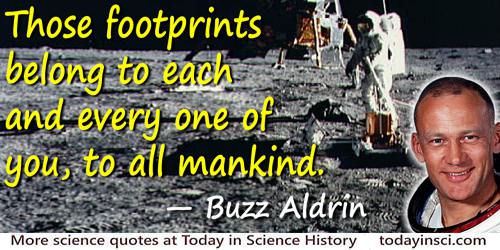
The honor you have given us goes not to us as a crew, but to ... all Americans, who believed, who persevered with us. What Apollo has begun we hope will spread out in many directions, not just in space, but underneath the seas, and in the cities to tell us unforgettably what we will and must do. There are footprints on the moon. Those footprints belong to each and every one of you, to all mankind. They are there because of the blood, sweat, and tears of millions of people. Those footprints are the symbol of true human spirit.
From his acceptance speech (13 Aug 1969) for the Medal of Freedom presented to him as one of the three astronauts on the first manned moon landing mission. In Leon Wagener, One Giant Leap: Neil Armstrong's Stellar American Journey (2004), 226.
The influence of the mathematics of Leibnitz upon his philosophy appears chiefly in connection with his law of continuity and his prolonged efforts to establish a Logical Calculus. … To find a Logical Calculus (implying a universal philosophical language or system of signs) is an attempt to apply in theological and philosophical investigations an analytic method analogous to that which had proved so successful in Geometry and Physics. It seemed to Leibnitz that if all the complex and apparently disconnected ideas which make up our knowledge could be analysed into their simple elements, and if these elements could each be represented by a definite sign, we should have a kind of “alphabet of human thoughts.” By the combination of these signs (letters of the alphabet of thought) a system of true knowledge would be built up, in which reality would be more and more adequately represented or symbolized. … In many cases the analysis may result in an infinite series of elements; but the principles of the Infinitesimal Calculus in mathematics have shown that this does not necessarily render calculation impossible or inaccurate. Thus it seemed to Leibnitz that a synthetic calculus, based upon a thorough analysis, would be the most effective instrument of knowledge that could be devised. “I feel,” he says, “that controversies can never be finished, nor silence imposed upon the Sects, unless we give up complicated reasonings in favor of simple calculations, words of vague and uncertain meaning in favor of fixed symbols [characteres].” Thus it will appear that “every paralogism is nothing but an error of calculation.” “When controversies arise, there will be no more necessity of disputation between two philosophers than between two accountants. Nothing will be needed but that they should take pen in hand, sit down with their counting-tables, and (having summoned a friend, if they like) say to one another: Let us calculate.” This sounds like the ungrudging optimism of youth; but Leibniz was optimist enough to cherish the hope of it to his life’s end.
By Robert Latta in 'Introduction' to his translation of Gottfried Leibnitz, The Monadology and Other Philosophical Writings (1898), 85. Also quoted (omitting the last sentence) in Robert Édouard Moritz, Memorabilia Mathematica; Or, The Philomath’s Quotation-Book (1914), 205-206.
The invention of what we may call primary or fundamental notation has been but little indebted to analogy, evidently owing to the small extent of ideas in which comparison can be made useful. But at the same time analogy should be attended to, even if for no other reason than that, by making the invention of notation an art, the exertion of individual caprice ceases to be allowable. Nothing is more easy than the invention of notation, and nothing of worse example and consequence than the confusion of mathematical expressions by unknown symbols. If new notation be advisable, permanently or temporarily, it should carry with it some mark of distinction from that which is already in use, unless it be a demonstrable extension of the latter.
In 'Calculus of Functions', Encyclopaedia of Pure Mathematics (1847), Addition to Article 26, 388.
The mathematician requires tact and good taste at every step of his work, and he has to learn to trust to his own instinct to distinguish between what is really worthy of his efforts and what is not; he must take care not to be the slave of his symbols, but always to have before his mind the realities which they merely serve to express. For these and other reasons it seems to me of the highest importance that a mathematician should be trained in no narrow school; a wide course of reading in the first few years of his mathematical study cannot fail to influence for good the character of the whole of his subsequent work.
In Presidential Address British Association for the Advancement of Science, Section A, (1890), Nature, 42, 467.
The mathematician, carried along on his flood of symbols, dealing apparently with purely formal truths, may still reach results of endless importance for our description of the physical universe.
In The Grammar of Science (1900), 505.
The monogram of our national initials, which is the symbol for our monetary unit, the dollar, is almost as frequently conjoined to the figures of an engineer’s calculations as are the symbols indicating feet, minutes, pounds, or gallons. … This statement, while true in regard to the work of all engineers, applies particularly to that of the mechanical engineer…
'The Engineer as an Economist', Proceedings of the Chicago Meeting (25-28 May 1886)Transactions of the American Society of Mechanical Engineers (1886), 7, 428.
The most striking characteristic of the written language of algebra and of the higher forms of the calculus is the sharpness of definition, by which we are enabled to reason upon the symbols by the mere laws of verbal logic, discharging our minds entirely of the meaning of the symbols, until we have reached a stage of the process where we desire to interpret our results. The ability to attend to the symbols, and to perform the verbal, visible changes in the position of them permitted by the logical rules of the science, without allowing the mind to be perplexed with the meaning of the symbols until the result is reached which you wish to interpret, is a fundamental part of what is called analytical power. Many students find themselves perplexed by a perpetual attempt to interpret not only the result, but each step of the process. They thus lose much of the benefit of the labor-saving machinery of the calculus and are, indeed, frequently incapacitated for using it.
In 'Uses of Mathesis', Bibliotheca Sacra (Jul 1875), 32, 505.
The results of systematic symbolical reasoning must always express general truths, by their nature; and do not, for their justification, require each of the steps of the process to represent some definite operation upon quantity. The absolute universality of the interpretation of symbols is the fundamental principle of their use.
In 'The Foundations of Higher Mathematics', The Philosophy of the Inductive Sciences (1847), Part I, Bk. 2, 149.
The study of … simple cases would, I think, often be of advantage even to students whose mathematical attainments are sufficient to enable them to follow the solution of the more general cases. For in these simple cases the absence of analytical difficulties allows attention to be more easily concentrated on the physical aspects of the question, and thus gives the student a more vivid idea and a more manageable grasp of the subject than he would be likely to attain if he merely regarded electrical phenomena through a cloud of analytical symbols.
Elements of the Mathematical Theory of Electricity and Magnetism (189S), v-vi.
The study of economics does not seem to require any specialised gifts of an unusually high order. Is it not, intellectually regarded, a very easy subject compared with the higher branches of philosophy and pure science? Yet good, or even competent, economists are the rarest of birds. An easy subject, at which very few excel! The paradox finds its explanation, perhaps, in that the master-economist must possess a rare combination of gifts. He must reach a high standard in several different directions and must combine talents not often found together. He must be mathematician, historian, statesman, philosopher—in some degree. He must understand symbols and speak in words. He must contemplate the particular in terms of the general, and touch abstract and concrete in the same flight of thought. He must study the present in the light of the past for the purposes of the future. No part of man's nature or his institutions must lie entirely outside his regard. He must be purposeful and disinterested in a simultaneous mood; as aloof and incorruptible as an artist, yet sometimes as near the earth as a politician.
'Alfred Marshall: 1842-1924' (1924). In Geoffrey Keynes (ed.), Essays in Biography (1933), 170.
The Syllogism consists of propositions, propositions consist of words, words are symbols of notions. Therefore if the notions themselves (which is the root of the matter) are confused and over-hastily abstracted from the facts, there can be no firmness in the superstructure. Our only hope therefore lies in a true induction.
From Novum Organum (1620), Book 1, Aphorism 14. Translated as The New Organon: Aphorisms Concerning the Interpretation of Nature and the Kingdom of Man), collected in James Spedding, Robert Ellis and Douglas Heath (eds.), The Works of Francis Bacon (1857), Vol. 4, 49.
The symbol A is not the counterpart of anything in familiar life. To the child the letter A would seem horribly abstract; so we give him a familiar conception along with it. “A was an Archer who shot at a frog.” This tides over his immediate difficulty; but he cannot make serious progress with word-building so long as Archers, Butchers, Captains, dance round the letters. The letters are abstract, and sooner or later he has to realise it. In physics we have outgrown archer and apple-pie definitions of the fundamental symbols. To a request to explain what an electron really is supposed to be we can only answer, “It is part of the A B C of physics”.
In Introduction to The Nature of the Physical World (1928), xiv.
The training which mathematics gives in working with symbols is an excellent preparation for other sciences; … the world’s work requires constant mastery of symbols.
In Teaching of Mathematics in the Elementary and the Secondary School (1906), 42.
The woof and warp of all thought and all research is symbols, and the life of thought and science is the life inherent in symbols; so that it is wrong to say that a good language is important to good thought, merely; for it is the essence of it.
From 'The Ethics of Terminology', in Collected Papers (1931), Vol. 1, 129.
There are in this world optimists who feel that any symbol that starts off with an integral sign must necessarily denote something that will have every property that they should like an integral to possess. This of course is quite annoying to us rigorous mathematicians; what is even more annoying is that by doing so they often come up with the right answer.
In 'Integrals Devised for Special Purposes', Bulletin of the American Mathematical Society (1963), 69, 611.
There is a strange disparity between the sciences of inert matter and those of life. Astronomy, mechanics, and physics are based on concepts which can be expressed, tersely and elegantly, in mathematical language. They have built up a universe as harmonious as the monuments of ancient Greece. They weave about it a magnificent texture of calculations and hypotheses. They search for reality beyond the realm of common thought up to unutterable abstractions consisting only of equations of symbols. Such is not the position of biological sciences. Those who investigate the phenomena of life are as if lost in an inextricable jungle, in the midst of a magic forest, whose countless trees unceasingly change their place and their shape. They are crushed under a mass of facts, which they can describe but are incapable of defining in algebraic equations.
Man the Unknown (1935), 1.
There is symbolic as well as actual beauty in the migration of the birds, the ebb and flow of the tides, the folded bud ready for the spring. There is something infinitely healing in the repeated refrains of nature—the assurance that dawn comes after night, and spring after the winter.
In The Sense of Wonder (1956, 1965), 88-89.
This has been far more than three men on a mission to the Moon; more still than the efforts of a government and industry team; more, even, than the efforts of one nation. We feel this stands as a symbol of the insatiable curiosity of all mankind to explore the unknown.
…...
This maze of symbols, electric and magnetic potential, vector potential, electric force, current, displacement, magnetic force, and induction, have been practically reduced to two, electric and magnetic force.
Describing Heaviside’s refinement of the original Maxwell Equations. In Joseph Larmore (ed.), The Scientific Writings of the Late George Francis Fitzgerald (1902) 294.
Thought-economy is most highly developed in mathematics, that science which has reached the highest formal development, and on which natural science so frequently calls for assistance. Strange as it may seem, the strength of mathematics lies in the avoidance of all unnecessary thoughts, in the utmost economy of thought-operations. The symbols of order, which we call numbers, form already a system of wonderful simplicity and economy. When in the multiplication of a number with several digits we employ the multiplication table and thus make use of previously accomplished results rather than to repeat them each time, when by the use of tables of logarithms we avoid new numerical calculations by replacing them by others long since performed, when we employ determinants instead of carrying through from the beginning the solution of a system of equations, when we decompose new integral expressions into others that are familiar,—we see in all this but a faint reflection of the intellectual activity of a Lagrange or Cauchy, who with the keen discernment of a military commander marshalls a whole troop of completed operations in the execution of a new one.
In Populär-wissenschafliche Vorlesungen (1903), 224-225.
Two kinds of symbol must surely be distinguished. The algebraic symbol comes naked into the world of mathematics and is clothed with value by its masters. A poetic symbol—like the Rose, for Love, in Guillaume de Lorris—comes trailing clouds of glory from the real world, clouds whose shape and colour largely determine and explain its poetic use. In an equation, x and y will do as well as a and b; but the Romance of the Rose could not, without loss, be re-written as the Romance of the Onion, and if a man did not see why, we could only send him back to the real world to study roses, onions, and love, all of them still untouched by poetry, still raw.
C.S. Lewis and E.M. Tillyard, The Personal Heresy: A Controversy (1936), 97.
Two lights for guidance. The first, our little glowing atom of community, with all that it signifies. The second, the cold light of the stars, symbol of the hypercosmical reality, with its crystal ecstasy. Strange that in this light, in which even the dearest love is frostily asserted, and even the possible defeat of our half-waking world is contemplated without remission of praise, the human crisis does not lose but gains significance. Strange, that it seems more, not less, urgent to play some part in this struggle, this brief effort of animalcules striving to win for their race some increase of lucidity before the ultimate darkness.
…...
We have to build the spiritual world out of symbols taken from our own personality, as we build the scientific world out of the symbols of the mathematician.
Swarthmore Lecture (1929) at Friends’ House, London, printed in Science and the Unseen World (1929), 82.
We have two kinds of knowledge which I call symbolic knowledge and intimate knowledge. I do not know whether it would be correct to say that reasoning is only applicable to symbolic knowledge, but the more customary forms of reasoning have been developed for symbolic knowledge only. The intimate knowledge will not submit to codification and analysis; or, rather, when we attempt to analyse it the intimacy is lost and it is replaced by symbolism. … Experience is intimate knowledge.
In 'Science and Mysticism', The Nature of the Physical World (1928), 321-322.
We may see how unexpectedly recondite parts of pure mathematics may bear upon physical science, by calling to mind the circumstance that Fresnel obtained one of the most curious confirmations of the theory (the laws of Circular Polarization by reflection) through an interpretation of an algebraical expression, which, according to the original conventional meaning of the symbols, involved an impossible quantity.
In History of Scientific Ideas, Bk. 2, chap. 14, sect. 8.
We thought of universities as the cathedrals of the modern world. In the middle ages, the cathedral was the center and symbol of the city. In the modern world, its place could be taken by the university.
L.A. Times (21 Jul 1999)
Without tracing back to the Tower of Babel, one can observe that the very idea of building a very tall tower has long haunted human imagination. That kind of victory over the formidable law of gravity that tethers man to the ground has always appeared to him a symbol of the force and the challenges overcome.
From the original French, “Sans remonter à la Tour de Babel, on peut observer que l’idée même de la construction d’une tour de très grande hauteur a depuis longtemps hanté l'imagination des hommes. Celle sorte de victoire sur cette terrible loi de la pesanteur qui attache l’homme au sol lui a toujours paru un symbole de la force et des difficultés vaincues.” First sentences of Chap. 1, in Travaux Scientifiques Exécutés à la Tour de 300 Mètres de 1889 à 1900 (1900), 1. English translation by Webmaster using online resources.
 In science it often happens that scientists say, 'You know that's a really good argument; my position is mistaken,' and then they would actually change their minds and you never hear that old view from them again. They really do it. It doesn't happen as often as it should, because scientists are human and change is sometimes painful. But it happens every day. I cannot recall the last time something like that happened in politics or religion.
(1987) --
In science it often happens that scientists say, 'You know that's a really good argument; my position is mistaken,' and then they would actually change their minds and you never hear that old view from them again. They really do it. It doesn't happen as often as it should, because scientists are human and change is sometimes painful. But it happens every day. I cannot recall the last time something like that happened in politics or religion.
(1987) -- 





.jpg)

