Survival Of The Fittest Quotes (43 quotes)
Dinosaur: I plan to use punctuated equilibrium to turn this zit into a third eye.
Catbert: That's not a natural advantage. You'd better stay away from the fitter dinosaurs.
Catbert: That's not a natural advantage. You'd better stay away from the fitter dinosaurs.
Dilbert comic strip (30 Aug 2002).
By the advance of civilization, a sharper and more healthy form of competition is brought about. The markets have become more fastidious; and he who puts such a product upon the market as it demands controls that market, regardless of color. It is simply a survival of the fittest.
In Farmer’s Leaflet 7: The Need of Scientific Agriculture in the South (1902). Reprinted in The Review of Reviews (1902), 25, 322.
Everything that comes into being seeks room for itself and desires duration: hence it drives something else from its place and shortens its duration.
In The Maxims and Reflections of Goethe (1906), 199.
Evolution is the law of policies: Darwin said it, Socrates endorsed it, Cuvier proved it and established it for all time in his paper on 'The Survival of the Fittest.' These are illustrious names, this is a mighty doctrine: nothing can ever remove it from its firm base, nothing dissolve it, but evolution.
'Three Thousand Years Among the Microbes', Which Was the Dream? (1967), Chap. 8. In Mark Twain and Brian Collins (ed.), When in Doubt, Tell the Truth: and Other Quotations from Mark Twain (1996), 47.
He who has mastered the Darwinian theory, he who recognizes the slow and subtle process of evolution as the way in which God makes things come to pass, … sees that in the deadly struggle for existence that has raged throughout countless aeons of time, the whole creation has been groaning and travailing together in order to bring forth that last consummate specimen of God’s handiwork, the Human Soul
In The Destiny of Man Viewed in the Light of his Origin (1884), 32. Collected in Studies in Religion (1902), 19–20.
I fully agree with all that you say on the advantages of H. Spencer's excellent expression of 'the survival of the fittest.' This, however, had not occurred to me till reading your letter. It is, however, a great objection to this term that it cannot be used as a substantive governing a verb; and that this is a real objection I infer from H. Spencer continually using the words, natural selection.
Letter to A. R. Wallace July 1866. In Francis Darwin (ed.), The Life and Letters of Charles Darwin, Including an Autobiographical Chapter (1887), Vol. 3, 45-6.
I have called this principle, by which each slight variation, if useful, is preserved, by the term Natural Selection, in order to mark its relation to man's power of selection. But the expression often used by Mr. Herbert Spencer of the Survival of the Fittest is more accurate, and is sometimes equally convenient.
from Origin of Species (1859, 1888), 49.
I never said a word against eminent men of science. What I complain of is a vague popular philosophy which supposes itself to be scientific when it is really nothing but a sort of new religion and an uncommonly nasty one. When people talked about the fall of man, they knew they were talking about a mystery, a thing they didn’t understand. Now they talk about the survival of the fittest: they think they do understand it, whereas they have not merely no notion, they have an elaborately false notion of what the words mean.
In The Club of Queer Trades (1903, 1905), 241.
I was suffering from a sharp attack of intermittent fever, and every day during the cold and succeeding hot fits had to lie down for several hours, during which time I had nothing to do but to think over any subjects then particularly interesting me. One day something brought to my recollection Malthus's 'Principles of Population', which I had read about twelve years before. I thought of his clear exposition of 'the positive checks to increase'—disease, accidents, war, and famine—which keep down the population of savage races to so much lower an average than that of more civilized peoples. It then occurred to me that these causes or their equivalents are continually acting in the case of animals also; and as animals usually breed much more rapidly than does mankind, the destruction every year from these causes must be enormous in order to keep down the numbers of each species, since they evidently do not increase regularly from year to year, as otherwise the world would long ago have been densely crowded with those that breed most quickly. Vaguely thinking over the enormous and constant destruction which this implied, it occurred to me to ask the question, Why do some die and some live? The answer was clearly, that on the whole the best fitted live. From the effects of disease the most healthy escaped; from enemies, the strongest, swiftest, or the most cunning; from famine, the best hunters or those with the best digestion; and so on. Then it suddenly flashed upon me that this self-acting process would necessarily improve the race, because in every generation the inferior would inevitably be killed off and the superior would remain—that is, the fittest would survive.
[The phrase 'survival of the fittest,' suggested by the writings of Thomas Robert Malthus, was expressed in those words by Herbert Spencer in 1865. Wallace saw the term in correspondence from Charles Darwin the following year, 1866. However, Wallace did not publish anything on his use of the expression until very much later, and his recollection is likely flawed.]
[The phrase 'survival of the fittest,' suggested by the writings of Thomas Robert Malthus, was expressed in those words by Herbert Spencer in 1865. Wallace saw the term in correspondence from Charles Darwin the following year, 1866. However, Wallace did not publish anything on his use of the expression until very much later, and his recollection is likely flawed.]
My Life: A Record of Events and Opinions (1905), Vol. 1, 361-362, or in reprint (2004), 190.
If Darwin were alive today the insect world would delight and astound him with its impressive verification of his theories of the survival of the fittest. Under the stress of intensive chemical spraying the weaker members of the insect populations are being weeded out… . Only the strong and fit remain to defy our efforts to control them.
In Silent Spring (1952, 1962), 263.
If only the fit survive and if the fitter they are the longer they survive, then Volvox must have demonstrated its superb fitness more conclusively than any higher animal ever has.
The Great Chain of Life (1957), 22.
In October 1838, that is, fifteen months after I had begun my systematic enquiry, I happened to read for amusement Malthus on Population, and being well prepared to appreciate the struggle for existence which everywhere goes on from long-continued observation of the habits of animals and plants, it at once struck me that under these circumstances favourable variations would tend to be, preserved, and unfavourable ones to be destroyed. The result of this would be the formation of new species. Here, then, I had at last got a theory by which to work; but I was so anxious to avoid prejudice, that I determined not for some time to write even the briefest sketch of it.
In Charles Darwin and Francis Darwin (ed.), Charles Darwin: His Life Told in an Autobiographical Chapter, and in a Selected Series of His Published Letters (1892), 40.
In the animal world we have seen that the vast majority of species live in societies, and that they find in association the best arms for the struggle for life: understood, of course, in its wide Darwinian sense—not as a struggle for the sheer means of existence, but as a struggle against all natural conditions unfavourable to the species. The animal species, in which individual struggle has been reduced to its narrowest limits, and the practice of mutual aid has attained the greatest development, are invariably the most numerous, the most prosperous, and the most open to further progress. The mutual protection which is obtained in this case, the possibility of attaining old age and of accumulating experience, the higher intellectual development, and the further growth of sociable habits, secure the maintenance of the species, its extension, and its further progressive evolution. The unsociable species, on the contrary, are doomed to decay.
Mutual Aid: A Factor of Evolution (1902), 293.
In the struggle for survival, the fittest win out at the expense of their rivals because they succeed in adapting themselves best to their environment. [Modern paraphrase; Darwin never wrote with these words.]
This is NOT AN AUTHENTIC Darwin quote. It is just a modern paraphrase, commonly seen in books and on the web. It is included here so that this caution can be attached to it.

In these strenuous times, we are likely to become morbid and look constantly on the dark side of life, and spend entirely too much time considering and brooding over what we can't do, rather than what we can do, and instead of growing morose and despondent over opportunities either real or imaginary that are shut from us, let us rejoice at the many unexplored fields in which there is unlimited fame and fortune to the successful explorer and upon which there is no color line; simply the survival of the fittest.
In article urging African-Americans to engage in plant breeding to develop improved species.'A New Industry for Colored Men and Women', Colored American (Jan 1908, 14, 33. Cited in Linda O. McMurry, George Washington Carver, Scientist and Symbol (1982), 109.
In true natural selection, if a body has what it takes to survive, its genes automatically survive because they are inside it. So the genes that survive tend to be, automatically, those genes that confer on bodies the qualities that assist them to survive.
The Blind Watchmaker (1996), 57
It has been a bitter mortification for me to digest the conclusion that the “race is for the strong” and that I shall probably do little more but be content to admire the strides others made in science.
Charles Darwin and Francis Darwin (ed.), Charles Darwin's Works (1896), Vol. 1, 243.
Kids who aren’t even allowed to have hazardous toys, … Hazardous toys…! Whatever happened to natural selection? Survival of the fittest? The kid who swallows too many marbles doesn’t grow up to have kids of his own. Simple stuff. Nature knows best!
In Napalm and Silly Putty (2001), 56.
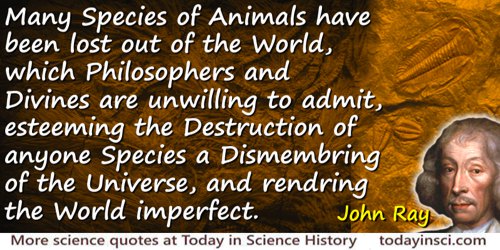
Many Species of Animals have been lost out of the World, which Philosophers and Divines are unwilling to admit, esteeming the Destruction of anyone Species a Dismembring of the Universe, and rendring the World imperfect; whereas they think the Divine Providence is especially concerned, and solicitous to secure and preserve the Works of the Creation. And truly so it is, as appears, in that it was so careful to lodge all Land Animals in the Ark at the Time of the general Deluge; and in that, of all Animals recorded in Natural Histories, we cannot say that there hath been anyone Species lost, no not of the most infirm, and most exposed to Injury and Ravine. Moreover, it is likely, that as there neither is nor can be any new Species of Animals produced, all proceeding from Seeds at first created; so Providence, without which one individual Sparrow falls not to the ground, doth in that manner watch over all that are created, that an entire Species shall not be lost or destroyed by any Accident. Now, I say, if these Bodies were sometimes the Shells and Bones of Fish, it will thence follow, that many Species have been lost out of the World... To which I have nothing to reply, but that there may be some of them remaining some where or other in the Seas, though as yet they have not come to my Knowledge. Far though they may have perished, or by some Accident been destroyed out of our Seas, yet the Race of them may be preserved and continued still in others.
— John Ray
Three Physico-Theological Discourses (1713), Discourse II, 'Of the General Deluge, in the Days of Noah; its Causes and Effects', 172-3.
Might one not say that in the chance combination of nature's production, since only those endowed with certain relations of suitability could survive, it is no cause for wonder that this suitability is found in all species that exist today? Chance, one might say, produced an innumerable multitude of individuals; a small number turned out to be constructed in such fashion that the parts of the animal could satisfy its needs; in another, infinitely greater number, there was neither suitability nor order: all of the later have perished; animals without a mouth could not live, others lacking organs for reproduction could not perpetuate themselves: the only ones to have remained are those in which were found order and suitability; and these species, which we see today, are only the smallest part of what blind fate produced.
'Essai de Cosmologie' in Oeuvres de Mr. De Maupertuis (1756), Vol. 1, 11-12. Quoted in Jacques Roger, The Life Sciences in Eighteenth-Century French Thought, ed. Keith R. Benson and trans. Robert Ellrich (1997), 381.
Nature abhors a hero. For one thing, he violates the law of conservation of energy. For another, how can it be the survival of the fittest when the fittest keeps putting himself in situations where he is most likely to be creamed?
…...
Nature is not cruel, only pitilessly indifferent. This is one of the hardest lessons for humans to learn. We cannot admit that things might be neither good nor evil, neither cruel nor kind, but simply callous—indifferent to all suffering, lacking all purpose.
River Out of Eden: A Darwinian View of Life (1995), 112.
Nature knows no political boundaries. She puts living creatures on this globe and watches the free play of forces. She then confers the master's right on her favourite child, the strongest in courage and industry ... The stronger must dominate and not blend with the weaker, thus sacrificing his own greatness. Only the born weakling can view this as cruel.
Mein Kampf (1925-26), American Edition (1943), 134-5. In William Lawrence Shirer, The Rise and Fall of the Third Reich (1990), 86.
Nature produces those things which, being continually moved by a certain principle contained in themselves, arrive at a certain end.
In 'Physics' as quoted by Henry Fairfield Osborn in Address (29 Dec 1925) for the Opening of the new Peabody Museum of Yale University, 'The Origin of Species 1859-1925', The Scientific Monthly (Mar 1926), Vol. 22, 190.
Nature's stern discipline enjoins mutual help at least as often as warfare. The fittest may also be the gentlest.
Mankind Evolving (1962), 134.
So the horns of the stag are sharp to offend his adversary, but are branched for the purpose of parrying or receiving the thrusts of horns similar to his own, and have therefore been formed for the purpose of combating other stags for the exclusive possession of the females; who are observed, like the ladies in the times of chivalry, to attend to the car of the victor... The final cause of this contest amongst the males seems to be, that the strongest and most active animal should propagate the species, which should thence become improved.
Zoonomia (1794), Vol. 1, 507.
Such biological ideas as the “survival of the fittest,” whatever their doubtful value in natural science, are utterly useless in attempting to understand society … The life of a man in society, while it is incidentally a biological fact, has characteristics that are not reducible to biology and must be explained in the distinctive terms of a cultural analysis … the physical well-being of men is a result of their social organization and not vice versa … Social improvement is a product of advances in technology and social organization, not of breeding or selective elimination … Judgments as to the value of competition between men or enterprises or nations must be based upon social and not allegedly biological consequences; and … there is nothing in nature or a naturalistic philosophy of life to make impossible the acceptance of moral sanctions that can be employed for the common good.
Social Darwinism in American Thought 1860-1915 (1945), 176.
Surely there’s no problem with having several conflicting theories of evolution? Eventually the fittest will survive.
Comment by Pete Bibby following an article, 'Scientists Are Still Fleshing Out Darwin’s Theory of Evolution', The Guardian (1 Jul 2022).
Survival of the fittest led to “nature red in tooth and claw” and this is not sufficiently wishy-washy for modern scientists.
In Science is a Sacred Cow (1950), 107.
The conflict of theories, leading, as it eventually must, to the survival of the fittest, is advantageous.
In Address (11 Dec 1895) as President of the Geological Society, 'The Origin of Hypotheses, illustrated by the Discussion of a Topographical Problem', printed as Presidential Address of Grove Karl Gilbert (1896), 4. Also collected in Science (1896), 3, 2.
The embryological record is almost always abbreviated in accordance with the tendency of nature (to be explained on the principle of survival of the fittest) to attain her needs by the easiest means.
A Treatise on Comparative Embryology (1880), Vol. I, 3-4.
The expression often used by Mr. Herbert Spencer of the Survival of the Fittest is more accurate, and is sometimes equally convenient
Origin of Species, Ch. 3.
The fittest survive.
What is meant by the fittest?
Not the strongest; not the cleverest—
Weakness and stupidity everywhere survive.
There is no way of determining fitness except in that a thing does survive.
'Fitness,' then, is only another name for 'survival.'
Darwinism:
That survivors survive.
What is meant by the fittest?
Not the strongest; not the cleverest—
Weakness and stupidity everywhere survive.
There is no way of determining fitness except in that a thing does survive.
'Fitness,' then, is only another name for 'survival.'
Darwinism:
That survivors survive.
The Book of the Damned (1932). In The Complete Books of Charles Fort (1975), 24.
The growth of a large business is merely a survival of the fittest. … The American Beauty rose can be produced in the splendor and fragrance which bring cheer to its beholder only by sacrificing the early buds which grow up around it. This is not an evil tendency in business. It is merely the working-out of a law of nature and a law of God.
From address to the Brown University YMCA, as quoted in 'Young Rockefeller: Defending Trusts, Uses American Beauty Similitude,' Cincinnati Enquirer (9 Feb 1902), 4, citing the New York Journal.
The problem [evolution] presented itself to me, and something led me to think of the positive checks described by Malthus in his Essay on Population, a work I had read several years before, and which had made a deep and permanent impression on my mind. These checks—war, disease, famine, and the like—must, it occurred to me, act on animals as well as man. Then I thought of the enormously rapid multiplication of animals, causing these checks to be much more effective in them than in the case of man; and while pondering vaguely on this fact, there suddenly flashed upon me the idea of the survival of the fittest—that the individuals removed by these checks must be on the whole inferior to those that survived. I sketched the draft of my paper … and sent it by the next post to Mr. Darwin.
In 'Introductory Note to Chapter II in Present Edition', Natural Selection and Tropical Nature Essays on Descriptive and Theoretical Biology (1891, New ed. 1895), 20.
The process of natural selection has been summed up in the phrase “survival of the fittest.” This, however, tells only part of the story. “Survival of the existing” in many cases covers more of the truth. For in hosts of cases the survival of characters rests not on any special usefulness or fitness, but on the fact that individuals possessing these characters have inhabited or invaded a certain area. The principle of utility explains survivals among competing structures. It rarely accounts for qualities associated with geographic distribution.
The nature of animals which first colonize a district must determine what the future fauna will be. From their specific characters, which are neither useful nor harmful, will be derived for the most part the specific characters of their successors.
It is not essential to the meadow lark that he should have a black blotch on the breast or the outer tail-feather white. Yet all meadow larks have these characters just as all shore larks have the tiny plume behind the ear. Those characters of the parent stock, which may be harmful in the new relations, will be eliminated by natural selection. Those especially helpful will be intensified and modified, but the great body of characters, the marks by which we know the species, will be neither helpful nor hurtful. These will be meaningless streaks and spots, variations in size of parts, peculiar relations of scales or hair or feathers, little matters which can neither help nor hurt, but which have all the persistence heredity can give.
The nature of animals which first colonize a district must determine what the future fauna will be. From their specific characters, which are neither useful nor harmful, will be derived for the most part the specific characters of their successors.
It is not essential to the meadow lark that he should have a black blotch on the breast or the outer tail-feather white. Yet all meadow larks have these characters just as all shore larks have the tiny plume behind the ear. Those characters of the parent stock, which may be harmful in the new relations, will be eliminated by natural selection. Those especially helpful will be intensified and modified, but the great body of characters, the marks by which we know the species, will be neither helpful nor hurtful. These will be meaningless streaks and spots, variations in size of parts, peculiar relations of scales or hair or feathers, little matters which can neither help nor hurt, but which have all the persistence heredity can give.
Foot-notes to Evolution. A Series of Popular Addresses on the Evolution of Life (1898), 218.
There are, as we have seen, a number of different modes of technological innovation. Before the seventeenth century inventions (empirical or scientific) were diffused by imitation and adaption while improvement was established by the survival of the fittest. Now, technology has become a complex but consciously directed group of social activities involving a wide range of skills, exemplified by scientific research, managerial expertise, and practical and inventive abilities. The powers of technology appear to be unlimited. If some of the dangers may be great, the potential rewards are greater still. This is not simply a matter of material benefits for, as we have seen, major changes in thought have, in the past, occurred as consequences of technological advances.
Concluding paragraph of "Technology," in Dictionary of the History of Ideas (1973), Vol. 4, 364.
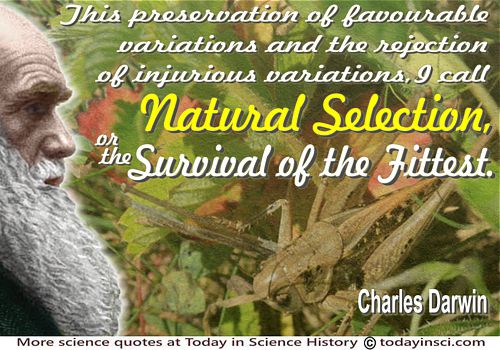
This preservation of favourable variations and the destruction of injurious variations, I call Natural Selection, or the Survival of the Fittest. Variations neither useful nor injurious would not be affected by natural selection and would be left a fluctuating element.
From Origin of Species (fifth edition, 1869), 81. The phrase “survival of the fittest” was not added until the fifth edition (1869), and is absent from earlier editions. Also in the fifth edition, the word “destruction” replaced “rejection” used in the earlier editions (1859, 1860, 1861, 1866) to the fourth edition.
This preservation of favourable variations and the rejection of injurious variations, I call Natural Selection. Variations neither useful nor injurious would not be affected by natural selection and would be left a fluctuating element.
From Origin of Species (first edition, 1859), 81. The phrase “survival of the fittest” was not added until the fifth edition (1869), when also “rejection” was replaced with “destruction.”
This survival of the fittest implies multiplication of the fittest.
[The phrase “survival of the fittest” was not originated by Charles Darwin, though he discussed Spencer's “excellent expression” in a letter to A. R. Wallace (Jul 1866).]
[The phrase “survival of the fittest” was not originated by Charles Darwin, though he discussed Spencer's “excellent expression” in a letter to A. R. Wallace (Jul 1866).]
In Principles of Biology (1865, 1872), Vol. 1, 444.
This survival of the fittest which I have here sought to express in mechanical terms, is that which Mr. Darwin has called “natural selection, or the preservation of favoured races in the struggle for life.”
Principles of Biology (1865, 1872), Vol. 1, 444-445.
We will now discuss in a little more detail the Struggle for Existence.
On the Origin of Species by Means of Natural Selection (1859, 1902), 57.
While the law [of competition] may be sometimes hard for the individual, it is best for the race, because it insures the survival of the fittest in every department. We accept and welcome, therefore, as conditions to which we must accommodate ourselves, great inequality of environment, the concentration of business, industrial and commercial, in the hands of a few, and the law of competition between these, as being not only beneficial, but essential for the future progress of the race.
Wealth (1899), 655.
 In science it often happens that scientists say, 'You know that's a really good argument; my position is mistaken,' and then they would actually change their minds and you never hear that old view from them again. They really do it. It doesn't happen as often as it should, because scientists are human and change is sometimes painful. But it happens every day. I cannot recall the last time something like that happened in politics or religion.
(1987) --
In science it often happens that scientists say, 'You know that's a really good argument; my position is mistaken,' and then they would actually change their minds and you never hear that old view from them again. They really do it. It doesn't happen as often as it should, because scientists are human and change is sometimes painful. But it happens every day. I cannot recall the last time something like that happened in politics or religion.
(1987) -- 




