Superstition Quotes (72 quotes)
[Science] intensifies religious truth by cleansing it of ignorance and superstition.
Quoted in 'Antiseptic Christianity', book review of Lindbergh, Of Flight and Life in Time magazine, (6 Sep 1948).
[Understanding] dispels superstition, and it gives you a feeling of mastery which you can’t have any other way.
In interview, Rushworth M. Kidder, 'Grounded in Space Science', Christian Science Monitor (22 Dec 1989).
[William Henry] Flower [the Anglican] too praised evolution as a cleansing solvent, dissolving the dross which had “encrusted” Christianity “in the days of ignorance and superstition.”
Huxley: From Devil's Disciple To Evolution's High Priest (1997), 305.
[With] our critical faculties in decline, unable to distinguish between what feels good and what’s true, we slide, almost without noticing, back into superstition. … We have also arranged things so that almost no one understands science and technology. We might get away with it for a while, but eventually this combustible mixture of ignorance and power is going to blow up in our faces.
In 'With Science on Our Side', Washington Post (9 Jan 1994).
Mathematical Knowledge adds a manly Vigour to the Mind, frees it from Prejudice, Credulity, and Superstition.
In An Essay On the Usefulness of Mathematical Learning, (1701), 7.
A fool’s brain digests philosophy into folly, science into superstition, and art into pedantry. Hence University education.
In 'Maxims for Revolutionists: Education', in Man and Superman (1903), 230.
A superstition is a premature explanation that overstays its time.
From chapter 'Jottings from a Note-book', in Canadian Stories (1918), 168.
A visitor to Niels Bohr's country cottage, noticing a horseshoe hanging on the wall, teasing the eminent scientist about this ancient superstition. “Can it be true that you, of all people, believe it will bring you luck?'
'Of course not,' replied Bohr, 'but I understand it brings you luck whether you believe it or not.'”
'Of course not,' replied Bohr, 'but I understand it brings you luck whether you believe it or not.'”
As described in Clifton Fadiman (ed.), André Bernard (ed.), Bartlett's Book of Anecdotes (2000), 68.
An extraterrestrial being, newly arrived on Earth - scrutinizing what we mainly present to our children in television, radio, movies, newspapers, magazines, the comics, and many books - might easily conclude that we are intent on teaching them murder, rape, cruelty, superstition, credulity and consumerism.
…...
Astrology is a disease, not a science... It is a tree under the shadow of which all sorts of superstitions thrive. ... Only fools and charlatans lend value to it.
Letter to Marseilles, 1195. Responsa, ii. 25b. In Philip Birnbaum (ed.), Mishneh Torah: Maimonides' Code of Law and Ethics (1974), 35.
Fear is the main source of superstition, and one of the main sources of cruelty. To conquer fear is the beginning of wisdom, in the pursuit of truth as in the endeavour after a worthy manner of life.
In An Outline of Intellectual Rubbish (1943), 23.
For my own part I would as soon be descended from that heroic little monkey, who braved his dreaded enemy in order to save the life of his keeper; or from that old baboon, who, descending from the mountains, carried away in triumph his young comrade from a crowd of astonished dogs—as from a savage who delights to torture his enemies, offers up bloody sacrifices, practices infanticide without remorse, treats his wives like slaves, knows no decency, and is haunted by the grossest superstitions.
The Descent of Man (1871), Vol. 2, 404-5.
Hellenic science is a victory of rationalism, which appears greater, not smaller, when one is made to realize that it had been won in spite of the irrational beliefs of the Greek people; all in all, it was a triumph of reason in the face of unreason. Some knowledge of Greek superstitions is needed not only for a proper appreciation of that triumph but also for the justification of occasional failures, such as the many Platonic aberrations.
In A History of Science: Volume 1: Ancient Science Through the Golden Age of Greece (1952), ix.
History warns us … that it is the customary fate of new truths to begin as heresies and to end as superstitions; and, as matters now stand, it is hardly rash to anticipate that, in another twenty years, the new generation, educated under the influences of the present day, will be in danger of accepting the main doctrines of the “Origin of Species,” with as little reflection, and it may be with as little justification, as so many of our contemporaries, twenty years ago, rejected them.
'The Coming of Age of the Origin of Species' (1880). In Collected Essays, Vol. 2: Darwiniana (1893), 229.
Humanity has the stars in its future, and that future is too important to be lost under the burden of juvenile folly and ignorant superstition.
In 'The Deadly Information', Introduction written by Asimov for James Randi, Flim-Flam (1982), xiii.
I maintain that the human mystery is incredibly demeaned by scientific reductionism, with its claim in promissory materialism to account eventually for all of the spiritual world in terms of patterns of neuronal activity. This belief must be classed as a superstition. ... We have to recognize that we are spiritual beings with souls existing in a spiritual world as well as material beings with bodies and brains existing in a material world.
In Evolution of the Brain: Creation of the Self (1991), 241.
I said, that Superstition was the child of Fear, and Fear the child of Ignorance; and you might expect me to say antithetically, that Science was the child of Courage, and Courage the child of Knowledge.
Opening of 'Science', a lecture delivered at the Royal Institution, published in Fraser's Magazine (Jul 1866), 74, 15.
I wished to show that Pythagoras, the first founder of the vegetable regimen, was at once a very great physicist and a very great physician; that there has been no one of a more cultured and discriminating humanity; that he was a man of wisdom and of experience; that his motive in commending and introducing the new mode of living was derived not from any extravagant superstition, but from the desire to improve the health and the manners of men.
From Dell Vitto Pitagorico (1743), (The Pythagorean Diet: for the Use of the Medical Faculty), as translated quotes in Howard Williams, The Ethics of Diet: A Catena of Authorities Deprecatory of the Practice of Flesh-Eating (1883), 158.
In ancient days heroes slew the dragons that terrified men; science is destroying the more dreadful superstitions that have darkened human lives.
With co-author Justus J. Schifferes, in The Autobiography of Science (Second Edition) (1960).
In the study of ideas, it is necessary to remember that insistence on hard-headed clarity issues from sentimental feeling, as it were a mist, cloaking the perplexities of fact. Insistence on clarity at all costs is based on sheer superstition as to the mode in which human intelligence functions. Our reasonings grasp at straws for premises and float on gossamers for deductions.
In Adventure of Ideas (1933), 91.
It is science alone that can solve the problems of hunger and poverty, of insanitation and literacy, of superstition and tradition, of vast resources running to waste, of a rich country inhabited by starving people. ... The future belongs to science and to those who make friends with science.
Address to the Indian Institute of Science, Proceedings of the National Institute of Science of India (1960), 27, 564, cited in Mary Midgley, The myths We live By (2004), 14., x. In Vinoth Ramachandra, Subverting Global Myths: Theology and the Public Issues Shaping our World (2008), 172.
It is science alone that can solve the problems of hunger and poverty, of insanitation and illiteracy, of superstition and deadening custom and tradition, of vast resources running to waste, of a rich country inhabited by starving people… Who indeed could afford to ignore science today? At every turn we have to seek its aid … the future belongs to science and those who make friends with science.
From address to the Indian Science Congress (26 Dec 1937). As cited in M.J. Vinod and Meena Deshpande, Contemporary Political Theory (2013), 507. An earlier, longer version of the quote is in Atma Ram, 'The Making of Optical Glass in India: Its Lessons for Industrial Development', Proceedings of the National Institute of Sciences of India (1961), 27, 564-5.
It is the business of science to offer rational explanations for all the events in the real world, and any scientist who calls on God to explain something is falling down on his job. This applies as much to the start of the expansion as to any other event. If the explanation is not forthcoming at once, the scientist must suspend judgment: but if he is worth his salt he will always maintain that a rational explanation will eventually be found. This is the one piece of dogmatism that a scientist can allow himself—and without it science would be in danger of giving way to superstition every time that a problem defied solution for a few years.
The Mystery of the Expanding Universe (1964), 122.
It is the customary fate of new truths to begin as heresies and to end as superstitions.
From Lecture (19 Mar 1880) delivered at the Royal Institute 'The Coming of Age of The Origin of Species', printed in John Michels (ed.), Science (3 Jul 1880), 1, 15. Also seen misquoted as, “Every truth starts life as a heresy and ends life as an orthodoxy.”
It is time, therefore, to abandon the superstition that natural science cannot be regarded as logically respectable until philosophers have solved the problem of induction. The problem of induction is, roughly speaking, the problem of finding a way to prove that certain empirical generalizations which are derived from past experience will hold good also in the future.
Language, Truth and Logic (1960), 49.
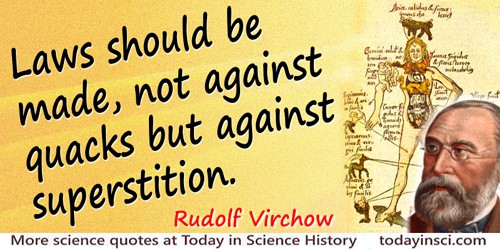
Laws should be made, not against quacks but against superstition.
In Fielding Hudson Garrison, An Introduction to the History of Medicine (1966), 577.
Mankind have been slow to believe that order reigns in the universe—that the world is a cosmos and a chaos.
… The divinities of heathen superstition still linger in one form or another in the faith of the ignorant, and even intelligent men shrink from the contemplation of one supreme will acting regularly, not fortuitously, through laws beautiful and simple rather than through a fitful and capricious system of intervention.
... The scientific spirit has cast out the demons, and presented us with nature clothed in her right mind and living under the reign of law. It has given us, for the sorceries of the alchemist, the beautiful laws of chemistry; for the dreams of the astrologer, the sublime truths of astronomy; for the wild visions of cosmogony, the monumental records of geology; for the anarchy of diabolism, the laws of God.
… The divinities of heathen superstition still linger in one form or another in the faith of the ignorant, and even intelligent men shrink from the contemplation of one supreme will acting regularly, not fortuitously, through laws beautiful and simple rather than through a fitful and capricious system of intervention.
... The scientific spirit has cast out the demons, and presented us with nature clothed in her right mind and living under the reign of law. It has given us, for the sorceries of the alchemist, the beautiful laws of chemistry; for the dreams of the astrologer, the sublime truths of astronomy; for the wild visions of cosmogony, the monumental records of geology; for the anarchy of diabolism, the laws of God.
Speech (16 Dec 1867) given while a member of the U.S. House of Representatives, introducing resolution for the appointment of a committee to examine the necessities for legislation upon the subject of the ninth census to be taken the following year. Quoted in John Clark Ridpath, The Life and Work of James A. Garfield (1881), 216.
Marxism is sociobiology without biology … Although Marxism was formulated as the enemy of ignorance and superstition, to the extent that it has become dogmatic it has faltered in that commitment and is now mortally threatened by the discoveries of human sociobiology.
In On Human Nature (1978), 191.
May we not suspect that the vague but very real fears of children, which are quite independent of experience, are the inherited effects of real dangers and abject superstitions during ancient savage times?
Mind, 1877
Men are probably nearer the essential truth in their superstitions than in their science.
Journal, 27 Jun 1852, in The Writings of Henry David Thoreau (1906), Vol. 10, 158.
Nominally a great age of scientific inquiry, ours has become an age of superstition about the infallibility of science; of almost mystical faith in its non-mystical methods; above all—which perhaps most explains the expert's sovereignty—of external verities; of traffic-cop morality and rabbit-test truth.
In Company Manners: A Cultural Inquiry into American Life (1954), 94.
One of the commonest dietary superstitions of the day is a belief in instinct as a guide to dietary excellence ... with a corollary that the diets of primitive people are superior to diets approved by science ... [and even] that light might be thrown on the problems of human nutrition by study of what chimpanzees eat in their native forests. ... Such notions are derivative of the eighteenth-century fiction of the happy and noble savage.
Nutrition and Public Health', League of Nations Health Organization Quarterly Bulletin (1935) 4, 323–474. In Kenneth J. Carpenter, 'The Work of Wallace Aykroyd: International Nutritionist and Author', The Journal of Nutrition (2007), 137, 873-878.
One of the greatest gifts science has brought to the world is continuing elimination of the supernatural, and it was a lesson that my father passed on to me, that knowledge liberates mankind from superstition. We can live our lives without the constant fear that we have offended this or that deity who must be placated by incantation or sacrifice, or that we are at the mercy of devils or the Fates. With increasing knowledge, the intellectual darkness that surrounds us is illuminated and we learn more of the beauty and wonder of the natural world.
…...
One of the greatest superstitions of our time is the belief that it has none.
In The Decline and Fall of Science (1976).
One of the largest promises of science is, that the sum of human happiness will be increased, ignorance destroyed, and, with ignorance, prejudice and superstition, and that great truth taught to all, that this world and all it contains were meant for our use and service; and that where nature by her own laws has defined the limits of original unfitness, science may by extract so modify those limits as to render wholesome that which by natural wildness was hurtful, and nutritious that which by natural poverty was unnourishing. We do not yet know half that chemistry may do by way of increasing our food.
'Common Cookery'. Household Words (26 Jan 1856), 13, 45. An English weekly magazine edited by Charles Dickens.
Paradoxically, science … has produced institutions, systems of thought and eventually social-political programs that bind people even more than the “superstitions” they replaced.
With co-author Hansfried Kellner, in Sociology Reinterpreted (1981).
Science can purify religion from error and superstition. Religion can purify science from idolatry and false absolutes. Each can draw the other into a wider world, a world in which both can flourish.
In Letter (1 Jun 1988) to Father George V. Coyne, Director of the Vatican Observatory. On vatican.va website.
Science did not germinate and grow on a healthy prairie of ignorance but in a noisome jungle of magic and superstition, which again and again choked the seedlings of knowledge.
In A Shorter History of Science (1944), 5.
Science is a body of truths which offers clear and certain knowledge about the real world and is therefore superior to tradition philosophy religion dogma and superstition which offer shadowy knowledge about an ideal world.
Need primary source (can you help?).
Science is one of our best weapons against authoritarianism, but authoritarianism has been known to surface among scientists. When this happens, misguided perfectionists or romanticists sometimes seek to root it out by attacking science. Instead of destroying science, which would merely return us to ignorance and superstition, what we need to do is to expose and root out the authoritarians.
In How to Tell the Liars from the Statisticians (1983), 129.
Science is our favorite modern superstition.
In conversation, 1970.
Science is the great antidote to the poison of enthusiasm and superstition.
An Inquiry into the Nature And Causes of the Wealth of Nations (1776, 1801), Vol. 2, 314.
Science of to-day—the superstition of to-morrow. Science of to-morrow—the superstition of to-day.
The Book of The Damned (1919), 157
Science would have us believe that such accuracy, leading to certainty, is the only criterion of knowledge, would make the trial of Galileo the paradigm of the two points of view which aspire to truth, would suggest, that is, that the cardinals represent only superstition and repression, while Galileo represents freedom. But there is another criterion which is systematically neglected in this elevation of science. Man does not now—and will not ever—live by the bread of scientific method alone. He must deal with life and death, with love and cruelty and despair, and so must make conjectures of great importance which may or may not be true and which do not lend themselves to experimentation: It is better to give than to receive; Love thy neighbor as thyself; Better to risk slavery through non-violence than to defend freedom with murder. We must deal with such propositions, must decide whether they are true, whether to believe them, whether to act on them—and scientific method is no help for by their nature these matters lie forever beyond the realm of science.
In The End of the Modern Age (1973), 89.
Scientific research can reduce superstition by encouraging people to think and survey things in terms of cause and effect. Certain it is that a conviction, akin to religious feeling, of the rationality or intelligibility of the world lies behind all scientific work of a higher order.
From 'Scientific Truth' in Essays in Science (1934, 2004), 11.
Scientifically considered, nature is that which we have divested of mystery, stripped of autonomy, and subjected to our ends. It is that over which we have gained knowledge and manipulative power. This is the meaning concealed in the platitudinous expression that science “conquers nature” and pushes back the boundaries of ignorance and superstition.
In Legitimacy in the Modern State (1981), 176.
Superstition is to religion what astrology is to astronomy; the mad daughter of a wise mother.
'A Treatise in Toleration'. In Voltaire, Tobias George Smollett (ed.) and William F. Fleming (trans.), The Works of Voltaire (1904), Vol. 4, 265.
Superstition may be defined as constructive religion which has grown incongruous with intelligence.
In 'Science and Man', Fragments of Science (1879), Vol. 2, 370.
The birth of science was the death of superstition.
Widely quoted, but without citation, for example collected in Maturin Murray Ballou, Edge-Tools of Speech (1886, 1899), 440. If you know the primary source, please contact Webmaster, who has not yet found it.
The general root of superstition [is that] men observe when things hit, and not when they miss, and commit to memory the one, and pass over the other.
In The Works of Francis Bacon (1819), Vol. 2, 73.
The logical feebleness of science is not sufficiently borne in mind. It keeps down the weed of superstition, not by logic but by slowly rendering the mental soil unfit for its cultivation.
In 'Science and Spirits', Fragments of Science for Unscientific People (1871), 409.
The mere man of pleasure is miserable in old age, and the mere drudge in business is but little better, whereas, natural philosophy, mathematical and mechanical science, are a continual source of tranquil pleasure, and in spite of the gloomy dogmas of priests and of superstition, the study of these things is the true theology; it teaches man to know and admire the Creator, for the principles of science are in the creation, and are unchangeable and of divine origin.
Age of Reason (1794, 1818), 35.
The superstition of science scoffs at the superstition of faith.
Attributed.
The superstition that the hounds of truth will rout the vermin of error seems, like a fragment of Victorian lace, quaint, but too brittle to be lifted out of the showcase.
In National Review (16 Jan 1962), 12, 21.
The superstitions of today are the scientific facts of tomorrow.
In the play Dracula (1927), spoken by the character Von Helsing. In the script Dracula: the Vampire Play in Three Acts (Samuel French Inc., 1960), 25.
The worst of all superstitions may be that astrology is a superstition.
Quotations: Superultramodern Science and Philosophy (2005), 1.
There is a fifth dimension beyond that which is known to man. It is a dimension as vast as space and as timeless as infinity. It is the middle ground between light and shadow, between science and superstition, and it lies between the pit of man’s fears and the summit of his knowledge. This is the dimension of imagination. It is an area which we call the Twilight Zone.
Opening narration of the first season episodes of CBS TV Series, The Twilight Zone (1959). Collected in Vincent Terrace, Television Introductions: Narrated TV Program Openings since 1949 (2013), 183.
There is no area in our minds reserved for superstition, such as the Greeks had in their mythology; and superstition, under cover of an abstract vocabulary, has revenged itself by invading the entire realm of thought. Our science is like a store filled with the most subtle intellectual devices for solving the most complex problems, and yet we are almost incapable of applying the elementary principles of rational thought. In every sphere, we seem to have lost the very elements of intelligence: the ideas of limit, measure, degree, proportion, relation, comparison, contingency, interdependence, interrelation of means and ends. To keep to the social level, our political universe is peopled exclusively by myths and monsters; all it contains is absolutes and abstract entities. This is illustrated by all the words of our political and social vocabulary: nation, security, capitalism, communism, fascism, order, authority, property, democracy. We never use them in phrases such as: There is democracy to the extent that… or: There is capitalism in so far as… The use of expressions like “to the extent that” is beyond our intellectual capacity. Each of these words seems to represent for us an absolute reality, unaffected by conditions, or an absolute objective, independent of methods of action, or an absolute evil; and at the same time we make all these words mean, successively or simultaneously, anything whatsoever. Our lives are lived, in actual fact, among changing, varying realities, subject to the casual play of external necessities, and modifying themselves according to specific conditions within specific limits; and yet we act and strive and sacrifice ourselves and others by reference to fixed and isolated abstractions which cannot possibly be related either to one another or to any concrete facts. In this so-called age of technicians, the only battles we know how to fight are battles against windmills.
From 'The Power of Words', collected in Siân Miles (ed.), Simone Weil: An Anthology (2000), 222-223.
Those afraid of the universe as it really is, those who pretend to nonexistent knowledge and envision a Cosmos centered on human beings will prefer the fleeting comforts of superstition. They avoid rather than confront the world. But those with the courage to explore the weave and structure of the Cosmos, even where it differs profoundly from their wishes and prejudices, will penetrate its deepest mysteries.
Cosmos (1985), 275.
Those who suggest that the “dark ages” were a time of violence and superstition would do well to remember the appalling cruelties of our own time, truly without parallel in past ages, as well as the fact that the witch-hunts were not strictly speaking a medieval phenomenon but belong rather to the so-called Renaissance.
From Interview (2003) on the Exhibition, 'Il Medioevo Europeo di Jacques le Goff' (The European Middle Ages by Jacques Le Goff), at Parma, Italy (27 Sep 2003—11 Jan 2004). Published among web pages about the Exhibition, that were on the website of the Province of Parma.
Through it [Science] we believe that man will be saved from misery and degradation, not merely acquiring new material powers, but learning to use and to guide his life with understanding. Through Science he will be freed from the fetters of superstition; through faith in Science he will acquire a new and enduring delight in the exercise of his capacities; he will gain a zest and interest in life such as the present phase of culture fails to supply.
'Biology and the State', The Advancement of Science: Occasional Essays & Addresses (1890), 108-9.
Thus identified with astronomy, in proclaiming truths supposed to be hostile to Scripture, Geology has been denounced as the enemy of religion. The twin sisters of terrestrial and celestial physics have thus been joint-heirs of intolerance and persecution—unresisting victims in the crusade which ignorance and fanaticism are ever waging against science. When great truths are driven to make an appeal to reason, knowledge becomes criminal, and philosophers martyrs. Truth, however, like all moral powers, can neither be checked nor extinguished. When compressed, it but reacts the more. It crushes where it cannot expand—it burns where it is not allowed to shine. Human when originally divulged, it becomes divine when finally established. At first, the breath of a rage—at last it is the edict of a god. Endowed with such vital energy, astronomical truth has cut its way through the thick darkness of superstitious times, and, cheered by its conquests, Geology will find the same open path when it has triumphed over the less formidable obstacles of a civilized age.
More Worlds than One: The Creed of the Philosopher and the Hope of the Christian (1854), 42.
Time, inexhaustible and ever accumulating his efficacy, can undoubtedly do much for the theorist in geology; but Force, whose limits we cannot measure, and whose nature we cannot fathom, is also a power never to be slighted: and to call in the one to protect us from the other, is equally presumptuous, to whichever of the two our superstition leans. To invoke Time, with ten thousand earthquakes, to overturn and set on edge a mountain-chain, should the phenomena indicate the change to have been sudden and not successive, would be ill excused by pleading the obligation of first appealing to known causes.
In History of the Inductive Sciences (1857), Vol. 3, 513-514.
To show that Science, truly expounding nature, can, like nature herself, restore in some new form whatever she destroys; that, instead of binding us, as some would have it, in stern utilitarian chains, when she has freed us from a harmless superstition, she offers to our contemplation something better and more beautiful, something which, rightly considered, is more elevating to the soul, nobler and more stimulating to the soaring fancy; is a sound, wise, wholesome object.
In 'The Poetry of Science', Examiner 2132 (9 Dec 1848), 787. Collected in The Works of Charles Dickens: Vol. 19 (1911), 135-136.
We are going through the body-snatching phase right now, and there are all these Burke and Hare attitudes towards geneticists-that they are playing God and that DNA is sacred. No, it’s not. It’s no more sacred than your toenails. Basically, we are not going to make long-term medical progress without understanding how the genes work.
[Referring to the similarity of fears and superstitions in genetics as once were associated with anatomy ]
[Referring to the similarity of fears and superstitions in genetics as once were associated with anatomy ]
Quoted by Sean O’Hagan, in 'End of sperm report', The Observer (14 Sep 2002).
We debase the richness of both nature and our own minds if we view the great pageant of our intellectual history as a compendium of new in formation leading from primal superstition to final exactitude. We know that the sun is hub of our little corner of the universe, and that ties of genealogy connect all living things on our planet, because these theories assemble and explain so much otherwise disparate and unrelated information–not because Galileo trained his telescope on the moons of Jupiter or because Darwin took a ride on a Galápagos tortoise.
…...
We have passed midnight in the great struggle between Fact and Faith, between Science and
Superstition.
In 'The Great Infidels', The Works of Robert G. Ingersoll (1902), Vol. 3, 308.
We must trust our observations or our theories only after experimental verification. If we trust too much, the mind becomes bound and cramped by the results of its own reasoning; it no longer has freedom of action, and so lacks the power to break away from that blind faith in theories which is only scientific superstition.
From An Introduction to the Study of Experimental Medicine (1865), as translated by Henry Copley Greene (1957), 37.
When even the brightest mind in our world has been trained up from childhood in a superstition of any kind, it will never be possible for that mind, in its maturity, to examine sincerely, dispassionately, and conscientiously any evidence or any circumstance which shall seem to cast a doubt upon the validity of that superstition. I doubt if I could do it myself.
In Is Shakespeare Dead?: From My Autobiography (1909), 127-128.
When man seized the loadstone of science, the loadstar of superstition vanished in the clouds.
In James Wood, Dictionary of Quotations from Ancient and Modern, English and Foreign Sources (1893), 544:20.
When not protected by law, by popular favor or superstition, or by other special circumstances, [birds] yield very readily to the influences of civilization, and, though the first operations of the settler are favorable to the increase of many species, the great extension of rural and of mechanical industry is, in a variety of ways, destructive even to tribes not directly warred upon by man.
In Man and Nature, (1864), 93-93.
Wherever modern Science has exploded a superstitious fable or even a picturesque error, she has replaced it with a grander and even more poetical truth.
'The Study of Nature', The Christian Examiner, 1860, 67, 40.
 In science it often happens that scientists say, 'You know that's a really good argument; my position is mistaken,' and then they would actually change their minds and you never hear that old view from them again. They really do it. It doesn't happen as often as it should, because scientists are human and change is sometimes painful. But it happens every day. I cannot recall the last time something like that happened in politics or religion.
(1987) --
In science it often happens that scientists say, 'You know that's a really good argument; my position is mistaken,' and then they would actually change their minds and you never hear that old view from them again. They really do it. It doesn't happen as often as it should, because scientists are human and change is sometimes painful. But it happens every day. I cannot recall the last time something like that happened in politics or religion.
(1987) -- 







.jpg)
.jpg)