Sun Quotes (407 quotes)
...it is not to be taken in the sense of our day, which we reckon by the course of the sun; but it must have another meaning, applicable to the
three days mentioned before the creation of the heavenly bodies.
three days mentioned before the creation of the heavenly bodies.
iv.26
...the scientific cast of mind examines the world critically, as if many alternative worlds might exist, as if other things might be here which are not. Then we are forced to ask why what we see is present and not something else. Why are the Sun and moon and the planets spheres? Why not pyramids, or cubes, or dodecahedra? Why not irregular, jumbly shapes? Why so symmetrical, worlds? If you spend any time spinning hypotheses, checking to see whether they make sense, whether they conform to what else we know. Thinking of tests you can pose to substantiate or deflate hypotheses, you will find yourself doing science.
…...
“I see no shadows,” saith the sun:
Yet he casts them every one.
Yet he casts them every one.
Quoted without citation in George Iles, Canadian Stories (1918), 150. Webmaster has found no other source for this couplet, and wonders if it was coined by the author himself to ornament a chapter heading, or not. Please contact Webmaster if you know the primary source.
“Of course they answer to their names?” the Gnat remarked carelessly.
“I never knew them to do it,” [said Alice.]
“What’s the use of them having names,” said the Gnat, “if they won’t answer to them?”
“No use to them,” said Alice; “but it’s useful to the people that name them, I suppose.”
“I never knew them to do it,” [said Alice.]
“What’s the use of them having names,” said the Gnat, “if they won’t answer to them?”
“No use to them,” said Alice; “but it’s useful to the people that name them, I suppose.”
In Through the Looking Glass and What Alice Found There (1871, 1897), 55.
“Unless,” said I [Socrates], “either philosophers become kings in our states or those whom we now call our kings and rulers take to the pursuit of' philosophy seriously and adequately, and there is a conjunction of these two things, political power and philosophic intelligence, while the motley horde of the natures who at present pursue either apart from the other are compulsorily excluded, there can be no cessation of troubles, dear Glaucon, for our states, nor, I fancy for the human race either. Nor, until this happens, will this constitution which we have been expounding in theory ever be put into practice within the limits of possibility and see the light of the sun.”
— Plato
From The Republic 5 473 c-e, in Paul Shorey (trans.), Plato in Twelve Volumes (1930, 1969), Vol. 5, 509.
[Coleridge] selected an instance of what was called the sublime, in DARWIN, who imagined the creation of the universe to have taken place in a moment, by the explosion of a mass of matter in the womb, or centre of space. In one and the same instant of time, suns and planets shot into systems in every direction, and filled and spangled the illimitable void! He asserted this to be an intolerable degradation—referring, as it were, all the beauty and harmony of nature to something like the bursting of a barrel of gunpowder! that spit its combustible materials into a pock-freckled creation!
In Seamus Perry (eds.), Coleridge’s Responses: Vol. 1: Coleridge on Writers and Writing (2007), 338-339.
[Concerning] phosphorescent bodies, and in particular to uranium salts whose phosphorescence has a very brief duration. With the double sulfate of uranium and potassium ... I was able to perform the following experiment: One wraps a Lumière photographic plate with a bromide emulsion in two sheets of very thick black paper, such that the plate does not become clouded upon being exposed to the sun for a day. One places on the sheet of paper, on the outside, a slab of the phosphorescent substance, and one exposes the whole to the sun for several hours. When one then develops the photographic plate, one recognizes that the silhouette of the phosphorescent substance appears in black on the negative. If one places between the phosphorescent substance and the paper a piece of money or a metal screen pierced with a cut-out design, one sees the image of these objects appear on the negative. One can repeat the same experiments placing a thin pane of glass between the phosphorescent substance and the paper, which excludes the possibility of chemical action due to vapors which might emanate from the substance when heated by the sun's rays. One must conclude from these experiments that the phosphorescent substance in question emits rays which pass through the opaque paper and reduces silver salts.
[Although the sun is irrelevant, and he misinterprets the role of phosphorescence, he has discovered the effect of radioactivity.]
[Although the sun is irrelevant, and he misinterprets the role of phosphorescence, he has discovered the effect of radioactivity.]
Read at French Academy of Science (24 Feb 1896). In Comptes Rendus (1896), 122, 420. As translated by Carmen Giunta on the Classic Chemistry web site.
[Godfrey H. Hardy] personified the popular idea of the absent-minded professor. But those who formed the idea that he was merely an absent-minded professor would receive a shock in conversation, where he displayed amazing vitality on every subject under the sun. ... He was interested in the game of chess, but was frankly puzzled by something in its nature which seemed to come into conflict with his mathematical principles.
In 'Prof. G. H. Hardy: A Mathematician of Genius,' Obituary The Times.
[P]olitical and social and scientific values … should be correlated in some relation of movement that could be expressed in mathematics, nor did one care in the least that all the world said it could not be done, or that one knew not enough mathematics even to figure a formula beyond the schoolboy s=(1/2)gt2. If Kepler and Newton could take liberties with the sun and moon, an obscure person ... could take liberties with Congress, and venture to multiply its attraction into the square of its time. He had only to find a value, even infinitesimal, for its attraction.
The Education of Henry Adams: An Autobiography? (1918), 376.
[The human control of atomic energy could] virtually provide anyone who wanted it with a private sun of his own.
'Advances in the Study of Radio-active Bodies', Two lectures delivered at the Royal Institution on 15 and 18 May 1915. Quoted in Thaddeus Trenn, 'The Central Role of Energy in Soddy's Holistic and Critical Approach to Nuclear Science, Economics, and Social Responsibility', British Journal for the History of Science (1979), 42, 261.
[The National Academy of Sciences] would be unable to give a unanimous decision if asked whether the sun would rise tomorrow.
In David M. Rorvik, 'Ecology’s Angry Lobbyist: Dr. Paul Ehrlich Argues That the Chief Cause of
Pollution Is Overpopulation', Look (21 Apr 1970). As quoted and cited in Columbia World of Quotations (1966).
[The sun] … which alone we should judge to be worthy of the most high God, if He should be pleased with a material domicile, and choose a place in which to dwell with the blessed angels.
As translated in Edwin Arthur Burtt, 'Kepler’s Early Acceptance of the New World-Scheme', The Metaphysical Foundations of Modern Physical Science: A Historical and and Critical Essay (1925), 48. From the Latin [as best as Webmaster can tell]: “[solem] … unum dignum omnes aestimaremus, in quo Deus Opt. Max., si corporeo domicilio delectaretur et capi loco posset, cum beatis angelis inhabitaret,” in Christian Frisch (ed.), Opera Omnia, Vol. 8, Part 1, 267.
[Two college boys on the Flambeau River in a canoe]… their watches had run down, and for the first time in their lives there was no clock, whistle, or radio to set watches by. For two days they had lived by “sun-time,” and were getting a thrill out of it. No servant brought them meals: they got their meat out of the river, or went without. No traffic cop whistled them off the hidden rock in the next rapids. No friendly roof kept them dry when they misguessed whether or not to pitch the tent. No guide showed them which camping spots offered a nightlong breeze, and which a nightlong misery of mosquitoes; which firewood made clean coals, and which only smoke.
In 'Wisconsin: Flambeau', A Sand County Almanac, and Sketches Here and There (1949, 1987), 112-113.
[What verdict would a historian of the year 3000 pass upon our age? Let us hope this will be his judgement:]
“The twentieth century was, without question, the most momentous hundred years in the history of Mankind. It opened with the conquest of the air, and before it had run half its course had presented civilisation with its supreme challenge—the control of atomic energy. Yet even these events, each of which changed the world, were soon to be eclipsed. To us a thousand years later, the whole story of Mankind before the twentieth century seems like the prelude to some great drama, played on the narrow strip of stage before the curtain has risen and revealed the scenery. For countless generations of men, that tiny, crowded stage—the planet Earth—was the whole of creation, and they the only actors. Yet towards the close of that fabulous century, the curtain began slowly, inexorably to rise, and Man realised at last that the Earth was only one of many worlds; the Sun only one among many stars. The coming of the rocket brought to an end a million years of isolation. With the landing of the first spaceship on Mars and Venus, the childhood of our race was over and history as we know it began….”
“The twentieth century was, without question, the most momentous hundred years in the history of Mankind. It opened with the conquest of the air, and before it had run half its course had presented civilisation with its supreme challenge—the control of atomic energy. Yet even these events, each of which changed the world, were soon to be eclipsed. To us a thousand years later, the whole story of Mankind before the twentieth century seems like the prelude to some great drama, played on the narrow strip of stage before the curtain has risen and revealed the scenery. For countless generations of men, that tiny, crowded stage—the planet Earth—was the whole of creation, and they the only actors. Yet towards the close of that fabulous century, the curtain began slowly, inexorably to rise, and Man realised at last that the Earth was only one of many worlds; the Sun only one among many stars. The coming of the rocket brought to an end a million years of isolation. With the landing of the first spaceship on Mars and Venus, the childhood of our race was over and history as we know it began….”
In Chap. 18, 'Concerning Means and Ends', The Exploration of Space (1951), 195. [Clarke wrote this, not knowing there would be a Moon landing just 18 years later, on 20 Jul 1969. In fact, in an earlier chapter, he wrote “On our present knowledge, there is no likelihood of such spaceships for a very long time to come.” —Webmaster]
[When I was a child] I grew up in Brooklyn, New York, and I was a street kid. … [T]here was one aspect of that environment that, for some reason, struck me as different, and that was the stars. … I could tell they were lights in the sky, but that wasn’t an explanation. I mean, what were they? Little electric bulbs on long black wires, so you couldn’t see what they were held up by? What were they? … My mother said to me, "Look, we’ve just got you a library card … get out a book and find the answer.” … It was in there. It was stunning. The answer was that the Sun was a star, except very far away. … The dazzling idea of a universe vast beyond imagining swept over me. … I sensed awe.
In 'Wonder and Skepticism', Skeptical Enquirer (Jan-Feb 1995), 19, No. 1.
[Wind power is] for the birds, [tidal power] is for the fish, [and solar power makes sense chiefly in tropical places where the sun shines regularly and where there is plenty of human labor to dust off the mirrors that focus the sun’s rays in solar furnaces].
In address at City College, reported in Victor K. McElheny, 'Hans Bethe Urges U.S. Drive for Atom Power and Coal', The New York Times (14 Dec 1974), 58. Notice that almost all the statement above is in the the reporter’s own words, summarizing what Bethe said. The article context shows Bethe strongly supporting nuclear fission power plants. Bethe also stated—quoting in the reporter’s own words in the article—that: “solar power is three times as expensive as nuclear, while wind power could deliver only a tenth as much as solar, and tidal power can be harnessed in only a few places.” [The quote is from 1974, and of course, the situation for alternative power has very much improved decades later. —Webmaster]
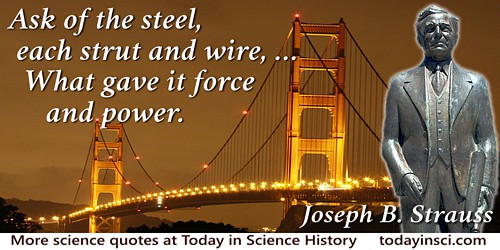
The Mighty Task is Done
At last the mighty task is done;
Resplendent in the western sun
The Bridge looms mountain high;
Its titan piers grip ocean floor,
Its great steel arms link shore with shore,
Its towers pierce the sky.
On its broad decks in rightful pride,
The world in swift parade shall ride,
Throughout all time to be;
Beneath, fleet ships from every port,
Vast landlocked bay, historic fort,
And dwarfing all the sea.
To north, the Redwood Empires gates;
To south, a happy playground waits,
In Rapturous appeal;
Here nature, free since time began,
Yields to the restless moods of man,
Accepts his bonds of steel.
Launched midst a thousand hopes and fears,
Damned by a thousand hostile sneers,
Yet Neer its course was stayed,
But ask of those who met the foe
Who stood alone when faith was low,
Ask them the price they paid.
Ask of the steel, each strut and wire,
Ask of the searching, purging fire,
That marked their natal hour;
Ask of the mind, the hand, the heart,
Ask of each single, stalwart part,
What gave it force and power.
An Honored cause and nobly fought
And that which they so bravely wrought,
Now glorifies their deed,
No selfish urge shall stain its life,
Nor envy, greed, intrigue, nor strife,
Nor false, ignoble creed.
High overhead its lights shall gleam,
Far, far below lifes restless stream,
Unceasingly shall flow;
For this was spun its lithe fine form,
To fear not war, nor time, nor storm,
For Fate had meant it so.
At last the mighty task is done;
Resplendent in the western sun
The Bridge looms mountain high;
Its titan piers grip ocean floor,
Its great steel arms link shore with shore,
Its towers pierce the sky.
On its broad decks in rightful pride,
The world in swift parade shall ride,
Throughout all time to be;
Beneath, fleet ships from every port,
Vast landlocked bay, historic fort,
And dwarfing all the sea.
To north, the Redwood Empires gates;
To south, a happy playground waits,
In Rapturous appeal;
Here nature, free since time began,
Yields to the restless moods of man,
Accepts his bonds of steel.
Launched midst a thousand hopes and fears,
Damned by a thousand hostile sneers,
Yet Neer its course was stayed,
But ask of those who met the foe
Who stood alone when faith was low,
Ask them the price they paid.
Ask of the steel, each strut and wire,
Ask of the searching, purging fire,
That marked their natal hour;
Ask of the mind, the hand, the heart,
Ask of each single, stalwart part,
What gave it force and power.
An Honored cause and nobly fought
And that which they so bravely wrought,
Now glorifies their deed,
No selfish urge shall stain its life,
Nor envy, greed, intrigue, nor strife,
Nor false, ignoble creed.
High overhead its lights shall gleam,
Far, far below lifes restless stream,
Unceasingly shall flow;
For this was spun its lithe fine form,
To fear not war, nor time, nor storm,
For Fate had meant it so.
Written upon completion of the building of the Golden Gate Bridge, May 1937. In Allen Brown, Golden Gate: biography of a Bridge (1965), 229.
—Aaaah!!! Une explosion nucleaire!
—Oui…On appelle ça le soleil.
—Aaaah!!! A nuclear explosion!
—Yes…It’s called the sun.
—Oui…On appelle ça le soleil.
—Aaaah!!! A nuclear explosion!
—Yes…It’s called the sun.
— Matyo
Cartoon showing one cartoon character running away from the bright sun while a second one replies. On matyo.net website (accessed 22 Mar 2015).
“Ye, sire,” I seide,
“By so no man were greved,
Alle the sciences under sonne,
And alle sotile craftes,
Ich wolde ich knewe and kouthe
Kyndely in myn harte.”
“Yes, sir,” I said, “so long as no one minds. All science under the sun, and all subtle arts. Were it possible, I would know and hold naturally within my heart!”
“By so no man were greved,
Alle the sciences under sonne,
And alle sotile craftes,
Ich wolde ich knewe and kouthe
Kyndely in myn harte.”
“Yes, sir,” I said, “so long as no one minds. All science under the sun, and all subtle arts. Were it possible, I would know and hold naturally within my heart!”
In William Langland and B. Thomas Wright (ed.) The Vision and Creed of Piers Ploughman (1842), 297. Modern translation by Terrence Tiller in Piers Plowman (1981, 1999), 157.
[Describing the effects of over-indulgence in wine:]
But most too passive, when the blood runs low
Too weakly indolent to strive with pain,
And bravely by resisting conquer fate,
Try Circe's arts; and in the tempting bowl
Of poisoned nectar sweet oblivion swill.
Struck by the powerful charm, the gloom dissolves
In empty air; Elysium opens round,
A pleasing frenzy buoys the lightened soul,
And sanguine hopes dispel your fleeting care;
And what was difficult, and what was dire,
Yields to your prowess and superior stars:
The happiest you of all that e'er were mad,
Or are, or shall be, could this folly last.
But soon your heaven is gone: a heavier gloom
Shuts o'er your head; and, as the thundering stream,
Swollen o'er its banks with sudden mountain rain,
Sinks from its tumult to a silent brook,
So, when the frantic raptures in your breast
Subside, you languish into mortal man;
You sleep, and waking find yourself undone,
For, prodigal of life, in one rash night
You lavished more than might support three days.
A heavy morning comes; your cares return
With tenfold rage. An anxious stomach well
May be endured; so may the throbbing head;
But such a dim delirium, such a dream,
Involves you; such a dastardly despair
Unmans your soul, as maddening Pentheus felt,
When, baited round Citheron's cruel sides,
He saw two suns, and double Thebes ascend.
But most too passive, when the blood runs low
Too weakly indolent to strive with pain,
And bravely by resisting conquer fate,
Try Circe's arts; and in the tempting bowl
Of poisoned nectar sweet oblivion swill.
Struck by the powerful charm, the gloom dissolves
In empty air; Elysium opens round,
A pleasing frenzy buoys the lightened soul,
And sanguine hopes dispel your fleeting care;
And what was difficult, and what was dire,
Yields to your prowess and superior stars:
The happiest you of all that e'er were mad,
Or are, or shall be, could this folly last.
But soon your heaven is gone: a heavier gloom
Shuts o'er your head; and, as the thundering stream,
Swollen o'er its banks with sudden mountain rain,
Sinks from its tumult to a silent brook,
So, when the frantic raptures in your breast
Subside, you languish into mortal man;
You sleep, and waking find yourself undone,
For, prodigal of life, in one rash night
You lavished more than might support three days.
A heavy morning comes; your cares return
With tenfold rage. An anxious stomach well
May be endured; so may the throbbing head;
But such a dim delirium, such a dream,
Involves you; such a dastardly despair
Unmans your soul, as maddening Pentheus felt,
When, baited round Citheron's cruel sides,
He saw two suns, and double Thebes ascend.
The Art of Preserving Health: a Poem in Four Books (2nd. ed., 1745), Book IV, 108-110.
But how shall we this union well expresse?
Naught tyes the soule: her subtiltie is such
She moves the bodie, which she doth possesse.
Yet no part toucheth, but by Vertue's touch.
Then dwels she not therein as in a tent;
Nor as a pilot in his Ship doth sit;
Nor as the spider in his web is pent;
Nor as the Waxe retaines the print in it;
Nor as a Vessell water doth containe;
Nor as one Liquor in another shed;
Nor as the heate dath in the fire remaine;
Nor as a voice throughout the ayre is spred;
But as the faire and cheerfull morning light,
Doth here, and there, her silver beames impart,
And in an instant doth her selfe unite
To the transparent Aire, in all, and part:
Still resting whole, when blowes the Aire devide;
Abiding pure, when th' Aire is most corrupted;
Throughout the Aire her beames dispersing wide,
And when the Aire is tost, not interrupted:
So doth the piercing Soule the body fill;
Being all in all, and all in part diffus'd;
Indivisible, incorruptible still,
Not forc't, encountred, troubled or confus'd.
And as the Sunne above the light doth bring,
Tough we behold it in the Aire below;
So from th'eternall light the Soule doth spring,
Though in the Bodie she her powers do show.
Naught tyes the soule: her subtiltie is such
She moves the bodie, which she doth possesse.
Yet no part toucheth, but by Vertue's touch.
Then dwels she not therein as in a tent;
Nor as a pilot in his Ship doth sit;
Nor as the spider in his web is pent;
Nor as the Waxe retaines the print in it;
Nor as a Vessell water doth containe;
Nor as one Liquor in another shed;
Nor as the heate dath in the fire remaine;
Nor as a voice throughout the ayre is spred;
But as the faire and cheerfull morning light,
Doth here, and there, her silver beames impart,
And in an instant doth her selfe unite
To the transparent Aire, in all, and part:
Still resting whole, when blowes the Aire devide;
Abiding pure, when th' Aire is most corrupted;
Throughout the Aire her beames dispersing wide,
And when the Aire is tost, not interrupted:
So doth the piercing Soule the body fill;
Being all in all, and all in part diffus'd;
Indivisible, incorruptible still,
Not forc't, encountred, troubled or confus'd.
And as the Sunne above the light doth bring,
Tough we behold it in the Aire below;
So from th'eternall light the Soule doth spring,
Though in the Bodie she her powers do show.
From 'Nosce Teipsum' (1599), in Claire Howard (ed.), The Poems of Sir John Davies (1941), 151-2.
Copernicus, who rightly did condemn
This eldest systeme, form’d a wiser scheme;
In which he leaves the Sun at Rest, and rolls
The Orb Terrestial on its proper Poles;
Which makes the Night and Day by this Career,
And by its slow and crooked Course the Year.
The famous Dane, who oft the Modern guides,
To Earth and Sun their Provinces divides:
The Earth’s Rotation makes the Night and Day,
The Sun revolving through th’ Eccliptic Way
Effects the various seasons of the Year,
Which in their Turn for happy Ends appear.
This Scheme or that, which pleases best, embrace,
Still we the Fountain of their Motion trace.
Kepler asserts these Wonders may be done
By the Magnetic Vertue of the Sun,
Which he, to gain his End, thinks fit to place
Full in the Center of that mighty Space,
Which does the Spheres, where Planets roll, include,
And leaves him with Attractive Force endu’d.
The Sun, thus seated, by Mechanic Laws,
The Earth, and every distant Planet draws;
By which Attraction all the Planets found
Within his reach, are turn'd in Ether round.
This eldest systeme, form’d a wiser scheme;
In which he leaves the Sun at Rest, and rolls
The Orb Terrestial on its proper Poles;
Which makes the Night and Day by this Career,
And by its slow and crooked Course the Year.
The famous Dane, who oft the Modern guides,
To Earth and Sun their Provinces divides:
The Earth’s Rotation makes the Night and Day,
The Sun revolving through th’ Eccliptic Way
Effects the various seasons of the Year,
Which in their Turn for happy Ends appear.
This Scheme or that, which pleases best, embrace,
Still we the Fountain of their Motion trace.
Kepler asserts these Wonders may be done
By the Magnetic Vertue of the Sun,
Which he, to gain his End, thinks fit to place
Full in the Center of that mighty Space,
Which does the Spheres, where Planets roll, include,
And leaves him with Attractive Force endu’d.
The Sun, thus seated, by Mechanic Laws,
The Earth, and every distant Planet draws;
By which Attraction all the Planets found
Within his reach, are turn'd in Ether round.
In Creation: A Philosophical Poem in Seven Books (1712), book 2, l. 430-53, p.78-9.
Energie is the operation, efflux or activity of any being: as the light of the Sunne is the energie of the Sunne, and every phantasm of the soul is the energie of the soul.
[The first recorded definition of the term energy in English]
[The first recorded definition of the term energy in English]
In Platonica: A Platonicall Song of the Soul (1642). In this book of poems, More uses the word energie many times, and in the opening section, 'To the Reader'. The definition quoted appears at the end of the book in 'The interpretation of the more unusual names or words that occurre in the foregoing Poems.'
For-thi loke thow lovye,
As longe as thow durest;
For is no science under sonne
So sovereyn for the soule.
So long as you live, see that you love,
For no science under the sun can so heal the soul.
As longe as thow durest;
For is no science under sonne
So sovereyn for the soule.
So long as you live, see that you love,
For no science under the sun can so heal the soul.
In William Langland and B. Thomas Wright (ed.) The Vision and Creed of Piers Ploughman (1842), 184. Modern translation by Terrence Tiller in Piers Plowman (1981, 1999), 94.
Nautae etiam mare legentes, cum beneficium claritatis solis in tempore nubilo non sentiunt, aut etiam cum caligne nocturnarum tenebrarum mundus obvolvitur, et ignorant in quem mundi cardinem prora tendat, acum super mangentem ponunt, quae circulariter circumvolvitur usque dum, ejus motu cessante.
Mariners at sea, when, through cloudy weather in the day which hides the sun, or through the darkness of night, they lose knowlege of the quarter of the world to which they are sailing, touch a needle with a magnet, which will turn round till, on its motion ceasing, its point will be directed towards the north.
Mariners at sea, when, through cloudy weather in the day which hides the sun, or through the darkness of night, they lose knowlege of the quarter of the world to which they are sailing, touch a needle with a magnet, which will turn round till, on its motion ceasing, its point will be directed towards the north.
De naturis rerum. Original Latin text quoted in Thomas Wright, A Volume of Vocabularies... (1873), 114. Translation from Lloyd A Brown, The Story of Maps (1980), 127.
Or any science under sonne,
The sevene artz and alle,
But thei ben lerned for oure Lordes love
Lost is al the tyme.
Every science under the sun, including the Seven Arts,
Unless learned for love of Our Lord, is only time lost.
The sevene artz and alle,
But thei ben lerned for oure Lordes love
Lost is al the tyme.
Every science under the sun, including the Seven Arts,
Unless learned for love of Our Lord, is only time lost.
In William Langland and B. Thomas Wright (ed.) The Vision and Creed of Piers Ploughman (1842), 212. An associated Note on p.539 lists: “The seven arts studied in the schools were very famous throughout the middle ages. They were grammar, dialectics, rhetoric, music, arithmetic, geometry, astronomy; and were included in the following memorial distich:—
“Gram, loquitur, Dia. vera docet, Rliet. verba colorat,
Mus. canit, Ar. numerat, Geo. ponderat, As. colit astra.”
Modern translation by Terrence Tiller in Piers Plowman (1981, 1999), 109.
“Gram, loquitur, Dia. vera docet, Rliet. verba colorat,
Mus. canit, Ar. numerat, Geo. ponderat, As. colit astra.”
Modern translation by Terrence Tiller in Piers Plowman (1981, 1999), 109.
That the Sun will not rise Tomorrow is no less intelligible a Proposition and implies no more contradiction than the Affirmation that it will rise. We should in vain, therefore, attempt to demonstrate its falsehood.
An Enquiry Concerning Human Understanding (1748), 48.
1104 … In this year the first day of Whitsuntide was on 5 June, and on the following Tuesday at noon there appeared four intersecting halos around the sun, white in color, and looking as if they had been painted. All who saw it were astonished, for they did not remember seeing anything like it before.
From the 'Peterborough Chronicle (Laud Manuscript)', The Anglo-Saxon Chronicle, as translated in The Anglo-Saxon Chronicle, Issue 1624 (1975), 239. The Chronicle is the work of many successive hands at several monasteries across England.
A lodestone is a wonderful thing in very many experiments, and like living things. And one of its remarkable virtues in that which the ancients considered to be a living soul in the sky, in the globes and in the stars, in the sun and in the moon.
In De Magnete. Cited in Gerrit L. Verschuur, Hidden Attraction (1996), 19.
A number of years ago, when I was a freshly-appointed instructor, I met, for the first time, a certain eminent historian of science. At the time I could only regard him with tolerant condescension.
I was sorry of the man who, it seemed to me, was forced to hover about the edges of science. He was compelled to shiver endlessly in the outskirts, getting only feeble warmth from the distant sun of science- in-progress; while I, just beginning my research, was bathed in the heady liquid heat up at the very center of the glow.
In a lifetime of being wrong at many a point, I was never more wrong. It was I, not he, who was wandering in the periphery. It was he, not I, who lived in the blaze.
I had fallen victim to the fallacy of the “growing edge;” the belief that only the very frontier of scientific advance counted; that everything that had been left behind by that advance was faded and dead.
But is that true? Because a tree in spring buds and comes greenly into leaf, are those leaves therefore the tree? If the newborn twigs and their leaves were all that existed, they would form a vague halo of green suspended in mid-air, but surely that is not the tree. The leaves, by themselves, are no more than trivial fluttering decoration. It is the trunk and limbs that give the tree its grandeur and the leaves themselves their meaning.
There is not a discovery in science, however revolutionary, however sparkling with insight, that does not arise out of what went before. “If I have seen further than other men,” said Isaac Newton, “it is because I have stood on the shoulders of giants.”
I was sorry of the man who, it seemed to me, was forced to hover about the edges of science. He was compelled to shiver endlessly in the outskirts, getting only feeble warmth from the distant sun of science- in-progress; while I, just beginning my research, was bathed in the heady liquid heat up at the very center of the glow.
In a lifetime of being wrong at many a point, I was never more wrong. It was I, not he, who was wandering in the periphery. It was he, not I, who lived in the blaze.
I had fallen victim to the fallacy of the “growing edge;” the belief that only the very frontier of scientific advance counted; that everything that had been left behind by that advance was faded and dead.
But is that true? Because a tree in spring buds and comes greenly into leaf, are those leaves therefore the tree? If the newborn twigs and their leaves were all that existed, they would form a vague halo of green suspended in mid-air, but surely that is not the tree. The leaves, by themselves, are no more than trivial fluttering decoration. It is the trunk and limbs that give the tree its grandeur and the leaves themselves their meaning.
There is not a discovery in science, however revolutionary, however sparkling with insight, that does not arise out of what went before. “If I have seen further than other men,” said Isaac Newton, “it is because I have stood on the shoulders of giants.”
Adding A Dimension: Seventeen Essays on the History of Science (1964), Introduction.
A plain, reasonable working man supposes, in the old way which is also the common-sense way, that if there are people who spend their lives in study, whom he feeds and keeps while they think for him—then no doubt these men are engaged in studying things men need to know; and he expects of science that it will solve for him the questions on which his welfare, and that of all men, depends. He expects science to tell him how he ought to live: how to treat his family, his neighbours and the men of other tribes, how to restrain his passions, what to believe in and what not to believe in, and much else. And what does our science say to him on these matters?
It triumphantly tells him: how many million miles it is from the earth to the sun; at what rate light travels through space; how many million vibrations of ether per second are caused by light, and how many vibrations of air by sound; it tells of the chemical components of the Milky Way, of a new element—helium—of micro-organisms and their excrements, of the points on the hand at which electricity collects, of X rays, and similar things.
“But I don't want any of those things,” says a plain and reasonable man—“I want to know how to live.”
It triumphantly tells him: how many million miles it is from the earth to the sun; at what rate light travels through space; how many million vibrations of ether per second are caused by light, and how many vibrations of air by sound; it tells of the chemical components of the Milky Way, of a new element—helium—of micro-organisms and their excrements, of the points on the hand at which electricity collects, of X rays, and similar things.
“But I don't want any of those things,” says a plain and reasonable man—“I want to know how to live.”
In 'Modern Science', Essays and Letters (1903), 221-222.
A single and distinct luminous body causes stronger relief in the objects than a diffused light; as may be seen by comparing one side of a landscape illuminated by the sun, and one overshadowed by clouds, and illuminated only by the diffused light of the atmosphere.
…...
A star is drawing on some vast reservoir of energy by means unknown to us. This reservoir can scarcely be other than the subatomic energy which, it is known exists abundantly in all matter; we sometimes dream that man will one day learn how to release it and use it for his service. The store is well nigh inexhaustible, if only it could be tapped. There is sufficient in the Sun to maintain its output of heat for 15 billion years.
Address to the British Association in Cardiff, (24 Aug 1920), in Observatory (1920), 43 353. Reprinted in Foreward to Arthur S. Eddington, The Internal Constitution of the Stars (1926, 1988), x.
A strict materialist believes that everything depends on the motion of matter. He knows the form of the laws of motion though he does not know all their consequences when applied to systems of unknown complexity.
Now one thing in which the materialist (fortified with dynamical knowledge) believes is that if every motion great & small were accurately reversed, and the world left to itself again, everything would happen backwards the fresh water would collect out of the sea and run up the rivers and finally fly up to the clouds in drops which would extract heat from the air and evaporate and afterwards in condensing would shoot out rays of light to the sun and so on. Of course all living things would regrede from the grave to the cradle and we should have a memory of the future but not of the past.
The reason why we do not expect anything of this kind to take place at any time is our experience of irreversible processes, all of one kind, and this leads to the doctrine of a beginning & an end instead of cyclical progression for ever.
Now one thing in which the materialist (fortified with dynamical knowledge) believes is that if every motion great & small were accurately reversed, and the world left to itself again, everything would happen backwards the fresh water would collect out of the sea and run up the rivers and finally fly up to the clouds in drops which would extract heat from the air and evaporate and afterwards in condensing would shoot out rays of light to the sun and so on. Of course all living things would regrede from the grave to the cradle and we should have a memory of the future but not of the past.
The reason why we do not expect anything of this kind to take place at any time is our experience of irreversible processes, all of one kind, and this leads to the doctrine of a beginning & an end instead of cyclical progression for ever.
Letter to Mark Pattison (7 Apr 1868). In P. M. Hannan (ed.), The Scientific Letters and Papers of James Clerk Maxwell (1995), Vol. 2, 1862-1873, 360-1.
A time will come when science will transform [our bodies] by means which we cannot conjecture... And then, the earth being small, mankind will migrate into space, and will cross the airless Saharas which separate planet from planet, and sun from sun. The earth will become a Holy Land which will be visited by pilgrims from all quarters of the universe.
…...
A tree is beautiful, but what’s more, it has a right to life; like water, the sun and the stars, it is essential. Life on earth is inconceivable without trees. Forests create climate, climate influences peoples’ character, and so on and so forth. There can be neither civilization nor happiness if forests crash down under the axe, if the climate is harsh and severe, if people are also harsh and severe. ... What a terrible future!
In letter to A.S. Suvorin (18 Oct 1888).
According to the Boshongo people of central Africa, in the beginning, there was only darkness, water, and the great god Bumba. One day Bumba, in pain from a stomach ache, vomited up the sun. The sun dried up some of the water, leaving land. Still in pain, Bumba vomited up the moon, the stars, and then some animals. The leopard, the crocodile, the turtle, and finally, man. This creation myth, like many others, tries to answer the questions we all ask. Why are we here? Where did we come from?
Lecture (1987), 'The Origin of the Universe', collected in Black Holes And Baby Universes And Other Essays (1993), 99.
After I had addressed myself to this very difficult and almost insoluble problem, the suggestion at length came to me how it could be solved with fewer and much simpler constructions than were formerly used, if some assumptions (which are called axioms) were granted me. They follow in this order.
There is no one center of all the celestial circles or spheres.
The center of the earth is not the center of the universe, but only of gravity and of the lunar sphere.
All the spheres revolve about the sun as their mid-point, and therefore the sun is the center of the universe.
The ratio of the earth’s distance from the sun to the height of the firmament is so much smaller than the ratio of the earth’s radius to its distance from the sun that the distance from the earth to the sun is imperceptible in comparison with the height of the firmament.
Whatever motion appears in the firmament arises not from any motion of the firmament, but from the earth’s motion. The earth together with its circumjacent elements performs a complete rotation on its fixed poles in a daily motion, while the firmament and highest heaven abide unchanged.
What appears to us as motions of the sun arise not from its motion but from the motion of the earth and our sphere, with which we revolve about the sun like any other planet. The earth has, then, more than one motion.
The apparent retrograde and direct motion of the planets arises not from their motion but from the earth’s. The motion of the earth alone, therefore, suffices to explain so many apparent inequalities in the heavens.
There is no one center of all the celestial circles or spheres.
The center of the earth is not the center of the universe, but only of gravity and of the lunar sphere.
All the spheres revolve about the sun as their mid-point, and therefore the sun is the center of the universe.
The ratio of the earth’s distance from the sun to the height of the firmament is so much smaller than the ratio of the earth’s radius to its distance from the sun that the distance from the earth to the sun is imperceptible in comparison with the height of the firmament.
Whatever motion appears in the firmament arises not from any motion of the firmament, but from the earth’s motion. The earth together with its circumjacent elements performs a complete rotation on its fixed poles in a daily motion, while the firmament and highest heaven abide unchanged.
What appears to us as motions of the sun arise not from its motion but from the motion of the earth and our sphere, with which we revolve about the sun like any other planet. The earth has, then, more than one motion.
The apparent retrograde and direct motion of the planets arises not from their motion but from the earth’s. The motion of the earth alone, therefore, suffices to explain so many apparent inequalities in the heavens.
'The Commentariolus', in Three Copernican Treatises (c.1510), trans. E. Rosen (1939), 58-9.
All change is relative. The universe is expanding relatively to our common material standards; our material standards are shrinking relatively to the size of the universe. The theory of the “expanding universe” might also be called the theory of the “shrinking atom”. …
:Let us then take the whole universe as our standard of constancy, and adopt the view of a cosmic being whose body is composed of intergalactic spaces and swells as they swell. Or rather we must now say it keeps the same size, for he will not admit that it is he who has changed. Watching us for a few thousand million years, he sees us shrinking; atoms, animals, planets, even the galaxies, all shrink alike; only the intergalactic spaces remain the same. The earth spirals round the sun in an ever-decreasing orbit. It would be absurd to treat its changing revolution as a constant unit of time. The cosmic being will naturally relate his units of length and time so that the velocity of light remains constant. Our years will then decrease in geometrical progression in the cosmic scale of time. On that scale man’s life is becoming briefer; his threescore years and ten are an ever-decreasing allowance. Owing to the property of geometrical progressions an infinite number of our years will add up to a finite cosmic time; so that what we should call the end of eternity is an ordinary finite date in the cosmic calendar. But on that date the universe has expanded to infinity in our reckoning, and we have shrunk to nothing in the reckoning of the cosmic being.
We walk the stage of life, performers of a drama for the benefit of the cosmic spectator. As the scenes proceed he notices that the actors are growing smaller and the action quicker. When the last act opens the curtain rises on midget actors rushing through their parts at frantic speed. Smaller and smaller. Faster and faster. One last microscopic blurr of intense agitation. And then nothing.
:Let us then take the whole universe as our standard of constancy, and adopt the view of a cosmic being whose body is composed of intergalactic spaces and swells as they swell. Or rather we must now say it keeps the same size, for he will not admit that it is he who has changed. Watching us for a few thousand million years, he sees us shrinking; atoms, animals, planets, even the galaxies, all shrink alike; only the intergalactic spaces remain the same. The earth spirals round the sun in an ever-decreasing orbit. It would be absurd to treat its changing revolution as a constant unit of time. The cosmic being will naturally relate his units of length and time so that the velocity of light remains constant. Our years will then decrease in geometrical progression in the cosmic scale of time. On that scale man’s life is becoming briefer; his threescore years and ten are an ever-decreasing allowance. Owing to the property of geometrical progressions an infinite number of our years will add up to a finite cosmic time; so that what we should call the end of eternity is an ordinary finite date in the cosmic calendar. But on that date the universe has expanded to infinity in our reckoning, and we have shrunk to nothing in the reckoning of the cosmic being.
We walk the stage of life, performers of a drama for the benefit of the cosmic spectator. As the scenes proceed he notices that the actors are growing smaller and the action quicker. When the last act opens the curtain rises on midget actors rushing through their parts at frantic speed. Smaller and smaller. Faster and faster. One last microscopic blurr of intense agitation. And then nothing.
In The Expanding Universe (1933) , 90-92.
All of us Hellenes tell lies … about those great Gods, the Sun and the Moon… . We say that they, and diverse other stars, do not keep the same path, and we call them planets or wanderers. … Each of them moves in the same path-not in many paths, but in one only, which is circular, and the varieties are only apparent.
— Plato
In Plato and B. Jowett (trans.), The Dialogues of Plato: Laws (3rd ed., 1892), Vol. 5, 204-205.
All over the world there lingers on the memory of a giant tree, the primal tree, rising up from the centre of the Earth to the heavens and ordering the universe around it. It united the three worlds: its roots plunged down into subterranean abysses, Its loftiest branches touched the empyrean. Thanks to the Tree, it became possible to breathe the air; to all the creatures that then appeared on Earth it dispensed its fruit, ripened by the sun and nourished by the water which it drew from the soil. From the sky it attracted the lightning from which man made fire and, beckoning skyward, where clouds gathered around its fall. The Tree was the source of all life, and of all regeneration. Small wonder then that tree-worship was so prevalent in ancient times.
From 'L'Arbre Sacre' ('The Sacred Tree'), UNESCO Courier (Jan 1989), 4. Epigraph to Chap 1, in Kenton Miller and Laura Tangley, Trees of Life: Saving Tropical Forests and Their Biological Wealt (1991), 1.
All rivers, small or large, agree in one character; they like to lean a little on one side; they cannot bear to have their channels deepest in the middle, but will always, if they can, have one bank to sun themselves upon, and another to get cool under.
In 'Water', The True and the Beautiful in Nature, Art, Morals, and Religion (1872), 62.
An example of such emergent phenomena is the origin of life from non-living chemical compounds in the oldest, lifeless oceans of the earth. Here, aided by the radiation energy received from the sun, countless chemical materials were synthesized and accumulated in such a way that they constituted, as it were, a primeval “soup.” In this primeval soup, by infinite variations of lifeless growth and decay of substances during some billions of years, the way of life was ultimately reached, with its metabolism characterized by selective assimilation and dissimilation as end stations of a sluiced and canalized flow of free chemical energy.
In 'The Scientific Character of Geology', The Journal of Geology (Jul 1961), 69, No. 4, 458.
An infallible Remedy for the Tooth-ach, viz Wash the Root of an aching Tooth, in Elder Vinegar, and let it dry half an hour in the Sun; after which it will never ach more; Probatum est.
In Poor Richard's Almanack (1739).
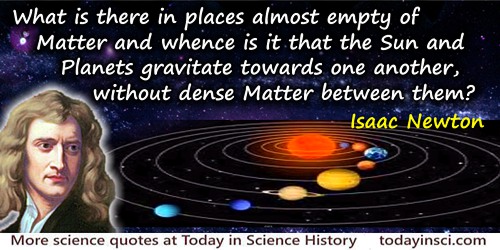
And for rejecting such a Medium, we have the Authority of those the oldest and most celebrated Philosophers of Greece and Phoenicia, who made a Vacuum, and Atoms, and the Gravity of Atoms, the first Principles of their Philosophy; tacitly attributing Gravity to some other Cause than dense Matter. Later Philosophers banish the Consideration of such a Cause out of natural Philosophy, feigning Hypotheses for explaining all things mechanically, and referring other Causes to Metaphysicks: Whereas the main Business of natural Philosophy is to argue from Phaenomena without feigning Hypotheses, and to deduce Causes from Effects, till we come to the very first Cause, which certainly is not mechanical; and not only to unfold the Mechanism of the World, but chiefly to resolve these and such like Questions. What is there in places almost empty of Matter, and whence is it that the Sun and Planets gravitate towards one another, without dense Matter between them? Whence is it that Nature doth nothing in vain; and whence arises all that Order and Beauty which we see in the World? ... does it not appear from phaenomena that there is a Being incorporeal, living, intelligent, omnipresent, who in infinite space, as it were in his Sensory, sees the things themselves intimately, and thoroughly perceives them, and comprehends them wholly by their immediate presence to himself.
In Opticks, (1704, 2nd. Ed. 1718), Book 3, Query 28, 343-5. Newton’s reference to “Nature does nothing in vain” recalls the axiom from Aristotle, which may be seen as “Natura nihil agit frustra” in the Aristotle Quotes on this web site.
And genius hath electric power,
Which earth can never tame;
Bright suns may scorch, and dark clouds lower,
Its flash is still the same.
Which earth can never tame;
Bright suns may scorch, and dark clouds lower,
Its flash is still the same.
Louis Klopsch, Many Thoughts of Many Minds (1896), 106.
And God made two great lights, great for their use
To man, the greater to have rule by day, The less by night…
To man, the greater to have rule by day, The less by night…
Paradise Lost: A poem, in Twelve Books (1750), Book 7, 36-37.
And it shall come to pass in that day, saith the Lord God, that I will cause the sun to go down at noon, and I will darken the earth in the clear day.
— Bible
Amos 8:9. As in The Holy Bible, Or Divine Treasury (1804), 75.
And new philosophy calls all in doubt,
The Element of fire is quite put out;
The Sun is lost, and th’earth, and no mans wit
Can well direct him where to look for it.
And freely men confesse that this world’s spent,
When in the Planets, and the Firmament
They seeke so many new; and then see that this
Is crumbled out againe to his Atomies.
’Tis all in pieces, all cohaerence gone;
All just supply, and all Relation;
Prince, Subject, Father, Sonne, are things forgot,
For every man alone thinkes he hath got
To be a phoenix, and that then can bee
None of that kinde, of which he is, but hee.
The Element of fire is quite put out;
The Sun is lost, and th’earth, and no mans wit
Can well direct him where to look for it.
And freely men confesse that this world’s spent,
When in the Planets, and the Firmament
They seeke so many new; and then see that this
Is crumbled out againe to his Atomies.
’Tis all in pieces, all cohaerence gone;
All just supply, and all Relation;
Prince, Subject, Father, Sonne, are things forgot,
For every man alone thinkes he hath got
To be a phoenix, and that then can bee
None of that kinde, of which he is, but hee.
An Anatomie of the World, I. 205-18. The Works of John Donne (Wordsworth edition 1994), 177.
And teach me how
To name the bigger light, and how the less,
That burn by day and night …
To name the bigger light, and how the less,
That burn by day and night …
The Tempest, Act 1, Scene 2. In Carl Sagan, Broca's Brain (1986), 188.
Animals live either on plants or on each other, and so all are ultimately dependent on the energy of the Sun.
In A Shorter History of Science (1944), 118.
Any opinion as to the form in which the energy of gravitation exists in space is of great importance, and whoever can make his opinion probable will have, made an enormous stride in physical speculation. The apparent universality of gravitation, and the equality of its effects on matter of all kinds are most remarkable facts, hitherto without exception; but they are purely experimental facts, liable to be corrected by a single observed exception. We cannot conceive of matter with negative inertia or mass; but we see no way of accounting for the proportionality of gravitation to mass by any legitimate method of demonstration. If we can see the tails of comets fly off in the direction opposed to the sun with an accelerated velocity, and if we believe these tails to be matter and not optical illusions or mere tracks of vibrating disturbance, then we must admit a force in that direction, and we may establish that it is caused by the sun if it always depends upon his position and distance.
Letter to William Huggins (13 Oct 1868). In P. M. Hannan (ed.), The Scientific Letters and Papers of James Clerk Maxwell (1995), Vol. 2, 1862-1873, 451-2.
Art is unquestionably one of the purest and highest elements in human happiness. It trains the mind through the eye, and the eye through the mind. As the sun colors flowers, so does art color life.
The Pleasures of Life (1887, 2007), 99.
As Bertrand Russell once wrote, two plus two is four even in the interior of the sun.
In When You Were a Tadpole and I Was a Fish: And Other Speculations About This and That (2009), 124.
As soon … as it was observed that the stars retained their relative places, that the times of their rising and setting varied with the seasons, that sun, moon, and planets moved among them in a plane, … then a new order of things began.… Science had begun, and the first triumph of it was the power of foretelling the future; eclipses were perceived to recur in cycles of nineteen years, and philosophers were able to say when an eclipse was to be looked for. The periods of the planets were determined. Theories were invented to account for their eccentricities; and, false as those theories might be, the position of the planets could be calculated with moderate certainty by them.
Lecture delivered to the Royal Institution (5 Feb 1864), 'On the Science of History'. Collected in Notices of the Proceedings at the Meetings of the Members of the Royal Institution of Great Britain with Abstracts of the Discourses (1866), Vol. 4, 187.
As the sun eclipses the stars by his brilliancy, so the man of knowledge will eclipse the fame of others in assemblies of the people if he proposes algebraic problems, and still more if he solves them.
In Florian Cajori, History of Mathematics (1893), 92.
As to the position of the earth, then, this is the view which some advance, and the views advanced concerning its rest or motion are similar. For here too there is no general agreement. All who deny that the earth lies at the centre think that it revolves about the centre, and not the earth only but, as we said before, the counter-earth as well. Some of them even consider it possible that there are several bodies so moving, which are invisible to us owing to the interposition of the earth. This, they say, accounts for the fact that eclipses of the moon are more frequent than eclipses of the sun; for in addition to the earth each of these moving bodies can obstruct it.
On the Heavens, 293b, 15-25. In Jonathan Barnes (ed.), The Complete Works of Aristotle (1984), Vol. 1, 483.
As to what Simplicius said last, that to contend whether the parts of the Sun, Moon, or other celestial body, separated from their whole, should naturally return to it, is a vanity, for that the case is impossible, it being clear by the demonstrations of Aristotle that the celestial bodies are impassible, impenetrable, unpartable, etc., I answer that none of the conditions whereby Aristotle distinguishes the celestial bodies from the elementary has any foundation other than what he deduces from the diversity of their natural motions; so that, if it is denied that the circular motion is peculiar to celestial bodies, and affirmed instead that it is agreeable to all naturally moveable bodies, one is led by necessary confidence to say either that the attributes of generated or ungenerated, alterable or unalterable, partable or unpartable, etc., equally and commonly apply to all bodies, as well to the celestial as to the elementary, or that Aristotle has badly and erroneously deduced those from the circular motion which he has assigned to celestial bodies.
Dialogue on the Great World Systems (1632). Revised and Annotated by Giorgio De Santillana (1953), 45.
As true as steel, as plantage to the moon,
As sun to day, at turtle to her mate,
As iron to adamant, as earth to centre.
As sun to day, at turtle to her mate,
As iron to adamant, as earth to centre.
Character Troilus speaking to Cressida, in play Troilus and Cressida (c.1601), Act 3, lines 352-354. In Troilus and Cressida (1811), 72.
Astronomy may be revolutionized more than any other field of science by observations from above the atmosphere. Study of the planets, the Sun, the stars, and the rarified matter in space should all be profoundly influenced by measurements from balloons, rockets, probes and satellites. ... In a new adventure of discovery no one can foretell what will be found, and it is probably safe to predict that the most important new discovery that will be made with flying telescopes will be quite unexpected and unforeseen. (1961)
Opening and closing of 'Flying Telescopes', Bulletin of the Atomic Scientists (May 1961), Vol. 17, No. 5, 191 and 194.
Astronomy teaches the correct use of the sun and the planets. These may be put on a frame of little sticks and turned round. This causes the tides. Those at the ends of the sticks are enormously far away. From time to time a diligent searching of the sticks reveals new planets. The orbit of the planet is the distance the stick goes round in going round. Astronomy is intensely interesting; it should be done at night, in a high tower at Spitzbergen. This is to avoid the astronomy being interrupted. A really good astronomer can tell when a comet is coming too near him by the warning buzz of the revolving sticks.
In Literary Lapses (1928), 128.
Astronomy was thus the cradle of the natural sciences and the starting point of geometrical theories. The stars themselves gave rise to the concept of a ‘point’; triangles, quadrangles and other geometrical figures appeared in the constellations; the circle was realized by the disc of the sun and the moon. Thus in an essentially intuitive fashion the elements of geometrical thinking came into existence.
In George Edward Martin, The Foundations of Geometry and the Non-Euclidean Plane (1982), 72.
At the moment I am occupied by an investigation with Kirchoff which does not allow us to sleep. Kirchoff has made a totally unexpected discovery, inasmuch as he has found out the cause for the dark lines in the solar spectrum and can produce these lines artificially intensified both in the solar spectrum and in the continuous spectrum of a flame, their position being identical with that of Fraunhofer’s lines. Hence the path is opened for the determination of the chemical composition of the Sun and the fixed stars.
Letter to H.E. Roscoe (Nov 1859). In The Life and Experiences of Sir Henry Enfield Roscoe (1906), 81.
At the moment I am occupied by an investigation with Kirchoff which does not allow us to sleep. Kirchoff has made a totally unexpected discovery, inasmuch as he has found out the cause for the dark lines in the solar spectrum and can produce these lines artificially intensified both in the solar spectrum and in the continuous spectrum of a flame, their position being identical with that of Fraunhofer’s lines. Hence the path is opened for the determination of the chemical composition of the Sun and the fixed stars.
Letter to H.E. Roscoe (Nov 1859). In The Life and Experiences of Sir Henry Enfield Roscoe (1906), 71.
Because of the way it came into existence, the solar system has only one-way traffic—like Piccadilly Circus. … If we want to make a model to scale, we must take a very tiny object, such as a pea, to represent the sun. On the same scale the nine planets will be small seeds, grains of sand and specks of dust. Even so, Piccadilly Circus is only just big enough to contain the orbit of Pluto. … The whole of Piccadilly Circus was needed to represent the space of the solar system, but a child can carry the whole substance of the model in its hand. All the rest is empty space.
In The Stars in Their Courses (1931, 1954), 49-50 & 89.
Believe me, this planet has put up with much worse than us. It’s been through earthquakes, volcanoes, plate tectonics, solar flares, sun-spots, magnetic storms, pole reversals, planetary floods, worldwide fires, tidal waves, wind and water erosion, cosmic rays, ice ages, and hundreds of thousands of years of bombardment by comets, asteroids, and meteors. And people think a few plastic bags and aluminum cans are going to make a difference?
In Napalm and Silly Putty (2002), 97.
Beyond these are other suns, giving light and life to systems, not a thousand, or two thousand merely, but multiplied without end, and ranged all around us, at immense distances from each other, attended by ten thousand times ten thousand worlds, all in rapid motion; yet calm, regular and harmonious—all space seems to be illuminated, and every particle of light a world. ... all this vast assemblages of suns and worlds may bear no greater proportion to what lies beyond the utmost boundaries of human vision, than a drop of water to the ocean.
In The Geography of the Heavens and Class-Book of Astronomy (1874), 148 That knowledge is not happiness.
But that which will excite the greatest astonishment by far, and which indeed especially moved me to call the attention of all astronomers and philosophers, is this: namely, that I have observed four planets, neither known nor observed by any one of the astronomers before my time, which have their orbits round a certain bright star [Jupiter], one of those previously known, like Venus or Mercury round the sun, and are sometimes in front of it, sometimes behind it, though they never depart from it beyond certain limits. All of which facts were discovered and observed a few days ago by the help of a telescope devised by me, through God’s grace first enlightening my mind.
In pamphlet, The Sidereal Messenger (1610), reprinted in The Sidereal Messenger of Galileo Galilei: And a Part of the Preface to the Preface to Kepler's Dioptrics Containing the Original Account of Galileo's Astronomical Discoveries (1880), 9.
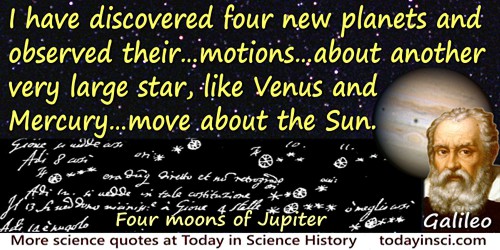
But what exceeds all wonders, I have discovered four new planets and observed their proper and particular motions, different among themselves and from the motions of all the other stars; and these new planets move about another very large star [Jupiter] like Venus and Mercury, and perchance the other known planets, move about the Sun. As soon as this tract, which I shall send to all the philosophers and mathematicians as an announcement, is finished, I shall send a copy to the Most Serene Grand Duke, together with an excellent spyglass, so that he can verify all these truths.
Letter to the Tuscan Court, 30 Jan 1610. Quoted in Albert van Heiden (ed.), Siderius Nuncius or The Sidereal Messenger (1989), 18.
By death the moon was gathered in Long ago, ah long ago;
Yet still the silver corpse must spin
And with another's light must glow.
Her frozen mountains must forget
Their primal hot volcanic breath,
Doomed to revolve for ages yet,
Void amphitheatres of death.
And all about the cosmic sky,
The black that lies beyond our blue,
Dead stars innumerable lie,
And stars of red and angry hue
Not dead but doomed to die.
Yet still the silver corpse must spin
And with another's light must glow.
Her frozen mountains must forget
Their primal hot volcanic breath,
Doomed to revolve for ages yet,
Void amphitheatres of death.
And all about the cosmic sky,
The black that lies beyond our blue,
Dead stars innumerable lie,
And stars of red and angry hue
Not dead but doomed to die.
'Cosmic Death' (1923), in The Captive Shrew and Other Poems of a Biologist (1932), 30.
By looking at the sun at different wavelengths, we can peel off the different layers in the (solar) atmosphere, just like peeling an onion.
Primary Source needed. Can you help?
Chemistry teaches us to regard under one aspect, as various types of combustion or oxidation, the burning of a candle, the rusting of metals, the physiological process of respiration, and the explosion of gunpowder. In each process there is the one common fact that oxygen enters into new chemical combinations. Similarly to the physicist, the fall of the traditional apple of Newton, the revolution of the earth and planets round the sun, the apparitions of comets, and the ebb and flow of the tides are all phases of the universal law of gravitation. A race ignorant of the nature of combustion or of the law of gravitation, and ignorant of the need of such generalisations, could not be considered to have advanced far along the paths of scientific discovery.
In 'The Discovery of Radioactivity: Radioactivity, a New Science', The Interpretation of Radium and the Structure of the Atom (4th ed., 1920), 1.
Concentrate all your thoughts upon the work at hand. The sun’s rays do not burn until brought to a focus.
In Orison Swett Marden, 'Bell Telephone Talk: Hints on Success by Alexander G. Bell', How They Succeeded: Life Stories of Successful Men Told by Themselves (1901), 34.
Consider now the Milky Way. Here also we see an innumerable dust, only the grains of this dust are no longer atoms but stars; these grains also move with great velocities, they act at a distance one upon another, but this action is so slight at great distances that their trajectories are rectilineal; nevertheless, from time to time, two of them may come near enough together to be deviated from their course, like a comet that passed too close to Jupiter. In a word, in the eyes of a giant, to whom our Suns were what our atoms are to us, the Milky Way would only look like a bubble of gas.
Science and Method (1908), trans. Francis Maitland (1914), 254-5.
Cosmology does, I think, affect the way that we perceive humanity’s role in nature. One thing we’ve learnt from astronomy is that the future lying ahead is more prolonged than the past. Even our sun is less than halfway through its life.
…...
Curiosity that inborn property of man, daughter of ignorance and mother of knowledge when wonder wakens our minds, has the habit, wherever it sees some extraordinary phenomenon of nature, a comet for example, a sun-dog, or a midday star, of asking straightway what it means.
In The New Science (3rd ed., 1744), Book 1, Para. 189, as translated by Thomas Goddard Bergin and Max Harold Fisch, The New Science of Giambattista Vico (1948), 64.
Death, like the sun, cannot be looked at steadily.
Maxims (1678), no. 26, trans. F. G. Stevens (1939), 11.
Deep beneath the surface of the Sun, enormous forces were gathering. At any moment, the energies of a million hydrogen bombs might burst forth in the awesome explosion…. Climbing at millions of miles per hour, an invisible fireball many times the size of Earth would leap from the Sun and head out across space.
From 'Sunjammer', collected in Harry Harrison (ed.), Worlds of Wonder: Sixteen Tales of Science Fiction (1969), 32-33. Originally published in Boys’ Life (Mar 1964).
Do not great Bodies conserve their heat the longest, their parts heating one another, and may not great dense and fix'd Bodies, when heated beyond a certain degree, emit Light so copiously, as by the Emission and Re-action of its Light, and the Reflexions and Refractions of its Rays within its Pores to grow still hotter, till it comes to a certain period of heat, such as is that of the Sun?
Opticks (1704), Book 3, Query II, 135.
Do not let the sun rise upon a strangulated hernia if first seen at night; and do not let the sun set upon a strangulated hernia if first seen by day.
Quoted in Alexander Bryan Johnson, Operative Therapeusis (1915), Vol. 4, 130.
Engineers apply the theories and principles of science and mathematics to research and develop economical solutions to practical technical problems. Their work is the link between scientific discoveries and commercial applications. Engineers design products, the machinery to build those products, the factories in which those products are made, and the systems that ensure the quality of the product and efficiency of the workforce and manufacturing process. They design, plan, and supervise the construction of buildings, highways, and transit systems. They develop and implement improved ways to extract, process, and use raw materials, such as petroleum and natural gas. They develop new materials that both improve the performance of products, and make implementing advances in technology possible. They harness the power of the sun, the earth, atoms, and electricity for use in supplying the Nation’s power needs, and create millions of products using power. Their knowledge is applied to improving many things, including the
quality of health care, the safety of food products, and the efficient operation of financial systems.
Bureau of Labor Statistics, Occupational Outlook Handbook (2000) as quoted in Charles R. Lord. Guide to Information Sources in Engineering (2000), 5. This definition has been revised and expanded over time in different issues of the Handbook.
Eratosthenes of Cyrene, employing mathematical theories and geometrical methods, discovered from the course of the sun, the shadows cast by an equinoctial gnomon, and the inclination of the heaven that the circumference of the earth is two hundred and fifty-two thousand stadia, that is, thirty-one million five hundred thousand paces.
In De Architectura, Book 1, Chap 6, Sec. 9. As translated in Morris Hicky Morgan (trans.), Vitruvius: The Ten Books on Architecture (1914), 27-28.
Every 12 years Jupiter returns to the same position in the sky; every 370 days it disappears in the fire of the Sun in the evening to the west, 30 days later it reappears in the morning to the east...[Observation in 4th century B.C.]
— Gan De
In the lost book Suixing Jing (Treatise on Jupiter), quoted in the extensive compilation Kaiyuan Zhanjing, (The Kaiyuan Treatise on Astrology (compiled 718-726). Quotation as given in Norman K. Glendenning, Our Place in the Universe (2007), 126. Source cited in Helaine Selin, Encyclopaedia of the History of Science, Technology, and Medicine in Non-Western Cultures (1997), 342.
Every morning in Africa, a Gazelle wakes up. It knows it must run faster than the fastest lion or it will be killed. Every morning a Lion wakes up. It knows it must outrun the slowest Gazelle or it will starve to death. It doesn't matter whether you are a Lion or a Gazelle; when the sun comes up, you'd better be running.
As seen in The Economist (1985), 296, 37. Sometimes cited in other sources as an African proverb. For example, referred as from a poster of an old African proverb in Venise T. Berry, So Good (1996), 241.
Every one is fond of comparing himself to something great and grandiose, as Louis XIV likened himself to the sun, and others have had like similes. I am more humble. I am a mere street scavenger (chiffonier) of science. With my hook in my hand and my basket on my back, I go about the streets of science, collecting what I find.
Quoted in Michael Foster, Claude Bernard (1899), 40.
Exits sun; enters moon.
This moon is never alone.
Stars are seen all around.
These twinklers do not make a sound.
The tiny ones shine from their place.
Mother moon watches with a smiling face.
Its light is soothing to the eyes.
Night’s darkness hides its face.
Cool and calm is its light.
Heat and sweat are never felt.
Some days, moon is not seen.
Makes kids wonder, where had it been?
Partial eclipse shades the moon.
In summers it does not arrive soon.
Beautiful is this milky ball.
It is the love of one and all.
This moon is never alone.
Stars are seen all around.
These twinklers do not make a sound.
The tiny ones shine from their place.
Mother moon watches with a smiling face.
Its light is soothing to the eyes.
Night’s darkness hides its face.
Cool and calm is its light.
Heat and sweat are never felt.
Some days, moon is not seen.
Makes kids wonder, where had it been?
Partial eclipse shades the moon.
In summers it does not arrive soon.
Beautiful is this milky ball.
It is the love of one and all.
…...
Exper. I. I made a small hole in a window-shutter, and covered it with a piece of thick paper, which I perforated with a fine needle. For greater convenience of observation I placed a small looking-glass without the window-shutter, in such a position as to reflect the sun's light, in a direction nearly horizontal, upon the opposite wall, and to cause the cone of diverging light to pass over a table on which were several little screens of card-paper. I brought into the sunbeam a slip of card, about one-thirtieth of an inch in breadth, and observed its shadow, either on the wall or on other cards held at different distances. Besides the fringes of colour on each side of the shadow, the shadow itself was divided by similar parallel fringes, of smaller dimensions, differing in number, according to the distance at which the shadow was observed, but leaving the middle of the shadow always white. Now these fringes were the joint effects of the portions of light passing on each side of the slip of card and inflected, or rather diffracted, into the shadow. For, a little screen being placed a few inches from the card, so as to receive either edge of the shadow on its margin, all the fringes which had before been observed in the shadow on the wall, immediately disappeared, although the light inflected on the other side was allowed to retain its course, and although this light must have undergone any modification that the proximity of the other edge of the slip of card might have been capable of occasioning... Nor was it for want of a sufficient intensity of light that one of the two portions was incapable of producing the fringes alone; for when they were both uninterrupted, the lines appeared, even if the intensity was reduced to one-tenth or one-twentieth.
'Experiments and Calculations Relative to Physical Optics' (read in 1803), Philosophical Transactions (1804), 94, 2-3.
Following the light of the sun, we left the Old World.
…...
Food is at present obtained almost entirely from the energy of the sunlight. The radiation from the sun produces from the carbonic acid in the air more or less complicated carbon compounds which serve us in plants and vegetables. We use the latent chemical energy of these to keep our bodies warm, we convert it into muscular effort. We employ it in the complicated process of digestion to repair and replace the wasted cells of our bodies. … If the gigantic sources of power become available, food would be produced without recourse to sunlight. Vast cellars, in which artificial radiation is generated, may replace the cornfields and potato patches of the world.
From 'Fifty Years Hence', Strand Magazine (Dec 1931). Reprinted in Popular Mechanics (Mar 1932), 57, No. 3, 396-397.
For FRICTION is inevitable because the Universe is FULL of God's works.
For the PERPETUAL MOTION is in all works of Almighty GOD.
For it is not so in the engines of man, which are made of dead materials, neither indeed can be.
For the Moment of bodies, as it is used, is a false term—bless God ye Speakers on the Fifth of November.
For Time and Weight are by their several estimates.
For I bless GOD in the discovery of the LONGITUDE direct by the means of GLADWICK.
For the motion of the PENDULUM is the longest in that it parries resistance.
For the WEDDING GARMENTS of all men are prepared in the SUN against the day of acceptation.
For the wedding Garments of all women are prepared in the MOON against the day of their purification.
For CHASTITY is the key of knowledge as in Esdras, Sir Isaac Newton & now, God be praised, in me.
For Newton nevertheless is more of error than of the truth, but I am of the WORD of GOD.
For the PERPETUAL MOTION is in all works of Almighty GOD.
For it is not so in the engines of man, which are made of dead materials, neither indeed can be.
For the Moment of bodies, as it is used, is a false term—bless God ye Speakers on the Fifth of November.
For Time and Weight are by their several estimates.
For I bless GOD in the discovery of the LONGITUDE direct by the means of GLADWICK.
For the motion of the PENDULUM is the longest in that it parries resistance.
For the WEDDING GARMENTS of all men are prepared in the SUN against the day of acceptation.
For the wedding Garments of all women are prepared in the MOON against the day of their purification.
For CHASTITY is the key of knowledge as in Esdras, Sir Isaac Newton & now, God be praised, in me.
For Newton nevertheless is more of error than of the truth, but I am of the WORD of GOD.
From 'Jubilate Agno' (c.1758-1763), in N. Callan (ed.), The Collected Poems of Christopher Smart (1949), Vol. 1, 276.
For it is owing to their wonder that men now both begin and at first began to philosophize; they wondered originally at the obvious difficulties, then advanced little by little and stated difficulties about the greater matters, e.g. about the phenomena of the moon and those of the sun and the stars, and about the genesis of the universe. And a man who is puzzled and wonders thinks himself ignorant (whence even the lover of myth is in a sense a lover of wisdom, for myth is composed of wonders); therefore since they philosophized in order to escape from ignorance, evidently they were pursuing science in order to know, and not for any utilitarian end. And this is confirmed by the facts; for it was when almost all the necessities of life and the things that make for comfort and recreation were present, that such knowledge began to be sought. Evidently then we do not seek it for the sake of any advantage; but as the man is free, we say, who exists for himself and not for another, so we pursue this as the only free science, for it alone exists for itself.
Metaphysics, 982b, 12-27. In Jonathan Baines (ed.), The Complete Works of Aristotle (1984), Vol. 2, 1554.
For many planet hunters, though, the ultimate goal is still greater (or actually, smaller) prey: terrestrial planets, like Earth, circling a star like the Sun. Astronomers already know that three such planets orbit at least one pulsar. But planet hunters will not rest until they are in sight of a small blue world, warm and wet, in whose azure skies and upon whose wind-whipped oceans shines a bright yellow star like our own.
…...
For nature is a perpetuall circulatory worker, generating fluids out of solids, and solids out of fluids, fixed things out of volatile, & volatile out of fixed, subtile out of gross, & gross out of subtile, Some things to ascend & make the upper terrestriall juices, Rivers and the Atmosphere; & by consequence others to descend for a Requitall to the former. And as the Earth, so perhaps may the Sun imbibe this spirit copiously to conserve his Shineing, & keep the Planets from recedeing further from him. And they that will, may also suppose, that this Spirit affords or carryes with it thither the solary fewell & materiall Principle of Light; And that the vast aethereall Spaces between us, & the stars are for a sufficient repository for this food of the Sunn and Planets.
Letter to Oldenburg (7 Dec 1675). In H. W. Turnbull (ed.), The Correspondence of Isaac Newton, 1661-1675 (1959), Vol. 1, 366.
Four elements, hydrogen, carbon, oxygen and nitrogen, also provide an example of the astonishing togetherness of our universe. They make up the “organic” molecules that constitute living organisms on a planet, and the nuclei of these same elements interact to generate the light of its star. Then the organisms on the planet come to depend wholly on that starlight, as they must if life is to persist. So it is that all life on the Earth runs on sunlight. [Referring to photosynthesis]
In lecture, 'Life and Mind in the Universe', versions of which George Wald delivered throughout the 1980s. On the website of his son, Elijah Wald, who states it was the last of his father’s major lectures.
From the infinitely great down to the infinitely small, all things are subject to [the laws of nature]. The sun and the planets follow the laws discovered by Newton and Laplace, just as the atoms in their combinations follow the laws of chemistry, as living creatures follow the laws of biology. It is only the imperfections of the human mind which multiply the divisions of the sciences, separating astronomy from physics or chemistry, the natural sciences from the social sciences. In essence, science is one. It is none other than the truth.
From Cours d’Economie Politique (1896-97), as given in Archives Internationales d’Histoire des Sciences (1993), Issues 131-133, 67.
From what has been said it is also evident, that the Whiteness of the Sun's Light is compounded all the Colours wherewith the several sorts of Rays whereof that Light consists, when by their several Refrangibilities they are separated from one another, do tinge Paper or any other white Body whereon they fall. For those Colours ... are unchangeable, and whenever all those Rays with those their Colours are mix'd again, they reproduce the same white Light as before.
Opticks (1704), Book 1, Part 2, Exper. XV, 114.
Frost is but slender weeks away,
Tonight the sunset glow will stay,
Swing to the north and burn up higher
And Northern Lights wall earth with fire.
Nothing is lost yet, nothing broken,
And yet the cold blue word is spoken:
Say goodbye to the sun.
The days of love and leaves are done.
Tonight the sunset glow will stay,
Swing to the north and burn up higher
And Northern Lights wall earth with fire.
Nothing is lost yet, nothing broken,
And yet the cold blue word is spoken:
Say goodbye to the sun.
The days of love and leaves are done.
Apples by Ocean (1950), 10.
George Stephenson, with a sagacity of mind in advance of the science of his day, answered, when asked what was the ultimate cause of motion of his locomotive engine, ‘that it went by the bottled-up rays of the sun.’
From 'Fuel', Lecture delivered to the British Association at Bradford, printed in Nature (25 Sep 1873), 8, 443.
Go into a room where the shutters are always shut (in a sick-room or a bed-room there should never be shutters shut), and though the room be uninhabited—though the air has never been polluted by the breathing of human beings, you will observe a close, musty smell of corrupt air—of air unpurified by the effect of the sun's rays.
Notes on Nursing: What it is and what it is not (1860), 120.
Go, wondrous creature, mount where science guides.
Go, measure earth, weigh air, and state the tides;
Instruct the planets in what orbs to run,
Correct old Time, and regulate the sun;
Go, teach Eternal Wisdom how to rule,
Then drop into thyself and be a fool.
Go, measure earth, weigh air, and state the tides;
Instruct the planets in what orbs to run,
Correct old Time, and regulate the sun;
Go, teach Eternal Wisdom how to rule,
Then drop into thyself and be a fool.
Quoted in James Wood Dictionary of Quotations from Ancient and Modern, English and Foreign Sources (1893), 125.
Go, wondrous creature! mount where Science guides,
Go, measure earth, weigh air, and state the tides;
Instruct the planets in what orbs to run,
Correct old Time, and regulate the Sun.
Go, measure earth, weigh air, and state the tides;
Instruct the planets in what orbs to run,
Correct old Time, and regulate the Sun.
In An Essay on Man (1736), Epistle II, lines 19-22, 10.
God is infinite, so His universe must be too. Thus is the excellence of God magnified and the greatness of His kingdom made manifest; He is glorified not in one, but in countless suns; not in a single earth, a single world, but in a thousand thousand, I say in an infinity of worlds.
…...
He (Anaxagoras) is said to have been twenty years old at the time of Xerxes' crossing, and to have lived to seventy-two. Apollodorus says in his Chronicles that he was born in the seventieth Olympiad (500-497 B.C.) and died in the first year of the eighty-eighth (428/7). He began to be a philosopher at Athens in the archonship of Callias (456/5), at the age of twenty, as Demetrius Phalereus tells us in his Register of Archons, and they say he spent thirty years there. … There are different accounts given of his trial. Sotion, in his Succession of Philosophers, says that he was prosecuted by Cleon for impiety, because he maintained that the sun was a red hot mass of metal, and after that Pericles, his pupil, had made a speech in his defence, he was fined five talents and exiled. Satyrus in his Uves, on the other hand, says that the charge was brought by Thucydides in his political campaign against Pericles; and he adds that the charge was not only for the impiety but for Medism as well; and he was condemned to death in his absence. ... Finally he withdrew to Lampsacus, and there died. It is said that when the rulers of the city asked him what privilege he wished to be granted, he replied that the children should be given a holiday every year in the month in which he died. The custom is preserved to the present day. When he died the Lampsacenes buried him with full honours.
Diogenes Laërtius 2.7. In G. S. Kirk, J. E. Raven and M. Schofield (eds.), The Presocratic Philosophers: A Critical History with a Selection of Texts (1983), p. 353.
Herschel removed the speckled tent-roof from the world and exposed the immeasurable deeps of space, dim-flecked with fleets of colossal suns sailing their billion-leagued remoteness.
'The Secret History of Eddypus', in Mark Twain and David Ketterer (ed.), Tales of Wonder (2003), 223.
Hidden within the vast spaces of the Milky Way are over a billion targets for the search for intelligent life. … A decision has to be made as to which stars should be the first objects of this search, … [But] only stars not much different from the sun are likely to support intelligent creatures. So the search should concentrate on … the nearest of these stars first, since the inverse square law indicates that signals from the closest stars would be the strongest received on the earth.
In Intelligent Life in Space (1962), 99-100.
Hipparchus displayed his love of truth in confining to the sun and moon his demonstration of
circular and uniform motions, and in not extending them to the five planets. Inasmuch as his predecessors had not left him a sufficient number of accurate observations, he judged rightly, with reference to the planets, in attempting nothing beyond a collection of good observations for the use of his successors, and a demonstration, by means of these observations, that the hypotheses of the mathematicians of his time did not agree with the phenomena.
— Ptolemy
Translated from Syntaxis, ix, 2. As quoted and cited in George Cornewall Lewis, An Historical Survey of the Astronomy of the Ancients (1862), 214.
His [Sherlock Holmes] ignorance was as remarkable as his knowledge. … he was ignorant of the Copernican Theory and of the composition of the Solar System. … “But the Solar System!" I protested. “What the deuce is it to me?” he interrupted impatiently; “you say that we go round the sun. If we went round the moon it would not make a pennyworth of difference to me or to my work.”
In 'The Science Of Deduction', A Study In Scarlet (1887, 1904), 15-16.
Holding then to science with one hand—the left hand—we give the right hand to religion, and cry: ‘Open Thou mine eyes, that I may behold wondrous things, more wondrous than the shining worlds can tell.’ Obedient to the promise, religion does awaken faculties within us, does teach our eyes to the beholding of more wonderful things. Those great worlds blazing like suns die like feeble stars in the glory of the morning, in the presence of this new light. The soul knows that an infinite sea of love is all about it, throbbing through it, everlasting arms of affection lift it, and it bathes itself in the clear consciousness of a Father’s love.
…...
How can a man sit down and quietly pare his nails, while the earth goes gyrating ahead amid such a din of sphere music, whirling him along about her axis some twenty-four thousand miles between sun and sun, but mainly in a circle some two millions of miles actual progress? And then such a hurly-burly on the surface …. Can man do less than get up and shake himself?
(6 Mar 1838). In Henry David Thoreau and Bradford Torrey (ed.), The Writings of Henry Thoreau: Journal: I: 1837-1846 (1906), 35.
How many times did the sun shine, how many times did the wind howl over the desolate tundras, over the bleak immensity of the Siberian taigas, over the brown deserts where the Earth’s salt shines, over the high peaks capped with silver, over the shivering jungles, over the undulating forests of the tropics! Day after day, through infinite time, the scenery has changed in imperceptible features. Let us smile at the illusion of eternity that appears in these things, and while so many temporary aspects fade away, let us listen to the ancient hymn, the spectacular song of the seas, that has saluted so many chains rising to the light.
In Tectonics of Asia (1924, 1977), 165, trans. Albert V. and Marguerite Carozzi.
How science dwindles, and how volumes swell,
How commentators each dark passage shun,
And hold their farthing candle to the sun!
How commentators each dark passage shun,
And hold their farthing candle to the sun!
Edward Young and John Mitford, 'Love of Fame, the Universal Passion', Satire VII, The Poetical Works of Edward Young (1858), Vol. 2, 136. In James Wood, Dictionary of Quotations from Ancient and Modern, English and Foreign Sources (1893), 162:24.
How to start on my adventure—how to become a forester—was not so simple. There were no schools of Forestry in America. … Whoever turned his mind toward Forestry in those days thought little about the forest itself and more about its influences, and about its influence on rainfall first of all. So I took a course in meteorology, which has to do with weather and climate. and another in botany, which has to do with the vegetable kingdom—trees are unquestionably vegetable. And another in geology, for forests grow out of the earth. Also I took a course in astronomy, for it is the sun which makes trees grow. All of which is as it should be, because science underlies the forester’s knowledge of the woods. So far I was headed right. But as for Forestry itself, there wasn’t even a suspicion of it at Yale. The time for teaching Forestry as a profession was years away.
In Breaking New Ground (1947, 1998), 3.
I am here to support the assertion that light of every kind is itself an electrical phenomenon—the light of the sun, the light of a candle, the light of a glowworm.
From Lecture (20 Sep 1889) delivered to the German Association for the Advancement of Natural Science and Medicine, Heidelberg, 'On the Relations Between Light and Electricity', Miscellaneous Papers (1896), 313, as translated by D.E. Jones and G.A. Schott.
I attained a triumph so complete that it is now rare to meet an American with marks of small pox on his face... Benefits are valuable according to their duration and extent, like the showers from heaven, but the benign remedy Vaccination saves millions of lives every century, like the blessing of the sun, universal and everlasting.
(Remark made near the end of his life.)
(Remark made near the end of his life.)
I believe as a matter of faith that the extension of space travel to the limits of the solar system will probably be accomplished in several decades, perhaps before the end of the century. Pluto is 4000 million miles from the sun. The required minimum launching velocity is about 10 miles per second and the transit time is 46 years. Thus we would have to make the velocity considerably higher to make the trip interesting to man. Travel to the stars is dependent on radically new discoveries in science and technology. The nearest star is 25 million million miles way and requires a travel time of more than four years at the speed of light. Prof. Dr. Ing. E. Sanger has speculated that velocities comparable with the speed of light might be attained in the next century, but such extrapolation of current technology is probably not very reliable.
In Popular Mechanics (Sep 1961), 262.
I believe in Christianity as I believe that the sun has risen: not only because I see it, but because by it I see everything else.
Quoted in Kim Lim (ed.), 1,001 Pearls of Spiritual Wisdom: Words to Enrich, Inspire, and Guide Your Life (2014), 10
I can certainly wish for new, large, and properly constructed instruments, and enough of them, but to state where and by what means they are to be procured, this I cannot do. Tycho Brahe has given Mastlin an instrument of metal as a present, which would be very useful if Mastlin could afford the cost of transporting it from the Baltic, and if he could hope that it would travel such a long way undamaged… . One can really ask for nothing better for the observation of the sun than an opening in a tower and a protected place underneath.
As quoted in James Bruce Ross and Mary Martin McLaughlin, The Portable Renaissance Reader (1968), 605.
I don't really care how time is reckoned so long as there is some agreement about it, but I object to being told that I am saving daylight when my reason tells me that I am doing nothing of the kind. I even object to the implication that I am wasting something valuable if I stay in bed after the sun has risen. As an admirer of moonlight I resent the bossy insistence of those who want to reduce my time for enjoying it. At the back of the Daylight Saving scheme I detect the bony, blue-fingered hand of Puritanism, eager to push people into bed earlier, and get them up earlier, to make them healthy, wealthy and wise in spite of themselves.
In The Diary of Samuel Marchbanks (1947), 75.
I finally saw that the blood, forced by the action of the left ventricle into the arteries, was distributed to the body at large, and its several parts, in the same manner as it is sent through the lungs, impelled by the right ventricle into the pulmonary artery, and that it then passed through the veins and along the vena cava, and so round to the left ventricle in the manner already indicated. Which motion we may be allowed to call circular, in the same way as Aristotle says that the air and the rain emulate the circular motion of the superior bodies; for the moist earth, warmed by the sun, evaporates; the vapours drawn upwards are condensed, and descending in the form of rain, moisten the earth again; and by this arrangement are generations of living things produced.
From William Harvey and Robert Willis (trans.), The Works of William Harvey, M.D. (1847), 46.
I grew up in Brooklyn, New York … a city neighborhood that included houses, lampposts, walls, and bushes. But with an early bedtime in the winter, I could look out my window and see the stars, and the stars were not like anything else in my neighborhood. [At age 5] I didn’t know what they were.
[At age 9] my mother … said to me, “You have a library card now, and you know how to read. Take the streetcar to the library and get a book on stars.” … I stepped up to the big librarian and asked for a book on stars. … I sat down and found out the answer, which was something really stunning.I found out that the stars are glowing balls of gas. I also found out that the Sun is a star but really close and that the stars are all suns except really far away I didn’t know any physics or mathematics at that time, but I could imagine how far you’d have to move the Sun away from us till it was only as bright as a star. It was in that library, reading that book, that the scale of the universe opened up to me. There was something beautiful about it.
At that young age, I already knew that I’d be very happy if I could devote my life to finding out more about the stars and the planets that go around them. And it’s been my great good fortune to do just that.
[At age 9] my mother … said to me, “You have a library card now, and you know how to read. Take the streetcar to the library and get a book on stars.” … I stepped up to the big librarian and asked for a book on stars. … I sat down and found out the answer, which was something really stunning.I found out that the stars are glowing balls of gas. I also found out that the Sun is a star but really close and that the stars are all suns except really far away I didn’t know any physics or mathematics at that time, but I could imagine how far you’d have to move the Sun away from us till it was only as bright as a star. It was in that library, reading that book, that the scale of the universe opened up to me. There was something beautiful about it.
At that young age, I already knew that I’d be very happy if I could devote my life to finding out more about the stars and the planets that go around them. And it’s been my great good fortune to do just that.
Quoted in interview with Jack Rightmyer, in 'Stars in His Eyes', Highlights For Children (1 Jan 1997). Ages as given in Tom Head (ed.), Conversations with Carl Sagan (2006), x.
I had a dream, which was not all a dream.
The bright sun was extinguish'd, and the stars
Did wander darkling in the eternal space,
Rayless, and pathless, and the icy earth
Swung blind and blackening in the moonless air;
Morn came, and went—and came, and brought no day.
The bright sun was extinguish'd, and the stars
Did wander darkling in the eternal space,
Rayless, and pathless, and the icy earth
Swung blind and blackening in the moonless air;
Morn came, and went—and came, and brought no day.
Darkness (1816), lines 1-6. In Jerome J. McGann (ed.), Lord Byron: The Complete Poetical Works (1986), Vol. 4, 40-1.
I had rather be Mercury, the smallest among seven [planets], revolving round the sun, than the first among five [moons] revolving round Saturn.
In James Wood, Dictionary of Quotations from Ancient and Modern, English and Foreign Sources (1893), 166:23.
I have always felt that astronomical hypotheses should not be regarded as articles of faith, but should only serve as a framework for astronomical calculations, so that it does not matter whether they were right or wrong, as long as the phenomena can be characterized precisely. For who could possibly be certain as to whether the uneven movement of the sun, if we follow the hypotheses of Ptolemy, can be explained by assuming an epicycle or eccentricity. Both assumptions are plausible. That’s why I would consider it quite desirable for you to tell something about that in the preface. In this way you would appease the Aristotelians and the theologians, whose opposition you dread.
From surviving fragment of a Letter (20 Apr 1541) answering a query from Copernicus as to whether he should publish his book (De Revolutionibus). From the German in Leopold Friedrich Prowe, Nicolaus Coppernicus (1883), Vol. 1, Part 2, 521-522. Translated from Prowe by Webmaster using web resources. Original German: “Hypothesen nicht als Glaubens-Artikel zu betrachten seien, sondern nur als Grundlage für die astronomischen Rechnungen zu dienen hätten, so dass es nicht darauf ankomme, ob sie richtig oder falsch seien, wofern sich nur die Erscheinungen dadurch genau bestimmen liessen. »Denn wer dürfte uns wohl darüber sichere Auskunft geben, ob die ungleiche Bewegung der Sonne, wenn wir den Hypothesen des Ptolemaeus folgen, durch Annahme eines Epicykels oder der Ekcentricität zu erklären sei. Beide Annahmen sind gestattet. Daher würde ich—so schliesst Osiander—es für recht wünschenswerth erachten, wenn Du hierüber in der Vorrede etwas beibrächtest. Auf diese Weise würdest Du die Aristoteliker und die Theologen milder stimmen, von denen Du befürchtest, dass sie heftigen Widerspruch kundthun werden.«” Compare Latin text, from Johannes Kepler, 'Apologia Tychonia', Astronomi Opera Omnia (1858), Vol. 1, 246: “De hypothesibus ego sic sensi semper, non esse articulos fidei, sed fundamenta calculi ita ut, etiamsi falsae sint, modo motuum φαινομενα exacte exhibeant, nihil referat; quis enim nos certiores reddet, an Solis inaequalis motus nomine epicycli an nomine eccentricitatis contingat, si Ptolemaei hypotheses sequamur, cum id possit utrumque. Quare plausibile fore videretur, si hac de re in praefatione nonnihil attingeres. Sic enim placidiores redderes peripatheticos et theologos, quos contradicturos metuis.”
I have always liked horticulturists, people who make their living from orchards and gardens, whose hands are familiar with the feel of the bark, whose eyes are trained to distinguish the different varieties, who have a form memory. Their brains are not forever dealing with vague abstractions; they are satisfied with the romance which the seasons bring with them, and have the patience and fortitude to gamble their lives and fortunes in an industry which requires infinite patience, which raise hopes each spring and too often dashes them to pieces in fall. They are always conscious of sun and wind and rain; must always be alert lest they lose the chance of ploughing at the right moment, pruning at the right time, circumventing the attacks of insects and fungus diseases by quick decision and prompt action. They are manufacturers of a high order, whose business requires not only intelligence of a practical character, but necessitates an instinct for industry which is different from that required by the city dweller always within sight of other people and the sound of their voices. The successful horticulturist spends much time alone among his trees, away from the constant chatter of human beings.
I have heard articulate speech produced by sunlight I have heard a ray of the sun laugh and cough and sing! … I have been able to hear a shadow, and I have even perceived by ear the passage of a cloud across the sun's disk.
Letter to his father (26 Feb 1880), describing his photophone research. Transcript with Bell Papers, Library of Congress.
I have known silence: the cold earthy silence at the bottom of a newly dug well; the implacable stony silence of a deep cave; the hot, drugged midday silence when everything is hypnotised and stilled into silence by the eye of the sun;… I have heard summer cicadas cry so that the sound seems stitched into your bones. I have heard tree frogs in an orchestration as complicated as Bach singing in a forest lit by a million emerald fireflies. I have heard the Keas calling over grey glaciers that groaned to themselves like old people as they inched their way to the sea. I have heard the hoarse street vendor cries of the mating Fur seals as they sang to their sleek golden wives, the crisp staccato admonishment of the Rattlesnake, the cobweb squeak of the Bat and the belling roar of the Red deer knee-deep in purple heather.
Letter to Lee McGeorge (31 Jul 1978). Collected in Letters of Note: Volume 2: An Eclectic Collection of Correspondence (2016), 76.
I have no doubt that certain learned men, now that the novelty of the hypotheses in this work has been widely reported—for it establishes that the Earth moves, and indeed that the Sun is motionless in the middle of the universe—are extremely shocked, and think that the scholarly disciplines, rightly established once and for all, should not be upset. But if they are willing to judge the matter thoroughly, they will find that the author of this work has committed nothing which deserves censure. For it is proper for an astronomer to establish a record of the motions of the heavens with diligent and skilful observations, and then to think out and construct laws for them, or rather hypotheses, whatever their nature may be, since the true laws cannot be reached by the use of reason; and from those assumptions the motions can be correctly calculated, both for the future and for the past. Our author has shown himself outstandingly skilful in both these respects. Nor is it necessary that these hypotheses should be true, nor indeed even probable, but it is sufficient if they merely produce calculations which agree with the observations. … For it is clear enough that this subject is completely and simply ignorant of the laws which produce apparently irregular motions. And if it does work out any laws—as certainly it does work out very many—it does not do so in any way with the aim of persuading anyone that they are valid, but only to provide a correct basis for calculation. Since different hypotheses are sometimes available to explain one and the same motion (for instance eccentricity or an epicycle for the motion of the Sun) an astronomer will prefer to seize on the one which is easiest to grasp; a philosopher will perhaps look more for probability; but neither will grasp or convey anything certain, unless it has been divinely revealed to him. Let us therefore allow these new hypotheses also to become known beside the older, which are no more probable, especially since they are remarkable and easy; and let them bring with them the vast treasury of highly learned observations. And let no one expect from astronomy, as far as hypotheses are concerned, anything certain, since it cannot produce any such thing, in case if he seizes on things constructed for another other purpose as true, he departs from this discipline more foolish than he came to it.
Although this preface would have been assumed by contemporary readers to be written by Copernicus, it was unsigned. It is now believed to have been written and added at press time by Andreas Osiander (who was then overseeing the printing of the book). It suggests the earth’s motion as described was merely a mathematical device, and not to be taken as absolute reality. Text as given in 'To the Reader on the Hypotheses in this Work', Copernicus: On the Revolutions of the Heavenly Spheres (1543), translated by Alistair Matheson Duncan (1976), 22-3. By adding this preface, Osiander wished to stave off criticism by theologians. See also the Andreas Osiander Quotes page of this website.
I have no doubt that we will be successful in harnessing the sun's energy. … If sunbeams were weapons of war, we would have had solar energy centuries ago.
'Sayings of the Week.' The Observer, London (26 Aug 1973). Quoted in Barbara K. Rodes and Rice Odell, A Dictionary of Environmental Quotations (1992), 265.
I have now said enough to show you that it is indispensable for this country to have a scientific education in connexion with manufacturers, if we wish to outstrip the intellectual competition which now, happily for the world, prevails in all departments of industry. As surely as darkness follows the setting of the sun, so surely will England recede as a manufacturing nation, unless her industrial population become much more conversant with science than they are now.
In 'The Study of Abstract Science Essential to the Progress of Industry', Records of the School of Mines (1852) 1, 48.
I have sat by night beside a cold lake
And touched things smoother than moonlight on still water,
But the moon on this cloud sea is not human,
And here is no shore, no intimacy,
Only the start of space, the road to suns.
And touched things smoother than moonlight on still water,
But the moon on this cloud sea is not human,
And here is no shore, no intimacy,
Only the start of space, the road to suns.
Trans Canada
I have satisfied myself that the [cosmic] rays are not generated by the formation of new matter in space, a process which would be like water running up a hill. Nor do they come to any appreciable amount from the stars. According to my investigations the sun emits a radiation of such penetrative power that it is virtually impossible to absorb it in lead or other substances. ... This ray, which I call the primary solar ray, gives rise to a secondary radiation by impact against the cosmic dust scattered through space. It is the secondary radiation which now is commonly called the cosmic ray, and comes, of course, equally from all directions in space. [The article continues: The phenomena of radioactivity are not the result of forces within the radioactive substances but are caused by this ray emitted by the sun. If radium could be screened effectively against this ray it would cease to be radioactive, he said.]
Quoted in 'Tesla, 75, Predicts New Power Source', New York Times (5 Jul 1931), Section 2, 1.
I hear beyond the range of sound,
I see beyond the range of sight,
New earths and skies and seas around,
And in my day the sun doth pale his light.
I see beyond the range of sight,
New earths and skies and seas around,
And in my day the sun doth pale his light.
…...
I love nuclear energy. I just want to make sure it stays where God put it—93 million miles away, in the sun.
In article, interview with Anne Underwood, 'Designing For The Future', Newsweek (15 May 2005).
I myself consider that gravity is merely a certain natural inclination with which parts are imbued by the architect of all things for gathering themselves together into a unity and completeness by assembling into the form of a globe. It is easy to believe that the Sun, Moon and other luminaries among the wandering stars have this tendency also, so that by its agency they retain the rounded shape in which they reveal themselves, but nevertheless go round their orbits in various ways. If then the Earth also performs other motions, as for example the one about the centre, they must necessarily be like those which are similarly apparent in many external bodies in which we find an annual orbit.
'Book One. Chapter IX. Whether several motions can be attributed to the Earth, and on the centre of the universe', in Copernicus: On the Revolutions of the Heavenly Spheres (1543), trans. A. M. Duncan (1976), 46.
I observed that plants not only have a faculty to correct bad air in six to ten days, by growing in it…but that they perform this important office in a complete manner in a few hours; that this wonderful operation is by no means owing to the vegetation of the plant, but to the influence of light of the sun upon the plant.
In Tobias George Smollett (ed.), 'Experiments Upon Vegetables', The Critical Review, Or, Annals of Literature (1779), 48, 334.
I returned and saw under the sun that the race is not to the swift, nor the battle to the strong, neither yet bread to the wise, nor yet riches to men of understanding, nor yet favour to men of skill; but time and chance happeneth to them all.
— Bible
Ecclesiastes 9:11. As given in the King James Version.
I say it is impossible that so sensible a people [citizens of Paris], under such circumstances, should have lived so long by the smoky, unwholesome, and enormously expensive light of candles, if they had really known that they might have had as much pure light of the sun for nothing.
[Describing the energy-saving benefit of adopting daylight saving time. (1784)]
[Describing the energy-saving benefit of adopting daylight saving time. (1784)]
'An Economical Project', The Life and Miscellaneous Writings of Benjamin Franklin (1839), 58. A translation of this letter appeared in one of the Paris daily papers about 1784. He estimated, during six months, a saving of over 64 million pound weight of candles, worth over 96 million livres tournois.
I shall explain a System of the World differing in many particulars from any yet known, answering in all things to the common Rules of Mechanical Motions: This depends upon three Suppositions. First, That all Cœlestial Bodies whatsoever, have an attraction or gravitating power towards their own Centers, whereby they attract not only their own parts, and keep them from flying from them, as we may observe the Earth to do, but that they do also attract all the other Cœlestial bodies that are within the sphere of their activity; and consequently that not only the Sun and Moon have an influence upon the body and motion the Earth, and the Earth upon them, but that Mercury also Venus, Mars, Saturn and Jupiter by their attractive powers, have a considerable influence upon its motion in the same manner the corresponding attractive power of the Earth hath a considerable influence upon every one of their motions also. The second supposition is this, That all bodies whatsoever that are put into a direct and simple motion, will continue to move forward in a streight line, till they are by some other effectual powers deflected and bent into a Motion, describing a Circle, Ellipse, or some other more compounded Curve Line. The third supposition is, That these attractive powers are so much the more powerful in operating, by how much the nearer the body wrought upon is to their own Centers. Now what these several degrees are I have not yet experimentally verified; but it is a notion, which if fully prosecuted as it ought to be, will mightily assist the Astronomer to reduce all the Cœlestial Motions to a certain rule, which I doubt will never be done true without it. He that understands the nature of the Circular Pendulum and Circular Motion, will easily understand the whole ground of this Principle, and will know where to find direction in Nature for the true stating thereof. This I only hint at present to such as have ability and opportunity of prosecuting this Inquiry, and are not wanting of Industry for observing and calculating, wishing heartily such may be found, having myself many other things in hand which I would first compleat and therefore cannot so well attend it. But this I durst promise the Undertaker, that he will find all the Great Motions of the World to be influenced by this Principle, and that the true understanding thereof will be the true perfection of Astronomy.
An Attempt to Prove the Motion of the Earth from Observations (1674), 27-8. Based on a Cutlerian Lecture delivered by Hooke at the Royal Society four years earlier.
I tell my students, with a feeling of pride that I hope they will share, that the carbon, nitrogen, and oxygen that make up ninety-nine per cent of our living substance were cooked in the deep interiors of earlier generations of dying stars. Gathered up from the ends of the universe, over billions of years, eventually they came to form, in part, the substance of our sun, its planets, and ourselves. Three billion years ago, life arose upon the earth. It is the only life in the solar system.
From speech given at an anti-war teach-in at the Massachusetts Institute of Technology, (4 Mar 1969) 'A Generation in Search of a Future', as edited by Ron Dorfman for Chicago Journalism Review, (May 1969).
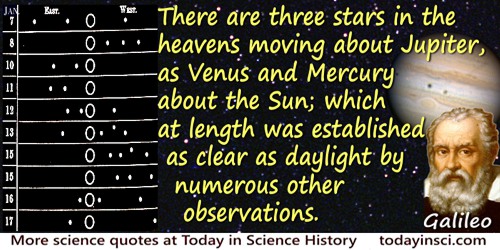
I therefore concluded, and decided unhesitatingly, that there are three stars in the heavens moving about Jupiter, as Venus and Mercury about the Sun; which at length was established as clear as daylight by numerous other observations.
Referring to his pioneering telescope observations.
Referring to his pioneering telescope observations.
The Starry Messenger (Mar 1610). Quoted in Edmund Blair Bolles, Galileo's Commandment (1999), 104.
I think it would be a very rash presumption to think that nowhere else in the cosmos has nature repeated the strange experiment which she has performed on earth—that the whole purpose of creation has been staked on this one planet alone. It is probable that dotted through the cosmos there are other suns which provide the energy for life to attendant planets. It is apparent, however, that planets with just the right conditions of temperature, oxygen, water and atmosphere necessary for life are found rarely.
But uncommon as a habitable planet may be, non-terrestrial life exists, has existed and will continue to exist. In the absence of information, we can only surmise that the chance that it surpasses our own is as good as that it falls below our level.
But uncommon as a habitable planet may be, non-terrestrial life exists, has existed and will continue to exist. In the absence of information, we can only surmise that the chance that it surpasses our own is as good as that it falls below our level.
As quoted by H. Gordon Garbedian in 'Ten Great Riddles That Call For Solution by Scientists', New York Times (5 Oct 1930), XX4. Garbedian gave no citation to a source for Shapley’s words. However, part of this quote is very similar to that of Sir Arthur Eddington: “It would indeed be rash to assume that nowhere else has Nature repeated the strange experiment which she has performed on the earth,” from 'Man’s Place in the Universe', Harper’s Magazine (Oct 1928), 157 573.
I think it’s time we recognized the Dark Ages are over. Galileo and Copernicus have been proven right. The world is in fact round; the Earth does revolve around the sun. I believe God gave us intellect to differentiate between imprisoning dogma and sound ethical science, which is what we must do here today.
Debating federal funding for stem cell research as Republican Representative (CT).
Debating federal funding for stem cell research as Republican Representative (CT).
In Eve Herold, George Daley, Stem Cell Wars (2007), 57.
I wanted to be a scientist from my earliest school days. The crystallizing moment came when I first caught on that stars are mighty suns, and how staggeringly far away they must be to appear to us as mere points of light. I’m not sure I even knew the word science then, but I was gripped by the prospect of understanding how things work, of helping to uncover deep mysteries, of exploring new worlds.
In 'With Science on Our Side', Washington Post (9 Jan 1994).
I will give you a “celestial multiplication table.” We start with a star as the unit most familiar to us, a globe comparable to the sun. Then—
A hundred thousand million Stars make one Galaxy;
A hundred thousand million Galaxies make one Universe.
The figures may not be very trustworthy, but I think they give a correct impression.
A hundred thousand million Stars make one Galaxy;
A hundred thousand million Galaxies make one Universe.
The figures may not be very trustworthy, but I think they give a correct impression.
In The Expanding Universe (1933), 4.
I wol yow telle, as was me taught also,
The foure spirites and the bodies sevene,
By ordre, as ofte I herde my lord hem nevene.
The firste spirit quiksilver called is,
The second orpiment, the thridde, ywis,
Sal armoniak, and the firthe brimstoon.
The bodies sevene eek, lo! hem heer anoon:
Sol gold is, and Luna silver we threpe,
Mars yron, Mercurie quiksilver we clepe,
Saturnus leed, and Jupiter is tin,
And Venus coper, by my fader kin!
The foure spirites and the bodies sevene,
By ordre, as ofte I herde my lord hem nevene.
The firste spirit quiksilver called is,
The second orpiment, the thridde, ywis,
Sal armoniak, and the firthe brimstoon.
The bodies sevene eek, lo! hem heer anoon:
Sol gold is, and Luna silver we threpe,
Mars yron, Mercurie quiksilver we clepe,
Saturnus leed, and Jupiter is tin,
And Venus coper, by my fader kin!
The Canon's Yeoman's Tale, lines 819-29. In Larry D. Benson (ed.), The Riverside Chaucer (1988), 273.
I would liken science and poetry in their natural independence to those binary stars, often different in colour, which Herschel’s telescope discovered to revolve round each other. “There is one light of the sun,” says St. Paul, “and another of the moon, and another of the stars: star differeth from star in glory.” It is so here. That star or sun, for it is both, with its cold, clear, white light, is SCIENCE: that other, with its gorgeous and ever-shifting hues and magnificent blaze, is POETRY. They revolve lovingly round each other in orbits of their own, pouring forth and drinking in the rays which they exchange; and they both also move round and shine towards that centre from which they came, even the throne of Him who is the Source of all truth and the Cause of all beauty.
'The Alleged Antagonism between Poetry and Chemistry.' In Jesse Aitken Wilson, Memoirs of George Wilson. Quoted in Natural History Society of Montreal, 'Reviews and Notices of Books,' The Canadian Naturalist and Geologist (1861) Vol. 6, 393.
I, Galileo Galilei, son of the late Vincenzo Galilei, of Florence, aged seventy years, being brought personally to judgment, and kneeling before your Most Eminent and Most Reverend Lords Cardinals, General Inquisitors of the universal Christian republic against heretical depravity, having before my eyes the Holy Gospels, which I touch with my own hands, swear that I have always believed, and now believe, and with the help of God will in future believe, every article which the Holy Catholic and Apostolic Church of Rome holds, teaches, and preaches. But because I have been enjoined by this Holy Office altogether to abandon the false opinion which maintains that the sun is the centre and immovable, and forbidden to hold, defend, or teach the said false doctrine in any manner, and after it hath been signified to me that the said doctrine is repugnant with the Holy Scripture, I have written and printed a book, in which I treat of the same doctrine now condemned, and adduce reasons with great force in support of the same, without giving any solution, and therefore have been judged grievously suspected of heresy; that is to say, that I held and believed that the sun is the centre of the universe and is immovable, and that the earth is not the centre and is movable; willing, therefore, to remove from the minds of your Eminences, and of every Catholic Christian, this vehement suspicion rightfully entertained toward me, with a sincere heart and unfeigned faith, I abjure, curse, and detest the said errors and heresies, and generally every other error and sect contrary to Holy Church; and I swear that I will never more in future say or assert anything verbally, or in writing, which may give rise to a similar suspicion of me; but if I shall know any heretic, or anyone suspected of heresy, that I will denounce him to this Holy Office, or to the Inquisitor or Ordinary of the place where I may be; I swear, moreover, and promise, that I will fulfil and observe fully, all the penances which have been or shall be laid on me by this Holy Office. But if it shall happen that I violate any of my said promises, oaths, and protestations (which God avert!), I subject myself to all the pains and punishments which have been decreed and promulgated by the sacred canons, and other general and particular constitutions, against delinquents of this description. So may God help me, and his Holy Gospels which I touch with my own hands. I, the above-named Galileo Galilei, have abjured, sworn, promised, and bound myself as above, and in witness thereof with my own hand have subscribed this present writing of my abjuration, which I have recited word for word. At Rome, in the Convent of Minerva, June 22, 1633. I, Galileo Galilei, have abjured as above with my own hand.
Abjuration, 22 Jun 1633. In J.J. Fahie, Galileo, His Life and Work (1903), 319-321.
I’m just a speck, standing on this big planet. … The Earth is orbiting the Sun, and the Sun is a huge star. And our star may be a big deal to us, but, my friends, our star is just another speck. … It’s not really in downtown Milky Way, it’s way out on the side. … I'm a speck, living on a speck, orbiting a speck in the middle of specklessness. But … I have this brain … to think about all of this. To think about the vast emptiness of space. I can reason that I'm a speck on a speck in the middle of specklessness. And that’s cool. That’s worthy of respect.
— Bill Nye
From narration to PBS TV program, 'Astrobiology', The Eyes of Nye (2005), Ep. 1, Introduction before titles. Also seen quoted as: “We are just a speck, on a speck, orbiting a speck, in the corner of a speck, in the middle of nowhere.”
If common sense has not the brilliancy of the sun, it has the fixity of the stars.
In Hialmer Day Gould, New Practical Spelling (1905), 13.
If I were to suggest that between the Earth and Mars there is a china teapot revolving about the sun in an elliptical orbit, nobody would be able to disprove my assertion provided I were careful to add that the teapot is too small to be revealed even by our most powerful telescopes. But if I were to go on to say that, since my assertion cannot be disproved, it is intolerable presumption on the part of human reason to doubt it, I should rightly be thought to be talking nonsense. If, however, the existence of such a teapot were affirmed in ancient books, taught as the sacred truth every Sunday, and instilled into the minds of children at school, hesitation to believe in its existence would become a mark of eccentricity and entitle the doubter to the attentions of the psychiatrist in an enlightened age or of the Inquisitor in an earlier time.
In unpublished manuscript, 'Is There a God', (5 Mar 1952) written for the magazine, Illustrated. Collected in Bertrand Russell, John G. Slater (ed.) and Peter Köllner (ed.) The Collected Papers of Bertran Russell: Volume II: Last Philosophical Testament: 1943-68 (1997), 547-548.
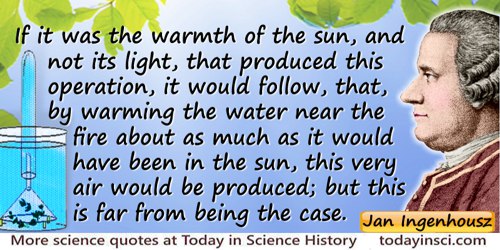
If it was the warmth of the sun, and not its light, that produced this operation, it would follow, that, by warming the water near the fire about as much as it would have been in the sun, this very air would be produced; but this is far from being the case.
In Tobias George Smollett (ed.), 'Experiments Upon Vegetables', The Critical Review, Or, Annals of Literature (1779), 48, 336.
If it were not for our conception of weights and measures we would stand in awe of the firefly as we do before the sun.
In Kahlil Gibran: The Collected Works (2007), 204.
If Lovelock hadn’t detected those CFCs [in the atmosphere above Antarctica] we’d all be living under the ocean in snorkels and fins to escape that poisonous sun.
As quoted in Jeff Goodell, How to Cool the Planet: Geoengineering and the Audacious Quest to Fix Earth’s Climate (2010), 95. Goodell noted that Nobel Prize-winning scientists Rowland and Molina hypothesized that sunlight split apart CFC molecules, releasing reactive chlorine atoms, that would burn a hole in the protective ozone layer of the atmosphere, increasing danger from more ultraviolet light penetrating to the earth. When the ozone hole was experimentally verified over Antarctica, the potential destruction to the planet on a grand scale was realized, CFCs were banned, and ozone depletion was halted. Rowland and Molina shared a 1995 Nobel Prize. Although earlier, Lovelock had recognized “no conceivable hazard” from CFCs in the earth’s atmosphere, he was nevertheless the first to detect them in the atmosphere over Antarctica. For this critical evidence, Lovelock was at least mentioned in the Nobel Prize press release.
If Nicolaus Copernicus, the distinguished and incomparable master, in this work had not been deprived of exquisite and faultless instruments, he would have left us this science far more well-established. For he, if anybody, was outstanding and had the most perfect understanding of the geometrical and arithmetical requisites for building up this discipline. Nor was he in any respect inferior to Ptolemy; on the contrary, he surpassed him greatly in certain fields, particularly as far as the device of fitness and compendious harmony in hypotheses is concerned. And his apparently absurd opinion that the Earth revolves does not obstruct this estimate, because a circular motion designed to go on uniformly about another point than the very center of the circle, as actually found in the Ptolemaic hypotheses of all the planets except that of the Sun, offends against the very basic principles of our discipline in a far more absurd and intolerable way than does the attributing to the Earth one motion or another which, being a natural motion, turns out to be imperceptible. There does not at all arise from this assumption so many unsuitable consequences as most people think.
From Letter (20 Jan 1587) to Christopher Rothman, chief astronomer of the Landgrave of Hesse. Webmaster seeks more information to better cite this source — please contact if you can furnish more. Webmaster originally found this quote introduced by an uncredited anonymous commentary explaining the context: “It was not just the Church that resisted the heliocentrism of Copernicus. Many prominent figures, in the decades following the 1543 publication of De Revolutionibus, regarded the Copernican model of the universe as a mathematical artifice which, though it yielded astronomical predictions of superior accuracy, could not be considered a true representation of physical reality.”
If one might wish for impossibilities, I might then wish that my children might be well versed in physical science, but in due subordination to the fulness and freshness of their knowledge on moral subjects. ... Rather than have it the principal thing in my son's mind, I would gladly have him think that the sun went round the earth, and that the stars were so many spangles set in the bright blue firmament.
Letter to Dr. Greenhill (9 May 1836). In Arthur Penrhyn Stanley, The Life and Correspondence of Thomas Arnold (2nd Ed., 1846), 277.
If the average man in the street were asked to name the benefits derived from sunshine, he would probably say “light and warmth” and there he would stop. But, if we analyse the matter a little more deeply, we will soon realize that sunshine is the one great source of all forms of life and activity on this old planet of ours. … [M]athematics underlies present-day civilization in much the same far-reaching manner as sunshine underlies all forms of life, and that we unconsciously share the benefits conferred by the mathematical achievements of the race just as we unconsciously enjoy the blessings of the sunshine.
From Address (25 Feb 1928) to National Council of Teachers of Mathematics, Boston. Abstract published in 'Mathematics and Sunshine', The Mathematics Teacher (May 1928), 21, No. 5, 245.
If the doctor cures, the sun sees it; but if he kills, the earth hides it.
In John Wade, Select Proverbs of all Nations (1824), 124.
If the observation of the amount of heat the sun sends the earth is among the most important and difficult in astronomical physics, it may also be termed the fundamental problem of meteorology, nearly all whose phenomena would become predictable, if we knew both the original quantity and kind of this heat.
In Report of the Mount Whitney Expedition, quoted in Charles Greeley Abbot, Adventures in the World of Science (1958), 17. Also quoted and cited in David H. Devorkin, 'Charles Greeley Abbot', Biographical Memoirs (1998), 4.
If the radiance of a thousand suns
Were to burst at once into the sky
That would be like the splendour of the Mighty One …
I am become Death,
The shatterer of worlds.
Were to burst at once into the sky
That would be like the splendour of the Mighty One …
I am become Death,
The shatterer of worlds.
His thoughts in reaction to viewing the fireball of the Trinity test of the first atomic bomb at Alamogordo, N.M. (16 Jul 1945). Fragments from Sacred Hindu Epic, Bhagavad-Gita. Quoted in A. Berry (ed.), The Book of Scientific Anecdotes (1989), 175.
If this fire determined by the sun, be received on the blackest known bodies, its heat will be long retain'd therein; and hence such bodies are the soonest and the strongest heated by the flame fire, as also the quickest dried, after having been moisten'd with water; and it may be added, that they also burn by much the readiest: all which points are confirm'd by daily observations. Let a piece of cloth be hung in the air, open to the sun, one part of it dyed black, another part of a white colour, others of scarlet, and diverse other colours; the black part will always be found to heat the most, and the quickest of all; and the others will each be found to heat more slowly, by how much they reflect the rays more strongly to the eye; thus the white will warm the slowest of them all, and next to that the red, and so of the rest in proportion, as their colour is brighter or weaker.
A New Method of Chemistry, 2nd edition (1741), 262.
If we do not learn to eliminate waste and to be more productive and more efficient in the ways we use energy, then we will fall short of this goal [for the Nation to derive 20 percent of all the energy we use from the Sun, by 2000]. But if we use our technological imagination, if we can work together to harness the light of the Sun, the power of the wind, and the strength of rushing streams, then we will succeed.
Speech, at dedication of solar panels on the White House roof, 'Solar Energy Remarks Announcing Administration Proposals' (20 Jun 1979).
If we lived on a planet where nothing ever changed, there would be little to do. There would be nothing to figure out. There would be no impetus for science. And if we lived in an unpredictable world, where things changed in random or very complex ways, we would not be able to figure things out. But we live in an in-between universe, where things change, but according to patterns, rules, or as we call them, laws of nature. If I throw a stick up in the air, it always falls down. If the sun sets in the west, it always rises again the next morning in the east. And so it becomes possible to figure things out. We can do science, and with it we can improve our lives.
Cosmos (1980, 1985), 32.
If, again with the light of science, we trace forward into the future the condition of our globe, we are compelled to admit that it cannot always remain in its present condition; that in time, the store of potential energy which now exists in the sun and in the bodies of celestial space which may fall into it will be dissipated in radiant heat, and consequently the earth, from being the theatre of life, intelligence, of moral emotions, must become a barren waste.
Address (Jul 1874) at the grave of Joseph Priestley, in Joseph Henry and Arthur P. Molella, et al. (eds.), A Scientist in American Life: Essays and Lectures of Joseph Henry (1980), 120.
Immediately after totality, two splendid protuberances appeared; one of them, of more than 3 minute height, shone of a splendor which it is difficult to imagine. The analysis of its light showed me immediately that it was formed by an immense incandescent gas column, mainly made up of hydrogen gas.
About his observations of a solar eclipse (18 Aug 1868), viewed from Guntur, India, reported in Comptes Rendus (19 Sep 1868), 67, 838. As cited, and given in translation, in Wheeler M. “Bo” Sears, Jr., Helium, the Disappearing Element (2015), 44. From the original French, “Immédiatement après la totalité, deux magnifiques protubérances ont apparu; l’une d’elles, de plus de 3 min de hauteur, brillait d’une splendeur qu’il est difficile d’imaginer. L’analyse de sa lumière m’a immédiatement montré qu’elle était formée par une immense colonne gazeuse incandescente, principalement compose de gaz hydrogène.” [Notably, Janssen fails to mention anything about a yellow line of unknown origin (later identified as helium) in this report.]
In 1684 Dr Halley came to visit him at Cambridge, after they had been some time together, the Dr asked him what he thought the Curve would be that would be described by the Planets supposing the force of attraction towards the Sun to be reciprocal to the square of their distance from it. Sr Isaac replied immediately that it would be an Ellipsis, the Doctor struck with joy & amazement asked him how he knew it, why saith he I have calculated it, whereupon Dr Halley asked him for his calculation without any farther delay. Sr Isaac looked among his papers but could not find it, but he promised him to renew it, & then to send it him.
[Recollecting Newton's account of the meeting after which Halley prompted Newton to write The Principia. When asking Newton this question, Halley was aware, without revealing it to Newton that Robert Hooke had made this hypothesis of plantary motion a decade earlier.]
[Recollecting Newton's account of the meeting after which Halley prompted Newton to write The Principia. When asking Newton this question, Halley was aware, without revealing it to Newton that Robert Hooke had made this hypothesis of plantary motion a decade earlier.]
Quoted in Richard Westfall, Never at Rest: A Biography of Isaac Newton (1980), 403.
In 1808 … Malus chanced to look through a double refracting prism at the light of the setting sun, reflected from the windows of the Luxembourg Palace. In turning the prism round, he was surprised to find that the ordinary image disappeared at two opposite positions of the prism. He remarked that the reflected light behaved like light which had been polarized by passing through another prism.
In Principles of Science (1874), Vols. 1-2, Book IV, Chap. 18, 163.
In 1945 J.A. Ratcliffe … suggested that I [join his group at Cavendish Laboratory, Cambridge] to start an investigation of the radio emission from the Sun, which had recently been discovered accidentally with radar equipment. … [B]oth Ratcliffe and Sir Lawrence Bragg, then Cavendish Professor, gave enormous support and encouragement to me. Bragg’s own work on X-ray crystallography involved techniques very similar to those we were developing for “aperture synthesis,” and he always showed a delighted interest in the way our work progressed.
From Autobiography in Wilhelm Odelberg (ed.), Les Prix Nobel en 1974/Nobel Lectures (1975)
In a certain sense I made a living for five or six years out of that one star [υ Sagittarii] and it is still a fascinating, not understood, star. It’s the first star in which you could clearly demonstrate an enormous difference in chemical composition from the sun. It had almost no hydrogen. It was made largely of helium, and had much too much nitrogen and neon. It’s still a mystery in many ways … But it was the first star ever analysed that had a different composition, and I started that area of spectroscopy in the late thirties.
Oral History Transcript of interview with Dr. Jesse Greenstein by Paul Wright (31 Jul 1974), on website of American Institute of Physics, about his research on strange shell stars. As quoted in J. B. Hearnshaw, The Analysis of Starlight: One Hundred and Fifty Years of Astronomical Spectroscopy (1986, 1990), 362. Hearnshaw footnoted that Berman earlier analysed the peculiar star R CrB (1935).
In a sense human flesh is made of stardust. Every atom in the human body, excluding only the primordial hydrogen atoms, was fashioned in stars that formed, grew old and exploded most violently before the Sun and Earth came into being.
In The Key to the Universe: Report on the New Physics (1977), 32-33.
In ancient days two aviators procured to themselves wings. Daedalus flew safely through the middle air and was duly honored on his landing. Icarus soared upwards to the sun till the wax melted which bound his wings and his flight ended in fiasco. In weighing their achievements, there is something to be said for Icarus. The classical authorities tell us that he was only “doing a stunt,” but I prefer to think of him as the man who brought to light a serious constructional defect in the flying machines of his day.
In fact, the thickness of the Earth's atmosphere, compared with the size of the Earth, is in about the same ratio as the thickness of a coat of shellac on a schoolroom globe is to the diameter of the globe. That's the air that nurtures us and almost all other life on Earth, that protects us from deadly ultraviolet light from the sun, that through the greenhouse effect brings the surface temperature above the freezing point. (Without the greenhouse effect, the entire Earth would plunge below the freezing point of water and we'd all be dead.) Now that atmosphere, so thin and fragile, is under assault by our technology. We are pumping all kinds of stuff into it. You know about the concern that chlorofluorocarbons are depleting the ozone layer; and that carbon dioxide and methane and other greenhouse gases are producing global warming, a steady trend amidst fluctuations produced by volcanic eruptions and other sources. Who knows what other challenges we are posing to this vulnerable layer of air that we haven't been wise enough to foresee?
In 'Wonder and Skepticism', Skeptical Enquirer (Jan-Feb 1995), 19, No. 1.
In general I would be cautious against … plays of fancy and would not make way for their reception into scientific astronomy, which must have quite a different character. Laplace’s cosmogenic hypotheses belong in that class. Indeed, I do not deny that I sometimes amuse myself in a similar manner, only I would never publish the stuff. My thoughts about the inhabitants of celestial bodies, for example, belong in that category. For my part, I am (contrary to the usual opinion) convinced … that the larger the cosmic body, the smaller are the inhabitants and other products. For example, on the sun trees, which in the same ratio would be larger than ours, as the sun exceeds the earth in magnitude, would not be able to exist, for on account of the much greater weight on the surface of the sun, all branches would break themselves off, in so far as the materials are not of a sort entirely heterogeneous with those on earth.
Letter to Heinrich Schumacher (7 Nov 1847). Quoted in G. Waldo Dunnington, Carl Friedrich Gauss: Titan of Science (2004), 411.
In my studies of astronomy and philosophy I hold this opinion about the universe, that the Sun remains fixed in the centre of the circle of heavenly bodies, without changing its place; and the Earth, turning upon itself, moves round the Sun.
Letter to Cristina di Lorena, Grand Duchess of Tuscany (the mother of his patron Cosmo), 1615. Quoted in Sedley Taylor, 'Galileo and Papal Infallibility' (Dec 1873), in Macmillan's Magazine: November 1873 to April 1874 (1874) Vol 29, 93.
In our daily lives, we enjoy the pervasive benefits of long-lived robotic spacecraft that provide high-capacity worldwide telecommunications; reconnaissance of Earth’s solid surface and oceans, with far-reaching cultural and environmental implications; much-improved weather and climatic forecasts; improved knowledge about the terrestrial effects of the Sun’s radiations; a revolutionary new global navigational system for all manner of aircraft and many other uses both civil and military; and the science of Earth itself as a sustainable abode of life.
In 'Is Human Spaceflight Obsolete?', Issues in Science and Technology (Summer 2004).
In Seneca the north is “the sun never goes there,” and this sentence may be used as adjective or noun; in such cases noun, adjective, verb, and adverb are found as one vocable or word, and the four parts of speech are undifferentiated.
In Introduction to the Study of Indian Languages: With Words, Phrases and Sentences to be Collected (1880), 73.
In some sense, there’s nothing as impractical as astronomy. You could take away the whole astronomical universe, and most people wouldn’t know the difference—except for the sun and maybe the moon.
In interview, Rushworth M. Kidder, 'Grounded in Space Science', Christian Science Monitor (22 Dec 1989).
In space there are countless constellations, suns and planets; we see only the suns because they give light; the planets remain invisible, for they are small and dark. There are also numberless earths circling around their suns, no worse and no less than this globe of ours. For no reasonable mind can assume that heavenly bodies that may be far more magnificent than ours would not bear upon them creatures similar or even superior to those upon our human earth.
As quoted in Dave Goldberg, The Universe in the Rearview Mirror: How Hidden Symmetries Shape Reality (2013), 74.
In the beginning was the book of Nature. For eon after eon, the pages of the book turned with no human to read them. No eye wondered at the ignition of the sun, the coagulation of the earth, the birth of the moon, the solidification of a terrestrial continent, or the filling of the seas. Yet when the first primitive algae evolved to float on the waters of this ocean, a promise was born—a hope that someday all the richness and variety of the phenomena of the universe would be read with appreciative eyes.
Opening paragraph in Gary G. Tibbetts, How the Great Scientists Reasoned: The Scientific Method in Action (2012), 1.
In the case of the Sun, we have a new understanding of the cosmological meaning of sacrifice. The Sun is, with each second, transforming four million tons of itself into light—giving itself over to become energy that we, with every meal, partake of. The Sun converts itself into a flow of energy that photosynthesis changes into plants that are consumed by animals. Humans have been feasting on the Sun’s energy stored in the form of wheat or maize or reindeer as each day the Sun dies as Sun and is reborn as the vitality of Earth. These solar flares are in fact the very power of the vast human enterprise. Every child of ours needs to learn the simple truth: she is the energy of the Sun. And we adults should organize things so her face shines with the same radiant joy.
In The Hidden Heart of the Cosmos: Humanity and the New Story (1996), 40-41.
In the center of everything rules the sun; for who in this most beautiful temple could place this luminary at another better place whence it can light up the whole at once? … In fact, the sun sitting on his royal throne guides the family of stars surrounding him. … In this arrangement we thus find an admirable harmony of the world, and a constant harmonious connection between the motion and the size of the orbits as could not be found otherwise.
In De Revolutionibus Orbium Coelestium (1543), Book 1, Ch. 10. As translated in Hermann Kesten, Copernicus and his World (1945), 182-183. From the original Latin: “In medio vero omnium residet Sol. Quis enim in hoc pulcherrimo templo lampadem hanc in alio vel meliori loco poneret, quam unde totum simul possit illuminare? … Ita profecto tanquam in solio regali Sol residens circum agentem gubernat Astrorum familiam. … Invenimus igitur sub hac ordinatione admirandam mundi symmetriam, ac certum harmoniae nexum motus et magnitudinis orbium: qualis alio modo reperiri non potest.” Corresponding translations also found in Charles Glenn Wallis (trans.), On the Revolutions of Heavenly Spheres (1939, 1995), 24-25, which gives: “In the center of all rests the sun. For who would place this lamp of a very beautiful temple in another or better place than this wherefrom it can illuminate everything at the same time? … And so the sun, as if resting on a kingly throne, governs the family of stars which wheel around. … Therefore in this ordering we find that the world has a wonderful commensurability and that there is a sure bond of harmony for the movement and magnitude of the orbital circles such as cannot be found in any other way.” The passage is translated in Robert Reinhold, 'After 500 Years, Now the Year of Copernicus', New York Times (28 Dec 1972), 33, as: “At rest in the middle of everything is the sun, for in this most beautiful temple, who would place this lamp in another or better position than that from which it can light up the whole thing at the same time? … As though seated on a royal throne, the sun governs the family of planets revolving around it.” Also seen translated in Edwin Arthur Burtt, The Metaphysical Foundations of Modern Physical Science (1925), 45, as: “Then in the middle of all stands the sun. For who, in our most beautiful temple, could set this light in another or better place, than that from which it can at once illuminate the whole? … And in fact does the sun, seated on his royal throne, guide his family of planets as they circle round him.” [Notice the original Latin reads “Astrorum familiam”, so the literal translation is “family of stars” rather than what we now call “planets.” —Webmaster]
In the heat of the sun, the ocean is the boiler and condenser of a gigantic steam engine, a weather engine that governs crops, floods, droughts, frosts, hurricanes.
In 'Ocean Policy and Reasonable Utopias', The Forum (Summer 1981), 16, No. 5, 900.
In the year 1456 ... a Comet was seen passing Retrograde between the Earth and the sun... Hence I dare venture to foretell, that it will return again in the year 1758.
A Synopsis of the Astronomy of Comets (1705),22.
In the year 2000, the solar water heater behind me, which is being dedicated today, will still be here supplying cheap, efficient energy. A generation from now, this solar heater can either be a curiosity, a museum piece, an example of a road not taken, or it can be just a small part of one of the greatest and most exciting adventures ever undertaken by the American people: harnessing the power of the Sun to enrich our lives as we move away from our crippling dependence on foreign oil.
[The next President, Republican Ronald Reagan, removed the solar panels and gutted renewable energy research budgets. The road was not taken, nationally, in the eight years of his presidency. Several of the panels are, indeed, now in museums. Most were bought as government surplus and put to good use on a college roof.]
[The next President, Republican Ronald Reagan, removed the solar panels and gutted renewable energy research budgets. The road was not taken, nationally, in the eight years of his presidency. Several of the panels are, indeed, now in museums. Most were bought as government surplus and put to good use on a college roof.]
Speech, at dedication of solar panels on the White House roof, 'Solar Energy Remarks Announcing Administration Proposals' (20 Jun 1979).
In the year of our Lord 729, two comets appeared around the sun, striking terror into all who saw them. One comet rose early and preceded the sun, while the other followed the setting sun at evening, seeming to portend awful calamity to east and west alike. Or else, since one comet was the precursor of day and the other of night, they indicated that mankind was menaced by evils at both times. They appeared in the month of January, and remained visible for about a fortnight, pointing their fiery torches northward as though to set the welkin aflame. At this time, a swarm of Saracens ravaged Gaul with horrible slaughter; … Both the outset and course of Ceolwulfs reign were filled by so many grave disturbances that it is quite impossible to know what to write about them or what the outcome will be.
— Bede
From Historia Ecclesiastica Gentis Anglorum, Book V, Chap. XXIII., as translated by Leo Sherley-Price, revised by R.E. Latham, Ecclesiastical History of the English People (1955, 1990), 323. Note: The observation likely was on a single comet seen twice each day. The event is also in both the Laud and Parker manuscripts of The Anglo-Saxon Chronicle.
In the year of our Lord’s incarnation 729, two comets appeared about the sun, to the great terror of the beholders. One of them went before the rising sun in the morning, the other followed him when he set at night, as it were presaging much destruction to the east and west; one was the forerunner of the day, and the other of the night, to signify that mortals were threatened with calamities at both times. They carried their flaming tails towards the north, as it were ready to set the world on fire. They appeared in January, and continued nearly a fortnight. At which time a dreadful plague of Saracens ravaged France with miserable slaughter; … the beginning
and progress of Ceolwulf’s reign were so filled with commotions, that it cannot yet be known what is to be said concerning them, or what end they will have.
— Bede
From Historia Ecclesiastica Gentis Anglorum, Book V, Chap. XXIII, as translated in J.A. Giles (ed.), The Venerable Bede’s Ecclesiastical History of England. Also the Anglo-Saxon Chronicle (1894), 291-292. The editor reprinted the translation based on the 1723 work of John Stevens into modern English. Note: The observation likely was on a single comet seen twice each day. The event is also in both the Laud and Parker manuscripts of The Anglo-Saxon Chronicle.
In this model, the sun is a very tiny speck of dust indeed—a speck less than a three-thousandth of an inch in diameter ... Think of the sun as something less than a speck of dust in a vast city, of the earth as less than a millionth part of such a speck of dust, and we have perhaps as vivid a picture as the mind can really grasp of the relation of our home in space to the rest of the universe.
In The Universe Around Us (1953), 96.
In time, manufacturing will to a great extent follow the sun.
[Speculating that with development of solar power the deserts would become great industrial areas.]
[Speculating that with development of solar power the deserts would become great industrial areas.]
As quoted in Rene Bache, 'Harnessing the Sun', Popular Mechanics (Apr 1928), 602.
Is it in Time to hide Eternity?
And why not in an Atom on the Shore,
To cover Ocean? or a Mote, the Sun?
And why not in an Atom on the Shore,
To cover Ocean? or a Mote, the Sun?
The Complaint: or, Night-Thoughts on Life, Death, and Immortality (1742, 1750), Night 6, 127. [A mote means a speck - Webmaster]
It is a natural inquiry to ask—To what most nearly are these new phenomena [the newly-born science of radioactivity and the spontaneous disintegration of elements] correlated? Is it possible to give, by the help of an analogy to familiar phenomena, any correct idea of the nature of this new phenomenon “Radioactivity”? The answer may surprise those who hold to the adage that there is nothing new under the sun. Frankly, it is not possible, because in these latest developments science has broken fundamentally new ground, and has delved one distinct step further down into the foundations of knowledge.
In The Interpretation of Radium: Being the Substance of Six Free Popular Lectures Delivered at the University of Glasgow (1909, 1912), 2. The original lectures of early 1908, were greatly edited, rearranged and supplemented by the author for the book form.
It is admitted, on all hands, that the Scriptures are not intended to resolve physical questions, or to explain matters in no way related to the morality of human actions; and if, in consequence of this principle, a considerable latitude of interpretation were not allowed, we should continue at this moment to believe, that the earth is flat; that the sun moves round the earth; and that the circumference of a circle is no more than three times its diameter.
In The Works of John Playfair: Vol. 1: Illustrations of the Huttonian Theory of the Earth (1822), 137.
It is no secret that the moon has no light of her own, but is, as it were, a mirror, receiving brightness from the influence of the sun
In De Architectura, Book 9, Chap 2, Sec.3. As translated in Morris Hicky Morgan (trans.), Vitruvius: The Ten Books on Architecture (1914), 263.
It is not failure but success that is forcing man off this earth. It is not sickness but the triumph of health... Our capacity to survive has expanded beyond the capacity of Earth to support us. The pains we are feeling are growing pains. We can solve growth problems in direct proportion to our capacity to find new worlds... If man stays on Earth, his extinction is sure even if he lasts till the sun expands and destroys him... It is no longer reasonable to assume that the meaning of life lies on this earth alone. If Earth is all there is for man, we are reaching the foreseeable end of man.
…...
It is of priceless value to the human race to know that the sun will supply the needs of the earth, as to light and heat, for millions of years; that the stars are not lanterns hung out at night, but are suns like our own; and that numbers of them probably have planets revolving around them, perhaps in many cases with inhabitants adapted to the conditions existing there. In a sentence, the main purpose of the science is to learn the truth about the stellar universe; to increase human knowledge concerning our surroundings, and to widen the limits of intellectual life.
In 'The Nature of the Astronomer’s Work', North American Review (Jun 1908), 187, No. 631, 915.
It is the destiny of wine to be drunk, and it is the destiny of glucose to be oxidized. But it was not oxidized immediately: its drinker kept it in his liver for more than a week, well curled up and tranquil, as a reserve aliment for a sudden effort; an effort that he was forced to make the following Sunday, pursuing a bolting horse. Farewell to the hexagonal structure: in the space of a few instants the skein was unwound and became glucose again, and this was dragged by the bloodstream all the way to a minute muscle fiber in the thigh, and here brutally split into two molecules of lactic acid, the grim harbinger of fatigue: only later, some minutes after, the panting of the lungs was able to supply the oxygen necessary to quietly oxidize the latter. So a new molecule of carbon dioxide returned to the atmosphere, and a parcel of the energy that the sun had handed to the vine-shoot passed from the state of chemical energy to that of mechanical energy, and thereafter settled down in the slothful condition of heat, warming up imperceptibly the air moved by the running and the blood of the runner. 'Such is life,' although rarely is it described in this manner: an inserting itself, a drawing off to its advantage, a parasitizing of the downward course of energy, from its noble solar form to the degraded one of low-temperature heat. In this downward course, which leads to equilibrium and thus death, life draws a bend and nests in it.
The Periodic Table (1975), trans. Raymond Rosenthal (1984), 192-3.
It is very remarkable that while the words Eternal, Eternity, Forever, are constantly in our mouths, and applied without hesitation, we yet experience considerable difficulty in contemplating any definite term which bears a very large proportion to the brief cycles of our petty chronicles. There are many minds that would not for an instant doubt the God of Nature to have existed from all Eternity, and would yet reject as preposterous the idea of going back a million of years in the History of His Works. Yet what is a million, or a million million, of solar revolutions to an Eternity?
Memoir on the Geology of Central France (1827), 165.
It seems to me that your Reverence and Signor Galileo act prudently when you content yourselves with speaking hypothetically and not absolutely, as I have always understood that Copernicus spoke. To say that on the supposition of the Earth’s movement and the Sun's quiescence all the celestial appearances are explained better than by the theory of eccentrics and epicycles is to speak with excellent good sense and to run no risk whatsoever. Such a manner of speaking is enough for a mathematician. But to want to affirm that the Sun, in very truth, is at the center of the universe and only rotates on its axis without going from east to west, is a very dangerous attitude and one calculated not only to arouse all Scholastic philosophers and theologians but also to injure our holy faith by contradicting the Scriptures.
Letter to Paolo Antonio Foscarini, 12 April 1615. Quoted in Giorgio De Santillana, The Crime of Galileo (1955), 99.
It sometimes strikes me that the whole of science is a piece of impudence; that nature can afford to ignore our impertinent interference. If our monkey mischief should ever reach the point of blowing up the earth by decomposing an atom, and even annihilated the sun himself, I cannot really suppose that the universe would turn a hair.
The Confessions of Aleister Crowley, ch. 14 (1929, rev 1970).
It took Galileo 16 years to master the universe. You have one night. It seems unfair. The genius had all that time. While you have a few short hours to learn sun spots from your satellites before the dreaded astronomy exam. On the other hand, Vivarin [caffeine tablets] help you keep awake and mentally alert… So even when the subject matter’s dull, your mind will remain razor sharp. If Galileo had used Vivarin, maybe he could have mastered the solar system faster, too.
Advertisement by Beecham for Vivarin, student newspaper, Columbia Daily Spectator (1 Dec 1988), Vol. 112, No. 186, 5.
It’s not quite as exhilarating a feeling as orbiting the earth, but it’s close. In addition, it has an exotic, bizarre quality due entirely to the nature of the surface below. The earth from orbit is a delight - offering visual variety and an emotional feeling of belonging “down there.” Not so with this withered, sun-seared peach pit out of my window. There is no comfort to it; it is too stark and barren; its invitation is monotonous and meant for geologists only.
…...
Keep your faith in all beautiful things; in the Sun when it is hidden, in the Spring when it is gone.
…...
Kepler’s laws, although not rigidly true, are sufficiently near to the truth to have led to the discovery of the law of attraction of the bodies of the solar system. The deviation from complete accuracy is due to the facts, that the planets are not of inappreciable mass, that, in consequence, they disturb each other's orbits about the Sun, and, by their action on the Sun itself, cause the periodic time of each to be shorter than if the Sun were a fixed body, in the subduplicate ratio of the mass of the Sun to the sum of the masses of the Sun and Planet; these errors are appreciable although very small, since the mass of the largest of the planets, Jupiter, is less than 1/1000th of the Sun's mass.
In Isaac Newton and Percival Frost (ed.) Newton’s Principia: Sections I, II, III (1863), 216.
Knock, And He’ll open the door
Vanish, And He’ll make you shine like the sun
Fall, And He’ll raise you to the heavens
Become nothing, And He’ll turn you into everything.
Vanish, And He’ll make you shine like the sun
Fall, And He’ll raise you to the heavens
Become nothing, And He’ll turn you into everything.
— Rumi
Quoted in Kim Lim (ed.), 1,001 Pearls of Spiritual Wisdom: Words to Enrich, Inspire, and Guide Your Life (2014), 164
Learn to reverence night and to put away the vulgar fear of it, for, with the banishment of night from the experience of man, there vanishes as well a religious emotion, a poetic mood, which gives depth to the adventure of humanity. By day, space is one with the earth and with man - it is his sun that is shining, his clouds that are floating past; at night, space is his no more. When the great earth, abandoning day, rolls up the deeps of the heavens and the universe, a new door opens for the human spirit, and there are few so clownish that some awareness of the mystery of being does not touch them as they gaze. For a moment of night we have a glimpse of ourselves and of our world islanded in its stream of stars - pilgrims of mortality, voyaging between horizons across eternal seas of space and time. Fugitive though the instant be, the spirit of man is, during it, ennobled by a genuine moment of emotional dignity, and poetry makes its own both the human spirit and experience.
…...
Let me describe briefly how a black hole might be created. Imagine a star with a mass 10 times that of the sun. During most of its lifetime of about a billion years the star will generate heat at its center by converting hydrogen into helium. The energy released will create sufficient pressure to support the star against its own gravity, giving rise to an object with a radius about five times the radius of the sun. The escape velocity from the surface of such a star would be about 1,000 kilometers per second. That is to say, an object fired vertically upward from the surface of the star with a velocity of less than 1,000 kilometers per second would be dragged back by the gravitational field of the star and would return to the surface, whereas an object with a velocity greater than that would escape to infinity.
When the star had exhausted its nuclear fuel, there would be nothing to maintain the outward pressure, and the star would begin to collapse because of its own gravity. As the star shrank, the gravitational field at the surface would become stronger and the escape velocity would increase. By the time the radius had got down to 10 kilometers the escape velocity would have increased to 100,000 kilometers per second, the velocity of light. After that time any light emitted from the star would not be able to escape to infinity but would be dragged back by the gravitational field. According to the special theory of relativity nothing can travel faster than light, so that if light cannot escape, nothing else can either. The result would be a black hole: a region of space-time from which it is not possible to escape to infinity.
When the star had exhausted its nuclear fuel, there would be nothing to maintain the outward pressure, and the star would begin to collapse because of its own gravity. As the star shrank, the gravitational field at the surface would become stronger and the escape velocity would increase. By the time the radius had got down to 10 kilometers the escape velocity would have increased to 100,000 kilometers per second, the velocity of light. After that time any light emitted from the star would not be able to escape to infinity but would be dragged back by the gravitational field. According to the special theory of relativity nothing can travel faster than light, so that if light cannot escape, nothing else can either. The result would be a black hole: a region of space-time from which it is not possible to escape to infinity.
'The Quantum Mechanics of Black Holes', Scientific American, 1977, 236, 34-40.
Let no one mistake it for comedy, farcical though it may be in all its details. It serves notice on the country that Neanderthal man is organizing in these forlorn backwaters of the land, led by a fanatic, rid of sense and devoid of conscience.
[Commenting on the Scopes Monkey Trial, while reporting for the Baltimore Sun.]
[Commenting on the Scopes Monkey Trial, while reporting for the Baltimore Sun.]
In Michael Shermer, Why Darwin Matters (2006), 26.
Let the sun never set or rise on a small bowel obstruction.
Adage expressing urgency for early operation to avoid possible fatality.
Adage expressing urgency for early operation to avoid possible fatality.
Summary of classic advice by Georg Friedrich Louis Stromeyer (1804-76) for a stangulated hernia. In Joe J. Tjandra et al., Textbook of Surgery (2006), 159.
Let us see how high we can fly before the sun melts the wax in our wings.
About the ambitious pursuit of knowledge, alluding to Icarus of the Greek myth.
About the ambitious pursuit of knowledge, alluding to Icarus of the Greek myth.
Consilience: The Unity of Knowledge (1999), 7.
Life is order, death is disorder. A fundamental law of Nature states that spontaneous chemical changes in the universe tend toward chaos. But life has, during milliards of years of evolution, seemingly contradicted this law. With the aid of energy derived from the sun it has built up the most complicated systems to be found in the universe—living organisms. Living matter is characterized by a high degree of chemical organisation on all levels, from the organs of large organisms to the smallest constituents of the cell. The beauty we experience when we enjoy the exquisite form of a flower or a bird is a reflection of a microscopic beauty in the architecture of molecules.
The Nobel Prize for Chemistry: Introductory Address'. Nobel Lectures: Chemistry 1981-1990 (1992), 69.
Limitless undying love which shines around me like a million suns it calls me on and on across the universe.
…...
Man is a little germ that lives on an unimportant rock ball that revolves about a small star at the outskirts of an ordinary galaxy. ... I am absolutely amazed to discover myself on this rock ball rotating around a spherical fire. It’s a very odd situation. And the more I look at things I cannot get rid of the feeling that existence is quite weird.
From lecture, 'Images of God,' available as a podcast, and part of The Tao of Philosophy six-CD collection of lectures by Watts.
Mankind will not remain on Earth forever, but in its quest for light and space will at first timidly penetrate beyond the confines of the atmosphere, and later will conquer for itself all the space near the Sun.
…...
Many animals even now spring out of the soil,
Coalescing from the rains and the heat of the sun.
Small wonder, then, if more and bigger creatures,
Full-formed, arose from the new young earth and sky.
The breed, for instance, of the dappled birds
Shucked off their eggshells in the springtime, as
Crickets in summer will slip their slight cocoons
All by themselves, and search for food and life.
Earth gave you, then, the first of mortal kinds,
For all the fields were soaked with warmth and moisture.
Coalescing from the rains and the heat of the sun.
Small wonder, then, if more and bigger creatures,
Full-formed, arose from the new young earth and sky.
The breed, for instance, of the dappled birds
Shucked off their eggshells in the springtime, as
Crickets in summer will slip their slight cocoons
All by themselves, and search for food and life.
Earth gave you, then, the first of mortal kinds,
For all the fields were soaked with warmth and moisture.
On the Nature of Things, trans. Anthony M. Esolen (1995), Book 5, lines 794-803, 181.
Mars tugs at the human imagination like no other planet. With a force mightier than gravity, it attracts the eye to its shimmering red presence in the clear night sky. It is like a glowing ember in a field of ethereal lights, projecting energy and promise. It inspires visions of an approachable world. The mind vaults to thoughts of what might have been (if Mars were a litter closer to the warming Sun) and of what could be (if humans were one day to plant colonies there). Mysterious Mars, alluring Mars, fourth planet from the Sun: so far away and yet, on a cosmic scale, so very near.
…...
May the Gods confound that man who first disclosed the hours, and who first, in fact, erected a sun-dial here; who, for wretched me, minced the day up into pieces. For when I was a boy, this stomach was the sun-dial, one much better and truer than all of these; when that used to warn me to eat. Except when there was nothing to eat. Now, even when there is something to eat, it’s not eaten, unless the sun chooses; and to such a degree now, in fact, is the city filled with sun-dials, that the greater part of the people are creeping along the streets shrunk up with famine.
— Plautus
A fragment, preserved in the works of Aulus Gellius, as translated by Henry Thomas Riley, in The Comedies of Plautus (1890), Vol. 2, 517.
May the road rise to meet you. May the wind always be at your back. May the sun shine warm upon your face, the rains fall soft upon your fields and, until we meet again, may God hold you in the palm of his hand.
…...
Men are weak now, and yet they transform the Earth’s surface. In millions of years their might will increase to the extent that they will change the surface of the Earth, its oceans, the atmosphere, and themselves. They will control the climate and the Solar System just as they control the Earth. They will travel beyond the limits of our planetary system; they will reach other Suns, and use their fresh energy instead of the energy of their dying luminary.
In Plan of Space Exploration (1926). Quote as translated in Vitaliĭ Ivanovich Sevastʹi︠a︡nov, Arkadiĭ Dmitrievich Ursul, I︠U︡riĭ Andreevich Shkolenko, The Universe and Civilisation (1981), 104.
Most educated people are aware that we're the outcome of nearly 4 billion years of Darwinian selection, but many tend to think that humans are somehow the culmination. Our sun, however, is less than halfway through its lifespan. It will not be humans who watch the sun's demise, 6 billion years from now. Any creatures that then exist will be as different from us as we are from bacteria or amoebae.
Lecture (2006), reprinted as 'Dark Materials'. As cited in J.G. Ballard, 'The Catastrophist', collected in Christopher Hitchens, Arguably: Selected Essays (2011), 353
My experiences with science led me to God. They challenge science to prove the existence of God. But must we really light a candle to see the sun?
In letter to California State board of Education (14 Sep 1972).
My sun sets to rise again.
In poem 'At “The Mermaid”', The Complete Poetic Works of Browning (1895), 808.
Myriad small ponds and streams would reflect the full glare of the sun for one or two seconds, then fade away as a new set of water surfaces came into the reflecting position. The effect was as if the land were covered with sparkling jewels.
…...
Nature has put itself the problem how to catch in flight light streaming to the earth and to store the most elusive of all powers in rigid form. To achieve this aim, it has covered the crust of earth with organisms which in their life processes absorb the light of the sun and use this power to produce a continuously accumulating chemical difference. ... The plants take in one form of power, light; and produce another power, chemical difference.
In pamphlet, The Organic Motion in its Relation to Metabolism (1845), as translated in Eugene Rabinowitch, Govindjee, Photosynthesis (1969), 9.
Nature offers us a thousand simple pleasures—plays of light and color, fragrance in the air, the sun’s warmth on skin and muscle, the audible rhythm of life’s stir and push—for the price of merely paying attention. What joy! But how unwilling or unable many of us are to pay this price in an age when manufactured sources of stimulation and pleasure are everywhere at hand. For me, enjoying nature’s pleasures takes conscious choice, a choice to slow down to seed time or rock time, to still the clamoring ego, to set aside plans and busyness, and to simply to be present in my body, to offer myself up.
In Sisters of the Earth: Women’s Prose and Poetry (1991), 43.
Never in its life has the sun seen shade,
Never in its life seen a shadow where it falls:
There, always there, in the sun-swept glade,
It lurks below the leaf; behind bodies, under walls,
Creeps, clings, hides. Be it millions, be it one—
The sun sees no shadow, and no shadow sees the sun.
Never in its life seen a shadow where it falls:
There, always there, in the sun-swept glade,
It lurks below the leaf; behind bodies, under walls,
Creeps, clings, hides. Be it millions, be it one—
The sun sees no shadow, and no shadow sees the sun.
Poem, as quoted in Arthur E. Shipley, Life: A Book for Elementary Students (1925, 2013), 31.
Newton supposed that the case of the planet was similar to that of [a ball spun around on the end of an elastic string]; that it was always pulled in the direction of the sun, and that this attraction or pulling of the sun produced the revolution of the planet, in the same way that the traction or pulling of the elastic string produces the revolution of the ball. What there is between the sun and the planet that makes each of them pull the other, Newton did not know; nobody knows to this day; and all we are now able to assert positively is that the known motion of the planet is precisely what would be produced if it were fastened to the sun by an elastic string, having a certain law of elasticity. Now observe the nature of this discovery, the greatest in its consequences that has ever yet been made in physical science:—
I. It begins with an hypothesis, by supposing that there is an analogy between the motion of a planet and the motion of a ball at the end of a string.
II. Science becomes independent of the hypothesis, for we merely use it to investigate the properties of the motion, and do not trouble ourselves further about the cause of it.
I. It begins with an hypothesis, by supposing that there is an analogy between the motion of a planet and the motion of a ball at the end of a string.
II. Science becomes independent of the hypothesis, for we merely use it to investigate the properties of the motion, and do not trouble ourselves further about the cause of it.
'On Some of the Conditions of Mental Development,' a discourse delivered at the Royal Institution, 6 Mar 1868, in Leslie Stephen and Frederick Pollock (eds.), Lectures and Essays, by the Late William Kingdon Clifford (1886), 56.
No one in his senses, or imbued with the slightest knowledge of physics, will ever think that the earth, heavy and unwieldy from its own weight and mass, staggers up and down around its own center and that of the sun; for at the slightest jar of the earth, we would see cities and fortresses, towns and mountains thrown down.
Universae Naturae Theatrum (1597). In Dorothy Stimson, The Gradual Acceptance of the Copernican Theory of the Universe (1917), 45.
Nor ever yet
The melting rainbow’s vernal-tinctur’d hues
To me have shone so pleasing, as when first
the hand of science pointed out the path
In which the sun-beams gleaming from the west
Fall on the watery cloud.
The melting rainbow’s vernal-tinctur’d hues
To me have shone so pleasing, as when first
the hand of science pointed out the path
In which the sun-beams gleaming from the west
Fall on the watery cloud.
The Pleasures of Imagination (1818), 50.
Not greatly moved with awe am I
To learn that we may spy
Five thousand firmaments beyond our own.
The best that's known
Of the heavenly bodies does them credit small.
View'd close, the Moon's fair ball
Is of ill objects worst,
A corpse in Night's highway, naked, fire-scarr'd, accurst;
And now they tell
That the Sun is plainly seen to boil and burst
Too horribly for hell.
So, judging from these two,
As we must do,
The Universe, outside our living Earth,
Was all conceiv'd in the Creator's mirth,
Forecasting at the time Man's spirit deep,
To make dirt cheap.
Put by the Telescope!
Better without it man may see,
Stretch'd awful in the hush'd midnight,
The ghost of his eternity.
To learn that we may spy
Five thousand firmaments beyond our own.
The best that's known
Of the heavenly bodies does them credit small.
View'd close, the Moon's fair ball
Is of ill objects worst,
A corpse in Night's highway, naked, fire-scarr'd, accurst;
And now they tell
That the Sun is plainly seen to boil and burst
Too horribly for hell.
So, judging from these two,
As we must do,
The Universe, outside our living Earth,
Was all conceiv'd in the Creator's mirth,
Forecasting at the time Man's spirit deep,
To make dirt cheap.
Put by the Telescope!
Better without it man may see,
Stretch'd awful in the hush'd midnight,
The ghost of his eternity.
'The Two Deserts' (1880-85). Poems, Introduction Basil Champneys (1906), 302.
Nothing afflicted Marcellus so much as the death of Archimedes, who was then, as fate would have it, intent upon working out some problem by a diagram, and having fixed his mind alike and his eyes upon the subject of his speculation, he never noticed the incursion of the Romans, nor that the city was taken. In this transport of study and contemplation, a soldier, unexpectedly coming up to him, commanded him to follow to Marcellus, which he declined to do before he had worked out his problem to a demonstration; the soldier, enraged, drew his sword and ran him through. Others write, that a Roman soldier, running upon him with a drawn sword, offered to kill him; and that Archimedes, looking back, earnestly besought him to hold his hand a little while, that he might not leave what he was at work upon inconclusive and imperfect; but the soldier, nothing moved by his entreaty, instantly killed him. Others again relate, that as Archimedes was carrying to Marcellus mathematical instruments, dials, spheres, and angles, by which the magnitude of the sun might be measured to the sight, some soldiers seeing him, and thinking that he carried gold in a vessel, slew him. Certain it is, that his death was very afflicting to Marcellus; and that Marcellus ever after regarded him that killed him as a murderer; and that he sought for his kindred and honoured them with signal favours.
— Plutarch
In John Dryden (trans.), Life of Marcellus.
Nothing afflicted Marcellus so much as the death of Archimedes, who was then, as fate would have it, intent upon working out some problem by a diagram, and having fixed his mind alike and his eyes upon the subject of his speculation, he never noticed the incursion of the Romans, nor that the city was taken. In this transport of study and contemplation, a soldier, unexpectedly coming up to him, commanded him to follow to Marcellus, which he declined to do before he had worked out his problem to a demonstration; the soldier, enraged, drew his sword and ran him through. Others write, that a Roman soldier, running upon him with a drawn sword, offered to kill him; and that Archimedes, looking back, earnestly besought him to hold his hand a little while, that he might not leave what he was at work upon inconclusive and imperfect; but the soldier, nothing moved by his entreaty, instantly killed him. Others again relate, that as Archimedes was carrying to Marcellus mathematical instruments, dials, spheres, and angles, by which the magnitude of the sun might be measured to the sight, some soldiers seeing him, and thinking that he carried gold in a vessel, slew him. Certain it is, that his death was very afflicting to Marcellus; and that Marcellus ever after regarded him that killed him as a murderer; and that he sought for his kindred and honoured them with signal favours.
— Plutarch
In John Dryden (trans.), Life of Marcellus.
Nothing is there beyond hope
Nothing that can be sworn impossible
Nothing wonderful, since Zeus,
Father of the Olympians
Made night from mid-day
Hiding the bright sunlight
And sore fear came upon men.
[Perhaps written having seen the eclipse of 6 Apr 648 BC.]
Nothing that can be sworn impossible
Nothing wonderful, since Zeus,
Father of the Olympians
Made night from mid-day
Hiding the bright sunlight
And sore fear came upon men.
[Perhaps written having seen the eclipse of 6 Apr 648 BC.]
Quoted in B S Shylaja, Eclipse (1999), 16.
Now, all causes of natural effects must be expressed by means of lines, angles and figures, for otherwise it is impossible to grasp their explanation. This is evident as follows. A natural agent multiplies its power from itself to the recipient, whether it acts on sense or on matter. This power is sometimes called species, sometimes a likeness, and it is the same thing whatever it may be called; and the agent sends the same power into sense and into matter, or into its own contrary, as heat sends the same thing into the sense of touch and into a cold body. For it does not act, by deliberation and choice, and therefore it acts in a single manner whatever it encounters, whether sense or something insensitive, whether something animate or inanimate. But the effects are diversified by the diversity of the recipient, for when this power is received by the senses, it produces an effect that is somehow spiritual and noble; on the other hand, when it is received by matter, it produces a material effect. Thus the sun produces different effects in different recipients by the same power, for it cakes mud and melts ice.
De Uneis, Angulis et Figuris seu Fractionibus Reflexionibus Radiorum (On Lines, Angles and Figures or On the Refraction and Reflection of Rays) [1230/31], trans. D. C. Lindberg, quoted in E. Grant (ed.), A Source Book in Medieval Science (1974), 385-6.
October 9, 1863
Always, however great the height of the balloon, when I have seen the horizon it has roughly appeared to be on the level of the car though of course the dip of the horizon is a very appreciable quantity or the same height as the eye. From this one might infer that, could the earth be seen without a cloud or anything to obscure it, and the boundary line of the plane approximately the same height as the eye, the general appearance would be that of a slight concavity; but I have never seen any part of the surface of the earth other than as a plane.
Towns and cities, when viewed from the balloon are like models in motion. I shall always remember the ascent of 9th October, 1863, when we passed over London about sunset. At the time when we were 7,000 feet high, and directly over London Bridge, the scene around was one that cannot probably be equalled in the world. We were still so low as not to have lost sight of the details of the spectacle which presented itself to our eyes; and with one glance the homes of 3,000,000 people could be seen, and so distinct was the view, that every large building was easily distinguishable. In fact, the whole of London was visible, and some parts most clearly. All round, the suburbs were also very distinct, with their lines of detached villas, imbedded as it were in a mass of shrubs; beyond, the country was like a garden, its fields, well marked, becoming smaller and smaller as the eye wandered farther and farther away.
Again looking down, there was the Thames, throughout its whole length, without the slightest mist, dotted over its winding course with innumerable ships and steamboats, like moving toys. Gravesend was visible, also the mouth of the Thames, and the coast around as far as Norfolk. The southern shore of the mouth of the Thames was not so clear, but the sea beyond was seen for many miles; when at a higher elevation, I looked for the coast of France, but was unable to see it. On looking round, the eye was arrested by the garden-like appearance of the county of Kent, till again London claimed yet more careful attention.
Smoke, thin and blue, was curling from it, and slowly moving away in beautiful curves, from all except one part, south of the Thames, where it was less blue and seemed more dense, till the cause became evident; it was mixed with mist rising from the ground, the southern limit of which was bounded by an even line, doubtless indicating the meeting of the subsoils of gravel and clay. The whole scene was surmounted by a canopy of blue, everywhere free from cloud, except near the horizon, where a band of cumulus and stratus extended all round, forming a fitting boundary to such a glorious view.
As seen from the earth, the sunset this evening was described as fine, the air being clear and the shadows well defined; but, as we rose to view it and its effects, the golden hues increased in intensity; their richness decreased as the distance from the sun increased, both right and left; but still as far as 90º from the sun, rose-coloured clouds extended. The remainder of the circle was completed, for the most part, by pure white cumulus of well-rounded and symmetrical forms.
I have seen London by night. I have crossed it during the day at the height of four miles. I have often admired the splendour of sky scenery, but never have I seen anything which surpassed this spectacle. The roar of the town heard at this elevation was a deep, rich, continuous sound the voice of labour. At four miles above London, all was hushed; no sound reached our ears.
Always, however great the height of the balloon, when I have seen the horizon it has roughly appeared to be on the level of the car though of course the dip of the horizon is a very appreciable quantity or the same height as the eye. From this one might infer that, could the earth be seen without a cloud or anything to obscure it, and the boundary line of the plane approximately the same height as the eye, the general appearance would be that of a slight concavity; but I have never seen any part of the surface of the earth other than as a plane.
Towns and cities, when viewed from the balloon are like models in motion. I shall always remember the ascent of 9th October, 1863, when we passed over London about sunset. At the time when we were 7,000 feet high, and directly over London Bridge, the scene around was one that cannot probably be equalled in the world. We were still so low as not to have lost sight of the details of the spectacle which presented itself to our eyes; and with one glance the homes of 3,000,000 people could be seen, and so distinct was the view, that every large building was easily distinguishable. In fact, the whole of London was visible, and some parts most clearly. All round, the suburbs were also very distinct, with their lines of detached villas, imbedded as it were in a mass of shrubs; beyond, the country was like a garden, its fields, well marked, becoming smaller and smaller as the eye wandered farther and farther away.
Again looking down, there was the Thames, throughout its whole length, without the slightest mist, dotted over its winding course with innumerable ships and steamboats, like moving toys. Gravesend was visible, also the mouth of the Thames, and the coast around as far as Norfolk. The southern shore of the mouth of the Thames was not so clear, but the sea beyond was seen for many miles; when at a higher elevation, I looked for the coast of France, but was unable to see it. On looking round, the eye was arrested by the garden-like appearance of the county of Kent, till again London claimed yet more careful attention.
Smoke, thin and blue, was curling from it, and slowly moving away in beautiful curves, from all except one part, south of the Thames, where it was less blue and seemed more dense, till the cause became evident; it was mixed with mist rising from the ground, the southern limit of which was bounded by an even line, doubtless indicating the meeting of the subsoils of gravel and clay. The whole scene was surmounted by a canopy of blue, everywhere free from cloud, except near the horizon, where a band of cumulus and stratus extended all round, forming a fitting boundary to such a glorious view.
As seen from the earth, the sunset this evening was described as fine, the air being clear and the shadows well defined; but, as we rose to view it and its effects, the golden hues increased in intensity; their richness decreased as the distance from the sun increased, both right and left; but still as far as 90º from the sun, rose-coloured clouds extended. The remainder of the circle was completed, for the most part, by pure white cumulus of well-rounded and symmetrical forms.
I have seen London by night. I have crossed it during the day at the height of four miles. I have often admired the splendour of sky scenery, but never have I seen anything which surpassed this spectacle. The roar of the town heard at this elevation was a deep, rich, continuous sound the voice of labour. At four miles above London, all was hushed; no sound reached our ears.
Travels in the Air (1871), 99-100.
Oh, I have slipped the surly bonds of earth
and danced the skies on laughter-silvered wings;
Sunward I’ve climbed, and joined the tumbling mirth
of sun-split clouds and done a hundred things
you have not dreamed of wheeled and soared and swung
high in the sunlit silence. Hovering there,
I’ve chased the shouting wind along, and flung
my eager craft through footless halls of air.
Up, up the long, delirious, burning blue
I’ve topped the windswept heights with easy grace
where never lark, or even eagle flew
and, while with silent, lifting mind I’ve trod
the high untrespassed sanctity of space,
put out my hand, and touched the face of God.
and danced the skies on laughter-silvered wings;
Sunward I’ve climbed, and joined the tumbling mirth
of sun-split clouds and done a hundred things
you have not dreamed of wheeled and soared and swung
high in the sunlit silence. Hovering there,
I’ve chased the shouting wind along, and flung
my eager craft through footless halls of air.
Up, up the long, delirious, burning blue
I’ve topped the windswept heights with easy grace
where never lark, or even eagle flew
and, while with silent, lifting mind I’ve trod
the high untrespassed sanctity of space,
put out my hand, and touched the face of God.
…...
Once the sun sets, it grows dark; don’t let that catch you by surprise.
Aphorism as given by the fictional character Dezhnev Senior, in Fantastic Voyage II: Destination Brain (1987), 265.
One might be led to question whether the scientists acted wisely in presenting the statesmen of the world with this appalling problem. Actually there was no choice. Once basic knowledge is acquired, any attempt at preventing its fruition would be as futile as hoping to stop the earth from revolving around the sun.
'Atomic Energy for Power', Collected Papers (Note e Memorie): The United States 1939-1945 (1962), Vol. 2, 556.
Only dream I ever have... is it the surface of the Sun? Every time I shut my eyes... it’s always the same.
— Movie
Cassie, Sunshine (2007)
Our atom of carbon enters the leaf, colliding with other innumerable (but here useless) molecules of nitrogen and oxygen. It adheres to a large and complicated molecule that activates it, and simultaneously receives the decisive message from the sky, in the flashing form of a packet of solar light; in an instant, like an insect caught by a spider, it is separated from its oxygen, combined with hydrogen and (one thinks) phosphorus, and finally inserted in a chain, whether long or short does not matter, but it is the chain of life. All this happens swiftly, in silence, at the temperature and pressure of the atmosphere, and gratis: dear colleagues, when we learn to do likewise we will be sicut Deus [like God], and we will have also solved the problem of hunger in the world.
Levi Primo and Raymond Rosenthal (trans.), The Periodic Table (1975, 1984), 227-228. In this final section of his book, Levi imagines the life of a carbon atom. He calls this his first “literary dream”. It came to him at Auschwitz.
Our sun is one of 100 billion stars in our galaxy. Our galaxy is one of billions of galaxies populating the universe. It would be the height of presumption to think that we are the only living things in that enormous immensity.
…...
Our sun, by the way … may become a white dwarf some day but apparently will never become a supernova.
In The Intelligent Man's Guide to the Physical Sciences (1960, 1968), 56. Also in Isaac Asimov’s Book of Science and Nature Quotations (1988), 316.
Outside intelligences, exploring the solar system with true impartiality, would be quite likely to enter the sun in their records thus: Star X, spectral class G0, 4 planets plus debris.
Essay 16, 'By Jove!'. In View From a Height (1963), 227.
Painting the desert, sun-setting the tone
Starving backstage, morning-stars are jaded
The moonshine murmur still shivers alone
Curved slice of sliver, shear breath shadows stone
Suspending twilight shiny and shaded
Painting the desert, sun-setting the tone
Carving solace into silver in June
On horizons’ glow from forgotten gold
The moonshine’s’ shilling delivers alone
Gleaming duels of knights, pierce deathly silence
Steel tines of starlight, clashing swords they hold
Painting the desert, sun-setting the tone
Dimples aware, sparkle sand on the dune
Winking at comets, after tails are told
The moon-sand whispers, sift rivers alone
Sharpness they hone, filing skills onto stone
Starlight dazzles, its own space created
Painting the desert, sun-setting the tone
From owls’ talon, moonlight shimmers alone
Starving backstage, morning-stars are jaded
The moonshine murmur still shivers alone
Curved slice of sliver, shear breath shadows stone
Suspending twilight shiny and shaded
Painting the desert, sun-setting the tone
Carving solace into silver in June
On horizons’ glow from forgotten gold
The moonshine’s’ shilling delivers alone
Gleaming duels of knights, pierce deathly silence
Steel tines of starlight, clashing swords they hold
Painting the desert, sun-setting the tone
Dimples aware, sparkle sand on the dune
Winking at comets, after tails are told
The moon-sand whispers, sift rivers alone
Sharpness they hone, filing skills onto stone
Starlight dazzles, its own space created
Painting the desert, sun-setting the tone
From owls’ talon, moonlight shimmers alone
…...
People are like stained glass windows: they sparkle and shine when the sun is out, but when the darkness sets in their true beauty is revealed only if there is a light within.
…...
People give ear to an upstart astrologer [Copernicus] who strove to show that the earth revolves, not the heavens or the firmament, the sun and the moon. Whoever wishes to appear clever must devise some new system, which of all systems is of course the very best. This fool wishes to reverse the entire science of astronomy.
c. 1543, in The Experts Speak by Christopher Cerf and Victor Navasky (1998).
PHOTOGRAPH, n. A picture painted by the sun without instruction in art.
The Collected Works of Ambrose Bierce (1911), Vol. 7, The Devil's Dictionary, 251.
Poised for flight,
Wings spread bright,
Spring from night into the Sun.
Wings spread bright,
Spring from night into the Sun.
Help on the Way
Repudiating the sensible world, which he neither sees himself nor believes from those who have, the Peripatetic joins combat by childish quibbling in a world on paper, and denies the Sun shines because he himself is blind.
Letter to Galileo Galilei (28 Mar 1611). Johannes Kepler Gesammelte Werke (1937- ), Vol. 16, letter 611, 1. 17-20, p. 372.
Roses have thorns, and silver fountains mud.
Clouds and eclipses stain both moon and sun,
And loathsome canker lives in sweetest bud.
All men make faults, and even I in this.
Clouds and eclipses stain both moon and sun,
And loathsome canker lives in sweetest bud.
All men make faults, and even I in this.
Sonnet 35.
Science moves, but slowly, slowly, creeping on from point to point. ...
Yet I doubt not through the ages one increasing purpose runs,
And the thoughts of men are widened with the process of the suns.…
Knowledge comes, but wisdom lingers…
Yet I doubt not through the ages one increasing purpose runs,
And the thoughts of men are widened with the process of the suns.…
Knowledge comes, but wisdom lingers…
In poem, 'Locksley Hall', collected in Poems by Alfred Tennyson (1842), Vol. 1, 105-106.
Science, testing absolutely all thoughts, all works, has already burst well upon the world—a sun, mounting, most illuminating, most glorious—surely never again to set.
In Specimen Days & Collect (1882), 244.
Science, the partisan of no country, but the beneficent patroness of all, has liberally opened a temple where all may meet. Her influence on the mind, like the sun on the chilled earth, has long been preparing it for higher cultivation and further improvement. The philosopher of one country sees not an enemy in the philosopher of another; he takes his seat in the temple of science, and asks not who sits beside him.
In Letter to the Abbé Reynal, on the 'Affairs of North America in which the Mistakes in the Abbé’s Account of the Revolution of America are Corrected and Cleared Up', collected in The Works of Thomas Paine (1797), Vol. 1, 295. Originally published in the Pennsylvania magazine (1775).
Scientific truth will out, you can't hide the sun under a stone.
The Disposessed: An Ambiguous Utopia (1974). Quoted in Gary Westfahl, Science Fiction Quotations (2005), 322.
Seeing therefore the variety of Motion which we find in the World is always decreasing, there is a necessity of conserving and recruiting it by active Principles, such as are the cause of Gravity, by which Planets and Comets keep their Motions in their Orbs, and Bodies acquire great Motion in falling; and the cause of Fermentation, by which the Heart and Blood of Animals are kept in perpetual Motion and Heat; the inward Parts of the Earth are constantly warm'd, and in some places grow very hot; Bodies burn and shine, Mountains take fire, the Caverns of the Earth are blown up, and the Sun continues violently hot and lucid, and warms all things by his Light. For we meet with very little Motion in the World, besides what is owing to these active Principles.
From Opticks, (1704, 2nd ed. 1718), Book 3, Query 31, 375.
Shortly after electrons were discovered it was thought that atoms were like little solar systems, made up of a … nucleus and electrons, which went around in “orbits,” much like the planets … around the sun. If you think that’s the way atoms are, then you’re back in 1910.
In QED: The Strange Theory of Light and Matter (1985, 2006), 84.
Since Britain lies far north toward the pole, the nights are short in summer, and at midnight it is hard to tell whether the evening twilight still lingers or whether dawn is approaching, since the sun at night passes not far below the earth in its journey round the north back to the east. Consequently the days are long in summer, as are the nights in winter when the sun withdraws into African regions.
— Bede
Slowly, but very surely, by means of quiet sap,… we are effecting an entrance into the treasure-houses wherein are kept the secrets of the sun.
In 'What the Sun Is Made Of', The Nineteenth Century (1878), 4, No. 17, 75. [The term sap comes from trench warfare. It refers to digging a trench (sap) toward the enemy line. In a figurative sense, it means to secretly infiltrate. —Webmaster]
So erst the Sage [Pythagoras] with scientific truth
In Grecian temples taught the attentive youth;
With ceaseless change how restless atoms pass
From life to life, a transmigrating mass;
How the same organs, which to-day compose
The poisonous henbane, or the fragrant rose,
May with to-morrow's sun new forms compile,
Frown in the Hero, in the Beauty smile.
Whence drew the enlighten'd Sage the moral plan,
That man should ever be the friend of man;
Should eye with tenderness all living forms,
His brother-emmets, and his sister-worms.
In Grecian temples taught the attentive youth;
With ceaseless change how restless atoms pass
From life to life, a transmigrating mass;
How the same organs, which to-day compose
The poisonous henbane, or the fragrant rose,
May with to-morrow's sun new forms compile,
Frown in the Hero, in the Beauty smile.
Whence drew the enlighten'd Sage the moral plan,
That man should ever be the friend of man;
Should eye with tenderness all living forms,
His brother-emmets, and his sister-worms.
The Temple of Nature (1803), canto 4, lines 417-28, page 163.
So I travelled, stopping ever and again, in great strides of a thousand years or more, drawn on by the mystery of the earth’s fate, watching with a strange fascination the sun grow larger and duller in the westward sky, and the life of the old earth ebbing out.
In The Time Machine (1898), 160.
So then Gravity may put ye Planets into Motion, but without ye divine Power it could never put them into such a Circulating Motion as they have about ye Sun; & therefore, for this, as well as other Reasons, I am compelled to ascribe ye Frame of this Systeme to an intelligent agent.
Letter to Richard Bently (17 Jan 1693). 189.R.4.47, f. 5A, Trinity College Library, Cambridge.
Some of my cousins who had the great advantage of University education used to tease me with arguments to prove that nothing has any existence except what we think of it. … These amusing mental acrobatics are all right to play with. They are perfectly harmless and perfectly useless. ... I always rested on the following argument. … We look up to the sky and see the sun. Our eyes are dazzled and our senses record the fact. So here is this great sun standing apparently on no better foundation than our physical senses. But happily there is a method, apart altogether from our physical senses, of testing the reality of the sun. It is by mathematics. By means of prolonged processes of mathematics, entirely separate from the senses, astronomers are able to calculate when an eclipse will occur. They predict by pure reason that a black spot will pass across the sun on a certain day. You go and look, and your sense of sight immediately tells you that their calculations are vindicated. So here you have the evidence of the senses reinforced by the entirely separate evidence of a vast independent process of mathematical reasoning. We have taken what is called in military map-making “a cross bearing.” When my metaphysical friends tell me that the data on which the astronomers made their calculations, were necessarily obtained originally through the evidence of the senses, I say, “no.” They might, in theory at any rate, be obtained by automatic calculating-machines set in motion by the light falling upon them without admixture of the human senses at any stage. When it is persisted that we should have to be told about the calculations and use our ears for that purpose, I reply that the mathematical process has a reality and virtue in itself, and that onie discovered it constitutes a new and independent factor. I am also at this point accustomed to reaffirm with emphasis my conviction that the sun is real, and also that it is hot— in fact hot as Hell, and that if the metaphysicians doubt it they should go there and see.
In My Early Life (1930).
Some think that the earth remains at rest. But Philolaus the Pythagorean believes that, like the sun and moon, it revolves around the fire in an oblique circle. Heraclides of Pontus, and Ephantus the Pythagorean make the earth move, not in a progressive motion, but like a wheel in a rotation from west to east about its own center.
From Preface to Book on the Revolutions.
Somebody once observed to the eminent philosopher Wittgenstein how stupid medieval Europeans living before the time of Copernicus must have been that they could have looked at the sky and thought that the sun was circling the earth. Surely a modicum of astronomical good sense would have told them that the reverse was true. Wittgenstein is said to have replied: “I agree. But I wonder what it would have looked like if the sun had been circling the earth.”
In Day the Universe Changed (1985), 11.
Someday man will harness the rise and fall of the tides, imprison the power of the sun, and release atomic power.
…...
Starres by the Sun are not inlarg’d but showne.
Gentle love deeds, as blossomes on a bough,
From loves awaken’d root doe bud out now.
If, as in water stir’d more circles bee
Produc’d by one, love such additions take,
Those like to many spheares, but one heaven make,
For, they are all concentrique unto thee.
Gentle love deeds, as blossomes on a bough,
From loves awaken’d root doe bud out now.
If, as in water stir’d more circles bee
Produc’d by one, love such additions take,
Those like to many spheares, but one heaven make,
For, they are all concentrique unto thee.
From poem 'Loves Growth'in Poems on Several Occasions (1719), 23-24.
Study is like the heaven’s glorious sun,
That will not be deep-search’d with saucy looks:
Small have continual plodders ever won,
Save base authority from others’ books.
That will not be deep-search’d with saucy looks:
Small have continual plodders ever won,
Save base authority from others’ books.
Dialog for Biron, written in Love’s Labour Lost (1598), Act 1, Scene 1, line 74-77.
Suppose you were given a watch, a tube to sight with and a string, and then asked to determine the distance to the nearest star. Or you were asked the chemical composition, pressure or temperature of the Sun. A hundred or more years ago, these questions seemed impossible. Now astronomers are answering them all the time, and they believe their answers. Why? Because there are many parallel ways and tests, and they all give the same answers.
As quoted in John Noble Wilford, 'Sizing up the Cosmos: An Astronomers Quest', New York Times (12 Mar 1991), C10.
Take note, theologians, that in your desire to make matters of faith out of propositions relating to the fixity of sun and earth you run the risk of eventually having to condemn as heretics those who would declare the earth to stand still and the sun to change position—eventually, I say, at such a time as it might be physically or logically proved that the earth moves and the sun stands still.
Note added by Galileo in the preliminary leaves of his copy of Dialogue on the Great World Systems (1632).
Talent wears well, genius wears itself out; talent drives a snug brougham in fact; genius, a sun-chariot in fancy.
In Marie Louise De la Ramée, Chandos (1866), 38. Ramée used the pen-name 'Ouida.'
That night I lie out under the stars again. The Pleiades are there winking at me. I am no longer on my way from one place to another. I have changed lives. My life now is as black and white as night and day; a life of fierce struggle under the sun, and peaceful reflection under the night sky. I feel as though I am floating on a raft far, far away from any world I ever knew.
…...
The Qualities then that are in Bodies rightly considered, are of Three sorts.
First, the Bulk, Figure, Number, Situation, and Motion, or Rest of their solid Parts; those are in them, whether we perceive them or no; and when they are of that size, that we can discover them, we have by these an Idea of the thing, as it is in it self, as is plain in artificial things. These I call primary Qualities.
Secondly, The Power that is in any Body, by Reason of its insensible primary Qualities, to operate after a peculiar manner on any of our Senses, and thereby produce in us the different Ideas of several Colours, Sounds, Smells, Tastes, etc. These are usually called sensible Qualities.
Thirdly, The Power that is in any Body, by Reason of the particular Constitution of its primary Qualities, to make such a change in the Bulk, Figure, Texture, and Motion of another Body, as to make it operate on our Senses, differently from what it did before. Thus the Sun has a Power to make Wax white, and Fire to make Lead fluid. These are usually called Powers.
First, the Bulk, Figure, Number, Situation, and Motion, or Rest of their solid Parts; those are in them, whether we perceive them or no; and when they are of that size, that we can discover them, we have by these an Idea of the thing, as it is in it self, as is plain in artificial things. These I call primary Qualities.
Secondly, The Power that is in any Body, by Reason of its insensible primary Qualities, to operate after a peculiar manner on any of our Senses, and thereby produce in us the different Ideas of several Colours, Sounds, Smells, Tastes, etc. These are usually called sensible Qualities.
Thirdly, The Power that is in any Body, by Reason of the particular Constitution of its primary Qualities, to make such a change in the Bulk, Figure, Texture, and Motion of another Body, as to make it operate on our Senses, differently from what it did before. Thus the Sun has a Power to make Wax white, and Fire to make Lead fluid. These are usually called Powers.
An Essay Concerning Human Understanding (1690). Edited by Peter Nidditch (1975), Book 2, Chapter 8, Section 23, 140-1.
The animal's heart is the basis of its life, its chief member, the sun of its microcosm; on the heart all its activity depends, from the heart all its liveliness and strength arise. Equally is the king the basis of his kingdoms, the sun of his microcosm, the heart of the state; from him all power arises and all grace stems.
De Motu Cordis (1628), The Circulation of the Blood and Other Writings, trans. Kenneth j. Franklin (1957), Dedication to the King, 3.
The Atomic Age began at exactly 5.30 Mountain War Time on the morning of July 15, 1945, on a stretch of semi-desert land about 50 airline miles from Alamogordo, New Mexico. And just at that instance there rose from the bowels of the earth a light not of this world, the light of many suns in one. ... At first it was a giant column that soon took the shape of a supramundane mushroom.
On the first atomic explosion in New Mexico, 16 Jul 1945.
On the first atomic explosion in New Mexico, 16 Jul 1945.
From 'Drama of the Atomic Bomb Found Climax in July 16 Test', in New York Times (26 Sep 1945), 1.
The biggest thrill of my life was finding out something that nobody in the world ever knew before. Another gratification is a recognition of the fact that you really do understand a lot of things that go on in the world that most people don’t—like planets moving around the sun.
In interview, Rushworth M. Kidder, 'Grounded in Space Science', Christian Science Monitor (22 Dec 1989).
The canyon country does not always inspire love. To many it appears barren, hostile, repellent—a fearsome, mostly waterless land of rock and heat, sand dunes and quicksand. cactus, thornbush, scorpion, rattlesnake, and agoraphobic distances. To those who see our land in that manner, the best reply is, yes, you are right, it is a dangerous and terrible place. Enter at your own risk. Carry water. Avoid the noon-day sun. Try to ignore the vultures. Pray frequently.
The Journey Home
The claims of certain so-called scientific men as to 'science overthrowing religion' are as baseless as the fears of certain sincerely religious men on the same subject. The establishment of the doctrine of evolution in out time offers no more justification for upsetting religious beliefs than the discovery of the facts concerning the solar system a few centuries ago. Any faith sufficiently robust to stand the—surely very slight—strain of admitting that the world is not flat and does not move round the sun need have no apprehensions on the score of evolution, and the materialistic scientists who gleefully hail the discovery of the principle of evolution as establishing their dreary creed might with just as much propriety rest it upon the discovery of the principle of gravity.
'The Search for Truth in a Reverent Spirit', (originally published in The Outlook, 2 Dec 1911). In The Works of Theodore Roosevelt (1913), Vol. 26, 256.
The Earth does not orbit the sun because of any gravitational pull that the sun exerts on Earth; rather, the sun, being a rather massive object, warps the fabric of space time around it, and the Earth, in attempting to move in a straight line, is instead placed into its near-circular orbit around the sun due to this warping.
In column, 'In Our Skies: Surfing the Gravitational waves of Einstein’s theory', Ruidoso News (online 25 Feb 2016), on ruidosonews.com website.
The earth in its rapid motion round the sun possesses a degree of living force so vast that, if turned into the equivalent of heat, its temperature would be rendered at least one thousand times greater than that of red-hot iron, and the globe on which we tread would in all probability be rendered equal in brightness to the sun itself.
'On Matter, Living Force, and Heat' (1847). In The Scientific Papers of James Prescott Joule (1884), Vol. 1, 271.
The earth is flat, being borne upon air, and similarly the sun, moon and the other heavenly bodies, which are all fiery, ride upon the air through their flatness.
Hippolytus, Refutation 1.7.4. In G. S. Kirk, J. E. Raven and M.Schofield (eds), The Presocratic Philosophers: A Critical History with a Selection of Texts (1983), p. 154.
The earth, formed out of the same debris of which the sun was born, is extraordinarily rich in iron—iron which once may have existed at the center of a star that exploded many billions of years ago.
(1965). In Isaac Asimov’s Book of Science and Nature Quotations (1988), 220.
The education of the intellect is a great business, but an unconsecrated intellect is a sight than which the sun in all his daily course can see no sadder.
From a book review giving the quote in an extract from John W. Chadwick’s book, The Education of Conscience in Herald of Health (Mar 1876), 27, 135. Note that this is clearly identified as the work of JOHN Chadwick. IMPORTANT NOTE: It is thus apparently NOT a quote by Edwin Chadwick, to whom it is attributed in 19th century quote collections, and now virally spread across the web. John Chadwick writes sermons; Edwin Chadwick writes on public health and clearly this quote is typical of lines from a sermon. The error traces back at least as early as Tryon Edwards, A Dictionary of Thoughts: Being a Cyclopedia of Laconic Quotations (1891), 266. Edwards gives the quote in the body of the text, attributed with the single word, “Chadwick,” then, in the prefatory material, the 'Index of Authors' lists only “Chadwick, Erwin”. Since the book review cited above makes clear the quote was written in a book by John W. Chadwick, Tryon Edwards must be in error.
The evening was calm, the calmest we had known above the North Col. The smooth, outward dipping slabs glowed in the fast setting sun and, at an immense distance beneath, clouds concealed the valleys and lesser peaks. There was nothing to obstruct the tremendous prospect. Seen from Everest, great peaks that dominate the climber as he toils along the East Rongbuk Glacier, and up the slopes of the North Col, show like insignificant ripples at the base of a great ocean roller. Even the North Peak was but a stepping-stone to quick-footed vision.
…...
The experiments that we will do with the LHC [Large Hadron Collider] have been done billions of times by cosmic rays hitting the earth. ... They're being done continuously by cosmic rays hitting our astronomical bodies, like the moon, the sun, like Jupiter and so on and so forth. And the earth's still here, the sun's still here, the moon's still here. LHC collisions are not going to destroy the planet.
As quoted in Alan Boyle, 'Discovery of Doom? Collider Stirs Debate', article (8 Sep 2008) on a msnbc.com web page.
The explosions [of dying stars] scattered the heavy elements as a fine dust through space. By the time it made the Sun, the primordial gas of the Milky Way was sufficiently enriched with heavier elements for rocky planets like the Earth to form. And from the rocks atoms escaped for eventual incorporation in living things: carbon, nitrogen, oxygen, phosphorus and sulphur for all living tissue; calcium for bones and teeth; sodium and potassium for the workings of nerves and brains; the iron colouring blood red… and so on.
No other conclusion of modern research testifies more clearly to mankind’s intimate connections with the universe at large and with the cosmic forces at work among the stars.
In The Key to the Universe: A Report on the New Physics (1977), 33.
The fact that this chain of life existed [at volcanic vents on the seafloor] in the black cold of the deep sea and was utterly independent of sunlight—previously thought to be the font of all Earth’s life—has startling ramifications. If life could flourish there, nurtured by a complex chemical process based on geothermal heat, then life could exist under similar conditions on planets far removed from the nurturing light of our parent star, the Sun.
Quoted in Peter Douglas Ward and Donald Brownlee, Rare Earth: Why Complex Life is Uncommon in the Universe (2000), 1, without citation.
The fact that we live at the bottom of a deep gravity well, on the surface of a gas covered planet going around a nuclear fireball 90 million miles away and think this to be normal is obviously some indication of how skewed our perspective tends to be.
In The Salmon of Doubt: Hitchhiking the Galaxy One Last Time (2002), 132.
The first principles of the universe are atoms and empty space. Everything else is merely thought to exist. The worlds are unlimited. They come into being and perish. Nothing can come into being from that which is not nor pass away into that which is not. Further, the atoms are unlimited in size and number, and they are borne along in the whole universe in a vortex, and thereby generate all composite things—-fire, water, air, earth. For even these are conglomerations of given atoms. And it is because of their solidarity that these atoms are impassive and unalterable. The sun and the moon have been composed of such smooth and spherical masses [i.e. atoms], and so also the soul, which is identical with reason.
Diogenes Laertius IX, 44. Trans. R. D. Hicks (1925), Vol. 2, 453-5. An alternate translation of the opening is "Nothing exists except atoms and empty space; everything else is opinion."
The fuel in the earth will be exhausted in a thousand or more years, and its mineral wealth, but man will find substitutes for these in the winds, the waves, the sun's heat, and so forth. (1916)
From Under the Apple-Trees (1916), 308.
The generalized theory of relativity has furnished still more remarkable results. This considers not only uniform but also accelerated motion. In particular, it is based on the impossibility of distinguishing an acceleration from the gravitation or other force which produces it. Three consequences of the theory may be mentioned of which two have been confirmed while the third is still on trial: (1) It gives a correct explanation of the residual motion of forty-three seconds of arc per century of the perihelion of Mercury. (2) It predicts the deviation which a ray of light from a star should experience on passing near a large gravitating body, the sun, namely, 1".7. On Newton's corpuscular theory this should be only half as great. As a result of the measurements of the photographs of the eclipse of 1921 the number found was much nearer to the prediction of Einstein, and was inversely proportional to the distance from the center of the sun, in further confirmation of the theory. (3) The theory predicts a displacement of the solar spectral lines, and it seems that this prediction is also verified.
Studies in Optics (1927), 160-1.
The genuine spirit of Mathesis is devout. No intellectual pursuit more truly leads to profound impressions of the existence and attributes of a Creator, and to a deep sense of our filial relations to him, than the study of these abstract sciences. Who can understand so well how feeble are our conceptions of Almighty Power, as he who has calculated the attraction of the sun and the planets, and weighed in his balance the irresistible force of the lightning? Who can so well understand how confused is our estimate of the Eternal Wisdom, as he who has traced out the secret laws which guide the hosts of heaven, and combine the atoms on earth? Who can so well understand that man is made in the image of his Creator, as he who has sought to frame new laws and conditions to govern imaginary worlds, and found his own thoughts similar to those on which his Creator has acted?
In 'The Imagination in Mathematics', North American Review, 85, 226.
The glorious lamp of heaven, the radiant sun,
Is Nature’s eye.
Is Nature’s eye.
From 'Ovid's Metamorphoses' (Thirteenth Book), as translated in The Works of the English Poets, Vol. 16: The Poems of Dryden, Vol. 4 (1779), 129.
The glorious lamp of heaven, the sun.
In 'Hesperides' (1648), The Works of Robert Herrick (1823), Vol. 1, 114.
The great object of all knowledge is to enlarge and purify the soul, to fill the mind with noble contemplations, to furnish a refined pleasure, and to lead our feeble reason from the works of nature up to its great Author and Sustainer. Considering this as the ultimate end of science, no branch of it can surely claim precedence of Astronomy. No other science furnishes such a palpable embodiment of the abstractions which lie at the foundation of our intellectual system; the great ideas of time, and space, and extension, and magnitude, and number, and motion, and power. How grand the conception of the ages on ages required for several of the secular equations of the solar system; of distances from which the light of a fixed star would not reach us in twenty millions of years, of magnitudes compared with which the earth is but a foot-ball; of starry hosts—suns like our own—numberless as the sands on the shore; of worlds and systems shooting through the infinite spaces.
Oration at Inauguration of the Dudley Astronomical Observatory, Albany (28 Jul 1856). Text published as The Uses of Astronomy (1856), 36.
The heavens declare the glory of God; and the firmament sheweth his handy work. … In them hath he set a tabernacle for the sun, which is as a bridegroom coming out of his chamber, and rejoiceth as a strong man to run a race. His going forth is from the end of the heaven, and his circuit unto the ends of it: and there is nothing his from the heat thereof.
— Bible
Psalm 19, verse 1 from the King James Bible (translated 1611), as in The Holy Bible Containing the Old and New Testaments (1709), 347.
The history of aëronautic adventure affords a curious illustration of the same [dip of the horizon] principle. The late Mr. Sadler, the celebrated aeronaut, ascended on one occasion in a balloon from Dublin, and was wafted across the Irish Channel, when, on his approach to the Welsh coast, the balloon descended nearly to the surface of the sea. By this time the sun was set, and the shades of evening began to close in. He threw out nearly all his ballast, and suddenly sprang upwards to a great height, and by so doing brought his horizon to dip below the sun, producing the whole phenomenon of a western sunrise. Subsequently descending in Wales, he of course witnessed a second sunset on the same evening.
This describes how a rapidly ascending balloonist can see more of a setting sun, from the top down, as the viewer gradually rises more and thus sees further, beyond the curvature of the earth. The sun gradually appears as if at sunrise. It is the reverse of the view of a ship sailing toward the horizon which disappears from its hull up to the tip of the mast. In Outlines of Astronomy (1849), 20. A similar description appeared earlier, in Astronomy (1833), 36, which also footnoted Herschel's comment that he had this anecdote from Dr. Lardner, who was present at the ascent
The Judeo-Christian tradition describes the beginning of the world in a way that is surprisingly similar to the scientific model. Previously, it seemed scientifically unsound to have light created before the sun. The present scientific view does indeed assume the early universe to be filled with various kinds of radiation long before the sun was created.
In concluding paragraph of 'The Origin of the Universe: An introduction to Recent Theoretical Developments That are Linking Cosmology and Particle Physics', American Scientist (Sep-Oct 1983), 71, No. 5, 480.
The largest land animal is the elephant, and it is the nearest to man in intelligence: it understands the language of its country and obeys orders, remembers duties that it has been taught, is pleased by affection and by marks of honour, nay more it possesses virtues rare even in man, honesty, wisdom, justice, also respect for the stars and reverence for the sun and moon.
Natural History, 8, I. Trans. H. Rackham, Pliny: Natural History (1947), Vol. 3, 3.
The law of conservation rigidly excludes both creation and annihilation. Waves may change to ripples, and ripples to waves,—magnitude may be substituted for number, and number for magnitude,—asteroids may aggregate to suns, suns may resolve themselves into florae and faunae, and florae and faunae melt in air,—the flux of power is eternally the same. It rolls in music through the ages, and all terrestrial energy,—the manifestations of life, as well as the display of phenomena, are but the modulations of its rhythm.
Conclusion to lecture 12 (10 Apr 1862) at the Royal Institution, collected in Heat Considered as a Mode of Motion: Being a Course of Twelve Lectures (1863), 449.
The light and heat of the universe comes from the sun, and its cold and darkness from the withdrawal of the sun.
…...
The living world is a unique and spectacular marvel. Billions of individuals, and millions of kinds of plants and animals …. Working together to benefit from the energy of the sun and the minerals of the earth. Leading lives that interlock in such a way that they sustain each other. We rely entirely on this finely tuned life-support machine. And it relies on its biodiversity to run smoothly. Yet the way we humans live on Earth now is sending biodiversity into a decline.
From introductory narration to Netflix TV program, A Life on Our Planet: My Witness Statement and a Vision for the Future (4 Oct 2020).
The mass starts into a million suns;
Earths round each sun with quick explosions burst,
And second planets issue from the first.
[The first concept of a 'big bang' theory of the universe.]
Earths round each sun with quick explosions burst,
And second planets issue from the first.
[The first concept of a 'big bang' theory of the universe.]
The Botanic Garden (1789-1791, 1805), 12.
The methods of science aren’t foolproof, but they are indefinitely perfectible. Just as important: there is a tradition of criticism that enforces improvement whenever and wherever flaws are discovered. The methods of science, like everything else under the sun, are themselves objects of scientific scrutiny, as method becomes methodology, the analysis of methods. Methodology in turn falls under the gaze of epistemology, the investigation of investigation itself—nothing is off limits to scientific questioning. The irony is that these fruits of scientific reflection, showing us the ineliminable smudges of imperfection, are sometimes used by those who are suspicious of science as their grounds for denying it a privileged status in the truth-seeking department—as if the institutions and practices they see competing with it were no worse off in these regards. But where are the examples of religious orthodoxy being simply abandoned in the face of irresistible evidence? Again and again in science, yesterday’s heresies have become today’s new orthodoxies. No religion exhibits that pattern in its history.
…...
The most important distinction between the two qualities [talent and genius] is this: one, in conception, follows mechanical processes; the other, vital. Talent feebly conceives objects with the senses and understanding; genius, fusing all its powers together in the alembic of an impassioned imagination, clutches every thing in the concrete, conceives objects as living realities, gives body to spiritual abstractions, and spirit to bodily appearances, and like
“A gate of steel
Fronting the sun, receives and renders back
His figure and his heat!”
“A gate of steel
Fronting the sun, receives and renders back
His figure and his heat!”
In 'Genius', Wellman’s Miscellany (Dec 1871), 4, No. 6, 203. The quotation at the end is from Wiliam Shakespeare, Tr. & Cress. iii, 3.
The most striking impression was that of an overwhelming bright light. I had seen under similar conditions the explosion of a large amount—100 tons—of normal explosives in the April test, and I was flabbergasted by the new spectacle. We saw the whole sky flash with unbelievable brightness in spite of the very dark glasses we wore. Our eyes were accommodated to darkness, and thus even if the sudden light had been only normal daylight it would have appeared to us much brighter than usual, but we know from measurements that the flash of the bomb was many times brighter than the sun. In a fraction of a second, at our distance, one received enough light to produce a sunburn. I was near Fermi at the time of the explosion, but I do not remember what we said, if anything. I believe that for a moment I thought the explosion might set fire to the atmosphere and thus finish the earth, even though I knew that this was not possible.
In Enrico Fermi: Physicist (1970), 147.
The overwhelming astonishment, the queerest structure we know about so far in the whole universe, the greatest of all cosmological scientific puzzles, confounding all our efforts to comprehend it, is the earth. We are only now beginning to appreciate how strange and splendid it is, how it catches the breath, the loveliest object afloat around the sun, enclosed in its own blue bubble of atmosphere, manufacturing and breathing its own oxygen, fixing its own nitrogen from the air into its own soil, generating its own weather at the surface of its rain forests, constructing its own carapace from living parts: chalk cliffs, coral reefs, old fossils from earlier forms of life now covered by layers of new life meshed together around the globe, Troy upon Troy.
In Late Night Thoughts on Listening to Mahler’s Ninth Symphony (1984), 22-23.
The poet alone knows astronomy, chemistry, vegetation, and animation, for he does not stop at these facts, but employs them as signs. He knows why the plain, or meadow of space, was strown with these flowers we call suns, and moons, and stars; why the deep is adorned with animals, with men, and gods; for, in every word he speaks he rides on them as the horses of thought.
Essay, 'The Poet', in Ralph Waldo Emerson, Alfred Riggs Ferguson (ed.) and Jean Ferguson Carr (ed.), The Collected Works of Ralph Waldo Emerson, Volume III, Essays: Second Series (1984), 104.
The pre-Darwinian age had come to be regarded as a Dark Age in which men still believed that the book of Genesis was a standard scientific treatise, and that the only additions to it were Galileo’s demonstration of Leonardo da Vinci’s simple remark that the earth is a moon of the sun, Newton’s theory of gravitation, Sir Humphry Davy's invention of the safety-lamp, the discovery of electricity, the application of steam to industrial purposes, and the penny post.
Back to Methuselah: a Metabiological Pentateuch (1921), viii.
The primary rocks, … I regard as the deposits of a period in which the earth’s crust had sufficiently cooled down to permit the existence of a sea, with the necessary denuding agencies,—waves and currents,—and, in consequence, of deposition also; but in which the internal heat acted so near the surface, that whatever was deposited came, matter of course, to be metamorphosed into semi-plutonic forms, that retained only the stratification. I dare not speak of the scenery of the period. We may imagine, however, a dark atmosphere of steam and vapour, which for age after age conceals the face of the sun, and through which the light of moon or star never penetrates; oceans of thermal water heated in a thousand centres to the boiling point; low, half-molten islands, dim through the log, and scarce more fixed than the waves themselves, that heave and tremble under the impulsions of the igneous agencies; roaring geysers, that ever and anon throw up their intermittent jets of boiling fluid, vapour, and thick steam, from these tremulous lands; and, in the dim outskirts of the scene, the red gleam of fire, shot forth from yawning cracks and deep chasms, and that bears aloft fragments of molten rock and clouds of ashes. But should we continue to linger amid a scene so featureless and wild, or venture adown some yawning opening into the abyss beneath, where all is fiery and yet dark,—a solitary hell, without suffering or sin,—we would do well to commit ourselves to the guidance of a living poet of the true faculty,—Thomas Aird and see with his eyes.
Lecture Sixth, collected in Popular Geology: A Series of Lectures Read Before the Philosophical Institution of Edinburgh, with Descriptive Sketches from a Geologist's Portfolio (1859), 297-298.
The pursuit of science has often been compared to the scaling of mountains, high and not so high. But who amongst us can hope, even in imagination, to scale the Everest and reach its summit when the sky is blue and the air is still, and in the stillness of the air survey the entire Himalayan range in the dazzling white of the snow stretching to infinity? None of us can hope for a comparable vision of nature and of the universe around us. But there is nothing mean or lowly in standing in the valley below and awaiting the sun to rise over Kinchinjunga.
Truth and Beauty: Aesthetics and Motivations in Science (1987), 26.
The rainbow is the repercussion or refraction of rays of the sun in a concave aqueous cloud.
As quoted in Alistair Cameron Crombie, Robert Grosseteste and the Origins of Experimental Science, 1100-1700 (1971), 113.
The rays of the sun
filter through the window
making me toasty
and warm
burning the paper
browning the plants
the magic you have
upon the world
through the summer
your always there
making us all so happy
a big ball of sunshine
for all to share
filter through the window
making me toasty
and warm
burning the paper
browning the plants
the magic you have
upon the world
through the summer
your always there
making us all so happy
a big ball of sunshine
for all to share
…...
The reptilian idea of fun
Is to bask all day in the sun.
A physiological barrier,
Discovered by Carrier,
Says they can't breathe, if they run.
Is to bask all day in the sun.
A physiological barrier,
Discovered by Carrier,
Says they can't breathe, if they run.
Written about David Carrier’s rule concerning a vertebrate’s breathing when lungs are affected because the rib structure distorts during locomotion. Thus sprawling vertebrates cannot run and breathe at the same time. In sidebar to 'Respiration, Metabolism, and Locomotion', History of Life (1991), 177. Carrier’s constraint idea was published in 'The evolution of locomotor stamina in tetrapods: circumventing a mechanical constraint' Paleobiology (1987), 13, 326-341.
The science of the geologist seems destined to exert a marked influence on that of the natural theologian... Not only—to borrow from Paley's illustration—does it enable him to argue on the old grounds, from the contrivance exhibited in the watch found on the moor, that the watch could not have lain upon the moor for ever; but it establishes further, on different and more direct evidence, that there was a time when absolutely the watch was not there; nay, further, so to speak, that there was a previous time in which no watches existed at all, but only water-clocks; yet further, that there was at time in which there we not even water-clocks, but only sun-dials; and further, an earlier time still in which sun-dials were not, nor an measurers of time of any kind.
Lecture to the Edinburgh Philosophical Institution, 'Geology in its Bearings on the Two Theologies, Part 1', collected in The Testimony of the Rocks: or, Geology in Its Bearings on the Two Theologies, Natural and Revealed (1857), 211.
The secrets of the sun include the cipher in which the light messages … the Chemistry of Space.
How observation of details in the Sun’s light spectrum can be interpreted to reveal the Sun’s chemical composition. In 'What the Sun Is Made Of', The Nineteenth Century (1878), 4, No. 17, 75.
The Spacious Firmament on high,
With all the blue Etherial Sky,
And spangled Heav’ns, a Shining Frame, Their great Original proclaim:
Th’unwearied Sun, from day to day
Does his Creator’s Pow’r display,
And publishes to every Land
The Work of an Almighty Hand.
Soon as the Evening Shades prevail,
The Moon takes up the wondrous Tale,
And nightly to the listning Earth Repeats the Story of her Birth:
Whilst all the Stars that round her burn,
And all the Planets, in their turn,
Confirm the Tidings as they rowl,
And spread the Truth from Pole to Pole.
What though, in solemn Silence, all
Move round the dark terrestrial Ball?
What tho’ nor real Voice nor Sound
Amid their radiant Orbs be found?
In Reason’s Ear they all rejoice,
And utter forth a glorious Voice,
For ever singing, as they shine,
“The Hand that made us is Divine”.
With all the blue Etherial Sky,
And spangled Heav’ns, a Shining Frame, Their great Original proclaim:
Th’unwearied Sun, from day to day
Does his Creator’s Pow’r display,
And publishes to every Land
The Work of an Almighty Hand.
Soon as the Evening Shades prevail,
The Moon takes up the wondrous Tale,
And nightly to the listning Earth Repeats the Story of her Birth:
Whilst all the Stars that round her burn,
And all the Planets, in their turn,
Confirm the Tidings as they rowl,
And spread the Truth from Pole to Pole.
What though, in solemn Silence, all
Move round the dark terrestrial Ball?
What tho’ nor real Voice nor Sound
Amid their radiant Orbs be found?
In Reason’s Ear they all rejoice,
And utter forth a glorious Voice,
For ever singing, as they shine,
“The Hand that made us is Divine”.
The Spectator, no. 465, Saturday 23 August 1712. In D. F. Bond (ed.) The Spectator (1965), Vol. 4, 144-5.
The star spectra present such varieties that it is difficult to point out any mode of classification. For the present, I divide them into three groups: first, those having many lines and bands and most nearly resembling the sun viz., Capella, β Geminorum, α Orionis, Aldeberan, γ Leonis, Arcturus, and β Pegasi. These are all reddish or golden stars. The second group, of which Sirius is the type, presents spectra wholly unlike that of the sun, and are white stars. The third group, comprising α Virginis, Rigel &c., are also white stars, but show no lines; perhaps they contain no mineral substance or are incandescent without flame.
L.M. Rutherfurd, 'Astronomical Observations with the Spectroscope' (4 Dec 1862), American Journal of Science and Arts (May 1863), 2nd Series, 35, No. 103, 77. His obituarist, Johns K. Rees, wrote (1892) “This paper was the first published work on star spectra.”
The sun … is a body of great size and power, the ruler, not only of the seasons and of the different climates, but also of the stars themselves and of the heavens. When we consider his operations, we must regard him as the life, or rather the mind of the universe, the chief regulator and the God of nature; he also lends his light to the other stars. He is the most illustrious and excellent, beholding all things and hearing all things.
In The Natural History of Pliny (1855), Vol. 1, 20.
The sun alone appears, by virtue of his dignity and power, suited for this motive duty (of moving the planets) and worthy to become the home of God himself.
As quoted in Änne Bäumer-Schleinkofer, Science and Religion (1989), 10.
The sun and the moon and the stars would have disappeared long ago—as even their infinitely more numerous analogues on the earth beneath are likely to disappear—had they happened to be within the reach of predatory human hands.
In The Dance of Life (1923), 352.
The sun atom shakes; my eye electron shakes eight minutes later, because of a direct interaction across.
In his Nobel Prize Lecture (11 Dec 1965), 'The Development of the Space-Time View of Quantum Electrodynamics'. Collected in Stig Lundqvist, Nobel Lectures: Physics, 1963-1970 (1998), 156.
The sun gives spirit and life to the plants and the earth nourishes them with moisture.
…...
The sun has lost no beams, the earth no elements ; gravity is as adhesive, heat as expansive, light as joyful, air as virtuous, water as medicinal as on the first day. There is no loss, only transference. When the heat is less here it is not lost, but more heat is there.
In 'Perpetual Forces', North American Review (1877), No. 125. Collected in Ralph Waldo Emerson and James Elliot Cabot (ed.), Lectures and Biographical Sketches (1883), 61.
The sun is a mass of incandescent gas, a gigantic nuclear furnace,
Where hydrogen is built into helium at a temperature of millions of degrees.
Yo ho, it’s hot, the sun is not a place where we could live.
But here on earth there’d be no life without the light it gives.
We need its light, we need its heat, we need its energy.
Without the sun, without a doubt, there’d be no you and me.
Where hydrogen is built into helium at a temperature of millions of degrees.
Yo ho, it’s hot, the sun is not a place where we could live.
But here on earth there’d be no life without the light it gives.
We need its light, we need its heat, we need its energy.
Without the sun, without a doubt, there’d be no you and me.
— Hy Zaret
From song 'Why Does the Sun Shine? (The Sun Is A Mass Of Incandescent Gas)' on LP record album Space Songs (1961), in the series Ballads for the Age of Science. Music by Louis Singer, and sung by Tom Glazer. Also recorded by the group They Might Be Giants (1998) who followed up with 'Why Does The Sun Really Shine? (The Sun is a Miasma of Incandescent Plasma)' on CD album Here Comes Science (2009), which corrects several scientific inaccuracies in the lyrics
The Sun is all in all to us, the center from which all arises, but look wider, and it is only one of countless billions.
Epigraph in Isaac Asimov’s Book of Science and Nature Quotations (1988), 315.
The Sun is at the center of the Universe.
From the original Latin: “In medio vero omnium residet Sol.” Although, “omnium” which literally translates as “all”, is here freely translated as “Universe”, note that is in the limited sense of all that could be observed in his time—but certainly not meaning the Universe as it is known now. The word “vero”, meaning “however” when in the full context, is ignored here.) See the longer quote, with citation and more discussion on this web page, beginning, “In the center of everything rules the sun….”
The sun is larger than the moon, and, in fact, … is so enormous that if we could hollow out the sun’s globe and place the earth in the centre, there would still be so much room that the moon might go on moving in her present orbit at two hundred and forty thousand miles from the earth,—all within the globe of the sun itself,—and have plenty of room to spare.
In The New Astronomy (1888), 5.
The Sun is no lonelier than its neighbors; indeed, it is a very common-place star,—dwarfish, though not minute,—like hundreds, nay thousands, of others. By accident the brighter component of Alpha Centauri (which is double) is almost the Sun's twin in brightness, mass, and size. Could this Earth be transported to its vicinity by some supernatural power, and set revolving about it, at a little less than a hundred million miles' distance, the star would heat and light the world just as the Sun does, and life and civilization might go on with no radical change. The Milky Way would girdle the heavens as before; some of our familiar constellations, such as Orion, would be little changed, though others would be greatly altered by the shifting of the nearer stars. An unfamiliar brilliant star, between Cassiopeia and Perseus would be—the Sun. Looking back at it with our telescopes, we could photograph its spectrum, observe its motion among the stars, and convince ourselves that it was the same old Sun; but what had happened to the rest of our planetary system we would not know.
The Solar System and its Origin (1935), 2-3.
The sun is not a-bed, when I
At night upon my pillow lie;
Still round the earth his way he takes,
And morning after morning makes.
At night upon my pillow lie;
Still round the earth his way he takes,
And morning after morning makes.
In poem, 'The Sun’s Travels', A Child's Garden of Verses (1885), 36
The sun of science has yet penetrated but through the outer fold of Nature’s majestic robe.
In 'Future Prospects', On the Economy of Machinery and Manufactures (1st ed., 1832), chap. 32, 281.
The sun rises. In that short phrase, in a single fact, is enough information to keep biology, physics, and philosophy busy for all the rest of time.
In Lifetide: A Biology of the Unconscious (1979), 23.
The Sun truly “comes up like thunder,” and it sets just as fast. Each sunrise and sunset lasts only a few seconds. But in that time you see at least eight different bands of color come and go, from a brilliant red to the brightest and deepest blue. And you see sixteen sunrises and sixteen sunsets every day you’re in space. No sunrise or sunset is ever the same.
…...
The sun was stronger than science; the hills more than philosophy.
In The Story of My Heart: My Autobiography (1891), 23.
The sun-awakened avalanche! whose mass,
Thrice sifted by the storm, had gathered there
Flake after flake, in heaven-defying minds
As thought by thought is piled, till some great truth
Is loosened, and the nations echo round,
Shaken to their roots, as do the mountains now.
Thrice sifted by the storm, had gathered there
Flake after flake, in heaven-defying minds
As thought by thought is piled, till some great truth
Is loosened, and the nations echo round,
Shaken to their roots, as do the mountains now.
From Prometheus Unbound: A Lyrical Drama in Four Acts (1820), Act 2, Scene 3, 78.
The sun, moving as it does, sets up processes of change and becoming and decay, and by its agency the finest and sweetest water is every day carried up and is dissolved into vapour and rises to the upper region, where it is condensed again by the cold and so returns to the earth. This, as we have said before, is the regular course of nature.
Meteorology (350 B.C.), Book II, translated by E. W. Webster. Internet Classics Archive, (classics.mit.edu).
The Sun, with all the planets revolving around it, and depending on it, can still ripen a bunch of grapes as though it had nothing else in the Universe to do.
…...
The sun's rays are the ultimate source of almost every motion which takes place on the surface of the earth. By their heat are produced all winds, and those disturbances in the electric equilibrium of the atmosphere which give rise to the phenomena of terrestrial magnetism. By their vivifying action vegetables are elaborated from inorganic matter, and become in their turn the support of animals and of man, and the sources of those great deposits of dynamical efficiency which are laid up for human use in our coal strata. By them the waters of the sea are made to circulate in vapor through the air, and irrigate the land, producing springs and rivers. By them are produced all disturbances of the chemical equilibrium of the elements of nature which, by a series of compositions and decompositions, give rise to new products, and originate a transfer of materials. Even the slow degradation of the solid constituents of the surface, in which its chief geological changes consist, and their diffusion among the waters of the ocean, are entirely due to the abrasion of the wind, rain, and tides, which latter, however, are only in part the effect of solar influence and the alternate action of the seasons.
from Outlines of Astronomy (1849), 237.
The sun’s rays proceed from the sun along straight lines and are reflected from every polished object at equal angles, i.e. the reflected ray subtends, together with the line tangential to the polished object which is in the plane of the reflected ray, two equal angles. Hence it follows that the ray reflected from the spherical surface, together with the circumference of the circle which is in the plane of the ray, subtends two equal angles. From this it also follows that the reflected ray, together with the diameter of the circle, subtends two equal angles. And every ray which is reflected from a polished object to a point produces a certain heating at that point, so that if numerous rays are collected at one point, the heating at that point is multiplied: and if the number of rays increases, the effect of the heat increases accordingly.
— Alhazan
In H.J.J. Winter, 'A Discourse of the Concave Spherical Mirror by Ibn Al-Haitham', Journal of the Royal Asiatic Society of Bengal, 1950, 16, 2.
The use of solar energy has not been opened up because the oil industry does not own the sun.
Often seen, though without citation, for example, Cutler J. Cleveland and Christopher G. Morris, Dictionary of Energy (2009), 578. If you know a primary source, please contact Webmaster.
The weather is warm
The sun is out
There are people all around
The waves come flowing
And hits the shore
But makes so little sound
The wind is blowing
Oh so softly
The sand between my feet
The dolphins jump
The people watch
They even take a seat
I fly around
Watching from above
Today is like everyday
That is something I love
The sun is out
There are people all around
The waves come flowing
And hits the shore
But makes so little sound
The wind is blowing
Oh so softly
The sand between my feet
The dolphins jump
The people watch
They even take a seat
I fly around
Watching from above
Today is like everyday
That is something I love
…...
The wintry clouds drop spangles on the mountains. If the thing occurred once in a century historians would chronicle and poets would sing of the event; but Nature, prodigal of beauty, rains down her hexagonal ice-stars year by year, forming layers yards in thickness. The summer sun thaws and partially consolidates the mass. Each winter's fall is covered by that of the ensuing one, and thus the snow layer of each year has to sustain an annually augmented weight. It is more and more compacted by the pressure, and ends by being converted into the ice of a true glacier, which stretches its frozen tongue far down beyond the limits of perpetual snow. The glaciers move, and through valleys they move like rivers.
The Glaciers of the Alps & Mountaineering in 1861 (1911), 247.
The works of Lavoisier and his associates operated upon many of us at that time like the Sun's rising after a night of moonshine: but Chemistry is now betrothed to the Mathematics, and is in consequence grown somewhat shy of her former admirers.
In Luke Howard, Johann Wolfgang von Goethe and D.F.S. Scott (ed.), Luke Howard (1772-1864): His Correspondence with Goethe and his Continental Journey of 1816(1976), 2.
The world looks so different after learning science. For example, trees are made of air, primarily. When they are burned, they go back to air, and in the flaming heat is released the flaming heat of the sun which was bound in to convert the air into tree, and in the ash is the small remnant of the part which did not come from air, that came from the solid earth, instead. These are beautiful things, and the content of science is wonderfully full of them. They are very inspiring, and they can be used to inspire others.
From address (1966) at the 14th Annual Convention of the National Science Teachers Association, New York City, printed in 'What is science?', The Physics Teacher (1969), 7, No. 6, 320.
The worlds of our solar system are widely different, but all share a common gravitational tie to the sun.
Epigraph in Isaac Asimov’s Book of Science and Nature Quotations (1988), 218.
Then if the first argument remains secure (for nobody will produce a neater one, than the length of the periodic time is a measure of the size of the spheres), the order of the orbits follows this sequence, beginning from the highest: The first and highest of all is the sphere of the fixed stars, which contains itself and all things, and is therefore motionless. It is the location of the universe, to which the motion and position of all the remaining stars is referred. For though some consider that it also changes in some respect, we shall assign another cause for its appearing to do so in our deduction of the Earth’s motion. There follows Saturn, the first of the wandering stars, which completes its circuit in thirty years. After it comes Jupiter which moves in a twelve-year long revolution. Next is Mars, which goes round biennially. An annual revolution holds the fourth place, in which as we have said is contained the Earth along with the lunar sphere which is like an epicycle. In fifth place Venus returns every nine months. Lastly, Mercury holds the sixth place, making a circuit in the space of eighty days. In the middle of all is the seat of the Sun. For who in this most beautiful of temples would put this lamp in any other or better place than the one from which it can illuminate everything at the same time? Aptly indeed is he named by some the lantern of the universe, by others the mind, by others the ruler. Trismegistus called him the visible God, Sophocles' Electra, the watcher over all things. Thus indeed the Sun as if seated on a royal throne governs his household of Stars as they circle around him. Earth also is by no means cheated of the Moon’s attendance, but as Aristotle says in his book On Animals the Moon has the closest affinity with the Earth. Meanwhile the Earth conceives from the Sun, and is made pregnant with annual offspring. We find, then, in this arrangement the marvellous symmetry of the universe, and a sure linking together in harmony of the motion and size of the spheres, such as could be perceived in no other way. For here one may understand, by attentive observation, why Jupiter appears to have a larger progression and retrogression than Saturn, and smaller than Mars, and again why Venus has larger ones than Mercury; why such a doubling back appears more frequently in Saturn than in Jupiter, and still more rarely in Mars and Venus than in Mercury; and furthermore why Saturn, Jupiter and Mars are nearer to the Earth when in opposition than in the region of their occultation by the Sun and re-appearance. Indeed Mars in particular at the time when it is visible throughout the night seems to equal Jupiter in size, though marked out by its reddish colour; yet it is scarcely distinguishable among stars of the second magnitude, though recognized by those who track it with careful attention. All these phenomena proceed from the same course, which lies in the motion of the Earth. But the fact that none of these phenomena appears in the fixed stars shows their immense elevation, which makes even the circle of their annual motion, or apparent motion, vanish from our eyes.
'Book One. Chapter X. The Order of the Heavenly Spheres', in Copernicus: On the Revolutions of the Heavenly Spheres (1543), trans. A. M. Duncan (1976), 49-51.
There are some viviparous flies, which bring forth 2,000 young. These in a little time would fill the air, and like clouds intercept the rays of the sun, unless they were devoured by birds, spiders, and many other animals.
Oeconomia Naturae, The Oeconomy of Nature. Trans Benjamin Stillingfleet, Miscellaneous Tracts Relating to Natural History (1775), revised edition, 1777, 119.
There is a place with four suns in the sky—red, white, blue, and yellow; two of them are so close together that they touch, and star-stuff flows between them. I know of a world with a million moons. I know of a sun the size of the Earth—and made of diamond. There are atomic nuclei a few miles across which rotate thirty times a second. There are tiny grains between the stars, with the size and atomic composition of bacteria. There are stars leaving the Milky Way, and immense gas clouds falling into it. There are turbulent plasmas writhing with X- and gamma-rays and mighty stellar explosions. There are, perhaps, places which are outside our universe. The universe is vast and awesome, and for the first time we are becoming a part of it.
Opening paragraph, in 'Introduction' Planetary Exploration (1970), 15.
There is a point of view among astronomical researchers that is generally referred to as the Principle of Mediocrity. ... If the Sun and its retinue of worlds is only one system among many, then many other systems will be like ours: home to life. Indeed, to the extent that this is true, we should be prepared for the possibility that, even in the Milky Way galaxy, billions of planets may be carpeted by the dirty, nasty business known as life.
Quoted in 'Do Aliens Exist in the Milky Way', PBS web page for WGBH Nova, 'Origins.'
There is an even cleaner form of energy than the sun, more renewable than the wind: it’s the energy we don’t consume.
There is not perhaps another object in the heavens that presents us with such a variety of extraordinary phenomena as the planet Saturn: a magnificent globe, encompassed by a stupendous double ring: attended by seven satellites: ornamented with equatorial belts: compressed at the poles: turning upon its axis: mutually eclipsing its ring and satellites, and eclipsed by them: the most distant of the rings also turning upon its axis, and the same taking place with the farthest of the satellites: all the parts of the system of Saturn occasionally reflecting light to each other: the rings and moons illuminating the nights of the Saturnian: the globe and satellites enlightening the dark parts of the rings: and the planet and rings throwing back the sun's beams upon the moons, when they are deprived of them at the time of their conjunctions. (1805)
Quoted in John Vose, A System of Astronomy: On the Principles of Copernicus (1827), 66-67.
There might have been a hundred or a thousand life-bearing planets, had the course of evolution of the universe been a little different, or there might have been none at all. They would probably add, that, as life and man have been produced, that shows that their production was possible; and therefore, if not now then at some other time, if not here then in some other planet of some other sun, we should be sure to have come into existence; or if not precisely the same as we are, then something a little better or a little worse.
From Conclusion to Man's Place in the Universe: A Study of the Results of Scientific Research (1903), 315.
They had neither compass, nor astronomical instruments, nor any of the appliances of our time for finding their position at sea; they could only sail by the sun, moon, and stars, and it seems incomprehensible how for days and weeks, when these were invisible, they were able to find their course through fog and bad weather; but they found it, and in the open craft of the Norwegian Vikings, with their square sails, fared north and west over the whole ocean, from Novaya Zemlya and Spitsbergen to Greenland, Baffin Bay, Newfoundland, and North America.
In northern mists: Arctic exploration in early times - Volume 1 - Page 248
https://books.google.com/books?id=I1ugAAAAMAAJ
Fridtjof Nansen - 1911
Think of the image of the world in a convex mirror. ... A well-made convex mirror of moderate aperture represents the objects in front of it as apparently solid and in fixed positions behind its surface. But the images of the distant horizon and of the sun in the sky lie behind the mirror at a limited distance, equal to its focal length. Between these and the surface of the mirror are found the images of all the other objects before it, but the images are diminished and flattened in proportion to the distance of their objects from the mirror. ... Yet every straight line or plane in the outer world is represented by a straight line or plane in the image. The image of a man measuring with a rule a straight line from the mirror, would contract more and more the farther he went, but with his shrunken rule the man in the image would count out exactly the same results as in the outer world, all lines of sight in the mirror would be represented by straight lines of sight in the mirror. In short, I do not see how men in the mirror are to discover that their bodies are not rigid solids and their experiences good examples of the correctness of Euclidean axioms. But if they could look out upon our world as we look into theirs without overstepping the boundary, they must declare it to be a picture in a spherical mirror, and would speak of us just as we speak of them; and if two inhabitants of the different worlds could communicate with one another, neither, as far as I can see, would be able to convince the other that he had the true, the other the distorted, relation. Indeed I cannot see that such a question would have any meaning at all, so long as mechanical considerations are not mixed up with it.
In 'On the Origin and Significance of Geometrical Axioms,' Popular Scientific Lectures< Second Series (1881), 57-59. In Robert Édouard Moritz, Memorabilia Mathematica (1914), 357-358.
This Academy [at Lagado] is not an entire single Building, but a Continuation of several Houses on both Sides of a Street; which growing waste, was purchased and applied to that Use.
I was received very kindly by the Warden, and went for many Days to the Academy. Every Room hath in it ' one or more Projectors; and I believe I could not be in fewer than five Hundred Rooms.
The first Man I saw was of a meagre Aspect, with sooty Hands and Face, his Hair and Beard long, ragged and singed in several Places. His Clothes, Shirt, and Skin were all of the same Colour. He had been Eight Years upon a Project for extracting Sun-Beams out of Cucumbers, which were to be put into Vials hermetically sealed, and let out to warm the Air in raw inclement Summers. He told me, he did not doubt in Eight Years more, that he should be able to supply the Governor's Gardens with Sunshine at a reasonable Rate; but he complained that his Stock was low, and interested me to give him something as an Encouragement to Ingenuity, especially since this had been a very dear Season for Cucumbers. I made him a small Present, for my Lord had furnished me with Money on purpose, because he knew their Practice of begging from all who go to see them.
I saw another at work to calcine Ice into Gunpowder; who likewise shewed me a Treatise he had written concerning the Malleability of Fire, which he intended to publish.
There was a most ingenious Architect who had contrived a new Method for building Houses, by beginning at the Roof, and working downwards to the Foundation; which he justified to me by the life Practice of those two prudent Insects the Bee and the Spider.
In another Apartment I was highly pleased with a Projector, who had found a device of plowing the Ground with Hogs, to save the Charges of Plows, Cattle, and Labour. The Method is this: In an Acre of Ground you bury at six Inches Distance, and eight deep, a quantity of Acorns, Dates, Chestnuts, and other Masts or Vegetables whereof these Animals are fondest; then you drive six Hundred or more of them into the Field, where in a few Days they will root up the whole Ground in search of their Food, and make it fit for sowing, at the same time manuring it with their Dung. It is true, upon Experiment they found the Charge and Trouble very great, and they had little or no Crop. However, it is not doubted that this Invention may be capable of great Improvement.
I had hitherto seen only one Side of the Academy, the other being appropriated to the Advancers of speculative Learning.
Some were condensing Air into a dry tangible Substance, by extracting the Nitre, and letting the acqueous or fluid Particles percolate: Others softening Marble for Pillows and Pin-cushions. Another was, by a certain Composition of Gums, Minerals, and Vegetables outwardly applied, to prevent the Growth of Wool upon two young lambs; and he hoped in a reasonable Time to propagate the Breed of naked Sheep all over the Kingdom.
I was received very kindly by the Warden, and went for many Days to the Academy. Every Room hath in it ' one or more Projectors; and I believe I could not be in fewer than five Hundred Rooms.
The first Man I saw was of a meagre Aspect, with sooty Hands and Face, his Hair and Beard long, ragged and singed in several Places. His Clothes, Shirt, and Skin were all of the same Colour. He had been Eight Years upon a Project for extracting Sun-Beams out of Cucumbers, which were to be put into Vials hermetically sealed, and let out to warm the Air in raw inclement Summers. He told me, he did not doubt in Eight Years more, that he should be able to supply the Governor's Gardens with Sunshine at a reasonable Rate; but he complained that his Stock was low, and interested me to give him something as an Encouragement to Ingenuity, especially since this had been a very dear Season for Cucumbers. I made him a small Present, for my Lord had furnished me with Money on purpose, because he knew their Practice of begging from all who go to see them.
I saw another at work to calcine Ice into Gunpowder; who likewise shewed me a Treatise he had written concerning the Malleability of Fire, which he intended to publish.
There was a most ingenious Architect who had contrived a new Method for building Houses, by beginning at the Roof, and working downwards to the Foundation; which he justified to me by the life Practice of those two prudent Insects the Bee and the Spider.
In another Apartment I was highly pleased with a Projector, who had found a device of plowing the Ground with Hogs, to save the Charges of Plows, Cattle, and Labour. The Method is this: In an Acre of Ground you bury at six Inches Distance, and eight deep, a quantity of Acorns, Dates, Chestnuts, and other Masts or Vegetables whereof these Animals are fondest; then you drive six Hundred or more of them into the Field, where in a few Days they will root up the whole Ground in search of their Food, and make it fit for sowing, at the same time manuring it with their Dung. It is true, upon Experiment they found the Charge and Trouble very great, and they had little or no Crop. However, it is not doubted that this Invention may be capable of great Improvement.
I had hitherto seen only one Side of the Academy, the other being appropriated to the Advancers of speculative Learning.
Some were condensing Air into a dry tangible Substance, by extracting the Nitre, and letting the acqueous or fluid Particles percolate: Others softening Marble for Pillows and Pin-cushions. Another was, by a certain Composition of Gums, Minerals, and Vegetables outwardly applied, to prevent the Growth of Wool upon two young lambs; and he hoped in a reasonable Time to propagate the Breed of naked Sheep all over the Kingdom.
Gulliver's Travels (1726, Penguin ed. 1967), Part III, Chap. 5, 223.
This is the excellent foppery of the world: that when we are sick in fortune—often the surfeits of our own behaviour—we make guilty of our disasters the sun, the moon, and stars, as if we were villains on necessity, fools by heavenly compulsion, knaves, thieves, and treachers by spherical predominance, drunkards, liars, and adulterers, by an enforced obedience of planetary influence, and all that we are evil in, by a divine thrusting on. An admirable evasion of whoremaster man, to lay his goatish disposition on the charge of a star! My father compounded with my mother under the Dragon's tail and my nativity was under Ursa Major, so that it follows that I am rough and lecherous. Fut! I should have been that I am had the maidenliest star in the firmament twinkled on my bastardizing.
King Lear (1605-6), I, ii.
This most beautiful system of the sun, planets, and comets could only proceed from the counsel and dominion of an intelligent and powerful Being.
In The Mathematical Principles of Natural Philosophy (1729), Vol. 2, 388.
This organ deserves to be styled the starting point of life and the sun of our microcosm just as much as the sun deserves to be styled the heart of the world. For it is by the heart's vigorous beat that the blood is moved, perfected, activated, and protected from injury and coagulation. The heart is the tutelary deity of the body, the basis of life, the source of all things, carrying out its function of nourishing, warming, and activating body as a whole. But we shall more fittingly speak of these matters when we consider the final cause of this kind of movement.
De Motu Cordis (1628), The Circulation of the Blood and Other Writings, trans. Kenneth J. Franklin (1957), Chapter 8, 59. Alternate translation: “The heart is the beginning of life; the sun of the microcosm, even as the sun in his turn might well be designated the heart of the world; for it is the heart by whose virtue and pulse the blood is moved, perfected, made apt to nourish, and is preserved from corruption and coagulation; it is the household divinity which, discharging its function, nourishes, cherishes, quickens the whole body, and is indeed the foundation of life, the source of all action. … The heart, like the prince in a kingdom, in whose hands lie the chief highest authority, rules over all; it is the original and foundation from which all power is derived, on which all power depends in the animal body.” In translation by Geoffrey Keynes (1953), 59.
This success permits us to hope that after thirty or forty years of observation on the new Planet [Neptune], we may employ it, in its turn, for the discovery of the one following it in its order of distances from the Sun. Thus, at least, we should unhappily soon fall among bodies invisible by reason of their immense distance, but whose orbits might yet be traced in a succession of ages, with the greatest exactness, by the theory of Secular Inequalities.
[Following the success of the confirmation of the existence of the planet Neptune, he considered the possibility of the discovery of a yet further planet.]
[Following the success of the confirmation of the existence of the planet Neptune, he considered the possibility of the discovery of a yet further planet.]
In John Pringle Nichol, The Planet Neptune: An Exposition and History (1848), 90.
This very sun, this very moon, these stars, this very order and revolution of the universe, is the same which your ancestors enjoyed, and which will be the admiration of your posterity.
From Essay 1, Chapter 19. In Craufurd Tait Ramage (ed.), Beautiful Thoughts from French and Italian Authors (1866), 164.
This world was once a fluid haze of light,
Till toward the centre set the starry tides,
And eddied into suns, that wheeling cast
The planets: then the monster, then the man.
Till toward the centre set the starry tides,
And eddied into suns, that wheeling cast
The planets: then the monster, then the man.
&039;The Princess&039; (1847), part 2, collected in Alfred Tennyson and William James Rolfe (ed.) The Poetic and Dramatic Works of Alfred, Lord Tennyson (1898), 124.
Three thousand stadia from the earth to the moon,—the first station. From thence to the sun about five hundred parasangs. ... Marvel not, my comrade, if I appear talking to you on super-terrestrial and aerial topics. The long and the short of the matter is that I am running over the order of a Journey I have lately made. ... I have travelled in the stars.
One of the earliest examples of what might be regarded as science fiction.
One of the earliest examples of what might be regarded as science fiction.
Icaromennipus, or the Aerial Jaunt in Ainsworth Rand Spofford (ed.), Rufus Edmonds Shapley (ed.) The Library of Wit and Humor, Prose and Poetry, Selected from the Literature of all Times and Nations (1894), vol. 4, 282-283. A shortened quote is on the title page of H. G. Wells, The First Men in the Moon (1901).
Three ways have been taken to account for it [racial differences]: either that they are the posterity of Ham, who was cursed; or that God at first created two kinds of men, one black and another white; or that by the heat of the sun the skin is scorched, and so gets the sooty hue. This matter has been much canvassed among naturalists, but has never been brought to any certain issue.
In James Boswell, London Journal, 1762-1763, as First Published in 1950 from the Original Manuscript (1956), 251.
Thus far I have explained the phenomena of the heavens and of our sea by the force of gravity, but I have not yet assigned a cause to gravity. Indeed, this force arises from some cause that penetrates as far as the centers of the sun and planets without any diminution of its power to act, and that acts not in proportion to the quantity of the surfaces of the particles on which it acts (as mechanical causes are wont to do) but in proportion to the quantity of solid matter, and whose action is extended everywhere to immense distances, always decreasing as the squares of the distances.
The Principia: Mathematical Principles of Natural Philosophy (1687), 3rd edition (1726), trans. I. Bernard Cohen and Anne Whitman (1999), General Scholium, 943.
Thy shadow, Earth, from Pole to Central Sea,
Now steals along upon the Moon's meek shine
In even monochrome and curving line Of imperturbable serenity.
How shall I link such sun-cast symmetry
With the torn troubled form I know as thine,
That profile, placid as a brow divine,
With continents of moil and misery?
Now steals along upon the Moon's meek shine
In even monochrome and curving line Of imperturbable serenity.
How shall I link such sun-cast symmetry
With the torn troubled form I know as thine,
That profile, placid as a brow divine,
With continents of moil and misery?
'At a Lunar Eclipse'. In James Gibson (ed.), The Complete Poems of Thomas Hardy (1976), 116.
Time ends. That is the lesson of the “big bang”. It is also the lesson of the black hole, closer at hand and more immediate object of study. The black hole is a completely collapsed object. It is mass without matter. The Cheshire cat in Alice in Wonderland faded away leaving behind only its grin. A star that falls into an already existing black hole, or that collapses to make a new black hole, fades away. Of the star, of its matter and of its sunspots and solar prominences, all trace disappears. There remains behind only gravitational attraction, the attraction of disembodied mass.
In 'The Lesson of the Black Hole', Proceedings of the American Philosophical Society (1981), 125, 25.
To a body of infinite size there can be ascribed neither center nor boundary ... Just as we regard ourselves as at the center of that universally equidistant circle, which is the great horizon and the limit of our own encircling ethereal region, so doubtless the inhabitants of the moon believe themselves to be at the center (of a great horizon) that embraces this earth, the sun, and the stars, and is the boundary of the radii of their own horizon. Thus the earth no more than any other world is at the center; moreover no points constitute determined celestial poles for our earth, just as she herself is not a definite and determined pole to any other point of the ether, or of the world-space; and the same is true for all other bodies. From various points of view these may all be regarded either as centers, or as points on the circumference, as poles, or zeniths and so forth. Thus the earth is not in the center of the universe; it is central only to our own surrounding space.
Irving Louis Horowitz, The Renaissance Philosophy of Giordano Bruno (1952), 60.
To Nature nothing can be added; from Nature nothing can be taken away; the sum of her energies is constant, and the utmost man can do in the pursuit of physical truth, or in the applications of physical knowledge, is to shift the constituents of the never-varying total. The law of conservation rigidly excludes both creation and annihilation. Waves may change to ripples, and ripples to waves; magnitude may be substituted for number, and number for magnitude; asteroids may aggregate to suns, suns may resolve themselves into florae and faunae, and floras and faunas melt in air: the flux of power is eternally the same. It rolls in music through the ages, and all terrestrial energy—the manifestations of life as well as the display of phenomena—are but the modulations of its rhythm.
Conclusion of Heat Considered as a Mode of Motion: Being a Course of Twelve Lectures Delivered at the Royal Institution of Great Britain in the Season of 1862 (1863), 449.
To suppose that the eye, with all its inimitable contrivances for adjusting the focus to different distances, for admitting different amounts of light, and for the correction of spherical and chromatic aberration, could have been formed by natural selection, seems, I freely confess, absurd in the highest possible degree. When it was first said that the sun stood still and the world turned round, the common sense of mankind declared the doctrine false; but the old saying of Vox populi, vox Dei, as every philosopher knows, cannot be trusted in science. Reason tells me, that if numerous gradations from a perfect and complex eye to one very imperfect and simple, each grade being useful to its possessor, can be shown to exist; if further, the eye does vary ever so slightly, and the variations be inherited, which is certainly the case; and if any variation or modification in the organ be ever useful to an animal under changing conditions of life, then the difficulty of believing that a perfect and complex eye could be formed by natural selection, though insuperable by our imagination, can hardly be considered real.
On The Origin of Species by Means of Natural Selection (1859, 1882), 143-144.
Today, in directly harnessing the power of the Sun, we're taking the energy that God gave us, the most renewable energy that we will ever see, and using it to replace our dwindling supplies of fossil fuels.
Speech, at dedication of solar panels on the White House roof, 'Solar Energy Remarks Announcing Administration Proposals' (20 Jun 1979).
Twinkle, twinkle, quasi-star
Biggest puzzle from afar
How unlike the other ones
Brighter than a billion suns
Twinkle, twinkle, quasi-star
How I wonder what you are.
Biggest puzzle from afar
How unlike the other ones
Brighter than a billion suns
Twinkle, twinkle, quasi-star
How I wonder what you are.
In Matter, Earth, and Sky (1965), 568. Quoted earlier in Newsweek (25 May 1964), 63, Pt 2, 63.
Unless the eye had sun-like parts
It could not see the sun and sight us.
It could not see the sun and sight us.
In 'Unless the Eye Had Sunlike Parts' (1810), Selected Poems (1998), 107.
Vision, in my view, is the cause of the greatest benefit to us, inasmuch as none of the accounts now given concerning the Universe would ever have been given if men had not seen the stars or the sun or the heavens. But as it is, the vision of day and night and of months and circling years has created the art of number and has given us not only the notion of Time but also means of research into the nature of the Universe. From these we have procured Philosophy in all its range, than which no greater boon ever has come or will come, by divine bestowal, unto the race of mortals.
— Plato
…...
We are like tenant farmers chopping down the fence around our house for fuel when we should be using Natures inexhaustible sources of energy — sun, wind and tide. ... I'd put my money on the sun and solar energy. What a source of power! I hope we don't have to wait until oil and coal run out before we tackle that.
Edison in conversation Henry Ford and Harvey Firestone (1931), quoted as a recollection of the author, in James Newton, Uncommon Friends: Life with Thomas Edison, Henry Ford, Harvey Firestone, Alexis Carrel & Charles Lindbergh (1987), 31. The quote is not cited from a print source. However, in the introduction the author said he “kept a diary in which I noted times and places, key phrases, and vivid impressions.” He also “relied on publications by and about my friends, which jogged my memory.” Webmaster has found no earlier record of this quote, and thus suggests the author may have the gist of what Edison said, but is not quoting the exact words uttered by Edison, although quote marks are used to state what Edison said.
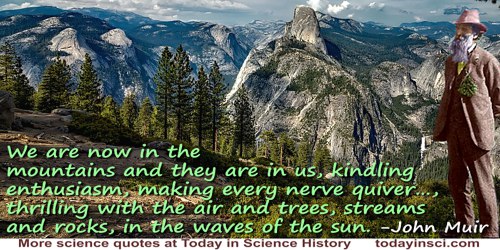
We are now in the mountains and they are in us, kindling enthusiasm, making every nerve quiver, filling every pore and cell of us. Our flesh-and-bone tabernacle seems transparent as glass to the beauty about us, as if truly an inseparable part of it, thrilling with the air and trees, streams and rocks, in the waves of the sun,—a part of all nature, neither old nor young, sick nor well, but immortal.
In My First Summer in the Sierra (1911), 20. Based on Muir’s original journals and sketches of his 1869 stay in the Sierra.
We can allow satellites, planets, suns, universe, nay whole systems of universe[s,] to be governed by laws, but the smallest insect, we wish to be created at once by special act.
In Notebook N (1838), 36. Excerpted in Charles Darwin, Thomas F. Glick (ed.) and David Kohn (ed.) On Evolution: The Development of the Theory of Natural Selection (1996), 80.
We debase the richness of both nature and our own minds if we view the great pageant of our intellectual history as a compendium of new in formation leading from primal superstition to final exactitude. We know that the sun is hub of our little corner of the universe, and that ties of genealogy connect all living things on our planet, because these theories assemble and explain so much otherwise disparate and unrelated information–not because Galileo trained his telescope on the moons of Jupiter or because Darwin took a ride on a Galápagos tortoise.
…...
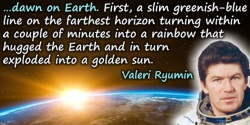
We entered into shadow. Contact with Moscow was gone. Japan floated by beneath us and I could clearly see its cities ablaze with lights. We left Japan behind to face the dark emptiness of the Pacific Ocean. No moon. Only stars, bright and far away. I gripped the handle like a man hanging onto a streetcar. Very slowly, agonizingly, half an hour passed, and with that, dawn on Earth. First, a slim greenish-blue line on the farthest horizon turning within a couple of minutes into a rainbow that hugged the Earth and in turn exploded into a golden sun. You’re out of your mind, I told myself, hanging onto a ship in space, and to your life, and getting ready to admire a sunrise.
…...
We have dominated and overruled nature, and from now on the earth is ours, a kitchen garden until we learn to make our own chlorophyll and float it out in the sun inside plastic mebranes. We will build Scarsdale on Mount Everest.
In The Medusa and the Snail: More Notes of a Biology Watcher (1974, 1979), 108.
We live on an obscure hunk of rock and metal circling a humdrum sun, which is on the outskirts of a perfectly ordinary galaxy comprised of 400 billion other suns, which, in turn, is one of some hundred billion galaxies that make up the universe, which, current thinking suggests, is one of a huge number—perhaps an infinite number—of other closed-off universes. From that perspective, the idea that we’re at the center, that we have some cosmic importance, is ludicrous.
From interview with Linda Obst in her article 'Valentine to Science', in Interview (Feb 1996). Quoted and cited in Tom Head (ed.), Conversations with Carl Sagan (2006), ix, and cited on p.xix.
We need not hesitate to admit that the Sun is richly stored with inhabitants.
Philosophical Transactions of the Royal Society of London, from their commencement in 1665 to the year 1800. Vol. 17: From 1791 to 1796 (1809), 490.
Quoted in Edward Polehampton and John Mason Good The Gallery of Nature and Art (1818), 58.
We no longer can talk of unearned “rights.” We’ll have to get back to working for “rights” to adequate food, housing, education, opportunity, a place in the sun—and not everybody is going to make the grade. I don’t see this obsession with the lowest strata of humanity, against all natural biologic experience. We must accept that life is unfair.
In Raymond Mungo, 'Dixy Lee Ray: How Madame Nuke Took Over Washington', Mother Jones (May 1977), 2, No. 4, 31.
We owe our lives to the sun... How is it, then, that we feel no gratitude?
Earth Ethics (Summer 1990).
We sound the future, and learn that after a period, long compared with the divisions of time open to our investigation, the energies of our system will decay, the glory of the sun will be dimmed and the earth, tideless and inert, will no longer tolerate the race which has for a moment disturbed its solitude. Man will go down into the pit, and all his thoughts will perish.
The Foundations of Belief: Being Notes Introductory to the Study of Theology (1895), 30-1.
We speak of it [astrology] as an extinct science; yet let but an eclipse of the sun happen, or a comet visit the evening sky, and in a moment we all believe in astrology. In vain do you tell the gazers on such spectacles that a solar eclipse is only the moon acting for the time as a candle-extinguisher to the sun, and give them bits of smoked glass to look through, and draw diagrams on the blackboard to explain it all. They listen composedly, and seem convinced, but in their secret hearts they are saying—“What though you can see it through a glass darkly, and draw it on a blackboard, does that show that it has no moral significance? You can draw a gallows or a guillotine, or write the Ten Commandments on a blackboard, but does that deprive them of meaning?” And so with the comet. No man will believe that the splendid stranger is hurrying through the sky solely on a momentous errand of his own. No! he is plainly signalling, with that flashing sword of his, something of importance to men,—something at all events that, if we could make it out, would be found of huge concern to us.
From 'Introductory Lecture on Technology for 1858-59', published as The Progress of the Telegraph (1859), 19-20.
We will build the roads and bridges, the electric grids and digital lines that feed our commerce and bind us together. We'll restore science to its rightful place, and wield technology's wonders to raise health care's quality and lower its cost. We will harness the sun and the winds and the soil to fuel our cars and run our factories. And we will transform our schools and colleges and universities to meet the demands of a new age. All this we can do. All this we will do.
From First Inaugural Address (20 Jan 2009)
Well, the people, I would say. There is no patent. Could you patent the sun?
[On being asked who owned the patent on his polio vaccine by journalist, Edward R. Murrow in 1954.]
[On being asked who owned the patent on his polio vaccine by journalist, Edward R. Murrow in 1954.]
Quoted in The Economist (14 Aug 1999), 11. In Howard Gardner, et al., Good Work (2002), 111.
What a type of happy family is the family of the Sun! With what order, with what harmony, with what blessed peace, do his children the planets move around him, shining with light which they drink in from their parent’s in at once upon him and on one another!
…...
What do we plant when we plant the tree?
We plant the ship, which will cross the sea.
We plant the mast to carry the sails;
We plant the planks to withstand the gales—
The keel, the keelson, and beam and knee;
We plant the ship when we plant the tree.
What do we plant when we plant the tree?
We plant the houses for you and me.
We plant the rafters, the shingles, the floors,
We plant the studding, the lath, the doors,
The beams and siding, all parts that be;
We plant the house when we plant the tree.
What do we plant when we plant the tree?
A thousand things that we daily see;
We plant the spire that out-towers the crag,
We plant the staff for our country's flag,
We plant the shade, from the hot sun free;
We plant all these when we plant the tree.
We plant the ship, which will cross the sea.
We plant the mast to carry the sails;
We plant the planks to withstand the gales—
The keel, the keelson, and beam and knee;
We plant the ship when we plant the tree.
What do we plant when we plant the tree?
We plant the houses for you and me.
We plant the rafters, the shingles, the floors,
We plant the studding, the lath, the doors,
The beams and siding, all parts that be;
We plant the house when we plant the tree.
What do we plant when we plant the tree?
A thousand things that we daily see;
We plant the spire that out-towers the crag,
We plant the staff for our country's flag,
We plant the shade, from the hot sun free;
We plant all these when we plant the tree.
(Feb 1890) In The Poems of Henry Abbey (1895), 262.
What makes planets go around the sun? At the time of Kepler, some people answered this problem by saying that there were angels behind them beating their wings and pushing the planets around an orbit. As you will see, the answer is not very far from the truth. The only difference is that the angels sit in a different direction and their wings push inward.
In The Character of Physical Law (1965), 18.
What makes the beauty of this flower which blows?
Not nourishing earth, nor air, nor heaven’s blue,
Nor sun, nor soil, nor the translucent dew;
But that which held in combination grows
Whole in each part, and perfect at the close.
Chemist nor botanist no more than you
Can see that pure necessity wherethrough
Beauty is born—a rose within the rose.
Not nourishing earth, nor air, nor heaven’s blue,
Nor sun, nor soil, nor the translucent dew;
But that which held in combination grows
Whole in each part, and perfect at the close.
Chemist nor botanist no more than you
Can see that pure necessity wherethrough
Beauty is born—a rose within the rose.
In 'A Rose', Memorial Volume: Selections from the Prose and Poetical Writings of the Late John Savary (1912), 41. The quoted lines begin the first stanza, which ends similarly: “Upon the shooting of a seed
Our world depends for daily bread.”
Our world depends for daily bread.”
What signifies Philosophy that does not apply to some Use? May we not learn from hence, that black Clothes are not so fit to wear in a hot Sunny Climate or Season, as white ones; because in such Cloaths the Body is more heated by the Sun when we walk abroad, and are at the same time heated by the Exercise, which double Heat is apt to bring on putrid dangerous Fevers? The Soldiers and Seamen, who must march and labour in the Sun, should in the East or West Indies have an Uniform of white?
Letter to Miss Mary Stevenson, 20 Sep 1761. In Albert Henry Smyth (ed.), The Writings of Benjamin Franklin (1906), Vol. 4, 115.
Whatever be the detail with which you cram your student, the chance of his meeting in after life exactly that detail is almost infinitesimal; and if he does meet it, he will probably have forgotten what you taught him about it. The really useful training yields a comprehension of a few general principles with a thorough grounding in the way they apply to a variety of concrete details. In subsequent practice the men will have forgotten your particular details; but they will remember by an unconscious common sense how to apply principles to immediate circumstances. Your learning is useless to you till you have lost your textbooks, burnt your lecture notes, and forgotten the minutiae which you learned by heart for the examination. What, in the way of detail, you continually require will stick in your memory as obvious facts like the sun and the moon; and what you casually require can be looked up in any work of reference. The function of a University is to enable you to shed details in favor of principles. When I speak of principles I am hardly even thinking of verbal formulations. A principle which has thoroughly soaked into you is rather a mental habit than a formal statement. It becomes the way the mind reacts to the appropriate stimulus in the form of illustrative circumstances. Nobody goes about with his knowledge clearly and consciously before him. Mental cultivation is nothing else than the satisfactory way in which the mind will function when it is poked up into activity.
In 'The Rhythm of Education', The Aims of Education: & Other Essays (1917), 41.
When a Parliament, acting against the declared Sense of the Nation, would have appeared as surprising a phœnomenon in the moral World, as a retrograde Motion of the Sun, or any other signal Deviation of Things from their ordinary Course in the natural World.
In A Dissertation Upon Parties: In Several Letters to Caleb D’Anvers, Esq. (1733, 1735), 39.
When a man spends his life among the stars and planets, or lays out a twelvemonth on the spots of the sun, however noble his speculations may be, they are very apt to fall into burlesque.
In The Works of Joseph Addison: Including the Whole Contents of Bp. Hurd’s Edition, with Letters and Other Pieces Not Found in Any Previous Collection; and Macaulay’s Essay on His Life and Works (1854), Vol. 2, 9.
When Bonner writes that ‘natural selection for optimal feeding is then presumed to be the cause of non-motility in all forms,’ I can’t help suspecting that some plants might do even better if they could walk from shade to sun–but the inherited constraints of design never permitted a trial of this intriguing option.
…...
When I observe the luminous progress and expansion of natural science in modern times, I seem to myself like a traveller going eastwards at dawn, and gazing at the growing light with joy, but also with impatience; looking forward with longing to the advent of the full and final light, but, nevertheless, having to turn away his eyes when the sun appeared, unable to bear the splendour he had awaited with so much desire.
In The Maxims and Reflections of Goethe (1906), 197-198.
When the earth came alive it began constructing its own membrane, for the general purpose of editing the sun.
In The Lives of a Cell (1974), 171.
When the moon is ninety degrees away from the sun it sees but half the earth illuminated (the western half). For the other (the eastern half) is enveloped in night. Hence the moon itself is illuminated less brightly from the earth, and as a result its secondary light appears fainter to us.
The Starry Messenger (1610), trans. Stillman Drake, Discoveries and Opinions of Galileo (1957), 45.
When the Romans besieged the town [Sicily] (in 212 to 210 B.C.), he [Archimedes] is said to have burned their ships by concentrating on them, by means of mirrors, the sun’s rays. The story is highly improbable, but is good evidence of the reputation which he had gained among his contemporaries for his knowledge of optics.
In An Introduction to Mathematics (1911), 37.
When the sun is covered by clouds, objects are less conspicuous, because there is little difference between the light and shade of the trees and the buildings being illuminated by the brightness of the atmosphere which surrounds the objects in such a way that the shadows are few, and these few fade away so that their outline is lost in haze.
…...
When ultra-violet light acts on a mixture of water, carbon dioxide, and ammonia, a vast variety of organic substances are made, including sugars and apparently some of the materials from which proteins are built up…. But before the origin of life they must have accumulated till the primitive oceans reached the consistency of hot dilute soup…. The first living or half-living things were probably large molecules synthesized under the influence of the sun’s radiation, and only capable of reproduction in the particularly favorable medium in which they originated….
In 'The Origin of Life', The Inequality of Man: And Other Essays (1932, 1937), 152.
Whether a man is on the earth, or the sun, or some other star, it will always seem to him that the position that he occupies is the motionless center, and that all other things are in motion.
…...
Which way will the sunflowers turn surrounded by millions of suns?
From poem, 'Poem Rocket', in Kaddish and Other Poems (1961).
Who can estimate the value to civilization of the Copernican system of the sun and planets? A round earth, an earth not the centre of the universe, an earth obeying law, an earth developed by processes of evolution covering tens of millions of years, is incomparably grander than the earth which ante-Copernican imagination pictured.
In 'The Nature of the Astronomer’s Work', North American Review (Jun 1908), 187, No. 631, 915.
Why there is one Body in or System qualified to give Light and Heat to all ye rest, I know no reason, but because ye author of the Systeme thought it convenient.
Letter to Bentley (10 Dec 1692). In The Works of Richard Bentley (1838), Vol. 3, 204.
Xenophanes of Kolophon ... says that ... [t]he sun is formed each day from small fiery particles which are gathered together: the earth is infinite, and is not surrounded by air or by sky; an infinite number of suns and moons exist, and all things come from earth. The sea, he said, is salt because so many things flow together and become mixed in it...
Doxographists, Epiph. adv. Haer. iii. 9; Dox. 590. Quoted in Arthur Fairbanks (ed. And trans.), The First Philosophers of Greece (1898), 83.
You can hardly imagine how I am struggling to exert my poetical ideas just now for the discovery of analogies & remote figures respecting the earth, Sun & all sorts of things—for I think it is the true way (corrected by judgement) to work out a discovery.
Letter to C. Schrenbein, 13th Nov, 1845. In Frank A. J. L. James (ed.), The Correspondence of Michael Faraday (1996), Vol. 3, 428.
You can’t just write and write and put things in a drawer. They wither without the warm sun of someone else’s appreciation.
In Locked Rooms and Open Doors (1974), 44.
You see but your shadow when you turn your back to the sun.
In Kahlil Gibran: The Collected Works (2007), 188.
YOUTH AND AGE
Though leaves are many, the root is one;
Through all the lying days of my youth
I swayed my leaves and flowers in the sun;
Now I may wither into the truth.
Though leaves are many, the root is one;
Through all the lying days of my youth
I swayed my leaves and flowers in the sun;
Now I may wither into the truth.
In McClure's Magazine (Dec 1910), 36, No. 2, 168.
 In science it often happens that scientists say, 'You know that's a really good argument; my position is mistaken,' and then they would actually change their minds and you never hear that old view from them again. They really do it. It doesn't happen as often as it should, because scientists are human and change is sometimes painful. But it happens every day. I cannot recall the last time something like that happened in politics or religion.
(1987) --
In science it often happens that scientists say, 'You know that's a really good argument; my position is mistaken,' and then they would actually change their minds and you never hear that old view from them again. They really do it. It doesn't happen as often as it should, because scientists are human and change is sometimes painful. But it happens every day. I cannot recall the last time something like that happened in politics or religion.
(1987) -- 





