Suggestion Quotes (49 quotes)
[About a conference on Systematic Biology] Many interesting statements were made that apply directly to the work of taxonomists. In some cases the interest lay in the value of the suggestion and sometimes in the obvious need for rebuttal.
In 'Illogicality in Criticism', Systematic Zoology (Dec 1969), 18, No. 4, 470.
[In plotting earthquake measurements] the range between the largest and smallest magnitudes seemed unmanageably large. Dr. Beno Gutenberg then made the natural suggestion to plot the amplitudes logarithmically.
From interview with Henry Spall, as in an abridged version of Earthquake Information Bulletin (Jan-Feb 1980), 12, No. 1, that is on the USGS website.
Every teacher certainly should know something of non-euclidean geometry. Thus, it forms one of the few parts of mathematics which, at least in scattered catch-words, is talked about in wide circles, so that any teacher may be asked about it at any moment. … Imagine a teacher of physics who is unable to say anything about Röntgen rays, or about radium. A teacher of mathematics who could give no answer to questions about non-euclidean geometry would not make a better impression.
On the other hand, I should like to advise emphatically against bringing non-euclidean into regular school instruction (i.e., beyond occasional suggestions, upon inquiry by interested pupils), as enthusiasts are always recommending. Let us be satisfied if the preceding advice is followed and if the pupils learn to really understand euclidean geometry. After all, it is in order for the teacher to know a little more than the average pupil.
On the other hand, I should like to advise emphatically against bringing non-euclidean into regular school instruction (i.e., beyond occasional suggestions, upon inquiry by interested pupils), as enthusiasts are always recommending. Let us be satisfied if the preceding advice is followed and if the pupils learn to really understand euclidean geometry. After all, it is in order for the teacher to know a little more than the average pupil.
In George Edward Martin, The Foundations of Geometry and the Non-Euclidean Plane (1982), 72.
Replying to G. H. Hardy’s suggestion that the number of a taxi (1729) was “dull”: No, it is a very interesting number; it is the smallest number expressible as a sum of two cubes in two different ways, the two ways being 1³ + 12³ and 9³ + 10³.
Proceedings of the London Mathematical Society (26 May 1921).
A fact is a simple statement that everyone believes. It is innocent, unless found guilty. A hypothesis is a novel suggestion that no one wants to believe. It is guilty until found effective.
Edward Teller, Wendy Teller, Wilson Talley, Conversations on the Dark Secrets of Physics (1991, 2002), Footnote, 69.
A great department of thought must have its own inner life, however transcendent may be the importance of its relations to the outside. No department of science, least of all one requiring so high a degree of mental concentration as Mathematics, can be developed entirely, or even mainly, with a view to applications outside its own range. The increased complexity and specialisation of all branches of knowledge makes it true in the present, however it may have been in former times, that important advances in such a department as Mathematics can be expected only from men who are interested in the subject for its own sake, and who, whilst keeping an open mind for suggestions from outside, allow their thought to range freely in those lines of advance which are indicated by the present state of their subject, untrammelled by any preoccupation as to applications to other departments of science. Even with a view to applications, if Mathematics is to be adequately equipped for the purpose of coping with the intricate problems which will be presented to it in the future by Physics, Chemistry and other branches of physical science, many of these problems probably of a character which we cannot at present forecast, it is essential that Mathematics should be allowed to develop freely on its own lines.
In Presidential Address British Association for the Advancement of Science, Sheffield, Section A,
Nature (1 Sep 1910), 84, 286.
A living organism must be studied from two distinct aspects. One of these is the causal-analytic aspect which is so fruitfully applicable to ontogeny. The other is the historical descriptive aspect which is unravelling lines of phylogeny with ever-increasing precision. Each of these aspects may make suggestions concerning the possible significance of events seen under the other, but does not explain or translate them into simpler terms.
'Embryology and Evolution', in G. R. de Beer (ed.), Evolution: Essays on Aspects of Evolutionary Biology presented to Professor E. S. Goodrich on his Seventieth Birthday (1938), 76-7.
A mind exclusively bent upon the idea of utility necessarily narrows the range of the imagination. For it is the imagination which pictures to the inner eye of the investigator the indefinitely extending sphere of the possible,—that region of hypothesis and explanation, of underlying cause and controlling law. The area of suggestion and experiment is thus pushed beyond the actual field of vision.
In 'The Paradox of Research', The North American Review (Sep 1908), 188, No. 634, 425.
A physician’s subject of study is necessarily the patient, and his first field for observation is the hospital. But if clinical observation teaches him to know the form and course of diseases, it cannot suffice to make him understand their nature; to this end he must penetrate into the body to find which of the internal parts are injured in their functions. That is why dissection of cadavers and microscopic study of diseases were soon added to clinical observation. But to-day these various methods no longer suffice; we must push investigation further and, in analyzing the elementary phenomena of organic bodies, must compare normal with abnormal states. We showed elsewhere how incapable is anatomy alone to take account of vital phenenoma, and we saw that we must add study of all physico-chemical conditions which contribute necessary elements to normal or pathological manifestations of life. This simple suggestion already makes us feel that the laboratory of a physiologist-physician must be the most complicated of all laboratories, because he has to experiment with phenomena of life which are the most complex of all natural phenomena.
From An Introduction to the Study of Experimental Medicine (1865), as translated by Henry Copley Greene (1957), 140-141.
After I had addressed myself to this very difficult and almost insoluble problem, the suggestion at length came to me how it could be solved with fewer and much simpler constructions than were formerly used, if some assumptions (which are called axioms) were granted me. They follow in this order.
There is no one center of all the celestial circles or spheres.
The center of the earth is not the center of the universe, but only of gravity and of the lunar sphere.
All the spheres revolve about the sun as their mid-point, and therefore the sun is the center of the universe.
The ratio of the earth’s distance from the sun to the height of the firmament is so much smaller than the ratio of the earth’s radius to its distance from the sun that the distance from the earth to the sun is imperceptible in comparison with the height of the firmament.
Whatever motion appears in the firmament arises not from any motion of the firmament, but from the earth’s motion. The earth together with its circumjacent elements performs a complete rotation on its fixed poles in a daily motion, while the firmament and highest heaven abide unchanged.
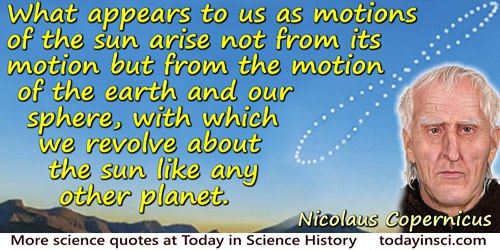
What appears to us as motions of the sun arise not from its motion but from the motion of the earth and our sphere, with which we revolve about the sun like any other planet. The earth has, then, more than one motion.
The apparent retrograde and direct motion of the planets arises not from their motion but from the earth’s. The motion of the earth alone, therefore, suffices to explain so many apparent inequalities in the heavens.
There is no one center of all the celestial circles or spheres.
The center of the earth is not the center of the universe, but only of gravity and of the lunar sphere.
All the spheres revolve about the sun as their mid-point, and therefore the sun is the center of the universe.
The ratio of the earth’s distance from the sun to the height of the firmament is so much smaller than the ratio of the earth’s radius to its distance from the sun that the distance from the earth to the sun is imperceptible in comparison with the height of the firmament.
Whatever motion appears in the firmament arises not from any motion of the firmament, but from the earth’s motion. The earth together with its circumjacent elements performs a complete rotation on its fixed poles in a daily motion, while the firmament and highest heaven abide unchanged.
What appears to us as motions of the sun arise not from its motion but from the motion of the earth and our sphere, with which we revolve about the sun like any other planet. The earth has, then, more than one motion.
The apparent retrograde and direct motion of the planets arises not from their motion but from the earth’s. The motion of the earth alone, therefore, suffices to explain so many apparent inequalities in the heavens.
'The Commentariolus', in Three Copernican Treatises (c.1510), trans. E. Rosen (1939), 58-9.
All things are made of atoms—little particles that move around in perpetual motion, attracting each other when they are a little distance apart, but repelling upon being squeezed into one another. In that one sentence ... there is an enormous amount of information about the world.
His suggestion that the most valuable information on scientific knowledge in a single sentence using the fewest words is to state the atomic hypothesis.
His suggestion that the most valuable information on scientific knowledge in a single sentence using the fewest words is to state the atomic hypothesis.
Six Easy Pieces (1995), 4.
Apart from blunt truth, our lives sink decadently amid the perfume of hints and suggestions.
In Adventures of Ideas (1933), 321.
Despite the vision and the far-seeing wisdom of our wartime heads of state, the physicists felt a peculiarly intimate responsibility for suggesting, for supporting, and in the end, in large measure, for achieving the realization of atomic weapons. Nor can we forget that these weapons, as they were in fact used, dramatized so mercilessly the inhumanity and evil of modern war. In some sort of crude sense which no vulgarity, no humor, no overstatement can quite extinguish, the physicists have known sin; and this is a knowledge which they cannot lose.
In Arthur Dehon Little Memorial Lecture (25 Nov 1947) to the Massachusetts Institute of Technology, 'Physics in the Contemporary World'. Collected in J. Robert Oppenheimer, The Open Mind (1955), 88.
Einstein was wrong when he said, 'God does not play dice'. Consideration of black holes suggests, not only that God does play dice, but that he sometimes confuses us by throwing them where they can't be seen.
In The Nature Of Space And Time (1996, 2010), 26.
Every body continues in its state of rest or uniform motion in a straight line, except in so far as it doesn’t. … The suggestion that the body really wanted to go straight but some mysterious agent made it go crooked is picturesque but unscientific.
Paraphasing Newton’s First Law of Motion. In a Gifford Lecture delivered at the University of Edinburgh (1927), 'Gravitation: The Law', The Nature of the Physical World (1928), 124.
Everything you’ve learned in school as “obvious” becomes less and less obvious as you begin to study the universe. For example, there are no solids in the universe. There’s not even a suggestion of a solid. There are no absolute continuums. There are no surfaces. There are no straight lines.
…...
Far be it from me to suggest that geologists should be reckless in their drafts upon the bank of Time; but nothing whatever is gained, and very much is lost, by persistent niggardliness in this direction.
Proceedings of the Geological Society of London (1903), 59, lxxii.
He who studies it [Nature] has continually the exquisite pleasure of discerning or half discerning and divining laws; regularities glimmer through an appearance of confusion, analogies between phenomena of a different order suggest themselves and set the imagination in motion; the mind is haunted with the sense of a vast unity not yet discoverable or nameable. There is food for contemplation which never runs short; you are gazing at an object which is always growing clearer, and yet always, in the very act of growing clearer, presenting new mysteries.
From 'Natural History', Macmillan's Magazine (1875), 31, 366.
Hence when a person is in great pain, the cause of which he cannot remove, he sets his teeth firmly together, or bites some substance between them with great vehemence, as another mode of violent exertion to produce a temporary relief. Thus we have the proverb where no help can be has in pain, 'to grin and abide;' and the tortures of hell are said to be attended with 'gnashing of teeth.'Describing a suggestion of the origin of the grin in the present form of a proverb, 'to grin and bear it.'
Zoonomia, Or, The Laws of Organic Life, in three parts (1803), Vol. 1, 330.
I suggest that the best geologist is he who has seen most rocks.
The Granite Controversy: Geological Addresses Illustrating the Evolution of a Disputant (1957), 3.
I thank God that I was not made a dexterous manipulator, for the most important of my discoveries have been suggested to me by my failures.
In Joseph William Mellor, Modern Inorganic Chemistry (1927). Quoted earlier in books by Samuel Smiles.
If the world has begun with a single quantum, the notions of space and would altogether fail to have any meaning at the beginning; they would only begin to have a sensible meaning when the original quantum had been divided into a sufficient number of quanta. If this suggestion is correct, the beginning of the world happened a little before the beginning of space and time. I think that such a beginning of the world is far enough from the present order of Nature to be not at all repugnant. It may be difficult to follow up the idea in detail as we are not yet able to count the quantum packets in every case. For example, it may be that an atomic nucleus must be counted as a unique quantum, the atomic number acting as a kind of quantum number. If the future development of quantum theory happens to turn in that direction, we could conceive the beginning of the universe in the form of a unique atom, the atomic weight of which is the total mass of the universe. This highly unstable atom would divide in smaller and smaller atoms by a kind of super-radioactive process.
In a seminal short letter (457 words), 'The Beginning of the World from the Point of View of Quantum Theory', Nature (9 May 1931), 127, 706.
In an enterprise such as the building of the atomic bomb the difference between ideas, hopes, suggestions and theoretical calculations, and solid numbers based on measurement, is paramount. All the committees, the politicking and the plans would have come to naught if a few unpredictable nuclear cross sections had been different from what they are by a factor of two.
Epigraph in Richard Rhodes, The Making of the Atomic Bomb (1986), 8.
In my opinion instruction is very purposeless for such individuals who do no want merely to collect a mass of knowledge, but are mainly interested in exercising (training) their own powers. One doesn't need to grasp such a one by the hand and lead him to the goal, but only from time to time give him suggestions, in order that he may reach it himself in the shortest way.
Letter to Heinrich Schumacher (2 Oct 1808). Quoted in G. Waldo Dunnington, Carl Friedrich Gauss: Titan of Science (2004), 416.
In no subject is there a rule, compliance with which will lead to new knowledge or better understanding. Skilful observations, ingenious ideas, cunning tricks, daring suggestions, laborious calculations, all these may be required to advance a subject. Occasionally the conventional approach in a subject has to be studiously followed; on other occasions it has to be ruthlessly disregarded. Which of these methods, or in what order they should be employed is generally unpredictable. Analogies drawn from the history of science are frequently claimed to be a guide; but, as with forecasting the next game of roulette, the existence of the best analogy to the present is no guide whatever to the future. The most valuable lesson to be learnt from the history of scientific progress is how misleading and strangling such analogies have been, and how success has come to those who ignored them.
'Cosmology', in Arthur Beer (ed.), Vistas in Astronomy (1956), Vol. 2, 1722.
In the fall of 1967, [I was invited] to a conference … on pulsars. … In my talk, I argued that we should consider the possibility that the center of a pulsar is a gravitationally completely collapsed object. I remarked that one couldn't keep saying “gravitationally completely collapsed object” over and over. One needed a shorter descriptive phrase. “How about black hole?” asked someone in the audience. I had been searching for the right term for months, mulling it over in bed, in the bathtub, in my car, whenever I had quiet moments. Suddenly this name seemed exactly right. When I gave a more formal Sigma Xi-Phi Beta Kappa lecture … on December 29, 1967, I used the term, and then included it in the written version of the lecture published in the spring of 1968. (As it turned out, a pulsar is powered by “merely” a neutron star, not a black hole.)
[Although John Wheeler is often identified as coining the term “black hole,” he in fact merely popularized the expression. In his own words, this is his explanation of the true origin: a suggestion from an unidentified person in a conference audience.]
[Although John Wheeler is often identified as coining the term “black hole,” he in fact merely popularized the expression. In his own words, this is his explanation of the true origin: a suggestion from an unidentified person in a conference audience.]
In Geons, Black Holes, and Quantum Foam (2000), 296-297.
It need scarcely be pointed out that with such a mechanism complete isolation of portion of a species should result relatively rapidly in specific differentiation, and one that is not necessarily adaptive. The effective intergroup competition leading to adaptive advance may be between species rather than races. Such isolation is doubtless usually geographic in character at the outset but may be clinched by the development of hybrid sterility. The usual difference of the chromosome complements of related species puts the importance of chromosome aberration as an evolutionary process beyond question, but, as I see it, this importance is not in the character differences which they bring (slight in balanced types), but rather in leading to the sterility of hybrids and thus making permanent the isolation of two groups.
How far do the observations of actual species and their subdivisions conform to this picture? This is naturally too large a subject for more than a few suggestions.
That evolution involves non-adaptive differentiation to a large extent at the subspecies and even the species level is indicated by the kinds of differences by which such groups are actually distinguished by systematics. It is only at the subfamily and family levels that clear-cut adaptive differences become the rule. The principal evolutionary mechanism in the origin of species must thus be an essentially nonadaptive one.
How far do the observations of actual species and their subdivisions conform to this picture? This is naturally too large a subject for more than a few suggestions.
That evolution involves non-adaptive differentiation to a large extent at the subspecies and even the species level is indicated by the kinds of differences by which such groups are actually distinguished by systematics. It is only at the subfamily and family levels that clear-cut adaptive differences become the rule. The principal evolutionary mechanism in the origin of species must thus be an essentially nonadaptive one.
In Proceedings of the Sixth International Congress of Genetics: Ithaca, New York, 1932 (1932) Vol. 1, 363-364.
Kepler’s suggestion of gravitation with the inverse distance, and Bouillaud’s proposed substitution of the inverse square of the distance, are things which Newton knew better than his modern readers. I have discovered two anagrams on his name, which are quite conclusive: the notion of gravitation was not new; but Newton went on.
In Budget of Paradoxes (1872), 82.
Maybe the best single measure of mental skill lies in the speed with which errors are detected and thrown out.
In 'The Measurement of Human Skill', British Medical Journal (21 Jun 1947), 1, No. 4511, 879. The article is the text of the second (23 Jan 1947) of two Oliver-Sharpey Lectures given by Bartlett at the Royal College of Physicians of London.

Necessity is not the mother of invention. Knowledge and experiment are its parents. It sometimes happens that successful search is made for unknown materials to fill well-recognized and predetermined requirements. It more often happens that the acquirement of knowledge of the previously unknown properties of a material suggests its trial for some new use. These facts strongly indicate the value of knowledge of properties of materials and indicate
a way for research.
Quoted in Guy Suits, 'Willis Rodney Whitney', National Academy of Sciences, Biographical Memoirs (1960), 357.
Neither the naked hand nor the understanding left to itself can effect much. It is by instruments and helps that the work is done, which are as much wanted for the understanding as for the hand. And as the instruments of the hand either give motion or guide it, so the instruments of the mind supply either suggestions for the understanding or cautions.
From Novum Organum (1620), Book 1, Aphorism 2. Translated as The New Organon: Aphorisms Concerning the Interpretation of Nature and the Kingdom of Man), collected in James Spedding, Robert Ellis and Douglas Heath (eds.), The Works of Francis Bacon (1857), Vol. 4, 47.
Not a single visible phenomenon of cell-division gives even a remote suggestion of qualitative division. All the facts, on the contrary, indicate that the division of the chromatin is carried out with the most exact equality.
In The Cell in Development and Inheritance (1896), 306.
On May 15, 1957 Linus Pauling made an extraordinary speech to the students of Washington University. ... It was at this time that the idea of the scientists' petition against nuclear weapons tests was born. That evening we discussed it at length after dinner at my house and various ones of those present were scribbling and suggesting paragraphs. But it was Linus Pauling himself who contributed the simple prose of the petition that was much superior to any of the suggestions we were making.
Speech, "The 1962 Nobel Peace Prize," at Unitarian Church, Boulder, Colorado (20 Oct 1963). On Oregon State University Library website.
One thought I cannot forbear suggesting: we have long known that “one star differeth from another star in glory;” we have now the strongest evidence that they also differ in constituent materials,—some of them perhaps having no elements to be found in some other. What then becomes of that homogeneity of original diffuse matter which is almost a logical necessity of the nebular hypothesis?
L.M. Rutherfurd, 'Astronomical Observations with the Spectroscope' (4 Dec 1862), American Journal of Science and Arts (May 1863), 2nd Series, 35, No. 103, 77. His obituarist, John K. Rees, wrote (1892) “This paper was the first published work on star spectra.”
Science, then, is the attentive consideration of common experience; it is common knowledge extended and refined. Its validity is of the same order as that of ordinary perception; memory, and understanding. Its test is found, like theirs, in actual intuition, which sometimes consists in perception and sometimes in intent. The flight of science is merely longer from perception to perception, and its deduction more accurate of meaning from meaning and purpose from purpose. It generates in the mind, for each vulgar observation, a whole brood of suggestions, hypotheses, and inferences. The sciences bestow, as is right and fitting, infinite pains upon that experience which in their absence would drift by unchallenged or misunderstood. They take note, infer, and prophesy. They compare prophesy with event, and altogether they supply—so intent are they on reality—every imaginable background and extension for the present dream.
The Life of Reason, or the Phases of Human Progress (1954), 393.
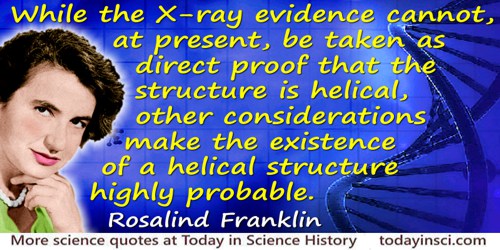
Sodium thymonucleate fibres give two distinct types of X-ray diagram … [structures A and B]. The X-ray diagram of structure B (see photograph) shows in striking manner the features characteristic of helical structures, first worked out in this laboratory by Stokes (unpublished) and by Crick, Cochran and Vand2. Stokes and Wilkins were the first to propose such structures for nucleic acid as a result of direct studies of nucleic acid fibres, although a helical structure had been previously suggested by Furberg (thesis, London, 1949) on the basis of X-ray studies of nucleosides and nucleotides.
While the X-ray evidence cannot, at present, be taken as direct proof that the structure is helical, other considerations discussed below make the existence of a helical structure highly probable.
While the X-ray evidence cannot, at present, be taken as direct proof that the structure is helical, other considerations discussed below make the existence of a helical structure highly probable.
From Rosalind Franklin and R. G. Gosling,'Molecular Configuration in Sodium Thymonucleate', Nature (25 Apr 1953), 171, No. 4356, 740.
The greatest delight which the fields and woods minister, is the suggestion of an occult relation between man and the vegetable. I am not alone and unacknowledged. They nod to me, and I to them. The waving of the boughs in the storm, is new to me and old. It takes me by surprise, and yet is not unknown. Its effect is like that of a higher thought or a better emotion coming over me, when I deemed I was thinking justly or doing right.
In Nature: An Essay, to Which is Added, Orations, Lectures, and Addresses (1845), 5.
The layman, taught to revere scientists for their absolute respect for the observed facts, and for the judiciously detached and purely provisional manner in which they hold scientific theories (always ready to abandon a theory at the sight of any contradictory evidence) might well have thought that, at [Dayton C.] Miller's announcement of this overwhelming evidence of a “positive effect” [indicating that the speed of light is not independent from the motion of the observer, as Einstein's theory of relativity demands] in his presidential address to the American Physical Society on December 29th, 1925, his audience would have instantly abandoned the theory of relativity. Or, at the very least, that scientists—wont to look down from the pinnacle of their intellectual humility upon the rest of dogmatic mankind—might suspend judgment in this matter until Miller's results could be accounted for without impairing the theory of relativity. But no: by that time they had so well closed their minds to any suggestion which threatened the new rationality achieved by Einstein's world-picture, that it was almost impossible for them to think again in different terms. Little attention was paid to the experiments, the evidence being set aside in the hope that it would one day turn out to be wrong.
Personal Knowledge: Towards a Post-Critical Philosophy (1958, 1998), 13. Miller had earlier presented his evidence against the validity of the relativity theory at the annual meeting, 28 Apr 1925, of the National Academy of Sciences. Miller believed he had, by a much-refined and improved repetition of the so-called Michelson-Morley experiment, shown that there is a definite and measurable motion of the earth through the ether. In 1955, a paper by R.S. Shankland, et al., in Rev. Modern Phys. (1955), 27, 167, concluded that statistical fluctuations and temperature effects in the data had simulated what Miller had taken to be he apparent ether drift.
The whole philosophy of medicine consists in working out the histories of diseases, and applying the remedies which may dispel them; and Experience is the sole guide. This we attain by … the suggestions of common sense rather than of speculation.
In The Works of Thomas Sydenham, (1850), Vol. 2, 182.
The world little knows how many of the thoughts and theories which have passed through the mind of a scientific investigator, have been crushed in silence and secrecy by his own severe criticism and adverse examination; that in the most successful instances not a tenth of the suggestions, the hopes, the wishes, the preliminary conclusions have been realized.
In 'Observations On Mental Education', a lecture before the Prince Consort and the Royal Institution (6 May 1854). Experimental Researches in Chemistry and Physics (1859), 486.
There is more than a germ of truth in the suggestion that, in a society where statisticians thrive, liberty and individuality are likely to be emasculated.
In Facts From Figures (1951), 1
To most people, I fancy, the stars are beautiful; but if you asked why, they would be at a loss to reply, until they remembered what they had heard about astronomy, and the great size and distance and possible habitation of those orbs. ... [We] persuade ourselves that the power of the starry heavens lies in the suggestion of astronomical facts.
In The Sense of Beauty: Being the Outlines of Aesthetic Theory (1896), 100-101.
To those who have any intimate acquaintance with the laws of chemistry and physics the suggestion that the spiritual world could be ruled by laws of allied character is as preposterous as the suggestion that a nation could be ruled by laws like the laws of grammar.
Swarthmore Lecture (1929) at Friends’ House, London, printed in Science and the Unseen World (1929), 54.
We have seen that a proton of energy corresponding to 30,000 volts can effect the transformation of lithium into two fast α-particles, which together have an energy equivalent of more than 16 million volts. Considering the individual process, the output of energy in the transmutation is more than 500 times greater than the energy carried by the proton. There is thus a great gain of energy in the single transmutation, but we must not forget that on an average more than 1000 million protons of equal energy must be fired into the lithium before one happens to hit and enter the lithium nucleus. It is clear in this case that on the whole the energy derived from transmutation of the atom is small compared with the energy of the bombarding particles. There thus seems to be little prospect that we can hope to obtain a new source of power by these processes. It has sometimes been suggested, from analogy with ordinary explosives, that the transmutation of one atom might cause the transmutation of a neighbouring nucleus, so that the explosion would spread throughout all the material. If this were true, we should long ago have had a gigantic explosion in our laboratories with no one remaining to tell the tale. The absence of these accidents indicates, as we should expect, that the explosion is confined to the individual nucleus and does not spread to the neighbouring nuclei, which may be regarded as relatively far removed from the centre of the explosion.
The Transmutation of the Atom (1933), 23-4
We see, then, that the disappearance of the conscious personality, the predominance of the unconscious personality, the turning by means of suggestion and contagion of feelings and ideas in an identical direction, the tendency to immediately transform the suggested ideas into acts; these, we see, are the principal characteristics of the individual forming part of a crowd. He is no longer himself, but has become an automaton who has ceased to be guided by his will.
From Psychologie des Foules (1895), 20. English text in The Crowd: A Study of the Popular Mind (1897), Book 1, Chap. 1, 12. Original French text: “Donc, évanouissement de la personnalité consciente, prédominance de la personnalité inconsciente, orientation par voie de suggestion et de contagion des sentiments et des idées dans un même sens, tendance a transformer immédiatement en actes les idée suggérées, tels sont les principaux caractères de l’individu en foule. II n’est plus lui-même, il est devenu un automate que sa volonté ne guide plus.”
What I remember most clearly was that when I put down a suggestion that seemed to me cogent and reasonable, Einstein did not in the least contest this, but he only said, 'Oh, how ugly.' As soon as an equation seemed to him to be ugly, he really rather lost interest in it and could not understand why somebody else was willing to spend much time on it. He was quite convinced that beauty was a guiding principle in the search for important results in theoretical physics.
quoted in Fearful Symmetry: The Search for Beauty in Modern Physics (1987)
What is wanted in architecture, as in so many things, is a man. ... One suggestion might be made—no profession in England has done its duty until it has furnished a victim. ... Even our boasted navy never achieved a great victory until we shot an admiral. Suppose an architect were hanged? Terror has its inspiration, as well as competition.
Tancred: Or, The New Crusade (1907), 112.
Who could have believed that … the introduction into the human body of a small particle of matter from a cow’s udder might be the means of saving thousands of human lives? We learn from these and innumerable similar instances that the highest truths lie hid in the simplest facts; that, unlike human proclamations, nature’s teachings are not by sound of trumpet, but often in the stillest voice, by indirect hints and obscure suggestions.
From Address (Oct 1874) delivered at Guy’s Hospital, 'On The Study of Medicine', printed in British Medical journal (1874), 2, 425. Collected in Sir William Withey Gull and Theodore Dyke Acland (ed.), A Collection of the Published Writings of William Withey Gull (1896), 109.
Why should an hypothesis, suggested by a scientist, be accepted as true until its truth is established? Science should be the last to make such a demand because science to be truly science is classified knowledge; it is the explanation of facts. Tested by this definition, Darwinism is not science at all; it is guesses strung together.
In chapter, 'The Origin of Man', In His Image (1922), 94.
 In science it often happens that scientists say, 'You know that's a really good argument; my position is mistaken,' and then they would actually change their minds and you never hear that old view from them again. They really do it. It doesn't happen as often as it should, because scientists are human and change is sometimes painful. But it happens every day. I cannot recall the last time something like that happened in politics or religion.
(1987) --
In science it often happens that scientists say, 'You know that's a really good argument; my position is mistaken,' and then they would actually change their minds and you never hear that old view from them again. They really do it. It doesn't happen as often as it should, because scientists are human and change is sometimes painful. But it happens every day. I cannot recall the last time something like that happened in politics or religion.
(1987) -- 





