Suffering Quotes (68 quotes)
…the ideal doctor would be a man endowed with profound knowledge of life and of the soul, intuitively divining any suffering or disorder of whatever kind, and restoring peace by his mere presence.
Amiel's Journal The Journal Intime of Henri-Frederic Amiel (22 Aug 1873), trans. By Mrs Humphry Ward (1889), Vol 2., 153.
[A man] must learn to understand the motives of human beings, their illusions, and their sufferings human beings, their illusions, and their sufferings in order to acquire a proper relationship to individual fellow-men and to the community. These precious things … primarily constitutes and preserves culture. This is what I have in mind when I recommend the “humanities” as important, not just dry specialized knowledge in the fields of history and philosophy.
From interview with Benjamin Fine, 'Einstein Stresses Critical Thinking', New York Times (5 Oct 1952), 37.
[For] those suffering under the thraldom of the vice [of opium eating] … it is well to avoid undue harshness with the patient; and it should be carefully remembered, that in many instances the sufferers are more objects of pity than of blame.
In 'Clinical Lecture On The Treatment Of The Habit Of Opium-Eating', The British Medical Journal (15 Feb 1868), 1, No. 372, 137.
Se è vero che ci si abitua al dolore, come mai con l’andare degli anni si soffre sempre di píu?
If it is true that one gets used to suffering, how is it that, as the years go by, one always suffers more?
If it is true that one gets used to suffering, how is it that, as the years go by, one always suffers more?
Diary entry for 21 Nov 1937, in Il mestiere di vivere (1947), 303. Translated as The Burning Brand: Diaries 1935-1950 (1961), 70.
A game is on, at the other end of this infinite distance, and heads or tails will turn up. What will you wager? According to reason you cannot leave either; according to reason you cannot leave either undone... Yes, but wager you must; there is no option, you have embarked on it. So which will you have. Come. Since you must choose, let us see what concerns you least. You have two things to lose: truth and good, and two things to stake: your reason and your will, your knowledge and your happiness. And your nature has two things to shun: error and misery. Your reason does not suffer by your choosing one more than the other, for you must choose. That is one point cleared. But your happiness? Let us weigh gain and loss in calling heads that God is. Reckon these two chances: if you win, you win all; if you lose, you lose naught. Then do not hesitate, wager that He is.
Pensées (1670), Section I, aphorism 223. In H. F. Stewart (ed.), Pascal's Pensées (1950), 117-119.
All disease, at some period or other of its course, is more or less a reparative process, not necessarily accompanied with suffering: an effort of nature to remedy a process of poisoning or of decay, which has taken place weeks, months, sometimes years beforehand, unnoticed.
In Notes on Nursing: What It Is and What It Is Not (1859), 5.
Aristotle, in spite of his reputation, is full of absurdities. He says that children should be conceived in the Winter, when the wind is in the North, and that if people marry too young the children will be female. He tells us that the blood of females is blacker then that of males; that the pig is the only animal liable to measles; that an elephant suffering from insomnia should have its shoulders rubbed with salt, olive-oil, and warm water; that women have fewer teeth than men, and so on. Nevertheless, he is considered by the great majority of philosophers a paragon of wisdom.
From An Outline of Intellectual Rubbish (1937, 1943), 19. Collected in The Basic Writings of Bertrand Russell (2009), 63.
But for us, it’s different. Look again at that dot. That’s here. That’s home. That’s us. On it everyone you love, everyone you know, everyone you ever heard of, every human being who ever was, lived out their lives. The aggregate of our joy and suffering, thousands of confident religions, ideologies, and economic doctrines, every hunter and forager, every hero and coward, every creator and destroyer of civilization, every king and peasant, every young couple in love, every mother and father, hopeful child, inventor and explorer, every teacher of morals, every corrupt politician, every “superstar,” every “supreme leader,” every saint and sinner in the history of our species lived there - on a mote of dust suspended in a sunbeam.
…...
Character cannot be developed in ease and quiet. Only through experience of trial and suffering can the soul be strengthened, ambition inspired, and success achieved.
…...
Climate change threatens every corner of our country, every sector of our economy and the health and future of every child. We are already seeing its impacts and we know the poorest and most vulnerable people in the United States and around the world will suffer most of all.
In Hillary Clinton, 'Hillary Clinton: America Must Lead at Paris Climate Talks', Time (29 Nov 2015).
Consider the hateful brew compounded with gleaming, deadly white lead whose fresh colour is like milk…. Over the victim’s jaws and in the grooves of the gums is plastered an astringent froth, and the furrow of the tongue turns rough on either side, and the depth of the throat grows somewhat dry, and from the pernicious venom follows a dry retching and hawking, for this affliction is severe; meanwhile his spirit sickens and he is worn out with mortal suffering. His body too grows chill, while sometimes his eyes behold strange illusions or else he drowses; nor can he bestir his limbs as heretofore, and he succumbs to the overmastering fatigue.
— Nicander
As translated by A.S.F. Gow and A.F. Scholfield in Nicander: The Poems and Portical Fragments (1953), 99.
Disease is largely a removable evil. It continues to afflict humanity, not only because of incomplete knowledge of its causes and lack of individual and public hygiene, but also because it is extensively fostered by harsh economic and industrial conditions and by wretched housing in congested communities. ... The reduction of the death rate is the principal statistical expression and index of human social progress. It means the saving and lengthening of lives of thousands of citizens, the extension of the vigorous working period well into old age, and the prevention of inefficiency, misery, and suffering. These advances can be made by organized social effort. Public health is purchasable. (1911)
Quoted in Evelynn Maxine Hammonds, Childhood's Deadly Scourge: The Campaign to Control Diphtheria in New York City, 1880-1930(1999), 221.
Disease is somatic; the suffering from it, psychic.
Doctors have been exposed—you always will be exposed—to the attacks of those persons who consider their own undisciplined emotions more important than the world's most bitter agonies—the people who would limit and cripple and hamper research because they fear research may be accompanied by a little pain and suffering.
Doctors (1908), 28-9.
During the eight days I spent in space, I realized that mankind needs height primarily to better know our long-suffering Earth, to see what cannot be seen close up. Not just to love her beauty, but also to ensure that we do not bring even the slightest harm to the natural world
In Jack Hassard and Julie Weisberg , Environmental Science on the Net: The Global Thinking Project (1999), 40.
I have now reached the point where I may indicate briefly what to me constitutes the essence of the crisis of our time. It concerns the relationship of the individual to society. The individual has become more conscious than ever of his dependence upon society. But he does not experience this dependence as a positive asset, as an organic tie, as a protective force, but rather as a threat to his natural rights, or even to his economic existence. Moreover, his position in society is such that the egotistical drives of his make-up are constantly being accentuated, while his social drives, which are by nature weaker, progressively deteriorate. All human beings, whatever their position in society, are suffering from this process of deterioration. Unknowingly prisoners of their own egotism, they feel insecure, lonely, and deprived of the naive, simple, and unsophisticated enjoyment of life. Man can find meaning in life, short and perilous as it is, only through devoting himself to society.
…...
I was suffering from a sharp attack of intermittent fever, and every day during the cold and succeeding hot fits had to lie down for several hours, during which time I had nothing to do but to think over any subjects then particularly interesting me. One day something brought to my recollection Malthus's 'Principles of Population', which I had read about twelve years before. I thought of his clear exposition of 'the positive checks to increase'—disease, accidents, war, and famine—which keep down the population of savage races to so much lower an average than that of more civilized peoples. It then occurred to me that these causes or their equivalents are continually acting in the case of animals also; and as animals usually breed much more rapidly than does mankind, the destruction every year from these causes must be enormous in order to keep down the numbers of each species, since they evidently do not increase regularly from year to year, as otherwise the world would long ago have been densely crowded with those that breed most quickly. Vaguely thinking over the enormous and constant destruction which this implied, it occurred to me to ask the question, Why do some die and some live? The answer was clearly, that on the whole the best fitted live. From the effects of disease the most healthy escaped; from enemies, the strongest, swiftest, or the most cunning; from famine, the best hunters or those with the best digestion; and so on. Then it suddenly flashed upon me that this self-acting process would necessarily improve the race, because in every generation the inferior would inevitably be killed off and the superior would remain—that is, the fittest would survive.
[The phrase 'survival of the fittest,' suggested by the writings of Thomas Robert Malthus, was expressed in those words by Herbert Spencer in 1865. Wallace saw the term in correspondence from Charles Darwin the following year, 1866. However, Wallace did not publish anything on his use of the expression until very much later, and his recollection is likely flawed.]
[The phrase 'survival of the fittest,' suggested by the writings of Thomas Robert Malthus, was expressed in those words by Herbert Spencer in 1865. Wallace saw the term in correspondence from Charles Darwin the following year, 1866. However, Wallace did not publish anything on his use of the expression until very much later, and his recollection is likely flawed.]
My Life: A Record of Events and Opinions (1905), Vol. 1, 361-362, or in reprint (2004), 190.
I will give no deadly medicine to any one if asked, nor suggest any such counsel; and in like manner I will not give any woman the instrument to procure abortion. … I will not cut a person who is suffering with stone, but will leave this to be done by men who are practitioners of such work.
From 'The Oath', as translated by Francis Adams in The Genuine Works of Hippocrates (1849), Vol. 2, 780.
I’d disband NASA for 10 years and take half its budget to avert natural disasters. We could do it, we’ve got the technology. I'd take the other half to deal with disease and suffering. The time has come to do something bold instead of buying wheelchairs.
Quoted in Jennifer Kay 'Neurosurgeon Barth Green: Football player's treatment available to all', Associated Press news report, USA Today website (posted 27 Sep 2007).

If any student comes to me and says he wants to be useful to mankind and go into research to alleviate human suffering, I advise him to go into charity instead. Research wants real egotists who seek their own pleasure and satisfaction, but find it in solving the puzzles of nature.
In Science Today (May 1980), 35. In Vladimir Burdyuzha, The Future of Life and the Future of Our Civilization (2006), 374.
In 1945, therefore, I proved a sentimental fool; and Mr. Truman could safely have classified me among the whimpering idiots he did not wish admitted to the presidential office. For I felt that no man has the right to decree so much suffering, and that science, in providing and sharpening the knife and in upholding the ram, had incurred a guilt of which it will never get rid. It was at that time that the nexus between science and murder became clear to me. For several years after the somber event, between 1947 and 1952, I tried desperately to find a position in what then appeared to me as a bucolic Switzerland,—but I had no success.
Heraclitean Fire: Sketches from a Life before Nature (1978), 4.
In diabetes the thirst is greater for the fluid dries the body ... For the thirst there is need of a powerful remedy, for in kind it is the greatest of all sufferings, and when a fluid is drunk, it stimulates the discharge of urine.
Therapeutics of chronic diseases II, Ch. II, 485-6.
In fact, almost everything in this isle [Ireland] confers immunity to poison, and I have seen that folk suffering from snake-bite have drunk water in which scrapings from the leaves of books from Ireland had been steeped, and that this remedy checked the spreading poison and reduced the swelling.
— Bede
In spite of what moralists say, the, animals are scarcely less wicked or less unhappy than we are ourselves. The arrogance of the strong, the servility of the weak, low rapacity, ephemeral pleasure purchased by great effort, death preceded by long suffering, all belong to the animals as they do to men.
Recueil des Éloges Historiques 1819-27, Vol. 1, 91.
It is a curious and painful fact that almost all the completely futile treatments that have been believed in during the long history of medical folly have been such as caused acute suffering to the patient. When anesthetics were discovered, pious people considered them an attempt to evade the will of God. It was pointed out, however, that when God extracted Adam's rib He put him into a deep sleep. This proved that anesthetics are all right for men; women, however, ought to suffer, because of the curse of Eve.
In An Outline of Intellectual Rubbish (1943), 13.
It is not a case we are treating; it is a living, palpitating, alas, too often suffering fellow creature.
…...
Know how sublime a thing it is
To suffer and be strong.
To suffer and be strong.
Concluding lines of 'The Light of Stars', The Poetical Works of Henry Wadsworth Longfellow (1855), 44.

Knowledge is like a knife. In the hands of a well-balanced adult it is an instrument for good of inestimable value; but in the hands of a child, an idiot, a criminal, a drunkard or an insane man, it may cause havoc, misery, suffering and crime. Science and religion have this in common, that their noble aims, their power for good, have often, with wrong men, deteriorated into a boomerang to the human race.
In 'Applied Chemistry', Science (22 Oct 1915), New Series, 42, No. 1086, 548.
Mainstream biology may be suffering from what I call 'Physics envy' in aiming to reduce life to nothing but well known, typically Newtonian principles of physics and chemistry.
'From the Editor's Desk', Frontier Perspectives (1991), 2, 3.
Man is still by instinct a predatory animal given to devilish aggression.
The discoveries of science have immensely increased productivity of material things. They have increased the standards of living and comfort. They have eliminated infinite drudgery. They have increased leisure. But that gives more time for devilment.
The work of science has eliminated much disease and suffering. It has increased the length of life. That, together with increase in productivity, has resulted in vastly increased populations. Also it increased the number of people engaged in devilment.
The discoveries of science have immensely increased productivity of material things. They have increased the standards of living and comfort. They have eliminated infinite drudgery. They have increased leisure. But that gives more time for devilment.
The work of science has eliminated much disease and suffering. It has increased the length of life. That, together with increase in productivity, has resulted in vastly increased populations. Also it increased the number of people engaged in devilment.
Address delivered to Annual Meeting of the York Bible Class, Toronto, Canada (22 Nov 1938), 'The Imperative Need for Moral Re-armament', collected in America's Way Forward (1939), 50.
Nature is not cruel, only pitilessly indifferent. This is one of the hardest lessons for humans to learn. We cannot admit that things might be neither good nor evil, neither cruel nor kind, but simply callous—indifferent to all suffering, lacking all purpose.
River Out of Eden: A Darwinian View of Life (1995), 112.
Observation is simple, indefatigable, industrious, upright, without any preconceived opinion. Experiment is artificial, impatient, busy, digressive; passionate, unreliable. We see every day one experiment after another, the second outweighing the impression gained from the first, both, often enough, carried out by men who are neither much distinguished for their spirit, nor for carrying with them the truth of personality and self denial. Nothing is easier than to make a series of so-called interesting experiments. Nature can only in some way be forced, and in her distress, she will give her suffering answer. Nothing is more difficult than to explain it, nothing is more difficult than a valid physiological experiment. We consider as the first task of current physiology to point at it and comprehend it.
Inaugural lecture as docent of physiology at the University of Bonn (19 Oct) 1824. Published in Johannes Muller, Zur vergleichenden Physiologie des Gesichtssinnes des Menschen und der Thiere (1826), 20.
One precept for the scientist-to-be is already obvious. Do not place yourself in an environment where your advisor is already suffering from scientific obsolescence. If one is so unfortunate as to receive his training under a person who is either technically or intellectually obsolescent, one finds himself to be a loser before he starts. It is difficult to move into a position of leadership if one’s launching platform is a scientific generation whose time is already past.
In 'Scientific innovation and creativity: a zoologist’s point of view', American Zoologist (1982), 22, 229.
Our contemporary culture, primed by population growth and driven by technology, has created problems of environmental degradation that directly affect all of our senses: noise, odors and toxins which bring physical pain and suffering, and ugliness, barrenness, and homogeneity of experience which bring emotional and psychological suffering and emptiness. In short, we are jeopardizing our human qualities by pursuing technology as an end rather than a means. Too often we have failed to ask two necessary questions: First, what human purpose will a given technology or development serve? Second, what human and environmental effects will it have?
Report of the Subcommittee on Air and Water Pollution (7 Aug 1969). 'Environmental Quality: Summary and Discussion of Major Provisions', U.S. Environmental Protection Agency, Legal Compilation, (Jan 1973), Water, Vol. 3, 1365. EPA website.
Pathology, probably more than any other branch of science, suffers from heroes and hero-worship. Rudolf Virchow has been its archangel and William Welch its John the Baptist, while Paracelsus and Cohnheim have been relegated to the roles of Lucifer and Beelzebub. … Actually, there are no heroes in Pathology—all of the great thoughts permitting advance have been borrowed from other fields, and the renaissance of pathology stems not from pathology itself but from the philosophers Kant and Goethe.
Quoted from an address to a second year class, in Levin L. Waters, obituary for Harry S. N. Greene, M.D., in Yale Journal of Biology and Medicine (Feb-Apr 1971), 43:4-5, 207.
Physical misery is great everywhere out here [Africa]. Are we justified in shutting our eyes and ignoring it because our European newspapers tell us nothing about it? We civilised people have been spoilt. If any one of us is ill the doctor comes at once. Is an operation necessary, the door of some hospital or other opens to us immediately. But let every one reflect on the meaning of the fact that out here millions and millions live without help or hope of it. Every day thousands and thousands endure the most terrible sufferings, though medical science could avert them. Every day there prevails in many and many a far-off hut a despair which we could banish. Will each of my readers think what the last ten years of his family history would have been if they had been passed without medical or surgical help of any sort? It is time that we should wake from slumber and face our responsibilities!
In On the Edge of the Primeval Forest, trans. C. T. Campion (1948, 1998), 126-127.
POTABLE, n. Suitable for drinking. Water is said to be potable; indeed, some declare it our natural beverage, although even they find it palatable only when suffering from the recurrent disorder known as thirst, for which it is a medicine. Upon nothing has so great and diligent ingenuity been brought to bear in all ages and in all countries, except the most uncivilized, as upon the invention of substitutes for water. To hold that this general aversion to that liquid has no basis in the preservative instinct of the race is to be unscientific—and without science we are as the snakes and toads.
The Collected Works of Ambrose Bierce (1911), Vol. 7, The Devil's Dictionary, 260-261.
Science itself, no matter whether it is the search for truth or merely the need to gain control over the external world, to alleviate suffering, or to prolong life, is ultimately a matter of feeling, or rather, of desire—the desire to know or the desire to realize.
In New Perspectives in Physics (1962), 196.
Search the scriptures of human achievement and you cannot find any to equal in beneficence the introduction of Anæsthesia, Sanitation, with ail that it includes, and Asepsis—a short half century’s contribution towards the practical solution of the problems of human suffering, regarded as eternal and insoluble.
Address to the Canadian Medical association, Montreal (1902). Collected in 'Chavinism in Medicine', Aequanimitas (1904), 283.
Seeing much, suffering much, and studying much are the three pillars of learning.
In Hialmer Day Gould, New Practical Spelling (1905), 14.
So many people today–and even professional scientists–seem to me like someone who has seen thousands of trees but has never seen a forest . A knowledge of the historic and philosophical background gives that kind of independence from prejudices of his generation from which most scientists are suffering. This independence created by philosophical insight is–in my opinion–the mark of distinction between a mere artisan or specialist and a real seeker after truth.
In unpublished Letter (7 Dec 1944) to R.A. Thornton, Einstein Archive, EA 6-574, Hebrew University, Jerusalem, Israel. As quoted and cited in Don A. Howard, 'Albert Einstein as a Philosopher of Science', Physics Today (Dec 2006), 34.
Suffering isn’t ennobling, recovery is.
Quoted in Patricia T. O’Conner, 'Recovery Is Ennobling, Suffering Is Not', New York Times (28 Apr 1985), BR9.
Sufficient knowledge and a solid background in the basic sciences are essential for all medical students. But that is not enough. A physician is not only a scientist or a good technician. He must be more than that—he must have good human qualities. He has to have a personal understanding and sympathy for the suffering of human beings.
From interview with Benjamin Fine, 'Einstein Stresses Critical Thinking', New York Times (5 Oct 1952), 37.
The achievements of the Beagle did not just depend on FitzRoy’s skill as a hydrographer, nor on Darwin’s skill as a natural scientist, but on the thoroughly effective fashion in which everyone on board pulled together. Of course Darwin and FitzRoy had their quarrels, but all things considered, they were remarkably infrequent. To have shared such cramped quarters for nearly five years with a man often suffering from serious depression, prostrate part of the time with sea sickness, with so little friction, Darwin must have been one of the best-natured
people ever! This is, indeed, apparent in his letters. And anyone who has participated in a scientific expedition will agree that when he wrote from Valparaiso in July 1834 that ‘The Captain keeps all smooth by rowing everyone in turn, which of course he has as much right to do as a gamekeeper to shoot partridges on the first of September’, he was putting a finger on an important ingredient in the Beagle’s success.
From Introduction to The Beagle Record (1979, 2012), 9.
The best class of scientific mind is the same as the best class of business mind. The great desideratum in either case is to know how much evidence is enough to warrant action. It is as unbusiness-like to want too much evidence before buying or selling as to be content with too little. The same kind of qualities are wanted in either case. The difference is that if the business man makes a mistake, he commonly has to suffer for it, whereas it is rarely that scientific blundering, so long as it is confined to theory, entails loss on the blunderer. On the contrary it very often brings him fame, money and a pension. Hence the business man, if he is a good one, will take greater care not to overdo or underdo things than the scientific man can reasonably be expected to take.
Samuel Butler, Henry Festing Jones (ed.), The Note-Books of Samuel Butler (1917), 217.
The earth lies polluted under its inhabitants; for they have transgressed laws, violated the statutes, broken the everlasting covenant. Therefore a curse devours the earth, and its inhabitants suffer for their guilt.
— Bible
Isaiah 24:5-6 in Holy Bible: New Revised Standard Version (2011), 504.
The introduction of men into the lying in chamber in place of female attendants, has increased the suffering and dangers of childbearing women, and brought multiplied injuries and fatalities upon mothers and children; it violates the sensitive feelings of husbands and wives and causes an untold amount of domestic misery. The unlimited intimacy between a male profession and the female population silently and effectually wears away female delicacy and professional morality, and tends probably more than any other cause in existence, to undermine the foundation of public virtue.
Man-midwifery Exposed and Corrected (1848) quoted in The Male Midwife and the Female Doctor: The Gynecology Controversy in Nineteenth Century America Charles Rosenburg and Carroll Rovenberg Smith (Editors) publ. Arno, 1974.
The men you see waiting in the lobbies of doctors’ offices are, in a vast majority of cases, suffering through poisoning caused by an excess of food.
In Love, Life and Work (), 129.
The monstrous evils of the twentieth century have shown us that the greediest money grubbers are gentle doves compared with money-hating wolves like Lenin, Stalin, and Hitler, who in less than three decades killed or maimed nearly a hundred million men, women, and children and brought untold suffering to a large portion of mankind.
In 'Money', In Our Time (1976), 37.
The physician himself, if sick, actually calls in another physician, knowing that he cannot reason correctly if required to judge his own condition while suffering.
De Republica, iii.16.
The primary rocks, … I regard as the deposits of a period in which the earth’s crust had sufficiently cooled down to permit the existence of a sea, with the necessary denuding agencies,—waves and currents,—and, in consequence, of deposition also; but in which the internal heat acted so near the surface, that whatever was deposited came, matter of course, to be metamorphosed into semi-plutonic forms, that retained only the stratification. I dare not speak of the scenery of the period. We may imagine, however, a dark atmosphere of steam and vapour, which for age after age conceals the face of the sun, and through which the light of moon or star never penetrates; oceans of thermal water heated in a thousand centres to the boiling point; low, half-molten islands, dim through the log, and scarce more fixed than the waves themselves, that heave and tremble under the impulsions of the igneous agencies; roaring geysers, that ever and anon throw up their intermittent jets of boiling fluid, vapour, and thick steam, from these tremulous lands; and, in the dim outskirts of the scene, the red gleam of fire, shot forth from yawning cracks and deep chasms, and that bears aloft fragments of molten rock and clouds of ashes. But should we continue to linger amid a scene so featureless and wild, or venture adown some yawning opening into the abyss beneath, where all is fiery and yet dark,—a solitary hell, without suffering or sin,—we would do well to commit ourselves to the guidance of a living poet of the true faculty,—Thomas Aird and see with his eyes.
Lecture Sixth, collected in Popular Geology: A Series of Lectures Read Before the Philosophical Institution of Edinburgh, with Descriptive Sketches from a Geologist's Portfolio (1859), 297-298.
The prime goal is to alleviate suffering, and not to prolong life. And if your treatment does not alleviate suffering, but only prolongs life, that treatment should be stopped.
Attributed. Seen as an end-of-page space filler, 'Reflections', after article, Michael J. MacFarlane, 'Sir William Osier: A Brief Review', Journal of General Internal medicine (Nov 1993), 8, 625.
The remotest discoveries of the Chemist, the Botanist, or the Mineralogist, will be as proper objects of the Poet’s art as any upon which it can be employed, if the time should ever come when these things shall be familiar to us, and the relations under which they are contemplated by the followers of these respective sciences shall be manifestly and palpably material to us as enjoying and suffering beings.
In W. J. B. Owen (ed.), Preface to the Lyrical Ballads (1800, 1957), 124-125.
The sciences have sworn among themselves an inviolable partnership; it is almost impossible to separate them, for they would rather suffer than be torn apart; and if anyone persists in doing so, he gets for his trouble only imperfect and confused fragments. Yet they do not arrive all together, but they hold each other by the hand so that they follow one another in a natural order which it is dangerous to change, because they refuse to enter in any other way where they are called. ...
Les Préludes de l'Harmonie Universelle (1634), 135-139. In Charles Coulston Gillespie (ed.), Dictionary of Scientific Biography (1974), Vol. 9, 316.
The symptoms or the sufferings generally considered to be inevitable and incident to the disease are very often not symptoms of the disease at all, but of something quite different—of the want of fresh air, or of light, or of warmth, or of quiet, or of cleanliness, or of punctuality and care in the administration of diet, of each or of all of these.
In Notes on Nursing: What It Is and What It Is Not (1859), 5.
There are some arts which to those that possess them are painful, but to those that use them are helpful, a common good to laymen, but to those that practise them grievous. Of such arts there is one which the Greeks call medicine. For the medical man sees terrible sights, touches unpleasant things, and the misfortunes of others bring a harvest of sorrows that are peculiarly his; but the sick by means of the art rid themselves of the worst of evils, disease, suffering, pain and death.
Breaths, in Hippocrates, trans. W. H. S. Jones (1923), Vol. 2, 227.
This sense of the unfathomable beautiful ocean of existence drew me into science. I am awed by the universe, puzzled by it and sometimes angry at a natural order that brings such pain and suffering, Yet an emotion or feeling I have toward the cosmos seems to be reciprocated by neither benevolence nor hostility but just by silence. The universe appears to be a perfectly neutral screen unto which I can project any passion or attitude, and it supports them all.
…...
Three passions, simple but overwhelmingly strong, have governed my life: the longing for love, the search for knowledge, and unbearable pity for the suffering of mankind.
The Autobiography of Betrand Russell (1998), 9, first sentence of the Prologue.
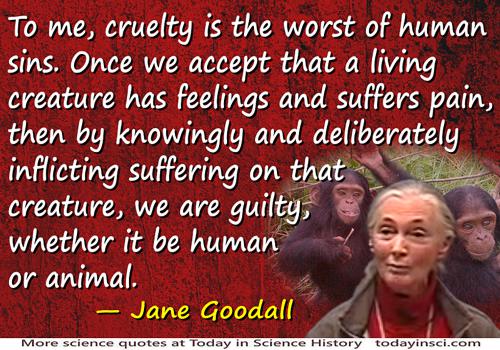
To me, cruelty is the worst of human sins. Once we accept that a living creature has feelings and suffers pain, then by knowingly and deliberately inflicting suffering on that creature, we are guilty, whether it be human or animal.
As given, without further citation, in Bollimuntha Venkata Ramana Rao, The Book of Uncommon Quips and Quotations (2003), 12. Please contact Webmaster if you know the primary source.
Unhappily for the physiologist, the subjects of the principal department of his science, that of animal physiology, are sentient beings; and every experiment, every new or unusual situation of such a being, is necessarily attended by pain or suffering of a bodily or mental kind.
A Critical and Experimental Essay on the Circulation of the Blood (1831), 1.
We have reason not to be afraid of the machine, for there is always constructive change, the enemy of machines, making them change to fit new conditions.
We suffer not from overproduction but from undercirculation. You have heard of technocracy. I wish I had those fellows for my competitors. I'd like to take the automobile it is said they predicted could be made now that would last fifty years. Even if never used, this automobile would not be worth anything except to a junkman in ten years, because of the changes in men's tastes and ideas. This desire for change is an inherent quality in human nature, so that the present generation must not try to crystallize the needs of the future ones.
We have been measuring too much in terms of the dollar. What we should do is think in terms of useful materials—things that will be of value to us in our daily life.
We suffer not from overproduction but from undercirculation. You have heard of technocracy. I wish I had those fellows for my competitors. I'd like to take the automobile it is said they predicted could be made now that would last fifty years. Even if never used, this automobile would not be worth anything except to a junkman in ten years, because of the changes in men's tastes and ideas. This desire for change is an inherent quality in human nature, so that the present generation must not try to crystallize the needs of the future ones.
We have been measuring too much in terms of the dollar. What we should do is think in terms of useful materials—things that will be of value to us in our daily life.
In 'Quotation Marks: Against Technocracy', New York Times (1 Han 1933), E4.
We often hear of people breaking down from overwork, but in nine cases out of ten they are really suffering from worry or anxiety.
The Pleasures of Life (1887, 2007), 13.
What you do in response to the ocean of suffering may seem be insignificant, but it is very important that you do it.
As quoted, without citation in Frederick Franck, Janis Roze, Richard Connolly (eds.), What Does It Mean to Be Human? (2000), 66. Often seen in abbreviated ed form as “Whatever you do will be insignificant, but it is very important that you do it.”
Whatever answers faith gives.. .such answers always give an infinite meaning to the finite existence of man; a meaning that is not destroyed by suffering, deprivation or death. This means only in faith can we find the meaning and possibility of life.
Quoted in Kim Lim (ed.), 1,001 Pearls of Spiritual Wisdom: Words to Enrich, Inspire, and Guide Your Life (2014), 19
When one person suffers from a delusion, it is called insanity. When many people suffer from a delusion it is called Religion.
As quoted by Richard Dawkins in The God Delusion (2006, 2008), Preface, 28.
With terminal illness, your fate is sealed. Morally, we're more comfortable with a situation where you don't cause death, but you hasten it. We think that's a bright line.
Comparing the U.S. with Switzerland, where assisted suicide is legal for patients suffering 'intolerable health problems.'
Comparing the U.S. with Switzerland, where assisted suicide is legal for patients suffering 'intolerable health problems.'
Quoted in Amanda Ripley, 'True Freedom', Time magazine (20 Apr 2003).
Without meaning to belittle the wonders of science, I do not think they can absolve mankind of suffering, desire, madness, and death.
In a speech at Northwestern Medical School, June 1987.
You bring me the deepest joy that can be felt by a man [Pasteur himself] whose invincible belief is that Science and Peace will triumph over Ignorance and War, that nations will unite, not to destroy, but to build, and that the future will belong to those who will have done most for suffering humanity. But whether our efforts are or are not favored by life, let us be able to say, when we come near to the great goal, “I have done what I could.”
Speech at the Sorbonne, Paris, France (27 Dec 1892) where his 70th birth was recognized. His son presented the speech due to the weakness of Pastuer's voice. In René Vallery-Radot, The Life of Pasteur, R. L. Devonshire (trans.) (1902), Vol. 2, 297.
 In science it often happens that scientists say, 'You know that's a really good argument; my position is mistaken,' and then they would actually change their minds and you never hear that old view from them again. They really do it. It doesn't happen as often as it should, because scientists are human and change is sometimes painful. But it happens every day. I cannot recall the last time something like that happened in politics or religion.
(1987) --
In science it often happens that scientists say, 'You know that's a really good argument; my position is mistaken,' and then they would actually change their minds and you never hear that old view from them again. They really do it. It doesn't happen as often as it should, because scientists are human and change is sometimes painful. But it happens every day. I cannot recall the last time something like that happened in politics or religion.
(1987) --