Study Quotes (707 quotes)
…nature seems very conversant with the rules of pure mathematics, as our own mathematicians have formulated them in their studies, out of their own inner consciousness and without drawing to any appreciable extent on their experience of the outer world.
In The Mysterious Universe (1930), 113.
...the study of butterflies—creatures selected as the types of airiness and frivolity—instead of being despised, will some day be valued as one of the most important branches of Biological science.
From The Naturalist on the River Amazons: A record of Adventures, Habits of Animals, Sketches of Brazilian and Indian life, and Aspects of Nature under the Equator, During Eleven Years of Travel (1864), 413.
…this discussion would be unprofitable if it did not lead us to appreciate the wisdom of our Creator, and the wondrous knowledge of the Author of the world, Who in the beginning created the world out of nothing, and set everything in number, measure and weight, and then, in time and the age of man, formulated a science which reveals fresh wonders the more we study it.
— Hrosvita
From her play Sapientia, as quoted and cited in Philip Davis with Reuben Hersh, in The Mathematical Experience (1981), 110-111. Davis and Hersh introduce the quote saying it comes “after a rather long and sophisticated discussion of certain facts in the theory of numbers” by the character Sapientia.
“Going fishing!” How often the question has been asked by acquaintances, as they have met me, with rod and basket, on an excursion after materials for microscopic study. “Yes!” has been the invariable answer, for it saved much detention and explanation; and now, behold! I offer them the results of that fishing. No fish for the stomach, but, as the old French microscopist Joblet observed, “some of the most remarkable fishes that have ever been seen”; and food-fishes for the intellect.
From 'Concluding Remarks', Fresh-Water Rhizopods of North America (1879), 295. Leidy explains how actively he pursued his interest in finding new microscopic life forms to examine by frequent exploration of suitable habitats in the neighborhood of Philadelphia, where he lived and taught.
“Science studies everything,” say the scientists. But, really, everything is too much. Everything is an infinite quantity of objects; it is impossible at one and the same time to study all. As a lantern cannot light up everything, but only lights up the place on which it is turned or the direction in which the man carrying it is walking, so also science cannot study everything, but inevitably only studies that to which its attention is directed. And as a lantern lights up most strongly the place nearest to it, and less and less strongly objects that are more and more remote from it, and does not at all light up those things its light does not reach, so also human science, of whatever kind, has always studied and still studies most carefully what seems most important to the investigators, less carefully what seems to them less important, and quite neglects the whole remaining infinite quantity of objects. ... But men of science to-day ... have formed for themselves a theory of “science for science's sake,” according to which science is to study not what mankind needs, but everything.
In 'Modern Science', Essays and Letters (1903), 223.
[A contemporary study] predicted the loss of two-thirds of all tropical forests by the turn of the century. Hundreds of thousands of species will perish, and this reduction of 10 to 20 percent of the earth’s biota will occur in about half a human life span. … This reduction of the biological diversity of the planet is the most basic issue of our time.
Foreword, written for Michael Soulé and Bruce Wilcox (eds.), papers from the 1978 International Conference on Conservation Biology, collected as Conservation Biology (1980), ix. As quoted and cited in Timothy J. Farnham, Saving Nature's Legacy: Origins of the Idea of Biological Diversity (2007), 208.
[About the mechanical properties of the molecules of a chemical substance being studied:] They could be measured, but that would have taken several months. So someone said, ‘Let’s get Teller in and make him guess the data.’ We got him into a room and locked the door, so no one else could get at him, and he asked questions and did some figuring at the blackboard. He got the answers in about two hours, not entirely accurately, of course, but—as we found out when we got around to verifying them—close enough for the purpose.
Recalls the first time she was ever really awed by mental abilities of Edward Teller. She had joined the Manhattan Project, and needed data on the physical properties of molecules of a certain substance to get started on her assigned task of calculating its chemical properties. As quoted in Robert Coughlan, 'Dr. Edward Teller’s Magnificent Obsession', Life (6 Sep 1954), 61.
[After the flash of the atomic bomb test explosion] Fermi got up and dropped small pieces of paper … a simple experiment to measure the energy liberated by the explosion … [W]hen the front of the shock wave arrived (some seconds after the flash) the pieces of paper were displaced a few centimeters in the direction of propagation of the shock wave. From the distance of the source and from the displacement of the air due to the shock wave, he could calculate the energy of the explosion. This Fermi had done in advance having prepared himself a table of numbers, so that he could tell immediately the energy liberated from this crude but simple measurement. … It is also typical that his answer closely approximated that of the elaborate official measurements. The latter, however, were available only after several days’ study of the records, whereas Fermi had his within seconds.
In Enrico Fermi: Physicist (1970), 147-148.
[Beyond natural history] Other biological sciences take up the study at other levels of organization: dissecting the individual into organs and tissues and seeing how these work together, as in physiology; reaching down still further to the level of cells, as in cytology; and reaching the final biological level with the study of living molecules and their interactions, as in biochemistry. No one of these levels can be considered as more important than any other.
In The Nature of Natural History (1961, 2014), 7.
[Florence Nightingale] was a great administrator, and to reach excellence here is impossible without being an ardent student of statistics. Florence Nightingale has been rightly termed the “Passionate Statistician.” Her statistics were more than a study, they were indeed her religion. For her, Quetelet was the hero as scientist, and the presentation copy of his Physique Sociale is annotated by her on every page. Florence Nightingale believed—and in all the actions of her life acted upon that belief—that the administrator could only be successful if he were guided by statistical knowledge. The legislator—to say nothing of the politician—too often failed for want of this knowledge. Nay, she went further: she held that the universe—including human communities—was evolving in accordance with a divine plan; that it was man's business to endeavour to understand this plan and guide his actions in sympathy with it. But to understand God's thoughts, she held we must study statistics, for these are the measure of his purpose. Thus the study of statistics was for her a religious duty.
In Karl Pearson, The Life, Letters and Labours of Francis Galton (1924), Vol. 2, 414-5.
[Henry Cavendish] fixed the weight of the earth; he established the proportions of the constituents of the air; he occupied himself with the quantitative study of the laws of heat; and lastly, he demonstrated the nature of water and determined its volumetric composition. Earth, air, fire, and water—each and all came within the range of his observations.
Essays in Historical Chemistry (1894), 86.
[I] learnt, for the first time, the joys of substituting hard, disciplined study for the indulgence of day-dreaming.
[Comment on his successful undergraduate studies at the University of St. Andrews.]
[Comment on his successful undergraduate studies at the University of St. Andrews.]
As quoted in Obituary, The Times (24 Mar 2010)
[In addition to classical, literary and philosophical studies,] I devoured without much appetite the Elements of Algebra and Geometry…. From these serious and scientific pursuits I derived a maturity of judgement, a philosophic spirit, of more value than the sciences themselves…. I could extract and digest the nutritive particles of every species of litterary food.
In The Autobiographies of Edward Gibbon (1896), 235. [“litterary” is sic.]
[Mathematics is] the study of ideal constructions (often applicable to real problems), and the discovery thereby of relations between the parts of these constructions, before unknown.
In 'Mathematics', Century Dictionary.
[Mathematics is] the study of the measurement, properties, and relationships of quantities and sets, using numbers and symbols.
Definition of Mathematics in William morris (ed.), American Heritage Dictionary (2000).
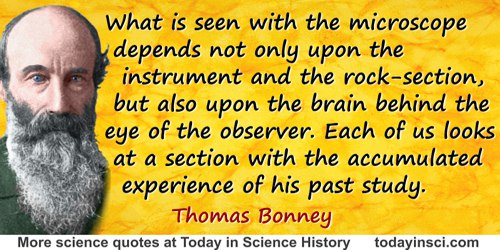
[Microscopic] evidence cannot be presented ad populum. What is seen with the microscope depends not only upon the instrument and the rock-section, but also upon the brain behind the eye of the observer. Each of us looks at a section with the accumulated experience of his past study. Hence the veteran cannot make the novice see with his eyes; so that what carries conviction to the one may make no appeal to the other. This fact does not always seem to be sufficiently recognized by geologists at large.
'The Anniversary Address of the President', Quarterly Journal of the Geological Society of London, 1885, 41, 59.
[My friends and I studied science to get away from] the stench of Fascist truths which tainted the sky. ... [T]he chemistry and physics on which we fed, besides being nourishment vital in themselves, were an antidote to Fascism. ... [T]hey were clear and distinct and verifiable at every step, and not a tissue of lies and emptiness like the radio and the newspapers.
The Periodic Table, trans. Raymond Rosenthal (1986), 42. In Vinoth Ramachandra, Subverting Global Myths: Theology and the Public Issues Shaping our World (2008), 170.
[My study of the universe] leaves little doubt that life has occurred on other planets. I doubt if the human race is the most intelligent form of life.
Speech to University of Miami students. Quoted in article, 'Notions in Motion,' Time (24 Nov 1952).
[Niels Bohr] is a national pride to his fellow Danes. In Denmark, Bohr’s standing is only slightly less than that of the royal family and Hans Christian Anderson. When the wife of an American physicist casually told a gentleman seated next to her on a Copenhagen streetcar that her husband was studying under Professor Bohr, the old man jumped to his feet, swept off his hat with a flourish and bowed deeply.
Quoted in Bill Becker, 'Pioneer of the Atom', New York Times Sunday Magazine (20 Oct 1957), 52.
[The famous attack of Sir William Hamilton on the tendency of mathematical studies] affords the most express evidence of those fatal lacunae in the circle of his knowledge, which unfitted him for taking a comprehensive or even an accurate view of the processes of the human mind in the establishment of truth. If there is any pre-requisite which all must see to be indispensable in one who attempts to give laws to the human intellect, it is a thorough acquaintance with the modes by which human intellect has proceeded, in the case where, by universal acknowledgment, grounded on subsequent direct verification, it has succeeded in ascertaining the greatest number of important and recondite truths. This requisite Sir W. Hamilton had not, in any tolerable degree, fulfilled. Even of pure mathematics he apparently knew little but the rudiments. Of mathematics as applied to investigating the laws of physical nature; of the mode in which the properties of number, extension, and figure, are made instrumental to the ascertainment of truths other than arithmetical or geometrical—it is too much to say that he had even a superficial knowledge: there is not a line in his works which shows him to have had any knowledge at all.
In Examination of Sir William Hamilton's Philosophy (1878), 607.
[The object of education is] to train the mind to ascertain the sequence of a particular conclusion from certain premises, to detect a fallacy, to correct undue generalisation, to prevent the growth of mistakes in reasoning. Everything in these must depend on the spirit and the manner in which the instruction itself is conveyed and honoured. If you teach scientific knowledge without honouring scientific knowledge as it is applied, you do more harm than good. I do think that the study of natural science is so glorious a school for the mind, that with the laws impressed on all these things by the Creator, and the wonderful unity and stability of matter, and the forces of matter, there cannot be a better school for the education of the mind.
Giving Evidence (18 Nov 1862) to the Public Schools Commission. As quoted in John L. Lewis, 125 Years: The Physical Society & The Institute of Physics (1999), 168-169.
[The] subjective [historical] element in geologic studies accounts for two characteristic types that can be distinguished among geologists: one considering geology as a creative art, the other regarding geology as an exact science.
In 'The Scientific Character of Geology', The Journal of Geology (Jul 1961), 69, No. 4, 453.
[The] weakness of biological balance studies has aptly been illustrated by comparison with the working of a slot machine. A penny brings forth one package of chewing gum; two pennies bring forth two. Interpreted according to the reasoning of balance physiology, the first observation is an indication of the conversion of copper into gum; the second constitutes proof.
[Co-author with David Rittenberg (1906-70).]
[Co-author with David Rittenberg (1906-70).]
'The Application of Isotopes to the Study of Intermediary Metabolism', Science (1938), 87, 222.
[Urbain Jean Joseph] Le Verrier—without leaving his study, without even looking at the sky—had found the unknown planet [Neptune] solely by mathematical calculation, and, as it were, touched it with the tip of his pen!
In Camille Flammarion, Astronomy (1914), 171.
[William Gull] endeavoured, above all things, to study the natural history of disease, uncomplicated by the action of unnecessary drugs, and he resented all useless interference with the course of nature. He would say of meddlesome poly-pharmacy—“Fools rush in, where angels fear to tread.”
Stated in Sir William Withey Gull and Theodore Dyke Acland (ed.), A Collection of the Published Writings of William Withey Gull (1896), xxv-xxvi.
“The Universe repeats itself, with the possible exception of history.” Of all earthly studies history is the only one that does not repeat itself. ... Astronomy repeats itself; botany repeats itself; trigonometry repeats itself; mechanics repeats itself; compound long division repeats itself. Every sum if worked out in the same way at any time will bring out the same answer. ... A great many moderns say that history is a science; if so it occupies a solitary and splendid elevation among the sciences; it is the only science the conclusions of which are always wrong.
In 'A Much Repeated Repetition', Daily News (26 Mar 1904). Collected in G. K. Chesterton and Dale Ahlquist (ed.), In Defense of Sanity: The Best Essays of G.K. Chesterton (2011), 82.
[Almost certainly not by Einstein.] The more I study science, the more I believe in God.
No cited primary source has been found, so it is almost certainly falsely linked with Einstein. Also, it is not compatible with Einstein’s documented statements on his religious views. See, for example, the quote beginning “It was, of course, a lie what you read about my religious convictions….” The subject quote is included here so readers may find this disclaimer.
[In reply to a question about how he got his expertise:]
By studying the masters and not their pupils.
By studying the masters and not their pupils.
Quoted in Eric Temple Bell, Men of Mathematics (1937, 1986), 308.
[Recalling Professor Ira Remsen's remarks (1895) to a group of his graduate students about to go out with their degrees into the world beyond the university:]
He talked to us for an hour on what was ahead of us; cautioned us against giving up the desire to push ahead by continued study and work. He warned us against allowing our present accomplishments to be the high spot in our lives. He urged us not to wait for a brilliant idea before beginning independent research, and emphasized the fact the Lavoisier's first contribution to chemistry was the analysis of a sample of gypsum. He told us that the fields in which the great masters had worked were still fruitful; the ground had only been scratched and the gleaner could be sure of ample reward.
He talked to us for an hour on what was ahead of us; cautioned us against giving up the desire to push ahead by continued study and work. He warned us against allowing our present accomplishments to be the high spot in our lives. He urged us not to wait for a brilliant idea before beginning independent research, and emphasized the fact the Lavoisier's first contribution to chemistry was the analysis of a sample of gypsum. He told us that the fields in which the great masters had worked were still fruitful; the ground had only been scratched and the gleaner could be sure of ample reward.
Quoted in Frederick Hutton Getman, The Life of Ira Remsen (1980), 73.
[Responding to a student whose friend asked about studying Agricultural Chemistry at Johns Hopkins:]
We would be glad to have your friend come here to study, but tell him that we teach Chemistry here and not Agricultural Chemistry, nor any other special kind of chemistry. ... We teach Chemistry.
We would be glad to have your friend come here to study, but tell him that we teach Chemistry here and not Agricultural Chemistry, nor any other special kind of chemistry. ... We teach Chemistry.
In Frederick Hutton Getman, The Life of Ira Remsen, 71.
Ac astronomye is an hard thyng,
And yvel for to knowe;
Geometrie and geomesie,
So gynful of speche,
Who so thynketh werche with tho two
Thryveth ful late,
For sorcerie is the sovereyn book
That to tho sciences bilongeth.
Now, astronomy is a difficult discipline, and the devil to learn;
And geometry and geomancy have confusing terminology:
If you wish to work in these two, you will not succeed quickly.
For sorcery is the chief study that these sciences entail.
And yvel for to knowe;
Geometrie and geomesie,
So gynful of speche,
Who so thynketh werche with tho two
Thryveth ful late,
For sorcerie is the sovereyn book
That to tho sciences bilongeth.
Now, astronomy is a difficult discipline, and the devil to learn;
And geometry and geomancy have confusing terminology:
If you wish to work in these two, you will not succeed quickly.
For sorcery is the chief study that these sciences entail.
In William Langland and B. Thomas Wright (ed.) The Vision and Creed of Piers Ploughman (1842), 186. Modern translation by Terrence Tiller in Piers Plowman (1981, 1999), 94.
Ath. There still remain three studies suitable for freemen. Calculation in arithmetic is one of them; the measurement of length, surface, and depth is the second; and the third has to do with the revolutions of the stars in reference to one another … there is in them something that is necessary and cannot be set aside, … if I am not mistaken, [something of] divine necessity; for as to the human necessities of which men often speak when they talk in this manner, nothing can be more ridiculous than such an application of the words.
Cle. And what necessities of knowledge are there, Stranger, which are divine and not human?
Ath. I conceive them to be those of which he who has no use nor any knowledge at all cannot be a god, or demi-god, or hero to mankind, or able to take any serious thought or charge of them.
Cle. And what necessities of knowledge are there, Stranger, which are divine and not human?
Ath. I conceive them to be those of which he who has no use nor any knowledge at all cannot be a god, or demi-god, or hero to mankind, or able to take any serious thought or charge of them.
— Plato
In Republic, Bk. 7, in Jowett, Dialogues of Plato (1897, 2010), Vol. 4, 331.
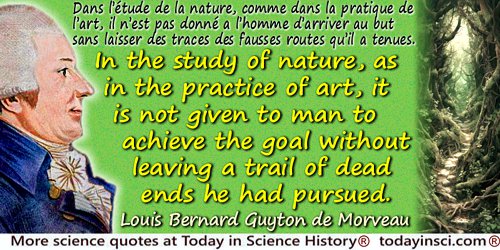
Dans l’étude de la nature, comme dans la pratique de l’art, il n’est pas donné a l’homme d’arriver au but sans laisser des traces des fausses routes qu’il a tenues.
In the study of nature, as in the practice of art, it is not given to man to achieve the goal without leaving a trail of dead ends he had pursued.
In the study of nature, as in the practice of art, it is not given to man to achieve the goal without leaving a trail of dead ends he had pursued.
French version in Encyclopédie Méthodique (1786), Vol. 1, Introduction, iv. English by Webmaster assisted by Google Translate.
L’analyse mathématique … dans l’étude de tous les phénomènes; elle les interprète par le même langage, comme pour attester l’unité et la simplicité du plan de l’univers, et rendre encore plus manifeste cet ordre immuable qui préside à toutes les causes naturelles.
Mathematical analysis … in the study of all phenomena, interprets them by the same language, as if to attest the unity and simplicity of the plan of the universe, and to make still more evident that unchangeable order which presides over all natural causes.
Mathematical analysis … in the study of all phenomena, interprets them by the same language, as if to attest the unity and simplicity of the plan of the universe, and to make still more evident that unchangeable order which presides over all natural causes.
From Théorie Analytique de la Chaleur (1822), xv, translated by Alexander Freeman in The Analytical Theory of Heat (1878), 8.
La vraye science et le vray étude de l'homme c'est l'homme.
The true science and study of mankind is man.
The true science and study of mankind is man.
De la Sagesse (1601), 1991 edn, Preface.
Le savant n’étudie pas la nature parce que cela est utile; il l’étudie parce qu’il y prend plaisir et il y prend plaisir parce qu’elle est belle. Si la nature n’était pas belle, elle ne vaudrait pas la peine d’être connue, la vie ne vaudrait pas la peine d’être vécue.
The scientist does not study nature because it is useful to do so. He studies it because he takes pleasure in it, and he takes pleasure in it because it is beautiful. If nature were not beautiful, it would not be worth knowing, and life would not be worth living. I am not speaking, of course, of the beauty which strikes the senses, of the beauty of qualities and appearances. I am far from despising this, but it has nothing to do with science. What I mean is that more intimate beauty which comes from the harmonious order of its parts, and which a pure intelligence can grasp.
The scientist does not study nature because it is useful to do so. He studies it because he takes pleasure in it, and he takes pleasure in it because it is beautiful. If nature were not beautiful, it would not be worth knowing, and life would not be worth living. I am not speaking, of course, of the beauty which strikes the senses, of the beauty of qualities and appearances. I am far from despising this, but it has nothing to do with science. What I mean is that more intimate beauty which comes from the harmonious order of its parts, and which a pure intelligence can grasp.
In Science et Méthode (1920), 48, as translated by Francis Maitland, in Science and Method (1908, 1952), 15.
Les causes primordiales ne nous sont point connues; mais elles sont assujetties à des lois simples et constantes, que l’on peut découvrir par l’observation, et dont l’étude est l’objet de la philosophie naturelle.
Primary causes are unknown to us; but are subject to simple and constant laws, which may be discovered by observation, the study of them being the object of natural philosophy.
Primary causes are unknown to us; but are subject to simple and constant laws, which may be discovered by observation, the study of them being the object of natural philosophy.
Opening statement from 'Discours Préliminaire' to Théorie Analytique de la Chaleur (1822), i, translated by Alexander Freeman in The Analytical Theory of Heat (1878), 1.
Les mathématique sont un triple. Elles doivent fournir un instrument pour l'étude de la nature. Mais ce n'est pas tout: elles ont un but philosophique et, j'ose le dire, un but esthétique.
Mathematics has a threefold purpose. It must provide an instrument for the study of nature. But this is not all: it has a philosophical purpose, and, I daresay, an aesthetic purpose.
Mathematics has a threefold purpose. It must provide an instrument for the study of nature. But this is not all: it has a philosophical purpose, and, I daresay, an aesthetic purpose.
La valeur de la science. In Anton Bovier, Statistical Mechanics of Disordered Systems (2006), 161.
Mi è impossibile cingere i fianchi di una ragazza con il mio braccio destro e serrare il suo sorriso nella mia mano sinistra, per poi tentare di studiare i due oggetti separatamente. Allo stesso modo, non ci è possibile separare la vita dalla materia vivente, allo scopo di studiare la sola materia vivente e le sue reazioni. Inevitabilmente, studiando la materia vivente e le sue reazioni, studiamo la vita stessa.
It is impossible to encircle the hips of a girl with my right arm and hold her smile in my left hand, then proceed to study the two items separately. Similarly, we can not separate life from living matter, in order to study only living matter and its reactions. Inevitably, studying living matter and its reactions, we study life itself
It is impossible to encircle the hips of a girl with my right arm and hold her smile in my left hand, then proceed to study the two items separately. Similarly, we can not separate life from living matter, in order to study only living matter and its reactions. Inevitably, studying living matter and its reactions, we study life itself
In The Nature of Life (1948).
Question: Explain why pipes burst in cold weather.
Answer: People who have not studied acoustics think that Thor bursts the pipes, but we know that is nothing of the kind for Professor Tyndall has burst the mythologies and has taught us that it is the natural behaviour of water (and bismuth) without which all fish would die and the earth be held in an iron grip. (1881)
Answer: People who have not studied acoustics think that Thor bursts the pipes, but we know that is nothing of the kind for Professor Tyndall has burst the mythologies and has taught us that it is the natural behaviour of water (and bismuth) without which all fish would die and the earth be held in an iron grip. (1881)
Genuine student answer* to an Acoustics, Light and Heat paper (1881), Science and Art Department, South Kensington, London, collected by Prof. Oliver Lodge. Quoted in Henry B. Wheatley, Literary Blunders (1893), 186-7, Question 10. (*From a collection in which Answers are not given verbatim et literatim, and some instances may combine several students' blunders.) Webmaster notes that “fish would die” may refer to being taught that water's greatest density is at 4°C, and sinks below a frozen surface, so bodies of water can remain liquid underneath, to the benefit of the fish. The student was likely taught that bismuth, like water, expands when it freezes.
Socrates: Shall we set down astronomy among the objects of study?
Glaucon: I think so, to know something about the seasons, the months and the years is of use for military purposes, as well as for agriculture and for navigation.
Socrates: It amuses me to see how afraid you are, lest the common herd of people should accuse you of recommending useless studies.
As quoted by Plato. In Richard Garnett, Léon Vallée, Alois Brandl (eds.), The Universal Anthology: A Collection of the Best Literature (1899), Vol. 4, 111.
To Wheeler's comment, If you haven't found something strange during the day, it hasn't been much of a day, a student responded, I can't believe that space is that crummy. Wheeler replied: To disagree leads to study, to study leads to understanding, to understand is to appreciate, to appreciate is to love. So maybe I'll end up loving your theory.
Quoted in Charles Birch, Biology and the Riddle of Life (1999), 10.
~~[Unverified]~~ The strongest affection and utmost zeal should, I think, promote the studies concerned with the most beautiful objects. This is the discipline that deals with the universe’s divine revolutions, the stars’ motions, sizes, distances, risings and settings . . . for what is more beautiful than heaven?
Seen spreading across the web, only in recent years. As yet, Webmaster cannot identify a trustworthy primary source, is therefore presently skeptical, and meanwhile labels the quote as unverified.
A century ago astronomers, geologists, chemists, physicists, each had an island of his own, separate and distinct from that of every other student of Nature; the whole field of research was then an archipelago of unconnected units. To-day all the provinces of study have risen together to form a continent without either a ferry or a bridge.
From chapter 'Jottings from a Note-book', in Canadian Stories (1918), 182-183.
A first step in the study of civilization is to dissect it into details, and to classify these in their proper groups. Thus, in examining weapons, they are to be classed under spear, club, sling, bow and arrow, and so forth; among textile arts are to be ranged matting, netting, and several grades of making and weaving threads; myths are divided under such headings as myths of sunrise and sunset, eclipse-myths, earthquake-myths, local myths which account for the names of places by some fanciful tale, eponymic myths which account for the parentage of a tribe by turning its name into the name of an imaginary ancestor; under rites and ceremonies occur such practices as the various kinds of sacrifice to the ghosts of the dead and to other spiritual beings, the turning to the east in worship, the purification of ceremonial or moral uncleanness by means of water or fire. Such are a few miscellaneous examples from a list of hundreds … To the ethnographer, the bow and arrow is the species, the habit of flattening children’s skulls is a species, the practice of reckoning numbers by tens is a species. The geographical distribution of these things, and their transmission from region to region, have to be studied as the naturalist studies the geography of his botanical and zoological species.
In Primitive Culture (1871), Vol. 1, 7.
A free soul ought not to pursue any study slavishly; for while bodily labors performed under constraint do not harm the body, nothing that is learned under compulsion stays with the mind.
— Plato
From The Republic 7 536e, as translated by Paul Shorey (1930).
A great surgeon performs operations for stone by a single method; later he makes a statistical summary of deaths and recoveries, and he concludes from these statistics that the mortality law for this operation is two out of five. Well, I say that this ratio means literally nothing scientifically and gives us no certainty in performing the next operation; for we do not know whether the next case will be among the recoveries or the deaths. What really should be done, instead of gathering facts empirically, is to study them more accurately, each in its special determinism. We must study cases of death with great care and try to discover in them the cause of mortal accidents so as to master the cause and avoid the accidents.
From An Introduction to the Study of Experimental Medicine (1865), as translated by Henry Copley Greene (1957), 137-138. (Note that Bernard overlooks how the statistical method can be useful: a surgeon announcing a mortality rate of 40% invites comparison. A surgeon with worse outcomes should adopt this method. If a surgeon has a better results, that method should be adopted.)
A hundred years ago the study of life was often pursued, and also presented to the public, in a highly unified way. Darwin, as everyone knows, in addressing the world at large began his story with the history of pigeons and ended it with the breeding of primroses, having made excursions on the way into the origins of coral reefs and of the races of Man.
In 'The Unification of Biology', New Scientist (11 Jan 1962), 13, No. 269, 72.
A large part of the training of the engineer, civil and military, as far as preparatory studies are concerned; of the builder of every fabric of wood or stone or metal designed to stand upon the earth, or bridge the stream, or resist or float upon the wave; of the surveyor who lays out a building lot in a city, or runs a boundary line between powerful governments across a continent; of the geographer, navigator, hydrographer, and astronomer,—must be derived from the mathematics.
In 'Academical Education', Orations and Speeches on Various Occasions (1870), Vol. 3, 513.
A learned man is an idler who kills time with study. Beware of his false knowledge: it is more dangerous than ignorance.
In 'Maxims for Revolutionists: Education', in Man and Superman (1905), 230.
A multidisciplinary study group ... estimated that it would be 1980 before developments in artificial intelligence make it possible for machines alone to do much thinking or problem solving of military significance. That would leave, say, five years to develop man-computer symbiosis and 15 years to use it. The 15 may be 10 or 500, but those years should be intellectually the most creative and exciting in the history of mankind.
From article 'Man-Computer Symbiosis', in IRE Transactions on Human Factors in Electronics (Mar 1960), Vol. HFE-1, 4-11.
A noteworthy and often-remarked similarity exists between the facts and methods of geology and those of linguistic study. The science of language is, as it were, the geology of the most modern period, the Age of the Man, having for its task to construct the history of development of the earth and its inhabitants from the time when the proper geological record remains silent … The remains of ancient speech are like strata deposited in bygone ages, telling of the forms of life then existing, and of the circumstances which determined or affected them; while words are as rolled pebbles, relics of yet more ancient formations, or as fossils, whose grade indicates the progress of organic life, and whose resemblances and relations show the correspondence or sequence of the different strata; while, everywhere, extensive denudation has marred the completeness of the record, and rendered impossible a detailed exhibition of the whole course of development.
In Language and the Study of Language (1867), 47.
A person by study must try to disengage the subject from useless matter, and to seize on points capable of improvement. ... When subjects are viewed through the mists of prejudice, useful truths may escape.
In An Essay on Aërial Navigation, With Some Observations on Ships (1844), 80.
A physician’s subject of study is necessarily the patient, and his first field for observation is the hospital. But if clinical observation teaches him to know the form and course of diseases, it cannot suffice to make him understand their nature; to this end he must penetrate into the body to find which of the internal parts are injured in their functions. That is why dissection of cadavers and microscopic study of diseases were soon added to clinical observation. But to-day these various methods no longer suffice; we must push investigation further and, in analyzing the elementary phenomena of organic bodies, must compare normal with abnormal states. We showed elsewhere how incapable is anatomy alone to take account of vital phenenoma, and we saw that we must add study of all physico-chemical conditions which contribute necessary elements to normal or pathological manifestations of life. This simple suggestion already makes us feel that the laboratory of a physiologist-physician must be the most complicated of all laboratories, because he has to experiment with phenomena of life which are the most complex of all natural phenomena.
From An Introduction to the Study of Experimental Medicine (1865), as translated by Henry Copley Greene (1957), 140-141.
A plain, reasonable working man supposes, in the old way which is also the common-sense way, that if there are people who spend their lives in study, whom he feeds and keeps while they think for him—then no doubt these men are engaged in studying things men need to know; and he expects of science that it will solve for him the questions on which his welfare, and that of all men, depends. He expects science to tell him how he ought to live: how to treat his family, his neighbours and the men of other tribes, how to restrain his passions, what to believe in and what not to believe in, and much else. And what does our science say to him on these matters?
It triumphantly tells him: how many million miles it is from the earth to the sun; at what rate light travels through space; how many million vibrations of ether per second are caused by light, and how many vibrations of air by sound; it tells of the chemical components of the Milky Way, of a new element—helium—of micro-organisms and their excrements, of the points on the hand at which electricity collects, of X rays, and similar things.
“But I don't want any of those things,” says a plain and reasonable man—“I want to know how to live.”
It triumphantly tells him: how many million miles it is from the earth to the sun; at what rate light travels through space; how many million vibrations of ether per second are caused by light, and how many vibrations of air by sound; it tells of the chemical components of the Milky Way, of a new element—helium—of micro-organisms and their excrements, of the points on the hand at which electricity collects, of X rays, and similar things.
“But I don't want any of those things,” says a plain and reasonable man—“I want to know how to live.”
In 'Modern Science', Essays and Letters (1903), 221-222.
A recognized fact which goes back to the earliest times is that every living organism is not the sum of a multitude of unitary processes, but is, by virtue of interrelationships and of higher and lower levels of control, an unbroken unity. When research, in the efforts of bringing understanding, as a rule examines isolated processes and studies them, these must of necessity be removed from their context. In general, viewed biologically, this experimental separation involves a sacrifice. In fact, quantitative findings of any material and energy changes preserve their full context only through their being seen and understood as parts of a natural order.
First sentence of 'The Central Control of the Activity of Internal Organs', Nobel Lecture (12 Dec 1949).
A rock or stone is not a subject that, of itself, may interest a philosopher to study; but, when he comes to see the necessity of those hard bodies, in the constitution of this earth, or for the permanency of the land on which we dwell, and when he finds that there are means wisely provided for the renovation of this necessary decaying part, as well as that of every other, he then, with pleasure, contemplates this manifestation of design, and thus connects the mineral system of this earth with that by which the heavenly bodies are made to move perpetually in their orbits.
Theory of the Earth, with Proofs and l1lustrations, Vol. 1 (1795), 276.
A scientific or technical study always consists of the following three steps:
1. One decides the objective.
2. One considers the method.
3. One evaluates the method in relation to the objective.
1. One decides the objective.
2. One considers the method.
3. One evaluates the method in relation to the objective.
System of Experimental Design (1987), xxix.
A student who wishes now-a-days to study geometry by dividing it sharply from analysis, without taking account of the progress which the latter has made and is making, that student no matter how great his genius, will never be a whole geometer. He will not possess those powerful instruments of research which modern analysis puts into the hands of modern geometry. He will remain ignorant of many geometrical results which are to be found, perhaps implicitly, in the writings of the analyst. And not only will he be unable to use them in his own researches, but he will probably toil to discover them himself, and, as happens very often, he will publish them as new, when really he has only rediscovered them.
From 'On Some Recent Tendencies in Geometrical Investigations', Rivista di Matematica (1891), 43. In Bulletin American Mathematical Society (1904), 443.
A study of Disease—of Pestilences methodically prepared and deliberately launched upon man and beast—is certainly being pursued in the laboratories of more than one great country. Blight to destroy crops, Anthrax to slay horses and cattle, Plague to poison not armies but whole districts—such are the lines along which military science is remorselessly advancing.
'Shall We All Commit Suicide?'. Pall Mall (Sep 1924). Reprinted in Thoughts and Adventures (1932), 250.
A study of history shows that civilizations that abandon the quest for knowledge are doomed to disintegration.
In The Observer (14 May 1972), 'Sayings of the Week'. As cited in Bill Swainson, The Encarta Book of Quotations (2000), 579.
A superficial knowledge of mathematics may lead to the belief that this subject can be taught incidentally, and that exercises akin to counting the petals of flowers or the legs of a grasshopper are mathematical. Such work ignores the fundamental idea out of which quantitative reasoning grows—the equality of magnitudes. It leaves the pupil unaware of that relativity which is the essence of mathematical science. Numerical statements are frequently required in the study of natural history, but to repeat these as a drill upon numbers will scarcely lend charm to these studies, and certainly will not result in mathematical knowledge.
In Primary Arithmetic: First Year, for the Use of Teachers (1897), 26-27.
A superficial knowledge of mathematics may lead to the belief that this subject can be taught incidentally, and that exercises akin to counting the petals of flowers or the legs of a grasshopper are mathematical. Such work ignores the fundamental idea out of which quantitative reasoning grows—the equality of magnitudes. It leaves the pupil unaware of that relativity which is the essence of mathematical science. Numerical statements are frequently required in the study of natural history, but to repeat these as a drill upon numbers will scarcely lend charm to these studies, and certainly will not result in mathematical knowledge.
In Primary Arithmetic: First Year, for the Use of Teachers (1897), 26-27.
A troubling question for those of us committed to the widest application of intelligence in the study and solution of the problems of men is whether a general understanding of the social sciences will be possible much longer. Many significant areas of these disciplines have already been removed by the advances of the past two decades beyond the reach of anyone who does not know mathematics; and the man of letters is increasingly finding, to his dismay, that the study of mankind proper is passing from his hands to those of technicians and specialists. The aesthetic effect is admittedly bad: we have given up the belletristic “essay on man” for the barbarisms of a technical vocabulary, or at best the forbidding elegance of mathematical syntax.
Opening paragraph of 'The Study of Man: Sociology Learns the Language of Mathematics' in Commentary (1 Sep 1952). Reprinted in James Roy Newman, The World of Mathematics (1956), Vol. 2, 1294.
Abraham Maslow, felt … [an] instinctive revolt against the “atmosphere” of Freudian psychology, with its emphasis on sickness and neurosis, and decided that he might obtain some equally interesting results if he studied extremely healthy people.
In Introduction to the New Existentialism (1966), 15.
According to the historian D. B. McIntyre (1963), James Hutton, often known as the father of geology, said in a lecture before the Royal Society of Edinburgh in the 1790s that he thought of the Earth as a superorganism and that its proper study would be by physiology. Hutton went on to make the analogy between the circulation of the blood, discovered by Harvey, and the circulation of the nutrient elements of the Earth and of the way that sunlight distills water from the oceans so that it may later fall as rain and so refresh the earth.
In 'The Earth as a Living Organism', Essay collected in E. O. Wilson and F. M. Peter (eds.), Biodiversity (1988), Chap. 56, 488. [Notes: Donald Bertram McIntyre (1923–2009) was a geologist. Hutton had medical training early in his life. According to Mirriam-Webster’s dictionary, the first known use of the word “superorganism” was “circa 1899”—so Hutton did not use that word. However, McIntyre did adopt that sophisticated word to describe Hutton’s thought, twice, in Philosophy of Geology (1963), 7 & 10. Thus, McIntyre and Lovelock freely embroidered whatever Hutton actually wrote, perhaps over-stepping. Cándido Manuel García Cruz criticizes that these “assertions are merely a misinterpretation” although “Hutton has nevertheless an holistic view which is closer to the Alfred N. Whitehead’s organic mechanicism than the James Lovelock’s Gaia Hypothesis,” as quoted from the abstract of his article 'From James Hutton’s «Theory of the Earth» to James Lovelock’s «Gaia Hypothesis»', Asclepio; Archivo Iberoamericano de Historia de la Medicina y Antropología Médica (Jun 2007), 59, No. 1, 65-100. Thus, it is best to read his own words in James Hutton, Theory of the Earth, which at length describes the “terrestrial system” as a “machine of a peculiar construction.” —Webmaster]
After the birth of printing books became widespread. Hence everyone throughout Europe devoted himself to the study of literature... Every year, especially since 1563, the number of writings published in every field is greater than all those produced in the past thousand years. Through them there has today been created a new theology and a new jurisprudence; the Paracelsians have created medicine anew and the Copernicans have created astronomy anew. I really believe that at last the world is alive, indeed seething, and that the stimuli of these remarkable conjunctions did not act in vain.
De Stella Nova, On the New Star (1606), Johannes Kepler Gesammelte Werke (1937- ), Vol. 1, 330-2. Quoted in N. Jardine, The Birth of History and Philosophy of Science: Kepler's A Defence of Tycho Against Ursus With Essays on its Provenance and Significance (1984), 277-8.
All talk about science purely for its practical and wealth-producing results is … idle. … Practical results will follow right enough. No real knowledge is sterile. … With this faith in the ultimate usefulness of all real knowledge a man may proceed to devote himself to a study of first causes without apology, and without hope of immediate return.
Quoted in Larry R. Squire (ed.), The History of Neuroscience in Autobiography (1996), Vol. 1, 350-351. The above is a highlight excerpted from a longer quote beginning “To prove to an indignant questioner ….” in this same collection for A. V. Hill.
Although with the majority of those who study and practice in these capacities [engineers, builders, surveyors, geographers, navigators, hydrographers, astronomers], secondhand acquirements, trite formulas, and appropriate tables are sufficient for ordinary purposes, yet these trite formulas and familiar rules were originally or gradually deduced from the profound investigations of the most gifted minds, from the dawn of science to the present day. … The further developments of the science, with its possible applications to larger purposes of human utility and grander theoretical generalizations, is an achievement reserved for a few of the choicest spirits, touched from time to time by Heaven to these highest issues. The intellectual world is filled with latent and undiscovered truth as the material world is filled with latent electricity.
In Orations and Speeches, Vol. 3 (1870), 513.
Among all the liberal arts, the first is logic, and specifically that part of logic which gives initial instruction about words. … [T]he word “logic” has a broad meaning, and is not restricted exclusively to the science of argumentative reasoning. [It includes] Grammar [which] is “the science of speaking and writing correctly—the starting point of all liberal studies.”
In John of Salisbury and Daniel D. McGarry (trans.), 'Whence grammar gets its name', The Metalogicon (2009), 37. It is footnoted: Isidore, Etym., i, 5, §1.
Among the current discussions, the impact of new and sophisticated methods in the study of the past occupies an important place. The new 'scientific' or 'cliometric' history—born of the marriage contracted between historical problems and advanced statistical analysis, with economic theory as bridesmaid and the computer as best man—has made tremendous advances in the last generation.
Co-author with Geoffrey Rudolph Elton (1921-94), British historian. Which Road to the Past? Two Views of History (1983), 2.
Among the studies to which the [Rockefeller] Foundation is giving support is a series in a relatively new field, which may be called molecular biology, in which delicate modern techniques are being used to investigate ever more minute details of certain life processes.
In 'Molecular Biology', Annual Report of the Rockefeller Foundation (1938), 203-4. Reprinted in a letter to Science (6 Nov 1970), 170, 582.
An astronomer must be the wisest of men; his mind must be duly disciplined in youth; especially is mathematical study necessary; both an acquaintance with the doctrine of number, and also with that other branch of mathematics, which, closely connected as it is with the science of the heavens, we very absurdly call geometry, the measurement of the earth.
— Plato
From the 'Epilogue to the Laws' (Epinomis), 988-990. As quoted in William Whewell, History of the Inductive Sciences from the Earliest to the Present Time (1837), Vol. 1, 161. (Although referenced to Plato’s Laws, the Epinomis is regarded as a later addition, not by Plato himself.)
An attempt to study the evolution of living organisms without reference to cytology would be as futile as an account of stellar evolution which ignored spectroscopy.
'Foreword', in C.D. Darlington, Recent Advances in Cytology (1937), v.
An Experiment, like every other event which takes place, is a natural phenomenon; but in a Scientific Experiment the circumstances are so arranged that the relations between a particular set of phenomena may be studied to the best advantage.
'General Considerations Concerning Scientific Apparatus', 1876. In W. D. Niven (ed.), The Scientific Papers of James Clerk Maxwell (1890), Vol. 2, 505.
An extremely healthy dose of skepticism about the reliability of science is an absolutely inevitable consequence of any scientific study of its track record.
…...
An infinity of these tiny animals defoliate our plants, our trees, our fruits... they attack our houses, our fabrics, our furniture, our clothing, our furs ... He who in studying all the different species of insects that are injurious to us, would seek means of preventing them from harming us, would seek to cause them to perish, proposes for his goal important tasks indeed.
In J. B. Gough, 'Rene-Antoine Ferchault de Réaumur', in Charles Gillispie (ed.), Dictionary of Scientific Biography (1975), Vol. 11, 332.
And if you want the exact moment in time, it was conceived mentally on 8th March in this year one thousand six hundred and eighteen, but submitted to calculation in an unlucky way, and therefore rejected as false, and finally returning on the 15th of May and adopting a new line of attack, stormed the darkness of my mind. So strong was the support from the combination of my labour of seventeen years on the observations of Brahe and the present study, which conspired together, that at first I believed I was dreaming, and assuming my conclusion among my basic premises. But it is absolutely certain and exact that the proportion between the periodic times of any two planets is precisely the sesquialterate proportion of their mean distances.
Harmonice Mundi, The Harmony of the World (1619), book V, ch. 3. Trans. E. J. Aiton, A. M. Duncan and J. V. Field (1997), 411.
And when with excellent Microscopes I discern in otherwise invisible Objects the Inimitable Subtlety of Nature’s Curious Workmanship; And when, in a word, by the help of Anatomicall Knives, and the light of Chymicall Furnaces, I study the Book of Nature, and consult the Glosses of Aristotle, Epicurus, Paracelsus, Harvey, Helmont, and other learn'd Expositors of that instructive Volumne; I find my self oftentimes reduc’d to exclaim with the Psalmist, How manifold are thy works, O Lord? In wisdom hast thou made them all.
Some Motives and Incentives to the Love of God (1659), 56-7.
Anthropology is the study of human beings as creatures of society. It fastens its attention upon those physical characteristics and industrial techniques, those conventions and values, which distinguish one community from all others that belong to a different tradition.
In 'The Science of Custom', Patterns of Culture (1934, 2005), 1.
Antoine Magnan, a French zoologist, in 1934 made some very careful studies of bumblebee flight and came to the conclusion that bumblebees cannot fly at all! Fortunately, the bumblebees never heard this bit of news and so went on flying as usual.
Insects (1968, 1972), 68. Referring to Antoine Magnan Le Vol des Insectes (1934), Vol. 1 of Locomotion Chez les Animaux. Cited
Any modern schoolboy, wrestling joyously and earnestly with some problem in the geometry of the triangle, is far closer to Euclid than he could possibly get by studying any history of Greek mathematics.
From Lecture (28 Nov 1957) in the Queen’s University, Belfast, 'Is the Study of its History a Brake on the Progress of Science', printed in Hermethena (1958), 19, 23.
Any one who has studied the history of science knows that almost every great step therein has been made by the “anticipation of Nature,” that is, by the invention of hypotheses, which, though verifiable, often had very little foundation to start with; and, not unfrequently, in spite of a long career of usefulness, turned out to be wholly erroneous in the long run.
In 'The Progress of Science 1837-1887' (1887), Collected Essays (1901), Vol. 1, 62.
Any scientist of any age who wants to make important discoveries must study important problems. Dull or piffling problems yield dull or piffling answers. It is not not enough that a problem should be “interesting.” … The problem must be such that it matters what the answer is—whether to science generally or to mankind.
From 'What Shall I Do Research On?', Advice to a Young Scientist (1979), 13.
Archimedes had discovered the truth about several important natural laws, but more significant—at least from Galileo’s standpoint—was Archimedes’s discovery of a way for a scientist to solve problems: first separating what he truly wants to solve from irrelevant externals and then attacking the core of the problem with boldness and imagination. Galileo realized that this approach was suitable for his own studies.
In Galileo and Newton (1964), 23.
Archimedes possessed so high a spirit, so profound a soul, and such treasures of highly scientific knowledge, that though these inventions [used to defend Syracuse against the Romans] had now obtained him the renown of more than human sagacity, he yet would not deign to leave behind him any commentary or writing on such subjects; but, repudiating as sordid and ignoble the whole trade of engineering, and every sort of art that lends itself to mere use and profit, he placed his whole affection and ambition in those purer speculations where there can be no reference to the vulgar needs of life; studies, the superiority of which to all others is unquestioned, and in which the only doubt can be whether the beauty and grandeur of the subjects examined, or the precision and cogency of the methods and means of proof, most deserve our admiration.
— Plutarch
In John Dryden (trans.), Life of Marcellus.
Arts and sciences in one and the same century have arrived at great perfection; and no wonder, since every age has a kind of universal genius, which inclines those that live in it to some particular studies; the work then, being pushed on by many hands, must go forward.
In Samuel Austin Allibone, Prose Quotations from Socrates to Macaulay (1880), 45.
As a man who has devoted his whole life to the most clear headed science, to the study of matter, I can tell you as a result of my research about atoms this much: There is no matter as such. All matter originates and exists only by virtue of a force which brings the particle of an atom to vibration and holds this most minute solar system of the atom together. … We must assume behind this force the existence of a conscious and intelligent mind. This mind is the matrix of all matter.
Lecture, 'Das Wesen der Materie' [The Essence/Nature/Character of Matter], Florence, Italy (1944). Archiv zur Geschichte der Max-Planck-Gesellschaft, Abt. Va, Rep. 11 Planck, Nr. 1797. Original German and this English translation, as in Gregg Braden, The Spontaneous Healing of Belief: Shattering the Paradigm of False Limits (2009), 334-35. Note: a number of books showing this quote cite it as from Planck’s Nobel Prize acceptance speech (1918), which the Webmaster has checked, and does not see this quote therein. The original German excerpt, and a slightly more complete translation is also on this web page, beginning: “As a physicist who devoted ….”
As a second year high school chemistry student, I still have a vivid memory of my excitement when I first saw a chart of the periodic table of elements. The order in the universe seemed miraculous, and I wanted to study and learn as much as possible about the natural sciences.
In Tore Frängsmyr and Jan E. Lindsten (eds.), Nobel Lectures: Physiology Or Medicine: 1981-1990 (1993), 555.
As a teenage fisherman, I watched and followed terns to find fish. Later I studied terns for my Ph.D. During those studies I came to see and love other seabirds. Albatrosses are the biggest, so they get your attention.
In 'Field Notes', National Geographic (Dec 2007).
As Crystallography was born of a chance observation by Haüy of the cleavage-planes of a single fortunately fragile specimen, … so out of the slender study of the Norwich Spiral has sprung the vast and interminable Calculus of Cyclodes, which strikes such far-spreading and tenacious roots into the profoundest strata of denumeration, and, by this and the multitudinous and multifarious dependent theories which cluster around it, reminds one of the Scriptural comparison of the Kingdom of Heaven “to a grain of mustard-seed which a man took and cast into his garden, and it grew and waxed a great tree, and the fowls of the air lodged in the branches of it.”
From 'Outline Trace of the Theory of Reducible Cyclodes', Proceedings of the London Mathematical Society (1869), 2, 155, collected in Collected Mathematical Papers of James Joseph Sylvester (1908), Vol. 2, 683-684.
As I strayed into the study of an eminent physicist, I observed hanging against the wall, framed like a choice engraving, several dingy, ribbon-like strips of, I knew not what... My curiosity was at once aroused. What were they? ... They might be shreds of mummy-wraps or bits of friable bark-cloth from the Pacific, ... [or] remnants from a grandmother’s wedding dress... They were none of these... He explained that they were carefully-prepared photographs of portions of the Solar Spectrum. I stood and mused, absorbed in the varying yet significant intensities of light and shade, bordered by mystic letters and symbolic numbers. As I mused, the pale legend began to glow with life. Every line became luminous with meaning. Every shadow was suffused with light shining from behind, suggesting some mighty achievement of knowledge; of knowledge growing more daring in proportion to the remoteness of the object known; of knowledge becoming more positive in its answers, as the questions which were asked seemed unanswerable. No Runic legend, no Babylonish arrowhead, no Egyptian hieroglyph, no Moabite stone, could present a history like this, or suggest thoughts of such weighty import or so stimulate and exalt the imagination.
The Sciences of Nature Versus the Science of Man: A Plea for the Science of Man (1871), 7-9.
As soon as we touch the complex processes that go on in a living thing, be it plant or animal, we are at once forced to use the methods of this science [chemistry]. No longer will the microscope, the kymograph, the scalpel avail for the complete solution of the problem. For the further analysis of these phenomena which are in flux and flow, the investigator must associate himself with those who have labored in fields where molecules and atoms, rather than multicellular tissues or even unicellular organisms, are the units of study.
'Experimental and Chemical Studies of the Blood with an Appeal for More Extended Chemical Training for the Biological and Medical Investigator', Science (6 Aug 1915), 42, 176.
As there is no study which may be so advantageously entered upon with a less stock of preparatory knowledge than mathematics, so there is none in which a greater number of uneducated men have raised themselves, by their own exertions, to distinction and eminence. … Many of the intellectual defects which, in such cases, are commonly placed to the account of mathematical studies, ought to be ascribed to the want of a liberal education in early youth.
In Elements of the Philosophy of the Human Mind (1827), Vol. 3, Chap. 1, Sec. 3, 183.
As turning the logs, will make a dull fire burn, so change of studies a dull brain.
In 'Table-Talk', The Poetical Works of Henry Wadsworth Longfellow: Volume 3 (1883), 1354.
Astronomy is a science in which you are not able to touch anything you study.
As quoted in John Noble Wilford, 'Sizing up the Cosmos: An Astronomers Quest', New York Times (12 Mar 1991), C10.
Astronomy may be revolutionized more than any other field of science by observations from above the atmosphere. Study of the planets, the Sun, the stars, and the rarified matter in space should all be profoundly influenced by measurements from balloons, rockets, probes and satellites. ... In a new adventure of discovery no one can foretell what will be found, and it is probably safe to predict that the most important new discovery that will be made with flying telescopes will be quite unexpected and unforeseen. (1961)
Opening and closing of 'Flying Telescopes', Bulletin of the Atomic Scientists (May 1961), Vol. 17, No. 5, 191 and 194.
Astronomy was not studied by Kepler, Galileo, or Newton for the practical applications which might result from it, but to enlarge the bounds of knowledge, to furnish new objects of thought and contemplation in regard to the universe of which we form a part; yet how remarkable the influence which this science, apparently so far removed from the sphere of our material interests, has exerted on the destinies of the world!
In 'Report of the Secretary', Annual Report of the Board of Regents of the Smithsonian Institution for 1859 (1860), 15.
Astronomy, as the science of cyclical motions, has nothing in common with Geology. But look at Astronomy where she has an analogy with Geology; consider our knowledge of the heavens as a palaetiological science;—as the study of a past condition, from which the present is derived by causes acting in time. Is there no evidence of a beginning, or of a progress?
In History of the Inductive Sciences (1857), Vol. 3, 516.
Astrophysicists have the formidable privilege of having the largest view of the Universe; particle detectors and large telescopes are today used to study distant stars, and throughout space and time, from the infinitely large to the infinitely small, the Universe never ceases to surprise us by revealing its structures little by little.
In Black Holes (1992), xv.
At night I would return home, set out a lamp before me, and devote myself to reading and writing. Whenever sleep overcame me or I became conscious of weakening, I would turn aside to drink a cup of wine, so that my strength would return to me. Then I would return to reading. And whenever sleep seized me I would see those very problems in my dream; and many questions became clear to me in my sleep. I continued in this until all of the sciences were deeply rooted within me and I understood them as is humanly possible. Everything which I knew at the time is just as I know it now; I have not added anything to it to this day. Thus I mastered the logical, natural, and mathematical sciences, and I had now reached the science.
— Avicenna
W. E. Gohhnan, The Life of Ibn Sina: A Critical Edition and Annotated Translation (1974), 29-31.
At the beginning of its existence as a science, biology was forced to take cognizance of the seemingly boundless variety of living things, for no exact study of life phenomena was possible until the apparent chaos of the distinct kinds of organisms had been reduced to a rational system. Systematics and morphology, two predominantly descriptive and observational disciplines, took precedence among biological sciences during the eighteenth and nineteenth centuries. More recently physiology has come to the foreground, accompanied by the introduction of quantitative methods and by a shift from the observationalism of the past to a predominance of experimentation.
In Genetics and the Origin of Species (1937, 1982), 6.
Attempts have been made from a study of the changes produced by mutation to obtain the relative order of the bases within various triplets, but my own view is that these are premature until there is more extensive and more reliable data on the composition of the triplets.
In Nobel Lecture (11 Dec 1962). Collected in Nobel Lectures, Physiology or Medicine 1942-1962 (1964).
Bacon first taught the world the true method of the study of nature, and rescued science from that barbarism in which the followers of Aristotle, by a too servile imitation of their master, had involved it.
A Course of Lectures on Natural Philosophy and the Mechanical Arts (1845), 5.
Basic research at universities comes in two varieties: research that requires big bucks and research that requires small bucks. Big bucks research is much like government research and in fact usually is government research but done for the government under contract. Like other government research, big bucks academic research is done to understand the nature and structure of the universe or to understand life, which really means that it is either for blowing up the world or extending life, whichever comes first. Again, that's the government's motivation. The universities' motivation for conducting big bucks research is to bring money in to support professors and graduate students and to wax the floors of ivy-covered buildings. While we think they are busy teaching and learning, these folks are mainly doing big bucks basic research for a living, all the while priding themselves on their terrific summer vacations and lack of a dress code.
Smalls bucks research is the sort of thing that requires paper and pencil, and maybe a blackboard, and is aimed primarily at increasing knowledge in areas of study that don't usually attract big bucks - that is, areas that don't extend life or end it, or both. History, political science, and romance languages are typically small bucks areas of basic research. The real purpose of small bucks research to the universities is to provide a means of deciding, by the quality of their small bucks research, which professors in these areas should get tenure.
Smalls bucks research is the sort of thing that requires paper and pencil, and maybe a blackboard, and is aimed primarily at increasing knowledge in areas of study that don't usually attract big bucks - that is, areas that don't extend life or end it, or both. History, political science, and romance languages are typically small bucks areas of basic research. The real purpose of small bucks research to the universities is to provide a means of deciding, by the quality of their small bucks research, which professors in these areas should get tenure.
Accidental Empires (1992), 78.
Before beginning I should put in three years of intensive study, and I haven’t that much time to squander on a probable failure.
Answering (1920) why he did not attempt a proof of Fermat's last theorem. As quoted, without citation, by Eric Temple Bell, Mathematics, Queen and Servant of Science (1951, 1961), 238. Collected in 'The Queen of Mathematics', The World of Mathematics (1956), Vol. 1, 510.
Besides accustoming the student to demand, complete proof, and to know when he has not obtained it, mathematical studies are of immense benefit to his education by habituating him to precision. It is one of the peculiar excellencies of mathematical discipline, that the mathematician is never satisfied with à peu près. He requires the exact truth. Hardly any of the non-mathematical sciences, except chemistry, has this advantage. One of the commonest modes of loose thought, and sources of error both in opinion and in practice, is to overlook the importance of quantities. Mathematicians and chemists are taught by the whole course of their studies, that the most fundamental difference of quality depends on some very slight difference in proportional quantity; and that from the qualities of the influencing elements, without careful attention to their quantities, false expectation would constantly be formed as to the very nature and essential character of the result produced.
In An Examination of Sir William Hamilton’s Philosophy (1878), 611. [The French phrase, à peu près means “approximately”. —Webmaster]
Besides electrical engineering theory of the transmission of messages, there is a larger field [cybernetics] which includes not only the study of language but the study of messages as a means of controlling machinery and society, the development of computing machines and other such automata, certain reflections upon psychology and the nervous system, and a tentative new theory of scientific method.
In Cybernetics (1948).
Between men of different studies and professions, may be observed a constant reciprocation of reproaches. The collector of shells and stones derides the folly of him who pastes leaves and flowers upon paper, pleases himself with colours that are perceptibly fading, and amasses with care what cannot be preserved. The hunter of insects stands amazed that any man can waste his short time upon lifeless matter, while many tribes of animals yet want their history. Every one is inclined not only to promote his own study, but to exclude all others from regard, and having heated his imagination with some favourite pursuit, wonders that the rest of mankind are not seized with the same passion.
From 'Numb. 83, Tuesday, January 1, 1750', The Rambler (1756), Vol. 2, 150.
Biology can be divided into the study of proximate causes, the study of the physiological sciences (broadly conceived), and into the study of ultimate (evolutionary) causes, the subject of natural history.
The Growth of Biological Thought: Diversity, Evolution and Inheritance (1982), 67.
Biology is a science of three dimensions. The first is the study of each species across all levels of biological organization, molecule to cell to organism to population to ecosystem. The second dimension is the diversity of all species in the biosphere. The third dimension is the history of each species in turn, comprising both its genetic evolution and the environmental change that drove the evolution. Biology, by growing in all three dimensions, is progressing toward unification and will continue to do so.
In 'Systematics and the Future of Biology', Systematics and the Origin of Species: on Ernst Mayr's 100th anniversary, Volume 102, Issues 22-26 (2005), 1.
Biology is the study of complicated things that give the appearance of having been designed for a purpose. Physics is the study of simple things that do not tempt us to invoke design.
In The Blind Watchmaker (1986, 1996), 1.
Biology occupies a position among the sciences both marginal and central. Marginal because, the living world, constituting only a tiny and very “special” part of the universe, it does not seem likely that the study of living beings will ever uncover general laws applicable outside the biosphere. But if the ultimate aim of the whole of science is indeed, as I believe, to clarify man's relationship to the universe, then biology must be accorded a central position, since of all the disciplines it is the one that endeavours to go most directly to the heart of the problems that must be resolved before that of “human nature” can even be framed in other than metaphysical terms.
In Jacques Monod and Austryn Wainhouse (trans.), Chance and Necessity: An Essay on the Natural Philosophy of Modern Biology (1971), xi.
Both social and biosocial factors are necessary to interpret crosscultural studies, with the general proviso that one’s research interest determines which elements, in what combinations, are significant for the provision of understanding.
…...
But for the persistence of a student of this university in urging upon me his desire to study with me the modern algebra I should never have been led into this investigation; and the new facts and principles which I have discovered in regard to it (important facts, I believe), would, so far as I am concerned, have remained still hidden in the womb of time. In vain I represented to this inquisitive student that he would do better to take up some other subject lying less off the beaten track of study, such as the higher parts of the calculus or elliptic functions, or the theory of substitutions, or I wot not what besides. He stuck with perfect respectfulness, but with invincible pertinacity, to his point. He would have the new algebra (Heaven knows where he had heard about it, for it is almost unknown in this continent), that or nothing. I was obliged to yield, and what was the consequence? In trying to throw light upon an obscure explanation in our text-book, my brain took fire, I plunged with re-quickened zeal into a subject which I had for years abandoned, and found food for thoughts which have engaged my attention for a considerable time past, and will probably occupy all my powers of contemplation advantageously for several months to come.
In Johns Hopkins Commemoration Day Address, Collected Mathematical Papers, Vol. 3, 76.
But if anyone, well seen in the knowledge, not onely of Sacred and exotick History, but of Astronomical Calculation, and the old Hebrew Kalendar, shall apply himself to these studies, I judge it indeed difficult, but not impossible for such a one to attain, not onely the number of years, but even, of dayes from the Creation of the World.
In 'Epistle to the Reader', The Annals of the World (1658). As excerpted in Wallen Yep, Man Before Adam: A Correction to Doctrinal Theology, "The Missing Link Found" (2002), 18.
But it is precisely mathematics, and the pure science generally, from which the general educated public and independent students have been debarred, and into which they have only rarely attained more than a very meagre insight. The reason of this is twofold. In the first place, the ascendant and consecutive character of mathematical knowledge renders its results absolutely insusceptible of presentation to persons who are unacquainted with what has gone before, and so necessitates on the part of its devotees a thorough and patient exploration of the field from the very beginning, as distinguished from those sciences which may, so to speak, be begun at the end, and which are consequently cultivated with the greatest zeal. The second reason is that, partly through the exigencies of academic instruction, but mainly through the martinet traditions of antiquity and the influence of mediaeval logic-mongers, the great bulk of the elementary text-books of mathematics have unconsciously assumed a very repellant form,—something similar to what is termed in the theory of protective mimicry in biology “the terrifying form.” And it is mainly to this formidableness and touch-me-not character of exterior, concealing withal a harmless body, that the undue neglect of typical mathematical studies is to be attributed.
In Editor’s Preface to Augustus De Morgan and Thomas J. McCormack (ed.), Elementary Illustrations of the Differential and Integral Calculus (1899), v.
But nothing is more estimable than a physician who, having studied nature from his youth, knows the properties of the human body, the diseases which assail it, the remedies which will benefit it, exercises his art with caution, and pays equal attention to the rich and the poor.
A Philosophical Dictionary: from the French? (2nd Ed.,1824), Vol. 5, 239-240.
But of this I can assure you that there is not a movement of any body of Men however small whether on Horse-back or on foot, nor an operation or March of any description nor any Service in the field that is not formed upon some mathematical principle, and in the performance of which the knowledge and practical application of the mathematicks will be found not only useful but necessary. The application of the Mathematicks to Gunnery, Fortification, Tactics, the survey and knowledge of formal Castrenantion etc. cannot be acquired without study.
Duke of Wellington to his son Douro (1826). Quoted in A Selection of the Private Correspondence of the First Duke of Wellington (1952), 44.
By 1999, over 880 studies suggested that some mutations might … be genetic alterations “custom tailored” to overcome emergencies.
In 'From Social Synapses to Social Ganglions', Global Brain: The Evolution of Mass Mind from the Big Bang to the 21st Century (2000), 44.
By destroying the biological character of phenomena, the use of averages in physiology and medicine usually gives only apparent accuracy to the results. From our point of view, we may distinguish between several kinds of averages: physical averages, chemical averages and physiological and pathological averages. If, for instance, we observe the number of pulsations and the degree of blood pressure by means of the oscillations of a manometer throughout one day, and if we take the average of all our figures to get the true or average blood pressure and to learn the true or average number of pulsations, we shall simply have wrong numbers. In fact, the pulse decreases in number and intensity when we are fasting and increases during digestion or under different influences of movement and rest; all the biological characteristics of the phenomenon disappear in the average. Chemical averages are also often used. If we collect a man's urine during twenty-four hours and mix all this urine to analyze the average, we get an analysis of a urine which simply does not exist; for urine, when fasting, is different from urine during digestion. A startling instance of this kind was invented by a physiologist who took urine from a railroad station urinal where people of all nations passed, and who believed he could thus present an analysis of average European urine! Aside from physical and chemical, there are physiological averages, or what we might call average descriptions of phenomena, which are even more false. Let me assume that a physician collects a great many individual observations of a disease and that he makes an average description of symptoms observed in the individual cases; he will thus have a description that will never be matched in nature. So in physiology, we must never make average descriptions of experiments, because the true relations of phenomena disappear in the average; when dealing with complex and variable experiments, we must study their various circumstances, and then present our most perfect experiment as a type, which, however, still stands for true facts. In the cases just considered, averages must therefore be rejected, because they confuse, while aiming to unify, and distort while aiming to simplify. Averages are applicable only to reducing very slightly varying numerical data about clearly defined and absolutely simple cases.
From An Introduction to the Study of Experimental Medicine (1865), as translated by Henry Copley Greene (1957), 134-135.
Can science ever be immune from experiments conceived out of prejudices and stereotypes, conscious or not? (Which is not to suggest that it cannot in discrete areas identify and locate verifiable phenomena in nature.) I await the study that says lesbians have a region of the hypothalamus that resembles straight men and I would not be surprised if, at this very moment, some scientist somewhere is studying brains of deceased Asians to see if they have an enlarged ‘math region’ of the brain.
— Kay Diaz
…...
Cell genetics led us to investigate cell mechanics. Cell mechanics now compels us to infer the structures underlying it. In seeking the mechanism of heredity and variation we are thus discovering the molecular basis of growth and reproduction. The theory of the cell revealed the unity of living processes; the study of the cell is beginning to reveal their physical foundations.
Recent Advances in Cytology (1937), 562.
Certain students of genetics inferred that the Mendelian units responsible for the selected character were genes producing only a single effect. This was careless logic. It took a good deal of hammering to get rid of this erroneous idea. As facts accumulated it became evident that each gene produces not a single effect, but in some cases a multitude of effects on the characters of the individual. It is true that in most genetic work only one of these character-effects is selected for study—the one that is most sharply defined and separable from its contrasted character—but in most cases minor differences also are recognizable that are just as much the product of the same gene as is the major effect.
'The Relation of Genetics to Physiology and Medicine', Nobel Lecture (4 Jun 1934). In Nobel Lectures, Physiology or Medicine 1922-1941 (1965), 317.
Chemical engineering is the profession in which a knowledge of mathematics, chemistry and other natural sciences gained by study, experience and practice is applied with judgment to develop economic ways of using materials and energy for the benefit of mankind.
— AIChE
In Article III, 'Definition of the Profession', Constitution of the American Institute of
Chemical Engineers (as amended 17 Jan 2003). The same wording is found in the 1983 Constitution, as quoted in Nicholas A. Peppas (ed.), One Hundred Years of Chemical Engineering: From Lewis M. Norton (M.I.T. 1888) to Present (2012), 334.
Chemistry is an art that has furnished the world with a great number of useful facts, and has thereby contributed to the improvement of many arts; but these facts lie scattered in many different books, involved in obscure terms, mixed with many falsehoods, and joined to a great deal of false philosophy; so that it is not great wonder that chemistry has not been so much studied as might have been expected with regard to so useful a branch of knowledge, and that many professors are themselves but very superficially acquainted with it. But it was particularly to be expected, that, since it has been taught in universities, the difficulties in this study should have been in some measure removed, that the art should have been put into form, and a system of it attempted—the scattered facts collected and arranged in a proper order. But this has not yet been done; chemistry has not yet been taught but upon a very narrow plan. The teachers of it have still confined themselves to the purposes of pharmacy and medicine, and that comprehends a small branch of chemistry; and even that, by being a single branch, could not by itself be tolerably explained.
John Thomson, An Account of the Life, Lectures and Writings of William Cullen, M.D. (1832), Vol. 1, 40.
Chemistry is the science or study of those effects and qualities of matter which are discovered by mixing bodies variously together, or applying them to one another with a view to mixture, and by exposing them to different degrees of heat, alone, or in mixture with one another, in order to enlarge our knowledge of nature, and to promote the useful arts.
From the first of a series of lectures on chemistry, collected in John Robison (ed.), Lectures on the Elements of Chemistry: Delivered in the University of Edinburgh (1807), Vol. 1, 11.
Chemistry is the study of material transformations. Yet a knowledge of the rate, or time dependence, of chemical change is of critical importance for the successful synthesis of new materials and for the utilization of the energy generated by a reaction. During the past century it has become clear that all macroscopic chemical processes consist of many elementary chemical reactions that are themselves simply a series of encounters between atomic or molecular species. In order to understand the time dependence of chemical reactions, chemical kineticists have traditionally focused on sorting out all of the elementary chemical reactions involved in a macroscopic chemical process and determining their respective rates.
'Molecular Beam Studies of Elementary Chemical Processes', Nobel Lecture, 8 Dec 1986. In Nobel Lectures: Chemistry 1981-1990 (1992), 320.
Chemistry is the study of the effects of heat and mixture, with a view of discovering their general and subordinate laws, and of improving the useful arts.
This is an editor’s shorter restatement of the definition given by Black in the first of a series of lectures on chemistry, collected in John Robison (ed.), Lectures on the Elements of Chemistry: Delivered in the University of Edinburgh (1807), Vol. 1, 11, footnote. For the definitions as given by Black, see elsewhere on this web page.
Children are told that an apple fell on Isaac Newton’s head and he was led to state the law of gravity. This, of course, is pure foolishness. What Newton discovered was that any two particles in the universe attract each other with a force that is proportional to the product of their masses and inversely proportional to the square of the distance between them. This is not learned from a falling apple, but by observing quantities of data and developing a mathematical theory that can be verified by additional data. Data gathered by Galileo on falling bodies and by Johannes Kepler on motions of the planets were invaluable aids to Newton. Unfortunately, such false impressions about science are not universally outgrown like the Santa Claus myth, and some people who don’t study much science go to their graves thinking that the human race took until the mid-seventeenth century to notice that objects fall.
In How to Tell the Liars from the Statisticians (1983), 127.
Contrary to popular parlance, Darwin didn't discover evolution. He uncovered one (most would say the) essential mechanism by which it operates: natural selection. Even then, his brainstorm was incomplete until the Modern Synthesis of the early/mid-20th century when (among other things) the complementary role of genetic heredity was fully realized. Thousands upon thousands of studies have followed, providing millions of data points that support this understanding of how life on Earth has come to be as it is.
In online article, 'The Day That Botany Took on Bobby Jindal by Just Being Itself', Huffington Post (5 Aug 2013).
Creationists have also changed their name ... to intelligent design theorists who study 'irreducible complexity' and the 'abrupt appearance' of life—yet more jargon for 'God did it.' ... Notice that they have no interest in replacing evolution with native American creation myths or including the Code of Hammarabi alongside the posting of the Ten Commandments in public schools.
'75 Years and Still No Peace'. Humanist (Sep 2000)
Descartes … commanded the future from his study more than Napoleon from his throne.
Paraphrased from Oliver Wendell Holmes, Montesquieu: A Critical and Biographical Introduction to “The Spirit of the Laws” (1900), xiv. The context referred to “Montesquieu … a lonely scholar sitting in a library. Like Descartes or Kant, he commanded the future from his study more than Napoléon from his throne.”
Despite rapid progress in the right direction, the program of the average elementary school has been primarily devoted to teaching the fundamental subjects, the three R’s, and closely related disciplines… Artificial exercises, like drills on phonetics, multiplication tables, and formal writing movements, are used to a wasteful degree. Subjects such as arithmetic, language, and history include content that is intrinsically of little value. Nearly every subject is enlarged unwisely to satisfy the academic ideal of thoroughness… Elimination of the unessential by scientific study, then, is one step in improving the curriculum.
Developmental Biology, in capitals, is the wave of the future. The creeping reductionism of biochemistry and molecular biology has taken over the cell and heredity, and looks covetously toward the heights of development and evolution. Recent literature is last year. Ancient literature is a decade ago. The rest is history, doubtfully alive. There is no time and often no opportunity to find and study the work of experimental biologists of 50 or 100 years ago, yet that was a time when the world was fresh.
Developmental biology was a lowercase phrase that graduated about 1950 and had previously lived under the cloak of Experimental Zoology
Developmental biology was a lowercase phrase that graduated about 1950 and had previously lived under the cloak of Experimental Zoology
In obituary by Charles R. Scriver, Biographical Memoirs of Fellows of the Royal Society (Nov 1999), 45, 33.
Direct observation of the testimony of the earth … is a matter of the laboratory, of the field naturalist, of indefatigable digging among the ancient archives of the earth’s history. If Mr. Bryan, with an open heart and mind, would drop all his books and all the disputations among the doctors and study first hand the simple archives of Nature, all his doubts would disappear; he would not lose his religion; he would become an evolutionist.
'Evolution and Religion', New York Times (5 Mar 1922), 91. Written in response to an article a few days earlier in which William Jennings Bryan challenged the theory of evolution as lacking proof.
Dirichlet was not satisfied to study Gauss’ Disquisitiones arithmetical once or several times, but continued throughout life to keep in close touch with the wealth of deep mathematical thoughts which it contains by perusing it again and again. For this reason the book was never placed on the shelf but had an abiding place on the table at which he worked. … Dirichlet was the first one, who not only fully understood this work, but made it also accessible to others.
In Dirichlet, Werke, Bd. 2, 315. As translated in Robert Édouard Moritz, Memorabilia Mathematica; Or, The Philomath’s Quotation-book (1914), 159.
Do not … keep children to their studies by compulsion but by play. That will also better enable you to discern the natural capacities of each
— Plato
From The Republic 7 536e-537a, as translated by Paul Shorey (1930).
Do not expect to be hailed as a hero when you make your great discovery. More likely you will be a ratbag—maybe failed by your examiners. Your statistics, or your observations, or your literature study, or your something else will be patently deficient. Do not doubt that in our enlightened age the really important advances are and will be rejected more often than acclaimed. Nor should we doubt that in our own professional lifetime we too will repudiate with like pontifical finality the most significant insight ever to reach our desk.
Theories of the Earth and Universe (1988), 365.
Do there exist many worlds, or is there but a single world? This is one of the most noble and exalted questions in the study of Nature.
Quoted in Grant McColley, 'The Seventeenth-Century Doctrine of a Plurality of Worlds', Annals of Science (1936), 1, 385. As cited in George Sarton and Frances Siegel, 'Forty-Ninth Critical Bibliography of the History and Philosophy of Science and of the History of Civilization',
Isis (May 1937), 27, No. 1, 174-175.
Does not human decency demand that we study with respect and admiration the great men whose labours laid the foundations of modern science? … Commonsense and emotion, hand in hand, shout derision on anyone so foolish as to raise objections against the study of the history of science.
From Lecture (28 Nov 1957) in the Queen’s University, Belfast, 'Is the Study of its History a Brake on the Progress of Science', printed in Hermethena (1958), 19, 20.
Doubtless many can recall certain books which have greatly influenced their lives, and in my own case one stands out especially—a translation of Hofmeister's epoch-making treatise on the comparative morphology of plants. This book, studied while an undergraduate at the University of Michigan, was undoubtedly the most important factor in determining the trend of my botanical investigation for many years.
D.H. Campbell, 'The Centenary of Wilhelm Hofmeister', Science (1925), 62, No. 1597, 127-128. Cited in William C. Steere, Obituary, 'Douglas Houghton Campbell', American Bryological and Lichenological Society, The Bryologist (1953), 127. The book to which Cambell refers is W. Hofmeister, On the Germination, Development, and Fructification of the Higher Cryptogamia, and on the Fructification of the Coniferae, trans. by Frederick Currey (1862).
Doubtless the reasoning faculty, the mind, is the leading and characteristic attribute of the human race. By the exercise of this, man arrives at the properties of the natural bodies. This is science, properly and emphatically so called. It is the science of pure mathematics; and in the high branches of this science lies the truly sublime of human acquisition. If any attainment deserves that epithet, it is the knowledge, which, from the mensuration of the minutest dust of the balance, proceeds on the rising scale of material bodies, everywhere weighing, everywhere measuring, everywhere detecting and explaining the laws of force and motion, penetrating into the secret principles which hold the universe of God together, and balancing worlds against worlds, and system against system. When we seek to accompany those who pursue studies at once so high, so vast, and so exact; when we arrive at the discoveries of Newton, which pour in day on the works of God, as if a second fiat had gone forth from his own mouth; when, further, we attempt to follow those who set out where Newton paused, making his goal their starting-place, and, proceeding with demonstration upon demonstration, and discovery upon discovery, bring new worlds and new systems of worlds within the limits of the known universe, failing to learn all only because all is infinite; however we may say of man, in admiration of his physical structure, that “in form and moving he is express and admirable,” it is here, and here without irreverence, we may exclaim, “In apprehension how like a god!” The study of the pure mathematics will of course not be extensively pursued in an institution, which, like this [Boston Mechanics’ Institute], has a direct practical tendency and aim. But it is still to be remembered, that pure mathematics lie at the foundation of mechanical philosophy, and that it is ignorance only which can speak or think of that sublime science as useless research or barren speculation.
In Works (1872), Vol. 1, 180.
During the school period the student has been mentally bending over his desk; at the University he should stand up and look around. For this reason it is fatal if the first year at the University be frittered away in going over the old work in the old spirit. At school the boy painfully rises from the particular towards glimpses at general ideas; at the University he should start from general ideas and study their applications to concrete cases.
In 'The Rhythm of Education', The Aims of Education and Other Essays (1929), 26.
During the three years which I spent at Cambridge my time was wasted, as far as the academical studies were concerned…. I attempted mathematics, … but I got on very slowly. The work was repugnant to me, chiefly from my not being able to see any meaning in the early steps in algebra. This impatience was very foolish…
In Charles Darwin and Francis Darwin (ed.), 'Autobiography', The Life and Letters of Charles Darwin (1887, 1896), Vol. 1, 40.
Engineering is quite different from science. Scientists try to understand nature. Engineers try to make things that do not exist in nature. Engineers stress invention. To embody an invention the engineer must put his idea in concrete terms, and design something that people can use. That something can be a device, a gadget, a material, a method, a computing program, an innovative experiment, a new solution to a problem, or an improvement on what is existing. Since a design has to be concrete, it must have its geometry, dimensions, and characteristic numbers. Almost all engineers working on new designs find that they do not have all the needed information. Most often, they are limited by insufficient scientific knowledge. Thus they study mathematics, physics, chemistry, biology and mechanics. Often they have to add to the sciences relevant to their profession. Thus engineering sciences are born.
Y.C. Fung and P. Tong, Classical and Computational Solid Mechanics (2001), 1.
Engineering is the profession in which a knowledge of the mathematical and natural sciences gained by study, experience, and practice is applied with judgment to develop ways to utilize, economically, the materials and forces of nature for the benefit of mankind.
— ABET
In EAC Criteria for 1999-2000 as cited in Charles R. Lord, Guide to Information Sources in Engineering (2000), 5. Found in many sources, and earlier, for example, Otis E. Lancaster, American Society for Engineering Education, Engineers' Council for Professional Development, Achieve Learning Objectives (1962), 8.
Essentially only one thing in life interests us: our psychical constitution, the mechanism of which was and is wrapped in darkness. All human resources, art, religion, literature, philosophy and historical sciences, all of them join in bringing lights in this darkness. But man has still another powerful resource: natural science with its strictly objective methods. This science, as we all know, is making huge progress every day. The facts and considerations which I have placed before you at the end of my lecture are one out of numerous attempts to employ a consistent, purely scientific method of thinking in the study of the mechanism of the highest manifestations of life in the dog, the representative of the animal kingdom that is man's best friend.
'Physiology of Digestion', Nobel Lecture (12 Dec 1904). In Nobel Lectures: Physiology or Medicine 1901-1921 (1967), 134
Ethnologists regard man as the primitive element of tribes, races, and peoples. The anthropologist looks at him as a member of the fauna of the globe, belonging to a zoölogical classification, and subject to the same laws as the rest of the animal kingdom. To study him from the last point of view only would be to lose sight of some of his most interesting and practical relations; but to be confined to the ethnologist’s views is to set aside the scientific rule which requires us to proceed from the simple to the compound, from the known to the unknown, from the material and organic fact to the functional phenomenon.
'Paul Broca and the French School of Anthropology'. Lecture delivered in the National Museum, Washington, D.C., 15 April 1882, by Dr. Robert Fletcher. In The Saturday Lectures (1882), 118.
Every individual is continually exerting himself to find out the most advantageous employment for whatever capital he can command. It is his own advantage, indeed, and not that of society, which he has in view. But the study of his own advantage naturally, or rather necessarily, leads him to prefer that employment which is most advantageous to the society.
In 'Of Restraints upon Importation', An Inquiry Into the Nature and Causes of the Wealth of Nations (1776), Vol. 2, Book 4, 32
Every occurrence in Nature is preceded by other occurrences which are its causes, and succeeded by others which are its effects. The human mind is not satisfied with observing and studying any natural occurrence alone, but takes pleasure in connecting every natural fact with what has gone before it, and with what is to come after it.
In Forms of Water in Clouds and Rivers, Ice and Glaciers (1872), 1.
Every scientist, through personal study and research, completes himself and his own humanity. ... Scientific research constitutes for you, as it does for many, the way for the personal encounter with truth, and perhaps the privileged place for the encounter itself with God, the Creator of heaven and earth. Science shines forth in all its value as a good capable of motivating our existence, as a great experience of freedom for truth, as a fundamental work of service. Through research each scientist grows as a human being and helps others to do likewise.
Address to the members of the Pontifical Academy of Sciences (13 Nov 2000). In L’Osservatore Romano (29 Nov 2000), translated in English edition, 5.
Everything you’ve learned in school as “obvious” becomes less and less obvious as you begin to study the universe. For example, there are no solids in the universe. There’s not even a suggestion of a solid. There are no absolute continuums. There are no surfaces. There are no straight lines.
…...
Facts are certainly the solid and true foundation of all sectors of nature study ... Reasoning must never find itself contradicting definite facts; but reasoning must allow us to distinguish, among facts that have been reported, those that we can fully believe, those that are questionable, and those that are false. It will not allow us to lend faith to those that are directly contrary to others whose certainty is known to us; it will not allow us to accept as true those that fly in the face of unquestionable principles.
Memoires pour Servir a l'Histoire des Insectes (1736), Vol. 2, xxxiv. Quoted in Jacques Roger, The Life Sciences in Eighteenth-Century French Thought, ed. Keith R. Benson and trans. Robert Ellrich (1997), 165.
Firm support has been found for the assertion that electricity occurs at thousands of points where we at most conjectured that it was present. Innumerable electrical particles oscillate in every flame and light source. We can in fact assume that every heat source is filled with electrons which will continue to oscillate ceaselessly and indefinitely. All these electrons leave their impression on the emitted rays. We can hope that experimental study of the radiation phenomena, which are exposed to various influences, but in particular to the effect of magnetism, will provide us with useful data concerning a new field, that of atomistic astronomy, as Lodge called it, populated with atoms and electrons instead of planets and worlds.
'Light Radiation in a Magnetic Field', Nobel Lecture, 2 May 1903. In Nobel Lectures: Physics 1901-1921 (1967), 40.
First, it must be a pleasure to study the human body the most miraculous masterpiece of nature and to learn about the smallest vessel and the smallest fiber. But second and most important, the medical profession gives the opportunity to alleviate the troubles of the body, to ease the pain, to console a person who is in distress, and to lighten the hour of death of many a sufferer.
Reasons for his choice of medicine as a career, from essay written during his last year in the Gymnasium (high school). As quoted in Leslie Dunn, Rudolf Virchow: Now You Know His Name (2012), 8-9.
Focusing on the science-technology relationship may strike some as strange, because conventional wisdom views this relationship as an unproblematic given. … Technology is seen as being, at best, applied science … the conventional view perceives science as clearly preceding and founding technology. … Recent studies in the history of technology have begun to challenge this assumed dependency of technology on science. … But the conventional view of science is persistent.
In 'Technology and Science', Stephen V. Monsma (ed.), Responsible Technology: A Christian Perspective (1986), 78-79.
For a modern ruler the laws of conservation and transformation of energy, when the vivifing stream takes its source, the ways it wends its course in nature, and how, under wisdom and knowledge, it may be intertwined with human destiny, instead of careering headlong to the ocean, are a study at least as pregnant with consequences to life as any lesson taught by the long unscientific history of man.
Science and Life (1920), 5.
For example, there are numbers of chemists who occupy themselves exclusively with the study of dyestuffs. They discover facts that are useful to scientific chemistry; but they do not rank as genuine scientific men. The genuine scientific chemist cares just as much to learn about erbium—the extreme rarity of which renders it commercially unimportant—as he does about iron. He is more eager to learn about erbium if the knowledge of it would do more to complete his conception of the Periodic Law, which expresses the mutual relations of the elements.
From 'Lessons from the History of Science: The Scientific Attitude' (c.1896), in Collected Papers (1931), Vol. 1, 20.
For it is obvious to everybody, I think, that this study [of astronomy] compels the soul to look upward and leads it away from things here to higher things.
— Plato
The Republic 7 529a ((5th-4th century B.C.), trans. P. Shorey (1935), Vol. 2, Book 7, 179-81. Another translation gives: “For everyone, as I think, must see that astronomy compels the soul to look upwards and leads us from this world to another.”
For me, the study of these laws is inseparable from a love of Nature in all its manifestations. The beauty of the basic laws of natural science, as revealed in the study of particles and of the cosmos, is allied to the litheness of a merganser diving in a pure Swedish lake, or the grace of a dolphin leaving shining trails at night in the Gulf of California.
Nobel Banquet Speech (10 Dec 1969), in Wilhelm Odelberg (ed.),Les Prix Nobel en 1969 (1970).
For myself, I found that I was fitted for nothing so well as for the study of Truth; as having a mind nimble and versatile enough to catch the resemblances of things (which is the chief point) , and at the same time steady enough to fix and distinguish their subtler differences; as being gifted by nature with desire to seek, patience to doubt, fondness to meditate, slowness to assert, readiness to reconsider, carefulness to dispose and set in order; and as being a man that neither affects what is new nor admires what is old, and that hates every kind of imposture. So I thought my nature had a kind of familiarity and relationship with Truth.
From 'Progress of philosophical speculations. Preface to intended treatise De Interpretatione Naturæ (1603), in Francis Bacon and James Spedding (ed.), Works of Francis Bacon (1868), Vol. 3, 85.
For those of us who make only a brief study of chemistry, the benefits to be expected are of an indirect nature. Increased capacity for enjoyment, a livelier interest in the world in which we live, a more intelligent attitude toward the great questions of the day—these are the by-products of a well-balanced education, including chemistry in its proper relation to other studies.
In 'Introduction', General Chemistry: An Elementary Survey Emphasizing Industrial Applications of Fundamental Principles (1923), 4.
Four college students taking a class together, had done so well through the semester, and each had an “A”. They were so confident, the weekend before finals, they went out partying with friends. Consequently, on Monday, they overslept and missed the final. They explained to the professor that they had gone to a remote mountain cabin for the weekend to study, but, unfortunately, they had a flat tire on the way back, didn’t have a spare, and couldn’t get help for a long time. As a result, they missed the final. The professor kindly agreed they could make up the final the following day. When they arrived the next morning, he placed them each in separate rooms, handed each one a test booklet, and told them to begin. The the first problem was simple, worth 5 points. Turning the page they found the next question, written: “(For 95 points): Which tire?”
From Pythagoras (ca. 550 BC) to Boethius (ca AD 480-524), when pure mathematics consisted of arithmetic and geometry while applied mathematics consisted of music and astronomy, mathematics could be characterized as the deductive study of “such abstractions as quantities and their consequences, namely figures and so forth” (Aquinas ca. 1260). But since the emergence of abstract algebra it has become increasingly difficult to formulate a definition to cover the whole of the rich, complex and expanding domain of mathematics.
In 100 Years of Mathematics: a Personal Viewpoint (1981), 2.
Further study of the division phenomena requires a brief discussion of the material which thus far I have called the stainable substance of the nucleus. Since the term nuclear substance could easily result in misinterpretation..., I shall coin the term chromatin for the time being. This does not indicate that this substance must be a chemical compound of a definite composition, remaining the same in all nuclei. Although this may be the case, we simply do not know enough about the nuclear substances to make such an assumption. Therefore, we will designate as chromatin that substance, in the nucleus, which upon treatment with dyes known as nuclear stains does absorb the dye. From my description of the results of staining resting and dividing cells... it follows that the chromatin is distributed throughout the whole resting nucleus, mostly in the nucleoli, the network, and the membrane, but also in the ground-substance. In nuclear division it accumulates exclusively in the thread figures. The term achromatin suggests itself automatically for the unstainable substance of the nucleus. The terms chromatic and achromatic which will be used henceforth are thus explained.
Generality of points of view and of methods, precision and elegance in presentation, have become, since Lagrange, the common property of all who would lay claim to the rank of scientific mathematicians. And, even if this generality leads at times to abstruseness at the expense of intuition and applicability, so that general theorems are formulated which fail to apply to a single special case, if furthermore precision at times degenerates into a studied brevity which makes it more difficult to read an article than it was to write it; if, finally, elegance of form has well-nigh become in our day the criterion of the worth or worthlessness of a proposition,—yet are these conditions of the highest importance to a wholesome development, in that they keep the scientific material within the limits which are necessary both intrinsically and extrinsically if mathematics is not to spend itself in trivialities or smother in profusion.
In Die Entwickdung der Mathematik in den letzten Jahrhunderten (1884), 14-15.
Gentlemen, as we study the universe we see everywhere the most tremendous manifestations of force. In our own experience we know of but one source of force, namely will. How then can we help regarding the forces we see in nature as due to the will of some omnipresent, omnipotent being? Gentlemen, there must be a GOD.
As quoted in W. E. Byerly (writing as a Professor Emeritus at Harvard University, but a former student at a Peirce lecture on celestial mechanics), 'Benjamin Peirce: II. Reminiscences', The American Mathematical Monthly (Jan 1925), 32, No. 1, 6.
Geology is the study of pressure and time. That's all it takes really, pressure, and time.
Narration by Red (Morgan Freeman) in movie The Shawshank Redemption (1994). Screenplay by Frank Darabont, from short story by Stephen King, Rita Hayworth and Shawshank Redemption.
Geometric writings are not rare in which one would seek in vain for an idea at all novel, for a result which sooner or later might be of service, for anything in fact which might be destined to survive in the science; and one finds instead treatises on trivial problems or investigations on special forms which have absolutely no use, no importance, which have their origin not in the science itself but in the caprice of the author; or one finds applications of known methods which have already been made thousands of times; or generalizations from known results which are so easily made that the knowledge of the latter suffices to give at once the former. Now such work is not merely useless; it is actually harmful because it produces a real incumbrance in the science and an embarrassment for the more serious investigators; and because often it crowds out certain lines of thought which might well have deserved to be studied.
From 'On Some Recent Tendencies in Geometric Investigations', Rivista di Matematica (1891), 43. In Bulletin American Mathematical Society (1904), 443.

Governments, universities and industry must put their faith in science and tell their people to study what they want to study.
From speech at the University of Saskatchewan, as quoted in Sean Trembath, 'Chemist Henry Taube Was Saskatchewan's First Nobel Laureate', Saskatoon StarPhoenix (5 Jan 2017).
Had there not been in zoology men who devoted themselves to such seemingly unimportant studies as the differentiation of the species of mosquitoes, we should not have been able to place on a firm foundation the aetiology of malaria and yellow fever.
From address, 'A Medical Retrospect'. Published in Yale Medical Journal (Oct 1910), 17, No. 2, 65.
Haldane was engaged in discussion with an eminent theologian. “What inference,” asked the latter, “might one draw about the nature of God from a study of his works?” Haldane replied: “An inordinate fondness for beetles.”
As quoted in Clifton Fadiman (ed.), André Bernard (ed.), Bartlett's Book of Anecdotes (2000), 253.
Half a century ago Oswald (1910) distinguished classicists and romanticists among the scientific investigators: the former being inclined to design schemes and to use consistently the deductions from working hypotheses; the latter being more fit for intuitive discoveries of functional relations between phenomena and therefore more able to open up new fields of study. Examples of both character types are Werner and Hutton. Werner was a real classicist. At the end of the eighteenth century he postulated the theory of “neptunism,” according to which all rocks including granites, were deposited in primeval seas. It was an artificial scheme, but, as a classification system, it worked quite satisfactorily at the time. Hutton, his contemporary and opponent, was more a romanticist. His concept of “plutonism” supposed continually recurrent circuits of matter, which like gigantic paddle wheels raise material from various depths of the earth and carry it off again. This is a very flexible system which opens the mind to accept the possible occurrence in the course of time of a great variety of interrelated plutonic and tectonic processes.
In 'The Scientific Character of Geology', The Journal of Geology (Jul 1961), 69, No. 4, 456-7.
He is not a true man of science who does not bring some sympathy to his studies, and expect to learn something by behavior as well as by application. It is childish to rest in the discovery of mere coincidences, or of partial and extraneous laws.
In A Week on the Concord and Merrimack Rivers (1862), 381.
He that in ye mine of knowledge deepest diggeth, hath, like every other miner, ye least breathing time, and must sometimes at least come to terr. alt. for air.
[Explaining how he writes a letter as break from his study.]
[Explaining how he writes a letter as break from his study.]
Letter to Dr. Law (15 Dec 1716) as quoted in Norman Lockyer, (ed.), Nature (25 May 1881), 24, 39. The source refers to it as an unpublished letter.
He who studies it [Nature] has continually the exquisite pleasure of discerning or half discerning and divining laws; regularities glimmer through an appearance of confusion, analogies between phenomena of a different order suggest themselves and set the imagination in motion; the mind is haunted with the sense of a vast unity not yet discoverable or nameable. There is food for contemplation which never runs short; you are gazing at an object which is always growing clearer, and yet always, in the very act of growing clearer, presenting new mysteries.
From 'Natural History', Macmillan's Magazine (1875), 31, 366.
He who would know what geometry is, must venture boldly into its depths and learn to think and feel as a geometer. I believe that it is impossible to do this, and to study geometry as it admits of being studied and am conscious it can be taught, without finding the reason invigorated, the invention quickened, the sentiment of the orderly and beautiful awakened and enhanced, and reverence for truth, the foundation of all integrity of character, converted into a fixed principle of the mental and moral constitution, according to the old and expressive adage “abeunt studia in mores”.
In 'A Probationary Lecture on Geometry, in Collected Mathematical Papers (1908), Vol. 2, 9. [The Latin phrase, “abeunt studia in mores” translates as “studies pass on into character”. —Webmaster]
Heroes of physics, Argonauts of our time
Who leaped the mountains, who crossed the seas …
You have confirmed in uncomfortable places
What Newton knew without leaving his study.
Who leaped the mountains, who crossed the seas …
You have confirmed in uncomfortable places
What Newton knew without leaving his study.
Discours en Vers sur l’Homme (1734), Quatrieme discours: de la Moderation (1738). English translation as in J. L. Heilbron, Weighing Imponderables and Other Quantitative Science around 1800 (1993), 224.
High school counselors would try to railroad Hispanic students into the AD nursing programs. I’m proud of the fact that we’ve [National Association of Hispanic Nurses] been able to push more of our nurses on to earn doctoral degrees. We now have a number of Hispanic doctoral nurses who are very good at research and have been recognized worldwide for their studies. For example, Mary Lou de Leon Siantz has done work with Mexican migrant families that was truly ground-breaking.
As quoted in 'Minority Mental Health: Shining a Light on Unique Needs and Situations', Minority Nurse (30 Mar 2013) online at minoritynurse.com
Histology is an exotic meal, but can be as repulsive as a dose of medicine for students who are obliged to study it, and little loved by doctors who have finished their study of it all too hastily. Taken compulsorily in large doses it is impossible to digest, but after repeated tastings in small draughts it becomes completely agreeable and even addictive. Whoever possesses a refined sensitivity for artistic manifestations will appreciate that, in the science of histology, there exists an inherent focus of aesthetic emotions.
Opening remarks of paper, 'Art and Artifice in the Science of Histology' (1933), reprinted in Histopathology (1993), 22, 515-525. Quoted in Ross, Pawlina and Barnash, Atlas of Descriptive Histology (2009).
How did I discover saccharin? Well, it was partly by accident and partly by study. I had worked a long time on the compound radicals and substitution products of coal tar... One evening I was so interested in my laboratory that I forgot about my supper till quite late, and then rushed off for a meal without stopping to wash my hands. I sat down, broke a piece of bread, and put it to my lips. It tasted unspeakably sweet. I did not ask why it was so, probably because I thought it was some cake or sweetmeat. I rinsed my mouth with water, and dried my moustache with my napkin, when, to my surprise the napkin tasted sweeter than the bread. Then I was puzzled. I again raised my goblet, and, as fortune would have it, applied my mouth where my fingers had touched it before. The water seemed syrup. It flashed on me that I was the cause of the singular universal sweetness, and I accordingly tasted the end of my thumb, and found it surpassed any confectionery I had ever eaten. I saw the whole thing at once. I had discovered some coal tar substance which out-sugared sugar. I dropped my dinner, and ran back to the laboratory. There, in my excitement, I tasted the contents of every beaker and evaporating dish on the table.
Interview with American Analyst. Reprinted in Pacific Record of Medicine and Surgery (1886), 1, No. 3, 78.
How indispensable to a correct study of Nature is a perception of her true meaning. The fact will one day flower out into a truth. The season will mature and fructify what the understanding had cultivated. Mere accumulators of facts—collectors of materials for the master-workmen—are like those plants growing in dark forests, which “put forth only leaves instead of blossoms.”
(16 Dec 1837). In Henry David Thoreau and Bradford Torrey (ed.), The Writings of Henry Thoreau: Journal: I: 1837-1846 (1906), 18.
Human behaviour reveals uniformities which constitute natural laws. If these uniformities did not exist, then there would be neither social science nor political economy, and even the study of history would largely be useless. In effect, if the future actions of men having nothing in common with their past actions, our knowledge of them, although possibly satisfying our curiosity by way of an interesting story, would be entirely useless to us as a guide in life.
In Cours d’Economie Politique (1896-7), Vol. 2, 397.
Humans everywhere share the same goals when the context is large enough. And the study of the Cosmos provides the largest possible context … . If a human disagrees with you, let him live. In a hundred billion galaxies, you will not find another … . If we are to survive, our loyalties must be broadened further, to include the whole human community, the entire planet Earth.
Cosmos
I … object to dividing the study of living processes into botany, zoology, and microbiology because by any such arrangement, the interrelations within the biological community get lost. Corals cannot be studied without reference to the algae that live with them; flowering plants without the insects that pollinate them; grasslands without the grazing mammals.
In The Forest and the Sea (1960), 7.
I am stealing the golden vessels of the Egyptians to build a tabernacle to my God from them, far far away from the boundaries of Egypt. If you forgive me, I shall rejoice; if you are enraged with me, I shall bear it. See, I cast the die, and I write the book. Whether it is to be read by the people of the present or of the future makes no difference: let it await its reader for a hundred years, if God himself has stood ready for six thousand years for one to study him.
Harmonice Mundi, The Harmony of the World (1619), end of Introduction to Book V. Trans. E. J. Aiton, A. M. Duncan and J. V. Field (1997), 391.
I believe that the useful methods of mathematics are easily to be learned by quite young persons, just as languages are easily learned in youth. What a wondrous philosophy and history underlie the use of almost every word in every language—yet the child learns to use the word unconsciously. No doubt when such a word was first invented it was studied over and lectured upon, just as one might lecture now upon the idea of a rate, or the use of Cartesian co-ordinates, and we may depend upon it that children of the future will use the idea of the calculus, and use squared paper as readily as they now cipher. … When Egyptian and Chaldean philosophers spent years in difficult calculations, which would now be thought easy by young children, doubtless they had the same notions of the depth of their knowledge that Sir William Thomson might now have of his. How is it, then, that Thomson gained his immense knowledge in the time taken by a Chaldean philosopher to acquire a simple knowledge of arithmetic? The reason is plain. Thomson, when a child, was taught in a few years more than all that was known three thousand years ago of the properties of numbers. When it is found essential to a boy’s future that machinery should be given to his brain, it is given to him; he is taught to use it, and his bright memory makes the use of it a second nature to him; but it is not till after-life that he makes a close investigation of what there actually is in his brain which has enabled him to do so much. It is taken because the child has much faith. In after years he will accept nothing without careful consideration. The machinery given to the brain of children is getting more and more complicated as time goes on; but there is really no reason why it should not be taken in as early, and used as readily, as were the axioms of childish education in ancient Chaldea.
In Teaching of Mathematics (1902), 14.
I believe that there is but one way to learn any subject, and that is through study. The very name student tells what the person so named should be doing; and with a natural science, dealing with a most complex object, extending through three dimensions of space, any other method besides studying the object is practically useless.
As quoted from a paper by Mall (1896), in Florence R. Sabin, Franklin Paine Mall: The Story of a Mind. (1934), 142.
I believe that, as men occupied with the study and treatment of disease, we cannot have too strong a conviction that the problems presented to us are physical problems, which perhaps we may never solve, but still admitting of solution only in one way, namely, by regarding them as part of an unbroken series, running up from the lowest elementary conditions of matter to the highest composition of organic structure.
From Address (7 Aug 1868), the Hunterian Oration, 'Clinical Observation in Relation to medicine in Modern Times' delivered to a meeting of the British Medical Association, Oxford. Collected in Sir William Withey Gull and Theodore Dyke Acland (ed.), A Collection of the Published Writings of William Withey Gull (1896), 4.
I claim that many patterns of Nature are so irregular and fragmented, that, compared with Euclid—a term used in this work to denote all of standard geometry—Nature exhibits not simply a higher degree but an altogether different level of complexity … The existence of these patterns challenges us to study these forms that Euclid leaves aside as being “formless,” to investigate the morphology of the “amorphous.”
Cited as from Fractals: Form, Chance, and Dimension (1977), by J.W. Cannon, in review of The Fractal Geometry of Nature (1982) in The American Mathematical Monthly (Nov 1984), 91, No. 9, 594.
I complained to Mr. Johnson that I was much afflicted with melancholy, which was hereditary in our family. He said that he himself had been greatly distressed with it, and for that reason had been obliged to fly from study and meditation to the dissipating variety of life. He advised me to have constant occupation of mind, to take a great deal of exercise, and to live moderately; especially to shun drinking at night. “Melancholy people,” said he, are apt to fly to intemperance, which gives a momentary relief but sinks the soul much lower in misery.” He observed that laboring men who work much and live sparingly are seldom or never troubled with low spirits.
I completed my formal education having been one of the first students in geophysics at three great universities. By today’s standards my studies were extremely casual, but I had learned to work hard, taking courses which it turned out were often irrelevant, old-fashioned, and frequently wrong. Nevertheless, the very casualness encouraged independence in thought and action.
In 'Early Days in University Geophysics', Annual Review of Earth and Planetary Sciences (1982), 10, 7.
I consider the study of medicine to have been that training which preached more impressively and more convincingly than any other could have done, the everlasting principles of all scientific work; principles which are so simple and yet are ever forgotten again, so clear and yet always hidden by a deceptive veil.
In Lecture (2 Aug 1877) delivered on the anniversary of the foundation of the Institute for the Education of Army Surgeons, 'On Thought in Medicine', collected in 'Popular Scientific Lectures', The Humboldt Library of Popular Science Literature (1 Jul 1881), 1, No. 24, 18, (renumbered as p.748 in reprint volume of Nos. 1-24).
I continued to pursue my studies and half believed I might try for a doctorate in philosophy and become a teacher, as teaching is, after all, a form of show business.
In Born Standing Up: A Comic’s Life (2007), 101.
I decided that life rationally considered seemed pointless and futile, but it is still interesting in a variety of ways, including the study of science. So why not carry on, following the path of scientific hedonism? Besides, I did not have the courage for the more rational procedure of suicide.
Life of a Scientist (1989), 24.
I decided to study science and, on arrival at Cambridge, became extremely excited and interested in biochemistry when I first heard about it…. It seemed to me that here was a way to really understand living matter and to develop a more scientific basis to many medical problems.
From biographical sketch in Wilhelm Odelberg (ed.) Les Prix Nobel. The Nobel Prizes 1980, (1981).
I do not intend to go deeply into the question how far mathematical studies, as the representatives of conscious logical reasoning, should take a more important place in school education. But it is, in reality, one of the questions of the day. In proportion as the range of science extends, its system and organization must be improved, and it must inevitably come about that individual students will find themselves compelled to go through a stricter course of training than grammar is in a position to supply. What strikes me in my own experience with students who pass from our classical schools to scientific and medical studies, is first, a certain laxity in the application of strictly universal laws. The grammatical rules, in which they have been exercised, are for the most part followed by long lists of exceptions; accordingly they are not in the habit of relying implicitly on the certainty of a legitimate deduction from a strictly universal law. Secondly, I find them for the most part too much inclined to trust to authority, even in cases where they might form an independent judgment. In fact, in philological studies, inasmuch as it is seldom possible to take in the whole of the premises at a glance, and inasmuch as the decision of disputed questions often depends on an aesthetic feeling for beauty of expression, or for the genius of the language, attainable only by long training, it must often happen that the student is referred to authorities even by the best teachers. Both faults are traceable to certain indolence and vagueness of thought, the sad effects of which are not confined to subsequent scientific studies. But certainly the best remedy for both is to be found in mathematics, where there is absolute certainty in the reasoning, and no authority is recognized but that of one’s own intelligence.
In 'On the Relation of Natural Science to Science in general', Popular Lectures on Scientific Subjects, translated by E. Atkinson (1900), 25-26.
I do not like to see all the fine boys turning to the study of law, instead of to the study of science or technology. … Japan wants no more lawyers now; and I think the professions of literature and of teaching give small promise. What Japan needs are scientific men; and she will need more and more of them every year.
In letter to Masanobu Ōtani (1894), collected in Elizabeth Bisland The Writings of Lafcadio Hearn (1922), Vol. 14, 273.
I do not maintain that the chief value of the study of arithmetic consists in the lessons of morality that arise from this study. I claim only that, to be impressed from day to day, that there is something that is right as an answer to the questions with which one is able to grapple, and that there is a wrong answer—that there are ways in which the right answer can be established as right, that these ways automatically reject error and slovenliness, and that the learner is able himself to manipulate these ways and to arrive at the establishment of the true as opposed to the untrue, this relentless hewing to the line and stopping at the line, must color distinctly the thought life of the pupil with more than a tinge of morality. … To be neighborly with truth, to feel one’s self somewhat facile in ways of recognizing and establishing what is right, what is correct, to find the wrong persistently and unfailingly rejected as of no value, to feel that one can apply these ways for himself, that one can think and work independently, have a real, a positive, and a purifying effect upon moral character. They are the quiet, steady undertones of the work that always appeal to the learner for the sanction of his best judgment, and these are the really significant matters in school work. It is not the noise and bluster, not even the dramatics or the polemics from the teacher’s desk, that abide longest and leave the deepest and stablest imprint upon character. It is these still, small voices that speak unmistakably for the right and against the wrong and the erroneous that really form human character. When the school subjects are arranged on the basis of the degree to which they contribute to the moral upbuilding of human character good arithmetic will be well up the list.
In Arithmetic in Public Education (1909), 18. As quoted and cited in Robert Édouard Moritz, Memorabilia Mathematica; Or, The Philomath’s Quotation-book (1914), 69.
I do not study to understand the transit of the stars. My soul has never sought for responses from ghosts. I detest all sacrilegious rites.
Confessions [c.397], Book X, chapter 35 (56), trans. H. Chadwick (1991),212.
I do not want to write beyond this point, because those days when I studied relentlessly are nostalgic to me; and on the other hand, I am sad when I think how I have become increasingly preoccupied with matters other than study.
Explaining why he went no further in his autobiography than 1934, the year he published his paper describing his great discovery, the meson theory. From the original Japanese autobiography Tabibito, translated as The Traveler (1982), 207.
I found the invention was applicable to painting, and would also contribute to facilitate the study of geography: for I have applied it to some maps, the rivers of which I represented in silver, and in the cities in gold. The rivers appearing, as it were, in silver streams, have a most pleasing effect on the sight, and relieve the eye of that painful search for the course, and origin, of rivers, the minutest branches of which can be splendidly represented this way.
Description of an outcome of her experiments originally investigating 'the possibility of making cloths of gold, silver and other metals by chemical processes.'
Description of an outcome of her experiments originally investigating 'the possibility of making cloths of gold, silver and other metals by chemical processes.'
Preface to An Essay on Combustion with a View to a New Art of Dyeing and Painting (1794), iii-iv. In Marilyn Bailey
Ogilvie and Joy Dorothy
Harvey, The Biographical Dictionary of Women in Science (2000), 478.
I had anger but never hate. Before the war, I was too busy studying to hate. After the war, I thought. What’s the use?To hate would be to reduce myself.
Quoted in Kim Lim (ed.), 1,001 Pearls of Spiritual Wisdom: Words to Enrich, Inspire, and Guide Your Life (2014), 253
I have before mentioned mathematics, wherein algebra gives new helps and views to the understanding. If I propose these it is not to make every man a thorough mathematician or deep algebraist; but yet I think the study of them is of infinite use even to grown men; first by experimentally convincing them, that to make anyone reason well, it is not enough to have parts wherewith he is satisfied, and that serve him well enough in his ordinary course. A man in those studies will see, that however good he may think his understanding, yet in many things, and those very visible, it may fail him. This would take off that presumption that most men have of themselves in this part; and they would not be so apt to think their minds wanted no helps to enlarge them, that there could be nothing added to the acuteness and penetration of their understanding.
In The Conduct of the Understanding, Sect. 7.
I have deeply regretted that I did not proceed far enough [as a Cambridge undergraduate] at least to understand something of the great leading principles of mathematics; for men thus endowed seem to have an extra sense.
In Charles Darwin and Francis Darwin (ed.), 'Autobiography', The Life and Letters of Charles Darwin (1887, 1896), Vol. 1, 40.
I have devoted my whole life to the study of Nature, and yet a single sentence may express all that I have done. I have shown that there is a correspondence between the succession of Fishes in geological times and the different stages of their growth in the egg,—this is all. It chanced to be a result that was found to apply to other groups and has led to other conclusions of a like nature.
In Methods of Study in Natural History (1863), 23.
I have mentioned mathematics as a way to settle in the mind a habit of reasoning closely and in train; not that I think it necessary that all men should be deep mathematicians, but that, having got the way of reasoning which that study necessarily brings the mind to, they might be able to transfer it to other parts of knowledge, as they shall have occasion. For in all sorts of reasoning, every single argument should be managed as a mathematical demonstration; the connection and dependence of ideas should be followed till the mind is brought to the source on which it bottoms, and observes the coherence all along; …
In The Conduct of the Understanding, Sect. 7.
I have presented principles of philosophy that are not, however, philosophical but strictly mathematical—that is, those on which the study of philosophy can be based. These principles are the laws and conditions of motions and of forces, which especially relate to philosophy.
... It still remains for us to exhibit system of the world from these same principles.
I have spent most of my days with wild mountain gorillas. Their home, and mine, has been the misty wooded slopes of the Virunga range, eight lofty volcanoes shared by three African nations, Rwanda, Uganda and the Democratic Republic of the Congo … My study of the wild gorilla is not yet finished, and even when it is complete, it will contribute only a small part toward man’s understanding of his closest animal relatives, the great apes…
As quoted on the back cover of Camilla De la Bédoyère, No One Loved Gorillas More: Dian Fossey’s Letters From the Mist (2005), 178.
I have spent much time in the study of the abstract sciences; but the paucity of persons with whom you can communicate on such subjects disgusted me with them. When I began to study man, I saw that these abstract sciences are not suited to him, and that in diving into them, I wandered farther from my real object than those who knew them not, and I forgave them for not having attended to these things. I expected then, however, that I should find some companions in the study of man, since it was so specifically a duty. I was in error. There are fewer students of man than of geometry.
Thoughts of Blaise Pascal (1846), 137.
I hope my studies may be an encouragement to other women, especially to young women, to devote their lives to the larger interests of the mind. It matters little whether men or women have the more brains; all we women need to do to exert our proper influence is just to use all the brains we have.
In Elinor Bluemel, Florence Sabin: Colorado Woman of the Century (1959), 124. Cited elsewhere as from speech accepting the Pictorial Review achievement award (1929).
I hope my studies may be an encouragement to other women, especially to young women, to devote their lives to the larger interests of the mind. It matters little whether men or women have the more brains; all we women need to do to exert our proper influence is just to use all the brains we have."
As quoted in part, in Eminent Women: Recipients of the National Achievement Award (1948), 8. Cited more completely elsewhere as from speech accepting the Pictorial Review achievement award (1929).
I hope that in due time the chemists will justify their proceedings by some large generalisations deduced from the infinity of results which they have collected. For me I am left hopelessly behind and I will acknowledge to you that through my bad memory organic chemistry is to me a sealed book. Some of those here, [August] Hoffman for instance, consider all this however as scaffolding, which will disappear when the structure is built. I hope the structure will be worthy of the labour. I should expect a better and a quicker result from the study of the powers of matter, but then I have a predilection that way and am probably prejudiced in judgment.
Letter to Christian Schönbein (9 Dec 1852), The Letters of Faraday and Schoenbein, 1836-1862 (1899), 209-210.
I know no study which is so unutterably saddening as that of the evolution of humanity, as it is set forth in the annals of history. Out of the darkness of prehistoric ages man emerges with the marks of his lowly origin strong upon him. He is a brute, only more intelligent than the other brutes, a blind prey to impulses, which as often as not led him to destruction; a victim to endless illusions, which make his mental existence a terror and a burden, and fill his physical life with barren toil and battle.
'Agnosticism' (1889). In Collected Essays (1894), Vol. 5, 256.
I know well there are those who would have the Study of Nature restrained wholly to Observations; without ever proceeding further. But due Consideration, and a deeper Insight into Things, would soon have undeceived and made them sensible of their error. Assuredly, that man who should spend his whole life in amassing together stone, timber, and other materials for building, without ever at the making any use, or raising any fabrick out of them, might well be reputed very fantastic and extravagant. And a like censure would be his due, who should be perpetually heaping up of natural collections without design. building a structure of philosophy out of them, or advancing some propositions that might turn to the benefit and advantage of the world. This is in reality the true and only proper end of collections, of observations, and natural history: and they are of no manner of use or value without it.
In An Attempt Toward a Natural History of the Fossils of England (1729), xiii-xiv.
I know, indeed, and can conceive of no pursuit so antagonistic to the cultivation of the oratorical faculty … as the study of Mathematics. An eloquent mathematician must, from the nature of things, ever remain as rare a phenomenon as a talking fish, and it is certain that the more anyone gives himself up to the study of oratorical effect the less will he find himself in a fit state to mathematicize.
In Address (22 Feb 1877) for Commemoration Day at Johns Hopkins University. Published as a pamphlet, and reprinted in The Collected Mathematical Papers of James Joseph Sylvester: (1870-1883) (1909), Vol. 3, 72.
https://books.google.com/books?id=wgVbAAAAQAAJ
James Joseph Sylvester - 1877
I must … explain how I was led to concern myself with the pathogenic protozoa. … I was sent to Algeria and put in charge of a department of the hospital at Bone. A large number of my patients had malarial fevers and I was naturally led to study these fevers of which I had only seen rare and benign forms in France.
From Nobel Lecture (11 Dec 1907), 'Protozoa as Causes of Diseases', collected in Nobel Lectures, Physiology or Medicine 1901-1921 (1967, 1999), 264.
I never could do anything with figures, never had any talent for mathematics, never accomplished anything in my efforts at that rugged study, and to-day the only mathematics I know is multiplication, and the minute I get away up in that, as soon as I reach nine times seven— [He lapsed into deep thought, trying to figure nine times seven. Mr. McKelway whispered the answer to him.] I’ve got it now. It’s eighty-four. Well, I can get that far all right with a little hesitation. After that I am uncertain, and I can’t manage a statistic.
Speech at the New York Association for Promoting the Interests of the Blind (29 Mar 1906). In Mark Twain and William Dean Howells (ed.), Mark Twain’s Speeches? (1910), 323.
I propose to put forward an apology for mathematics; and I may be told that it needs none, since there are now few studies more generally recognized, for good reasons or bad, as profitable and praiseworthy.
In A Mathematician's Apology (1940, 2012), 63-64.
I purpose, in return for the honour you do us by coming to see what are our proceedings here, to bring before you, in the course of these lectures, the Chemical History of a Candle. I have taken this subject on a former occasion; and were it left to my own will, I should prefer to repeat it almost every year—so abundant is the interest that attaches itself to the subject, so wonderful are the varieties of outlet which it offers into the various departments of philosophy. There is not a law under which any part of this universe is governed which does not come into play, and is touched upon in these phenomena. There is no better, there is no more open door by which you can enter the study of natural philosophy, than by considering the physical phenomena of a candle.
Opening of the first lecture (27 Dec 1860) delivered to a juvenile audience at the Royal Institution, as published in A Course of Six Lectures on the Chemical History of a Candle (1861), 9-10.
I really see no harm which can come of giving our children a little knowledge of physiology. ... The instruction must be real, based upon observation, eked out by good explanatory diagrams and models, and conveyed by a teacher whose own knowledge has been acquired by a study of the facts; and not the mere catechismal parrot-work which too often usurps the place of elementary teaching.
Science and Culture (1882), 92.
I regarded as quite useless the reading of large treatises of pure analysis: too large a number of methods pass at once before the eyes. It is in the works of application that one must study them; one judges their utility there and appraises the manner of making use of them.
As reported by J. F. Maurice in Moniteur Universel (1814), 228.
I respect Kirkpatrick both for his sponges and for his numinous nummulosphere. It is easy to dismiss a crazy theory with laughter that debars any attempt to understand a man’s motivation–and the nummulosphere is a crazy theory. I find that few men of imagination are not worth my attention. Their ideas may be wrong, even foolish, but their methods often repay a close study ... The different drummer often beats a fruitful tempo.
…...
I scrutinize life.
Part of a longer quote that begins, “You disembowel the animal…” on the Jean-Henri Fabre Quotes page of this website.
I shall esteem it a very great honor to have a degree from the institution that gave Elizabeth Blackwell her opportunity to study medicine.
Accepting a Doctor of Science honorary degree (28 Apr 1934) from Syracuse University, on the hundredth anniversary of the founding of Geneva Medical College. As quoted in Patricia J. F. Rosof, 'The Quiet Feminism of Dr. Florence Sabin: Helping Women Achieve in Science and Medicine', Gender Forum (2009), No. 24. Reiterated in Letter (15 Jun 1934) after the commencement, to Charles Flint, the fifth Chancellor of the university. (M.S. Box Fl-Fu, APS)
I should like to draw attention to the inexhaustible variety of the problems and exercises which it [mathematics] furnishes; these may be graduated to precisely the amount of attainment which may be possessed, while yet retaining an interest and value. It seems to me that no other branch of study at all compares with mathematics in this. When we propose a deduction to a beginner we give him an exercise in many cases that would have been admired in the vigorous days of Greek geometry. Although grammatical exercises are well suited to insure the great benefits connected with the study of languages, yet these exercises seem to me stiff and artificial in comparison with the problems of mathematics. It is not absurd to maintain that Euclid and Apollonius would have regarded with interest many of the elegant deductions which are invented for the use of our students in geometry; but it seems scarcely conceivable that the great masters in any other line of study could condescend to give a moment’s attention to the elementary books of the beginner.
In Conflict of Studies (1873), 10-11.
I should study Nature’s laws in all their crossings and unions; I should follow magnetic streams to their source and follow the shores of our magnetic oceans. I should go among the rays of the aurora, and follow them to their beginnings, and study their dealings and communications with other powers and expressions of matter. And I should go to the very center of our globe, and read the whole splendid page from the beginning.
Journal Entry, during his first winter in Yosemite Valley (18 Jan 1869). In John Muir and Linnie Marsh Wolfe (ed.), John of the Mountains: The Unpublished Journals of John Muir (1938, 1979), 43-44.
I sometimes think about the tower at Pisa as the first particle accelerator, a (nearly) vertical linear accelerator that Galileo used in his studies.
In Leon Lederman and Dick Teresi, The God Particle: If the Universe is the Answer, What is the Question (1993, 2006), 200.
I strive that in public dissection the students do as much as possible so that if even the least trained of them must dissect a cadaver before a group of spectators, he will be able to perform it accurately with his own hands; and by comparing their studies one with another they will properly understand, this part of medicine.
In De Humani Corporis Fabrica Libri Septem [Seven Books on the Structure of the Human Body] (1543), 547. Quoted and trans. in Charles Donald O'Malley, Andreas Vesalius of Brussels, 1514-1564 (1964), 144.
I studied for my degree in Calcium Anthropology: the study of milkmen.
I suppose that Dr. [Florence] Sabin is the most eminent of living women scientists. The knowledge she has derived from her studies has led to better understanding of the anatomy, physiology, and pathology of the body in health and in disease, and has been not only of theoretical but of practical value. It is of the nature of conspicuous social service to have added to the knowledge of our bodies, well and ill, and thus to have helped make them better instruments for the fulfilment of the purposes of society as a whole.
In Genevieve Parkhurst, 'Dr. Sabin, Scientist: Winner Of Pictorial Review’s Achievement Award', Pictorial Review (Jan 1930), 2.
I suppose that I tend to be optimistic about the future of physics. And nothing makes me more optimistic than the discovery of broken symmetries. In the seventh book of the Republic, Plato describes prisoners who are chained in a cave and can see only shadows that things outside cast on the cave wall. When released from the cave at first their eyes hurt, and for a while they think that the shadows they saw in the cave are more real than the objects they now see. But eventually their vision clears, and they can understand how beautiful the real world is. We are in such a cave, imprisoned by the limitations on the sorts of experiments we can do. In particular, we can study matter only at relatively low temperatures, where symmetries are likely to be spontaneously broken, so that nature does not appear very simple or unified. We have not been able to get out of this cave, but by looking long and hard at the shadows on the cave wall, we can at least make out the shapes of symmetries, which though broken, are exact principles governing all phenomena, expressions of the beauty of the world outside.
In Nobel Lecture (8 Dec 1989), 'Conceptual Foundations of the Unified Theory of Weak and Electromagnetic Interactions.' Nobel Lectures: Physics 1971-1980 (1992), 556.
I tell them if they will occupy themselves with the study of mathematics they will find in it the best remedy against the lusts of the flesh.
The Magic Mountain (1924, 1965), 417.
I then began to study arithmetical questions without any great apparent result, and without suspecting that they could have the least connexion with my previous researches. Disgusted at my want of success, I went away to spend a few days at the seaside, and thought of entirely different things. One day, as I was walking on the cliff, the idea came to me, again with the same characteristics of conciseness, suddenness, and immediate certainty, that arithmetical transformations of indefinite ternary quadratic forms are identical with those of non-Euclidian geometry.
Science and Method (1908), trans. Francis Maitland (1914), 53-4.
I think she [Rosalind Franklin] was a good experimentalist but certainly not of the first rank. She was simply not in the same class as Eigen or Bragg or Pauling, nor was she as good as Dorothy Hodgkin. She did not even select DNA to study. It was given to her. Her theoretical crystallography was very average.
Letter to Charlotte Friend (18 Sep 1979). In Francis Harry Compton Crick Papers, Wellcome Library for the History and Understanding of Medicine.
I think that in order to achieve progress in the study of language and human cognitive faculties in general it is necessary first to establish 'psychic distance' from the 'mental facts' to which Köhler referred, and then to explore the possibilities for developing explanatory theories... We must recognize that even the most familiar phenomena require explanation and that we have no privileged access to the underlying mechanisms, no more so than in physiology or physics.
Language and Mind (1972, enlarged edition), 26.
I transferred to … UCLA, … and I took several courses there. One was an acting class…; another was a course in television writing, which seemed practical. I also continued my studies in philosophy. I had done pretty well in symbolic logic at Long Beach, so I signed up for Advanced Symbolic Logic at my new school. Saying that I was studying Advanced Symbolic Logic at UCLA had a nice ring; what had been nerdy in high school now had mystique. However, I went to class the first day and discovered that UCLA used a different set of symbols from those I had learned at Long Beach. To catch
up, I added a class in Logic 101, which meant I was studying beginning logic and advanced logic at the same time. I was overwhelmed, and shocked to find that I couldn’t keep up. I had reached my math limit as well as my philosophy limit. I abruptly changed my major to theater and, free from the workload of my logic classes…. I realized that I was now investing in no other future but show business.
In Born Standing Up: A Comic’s Life (2007), 103.
I undertake my scientific research with the confident assumption that the earth follows the laws of nature which God established at creation. … My studies are performed with the confidence that God will not capriciously confound scientific results by “slipping in” a miracle.
Quoted in Lenny Flank, Deception by Design: The Intelligent Design Movement in America (2007), 81. Also seen as cited from Arthur Newell Strahler, Science and Earth History: the Evolution/Creation Controversy (1987), 40-41.
I venture to maintain, that, if the general culture obtained in the Faculty of Arts were what it ought to be, the student would have quite as much knowledge of the fundamental principles of Physics, of Chemistry, and of Biology, as he needs, before he commenced his special medical studies. Moreover, I would urge, that a thorough study of Human Physiology is, in itself, an education broader and more comprehensive than much that passes under that name. There is no side of the intellect which it does not call into play, no region of human knowledge into which either its roots, or its branches, do not extend; like the Atlantic between the Old and the New Worlds, its waves wash the shores of the two worlds of matter and of mind; its tributary streams flow from both; through its waters, as yet unfurrowed by the keel of any Columbus, lies the road, if such there be, from the one to the other; far away from that Northwest Passage of mere speculation, in which so many brave souls have been hopelessly frozen up.
'Universities: Actual and Ideal' (1874). In Collected Essays (1893), Vol. 3, 220.
I was aware of Darwin's views fourteen years before I adopted them and I have done so solely and entirely from an independent study of the plants themselves.
Letter to W.H. Harvey (c. 1860), in L. Huxley, Life and Letters of Sir Joseph Dalton Hooker (1918), Vol. 1, 520. As cited in Charles Coulston Gillispie, Dictionary of Scientific Biography (1972), 490, footnote 3.
I went to Polynesia to study how animals had reached oceanic islands, carried by winds and currents. I came home with a controversial theory of how man had reached these islands in prehistoric times.
In 'Foreword to the 35th Anniversary Edition', Kon-Tiki: Across the Pacific by Raft (1990), xii.
I will not go so far as to say that to construct a history of thought without profound study of the mathematical ideas of successive epochs is like omitting Hamlet from the play which is named after him. That would be claiming too much. But it is certainly analogous to cutting out the part of Ophelia. This simile is singularly exact. For Ophelia is quite essential to the play, she is very charming-and a little mad. Let us grant that the pursuit of mathematics is a divine madness of the human spirit, a refuge from the goading urgency of contingent happenings.
In Science and the Modern World (1926), 31.
I would have my son mind and understand business, read little history, study the mathematics and cosmography; these are good, with subordination to the things of God. … These fit for public services for which man is born.
In Letters and Speeches of Oliver Cromwell (1899), Vol. 1, 371.
I would... establish the conviction that Chemistry, as an independent science, offers one of the most powerful means towards the attainment of a higher mental cultivation; that the study of Chemistry is profitable, not only inasmuch as it promotes the material interests of mankind, but also because it furnishes us with insight into those wonders of creation which immediately surround us, and with which our existence, life, and development, are most closely connected.
Familiar Letters on Chemistry (1859), 4th edn., 1.
I've always felt that maybe one of the reasons that I did well as a student and made such good grades was because I lacked ... self-confidence, and I never felt that I was prepared to take an examination, and I had to study a little bit extra. So that sort of lack of confidence helped me, I think, to make a good record when I was a student.
If [a man's] wit be not apt to distinguish or find differences, let him study the schoolmen; for they are cymini sectores, [splitters of hairs,]
Translation in Francis Bacon, James Spedding (ed.) et al., Works of Francis Bacon (1858) Vol. 6, 498. (Note: The translation of cymini sectores, 'splitters of hairs,' is provided in the translated work cited. 'If [a man's]' has been added to clarify context of this quote from that work.)
If a man's wit be wandering, let him study the mathematics; for in demonstrations, if his wit be called away never so little, he must begin again.
Translation in Francis Bacon, James Spedding (ed.) et al., Works of Francis Bacon (1858) Vol. 6, 498.
If and when all the laws governing physical phenomena are finally discovered, and all the empirical constants occurring in these laws are finally expressed through the four independent basic constants, we will be able to say that physical science has reached its end, that no excitement is left in further explorations, and that all that remains to a physicist is either tedious work on minor details or the self-educational study and adoration of the magnificence of the completed system. At that stage physical science will enter from the epoch of Columbus and Magellan into the epoch of the National Geographic Magazine!
'Any Physics Tomorrow', Physics Today, January 1949, 2, 17.
If any person thinks the examination of the rest of the animal kingdom an unworthy task, he must hold in like disesteem the study of man. For no one can look at the primordia of the human frame—blood, flesh, bones, vessels, and the like—without much repugnance. Moreover, in every inquiry, the examination of material elements and instruments is not to be regarded as final, but as ancillary to the conception of the total form. Thus, the true object of architecture is not bricks, mortar or timber, but the house; and so the principal object of natural philosophy is not the material elements, but their composition, and the totality of the form to which they are subservient, and independently of which they have no existence.
On Parts of Animals, Book 1, Chap 5, 645a, 26-36. In W. Ogle (trans.), Aristotle on the Parts of Animals (1882), 17. Alternate translations: “primodia” = “elements”; “Moreover ... Thus” = “Moreover, when anyone of the parts or structures, be it which it may, is under discussion, it must not be supposed that it is its material composition to which attention is being directed or which is the object of the discussion, but rather the total form. Similarly”; “form ... subservient, and” = “totality of the substance.” See alternate translation in Jonathan Barnes (ed.), The Complete Works of Aristotle (1984), Vol. 1, 1004.
If it were possible to transfer the methods of physical or of biological science directly to the study of man, the transfer would long ago have been made ... We have failed not for lack of hypotheses which equate man with the rest of the universe, but for lack of a hypothesis (short of animism) which provides for the peculiar divergence of man ... Let me now state my belief that the peculiar factor in man which forbids our explaining his actions upon the ordinary plane of biology is a highly specialized and unstable biological complex, and that this factor is none other than language.
Linguistics as a Science (1930), 555.
If the omniscient author of nature knew that the study of his works tends to make men disbelieve his Being or Attributes, he would not have given them so many invitations to study and contemplate Nature.
'Some considerations touching the usefulness of experimental philosophy' (1663). Quoted In Peter Gay, The Enlightenment (1977), 140.
If the results of the present study on the chemical nature of the transforming principle are confirmed, then nucleic acids must be regarded as possessing biological specificity the chemical basis of which is as yet undetermined.
Oswald T. Avery (1877-1955), Colin Macleod (1909-72) and Maclyn McCarty (1911-2005), ‘Studies in the Chemical Nature of the Substance Inducing Transformation of Pneumococcal Types', Journal of Experimental Medicine 1944, 79, 155.
If the study of all these sciences which we have enumerated, should ever bring us to their mutual association and relationship, and teach us the nature of the ties which bind them together, I believe that the diligent treatment of them will forward the objects which we have in view, and that the labor, which otherwise would be fruitless, will be well bestowed.
— Plato
…...
If this “critical openminded attitude” … is wanted, the question at once arises, Is it science that should be studied in order to achieve it? Why not study law? A judge has to do everything that a scientist is exhorted to do in the way of withholding judgment until all the facts are in, and then judging impartially on the merits of the case as well as he can. … Why not a course in Sherlock Holmes? The detectives, or at least the detective-story writers, join with the scientists in excoriating “dogmatic prejudice, lying, falsification of facts, and data, and willful fallacious reasoning.”
In Science is a Sacred Cow (1950), 191.
If we betake ourselves to the statistical method, we do so confessing that we are unable to follow the details of each individual case, and expecting that the effects of widespread causes, though very different in each individual, will produce an average result on the whole nation, from a study of which we may estimate the character and propensities of an imaginary being called the Mean Man.
'Does the Progress of Physical Science tend to give any advantage to the opinion of necessity (or determinism) over that of the continuency of Events and the Freedom of the Will?' In P. M. Hannan (ed.), The Scientific Letters and Papers of James Clerk Maxwell (1995), Vol. 2, 1862-1873, 818.
If we drove an automobile the way we try to run civilization, I think we would face backwards, looking through the back window, admiring where we came from, and not caring where we are going. If you want a good life you must look to the future. … I think it is all right to have courses in history. But history is the “gonest” thing in the world. … Let’s keep history, but let’s take a small part of the time and study where we are going. … We can do something about the unmade history.
As quoted in book review, T.A. Boyd, 'Charles F. Kettering: Prophet of Progress', Science (30 Jan 1959), 256.
If we wish to foresee the future of mathematics, our proper course is to study the history and present condition of the science.
Science and Method (1914, 2003), 25.
If you confine yourself to this Skinnerian technique, you study nothing but the learning apparatus and you leave out everything that is different in octopi, crustaceans, insects and vertebrates. In other words, you leave out everything that makes a pigeon a pigeon, a rat a rat, a man a man, and, above all, a healthy man healthy and a sick man sick.
'Some Psychological Concepts and Issues. A Discussion between Konrad Lorenz and Richard I Evans'. In Richard I. Evans, Konrad Lorenz: The Man and his Ideas (1975), 60.
If you want to be a physicist, you must do three things—first, study mathematics, second, study more mathematics, and third, do the same.
Interview with Paul H. Kirkpatrick, in Daniel J. Kevles, The Physicists (1978), 200.
If you want to become a chemist, you will have to ruin your health. If you don’t ruin your health studying, you won’t accomplish anything these days in chemistry.
Liebig's advice to Kekulé. Quoted in Berichte der Deutschen Chemischen Gesellschaft, 23, 1890. Trans. W. H. Brock.
In 1900, [Hugo] de Vries studied mutations. He found a patch of evening primrose of different types, and he studied how they inherited their characteristics. And he worked out the laws of genetics. Two other guys worked out the laws of genetics at the same time, a guy called Charles Carrinse, who was a German (de Vries was a Dutchman) and Eric Von Chennark, who was an Austrian. All three worked out the laws of genetics in 1900. All three looked through the literature, having done so just to see what had been done before. All three discovered that in 1867 Gregor Mendel had worked out the laws of genetics and people hadn’t paid any attention then. All three reported their findings as confirmation of what Mendel had found. Not one of the three attempted to say that it was original with him, once he discovered Mendel. And that’s the sort of thing you just don’t find outside of science.
From PBS TV interview with Bill Moyers.
In a University we are especially bound to recognise not only the unity of science itself, but the communion of the workers in science. We are too apt to suppose that we are congregated here merely to be within reach of certain appliances of study, such as museums and laboratories, libraries and lecturers, so that each of us may study what he prefers. I suppose that when the bees crowd round the flowers it is for the sake of the honey that they do so, never thinking that it is the dust which they are carrying from flower to flower which is to render possible a more splendid array of flowers, and a busier crowd of bees, in the years to come. We cannot, therefore, do better than improve the shining hour in helping forward the cross-fertilization of the sciences.
'The Telephone', Nature, 15, 1878. In W. D. Niven (ed.), The Scientific Papers of James Clerk Maxwell (1890), Vol. 2, 743-4.
In all cases when a particular agent or cause is to be studied, experiments should be arranged in such a way as to lead if possible to results depending on it alone ; or, if this cannot be done, they should be arranged so as to increase the effects due to the cause to be studied till these so far exceed the unavoidable concomitants, that the latter may be considered as only disturbing, not essentially modifying the effects of the principal agent.
In William Thomson and Peter Guthrie Tait, Treatise on Natural Philosophy (1867), Vol. 1, 305.
In all our academies we attempt far too much. ... In earlier times lectures were delivered upon chemistry and botany as branches of medicine, and the medical student learned enough of them. Now, however, chemistry and botany are become sciences of themselves, incapable of comprehension by a hasty survey, and each demanding the study of a whole life, yet we expect the medical student to understand them. He who is prudent, accordingly declines all distracting claims upon his time, and limits himself to a single branch and becomes expert in one thing.
Quoted in Johann Hermann Baas, Henry Ebenezer Handerson (trans.), Outlines of the History of Medicine and the Medical Profession (1889), 842-843.
In clinical investigation the sick individual is at the centre of the picture. The physician must have a deep interest in his patient’s economic and social structure as well as in his physical and psychic state. If attention is not paid to the diagnosis of the person the clinical investigator is apt to fail in studies of the patient’s disease. Without a consideration of the patient as a human being it would have been difficult to have fed patients daily large amounts of liver.
In Nobel Banquet speech (10 Dec 1934). Collected in Gustaf Santesson (ed.) Les Prix Nobel en 1934 (1935).
In early life I had felt a strong desire to devote myself to the experimental study of nature; and, happening to see a glass containing some camphor, portions of which had been caused to condense in very beautiful crystals on the illuminated side, I was induced to read everything I could obtain respecting the chemical and mechanical influences of light, adhesion, and capillary attraction.
In preface to Scientific Memoirs (1878), xii.
In early times, when the knowledge of nature was small, little attempt was made to divide science into parts, and men of science did not specialize. Aristotle was a master of all science known in his day, and wrote indifferently treatises on physics or animals. As increasing knowledge made it impossible for any one man to grasp all scientific subjects, lines of division were drawn for convenience of study and of teaching. Besides the broad distinction into physical and biological science, minute subdivisions arose, and, at a certain stage of development, much attention was, given to methods of classification, and much emphasis laid on the results, which were thought to have a significance beyond that of the mere convenience of mankind.
But we have reached the stage when the different streams of knowledge, followed by the different sciences, are coalescing, and the artificial barriers raised by calling those sciences by different names are breaking down. Geology uses the methods and data of physics, chemistry and biology; no one can say whether the science of radioactivity is to be classed as chemistry or physics, or whether sociology is properly grouped with biology or economics. Indeed, it is often just where this coalescence of two subjects occurs, when some connecting channel between them is opened suddenly, that the most striking advances in knowledge take place. The accumulated experience of one department of science, and the special methods which have been developed to deal with its problems, become suddenly available in the domain of another department, and many questions insoluble before may find answers in the new light cast upon them. Such considerations show us that science is in reality one, though we may agree to look on it now from one side and now from another as we approach it from the standpoint of physics, physiology or psychology.
But we have reached the stage when the different streams of knowledge, followed by the different sciences, are coalescing, and the artificial barriers raised by calling those sciences by different names are breaking down. Geology uses the methods and data of physics, chemistry and biology; no one can say whether the science of radioactivity is to be classed as chemistry or physics, or whether sociology is properly grouped with biology or economics. Indeed, it is often just where this coalescence of two subjects occurs, when some connecting channel between them is opened suddenly, that the most striking advances in knowledge take place. The accumulated experience of one department of science, and the special methods which have been developed to deal with its problems, become suddenly available in the domain of another department, and many questions insoluble before may find answers in the new light cast upon them. Such considerations show us that science is in reality one, though we may agree to look on it now from one side and now from another as we approach it from the standpoint of physics, physiology or psychology.
In article 'Science', Encyclopedia Britannica (1911), 402.
In his wretched life of less than twenty-seven years Abel accomplished so much of the highest order that one of the leading mathematicians of the Nineteenth Century (Hermite, 1822-1901) could say without exaggeration, “Abel has left mathematicians enough to keep them busy for five hundred years.” Asked how he had done all this in the six or seven years of his working life, Abel replied, “By studying the masters, not the pupils.”
The Queen of the Sciences (1931, 1938), 10.
In mathematics … we find two tendencies present. On the one hand, the tendency towards abstraction seeks to crystallise the logical relations inherent in the maze of materials ... being studied, and to correlate the material in a systematic and orderly
Geometry and the Imagination (New York, 1952).
In my first publication I might have claimed that I had come to the conclusion, as a result of serious study of the literature and deep thought, that valuable antibacterial substances were made by moulds and that I set out to investigate the problem. That would have been untrue and I preferred to tell the truth that penicillin started as a chance observation. My only merit is that I did not neglect the observation and that I pursued the subject as a bacteriologist. My publication in 1929 was the starting-point of the work of others who developed penicillin especially in the chemical field.
'Penicillin', Nobel Lecture, 11 Dec 1945. In Nobel Lectures: Physiology or Medicine 1942-1962 (1964), 83.
In my youth scarcely anyone mentioned Wegener’s ideas of a mobile earth and moving continents. … The great impediment was that geologists only studied that one quarter of the earth’s surface not covered by ice or water; at that time no one had any means for exploring the great interior or the ocean floors.
In 'Early Days in University Geophysics', Annual Review of Earth and Planetary Sciences (1982), 10, 6.
In science, as in life, learning and knowledge are distinct, and the study of things, and not of books, is the source of the latter.
In 'On The Study of Zoology', Lay Sermons, Addresses, and Reviews (1870), 112.
In science, one can learn the most by studying what seems to be the least.
John Mitchinson and John Lloyd, If Ignorance Is Bliss, Why Aren't There More Happy People?: Smart Quotes for Dumb Times (2009), 217.
In scientific study, or, as I prefer to phrase it, in creative scholarship, the truth is the single end sought; all yields to that. The truth is supreme, not only in the vague mystical sense in which that expression has come to be a platitude, but in a special, definite, concrete sense. Facts and the immediate and necessary inductions from facts displace all pre-conceptions, all deductions from general principles, all favourite theories. Previous mental constructions are bowled over as childish play-structures by facts as they come rolling into the mind. The dearest doctrines, the most fascinating hypotheses, the most cherished creations of the reason and of the imagination perish from a mind thoroughly inspired with the scientific spirit in the presence of incompatible facts. Previous intellectual affections are crushed without hesitation and without remorse. Facts are placed before reasonings and before ideals, even though the reasonings and the ideals be more beautiful, be seemingly more lofty, be seemingly better, be seemingly truer. The seemingly absurd and the seemingly impossible are sometimes true. The scientific disposition is to accept facts upon evidence, however absurd they may appear to our pre-conceptions.
The Ethical Functions of Scientific Study: An Address Delivered at the Annual Commencement of the University of Michigan, 28 June 1888, 7-8.
In the final, the positive, state, the mind has given over the vain search after absolute notions, the origin and destination of the universe, and the causes of phenomena, and applies itself to the study of their laws—that is, their invariable relations of succession and resemblance. Reasoning and observation, duly combined, are the means of this knowledge. What is now understood when we speak of an explanation of facts is simply the establishment of a connection between single phenomena and some general facts.
The Positive Philosophy, trans. Harriet Martineau (1853), Vol. 1, 2.
In the index to the six hundred odd pages of Arnold Toynbee’s A Study of History, abridged version, the names of Copernicus, Galileo, Descartes and Newton do not occur … yet their cosmic quest destroyed the mediaeval vision of an immutable social order in a walled-in universe and transformed the European landscape, society, culture, habits and general outlook, as thoroughly as if a new species had arisen on this planet.
First lines of 'Preface', in The Sleepwalkers: A History of Man’s Changing Vision of the Universe (1959), 13.
In the index to the six hundred odd pages of Arnold Toynbee’s A Study of History, abridged version, the names of Copernicus, Galileo, Descartes and Newton do not occur yet their cosmic quest destroyed the medieval vision of an immutable social order in a walled-in universe and transformed the European landscape, society, culture, habits and general outlook, as thoroughly as if a new species had arisen on this planet.
In The Sleepwalkers: A History of Man's Changing Vision of the Universe (1959), Preface, 13.
In the present age the human mind must be coerced into theoretical studies; it runs of
its own accord to practical applications.
In Alexis de Tocqueville and Henry Reeve (trans.), Democracy in America (1840, 1899), Vol. 2, 48.
In the study of ideas, it is necessary to remember that insistence on hard-headed clarity issues from sentimental feeling, as it were a mist, cloaking the perplexities of fact. Insistence on clarity at all costs is based on sheer superstition as to the mode in which human intelligence functions. Our reasonings grasp at straws for premises and float on gossamers for deductions.
In Adventure of Ideas (1933), 91.
In the study of this membrane [the retina] I for the first time felt my faith in Darwinism (hypothesis of natural selection) weakened, being amazed and confounded by the supreme constructive ingenuity revealed not only in the retina and in the dioptric apparatus of the vertebrates but even in the meanest insect eye. ... I felt more profoundly than in any other subject of study the shuddering sensation of the unfathomable mystery of life.
Recollections of My Life (1898), 576. Quoted in Sidney Perkowitz, Empire of Light (1999), 16.
In the world of science different levels of esteem are accorded to different kinds of specialist. Mathematicians have always been eminently respectable, and so are those who deal with hard lifeless theories about what constitutes the physical world: the astronomers, the physicists, the theoretical chemists. But the more closely the scientist interests himself in matters which are of direct human relevance, the lower his social status. The real scum of the scientific world are the engineers and the sociologists and the psychologists. Indeed, if a psychologist wants to rate as a scientist he must study rats, not human beings. In zoology the same rules apply. It is much more respectable to dissect muscle tissues in a laboratory than to observe the behaviour of a living animal in its natural habitat.
From transcript of BBC radio Reith Lecture (12 Nov 1967), 'A Runaway World', on the bbc.co.uk website.
In these days of conflict between ancient and modern studies, there must surely be something to be said for a study which did not begin with Pythagoras, and will not end with Einstein, but is the oldest and the youngest of all.
In A Mathematician's Apology (1940, 2012), 76.
In these researches I followed the principles of the experimental method that we have established, i.e., that, in presence of a well-noted, new fact which contradicts a theory, instead of keeping the theory and abandoning the fact, I should keep and study the fact, and I hastened to give up the theory.
From An Introduction to the Study of Experimental Medicine (1865), as translated by Henry Copley Greene (1957), 164.
In truth, we know causes only by their effects; and in order to learn the nature of the causes which modify the earth, we must study them through all ages of their action, and not select arbitrarily the period in which we live as the standard for all other epochs.
In History of the Inductive Sciences (1857), Vol. 3, 514.
Investigating the conditions under which mutations occur … requires studies of mutation frequency under various methods of handling the organisms. As yet, extremely little has been done along this line. That is because, in the past, a mutation was considered a windfall, and the expression “mutation frequency” would have seemed a contradiction in terms. To attempt to study it would have seemed as absurd as to study the conditions affecting the distribution of dollar bills on the sidewalk. You were simply fortunate if you found one. … Of late, however, we may say that certain very exceptional banking houses have been found, in front of which the dollars fall more frequently—in other words, specially mutable genes have been discovered, that are beginning to yield abundant data at the hands of Nilsson-Ehle, Zeleny, Emerson, Anderson and others.
In 'Variation Due to Change in the Individual Gene', The American Naturalist (Jan-Feb 1922), 56, No. 642, 44.
Is it not evident, in these last hundred years (when the Study of Philosophy has been the business of all the Virtuosi in Christendome) that almost a new Nature has been revealed to us? that more errours of the School have been detected, more useful Experiments in Philosophy have been made, more Noble Secrets in Opticks, Medicine, Anatomy, Astronomy, discover'd, than in all those credulous and doting Ages from Aristotle to us? So true it is that nothing spreads more fast than Science, when rightly and generally cultivated.
Of Dramatic Poesie (1684 edition), lines 258-67, in James T. Boulton (ed.) (1964), 44
It amounts to a truism to say that progress in the practical arts of medicine in any of its branches, whether preventive or curative, only comes from the growth of accurate knowledge as it accumulates in the laboratories and studies of the various sciences.
From Norman Lockyer Lecture delivered before the British Science Guild (19 Nov 1929), 'Medical Research: The Tree and the Fruit', in The British Medical Journal (30 Nov 1929), Vol. 2, No. 3595, 995.
It could plausibly be argued that far from Christian theology having hampered the study of nature for fifteen hundred years, it was Greek corruptions of biblical Christianity which hampered it.
Science and the Human Imagination: Aspects of the History and Logic of Physical Science (1955). Quoted in V.F. Lenzen, book review, Isis (Jun 1956), 47, No. 2, 190.
It has become accepted doctrine that we must attempt to study the whole man. Actually we cannot study even a whole tree or a whole guinea pig. But it is a whole tree and a whole guinea pig that have survived and evolved, and we must make the attempt.
Personality (1947), 5.
It has been just so in all my inventions. The first step is an intuition—and comes with a burst, then difficulties arise. This thing that gives out and then that—“Bugs” as such little faults and difficulties are called show themselves and months of anxious watching, study and labor are requisite before commercial success—or failure—is certainly reached.
Describing his invention of a storage battery that involved 10,296 experiments. Note Edison’s use of the term “Bug” in the engineering research field for a mechanical defect greatly predates the use of the term as applied by Admiral Grace Murray Hopper to a computing defect upon finding a moth in the electronic mainframe.] Letter to Theodore Puskas (18 Nov 1878). In The Yale Book of Quotations (2006), 226.
It has been my misfortune never to have had any neighbours whose studies have led them towards the pursuit of natural knowledge; so that, for want of a companion to quicken my industry and sharpen my attention, I have made but slender progress in a kind of information to which I have been attached from my childhood.
In Letter to Thomas Pennant (4 Aug 1767), in The Natural History and Antiquities of Selborne (1789), 27.
It is admitted by all that a finished or even a competent reasoner is not the work of nature alone; the experience of every day makes it evident that education develops faculties which would otherwise never have manifested their existence. It is, therefore, as necessary to learn to reason before we can expect to be able to reason, as it is to learn to swim or fence, in order to attain either of those arts. Now, something must be reasoned upon, it matters not much what it is, provided it can be reasoned upon with certainty. The properties of mind or matter, or the study of languages, mathematics, or natural history, may be chosen for this purpose. Now of all these, it is desirable to choose the one which admits of the reasoning being verified, that is, in which we can find out by other means, such as measurement and ocular demonstration of all sorts, whether the results are true or not. When the guiding property of the loadstone was first ascertained, and it was necessary to learn how to use this new discovery, and to find out how far it might be relied on, it would have been thought advisable to make many passages between ports that were well known before attempting a voyage of discovery. So it is with our reasoning faculties: it is desirable that their powers should be exerted upon objects of such a nature, that we can tell by other means whether the results which we obtain are true or false, and this before it is safe to trust entirely to reason. Now the mathematics are peculiarly well adapted for this purpose, on the following grounds:
1. Every term is distinctly explained, and has but one meaning, and it is rarely that two words are employed to mean the same thing.
2. The first principles are self-evident, and, though derived from observation, do not require more of it than has been made by children in general.
3. The demonstration is strictly logical, taking nothing for granted except self-evident first principles, resting nothing upon probability, and entirely independent of authority and opinion.
4. When the conclusion is obtained by reasoning, its truth or falsehood can be ascertained, in geometry by actual measurement, in algebra by common arithmetical calculation. This gives confidence, and is absolutely necessary, if, as was said before, reason is not to be the instructor, but the pupil.
5. There are no words whose meanings are so much alike that the ideas which they stand for may be confounded. Between the meaning of terms there is no distinction, except a total distinction, and all adjectives and adverbs expressing difference of degrees are avoided.
1. Every term is distinctly explained, and has but one meaning, and it is rarely that two words are employed to mean the same thing.
2. The first principles are self-evident, and, though derived from observation, do not require more of it than has been made by children in general.
3. The demonstration is strictly logical, taking nothing for granted except self-evident first principles, resting nothing upon probability, and entirely independent of authority and opinion.
4. When the conclusion is obtained by reasoning, its truth or falsehood can be ascertained, in geometry by actual measurement, in algebra by common arithmetical calculation. This gives confidence, and is absolutely necessary, if, as was said before, reason is not to be the instructor, but the pupil.
5. There are no words whose meanings are so much alike that the ideas which they stand for may be confounded. Between the meaning of terms there is no distinction, except a total distinction, and all adjectives and adverbs expressing difference of degrees are avoided.
In On the Study and Difficulties of Mathematics (1898), chap. 1.
It is always noteworthy that all those who seriously study this science [the theory of numbers] conceive a sort of passion for it.
Letter to Jonos Boyai (2 Sep 1808). Quoted in G. Waldo Dunnington, Carl Friedrich Gauss: Titan of Science (2004), 413.
It is an obvious and imperative duty of every teacher of mathematics to study the masterpieces of mathematical literature.
In A Preface to Mathematics (1938), 76.
It is as great a mistake to maintain that a high development of the imagination is not essential to progress in mathematical studies as to hold with Ruskin and others that science and poetry are antagonistic pursuits.
In Sphere of Science (1898), 107.
It is better to have a few forms well known than to teach a little about many hundred species. Better a dozen specimens thoroughly studied as the result of the first year’s work, than to have two thousand dollars’ worth of shells and corals bought from a curiosity-shop. The dozen animals would be your own.
Lecture at a teaching laboratory on Penikese Island, Buzzard's Bay. Quoted from the lecture notes by David Starr Jordan, Science Sketches (1911), 147.
It is curious to observe how differently these great men [Plato and Bacon] estimated the value of every kind of knowledge. Take Arithmetic for example. Plato, after speaking slightly of the convenience of being able to reckon and compute in the ordinary transactions of life, passes to what he considers as a far more important advantage. The study of the properties of numbers, he tells us, habituates the mind to the contemplation of pure truth, and raises us above the material universe. He would have his disciples apply themselves to this study, not that they may be able to buy or sell, not that they may qualify themselves to be shop-keepers or travelling merchants, but that they may learn to withdraw their minds from the ever-shifting spectacle of this visible and tangible world, and to fix them on the immutable essences of things.
Bacon, on the other hand, valued this branch of knowledge only on account of its uses with reference to that visible and tangible world which Plato so much despised. He speaks with scorn of the mystical arithmetic of the later Platonists, and laments the propensity of mankind to employ, on mere matters of curiosity, powers the whole exertion of which is required for purposes of solid advantage. He advises arithmeticians to leave these trifles, and employ themselves in framing convenient expressions which may be of use in physical researches.
Bacon, on the other hand, valued this branch of knowledge only on account of its uses with reference to that visible and tangible world which Plato so much despised. He speaks with scorn of the mystical arithmetic of the later Platonists, and laments the propensity of mankind to employ, on mere matters of curiosity, powers the whole exertion of which is required for purposes of solid advantage. He advises arithmeticians to leave these trifles, and employ themselves in framing convenient expressions which may be of use in physical researches.
In 'Lord Bacon', Edinburgh Review (Jul 1837). Collected in Critical and Miscellaneous Essays: Contributed to the Edinburgh Review (1857), Vol. 1, 394.
It is difficult to give an idea of the vast extent of modern mathematics. The word “extent” is not the right one: I mean extent crowded with beautiful detail—not an extent of mere uniformity such as an objectless plain, but of a tract of beautiful country seen at first in the distance, but which will bear to be rambled through and studied in every detail of hillside and valley, stream, rock, wood, and flower.
President’s address (1883) to the British Association for the Advancement of Science, in The Collected Mathematical Papers (1895), Vol. 8, xxii.
It is evident that scientists and philosophers can help each other. For the scientist sometimes wants a new idea, and the philosopher is enlightened as to meanings by the study of the scientific consequences.
From Epilogue to a collection of lectures, 'The Aim of Philosophy', Modes of Thought (1938), 235.
It is for such inquiries the modern naturalist collects his materials; it is for this that he still wants to add to the apparently boundless treasures of our national museums, and will never rest satisfied as long as the native country, the geographical distribution, and the amount of variation of any living thing remains imperfectly known. He looks upon every species of animal and plant now living as the individual letters which go to make up one of the volumes of our earth’s history; and, as a few lost letters may make a sentence unintelligible, so the extinction of the numerous forms of life which the progress of cultivation invariably entails will necessarily render obscure this invaluable record of the past. It is, therefore, an important object, which governments and scientific institutions should immediately take steps to secure, that in all tropical countries colonised by Europeans the most perfect collections possible in every branch of natural history should be made and deposited in national museums, where they may be available for study and interpretation. If this is not done, future ages will certainly look back upon us as a people so immersed in the pursuit of wealth as to be blind to higher considerations. They will charge us with having culpably allowed the destruction of some of those records of Creation which we had it in our power to preserve; and while professing to regard every living thing as the direct handiwork and best evidence of a Creator, yet, with a strange inconsistency, seeing many of them perish irrecoverably from the face of the earth, uncared for and unknown.
In 'On the Physical Geography of the Malay Archipelago', Journal of the Royal Geographical Society (1863), 33, 234.
It is imperative in the design process to have a full and complete understanding of how failure is being obviated in order to achieve success. Without fully appreciating how close to failing a new design is, its own designer may not fully understand how and why a design works. A new design may prove to be successful because it has a sufficiently large factor of safety (which, of course, has often rightly been called a “factor of ignorance”), but a design's true factor of safety can never be known if the ultimate failure mode is unknown. Thus the design that succeeds (ie, does not fail) can actually provide less reliable information about how or how not to extrapolate from that design than one that fails. It is this observation that has long motivated reflective designers to study failures even more assiduously than successes.
In Design Paradigms: Case Histories of Error and Judgment in Engineering (1994), 31.
books.google.comHenry Petroski - 1994
It is important that students bring a certain ragamuffin, barefoot irreverence to their studies; they are not here to worship what is known, but to question it.
The Ascent of Man (1973), 360.
It is interesting to note how many fundamental terms which the social sciences are trying to adopt from physics have as a matter of historical fact originated in the social field. Take, for instance, the notion of cause. The Greek aitia or the Latin causa was originally a purely legal term. It was taken over into physics, developed there, and in the 18th century brought back as a foreign-born kind for the adoration of the social sciences. The same is true of the concept of law of nature. Originally a strict anthropomorphic conception, it was gradually depersonalized or dehumanized in the natural sciences and then taken over by the social sciences in an effort to eliminate final causes or purposes from the study of human affairs. It is therefore not anomalous to find similar transformations in the history of such fundamental concepts of statistics as average and probability. The concept of average was developed in the Rhodian laws as to the distribution of losses in maritime risks. After astronomers began to use it in correcting their observations, it spread to other physical sciences; and the prestige which it thus acquired has given it vogue in the social field. The term probability, as its etymology indicates, originates in practical and legal considerations of probing and proving.
The Statistical View of Nature (1936), 327-8.
It is often assumed that because the young child is not competent to study geometry systematically he need be taught nothing geometrical; that because it would be foolish to present to him physics and mechanics as sciences it is useless to present to him any physical or mechanical principles.
An error of like origin, which has wrought incalculable mischief, denies to the scholar the use of the symbols and methods of algebra in connection with his early essays in numbers because, forsooth, he is not as yet capable of mastering quadratics! … The whole infant generation, wrestling with arithmetic, seek for a sign and groan and travail together in pain for the want of it; but no sign is given them save the sign of the prophet Jonah, the withered gourd, fruitless endeavor, wasted strength.
An error of like origin, which has wrought incalculable mischief, denies to the scholar the use of the symbols and methods of algebra in connection with his early essays in numbers because, forsooth, he is not as yet capable of mastering quadratics! … The whole infant generation, wrestling with arithmetic, seek for a sign and groan and travail together in pain for the want of it; but no sign is given them save the sign of the prophet Jonah, the withered gourd, fruitless endeavor, wasted strength.
From presidential address (9 Sep 1884) to the General Meeting of the American Social Science Association, 'Industrial Education', printed in Journal of Social Science (1885), 19, 121. Collected in Francis Amasa Walker, Discussions in Education (1899), 132.
It is often held that scientific hypotheses are constructed, and are to be constructed, only after a detailed weighing of all possible evidence bearing on the matter, and that then and only then may one consider, and still only tentatively, any hypotheses. This traditional view however, is largely incorrect, for not only is it absurdly impossible of application, but it is contradicted by the history of the development of any scientific theory. What happens in practice is that by intuitive insight, or other inexplicable inspiration, the theorist decides that certain features seem to him more important than others and capable of explanation by certain hypotheses. Then basing his study on these hypotheses the attempt is made to deduce their consequences. The successful pioneer of theoretical science is he whose intuitions yield hypotheses on which satisfactory theories can be built, and conversely for the unsuccessful (as judged from a purely scientific standpoint).
Co-author with Raymond Arthur Lyttleton, in 'The Internal Constitution of the Stars', Occasional Notes of the Royal Astronomical Society 1948, 12, 90.
It is possible to read books on Natural History with intelligence and profit, and even to make good observations, without a scientific groundwork of biological instruction; and it is possible to arrive at empirical facts of hygiene and medical treatment without any physiological instruction. But in all three cases the absence of a scientific basis will render the knowledge fragmentary and incomplete; and this ought to deter every one from offering an opinion on debatable questions which pass beyond the limit of subjective observations. The psychologist who has not prepared himself by a study of the organism has no more right to be heard on the genesis of the psychical states, or of the relations between body and mind, than one of the laity has a right to be heard on a question of medical treatment.
The Physical Basis of Mind (1877), 4.
It is precisely because I have studied and reflected that I have to-day the faith of a Breton; and had I studied and reflected more I should have the faith of a Breton’s wife.
Apocryphal - doubtful that Pasteur actually said this. There seem to be no first-hand documents to support it. Alleged reply to a student, who supposedly asked Pasteur how it was possible for a scientific man, who had studied and reflected so much, to remain a devout Roman Catholic. As given in Michael Peter Hill, 'Scientific Freedom', The Catholic's Ready Answer: A Popular Vindication of Christian Beliefs and Practices Against the Attacks of Modern Criticism (1915), 415. Translated from the German, and expanded, from the work of Franz Xaver Brors, Modernes A B C. It was Pasteur’s position that science and faith were not mutually exclusive.
It is sages and grey-haired philosophers who ought to sit up all night reading Alice in Wonderland in order to study that darkest problem of metaphysics, the borderland between reason and unreason, and the nature of the most erratic of spiritual forces, humour, which eternally dances between the two. That we do find a pleasure in certain long and elaborate stories, in certain complicated and curious forms of diction, which have no intelligible meaning whatever, is not a subject for children to play with; it is a subject for psychologists to go mad over.
In 'The Library of the Nursery', in Lunacy and Letters (1958), 26.
It is said of Jacobi, that he attracted the particular attention and friendship of Böckh, the director of the philological seminary at Berlin, by the great talent he displayed for philology, and only at the end of two years’ study at the University, and after a severe mental struggle, was able to make his final choice in favor of mathematics.
In Collected Mathematical Papers, Vol. 2 (1908), 661.
It is said that Thales of Miletus, who was the first of the Greeks to devote himself to the study of the stars, was on one occasion so intent upon observing the heavens that he fell into a well, whereupon a maidservant laughed and remarked, “In his zeal for things in the sky he does
not see what is at his feet.”
— Thales
Apocryphal story, as given in Richard A. Gregory, Discovery: Or, The Spirit and Service of Science (1916), 21.
It is scientists, not sceptics, who are most willing to consider explanations that conflict with their own. And far from quashing dissent, it is the scientists, not the sceptics, who do most to acknowledge gaps in their studies and point out the limitations of their data—which is where sceptics get much of the mud they fling at the scientists. By contrast, the [sceptics] are not trying to build a theory of anything. They have set the bar much lower, and are happy muddying the waters.
Editorial, Nature (28 Jul 2011), 475, 423-424.
It is still true, even at the graduate level, that students study to avoid the consequences of not studying.
In 'B.F. Skinner Addresses Standing-Room-Only Crowd at Conference', Engineering Education News (Aug 1980), 7, No. 2, 3.
It is therefore through the study of mathematics, and only by it, that one can form a fair and comprehensive idea of what science is. … Any scientific education which does not begin with such a study, necessarily is fundamentally flawed.
From Cours de Philosophie Positive (1830), Vol. 1, 132. Comte believed in a hierarchy of the sciences, ordered by degree of generality and simplicity of their ideas. Mathematics he placed first, followed by astronomy, physics, chemistry, biology, and sociology in the sixth and last place. This quote was included by T.H. Huxley, in 'The Scientific Aspects of Positivism', Fortnightly Review (1869), 11, 666-667, in which Huxley strongly disagreed with ranking the abstract discipline of mathematics at the top, since education should begin with the concrete based on investigation by observation, “from the easy to the difficult.” English translation by Webmaster using online resources, from the original French, “C’est donc par l’étude des mathématiques, et seulement par elle, que l’on peut se faire une idée juste et approfondie de ce que c’est qu’une science. … Toute éducation scientifique qui ne commence point par une telle étude pèche donc nécessairement par sa base.”
It is true that physics gives a wonderful training in precise, logical thinking-about physics. It really does depend upon accurate reproducible experiments, and upon framing hypotheses with the greatest possible freedom from dogmatic prejudice. And if these were the really important things in life, physics would be an essential study for everybody.
In Science is a Sacred Cow (1950), 90-91.
It is well known that theoretical physicists cannot handle experimental equipment; it breaks whenever they touch it. Pauli was such a good theoretical physicist that something usually broke in the lab whenever he merely stepped across the threshold. A mysterious event that did not seem at first to be connected with Pauli's presence once occurred in Professor J. Franck's laboratory in Göttingen. Early one afternoon, without apparent cause, a complicated apparatus for the study of atomic phenomena collapsed. Franck wrote humorously about this to Pauli at his Zürich address and, after some delay, received an answer in an envelope with a Danish stamp. Pauli wrote that he had gone to visit Bohr and at the time of the mishap in Franck's laboratory his train was stopped for a few minutes at the Göttingen railroad station. You may believe this anecdote or not, but there are many other observations concerning the reality of the Pauli Effect!
From Thirty Years That Shook Physics: The Story of Quantum Theory (1966), 64. Note the so-called Pauli Effect is merely anecdotal to provide humor about supposed parapsychology phenomena in coincidences involving Pauli; it should not be confused with scientifically significant Pauli Exclusion Principle.
It may be said of some very old places, as of some very old books, that they are destined to be forever new. The nearer we approach them, the more remote they seem: the more we study them, the more we have yet to learn. Time augments rather than diminishes their everlasting novelty; and to our descendants of a thousand years hence it may safely be predicted that they will be even more fascinating than to ourselves. This is true of many ancient lands, but of no place is it so true as of Egypt.
Opening remark in Pharaohs, Fellahs and Explorers (1891), 3.
It may be that in the practice of religion men have real evidence of the Being of God. If that is so, it is merely fallacious to refuse consideration of this evidence because no similar evidence is forthcoming from the study of physics, astronomy or biology.
In Nature, Man and God: Being the Gifford Lectures Delivered in the University of Glasgow in the Academical Years 1932-1933 and 1933-1934 (1934), 11.
It might be thought … that evolutionary arguments would play a large part in guiding biological research, but this is far from the case. It is difficult enough to study what is happening now. To figure out exactly what happened in evolution is even more difficult. Thus evolutionary achievements can be used as hints to suggest possible lines of research, but it is highly dangerous to trust them too much. It is all too easy to make mistaken inferences unless the process involved is already very well understood.
In What Mad Pursuit: A Personal View of Scientific Discovery (1988), 138-139.
It must, however, be confessed that this species of scepticism, when more moderate, may be understood in a very reasonable sense, and is a necessary preparative to the study of philosophy by preserving a proper impartiality in our judgments and weaning our mind from all those prejudices which we may have imbibed from education or rash opinion.
From 'An Inquiry Concerning Human Understanding', Sec. 7, Pt. 1, collected in Essays and Treatises on Various Subjects: With a Brief Sketch of the (1849), 85.
It needs scarcely be pointed out that in placing Mathematics at the head of Positive Philosophy, we are only extending the application of the principle which has governed our whole Classification. We are simply carrying back our principle to its first manifestation. Geometrical and Mechanical phenomena are the most general, the most simple, the most abstract of all,— the most irreducible to others, the most independent of them; serving, in fact, as a basis to all others. It follows that the study of them is an indispensable preliminary to that of all others. Therefore must Mathematics hold the first place in the hierarchy of the sciences, and be the point of departure of all Education whether general or special.
In Auguste Comte and Harriet Martineau (trans.), The Positive Philosophy (1858), Introduction, Chap. 2, 50.
It took Freud 38 years to understand it. You have one night. The psych exam is in 12 hours. And your id wants to party. Your ego wants to conk out. But your superego knows you need to stay awake tonight to cram. Fortunately, you've got Vivarin [caffeine tablets]. It helps keep you awake and mentally alert… So all your brainpower can focus on understanding the brain. If Freud had used Vivarin, maybe he could have understood the brain faster, too.
Advertisement by SmithKline Beecham for Vivarin, student newspaper, Columbia Daily Spectator (16 Apr 1990), Vol. 114, No. 113, (16 April 1990), 4.
It took Galileo 16 years to master the universe. You have one night. It seems unfair. The genius had all that time. While you have a few short hours to learn sun spots from your satellites before the dreaded astronomy exam. On the other hand, Vivarin [caffeine tablets] help you keep awake and mentally alert… So even when the subject matter’s dull, your mind will remain razor sharp. If Galileo had used Vivarin, maybe he could have mastered the solar system faster, too.
Advertisement by Beecham for Vivarin, student newspaper, Columbia Daily Spectator (1 Dec 1988), Vol. 112, No. 186, 5.
It usually develops that after much laborious and frustrating effort the investigator of environmental physiology succeeds in proving that the animal in question can actually exist where it lives. It is always somewhat discouraging for an investigator to realize that his efforts can be made to appear so trite, but this statement does not belittle the ecological physiologist. If his data assist the understanding of the ways in which an animal manages to live where it does, he makes an important contribution to the study of distribution, for the present is necessarily a key to the past.”
From 'The role of physiology in the distribution of terrestrial vertebrates', collected in C.L. Hubbs (ed.), Zoogeography: Publ. 51 (1958), 84.
It was noted long ago that the front row of burlesque houses was occupied predominantly by bald-headed men. In fact, such a row became known as the bald-headed row. It might be assumed from this on statistical evidence that the continued close observation of chorus girls in tights caused loss of hair from the top of the head.
[Disputing a statistical study for the American Cancer Society showing smoking to be a cancer causative.]
[Disputing a statistical study for the American Cancer Society showing smoking to be a cancer causative.]
In Bess Furman, '2 Cite Extraction of Cigarette Tar', New York Times (26 Jul 1957), 21. The article reported on testimony before the Legal and Monetary Affairs Subcommittee of the House Government Operations Committee.
It would seem at first sight as if the rapid expansion of the region of mathematics must be a source of danger to its future progress. Not only does the area widen but the subjects of study increase rapidly in number, and the work of the mathematician tends to become more and more specialized. It is, of course, merely a brilliant exaggeration to say that no mathematician is able to understand the work of any other mathematician, but it is certainly true that it is daily becoming more and more difficult for a mathematician to keep himself acquainted, even in a general way, with the progress of any of the branches of mathematics except those which form the field of his own labours. I believe, however, that the increasing extent of the territory of mathematics will always be counteracted by increased facilities in the means of communication. Additional knowledge opens to us new principles and methods which may conduct us with the greatest ease to results which previously were most difficult of access; and improvements in notation may exercise the most powerful effects both in the simplification and accessibility of a subject. It rests with the worker in mathematics not only to explore new truths, but to devise the language by which they may be discovered and expressed; and the genius of a great mathematician displays itself no less in the notation he invents for deciphering his subject than in the results attained. … I have great faith in the power of well-chosen notation to simplify complicated theories and to bring remote ones near and I think it is safe to predict that the increased knowledge of principles and the resulting improvements in the symbolic language of mathematics will always enable us to grapple satisfactorily with the difficulties arising from the mere extent of the subject.
In Presidential Address British Association for the Advancement of Science, Section A., (1890), Nature, 42, 466.
It’s becoming clear that in a sense the cosmos provides the only laboratory where sufficiently extreme conditions are ever achieved to test new ideas on particle physics. The energies in the Big Bang were far higher than we can ever achieve on Earth. So by looking at evidence for the Big Bang, and by studying things like neutron stars, we are in effect learning something about fundamental physics.
From editted transcript of BBC Radio 3 interview, collected in Lewis Wolpert and Alison Richards, A Passion For Science (1988), 33.
It’s important to always bear in mind that life occurs in historical time. Everyone in every culture lives in some sort of historical time, though it might not be perceived in the same way an outside observer sees it. It’s an interesting question, “When is now?” “Now” can be drawn from some point like this hour, this day, this month, this lifetime, or this generation. “Now” can also have occurred centuries ago; things like unfair treaties, the Trail of Tears, and the Black Hawk War, for instance, remain part of the “Now” from which many Native Americans view their place in time today. Human beings respond today to people and events that actually occurred hundreds or even thousands of years ago. Ethnohistorians have played a major role in showing how now is a social concept of time, and that time is part of all social life. I can only hope that their work will further the understanding that the study of social life is a study of change over time.
From Robert S. Grumet, 'An Interview with Anthony F. C. Wallace', Ethnohistory (Winter 1998), 45, No. 1, 127.
It's hard to imagine anything more difficult to study than human sexuality, on every level from the technical to the political. One has only to picture monitoring orgasm in the lab to begin to grasp the challenge of developing testing techniques that are thorough and precise, yet respectful.
If you know an original print source for this quote, please contact webmaster.
Its [mathematical analysis] chief attribute is clearness; it has no means for expressing confused ideas. It compares the most diverse phenomena and discovers the secret analogies which unite them. If matter escapes us, as that of air and light because of its extreme tenuity, if bodies are placed far from us in the immensity of space, if man wishes to know the aspect of the heavens at successive periods separated by many centuries, if gravity and heat act in the interior of the solid earth at depths which will forever be inaccessible, mathematical analysis is still able to trace the laws of these phenomena. It renders them present and measurable, and appears to be the faculty of the human mind destined to supplement the brevity of life and the imperfection of the senses, and what is even more remarkable, it follows the same course in the study of all phenomena; it explains them in the same language, as if in witness to the unity and simplicity of the plan of the universe, and to make more manifest the unchangeable order which presides over all natural causes.
From Théorie Analytique de la Chaleur (1822), Discours Préliminaire, xiv, (Theory of Heat, Introduction), as translated by Alexander Freeman in The Analytical Theory of Heat (1878), 7.
John Bahcall, an astronomer on the Institute of Advanced Study faculty since 1970 likes to tell the story of his first faculty dinner, when he found himself seated across from Kurt Gödel, … a man dedicated to logic and the clean certainties of mathematical abstraction. Bahcall introduced himself and mentioned that he was a physicist. Gödel replied, “I don’t believe in natural science.”
As stated in Adam Begley, 'The Lonely Genius Club', New York Magazine (30 Jan 1995), 63.
Just as eating contrary to the inclination is injurious to the health, so study without desire sports the memory, and it retains nothing that it takes in.
…...
Just as mathematics aims to study such entities as numbers, functions, spaces, etc., the subject matter of metamathematics is mathematics itself.
In 'Mathematics: A Non-Technical Exposition', American Scientist (3 Jul 1954), 42, No. 3, 490.
Kant … commanded the future from his study more than Napoleon from his throne.
Paraphrased from Oliver Wendell Holmes, Montesquieu: A Critical and Biographical Introduction to “The Spirit of the Laws” (1900), xiv. The context referred to “Montesquieu … a lonely scholar sitting in a library. Like Descartes or Kant, he commanded the future from his study more than Napoléon from his throne.”
Kepler’s discovery would not have been possible without the doctrine of conics. Now contemporaries of Kepler—such penetrating minds as Descartes and Pascal—were abandoning the study of geometry ... because they said it was so UTTERLY USELESS. There was the future of the human race almost trembling in the balance; for had not the geometry of conic sections already been worked out in large measure, and had their opinion that only sciences apparently useful ought to be pursued, the nineteenth century would have had none of those characters which distinguish it from the ancien régime.
From 'Lessons from the History of Science: The Scientific Attitude' (c.1896), in Collected Papers (1931), Vol. 1, 32.
Know then thyself, presume not God to scan;
The proper study of Mankind is Man.
Plac'd on this isthmus of a middle state,
A being darkly wise, and rudely great:
With too much knowledge for the Sceptic side,
With too much weakness for the Stoic's pride,
He hangs between; in doubt to act, or rest;
In doubt to deem himself a God, or Beast;
In doubt his Mind or Body to prefer,
Born but to die, and reas'ning but to err;
Alike in ignorance, his reason such,
Whether he thinks too little, or too much:
Chaos of Thought and Passion, all confus'd;
Still by himself abus'd, or disabus'd;
Created half to rise, and half to fall;
Great lord of all things, yet a prey to all;
Sole judge of Truth, in endless Error hurl'd:
The glory, jest, and riddle of the world!
... Superior beings, when of late they saw
A mortal Man unfold all Nature's law,
Admir'd such wisdom in an earthly shape,
And shew'd a NEWTON as we shew an Ape.
The proper study of Mankind is Man.
Plac'd on this isthmus of a middle state,
A being darkly wise, and rudely great:
With too much knowledge for the Sceptic side,
With too much weakness for the Stoic's pride,
He hangs between; in doubt to act, or rest;
In doubt to deem himself a God, or Beast;
In doubt his Mind or Body to prefer,
Born but to die, and reas'ning but to err;
Alike in ignorance, his reason such,
Whether he thinks too little, or too much:
Chaos of Thought and Passion, all confus'd;
Still by himself abus'd, or disabus'd;
Created half to rise, and half to fall;
Great lord of all things, yet a prey to all;
Sole judge of Truth, in endless Error hurl'd:
The glory, jest, and riddle of the world!
... Superior beings, when of late they saw
A mortal Man unfold all Nature's law,
Admir'd such wisdom in an earthly shape,
And shew'd a NEWTON as we shew an Ape.
'An Essay on Man' (1733-4), Epistle II. In John Butt (ed.), The Poems of Alexander Pope (1965), 516-7.
Know thyself! This is the source of all wisdom, said the great thinkers of the past, and the sentence was written in golden letters on the temple of the gods. To know himself, Linnæus declared to be the essential indisputable distinction of man above all other creatures. I know, indeed, in study nothing more worthy of free and thoughtful man than the study of himself. For if we look for the purpose of our existence, we cannot possibly find it outside ourselves. We are here for our own sake.
As translated and quoted in Ernst Haeckel and E. Ray Lankester (trans.) as epigraph for Chap. 9, The History of Creation (1886), Vol. 1, 244.
Knowing Pains
I studied parts
of a flower
to understand
its flowering.
I learned much
about my limits.
I had forgotten
Earth and climate.
I studied parts
of a flower
to understand
its flowering.
I learned much
about my limits.
I had forgotten
Earth and climate.
Poem, in Starting Points: Poems (1971), 38. As quoted in Arthur Lerner, 'Poetry Therapy', The American Journal of Nursing (Aug 1973), 73, No. 8, 1338.
Lectures with demonstrations are certainly valuable—more valuable than the lectures with text-books alone. Yet analyzing the object itself is infinitely more valuable than to watch the results exposed by another. Wrestling with the part which is being studied, handling it and viewing it from all sides, and tabulating and classifying the parts worked out, give us the greatest reward. All this can be accomplished by practical laboratory work. If we can make the student work thoroughly and carefully, a great result is achieved. It makes of him an artist, an actor, an expert, not a dilettante. He is upon the stage, not in the audience.
As quoted from a paper by Mall (1896), in Florence R. Sabin, Franklin Paine Mall: The Story of a Mind. (1934), 142.
Let him who so wishes take pleasure in boring us with all the wonders of nature: let one spend his life observing insects, another counting the tiny bones in the hearing membrane of certain fish, even in measuring, if you will, how far a flea can jump, not to mention so many other wretched objects of study; for myself, who am curious only about philosophy, who am sorry only not to be able to extend its horizons, active nature will always be my sole point of view; I love to see it from afar, in its breadth and its entirety, and not in specifics or in little details, which, although to some extent necessary in all the sciences, are generally the mark of little genius among those who devote themselves to them.
'L'Homme Plante', in Oeuvres Philosophiques de La Mettrie (1796), Vol. 2, 70-1. Jacques Roger, The Life Sciences in Eighteenth-Century French Thought, edited by Keith R. Benson and trans. Robert Ellrich (1997), 377.
Let us keep the discoveries and indisputable measurements of physics. But ... A more complete study of the movements of the world will oblige us, little by little, to turn it upside down; in other words, to discover that if things hold and hold together, it is only by reason of complexity, from above.
In Teilhard de Chardin and Bernard Wall (trans.), The Phenomenon of Man (1959, 2008), 43. Originally published in French as Le Phénomene Humain (1955).
Let us not, in the pride of our superior knowledge, turn with contempt from the follies of our predecessors. The study of the errors into which great minds have fallen in the pursuit of truth can never be uninstructive.
From Memoirs of Extraordinary Popular Delusions (1841), Vol. 3, 3.
Life became a science when interest shifted from the dissection of dead bodies to the study of action in living beings and the nature of the environment they live in.
From Why We Behave Like Human Beings (1925), Preface, xiv.
Life is good for only two things: to do mathematics and to teach it.
From François Arago, 'Mort de Poisson', Œvres Complètes de François Arago (1854), Vol.2, 662, translated by Webmaster from the original French, “La vie n’est bonne qu’à deux choses: à faire des mathématiques et à les professer.” Quote introduced by Arago as “Poisson … avait l’habitude de dire” (“Poisson … used to say”). Also seen in a book of quotes, Alphonse Rebière (ed.), Mathématiques et Mathématiciens: Pensées et Curiosités (1893), 158, as “La vie n’est bonne qu'à étudier et à enseigner les mathématiques”, which Webmaster translates as “Life is good only to study and to teach mathematics”. Also currently found online as “La vie n’est bonne que pour deux choses: découvrir les mathématiques et enseigner les mathématiques”, translated as “Life is good for only two things, discovering mathematics and teaching mathematics”, in Howard Whitley Eves, Mathematical Circles Adieu: A Fourth Collection of Mathematical Stories and Anecdotes (1977), 22. Arago was a contemporary of Poisson, and Webmaster speculates from the context of the biography that perhaps Arago knew the quote firsthand from Poisson. Webmaster has not yet been able to trace either version to a primary source written by Poisson. (Can you help?)
Life is too complicated to permit a complete understanding through the study of whole organisms. Only by simplifying a biological problem—breaking it down into a multitude of individual problems—can you get the answers.
From interview with Neil A. Campbell, in 'Crossing the Boundaries of Science', BioScience (Dec 1986), 36, No. 11, 738.
Like almost every subject of human interest, this one [mathematics] is just as easy or as difficult as we choose to make it. A lifetime may be spent by a philosopher in discussing the truth of the simplest axiom. The simplest fact as to our existence may fill us with such wonder that our minds will remain overwhelmed with wonder all the time. A Scotch ploughman makes a working religion out of a system which appalls a mental philosopher. Some boys of ten years of age study the methods of the differential calculus; other much cleverer boys working at mathematics to the age of nineteen have a difficulty in comprehending the fundamental ideas of the calculus.
In Teaching of Mathematics (1902), 19-20.
Like Molière’s M. Jourdain, who spoke prose all his life without knowing it, mathematicians have been reasoning for at least two millennia without being aware of all the principles underlying what they were doing. The real nature of the tools of their craft has become evident only within recent times A renaissance of logical studies in modern times begins with the publication in 1847 of George Boole’s The Mathematical Analysis of Logic.
Co-authored with James R. Newman in Gödel's Proof (1986, 2005), 30.
Lord Kelvin had, in a manner hardly and perhaps never equalled before, except by Archimedes, the power of theorizing on the darkest, most obscure, and most intimate secrets of Nature, and at the same time, and almost in the same breath, carrying out effectively and practically some engineering feat, or carrying to a successful issue some engineering invention. He was one of the leaders in the movement which has compelled all modern engineers worthy of the name to be themselves men not merely of practice, but of theory, to carry out engineering undertakings in the spirit of true scientific inquiry and with an eye fixed on the rapidly growing knowledge of the mechanics of Nature, which can only be acquired by the patient work of physicists and mathematicians in their laboratories and studies.
In Speech (May 1921) to the Institute of Civil Engineers, to award the newly created Kelvin Medal. As quoted in Sarah Knowles Bolton, 'Lord Kelvin', Famous Men of Science (1889, Revised Ed. 1926), 316-317.
̈Machines which do not receive their motion from heat, those which have for a motor the force of men or of animal, a waterfall, an air current, etc., can be studied even to their smallest details by the mechanical theory. All cases are foreseen, all imaginable movements are referred to these general principles, firmly established, and applicable under all circumstances. This is the character of a complete theory. A similar theory is evidently needed for heat-engines. A similar theory is evidently needed for heat-engines. We shall have it only when the laws of Physics shall be extended enough, generalized enough, to make known beforehand all of the effects of heat acting in a determined manner on any body.
As translated in Reflections on the Motive Power of Heat and on Machines Fitted to Develop Power (1890, Rev. 1897), 44. Edited by R. H. Thurston, from the original French, Réflexions sur la Puissance Motrice du Feu (1824).
Man, whose organization is regarded as the highest, departs from the vertebrate archetype; and it is because the study of anatomy is usually commenced from, and often confined to, his structure, that a knowledge of the archetype has been so long hidden from anatomists.
'The Lexington Papers', The Quarterly Review (1851), 89, 450-1.
Man’s usurpation over nature is an egotism that will destroy human as well as whale kingdoms. … Academies should return to wisdom study in tree groves rather than robot study in plastic cells…
Resolution at World Poetry Conference in Stony Brook, Long Island, New York by Beat Bard, Allen Ginsberg and 35 others. Quoted in Time (12 Jul 1968).
Many climate sceptics seem to review scientific data and studies not as scientists but as attorneys, magnifying doubts and treating incomplete explanations as falsehoods rather than signs of progress towards the truth.
Editorial, Nature (28 Jul 2011), 475, 423-424.
Many scientists are atheists or agnostics who want to believe that the natural world they study is all there is, and being only human, they try to persuade themselves that science gives them grounds for that belief. It’s an honorable belief, but it isn’t a research finding.
In 'Oppressed by Evolution', Discover (Mar 1998), 83. Cited in Eugenie Carol Scott, Evolution vs. Creationism: an Introduction (2005), 67.
Mathematicians deal with possible worlds, with an infinite number of logically consistent systems. Observers explore the one particular world we inhabit. Between the two stands the theorist. He studies possible worlds but only those which are compatible with the information furnished by observers. In other words, theory attempts to segregate the minimum number of possible worlds which must include the actual world we inhabit. Then the observer, with new factual information, attempts to reduce the list further. And so it goes, observation and theory advancing together toward the common goal of science, knowledge of the structure and observation of the universe.
Lecture to Sigma Xi, 'The Problem of the Expanding Universe' (1941), printed in Sigma Xi Quarterly (1942), 30, 104-105. Reprinted in Smithsonian Institution Report of the Board of Regents (1943), 97, 123. As cited by Norriss S. Hetherington in 'Philosophical Values and Observation in Edwin Hubble's Choice of a Model of the Universe', Historical Studies in the Physical Sciences (1982), 13, No. 1, 63.
Mathematicians do not study objects, but the relations between objects; to them it is a matter of indifference if these objects are replaced by others, provided that the relations do not change. Matter does not engage their attention, they are interested in form alone.
In Science and Hypothesis (1901, 1907). Translated by W.J.G. from the original French, “Les mathématiciens n'étudient pas des objets, mais des relations entre les objets ; il leur est donc indifférent de remplacer ces objets par d'autres, pourvu que les relations ne changent pas. La matière ne leur importe pas, la forme seule les intéresse.”
Mathematics has often been characterized as the most conservative of all sciences. This is true in the sense of the immediate dependence of new upon old results. All the marvellous new advancements presuppose the old as indispensable steps in the ladder. … Inaccessibility of special fields of mathematics, except by the regular way of logically antecedent acquirements, renders the study discouraging or hateful to weak or indolent minds.
In Number and its Algebra (1896), 136.
Mathematics in its pure form, as arithmetic, algebra, geometry, and the applications of the analytic method, as well as mathematics applied to matter and force, or statics and dynamics, furnishes the peculiar study that gives to us, whether as children or as men, the command of nature in this its quantitative aspect; mathematics furnishes the instrument, the tool of thought, which we wield in this realm.
In Psychologic Foundations of Education (1898), 325.
Mathematics is a broad-ranging field of study in which the properties and interactions of idealized objects are examined
In CRC Concise Encyclopedia of Mathematics (1998, 2nd ed. 2002 ), 1862.
Mathematics is a study which, when we start from its most familiar portions, may be pursued in either of two opposite directions. The more familiar direction is constructive, towards gradually increasing complexity: from integers to fractions, real numbers, complex numbers; from addition and multiplication to differentiation and integration, and on to higher mathematics. The other direction, which is less familiar, proceeds, by analysing, to greater and greater abstractness and logical simplicity; instead of asking what can be defined and deduced from what is assumed to begin with, we ask instead what more general ideas and principles can be found, in terms of which what was our starting-point can be defined or deduced. It is the fact of pursuing this opposite direction that characterises mathematical philosophy as opposed to ordinary mathematics.
In Introduction to Mathematical Philosophy (1920), 1.
Mathematics is the classification and study of all possible patterns.
In Prelude to Mathematics (1955), 12.
Mathematics is the study of analogies between analogies. All science is. Scientists want to show that things that don’t look alike are really the same. That is one of their innermost Freudian motivations. In fact, that is what we mean by understanding.
In 'A Mathematician's Gossip', Indiscrete Thoughts (2008), 214.
Mathematics is the study which forms the foundation of the course [at West Point Military Academy]. This is necessary, both to impart to the mind that combined strength and versatility, the peculiar vigor and rapidity of comparison necessary for military action, and to pave the way for progress in the higher military sciences.
In Congressional Committee on Military Affairs, 1834, United States Bureau of Education, Bulletin 1912, No. 2, 10.
Mathematics, among all school subjects, is especially adapted to further clearness, definite brevity and precision in expression, although it offers no exercise in flights of rhetoric. This is due in the first place to the logical rigour with which it develops thought, avoiding every departure from the shortest, most direct way, never allowing empty phrases to enter. Other subjects excel in the development of expression in other respects: translation from foreign languages into the mother tongue gives exercise in finding the proper word for the given foreign word and gives knowledge of laws of syntax, the study of poetry and prose furnish fit patterns for connected presentation and elegant form of expression, composition is to exercise the pupil in a like presentation of his own or borrowed thoughtsand their development, the natural sciences teach description of natural objects, apparatus and processes, as well as the statement of laws on the grounds of immediate sense-perception. But all these aids for exercise in the use of the mother tongue, each in its way valuable and indispensable, do not guarantee, in the same manner as mathematical training, the exclusion of words whose concepts, if not entirely wanting, are not sufficiently clear. They do not furnish in the same measure that which the mathematician demands particularly as regards precision of expression.
In Anleitung zum mathematischen Unterricht in höheren Schulen (1906), 17.
Mathematics, or the science of magnitudes, is that system which studies the quantitative relations between things; logic, or the science of concepts, is that system which studies the qualitative (categorical) relations between things.
In 'The Axioms of Logic', Tertium Organum: The Third Canon of Thought; a Key to the Enigmas of the World (1922), 246.
May we not assure ourselves that whatever woman’s thought and study shall embrace will thereby receive a new inspiration, that she will save science from materialism, and art from a gross realism; that the ‘eternal womanly shall lead upward and onward’?
As quoted in The Fair Women, ch. 16, by Jeanne Madeline Weimann (1981).From a paper published in Art and Handicraft in the Woman's Building, a book sponsored by the Board of Lady Managers of the Commission that planned the 1893 World's Columbian Expositio

Medicine disregards international boundaries. The physician studies for the benefit of mankind.
In Nobel Banquet speech (10 Dec 1934). Collected in Gustaf Santesson (ed.) Les Prix Nobel en 1934 (1935).
Medicine, like every useful science, should be thrown open to the observation and study of all. It should, in fact, like law and every important science, be made part of the primary education of the people. … We should at once explode the whole machinery of mystification and concealment—wigs, gold canes, and the gibberish of prescriptions—which serves but as a cloak to ignorance and legalized murder.
Populist philosophy, of Samuel Thomson (1769-1843), founder of the Thomsonian System of medicine, as stated in New York Evening Star (27 Dec 1833)., as cited in the Thomsonian Recorder (17 Jan 1835), 3, 127. Quoted in Paul Starr The Social Transformation of American Medicine (1984), 56.
Men give me some credit for genius. All the genius I have lies in this: When I have a subject in hand, I study it profoundly. Day and night it is before me. I explore it in all its bearings. My mind becomes pervaded with it. Then the effort which I have made is what people are pleased to call the fruit of genius. It is the fruit of labor and thought.
Attributed as a comment to a friend. In J. C. Thomas, Manual of Useful Information (1893), 108.
Men today who have had an irreproachable training in the art are seen to abstain from the use of the hand as from the plague, and for this very reason, lest they should be slandered by the masters of the profession as barbers… . For it is indeed above all things the wide prevalence of this hateful error that prevents us even in our age from taking up the healing art as a whole, makes us confine ourselves merely to the treatment of internal complaints, and, if I may utter the blunt truth once for all, causes us, to the great detriment of mankind, to study to be healers only in a very limited degree.
As given in George I. Schwartz and Philip W. Bishop, 'Andreas Vesalius', Moments of Discovery: The Development of Modern Science (1958), Vol. 1, 521.
Meteorology has ever been an apple of contention, as if the violent commotions of the atmosphere induced a sympathetic effect on the minds of those who have attempted to study them.
'Meteorology in its Connection with Agriculture', US Patent Office Annual Report Agricultural, 1858. In J. R. Fleming, Meteorology in America: 1800-1870 (1990), 23.
Microbiology is usually regarded as having no relevance to the feelings and aspirations of the man of flesh and bone. Yet, never in my professional life do I find myself far removed from the man of flesh and bone. It is not only because microbes are ubiquitous in our environment, and therefore must be studied for the sake of human welfare. More interesting, and far more important in the long run, is the fact that microbes exhibit profound resemblances to man. They resemble him in their physical makeup, in their properties, in their responses to various stimuli; they also display associations with other living things which have perplexing and illuminating analogies with human societies.
Morphological information has provided the greatest single source of data in the formulation and development of the theory of evolution and that even now, when the preponderance of work is experimental, the basis for interpretation in many areas of study remains the form and relationships of structures.
'Morphology, Paleontology, and Evolution', in Sol Tax (ed.), Evolution After Darwin, Vol. 1, The Evolution of Life (1960), 524.
Most of the beds [of rock] contain shells, corals, and other related forms, called fossils,—so named because dug out of the earth, the word being from the Latin fossilis, meaning, that which is dug up. … The various species that have left their remains in any bed must have been in existence when that bed was in progress of formation…. The study of the fossils of the successive beds is the study of the succession of living species that have existed in the earth’s history.
In 'Introduction', A Text-book of Geology: Designed for Schools and Academies (1863), 3.
Most people prefer to carry out the kinds of experiments that allow the scientist to feel that he is in full control of the situation rather than surrendering himself to the situation, as one must in studying human beings as they actually live.
In Blackberry Winter (1972), 321.
Music and poesy use to quicken you;
The mathematics and the metaphysics—
Fall to them as you find your stomach serves you.
No profit grows where is no pleasure ta’en:
In brief, sir, study what you most affect.
The mathematics and the metaphysics—
Fall to them as you find your stomach serves you.
No profit grows where is no pleasure ta’en:
In brief, sir, study what you most affect.
In Taming of the Shrew, Act 1, Scene 1.
My crystal ball or intuition tells me that in the '80s the impact of RIA [radioimmunoassay] on the study of infectious diseases may prove as revolutionary as its impact on endocrinology in the 60s.
Radioimmunoassay: A probe for fine structure of biological systems Nobel Lecture, 8 Dec 1977
My father’s collection of fossils was practically unnamed, but the appearance of Phillips’ book [Geology of the Yorkshire Coast], in which most of our specimens were figured, enabled us to remedy this defect. Every evening was devoted by us to accomplishing the work. This was my first introduction to true scientific study. … Phillips’ accurate volume initiated an entirely new order of things. Many a time did I mourn over the publication of this book, and the consequences immediately resulting from it. Instead of indulging in the games and idleness to which most lads are prone, my evenings throughout a long winter were devoted to the detested labour of naming these miserable stones. Such is the short-sightedness of boyhood. Pursuing this uncongenial work gave me in my thirteenth year a thorough practical familiarity with the palaeontological treasures of Eastern Yorkshire. This early acquisition happily moulded the entire course of my future life.
In Reminiscences of a Yorkshire naturalist (1896), 12.
My main thesis will be that in the study of the intermediate processes of metabolism we have to deal not with complex substances which elude ordinary chemical methods, but with the simple substances undergoing comprehensible reactions... I intend also to emphasise the fact that it is not alone with the separation and identification of products from the animal that our present studies deal; but with their reactions in the body; with the dynamic side of biochemical phenomena.
'The Dynamic Side of Biochemistry', Address (11 Sep 1913) in Report on the 83rd Meeting of the British Association for the Advancement of Science (1914), 653.
My own prejudices are exactly the opposite of the functionalists’: “If you want to understand function, study structure.” I was supposed to have said in my molecular biology days. (I believe I was sailing at the time.)
What Mad Pursuit: A Personal View of Scientific Discovery (1988), 150.
My view, the skeptical one, holds that we may be as far away from an understanding of elementary particles as Newton's successors were from quantum mechanics. Like them, we have two tremendous tasks ahead of us. One is to study and explore the mathematics of the existing theories. The existing quantum field-theories may or may not be correct, but they certainly conceal mathematical depths which will take the genius of an Euler or a Hamilton to plumb. Our second task is to press on with the exploration of the wide range of physical phenomena of which the existing theories take no account. This means pressing on with experiments in the fashionable area of particle physics. Outstanding among the areas of physics which have been left out of recent theories of elementary particles are gravitation and cosmology
In Scientific American (Sep 1958). As cited in '50, 100 & 150 years ago', Scientific American (Sep 2008), 299, No. 3, 14.
My whole life is devoted unreservedly to the service of my sex. The study and practice of medicine is in my thought but one means to a great end, for which my very soul yearns with intensest passionate emotion, of which I have dreamed day and night, from my earliest childhood, for which I would offer up my life with triumphant thanksgiving, if martyrdom could secure that glorious end:— the true ennoblement of woman, the full harmonious development of her unknown nature, and the consequent redemption of the whole human race.
From letter (12 Aug 1848) replying to Emily Collins, reproduced in Elizabeth Cady Stanton, Susan Brownell Anthony and Matilda Joslyn Gage, History of Woman Suffrage (1881), Vol. 1, 91. Blackwell was at the time a student at the medical college of Geneva, N.Y.
Natural abilities are like natural plants; they need pruning by study.
'L. Of Studies,' Essays (1597). In Francis Bacon and Basil Montagu, The Works of Francis Bacon, Lord Chancellor of England (1852), 55.
Natural history is not equivalent to biology. Biology is the study of life. Natural history is the study of animals and plants—of organisms. Biology thus includes natural history, and much else besides.
In The Nature of Natural History (1961, 2014), 7.
Nature could not err, but knew exactly and infallibly. Our function was to ask her questions, to listen patiently to the answers, and to understand them correctly.
And to this end we went out into the field, time and time again. Often at brief intervals we returned to the same outcrop where our Pythia, nature, opened her mouth from time to time to utter her equivocal oracles. Time and again we studied the same stratification, or the same interpenetration of rocks, and yet each time advanced one step further, because of what we had learned on the last visit, because the previous impression had had time to settle, or because this time our eyes were a little keener and now observed what hitherto had escaped them.
And to this end we went out into the field, time and time again. Often at brief intervals we returned to the same outcrop where our Pythia, nature, opened her mouth from time to time to utter her equivocal oracles. Time and again we studied the same stratification, or the same interpenetration of rocks, and yet each time advanced one step further, because of what we had learned on the last visit, because the previous impression had had time to settle, or because this time our eyes were a little keener and now observed what hitherto had escaped them.
In Hans Cloos, Ernst Cloos (ed.) and Curt Dietz (ed.), Conversation With the Earth (1953, 1959), 28, as translated by E.B. Garside from the original German edition, Gespräch mit der Erde (1947).
Nature may be as selfishly studied as trade. Astronomy to the selfish becomes astrology; psychology, mesmerism (with intent to show where our spoons are gone); and anatomy and physiology become phrenology and palmistry.
Essay, 'Nature', in Ralph Waldo Emerson, Alfred Riggs Ferguson (ed.) and Jean Ferguson Carr (ed.), The Collected Works of Ralph Waldo Emerson, Volume III, Essays: Second Series (1984), 13.
Neither in the subjective nor in the objective world can we find a criterion for the reality of the number concept, because the first contains no such concept, and the second contains nothing that is free from the concept. How then can we arrive at a criterion? Not by evidence, for the dice of evidence are loaded. Not by logic, for logic has no existence independent of mathematics: it is only one phase of this multiplied necessity that we call mathematics.
How then shall mathematical concepts be judged? They shall not be judged. Mathematics is the supreme arbiter. From its decisions there is no appeal. We cannot change the rules of the game, we cannot ascertain whether the game is fair. We can only study the player at his game; not, however, with the detached attitude of a bystander, for we are watching our own minds at play.
How then shall mathematical concepts be judged? They shall not be judged. Mathematics is the supreme arbiter. From its decisions there is no appeal. We cannot change the rules of the game, we cannot ascertain whether the game is fair. We can only study the player at his game; not, however, with the detached attitude of a bystander, for we are watching our own minds at play.
In Number: The Language of Science; a Critical Survey Written for the Cultured Non-Mathematician (1937), 244-245.
Never regard study as a duty, but as the enviable opportunity to learn to know the liberating influence of beauty in the realm of the spirit for your own personal joy and to the profit of the community to which your later work belongs.
…...
No matter how intently one studies the hundred little dramas of the woods and meadows, one can never learn all the salient facts about any one of them.
In 'April: Sky Dance', A Sand County Almanac, and Sketches Here and There (1949, 1987), 32-33.
No more impressive warning can be given to those who would confine knowledge and research to what is apparently useful, than the reflection that conic sections were studied for eighteen hundred years merely as an abstract science, without regard to any utility other than to satisfy the craving for knowledge on the part of mathematicians, and that then at the end of this long period of abstract study, they were found to be the necessary key with which to attain the knowledge of the most important laws of nature.
In Introduction to Mathematics (1911), 136-137.
No occupation is more worthy of an intelligent and enlightened mind, than the study of Nature and natural objects; and whether we labour to investigate the structure and function of the human system, whether we direct our attention to the classification and habits of the animal kingdom, or prosecute our researches in the more pleasing and varied field of vegetable life, we shall constantly find some new object to attract our attention, some fresh beauties to excite our imagination, and some previously undiscovered source of gratification and delight.
In A Practical Treatise on the Cultivation of the Dahlia (1838), 1-2.
No scientist is admired for failing in the attempt to solve problems that lie beyond his competence. … Good scientists study the most important problems they think they can solve. It is, after all, their professional business to solve problems, not merely to grapple with them.
The Art of the Soluble: Creativity and Originality in Science (1967), 7.
No scientist or student of science, need ever read an original work of the past. As a general rule, he does not think of doing so. Rutherford was one of the greatest experimental physicists, but no nuclear scientist today would study his researches of fifty years ago. Their substance has all been infused into the common agreement, the textbooks, the contemporary papers, the living present.
Attempting to distinguish between science and the humanities in which original works like Shakespeare's must be studied verbatim. 'The Case of Leavis and the Serious Case', (1970), reprinted in Public Affairs (1971), 94.
No study is less alluring or more dry and tedious than statistics, unless the mind and imagination are set to work, or that the person studying is particularly interested in the subject; which last can seldom be the case with young men in any rank of life.
In The Statistical Breviary: Shewing, on a Principle Entirely New, the Resources of Every State and Kingdom in Europe (1801), 16.
Nobody, I suppose, could devote many years to the study of chemical kinetics without being deeply conscious of the fascination of time and change: this is something that goes outside science into poetry; but science, subject to the rigid necessity of always seeking closer approximations to the truth, itself contains many poetical elements.
From Nobel Lecture (11 Dec 1956), collected in Nobel Lectures in Chemistry (1999), 474.
None of us deny evolution. We know it and study it with pleasure. Catholic universities do not see anything in evolution to prevent a Christian accepting it, but with the reservation that the great problem of the origin of the world and of the creation of man is the secret of God. The Catholic church accepts what science gives it on condition that science reports facts which can be proved, for it is a fact that there is no scientific truth which can contradict eternal truth.
The position of the Catholic Church on the theory of evolution, as stated by Monseigneur Piette, as he introduced the next speaker Dr. Thomas Hunt Morgan, professor of experimental zoology at Columbia University. As given in The School of Education Record of the University of North Dakota (Jun 1926), Vol.11, No. 9, 72.
Nor do I know any study which can compete with mathematics in general in furnishing matter for severe and continued thought. Metaphysical problems may be even more difficult; but then they are far less definite, and, as they rarely lead to any precise conclusion, we miss the power of checking our own operations, and of discovering whether we are thinking and reasoning or merely fancying and dreaming.
In Conflict of Studies (1873), 13.
Not one man in a thousand has accuracy of eye and judgment sufficient to become an eminent breeder. If gifted with these qualities, and he studies his subject for years, and devotes his lifetime to it with indomitable perseverance, he will succeed, and may make great improvements; if he wants any of these qualities, he will assuredly fail.
In On the Origin of Species by Means of Natural Selection (1859, 1860), 32.
Not only in antiquity but in our own times also laws have been passed...to secure good conditions for workers; so it is right that the art of medicine should contribute its portion for the benefit and relief of those for whom the law has shown such foresight...[We] ought to show peculiar zeal...in taking precautions for their safety. I for one have done all that lay in my power, and have not thought it beneath me to step into workshops of the meaner sort now and again and study the obscure operations of mechanical arts.
De Morbis Artificum Diatriba (1713). Translation by W.C.Wright, in A.L.Birmingham Classics of Medicine Library (1983). Quoted in Edward J. Huth, T. J. Murray (eds.), Medicine in Quotations: Views of Health and Disease Through the Ages
Nothing afflicted Marcellus so much as the death of Archimedes, who was then, as fate would have it, intent upon working out some problem by a diagram, and having fixed his mind alike and his eyes upon the subject of his speculation, he never noticed the incursion of the Romans, nor that the city was taken. In this transport of study and contemplation, a soldier, unexpectedly coming up to him, commanded him to follow to Marcellus, which he declined to do before he had worked out his problem to a demonstration; the soldier, enraged, drew his sword and ran him through. Others write, that a Roman soldier, running upon him with a drawn sword, offered to kill him; and that Archimedes, looking back, earnestly besought him to hold his hand a little while, that he might not leave what he was at work upon inconclusive and imperfect; but the soldier, nothing moved by his entreaty, instantly killed him. Others again relate, that as Archimedes was carrying to Marcellus mathematical instruments, dials, spheres, and angles, by which the magnitude of the sun might be measured to the sight, some soldiers seeing him, and thinking that he carried gold in a vessel, slew him. Certain it is, that his death was very afflicting to Marcellus; and that Marcellus ever after regarded him that killed him as a murderer; and that he sought for his kindred and honoured them with signal favours.
— Plutarch
In John Dryden (trans.), Life of Marcellus.
Nothing afflicted Marcellus so much as the death of Archimedes, who was then, as fate would have it, intent upon working out some problem by a diagram, and having fixed his mind alike and his eyes upon the subject of his speculation, he never noticed the incursion of the Romans, nor that the city was taken. In this transport of study and contemplation, a soldier, unexpectedly coming up to him, commanded him to follow to Marcellus, which he declined to do before he had worked out his problem to a demonstration; the soldier, enraged, drew his sword and ran him through. Others write, that a Roman soldier, running upon him with a drawn sword, offered to kill him; and that Archimedes, looking back, earnestly besought him to hold his hand a little while, that he might not leave what he was at work upon inconclusive and imperfect; but the soldier, nothing moved by his entreaty, instantly killed him. Others again relate, that as Archimedes was carrying to Marcellus mathematical instruments, dials, spheres, and angles, by which the magnitude of the sun might be measured to the sight, some soldiers seeing him, and thinking that he carried gold in a vessel, slew him. Certain it is, that his death was very afflicting to Marcellus; and that Marcellus ever after regarded him that killed him as a murderer; and that he sought for his kindred and honoured them with signal favours.
— Plutarch
In John Dryden (trans.), Life of Marcellus.
Nothing in the whole system of nature is isolated or unimportant. The fall of a leaf and the motion of a planet are governed by the same laws. … It is in the study of objects considered trivial and unworthy of notice by the casual observer that genius finds the most important and interesting phenomena. It was in the investigation of the varying colors of the soap-bubble that Newton detected the remarkable fact of the fits of easy reflection and easy refraction presented by a ray of light in its passage through space, and upon which he established the fundamental principle of the present generalization of the undulatory theory of light. … The microscopic organization of animals and plants is replete with the highest instruction; and, surely, in the language of one of the fathers of modern physical science, “nothing can be unworthy of being investigated by man which was thought worthy of being created by GOD.”
In 'Report of the Secretary', Seventh Annual Report of the Board of Regents of the Smithsonian Institution for 1852 (1853), 15.
Now, when all these studies reach the point of inter-communion and connection with one another, and come to be considered in their mutual affinities, then, I think, but not till then, will the pursuit of them have a value for our objects: otherwise there is no profit in them.
— Plato
From The Republic, Book 7, Chap. 7, 531. As translated in The Dialogues of Plato (1871), Vol. 2, 367.
Oddly enough, eccentrics are happier and healthier than conformists. A study of 1,000 people found that eccentrics visit a doctor an average of just once every eight years, while conformists go twice a year. Eccentrics apparently enjoy better health because they feel less pressured to follow society’s rules, said the researcher who did the study at Royal Edinburgh Hospital in Scotland.
Eccentrics (1995).Study results in SELF magazine - 1992 National Enquirer.
Of possible quadruple algebras the one that had seemed to him by far the most beautiful and remarkable was practically identical with quaternions, and that he thought it most interesting that a calculus which so strongly appealed to the human mind by its intrinsic beauty and symmetry should prove to be especially adapted to the study of natural phenomena. The mind of man and that of Nature’s God must work in the same channels.
As quoted in W. E. Byerly (writing as a Professor Emeritus at Harvard University, but a former student at a Peirce lecture on Hamilton’s new calculus of quaternions), 'Benjamin Peirce: II. Reminiscences', The American Mathematical Monthly (Jan 1925), 32, No. 1, 6.
Of these austerer virtues the love of truth is the chief, and in mathematics, more than elsewhere, the love of truth may find encouragement for waning faith. Every great study is not only an end in itself, but also a means of creating and sustaining a lofty habit of mind; and this purpose should be kept always in view throughout the teaching and learning of mathematics.
Essay, 'The Study of Mathematics' (1902), collected in Philosophical Essays (1910), 73-74. Also collected in Mysticism and Logic: And Other Essays (1919), 73.
Often the great scientists, by turning the problem around a bit, changed a defect to an asset. For example, many scientists when they found they couldn't do a problem finally began to study why not. They then turned it around the other way and said, “But of course, this is what it is” and got an important result.
'You and Your Research', Bell Communications Research Colloquium Seminar, 7 Mar 1986.
On one occasion, when he was giving a dinner to some friends at the university, he left the table to get them a bottle of wine; but, on his way to the cellar, he fell into reflection, forgot his errand and his company, went to his chamber, put on his surplice, and proceeded to the chapel. Sometimes he would go into the street half dressed, and on discovering his condition, run back in great haste, much abashed. Often, while strolling in his garden, he would suddenly stop, and then run rapidly to his room, and begin to write, standing, on the first piece of paper that presented itself. Intending to dine in the public hall, he would go out in a brown study, take the wrong turn, walk a while, and then return to his room, having totally forgotten the dinner. Once having dismounted from his horse to lead him up a hill, the horse slipped his head out of the bridle; but Newton, oblivious, never discovered it till, on reaching a tollgate at the top of the hill, he turned to remount and perceived that the bridle which he held in his hand had no horse attached to it. His secretary records that his forgetfulness of his dinner was an excellent thing for his old housekeeper, who “sometimes found both dinner and supper scarcely tasted of, which the old woman has very pleasantly and mumpingly gone away with”. On getting out of bed in the morning, he has been discovered to sit on his bedside for hours without dressing himself, utterly absorbed in thought.
In 'Sir Isaac Newton', People’s Book of Biography: Or, Short Lives of the Most Interesting Persons of All Ages and Countries (1868), 257.
One can truly say that the irresistible progress of natural science since the time of Galileo has made its first halt before the study of the higher parts of the brain, the organ of the most complicated relations of the animal to the external world. And it seems, and not without reason, that now is the really critical moment for natural science; for the brain, in its highest complexity—the human brain—which created and creates natural science, itself becomes the object of this science.
Natural Science and Brain (1909), 120.
One dictionary that I consulted remarks that “natural history” now commonly means the study of animals and plants “in a popular and superficial way,” meaning popular and superficial to be equally damning adjectives. This is related to the current tendency in the biological sciences to label every subdivision of science with a name derived from the Greek. “Ecology” is erudite and profound; while “natural history” is popular and superficial. Though, as far as I can see, both labels apply to just about the same package of goods.
In The Nature of Natural History (1961, 2014), 7.
One feature which will probably most impress the mathematician accustomed to the rapidity and directness secured by the generality of modern methods is the deliberation with which Archimedes approaches the solution of any one of his main problems. Yet this very characteristic, with its incidental effects, is calculated to excite the more admiration because the method suggests the tactics of some great strategist who foresees everything, eliminates everything not immediately conducive to the execution of his plan, masters every position in its order, and then suddenly (when the very elaboration of the scheme has almost obscured, in the mind of the spectator, its ultimate object) strikes the final blow. Thus we read in Archimedes proposition after proposition the bearing of which is not immediately obvious but which we find infallibly used later on; and we are led by such easy stages that the difficulties of the original problem, as presented at the outset, are scarcely appreciated. As Plutarch says: “It is not possible to find in geometry more difficult and troublesome questions, or more simple and lucid explanations.” But it is decidedly a rhetorical exaggeration when Plutarch goes on to say that we are deceived by the easiness of the successive steps into the belief that anyone could have discovered them for himself. On the contrary, the studied simplicity and the perfect finish of the treatises involve at the same time an element of mystery. Though each step depends on the preceding ones, we are left in the dark as to how they were suggested to Archimedes. There is, in fact, much truth in a remark by Wallis to the effect that he seems “as it were of set purpose to have covered up the traces of his investigation as if he had grudged posterity the secret of his method of inquiry while he wished to extort from them assent to his results.” Wallis adds with equal reason that not only Archimedes but nearly all the ancients so hid away from posterity their method of Analysis (though it is certain that they had one) that more modern mathematicians found it easier to invent a new Analysis than to seek out the old.
In The Works of Archimedes (1897), Preface, vi.
One of the commonest dietary superstitions of the day is a belief in instinct as a guide to dietary excellence ... with a corollary that the diets of primitive people are superior to diets approved by science ... [and even] that light might be thrown on the problems of human nutrition by study of what chimpanzees eat in their native forests. ... Such notions are derivative of the eighteenth-century fiction of the happy and noble savage.
Nutrition and Public Health', League of Nations Health Organization Quarterly Bulletin (1935) 4, 323–474. In Kenneth J. Carpenter, 'The Work of Wallace Aykroyd: International Nutritionist and Author', The Journal of Nutrition (2007), 137, 873-878.
One of the most important choices any researcher makes is picking a significant topic to study. If you choose the right problem, you get important results that transform our perception of the underlying structure of the universe. If you don’t choose the right problem, you may work very hard but only get an interesting result.
Unverified - source citation needed. Can you help?
One reason which has led the organic chemist to avert his mind from the problems of Biochemistry is the obsession that the really significant happenings in the animal body are concerned in the main with substances of such high molecular weight and consequent vagueness of molecular structure as to make their reactions impossible of study by his available and accurate methods. There remains, I find, pretty widely spread, the feeling—due to earlier biological teaching—that, apart from substances which are obviously excreta, all the simpler products which can be found in cells or tissues are as a class mere objects, already too remote from the fundamental biochemical events to have much significance. So far from this being the case, recent progress points in the clearest way to the fact that the molecules with which a most important and significant part of the chemical dynamics of living tissues is concerned are of a comparatively simple character.
In 'The Dynamic Side of Biochemistry', Address (11 Sep 1913) in Report on the 83rd Meeting of the British Association for the Advancement of Science (1914), 657-8.
One should guard against inculcating a young man with the idea that success is the aim of life, for a successful man normally receives from his peers an incomparably greater portion than the services he has been able to render them deserve. The value of a man resides in what he gives and not in what he is capable of receiving. The most important motive for study at school, at the university, and in life is the pleasure of working and thereby obtaining results which will serve the community. The most important task for our educators is to awaken and encourage these psychological forces in a young man {or woman}. Such a basis alone can lead to the joy of possessing one of the most precious assets in the world - knowledge or artistic skill.
…...
One striking peculiarity of mathematics is its unlimited power of evolving examples and problems. A student may read a book of Euclid, or a few chapters of Algebra, and within that limited range of knowledge it is possible to set him exercises as real and as interesting as the propositions themselves which he has studied; deductions which might have pleased the Greek geometers, and algebraic propositions which Pascal and Fermat would not have disdained to investigate.
In 'Private Study of Mathematics', Conflict of Studies and other Essays (1873), 82.
![Ernest Henry Starling quote: Only by following out the injunction of our great predecessor [William Harvey] to search out and st](https://todayinsci.com/S/Starling_Ernest/StarlingErnest-MasteryThm.jpg)
Only by following out the injunction of our great predecessor [William Harvey] to search out and study the secrets of Nature by way of experiment, can we hope to attain to a comprehension of 'the wisdom of the body and the understanding of the heart,' and thereby to the mastery of disease and pain, which will enable us to relieve the burden of mankind.
'The Wisdom of the Body', The Lancet (1923), 205, 870.
Organic chemistry is the chemistry of carbon compounds. Biochemistry is the study of carbon compounds that crawl.
Often seen quoted, though without source, for example, in Jon Fripp, Michael Fripp and Deborah Fripp , Speaking of Science (2000), 13. [Please contact webmaster if you can identify the author and a primary source.]
Organic chemistry is the study of organs; inorganic chemistry is the study of the insides of organs.
Barefoot Boy with Cheek (1943), 129.
Our delight in any particular study, art, or science rises and improves in proportion to the application which we bestow upon it. Thus, what was at first an exercise becomes at length an entertainment.
In The Spectator (2 Aug 1712), No. 447, collected in The Spectator (9th ed., 1728), Vol. 6, 225.
Our knowledge regarding this important and fascinating question [about Kennewick Man] is based upon the scientific study of less than a dozen specimens found over the last 100 years. Furthermore, most of the specimens over 8,000 years old are either poorly preserved or are subadults and, therefore, much less informative than well preserved specimens.
From 'Mystery of the First Americans: Claims for the Remains: C. Vance Haynes, Jr.', web page on pbs.org website.
Our mistake is that we doubt what is certain and want to establish what is uncertain. My maxim in the study of Nature is this: hold fast what is certain and keep a watch on what is uncertain.
In The Maxims and Reflections of Goethe (1906), 196.
Over the years it has become clear that adjustments to the physical environment are behavioral as well as physiological and are inextricably intertwined with ecology and evolution. Consequently, a student of the physiology of adaptation should not only be a technically competent physiologist, but also be familiar with the evolutionary and ecological setting of the phenomenon that he or she is studying.
From 'Interspecific comparison as a tool for ecological physiologists', collected in M.E. Feder, A.F. Bennett, W.W. Burggren, and R.B. Huey, (eds.), New Directions in Ecological Physiology (1987), 17.
Perfect as the wing of a bird may be, it will never enable the bird to fly if unsupported by the air. Facts are the air of science. Without them a man of science can never rise. Without them your theories are vain surmises. But while you are studying, observing, experimenting, do not remain content with the surface of things. Do not become a mere recorder of facts, but try to penetrate the mystery of their origin. Seek obstinately for the laws that govern them.
Translation of a note, 'Bequest of Pavlov to the Academic Youth of his Country', written a few days before his death for a student magazine, The Generation of the Victors. As published in 'Pavlov and the Spirit of Science', Nature (4 Apr 1936), 137, 572.
Perhaps the majority of paleontologists of the present time, who believe in orthogenesis, the irreversibility of evolution and the polyphyletic origin families, will assume that a short molar must keep on getting shorter, that it can never get longer and then again grow relatively shorter and therefore that Propliopithecus with its extremely short third molar and Dryopithecus its long m3 are alike excluded from ancestry of the Gorilla, in which the is a slight retrogression in length of m3. After many years reflection and constant study of the evolution of the vertebrates however, I conclude that 'orthogenesis' should mean solely that structures and races evolve in a certain direction, or toward a certain goal, only until the direction of evolution shifts toward some other goal. I believe that the 'irreversibility of evolution' means only that past changes irreversibly limit and condition future possibilities, and that, as a matter of experience, if an organ is once lost the same (homogenous) organ can be regained, although nature is fertile in substituting imitations. But this not mean, in my judgement, that if one tooth is smaller than its fellows it will in all cases continue to grow smaller.
'Studies on the Evolution of the Primates’, Bulletin of the American Museum of Natural History, 1916, 35, 307.
Perhaps the most surprising thing about mathematics is that it is so surprising. The rules which we make up at the beginning seem ordinary and inevitable, but it is impossible to foresee their consequences. These have only been found out by long study, extending over many centuries. Much of our knowledge is due to a comparatively few great mathematicians such as Newton, Euler, Gauss, or Riemann; few careers can have been more satisfying than theirs. They have contributed something to human thought even more lasting than great literature, since it is independent of language.
Quoted in a space filler, without citation, in The Pentagon: A Mathematics Magazine for Students (Fall 1951), 11, No. 1, 12. Primary source needed (can you help).
Persons possessing great intellect and a capacity for excelling in the creative arts and also in the sciences are generally likely to have heavier brains than the ordinary individual. Arguing from this we might expect to find a corresponding lightness in the brain of the criminal, but this is not always the case ... Many criminals show not a single anomaly in their physical or mental make-up, while many persons with marked evidences of morphological aberration have never exhibited the criminal tendency.
Every attempt to prove crime to be due to a constitution peculiar only to criminals has failed signally. It is because most criminals are drawn from the ranks of the low, the degraded, the outcast, that investigators were ever deceived into attempting to set up a 'type' of criminal. The social conditions which foster the great majority of crimes are more needful of study and improvement.
From study of known normal brains we have learned that there is a certain range of variation. No two brains are exactly alike, and the greatest source of error in the assertions of Benedict and Lombroso has been the finding of this or that variation in a criminal’s brains, and maintaining such to be characteristic of the 'criminal constitution,' unmindful of the fact that like variations of structure may and do exist in the brains of normal, moral persons.
Every attempt to prove crime to be due to a constitution peculiar only to criminals has failed signally. It is because most criminals are drawn from the ranks of the low, the degraded, the outcast, that investigators were ever deceived into attempting to set up a 'type' of criminal. The social conditions which foster the great majority of crimes are more needful of study and improvement.
From study of known normal brains we have learned that there is a certain range of variation. No two brains are exactly alike, and the greatest source of error in the assertions of Benedict and Lombroso has been the finding of this or that variation in a criminal’s brains, and maintaining such to be characteristic of the 'criminal constitution,' unmindful of the fact that like variations of structure may and do exist in the brains of normal, moral persons.
Address to the American Association for the Advancement of Science in Philadelphia (28 Dec 1904), as quoted in 'Americans of Future Will Have Best Brains', New York Times (29 Dec 1904), 6.
Physicists still tend to regard biologists as men condemned by their lack of mathematics to follow an imprecise science. Some biologists think that, life is too complex to be amenable to mathematical study.
From A.S. Curtis, 'The Value of Mathematics in Biology',New Scientist (25 Jan 1962), 223.
Physics does not change the nature of the world it studies, and no science of behavior can change the essential nature of man, even though both sciences yield technologies with a vast power to manipulate their subject matters.
In article 'Man', Proceedings of the American Philosophical Society (1964), 108, 482-85. Collected in Cumulative Record: Definitive Edition (2015).
Please forget everything you have learned in school; for you haven’t learned it. … My daughters have been studying (chemistry) for several semesters already, think they have learned differential and integral calculus in school, and even today don’t know why x · y = y · x is true.
From 'Vorwort für den Lernenden', Grundlagen der Analysis (1930), vi. A later edition of the German text, published in the United States (1951, 1965), included Prefaces (only) translated into English by F. Steinhardt. In the latter text, the quote appears in English on pages 7-8, and in the original German on pages 15-16: “Bitte vergiß alles was Du auf der Schule gelernt hast; denn Du hast es nicht gelernt. … meine Töchter … schon mehrere Semester studieren (Chemie), schon auf der Schule Differential- und Integral-rechnung gelernt zu haben glauben und heute noch nicht, wissen, warum x · y = y · x ist.”
Power politics existed before Machiavelli was ever heard of; it will exist long after his name is only a faint memory. What he did, like Harvey, was to recognize its existence and subject it to scientific study.
The Prince and the Discourses by Niccolò Machiavelli, with an Introduction by Max Lerner (1950), xliii.
Psychology is a part of the science of life or biology. … As the physiologist inquires into the way in which the so-called “functions” of the body are performed, so the psychologist studies the so-called “faculties” of the mind.
In Hume (1879), 50.
Pure mathematics is much more than an armoury of tools and techniques for the applied mathematician. On the other hand, the pure mathematician has ever been grateful to applied mathematics for stimulus and inspiration. From the vibrations of the violin string they have drawn enchanting harmonies of Fourier Series, and to study the triode valve they have invented a whole theory of non-linear oscillations.
In 100 Years of Mathematics: a Personal Viewpoint (1981), 3.
Said M. Waldman, “…Chemistry is that branch of natural philosophy in which the greatest improvements have been and may be made; it is on that account that I have made it my peculiar study; but at the same time, I have not neglected the other branches of science. A man would make but a very sorry chemist if he attended to that department of human knowledge alone. If your wish is to become really a man of science and not merely a petty experimentalist, I should advise you to apply to every branch of natural philosophy, including mathematics.”
In Frankenstein: Or, The Modern Prometheus (1823), Vol. 1, 73-74. Webmaster note: In the novel, when the fictional characters meet, M. Waldman, professor of chemistry, sparks Victor Frankenstein’s interest in science. Shelley was age 20 when the first edition of the novel was published anonymously (1818).
Science has been seriously retarded by the study of what is not worth knowing and of what is not knowable.
Attributed. In James Wood, Dictionary of Quotations from Ancient and Modern, English and Foreign Sources (1893), 382:30.
Science is cumulative. The apprentice in this generation can outdo his master of the last. Art is not cumulative, however much study of past masters may improve the novice’s skill. A relatively poorly equipped anthropologist in intellectual terms can on the basis of sound training produce good work.
In Politics, Law and Ritual in Tribal Society (1965), 303.
Science is measurement. If I cannot make measurements, I cannot study a problem scientifically.
In 'Musical Acoustics Today', New Scientist (1 Nov 1962), 16 No. 311, 257.
Science is organized knowledge; and before knowledge can be organized, some of it must first be possessed. Every study, therefore, should have a purely experimental introduction; and only after an ample fund of observations has been accumulated, should reasoning begin.
In essay 'The Art of Education', The North British Review (May 1854), 137.
Science is the study of the admitted laws of existence, which cannot prove a universal negative about whether those laws could ever be suspended by something admittedly above them. It is as if we were to say that a lawyer was so deeply learned in the American Constitution that he knew there could never be a revolution in America..
From 'The Early Bird in History',The Thing: Why I Am Catholic (1929), 207. In Collected Works (1990), Vol. 3, 296.
Science is the way—a powerful way, indeed—to study the natural world. Science is not particularly effective—in fact, it’s rather ineffective—in making commentary about the supernatural world. Both worlds, for me, are quite real and quite important. They are investigated in different ways. They coexist. They illuminate each other.
From transcript of interview by Bob Abernathy with Francis Collins on PBS TV program 'Religion and Ethics'(16 Jun 2000).
Science studies the relations of things to each other: but art studies only their relations to man.
From Stones of Venice (1851, 1886), Vol. 3, 36.
Science, as long as it limits itself to the descriptive study of the laws of nature, has no moral or ethical quality and this applies to the physical as well as the biological sciences.
'Social Responsibility and the Scientist', New Scientist, 22 October 1970, 166.
Scientific studies have strengthened my faith, strengthened it indeed to an extent that no study besides could have effected.
Quoted in Arthur Holmes, 'The Faith of the Scientist', The Biblical World (1916), 48 7. [Source identifies 'Professor Meehan'. Webmaster believes this would be Thomas Meeham.'.]
Scientific studies on marine reserves around the world show that if you close a place to fishing, the number of species increases 20 percent, the average size of a fish increases by a third, and the total weight of fish per hectare increases almost five times—in less than a decade.
From interview with Terry Waghorn, 'Can We Eat Our Fish and Protect Them Too?', Forbes (21 Feb 2012)
Scientists have been only too willing to show their haughty disregard for philosophy. It is also true that in going against the practices of one’s own time and in ignoring the fashion prevailing in the schools and in books, one runs the risk of being very poorly received. But, after all, each philosopher works in his own way, and each brings to his philosophical speculations the imprint of his other studies and the turn of mind which they have given him. The theologian, the jurist, the mathematician, the physicist, and the philologist can each be recognised at a glance by the way in which he wears the mantle of philosophy.
From Essai sur les Fondements de nos Connaissances et sur les Caractères de la Critique Philosophique (1851), Preface, ii, as translated by Merritt H Moore in An Essay on the Foundations of Our Knowledge (1956), 3. From the original French: “Les savants à montrer volontiers leur peu d’estime pour la philosophie. Il est vrai qu’en allant ainsi contre les habitudes de son temps, et en s’écartant de la manière qui prévaut dans les écoles et dans les livres, on court grand risque d’être fort peu goûté: mais enfin, chacun philosophe à sa mode, et
porte dans la spéculation philosophique l’empreinte de ses autres études, le pli d’esprit que lui ont donné d’autres travaux. Le théologien, le légiste, le géomètre, le médecin, le philologue se laissent encore reconnaître à leur manière de draper le manteau du philosophe.” [Notice from the original French, “médecin”, was given by Moore as “physicist”, but a true translation would be “doctor” or “physician.” —Webmaster]
Sea-water is, of course, opaque and this is the first difficulty that faces the oceanographer. Most of the tools needed to investigate the sea must use physical principles which are more complicated than the optical methods that are so satisfactory for studying the surface features of the land.
In 'Man Explores the Sea', Journal of the Royal Society of Arts (Sep 1963), 111, No. 5086, 786.
Secondly, the study of mathematics would show them the necessity there is in reasoning, to separate all the distinct ideas, and to see the habitudes that all those concerned in the present inquiry have to one another, and to lay by those which relate not to the proposition in hand, and wholly to leave them out of the reckoning. This is that which, in other respects besides quantity is absolutely requisite to just reasoning, though in them it is not so easily observed and so carefully practised. In those parts of knowledge where it is thought demonstration has nothing to do, men reason as it were in a lump; and if upon a summary and confused view, or upon a partial consideration, they can raise the appearance of a probability, they usually rest content; especially if it be in a dispute where every little straw is laid hold on, and everything that can but be drawn in any way to give color to the argument is advanced with ostentation. But that mind is not in a posture to find truth that does not distinctly take all the parts asunder, and, omitting what is not at all to the point, draws a conclusion from the result of all the particulars which in any way influence it.
In Conduct of the Understanding, Sect. 7.
Seeing much, suffering much, and studying much are the three pillars of learning.
In Hialmer Day Gould, New Practical Spelling (1905), 14.
Simple as the law of gravity now appears, and beautifully in accordance with all the observations of past and of present times, consider what it has cost of intellectual study. Copernicus, Galileo, Kepler, Euler, Lagrange, Laplace, all the great names which have exalted the character of man, by carrying out trains of reasoning unparalleled in every other science; these, and a host of others, each of whom might have been the Newton of another field, have all labored to work out, the consequences which resulted from that single law which he discovered. All that the human mind has produced—the brightest in genius, the most persevering in application, has been lavished on the details of the law of gravity.
in The Ninth Bridgewater Treatise: A Fragment (1838), 57.
Since 1849 I have studied incessantly, under all its aspects, a question which was already in my mind [since 1832. I confess that my scheme is still a mere dream, and I do not shut my eyes to the fact that so long as I alone believe it to be possible, it is virtually impossible. ... The scheme in question is the cutting of a canal through the Isthmus of Suez. This has been thought of from the earliest historical times, and for that very reason is looked upon as impracticable. Geographical dictionaries inform us indeed that the project would have been executed long ago but for insurmountable obstacles. [On his inspiration for the Suez Canal.]
Letter to M.S.A. Ruyssenaers, Consul-General for Holland in Egypt, from Paris (8 Jul 1852), seeking support. Collected in Ferdinand de Lesseps, The Suez Canal: Letters and Documents Descriptive of Its Rise and Progress in 1854-1856 (1876), 2.
Since an organism is inseparable from its environment, any person who attempts to understand an organism’s distribution must keep constantly in mind that the item being studied is neither a stuffed skin, a pickled specimen, nor a dot on a map. It is not even the live organism held in the hand, caged in a laboratory, or seen in the field. It is a complex interaction between a self-sustaining physicochemical system and the environment. An obvious corollary is that to know the organism it is necessary to know its environment.
From 'The role of physiology in the distribution of terrestrial vertebrates', collected in C.L. Hubbs (ed.), Zoogeography: Publ. 51 (1958), 83.
Since my first discussions of ecological problems with Professor John Day around 1950 and since reading Konrad Lorenz's “King Solomon's Ring,” I have become increasingly interested in the study of animals for what they might teach us about man, and the study of man as an animal. I have become increasingly disenchanted with what the thinkers of the so-called Age of Enlightenment tell us about the nature of man, and with what the formal religions and doctrinaire political theorists tell us about the same subject.
'Autobiography of Allan M. Cormack,' Les Prix Nobel/Nobel Lectures 1979, editted by Wilhelm Odelberg.
Since you are now studying geometry and trigonometry, I will give you a problem. A ship sails the ocean. It left Boston with a cargo of wool. It grosses 200 tons. It is bound for Le Havre. The mainmast is broken, the cabin boy is on deck, there are 12 passengers aboard, the wind is blowing East-North-East, the clock points to a quarter past three in the afternoon. It is the month of May. How old is the captain?
Letter (14 Aug 1853) to Louise Colet. As quote and cited in Robert A. Nowlan, Masters of Mathematics: The Problems They Solved, Why These Are Important, and What You Should Know about Them (2017), 271.
So far from science being irreligious, as many think, it is the neglect of science that is irreligious—it is the refusal to study the surrounding creation that is irreligious.
'What Knowledge is of Most Worth'. Lectures in Education delivered at the Royal Institution (1855). In The Westminster Review (Jul 1859), 22. Collected in Essays on Education and Kindred Subjects (1911), 41.
Sodium thymonucleate fibres give two distinct types of X-ray diagram … [structures A and B]. The X-ray diagram of structure B (see photograph) shows in striking manner the features characteristic of helical structures, first worked out in this laboratory by Stokes (unpublished) and by Crick, Cochran and Vand2. Stokes and Wilkins were the first to propose such structures for nucleic acid as a result of direct studies of nucleic acid fibres, although a helical structure had been previously suggested by Furberg (thesis, London, 1949) on the basis of X-ray studies of nucleosides and nucleotides.
While the X-ray evidence cannot, at present, be taken as direct proof that the structure is helical, other considerations discussed below make the existence of a helical structure highly probable.
While the X-ray evidence cannot, at present, be taken as direct proof that the structure is helical, other considerations discussed below make the existence of a helical structure highly probable.
From Rosalind Franklin and R. G. Gosling,'Molecular Configuration in Sodium Thymonucleate', Nature (25 Apr 1953), 171, No. 4356, 740.
Some men grow mad by studying much to know,
But who grows mad by studying good to grow.
But who grows mad by studying good to grow.
In Poor Richard's Almanack (1734).
Someone who had begun to read geometry with Euclid, when he had learned the first proposition, asked Euclid, “But what shall I get by learning these things?” whereupon Euclid called his slave and said, “Give him three-pence, since he must make gain out of what he learns.”
As quoted in Robert Édouard Moritz, Memorabilia Mathematica; Or, The Philomath's Quotation-Book (1914), 152-153, citing Stobaeus, Edition Wachsmuth (1884), Ecl. II.
Sometimes progress is slow. But then there does come a time when a lot of people accept a new idea and see ways in which it can be exploited. And because of the larger number of workers in the field, progress becomes rapid. That is what happened with the study of protein structure.
From interview with Neil A. Campbell, in 'Crossing the Boundaries of Science', BioScience (Dec 1986), 36, No. 11, 739.
Strepsiades: But why do they look so fixedly on the ground?
Disciple of Socrates: They are seeking for what is below the ground. …
Strepsiades: And what is their rump looking at in the heavens?
Disciple: It is studying astronomy on its own account.
Disciple of Socrates: They are seeking for what is below the ground. …
Strepsiades: And what is their rump looking at in the heavens?
Disciple: It is studying astronomy on its own account.
In The Clouds, Aristophanes Five Comedies (2003), 129.
Students should learn to study at an early stage the great works of the great masters instead of making their minds sterile through the everlasting exercises of college, which are of no use whatever, except to produce a new Arcadia where indolence is veiled under the form of useless activity. … Hard study on the great models has ever brought out the strong; and of such must be our new scientific generation if it is to be worthy of the era to which it is born and of the struggles to which it is destined.
In Giornale di matematiche, Vol. 11, 153.
Study actively. Don’t just read it; fight it! Ask your own questions, look for your own examples, discover your own proofs. Is the hypothesis necessary? Is the converse true? What happens in the classical special case? What about the degenerate cases? Where does the proof use the hypothesis?
In I Want to be a Mathematician: An Automathography (1985), 69.
Study and, in general, the pursuit of truth and beauty is a sphere of activity in which we are permitted to remain children all of our lives.
…...
Study is like the heaven’s glorious sun,
That will not be deep-search’d with saucy looks:
Small have continual plodders ever won,
Save base authority from others’ books.
That will not be deep-search’d with saucy looks:
Small have continual plodders ever won,
Save base authority from others’ books.
Dialog for Biron, written in Love’s Labour Lost (1598), Act 1, Scene 1, line 74-77.
Study nature, love nature, stay close to nature. It will never fail you.
As quoted in Carla Lind, Wright Style (1992), 23.
Study of the patients’ diets was begun in 1915 in an attempt to determine if some sort of dietary deficiency could be found. The similarity of certain symptoms and signs of pernicious anemia to those in pellagra, sprue, and beriberi was appreciated.
From Nobel Prize Lecture (12 Dec 1934), collected in Nobel Lectures, Physiology or Medicine 1922-1941 (1965).
Study of the scientific world cannot prescribe the orientation of something which is excluded from the scientific world.
Swarthmore Lecture (1929) at Friends’ House, London, printed in Science and the Unseen World (1929), 43.
Study the hindrances, acquaint yourself with the causes which have led up to the disease. Don’t guess at them, but know them through and through if you can; and if you do not know them, know that you do not, and still inquire. “Cannot” is a word for the idle, the indifferent, the self-satisfied, but it is not admissible in science. “I do not know” is manly if it does not stop there, but to say “I cannot” is a judgment both entirely illogical, and in itself bad as favouring rest in ignorance.
In Sir William Withey Gull and Theodore Dyke Acland (ed.), A Collection of the Published Writings of William Withey Gull (1896), lix.
Study the science of art. Study the art of science. Develop your senses - especially learn how to see. Realize that everything connects to everything else.
…...
Suppose [an] imaginary physicist, the student of Niels Bohr, is shown an experiment in which a virus particle enters a bacterial cell and 20 minutes later the bacterial cell is lysed and 100 virus particles are liberated. He will say: “How come, one particle has become 100 particles of the same kind in 20 minutes? That is very interesting. Let us find out how it happens! How does the particle get in to the bacterium? How does it multiply? Does it multiply like a bacterium, growing and dividing, or does it multiply by an entirely different mechanism ? Does it have to be inside the bacterium to do this multiplying, or can we squash the bacterium and have the multiplication go on as before? Is this multiplying a trick of organic chemistry which the organic chemists have not yet discovered ? Let us find out. This is so simple a phenomenon that the answers cannot be hard to find. In a few months we will know. All we have to do is to study how conditions will influence the multiplication. We will do a few experiments at different temperatures, in different media, with different viruses, and we will know. Perhaps we may have to break into the bacteria at intermediate stages between infection and lysis. Anyhow, the experiments only take a few hours each, so the whole problem can not take long to solve.”
[Eight years later] he has not got anywhere in solving the problem he set out to solve. But [he may say to you] “Well, I made a slight mistake. I could not do it in a few months. Perhaps it will take a few decades, and perhaps it will take the help of a few dozen other people. But listen to what I have found, perhaps you will be interested to join me.”
[Eight years later] he has not got anywhere in solving the problem he set out to solve. But [he may say to you] “Well, I made a slight mistake. I could not do it in a few months. Perhaps it will take a few decades, and perhaps it will take the help of a few dozen other people. But listen to what I have found, perhaps you will be interested to join me.”
From 'Experiments with Bacterial Viruses (Bacteriophages)', Harvey Lecture (1946), 41, 161-162. As cited in Robert Olby, The Path of the Double Helix: The Discovery of DNA (1974, 1994), 237.
Suppose the results of a line of study are negative. It might save a lot of otherwise wasted money to know a thing won’t work. But how do you accurately evaluate negative results? ... The power plant in [the recently developed streamline trains] is a Diesel engine of a type which was tried out many [around 25] years ago and found to be a failure. … We didn’t know how to build them. The principle upon which it operated was sound. [Since then much has been] learned in metallurgy [and] the accuracy with which parts can be manufactured
When this type of engine was given another chance it was an immediate success [because now] an accuracy of a quarter of a tenth of a thousandth of an inch [prevents high-pressure oil leaks]. … If we had taken the results of past experience without questioning the reason for the first failure, we would never have had the present light-weight, high-speed Diesel engine which appears to be the spark that will revitalize the railroad business.
When this type of engine was given another chance it was an immediate success [because now] an accuracy of a quarter of a tenth of a thousandth of an inch [prevents high-pressure oil leaks]. … If we had taken the results of past experience without questioning the reason for the first failure, we would never have had the present light-weight, high-speed Diesel engine which appears to be the spark that will revitalize the railroad business.
'Industrial Prospecting', an address to the Founder Societies of Engineers (20 May 1935). In National Research Council, Reprint and Circular Series of the National Research Council (1933), No. 107, 2-3.
Taking … the mathematical faculty, probably fewer than one in a hundred really possess it, the great bulk of the population having no natural ability for the study, or feeling the slightest interest in it*. And if we attempt to measure the amount of variation in the faculty itself between a first-class mathematician and the ordinary run of people who find any kind of calculation confusing and altogether devoid of interest, it is probable that the former could not be estimated at less than a hundred times the latter, and perhaps a thousand times would more nearly measure the difference between them.
[* This is the estimate furnished me by two mathematical masters in one of our great public schools of the proportion of boys who have any special taste or capacity for mathematical studies. Many more, of course, can be drilled into a fair knowledge of elementary mathematics, but only this small proportion possess the natural faculty which renders it possible for them ever to rank high as mathematicians, to take any pleasure in it, or to do any original mathematical work.]
[* This is the estimate furnished me by two mathematical masters in one of our great public schools of the proportion of boys who have any special taste or capacity for mathematical studies. Many more, of course, can be drilled into a fair knowledge of elementary mathematics, but only this small proportion possess the natural faculty which renders it possible for them ever to rank high as mathematicians, to take any pleasure in it, or to do any original mathematical work.]
In Darwinism, chap. 15.
Tedious as it may appear to some to dwell on the discovery of odds and ends that have, no doubt, been thrown away by the owner as rubbish ... yet it is by the study of such trivial details that Archaeology is mainly dependent for determining the date of earthworks. ... Next to coins fragments of pottery afford the most reliable of all evidence ... In my judgement, a fragment of pottery, if it throws light on the history of our own country and people, is of more interest to the scientific collector of evidence in England, than even a work of art and merit that is associated only with races that we are remotely connected with.
On the importance of pottery to an archaeologist.
On the importance of pottery to an archaeologist.
Excavations in Bokerly and Wansdyke, vol. 3, ix-30. Quoted in Cambridge Antiquarian Society, Proceedings (1895), vol. 8, 180.
Telescopes are in some ways like time machines. They reveal galaxies so far away that their light has taken billions of years to reach us. We in astronomy have an advantage in studying the universe, in that we can actually see the past.
We owe our existence to stars, because they make the atoms of which we are formed. So if you are romantic you can say we are literally starstuff. If you’re less romantic you can say we’re the nuclear waste from the fuel that makes stars shine.
We’ve made so many advances in our understanding. A few centuries ago, the pioneer navigators learnt the size and shape of our Earth, and the layout of the continents. We are now just learning the dimensions and ingredients of our entire cosmos, and can at last make some sense of our cosmic habitat.
We owe our existence to stars, because they make the atoms of which we are formed. So if you are romantic you can say we are literally starstuff. If you’re less romantic you can say we’re the nuclear waste from the fuel that makes stars shine.
We’ve made so many advances in our understanding. A few centuries ago, the pioneer navigators learnt the size and shape of our Earth, and the layout of the continents. We are now just learning the dimensions and ingredients of our entire cosmos, and can at last make some sense of our cosmic habitat.
…...
The ability to imagine relations is one of the most indispensable conditions of all precise thinking. No subject can be named, in the investigation of which it is not imperatively needed; but it can be nowhere else so thoroughly acquired as in the study of mathematics.
In Darwinism and other Essays (1893), 296.
The adequate study of culture, our own and those on the opposite side of the globe, can press on to fulfillment only as we learn today from the humanities as well as from the sciences.
In An Anthropologist at Work (1959, 2011), 470.
The Almighty lecturer, by displaying the principles of science in the structure of the universe, has invited man to study and to imitation. It is as if he had said to the inhabitants of this globe that we call ours, “I have made an earth for man to dwell upon, and I have rendered the starry heavens visible, to teach him science and the arts. He can now provide for his own comfort, and learn from my munificence to all, to be kind to all, to be kind to each other.”
In The Age of Reason: Being an Investigation of True and Fabulous Theology (27 Jan O.S. 1794), 44.
The analysis of Nature into its individual parts, the grouping of the different natural processes and natural objects in definite classes, the study of the internal anatomy of organic bodies in their manifold forms—these were the fundamental conditions of the gigantic strides in our knowledge of Nature which have been made during the last four hundred years. But this method of investigation has also left us as a legacy the habit of observing natural objects and natural processes in their isolation, detached from the whole vast interconnection of things; and therefore not in their motion, but in their repose; not as essentially changing, but fixed constants; not in their life, but in their death.
Herr Eugen Dühring's Revolution in Science (Anti-Dühring), First Publication (1878). Trans. Emile Burns and ed. C.P. Dutt (1935), 27-8.
The ancients can still speak to us with authority, even on the themes of geology and chemistry, though these studies are thought to have had their birth in modern times.
In A Week on the Concord and Merrimack Rivers (1862), 384.
The ancients devoted a lifetime to the study of arithmetic; it required days to extract a square root or to multiply two numbers together. Is there any harm in skipping all that, in letting the school boy learn multiplication sums, and in starting his more abstract reasoning at a more advanced point? Where would be the harm in letting the boy assume the truth of many propositions of the first four books of Euclid, letting him assume their truth partly by faith, partly by trial? Giving him the whole fifth book of Euclid by simple algebra? Letting him assume the sixth as axiomatic? Letting him, in fact, begin his severer studies where he is now in the habit of leaving off? We do much less orthodox things. Every here and there in one’s mathematical studies one makes exceedingly large assumptions, because the methodical study would be ridiculous even in the eyes of the most pedantic of teachers. I can imagine a whole year devoted to the philosophical study of many things that a student now takes in his stride without trouble. The present method of training the mind of a mathematical teacher causes it to strain at gnats and to swallow camels. Such gnats are most of the propositions of the sixth book of Euclid; propositions generally about incommensurables; the use of arithmetic in geometry; the parallelogram of forces, etc., decimals.
In Teaching of Mathematics (1904), 12.
The architect should be equipped with knowledge of many branches of study and varied kinds of learning, for it is by his judgement that all work done by the other arts is put to test. This knowledge is the child of practice and theory.
In De Architectura, Book 1, Chap 1, Sec. 1. As translated in Morris Hicky Morgan (trans.), Vitruvius: The Ten Books on Architecture (1914), 3.
The arguments for the two substances [mind and body] have, we believe, entirely lost their validity; they are no longer compatible with ascertained science and clear thinking. The one substance with two sets of properties, two sides, the physical and the mental—a double-faced unity—would appear to comply with all the exigencies of the case. … The mind is destined to be a double study—to conjoin the mental philosopher with the physical philosopher.
From concluding paragraph in Mind and Body: The Theories of their Relation (1872), 195.
The atmosphere is much too near for dreams. It forces us to action. It is close to us. We are in it and of it. It rouses us both to study and to do. We must know its moods and also its motive forces.
From Address (16 Mar 1909) at Columbia University, printed in 'Meteorology of the Future', Popular Science Monthly (Dec 1910), 78, 22.
The attempted synthesis of paleontology and genetics, an essential part of the present study, may be particularly surprising and possibly hazardous. Not long ago, paleontologists felt that a geneticist was a person who shut himself in a room, pulled down the shades, watched small flies disporting themselves in milk bottles, and thought that he was studying nature. A pursuit so removed from the realities of life, they said, had no significance for the true biologist. On the other hand, the geneticists said that paleontology had no further contributions to make to biology, that its only point had been the completed demonstration of the truth of evolution, and that it was a subject too purely descriptive to merit the name 'science'. The paleontologist, they believed, is like a man who undertakes to study the principles of the internal combustion engine by standing on a street corner and watching the motor cars whiz by.
Tempo and Mode in Evolution (1944), 1.
The best way to study Mars is with two hands, eyes and ears of a geologist, first at a moon orbiting Mars … and then on the surface.
In his article, '40 Years After Apollo 11 Moon Landing, It’s Time for a Mission to Mars', in Washington post (16 Jul 2009).
The chances for favorable serendipity are increased if one studies an animal that is not one of the common laboratory species. Atypical animals, or preparations, force one to use non-standard approaches and non-standard techniques, and even to think nonstandard ideas. My own preference is to seek out species which show some extreme of adaptation. Such organisms often force one to abandon standard methods and standard points of view. Almost inevitably they lead one to ask new questions, and most importantly in trying to comprehend their special and often unusual adaptations one often serendipitously stumbles upon new insights.
In 'Scientific innovation and creativity: a zoologist’s point of view', American Zoologist (1982), 22, 234.
The chemist studies the effects produced by heat and by mixture, in all bodies, or mixtures of bodies, natural or artificial, and studies them with a view to the improvement of arts, and the knowledge of nature.
Restating his own definition in fewer words, from the first of a series of lectures on chemistry, collected in John Robison (ed.), Lectures on the Elements of Chemistry: Delivered in the University of Edinburgh (1807), Vol. 1, 11.
The chemist works along his own brilliant line of discovery and exposition; the astronomer has his special field to explore; the geologist has a well-defined sphere to occupy. It is manifest, however, that not one of these men can tell the whole tale, and make a complete story of creation. Another man is wanted. A man who, though not necessarily going into formal science, sees the whole idea, and speaks of it in its unity. This man is the theologian. He is not a chemist, an astronomer, a geologist, a botanist——he is more: he speaks of circles, not of segments; of principles, not of facts; of causes and purposes rather than of effects and appearances. Not that the latter are excluded from his study, but that they are so wisely included in it as to be put in their proper places.
In The People's Bible: Discourses Upon Holy Scripture: Vol. 1. Genesis (1885), 120.
The chief work of the botanists of yesterday was the study and classification of dried, shriveled plant mummies whose souls had fled.
From Paper (18 Jun 1901), read before the California Academy of Sciences, published in 'The Making of New Flowers', American Gardening (13 Jul 1901), 22, No. 342, 489.
The choice of zoology as a main subject [at university] was to follow up my childhood love of nature. … My animal studies never became quite what I had hoped for. We hardly heard of wild beasts and the way they lived in the wilderness. We sliced up intestines and looked at them under the microscope … but their life and function in the environment was ignored in favor of their Latin names. … Was our knowledge of nature superior to, or only different from, that of the eagle-eyed Polynesian islanders, who specialized in appraising nature the way it could best benefit man? I had to think as a scientist now. Not as a Polynesian yet. Knowledge was to be sought independently of its purpose.
In Ch. 1, 'Farewell to Civilization', Fatu-Hiva (1974), 9-10.
The classic dictum that genes encode enzymes was enunciated by a physician, Archibald Garrod, who studied a patient with black urine.
In Banquet Speech, 'The Nobel Prize in Physiology or Medicine 1985', on website nobelprize.org. Published in Les Prix Nobel, 1985: Nobel Prizes, Presentations, Biographies and Lectures (1986).
The conditions of the earth’s core are starlike. From their study can physicists of the future tell us something more of the true nature of the stars?
The creative scientist studies nature with the rapt gaze of the lover, and is guided as often by aesthetics as by rational considerations in guessing how nature works.
…...
The deep study of nature is the most fruitful source of mathematical discoveries. By offering to research a definite end, this study has the advantage of excluding vague questions and useless calculations; besides it is a sure means of forming analysis itself and of discovering the elements which it most concerns us to know, and which natural science ought always to conserve.
Théorie Analytique de la Chaleur, Discours Préliminaire. Translation as in Robert Édouard Moritz, Memorabilia Mathematica; Or, The Philomath's Quotation-book (1914), 89.
The distinguishing of the strata, or layers, in the embryonic membrane was a turning-point in the study of the history of evolution, and placed later researches in their proper light. A division of the (disc-shaped) embryo into an animal and a plastic part first takes place. In the lower part (the plastic or vegetative layer) are a serous and a vascular layer, each of peculiar organization. In the upper part also (the animal or serous germ-layer) two layers are clearly distinguishable, a flesh-layer and a skin-layer. (1828)
Quoted in Ernst Heinrich Philipp August Haeckel, The Evolution of Man (1897), Vol 1, 185.
The earth’s becoming at a particular period the residence of human beings, was an era in the moral, not in the physical world, that our study and contemplation of the earth, and the laws which govern its animate productions, ought no more to be considered in the light of a disturbance or deviation from the system, than the discovery of the satellites of Jupiter should be regarded as a physical event in the history of those heavenly bodies, however influential they may have become from that time in advancing the progress of sound philosophy among men.
In Principles of Geology, Being an Attempt to Explain the Former Changes of the of the Earth’s Surface, by Reference to Causes Now in Operation(1830), Vol. 1, 163.
The existence of these patterns [fractals] challenges us to study forms that Euclid leaves aside as being formless, to investigate the morphology of the amorphous. Mathematicians have disdained this challenge, however, and have increasingly chosen to flee from nature by devising theories unrelated to anything we can see or feel.
The Fractal Geometry of Nature (1977, 1983), Introduction, xiii.
The facts obtained in this study may possibly be sufficient proof of the causal relationship, that only the most sceptical can raise the objection that the discovered microorganism is not the cause but only an accompaniment of the disease... It is necessary to obtain a perfect proof to satisfy oneself that the parasite and the disease are ... actually causally related, and that the parasite is the... direct cause of the disease. This can only be done by completely separating the parasite from the diseased organism [and] introducing the isolated parasite into healthy organisms and induce the disease anew with all its characteristic symptoms and properties.
Berliner Klinische Wochenschrift (1882), 393. Quoted in Edward J. Huth and T. Jock Murray (eds.), Medicine in Quotations: Views of Health and Disease Through the Ages (2000), 52.
The faculty of resolution is possibly much invigorated by mathematical study, and especially by that highest branch of it which, unjustly, merely on account of its retrograde operations, has been called, as if par excellence, analysis.
In The Murders in Rue Morgue.
The fertilized ovum of a mouse and a whale look much alike, but differences quickly show up in the course of their development. If we could study their molecules with the naked eyes, we would see the differences from the start.
Epigraph in Isaac Asimov’s Book of Science and Nature Quotations (1988), 73.
The fertilized ovum of a mouse and a whale look much alike, but differences quickly show up in the course of their development. If we could study their molecules with the naked eyes, we would see the differences from the start.
Epigraph in Isaac Asimov’s Book of Science and Nature Quotations (1988), 73.
The field of the Geologist’s inquiry is the Globe itself, … [and] it is his study to decipher the monuments of the mighty revolutions and convulsions it has suffered.
In Vindiciae Geologicae (1820), 5.
The first effect of the mind growing cultivated is that processes once multiple get to be performed in a single act. Lazarus has called this the progressive “condensation” of thought. ... Steps really sink from sight. An advanced thinker sees the relations of his topics is such masses and so instantaneously that when he comes to explain to younger minds it is often hard ... Bowditch, who translated and annotated Laplace's Méchanique Céleste, said that whenever his author prefaced a proposition by the words “it is evident,” he knew that many hours of hard study lay before him.
In The Principles of Psychology (1918), Vol. 2, 369-370.
The first successes were such that one might suppose all the difficulties of science overcome in advance, and believe that the mathematician, without being longer occupied in the elaboration of pure mathematics, could turn his thoughts exclusively to the study of natural laws.
From Preface to Traité de calcul différentiel et de calcul intégral (1864-70), i. Quoted in address to the section of Algebra and Analysis, International Congress of Arts and Sciences, St. Louis (22 Sep 1904), 'On the Development of Mathematical Analysis and its Relation to Certain Other Sciences,' as translated by M.W. Haskell in Bulletin of the American Mathematical Society (May 1905), 11, 408.
The frontiers of science are separated now by long years of study, by specialized vocabularies, arts, techniques, and knowledge from the common heritage even of a most civilized society; and anyone working at the frontier of such science is in that sense a very long way from home, a long way too from the practical arts that were its matrix and origin, as indeed they were of what we today call art.
Address at the close of the year-long Bicentennial Celebration of Columbia University (26 Dec 54). Printed in 'Prospects in the Arts and Sciences', Bulletin of the Atomic Scientists (Feb 1955), 52.
The full story of successful organ transplantation in man weaves together three separate pathways: the study of renal disease, skin grafting in twins, and surgical determination. A leitmotif permeates each of these pathways, i.e. a single event or report was critical for medical progress.
In Tore Frängsmyr and Jan E. Lindsten (eds.), Nobel Lectures: Physiology Or Medicine: 1981-1990 (1993), 558.
The function of Latin literature is its expression of Rome. When to England and France your imagination can add Rome in the background, you have laid firm the foundations of culture. The understanding of Rome leads back to the Mediterranean civilisation of which Rome was the last phase, and it automatically exhibits the geography of Europe, and the functions of seas and rivers and mountains and plains. The merit of this study in the education of youth is its concreteness, its inspiration to action, and the uniform greatness of persons, in their characters and their staging. Their aims were great, their virtues were great, and their vices were great. They had the saving merit of sinning with cart ropes.
In 'The Place of Classics in Education', The Aims of Education: & Other Essays (1917), 106.
The fundamental act of medical care is assumption of responsibility. Surgery has assumed responsibility for disease which is largely acute, local or traumatic. This is responsibility for the entire range of injuries and wounds, local infections, benign and malignant tumors, as well as a large fraction of those pathologic processes and anomalies which are localized in the organs of the body. The study of surgery is a study of these diseases, the conditions and details of their care.
Metabolic Care of the Surgical Patient (1959), Preface. In Loyal Davis, David C. Sabiston, Jr., David C. Sabiston, Frederick Christopher, Davis-Christopher Textbook of Surgery (1972), 19.
The fundamental hypothesis of genetic epistemology is that there is a parallelism between the progress made in the logical and rational organization of knowledge and the corresponding formative psychological processes. With that hypothesis, the most fruitful, most obvious field of study would be the reconstituting of human history—the history of human thinking in prehistoric man. Unfortunately, we are not very well informed in the psychology of primitive man, but there are children all around us, and it is in studying children that we have the best chance of studying the development of logical knowledge, physical knowledge, and so forth.
'Genetic Epistemology', Columbia Forum (1969), 12, 4.
The general knowledge of our author [Leonhard Euler] was more extensive than could well be expected, in one who had pursued, with such unremitting ardor, mathematics and astronomy as his favorite studies. He had made a very considerable progress in medical, botanical, and chemical science. What was still more extraordinary, he was an excellent scholar, and possessed in a high degree what is generally called erudition. He had attentively read the most eminent writers of ancient Rome; the civil and literary history of all ages and all nations was familiar to him; and foreigners, who were only acquainted with his works, were astonished to find in the conversation of a man, whose long life seemed solely occupied in mathematical and physical researches and discoveries, such an extensive acquaintance with the most interesting branches of literature. In this respect, no doubt, he was much indebted to an uncommon memory, which seemed to retain every idea that was conveyed to it, either from reading or from meditation.
In Philosophical and Mathematical Dictionary (1815), 493-494.
The genesis of mathematical invention is a problem that must inspire the psychologist with the keenest interest. For this is the process in which the human mind seems to borrow least from the exterior world, in which it acts, or appears to act, only by itself and on itself, so that by studying the process of geometric thought, we may hope to arrive at what is most essential in the human mind
As translated in Arthur I. Miller, Imagery in Scientific Thought Creating 20th-Century Physics (1984, 2013), 307. Opening of Paper delivered at Conference at the Institut Général Psychologique, Paris, 'L’Invention Mathématique', published in Enseignment Mathématique (1908), 10, 357. From the original French, “La genèse do l’Invention mathématique est un problème qui doit inspirer le plus vif intérêt au psychologue. C’est l’acte dans lequel l’esprit humain semble le moins emprunter au monde extérieur, où il n’agit ou ne paraît agir que par lui-même et sur lui-même, de sorte, qu’en étudiant le processus de la pensée géométrique, c’est ce qu’il y a de plus essentiel dans l’esprit humain que nous pouvons espérer atteindre.”
The genuine spirit of Mathesis is devout. No intellectual pursuit more truly leads to profound impressions of the existence and attributes of a Creator, and to a deep sense of our filial relations to him, than the study of these abstract sciences. Who can understand so well how feeble are our conceptions of Almighty Power, as he who has calculated the attraction of the sun and the planets, and weighed in his balance the irresistible force of the lightning? Who can so well understand how confused is our estimate of the Eternal Wisdom, as he who has traced out the secret laws which guide the hosts of heaven, and combine the atoms on earth? Who can so well understand that man is made in the image of his Creator, as he who has sought to frame new laws and conditions to govern imaginary worlds, and found his own thoughts similar to those on which his Creator has acted?
In 'The Imagination in Mathematics', North American Review, 85, 226.
The Grand Cañon of the Colorado is a great innovation in modern ideas of scenery, and in our conceptions of the grandeur, beauty, and power of nature. As with all great innovations it is not to be comprehended in a day or a week, nor even in a month. It must be dwelt upon and studied, and the study must comprise the slow acquisition of the meaning and spirit of that marvelous scenery which characterizes the Plateau Country, and of which the great chasm is the superlative manifestation.
In Tertiary History of the Grand Cañon District: With Atlas (1882), Vol. 2, 141.
The greatest advantage to be derived from the study of geometry of more than three dimensions is a real understanding of the great science of geometry. Our plane and solid geometries are but the beginning of this science. The four-dimensional geometry is far more extensive than the three-dimensional, and all the higher geometries are more extensive than the lower.
Geometry of Four Dimensions (1914), 13.
The history of chemistry is properly divided into the mythologic, the obscure, and the certain. The first period exhibits it from its infancy, deformed by fictions, until the destruction of the library of Alexandria by the Arabs. —The second, though freed in some measure from these absurdities, yet is still clothed in numberless enigmas and allegorical expressions.— The third period commences at the middle of the seventeenth century, with the first establishment of societies and academies of science; of which the wise associates, in many places uniting their efforts, determined to pursue the study of Natural Philosophy by observation and experiments, and candidly to publish their attempts in a general account of their transactions.
In Essays, Physical and Chemical (1791), 4, translated from the original Latin.
The history of science is the study of the development of science—just as one studies the development of a plant or an animal—from its very birth.
In 'The History of Science', The Monist (July 1916), 26, No. 3, 321.
The hypothesis that man is not free is essential to the application of scientific method to the study of human behavior. The free inner man who is held responsible for the behavior of the external biological organism is only a prescientific substitute for the kinds of causes which are discovered in the course of a scientific analysis.
In Science and Human Behavior (1953), 447.
The idea of making a fault a subject of study and not an object to be merely determined has been the most important step in the course of my methods of observation. If I have obtained some new results it is to this that I owe it.
'Notice sur les Travaux Scientifiques de Marcel Bertrand' (1894). In Geological Society of London, The Quarterly Journal of the Geological Society of London (May 1908), 64, li.
The idea that the bumps or depressions on a man's head indicate the presence or absence of certain moral characteristics in his mental equipment is one of the absurdities developed from studies in this field that has long since been discarded by science. The ideas of the phrenologist Gall, however ridiculous they may now seem in the light of a century's progress, were nevertheless destined to become metamorphosed into the modern principles of cerebral localization.
From 'Looking for "The Face Within the Face" in Man', in the New York Times, 4 Mar 1906, SM page 3.
The investigator who holds back his conclusions until he is absolutely sure, never progresses far* When I reach certain conclusions, I do not hesitate to publish them, even though, after further study, I may find I was wrong; then I do not hesitate to say that I have changed my mind.
Quoted and cited as 'Sabin, F.R', Current Biography (Apr 1945) in Vincent T. Andriole, 'Florence Rena Sabin—Teacher, scientist, citizen' (1957), Yale Medicine Thesis Digital Library, article No. 2344.
The love of mathematics is daily on the increase, not only with us but in the army. The result of this was unmistakably apparent in our last campaigns. Bonaparte himself has a mathematical head, and though all who study this science may not become geometricians like Laplace or Lagrange, or heroes like Bonaparte, there is yet left an influence upon the mind which enables them to accomplish more than they could possibly have achieved without this training.
In Letter (26 Jan 1798) to Von Zach. As quoted in translation in Karl Bruhns (ed.), Jane Lassell (trans.) and Caroline Lassell (trans.), Life of Alexander von Humboldt (1872), Vol. 1, 232. [Webmaster assigns this quote to Jérôme Lalande as an informed guess for the following reasons. The cited text gives only the last names, Lalande and von Zach, but it does also give a source footnote to a Allgemeine geographische Ephemeriden, 1, 340. The journal editor, Franz Xaver von Zach, was a Hungarian astronomer. Jérôme Lalande was a French astronomer, living at the same time, who called himself Jérôme Le Français de la Lande. Their names are seen referred to together in the same journal, Vol. 6, 360.]
The majority of mathematical truths now possessed by us presuppose the intellectual toil of many centuries. A mathematician, therefore, who wishes today to acquire a thorough understanding of modern research in this department, must think over again in quickened tempo the mathematical labors of several centuries. This constant dependence of new truths on old ones stamps mathematics as a science of uncommon exclusiveness and renders it generally impossible to lay open to uninitiated readers a speedy path to the apprehension of the higher mathematical truths. For this reason, too, the theories and results of mathematics are rarely adapted for popular presentation … This same inaccessibility of mathematics, although it secures for it a lofty and aristocratic place among the sciences, also renders it odious to those who have never learned it, and who dread the great labor involved in acquiring an understanding of the questions of modern mathematics. Neither in the languages nor in the natural sciences are the investigations and results so closely interdependent as to make it impossible to acquaint the uninitiated student with single branches or with particular results of these sciences, without causing him to go through a long course of preliminary study.
In Mathematical Essays and Recreations (1898), 32.
The man who would discard the effort of the human intellect, and the science of Nature, from Religion, forgets … that the visible works of God are the principal medium by which he displays the attributes of his nature to intelligent beings—that the study and contemplation of these works employ the faculties of intelligences of a superior order.
From 'Introduction', The Christian Philosopher: Or, The Connection of Science and Philosophy With Religion (1840), 20.
The mathematical facts worthy of being studied are those which, by their analogy with other facts, are capable of leading us to the knowledge of a physical law. They reveal the kinship between other facts, long known, but wrongly believed to be strangers to one another.
From Lecture to the Psychological Society, Paris, 'Mathematical Creation', translation collected in James Roy Newman The World of Mathematics (1956), Vol. 4, 2043.
The mathematician … stands between areas of study, especially between the humanities and the natural sciences … The object of his research is more spiritual than that of the natural scientist, and more sentient than that of the humanist.
— Max Dehn
Address (18 Jan 1928) at the University of Frankfurt am Main, Germany. Trans. by Abe Schenitzer, and published in 'The Mentality of the Mathematician: A Characterization', The Mathematical Intelligencer (1983), 5, No. 2. As quoted in Michael Fitzgerald and Ioan James, The Mind of the Mathematician (2007), 6.
The mathematician requires tact and good taste at every step of his work, and he has to learn to trust to his own instinct to distinguish between what is really worthy of his efforts and what is not; he must take care not to be the slave of his symbols, but always to have before his mind the realities which they merely serve to express. For these and other reasons it seems to me of the highest importance that a mathematician should be trained in no narrow school; a wide course of reading in the first few years of his mathematical study cannot fail to influence for good the character of the whole of his subsequent work.
In Presidential Address British Association for the Advancement of Science, Section A, (1890), Nature, 42, 467.
The mathematician who pursues his studies without clear views of this matter, must often have the uncomfortable feeling that his paper and pencil surpass him in intelligence.
From 'The Economy of Science' in The Science of Mechanics: A Critical and Historical Exposition of its Principles (1893), 489.
The mere man of pleasure is miserable in old age, and the mere drudge in business is but little better, whereas, natural philosophy, mathematical and mechanical science, are a continual source of tranquil pleasure, and in spite of the gloomy dogmas of priests and of superstition, the study of these things is the true theology; it teaches man to know and admire the Creator, for the principles of science are in the creation, and are unchangeable and of divine origin.
Age of Reason (1794, 1818), 35.
The method of arithmetical teaching is perhaps the best understood of any of the methods concerned with elementary studies.
In Education as a Science (1879), 288.
The more I examine the universe and study the details of its architecture, the more evidence I find that the universe in some sense must have known that we were coming.
In Disturbing the Universe (1979), 250. As cited in Daniel C. Dennett, Darwin's Dangerous Idea: Evolution and the Meaning of Life (1996), 163.
The more I study the things of the mind the more mathematical I find them. In them as in mathematics it is a question of quantities; they must be treated with precision. I have never had more satisfaction than in proving this in the realms of art, politics and history.
Notes made after the completion of the third chapter of Vol. 3 of La Rivolution, 22 April 1883. In E. Sparvel-Bayly (trans.), Life and Letters of H. Taine (1902-1908), Vol. 3, 239.
The more we study Art, the less we care for Nature. What Art really reveals to us is Nature’s lack of design, her curious crudities, her extraordinary monotony, her absolutely unfinished condition. … It is fortunate for us, however, that Nature is so imperfect, as otherwise we should have had no art at all. Art is our spirited protest, our gallant attempt to teach Nature her proper place. As for the infinite variety of Nature, that is a pure myth. It is not to be found in Nature herself. It resides in the imagination, or fancy, or cultivated blindness of the man who looks at her.
In 'Decay of Lying', The Writings of Oscar Wilde: Epigrams, Phrases and Philosophies For the Use of the Young (1907), 5.
The motive for the study of mathematics is insight into the nature of the universe. Stars and strata, heat and electricity, the laws and processes of becoming and being, incorporate mathematical truths. If language imitates the voice of the Creator, revealing His heart, mathematics discloses His intellect, repeating the story of how things came into being. And Value of Mathematics, appealing as it does to our energy and to our honor, to our desire to know the truth and thereby to live as of right in the household of God, is that it establishes us in larger and larger certainties. As literature develops emotion, understanding, and sympathy, so mathematics develops observation, imagination, and reason.
In A Theory of Motives, Ideals and Values in Education (1907), 406.
The mutton in the study gathered over it a thick blanket of Penicillium. On the 13th [December 1875] it had assumed a light brown colour as if by a faint admixture of clay; but the infusion became transparent. The ‘clay’ here was the slime of dead or dormant Bacteria, the cause of their quiescence being the blanket of Penicillium. I found no active life in this tube, while all the others swarmed with Bacteria. In every case where the mould was thick and coherent the Bacteria died, or became dormant, and fell to the bottom of the sediment … The Bacteria which manufacture a green pigment appear to be uniformly victorious in their fight with the Penicillium.
From paper read to the Royal Institution (1 Jan 1876). In 'Professor Tyndall on the Optical Deportment of the Atmosphere in Relation to Putrefaction and Infection' , Philosophical Transactions of the Royal Society of London (1876), 166, 62.
The nature of the connexion between the mind and nervous matter has ever been, and must continue to be, the deepest mystery in physiology; and they who study the laws of Nature, as ordinances of God, will regard it as one of those secrets of his counsels ‘which Angels desire to look into.’
[Co-author with William Bowman]
[Co-author with William Bowman]
In Robert Todd and William Bowman, The Physiological Anatomy and Physiology of Man (1845), Vol. 1, 262. Bowman was a British surgeon (1816-1892).
The one [the logician] studies the science of drawing conclusions, the other [the mathematician] the science which draws necessary conclusions.
In Charles S. Peirce, Charles Hartshorne (ed.), Paul Weiss (ed.), Collected Papers of Charles Sanders Peirce (1931), Vol. 4, 199.
The opinion of Bacon on this subject [geometry] was diametrically opposed to that of the ancient philosophers. He valued geometry chiefly, if not solely, on account of those uses, which to Plato appeared so base. And it is remarkable that the longer Bacon lived the stronger this feeling became. When in 1605 he wrote the two books on the Advancement of Learning, he dwelt on the advantages which mankind derived from mixed mathematics; but he at the same time admitted that the beneficial effect produced by mathematical study on the intellect, though a collateral advantage, was “no less worthy than that which was principal and intended.” But it is evident that his views underwent a change. When near twenty years later, he published the De Augmentis, which is the Treatise on the Advancement of Learning, greatly expanded and carefully corrected, he made important alterations in the part which related to mathematics. He condemned with severity the pretensions of the mathematicians, “delidas et faslum mathematicorum.” Assuming the well-being of the human race to be the end of knowledge, he pronounced that mathematical science could claim no higher rank than that of an appendage or an auxiliary to other sciences. Mathematical science, he says, is the handmaid of natural philosophy; she ought to demean herself as such; and he declares that he cannot conceive by what ill chance it has happened that she presumes to claim precedence over her mistress.
In 'Lord Bacon', Edinburgh Review (Jul 1837). Collected in Critical and Miscellaneous Essays: Contributed to the Edinburgh Review (1857), Vol. 1, 395.
The origin of volcanic energy is one of the blankest mysteries of science, and it is strange indeed, that a class of phenomena so long familiar to the human race and so zealously studied through all the ages should be so utterly without explanation. (1880)
In Report on the Geology of the High Plateaus of Utah (1880), 113.
The other book you may have heard of and perhaps read, but it is not one perusal which will enable any man to appreciate it. I have read it through five or six times, each time with increasing admiration. It will live as long as the ‘Principia’ of Newton. It shows that nature is, as I before remarked to you, a study that yields to none in grandeur and immensity. The cycles of astronomy or even the periods of geology will alone enable us to appreciate the vast depths of time we have to contemplate in the endeavour to understand the slow growth of life upon the earth. The most intricate effects of the law of gravitation, the mutual disturbances of all the bodies of the solar system, are simplicity itself compared with the intricate relations and complicated struggle which have determined what forms of life shall exist and in what proportions. Mr. Darwin has given the world a new science, and his name should, in my opinion, stand above that of every philosopher of ancient or modem times. The force of admiration can no further go!!!
Letter to George Silk (1 Sep 1860), in My Life (1905), Vol. I, 372-373.
The peculiar character of mathematical truth is, that it is necessarily and inevitably true; and one of the most important lessons which we learn from our mathematical studies is a knowledge that there are such truths, and a familiarity with their form and character.
This lesson is not only lost, but read backward, if the student is taught that there is no such difference, and that mathematical truths themselves are learned by experience.
This lesson is not only lost, but read backward, if the student is taught that there is no such difference, and that mathematical truths themselves are learned by experience.
In Thoughts on the Study of Mathematics. Principles of English University Education (1838).
The philosophical study of nature rises above the requirements of mere delineation, and does not consist in the sterile accumulation of isolated facts. The active and inquiring spirit of man may therefore be occasionally permitted to escape from the present into the domain of the past, to conjecture that which cannot yet be clearly determined, and thus to revel amid the ancient and ever-recurring myths of geology.
Views of Nature: Or Contemplation of the Sublime Phenomena of Creation (1850), trans. E. C. Otte and H. G. Bohn, 375.
The philosophy that I have worked under most of my life is that the serious study of natural history is an activity which has far-reaching effects in every aspect of a person’s life. It ultimately makes people protective of the environment in a very committed way. It is my opinion that the study of natural history should be the primary avenue for creating environmentalists.
As quoted in William V. Mealy, Peter Friederici and Roger Tory Peterson Institute, Value in American Wildlife Art: Proceedings of the 1992 Forum (1992), 3.
The Physician, by the study and inspection of urine and ordure, approves himself in the science; and in like sort should our author accustom and exercise his imagination upon the dregs of nature.
The Works of Alexander Pope (1806), Vol. 6, 209.
The physicist, in his study of natural phenomena, has two methods of making progress: (1) the method of experiment and observation, and (2) the method of mathematical reasoning. The former is just the collection of selected data; the latter enables one to infer results about experiments that have not been performed. There is no logical reason why the second method should be possible at all, but one has found in practice that it does work and meets with reasonable success.
From Lecture delivered on presentation of the James Scott prize, (6 Feb 1939), 'The Relation Between Mathematics And Physics', printed in Proceedings of the Royal Society of Edinburgh (1938-1939), 59, Part 2, 122.
The picture of the natural world we all take for granted today, has one remarkable feature, which cannot be ignored in any study of the ancestry of science: it is a historical picture.
[Co-author with June Coodfield]
[Co-author with June Coodfield]
In Stephen Toulmin and CoodfieldThe Discovery of Time (1965), Reissued in paperback (1967), 17. Coodfield is a British historian (1927-)
The position of the anthropologist of to-day resembles in some sort the position of classical scholars at the revival of learning. To these men the rediscovery of ancient literature came like a revelation, disclosing to their wondering eyes a splendid vision of the antique world, such as the cloistered of the Middle Ages never dreamed of under the gloomy shadow of the minster and within the sound of its solemn bells. To us moderns a still wider vista is vouchsafed, a greater panorama is unrolled by the study which aims at bringing home to us the faith and the practice, the hopes and the ideals, not of two highly gifted races only, but of all mankind, and thus at enabling us to follow the long march, the slow and toilsome ascent, of humanity from savagery to civilization. And as the scholar of the Renaissance found not merely fresh food for thought but a new field of labour in the dusty and faded manuscripts of Greece and Rome, so in the mass of materials that is steadily pouring in from many sides—from buried cities of remotest antiquity as well as from the rudest savages of the desert and the jungle—we of to-day must recognise a new province of knowledge which will task the energies of generations of students to master.
'Author’s Introduction' (1900). In Dr Theodor H. Gaster (ed.), The New Golden Bough (1959), xxv-xxvi.
The powerful notion of entropy, which comes from a very special branch of physics … is certainly useful in the study of communication and quite helpful when applied in the theory of language.
From 'The Growth of Science and the Structure of Culture', Daedalus (Winter 1958), 87, No. 1, 67.
The present state of electrical science seems peculiarly unfavorable to speculation … to appreciate the requirements of the science, the student must make himself familiar with a considerable body of most intricate mathematics, the mere retention of which in the memory materially interferes with further progress. The first process therefore in the effectual study of the science, must be one of simplification and reduction of the results of previous investigation to a form in which the mind can grasp them.
First sentence of Maxwell’s first paper (read 10 Dec 1855), 'On Faraday’s Lines of Force', Transactions of the Cambridge Philosophical Society (1857), Vol. X, part I. Collected in William Davidson Niven (ed.), The Scientific Papers of James Clerk Maxwell (1890), Vol. 1, 155.
The process of mutation is the only known source of the raw materials of genetic variability, and hence of evolution. It is subject to experimental study, and considerable progress has been accomplished in this study in recent years. An apparent paradox has been disclosed. Although the living matter becomes adapted to its environment through formation of superior genetic patterns from mutational components, the process of mutation itself is not adaptive. On the contrary, the mutants which arise are, with rare exceptions, deleterious to their carriers, at least in the environments which the species normally encounters. Some of them are deleterious apparently in all environments. Therefore, the mutation process alone, not corrected and guided by natural selection, would result in degeneration and extinction rather than in improved adaptedness.
'On Methods of Evolutionary Biology and Anthropology', American Scientist, 1957, 45, 385.
The psychopaths are always around. In calm times we study them, but in times of upheaval, they rule over us.
Gestalten und Gedanken (1963), 94, trans. P. Lerner.
The pupils have got to be made to feel that they are studying something, and are not merely executing intellectual minuets.
In 'The Aims of Education', The Aims of Education and Other Essays (1929), 21.
The pursuits of the greatest trifles may sometimes have a very good effect. The search after the philosopher’s stone has preserved chemistry; and the following astrology so much in former ages has been the cause of astronomy’s being so much advanced in ours. Sir Isaac Newton himself has owned that he began with studying judicial astrology, and that it was his pursuits of that idle and vain study which led him into the beauties and love of astronomy.
As recalled and recorded in Joseph Spence and Edmund Malone (ed.) Anecdotes, Observations, and Characters of Books and Men (1858), 159-160.
The question now at issue, whether the living species are connected with the extinct by a common bond of descent, will best be cleared up by devoting ourselves to the study of the actual state of the living world, and to those monuments of the past in which the relics of the animate creation of former ages are best preserved and least mutilated by the hand of time.
The Antiquity of Man (1863), 470.
The recent NSF study found that … only 54% agree that humans developed from earlier species of animals. Perhaps the rest have found a better way to explain their own tail bones.
In commentary, 'Justice Is Blind to Scientific Evidence', Los Angeles Times (31 Mar 1989).
The reputation of science which ought to be the most lasting, as synonymous with truth, is often the least so. One discovery supersedes another; and the progress of light throws the past into obscurity. What is become of the Blacks, the Lavoisiers, the Priestleys, in chemistry? … When any set of men think theirs the only science worth studying, and themselves the only infallible persons in it, it is a sign how frail the traces are of past excellence in it.
Characteristics: In the Manner of Rochefoucault's Maxims (1837), 148-149.
The science of fossil shells is the first step towards the study of the earth.
Conchiologia Fossile Subappennina (1814), Vol. I, trans. Ezio Vaccari, 13.
/AdamsJohn(1735-1826)-StudyThm.jpg)
The science of government is my duty. … I must study politics and war that my sons may have liberty to study mathematics and philosophy. My sons ought to study mathematics and philosophy, geography, natural history, naval architecture, navigation, commerce, and agriculture, in order to give their children a right to study painting, poetry, music, architecture, statuary, tapestry, and porcelain.
Letter to Abigail Adams, (1780). In John Adams and Charles Francis Adams, Letters of John Adams, Addressed to His Wife (1841), 68.
The science of mathematics performs more than it promises…. The study of the mathematics, like the Nile, begins in minuteness, but ends in magnificence.
Reflection 342, in Lacon: or Many things in Few Words; Addressed to Those Who Think (1820), 162.
The science of metaphysics promises more than it performs. The study of … metaphysics begins with a torrent of tropes, and a copious current of words, yet loses itself at last, in obscurity and conjecture, like the Niger in his barren deserts of sand.
Reflection 342, in Lacon: or Many things in Few Words; Addressed to Those Who Think (1820), 162.
The sense for style … is an aesthetic sense, based on admiration for the direct attainment of a foreseen end, simply and without waste. Style in art, style in literature, style in science, style in logic, style in practical execution have fundamentally the same aesthetic qualities, namely, attainment and restraint. The love of a subject in itself and for itself, where it is not the sleepy pleasure of pacing a mental quarter-deck, is the love of style as manifested in that study. Here we are brought back to the position from which we started, the utility of education. Style, in its finest sense, is the last acquirement of the educated mind; it is also the most useful. It pervades the whole being. The administrator with a sense for style hates waste; the engineer with a sense for style economises his material; the artisan with a sense for style prefers good work. Style is the ultimate morality of the mind.
In 'The Aims of Education', The Aims of Education and Other Essays (1929), 23.
The shell model, although proposed by theoreticians, really corresponds to the experimentalist’s approach. It was born from a thorough study of the experimental data, plotting them in different ways, and looking for interconnections.
The Shell Model, Nobel Lecture.
The so-called Pythagoreans applied themselves to mathematics, and were the first to develop this science; and through studying it they came to believe that its principles are the principles of everything.
In Metaphysics, 1-985b, as translated by Hugh Tredennick (1933). Also seen translated as, “The so-called Pythagoreans, who were the first to take up mathematics, not only advanced this subject, but saturated with it, they fancied that the principles of mathematics were the principles of all things.”
The strangest thing of all is that our ulama these days have divided science into two parts. One they call Muslim science, and one European science. Because of this they forbid others to teach some of the useful sciences. They have not understood that science is that noble thing that has no connection with any nation, and is not distinguished by anything but itself. Rather, everything that is known is known by science, and every nation that becomes renowned becomes renowned through science. Men must be related to science, not science to men. How very strange it is that the Muslims study those sciences that are ascribed to Aristotle with the greatest delight, as if Aristotle were one of the pillars of the Muslims. However, if the discussion relates to Galileo, Newton, and Kepler, they consider them infidels. The father and mother of science is proof, and proof is neither Aristotle nor Galileo. The truth is where there is proof, and those who forbid science and knowledge in the belief that they are safeguarding the Islamic religion are really the enemies of that religion. Lecture on Teaching and Learning (1882).
In Nikki R. Keddie, An Islamic Response to Imperialism (1983), 107.
The student of medicine can no more hope to advance in the mastery of his subject with a loose and careless mind than the student of mathematics. If the laws of abstract truth require such rigid precision from those who study them, we cannot believe the laws of nature require less. On the contrary, they would seem to require more; for the facts are obscure, the means of inquiry imperfect, and in every exercise of the mind there are peculiar facilities to err.
From Address (Oct 1874) delivered at Guy’s Hospital, 'On The Study of Medicine', printed in British Medical journal (1874), 2, 425. Collected in Sir William Withey Gull and Theodore Dyke Acland (ed.), A Collection of the Published Writings of William Withey Gull (1896), 6.
The study of … simple cases would, I think, often be of advantage even to students whose mathematical attainments are sufficient to enable them to follow the solution of the more general cases. For in these simple cases the absence of analytical difficulties allows attention to be more easily concentrated on the physical aspects of the question, and thus gives the student a more vivid idea and a more manageable grasp of the subject than he would be likely to attain if he merely regarded electrical phenomena through a cloud of analytical symbols.
Elements of the Mathematical Theory of Electricity and Magnetism (189S), v-vi.
The study of abstract science … offers unbounded fields of pleasurable, healthful, and ennobling exercise to the restless intellect of man, expanding his powers and enlarging his conceptions of the wisdom, the energy, and the beneficence of the Great Ruler of the universe
In 'Report of the Secretary', Annual Report of the Board of Regents of the Smithsonian Institution for 1859 (1860), 17.
The study of economics does not seem to require any specialised gifts of an unusually high order. Is it not, intellectually regarded, a very easy subject compared with the higher branches of philosophy and pure science? Yet good, or even competent, economists are the rarest of birds. An easy subject, at which very few excel! The paradox finds its explanation, perhaps, in that the master-economist must possess a rare combination of gifts. He must reach a high standard in several different directions and must combine talents not often found together. He must be mathematician, historian, statesman, philosopher—in some degree. He must understand symbols and speak in words. He must contemplate the particular in terms of the general, and touch abstract and concrete in the same flight of thought. He must study the present in the light of the past for the purposes of the future. No part of man's nature or his institutions must lie entirely outside his regard. He must be purposeful and disinterested in a simultaneous mood; as aloof and incorruptible as an artist, yet sometimes as near the earth as a politician.
'Alfred Marshall: 1842-1924' (1924). In Geoffrey Keynes (ed.), Essays in Biography (1933), 170.
The study of fish in the sea may be the most necessary of all our oceanographic researches because we shall increasingly be made to turn to the sea as a vast food producer by the increase in the population of the world.
In 'Man Explores the Sea', Journal of the Royal Society of Arts (Sep 1963), 111, No. 5086, 787.
The study of geometry is a petty and idle exercise of the mind, if it is applied to no larger system than the starry one. Mathematics should be mixed not only with physics but with ethics; that is mixed mathematics.
A Week on the Concord and Merrimack Rivers (1862), 381-382.
The study of human anatomy is the basis of the investigation of the anatomy of all animals with a back-bone; and conversely, the anatomy of any animal of this class tends to throw light on that of man.
In 'Report of the Secretary', Seventh Annual Report of the Board of Regents of the Smithsonian Institution for 1852 (1853), 16.
The study of letters is the study of the operation of human force, of human freedom and activity; the study of nature is the study of the operation of non-human forces, of human limitation and passivity. The contemplation of human force and activity tends naturally to heighten our own force and activity; the contemplation of human limits and passivity tends rather to check it. Therefore the men who have had the humanistic training have played, and yet play, so prominent a part in human affairs, in spite of their prodigious ignorance of the universe.
Schools and Universities on the Continent (1868), in R. H. Super (ed.) The Complete Prose Works of Matthew Arnold: Schools and Universities on the Continent (1964), Vol. 4, 292.
The study of mathematics cannot be replaced by any other activity that will train and develop man’s purely logical faculties to the same level of rationality.
In The American Mathematical Monthly (1949), 56, 19. Excerpted in John Ewing (ed,), A Century of Mathematics: Through the Eyes of the Monthly (1996), 186.
The study of mathematics is apt to commence in disappointment. … We are told that by its aid the stars are weighed and the billions of molecules in a drop of water are counted. Yet, like the ghost of Hamlet's father, this greatest science eludes the efforts of our mental weapons to grasp it.
Opening of Chap 1, in An Introduction to Mathematics (1911), 7.
The study of mathematics is apt to commence in disappointment. The important applications of the science, the theoretical interest of its ideas, and the logical rigour of its methods all generate the expectation of a speedy introduction to processes of interest. We are told that by its aid the stars are weighed and the billions of molecules in a drop of water are counted. Yet, like the ghost of Hamlet's father, this great science eludes the efforts of our mental weapons to grasp it.
Opening to An Introduction to Mathematics (1911), 7.
The study of mathematics is, if an unprofitable, a perfectly harmless and innocent occupation.
From Inaugural Lecture, Oxford (1920). Recalled in A Mathematician’s Apology (1940, 1967), 74.
The study of mathematics—from ordinary reckoning up to the higher processes—must be connected with knowledge of nature, and at the same time with experience, that it may enter the pupil’s circle of thought.
In Johann Friedrich Herbart, Henry M. Felkin (trans.) and Emmie Felkin (trans.), Letters and Lectures on Education [Felkin] (1898), 117.
The study of Nature is intercourse with the highest mind. You should never trifle with Nature. At her lowest her works are the works of the highest powers, the highest something in the universe, in whichever way we look at it… This is the charm of Study from Nature itself; she brings us back to absolute truth wherever we wander.
Lecture at a teaching laboratory on Penikese Island, Buzzard's Bay. Quoted from the lecture notes by David Starr Jordan, Science Sketches (1911), 147. Last sentence included with the quote in Peter Haring Judd (ed.), Affection: Ninety Years of Family Letters, 1850s-1930s: Haring, White, Griggs, Judd Families of New York and Waterbury, Connecticut (206), 102, where it is also noted that this comes from what must have been one of his last lectures since Agassiz died shortly thereafter.
The study of nature with a view to works is engaged in by the mechanic, the mathematician, the physician, the alchemist, and the magician; but by all (as things now are) with slight endeavour and scanty success.
From Novum Organum (1620), Book 1, Aphorism 5. Translated as The New Organon: Aphorisms Concerning the Interpretation of Nature and the Kingdom of Man), collected in James Spedding, Robert Ellis and Douglas Heath (eds.), The Works of Francis Bacon (1857), Vol. 4, 47-48.
The study of origins is the art of drawing sufficient conclusions from insufficient evidence.
As quoted in John Noble Wilford, 'Sizing up the Cosmos: An Astronomers Quest', New York Times (12 Mar 1991), C10.
The study of science teaches young men to think, while study of the classics teaches them to express thought.
In Tryon Edwards. A Dictionary of Thoughts (1908), 506.
The study of taxonomy in its broadest sense is probably the oldest branch of biology or natural history as well as the basis for all the other branches, since the first step in obtaining any knowledge of things about us is to discriminate between them and to learn to recognize them.
From paper presented to New York Entomological Society (12 Dec 1939), 'Some Aspects of Modern Taxonomy', published in Journal of the New York Entomological Society (Sep 1940), 48, No. 3, 245.
The study of the history of mathematics will not make better mathematicians but gentler ones, it will enrich their minds, mellow their hearts, and bring out their finer qualities.
In The Study of the History of Mathematics (1936), 28.
The study of the mathematics is like climbing up a steep and craggy mountain; when once you reach the top, it fully recompenses your trouble, by opening a fine, clear, and extensive prospect.
In Tryon Edwards (ed.), A Dictionary of Thoughts (1908), 337.
The study of the past with one eye, so to speak, upon the present is the source of all sins and sophistries in history … It is the essence of what we mean by the word “unhistorical”.
In The Whig Interpretation of History (1931), 31-2.
The study of the radio-active substances and of the discharge of electricity through gases has supplied very strong experimental evidence in support of the fundamental ideas of the existing atomic theory. It has also indicated that the atom itself is not the smallest unit of matter, but is a complicated structure made up of a number of smaller bodies.
In Radio-activity (1905), 1.
The study of the reactivity of metal ion complexes—the birth of which I have witnessed and which I have helped to nurture … is still in its infancy; it too is flourishing.
Speech at the Nobel Banquet (10 Dec 1983) for his Nobel Prize in Chemistry. In Wilhelm Odelberg (ed.), Les Prix Nobel: The Nobel Prizes (1984), 43.
The study of the serum of immunized animals forms a new chapter in the history of the struggle between the animal and infective agents, under which heading practical results of the highest importance are already inscribed. Any explanation of the phenomena is, however, still far from complete.
In Studies in Immunity (1909), 8.
The study of the theory of a physical science should be preceded by some general experimental acquaintance therewith, in order to secure the inimitable advantage of a personal acquaintance with something real and living.
Opening sentence of Electromagnetic Theory (1892), Vol. 2, 1.
The subject-matter of Archaeology is threefold—the Oral, the Written and the Monumental.
In Lecture to the Oxford meeting of the Archaeological Institute (18 Jun 1850), printed in 'On the Study of Achaeology', Archaeological Journal (1851), 8, 2.
The surveyor ought to work in solitude. He must no more admit company while mapping than a writer admits visitors to his study while writing. This applies even to geological company, nay, even to the company of a skilled fellow-surveyor... The two authors of this book [Edward Greenly and Howell Williams] once thought that it would be pleasant to have a day's mapping together, and decided to break through their rule. The result was a ludicrous paralysis. The commonest operation seemed a mountain of difficulty. Next day the senior author (whose ground it was) swept an india-rubber over every line and went out again, when, hey presto! And all was clear.
Edward Greenly and Howell Williams, Methods in Geological Surveying (1930), 375-6.
The techniques have galloped ahead of the concepts. We have moved away from studying the complexity of the organism; from processes and organisation to composition.
[Commenting that growing use of new technologies and techniques, from molecular biology to genomics, has proved a mixed blessing.]
[Commenting that growing use of new technologies and techniques, from molecular biology to genomics, has proved a mixed blessing.]
Quoted in Andrew Jack, "An Acute Talent for Innovation", Financial Times (1 Feb 2009).
The theoretical broadening which comes from having many humanities subjects on the campus is offset by the general dopiness of the people who study these things and by the Department of Home Economics.
Letter to Robert Bacher (6 Apr 1950), as quoted in James Gleick, Genius: The Life and Science of Richard Feynman (1992), 278.
The theory of the earth is the science which describes and explains changes that the terrestrial globe has undergone from its beginning until today, and which allows the prediction of those it shall undergo in the future. The only way to understand these changes and their causes is to study the present-day state of the globe in order to gradually reconstruct its earlier stages, and to develop probable hypotheses on its future state. Therefore, the present state of the earth is the only solid base on which the theory can rely.
In Albert V. Carozzi, 'Forty Years of Thinking in Front of the Alps: Saussure's (1796) Unpublished Theory of the Earth', Earth Sciences History (1989), 8 136.
The true foundation of theology is to ascertain the character of God. It is by the aid of Statistics that law in the social sphere can be ascertained and codified, and certain aspects of the character of God thereby revealed. The study of statistics is thus a religious service.
As quoted by Florence Nightingale David in Games, Gods, and Gambling: A History of Probability and Statistical Ideas (1962, 1998), 103. David introduced the quote by saying “Florence Nightingale, after some lengthy calculations, wrote:”.
The University is a Mecca to which students come with something less than perfect faith. It is important that students bring a certain ragamuffin, barefoot irreverence to their studies; they are not here to worship what is known, but to question it.
From The Ascent of Man (1973,2011), 275.
The unscientific person takes things as they are, and cares not for their origin. To study things from a scientific standpoint means to take an inventory of them—to find the process in which they are being produced; to connect them with other things; to see things in their causal process.
From a series of lectures at Johns Hopkins University. Lecture 5 (4 Feb 1893), 'Herbert Spencer and What Knowledge is of Most Worth', The Philosophy of Education (1893), 7.
The usefulness of mathematics in furthering the sciences is commonly acknowledged: but outside the ranks of the experts there is little inquiry into its nature and purpose as a deliberate human activity. Doubtless this is due to the inevitable drawback that mathematical study is saturated with technicalities from beginning to end.
Opening remark in Preface to The Great Mathmaticians (1929). Collected in James Newman, The World of Mathematics (1956), Vol. 1, 75.
The vulgar opinion, then, which, on health reasons, condemns vegetable food and so much praises animal food, being so ill-founded, I have always thought it well to oppose myself to it, moved both by experience and by that refined knowledge of natural things which some study and conversation with great men have given me. And perceiving now that such my constancy has been honoured by some learned and wise physicians with their authoritative adhesion (della autorevole sequela), I have thought it my duty publicly to diffuse the reasons of the Pythagorean diet, regarded as useful in medicine, and, at the same time, as full of innocence, of temperance, and of health. And it is none the less accompanied with a certain delicate pleasure, and also with a refined and splendid luxury (non è privo nemmeno d’una certa delicate voluttà e d’un lusso gentile e splendido ancora), if care and skill be applied in selection and proper supply of the best vegetable food, to which the fertility and the natural character of our beautiful country seem to invite us. For my part I have been so much the more induced to take up this subject, because I have persuaded myself that I might be of service to intending diet-reformers, there not being, to my knowledge, any book of which this is the sole subject, and which undertakes exactly to explain the origin and the reasons of it.
From Dell Vitto Pitagorico (1743), (The Pythagorean Diet: for the Use of the Medical Faculty), as translated quotes in Howard Williams, The Ethics of Diet: A Catena of Authorities Deprecatory of the Practice of Flesh-Eating (1883), 158.
The whole secret of the study of nature lies in learning how to use one’s eyes.
In Nouvelles Lettres d'un Voyageur (1869).
The wise man should study the acquisition of science and riches as if he were not subject to sickness and death; but to the duties of religion he should attend as if death had seized him by the hair.
In Charles Wilkins (trans.) Fables and Proverbs from the Sanskrit: being the Hitopadesa (1885), 18.
The wisest decision I ever made with regard to science, I made as a child. In the summer of 1932, shortly after my thirteenth birthday, I decided to become a zoologist, because I thought it would be fascinating to visit distant parts of the world and study exotic animals. I was right. It has been.
In 'Integrative Biology: An Organismic Biologist’s Point of View', Integrative and Comparative Biology (2005), 45, 332.
The world is not as it was when it came from its Maker’s hands. It has been modified by many great revolutions, brought about by an inner mechanism of which we very imperfectly comprehend the movements; but of which we gain a glimpse by studying their effects: and their many causes still acting on the surface of our globe with undiminished power, which are changing, and will continue to change it, as long as it shall last.
Letter 1 to William Wordsworth. Quoted in the appendix to W. Wordsworth, A Complete Guide to the Lakes, Comprising Minute Direction for the Tourist, with Mr Wordsworth's Description of the Scenery of the County and Three Letters upon the Geology of the Lake District (1841), 6.
The world of organisms, of animals and plants, is built up of individuals. I like to think, then, of natural history as the study of life at the level of the individual—of what plants and animals do, how they react to each other and their environment, how they are organized into larger groupings like populations and communities.
In The Nature of Natural History (1961, 2014), 7.
Theoretical and experimental physicists are now studying nothing at all—the vacuum. But that nothingness contains all of being.
The Cosmic Code: Quantum Physics as the Language of Nature (1982), 279.
There are certain general Laws that run through the whole Chain of natural Effects: these are learned by the Observation and Study of Nature, and are by Men applied as well to the framing artificial things for the Use and Ornament of Life, as to the explaining the various Phænomena: Which Explication consists only in shewing the Conformity any particular Phænomenon hath to the general Laws of Nature, or, which is the same thing, in discovering the Uniformity there is in the production of natural Effects; as will be evident to whoever shall attend to the several Instances, wherin Philosophers pretend to account for Appearances.
A Treatise Concerning the Principles of Human Knowledge [first published 1710], (1734), 87-8.
There are no enemies in science, professor, only phenomena to study.
Movie, The Thing (from Another World) (1951). In Gary Westfahl, Science Fiction Quotations: From the Inner Mind to the Outer Limits (2006), 320.
There are pessimists who hold that such a state of affairs is necessarily inherent in human nature; it is those who propound such views that are the enemies of true religion, for they imply thereby that religious teachings are utopian ideals and unsuited to afford guidance in human affairs. The study of the social patterns in certain so-called primitive cultures, however, seems to have made it sufficiently evident that such a defeatist view is wholly unwarranted.
From a response to a greeting sent by the Liberal Ministers' Club of New York City, published in The Christian Register (Jun 1948). Collected as 'Religion and Science: Irreconcilable?', in Carl Seelig (ed.)Ideas and Opinions (1954, 2010), 52.
There are things which seem incredible to most men who have not studied mathematics.
As given, without source, in epigraph, Herbert Meschkowski Ways of Thought of Great Mathematicians: An Approach to the History of Mathematics (1964), 13.
There are three leading objects in the study of truth:—one, to discover it; another, to demonstrate it when discovered; the last, to separate it from all admixture of falsehood.
As translated in Blaise Pascal and M.P. Faugère (trans.), 'On The Geometrical Spirit', collected in The Miscellaneous Writings of Pascal; Consisting of Letters, Essays, Conversations, and Miscellaneous Thoughts (1849), 73. From the original French, “On peut avoir trois principaux objets dans l’etude de la vérité: l’un, de la découvrir quand on la cherche; l’autre, de la démontrer quand on la possède; le dernier, de la discerner d'avec le faux quand on l’examine,” in 'De l'Esprit Géométrique', Pascal: Opuscules Philosophiques (1887), 82. For an alternative translation, see the quote beginning, “We may have three principal objects…” on the Blaise Pascal Quotes page of this website.
There are three stages in the development of science: First, there is the observation of things and facts—the scientists map out and inventory the objects in each department of Nature; secondly, the interrelations are investigated, and this leads to a knowledge of forces and influences which produce or modify those objects…. This is the dynamic stage, the discovery of forces and laws connecting each fact with all other facts, and each province of Nature with all other provinces of Nature. The goal of this second stage of science is to make each fact in Nature throw light on all the other facts, and thus to illuminate each by all. … Science in its third and final stage learns to know everything in Nature as a part of a process which it studies in the history of its development. When it comes to see each thing in the perspective of its evolution, it knows it and comprehends it.
In Psychologic Foundations of Education: An Attempt to Show the Genesis of the Higher Faculties of the Mind (1907), 378.
There are two kinds of biologists, those who are looking to see if there is one thing that can be understood and those who keep saying it is very complicated and that nothing can be understood. ... You must study the simplest system you think has the properties you are interested in.
As quoted, without source, by John R. Platt in 'Science, Strong Inference', Science (16 Oct 1964), 146, No. 3642, 349.
There have been many authorities who have asserted that the basis of science lies in counting or measuring, i.e. in the use of mathematics. Neither counting nor measuring can however be the most fundamental processes in our study of the material universe—before you can do either to any purpose you must first select what you propose to count or measure, which presupposes a classification.
Classification and Biology (1970), 2.
There is an influence which is getting strong and stronger day by day, which shows itself more and more in all departments of human activity, and influence most fruitful and beneficial—the influence of the artist. It was a happy day for the mass of humanity when the artist felt the desire of becoming a physician, an electrician, an engineer or mechanician or—whatnot—a mathematician or a financier; for it was he who wrought all these wonders and grandeur we are witnessing. It was he who abolished that small, pedantic, narrow-grooved school teaching which made of an aspiring student a galley-slave, and he who allowed freedom in the choice of subject of study according to one's pleasure and inclination, and so facilitated development.
'Roentgen Rays or Streams', Electrical Review (12 Aug 1896). Reprinted in The Nikola Tesla Treasury (2007), 307.
By Nikola Tesla
There is another ground of hope that must not be omitted. Let men but think over their infinite expenditure of understanding, time, and means on matters and pursuits of far less use and value; whereof, if but a small part were directed to sound and solid studies, there is no difficulty that might not be overcome.
Translation of Novum Organum, CXI. In Francis Bacon, James Spedding, The Works of Francis Bacon (1864), Vol. 8, 144.
There is no study in the world which brings into more harmonious action all the faculties of the mind than [mathematics], … or, like this, seems to raise them, by successive steps of initiation, to higher and higher states of conscious intellectual being.
In Presidential Address to British Association (19 Aug 1869), 'A Plea for the Mathematician', published in Nature (6 Jan 1870), 1, 261.
There is no subject more captivating, more worthy of study, than nature. To understand this great mechanism, to discover the forces which are active, and the laws which govern them, is the highest aim of the intellect of man.
Lecture (20 May 1891) to American Institute of Electrical Engineers, Columbia College, N. Y., 'Experiments With Alternate Currents Of Very High Frequencv And Their Application To Methods Of Artificial Illumination', collected in Nikola Tesla and Thomas Commerford Martin (ed.), The Inventions, Researches and Writings of Nikola Tesla: With Special Reference to His Work in Polyphase Currents and High Potential Lighting (1894), 145.
There is only one law of Nature—the second law of thermodynamics—which recognises a distinction between past and future more profound than the difference of plus and minus. It stands aloof from all the rest. … It opens up a new province of knowledge, namely, the study of organisation; and it is in connection with organisation that a direction of time-flow and a distinction between doing and undoing appears for the first time.
In The Nature of the Physical World (1928, 2005), 67-68.
There is thus a possibility that the ancient dream of philosophers to connect all Nature with the properties of whole numbers will some day be realized. To do so physics will have to develop a long way to establish the details of how the correspondence is to be made. One hint for this development seems pretty obvious, namely, the study of whole numbers in modern mathematics is inextricably bound up with the theory of functions of a complex variable, which theory we have already seen has a good chance of forming the basis of the physics of the future. The working out of this idea would lead to a connection between atomic theory and cosmology.
From Lecture delivered on presentation of the James Scott prize, (6 Feb 1939), 'The Relation Between Mathematics And Physics', printed in Proceedings of the Royal Society of Edinburgh (1938-1939), 59, Part 2, 129.
There still remain three studies suitable for free man. Arithmetic is one of them.
— Plato
As quoted in James R. Newman, The World of Mathematics (1956), Vol. 1, 212. This is part of a longer quote from Republic, Bk. 7, in Jowett, Dialogues of Plato (1897, 2010), Vol. 4, 331. The longer quote begins “Ath. There still remain three studies…”, on the Plato Quotes page of this website.
Therefore O students study mathematics and do not build without foundations.
…...
These Disciplines [mathematics] serve to inure and corroborate the Mind to a constant Diligence in Study; to undergo the Trouble of an attentive Meditation, and cheerfully contend with such Difficulties as lie in the Way. They wholly deliver us from a credulous Simplicity, most strongly fortify us against the Vanity of Scepticism, effectually restrain from a rash Presumption, most easily incline us to a due Assent, perfectly subject us to the Government of right Reason, and inspire us with Resolution to wrestle against the unjust Tyranny of false Prejudices. If the Fancy be unstable and fluctuating, it is to be poized by this Ballast, and steadied by this Anchor, if the Wit be blunt it is sharpened upon this Whetstone; if luxuriant it is pared by this Knife; if headstrong it is restrained by this Bridle; and if dull it is rouzed by this Spur. The Steps are guided by no Lamp more clearly through the dark Mazes of Nature, by no Thread more surely through the intricate Labyrinths of Philosophy, nor lastly is the Bottom of Truth sounded more happily by any other Line. I will not mention how plentiful a Stock of Knowledge the Mind is furnished from these, with what wholesome Food it is nourished, and what sincere Pleasure it enjoys. But if I speak farther, I shall neither be the only Person, nor the first, who affirms it; that while the Mind is abstracted and elevated from sensible Matter, distinctly views pure Forms, conceives the Beauty of Ideas, and investigates the Harmony of Proportions; the Manners themselves are sensibly corrected and improved, the Affections composed and rectified, the Fancy calmed and settled, and the Understanding raised and excited to more divine Contemplations. All which I might defend by Authority, and confirm by the Suffrages of the greatest Philosophers.
Prefatory Oration in Mathematical Lectures (1734), xxxi.
These neutrino observations are so exciting and significant that I think we're about to see the birth of an entirely new branch of astronomy: neutrino astronomy. Supernova explosions that are invisible to us because of dust clouds may occur in our galaxy as often as once every 10 years, and neutrino bursts could give us a way to study them.
New York Times (3 Apr 1987)
These parsons are so in the habit of dealing with the abstractions of doctrines as if there was no difficulty about them whatever, so confident, from the practice of having the talk all to themselves for an hour at least every week with no one to gainsay a syllable they utter, be it ever so loose or bad, that they gallop over the course when their field is Botany or Geology as if we were in the pews and they in the pulpit ... There is a story somewhere of an Englishman, Frenchman, and German being each called on to describe a camel. The Englishman immediately embarked for Egypt, the Frenchman went to the Jardin des Plantes, and the German shut himself up in his study and thought it out!
Letter to Asa Gray (29 Mar 1857). Quoted in Leonard Huxley, Life and Letters of Sir Joseph Dalton Hooker (1918), Vol. 1, 477.
They look a little like the monster in ‘Alien.’ They’re horrifying to look at up close. That’s sort of what makes them fun. [About his microscopic study of ants.]
As quoted by Lindsay Whitehurst in 'University of Utah Scientist Discovers Terrifying Ant Species', The Salt Lake Tribune (31 Jul 2013)
This [the fact that the pursuit of mathematics brings into harmonious action all the faculties of the human mind] accounts for the extraordinary longevity of all the greatest masters of the Analytic art, the Dii Majores of the mathematical Pantheon. Leibnitz lived to the age of 70; Euler to 76; Lagrange to 77; Laplace to 78; Gauss to 78; Plato, the supposed inventor of the conic sections, who made mathematics his study and delight, who called them the handles or aids to philosophy, the medicine of the soul, and is said never to have let a day go by without inventing some new theorems, lived to 82; Newton, the crown and glory of his race, to 85; Archimedes, the nearest akin, probably, to Newton in genius, was 75, and might have lived on to be 100, for aught we can guess to the contrary, when he was slain by the impatient and ill mannered sergeant, sent to bring him before the Roman general, in the full vigour of his faculties, and in the very act of working out a problem; Pythagoras, in whose school, I believe, the word mathematician (used, however, in a somewhat wider than its present sense) originated, the second founder of geometry, the inventor of the matchless theorem which goes by his name, the pre-cognizer of the undoubtedly mis-called Copernican theory, the discoverer of the regular solids and the musical canon who stands at the very apex of this pyramid of fame, (if we may credit the tradition) after spending 22 years studying in Egypt, and 12 in Babylon, opened school when 56 or 57 years old in Magna Græcia, married a young wife when past 60, and died, carrying on his work with energy unspent to the last, at the age of 99. The mathematician lives long and lives young; the wings of his soul do not early drop off, nor do its pores become clogged with the earthy particles blown from the dusty highways of vulgar life.
In Presidential Address to the British Association, Collected Mathematical Papers, Vol. 2 (1908), 658.
This irrelevance of molecular arrangements for macroscopic results has given rise to the tendency to confine physics and chemistry to the study of homogeneous systems as well as homogeneous classes. In statistical mechanics a great deal of labor is in fact spent on showing that homogeneous systems and homogeneous classes are closely related and to a considerable extent interchangeable concepts of theoretical analysis (Gibbs theory). Naturally, this is not an accident. The methods of physics and chemistry are ideally suited for dealing with homogeneous classes with their interchangeable components. But experience shows that the objects of biology are radically inhomogeneous both as systems (structurally) and as classes (generically). Therefore, the method of biology and, consequently, its results will differ widely from the method and results of physical science.
Atom and Organism: A New Approach to Theoretical Biology (1966), 34.
This marvellous experimental method eliminates certain facts, brings forth others, interrogates nature, compels it to reply and stops only when the mind is fully satisfied. The charm of our studies, the enchantment of science, is that, everywhere and always, we can give the justification of our principles and the proof of our discoveries.
As quoted in René Dubos, Louis Pasteur, Free Lance of Science (1960, 1986), 377.
This study was supported by NSF MBS75-14268 and inspired by paying 95 cents for a rotten avocado.
In 'Why Fruits Rot, Seeds Mold, and Meat Spoils', The American Naturalist (Jul-Aug 1977), 111, No. 980, 707. The author suggests that food spoilage is the result of microbes competing to keep the resource to themselves by engendering the rotting process to repel larger animals from consuming the food item.
Those of us who were familiar with the state of inorganic chemistry in universities twenty to thirty years ago will recall that at that time it was widely regarded as a dull and uninteresting part of the undergraduate course. Usually, it was taught almost entirely in the early years of the course and then chiefly as a collection of largely unconnected facts. On the whole, students concluded that, apart from some relationships dependent upon the Periodic table, there was no system in inorganic chemistry comparable with that to be found in organic chemistry, and none of the rigour and logic which characterised physical chemistry. It was widely believed that the opportunities for research in inorganic chemistry were few, and that in any case the problems were dull and uninspiring; as a result, relatively few people specialized in the subject... So long as inorganic chemistry is regarded as, in years gone by, as consisting simply of the preparations and analysis of elements and compounds, its lack of appeal is only to be expected. The stage is now past and for the purpose of our discussion we shall define inorganic chemistry today as the integrated study of the formation, composition, structure and reactions of the chemical elements and compounds, excepting most of those of carbon.
Inaugural Lecture delivered at University College, London (1 Mar 1956). In The Renaissance of Inorganic Chemistry (1956), 4-5.
Those that can readily master the difficulties of Mathematics find a considerable charm in the study, sometimes amounting to fascination. This is far from universal; but the subject contains elements of strong interest of a kind that constitutes the pleasures of knowledge. The marvellous devices for solving problems elate the mind with the feeling of intellectual power; and the innumerable constructions of the science leave us lost in wonder.
In Education as a Science (1879), 153.
Those who have long and carefully studied the Grand Cañon of the Colorado do not hesitate for a moment to pronounce it by far the most sublime of all earthly spectacles. If its sublimity consisted only in its dimensions, it could be sufficiently set forth in a single sentence. It is more than 200 miles long, from 5 to 12 miles wide, and from 5,000 to 6,000 feet deep. There are in the world valleys which are longer and a few which are deeper. There are valleys flanked by summits loftier than the palisades of the Kaibab. Still the Grand Cañon is the sublimest thing on earth. It is so not alone by virtue of its magnitudes, but by virtue of the whole—its ensemble.
In Tertiary History of the Grand Cañon District: With Atlas (1882), Vol. 2, 142-143.
Those who study the stars have God for a teacher.
Though much new light is shed by ... studies in radioactivity, the nucleus of the atom, with its hoard of energy, thus continues to present us with a fascinating mystery. ... Our assault on atoms has broken down the outer fortifications. We feel that we know the fundamental rules according to which the outer part of the atom is built. The appearance and properties of the electron atmosphere are rather familiar. Yet that inner citadel, the atomic nucleus, remains unconquered, and we have reason to believe that within this citadel is secreted a great treasure. Its capture may form the main objective of the physicists’ next great drive.
'Assault on Atoms' (Read 23 Apr 1931 at Symposium—The Changing World) Proceedings of the American Philosophical Society (1931), 70, No. 3, 229.
Three ways have been taken to account for it [racial differences]: either that they are the posterity of Ham, who was cursed; or that God at first created two kinds of men, one black and another white; or that by the heat of the sun the skin is scorched, and so gets the sooty hue. This matter has been much canvassed among naturalists, but has never been brought to any certain issue.
In James Boswell, London Journal, 1762-1763, as First Published in 1950 from the Original Manuscript (1956), 251.
Time ends. That is the lesson of the “big bang”. It is also the lesson of the black hole, closer at hand and more immediate object of study. The black hole is a completely collapsed object. It is mass without matter. The Cheshire cat in Alice in Wonderland faded away leaving behind only its grin. A star that falls into an already existing black hole, or that collapses to make a new black hole, fades away. Of the star, of its matter and of its sunspots and solar prominences, all trace disappears. There remains behind only gravitational attraction, the attraction of disembodied mass.
In 'The Lesson of the Black Hole', Proceedings of the American Philosophical Society (1981), 125, 25.
To be a good professional engineer, always start to study late for exams. Because it teaches you how to manage time and tackle emergencies.
Webmaster has not yet found a primary source to verify this quote. Can you help?
To be worthy of the name, an experimenter must be at once theorist and practitioner. While he must completely master the art of establishing experimental facts, which are the materials of science, he must also clearly understand the scientific principles which guide his reasoning through the varied experimental study of natural phenomena. We cannot separate these two things: head and hand. An able hand, without a head to direct it, is a blind tool; the head is powerless without its executive hand.
In Claude Bernard and Henry Copley Greene (trans.), An Introduction to the Study of Experimental Medicine (1927, 1957), 3.
To complete a PhD[,] I took courses in the history of philosophy. … As a result of my studies, I concluded that the traditional philosophy of science had little if anything to do with biology. … I had no use for a philosophy based on such an occult force as the vis vitalis. … But I was equally disappointed by the traditional philosophy of science, which was all based on logic, mathematics, and the physical sciences, and had adopted Descartes’ conclusion that an organism was nothing but a machine. This Cartesianism left me completely dissatisfied.
In 'Introduction', What Makes Biology Unique?: Considerations on the Autonomy of a Scientific Discipline (2007), 2.
To conclude, therefore, let no man out of a weak conceit of sobriety, or an ill-apply'd moderation, think or maintain, that a man can search too far or be too well studied in the book of God’s word, or in the book of God’s works; divinity or philosophy; but rather let men endeavour an endless progress or proficience in both.
In Of Proficience and Advancement of Learning Divine and Human (1605), collected in The Works of Francis Bacon (1711), Vol. 2, 417. Charles Darwin placed this quote on the title page of his On the Origin of Species.
To him who devotes his life to science, nothing can give more happiness than increasing the number of discoveries, but his cup of joy is full when the results of his studies immediately find practical applications.
As quoted in René J. Dubos, Louis Pasteur, Free Lance of Science (1960, 1986), 85.
To prove to an indignant questioner on the spur of the moment that the work I do was useful seemed a thankless task and I gave it up. I turned to him with a smile and finished, “To tell you the truth we don’t do it because it is useful but because it’s amusing.” The answer was thought of and given in a moment: it came from deep down in my soul, and the results were as admirable from my point of view as unexpected. My audience was clearly on my side. Prolonged and hearty applause greeted my confession. My questioner retired shaking his head over my wickedness and the newspapers next day, with obvious approval, came out with headlines “Scientist Does It Because It’s Amusing!” And if that is not the best reason why a scientist should do his work, I want to know what is. Would it be any good to ask a mother what practical use her baby is? That, as I say, was the first evening I ever spent in the United States and from that moment I felt at home. I realised that all talk about science purely for its practical and wealth-producing results is as idle in this country as in England. Practical results will follow right enough. No real knowledge is sterile. The most useless investigation may prove to have the most startling practical importance: Wireless telegraphy might not yet have come if Clerk Maxwell had been drawn away from his obviously “useless” equations to do something of more practical importance. Large branches of chemistry would have remained obscure had Willard Gibbs not spent his time at mathematical calculations which only about two men of his generation could understand. With this faith in the ultimate usefulness of all real knowledge a man may proceed to devote himself to a study of first causes without apology, and without hope of immediate return.
From lecture to a scientific society in Philadelphia on “The Mechanism of the Muscle” given by invitation after he received a Nobel Prize for that work. The quote is Hill’s response to a post-talk audience question asking disapprovingly what practical use the speaker thought there was in his research. The above quoted answer, in brief, is—for the intellectual curiosity. As quoted about Hill by Bernard Katz in his own autobiographical chapter, 'Sir Bernard Katz', collected in Larry R. Squire (ed.), The History of Neuroscience in Autobiography (1996), Vol. 1, 350-351. Two excerpts from the above have been highlighted as standalone quotes here in this same quote collection for A. V. Hill. They begin “All talk about science…” and “The most useless investigation may prove…”.
To set foot on the soil of the asteroids, to lift by hand a rock from the Moon, to observe Mars from a distance of several tens of kilometers, to land on its satellite or even on its surface, what can be more fantastic? From the moment of using rocket devices a new great era will begin in astronomy: the epoch of the more intensive study of the firmament.
(1896). As quoted in Firmin Joseph Krieger, Behind the Sputniks: A Survey of Soviet Space Science (1958), 23.
To study men, we must look close by; to study man, we must learn to look afar; if we are to discover essential characteristics, we must first observe differences.
Essai sur l'origine des langues (1781), 384
To study the phenomenon of disease without books is to sail uncharted sea, while to study books without patients is not to go to sea at all.
Address for the Dedication of the New Building of the Boston Medical Library (12 Jan 1901). Printed as 'Books and Men', The Boston Medical and Surgical Journal (17 Jan 1901), 144, No. 3, 60.
To the behaviourist a man is only a nexus of stimuli and responses, because the method of investigation, by its own definitions and axioms, is merely the study of the relations between stimuli and responses.
In A Shorter History of Science (1944), 137.
To this I may add another form of temptation, manifold in its dangers … There exists in the soul … a cupidity which does not take delight in the carnal pleasure but in perceptions acquired through the flesh. It is a vain inquisitiveness dignified with the title of knowledge and science. As this is rooted in the appetite for knowing, and as among the senses the eyes play a leading role in acquiring knowledge, the divine word calls it “the lust of the eyes” (I John, 2: 16) … To satisfy this diseased craving … people study the operations of nature, which lie beyond our grasp when there is no advantage in knowing and the investigators simply desire knowledge for its own sake. This motive is again at work if, using a perverted science for the same end, people try to achieve things by magical arts.
From Confessions (c.397), Book X, Chap. 35 (54-55), as given in Henry Chadwick, Confessions: A New Translation by Henry Chadwick (1991), 210-212.
To those … engaged in the practice of medicine, the study of Physiology is indispensable; for it is evident that the nature of the disordered actions of parts or organs can never be understood, nor judiciously counteracted, unless the nature of their healthy actions be previously known.
In 'Lecture 1', Physiological Lectures, Exhibiting a General View of Mr. Hunter’s Physiology (1817), 3.
To try to make a model of an atom by studying its spectrum is like trying to make a model of a grand piano by listening to the noise it makes when thrown downstairs.
In Oliver Lodge in Atoms and Rays (1924), 74.
To understand God’s thoughts, one must study statistics, for these are the measure of His purpose.
This is expressed in narrative form, not within quotation marks, in Karl Pearson in The Life, Letters and Labours of Francis Galton (1924), Vol 2, 415. [Pearson writes, without quotes: But to understand God’s thoughts, she held we must study statistics, for these are the measure of his purpose. Thus the study of statistics was for her a religious duty.] Pearson elsewhere does use quotation marks when providing a direct quote for illustration from other speakers. Thus, Webmaster cautions that the subject quote above perhaps should not be regarded as verbatim; Pearson was expressing Nightingale’s outlook in his own words.
To-day, science has withdrawn into realms that are hardly understanded of the people. Biology means very largely histology, the study of the cell by difficult and elaborate microscopical processes. Chemistry has passed from the mixing of simple substances with ascertained reactions, to an experimentation of these processes under varying conditions of temperature, pressure, and electrification—all requiring complicated apparatus and the most delicate measurement and manipulation. Similarly, physics has outgrown the old formulas of gravity, magnetism, and pressure; has discarded the molecule and atom for the ion, and may in its recent generalizations be followed only by an expert in the higher, not to say the transcendental mathematics.
‘Exit the Amateur Scientist.’ Editorial, The Nation, 23 August 1906, 83, 160.
True science is distinctively the study of useless things. For the useful things will get studied without the aid of scientific men. To employ these rare minds on such work is like running a steam engine by burning diamonds.
From 'Lessons from the History of Science: The Scientific Attitude' (c.1896), in Collected Papers (1931), Vol. 1, 32.
Truth is a dangerous word to incorporate within the vocabulary of science. It drags with it, in its train, ideas of permanence and immutability that are foreign to the spirit of a study that is essentially an historically changing movement, and that relies so much on practical examination within restricted circumstances. … Truth is an absolute notion that science, which is not concerned with any such permanency, had better leave alone.
In The Universe of Science (1933).
Two kinds of symbol must surely be distinguished. The algebraic symbol comes naked into the world of mathematics and is clothed with value by its masters. A poetic symbol—like the Rose, for Love, in Guillaume de Lorris—comes trailing clouds of glory from the real world, clouds whose shape and colour largely determine and explain its poetic use. In an equation, x and y will do as well as a and b; but the Romance of the Rose could not, without loss, be re-written as the Romance of the Onion, and if a man did not see why, we could only send him back to the real world to study roses, onions, and love, all of them still untouched by poetry, still raw.
C.S. Lewis and E.M. Tillyard, The Personal Heresy: A Controversy (1936), 97.
Understanding … must begin by saturating itself with facts and realities. … Besides, we only understand that which is already within us. To understand is to possess the thing understood, first by sympathy and then by intelligence. Instead of first dismembering and dissecting the object to be conceived, we should begin by laying hold of it in its ensemble. The procedure is the same, whether we study a watch or a plant, a work of art or a character.
(7 Apr 1886). In Mary A. Ward (trans.), Amiel’s Journal: The Journal Intime of Henri-Frédéric Amiel (1889), 119.
Unfortunately, the study of organic remains is beset with two evils, which, though of an opposite character, do not neutralize each other so much as at first sight might be anticipated: the one consisting of a strong desire to find similar organic remains in supposed equivalent deposits, even at great distances; the other being an equally strong inclination to discover new species, often as it would seem for the sole purpose of appending the apparently magical word nobis.
In Geological Manual (1832), Preface, iii.
Upon the whole, Chymistry is as yet but an opening science, closely connected with the usefull and ornamental arts, and worthy the attention of the liberal mind. And it must always become more and more so: for though it is only of late, that it has been looked upon in that light, the great progress already made in Chymical knowledge, gives us a pleasant prospect of rich additions to it. The Science is now studied on solid and rational grounds. While our knowledge is imperfect, it is apt to run into error: but Experiment is the thread that will lead us out of the labyrinth.
In Alexander Law, Notes of Black's Lectures, vol. 3, 88. Cited in Charles Coulston Gillispie, Dictionary of Scientific Biography: Volumes 1-2 (1981), 181.
Very few people, including authors willing to commit to paper, ever really read primary sources–certainly not in necessary depth and contemplation, and often not at all ... When writers close themselves off to the documents of scholarship, and then rely only on seeing or asking, they become conduits and sieves rather than thinkers. When, on the other hand, you study the great works of predecessors engaged in the same struggle, you enter a dialogue with human history and the rich variety of our own intellectual traditions. You insert yourself, and your own organizing powers, into this history–and you become an active agent, not merely a ‘reporter.’
…...
Wallace’s error on human intellect arose from the in adequacy of his rigid selectionism, not from a failure to apply it. And his argument repays our study today, since its flaw persists as the weak link in many of the most ‘modern’ evolutionary speculations of our current literature. For Wallace’s rigid selectionism is much closer than Darwin’s pluralism to the attitude embodied in our favored theory today, which, ironically in this context, goes by the name of ‘Neo-Darwinism.’
…...
We are told that “Mathematics is that study which knows nothing of observation, nothing of experiment, nothing of induction, nothing of causation.” I think no statement could have been made more opposite to the facts of the case; that mathematical analysis is constantly invoking the aid of new principles, new ideas, and new methods, not capable of being defined by any form of words, but springing direct from the inherent powers and activities of the human mind, and from continually renewed introspection of that inner world of thought of which the phenomena are as varied and require as close attention to discern as those of the outer physical world (to which the inner one in each individual man may, I think, be conceived to stand somewhat in the same relation of correspondence as a shadow to the object from which it is projected, or as the hollow palm of one hand to the closed fist which it grasps of the other), that it is unceasingly calling forth the faculties of observation and comparison, that one of its principal weapons is induction, that it has frequent recourse to experimental trial and verification, and that it affords a boundless scope for the exercise of the highest efforts of the imagination and invention.
In Presidential Address to British Association, Exeter British Association Report (1869), pp. 1-9, in Collected Mathematical Papers, Vol. 2, 654.
We expect that the study of lunar geology will help to answer some longstanding questions about the early evolution of the earth. The moon and the earth are essentially a two-planet system, and the two bodies are probably closely related in origin. In this connection the moon is of special interest because its surface has not been subjected to the erosion by running water that has helped to shape the earth’s surface.
In Scientific American (Sep 1964). As cited in '50, 100 & 150 Years Ago', Scientific American (Dec 2014), 311, No. 6, 98.
We have corrupted the term research to mean study and experiment and development toward selected objectives, and we have even espoused secret and classified projects. This was not the old meaning of university research. We need a new term, or the revival of a still older one, to refer to the dedicated activities of the scholar, the intensive study of special aspects of a subject for its own sake, motivated by the love of knowledge and truth.
In 'Technology and National Research Policy', Bulletin of the Atomic Scientists (Oct 1953), 292.
We may best hope to understand the nature and conditions of real knowledge, by studying the nature and conditions of the most certain and stable portions of knowledge which we already possess: and we are most likely to learn the best methods of discovering truth, by examining how truths, now universally recognised, have really been discovered.
In The Philosophy of the Inductive Sciences (1840), Vol. I, 3-4.
We may discover resources on the moon or Mars that will boggle the imagination, that will test our limits to dream. And the fascination generated by further exploration will inspire our young people to study math, and science, and engineering and create a new generation of innovators and pioneers.
Speech, NASA Headquarters (14 Jan 2004). In Office of the Federal Register (U.S.) Staff (eds.), Public Papers of the Presidents of the United States, George W. Bush (2007), 58-59.
We may fairly claim for the study of Physics the recognition that it answers to an impulse implanted by nature in the constitution of man.
From 'On the Study of Physics', a Lecture delivered in the Royal Institution of Great Britain in the Spring of 1854. Collected in Fragments of Science for Unscientific People: A Series of Detached Essays, Lectures, and Reviews (1892), Vol. 1, 284.
We may have three principal objects in the study of truth: one to discover it when it is sought; another to demonstrate it when it is possessed; and a third, to discriminate it from the false when it is examined.
As translated in Blaise Pascal and G.W. Wight (trans.), Of the Geometrical Spirit, collected in Charles William Eliot, The Harvard Classics (1910), Vol. 48, 427. From the original French, “On peut avoir trois principaux objets dans l’etude de la vérité: l’un, de la découvrir quand on la cherche; l’autre, de la démontrer quand on la possède; le dernier, de la discerner d'avec le faux quand on l’examine,” in 'De l'Ésprit Géométrique', Pascal: Opuscules Philosophiques (1887), 82. For an alternative translation, see the quote beginning, “There are three leading objects…” on the Blaise Pascal Quotes page of this website.
We must make practice in thinking, or, in other words, the strengthening of reasoning power, the constant object of all teaching from infancy to adult age, no matter what may be the subject of instruction. … Effective training of the reasoning powers cannot be secured simply by choosing this subject or that for study. The method of study and the aim in studying are the all-important things.
From 'Wherein Popular Education has Failed' Forum (Dec 1892), collected in American Contributions to Civilization: And Other Essays and Addresses (1897), 229 & 231.
We must study man as we have studied stars and rocks.
'Poet at the Breakfast-Table', The Atlantic Monthly (Oct 1872), 429.
We often think that when we have completed our study of one we know all about two, because “two” is “one and one.” We forget that we still have to make a study of “and.”
…...
We receive it as a fact, that some minds are so constituted as absolutely to require for their nurture the severe logic of the abstract sciences; that rigorous sequence of ideas which leads from the premises to the conclusion, by a path, arduous and narrow, it may be, and which the youthful reason may find it hard to mount, but where it cannot stray; and on which, if it move at all, it must move onward and upward… . Even for intellects of a different character, whose natural aptitude is for moral evidence and those relations of ideas which are perceived and appreciated by taste, the study of the exact sciences may be recommended as the best protection against the errors into which they are most likely to fall. Although the study of language is in many respects no mean exercise in logic, yet it must be admitted that an eminently practical mind is hardly to be formed without mathematical training.
In Orations and Speeches (1870), Vol. 8, 510.
We spend long hours discussing the curious situation that the two great bodies of biological knowledge, genetics and embryology, which were obviously intimately interrelated in development, had never been brought together in any revealing way. An obvious difficulty was that the most favorable organisms for genetics, Drosophila as a prime example, were not well suited for embryological study, and the classical objects of embryological study, sea urchins and frogs as examples, were not easily investigated genetically. What might we do about it? There were two obvious approaches: one to learn more about the genetics of an embryologically favourable organism, the other to better understand the development of Drosophila. We resolved to gamble up to a year of our lives on the latter approach, this in Ephrussi’s laboratory in Paris which was admirably equipped for tissue culture, tissue or organ transplantation, and related techniques.
In 'Recollections', Annual Review of Biochemistry, 1974, 43, 6.
What can you conceive more silly and extravagant than to suppose a man racking his brains, and studying night and day how to fly? ... wearying himself with climbing upon every ascent, ... bruising himself with continual falls, and at last breaking his neck? And all this, from an imagination that it would be glorious to have the eyes of people looking up at him, and mighty happy to eat, and drink, and sleep, at the top of the highest trees in the kingdom.
In A Serious Call to a Devout and Holy Life (1732), 168. This was written before Montgolfier brothers, pioneer balloonists, were born.
What is the true end and aim of science but the discovery of the ultimate power—a seeking after God through the study his ways?
…...
What makes the theory of relativity so acceptable to physicists in spite of its going against the principle of simplicity is its great mathematical beauty. This is a quality which cannot be defined, any more than beauty in art can be defined, but which people who study mathematics usually have no difficulty in appreciating. … The restricted theory changed our ideas of space and time in a way that may be summarised by stating that the group of transformations to which the space-time continuum is subject must be changed from the Galilean group to the Lorentz group.
From Lecture delivered on presentation of the James Scott prize, (6 Feb 1939), 'The Relation Between Mathematics And Physics', printed in Proceedings of the Royal Society of Edinburgh (1938-1939), 59, Part 2, 123.
What more powerful form of study of mankind could there be than to read our own instruction book?
From White House Announcement of the Completion of the First Survey of the Entire Human Genome Project, broadcast on the day of the publication of the first draft of the human genome. Quoted in transcript on the National Archives, Clinton White House web site, 'Text of Remarks on the Completion of the First Survey of the Entire Human Genome Project' (26 Jun 2000).
Whatever advantage can be attributed to logic in directing and strengthening the action of the understanding is found in a higher degree in mathematical study, with the immense added advantage of a determinate subject, distinctly circumscribed, admitting of the utmost precision, and free from the danger which is inherent in all abstract logic—of leading to useless and puerile rules, or to vain ontological speculations. The positive method, being everywhere identical, is as much at home in the art of reasoning as anywhere else: and this is why no science, whether biology or any other, can offer any kind of reasoning, of which mathematics does not supply a simpler and purer counterpart. Thus, we are enabled to eliminate the only remaining portion of the old philosophy which could even appear to offer any real utility; the logical part, the value of which is irrevocably absorbed by mathematical science.
In Auguste Comte and Harriet Martineau (trans.), Positive Philosophy (1858), Vol. 1, 326-327.
Whatever may have been imputed to some other studies under the notion of insignificancy and loss of time, yet these [mathematics], I believe, never caused repentance in any, except it was for their remissness in the prosecution of them.
In 'On the Usefulness of Mathematics', Works (1840), Vol. 2, 69.
Whatever plan of classification, founded on the natural relations of the elements, be adopted, in the practical study of chemistry, it will always be found most advantageous to commence with the consideration of the great constituents of the ocean and the atmosphere.
Introducing sections on oxygen and hydrogen, in Elementary Chemistry, Theoretical and Practical (1854), 104.
When chemists have brought their knowledge out of their special laboratories into the laboratory of the world, where chemical combinations are and have been through all time going on in such vast proportions,—when physicists study the laws of moisture, of clouds and storms, in past periods as well as in the present,—when, in short, geologists and zoologists are chemists and physicists, and vice versa,—then we shall learn more of the changes the world has undergone than is possible now that they are separately studied.
Geological Sketches (1866), 73.
When Dr. Johnson felt, or fancied he felt, his fancy disordered, his constant recurrence was to the study of arithmetic.
In In Life of Johnson (1871), Vol. 2, 264.
When first I applied my mind to Mathematics I read straight away most of what is usually given by the mathematical writers, and I paid special attention to Arithmetic and Geometry because they were said to be the simplest and so to speak the way to all the rest. But in neither case did I then meet with authors who fully satisfied me. I did indeed learn in their works many propositions about numbers which I found on calculation to be true. As to figures, they in a sense exhibited to my eyes a great number of truths and drew conclusions from certain consequences. But they did not seem to make it sufficiently plain to the mind itself why these things are so, and how they discovered them. Consequently I was not surprised that many people, even of talent and scholarship, should, after glancing at these sciences, have either given them up as being empty and childish or, taking them to be very difficult and intricate, been deterred at the very outset from learning them. … But when I afterwards bethought myself how it could be that the earliest pioneers of Philosophy in bygone ages refused to admit to the study of wisdom any one who was not versed in Mathematics … I was confirmed in my suspicion that they had knowledge of a species of Mathematics very different from that which passes current in our time.
In Elizabeth S. Haldane (trans.) and G.R.T. Ross (trans.), 'Rules for the Direction of the Mind', The Philosophical Works of Descartes (1911, 1973), Vol. 1, Rule 4, 11.
When I am violently beset with temptations, or cannot rid myself of evil thoughts, [I resolve] to do some Arithmetic, or Geometry, or some other study, which necessarily engages all my thoughts, and unavoidably keeps them from wandering.
In T. Mallon A Book of One’s Own: People and Their Diaries (1984), 107.
When I arrived in California to join the faculty of the New University which opened in October 1891, it was near the end of the dry season and probably no rain had fallen for three or four months. The bare cracked adobe fields surrounding the new buildings ... offered a decidedly unpromising outlook... A month or two later, however, there was a magical transformation. With the advent of the autumn rains the whole country quickly turned green, and a profusion of liverworts such as I had never seen before appeared on the open ground... I soon realized that right in my own backyard, so to speak, was a wealth of material such as I had never imagined would be my good fortune to encounter. ... Such an invitation to make a comprehensive study of the structure and development of the liverworts could not be resisted; and the next three years were largely devoted to this work which finally resulted in the publication of 'The Mosses and Ferns' in 1895.
In The Structure and Development of Mosses and Ferns (Archegoniatae) (1905, 3rd ed. 1918, rev. 1928). Cited in William C. Steere, Obituary, 'Douglas Houghton Campbell', American Bryological and Lichenological Society, The Bryologist (1953), 131.
When I asked Sir Isaac how the study of the mathematics flourished in England, he said, “Not so much as it has done here; but more than it does in any other country.”
As recalled and recorded in Joseph Spence and Edmund Malone (ed.) Anecdotes, Observations, and Characters of Books and Men (1858), 160.
When I came back from Munich, it was September, and I was Professor of Mathematics at the Eindhoven University of Technology. Later I learned that I had been the Department’s third choice, after two numerical analysts had turned the invitation down; the decision to invite me had not been an easy one, on the one hand because I had not really studied mathematics, and on the other hand because of my sandals, my beard and my ‘arrogance’ (whatever that may be).
…...
When I study philosophical works I feel I am swallowing something which I don’t have in my mouth.
In A Dictionary of Scientific Quotations by Alan L. Mackay (1991).
When I was in college studying science, I found the experience fundamentally unsatisfying. I was continually oppressed by the feeling that my only role was to “shut up and learn.” I felt there was nothing I could say to my instructors that they would find interesting. … As I sat in the science lecture hall, I was utterly silent. That’s not a good state to be in when you are 19 years old.
In Understanding the Universe: An Inquiry Approach to Astronomy and the Nature of Scientific Research (2013), ix.
When I was reading Mathematics for University honours, I would sometimes, after working a week or two at some new book, and mastering ten or twenty pages, get into a hopeless muddle, and find it just as bad the next morning. My rule was to begin the book again. And perhaps in another fortnight I had come to the old difficulty with impetus enough to get over it. Or perhaps not. I have several books that I have begun over and over again.
From letter to Edith Rix with hints for studying (about Mar 1885), in Stuart Dodgson Collingwood, The Life and Letters of Lewis Carroll (1898), 240-241.
When my parents moved to Washington with me as a 9-year-old, when my father had a temporary job in the government, I found myself five blocks from the National Zoo and just beyond Rock Creek Park. And so while I was going through the end of grammar school, I proceeded to spend all of my time in that zoo and then exploring Rock Creek Park. And I became then and there a lifetime professional scientific naturalist…. Seeing people who are actually engaged and studying it and treasuring it and making a lot of it was just enough to make me want to study any subject so that I could be like one of them.
From interview with National Geographic, in Andrew Revkin, 'Conservation Legend Has Big Plans For Future', on nationalgeographic.com website.
When one studies strongly radioactive substances special precautions must be taken if one wishes to be able to take delicate measurements. The various objects used in a chemical laboratory and those used in a chemical laboratory, and those which serve for experiments in physics, become radioactive in a short time and act upon photographic plates through black paper. Dust, the air of the room, and one’s clothes all become radioactive.
Notebook entry. In Eve Curie, Madame Curie: a Biography by Eve Curie (1937, 2007), 196.
When we no longer look at an organic being as a savage looks at a ship, as something wholly beyond his comprehension; when we regard every production of nature as one which has had a long history; when we contemplate every complex structure and instinct as the summing up of many contrivances, each useful to the possessor, in the same way as any great mechanical invention is the summing up of the labour, the experience, the reason, and even the blunders of numerous workmen; when we thus view each organic being, how far more interesting, I speak from experience, does the study of natural history become!
From the Conclusion of Origin of Species by Means of Natural Selection, Or the Preservation of Favoured Races in the Struggle for Life (3rd. ed., 1861), 521.
When you study natural science and the miracles of creation, if you don’t turn into a mystic you are not a natural scientist.
Quoted in Kim Lim (ed.), 1,001 Pearls of Spiritual Wisdom: Words to Enrich, Inspire, and Guide Your Life (2014), 39
Whenever I meet in Laplace with the words “Thus it plainly appears”, I am sure that hours and perhaps days, of hard study will alone enable me to discover how it plainly appears.
Mécanique céleste (1829-39), Celestial mechanics (1966).
Whereas there is nothing more necessary for promoting the improvement of Philosophical Matters, than the communicating to such, as apply their Studies and Endeavours that way, such things as are discovered or put in practice by others; it is therefore thought fit to employ the Press, as the most proper way to gratifie those, whose engagement in such Studies, and delight in the advancement of Learning and profitable Discoveries, doth entitle them to the knowledge of what this Kingdom, or other parts of the World, do, from time to time, afford as well of the progress of the Studies, Labours, and attempts of the Curious and learned in things of this kind, as of their compleat Discoveries and performances: To the end, that such Productions being clearly and truly communicated, desires after solid and usefull knowledge may be further entertained, ingenious Endeavours and Undertakings cherished, and those, addicted to and conversant in such matters, may be invited and encouraged to search, try, and find out new things, impart their knowledge to one another, and contribute what they can to the Grand design of improving Natural knowledge, and perfecting all Philosophical Arts, and Sciences. All for the Glory of God, the Honour and Advantage of these Kingdoms, and the Universal Good of Mankind.
'Introduction', Philosophical Transactions (1665), 1, 1-2.
While speaking, M. Bertrand is always in motion; now he seems in combat with some outside enemy, now he outlines with a gesture of the hand the figures he studies. Plainly he sees and he is eager to paint, this is why he calls gesture to his aid. With M. Hermite, it is just the opposite; his eyes seem to shun contact with the world; it is not without, it is within he seeks the vision of truth.
From La Valeur de la Science (1904), 14, as translated by George Bruce Halsted (trans.), in The Value of Science (1907), 16. From the French, “Tout en parlant, M. Bertrand est toujours en action; tantôt il semble aux prises avec quelque ennemi extérieur, tantôt il dessine d'un geste de la main les figures qu’il étudie. Évidemment, il voit et il cherche à peindre, c’est pour cela qu’il appelle le geste à son secours. Pour M. Hermite, c’est tout le contraire; ses yeux semblent fuir le contact du monde; ce n’est pas au dehors, c’est au dedans qu’il cherche la vision de la vérité.”
Who has studied the works of such men as Euler, Lagrange, Cauchy, Riemann, Sophus Lie, and Weierstrass, can doubt that a great mathematician is a great artist? The faculties possessed by such men, varying greatly in kind and degree with the individual, are analogous with those requisite for constructive art. Not every mathematician possesses in a specially high degree that critical faculty which finds its employment in the perfection of form, in conformity with the ideal of logical completeness; but every great mathematician possesses the rarer faculty of constructive imagination.
In Presidential Address British Association for the Advancement of Science, Sheffield, Section A,
Nature (1 Sep 1910), 84, 290.
Whoever is to acquire a competent knowledge of medicine, ought to be possessed of the following advantages: a natural disposition; instructionl a favorable place for the study; early tuition, love of labor; leisure.
The Genuine Works of Hippocrates, trans. Francis Adams (1886), Vol. 2, 284.
Whoever would not remain in complete ignorance of the resources which cause him to act; whoever would seize, at a single philosophical glance, the nature of man and animals, and their relations to external objects; whoever would establish, on the intellectual and moral functions, a solid doctrine of mental diseases, of the general and governing influence of the brain in the states of health and disease, should know, that it is indispensable, that the study of the organization of the brain should march side by side with that of its functions.
On the Organ of the Moral Qualities and Intellectual Faculties, and the Plurality of the Cerebral Organs (1835), 45-6.
Why do we study insects? Because, together with man, hummingbirds and the bristlecone pine, they are among the great achievements of organic evolution.
In The Insect Societies (1971), 1.
With the discovery and study of Cathode rays, Röntgen rays and Radioactivity a new era has begun in Physics.
In Conduction of Electricity through Gases (1903), vi.
Without preparing fluorine, without being able to separate it from the substances with which it is united, chemistry has been able to study and to analyze a great number of its compounds. The body was not isolated, and yet its place was marked in our classifications. This well demonstrates the usefulness of a scientific theory, a theory which is regarded as true during a certain time, which correlates facts and leads the mind to new hypotheses, the first causes of experimentation; which, little by little, destroy the theory itself, in order to replace it by another more in harmony with the progress of science.
[Describing the known history of fluorine compounds before his isolation of the element.]
[Describing the known history of fluorine compounds before his isolation of the element.]
'Fluorine', lecture at the Royal Institution (28 May 1897), translated from the French, in Proceedings of the Royal Institution (1897). In Annual Report of the Board of Regents of the Smithsonian Institution to July 1897 (1898), 262.
Wonder … and not any expectation of advantage from its discoveries, is the first principle which prompts mankind to the study of Philosophy, of that science which pretends to lay open the concealed connections that unite the various appearances of nature.
In 'The History of Astronomy,' Essays on Philosophical Subjects (1795).
You ask me how, with so much study, I manage to retene my health. ... Morpheous is my last companion ; without 8 or 9 hours of him yr correspondent is not worth one scavenger's peruke. My practices did at ye first hurt my stomach, but now I eat heartily enou' as y’ will see when I come down beside you. [On the value of sleep, and harm of eating poorly while intent on study.]
Letter to Dr. Law (15 Dec 1716) as quoted in Norman Lockyer, (ed.), Nature (25 May 1881), 24, 39. The source refers to it as an unpublished letter.
You cannot become a nuclear physicist capable of real work in the field merely by studying alone in a library, any more than you can become a Jesuit without a certain number of years spent in company with Jesuit scholars. This, and the fact that scientists are among the most international-minded of men, may well be the most important factor in our survival.
As quoted in Michael Amrine, 'I’m A Frightened Man', Collier’s (1946), 117, 51.
You cannot do without one specialty. You must have some base-line to measure the work and attainments of others. For a general view of the subject, study the history of the sciences. Broad knowledge of all Nature has been the possession of no naturalist except Humboldt, and general relations constituted his specialty.
Lecture at a teaching laboratory on Penikese Island, Buzzard's Bay. Quoted from the lecture notes by David Starr Jordan, Science Sketches (1911), 146.
You cannot force ideas. Successful ideas are the result of slow growth. Ideas do not reach perfection in a day, no matter how much study is put upon them. It is perserverance in the pursuit of studies that is really wanted.
In Orison Swett Marden, 'Bell Telephone Talk: Hints on Success by Alexander G. Bell', How They Succeeded: Life Stories of Successful Men Told by Themselves (1901), 34.
You disembowel the animal and I study it alive; you make it an object of horror and pity, and I make it love you; you work in a torture and dismemberment workshop, I observe under the blue sky, on the cicadas’ song; … you scrutinize death, I scrutinize life.
From the original French, “Vous éventrez la bête et moi je l'étudie vivante ; vous en faites un objet d'horreur et de pitié, et moi je la fais aimer; vous travaillez dans un atelier de torture et de dépècement, j'observe sous le ciel bleu, au chant des cigales; … vous scrutez la mort, je scrute la vie.” In 'L’Harmas', Nouveaux Souvenirs entomologiques: Études sur l’instinct et les mœurs des Insectes (1882), 3. English version by Webmaster using Google translate.
You have chosen the most fascinating and dynamic profession there is, a profession with the highest potential for greatness, since the physician’s daily work is wrapped up in the subtle web of history. Your labors are linked with those of your colleagues who preceded you in history, and those who are now working all over the world. It is this spiritual unity with our colleagues of all periods and all countries that has made medicine so universal and eternal. For this reason we must study and try to imitate the lives of the “Great Doctors” of history.
epilogue to A Prelude to Medical History
You may perceive something of the distinction which I think necessary to keep in view between art and science, between the artist and the man of knowledge, or the philosopher. The man of knowledge, the philosopher, is he who studies and acquires knowledge in order to improve his own mind; and with a desire of extending the department of knowledge to which he turns his attention, or to render it useful to the world, by discoveries, or by inventions, which may be the foundation of new arts, or of improvements in those already established. Excited by one or more of these motives, the philosopher employs himself in acquiring knowledge and in communicating it. The artist only executes and practises what the philosopher or man of invention has discovered or contrived, while the business of the trader is to retail the productions of the artist, exchange some of them for others, and transport them to distant places for that purpose.
From the first of a series of lectures on chemistry, collected in John Robison (ed.), Lectures on the Elements of Chemistry: Delivered in the University of Edinburgh (1807), Vol. 1, 3.
You too can win Nobel Prizes. Study diligently. Respect DNA. Don't smoke. Don't drink. Avoid women and politics. That's my formula.
As given in David Pratt, 'What makes a Nobel laureate?', Los Angeles Times (9 Oct 2013). Cited as the response to telegram of congratulations from Caltech students (Oct 1958) in David Pratt, The Impossible Takes Longer: The 1,000 Wisest Things Ever Said by Nobel Prize Laureates (2007), 10 and 178.
 In science it often happens that scientists say, 'You know that's a really good argument; my position is mistaken,' and then they would actually change their minds and you never hear that old view from them again. They really do it. It doesn't happen as often as it should, because scientists are human and change is sometimes painful. But it happens every day. I cannot recall the last time something like that happened in politics or religion.
(1987) --
In science it often happens that scientists say, 'You know that's a really good argument; my position is mistaken,' and then they would actually change their minds and you never hear that old view from them again. They really do it. It doesn't happen as often as it should, because scientists are human and change is sometimes painful. But it happens every day. I cannot recall the last time something like that happened in politics or religion.
(1987) -- 





.jpg)