Structure Quotes (366 quotes)
“Progress” was synonymous with distance from nature. The adults, who set the pace of progress from nature, were so absorbed by their own ability to invent and to alter the existing world, that they hurried headlong, with no design for the ultimate structure. A man-made environment was the obvious goal, but who was the responsible architect? No one in my country. Not even the king of Great Britain or the president of America. Each inventor and producer who worked on building tomorrow’s world just threw in a brick or a cogwheel wherever he cared to, and it was up to us of the next generation to find out what the result would be.
In Ch. 1, 'Farewell to Civilization', Fatu-Hiva (1974), 4.
[About the structure of DNA] [T]he whole business was like a child's toy that you could buy at the dime store, all built in this wonderful way that you could explain in Life magazine so that really a five-year-old can understand what's going on...This was the greatest surprise for everyone.
Quoted in Horace Freeland Judson, Eighth Day of Creation (1979)
[Certain students] suppose that because science has penetrated the structure of the atom it can solve all the problems of the universe. ... They are known in every ... college as the most insufferable, cocksure know-it-alls. If you want to talk to them about poetry, they are likely to reply that the "emotive response" to poetry is only a conditioned reflex .... If they go on to be professional scientists, their sharp corners are rubbed down, but they undergo no fundamental change. They most decidedly are not set apart from the others by their intellectual integrity and faith, and their patient humility in front of the facts of nature.... They are uneducated, in the fullest sense of the word, and they certainly are no advertisement for the claims of science teachers.
In Science is a Sacred Cow (1950), 18-19.
[Herschel and Humboldt] stirred up in me a burning zeal to add even the most humble contribution to the noble structure of Natural Science. No one or a dozen other books influenced me nearly so much as these two. I copied out from Humboldt long passages about Teneriffe and read them aloud on one of [my walking excursions].
Autobiographies, (eds.) Michael Neve and Sharon Messenger (2002), Penguin edn., 36.
[I doubt that in today's world, I and Francis Crick would ever have had our Eureka moment.] I recently went to my staircase at Clare College, Cambridge and there were women there! he said, with an enormous measure of retrospective sexual frustration. There have been a lot of convincing studies recently about the loss of productivity in the Western male. It may be that entertainment culture now is so engaging that it keeps people satisfied. We didn't have that. Science was much more fun than listening to the radio. When you are 16 or 17 and in that inherently semi-lonely period when you are deciding whether to be an intellectual, many now don't bother.
(Response when asked how he thought the climate of scientific research had changed since he made his discovery of the structure of life in 1953.)
(Response when asked how he thought the climate of scientific research had changed since he made his discovery of the structure of life in 1953.)
Quoted by Tim Adams in 'The New Age of Ignorance', The Observer (30 Jun 2007).
[It] is not the nature of things for any one man to make a sudden, violent discovery; science goes step by step and every man depends on the work of his predecessors. When you hear of a sudden unexpected discovery—a bolt from the blue—you can always be sure that it has grown up by the influence of one man or another, and it is the mutual influence which makes the enormous possibility of scientific advance. Scientists are not dependent on the ideas of a single man, but on the combined wisdom of thousands of men, all thinking of the same problem and each doing his little bit to add to the great structure of knowledge which is gradually being erected.
Concluding remark in Lecture ii (1936) on 'Forty Years of Physics', revised and prepared for publication by J.A. Ratcliffe, collected in Needham and Pagel (eds.), Background to Modern Science: Ten Lectures at Cambridge Arranged by the History of Science Committee, (1938), 73-74. Note that the words as prepared for publication may not be verbatim as spoken in the original lecture by the then late Lord Rutherford.
[Mathematics] is security. Certainty. Truth. Beauty. Insight. Structure. Architecture. I see mathematics, the part of human knowledge that I call mathematics, as one thing—one great, glorious thing. Whether it is differential topology, or functional analysis, or homological algebra, it is all one thing. … They are intimately interconnected, they are all facets of the same thing. That interconnection, that architecture, is secure truth and is beauty. That’s what mathematics is to me.
From interview with Donald J. Albers. In John H. Ewing and Frederick W. Gehring, Paul Halmos Celebrating 50 Years of Mathematics (1991), 13.
[Mercurial medicines] affect the human constitution in a peculiar manner, taking, so to speak, an iron grasp of all its systems, and penetrating even to the bones, by which they not only change the healthy action of its vessels, and general structure, but greatly impair and destroy its energies; so that their abuse is rarely overcome. When the tone of the stomach, intestines, or nervous system generally, has been once injured by this mineral ... it could seldom be restored.
Quoted in Wooster Beach, A Treatise on Anatomy, Physiology, and Health (1848), 177.
[Molecular biology] is concerned particularly with the forms of biological molecules and with the evolution, exploitation and ramification of these forms in the ascent to higher and higher levels of organisation. Molecular biology is predominantly three-dimensional and structural—which does not mean, however, that it is merely a refinement of morphology. It must at the same time inquire into genesis and function.
From Harvey lecture (1951). As cited by John Law in 'The Case of X-ray Protein Crystallography', collected in Gerard Lemaine (ed.), Perspectives on the Emergence of Scientific Disciplines, 1976, 141.
[Our work on the structure of DNA] was fairly fast, but you know, we were lucky. One must remember, it was based on the X-ray work done here in London started off by Morris Wilkins and carried on by Rosalind Franklin, and we wouldn’t have got to the stage of at least having a molecular model, if it hadn't been for their work.
Quoted and cited from BBC radio (1999) in transcript of Australian ABC radio program PM (30 Jul 2004) on the ABC website.
[Professor Pauling] confesses that he had harboured the feeling that sooner or later he would be the one to get the DNA structure; and although he was pleased with the double-helix, he ‘rather wished the idea had been his’.
‘The Need to Understand’, New Scientist (1971), 50, 755.
[T]he phenomena of animal life correspond to one another, whether we compare their rank as determined by structural complication with the phases of their growth, or with their succession in past geological ages; whether we compare this succession with their relative growth, or all these different relations with each other and with the geographical distribution of animals upon the earth. The same series everywhere!
In Essay on Classification (1851), 196.
[The ancient monuments] were all dwarfs in size and pigmies in spirit beside this mighty Statue of Liberty, and its inspiring thought. Higher than the monument in Trafalgar Square which commemorates the victories of Nelson on the sea; higher than the Column Vendome, which perpetuates the triumphs of Napoleon on the land; higher than the towers of the Brooklyn Bridge, which exhibit the latest and greatest results of science, invention, and industrial progress, this structure rises toward the heavens to illustrate an idea ... which inspired the charter in the cabin of the Mayflower and the Declaration of Independence from the Continental Congress.
Speech at unveiling of the Statue of Liberty, New York. In E.S. Werner (ed.), Werner's Readings and Recitations (1908), 107.
[The chemical bond] First, it is related to the disposition of two electrons (remember, no one has ever seen an electron!): next, these electrons have their spins pointing in opposite directions (remember, no one can ever measure the spin of a particular electron!): then, the spatial distribution of these electrons is described analytically with some degree of precision (remember, there is no way of distinguishing experimentally the density distribution of one electron from another!): concepts like hybridization, covalent and ionic structures, resonance, all appear, not one of which corresponds to anything that is directly measurable. These concepts make a chemical bond seem so real, so life-like, that I can almost see it. Then I wake with a shock to the realization that a chemical bond does not exist; it is a figment of the imagination that we have invented, and no more real than the square root of - 1. I will not say that the known is explained in terms of the unknown, for that is to misconstrue the sense of intellectual adventure. There is no explanation: there is form: there is structure: there is symmetry: there is growth: and there is therefore change and life.
Quoted in his obituary, Biographical Memoirs of the Fellows of the Royal Society 1974, 20, 96.
[The octopus has] an amazing skin, because there are up to 20 million of these chromatophore pigment cells and to control 20 million of anything is going to take a lot of processing power. ... These animals have extraordinarily large, complicated brains to make all this work. ... And what does this mean about the universe and other intelligent life? The building blocks are potentially there and complexity will arise. Evolution is the force that's pushing that. I would expect, personally, a lot of diversity and a lot of complicated structures. It may not look like us, but my personal view is that there is intelligent life out there.
From transcript of PBS TV program Nova episode 'Origins: Where are the Aliens?' (2004).
[The] structural theory is of extreme simplicity. It assumes that the molecule is held together by links between one atom and the next: that every kind of atom can form a definite small number of such links: that these can be single, double or triple: that the groups may take up any position possible by rotation round the line of a single but not round that of a double link: finally that with all the elements of the first short period [of the periodic table], and with many others as well, the angles between the valencies are approximately those formed by joining the centre of a regular tetrahedron to its angular points. No assumption whatever is made as to the mechanism of the linkage. Through the whole development of organic chemistry this theory has always proved capable of providing a different structure for every different compound that can be isolated. Among the hundreds of thousands of known substances, there are never more isomeric forms than the theory permits.
Presidential Address to the Chemical Society (16 Apr 1936), Journal of the Chemical Society (1936), 533.
[About gorillas] You take these fine, regal animals. How many (human) fathers have the same sense of paternity? How many human mothers are more caring? The family structure is unbelievably strong.
As quoted in article from Times Wire Services, 'Naturalist Dian Fossey Slain at Camp in Rwanda: American Was Expert on Mountain Gorillas; Assailants Hunted', Los Angeles Times (29 Dec 1985).
[When asked “Dr. Einstein, why is it that when the mind of man has stretched so far as to discover the structure of the atom we have been unable to devise the political means to keep the atom from destroying us?”] That is simple, my friend. It is because politics is more difficult than physics.
Einstein’s answer to a conferee at a meeting at Princeton, N.J. (Jan 1946), as recalled by Greenville Clark in 'Letters to the Times', in New York Times (22 Apr 1955), 24.
Branches or types are characterized by the plan of their structure,
Classes, by the manner in which that plan is executed, as far as ways and means are concerned,
Orders, by the degrees of complication of that structure,
Families, by their form, as far as determined by structure,
Genera, by the details of the execution in special parts, and
Species, by the relations of individuals to one another and to the world in which they live, as well as by the proportions of their parts, their ornamentation, etc.
Classes, by the manner in which that plan is executed, as far as ways and means are concerned,
Orders, by the degrees of complication of that structure,
Families, by their form, as far as determined by structure,
Genera, by the details of the execution in special parts, and
Species, by the relations of individuals to one another and to the world in which they live, as well as by the proportions of their parts, their ornamentation, etc.
Essay on Classification (1857). Contributions to the Natural History of the United States of America (1857), Vol. I, 170.
La nature veut que dans certains temps les hommes se succèdent les uns aux autres par le moyen de la mort; il leur est permis de se défendre contr’elle jusqu’à un certain point; mais passé cela, on aura beau faire de nouvelles découvertes dans l’Anatomie, on aura beau pénétrer de plus en plus dans les secrets de la structure du corps humain, on ne prendra point la Nature pour dupe, on mourra comme à l’ordinaire.
Nature intends that at fixed periods men should succeed each other by the instrumentality of death. They are allowed to keep it at bay up to a certain point; but when that is passed, it will be of no use to make new discoveries in anatomy, or to penetrate more and more into the secrets of the structure of the human body; we shall never outwit nature, we shall die as usual.
Nature intends that at fixed periods men should succeed each other by the instrumentality of death. They are allowed to keep it at bay up to a certain point; but when that is passed, it will be of no use to make new discoveries in anatomy, or to penetrate more and more into the secrets of the structure of the human body; we shall never outwit nature, we shall die as usual.
In 'Dialogue 5: Dialogues De Morts Anciens', Nouveaux Dialogues des Morts (2nd Ed., 1683), Vol. 1, 154-155. As translated in Craufurd Tait Ramage, Beautiful Thoughts from French and Italian Authors (1866), 113.
~~[Unverified]~~ Through steady observation and a meaningful contact with the divined order of the world’s structure, arranged by God’s wisdom,–who would not be guided to admire the Builder who creates all!
As quoted, without citation, in Adam Mabry, Life and Doctrine: How the Truth and Grace of Christian Story Change Everything (2001, 2014), 17. Also seen, without citation, in Katherine Katsanis, 'In This Age of Science And Technology, How Can we Accept The Reality of Miracles?', Orthodox Observer (Sep 1997), 21, attributed to Nikolai Copernicus. As yet, Webmaster cannot identify a trustworthy primary source, is therefore presently skeptical, and meanwhile labels the quote as unverified.
1839—The fermentation satire
THE MYSTERY OF ALCOHOLIC FERMENTATION RESOLVED
(Preliminary Report by Letter) Schwindler
I am about to develop a new theory of wine fermentation … Depending on the weight, these seeds carry fermentation to completion somewhat less than as in the beginning, which is understandable … I shall develop a new theory of wine fermentation [showing] what simple means Nature employs in creating the most amazing phenomena. I owe it to the use of an excellent microscope designed by Pistorius.
When brewer’s yeast is mixed with water the microscope reveals that the yeast dissolves into endless small balls, which are scarcely 1/800th of a line in diameter … If these small balls are placed in sugar water, it can be seen that they consist of the eggs of animals. As they expand, they burst, and from them develop small creatures that multiply with unbelievable rapidity in a most unheard of way. The form of these animals differs from all of the 600 types described up until now. They possess the shape of a Beinsdorff still (without the cooling apparatus). The head of the tube is a sort of proboscis, the inside of which is filled with fine bristles 1/2000th of a line long. Teeth and eyes are not discernible; however, a stomach, intestinal canal, anus (a rose red dot), and organs for secretion of urine are plainly discernible. From the moment they are released from the egg one can see these animals swallow the sugar from the solution and pass it to the stomach. It is digested immediately, a process recognized easily by the resultant evacuation of excrements. In a word, these infusors eat sugar, evacuate ethyl alcohol from the intestinal canal, and carbon dioxide from the urinary organs. The bladder, in the filled state, has the form of a champagne bottle; when empty, it is a small button … As soon as the animals find no more sugar present, they eat each other up, which occurs through a peculiar manipulation; everything is digested down to the eggs which pass unchanged through the intestinal canal. Finally, one again fermentable yeast, namely the seed of the animals, which remain over.
THE MYSTERY OF ALCOHOLIC FERMENTATION RESOLVED
(Preliminary Report by Letter) Schwindler
I am about to develop a new theory of wine fermentation … Depending on the weight, these seeds carry fermentation to completion somewhat less than as in the beginning, which is understandable … I shall develop a new theory of wine fermentation [showing] what simple means Nature employs in creating the most amazing phenomena. I owe it to the use of an excellent microscope designed by Pistorius.
When brewer’s yeast is mixed with water the microscope reveals that the yeast dissolves into endless small balls, which are scarcely 1/800th of a line in diameter … If these small balls are placed in sugar water, it can be seen that they consist of the eggs of animals. As they expand, they burst, and from them develop small creatures that multiply with unbelievable rapidity in a most unheard of way. The form of these animals differs from all of the 600 types described up until now. They possess the shape of a Beinsdorff still (without the cooling apparatus). The head of the tube is a sort of proboscis, the inside of which is filled with fine bristles 1/2000th of a line long. Teeth and eyes are not discernible; however, a stomach, intestinal canal, anus (a rose red dot), and organs for secretion of urine are plainly discernible. From the moment they are released from the egg one can see these animals swallow the sugar from the solution and pass it to the stomach. It is digested immediately, a process recognized easily by the resultant evacuation of excrements. In a word, these infusors eat sugar, evacuate ethyl alcohol from the intestinal canal, and carbon dioxide from the urinary organs. The bladder, in the filled state, has the form of a champagne bottle; when empty, it is a small button … As soon as the animals find no more sugar present, they eat each other up, which occurs through a peculiar manipulation; everything is digested down to the eggs which pass unchanged through the intestinal canal. Finally, one again fermentable yeast, namely the seed of the animals, which remain over.
In 'Das entriithselle Geheimiss der geisligen Giihrung', Annalen der Pharmacie und Chemie (1839), 29, 100-104; adapted from English translalion by Ralph E. Oesper, The Human Side of Scientists (1975), 203-205.
A cell has a history; its structure is inherited, it grows, divides, and, as in the embryo of higher animals, the products of division differentiate on complex lines. Living cells, moreover, transmit all that is involved in their complex heredity. I am far from maintaining that these fundamental properties may not depend upon organisation at levels above any chemical level; to understand them may even call for different methods of thought; I do not pretend to know. But if there be a hierarchy of levels we must recognise each one, and the physical and chemical level which, I would again say, may be the level of self-maintenance, must always have a place in any ultimate complete description.
'Some Aspects of Biochemistry', The Irish Journal of Medical Science (1932), 79, 346.
A complete theory of evolution must acknowledge a balance between ‘external’ forces of environment imposing selection for local adaptation and ‘internal’ forces representing constraints of inheritance and development. Vavilov placed too much emphasis on internal constraints and downgraded the power of selection. But Western Darwinians have erred equally in practically ignoring (while acknowledging in theory) the limits placed on selection by structure and development–what Vavilov and the older biologists would have called ‘laws of form.’
…...
A good psychologist has to be able to distinguish strongly between problems of process, which are causal, and problems of structure, which are analytic and descriptive. In particular the statistics adequate for the latter are not sufficient for the former.
From archive recording (3 Jun 1959) with to John C. Kenna, giving his recollection of his farewell speech to Cambridge Psychological Society (4 Mar 1952), in which he gave a summary of points he considered to be basic requirements for a good experimental psychologist. Point 5 of 7, from transcription of recording held at British Psychological Society History of Psychology Centre, London, as abridged on thepsychologist.bps.org.uk website.
A great advantage of X-ray analysis as a method of chemical structure analysis is its power to show some totally unexpected and surprising structure with, at the same time, complete certainty.
In 'X-ray Analysis of Complicated Molecules', Nobel Lecture (11 Dec 1964). In Nobel Lectures: Chemistry 1942-1962 (1964), 83.
A man's own addition to what he learns is cement to bind an otherwise loose heap of stones into a structure of unity, strength, and use.
From chapter 'Jottings from a Note-Book', in Canadian Stories (1918), 180.
A scientific observation is always a committed observation. It confirms or denies one’s preconceptions, one’s first ideas, one’s plan of observation. It shows by demonstration. It structures the phenomenon. It transcends what is close at hand. It reconstructs the real after having reconstructed its representation.
In The New Scientific Spirit (1934).
According to my derivative hypothesis, a change takes place first in the structure of the animal, and this, when sufficiently advanced, may lead to modifications of habits… . “Derivation” holds that every species changes, in time, by virtue of inherent tendencies thereto. “Natural Selection” holds that no such change can take place without the influence of altered external circumstances educing or selecting such change… . The hypothesis of “natural selection” totters on the extension of a conjectural condition, explanatory of extinction to the majority of organisms, and not known or observed to apply to the origin of any species.
In On the Anatomy of Vertebrates (1868), Vol. 3, 808.
According to the older view, for every single effect of a serum, there was a separate substance, or at least a particular chemical group... A normal serum contained as many different haemagglutinins as it agglutinated different cells. The situation was undoubtedly made much simpler if, to use the Ehrlich terminology... the separate haptophore groups can combine with an extremely large number of receptors in stepwise differing quantities as a stain does with different animal tissues, though not always with the same intensity. A normal serum would therefore visibly affect such a large number of different blood cells... not because it contained countless special substances, but because of the colloids of the serum, and therefore of the agglutinins by reason of their chemical constitution and the electrochemical properties resulting from it. That this manner of representation is a considerable simplification is clear; it also opens the way to direct experimental testing by the methods of structural chemistry.
'Die Theorien der Antikorperbildung ... ', Wiener klinische Wöchenschrift (1909), 22, 1623-1631. Trans. Pauline M. H. Mazumdar.
Adrenalin does not excite sympathetic ganglia when applied to them directly, as does nicotine. Its effective action is localised at the periphery. The existence upon plain muscle of a peripheral nervous network, that degenerates only after section of both the constrictor and inhibitory nerves entering it, and not after section of either alone, has been described. I find that even after such complete denervation, whether of three days' or ten months' duration, the plain muscle of the dilatator pupillae will respond to adrenalin, and that with greater rapidity and longer persistence than does the iris whose nervous relations are uninjured. Therefore it cannot be that adrenalin excites any structure derived from, and dependent for its persistence on, the peripheral neurone. But since adrenalin does not evoke any reaction from muscle that has at no time of its life been innervated by the sympathetic, the point at which the stimulus of the chemical excitant is received, and transformed into what may cause the change of tension of the muscle fibre, is perhaps a mechanism developed out of the muscle cell in response to its union with the synapsing sympathetic fibre, the function of which is to receive and transform the nervous impulse. Adrenalin might then be the chemical stimulant liberated on each occasion when the impulse arrives at the periphery.
'On the Action of Adrenalin', Proceedings of the Physiological Society, 21 May 1904, in The Journal of Physiology 1904, 31, xxi.
After a duration of a thousand years, the power of astrology broke down when, with Copernicus, Kepler, and Galileo, the progress of astronomy overthrew the false hypothesis upon which the entire structure rested, namely the geocentric system of the universe. The fact that the earth revolves in space intervened to upset the complicated play of planetary influences, and the silent stars, related to the unfathomable depths of the sky, no longer made their prophetic voices audible to mankind. Celestial mechanics and spectrum analysis finally robbed them of their mysterious prestige.
Franz Cumont, translated by J.B. Baker, Astrology and Religion Among the Greeks and Romans (1912, 2007), 6.
After the discovery of spectral analysis no one trained in physics could doubt the problem of the atom would be solved when physicists had learned to understand the language of spectra. So manifold was the enormous amount of material that has been accumulated in sixty years of spectroscopic research that it seemed at first beyond the possibility of disentanglement. An almost greater enlightenment has resulted from the seven years of Röntgen spectroscopy, inasmuch as it has attacked the problem of the atom at its very root, and illuminates the interior. What we are nowadays hearing of the language of spectra is a true 'music of the spheres' in order and harmony that becomes ever more perfect in spite of the manifold variety. The theory of spectral lines will bear the name of Bohr for all time. But yet another name will be permanently associated with it, that of Planck. All integral laws of spectral lines and of atomic theory spring originally from the quantum theory. It is the mysterious organon on which Nature plays her music of the spectra, and according to the rhythm of which she regulates the structure of the atoms and nuclei.
Atombau und Spektrallinien (1919), viii, Atomic Structure and Spectral Lines, trans. Henry L. Brose (1923), viii.
Algebra reverses the relative importance of the factors in ordinary language. It is essentially a written language, and it endeavors to exemplify in its written structures the patterns which it is its purpose to convey. The pattern of the marks on paper is a particular instance of the pattern to be conveyed to thought. The algebraic method is our best approach to the expression of necessity, by reason of its reduction of accident to the ghost-like character of the real variable.
In Science and Philosophy (1948), 116.
All of our experience indicates that life can manifest itself only in a concrete form, and that it is bound to certain substantial loci. These loci are cells and cell formations. But we are far from seeking the last and highest level of understanding in the morphology of these loci of life. Anatomy does not exclude physiology, but physiology certainly presupposes anatomy. The phenomena that the physiologist investigates occur in special organs with quite characteristic anatomical arrangements; the various morphological parts disclosed by the anatomist are the bearers of properties or, if you will, of forces probed by the physiologist; when the physiologist has established a law, whether through physical or chemical investigation, the anatomist can still proudly state: This is the structure in which the law becomes manifest.
In 'Cellular-Pathologie', Archiv für pathologische Anatomie und Physiologie und fur klinische Medizin (1855), 8, 19, as translated in LellandJ. Rather, 'Cellular Pathology', Disease, Life, and Man: Selected Essays by Rudolf Virchow (1958), 84.
All the human culture, all the results of art, science and technology that we see before us today, are almost exclusively the creative product of the Aryan. This very fact admits of the not unfounded inference that he alone was the founder of all higher humanity, therefore representing the prototype of all that we understand by the word 'man.' He is the Prometheus of mankind from whose shining brow the divine spark of genius has sprung at all times, forever kindling anew that fire of knowledge which illuminated the night of silent mysteries and thus caused man to climb the path to mastery over the other beings of the earth ... It was he who laid the foundations and erected the walls of every great structure in human culture.
Mein Kampf (1925-26), American Edition (1943), 290. In William Lawrence Shirer, The Rise and Fall of the Third Reich (1990), 86-87.
Although we may be at a loss to explain the nature of that substance in the nerves, by whose intervention the mind seems enabled to act upon the muscles; and though we may be unacquainted with the intimate structure of those fibres upon which this substance operates, yet we have no room to doubt that voluntary motion is produced by the immediate energy of the mind; manifold experience convincing us, that though there be required certain conditions in the body in order to its performance, it is nevertheless owing to the will.
In An Essay on the Vital and Other Involuntary Motions of Animals (1751), 2.
An aromatic compound may be defined as a cyclic compound with a large resonance energy where all the annular atoms take part in a single conjugated system.
Electronic Theory of Organic Chemistry (1949), 160.
As an empiricist I continue to think of the conceptual scheme of science as a tool, ultimately, for predicting future experience in the light of past experience. Physical objects are conceptually imported into the situation as convenient intermediaries—not by definition in terms of experience, but simply as irreducible posits comparable, epistemologically, to the gods of Homer. For my part I do, qua lay physicist, believe in physical objects and not in Homer's gods; and I consider it a scientific error to believe otherwise. But in point of epistemological footing the physical objects and the gods differ only in degree and not in kind. Both sorts of entities enter our conception only as cultural posits. The myth of physical objects is epistemologically superior to most in that it has proved more efficacious than other myths as a device for working a manageable structure into the flux of experience.
From A Logical Point of View (1953), 44. [Note: “qua” means “in the character or role of,” thus “qua lay physicist” means “in the role of lay physicist,” or perhaps even (?) “putting on my lay physicist hat.” —Webmaster]
As I have already mentioned, wherever cells are formed, this tough fluid precedes the first solid structures that indicate the presence of future cells. Moreover, we must assume that this substance furnishes the material for the formation of the nucleus and of the primitive sac, not only because these structures are closely apposed to it, but also because,they react to iodine in the same way. We must assume also that the organization of this substance is the process that inaugurates the formation of new cells. It therefore seems justifiable for me to propose a name that refers to its physiological function: I propose the word protoplasma.
H. Mohl, Botanisch Zeitung (1846), 4, col. 73, trans. Henry Harris, The Birth of the Cell (1999), 75.
As long as our brain is a mystery, the universe, the reflection of the structure of the brain will also be a mystery.
In Charlas de Café: pensamientos, anécdotas y confidencias (1920,1967), 276. (Café Chats: Thoughts, Anecdotes and Confidences). As translated in Roger Carpenter and Benjamin Redd, Neurophysiology: A Conceptual Approach (2012), 5th ed., 16. From the original Spanish, “Mientras nuestro cerebro sea un arcano, el universo reflejo de su estructura también será un misterio.”
Astrophysicists closing in on the grand structure of matter and emptiness in the universe are ruling out the meatball theory, challenging the soap bubble theory, and putting forward what may be the strongest theory of all: that the cosmos is organized like a sponge.
'Rethinking Clumps and Voids in the Universe', New York Times (9 Nov 1986), A1.
Astrophysicists have the formidable privilege of having the largest view of the Universe; particle detectors and large telescopes are today used to study distant stars, and throughout space and time, from the infinitely large to the infinitely small, the Universe never ceases to surprise us by revealing its structures little by little.
In Black Holes (1992), xv.
Basic research at universities comes in two varieties: research that requires big bucks and research that requires small bucks. Big bucks research is much like government research and in fact usually is government research but done for the government under contract. Like other government research, big bucks academic research is done to understand the nature and structure of the universe or to understand life, which really means that it is either for blowing up the world or extending life, whichever comes first. Again, that's the government's motivation. The universities' motivation for conducting big bucks research is to bring money in to support professors and graduate students and to wax the floors of ivy-covered buildings. While we think they are busy teaching and learning, these folks are mainly doing big bucks basic research for a living, all the while priding themselves on their terrific summer vacations and lack of a dress code.
Smalls bucks research is the sort of thing that requires paper and pencil, and maybe a blackboard, and is aimed primarily at increasing knowledge in areas of study that don't usually attract big bucks - that is, areas that don't extend life or end it, or both. History, political science, and romance languages are typically small bucks areas of basic research. The real purpose of small bucks research to the universities is to provide a means of deciding, by the quality of their small bucks research, which professors in these areas should get tenure.
Smalls bucks research is the sort of thing that requires paper and pencil, and maybe a blackboard, and is aimed primarily at increasing knowledge in areas of study that don't usually attract big bucks - that is, areas that don't extend life or end it, or both. History, political science, and romance languages are typically small bucks areas of basic research. The real purpose of small bucks research to the universities is to provide a means of deciding, by the quality of their small bucks research, which professors in these areas should get tenure.
Accidental Empires (1992), 78.
Because intelligence is our own most distinctive feature, we may incline to ascribe superior intelligence to the basic primate plan, or to the basic plan of the mammals in general, but this point requires some careful consideration. There is no question at all that most mammals of today are more intelligent than most reptiles of today. I am not going to try to define intelligence or to argue with those who deny thought or consciousness to any animal except man. It seems both common and scientific sense to admit that ability to learn, modification of action according to the situation, and other observable elements of behavior in animals reflect their degrees of intelligence and permit us, if only roughly, to compare these degrees. In spite of all difficulties and all the qualifications with which the expert (quite properly) hedges his conclusions, it also seems sensible to conclude that by and large an animal is likely to be more intelligent if it has a larger brain at a given body size and especially if its brain shows greater development of those areas and structures best developed in our own brains. After all, we know we are intelligent, even though we wish we were more so.
In The Meaning of Evolution: A Study of the History of Life and of its Significance for Man (1949), 78.
Being the most striking manifestation of the art of metal structures by which our engineers have shown in Europe, it [the Eiffel Tower] is one of the most striking of our modern national genius.
English version by Webmaster using Google Translate, from the original French, “Étant la plus saisissante manifestation de l’art des constructions métalliques par lesquelles nos ingénieurs se sont illustrés en Europe, elle est une des formes les plus frappantes de notre génie national moderne.” From interview of Eiffel by Paul Bourde, in the newspaper Le Temps (14 Feb 1887). Reprinted in 'Au Jour le Jour: Les Artistes Contre la Tour Eiffel', Gazette Anecdotique, Littéraire, Artistique et Bibliographique (Feb 1887), 126, and in Gustave Eiffel, Travaux Scientifiques Exécutés à la Tour de 300 Mètres de 1889 à 1900 (1900), 14. Also quoted in review of the Gustave Eiffel’s book La Tour Eiffel (1902), in Nature (30 Jan 1902), 65, 292.
Biologists have long attempted by chemical means to induce in higher organisms predictable and specific changes which thereafter could be transmitted in series as hereditary characters. Among microorganisms the most striking example of inheritable and specific alterations in cell structure and function that can be experimentally induced and are reproducible under well defined and adequately controlled conditions is the transformation of specific types of Pneumococcus.
Oswald T. Avery (1877-1955), Colin Macleod (1909-72) and Maclyn McCarty (1911-2005), 'Studies on the Chemical Nature of the Substance Inducing Transformation of Pneumococcal Types', Journal of Experimental Medicine 1944, 79, 137.
Biology today is moving in the direction of chemistry. Much of what is understood in the field is based on the structure of molecules and the properties of molecules in relation to their structure. If you have that basis, then biology isn’t just a collection of disconnected facts.
From interview with Neil A. Campbell, in 'Crossing the Boundaries of Science', BioScience (Dec 1986), 36, No. 11, 737.
Borel makes the amusing supposition of a million monkeys allowed to play upon the keys of a million typewriters. What is the chance that this wanton activity should reproduce exactly all of the volumes which are contained in the library of the British Museum? It certainly is not a large chance, but it may be roughly calculated, and proves in fact to be considerably larger than the chance that a mixture of oxygen and nitrogen will separate into the two pure constituents. After we have learned to estimate such minute chances, and after we have overcome our fear of numbers which are very much larger or very much smaller than those ordinarily employed, we might proceed to calculate the chance of still more extraordinary occurrences, and even have the boldness to regard the living cell as a result of random arrangement and rearrangement of its atoms. However, we cannot but feel that this would be carrying extrapolation too far. This feeling is due not merely to a recognition of the enormous complexity of living tissue but to the conviction that the whole trend of life, the whole process of building up more and more diverse and complex structures, which we call evolution, is the very opposite of that which we might expect from the laws of chance.
The Anatomy of Science (1926), 158-9.
Built up of carbon, hydrogen, oxygen, nitrogen, together with traces of a few other elements, yet of a complexity of structure that has hitherto resisted all attempts at complete analysis, protoplasm is at once the most enduring and the most easily destroyed of substances; its molecules are constantly breaking down to furnish the power for the manifestations of vital phenomena, and yet, through its remarkable property of assimilation, a power possessed by nothing else upon earth, it constantly builds up its substance anew from the surrounding medium.
In History of the Human Body (1919), 1.
But I think that in the repeated and almost entire changes of organic types in the successive formations of the earth—in the absence of mammalia in the older, and their very rare appearance (and then in forms entirely. unknown to us) in the newer secondary groups—in the diffusion of warm-blooded quadrupeds (frequently of unknown genera) through the older tertiary systems—in their great abundance (and frequently of known genera) in the upper portions of the same series—and, lastly, in the recent appearance of man on the surface of the earth (now universally admitted—in one word, from all these facts combined, we have a series of proofs the most emphatic and convincing,—that the existing order of nature is not the last of an uninterrupted succession of mere physical events derived from laws now in daily operation: but on the contrary, that the approach to the present system of things has been gradual, and that there has been a progressive development of organic structure subservient to the purposes of life.
'Address to the Geological Society, delivered on the Evening of the 18th of February 1831', Proceedings of the Geological Society (1834), 1, 305-6.
But many of our imaginations and investigations of nature are futile, especially when we see little living animals and see their legs and must judge the same to be ten thousand times thinner than a hair of my beard, and when I see animals living that are more than a hundred times smaller and am unable to observe any legs at all, I still conclude from their structure and the movements of their bodies that they do have legs... and therefore legs in proportion to their bodies, just as is the case with the larger animals upon which I can see legs... Taking this number to be about a hundred times smaller, we therefore find a million legs, all these together being as thick as a hair from my beard, and these legs, besides having the instruments for movement, must be provided with vessels to carry food.
Letter to N. Grew, 27 Sep 1678. In The Collected Letters of Antoni van Leeuwenhoek (1957), Vol. 2, 391.
By considering the embryological structure of man - the homologies which he presents with the lower animals - the rudiments which he retains - and the reversions to which he is liable, we can partly recall in imagination the former condition of our early progenitors; and we can approximately place them in their proper position in the zoological series. We thus learnt that man is descended from a hairy quadruped, furnished with a tail and pointed ears, probably arboreal in its habit, and an inhabitant of the Old World. This creature, if its whole structure had been examined by a naturalist, would have been classed among the Quadrumana, as surely as would be the common and still more ancient progenitor of the Old and New World monkeys.
The Descent of Man (1871), Vol. 2, 389.
Can one think that because we are engineers, beauty does not preoccupy us or that we do not try to build beautiful, as well as solid and long lasting structures? Aren’t the genuine functions of strength always in keeping with unwritten conditions of harmony? … Besides, there is an attraction, a special charm in the colossal to which ordinary theories of art do not apply.
As translated in Henry Petroski, Remaking the World: Adventures in Engineering (1998), 173. From the original French in interview of Eiffel by Paul Bourde, in the newspaper Le Temps (14 Feb 1887). Quoted in 'Au Jour le Jour: Les Artistes Contre la Tour Eiffel', Gazette Anecdotique, Littéraire, Artistique et Bibliographique (Feb 1887), 126, and in Gustave Eiffel, Travaux Scientifiques Exécutés à la Tour de 300 Mètres de 1889 à 1900 (1900), 14. “Parce que nous sommes des ingénieurs, croit-on donc que la beauté ne nous préoccupe pas dans nos constructions et qu'en même temps que nous faisons solide et durable nous ne nous efforçons pas rletfaire élégant? Est-ce que les véritables conditions de la force ne sont pas toujours conformes aux conditions secrètes de l'harmonie?.… Il y a du reste dans le colossal une attraction, un charme propre auxquels les théories d'art ordinaires ne sont guère applicables.
Cell genetics led us to investigate cell mechanics. Cell mechanics now compels us to infer the structures underlying it. In seeking the mechanism of heredity and variation we are thus discovering the molecular basis of growth and reproduction. The theory of the cell revealed the unity of living processes; the study of the cell is beginning to reveal their physical foundations.
Recent Advances in Cytology (1937), 562.
Chess combines the beauty of mathematical structure with the recreational delights of a competitive game.
In 'Preface', Mathematics, Magic, and Mystery (1956), ix.
Classes and concepts may, however, also be conceived as real objects, namely classes as “pluralities of things” or as structures consisting of a plurality of things and concepts as the properties and relations of things existing independently of our definitions and constructions. It seems to me that the assumption of such objects is quite as legitimate as the assumption of physical bodies and there is quite as much reason to believe in their existence. They are in the same sense necessary to obtain a satisfactory system of mathematics as physical bodies are necessary for a satisfactory theory of our sense perceptions…
In 'Russell's Mathematical Logic', in P.A. Schilpp (ed.), The Philosophy of Bertrand Russell (1944), Vol. 1, 137.
Consider the very roots of our ability to discern truth. Above all (or perhaps I should say “underneath all”), common sense is what we depend on—that crazily elusive, ubiquitous faculty we all have to some degree or other. … If we apply common sense to itself over and over again, we wind up building a skyscraper. The ground floor of the structure is the ordinary common sense we all have, and the rules for building news floors are implicit in the ground floor itself. However, working it all out is a gigantic task, and the result is a structure that transcends mere common sense.
In Metamagical Themas: Questing for the Essence of Mind and Pattern (1985), 93–94.
Disease is an abnormal state of the body which primarily and independently produces a disturbance in the normal functions of the body. It may be an abnormality of temperament or form (structure). Symptom is a manifestation of some abnormal state in the body. It may be harmful as a colic pain or harmless as the flushing of cheeks in peripneumonia.
— Avicenna
'A Discussion of the Cause of Disease and Symptoms', in The Canon of Medicine, adapted by L. Bakhtiar (1999), 171.
Doubtless the reasoning faculty, the mind, is the leading and characteristic attribute of the human race. By the exercise of this, man arrives at the properties of the natural bodies. This is science, properly and emphatically so called. It is the science of pure mathematics; and in the high branches of this science lies the truly sublime of human acquisition. If any attainment deserves that epithet, it is the knowledge, which, from the mensuration of the minutest dust of the balance, proceeds on the rising scale of material bodies, everywhere weighing, everywhere measuring, everywhere detecting and explaining the laws of force and motion, penetrating into the secret principles which hold the universe of God together, and balancing worlds against worlds, and system against system. When we seek to accompany those who pursue studies at once so high, so vast, and so exact; when we arrive at the discoveries of Newton, which pour in day on the works of God, as if a second fiat had gone forth from his own mouth; when, further, we attempt to follow those who set out where Newton paused, making his goal their starting-place, and, proceeding with demonstration upon demonstration, and discovery upon discovery, bring new worlds and new systems of worlds within the limits of the known universe, failing to learn all only because all is infinite; however we may say of man, in admiration of his physical structure, that “in form and moving he is express and admirable,” it is here, and here without irreverence, we may exclaim, “In apprehension how like a god!” The study of the pure mathematics will of course not be extensively pursued in an institution, which, like this [Boston Mechanics’ Institute], has a direct practical tendency and aim. But it is still to be remembered, that pure mathematics lie at the foundation of mechanical philosophy, and that it is ignorance only which can speak or think of that sublime science as useless research or barren speculation.
In Works (1872), Vol. 1, 180.
During my stay in London I resided for a considerable time in Clapham Road in the neighbourhood of Clapham Common... One fine summer evening I was returning by the last bus 'outside' as usual, through the deserted streets of the city, which are at other times so full of life. I fell into a reverie (Träumerei), and 10, the atoms were gambolling before my eyes! Whenever, hitherto, these diminutive beings had appeared to me, they had always been in motion: but up to that time I had never been able to discern the nature of their motion. Now, however, I saw how, frequently, two smaller atoms united to form a pair: how the larger one embraced the two smaller ones: how still larger ones kept hold of three or even four of the smaller: whilst the whole kept whirling in a giddy dance. I saw how the larger ones formed a chain, dragging the smaller ones after them but only at the ends of the chain. I saw what our past master, Kopp, my highly honoured teacher and friend has depicted with such charm in his Molekular-Welt: but I saw it long before him. The cry of the conductor 'Clapham Road', awakened me from my dreaming: but I spent part of the night in putting on paper at least sketches of these dream forms. This was the origin of the 'Structural Theory'.
Kekule at Benzolfest in Berichte (1890), 23, 1302.
During the half-century that has elapsed since the enunciation of the cell-theory by Schleiden and Schwann, in 1838-39, it has became ever more clearly apparent that the key to all ultimate biological problems must, in the last analysis, be sought in the cell. It was the cell-theory that first brought the structure of plants and animals under one point of view by revealing their common plan of organization. It was through the cell-theory that Kolliker and Remak opened the way to an understanding of the nature of embryological development, and the law of genetic continuity lying at the basis of inheritance. It was the cell-theory again which, in the hands of Virchaw and Max Schultze, inaugurated a new era in the history of physiology and pathology, by showing that all the various functions of the body, in health and in disease, are but the outward expression of cell-activities. And at a still later day it was through the cell-theory that Hertwig, Fol, Van Beneden, and Strasburger solved the long-standing riddle of the fertilization of the egg, and the mechanism of hereditary transmission. No other biological generalization, save only the theory of organic evolution, has brought so many apparently diverse phenomena under a common point of view or has accomplished more far the unification of knowledge. The cell-theory must therefore be placed beside the evolution-theory as one of the foundation stones of modern biology.
In The Cell in Development and Inheritance (1896), 1.
Each nerve cell receives connections from other nerve cells at six sites called synapses. But here is an astonishing fact—there are about one million billion connections in the cortical sheet. If you were to count them, one connection (or synapse) per second, you would finish counting some thirty-two million years after you began. Another way of getting a feeling for the numbers of connections in this extraordinary structure is to consider that a large match-head’s worth of your brain contains about a billion connections. Notice that I only mention counting connections. If we consider how connections might be variously combined, the number would be hyperastronomical—on the order of ten followed by millions of zeros. (There are about ten followed by eighty zero’s worth of positively charged particles in the whole known universe!)
Bright and Brilliant Fire, On the Matters of the Mind (1992), 17.
Embryology will often reveal to us the structure, in some degree obscured, of the prototype of each great class.
Energy is the measure of that which passes from one atom to another in the course of their transformations. A unifying power, then, but also, because the atom appears to become enriched or exhausted in the course of the exchange, the expression of structure.
In Teilhard de Chardin and Bernard Wall (trans.), The Phenomenon of Man (1959, 2008), 42. Originally published in French as Le Phénomene Humain (1955).
Engineering is the application of scientific and mathematical principles to practical ends such as the design, manufacture, and operation of efficient and economical structures, machines, processes, and systems.
In Bernice Zeldin Schacter, Issues and Dilemmas of Biotechnology: A Reference Guide (1999), 1, citing the American Heritage Dictionary, 2nd College Edition.
Engineering is the art or science of utilizing, directing or instructing others in the utilization of the principles, forces, properties and substance of nature in the production, manufacture, construction, operation and use of things ... or of means, methods, machines, devices and structures ...
(1920}
Enough for me the mystery of the eternity of life, and the inkling of the marvellous structure of reality, together with the single-hearted endeavour to comprehend a portion, be it never so tiny, of the reason that manifests itself in nature.
In Alan Harris (ed.), The World As I See It (1934), 242.
Entropy theory is indeed a first attempt to deal with global form; but it has not been dealing with structure. All it says is that a large sum of elements may have properties not found in a smaller sample of them.
In Entropy and Art: An Essay on Disorder and Order (1974), 21.
Every complete set of chromosomes contains the full code; so there are, as a rule, two copies of the latter in the fertilized egg cell, which forms the earliest stage of the future individual. In calling the structure of the chromosome fibres a code-script we mean that the all-penetrating mind, once conceived by Laplace, to which every causal connection lay immediately open, could tell from their structure whether the egg would develop, under suitable conditions, into a black cock or into a speckled hen, into a fly or a maize plant, a rhododendron, a beetle, a mouse or a woman. To which we may add, that the appearances of the egg cells are very often remarkably similar; and even when they are not, as in the case of the comparatively gigantic eggs of birds and reptiles, the difference is not so much in the relevant structures as in the nutritive material which in these cases is added for obvious reasons.
But the term code-script is, of course, too narrow. The chromosome structures are at the same time instrumental in bringing about the development they foreshadow. They are law-code and executive power?or, to use another simile, they are architect's plan and builder’s craft-in one.
But the term code-script is, of course, too narrow. The chromosome structures are at the same time instrumental in bringing about the development they foreshadow. They are law-code and executive power?or, to use another simile, they are architect's plan and builder’s craft-in one.
In What is Life? : The Physical Aspect of the Living Cell (1944), 20-21.
Every dream will reveal itself as a psychological structure, full of significance.
First sentence of Chapter 1, 'The Scientific Literature on the Problems of the Dream, The Interpretation of Dreams (1900) as translated by A.A. Brill (1913), 1.
Every living being is also a fossil. Within it, all the way down to the microscopic structure of its proteins, it bears the traces if not the stigmata of its ancestry.
In Jacques Monod and Austryn Wainhouse (trans.), Chance and Necessity: An Essay on the Natural Philosophy of Modern Biology (1972), 160.
Everybody now wants to discover universal laws which will explain the structure and behavior of the nucleus of the atom. But actually our knowledge of the elementary particles that make up the nucleus is tiny. The situation calls for more modesty. We should first try to discover more about these elementary particles and about their laws. Then it will be the time for the major synthesis of what we really know, and the formulation of the universal law.
As quoted in Robert Coughlan, 'Dr. Edward Teller’s Magnificent Obsession', Life (6 Sep 1954), 74.
Evolution is a theory of organic change, but it does not imply, as many people assume, that ceaseless flux is the irreducible state of nature and that structure is but a temporary incarnation of the moment. Change is more often a rapid transition between stable states than a continuous transformation at slow and steady rates. We live in a world of structure and legitimate distinction. Species are the units of nature’s morphology.
…...
Exact science and its practical movements are no checks on the greatest poet, but always his encouragement and support … The sailor and traveller, the anatomist, chemist, astronomer, geologist, phrenologist, spiritualist, mathematician, historian and lexicographer are not poets, but they are the lawgivers of poets and their construction underlies the structure of every perfect poem.
In Walt Whitman and William Michael Rossetti (ed.), 'Preface to the First Edition of Leaves of Grass', Poems By Walt Whitman (1868), 46.
Facts and theories are different things, not rungs in a hierarchy of increasing certainty. Facts are the world's data. Theories are structures of ideas that explain and interpret facts. Facts do not go away while scientists debate rival theories for explaining them. Einstein's theory of gravitation replaced Newton's, but apples did not suspend themselves in mid-air pending the outcome.
'Evolution as Fact and Theory', in Hen's Teeth and Horse's Toes (1983, 1994), Chap. 19.
Few scientists acquainted with the chemistry of biological systems at the molecular level can avoid being inspired. Evolution has produced chemical compounds exquisitely organized to accomplish the most complicated and delicate of tasks. Many organic chemists viewing crystal structures of enzyme systems or nucleic acids and knowing the marvels of specificity of the immune systems must dream of designing and synthesizing simpler organic compounds that imitate working features of these naturally occurring compounds.
In 'The Design of Molecular Hosts, Guests, and Their Complexes', Nobel Lecture, 8 December 1987. In Nobel Lectures: Chemistry 1981-1990 (1992), 419.
First they said my [cyclol] structure [of proteins] couldn’t exist. Then when it was found in Nature they said it couldn’t be synthesized in a laboratory. Then when it was synthesized they said it wasn’t important in any way.
Quoted in Maureen M. Julian in G. KassSimon and Patricia Farnes (eds.), Women of Science (1990), 368.
Food is the burning question in animal society, and the whole structure and activities of the community are dependent upon questions of food-supply.
(1960)
For a stone, when it is examined, will be found a mountain in miniature. The fineness of Nature’s work is so great, that, into a single block, a foot or two in diameter, she can compress as many changes of form and structure, on a small scale, as she needs for her mountains on a large one; and, taking moss for forests, and grains of crystal for crags, the surface of a stone, in by far the plurality of instances, is more interesting than the surface of an ordinary hill; more fantastic in form and incomparably richer in colour—the last quality being, in fact, so noble in most stones of good birth (that is to say, fallen from the crystalline mountain ranges).
Modern Painters, 4, Containing part 5 of Mountain Beauty (1860), 311.
For Christmas, 1939, a girl friend gave me a book token which I used to buy Linus Pauling's recently published Nature of the Chemical Bond. His book transformed the chemical flatland of my earlier textbooks into a world of three-dimensional structures.
'What Holds Molecules Together', in I Wish I'd Made You Angry Earlier (1998), 165.
Fossils, be it understood, are given botanical names and spoken of as if they were species, but they are merely the bits, however wonderfully preserved, of extinct beings: we are apt to forget in the explicit elegance of the structures made by cell-walls, that it is the living protoplasm which is plant life and makes species.
In The Life of Plants (1964, 2002), 177.
Fractal is a word invented by Mandelbrot to bring together under one heading a large class of objects that have [played] … an historical role … in the development of pure mathematics. A great revolution of ideas separates the classical mathematics of the 19th century from the modern mathematics of the 20th. Classical mathematics had its roots in the regular geometric structures of Euclid and the continuously evolving dynamics of Newton. Modern mathematics began with Cantor’s set theory and Peano’s space-filling curve. Historically, the revolution was forced by the discovery of mathematical structures that did not fit the patterns of Euclid and Newton. These new structures were regarded … as “pathological,” .… as a “gallery of monsters,” akin to the cubist paintings and atonal music that were upsetting established standards of taste in the arts at about the same time. The mathematicians who created the monsters regarded them as important in showing that the world of pure mathematics contains a richness of possibilities going far beyond the simple structures that they saw in Nature. Twentieth-century mathematics flowered in the belief that it had transcended completely the limitations imposed by its natural origins.
Now, as Mandelbrot points out, … Nature has played a joke on the mathematicians. The 19th-century mathematicians may not have been lacking in imagination, but Nature was not. The same pathological structures that the mathematicians invented to break loose from 19th-century naturalism turn out to be inherent in familiar objects all around us.
Now, as Mandelbrot points out, … Nature has played a joke on the mathematicians. The 19th-century mathematicians may not have been lacking in imagination, but Nature was not. The same pathological structures that the mathematicians invented to break loose from 19th-century naturalism turn out to be inherent in familiar objects all around us.
From 'Characterizing Irregularity', Science (12 May 1978), 200, No. 4342, 677-678. Quoted in Benoit Mandelbrot, The Fractal Geometry of Nature (1977, 1983), 3-4.
Freudian psychoanalytical theory is a mythology that answers pretty well to Levi-Strauss's descriptions. It brings some kind of order into incoherence; it, too, hangs together, makes sense, leaves no loose ends, and is never (but never) at a loss for explanation. In a state of bewilderment it may therefore bring comfort and relief … give its subject a new and deeper understanding of his own condition and of the nature of his relationship to his fellow men. A mythical structure will be built up around him which makes sense and is believable-in, regardless of whether or not it is true.
From 'Science and Literature', The Hope of Progress: A Scientist Looks at Problems in Philosophy, Literature and Science (1973), 29.
From all we have learnt about the structure of living matter, we must be prepared to find it working in a manner that cannot be reduced to the ordinary laws of physics. And that not on the ground that there is any “new force” or what not, directing the behavior of the single atoms within a living organism, but because the construction is different from anything we have yet tested in the physical laboratory.
What is Life? (1956), 74.
From the intensity of the spots near the centre, we can infer that the protein molecules are relatively dense globular bodies, perhaps joined together by valency bridges, but in any event separated by relatively large spaces which contain water. From the intensity of the more distant spots, it can be inferred that the arrangement of atoms inside the protein molecule is also of a perfectly definite kind, although without the periodicities characterising the fibrous proteins. The observations are compatible with oblate spheroidal molecules of diameters about 25 A. and 35 A., arranged in hexagonal screw-axis. ... At this stage, such ideas are merely speculative, but now that a crystalline protein has been made to give X-ray photographs, it is clear that we have the means of checking them and, by examining the structure of all crystalline proteins, arriving at a far more detailed conclusion about protein structure than previous physical or chemical methods have been able to give.
'X-Ray Photographs of Crystalline Pepsin', Nature (1934), 133, 795.
From thus meditating on the great similarity of the structure of the warm-blooded animals, and at the same time of the great changes they undergo both before and after their nativity; and by considering in how minute a portion of time many of the changes of animals above described have been produced; would it be too bold to imagine that, in the great length of time since the earth began to exist, perhaps millions of ages before the commencement of the history of mankind would it be too bold to imagine that all warm-blooded animals have arisen from one living filament, which THE GREAT FIRST CAUSE endued with animality, with the power of acquiring new parts, attended with new propensities, directed by irritations, sensations, volitions and associations, and thus possessing the faculty of continuing to improve by its own inherent activity, and of delivering down these improvements by generation to its posterity, world without end!
Zoonomia, Or, The Laws of Organic Life, in three parts (1803), Vol. 1, 397.
Games are among the most interesting creations of the human mind, and the analysis of their structure is full of adventure and surprises. Unfortunately there is never a lack of mathematicians for the job of transforming delectable ingredients into a dish that tastes like a damp blanket.
In J.R. Newman (ed.), 'Commentary on Games and Puzzles', The World of Mathematics (1956), Vol. 4, 2414.
Geology is the science which investigates the successive changes that have taken place in the organic and inorganic kingdoms of nature; it enquires into the causes of these changes, and the influence which they have exerted in modifying the surface and external structure of our planet.
Principles of Geology (1830-3), Vol. 1, 1.
Given a situation, a system with a Leerstelle [a gap], whether a given completion (Lueckenfuellung) does justice to the structure, is the “right” one, is often determined by the structure of the system, the situation. There are requirements, structurally determined; there are possible in pure cases unambiguous decisions as to which completion does justice to the situation, which does not, which violates the requirements and the situation.
From 'Some Problems in the Theory of Ethics', collected in Mary Henle (ed.), Documents of Gestalt Psychology (1961), 36.
He who designs an unsafe structure or an inoperative machine is a bad Engineer; he who designs them so that they are safe and operative, but needlessly expensive, is a poor Engineer, and … he who does the best work at lowest cost sooner or later stands at the top of his profession.
From Address on 'Industrial Engineering' at Purdue University (24 Feb 1905). Reprinted by Yale & Towne Mfg Co of New York and Stamford, Conn. for the use of students in its works.
Hence, a generative grammar must be a system of rules that can iterate to generate an indefinitely large number of structures. This system of rules can be analyzed into the three major components of a generative grammar: the syntactic, phonological, and semantic components... the syntactic component of a grammar must specify, for each sentence, a deep structure that determines its semantic interpretation and a surface structure that determines its phonetic interpretation. The first of these is interpreted by the semantic component; the second, by the phonological component.
Aspects of the Theory of Syntax (1965), 15-6.
Historians constantly rewrite history, reinterpreting (reorganizing) the records of the past. So, too, when the brain's coherent responses become part of a memory, they are organized anew as part of the structure of consciousness. What makes them memories is that they become part of that structure and thus form part of the sense of self; my sense of self derives from a certainty that my experiences refer back to me, the individual who is having them. Hence the sense of the past, of history, of memory, is in part the creation of the self.
The Strange, Familiar, and Forgotten: An Anatomy of Consciousness (1995), 87.
History employs evolution to structure biological events in time.
The Flamingo's Smile (1987), 18.
However far the mathematician’s calculating senses seem to be separated from the audacious flight of the artist’s imagination, these manifestations refer to mere instantaneous images, which have been arbitrarily torn from the operation of both. In designing new theories, the mathematician needs an equally bold and inspired imagination as creative as the artist, and in carrying out the details of a work the artist must unemotionally reckon all the resources necessary for the success of the parts. Common to both is the fabrication, the creation of the structure from the intellect.
From Die Entwickelung der Mathematik im Zusammenhange mit der Ausbreitung der Kultur (1893), 4. Translated by Webmaster using online resources. From the original German, “Wie weit auch der rechnende Verstand des Mathematikers von dem kühnen Fluge der Phantasie des Künstlers getrennt zu sein scheint, so bezeichnen diese Ausdrücke doch blosse Augenblicksbilder, die willkürlich aus der Thätigkeit Beider herausgerissen sind. Bei dem Entwurfe neuer Theorieen bedarf der Mathematiker einer ebenso kühnen und schöpferischen Phantasie wie der schaffende Künstler, und bei der Ausführung der Einzelheiten eines Werkes muss auch der Künstler kühl alle Mittel berechnen, welche zum Gelingen der Theile erforderlich sind. Gemeinsam ist Beiden die Hervorbringung, die Erzeugung der Gebilde aus dem Geiste.”
However, if we consider that all the characteristics which have been cited are only differences in degree of structure, may we not suppose that this special condition of organization of man has been gradually acquired at the close of a long period of time, with the aid of circumstances which have proved favorable? What a subject for reflection for those who have the courage to enter into it!
In Recherches sur l'Organization des corps vivans (1802), as translated in Alpheus Spring Packard, Lamarck, the Founder of Evolution: His Life and Work (1901), 363. Packard's italics.
Human personality resembles a coral reef: a large hard/dead structure built and inhabited by tiny soft/live animals. The hard/dead part of our personality consists of habits, memories, and compulsions and will probably be explained someday by some sort of extended computer metaphor. The soft/live part of personality consists of moment-to-moment direct experience of being. This aspect of personality is familiar but somewhat ineffable and has eluded all attempts at physical explanation.
Quoted in article 'Nick Herbert', in Gale Cengage Learning, Contemporary Authors Online (2002).
Hyper-selectionism has been with us for a long time in various guises; for it represents the late nineteenth century’s scientific version of the myth of natural harmony–all is for the best in the best of all possible worlds (all structures well designed for a definite purpose in this case). It is, indeed, the vision of foolish Dr. Pangloss, so vividly satirized by Voltaire in Candide–the world is not necessarily good, but it is the best we could possibly have.
…...
I am afraid all we can do is to accept the paradox and try to accommodate ourselves to it, as we have done to so many paradoxes lately in modern physical theories. We shall have to get accustomed to the idea that the change of the quantity R, commonly called the 'radius of the universe', and the evolutionary changes of stars and stellar systems are two different processes, going on side by side without any apparent connection between them. After all the 'universe' is an hypothesis, like the atom, and must be allowed the freedom to have properties and to do things which would be contradictory and impossible for a finite material structure.
Kosmos (1932), 133.
I am delighted that I have found a new reaction to demonstrate even to the blind the structure of the interstitial stroma of the cerebral cortex. I let the silver nitrate react with pieces of brain hardened in potassium dichromate. I have already obtained magnificent results and hope to do even better in the future.
Letter to Nicolo Manfredi, 16 Feb 1873. Archive source. Quoted in Paolo Mazzarello, The Hidden Structure: A Scientific Biography of Camillo Golgi, trans. and ed. Henry A. Buchtel and Aldo Badiani (1999), 63.
I am of the decided opinion, that mathematical instruction must have for its first aim a deep penetration and complete command of abstract mathematical theory together with a clear insight into the structure of the system, and doubt not that the instruction which accomplishes this is valuable and interesting even if it neglects practical applications. If the instruction sharpens the understanding, if it arouses the scientific interest, whether mathematical or philosophical, if finally it calls into life an esthetic feeling for the beauty of a scientific edifice, the instruction will take on an ethical value as well, provided that with the interest it awakens also the impulse toward scientific activity. I contend, therefore, that even without reference to its applications mathematics in the high schools has a value equal to that of the other subjects of instruction.
In 'Ueber das Lehrziel im mathemalischen Unterricht der höheren Realanstalten', Jahresbericht der Deutschen Mathematiker Vereinigung, 2, 192. (The Annual Report of the German Mathematical Association. As translated in Robert Édouard Moritz, Memorabilia Mathematica; Or, The Philomath’s Quotation-Book (1914), 73.
I am satisfied with the mystery of life’s eternity and with a knowledge, a sense, of the marvelous structure of existence–as well as the humble attempt to understand even a tiny portion of the Reason that manifests itself in nature.
…...
I believe that, as men occupied with the study and treatment of disease, we cannot have too strong a conviction that the problems presented to us are physical problems, which perhaps we may never solve, but still admitting of solution only in one way, namely, by regarding them as part of an unbroken series, running up from the lowest elementary conditions of matter to the highest composition of organic structure.
From Address (7 Aug 1868), the Hunterian Oration, 'Clinical Observation in Relation to medicine in Modern Times' delivered to a meeting of the British Medical Association, Oxford. Collected in Sir William Withey Gull and Theodore Dyke Acland (ed.), A Collection of the Published Writings of William Withey Gull (1896), 4.
I cannot imagine a God who rewards and punishes the objects of his creation, whose purposes are modeled after our own–a God, in short, who is but a reflection of human frailty. Neither can I believe that the individual survives the death of his body, although feeble souls harbor such thoughts through fear or ridiculous egotism. It is enough for me to contemplate the mystery of conscious life perpetuating itself through all eternity, to reflect upon the marvelous structure of the universe which we can dimly perceive, and to try humbly to comprehend even an infinitesimal part of the intelligence manifested in nature.
From 'What I Believe: Living Philosophies XIII', Forum and Century (Oct 1930), 84, No. 4, 194. Article in full, reprinted in Edward H. Cotton (ed.), Has Science Discovered God? A Symposium of Modern Scientific Opinion (1931), 97.
I consider the differences between man and animals in propensities, feelings, and intellectual faculties, to be the result of the same cause as that which we assign for the variations in other functions, viz. difference of organization; and that the superiority of man in rational endowments is not greater than the more exquisite, complicated, and perfectly developed structure of his brain, and particularly of his ample cerebral hemispheres, to which the rest of the animal kingdom offers no parallel, nor even any near approximation, is sufficient to account for.
Lectures on Physiology, Zoology, and the Natural History of Man (1819), 237.
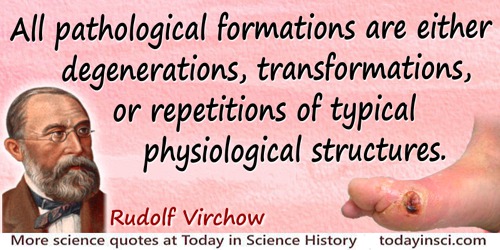
I definitely deny that any pathological process, i.e. any life-process taking place under unfavourable circumstances, is able to call forth qualitatively new formations lying beyond the customary range of forms characteristic of the species. All pathological formations are either degenerations, transformations, or repetitions of typical physiological structures.
In 'Cellular-Pathologie', Archiv für pathologische Anatomie und Physiologie und fur klinische Medizin (1855), 8, 13-14, as translated in LellandJ. Rather, 'Cellular Pathology', Disease, Life, and Man: Selected Essays by Rudolf Virchow (1958), 81.
I don’t know whether there is a finite set of basic laws of physics or whether there are infinite sets of structure like an infinite set of Chinese boxes. Will the electron turn out to have an interior structure? I wish I knew!
In Kendrick Frazier, 'A Mind at Play: An Interview with Martin Gardner', Skeptical Inquirer (Mar/Apr 1998), 37.
I don’t think it is proper at all to take the position that C. P. Snow has: namely, that the science—the knowledge, the mathematical side of life—runs in an opposite direction to the life of spontaneous humanistic action. They supplement each other. In literature, for instance, writing sonnets: it takes a lot of practice to make that kind of structure become something that just pours out, but when it does pour out, it is possible to say things that cannot be said without the sonnet form. Form and expression are very close together.
In Diane K. Osbon (ed.), A Joseph Campbell Companion: Reflections on the Art of Living (Collected Works of Joseph Campbell) (1991, 1995), 261.
I have destroyed almost the whole race of frogs, which does not happen in that savage Batrachomyomachia of Homer. For in the anatomy of frogs, which, by favour of my very excellent colleague D. Carolo Fracassato, I had set on foot in order to become more certain about the membranous substance of the lungs, it happened to me to see such things that not undeservedly I can better make use of that [saying] of Homer for the present matter—
“I see with my eyes a work trusty and great.”
For in this (frog anatomy) owing to the simplicity of the structure, and the almost complete transparency of the vessels which admits the eye into the interior, things are more clearly shown so that they will bring the light to other more obscure matters.
“I see with my eyes a work trusty and great.”
For in this (frog anatomy) owing to the simplicity of the structure, and the almost complete transparency of the vessels which admits the eye into the interior, things are more clearly shown so that they will bring the light to other more obscure matters.
De Pulmonibus (1661), trans. James Young, Proceedings of the Royal Society of Medicine (1929-30), 23, 7.
I have no patience with attempts to identify science with measurement, which is but one of its tools, or with any definition of the scientist which would exclude a Darwin, a Pasteur or a Kekulé. The scientist is a practical man and his are practical aims. He does not seek the ultimate but the proximate. He does not speak of the last analysis but rather of the next approximation. His are not those beautiful structures so delicately designed that a single flaw may cause the collapse of the whole. The scientist builds slowly and with a gross but solid kind of masonry. If dissatisfied with any of his work, even if it be near the very foundations, he can replace that part without damage to the remainder. On the whole, he is satisfied with his work, for while science may never be wholly right it certainly is never wholly wrong; and it seems to be improving from decade to decade.
The Anatomy of Science (1926), 6-7.
I have paid special attention to those Properties of the Positive Rays which seem to throw light on the problems of the structure of molecules and atoms and the question of chemical combination … I am convinced that as yet we are only at the beginning of the harvest of results which will elucidate the process of chemical combination, and thus bridge over the most serious gap which now exists between Physics and Chemistry.
Rays of Positive Electricity and their Application to Chemical Analyses (1921), v.
I heard … xenon was a good anesthesia. … I thought, “How can xenon, which doesn’t form any chemical compounds, serve as a general anesthetic? … I lay awake at night for a few minutes before going to sleep, and during the next couple of weeks each night I would think, “…how do anesthetic agents work?" Then I forgot to do it after a while, but I’d trained my unconscious mind to keep this question alive and to call [it] to my consciousness whenever a new idea turned up…. So seven years went by. [One day I] put my feet up on the desk and started reading my mail, and here was a letter from George Jeffrey … an x-ray crystallographer, on his determination of the structure of a hydrate crystal. Immediately I sat up, took my feet off the desk, and said, “I understand anesthesia!” … I spent a year [and] determined the structure of chloroform hydrate, and then I wrote my paper published in June of 1961.
Interview with George B. Kauffman and Laurie M. Kauffman, in 'Linus Pauling: Reflections', American Scientist (Nov-Dec 1994), 82, No. 6, 522-523.
I hope that in due time the chemists will justify their proceedings by some large generalisations deduced from the infinity of results which they have collected. For me I am left hopelessly behind and I will acknowledge to you that through my bad memory organic chemistry is to me a sealed book. Some of those here, [August] Hoffman for instance, consider all this however as scaffolding, which will disappear when the structure is built. I hope the structure will be worthy of the labour. I should expect a better and a quicker result from the study of the powers of matter, but then I have a predilection that way and am probably prejudiced in judgment.
Letter to Christian Schönbein (9 Dec 1852), The Letters of Faraday and Schoenbein, 1836-1862 (1899), 209-210.
I know well there are those who would have the Study of Nature restrained wholly to Observations; without ever proceeding further. But due Consideration, and a deeper Insight into Things, would soon have undeceived and made them sensible of their error. Assuredly, that man who should spend his whole life in amassing together stone, timber, and other materials for building, without ever at the making any use, or raising any fabrick out of them, might well be reputed very fantastic and extravagant. And a like censure would be his due, who should be perpetually heaping up of natural collections without design. building a structure of philosophy out of them, or advancing some propositions that might turn to the benefit and advantage of the world. This is in reality the true and only proper end of collections, of observations, and natural history: and they are of no manner of use or value without it.
In An Attempt Toward a Natural History of the Fossils of England (1729), xiii-xiv.
I shall conclude, for the time being, by saying that until Philosophers make observations (especially of mountains) that are longer, more attentive, orderly, and interconnected, and while they fail to recognize the two great agents, fire and water, in their distinct affects, they will not be able to understand the causes of the great natural variety in the disposition, structure, and other matter that can be observed in the terrestrial globe in a manner that truly corresponds to the facts and to the phenomena of Nature.
'Aleune Osservazioni Orittologiche fatte nei Monti del Vicentino', Giomale d’Italia, 1769, 5, 411, trans. Ezio Vaccari.
I should like to compare this rearrangement which the proteins undergo in the animal or vegetable organism to the making up of a railroad train. In their passage through the body parts of the whole may be left behind, and here and there new parts added on. In order to understand fully the change we must remember that the proteins are composed of Bausteine united in very different ways. Some of them contain Bausteine of many kinds. The multiplicity of the proteins is determined by many causes, first through the differences in the nature of the constituent Bausteine; and secondly, through differences in the arrangement of them. The number of Bausteine which may take part in the formation of the proteins is about as large as the number of letters in the alphabet. When we consider that through the combination of letters an infinitely large number of thoughts may be expressed, we can understand how vast a number of the properties of the organism may be recorded in the small space which is occupied by the protein molecules. It enables us to understand how it is possible for the proteins of the sex-cells to contain, to a certain extent, a complete description of the species and even of the individual. We may also comprehend how great and important the task is to determine the structure of the proteins, and why the biochemist has devoted himself with so much industry to their analysis.
'The Chemical Composition of the Cell', The Harvey Lectures (1911), 7, 45.
I should not like to leave an impression that all structural problems can be settled by X-ray analysis or that all crystal structures are easy to solve. I seem to have spent much more of my life not solving structures than solving them.
In 'X-ray Analysis of Complicated Molecules', Nobel Lecture (11 Dec 1964). In Nobel Lectures: Chemistry 1942-1962 (1964), 88.
I think that the event which, more than anything else, led me to the search for ways of making more powerful radio telescopes, was the recognition, in 1952, that the intense source in the constellation of Cygnus was a distant galaxy—1000 million light years away. This discovery showed that some galaxies were capable of producing radio emission about a million times more intense than that from our own Galaxy or the Andromeda nebula, and the mechanisms responsible were quite unknown. ... [T]he possibilities were so exciting even in 1952 that my colleagues and I set about the task of designing instruments capable of extending the observations to weaker and weaker sources, and of exploring their internal structure.
From Nobel Lecture (12 Dec 1974). In Stig Lundqvist (ed.), Nobel Lectures, Physics 1971-1980 (1992), 187.
I think that the formation of [DNA's] structure by Watson and Crick may turn out to be the greatest developments in the field of molecular genetics in recent years.
‘Discussion des rapports de M Pauling’, Rep. Institut International de Chemie Solvay: Conference on Proteins, 6-14 April 1953 (1953), 113.
I was sitting writing at my textbook but the work did not progress; my thoughts were elsewhere. I turned my chair to the fire and dozed. Again the atoms were gambolling before my eyes. This time the smaller groups kept modestly in the background. My mental eye, rendered more acute by the repeated visions of the kind, could now distinguish larger structures of manifold confirmation: long rows, sometimes more closely fitted together all twining and twisting in snake like motion. But look! What was that? One of the snakes had seized hold of its own tail, and the form whirled mockingly before my eyes. As if by a flash of lightning I awoke; and this time also I spent the rest of the night in working out the rest of the hypothesis. Let us learn to dream, gentlemen, then perhaps we shall find the truth... But let us beware of publishing our dreams till they have been tested by waking understanding.
Kekule at Benzolfest in Berichte (1890), 23, 1302.
I would ... change the accepted rule that the nature of a complex molecule is determined by the nature, quantity, and position of its elementary component parts, by the following statement: the chemical nature of a complex molecule is determined by the nature of its elementary component parts, their quantity and chemical structure.
'On the Chemical Structure of Substances' 1861.
Iconography becomes even more revealing when processes or concepts, rather than objects, must be depicted–for the constraint of a definite ‘thing’ cedes directly to the imagination. How can we draw ‘evolution’ or ‘social organization,’ not to mention the more mundane ‘digestion’ or ‘self-interest,’ without portraying more of a mental structure than a physical reality? If we wish to trace the history of ideas, iconography becomes a candid camera trained upon the scholar’s mind.
…...
If gold medals and prizes were awarded to institutions instead of individuals, the Peter Bent Brigham Hospital of 30 years ago would have qualified. The ruling board and administrative structure of that hospital did not falter in their support of the quixotic objective of treating end-stage renal disease despite a long list of tragic failures that resulted from these early efforts.
In Tore Frängsmyr and Jan E. Lindsten (eds.), Nobel Lectures: Physiology Or Medicine: 1981-1990 (1993), 558.
If molecules can be structurally identical and yet possess dissimilar properties, this can be explained only on the ground that the difference is due to a different arrangement of the atoms in space.
In Annalen der Chemie (1873), 166, 47, translated in A. Ihde, The Development of Modern Chemistry (1964), 326.
If the structure that serves as a template (the gene or virus molecule) consists of, say, two parts, which are themselves complementary In structure, then each of these parts can serve as the mould for the production of a replica of the other part, and the complex of two complementary parts thus can serve as the mould for the production of duplicates of itself.
Molecular Architecture and the Processses of Life (1948), 10.
If the universe is not meaningless, what is its meaning? For me, this meaning is to be found in the structure of the universe, which happens to be such as to produce thought by way of life and mind. Thought, in turn, is a faculty whereby the universe can reflect upon itself, discover its own structure, and apprehend such immanent entities as truth, beauty, goodness, and love. Such is the meaning of the universe, as I see it.
In Vital Dust: Life as a Cosmic Imperative (1995), 301.
If Watson and I had not discovered the [DNA] structure, instead of being revealed with a flourish it would have trickled out and that its impact would have been far less. For this sort of reason Stent had argued that a scientific discovery is more akin to a work of art than is generally admitted. Style, he argues, is as important as content. I am not completely convinced by this argument, at least in this case.
What Mad Pursuit (1990), 76.
If we range through the whole territory of nature, and endeavour to extract from each department the rich stores of knowledge and pleasure they respectively contain, we shall not find a more refined or purer source of amusement, or a more interesting and unfailing subject for recreation, than that which the observation and examination of the structure, affinities, and habits of plants and vegetables, afford.
In A Practical Treatise on the Cultivation of the Dahlia (1838), 2.
If words are not things, or maps are not the actual territory, then, obviously, the only possible link between the objective world and the linguistic world is found in structure, and structure alone.
Science and Sanity: An Introduction to Non-Aristotelian Systems and General Semantics (1958), 61.
In all works on Natural History, we constantly find details of the marvellous adaptation of animals to their food, their habits, and the localities in which they are found. But naturalists are now beginning to look beyond this, and to see that there must be some other principle regulating the infinitely varied forms of animal life. It must strike every one, that the numbers of birds and insects of different groups having scarcely any resemblance to each other, which yet feed on the same food and inhabit the same localities, cannot have been so differently constructed and adorned for that purpose alone. Thus the goat-suckers, the swallows, the tyrant fly-catchers, and the jacamars, all use the same kind ‘Of food, and procure it in the same manner: they all capture insects on the wing, yet how entirely different is the structure and the whole appearance of these birds!
In A Narrative of Travels on the Amazon and Rio Negro (1853), 83-84.
In attempting to understand the elements out of which mental phenomena are compounded, it is of the greatest importance to remember that from the protozoa to man there is nowhere a very wide gap either in structure or in behaviour. From this fact it is a highly probable inference that there is also nowhere a very wide mental gap.
Lecture II, 'Instinct and Habit', The Analysis of Mind
In clinical investigation the sick individual is at the centre of the picture. The physician must have a deep interest in his patient’s economic and social structure as well as in his physical and psychic state. If attention is not paid to the diagnosis of the person the clinical investigator is apt to fail in studies of the patient’s disease. Without a consideration of the patient as a human being it would have been difficult to have fed patients daily large amounts of liver.
In Nobel Banquet speech (10 Dec 1934). Collected in Gustaf Santesson (ed.) Les Prix Nobel en 1934 (1935).
In describing a protein it is now common to distinguish the primary, secondary and tertiary structures. The primary structure is simply the order, or sequence, of the amino-acid residues along the polypeptide chains. This was first determined by Sanger using chemical techniques for the protein insulin, and has since been elucidated for a number of peptides and, in part, for one or two other small proteins. The secondary structure is the type of folding, coiling or puckering adopted by the polypeptide chain: the a-helix structure and the pleated sheet are examples. Secondary structure has been assigned in broad outline to a number of librous proteins such as silk, keratin and collagen; but we are ignorant of the nature of the secondary structure of any globular protein. True, there is suggestive evidence, though as yet no proof, that a-helices occur in globular proteins, to an extent which is difficult to gauge quantitatively in any particular case. The tertiary structure is the way in which the folded or coiled polypeptide chains are disposed to form the protein molecule as a three-dimensional object, in space. The chemical and physical properties of a protein cannot be fully interpreted until all three levels of structure are understood, for these properties depend on the spatial relationships between the amino-acids, and these in turn depend on the tertiary and secondary structures as much as on the primary. Only X-ray diffraction methods seem capable, even in principle, of unravelling the tertiary and secondary structures.
Co-author with G. Bodo, H. M. Dintzis, R. G. Parrish, H. Wyckoff, and D. C. Phillips
Co-author with G. Bodo, H. M. Dintzis, R. G. Parrish, H. Wyckoff, and D. C. Phillips
'A Three-Dimensional Model of the Myoglobin Molecule Obtained by X-ray Analysis', Nature (1958) 181, 662.
In design, people like Buckminster Fuller amazed me at the levels at which he could think. He could think molecularly. And he could think at the almost galactic scale. And the idea that somebody could actually talk about molecules and talk about buildings and structures and talk about space just amazed me. As I get older–I’ll be 60 next year–what I’ve discovered is that I find myself in those three realms too.
In interview with Kerry A. Dolan, 'William McDonough On Cradle-to-Cradle Design', Forbes (4 Aug 2010)
In high school, when I first heard of entropy, I was attracted to it immediately. They said that in nature all systems are breaking down, and I thought, What a wonderful thing; perhaps I can make some small contribution to this process, myself. And, of course, it’s not just true of nature, it’s true of society as well. If you look carefully, you can see that the social structure is just beginning to break down, just beginning to come apart at the seams.
In Napalm and Silly Putty (2001), 130.
In its most primitive form, life is, therefore, no longer bound to the cell, the cell which possesses structure and which can be compared to a complex wheel-work, such as a watch which ceases to exist if it is stamped down in a mortar. No, in its primitive form life is like fire, like a flame borne by the living substance;—like a flame which appears in endless diversity and yet has specificity within it;—which can adopt the form of the organic world, of the lank grass-leaf and of the stem of the tree.
Address given at the 1913 meeting of the Koninklijke Akademie van Wetenschappen in Amsterdam. Trans. in G. Van Iterson, Jr, L. E. Den Dooren De Jong and A. J. Kluyver, Martinus Willem Beilerinck: His Life and Work (1940), 120.
In man, population structure reaches its greatest complexity. Mankind—the human species, Homo sapiens—is the most inclusive Mendelian population, one which inhabits nearly the whole globe.
In Radiation, Genes, and Man (1959), 102.
In man’s brain the impressions from outside are not merely registered; they produce concepts and ideas. They are the imprint of the external world upon the human brain. Therefore, it is not surprising that, after a long period of searching and erring, some of the concepts and ideas in human thinking should have come gradually closer to the fundamental laws of the world, that some of our thinking should reveal the true structure of atoms and the true movements of the stars. Nature, in the form of man, begins to recognize itself.
In Knowledge and Wonder (1962).
In most sciences one generation tears down what another has built, and what one has established, another undoes. In mathematics alone each generation adds a new storey to the old structure.
In Die Entwickelung der Mathematik in den letzten Jahrhunderten (1869), 34. As translated in Robert Édouard Moritz, Memorabilia Mathematica; Or, The Philomath’s Quotation-book (1914), 14. From the original German, “In den meisten Wissenschaften pflegt eine Generation das niederzureissen, was die andere gebaut, und was jene gesetzt, hebt diese auf. In der Mathematik allein setzt jede Generation ein neues Stockwerk auf den alten Unterbau.”
In my own field, x-ray crystallography, we used to work out the structure of minerals by various dodges which we never bothered to write down, we just used them. Then Linus Pauling came along to the laboratory, saw what we were doing and wrote out what we now call Pauling's Rules. We had all been using Pauling's Rules for about three or four years before Pauling told us what the rules were.
In The Extension of Man (1972), 116.
In physics we have dealt hitherto only with periodic crystals. To a humble physicist’s mind, these are very interesting and complicated objects; they constitute one of the most fascinating and complex material structures by which inanimate nature puzzles his wits. Yet, compared with the aperiodic crystal, they are rather plain and dull. The difference in structure is of the same kind as that between an ordinary wallpaper in which the same pattern is repeated again and again in regular periodicity and a masterpiece of embroidery, say a Raphael tapestry, which shows no dull repetition, but an elaborate, coherent, meaningful design traced by the great master.
…...
In pure mathematics we have a great structure of logically perfect deductions which constitutes an integral part of that great and enduring human heritage which is and should be largely independent of the perhaps temporary existence of any particular geographical location at any particular time. … The enduring value of mathematics, like that of the other sciences and arts, far transcends the daily flux of a changing world. In fact, the apparent stability of mathematics may well be one of the reasons for its attractiveness and for the respect accorded it.
In Fundamentals of Mathematics (1941), 463.
In scientific study, or, as I prefer to phrase it, in creative scholarship, the truth is the single end sought; all yields to that. The truth is supreme, not only in the vague mystical sense in which that expression has come to be a platitude, but in a special, definite, concrete sense. Facts and the immediate and necessary inductions from facts displace all pre-conceptions, all deductions from general principles, all favourite theories. Previous mental constructions are bowled over as childish play-structures by facts as they come rolling into the mind. The dearest doctrines, the most fascinating hypotheses, the most cherished creations of the reason and of the imagination perish from a mind thoroughly inspired with the scientific spirit in the presence of incompatible facts. Previous intellectual affections are crushed without hesitation and without remorse. Facts are placed before reasonings and before ideals, even though the reasonings and the ideals be more beautiful, be seemingly more lofty, be seemingly better, be seemingly truer. The seemingly absurd and the seemingly impossible are sometimes true. The scientific disposition is to accept facts upon evidence, however absurd they may appear to our pre-conceptions.
The Ethical Functions of Scientific Study: An Address Delivered at the Annual Commencement of the University of Michigan, 28 June 1888, 7-8.
In structure these little animals were fashioned like a bell, and at the round opening they made such a stir, that the particles in the water thereabout were set in motion thereby. … And though I must have seen quite 20 of these little animals on their long tails alongside one another very gently moving, with outstretcht bodies and straitened-out tails; yet in an instant, as it were, they pulled their bodies and their tails together, and no sooner had they contracted their bodies and tails, than they began to stick their tails out again very leisurely, and stayed thus some time continuing their gentle motion: which sight I found mightily diverting.
[Describing the ciliate Vorticella.]
[Describing the ciliate Vorticella.]
Letter to the Royal Society, London (25 Dec 1702). In Clifford Dobell (ed.), Anthony van Leewenhoek and his “Little Animals” (1932), 277.
In the first book I shall describe all the positions of the spheres, along with the motions which I attribute to the Earth, so that the book will contain as it were the general structure of the universe. In the remaining books I relate the motions of the remaining stars, and all the spheres, to the mobility of the Earth, so that it can be thence established how far the motions and appearances of the remaining stars and spheres can be saved, if they are referred to the motions of the Earth.
'To His Holiness Pope Paul III', in Copernicus: On the Revolutions of the Heavenly Spheres (1543), trans, A. M. Duncan (1976), 26.
In the light of [current research on atomic structure] the physicists have, I think, some justification for their faith that they are building on the solid rock of fact, and not, as we are often so solemnly warned by some of our scientific brethren, on the shifting sands of imaginative hypothesis.
From Opening Address to the Mathematics and Physics Section at the Annual Meeting of the British Association for the Advancement of Science, Winnipeg. Collected in 'The British Association at Winnipeg', Nature (26 Aug 1909), 81. No. 2078, 263.
In the real changes which animals undergo during their embryonic growth, in those external transformations as well as in those structural modifications within the body, we have a natural scale to measure the degree or the gradation of those full grown animals which corresponds in their external form and in their structure, to those various degrees in the metamorphoses of animals, as illustrated by embryonic changes, a real foundation for zoological classification.
From Lecture 4, collected in Twelve Lectures on Comparative Embryology: Delivered Before the Lowell Institute in Boston: December and January 1848-9 (1849), 29.
In the summer after kindergarten, a friend introduced me to the joys of building plastic model airplanes and warships. By the fourth grade, I graduated to an erector set and spent many happy hours constructing devices of unknown purpose where the main design criterion was to maximize the number of moving parts and overall size. The living room rug was frequently littered with hundreds of metal “girders” and tiny nuts and bolts surrounding half-finished structures. An understanding mother allowed me to keep the projects going for days on end.
Autobiography in Gösta Ekspong (ed.), Nobel Lectures: Physics 1996-2000 (2002), 116.
In the year 1902 (while I was attempting to explain to an elementary class in chemistry some of the ideas involved in the periodic law) becoming interested in the new theory of the electron, and combining this idea with those which are implied in the periodic classification, I formed an idea of the inner structure of the atom which, although it contained certain crudities, I have ever since regarded as representing essentially the arrangement of electrons in the atom ... In accordance with the idea of Mendeleef, that hydrogen is the first member of a full period, I erroneously assumed helium to have a shell of eight electrons. Regarding the disposition in the positive charge which balanced the electrons in the neutral atom, my ideas were very vague; I believed I inclined at that time toward the idea that the positive charge was also made up of discrete particles, the localization of which determined the localization of the electrons.
Valence and the Structure of Atoms and Molecules (1923), 29-30.
In using the present in order to reveal the past, we assume that the forces in the world are essentially the same through all time; for these forces are based on the very nature of matter, and could not have changed. The ocean has always had its waves, and those waves have always acted in the same manner. Running water on the land has ever had the same power of wear and transportation and mathematical value to its force. The laws of chemistry, heat, electricity, and mechanics have been the same through time. The plan of living structures has been fundamentally one, for the whole series belongs to one system, as much almost as the parts of an animal to the one body; and the relations of life to light and heat, and to the atmosphere, have ever been the same as now.
In 'Introduction', Manual of Geology: Treating of the Principles of the Science (1863), 7.
Indeed, while Nature is wonderfully inventive of new structures, her conservatism in holding on to old ones is still more remarkable. In the ascending line of development she tries an experiment once exceedingly thorough, and then the question is solved for all time. For she always takes time enough to try the experiment exhaustively. It took ages to find how to build a spinal column or brain, but when the experiment was finished she had reason to be, and was, satisfied.
In The Whence and Whither of Man; a Brief History of his Origin and Development through Conformity to Environment; being the Morse Lectures of 1895. (1896), 173. The Morse lectureship was founded by Prof. Samuel F.B. Morse in 1865 at Union Theological Seminary, the lectures to deal with “the relation of the Bible to any of the sciences.”
Innovation is not the product of logical thought, even though the final product is tied to a logical structure.
…...
It had the old double keyboard, an entirely different set of keys for capitals and figures, so that the paper seemed a long way off, and the machine was as big and solid as a battle cruiser. Typing was then a muscular activity. You could ache after it. If you were not familiar with those vast keyboards, your hand wandered over them like a child lost in a wood. The noise might have been that of a shipyard on the Clyde. You would no more have thought of carrying one of those grim structures as you would have thought of travelling with a piano.
[About his first typewriter.]
[About his first typewriter.]
English Journey (1934), 122-123.
It has been recognized that hydrogen bonds restrain protein molecules to their native configurations, and I believe that as the methods of structural chemistry are further applied to physiological problems it will be found that the significance of the hydrogen bond for physiology is greater than that of any other single structural feature.
Nature of the Chemical Bond and the Structure of Molecules and Crystals (1939), 265.
It has not escaped our notice that the specific pairing we have postulated immediately suggests a possible copying mechanism for the genetic material.
[Concluding remark in the paper by Watson and Crick announcing discovery of the structure of DNA.]
[Concluding remark in the paper by Watson and Crick announcing discovery of the structure of DNA.]
In J.D. Watson and F.H.C. Crick, 'A Structure for Deoxyribose Nucleic Acid,' Letter in Nature (25 Apr 1953), 171, 738. Quoted in Francis Crick, What Mad Pursuit (1990), 66.
It is frivolous to fix pedantically the date of particular inventions. They have all been invented over and over fifty times. Man is the arch machine, of which all these shifts drawn from himself are toy models. He helps himself on each emergency by copying or duplicating his own structure, just so far as the need is.
It is natural selection that gives direction to changes, orients chance, and slowly, progressively produces more complex structures, new organs, and new species. Novelties come from previously unseen association of old material. To create is to recombine.
In 'Evolution and Tinkering', Science (10 Jun 1977), 196, 1163.
It is not knowledge, but the act of learning, not possession but the act of getting there, which grants the greatest enjoyment. When I have clarified and exhausted a subject, then I turn away from it, in order to go into darkness again; the never-satisfied man is so strange if he has completed a structure, then it is not in order to dwell in it peacefully,but in order to begin another. I imagine the world conqueror must feel thus, who, after one kingdom is scarcely conquered, stretches out his arms for others.
Letter to Farkas Wolfgang Bolyai (2 Sep 1808). Quoted in G. Waldo Dunnington, Carl Friedrich Gauss: Titan of Science (2004), 416.
It is not surprising, in view of the polydynamic constitution of the genuinely mathematical mind, that many of the major heros of the science, men like Desargues and Pascal, Descartes and Leibnitz, Newton, Gauss and Bolzano, Helmholtz and Clifford, Riemann and Salmon and Plücker and Poincaré, have attained to high distinction in other fields not only of science but of philosophy and letters too. And when we reflect that the very greatest mathematical achievements have been due, not alone to the peering, microscopic, histologic vision of men like Weierstrass, illuminating the hidden recesses, the minute and intimate structure of logical reality, but to the larger vision also of men like Klein who survey the kingdoms of geometry and analysis for the endless variety of things that flourish there, as the eye of Darwin ranged over the flora and fauna of the world, or as a commercial monarch contemplates its industry, or as a statesman beholds an empire; when we reflect not only that the Calculus of Probability is a creation of mathematics but that the master mathematician is constantly required to exercise judgment—judgment, that is, in matters not admitting of certainty—balancing probabilities not yet reduced nor even reducible perhaps to calculation; when we reflect that he is called upon to exercise a function analogous to that of the comparative anatomist like Cuvier, comparing theories and doctrines of every degree of similarity and dissimilarity of structure; when, finally, we reflect that he seldom deals with a single idea at a tune, but is for the most part engaged in wielding organized hosts of them, as a general wields at once the division of an army or as a great civil administrator directs from his central office diverse and scattered but related groups of interests and operations; then, I say, the current opinion that devotion to mathematics unfits the devotee for practical affairs should be known for false on a priori grounds. And one should be thus prepared to find that as a fact Gaspard Monge, creator of descriptive geometry, author of the classic Applications de l’analyse à la géométrie; Lazare Carnot, author of the celebrated works, Géométrie de position, and Réflections sur la Métaphysique du Calcul infinitesimal; Fourier, immortal creator of the Théorie analytique de la chaleur; Arago, rightful inheritor of Monge’s chair of geometry; Poncelet, creator of pure projective geometry; one should not be surprised, I say, to find that these and other mathematicians in a land sagacious enough to invoke their aid, rendered, alike in peace and in war, eminent public service.
In Lectures on Science, Philosophy and Art (1908), 32-33.
It is not the organs—that is, the character and form of the animal’s bodily parts—that have given rise to its habits and particular structures. It is the habits and manner of life and the conditions in which its ancestors lived that have in the course of time fashioned its bodily form, its organs and qualities.
In Jean Lamarck and Hugh Elliot (trans.) Zoological Philosophy: An Exposition with Regard to the Natural History of Animals (1914), 114.
It is probable that all heavy matter possesses—latent and bound up with the structure of the atom—a similar quantity of energy to that possessed by radium. If it could be tapped and controlled, what an agent it would be in shaping the world's destiny! The man who puts his hand on the lever by which a parsimonious nature regulates so jealously the output of this store of energy would possess a weapon by which he could destroy the Earth if he chose.
A prescient remark on atomic energy after the discovery of radioactivity, but decades before the harnessing of nuclear fission in an atomic bomb became a reality.
A prescient remark on atomic energy after the discovery of radioactivity, but decades before the harnessing of nuclear fission in an atomic bomb became a reality.
Lecture to the Corps of Royal Engineers, Britain (19040. In Rodney P. Carlisle, Scientific American Inventions and Discoveries (2004), 373.
It is probable that all organisms now alive are descended from one ancestor, for the following reason. Most of our structural molecules are asymmetrical, as shown by the fact that they rotate the plane of polarized light, and often form asymmetrical crystals. But of the two possible types of any such molecule, related to one another like a right and left boot, only one is found throughout living nature. The apparent exceptions to this rule are all small molecules which are not used in the building of the large structures which display the phenomena of life.
In 'The Origin of Life', The Inequality of Man: And Other Essays (1932), 157.
It is structure that we look for whenever we try to understand anything. All science is built upon this search; we investigate how the cell is built of reticular material, cytoplasm, chromosomes; how crystals aggregate; how atoms are fastened together; how electrons constitute a chemical bond between atoms. We like to understand, and to explain, observed facts in terms of structure. A chemist who understands why a diamond has certain properties, or why nylon or hemoglobin have other properties, because of the different ways their atoms are arranged, may ask questions that a geologist would not think of formulating, unless he had been similarly trained in this way of thinking about the world.
‘The Place of Chemistry In the Integration of the Sciences’, Main Currents in Modern Thought (1950), 7, 110.
It is the destiny of wine to be drunk, and it is the destiny of glucose to be oxidized. But it was not oxidized immediately: its drinker kept it in his liver for more than a week, well curled up and tranquil, as a reserve aliment for a sudden effort; an effort that he was forced to make the following Sunday, pursuing a bolting horse. Farewell to the hexagonal structure: in the space of a few instants the skein was unwound and became glucose again, and this was dragged by the bloodstream all the way to a minute muscle fiber in the thigh, and here brutally split into two molecules of lactic acid, the grim harbinger of fatigue: only later, some minutes after, the panting of the lungs was able to supply the oxygen necessary to quietly oxidize the latter. So a new molecule of carbon dioxide returned to the atmosphere, and a parcel of the energy that the sun had handed to the vine-shoot passed from the state of chemical energy to that of mechanical energy, and thereafter settled down in the slothful condition of heat, warming up imperceptibly the air moved by the running and the blood of the runner. 'Such is life,' although rarely is it described in this manner: an inserting itself, a drawing off to its advantage, a parasitizing of the downward course of energy, from its noble solar form to the degraded one of low-temperature heat. In this downward course, which leads to equilibrium and thus death, life draws a bend and nests in it.
The Periodic Table (1975), trans. Raymond Rosenthal (1984), 192-3.
It is the structure of the universe that has taught this knowledge to man. That structure is an ever existing exhibition of every principle upon which every part of mathematical science is founded. The offspring of this science is mechanics; for mechanics are no other than the principles of science appplied practically.
In The Age of Reason: Being an Investigation of True and Fabulous Theology (27 Jan O.S. 1794), 42.
It was not alone the striving for universal culture which attracted the great masters of the Renaissance, such as Brunellesco, Leonardo da Vinci, Raphael, Michelangelo and especially Albrecht Dürer, with irresistible power to the mathematical sciences. They were conscious that, with all the freedom of the individual fantasy, art is subject to necessary laws, and conversely, with all its rigor of logical structure, mathematics follows aesthetic laws.
From Lecture (5 Feb 1891) held at the Rathhaus, Zürich, printed as Ueber den Antheil der mathematischen Wissenschaft an der Kultur der Renaissance (1892), 19. (The Contribution of the Mathematical Sciences to the Culture of the Renaissance.) As translated in Robert Édouard Moritz, Memorabilia Mathematica; Or, The Philomath’s Quotation-Book (1914), 183.
It was, of course, a lie what you read about my religious convictions, a lie which is being systematically repeated. I do not believe in a personal God and I have never denied this but have expressed it clearly. If something is in me which can be called religious then it is the unbounded admiration for the structure of the world so far as our science can reveal it.
From Letter (24 Mar 1954) in Einstein archives. Quoted by Helen Dukas and Banesh Hoffman, Albert Einstein: The Human Side (1979, 2013), 43. Dukas was Einstein’s personal secretary for 28 years, so she knew his philosophy well.
Just as a tree constitutes a mass arranged in a definite manner, in which, in every single part, in the leaves as in the root, in the trunk as in the blossom, cells are discovered to be the ultimate elements, so is it also with the forms of animal life. Every animal presents itself as a sum of vital unities, every one of which manifests all the characteristics of life. The characteristics and unity of life cannot be limited to anyone particular spot in a highly developed organism (for example, to the brain of man), but are to be found only in the definite, constantly recurring structure, which every individual element displays. Hence it follows that the structural composition of a body of considerable size, a so-called individual, always represents a kind of social arrangement of parts, an arrangement of a social kind, in which a number of individual existences are mutually dependent, but in such a way, that every element has its own special action, and, even though it derive its stimulus to activity from other parts, yet alone effects the actual performance of its duties.
In Lecture I, 'Cells and the Cellular Theory' (1858), Rudolf Virchow and Frank Chance (trans.) ,Cellular Pathology (1860), 13-14.
Just as the constant increase of entropy is the basic law of the universe, so it is the basic law of life to be ever more highly structured and to struggle against entropy.
In 'Letter to Dr. Gustáv Husák', Václav Havel: Or Living in Truth (1986), Pt. 1, 23.
Knowing what we know from X-ray and related studies of the fibrous proteins, how they are built from long polypeptide chains with linear patterns drawn to a grand scale, how these chains can contract and take up different configurations by intramolecular folding, how the chain- groups are penetrated by, and their sidechains react with, smaller co-operating molecules, and finally how they can combine so readily with nucleic acid molecules and still maintain the fibrous configuration, it is but natural to assume, as a first working hypothesis at least, that they form the long scroll on which is written the pattern of life. No other molecules satisfy so many requirements.
William Thomas Astbury and Florence O. Bell. 'Some Recent Developments in the X-Ray Study of Proteins and Related Structures', Cold Spring Harbor Symposia on Quantitative Biology, 1938, 6, 1144.
Let us ... consider the ovum [egg] as a physical system. Its potentialities are prodigious and one's first impulse is to expect that such vast potentialities would find expression in complexity of
structure. But what do we find? The substance is clouded with particles, but these can be
centrifuged away leaving it optically structureless but still capable of development.... On the
surface of the egg there is a fine membrane, below it fluid of high viscosity, next fluid of
relatively low viscosity, and within this the nucleus, which in the resting stage is simply a bag
of fluid enclosed in a delicate membrane.... The egg's simplicity is not that of a machine or a
crystal, but that of a nebula. Gathered into it are units relatively simple but capable by their
combinations of forming a vast number of dynamical systems...
As guest of honour, closing day address (Jun 1928), Sixth Colloid Symposium, Toronto, Canada, 'Living Matter', printed in Harry Boyer Weiser (ed.), Colloid Symposium Monograph (1928), Vol. 6, 15. Quoted in Joseph Needham, Chemical Embryology (1931), Vol. 1, 612-613.
Let us only imagine that birds had studied their own development and that it was they in turn who investigated the structure of the adult mammal and of man. Wouldn’t their physiological textbooks teach the following? “Those four and two-legged animals bear many resemblances to embryos, for their cranial bones are separated, and they have no beak, just as we do in the first live or six days of incubation; their extremities are all very much alike, as ours are for about the same period; there is not a single true feather on their body, rather only thin feather-shafts, so that we, as fledglings in the nest, are more advanced than they shall ever be … And these mammals that cannot find their own food for such a long time after their birth, that can never rise freely from the earth, want to consider themselves more highly organized than we?”
Über Entwicklungsgeschichte der Thiere: Beobachtung und Reflexion (1828), 203. Trans. Stephen Jay Gould, Ontogeny and Phylogeny (1977), 54.
Life is a series of definite and successive changes both in structure and in composition, which take place in an individual without destroying its identity.
In Problems of Life and Mind: Second Series: the Physical Basis of Mind (1891), 32.
Life through many long periods has been manifested in a countless host of varying structures, all circumscribed by one general plan, each appointed to a definite place, and limited to an appointed duration. On the whole the earth has been thus more and more covered by the associated life of plants and animals, filling all habitable space with beings capable of enjoying their own existence or ministering to the enjoyment of others; till finally, after long preparation, a being was created capable of the wonderful power of measuring and weighing all the world of matter and space which surrounds him, of treasuring up the past history of all the forms of life, and considering his own relation to the whole. When he surveys this vast and co-ordinated system, and inquires into its history and origin, can he be at a loss to decide whether it be a work of Divine thought and wisdom, or the fortunate offspring of a few atoms of matter, warmed by the anima mundi, a spark of electricity, or an accidental ray of sunshine?
Life on the Earth: Its Origin and Succession (1860), 216-7.
Man, whose organization is regarded as the highest, departs from the vertebrate archetype; and it is because the study of anatomy is usually commenced from, and often confined to, his structure, that a knowledge of the archetype has been so long hidden from anatomists.
'The Lexington Papers', The Quarterly Review (1851), 89, 450-1.
Mankind has always drawn from outside sources of energy. This island was the first to harness coal and steam. But our present sources stand in the ratio of a million to one, compared with any previous sources. The release of atomic energy will change the whole structure of society.
Address to New Europe Group meeting on the third anniversary of the Hiroshima bomb. Quoted in New Europe Group, In Commemoration of Professor Frederick Soddy (1956), 7.
Mathematical magic combines the beauty of mathematical structure with the entertainment value of a trick.
In 'Preface', Mathematics, Magic, and Mystery (1956), ix. Webmaster checked the actual page, in the 1956 edition, and there Gardner plainly uses the beginning words “Mathematical magic.” On page 113, Gardner credits Royal V. Heath for originating the term “Mathemagic,” used as Heath’s book title in 1933. Anywhere you see the quote incorrectly beginning with “Mathemagical mathematics…” or saying Gardner coined the term “mathemagical” obviously did not check the primary source.
Mathematicians are only dealing with the structure of reasoning, and they do not really care what they are talking about. They do not even need to know what they are talking about … But the physicist has meaning to all his phrases. … In physics, you have to have an understanding of the connection of words with the real world.
In The Character of Physical Law (1965), 55.
Mathematicians create by acts of insight and intuition. Logic then sanctions the conquests of intuition. It is the hygiene that mathematics practices to keep its ideas healthy and strong. Moreover, the whole structure rests fundamentally on uncertain ground, the intuition of humans. Here and there an intuition is scooped out and replaced by a firmly built pillar of thought; however, this pillar is based on some deeper, perhaps less clearly defined, intuition. Though the process of replacing intuitions with precise thoughts does not change the nature of the ground on which mathematics ultimately rests, it does add strength and height to the structure.
In Mathematics in Western Culture (1964), 408.
Mathematicians deal with possible worlds, with an infinite number of logically consistent systems. Observers explore the one particular world we inhabit. Between the two stands the theorist. He studies possible worlds but only those which are compatible with the information furnished by observers. In other words, theory attempts to segregate the minimum number of possible worlds which must include the actual world we inhabit. Then the observer, with new factual information, attempts to reduce the list further. And so it goes, observation and theory advancing together toward the common goal of science, knowledge of the structure and observation of the universe.
Lecture to Sigma Xi, 'The Problem of the Expanding Universe' (1941), printed in Sigma Xi Quarterly (1942), 30, 104-105. Reprinted in Smithsonian Institution Report of the Board of Regents (1943), 97, 123. As cited by Norriss S. Hetherington in 'Philosophical Values and Observation in Edwin Hubble's Choice of a Model of the Universe', Historical Studies in the Physical Sciences (1982), 13, No. 1, 63.
Mathematics because of its nature and structure is peculiarly fitted for high school instruction [Gymnasiallehrfach]. Especially the higher mathematics, even if presented only in its elements, combines within itself all those qualities which are demanded of a secondary subject.
In Die Mathematik die Fackelträgerin einer neuen Zeit (1889), 40. As translated in Robert Édouard Moritz, Memorabilia Mathematica; Or, The Philomath’s Quotation-book (1914), 49.
Mathematics is a structure providing observers with a framework upon which to base healthy, informed, and intelligent judgment. Data and information are slung about us from all directions, and we are to use them as a basis for informed decisions. … Ability to critically analyze an argument purported to be logical, free of the impact of the loaded meanings of the terms involved, is basic to an informed populace.
In 'Mathematics Is an Edifice, Not a Toolbox', Notices of the AMS (Oct 1996), 43, No. 10, 1108.
Mathematics is not only real, but it is the only reality. That is that entire universe is made of matter, obviously. And matter is made of particles. It’s made of electrons and neutrons and protons. So the entire universe is made out of particles. Now what are the particles made out of? They’re not made out of anything. The only thing you can say about the reality of an electron is to cite its mathematical properties. So there’s a sense in which matter has completely dissolved and what is left is just a mathematical structure.
In 'Gardner on Gardner: JPBM Communications Award Presentation', Focus-The Newsletter of the Mathematical Association of America (Dec 1994), 14, No. 6. Also, first sentence as filler, with citation, after Washek F. Pfeffer, 'A Devil's Platform', The American Mathematical Monthly (Dec 2008), 115, No. 10, 947.
Mathematics, too, is a language, and as concerns its structure and content it is the most perfect language which exists, superior to any vernacular; indeed, since it is understood by every people, mathematics may be called the language of languages. Through it, as it were, nature herself speaks; through it the Creator of the world has spoken, and through it the Preserver of the world continues to speak.
In Die Mathematik die Fackeltragerin einer neutn Zeit (1889), 5. As translated in Robert Édouard Moritz, Memorabilia Mathematica; Or, The Philomath’s Quotation-Book (1914), 194. From the original German, “Denn auch die Mathematik ist eine Sprache, und zwar nach Bau und Inhalt die vollkommenste Sprache, die es giebt, höher als jede Volkssprache; ja, weil alle Völker sie verstehen, kann sie die Sprache der Sprachen heißen. In ihr spricht sozusagen die Natur selbst, in ihr hat der Schöpfer der Welt geredet und in ihr redet noch immer ihr Erhalter.”
Mathematics… is the set of all possible self-consistent structures, and there are vastly more logical structures than physical principles.
In 'Conclusion', Hyperspace: A Scientific Odyssey Through Parallel Universes, Time Warps, and the Tenth Dimension (1995), 328.
Matter and energy seem granular in structure, and so does “life”, but not so mind.
In Tarner Lecture, at Trinity College, Cambridge (Oct 1956), 'The Arithmetical Paradox: The Oneness of Mind', printed in Mind and Matter (1958), 61. Also collected in What is Life?: With Mind and Matter and Autobiographical Sketches (1992, 2012), 134.
Medicine is essentially a learned profession. Its literature is ancient, and connects it with the most learned periods of antiquity; and its terminology continues to be Greek or Latin. You cannot name a part of the body, and scarcely a disease, without the use of a classical term. Every structure bears upon it the impress of learning, and is a silent appeal to the student to cultivate an acquaintance with the sources from which the nomenclature of his profession is derived.
From Address (Oct 1874) delivered at Guy’s Hospital, 'On The Study of Medicine', printed in British Medical journal (1874), 2, 425. Collected in Sir William Withey Gull and Theodore Dyke Acland (ed.), A Collection of the Published Writings of William Withey Gull (1896), 11.
Men cannot help feeling a little ashamed of their cousin-german the Ape. His close yet grotesque and clumsy semblance of the human form is accompanied by no gleams of higher instinct. Our humble friend the dog, our patient fellow-labourer the horse, are nearer to us in this respect. The magnanimous and sagacious elephant, doomed though he be to all fours, is godlike compared with this spitefully ferocious creature. Strangely enough, too, the most repulsive and ferocious of all apekind, the recently discovered Gorilla is, the comparative anatomist assures us, nearest to us all: the most closely allied in structure to the human form.
In 'Our Nearest Relation', All Year Round (28 May 1859), 1, No. 5, 112. Charles Dickens was both the editor and publisher of this magazine. The author of the article remains unknown. The articles were by custom printed without crediting the author. Biographers have been able to use extant office records to identify various authors of other articles, but not this specific one. Dickens and Richard Owen were friends; they read each other’s work. Owen is known to have found at least a little time to write a few articles for Dickens’ magazines. Owen had given a talk at the Royal Institution (4 Feb 1859) titled 'On the Gorilla.' This would suggest why Dickens may have had a definite interest in publishing on this subject, regardless of who in fact wrote the article.
Men of science belong to two different types—the logical and the intuitive. Science owes its progress to both forms of minds. Mathematics, although a purely logical structure, nevertheless makes use of intuition. Among the mathematicians there are intuitives and logicians, analysts and geometricians. Hermite and Weierstrass were intuitives. Riemann and Bertrand, logicians. The discoveries of intuition have always to be developed by logic.
In Man the Unknown (1935), 123.
Mistakes are at the very base of human thought feeding the structure like root nodules. If we were not provided with the knack of being wrong, we could never get anything useful done.
In The Medusa and the Snail (1979), 37.
Modern tree communities in Amazonia are structured to an important extent by a long history of plant domestication by Amazonian peoples.
As quoted in Robinson Meyer, 'The Amazon Rainforest Was Profoundly Changed by Ancient Humans', The Atlantic (2 Mar 2017).
MOLECULE, n. The ultimate, indivisible unit of matter. It is distinguished from the corpuscle, also the ultimate, indivisible unit of matter, by a closer resemblance to the atom, also the ultimate, indivisible unit of matter. Three great scientific theories of the structure of the universe are the molecular, the corpuscular and the atomic. A fourth affirms, with Haeckel, the condensation or precipitation of matter from ether—whose existence is proved by the condensation or precipitation. The present trend of scientific thought is toward the theory of ions. The ion differs from the molecule, the corpuscle and the atom in that it is an ion. A fifth theory is held by idiots, but it is doubtful if they know any more about the matter than the others.
The Collected Works of Ambrose Bierce (1911), Vol. 7, The Devil's Dictionary, 220-221.
Morphological information has provided the greatest single source of data in the formulation and development of the theory of evolution and that even now, when the preponderance of work is experimental, the basis for interpretation in many areas of study remains the form and relationships of structures.
'Morphology, Paleontology, and Evolution', in Sol Tax (ed.), Evolution After Darwin, Vol. 1, The Evolution of Life (1960), 524.
Most loss of life and property has been due to the collapse of antiquated and unsafe structures, mostly of brick and other masonry. ... There is progress of California toward building new construction according to earthquake-resistant design. We would have less reason to ask for earthquake prediction if this was universal.
From interview with Henry Spall, as in an abridged version of Earthquake Information Bulletin (Jan-Feb 1980), 12, No. 1, that was on the USGS website.
Much scientific truth proved to be as hypothetical as poetic allegory. The relationshiip of those rod-connected blue and red balls to an actual atomic structure was about the same as the relationship of Christianity to the fish or the Lamb.
Another Roadside Attraction (1990), 240.
Mutations and chromosomal changes arise in every sufficiently studied organism with a certain finite frequency, and thus constantly and unremittingly supply the raw materials for evolution. But evolution involves something more than origin of mutations. Mutations and chromosomal changes are only the first stage, or level, of the evolutionary process, governed entirely by the laws of the physiology of individuals. Once produced, mutations are injected in the genetic composition of the population, where their further fate is determined by the dynamic regularities of the physiology of populations. A mutation may be lost or increased in frequency in generations immediately following its origin, and this (in the case of recessive mutations) without regard to the beneficial or deleterious effects of the mutation. The influences of selection, migration, and geographical isolation then mold the genetic structure of populations into new shapes, in conformity with the secular environment and the ecology, especially the breeding habits, of the species. This is the second level of the evolutionary process, on which the impact of the environment produces historical changes in the living population.
Genetics and Origin of Species (1937), 13.
My own prejudices are exactly the opposite of the functionalists’: “If you want to understand function, study structure.” I was supposed to have said in my molecular biology days. (I believe I was sailing at the time.)
What Mad Pursuit: A Personal View of Scientific Discovery (1988), 150.
Nature has but one plan of operation, invariably the same in the smallest things as well as in the largest, and so often do we see the smallest masses selected for use in Nature, that even enormous ones are built up solely by fitting these together. Indeed, all Nature’s efforts are devoted to uniting the smallest parts of our bodies in such a way that all things whatsoever, however diverse they may be, which coalesce in the structure of living things construct the parts by means of a sort of compendium.
'On the Developmental Process', in H. B. Adelmann (ed.), Marcello Malpighi and the Evolution of Embryology (1966), Vol. 2, 843.
Nature is disordered, powerful and chaotic, and through fear of the chaos we impose system on it. We abhor complexity, and seek to simplify things whenever we can by whatever means we have at hand. We need to have an overall explanation of what the universe is and how it functions. In order to achieve this overall view we develop explanatory theories which will give structure to natural phenomena: we classify nature into a coherent system which appears to do what we say it does.
In Day the Universe Changed (1985), 11.
Nature never “fails.” Nature complies with its own laws. Nature is the law. When Man lacks understanding of Nature’s laws and a Man-contrived structure buckles unexpectedly, it does not fail. It only demonstrates that Man did not understand Nature’s laws and behaviors. Nothing failed. Man’s knowledge or estimating was inadequate.
In "How Little I Know", in Saturday Review (12 Nov 1966), 152. Excerpted in Buckminster Fuller and Answar Dil, Humans in Universe (1983), 31.
Nature when more shy in one, hath more freely confest and shewn herself in another; and a Fly sometimes hath given greater light towards the true knowledge of the structure and the uses of the Parts in Humane Bodies, than an often repeated dissection of the same might have done … We must not therefore think the meanest of the Creation vile or useless, since that in them in lively Characters (if we can but read) we may find the knowledge of a Deity and ourselves … In every Animal there is a world of wonders; each is a Microcosme or a world in it self.
Phocrena, or the Anatomy of a Porpess, dissected at Gresham College: With a Prreliminary Discourse Concerning Anatomy, and a Natural History of Animals (1680), 2-3.

Nature, … in order to carry out the marvelous operations [that occur] in animals and plants has been pleased to construct their organized bodies with a very large number of machines, which are of necessity made up of extremely minute parts so shaped and situated as to form a marvelous organ, the structure and composition of which are usually invisible to the naked eye without the aid of a microscope. … Just as Nature deserves praise and admiration for making machines so small, so too the physician who observes them to the best of his ability is worthy of praise, not blame, for he must also correct and repair these machines as well as he can every time they get out of order.
'Reply to Doctor Sbaraglia' in Opera Posthuma (1697), in H. B. Adelmann (ed.), Marcello Malpighi and the Evolution of Embryology (1966), Vol. 1, 568.
No collateral science had profited so much by palæontology as that which teaches the structure and mode of formation of the earth’s crust, with the relative position, time, and order of formation of its constituent stratified and unstratified parts. Geology has left her old hand-maiden mineralogy to rest almost wholly on the broad shoulders of her young and vigorous offspring, the science of organic remains.
In article 'Palæontology' contributed to Encyclopædia Britannica (8th ed., 1859), Vol. 17, 91.
No medieval schoolman has been singled out as a precursor more often than the French scholastic Nicole Oresme.This brilliant scholar has been credited with … the framing of Gresham’s law before Gresham, the invention of analytic geometry before Descartes, with propounding structural theories of compounds before nineteenth century organic chemists, with discovering the law of free fall before Galileo, and with advocating the rotation of the Earth before Copernicus. None of these claims is, in fact, true, although each is based on discussion by Oresme of some penetration and originality …
In Nicole Oresme and the Medieval Geometry of Quantities and Motions (1968).
No more harmful nonsense exists than the common supposition that deepest insight into great questions about the meaning of life or the structure of reality emerges most readily when a free, undisciplined, and uncluttered (read, rather, ignorant and uneducated) mind soars above mere earthly knowledge and concern.
…...
No occupation is more worthy of an intelligent and enlightened mind, than the study of Nature and natural objects; and whether we labour to investigate the structure and function of the human system, whether we direct our attention to the classification and habits of the animal kingdom, or prosecute our researches in the more pleasing and varied field of vegetable life, we shall constantly find some new object to attract our attention, some fresh beauties to excite our imagination, and some previously undiscovered source of gratification and delight.
In A Practical Treatise on the Cultivation of the Dahlia (1838), 1-2.
No physiologist who calmly considers the question in connection with the general truths of his science, can long resist the conviction that different parts of the cerebrum subserve different kinds of mental action. Localization of function is the law of all organization whatever: separateness of duty is universally accompanied with separateness of structure: and it would be marvellous were an exception to exist in the cerebral hemispheres.
The Principles of Psychology (1855), 607.
No substantial part of the universe is so simple that it can be grasped and controlled without abstraction. Abstraction consists in replacing the part of the universe under consideration by a model of similar but simpler structure. Models, formal and intellectual on the one hand, or material on the other, are thus a central necessity of scientific procedure.
As coauthor with Norbert Wiener in 'The Role of Models in Science', Philosophy of Science (Oct 1945), 12, No. 4, 316.
Nor can it be supposed that the diversity of chemical structure and process stops at the boundary of the species, and that within that boundary, which has no real finality, rigid uniformity reigns. Such a conception is at variance with any evolutionary conception of the nature and origin of species. The existence of chemical individuality follows of necessity from that of chemical specificity, but we should expect the differences between individuals to be still more subtle and difficult of detection. Indications of their existence are seen, even in man, in the various tints of skin, hair, and eyes, and in the quantitative differences in those portions of the end-products of metabolism which are endogenous and are not affected by diet, such as recent researches have revealed in increasing numbers. Even those idiosyncrasies with regard to drugs and articles of food which are summed up in the proverbial saying that what is one man's meat is another man's poison presumably have a chemical basis.
Inborn Errors of Metabolism: The Croonian Lectures delivered before the Royal College of Physicians of London, in June, 1908 (1909), 2-3.
Not only do the various components of the cells form a living system, in which the capacity to live, react, and reproduce is dependent on the interactions of all the members of the system; but this living system is identical with the genetic system. The form of life is determined not only by the specific nature of the hereditary units but also by the structure and arrangement of the system. The whole system is more than the sum of its parts, and the effect of each of the components depends on and is influenced by all previous reactions, whose sequence is in turn determined by the whole idiotype.
'Cytoplasmic Inheritance in Epilobium and Its Theoretical Significance', Advances in Genetics (1954), 6, 320.
Observation by means of the microscope will reveal more wonderful things than those viewed in regard to mere structure and connection: for while the heart is still beating the contrary (i.e., in opposite directions in the different vessels) movement of the blood is observed in the vessels—though with difficulty—so that the circulation of the blood is clearly exposed.
De Pulmonibus (1661), trans. James Young, Proceedings of the Royal Society of Medicine (1929-30), 23, 8.
Occurrences that other men would have noted only with the most casual interest became for Whitney exciting opportunities to experiment. Once he became disturbed by a scientist's seemingly endless pursuit of irrelevant details in the course of an experiment, and criticized this as being as pointless as grabbing beans out of a pot, recording the numbers, and then analyzing the results. Later that day, after he had gone home, his simile began to intrigue him, and he asked himself whether it would really be pointless to count beans gathered in such a random manner. Another man might well have dismissed this as an idle fancy, but to Whitney an opportunity to conduct an experiment was not to be overlooked. Accordingly, he set a pot of beans beside his bed, and for several days each night before retiring he would take as many beans as he could grasp in one hand and make a note of how many were in the handful. After several days had passed he was intrigued to find that the results were not as unrewarding as he had expected. He found that each handful
contained more beans than the one before, indicating that with practice he was learning to grasp more and more beans. “This might be called research in morphology, the science of animal structure,” he mused. “My hand was becoming webbed … so I said to myself: never label a real experiment useless, it may reveal something unthought of but worth knowing.”
'Willis Rodney Whitney', National Academy of Sciences, Biographical Memoirs (1960), 358-359.
Of the nucleosides from deoxyribonucleic acids, all that was known with any certainty [in the 1940s] was that they were 2-deoxy-D-ribosides of the bases adenine, guanine, thymine and cytosine and it was assumed that they were structurally analogous to the ribonucleosides. The chemistry of the nucleotides—the phosphates of the nucleosides—was in a correspondingly primitive state. It may well be asked why the chemistry of these groups of compounds was not further advanced, particularly since we recognize today that they occupy a central place in the history of the living cell. True, their full significance was for a long time unrecognized and emerged only slowly as biochemical research got into its stride but I think a more important reason is to be found in the physical properties of compounds of the nucleotide group. As water-soluble polar compounds with no proper melting points they were extremely difficult to handle by the classic techniques of organic chemistry, and were accordingly very discouraging substances to early workers. It is surely no accident that the major advances in the field have coincided with the appearance of new experimental techniques such as paper and ion-exchange chromatography, paper electrophoresis, and countercurrent distribution, peculiarly appropriate to the compounds of this group.
In 'Synthesis in the Study of Nucleotides', Nobel Lecture, 11 December 1957. In Nobel Lectures: Chemistry 1942-1962 (1964), 524.
One of the most important choices any researcher makes is picking a significant topic to study. If you choose the right problem, you get important results that transform our perception of the underlying structure of the universe. If you don’t choose the right problem, you may work very hard but only get an interesting result.
Unverified - source citation needed. Can you help?
One of the most striking evidences of the reliability of the organic chemist's methods of determining molecular structure is the fact that he has never been able to derive satisfactory structures for supposed molecules which are in fact nonexistent.
Physical Organic Chemistry; Reaction Rates, Equilibria, and Mechanisms (1940),38.
One reason which has led the organic chemist to avert his mind from the problems of Biochemistry is the obsession that the really significant happenings in the animal body are concerned in the main with substances of such high molecular weight and consequent vagueness of molecular structure as to make their reactions impossible of study by his available and accurate methods. There remains, I find, pretty widely spread, the feeling—due to earlier biological teaching—that, apart from substances which are obviously excreta, all the simpler products which can be found in cells or tissues are as a class mere objects, already too remote from the fundamental biochemical events to have much significance. So far from this being the case, recent progress points in the clearest way to the fact that the molecules with which a most important and significant part of the chemical dynamics of living tissues is concerned are of a comparatively simple character.
In 'The Dynamic Side of Biochemistry', Address (11 Sep 1913) in Report on the 83rd Meeting of the British Association for the Advancement of Science (1914), 657-8.
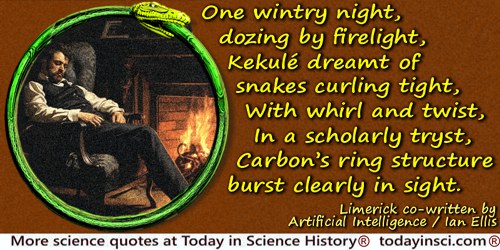
One wintry night, dozing by firelight,
Kekulé dreamt of snakes curling tight,
With whirl and twist,
In a scholarly tryst,
Carbon’s ring structure burst clearly in sight.
Kekulé dreamt of snakes curling tight,
With whirl and twist,
In a scholarly tryst,
Carbon’s ring structure burst clearly in sight.
Limerick co-written by Artificial Intelligence and Webmaster.
Our model of Nature should not be like a building—a handsome structure for the populace to admire, until in the course of time some one takes away a corner stone and the edifice comes toppling down. It should be like an engine with movable parts. We need not fix the position of any one lever; that is to be adjusted from time to time as the latest observations indicate. The aim of the theorist is to know the train of wheels which the lever sets in motion—that binding of the parts which is the soul of the engine.
In 'The Internal Constitution of the Stars', The Scientific Monthly (Oct 1920), 11, No. 4, 302.
Owing to his lack of knowledge, the ordinary man cannot attempt to resolve conflicting theories of conflicting advice into a single organized structure. He is likely to assume the information available to him is on the order of what we might think of as a few pieces of an enormous jigsaw puzzle. If a given piece fails to fit, it is not because it is fraudulent; more likely the contradictions and inconsistencies within his information are due to his lack of understanding and to the fact that he possesses only a few pieces of the puzzle. Differing statements about the nature of things, differing medical philosophies, different diagnoses and treatments—all of these are to be collected eagerly and be made a part of the individual's collection of puzzle pieces. Ultimately, after many lifetimes, the pieces will fit together and the individual will attain clear and certain knowledge.
'Strategies of Resort to Curers in South India', contributed in Charles M. Leslie (ed.), Asian Medical Systems: A Comparative Study (1976), 185.
Pauling was shocked by the freedom with which the X-ray crystallographers of the time, including particularly Astbury, played with the intimate chemical structure of their models. They seemed to think that if the atoms were arranged in the right order and about the right distance apart, that was all that mattered, that no further restrictions need to be put on them.
Quoted by John Law in 'The Case of X-ray Protein Crystallography', collected in Gerard Lemaine (ed.), Perspectives on the Emergence of Scientific Disciplines, 1976, 140.
People are entirely too disbelieving of coincidence. They are far too ready to dismiss it and to build arcane structures of extremely rickety substance in order to avoid it. I, on the other hand, see coincidence everywhere as an inevitable consequence of the laws of probability, according to which having no unusual coincidence is far more unusual than any coincidence could possibly be.
In The Planet That Wasn't (1976), 3.
People have noted with admiration how the progress of scientific enquiry is like the growth of a coral reef; each generation of little toilers building a sure foundation on which their successors may build yet further. The simile is apt in many ways, and in one way in particular that is worth considering. When we see how industrious and how prolific are the coral insects, our chief astonishment should be, not how vast are the structures they have built, but how few and scattered. Why is not every coast lined with coral? Why is the abyss if ocean not bridged with it. The answer is that coral only lives under certain limitations; it can only thrive at certain depths, in water of certain temperatures and salinities; outside these limits it languishes and dies. Science is like coral in this. Scientific investigators can only work in certain spots of the ocean of Being, where they are at home, and all outside is unknown to them...
Scientific Method: An Inquiry into the Character and Validy of Natural Law (1923), 195. Quoted in Wilson Gee, Social science research methods (1950), 182.
Perhaps the majority of paleontologists of the present time, who believe in orthogenesis, the irreversibility of evolution and the polyphyletic origin families, will assume that a short molar must keep on getting shorter, that it can never get longer and then again grow relatively shorter and therefore that Propliopithecus with its extremely short third molar and Dryopithecus its long m3 are alike excluded from ancestry of the Gorilla, in which the is a slight retrogression in length of m3. After many years reflection and constant study of the evolution of the vertebrates however, I conclude that 'orthogenesis' should mean solely that structures and races evolve in a certain direction, or toward a certain goal, only until the direction of evolution shifts toward some other goal. I believe that the 'irreversibility of evolution' means only that past changes irreversibly limit and condition future possibilities, and that, as a matter of experience, if an organ is once lost the same (homogenous) organ can be regained, although nature is fertile in substituting imitations. But this not mean, in my judgement, that if one tooth is smaller than its fellows it will in all cases continue to grow smaller.
'Studies on the Evolution of the Primates’, Bulletin of the American Museum of Natural History, 1916, 35, 307.
Persons possessing great intellect and a capacity for excelling in the creative arts and also in the sciences are generally likely to have heavier brains than the ordinary individual. Arguing from this we might expect to find a corresponding lightness in the brain of the criminal, but this is not always the case ... Many criminals show not a single anomaly in their physical or mental make-up, while many persons with marked evidences of morphological aberration have never exhibited the criminal tendency.
Every attempt to prove crime to be due to a constitution peculiar only to criminals has failed signally. It is because most criminals are drawn from the ranks of the low, the degraded, the outcast, that investigators were ever deceived into attempting to set up a 'type' of criminal. The social conditions which foster the great majority of crimes are more needful of study and improvement.
From study of known normal brains we have learned that there is a certain range of variation. No two brains are exactly alike, and the greatest source of error in the assertions of Benedict and Lombroso has been the finding of this or that variation in a criminal’s brains, and maintaining such to be characteristic of the 'criminal constitution,' unmindful of the fact that like variations of structure may and do exist in the brains of normal, moral persons.
Every attempt to prove crime to be due to a constitution peculiar only to criminals has failed signally. It is because most criminals are drawn from the ranks of the low, the degraded, the outcast, that investigators were ever deceived into attempting to set up a 'type' of criminal. The social conditions which foster the great majority of crimes are more needful of study and improvement.
From study of known normal brains we have learned that there is a certain range of variation. No two brains are exactly alike, and the greatest source of error in the assertions of Benedict and Lombroso has been the finding of this or that variation in a criminal’s brains, and maintaining such to be characteristic of the 'criminal constitution,' unmindful of the fact that like variations of structure may and do exist in the brains of normal, moral persons.
Address to the American Association for the Advancement of Science in Philadelphia (28 Dec 1904), as quoted in 'Americans of Future Will Have Best Brains', New York Times (29 Dec 1904), 6.
Physicist Isador Isaac Rabi, who won a Nobel Prize for inventing a technique that permitted scientists to probe the structure of atoms and molecules in the 1930s, attributed his success to the way his mother used to greet him when he came home from school each day. “Did you ask any good questions today, Isaac?” she would say.
Thomas J. Peters, Liberation Management: Necessary Disorganization for the Nanosecond Nineties (1992).
Plasticity, then, in the wide sense of the word, means the possession of a structure weak enough to yield to an influence, but strong enough not to yield all at once. Each relatively stable phase of equilibrium in such a structure is marked by what we may call a new set of habits. Organic matter, especially nervous tissue, seems endowed with a very extraordinary degree of plasticity of this sort ; so that we may without hesitation lay down as our first proposition the following, that the phenomena of habit in living beings are due to plasticity of the organic materials of which their bodies are composed.
'The Laws of Habit', The Popular Science Monthly (Feb 1887), 434.
Psychoanalytic theory is the most stupendous intellectual confidence trick of the twentieth century and a terminal product as well—something akin to a dinosaur or zeppelin in the history of ideas, a vast structure of radically unsound design and with no posterity.
'Victims of Psychiatry', The New York Review of Books (23 Jan 1975), 21. Cited in David E. Stannard, Shrinking History: On Freud and the Failure of Psychohistory (1980), 150.
Quarks appear to be without spatial extent and to lack a deeper structure: they have character without extension and are substance without inside.
In The Creation (1981), 15.
Rather than believe that Watson and Crick made the DNA structure, I would rather stress that the structure made Watson and Crick.
In What Mad Pursuit: A Personal View of Scientific Discovery (1988), 76.
Reality is never skin-deep. The true nature of the earth and its full wealth of hidden treasures cannot be argued from the visible rocks, the rocks upon which we live and out of which we make our living. The face of the earth, with its upstanding continents and depressed ocean-deeps, its vast ornament of plateau and mountain-chain, is molded by structure and process in hidden depths.
Saturated with that speculative spirit then pervading the Greek mind, he [Pythagoras] endeavoured to discover some principle of homogeneity in the universe. Before him, the philosophers of the Ionic school had sought it in the matter of things; Pythagoras looked for it in the structure of things. He observed the various numerical relations or analogies between numbers and the phenomena of the universe. Being convinced that it was in numbers and their relations that he was to find the foundation to true philosophy, he proceeded to trace the origin of all things to numbers. Thus he observed that musical strings of equal lengths stretched by weights having the proportion of 1/2, 2/3, 3/4, produced intervals which were an octave, a fifth and a fourth. Harmony, therefore, depends on musical proportion; it is nothing but a mysterious numerical relation. Where harmony is, there are numbers. Hence the order and beauty of the universe have their origin in numbers. There are seven intervals in the musical scale, and also seven planets crossing the heavens. The same numerical relations which underlie the former must underlie the latter. But where number is, there is harmony. Hence his spiritual ear discerned in the planetary motions a wonderful “Harmony of spheres.”
In History of Mathematics (1893), 67.
Science is intimately integrated with the whole social structure and cultural tradition. They mutually support one other—only in certain types of society can science flourish, and conversely without a continuous and healthy development and application of science such a society cannot function properly.
The Social System (1951, 1977), Chap. 8, 111. As a functionalist, Parsons argued that social practices had to be studied in terms of their function in maintaining society.
Science will continue to surprise us with what it discovers and creates; then it will astound us by devising new methods to surprise us. At the core of science’s self-modification is technology. New tools enable new structures of knowledge and new ways of discovery. The achievement of science is to know new things; the evolution of science is to know them in new ways. What evolves is less the body of what we know and more the nature of our knowing.
'Speculations on the Future of Science'. In Clifford A. Pickover, Archimedes to Hawking: Laws of Science and the Great Minds Behind Them (2008), 172.
Scientists are not robotic inducing machines that infer structures of explanation only from regularities observed in natural phenomena (assuming, as I doubt, that such a style of reasoning could ever achieve success in principle). Scientists are human beings, immersed in culture, and struggling with all the curious tools of inference that mind permits ... Culture can potentiate as well as constrain–as Darwin’s translation of Adam Smith’s laissez-faire economic models into biology as the theory of natural selection. In any case, objective minds do not exist outside culture, so we must make the best of our ineluctable embedding.
…...
Seeing this gradation and diversity of structure in one small, intimately related group of birds, one might really fancy that from an original paucity of birds in this archipelago, one species had been taken and modified for different ends.
[Comment added to the second edition (1845) of Voyage of the Beagle (1839) concerning the variations he found of finches in the Galapagos Islands. In the first edition (p.461) he had merely described the thirteen allied species of finch but without further commentary.]
[Comment added to the second edition (1845) of Voyage of the Beagle (1839) concerning the variations he found of finches in the Galapagos Islands. In the first edition (p.461) he had merely described the thirteen allied species of finch but without further commentary.]
Voyage of the Beagle, 2nd ed., (1845), 380.
Siphonophores do not convey the message–a favorite theme of unthinking romanticism–that nature is but one gigantic whole, all its parts intimately connected and interacting in some higher, ineffable harmony. Nature revels in boundaries and distinctions; we inhabit a universe of structure. But since our universe of structure has evolved historically, it must present us with fuzzy boundaries, where one kind of thing grades into another.
…...
Soccer ball C60 quickly became a sort of “Rosetta Stone” leading to the discovery of a new world of geodesic structures of pure carbon built on the nanometer scale.
From Nobel Lecture (7 Dec 1996), 'Discovering the Fullerenes', collected in Ingmar Grenthe (ed.), Nobel Lectures, Chemistry 1996-2000 (2003).
Sodium thymonucleate fibres give two distinct types of X-ray diagram … [structures A and B]. The X-ray diagram of structure B (see photograph) shows in striking manner the features characteristic of helical structures, first worked out in this laboratory by Stokes (unpublished) and by Crick, Cochran and Vand2. Stokes and Wilkins were the first to propose such structures for nucleic acid as a result of direct studies of nucleic acid fibres, although a helical structure had been previously suggested by Furberg (thesis, London, 1949) on the basis of X-ray studies of nucleosides and nucleotides.
While the X-ray evidence cannot, at present, be taken as direct proof that the structure is helical, other considerations discussed below make the existence of a helical structure highly probable.
While the X-ray evidence cannot, at present, be taken as direct proof that the structure is helical, other considerations discussed below make the existence of a helical structure highly probable.
From Rosalind Franklin and R. G. Gosling,'Molecular Configuration in Sodium Thymonucleate', Nature (25 Apr 1953), 171, No. 4356, 740.
Sometimes progress is slow. But then there does come a time when a lot of people accept a new idea and see ways in which it can be exploited. And because of the larger number of workers in the field, progress becomes rapid. That is what happened with the study of protein structure.
From interview with Neil A. Campbell, in 'Crossing the Boundaries of Science', BioScience (Dec 1986), 36, No. 11, 739.
Strictly speaking, it is really scandalous that science has not yet clarified the nature of number. It might be excusable that there is still no generally accepted definition of number, if at least there were general agreement on the matter itself. However, science has not even decided on whether number is an assemblage of things, or a figure drawn on the blackboard by the hand of man; whether it is something psychical, about whose generation psychology must give information, or whether it is a logical structure; whether it is created and can vanish, or whether it is eternal. It is not known whether the propositions of arithmetic deal with those structures composed of calcium carbonate [chalk] or with non-physical entities. There is as little agreement in this matter as there is regarding the meaning of the word “equal” and the equality sign. Therefore, science does not know the thought content which is attached to its propositions; it does not know what it deals with; it is completely in the dark regarding their proper nature. Isn’t this scandalous?
From opening paragraph of 'Vorwort', Über die Zahlen des Herrn H. Schubert (1899), iii. ('Foreword', On the Numbers of Mr. H. Schubert). Translated by Theodore J. Benac in Friedrich Waismann, Introduction to Mathematical Thinking: The Formation of Concepts in Modern Mathematics (1959, 2003), 107. Webmaster added “[chalk]”.
Structures are the weapons of the mathematician.
Epigraph, without citation, in Nimal Nissanke, Introductory Logic and Sets for Computer Scientists (1999), 240. Primary source needed (can you help?)
Taking advantage of the method, found by me, of the black staining of the elements of the brain, staining obtained by the prolonged immersion of the pieces, previously hardened with potassium or ammonium bichromate, in a 0.50 or 1.0% solution of silver nitrate, I happened to discover some facts concerning the structure of the cerebral gray matter that I believe merit immediate communication.
'On the Structure of the Gray Matter of the Brain', Gazetta Medica Italiana, 2 Aug 1873. Trans. Maurizio Santini (ed.), Golgi Centennial Symposium: Perspectives in Neurobiology (1975), 647.
That alone is worthy to be called Natural History, which investigates and records the condition of living things, of things in a state of nature; if animals, of living animals:— which tells of their 'sayings and doings,' their varied notes and utterances, songs and cries; their actions, in ease and under the pressure of circumstances; their affections and passions, towards their young, towards each other, towards other animals, towards man: their various arts and devices, to protect their progeny, to procure food, to escape from their enemies, to defend themselves from attacks; their ingenious resources for concealment; their stratagems to overcome their victims; their modes of bringing forth, of feeding, and of training, their offspring; the relations of their structure to their wants and habits; the countries in which they dwell; their connexion with the intimate world around them, mountain or plain, forest or field, barren heath or bushy dell, open savanna or wild hidden glen, river, lake, or sea:— this would be indeed zoology, i.e. the science of living creatures.
A Naturalist's Sojourn in Jamaica (1851), vi-vii.
The activity characteristic of professional engineering is the design of structures, machines, circuits, or processes, or of combinations of these elements into systems or plants and the analysis and prediction of their performance and costs under specified working conditions.
1954
The Almighty lecturer, by displaying the principles of science in the structure of the universe, has invited man to study and to imitation. It is as if he had said to the inhabitants of this globe that we call ours, “I have made an earth for man to dwell upon, and I have rendered the starry heavens visible, to teach him science and the arts. He can now provide for his own comfort, and learn from my munificence to all, to be kind to all, to be kind to each other.”
In The Age of Reason: Being an Investigation of True and Fabulous Theology (27 Jan O.S. 1794), 44.
The application of botanical and zoological evidence to determine the relative age of rocks—this chronometry of the earth's surface which was already present to the lofty mind of Hooke—indicates one of the most glorious epochs of modern geognosy, which has finally, on the Continent at least, been emancipated from the way of Semitic doctrines. Palaeontological investigations have imparted a vivifying breath of grace and diversity to the science of the solid structure of the earth.
Cosmos: A Sketch of a Physical Description of the Universe (1845-62), trans. E. C. Due (1849), Vol. 1, 272.
The basic thesis of gestalt theory might be formulated thus: there are contexts in which what is happening in the whole cannot be deduced from the characteristics of the separate pieces, but conversely; what happens to a part of the whole is, in clearcut cases, determined by the laws of the inner structure of its whole.
Lecture at the Kantgesellschaft (Kant Society), Berlin (17 Dec 1924), 'Über Gestalttheorie', as taken down in shorthand. Translated by N. Nairn-Allison in Social Research (1944), 11, 84.
The bottom line for mathematicians is that the architecture has to be right. In all the mathematics that I did, the essential point was to find the right architecture. It’s like building a bridge. Once the main lines of the structure are right, then the details miraculously fit. The problem is the overall design.
In interview by Donald J. Albers, in 'Freeman Dyson: Mathematician, Physicist, and Writer', The College Mathematics Journal (Jan 1994), 25, No. 1, 20.
The cell was the first invention of the animal kingdom, and all higher animals are and must be cellular in structure. Our tissues were formed ages on ages ago; they have all persisted. Most of our organs are as old as worms. All these are very old, older than the mountains.
In The Whence and Whither of Man; a Brief History of his Origin and Development through Conformity to Environment; being the Morse Lectures of 1895. (1896), 173. The Morse lectureship was founded by Prof. Samuel F.B. Morse in 1865 at Union Theological Seminary, the lectures to deal with “the relation of the Bible to any of the sciences.”
The common perception of science as a rational activity, in which one confronts the evidence of fact with an open mind, could not be more false. Facts assume significance only within a pre-existing intellectual structure, which may be based as much on intuition and prejudice as on reason.
In The Guardian, September 28, 1989.
The complacent manner in which geologists have produced their theories has been extremely amusing; for often with knowledge (and that frequently inaccurate) not extending beyond a given province, they have described the formation of a world with all the detail and air of eye-witnesses. That much good ensues, and that the science is greatly advanced, by the collision of various theories, cannot be doubted. Each party is anxious to support opinions by facts. Thus, new countries are explored, and old districts re-examined; facts come to light that do not suit either party; new theories spring up; and, in the end, a greater insight into the real structure of the earth's surface is obtained.
Sections and Views Illustrative of Geological Phenomena (1830), iii.
The concept of an independent system is a pure creation of the imagination. For no material system is or can ever be perfectly isolated from the rest of the world. Nevertheless it completes the mathematician’s “blank form of a universe” without which his investigations are impossible. It enables him to introduce into his geometrical space, not only masses and configurations, but also physical structure and chemical composition. Just as Newton first conclusively showed that this is a world of masses, so Willard Gibbs first revealed it as a world of systems.
The Order of Nature: An Essay (1917), 126.
The concepts of ‘soul’ or ‘life’ do not occur in atomic physics, and they could not, even indirectly, be derived as complicated consequences of some natural law. Their existence certainly does not indicate the presence of any fundamental substance other than energy, but it shows only the action of other kinds of forms which we cannot match with the mathematical forms of modern atomic physics ... If we want to describe living or mental processes, we shall have to broaden these structures. It may be that we shall have to introduce yet other concepts.
In 'Fundamental Problems of Atomic Physics', collected in Philip P. Wiener (Ed.), Readings in Philosophy of Science: Introduction to the Foundations and Cultural Aspects of the Sciences (1953), 96. From a Lecture delivered at the Eidgenössische Technische Hochschule, Zürich (9 Jul 1948). Published Wandlungen in den Grundlagen der Naturwissenschaft, as translated by F. C. Hayes in Philosophic Problems of Nuclear Science (1952).
The constructions of the mathematical mind are at the same time free and necessary. The individual mathematician feels free to define his notions and set up his axioms as he pleases. But the question is will he get his fellow-mathematician interested in the constructs of his imagination. We cannot help the feeling that certain mathematical structures which have evolved through the combined efforts of the mathematical community bear the stamp of a necessity not affected by the accidents of their historical birth. Everybody who looks at the spectacle of modern algebra will be struck by this complementarity of freedom and necessity.
In 'A Half-Century of Mathematics',The American Mathematical Monthly (Oct 1951), 58, No. 8, 538-539.
The discovery of an interaction among the four hemes made it obvious that they must be touching, but in science what is obvious is not necessarily true. When the structure of hemoglobin was finally solved, the hemes were found to lie in isolated pockets on the surface of the subunits. Without contact between them how could one of them sense whether the others had combined with oxygen? And how could as heterogeneous a collection of chemical agents as protons, chloride ions, carbon dioxide, and diphosphoglycerate influence the oxygen equilibrium curve in a similar way? It did not seem plausible that any of them could bind directly to the hemes or that all of them could bind at any other common site, although there again it turned out we were wrong. To add to the mystery, none of these agents affected the oxygen equilibrium of myoglobin or of isolated subunits of hemoglobin. We now know that all the cooperative effects disappear if the hemoglobin molecule is merely split in half, but this vital clue was missed. Like Agatha Christie, Nature kept it to the last to make the story more exciting. There are two ways out of an impasse in science: to experiment or to think. By temperament, perhaps, I experimented, whereas Jacques Monod thought.
From essay 'The Second Secret of Life', collected in I Wish I'd Made You Angry Earlier (1998), 263-5.
The Earth Speaks, clearly, distinctly, and, in many of the realms of Nature, loudly, to William Jennings Bryan, but he fails to hear a single sound. The earth speaks from the remotest periods in its wonderful life history in the Archaeozoic Age, when it reveals only a few tissues of its primitive plants. Fifty million years ago it begins to speak as “the waters bring forth abundantly the moving creatures that hath life.” In successive eons of time the various kinds of animals leave their remains in the rocks which compose the deeper layers of the earth, and when the rocks are laid bare by wind, frost, and storm we find wondrous lines of ascent invariably following the principles of creative evolution, whereby the simpler and more lowly forms always precede the higher and more specialized forms.
The earth speaks not of a succession of distinct creations but of a continuous ascent, in which, as the millions of years roll by, increasing perfection of structure and beauty of form are found; out of the water-breathing fish arises the air-breathing amphibian; out of the land-living amphibian arises the land-living, air-breathing reptile, these two kinds of creeping things resembling each other closely. The earth speaks loudly and clearly of the ascent of the bird from one kind of reptile and of the mammal from another kind of reptile.
This is not perhaps the way Bryan would have made the animals, but this is the way God made them!
The earth speaks not of a succession of distinct creations but of a continuous ascent, in which, as the millions of years roll by, increasing perfection of structure and beauty of form are found; out of the water-breathing fish arises the air-breathing amphibian; out of the land-living amphibian arises the land-living, air-breathing reptile, these two kinds of creeping things resembling each other closely. The earth speaks loudly and clearly of the ascent of the bird from one kind of reptile and of the mammal from another kind of reptile.
This is not perhaps the way Bryan would have made the animals, but this is the way God made them!
The Earth Speaks to Bryan (1925), 5-6. Osborn wrote this book in response to the Scopes Monkey Trial, where William Jennings Bryan spoke against the theory of evolution. They had previously been engaged in the controversy about the theory for several years. The title refers to a Biblical verse from the Book of Job (12:8), “Speak to the earth and it shall teach thee.”
The empirical basis of objective science has nothing “absolute” about it. Science does not rest upon solid bedrock. The bold structure of its theories rises, as it were, above a swamp. It is like a building erected on piles. The piles are driven down from above into the swamp, but not down to any natural or “given” base; and when we cease our attempts to drive our piles into a deeper layer, it is not because we have reached firm ground. We simply stop when we are satisfied that they are firm enough to carry the structure, at least for the time being.
The Logic of Scientific Discovery: Logik Der Forschung (1959, 2002), 94.
The examination of crystal structure, with the aid of X-rays has given us for the first time an insight into the actual arrangement of the atoms in solid bodies. The study of structure by means of a microscope is limited by the coarseness of the light which illuminates the object, for we can never hope to see details smaller than the wavelength of the light. By using X-rays with their very short wavelengths, this limit of minuteness has at one step been decreased ten thousand times, for the wavelength of the X-rays is of a smaller order than the dimensions of the atomic structure. We are actually looking into the interior of the molecule and the atom with this fine-grained form of light.
In Nobel Lecture (6 Sep 1922). Published in Nobel Lectures, Physics 1901-1921 (1967), 377-378; and on the nobelprize.org website.
The fate of the physiology of the brain is independent of the truth and falsity of my assertions relative to the laws of the organization of the nervous system, in general, and of the brain in particular, just as the knowledge of the functions of a sense is independent of the knowledge of the structure of its apparatus.
Critical Review of Some Anatomical- Physiological Works; With an Explanation of a New Philosophy of the Moral Qualities and Intellectual Faculties (1835), 237-8.
The form of society has a very great effect on the rate of inventions and a form of society which in its young days encourages technical progress can, as a result of the very inventions it engenders, eventually come to retard further progress until a new social structure replaces it. The converse is also true. Technical progress affects the structure of society.
In Men, Machines and History (1948).
The fundamental biological variant is DNA. That is why Mendel's definition of the gene as the unvarying bearer of hereditary traits, its chemical identification by Avery (confirmed by Hershey), and the elucidation by Watson and Crick of the structural basis of its replicative invariance, are without any doubt the most important discoveries ever made in biology. To this must be added the theory of natural selection, whose certainty and full significance were established only by those later theories.
In Jacques Monod and Austryn Wainhouse (trans.), Chance and Necessity: An Essay on the Natural Philosophy of Modern Biology (1971), 104.
The genotypic constitution of a gamete or a zygote may be parallelized with a complicated chemico-physical structure. This reacts exclusively in consequence of its realized state, but not in consequence of the history of its creation. So it may be with the genotypical constitution of gametes and zygotes: its history is without influence upon its reactions, which are determined exclusively by its actual nature. The genotype-conception is thus an 'ahistoric' view of the reactions of living beings—of course only as far as true heredity is concerned. This view is an analog to the chemical view, as already pointed out; chemical compounds have no compromising ante-act, H2O is always H2O, and reacts always in the same manner, whatsoever may be the 'history' of its formation or the earlier states of its elements. I suggest that it is useful to emphasize this 'radical' ahistoric genotype-conception of heredity in its strict antagonism to the transmission—or phenotype-view.
'The Genotype Conception of Heredity', The American Naturalist (1911), 45, 129.
The important thing is not to stop questioning. Curiosity has its own reason for existing. One cannot help but be in awe when he contemplates the mysteries of eternity, of life, of the marvelous structure of reality.
Recollection of a statement to William Miller, an editor, as quoted in, 'Old Man’s Advice to Youth: “Never Lose a Holy Curiosity”', Life (2 May 1955), 64.
The ingenuity and effective logic that enabled chemists to determine complex molecular structures from the number of isomers, the reactivity of the molecule and of its fragments, the freezing point, the empirical formula, the molecular weight, etc., is one of the outstanding triumphs of the human mind.
'Trends in Chemistry', Chemical Engineering News, 7 Jan 1963, 5.
The institutional goal of science is the extension of certified knowledge. The technical methods employed toward this end provide the relevant definition of knowledge: empirically confirmed and logically consistent predictions. The institutional imperatives (mores) derive from the goal and the methods. The entire structure of technical and moral norms implements the final objective. The technical norm of empirical evidence, adequate, valid and reliable, is a prerequisite for sustained true prediction; the technical norm of logical consistency, a prerequisite for systematic and valid prediction. The mores of science possess a methodologic rationale but they are binding, not only because they are procedurally efficient, but because they are believed right and good. They are moral as well as technical prescriptions. Four sets of institutional imperatives–universalism, communism, disinterestedness, organized scepticism–comprise the ethos of modern science.
Social Theory and Social Structure (1957), 552-3.
The laws of Coexistence;—the adaptation of structure to function; and to a certain extent the elucidation of natural affinities may be legitimately founded upon the examination of fully developed species;—But to obtain an insight into the laws of development,—the signification or bedeutung, of the parts of an animal body demands a patient examination of the successive stages of their development, in every group of Animals.
'Lecture Four, 9 May 1837', The Hunterian Lectures in Comparative Anatomy, May-June 1837, ed. Phillip Reid Sloan (1992), 191.
The laws of logic and pure mathematics, by their very nature, cannot be used as a basis for a scientific explanation because they tell us nothing that distinguishes the actual world from some other possible world. When we ask for the explanation of a fact, a particular observation in the actual world, we must use of empirical laws. They do not possess the certainty of logical and mathematical laws, but they do tell us something about the structure of the world.
In An Introduction to the Philosophy of Science (1966, 1995), 11-12.
The main steps of my argument may be summarized thus:
1. Organisms are highly coordinated structures.
2. Only certain avenues of change are compatible with their conditions of coordination.
3. The formative and selective action of these internal conditions is theoretically and empirically different from that of Darwinian selection.
4. Mutations in the mode of coordination of the genetic system lie outside the scope of the classical arguments purporting to show that natural selection is the only directive agency.
5. The coordinative conditions constitute a second directive agency.
1. Organisms are highly coordinated structures.
2. Only certain avenues of change are compatible with their conditions of coordination.
3. The formative and selective action of these internal conditions is theoretically and empirically different from that of Darwinian selection.
4. Mutations in the mode of coordination of the genetic system lie outside the scope of the classical arguments purporting to show that natural selection is the only directive agency.
5. The coordinative conditions constitute a second directive agency.
In Internal Factors in Evolution (1965), 73.
The major credit I think Jim and I deserve … is for selecting the right problem and sticking to it. It’s true that by blundering about we stumbled on gold, but the fact remains that we were looking for gold. Both of us had decided, quite independently of each other, that the central problem in molecular biology was the chemical structure of the gene. … We could not see what the answer was, but we considered it so important that we were determined to think about it long and hard, from any relevant point of view.
In What Mad Pursuit (1990), 74-75.
The mathematical intellectualism is henceforth a positive doctrine, but one that inverts the usual doctrines of positivism: in place of originating progress in order, dynamics in statics, its goal is to make logical order the product of intellectual progress. The science of the future is not enwombed, as Comte would have had it, as Kant had wished it, in the forms of the science already existing; the structure of these forms reveals an original dynamism whose onward sweep is prolonged by the synthetic generation of more and more complicated forms. No speculation on number considered as a category a priori enables one to account for the questions set by modern mathematics … space affirms only the possibility of applying to a multiplicity of any elements whatever, relations whose type the intellect does not undertake to determine in advance, but, on the contrary, it asserts their existence and nourishes their unlimited development.
As translated in James Byrnie Shaw, Lectures on the Philosophy of Mathematics (1918), 193. From Léon Brunschvicg, Les Étapes de La Philosophie Mathématique (1912), 567-568, “L’intellectualisme mathématique est désormais une doctrine positive, mais qui intervertira les formules habituelles du positivisme: au lieu de faire sortir le progrès de l’ordre, ou le dynamique du statique, il tend à faire de l'ordre logique le produit du progrès intellectuel. La science à venir n'est pas enfermée, comme l’aurait voulu Comte, comme le voulait déjà Kant, dans les formes de la science déjà faite; la constitution de ces formes révèle un dynamisme originel dont l’élan se prolonge par la génération synthétique de notions de plus en plus compliquées. Aucune spéculation sur le nombre, considéré comme catégorie a priori, ne permet de rendre compte des questions qui se sont posées pour la mathématique moderne … … l’espace ne fait qu'affirmer la possibilité d'appliquer sur une multiplicité d’éléments quelconques des relations dont l’intelligence ne cherche pas à déterminer d’avance le type, dont elle constate, au contraire, dont elle suscite le développement illimité.”
The mechanist is intimately convinced that a precise knowledge of the chemical constitution, structure, and properties of the various organelles of a cell will solve biological problems. This will come in a few centuries. For the time being, the biologist has to face such concepts as orienting forces or morphogenetic fields. Owing to the scarcity of chemical data and to the complexity of life, and despite the progresses of biochemistry, the biologist is still threatened with vertigo.
Problems of Morphogenesis in Ciliates: The Kinetosomes in Development, Reproduction and Evolution (1950), 92-3.
The methods of science may be described as the discovery of laws, the explanation of laws by theories, and the testing of theories by new observations. A good analogy is that of the jigsaw puzzle, for which the laws are the individual pieces, the theories local patterns suggested by a few pieces, and the tests the completion of these patterns with pieces previously unconsidered. … The scientist likes to fancy … that sufficient pieces may be assembled to indicate eventually the entire pattern of the puzzle, and thus to reveal the structure and behavior of the physical universe as it appears to man.
The Nature of Science and Other Lectures (1954), 11.
The mineral kingdom consists of the fossil substances found in the earth. These are either entirely destitute of organic structure, or, having once possessed it, possess it no longer: such are the petrefactions.
In Outlines of Mineralogy (1783), trans. William Withering, 5. [Before it was specifically used for the petrified remains of organic forms, the word “fossil”—obsolete, as used here—refers to that which is “dug from the earth, preserved in the ground.” —Webmaster] Also collected in William Withering (the son, ed.), The Miscellaneous Tracts of the Late William Withering (1822), Vol. 2, 9.
The more experiences and experiments accumulate in the exploration of nature, the more precarious the theories become. But it is not always good to discard them immediately on this account. For every hypothesis which once was sound was useful for thinking of previous phenomena in the proper interrelations and for keeping them in context. We ought to set down contradictory experiences separately, until enough have accumulated to make building a new structure worthwhile.
Lichtenberg: Aphorisms & Letters (1969), 61.
The morphological characteristics of plant and animal species form the chief subject of the descriptive natural sciences and are the criteria for their classification. But not until recently has it been recognized that in living organisms, as in the realm of crystals, chemical differences parallel the variation in structure.
The Specificity of Serological Reactions (1936), 3.
The most beautiful and profound experience for a person is the feeling of the mysterious. It underlies religion and all deeper endeavors in art and science. Anyone who has not experienced this appears to me, if not like a dead man, at least like a blind man. To feel that behind the perceptible is hidden something that is incomprehensible, whose beauty and grandeur only reach us indirectly and in a dim reflection—that is religiousness. In that sense I am religious. It is enough for me to sense these secrets with wonder and to try to humbly grasp a faint image of the majestic structure of all things.
From His 'Credo' on a manuscript in German (Aug 1932) which he read for a sound recording (c. end Sep/early Oct 1932) for limited distribution on a 20 cm, 75 rpm shellac disk, by order and to benefit of the German League of Human Rights. Manuscript held by the Albert Einstein Archives, Hebrew University of Jerusalem, Israel. Original text, in German, “Das Schönste und Tiefste, was der Mensch erleben kann, ist das Gefühl des Geheimnisvollen. Es liegt der Religion sowie allem tieferen Streben in Kunst und Wissenschaft zugrunde. Wer dies nicht erlebt hat, erscheint mir, wenn nicht wie ein Toter, so doch wie ein Blinder. Zu empfinden, dass hinter dem Erlebbaren ein für unseren Geist Unerreichbares verborgen sei, dessen Schönheit und Erhabenheit uns nur mittelbar und in schwachem Widerschein erreicht, das ist Religiosität. In diesem Sinne bin ich religiös. Es ist mir genug, diese Geheimnisse staunend zu ahnen und zu versuchen, von der erhabenen Struktur des Seienden in Demut ein mattes Abbild geistig zu erfassen.” Translated to English using Google Translate and other online tools—and tweaked by Webmaster.

The most fundamental difference between compounds of low molecular weight and macromolecular compounds resides in the fact that the latter may exhibit properties that cannot be deduced from a close examination of the low molecular weight materials. Not very different structures can be obtained from a few building blocks; but if 10,000 or 100,000 blocks are at hand, the most varied structures become possible, such as houses or halls, whose special structure cannot be predicted from the constructions that are possible with only a few building blocks... Thus, a chromosome can be viewed as a material whose macromolecules possess a well defined arrangement, like a living room in which each piece of furniture has its place and not, as in a warehouse, where the pieces of furniture are placed together in a heap without design.
Quoted, without citation, in Ralph E. Oesper (ed.), The Human Side of Scientists (1975), 175.
The most stable arrangement for an assemblage of molecules is one in which the component atoms and groups are packed together so that (a) the distances between neighbors are close to the equilibrium distance, (b) each atom or group has as many close neighbors as possible, and (c) there are no large unoccupied regions. In other words, each structure tends to be as 'close-packed' as possible, consistent with the 'sizes' of its component atoms or groups.
'The Structure of Fibrous Proteins', Chemical Reviews (1943), 32, 198.
The nature of the atoms, and the forces called into play in their chemical union; the interactions between these atoms and the non-differentiated ether as manifested in the phenomena of light and electricity; the structures of the molecules and molecular systems of which the atoms are the units; the explanation of cohesion, elasticity, and gravitation—all these will be marshaled into a single compact and consistent body of scientific knowledge.
In Light Waves and Their Uses? (1902), 163.
The novel feature of the structure is the manner in which the two chains are held together by the purine and pyrimidine bases. The planes of the bases are perpendicular to the fibre axis. They are joined together in pairs, a single base from one chain being hydrogen-bonded to a single base from the other chain, so that the two lie side by side with identical z-co-ordinates. One of the pair must be 11 purine and the other a pyrimidine for bonding to occur. The hydrogen bonds are made as follows: purine position I to pyrimidine position I; purine position 6 to pyrimidine position 6.
[Co-author with Francis Crick]
[Co-author with Francis Crick]
In 'Molecular Structure of Nucleic Acids', Nature (1953), 171, 737.
The nucleic acids, as constituents of living organisms, are comparable In importance to proteins. There is evidence that they are Involved In the processes of cell division and growth, that they participate In the transmission of hereditary characters, and that they are important constituents of viruses. An understanding of the molecular structure of the nucleic acids should be of value In the effort to understand the fundamental phenomena of life.
[Co-author with American chemist, B. Corey (1897-1971)]
[Co-author with American chemist, B. Corey (1897-1971)]
'A Proposed Structure for the Nucleic Acids', Proceedings of the National Academy of Sciences (1953), 39, 84.
The occurrence of an internal skeleton, in definite relations to the other organ systems, and the articulation of the body into homologous segments, are points in the general organization of Vertebrates to which especial weight must be given. This metameric structure is more or less definitely expressed in most of the organs, and as it extends to the axial skeleton, the latter also gradually articulates into separate segments, the vertebrae. The latter, however, must be regarded only as the partial expression of a general articulation of the body which is all the more important in consequence of its appearing prior to the articulation of the originally inarticulate axial skeleton. Hence this general articulation may be considered as a primitive vertebral structure, to which the articulation of the axial skeleton is related as a secondary process of the same sort.
As translated and quoted in Ernst Haeckel and E. Ray Lankester (trans.) as epigraph for Chap. 11, The History of Creation (1886), Vol. 1, 328-329.
The origin of an adaptive structure and the purposes it comes to fulfill are only chance combinations. Purposefulness is a very human conception for usefulness. It is usefulness looked at backwards. Hard as it is to imagine, inconceivably hard it may appear to many, that there is no direct relation between the origin of useful variations and the ends they come to serve, yet the modern zoologist takes his stand as a man of science on this ground. He may admit in secret to his father confessor, the metaphysician, that his poor intellect staggers under such a supposition, but he bravely carries forward his work of investigation along the only lines that he has found fruitful.
'For Darwin', The Popular Science Monthly (1909), 74, 380.
The overwhelming astonishment, the queerest structure we know about so far in the whole universe, the greatest of all cosmological scientific puzzles, confounding all our efforts to comprehend it, is the earth.
In Late Night Thoughts on Listening to Mahler's Ninth Symphony(1984), 16.
The overwhelming astonishment, the queerest structure we know about so far in the whole universe, the greatest of all cosmological scientific puzzles, confounding all our efforts to comprehend it, is the earth. We are only now beginning to appreciate how strange and splendid it is, how it catches the breath, the loveliest object afloat around the sun, enclosed in its own blue bubble of atmosphere, manufacturing and breathing its own oxygen, fixing its own nitrogen from the air into its own soil, generating its own weather at the surface of its rain forests, constructing its own carapace from living parts: chalk cliffs, coral reefs, old fossils from earlier forms of life now covered by layers of new life meshed together around the globe, Troy upon Troy.
In Late Night Thoughts on Listening to Mahler’s Ninth Symphony (1984), 22-23.
The physicist is like someone who’s watching people playing chess and, after watching a few games, he may have worked out what the moves in the game are. But understanding the rules is just a trivial preliminary on the long route from being a novice to being a grand master. So even if we understand all the laws of physics, then exploring their consequences in the everyday world where complex structures can exist is a far more daunting task, and that’s an inexhaustible one I'm sure.
In Lewis Wolpert and Alison Richards, A Passion For Science (1988), 37.
The power of the eye could not be extended further in the opened living animal, hence I had believed that this body of the blood breaks into the empty space, and is collected again by a gaping vessel and by the structure of the walls. The tortuous and diffused motion of the blood in divers directions, and its union at a determinate place offered a handle to this. But the dried lung of the frog made my belief dubious. This lung had, by chance, preserved the redness of the blood in (what afterwards proved to be) the smallest vessels, where by means of a more perfect lens, no more there met the eye the points forming the skin called Sagrino, but vessels mingled annularly. And, so great is the divarication of these vessels as they go out, here from a vein, there from an artery, that order is no longer preserved, but a network appears made up of the prolongations of both vessels. This network occupies not only the whole floor, but extends also to the walls, and is attached to the outgoing vessel, as I could see with greater difficulty but more abundantly in the oblong lung of a tortoise, which is similarly membranous and transparent. Here it was clear to sense that the blood flows away through the tortuous vessels, that it is not poured into spaces but always works through tubules, and is dispersed by the multiplex winding of the vessels.
De Pulmonibus (1661), trans. James Young, Proceedings of the Royal Society of Medicine (1929-30), 23, 8.
The process of natural selection has been summed up in the phrase “survival of the fittest.” This, however, tells only part of the story. “Survival of the existing” in many cases covers more of the truth. For in hosts of cases the survival of characters rests not on any special usefulness or fitness, but on the fact that individuals possessing these characters have inhabited or invaded a certain area. The principle of utility explains survivals among competing structures. It rarely accounts for qualities associated with geographic distribution.
The nature of animals which first colonize a district must determine what the future fauna will be. From their specific characters, which are neither useful nor harmful, will be derived for the most part the specific characters of their successors.
It is not essential to the meadow lark that he should have a black blotch on the breast or the outer tail-feather white. Yet all meadow larks have these characters just as all shore larks have the tiny plume behind the ear. Those characters of the parent stock, which may be harmful in the new relations, will be eliminated by natural selection. Those especially helpful will be intensified and modified, but the great body of characters, the marks by which we know the species, will be neither helpful nor hurtful. These will be meaningless streaks and spots, variations in size of parts, peculiar relations of scales or hair or feathers, little matters which can neither help nor hurt, but which have all the persistence heredity can give.
The nature of animals which first colonize a district must determine what the future fauna will be. From their specific characters, which are neither useful nor harmful, will be derived for the most part the specific characters of their successors.
It is not essential to the meadow lark that he should have a black blotch on the breast or the outer tail-feather white. Yet all meadow larks have these characters just as all shore larks have the tiny plume behind the ear. Those characters of the parent stock, which may be harmful in the new relations, will be eliminated by natural selection. Those especially helpful will be intensified and modified, but the great body of characters, the marks by which we know the species, will be neither helpful nor hurtful. These will be meaningless streaks and spots, variations in size of parts, peculiar relations of scales or hair or feathers, little matters which can neither help nor hurt, but which have all the persistence heredity can give.
Foot-notes to Evolution. A Series of Popular Addresses on the Evolution of Life (1898), 218.
The question of the origin of the universe is one of the most exciting topics for a scientist to deal with. It reaches far beyond its purely scientific significance, since it is related to human existence, to mythology, and to religion. Furthermore, it deals with questions are connected with the fundamental structure of matter, with elementary particles.
Opening sentences of 'The Origin of the Universe: An introduction to Recent Theoretical Developments That are Linking Cosmology and Particle Physics', American Scientist (Sep-Oct 1983), 71, No. 5, 473.
The reactions follow a pattern, which is valid for the blood of all humans... Basically, in fact, there are four different types of human blood, the so-called blood groups. The number of the groups follows from the fact that the erythrocytes evidently contain substances (iso-agglutinogens) with two different structures, of which both may be absent, or one or both present, in the erythrocytes of a person. This alone would still not explain the reactions; the active substances of the sera, the iso-agglutinins, must also be present in a specific distribution. This is actually the case, since every serum contains those agglutinins which react with the agglutinogens not present in the cells—a remarkable phenomenon, the cause of which is not yet known for certain.
'On Individual Differences in Human Blood', Nobel Lecture (11 Dec 1930). In Nobel Lectures: Physiology or Medicine 1922-1941 (1965), 235.
The results suggest a helical structure (which must be very closely packed) containing probably 2, 3 or 4 coaxial nucleic acid chains per helical unit and having the phosphate groups near the outside.
Official Report, submitted in Feb 1952. In Anne Sayre, Rosalind Franklin and DNA (2000), 126.
The scientific method is a potentiation of common sense, exercised with a specially firm determination not to persist in error if any exertion of hand or mind can deliver us from it. Like other exploratory processes, it can be resolved into a dialogue between fact and fancy, the actual and the possible; between what could be true and what is in fact the case. The purpose of scientific enquiry is not to compile an inventory of factual information, nor to build up a totalitarian world picture of Natural Laws in which every event that is not compulsory is forbidden. We should think of it rather as a logically articulated structure of justifiable beliefs about nature. It begins as a story about a Possible World—a story which we invent and criticise and modify as we go along, so that it ends by being, as nearly as we can make it, a story about real life.
Induction and Intuition in Scientific Thought (1969), 59.
The scientist values research by the size of its contribution to that huge, logically articulated structure of ideas which is already, though not yet half built, the most glorious accomplishment of mankind.
In The Art of the Soluble (1967), 126. Also 'Two Conceptions of Science', collected in The Strange Case of the Spotted Mice and Other Classic Essays on Science (1996), 70.
The state must increasingly and earnestly concern itself with the care of the sick and the aged, and above all, the children. … I look forward to the universal establishment of minimum standards of life and labor. … I do not want to see impaired the vigour of competition, but we can do much to mitigate the consequences of failure. We can draw a line below which we will not allow persons to live and labour yet above which they may compete with all the strength of their manhood. We want to have free competition upwards; we decline to allow free competition to run downwards. … We do not want to pull down the structure of science and civilization — but to spread a net over the abyss.
In The People's Rights (1909, 1971), 154-155.
The story is told of Lord Kelvin, a famous Scotch physicist of the last century, that after he had given a lecture on atoms and molecules, one of his students came to him with the question, “Professor, what is your idea of the structure of the atom.”
“What,” said Kelvin, “The structure of the atom? Why, don’t you know, the very word ‘atom’ means the thing that can’t be cut. How then can it have a structure?”
“That,” remarked the facetious young man, “shows the disadvantage of knowing Greek.”
“What,” said Kelvin, “The structure of the atom? Why, don’t you know, the very word ‘atom’ means the thing that can’t be cut. How then can it have a structure?”
“That,” remarked the facetious young man, “shows the disadvantage of knowing Greek.”
As described in 'Assault on Atoms' (Read 23 Apr 1931 at Symposium—The Changing World) Proceedings of the American Philosophical Society (1931), 70, No. 3, 219.
The structure known, but not yet accessible by synthesis, is to the chemist what the unclimbed mountain, the uncharted sea, the untilled field, the unreached planet, are to other men … The unique challenge which chemical synthesis provides for the creative imagination and the skilled hand ensures that it will endure as long as men write books, paint pictures, and fashion things which are beautiful, or practical, or both.
In 'Art and Science in the Synthesis of Organic Compounds: Retrospect and Prospect', in Maeve O'Connor (ed.), Pointers and Pathways in Research (1963), 41.
The study of the radio-active substances and of the discharge of electricity through gases has supplied very strong experimental evidence in support of the fundamental ideas of the existing atomic theory. It has also indicated that the atom itself is not the smallest unit of matter, but is a complicated structure made up of a number of smaller bodies.
In Radio-activity (1905), 1.
The Titanic didn’t sink because it hit an iceberg; it sank because the steel was brittle and it cracked. If you know the structure of a material, you can figure out how to improve it.
Speaking as group leader of the Electron Microscopy Group at Oak Ridge National Laboratory which uses scanning transmission electron microscopy (STEM) to image atomic structure. As quoted by Alex Stone in 'The Secret Life of Atoms', in magazine, Discover (Jun 2007), 28, 5253.
The total disorder in the universe, as measured by the quantity that physicists call entropy, increases steadily steadily as we go from past to future. On the other hand, the total order in the universe, as measured by the complexity and permanence of organized structures, also increases steadily as we go from past to future.
From Page-Barbour lecture, University of Virginia (Mar 2004). Collected in 'A Friendly Universe', A Many-Colored Glass: Reflections on the Place of Life in the Universe (2007), 62.
The truly awesome intellectuals in our history have not merely made discoveries; they have woven variegated, but firm, tapestries of comprehensive coverage. The tapestries have various fates: Most burn or unravel in the foot steps of time and the fires of later discovery. But their glory lies in their integrity as unified structures of great complexity and broad implication.
…...
The truth of the matter is that, though mathematics truth may be beauty, it can be only glimpsed after much hard thinking. Mathematics is difficult for many human minds to grasp because of its hierarchical structure: one thing builds on another and depends on it.
As co-author with D.T.E. Marjoram, Mathematics in a Changing World (1973).
The ultimate aim of those who are devoted to science is to penetrate beyond the phenomena observed on the surface to the ultimate causes, and to reduce the whole … to a simple deductive system of mechanics, in which the phenomena observed shall be shown to flow naturally from the few simple laws that underlie the structure of the universe.
In article, 'Meteorolgy', Encyclopaedia Britannica, (11th ed., 1911), Vol. 18, 281
The universe is made of particles and fields about which nothing can be said except to describe their mathematical structures. In a sense, the entire universe is made of mathematics. If the particles and fields are not made of mathematical structure, then please tell me what you think they are made of!
As quoted in Kendrick Frazier, 'A Mind at Play: An Interview with Martin Gardner', Skeptical Inquirer (Mar/Apr 1998), 22, No. 2, 39.
The volumes, the surfaces, the lines—in one word, the structures that build a tectonic construction—do not represent the whole picture: there is also the movement that animated and still animates these bodies because the history continues and we live under no particular privileged conditions at any given time in this great process.
In Tectonics of Asia (1924, 1977), 2, trans. Albert V. and Marguerite Carozzi.
The war found me in Marburg. One day a man visited me whose fine features and penetrating blue-grey eyes I was unable to forget, even after only one encounter. He spun out an extremely strange train of thought about the structure of the earth and asked me whether I would be willing to help him, a physicist, with geological facts and concepts. As off-putting as this idea seemed to me, the man himself became my friend. As long as we could find time from our military responsibilities, we were able to work together informally. … The man was Alfred Wegener.
From Gespräch mit der Erde (1946). In Martin Schwarzbach, Alfred Wegener, The Father of Continental Drift (1986), 19, as translated by Carla Love, from Alfred Wegener und die Drift der Kontinente (1980). This passage appears in a slightly different translation in the English version of Cloos’ book, Conversation With the Earth. See the Todayinsci webpage of Hans Cloos quotations, for the one beginning, “One day while I was teaching at Marburg…”.
The whole aim of comparative anatomy is to discover what structures are homologous.
A Laboratory Manual for Comparative Vertebrate Anatomy (1922), 3.
The wonderful structure of the animal system will probably never permit us to look upon it as a merely physical apparatus, yet the demands of science require that the evidently magnified principles of vitality should be reduced to their natural spheres, or if truth requires, wholly subverted in favor of those more cognizable by the human understanding. The spirit of the age will not tolerate in the devotee of science a quiet indifference. ...
In 'An Inquiry, Analogical and Experimental, into the Different Electrical conditions of Arterial and Venous Blood', New Orleans Medical and Surgical Journal (1853-4), 10, 584-602 & 738-757. As cited in George B. Roth, 'Dr. John Gorrie—Inventor of Artificial Ice and Mechanical Refrigeration', The Scientific Monthly (May 1936) 42 No. 5, 464-469.
The X-ray spectrometer opened up a new world. It proved to be a far more powerful method of analysing crystal structure…. One could examine the various faces of a crystal in succession, and by noting the angles at which and the intensity with which they reflected the X-rays, one could deduce the way in which the atoms were arranged in sheets parallel to these faces. The intersections of these sheets pinned down the positions of the atoms in space.… It was like discovering an alluvial gold field with nuggets lying around waiting to be picked up.… It was a glorious time when we worked far into every night with new worlds unfolding before us in the silent laboratory.
In The History of X-ray Analysis (1943), 9.
Their specific effect on the glucosides might thus be explained by assuming that the intimate contact between the molecules necessary for the release of the chemical reaction is possible only with similar geometrical configurations. To give an illustration I will say that enzyme and glucoside must fit together like lock and key in order to be able to exercise a chemical action on each other. This concept has undoubtedly gained in probability and value for stereochemical research, after the phenomenon itself was transferred from the biological to the purely chemical field. It is an extension of the theory of asymmetry without being a direct consequence of it: for the conviction that the geometrical structure of the molecule even for optical isomers exercises such a great influence on the chemical affinities, in my opinion could only be gained by new actual observations.
'Einfluss der Configuration auf die wirkung der Enzyme', Berichte der deutschen Chemischen Gesellschaft, 1894, 27, 2985-93. Trans. B. Holmstedt and G. Liljestrand (eds.) Readings in Pharmacology (1963), 251.
Then I had shown, in the same place, what the structure of the nerves and muscles of the human body would have to be in order for the animal spirits in the body to have the power to move its members, as one sees when heads, soon after they have been cut off, still move and bite the ground even though they are no longer alive; what changes must be made in the brain to cause waking, sleep and dreams; how light, sounds, odours, tastes, warmth and all the other qualities of external objects can impress different ideas on it through the senses; how hunger, thirst, and the other internal passions can also send their ideas there; what part of the brain should be taken as “the common sense”, where these ideas are received; what should be taken as the memory, which stores the ideas, and as the imagination, which can vary them in different ways and compose new ones and, by the same means, distribute the animal spirits to the muscles, cause the limbs of the body to move in as many different ways as our own bodies can move without the will directing them, depending on the objects that are present to the senses and the internal passions in the body. This will not seem strange to those who know how many different automata or moving machines can be devised by human ingenuity, by using only very few pieces in comparison with the larger number of bones, muscles, nerves, arteries, veins and all the other parts in the body of every animal. They will think of this body like a machine which, having been made by the hand of God, is incomparably better structured than any machine that could be invented by human beings, and contains many more admirable movements.
Discourse on Method in Discourse on Method and Related Writings (1637), trans. Desmond M. Clarke, Penguin edition (1999), Part 5, 39-40.
There are as many species as the infinite being created diverse forms in the beginning, which, following the laws of generation, produced many others, but always similar to them: therefore there are as many species as we have different structures before us today.
Philosophia Botanica (1751), aphorism 157. Trans. Frans A. Stafleu, Linnaeus and the Linneans: The Spreading of their Ideas in Systematic Botany, 1735-1789 (1971), 63.
There are still psychologists who, in a basic misunderstanding, think that gestalt theory tends to underestimate the role of past experience. Gestalt theory tries to differentiate between and-summative aggregates, on the one hand, and gestalten, structures, on the other, both in sub-wholes and in the total field, and to develop appropriate scientific tools for investigating the latter. It opposes the dogmatic application to all cases of what is adequate only for piecemeal aggregates. The question is whether an approach in piecemeal terms, through blind connections, is or is not adequate to interpret actual thought processes and the role of the past experience as well. Past experience has to be considered thoroughly, but it is ambiguous in itself; so long as it is taken in piecemeal, blind terms it is not the magic key to solve all problems.
In Productive Thinking (1959), 65.
There is a finite number of species of plants and animals—even of insects—upon the earth. … Moreover, the universality of the genetic code, the common character of proteins in different species, the generality of cellular structure and cellular reproduction, the basic similarity of energy metabolism in all species and of photosynthesis in green plants and bacteria, and the universal evolution of living forms through mutation and natural selection all lead inescapably to a conclusion that, although diversity may be great, the laws of life, based on similarities, are finite in number and comprehensible to us in the main even now.
Presidential Address (28 Dec 1970) to the American Association for the Advancement of Science. 'Science: Endless Horizons or Golden Age?', Science (8 Jan 1971), 171, No. 3866, 24.
There is a reward structure in science that is very interesting: Our highest honors go to those who disprove the findings of the most revered among us. So Einstein is revered not just because he made so many fundamental contributions to science, but because he found an imperfection in the fundamental contribution of Isaac Newton.
In 'Wonder and Skepticism', Skeptical Enquirer (Jan-Feb 1995), 19, No. 1.
There is, I think, no more wonderful and illuminating spectacle than that of an osmotic growth,—a crude lump of brute inanimate matter germinating before our very eyes, putting forth bud and stem and root and branch and leaf and fruit, with no stimulus from germ or seed, without even the presence of organic matter. For these mineral growths are not mere crystallizations as many suppose … They imitate the forms, the colour, the texture, and even the microscopical structure of organic growth so closely as to deceive the very elect.
In the 'Translator’s Preface' of his translation of Stéphane Leduc, The Mechanism of Life (1911), vii-viii. Butcher is drawing attention to the remarkable discussion of “Organic Growth” in Leduc’s book. Must-see illustrations of various inorganic growths are shown on the M.I.T. web page Osmotic Morphogenesis. Also note that “to deceive the very elect” is a Biblical reference, where the “elect” are the chosen ones faithful to their divine call.See, for example, Matthew 24:24.
These expert men, technologists, engineers, or whatever name may best suit them, make up the indispensable General staff of the industrial system; and without their immediate and unremitting guidance and correction the industrial system will not work. It is a mechanically organized structure of technical processes designed, installed, and conducted by these production engineers. Without them and their constant attention the industrial equipment, the mechanical appliances of industry, will foot up to just so much junk.
Collected in 'The Captains of Finance and the Engineers', The Engineers and the Price System (1921), 69. Previously published in The Dial (1919).
Those afraid of the universe as it really is, those who pretend to nonexistent knowledge and envision a Cosmos centered on human beings will prefer the fleeting comforts of superstition. They avoid rather than confront the world. But those with the courage to explore the weave and structure of the Cosmos, even where it differs profoundly from their wishes and prejudices, will penetrate its deepest mysteries.
Cosmos (1985), 275.
Those of us who were familiar with the state of inorganic chemistry in universities twenty to thirty years ago will recall that at that time it was widely regarded as a dull and uninteresting part of the undergraduate course. Usually, it was taught almost entirely in the early years of the course and then chiefly as a collection of largely unconnected facts. On the whole, students concluded that, apart from some relationships dependent upon the Periodic table, there was no system in inorganic chemistry comparable with that to be found in organic chemistry, and none of the rigour and logic which characterised physical chemistry. It was widely believed that the opportunities for research in inorganic chemistry were few, and that in any case the problems were dull and uninspiring; as a result, relatively few people specialized in the subject... So long as inorganic chemistry is regarded as, in years gone by, as consisting simply of the preparations and analysis of elements and compounds, its lack of appeal is only to be expected. The stage is now past and for the purpose of our discussion we shall define inorganic chemistry today as the integrated study of the formation, composition, structure and reactions of the chemical elements and compounds, excepting most of those of carbon.
Inaugural Lecture delivered at University College, London (1 Mar 1956). In The Renaissance of Inorganic Chemistry (1956), 4-5.
Though to the layman, the world revealed by the chemist may seem more commonplace, it is not so to him. Each new insight into how the atoms in their interactions express themselves in structure and transformations, not only of inanimate matter, but particularly also of living matter, provides a thrill.
Speech at the Nobel Banquet (10 Dec 1983) for his Nobel Prize in Chemistry. In Wilhelm Odelberg (ed.), Les Prix Nobel: The Nobel Prizes (1984), 43.
Thought, without the data on which to structure that thought, leads nowhere.
In Has Science Found God?: The Latest Results in the Search for Purpose in the Universe (2003), 41.
To a man of an impatient disposition, like James Gray, it became clear that in view of the very large number of known species many more generations of scientists could be kept occupied as sedate, taxonomic filing clerks by painstaking description and comparison of structures. This sort of existence was not for him; it lacked the excitement of discovery, and was not likely to make the principles or mechanisms underlying the process of evolution any more plausible.
In obituary, 'James Gray, 14 October 1891 - 14 December 1975', Biographical Memoirs of Fellows of the Royal Society (1 Nov 1978), 24.
To have a railroad, there must have been first the discoverers, who found out the properties of wood and iron, fire and water, and their latent power to carry men over the earth; next the organizers, who put these elements together, surveyed the route, planned the structure, set men to grade the hill, to fill the valley, and pave the road with iron bars; and then the administrators, who after all that is done, procure the engines, engineers, conductors, ticket-distributors, and the rest of the “hands;” they buy the coal and see it is not wasted, fix the rates of fare, calculate the savings, and distribute the dividends. The discoverers and organizers often fare hard in the world, lean men, ill-clad and suspected, often laughed at, while the administrator is thought the greater man, because he rides over their graves and pays the dividends, where the organizer only called for the assessments, and the discoverer told what men called a dream. What happens in a railroad happens also in a Church, or a State.
Address at the Melodeon, Boston (5 Mar 1848), 'A Discourse occasioned by the Death of John Quincy Adams'. Collected in Discourses of Politics: The Collected Works of Theodore Parker: Part 4 (1863), 139. Note: Ralph Waldo Emerson earlier used the phrase “pave the road with iron bars,” in Nature (1836), 17.
Today scientists describe the universe in terms of two basic partial theories—the general theory of relativity and quantum mechanics. They are the great intellectual achievements of the first half of this century. The general theory of relativity describes the force of gravity and the large-scale structure of the universe, that is, the structure on scales from only a few miles to as large as a million million million million (1 with twenty-four zeros after it) miles, the size of the observable universe. Quantum mechanics, on the other hand, deals with phenomena on extremely small scales, such as a millionth of a millionth of an inch. Unfortunately, however, these two theories are known to be inconsistent with each other—they cannot both be correct.
A Brief History of Time: From the Big Bang to Black Holes (1988), 11-2.
Today’s scientists have substituted mathematics for experiments, and they wander off through equation after equation, and eventually build a structure which has no relation to reality.
In 'Radio Power Will Revolutionize the World', Modern Mechanix and Inventions (Jul 1934), 117-118.
Truly grand and powerful theories … do not and cannot rest upon single observations. Evolution is an inference from thousands of independent sources, the only conceptual structure that can make unified sense of all this disparate information. The failure of a particular claim usually records a local error, not the bankruptcy of a central theory … If I mistakenly identify your father’s brother as your own dad, you don’t become genealogically rootless and created de novo. You still have a father; we just haven’t located him properly.
Leonardo’s Mountain of Clams and the Diet of Worms: Essays on Natural History (1998), 155.
Truth, indeed, may not exist;… but what men took for truth stares one everywhere in the eye and begs for sympathy. The architects of the twelfth and thirteenth centuries took the Church and the universe for truths, and tried to express them in a structure which should be final.
In Mont-Saint-Michel and Chartres (1913), 382.
Trying to determine the structure of a protein by UV spectroscopy was like trying to determine the structure of a piano by listening to the sound it made while being dropped down a flight of stairs.
…...
Two important characteristics of maps should be noticed. A map is not the territory it represents, but, if correct, it has a similar structure to the territory, which accounts for its usefulness. ... If we reflect upon our languages, we find at best they must be considered only as maps.
Science and Sanity: An Introduction to Non-Aristotelian Systems and General Semantics (1958), 58.
Tyndall declared that he saw in Matter the promise and potency of all forms of life, and with his Irish graphic lucidity made a picture of a world of magnetic atoms, each atom with a positive and a negative pole, arranging itself by attraction and repulsion in orderly crystalline structure. Such a picture is dangerously fascinating to thinkers oppressed by the bloody disorders of the living world. Craving for purer subjects of thought, they find in the contemplation of crystals and magnets a happiness more dramatic and less childish than the happiness found by mathematicians in abstract numbers, because they see in the crystals beauty and movement without the corrupting appetites of fleshly vitality.
In Back to Methuselah: A Metabiological Pentateuch (1921), lxi-lxii.
Unity of plan everywhere lies hidden under the mask: of diversity of structure—the complex is everywhere evolved out of the simple.
From lecture, 'A Lobster; or, the Study of Zoology' (1861). In Collected Essays (1894). Vol. 8, 205-6.
Unless the structure of the nucleus has a surprise in store for us, the conclusion seems plain—there is nothing in the whole system if laws of physics that cannot be deduced unambiguously from epistemological considerations. An intelligence, unacquainted with our universe, but acquainted with the system of thought by which the human mind interprets to itself the contents of its sensory experience, and should be able to attain all the knowledge of physics that we have attained by experiment.
In Clive William Kilmister, Eddington's Search for a Fundamental Theory (1994), 202.
We admit as many genera as there are different groups of natural species of which the fructification has the same structure.
Fundamenta Botanica (1736), 159. Trans. Gunnar Eriksson, 'Linnaeus the Botanist', in Tore Frängsmyr (ed.), Linnaeus: The Man and his Work (1983), 86.
We are at the dawn of a new era, the era of “molecular biology” as I like to call it, and there is an urgency about the need for more intensive application of physics and chemistry, and specially of structure analysis, that is still not sufficiently appreciated.
'On the Structure of Biological Fibres and the Problem of Muscle', Proceedings of the Royal Society of London, 1947, 134, 326.
We are the children of chaos, and the deep structure of change is decay. At root, there is only corruption, and the unstemmable tide of chaos. Gone is purpose; all that is left is direction. This is the bleakness we have to accept as we peer deeply and dispassionately into the heart of the Universe.
In The Second Law (1984), 216.
We are the inheritors of a great scientific tradition and of a beautiful structure of knowledge. It is the duty of our generation to add to the perfection of this structure and to pass on to the next generation the best traditions of our science for the edification and entertainment of all mankind.
Concluding sentences of 'The Physicist Returns from the War', The Atlantic Monthly (Oct 1945), 176, No. 4, 114. Collected in 'Physics: A Physicist Surveys the Scene', American Thought 1947 (1947), 342.
We consider species to be like a brick in the foundation of a building. You can probably lose one or two or a dozen bricks and still have a standing house. But by the time you’ve lost twenty percent of species, you’re going to destabilize the entire structure. That’s the way ecosystems work.
The Christian Science Monitor (26 May 1989)
We do not inhabit a perfected world where natural selection ruthlessly scrutinizes all organic structures and then molds them for optimal utility. Organisms inherit a body form and a style of embryonic development; these impose constraint s upon future change and adaptation. In many cases, evolutionary pathways reflect inherited patterns more than current environmental demands. These inheritances constrain, but they also provide opportunity. A potentially minor genetic change ... entails a host of complex, nonadaptive consequences ... What ‘play’ would evolution have if each structure were built for a restricted purpose and could be used for nothing else? How could humans learn to write if our brain had not evolved for hunting, social cohesion, or whatever, and could not transcend the adaptive boundaries of its original purpose?
…...
We do not know of any enzymes or other chemical defined organic substances having specifically acting auto-catalytic properties such as to enable them to construct replicas of themselves. Neither was there a general principle known that would result in pattern-copying; if there were, the basis of life would be easier to come by. Moreover, there was no evidence to show that the enzymes were not products of hereditary determiners or genes, rather than these genes themselves, and they might even be products removed by several or many steps from the genes, just as many other known substances in the cell must be. However, the determiners or genes themselves must conduct, or at least guide, their own replication, so as to lead to the formation of genes just like themselves, in such wise that even their own mutations become .incorporated in the replicas. And this would probably take place by some kind of copying of pattern similar to that postulated by Troland for the enzymes, but requiring some distinctive chemical structure to make it possible. By virtue of this ability of theirs to replicate, these genes–or, if you prefer, genetic material–contained in the nuclear chromosomes and in whatever other portion of the cell manifests this property, such as the chloroplastids of plants, must form the basis of all the complexities of living matter that have arisen subsequent to their own appearance on the scene, in the whole course of biological evolution. That is, this genetic material must underlie all evolution based on mutation and selective multiplication.
'Genetic Nucleic Acid', Perspectives in Biology and Medicine (1961), 5, 6-7.
We have in the spinal cord the antetype (Vorbild) and the foundation for the entire structure of the brain.
Handbuch der Anatonne des Menschen nnt besonderer Riicksicht auf Physiologie und praktische Medicin (1851), Vol. 2, 682. Trans. Edwin Clarke and L. S. Jacyna, Nineteenth Century Origins of Neuroscentific Concepts (1987), 52.
We have seen that the cytoplasm of nerve has a fluid consistency. Hence its molecules are free to move. According to the thermodynamic principle known as the Gibbs-Thompson rule, any substance in the interior of a liquid which will reduce the free energy of the surface of the liquid, will be concentrated in the surface. The composition of the surface is, therefore, determined by the composition of the fluid from which it is formed; and as the rule is one having universal application, it must hold also for the cytoplasm of nerve. We must think of the surface membrane, then, as a structure which is in equilibrium with the interior of the axon, or at least as one which deviates from equilibrium only because, for dynamic reasons, equilibrium cannot be attained.
With Joseph Erlanger (1874-1965), American physiologist.
With Joseph Erlanger (1874-1965), American physiologist.
Joseph Erlanger and Herbert S. Gasser (eds.), Electrical Signs of Nervous Activity (1937), 136.
We intend to say something about the structure of the atom but lack a language in which we can make ourselves understood. We are in much the same position as a sailor, marooned on a remote island where conditions differ radically from anything he has ever known and where, to make things worse, the natives speak a completely alien tongue.
In conversation during first meeting with Werner Heisenberg (summer 1920), as quoted in William H. Cropper, Great Physicists: The Life and Times of Leading Physicists from Galileo to Hawking (2001), 249-250.
We may say that life has borrowed from inanimate processes the same mechanism used in producing these striking structures that are crystals.
‘The Nature of Forces between Large Molecules of Biological Interest’, Nature (1948), 161, 708.
We often think, naïvely, that missing data are the primary impediments to intellectual progress–just find the right facts and all problems will dissipate. But barriers are often deeper and more abstract in thought. We must have access to the right metaphor, not only to the requisite information. Revolutionary thinkers are not, primarily, gatherers of fact s, but weavers of new intellectual structures.
…...
We speak erroneously of “artificial” materials, “synthetics”, and so forth. The basis for this erroneous terminology is the notion that Nature has made certain things which we call natural, and everything else is “man-made”, ergo artificial. But what one learns in chemistry is that Nature wrote all the rules of structuring; man does not invent chemical structuring rules; he only discovers the rules. All the chemist can do is find out what Nature permits, and any substances that are thus developed or discovered are inherently natural. It is very important to remember that.
From 'The Comprehensive Man', Ideas and Integrities: A Spontaneous Autobiographical Disclosure (1963), 75-76.
We wish to discuss a structure for the salt of deoxyribose nucleic acid. (D.N.A.). This structure has novel features which are of considerable biological interest. [Co-author with Francis Crick]
From James Watson and Francis Crick, 'Molecular Structure of Nucleic Acids: A Structure for Deoxyribose Nucleic Acid', Nature (25 Apr 1953), 171, No. 4356, 737. (Note: in W.F. Bynum and Roy Porter (eds.), Oxford Dictionary of Scientific Quotations (2005), 226, this quote is listed under Rosalind Elsie Franklin and cited, incorrectly, as from “Rosalind Franklin and R. G. Gosling, 'Molecular Structures of Nucleic Acids: A Structure for Deoxyribose Nucleic Acid', Nature, 1953, 171, 737.” However, the actual Franklin and Gosling article in that issue, is on pp.740-741, and titled 'Molecular Configuration in Sodium Thymonucleate'.)
We wish to put forward a radically different structure for the salt of deoxyribose nucleic acid. This structure has two helical chains each coiled round the same axis (see diagram).
[Co-author with Francis Crick]
[Co-author with Francis Crick]
From James Watson and Francis Crick, 'Molecular Structure of Nucleic Acids: A Structure for Deoxyribose Nucleic Acid', Nature (25 Apr 1953), 171, No. 4356, 737.
We wish to suggest a structure for the salt of deoxyribose nucleic acid (DNA). This structure has novel features which are of considerable biological interest.
[Opening remark in the paper by Watson and Crick announcing discovery of the structure of DNA.]
[Opening remark in the paper by Watson and Crick announcing discovery of the structure of DNA.]
In J.D. Watson and F.H.C. Crick, 'A Structure for Deoxyribose Nucleic Acid,' Letter in Nature (25 Apr 1953), 171, 737. Quoted in Diane Dowdey, The Researching Reader: Source-based Writings Across the Disciplines (1990), 203.
We…know…that the smallest units of many materials are not atoms but molecules, which are groups of atoms, closely bound to each other. If we are to understand the structure of matter, we must understand not only the structure of atoms but also the reason atoms join and form molecules. We must understand what is called the chemical bond, which keeps the atoms together within the molecule, and we must get acquainted with a few typical molecules and their properties. The chemical bond and the properties of molecules are the subjects of chemistry.
In 'The Chemical Bond', Knowledge and Wonder (1962, Rev. ed. 1966), 142.
Well, evolution is a theory. It is also a fact. And facts and theories are different things, not rungs in a hierarchy of increasing certainty. Facts are the world’s data. Theories are structures of ideas that explain and interpret facts. Facts do not go away while scientists debate rival theories for explaining them. Einstein’s theory of gravitation replaced Newton’s, but apples did not suspend themselves in mid-air pending the outcome. And human beings evolved from apelike ancestors whether they did so by Darwin’s proposed mechanism or by some other, yet to be discovered … Evolutionists make no claim for perpetual truth, though creationists often do (and then attack us for a style of argument that they themselves favor).
'Evolution as Fact and Theory', in Hen’s Teeth and Horse’s Toes: Further Reflections in Natural History (1983), 254-255.
What a deep faith in the rationality of the structure of the world and what a longing to understand even a small glimpse of the reason revealed in the world there must have been in Kepler and Newton to enable them to unravel the mechanism of the heavens in long years of lonely work!
'Religion and Science', The New York Times (9 Nov 1930), Sunday Magazine, 1.
What these two sciences of recognition, evolution and immunology, have in common is not found in nonbiological systems such as 'evolving' stars. Such physical systems can be explained in terms of energy transfer, dynamics, causes, and even 'information transfer'. But they do not exhibit repertoires of variants ready for interaction by selection to give a population response according to a hereditary principle. The application of a selective principle in a recognition system, by the way, does not necessarily mean that genes must be involved—it simply means that any state resulting after selection is highly correlated in structure with the one that gave rise to it and that the correlation continues to be propagated. Nor is it the case that selection cannot itself introduce variation. But a constancy or 'memory' of selected events is necessary. If changes occurred so fast that what was selected could not emerge in the population or was destroyed, a recognition system would not survive. Physics proper does not deal with recognition systems, which are by their nature biological and historical systems. But all the laws of physics nevertheless apply to recognition systems.
Bright and Brilliant Fire, On the Matters of the Mind (1992), 79.
Whatever Nature undertakes, she can only accomplish it in a sequence. She never makes a leap. For example she could not produce a horse if it were not preceded by all the other animals on which she ascends to the horse’s structure as if on the rungs of a ladder. Thus every one thing exists for the sake of all things and all for the sake of one; for the one is of course the all as well. Nature, despite her seeming diversity, is always a unity, a whole; and thus, when she manifests herself in any part of that whole, the rest must serve as a basis for that particular manifestation, and the latter must have a relationship to the rest of the system.
Jeremy Naydler (ed.), Goethe On Science: An Anthology of Goethe's Scientific Writings (1996), 60
When I arrived in California to join the faculty of the New University which opened in October 1891, it was near the end of the dry season and probably no rain had fallen for three or four months. The bare cracked adobe fields surrounding the new buildings ... offered a decidedly unpromising outlook... A month or two later, however, there was a magical transformation. With the advent of the autumn rains the whole country quickly turned green, and a profusion of liverworts such as I had never seen before appeared on the open ground... I soon realized that right in my own backyard, so to speak, was a wealth of material such as I had never imagined would be my good fortune to encounter. ... Such an invitation to make a comprehensive study of the structure and development of the liverworts could not be resisted; and the next three years were largely devoted to this work which finally resulted in the publication of 'The Mosses and Ferns' in 1895.
In The Structure and Development of Mosses and Ferns (Archegoniatae) (1905, 3rd ed. 1918, rev. 1928). Cited in William C. Steere, Obituary, 'Douglas Houghton Campbell', American Bryological and Lichenological Society, The Bryologist (1953), 131.
When I saw the alpha-helix and saw what a beautiful, elegant structure it was, I was thunderstruck and was furious with myself for not having built this, but on the other hand, I wondered, was it really right?
So I cycled home for lunch and was so preoccupied with the turmoil in my mind that didn’t respond to anything. Then I had an idea, so I cycled back to the lab. I realized that I had a horse hair in a drawer. I set it up on the X-ray camera and gave it a two hour exposure, then took the film to the dark room with my heart in my mouth, wondering what it showed, and when I developed it, there was the 1.5 angstrom reflection which I had predicted and which excluded all structures other than the alpha-helix.
So on Monday morning I stormed into my professor’s office, into Bragg’s office and showed him this, and Bragg said, 'Whatever made you think of that?' And I said, 'Because I was so furious with myself for having missed that beautiful structure.' To which Bragg replied coldly, 'I wish I had made you angry earlier.'
So I cycled home for lunch and was so preoccupied with the turmoil in my mind that didn’t respond to anything. Then I had an idea, so I cycled back to the lab. I realized that I had a horse hair in a drawer. I set it up on the X-ray camera and gave it a two hour exposure, then took the film to the dark room with my heart in my mouth, wondering what it showed, and when I developed it, there was the 1.5 angstrom reflection which I had predicted and which excluded all structures other than the alpha-helix.
So on Monday morning I stormed into my professor’s office, into Bragg’s office and showed him this, and Bragg said, 'Whatever made you think of that?' And I said, 'Because I was so furious with myself for having missed that beautiful structure.' To which Bragg replied coldly, 'I wish I had made you angry earlier.'
From transcript of audio of Max Perutz in BBC programme, 'Lifestory: Linus Pauling' (1997). On 'Linus Pauling and the Race for DNA' webpage 'I Wish I Had Made You Angry Earlier.'
When one ponders on the tremendous journey of evolution over the past three billion years or so, the prodigious wealth of structures it has engendered, and the extraordinarily effective teleonomic performances of living beings from bacteria to man, one may well find oneself beginning to doubt again whether all this could conceiveably be the product of an enormous lottery presided over by natural selection, blindly picking the rare winners from among numbers drawn at random. [Nevertheless,] a detailed review of the accumulated modern evidence [shows] that this conception alone is compatible with the facts.
In Jacques Monod and Austryn Wainhouse (trans.), Chance and Necessity: An Essay on the Natural Philosophy of Modern Biology (1971), 138.
When we no longer look at an organic being as a savage looks at a ship, as something wholly beyond his comprehension; when we regard every production of nature as one which has had a long history; when we contemplate every complex structure and instinct as the summing up of many contrivances, each useful to the possessor, in the same way as any great mechanical invention is the summing up of the labour, the experience, the reason, and even the blunders of numerous workmen; when we thus view each organic being, how far more interesting, I speak from experience, does the study of natural history become!
From the Conclusion of Origin of Species by Means of Natural Selection, Or the Preservation of Favoured Races in the Struggle for Life (3rd. ed., 1861), 521.
When... the biologist is confronted with the fact that in the organism the parts are so adapted to each other as to give rise to a harmonious whole; and that the organisms are endowed with structures and instincts calculated to prolong their life and perpetuate their race, doubts as to the adequacy of a purely physiochemical viewpoint in biology may arise. The difficulties besetting the biologist in this problem have been rather increased than diminished by the discovery of Mendelian heredity, according to which each character is transmitted independently of any other character. Since the number of Mendelian characters in each organism is large, the possibility must be faced that the organism is merely a mosaic of independent hereditary characters. If this be the case the question arises: What moulds these independent characters into a harmonious whole? The vitalist settles this question by assuming the existence of a pre-established design for each organism and of a guiding 'force' or 'principle' which directs the working out of this design. Such assumptions remove the problem of accounting for the harmonious character of the organism from the field of physics or chemistry. The theory of natural selection invokes neither design nor purpose, but it is incomplete since it disregards the physiochemical constitution of living matter about which little was known until recently.
The Organism as a Whole: From a Physiochemical Viewpoint (1916), v-vi.
Wherever man has left the stamp of mind on brute-matter; whether we designate his work as structure, texture, or mixture, mechanical or chymical; whether the result be a house, a ship, a garment, a piece of glass, or a metallic implement, these memorials of economy and invention will always be worthy of the attention of the Archaeologist.
In Lecture to the Oxford meeting of the Archaeological Institute (18 Jun 1850), printed in 'On the Study of Achaeology', Archaeological Journal (1851), 8, No. 29, 25.
Wherever we seek to find constancy we discover change. Having looked at the old woodlands in Hutcheson Forest, at Isle Royale, and in the wilderness of the boundary waters, in the land of the moose and the wolf, and having uncovered the histories hidden within the trees and within the muds, we find that nature undisturbed is not constant in form, structure, or proportion, but changes at every scale of time and space. The old idea of a static landscape, like a single musical chord sounded forever, must be abandoned, for such a landscape never existed except in our imagination. Nature undisturbed by human influence seems more like a symphony whose harmonies arise from variation and change over many scales of time and space, changing with individual births and deaths, local disruptions and recoveries, larger scale responses to climate from one glacial age to another, and to the slower alterations of soils, and yet larger variations between glacial ages.
Discordant Harmonies (1990), 62.
While the biological properties of deoxypentose nucleic acid suggest a molecular structure containing great complexity, X-ray diffraction studies described here … show the basic molecular configuration has great simplicity. [Co-author with A.R. Stokes, H.R. Wilson. Thanks include to “… our colleagues R.E. Franklin, R.G. Gosling … for discussion.”]
From 'Molecular Structure of Deoxypentose Nucleic Acids', Nature (25 Apr 1953), 171, No. 4356, 738. (Note: in W.F. Bynum and Roy Porter (eds.), Oxford Dictionary of Scientific Quotations (2005), 226, this quote is listed under Rosalind Elsie Franklin and cited, incorrectly, as from “Rosalind Franklin and R. G. Gosling, 'Molecular Structures of Nucleic Acids: A Structure for Deoxyribose Nucleic Acid', Nature, 1953, 171, 741.” However, the Franklin and Gosling article on p.741 is the second of two pages titled 'Molecular Configuration in Sodium Thymonucleate'.)
Why can the chemist not take the requisite numbers of atoms and simply put them together? The answer is that the chemist never has atoms at his disposal, and if he had, the direct combination of the appropriate numbers of atoms would lead only to a Brobdingnagian potpourri of different kinds of molecules, having a vast array of different structures. What the chemist has at hand always consists of substances, themselves made up of molecules, containing defined numbers of atoms in ordered arrangements. Consequently, in order to synthesize anyone substance, his task is that of combining, modifying, transforming, and tailoring known substances, until the total effect of his manipulations is the conversion of one or more forms of matter into another.
In 'Art and Science in the Synthesis of Organic Compounds: Retrospect and Prospect', in Maeve O'Connor (ed.), Pointers and Pathways in Research (1963), 28.
With crystals we are in a situation similar to an attempt to investigate an optical grating merely from the spectra it produces... But a knowledge of the positions and intensities of the spectra does not suffice for the determination of the structure. The phases with which the diffracted waves vibrate relative to one another enter in an essential way. To determine a crystal structure on the atomic scale, one must know the phase differences between the different interference spots on the photographic plate, and this task may certainly prove to be rather difficult.
Physikalische Zeitschrift (1913), 14. Translated in Walter Moore, Schrödinger. Life and Thought (1989), 73.
Without some idea of oxidation processes, of the chemical structure of food, and of the chemical reactions in digestion, visceral behavior is a blank. And without some understanding of visceral behavior, psychic behavior is up in the air.
From Why We Behave Like Human Beings (1925), xiv.
Write a paper promising salvation, make it a ‘structured’ something or a ‘virtual’ something, or ‘abstract’, ‘distributed’ or ‘higher-order’ or ‘applicative’ and you can almost be certain of having started a new cult.
…...
Years ago I used to worry about the degree to which I specialized. Vision is limited enough, yet I was not really working on vision, for I hardly made contact with visual sensations, except as signals, nor with the nervous pathways, nor the structure of the eye, except the retina. Actually my studies involved only the rods and cones of the retina, and in them only the visual pigments. A sadly limited peripheral business, fit for escapists. But it is as though this were a very narrow window through which at a distance, one can only see a crack of light. As one comes closer the view grows wider and wider, until finally looking through the same narrow window one is looking at the universe. It is like the pupil of the eye, an opening only two to three millimetres across in daylight, but yielding a wide angle of view, and manoeuvrable enough to be turned in all directions. I think this is always the way it goes in science, because science is all one. It hardly matters where one enters, provided one can come closer, and then one does not see less and less, but more and more, because one is not dealing with an opaque object, but with a window.
In Scientific American, 1960s, attributed.
You may not divide the seamless coat of learning. What education has to impart is an intimate sense for the power of ideas, for the beauty of ideas, and for the structure of ideas, together with a particular body of knowledge which has peculiar reference to the life of the being possessing it.
In 'The Aims of Education', The Aims of Education and Other Essays (1929), 23.
 In science it often happens that scientists say, 'You know that's a really good argument; my position is mistaken,' and then they would actually change their minds and you never hear that old view from them again. They really do it. It doesn't happen as often as it should, because scientists are human and change is sometimes painful. But it happens every day. I cannot recall the last time something like that happened in politics or religion.
(1987) --
In science it often happens that scientists say, 'You know that's a really good argument; my position is mistaken,' and then they would actually change their minds and you never hear that old view from them again. They really do it. It doesn't happen as often as it should, because scientists are human and change is sometimes painful. But it happens every day. I cannot recall the last time something like that happened in politics or religion.
(1987) -- 





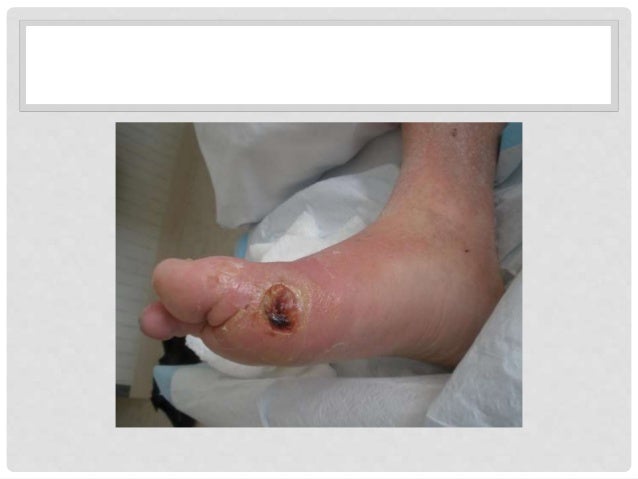

.jpg)
