Storm Quotes (57 quotes)
“Biodiversity” … is the key to the maintenance of the world as we know it. Life in a local site
struck down by a passing storm springs back quickly because enough diversity still exists. … This is the assembly of life that took a billion years to evolve. It has eaten the storms—folded them into its genes—and created the world that created us. It holds the world steady.
In The Diversity of Life (1992, 1999), 15.
[During a violent dust storm, Bartender (Dewey Robinson):] You ain't aimin' to drive back to your farm tonight, mister?
[John Phillips (John Wayne):] Why not?
[Bartender:] Save time by stayin' put. Let the wind blow the farm to you.
[John Phillips (John Wayne):] Why not?
[Bartender:] Save time by stayin' put. Let the wind blow the farm to you.
From movie Three Faces West (1940). Writers, F. Hugh Herbert, Joseph Moncure March, Samuel Ornitz. In Larry Langman and Paul Gold, Comedy Quotes from the Movies (2001), 241.
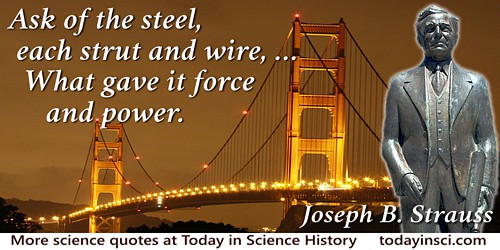
The Mighty Task is Done
At last the mighty task is done;
Resplendent in the western sun
The Bridge looms mountain high;
Its titan piers grip ocean floor,
Its great steel arms link shore with shore,
Its towers pierce the sky.
On its broad decks in rightful pride,
The world in swift parade shall ride,
Throughout all time to be;
Beneath, fleet ships from every port,
Vast landlocked bay, historic fort,
And dwarfing all the sea.
To north, the Redwood Empires gates;
To south, a happy playground waits,
In Rapturous appeal;
Here nature, free since time began,
Yields to the restless moods of man,
Accepts his bonds of steel.
Launched midst a thousand hopes and fears,
Damned by a thousand hostile sneers,
Yet Neer its course was stayed,
But ask of those who met the foe
Who stood alone when faith was low,
Ask them the price they paid.
Ask of the steel, each strut and wire,
Ask of the searching, purging fire,
That marked their natal hour;
Ask of the mind, the hand, the heart,
Ask of each single, stalwart part,
What gave it force and power.
An Honored cause and nobly fought
And that which they so bravely wrought,
Now glorifies their deed,
No selfish urge shall stain its life,
Nor envy, greed, intrigue, nor strife,
Nor false, ignoble creed.
High overhead its lights shall gleam,
Far, far below lifes restless stream,
Unceasingly shall flow;
For this was spun its lithe fine form,
To fear not war, nor time, nor storm,
For Fate had meant it so.
At last the mighty task is done;
Resplendent in the western sun
The Bridge looms mountain high;
Its titan piers grip ocean floor,
Its great steel arms link shore with shore,
Its towers pierce the sky.
On its broad decks in rightful pride,
The world in swift parade shall ride,
Throughout all time to be;
Beneath, fleet ships from every port,
Vast landlocked bay, historic fort,
And dwarfing all the sea.
To north, the Redwood Empires gates;
To south, a happy playground waits,
In Rapturous appeal;
Here nature, free since time began,
Yields to the restless moods of man,
Accepts his bonds of steel.
Launched midst a thousand hopes and fears,
Damned by a thousand hostile sneers,
Yet Neer its course was stayed,
But ask of those who met the foe
Who stood alone when faith was low,
Ask them the price they paid.
Ask of the steel, each strut and wire,
Ask of the searching, purging fire,
That marked their natal hour;
Ask of the mind, the hand, the heart,
Ask of each single, stalwart part,
What gave it force and power.
An Honored cause and nobly fought
And that which they so bravely wrought,
Now glorifies their deed,
No selfish urge shall stain its life,
Nor envy, greed, intrigue, nor strife,
Nor false, ignoble creed.
High overhead its lights shall gleam,
Far, far below lifes restless stream,
Unceasingly shall flow;
For this was spun its lithe fine form,
To fear not war, nor time, nor storm,
For Fate had meant it so.
Written upon completion of the building of the Golden Gate Bridge, May 1937. In Allen Brown, Golden Gate: biography of a Bridge (1965), 229.
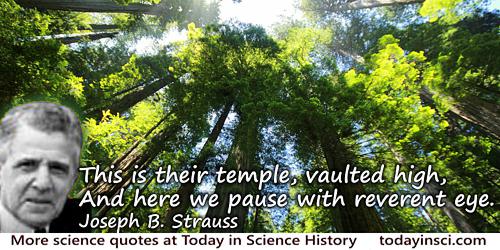
The Redwoods
Here, sown by the Creator's hand,
In serried ranks, the Redwoods stand;
No other clime is honored so,
No other lands their glory know.
The greatest of Earth's living forms,
Tall conquerors that laugh at storms;
Their challenge still unanswered rings,
Through fifty centuries of kings.
The nations that with them were young,
Rich empires, with their forts far-flung,
Lie buried now—their splendor gone;
But these proud monarchs still live on.
So shall they live, when ends our day,
When our crude citadels decay;
For brief the years allotted man,
But infinite perennials' span.
This is their temple, vaulted high,
And here we pause with reverent eye,
With silent tongue and awe-struck soul;
For here we sense life's proper goal;
To be like these, straight, true and fine,
To make our world, like theirs, a shrine;
Sink down, oh traveler, on your knees,
God stands before you in these trees.
Here, sown by the Creator's hand,
In serried ranks, the Redwoods stand;
No other clime is honored so,
No other lands their glory know.
The greatest of Earth's living forms,
Tall conquerors that laugh at storms;
Their challenge still unanswered rings,
Through fifty centuries of kings.
The nations that with them were young,
Rich empires, with their forts far-flung,
Lie buried now—their splendor gone;
But these proud monarchs still live on.
So shall they live, when ends our day,
When our crude citadels decay;
For brief the years allotted man,
But infinite perennials' span.
This is their temple, vaulted high,
And here we pause with reverent eye,
With silent tongue and awe-struck soul;
For here we sense life's proper goal;
To be like these, straight, true and fine,
To make our world, like theirs, a shrine;
Sink down, oh traveler, on your knees,
God stands before you in these trees.
In The Record: Volumes 60-61 (1938), 39.
A grove of giant redwoods or sequoias should be kept just as we keep a great or beautiful cathedral. The extermination of the passenger pigeon meant that mankind was just so much poorer; exactly as in the case of the destruction of the cathedral at Rheims. And to lose the chance to see frigate-birds soaring in circles above the storm, or a file of pelicans winging their way homeward across the crimson afterglow of the sunset, or a myriad terns flashing in the bright light of midday as they hover in a shifting maze above the beach—why, the loss is like the loss of a gallery of the masterpieces of the artists of old time.
In A Book-Lover's Holidays in the Open (1916), 316-317.
After an orange cloud—formed as a result of a dust storm over the Sahara and caught up by air currents—reached the Philippines and settled there with rain, I understood that we are all sailing in the same boat.
In Jack Hassard and Julie Weisberg , Environmental Science on the Net: The Global Thinking Project (1999), 40.
After the German occupation of Holland in May 1940, the [last] two dark years of the war I spent hiding indoors from the Nazis, eating tulip bulbs to fill the stomach and reading Kramers' book “Quantum Theorie des Elektrons und der Strahlung” by the light of a storm lamp.
And if you want the exact moment in time, it was conceived mentally on 8th March in this year one thousand six hundred and eighteen, but submitted to calculation in an unlucky way, and therefore rejected as false, and finally returning on the 15th of May and adopting a new line of attack, stormed the darkness of my mind. So strong was the support from the combination of my labour of seventeen years on the observations of Brahe and the present study, which conspired together, that at first I believed I was dreaming, and assuming my conclusion among my basic premises. But it is absolutely certain and exact that the proportion between the periodic times of any two planets is precisely the sesquialterate proportion of their mean distances.
Harmonice Mundi, The Harmony of the World (1619), book V, ch. 3. Trans. E. J. Aiton, A. M. Duncan and J. V. Field (1997), 411.
And part of the soil is called to wash away
In storms and streams shave close and gnaw the rocks.
Besides, whatever the earth feeds and grows
Is restored to earth. And since she surely is
The womb of all things and their common grave,
Earth must dwindle, you see and take on growth again.
In storms and streams shave close and gnaw the rocks.
Besides, whatever the earth feeds and grows
Is restored to earth. And since she surely is
The womb of all things and their common grave,
Earth must dwindle, you see and take on growth again.
On the Nature of Things, trans. Anthony M. Esolen (1995), Book 5, lines 255-60, 166.
As every circumstance relating to so capital a discovery as this (the greatest, perhaps, that has been made in the whole compass of philosophy, since the time of Sir Isaac Newton) cannot but give pleasure to all my readers, I shall endeavour to gratify them with the communication of a few particulars which I have from the best authority. The Doctor [Benjamin Franklin], after having published his method of verifying his hypothesis concerning the sameness of electricity with the matter lightning, was waiting for the erection of a spire in Philadelphia to carry his views into execution; not imagining that a pointed rod, of a moderate height, could answer the purpose; when it occurred to him, that, by means of a common kite, he could have a readier and better access to the regions of thunder than by any spire whatever. Preparing, therefore, a large silk handkerchief, and two cross sticks, of a proper length, on which to extend it, he took the opportunity of the first approaching thunder storm to take a walk into a field, in which there was a shed convenient for his purpose. But dreading the ridicule which too commonly attends unsuccessful attempts in science, he communicated his intended experiment to no body but his son, who assisted him in raising the kite.
The kite being raised, a considerable time elapsed before there was any appearance of its being electrified. One very promising cloud passed over it without any effect; when, at length, just as he was beginning to despair of his contrivance, he observed some loose threads of the hempen string to stand erect, and to avoid one another, just as if they had been suspended on a common conductor. Struck with this promising appearance, he inmmediately presented his knuckle to the key, and (let the reader judge of the exquisite pleasure he must have felt at that moment) the discovery was complete. He perceived a very evident electric spark. Others succeeded, even before the string was wet, so as to put the matter past all dispute, and when the rain had wetted the string, he collected electric fire very copiously. This happened in June 1752, a month after the electricians in France had verified the same theory, but before he had heard of any thing that they had done.
The kite being raised, a considerable time elapsed before there was any appearance of its being electrified. One very promising cloud passed over it without any effect; when, at length, just as he was beginning to despair of his contrivance, he observed some loose threads of the hempen string to stand erect, and to avoid one another, just as if they had been suspended on a common conductor. Struck with this promising appearance, he inmmediately presented his knuckle to the key, and (let the reader judge of the exquisite pleasure he must have felt at that moment) the discovery was complete. He perceived a very evident electric spark. Others succeeded, even before the string was wet, so as to put the matter past all dispute, and when the rain had wetted the string, he collected electric fire very copiously. This happened in June 1752, a month after the electricians in France had verified the same theory, but before he had heard of any thing that they had done.
The History and Present State of Electricity, with Original Experiments (1767, 3rd ed. 1775), Vol. 1, 216-7.
Believe me, this planet has put up with much worse than us. It’s been through earthquakes, volcanoes, plate tectonics, solar flares, sun-spots, magnetic storms, pole reversals, planetary floods, worldwide fires, tidal waves, wind and water erosion, cosmic rays, ice ages, and hundreds of thousands of years of bombardment by comets, asteroids, and meteors. And people think a few plastic bags and aluminum cans are going to make a difference?
In Napalm and Silly Putty (2002), 97.
Biological diversity is the key to the maintenance of the world as we know it. Life in a local site struck down by a passing storm springs back quickly: opportunistic species rush in to fill the spaces. They entrain the succession that circles back to something resembling the original state of the environment.
In 'Storm Over the Amazon', The Diversity of Life (1992), 15.
Climb the mountains and get their good tidings. Nature’s peace will flow into you as sunshine flows into trees. The winds will blow their own freshness into you, and the storms their energy, while cares will drop off like autumn leaves.
In 'The Yellowstone National Park', Our National Parks (1901), Chap. 2, 56.
Each pregnant Oak ten thousand acorns forms
Profusely scatter’d by autumnal storms;
Ten thousand seeds each pregnant poppy sheds
Profusely scatter’d from its waving heads;
The countless Aphides, prolific tribe,
With greedy trunks the honey’d sap imbibe;
Swarm on each leaf with eggs or embryons big,
And pendent nations tenant every twig ...
—All these, increasing by successive birth,
Would each o’erpeople ocean, air, and earth.
So human progenies, if unrestrain’d,
By climate friended, and by food sustain’d,
O’er seas and soils, prolific hordes! would spread
Erelong, and deluge their terraqueous bed;
But war, and pestilence, disease, and dearth,
Sweep the superfluous myriads from the earth...
The births and deaths contend with equal strife,
And every pore of Nature teems with Life;
Which buds or breathes from Indus to the Poles,
And Earth’s vast surface kindles, as it rolls!
Profusely scatter’d by autumnal storms;
Ten thousand seeds each pregnant poppy sheds
Profusely scatter’d from its waving heads;
The countless Aphides, prolific tribe,
With greedy trunks the honey’d sap imbibe;
Swarm on each leaf with eggs or embryons big,
And pendent nations tenant every twig ...
—All these, increasing by successive birth,
Would each o’erpeople ocean, air, and earth.
So human progenies, if unrestrain’d,
By climate friended, and by food sustain’d,
O’er seas and soils, prolific hordes! would spread
Erelong, and deluge their terraqueous bed;
But war, and pestilence, disease, and dearth,
Sweep the superfluous myriads from the earth...
The births and deaths contend with equal strife,
And every pore of Nature teems with Life;
Which buds or breathes from Indus to the Poles,
And Earth’s vast surface kindles, as it rolls!
The Temple of Nature (1803), canto 4, lines 347-54, 367-74, 379-82, pages 156-60.
Give me the storm and tempest of thought and action, rather than the dead calm of ignorance and faith. Banish me from Eden when you will, but first let me eat of the fruit of the Tree of Knowledge.
Epigraph, title page of The Works of Robert G. Ingersoll (1902), Vol. 3. Since it is not printed with a citation, Webmaster believes it is attributable to the author of the book.
Great innovations, whether in art or literature, in science or in nature, seldom take the world by storm. They must be understood before they can be estimated, and must be cultivated before they can be understood.
In Tertiary History of the Grand Cañon District: With Atlas (1882), 142.
Have you ever watched an eagle held captive in a zoo, fat and plump and full of food and safe from danger too?
Then have you seen another wheeling high up in the sky, thin and hard and battle-scarred, but free to soar and fly?
Well, which have you pitied the caged one or his brother? Though safe and warm from foe or storm, the captive, not the other!
There’s something of the eagle in climbers, don’t you see; a secret thing, perhaps the soul, that clamors to be free.
It’s a different sort of freedom from the kind we often mean, not free to work and eat and sleep and live in peace serene.
But freedom like a wild thing to leap and soar and strive, to struggle with the icy blast, to really be alive.
That’s why we climb the mountain’s peak from which the cloud-veils flow, to stand and watch the eagle fly, and soar, and wheel... below...
Then have you seen another wheeling high up in the sky, thin and hard and battle-scarred, but free to soar and fly?
Well, which have you pitied the caged one or his brother? Though safe and warm from foe or storm, the captive, not the other!
There’s something of the eagle in climbers, don’t you see; a secret thing, perhaps the soul, that clamors to be free.
It’s a different sort of freedom from the kind we often mean, not free to work and eat and sleep and live in peace serene.
But freedom like a wild thing to leap and soar and strive, to struggle with the icy blast, to really be alive.
That’s why we climb the mountain’s peak from which the cloud-veils flow, to stand and watch the eagle fly, and soar, and wheel... below...
…...
I always enjoyed the hearty society of a snowstorm; glad, though solemn, when within a mile or two of safe ground where a storm-nest could be made. Now on this shattered ice I need my eyes, but the snow, gyrating, whirling, and sifting, the very incarnation of spasmodic hysterical mirth, fills them, and I am blinded as if blinded by kisses, delicious in the eye, and sweet.
Journal Entry, while camping on Muir Glacier, Alaska (19? Jul 1890). In John Muir and Linnie Marsh Wolfe (ed.), John of the Mountains: The Unpublished Journals of John Muir (1938, 1979), 321.
In former times, … when ships buffeted by storms threw a portion of their cargo overboard, it was recognized that those whose goods were sacrificed had a claim in equity to indemnification at the expense of those whose goods were safely delivered. The value of the lost goods was paid for by agreement between all those whose merchandise had been in the same ship. This sea damage to cargo in transit was known as “havaria” and the word came naturally to be applied to the compensation money which each individual was called upon to pay. From this Latin word derives our modern word average.
In 'On the Average', Facts From Figures (1951), Chap. 4, 34.
Innovations, free thinking is blowing like a storm; those that stand in front of it, ignorant scholars like you, false scientists, perverse conservatives, obstinate goats, resisting mules are being crushed under the weight of these innovations. You are nothing but ants standing in front of the giants; nothing but chicks trying to challenge roaring volcanoes!
From the play Galileo Galilei (2001) .
It is not necessary to probe into the nature of things, as was done by those whom the Greeks call physici; nor need we be in alarm lest the Christian should be ignorant of the force and number of the elements—the motion, and order, and eclipses of the heavenly bodies; the form of the heavens; the species and the natures of animals, plants, stones, fountains, rivers, mountains; about chronology and distances; the signs of coming storms; and a thousand other things which those philosophers either have found out, or think they have found out. … It is enough for the Christian to believe that the only cause of all created things, whether heavenly or earthly … is the goodness of the Creator, the one true God.
In Marcus Dods (ed.), J.F. Shaw (trans.), The Enchiridion of Augustine, Chap. 9, collected in The Works of Aurelius Augustine, Bishop of Hippo: A new translation (1873), Vol. 9, 180-181. The physici are natural philosophers.
Jupiter is the largest of all the solar system’s planets, more than ten times bigger and three hundred times as massive as Earth. Jupiter is so immense it could swallow all the other planets easily. Its Great Red Spot, a storm that has raged for centuries, is itself wider than Earth. And the Spot is merely one feature visible among the innumerable vortexes and streams of Jupiter’s frenetically racing cloud tops. Yet Jupiter is composed mainly of the lightest elements, hydrogen and helium, more like a star than a planet. All that size and mass, yet Jupiter spins on its axis in less than ten hours, so fast that the planet is clearly not spherical: Its poles are noticeably flattened. Jupiter looks like a big, colorfully striped beach ball that’s squashed down as if some invisible child were sitting on it. Spinning that fast, Jupiter’s deep, deep atmosphere is swirled into bands and ribbons of multihued clouds: pale yellow, saffron orange, white, tawny yellow-brown, dark brown, bluish, pink and red. Titanic winds push the clouds across the face of Jupiter at hundreds of kilometers per hour.
— Ben Bova
Jupiter
Life does not consist mainly—or even largely—of facts and happenings. It consists mainly of the storm of thoughts that is forever blowing through one’s head.
In Autobiography of Mark Twain (1929), Vol. 1, 283.
Littlewood, on Hardy’s own estimate, is the finest mathematician he has ever known. He was the man most likely to storm and smash a really deep and formidable problem; there was no one else who could command such a combination of insight, technique and power.
(1943). In Béla Bollobás, Littlewood's Miscellany (1986), Foreward, 22.
Nature vibrates with rhythms, climatic and diastrophic, those finding stratigraphic expression ranging in period from the rapid oscillation of surface waters, recorded in ripple-mark, to those long-deferred stirrings of the deep imprisoned titans which have divided earth history into periods and eras. The flight of time is measured by the weaving of composite rhythms- day and night, calm and storm, summer and winter, birth and death such as these are sensed in the brief life of man. But the career of the earth recedes into a remoteness against which these lesser cycles are as unavailing for the measurement of that abyss of time as would be for human history the beating of an insect's wing. We must seek out, then, the nature of those longer rhythms whose very existence was unknown until man by the light of science sought to understand the earth. The larger of these must be measured in terms of the smaller, and the smaller must be measured in terms of years.
'Rhythm and the Measurement of Geologic Time', Bulletin of the Geological Society of America, 1917, 28,746.
No one would have crossed the ocean if he could have gotten off the ship in the storm.
Quoted in 'Looking ahead with Boss Ket', Popular Mechanics (Feb 1935), 63, No. 2, 202.
Not all the winds, and storms, and earthquakes, and seas, and seasons of the world, have done so much to revolutionize the earth as Man, the power of an endless life, has done since the day he came forth upon it, and received dominion over it.
From Sermon on the Power of Endless Life, and Other Sermons (1876), 310.
Nothing is sudden in nature: whereas the slightest storms are forecasted several days in advance, the destruction of the world must have been announced several years beforehand by heat waves, by winds, by meteorites, in short, by an infinity of phenomena.
L' Antiquité devoilée par ses usages ou Examen critique des principales Opinions, Cérémonies & Institutions religieuses & politiques des differens Peuples de la Terre (1766), 373-4.
Now, I must tell you of a strange experience which bore fruit in my later life. … We had a cold [snap] drier that ever observed before. People walking in the snow left a luminous trail behind them and a snowball thrown against an obstacle gave a flare of light like a loaf of sugar hit with a knife. [As I stroked] Mačak’s back, [it became] a sheet of light and my hand produced a shower of sparks. … My father … remarked, this is nothing but electricity, the same thing you see on the trees in a storm. My mother seemed alarmed. Stop playing with the cat, she said, he might start a fire. I was thinking abstractly. Is nature a cat? If so, who strokes its back? It can only be God, I concluded. …
I cannot exaggerate the effect of this marvelous sight on my childish imagination. Day after day I asked myself what is electricity and found no answer. Eighty years have gone by since and I still ask the same question, unable to answer it.
I cannot exaggerate the effect of this marvelous sight on my childish imagination. Day after day I asked myself what is electricity and found no answer. Eighty years have gone by since and I still ask the same question, unable to answer it.
Letter to Miss Pola Fotitch, 'A Story of Youth Told by Age' (1939). In John Ratzlaff, editor, Tesla Said (1984), 283-84. Cited in Marc J. Seifer, Wizard: The Life and Times of Nikola Tesla (1998), 5.
Numbers written on restaurant checks [bills] within the confines of restaurants do not follow the same mathematical laws as numbers written on any other pieces of paper in any other parts of the Universe.
This single statement took the scientific world by storm. It completely revolutionized it. So many mathematical conferences got held in such good restaurants that many of the finest minds of a generation died of obesity and heart failure and the science of math was put back by years.
This single statement took the scientific world by storm. It completely revolutionized it. So many mathematical conferences got held in such good restaurants that many of the finest minds of a generation died of obesity and heart failure and the science of math was put back by years.
Life, the Universe and Everything (1982, 1995), 49.
On the day of Cromwell’s death, when Newton was sixteen, a great storm raged all over England. He used to say, in his old age, that on that day he made his first purely scientific experiment. To ascertain the force of the wind, he first jumped with the wind and then against it; and, by comparing these distances with the extent of his own jump on a calm day, he was enabled to compute the force of the storm. When the wind blew thereafter, he used to say it was so many feet strong.
In 'Sir Isaac Newton', People’s Book of Biography: Or, Short Lives of the Most Interesting Persons of All Ages and Countries (1868), 248.
Science appears to us with a very different aspect after we have found out that it is not in lecture rooms only, and by means of the electric light projected on a screen, that we may witness physical phenomena, but that we may find illustrations of the highest doctrines of science in games and gymnastics, in travelling by land and by water, in storms of the air and of the sea, and wherever there is matter in motion.
'Introductory Lecture on Experimental Physics' (1871). In W. D. Niven (ed.), The Scientific Papers of James Clerk Maxwell (1890), Vol. 2, 243.
Science is a magnificent force, but it is not a teacher of morals. It can perfect machinery, but it adds no moral restraints to protect society from the misuse of the machine. It can also build gigantic intellectual ships, but it constructs no moral rudders for the control of storm tossed human vessel. It not only fails to supply the spiritual element needed but some of its unproven hypotheses rob the ship of its compass and thus endangers its cargo.
Proposed summation written for the Scopes Monkey Trial (1925), in Genevieve Forbes Herrick and John Origen Herrick ,The Life of William Jennings Bryan (1925), 405. This speech was prepared for delivery at the trial, but was never heard there, as both sides mutually agreed to forego arguments to the jury.
The Aurora borealis may now become connected with magnetic disturbances and storms in a very distinct manner and if the variations of the atmosphere cause both, it will also tie both together by a common hub.
In 'The Scientific Grammar of Michael Faraday’s Diaries', Part I, 'The Classic of Science', A Classic and a Founder (1937), collected in Rosenstock-Huessy Papers (1981), Vol. 1, 10.
The Earth Speaks, clearly, distinctly, and, in many of the realms of Nature, loudly, to William Jennings Bryan, but he fails to hear a single sound. The earth speaks from the remotest periods in its wonderful life history in the Archaeozoic Age, when it reveals only a few tissues of its primitive plants. Fifty million years ago it begins to speak as “the waters bring forth abundantly the moving creatures that hath life.” In successive eons of time the various kinds of animals leave their remains in the rocks which compose the deeper layers of the earth, and when the rocks are laid bare by wind, frost, and storm we find wondrous lines of ascent invariably following the principles of creative evolution, whereby the simpler and more lowly forms always precede the higher and more specialized forms.
The earth speaks not of a succession of distinct creations but of a continuous ascent, in which, as the millions of years roll by, increasing perfection of structure and beauty of form are found; out of the water-breathing fish arises the air-breathing amphibian; out of the land-living amphibian arises the land-living, air-breathing reptile, these two kinds of creeping things resembling each other closely. The earth speaks loudly and clearly of the ascent of the bird from one kind of reptile and of the mammal from another kind of reptile.
This is not perhaps the way Bryan would have made the animals, but this is the way God made them!
The earth speaks not of a succession of distinct creations but of a continuous ascent, in which, as the millions of years roll by, increasing perfection of structure and beauty of form are found; out of the water-breathing fish arises the air-breathing amphibian; out of the land-living amphibian arises the land-living, air-breathing reptile, these two kinds of creeping things resembling each other closely. The earth speaks loudly and clearly of the ascent of the bird from one kind of reptile and of the mammal from another kind of reptile.
This is not perhaps the way Bryan would have made the animals, but this is the way God made them!
The Earth Speaks to Bryan (1925), 5-6. Osborn wrote this book in response to the Scopes Monkey Trial, where William Jennings Bryan spoke against the theory of evolution. They had previously been engaged in the controversy about the theory for several years. The title refers to a Biblical verse from the Book of Job (12:8), “Speak to the earth and it shall teach thee.”
The greatest delight which the fields and woods minister, is the suggestion of an occult relation between man and the vegetable. I am not alone and unacknowledged. They nod to me, and I to them. The waving of the boughs in the storm, is new to me and old. It takes me by surprise, and yet is not unknown. Its effect is like that of a higher thought or a better emotion coming over me, when I deemed I was thinking justly or doing right.
In Nature: An Essay, to Which is Added, Orations, Lectures, and Addresses (1845), 5.
The lightning fell and the storm raged, and strata were deposited and uptorn and bent back, and Chaos moved from beneath, to create and flavor the fruit on your table to-day.
In 'Perpetual Forces', North American Review (1877), No. 125. Collected in Ralph Waldo Emerson and James Elliot Cabot (ed.), Lectures and Biographical Sketches (1883), 60.
The living and dead look well together in woods. Trees receive a most beautiful burial.
Nature takes fallen trees gently to her bosom—at rest from storms. They seem to have been called home out of the sky to sleep now.
In Linnie Marsh Wolfe (ed.), John of the Mountains: The Unpublished Journals of John Muir (1938 1979), 313. Entered in journal while on sled trip exploring Muir Glacier, its boundaries and tributaries; Hemlock Mountain (11-21 Jul 1890).
The members of the department became like the Athenians who, according to the Apostle Paul, “spent their time in nothing else, but either to tell or to hear some new thing.” Anyone who thought he had a bright idea rushed out to try it out on a colleague. Groups of two or more could be seen every day in offices, before blackboards or even in corridors, arguing vehemently about these 'brain storms.' It is doubtful whether any paper ever emerged for publication that had not run the gauntlet of such criticism. The whole department thus became far greater than the sum of its individual members.
Obituary of Gilbert Newton Lewis, Biographical Memoirs of the National Academy of Science (1958), 31, 212.
The Moon by us to you her greeting sends,
But bids us say that she’s an ill-used moon,
And takes it much amiss that you should still
Shuffle her days, and turn them topsy-turvy;
And that the gods (who know their feast-days well),
By your false count are sent home supperless,
And scold and storm at her for your neglect.
But bids us say that she’s an ill-used moon,
And takes it much amiss that you should still
Shuffle her days, and turn them topsy-turvy;
And that the gods (who know their feast-days well),
By your false count are sent home supperless,
And scold and storm at her for your neglect.
From poem, 'The Clouds', quoted in William Whewell, History of the Inductive Sciences (1837), 126. Concerning the imperfect calendar used in ancient Greece in which multiples of the lunar cycles did not exactly correspond to the solar year.
The steam-engine in its manifold applications, the crime-decreasing gas-lamp, the lightning conductor, the electric telegraph, the law of storms and rules for the mariner's guidance in them, the power of rendering surgical operations painless, the measures for preserving public health, and for preventing or mitigating epidemics,—such are among the more important practical results of pure scientific research, with which mankind have been blessed and States enriched.
President's Address to the British Association, Leeds (1858). In Charles W. Vincent and James Mason (eds.), The Year-book of Facts in Science and Art (1859), title page.
The sun-awakened avalanche! whose mass,
Thrice sifted by the storm, had gathered there
Flake after flake, in heaven-defying minds
As thought by thought is piled, till some great truth
Is loosened, and the nations echo round,
Shaken to their roots, as do the mountains now.
Thrice sifted by the storm, had gathered there
Flake after flake, in heaven-defying minds
As thought by thought is piled, till some great truth
Is loosened, and the nations echo round,
Shaken to their roots, as do the mountains now.
From Prometheus Unbound: A Lyrical Drama in Four Acts (1820), Act 2, Scene 3, 78.
The young genius early exults in the contemplation of power and beauty. During Scott’s childhood, a frightful thunder-storm raged at Edinburgh, which made his brothers and the domestics huddle together in one room, shivering with fear at every peal. Young Walter was found lying on his back in the garden, the rain pitilessly pelting his face, while he, almost convulsed with delight, shouted, at every flash, “bonnie! bonnie!” Schiller was found by his father, on a similar occasion, perched upon a tree, and, on being harshly questioned as to his object, whimpered out that he wanted to see where the thunder came from.
In 'Genius', Wellman’s Miscellany (Dec 1871), 4, No. 6, 204. A variation of the anecdote about Walter Scott is given in George Gilfillan (ed.), 'Memoir of Sir Walter Scott', The Poetical Works of Sir Walter Scott: With memoir and critical dissertation (1857), viii. The anecdote about Schiller is of dubious authenticity, according to Charles Follen (ed.), The Life of Friedrich Schiller: Comprehending an Examination of His Works (1837), 7
There are those who say that the human kidney was created to keep the blood pure, or more precisely, to keep our internal environment in an ideal balanced state. This I must deny. I grant that the human kidney is a marvelous organ, but I cannot grant that it was purposefully designed to excrete urine or to regulate the composition of the blood or to subserve the physiological welfare of Homo sapiens in any sense. Rather I contend that the human kidney manufactures the kind of urine that it does, and it maintains the blood in the composition which that fluid has, because this kidney has a certain functional architecture; and it owes that architecture not to design or foresight or to any plan, but to the fact that the earth is an unstable sphere with a fragile crust, to the geologic revolutions that for six hundred million years have raised and lowered continents and seas, to the predacious enemies, and heat and cold, and storms and droughts; to the unending succession of vicissitudes that have driven the mutant vertebrates from sea into fresh water, into desiccated swamps, out upon the dry land, from one habitation to another, perpetually in search of the free and independent life, perpetually failing, for one reason or another, to find it.
From Fish to Philosopher (1953), 210-1.
They say,
The solid earth whereon we tread
In tracts of fluent heat began,
And grew to seeming-random forms,
The seeming prey of cyclic storms,
Till at the last arose the Man. …
The solid earth whereon we tread
In tracts of fluent heat began,
And grew to seeming-random forms,
The seeming prey of cyclic storms,
Till at the last arose the Man. …
From poem, 'In Memoriam A.H.H.' written between 1833-50, and first published anonymously in 1850. Collected in Poetical Works of Alfred Tennyson (1860), Vol.2, 147.
This long run is a misleading guide to current affairs. In the long run we are all dead. Economists set themselves too easy, too useless a task if in tempestuous seasons they can only tell us that when the storm is long past the ocean is flat again.
A Tract on Monetary Reform (1923), 80.
Tomorrow may be fair, however stormy the sky of today.
Quoted, without citation, in front matter to T. A. Edison Foundation, Lewis Howard Latimer: A Black Inventor: a Biography and Related Experiments You Can Do (1973). If you know the primary source, please contact Webmaster.
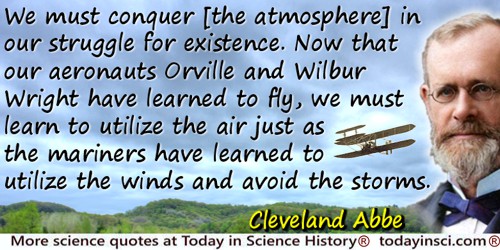
We must conquer [the atmosphere] in our struggle for existence. Now that our aeronauts Orville and Wilbur Wright have learned to fly, we must learn to utilize the air just as the mariners have learned to utilize the winds and avoid the storms.
From Address (16 Mar 1909) at Columbia University, printed in 'Meteorology of the Future', Popular Science Monthly (Dec 1910), 78, 22.
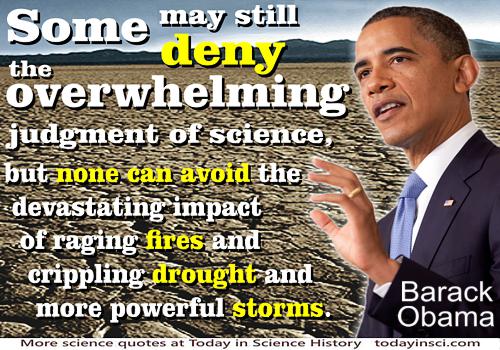
We, the people, still believe that our obligations as Americans are not just to ourselves, but to all posterity. We will respond to the threat of climate change, knowing that the failure to do so would betray our children and future generations. Some may still deny the overwhelming judgment of science, but none can avoid the devastating impact of raging fires and crippling drought and more powerful storms.
In Second Inaugural Address (21 Jan 2013) at the United States Capitol.
What friends do with us and for us is a real part of our life; for it strengthens and advances our personality. The assault of our enemies is not part of our life ; it is only part of our experience ; we throw it off and guard ourselves against it as against frost, storm, rain, hail, or any other of the external evils which may be expected to happen.
In The Maxims and Reflections of Goethe (1906), 201.
What if angry vectors veer
Round your sleeping head, and form.
There’s never need to fear
Violence of the poor world’s abstract storm.
Round your sleeping head, and form.
There’s never need to fear
Violence of the poor world’s abstract storm.
Poem, 'Lullaby: Smile in Sleep' (1957). In John D. Burt (ed.), The Collected Poems of Robert Penn Warren (1998), 128.
When chemists have brought their knowledge out of their special laboratories into the laboratory of the world, where chemical combinations are and have been through all time going on in such vast proportions,—when physicists study the laws of moisture, of clouds and storms, in past periods as well as in the present,—when, in short, geologists and zoologists are chemists and physicists, and vice versa,—then we shall learn more of the changes the world has undergone than is possible now that they are separately studied.
Geological Sketches (1866), 73.
When I saw the alpha-helix and saw what a beautiful, elegant structure it was, I was thunderstruck and was furious with myself for not having built this, but on the other hand, I wondered, was it really right?
So I cycled home for lunch and was so preoccupied with the turmoil in my mind that didn’t respond to anything. Then I had an idea, so I cycled back to the lab. I realized that I had a horse hair in a drawer. I set it up on the X-ray camera and gave it a two hour exposure, then took the film to the dark room with my heart in my mouth, wondering what it showed, and when I developed it, there was the 1.5 angstrom reflection which I had predicted and which excluded all structures other than the alpha-helix.
So on Monday morning I stormed into my professor’s office, into Bragg’s office and showed him this, and Bragg said, 'Whatever made you think of that?' And I said, 'Because I was so furious with myself for having missed that beautiful structure.' To which Bragg replied coldly, 'I wish I had made you angry earlier.'
So I cycled home for lunch and was so preoccupied with the turmoil in my mind that didn’t respond to anything. Then I had an idea, so I cycled back to the lab. I realized that I had a horse hair in a drawer. I set it up on the X-ray camera and gave it a two hour exposure, then took the film to the dark room with my heart in my mouth, wondering what it showed, and when I developed it, there was the 1.5 angstrom reflection which I had predicted and which excluded all structures other than the alpha-helix.
So on Monday morning I stormed into my professor’s office, into Bragg’s office and showed him this, and Bragg said, 'Whatever made you think of that?' And I said, 'Because I was so furious with myself for having missed that beautiful structure.' To which Bragg replied coldly, 'I wish I had made you angry earlier.'
From transcript of audio of Max Perutz in BBC programme, 'Lifestory: Linus Pauling' (1997). On 'Linus Pauling and the Race for DNA' webpage 'I Wish I Had Made You Angry Earlier.'
When we contemplate the whole globe as one great dewdrop, striped and dotted with continents and islands, flying through space with other stars all singing and shining together as one, the whole universe appears as an infinite storm of beauty.
In The Writings of John Muir: Travels in Alaska (1915), 6.
When young Galileo, then a student at Pisa, noticed one day during divine service a chandelier swinging backwards and forwards, and convinced himself, by counting his pulse, that the duration of the oscillations was independent of the arc through which it moved, who could know that this discovery would eventually put it in our power, by means of the pendulum, to attain an accuracy in the measurement of time till then deemed impossible, and would enable the storm-tossed seaman in the most distant oceans to determine in what degree of longitude he was sailing?
Hermann von Helmholtz, Edmund Atkinson (trans.), Popular Lectures on Scientific Subjects: First Series (1883), 29.
Why is it that showers and even storms seem to come by chance, so that many people think it quite natural to pray for rain or fine weather, though they would consider it ridiculous to ask for an eclipse by prayer.
Science and Method (1908), trans. Francis Maitland (1914), 68.
You see layers as you look down. You see clouds towering up. You see their shadows on the sunlit plains, and you see a ship’s wake in the Indian Ocean and brush fires in Africa and a lightning storm walking its way across Australia. You see the reds and the pinks of the Australian desert, and it’s just like a stereoscopic view of all nature, except you’re a hundred ninety miles up.
…...
 In science it often happens that scientists say, 'You know that's a really good argument; my position is mistaken,' and then they would actually change their minds and you never hear that old view from them again. They really do it. It doesn't happen as often as it should, because scientists are human and change is sometimes painful. But it happens every day. I cannot recall the last time something like that happened in politics or religion.
(1987) --
In science it often happens that scientists say, 'You know that's a really good argument; my position is mistaken,' and then they would actually change their minds and you never hear that old view from them again. They really do it. It doesn't happen as often as it should, because scientists are human and change is sometimes painful. But it happens every day. I cannot recall the last time something like that happened in politics or religion.
(1987) -- 




