Stone Quotes (169 quotes)
Stones Quotes
Stones Quotes
“Logic” proved that airplanes can’t fly and that H-bombs won’t work and that stones don’t fall out of the sky. Logic is a way of saying that anything which didn't happen yesterday won't happen tomorrow.
In Glory Road (1963, 1981), 54.
[Engineering] is a great profession. There is the fascination of watching a figment of the imagination emerge through the aid of science to a plan on paper. Then it moves to realization in stone or metal or energy. Then it brings homes to men or women. Then it elevates the standards of living and adds to the comforts of life. That is the engineer’s high privilege.
Reprint of his 1916 statement in 'Engineering as a Profession', Engineer’s Week (1954).
[In an inventor’s life] Everything is stacked against you, but for some reason some silly chaps seem to be driven to it (rather like a painter of a composer of music), which is perhaps just as well or we should still be living in the Stone Age.
As quoted in Michael T. Kaufman, 'Christopher Cockerell, 88, Inventor, Dies; Father of Hovercraft and Marconi Devices', New York Times (4 Jun 1999), 19.
Gilbert shall live, till Load-stones cease to draw,
Or British Fleets the boundless Ocean awe.
Or British Fleets the boundless Ocean awe.
'Of Miscellany Poems To my Honor’d Friend Dr. Charleton On his Learned and Useful Works; But more particularly his Treatise of Stone-Heng, By him restored to the true Founders', collected in Poetical Miscellanies: The Fifth Part (1704), 39. (Dr Walter Charleton was physician in ordinary to King Charles I. His treatise on Stonehenge was published in 1663.)
Nature and nurture are an inseparable blend of influences that work together to produce our behavior. A growing band of researchers are demonstrating that the bedrock of behaviors that make up the concerns of everyday life, such as sex, language, cooperation, and violence have been carved out by evolution over the eons, and this Stone Age legacy continues to influence modern life today.
In Stone Age Present: How Evolution Has Shaped Modern Life: From Sex, Violence and Language to Emotions, Morals and Communities, (1995), 25-26.
A great surgeon performs operations for stone by a single method; later he makes a statistical summary of deaths and recoveries, and he concludes from these statistics that the mortality law for this operation is two out of five. Well, I say that this ratio means literally nothing scientifically and gives us no certainty in performing the next operation; for we do not know whether the next case will be among the recoveries or the deaths. What really should be done, instead of gathering facts empirically, is to study them more accurately, each in its special determinism. We must study cases of death with great care and try to discover in them the cause of mortal accidents so as to master the cause and avoid the accidents.
From An Introduction to the Study of Experimental Medicine (1865), as translated by Henry Copley Greene (1957), 137-138. (Note that Bernard overlooks how the statistical method can be useful: a surgeon announcing a mortality rate of 40% invites comparison. A surgeon with worse outcomes should adopt this method. If a surgeon has a better results, that method should be adopted.)
A large part of the training of the engineer, civil and military, as far as preparatory studies are concerned; of the builder of every fabric of wood or stone or metal designed to stand upon the earth, or bridge the stream, or resist or float upon the wave; of the surveyor who lays out a building lot in a city, or runs a boundary line between powerful governments across a continent; of the geographer, navigator, hydrographer, and astronomer,—must be derived from the mathematics.
In 'Academical Education', Orations and Speeches on Various Occasions (1870), Vol. 3, 513.
A man's own addition to what he learns is cement to bind an otherwise loose heap of stones into a structure of unity, strength, and use.
From chapter 'Jottings from a Note-Book', in Canadian Stories (1918), 180.
A mind which has once imbibed a taste for scientific enquiry, and has learnt the habit of applying its principles readily to the cases which occur, has within itself an inexhaustable source of pure and exciting contemplations:— One would think that Shakespeare had such a mind in view when he describes a contemplative man as finding
“Tongues in trees—books in running brooks—
Sermons in stones—and good in everything.”
Accustomed to trace the operations of general causes and the exemplification of general laws, in circumstances where the uninformed and uninquiring eye, perceives neither novelty nor beauty, he walks in the midst of wonders; every object which falls in his way elucidates some principle, affords some instruction and impresses him with a sense of harmony and order. Nor is it a mere passive pleasure which is thus communicated. A thousand questions are continually arising in his mind, a thousand objects of enquiry presenting themselves, which keep his faculties in constant exercise, and his thoughts perpetually on the wing, so that lassitude is excluded from his life, and that craving after artificial excitement and dissipation of the mind, which leads so many into frivolous, unworthy, and destructive pursuits, is altogether eradicated from his bosom.
“Tongues in trees—books in running brooks—
Sermons in stones—and good in everything.”
Accustomed to trace the operations of general causes and the exemplification of general laws, in circumstances where the uninformed and uninquiring eye, perceives neither novelty nor beauty, he walks in the midst of wonders; every object which falls in his way elucidates some principle, affords some instruction and impresses him with a sense of harmony and order. Nor is it a mere passive pleasure which is thus communicated. A thousand questions are continually arising in his mind, a thousand objects of enquiry presenting themselves, which keep his faculties in constant exercise, and his thoughts perpetually on the wing, so that lassitude is excluded from his life, and that craving after artificial excitement and dissipation of the mind, which leads so many into frivolous, unworthy, and destructive pursuits, is altogether eradicated from his bosom.
In Dionysius Lardner (ed.), Cabinet Cyclopaedia, Vol 1, Preliminary Discourse on the Study of Natural Philosophy (1831), 14-15.
A parable: A man was examining the construction of a cathedral. He asked a stone mason what he was doing chipping the stones, and the mason replied, “I am making stones.” He asked a stone carver what he was doing. “I am carving a gargoyle.” And so it went, each person said in detail what they were doing. Finally he came to an old woman who was sweeping the ground. She said. “I am helping build a cathedral.”
...Most of the time each person is immersed in the details of one special part of the whole and does not think of how what they are doing relates to the larger picture.
[For example, in education, a teacher might say in the next class he was going to “explain Young's modulus and how to measure it,” rather than, “I am going to educate the students and prepare them for their future careers.”]
...Most of the time each person is immersed in the details of one special part of the whole and does not think of how what they are doing relates to the larger picture.
[For example, in education, a teacher might say in the next class he was going to “explain Young's modulus and how to measure it,” rather than, “I am going to educate the students and prepare them for their future careers.”]
In The Art of Doing Science and Engineering: Learning to Learn (1975, 2005), 195.
A physicist will tell me that this armchair is made of vibrations and that it’s not really here at all. But when Samuel Johnson was asked to prove the material existence of reality, he just went up to a big stone and kicked it. I'm with him.
Commenting on string theory. From 'Interview: Of Mind and Matter: David Attenborough Meets Richard Dawkins', The Guardian (11 Sep 2010).
A rock or stone is not a subject that, of itself, may interest a philosopher to study; but, when he comes to see the necessity of those hard bodies, in the constitution of this earth, or for the permanency of the land on which we dwell, and when he finds that there are means wisely provided for the renovation of this necessary decaying part, as well as that of every other, he then, with pleasure, contemplates this manifestation of design, and thus connects the mineral system of this earth with that by which the heavenly bodies are made to move perpetually in their orbits.
Theory of the Earth, with Proofs and l1lustrations, Vol. 1 (1795), 276.
A scientific man ought to have no wishes, no affections, a mere heart of stone.
Letter to T. H. Huxley (9 Jul 1857). In Charles Darwin, Francis Darwin (ed.), Albert Charles Seward (ed.), More letters of Charles Darwin (1903), Vol. 1, 98.
A stone arrowhead is as convincing as a steam-engine.
As proof that there has been a continuing advance of technology since prehistoric times. In 'A Law of Acceleration' (1904), The Education of Henry Adams: An Autobiography (1918), 493.
After we came out of the church, we stood talking for some time together of Bishop Berkeley’s ingenious sophistry to prove the non-existence of matter, and that every thing in the universe is merely ideal. I observed, that though we are satisfied his doctrine is not true, it is impossible to refute it. I never shall forget the alacrity with which Johnson answered, striking his foot with mighty force against a large stone, till he rebounded from it, “I refute it thus.”
In Boswell’s Life of Johnson (1820), Vol. 1, 218.
All knowledge and understanding of the Universe was no more than playing with stones and shells on the seashore of the vast imponderable ocean of truth.
…...
Anaximenes ... also says that the underlying nature is one and infinite ... but not undefined as Anaximander said but definite, for he identifies it as air; and it differs in its substantial nature by rarity and density. Being made finer it becomes fire; being made thicker it becomes wind, then cloud, then (when thickened still more) water, then earth, then stones; and the rest come into being from these.
Simplicius, Commentary on Aristotle’s Physics, 24, 26-31, quoting Theophrastus on Anaximenes. In G. S. Kirk, J. E. Raven and M.Schofield (eds), The Presocratic Philosophers: A Critical History with a Selection of Texts (1983), p. 145.
Anaximenes ... said that infinite air was the principle, from which the things that are becoming, and that are, and that shall be, and gods and things divine, all come into being, and the rest from its products. The form of air is of this kind: whenever it is most equable it is invisible to sight, but is revealed by the cold and the hot and the damp and by movement. It is always in motion; for things that change do not change unless there be movement. Through becoming denser or finer it has different appearances; for when it is dissolved into what is finer it becomes fire, while winds, again, are air that is becoming condensed, and cloud is produced from air by felting. When it is condensed still more, water is produced; with a further degree of condensation earth is produced, and when condensed as far as possible, stones. The result is that the most influential components of the generation are opposites, hot and cold.
Hippolytus, Refutation, 1.7.1. In G. S. Kirk, J. E. Raven and M. Schofield (eds.), The Presocratic Philosophers: A Critical History with a Selection of Texts (1983), p. 145.
Are God and Nature then at strife,
That Nature lends such evil dreams?
So careful of the type she seems,
So careless of the single life; ...
'So careful of the type', but no.
From scarped cliff and quarried stone
She cries, 'A thousand types are gone:
I care for nothing, all shall go' ...
Man, her last work, who seemed so fair,
Such splendid purpose in his eyes,
Who rolled the psalm to wintry skies,
Who built him fanes of fruitless prayer,
Who trusted God was love indeed
And love Creation's final law—
Tho’ Nature red in tooth and claw
With ravine, shrieked against his creed...
That Nature lends such evil dreams?
So careful of the type she seems,
So careless of the single life; ...
'So careful of the type', but no.
From scarped cliff and quarried stone
She cries, 'A thousand types are gone:
I care for nothing, all shall go' ...
Man, her last work, who seemed so fair,
Such splendid purpose in his eyes,
Who rolled the psalm to wintry skies,
Who built him fanes of fruitless prayer,
Who trusted God was love indeed
And love Creation's final law—
Tho’ Nature red in tooth and claw
With ravine, shrieked against his creed...
In Memoriam A. H. H. (1850), Cantos 56-57. Collected in Alfred Tennyson and William James Rolfe (ed.) The Poetic and Dramatic works of Alfred, Lord Tennyson (1898), 176.
Are God and Nature then at strife,
That Nature lends such evil dreams?
So careful of the type she seems,
So careless of the single life…
So careful of the type, but no.
From scarped cliff and quarried stone
She cries, “A thousand types are gone;
I care for nothing, all shall go.”
That Nature lends such evil dreams?
So careful of the type she seems,
So careless of the single life…
So careful of the type, but no.
From scarped cliff and quarried stone
She cries, “A thousand types are gone;
I care for nothing, all shall go.”
From poem, 'In Memoriam A.H.H.' written between 1833-50, and first published anonymously in 1850. Collected in Poetical Works of Alfred Tennyson (1860), Vol.2, 64.
As for the earth, out of it comes bread, but underneath it is turned up as by fire. Its stones are the place of sapphires, and it has dust of gold.
— Bible
Bible: English Standard Version, Job Chap 28, verses 5-6.
As I strayed into the study of an eminent physicist, I observed hanging against the wall, framed like a choice engraving, several dingy, ribbon-like strips of, I knew not what... My curiosity was at once aroused. What were they? ... They might be shreds of mummy-wraps or bits of friable bark-cloth from the Pacific, ... [or] remnants from a grandmother’s wedding dress... They were none of these... He explained that they were carefully-prepared photographs of portions of the Solar Spectrum. I stood and mused, absorbed in the varying yet significant intensities of light and shade, bordered by mystic letters and symbolic numbers. As I mused, the pale legend began to glow with life. Every line became luminous with meaning. Every shadow was suffused with light shining from behind, suggesting some mighty achievement of knowledge; of knowledge growing more daring in proportion to the remoteness of the object known; of knowledge becoming more positive in its answers, as the questions which were asked seemed unanswerable. No Runic legend, no Babylonish arrowhead, no Egyptian hieroglyph, no Moabite stone, could present a history like this, or suggest thoughts of such weighty import or so stimulate and exalt the imagination.
The Sciences of Nature Versus the Science of Man: A Plea for the Science of Man (1871), 7-9.
As the saying goes, the Stone Age did not end because we ran out of stones; we transitioned to better solutions. The same opportunity lies before us with energy efficiency and clean energy.
In letter (1 Feb 2013) to Energy Department employees announcing his decision not to serve a second term.
As the world has seen its age of stone, its age of bronze, and its age of iron, so it may before long have embarked on a new and even more prosperous era—the age of aluminium.
— Magazine
Concluding remark in uncredited 'Topics of the Day' article, 'The Future of Aluminium', The Spectator (15 Jul 1893), 77.
At the entrance to the observatory Stjerneborg located underground, Tycho Brahe built a Ionic portal. On top of this were three sculptured lions. On both sides were inscriptions and on the backside was a longer inscription in gold letters on a porfyr stone: Consecrated to the all-good, great God and Posterity. Tycho Brahe, Son of Otto, who realized that Astronomy, the oldest and most distinguished of all sciences, had indeed been studied for a long time and to a great extent, but still had not obtained sufficient firmness or had been purified of errors, in order to reform it and raise it to perfection, invented and with incredible labour, industry, and expenditure constructed various exact instruments suitable for all kinds of observations of the celestial bodies, and placed them partly in the neighbouring castle of Uraniborg, which was built for the same purpose, partly in these subterranean rooms for a more constant and useful application, and recommending, hallowing, and consecrating this very rare and costly treasure to you, you glorious Posterity, who will live for ever and ever, he, who has both begun and finished everything on this island, after erecting this monument, beseeches and adjures you that in honour of the eternal God, creator of the wonderful clockwork of the heavens, and for the propagation of the divine science and for the celebrity of the fatherland, you will constantly preserve it and not let it decay with old age or any other injury or be removed to any other place or in any way be molested, if for no other reason, at any rate out of reverence to the creator’s eye, which watches over the universe. Greetings to you who read this and act accordingly. Farewell!
(Translated from the original in Latin)
Before Kuhn, most scientists followed the place-a-stone-in-the-bright-temple-of-knowledge tradition, and would have told you that they hoped, above all, to lay many of the bricks, perhaps even the keystone, of truth’s temple. Now most scientists of vision hope to foment revolution. We are, therefore, awash in revolutions, most self-proclaimed.
…...
Between men of different studies and professions, may be observed a constant reciprocation of reproaches. The collector of shells and stones derides the folly of him who pastes leaves and flowers upon paper, pleases himself with colours that are perceptibly fading, and amasses with care what cannot be preserved. The hunter of insects stands amazed that any man can waste his short time upon lifeless matter, while many tribes of animals yet want their history. Every one is inclined not only to promote his own study, but to exclude all others from regard, and having heated his imagination with some favourite pursuit, wonders that the rest of mankind are not seized with the same passion.
From 'Numb. 83, Tuesday, January 1, 1750', The Rambler (1756), Vol. 2, 150.
BIRTH, n. The first and direst of all disasters. As to the nature of it there appears to be no uniformity. Castor and Pollux were born from the egg. Pallas came out of a skull. Galatea was once a block of stone. Peresilis, who wrote in the tenth century, avers that he grew up out of the ground where a priest had spilled holy water. It is known that Arimaxus was derived from a hole in the earth, made by a stroke of lightning. Leucomedon was the son of a cavern in Mount Etna, and I have myself seen a man come out of a wine cellar.
The Collected Works of Ambrose Bierce (1911), Vol. 7, The Devil's Dictionary, 38.
Bombs and pistols do not make a revolution. The sword of revolution is sharpened on the whetting-stone of ideas.
Quoted in India Today (Apr 2008), 33, No 16, as cited on webpage of Dhirubhai Ambani Institute of Information and Communication Technology.
But if you have seen the soil of India with your own eyes and meditate on its nature - if you consider the rounded stones found in the earth however deeply you dig, stones that are huge near the mountains and where the rivers have a violent current; stones that are of smaller size at greater distance from the mountains, and where the streams flow more slowly; stones that appear pulverised in the shape of sand where the streams begin to stagnate near their mouths and near the sea - if you consider all this, you could scarcely help thinking that India has once been a sea which by degrees has been filled up by the alluvium of the streams.
Alberuni's India, trans. E. C. Sachau (1888), Vol. 1, 198.
By far the most important books for geology students were the quarries and clay pits, the cliffs and
creek beds, the road and railroad cuts in woods and fields. Our words and letters were the imprints of plants and animals in stone, the minerals and crystals, and our vast, inexhaustible, incorruptible, and infallible library was nature itself.
In Hans Cloos, Ernst Cloos (ed.) and Curt Dietz (ed.), Conversation With the Earth (1953, 1959), 28, as translated by E.B. Garside from the original German edition, Gespräch mit der Erde (1947).
Conformity-enforcing packs of vicious children and adults gradually shape the social complexes we know as religion, science, corporations, ethnic groups, and even nations. The tools of our cohesion include ridicule, rejection, snobbery, self-righteousness, assault, torture, and death by stoning, lethal injection, or the noose. A collective brain may sound warm and fuzzily New Age, but one force lashing it together is abuse.
In 'The Conformity Police', Global Brain: The Evolution of Mass Mind from the Big Bang to the 21st Century (2000), 89.
Consider the eighth category, which deals with stones. Wilkins divides them into the following classifications: ordinary (flint, gravel, slate); intermediate (marble, amber, coral); precious (pearl, opal); transparent (amethyst, sapphire); and insoluble (coal, clay, and arsenic). The ninth category is almost as alarming as the eighth. It reveals that metals can be imperfect (vermilion, quicksilver); artificial (bronze, brass); recremental (filings, rust); and natural (gold, tin, copper). The whale appears in the sixteenth category: it is a viviparous, oblong fish. These ambiguities, redundances, and deficiencies recall those attributed by Dr. Franz Kuhn to a certain Chinese encyclopedia entitled Celestial Emporium of Benevolent Knowledge. On those remote pages it is written that animals are divided into (a) those that belong to the Emperor, (b) embalmed ones, (c) those that are trained, (d) suckling pigs, (e) mermaids, (f) fabulous ones, (g) stray dogs, (h) those that are included in this classification, (i) those that tremble as if they were mad, (j) innumerable ones, (k) those drawn with a very fine camel's hair brush, (l) others, (m) those that have just broken a flower vase, (n) those that resemble flies from a distance.
Other Inquisitions 1937-1952 (1964), trans. Ruth L. C. Simms, 103.
Crystals grew inside rock like arithmetic flowers. They lengthened and spread, added plane to plane in an awed and perfect obedience to an absolute geometry that even stones—maybe only the stones—understood.
In An American Childhood (1987), 139.
Dance … is life, or becomes it, in a way that other arts cannot attain. It is not in stone, or words or tones, but in our muscles. It is a formulation of their movements.
In Art Is Action: A Discussion of Nine Arts in a Modern World (1939), 56.
Deprived, therefore, as regards this period, of any assistance from history, but relieved at the same time from the embarrassing interference of tradition, the archaeologist is free to follow the methods which have been so successfully pursued in geology—the rude bone and stone implements of bygone ages being to the one what the remains of extinct animals are to the other. The analogy may be pursued even further than this. Many mammalia which are extinct in Europe have representatives still living in other countries. Our fossil pachyderms, for instance, would be almost unintelligible but for the species which still inhabit some parts of Asia and Africa; the secondary marsupials are illustrated by their existing representatives in Australia and South America; and in the same manner, if we wish clearly to understand the antiquities of Europe, we must compare them with the rude implements and weapons still, or until lately, used by the savage races in other parts of the world. In fact, the Van Diemaner and South American are to the antiquary what the opossum and the sloth are to the geologist.
Pre-historic Times, as Illustrated by Ancient Remains, and the Manners and Customs of Modern Savages, (2nd ed. 1869, 1890), 429-430.
Dogmatism has only one eye, but bigotry is stone blind.
Aphorism in The Philistine (Mar 1905), 20, No. 4, 128.
During the half-century that has elapsed since the enunciation of the cell-theory by Schleiden and Schwann, in 1838-39, it has became ever more clearly apparent that the key to all ultimate biological problems must, in the last analysis, be sought in the cell. It was the cell-theory that first brought the structure of plants and animals under one point of view by revealing their common plan of organization. It was through the cell-theory that Kolliker and Remak opened the way to an understanding of the nature of embryological development, and the law of genetic continuity lying at the basis of inheritance. It was the cell-theory again which, in the hands of Virchaw and Max Schultze, inaugurated a new era in the history of physiology and pathology, by showing that all the various functions of the body, in health and in disease, are but the outward expression of cell-activities. And at a still later day it was through the cell-theory that Hertwig, Fol, Van Beneden, and Strasburger solved the long-standing riddle of the fertilization of the egg, and the mechanism of hereditary transmission. No other biological generalization, save only the theory of organic evolution, has brought so many apparently diverse phenomena under a common point of view or has accomplished more far the unification of knowledge. The cell-theory must therefore be placed beside the evolution-theory as one of the foundation stones of modern biology.
In The Cell in Development and Inheritance (1896), 1.
Edison was by far the most successful and, probably, the last exponent of the purely empirical method of investigation. Everything he achieved was the result of persistent trials and experiments often performed at random but always attesting extraordinary vigor and resource. Starting from a few known elements, he would make their combinations and permutations, tabulate them and run through the whole list, completing test after test with incredible rapidity until he obtained a clue. His mind was dominated by one idea, to leave no stone unturned, to exhaust every possibility.
As quoted in 'Tesla Says Edison Was an Empiricist', The New York Times (19 Oct 1931), 25.
Euclid alone has looked on Beauty bare.
Let all who prate of Beauty hold their peace,
And lay them prone upon the earth and cease
To ponder on themselves, the while they stare
At nothing, intricately drawn nowhere
In shapes of shifting lineage; let geese
Gabble and hiss, but heroes seek release
From dusty bondage into luminous air.
O blinding hour, O holy, terrible day,
When first the shaft into his vision shone
Of light anatomized! Euclid alone
Has looked on Beauty bare. Fortunate they
Who, though once only and then but far away,
Have heard her massive sandal set on stone.
Let all who prate of Beauty hold their peace,
And lay them prone upon the earth and cease
To ponder on themselves, the while they stare
At nothing, intricately drawn nowhere
In shapes of shifting lineage; let geese
Gabble and hiss, but heroes seek release
From dusty bondage into luminous air.
O blinding hour, O holy, terrible day,
When first the shaft into his vision shone
Of light anatomized! Euclid alone
Has looked on Beauty bare. Fortunate they
Who, though once only and then but far away,
Have heard her massive sandal set on stone.
Poem, 'Euclid Alone Has Looked on Beauty Bare", collected in Wallace Warner Douglas and Hallett Darius Smith (eds.), The Critical Reader: Poems, Stories, Essays (1949), 110.
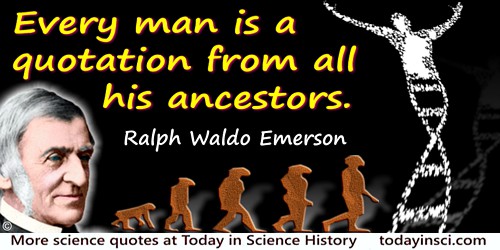
Every book is a quotation; and every house is a quotation out of all forests and mines and stone-quarries; and every man is a quotation from all his ancestors.
Epigraph for chapter 'Quotation and Originality', in Letters and Social Aims (1875, 1917), 176.
Everything material which is the subject of knowledge has number, order, or position; and these are her first outlines for a sketch of the universe. If our feeble hands cannot follow out the details, still her part has been drawn with an unerring pen, and her work cannot be gainsaid. So wide is the range of mathematical sciences, so indefinitely may it extend beyond our actual powers of manipulation that at some moments we are inclined to fall down with even more than reverence before her majestic presence. But so strictly limited are her promises and powers, about so much that we might wish to know does she offer no information whatever, that at other moments we are fain to call her results but a vain thing, and to reject them as a stone where we had asked for bread. If one aspect of the subject encourages our hopes, so does the other tend to chasten our desires, and he is perhaps the wisest, and in the long run the happiest, among his fellows, who has learned not only this science, but also the larger lesson which it directly teaches, namely, to temper our aspirations to that which is possible, to moderate our desires to that which is attainable, to restrict our hopes to that of which accomplishment, if not immediately practicable, is at least distinctly within the range of conception.
From Presidential Address (Aug 1878) to the British Association, Dublin, published in the Report of the 48th Meeting of the British Association for the Advancement of Science (1878), 31.
Evidence of this [transformation of animals into fossils] is that parts of aquatic animals and perhaps of naval gear are found in rock in hollows on mountains, which water no doubt deposited there enveloped in sticky mud, and which were prevented by coldness and dryness of the stone from petrifying completely. Very striking evidence of this kind is found in the stones of Paris, in which one very often meets round shells the shape of the moon.
De Causis Proprietatum Elementorum (On the Causes of the Properties of the Elements) [before 1280], Book II, tract 3, chapter 5, quoted in A. C. Crombie, Augustine to Galileo (1959), Vol. 1, 126.
Fifty years ago Geology was in its infancy; there were but few who cultivated it as a Science ... If an unfortunate lover of nature was seen hammering in a stone quarry, he was generally supposed to be slightly demented.
Geology Considered with Reference to its Utility and Practical Effects', The Geologist, 1858, 1, 6.
For a billion years the patient earth amassed documents and inscribed them with signs and pictures which lay unnoticed and unused. Today, at last, they are waking up, because man has come to rouse them. Stones have begun to speak, because an ear is there to hear them. Layers become history and, released from the enchanted sleep of eternity, life’s motley, never-ending dance rises out of the black depths of the past into the light of the present.
In 'Prologue', Conversation with the Earth (1954), 4. As translated by E.B. Garside from Gespräch mit der Erde (1947).
For a stone, when it is examined, will be found a mountain in miniature. The fineness of Nature’s work is so great, that, into a single block, a foot or two in diameter, she can compress as many changes of form and structure, on a small scale, as she needs for her mountains on a large one; and, taking moss for forests, and grains of crystal for crags, the surface of a stone, in by far the plurality of instances, is more interesting than the surface of an ordinary hill; more fantastic in form and incomparably richer in colour—the last quality being, in fact, so noble in most stones of good birth (that is to say, fallen from the crystalline mountain ranges).
Modern Painters, 4, Containing part 5 of Mountain Beauty (1860), 311.
For all these years you were merely
A smear of light through our telescopes
On the clearest, coldest night; a hint
Of a glint, just a few pixels wide
On even your most perfectly-framed portraits.
But now, now we see you!
Swimming out of the dark - a great
Stone shark, your star-tanned skin pitted
And pocked, scarred after eons of drifting
Silently through the endless ocean of space.
Here on Earth our faces lit up as we saw
You clearly for the first time; eyes wide
With wonder we traced the strangely familiar
Grooves raked across your sides,
Wondering if Rosetta had doubled back to Mars
And raced past Phobos by mistake –
Then you were gone, falling back into the black,
Not to be seen by human eyes again for a thousand
Blue Moons or more. But we know you now,
We know you; you’ll never be just a speck of light again.
A smear of light through our telescopes
On the clearest, coldest night; a hint
Of a glint, just a few pixels wide
On even your most perfectly-framed portraits.
But now, now we see you!
Swimming out of the dark - a great
Stone shark, your star-tanned skin pitted
And pocked, scarred after eons of drifting
Silently through the endless ocean of space.
Here on Earth our faces lit up as we saw
You clearly for the first time; eyes wide
With wonder we traced the strangely familiar
Grooves raked across your sides,
Wondering if Rosetta had doubled back to Mars
And raced past Phobos by mistake –
Then you were gone, falling back into the black,
Not to be seen by human eyes again for a thousand
Blue Moons or more. But we know you now,
We know you; you’ll never be just a speck of light again.
…...
For forty-nine months between 1968 and 1972, two dozen Americans had the great good fortune to briefly visit the Moon. Half of us became the first emissaries from Earth to tread its dusty surface. We who did so were privileged to represent the hopes and dreams of all humanity. For mankind it was a giant leap for a species that evolved from the Stone Age to create sophisticated rockets and spacecraft that made a Moon landing possible. For one crowning moment, we were creatures of the cosmic ocean, an epoch that a thousand years hence may be seen as the signature of our century.
…...
For the environmentalists, The Space Option is the ultimate environmental solution. For the Cornucopians, it is the technological fix that they are relying on. For the hard core space community, the obvious by-product would be the eventual exploration and settlement of the solar system. For most of humanity however, the ultimate benefit is having a realistic hope in a future with possibilities.... If our species does not soon embrace this unique opportunity with sufficient commitment, it may miss its one and only chance to do so. Humanity could soon be overwhelmed by one or more of the many challenges it now faces. The window of opportunity is closing as fast as the population is increasing. Our future will be either a Space Age or a Stone Age.
Arthur Woods and Marco Bernasconi
Fundamentally, as is readily seen, there exists neither force nor matter. Both are abstractions of things, such as they are, looked at from different standpoints. They complete and presuppose each other. Isolated they are meaningless. … Matter is not a go-cart, to and from which force, like a horse, can be now harnessed, now loosed. A particle of iron is and remains exactly the same thing, whether it shoot through space as a meteoric stone, dash along on the tire of an engine-wheel, or roll in a blood-corpuscle through the veins of a poet. … Its properties are eternal, unchangeable, untransferable.
From the original German text in 'Über die Lebenskraft', Preface to Untersuchungen über tierische Elektrizität (1848), xliii. As translated in Ludwig Büchner, Force and Matter: Or, Principles of the Natural Order of the Universe (1891), 1.
Germs of a theory, though in their present condition they are vague and formless … may be said to resemble stones in the quarry, rough and unhewn, but which may some time become corner-stones, columns, and entablatures in the future edifice.
In Report on the Geology of the High Plateaus of Utah (1880), 114.
How hard to realize that every camp of men or beast has this glorious starry firmament for a roof! … In such places standing alone on the mountain-top it is easy to realize that whatever special nests we make—leaves and moss like the marmots and birds, or tents or piled stone—we all dwell in a house of one room—the world with the firmament for its roof—and are sailing the celestial spaces without leaving any track.
Journal Entry, written while camping on top of Quarry Mountain, seven or eight miles from the front of Muir Glacier, Alaska (18 Jul 1890). In John Muir and Linnie Marsh Wolfe (ed.), John of the Mountains: The Unpublished Journals of John Muir (1938, 1979), 321.
How peacefully he sleep!
Yet may his ever-questing spirit, freed at length
from all the frettings of this little world,
Wander at will among the uncharted stars.
Fairfield his name. Perchance celestial fields
disclosing long sought secrets of the past
Spread 'neath his enraptured gaze
And beasts and men that to his earthly sight
were merely bits of stone shall live again to
gladden those eager eyes.
o let us picture him—enthusiast—scientist—friend—
Seeker of truth and light through all eternity!
Yet may his ever-questing spirit, freed at length
from all the frettings of this little world,
Wander at will among the uncharted stars.
Fairfield his name. Perchance celestial fields
disclosing long sought secrets of the past
Spread 'neath his enraptured gaze
And beasts and men that to his earthly sight
were merely bits of stone shall live again to
gladden those eager eyes.
o let us picture him—enthusiast—scientist—friend—
Seeker of truth and light through all eternity!
New York Sun (13 Nov 1935). Reprinted in 'Henry Fairfield Osborn', Supplement to Natural History (Feb 1936), 37:2, 135. Bound in Kofoid Collection of Pamphlets on Biography, University of California.
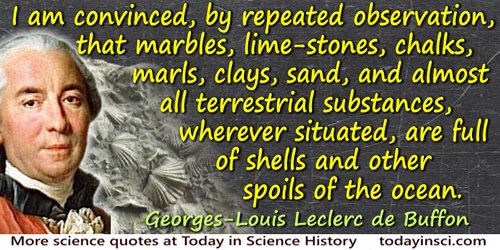
I am convinced, by repeated observation, that marbles, lime-stones, chalks, marls, clays, sand, and almost all terrestrial substances, wherever situated, are full of shells and other spoils of the ocean.
'Second Discours: Histoire & Théorie de la Terre', Histoire Naturelle, Générale et Particulière, Avec la Description du Cabinet du Roi (1749), Vol. I, 76-77; Natural History, General and Particular (1785), Vol. I, trans. W. Smellie, 13.
I am mindful that scientific achievement is rooted in the past, is cultivated to full stature by many contemporaries and flourishes only in favorable environment. No individual is alone responsible for a single stepping stone along the path of progress, and where the path is smooth progress is most rapid. In my own work this has been particularly true.
Nobel Prize banquet speech (29 Feb 1940)
I chatter over stony ways,
In little sharps and trebles,
I bubble into eddying bays,
I babble on the pebbles.…
And out again I curve and flow
To join the brimming river;
For men may come and men may go,
But I go on forever.
In little sharps and trebles,
I bubble into eddying bays,
I babble on the pebbles.…
And out again I curve and flow
To join the brimming river;
For men may come and men may go,
But I go on forever.
From 'Song of the Brook' (1842), collected in The Poetical Works of Alfred Tennyson (1873), 142.
I could more easily believe that two Yankee professors would lie than that stones would fall from heaven.
on a report on a meteorite shower which fell in Weston, Connecticut in 1807, in Our Stone-pelted Planet by H. H. Nininger (1933).
I have never seen the Philosopher's Stone that turns lead into Gold, but I have known the pursuit of it turn a Man's Gold into Lead.
In Poor Richard's Almanack (1738).
I have very often reflected on what it is that really distinguishes the great genius from the common crowd. Here are a few observations I have made. The common individual always conforms to the prevailing opinion and the prevailing fashion; he regards the State in which everything now exists as the only possible one and passively accepts it ail. It does not occur to him that everything, from the shape of the furniture up to the subtlest hypothesis, is decided by the great council of mankind of which he is a member. He wears thin-soled shoes even though the sharp stones of the Street hurt his feet, he allows fashion to dictate to him that the buckles of his shoes must extend as far as the toes even though that means the shoe is often hard to get on. He does not reflect that the form of the shoe depends as much upon him as it does upon the fool who first wore thin shoes on a cracked pavement. To the great genius it always occurs to ask: Could this too not be false! He never gives his vote without first reflecting.
Aphorism 24 in Notebook C (1772-1773), as translated by R.J. Hollingdale in Aphorisms (1990). Reprinted as The Waste Books (2000), 36.
I know not with what weapons World War III will be fought, but World War IV will be fought with sticks and stones.
In interview, Alfred Werner, Liberal Judaism (Apr-May 1949), 16. Einstein Archive 30-1104. As cited in Alice Calaprice, The New Quotable Einstein (2005), 173.
I know well there are those who would have the Study of Nature restrained wholly to Observations; without ever proceeding further. But due Consideration, and a deeper Insight into Things, would soon have undeceived and made them sensible of their error. Assuredly, that man who should spend his whole life in amassing together stone, timber, and other materials for building, without ever at the making any use, or raising any fabrick out of them, might well be reputed very fantastic and extravagant. And a like censure would be his due, who should be perpetually heaping up of natural collections without design. building a structure of philosophy out of them, or advancing some propositions that might turn to the benefit and advantage of the world. This is in reality the true and only proper end of collections, of observations, and natural history: and they are of no manner of use or value without it.
In An Attempt Toward a Natural History of the Fossils of England (1729), xiii-xiv.
I observed on most collected stones the imprints of innumerable plant fragments which were so different from those which are growing in the Lyonnais, in the nearby provinces, and even in the rest of France, that I felt like collecting plants in a new world… The number of these leaves, the way they separated easily, and the great variety of plants whose imprints I saw, appeared to me just as many volumes of botany representing in the same quarry the oldest library of the world.
In 'Examen des causes des Impressions des Plantes marquees sur certaines Pierres des environs de Saint-Chaumont dans le Lionnais', Memoires de l’ Academie Royale des Sciences (1718), 364, as trans. by Albert V. and Marguerite Carozzi.
I was ever of the opinion that the philosopher’s stone, and an holy war, were but the rendezvous of cracked brains, that wore their feather in their heads.
From essay, An Advertisement Touching a Holy War (1622). As collected and translated in Francis Bacon and Basil Montagu, The Works of Francis Bacon (1844), Vol. 2, 439. As quoted in Samuel Austin Allibone, Prose Quotations From Socrates to Macaulay (1876), 28. [Note: In Bacon’s time, the 17th century, the meaning of “advertise” was to give knowledge, advice or counsel. An “advertisement” meant the same in the form of a written statement. —Webmaster]
I will give no deadly medicine to any one if asked, nor suggest any such counsel; and in like manner I will not give any woman the instrument to procure abortion. … I will not cut a person who is suffering with stone, but will leave this to be done by men who are practitioners of such work.
From 'The Oath', as translated by Francis Adams in The Genuine Works of Hippocrates (1849), Vol. 2, 780.
i2 = j2 = k2 = ijk = - 1
[This representation was devised on 16th Oct 1843, and which he carved into a stone of Brougham Bridge, over the Royal Canal, Dublin. It has since worn away.]
[This representation was devised on 16th Oct 1843, and which he carved into a stone of Brougham Bridge, over the Royal Canal, Dublin. It has since worn away.]
As written on a page in his note-book, shown in William Hamilton, Mathematical Papers (1967), Vol. 3, frontispiece.
If we peep into Dom Claude’s cell, we are introduced to a typical alchemist’s laboratory—a gloomy, dimly-lighted place, full of strange vessels, and furnaces, and melting-pots, spheres, and portions of skeletons hanging from the ceiling; the floor littered with stone bottles, pans, charcoal, aludels, and alembics, great parchment books covered with hieroglyphics; the bellows with its motto Spira, Spera; the hour-glass, the astrolabe, and over all cobwebs, and dust, and ashes. The walls covered with various aphorisms of the brotherhood; legends and memorials in many tongues; passages from the Smaragdine Table of Hermes Trismegistus; and looming out from all in great capitals, ’ANAΓKH.
In The Birth of Chemistry (1874), 100.
If you throw a stone in a pond... the waves which strike against the shores are thrown back towards the spot where the stone struck; and on meeting other waves they never intercept each other’s course... In a small pond one and the same stroke gives birth to many motions of advance and recoil.
…...
In 1768, some peasants, near Luce in France, heard a thunderclap and saw a large stone fall from the sky. Reports of this strange phenomenon reached the French Academy of Sciences. The Academy asked Lavoisier, the premier chemist, to investigate. Lavoisier knew that stones do not fall out of the sky; so, in his knowledgeable arrogance, he reported that the witnesses were either lying or mistaken. The academy did not accept the fact of meteorites until the following century.
In 'Forum: A Case of Spontaneous Human Combustion', New Scientist (15 May 1986), 70.
In crossing a heath, suppose I pitched my foot against a stone, and were asked how the stone came to be there, I might possibly answer, that, for any thing I knew to the contrary, it had lain there for ever: nor would it perhaps be very easy to shew the absurdity of this answer. But suppose I had found a watch upon the ground, and it should be enquired how the watch happened to be in that place, I should hardly think of the answer which I had before given, that, for any thing I knew, the watch might have always been there.
Natural Theology: or, Evidences of the Existence and Attributes of the Deity, Collected from the Appearances of Nature (1802), 1-2.
In like manner, the loadstone has from nature its two poles, a northern and a southern; fixed, definite points in the stone, which are the primary termini of the movements and effects, and the limits and regulators of the several actions and properties. It is to be understood, however, that not from a mathematical point does the force of the stone emanate, but from the parts themselves; and all these parts in the whole—while they belong to the whole—the nearer they are to the poles of the stone the stronger virtues do they acquire and pour out on other bodies. These poles look toward the poles of the earth, and move toward them, and are subject to them. The magnetic poles may be found in very loadstone, whether strong and powerful (male, as the term was in antiquity) or faint, weak, and female; whether its shape is due to design or to chance, and whether it be long, or flat, or four-square, or three-cornered or polished; whether it be rough, broken-off, or unpolished: the loadstone ever has and ever shows its poles.
On the Loadstone and Magnetic Bodies and on the Great Magnet the Earth: A New Physiology, Demonstrated with many Arguments and Experiments (1600), trans. P. Fleury Mottelay (1893), 23.
In science its main worth is temporary, as a stepping-stone to something beyond. Even the Principia, as Newton with characteristic modesty entitled his great work, is truly but the beginning of a natural philosophy, and no more an ultimate work, than Watt’s steam-engine, or Arkwright's spinning-machine.
Co-author with his brother Augustus William Hare Guesses At Truth, By Two Brothers: Second Edition: With Large Additions (1848), Second Series, 46. (The volume is introduced as “more than three fourths new.” This quote is identified as by Julius; Augustus had died in 1833.)
In the bleak midwinter Frosty wind made moan, Earth stood hard as iron, Water like a stone; Snow had fallen, snow on snow, Snow on snow, In the bleak midwinter, Long ago.
…...
In the mountains of Parma and Piacenza, multitudes of shells and corals filled with worm-holes may be seen still adhering to the rocks, and when I was making the great horse at Milan a large sack of those which had been found in these parts was brought to my workshop by some peasants... The red stone of the mountains of Verona is found with shells all intermingled, which have become part of this stone... And if you should say that these shells have been and still constantly are being created in such places as these by the nature of the locality or by potency of the heavens in these spots, such an opinion cannot exist in brains possessed of any extensive powers of reasoning because the years of their growth are numbered upon the outer coverings of their shells; and both small and large ones may be seen; and these would not have grown without feeding, or fed without movement, and here [embedded in rock] they would not have been able to move... The peaks of the Apennines once stood up in a sea, in the form of islands surrounded by salt water... and above the plains of Italy where flocks of birds are flying today, fishes were once moving in large shoals.
'Physical Geography', in The Notebooks of Leonardo da Vinci, trans. E. MacCurdy (1938), Vol. 1, 355-6, 359.
It behooves us always to remember that in physics it has taken great men to discover simple things. They are very great names indeed which we couple with the explanation of the path of a stone, the droop of a chain, the tints of a bubble, the shadows of a cup.
In On Growth and Form (1917).
It is not necessary to probe into the nature of things, as was done by those whom the Greeks call physici; nor need we be in alarm lest the Christian should be ignorant of the force and number of the elements—the motion, and order, and eclipses of the heavenly bodies; the form of the heavens; the species and the natures of animals, plants, stones, fountains, rivers, mountains; about chronology and distances; the signs of coming storms; and a thousand other things which those philosophers either have found out, or think they have found out. … It is enough for the Christian to believe that the only cause of all created things, whether heavenly or earthly … is the goodness of the Creator, the one true God.
In Marcus Dods (ed.), J.F. Shaw (trans.), The Enchiridion of Augustine, Chap. 9, collected in The Works of Aurelius Augustine, Bishop of Hippo: A new translation (1873), Vol. 9, 180-181. The physici are natural philosophers.
It is odd to think that there is a word for something which, strictly speaking, does not exist, namely, “rest.” We distinguish between living and dead matter; between moving bodies and bodies at rest. This is a primitive point of view. What seems dead, a stone or the proverbial “door-nail,” say, is actually forever in motion. We have merely become accustomed to judge by outward appearances; by the deceptive impressions we get through our senses.
— Max Born
The Restless Universe (1935), I.
It is to geometry that we owe in some sort the source of this discovery [of beryllium]; it is that [science] that furnished the first idea of it, and we may say that without it the knowledge of this new earth would not have been acquired for a long time, since according to the analysis of the emerald by M. Klaproth and that of the beryl by M. Bindheim one would not have thought it possible to recommence this work without the strong analogies or even almost perfect identity that Citizen Haüy found for the geometrical properties between these two stony fossils.
Haüy used the geometry of cleavage to reveal the underlying crystal structure, and thus found the emeral and beryl were geometrically identical. In May Elvira Weeks, The Discovery of the Elements (1934), 153, citing Mellor, Comprehensive Treatise on Inorganic and Theoretical Chemistry (1923), 204-7.
It must be gently but firmly pointed out that analogy is the very corner-stone of scientific method. A root-and-branch condemnation would invalidate any attempt to explain the unknown in terms of the known, and thus prune away every hypothesis.
In 'On Analogy', The Cambridge Magazine (2 Mar 1918), 476. As quoted in Robert Scott Root-Bernstein and Michèle Root-Bernstein, Sparks of Genius: The Thirteen Thinking Tools of the World’s Most Creative (2001), 144.
It seems wonderful to everyone that sometimes stones are found that have figures of animals inside and outside. For outside they have an outline, and when they are broken open, the shapes of the internal organs are found inside. And Avicenna says that the cause of this is that animals, just as they are, are sometimes changed into stones, and especially [salty] stones. For he says that just as the Earth and Water are material for stones, so animals, too, are material for stones. And in places where a petrifying force is exhaling, they change into their elements and are attacked by the properties of the qualities [hot, cold, moist, dry] which are present in those places, and in the elements in the bodies of such animals are changed into the dominant element, namely Earth mixed with Water; and then the mineralizing power converts [the mixture] into stone, and the parts of the body retain their shape, inside and outside, just as they were before. There are also stones of this sort that are [salty] and frequently not hard; for it must be a strong power which thus transmutes the bodies of animals, and it slightly burns the Earth in the moisture, so it produces a taste of salt.
De Mineralibus (On Minerals) (c.1261-1263), Book I, tract 2, chapter 8, trans. Dorothy Wyckoff (1967), 52-53.
It turned out that the buckyball, the soccer ball, was something of a Rosetta stone of an infinite new class of molecules.
From interview with National Public Radio (2000), quoted and cited in Nell GreenfieldBoyce, '‘Buckyball’ Nobel Laureate Richard Smalley Dies', All Things Considered (31 Oct 2005). Transcript on NPR website.
It would indeed be a great delusion, if we stated that those sports of Nature [we find] enclosed in rocks are there by chance or by some vague creative power. Ah, that would be superficial indeed! In reality, those shells, which once were alive in water and are now dead and decomposed, were made thus by time not Nature; and what we now find as very hard, figured stone, was once soft mud and which received the impression of the shape of a shell, as I have frequently demonstrated.
La vana speculazione disingannata del senso (1670), trans. Ezio Vaccari, 83-4.
Language is the city to the building of which every human being brought a stone.
Laws, written, if not on stone tables, yet on the azure of infinitude, in the inner heart of God’s creation, certain as life, certain as death, are there, and thou shalt not disobey them.
In James Wood, Dictionary of Quotations from Ancient and Modern, English and Foreign Sources (1893), 232:11.
Man cannot afford to be a naturalist, to look at Nature directly, but only with the side of his eye. He must look through and beyond her, to look at her is fatal as to look at the head of Medusa. It turns the man of science to stone. I feel that I am dissipated by so many observations. I should be the magnet in the midst of all this dust and filings.
From Journal entry (23 Mar 1953), in Henry David Thoreau and Bradford Torrey (ed.), Journal (1906), Vol. 5, 45.
Many physicians would prefer passing a small kidney stone to presenting a paper.
Journal of the American Medical Association (1960) 174, 292.
Mathematics may be likened to a large rock whose interior composition we wish to examine. The older mathematicians appear as persevering stone cutters slowly attempting to demolish the rock from the outside with hammer and chisel. The later mathematicians resemble expert miners who seek vulnerable veins, drill into these strategic places, and then blast the rock apart with well placed internal charges.
From In Mathematical Circles (1969), 7.
MEDICINE, n. A stone flung down the Bowery to kill a dog in Broadway.
The Collected Works of Ambrose Bierce (1911), Vol. 7, The Devil's Dictionary, 215.
Men of genius are often dull and inert in society; as the blazing meteor, when it descends to earth, is only a stone.
From Kavanagh: A Tale (1849), 49.
Mountains have been formed by one [or other] of the causes of the formation of stone, most probably from agglutinative clay which slowly dried and petrified during ages of which we have no record. It seems likely that this habitable world was in former days uninhabitable and, indeed, submerged beneath the ocean. Then, becoming exposed little by little, it petrified in the course of ages.
— Avicenna
Congelatione et Conglutinatione Lapidium (1021-23), trans. E. J. Hohnyard and D. C. Mandeville (1927), 28.
My father’s collection of fossils was practically unnamed, but the appearance of Phillips’ book [Geology of the Yorkshire Coast], in which most of our specimens were figured, enabled us to remedy this defect. Every evening was devoted by us to accomplishing the work. This was my first introduction to true scientific study. … Phillips’ accurate volume initiated an entirely new order of things. Many a time did I mourn over the publication of this book, and the consequences immediately resulting from it. Instead of indulging in the games and idleness to which most lads are prone, my evenings throughout a long winter were devoted to the detested labour of naming these miserable stones. Such is the short-sightedness of boyhood. Pursuing this uncongenial work gave me in my thirteenth year a thorough practical familiarity with the palaeontological treasures of Eastern Yorkshire. This early acquisition happily moulded the entire course of my future life.
In Reminiscences of a Yorkshire naturalist (1896), 12.
Natural causes, as we know, are at work, which tend to modify, if they do not at length destroy, all the arrangements and dimensions of the earth and the whole solar system. But though in the course of ages catastrophes have occurred and may yet occur in the heavens, though ancient systems may be dissolved and new systems evolved out of their ruins, the molecules [i.e. atoms] out of which these systems are built—the foundation stones of the material universe—remain unbroken and unworn. They continue to this day as they were created—perfect in number and measure and weight.
Lecture to the British Association at Bradford, 'Molecules', Nature (1873), 8, 437-441. Reprinted in James Clerk Maxwell and W. D. Niven, editor, The Scientific Papers of James Clerk Maxwell (2003), 377.
By
Nature, the parent of all things, designed the human backbone to be like a keel or foundation. It is because we have a backbone that we can walk upright and stand erect. But this was not the only purpose for which Nature provided it; here, as elsewhere, she displayed great skill in turning the construction of a single member to a variety of different uses.
It Provides a Path for the Spinal Marrow, Yet is Flexible.
Firstly, she bored a hole through the posterior region of the bodies of all the vertebrae, thus fashioning a suitable pathway for the spinal marrow which would descend through them.
Secondly, she did not make the backbone out of one single bone with no joints. Such a unified construction would have afforded greater stability and a safer seat for the spinal marrow since, not having joints, the column could not have suffered dislocations, displacements, or distortions. If the Creator of the world had paid such attention to resistance to injury and had subordinated the value and importance of all other aims in the fabric of parts of the body to this one, he would certainly have made a single backbone with no joints, as when someone constructing an animal of wood or stone forms the backbone of one single and continuous component. Even if man were destined only to bend and straighten his back, it would not have been appropriate to construct the whole from one single bone. And in fact, since it was necessary that man, by virtue of his backbone, be able to perform a great variety of movements, it was better that it be constructed from many bones, even though as a result of this it was rendered more liable to injury.
It Provides a Path for the Spinal Marrow, Yet is Flexible.
Firstly, she bored a hole through the posterior region of the bodies of all the vertebrae, thus fashioning a suitable pathway for the spinal marrow which would descend through them.
Secondly, she did not make the backbone out of one single bone with no joints. Such a unified construction would have afforded greater stability and a safer seat for the spinal marrow since, not having joints, the column could not have suffered dislocations, displacements, or distortions. If the Creator of the world had paid such attention to resistance to injury and had subordinated the value and importance of all other aims in the fabric of parts of the body to this one, he would certainly have made a single backbone with no joints, as when someone constructing an animal of wood or stone forms the backbone of one single and continuous component. Even if man were destined only to bend and straighten his back, it would not have been appropriate to construct the whole from one single bone. And in fact, since it was necessary that man, by virtue of his backbone, be able to perform a great variety of movements, it was better that it be constructed from many bones, even though as a result of this it was rendered more liable to injury.
From De Humani Corporis Fabrica Libri Septem: (1543), Book I, 57-58, as translated by William Frank Richardson, in 'Nature’s Skill in Creating a Backbone to Hold Us Erect', On The Fabric of the Human Body: Book I: The Bones and Cartilages (1998), 138.
Nothing is so contagious as enthusiasm; it is the real allegory of the lute of Orpheus: it moves stones, it charms brutes.
In The Last Days of Pompeii (1834), Vol. 1, 78.
Of what use are the great number of petrifactions, of different species, shape and form which are dug up by naturalists? Perhaps the collection of such specimens is sheer vanity and inquisitiveness. I do not presume to say; but we find in our mountains the rarest animals, shells, mussels, and corals embalmed in stone, as it were, living specimens of which are now being sought in vain throughout Europe. These stones alone whisper in the midst of general silence.
Philosophia Botanica (1751), aphorism 132. Trans. Frans A. Stafleu, Linnaeus and the Linnaeans: The Spreading of their Ideas in Systematic Botany, 1735-1789 (1971), 56.
One summer day, while I was walking along the country road on the farm where I was born, a section of the stone wall opposite me, and not more than three or four yards distant, suddenly fell down. Amid the general stillness and immobility about me the effect was quite startling. ... It was the sudden summing up of half a century or more of atomic changes in the material of the wall. A grain or two of sand yielded to the pressure of long years, and gravity did the rest.
Under the Apple-Trees (1916), 105.
One will see a layer of smooth stones, popularly called fluitati [diluvium], and over these another layer of smaller pebbles, thirdly sand, and finally earth, and you will see this repeatedly … up to the summit of the Mountain. This clearly shows that the order has been caused by many floods, not just one.
In De' Corpi Marini che su Monti si Trovano (1721), 57, as translated by Ezio Vaccari.
Our model of Nature should not be like a building—a handsome structure for the populace to admire, until in the course of time some one takes away a corner stone and the edifice comes toppling down. It should be like an engine with movable parts. We need not fix the position of any one lever; that is to be adjusted from time to time as the latest observations indicate. The aim of the theorist is to know the train of wheels which the lever sets in motion—that binding of the parts which is the soul of the engine.
In 'The Internal Constitution of the Stars', The Scientific Monthly (Oct 1920), 11, No. 4, 302.
Painting the desert, sun-setting the tone
Starving backstage, morning-stars are jaded
The moonshine murmur still shivers alone
Curved slice of sliver, shear breath shadows stone
Suspending twilight shiny and shaded
Painting the desert, sun-setting the tone
Carving solace into silver in June
On horizons’ glow from forgotten gold
The moonshine’s’ shilling delivers alone
Gleaming duels of knights, pierce deathly silence
Steel tines of starlight, clashing swords they hold
Painting the desert, sun-setting the tone
Dimples aware, sparkle sand on the dune
Winking at comets, after tails are told
The moon-sand whispers, sift rivers alone
Sharpness they hone, filing skills onto stone
Starlight dazzles, its own space created
Painting the desert, sun-setting the tone
From owls’ talon, moonlight shimmers alone
Starving backstage, morning-stars are jaded
The moonshine murmur still shivers alone
Curved slice of sliver, shear breath shadows stone
Suspending twilight shiny and shaded
Painting the desert, sun-setting the tone
Carving solace into silver in June
On horizons’ glow from forgotten gold
The moonshine’s’ shilling delivers alone
Gleaming duels of knights, pierce deathly silence
Steel tines of starlight, clashing swords they hold
Painting the desert, sun-setting the tone
Dimples aware, sparkle sand on the dune
Winking at comets, after tails are told
The moon-sand whispers, sift rivers alone
Sharpness they hone, filing skills onto stone
Starlight dazzles, its own space created
Painting the desert, sun-setting the tone
From owls’ talon, moonlight shimmers alone
…...
Poore soule, in this thy flesh what do'st thou know?
Thou know'st thy selfe so little, as thou know'st not.
How thou did'st die, nor how thou wast begot.
Thou neither know'st how thou at first camest in,
Nor how thou took'st the poyson of mans sin.
Nor dost thou, (though thou know'st, that thou art so)
By what way thou art made immortall, know.
Thou art too narrow, wretch, to comprehend
Even thy selfe; yea though thou wouldst but bend
To know thy body. Have not all soules thought
For many ages, that our body'is wrought
Of Ayre, and Fire, and other Elements?
And now they thinke of new ingredients,
And one soule thinkes one, and another way
Another thinkes, and 'tis an even lay.
Knowst thou but how the stone doth enter in
The bladder's Cave, and never breake the skin?
Knowst thou how blood, which to the hart doth flow,
Doth from one ventricle to th'other go?
And for the putrid stuffe, which thou dost spit,
Knowst thou how thy lungs have attracted it?
There are no passages, so that there is
(For aught thou knowst) piercing of substances.
And of those many opinions which men raise
Of Nailes and Haires, dost thou know which to praise?
What hope have we to know our selves, when wee
Know not the least things, which for our use bee?
Thou know'st thy selfe so little, as thou know'st not.
How thou did'st die, nor how thou wast begot.
Thou neither know'st how thou at first camest in,
Nor how thou took'st the poyson of mans sin.
Nor dost thou, (though thou know'st, that thou art so)
By what way thou art made immortall, know.
Thou art too narrow, wretch, to comprehend
Even thy selfe; yea though thou wouldst but bend
To know thy body. Have not all soules thought
For many ages, that our body'is wrought
Of Ayre, and Fire, and other Elements?
And now they thinke of new ingredients,
And one soule thinkes one, and another way
Another thinkes, and 'tis an even lay.
Knowst thou but how the stone doth enter in
The bladder's Cave, and never breake the skin?
Knowst thou how blood, which to the hart doth flow,
Doth from one ventricle to th'other go?
And for the putrid stuffe, which thou dost spit,
Knowst thou how thy lungs have attracted it?
There are no passages, so that there is
(For aught thou knowst) piercing of substances.
And of those many opinions which men raise
Of Nailes and Haires, dost thou know which to praise?
What hope have we to know our selves, when wee
Know not the least things, which for our use bee?
Of the Progresse of the Soule. The Second Anniversarie, I. 254-280. The Works of John Donne (Wordsworth edition 1994), 196-7.
Pure earth does not petrify, because the predominance of dryness over [i.e. in] the earth endows it not with coherence but rather with crumbliness. In general, stone is formed in two ways only (a) through the hardening of clay, and (b) by the congelation [of waters].
— Avicenna
Congelatione et Conglutinatione Lapidium (1021-23), trans. E. J. Holmyard and D. C. Mandeville (1927), 18.
Research serves to make building stones out of stumbling blocks.
Quoted in Massachusetts Institute of Technology, Technology Review (1932), 34, 4.
Sand in reality is nothing else than very small stones.
An Essay Towards a System of Mineralogy (1770), trans. G. Von Engestrom, xiv.
Sarcophagus is a stone that devours dead bodies, for in Greek σάρκος means “flesh” and φαγώ “eating”. Some of the ancients first made coffins for the dead of this stone because in the space of thirty days it consumed the dead… . For this reason stone monuments are called sarcophagi.
From De Mineralibus (c.1261-1263), as translated by Dorothy Wyckoff, Book of Minerals (1967), 116.
Science has blown to atoms, as she can rend and rive in the rocks themselves; but in those rocks she has found, and read aloud, the great stone book which is the history of the earth, even when darkness sat upon the face of the deep. Along their craggy sides she has traced the footprints of birds and beasts, whose shapes were never seen by man. From within them she has brought the bones, and pieced together the skeletons, of monsters that would have crushed the noted dragons of the fables at a blow.
Book review of Robert Hunt, Poetry of Science (1848), in the London Examiner (1848). Although uncredited in print, biographers identified his authorship from his original handwritten work. Collected in Charles Dickens and Frederic George Kitton (ed.) Old Lamps for New Ones: And Other Sketches and Essays (1897), 87.
Science has zipped the atom open in a dozen places, it can read the scrawlings on the Rosetta stone as glibly as a literary critic explains Hart Crane, but it doesn’t know anything about playwrights.
In article 'Roaming in the Gloaming' collected in Collecting Himself: James Thurber on Writing and Writers, Humour and Himself (1989). As cited in Eugene Ehrlich and Marshall De Bruhl (eds.)International Thesaurus of Quotations (1996), 601.
Science is built up with facts, as a house is with stones. But a collection of facts is no more a science than a heap of stones is a house.
In George Bruce Halsted (trans.) Science and Hypothesis (1905), 101. From the original French, “On fait la science avec des faits, comme on fait une maison avec des pierres; mais une accumulation de faits n’est pas plus une science qu’un tas de pierres n’est une maison.”, in La Science et l’Hypothèse (1908), 168. Also seen translated as “Science is built up of facts, as a house is built of stones; but an accumulation of facts is no more a science than a heap of stones is a house.”
Science is facts; just as houses are made of stones, so is science made of facts; but a pile of stones is not a house and a collection of facts is not necessarily science.
In Science and Hypothesis.
Science, its imperfections notwithstanding, is the sword in the stone that humanity finally pulled.
In Consilience: The Unity of Knowledge (1998, 1999), 60
Science, which now offers us a golden age with one hand, offers at the same time with the other the doom of all that we have built up inch by inch since the Stone Age and the dawn of any human annals. My faith is in the high progressive destiny of man. I do not believe we are to be flung back into abysmal darkness by those fiercesome discoveries which human genius has made. Let us make sure that they are servants, but not our masters.
In The Wit & Wisdom of Winston Churchill by James C. Humes (1994).
Scientific theories can always be improved and are improved. That is one of the glories of science. It is the authoritarian view of the Universe that is frozen in stone and cannot be changed, so that once it is wrong, it is wrong forever.
Essay, 'The Nearest Star', The Magazine of Fantasy and Science Fiction (Oct 1989), collected in The Secret of the Universe (1991), 82.
Scientific truth will out, you can't hide the sun under a stone.
The Disposessed: An Ambiguous Utopia (1974). Quoted in Gary Westfahl, Science Fiction Quotations (2005), 322.
Since brass, nor stone, nor earth, nor boundless sea,
But bad mortality o'ersways their power,
How with this rage shall beauty hold a plea,
Whose action is no stronger than a flower?
But bad mortality o'ersways their power,
How with this rage shall beauty hold a plea,
Whose action is no stronger than a flower?
Sonnet 65.
Soccer ball C60 quickly became a sort of “Rosetta Stone” leading to the discovery of a new world of geodesic structures of pure carbon built on the nanometer scale.
From Nobel Lecture (7 Dec 1996), 'Discovering the Fullerenes', collected in Ingmar Grenthe (ed.), Nobel Lectures, Chemistry 1996-2000 (2003).
Stone, wood and iron are wrought and put together by mechanical methods, but the greatest work is to keep right the animal part of the machinery.
Stones grow, plants grow, and live, animals grow live and feel.
Philosophia Botanica (1751), Introduction 1-4. Trans. Frans A. Statleu, Linnaeus and the Linnaeans: The Spreading of their Ideas in Systematic Botany, 1735-1789 (1971), 33.
That Mettals, Small Stones, Rocky-Stones, Sulphurs, Salts, and so the whole rank of Minerals, do find their Seeds in the Matrix or Womb of the Waters, which contain the Reasons, Gifts, Knowledges, Progresses, Appointments, Offices, and Durations of the same.
Oriatrike: Or, Physick Refined, trans. John Chandler (1662), 693.
The art of causing intemperance and health to exist in the same body is as chimerical as the philosopher’s stone, judicial astrology, and the theology of the magi.
From the original French, “L'art de faire subsister ensemble l'intempérance et la santé, est un art aussi chimérique que la pierre philosophale, l'astrologie judiciaire, et la théologie des magies”, in Zadig. Accompanied with the translation in Craufurd Tait Ramage, Beautiful Thoughts from French and Italian Authors (1866), 371.
The bottom of the sea is the great laboratory, where loose materials are mineralized and formed into stone, the atmosphere is the region where stones are decomposed, and again resolved into earth.
In The Works of John Playfair: Vol. 1: Illustrations of the Huttonian Theory of the Earth (1822), 109.
The Dark Ages may return—the Stone Age may return on the gleaming wings of Science; and what might now shower immeasureable material blessings upon mankind may even bring about its total destruction. Beware! I say. Time may be short.
Referring to the discovery of atomic energy.
Referring to the discovery of atomic energy.
“Iron Curtain” speech at Fulton, Missouri (5 Mar 1946). Maxims and Reflections (1947), 164.
The discovery of the famous original [Rosetta Stone] enabled Napoleon’s experts to begin the reading of Egypt’s ancient literature. In like manner the seismologists, using the difficult but manageable Greek of modern physics, are beginning the task of making earthquakes tell the nature of the earth’s interior and translating into significant speech the hieroglyphics written by the seismograph.
The evening was calm, the calmest we had known above the North Col. The smooth, outward dipping slabs glowed in the fast setting sun and, at an immense distance beneath, clouds concealed the valleys and lesser peaks. There was nothing to obstruct the tremendous prospect. Seen from Everest, great peaks that dominate the climber as he toils along the East Rongbuk Glacier, and up the slopes of the North Col, show like insignificant ripples at the base of a great ocean roller. Even the North Peak was but a stepping-stone to quick-footed vision.
…...
The frying pan you should give to your enemy. Food should not be prepared in fat. Our bodies are adapted to a stone age diet of roots and vegetables.
The geologist, in those tables of stone which form his records, finds no examples of dynasties once passed away again returning. There has no repetition of the dynasty of the fish, of the reptile, of the mammal. The dynasty of the future is to have glorified man for its inhabitant; but it is to be the dynasty—“the kingdom”—not of glorified man made in the image of God, but of God himself in the form man.
The Testimony of the Rocks: or, Geology in Its Bearings on the Two Theologies, Natural and Revealed (1857), 178.
The latest refinements of science are linked with the cruelties of the Stone Age.
Speech (26 Mar 1942), on the effects of war.
The mind, in short, works on the data it receives very much as a sculptor works on his block of stone. In a sense the statue stood there from eternity. But there were a thousand different ones beside it, and the sculptor alone is to thank for having extricated this one from the rest. Just so with the world of each of us, howsoever different our several views of it may be, all lay embedded in the primordial chaos of sensations, which gave the mere matter to the thought of all of us indifferently.
In 'The Stream of Thought', The Principles of Psychology (1890), Vol. 1, 288.
The moment man first picked up a stone or a branch to use as a tool, he altered irrevocably the balance between him and his environment. From this point on, the way in which the world around him changed was different. It was no longer regular or predictable. New objects appeared that were not recognizable as a mutation of something that existed before, and as each one merged it altered the environment not for one season, but for ever.
from Introduction to Connections by James Burke, Macmillan (1978)
THE OATH. I swear by Apollo [the healing God], the physician and Aesclepius [son of Apollo], and Health [Hygeia], and All-heal [Panacea], and all the gods and goddesses, that, according to my ability and judgment, I will keep this Oath and this stipulation—to reckon him who taught me this Art equally dear to me as my parents, to share my substance with him, and relieve his necessities if required; to look upon his offspring in the same footing as my own brothers, and to teach them this art, if they shall wish to learn it, without fee or stipulation; and that by precept, lecture, and every other mode of instruction, I will impart a knowledge of the Art to my own sons, and those of my teachers, and to disciples bound by a stipulation and oath according to the law of medicine, but to none others. I will follow that system of regimen which, according to my ability and judgment, I consider for the benefit of my patients, and abstain from whatever is deleterious and mischievous. I will give no deadly medicine to any one if asked, nor suggest any such counsel; and in like manner I will not give to a woman a pessary to produce abortion. With purity and with holiness I will pass my life and practice my Art. I will not cut persons laboring under the stone, but will leave this to be done by men who are practitioners of this work. Into whatever houses I enter, I will go into them for the benefit of the sick, and will abstain from every voluntary act of mischief and corruption; and, further, from the seduction of females or males, of freemen and slaves. Whatever, in connection with my professional practice or not, in connection with it, I see or hear, in the life of men, which ought not to be spoken of abroad, I will not divulge, as reckoning that all such should be kept secret. While I continue to keep this Oath unviolated, may it be granted to me to enjoy life and the practice of the art, respected by all men, in all times! But should I trespass and violate this Oath, may the reverse be my lot!
The Genuine Works of Hippocrates, trans. Francis Adams (1886), Vol. 2, 344-5.
The personal adventures of a geologist would form an amusing narrative. He is trudging along, dusty and weatherbeaten, with his wallet at his back, and his hammer on his shoulder, and he is taken for a stone-mason travelling in search of work. In mining-countries, he is supposed to be in quest of mines, and receives many tempting offers of shares in the ‘Wheel Dream’, or the ‘Golden Venture’;—he has been watched as a smuggler; it is well if he has not been committed as a vagrant, or apprehended as a spy, for he has been refused admittance to an inn, or has been ushered into the room appropriated to ostlers and postilions. When his fame has spread among the more enlightened part of the community of a district which he has been exploring, and inquiries are made of the peasantry as to the habits and pursuits of the great philosopher who has been among them, and with whom they have become familiar, it is found that the importance attached by him to shells and stones, and such like trumpery, is looked upon as a species of derangement, but they speak with delight of his affability, sprightliness, and good-humour. They respect the strength of his arm, and the weight of his hammer, as they point to marks which he inflicted on the rocks, and they recount with wonder his pedestrian performances, and the voracious appetite with which, at the close of a long day’s work he would devour the coarsest food that was set before him.
In Practical Geology and Mineralogy: With Instructions for the Qualitative Analysis of Minerals (1841), 31-2.
The point of mathematics is that in it we have always got rid of the particular instance, and even of any particular sorts of entities. So that for example, no mathematical truths apply merely to fish, or merely to stones, or merely to colours. … Mathematics is thought moving in the sphere of complete abstraction from any particular instance of what it is talking about.
In 'Mathematics', Science and the Modern World (1926, 2011), 27.
The point of mathematics is that in it we have always got rid of the particular instance, and even of any particular sorts of entities. So that for example, no mathematical truths apply merely to fish, or merely to stones, or merely to colours. So long as you are dealing with pure mathematics, you are in the realm of complete and absolute abstraction. … Mathematics is thought moving in the sphere of complete abstraction from any particular instance of what it is talking about.
In Science and the Modern World: Lowell Lectures, 1925 (1925), 31.
The pursuits of the greatest trifles may sometimes have a very good effect. The search after the philosopher’s stone has preserved chemistry; and the following astrology so much in former ages has been the cause of astronomy’s being so much advanced in ours. Sir Isaac Newton himself has owned that he began with studying judicial astrology, and that it was his pursuits of that idle and vain study which led him into the beauties and love of astronomy.
As recalled and recorded in Joseph Spence and Edmund Malone (ed.) Anecdotes, Observations, and Characters of Books and Men (1858), 159-160.
The rocks have a history; gray and weatherworn, they are veterans of many battles; they have most of them marched in the ranks of vast stone brigades during the ice age; they have been torn from the hills, recruited from the mountaintops, and marshaled on the plains and in the valleys; and now the elemental war is over, there they lie waging a gentle but incessant warfare with time and slowly, oh, so slowly, yielding to its attacks!
In Under the Apple-Trees (1916), 42.
The same thing may have all the kinds of causes, e.g. the moving cause of a house is the art or the builder, the final cause is the function it fulfils, the matter is earth and stones, and the form is the definitory formula.
Metaphysics, 996b, 5-8. In Jonathan Barnes (ed.), The Complete Works of Aristotle (1984), Vol. 2, 1574.
The scientist takes off from the manifold observations of predecessors, and shows his intelligence, if any, by his ability to discriminate between the important and the negligible, by selecting here and there the significant steppingstones that will lead across the difficulties to new understanding. The one who places the last stone and steps across to the terra firma of accomplished discovery gets all the credit.
In As I Remember Him (1940).
The seer of the past was the man of mysteries. The veil within which none but the high-priest must enter, … whose traditions are the cement in which the stones of all these temples rising around us are laid. The seer of to-day is the man of explorations and explanations. Moses is
busy with his microscope, and Daniel prophesies from the meteorological headquarters at Washington.
From 'Professor Jeffries Wyman: A Memorial Outline', The Atlantic Monthly (Nov 1874), 622.
The Stone Age did not end because humans ran out of stones. It ended because it was time for a re-think about how we live.
As reported, without quotation marks, in Jo Twist, 'Eco-designs on Future Cities', on BBC News website (14 June 2005). McDonough did not originate the statement about the Stone Age; it has been used earlier and attributed to others. He added his own conclusion to it.
The stone age did not end for lack of stone, and the oil age will end long before the world runs out of oil.
…...
The stone that Dr. Johnson once kicked to demonstrate the reality of matter has become dissipated in a diffuse distribution of mathematical probabilities. The ladder that Descartes, Galileo, Newton, and Leibniz erected in order to scale the heavens rests upon a continually shifting, unstable foundation.
Mathematics in Western Culture (1953), 382.
The whole Terrestrial Globe was taken all to Pieces and dissolved at the Deluge, the Particles of Stone, Marble, and all other solid Fossils being dissevered, taken up into the Water, and there sustained with Sea-Shells and other Animal and Vegetable Bodyes: and that the present Earth consists, and was formed out of that promiscuous Mass of Sand, Earth, Shells, and the rest, falling down again, and subsiding from the Water.
In An Essay Towards a Natural History of the Earth (3rd ed., 1723), Preface.
There are dark, hard, cherty silt-stones from some deep ocean trench full of rapidly accumulating Pennsylvanian guck.
In Basin and Range (1981), 61.
There is no art or science that is too difficult for industry to attain to; it is the gift of tongues, and makes a man understood and valued in all countries, and by all nations; it is the philosopher's stone, that turns all metals, and even stones, into gold, and suffers not want to break into its dwelling; it is the northwest passage, that brings the merchant's ships as soon to him as he can desire: in a word, it conquers all enemies, and makes fortune itself pay contribution.
'Essay on Industry' (1670). In Thomas Henry Lister, Life and Administration of Edward, first Earl of Clarendon (1838), Vol. 2, 566.
There was a time, I can assure you, when he was possessed with the old fooleries of astrology; and another when he was so far gone in chemistry as to be
upon the hunt after the philosopher’s stone.
As recalled and recorded in Joseph Spence and Edmund Malone (ed.) Anecdotes, Observations, and Characters of Books and Men (1858), 159.
There were details like clothing, hair styles and the fragile objects that hardly ever survive for the archaeologist—musical instruments, bows and arrows, and body ornaments depicted as they were worn. … No amounts of stone and bone could yield the kinds of information that the paintings gave so freely
As quoted in Current Biography Yearbook (1985), 259.
This sceptred isle,…
This fortress built by Nature for herself…
This precious stone set in the silver sea,
Which serves it in the office of a wall
Or as a moat defensive to a house,
Against the envy of less happier lands,
This blessed plot, this earth, this realm, this England.
This fortress built by Nature for herself…
This precious stone set in the silver sea,
Which serves it in the office of a wall
Or as a moat defensive to a house,
Against the envy of less happier lands,
This blessed plot, this earth, this realm, this England.
In Richard II, Act 2, Scene 1.
Thus you may multiply each stone 4 times & no more for they will then become oyles shining in ye dark and fit for magicall uses. You may ferment them with ☉ [gold] and [silver], by keeping the stone and metal in fusion together for a day, & then project upon metalls. This is the multiplication of ye stone in vertue. To multiply it in weight ad to it of ye first Gold whether philosophic or vulgar.
Praxis (c.1693), quoted in Betty Jo Teeter Dobbs, The Janus Faces of Genius: The Role of Alchemy In Newton's Thought (1991), 304.
To every Form of being is assigned’
Thus calmly spoke the venerable Sage,
An active Principle:—howe’er remove!
From sense and observation, it subsists.
In all things, in all natures; in the stars
Of azure heaven, the unenduring clouds,
In flower and tree, in every pebbly stone
That paves the brooks, the stationary rocks,
The moving waters, and the invisible air.’
Thus calmly spoke the venerable Sage,
An active Principle:—howe’er remove!
From sense and observation, it subsists.
In all things, in all natures; in the stars
Of azure heaven, the unenduring clouds,
In flower and tree, in every pebbly stone
That paves the brooks, the stationary rocks,
The moving waters, and the invisible air.’
In The Excursion (1814). In The Works of William Wordsworth (1994), Book 9, 884.
To mean understandings, it is sufficient honour to be numbered amongst the lowest labourers of learning; but different abilities must find different tasks. To hew stone, would have been unworthy of Palladio; and to have rambled in search of shells and flowers, had but ill suited with the capacity of Newton.
From 'Numb. 83, Tuesday, January 1, 1750', The Rambler (1756), Vol. 2, 154. (Italian architect Palladio, 1509-80, is widely considered the most influential in the history of Western architecture.)
To say that there is a soul in stones simply in order to account for their production is unsatisfactory: for their production is not like the reproduction of living plants, and of animals which have senses. For all these we see reproducing their own species from their own seeds; and a stone does not do this at all. We never see stones reproduced from stones; ... because a stone seems to have no reproductive power at all.
De Mineralibus (On Minerals) (c.1261-1263), Book I, tract I, chapter 4, trans. Dorothy Wyckoff (1967), 20.
To stumble twice against the same stone is a proverbial disgrace.
Today the earth speaks with resonance and clearness and every ear in every civilized country of the world is attuned to its wonderful message of the creative evolution of man, except the ear of William Jennings Bryan; he alone remains stone-deaf, he alone by his own resounding voice drowns the eternal speech of nature.
In The Earth Speaks to Bryan (1925), 8.
Voice is a flowing breath of air, perceptible to the hearing by contact. It moves in an endless number of circular rounds, like the innumerably increasing circular waves which appear when a stone is thrown into smooth water, and which keep on spreading indefinitely from the centre.
In De Architectura, Book 5, Chap 1, Sec. 6. As translated in Morris Hicky Morgan (trans.), Vitruvius: The Ten Books on Architecture (1914), 138.
We have several stones whose generation is incomprehensible unless it is supposed that they come from some kind of seed, if I may be permitted to use this term; that is to say, from a germ in which the organic particles of these stones are enclosed ‘en petit’, just as those of the largest plants are enclosed in the germs of their grains.
In Histoire de l' Académie Royale des Sciences Annee: Avec les Memoires de Mathematique et de Physique (1702), 230.
We maintain that there are two exhalations, one vaporous the other smoky, and these correspond to two kinds of bodies that originate in the earth, things quarried and things mined. The heat of the dry exhalation is the cause of all things quarried. Such are the kinds of stones that cannot be melted, and realgar, and ochre, and ruddle, and sulphur, and the other things of that kind, most things quarried being either coloured lye or, like cinnabar, a stone compounded of it. The vaporous exhalation is the cause of all things mined—things which are either fusible or malleable such as iron, copper, gold.
Meteorology, 378a, 19-28. In Jonathan Barnes (ed.), The Complete Works of Aristotle (1984), Vol. I, 607.
We rest in the immense and complete order of the earth. And then it may well happen that what we have been seeing as beautiful repose changes into motions; lines seem to rise and fall, surfaces wave and swing. Folding, which long ago buckled horizontal strata into huge subterranean waves of stone (folds) is revived. The rounded crests of folds rise and fall rhythmically. Giant smoking volcanoes stand in a row like the pipes of a cosmic organ through which the earth’s mighty breath blows its roaring music. Granite domes in the deserts, the broadly arched shields of the Rocky Mountains become the chimes waiting only for the earthquake’s stroke to awaken the mighty symphony that drowns out all human tones and resounds throughout the world.
In 'Prologue', Conversation with the Earth (1954), 4. As translated by E.B. Garside from Gespräch mit der Erde (1947).
We say in general that the material of all stone is either some form of Earth or some form of Water. For one or the other of these elements predominates in stones; and even in stones in which some form of Water seems to predominate, something of Earth is also important. Evidence of this is that nearly all kinds of stones sink in water.
From De Mineralibus (c.1261-1263), as translated by Dorothy Wyckoff, Book of Minerals (1967), 12.
We say that, in very truth the productive cause is a mineralizing power which is active in forming stones… . This power, existing in the particular material of stones, has two instruments according to different natural conditions.
One of these is heat, which is active in drawing out moisture and digesting the material and bringing about its solidification into the form of stone, in Earth that has been acted upon by unctuous moisture… .
The other instrument is in watery moist material that has been acted upon by earthy dryness; and this [instrument] is cold, which … is active in expelling moisture.
One of these is heat, which is active in drawing out moisture and digesting the material and bringing about its solidification into the form of stone, in Earth that has been acted upon by unctuous moisture… .
The other instrument is in watery moist material that has been acted upon by earthy dryness; and this [instrument] is cold, which … is active in expelling moisture.
From De Mineralibus (c.1261-1263), as translated by Dorothy Wyckoff, Book of Minerals (1967), 22.
We see only the simple motion of descent, since that other circular one common to the Earth, the tower, and ourselves remains imperceptible. There remains perceptible to us only that of the stone, which is not shared by us; and, because of this, sense shows it as by a straight line, always parallel to the tower, which is built upright and perpendicular upon the terrestrial surface.
Dialogue on the Great World Systems (1632). Revised and Annotated by Giorgio De Santillana (1953), 177.
Wedges of gold, great anchors, heaps of pearl,
Inestimable stones, unvalued jewels,
All scattered in the bottom of the sea.
Inestimable stones, unvalued jewels,
All scattered in the bottom of the sea.
From Richard III (Nov 1633), Act 1, Scene 4. In The Plays of William Shakespeare (1804), Vol. 5, 33.
What is it to see, in an Eagle glide
Which fills a human heart with so much pride?
Is it that it soars effortless above the Earth
That steals us from our own limits & dearth?
Trapped in our seas of befuddling sludge
We try and try but cannot budge.
And then to see a mortal; with such ease take wing
Up in a breeze that makes our failing spirits sing?
Do we, vicarious birds, search in it our childishness -
When we too were young & yearned in heart to fly?
Taking flights of fancy through adolescent nights
Listening little, heeding less, knowing not why?
From its highest perch in the forest of snow
Majestic - the Eagle soars alone.
Riding thermals, lording clouds
Till dropping silent from the sky as a stone
But we, so quick and ready to fold
Give up our wings at the whiff of age
Losing years, cursing time, wasting spirit
Living out entire lives in futile rage!
Which fills a human heart with so much pride?
Is it that it soars effortless above the Earth
That steals us from our own limits & dearth?
Trapped in our seas of befuddling sludge
We try and try but cannot budge.
And then to see a mortal; with such ease take wing
Up in a breeze that makes our failing spirits sing?
Do we, vicarious birds, search in it our childishness -
When we too were young & yearned in heart to fly?
Taking flights of fancy through adolescent nights
Listening little, heeding less, knowing not why?
From its highest perch in the forest of snow
Majestic - the Eagle soars alone.
Riding thermals, lording clouds
Till dropping silent from the sky as a stone
But we, so quick and ready to fold
Give up our wings at the whiff of age
Losing years, cursing time, wasting spirit
Living out entire lives in futile rage!
…...
What, then, shall we say about the receipts of alchemy, and about the diversity of its vessels and instruments? These are furnaces, glasses, jars, waters, oils, limes, sulphurs, salts, saltpeters, alums, vitriols, chrysocollae, copper greens, atraments, auripigments, fel vitri, ceruse, red earth, thucia, wax, lutum sapientiae, pounded glass, verdigris, soot, crocus of Mars, soap, crystal, arsenic, antimony, minium, elixir, lazarium, gold leaf salt niter, sal ammoniac, calamine stone, magnesia, bolus armenus, and many other things. Then, again, concerning herbs, roots, seeds, woods, stones, animals, worms, bone dust, snail shells, other shells, and pitch. These and the like, whereof there are some very farfetched in alchemy, are mere incumbrances of work; since even if Sol and Luna [gold and silver] could be made by them they rather hinder and delay than further one’s purpose.
In Paracelsus and Arthur Edward Waite (ed.), The Hermetic and Alchemical Writings of Paracelsus (1894), Vol. 1, 13.
When I was examining and arranging some minerals in the British Museum, I observed a small specimen of a dark colored substance, which attracted my attention, on account of some resemblance which it had with the Siberian chromate of iron, on which I that time was making experiments. Upon referring to Sir Hans Sloane’s catalog, I found that this specimen was only described as a very heavy black stone with golden streaks, which proved to be yellow mica, and it appeared that it had been sent…to Sloane by Mr, Winthrop, of Massachusetts.
Opening paragraph from Paper (26 Nov 1801) read to the Royal Society, printed in 'Analysis of a Mineral Substance From North America, Containing a Metal Hitherto Unknown', Philosophical Transactions (1802), 92, 49.
When some portion of the biosphere is rather unpopular with the human race–a crocodile, a dandelion, a stony valley, a snowstorm, an odd-shaped flint–there are three sorts of human being who are particularly likely still to see point in it and befriend it. They are poets, scientists and children. Inside each of us, I suggest, representatives of all these groups can be found.
Animals and Why They Matter; A Journey Around the Species Barrier (1983), 145.
When the old and bewhiskered alchemist mentally planned his transmutations from lead to gold, he no doubt considered his reagent “spiritus vitroli” second only to his trusty Philosopher’s Stone in power and usefulness; for we read of sulphuric acid back through Alchemical times.
Co-author with E.L. Larison, American Sulphuric Acid Practice (1921), 1.
When the uncultured man sees a stone in the road it tells him no story other than the fact that he sees a stone … The scientist looking at the same stone perhaps will stop, and with a hammer break it open, when the newly exposed faces of the rock will have written upon them a history that is as real to him as the printed page.
In Nature’s Miracles: Familiar Talks on Science (1899), Vol. 1, 2.
When we build, let us think that we build forever. Let it not be for present delight nor for present use alone. Let it be such work as our descendants will thank us for; and let us think, as we lay stone on stone, that a time is to come when those stones will be held sacred because our hands have touched them, and that men will say, as they look upon the labor and wrought substance of them, “See! This our father did for us.”
From Lectures on 'Architecture and Painting' (Nov 1853), delivered at Edinburgh, collected in The Seven Lamps of Architecture (May 1849, 1887), 172.
When we try to pick out anything by itself we find it hitched to everything else in the
universe … The whole wilderness is unity and interrelation, is alive and familiar, full of humanity. The very stones seem talkative, sympathetic, brotherly.
In My First Summer in the Sierra (1911), 211 and 319. Based on Muir’s original journals and sketches of his 1869 stay in the Sierra.
Who, of men, can tell
That flowers would bloom, or that green fruit would swell
To melting pulp, that fish would have bright mail,
The earth its dower of river, wood, and vale,
The meadows runnels, runnels pebble-stones,
The seed its harvest, or the lute its tones,
Tones ravishment, or ravishment its sweet,
If human souls did never kiss and greet?
That flowers would bloom, or that green fruit would swell
To melting pulp, that fish would have bright mail,
The earth its dower of river, wood, and vale,
The meadows runnels, runnels pebble-stones,
The seed its harvest, or the lute its tones,
Tones ravishment, or ravishment its sweet,
If human souls did never kiss and greet?
Endymion (1818), bk. 1, l. 835-842. In John Barnard (ed.), John Keats. The Complete Poems (1973), 129.
Xenophanes of Kolophon ... believes that once the earth was mingled with the sea, but in the course of time it became freed from moisture; and his proofs are such as these: that shells are found in the midst of the land and among the mountains, that in the quarries of Syracuse the imprints of a fish and of seals had been found, and in Paros the imprint of an anchovy at some depth in the stone, and in Melite shallow impressions of all sorts of sea products. He says that these imprints were made when everything long ago was covered with mud, and then the imprint dried in the mud.
Doxographists, Zeller, Vorsokr. Phil. 543, n. 1. Quoted in Arthur Fairbanks (ed. And trans.), The First Philosophers of Greece (1898), 83.
You are literally filled with the fruit of your own devices, with rats and mice and such small deer, paramecia, and entomostraceæ, and kicking things with horrid names, which you see in microscopes at the Polytechnic, and rush home and call for brandy—without the water—stone, and gravel, and dyspepsia, and fragments of your own muscular tissue tinged with your own bile.
'The Water Supply of London', North British Review (1851), 15, 246
 In science it often happens that scientists say, 'You know that's a really good argument; my position is mistaken,' and then they would actually change their minds and you never hear that old view from them again. They really do it. It doesn't happen as often as it should, because scientists are human and change is sometimes painful. But it happens every day. I cannot recall the last time something like that happened in politics or religion.
(1987) --
In science it often happens that scientists say, 'You know that's a really good argument; my position is mistaken,' and then they would actually change their minds and you never hear that old view from them again. They really do it. It doesn't happen as often as it should, because scientists are human and change is sometimes painful. But it happens every day. I cannot recall the last time something like that happened in politics or religion.
(1987) --