Statement Quotes (149 quotes)
[About a conference on Systematic Biology] Many interesting statements were made that apply directly to the work of taxonomists. In some cases the interest lay in the value of the suggestion and sometimes in the obvious need for rebuttal.
In 'Illogicality in Criticism', Systematic Zoology (Dec 1969), 18, No. 4, 470.
[Boswell]: Sir Alexander Dick tells me, that he remembers having a thousand people in a year to dine at his house: that is, reckoning each person as one, each time that he dined there.
[Johnson]: That, Sir, is about three a day.
[Boswell]: How your statement lessens the idea.
[Johnson]: That, Sir, is the good of counting. It brings every thing to a certainty, which before floated in the mind indefinitely.
[Johnson]: That, Sir, is about three a day.
[Boswell]: How your statement lessens the idea.
[Johnson]: That, Sir, is the good of counting. It brings every thing to a certainty, which before floated in the mind indefinitely.
Entry for Fri 18 Apr 1783. In George Birkbeck-Hill (ed.), Boswell's Life of Johnson (1934-50), Vol. 4, 204.
[J.J.] Sylvester’s methods! He had none. “Three lectures will be delivered on a New Universal Algebra,” he would say; then, “The course must be extended to twelve.” It did last all the rest of that year. The following year the course was to be Substitutions-Théorie, by Netto. We all got the text. He lectured about three times, following the text closely and stopping sharp at the end of the hour. Then he began to think about matrices again. “I must give one lecture a week on those,” he said. He could not confine himself to the hour, nor to the one lecture a week. Two weeks were passed, and Netto was forgotten entirely and never mentioned again. Statements like the following were not unfrequent in his lectures: “I haven’t proved this, but I am as sure as I can be of anything that it must be so. From this it will follow, etc.” At the next lecture it turned out that what he was so sure of was false. Never mind, he kept on forever guessing and trying, and presently a wonderful discovery followed, then another and another. Afterward he would go back and work it all over again, and surprise us with all sorts of side lights. He then made another leap in the dark, more treasures were discovered, and so on forever.
As quoted by Florian Cajori, in Teaching and History of Mathematics in the United States (1890), 265-266.
[Louis Rendu, Bishop of Annecy] collects observations, makes experiments, and tries to obtain numerical results; always taking care, however, so to state his premises and qualify his conclusions that nobody shall be led to ascribe to his numbers a greater accuracy than they merit. It is impossible to read his work, and not feel that he was a man of essentially truthful mind and that science missed an ornament when he was appropriated by the Church.
In The Glaciers of the Alps (1860), 299.
[Theory is] an explanation that has been confirmed to such a degree, by observation and experiment, that knowledgeable experts accept it as fact. That’s what scientists mean when they talk about a theory: not a dreamy and unreliable speculation, but an explanatory statement that fits the evidence. They embrace such an explanation confidently but provisionally—taking it as their best available view of reality, at least until some severely conflicting data or some better explanation might come along.
In 'Was Darwin Wrong?', National Geographic (Nov 2004), 206, 4.
A conflict arises when a religious community insists on the absolute truthfulness of all statements recorded in the Bible. This means an intervention on the part of religion into the sphere of science; this is where the struggle of the Church against the doctrines of Galileo and Darwin belongs. On the other hand, representatives of science have often made an attempt to arrive at fundamental judgments with respect to values and ends on the basis of scientific method, and in this way have set themselves in opposition to religion. These conflicts have all sprung from fatal errors.
From an Address (19 May 1939) at Princeton Theological Seminary, 'Science and Religion', collected in Ideas And Opinions (1954, 2010), 45.
A fact is a simple statement that everyone believes. It is innocent, unless found guilty. A hypothesis is a novel suggestion that no one wants to believe. It is guilty until found effective.
Edward Teller, Wendy Teller, Wilson Talley, Conversations on the Dark Secrets of Physics (1991, 2002), Footnote, 69.
A few days ago, a Master of Arts, who is still a young man, and therefore the recipient of a modern education, stated to me that until he had reached the age of twenty he had never been taught anything whatever regarding natural phenomena, or natural law. Twelve years of his life previously had been spent exclusively amongst the ancients. The case, I regret to say, is typical. Now we cannot, without prejudice to humanity, separate the present from the past.
'On the Study of Physics', From a Lecture delivered in the Royal Institution of Great Britain in the Spring of 1854. Fragments of Science for Unscientific People: A Series of Detached Essays, Lectures, and Reviews (1892), Vol. 1, 284-5.
A principle of induction would be a statement with the help of which we could put inductive inferences into a logically acceptable form. In the eyes of the upholders of inductive logic, a principle of induction is of supreme importance for scientific method: “... this principle”, says Reichenbach, “determines the truth of scientific theories. To eliminate it from science would mean nothing less than to deprive science of the power to decide the truth or falsity of its theories. Without it, clearly, science would no longer have the right to distinguish its theories from the fanciful and arbitrary creations of the poet’s mind.” Now this principle of induction cannot be a purely logical truth like a tautology or an analytic statement. Indeed, if there were such a thing as a purely logical principle of induction, there would be no problem of induction; for in this case, all inductive inferences would have to be regarded as purely logical or tautological transformations, just like inferences in inductive logic. Thus the principle of induction must be a synthetic statement; that is, a statement whose negation is not self-contradictory but logically possible. So the question arises why such a principle should be accepted at all, and how we can justify its acceptance on rational grounds.
…...
A superficial knowledge of mathematics may lead to the belief that this subject can be taught incidentally, and that exercises akin to counting the petals of flowers or the legs of a grasshopper are mathematical. Such work ignores the fundamental idea out of which quantitative reasoning grows—the equality of magnitudes. It leaves the pupil unaware of that relativity which is the essence of mathematical science. Numerical statements are frequently required in the study of natural history, but to repeat these as a drill upon numbers will scarcely lend charm to these studies, and certainly will not result in mathematical knowledge.
In Primary Arithmetic: First Year, for the Use of Teachers (1897), 26-27.
A superficial knowledge of mathematics may lead to the belief that this subject can be taught incidentally, and that exercises akin to counting the petals of flowers or the legs of a grasshopper are mathematical. Such work ignores the fundamental idea out of which quantitative reasoning grows—the equality of magnitudes. It leaves the pupil unaware of that relativity which is the essence of mathematical science. Numerical statements are frequently required in the study of natural history, but to repeat these as a drill upon numbers will scarcely lend charm to these studies, and certainly will not result in mathematical knowledge.
In Primary Arithmetic: First Year, for the Use of Teachers (1897), 26-27.
Absorbed in the special investigation, I paid no heed to the edifice which was meanwhile unconsciously building itself up. Having however completed the comparison of the fossil species in Paris, I wanted, for the sake of an easy revision of the same, to make a list according to their succession in geological formations, with a view of determining the characteristics more exactly and bringing them by their enumeration into bolder relief. What was my joy and surprise to find that the simplest enumeration of the fossil fishes according to their geological succession was also a complete statement of the natural relations of the families among themselves; that one might therefore read the genetic development of the whole class in the history of creation, the representation of the genera and species in the several families being therein determined; in one word, that the genetic succession of the fishes corresponds perfectly with their zoological classification, and with just that classification proposed by me.
Quoted in Elizabeth Cary Agassiz (ed.), Louis Agassiz: His Life and Correspondence (1885), Vol. I, 203-4.
All science is full of statements where you put your best face on your ignorance, where you say: … we know awfully little about this, but more or less irrespective of the stuff we don’t know about, we can make certain useful deductions.
From Assumption and Myth in Physical Theory (1967), 11.
All statements about the hydrides of boron earlier than 1912, when Stock began to work upon them, are untrue.
Quoted in N. V. Sidgwick, The Chemical Elements and their Compounds (1950), Vol. 1, 338.
All statements are true, if you are free to redefine their terms.
'Penetrating the Rhetoric', The Vision of the Anointed (1996), 102.
Although I have several agents who know the Niam-Niam country, I did not dare to make anything of their unreliable statements before I could orient myself. These Nubians are unpredictable to a high degree, they have a very poor memory for names and practically no human idea of the points of the compass; the agents of the merchants of Khartoum who are entrusted with such great journeys are to the last man absolute liars, braggarts and habitual fibbers.
In August Petermann, Petermann’s Geographische Mittheilungen (1870), 20. As quoted and cited in Kathrin Fritsch, '"You Have Everything Confused And Mixed Up…!" Georg Schweinfurth, Knowledge And Cartography Of Africa In The 19th Century', History in Africa (2009), 36, 93-94. Fritsch comments how at that point in his travels, thus far, Schweinfurth “did not appear to understand their geographical orientation and with his European prejudice he chose to view all Nubians as braggarts and liars.
Another advantage of a mathematical statement is that it is so definite that it might be definitely wrong; and if it is found to be wrong, there is a plenteous choice of amendments ready in the mathematicians’ stock of formulae. Some verbal statements have not this merit; they are so vague that they could hardly be wrong, and are correspondingly useless.
From 'Mathematics of War and Foreign Politics', in James R. Newman, The World of Mathematics (1956), Vol. 2, 1248.
Aristotle maintained that women have fewer teeth than men; although he was twice married, it never occurred to him to verify this statement by examining his wives' mouths.
In The Impact of Science on Society (1951), 7.
Both the physicist and the mystic want to communicate their knowledge, and when they do so with words their statements are paradoxical and full of logical contradictions.
In The Tao of Physics (1975), 46.
By a generative grammar I mean simply a system of rules that in some explicit and well-defined way assigns structural descriptions to sentences. Obviously, every speaker of a language has mastered and internalized a generative grammar that expresses his knowledge of his language. This is not to say that he is aware of the rules of the grammar or even that he can become aware of them, or that his statements about his intuitive knowledge of the language are necessarily accurate.
Aspects of the Theory of Syntax (1965), 8.
Classification is now a pejorative statement. You know, these classifiers look like “dumb fools.” I’m a classifier. But I’d like to use a word that includes more than what people consider is encompassed by classification. It is more than that, and it’s something which can be called phenomenology.
'Oral History Transcript: Dr. William Wilson Morgan' (8 Aug 1978) in the Niels Bohr Library & Archives.
Do not enter upon research unless you can not help it. Ask yourself the “why” of every statement that is made and think out your own answer. If through your thoughtful work you get a worthwhile idea, it will get you. The force of the conviction will compel you to forsake all and seek the relief of your mind in research work.
From Cameron Prize Lecture (1928), delivered before the University of Edinburgh. As quoted in J.B. Collip 'Frederick Grant Banting, Discoverer of Insulin', The Scientific Monthly (May 1941), 52, No. 5, 473.
Early in my school days a boy had a copy of the “Wonders of the World,” which I often read, and disputed with other boys about the veracity of some of the statements; and I believe that this book first gave me a wish to travel in remote countries, which was ultimately fulfilled by the voyage of the Beagle.
In Charles Darwin and Francis Darwin (ed.), 'Autobiography', The Life and Letters of Charles Darwin (1887, 1896), Vol. 1, 31.
Every investigator must before all things look upon himself as one who is summoned to serve on a jury. He has only to consider how far the statement of the case is complete and clearly set forth by the evidence. Then he draws his conclusion and gives his vote, whether it be that his opinion coincides with that of the foreman or not.
In The Maxims and Reflections of Goethe (1906), 190.
Every species of plant and animal is determined by a pool of germ plasm that has been most carefully selected over a period of hundreds of millions of years. We can understand now why it is that mutations in these carefully selected organisms almost invariably are detrimental.The situation can be suggested by a statement by Dr. J.B.S. Haldane: “My clock is not keeping perfect time. It is conceivable that it will run better if I shoot a bullet through it; but it is much more probable that it will stop altogether.” Professor George Beadle, in this connection, has asked: “What is the chance that a typographical error would improve Hamlet?”
In No More War! (1958), Chap. 4, 53.
Experimental investigation, to borrow a phrase employed by Kepler respecting the testing of hypotheses, is “a very great thief of time.” Sometimes it costs many days to determine a fact that can be stated in a line.
In preface to Scientific Memoirs (1878), xi.
First of all, we ought to observe, that mathematical propositions, properly so called, are always judgments a priori, and not empirical, because they carry along with them necessity, which can never be deduced from experience. If people should object to this, I am quite willing to confine my statements to pure mathematics, the very concept of which implies that it does not contain empirical, but only pure knowledge a priori.
In Critique of Pure Reason (1900), 720.
First you guess. Don’t laugh, this is the most important step. Then you compute the consequences. Compare the consequences to experience. If it disagrees with experience, the guess is wrong. In that simple statement is the key to science. It doesn’t matter how beautiful your guess is or how smart you are or what your name is. If it disagrees with experience, it’s wrong.
As condensed in Florentin Smarandache, V. Christianto, Multi-Valued Logic, Neutrosophy, and Schrodinger Equation? (2006), 73 & 160 (footnote), paraphrasing from Lecture No. 7, 'Seeking New Laws', Messenger Lectures, Cornell (1964). The original verbatim quote, taken from the transcript is elsewhere on the Richard Feynman Quotations webpage, beginning: “In general, we look for a new law…”.
For if there is any truth in the dynamical theory of gases the different molecules in a gas at uniform temperature are moving with very different velocities. Put such a gas into a vessel with two compartments [A and B] and make a small hole in the wall about the right size to let one molecule through. Provide a lid or stopper for this hole and appoint a doorkeeper, very intelligent and exceedingly quick, with microscopic eyes but still an essentially finite being.
Whenever he sees a molecule of great velocity coming against the door from A into B he is to let it through, but if the molecule happens to be going slow he is to keep the door shut. He is also to let slow molecules pass from B to A but not fast ones ... In this way the temperature of B may be raised and that of A lowered without any expenditure of work, but only by the intelligent action of a mere guiding agent (like a pointsman on a railway with perfectly acting switches who should send the express along one line and the goods along another).
I do not see why even intelligence might not be dispensed with and the thing be made self-acting.
Moral The 2nd law of Thermodynamics has the same degree of truth as the statement that if you throw a tumblerful of water into the sea you cannot get the same tumblerful of water out again.
Whenever he sees a molecule of great velocity coming against the door from A into B he is to let it through, but if the molecule happens to be going slow he is to keep the door shut. He is also to let slow molecules pass from B to A but not fast ones ... In this way the temperature of B may be raised and that of A lowered without any expenditure of work, but only by the intelligent action of a mere guiding agent (like a pointsman on a railway with perfectly acting switches who should send the express along one line and the goods along another).
I do not see why even intelligence might not be dispensed with and the thing be made self-acting.
Moral The 2nd law of Thermodynamics has the same degree of truth as the statement that if you throw a tumblerful of water into the sea you cannot get the same tumblerful of water out again.
Letter to John William Strutt (6 Dec 1870). In P. M. Hannan (ed.), The Scientific Letters and Papers of James Clerk Maxwell (1995), Vol. 2, 582-3.
For Linnaeus, Homo sapiens was both special and not special ... Special and not special have come to mean nonbiological and biological, or nurture and nature. These later polarizations are nonsensical. Humans are animals and everything we do lies within our biological potential ... the statement that humans are animals does not imply that our specific patterns of behavior and social arrangements are in any way directly determined by our genes. Potentiality and determination are different concepts.
…...
For the truth of the conclusions of physical science, observation is the supreme Court of Appeal. It does not follow that every item which we confidently accept as physical knowledge has actually been certified by the Court; our confidence is that it would be certified by the Court if it were submitted. But it does follow that every item of physical knowledge is of a form which might be submitted to the Court. It must be such that we can specify (although it may be impracticable to carry out) an observational procedure which would decide whether it is true or not. Clearly a statement cannot be tested by observation unless it is an assertion about the results of observation. Every item of physical knowledge must therefore be an assertion of what has been or would be the result of carrying out a specified observational procedure.
In ’Scientific Epistemology', The Philosophy of Physical Science (1938, 2012), 9.
For what is thought to be a ‘system’ is after all, just conventional, and I do not see how one is supposed to divide up the world objectively so that one can make statements about parts.
…...
He [Sylvester] had one remarkable peculiarity. He seldom remembered theorems, propositions, etc., but had always to deduce them when he wished to use them. In this he was the very antithesis of Cayley, who was thoroughly conversant with everything that had been done in every branch of mathematics.
I remember once submitting to Sylvester some investigations that I had been engaged on, and he immediately denied my first statement, saying that such a proposition had never been heard of, let alone proved. To his astonishment, I showed him a paper of his own in which he had proved the proposition; in fact, I believe the object of his paper had been the very proof which was so strange to him.
I remember once submitting to Sylvester some investigations that I had been engaged on, and he immediately denied my first statement, saying that such a proposition had never been heard of, let alone proved. To his astonishment, I showed him a paper of his own in which he had proved the proposition; in fact, I believe the object of his paper had been the very proof which was so strange to him.
As quoted by Florian Cajori, in Teaching and History of Mathematics in the United States (1890), 268.
Herrmann Pidoux and Armand Trousseau stated 'Disease exists within us, because of us, and through us', Pasteur did not entirely disagree, 'This is true for certain diseases', he wrote cautiously, only to add immediately: 'I do not think that it is true for all of them'.
Pasteur Vallery-Radot (ed.), Oeuvres de Pasteur (1922-1939), Vol. 6, 167. Quoted in Patrice Debré, Louis Pasteur, trans. Elborg Forster (1994), 261.
How does it arise that, while the statements of geologists that other organic bodies existed millions of years ago are tacitly accepted, their conclusions as to man having existed many thousands of years ago should be received with hesitation by some geologists, and be altogether repudiated by a not inconsiderable number among the other educated classes of society?
'Anniversary Address of the Geological Society of London', Proceedings of the Geological Society of London (1861), 17, lxvii.
However, all scientific statements and laws have one characteristic in common: they are “true or false” (adequate or inadequate). Roughly speaking, our reaction to them is “yes” or “no.” The scientific way of thinking has a further characteristic. The concepts which it uses to build up its coherent systems are not expressing emotions. For the scientist, there is only “being,” but no wishing, no valuing, no good, no evil; no goal. As long as we remain within the realm of science proper, we can never meet with a sentence of the type: “Thou shalt not lie.” There is something like a Puritan's restraint in the scientist who seeks truth: he keeps away from everything voluntaristic or emotional.
Essays in Physics (1950), 68.
I believe the statement that in this war a hundred physicists are worth a million soldiers originated in England.
From First Richtmyer Memorial Lecture (30 Dec 1941) to the American Physical Society, Princeton, printed in 'War Problems of the Physics Teacher', American Journal of Physics (1942), 10, 92. Also reprinted in 'War problems of the Physics Teacher', The Scientific Monthly (Apr 1942), 54, No. 4, 370.
I have reviewed this work elsewhere under the title 'Natural Products Chemistry 1950 to 1980-A Personal View.' It is with some relish that I recall the flood of reprint requests prompted by the following footnote on the title page: 'Selected personal statements by the author were removed by the editor without Professor Djerassi's consent. An uncensored version of this paper can be obtained by writing to Professor C. Djerassi'.
Steroids Made it Possible (1990), 14.
I have sold more books on physics than Madonna has on sex.
[Hawking adopted this statement from a remark made to him by his former post-doc, Nathan Myhrvold.]
[Hawking adopted this statement from a remark made to him by his former post-doc, Nathan Myhrvold.]
The Illustrated A Brief History of Time, Updated and Expanded Edition (1996), Foreward.
I like to summarize what I regard as the pedestal-smashing messages of Darwin’s revolution in the following statement, which might be chanted several times a day, like a Hare Krishna mantra, to encourage penetration into the soul: Humans are not the end result of predictable evolutionary progress, but rather a fortuitous cosmic afterthought, a tiny little twig on the enormously arborescent bush of life, which, if replanted from seed, would almost surely not grow this twig again, or perhaps any twig with any property that we would care to call consciousness.
…...
I shall take as a starting point for our flight into space two contrasted statements about geography. The first is that of a boy who said that the earth is a ball filled inside with dirt and worms and covered all over on the outside with geography.
'Genetic Geography: The Development of the Geographic Sense and Concept', Annals of the Association of American Geographers, 1920, 10, 4.
I wish the lecturers to treat their subject as a strictly natural science, the greatest of all possible sciences, indeed, in one sense, the only science, that of Infinite Being, without reference to or reliance upon any supposed special exception or so-called miraculous revelation. I wish it considered just as astronomy or chemistry is.
Statement in deed of foundation of the Gifford Lectures on natural theology (1885).
Statement in deed of foundation of the Gifford Lectures on natural theology (1885).
Quoted in Michael A. Arbib and Mary B. Hesse, The Construction of Reality (1986), 1.
I would ... change the accepted rule that the nature of a complex molecule is determined by the nature, quantity, and position of its elementary component parts, by the following statement: the chemical nature of a complex molecule is determined by the nature of its elementary component parts, their quantity and chemical structure.
'On the Chemical Structure of Substances' 1861.
I’ve tried to make the men around me feel as I do, that we are embarked as pioneers upon a new science and industry in which our problems are so new and unusual that it behooves no one to dismiss any novel idea with the statement, “It can’t be done.”
Start of Boeing’s quote, inscribed on his memorial at the Boeing Developmental Center, Tukwila, WA, as given in Mike Lombardi, 'Historical Perspective: 50 years at the Leading Edge', Boeing Frontiers (Aug 2009), 8.
If a problem is clearly stated, it has no further interest to the physicist.
In Richard Hamming, Numerical Methods for Scientists and Engineers (1973), 704, footnote, without citation.
If an angel were to tell us about his philosophy, I believe many of his statements might well sound like '2 x 2= 13'.
Lichtenberg: Aphorisms & Letters (1969), 31.
If diphtheria is a disease caused by a microorganism, it is essential that three postulates be fulfilled. The fulfilment of these postulates is necessary in order to demonstrate strictly the parasitic nature of a disease:
1) The organism must be shown to be constantly present in characteristic form and arrangement in the diseased tissue.
2) The organism which, from its behaviour appears to be responsible for the disease, must be isolated and grown in pure culture.
3) The pure culture must be shown to induce the disease experimentally.
An early statement of Koch's postulates.
1) The organism must be shown to be constantly present in characteristic form and arrangement in the diseased tissue.
2) The organism which, from its behaviour appears to be responsible for the disease, must be isolated and grown in pure culture.
3) The pure culture must be shown to induce the disease experimentally.
An early statement of Koch's postulates.
Mittheilungen aus den Kaiserliche Gesundheitsamt (1884) Vol. 2. Trans. T. D. Brock, Robert Koch: A Life in Medicine and Bacteriology (1988), 180.
If excessive smoking actually plays a role in the production of lung cancer, it seems to be a minor one, if judged by the evidence on hand.
A cautious statement indicating that evidence was, in 1954, beginning to point to the connection between lung cancer and smoking.
A cautious statement indicating that evidence was, in 1954, beginning to point to the connection between lung cancer and smoking.
Quoted in 'Tobacco Industry Denies Cancer Tie'. New York Times (14 Apr 1954), 51. In Oliver E. Byrd, Health Yearbook (1954), 142. The newspaper article was a report 'that the Tobacco Industry Research Committee had made public a list of "quotations and statements authorized by 36 distinguished cancer authorities" denying that there was any proof establishing a link between smothing and lung cancer. The committee is the spokesman for the leading tobacco manufacturers and associations of tobacco growers.' Webmaster comments: So, the central news was the publication of a booklet (which was essentially statements carefully picked for the purpose of propaganda for the tobacco industry). The quoted comment of Dr. Heuper, of the National Cancer Institute, is often seen in a list of regrettable remarks—where it is always stated lacking the final qualifying phrase, 'if judged by the evidence on hand.' Thus his statement was not at all an outright denial that smoking and lung cancer were related, but was—in fact— a balanced viewpoint indicating that the evidence was not yet in place. In fact, at the time, there was much debate on what reliable conclusions could be drawn on the basis of existing conflicting evidence from various researchers. Dr. Heuper's career was spent actively protecting health by carefully investigating cancer risks from various domestic and industrial chemicals. The list of regrettable remarks presently widely circulating on the web, and frequently seen in publications, unfairly distorts the intent of Heuper's quotation by omitting the final phrase. What is regrettable is that a huge number of authors are republishing the distorted remark, without consulting a primary print source and examining its context. Again, at the time, even the position of the American Cancer Society was cautiously stated, and limited to their position to: 'The evidence to date justifies suspicion that cigarette smoking does, to a degree as yet undertermined, increase the likelihood of developing cancer of the lung....' (See the ACS quote for 17 Mar 1954).
If it [a hypothesis] disagrees with experiment, it’s wrong. In that simple statement, is the key to science: it doesn’t make any difference how beautiful your guess is; it doesn’t make any difference how smart you are, who made the guess, or what his name is—if it disagrees with experiment, it’s wrong; that’s all there is to it.
Verbatim from Lecture No. 7, 'Seeking New Laws', Messenger Lectures, Cornell, (1964) in video and transcript online at caltech.edu website. Also in Christopher Sykes, No Ordinary Genius: The Illustrated Richard Feynman (1994), 143. This quote continues one elsewhere on the Richard Feynman Quotations webpage, which begins: “In general, we look for a new law by…”.
If the resident zoologist of Galaxy X had visited the earth 5 million years ago while making his inventory of inhabited planets in the universe, he would surely have corrected his earlier report that apes showed more promise than Old World monkeys and noted that monkeys had overcome an original disadvantage to gain domination among primates. (He will confirm this statement after his visit next year–but also add a footnote that one species from the ape bush has enjoyed an unusual and unexpected flowering, thus demanding closer monitoring.)
…...
If there’s more than one way to do a job and one of those ways will end in disaster, then somebody will do it that way.
[Early statement of what became known as Murphy's Law.]
[Early statement of what became known as Murphy's Law.]
As quoted in People (31 Jan 1983), 82. Also in Nick T. Spark, A History of Murphy's Law (2006), 47.
Nick T. Spark - Humor - 2006
If two masters of the same art differ in their statement of it, in all likelihood the insoluble problem lies midway between them.
In The Maxims and Reflections of Goethe (1906), 186.
In despair, I offer your readers their choice of the following definitions of entropy. My authorities are such books and journals as I have by me at the moment.
(a) Entropy is that portion of the intrinsic energy of a system which cannot be converted into work by even a perfect heat engine.—Clausius.
(b) Entropy is that portion of the intrinsic energy which can be converted into work by a perfect engine.—Maxwell, following Tait.
(c) Entropy is that portion of the intrinsic energy which is not converted into work by our imperfect engines.—Swinburne.
(d) Entropy (in a volume of gas) is that which remains constant when heat neither enters nor leaves the gas.—W. Robinson.
(e) Entropy may be called the ‘thermal weight’, temperature being called the ‘thermal height.’—Ibid.
(f) Entropy is one of the factors of heat, temperature being the other.—Engineering.
I set up these bald statement as so many Aunt Sallys, for any one to shy at.
[Lamenting a list of confused interpretations of the meaning of entropy, being hotly debated in journals at the time.]
(a) Entropy is that portion of the intrinsic energy of a system which cannot be converted into work by even a perfect heat engine.—Clausius.
(b) Entropy is that portion of the intrinsic energy which can be converted into work by a perfect engine.—Maxwell, following Tait.
(c) Entropy is that portion of the intrinsic energy which is not converted into work by our imperfect engines.—Swinburne.
(d) Entropy (in a volume of gas) is that which remains constant when heat neither enters nor leaves the gas.—W. Robinson.
(e) Entropy may be called the ‘thermal weight’, temperature being called the ‘thermal height.’—Ibid.
(f) Entropy is one of the factors of heat, temperature being the other.—Engineering.
I set up these bald statement as so many Aunt Sallys, for any one to shy at.
[Lamenting a list of confused interpretations of the meaning of entropy, being hotly debated in journals at the time.]
In The Electrician (9 Jan 1903).
In mathematics two ends are constantly kept in view: First, stimulation of the inventive faculty, exercise of judgment, development of logical reasoning, and the habit of concise statement; second, the association of the branches of pure mathematics with each other and with applied science, that the pupil may see clearly the true relations of principles and things.
In 'Aim of the Mathematical Instruction', International Commission on Teaching of Mathematics, American Report: United States Bureau of Education: Bulletin 1912, No. 4, 7.
In scientific thought we adopt the simplest theory which will explain all the facts under consideration and enable us to predict new facts of the same kind. The catch in this criterion lies in the world “simplest.” It is really an aesthetic canon such as we find implicit in our criticisms of poetry or painting. The layman finds such a law as dx/dt = κ(d²x/dy²) much less simple than “it oozes,” of which it is the mathematical statement. The physicist reverses this judgment, and his statement is certainly the more fruitful of the two, so far as prediction is concerned. It is, however, a statement about something very unfamiliar to the plain man, namely the rate of change of a rate of change.
In 'Science and Theology as Art-Forms', Possible Worlds (1927), 227.
In so far as a scientific statement speaks about reality, it must be falsifiable: and in so far as it is not falsifiable, it does not speak about reality.
The Logic of Scientific Discovery (2002), 316.
In the twenties the late Dr. Glenn Frank, an eminent social scientist, developed a new statement of the scientific code, which has been referred to as the “Five Fingers of the Scientific Method.” It may be outlined as follows: find the facts; filter the facts; focus the facts; face the facts; follow the facts. The facts or truths are found by experimentation; the motivation is material. The facts are filtered by research into the literature; the motivation is material. The facts are focused by the publication of results; again the motivation is material. Thus the first three-fifths of the scientific method have a material motivation. It is about time scientists acknowledge that there is more to the scientific convention than the material aspect. Returning to the fourth and fifth fingers of Dr. Frank's conception of the scientific method, the facts should be faced by the proper interpretation of them for society. In other words, a scientist must assume social responsibility for his discoveries, which means that he must have a moral motivation. Finally, in the fifth definition of the scientific method, the facts are to be followed by their proper application to everyday life in society, which means moral motivation through responsibility to society.
From 'Scientists and Society', American Scientist (Jul 1954), 42, No. 3, 495.
It always bothers me that according to the laws as we understand them today, it takes a computing machine an infinite number of logical operations to figure out what goes on in no matter how tiny a region of space and no matter how tiny a region of time … I have often made the hypothesis that ultimately physics will not require a mathematical statement, that in the end the machinery will be revealed and the laws will turn out to be simple, like the chequer board with all its apparent complexities. But this speculation is of the same nature as those other people make—“I like it”,“I don't like it”—and it is not good to be too prejudiced about these things.
In The Character of Physical Law (1965, 2001), 57.
It is above all the duty of the methodical text-book to adapt itself to the pupil’s power of comprehension, only challenging his higher efforts with the increasing development of his imagination, his logical power and the ability of abstraction. This indeed constitutes a test of the art of teaching, it is here where pedagogic tact becomes manifest. In reference to the axioms, caution is necessary. It should be pointed out comparatively early, in how far the mathematical body differs from the material body. Furthermore, since mathematical bodies are really portions of space, this space is to be conceived as mathematical space and to be clearly distinguished from real or physical space. Gradually the student will become conscious that the portion of the real space which lies beyond the visible stellar universe is not cognizable through the senses, that we know nothing of its properties and consequently have no basis for judgments concerning it. Mathematical space, on the other hand, may be subjected to conditions, for instance, we may condition its properties at infinity, and these conditions constitute the axioms, say the Euclidean axioms. But every student will require years before the conviction of the truth of this last statement will force itself upon him.
In Methodisches Lehrbuch der Elementar-Mathemalik (1904), Teil I, Vorwort, 4-5.
It is the rule which says that the other rules of scientific procedure must be designed in such a way that they do not protect any statement in science against falsification. (1959)
The Logic of Scientific Discovery: Logik Der Forschung (2002), 33.
It is this mythical, or rather this symbolic, content of the religious traditions which is likely to come into conflict with science. This occurs whenever this religious stock of ideas contains dogmatically fixed statements on subjects which be long in the domain of science. Thus, it is of vital importance for the preservation of true religion that such conflicts be avoided when they arise from subjects which, in fact, are not really essential for the pursuance of the religious aims.
…...
It may be appropriate to quote a statement of Poincare, who said (partly in jest no doubt) that there must be something mysterious about the normal law since mathematicians think it is a law of nature whereas physicists are convinced that it is a mathematical theorem.
Quoted in Mark Kac, Statistical Independence in Probability, Analysis and Number Theory (1959), 52.
It seems to me that the idea of a personal God is an anthropological concept which I cannot take seriously. I also cannot imagine some will or goal outside the human sphere has been cited as a statement that precedes the last three sentences here, but this might have originated in a paraphrase, a transcription error, or a misquotation; it does not appear in any editions of the essay which have thus far been checked.
…...
It usually develops that after much laborious and frustrating effort the investigator of environmental physiology succeeds in proving that the animal in question can actually exist where it lives. It is always somewhat discouraging for an investigator to realize that his efforts can be made to appear so trite, but this statement does not belittle the ecological physiologist. If his data assist the understanding of the ways in which an animal manages to live where it does, he makes an important contribution to the study of distribution, for the present is necessarily a key to the past.”
From 'The role of physiology in the distribution of terrestrial vertebrates', collected in C.L. Hubbs (ed.), Zoogeography: Publ. 51 (1958), 84.
Logic is not concerned with human behavior in the same sense that physiology, psychology, and social sciences are concerned with it. These sciences formulate laws or universal statements which have as their subject matter human activities as processes in time. Logic, on the contrary, is concerned with relations between factual sentences (or thoughts). If logic ever discusses the truth of factual sentences it does so only conditionally, somewhat as follows: if such-and-such a sentence is true, then such-and-such another sentence is true. Logic itself does not decide whether the first sentence is true, but surrenders that question to one or the other of the empirical sciences.
Logic (1937). In The Language of Wisdom and Folly: Background Readings in Semantics (1967), 44.
Mathematics … belongs to every inquiry, moral as well as physical. Even the rules of logic, by which it is rigidly bound, could not be deduced without its aid. The laws of argument admit of simple statement, but they must be curiously transposed before they can be applied to the living speech and verified by observation. In its pure and simple form the syllogism cannot be directly compared with all experience, or it would not have required an Aristotle to discover it. It must be transmuted into all the possible shapes in which reasoning loves to clothe itself. The transmutation is the mathematical process in the establishment of the law.
From Memoir (1870) read before the National Academy of Sciences, Washington, printed in 'Linear Associative Algebra', American Journal of Mathematics (1881), 4, 97-98.
Mathematics is not arithmetic. Though mathematics may have arisen from the practices of counting and measuring it really deals with logical reasoning in which theorems—general and specific statements—can be deduced from the starting assumptions. It is, perhaps, the purest and most rigorous of intellectual activities, and is often thought of as queen of the sciences.
Essay,'Private Games', in Lewis Wolpert, Alison Richards (eds.), A Passion for Science (1988), 53.
Mathematics, among all school subjects, is especially adapted to further clearness, definite brevity and precision in expression, although it offers no exercise in flights of rhetoric. This is due in the first place to the logical rigour with which it develops thought, avoiding every departure from the shortest, most direct way, never allowing empty phrases to enter. Other subjects excel in the development of expression in other respects: translation from foreign languages into the mother tongue gives exercise in finding the proper word for the given foreign word and gives knowledge of laws of syntax, the study of poetry and prose furnish fit patterns for connected presentation and elegant form of expression, composition is to exercise the pupil in a like presentation of his own or borrowed thoughtsand their development, the natural sciences teach description of natural objects, apparatus and processes, as well as the statement of laws on the grounds of immediate sense-perception. But all these aids for exercise in the use of the mother tongue, each in its way valuable and indispensable, do not guarantee, in the same manner as mathematical training, the exclusion of words whose concepts, if not entirely wanting, are not sufficiently clear. They do not furnish in the same measure that which the mathematician demands particularly as regards precision of expression.
In Anleitung zum mathematischen Unterricht in höheren Schulen (1906), 17.
Mathematics, while giving no quick remuneration, like the art of stenography or the craft of bricklaying, does furnish the power for deliberate thought and accurate statement, and to speak the truth is one of the most social qualities a person can possess. Gossip, flattery, slander, deceit, all spring from a slovenly mind that has not been trained in the power of truthful statement, which is one of the highest utilities.
In Social Phases of Education in the School and the Home (1900), 30.
Moreover, I am now well-informed about that part of the country to be traversed, as I can acquire the most exact information from the Nubian leaders, who are truly well-versed in regional knowledge, and thus supported in my route I could determine positions with the greatest certainty. I could not do this before, as one only learns how to interpret the statements of the Nubians by undertaking such a journey.
In August Petermann, Petermann’s Geographische Mittheilungen (1871), 16. As quoted and cited in Kathrin Fritsch, '"You Have Everything Confused And Mixed Up…!" Georg Schweinfurth, Knowledge And Cartography Of Africa In The 19th Century', History in Africa (2009), 36, 94. Fritsch comments on his changed “acknowledgement of the quality of indigenous knowledge.”
Mssr. Fermat—what have you done?
Your simple conjecture has everyone
Churning out proofs,
Which are nothing but goofs!
Could it be that your statement’s an erudite spoof?
A marginal hoax
That you’ve played on us folks?
But then you’re really not known for your practical jokes.
Or is it then true
That you knew what to do
When n was an integer greater than two?
Oh then why can’t we find
That same proof…are we blind?
You must be reproved, for I’m losing my mind.
Your simple conjecture has everyone
Churning out proofs,
Which are nothing but goofs!
Could it be that your statement’s an erudite spoof?
A marginal hoax
That you’ve played on us folks?
But then you’re really not known for your practical jokes.
Or is it then true
That you knew what to do
When n was an integer greater than two?
Oh then why can’t we find
That same proof…are we blind?
You must be reproved, for I’m losing my mind.
In 'Fermat's Last Theorem', Mathematics Magazine (Apr 1986), 59, No. 2, 76.
My choosing Islam was not a political statement; it was a spiritual statement.
Quoted in Kim Lim (ed.), 1,001 Pearls of Spiritual Wisdom: Words to Enrich, Inspire, and Guide Your Life (2014), 32
My visceral perception of brotherhood harmonizes with our best modern biological knowledge ... Many people think (or fear) that equality of human races represents a hope of liberal sentimentality probably squashed by the hard realities of history. They are wrong. This essay can be summarized in a single phrase, a motto if you will: Human equality is a contingent fact of history. Equality is not true by definition; it is neither an ethical principle (though equal treatment may be) nor a statement about norms of social action. It just worked out that way. A hundred different and plausible scenarios for human history would have yielded other results (and moral dilemmas of enormous magnitude). They didn’t happen.
…...
Neither the natives of Munsa [chief of the Mangbetu] nor the people of Kifan who came to me knew anything of the existence of a great lake, even though I undertook a positively detective investigation in order to discover any possible political intrigues. All of the statements of different people were noted and then compared; they agree as to names etc., which put my mind at rest.
On the necessity of compiling map data by comparisons between interviews with locals. In August Petermann, Petermann’s Geographische Mittheilungen (1871), 13. As quoted and cited in Kathrin Fritsch, '"You Have Everything Confused And Mixed Up…!" Georg Schweinfurth, Knowledge And Cartography Of Africa In The 19th Century', History in Africa (2009), 36, 93.
No doubt science cannot admit of compromises, and can only bring out the complete truth. Hence there must be controversy, and the strife may be, and sometimes must be, sharp. But must it even then be personal? Does it help science to attack the man as well as the statement? On the contrary, has not science the noble privilege of carrying on its controversies without personal quarrels?
In his collected writings of 1861, preface. Quoted in Proceedings of the Royal Society of London, Vol. 75, 300.
Not seldom did he [Sir William Thomson], in his writings, set down some mathematical statement with the prefacing remark “it is obvious that” to the perplexity of mathematical readers, to whom the statement was anything but obvious from such mathematics as preceded it on the page. To him it was obvious for physical reasons that might not suggest themselves at all to the mathematician, however competent.
As given in Life of Lord Kelvin (1910), Vol. 2, 1136. [Note: William Thomson, later became Lord Kelvin —Webmaster]
Numbers written on restaurant checks [bills] within the confines of restaurants do not follow the same mathematical laws as numbers written on any other pieces of paper in any other parts of the Universe.
This single statement took the scientific world by storm. It completely revolutionized it. So many mathematical conferences got held in such good restaurants that many of the finest minds of a generation died of obesity and heart failure and the science of math was put back by years.
This single statement took the scientific world by storm. It completely revolutionized it. So many mathematical conferences got held in such good restaurants that many of the finest minds of a generation died of obesity and heart failure and the science of math was put back by years.
Life, the Universe and Everything (1982, 1995), 49.
Often the confidence of the patient in his physician does more for the cure of his disease than the physician with all his remedies.
Reasserting the statement by Avicenna.
Reasserting the statement by Avicenna.
In James Joseph Walsh, Old-Time Makers of Medicine (1911), 270.
Ohm (a distinguished mathematician, be it noted) brought into order a host of puzzling facts connecting electromotive force and electric current in conductors, which all previous electricians had only succeeded in loosely binding together qualitatively under some rather vague statements. Even as late as 20 years ago, “quantity” and “tension” were much used by men who did not fully appreciate Ohm's law. (Is it not rather remarkable that some of Germany's best men of genius should have been, perhaps, unfairly treated? Ohm; Mayer; Reis; even von Helmholtz has mentioned the difficulty he had in getting recognised. But perhaps it is the same all the world over.)
One might describe the mathematical quality in Nature by saying that the universe is so constituted that mathematics is a useful tool in its description. However, recent advances in physical science show that this statement of the case is too trivial. The connection between mathematics and the description of the universe goes far deeper than this, and one can get an appreciation of it only from a thorough examination of the various facts that make it up.
From Lecture delivered on presentation of the James Scott prize, (6 Feb 1939), 'The Relation Between Mathematics And Physics', printed in Proceedings of the Royal Society of Edinburgh (1938-1939), 59, Part 2, 122.
One-story intellects, two-story intellects, three-story intellects with skylights. All fact-collectors, who have no aim beyond their facts, are one-story men. Two-story men compare, reason, generalize, using the labors of the fact-collectors as well as their own. Three-story men idealize, imagine, predict; their best illumination comes from above, through the skylight. There are minds with large ground-floors, that can store an infinite amount of knowledge; some librarians, for instance, who know enough of books to help other people, without being able to make much other use of their knowledge, have intellects of this class. Your great working lawyer has two spacious stories; his mind is clear, because his mental floors are large, and he has room to arrange his thoughts so that lie can get at them,—facts below, principles above, and all in ordered series; poets are often narrow below, incapable of clear statement, and with small power of consecutive reasoning, but full of light, if sometimes rather bare of furniture, in the attics.
The Poet at the Breakfast Table (1883), 50.
Our most trustworthy safeguard in making general statements on this question is imagination. If we can imagine the breaking of a law of physics then… it is in some degree an empirical law. With a purely rational law we could not conceive an alternative… This ultimate criterion serves as an anchor to keep us from drifting unduly in a perilous sea of thought.
From concluding paragraph of 'Transition to General Relativity', The Special Theory of Relativity (1940, 2014), Chap 8, 91.
Our natural way of thinking about these coarser emotions is that the mental perception of some fact excites the mental affection called the emotion, and that this latter state of mind gives rise to the bodily expression. My theory, on the contrary, is that the bodily changes follow directly the perception of the exciting fact, and that our feeling of the same changes as they occur IS the emotion. Common-sense says, we lose our fortune, are sorry and weep; we meet a bear, are frightened and run; we are insulted by a rival, are angry and strike. The hypothesis here to be defended says that this order of sequence is incorrect, that the one mental state is not immediately induced by the other, that the bodily manifestations must first be interposed between, and that the more rational statement is that we feel sorry because we cry, angry because we strike, afraid because we tremble, and not that we cry, strike, or tremble, because we are sorry, angry, or fearful, as the case may be. Without the bodily states following on the perception, the latter would be purely cognitive in form, pale, colorless, destitute of emotional warmth. We might then see the bear, and judge it best to run, receive the insult and deem it right to strike, but we should not actually feel afraid or angry.
The Principles or Psychology (1890), Vol. 2, 449-50.
Owing to his lack of knowledge, the ordinary man cannot attempt to resolve conflicting theories of conflicting advice into a single organized structure. He is likely to assume the information available to him is on the order of what we might think of as a few pieces of an enormous jigsaw puzzle. If a given piece fails to fit, it is not because it is fraudulent; more likely the contradictions and inconsistencies within his information are due to his lack of understanding and to the fact that he possesses only a few pieces of the puzzle. Differing statements about the nature of things, differing medical philosophies, different diagnoses and treatments—all of these are to be collected eagerly and be made a part of the individual's collection of puzzle pieces. Ultimately, after many lifetimes, the pieces will fit together and the individual will attain clear and certain knowledge.
'Strategies of Resort to Curers in South India', contributed in Charles M. Leslie (ed.), Asian Medical Systems: A Comparative Study (1976), 185.
People were pretty well spellbound by what Bohr said… While I was very much impressed by [him], his arguments were mainly of a qualitative nature, and I was not able to really pinpoint the facts behind them. What I wanted was statements which could be expressed in terms of equations, and Bohr's work very seldom provided such statements. I am really not sure how much later my work was influenced by these lectures of Bohr's... He certainly did not have a direct influence because he did not stimulate one to think of new equations.
Recalling the occasion in May 1925 (a year before receiving his Ph.D.) when he met Niels Bohr who was in Cambridge to give a talk on the fundamental difficulties of the quantum theory.
Recalling the occasion in May 1925 (a year before receiving his Ph.D.) when he met Niels Bohr who was in Cambridge to give a talk on the fundamental difficulties of the quantum theory.
In History of Twentieth Century Physics (1977), 109. In A. Pais, 'Playing With Equations, the Dirac Way'. Behram N. Kursunoglu (Ed.) and Eugene Paul Wigner (Ed.), Paul Adrien Maurice Dirac: Reminiscences about a Great Physicist (1990), 94.
Placed as the fossils are in their several tiers of burial-places the one over the other; we have in them true witnesses of successive existences, whilst the historian of man is constantly at fault as to dates and even the sequence of events, to say nothing of the contradicting statements which he is forced to reconcile.
Siluria (1872), 476.
Pressure, no doubt, has always been a most important factor in the metamorphism of rocks; but there is, I think, at present some danger in over-estimating this, and representing a partial statement of truth as the whole truth. Geology, like many human beings, suffered from convulsions in its infancy; now, in its later years, I apprehend an attack of pressure on the brain.
In 'The Foundation-Stones of the Earth’s Crust', Nature, 1888, 39, 93.
Psychology appeared to be a jungle of confusing, conflicting, and arbitrary concepts. These pre-scientific theories doubtless contained insights which still surpass in refinement those depended upon by psychiatrists or psychologists today. But who knows, among the many brilliant ideas offered, which are the true ones? Some will claim that the statements of one theorist are correct, but others will favour the views of another. Then there is no objective way of sorting out the truth except through scientific research.
From The Scientific Analysis of Personality (1965), 14.
Read, and found correct.
Written, with Einstein’s signature, below this statement written by an admirer: “A Short Definition of Relativity: There is no hitching post in the Universe—as far as we know.”
Written, with Einstein’s signature, below this statement written by an admirer: “A Short Definition of Relativity: There is no hitching post in the Universe—as far as we know.”
As described in Ronald William Clark, Einstein: The Life and Times (1995), 248-249.
Science is a system of statements based on direct experience, and controlled by experimental verification. Verification in science is not, however, of single statements but of the entire system or a sub-system of such statements.
The Unity of Science (1934), trans. Max Black, 42.
Science is but the statement of truth found out.
In Tryon Edwards (ed.), A Dictionary of Thoughts: Being a Cyclopedia of Laconic Quotations from the Best Authors, Both Ancient and Modern (1891), 507. Please contact Webmaster if you known the primary source.
Science is not a system of certain, or -established, statements; nor is it a system which steadily advances towards a state of finality... And our guesses are guided by the unscientific, the metaphysical (though biologically explicable) faith in laws, in regularities which we can uncover—discover. Like Bacon, we might describe our own contemporary science—'the method of reasoning which men now ordinarily apply to nature'—as consisting of 'anticipations, rash and premature' and as 'prejudices'.
The Logic of Scientific Discovery (1959), 278.
Science, in the immediate, produces knowledge and, indirectly, means of action. It leads to methodical action if definite goals are set up in advance. For the function of setting up goals and passing statements of value transcends its domain. While it is true that science, to the extent of its grasp of causative connections, may reach important conclusions as to the compatibility and incompatibility of goals and evaluations, the independent and fundamental definitions regarding goals and values remain beyond science’s reach.
…...
Scientific discovery, or the formulation of scientific theory, starts in with the unvarnished and unembroidered evidence of the senses. It starts with simple observation—simple, unbiased, unprejudiced, naive, or innocent observation—and out of this sensory evidence, embodied in the form of simple propositions or declarations of fact, generalizations will grow up and take shape, almost as if some process of crystallization or condensation were taking place. Out of a disorderly array of facts, an orderly theory, an orderly general statement, will somehow emerge.
In 'Is the Scientific Paper Fraudulent?', The Saturday Review (1 Aug 1964), 42.
Since the stomach gives no obvious external sign of its workings, investigators of gastric movements have hitherto been obliged to confine their studies to pathological subjects or to animals subjected to serious operative interference. Observations made under these necessarily abnormal conditions have yielded a literature which is full of conflicting statements and uncertain results. The only sure conclusion to be drawn from this material is that when the stomach receives food, obscure peristaltic contractions are set going, which in some way churn the food to a liquid chyme and force it into the intestines. How imperfectly this describes the real workings of the stomach will appear from the following account of the actions of the organ studied by a new method. The mixing of a small quantity of subnitrate of bismuth with the food allows not only the contractions of the gastric wall, but also the movements of the gastric contents to be seen with the Röntgen rays in the uninjured animal during normal digestion.
In 'The Movements of the Stomach Studied by Means of the Röntgen Rays,' American Journal of Physiology (1898), 1, 359-360.
Sociobiology is not just any statement that biology, genetics, and evolutionary theory have something to do with human behavior. Sociobiology is a specific theory about the nature of genetic and evolutionary input into human behavior. It rests upon the view that natural selection is a virtually omnipotent architect, constructing organisms part by part as best solutions to problems of life in local environments. It fragments organisms into “traits,” explains their existence as a set of best solutions, and argues that each trait is a product of natural selection operating “for” the form or behavior in question. Applied to humans, it must view specific behaviors (not just general potentials) as adaptations built by natural selection and rooted in genetic determinants, for natural selection is a theory of genetic change. Thus, we are presented with unproved and unprovable speculations about the adaptive and genetic basis of specific human behaviors: why some (or all) people are aggressive, xenophobic, religious, acquisitive, or homosexual.
In Hen's Teeth and Horses Toes (1983, 2010), 242-243.
Statements about climate trends must be based on, er, trends. Not individual events or occurrences. Weather is not climate, and anecdotes are not statistics.
In article, 'Dear Donald Trump: Winter Does Not Disprove Global Warming', on the Mother Jones website (2 Jan 2014).
The anxious precision of modern mathematics is necessary for accuracy, … it is necessary for research. It makes for clearness of thought and for fertility in trying new combinations of ideas. When the initial statements are vague and slipshod, at every subsequent stage of thought, common sense has to step in to limit applications and to explain meanings. Now in creative thought common sense is a bad master. Its sole criterion for judgment is that the new ideas shall look like the old ones, in other words it can only act by suppressing originality.
In Introduction to Mathematics (1911), 157.
The average English author [of mathematical texts] leaves one under the impression that he has made a bargain with his reader to put before him the truth, the greater part of the truth, and nothing but the truth; and that if he has put the facts of his subject into his book, however difficult it may be to unearth them, he has fulfilled his contract with his reader. This is a very much mistaken view, because effective teaching requires a great deal more than a bare recitation of facts, even if these are duly set forth in logical order—as in English books they often are not. The probable difficulties which will occur to the student, the objections which the intelligent student will naturally and necessarily raise to some statement of fact or theory—these things our authors seldom or never notice, and yet a recognition and anticipation of them by the author would be often of priceless value to the student. Again, a touch of humour (strange as the contention may seem) in mathematical works is not only possible with perfect propriety, but very helpful; and I could give instances of this even from the pure mathematics of Salmon and the physics of Clerk Maxwell.
In Perry, Teaching of Mathematics (1902), 59-61.
The axioms of geometry are—according to my way of thinking—not arbitrary, but sensible. statements, which are, in general, induced by space perception and are determined as to their precise content by expediency.
In George Edward Martin, The Foundations of Geometry and the Non-Euclidean Plane (1982), 142.
The essence of knowledge is generalization. That fire can be produced by rubbing wood in a certain way is a knowledge derived by generalization from individual experiences; the statement means that rubbing wood in this way will always produce fire. The art of discovery is therefore the art of correct generalization. ... The separation of relevant from irrelevant factors is the beginning of knowledge.
The Rise of Scientific Philosophy (1951), 5.
The familiar idea of a god who is omniscient: someone who knows everything … does not immediately ring alarm bells in our brains; it is plausible that such a being could exist. Yet, when it is probed more closely one can show that omniscience of this sort creates a logical paradox and must, by the standards of human reason, therefore be judged impossible or be qualified in some way. To see this consider this test statement:
This statement is not known to be true by anyone. Now consider the plight of our hypothetical Omniscient Being (“Big O”). Suppose first that this statement is true and Big O does not know it. Then Big O would not be omniscient. So, instead, suppose our statement is false. This means that someone must know the statement to be true; hence it must be true. So regardless of whether we assume at the outset that this statement is true or false, we are forced to conclude that it must be true! And therefore, since the statement is true, nobody (including Big O) can know that it is true. This shows that there must always be true statements that no being can know to be true. Hence there cannot be an Omniscient Being who knows all truths. Nor, by the same argument, could we or our future successors, ever attain such a state of omniscience. All that can be known is all that can be known, not all that is true.
In Impossibility: The Limits of Science and the Science of Limits (1999), 11.
The general statement that the mental faculties are class concepts, belonging to descriptive psychology, relieves us of the necessity of discussing them and their significance at the present stage of our inquiry.
The increasing technicality of the terminology employed is also a serious difficulty. It has become necessary to learn an extensive vocabulary before a book in even a limited department of science can be consulted with much profit. This change, of course, has its advantages for the initiated, in securing precision and concisement of statement; but it tends to narrow the field in which an investigator can labour, and it cannot fail to become, in the future, a serious impediment to wide inductive generalisations.
Year Book of Science (1892), preface, from review in Chemical News and Journal of Physical Science (14 Apr 1892), 65, 190.
The man in the street will, therefore, twist the statement that the scientist has come to the end of meaning into the statement that the scientist has penetrated as far as he can with the tools at his command, and that there is something beyond the ken of the scientist. This imagined beyond, which the scientist has proved he cannot penetrate, will become the playground of the imagination of every mystic and dreamer. The existence of such a domain will be made the basis of an orgy of rationalizing. It will be made the substance of the soul; the spirits of the dead will populate it; God will lurk in its shadows; the principle of vital processes will have its seat here; and it will be the medium of telepathic communication. One group will find in the failure of the physical law of cause and effect the solution of the age-long problem of the freedom of the will; and on the other hand the atheist will find the justification of his contention that chance rules the universe.
Reflections of a Physicist (1950),102-3.
The man of science dissects the statement, verifies the facts, and demonstrates connection even where he cannot its purpose.
From 'The Great Lawsuit. Man versus Men. Woman versus Women,' in the Boston Dial (Jul 1843), 4, No. 1, 3, which she expanded (padded) to publish as Woman in the Nineteenth Century (1844).
The monogram of our national initials, which is the symbol for our monetary unit, the dollar, is almost as frequently conjoined to the figures of an engineer’s calculations as are the symbols indicating feet, minutes, pounds, or gallons. … This statement, while true in regard to the work of all engineers, applies particularly to that of the mechanical engineer…
'The Engineer as an Economist', Proceedings of the Chicago Meeting (25-28 May 1886)Transactions of the American Society of Mechanical Engineers (1886), 7, 428.
The more important fundamental laws and facts of physical science have all been discovered, and these are now so firmly established that the possibility of their ever being supplanted in consequence of new discoveries is exceedingly remote. Nevertheless, it has been found that there are apparent exceptions to most of these laws, and this is particularly true when the observations are pushed to a limit, i.e., whenever the circumstances of experiment are such that extreme cases can be examined. Such examination almost surely leads, not to the overthrow of the law, but to the discovery of other facts and laws whose action produces the apparent exceptions. As instances of such discoveries, which are in most cases due to the increasing order of accuracy made possible by improvements in measuring instruments, may be mentioned: first, the departure of actual gases from the simple laws of the so-called perfect gas, one of the practical results being the liquefaction of air and all known gases; second, the discovery of the velocity of light by astronomical means, depending on the accuracy of telescopes and of astronomical clocks; third, the determination of distances of stars and the orbits of double stars, which depend on measurements of the order of accuracy of one-tenth of a second-an angle which may be represented as that which a pin's head subtends at a distance of a mile. But perhaps the most striking of such instances are the discovery of a new planet or observations of the small irregularities noticed by Leverrier in the motions of the planet Uranus, and the more recent brilliant discovery by Lord Rayleigh of a new element in the atmosphere through the minute but unexplained anomalies found in weighing a given volume of nitrogen. Many other instances might be cited, but these will suffice to justify the statement that “our future discoveries must be looked for in the sixth place of decimals.”
In Light Waves and Their Uses (1903), 23-4. Michelson had some years earlier referenced “an eminent physicist” that he did not name who had “remarked that the future truths of physical science are to be looked for in the sixth place of decimals,” near the end of his Convocation Address at the Dedication of the Ryerson Physical Laboratory at the University of Chicago, 'Some of the Objects and Methods of Physical Science' (4 Jul 1894), published in University of Chicago Quarterly Calendar (Aug 1894), 3, No.2, 15. Also
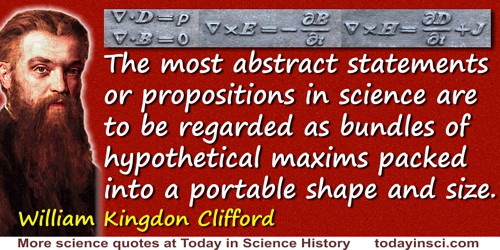
The most abstract statements or propositions in science are to be regarded as bundles of hypothetical maxims packed into a portable shape and size. Every scientific fact is a short-hand expression for a vast number of practical directions: if you want so-and-so, do so-and-so.
In 'On The Scientific Basis of Morals', Contemporary Review (Sep 1875), collected in Leslie Stephen and Frederick Pollock (eds.), Lectures and Essays: By the Late William Kingdon Clifford, F.R.S. (1886), 289.
The most distinct and beautiful statement of any truth [in science] must take at last the mathematical form.
A Week on the Concord and Merrimack Rivers (1862), 381.
The Nubians never remember the native name for a river; thus their statements are of little value to geographical criticism. Hence they never speak of the River Bah or Ibba, for example, but always say the “Penio’s river,” because this is the name of the district head whose seat is on this river. In other places they are quite helpless…. This is a dreadful fact. Were the well-traveled and well-informed Arab leaders able to remember the names of the rivers, it would be wonderfully easy to draw a map of the entire country.
In August Petermann, Petermann’s Geographische Mittheilungen (1871), 137. As quoted and cited in Kathrin Fritsch, '"You Have Everything Confused And Mixed Up…!" Georg Schweinfurth, Knowledge And Cartography Of Africa In The 19th Century', History in Africa (2009), 36, 92.
The observations we make in everyday life as well as the more systematic observations of science reveal certain repetitions or regularities in the world. Day always follows night; the seasons repeat themselves in the same order; fire always feels hot; objects fall when we drop them; and so on. The laws of science are nothing more than statements expressing these regularities as precisely as possible.
In An Introduction to the Philosophy of Science (1966, 1995), 3.
The old saying of the two kinds of truth. To the one kind belongs statements so simple and clear that the opposite assertion obviously could not be defended. The other kind, the so-called “deep truths”, are statements in which the opposite also contains deep truth.
Niels Bohr, 'Discussion with Einstein on Epistemological Problems in Atomic Physics', in P. A. Schilpp (ed.), Albert Einstein: Philosopher-Scientist (1949), 240.
The old scientific ideal of episteme — of absolutely certain, demonstrable knowledge — has proved to be an idol. The demand for scientific objectivity makes it inevitable that every scientific statement must remain tentative for ever. (1959)
The Logic of Scientific Discovery: Logik Der Forschung (1959, 2002), 280.
The only ethical principle which has made science possible is that the truth shall be told all the time. If we do not penalize false statements made in error, we open up the way for false statements by intention. And a false statement of fact, made deliberately, is the most serious crime a scientist can commit.
In The Search (1934, rev. ed. 1959), 273.
The only universal attribute of scientific statements resides in their potential fallibility. If a claim cannot be disproven, it does not belong to the enterprise of science.
Leonardo's Mountain of Clams and the Diet of Worms: Essays on Natural History (1998), 155.
The opposite of a correct statement is a false statement. But the opposite of a profound truth may well be another profound truth.
Webmaster has not yet found a primary source for this quote verbatim. However, it is very widely seen quoted in this wording, and seemingly always without a citation to the original source. Hans Bohr, the son of Niels Bohr, gives his first-hand knowledge that: “One of the favorite maxims of my father was the distinction between the two sorts of truth, profound truths recognized by the fact that the opposite is also a profound truth, in contrast to trivialities where opposites are obviously absurd.” (Webmaster has not been able to verify a source for that which cited it as Hans Bohr, My Father: His Life and Work (1967), 328. In any case, notice that the son’s narrative does not give his father’s words in quotation marks.
The publication in 1859 of the Origin of Species by Charles Darwin made a marked epoch in my own mental development, as it did in that of human thought generally. Its effect was to demolish a multitude of dogmatic barriers by a single stroke, and to arouse a spirit of rebellion against all ancient authorities whose positive and unauthenticated statements were contradicted by modern science.
Memories of My Life (1908), 287.
The question of relevance comes before that of truth, because to ask whether a statement is true or false presupposes that it is relevant (so that to try to assert the truth or falsity of an irrelevant statement is a form of confusion)...
From Wholeness and the Implicate Order (1980, 2002), 42.
The saying of Protagoras is like the views we have mentioned; he said that man is the measure of all things, meaning simply that that which seems to each man assuredly is. If this is so, it follows that the same thing both is and is not, and is bad and good, and that the contents of all other opposite statements are true, because often a particular thing appears beautiful to some and ugly to others, and that which appears to each man is the measure
Metaphysics, 1062b, 12- I 9. In Jonathan Barnes (ed.), The Complete Works of Aristotle (1984), Vol. 2, 1678.
The saying often quoted from Lord Kelvin… that “where you cannot measure your knowledge is meagre and unsatisfactory,” as applied in mental and social science, is misleading and pernicious. This is another way of saying that these sciences are not science in the sense of physical science and cannot attempt to be such without forfeiting their proper nature and function. Insistence on a concretely quantitative economics means the use of statistics of physical magnitudes, whose economic meaning and significance is uncertain and dubious. (Even wheat is approximately homogeneous only if measured in economic terms.) And a similar statement would even apply more to other social sciences. In this field, the Kelvin dictum very largely means in practice, “if you cannot measure, measure anyhow!”
'What is Truth' in Economics? (1956), 166.
The scientist knows very well that he is approaching ultimate truth only in an asymptotic curve and is barred from ever reaching it; but at the same time he is proudly aware of being indeed able to determine whether a statement is a nearer or a less near approach to the truth.
In On Aggression (1966, 2002), 279.
The second [argument about motion] is the so-called Achilles, and it amounts to this, that in a race the quickest runner can never overtake the slowest, since the pursuer must first reach the point whence the pursued started, so that the slower must always hold a lead.
Statement of the Achilles and the Tortoise paradox in the relation of the discrete to the continuous.; perhaps the earliest example of the reductio ad absurdum method of proof.
Statement of the Achilles and the Tortoise paradox in the relation of the discrete to the continuous.; perhaps the earliest example of the reductio ad absurdum method of proof.
— Zeno
Aristotle, Physics, 239b, 14-6. In Jonathan Barnes (ed.), The Complete Works of Aristotle (1984), Vol. 1, 404.
The Secretary of the Navy [Josephus Daniels] has decided that the science of aerial navigation has reached that point where aircraft must form a large part of our naval force for offensive and defensive operations. Nearly all countries having a Navy are giving attention to this subject. This country has not fully realized the value of aeronautics in preparation for war, but it is believed we should take our proper place.
Statement on the future of U.S. Naval Aviation made on the eve of World War I.
Statement on the future of U.S. Naval Aviation made on the eve of World War I.
News release, U.S. Navy Department, 10 Jan 1914. In Aviation in the United States Navy (1965), 5. In Kevin L. Falk, Why Nations Put to Sea (2000), 48.
The solution, as all thoughtful people recognize, must lie in properly melding the themes of inborn predisposition and shaping through life’s experiences. This fruitful joining cannot take the false form of percentages adding to 100–as in ‘intelligence is 80 percent nature and 20 percent nurture,’ or ‘homosexuality is 50 percent inborn and 50 percent learned,’ and a hundred other harmful statements in this foolish format. When two ends of such a spectrum are commingled, the result is not a separable amalgam (like shuffling two decks of cards with different backs), but an entirely new and higher entity that cannot be decomposed (just as adults cannot be separated into maternal and paternal contributions to their totality).
…...
The starting point of Darwin’s theory of evolution is precisely the existence of those differences between individual members of a race or species which morphologists for the most part rightly neglect. The first condition necessary, in order that any process of Natural Selection may begin among a race, or species, is the existence of differences among its members; and the first step in an enquiry into the possible effect of a selective process upon any character of a race must be an estimate of the frequency with which individuals, exhibiting any given degree of abnormality with respect to that, character, occur. The unit, with which such an enquiry must deal, is not an individual but a race, or a statistically representative sample of a race; and the result must take the form of a numerical statement, showing the relative frequency with which the various kinds of individuals composing the race occur.
Biometrika: A Joumal for the Statistical Study of Biological Problems (1901), 1, 1-2.
The statement that although the past can be recorded, the future cannot, is translatable into the statistical statement: Isolated states of order are always postinteraction states, never preinteraction states.
'18. Cause aud Effect: Producing and Recording—The Time Direction of Macrostatistics', in Hans Reichenbach and Maria Reichenbach (ed.), The Direction of Time (1956, 1991), 155.
The statement that there is no single scientific method has become a truism only rather recently.
In 'On the Duality and Growth of Physical Science', American Scientist (Jan 1953), 41, No. 1, 89.
The totality of our so-called knowledge or beliefs, from the most casual matters of geography and history to the profoundest laws of atomic physics or even of pure mathematics and logic, is a man-made fabric which impinges on experience only along the edges. Or, to change the figure, total science is like a field of force whose boundary conditions are experience. A conflict with experience at the periphery occasions readjustments in the interior of the field. Truth values have to be redistributed over some of our statements. Reevaluation of some statements entails reevaluation of others, because of their logical interconnections—the logical laws being in turn simply certain further statements of the system, certain further elements of the field.
'Two Dogmas of Experience,' in Philosophical Review (1951). Reprinted in From a Logical Point of View (1953), 42.
The universe is of the nature of a thought or sensation in a universal Mind… To put the conclusion crudely—the stuff of the world is mind-stuff. As is often the way with crude statements, I shall have to explain that by “mind” I do not exactly mean mind and by “stuff” I do not at all mean stuff. Still that is about as near as we can get to the idea in a simple phrase. The mind-stuff of the world is something more general than our individual conscious minds; but we may think of its nature as not altogether foreign to feelings in our consciousness… Having granted this, the mental activity of the part of world constituting ourselves occasions no great surprise; it is known to us by direct self-knowledge, and we do not explain it away as something other than we know it to be—or rather, it knows itself to be.
From Gifford Lecture, Edinburgh, (1927), 'Reality', collected in The Nature of the Physical World (1928), 276.
There can be no ultimate statements science: there can be no statements in science which can not be tested, and therefore none which cannot in principle be refuted, by falsifying some of the conclusions which can be deduced from them.
The Logic of Scientific Discovery (1959), 47.
There is nothing which Nature so clearly reveals, and upon which science so strongly insists, as the universal reign of law, absolute, universal, invariable law... Not one jot or tittle of the laws of Nature are unfulfilled. I do not believe it is possible to state this fact too strongly... Everything happens according to law, and, since law is the expression of Divine will, everything happens according to Divine will, i.e. is in some sense ordained, decreed.
Lecture 18, 'Predestination and Free-Will', Religion and Science: A Series of Sunday Lectures (1874), 278.
Those who have occasion to enter into the depths of what is oddly, if generously, called the literature of a scientific subject, alone know the difficulty of emerging with an unsoured disposition. The multitudinous facts presented by each corner of Nature form in large part the scientific man's burden to-day, and restrict him more and more, willy-nilly, to a narrower and narrower specialism. But that is not the whole of his burden. Much that he is forced to read consists of records of defective experiments, confused statement of results, wearisome description of detail, and unnecessarily protracted discussion of unnecessary hypotheses. The publication of such matter is a serious injury to the man of science; it absorbs the scanty funds of his libraries, and steals away his poor hours of leisure.
'Physiology, including Experimental Pathology and Experimental Physiology', Reports of the British Association for the Advancement of Science, 1899, 891-2.
Though the world does not change with a change of paradigm, the scientist afterward works in a different world... I am convinced that we must learn to make sense of statements that at least resemble these. What occurs during a scientific revolution is not fully reducible to a re-interpretation of individual and stable data. In the first place, the data are not unequivocally stable.
The Structure of Scientific Revolutions (1962), 120.
Thus a statement may be pseudoscientific even if it is eminently ‘plausible’ and everybody believes in it, and it may he scientifically valuable even if it is unbelievable and nobody believes in it. A theory may even be of supreme scientific value even if no one understands it, let alone believes it.
In Radio Lecture (30 Jun 1973) broadcast by the Open University, collected in Imre Lakatos, John Worrall (ed.) and Gregory Currie (ed.), 'Introduction: Science and Pseudoscience', The Methodology of Scientific Research Programmes (1978, 1980), Vol. 1, 1.
To a mind of sufficient intellectual power, the whole of mathematics would appear trivial, as trivial as the statement that a four-footed animal is an animal. (1959)
My Philosophical Development (1995), 207.
To give a causal explanation of an event means to deduce a statement which describes it, using as premises of the deduction one or more universal laws, together with certain singular statements, the initial conditions ... We have thus two different kinds of statement, both of which are necessary ingredients of a complete causal explanation. (1959)
The Logic of Scientific Discovery: Logik Der Forschung (1959, 2002), 38.
Truth and falsity, indeed understanding, is not necessarily something purely intellectual, remote from feelings and attitudes. ... It is in the total conduct of men rather than in their statements that truth or falsehood lives, more in what a man does, in his real reaction to other men and to things, in his will to do them justice, to live at one with them. Here lies the inner connection between truth and justice. In the realm of behavior and action, the problem recurs as to the difference between piece and part.
From 'On Truth', collected in Mary Henle (ed.), Documents of Gestalt Psychology (1961), 28.
Undoubtedly, the capstone of every mathematical theory is a convincing proof of all of its assertions. Undoubtedly, mathematics inculpates itself when it foregoes convincing proofs. But the mystery of brilliant productivity will always be the posing of new questions, the anticipation of new theorems that make accessible valuable results and connections. Without the creation of new viewpoints, without the statement of new aims, mathematics would soon exhaust itself in the rigor of its logical proofs and begin to stagnate as its substance vanishes. Thus, in a sense, mathematics has been most advanced by those who distinguished themselves by intuition rather than by rigorous proofs.
As quoted in Hermann Weyl, Unterrichtsblätter für Mathematik und Naturwissenschaften (1932), 38, 177-188. As translated by Abe Shenitzer, in 'Part I. Topology and Abstract Algebra as Two Roads of Mathematical Comprehension', The American Mathematical Monthly (May 1995), 102, No. 7, 453.
We are the intelligent elite among animal life on earth and whatever our mistakes, [Earth] needs us. This may seem an odd statement after … the way 20th century humans became almost a planetary disease organism. But it has taken [Earth] 2.5 billion years to evolve an animal that can think and communicate its thoughts. If we become extinct she has little chance of evolving another.
In The Vanishing Face of Gaia: A Final Warning (2010), 28.
We are told that “Mathematics is that study which knows nothing of observation, nothing of experiment, nothing of induction, nothing of causation.” I think no statement could have been made more opposite to the facts of the case; that mathematical analysis is constantly invoking the aid of new principles, new ideas, and new methods, not capable of being defined by any form of words, but springing direct from the inherent powers and activities of the human mind, and from continually renewed introspection of that inner world of thought of which the phenomena are as varied and require as close attention to discern as those of the outer physical world (to which the inner one in each individual man may, I think, be conceived to stand somewhat in the same relation of correspondence as a shadow to the object from which it is projected, or as the hollow palm of one hand to the closed fist which it grasps of the other), that it is unceasingly calling forth the faculties of observation and comparison, that one of its principal weapons is induction, that it has frequent recourse to experimental trial and verification, and that it affords a boundless scope for the exercise of the highest efforts of the imagination and invention.
In Presidential Address to British Association, Exeter British Association Report (1869), pp. 1-9, in Collected Mathematical Papers, Vol. 2, 654.
We have heard much about the poetry of mathematics, but very little of it has yet been sung. The ancients had a juster notion of their poetic value than we. The most distinct and beautiful statements of any truth must take at last the mathematical form.
In A Week on the Concord and Merrimack Rivers (1862), 381.
We regard as 'scientific' a method based on deep analysis of facts, theories, and views, presupposing unprejudiced, unfearing open discussion and conclusions. The complexity and diversity of all the phenomena of modern life, the great possibilities and dangers linked with the scientific-technical revolution and with a number of social tendencies demand precisely such an approach, as has been acknowledged in a number of official statements.
Progress, Coexistence and Intellectual Freedom (1968), 25.
Whatever be the detail with which you cram your student, the chance of his meeting in after life exactly that detail is almost infinitesimal; and if he does meet it, he will probably have forgotten what you taught him about it. The really useful training yields a comprehension of a few general principles with a thorough grounding in the way they apply to a variety of concrete details. In subsequent practice the men will have forgotten your particular details; but they will remember by an unconscious common sense how to apply principles to immediate circumstances. Your learning is useless to you till you have lost your textbooks, burnt your lecture notes, and forgotten the minutiae which you learned by heart for the examination. What, in the way of detail, you continually require will stick in your memory as obvious facts like the sun and the moon; and what you casually require can be looked up in any work of reference. The function of a University is to enable you to shed details in favor of principles. When I speak of principles I am hardly even thinking of verbal formulations. A principle which has thoroughly soaked into you is rather a mental habit than a formal statement. It becomes the way the mind reacts to the appropriate stimulus in the form of illustrative circumstances. Nobody goes about with his knowledge clearly and consciously before him. Mental cultivation is nothing else than the satisfactory way in which the mind will function when it is poked up into activity.
In 'The Rhythm of Education', The Aims of Education: & Other Essays (1917), 41.
Where should I start? Start from the statement of the problem. ... What can I do? Visualize the problem as a whole as clearly and as vividly as you can. ... What can I gain by doing so? You should understand the problem, familiarize yourself with it, impress its purpose on your mind.
How to Solve It: a New Aspect of Mathematical Method (1957), 33.
While reading in a textbook of chemistry, … I came across the statement, “nitric acid acts upon copper.” I was getting tired of reading such absurd stuff and I determined to see what this meant. Copper was more or less familiar to me, for copper cents were then in use. I had seen a bottle marked “nitric acid” on a table in the doctor’s office where I was then “doing time.” I did not know its peculiarities, but I was getting on and likely to learn. The spirit of adventure was upon me. Having nitric acid and copper, I had only to learn what the words “act upon” meant … I put one of them [cent] on the table, opened the bottle marked “nitric acid”; poured some of the liquid on the copper; and prepared to make an observation. But what was this wonderful thing which I beheld? The cent was already changed, and it was no small change either. A greenish blue liquid foamed and fumed over the cent and over the table. The air in the neighborhood of the performance became colored dark red. A great colored cloud arose. This was disagreeable and suffocating—how should I stop this? I tried to get rid of the objectionable mess by picking it up and throwing it out of the window, which I had meanwhile opened. I learned another fact—nitric acid not only acts upon copper but it acts upon fingers. The pain led to another unpremeditated experiment. I drew my fingers across my trousers and another fact was discovered. Nitric acid acts upon trousers. Taking everything into consideration, that was the most impressive experiment, and, relatively, probably the most costly experiment I have ever performed.
In F.H. Getman, The Life of Ira Remsen (1940), 9.
With the ministry’s motto ‘Research on a Shoestring’ emblazoned on his coat of arms, he has to struggle with a treasury more interested in surtax relief than national survival. [Responding to an earlier statement by British Science Minister, Lord Hailsham, that British scientists were being recruited by the U.S.]
Address at the Imperial College of Science and Technology, London (28 Feb 1963). In 'Hailsham Chided on Science's Role', New York Times (1 Mar 1963), 2. See also aron Hailsham's original statement using the link below.
Work done on any system of bodies (in Newton’s statement, the parts of any machine) has its equivalent in work done against friction, molecular forces, or gravity, if there be no acceleration; but if there be acceleration, part of the work is expended in overcoming the resistance to acceleration, and the additional kinetic energy developed is equivalent to the work so spent.
In William Thomson and Peter Guthrie Tait, Treatise on Natural Philosophy (1867), Vol. 1, 186.
You are surprised at my working simultaneously in literature and in mathematics. Many people who have never had occasion to learn what mathematics is confuse it with arithmetic and consider it a dry and arid science. In actual fact it is the science which demands the utmost imagination. One of the foremost mathematicians of our century says very justly that it is impossible to be a mathematician without also being a poet in spirit. It goes without saying that to understand the truth of this statement one must repudiate the old prejudice by which poets are supposed to fabricate what does not exist, and that imagination is the same as “making things up”. It seems to me that the poet must see what others do not see, and see more deeply than other people. And the mathematician must do the same.
In letter (1890), quoted in S. Kovalevskaya and Beatrice Stillman (trans. and ed.), Sofia Kovalevskaya: A Russian Childhood (2013), 35. Translated the Russian edition of Vospominaniya detstva (1974).
 In science it often happens that scientists say, 'You know that's a really good argument; my position is mistaken,' and then they would actually change their minds and you never hear that old view from them again. They really do it. It doesn't happen as often as it should, because scientists are human and change is sometimes painful. But it happens every day. I cannot recall the last time something like that happened in politics or religion.
(1987) --
In science it often happens that scientists say, 'You know that's a really good argument; my position is mistaken,' and then they would actually change their minds and you never hear that old view from them again. They really do it. It doesn't happen as often as it should, because scientists are human and change is sometimes painful. But it happens every day. I cannot recall the last time something like that happened in politics or religion.
(1987) -- 





