Star Quotes (464 quotes)
Starry Quotes
Starry Quotes
…at the stars,
Which are the brain of heaven, he look’d, and sank.
Around the ancient track marched, rank on rank,
The army of unalterable law.
Which are the brain of heaven, he look’d, and sank.
Around the ancient track marched, rank on rank,
The army of unalterable law.
In poem, 'Lucifer in Starlight', collected in Arthur Quiller-Couch (ed.), The Oxford Book of English Verse: 1250–1900 (1919), 942.
’Tis late; the astronomer in his lonely height
Exploring all the dark, descries from far
Orbs that like distant isles of splendor are,
And mornings whitening in the infinite.…
He summons one disheveled, wandering star,—
Return ten centuries hence on such a night.
That star will come. It dare not by one hour
Cheat science, or falsify her calculation;
Men will have passed, but watchful in the tower
Man shall remain in sleepless contemplation;
And should all men have perished there in turn,
Truth in their stead would watch that star’s return.
Exploring all the dark, descries from far
Orbs that like distant isles of splendor are,
And mornings whitening in the infinite.…
He summons one disheveled, wandering star,—
Return ten centuries hence on such a night.
That star will come. It dare not by one hour
Cheat science, or falsify her calculation;
Men will have passed, but watchful in the tower
Man shall remain in sleepless contemplation;
And should all men have perished there in turn,
Truth in their stead would watch that star’s return.
From poem, 'The Appointment', as translated by Arthur O’Shaughnessy, collected in Samuel Waddington (ed.), The Sonnets of Europe (1886), 154.
’Tis the witching hour of night,
Orbed is the moon and bright.
And the stars they glisten, glisten,
Seeming with bright eyes to listen-
For what listen they?
Orbed is the moon and bright.
And the stars they glisten, glisten,
Seeming with bright eyes to listen-
For what listen they?
From poem 'Prophecy', collected in The Complete Works of John Keats (1818). Vol. 2, 239.
“Arcturus” is his other name-
I’d rather call him “Star.”
It’s very mean of Science
To go and interfere!
I’d rather call him “Star.”
It’s very mean of Science
To go and interfere!
'Arcturus' (c.1859). The Complete Poems of Emily Dickinson, ed. Thomas H. Johnson (1970), 36.
[I attach] little importance to physical size. I don’t feel the least humble before the vastness of the heavens. The stars may be large, but they cannot think or love; and these are qualities which impress me far more than size does.
From a paper read to the Apostles, a Cambridge discussion society (1925). In 'The Foundations of Mathematics' (1925), collected in Frank Plumpton Ramsey and D. H. Mellor (ed.), Philosophical Papers (1990), Epilogue, 249. Citation to the paper, in Nils-Eric Sahlin, The Philosophy of F.P. Ramsey (1990), 225.
[I]magine you want to know the sex of your unborn child. There are several approaches. You could, for example, do what the late film star ... Cary Grant did before he was an actor: In a carnival or fair or consulting room, you suspend a watch or a plumb bob above the abdomen of the expectant mother; if it swings left-right it's a boy, and if it swings forward-back it's a girl. The method works one time in two. Of course he was out of there before the baby was born, so he never heard from customers who complained he got it wrong. ... But if you really want to know, then you go to amniocentesis, or to sonograms; and there your chance of being right is 99 out of 100. ... If you really want to know, you go to science.
In 'Wonder and Skepticism', Skeptical Enquirer (Jan-Feb 1995), 19, No. 1.
[In space] the stars don’t look bigger, but they do look brighter.
Interview conducted on Scholastic website (20 Nov 1998).
[O]ne might ask why, in a galaxy of a few hundred billion stars, the aliens are so intent on coming to Earth at all. It would be as if every vertebrate in North America somehow felt drawn to a particular house in Peoria, Illinois. Are we really that interesting?
Quoted in 'Do Aliens Exist in the Milky Way', PBS web page for WGBH Nova, 'Origins.'
[On the 11th day of November 1572], in the evening, after sunset, when, according to my habit, I was contemplating the stars in a clear sky, I noticed that a new and unusual star, surpassing all others in brilliancy, was shining almost directly over my head; and since I had, almost from boyhood, known all the stars of the heavens perfectly (there is no great difficulty in gaining that knowledge), it was quite evident to me that there had never before been any star in that place in the sky, even the smallest, to say nothing of a star so conspicuously bright as this. I was so astonished at this sight that I was not ashamed to doubt the trustworthiness of my own eyes. But when I observed that others, too, on having the place pointed out to them, could see that there was a star there, I had no further doubts. A miracle indeed, either the greatest of all that have occurred in the whole range of nature since the beginning of the world, or one certainly that is to be classed with those attested by the Holy Oracles.
De Stello. Nova (On the New Star) (1573). Quoted in H. Shapley and A. E. Howarth (eds.), Source Book in Astronomy (1929), 13.
[Otto Struve] made the remark once that he never looked at the spectrum of a star, any star, where he didn’t find something important to work on.
'Oral History Transcript: Dr. William Wilson Morgan' (8 Aug 1978) in the Niels Bohr Library & Archives.
[Science] is the literature of God written on the stars—the trees—the rocks—and more important because [of] its marked utilitarian character.
Quoted in Allan Peskin, Garfield: A Biography (1978), 57.
[T]here is little chance that aliens from two societies anywhere in the Galaxy will be culturally close enough to really 'get along.' This is something to ponder as you watch the famous cantina scene in Star Wars. ... Does this make sense, given the overwhelmingly likely situation that galactic civilizations differ in their level of evolutionary development by thousands or millions of years? Would you share drinks with a trilobite, an ourang-outang, or a saber-toothed tiger? Or would you just arrange to have a few specimens stuffed and carted off to the local museum?
Quoted in 'Do Aliens Exist in the Milky Way', PBS web page for WGBH Nova, 'Origins.'
[We] can easily distinguish what relates to Mathematics in any question from that which belongs to the other sciences. But as I considered the matter carefully it gradually came to light that all those matters only were referred to Mathematics in which order and measurements are investigated, and that it makes no difference whether it be in numbers, figures, stars, sounds or any other object that the question of measurement arises. I saw consequently that there must be some general science to explain that element as a whole which gives rise to problems about order and measurement, restricted as these are to no special subject matter. This, I perceived was called “Universal Mathematics,” not a far-fetched asignation, but one of long standing which has passed into current use, because in this science is contained everything on account of which the others are called parts of Mathematics.
Rules for the Direction of the Mind (written 1628). As translated by Elizabeth Sanderson Haldane and George Robert Thomson Ross in The Philosophical Works of Descartes (1911, 1931), 13.
[Wernher von Braun] is a human leader whose eyes and thoughts have always been turned toward the stars. It would be foolish to assign rocketry success to one person totally. Components must necessarily be the work of many minds; so must successive stages of development. But because Wernher von Braun joins technical ability, passionate optimism, immense experience and uncanny organizing ability in the elusive power to create a team, he is the greatest human element behind today’s rocketry success
Quoted in 'Reach For The Stars', Time (17 Feb 1958), 71, 25.
[When I was a child] I grew up in Brooklyn, New York, and I was a street kid. … [T]here was one aspect of that environment that, for some reason, struck me as different, and that was the stars. … I could tell they were lights in the sky, but that wasn’t an explanation. I mean, what were they? Little electric bulbs on long black wires, so you couldn’t see what they were held up by? What were they? … My mother said to me, "Look, we’ve just got you a library card … get out a book and find the answer.” … It was in there. It was stunning. The answer was that the Sun was a star, except very far away. … The dazzling idea of a universe vast beyond imagining swept over me. … I sensed awe.
In 'Wonder and Skepticism', Skeptical Enquirer (Jan-Feb 1995), 19, No. 1.
[Describing the effects of over-indulgence in wine:]
But most too passive, when the blood runs low
Too weakly indolent to strive with pain,
And bravely by resisting conquer fate,
Try Circe's arts; and in the tempting bowl
Of poisoned nectar sweet oblivion swill.
Struck by the powerful charm, the gloom dissolves
In empty air; Elysium opens round,
A pleasing frenzy buoys the lightened soul,
And sanguine hopes dispel your fleeting care;
And what was difficult, and what was dire,
Yields to your prowess and superior stars:
The happiest you of all that e'er were mad,
Or are, or shall be, could this folly last.
But soon your heaven is gone: a heavier gloom
Shuts o'er your head; and, as the thundering stream,
Swollen o'er its banks with sudden mountain rain,
Sinks from its tumult to a silent brook,
So, when the frantic raptures in your breast
Subside, you languish into mortal man;
You sleep, and waking find yourself undone,
For, prodigal of life, in one rash night
You lavished more than might support three days.
A heavy morning comes; your cares return
With tenfold rage. An anxious stomach well
May be endured; so may the throbbing head;
But such a dim delirium, such a dream,
Involves you; such a dastardly despair
Unmans your soul, as maddening Pentheus felt,
When, baited round Citheron's cruel sides,
He saw two suns, and double Thebes ascend.
But most too passive, when the blood runs low
Too weakly indolent to strive with pain,
And bravely by resisting conquer fate,
Try Circe's arts; and in the tempting bowl
Of poisoned nectar sweet oblivion swill.
Struck by the powerful charm, the gloom dissolves
In empty air; Elysium opens round,
A pleasing frenzy buoys the lightened soul,
And sanguine hopes dispel your fleeting care;
And what was difficult, and what was dire,
Yields to your prowess and superior stars:
The happiest you of all that e'er were mad,
Or are, or shall be, could this folly last.
But soon your heaven is gone: a heavier gloom
Shuts o'er your head; and, as the thundering stream,
Swollen o'er its banks with sudden mountain rain,
Sinks from its tumult to a silent brook,
So, when the frantic raptures in your breast
Subside, you languish into mortal man;
You sleep, and waking find yourself undone,
For, prodigal of life, in one rash night
You lavished more than might support three days.
A heavy morning comes; your cares return
With tenfold rage. An anxious stomach well
May be endured; so may the throbbing head;
But such a dim delirium, such a dream,
Involves you; such a dastardly despair
Unmans your soul, as maddening Pentheus felt,
When, baited round Citheron's cruel sides,
He saw two suns, and double Thebes ascend.
The Art of Preserving Health: a Poem in Four Books (2nd. ed., 1745), Book IV, 108-110.
[Of the Laputans:] They have likewise discovered two lesser stars, or satellites, which revolve about Mars, whereof the innermost is distant from the centre of the primary planet exactly three of his diameters, and the outermost five; the former revolves in the space of ten hours, and the latter in twenty one and a half.
Gulliver's Travels (1726, Penguin ed. 1967), Part III, Chap. 3, 213.
Ath. There still remain three studies suitable for freemen. Calculation in arithmetic is one of them; the measurement of length, surface, and depth is the second; and the third has to do with the revolutions of the stars in reference to one another … there is in them something that is necessary and cannot be set aside, … if I am not mistaken, [something of] divine necessity; for as to the human necessities of which men often speak when they talk in this manner, nothing can be more ridiculous than such an application of the words.
Cle. And what necessities of knowledge are there, Stranger, which are divine and not human?
Ath. I conceive them to be those of which he who has no use nor any knowledge at all cannot be a god, or demi-god, or hero to mankind, or able to take any serious thought or charge of them.
Cle. And what necessities of knowledge are there, Stranger, which are divine and not human?
Ath. I conceive them to be those of which he who has no use nor any knowledge at all cannot be a god, or demi-god, or hero to mankind, or able to take any serious thought or charge of them.
— Plato
In Republic, Bk. 7, in Jowett, Dialogues of Plato (1897, 2010), Vol. 4, 331.
Ce qui est admirable, ce n'est pas que le champ des étoiles soit si vaste, c'est que l'homme l'ait mesuré.
The wonder is, not that the field of the stars is so vast, but that man has measured it.
The wonder is, not that the field of the stars is so vast, but that man has measured it.
The Garden of Epicurus (1894) translated by Alfred Allinson, in The Works of Anatole France in an English Translation (1920), 16.
Dogbert (gazing at night sky) No matter how bad the day is, the stars are always there.
Dilbert Actually, many of them burned out years ago, but their light is just now reaching earth.
DogbertThank you for shattering my comfortable misconception.
DilbertIt's the miracle of science.
Dilbert Actually, many of them burned out years ago, but their light is just now reaching earth.
DogbertThank you for shattering my comfortable misconception.
DilbertIt's the miracle of science.
Dilbert comic strip (21 Nov 1990).
Il est impossible de contempler le spectacle de l’univers étoilé sans se demander comment il s’est formé: nous devions peut-être attendre pour chercher une solution que nous ayons patiemment rassemblé les éléments …mais si nous étions si raisonnables, si nous étions curieux sans impatience, il est probable que nous n’avions jamais créé la Science et que nous nous serions toujours contentés de vivre notre petite vie. Notre esprit a donc reclamé impérieusement cette solution bien avant qu’elle fut mûre, et alors qu’il ne possédait que de vagues lueurs, lui permettant de la deviner plutôt que de l’attendre.
It is impossible to contemplate the spectacle of the starry universe without wondering how it was formed: perhaps we ought to wait, and not look for a solution until have patiently assembled the elements … but if we were so reasonable, if we were curious without impatience, it is probable we would never have created Science and we would always have been content with a trivial existence. Thus the mind has imperiously laid claim to this solution long before it was ripe, even while perceived in only faint glimmers—allowing us to guess a solution rather than wait for it.
It is impossible to contemplate the spectacle of the starry universe without wondering how it was formed: perhaps we ought to wait, and not look for a solution until have patiently assembled the elements … but if we were so reasonable, if we were curious without impatience, it is probable we would never have created Science and we would always have been content with a trivial existence. Thus the mind has imperiously laid claim to this solution long before it was ripe, even while perceived in only faint glimmers—allowing us to guess a solution rather than wait for it.
From Leçons sur les Hypothèses Consmogoniques (1913) as cited in D. Ter Haar and A.G.W. Cameron, 'Historical Review of Theories of the Origin of the Solar System', collected in Robert Jastrow and A. G. W. Cameron (eds.), Origin of the Solar System: Proceedings of a Conference Held at the Goddard Institute for Space Studies, New York, January 23-24, 1962, (1963), 3.
'Cosmogonical Hypotheses' (1913), collected in Harlow Shapley, Source Book in Astronomy, 1900-1950 (1960), 347.
Quand on demande à nos philosophes à quoi sert ce nombre prodigieux d’étoiles fixes, dont une partie suffirait pour faire ce qu’elles font toutes, ils vous répondent froidement qu’elles servent à leur réjouir la vue.
When our philosophers are asked what is the use of these countless myriads of fixed stars, of which a small part would be sufficient to do what they all do, they coolly tell us that they are made to give delight to their eyes.
When our philosophers are asked what is the use of these countless myriads of fixed stars, of which a small part would be sufficient to do what they all do, they coolly tell us that they are made to give delight to their eyes.
In 'Premier Soir', Entretiens Sur La Pluralité Des Mondes (1686, 1863), 29. French and translation in Craufurd Tait Ramage, Beautiful Thoughts from French and Italian Authors (1866), 117.
Quod est ante pedes nemo spectat: coeli scrutantur plagas.
No one sees what is before his feet: they scan the tracks of heaven.
No one sees what is before his feet: they scan the tracks of heaven.
In Jon R. Stone, The Routledge Dictionary of Latin Quotations (2005), 101.
Sic Itur Ad Astra
So we go to the stars.
So we go to the stars.
Motto from his family coat-of-arms, given by Louis XVI (Dec 1783) to Pierre Montgolfier in recognition of his sons’ successful balloon flight. Illustration in the French magazine Contemporaries (8 Feb 1903), No. 539. Another coat-of-arms illustration is in Raoul De Cazenove, Premiers Voyages Aeriens (1887), 24. The motto comes from Virgil, who wrote “Sic itur ad astra” in the Aeneid, Book 9, line 641, spoken by Apollo to Aeneas’s young son. Above translation using Google translate. The motto is used elsewhere (including over the gate at Edinburgh Castle), and has various similar translations, such as “We journey to the stars.”
~~[Dubious]~~ I demonstrate by means of philosophy that the earth is round, and is inhabited on all sides; that it is insignificantly small, and is borne through the stars.
Included here to add a caution. As quoted in Paul Lyle, The Abyss of Time: A Study in Geological Time and Earth History (2015), 38, citing Astronomia Nova (1609). Webmaster has not yet been able to find in a primary source, so cannot vouch for this quote. Can you help?
~~[Unverified]~~ The strongest affection and utmost zeal should, I think, promote the studies concerned with the most beautiful objects. This is the discipline that deals with the universe’s divine revolutions, the stars’ motions, sizes, distances, risings and settings . . . for what is more beautiful than heaven?
Seen spreading across the web, only in recent years. As yet, Webmaster cannot identify a trustworthy primary source, is therefore presently skeptical, and meanwhile labels the quote as unverified.
1066. … At that time, throughout all England, a portent such as men had never seen before was seen in the heavens. Some declared that the star was a comet, which some call “the long-haired star”: it first appeared on the eve of the festival of Letania Maior, that is on 24 April, and shone every night for a week.
In George Norman Garmonsway (ed., trans.), 'The Parker Chronicle', The Anglo-Saxon Chronicle (1953), 195. This translation from the original Saxon, is a modern printing of an ancient anthology known as The Anglo-Saxon Chronicle. Manuscript copies were held at various English monasteries. These copies of the Chronicle include content first recorded in the late 9th century. The monasteries continued independently updating these annals. This quote comes from a copy once owned by Matthew Parker, Archbishop of Canterbury. Known as the Winchester (or Parker) Chronicle, it is the oldest surviving manuscript.
1095 … Then after Easter on the eve of St. Ambrose, which is on 4 April [recte 3 April], almost everywhere in this country and almost the whole night, stars in very large numbers were seen to fall from heaven, not by ones or twos, but in such quick succession that they could not be counted.
In The Anglo-Saxon Chronicle, as translated in The Anglo-Saxon Chronicle, Issue 1624 (1975), 230. The Chronicle is the work of many successive hands at several monasteries across England. For the date recorded, This meteor shower could have been a display of the Lyrids (according to The Starseeker, reprinted in O. Vrazell, 'Astronomical Observations in the Anglo Saxon Chronicle', Journal of the Royal Astronomical Society of Canada Newsletter (Aug 1984), 78, 57.
1097 … Then at Michaelmas, on the 4th before the Nones of October, an uncommon star appeared shining in the evening, and soon going down: it was seen in the south-west, and the light which streamed from it seemed very long, shining towards the south-east; and it appeared after this manner nearly all the week. Many allowed that it was a comet.
From the The Anglo-Saxon Chronicle as translated in The Venerable Bede's Ecclesiastical History of England. Also the Anglo-Saxon Chronicle (1894), 474. The Chronicle is the work of many successive hands at several monasteries across England.
1106. … In the first week of Lent, on the Friday, 16 February, a strange star appeared in the evening, and for a long time afterwards was seen shining for a while each evening. The star made its appearance in the south-west, and seemed to be small and dark, but the light that shone from it was very bright, and appeared like an enormous beam of light shining north-east; and one evening it seemed as if the beam were flashing in the opposite direction towards the star. Some said that they had seen other unknown stars about this time, but we cannot speak about these without reservation, because we did not ourselves see them.
In George Norman Garmonsway (ed., trans.), 'The Parker Chronicle', The Anglo-Saxon Chronicle (1953), 240. This translation from the original Saxon, is a modern printing of an ancient anthology known as The Anglo-Saxon Chronicle. Manuscript copies were held at various English monasteries. These copies of the Chronicle include content first recorded in the late 9th century. This quote comes from the copy known as the Peterborough Chronicle (a.k.a. Laud manuscript).
A bit of mould is a pleiad of flowers; a nebula is an ant-hill of stars.
Victor Hugo and Charles E. Wilbour (trans.), Les Misérables (1862), 41.
A hundred years ago, Auguste Compte, … a great philosopher, said that humans will never be able to visit the stars, that we will never know what stars are made out of, that that's the one thing that science will never ever understand, because they're so far away. And then, just a few years later, scientists took starlight, ran it through a prism, looked at the rainbow coming from the starlight, and said: “Hydrogen!” Just a few years after this very rational, very reasonable, very scientific prediction was made, that we'll never know what stars are made of.
Quoted in Nina L. Diamond, Voices of Truth (2000), 332.
A lodestone is a wonderful thing in very many experiments, and like living things. And one of its remarkable virtues in that which the ancients considered to be a living soul in the sky, in the globes and in the stars, in the sun and in the moon.
In De Magnete. Cited in Gerrit L. Verschuur, Hidden Attraction (1996), 19.
A monument to Newton! a monument to Shakespeare! Look up to Heaven—look into the Human Heart. Till the planets and the passions–the affections and the fixed stars are extinguished—their names cannot die.
In 'Noctes Ambrosianae: XXV' (Jun 1830), The Works of Professor Wilson of the University of Edinburgh: Noctes Ambrosianae (1865), Vol. 3, 55.
A Russian with eyes on the stars,
Tsiolkovsky dreamed past the Mars,
With math as his guide,
He took in his stride,
To sketch out space voyages afar.
Tsiolkovsky dreamed past the Mars,
With math as his guide,
He took in his stride,
To sketch out space voyages afar.
Limerick created by Artificial Intelligence from: “Write a limerick about K.E. Tsiolkovsky, Russian pioneer space theorist,” and only two words tweaked by Webmaster (17 Sep 2023).
A scientist can discover a new star but he cannot make one. He would have to ask an engineer to do it for him.
The Design of Design (1969), 1
A single ray of light from a distant star falling upon the eye of a tyrant in bygone times, may have altered the course of his life, may have changed the destiny of nations, may have transformed the surface of the globe, so intricate, so inconceivably complex are the processes of nature.
Lecture (Feb 1893) delivered before the Franklin Institute, Philadelphia, 'On Light and Other High Frequency Phenomena,' collected in Thomas Commerford Martin and Nikola Tesla, The Inventions, Researches and Writings of Nikola Tesla (1894), 298.
A star is drawing on some vast reservoir of energy by means unknown to us. This reservoir can scarcely be other than the subatomic energy which, it is known exists abundantly in all matter; we sometimes dream that man will one day learn how to release it and use it for his service. The store is well nigh inexhaustible, if only it could be tapped. There is sufficient in the Sun to maintain its output of heat for 15 billion years.
Address to the British Association in Cardiff, (24 Aug 1920), in Observatory (1920), 43 353. Reprinted in Foreward to Arthur S. Eddington, The Internal Constitution of the Stars (1926, 1988), x.
A star shines on the hour of our meeting.
Elvish greeting, "The Lord of the Rings"
A thorough advocate in a just cause, a penetrating mathematician facing the starry heavens, both alike bear the semblance of divinity
In Wilhelm Meister, Wanderjahre, Zweites Buch, in 'Sprüche in Prosa' Natur, VI, 947.
A tree is beautiful, but what’s more, it has a right to life; like water, the sun and the stars, it is essential. Life on earth is inconceivable without trees. Forests create climate, climate influences peoples’ character, and so on and so forth. There can be neither civilization nor happiness if forests crash down under the axe, if the climate is harsh and severe, if people are also harsh and severe. ... What a terrible future!
In letter to A.S. Suvorin (18 Oct 1888).
According to the Boshongo people of central Africa, in the beginning, there was only darkness, water, and the great god Bumba. One day Bumba, in pain from a stomach ache, vomited up the sun. The sun dried up some of the water, leaving land. Still in pain, Bumba vomited up the moon, the stars, and then some animals. The leopard, the crocodile, the turtle, and finally, man. This creation myth, like many others, tries to answer the questions we all ask. Why are we here? Where did we come from?
Lecture (1987), 'The Origin of the Universe', collected in Black Holes And Baby Universes And Other Essays (1993), 99.
Accordingly the primordial state of things which I picture is an even distribution of protons and electrons, extremely diffuse and filling all (spherical) space, remaining nearly balanced for an exceedingly long time until its inherent instability prevails. We shall see later that the density of this distribution can be calculated; it was about one proton and electron per litre. There is no hurry for anything to begin to happen. But at last small irregular tendencies accumulate, and evolution gets under way. The first stage is the formation of condensations ultimately to become the galaxies; this, as we have seen, started off an expansion, which then automatically increased in speed until it is now manifested to us in the recession of the spiral nebulae.
As the matter drew closer together in the condensations, the various evolutionary processes followed—evolution of stars, evolution of the more complex elements, evolution of planets and life.
As the matter drew closer together in the condensations, the various evolutionary processes followed—evolution of stars, evolution of the more complex elements, evolution of planets and life.
The Expanding Universe (1933), 56-57.
After a duration of a thousand years, the power of astrology broke down when, with Copernicus, Kepler, and Galileo, the progress of astronomy overthrew the false hypothesis upon which the entire structure rested, namely the geocentric system of the universe. The fact that the earth revolves in space intervened to upset the complicated play of planetary influences, and the silent stars, related to the unfathomable depths of the sky, no longer made their prophetic voices audible to mankind. Celestial mechanics and spectrum analysis finally robbed them of their mysterious prestige.
Franz Cumont, translated by J.B. Baker, Astrology and Religion Among the Greeks and Romans (1912, 2007), 6.
All of my life, I have been fascinated by the big questions that face us, and have tried to find scientific answers to them. If, like me, you have looked at the stars, and tried to make sense of what you see, you too have started to wonder what makes the universe exist.
From website for PBS program, Stephen Hawking's Universe (1997).
All of us Hellenes tell lies … about those great Gods, the Sun and the Moon… . We say that they, and diverse other stars, do not keep the same path, and we call them planets or wanderers. … Each of them moves in the same path-not in many paths, but in one only, which is circular, and the varieties are only apparent.
— Plato
In Plato and B. Jowett (trans.), The Dialogues of Plato: Laws (3rd ed., 1892), Vol. 5, 204-205.
All the old constellations had gone from the sky, however: that slow movement which is imperceptible in a hundred human lifetimes, had long since rearranged them in unfamiliar groupings. But the Milky Way, it seemed to me, was still the same tattered streamer of star-dust as of yore.
In The Time Machine (1898), 144.
Although gravity is by far the weakest force of nature, its insidious and cumulative action serves to determine the ultimate fate not only of individual astronomical objects but of the entire cosmos. The same remorseless attraction that crushes a star operates on a much grander scale on the universe as a whole.
In The Last Three Minutes (1994).
America has always been greatest when we dared to be great. We can reach for greatness again. We can follow our dreams to distant stars, living and working in space for peaceful, economic, and scientific gain. Tonight, I am directing NASA to develop a permanently manned space station and to do it within a decade.
From State of the Union Address (25 Jan 1984).
An attempt to study the evolution of living organisms without reference to cytology would be as futile as an account of stellar evolution which ignored spectroscopy.
'Foreword', in C.D. Darlington, Recent Advances in Cytology (1937), v.
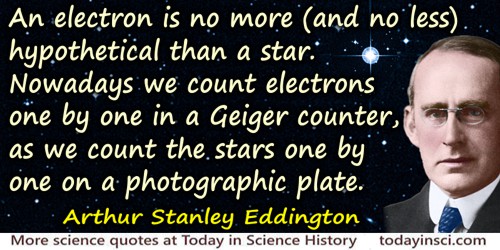
An electron is no more (and no less) hypothetical than a star. Nowadays we count electrons one by one in a Geiger counter, as we count the stars one by one on a photographic plate.
Messenger Lectures (1934), New Pathways in Science (1935), 21.
Anaximenes son of Eurystratus, of Miletus, was a pupil of Anaximander; some say he was also a pupil of Parmenides. He said that the material principle was air and the infinite; and that the stars move, not under the earth, but round it. He used simple and economical Ionic speech. He was active, according to what Apollodorus says, around the time of the capture of Sardis, and died in the 63rd Olympiad.
Diogenes Laertius 2.3. In G. S. Kirk, J. E. Raven and M. Schofield (eds), The Presocratic Philosophers: A Critical History with a Selection of Texts(1983), p. 143.
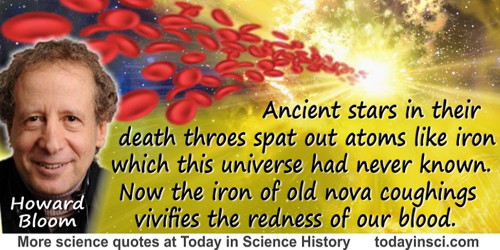
Ancient stars in their death throes spat out atoms like iron which this universe had never known. ... Now the iron of old nova coughings vivifies the redness of our blood.
Global Brain: The Evolution of Mass Mind from the Big Bang to the 21st century (2003), 223. Quoted in Rob Brezsny, Pronoia Is the Antidote for Paranoia (2005), 228.
And beyond our galaxy are other galaxies, in the universe all told at least a hundred billion, each containing a hundred billion stars. Do these figures mean anything to you?
In The Centaur (1990).
And from my pillow, looking forth by light
Of moon or favouring stars, I could behold
The antechapel where the statue stood
Of Newton with his prism and silent face,
The marble index of a mind for ever
Voyaging through strange seas of Thought, alone.
Of moon or favouring stars, I could behold
The antechapel where the statue stood
Of Newton with his prism and silent face,
The marble index of a mind for ever
Voyaging through strange seas of Thought, alone.
'Residence at Cambridge', The Prelude, or, Growth of a Poet's Mind: An Autobiographical Poem (1850), Book 3, 57-58.
And God said, Let there be lights in the firmament of the heavens to separate the day from the night; and let them be for signs and for seasons and for days and years, and let them be lights in the firmament of the heavens to give light upon the earth.” And it was so. And God made the two great lights, the greater light to rule the day, and the lesser light to rule the night; he made the stars also.
— Bible
(circa 725 B.C.)
And this grey spirit yearning in desire, To follow knowledge like a sinking star, beyond the utmost bound of human thought.
From poem, 'Ulysses', collected in The Complete Poetical Works of Tennyson (1909), Vol. 2, 89.
Aristotle ... imputed this symphony of the heavens ... this music of the spheres to Pythagorus. ... But Pythagoras alone of mortals is said to have heard this harmony ... If our hearts were as pure, as chaste, as snowy as Pythagoras' was, our ears would resound and be filled with that supremely lovely music of the wheeling stars.
'On the Music of the Spheres'. Second Prolusion. In John Milton and Merritt Yerkes Hughes (ed.), Complete Poems and Major Prose (1957, 2003), 603-604.
Art gallery? Who needs it? Look up at the swirling silver-lined clouds in the magnificent blue sky or at the silently blazing stars at midnight. How could indoor art be any more masterfully created than God’s museum of nature?
…...
As marvelous as the stars is the mind of the person who studies them.
Jr., in Voyage to the Great Attractor by Alan Dressier (1995).
As night approaches,
Moon shines upon.
Like a baby it sleeps,
With starry blanket on.
Moon shines upon.
Like a baby it sleeps,
With starry blanket on.
As pure truth is the polar star of our science [mathematics], so it is the great advantage of our science over others that it awakens more easily the love of truth in our pupils. … If Hegel justly said, “Whoever does not know the works of the ancients, has lived without knowing beauty,” Schellbach responds with equal right, “Who does not know mathematics, and the results of recent scientific investigation, dies without knowing truth.”
From Didaktik und Methodik des Rechnens und der Mathematik (1908), 37. As quoted and translated in J.W.A. Young, Teaching of Mathematics in the Elementary and the Secondary School (1907), 44. From the original German, “Wenn Hegel mit Recht sagt: ‘Wer die Werke der Alten nicht kennt, der hat gelebt, ohne die Schönheit gekannt zu haben’, so erwidert Schellbach mit nicht minderem Recht: ‘Wer die Math. und die Resultate der neueren Naturforschung nicht gekannt hat, der stirbt, ohne die Wahrheit zu kennen.’”
As soon … as it was observed that the stars retained their relative places, that the times of their rising and setting varied with the seasons, that sun, moon, and planets moved among them in a plane, … then a new order of things began.… Science had begun, and the first triumph of it was the power of foretelling the future; eclipses were perceived to recur in cycles of nineteen years, and philosophers were able to say when an eclipse was to be looked for. The periods of the planets were determined. Theories were invented to account for their eccentricities; and, false as those theories might be, the position of the planets could be calculated with moderate certainty by them.
Lecture delivered to the Royal Institution (5 Feb 1864), 'On the Science of History'. Collected in Notices of the Proceedings at the Meetings of the Members of the Royal Institution of Great Britain with Abstracts of the Discourses (1866), Vol. 4, 187.
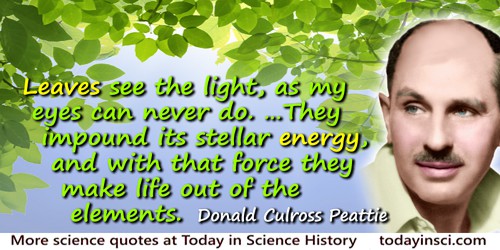
As the brain of man is the speck of dust in the universe that thinks, so the leaves—the fern and the needled pine and the latticed frond and the seaweed ribbon—perceive the light in a fundamental and constructive sense. … Their leaves see the light, as my eyes can never do. … They impound its stellar energy, and with that force they make life out of the elements.
In Flowering Earth (1939), 4.
As the race has advanced from the animal mind to savagery and then to science, the character it has ascribed to the stars, let us say, has undergone the most radical change, but hardly the character of the stars themselves.
In The Nature Of Thought Vol. 1 (1921), 425.
As the sun eclipses the stars by his brilliancy, so the man of knowledge will eclipse the fame of others in assemblies of the people if he proposes algebraic problems, and still more if he solves them.
In Florian Cajori, History of Mathematics (1893), 92.
As to what Simplicius said last, that to contend whether the parts of the Sun, Moon, or other celestial body, separated from their whole, should naturally return to it, is a vanity, for that the case is impossible, it being clear by the demonstrations of Aristotle that the celestial bodies are impassible, impenetrable, unpartable, etc., I answer that none of the conditions whereby Aristotle distinguishes the celestial bodies from the elementary has any foundation other than what he deduces from the diversity of their natural motions; so that, if it is denied that the circular motion is peculiar to celestial bodies, and affirmed instead that it is agreeable to all naturally moveable bodies, one is led by necessary confidence to say either that the attributes of generated or ungenerated, alterable or unalterable, partable or unpartable, etc., equally and commonly apply to all bodies, as well to the celestial as to the elementary, or that Aristotle has badly and erroneously deduced those from the circular motion which he has assigned to celestial bodies.
Dialogue on the Great World Systems (1632). Revised and Annotated by Giorgio De Santillana (1953), 45.
Astronomers = Moon Starers = No More Stars
— Anagram
From 'The Anagram Hall of Fame' on the wordsmith.org website.
Astronomers have built telescopes which can show myriads of stars unseen before; but when a man looks through a tear in his own eye, that is a lens which opens reaches into the unknown, and reveals orbs which no telescope, however skilfully constructed, could do.
Life Thoughts (1858), 20.
Astronomers tell us that there are about 1023 stars in the universe. That’s a meaningful number to chemists—an Avogadro number of potential solar systems of which between 1 and 50 percent are estimated to have planets. … Planets are plentiful—and from this fact we can begin our exploration of how life might have evolved on any one of them.
In 'Cosmochemistry The Earliest Evolution', The Science Teacher (Oct 1983), 50, No. 7, 34.
Astronomers work always with the past; because light takes time to move from one place to another, they see things as they were, not as they are.
The Telescope Handbook and Star Atlas (1967), 33.
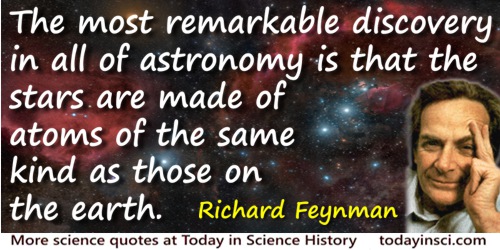
Astronomy is older than physics. In fact, it got physics started by showing the beautiful simplicity of the motion of the stars and planets, the understanding of which was the beginning of physics. But the most remarkable discovery in all of astronomy is that the stars are made of atoms of the same kind as those on the earth.
In 'Astronomy', The Feynman Lectures on Physics (1961), Vol. 1, 3-6.
Astronomy may be revolutionized more than any other field of science by observations from above the atmosphere. Study of the planets, the Sun, the stars, and the rarified matter in space should all be profoundly influenced by measurements from balloons, rockets, probes and satellites. ... In a new adventure of discovery no one can foretell what will be found, and it is probably safe to predict that the most important new discovery that will be made with flying telescopes will be quite unexpected and unforeseen. (1961)
Opening and closing of 'Flying Telescopes', Bulletin of the Atomic Scientists (May 1961), Vol. 17, No. 5, 191 and 194.
Astronomy was big science but not as big as high-energy physics, devoted to the exploration of the micro-universe. Any thorough account of the universe would have to explain why nature had mass-produced particles of certain kinds, wherewith to build atoms, stars, planets and living things. Looking deeply into matter required the most elaborate instruments ever conceived and engineered for scientific purposes.
In The Key to the Universe: Report on the New Physics (1977), 8.
Astronomy was thus the cradle of the natural sciences and the starting point of geometrical theories. The stars themselves gave rise to the concept of a ‘point’; triangles, quadrangles and other geometrical figures appeared in the constellations; the circle was realized by the disc of the sun and the moon. Thus in an essentially intuitive fashion the elements of geometrical thinking came into existence.
In George Edward Martin, The Foundations of Geometry and the Non-Euclidean Plane (1982), 72.
Astrophysicists have the formidable privilege of having the largest view of the Universe; particle detectors and large telescopes are today used to study distant stars, and throughout space and time, from the infinitely large to the infinitely small, the Universe never ceases to surprise us by revealing its structures little by little.
In Black Holes (1992), xv.
At terrestrial temperatures matter has complex properties which are likely to prove most difficult to unravel; but it is reasonable to hope that in the not too distant future we shall be competent to understand so simple a thing as a star.
The Internal Constitution of Stars, Cambridge. (1926, 1988), 393.
At the moment I am occupied by an investigation with Kirchoff which does not allow us to sleep. Kirchoff has made a totally unexpected discovery, inasmuch as he has found out the cause for the dark lines in the solar spectrum and can produce these lines artificially intensified both in the solar spectrum and in the continuous spectrum of a flame, their position being identical with that of Fraunhofer’s lines. Hence the path is opened for the determination of the chemical composition of the Sun and the fixed stars.
Letter to H.E. Roscoe (Nov 1859). In The Life and Experiences of Sir Henry Enfield Roscoe (1906), 81.
At the moment I am occupied by an investigation with Kirchoff which does not allow us to sleep. Kirchoff has made a totally unexpected discovery, inasmuch as he has found out the cause for the dark lines in the solar spectrum and can produce these lines artificially intensified both in the solar spectrum and in the continuous spectrum of a flame, their position being identical with that of Fraunhofer’s lines. Hence the path is opened for the determination of the chemical composition of the Sun and the fixed stars.
Letter to H.E. Roscoe (Nov 1859). In The Life and Experiences of Sir Henry Enfield Roscoe (1906), 71.
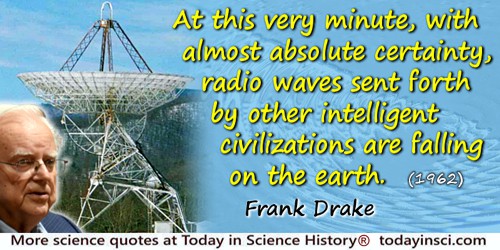
At this very minute, with almost absolute certainty, radio waves sent forth by other intelligent civilizations are falling on the earth. A telescope can be built that, pointed in the right place, and tuned to the right frequency, could discover these waves. Someday, from somewhere out among the stars, will come the answers to many of the oldest, most important, and most exciting questions mankind has asked.
In Intelligent Life in Space (1962), 111.
Be glad of life, because it gives you the chance to love and to work and to play and to look up at the stars.
…...
Before counting the stars have a look underfoot.
Attributed an “Oriental saying”, in a translation from the original Russian (1960), by David Sobolev of D.N. Trifonov and L.G. Vlasov, 107 Stories About Chemistry (1970), 215. New edition published as Silhouettes of Chemistry (1987), 196. Webmaster has so far found only this single source.
Between this body [the earth] and the heavens there are suspended, in this aerial spirit, seven stars, separated by determinate spaces, which, on account of their motion, we call wandering.
In The Natural History of Pliny (1855), Vol. 1, 19-20.
Beyond lonely Pluto, dark and shadowless, lies the glittering realm of interstellar space, the silent ocean that rolls on and on, past stars and galaxies alike, to the ends of the Universe. What do men know of this vast infinity, this shoreless ocean? Is it hostile or friendly–or merely indifferent?
…...
But in the heavens we discover by their light, and by their light alone, stars so distant from each other that no material thing can ever have passed from one to another; and yet this light, which is to us the sole evidence of the existence of these distant worlds, tells us also that each of them is built up of molecules of the same kinds as those which we find on earth. A molecule of hydrogen, for example, whether in Sirius or in Arcturus, executes its vibrations in precisely the same time. Each molecule, therefore, throughout the universe, bears impressed on it the stamp of a metric system as distinctly as does the metre of the Archives at Paris, or the double royal cubit of the Temple of Karnac ... the exact quantity of each molecule to all others of same kind gives it, as Sir John Herschel has well said, the essential character of a manufactured article and precludes the idea of its being external and self-existent.
'Molecules', 1873. In W. D. Niven (ed.), The Scientific Papers of James Clerk Maxwell (1890), Vol. 2, 375-6.
But that which will excite the greatest astonishment by far, and which indeed especially moved me to call the attention of all astronomers and philosophers, is this: namely, that I have observed four planets, neither known nor observed by any one of the astronomers before my time, which have their orbits round a certain bright star [Jupiter], one of those previously known, like Venus or Mercury round the sun, and are sometimes in front of it, sometimes behind it, though they never depart from it beyond certain limits. All of which facts were discovered and observed a few days ago by the help of a telescope devised by me, through God’s grace first enlightening my mind.
In pamphlet, The Sidereal Messenger (1610), reprinted in The Sidereal Messenger of Galileo Galilei: And a Part of the Preface to the Preface to Kepler's Dioptrics Containing the Original Account of Galileo's Astronomical Discoveries (1880), 9.
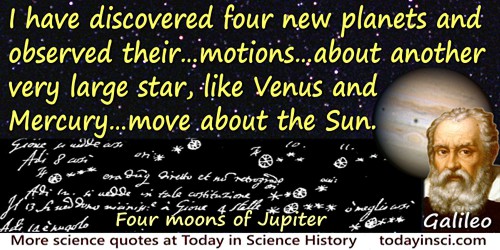
But what exceeds all wonders, I have discovered four new planets and observed their proper and particular motions, different among themselves and from the motions of all the other stars; and these new planets move about another very large star [Jupiter] like Venus and Mercury, and perchance the other known planets, move about the Sun. As soon as this tract, which I shall send to all the philosophers and mathematicians as an announcement, is finished, I shall send a copy to the Most Serene Grand Duke, together with an excellent spyglass, so that he can verify all these truths.
Letter to the Tuscan Court, 30 Jan 1610. Quoted in Albert van Heiden (ed.), Siderius Nuncius or The Sidereal Messenger (1989), 18.
By death the moon was gathered in Long ago, ah long ago;
Yet still the silver corpse must spin
And with another's light must glow.
Her frozen mountains must forget
Their primal hot volcanic breath,
Doomed to revolve for ages yet,
Void amphitheatres of death.
And all about the cosmic sky,
The black that lies beyond our blue,
Dead stars innumerable lie,
And stars of red and angry hue
Not dead but doomed to die.
Yet still the silver corpse must spin
And with another's light must glow.
Her frozen mountains must forget
Their primal hot volcanic breath,
Doomed to revolve for ages yet,
Void amphitheatres of death.
And all about the cosmic sky,
The black that lies beyond our blue,
Dead stars innumerable lie,
And stars of red and angry hue
Not dead but doomed to die.
'Cosmic Death' (1923), in The Captive Shrew and Other Poems of a Biologist (1932), 30.
Come, my friends,
’Tis not too late to seek a newer world.
Push off, and sitting well in order smite
The sounding furrows; for my purpose holds
To sail beyond the sunset, and the baths
Of all the western stars, until I die.
’Tis not too late to seek a newer world.
Push off, and sitting well in order smite
The sounding furrows; for my purpose holds
To sail beyond the sunset, and the baths
Of all the western stars, until I die.
From poem, 'Ulysses', collected in Walter James Turner (ed.), Great Names: Being an Anthology of English & American Literature from Chaucer to Francis Thompson (1926), 198.
Consider now the Milky Way. Here also we see an innumerable dust, only the grains of this dust are no longer atoms but stars; these grains also move with great velocities, they act at a distance one upon another, but this action is so slight at great distances that their trajectories are rectilineal; nevertheless, from time to time, two of them may come near enough together to be deviated from their course, like a comet that passed too close to Jupiter. In a word, in the eyes of a giant, to whom our Suns were what our atoms are to us, the Milky Way would only look like a bubble of gas.
Science and Method (1908), trans. Francis Maitland (1914), 254-5.
Continuous as the stars that shine
And twinkle on the milky way,
They stretch’d in never-ending line
Along the margin of a bay:
Ten thousand saw I at a glance
Tossing their heads in sprightly dance.
And twinkle on the milky way,
They stretch’d in never-ending line
Along the margin of a bay:
Ten thousand saw I at a glance
Tossing their heads in sprightly dance.
Second verse of poem, 'I Wandered Lonely as a Cloud', In Poems: Including Lyrical Ballads: In two Volumes (1815), Vol. 1, 328.
Counting stars by candlelight all are dim but one is bright; the spiral light of Venus rising first and shining best, from the northwest corner of a brand-new crescent moon crickets and cicadas sing a rare and different tune.
Terrapin Station
Curiosity that inborn property of man, daughter of ignorance and mother of knowledge when wonder wakens our minds, has the habit, wherever it sees some extraordinary phenomenon of nature, a comet for example, a sun-dog, or a midday star, of asking straightway what it means.
In The New Science (3rd ed., 1744), Book 1, Para. 189, as translated by Thomas Goddard Bergin and Max Harold Fisch, The New Science of Giambattista Vico (1948), 64.
Distinguished from all the rest by its nearness to the earth, and by its white light, and by its long, curling tail, stood the tremendous brilliant comet of 1812,—the same which men thought presaged all manner of woes and the end of the world. … this glorious star which seemed…to have come flying with inconceivable swiftness through measureless space, straight toward the earth, there to strike like an enormous arrow, and remain in that one fate-designated spot upon the dark sky; and, pausing, raise aloft with monstrous force its curling tail, flashing and playing with white light, amid the countless other stars doomed to perish.
In Leo Tolstoy and Nathan Haskell Dole (trans.), War and Peace (1889), Vol. 2, 392. Also translated as “The radiant star which, after travelling in its orbit with inconceivable velocity through infinite space, seemed suddenly—like an arrow piercing the earth—to remain fast in one chosen spot in the black firmament, vigorously tossing up its tail, shining and playing with its white light and the countless other scintillating stars,” in Leo Tolstoy and Louise Shanks Maude, War and Peace: A Novel (1941), 252.
Do all the stars have systems of planets?
Movie character
Dreams are wishes cast upon stars, so catch a shining one ~ take your friend’s hand~ and hold on forever.
…...
Each science and law is … prospective and fruitful. Astronomy is not yet astronomy, whilst it only counts the stars in the sky. It must come nearer, and be related to men and their life.
From Notes to 'Progress of Culture' in The Complete Works of Ralph Waldo Emerson: Letters and Social Aims (1875, 1904), Vol. 8, 409.
Early Greek astronomers, derived their first knowledge from the Egyptians, and these from the Chaldeans, among whom the science was studied, at a very early period. Their knowledge of astronomy, which gave their learned men the name of Magi, wise men, afterwards degenerated into astrology, or the art of consulting the position of the stars to foretel events—and hence sprung the silly occupation of sooth saying, for which the Chaldeans were noted to a proverb, in later ages.
In Elements of Useful Knowledge (1806), Vol. 1, 8-9. Note “foretel” is as printed in this text.
Everything is determined … by forces over which we have no control. It is determined for the insect as well as the star. Human beings, vegetables, or cosmic dust—we all dance to a mysterious tune, intoned in the distance by an invisible piper.
In interview, George Sylvester Viereck, 'What Life Means to Einstein', The Saturday Evening Post (26 Oct 1929), 117.
Exits sun; enters moon.
This moon is never alone.
Stars are seen all around.
These twinklers do not make a sound.
The tiny ones shine from their place.
Mother moon watches with a smiling face.
Its light is soothing to the eyes.
Night’s darkness hides its face.
Cool and calm is its light.
Heat and sweat are never felt.
Some days, moon is not seen.
Makes kids wonder, where had it been?
Partial eclipse shades the moon.
In summers it does not arrive soon.
Beautiful is this milky ball.
It is the love of one and all.
This moon is never alone.
Stars are seen all around.
These twinklers do not make a sound.
The tiny ones shine from their place.
Mother moon watches with a smiling face.
Its light is soothing to the eyes.
Night’s darkness hides its face.
Cool and calm is its light.
Heat and sweat are never felt.
Some days, moon is not seen.
Makes kids wonder, where had it been?
Partial eclipse shades the moon.
In summers it does not arrive soon.
Beautiful is this milky ball.
It is the love of one and all.
…...
Facts may belong to the past history of mankind, to the social statistics of our great cities, to the atmosphere of the most distant stars, to the digestive organs of a worm, or to the life of a scarcely visible bacillus. It is not the facts themselves which form science, but the method in which they are dealt with.
From The Grammar of Science (1892), 15.
Fanatical ethnic or religious or national chauvinisms are a little difficult to maintain when we see our planet as a fragile blue crescent fading to become an inconspicuous point of light against a bastion and citadel of the stars.
Cosmos
Finally, from what we now know about the cosmos, to think that all this was created for just one species among the tens of millions of species who live on one planet circling one of a couple of hundred billion stars that are located in one galaxy among hundreds of billions of galaxies, all of which are in one universe among perhaps an infinite number of universes all nestled within a grand cosmic multiverse, is provincially insular and anthropocentrically blinkered. Which is more likely? That the universe was designed just for us, or that we see the universe as having been designed just for us?
…...
For all these years you were merely
A smear of light through our telescopes
On the clearest, coldest night; a hint
Of a glint, just a few pixels wide
On even your most perfectly-framed portraits.
But now, now we see you!
Swimming out of the dark - a great
Stone shark, your star-tanned skin pitted
And pocked, scarred after eons of drifting
Silently through the endless ocean of space.
Here on Earth our faces lit up as we saw
You clearly for the first time; eyes wide
With wonder we traced the strangely familiar
Grooves raked across your sides,
Wondering if Rosetta had doubled back to Mars
And raced past Phobos by mistake –
Then you were gone, falling back into the black,
Not to be seen by human eyes again for a thousand
Blue Moons or more. But we know you now,
We know you; you’ll never be just a speck of light again.
A smear of light through our telescopes
On the clearest, coldest night; a hint
Of a glint, just a few pixels wide
On even your most perfectly-framed portraits.
But now, now we see you!
Swimming out of the dark - a great
Stone shark, your star-tanned skin pitted
And pocked, scarred after eons of drifting
Silently through the endless ocean of space.
Here on Earth our faces lit up as we saw
You clearly for the first time; eyes wide
With wonder we traced the strangely familiar
Grooves raked across your sides,
Wondering if Rosetta had doubled back to Mars
And raced past Phobos by mistake –
Then you were gone, falling back into the black,
Not to be seen by human eyes again for a thousand
Blue Moons or more. But we know you now,
We know you; you’ll never be just a speck of light again.
…...
For it is owing to their wonder that men now both begin and at first began to philosophize; they wondered originally at the obvious difficulties, then advanced little by little and stated difficulties about the greater matters, e.g. about the phenomena of the moon and those of the sun and the stars, and about the genesis of the universe. And a man who is puzzled and wonders thinks himself ignorant (whence even the lover of myth is in a sense a lover of wisdom, for myth is composed of wonders); therefore since they philosophized in order to escape from ignorance, evidently they were pursuing science in order to know, and not for any utilitarian end. And this is confirmed by the facts; for it was when almost all the necessities of life and the things that make for comfort and recreation were present, that such knowledge began to be sought. Evidently then we do not seek it for the sake of any advantage; but as the man is free, we say, who exists for himself and not for another, so we pursue this as the only free science, for it alone exists for itself.
Metaphysics, 982b, 12-27. In Jonathan Baines (ed.), The Complete Works of Aristotle (1984), Vol. 2, 1554.
For many planet hunters, though, the ultimate goal is still greater (or actually, smaller) prey: terrestrial planets, like Earth, circling a star like the Sun. Astronomers already know that three such planets orbit at least one pulsar. But planet hunters will not rest until they are in sight of a small blue world, warm and wet, in whose azure skies and upon whose wind-whipped oceans shines a bright yellow star like our own.
…...
For nature is a perpetuall circulatory worker, generating fluids out of solids, and solids out of fluids, fixed things out of volatile, & volatile out of fixed, subtile out of gross, & gross out of subtile, Some things to ascend & make the upper terrestriall juices, Rivers and the Atmosphere; & by consequence others to descend for a Requitall to the former. And as the Earth, so perhaps may the Sun imbibe this spirit copiously to conserve his Shineing, & keep the Planets from recedeing further from him. And they that will, may also suppose, that this Spirit affords or carryes with it thither the solary fewell & materiall Principle of Light; And that the vast aethereall Spaces between us, & the stars are for a sufficient repository for this food of the Sunn and Planets.
Letter to Oldenburg (7 Dec 1675). In H. W. Turnbull (ed.), The Correspondence of Isaac Newton, 1661-1675 (1959), Vol. 1, 366.
Formerly one sought the feeling of the grandeur of man by pointing to his divine origin: this has now become a forbidden way, for at its portal stands the ape, together with other gruesome beasts, grinning knowingly as if to say: no further in this direction! One therefore now tries the opposite direction: the way mankind is going shall serve as proof of his grandeur and kinship with God. Alas this, too, is vain! At the end of this way stands the funeral urn of the last man and gravedigger (with the inscription “nihil humani a me alienum puto”). However high mankind may have evolved—and perhaps at the end it will stand even lower than at the beginning!— it cannot pass over into a higher order, as little as the ant and the earwig can at the end of its “earthly course” rise up to kinship with God and eternal life. The becoming drags the has-been along behind it: why should an exception to this eternal spectacle be made on behalf of some little star or for any little species upon it! Away with such sentimentalities!
Daybreak: Thoughts on the Prejudices of Morality (1881), trans. R. J. Hollingdale (1982), 32.
Forty years as an astronomer have not quelled my enthusiasm for lying outside after dark, staring up at the stars. It isn’t only the beauty of the night sky that thrills me. It’s the sense I have that some of those points of light—which ones I can’t even guess—are the home stars of beings not so different from us, daily cares and all, who look across space and wonder, just as we do.
In Frank Drake and Dava Sobel, Is Anyone Out There?: The Scientific Search for Extraterrestrial Intelligence (1992), 1.
Four elements, hydrogen, carbon, oxygen and nitrogen, also provide an example of the astonishing togetherness of our universe. They make up the “organic” molecules that constitute living organisms on a planet, and the nuclei of these same elements interact to generate the light of its star. Then the organisms on the planet come to depend wholly on that starlight, as they must if life is to persist. So it is that all life on the Earth runs on sunlight. [Referring to photosynthesis]
In lecture, 'Life and Mind in the Universe', versions of which George Wald delivered throughout the 1980s. On the website of his son, Elijah Wald, who states it was the last of his father’s major lectures.
From astronomy we find the east, west, south, and north, as well as the theory of the heavens, the equinox, solstice, and courses of the stars. If one has no knowledge of these matters, he will not be able to have any comprehension of the theory of sundials.
In De Architectura, Book 1, Chap 1, Sec. 10. As translated in Morris Hicky Morgan (trans.), Vitruvius: The Ten Books on Architecture (1914), 10.
From man or angel the great Architect did wisely to conceal, and not divulge his secrets to be scanned by them who ought rather admire; or if they list to try conjecture, he his fabric of the heavens left to their disputes, perhaps to move his laughter at their quaint opinions wide hereafter, when they come to model heaven calculate the stars, how they will wield the mighty frame, how build, unbuild, contrive to save appearances, how gird the sphere with centric and eccentric scribbled o’er, and epicycle, orb in orb.
Paradise Lost (1674, 1754), Book 8, 231.
Getting up too early is a vice habitual in horned owls, stars, geese, and freight trains. Some hunters acquire it from geese, and some coffee pots from hunters.
In 'Too Early', A Sand County Almanac, and Sketches Here and There (1949, 1987), 59.
God’s promises are like the stars; the darker the night the brighter they shine.
Quoted in Kim Lim (ed.), 1,001 Pearls of Spiritual Wisdom: Words to Enrich, Inspire, and Guide Your Life (2014), 153
Governments and parliaments must find that astronomy is one of the sciences which cost most dear: the least instrument costs hundreds of thousands of dollars, the least observatory costs millions; each eclipse carries with it supplementary appropriations. And all that for stars which are so far away, which are complete strangers to our electoral contests, and in all probability will never take any part in them. It must be that our politicians have retained a remnant of idealism, a vague instinct for what is grand; truly, I think they have been calumniated; they should be encouraged and shown that this instinct does not deceive them, that they are not dupes of that idealism.
In Henri Poincaré and George Bruce Halsted (trans.), The Value of Science: Essential Writings of Henri Poincare (1907), 84.
He saw virus particles shaped like snakes, in negative images. They were white cobras tangled among themselves, like the hair of Medusa. They were the face of nature herself, the obscene goddess revealed naked. This life form thing was breathtakingly beautiful. As he stared at it, he found himself being pulled out of the human world into a world where moral boundaries blur and finally dissolve completely. He was lost in wonder and admiration, even though he knew that he was the prey.
The Hot Zone
He telleth the number of stars; he calleth them all by their names.
— Bible
Psalms 147:4 in The Holy Bible (1746), 549.
Here are the most important pieces of advice that I’ve passed on to my children. One, remember to look up at the stars and not down at your feet. Two, never give up work. Work gives you meaning and purpose and life is empty without it. Three, if you are lucky enough to find love, remember it is rare and don’t throw it away.
From Interview with Diane Sawyer on ABC TV, World News Tonight (2010). As quoted in 'The Most Important Pieces of Advice Stephen Hawking Gave to his Children' (14 Mar 2018), on abcnews.go.com webpage.
Hidden within the vast spaces of the Milky Way are over a billion targets for the search for intelligent life. … A decision has to be made as to which stars should be the first objects of this search, … [But] only stars not much different from the sun are likely to support intelligent creatures. So the search should concentrate on … the nearest of these stars first, since the inverse square law indicates that signals from the closest stars would be the strongest received on the earth.
In Intelligent Life in Space (1962), 99-100.
Holding then to science with one hand—the left hand—we give the right hand to religion, and cry: ‘Open Thou mine eyes, that I may behold wondrous things, more wondrous than the shining worlds can tell.’ Obedient to the promise, religion does awaken faculties within us, does teach our eyes to the beholding of more wonderful things. Those great worlds blazing like suns die like feeble stars in the glory of the morning, in the presence of this new light. The soul knows that an infinite sea of love is all about it, throbbing through it, everlasting arms of affection lift it, and it bathes itself in the clear consciousness of a Father’s love.
…...
How hard to realize that every camp of men or beast has this glorious starry firmament for a roof! … In such places standing alone on the mountain-top it is easy to realize that whatever special nests we make—leaves and moss like the marmots and birds, or tents or piled stone—we all dwell in a house of one room—the world with the firmament for its roof—and are sailing the celestial spaces without leaving any track.
Journal Entry, written while camping on top of Quarry Mountain, seven or eight miles from the front of Muir Glacier, Alaska (18 Jul 1890). In John Muir and Linnie Marsh Wolfe (ed.), John of the Mountains: The Unpublished Journals of John Muir (1938, 1979), 321.
How peacefully he sleep!
Yet may his ever-questing spirit, freed at length
from all the frettings of this little world,
Wander at will among the uncharted stars.
Fairfield his name. Perchance celestial fields
disclosing long sought secrets of the past
Spread 'neath his enraptured gaze
And beasts and men that to his earthly sight
were merely bits of stone shall live again to
gladden those eager eyes.
o let us picture him—enthusiast—scientist—friend—
Seeker of truth and light through all eternity!
Yet may his ever-questing spirit, freed at length
from all the frettings of this little world,
Wander at will among the uncharted stars.
Fairfield his name. Perchance celestial fields
disclosing long sought secrets of the past
Spread 'neath his enraptured gaze
And beasts and men that to his earthly sight
were merely bits of stone shall live again to
gladden those eager eyes.
o let us picture him—enthusiast—scientist—friend—
Seeker of truth and light through all eternity!
New York Sun (13 Nov 1935). Reprinted in 'Henry Fairfield Osborn', Supplement to Natural History (Feb 1936), 37:2, 135. Bound in Kofoid Collection of Pamphlets on Biography, University of California.
How quickly do we grow accustomed to wonders. I am reminded of the Isaac Asimov story “Nightfall,” about the planet where the stars were visible only once in a thousand years. So awesome was the sight that it drove men mad. We who can see the stars every night glance up casually at the cosmos and then quickly down again, searching for a Dairy Queen.
…...
Humanity has the stars in its future, and that future is too important to be lost under the burden of juvenile folly and ignorant superstition.
In 'The Deadly Information', Introduction written by Asimov for James Randi, Flim-Flam (1982), xiii.
Humans ... would not exist but for the wreckage of spent stars. So you're made of detritus [from exploded stars]. Get over it. Or better yet, celebrate it. After all, what nobler thought can one cherish than that the universe lives within us all?
In Death by Black Hole: And Other Cosmic Quandaries (2007), 222.
I admit that the generation which produced Stalin, Auschwitz and Hiroshima will take some beating, but the radical and universal consciousness of the death of God is still ahead of us. Perhaps we shall have to colonise the stars before it is finally borne in upon us that God is not out there.
In Thomas Mann: a Critical Study (1971), 175.
I am afraid all we can do is to accept the paradox and try to accommodate ourselves to it, as we have done to so many paradoxes lately in modern physical theories. We shall have to get accustomed to the idea that the change of the quantity R, commonly called the 'radius of the universe', and the evolutionary changes of stars and stellar systems are two different processes, going on side by side without any apparent connection between them. After all the 'universe' is an hypothesis, like the atom, and must be allowed the freedom to have properties and to do things which would be contradictory and impossible for a finite material structure.
Kosmos (1932), 133.
I believe a blade of grass is no less than the journey-work of the stars.
In Leaves of Grass (1855), 34.
I believe as a matter of faith that the extension of space travel to the limits of the solar system will probably be accomplished in several decades, perhaps before the end of the century. Pluto is 4000 million miles from the sun. The required minimum launching velocity is about 10 miles per second and the transit time is 46 years. Thus we would have to make the velocity considerably higher to make the trip interesting to man. Travel to the stars is dependent on radically new discoveries in science and technology. The nearest star is 25 million million miles way and requires a travel time of more than four years at the speed of light. Prof. Dr. Ing. E. Sanger has speculated that velocities comparable with the speed of light might be attained in the next century, but such extrapolation of current technology is probably not very reliable.
In Popular Mechanics (Sep 1961), 262.
I call upon the scientific community in our country, those who gave us nuclear weapons, to turn their great talents now to the cause of mankind and world peace, to give us the means of rendering those nuclear weapons impotent and obsolete.
About his proposed Strategic Defense Initiative, later to be known as 'Star Wars.')
About his proposed Strategic Defense Initiative, later to be known as 'Star Wars.')
National address (23 Mar 1983)
I can assure you, reader, that in a very few hours, even during the first day, you will learn more natural philosophy about things contained in this book, than you could learn in fifty years by reading the theories and opinions of the ancient philosophers. Enemies of science will scoff at the astrologers: saying, where is the ladder on which they have climbed to heaven, to know the foundation of the stars? But in this respect I am exempt from such scoffing; for in proving my written reason, I satisfy sight, hearing, and touch: for this reason, defamers will have no power over me: as you will see when you come to see me in my little Academy.
The Admirable Discourses (1580), trans. Aurele La Rocque (1957), 27.
I can hear the sizzle of newborn stars, and know anything of meaning, of the fierce magic emerging here. I am witness to flexible eternity, the evolving past, and I know we will live forever, as dust or breathe in the face of stars, in the shifting pattern of winds.
In Secrets from the Center of the World (1989), 56.
I can never look now at the Milky Way without wondering from which of those banked clouds of stars the emissaries are coming. If you will pardon so commonplace a simile, we have broken the glass of the fire-alarm and have nothing to do but to wait. I do not think we will have to wait for long.
Concluding sentences of short story, 'The Sentinel', collected in Avon 10 Story Fantasy (Spring 1951), 1, No. 1, 47.
I conclude therefore that this star [Tycho’s supernova] is not some kind of comet or a fiery meteor, whether these be generated beneath the Moon or above the Moon, but that it is a star shining in the firmament itself—one that has never previously been seen before our time, in any age since the beginning of the world.
In De Stella Nova, as translated in Dagobert D. Runes, A Treasury of World Science (1962), 108.
I confess that Fermat’s Theorem as an isolated proposition has very little interest for me, for a multitude of such theorems can easily be set up, which one could neither prove nor disprove. But I have been stimulated by it to bring our again several old ideas for a great extension of the theory of numbers. Of course, this theory belongs to the things where one cannot predict to what extent one will succeed in reaching obscurely hovering distant goals. A happy star must also rule, and my situation and so manifold distracting affairs of course do not permit me to pursue such meditations as in the happy years 1796-1798 when I created the principal topics of my Disquisitiones arithmeticae. But I am convinced that if good fortune should do more than I expect, and make me successful in some advances in that theory, even the Fermat theorem will appear in it only as one of the least interesting corollaries.
In reply to Olbers' attempt in 1816 to entice him to work on Fermat's Theorem. The hope Gauss expressed for his success was never realised.
In reply to Olbers' attempt in 1816 to entice him to work on Fermat's Theorem. The hope Gauss expressed for his success was never realised.
Letter to Heinrich Olbers (21 Mar 1816). Quoted in G. Waldo Dunnington, Carl Friedrich Gauss: Titan of Science (2004), 413.
I do not find that any one has doubted that there are four elements. The highest of these is supposed to be fire, and hence proceed the eyes of so many glittering stars. The next is that spirit, which both the Greeks and ourselves call by the same name, air. It is by the force of this vital principle, pervading all things and mingling with all, that the earth, together with the fourth element, water, is balanced in the middle of space.
In The Natural History of Pliny (1855), Vol. 1, 18.
I do not study to understand the transit of the stars. My soul has never sought for responses from ghosts. I detest all sacrilegious rites.
Confessions [c.397], Book X, chapter 35 (56), trans. H. Chadwick (1991),212.
I feel it myself, the glitter of nuclear weapons. It is irresistible if you come to them as a scientist. To feel it’s there in your hands. To release the energy that fuels the stars. To let it do your bidding. And to perform these miracles, to lift a million tons of rock into the sky, it is something that gives people an illusion of illimitable power, and it is in some ways responsible for all our troubles, I would say, this is what you might call ‘technical arrogance’ that overcomes people when they see what they can do with their minds.
As quoted in Ian Sample, Massive: The Hunt for the God Particle (2010), 41, citing it as: The Day After Trinity, a documentary about the life and work of Robert Oppenheimer.
I feel the development of space should continue. It is of tremendous importance. … Along with this development of space, which is really a flowering of civilization toward the stars, you might say, we must protect the surface of the earth. That’s even more important. Our environment on the surface is where man lives.
In 'Reactions to Man’s Landing on the Moon Show Broad Variations in Opinions', The New York Times (21 Jul 1969), 6.
I got a four year scholarship to Harvard, and while I was there they wanted to groom me for work in the Star Wars program designing weapons ignited by hydrogen bombs. I didn't want to do that. I thought about how many scientists had died in World War II.
Quoted in Nina L. Diamond, Voices of Truth (2000), 326.
I grew up in Brooklyn, New York … a city neighborhood that included houses, lampposts, walls, and bushes. But with an early bedtime in the winter, I could look out my window and see the stars, and the stars were not like anything else in my neighborhood. [At age 5] I didn’t know what they were.
[At age 9] my mother … said to me, “You have a library card now, and you know how to read. Take the streetcar to the library and get a book on stars.” … I stepped up to the big librarian and asked for a book on stars. … I sat down and found out the answer, which was something really stunning.I found out that the stars are glowing balls of gas. I also found out that the Sun is a star but really close and that the stars are all suns except really far away I didn’t know any physics or mathematics at that time, but I could imagine how far you’d have to move the Sun away from us till it was only as bright as a star. It was in that library, reading that book, that the scale of the universe opened up to me. There was something beautiful about it.
At that young age, I already knew that I’d be very happy if I could devote my life to finding out more about the stars and the planets that go around them. And it’s been my great good fortune to do just that.
[At age 9] my mother … said to me, “You have a library card now, and you know how to read. Take the streetcar to the library and get a book on stars.” … I stepped up to the big librarian and asked for a book on stars. … I sat down and found out the answer, which was something really stunning.I found out that the stars are glowing balls of gas. I also found out that the Sun is a star but really close and that the stars are all suns except really far away I didn’t know any physics or mathematics at that time, but I could imagine how far you’d have to move the Sun away from us till it was only as bright as a star. It was in that library, reading that book, that the scale of the universe opened up to me. There was something beautiful about it.
At that young age, I already knew that I’d be very happy if I could devote my life to finding out more about the stars and the planets that go around them. And it’s been my great good fortune to do just that.
Quoted in interview with Jack Rightmyer, in 'Stars in His Eyes', Highlights For Children (1 Jan 1997). Ages as given in Tom Head (ed.), Conversations with Carl Sagan (2006), x.
I had a dream, which was not all a dream.
The bright sun was extinguish'd, and the stars
Did wander darkling in the eternal space,
Rayless, and pathless, and the icy earth
Swung blind and blackening in the moonless air;
Morn came, and went—and came, and brought no day.
The bright sun was extinguish'd, and the stars
Did wander darkling in the eternal space,
Rayless, and pathless, and the icy earth
Swung blind and blackening in the moonless air;
Morn came, and went—and came, and brought no day.
Darkness (1816), lines 1-6. In Jerome J. McGann (ed.), Lord Byron: The Complete Poetical Works (1986), Vol. 4, 40-1.
I have looked further into space than ever human being did before me. I have observed stars of which the light, it can be proved, must take two million years to reach the earth.
Having identified Uranus (1781), the first planet discovered since antiquity. Quoted in Constance Anne Lubbock, The Herschel Chronicle: the Life-story of William Herschel and his Sister, Caroline Herschel (1933), 336.
I have always played with the fancy that some contagion from outer space had been the seed of man. Our passionate preoccupation with the sky, the stars, and a God somewhere in outer space is a homing impulse. We are drawn back to where we came from.
Commenting on the first moon landing. In 'Reactions to Man’s Landing on the Moon Show Broad Variations in Opinions', The New York Times (21 Jul 1969), 6.
I have had [many letters] asking me,… how to start making a hobby out of astronomy. My answer is always the same. Do some reading, learn the basic facts, and then take a star-map and go outdoors on the first clear night so that you can begin learning the various stars and constellation patterns. The old cliche that ‘an ounce of practice is worth a ton of theory’ is true in astronomy, as it is in everything else.
From 'Introduction', The Amateur Astronomer (11th Ed., 1990), 1.
I have presented the periodic table as a kind of travel guide to an imaginary country, of which the elements are the various regions. This kingdom has a geography: the elements lie in particular juxtaposition to one another, and they are used to produce goods, much as a prairie produces wheat and a lake produces fish. It also has a history. Indeed, it has three kinds of history: the elements were discovered much as the lands of the world were discovered; the kingdom was mapped, just as the world was mapped, and the relative positions of the elements came to take on a great significance; and the elements have their own cosmic history, which can be traced back to the stars.
In The Periodic Kingdom: A Journey Into the Land of the Chemical Elements (1995), Preface, viii.
I have satisfied myself that the [cosmic] rays are not generated by the formation of new matter in space, a process which would be like water running up a hill. Nor do they come to any appreciable amount from the stars. According to my investigations the sun emits a radiation of such penetrative power that it is virtually impossible to absorb it in lead or other substances. ... This ray, which I call the primary solar ray, gives rise to a secondary radiation by impact against the cosmic dust scattered through space. It is the secondary radiation which now is commonly called the cosmic ray, and comes, of course, equally from all directions in space. [The article continues: The phenomena of radioactivity are not the result of forces within the radioactive substances but are caused by this ray emitted by the sun. If radium could be screened effectively against this ray it would cease to be radioactive, he said.]
Quoted in 'Tesla, 75, Predicts New Power Source', New York Times (5 Jul 1931), Section 2, 1.
I hear one day the word “mountain,” and I ask someone “what is a mountain? I have never seen one.”
I join others in discussions of mountains.
One day I see in a book a picture of a mountain.
And I decide I must climb one.
I travel to a place where there is a mountain.
At the base of the mountain I see there are lots of paths to climb.
I start on a path that leads to the top of the mountain.
I see that the higher I climb, the more the paths join together.
After much climbing the many paths join into one.
I climb till I am almost exhausted but I force myself and continue to climb.
Finally I reach the top and far above me there are stars.
I look far down and the village twinkles far below.
It would be easy to go back down there but it is so beautiful up here.
I am just below the stars.
I join others in discussions of mountains.
One day I see in a book a picture of a mountain.
And I decide I must climb one.
I travel to a place where there is a mountain.
At the base of the mountain I see there are lots of paths to climb.
I start on a path that leads to the top of the mountain.
I see that the higher I climb, the more the paths join together.
After much climbing the many paths join into one.
I climb till I am almost exhausted but I force myself and continue to climb.
Finally I reach the top and far above me there are stars.
I look far down and the village twinkles far below.
It would be easy to go back down there but it is so beautiful up here.
I am just below the stars.
…...
I just looked up at a fine twinkling star and thought that a voyager whom I know, now many a days’ sail from this coast, might possibly be looking up at that same star with me. The stars are the apexes of what triangles!
In Henry David Thoreau and Bradford Torrey (ed.), The Writings of Henry Thoreau: Journal: I: 1837-1846 (1906), 486.
I know too much; I have stuffed too many of the facts of History and Science into my intellectuals. My eyes have grown dim over books; believing in geological periods, cave-dwellers, Chinese Dynasties, and the fixed stars has prematurely aged me.
In 'The Burden', Trivia (1917,1921), 156.
I myself consider that gravity is merely a certain natural inclination with which parts are imbued by the architect of all things for gathering themselves together into a unity and completeness by assembling into the form of a globe. It is easy to believe that the Sun, Moon and other luminaries among the wandering stars have this tendency also, so that by its agency they retain the rounded shape in which they reveal themselves, but nevertheless go round their orbits in various ways. If then the Earth also performs other motions, as for example the one about the centre, they must necessarily be like those which are similarly apparent in many external bodies in which we find an annual orbit.
'Book One. Chapter IX. Whether several motions can be attributed to the Earth, and on the centre of the universe', in Copernicus: On the Revolutions of the Heavenly Spheres (1543), trans. A. M. Duncan (1976), 46.
I remember growing up thinking that astronauts and their job was the coolest thing you could possibly do... But I absolutely couldn’t identify with the people who were astronauts. I thought they were movie stars.
…...
I remember my father had a sermon he used to preach when we were in Florida, in which he gave a reference to the Southern Cross—about the stars, the colors, in the Southern Cross, which thrilled me very much. I must have been around 5 years old. ... Now, it turns out that the Southern Cross itself does have one red star, together with three blue ones.
'Oral History Transcript: Dr. William Wilson Morgan' (8 Aug 1978) in the Niels Bohr Library & Archives.
I see it fall.
So beautiful and light.
So very tranquil.
Untouchable in the night.
Pretty in white.
Like the stars at night.
The twinkle from the shine.
The cold from the sky.
With every footprint left.
Every snowman made.
With every snowflake fallen.
Unique in every way.
So beautiful and light.
So very tranquil.
Untouchable in the night.
Pretty in white.
Like the stars at night.
The twinkle from the shine.
The cold from the sky.
With every footprint left.
Every snowman made.
With every snowflake fallen.
Unique in every way.
…...
I see the moon like a clipped piece of silver. Like gilded bees the stars cluster round her.
In his dialogue 'The Critic As Artist', collected in Intentions (1891), 92.
I tell my students, with a feeling of pride that I hope they will share, that the carbon, nitrogen, and oxygen that make up ninety-nine per cent of our living substance were cooked in the deep interiors of earlier generations of dying stars. Gathered up from the ends of the universe, over billions of years, eventually they came to form, in part, the substance of our sun, its planets, and ourselves. Three billion years ago, life arose upon the earth. It is the only life in the solar system.
From speech given at an anti-war teach-in at the Massachusetts Institute of Technology, (4 Mar 1969) 'A Generation in Search of a Future', as edited by Ron Dorfman for Chicago Journalism Review, (May 1969).
I tell young people to reach for the stars. And I can't think of a greater high than you could possibly get than by inventing something.
From audio on MIT video '1999 Lemelson-MIT Lifetime Achievement Award Winner', on 'Innovative Lives: Stephanie Kwolek and Kevlar, The Wonder Fiber' on the Smithsonian website.
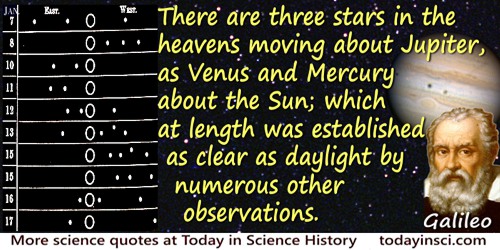
I therefore concluded, and decided unhesitatingly, that there are three stars in the heavens moving about Jupiter, as Venus and Mercury about the Sun; which at length was established as clear as daylight by numerous other observations.
Referring to his pioneering telescope observations.
Referring to his pioneering telescope observations.
The Starry Messenger (Mar 1610). Quoted in Edmund Blair Bolles, Galileo's Commandment (1999), 104.
I therefore took this opportunity and also began to consider the possibility that the Earth moved. Although it seemed an absurd opinion, nevertheless, because I knew that others before me had been granted the liberty of imagining whatever circles they wished to represent the phenomena of the stars, I thought that I likewise would readily be allowed to test whether, by assuming some motion of the Earth's, more dependable representations than theirs could be found for the revolutions of the heavenly spheres.
'To His Holiness Pope Paul III', in Copernicus: On the Revolutions of the Heavenly Spheres (1543), trans. A. M. Duncan (1976), 26.
I think it’s going to be great if people can buy a ticket to fly up and see black sky and the stars. I’d like to do it myself - but probably after it has flown a serious number of times first!
…...
I think there probably is life, maybe primitive life, in outer space. There might be very primitive life in our solar system—single-cell animals, that sort of thing. We may know the answer to that in five or ten years. There is very likely to be life in other solar systems, in planets around other stars. But we won’t know about that for a long time.
Interview conducted on Scholastic website (20 Nov 1998).
I wanted to be a scientist from my earliest school days. The crystallizing moment came when I first caught on that stars are mighty suns, and how staggeringly far away they must be to appear to us as mere points of light. I’m not sure I even knew the word science then, but I was gripped by the prospect of understanding how things work, of helping to uncover deep mysteries, of exploring new worlds.
In 'With Science on Our Side', Washington Post (9 Jan 1994).
I will give you a “celestial multiplication table.” We start with a star as the unit most familiar to us, a globe comparable to the sun. Then—
A hundred thousand million Stars make one Galaxy;
A hundred thousand million Galaxies make one Universe.
The figures may not be very trustworthy, but I think they give a correct impression.
A hundred thousand million Stars make one Galaxy;
A hundred thousand million Galaxies make one Universe.
The figures may not be very trustworthy, but I think they give a correct impression.
In The Expanding Universe (1933), 4.
I will not now discuss the Controversie betwixt some of the Modern Atomists, and the Cartesians; the former of whom think, that betwixt the Earth and the Stars, and betwixt these themselves there are vast Tracts of Space that are empty, save where the beams of Light do pass through them; and the later of whom tell us, that the Intervals betwixt the Stars and Planets (among which the Earth may perhaps be reckon'd) are perfectly fill'd, but by a Matter far subtiler than our Air, which some call Celestial, and others Æther. I shall not, I say, engage in this controversie, but thus much seems evident, That If there be such a Celestial Matter, it must ' make up far the Greatest part of the Universe known to us. For the Interstellar part of the world (If I may so stile it) bears so very great a proportion to the Globes, and their Atmospheres too, (If other Stars have any as well as the Earth,) that It Is almost incomparably Greater in respect of them, than all our Atmosphere is in respect of the Clouds, not to make the comparison between the Sea and the Fishes that swim in it.
A Continuation of New Experiments Physico-Mechanical, Touching the Spring and Weight of the Air, and their Effects (1669), 127.
I would liken science and poetry in their natural independence to those binary stars, often different in colour, which Herschel’s telescope discovered to revolve round each other. “There is one light of the sun,” says St. Paul, “and another of the moon, and another of the stars: star differeth from star in glory.” It is so here. That star or sun, for it is both, with its cold, clear, white light, is SCIENCE: that other, with its gorgeous and ever-shifting hues and magnificent blaze, is POETRY. They revolve lovingly round each other in orbits of their own, pouring forth and drinking in the rays which they exchange; and they both also move round and shine towards that centre from which they came, even the throne of Him who is the Source of all truth and the Cause of all beauty.
'The Alleged Antagonism between Poetry and Chemistry.' In Jesse Aitken Wilson, Memoirs of George Wilson. Quoted in Natural History Society of Montreal, 'Reviews and Notices of Books,' The Canadian Naturalist and Geologist (1861) Vol. 6, 393.
I’m just a speck, standing on this big planet. … The Earth is orbiting the Sun, and the Sun is a huge star. And our star may be a big deal to us, but, my friends, our star is just another speck. … It’s not really in downtown Milky Way, it’s way out on the side. … I'm a speck, living on a speck, orbiting a speck in the middle of specklessness. But … I have this brain … to think about all of this. To think about the vast emptiness of space. I can reason that I'm a speck on a speck in the middle of specklessness. And that’s cool. That’s worthy of respect.
— Bill Nye
From narration to PBS TV program, 'Astrobiology', The Eyes of Nye (2005), Ep. 1, Introduction before titles. Also seen quoted as: “We are just a speck, on a speck, orbiting a speck, in the corner of a speck, in the middle of nowhere.”
Ideas are like stars: You will not succeed in touching them with your hands, but like the seafaring man on the ocean desert of waters, you choose them as your guides, and following them, you reach your destiny.
…...
If a man would be alone, let him look at the stars. … One might think the atmosphere was made transparent with this design, to give man, in the heavenly bodies, the perpetual presence of the sublime.
In 'Nature', The Prose Works of Ralph Waldo Emerson (1870), Vol. 1, Chap 1, 7.
If a photographic plate under the center of a lens focused on the heavens is exposed for hours, it comes to reveal stars so far away that even the most powerful telescopes fail to reveal them to the naked eye. In a similar way, time and concentration allow the intellect to perceive a ray of light in the darkness of the most complex problem.
From Reglas y Consejos sobre Investigacíon Cientifica: Los tónicos de la voluntad. (1897), as translated by Neely and Larry W. Swanson, in Advice for a Young Investigator (1999), 34.
If common sense has not the brilliancy of the sun, it has the fixity of the stars.
In Hialmer Day Gould, New Practical Spelling (1905), 13.
If every man waz a genius, mankind would be az bad oph az the heavens would be, with every star a comet, things would git hurt badly, and noboddy tew blame.
In The Complete Works of Josh Billings (1876), 79.
If one might wish for impossibilities, I might then wish that my children might be well versed in physical science, but in due subordination to the fulness and freshness of their knowledge on moral subjects. ... Rather than have it the principal thing in my son's mind, I would gladly have him think that the sun went round the earth, and that the stars were so many spangles set in the bright blue firmament.
Letter to Dr. Greenhill (9 May 1836). In Arthur Penrhyn Stanley, The Life and Correspondence of Thomas Arnold (2nd Ed., 1846), 277.
If seeds in the black Earth can turn into such beautiful roses what might not the heart of man become in its long journey towards the stars?
As quoted in Maisie Ward, Return to Chesterton (1952), 161.
If the laws of physics and chemistry are universal, we can extrapolate the events of Earth’s chemical evolution to other planets and other stars and thus argue for the possibility of life beyond Earth.
In 'Cosmochemistry The Earliest Evolution', The Science Teacher (Oct 1983), 50, No. 7, 36.
If there is an underlying oneness of all things, it does not matter where we begin, whether with stars, or laws of supply and demand, or frogs, or Napoleon Bonaparte. One measures a circle, beginning anywhere.
Lo! (1931, 1941), 8.
If we consider what science already has enabled men to know—the immensity of space, the fantastic philosophy of the stars, the infinite smallness of the composition of atoms, the macrocosm whereby we succeed only in creating outlines and translating a measure into numbers without our minds being able to form any concrete idea of it—we remain astounded by the enormous machinery of the universe.
Address (10 Sep 1934) to the International Congress of Electro-Radio Biology, Venice. In Associated Press, 'Life a Closed Book, Declares Marconi', New York Times (11 Sep 1934), 15.
If we ever establish contact with intelligent aliens living on a planet around a distant star … They would be made of similar atoms to us. They could trace their origins back to the big bang 13.7 billion years ago, and they would share with us the universe's future. However, the surest common culture would be mathematics.
In 'Take Me to Your Mathematician', New Scientist (14 Feb 2009), 201, No. 2695.
If we long to believe that the stars rise and set for us, that we are the reason there is a Universe, does science do us a disservice in deflating our conceits
…...
If you ask me whether science has solved, or is likely to solve, the problem of this universe, I must shake my head in doubt. We have been talking of matter and force; but whence came matter, and whence came force? You remember the first Napoleon’s question, when the savans who accompanied him to Egypt discussed in his presence the problem of the universe, and solved it to their apparent satisfaction. He looked aloft to the starry heavens, and said—“It is all very well, gentlemen, but who made all these!” That question still remains unanswered, and science makes no attempt to answer it.
Lecture 'On Matter and Force', to nearly 3,000 working men, at the Dundee Meeting of the British Association for the Advancement of Science (Sep 1867), reported in 'Dundee Meeting, 1867', Chemical News and Journal of Physical Science (Nov 1867)
If you go far enough out you can see the Universe itself, all the billion light years summed up time only as a flash, just as lonely, as distant as a star on a June night if you go far enough out. And still, my friend, if you go far enough out you are only at the beginning of yourself.
…...
Ignorance may find a truth on its doorstep that erudition vainly seeks in the stars.
From chapter 'Jottings from a Note-book', in Canadian Stories (1918), 168.
In a certain sense I made a living for five or six years out of that one star [υ Sagittarii] and it is still a fascinating, not understood, star. It’s the first star in which you could clearly demonstrate an enormous difference in chemical composition from the sun. It had almost no hydrogen. It was made largely of helium, and had much too much nitrogen and neon. It’s still a mystery in many ways … But it was the first star ever analysed that had a different composition, and I started that area of spectroscopy in the late thirties.
Oral History Transcript of interview with Dr. Jesse Greenstein by Paul Wright (31 Jul 1974), on website of American Institute of Physics, about his research on strange shell stars. As quoted in J. B. Hearnshaw, The Analysis of Starlight: One Hundred and Fifty Years of Astronomical Spectroscopy (1986, 1990), 362. Hearnshaw footnoted that Berman earlier analysed the peculiar star R CrB (1935).
In a sense human flesh is made of stardust. Every atom in the human body, excluding only the primordial hydrogen atoms, was fashioned in stars that formed, grew old and exploded most violently before the Sun and Earth came into being.
In The Key to the Universe: Report on the New Physics (1977), 32-33.
In fields of air he writes his name,
And treads the chambers of the sky;
He reads the stars, and grasps the flame
That quivers in the realms on high.
And treads the chambers of the sky;
He reads the stars, and grasps the flame
That quivers in the realms on high.
In poem 'Art', collected in Samuel Kettell (ed.), Specimens of American Poetry, with Critical and Biographical Notices (1829), Vol. 3, 198.
In her starry shade
Of dim and solitary loveliness,
I learn the language of another world.
Of dim and solitary loveliness,
I learn the language of another world.
In man’s brain the impressions from outside are not merely registered; they produce concepts and ideas. They are the imprint of the external world upon the human brain. Therefore, it is not surprising that, after a long period of searching and erring, some of the concepts and ideas in human thinking should have come gradually closer to the fundamental laws of the world, that some of our thinking should reveal the true structure of atoms and the true movements of the stars. Nature, in the form of man, begins to recognize itself.
In Knowledge and Wonder (1962).
In my opinion the separation of the c- and ac-stars is the most important advancement in stellar classification since the trials by Vogel and Secchi ... To neglect the c-properties in classifying stellar spectra, I think, is nearly the same thing as if a zoologist, who has detected the deciding differences between a whale and a fish, would continue classifying them together.
Letter to Edward Pickering (22 Jul 1908). In Charles Coulston Gillespie (ed.), Dictionary of Scientific Biography (1974), Vol. 9, 194.
In some remote corner of the universe, poured out and glittering in innumerable solar systems, there once was a star on which clever animals invented knowledge. That was the haughtiest and most mendacious minute of ‘world history’—yet only a minute. After nature had drawn a few breaths the star grew cold, and the clever animals had to die. ... There have been eternities when [human intellect] did not exist; and when it is done for again, nothing will have happened.
…...
In the beginning there was an explosion. Not an explosion like those familiar on earth, starting from a definite center and spreading out to engulf more and more of the circumambient air, but an explosion which occurred simultaneously everywhere, filling all space from the beginning, with every particle of matter rushing apart from every other particle. ‘All space’ in this context may mean either all of an infinite universe, or all of a finite universe which curves back on itself like the surface of a sphere. Neither possibility is easy to comprehend, but this will not get in our way; it matters hardly at all in the early universe whether space is finite or infinite. At about one-hundredth of a second, the earliest time about which we can speak with any confidence, the temperature of the universe was about a hundred thousand million (1011) degrees Centigrade. This is much hotter than in the center of even the hottest star, so hot, in fact, that none of the components of ordinary matter, molecules, or atoms, or even the nuclei of atoms, could have held together. Instead, the matter rushing apart in this explosion consisted of various types of the so-called elementary particles, which are the subject of modern high energy nuclear physics.
The First Three Minutes: A Modern View of the Origin of the Universe (1977), 5.
In the fall of 1967, [I was invited] to a conference … on pulsars. … In my talk, I argued that we should consider the possibility that the center of a pulsar is a gravitationally completely collapsed object. I remarked that one couldn't keep saying “gravitationally completely collapsed object” over and over. One needed a shorter descriptive phrase. “How about black hole?” asked someone in the audience. I had been searching for the right term for months, mulling it over in bed, in the bathtub, in my car, whenever I had quiet moments. Suddenly this name seemed exactly right. When I gave a more formal Sigma Xi-Phi Beta Kappa lecture … on December 29, 1967, I used the term, and then included it in the written version of the lecture published in the spring of 1968. (As it turned out, a pulsar is powered by “merely” a neutron star, not a black hole.)
[Although John Wheeler is often identified as coining the term “black hole,” he in fact merely popularized the expression. In his own words, this is his explanation of the true origin: a suggestion from an unidentified person in a conference audience.]
[Although John Wheeler is often identified as coining the term “black hole,” he in fact merely popularized the expression. In his own words, this is his explanation of the true origin: a suggestion from an unidentified person in a conference audience.]
In Geons, Black Holes, and Quantum Foam (2000), 296-297.
In the firmament of science Mayer and Joule constitute a double star, the light of each being in a certain sense complementary to that of the other.
In Heat: A Mode of Motion (1800, 1915), 569.
In the first book I shall describe all the positions of the spheres, along with the motions which I attribute to the Earth, so that the book will contain as it were the general structure of the universe. In the remaining books I relate the motions of the remaining stars, and all the spheres, to the mobility of the Earth, so that it can be thence established how far the motions and appearances of the remaining stars and spheres can be saved, if they are referred to the motions of the Earth.
'To His Holiness Pope Paul III', in Copernicus: On the Revolutions of the Heavenly Spheres (1543), trans, A. M. Duncan (1976), 26.
In the heavens we discover [stars] by their light, and by their light alone ... the sole evidence of the existence of these distant worlds ... that each of them is built up of molecules of the same kinds we find on earth. A molecule of hydrogen, for example, whether in Sirius or in Arcturus, executes its vibrations in precisely the same time. Each molecule therefore throughout the universe bears impressed upon it the stamp of a metric system as distinctly as does the metre of the Archives at Paris, or the royal cubit of the Temple of Karnac.
[Footnote: Where Maxwell uses the term “molecule” we now use the term “atom.”]
[Footnote: Where Maxwell uses the term “molecule” we now use the term “atom.”]
Lecture to the British Association at Bradford (1873), 'Atoms and Molecules'. Quoted by Ernest Rutherford, in 'The Constitution of Matter and the Evolution of the Elements', The Popular Science Monthly (Aug 1915), 112.
In the month of August 678, in the eighth year of Egfrid’s reign, there appeared a star known as a comet, which remained visible for three months, rising in the morning and emitting what seemed to be a tall column of bright flame.
— Bede
From Historia Ecclesiastica Gentis Anglorum, Book V, Chap. XXIII., as translated by Leo Sherley-Price, revised by R.E. Latham, Ecclesiastical History of the English People (1955, 1990), 224.
In the moonlight
While drinking homemade wine
My sorrow hung heavy
And my heart felt like lead.
The moon was golden yellow
The night soft and mellow.
There was a smell of jasmine
All around.
And I felt the weight of the world
Upon my shoulders.
I looked at the twinkling stars in the sky
So far and wide
Here’s to you
I lifted my wine
And my eyes looked upon the brilliance
Of the moon and stars
From afar...
While drinking homemade wine
My sorrow hung heavy
And my heart felt like lead.
The moon was golden yellow
The night soft and mellow.
There was a smell of jasmine
All around.
And I felt the weight of the world
Upon my shoulders.
I looked at the twinkling stars in the sky
So far and wide
Here’s to you
I lifted my wine
And my eyes looked upon the brilliance
Of the moon and stars
From afar...
…...
In the pure mathematics we contemplate absolute truths which existed in the divine mind before the morning stars sang together, and which will continue to exist there when the last of their radiant host shall have fallen from heaven.
From Address (22 Apr 1857) for Inauguration of Washington University, St. Louis, Missouri, collected in 'Academical Education', Orations and Speeches on Various Occasions (1870), Vol. 3, 514. This is seen misattributed to Eric Temple Bell, who only quoted it, attributing it to Everett, in for example, Mathematics: Queen and Servant of Sciences (1938), 20.
In the streets of a modern city the night sky is invisible; in rural districts, we move in cars with bright headlights. We have blotted out the heavens, and only a few scientists remain aware of stars and planets, meteorites and comets.
In 'On Comets', collected in In Praise of Idleness and Other Essays (1935), 224.
In the vast cosmical changes, the universal life comes and goes in unknown quantities ... sowing an animalcule here, crumbling a star there, oscillating and winding, ... entangling, from the highest to the lowest, all activities in the obscurity of a dizzying mechanism, hanging the flight of an insect upon the movement of the earth... Enormous gearing, whose first motor is the gnat, and whose last wheel is the zodiac.
Victor Hugo and Charles E. Wilbour (trans.), Les Misérables (1862), 41.
In the year of chan yan..., Jupiter was in [the Zodiacal Division of] Zi, it rose in the morning and went under in the evening together with the Lunar Mansions Xunu, Xu and Wei. It was very large and bright. Apparently, there was a small reddish (chi) star appended (fu) to its side. This is called “an alliance” (tong meng).
— Gan De
As given in Chinese Astronomy and Astrophysics (1981), 5, 242.
In the year of our Lord’s incarnation 678, which is the eighth of the reign of Egfrid, in the month of August, appeared a star, called a comet, which continued for three months, rising in the morning, and darting out, as it were, a pillar of radiant flame.
— Bede
From Historia Ecclesiastica Gentis Anglorum: The Ecclesiastical History of the English Nation, Book IV, Chap. XII, as translated in J.A. Giles (ed.), The Miscellaneous Works of Venerable Bede (1843), Vol. 3, 57.
In this great celestial creation, the catastrophy of a world, such as ours, or even the total dissolution of a system of worlds, may possibly be no more to the great Author of Nature, than the most common accident in life with us, and in all probability such final and general Doomsdays may be as frequent there, as even Birthdays or mortality with us upon the earth. This idea has something so cheerful in it, that I know I can never look upon the stars without wondering why the whole world does not become astronomers; and that men endowed with sense and reason should neglect a science they are naturally so much interested in, and so capable of enlarging their understanding, as next to a demonstration must convince them of their immortality, and reconcile them to all those little difficulties incident to human nature, without the least anxiety. All this the vast apparent provision in the starry mansions seem to promise: What ought we then not to do, to preserve our natural birthright to it and to merit such inheritance, which alas we think created all to gratify alone a race of vain-glorious gigantic beings, while they are confined to this world, chained like so many atoms to a grain of sand.
In The Universe and the Stars: Being an Original Theory on the Visible Creation, Founded on the Laws of Nature (1750, 1837), 132.
In this lecture I would like to conclude with … some characteristics [of] gravity … The most impressive fact is that gravity is simple. It is simple to state the principles completely and not have left any vagueness for anybody to change the ideas of the law. It is simple, and therefore it is beautiful. It is simple in its pattern. I do not mean it is simple in its action—the motions of the various planets and the perturbations of one on the other can be quite complicated to work out, and to follow how all those stars in a globular cluster move is quite beyond our ability. It is complicated in its actions, but the basic pattern or the system beneath the whole thing is simple. This is common to all our laws; they all turn out to be simple things, although complex in their actual actions.
In 'The Law of Gravitation, as Example of Physical Law', the first of his Messenger Lectures (1964), Cornell University. Collected in The Character of Physical Law (1967), 33-34.
Infidels are intellectual discoverers. They sail the unknown seas and find new isles and continents in the infinite realms of thought. An Infidel is one who has found a new fact, who
has an idea of his own, and who in the mental sky has seen another star. He is an intellectual capitalist, and for that reason excites the envy and hatred of the theological pauper.
In 'The Great Infidels', The Works of Robert G. Ingersoll (1902), Vol. 3, 309.
Isn’t it marvelous how those scientists know the names of all those stars?
…...
It is because simplicity and vastness are both beautiful that we seek by preference simple facts and vast facts; that we take delight, now in following the giant courses of the stars, now in scrutinizing the microscope that prodigious smallness which is also a vastness, and now in seeking in geological ages the traces of a past that attracts us because of its remoteness.
…...
It is better to trust in the Rock of Ages, than to know the age of the rocks; it is better for one to know that he is close to the Heavenly Father, than to know how far the stars in the heavens are apart.
In chapter, 'The Origin of Man', In His Image (1922), 93.
It is fair to say that astronomy is still just about the only science in which the amateur can make valuable contributions today, and in which the work is welcomed by professionals. For example, amateurs search for new comets and ‘new stars’ or novae, and since they generally know the sky much better than their professional colleagues they have a fine record of success. Routinely, they keep watch on objects such as variable stars, and they monitor the surfaces of the planets in a way that professionals have neither the time nor the inclination to do.
From 'Introduction', The Amateur Astronomer (11th Ed., 1990), 1-2.
It is impossible not to feel stirred at the thought of the emotions of man at certain historic moments of adventure and discovery—Columbus when he first saw the Western shore, Pizarro when he stared at the Pacific Ocean, Franklin when the electric spark came from the string of his kite, Galileo when he first turned his telescope to the heavens. Such moments are also granted to students in the abstract regions of thought, and high among them must be placed the morning when Descartes lay in bed and invented the method of co-ordinate geometry.
Quoted in James Roy Newman, The World of Mathematics (2000), Vol. 1, 239.
President Clinton at the Human Genome Announcement at the White House (20 Jun 2000), with Francis S. Collins (left) and Craig Ventner. (source)
It is now conceivable that our children's children will know the term cancer only as a constellation of stars. [Speaking on the Human Genome Project's progress.]
From White House Announcement of the Completion of the First Survey of the Entire Human Genome Project, broadcast on the day of the publication of the first draft of the human genome. Quoted in transcript on the National Archives, Clinton White House web site, 'Text of Remarks on the Completion of the First Survey of the Entire Human Genome Project' (26 Jun 2000).
It is of priceless value to the human race to know that the sun will supply the needs of the earth, as to light and heat, for millions of years; that the stars are not lanterns hung out at night, but are suns like our own; and that numbers of them probably have planets revolving around them, perhaps in many cases with inhabitants adapted to the conditions existing there. In a sentence, the main purpose of the science is to learn the truth about the stellar universe; to increase human knowledge concerning our surroundings, and to widen the limits of intellectual life.
In 'The Nature of the Astronomer’s Work', North American Review (Jun 1908), 187, No. 631, 915.
It is reported of Margaret Fuller that she said she accepted the universe. “Gad, she'd better!” retorted Carlyle. Carlyle himself did not accept the universe in a very whole-hearted manner. Looking up at the midnight stars, he exclaimed: “A sad spectacle! If they be inhabited, what a scope for misery and folly; if they be na inhabited, what a waste of space!”
Opening paragraph of book of collected essays, Accepting the Universe (1920), 3. “‘I accept the universe’ is reported to have been a favorite utterance of our New England transcendentalist, Margaret Fuller…” was stated by William James in The Varieties of Religious Experience (1902), 41. James continues, “and when some one repeated this phrase to Thomas Carlyle, his sardonic comment is said to have been: ‘Gad! she'd better!’” Note that James does not here merge Carlyle's remark about the universe. Burroughs’ attribution of the “sad spectacle” quote is, so far, the earliest found by the Webmaster, who has not located it in a printed work by Carlisle himself. If you know a primary source, or earlier attribution, please contact Webmaster.
It is said that such inedible animals as star-fish take up about 80 per cent of the nutrients in the North Sea.
In 'Man Explores the Sea', Journal of the Royal Society of Arts (Sep 1963), 111, No. 5086, 789.
It is said that Thales of Miletus, who was the first of the Greeks to devote himself to the study of the stars, was on one occasion so intent upon observing the heavens that he fell into a well, whereupon a maidservant laughed and remarked, “In his zeal for things in the sky he does
not see what is at his feet.”
— Thales
Apocryphal story, as given in Richard A. Gregory, Discovery: Or, The Spirit and Service of Science (1916), 21.
It is that range of biodiversity that we must care for—the whole thing—rather than just one or two stars.
From BBC interview. As cited in Bruce L. Smith, Stories from Afield: Adventures with Wild Things in Wild (2016), 185.
It is unlikely that we will ever see a star being born. Stars are like animals in the wild. We may see the very young, but never their actual birth, which is a veiled and secret event. Stars are born inside thick clouds of dust and gas in the spiral arms of the galaxy, so thick that visible light cannot penetrate them.
Perfect Symmetry: The Search for the Beginning of Time (1985), 44.
It is well to observe the force and virtue and consequence of discoveries, and these are to be seen nowhere more conspicuously than in those three which were unknown to the ancients, and of which the origins, although recent, are obscure and inglorious; namely, printing, gunpowder, and the magnet. For these three have changed the whole face and state of things throughout the world; the first in literature, the second in warfare, the third in navigation; whence have followed innumerable changes, insomuch that no empire, no sect, no star seems to have exerted greater power and influence in human affairs than these mechanical discoveries.
From Novum Organum (1620), Book 1, Aphorism 129. Translated as The New Organon: Aphorisms Concerning the Interpretation of Nature and the Kingdom of Man), collected in James Spedding, Robert Ellis and Douglas Heath (eds.), The Works of Francis Bacon (1857), Vol. 4, 114.
It may be that the old astrologers had the truth exactly reversed, when they believed that the stars controlled the destinies of men. The time may come when men control the destinies of stars.
The View from Serendip (1977), 79.
It may be true, that as Francis Thompson noted, ‘Thou canst not stir a flower without troubling a star’, but in computing the motion of stars and planets, the effects of flowers do not loom large. It is the disregarding of the effect of flowers on stars that allows progress in astronomy. Appropriate abstraction is critical to progress in science.
…...
It may truly be said that the eye as much touches the most distant star as that my fingers touch the pen with which I write.
In Sir William Withey Gull and Theodore Dyke Acland (ed.), A Collection of the Published Writings of William Withey Gull (1896), xlviii.
It must be borne in mind that the tragedy of life doesn’t lie in not reaching your goal. The tragedy lies in having no goal to reach. It isn’t a calamity to die with dreams unfulfilled, but it is a calamity not to dream. It is not a disaster to be unable to capture your idea, but it is disaster to have no idea to capture. It is not a disgrace not to reach for the stars, but it is a disgrace to have no stars to reach for. Not failure, but low aim is a sin.
…...
It seems to me that the evidence ... is opposed to the view that the spirals are individual galaxies comparable with our own. In fact, there appears as yet no reason for modifying the tentative hypothesis that the spirals are not composed of typical stars at all, but are truly nebulous objects.
[Contradicting the view of Heber Curtis during the Shapley-Curtis debate on 26 Apr 1920 to the National Academy of Sciences.]
[Contradicting the view of Heber Curtis during the Shapley-Curtis debate on 26 Apr 1920 to the National Academy of Sciences.]
In Aleksandr Sergeevich Sharov and Igor Dmitrievich Novikov, Edwin Hubble: The Discoverer of the Big Bang Universe (1993), 27.
It took less than an hour to make the atoms, a few hundred million years to make the stars and planets, but five billion years to make man!
In The Creation of the Universe (1952), 139.
It was an admirable reply of a converted astronomer, who, when interrogated concerning his comparative estimate of religion and the science he had formerly idolized, answered, 'I am now bound for heaven, and I take the stars in my way.'
In Tryon Edwards. A Dictionary of Thoughts (1908), 506.
It’s becoming clear that in a sense the cosmos provides the only laboratory where sufficiently extreme conditions are ever achieved to test new ideas on particle physics. The energies in the Big Bang were far higher than we can ever achieve on Earth. So by looking at evidence for the Big Bang, and by studying things like neutron stars, we are in effect learning something about fundamental physics.
From editted transcript of BBC Radio 3 interview, collected in Lewis Wolpert and Alison Richards, A Passion For Science (1988), 33.
John Young and Bob Crippen have made us very proud. Their deeds reminded us that we as a free people can accomplish whatever we set out to do. Nothing binds our abilities except our expectations, and, given that, the farthest star is within our reach.
At Oval Office ceremony (20 May 1981) awarding NASA Distinguished Service medals to Young and Crippen, and a Congressional Space Medal of Honor to Young.
Jupiter is the largest of all the solar system’s planets, more than ten times bigger and three hundred times as massive as Earth. Jupiter is so immense it could swallow all the other planets easily. Its Great Red Spot, a storm that has raged for centuries, is itself wider than Earth. And the Spot is merely one feature visible among the innumerable vortexes and streams of Jupiter’s frenetically racing cloud tops. Yet Jupiter is composed mainly of the lightest elements, hydrogen and helium, more like a star than a planet. All that size and mass, yet Jupiter spins on its axis in less than ten hours, so fast that the planet is clearly not spherical: Its poles are noticeably flattened. Jupiter looks like a big, colorfully striped beach ball that’s squashed down as if some invisible child were sitting on it. Spinning that fast, Jupiter’s deep, deep atmosphere is swirled into bands and ribbons of multihued clouds: pale yellow, saffron orange, white, tawny yellow-brown, dark brown, bluish, pink and red. Titanic winds push the clouds across the face of Jupiter at hundreds of kilometers per hour.
— Ben Bova
Jupiter
Jupiter was very large and bright. Apparently, there was a small reddish star appended to its side. This is called “an alliance.”
[Observation in summer 365 B.C., speculated to be of Ganymede.]
[Observation in summer 365 B.C., speculated to be of Ganymede.]
— Gan De
In the lost book Suixing Jing (Treatise on Jupiter), quoted in the extensive compilation Kaiyuan Zhanjing, (The Kaiyuan Treatise on Astrology (compiled 718-726). As given Helaine Selin, Encyclopaedia of the History of Science, Technology, and Medicine in Non-Western Cultures (1997), 342. It has been speculated that it was the moon Ganymede beside Jupiter, by Xi Zezong in 'The Discovery of Jupiter’s Satellite Made by Gan De 2000 years Before Galileo,' Chinese Physics (1982), 2, No. 3, 664–67.
Jupiter’s passed through Orion
And come into conjunction with Mars.
Saturn is wheeling through infinite space
To its preordained place in the stars.
And I gaze at the planets in wonder
At the trouble and time they spend,
All to warn me to be careful
In dealings involving a friend!
And come into conjunction with Mars.
Saturn is wheeling through infinite space
To its preordained place in the stars.
And I gaze at the planets in wonder
At the trouble and time they spend,
All to warn me to be careful
In dealings involving a friend!
Lyrics of 'Horoscope' from At the Drop of Another Hat, revue performance by Michael Flanders and Donald Swann (Haymarket Theatre, London, opened 2 Oct 1963), and on LP recording (released 1964).
Just as the spectroscope opened up a new astronomy by enabling the astronomer to determine some of the constituents of which distant stars are composed, so the seismograph, recording the unfelt motion of distant earthquakes, enables us to see into the earth and determine its nature with as great a certainty, up to a certain point, as if we could drive a tunnel through it and take samples of the matter passed through.
'The Constitution of the Interior of the Earth, as Revealed by Earthquakes', Quarterly Journal of the Geological Society (1906), 62, 456.
Large physical objects like stars consist of a rather limited array of parts, more or less haphazardly arranged. The behaviour of physical, nonbiological objects is so simple that it is feasible to use existing mathematical language to describe it, which is why physics books are full of mathematics.
In The Blind Watchmaker (1986, 1996), 2.
Learn to reverence night and to put away the vulgar fear of it, for, with the banishment of night from the experience of man, there vanishes as well a religious emotion, a poetic mood, which gives depth to the adventure of humanity. By day, space is one with the earth and with man - it is his sun that is shining, his clouds that are floating past; at night, space is his no more. When the great earth, abandoning day, rolls up the deeps of the heavens and the universe, a new door opens for the human spirit, and there are few so clownish that some awareness of the mystery of being does not touch them as they gaze. For a moment of night we have a glimpse of ourselves and of our world islanded in its stream of stars - pilgrims of mortality, voyaging between horizons across eternal seas of space and time. Fugitive though the instant be, the spirit of man is, during it, ennobled by a genuine moment of emotional dignity, and poetry makes its own both the human spirit and experience.
…...
Let both sides seek to invoke the wonders of science instead of its terrors. Together let us explore the stars, conquer the deserts, eradicate disease, tap the ocean depths, and encourage the arts and commerce.
From Inaugural Address (20 Jan 1961). As quoted in Elizabeth Sirimarco, The Cold War (2005), 45.
Let him look at that dazzling light hung aloft as an eternal lamp to lighten the universe; let him behold the earth, a mere dot compared with the vast circuit which that orb describes, and stand amazed to find that the vast circuit itself is but a very fine point compared with the orbit traced by the stars as they roll their course on high. But if our vision halts there, let imagination pass beyond; it will fail to form a conception long before Nature fails to supply material. The whole visible world is but an imperceptible speck in the ample bosom of Nature. No notion comes near it. Though we may extend our thought beyond imaginable space, yet compared with reality we bring to birth mere atoms. Nature is an infinite sphere whereof the centre is everywhere, the circumference nowhere. In short, imagination is brought to silence at the thought, and that is the most perceptible sign of the all-power of God.
Let man reawake and consider what he is compared with the reality of things; regard himself lost in this remote corner of Nature; and from the tiny cell where he lodges, to wit the Universe, weigh at their true worth earth, kingdoms, towns, himself. What is a man face to face with infinity?
Let man reawake and consider what he is compared with the reality of things; regard himself lost in this remote corner of Nature; and from the tiny cell where he lodges, to wit the Universe, weigh at their true worth earth, kingdoms, towns, himself. What is a man face to face with infinity?
Pensées (1670), Section 1, aphorism 43. In H. F. Stewart (ed.), Pascal’s Pensées (1950), 19.
Let me describe briefly how a black hole might be created. Imagine a star with a mass 10 times that of the sun. During most of its lifetime of about a billion years the star will generate heat at its center by converting hydrogen into helium. The energy released will create sufficient pressure to support the star against its own gravity, giving rise to an object with a radius about five times the radius of the sun. The escape velocity from the surface of such a star would be about 1,000 kilometers per second. That is to say, an object fired vertically upward from the surface of the star with a velocity of less than 1,000 kilometers per second would be dragged back by the gravitational field of the star and would return to the surface, whereas an object with a velocity greater than that would escape to infinity.
When the star had exhausted its nuclear fuel, there would be nothing to maintain the outward pressure, and the star would begin to collapse because of its own gravity. As the star shrank, the gravitational field at the surface would become stronger and the escape velocity would increase. By the time the radius had got down to 10 kilometers the escape velocity would have increased to 100,000 kilometers per second, the velocity of light. After that time any light emitted from the star would not be able to escape to infinity but would be dragged back by the gravitational field. According to the special theory of relativity nothing can travel faster than light, so that if light cannot escape, nothing else can either. The result would be a black hole: a region of space-time from which it is not possible to escape to infinity.
When the star had exhausted its nuclear fuel, there would be nothing to maintain the outward pressure, and the star would begin to collapse because of its own gravity. As the star shrank, the gravitational field at the surface would become stronger and the escape velocity would increase. By the time the radius had got down to 10 kilometers the escape velocity would have increased to 100,000 kilometers per second, the velocity of light. After that time any light emitted from the star would not be able to escape to infinity but would be dragged back by the gravitational field. According to the special theory of relativity nothing can travel faster than light, so that if light cannot escape, nothing else can either. The result would be a black hole: a region of space-time from which it is not possible to escape to infinity.
'The Quantum Mechanics of Black Holes', Scientific American, 1977, 236, 34-40.
Life, forever dying to be born afresh, forever young and eager, will presently stand upon this Earth as upon a footstool, and stretch out its realm amidst the stars.
…...
Like most fathers, by clear star-studded skies I used to take each of my two little boys in my arms for a glimpse at infinity. The splendor of the unreachable silenced their chatterboxes for a few seconds. They raised their arms and closed their little fingers in a futile attempt to grasp one of the twinkling sparks that dot our dreams. The little fellows obeyed the command reported by Ovid: “God elevated man's forehead and ordered him to contemplate the stars.”
Written as opening paragraph for 'Foreword' to Kevin W. Kelley (ed.), The Home Planet (1988) (unpaginated).
Little mirrors were attached to the front of their cars, at which they glanced to see where they had been; then they stared ahead again. I had thought that only beetles had this delusion of Progress.
The Direction of the Road (1973)
Looking at these stars suddenly dwarfed my own troubles and all the gravities of terrestrial life. I thought of their unfathomable distance, and the slow inevitable drift of their movements out of the unknown past into the unknown future.
In The Time Machine (1898), 144.
Man is a little germ that lives on an unimportant rock ball that revolves about a small star at the outskirts of an ordinary galaxy. ... I am absolutely amazed to discover myself on this rock ball rotating around a spherical fire. It’s a very odd situation. And the more I look at things I cannot get rid of the feeling that existence is quite weird.
From lecture, 'Images of God,' available as a podcast, and part of The Tao of Philosophy six-CD collection of lectures by Watts.
Man is a part of nature, not something contrasted with nature. His thoughts and his bodily movements follow the same laws that describe the motions of stars and atoms.
Opening of What I Believe (1925), 1.
Man is slightly nearer to the atom than to the star. … From his central position man can survey the grandest works of Nature with the astronomer, or the minutest works with the physicist. … [K]nowledge of the stars leads through the atom; and important knowledge of the atom has been reached through the stars.
Lecture 1. Stars and Atoms (1928, 2007), 9.
Man is the highest product of his own history. The discoverer finds nothing so grand or tall as himself, nothing so valuable to him. The greatest star is at the small end of the telescope, the star that is looking, not looked after nor looked at.
In Theodore Parker and Rufus Leighton (ed.), Lessons from the World of Matter and the World of Man: Selected from Notes of Unpublished Sermons (1865), 70.
Many billions of years will elapse before the smallest, youngest stars complete their nuclear burning and into white dwarfs. But with slow, agonizing finality perpetual night will surely fall.
In The Last Three Minutes: Conjectures About The Ultimate Fate Of The Universe (1994, 2008), 50.
Many professional mathematicians regard their work as a form of play, in the same way professional golfers or basketball stars might.
In his final retrospective article, 'A Quarter-Century of Recreational Mathematics', Scientific American (Aug 1998).
Men at some time are masters of their fates:
The fault, dear Brutus, is not in our stars,
But in ourselves, that we are underlings.
The fault, dear Brutus, is not in our stars,
But in ourselves, that we are underlings.
Julius Caesar Act 1, Scene 2, lines 139-141.
Minorities are the stars of the firmament; majorities, the darkness in which they float.
Mortal as I am, I know that I am born for a day. But when I follow at my pleasure the serried multitude of the stars in their circular course, my feet no longer touch the earth.
— Ptolemy
…...
Most, if not all, of the great ideas of modern mathematics have had their origin in observation. Take, for instance, the arithmetical theory of forms, of which the foundation was laid in the diophantine theorems of Fermat, left without proof by their author, which resisted all efforts of the myriad-minded Euler to reduce to demonstration, and only yielded up their cause of being when turned over in the blow-pipe flame of Gauss’s transcendent genius; or the doctrine of double periodicity, which resulted from the observation of Jacobi of a purely analytical fact of transformation; or Legendre’s law of reciprocity; or Sturm’s theorem about the roots of equations, which, as he informed me with his own lips, stared him in the face in the midst of some mechanical investigations connected (if my memory serves me right) with the motion of compound pendulums; or Huyghen’s method of continued fractions, characterized by Lagrange as one of the principal discoveries of that great mathematician, and to which he appears to have been led by the construction of his Planetary Automaton; or the new algebra, speaking of which one of my predecessors (Mr. Spottiswoode) has said, not without just reason and authority, from this chair, “that it reaches out and indissolubly connects itself each year with fresh branches of mathematics, that the theory of equations has become almost new through it, algebraic geometry transfigured in its light, that the calculus of variations, molecular physics, and mechanics” (he might, if speaking at the present moment, go on to add the theory of elasticity and the development of the integral calculus) “have all felt its influence”.
In 'A Plea for the Mathematician', Nature, 1, 238 in Collected Mathematical Papers, Vol. 2, 655-56.
My amateur interest in astronomy brought out the term “magnitude,” which is used for the brightness of a star.
From interview with Henry Spall, as in an abridged version of Earthquake Information Bulletin (Jan-Feb 1980), 12, No. 1, that is on the USGS website.
My interest in science was excited at age nine by an article on astronomy in National Geographic; the author was Donald Menzel of the Harvard Observatory. For the next few years, I regularly made star maps and snuck out at night to make observations from a locust tree in our back yard.
In Wilhelm Odelberg (ed.), Les Prix Nobel. The Nobel Prizes 1986 (1987).
My judgment is that research in 'Star Wars' is going to fail, and I believe this so strongly that I'm willing to stake my professional reputation on this. I don't believe anybody is going to build this thing.
My picture of the world is drawn in perspective and not like a model to scale. The foreground is occupied by human beings and the stars are all as small as three-penny bits. I don't really believe in astronomy, except as a complicated description of part of the course of human and possibly animal sensation. I apply my perspective not merely to space but also to time. In time the world will cool and everything will die; but that is a long time off still and its present value at compound discount is almost nothing.
From a paper read to the Apostles, a Cambridge discussion society (1925). In 'The Foundations of Mathematics' (1925), collected in Frank Plumpton Ramsey and D.H. Mellor (ed.), Philosophical Papers (1990), Epilogue, 249. Citation to the paper, in Nils-Eric Sahlin, The Philosophy of F.P. Ramsey (1990), 225.
Nature crying out and speaking to country people in these words: Clown, wherefore dost thou behold the heavens? Why dost thou seek after the stars? When thou art now werry with short sleep, the nights are troublesome to thee. So I scatter little stars in the grass, and I shew them in the evening when thy labour is ended, and thou art miraculously allured to look upon them when thous passest by: Dost thou not see how a light like fire is covered when she closeth her wings, and she carrieth both night and day with her.
In Thomas Moffett, 'Glow-Worms', The Theater of Insects.
Newton found that a star, examined through a glass tarnished by smoke, was diminished into a speck of light. But no smoke ever breathed so thick a mist as envy or detraction.
Pleasures, Objects, and Advantages of Literature (1855), 67.
Night after night, among the gabled roofs,
Climbing and creeping through a world unknown
Save to the roosting stork, he learned to find
The constellations, Cassiopeia’s throne,
The Plough still pointing to the Polar Star,
The movements of the planets, hours and hours,
And wondered at the mystery of it all.
Climbing and creeping through a world unknown
Save to the roosting stork, he learned to find
The constellations, Cassiopeia’s throne,
The Plough still pointing to the Polar Star,
The movements of the planets, hours and hours,
And wondered at the mystery of it all.
In 'Tycho Brahe', The Torch-Bearers: Watchers of the Sky (1922), Vol. 1, 40.
No matter how far you have wandered hitherto, or how many famous gorges and valleys you have seen, this one, the Grand Cañon of the Colorado, will seem as novel to you, as unearthly in the color and grandeur and quantity of its architecture, as if you have found it after death, on some other star.
In 'The Wild Parks and Forest Reservations of the West', The Atlantic Monthly (1896), 81, 28.
No one knows the diversity in the world, not even to the nearest order of magnitude. … We don’t know for sure how many species there are, where they can be found or how fast they’re disappearing. It’s like having astronomy without knowing where the stars are.
Quoted in Jamie Murphy and Andrea Dorfman, 'The Quiet Apocalypse,' Time (13 Oct 1986).
No pessimist ever discovered the secret of the stars or sailed an uncharted land, or opened a new doorway for the human spirit.
…...
Not from the stars do I my judgement pluck,
And yet methinks I have astronomy.
But not to tell of good or evil luck,
Of plagues, of dearths, or season's quality;
Nor can I fortune to brief minutes tell,
Pointing to each his thunder, rain, and wind,
Or say with princes if it shall go well …
And yet methinks I have astronomy.
But not to tell of good or evil luck,
Of plagues, of dearths, or season's quality;
Nor can I fortune to brief minutes tell,
Pointing to each his thunder, rain, and wind,
Or say with princes if it shall go well …
Opening lines of 'Sonnet 14' (1609) in Complete Dramatic Works and Miscellaneous Poems (1823), 776.
(1906), 14.
Nothing is more symptomatic of the enervation, of the decompression of the Western imagination, than our incapacity to respond to the landings on the Moon. Not a single great poem, picture, metaphor has come of this breathtaking act, of Prometheus’ rescue of Icarus or of Phaeton in flight towards the stars.
…...
Now do you not see that the eye embraces the beauty of the whole world? It counsels and corrects all the arts of mankind... it is the prince of mathematics, and the sciences founded on it are absolutely certain. It has measured the distances and sizes of the stars it has discovered the elements and their location... it has given birth to architecture and to perspective and to the divine art of painting.
…...
Now that is the wisdom of a man, in every instance of his labor, to hitch his wagon to a star, and see his chore done by the gods themselves. That is the way we are strong, by borrowing the might of the elements. The forces of steam, gravity, galvanism, light, magnets, wind, fire, serve us day by day and cost us nothing.
From Chap. 2, 'Civilization', in Society and Solitude (1870), 24.
Now when we think that each of these stars is probably the centre of a solar system grander than our own, we cannot seriously take ourselves to be the only minds in it all.
…...
O star-eyed Science, hast thou wander’d there,
To waft us home the message of despair?
To waft us home the message of despair?
'Pleasures of Hope', Part 2. In Samuel Rogers, Thomas Campbell, et al, The Poetical Works of Rogers, Campbell, J. Montgomery, Lamb, and Kirke White (1830), 121.
Obstacles cannot crush me. Every obstacle yields to stern resolve. He who is fixed to a star does not change his mind.
…...
Of … habitable worlds, such as the Earth, all which we may suppose to be of a terrestrial or terraqueous nature, and filled with beings of the human species, subject to mortality, it may not be amiss in this place to compute how many may he conceived within our finite view every clear Star-light night. … In all together then we may safely reckon 170,000,000, and yet be much within compass, exclusive Of the Comets which I judge to be by far the most numerous part of the creation.
In The Universe and the Stars: Being an Original Theory on the Visible Creation, Founded on the Laws of Nature (1750, 1837), 131-132.
Oh! But I have better news for you, Madam, if you have any patriotism as citizen of this world and wish its longevity. Mr. Herschel has found out that our globe is a comely middle-aged personage, and has not so many wrinkles as seven stars, who are evidently our seniors. Nay, he has discovered that the Milky Way is not only a mob of stars, but that there is another dairy of them still farther off, whence, I conclude, comets are nothing but pails returning from milking, instead of balloons filled with inflammable air.
Letter to the Countess of Upper Ossory (4 Jul 1785) in W. S. Lewis (ed.), Horace Walpole's Correspondence with the Countess of Upper Ossory (1965), Vol. 33, 474.
On entering a temple we assume all signs of reverence. How much more reverent then should we be before the heavenly bodies, the stars, the very nature of God!
From Quaestiones Naturales as translated in Charles Singer, From Magic to Science (1958), 57.
One day when the whole family had gone to a circus to see some extraordinary performing apes, I remained alone with my microscope, observing the life in the mobile cells of a transparent star-fish larva, when a new thought suddenly flashed across my brain. It struck me that similar cells might serve in the defence of the organism against intruders. Feeling that there was in this something of surpassing interest, I felt so excited that I began striding up and down the room and even went to the seashore in order to collect my thoughts.
I said to myself that, if my supposition was true, a splinter introduced into the body of a star-fish larva, devoid of blood-vessels or of a nervous system, should soon be surrounded by mobile cells as is to be observed in a man who runs a splinter into his finger. This was no sooner said than done.
There was a small garden to our dwelling, in which we had a few days previously organised a 'Christmas tree' for the children on a little tangerine tree; I fetched from it a few rose thorns and introduced them at once under the skin of some beautiful star-fish larvae as transparent as water.
I was too excited to sleep that night in the expectation of the result of my experiment, and very early the next morning I ascertained that it had fully succeeded.
That experiment formed the basis of the phagocyte theory, to the development of which I devoted the next twenty-five years of my life.
I said to myself that, if my supposition was true, a splinter introduced into the body of a star-fish larva, devoid of blood-vessels or of a nervous system, should soon be surrounded by mobile cells as is to be observed in a man who runs a splinter into his finger. This was no sooner said than done.
There was a small garden to our dwelling, in which we had a few days previously organised a 'Christmas tree' for the children on a little tangerine tree; I fetched from it a few rose thorns and introduced them at once under the skin of some beautiful star-fish larvae as transparent as water.
I was too excited to sleep that night in the expectation of the result of my experiment, and very early the next morning I ascertained that it had fully succeeded.
That experiment formed the basis of the phagocyte theory, to the development of which I devoted the next twenty-five years of my life.
In Olga Metchnikoff, Life of Elie Metchnikoff 1845-1916 (1921), 116-7.
One important object of this original spectroscopic investigation of the light of the stars and other celestial bodies, namely to discover whether the same chemical elements as those of our earth are present throughout the universe, was most satisfactorily settled in the affirmative. (1909)
In Publications of Sir William Huggins's Observatory (1909), Vol. 2, 49, footnote added to emphasize the significance of the results shown in this collection’s reprint of William Huggins and Dr. Miller, 'On the Spectra of Some of the Fixed Stars', Philosophical Transactions (1864), 64, 413-435.
One may understand the cosmos, but never the ego; the self is more distant than any star.
In Orthodoxy (1908), 96.
One of the great triumphs of 20th Century astrophysics, was tracing the elements of your body, of all the elements around us, to the actions of stars—that crucible in the centers of stars that cooked basic elements into heavier elements, light elements into heavy elements. (I say “cooked”—I mean thermonuclear fusion.) The heat brings them together, gets you bigger atoms, that then do other interesting chemical things, fleshing out the contents of the Periodic Table.
From interview, The Science Studio video series of The Science Network website, episode 'The Moon, the Tides and why Neil DeGrasse Tyson is Colbert’s God' (20 Jan 2011), time 20:53-21:25.
One of the most impressive discoveries was the origin of the energy of the stars, that makes them continue to burn. One of the men who discovered this was out with his girl friend the night after he realized that nuclear reactions must be going on in the stars in order to make them shine.
She said “Look at how pretty the stars shine!”
He said, “Yes, and right now I am the only man in the world who knows why they shine.”
She merely laughed at him. She was not impressed with being out with the only man who, at that moment, knew why stars shine. Well, it is sad to be alone, but that is the way it is in this world.
She said “Look at how pretty the stars shine!”
He said, “Yes, and right now I am the only man in the world who knows why they shine.”
She merely laughed at him. She was not impressed with being out with the only man who, at that moment, knew why stars shine. Well, it is sad to be alone, but that is the way it is in this world.
…...
One of the most poetic facts I know about the universe is that essentially every atom in your body was once inside a star that exploded. Moreover, the atoms in your left hand probably came from a different star than did those in your right. We are all, literally, star children, and our bodies made of stardust.
In A Universe from Nothing: Why There Is Something Rather than Nothin (2012, pb 2013), 17.
One of the wonders of this world is that objects so small can have such consequences: any visible lump of matter—even the merest speck—contains more atoms than there are stars in our galaxy.
In Scientific American Library, Molecules (1987), 4.
One summer night, out on a flat headland, all but surrounded by the waters of the bay, the horizons were remote and distant rims on the edge of space. Millions of stars blazed in darkness, and on the far shore a few lights burned in cottages. Otherwise there was no reminder of human life. My companion and I were alone with the stars: the misty river of the Milky Way flowing across the sky, the patterns of the constellations standing out bright and clear, a blazing planet low on the horizon. It occurred to me that if this were a sight that could be seen only once in a century, this little headland would be thronged with spectators. But it can be seen many scores of nights in any year, and so the lights burned in the cottages and the inhabitants probably gave not a thought to the beauty overhead; and because they could see it almost any night, perhaps they never will.
In The Sense of Wonder (1956), as condensed in Reader’s Digest (1986), 129, 174.
One thought I cannot forbear suggesting: we have long known that “one star differeth from another star in glory;” we have now the strongest evidence that they also differ in constituent materials,—some of them perhaps having no elements to be found in some other. What then becomes of that homogeneity of original diffuse matter which is almost a logical necessity of the nebular hypothesis?
L.M. Rutherfurd, 'Astronomical Observations with the Spectroscope' (4 Dec 1862), American Journal of Science and Arts (May 1863), 2nd Series, 35, No. 103, 77. His obituarist, John K. Rees, wrote (1892) “This paper was the first published work on star spectra.”
One will weave the canvas; another will fell a tree by the light of his ax. Yet another will forge nails, and there will be others who observe the stars to learn how to navigate. And yet all will be as one. Building a boat isn’t about weaving canvas, forging nails, or reading the sky. It’s about giving a shared taste for the sea, by the light of which you will see nothing contradictory but rather a community of love.
From the French, “Celui-là tissera des toiles, l’autre dans la forêt par l’éclair de sa hache couchera l’arbre. L’autre, encore, forgera des clous, et il en sera quelque part qui observeront les étoiles afin d’apprendre à gouverner. Et tous cependant ne seront qu’un. Créer le navire ce n’est point tisser les toiles, forger les clous, lire les astres, mais bien donner le goût de la mer qui est un, et à la lumière duquel il n’est plus rien qui soit contradictoire mais communauté dans l’amour.” In Citadelle (1948), Sect. 75, 687. An English edition was published as “Wisdom of the Sands.” The translation in the subject quote is given the website quoteinvestigator.com which discusses how it may have been paraphrased anonymously to yield the commonly seen quote as “If you want to build a ship, don’t recruit the men to gather the wood, divide the work and give orders. Instead, teach them to yearn for vast and endless sea.”
Only the inertia of tradition keeps the contraction hypothesis alive—or rather, not alive, but an unburied corpse. But if we decide to inter the corpse, let us frankly recognize the position in which we are left. A star is drawing on some vast reservoir of energy by means unknown to us. This reservoir can scarcely be other than the subatomic energy which, it is known, exists abundantly in all matter.
From Presidential address to Section A of the British Association at Cardiff (24 Aug 1920). Published in 'The Internal Constitution of the Stars', The Observatory: A Monthly Review of Astronomy (Oct 1920), 43, No. 557, 353.
Our knowledge of stars and interstellar matter must be based primarily on the electromagnetic radiation which reaches us. Nature has thoughtfully provided us with a universe in which radiant energy of almost all wave lengths travels in straight lines over enormous distances with usually rather negligible absorption.
In 'Flying Telescopes', Bulletin of the Atomic Scientists (May 1961), Vol. 17, No. 5, 191.
Our sun is one of 100 billion stars in our galaxy. Our galaxy is one of billions of galaxies populating the universe. It would be the height of presumption to think that we are the only living things in that enormous immensity.
…...
Outside intelligences, exploring the solar system with true impartiality, would be quite likely to enter the sun in their records thus: Star X, spectral class G0, 4 planets plus debris.
Essay 16, 'By Jove!'. In View From a Height (1963), 227.
Painting the desert, sun-setting the tone
Starving backstage, morning-stars are jaded
The moonshine murmur still shivers alone
Curved slice of sliver, shear breath shadows stone
Suspending twilight shiny and shaded
Painting the desert, sun-setting the tone
Carving solace into silver in June
On horizons’ glow from forgotten gold
The moonshine’s’ shilling delivers alone
Gleaming duels of knights, pierce deathly silence
Steel tines of starlight, clashing swords they hold
Painting the desert, sun-setting the tone
Dimples aware, sparkle sand on the dune
Winking at comets, after tails are told
The moon-sand whispers, sift rivers alone
Sharpness they hone, filing skills onto stone
Starlight dazzles, its own space created
Painting the desert, sun-setting the tone
From owls’ talon, moonlight shimmers alone
Starving backstage, morning-stars are jaded
The moonshine murmur still shivers alone
Curved slice of sliver, shear breath shadows stone
Suspending twilight shiny and shaded
Painting the desert, sun-setting the tone
Carving solace into silver in June
On horizons’ glow from forgotten gold
The moonshine’s’ shilling delivers alone
Gleaming duels of knights, pierce deathly silence
Steel tines of starlight, clashing swords they hold
Painting the desert, sun-setting the tone
Dimples aware, sparkle sand on the dune
Winking at comets, after tails are told
The moon-sand whispers, sift rivers alone
Sharpness they hone, filing skills onto stone
Starlight dazzles, its own space created
Painting the desert, sun-setting the tone
From owls’ talon, moonlight shimmers alone
…...
People travel to wonder at the height of mountains, at the huge waves of the sea, at the long courses of rivers, at the vast compass of the ocean, at the circular motion of the stars; and they pass by themselves without wondering.
In Circulations: Webster's Quotations, Facts and Phrases, 1.
Pick a flower on Earth and you move the farthest star.
As given, without citation, in Paul G. Hewitt, Conceptual Physics (4th ed., 1981), 51, footnote.
Picture yourself during the early 1920's inside the dome of the [Mount Wilson Observatory]. …
[Milton] Humason is showing [Harlow] Shapley stars he had found in the Andromeda Nebula that appeared and disappeared on photographs of that object. The famous astronomer very patiently explains that these objects could not be stars because the Nebula was a nearby gaseous cloud within our own Milky Way system. Shapley takes his handkerchief from his pocket and wipes the identifying marks off the back of the photographic plate.
Of course, Hubble came along in 1924 and showed that it was just these Cepheid variable stars in the Andromeda Nebula which proved it was a separate galaxy system.
Of course, Hubble came along in 1924 and showed that it was just these Cepheid variable stars in the Andromeda Nebula which proved it was a separate galaxy system.
In Quasars, Redshifts and Controversies (1998), 168. Arp writes that this was “a piece of real history which I happen to know because it was told to me by one of the participants. It dramatically illustrate the critical role of discordant evidence.”
Placed in a universe of constant change, on an isolated globe surrounded by distant celestial objects on all sides, subjected to influences of various kinds, it is a sublime occupation to measure the earth and weigh the planets, to predict their changes, and even to discover the materials of which they are composed; to investigate the causes of the tempest and volcano; to bring the lightning from the clouds; to submit it to experiment by which it shall reveal its character; and to estimate the size and weight of those invisible atoms which constitute the universe of things.
In Letter (3 Feb 1873) to the Committee of Arrangements, in Proceedings of the Farewell Banquet to Professor Tyndall (4 Feb 1873), 19. Reprinted as 'On the Importance of the Cultivation of Science', The Popular Science Monthly (1873), Vol. 2, 645.
Poets say science takes away from the beauty of the stars—mere globs of gas atoms. Nothing is “mere.” I too can see the stars on a desert night, and feel them. But do I see less or more? The vastness of the heavens stretches my imagination—stuck on this carousel my little eye can catch one-million-year-old light. A vast pattern—of which I am a part. … What is the pattern, or the meaning, or the “why?” It does not do harm to the mystery to know a little about it. For far more marvelous is the truth than any artists of the past imagined it. Why do the poets of the present not speak of it? What men are poets who can speak of Jupiter if he were a man, but if he is an immense spinning sphere of methane and ammonia must be silent?
In 'Astronomy', The Feynman Lectures on Physics (1961), Vol. 1, 3-6, footnote.
Put three grains of sand inside a vast cathedral, and the cathedral will be more closely packed with sand than space is with stars.
In 'Our Home in Space.' In R.C. Prasad (ed.), Modern Essays: Studying Language Through Literature (1987), 26.
Reach high, for stars lie hidden in your soul. Dream deep, for every dream precedes the goal.
…...
Recognize that the very molecules that make up your body, the atoms that construct the molecules, are traceable to the crucibles that were once the centers of high mass stars that exploded their chemically rich guts into the galaxy, enriching pristine gas clouds with the chemistry of life. So that we are all connected to each other biologically, to the earth chemically and to the rest of the universe atomically. That’s kinda cool! That makes me smile and I actually feel quite large at the end of that. It’s not that we are better than the universe, we are part of the universe. We are in the universe and the universe is in us.
From a History Channel TV show, (?) The Universe.
Sarcastic Science, she would like to know,
In her complacent ministry of fear,
How we propose to get away from here
When she has made things so we have to go
Or be wiped out. Will she be asked to show
Us how by rocket we may hope to steer
To some star off there, say, a half light-year
Through temperature of absolute zero?
Why wait for Science to supply the how
When any amateur can tell it now?
The way to go away should be the same
As fifty million years ago we came—
If anyone remembers how that was
I have a theory, but it hardly does.
In her complacent ministry of fear,
How we propose to get away from here
When she has made things so we have to go
Or be wiped out. Will she be asked to show
Us how by rocket we may hope to steer
To some star off there, say, a half light-year
Through temperature of absolute zero?
Why wait for Science to supply the how
When any amateur can tell it now?
The way to go away should be the same
As fifty million years ago we came—
If anyone remembers how that was
I have a theory, but it hardly does.
'Why Wait for Science?' In Edward Connery Latham (ed.), The Poetry of Robert Frost: The Collected Poems, Complete and Unabridged (1979), 395.
Science boasts of the distance of its stars; of the terrific remoteness of the things of which it has to speak. But poetry and religion always insist upon the proximity, the almost menacing closeness of the things with which they are concerned. Always the Kingdom of Heaven is “At Hand.”
'A Glimpse of My Country', The Daily News. Collected in Tremendous Trifles (1920), 277.
Science is a cosy, friendly club of specialists who follow their numerous different stars; it is proud and wonderfully productive but never certain and always hampered by the persistence of incomplete world views.
In 'The State of Earth', The Revenge of Gaia: Earth’s Climate Crisis & The Fate of Humanity (2006), Chap. 1, 5.
Science! true daughter of Old Time thou art!
alterest all things with thy peering eyes.
preyest thou thus upon the poet’s heart,
Vulture, whose wings are dull realities?
How should he love thee? or how deem thee wise,
Who wouldst not leave him in his wandering .
To seek for treasure in the jewelled skies,
Albeit he soared with an undaunted wing?
Hast thou not dragged Diana from her car?
And driven the Hamadryad from the wood
To seek a shelter in some happier star?
Hast thou not torn the Naiad from her flood,
The Elfin from the green grass, and from me
The summer dread beneath the tamarind tree?
alterest all things with thy peering eyes.
preyest thou thus upon the poet’s heart,
Vulture, whose wings are dull realities?
How should he love thee? or how deem thee wise,
Who wouldst not leave him in his wandering .
To seek for treasure in the jewelled skies,
Albeit he soared with an undaunted wing?
Hast thou not dragged Diana from her car?
And driven the Hamadryad from the wood
To seek a shelter in some happier star?
Hast thou not torn the Naiad from her flood,
The Elfin from the green grass, and from me
The summer dread beneath the tamarind tree?
Sonnet, 'To Science' (1829), Saturday Evening Post (11 Sep 1830). In Poems of Edgar Allan Poe (1917), 33, and Notes, 169.
Scientists alone is true poet he gives us the moon / he promises the stars he’ll make us a new universe if it comes to that.
From poem, 'Poem Rocket', in Kaddish and Other Poems (1961).
Shoot for the moon. Even if you miss, you’ll land among the stars
…...
Should the research worker of the future discover some means of releasing this [atomic] energy in a form which could be employed, the human race will have at its command powers beyond the dream of scientific fiction, but the remotest possibility must always be considered that the energy once liberated will be completely uncontrollable and by its intense violence detonate all neighbouring substances. In this event, the whole of the hydrogen on earth might be transformed at once and the success of the experiment published at large to the universe as a new star.
'Mass Spectra and Isotopes', Nobel Lecture, 12 December 1922. In Nobel Lectures, Chemistry, 1922-1941 (1966), 20.
Silently, one by one, in the infinite meadows of heaven,
Blossomed the lovely stars, the forget-me-nots of the angels.
Blossomed the lovely stars, the forget-me-nots of the angels.
From poem, 'Evangeline' collected in The Poetical Works of H.W. Longfellow (1855), 14.
Since as the Creation is, so is the Creator also magnified, we may conclude in consequence of an infinity, and an infinite all-active power, that as the visible creation is supposed to be full of siderial systems and planetary worlds, so on, in like similar manner, the endless Immensity is an unlimited plenum of creations not unlike the known Universe.… That this in all probability may be the real case, is in some degree made evident by the many cloudy spots, just perceivable by us, as far without our starry Regions, in which tho’ visibly luminous spaces, no one Star or particular constituent body can possibly be distinguished; those in all likelyhood may be external creation, bordering upon the known one, too remote for even our Telescopes to reach.
In The Universe and the Stars: Being an Original Theory on the Visible Creation, Founded on the Laws of Nature (1750, 1837), 143-144.
Since, then, there is no objection to the mobility of the Earth, I think it must now be considered whether several motions are appropriate for it, so that it can be regarded as one of the wandering stars. For the fact that it is not the centre of all revolutions is made clear by the apparent irregular motion of the wandering stars, and their variable distances from the Earth, which cannot be understood in a circle having the same centre as the Earth.
'Book One. Chapter IX. Whether several motions can be attributed to the Earth, and on the centre of the universe', in Copernicus: On the Revolutions of the Heavenly Spheres (1543), trans. A. M. Duncan (1976), 46.
Sir,—The Planet [Neptune] whose position you marked out actually exists. On the day on which your letter reached me, I found a star of the eighth magnitude, which was not recorded in the excellent map designed by Dr. Bremiker, containing the twenty-first hour of the collection published by the Royal Academy of Berlin. The observation of the succeeding day showed it to be the Planet of which we were in quest.
Letter, from Berlin (25 Sep 1846). In John Pringle Nichol, The Planet Neptune: An Exposition and History (1848), 89. Galle thus confirmed the existence of the planet Neptune, found at the position predicted in a letter he had just received from Urbain Le Verrier.
So let us then try to climb the mountain, not by stepping on what is below us, but to pull us up at what is above us, for my part at the stars; amen.
As quoted, without citation, on the mcescher.com website.
So numerous are the objects which meet our view in the heavens, that we cannot imagine a point of space where some light would not strike the eye;—innumerable stars, thousands of double and multiple systems, clusters in one blaze with their tens of thousands of stars, and the nebulae amazing us by the strangeness of their forms and the incomprehensibility of their nature, till at last, from the limit of our senses, even these thin and airy phantoms vanish in the distance.
On the Connexion of the Physical Sciences (1858), 420.
So when, by various turns of the Celestial Dance,
In many thousand years,
A Star, so long unknown, appears,
Tho’ Heaven itself more beauteous by it grow,
It troubles and alarms the World below,
Does to the Wise a Star, to Fools a Meteor show.
In many thousand years,
A Star, so long unknown, appears,
Tho’ Heaven itself more beauteous by it grow,
It troubles and alarms the World below,
Does to the Wise a Star, to Fools a Meteor show.
Some things mankind can finish and be done with, but not ... science, that persists, and changes from ancient Chaldeans studying the stars to a new telescope with a 200-inch reflector and beyond; not religion, that persists, and changes from old credulities and world views to new thoughts of God and larger apprehensions of his meaning.
In 'What Keeps Religion Going?', collected in Living Under Tension: Sermons On Christianity Today (1941), 51-52.
Spong and I had also several fine discourses upon the globes this afternoon, particularly why the fixed stars do not rise and set at the same hour all the year long, which he could not demonstrate nor I neither.
Entry for 19 Aug 1666. In Samuel Pepys and Henry B. Wheatley (ed.), The Diary of Samuel Pepys (1895, 1900), Vol. 5, 382. He spent the day with Mr Reeves and Mr Spong.
Starres by the Sun are not inlarg’d but showne.
Gentle love deeds, as blossomes on a bough,
From loves awaken’d root doe bud out now.
If, as in water stir’d more circles bee
Produc’d by one, love such additions take,
Those like to many spheares, but one heaven make,
For, they are all concentrique unto thee.
Gentle love deeds, as blossomes on a bough,
From loves awaken’d root doe bud out now.
If, as in water stir’d more circles bee
Produc’d by one, love such additions take,
Those like to many spheares, but one heaven make,
For, they are all concentrique unto thee.
From poem 'Loves Growth'in Poems on Several Occasions (1719), 23-24.
Stars look serene, but they are incredibly violent furnaces that occasionally erupt in incredibly violent explosions.
Epigraph in Isaac Asimov’s Book of Science and Nature Quotations (1988), 309.
Stellar explosions did remarkable things to the nuclei of atoms. The medieval alchemists had tried to change one chemical element into another, especially hoping to make gold. Their successors in the twentieth century could say why their efforts were in vain. The essential character of
an element was fixed by the number of protons (positively charged particles) in the nucleus of each of its atoms. You could transmute an element only by reaching into the nucleus itself, which the alchemists had no means of doing. But stars were playing the alchemist all the time.
In The Key to the Universe: A Report on the New Physics (1977), 33-35.
Suppose you were given a watch, a tube to sight with and a string, and then asked to determine the distance to the nearest star. Or you were asked the chemical composition, pressure or temperature of the Sun. A hundred or more years ago, these questions seemed impossible. Now astronomers are answering them all the time, and they believe their answers. Why? Because there are many parallel ways and tests, and they all give the same answers.
As quoted in John Noble Wilford, 'Sizing up the Cosmos: An Astronomers Quest', New York Times (12 Mar 1991), C10.
Teach me your mood,
O patient stars.
Who climb each night,
the ancient sky.
leaving on space no shade, no scars,
no trace of age, no fear to die.
O patient stars.
Who climb each night,
the ancient sky.
leaving on space no shade, no scars,
no trace of age, no fear to die.
…...
Telescopes are in some ways like time machines. They reveal galaxies so far away that their light has taken billions of years to reach us. We in astronomy have an advantage in studying the universe, in that we can actually see the past.
We owe our existence to stars, because they make the atoms of which we are formed. So if you are romantic you can say we are literally starstuff. If you’re less romantic you can say we’re the nuclear waste from the fuel that makes stars shine.
We’ve made so many advances in our understanding. A few centuries ago, the pioneer navigators learnt the size and shape of our Earth, and the layout of the continents. We are now just learning the dimensions and ingredients of our entire cosmos, and can at last make some sense of our cosmic habitat.
We owe our existence to stars, because they make the atoms of which we are formed. So if you are romantic you can say we are literally starstuff. If you’re less romantic you can say we’re the nuclear waste from the fuel that makes stars shine.
We’ve made so many advances in our understanding. A few centuries ago, the pioneer navigators learnt the size and shape of our Earth, and the layout of the continents. We are now just learning the dimensions and ingredients of our entire cosmos, and can at last make some sense of our cosmic habitat.
…...
Tell a man that there are 300 billion stars in the universe, and he’ll believe you. Tell him that a bench has wet paint upon it and he’ll have to touch it to be sure.
Occasionally seen attributed to Albert Einstein, but without citation, so it is most likely anonymous.
Tell me these things, Olympian Muses, tell
From the beginning, which first came to be?
Chaos was first of all, but next appeared
Broad-bosomed Earth, Sure standing-place for all
The gods who live on snowy Olympus' peak,
And misty Tartarus, in a recess
Of broad-pathed earth, and Love, most beautiful
Of all the deathless gods. He makes men weak,
He overpowers the clever mind, and tames
The spirit in the breasts of men and gods.
From Chaos came black Night and Erebos.
And Night in turn gave birth to Day and Space
Whom she conceived in love to Erebos.
And Earth bore starry Heaven, first, to be
An equal to herself, to cover her
All over, and to be a resting-place,
Always secure, for all the blessed gods.Theogony, I. 114-28.
From the beginning, which first came to be?
Chaos was first of all, but next appeared
Broad-bosomed Earth, Sure standing-place for all
The gods who live on snowy Olympus' peak,
And misty Tartarus, in a recess
Of broad-pathed earth, and Love, most beautiful
Of all the deathless gods. He makes men weak,
He overpowers the clever mind, and tames
The spirit in the breasts of men and gods.
From Chaos came black Night and Erebos.
And Night in turn gave birth to Day and Space
Whom she conceived in love to Erebos.
And Earth bore starry Heaven, first, to be
An equal to herself, to cover her
All over, and to be a resting-place,
Always secure, for all the blessed gods.Theogony, I. 114-28.
— Heslod
In Hesiod and Theognis, trans. Dorothea Wender (1973), 26-7.
That night I lie out under the stars again. The Pleiades are there winking at me. I am no longer on my way from one place to another. I have changed lives. My life now is as black and white as night and day; a life of fierce struggle under the sun, and peaceful reflection under the night sky. I feel as though I am floating on a raft far, far away from any world I ever knew.
…...
The aim of education should be to preserve and nurture the yearning for learning that a child is born with. Grades and gold stars destroy this yearning for learning.
Letter to David Bayless (6 Feb 1992).
The Almighty lecturer, by displaying the principles of science in the structure of the universe, has invited man to study and to imitation. It is as if he had said to the inhabitants of this globe that we call ours, “I have made an earth for man to dwell upon, and I have rendered the starry heavens visible, to teach him science and the arts. He can now provide for his own comfort, and learn from my munificence to all, to be kind to all, to be kind to each other.”
In The Age of Reason: Being an Investigation of True and Fabulous Theology (27 Jan O.S. 1794), 44.
The astronomer is severely handicapped as compared with other scientists. He is forced into a comparatively passive role. He cannot invent his own experiments as the physicist, the chemist or the biologist can. He cannot travel about the Universe examining the items that interest him. He cannot, for example, skin a star like an onion and see how it works inside.
In The Nature of the Universe (1950).
The astronomer is, in some measure, independent of his fellow astronomer; he can wait in his observatory till the star he wishes to observe comes to his meridian; but the meteorologist has his observations bounded by a very limited horizon, and can do little without the aid of numerous observers furnishing him contemporaneous observations over a wide-extended area.
Second Report on Meteorology to the Secretary of the Navy (1849), US Senate Executive Document 39, 31st Congress, 1st session. Quoted in J. R. Fleming, Meteorology in America: 1800-1870 (1990), vii.
The astronomer who catalogues the stars cannot add one atom to the universe; the poet can call an universe from the atom.
From Zanoni (1842), 6.
The astronomer who studies the motion of the stars is surely like a blind man who, with only a staff [mathematics] to guide him, must make a great, endless, hazardous journey that winds through innumerable desolate places. What will be the result? Proceeding anxiously for a while and groping his way with his staff, he will at some time, leaning upon it, cry out in despair to Heaven, Earth and all the Gods to aid him in his misery.
In The Sleepwalkers by Arthur Koestler (1968).
The astronomers must be very clever to have found out the narnes of all the stars.
In The Physics Teacher, October 1970.
The believer has the whole world of wealth (Prov. 17: 6 LXX) and “possesses all things as if he had nothing” (2 Cor. 6: 10) by virtue of his attachment to you whom all things serve; yet he may know nothing about the circuits of the Great Bear. It is stupid to doubt that he is better than the person who measures the heaven and counts the stars and weighs the elements, but neglects you who have disposed everything “by measure and number and weight” (Wisd. 11: 21).
Confessions [c.397], Book V, chapter 4 (7), trans. H. Chadwick (1991), 76.
The body of the Earth, large, sluggish and inapt for motion, is not to be disturbed by movement (especially three movements), any more than the Aetherial Lights [stars] are to be shifted, so that such ideas are opposed both to physical principles and to the authority of the Holy Writ which many time: confirms the stability of the Earth (as we shall discuss more fully elsewhere).
De Mundi Aetherei Recentioribus Phaenomenis (On Recent Phenomena in the Aetherial World) (1588). Quoted in M. Boas Hall, The Scientific Renaissance 1450-1630 (1962), 115.
The colors are stunning. In a single view, I see - looking out at the edge of the earth: red at the horizon line, blending to orange and yellow, followed by a thin white line, then light blue, gradually turning to dark blue and various gradually darker shades of gray, then black and a million stars above. It’s breathtaking.
…...
The conditions of the earth’s core are starlike. From their study can physicists of the future tell us something more of the true nature of the stars?
The Creator would appear as endowed with a passion for stars, on the one hand, and for beetles on the other.
In What is Life? The Layman’s View of Nature (1947), 239. The text continues with an explanation that “there are nearly 300,000 species of beetle known…as compared with somewhat less than 9,000 species of birds… Beetles are actually more numerous than the species of any other insect order.”
The discovery of a new dish does more for the happiness of mankind than the discovery of a star.
The Philosopher in the Kitchen (1825), Aphorism ix.
The discovery of one star is the promise of another.
Pleasures, Objects, and Advantages of Literature (1855), 151.
The earth, formed out of the same debris of which the sun was born, is extraordinarily rich in iron—iron which once may have existed at the center of a star that exploded many billions of years ago.
(1965). In Isaac Asimov’s Book of Science and Nature Quotations (1988), 220.
The experience was more fulfilling than I could have ever imagined. I have a newfound sense of wonder seeing the Earth and stars from such an incredible perspective. Certainly, through my training I was prepared for the technical aspects, but I had no idea that I would be flooded with such amazement and joy after seeing my first sunrise and sunset from space.
…...
The explosions [of dying stars] scattered the heavy elements as a fine dust through space. By the time it made the Sun, the primordial gas of the Milky Way was sufficiently enriched with heavier elements for rocky planets like the Earth to form. And from the rocks atoms escaped for eventual incorporation in living things: carbon, nitrogen, oxygen, phosphorus and sulphur for all living tissue; calcium for bones and teeth; sodium and potassium for the workings of nerves and brains; the iron colouring blood red… and so on.
No other conclusion of modern research testifies more clearly to mankind’s intimate connections with the universe at large and with the cosmic forces at work among the stars.
In The Key to the Universe: A Report on the New Physics (1977), 33.
The fact that astronomies change while the stars abide is a true analogy of every realm of human life and thought, religion not least of all.
In The Living of These Days: An Autobiography (1956), 230.
The fact that this chain of life existed [at volcanic vents on the seafloor] in the black cold of the deep sea and was utterly independent of sunlight—previously thought to be the font of all Earth’s life—has startling ramifications. If life could flourish there, nurtured by a complex chemical process based on geothermal heat, then life could exist under similar conditions on planets far removed from the nurturing light of our parent star, the Sun.
Quoted in Peter Douglas Ward and Donald Brownlee, Rare Earth: Why Complex Life is Uncommon in the Universe (2000), 1, without citation.
The field cannot be well seen from within the field. The astronomer must have his diameter of the earth's orbit as a base to fix the parallax of any other star
In James Wood, Dictionary of Quotations from Ancient and Modern, English and Foreign Sources (1893), 427:37.
The field cannot well be seen from within the field. The astronomer must have his diameter of the earth’s orbit as a base to find the parallax of any star.
In Essay 10, 'Circles', Essays by R.W. Emerson (1841), 314.
The first watch of night is given
To the red planet Mars.
Is it the tender star of love?
The star of love and dreams?
Oh. no! from that blue tent above,
A hero’s armour gleams.
And earnest thoughts within me rise,
When I behold afar,
Suspended in the evening skies,
The shield of that red star.
O star of strength! I see thee stand
And smile upon my pain;
Thou beckonest with thy mailèd hand,
And I am strong again.
To the red planet Mars.
Is it the tender star of love?
The star of love and dreams?
Oh. no! from that blue tent above,
A hero’s armour gleams.
And earnest thoughts within me rise,
When I behold afar,
Suspended in the evening skies,
The shield of that red star.
O star of strength! I see thee stand
And smile upon my pain;
Thou beckonest with thy mailèd hand,
And I am strong again.
From 'The Light of Stars', The Poetical Works of Henry Wadsworth Longfellow (1855), 43.
The general disposition of the land [in the Periodic Kingdom] is one of metals in the west, giving way, as you travel eastward, to a varied landscape of nonmetals, which terminates in largely inert elements at the eastern shoreline. To the south of the mainland, there is an offshore island, which we shall call the Southern Island. It consists entirely of metals of subtly modulated personality. North of the mainland, situated rather like Iceland off the northwestern edge of Europe, lies a single, isolated region-hydrogen. This simple but gifted element is an essential outpost of the kingdom, for despite its simplicity it is rich in chemical personality. It is also the most abundant element in the universe and the fuel of the stars.
In The Periodic Kingdom: A Journey Into the Land of the Chemical Elements (1995), 9.
The generalized theory of relativity has furnished still more remarkable results. This considers not only uniform but also accelerated motion. In particular, it is based on the impossibility of distinguishing an acceleration from the gravitation or other force which produces it. Three consequences of the theory may be mentioned of which two have been confirmed while the third is still on trial: (1) It gives a correct explanation of the residual motion of forty-three seconds of arc per century of the perihelion of Mercury. (2) It predicts the deviation which a ray of light from a star should experience on passing near a large gravitating body, the sun, namely, 1".7. On Newton's corpuscular theory this should be only half as great. As a result of the measurements of the photographs of the eclipse of 1921 the number found was much nearer to the prediction of Einstein, and was inversely proportional to the distance from the center of the sun, in further confirmation of the theory. (3) The theory predicts a displacement of the solar spectral lines, and it seems that this prediction is also verified.
Studies in Optics (1927), 160-1.
The great object of all knowledge is to enlarge and purify the soul, to fill the mind with noble contemplations, to furnish a refined pleasure, and to lead our feeble reason from the works of nature up to its great Author and Sustainer. Considering this as the ultimate end of science, no branch of it can surely claim precedence of Astronomy. No other science furnishes such a palpable embodiment of the abstractions which lie at the foundation of our intellectual system; the great ideas of time, and space, and extension, and magnitude, and number, and motion, and power. How grand the conception of the ages on ages required for several of the secular equations of the solar system; of distances from which the light of a fixed star would not reach us in twenty millions of years, of magnitudes compared with which the earth is but a foot-ball; of starry hosts—suns like our own—numberless as the sands on the shore; of worlds and systems shooting through the infinite spaces.
Oration at Inauguration of the Dudley Astronomical Observatory, Albany (28 Jul 1856). Text published as The Uses of Astronomy (1856), 36.
The great truths with which it [mathematics] deals, are clothed with austere grandeur, far above all purposes of immediate convenience or profit. It is in them that our limited understandings approach nearest to the conception of that absolute and infinite, towards which in most other things they aspire in vain. In the pure mathematics we contemplate absolute truths, which existed in the divine mind before the morning stars sang together, and which will continue to exist there, when the last of their radiant host shall have fallen from heaven. They existed not merely in metaphysical possibility, but in the actual contemplation of the supreme reason. The pen of inspiration, ranging all nature and life for imagery to set forth the Creator’s power and wisdom, finds them best symbolized in the skill of the surveyor. "He meted out heaven as with a span;" and an ancient sage, neither falsely nor irreverently, ventured to say, that “God is a geometer”.
In Orations and Speeches (1870), Vol. 3, 614.
The greatest scientists have always looked on scientific materialism as a kind of religion, as a mythology. They are impelled by a great desire to explore mystery, to celebrate mystery in the universe, to open it up, to read the stars, to find the deeper meaning.
In Pamela Weintraub (ed.), 'E. O. Wilson', The Omni Interviews (1984), 231.
The helium which we handle must have been put together at some time and some place. We do not argue with the critic who urges that the stars are not hot enough for this process; we tell him to go and find a hotter place.
The Internal Constitution of the Stars (1926), 301.
The humblest star twinkles most in the darkest night.
In Aphorisms on Man: Translated from the Original Manuscript (1794), 29.
The important thing in any science is to do the things that can be done. Scientists naturally have a right and a duty to have opinions. But their science gives them no special insight into public affairs. There is a time for scientists and movie stars and people who have flown the Atlantic to restrain their opinions lest they be taken more seriously than they should be.
As quoted in Robert Coughlan, 'Dr. Edward Teller’s Magnificent Obsession', Life (6 Sep 1954), 69.
The interpretation of messages from the earth’s interior demands all the resources of ordinary physics and of extraordinary mathematics. The geophysicist is of a noble company, all of whom are reading messages from the untouchable reality of things. The inwardness of things—atoms, crystals, mountains, planets, stars, nebulas, universes—is the quarry of these hunters of genius and Promethean boldness.
The largest land animal is the elephant, and it is the nearest to man in intelligence: it understands the language of its country and obeys orders, remembers duties that it has been taught, is pleased by affection and by marks of honour, nay more it possesses virtues rare even in man, honesty, wisdom, justice, also respect for the stars and reverence for the sun and moon.
Natural History, 8, I. Trans. H. Rackham, Pliny: Natural History (1947), Vol. 3, 3.
The mathematical giant [Gauss], who from his lofty heights embraces in one view the stars and the abysses …
Kurzer Grundriss eines Versuchs (1851), 44. As translated in Robert Édouard Moritz, Memorabilia Mathematica; Or, The Philomath’s Quotation-book (1914), 158.
The miracle of man is not how far he has sunk but how magnificently he has risen. We are known among the stars by our poems, not our corpses. No creature who began as a mathematical improbability, who was selected through millions of years of unprecedented environmental hardship and change for ruggedness, ruthlessness, cunning, and adaptability, and who in the short ten thousand years of what we may call civilization has achieved such wonders as we find about us, may be regarded as a creature without promise.
African Genesis: A Personal Investigation into the Animal Origins and Nature of Man (1961), 348.
The moon is the first milestone on the road to the stars.
In The View from Serendip (1977), 87.
The more important fundamental laws and facts of physical science have all been discovered, and these are now so firmly established that the possibility of their ever being supplanted in consequence of new discoveries is exceedingly remote. Nevertheless, it has been found that there are apparent exceptions to most of these laws, and this is particularly true when the observations are pushed to a limit, i.e., whenever the circumstances of experiment are such that extreme cases can be examined. Such examination almost surely leads, not to the overthrow of the law, but to the discovery of other facts and laws whose action produces the apparent exceptions. As instances of such discoveries, which are in most cases due to the increasing order of accuracy made possible by improvements in measuring instruments, may be mentioned: first, the departure of actual gases from the simple laws of the so-called perfect gas, one of the practical results being the liquefaction of air and all known gases; second, the discovery of the velocity of light by astronomical means, depending on the accuracy of telescopes and of astronomical clocks; third, the determination of distances of stars and the orbits of double stars, which depend on measurements of the order of accuracy of one-tenth of a second-an angle which may be represented as that which a pin's head subtends at a distance of a mile. But perhaps the most striking of such instances are the discovery of a new planet or observations of the small irregularities noticed by Leverrier in the motions of the planet Uranus, and the more recent brilliant discovery by Lord Rayleigh of a new element in the atmosphere through the minute but unexplained anomalies found in weighing a given volume of nitrogen. Many other instances might be cited, but these will suffice to justify the statement that “our future discoveries must be looked for in the sixth place of decimals.”
In Light Waves and Their Uses (1903), 23-4. Michelson had some years earlier referenced “an eminent physicist” that he did not name who had “remarked that the future truths of physical science are to be looked for in the sixth place of decimals,” near the end of his Convocation Address at the Dedication of the Ryerson Physical Laboratory at the University of Chicago, 'Some of the Objects and Methods of Physical Science' (4 Jul 1894), published in University of Chicago Quarterly Calendar (Aug 1894), 3, No.2, 15. Also
The morning stars sang together.
And a person of delicate ear and nice judgment discussed the singing at length, and showed how and wherein one star differed from another, and which was great and which was not.
And still the morning stars sang together.
And a person of delicate ear and nice judgment discussed the singing at length, and showed how and wherein one star differed from another, and which was great and which was not.
And still the morning stars sang together.
'Classification' in Little Stings (1907, 1908), 83.
The motion of the stars over our heads is as much an illusion as that of the cows, trees and churches that flash past the windows of our train.
The Stars in their Courses (1931, 1948), 3.
The motive for the study of mathematics is insight into the nature of the universe. Stars and strata, heat and electricity, the laws and processes of becoming and being, incorporate mathematical truths. If language imitates the voice of the Creator, revealing His heart, mathematics discloses His intellect, repeating the story of how things came into being. And Value of Mathematics, appealing as it does to our energy and to our honor, to our desire to know the truth and thereby to live as of right in the household of God, is that it establishes us in larger and larger certainties. As literature develops emotion, understanding, and sympathy, so mathematics develops observation, imagination, and reason.
In A Theory of Motives, Ideals and Values in Education (1907), 406.
The next care to be taken, in respect of the Senses, is a supplying of their infirmities with Instruments, and, as it were, the adding of artificial Organs to the natural; this in one of them has been of late years accomplisht with prodigious benefit to all sorts of useful knowledge, by the invention of Optical Glasses. By the means of Telescopes, there is nothing so far distant but may be represented to our view; and by the help of Microscopes, there is nothing so small, as to escape our inquiry; hence there is a new visible World discovered to the understanding. By this means the Heavens are open'd, and a vast number of new Stars, and new Motions, and new Productions appear in them, to which all the ancient Astronomers were utterly Strangers. By this the Earth it self, which lyes so neer us, under our feet, shews quite a new thing to us, and in every little particle of its matter, we now behold almost as great a variety of creatures as we were able before to reckon up on the whole Universe it self.
Micrographia, or some Physiological Descriptions of Minute Bodies made by Magnifying Glasses with Observations and Inquiries thereupon (1665), preface, sig. A2V.
The next object which I have observed is the essence or substance of the Milky Way. By the aid of a telescope anyone may behold this in a manner which so distinctly appeals to the senses that all the disputes which have tormented philosophers through so many ages are exploded at once by the irrefragable evidence of our eyes, and we are freed from wordy disputes upon this subject, for the Galaxy is nothing else but a mass of innumerable stars planted together in clusters.
In pamphlet, The Sidereal Messenger (1610), reprinted in The Sidereal Messenger of Galileo Galilei: And a Part of the Preface to the Preface to Kepler's Dioptrics Containing the Original Account of Galileo's Astronomical Discoveries (1880), 42.
The night spread out of the east in a great flood, quenching the red sunlight in a single minute. We wriggled by breathless degrees deep into our sleeping bags. Our sole thought was of comfort; we were not alive to the beauty or the grandeur of our position; we did not reflect on the splendor of our elevation. A regret I shall always have is that I did not muster up the energy to spend a minute or two stargazing. One peep I did make between the tent flaps into the night, and I remember dimly an appalling wealth of stars, not pale and remote as they appear when viewed through the moisture-laden air of lower levels, but brilliant points of electric blue fire standing out almost stereoscopically. It was a sight an astronomer would have given much to see, and here were we lying dully in our sleeping bags concerned only with the importance of keeping warm and comfortable.
…...
The nitrogen in our DNA, the calcium in our teeth, the iron in our blood, the carbon in our apple pies were made in the interiors of collapsing stars. We are made of starstuff.
In Cosmos (1980), 233.
The number of fixed stars which observers have been able to see without artificial powers of sight up to this day can be counted. It is therefore decidedly a great feat to add to their number, and to set distinctly before the eyes other stars in myriads, which have never been seen before, and which surpass the old, previously known stars in number more than ten times.
In pamphlet, The Sidereal Messenger (1610), reprinted in The Sidereal Messenger of Galileo Galilei: And a Part of the Preface to the Preface to Kepler's Dioptrics Containing the Original Account of Galileo's Astronomical Discoveries (1880), 7-8.
The number of stars making up the Milky Way is about 10¹¹ or something like the number of raindrops falling in Hyde Park in a day’s heavy rain.
From review of Harlow Shapley, Of Stars and Men in 'Man and his Universe', New Scientist (12 Mar 1959), 594,
The picture of scientific method drafted by modern philosophy is very different from traditional conceptions. Gone is the ideal of a universe whose course follows strict rules, a predetermined cosmos that unwinds itself like an unwinding clock. Gone is the ideal of the scientist who knows the absolute truth. The happenings of nature are like rolling dice rather than like revolving stars; they are controlled by probability laws, not by causality, and the scientist resembles a gambler more than a prophet. He can tell you only his best posits—he never knows beforehand whether they will come true. He is a better gambler, though, than the man at the green table, because his statistical methods are superior. And his goal is staked higher—the goal of foretelling the rolling dice of the cosmos. If he is asked why he follows his methods, with what title he makes his predictions, he cannot answer that he has an irrefutable knowledge of the future; he can only lay his best bets. But he can prove that they are best bets, that making them is the best he can do—and if a man does his best, what else can you ask of him?
The Rise of Scientific Philosophy (1951, 1973), 248-9. Collected in James Louis Jarrett and Sterling M. McMurrin (eds.), Contemporary Philosophy: A Book of Readings (1954), 376.
The poet alone knows astronomy, chemistry, vegetation, and animation, for he does not stop at these facts, but employs them as signs. He knows why the plain, or meadow of space, was strown with these flowers we call suns, and moons, and stars; why the deep is adorned with animals, with men, and gods; for, in every word he speaks he rides on them as the horses of thought.
Essay, 'The Poet', in Ralph Waldo Emerson, Alfred Riggs Ferguson (ed.) and Jean Ferguson Carr (ed.), The Collected Works of Ralph Waldo Emerson, Volume III, Essays: Second Series (1984), 104.
The primary rocks, … I regard as the deposits of a period in which the earth’s crust had sufficiently cooled down to permit the existence of a sea, with the necessary denuding agencies,—waves and currents,—and, in consequence, of deposition also; but in which the internal heat acted so near the surface, that whatever was deposited came, matter of course, to be metamorphosed into semi-plutonic forms, that retained only the stratification. I dare not speak of the scenery of the period. We may imagine, however, a dark atmosphere of steam and vapour, which for age after age conceals the face of the sun, and through which the light of moon or star never penetrates; oceans of thermal water heated in a thousand centres to the boiling point; low, half-molten islands, dim through the log, and scarce more fixed than the waves themselves, that heave and tremble under the impulsions of the igneous agencies; roaring geysers, that ever and anon throw up their intermittent jets of boiling fluid, vapour, and thick steam, from these tremulous lands; and, in the dim outskirts of the scene, the red gleam of fire, shot forth from yawning cracks and deep chasms, and that bears aloft fragments of molten rock and clouds of ashes. But should we continue to linger amid a scene so featureless and wild, or venture adown some yawning opening into the abyss beneath, where all is fiery and yet dark,—a solitary hell, without suffering or sin,—we would do well to commit ourselves to the guidance of a living poet of the true faculty,—Thomas Aird and see with his eyes.
Lecture Sixth, collected in Popular Geology: A Series of Lectures Read Before the Philosophical Institution of Edinburgh, with Descriptive Sketches from a Geologist's Portfolio (1859), 297-298.
The prohibition of science would be contrary to the Bible, which in hundreds of places teaches us how the greatness and the glory of God shine forth marvelously in all His works, and is to be read above all in the open book of the heavens. And let no one believe that the reading of the most exalted thoughts which are inscribed upon these pages is to be accomplished through merely staring up at the radiance of the stars. There are such profound secrets and such lofty conceptions that the night labors and the researches of hundreds and yet hundreds of the keenest minds, in investigations extending over thousands of years would not penetrate them, and the delight of the searching and finding endures forever.
As stated by William H. Hobbs, 'The Making of Scientific Theories,' Address of the president of Michigan Academy of Science at the Annual Meeting, Ann Arbor (28 Mar 1917) in Science (11 May 1917), N.S. 45, No. 1167, 443.
The radical novelty of modern science lies precisely in the rejection of the belief, which is at the heart of all popular religion, that the forces which move the stars and atoms are contingent upon the preferences of the human heart.
In A Preface to Morals (1929, 1982), 127.
The radius of space began at zero; the first stages of the expansion consisted of a rapid expansion determined by the mass of the initial atom, almost equal to the present mass of the universe. If this mass is sufficient, and the estimates which we can make indicate that this is indeed so, the initial expansion was able to permit the radius to exceed the value of the equilibrium radius. The expansion thus took place in three phases: a first period of rapid expansion in which the atom-universe was broken into atomic stars, a period of slowing-down, followed by a third period of accelerated expansion. It is doubtless in this third period that we find ourselves today, and the acceleration of space which followed the period of slow expansion could well be responsible for the separation of stars into extra-galactic nebulae.
From 'La formation des Nebuleuses dans l’Univers en Expansion', Comptes Rendus (1933), 196, 903-904. As translated in Helge Kragh, Cosmology and Controversy: The Historical Development of Two Theories of the Universe (1996), 52.
The Spacious Firmament on high,
With all the blue Etherial Sky,
And spangled Heav’ns, a Shining Frame, Their great Original proclaim:
Th’unwearied Sun, from day to day
Does his Creator’s Pow’r display,
And publishes to every Land
The Work of an Almighty Hand.
Soon as the Evening Shades prevail,
The Moon takes up the wondrous Tale,
And nightly to the listning Earth Repeats the Story of her Birth:
Whilst all the Stars that round her burn,
And all the Planets, in their turn,
Confirm the Tidings as they rowl,
And spread the Truth from Pole to Pole.
What though, in solemn Silence, all
Move round the dark terrestrial Ball?
What tho’ nor real Voice nor Sound
Amid their radiant Orbs be found?
In Reason’s Ear they all rejoice,
And utter forth a glorious Voice,
For ever singing, as they shine,
“The Hand that made us is Divine”.
With all the blue Etherial Sky,
And spangled Heav’ns, a Shining Frame, Their great Original proclaim:
Th’unwearied Sun, from day to day
Does his Creator’s Pow’r display,
And publishes to every Land
The Work of an Almighty Hand.
Soon as the Evening Shades prevail,
The Moon takes up the wondrous Tale,
And nightly to the listning Earth Repeats the Story of her Birth:
Whilst all the Stars that round her burn,
And all the Planets, in their turn,
Confirm the Tidings as they rowl,
And spread the Truth from Pole to Pole.
What though, in solemn Silence, all
Move round the dark terrestrial Ball?
What tho’ nor real Voice nor Sound
Amid their radiant Orbs be found?
In Reason’s Ear they all rejoice,
And utter forth a glorious Voice,
For ever singing, as they shine,
“The Hand that made us is Divine”.
The Spectator, no. 465, Saturday 23 August 1712. In D. F. Bond (ed.) The Spectator (1965), Vol. 4, 144-5.
The star [Tycho’s supernova] was at first like Venus and Jupiter, giving pleasing effects; but as it then became like Mars, there will next come a period of wars, seditions, captivity and death of princes, and destruction of cities, together with dryness and fiery meteors in the air, pestilence, and venomous snakes. Lastly, the star became like Saturn, and there will finally come a time of want, death, imprisonment and all sorts of sad things.
The star spectra present such varieties that it is difficult to point out any mode of classification. For the present, I divide them into three groups: first, those having many lines and bands and most nearly resembling the sun viz., Capella, β Geminorum, α Orionis, Aldeberan, γ Leonis, Arcturus, and β Pegasi. These are all reddish or golden stars. The second group, of which Sirius is the type, presents spectra wholly unlike that of the sun, and are white stars. The third group, comprising α Virginis, Rigel &c., are also white stars, but show no lines; perhaps they contain no mineral substance or are incandescent without flame.
L.M. Rutherfurd, 'Astronomical Observations with the Spectroscope' (4 Dec 1862), American Journal of Science and Arts (May 1863), 2nd Series, 35, No. 103, 77. His obituarist, Johns K. Rees, wrote (1892) “This paper was the first published work on star spectra.”
The starry Galileo, with his woes.
The stars are laboratories in which the evolution of matter proceeds in the direction of large molecules.
In Teilhard de Chardin and Bernard Wall (trans.), The Phenomenon of Man (1959, 2008), 50. Originally published in French as Le Phénomene Humain (1955).
The stars bend like slaves to laws not decreed for them by human intelligence, but gleaned from them.
As quoted by George Greenstein in 'The Bulldog: A Profile of Ludwig Boltzmann', The American Scholar (1 Jan 1999), 60, 102.
The stars hang bright above,
Silent, as if they watch’d the sleeping earth.
Silent, as if they watch’d the sleeping earth.
The study of geometry is a petty and idle exercise of the mind, if it is applied to no larger system than the starry one. Mathematics should be mixed not only with physics but with ethics; that is mixed mathematics.
A Week on the Concord and Merrimack Rivers (1862), 381-382.
The study of mathematics is apt to commence in disappointment. … We are told that by its aid the stars are weighed and the billions of molecules in a drop of water are counted. Yet, like the ghost of Hamlet's father, this greatest science eludes the efforts of our mental weapons to grasp it.
Opening of Chap 1, in An Introduction to Mathematics (1911), 7.
The study of mathematics is apt to commence in disappointment. The important applications of the science, the theoretical interest of its ideas, and the logical rigour of its methods all generate the expectation of a speedy introduction to processes of interest. We are told that by its aid the stars are weighed and the billions of molecules in a drop of water are counted. Yet, like the ghost of Hamlet's father, this great science eludes the efforts of our mental weapons to grasp it.
Opening to An Introduction to Mathematics (1911), 7.
The sun … is a body of great size and power, the ruler, not only of the seasons and of the different climates, but also of the stars themselves and of the heavens. When we consider his operations, we must regard him as the life, or rather the mind of the universe, the chief regulator and the God of nature; he also lends his light to the other stars. He is the most illustrious and excellent, beholding all things and hearing all things.
In The Natural History of Pliny (1855), Vol. 1, 20.
The sun and the moon and the stars would have disappeared long ago—as even their infinitely more numerous analogues on the earth beneath are likely to disappear—had they happened to be within the reach of predatory human hands.
In The Dance of Life (1923), 352.
The Sun is no lonelier than its neighbors; indeed, it is a very common-place star,—dwarfish, though not minute,—like hundreds, nay thousands, of others. By accident the brighter component of Alpha Centauri (which is double) is almost the Sun's twin in brightness, mass, and size. Could this Earth be transported to its vicinity by some supernatural power, and set revolving about it, at a little less than a hundred million miles' distance, the star would heat and light the world just as the Sun does, and life and civilization might go on with no radical change. The Milky Way would girdle the heavens as before; some of our familiar constellations, such as Orion, would be little changed, though others would be greatly altered by the shifting of the nearer stars. An unfamiliar brilliant star, between Cassiopeia and Perseus would be—the Sun. Looking back at it with our telescopes, we could photograph its spectrum, observe its motion among the stars, and convince ourselves that it was the same old Sun; but what had happened to the rest of our planetary system we would not know.
The Solar System and its Origin (1935), 2-3.
The two revolutions, I mean the annual revolutions of the declination and of the centre of the Earth, are not completely equal; that is the return of the declination to its original value is slightly ahead of the period of the centre. Hence it necessarily follows that the equinoxes and solstices seem to anticipate their timing, not because the sphere of the fixed stars moves to the east, but rather the equatorial circle moves to the west, being at an angle to the plane of the ecliptic in proportion to the declination of the axis of the terrestrial globe.
'Book Three. Chapter I. The Precession of the equinoxes and solstices', in Copernicus: On the Revolutions of the Heavenly Spheres (1543), trans. A. M. Duncan (1976), 141.
The universe is one great kindergarten for man. Everything that exists has brought with it its own peculiar lesson. The mountain teaches stability and grandeur; the ocean immensity and change. Forests, lakes, and rivers, clouds and winds, stars and flowers, stupendous glaciers and crystal snowflakes—every form of animate or inanimate existence, leaves its impress upon the soul of man.
…...
The unprecedented identification of the spectrum of an apparently stellar object in terms of a large red-shift suggests either of the two following explanations.
The stellar object is a star with a large gravitational red-shift. Its radius would then be of the order of 10km. Preliminary considerations show that it would be extremely difficult, if not impossible, to account for the occurrence of permitted lines and a forbidden line with the same red-shift, and with widths of only 1 or 2 per cent of the wavelength.
The stellar object is the nuclear region of a galaxy with a cosmological red-shift of 0.158, corresponding to an apparent velocity of 47,400 km/sec. The distance would be around 500 megaparsecs, and the diameter of the nuclear region would have to be less than 1 kiloparsec. This nuclear region would be about 100 times brighter optically than the luminous galaxies which have been identified with radio sources thus far. If the optical jet and component A of the radio source are associated with the galaxy, they would be at a distance of 50 kiloparsecs implying a time-scale in excess of 105 years. The total energy radiated in the optical range at constant luminosity would be of the order of 1059 ergs.
Only the detection of irrefutable proper motion or parallax would definitively establish 3C 273 as an object within our Galaxy. At the present time, however, the explanation in terms of an extragalactic origin seems more direct and less objectionable.
The stellar object is a star with a large gravitational red-shift. Its radius would then be of the order of 10km. Preliminary considerations show that it would be extremely difficult, if not impossible, to account for the occurrence of permitted lines and a forbidden line with the same red-shift, and with widths of only 1 or 2 per cent of the wavelength.
The stellar object is the nuclear region of a galaxy with a cosmological red-shift of 0.158, corresponding to an apparent velocity of 47,400 km/sec. The distance would be around 500 megaparsecs, and the diameter of the nuclear region would have to be less than 1 kiloparsec. This nuclear region would be about 100 times brighter optically than the luminous galaxies which have been identified with radio sources thus far. If the optical jet and component A of the radio source are associated with the galaxy, they would be at a distance of 50 kiloparsecs implying a time-scale in excess of 105 years. The total energy radiated in the optical range at constant luminosity would be of the order of 1059 ergs.
Only the detection of irrefutable proper motion or parallax would definitively establish 3C 273 as an object within our Galaxy. At the present time, however, the explanation in terms of an extragalactic origin seems more direct and less objectionable.
'3C 273: A Star-like Object with Large Red-Shift', Nature (1963), 197, 1040.
The vast spread
Of darkness
That speaks of mystery
The darkness that reveals
The beauty that lies beneath
In the form of glittering
Stars, a countless beauty
That seemed to conceal
A million stories
That can make the mankind
Take a new look at life
And the majestic moon
That silently looks at mankind
Wondering how its serenity
Was disturbed by the little steps
Of a man from the beautiful earth
Yet softly smiling back
And let the world sleep
In its magical glow
A glow that soothes
The world’s senses
And forget the pain of reality
Of darkness
That speaks of mystery
The darkness that reveals
The beauty that lies beneath
In the form of glittering
Stars, a countless beauty
That seemed to conceal
A million stories
That can make the mankind
Take a new look at life
And the majestic moon
That silently looks at mankind
Wondering how its serenity
Was disturbed by the little steps
Of a man from the beautiful earth
Yet softly smiling back
And let the world sleep
In its magical glow
A glow that soothes
The world’s senses
And forget the pain of reality
…...
The very closest stars would require many years to visit, even traveling at the speed of light, which is impossible according to Einstein's theory of relativity. Today's fastest spaceships would require 200,000 years to travel to Alpha Centauri, our closest bright star. The energy required to send a hundred colonists to another star, as Frank Drake has pointed out, would be enough to meet the energy needs of the entire United States over a human lifetime. And these estimates are regarding nearby stars. When we consider the distances across the entire galaxy, and between galaxies, interstellar travel seems absolutely untenable.
As co-author with his son, Marshall Fisher, in Strangers in the Night: a Brief History of Life on Other Worlds (1998).
The wintry clouds drop spangles on the mountains. If the thing occurred once in a century historians would chronicle and poets would sing of the event; but Nature, prodigal of beauty, rains down her hexagonal ice-stars year by year, forming layers yards in thickness. The summer sun thaws and partially consolidates the mass. Each winter's fall is covered by that of the ensuing one, and thus the snow layer of each year has to sustain an annually augmented weight. It is more and more compacted by the pressure, and ends by being converted into the ice of a true glacier, which stretches its frozen tongue far down beyond the limits of perpetual snow. The glaciers move, and through valleys they move like rivers.
The Glaciers of the Alps & Mountaineering in 1861 (1911), 247.
The word “dis-aster,” in fact, means “bad star.”
As quoted in Douglas Martin, 'Kenneth Franklin, Astronomer, Dies at 84', New York Times (21 Jun 2007), C13. This is etymologically correct. The word comes from late 16th century Italian disastro ‘ill-starred event,’ the prefix dis expresses negation + astro from Latin for 'star.'
The word “universe” means the general assemblage of all nature, and it also means the heaven that is made up of the constellations and the courses of the stars.
In De Architectura, Book 9, Chap 1, Sec. 2. As translated in Morris Hicky Morgan (trans.), Vitruvius: The Ten Books on Architecture (1914), 257.
The works of the great poets have only been read for most part as the multitude read the stars, at most, astrologically, not astronomically.
In James Wood, Dictionary of Quotations from Ancient and Modern, English and Foreign Sources (1893), 464:3.
The worst primary school scolding I ever received was for ridiculing a classmate who asked, ‘What’s an atom?’ To my third grader’s mind, the question betrayed a level of ignorance more befitting a preschooler, but the teacher disagreed and banned me from recess for a week. I had forgotten the incident until a few years ago, while sitting in on a quantum mechanics class taught by a Nobel Prizewinning physicist. Midway through a brutally abstract lecture on the hydrogen atom, a plucky sophomore raised his hand and asked the very same question. To the astonishment of all, our speaker fell silent. He stared out the window for what seemed like an eternity before answering, ‘I don’t know.’
'The Secret Life of Atoms'. Discover (Jun 2007), 28:6, 52.
The year 1918 was the time of the great influenza epidemic, the schools were closed. And this was when, as far as I can remember, the first explicitly strong interest in astronomy developed ... I took a piece of bamboo, and sawed a piece in the middle of each end, to put a couple of spectacle lenses in it. Well, the Pleiades looked nice because the stars were big. I thought I was looking at stars magnified. Well, they weren’t. It was a little thing with two lenses at random on each end, and all you got were extra focal images, big things, but I thought I was looking at star surfaces. I was 12 years old.
'Oral History Transcript: Dr. William Wilson Morgan' (8 Aug 1978) in the Niels Bohr Library & Archives.
Then if the first argument remains secure (for nobody will produce a neater one, than the length of the periodic time is a measure of the size of the spheres), the order of the orbits follows this sequence, beginning from the highest: The first and highest of all is the sphere of the fixed stars, which contains itself and all things, and is therefore motionless. It is the location of the universe, to which the motion and position of all the remaining stars is referred. For though some consider that it also changes in some respect, we shall assign another cause for its appearing to do so in our deduction of the Earth’s motion. There follows Saturn, the first of the wandering stars, which completes its circuit in thirty years. After it comes Jupiter which moves in a twelve-year long revolution. Next is Mars, which goes round biennially. An annual revolution holds the fourth place, in which as we have said is contained the Earth along with the lunar sphere which is like an epicycle. In fifth place Venus returns every nine months. Lastly, Mercury holds the sixth place, making a circuit in the space of eighty days. In the middle of all is the seat of the Sun. For who in this most beautiful of temples would put this lamp in any other or better place than the one from which it can illuminate everything at the same time? Aptly indeed is he named by some the lantern of the universe, by others the mind, by others the ruler. Trismegistus called him the visible God, Sophocles' Electra, the watcher over all things. Thus indeed the Sun as if seated on a royal throne governs his household of Stars as they circle around him. Earth also is by no means cheated of the Moon’s attendance, but as Aristotle says in his book On Animals the Moon has the closest affinity with the Earth. Meanwhile the Earth conceives from the Sun, and is made pregnant with annual offspring. We find, then, in this arrangement the marvellous symmetry of the universe, and a sure linking together in harmony of the motion and size of the spheres, such as could be perceived in no other way. For here one may understand, by attentive observation, why Jupiter appears to have a larger progression and retrogression than Saturn, and smaller than Mars, and again why Venus has larger ones than Mercury; why such a doubling back appears more frequently in Saturn than in Jupiter, and still more rarely in Mars and Venus than in Mercury; and furthermore why Saturn, Jupiter and Mars are nearer to the Earth when in opposition than in the region of their occultation by the Sun and re-appearance. Indeed Mars in particular at the time when it is visible throughout the night seems to equal Jupiter in size, though marked out by its reddish colour; yet it is scarcely distinguishable among stars of the second magnitude, though recognized by those who track it with careful attention. All these phenomena proceed from the same course, which lies in the motion of the Earth. But the fact that none of these phenomena appears in the fixed stars shows their immense elevation, which makes even the circle of their annual motion, or apparent motion, vanish from our eyes.
'Book One. Chapter X. The Order of the Heavenly Spheres', in Copernicus: On the Revolutions of the Heavenly Spheres (1543), trans. A. M. Duncan (1976), 49-51.
There are so many stars shining in the sky, so many beautiful things winking at you, but when Venus comes out, all the others are waned, they are pushed to the background.
From the play Galileo Galilei (2001) .
There can be no thought of finishing, for aiming at the stars, both literally and figuratively, is the work of generations, but no matter how much progress one makes there is always the thrill of just beginning.
In letter to H.G. Wells (Apr 1932). Quoted in Tom D. Crouch, Aiming for the Stars: the Dreamers and Doers of the Space Age (1999), 20.
There is a place with four suns in the sky—red, white, blue, and yellow; two of them are so close together that they touch, and star-stuff flows between them. I know of a world with a million moons. I know of a sun the size of the Earth—and made of diamond. There are atomic nuclei a few miles across which rotate thirty times a second. There are tiny grains between the stars, with the size and atomic composition of bacteria. There are stars leaving the Milky Way, and immense gas clouds falling into it. There are turbulent plasmas writhing with X- and gamma-rays and mighty stellar explosions. There are, perhaps, places which are outside our universe. The universe is vast and awesome, and for the first time we are becoming a part of it.
Opening paragraph, in 'Introduction' Planetary Exploration (1970), 15.
There is a single general space, a single vast immensity which we may freely call void: in it are unnumerable globes like this on which we live and grow, this space we declare to be infinite, since neither reason, convenience, sense-perception nor nature assign to it a limit.
Quoted in Joseph Silk, The Big Bang (1997), 89.
There is another approach to the extraterrestrial hypothesis of UFO origins. This assessment depends on a large number of factors about which we know little, and a few about which we know literally nothing. I want to make some crude numerical estimate of the probability that we are frequently visited by extraterrestrial beings.
Now, there is a range of hypotheses that can be examined in such a way. Let me give a simple example: Consider the Santa Claus hypothesis, which maintains that, in a period of eight hours or so on December 24-25 of each year, an outsized elf visits one hundred million homes in the United States. This is an interesting and widely discussed hypothesis. Some strong emotions ride on it, and it is argued that at least it does no harm.
We can do some calculations. Suppose that the elf in question spends one second per house. This isn't quite the usual picture—“Ho, Ho, Ho,” and so on—but imagine that he is terribly efficient and very speedy; that would explain why nobody ever sees him very much-only one second per house, after all. With a hundred million houses he has to spend three years just filling stockings. I have assumed he spends no time at all in going from house to house. Even with relativistic reindeer, the time spent in a hundred million houses is three years and not eight hours. This is an example of hypothesis-testing independent of reindeer propulsion mechanisms or debates on the origins of elves. We examine the hypothesis itself, making very straightforward assumptions, and derive a result inconsistent with the hypothesis by many orders of magnitude. We would then suggest that the hypothesis is untenable.
We can make a similar examination, but with greater uncertainty, of the extraterrestrial hypothesis that holds that a wide range of UFOs viewed on the planet Earth are space vehicles from planets of other stars.
Now, there is a range of hypotheses that can be examined in such a way. Let me give a simple example: Consider the Santa Claus hypothesis, which maintains that, in a period of eight hours or so on December 24-25 of each year, an outsized elf visits one hundred million homes in the United States. This is an interesting and widely discussed hypothesis. Some strong emotions ride on it, and it is argued that at least it does no harm.
We can do some calculations. Suppose that the elf in question spends one second per house. This isn't quite the usual picture—“Ho, Ho, Ho,” and so on—but imagine that he is terribly efficient and very speedy; that would explain why nobody ever sees him very much-only one second per house, after all. With a hundred million houses he has to spend three years just filling stockings. I have assumed he spends no time at all in going from house to house. Even with relativistic reindeer, the time spent in a hundred million houses is three years and not eight hours. This is an example of hypothesis-testing independent of reindeer propulsion mechanisms or debates on the origins of elves. We examine the hypothesis itself, making very straightforward assumptions, and derive a result inconsistent with the hypothesis by many orders of magnitude. We would then suggest that the hypothesis is untenable.
We can make a similar examination, but with greater uncertainty, of the extraterrestrial hypothesis that holds that a wide range of UFOs viewed on the planet Earth are space vehicles from planets of other stars.
The Cosmic Connection: An Extraterrestrial Perspective (1973), 200.
There they stand, the innumerable stars, shining in order like a living hymn, written in light.
…...
There’s a joke among cosmologists that romantics are made of stardust, but cynics are made of the nuclear waste of worn-out stars.
As co-author with Nancy Ellen Abrams, in The View from the Center of the Universe: Discovering Our Extraordinary Place in the Cosmos (2006), 279. With less clarity (with no reference to the worn-out stars), this was expressed earlier by Simon Singh, in Big Bang: The Most Important Scientific Discovery of All Time and Why You Need To Know About It (2004), 389, as: “Romantics might like to think of themselves as being composed of Stardust. Cynics might prefer to think of themselves as nuclear waste.”
These earthly godfathers of heaven’s lights
That give a name to every fixed star,
Have no more profit of their shining nights
Than those that walk and wot not what they are.
That give a name to every fixed star,
Have no more profit of their shining nights
Than those that walk and wot not what they are.
The Sonnets, (1906), 169.
These earthly godfathers of heaven’s lights
That give a name to every fixed star
Have no more profit of their shining nights
Than those that walk and wot not what they are.
That give a name to every fixed star
Have no more profit of their shining nights
Than those that walk and wot not what they are.
Dialog for Biron, written in Love’s Labour Lost (1598), Act 1, Scene 1, line 78-81.
They cannot scare me with their empty spaces
Between stars—on stars where no human race is.
I have it in me so much nearer home
To scare myself with my own desert places.
Between stars—on stars where no human race is.
I have it in me so much nearer home
To scare myself with my own desert places.
Poem, ‘Desert Places’, in Collected Poems of Robert Frost 1939 (1945), 386.
They had neither compass, nor astronomical instruments, nor any of the appliances of our time for finding their position at sea; they could only sail by the sun, moon, and stars, and it seems incomprehensible how for days and weeks, when these were invisible, they were able to find their course through fog and bad weather; but they found it, and in the open craft of the Norwegian Vikings, with their square sails, fared north and west over the whole ocean, from Novaya Zemlya and Spitsbergen to Greenland, Baffin Bay, Newfoundland, and North America.
In northern mists: Arctic exploration in early times - Volume 1 - Page 248
https://books.google.com/books?id=I1ugAAAAMAAJ
Fridtjof Nansen - 1911
This is the excellent foppery of the world: that when we are sick in fortune—often the surfeits of our own behaviour—we make guilty of our disasters the sun, the moon, and stars, as if we were villains on necessity, fools by heavenly compulsion, knaves, thieves, and treachers by spherical predominance, drunkards, liars, and adulterers, by an enforced obedience of planetary influence, and all that we are evil in, by a divine thrusting on. An admirable evasion of whoremaster man, to lay his goatish disposition on the charge of a star! My father compounded with my mother under the Dragon's tail and my nativity was under Ursa Major, so that it follows that I am rough and lecherous. Fut! I should have been that I am had the maidenliest star in the firmament twinkled on my bastardizing.
King Lear (1605-6), I, ii.
This Universe is a wild revel of atoms, men, and stars, each one a Soul of Light and Mirth, horsed on Eternity.
In The Commentaries of AL: Being the Equinox (1975), Volume V, No. 1, 130.
This very sun, this very moon, these stars, this very order and revolution of the universe, is the same which your ancestors enjoyed, and which will be the admiration of your posterity.
From Essay 1, Chapter 19. In Craufurd Tait Ramage (ed.), Beautiful Thoughts from French and Italian Authors (1866), 164.
This world was once a fluid haze of light,
Till toward the centre set the starry tides,
And eddied into suns, that wheeling cast
The planets: then the monster, then the man.
Till toward the centre set the starry tides,
And eddied into suns, that wheeling cast
The planets: then the monster, then the man.
&039;The Princess&039; (1847), part 2, collected in Alfred Tennyson and William James Rolfe (ed.) The Poetic and Dramatic Works of Alfred, Lord Tennyson (1898), 124.
Those who study the stars have God for a teacher.
Three thousand stadia from the earth to the moon,—the first station. From thence to the sun about five hundred parasangs. ... Marvel not, my comrade, if I appear talking to you on super-terrestrial and aerial topics. The long and the short of the matter is that I am running over the order of a Journey I have lately made. ... I have travelled in the stars.
One of the earliest examples of what might be regarded as science fiction.
One of the earliest examples of what might be regarded as science fiction.
Icaromennipus, or the Aerial Jaunt in Ainsworth Rand Spofford (ed.), Rufus Edmonds Shapley (ed.) The Library of Wit and Humor, Prose and Poetry, Selected from the Literature of all Times and Nations (1894), vol. 4, 282-283. A shortened quote is on the title page of H. G. Wells, The First Men in the Moon (1901).
Time ends. That is the lesson of the “big bang”. It is also the lesson of the black hole, closer at hand and more immediate object of study. The black hole is a completely collapsed object. It is mass without matter. The Cheshire cat in Alice in Wonderland faded away leaving behind only its grin. A star that falls into an already existing black hole, or that collapses to make a new black hole, fades away. Of the star, of its matter and of its sunspots and solar prominences, all trace disappears. There remains behind only gravitational attraction, the attraction of disembodied mass.
In 'The Lesson of the Black Hole', Proceedings of the American Philosophical Society (1981), 125, 25.
Time is but a stream I go a-fishing in. I drink at it; but while I drink I see the sandy bottom, and detect how shallow it is. Its thin current slides away, but eternity remains. I would drink deeper; fish in the sky, whose bottom is pebby with stars.
Walden (1882), Vol. 1, 155.
To a body of infinite size there can be ascribed neither center nor boundary ... Just as we regard ourselves as at the center of that universally equidistant circle, which is the great horizon and the limit of our own encircling ethereal region, so doubtless the inhabitants of the moon believe themselves to be at the center (of a great horizon) that embraces this earth, the sun, and the stars, and is the boundary of the radii of their own horizon. Thus the earth no more than any other world is at the center; moreover no points constitute determined celestial poles for our earth, just as she herself is not a definite and determined pole to any other point of the ether, or of the world-space; and the same is true for all other bodies. From various points of view these may all be regarded either as centers, or as points on the circumference, as poles, or zeniths and so forth. Thus the earth is not in the center of the universe; it is central only to our own surrounding space.
Irving Louis Horowitz, The Renaissance Philosophy of Giordano Bruno (1952), 60.
To every Form of being is assigned’
Thus calmly spoke the venerable Sage,
An active Principle:—howe’er remove!
From sense and observation, it subsists.
In all things, in all natures; in the stars
Of azure heaven, the unenduring clouds,
In flower and tree, in every pebbly stone
That paves the brooks, the stationary rocks,
The moving waters, and the invisible air.’
Thus calmly spoke the venerable Sage,
An active Principle:—howe’er remove!
From sense and observation, it subsists.
In all things, in all natures; in the stars
Of azure heaven, the unenduring clouds,
In flower and tree, in every pebbly stone
That paves the brooks, the stationary rocks,
The moving waters, and the invisible air.’
In The Excursion (1814). In The Works of William Wordsworth (1994), Book 9, 884.
To go straight to the deepest depth, I went for Hegel; what unclear thoughtless flow of words I was to find there! My unlucky star led me from Hegel to Schopenhauer … Even in Kant there were many things that I could grasp so little that given his general acuity of mind I almost suspected that he was pulling the reader’s leg or was even an imposter.
As quoted in D. Flamm, Stud. Hist. Phil. Sci. (1983), 14, 257.
To most people, I fancy, the stars are beautiful; but if you asked why, they would be at a loss to reply, until they remembered what they had heard about astronomy, and the great size and distance and possible habitation of those orbs. ... [We] persuade ourselves that the power of the starry heavens lies in the suggestion of astronomical facts.
In The Sense of Beauty: Being the Outlines of Aesthetic Theory (1896), 100-101.
To understand [our cosmological roots]...is to give voice to the silent stars. Stand under the stars and say what you like to them. Praise them or blame them, question them, pray to them, wish upon them. The universe will not answer. But it will have spoken.
…...
Truth is beautiful and divine, no matter how humble its origin; it is the same in the musty boiler-room as it is in the glorious stars of heaven.
In 'From Chaos to Cosmos', Scribner's Magazine (July 1924), 76, No. 1, 9. Reprinted in The New Reformation: From Physical to Spiritual Realities (1927), 205.
Twinkle, twinkle, quasi-star
Biggest puzzle from afar
How unlike the other ones
Brighter than a billion suns
Twinkle, twinkle, quasi-star
How I wonder what you are.
Biggest puzzle from afar
How unlike the other ones
Brighter than a billion suns
Twinkle, twinkle, quasi-star
How I wonder what you are.
In Matter, Earth, and Sky (1965), 568. Quoted earlier in Newsweek (25 May 1964), 63, Pt 2, 63.
Two lights for guidance. The first, our little glowing atom of community, with all that it signifies. The second, the cold light of the stars, symbol of the hypercosmical reality, with its crystal ecstasy. Strange that in this light, in which even the dearest love is frostily asserted, and even the possible defeat of our half-waking world is contemplated without remission of praise, the human crisis does not lose but gains significance. Strange, that it seems more, not less, urgent to play some part in this struggle, this brief effort of animalcules striving to win for their race some increase of lucidity before the ultimate darkness.
…...
Two men stood looking through the bars,
One saw the mud, the other saw the stars.
One saw the mud, the other saw the stars.
As given in Richard A. Gregory, Discovery: Or, The Spirit and Service of Science (1916), 20.
Two things fill the mind with ever new and increasing admiration and awe, the oftener and more steadily they are reflected on: the starry heavens above me and the moral law within me.
Critique of Practical Reason (1788). In L. W. Beck (ed. and trans.), Critique of Practical Reason and Other Writings in Moral Philosophy (1949), 258.
![Albert Claude quote: Until 1930 or thereabout biologists [using microscopes]](https://todayinsci.com/C/Claude_Albert/ClaudeAlbert-DistantThm.jpg)
Until 1930 or thereabout biologists [using microscopes], in the situation of Astronomers and Astrophysicists, were permitted to see the objects of their interest, but not to touch them; the cell was as distant from us, as the stars and galaxies were from them.
Nobel Lecture, The Coming Age of the Cell, 12 Dec 1974
Vision, in my view, is the cause of the greatest benefit to us, inasmuch as none of the accounts now given concerning the Universe would ever have been given if men had not seen the stars or the sun or the heavens. But as it is, the vision of day and night and of months and circling years has created the art of number and has given us not only the notion of Time but also means of research into the nature of the Universe. From these we have procured Philosophy in all its range, than which no greater boon ever has come or will come, by divine bestowal, unto the race of mortals.
— Plato
…...
Walking home at night, I shine my flashlight up at the sky. I send billions of ... photons toward space. What is their destination? A tiny fraction will be absorbed by the air. An even smaller fraction will be intercepted by the surface of planets and stars. The vast majority ... will plod on forever. After some thousands of years they will leave our galaxy; after some millions of years they will leave our supercluster. They will wander through an even emptier, even colder realm. The universe is transparent in the direction of the future.
Atoms of Silence
Watch the stars, and from them learn. To the Master’s honor all must turn, each in its track, without a sound, forever tracing Newton’s ground.
…...
We are all in the gutter, but some of us are looking at the stars.
Lady Windermere’s Fan. Quoted in Kim Lim (ed.), 1,001 Pearls of Spiritual Wisdom: Words to Enrich, Inspire, and Guide Your Life (2014), 22
We are insignificant creatures on a small rock orbiting a very average star in the outer suburbs
of one of a hundred thousand million galaxies.
From interview with Ken Campbell in Channel 4 TV program 'Beyond Our Ken', episode 3 of Reality on the Rocks (1995).
We are made of cells. And of stars. The Universe outside of us has made the universe inside us.
Opening sentence from The Center of Life: A Natural History of the Cell (1977, 1978), 5.
We are made of starstuff.
Cosmos (1980), 190.
We entered into shadow. Contact with Moscow was gone. Japan floated by beneath us and I could clearly see its cities ablaze with lights. We left Japan behind to face the dark emptiness of the Pacific Ocean. No moon. Only stars, bright and far away. I gripped the handle like a man hanging onto a streetcar. Very slowly, agonizingly, half an hour passed, and with that, dawn on Earth. First, a slim greenish-blue line on the farthest horizon turning within a couple of minutes into a rainbow that hugged the Earth and in turn exploded into a golden sun. You’re out of your mind, I told myself, hanging onto a ship in space, and to your life, and getting ready to admire a sunrise.
…...
We find it hard to picture to ourselves the state of mind of a man of older days who firmly believed that the Earth was the centre of the Universe, and that all the heavenly bodies revolved around it. He could feel beneath his feet the writhings of the damned amid the flames; very likely he had seen with his own eyes and smelt with his own nostrils the sulphurous fumes of Hell escaping from some fissure in the rocks. Looking upwards, he beheld ... the incorruptible firmament, wherein the stars hung like so many lamps.
The Garden of Epicurus (1894) translated by Alfred Allinson, in The Works of Anatole France in an English Translation (1920), 11.
We had the sky up there, all speckled with stars, and we used to lay on our backs and look up at them, and discuss whether they was made or just happened.
In The Adventures of Huckleberry Finn (Tom Sawyer's Comrade) (1885), Vol. 1, 214.
We have been forced to admit for the first time in history not only the possibility of the fact of the growth and decay of the elements of matter. With radium and with uranium we do not see anything but the decay. And yet, somewhere, somehow, it is almost certain that these elements must be continuously forming. They are probably being put together now in the laboratory of the stars. ... Can we ever learn to control the process. Why not? Only research can tell.
'The Significance of Radium,' an address delivered (in connection with the presentation of a gram of radium to Madame Curie) at the National Museum, Washington, D.C. (25 May 1921). In Science (1921), 54, No. 1383, 1921. In Rodney P. Carlisle, Scientific American Inventions and Discoveries (2004), 375.
We have refused to recognize the creativity of youth. We don’t want our children to write poetry or go to the stars. We want them to go steady, get married and have four children.
As quoted in interview with Frances Glennon, 'Student and Teacher of Human Ways', Life (14 Sep 1959), 147.
We must regard it rather as an accident that the Earth (and presumably the whole solar system) contains a preponderance of negative electrons and positive protons. It is quite possible that for some of the stars it is the other way about.
(1902)
We must study man as we have studied stars and rocks.
'Poet at the Breakfast-Table', The Atlantic Monthly (Oct 1872), 429.
We think our civilization near its meridian, but we are yet only at the cock-crowing and the morning star.
Were the succession of stars endless, then the background of the sky would present us an uniform luminosity, like that displayed by the Galaxy—since there could be absolutely no point, in all that background, at which would not exist a star. The only mode, therefore, in which, under such a state of affairs, we could comprehend the voids which our telescopes find in innumerable directions, would be by supposing the distance of the invisible background so immense that no ray from it has yet been able to reach us at all.
'Eureka: An Essay on the Material and Spiritual Universe' (1848). Collected in The Works of the Late Edgar Allan Poe (1857), Vol. 2, 183.
What astronomy has done for space, geology has done for time; the one gives us the idea of infinite distance and magnitude in the starry heavens—the other, of almost infinite duration of time in the immense cycles of changes which our own planet has undergone.
In The Geological Survey of California: An Address Delivered Before the Legislature of California … March 12th, 1861 by J.D. Whitney (1861), 8.
What now, dear reader, shall we make of our telescope? Shall we make a Mercury’s magic wand to cross the liquid aether with, and like Lucian lead a colony to the uninhabitied evening star, allured by the sweetness of the place?
In Preface to Dioptrics (1611), 86. Collected in Galileo Galilei, Johannes Kepler and Edward Stafford Carlos (trans.), The Sidereal Messenger of Galileo Galilei: And a Part of the Preface to Kepler’s Dioptrics (1880), 103.
What parts of the interior or the atmosphere give rise to the various phenomena, or indeed, if these regions have any parts at all, are questions which we ask of the stars in vain.
In Modern Astrophysics (1924), 182.
What these two sciences of recognition, evolution and immunology, have in common is not found in nonbiological systems such as 'evolving' stars. Such physical systems can be explained in terms of energy transfer, dynamics, causes, and even 'information transfer'. But they do not exhibit repertoires of variants ready for interaction by selection to give a population response according to a hereditary principle. The application of a selective principle in a recognition system, by the way, does not necessarily mean that genes must be involved—it simply means that any state resulting after selection is highly correlated in structure with the one that gave rise to it and that the correlation continues to be propagated. Nor is it the case that selection cannot itself introduce variation. But a constancy or 'memory' of selected events is necessary. If changes occurred so fast that what was selected could not emerge in the population or was destroyed, a recognition system would not survive. Physics proper does not deal with recognition systems, which are by their nature biological and historical systems. But all the laws of physics nevertheless apply to recognition systems.
Bright and Brilliant Fire, On the Matters of the Mind (1992), 79.
What was really great about 'Star Trek' when I was growing up as a little girl is not only did they have Lt. Uhura played by Nichelle Nichols as a technical officer—she was African. ... At the same time, they had this crew that was composed of people from all around the world and they were working together to learn more about the universe. ... So that helped to fuel my whole idea that I could be involved in space exploration as well as in the sciences.
As quoted in 'Then & Now: Dr. Mae Jemison' (19 Jun 2005) on CNN web site.
When a man spends his life among the stars and planets, or lays out a twelvemonth on the spots of the sun, however noble his speculations may be, they are very apt to fall into burlesque.
In The Works of Joseph Addison: Including the Whole Contents of Bp. Hurd’s Edition, with Letters and Other Pieces Not Found in Any Previous Collection; and Macaulay’s Essay on His Life and Works (1854), Vol. 2, 9.
When I consider how, after sunset, the stars come out gradually in troops from behind the hills and woods, I confess that I could not have contrived a more curious and inspiring night.
(26 Jul 1840). In Henry David Thoreau and Bradford Torrey (ed.), The Writings of Henry Thoreau: Journal: I: 1837-1846 (1906), 170.
When I consider Thy heavens, the work of Thy fingers, the moon and the stars, which Thou hast ordained; What is man, that Thou art mindful of him? and the son of man, that Thou visitest him?
— Bible
Psalms VIII, verses 3-4, in The Book of Psalms: Containing the Prayer Book Version, The Authorized Version and The Revised Version: in Parallel Columns (1899), 8, Authorized Version column.
When I consider Thy heavens, the work of thy fingers, the moon and the stars, which thou hast ordained; What is man, that Thou art mindful of him? and the son of man, that thou visitest him?
— Bible
Psalm VIII, 3-4. In George D'Oyly and Richard Mant (eds.), The Holy Bible According to the Authorized Version (1839).
When I had satisfied myself that no star of that kind had ever shone before, I was led into such perplexity by the unbelievability of the thing that I began to doubt the faith of my own eyes.
When I heard the learn’d astronomer,
When the proofs, the figures, were ranged in columns before me,
When I was shown the charts and diagrams, to add, divide, and measure them,
When I sitting heard the astronomer where he lectured with much applause in the lecture-room,
How soon unaccountable I became tired and sick,
Till rising and gliding out I wander’d by myself,
In the mystical moist night-air, and from time to time,
Look’d up in perfect silence at the stars.
When the proofs, the figures, were ranged in columns before me,
When I was shown the charts and diagrams, to add, divide, and measure them,
When I sitting heard the astronomer where he lectured with much applause in the lecture-room,
How soon unaccountable I became tired and sick,
Till rising and gliding out I wander’d by myself,
In the mystical moist night-air, and from time to time,
Look’d up in perfect silence at the stars.
In Leaves of Grass (1881, 1882), 214.
When the Heavens were a little blue Arch, stuck with Stars, methought the Universe was too straight and close: I was almost stifled for want of Air: but now it is enlarged in height and breadth, and a thousand Vortex’s taken in. I begin to breathe with more freedom, and I think the Universe to be incomparably more magnificent than it was before.
In A Plurality of Worlds (1688), 126, as translated by Mr. Glanvill.
When they [radio astronomers] grew weary at their electronic listening posts. When their eyes grew dim with looking at unrevealing dials and studying uneventful graphs, they could step outside their concrete cells and renew their dull spirits in communion with the giant mechanism they commanded, the silent, sensing instrument in which the smallest packets of energy, the smallest waves of matter, were detected in their headlong, eternal flight across the universe. It was the stethoscope with which they took the pulse of the all and noted the birth and death of stars, the probe which, here on an insignificant planet of an undistinguishable star on the edge of its galaxy, they explored the infinite.
The Listeners (1968, 1972), 12.
When understanding of the universe has become widespread, when the majority of men know that the stars are not sources of light but worlds, perhaps inhabited worlds like ours, then the Christian doctrine will be convicted of absurdity.
In Adolf Hitler, Hugh Redwald Trevor-Roper, translated by Norman Cameron and R. H. Stevens, '14 October 1941', Secret Conversations (1941 - 1944) (1953), 50
When we contemplate the whole globe as one great dewdrop, striped and dotted with continents and islands, flying through space with other stars all singing and shining together as one, the whole universe appears as an infinite storm of beauty.
In The Writings of John Muir: Travels in Alaska (1915), 6.
Where the untrained eye will see nothing but mire and dirt, Science will often reveal exquisite possibilities. The mud we tread under our feet in the street is a grimy mixture of clay and sand, soot and water. Separate the sand, however, as Ruskinn observes—let the atoms arrange themselves in peace according to their nature—and you have the opal. Separate the clay, and it becomes a white earth, fit for the finest porcelain; or if it still further purifies itself, you have a sapphire. Take the soot, and it properly treated it will give you a diamond. While lastly, the water, purified and distilled, will become a dew-drop, or crystallize into a lovely star. Or, again, you may see as you will in any shallow pool either the mud lying at the bottom, or the image of the heavens above.
The Pleasures of Life (1887, 2007), 63.
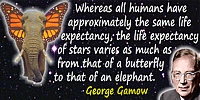
Whereas all humans have approximately the same life expectancy the life expectancy of stars varies as much as from that of a butterfly to that of an elephant.
In A Star Called the Sun (1964), 145.
Whether a man is on the earth, or the sun, or some other star, it will always seem to him that the position that he occupies is the motionless center, and that all other things are in motion.
…...
Who are we? We find that we live on an insignificant planet of a humdrum star lost between two spiral arms in the outskirts of a galaxy, tucked away in some forgotten corner of a universe in which there are far more galaxies than people.
Cosmos (1985), 160.
Who vagrant transitory comets sees,
Wonders because they’re rare; but a new star
Whose motion with the firmament agrees,
Is miracle; for there no new things are.
Wonders because they’re rare; but a new star
Whose motion with the firmament agrees,
Is miracle; for there no new things are.
Wilbur, a bright star among the Wright intellects…
Snippet from Milton’s Diary entry for Sat, 1 Jan 1916. Milton was in good health, and reflecting on his own advancing age (88), compared to the ages reached by other relatives and ancestors who had passed on. In the subject quote, he continued by writing [Wilbur] “…has been gone nearly four years.” Wilbur had died at age 45 (1912) after suffering from typhoid fever.
Winter opened its vaults last night, flinging fistfuls of crystalline diamonds into the darkening sky. Like white-tulled ballerinas dancing gracefully on heaven’s stage, silent stars stood entranced by their intricate beauty. Motionless, I watched each lacy gem drift softly by my upturned face, as winter’s icy hands guided them gently on their swirling lazy way, and blanketed the waiting earth in cold splendor. The shivering rustling of reeds, the restless fingers of the trees snapping in the frosty air, broke the silent stillness, as winter quietly pulled up its white coverlet over the sleepy earth.
…...
With all reserve we advance the view that a supernova represents the transition of an ordinary star into a neutron star consisting mainly of neutrons. Such a star may possess a very small radius and an extremely high density. As neutrons can be packed much more closely than ordinary nuclei and electrons, the gravitational packing energy in a cold neutron star may become very large, and under certain conditions may far exceed the ordinary nuclear packing fractions...
[Co-author with Walter Baade]
[Co-author with Walter Baade]
Paper presented to American Physical Society meeting at Stanford (15-16 Dec 1933). Published in Physical Review (15 Jan 1934). Cited in P. Haensel, Paweł Haensel and A. Y. Potekhin, D. G. Yakovlev, Neutron Stars: Equation of State and Structure (2007), 2-3. Longer version of quote from Freeman Dyson, From Eros to Gaia (1992), 34. The theoretical prediction of neutron stars was made after analyzing observations of supernovae and proposed as an explanation of the enormous energy released in such explosions. It was written just two years after Chadwick discovered the neutron.
With equal passion I have sought knowledge. I have wished to understand the hearts of men. I have wished to know why the stars shine. And I have tried to apprehend the Pythagorean power by which numbers holds sway above the flux. A little of this, but not much, I have achieved.
In 'Prologue: What I Have Lived For', The Autobiography of Bertrand Russell (1969). 3-4.
Within our bodies course the same elements that flame in the stars.
In The Incredible Machine (1986).
Yet in this my stars were not Mercury as morning star in the angle of the seventh house, in quartile with Mars, but they were Copernicus, they were Tycho Brahe, without whose books of observations everything which has now been brought by me into the brightest daylight would lie buried in darkness.
Harmonice Mundi, The Harmony of the World (1619), book IV, Epilogue on Sublunary Nature. Trans. E. J. Aiton, A. M. Duncan and J. V. Field (1997), 377.
 In science it often happens that scientists say, 'You know that's a really good argument; my position is mistaken,' and then they would actually change their minds and you never hear that old view from them again. They really do it. It doesn't happen as often as it should, because scientists are human and change is sometimes painful. But it happens every day. I cannot recall the last time something like that happened in politics or religion.
(1987) --
In science it often happens that scientists say, 'You know that's a really good argument; my position is mistaken,' and then they would actually change their minds and you never hear that old view from them again. They really do it. It doesn't happen as often as it should, because scientists are human and change is sometimes painful. But it happens every day. I cannot recall the last time something like that happened in politics or religion.
(1987) -- 





.jpg)


