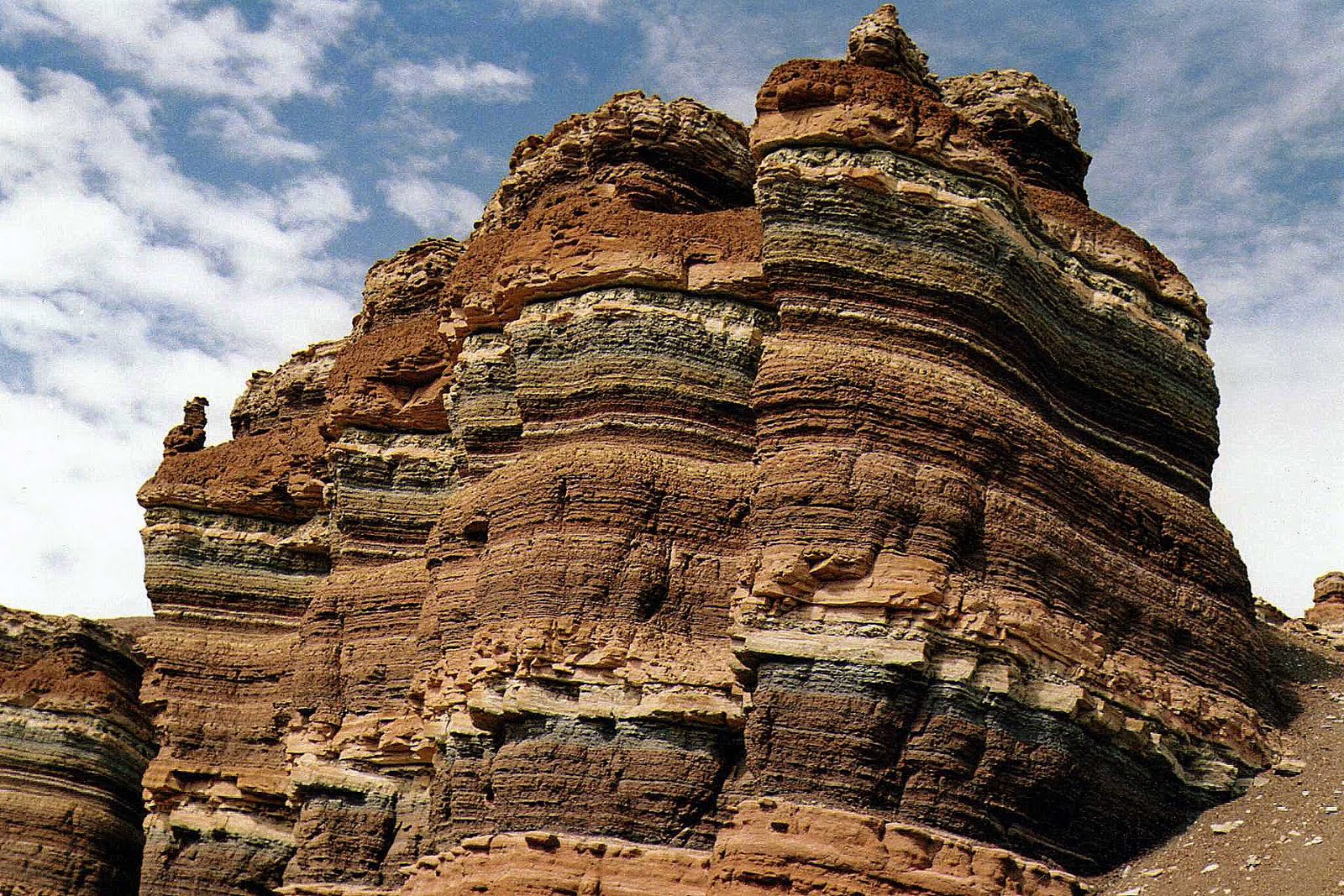
Stand Quotes (286 quotes)
...I may perhaps venture a short word on the question much discussed in certain quarters, whether in the work of excavation it is a good thing to have cooperation between men and women ... Of a mixed dig ... I have seen something, and it is an experiment that I would be reluctant to try again. I would grant if need be that women are admirable fitted for the work, yet I would uphold that they should undertake it by themselves ... the work of an excavator on the dig and off it lays on those who share it a bond of closer daily intercourse than is conceivable ... between men and women, except in chance cases, I do not believe that such close and unavoidable companionship can ever be other than a source of irritation; at any rate, I believe that however it may affect women, the ordinary male at least cannot stand it ... A minor ... objection lies in one particular form of contraint ... moments will occur on the best regulated dig when you want to say just what you think without translation, which before the ladies, whatever their feelings about it, cannot be done.
Archaeological Excavation (1915), 63-64. In Getzel M. Cohen and Martha Sharp Joukowsky Breaking Ground (2006), 557-558.
By (), 163-164.
…indeed what reason may not go to Schoole to the wisdome of Bees, Aunts, and Spiders? what wise hand teacheth them to doe what reason cannot teach us? Ruder heads stand amazed at those prodigious pieces of nature, Whales, Elephants, Dromidaries and Camels; these I confesse, are the Colossus and Majestick pieces of her hand; but in these narrow Engines there is more curious Mathematicks, and the civilitie of these little Citizens more neatly sets forth the wisedome of their Maker.
In Religio Medici and Other Writings (1909), 17.
...neither is it possible to discover the more remote and deeper parts of any science, if you stand but upon the level of the same science, and ascend not to a higher science.
Francis Bacon, Basil Montagu (Ed.), The Works of Francis Bacon (1852), Vol. 1, 173.
[1.] And first I suppose that there is diffused through all places an aethereal substance capable of contraction & dilatation, strongly elastick, & in a word, much like air in all respects, but far more subtile.
2. I suppose this aether pervades all gross bodies, but yet so as to stand rarer in their pores then in free spaces, & so much ye rarer as their pores are less ...
3. I suppose ye rarer aether within bodies & ye denser without them, not to be terminated in a mathematical superficies, but to grow gradually into one another.
2. I suppose this aether pervades all gross bodies, but yet so as to stand rarer in their pores then in free spaces, & so much ye rarer as their pores are less ...
3. I suppose ye rarer aether within bodies & ye denser without them, not to be terminated in a mathematical superficies, but to grow gradually into one another.
Letter to Robert Boyle (28 Feb 1678/9). In H. W. Turnbull (ed.), The Correspondence of Isaac Newton, 1676-1687 (1960), Vol. 2, 289.
[1665-06-17] It stroke me very deep this afternoon, going with a hackney-coach from my Lord Treasurer's down Holborne - the coachman I found to drive easily and easily; at last stood still, and came down hardly able to stand; and told me that he was suddenly stroke very sick and almost blind. So I light and went into another coach, with a sad heart for the poor man and trouble for myself, lest he should have been stroke with the plague - being at that end of the town that I took him up. But God have mercy upon us all.
Diary of Samuel Pepys (17 Jun 1665)
[I have seen] workers in whom certain morbid affections gradually arise from some particular posture of the limbs or unnatural movements of the body called for while they work. Such are the workers who all day stand or sit, stoop or are bent double, who run or ride or exercise their bodies in all sorts of [excess] ways. ... the harvest of diseases reaped by certain workers ... [from] irregular motions in unnatural postures of the body.
translation published by the University of Chicago Press, 1940
[Regarding mathematics,] there are now few studies more generally recognized, for good reasons or bad, as profitable and praiseworthy. This may be true; indeed it is probable, since the sensational triumphs of Einstein, that stellar astronomy and atomic physics are the only sciences which stand higher in popular estimation.
In A Mathematician's Apology (1940, reprint with Foreward by C.P. Snow 1992), 63-64.
[Society's rights to employ the scopolamine (“truth serum”) drug supersede those of a criminal.] It therefore stands to reason, that where there is a safe and humane method existing to evoke the truth from the consciousness of a suspect society is entitled to have that truth.
Quoted from presentation at the first annual meeting of the Eastern Society of Anesthetists at the Hotel McAlpin, as reported in '“Truth Serum” Test Proves Its Power', New York Times (22 Oct 1924), 14.
[The more science discovers and] the more comprehension it gives us of the mechanisms of existence, the more clearly does the mystery of existence itself stand out.
Julian Huxley and Aldous Huxley, Aldous Huxley, 1894-1963: A Memorial Volume (1965), 21.
[Wolfgang Bolyai] was extremely modest. No monument, said he, should stand over his grave, only an apple-tree, in memory of the three apples: the two of Eve and Paris, which made hell out of earth, and that of Newton, which elevated the earth again into the circle of the heavenly bodies.
In History of Elementary Mathematics (1910), 273.
δος μοι που στω και κινω την γην — Dos moi pou sto kai kino taen gaen (in epigram form, as given by Pappus, classical Greek).
δος μοι πα στω και τα γαν κινάσω — Dos moi pa sto kai tan gan kinaso (Doric Greek).
Give me a place to stand on and I can move the Earth.
About four centuries before Pappas, but about three centuries after Archimedes lived, Plutarch had written of Archimedes' understanding of the lever:
Archimedes, a kinsman and friend of King Hiero, wrote to him that with a given force, it was possible to move any given weight; and emboldened, as it is said, by the strength of the proof, he asserted that, if there were another world and he could go to it, he would move this one.
A commonly-seen expanded variation of the aphorism is:
Give me a lever long enough and a place to stand, and I can move the earth.
δος μοι πα στω και τα γαν κινάσω — Dos moi pa sto kai tan gan kinaso (Doric Greek).
Give me a place to stand on and I can move the Earth.
About four centuries before Pappas, but about three centuries after Archimedes lived, Plutarch had written of Archimedes' understanding of the lever:
Archimedes, a kinsman and friend of King Hiero, wrote to him that with a given force, it was possible to move any given weight; and emboldened, as it is said, by the strength of the proof, he asserted that, if there were another world and he could go to it, he would move this one.
A commonly-seen expanded variation of the aphorism is:
Give me a lever long enough and a place to stand, and I can move the earth.
As attributed to Pappus (4th century A.D.) and Plutarch (c. 46-120 A.D.), in Sherman K. Stein, Archimedes: What Did He Do Besides Cry Eureka? (1999), 5, where it is also stated that Archimedes knew that ropes and pulley exploit “the principle of the lever, where distance is traded for force.” Eduard Jan Dijksterhuis, in his book, Archimedes (1956), Vol. 12., 15. writes that Hiero invited Archimedes to demonstrate his claim on a ship from the royal fleet, drawn up onto land and there loaded with a large crew and freight, and Archimedes easily succeeded. Thomas Little Heath in The Works of Archimedes (1897), xix-xx, states according to Athenaeus, the mechanical contrivance used was not pulleys as given by Plutarch, but a helix., Heath provides cites for Pappus Synagoge, Book VIII, 1060; Plutarch, Marcellus, 14; and Athenaeus v. 207 a-b. What all this boils down to, in the opinion of the Webmaster, is the last-stated aphorism would seem to be not the actual words of Archimedes (c. 287 – 212 B.C.), but restatements of the principle attributed to him, formed by other writers centuries after his lifetime.
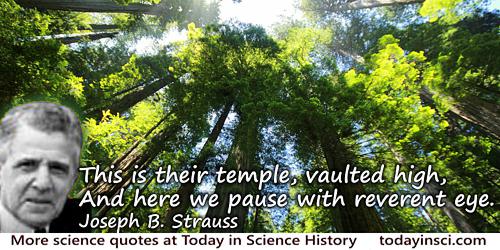
The Redwoods
Here, sown by the Creator's hand,
In serried ranks, the Redwoods stand;
No other clime is honored so,
No other lands their glory know.
The greatest of Earth's living forms,
Tall conquerors that laugh at storms;
Their challenge still unanswered rings,
Through fifty centuries of kings.
The nations that with them were young,
Rich empires, with their forts far-flung,
Lie buried now—their splendor gone;
But these proud monarchs still live on.
So shall they live, when ends our day,
When our crude citadels decay;
For brief the years allotted man,
But infinite perennials' span.
This is their temple, vaulted high,
And here we pause with reverent eye,
With silent tongue and awe-struck soul;
For here we sense life's proper goal;
To be like these, straight, true and fine,
To make our world, like theirs, a shrine;
Sink down, oh traveler, on your knees,
God stands before you in these trees.
Here, sown by the Creator's hand,
In serried ranks, the Redwoods stand;
No other clime is honored so,
No other lands their glory know.
The greatest of Earth's living forms,
Tall conquerors that laugh at storms;
Their challenge still unanswered rings,
Through fifty centuries of kings.
The nations that with them were young,
Rich empires, with their forts far-flung,
Lie buried now—their splendor gone;
But these proud monarchs still live on.
So shall they live, when ends our day,
When our crude citadels decay;
For brief the years allotted man,
But infinite perennials' span.
This is their temple, vaulted high,
And here we pause with reverent eye,
With silent tongue and awe-struck soul;
For here we sense life's proper goal;
To be like these, straight, true and fine,
To make our world, like theirs, a shrine;
Sink down, oh traveler, on your knees,
God stands before you in these trees.
In The Record: Volumes 60-61 (1938), 39.
[Students or readers about teachers or authors.] They will listen with both ears to what is said by the men just a step or two ahead of them, who stand nearest to them, and within arm’s reach. A guide ceases to be of any use when he strides so far ahead as to be hidden by the curvature of the earth.
From Lecture (5 Apr 1917) at Hackley School, Tarrytown, N.Y., 'Choosing Books', collected in Canadian Stories (1918), 150.
A stands for atom; it is so small No one has ever seen it at all.
B stands for bomb; the bombs are much bigger,
So, brother, do not be too fast on the trigger.
H has become a most ominous letter.
It means something bigger if not something better.
B stands for bomb; the bombs are much bigger,
So, brother, do not be too fast on the trigger.
H has become a most ominous letter.
It means something bigger if not something better.
As quoted in Robert Coughlan, 'Dr. Edward Teller’s Magnificent Obsession', Life (6 Sep 1954), 74.
I cannot give any scientist of any age better advice than this: the intensity of the conviction that a hypothesis is true has no bearing on whether it is true or not. The importance of the strength of our conviction is only to provide a proportionally strong incentive to find out if the hypothesis will stand up to critical examination.
In Advice to a Young Scientist (1979), 39.
Question: Explain how to determine the time of vibration of a given tuning-fork, and state what apparatus you would require for the purpose.
Answer: For this determination I should require an accurate watch beating seconds, and a sensitive ear. I mount the fork on a suitable stand, and then, as the second hand of my watch passes the figure 60 on the dial, I draw the bow neatly across one of its prongs. I wait. I listen intently. The throbbing air particles are receiving the pulsations; the beating prongs are giving up their original force; and slowly yet surely the sound dies away. Still I can hear it, but faintly and with close attention; and now only by pressing the bones of my head against its prongs. Finally the last trace disappears. I look at the time and leave the room, having determined the time of vibration of the common “pitch” fork. This process deteriorates the fork considerably, hence a different operation must be performed on a fork which is only lent.
Answer: For this determination I should require an accurate watch beating seconds, and a sensitive ear. I mount the fork on a suitable stand, and then, as the second hand of my watch passes the figure 60 on the dial, I draw the bow neatly across one of its prongs. I wait. I listen intently. The throbbing air particles are receiving the pulsations; the beating prongs are giving up their original force; and slowly yet surely the sound dies away. Still I can hear it, but faintly and with close attention; and now only by pressing the bones of my head against its prongs. Finally the last trace disappears. I look at the time and leave the room, having determined the time of vibration of the common “pitch” fork. This process deteriorates the fork considerably, hence a different operation must be performed on a fork which is only lent.
Genuine student answer* to an Acoustics, Light and Heat paper (1880), Science and Art Department, South Kensington, London, collected by Prof. Oliver Lodge. Quoted in Henry B. Wheatley, Literary Blunders (1893), 176-7, Question 4. (*From a collection in which Answers are not given verbatim et literatim, and some instances may combine several students' blunders.)
The Word Reason in the English Language has different Significances: sometimes it is taken for true, and clear Principles: Sometimes for clear, and fair deductions from those Principles: and sometimes for Cause, and particularly the final Cause: but the Consideration I shall have of it here, is in a Signification different from all these; and that is, as it stands for a Faculty of Man, That Faculty, whereby Man is supposed to be distinguished from Beasts; and wherein it is evident he much surpasses them.
In 'Of Reason', Essay Concerning Humane Understanding (1690), Book 4, Ch. 17, Sec. 1, 341.
A fact is like a sack which won’t stand up if it’s empty. In order that it may stand up, one has to put into it the reason and sentiment which caused it to exist.
Character, The Father, in play Six Characters in Search of an Author (1921), Act 1. Collected in John Gassner and Burns Mantle, A Treasury of the Theatre (1935), Vol. 2, 507.
A few of the results of my activities as a scientist have become embedded in the very texture of the science I tried to serve—this is the immortality that every scientist hopes for. I have enjoyed the privilege, as a university teacher, of being in a position to influence the thought of many hundreds of young people and in them and in their lives I shall continue to live vicariously for a while. All the things I care for will continue for they will be served by those who come after me. I find great pleasure in the thought that those who stand on my shoulders will see much farther than I did in my time. What more could any man want?
In 'The Meaning of Death,' in The Humanist Outlook edited by A. J. Ayer (1968) [See Gerald Holton and Sir Isaac Newton].
A frequent misunderstanding of my vision of Gaia is that I champion complacence, that I claim feedback will always protect the environment from any serious harm that humans might do. It is sometimes more crudely put as “Lovelock’s Gaia gives industry the green light to pollute at will.” The truth is almost diametrically opposite. Gaia, as I see her, is no doting mother tolerant of misdemeanors, nor is she some fragile and delicate damsel in danger from brutal mankind. She is stern and tough, always keeping the world warm and comfortable for those who obey the rules, but ruthless in her destruction of those who transgress. Her unconscious goal is a planet fit for life. If humans stand in the way of this, we shall be eliminated with as little pity as would be shown by the micro-brain of an intercontinental ballistic nuclear missile in full flight to its target.
In The Ages of Gaia: A Biography of Our Living Earth (1999), 199.
A Lady with a Lamp shall stand
In the great history of the land,
A noble type of good,
Heroic womanhood.
In the great history of the land,
A noble type of good,
Heroic womanhood.
'Santa Filomena' (1857), The Poetical Works of Henry Wadsworth Longfellow (1867), 333.
A large part of the training of the engineer, civil and military, as far as preparatory studies are concerned; of the builder of every fabric of wood or stone or metal designed to stand upon the earth, or bridge the stream, or resist or float upon the wave; of the surveyor who lays out a building lot in a city, or runs a boundary line between powerful governments across a continent; of the geographer, navigator, hydrographer, and astronomer,—must be derived from the mathematics.
In 'Academical Education', Orations and Speeches on Various Occasions (1870), Vol. 3, 513.
A man cannot well stand by himself, and so he is glad to join a party; because if he does not find rest there, he at any rate finds quiet and safety.
In The Maxims and Reflections of Goethe (1906), 183.
A man’s value to the community depends primarily on how far his feelings, thoughts, and actions are directed towards promoting the good of his fellows. We call him good or bad according to how he stands in this matter. It looks at first sight as if our estimate of a man depended entirely on his social qualities.
…...
A most vile face! and yet she spends me forty pound a year in Mercury and Hogs Bones. All her teeth were made in the Black-Fryars, both her Eyebrows i’ the Strand, and her Hair in Silver-street. Every part of Town owns a Piece of her.
A reference to artificial teeth by character Otter, speaking of his wife, in Epicoene: or, The Silent Woman (1609), Act IV, Sc. 2, 64. Also, True-wit makes a specific reference to “false Teeth” in Act I, Sc. 1, 10.
A noiseless, patient spider,
I mark’d, where on a little promontory, it stood, isolated;
Mark’d how, to explore the vacant, vast surrounding,
It launch’d forth filament, filament, filament, out of itself
Ever unreeling them—ever tirelessly speeding them.
I mark’d, where on a little promontory, it stood, isolated;
Mark’d how, to explore the vacant, vast surrounding,
It launch’d forth filament, filament, filament, out of itself
Ever unreeling them—ever tirelessly speeding them.
In 'A Noiseless Patient Spider', Broadway: A London Magazine (1868), reprinted in Leaves of Grass (5th ed., 1871, 1888), 343.
A schism has taken place among the chemists. A particular set of them in France have undertaken to remodel all the terms of the science, and to give every substance a new name, the composition, and especially the termination of which, shall define the relation in which it stands to other substances of the same family, But the science seems too much in its infancy as yet, for this reformation; because in fact, the reformation of this year must be reformed again the next year, and so on, changing the names of substances as often as new experiments develop properties in them undiscovered before. The new nomenclature has, accordingly, been already proved to need numerous and important reformations. ... It is espoused by the minority here, and by the very few, indeed, of the foreign chemists. It is particularly rejected in England.
Letter to Dr. Willard (Paris, 1788). In Thomas Jefferson and John P. Foley (ed.), The Jeffersonian Cyclopedia (1900), 135. From H.A. Washington, The Writings of Thomas Jefferson (1853-54). Vol 3, 15.
A small cabin stands in the Glacier Peak Wilderness, about a hundred yards off a trail that crosses the Cascade Range. In midsummer, the cabin looked strange in the forest. It was only twelve feet square, but it rose fully two stories and then had a high and steeply peaked roof. From the ridge of the roof, moreover, a ten-foot pole stuck straight up. Tied to the top of the pole was a shovel. To hikers shedding their backpacks at the door of the cabin on a cold summer evening—as the five of us did—it was somewhat unnerving to look up and think of people walking around in snow perhaps thirty-five feet above, hunting for that shovel, then digging their way down to the threshold.
In Encounters with the Archdruid (1971), 3.
A vision of the whole of life!. Could any human undertaking be ... more grandiose? This attempt stands without rival as the most audacious enterprise in which the mind of man has ever engaged ... Here is man, surrounded by the vastness of a universe in which he is only a tiny and perhaps insignificant part—and he wants to understand it.
…...
A Vulgar Mechanick can practice what he has been taught or seen done, but if he is in an error he knows not how to find it out and correct it, and if you put him out of his road, he is at a stand; Whereas he that is able to reason nimbly and judiciously about figure, force and motion, is never at rest till he gets over every rub.
Letter (25 May 1694) to Nathaniel Hawes. In J. Edleston (ed.), Correspondence of Sir Isaac Newton and Professor Cotes (1850), 284.
A work of genius is something like the pie in the nursery song, in which the four and twenty blackbirds are baked. When the pie is opened, the birds begin to sing. Hereupon three fourths of the company run away in a fright; and then after a time, feeling ashamed, they would fain excuse themselves by declaring, the pie stank so, they could not sit near it. Those who stay behind, the men of taste and epicures, say one to another, We came here to eat. What business have birds, after they have been baked, to be alive and singing? This will never do. We must put a stop to so dangerous an innovation: for who will send a pie to an oven, if the birds come to life there? We must stand up to defend the rights of all the ovens in England. Let us have dead birds..dead birds for our money. So each sticks his fork into a bird, and hacks and mangles it a while, and then holds it up and cries, Who will dare assert that there is any music in this bird’s song?
Co-author with his brother Augustus William Hare Guesses At Truth, By Two Brothers: Second Edition: With Large Additions (1848), Second Series, 86. (The volume is introduced as “more than three fourths new.” This quote is identified as by Julius; Augustus had died in 1833.)
Aeroplanes are not designed by science, but by art in spite of some pretence and humbug to the contrary. I do not mean to suggest that engineering can do without science, on the contrary, it stands on scientific foundations, but there is a big gap between scientific research and the engineering product which has to be bridged by the art of the engineer.
In John D. North, 'The Case for Metal Construction', The Journal of the Royal Aeronautical Society, (Jan 1923), 27, 11.
Among the scenes which are deeply impressed on my mind, none exceed in sublimity the primeval [tropical] forests, ... temples filled with the varied productions of the God of Nature. No one can stand in these solitudes unmoved, and not feel that there is more in man than the mere breath of his body.
In What Mr. Darwin Saw in His Voyage Round the World in the Ship “Beagle” 1879, 170.
Among the scenes which are deeply impressed on my mind, none exceed in sublimity the primeval forests undefaced by the hand of man; whether those of Brazil, where the powers of Life are predominant, or those of Tierra del Fuego, where Death and Decay prevail. Both are temples filled with the varied productions of the God of Nature: no one can stand in these solitudes unmoved, and not feel that there is more in man than the mere breath of his body.
Journal of Researches: into the Natural History and Geology of the Countries Visited During the Voyage of H.M.S. Beagle Round the World (1839), ch. XXIII, 604-5.
An astronomer is a guy who stands around looking at heavenly bodies.
Quoted in M. Goran, A Treasury of Science Jokes (1986), 29.
An experiment is an observation that can be repeated, isolated and varied. The more frequently you can repeat an observation, the more likely are you to see clearly what is there and to describe accurately what you have seen. The more strictly you can isolate an observation, the easier does your task of observation become, and the less danger is there of your being led astray by irrelevant circumstances, or of placing emphasis on the wrong point. The more widely you can vary an observation, the more clearly will the uniformity of experience stand out, and the better is your chance of discovering laws.
In A Text-Book of Psychology (1909), 20.
Artificial intelligence is based on the assumption that the mind can be described as some kind of formal system manipulating symbols that stand for things in the world. Thus it doesn't matter what the brain is made of, or what it uses for tokens in the great game of thinking. Using an equivalent set of tokens and rules, we can do thinking with a digital computer, just as we can play chess using cups, salt and pepper shakers, knives, forks, and spoons. Using the right software, one system (the mind) can be mapped onto the other (the computer).
Machinery of the Mind: Inside the New Science of Artificial Intelligence (1986), 250.
As a result of the phenomenally rapid change and growth of physics, the men and women who did their great work one or two generations ago may be our distant predecessors in terms of the state of the field, but they are our close neighbors in terms of time and tastes. This may be an unprecedented state of affairs among professionals; one can perhaps be forgiven if one characterizes it epigrammatically with a disastrously mixed metaphor; in the sciences, we are now uniquely privileged to sit side-by-side with the giants on whose shoulders we stand.
In 'On the Recent Past of Physics', American Journal of Physics (1961), 29, 807.
As every circumstance relating to so capital a discovery as this (the greatest, perhaps, that has been made in the whole compass of philosophy, since the time of Sir Isaac Newton) cannot but give pleasure to all my readers, I shall endeavour to gratify them with the communication of a few particulars which I have from the best authority. The Doctor [Benjamin Franklin], after having published his method of verifying his hypothesis concerning the sameness of electricity with the matter lightning, was waiting for the erection of a spire in Philadelphia to carry his views into execution; not imagining that a pointed rod, of a moderate height, could answer the purpose; when it occurred to him, that, by means of a common kite, he could have a readier and better access to the regions of thunder than by any spire whatever. Preparing, therefore, a large silk handkerchief, and two cross sticks, of a proper length, on which to extend it, he took the opportunity of the first approaching thunder storm to take a walk into a field, in which there was a shed convenient for his purpose. But dreading the ridicule which too commonly attends unsuccessful attempts in science, he communicated his intended experiment to no body but his son, who assisted him in raising the kite.
The kite being raised, a considerable time elapsed before there was any appearance of its being electrified. One very promising cloud passed over it without any effect; when, at length, just as he was beginning to despair of his contrivance, he observed some loose threads of the hempen string to stand erect, and to avoid one another, just as if they had been suspended on a common conductor. Struck with this promising appearance, he inmmediately presented his knuckle to the key, and (let the reader judge of the exquisite pleasure he must have felt at that moment) the discovery was complete. He perceived a very evident electric spark. Others succeeded, even before the string was wet, so as to put the matter past all dispute, and when the rain had wetted the string, he collected electric fire very copiously. This happened in June 1752, a month after the electricians in France had verified the same theory, but before he had heard of any thing that they had done.
The kite being raised, a considerable time elapsed before there was any appearance of its being electrified. One very promising cloud passed over it without any effect; when, at length, just as he was beginning to despair of his contrivance, he observed some loose threads of the hempen string to stand erect, and to avoid one another, just as if they had been suspended on a common conductor. Struck with this promising appearance, he inmmediately presented his knuckle to the key, and (let the reader judge of the exquisite pleasure he must have felt at that moment) the discovery was complete. He perceived a very evident electric spark. Others succeeded, even before the string was wet, so as to put the matter past all dispute, and when the rain had wetted the string, he collected electric fire very copiously. This happened in June 1752, a month after the electricians in France had verified the same theory, but before he had heard of any thing that they had done.
The History and Present State of Electricity, with Original Experiments (1767, 3rd ed. 1775), Vol. 1, 216-7.
As for your doctrines I am prepared to go to the Stake if requisite ... I trust you will not allow yourself to be in any way disgusted or annoyed by the considerable abuse & misrepresentation which unless I greatly mistake is in store for you... And as to the curs which will bark and yelp - you must recollect that some of your friends at any rate are endowed with an amount of combativeness which (though you have often & justly rebuked it) may stand you in good stead - I am sharpening up my claws and beak in readiness.
Letter (23 Nov 1859) to Charles Darwin a few days after the publication of Origin of Species. In Charles Darwin, Frederick Burkhardt, Sydney Smith, The Correspondence of Charles Darwin: 1858-1859 (1992), Vol. 19, 390-391.
As he [Clifford] spoke he appeared not to be working out a question, but simply telling what he saw. Without any diagram or symbolic aid he described the geometrical conditions on which the solution depended, and they seemed to stand out visibly in space. There were no longer consequences to be deduced, but real and evident facts which only required to be seen. … So whole and complete was his vision that for the time the only strange thing was that anybody should fail to see it in the same way. When one endeavored to call it up again, and not till then, it became clear that the magic of genius had been at work, and that the common sight had been raised to that higher perception by the power that makes and transforms ideas, the conquering and masterful quality of the human mind which Goethe called in one word das Dämonische.
In Leslie Stephen and Frederick Pollock (eds.), Lectures and Essays by William Kingdon Clifford(1879), Vol. 1, Introduction, 4-5.
As I am writing, another illustration of ye generation of hills proposed above comes into my mind. Milk is as uniform a liquor as ye chaos was. If beer be poured into it & ye mixture let stand till it be dry, the surface of ye curdled substance will appear as rugged & mountanous as the Earth in any place.
Letter to Thomas Burnet (Jan 1680/1. In H. W. Turnbull (ed.), The Correspondence of Isaac Newton, 1676-1687 (1960), Vol. 2, 334.
Attempt the end and never stand to doubt;
Nothing's so hard, but search will find it out.
Nothing's so hard, but search will find it out.
'Seeke and Finde', Hesperides: Or, the Works Both Humane and Divine of Robert Herrick Esq. (1648). In J. Max Patrick (ed.), The Complete Poetry of Robert Herrick (1963), 411.
Behind and permeating all our scientific activity, whether in critical analysis or in discovery, there is an elementary and overwhelming faith in the possibility of grasping the real world with out concepts, and, above all, faith in the truth over which we have no control but in the service of which our rationality stands or falls. Faith and intrinsic rationality are interlocked with one another
Christian Theology of Scientific Culture (1981), 63. In Vinoth Ramachandra, Subverting Global Myths: Theology and the Public Issues Shaping our World (2008), 187.
Between men of different studies and professions, may be observed a constant reciprocation of reproaches. The collector of shells and stones derides the folly of him who pastes leaves and flowers upon paper, pleases himself with colours that are perceptibly fading, and amasses with care what cannot be preserved. The hunter of insects stands amazed that any man can waste his short time upon lifeless matter, while many tribes of animals yet want their history. Every one is inclined not only to promote his own study, but to exclude all others from regard, and having heated his imagination with some favourite pursuit, wonders that the rest of mankind are not seized with the same passion.
From 'Numb. 83, Tuesday, January 1, 1750', The Rambler (1756), Vol. 2, 150.
But … the working scientist … is not consciously following any prescribed course of action, but feels complete freedom to utilize any method or device whatever which in the particular situation before him seems likely to yield the correct answer. … No one standing on the outside can predict what the individual scientist will do or what method he will follow.
In Reflections of a Physicist: A Collection of Essays (1955, 1980), 83.
But now that I was finally here, standing on the summit of Mount Everest, I just couldn’t summon the energy to care.
…...
But when we face the great questions about gravitation Does it require time? Is it polar to the 'outside of the universe' or to anything? Has it any reference to electricity? or does it stand on the very foundation of matter–mass or inertia? then we feel the need of tests, whether they be comets or nebulae or laboratory experiments or bold questions as to the truth of received opinions.
Letter to Michael Faraday, 9 Nov 1857. In P. M. Harman (ed.), The Scientific Letters and Papers of James Clerk Maxwell (1990), Vol. 1, 1846-1862, 551-2.
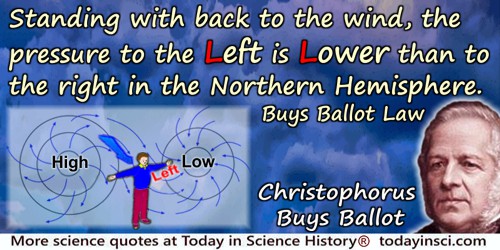
Buys Ballot Law: Standing with back to the wind, the pressure to the left is lower than to the right in the Northern Hemisphere.
Slightly reworded from the Glossary of Meteorology online at the site of the American Meteorological Society. Various statements of this law are found in different sources.
By destroying the biological character of phenomena, the use of averages in physiology and medicine usually gives only apparent accuracy to the results. From our point of view, we may distinguish between several kinds of averages: physical averages, chemical averages and physiological and pathological averages. If, for instance, we observe the number of pulsations and the degree of blood pressure by means of the oscillations of a manometer throughout one day, and if we take the average of all our figures to get the true or average blood pressure and to learn the true or average number of pulsations, we shall simply have wrong numbers. In fact, the pulse decreases in number and intensity when we are fasting and increases during digestion or under different influences of movement and rest; all the biological characteristics of the phenomenon disappear in the average. Chemical averages are also often used. If we collect a man's urine during twenty-four hours and mix all this urine to analyze the average, we get an analysis of a urine which simply does not exist; for urine, when fasting, is different from urine during digestion. A startling instance of this kind was invented by a physiologist who took urine from a railroad station urinal where people of all nations passed, and who believed he could thus present an analysis of average European urine! Aside from physical and chemical, there are physiological averages, or what we might call average descriptions of phenomena, which are even more false. Let me assume that a physician collects a great many individual observations of a disease and that he makes an average description of symptoms observed in the individual cases; he will thus have a description that will never be matched in nature. So in physiology, we must never make average descriptions of experiments, because the true relations of phenomena disappear in the average; when dealing with complex and variable experiments, we must study their various circumstances, and then present our most perfect experiment as a type, which, however, still stands for true facts. In the cases just considered, averages must therefore be rejected, because they confuse, while aiming to unify, and distort while aiming to simplify. Averages are applicable only to reducing very slightly varying numerical data about clearly defined and absolutely simple cases.
From An Introduction to the Study of Experimental Medicine (1865), as translated by Henry Copley Greene (1957), 134-135.
Cayley was singularly learned in the work of other men, and catholic in his range of knowledge. Yet he did not read a memoir completely through: his custom was to read only so much as would enable him to grasp the meaning of the symbols and understand its scope. The main result would then become to him a subject of investigation: he would establish it (or test it) by algebraic analysis and, not infrequently, develop it so to obtain other results. This faculty of grasping and testing rapidly the work of others, together with his great knowledge, made him an invaluable referee; his services in this capacity were used through a long series of years by a number of societies to which he was almost in the position of standing mathematical advisor.
In Proceedings of London Royal Society (1895), 58, 11-12.
Common sense always speaks too late. Common sense is the guy who tells you you ought to have had your brakes relined last week before you smashed a front end this week. Common sense is the Monday morning quarterback who could have won the ball game if he had been on the team. But he never is. He’s high up in the stands with a flask on his hip. Common sense is the little man in a grey suit who never makes a mistake in addition. But it’s always somebody else’s money he’s adding up.
In novel, Playback (1958), Chap. 14, 95.
Do the day’s work. If it be to protect the rights of the weak, whoever objects, do it. If it be to help a powerful corporation better to serve the people, whatever the opposition, do that. Expect to be called a stand-patter, but don’t be a stand-patter. Expect to be called a demagogue, but don’t be a demagogue. Don’t hesitate to be as revolutionary as science. Don’t hesitate to be as reactionary as the multiplication table. Don’t expect to build up the weak by pulling down the strong. Don’t hurry to legislate. Give administration a chance to catch up with legislation.
Speech (7 Jan 1914), to the State Senate of Massachusetts upon election as its president. Collected in Coolidge, Have Faith in Massachusetts (1919, 2004), 7-8.
Doubtless many can recall certain books which have greatly influenced their lives, and in my own case one stands out especially—a translation of Hofmeister's epoch-making treatise on the comparative morphology of plants. This book, studied while an undergraduate at the University of Michigan, was undoubtedly the most important factor in determining the trend of my botanical investigation for many years.
D.H. Campbell, 'The Centenary of Wilhelm Hofmeister', Science (1925), 62, No. 1597, 127-128. Cited in William C. Steere, Obituary, 'Douglas Houghton Campbell', American Bryological and Lichenological Society, The Bryologist (1953), 127. The book to which Cambell refers is W. Hofmeister, On the Germination, Development, and Fructification of the Higher Cryptogamia, and on the Fructification of the Coniferae, trans. by Frederick Currey (1862).
Dream analysis stands or falls with [the hypothesis of the unconscious]. Without it the dream appears to be merely a freak of nature, a meaningless conglomerate of memory-fragments left over from the happenings of the day.
Dream Analysis in its Practical Application (1930), 1-2.
During the school period the student has been mentally bending over his desk; at the University he should stand up and look around. For this reason it is fatal if the first year at the University be frittered away in going over the old work in the old spirit. At school the boy painfully rises from the particular towards glimpses at general ideas; at the University he should start from general ideas and study their applications to concrete cases.
In 'The Rhythm of Education', The Aims of Education and Other Essays (1929), 26.
Educators may bring upon themselves unnecessary travail by taking a tactless and unjustifiable position about the relation between scientific and religious narratives. … The point is that profound but contradictory ideas may exist side by side, if they are constructed from different materials and methods and have different purposes. Each tells us something important about where we stand in the universe, and it is foolish to insist that they must despise each other.
In The End of Education: Redefining the Value of School (1995), 107.
England and all civilised nations stand in deadly peril of not having enough to eat. As mouths multiply, food resources dwindle. Land is a limited quantity, and the land that will grow wheat is absolutely dependent on difficult and capricious natural phenomena... I hope to point a way out of the colossal dilemma. It is the chemist who must come to the rescue of the threatened communities. It is through the laboratory that starvation may ultimately be turned into plenty... The fixation of atmospheric nitrogen is one of the great discoveries, awaiting the genius of chemists.
Presidential Address to the British Association for the Advancement of Science 1898. Published in Chemical News, 1898, 78, 125.
Ethical axioms are found and tested not very differently from the axioms of science. Truth is what stands the test of experience.
…...
Every great scientist becomes a great scientist because of the inner self-abnegation with which he stands before truth, saying: “Not my will, but thine, be done.” What, then, does a man mean by saying, Science displaces religion, when in this deep sense science itself springs from religion?
In 'The Real Point of Conflict between Science and Religion', collected in Living Under Tension: Sermons On Christianity Today (1941), 148.
Every natural scientist who thinks with any degree of consistency at all will, I think, come to the view that all those capacities that we understand by the phrase psychic activities (Seelenthiitigkeiten) are but functions of the brain substance; or, to express myself a bit crudely here, that thoughts stand in the same relation to the brain as gall does to the liver or urine to the kidneys. To assume a soul that makes use of the brain as an instrument with which it can work as it pleases is pure nonsense; we would then be forced to assume a special soul for every function of the body as well.
In Physiologische Briefe für Gelbildete aIle Stünde (1845-1847), 3 parts, 206. as translated in Frederick Gregory, Scientific Materialism in Nineteenth Century Germany (1977), 64.
Everything is like a purse—there may be money in it, and we can generally say by the feel of it whether there is or is not. Sometimes, however, we must turn it inside out before we can be quite sure whether there is anything in it or no. When I have turned a proposition inside out, put it to stand on its head, and shaken it, I have often been surprised to find how much came out of it.
Samuel Butler, Henry Festing Jones (ed.), The Note-Books of Samuel Butler (1917), 222.
Facts were never pleasing to him. He acquired them with reluctance and got rid of them with relief. He was never on terms with them until he had stood them on their heads.
The Greenwood Hat (1937), 55.
For centuries we have dreamt of flying; recently we made that come true: we have always hankered for speed; now we have speeds greater than we can stand: we wanted to speak to far parts of the Earth; we can: we wanted to explore the sea bottom; we have: and so on, and so on. And, too, we wanted the power to smash our enemies utterly; we have it. If we had truly wanted peace, we should have had that as well. But true peace has never been one of the genuine dreams—we have got little further than preaching against war in order to appease out consciences.
The Outward Urge (1959)
For me too, the periodic table was a passion. ... As a boy, I stood in front of the display for hours, thinking how wonderful it was that each of those metal foils and jars of gas had its own distinct personality.
[Referring to the periodic table display in the Science Museum, London, with element samples in bottles]
[Referring to the periodic table display in the Science Museum, London, with element samples in bottles]
Letter to Oliver Sacks. Quoted in Oliver Sacks, Uncle Tungsten: Memories of a Chemical Boyhood (2001), footnote, 203.
For three days now this angel, almost too heavenly for earth has been my fiancée … Life stands before me like an eternal spring with new and brilliant colours. Upon his engagement to Johanne Osthof of Brunswick; they married 9 Oct 1805.
Letter to Farkas Wolfgang Bolyai (1804). Quoted in Stephen Hawking, God Created the Integers: The Mathematical Breakthroughs (2005), 567.
For three million years we were hunter-gatherers, and it was through the evolutionary pressures of that way of life that a brain so adaptable and so creative eventually emerged. Today we stand with the brains of hunter-gatherers in our heads, looking out on a modern world made comfortable for some by the fruits of human inventiveness, and made miserable for others by the scandal of deprivation in the midst of plenty.
Co-author with American science writer Roger Amos Lewin (1946), Origins: What New Discoveries Reveal about the Emergence of our Species and its Possible Future (1977), 249.
Formerly one sought the feeling of the grandeur of man by pointing to his divine origin: this has now become a forbidden way, for at its portal stands the ape, together with other gruesome beasts, grinning knowingly as if to say: no further in this direction! One therefore now tries the opposite direction: the way mankind is going shall serve as proof of his grandeur and kinship with God. Alas this, too, is vain! At the end of this way stands the funeral urn of the last man and gravedigger (with the inscription “nihil humani a me alienum puto”). However high mankind may have evolved—and perhaps at the end it will stand even lower than at the beginning!— it cannot pass over into a higher order, as little as the ant and the earwig can at the end of its “earthly course” rise up to kinship with God and eternal life. The becoming drags the has-been along behind it: why should an exception to this eternal spectacle be made on behalf of some little star or for any little species upon it! Away with such sentimentalities!
Daybreak: Thoughts on the Prejudices of Morality (1881), trans. R. J. Hollingdale (1982), 32.
Geometry seems to stand for all that is practical, poetry for all that is visionary, but in the kingdom of the imagination you will find them close akin, and they should go together as a precious heritage to every youth.
From The Proceedings of the Michigan Schoolmasters’ Club, reprinted in School Review (1898), 6 114.
Give me a place to stand, and I will move the earth.
F. Hultsch (ed.) Pappus Alexandrinus: Collectio (1876-8), Vol. 3, book 8, section 10, ix.
Have you ever watched an eagle held captive in a zoo, fat and plump and full of food and safe from danger too?
Then have you seen another wheeling high up in the sky, thin and hard and battle-scarred, but free to soar and fly?
Well, which have you pitied the caged one or his brother? Though safe and warm from foe or storm, the captive, not the other!
There’s something of the eagle in climbers, don’t you see; a secret thing, perhaps the soul, that clamors to be free.
It’s a different sort of freedom from the kind we often mean, not free to work and eat and sleep and live in peace serene.
But freedom like a wild thing to leap and soar and strive, to struggle with the icy blast, to really be alive.
That’s why we climb the mountain’s peak from which the cloud-veils flow, to stand and watch the eagle fly, and soar, and wheel... below...
Then have you seen another wheeling high up in the sky, thin and hard and battle-scarred, but free to soar and fly?
Well, which have you pitied the caged one or his brother? Though safe and warm from foe or storm, the captive, not the other!
There’s something of the eagle in climbers, don’t you see; a secret thing, perhaps the soul, that clamors to be free.
It’s a different sort of freedom from the kind we often mean, not free to work and eat and sleep and live in peace serene.
But freedom like a wild thing to leap and soar and strive, to struggle with the icy blast, to really be alive.
That’s why we climb the mountain’s peak from which the cloud-veils flow, to stand and watch the eagle fly, and soar, and wheel... below...
…...
He who designs an unsafe structure or an inoperative machine is a bad Engineer; he who designs them so that they are safe and operative, but needlessly expensive, is a poor Engineer, and … he who does the best work at lowest cost sooner or later stands at the top of his profession.
From Address on 'Industrial Engineering' at Purdue University (24 Feb 1905). Reprinted by Yale & Towne Mfg Co of New York and Stamford, Conn. for the use of students in its works.
He who wishes to explain Generation must take for his theme the organic body and its constituent parts, and philosophize about them; he must show how these parts originated, and how they came to be in that relation in which they stand to each other. But he who learns to know a thing not only from its phenomena, but also its reasons and causes; and who, therefore, not by the phenomena merely, but by these also, is compelled to say: “The thing must be so, and it cannot be otherwise; it is necessarily of such a character; it must have such qualities; it is impossible for it to possess others”—understands the thing not only historically but truly philosophically, and he has a philosophic knowledge of it. Our own Theory of Generation is to be such a philosphic comprehension of an organic body, a very different one from one merely historical. (1764)
Quoted as an epigraph to Chap. 2, in Ernst Haeckel, The Evolution of Man, (1886), Vol 1, 25.
Heat may be considered, either in respect of its quantity, or of its intensity. Thus two lbs. of water, equally heated, must contain double the quantity that one of them does, though the thermometer applied to them separately, or together, stands at precisely the same point, because it requires double the time to heat two lbs. as it does to heat one.
In Alexander Law, Notes of Black's Lectures, vol. 1, 5. Cited in Charles Coulston Gillispie, Dictionary of Scientific Biography: Volumes 1-2 (1981), 178.
Hence, wherever we meet with vital phenomena that present the two aspects, physical and psychical there naturally arises a question as to the relations in which these aspects stand to each other.
History warns us … that it is the customary fate of new truths to begin as heresies and to end as superstitions; and, as matters now stand, it is hardly rash to anticipate that, in another twenty years, the new generation, educated under the influences of the present day, will be in danger of accepting the main doctrines of the “Origin of Species,” with as little reflection, and it may be with as little justification, as so many of our contemporaries, twenty years ago, rejected them.
'The Coming of Age of the Origin of Species' (1880). In Collected Essays, Vol. 2: Darwiniana (1893), 229.
How hard to realize that every camp of men or beast has this glorious starry firmament for a roof! … In such places standing alone on the mountain-top it is easy to realize that whatever special nests we make—leaves and moss like the marmots and birds, or tents or piled stone—we all dwell in a house of one room—the world with the firmament for its roof—and are sailing the celestial spaces without leaving any track.
Journal Entry, written while camping on top of Quarry Mountain, seven or eight miles from the front of Muir Glacier, Alaska (18 Jul 1890). In John Muir and Linnie Marsh Wolfe (ed.), John of the Mountains: The Unpublished Journals of John Muir (1938, 1979), 321.
How many and how curious problems concern the commonest of the sea-snails creeping over the wet sea-weed! In how many points of view may its history be considered! There are its origin and development, the mystery of its generation, the phenomena of its growth, all concerning each apparently insignificant individual; there is the history of the species, the value of its distinctive marks, the features which link it with the higher and lower creatures, the reason why it takes its stand where we place it in the scale of creation, the course of its distribution, the causes of its diffusion, its antiquity or novelty, the mystery (deepest of mysteries) of its first appearance, the changes of the outline of continents and of oceans which have taken place since its advent, and their influence on its own wanderings.
On the Natural History of European Seas. In George Wilson and Archibald Geikie, Memoir of Edward Forbes F.R.S. (1861), 547-8.
Human consciousness is just about the last surviving mystery. A mystery is a phenomenon that people don’t know how to think about—yet. There have been other great mysteries: the mystery of the origin of the universe, the mystery of life and reproduction, the mystery of the design to be found in nature, the mysteries of time, space, and gravity. These were not just areas of scientific ignorance, but of utter bafflement and wonder. We do not yet have the final answers to any of the questions of cosmology and particle physics, molecular genetics and evolutionary theory, but we do know how to think about them. The mysteries haven't vanished, but they have been tamed. They no longer overwhelm our efforts to think about the phenomena, because now we know how to tell the misbegotten questions from the right questions, and even if we turn out to be dead wrong about some of the currently accepted answers, we know how to go about looking for better answers. With consciousness, however, we are still in a terrible muddle. Consciousness stands alone today as a topic that often leaves even the most sophisticated thinkers tongue-tied and confused. And, as with all the earlier mysteries, there are many who insist—and hope—that there will never be a demystification of consciousness.
Consciousness Explained (1991), 21-22.
Humanity stands ... before a great problem of finding new raw materials and new sources of energy that shall never become exhausted. In the meantime we must not waste what we have, but must leave as much as possible for coming generations.
Chemistry in Modern Life (1925), trans. Clifford Shattuck-Leonard, vii.
I am coming more and more to the conviction that the necessity of our geometry cannot be proved, at least neither by, nor for, the human intelligence … One would have to rank geometry not with arithmetic, which stands a priori, but approximately with mechanics.
From Letter (28 Apr 1817) to Olbers, as quoted in Guy Waldo Dunnington, Carl Friedrich Gauss, Titan of Science: A Study of His Life and Work (1955), 180.
I am more and more convinced that the ant colony is not so much composed of separate individuals as that the colony is a sort of individual, and each ant like a loose cell in it. Our own blood stream, for instance, contains hosts of white corpuscles which differ little from free-swimming amoebae. When bacteria invade the blood stream, the white corpuscles, like the ants defending the nest, are drawn mechanically to the infected spot, and will die defending the human cell colony. I admit that the comparison is imperfect, but the attempt to liken the individual human warrior to the individual ant in battle is even more inaccurate and misleading. The colony of ants with its component numbers stands half way, as a mechanical, intuitive, and psychical phenomenon, between our bodies as a collection of cells with separate functions and our armies made up of obedient privates. Until one learns both to deny real individual initiative to the single ant, and at the same time to divorce one's mind from the persuasion that the colony has a headquarters which directs activity … one can make nothing but pretty fallacies out of the polity of the ant heap.
In An Almanac for Moderns (1935), 121
I am pessimistic about the human race because it is too ingenious for its own good. Our approach to nature is to beat it into submission. We would stand a better chance of survival if we accommodated ourselves to this planet and viewed it appreciatively instead of skeptically and dictatorially.
Epigraph in Rachel Carson, Silent Spring (1962), vii.
I believe television is going to be the test of the modern world, and that in this new opportunity to see beyond the range of our vision we shall discover either a new and unbearable disturbance of the general peace or a saving radiance in the sky. We shall stand or fall by television—of that I am quite sure
In 'Removal' (Jul 1938), collected in One Man's Meat (1942), 3.
I cannot judge my work while I am doing it. I have to do as painters do, stand back and view it from a distance, but not too great a distance. How great? Guess.
Quoted without citation in W.H. Auden and L. Kronenberger (eds.) The Viking Book of Aphorisms (1966), 291. Webmaster has tried without success to locate a primary source. Can you help?
I do not value any view of the universe into which man and the institutions of man enter very largely and absorb much of the attention. Man is but the place where I stand, and the prospect hence is infinite.
Journal, April 2, 1852.
I experimented with all possible maneuvers—loops, somersaults and barrel rolls. I stood upside down on one finger and burst out laughing, a shrill, distorted laugh. Nothing I did altered the automatic rhythm of the air. Delivered from gravity and buoyancy, I flew around in space.
Describing his early test (1943) in the Mediterranean Sea of the Aqua-Lung he co-invented.
Describing his early test (1943) in the Mediterranean Sea of the Aqua-Lung he co-invented.
Quoted in 'Sport: Poet of the Depths', Time (28 Mar 1960)
I had made up my mind to find that for which I was searching even if it required the remainder of my life. After innumerable failures I finally uncovered the principle for which I was searching, and I was astounded at its simplicity. I was still more astounded to discover the principle I had revealed not only beneficial in the construction of a mechanical hearing aid but it served as well as means of sending the sound of the voice over a wire. Another discovery which came out of my investigation was the fact that when a man gives his order to produce a definite result and stands by that order it seems to have the effect of giving him what might be termed a second sight which enables him to see right through ordinary problems. What this power is I cannot say; all I know is that it exists and it becomes available only when a man is in that state of mind in which he knows exactly what he wants and is fully determined not to quit until he finds it.
As quoted, without citation, in Mack R. Douglas, Making a Habit of Success: How to Make a Habit of Succeeding, How to Win With High Self-Esteem (1966, 1994), 38. Note: Webmaster is dubious of a quote which seems to appear in only one source, without a citation, decades after Bell’s death. If you know a primary source, please contact Webmaster.
I have long recognized the theory and aesthetic of such comprehensive display: show everything and incite wonder by sheer variety. But I had never realized how power fully the decor of a cabinet museum can promote this goal until I saw the Dublin [Natural History Museum] fixtures redone right ... The exuberance is all of one piece–organic and architectural. I write this essay to offer my warmest congratulations to the Dublin Museum for choosing preservation–a decision not only scientifically right, but also ethically sound and decidedly courageous. The avant-garde is not an exclusive locus of courage; a principled stand within a reconstituted rear unit may call down just as much ridicule and demand equal fortitude. Crowds do not always rush off in admirable or defendable directions.
…...
I have taken the stand that nobody can be always wrong, but it does seem to me that I have approximated so highly that I am nothing short of a negative genius.
Wild Talents (1932). In The Complete Books of Charles Fort (1975), 1037.
I intend to interpret Tuscarora values, beliefs, and institutions not as relics of the past, not as a step on the acculturation ladder to the successful emulation of White culture … but as a viable way of life that can stand on its own as an alternative among other American life styles.
Expressing his aim as author in Tuscarora: A History (2012), 27-28.
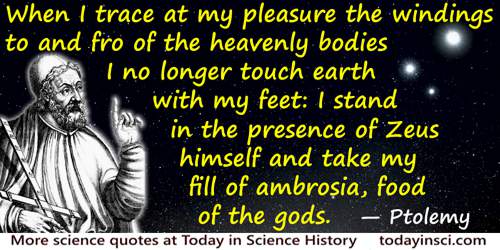
I know that I am mortal by nature, and ephemeral; but when I trace at my pleasure the windings to and fro of the heavenly bodies I no longer touch earth with my feet: I stand in the presence of Zeus himself and take my fill of ambrosia, food of the gods.
— Ptolemy
Epigram. Almagest. In Owen Gingerich, The Eye of Heaven: Ptolemy, Copernicus, Kepler (1993), 4.
I read in the proof sheets of Hardy on Ramanujan: “As someone said, each of the positive integers was one of his personal friends.” My reaction was, “I wonder who said that; I wish I had.” In the next proof-sheets I read (what now stands), “It was Littlewood who said…”. What had happened was that Hardy had received the remark in silence and with poker face, and I wrote it off as a dud.
In Béla Bollobás (ed.), Littlewood’s Miscellany, (1986), 61.
I regard sex as the central problem of life. And now that the problem of religion has practically been settled, and that the problem of labor has at least been placed on a practical foundation, the question of sex—with the racial questions that rest on it—stands before the coming generations as the chief problem for solution. Sex lies at the root of life, and we can never learn to reverence life until we know how to understand sex.
Studies in the Psychology of Sex (1897), Vol. 1, xxx.
I remember working out a blueprint for my future when I was twelve years old I resolved first to make enough money so I'd never be stopped from finishing anything; second, that to accumulate money in a hurry—and I was in a hurry—I'd have to invent something that people wanted. And third, that if I ever was going to stand on my own feet, I'd have to leave home.
In Sidney Shalett, 'Aviation’s Stormy Genius', Saturday Evening Post (13 Oct 1956), 229, No. 15, 26 & 155
I searched along the changing edge
Where, sky-pierced now the cloud had broken.
I saw no bird, no blade of wing,
No song was spoken.
I stood, my eyes turned upward still
And drank the air and breathed the light.
Then, like a hawk upon the wind,
I climbed the sky, I made the flight.
Where, sky-pierced now the cloud had broken.
I saw no bird, no blade of wing,
No song was spoken.
I stood, my eyes turned upward still
And drank the air and breathed the light.
Then, like a hawk upon the wind,
I climbed the sky, I made the flight.
…...
I stand almost with the others. They believe the world was made for man, I believe it likely that it was made for man; they think there is proof, astronomical mainly, that it was made for man, I think there is evidence only, not proof, that it was made for him. It is too early, yet, to arrange the verdict, the returns are not all in. When they are all in, I think that they will show that the world was made for man; but we must not hurry, we must patiently wait till they are all in.
Attributed.
I stand before you as somebody who is both physicist and a priest, and I want to hold together my scientific and my religious insights and experiences . I want to hold them together, as far as I am able, without dishonesty and without compartmentalism. I don’t want to be a priest on Sunday and a physicist on Monday; I want to be both on both days.
…...
I stand in favor of using seeds and products that have a proven track record. … There is a big gap between what the facts are, and what the perceptions are. … I mean “genetically modified” sounds Frankensteinish. Drought-resistant sounds really like something you’d want.
Speech at Biotechnology Industry Organization (BIO) convention, San Diego (Jun 2014). Audio on AgWired website.
I started studying law, but this I could stand just for one semester. I couldn’t stand more. Then I studied languages and literature for two years. After two years I passed an examination with the result I have a teaching certificate for Latin and Hungarian for the lower classes of the gymnasium, for kids from 10 to 14. I never made use of this teaching certificate. And then I came to philosophy, physics, and mathematics. In fact, I came to mathematics indirectly. I was really more interested in physics and philosophy and thought about those. It is a little shortened but not quite wrong to say: I thought I am not good enough for physics and I am too good for philosophy. Mathematics is in between.
From interview on his 90th birthday. In D J Albers and G L Alexanderson (eds.), Mathematical People: Profiles and Interviews (1985), 245-254.
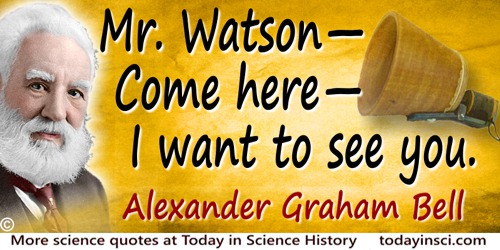
I then shouted into M [the mouthpiece] the following sentence: “Mr. Watson—Come here—I want to see you.” To my delight he came and declared that he had heard and understood what I said. I asked him to repeat the words. He answered “You said—‘Mr. Watson—-come here—I want to see you.’” We then changed places and I listened at S [the reed receiver] while Mr. Watson read a few passages from a book into the mouth piece M. It was certainly the case that articulate sounds proceeded from S. The effect was loud but indistinct and muffled. If I had read beforehand the passage given by Mr. Watson I should have recognized every word. As it was I could not make out the sense—but an occasional word here and there was quite distinct. I made out “to” and “out” and “further”; and finally the sentence “Mr. Bell do you understand what I say? Do—you—un—der—stand—what—I—say” came quite clearly and intelligibly. No sound was audible when the armature S was removed.
Notebook, 'Experiments made by A. Graham Bell, vol. I'. Entry for 10 March 1876. Quoted in Robert V. Bruce, Bell: Alexander Graham Bell and the Conquest of Solitude (1973), 181.
I think that each town should have a park, or rather a primitive forest, of five hundred or a thousand acres, either in one body or several, where a stick should never be cut for fuel, nor for the navy, nor to make wagons, but stand and decay for higher uses—a common possession forever, for instruction and recreation. All Walden Wood might have been reserved, with Walden in the midst of it.
In Wild Fruits: Thoreau’s Rediscovered Last Manuscript (2000), 238. Also appears as an epigraph after the title page.
I think that we shall have to get accustomed to the idea that we must not look upon science as a 'body of knowledge,' but rather as a system of hypotheses; that is to say, as a system of guesses or anticipations which in principle cannot be justified, but with which we work as long as they stand up to tests, and of which we are never justified in saying that we know they are 'true' or 'more or less certain' or even 'probable.'
The Logic of Scientific Discovery (1959), 317.
I waited for Rob and, linking arms, we took our final steps together onto the rooftop of the world. It was 8.15 am on 24 May 2004; there was nowhere higher on the planet that we could go, the world lay at our feet. Holding each other tightly, we tried to absorb where we were. To be standing here, together, exactly three years since Rob’s cancer treatment, was nothing short of a miracle. Standing on top of Everest was more than just climbing a mountain - it was a gift of life. With Pemba and Nawang we crowded together, wrapping our arms around each other. They had been more than Sherpas, they had been our guardian angels.
— Jo Gambi
…...
I would not have it inferred ... that I am, as yet, an advocate for the hypothesis of chemical life. The doctrine of the vitality of the blood, stands in no need of aid from that speculative source. If it did, I would certainly abandon it. For, notwithstanding the fashionableness of the hypothesis in Europe, and the ascendancy it has gained over some minds in this country [USA], it will require stubborn facts to convince me that man with all his corporeal and intellectual attributes is nothing but hydro-phosphorated oxyde of azote ... When the chemist declares, that the same laws which direct the crystallization of spars, nitre and Glauber's salts, direct also the crystallization of man, he must pardon me if I neither understand him, nor believe him.
Medical Theses (1805), 391-2, footnote.
I’m very intense in my work. At any given moment, I think I know the answer to some problem, and that I’m right. Since science is the only self-correcting human institution I know of, you should not be frightened to take an extreme stand, if that causes the stand to be examined more thoroughly than it might be if you are circumspect. I’ve always been positive about the value of the Hubble constant, knowing full well that it probably isn’t solved.
As quoted in John Noble Wilford, 'Sizing up the Cosmos: An Astronomers Quest', New York Times (12 Mar 1991), C10.
If I have not seen as far as others, it is because giants were standing on my shoulders.
As quoted, previously on webpage with short bio of Hal Abelson at publicknowledge.org (as archived from Nov 2004).
If it were not for our conception of weights and measures we would stand in awe of the firefly as we do before the sun.
In Kahlil Gibran: The Collected Works (2007), 204.
If somebody’d said before the flight, “Are you going to get carried away looking at the earth from the moon?” I would have say, “No, no way.” But yet when I first looked back at the earth, standing on the moon, I cried.
…...
If this [human kind’s extinction] happens I venture to hope that we shall not have destroyed the rat, an animal of considerable enterprise which stands as good a chance as any … of evolving toward intelligence.
In The Inequality of Man: And Other Essays (1937), 143.
If to-day you ask a physicist what he has finally made out the æther or the electron to be, the answer will not be a description in terms of billiard balls or fly-wheels or anything concrete; he will point instead to a number of symbols and a set of mathematical equations which they satisfy. What do the symbols stand for? The mysterious reply is given that physics is indifferent to that; it has no means of probing beneath the symbolism. To understand the phenomena of the physical world it is necessary to know the equations which the symbols obey but not the nature of that which is being symbolised. …this newer outlook has modified the challenge from the material to the spiritual world.
Swarthmore Lecture (1929) at Friends’ House, London, printed in Science and the Unseen World (1929), 30.
If you disregard the very simplest cases, there is in all of mathematics not a single infinite series whose sum has been rigorously determined. In other words, the most important parts of mathematics stand without a foundation.
In Letter to a friend, as quoted in George Finlay Simmons, Calculus Gems (1992), 188.
If you want to achieve conservation, the first thing you have to do is persuade people that the natural world is precious, beautiful, worth saving and complex. If people don’t understand that and don’t believe that in their hearts, conservation doesn't stand a chance. That’s the first step, and that is what I do.
From interview with Michael Bond, 'It’s a Wonderful Life', New Scientist (14 Dec 2002), 176, No. 2373, 48.
In Euclid each proposition stands by itself; its connection with others is never indicated; the leading ideas contained in its proof are not stated; general principles do not exist. In modern methods, on the other hand, the greatest importance is attached to the leading thoughts which pervade the whole; and general principles, which bring whole groups of theorems under one aspect, are given rather than separate propositions. The whole tendency is toward generalization. A straight line is considered as given in its entirety, extending both ways to infinity, while Euclid is very careful never to admit anything but finite quantities. The treatment of the infinite is in fact another fundamental difference between the two methods. Euclid avoids it, in modern mathematics it is systematically introduced, for only thus is generality obtained.
In 'Geometry', Encyclopedia Britannica (9th edition).
In Japan, an exceptional dexterity that comes from eating with chopsticks … is especially useful in micro-assembly. (This … brings smiles from my colleagues, but I stand by it. Much of modern assembly is fine tweezer work, and nothing prepares for it better than eating with chopsticks from early childhood.)
In The Wealth and Poverty of Nations: Why Some Are So Rich and Some So Poor (1998, 1999), 475.
In no case may we interpret an action [of an animal] as the outcome of the exercise of a higher psychical faculty, if it can be interpreted as the outcome of the exercise of one which stands lower in the psychological scale.
[Morgan's canon, the principle of parsimony in animal research.]
[Morgan's canon, the principle of parsimony in animal research.]
An Introduction to Comparative Psychology (1894), 53.
In reality, I have sometimes thought that we do not go on sufficiently slowly in the removal of diseases, and that it would he better if we proceeded with less haste, and if more were often left, to Nature than is the practice now-a-days. It is a great mistake to suppose that Nature always stands in need of the assistance of Art. If that were the case, site would have made less provision for the safety of mankind than the preservation of the species demands; seeing that there is not the least proportion between the host of existing diseases and the powers possessed by man for their removal, even in those ages wherein the healing art was at the highest pitch, and most extensively cultivated.
As quoted by Gavin Milroy in 'On the Writings of Sydenham', The Lancet (14 Nov 1846), 524.
In science men have discovered an activity of the very highest value in which they are no longer, as in art, dependent for progress upon the appearance of continually greater genius, for in science the successors stand upon the shoulders of their predecessors; where one man of supreme genius has invented a method, a thousand lesser men can apply it. … In art nothing worth doing can be done without genius; in science even a very moderate capacity can contribute to a supreme achievement.
Essay, 'The Place Of Science In A Liberal Education.' In Mysticism and Logic: and Other Essays (1919), 41.
In the bleak midwinter Frosty wind made moan, Earth stood hard as iron, Water like a stone; Snow had fallen, snow on snow, Snow on snow, In the bleak midwinter, Long ago.
…...
In the history of the discovery of zero will always stand out as one of the greatest single achievements of the human race.
Number: the Language of Science (1930), 35.
In the moment of the vernal equinox, we find ourselves standing at the threshold between winter’s chill and spring’s warmth, a testament to the resilience of life and the promise of new beginnings.
A fictional quote imagined in the style typical of a scientist (19 Mar 2024).
In the republic of scholarship everybody wants to rule, there are no aldermen there, and that is a bad thing: every general must, so to speak, draw up the plan, stand sentry, sweep out the guardroom and fetch the water; no one wants to work for the good of another.
Aphorism 80 in Notebook D (1773-1775), as translated by R.J. Hollingdale in Aphorisms (1990). Reprinted as The Waste Books (2000), 56.
Innovations, free thinking is blowing like a storm; those that stand in front of it, ignorant scholars like you, false scientists, perverse conservatives, obstinate goats, resisting mules are being crushed under the weight of these innovations. You are nothing but ants standing in front of the giants; nothing but chicks trying to challenge roaring volcanoes!
From the play Galileo Galilei (2001) .
Instead of adjusting students to docile membership in whatever group they happen to be placed, we should equip them to cope with their environment, not be adjusted to it, to be willing to stand alone, if necessary, for what is right and true.
In speech, 'Education for Creativity in the Sciences', Conference at New York University, Washington Square. As quoted by Gene Currivan in 'I.Q. Tests Called Harmful to Pupil', New York Times (16 Jun 1963), 66.
Intellect is void of affection and sees an object as it stands in the light of science, cool and disengaged. The intellect goes out of the individual, floats over its own personality, and regards it as a fact, and not as I and mine.
From 'Intellect', collected in The Complete Works of Ralph Waldo Emerson (1903), 326.
Is man a peculiar organism? Does he originate in a wholly different way from a dog, bird, frog, or fish? and does he thereby justify those who assert that he has no place in nature, and no real relationship with the lower world of animal life? Or does he develop from a similar embryo, and undergo the same slow and gradual progressive modifications? The answer is not for an instant doubtful, and has not been doubtful for the last thirty years. The mode of man’s origin and the earlier stages of his development are undoubtedly identical with those of the animals standing directly below him in the scale; without the slightest doubt, he stands in this respect nearer the ape than the ape does to the dog. (1863)
As quoted in Ernst Haeckel and E. Ray Lankester (trans.) as epigraph for Chap. 12, The History of Creation (1886), Vol. 1, 364.
It is a better world with some buffalo left in it, a richer world with some gorgeous canyons unmarred by signboards, hot-dog stands, super highways, or high-tension lines, undrowned by power or irrigation reservoirs. If we preserved as parks only those places that have no economic possibilities, we would have no parks. And in the decades to come, it will not be only the buffalo and the trumpeter swan who need sanctuaries. Our own species is going to need them too.
It needs them now.
Conclusion of essay 'The Marks of Human Passage', collected in This is Dinosaur: Echo Park Country and its Magic Rivers (1955), 17.
It is a strange feeling which comes over one as he stands in the centre of the tunnel, and knows that a mighty river is rolling on over his head, and that great ships with their thousands of tons burthen, sail over him. ... There is no single work of Art in London (with the exception of St. Paul's Cathedral) which excites so much curiosity and admiration among foreigners as the Tunnel. Great buildings are common to all parts of Europe, but the world has not such another Tunnel as this. There is something grand in the idea of walking under a broad river—making a pathway dry and secure beneath ships and navies!
[About visiting Brunel's Thames Tunnel, the first in the world under a navigable waterway.]
[About visiting Brunel's Thames Tunnel, the first in the world under a navigable waterway.]
What I Saw in London: or, Men and Things in the Great Metropolis (1853), 168-169.
It is admitted by all that a finished or even a competent reasoner is not the work of nature alone; the experience of every day makes it evident that education develops faculties which would otherwise never have manifested their existence. It is, therefore, as necessary to learn to reason before we can expect to be able to reason, as it is to learn to swim or fence, in order to attain either of those arts. Now, something must be reasoned upon, it matters not much what it is, provided it can be reasoned upon with certainty. The properties of mind or matter, or the study of languages, mathematics, or natural history, may be chosen for this purpose. Now of all these, it is desirable to choose the one which admits of the reasoning being verified, that is, in which we can find out by other means, such as measurement and ocular demonstration of all sorts, whether the results are true or not. When the guiding property of the loadstone was first ascertained, and it was necessary to learn how to use this new discovery, and to find out how far it might be relied on, it would have been thought advisable to make many passages between ports that were well known before attempting a voyage of discovery. So it is with our reasoning faculties: it is desirable that their powers should be exerted upon objects of such a nature, that we can tell by other means whether the results which we obtain are true or false, and this before it is safe to trust entirely to reason. Now the mathematics are peculiarly well adapted for this purpose, on the following grounds:
1. Every term is distinctly explained, and has but one meaning, and it is rarely that two words are employed to mean the same thing.
2. The first principles are self-evident, and, though derived from observation, do not require more of it than has been made by children in general.
3. The demonstration is strictly logical, taking nothing for granted except self-evident first principles, resting nothing upon probability, and entirely independent of authority and opinion.
4. When the conclusion is obtained by reasoning, its truth or falsehood can be ascertained, in geometry by actual measurement, in algebra by common arithmetical calculation. This gives confidence, and is absolutely necessary, if, as was said before, reason is not to be the instructor, but the pupil.
5. There are no words whose meanings are so much alike that the ideas which they stand for may be confounded. Between the meaning of terms there is no distinction, except a total distinction, and all adjectives and adverbs expressing difference of degrees are avoided.
1. Every term is distinctly explained, and has but one meaning, and it is rarely that two words are employed to mean the same thing.
2. The first principles are self-evident, and, though derived from observation, do not require more of it than has been made by children in general.
3. The demonstration is strictly logical, taking nothing for granted except self-evident first principles, resting nothing upon probability, and entirely independent of authority and opinion.
4. When the conclusion is obtained by reasoning, its truth or falsehood can be ascertained, in geometry by actual measurement, in algebra by common arithmetical calculation. This gives confidence, and is absolutely necessary, if, as was said before, reason is not to be the instructor, but the pupil.
5. There are no words whose meanings are so much alike that the ideas which they stand for may be confounded. Between the meaning of terms there is no distinction, except a total distinction, and all adjectives and adverbs expressing difference of degrees are avoided.
In On the Study and Difficulties of Mathematics (1898), chap. 1.
It is almost as difficult to make a man unlearn his errors, as his knowledge. Mal-information is more hopeless than non-information: for error is always more busy than ignorance. Ignorance is a blank sheet on which we may write; but error is a scribbled one on which we first erase. Ignorance is contented to stand still with her back to the truth; but error is more presumptuous, and proceeds, in the same direction. Ignorance has no light, but error follows a false one. The consequence is, that error, when she retraces her footsteps, has farther to go, before we can arrive at the truth, than ignorance.
Reflection 1, in Lacon: or Many things in Few Words; Addressed to Those Who Think (1820), 15.
It is difficult to know how to treat the errors of the age. If a man oppose them, he stands alone; if he surrender to them, they bring him neither joy nor credit.
In The Maxims and Reflections of Goethe (1906), 185.
It is well-known that both rude and civilized peoples are capable of showing unspeakable, and as it is erroneously termed, inhuman cruelty towards each other. These acts of cruelty, murder and rapine are often the result of the inexorable logic of national characteristics, and are unhappily truly human, since nothing like them can be traced in the animal world. It would, for instance, be a grave mistake to compare a tiger with the bloodthirsty exectioner of the Reign of Terror, since the former only satisfies his natural appetite in preying on other mammals. The atrocities of the trials for witchcraft, the indiscriminate slaughter committed by the negroes on the coast of Guinea, the sacrifice of human victims made by the Khonds, the dismemberment of living men by the Battas, find no parallel in the habits of animals in their savage state. And such a comparision is, above all, impossible in the case of anthropoids, which display no hostility towards men or other animals unless they are first attacked. In this respect the anthropid ape stands on a higher plane than many men.
Robert Hartmann, Anthropoid Apes, 294-295.
It isn’t important in which sea or lake you observe a slick of pollution, or in the forests of which country a fire breaks out, or on which continent a hurricane arises. You are standing guard over the whole of our Earth.
In Jack Hassard and Julie Weisberg, Environmental Science on the Net: The Global Thinking Project (1999), 23.
It must be for truth’s sake, and not for the sake of its usefulness to humanity, that the scientific man studies Nature. The application of science to the useful arts requires other abilities, other qualities, other tools than his; and therefore I say that the man of science who follows his studies into their practical application is false to his calling. The practical man stands ever ready to take up the work where the scientific man leaves it, and adapt it to the material wants and uses of daily life.
Methods of Study in Natural History (1863),24.
It remains a real world if there is a background to the symbols—an unknown quantity which the mathematical symbol x stands for. We think we are not wholly cut off from this background. It is to this background that our own personality and consciousness belong, and those spiritual aspects of our nature not to be described by any symbolism… to which mathematical physics has hitherto restricted itself.
Swarthmore Lecture (1929) at Friends’ House, London, printed in Science and the Unseen World (1929), 37-38.
It stands to the everlasting credit of science that by acting on the human mind it has overcome man's insecurity before himself and before nature.
Out of My Later Years (1995), 137.
It startled him even more when just after he was awarded the Galactic Institute’s Prize for Extreme Cleverness he got lynched by a rampaging mob of respectable physicists who had finally realized that the one thing they really couldn't stand was a smart-ass.
The Hitchhiker's Guide to the Galaxy (1979, 1997), 78.
It was cold. Space, the air we breathed, the yellow rocks, were deadly cold. There was something ultimate, passionless, and eternal in this cold. It came to us as a single constant note from the depths of space. We stood on the very boundary of life and death.
…...
It will be noticed that the fundamental theorem proved above bears some remarkable resemblances to the second law of thermodynamics. Both are properties of populations, or aggregates, true irrespective of the nature of the units which compose them; both are statistical laws; each requires the constant increase of a measurable quantity, in the one case the entropy of a physical system and in the other the fitness, measured by m, of a biological population. As in the physical world we can conceive the theoretical systems in which dissipative forces are wholly absent, and in which the entropy consequently remains constant, so we can conceive, though we need not expect to find, biological populations in which the genetic variance is absolutely zero, and in which fitness does not increase. Professor Eddington has recently remarked that “The law that entropy always increases—the second law of thermodynamics—holds, I think, the supreme position among the laws of nature.” It is not a little instructive that so similar a law should hold the supreme position among the biological sciences. While it is possible that both may ultimately be absorbed by some more general principle, for the present we should note that the laws as they stand present profound differences—-(1) The systems considered in thermodynamics are permanent; species on the contrary are liable to extinction, although biological improvement must be expected to occur up to the end of their existence. (2) Fitness, although measured by a uniform method, is qualitatively different for every different organism, whereas entropy, like temperature, is taken to have the same meaning for all physical systems. (3) Fitness may be increased or decreased by changes in the environment, without reacting quantitatively upon that environment. (4) Entropy changes are exceptional in the physical world in being irreversible, while irreversible evolutionary changes form no exception among biological phenomena. Finally, (5) entropy changes lead to a progressive disorganization of the physical world, at least from the human standpoint of the utilization of energy, while evolutionary changes are generally recognized as producing progressively higher organization in the organic world.
The Genetical Theory of Natural Selection (1930), 36.
It’s like trying to describe what you feel when you’re standing on the rim of the Grand Canyon or remembering your first love or the birth of your child. You have to be there to really know what it’s like.
As quoted on the nmspacemuseum.org website of the New Mexico Museum of Space History.
Let him look at that dazzling light hung aloft as an eternal lamp to lighten the universe; let him behold the earth, a mere dot compared with the vast circuit which that orb describes, and stand amazed to find that the vast circuit itself is but a very fine point compared with the orbit traced by the stars as they roll their course on high. But if our vision halts there, let imagination pass beyond; it will fail to form a conception long before Nature fails to supply material. The whole visible world is but an imperceptible speck in the ample bosom of Nature. No notion comes near it. Though we may extend our thought beyond imaginable space, yet compared with reality we bring to birth mere atoms. Nature is an infinite sphere whereof the centre is everywhere, the circumference nowhere. In short, imagination is brought to silence at the thought, and that is the most perceptible sign of the all-power of God.
Let man reawake and consider what he is compared with the reality of things; regard himself lost in this remote corner of Nature; and from the tiny cell where he lodges, to wit the Universe, weigh at their true worth earth, kingdoms, towns, himself. What is a man face to face with infinity?
Let man reawake and consider what he is compared with the reality of things; regard himself lost in this remote corner of Nature; and from the tiny cell where he lodges, to wit the Universe, weigh at their true worth earth, kingdoms, towns, himself. What is a man face to face with infinity?
Pensées (1670), Section 1, aphorism 43. In H. F. Stewart (ed.), Pascal’s Pensées (1950), 19.
Let us suppose that an ichthyologist is exploring the life of the ocean. He casts a net into the water and brings up a fishy assortment. Surveying his catch, he proceeds in the usual manner of a scientist to systematise what it reveals. He arrives at two generalisations:
(1) No sea-creature is less than two inches long.
(2) All sea-creatures have gills.
These are both true of his catch, and he assumes tentatively that they will remain true however often he repeats it.
In applying this analogy, the catch stands for the body of knowledge which constitutes physical science, and the net for the sensory and intellectual equipment which we use in obtaining it. The casting of the net corresponds to observation; for knowledge which has not been or could not be obtained by observation is not admitted into physical science.
An onlooker may object that the first generalisation is wrong. “There are plenty of sea-creatures under two inches long, only your net is not adapted to catch them.” The icthyologist dismisses this objection contemptuously. “Anything uncatchable by my net is ipso facto outside the scope of icthyological knowledge. In short, what my net can't catch isn't fish.” Or—to translate the analogy—“If you are not simply guessing, you are claiming a knowledge of the physical universe discovered in some other way than by the methods of physical science, and admittedly unverifiable by such methods. You are a metaphysician. Bah!”
(1) No sea-creature is less than two inches long.
(2) All sea-creatures have gills.
These are both true of his catch, and he assumes tentatively that they will remain true however often he repeats it.
In applying this analogy, the catch stands for the body of knowledge which constitutes physical science, and the net for the sensory and intellectual equipment which we use in obtaining it. The casting of the net corresponds to observation; for knowledge which has not been or could not be obtained by observation is not admitted into physical science.
An onlooker may object that the first generalisation is wrong. “There are plenty of sea-creatures under two inches long, only your net is not adapted to catch them.” The icthyologist dismisses this objection contemptuously. “Anything uncatchable by my net is ipso facto outside the scope of icthyological knowledge. In short, what my net can't catch isn't fish.” Or—to translate the analogy—“If you are not simply guessing, you are claiming a knowledge of the physical universe discovered in some other way than by the methods of physical science, and admittedly unverifiable by such methods. You are a metaphysician. Bah!”
In 'Selective Subjectivism', The Philosophy of Physical Science (1938, 2012), 16.
Life, forever dying to be born afresh, forever young and eager, will presently stand upon this Earth as upon a footstool, and stretch out its realm amidst the stars.
…...
Literature stands related to Man as Science stands to Nature; it is his history.
Discourses on the Scope and Nature of University Education. Addressed to the Catholics of Dublin (1852), Discourse 10, 353.
Mankind has always drawn from outside sources of energy. This island was the first to harness coal and steam. But our present sources stand in the ratio of a million to one, compared with any previous sources. The release of atomic energy will change the whole structure of society.
Address to New Europe Group meeting on the third anniversary of the Hiroshima bomb. Quoted in New Europe Group, In Commemoration of Professor Frederick Soddy (1956), 7.
Many the forms of life,
Fearful and strange to see,
But man supreme stands out
For strangeness and for fear.
Fearful and strange to see,
But man supreme stands out
For strangeness and for fear.
First line of a choral ode in Antigone, line 332, as translated in Harvard Classics. One of several variations given in Bernard Stiegler, Technics and Time, 3, (2010), 237.
Mathematic stands forth as that which unites, mediates between Man and Nature, Inner and Outer world, Thought and Perception, [as no other subject does].
In Die Erziehung der Menschheit (1826). Adapted and translated in William Henry Herford, 'The School: Mathematic', The Student’s Froebel (1894), Vol. 1, 84.
Mathematicians deal with possible worlds, with an infinite number of logically consistent systems. Observers explore the one particular world we inhabit. Between the two stands the theorist. He studies possible worlds but only those which are compatible with the information furnished by observers. In other words, theory attempts to segregate the minimum number of possible worlds which must include the actual world we inhabit. Then the observer, with new factual information, attempts to reduce the list further. And so it goes, observation and theory advancing together toward the common goal of science, knowledge of the structure and observation of the universe.
Lecture to Sigma Xi, 'The Problem of the Expanding Universe' (1941), printed in Sigma Xi Quarterly (1942), 30, 104-105. Reprinted in Smithsonian Institution Report of the Board of Regents (1943), 97, 123. As cited by Norriss S. Hetherington in 'Philosophical Values and Observation in Edwin Hubble's Choice of a Model of the Universe', Historical Studies in the Physical Sciences (1982), 13, No. 1, 63.
Mathematics has not a foot to stand upon which is not purely metaphysical.
'Kant in His Miscellaneous Essays', Blackwood's Magazine, 1830, 28, 244-68.
Mathematics is an interesting intellectual sport but it should not be allowed to stand in the way of obtaining sensible information about physical processes.
Quoted in Nicholas J. Rose, Mathematical Maxims and Minims (1988).
Mathematics is distinguished from all other sciences except only ethics, in standing in no need of ethics. Every other science, even logic—logic, especially—is in its early stages in danger of evaporating into airy nothingness, degenerating, as the Germans say, into an anachrioid [?] film, spun from the stuff that dreams are made of. There is no such danger for pure mathematics; for that is precisely what mathematics ought to be.
In Charles S. Peirce, Charles Hartshorne (ed.), Paul Weiss (ed.), Collected Papers of Charles Sanders Peirce (1931), Vol. 4, 200.
Mathematics vindicates the right … to stand in the front rank of the pioneers that search the real truth and find it crystallized forever in brilliant gems.
In Lectures on the Philosophy of Mathematics (1918), 194.
Modern Science has along with the theory that the Earth dated its beginning with the advent of man, swept utterly away this beautiful imagining. We can, indeed, find no beginning of the world. We trace back events and come to barriers which close our vistabarriers which, for all we know, may for ever close it. They stand like the gates of ivory and of horn; portals from which only dreams proceed; and Science cannot as yet say of this or that dream if it proceeds from the gate of horn or from that of ivory.
In short, of the Earth's origin we have no certain knowledge; nor can we assign any date to it. Possibly its formation was an event so gradual that the beginning was spread over immense periods. We can only trace the history back to certain events which may with considerable certainty be regarded as ushering in our geological era.
In short, of the Earth's origin we have no certain knowledge; nor can we assign any date to it. Possibly its formation was an event so gradual that the beginning was spread over immense periods. We can only trace the history back to certain events which may with considerable certainty be regarded as ushering in our geological era.
Lecture at the Royal Dublin Society, 6 Feb 1914. Published in Science Progress, Vol. 9, 37. Republished in The Birth-Time of the World and Other Scientific Essays, (1915), 2.
Modern technology has lost its magic. No longer do people stand in awe, thrilled by the onward rush of science, the promise of a new day. Instead, the new is suspect. It arouses our hostility as much as it used to excite our fancy. With each breakthrough there are recurrent fears and suspicion. How will the advance further pollute our lives; modern technology is not merely what it first appears to be. Behind the white coats, the disarming jargon, the elaborate instrumentation, and at the core of what has often seemed an automatic process, one finds what Dorothy found in Oz: modern technology is human after all.
In Science and Liberation edited by Rita Arditti, Pat Brennan, and Steve Cavrak (1980).
Mr Justus Liebig is no doubt a very clever gentleman and a most profound chemist, but in our opinion he knows as much of agriculture as the horse that ploughs the ground, and there is not an old man that stands between the stilts of a plough in Virginia, that cannot tell him of facts totally at variance with his finest spun theories.
— Magazine
The Southern Planter (1845), 3, 23.
Nature, the parent of all things, designed the human backbone to be like a keel or foundation. It is because we have a backbone that we can walk upright and stand erect. But this was not the only purpose for which Nature provided it; here, as elsewhere, she displayed great skill in turning the construction of a single member to a variety of different uses.
It Provides a Path for the Spinal Marrow, Yet is Flexible.
Firstly, she bored a hole through the posterior region of the bodies of all the vertebrae, thus fashioning a suitable pathway for the spinal marrow which would descend through them.
Secondly, she did not make the backbone out of one single bone with no joints. Such a unified construction would have afforded greater stability and a safer seat for the spinal marrow since, not having joints, the column could not have suffered dislocations, displacements, or distortions. If the Creator of the world had paid such attention to resistance to injury and had subordinated the value and importance of all other aims in the fabric of parts of the body to this one, he would certainly have made a single backbone with no joints, as when someone constructing an animal of wood or stone forms the backbone of one single and continuous component. Even if man were destined only to bend and straighten his back, it would not have been appropriate to construct the whole from one single bone. And in fact, since it was necessary that man, by virtue of his backbone, be able to perform a great variety of movements, it was better that it be constructed from many bones, even though as a result of this it was rendered more liable to injury.
It Provides a Path for the Spinal Marrow, Yet is Flexible.
Firstly, she bored a hole through the posterior region of the bodies of all the vertebrae, thus fashioning a suitable pathway for the spinal marrow which would descend through them.
Secondly, she did not make the backbone out of one single bone with no joints. Such a unified construction would have afforded greater stability and a safer seat for the spinal marrow since, not having joints, the column could not have suffered dislocations, displacements, or distortions. If the Creator of the world had paid such attention to resistance to injury and had subordinated the value and importance of all other aims in the fabric of parts of the body to this one, he would certainly have made a single backbone with no joints, as when someone constructing an animal of wood or stone forms the backbone of one single and continuous component. Even if man were destined only to bend and straighten his back, it would not have been appropriate to construct the whole from one single bone. And in fact, since it was necessary that man, by virtue of his backbone, be able to perform a great variety of movements, it was better that it be constructed from many bones, even though as a result of this it was rendered more liable to injury.
From De Humani Corporis Fabrica Libri Septem: (1543), Book I, 57-58, as translated by William Frank Richardson, in 'Nature’s Skill in Creating a Backbone to Hold Us Erect', On The Fabric of the Human Body: Book I: The Bones and Cartilages (1998), 138.
Newton said, “If I have seen further than others, it is because I’ve stood on the shoulders of giants.” These days we stand on each other’s feet!
In 'You and Your Research', Bell Communications Research Colloquium Seminar, 7 Mar 1986.
No nation can be really great unless it is great in peace, in industry, integrity, honesty. Skilled intelligence in civic affairs and industrial enterprises alike; the special ability of the artist, the man of letters, the man of science, and the man of business; the rigid determination to wrong no man, and to stand for righteousness—all these are necessary in a great nation.
Address (2 Jun 1897) at U.S. Naval War College, Newport, Rhode Island. In 'Washington's Forgotten Maxim', United States Naval Institute Proceedings (1897), 23, 450.
Nobody knows how the stand of our knowledge about the atom would be without him. Personally, [Niels] Bohr is one of the amiable colleagues I have met. He utters his opinions like one perpetually groping and never like one who believes himself to be in possession of the truth.
Quoted in Bill Becker, 'Pioneer of the Atom', New York Times Sunday Magazine (20 Oct 1957), 52.
Now and then, in the course of the century, a great man of science, like Darwin; a great poet, like Keats; a fine critical spirit, like M. Renan; a supreme artist, like Flaubert, has been able to isolate himself, to keep himself out of reach of the clamorous claims of others, to stand “under the shelter of the wall,” as Plato puts it, and so to realise the perfection of what was in him, to his own incomparable gain, and to the incomparable and lasting gain of the whole world.
In Sebastian Melmoth (1908), 133-134.
Now this supreme wisdom, united to goodness that is no less infinite, cannot but have chosen the best. For as a lesser evil is a kind of good, even so a lesser good is a kind of evil if it stands in the way of a greater good; and the would be something to correct in the actions of God if it were possible to the better. As in mathematics, when there is no maximum nor minimum, in short nothing distinguished, everything is done equally, or when that is not nothing at all is done: so it may be said likewise in respect of perfect wisdom, which is no less orderly than mathematics, that if there were not the best (optimum) among all possible worlds, God would not have produced any.
Theodicy: Essays on the Goodness of God and Freedom of Man and the Origin of Evil (1710), 128.
Of all the constituents of the human body, bone is the hardest, the driest, the earthiest, and the coldest; and, excepting only the teeth, it is devoid of sensation. God, the great Creator of all things, formed its substance to this specification with good reason, intending it to be like a foundation for the whole body; for in the fabric of the human body bones perform the same function as do walls and beams in houses, poles in tents, and keels and ribs in boats.
Bones Differentiated by Function
Some bones, by reason of their strength, form as it were props for the body; these include the tibia, the femur, the spinal vertebrae, and most of the bony framework. Others are like bastions, defense walls, and ramparts, affording natural protection to other parts; examples are the skull, the spines and transverse processes of the vertebrae, the breast bone, the ribs. Others stand in front of the joints between certain bones, to ensure that the joint does not move too loosely or bend to too acute an angle. This is the function of the tiny bones, likened by the professors of anatomy to the size of a sesame seed, which are attached to the second internode of the thumb, the first internode of the other four fingers and the first internodes of the five toes. The teeth, on the other hand, serve specifically to cut, crush, pound and grind our food, and similarly the two ossicles in the organ of hearing perform a specifically auditory function.
Bones Differentiated by Function
Some bones, by reason of their strength, form as it were props for the body; these include the tibia, the femur, the spinal vertebrae, and most of the bony framework. Others are like bastions, defense walls, and ramparts, affording natural protection to other parts; examples are the skull, the spines and transverse processes of the vertebrae, the breast bone, the ribs. Others stand in front of the joints between certain bones, to ensure that the joint does not move too loosely or bend to too acute an angle. This is the function of the tiny bones, likened by the professors of anatomy to the size of a sesame seed, which are attached to the second internode of the thumb, the first internode of the other four fingers and the first internodes of the five toes. The teeth, on the other hand, serve specifically to cut, crush, pound and grind our food, and similarly the two ossicles in the organ of hearing perform a specifically auditory function.
From De Humani Corporis Fabrica Libri Septem: (1543), Book I, 1, as translated by William Frank Richardson, in 'Nature of Bone; Function of Bones', On The Fabric of the Human Body: Book I: The Bones and Cartilages (1998), 1.
On a huge hill, Cragged, and steep, Truth stands, and hee that will
Reach her, about must, and about must goo.
Reach her, about must, and about must goo.
Satyre, III, I. 79-81. The Works of John Donne (Wordsworth edition 1994), 113.
One more word on “designed laws” and “undesigned results.” - I see a bird which I want for food, take my gun and kill it, I do this designedly.—An innocent and good man stands under a tree and is killed by a flash of lightning. Do you believe (& I really should like to hear) that God designedly killed this man? Many or most persons do believe this; I can’t and don’t.—If you believe so, do you believe that when a swallow snaps up a gnat that God designed that that particular swallow should snap up that particular gnat at that particular instant? I believe that the man and the gnat are in the same predicament. If the death of neither man nor gnat are designed, I see no good reason to believe that their first birth or production should be necessarily designed.
Letter to Asa Gray, 3 July 1860. In F. Burkhardt and S. Smith (eds.), The Correspondence of Charles Darwin 1860 (1993), Vol. 8, 275.
One must stand stiller than still.
On reverse time travel.
On reverse time travel.
Through Space and Time (1934).
One of the differences between the natural and the social sciences is that in the natural sciences, each succeeding generation stands on the shoulders of those that have gone before, while in the social sciences, each generation steps in the faces of its predecessors.
Skinner's Theory of Teaching Machines (1959), 167.
One summer night, out on a flat headland, all but surrounded by the waters of the bay, the horizons were remote and distant rims on the edge of space. Millions of stars blazed in darkness, and on the far shore a few lights burned in cottages. Otherwise there was no reminder of human life. My companion and I were alone with the stars: the misty river of the Milky Way flowing across the sky, the patterns of the constellations standing out bright and clear, a blazing planet low on the horizon. It occurred to me that if this were a sight that could be seen only once in a century, this little headland would be thronged with spectators. But it can be seen many scores of nights in any year, and so the lights burned in the cottages and the inhabitants probably gave not a thought to the beauty overhead; and because they could see it almost any night, perhaps they never will.
In The Sense of Wonder (1956), as condensed in Reader’s Digest (1986), 129, 174.
One wonders whether a generation that demands instant satisfaction of all its needs and instant solution of the world’s problems will produce anything of lasting value. Such a generation, even when equipped with the most modern technology, will be essentially primitive - it will stand in awe of nature, and submit to the tutelage of medicine men.
In Reflections on the Human Condition (1973), 38.
Only time and money stand between us and knowing the composition of every gene in the human genome.
(1986).
Our country is now at war and the only way out is forward. I would not change one word I have spoken against war but that is no longer the issue. We must now stand together.
As quoted in 'David Starr Jordan Dies at Age of 80', New York Times (20 Sep 1931), N6.
Our system of philosophy is itself on trial; it must stand or fall according as it is broad enough to find room for this experience as an element of life.
Swarthmore Lecture (1929) at Friends’ House, London, printed in Science and the Unseen World (1929), 46.
Our world faces a crisis as yet unperceived by those possessing power to make great decisions for good or evil. The unleashed power of the atom has changed everything save our modes of thinking and we thus drift toward unparalleled catastrophe. We scientists who released this immense power have an overwhelming responsibility in this world life-and-death struggle to harness the atom for the benefit of mankind and not for humanity’s destruction. … We need two hundred thousand dollars at once for a nation-wide campaign to let people know that a new type of thinking is essential if mankind is to survive and move toward higher levels. This appeal is sent to you only after long consideration of the immense crisis we face. … We ask your help at this fateful moment as a sign that we scientists do not stand alone.
In 'Atomic Education Urged by Einstein', New York Times (25 May 1946), 13. Extract from a telegram (24 May 1946) to “several hundred prominent Americans”, signed by Albert Einstein as Chairman, with other members, of the Emergency Committee of Atomic Scientists. It was also signed by the Federation of American Scientists.
Paradox has been defined as “Truth standing on her head to get attention.”
In 'When Doctors Agree', The Paradoxes of Mr Pond (1937), 71.
People like you and I, though mortal of course like everyone else, do not grow old no matter how long we live...[We] never cease to stand like curious children before the great mystery into which we were born.
…...
Phenomena unfold on their own appropriate scales of space and time and may be invisible in our myopic world of dimensions assessed by comparison with human height and times metered by human lifespans. So much of accumulating importance at earthly scales ... is invisible by the measuring rod of a human life. So much that matters to particles in the microscopic world of molecules ... either averages out to stability at our scale or simply stands below our limits of perception.
…...
Philosophy is written in this grand book, the universe, which stands continually open to our gaze. But the book cannot be understood unless one first learns to comprehend the language and read the letters in which it is composed. It is written in the language of mathematics, and its characters are triangles, circles, and other geometric figures without which it is humanly impossible to understand a single word of it; without these, one wanders about in a dark labyrinth.
In 'The Assayer' (1623), trans. Stillman Drake, Discoveries and Opinions of Galileo (1957), 237-8.
Philosophy stands in need of a science which shall determine the possibility, principles, and extent of human knowledge à priori.
Critique of Pure Reason, translated by John Miller Dow Meiklejohn (1899), 4.
Physical science comes nearest to that complete system of exact knowledge which all sciences have before them as an ideal. Some fall far short of it. The physicist who inveighs against the lack of coherence and the indefiniteness of theological theories, will probably speak not much less harshly of the theories of biology and psychology. They also fail to come up to his standard of methodology. On the other side of him stands an even superior being—the pure mathematician—who has no high opinion of the methods of deduction used in physics, and does not hide his disapproval of the laxity of what is accepted as proof in physical science. And yet somehow knowledge grows in all these branches. Wherever a way opens we are impelled to seek by the only methods that can be devised for that particular opening, not over-rating the security of our finding, but conscious that in this activity of mind we are obeying the light that is in our nature.
Swarthmore Lecture (1929) at Friends’ House, London, printed in Science and the Unseen World (1929), 77-78.
Physics is unable to stand on its own feet, but needs a metaphysics on which to support itself, whatever fine airs it may assume towards the latter.
The World as Will and Representation, trans. E. F. J. Byrne (1958), Vol. 2, 172.
Plants stand still and wait to be counted.
Contrasting the ease of counting plants with the difficulties following the population dynamics of animals. In Population Biology of Plants (1977, 2010), 515.
Positivism stands or falls with the principle of scientism, that is that the meaning of knowledge is defined by what the sciences do and can thus be adequately explicated through the methodological analysis of scientific procedures.
Knowledge and Human Interests (1968), 67.
Primates stand at a turning point in the course of evolution. Primates are to the biologist what viruses are to the biochemist. They can be analysed and partly understood according to the rules of a simpler discipline, but they also present another level of complexity: viruses are living chemicals, and primates are animals who love and hate and think.
'The Evolution of Primate Behavior: A survey of the primate order traces the progressive development of intelligence as a way of life', American Scientist (1985), 73, 288.
Psychiatry is the art of teaching people how to stand on their own feet while reclining on couches.
In Ashton Applewhite, Tripp Evans, Andrew Frothingham, And I Quote (1992), 232. [Webmaster found no primary print source. Can you help?]
Religious creeds are a great obstacle to any full sympathy between the outlook of the scientist and the outlook which religion is so often supposed to require … The spirit of seeking which animates us refuses to regard any kind of creed as its goal. It would be a shock to come across a university where it was the practice of the students to recite adherence to Newton's laws of motion, to Maxwell's equations and to the electromagnetic theory of light. We should not deplore it the less if our own pet theory happened to be included, or if the list were brought up to date every few years. We should say that the students cannot possibly realise the intention of scientific training if they are taught to look on these results as things to be recited and subscribed to. Science may fall short of its ideal, and although the peril scarcely takes this extreme form, it is not always easy, particularly in popular science, to maintain our stand against creed and dogma.
Swarthmore Lecture (1929), Science and the Unseen World (1929), 54-56.
Science is rooted in the will to truth. With the will to truth it stands or falls. Lower the standard even slightly and science becomes diseased at the core. Not only science, but man. The will to truth, pure and unadulterated, is among the essential conditions of his existence; if the standard is compromised he easily becomes a kind of tragic caricature of himself.
Opening statement in 'On Truth', Social Research (May 1934), 1, No. 2, 135.
Science stands, a too competant servant, behind her wrangling underbred masters, holding out resources, devices, and remedies they are too stupid to use. … And on its material side, a modern Utopia must needs present these gifts as taken.
A Modern Utopia (1904, 2006), 49.
Science, being human enquiry, can hear no answer except an answer couched somehow in human tones. Primitive man stood in the mountains and shouted against a cliff; the echo brought back his own voice, and he believed in a disembodied spirit. The scientist of today stands counting out loud in the face of the unknown. Numbers come back to him—and he believes in the Great Mathematician.
Concluding paragraph of chapter, 'Physics, Astronomy, and Mathematics: Or Beyond Common-Sense', contributed to Naomi Mitchison (ed.), An Outline For Boys And Girls And Their Parents (1932), 357.
Science, ships, policies, cities, factories, are not nothing,
Like a grand procession to music of distant bugles pouring, triumphantly moving, and grander heaving in sight,
They stand for realities—all is as it should be.
Like a grand procession to music of distant bugles pouring, triumphantly moving, and grander heaving in sight,
They stand for realities—all is as it should be.
In poem, 'As I Walk These Broad Majestic Days', Leaves of Grass (1892), 379.
Shakespeare was pursuing two Methods at once; and besides the Psychological Method, he had also to attend to the Poetical. (Note) we beg pardon for the use of this insolent verbum: but it is one of which our Language stands in great need. We have no single term to express the Philosophy of the Human Mind.
Since [World War I] we have seen the atomic age, the computer age, the space age, and the bio-engineering age, each as epochal as the Bronze Age, the Iron Age, the Renaissance and the Industrial Revolution. And all these have occurred in one generation. Man has stood on the moon and looked back on the earth, that small planet now reduced to a neighbourhood. But our material achievements have exceeded the managerial capacities of our human minds and institutions.
As quoted in Colin Bingham (ed.), Wit and Wisdom: A Public Affairs Miscellany (1982), 227.
Since nothing stands in the way of the movability of the earth, I believe we must now investigate whether it also has several motions, so that it can be considered one of the planets.
In De Revolutionibus Orbium Coelestium (1543).
Since the discovery of oxygen the civilised world has undergone a revolution in manners and customs. The knowledge of the composition of the atmosphere, of the solid crust of the earth, of water, and of their influence upon the life of plants and animals, was linked to that discovery. The successful pursuit of innumerable trades and manufactures, the profitable separation of metals from their ores, also stand in the closest connection therewith.
Familiar Letters on Chemistry (1851), 5.
Someday someone will write a pathology of experimental physics and bring to light all those swindles which subvert our reason, beguile our judgement and, what is worse, stand in the way of any practical progress. The phenomena must be freed once and for all from their grim torture chamber of empiricism, mechanism, and dogmatism; they must be brought before the jury of man's common sense.
Jeremy Naydler (ed.), Goethe On Science: An Anthology of Goethe's Scientific Writings (1996), 31.
Stand firm in your refusal to remain conscious during algebra. In real life, I assure you, there is no such thing as algebra.
In 'Tips for Teens,' Social Studies (1981), 27.
Standing beside each other, we feasted our eyes. Above us the cerulean sky deepened to an inky black as the remnants of the atmosphere gave way to the depths of space. The mighty Himalaya were now a sparkling relief map spread out before us and garnished with a gleaming lattice work of swirling glaciers. Even Cho Oyu, Lhotse and Makalu, all 8,000-meter giants, were dwarfed. To the east and west, Kanchenjunga and Shishapangma, two more great sentinels of the Himalaya, stood crystal clear over 100 kilometers away. To the north were the burnished plains of Tibet, and to the south the majestic peaks and lush foothills of Nepal. We stood on the crown jewel of the earth, the curved horizon spinning endlessly around us.
— Jo Gambi
…...
Standing now in diffused light, with the wind at my back, I experience suddenly a feeling of completeness–not a feeling of having achieved something or of being stronger than everyone who was ever here before, not a feeling of having arrived at the ultimate point, not a feeling of supremacy. Just a breath of happiness deep inside my mind and my breast. The summit seemed suddenly to me to be a refuge, and I had not expected to find any refuge up here. Looking at the steep, sharp ridges below us, I have the impression that to have come later would have been too late. Everything we now say to one another, we only say out of embarrassment. I don’t think anymore. As I pull the tape recorder, trancelike, from my rucksack, and switch it on wanting to record a few appropriate phrases, tears again well into my eyes. “Now we are on the summit of Everest,” I begin, “it is so cold that we cannot take photographs…” I cannot go on, I am immediately shaken with sobs. I can neither talk nor think, feeling only how this momentous experience changes everything. To reach only a few meters below the summit would have required the same amount of effort, the same anxiety and burden of sorrow, but a feeling like this, an eruption of feeling, is only possible on the summit itself.
In Everest: Expedition to the Ultimate (1979), 180.
Statistician: A man who believes figures don’t lie but admits that, under analysis some of them won’t stand up either.
In Esar’s Comic Dictionary (1943, 4th ed. 1983), 568.
Statistician: A man who believes figures don’t lie, but admits that under analysis some of them won’t stand up either.
From Evan Esar, Esar’s Comic Dictionary (1943), as cited in Raymond Rowe and Joseph Chamberlain, A Spoonful of Sugar: 1,001 Quotations (2007), 56.
Such propositions are therefore called Eternal Truths, not because they are Eternal Truths, not because they are External Propositions actually formed, and antecedent to the Understanding, that at any time makes them; nor because they are imprinted on the Mind from any patterns, that are any where out of the mind, and existed before: But because, being once made, about abstract Ideas, so as to be true, they will, whenever they can be supposed to be made again at any time, past or to come, by a Mind having those Ideas, always actually be true. For names being supposed to stand perpetually for the same ideas, and the same ideas having immutably the same habitudes one to another, Propositions concerning any abstract Ideas that are once true, must needs be eternal Verities.
An Essay Concerning Human Understanding (1690). Edited by Peter Nidditch (1975), Book 4, Chapter 11, Section 14, 638-9.
Suppose then I want to give myself a little training in the art of reasoning; suppose I want to get out of the region of conjecture and probability, free myself from the difficult task of weighing evidence, and putting instances together to arrive at general propositions, and simply desire to know how to deal with my general propositions when I get them, and how to deduce right inferences from them; it is clear that I shall obtain this sort of discipline best in those departments of thought in which the first principles are unquestionably true. For in all our thinking, if we come to erroneous conclusions, we come to them either by accepting false premises to start with—in which case our reasoning, however good, will not save us from error; or by reasoning badly, in which case the data we start from may be perfectly sound, and yet our conclusions may be false. But in the mathematical or pure sciences,—geometry, arithmetic, algebra, trigonometry, the calculus of variations or of curves,— we know at least that there is not, and cannot be, error in our first principles, and we may therefore fasten our whole attention upon the processes. As mere exercises in logic, therefore, these sciences, based as they all are on primary truths relating to space and number, have always been supposed to furnish the most exact discipline. When Plato wrote over the portal of his school. “Let no one ignorant of geometry enter here,” he did not mean that questions relating to lines and surfaces would be discussed by his disciples. On the contrary, the topics to which he directed their attention were some of the deepest problems,— social, political, moral,—on which the mind could exercise itself. Plato and his followers tried to think out together conclusions respecting the being, the duty, and the destiny of man, and the relation in which he stood to the gods and to the unseen world. What had geometry to do with these things? Simply this: That a man whose mind has not undergone a rigorous training in systematic thinking, and in the art of drawing legitimate inferences from premises, was unfitted to enter on the discussion of these high topics; and that the sort of logical discipline which he needed was most likely to be obtained from geometry—the only mathematical science which in Plato’s time had been formulated and reduced to a system. And we in this country [England] have long acted on the same principle. Our future lawyers, clergy, and statesmen are expected at the University to learn a good deal about curves, and angles, and numbers and proportions; not because these subjects have the smallest relation to the needs of their lives, but because in the very act of learning them they are likely to acquire that habit of steadfast and accurate thinking, which is indispensable to success in all the pursuits of life.
In Lectures on Teaching (1906), 891-92.
Take note, theologians, that in your desire to make matters of faith out of propositions relating to the fixity of sun and earth you run the risk of eventually having to condemn as heretics those who would declare the earth to stand still and the sun to change position—eventually, I say, at such a time as it might be physically or logically proved that the earth moves and the sun stands still.
Note added by Galileo in the preliminary leaves of his copy of Dialogue on the Great World Systems (1632).
Teaching is not telling. If it were telling, we’d all be so smart we couldn't stand ourselves.
Sometimes seen in recent publications attributed to Mark Twain, for example, in Thomas R. Rosebrough and Ralph G. Leverett Transformational Teaching in the Information Age (2011), 71. Also seen as “If teaching were just telling then we’d all be so smart we couldn’t stand up.” Webmaster has tried, but has not yet been able to find a primary source in Twain’s writings, and so believes “Anonymous” is the most likely source. Can you help?
That our knowledge only illuminates a small corner of the Universe, that it is incomplete, approximate, tentative and merely probable need not concert us. It is genuine nevertheless. Physical science stands as one of the great achievements of the human spirit.
Scientific Method: An Inquiry into the Character and Validy of Natural Law (1923), 201-202.
The “grand old Book of God still stands”, and this grand old earth, the more its leaves are turned over and pondered, the more it will sustain, enlighten and illustrate the Sacred word.
In Science and the Bible, a Review of ‘The Six Days of Creation’ of Prof. Tayler Lewis (1856), 128-129. Published as Article III, from the Bibliotheca Sacra (Jan 1856). Prof. Lewis, a Professor of Greek, published a book (1855) based on his lecture series (1853) interpreting Scripture, which slighted scientific discoveries of Geology, such that Prof. Dana was moved to write his extensive rebuttal.
The best men are always first discovered by their enemies: it is the adversary who turns on the searchlight, and the proof of excellence lies in being able to stand the gleam.
Aphorism in The Philistine (Dec 1904), 20, No. 1, 18.
The city of Hiroshima stands as more than a monument to massive death and destruction. It stands as a living testament to the necessity for progress toward nuclear disarmament.
Speech (11 Jan 1978)). In Bill Adler (ed.), The Wit and Wisdom of Ted Kennedy (2011).
The claims of certain so-called scientific men as to 'science overthrowing religion' are as baseless as the fears of certain sincerely religious men on the same subject. The establishment of the doctrine of evolution in out time offers no more justification for upsetting religious beliefs than the discovery of the facts concerning the solar system a few centuries ago. Any faith sufficiently robust to stand the—surely very slight—strain of admitting that the world is not flat and does not move round the sun need have no apprehensions on the score of evolution, and the materialistic scientists who gleefully hail the discovery of the principle of evolution as establishing their dreary creed might with just as much propriety rest it upon the discovery of the principle of gravity.
'The Search for Truth in a Reverent Spirit', (originally published in The Outlook, 2 Dec 1911). In The Works of Theodore Roosevelt (1913), Vol. 26, 256.
The day dawned grey and dreary
The sky made of silver
While the first snowflakes
Began to fall.
A lone bird chirped
In a tree bare of its leaves.
Standing on a lonely road
I stood watching as the world
Started changing.
And I embraced the winter
With memories of summer’s warmth
Still in my heart.
And soon the snowflakes
Began to dance about me
And I twirled around and around
As everything
Turned into a winter wonderland.
The sky made of silver
While the first snowflakes
Began to fall.
A lone bird chirped
In a tree bare of its leaves.
Standing on a lonely road
I stood watching as the world
Started changing.
And I embraced the winter
With memories of summer’s warmth
Still in my heart.
And soon the snowflakes
Began to dance about me
And I twirled around and around
As everything
Turned into a winter wonderland.
…...
The end of the ridge and the end of the world... then nothing but that clear, empty air. There was nowhere else to climb. I was standing on the top of the world.
…...
The existing premises, wholly altered by geologic science, are no longer those of Hume. The foot-print in the sand—to refer to his happy illustration—does now stand alone. Instead of one, we see many footprints, each in turn in advance of the print behind it, and on a higher level.
Lecture to the Edinburgh Philosophical Institution, 'Geology in its Bearings on the Two Theologies, Part 1', collected in The Testimony of the Rocks: or, Geology in Its Bearings on the Two Theologies, Natural and Revealed (1857), 223.
The explosion of the Alamogordo bomb ended the initial phase of the MED project: the major technical goal had been achieved …. The feat will stand as a great monument of human endeavor for a long time to come.
In Enrico Fermi: Physicist (1970), 148-149. (MED = Manhattan Engineering District, code name for the atomic bomb development project.)
The fairest thing we can experience is the mysterious. It is the fundamental emotion which stands at the cradle of true art and true science. He who knows it not and can no longer wonder, no longer feel amazement, is as good as dead, a snuffed-out candle. It was the experience of mystery–even if mixed with fear–that engendered religion. A knowledge of the existence of something we cannot penetrate, of the manifestations of the profoundest reason and the most radiant beauty, which are only accessible to our reason in their most elementary forms–it is this knowledge and this emotion that constitute the truly religious attitude; in this sense, and in this alone, I am a deeply religious man.
From 'What I Believe: Living Philosophies XIII', Forum and Century (Oct 1930), 84, No. 4, 193-194. Alan Harris (trans.), The World as I See It (1956, 1993), 5.
The fairest thing we can experience is the mysterious. It is the fundamental emotion which stands at the cradle of true science. He who knows it not, and can no longer wonder, no longer feel amazement, is as good as dead. We all had this priceless talent when we were young. But as time goes by, many of us lose it. The true scientist never loses the faculty of amazement. It is the essence of his being.
Newsweek (31 Mar 1958).
The first watch of night is given
To the red planet Mars.
Is it the tender star of love?
The star of love and dreams?
Oh. no! from that blue tent above,
A hero’s armour gleams.
And earnest thoughts within me rise,
When I behold afar,
Suspended in the evening skies,
The shield of that red star.
O star of strength! I see thee stand
And smile upon my pain;
Thou beckonest with thy mailèd hand,
And I am strong again.
To the red planet Mars.
Is it the tender star of love?
The star of love and dreams?
Oh. no! from that blue tent above,
A hero’s armour gleams.
And earnest thoughts within me rise,
When I behold afar,
Suspended in the evening skies,
The shield of that red star.
O star of strength! I see thee stand
And smile upon my pain;
Thou beckonest with thy mailèd hand,
And I am strong again.
From 'The Light of Stars', The Poetical Works of Henry Wadsworth Longfellow (1855), 43.
The following is one of the many stories told of “old Donald McFarlane” the faithful assistant of Sir William Thomson.
The father of a new student when bringing him to the University, after calling to see the Professor [Thomson] drew his assistant to one side and besought him to tell him what his son must do that he might stand well with the Professor. “You want your son to stand weel with the Profeessorr?” asked McFarlane. “Yes.” “Weel, then, he must just have a guid bellyful o’ mathematics!”
The father of a new student when bringing him to the University, after calling to see the Professor [Thomson] drew his assistant to one side and besought him to tell him what his son must do that he might stand well with the Professor. “You want your son to stand weel with the Profeessorr?” asked McFarlane. “Yes.” “Weel, then, he must just have a guid bellyful o’ mathematics!”
As given in Life of Lord Kelvin (1910), Vol. 1, 420, footnote. [Note: William Thomson, later became Lord Kelvin. —Webmaster]
The frequent allegation that the selective processes in the human species are no longer 'natural' is due to persistence of the obsolete nineteenth-century concept of 'natural' selection. The error of this view is made clear when we ask its proponents such questions as, why should the 'surviving fittest' be able to withstand cold and inclement weather without the benefit of fire and clothing? Is it not ludicrous to expect selection to make us good at defending ourselves against wild beasts when wild beasts are getting to be so rare that it is a privilege to see one outside of a zoo? Is it necessary to eliminate everyone who has poor teeth when our dentists stand ready to provide us with artificial ones? Is it a great virtue to be able to endure pain when anaesthetics are available?
[Co-author with American statistician Gordon Allen]
[Co-author with American statistician Gordon Allen]
Theodosius Dobzhansky and Gordon Allen, 'Does Natural Selection Continue to Operate in Modern Mankind?', American Anthropologist, 1956, 58, 595.
The idiot, the Indian, the child and unschooled farmer’s boy stand nearer to the light by which nature is to be read, than the dissector or the antiquary.
Concluding sentence in 'History', collected in The Complete Works of Ralph Waldo Emerson (1903), 41.
The infinite! No other question has ever moved so profoundly the spirit of man; no other idea has so fruitfully stimulated his intellect; yet no other concept stands in greater need of clarification than that of the infinite.
Address in memory of Karl Weierstrass. As quoted in Journal of the University of Bombay (1933), 2, 201. Also in Tobias Dantzig, Number: The Language of Science (1937), 237. Also partially quoted as epigraph in in James Roy Newman, The World of Mathematics (1956), Vol. 3, 1593. which dates the address as 1921. Another translation for perhaps the same address ('On the Infinite'), in honor of Weierstrass, dates it as 4 Jun 1925, in Paul Benacerraf (ed.) Philosophy of Mathematics (1983), 183. See this alternate version elsewhere on this page, beginning, “From time immemorial…”.
The known is finite, the unknown infinite; intellectually we stand on an islet in the midst of an illimitable ocean of inexplicability. Our business in every generation is to reclaim a little more land, to add something to the extent and the solidity of our possessions. And even a cursory glance at the history of the biological sciences during the last quarter of a century is sufficient to justify the assertion, that the most potent instrument for the extension of the realm of natural knowledge which has come into men’s hands, since the publication of Newton's ‘Principia’, is Darwin's ‘Origin of Species.’
From concluding remarks to a chapter by Thomas Huxley, 'On the Reception of the ‘Origin of Species’', the last chapter in Charles Darwin and Francis Darwin (ed.), The Life and Letters of Charles Darwin (1887), Vol. 1, 557.
The laboratory work was the province of Dr Searle, an explosive, bearded Nemesis who struck terror into my heart. If one made a blunder one was sent to ‘stand in the corner’ like a naughty child. He had no patience with the women students. He said they disturbed the magnetic equipment, and more than once I heard him shout ‘Go and take off your corsets!’ for most girls wore these garments then, and steel was beginning to replace whalebone as a stiffening agent. For all his eccentricities, he gave us excellent training in all types of precise measurement and in the correct handling of data.
In Cecilia Payne-Gaposchkin: An Autobiography and Other Recollections (1996), 116.
The maintenance of biological diversity requires special measures that extend far beyond the establishment of nature reserves. Several reasons for this stand out. Existing reserves have been selected according to a number of criteria, including the desire to protect nature, scenery, and watersheds, and to promote cultural values and recreational opportunities. The actual requirements of individual species, populations, and communities have seldom been known, nor has the available information always been employed in site selection and planning for nature reserves. The use of lands surrounding nature reserves has typically been inimical to conservation, since it has usually involved heavy use of pesticides, industrial development, and the presence of human settlements in which fire, hunting, and firewood gathering feature as elements of the local economy.
The Fragmented Forest: Island Biogeography Theory and the Preservation of Biotic Diversity (1984), xii.
The mathematician … stands between areas of study, especially between the humanities and the natural sciences … The object of his research is more spiritual than that of the natural scientist, and more sentient than that of the humanist.
— Max Dehn
Address (18 Jan 1928) at the University of Frankfurt am Main, Germany. Trans. by Abe Schenitzer, and published in 'The Mentality of the Mathematician: A Characterization', The Mathematical Intelligencer (1983), 5, No. 2. As quoted in Michael Fitzgerald and Ioan James, The Mind of the Mathematician (2007), 6.
The mental process by which hypotheses are suggested is obscure. Ordinarily they flash into consciousness without premonition, and it would he easy to ascribe them to a mysterious intuition or creative faculty; but this would contravene one of the broadest generalizations of modern psychology. Just as in the domain of matter nothing is created from nothing, just as in the domain of life there is no spontaneous generation, so in the domain of mind there are no ideas which do not owe their existence to antecedent ideas which stand in the relation of parent to child.
In Address (11 Dec 1895) as President of the Geological Society, 'The Origin of Hypotheses, illustrated by the Discussion of a Topographical Problem', printed as Presidential Address of Grove Karl Gilbert (1896), 4. Also collected in Science (1896), 3, 2.
The Microbe is so very small,
You cannot make him out at all.
But many sanguine people hope
To see him down a microscope.
His jointed tongue that lies beneath
A hundred curious rows of teeth;
His seven tufted tails with lots
Of lovely pink and purple spots
On each of which a pattern stands,
Composed of forty separate bands;
His eyebrows of a tender green;
All these have never yet been seen
But Scientists, who ought to know,
Assure us they must be so ...
Oh! let us never, never doubt
What nobody is sure about!
You cannot make him out at all.
But many sanguine people hope
To see him down a microscope.
His jointed tongue that lies beneath
A hundred curious rows of teeth;
His seven tufted tails with lots
Of lovely pink and purple spots
On each of which a pattern stands,
Composed of forty separate bands;
His eyebrows of a tender green;
All these have never yet been seen
But Scientists, who ought to know,
Assure us they must be so ...
Oh! let us never, never doubt
What nobody is sure about!
In More Beasts for Worse Children (1897), 47-8.
The most beautiful emotion we can experience is the mystical. It is the power of all true art and science. He to whom this emotion is a stranger, who can no longer wonder and stand rapt in awe, is as good as dead. To know that what is impenetrable to us really exists, manifesting itself as the highest wisdom and the most radiant beauty, which our dull faculties can comprehend only in their most primitive forms — this knowledge, this feeling, is at the center of true religiousness. In this sense, and in this sense only, I belong to the rank of devoutly religious men.
As quoted in Philip Frank, Einstein: His Life and Times (1947), chap. 12, sec. 5 - “Einstein’s Attitude Toward Religion.”
The most beautiful thing we can experience is the mysterious. It is the source of all true art and science. He to whom this emotion is a stranger, who can no longer pause to wonder and stand rapt in awe, is as good as dead: his eyes are closed.
'The World As I See It', Forum and Century Oct 1930), 84, 193-194. Albert Einstein and Carl Seelig. Ideas and Opinions, based on Mein Weltbild (1954), 11.
The multiplicity is only apparent. This is the doctrine of the Upanishads. And not of the Upanishads only. The mystical experience of the union with God regularly leads to this view, unless strong prejudices stand in the West.
…...
The night spread out of the east in a great flood, quenching the red sunlight in a single minute. We wriggled by breathless degrees deep into our sleeping bags. Our sole thought was of comfort; we were not alive to the beauty or the grandeur of our position; we did not reflect on the splendor of our elevation. A regret I shall always have is that I did not muster up the energy to spend a minute or two stargazing. One peep I did make between the tent flaps into the night, and I remember dimly an appalling wealth of stars, not pale and remote as they appear when viewed through the moisture-laden air of lower levels, but brilliant points of electric blue fire standing out almost stereoscopically. It was a sight an astronomer would have given much to see, and here were we lying dully in our sleeping bags concerned only with the importance of keeping warm and comfortable.
…...
The origin of an adaptive structure and the purposes it comes to fulfill are only chance combinations. Purposefulness is a very human conception for usefulness. It is usefulness looked at backwards. Hard as it is to imagine, inconceivably hard it may appear to many, that there is no direct relation between the origin of useful variations and the ends they come to serve, yet the modern zoologist takes his stand as a man of science on this ground. He may admit in secret to his father confessor, the metaphysician, that his poor intellect staggers under such a supposition, but he bravely carries forward his work of investigation along the only lines that he has found fruitful.
'For Darwin', The Popular Science Monthly (1909), 74, 380.
The other book you may have heard of and perhaps read, but it is not one perusal which will enable any man to appreciate it. I have read it through five or six times, each time with increasing admiration. It will live as long as the ‘Principia’ of Newton. It shows that nature is, as I before remarked to you, a study that yields to none in grandeur and immensity. The cycles of astronomy or even the periods of geology will alone enable us to appreciate the vast depths of time we have to contemplate in the endeavour to understand the slow growth of life upon the earth. The most intricate effects of the law of gravitation, the mutual disturbances of all the bodies of the solar system, are simplicity itself compared with the intricate relations and complicated struggle which have determined what forms of life shall exist and in what proportions. Mr. Darwin has given the world a new science, and his name should, in my opinion, stand above that of every philosopher of ancient or modem times. The force of admiration can no further go!!!
Letter to George Silk (1 Sep 1860), in My Life (1905), Vol. I, 372-373.
The Pacific coral reef, as a kind of oasis in a desert, can stand as an object lesson for man who must now learn that mutualism between autotrophic and heterotrophic components, and between producers and consumers in the societal realm, coupled with efficient recycling of materials and use of energy, are the keys to maintaining prosperity in a world of limited resources.
'The Emergence of Ecology as a New Integrative Discipline', Science (1977), 195, 1290.
The person who observes a clock, sees in it not only the pendulum swinging to and fro, and the dial-plate, and the hands moving, for a child can see all this; but he sees also the parts of the clock, and in what connexion the suspended weight stands to the wheel-work, and the pendulum to the moving hands.
'The Study of the Natural Sciences: An Introductory Lecture to the Course of Experimental Chemistry in the University of Munich, for the Winter Session of 1852-53,' as translated and republished in The Medical Times and Gazette (22 Jan 1853), N.S. Vol. 6, 82.
The ponderous instrument of synthesis, so effective in his [Newton’s] hands, has never since been grasped by one who could use it for such purposes; and we gaze at it with admiring curiosity, as on some gigantic implement of war, which stands idle among the memorials of ancient days, and makes us wonder what manner of man he was who could wield as a weapon what we can hardly lift as a burden.
In History of the Inductive Sciences (1857), Vol. 2, 128.
The power that produced Man when the monkey was not up to the mark, can produce a higher creature than Man if Man does not come up to the mark. What it means is that if Man is to be saved, Man must save himself. There seems no compelling reason why he should be saved. He is by no means an ideal creature. At his present best many of his ways are so unpleasant that they are unmentionable in polite society, and so painful that he is compelled to pretend that pain is often a good. Nature holds no brief for the human experiment: it must stand or fall by its results. If Man will not serve, Nature will try another experiment.
Back to Methuselah: a Metabiological Pentateuch (1921), xvii.
The powers of nature are never in repose; her work never stands still.
Letter 3 to William Wordsworth. Quoted in the appendix to W. Wordsworth, A Complete Guide to the Lakes, Comprising Minute Direction for the Tourist, with Mr Wordsworth's Description of the Scenery of the County and Three Letters upon the Geology of the Lake District (1842), 49.
The Principle of Uncertainty is a bad name. In science or outside of it we are not uncertain; our knowledge is merely confined, within a certain tolerance. We should call it the Principle of Tolerance. And I propose that name in two senses: First, in the engineering sense, science has progressed, step by step, the most successful enterprise in the ascent of man, because it has understood that the exchange of information between man and nature, and man and man, can only take place with a certain tolerance. But second, I also use the word, passionately, about the real world. All knowledge, all information between human beings, can only be exchanged within a play of tolerance. And that is true whether the exchange is in science, or in literature, or in religion, or in politics, or in any form of thought that aspires to dogma. It’s a major tragedy of my lifetime and yours that scientists were refining, to the most exquisite precision, the Principle of Tolerance, and turning their backs on the fact that all around them, tolerance was crashing to the ground beyond repair. The Principle of Uncertainty or, in my phrase, the Principle of Tolerance, fixed once for all the realization that all knowledge is limited. It is an irony of history that at the very time when this was being worked out there should rise, under Hitler in Germany and other tyrants elsewhere, a counter-conception: a principle of monstrous certainty. When the future looks back on the 1930s it will think of them as a crucial confrontation of culture as I have been expounding it, the ascent of man, against the throwback to the despots’ belief that they have absolute certainty. It is said that science will dehumanize people and turn them into numbers. That is false: tragically false. Look for yourself. This is the concentration camp and crematorium at Auschwitz. This is where people were turned into numbers. Into this pond were flushed the ashes of four million people. And that was not done by gas. It was done by arrogance. It was done by dogma. It was done by ignorance. When people believe that they have absolute knowledge, with no test in reality this is how they behave. This is what men do when they aspire to the knowledge of gods. Science is a very human form of knowledge. We are always at the brink of the known; we always feel forward for what is to be hoped. Every judgment in science stands on the edge of error, and is personal. Science is a tribute to what we can know although we are fallible. In the end, the words were said by Oliver Cromwell: “I beseech you, in the bowels of Christ: Think it possible you may be mistaken.” We have to cure ourselves of the itch for absolute knowledge and power. We have to close the distance between the push-button order and the human act. We have to touch people. [Referring to Heisenberg’s Uncertainty Principle.]
'Knowledge or Certainty,' episode 11, The Ascent of Man (1972), BBC TV series.
The product of mental labor—science—always stands far below its value, because the labor-time necessary to reproduce it has no relation at all to the labor-time required for its original production.
…...
The tax on farms not affecting the owners of timber, would be made up by a tax on the felling, a very justifiable tax, for standing timber is landed property. Standing timber is often worth much more than the land on which it stands.
From Appendix A, 'Extracts From the Unpublished Writings of Carnot', Reflections on the Motive Power of Heat (1890, 2nd ed. 1897), 215.
The transfinite numbers are in a sense the new irrationalities [ ... they] stand or fall with the finite irrational numbers.
Gesammelte Abhandlungen (1932),395, trans. Ivor Grattan-Guinness.
The understanding must not however be allowed to jump and fly from particulars to axioms remote and of almost the highest generality (such as the first principles, as they are called, of arts and things), and taking stand upon them as truths that cannot be shaken, proceed to prove and frame the middle axioms by reference to them; which has been the practice hitherto, the understanding being not only carried that way by a natural impulse, but also by the use of syllogistic demonstration trained and inured to it. But then, and then only, may we hope well of the sciences when in a just scale of ascent, and by successive steps not interrupted or broken, we rise from particulars to lesser axioms; and then to middle axioms, one above the other; and last of all to the most general. For the lowest axioms differ but slightly from bare experience, while the highest and most general (which we now have) are notional and abstract and without solidity. But the middle are the true and solid and living axioms, on which depend the affairs and fortunes of men; and above them again, last of all, those which are indeed the most general; such, I mean, as are not abstract, but of which those intermediate axioms are really limitations.
The understanding must not therefore be supplied with wings, but rather hung with weights, to keep it from leaping and flying. Now this has never yet been done; when it is done, we may entertain better hopes of science.
The understanding must not therefore be supplied with wings, but rather hung with weights, to keep it from leaping and flying. Now this has never yet been done; when it is done, we may entertain better hopes of science.
From Novum Organum (1620), Book 1, Aphorism 104. Translated as The New Organon: Aphorisms Concerning the Interpretation of Nature and the Kingdom of Man), collected in James Spedding, Robert Ellis and Douglas Heath (eds.), The Works of Francis Bacon (1857), Vol. 4, 97.
The vital act is the act of participation. “Participator” is the incontrovertible new concept given by quantum mechanics. It strikes down the term “observer” of classical theory, the man who stands safely behind the thick glass wall and watches what goes on without taking part. It can’t be done, quantum mechanics says.
In Charles W. Misner, Kip S. Thorne, John Archibald Wheeler, 'Beyond the Edge of Time', Gravitation (1973), Part 3, 1217.
The world is the geologist’s great puzzle-box; he stands before it like the child to whom the separate pieces of his puzzle remain a mystery till he detects their relation and sees where they fit, and then his fragments grow at once into a connected picture beneath his hand.
Geological Sketches (1866), II.
There are still people among us who believe that the golden age was in the past. We are devoted to past ideals … There is a yearning for the old ideals and a half-hearted acquiescence in the new and, on the whole, the genius of the people is for standing still.
Speech (3 Jun 1914), 'Address to the Mycore Economic Conference'. Collected in Speeches: 1910-11 to 1916-17: by Sir Mokshagundam Visvesvaraya (1917), 149.
There is no art so difficult as the art of observation: it requires a skillful, sober spirit and a well-trained experience, which can only be acquired by practice; for he is not an observer who only sees the thing before him with his eyes, but he who sees of what parts the thing consists, and in what connexion the parts stand to the whole. One person overlooks half from inattention; another relates more than he sees while he confounds it with that which he figures to himself; another sees the parts of the whole, but he throws things together that ought to be separated. ... When the observer has ascertained the foundation of a phenomenon, and he is able to associate its conditions, he then proves while he endeavours to produce the phenomena at his will, the correctness of his observations by experiment. To make a series of experiments is often to decompose an opinion into its individual parts, and to prove it by a sensible phenomenon. The naturalist makes experiments in order to exhibit a phenomenon in all its different parts. When he is able to show of a series of phenomena, that they are all operations of the same cause, he arrives at a simple expression of their significance, which, in this case, is called a Law of Nature. We speak of a simple property as a Law of Nature when it serves for the explanation of one or more natural phenomena.
'The Study of the Natural Sciences: An Introductory Lecture to the Course of Experimental Chemistry in the University of Munich, for the Winter Session of 1852-53,' as translated and republished in The Medical Times and Gazette (22 Jan 1853), N.S. Vol. 6, 82.
There is no more convincing proof of the truth of a comprehensive theory than its power of absorbing and finding a place for new facts, and its capability of interpreting phenomena which had been previously looked upon as unaccountable anomalies. It is thus that the law of universal gravitation and the undulatory theory of light have become established and universally accepted by men of science. Fact after fact has been brought forward as being apparently inconsistent with them, and one alter another these very facts have been shown to be the consequences of the laws they were at first supposed to disprove. A false theory will never stand this test. Advancing knowledge brings to light whole groups of facts which it cannot deal with, and its advocates steadily decrease in numbers, notwithstanding the ability and scientific skill with which it may have been supported.
From a review of four books on the subject 'Mimicry, and Other Protective Resemblances Among Animals', in The Westminster Review (Jul 1867), 88, 1. Wallace is identified as the author in the article as reprinted in William Beebe, The Book of Naturalists: An Anthology of the Best Natural History (1988), 108.
There is no thing as a man who does not create mathematics and yet is a fine mathematics teacher. Textbooks, course material—these do not approach in importance the communication of what mathematics is really about, of where it is going, and of where it currently stands with respect to the specific branch of it being taught. What really matters is the communication of the spirit of mathematics. It is a spirit that is active rather than contemplative—a spirit of disciplined search for adventures of the intellect. Only as adventurer can really tell of adventures.
Reflections: Mathematics and Creativity', New Yorker (1972), 47, No. 53, 39-45. In Douglas M. Campbell, John C. Higgins (eds.), Mathematics: People, Problems, Results (1984), Vol. 2, 7.
There is only one law of Nature—the second law of thermodynamics—which recognises a distinction between past and future more profound than the difference of plus and minus. It stands aloof from all the rest. … It opens up a new province of knowledge, namely, the study of organisation; and it is in connection with organisation that a direction of time-flow and a distinction between doing and undoing appears for the first time.
In The Nature of the Physical World (1928, 2005), 67-68.
There rolls the deep where grew the tree.
O earth, what changes hast thou seen!
There where the long street roars, hath been
The stillness of the central sea.
The hills are shadows, and they flow
From form to form, and nothing stands;
They melt like mist, the solid lands,
Like clouds they shape themselves and go.
O earth, what changes hast thou seen!
There where the long street roars, hath been
The stillness of the central sea.
The hills are shadows, and they flow
From form to form, and nothing stands;
They melt like mist, the solid lands,
Like clouds they shape themselves and go.
In Memoriam A. H. H. (1850), canto 123. Collected in Alfred Tennyson and William James Rolfe (ed.) The Poetic and Dramatic works of Alfred, Lord Tennyson (1898), 194.
There they stand, the innumerable stars, shining in order like a living hymn, written in light.
…...
There was this huge world out there, independent of us human beings and standing before us like a great, eternal riddle, at least partly accessible to our inspection and thought. The contemplation of that world beckoned like a liberation.
…...
These insecticides are not selective poisons; they do not single out the one species of which we desire to be rid. … Scientific observers at Sheldon described the symptoms of a meadowlark found near death: “Although it lacked muscular coordination and could not fly or stand, it continued to beat its wings and clutch with its toes while lying on its side. Its beak was held open and breathing was labored.”
In 'Needless Havoc', Silent Spring (1962), 99. [Note: Summarizing Carson (pp 92-93), for several years from 1954, Sheldon, in eastern Illinois, was subjected to extensive spraying of dieldrin (50 times more poisonous than DDT) by the Agriculture Departments of the U.S. and Illinois, to attempt to eradicate the Japanese beetle along the line of its invasive advance into Illinois. The dieldrin used was roughly equivalent to 150 pounds of DDT per acre. —Webmaster]
Things stand apart so far and differ, that
What’s food for one is poison for another.
What’s food for one is poison for another.
On the Nature of Things, trans. Authony M. Esolen (1995), Book 4, lines 634-5, 31.
This [the fact that the pursuit of mathematics brings into harmonious action all the faculties of the human mind] accounts for the extraordinary longevity of all the greatest masters of the Analytic art, the Dii Majores of the mathematical Pantheon. Leibnitz lived to the age of 70; Euler to 76; Lagrange to 77; Laplace to 78; Gauss to 78; Plato, the supposed inventor of the conic sections, who made mathematics his study and delight, who called them the handles or aids to philosophy, the medicine of the soul, and is said never to have let a day go by without inventing some new theorems, lived to 82; Newton, the crown and glory of his race, to 85; Archimedes, the nearest akin, probably, to Newton in genius, was 75, and might have lived on to be 100, for aught we can guess to the contrary, when he was slain by the impatient and ill mannered sergeant, sent to bring him before the Roman general, in the full vigour of his faculties, and in the very act of working out a problem; Pythagoras, in whose school, I believe, the word mathematician (used, however, in a somewhat wider than its present sense) originated, the second founder of geometry, the inventor of the matchless theorem which goes by his name, the pre-cognizer of the undoubtedly mis-called Copernican theory, the discoverer of the regular solids and the musical canon who stands at the very apex of this pyramid of fame, (if we may credit the tradition) after spending 22 years studying in Egypt, and 12 in Babylon, opened school when 56 or 57 years old in Magna Græcia, married a young wife when past 60, and died, carrying on his work with energy unspent to the last, at the age of 99. The mathematician lives long and lives young; the wings of his soul do not early drop off, nor do its pores become clogged with the earthy particles blown from the dusty highways of vulgar life.
In Presidential Address to the British Association, Collected Mathematical Papers, Vol. 2 (1908), 658.
This has been far more than three men on a mission to the Moon; more still than the efforts of a government and industry team; more, even, than the efforts of one nation. We feel this stands as a symbol of the insatiable curiosity of all mankind to explore the unknown.
…...
This is the forest primeval. The murmuring pines and the hemlocks,
Bearded with moss, and in garments green, indistinct in the twilight,
Stand like Druids of eld, with voices sad and prophetic,
Stand like harpers hoar, with beards that rest on their bosoms.
Loud from its rocky caverns, the deep-voiced neighboring ocean
Speaks, and in accents disconsolate answers the wail of the forest.
Bearded with moss, and in garments green, indistinct in the twilight,
Stand like Druids of eld, with voices sad and prophetic,
Stand like harpers hoar, with beards that rest on their bosoms.
Loud from its rocky caverns, the deep-voiced neighboring ocean
Speaks, and in accents disconsolate answers the wail of the forest.
From poem 'Evangeline: A Tale of Acadie' (1847), as collected in The Poetical Works of H.W. Longfellow (1855), 7.
This is the kingdom of the chemical elements, the substances from which everything tangible is made. It is not an extensive country, for it consists of only a hundred or so regions (as we shall often term the elements), yet it accounts for everything material in our actual world. From the hundred elements that are at the center of our story, all planets, rocks, vegetation, and animals are made. These elements are the basis of the air, the oceans, and the Earth itself. We stand on the elements, we eat the elements, we are the elements. Because our brains are made up of elements, even our opinions are, in a sense, properties of the elements and hence inhabitants of the kingdom.
In 'The Terrain', The Periodic Kingdom: A Journey Into the Land of the Chemical Elements (1995), 3.
Time is awake when all things sleep.
Time stands straight when all things fall.
Time shuts in all and will not be shut.
Is, was, and shall be are Time’s children.
O Reason! be witness! be stable!
Time stands straight when all things fall.
Time shuts in all and will not be shut.
Is, was, and shall be are Time’s children.
O Reason! be witness! be stable!
— Vyasa
In The Mahabarata (1968), Vol. 1, 31, v. 247-248
To stand at the edge of the sea … is to have knowledge of things that are as eternal as any earthly life can be.
In Under the Sea-Wind: A Naturalist’s Picture of Ocean Life (1941), xiii.
To understand [our cosmological roots]...is to give voice to the silent stars. Stand under the stars and say what you like to them. Praise them or blame them, question them, pray to them, wish upon them. The universe will not answer. But it will have spoken.
…...
To unfold the secret laws and relations of those high faculties of thought by which all beyond the merely perceptive knowledge of the world and of ourselves is attained or matured, is a object which does not stand in need of commendation to a rational mind.
An Investigation of the Laws of Thought (1854), 3.
Two erroneous impressions … seem to be current among certain groups of uninformed persons. The first is that religion today stands for mediaeval theology; the second that science is materialistic and irreligious.
Explaining the object of the statement formulated by Millikan (1923) signed by forty-five leaders of religion, science and human affairs. Reproduced in Bulletin of the American Association of University Professors (May 1923), 9, No. 5, 46.
Upon this ground it is that I am bold to think that morality is capable of demonstration, as well as mathematics: since the precise real essence of the things moral words stand for may be perfectly known, and so the congruity and incongruity of the things themselves be certainly discussed; in which consists perfect knowledge.
From An Essay in Human Understanding (1777), as quoted and cited in Philip Davis with Reuben Hersh, in The Mathematical Experience (1981), 110.
We are gliding across the world in total silence, with absolute smoothness; a motion of stately grace which makes me feel godlike as I stand erect in my sideways chariot, cruising the night sky.
…...
We are just beginning to understand how molecular reaction systems have found a way to “organize themselves”. We know that processes of this nature ultimately led to the life cycle, and that (for the time being?) Man with his central nervous system, i.e. his memory, his mind, and his soul, stands at the end of this development and feels compelled to understand this development. For this purpose he must penetrate into the smallest units of time and space, which also requires new ideas to make these familiar concepts from physics of service in understanding what has, right into our century, appeared to be beyond the confines of space and time.
Answering “Where Now?” as the conclusion of his Nobel Lecture (11 Dec 1967) on 'Immeasurably Fast Reactions', published in Nobel Lectures, Chemistry 1963-1970 (1972).
We are told that “Mathematics is that study which knows nothing of observation, nothing of experiment, nothing of induction, nothing of causation.” I think no statement could have been made more opposite to the facts of the case; that mathematical analysis is constantly invoking the aid of new principles, new ideas, and new methods, not capable of being defined by any form of words, but springing direct from the inherent powers and activities of the human mind, and from continually renewed introspection of that inner world of thought of which the phenomena are as varied and require as close attention to discern as those of the outer physical world (to which the inner one in each individual man may, I think, be conceived to stand somewhat in the same relation of correspondence as a shadow to the object from which it is projected, or as the hollow palm of one hand to the closed fist which it grasps of the other), that it is unceasingly calling forth the faculties of observation and comparison, that one of its principal weapons is induction, that it has frequent recourse to experimental trial and verification, and that it affords a boundless scope for the exercise of the highest efforts of the imagination and invention.
In Presidential Address to British Association, Exeter British Association Report (1869), pp. 1-9, in Collected Mathematical Papers, Vol. 2, 654.
We can distinguish three groups of scientific men. In the first and very small group we have the men who discover fundamental relations. Among these are van’t Hoff, Arrhenius and Nernst. In the second group we have the men who do not make the great discovery but who see the importance and bearing of it, and who preach the gospel to the heathen. Ostwald stands absolutely at the head of this group. The last group contains the rest of us, the men who have to have things explained to us.
'Ostwald', Journal of Chemical Education, 1933, 10, 612, as cited by Erwin N. Hiebert and Hans-Gunther Korber in article on Ostwald in Charles Coulston Gillespie (ed.), Dictionary of Scientific Biography Supplement 1, Vol 15-16, 466, which also says Wilder Bancroft "received his doctorate under Ostwald in 1892."
We consider species to be like a brick in the foundation of a building. You can probably lose one or two or a dozen bricks and still have a standing house. But by the time you’ve lost twenty percent of species, you’re going to destabilize the entire structure. That’s the way ecosystems work.
The Christian Science Monitor (26 May 1989)
We sleep, and at length awake to the still reality of a winter morning. The snow lies warm as cotton or down upon the window-sill; the broadened sash and frosted panes admit a dim and private light, which enhances the snug cheer within. The stillness of the morning is impressive... From the eaves and fences hang stalactites of snow, and in the yard stand stalagmites covering some concealed core. The trees and shrubs rear white arms to the sky on every side; and where were walls and fences we see fantastic forms stretching in the frolic gambols across the dusky landscape, as if nature had strewn her fresh designs over the fields by night as models for man’s art.
…...
We stand by the river and admire the great body of water flowing so sweetly on; could you trace it back to its source, you might find a mere rivulet, but meandering on, joined by other streams and by secret springs, and fed by the rains and dews of heaven, it gathers volume and force, makes its way through the gorges of the mountains, plows, widens and deepens its channel through the provinces, and attains its present majesty.
From Address (1 Aug 1875), 'The Growth of Principles' at Saratoga. Collected in William L. Snyder (ed.), Great Speeches by Great Lawyers: A Collection of Arguments and Speeches (1901), 246.
We woke periodically throughout the night to peel off leeches. In the light of the head torch, the ground was a sea of leeches - black, slithering, standing up on one end to sniff the air and heading inexorably our way to feed. Our exposed faces were the main problem, with leeches feeding off our cheeks and becoming entangled in our hair. I developed a fear of finding one feeding in my ear, and that it would become too large to slither out, causing permanent damage.
Kinabalu Escape: The Soldiers’ Story
Weierstrass related … that he followed Sylvester’s papers on the theory of algebraic forms very attentively until Sylvester began to employ Hebrew characters. That was more than he could stand and after that he quit him.
From Naturwissenschaftliche Rundschau (1897), 12 (1897), 361. As cited in Robert Édouard Moritz, Memorabilia Mathematica; Or, The Philomath’s Quotation-Book (1914), 180.
What animates a great pathologist? Is it the desire to cure disease, to save life? Surely not, save perhaps as an afterthought. He is too intelligent, deep in his soul, to see anything praiseworthy in such a desire. He knows from life-long observation that his discoveries will do quite as much harm as good, that a thousand scoundrels will profit to every honest man, that the folks who most deserve to be saved will probably be the last to be saved. ... What actually moves him is his unquenchable curiosity—his boundless, almost pathological thirst to penetrate the unknown, to uncover the secret, to find out what has not been found out before. ... [like] the dog sniffing tremendously at an infinite series of rat-holes. ... And yet he stands in the very front rank of the race
In 'The Scientist', Prejudices: third series (1922), 269-70.
When asked what it was like to set about proving something, the mathematician likened proving a theorem to seeing the peak of a mountain and trying to climb to the top. One establishes a base camp and begins scaling the mountain’s sheer face, encountering obstacles at every turn, often retracing one’s steps and struggling every foot of the journey. Finally when the top is reached, one stands examining the peak, taking in the view of the surrounding countryside and then noting the automobile road up the other side!
Space-filler in The Two-Year College Mathematics Journal (Nov 1980), 11, No. 5, 295.
When science makes minor mysteries disappear, greater mysteries stand confessed. For one object of delight whose emotional value science has inevitably lessened—as Newton damaged the rainbow for Keats—science gives back double. To the grand primary impressions of the worldpower, the immensities, the pervading order, and the universal flux, with which the man of feeling has been nurtured from of old, modern science has added thrilling impressions of manifoldness, intricacy, uniformity, inter-relatedness, and evolution. Science widens and clears the emotional window. There are great vistas to which science alone can lead, and they make for elevation of mind. The opposition between science and feeling is largely a misunderstanding. As one of our philosophers has remarked, science is in a true sense 'one of the humanities.'
J. Arthur Thomson (ed.), The Outline of Science: A Plain Story Simply Told (1921/2), Vol. 2, Science and Modern Thought, 787.
When the state is shaken to its foundations by internal or external events, when commerce, industry and all trades shall be at a stand, and perhaps on the brink of ruin; when the property and fortune of all are shaken or changed, and the inhabitants of towns look forward with dread and apprehension to the future, then the agriculturalist holds in his hand the key to the money chest of the rich, and the savings-box of the poor; for political events have not the slightest influence on the natural law, which forces man to take into his system, daily, a certain number of ounces of carbon and nitrogen.
Reflecting on events of 1848.
Reflecting on events of 1848.
Familiar Letters on Chemistry (1851), 3rd edn., 483.
Whereas the chemico-chemists always find in industry a beautiful field of gold-laden soil, the physico-chemists stand somewhat farther off, especially those who seek only the greatest dilution, for in general there is little to make with watery solutions.
Attributed.
While stands the Coliseum, Rome shall stand;
When falls the Coliseum, Rome shall fall;
And when Rome falls—the world.
When falls the Coliseum, Rome shall fall;
And when Rome falls—the world.
While the unique crystal stands on its shelf unmeasured by the goniometer, unslit by the optical lapidary, unanalysed by the chemist,—it is merely a piece of furniture, and has no more right to be considered as anything pertaining to science, than a curious china tea-cup on a chimney-piece.
In 'Report on the Progress and Present State of Mineralogy', Report of the British Association for the Advancement of Science (1831 -32), 364-365.
Who that has ever visited the borders of this classic sea, has not felt at the first sight of its waters a glow of reverent rapture akin to devotion, and an instinctive sensation of thanksgiving at being permitted to stand before these hallowed waves?
From Literary Papers (1855), 106. As quoted in On Early Explorations in the Mediterranean.In George Wilson and Archibald Geikie, Memoir of Edward Forbes F.R.S. (1861), 279. Geike introduces the Forbes quote as “the recollection of these, his earliest explorations in the Mediterranean,” as written down years later.
Winter opened its vaults last night, flinging fistfuls of crystalline diamonds into the darkening sky. Like white-tulled ballerinas dancing gracefully on heaven’s stage, silent stars stood entranced by their intricate beauty. Motionless, I watched each lacy gem drift softly by my upturned face, as winter’s icy hands guided them gently on their swirling lazy way, and blanketed the waiting earth in cold splendor. The shivering rustling of reeds, the restless fingers of the trees snapping in the frosty air, broke the silent stillness, as winter quietly pulled up its white coverlet over the sleepy earth.
…...
Yes, we have to divide up our time like that, between our politics and our equations. But to me our equations are far more important, for politics are only a matter of present concern. A mathematical equation stands forever.
…...
You cannot make a man by standing a sheep on its hind-legs. But by standing a flock of sheep in that position you can make a crowd of men.
In Zuleika Dobson (1911), 158.
You have … been told that science grows like an organism. You have been told that, if we today see further than our predecessors, it is only because we stand on their shoulders. But this [Nobel Prize Presentation] is an occasion on which I should prefer to remember, not the giants upon whose shoulders we stood, but the friends with whom we stood arm in arm … colleagues in so much of my work.
From Nobel Banquet speech (10 Dec 1960).
You, in this country [the USA], are subjected to the British insularity in weights and measures; you use the foot, inch and yard. I am obliged to use that system, but must apologize to you for doing so, because it is so inconvenient, and I hope Americans will do everything in their power to introduce the French metrical system. ... I look upon our English system as a wickedly, brain-destroying system of bondage under which we suffer. The reason why we continue to use it, is the imaginary difficulty of making a change, and nothing else; but I do not think in America that any such difficulty should stand in the way of adopting so splendidly useful a reform.
Journal of the Franklin Institute, Nov 1884, 118, 321-341
You’ve watched the Star Trek and the Star Wars and all those movies, and everything is evil looking and all sharp and angular. But on the moon it’s not that way at all. It’s all smooth and…just sort of rounded, general rolling terrain except for the individual rocks and things. And they were angular, but the general impression was just the rounded mountains that came down and then rolled into the valley, and then the valley rolled away to the horizon… it was mostly gray in color, but some of the rocks were white and some were gray…. It was just tremendously exciting to stand on the moon. I can’t even put into words the excitement that I experienced as I stood there looking across this dramatic landscape, which was absolutely lifeless.
Describing his first impression of the moon landscape and sky, as quoted in Colin Burgess, Footprints in the Dust: The Epic Voyages of Apollo, 1969-1975 (2010), 422-423.
Your words have come true with a vengeance that I shd [should] be forestalled ... I never saw a more striking coincidence. If Wallace had my M.S. sketch written out in 1842 he could not have made a better short abstract! Even his terms now stand as Heads of my Chapters.
Letter to Charles Lyell, 18 June 1858. In F. Burkhardt and S. Smith (eds.), The Correspondence of Charles Darwin 1858-1859, Supplement 1821-1857 (1991), Vol. 7, 107.
 In science it often happens that scientists say, 'You know that's a really good argument; my position is mistaken,' and then they would actually change their minds and you never hear that old view from them again. They really do it. It doesn't happen as often as it should, because scientists are human and change is sometimes painful. But it happens every day. I cannot recall the last time something like that happened in politics or religion.
(1987) --
In science it often happens that scientists say, 'You know that's a really good argument; my position is mistaken,' and then they would actually change their minds and you never hear that old view from them again. They really do it. It doesn't happen as often as it should, because scientists are human and change is sometimes painful. But it happens every day. I cannot recall the last time something like that happened in politics or religion.
(1987) --