Speech Quotes (66 quotes)
[Richard Nixon] is the kind of politician who would cut down a redwood tree, and then mount the stump and make a speech for conservation.
Campaign speech (1956). Quoted in Jean H. Baker, The Stevensons: A Biography of an American Family (1997), 328.
Jean H. Baker - 1997
Usus quem penes arbitrium est et jus norma loquendi.
Usage, in which lies the decision, the law, and the norm of speech.
Usage, in which lies the decision, the law, and the norm of speech.
— Horace
From 'Epistola ad Pisones', known as 'De Arte Poetica', lines 71-72. The Works of Horace (1893), 304. Another translation gives, “If usage wills, within whose power are the laws and rules of speech.” A looser interpretation explains, “Words, like other human things, have their day, and pass and change.” A related comment would be, “Use is the tyrant of languages.” In context, Horace is meaning the usage of refined, cultured, educated class in their writings and speech as masters of the language.
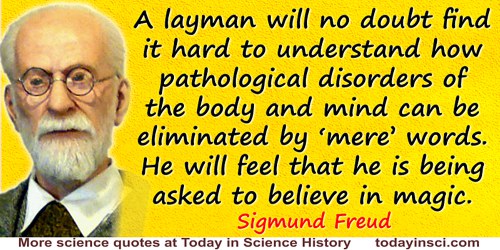
A layman will no doubt find it hard to understand how pathological disorders of the body and mind can be eliminated by 'mere' words. He will feel that he is being asked to believe in magic. And he will not be so very wrong, for the words which we use in our everyday speech are nothing other than watered-down magic. But we shall have to follow a roundabout path in order to explain how science sets about restoring to words a part at least of their former magical power.
Psychical (or Mental) Treatment (1905), In James Strachey (ed.), The Standard Edition of the Complete Psychological Works of Sigmund Freud (1953), Vol. 7, 283.
A noteworthy and often-remarked similarity exists between the facts and methods of geology and those of linguistic study. The science of language is, as it were, the geology of the most modern period, the Age of the Man, having for its task to construct the history of development of the earth and its inhabitants from the time when the proper geological record remains silent … The remains of ancient speech are like strata deposited in bygone ages, telling of the forms of life then existing, and of the circumstances which determined or affected them; while words are as rolled pebbles, relics of yet more ancient formations, or as fossils, whose grade indicates the progress of organic life, and whose resemblances and relations show the correspondence or sequence of the different strata; while, everywhere, extensive denudation has marred the completeness of the record, and rendered impossible a detailed exhibition of the whole course of development.
In Language and the Study of Language (1867), 47.
A prominent official was asked to deliver an after-dinner speech at the banquet recently held in Cambridge, Mass., for the Mathematicians at the International Congress. “What do you wish me to speak about?" he asked. "About five minutes," was the answer.
Found as a space filler, Pi Mu Epsilon Journal (1949), 1, No. 1, 102.
Almighty God, to whose efficacious Word all things owe their original, abounding in his own glorious Essence with infinite goodness and fecundity, did in the beginning Create Man after his own likeness, Male and Female, created he them; the true distinction of which Sexes, consists merely in the different site of those parts of the body, wherein Generation necessarily requires a Diversity: for both Male and Female he impartially endued with the same, and altogether indifferent form of Soul, the Woman being possess’d of no less excellent Faculties of Mind, Reason, and Speech, than the Man, and equally with him aspiring to those Regions of Bliss and Glory, where there shall be no exception of Sex.
In Female Pre-eminence: Or, The Dignity and Excellency of that Sex above the Male, translation (1670).
Anaximenes son of Eurystratus, of Miletus, was a pupil of Anaximander; some say he was also a pupil of Parmenides. He said that the material principle was air and the infinite; and that the stars move, not under the earth, but round it. He used simple and economical Ionic speech. He was active, according to what Apollodorus says, around the time of the capture of Sardis, and died in the 63rd Olympiad.
Diogenes Laertius 2.3. In G. S. Kirk, J. E. Raven and M. Schofield (eds), The Presocratic Philosophers: A Critical History with a Selection of Texts(1983), p. 143.
August 29, 1662. The council and fellows of the Royal Society went in a body to Whitehall to acknowledge his Majesty’s royal grace to granting our charter and vouchsafing to be himself our founder; then the president gave an eloquent speech, to which his Majesty gave a gracious reply and we all kissed his hand. Next day, we went in like manner with our address to my Lord Chancellor, who had much prompted our patent.
Babylon,
Learned and wise, hath perished utterly,
Nor leaves her speech one word to aid the sigh
That would lament her.
Learned and wise, hath perished utterly,
Nor leaves her speech one word to aid the sigh
That would lament her.
From poem, 'Missions And Travels', collected in The Poetical Works of William Wordsworth: Complete in One Volume (1828), 176.
Bolyai [Janos] projected a universal language for speech as we have it for music and mathematics.
In János Bolyai, Science Absolute of Space, translated from the Latin by George Bruce Halsted (1896), Translator's Introduction, xxix.
Debate is an art form. It is about the winning of arguments. It is not about the discovery of truth. There are certain rules and procedures to debate that really have nothing to do with establishing fact–which creationists have mastered. Some of those rules are: never say anything positive about your own position because it can be attacked, but chip away at what appear to be the weaknesses in your opponent’s position. They are good at that. I don’t think I could beat the creationists at debate. I can tie them. But in courtrooms they are terrible, because in courtrooms you cannot give speeches. In a courtroom you have to answer direct questions about the positive status of your belief. We destroyed them in Arkansas. On the second day of the two-week trial we had our victory party!
…...
Do you remember what Darwin says about music? He claims that the power of producing and appreciating it existed among the human race long before the power of speech was arrived at. Perhaps that is why we are so subtly influenced by it. There are vague memories in our souls of those misty centuries when the world was in its childhood.
Spoken by character, Sherlock Holmes, in A Study in Scarlet (1887), Chap. 5. Collected in Works of Arthur Conan Doyle (1902), Vol. 11, 68-69.
Economy in speech is the force by which its development has been accomplished, and it divides itself properly into economy of utterance and economy of thought. Economy of utterance has had to do with the phonic constitution of words; economy of thought has developed the sentence.
In Introduction to the Study of Indian Languages: With Words, Phrases and Sentences to be Collected (1880), 74b.
Every breath you draw, every accelerated beat of your heart in the emotional periods of your oratory depend upon highly elaborated physical and chemical reactions and mechanisms which nature has been building up through a million centuries. If one of these mechanisms, which you owe entirely to your animal ancestry, were to be stopped for a single instant, you would fall lifeless on the stage. Not only this, but some of your highest ideals of human fellowship and comradeship were not created in a moment, but represent the work of ages.
Quoted in Closing Address by Dr. Henry Sloane Coffin, president of the Union Theological Seminary, New York, at the Memorial Service for Osborn at St. Bartholomew's Church, N.Y. (18 Dec 1935). In 'Henry Fairfield Osborn', Supplement to Natural History (Feb 1936), 37:2, 133-34. Bound in Kofoid Collection of Pamphlets on Biography, University of California.
He (Anaxagoras) is said to have been twenty years old at the time of Xerxes' crossing, and to have lived to seventy-two. Apollodorus says in his Chronicles that he was born in the seventieth Olympiad (500-497 B.C.) and died in the first year of the eighty-eighth (428/7). He began to be a philosopher at Athens in the archonship of Callias (456/5), at the age of twenty, as Demetrius Phalereus tells us in his Register of Archons, and they say he spent thirty years there. … There are different accounts given of his trial. Sotion, in his Succession of Philosophers, says that he was prosecuted by Cleon for impiety, because he maintained that the sun was a red hot mass of metal, and after that Pericles, his pupil, had made a speech in his defence, he was fined five talents and exiled. Satyrus in his Uves, on the other hand, says that the charge was brought by Thucydides in his political campaign against Pericles; and he adds that the charge was not only for the impiety but for Medism as well; and he was condemned to death in his absence. ... Finally he withdrew to Lampsacus, and there died. It is said that when the rulers of the city asked him what privilege he wished to be granted, he replied that the children should be given a holiday every year in the month in which he died. The custom is preserved to the present day. When he died the Lampsacenes buried him with full honours.
Diogenes Laërtius 2.7. In G. S. Kirk, J. E. Raven and M. Schofield (eds.), The Presocratic Philosophers: A Critical History with a Selection of Texts (1983), p. 353.
Heart and Brain are the two lords of life. In the metaphors of ordinary speech and in the stricter language of science, we use these terms to indicate two central powers, from which all motives radiate, to which all influences converge.
From 'The Principles of Success in Literature', The Fortnightly (1865), 1, 66.
Here I most violently want you to
Avoid one fearful error, a vicious flaw.
Don’t think that our bright eyes were made that we
Might look ahead; that hips and knees and ankles
So intricately bend that we might take
Big strides, and the arms are strapped to the sturdy shoulders
And hands are given for servants to each side
That we might use them to support our lives.
All other explanations of this sort
Are twisted, topsy-turvy logic, for
Nothing what is born produces its own use.
Sight was not born before the light of the eyes,
Nor were words and pleas created before the tongue
Rather the tongue's appearance long preceded
Speech, and the ears were formed far earlier than
The sound first heard. To sum up, all the members
Existed, I should think, before their use,
So use has not caused them to have grown.
Avoid one fearful error, a vicious flaw.
Don’t think that our bright eyes were made that we
Might look ahead; that hips and knees and ankles
So intricately bend that we might take
Big strides, and the arms are strapped to the sturdy shoulders
And hands are given for servants to each side
That we might use them to support our lives.
All other explanations of this sort
Are twisted, topsy-turvy logic, for
Nothing what is born produces its own use.
Sight was not born before the light of the eyes,
Nor were words and pleas created before the tongue
Rather the tongue's appearance long preceded
Speech, and the ears were formed far earlier than
The sound first heard. To sum up, all the members
Existed, I should think, before their use,
So use has not caused them to have grown.
On the Nature of Things, trans. Anthony M. Esolen (1995), Book 4, lines 820-8, 145.
I am the most travelled of all my contemporaries; I have extended my field of enquiry wider than anybody else, I have seen more countries and climes, and have heard more speeches of learned men. No one has surpassed me in the composition of lines, according to demonstration, not even the Egyptian knotters of ropes, or geometers.
In Alan L. Mackay, A Dictionary of Scientific Quotations (1992, 1994), 71.
I appeal to the contemptible speech made lately by Sir Robert Peel to an applauding House of Commons. 'Orders of merit,' said he, 'were the proper rewards of the military' (the desolators of the world in all ages). 'Men of science are better left to the applause of their own hearts.' Most learned Legislator! Most liberal cotton-spinner! Was your title the proper reward of military prowess? Pity you hold not the dungeon-keys of an English Inquisition! Perhaps Science, like creeds, would flourish best under a little persecution.
Chemical Recreations (1834), 232.
I came into the room, which was half dark, and presently spotted Lord Kelvin in the audience and realised that I was in for trouble at the last part of my speech dealing with the age of the earth, where my views conflicted with his. To my relief, Kelvin fell fast asleep, but as I came to the important point, I saw the old bird sit up, open an eye and cock a baleful glance at me! Then a sudden inspiration came, and I said Lord Kelvin had limited the age of the earth, provided no new source was discovered. That prophetic utterance refers to what we are now considering tonight, radium! Behold! the old boy beamed upon me.
The italicized phrase refers to “no new source” of energy. Concerning a Lecture by Rutherford, at the Royal Institution, dealing with the energy of subterranean radium, which had an effect prolonging the heat of the Earth. Arthur S. Eve wrote that Rutherford “used to tell humorous stories about this lecture long afterwards:” — followed by the subject quote above, as its own paragraph. As given in Arthur S. Eve, Rutherford: Being the Life and Letters of the Rt. Hon. Lord Rutherford, O.M. (1939), 107. The story lacks quotation marks, and thus should be regarded as perhaps Eve’s own words giving a faithful recollection, rather than Rutherford’s verbatim words. (However, note that the style used throughout the book is to omit quotation marks from their own separate paragraph.)
I give them experiments and they respond with speeches.
in Patrice Debré, Louis Pasteur, trans. Elborg Forster (1994), 362.
I have heard articulate speech produced by sunlight I have heard a ray of the sun laugh and cough and sing! … I have been able to hear a shadow, and I have even perceived by ear the passage of a cloud across the sun's disk.
Letter to his father (26 Feb 1880), describing his photophone research. Transcript with Bell Papers, Library of Congress.
I have read somewhere that the resistance offered by a wire ... is affected by the tension of the wire. If this is so, a continuous current of electricity passed through a vibrating wire should meet with a varying resistance, and hence a pulsatory action should be induced in the current ... [corresponding] in amplitude, as well as in rate of movement, to the vibrations of the string ... [Thus] the timbre of a sound [a quality essential to intelligible speech] could be transmitted ... [and] the strength of the current can be increased ad libitum without destroying the relative intensities of the vibrations.
Letter to Gardiner Greene Hubbard (4 May 1875), 3-4. Bell Papers, Library of Congress.
I specifically paused to show that, if there were such machines with the organs and shape of a monkey or of some other non-rational animal, we would have no way of discovering that they are not the same as these animals. But if there were machines that resembled our bodies and if they imitated our actions as much as is morally possible, we would always have two very certain means for recognizing that, none the less, they are not genuinely human. The first is that they would never be able to use speech, or other signs composed by themselves, as we do to express our thoughts to others. For one could easily conceive of a machine that is made in such a way that it utters words, and even that it would utter some words in response to physical actions that cause a change in its organs—for example, if someone touched it in a particular place, it would ask what one wishes to say to it, or if it were touched somewhere else, it would cry out that it was being hurt, and so on. But it could not arrange words in different ways to reply to the meaning of everything that is said in its presence, as even the most unintelligent human beings can do. The second means is that, even if they did many things as well as or, possibly, better than anyone of us, they would infallibly fail in others. Thus one would discover that they did not act on the basis of knowledge, but merely as a result of the disposition of their organs. For whereas reason is a universal instrument that can be used in all kinds of situations, these organs need a specific disposition for every particular action.
Discourse on Method in Discourse on Method and Related Writings (1637), trans. Desmond M. Clarke, Penguin edition (1999), Part 5, 40.
I wanted to preserve the spontaneity of thought in speech… [and to] guard the spontaneity of the argument. A spoken argument is informal and heuristic; it singles out the heart of the matter and shows in what way it is crucial and new; and it gives the direction and line of the solution so that, simplified as it is, still the logic is right. For me, this philosophic form of argument is the foundation of science, and nothing should be allowed to obscure it.
On his philosophy in presenting the TV series, from which the book followed. In 'Foreward', The Ascent of Man, (1973), 14-15.
I’ve been turning it over in after-dinner speeches, but it looks awkward—it’s not what people are
used to—it wants a good deal of Latin to make it go down.
From Felix Holt: The Radical (1866), Vol. 1, 59.
If there were some solitary or feral man, the passions of the soul would be sufficient for him; by them he would be conformed to things in order that he might have knowledge of them. But because man is naturally political and social, there is need for one man to make his conceptions known to others, which is done with speech. So significant speech was needed if men were to live together. Which is why those of different tongues do not easily live together.
Sententia super libri Perihermeneias (Commentary on Aristotle’s On Interpretation) [1270-1271], Book I, lesson 2, number 2, trans. R. McInerny, quoted in R. McInerny (ed.) Thomas Aquinas, Selected Writings (1998), 460.
In Mathematics, censorship and criticism can not be allowed to everyone; the speeches of the rhetoricians and the defenses of the lawyers are worthless.
From In Artem Analyticem Isagoge (1591, “Introduction to the Analytic Arts”), translated from the original Latin to French in Édouard Lucas, Récréations Mathématiques (1883), Vol. 2, 1, given as, “Dans les Mathématiques, la censure et la critique ne peuvent être permises à tout le monde; les discours des rhéteurs et les défenses des avocats n’y valent rien.” English version from the French by Webmaster using Google translate.
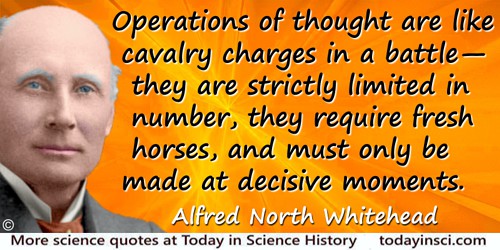
It is a profoundly erroneous truism, repeated by all copy-books and eminent people when they are making speeches, that we should cultivate habit of thinking of what we are doing. The precise opposite is the case. Civilization advances by extending the number of important operations which we can perform without thinking about them. Operations of thought are like cavalry charges in a battle—they are strictly limited in number, they require fresh horses, and must only be made at decisive moments.
In An Introduction to Mathematics (1911), 61.
It was a profound saying of Wilhelm Humboldt, that 'Man is man only by means of speech, but in order to invent speech he must be already man.'
The Antiquity of Man (1863), 468.
It would be an easy task to show that the characteristics in the organization of man, on account of which the human species and races are grouped as a distinct family, are all results of former changes of occupation, and of acquired habits, which have come to be distinctive of individuals of his kind. When, compelled by circumstances, the most highly developed apes accustomed themselves to walking erect, they gained the ascendant over the other animals. The absolute advantage they enjoyed, and the new requirements imposed on them, made them change their mode of life, which resulted in the gradual modification of their organization, and in their acquiring many new qualities, and among them the wonderful power of speech.
Quoted in Ernst Heinrich Philipp August Haeckel The Evolution of Man (1897), Vol. 1, 70.
Let thy speech be short, comprehending much in few words.
— Bible
(circa 725 B.C.)
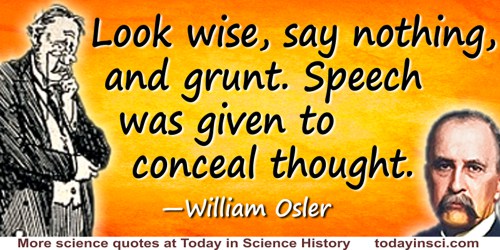
Look wise, say nothing, and grunt. Speech was given to conceal thought.
William Bennett Bean (ed.), Sir William Osler: Aphorisms from his Bedside Teachings and Writings, No. 267 (1950), 126.
Man alone amongst the animals speaks and has gestures and expression which we call rational, because he alone has reason in him. And if anyone should say in contradiction that certain birds talk, as seems to be the case with some, especially the magpie and the parrot, and that certain beasts have expression or gestures, as the ape and some others seem to have, I answer that it is not true that they speak, nor that they have gestures, because they have no reason, from which these things need proceed; nor do they purpose to signify anything by them, but they merely reproduce what they see and hear.
In 'The Third Treatise', The Convivio of Dante Alighieri (1903), Chap. 7, 175. This footnoted: Compare De Vulgari Eloquentia, Book 1, Chap 2: 43-65.
Man is a classifying animal: in one sense it may be said that the whole process of speaking is nothing but distributing phenomena, of which no two are alike in every respect, into different classes on the strength of perceived similarities and dissimilarities. In the name-giving process we witness the same ineradicable and very useful tendency to see likenesses and to express similarity in the phenomena through similarity in name.
Language: Its Nature, Development and Origin (1922), 388-9.
Mathematics … belongs to every inquiry, moral as well as physical. Even the rules of logic, by which it is rigidly bound, could not be deduced without its aid. The laws of argument admit of simple statement, but they must be curiously transposed before they can be applied to the living speech and verified by observation. In its pure and simple form the syllogism cannot be directly compared with all experience, or it would not have required an Aristotle to discover it. It must be transmuted into all the possible shapes in which reasoning loves to clothe itself. The transmutation is the mathematical process in the establishment of the law.
From Memoir (1870) read before the National Academy of Sciences, Washington, printed in 'Linear Associative Algebra', American Journal of Mathematics (1881), 4, 97-98.
Mathematics is the language of languages, the best school for sharpening thought and expression, is applicable to all processes in nature; and Germany needs mathematical gymnasia. Mathematics is God’s form of speech, and simplifies all things organic and inorganic. As knowledge becomes real, complete and great it approximates mathematical forms. It mediates between the worlds of mind and of matter.
Summarizing the ideas presented by Christian Heinrich Dillmann in Die Mathematik die Fackelträgerin einer neuen Zeit (1889). From book review, 'Recent Literature on Arithmetic and Arithmetical Teaching', in Granville Stanley Hall (ed.), The Pedagogical Seminary (1892), 2, 168. Dillmann’s book title translates as “Mathematics the Torchbearer of a New Era”. (However, Conant concluded that it was a “loosely-written, vague and incoherent book, which belies every anticipation awakened by its attractive title.”)
Mr. Chairman, ladies and gentlemen, I am told that someone accused me of saying that if the Ministry of Fuel and Power were boring for coal and they went through a layer of gold nine feet thick they would throw it away because they wouldn't know what to do with it, Sir, I only said four feet thick.
Remark while accepting a presentation upon his retirement from I.C.I. As quoted by Peter Allen in obituary, Biographical Memoirs of Fellows of the Royal Society (Nov 1976), 22, 117.
New sources of power … will surely be discovered. Nuclear energy is incomparably greater than the molecular energy we use today. The coal a man can get in a day can easily do five hundred times as much work as himself. Nuclear energy is at least one million times more powerful still. If the hydrogen atoms in a pound of water could be prevailed upon to combine and form helium, they would suffice to drive a thousand-horsepower engine for a whole year. If the electrons, those tiny planets of the atomic systems, were induced to combine with the nuclei in hydrogen, the horsepower would be 120 times greater still. There is no question among scientists that this gigantic source of energy exists. What is lacking is the match to set the bonfire alight, or it may be the detonator to cause the dynamite to explode. The scientists are looking for this.
[In his last major speech to the House of Commons on 1 Mar 1955, Churchill quoted from his original printed article, nearly 25 years earlier.]
[In his last major speech to the House of Commons on 1 Mar 1955, Churchill quoted from his original printed article, nearly 25 years earlier.]
'Fifty Years Hence'. Strand Magazine (Dec 1931). Reprinted in Popular Mechanics (Mar 1932), 57:3, 395.
No subject of philosophical inquiry within the limits of human investigation is more calculated to excite admiration and to awaken curiosity than fire; and there is certainly none more extensively useful to mankind. It is owing, no doubt, to our being acquainted with it from our infancy, that we are not more struck with its appearance, and more sensible of the benefits we derive from it. Almost every comfort and convenience which man by his ingenuity procures for himself is obtained by its assistance; and he is not more distinguished from the brute creation by the use of speech, than by his power over that wonderful agent.
In The Complete Works of Count Rumford (1876), Vol. 4, 3-4.
Now the whole earth had one language and few words… . Then they said, Come, let us build ourselves a city, and a tower with its top in the heavens, and let us make a name for ourselves, lest we be scattered abroad upon the face of the whole earth.” And the Lord came down to see the city and the tower, which the sons of men had built. And the Lord said, “Behold, they are one people, and they have all one language; and this is only the beginning of what they will do; and nothing that they propose to do will now be impossible for them. Come, let us go down, and there confuse their language, that they may not understand one another’s speech.” So the Lord scattered them abroad from there over the face of all the earth, and they left off building the city. Therefore its name was called Babel, because there the Lord confused the language of all the earth… .
— Bible
(circa 725 B.C.)
Of the many definitions of poetry, the simplest is still the best: “memorable speech.”
From 'The Poet's Tongue' (1935), Introduction, collected in Edward Mendelson (ed.), The Complete Works of W.H. Auden: Prose and Travel Books in Prose and Verse: 1926-1938 (1996), Vol. 1.
On May 15, 1957 Linus Pauling made an extraordinary speech to the students of Washington University. ... It was at this time that the idea of the scientists' petition against nuclear weapons tests was born. That evening we discussed it at length after dinner at my house and various ones of those present were scribbling and suggesting paragraphs. But it was Linus Pauling himself who contributed the simple prose of the petition that was much superior to any of the suggestions we were making.
Speech, "The 1962 Nobel Peace Prize," at Unitarian Church, Boulder, Colorado (20 Oct 1963). On Oregon State University Library website.
Only human beings were given the power of speech, because only to them was it necessary. It was not necessary that either angels or the lower animals should be able to speak; rather, this power would have been wasted on them, and nature, of course, hates to do anything superfluous. …
As for the lower animals, since they are guided only by their natural instinct, it was not necessary for them to be given the power of speech. For all animals that belong to the same species are identical in respect of action and feeling; and thus they can know the actions and feelings of others by knowing their own. Between creatures of different species, on the other hand, not only was speech unnecessary, but it would have been injurious, since there could have been no friendly exchange between them.
In Dante Alighieri and Steven Botterill (trans.), De Vulgari Eloquentia (1305), Book 1, Chap 2. from the Latin original.
Regardless of communication between man and man, speech is a necessary condition for the thinking of the individual in solitary seclusion. In appearance, however, language develops only socially, and man understands himself only once he has tested the intelligibility of his words by trial upon others.
On Language (1836), trans. Peter Heath (1988), 56.
Scientists alone can establish the objectives of their research, but society, in extending support to science, must take account of its own needs. As a layman, I can suggest only with diffidence what some of the major tasks might be on your scientific agenda, but … First, I would suggest the question of the conservation and development of our natural resources. In a recent speech to the General Assembly of the United Nations, I proposed a world-wide program to protect land and water, forests and wildlife, to combat exhaustion and erosion, to stop the contamination of water and air by industrial as well as nuclear pollution, and to provide for the steady renewal and expansion of the natural bases of life.
From Address to the Centennial Convocation of the National Academy of Sciences (22 Oct 1963), 'A Century of Scientific Conquest'. Online at The American Presidency Project.
Sign language is the equal of speech, lending itself equally to the rigorous and the poetic, to philosophical analysis or to making love.
In The Times (16 Jun 1994).
Sooner or later in every talk, [David] Brower describes the creation of the world. He invites his listeners to consider the six days of Genesis as a figure of speech for what has in fact been 4 billion years. On this scale, one day equals something like six hundred and sixty-six million years, and thus, all day Monday and until Tuesday noon, creation was busy getting the world going. Life began Tuesday noon, and the beautiful organic wholeness of it developed over the next four days. At 4 p.m. Saturday, the big reptiles came on. At three minutes before midnight on the last day, man appeared. At one-fourth of a second before midnight Christ arrived. At one-fortieth of a second before midnight, the Industrial Revolution began. We are surrounded with people who think that what we have been doing for that one-fortieth of a second can go on indefinitely. They are considered normal, but they are stark. raving mad.
In Encounters with the Archdruid (1971), 79-80.
Speech is the representation of the mind, and writing is the representation of speech.
In 'On Interpretation'. As quoted in New Encyclopedia Britannica (2003), Vol. 22, 567.
Speeches are like babies-easy to conceive but hard to deliver.
Attributed.
The discovery of the famous original [Rosetta Stone] enabled Napoleon’s experts to begin the reading of Egypt’s ancient literature. In like manner the seismologists, using the difficult but manageable Greek of modern physics, are beginning the task of making earthquakes tell the nature of the earth’s interior and translating into significant speech the hieroglyphics written by the seismograph.
The game of status seeking, organized around committees, is played in roughly the same fashion in Africa and in America and in the Soviet Union. Perhaps the aptitude for this game is a part of our genetic inheritance, like the aptitude for speech and for music. The game has had profound consequences for science. In science, as in the quest for a village water supply, big projects bring enhanced status; small projects do not. In the competition for status, big projects usually win, whether or not they are scientifically justified. As the committees of academic professionals compete for power and influence, big science becomes more and more preponderant over small science. The large and fashionable squeezes out the small and unfashionable. The space shuttle squeezes out the modest and scientifically more useful expendable launcher. The Great Observatory squeezes out the Explorer. The centralized adduction system squeezes out the village well. Fortunately, the American academic system is pluralistic and chaotic enough that first-rate small science can still be done in spite of the committees. In odd corners, in out-of the-way universities, and in obscure industrial laboratories, our Fulanis are still at work.
From a Danz lecture at University of Washington, 'Six Cautionary Tales for Scientists' (1988), collected in From Eros to Gaia (1992), Vol. 5, 19.
The integers of language are sentences, and their organs are the parts of speech. Linguistic organization, then, consists in the differentiation of the parts of speech and the integration of the sentence.
In Introduction to the Study of Indian Languages: With Words, Phrases and Sentences to be Collected (1880), 70.
The most noble and profitable invention of all other, was that of SPEECH, consisting of Names or Appellations, and their Connexion; whereby men register their Thoughts; recall them when they are past; and also declare them one to another for mutuall utility and conversation; without which, there had been amongst men, neither Commonwealth, nor Society, nor Contract, nor Peace, no more than amongst Lyons, Bears, and Wolves.
Leviathan (1651), ed. C. B. Macpherson (1968), Part 1, Chapter 4, 100.
The need to make music, and to listen to it, is universally expressed by human beings. I cannot imagine, even in our most primitive times, the emergence of talented painters to make cave paintings without there having been, near at hand, equally creative people making song. It is, like speech, a dominant aspect of human biology.
In 'The Music of This Sphere', The Lives of a Cell: Notes of a Biology Watcher (1974), 25.
The real problem in speech is not precise language. The problem is clear language. The desire is to have the idea clearly communicated to the other person. [But] precise language is not precise in any sense if you deal with the real objects of the world, and is overly pedantic and quite confusing to use it unless there are some special subtleties which have to be carefully distinguished.
Criticizing “overly pedantic” language in proposed textbooks for a modified arithmetic course for grades 1-8 in California schools. In article, 'New Textbooks for the ‘New’ Mathematics', Engineering and Science (Mar 1965), 28, No. 6. Collected in Perfectly Reasonable Deviations from the Beaten Track: The Letters of Richard Feynman (2008), 454. He was writing as a member of the California State Curriculum Committee
The so-called medical literature is stuffed to bursting with junk, written in a hopscotch style characterised by a Brownian movement of uncontrolled parts of speech which seethe in restless unintelligibility.
Journal of Laboratory and Clinical Medicine (1952), 39, 3.
The spirit of science arises from the habit of seeking food; the spirit of art arises from the habit of imitation, by which the young animal first learns to feed; the spirit of music arises from primeval speech, by means of which males and females are attracted to each other.
In The Martyrdom of Man (1876), 443.
The wonders of the Grand Canyon cannot be adequately represented in symbols of speech, nor by speech itself. The resources of the graphic art are taxed beyond their powers in attempting to portray its features. Language and illustration combined must fail.
In Canyons of the Colorado (1895), 394.
There's many a true word spoken in jest; scientists are abominably solemn; therefore scientists miss many a true word.
In Science is a Sacred Cow (1950), 140.
Through seven figures come sensations for a man; there is hearing for sounds, sight for the visible, nostril for smell, tongue for pleasant or unpleasant tastes, mouth for speech, body for touch, passages outwards and inwards for hot or cold breath. Through these come knowledge or lack of it.
Regimen, in Hippocrates, trans. W. H. S. Jones (1931), Vol. 4, 261.
Today the earth speaks with resonance and clearness and every ear in every civilized country of the world is attuned to its wonderful message of the creative evolution of man, except the ear of William Jennings Bryan; he alone remains stone-deaf, he alone by his own resounding voice drowns the eternal speech of nature.
In The Earth Speaks to Bryan (1925), 8.
Watson, if I can get a mechanism which will make a current of electricity vary in its intensity, as the air varies in density when a sound is passing through it, I can telegraph any sound, even the sound of speech.
As quoted by Thomas A. Watson, in Exploring Life: The Autobiography of Thomas A. Watson (1926), 62.
Who ever heard a theologian preface his creed, or a politician conclude his speech with an estimate of the probable error of his opinion.
In The Scientific Outlook (1931, 1954), 66.
Wise men know when to speak his mind and when to mind his speech.
As stated in Ebrahim Kazim, Scientific Commentary of Suratul Faateḥah (2010).
Ye knowe eek, that in forme of speche is chaunge
With-inne a thousand yeer, and wordes tho
That hadden prys, now wonder nyce and straunge
Us thinketh hem; and yet they spake hem so,
And spedde as wel in love as men now do.
With-inne a thousand yeer, and wordes tho
That hadden prys, now wonder nyce and straunge
Us thinketh hem; and yet they spake hem so,
And spedde as wel in love as men now do.
 In science it often happens that scientists say, 'You know that's a really good argument; my position is mistaken,' and then they would actually change their minds and you never hear that old view from them again. They really do it. It doesn't happen as often as it should, because scientists are human and change is sometimes painful. But it happens every day. I cannot recall the last time something like that happened in politics or religion.
(1987) --
In science it often happens that scientists say, 'You know that's a really good argument; my position is mistaken,' and then they would actually change their minds and you never hear that old view from them again. They really do it. It doesn't happen as often as it should, because scientists are human and change is sometimes painful. But it happens every day. I cannot recall the last time something like that happened in politics or religion.
(1987) --