Species Quotes (438 quotes)
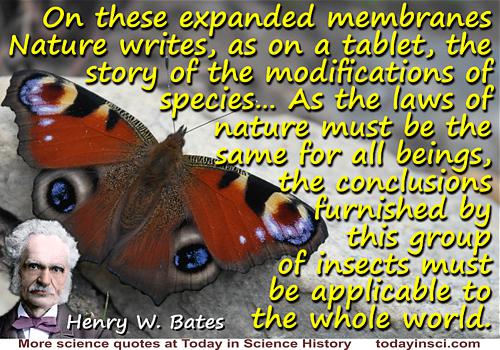
… on these expanded membranes [butterfly wings] Nature writes, as on a tablet, the story of the modifications of species, so truly do all changes of the organisation register themselves thereon. Moreover, the same colour-patterns of the wings generally show, with great regularity, the degrees of blood-relationship of the species. As the laws of nature must be the same for all beings, the conclusions furnished by this group of insects must be applicable to the whole world.
From The Naturalist on the River Amazons: A record of Adventures, Habits of Animals, Sketches of Brazilian and Indian life, and Aspects of Nature under the Equator, During Eleven Years of Travel (1864), 413.
...[T]he natural history of the rat is tragically similar to that of man ... some of the more obvious qualities in which rats resemble men — ferocity, omnivorousness, and adaptability to all climates ... the irresponsible fecundity with which both species breed at all seasons of the year with a heedlessness of consequences, which subjects them to wholesale disaster on the inevitable, occasional failure of the food supply.... [G]radually, these two have spread across the earth, keeping pace with each other and unable to destroy each other, though continually hostile. They have wandered from East to West, driven by their physical needs, and — unlike any other species of living things — have made war upon their own kind. The gradual, relentless, progressive extermination of the black rat by the brown has no parallel in nature so close as that of the similar extermination of one race of man by another...
Rats, Lice and History(1935)
…the longest-domesticated of all species, man.
— Asa Gray
'Notice of Dr. Hooker's Flora of New Zealand', American Journal of Science (May 1854), 2nd. series, 17, No 51, 336. Asa Gray, acknowledged on the journal's title page, is indicated as this article's author by the initials “A.G.” at the end of the article. On pages 335-336, the full quote, for context, is: “Perhaps if zoologists would contemplate the wide variations presented by many plants of indubitably one and the same species, and the still wider diversities of long cultivated races from an original stock, they would find more than one instructive parallel to the case of the longest domesticated of all species, man.”
[Vestiges begins] from principles which are at variance with all sober inductive truth. The sober facts of geology shuffled, so as to play a rogue’s game; phrenology (that sinkhole of human folly and prating coxcombry); spontaneous generation; transmutation of species; and I know not what; all to be swallowed, without tasting and trying, like so much horse-physic!! Gross credulity and rank infidelity joined in unlawful marriage, and breeding a deformed progeny of unnatural conclusions!
Letter to Charles Lyell (9 Apr 1845). In John Willis Clark and Thomas McKenny Hughes (eds.), The Life and Letters of the Reverend Adam Sedgwick (1890), Vol. 2, 83.
[A contemporary study] predicted the loss of two-thirds of all tropical forests by the turn of the century. Hundreds of thousands of species will perish, and this reduction of 10 to 20 percent of the earth’s biota will occur in about half a human life span. … This reduction of the biological diversity of the planet is the most basic issue of our time.
Foreword, written for Michael Soulé and Bruce Wilcox (eds.), papers from the 1978 International Conference on Conservation Biology, collected as Conservation Biology (1980), ix. As quoted and cited in Timothy J. Farnham, Saving Nature's Legacy: Origins of the Idea of Biological Diversity (2007), 208.
[A plant] does not change itself gradually, but remains unaffected during all succeeding generations. It only throws off new forms, which are sharply contrasted with the parent, and which are from the very beginning as perfect and as constant, as narrowly defined, and as pure of type as might be expected of any species.
In Species and Varieties: Their Origin and Mutation (1905), 28-9.
[Bacteria are the] dark matter of the biological world [with 4 million mostly unknown species in a ton of soil].
Talk as a TED prize winner (2007). From video on TEDprize website.
[Everyone should know:] The unity of life that comes about through evolution, since we’re all descended from a single common ancestor. It’s almost too good to be true, that on one planet this extraordinary complexity of life should have come about by what is pretty much an intelligible process. And we're the only species capable of understanding it.
From 'Interview: Of Mind and Matter: David Attenborough Meets Richard Dawkins', The Guardian (11 Sep 2010),
[Fossils found in the Secondary formation are] unrefined and imperfect [species and the species in the Tertiary formation] are very perfect and wholly similar to those that are seen in the modern sea. [Thus] as many ages have elapsed during the elevation of the Alps, as there are races of organic fossil bodies embedded within the strata.
Quoted in Francesco Rodolico, 'Arduino', In Charles Coulston Gillispie (ed.), Dictionary of Scientific Biography (1970), Vol. 1, 234.
[In addition to classical, literary and philosophical studies,] I devoured without much appetite the Elements of Algebra and Geometry…. From these serious and scientific pursuits I derived a maturity of judgement, a philosophic spirit, of more value than the sciences themselves…. I could extract and digest the nutritive particles of every species of litterary food.
In The Autobiographies of Edward Gibbon (1896), 235. [“litterary” is sic.]
[My dream dinner guest is] Charles Darwin. It’s an obvious answer, but it’s the truth. Think of any problem and before you start theorising, just check up whether Charles Darwin mentioned it in one of those green books sitting on your shelf. Whether it’s earthworms, human gestures or the origin of species, the observations that man made are unbelievable. He touched on so many subjects. Then, Alexander von Humboldt, the last polymath. There was no aspect of the natural world that he wasn’t curious about or didn’t write about in Kosmos, an extraordinary book.
From interview with Alice Roberts, 'Attenborough: My Life on Earth', The Biologist (Aug 2015), 62, No. 4, 16.
[My work as a photographer is a] mission to document endangered species and landscapes in order to show a world worth saving.
On the 'About' page of his web site.
[My] numberless observations... made on the Strata... [have] made me confident of their uniformity throughout this Country & [have] led me to conclude that the same regularity... will be found to extend to every part of the Globe for Nature has done nothing by piecemeal. [T]here is no inconsistency in her productions. [T]he Horse never becomes an Ass nor the Crab an Apple by any intermixture or artificial combination whatever[. N]or will the Oak ever degenerate into an Ash or an Ash into an Elm. [H]owever varied by Soil or Climate the species will still be distinct on this ground. [T]hen I argue that what is found here may be found elsewhere[.] When proper allowances are made for such irregularities as often occur and the proper situation and natural agreement is well understood I am satisfied there will be no more difficulty in ascertaining the true quality of the Strata and the place of its possition [sic] than there is now in finding the true Class and Character of Plants by the Linean [sic] System.
Natural Order of the Strata in England and Wales Accurately Delineated and Described, unpublished manuscript, Department of Geology, University of Oxford, 1801, f. 7v.
[The] erroneous assumption is to the effect that the aim of public education is to fill the young of the species with knowledge and awaken their intelligence, and so make them fit to discharge the duties of citizenship in an enlightened and independent manner. Nothing could be further from the truth. The aim of public education is not to spread enlightenment at all; it is simply to reduce as many individuals as possible to the same safe level, to breed and train a standardised citizenry, to put down dissent and originality.
The American Mercury (24 Apr 1924).
[We are] a fragile species, still new to the earth, … here only a few moments as evolutionary time is measured, … in real danger at the moment of leaving behind only a thin layer of of our fossils, radioactive at that.
The Fragile Species (1992, 1996), 25.
Ode to The Amoeba
Recall from Time's abysmal chasm
That piece of primal protoplasm
The First Amoeba, strangely splendid,
From whom we're all of us descended.
That First Amoeba, weirdly clever,
Exists today and shall forever,
Because he reproduced by fission;
He split himself, and each division
And subdivision deemed it fitting
To keep on splitting, splitting, splitting;
So, whatsoe'er their billions be,
All, all amoebas still are he.
Zoologists discern his features
In every sort of breathing creatures,
Since all of every living species,
No matter how their breed increases
Or how their ranks have been recruited,
From him alone were evoluted.
King Solomon, the Queen of Sheba
And Hoover sprang from that amoeba;
Columbus, Shakespeare, Darwin, Shelley
Derived from that same bit of jelly.
So famed is he and well-connected,
His statue ought to be erected,
For you and I and William Beebe
Are undeniably amoebae!
Recall from Time's abysmal chasm
That piece of primal protoplasm
The First Amoeba, strangely splendid,
From whom we're all of us descended.
That First Amoeba, weirdly clever,
Exists today and shall forever,
Because he reproduced by fission;
He split himself, and each division
And subdivision deemed it fitting
To keep on splitting, splitting, splitting;
So, whatsoe'er their billions be,
All, all amoebas still are he.
Zoologists discern his features
In every sort of breathing creatures,
Since all of every living species,
No matter how their breed increases
Or how their ranks have been recruited,
From him alone were evoluted.
King Solomon, the Queen of Sheba
And Hoover sprang from that amoeba;
Columbus, Shakespeare, Darwin, Shelley
Derived from that same bit of jelly.
So famed is he and well-connected,
His statue ought to be erected,
For you and I and William Beebe
Are undeniably amoebae!
(1922). Collected in Gaily the Troubadour (1936), 18.
[Concerning the former belief that there were no genetic connections among species:] This view, as a rounded whole and in all its essential elements, has very recently disappeared from science. It died a royal death with Agassiz.
— Asa Gray
From lecture 'Scientific Beliefs', as published in Natural Science and Religion: Two Lectures delivered to the Theological School of Yale College (1880), Vol. 3, Lecture 1, 35.
Branches or types are characterized by the plan of their structure,
Classes, by the manner in which that plan is executed, as far as ways and means are concerned,
Orders, by the degrees of complication of that structure,
Families, by their form, as far as determined by structure,
Genera, by the details of the execution in special parts, and
Species, by the relations of individuals to one another and to the world in which they live, as well as by the proportions of their parts, their ornamentation, etc.
Classes, by the manner in which that plan is executed, as far as ways and means are concerned,
Orders, by the degrees of complication of that structure,
Families, by their form, as far as determined by structure,
Genera, by the details of the execution in special parts, and
Species, by the relations of individuals to one another and to the world in which they live, as well as by the proportions of their parts, their ornamentation, etc.
Essay on Classification (1857). Contributions to the Natural History of the United States of America (1857), Vol. I, 170.
Trimming consists of clipping off little bits here and there from those observations which differ most in excess from the mean, and in sticking them onto those which are too small; a species of 'equitable adjustment,' as a radical would term it, which cannot be admitted in science.
'On the Frauds of Observers', Reflections on the Decline of Science in England (1830). In Calyampudi Radhakrishna Rao, Statistics and Truth (1997), 84.
A bewildering assortment of (mostly microscopic) life-forms has been found thriving in what were once thought to be uninhabitable regions of our planet. These hardy creatures have turned up in deep, hot underground rocks, around scalding volcanic vents at the bottom of the ocean, in the desiccated, super-cold Dry Valleys of Antarctica, in places of high acid, alkaline, and salt content, and below many meters of polar ice. ... Some deep-dwelling, heat-loving microbes, genetic studies suggest, are among the oldest species known, hinting that not only can life thrive indefinitely in what appear to us totally alien environments, it may actually originate in such places.
In Life Everywhere: the Maverick Science of Astrobiology (2002), xi.
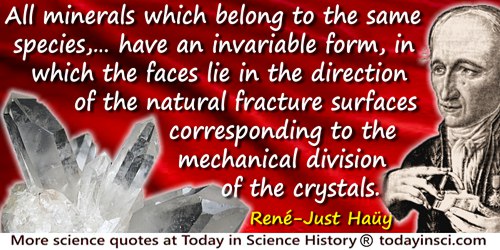
A casual glance at crystals may lead to the idea that they were pure sports of nature, but this is simply an elegant way of declaring one’s ignorance. With a thoughtful examination of them, we discover laws of arrangement. With the help of these, calculation portrays and links up the observed results. How variable and at the same time how precise and regular are these laws! How simple they are ordinarily, without losing anything of their significance! The theory which has served to develop these laws is based entirely on a fact, whose existence has hitherto been vaguely discerned rather than demonstrated. This fact is that in all minerals which belong to the same species, these little solids, which are the crystal elements and which I call their integrant molecules, have an invariable form, in which the faces lie in the direction of the natural fracture surfaces corresponding to the mechanical division of the crystals. Their angles and dimensions are derived from calculations combined with observation.
Traité de mineralogie … Publié par le conseil des mines (1801), Vol. 1, xiii-iv, trans. Albert V. and Marguerite Carozzi.
A comparatively small variety of species is found in the older rocks, although of some particular ones the remains are very abundant; ... Ascending to the next group of rocks, we find the traces of life become more abundant, the number of species extended.
Vestiges of the Natural History of Creation (1844), 60-1.
A first step in the study of civilization is to dissect it into details, and to classify these in their proper groups. Thus, in examining weapons, they are to be classed under spear, club, sling, bow and arrow, and so forth; among textile arts are to be ranged matting, netting, and several grades of making and weaving threads; myths are divided under such headings as myths of sunrise and sunset, eclipse-myths, earthquake-myths, local myths which account for the names of places by some fanciful tale, eponymic myths which account for the parentage of a tribe by turning its name into the name of an imaginary ancestor; under rites and ceremonies occur such practices as the various kinds of sacrifice to the ghosts of the dead and to other spiritual beings, the turning to the east in worship, the purification of ceremonial or moral uncleanness by means of water or fire. Such are a few miscellaneous examples from a list of hundreds … To the ethnographer, the bow and arrow is the species, the habit of flattening children’s skulls is a species, the practice of reckoning numbers by tens is a species. The geographical distribution of these things, and their transmission from region to region, have to be studied as the naturalist studies the geography of his botanical and zoological species.
In Primitive Culture (1871), Vol. 1, 7.
A good ornithologist should be able to distinguish birds by their air as well as by their colors and shape; on the ground as well as on the wing, and in the bush as well as in the hand. For, though it must not be said that every species of birds has a manner peculiar to itself, yet there is somewhat, in most genera at least, that at first sight discriminates them and enables a judicious observer to pronounce upon them with some certainty.
Letter (7 Aug 1778) to Daines Barrington, collected in The Natural History of Selborne (1829), 274.
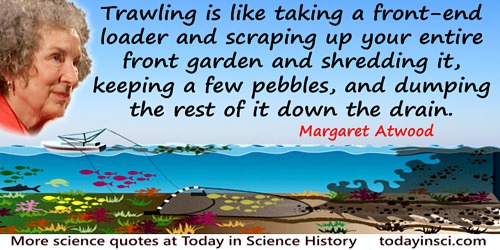
A huge net is being dragged across the sea floor, destroying everything in its path. Ahead of it bloom undersea forests and their hundreds and thousands of living creatures, both plant and animal; behind it is a desert. The net is pulled to the surface and most of the dead and dying life forms in it are thrown out. A few marketable species are retained. [Trawling] is like taking a front-end loader and scraping up your entire front garden and shredding it, keeping a few pebbles, and dumping the rest of it down the drain.
In Payback: Debt and the Shadow Side of Wealth (2008), 191.
A man reserves his true and deepest love not for the species of woman in whose company he finds himself electrified and enkindled, but for that one in whose company he may feel tenderly drowsy.
…...
A new species develops if a population which has become geographically isolated from its parental species acquires during this period of isolation characters which promote or guarantee reproductive isolation when the external barriers break down.
Systematics and the Origin of Species: From the Viewpoint of a Zoologist (1942), 155.
A right understanding of the words which are names of names, is of great importance in philosophy. The tendency was always strong to believe that whatever receives a name must be an entity or being, having an independent existence of its own; and if no real entity answering to the name could be found, men did not for that reason suppose that none existed, but imagined that it was something peculiarly abstruse and mysterious, too high to be an object of sense. The meaning of all general, and especially of all abstract terms, became in this way enveloped in a mystical haze; and none of these have been more generally misunderstood, or have been a more copious source of futile and bewildering speculation, than some of the words which are names of names. Genus, Species, Universal, were long supposed to be designations of sublime hyperphysical realities; Number, instead of a general name of all numerals, was supposed to be the name, if not of a concrete thing, at least of a single property or attribute.
A footnote by John Stuart Mill, which he added as editor of a new edition of a work by his father, James Mill, Analysis of the Phenomena of the Human Mind (1869), Vol. 2, 5.
A schoolteacher or professor cannot educate individuals, he educates only species. A thought that deserves taking to heart.
Aphorism 5 in Notebook J (1789-1793), as translated by R. J. Hollingdale in Aphorisms (1990). Reprinted as The Waste Books (2000), 129.
A single tree by itself is dependent upon all the adverse chances of shifting circumstances. The wind stunts it: the variations in temperature check its foliage: the rains denude its soil: its leaves are blown away and are lost for the purpose of fertilisation. You may obtain individual specimens of line trees either in exceptional circumstances, or where human cultivation had intervened. But in nature the normal way in which trees flourish is by their association in a forest. Each tree may lose something of its individual perfection of growth, but they mutually assist each other in preserving the conditions of survival. The soil is preserved and shaded; and the microbes necessary for its fertility are neither scorched, nor frozen, nor washed away. A forest is the triumph of the organisation of mutually dependent species.
In Science and the Modern World (1926), 296-7.
A species can only thrive when everything else around it thrives too. … If we take care of nature, nature will take care of us. It’s now time for our species to stop simply growing, to establish a life on our planet in balance with nature. To start to thrive.
From narration to Netflix TV program, A Life on Our Planet: My Witness Statement and a Vision for the Future (4 Oct 2020).
A species consists of a group of populations which replace each other geographically or ecologically and of which the neighboring ones integrate or hybridise wherever they are in contact or which are potentially capable of doing so (with one or more of the populations) in those cases where contact is prevented by geographical or ecological barriers.
'Speciation Phenomena in Birds', The American Naturalist (1940), 74, 256.
A species is a reproductive community of populations (reproductively isolated from others) that occupies a specific niche in nature.
The Growth of Biological Thought: Diversity, Evolution and Inheritance (1982), 273.
A tree is known better by its Fruit, than its Leaves.
No. 444 in Gnomologia: Adagies and Proverbs, Wise Sentences and Witty Sayings (1732), 17. Compare with No. 4280, “Such as the Tree, such is the Fruit”, p.183.
About two million years ago, man appeared. He has become the dominant species on the earth. All other living things, animal and plant, live by his sufferance. He is the custodian of life on earth, and in the solar system. It’s a big responsibility.
From speech given at an anti-war teach-in at the Massachusetts Institute of Technology, (4 Mar 1969) 'A Generation in Search of a Future', as edited by Ron Dorfman for Chicago Journalism Review, (May 1969).
Absolute space, of its own nature without reference to anything external, always remains homogenous and immovable. Relative space is any movable measure or dimension of this absolute space; such a measure or dimension is determined by our senses from the situation of the space with respect to bodies and is popularly used for immovable space, as in the case of space under the earth or in the air or in the heavens, where the dimension is determined from the situation of the space with respect to the earth. Absolute and relative space are the same in species and in magnitude, but they do not always remain the same numerically. For example, if the earth moves, the space of our air, which in a relative sense and with respect to the earth always remains the same, will now be one part of the absolute space into which the air passes, now another part of it, and thus will be changing continually in an absolute sense.
The Principia: Mathematical Principles of Natural Philosophy (1687), 3rd edition (1726), trans. I. Bernard Cohen and Anne Whitman (1999), Definitions, Scholium, 408-9.
Absorbed in the special investigation, I paid no heed to the edifice which was meanwhile unconsciously building itself up. Having however completed the comparison of the fossil species in Paris, I wanted, for the sake of an easy revision of the same, to make a list according to their succession in geological formations, with a view of determining the characteristics more exactly and bringing them by their enumeration into bolder relief. What was my joy and surprise to find that the simplest enumeration of the fossil fishes according to their geological succession was also a complete statement of the natural relations of the families among themselves; that one might therefore read the genetic development of the whole class in the history of creation, the representation of the genera and species in the several families being therein determined; in one word, that the genetic succession of the fishes corresponds perfectly with their zoological classification, and with just that classification proposed by me.
Quoted in Elizabeth Cary Agassiz (ed.), Louis Agassiz: His Life and Correspondence (1885), Vol. I, 203-4.
According to my derivative hypothesis, a change takes place first in the structure of the animal, and this, when sufficiently advanced, may lead to modifications of habits… . “Derivation” holds that every species changes, in time, by virtue of inherent tendencies thereto. “Natural Selection” holds that no such change can take place without the influence of altered external circumstances educing or selecting such change… . The hypothesis of “natural selection” totters on the extension of a conjectural condition, explanatory of extinction to the majority of organisms, and not known or observed to apply to the origin of any species.
In On the Anatomy of Vertebrates (1868), Vol. 3, 808.
ADDER, n. A species of snake. So called from its habit of adding funeral outlays to the other expenses of living.
The Collected Works of Ambrose Bierce (1911), Vol. 7, The Devil's Dictionary, 19.
All fossil anthropoids found hitherto have been known only from mandibular or maxillary fragments, so far as crania are concerned, and so the general appearance of the types they represented had been unknown; consequently, a condition of affairs where virtually the whole face and lower jaw, replete with teeth, together with the major portion of the brain pattern, have been preserved, constitutes a specimen of unusual value in fossil anthropoid discovery. Here, as in Homo rhodesiensis, Southern Africa has provided documents of higher primate evolution that are amongst the most complete extant. Apart from this evidential completeness, the specimen is of importance because it exhibits an extinct race of apes intermediate between living anthropoids and man ... Whether our present fossil is to be correlated with the discoveries made in India is not yet apparent; that question can only be solved by a careful comparison of the permanent molar teeth from both localities. It is obvious, meanwhile, that it represents a fossil group distinctly advanced beyond living anthropoids in those two dominantly human characters of facial and dental recession on one hand, and improved quality of the brain on the other. Unlike Pithecanthropus, it does not represent an ape-like man, a caricature of precocious hominid failure, but a creature well advanced beyond modern anthropoids in just those characters, facial and cerebral, which are to be anticipated in an extinct link between man and his simian ancestor. At the same time, it is equally evident that a creature with anthropoid brain capacity and lacking the distinctive, localised temporal expansions which appear to be concomitant with and necessary to articulate man, is no true man. It is therefore logically regarded as a man-like ape. I propose tentatively, then, that a new family of Homo-simidæ be created for the reception of the group of individuals which it represents, and that the first known species of the group be designated Australopithecus africanus, in commemoration, first, of the extreme southern and unexpected horizon of its discovery, and secondly, of the continent in which so many new and important discoveries connected with the early history of man have recently been made, thus vindicating the Darwinian claim that Africa would prove to be the cradle of mankind.
'Australopithicus africanus: The Man-Ape of South Africa', Nature, 1925, 115, 195.
All geologic history is full of the beginning and the ends of species–of their first and last days; but it exhibits no genealogies of development.
Lecture to the Edinburgh Philosophical Institution, 'Geology in its Bearings on the Two Theologies, Part 1', collected in The Testimony of the Rocks: or, Geology in Its Bearings on the Two Theologies, Natural and Revealed (1857), 220.
All palaetiological sciences, all speculations which attempt to ascend from the present to the remote past, by the chain of causation, do also, by an inevitable consequence, urge us to look for the beginning of the state of things which we thus contemplate; but in none of these cases have men been able, by the aid of science, to arrive at a beginning which is homogeneous with the known course of events. The first origin of language, of civilization, of law and government, cannot be clearly made out by reasoning and research; and just as little, we may expect, will a knowledge of the origin of the existing and extinct species of plants and animals, be the result of physiological and geological investigation.
In History of the Inductive Sciences (1837), Vol. 3, 581.
All the different classes of beings which taken together make up the universe are, in the ideas of God who knows distinctly their essential gradations, only so many ordinates of a single curve so closely united that it would be impossible to place others between any two of them, since that would imply disorder and imperfection. Thus men are linked with the animals, these with the plants and these with the fossils which in turn merge with those bodies which our senses and our imagination represent to us as absolutely inanimate. And, since the law of continuity requires that when the essential attributes of one being approximate those of another all the properties of the one must likewise gradually approximate those of the other, it is necessary that all the orders of natural beings form but a single chain, in which the various classes, like so many rings, are so closely linked one to another that it is impossible for the senses or the imagination to determine precisely the point at which one ends and the next begins?all the species which, so to say, lie near the borderlands being equivocal, at endowed with characters which might equally well be assigned to either of the neighboring species. Thus there is nothing monstrous in the existence zoophytes, or plant-animals, as Budaeus calls them; on the contrary, it is wholly in keeping with the order of nature that they should exist. And so great is the force of the principle of continuity, to my thinking, that not only should I not be surprised to hear that such beings had been discovered?creatures which in some of their properties, such as nutrition or reproduction, might pass equally well for animals or for plants, and which thus overturn the current laws based upon the supposition of a perfect and absolute separation of the different orders of coexistent beings which fill the universe;?not only, I say, should I not be surprised to hear that they had been discovered, but, in fact, I am convinced that there must be such creatures, and that natural history will perhaps some day become acquainted with them, when it has further studied that infinity of living things whose small size conceals them for ordinary observation and which are hidden in the bowels of the earth and the depth of the sea.
Lettre Prétendue de M. De Leibnitz, à M. Hermann dont M. Koenig a Cité le Fragment (1753), cxi-cxii, trans. in A. O. Lovejoy, Great Chain of Being: A Study of the History of an Idea (1936), 144-5.
All the events which occur upon the earth result from Law: even those actions which are entirely dependent on the caprices of the memory, or the impulse of the passions, are shown by statistics to be, when taken in the gross, entirely independent of the human will. As a single atom, man is an enigma; as a whole, he is a mathematical problem. As an individual, he is a free agent; as a species, the offspring of necessity.
In The Martyrdom of Man (1876), 185-186.
All the species recognized by Botanists came forth from the Almighty Creator’s hand, and the number of these is now and always will be exactly the same, while every day new and different florists’ species arise from the true species so-called by Botanists, and when they have arisen they finally revert to the original forms. Accordingly to the former have been assigned by Nature fixed limits, beyond which they cannot go: while the latter display without end the infinite sport of Nature.
In Philosophia Botanica (1751), aphorism 310. Trans. Frans A. Stafleu, Linnaeus and the Linnaeans: The Spreading of their Ideas in Systematic Botany, 1735-1789 (1971), 90.
All versions written for nonscientists speak of fused males as the curious tale of the anglerfish–just as we so often hear about the monkey swinging through the trees, or the worm burrowing through soil. But if nature teaches us any lesson, it loudly proclaims life’s diversity. There ain’t no such abstraction as the clam, the fly, or the anglerfish. Ceratioid anglerfishes come in nearly 100 species, and each has its own peculiarity.
…...
Already at the origin of the species man was equal to what he was destined to become.
Can Man Be Modified? (1959), 76.
Although I must say that research problems I worked on were frequently the result of serendipity and often grew out of my interest in some species or some environment which I found to be particularly appealing—marine birds and tropical islands for example.
Bartholomew, April 1993, unpublished remarks when receiving the Miller Award from the Cooper Ornithological Society.
Although species may be discrete, they have no immutable essence. Variation is the raw material of evolutionary change. It represents the fundamental reality of nature, not an accident about a created norm. Variation is primary; essences are illusory. Species must be defined as ranges of irreducible variation.
…...
Amidst the vicissitudes of the earth’s surface, species cannot be immortal, but must perish, one after another, like the individuals which compose them. There is no possibility of escaping from this conclusion.
Principles of Geology (1837), Vol. 2, 202.
Among innumerable footsteps of divine providence to be found in the works of nature, there is a very remarkable one to be observed in the exact balance that is maintained, between the numbers of men and women; for by this means is provided, that the species never may fail, nor perish, since every male may have its female, and of proportionable age. This equality of males and females is not the effect of chance but divine providence, working for a good end, which I thus demonstrate.
'An Argument for Divine Providence, taken from the Constant Regularity observ’d in the Births of both Sexes', Philosophical Transactions of the Royal Society, 1710-12, 27, 186. This has been regarded as the origin of mathematical statistics
An evolutionary perspective of our place in the history of the earth reminds us that Homo sapiens sapiens has occupied the planet for the tiniest fraction of that planet's four and a half thousand million years of existence. In many ways we are a biological accident, the product of countless propitious circumstances. As we peer back through the fossil record, through layer upon layer of long-extinct species, many of which thrived far longer than the human species is ever likely to do, we are reminded of our mortality as a species. There is no law that declares the human animal to be different, as seen in this broad biological perspective, from any other animal. There is no law that declares the human species to be immortal.
Co-author with American science writer Roger Amos Lewin (1946), Origins: What New Discoveries Reveal about the Emergence of our Species and its Possible Future (1977), 256.
An Individual, whatever species it might be, is nothing in the Universe. A hundred, a thousand individuals are still nothing. The species are the only creatures of Nature, perpetual creatures, as old and as permanent as it. In order to judge it better, we no longer consider the species as a collection or as a series of similar individuals, but as a whole independent of number, independent of time, a whole always living, always the same, a whole which has been counted as one in the works of creation, and which, as a consequence, makes only a unity in Nature.
'De la Nature: Seconde Vue', Histoire Naturelle, Générale et Particulière, Avec la Description du Cabinet du Roi (1765), Vol. 13, i. Trans. Phillip R. Sloan.
An infinity of these tiny animals defoliate our plants, our trees, our fruits... they attack our houses, our fabrics, our furniture, our clothing, our furs ... He who in studying all the different species of insects that are injurious to us, would seek means of preventing them from harming us, would seek to cause them to perish, proposes for his goal important tasks indeed.
In J. B. Gough, 'Rene-Antoine Ferchault de Réaumur', in Charles Gillispie (ed.), Dictionary of Scientific Biography (1975), Vol. 11, 332.
And I believe there are many Species in Nature, which were never yet taken notice of by Man, and consequently of no use to him, which yet we are not to think were created in vain; but it’s likely … to partake of the overflowing Goodness of the Creator, and enjoy their own Beings. But though in this sense it be not true, that all things were made for Man; yet thus far it is, that all the Creatures in the World may be some way or other useful to us, at least to exercise our Wits and Understandings, in considering and contemplating of them, and so afford us Subject of Admiring and Glorifying their and our Maker. Seeing them, we do believe and assert that all things were in some sense made for us, we are thereby obliged to make use of them for those purposes for which they serve us, else we frustrate this End of their Creation.
— John Ray
The Wisdom of God Manifested in the Works of the Creation (1691), 169-70.
Animals generally seem naturally disposed to … intercourse at about the same period of the year, and that is when winter is changing into summer…. In the human species, the male experiences more under sexual excitement in winter, and the female in summer.
In The Works of Aristotle: Historia Animalium (350 BC), (The History of Animals), Book V, Part 8, 542a20 translated in William David Ross and John Alexander Smith (eds.), D’Arcy Wentworth Thompson (trans.), (1910), Vol. 4, 27-28
Animals have genes for altruism, and those genes have been selected in the evolution of many creatures because of the advantage they confer for the continuing survival of the species.
In Late Night Thoughts on Listening to Mahler’s Ninth Symphony(1984), 143.
Animals, even plants, lie to each other all the time, and we could restrict the research to them, putting off the real truth about ourselves for the several centuries we need to catch our breath. What is it that enables certain flowers to resemble nubile insects, or opossums to play dead, or female fireflies to change the code of their flashes in order to attract, and then eat, males of a different species?
In Late Night Thoughts on Listening to Mahler's Ninth Symphony(1984), 131.
As evolutionary time is measured, we have only just turned up and have hardly had time to catch breath, still marveling at our thumbs, still learning to use the brand-new gift of language. Being so young, we can be excused all sorts of folly and can permit ourselves the hope that someday, as a species, we will begin to grow up.
From 'Introduction' written by Lewis Thomas for Horace Freeland Judson, The Search for Solutions (1980, 1987), xvii.
As for me ... I would much rather be a perfected ape than a degraded Adam. Yes, if it is shown to me that my humble ancestors were quadrupedal animals, arboreal herbivores, brothers or cousins of those who were also the ancestors of monkeys and apes, far from blushing in shame for my species because of its genealogy and parentage, I will be proud of all that evolution has accomplished, of the continuous improvement which takes us up to the highest order, of the successive triumphs that have made us superior to all of the other species ... the splendid work of progress.
I will conclude in saying: the fixity of species is almost impossible, it contradicts the mode of succession and of the distribution of species in the sequence of extant and extinct creatures. It is therefore extremely likely that species are variable and are subject to evolution. But the causes, the mechanisms of this evolution are still unknown.
I will conclude in saying: the fixity of species is almost impossible, it contradicts the mode of succession and of the distribution of species in the sequence of extant and extinct creatures. It is therefore extremely likely that species are variable and are subject to evolution. But the causes, the mechanisms of this evolution are still unknown.
'Discussion sur la Machoire Humaine de la Naulette (Belgique)', Bulletin de la Societé d'Anthropologie de Paris, 2nd Series, I (1866), 595. Trans. Erik Trinkaus and Pat Shipman, The Neanderthals: Changing the Image of Mankind (1993), 103-4.
As geologists, we learn that it is not only the present condition of the globe that has been suited to the accommodation of myriads of living creatures, but that many former states also have been equally adapted to the organization and habits of prior races of beings. The disposition of the seas, continents, and islands, and the climates have varied; so it appears that the species have been changed, and yet they have all been so modelled, on types analogous to those of existing plants and animals, as to indicate throughout a perfect harmony of design and unity of purpose. To assume that the evidence of the beginning or end of so vast a scheme lies within the reach of our philosophical inquiries, or even of our speculations, appears to us inconsistent with a just estimate of the relations which subsist between the finite powers of man and the attributes of an Infinite and Eternal Being.
Concluding remark, Principles of Geology(1833), Vol. 3, 384-5.
As new areas of the world came into view through exploration, the number of identified species of animals and plants grew astronomically. By 1800 it had reached 70,000. Today more than 1.25 million different species, two-thirds animal and one-third plant, are known, and no biologist supposes that the count is complete.
In The Intelligent Man's Guide to Science: The Biological Sciences (1960), 654. Also in Isaac Asimov’s Book of Science and Nature Quotations (1988), 320.
As our own species is in the process of proving, one cannot have superior science and inferior morals. The combination is unstable and self-destroying.
Voices From the Sky: Previews of the Coming Space Age (1967), 156.
As regards religion, on the other hand, one is generally agreed that it deals with goals and evaluations and, in general, with the emotional foundation of human thinking and acting, as far as these are not predetermined by the inalterable hereditary disposition of the human species. Religion is concerned with man’s attitude toward nature at large, with the establishing of ideals for the individual and communal life, and with mutual human relationship. These ideals religion attempts to attain by exerting an educational influence on tradition and through the development and promulgation of certain easily accessible thoughts and narratives (epics and myths) which are apt to influence evaluation and action along the lines of the accepted ideals.
Replying to the Liberal Ministers’ Club of New York City. Published in >The Christian Register, (Jun 1948). As given in Albert Einstein, Cal Seelig (ed.) and Sonja Bargmann (trans., ed.), Ideas and Opinions (1954, 2010), 50.
As soon as somebody demonstrates the art of flying, settlers from our species of man will not be lacking [on the moon and Jupiter]… Given ships or sails adapted to the breezes of heaven, there will be those who will not shrink from even that vast expanse.
(1610) As translated by Edward Rosen in Kepler’s Conversation with Galileo’s Sidereal Messenger (1965), 39.
As we consider the manifold materials that keep us going between breakfast and bedtime, our welfare is served by the wild species that make up the planetary ecosystem with us. To date, scientists have conducted intensive screening of less than 1 percent of all species with a view to determining their economic potential. Yet these preliminary investigations have thrown up thousands of products of everyday use.
A Wealth Of Wild Species: Storehouse For Human Welfare (1983), Prologue, 8.
As we peer back through the fossil record, through layer upon layer of long extinct species, many of which thrived far longer that the human species is ever likely to do, we are reminded of our mortality as a species
As quoted in 'Ngaren: The Museum of Humankind', on website of archello.com
At last gleams of light have come, and I am almost convinced (quite contrary to opinion I started with) that species are not (it is like confessing a murder) immutable. Heaven forfend me from Lamarck nonsense of a “tendency to progression”, “adaptations from the slow willing of animals”, &c! But the conclusions I am led to are not widely different from his; though the means of change are wholly so. I think I have found out (here’s presumption!) the simple way by which species become exquisitely adapted to various ends.
Letter to Sir Joseph Hooker (11 Jan 1844). In Charles Darwin and Francis Darwin (ed.), Charles Darwin: His Life Told in an Autobiographical Chapter, and in a Selected Series of His Published Letters (1892), 173-174.
At the voice of comparative anatomy, every bone, and fragment of a bone, resumed its place. I cannot find words to express the pleasure I have in seeing, as I discovered one character, how all the consequences, which I predicted from it, were successively confirmed; the feet were found in accordance with the characters announced by the teeth; the teeth in harmony with those indicated beforehand by the feet; the bones of the legs and thighs, and every connecting portion of the extremities, were found set together precisely as I had arranged them, before my conjectures were verified by the discovery of the parts entire: in short, each species was, as it were, reconstructed from a single one of its component elements.
Geology and Mineralogy (1836), Vol. I, 83-4.
Biological diversity is the key to the maintenance of the world as we know it. Life in a local site struck down by a passing storm springs back quickly: opportunistic species rush in to fill the spaces. They entrain the succession that circles back to something resembling the original state of the environment.
In 'Storm Over the Amazon', The Diversity of Life (1992), 15.
Biologically the species is the accumulation of the experiments of all its successful individuals since the beginning.
repr. In The Works of H.G. Wells, vol. 9 (1925). A Modern Utopia, ch. 3, sect. 4 (1905).
Biology is a science of three dimensions. The first is the study of each species across all levels of biological organization, molecule to cell to organism to population to ecosystem. The second dimension is the diversity of all species in the biosphere. The third dimension is the history of each species in turn, comprising both its genetic evolution and the environmental change that drove the evolution. Biology, by growing in all three dimensions, is progressing toward unification and will continue to do so.
In 'Systematics and the Future of Biology', Systematics and the Origin of Species: on Ernst Mayr's 100th anniversary, Volume 102, Issues 22-26 (2005), 1.
But as my conclusions have lately been much misrepresented, and it has been stated that I attribute the modification of species exclusively to natural selection, I may be permitted to remark that in the first edition of this work, and subsequently, I placed in a most conspicuous position—namely, at the close of the Introduction—the following words: “I am convinced that natural selection has been the main but not the exclusive means of modification.” This has been of no avail. Great is the power of steady misrepresentation; but the history of science shows that fortunately this power does not long endure.
In The Origin of Species by Means of Natural Selection with additions and corrections from sixth and last English edition (1899), Vol. 2, 293.
But for us, it’s different. Look again at that dot. That’s here. That’s home. That’s us. On it everyone you love, everyone you know, everyone you ever heard of, every human being who ever was, lived out their lives. The aggregate of our joy and suffering, thousands of confident religions, ideologies, and economic doctrines, every hunter and forager, every hero and coward, every creator and destroyer of civilization, every king and peasant, every young couple in love, every mother and father, hopeful child, inventor and explorer, every teacher of morals, every corrupt politician, every “superstar,” every “supreme leader,” every saint and sinner in the history of our species lived there - on a mote of dust suspended in a sunbeam.
…...
But we must here state that we should not see anything if there were a vacuum. But this would not be due to some nature hindering species, and resisting it, but because of the lack of a nature suitable for the multiplication of species; for species is a natural thing, and therefore needs a natural medium; but in a vacuum nature does not exist.
Opus Majus [1266-1268], Part V, distinction 9, chapter 2, trans. R. B. Burke, The Opus Majus of Roger Bacon (1928), Vol. 2, 485.
By natural selection our mind has adapted itself to the conditions of the external world. It has adopted the geometry most advantageous to the species or, in other words, the most convenient. Geometry is not true, it is advantageous.
Science and Hypothesis (1902), in The Foundations of Science: Science and Hypothesis, The Value of Science, Science and Method(1946), trans. by George Bruce Halsted, 91.
Cheetah genes cooperate with cheetah genes but not with camel genes, and vice versa. This is not because cheetah genes, even in the most poetic sense, see any virtue in the preservation of the cheetah species. They are not working to save the cheetah from extinction like some molecular World Wildlife Fund.
From Unweaving the Rainbow: Science, Delusion, and the Appetite for Wonder (1998), 218.
Chemical research conducts to the knowledge of philosophical truth, and forms the mind to philosophical enlargement and accuracy of thought, more happily than almost any other species of investigation in which the human intellect can be employed.
Quote following title page of Samuel Parkes, A Chemical Catechism With Notes, Illustrations and Experiments (8th ed. 1818).
Chemistry affords two general methods of determining the constituent principles of bodies, the method of analysis, and that of synthesis. When, for instance, by combining water with alkohol, we form the species of liquor called, in commercial language, brandy or spirit of wine, we certainly have a right to conclude, that brandy, or spirit of wine, is composed of alkohol combined with water. We can produce the same result by the analytical method; and in general it ought to be considered as a principle in chemical science, never to rest satisfied without both these species of proofs. We have this advantage in the analysis of atmospherical air, being able both to decompound it, and to form it a new in the most satisfactory manner.
Elements of Chemistry (1790), trans. R. Kerr, 33.
Chemistry is the study of material transformations. Yet a knowledge of the rate, or time dependence, of chemical change is of critical importance for the successful synthesis of new materials and for the utilization of the energy generated by a reaction. During the past century it has become clear that all macroscopic chemical processes consist of many elementary chemical reactions that are themselves simply a series of encounters between atomic or molecular species. In order to understand the time dependence of chemical reactions, chemical kineticists have traditionally focused on sorting out all of the elementary chemical reactions involved in a macroscopic chemical process and determining their respective rates.
'Molecular Beam Studies of Elementary Chemical Processes', Nobel Lecture, 8 Dec 1986. In Nobel Lectures: Chemistry 1981-1990 (1992), 320.
Coming to the question of life being found on other planets, Professor Haldane apologized for discoursing, as a mere biologist, on a subject on which we had been expecting a lecture by a physicist [J. D. Bernal]. He mentioned three hypotheses:
(a) That life had a supernatural origin,
(b) That it originated from inorganic materials, and (c) That life is a constituent of the Universe and can only arise from pre-existing life. The first hypothesis, he said, should be taken seriously, and he would proceed to do so. From the fact that there are 400,000 species of beetle on this planet, but only 8,000 species of mammals, he concluded that the Creator, if he exists, has a special preference for beetles, and so we might be more likely to meet them than any other type of animal on a planet which would support life.
(a) That life had a supernatural origin,
(b) That it originated from inorganic materials, and (c) That life is a constituent of the Universe and can only arise from pre-existing life. The first hypothesis, he said, should be taken seriously, and he would proceed to do so. From the fact that there are 400,000 species of beetle on this planet, but only 8,000 species of mammals, he concluded that the Creator, if he exists, has a special preference for beetles, and so we might be more likely to meet them than any other type of animal on a planet which would support life.
In Mark Williamson, 'Haldane’s Special Preference', The Linnean, 1992, 8, 14.
Contingency is rich and fascinating; it embodies an exquisite tension between the power of individuals to modify history and the intelligible limits set by laws of nature. The details of individual and species’s lives are not mere frills, without power to shape the large-scale course of events, but particulars that can alter entire futures, profoundly and forever.
Reprinted from column, 'This View of Life',Natural History magazine, in Eight Little Piggies (1993), 77.
CREATION OF LIFE.
The Startling Discovery of Prof. Loeb.
Lower Animals Produced by Chemical Means.
Process May Apply to the Human Species.
Immaculate Conception is Explained.
Wonderful Experiments Conducted at Woods Hole.
The Startling Discovery of Prof. Loeb.
Lower Animals Produced by Chemical Means.
Process May Apply to the Human Species.
Immaculate Conception is Explained.
Wonderful Experiments Conducted at Woods Hole.
The Boston Herald (26 Nov 1899), 17.
Darwin abolished special creations, contributed the Origin of Species and hitched all life together in one unbroken procession of Siamese Twins, the whole evolved by natural and orderly processes from one microscopic parent germ.
'The Secret History of Eddypus', in Mark Twain and David Ketterer (ed.), Tales of Wonder (2003), 223.
Darwin's Origin of Species had come into the theological world like a plough into an ant-hill. Everywhere those thus rudely awakened from their old comfort and repose had swarmed forth angry and confused. Reviews, sermons, books light and heavy, came flying at the new thinker from all sides.
From The Warfare of Science and Theology in Christendom (1898), 70.
Darwin's characteristic perspicacity is nowhere better illustrated than in his prophecy of the reaction of the world of science. He admitted at once that it would be impossible to convince those older men '...whose minds are stocked with a multitude of facts, all viewed ... from a point of view directly opposite to mine ... A few naturalists endowed with much flexibility of mind and who have already begun to doubt the immutability of species, may be influenced by this volume; but I look with confidence to the young and rising naturalists, who will be able to view both sides with equal impartiality.
'The Reaction of American scientists to Darwinism', American Historical Review 1932), 38, 687. Quoted in David L. Hull, Science as Process (), 379.
Deprived, therefore, as regards this period, of any assistance from history, but relieved at the same time from the embarrassing interference of tradition, the archaeologist is free to follow the methods which have been so successfully pursued in geology—the rude bone and stone implements of bygone ages being to the one what the remains of extinct animals are to the other. The analogy may be pursued even further than this. Many mammalia which are extinct in Europe have representatives still living in other countries. Our fossil pachyderms, for instance, would be almost unintelligible but for the species which still inhabit some parts of Asia and Africa; the secondary marsupials are illustrated by their existing representatives in Australia and South America; and in the same manner, if we wish clearly to understand the antiquities of Europe, we must compare them with the rude implements and weapons still, or until lately, used by the savage races in other parts of the world. In fact, the Van Diemaner and South American are to the antiquary what the opossum and the sloth are to the geologist.
Pre-historic Times, as Illustrated by Ancient Remains, and the Manners and Customs of Modern Savages, (2nd ed. 1869, 1890), 429-430.
Differences between individuals are the raw materials for evolutionary change and for the evolution of adaptations, yet of course most physiologists treat these differences as noise that is to be filtered out. From the standpoint of physiological ecology, the traditional emphasis of physiologists on central tendencies rather than on variance has some unhappy consequences. Variation is not just noise; it is also the stuff of evolution and a central attribute of living systems. The physiological differences between individuals in the same species or population, and also the patterns of variation in different groups, must not be ignored.
From 'Interspecific comparison as a tool for ecological physiologists', collected in M.E. Feder, A.F. Bennett, W.W. Burggren, and R.B. Huey, (eds.), New Directions in Ecological Physiology (1987), 32-33,
Disinterestedness is as great a puzzle and paradox as ever. Indeed, strictly speaking, it is a species of irrationality, or insanity, as regards the individual’s self; a contradiction of the most essential nature of a sentient being, which is to move to pleasure and from pain.
In On the Study of Character: Including an Estimate of Phrenology (1861), 202.
Each of the major sciences has contributed an essential ingredient in our long retreat from an initial belief in our own cosmic importance. Astronomy defined our home as a small planet tucked away in one corner of an average galaxy among millions; biology took away our status as paragons created in the image of God; geology gave us the immensity of time and taught us how little of it our own species has occupied.
…...
Each person is an idiom unto himself, an apparent violation of the syntax of the species.
Becoming: Basic Considerations for a Psychology of Personality (1955), 19.
Each species has evolved a special set of solutions to the general problems that all organisms must face. By the fact of its existence, a species demonstrates that its members are able to carry out adequately a series of general functions. … These general functions offer a framework within which one can integrate one’s view of biology and focus one’s research. Such a view helps one to avoid becoming lost in a morass of unstructured detail—even though the ways in which different species perform these functions may differ widely. A few obvious examples will suffice. Organisms must remain functionally integrated. They must obtain materials from their environments, and process and release energy from these materials. … They must differentiate and grow, and they must reproduce. By focusing one’s questions on one or another of these obligatory and universal capacities, one can ensure that one’s research will not be trivial and that it will have some chance of achieving broad general applicability.
In 'Integrative Biology: An Organismic Biologist’s Point of View', Integrative and Comparative Biology (2005), 45, 331.
Each species may have had its origin in a single pair, or individual, where an individual was sufficient, and species may have been created in succession at such times and in such places as to enable them to multiply and endure for an appointed period, and occupy an appointed space on the globe.
Principles of Geology(1830-3), Vol. 2, 124.
Ever since we arrived on this planet as a species, we’ve cut them down, dug them up, burnt them and poisoned them. Today we’re doing so on a greater scale than ever.
As quoted in Jack Shepherd, "David Attenborough: 15 of the naturalist’s best quotes: In celebration of his 94th birthday", Independent (8 May 2017), on independent.co.uk website.
Every philosophical thinker hails it [The Origin of Species] as a veritable Whitworth gun in the armoury of liberalism.
'The Origin of Species' (1860). In Collected Essays (1893), Vol. 2, 23.
Every species has come into existence coincident both in time and space with a pre-existing closely allied species.
In 'On the Law Which has Regulated the Introduction of New Species', The Annals and Magazine of Natural History, Including Zoology, Botany and Geology (1855), 16, 186.
Every species of plant and animal is determined by a pool of germ plasm that has been most carefully selected over a period of hundreds of millions of years. We can understand now why it is that mutations in these carefully selected organisms almost invariably are detrimental.The situation can be suggested by a statement by Dr. J.B.S. Haldane: “My clock is not keeping perfect time. It is conceivable that it will run better if I shoot a bullet through it; but it is much more probable that it will stop altogether.” Professor George Beadle, in this connection, has asked: “What is the chance that a typographical error would improve Hamlet?”
In No More War! (1958), Chap. 4, 53.
Every species of plant is a law unto itself.
'The Individualistic Concept of the Plant Association', Bulletin of the Torrey Botanical Club, 1926, 53, 26.
Everyone admits that the male is the primary efficient cause in generation, as being that in whom the species or form resides, and they further assert that his genitures emitted in coitus causes the egg both to exist and to be fertile. But how the semen of the cock produces the chick from the egg, neither the philosophers nor the physicians of yesterday or today have satisfactorily explained, or solved the problem formulated by Aristotle.
Disputations Touching the Generation of Animals (1651), trans. Gweneth Whitteridge (1981), Chapter 47, 214.
Evolution has no long-term goal. There is no long-distance target, no final perfection to serve as a criterion for selection, although human vanity cherishes the absurd notion that our species is the final goal of evolution.
The Blind Watchmaker (1996), 50.
Evolution is a theory of organic change, but it does not imply, as many people assume, that ceaseless flux is the irreducible state of nature and that structure is but a temporary incarnation of the moment. Change is more often a rapid transition between stable states than a continuous transformation at slow and steady rates. We live in a world of structure and legitimate distinction. Species are the units of nature’s morphology.
…...
Few problems are less recognized, but more important than, the accelerating disappearance of the earth’s biological resources. In pushing other species to extinction, humanity is busy sawing off the limb on which it is perched.
In Ashton Applewhite, William R. Evans and Andrew Frothingham, And I Quote (2003)
Finally in a large population, divided and subdivided into partially isolated local races of small size, there is a continually shifting differentiation among the latter (intensified by local differences in selection but occurring under uniform and static conditions) which inevitably brings about an indefinitely continuing, irreversible, adaptive, and much more rapid evolution of the species. Complete isolation in this case, and more slowly in the preceding, originates new species differing for the most part in nonadaptive parallel orthogenetic lines, in accordance with the conditions. It is suggested, in conclusion, that the differing statistical situations to be expected among natural species are adequate to account for the different sorts of evolutionary processes which have been described, and that, in particular, conditions in nature are often such as to bring about the state of poise among opposing tendencies on which an indefinitely continuing evolutionary process depends.
In 'Evolution In Mendelian Populations', Genetics, (1931), 16, 158.
Finally, from what we now know about the cosmos, to think that all this was created for just one species among the tens of millions of species who live on one planet circling one of a couple of hundred billion stars that are located in one galaxy among hundreds of billions of galaxies, all of which are in one universe among perhaps an infinite number of universes all nestled within a grand cosmic multiverse, is provincially insular and anthropocentrically blinkered. Which is more likely? That the universe was designed just for us, or that we see the universe as having been designed just for us?
…...
For forty-nine months between 1968 and 1972, two dozen Americans had the great good fortune to briefly visit the Moon. Half of us became the first emissaries from Earth to tread its dusty surface. We who did so were privileged to represent the hopes and dreams of all humanity. For mankind it was a giant leap for a species that evolved from the Stone Age to create sophisticated rockets and spacecraft that made a Moon landing possible. For one crowning moment, we were creatures of the cosmic ocean, an epoch that a thousand years hence may be seen as the signature of our century.
…...
For the environmentalists, The Space Option is the ultimate environmental solution. For the Cornucopians, it is the technological fix that they are relying on. For the hard core space community, the obvious by-product would be the eventual exploration and settlement of the solar system. For most of humanity however, the ultimate benefit is having a realistic hope in a future with possibilities.... If our species does not soon embrace this unique opportunity with sufficient commitment, it may miss its one and only chance to do so. Humanity could soon be overwhelmed by one or more of the many challenges it now faces. The window of opportunity is closing as fast as the population is increasing. Our future will be either a Space Age or a Stone Age.
Arthur Woods and Marco Bernasconi
Formerly one sought the feeling of the grandeur of man by pointing to his divine origin: this has now become a forbidden way, for at its portal stands the ape, together with other gruesome beasts, grinning knowingly as if to say: no further in this direction! One therefore now tries the opposite direction: the way mankind is going shall serve as proof of his grandeur and kinship with God. Alas this, too, is vain! At the end of this way stands the funeral urn of the last man and gravedigger (with the inscription “nihil humani a me alienum puto”). However high mankind may have evolved—and perhaps at the end it will stand even lower than at the beginning!— it cannot pass over into a higher order, as little as the ant and the earwig can at the end of its “earthly course” rise up to kinship with God and eternal life. The becoming drags the has-been along behind it: why should an exception to this eternal spectacle be made on behalf of some little star or for any little species upon it! Away with such sentimentalities!
Daybreak: Thoughts on the Prejudices of Morality (1881), trans. R. J. Hollingdale (1982), 32.
Fossils, be it understood, are given botanical names and spoken of as if they were species, but they are merely the bits, however wonderfully preserved, of extinct beings: we are apt to forget in the explicit elegance of the structures made by cell-walls, that it is the living protoplasm which is plant life and makes species.
In The Life of Plants (1964, 2002), 177.
From the physician, as emphatically the student of Nature, is expected not only an inquiry into cause, but an investigation of the whole empire of Nature and a determination of the applicability of every species of knowledge to the improvement of his art.
In 'An Inquiry, Analogical and Experimental, into the Different Electrical conditions of Arterial and Venous Blood', New Orleans Medical and Surgical Journal (1853-4), 10, 584-602 & 738-757. As cited in George B. Roth, 'Dr. John Gorrie—Inventor of Artificial Ice and Mechanical Refrigeration', The Scientific Monthly (May 1936) 42 No. 5, 464-469.
Genetics has enticed a great many explorers during the past two decades. They have labored with fruit-flies and guinea-pigs, with sweet peas and corn, with thousands of animals and plants in fact, and they have made heredity no longer a mystery but an exact science to be ranked close behind physics and chemistry in definiteness of conception. One is inclined to believe, however, that the unique magnetic attraction of genetics lies in the vision of potential good which it holds for mankind rather than a circumscribed interest in the hereditary mechanisms of the lowly species used as laboratory material. If man had been found to be sharply demarcated from the rest of the occupants of the world, so that his heritage of physical form, of physiological function, and of mental attributes came about in a superior manner setting him apart as lord of creation, interest in the genetics of the humbler organisms—if one admits the truth—would have flagged severely. Biologists would have turned their attention largely to the ways of human heredity, in spite of the fact that the difficulties encountered would have rendered progress slow and uncertain. Since this was not the case, since the laws ruling the inheritance of the denizens of the garden and the inmates of the stable were found to be applicable to prince and potentate as well, one could shut himself up in his laboratory and labor to his heart's content, feeling certain that any truth which it fell to his lot to discover had a real human interest, after all.
Mankind at the Crossroads (1923), v-vi.
Genetics is to biology what atomic theory is to physics. Its principle is clear: that inheritance is based on particles and not on fluids. Instead of the essence of each parent mixing, with each child the blend of those who made him, information is passed on as a series of units. The bodies of successive generations transport them through time, so that a long-lost character may emerge in a distant descendant. The genes themselves may be older than the species that bear them.
Almost Like a Whale: The Origin of Species Updated (1999), 115.
Had there not been in zoology men who devoted themselves to such seemingly unimportant studies as the differentiation of the species of mosquitoes, we should not have been able to place on a firm foundation the aetiology of malaria and yellow fever.
From address, 'A Medical Retrospect'. Published in Yale Medical Journal (Oct 1910), 17, No. 2, 65.
Here are a few things to keep in mind the next time ants show up in the potato salad. The 8,800 known species of the family Formicidae make up from 10% to 15% of the world's animal biomass, the total weight of all fauna. They are the most dominant social insect in the world, found almost everywhere except in the polar regions. Ants turn more soil than earthworms; they prune, weed and police most of the earth’s carrion. Among the most gregarious of creatures, they are equipped with a sophisticated chemical communications system. To appreciate the strength and speed of this pesky invertebrate, consider that a leaf cutter the size of a man could run repeated four-minute miles while carrying 750 lbs. of potato salad.
From book review, 'Nature: Splendor in The Grass', Time (3 Sep 1990).
Hereafter we shall be compelled to acknowledge that the only distinction between species and well-marked varieties is, that the latter are known, or believed to be connected at the present day by intermediate gradations whereas species were formerly thus connected.
From On the Origin of Species by Means of Natural Selection; or, The Preservation of Favoured Races in the Struggle for Life (1861), 421.
His subject is the “Origin of Species,” & not the origin of Organization; & it seems a needless mischief to have opened the latter speculation at all.
In a letter to Fannie Wedgwood (13 Mar 1860), in Harriet Martineau's Letters to Fanny Wedgwood (1983), 189.
Historians will have to face the fact that natural selection determined the evolution of cultures in the same manner as it did that of species.
On Aggression, trans. M. Latzke (1966), 260.
History warns us … that it is the customary fate of new truths to begin as heresies and to end as superstitions; and, as matters now stand, it is hardly rash to anticipate that, in another twenty years, the new generation, educated under the influences of the present day, will be in danger of accepting the main doctrines of the “Origin of Species,” with as little reflection, and it may be with as little justification, as so many of our contemporaries, twenty years ago, rejected them.
'The Coming of Age of the Origin of Species' (1880). In Collected Essays, Vol. 2: Darwiniana (1893), 229.
Hitherto man had to live with the idea of death as an individual; from now onward mankind will have to live with the idea of its death as a species.
As excerpted in Paul S. Burtness, 'Arthur Koestler (1905-)', The Contemporary University Reader (1963), 286.
How many and how curious problems concern the commonest of the sea-snails creeping over the wet sea-weed! In how many points of view may its history be considered! There are its origin and development, the mystery of its generation, the phenomena of its growth, all concerning each apparently insignificant individual; there is the history of the species, the value of its distinctive marks, the features which link it with the higher and lower creatures, the reason why it takes its stand where we place it in the scale of creation, the course of its distribution, the causes of its diffusion, its antiquity or novelty, the mystery (deepest of mysteries) of its first appearance, the changes of the outline of continents and of oceans which have taken place since its advent, and their influence on its own wanderings.
On the Natural History of European Seas. In George Wilson and Archibald Geikie, Memoir of Edward Forbes F.R.S. (1861), 547-8.
How near one Species to the next is join'd,
The due Gradations please a thinking Mind;
and there are Creatures which no eye can see,
That for a Moment live and breathe like me:
Whom a small Fly in bulk as far exceeds,
As yon tall Cedar does the waving Reeds:
These we can reach—and may we not suppose
There still are Creatures more minute than those.
The due Gradations please a thinking Mind;
and there are Creatures which no eye can see,
That for a Moment live and breathe like me:
Whom a small Fly in bulk as far exceeds,
As yon tall Cedar does the waving Reeds:
These we can reach—and may we not suppose
There still are Creatures more minute than those.
'The Enquiry'. In Poems Upon Several Occasions (1748), 198.
Human societies increased the abundance and distribution of useful species. This can also be used to preserve the forest, I think. We can use this as an opportunity to reduce the impacts of deforestation. Now we have huge plantations of soybeans that are destroying the Amazon—while in the forest we have lots of plants that can be used while maintaining the forest as it is.
As quoted in Robinson Meyer, 'The Amazon Rainforest Was Profoundly Changed by Ancient Humans', The Atlantic (2 Mar 2017).
I [do not know] when the end of science will come. ... What I do know is that our species is dumber than we normally admit to ourselves. This limit of our mental faculties, and not necessarily of science itself, ensures to me that we have only just begun to figure out the universe.
In Death by Black Hole: And Other Cosmic Quandaries (2007), 17.
I always feel like our descendants—they're going to be upset with us for wrecking the planet anyway—but they're really going to be mad that we didn't even bother to take a good picture. [On the importance of thorough research of even a little ant species.]
Quoted from NPR radio interview, also published on NPR web page by Christopher Joyce, Morning Edition (1 Aug 2013).
I am above the forest region, amongst grand rocks & such a torrent as you see in Salvator Rosa's paintings vegetation all a scrub of rhodods. with Pines below me as thick & bad to get through as our Fuegian Fagi on the hill tops, & except the towering peaks of P. S. [perpetual snow] that, here shoot up on all hands there is little difference in the mt scenery—here however the blaze of Rhod. flowers and various colored jungle proclaims a differently constituted region in a naturalists eye & twenty species here, to one there, always are asking me the vexed question, where do we come from?
Letter to Charles Darwin (24 Jun 1849). Quoted in The Correspondence of Charles Darwin (1988), Vol. 4, 1847-1850, 242.
I am concerned about the air we breathe and the water we drink. If overfishing continues, if pollution continues, many of these species will disappear off the face of the earth.
I am entitled to say, if I like, that awareness exists in all the individual creatures on the planet—worms, sea urchins, gnats, whales, subhuman primates, superprimate humans, the lot. I can say this because we do not know what we are talking about: consciousness is so much a total mystery for our own species that we cannot begin to guess about its existence in others.
In Late Night Thoughts on Listening to Mahler's Ninth Symphony(1984), 223.
I assume that each organism which the Creator educed was stamped with an indelible specific character, which made it what it was, and distinguished it from everything else, however near or like. I assume that such character has been, and is, indelible and immutable; that the characters which distinguish species now, were as definite at the first instant of their creation as now and are as distinct now as they were then. If any choose to maintain... that species were gradually bought to their present maturity from humbler forms... he is welcome to his hypothesis, but I have nothing to do with it.
Omphalos: An Attempt to Untie the Geological Knot (1857), 111.
I believe it’s worth emphasizing that a scientist and a graduate student in college, and a kid in grammar school all can start with understanding something new by exploring even the simplest and most common forms of life you find right in the heart of the city. Along a fringe of a street, along the edges and into a city park, is a multitude of species, of associations, of phenomena going on that scientists themselves have not fully come to understand.
From interview with National Geographic, in Andrew Revkin, 'Conservation Legend Has Big Plans For Future', on nationalgeographic.com website.
I believe that life can go on forever. It takes a million years to evolve a new species, ten million for a new genus, one hundred million for a class, a billion for a phylum—and that’s usually as far as your imagination goes. In a billion years, it seems, intelligent life might be as different from humans as humans are from insects. But what would happen in another ten billion years? It’s utterly impossible to conceive of ourselves changing as drastically as that, over and over again. All you can say is, on that kind of time scale the material form that life would take is completely open. To change from a human being to a cloud may seem a big order, but it’s the kind of change you’d expect over billions of years.
Quoted in Omni (1986), 8, 38.
I contend that the continued racial classification of Homo sapiens represents an outmoded approach to the general problem of differentiation within a species. In other words, I reject a racial classification of humans for the same reasons that I prefer not to divide into subspecies the prodigiously variable West Indian land snails that form the subject of my own research.
…...
I definitely deny that any pathological process, i.e. any life-process taking place under unfavourable circumstances, is able to call forth qualitatively new formations lying beyond the customary range of forms characteristic of the species. All pathological formations are either degenerations, transformations, or repetitions of typical physiological structures.
In 'Cellular-Pathologie', Archiv für pathologische Anatomie und Physiologie und fur klinische Medizin (1855), 8, 13-14, as translated in LellandJ. Rather, 'Cellular Pathology', Disease, Life, and Man: Selected Essays by Rudolf Virchow (1958), 81.
I do not think that, practically or morally, we can defend a policy of saving every distinctive local population of organisms. I can cite a good rationale for the preservation of species, for each species is a unique and separate natural object that, once lost, can never be reconstituted. But subspecies are distinctive local populations of species with broader geographic range. Subspecies are dynamic, interbreedable, and constantly changing: what then are we saving by declaring them all inviolate?
…...
I expect to think that I would rather be author of your book [The Origin of Species] than of any other on Nat. Hist. Science.
Letter to Darwin (12 Dec 1859). Quoted in Leonard Huxley, Life and Letters of Sir Joseph Dalton Hooker (1918), Vol. 1, 511.
I fully support the goal of species protection and conservation and believe that recovery and ultimately delisting of species should be the U.S. Fish and Wildlife Service’s top priority under ESA.
…...
I have attempted to form a judgment as to the conditions for evolution based on the statistical consequences of Mendelian heredity. The most general conclusion is that evolution depends on a certain balance among its factors. There must be a gene mutation, but an excessive rate gives an array of freaks, not evolution; there must be selection, but too severe a process destroys the field of variability, and thus the basis for further advance; prevalence of local inbreeding within a species has extremely important evolutionary consequences, but too close inbreeding leads merely to extinction. A certain amount of crossbreeding is favorable but not too much. In this dependence on balance the species is like a living organism. At all levels of organization life depends on the maintenance of a certain balance among its factors.
In Proceedings of the Sixth International Congress of Genetics: Ithaca, New York, 1932 (1932) Vol. 1, 365.
I have just finished my sketch of my species theory. If as I believe that my theory is true & if it be accepted even by one competent judge, it will be a considerable step in science. I therefore write this, in case of my sudden death, as my most solemn & last request, which I am sure you will consider the same as if legally entered in my will, that you will devote 400£ to its publication & further will yourself, or through Hensleigh [Wedgwood], take trouble in promoting it.
Letter to Emma Darwin, 5 July 1844. In F. Burkhardt and S. Smith (eds.), The Correspondence of Charles Darwin 1844-1846 (1987), Vol. 3, 43.
I have procured some of the mice mentioned in my former letters, a young one and a female with young, both of which I have preserved in brandy. From the colour, shape, size, and manner of nesting, I make no doubt but that the species is nondescript [not known to science]. They are much smaller and more slender than the mus domesticus medius of Ray; and have more of the squirrel or dormouse colour ... They never enter into houses; are carried into ricks and barns with the sheaves; abound in harvest, and build their nests amidst the straws of the corn above the ground, and sometimes in thistles.
[Part of his observations on the harvest mouse, which he was the first to describe as a new species.]
[Part of his observations on the harvest mouse, which he was the first to describe as a new species.]
Letter XII (4 Nov 1767) in The Natural History of Selborne (1789, 1899), 31.
I have seen oaks of many species in many kinds of exposure and soil, but those of Kentucky excel in grandeur all I had ever before beheld. They are broad and dense and bright green. In the leafy bowers and caves of their long branches dwell magnificent avenues of shade, and every tree seems to be blessed with a double portion of strong exulting life.
Notebook entry, (2 Sep 1867). In A Thousand-Mile Walk to the Gulf (1916), xix. This was the first day of Muir's journey, which he had began at Louisville, Kentucky.
I have stated, that in the thirteen species of ground-finches [in the Galapagos Islands], a nearly perfect gradation may be traced, from a beak extraordinarily thick, to one so fine, that it may be compared to that of a warbler. I very much suspect, that certain members of the series are confined to different islands; therefore, if the collection had been made on any one island, it would not have presented so perfect a gradation. It is clear, that if several islands have each their peculiar species of the same genera, when these are placed together, they will have a wide range of character. But there is not space in this work, to enter on this curious subject.
Journal of Researches: into the Natural History and Geology of the Countries Visited During the Voyage of H.M.S. Beagle Round the World (1839), ch. XIX, 475.
I hope you have not murdered too completely your own and my child.
Referring to their independently conceived ideas on the origin of species.
Referring to their independently conceived ideas on the origin of species.
Letter to A. R. Wallace, March 1869. In J. Marchant, Alfred Russel Wallace: Letters and Reminiscences (1916), Vol. 1, 240.
I see no good reason why the views given this volume [The Origin of Species] should shock the religious feelings of any one. It is satisfactory, as showing how transient such impressions are, to remember that the greatest discovery ever made by man, namely, the law of attraction of gravity, was also attacked by Leibnitz, “as subversive of natural, and inferentially of revealed, religion.”
The Origin of Species (1909), 520.
I should like to compare this rearrangement which the proteins undergo in the animal or vegetable organism to the making up of a railroad train. In their passage through the body parts of the whole may be left behind, and here and there new parts added on. In order to understand fully the change we must remember that the proteins are composed of Bausteine united in very different ways. Some of them contain Bausteine of many kinds. The multiplicity of the proteins is determined by many causes, first through the differences in the nature of the constituent Bausteine; and secondly, through differences in the arrangement of them. The number of Bausteine which may take part in the formation of the proteins is about as large as the number of letters in the alphabet. When we consider that through the combination of letters an infinitely large number of thoughts may be expressed, we can understand how vast a number of the properties of the organism may be recorded in the small space which is occupied by the protein molecules. It enables us to understand how it is possible for the proteins of the sex-cells to contain, to a certain extent, a complete description of the species and even of the individual. We may also comprehend how great and important the task is to determine the structure of the proteins, and why the biochemist has devoted himself with so much industry to their analysis.
'The Chemical Composition of the Cell', The Harvey Lectures (1911), 7, 45.
I think it [my ideal birthday present] would be a commitment in the policy of the United States and internationally to go for the exploration and identification and protection of every species on Earth, with the same vigor that is building toward stabilizing earth’s climate, because the two are intimately linked.
From interview with National Geographic, in Andrew Revkin, 'Conservation Legend Has Big Plans For Future', on nationalgeographic.com website.
I think that space flight is a condition of Nature that comes into effect when an intelligent species reaches the saturation point of its planetary habitat combined with a certain level of technological ability... I think it is a built-in gene-directed drive for the spreading of the species and its continuation.
…...
I use the word “attraction” here in a general sense for any endeavor whatever of bodies to approach one another, whether that endeavor occurs as a result of the action of the bodies either drawn toward one other or acting on one another by means of spirits emitted or whether it arises from the action of aether or of air or of any medium whatsoever—whether corporeal or incorporeal—in any way impelling toward one another the bodies floating therein. I use the word “impulse” in the same general sense, considering in this treatise not the species of forces and their physical qualities but their quantities and mathematical proportions, as I have explained in the definitions.
The Principia: Mathematical Principles of Natural Philosophy (1687), 3rd edition (1726), trans. I. Bernard Cohen and Anne Whitman (1999), Book I, Section II, Scholium, 588.
I want to argue that the ‘sudden’ appearance of species in the fossil record and our failure to note subsequent evolutionary change within them is the proper prediction of evolutionary theory as we understand it ... Evolutionary ‘sequences’ are not rungs on a ladder, but our retrospective reconstruction of a circuitous path running like a labyrinth, branch to branch, from the base of the bush to a lineage now surviving at its top.
…...
I was suffering from a sharp attack of intermittent fever, and every day during the cold and succeeding hot fits had to lie down for several hours, during which time I had nothing to do but to think over any subjects then particularly interesting me. One day something brought to my recollection Malthus's 'Principles of Population', which I had read about twelve years before. I thought of his clear exposition of 'the positive checks to increase'—disease, accidents, war, and famine—which keep down the population of savage races to so much lower an average than that of more civilized peoples. It then occurred to me that these causes or their equivalents are continually acting in the case of animals also; and as animals usually breed much more rapidly than does mankind, the destruction every year from these causes must be enormous in order to keep down the numbers of each species, since they evidently do not increase regularly from year to year, as otherwise the world would long ago have been densely crowded with those that breed most quickly. Vaguely thinking over the enormous and constant destruction which this implied, it occurred to me to ask the question, Why do some die and some live? The answer was clearly, that on the whole the best fitted live. From the effects of disease the most healthy escaped; from enemies, the strongest, swiftest, or the most cunning; from famine, the best hunters or those with the best digestion; and so on. Then it suddenly flashed upon me that this self-acting process would necessarily improve the race, because in every generation the inferior would inevitably be killed off and the superior would remain—that is, the fittest would survive.
[The phrase 'survival of the fittest,' suggested by the writings of Thomas Robert Malthus, was expressed in those words by Herbert Spencer in 1865. Wallace saw the term in correspondence from Charles Darwin the following year, 1866. However, Wallace did not publish anything on his use of the expression until very much later, and his recollection is likely flawed.]
[The phrase 'survival of the fittest,' suggested by the writings of Thomas Robert Malthus, was expressed in those words by Herbert Spencer in 1865. Wallace saw the term in correspondence from Charles Darwin the following year, 1866. However, Wallace did not publish anything on his use of the expression until very much later, and his recollection is likely flawed.]
My Life: A Record of Events and Opinions (1905), Vol. 1, 361-362, or in reprint (2004), 190.
I’m tired of that stupid phrase, “the birds and the bees” which is supposed to represent “the facts of life” or the beginnings of the sex instruction of the young. … Well for heaven’s sake, has anyone ever tried to explain sex by talking about the birds and the bees? What have the birds and the bees to do with it? IT’S THE BEES AND THE FLOWERS. Will you get that through your head? IT’S THE BEES AND THE FLOWERS. The bee travels to one flower and picks up pollen from the stamens. The pollen contains the male sex cells of the plant. The bee then travels to another flower (of the same species) and the pollen brushes off onto the pistil, which contains the female sex cells of the plant. … Now in the human being … we don’t rely on bees to do it for us.
From Isaac Asimov’s letter in 'Hue and Cry' letter column in magazine, James L. Quinn (ed.), IF: Worlds of Science Fiction (Dec 1957), 7, No. 6, 119
If … you reward people for behavior that’s actually bad … then you’re going to encourage that behavior. Today, our [conservation] incentives aren’t set up well-you can make a lot of money burning fossil fuels, digging up wetlands, pumping fossil water out of aquifers that will take 10,000 years to recharge, overfishing species in international waters that are close to collapse, and so on.
From interview with Mark Tercek, 'Q&A With Ramez Naam: Dialogues on the Environment', Huffington Post (1 Jul 2013).
If [in a rain forest] the traveler notices a particular species and wishes to find more like it, he must often turn his eyes in vain in every direction. Trees of varied forms, dimensions, and colors are around him, but he rarely sees any of them repeated. Time after time he goes towards a tree which looks like the one he seeks, but a closer examination proves it to be distinct.
In 'Equitorial Vegetation', Natural Selection and Tropical Nature Essays on Descriptive and Theoretical Biology (1891), 267.
If an organised body is not in the situation and circumstances best adapted to its sustenance and propagation, then, in conceiving an indefinite variety among the individuals of that species, we must be assured, that, on the one hand, those which depart most from the best adapted constitution, will be most liable to perish, while, on the other hand, those organised bodies, which most approach to the best constitution for the present circumstances, will be best adapted to continue, in preserving themselves and multiplying the individuals of their race.
In An Investigation into the Principles of Knowledge (1794, 1999), Vol. 2, 501.
If Darwin had printed “The Origin of Species” as a serial running twenty or thirty years he might have found himself, at the end of it, a member of the House of Lords or even Archbishop of Canterbury. But he disgorged it in one stupendous and appalling dose, and in consequence he alarmed millions, including many of his fellow scientists, and got an evil name.
From Baltimore Evening Sun (6 Apr 1931). Collected in A Mencken Chrestomathy (1949, 1956), 330.
If God wanted man to become a space faring species, He would have given man a moon.
…...
If I were working in astrophysics I would find it quite hard to explain to people what I was doing. Natural history is a pretty easy thing to explain. It does have its complexities, but nowhere do you speak about things that are outside people’s experience. You might speak about a species that is outside their experience, but nothing as remote as astrophysics.
From interview with Michael Bond, 'It’s a Wonderful Life', New Scientist (14 Dec 2002), 176, No. 2373, 48.
If it’s true that our species is alone in the universe, then I’d have to say that the universe aimed rather low and settled for very little.
In Napalm and Silly Putty (2001), 88.
If new species arise very rapidly in small, peripherally isolated local populations, then the great expectation of insensibly graded fossil sequences is a chimera. A new species does not evolve in the area of its ancestors; it does not arise from the slow transformation of all its forbears.
co-author with Niles Eldridge (palaeontologist, 1943- )
co-author with Niles Eldridge (palaeontologist, 1943- )
'Punctuated Equilibria: An Alternative to Phyletic Gradualism', in Thomas J. M. Schopf (ed.), Models in Paleobiology (1972), 84.
If the earth’s population continues to double every 50 years (as it is now doing) then by 2550 A.D. it will have increased 3,000-fold. … by 2800 A.D., it would reach 630,000 billion! Our planet would have standing room only, for there would be only two-and-a-half square feet per person on the entire land surface, including Greenland and Antarctica. In fact, if the human species could be imagined as continuing to multiply further at the same rate, by 4200 A.D. the total mass of human tissue would be equal to the mass of the earth.
In The Intelligent Man's Guide to Science: The Biological Sciences (1960), 117. Also in Isaac Asimov’s Book of Science and Nature Quotations (1988), 237.
If the resident zoologist of Galaxy X had visited the earth 5 million years ago while making his inventory of inhabited planets in the universe, he would surely have corrected his earlier report that apes showed more promise than Old World monkeys and noted that monkeys had overcome an original disadvantage to gain domination among primates. (He will confirm this statement after his visit next year–but also add a footnote that one species from the ape bush has enjoyed an unusual and unexpected flowering, thus demanding closer monitoring.)
…...
If they [enlightened men] take any interest in examining, in the infancy of our species, the almost obliterated traces of so many nations that have become extinct, they will doubtless take a similar interest in collecting, amidst the darkness which covers the infancy of the globe, the traces of those revolutions which took place anterior to the existence of all nations.
'Preliminary discourse', to Recherches sur les Ossemens Fossiles (1812), trans. R. Kerr Essay on the Theory of the Earth (1813), 3.
If thou art able, O stranger, to find out all these things and gather them together in your mind, giving all the relations, thou shalt depart crowned with glory and knowing that thou hast been adjudged perfect in this species of wisdom.
From a letter to Eratosthenes, the chief librarian at Alexandria, containing the Cattle Problem, an exceedingly difficult calculation involving huge numbers (which was not solved exactly until the use of a supercomputer in 1981). In David J. Darling, The Universal Book of Mathematics (2004), 23. The debate by scholars regarding whether Archimedes is the true author is in T. L. Heath (ed.), The Works of Archimedes (1897), xxxiv.
If we are correct in understanding how evolution actually works, and provided we can survive the complications of war, environmental degradation, and possible contact with interstellar planetary travelers, we will look exactly the same as we do now. We won’t change at all. The species is now so widely dispersed that it is not going to evolve, except by gradualism.
In Pamela Weintraub, The Omni Interviews (1984), 75.
If we continue on our current course, the damage that has been the defining feature of my lifetime will be eclipsed by the damage coming in the next. … Science predicts that were I born today, I would be witness to the 2030s—The Amazon Rainforest, cut down until it can no longer produce enough moisture, degrades into a dry savannah, bringing catastrophic species loss—and altering the global water cycle.
From narration to Netflix TV program, A Life on Our Planet: My Witness Statement and a Vision for the Future (4 Oct 2020).
If we look round the world, there seem to be not above six distinct varieties in the human species, each of which is strongly marked, and speaks the kind seldom to have mixed with any other. But there is nothing in the shape, nothing in the faculties, that shows their coming from different originals; and the varieties of climate, of nourishment, and custom, are sufficient to produce every change.
In History of the Earth and Animated Nature (1774, 1812), Vol. 2, 154.
If we sink to the biochemical level, then the human being has lost a great many synthetic abilities possessed by other species and, in particular, by plants and microorganisms. Our loss of ability to manufacture a variety of vitamins makes us dependent on our diet and, therefore, on the greater synthetic versatility of other creatures. This is as much a “degenerative” change as the tapeworm’s abandonment of a stomach it no longer needs, but since we are prejudiced in our own favor, we don’t mention it.
In 'The Modern Demonology' (Jan 1962). Collected in Asimov on Physics (1976), 150.
If you look at a tree and think of it as a design assignment, it would be like asking you to make something that makes oxygen, sequesters carbon, fixes nitrogen, distills water, provides habitat for hundreds of species, accrues solar energy’s fuel, makes complex sugars and food, changes colors with the seasons, creates microclimates, and self-replicates.
In audio segment, 'William McDonough: Godfather of Green', WNYC, Studio 360 broadcast on NPR radio (18 Mar 2008) and archived on the station website.
If you want to see an endangered species, get up and look in the mirror.
As quoted on the nmspacemuseum.org website of the New Mexico Museum of Space History.
In a purely technical sense, each species of higher organism—beetle, moss, and so forth, is richer in information than a Caravaggio painting, Mozart symphony, or any other great work of art. Consider the typical case of the house mouse, Mus musculus. Each of its cells contains four strings of DNA, each of which comprises about a billion nucleotide pairs organized into a hundred thousand structural nucleotide pairs, organized into a hundred thousand structural genes. … The full information therein, if translated into ordinary-sized printed letters, would just about fill all 15 editions of the Encyclopaedia Britannica published since 1768.
'The Biological Diversity Crisis: A Challenge to Science', Issues in Science and Technology (Fall 1985), 2:1, 22. Reprinted in Nature Revealed: Selected Writings, 1949-2006 (2006), 622.
In an age of egoism, it is so difficult to persuade man that of all studies, the most important is that of himself. This is because egoism, like all passions, is blind. The attention of the egoist is directed to the immediate needs of which his senses give notice, and cannot be raised to those reflective needs that reason discloses to us; his aim is satisfaction, not perfection. He considers only his individual self; his species is nothing to him. Perhaps he fears that in penetrating the mysteries of his being he will ensure his own abasement, blush at his discoveries, and meet his conscience. True philosophy, always at one with moral science, tells a different tale. The source of useful illumination, we are told, is that of lasting content, is in ourselves. Our insight depends above all on the state of our faculties; but how can we bring our faculties to perfection if we do not know their nature and their laws! The elements of happiness are the moral sentiments; but how can we develop these sentiments without considering the principle of our affections, and the means of directing them? We become better by studying ourselves; the man who thoroughly knows himself is the wise man. Such reflection on the nature of his being brings a man to a better awareness of all the bonds that unite us to our fellows, to the re-discovery at the inner root of his existence of that identity of common life actuating us all, to feeling the full force of that fine maxim of the ancients: 'I am a man, and nothing human is alien to me.'
Considerations sur les diverses méthodes à suivre dans l'observation des peuples sauvages (1800) The Observation of Savage Peoples, trans. F. C. T. Moore (1969), 61.
In July [1837] opened first note-book on Transmutation of Species. Had been greatly struck from about the month of previous March on character of South American fossils, and species on Galapagos Archipelago. These facts (especially latter), origin of all my views.
In Francis Darwin (ed.), The Life and Letters of Charles Darwin, Including an Autobiographical Chapter (1888), Vol. 1, 276.
In less than eight years “The Origin of Species” has produced conviction in the minds of a majority of the most eminent living men of science. New facts, new problems, new difficulties as they arise are accepted, solved, or removed by this theory; and its principles are illustrated by the progress and conclusions of every well established branch of human knowledge.
From a review of four books on the subject 'Mimicry, and Other Protective Resemblances Among Animals', in The Westminster Review (Jul 1867), 88, 1. Wallace is identified as the author in the article as reprinted in William Beebe, The Book of Naturalists: An Anthology of the Best Natural History (1988), 108.
In man, population structure reaches its greatest complexity. Mankind—the human species, Homo sapiens—is the most inclusive Mendelian population, one which inhabits nearly the whole globe.
In Radiation, Genes, and Man (1959), 102.
In nature hybrid species are usually sterile, but in science the reverse is often true. Hybrid subjects are often astonishingly fertile, whereas if a scientific discipline remains too pure it usually wilts.
In What Mad Pursuit: A Personal View of Scientific Discovery (1988), 150.
In nature we find not only that which is expedient, but also everything which is not so inexpedient as to endanger the existence of the species.
On Aggression, trans. M. Latzke (1966), 260.
In October 1838, that is, fifteen months after I had begun my systematic enquiry, I happened to read for amusement Malthus on Population, and being well prepared to appreciate the struggle for existence which everywhere goes on from long-continued observation of the habits of animals and plants, it at once struck me that under these circumstances favourable variations would tend to be, preserved, and unfavourable ones to be destroyed. The result of this would be the formation of new species. Here, then, I had at last got a theory by which to work; but I was so anxious to avoid prejudice, that I determined not for some time to write even the briefest sketch of it.
In Charles Darwin and Francis Darwin (ed.), Charles Darwin: His Life Told in an Autobiographical Chapter, and in a Selected Series of His Published Letters (1892), 40.
In order that an inventory of plants may be begun and a classification of them correctly established, we must try to discover criteria of some sort for distinguishing what are called “species”. After a long and considerable investigation, no surer criterion for determining species had occurred to me than distinguishing features that perpetuate themselves in propagation from seed. Thus, no matter what variations occur in the individuals or the species, if they spring from the seed of one and the same plant, they are accidental variations and not such as to distinguish a species. For these variations do not perpetuate themselves in subsequent seeding. Thus, for example, we do not regard caryophylli with full or multiple blossoms as a species distinct from caryophylli with single blossoms, because the former owe their origin to the seed of the latter and if the former are sown from their own seed, they once more produce single-blossom caryophylli. But variations that never have as their source seed from one and the same species may finally be regarded as distinct species. Or, if you make a comparison between any two plants, plants which never spring from each other's seed and never, when their seed is sown, are transmuted one into the other, these plants finally are distinct species. For it is just as in animals: a difference in sex is not enough to prove a difference of species, because each sex is derived from the same seed as far as species is concerned and not infrequently from the same parents; no matter how many and how striking may be the accidental differences between them; no other proof that bull and cow, man and woman belong to the same species is required than the fact that both very frequently spring from the same parents or the same mother. Likewise in the case of plants, there is no surer index of identity of species than that of origin from the seed of one and the same plant, whether it is a matter of individuals or species. For animals that differ in species preserve their distinct species permanently; one species never springs from the seed of another nor vice versa.
— John Ray
Historia Plantarum (1686), Vol. 1, 40. Trans. Edmund Silk. Quoted in Barbara G. Beddall, 'Historical Notes on Avian Classification', Systematic Zoology (1957), 6, 133-4.
In our concern for the whooping crane we are at once symbolizing and concealing a far deeper anxiety—namely, the prospective total extermination of all species.
In My Works and Days: A Personal Chronicle (1979), 452.
In our day grand generalizations have been reached. The theory of the origin of species is but one of them. Another, of still wider grasp and more radical significance, is the doctrine of the Conservation of Energy, the ultimate philosophical issues of which are as yet but dimly seem-that doctrine which “binds nature fast in fate” to an extent not hitherto recognized, exacting from every antecedent its equivalent consequent, and bringing vital as well as physical phenomena under the dominion of that law of causal connexion which, so far as the human understanding has yet pierced, asserts itself everywhere in nature.
'Address Delivered Before The British Association Assembled at Belfast', (19 Aug 1874). Fragments of Science for Unscientific People: A Series of Detached Essays, Lectures, and Reviews (1892), Vol. 2, 1801.
In reality, I have sometimes thought that we do not go on sufficiently slowly in the removal of diseases, and that it would he better if we proceeded with less haste, and if more were often left, to Nature than is the practice now-a-days. It is a great mistake to suppose that Nature always stands in need of the assistance of Art. If that were the case, site would have made less provision for the safety of mankind than the preservation of the species demands; seeing that there is not the least proportion between the host of existing diseases and the powers possessed by man for their removal, even in those ages wherein the healing art was at the highest pitch, and most extensively cultivated.
As quoted by Gavin Milroy in 'On the Writings of Sydenham', The Lancet (14 Nov 1846), 524.
In some respects medicine is directly opposed to the will of nature, which tends to perpetuate the strongest and best of the species, and to abandon the delicate to a thousand forms of destruction. This is what occurs among animals and savage men. Only the most robust attain the adult age, and these only reproduce the species. Medicine and the aids of the social state prolong the lives of feeble creatures whose posterity is usually equally feeble. Among the Spartans, barbarous regulations put an end to the existence of mal-formed infants, that the strength and beauty of the race might be preserved. Such regulations are antipathetic to our customs; nevertheless it might be desirable that we should devote ourselves to the preservation of the human race from the causes of weakness and degeneracy
From Appendix A, 'Extracts From the Unpublished Writings of Carnot', Reflections on the Motive Power of Heat (1890, 2nd ed. 1897), 210-211.
In the Anthropocene, the time of humans[,] … rocks … are forming today. Not only will they contain fewer species than the rocks that preceded them but they will contain markers that are completely new—fragments of plastic, plutonium from nuclear activity, and a worldwide distribution of the bones of domesticated chickens.
In 'Conclusion', A Life on Our Planet: My Witness Statement and a Vision for the Future (2020), 215.
In the animal world we have seen that the vast majority of species live in societies, and that they find in association the best arms for the struggle for life: understood, of course, in its wide Darwinian sense—not as a struggle for the sheer means of existence, but as a struggle against all natural conditions unfavourable to the species. The animal species, in which individual struggle has been reduced to its narrowest limits, and the practice of mutual aid has attained the greatest development, are invariably the most numerous, the most prosperous, and the most open to further progress. The mutual protection which is obtained in this case, the possibility of attaining old age and of accumulating experience, the higher intellectual development, and the further growth of sociable habits, secure the maintenance of the species, its extension, and its further progressive evolution. The unsociable species, on the contrary, are doomed to decay.
Mutual Aid: A Factor of Evolution (1902), 293.
In the index to the six hundred odd pages of Arnold Toynbee’s A Study of History, abridged version, the names of Copernicus, Galileo, Descartes and Newton do not occur … yet their cosmic quest destroyed the mediaeval vision of an immutable social order in a walled-in universe and transformed the European landscape, society, culture, habits and general outlook, as thoroughly as if a new species had arisen on this planet.
First lines of 'Preface', in The Sleepwalkers: A History of Man’s Changing Vision of the Universe (1959), 13.
In the index to the six hundred odd pages of Arnold Toynbee’s A Study of History, abridged version, the names of Copernicus, Galileo, Descartes and Newton do not occur yet their cosmic quest destroyed the medieval vision of an immutable social order in a walled-in universe and transformed the European landscape, society, culture, habits and general outlook, as thoroughly as if a new species had arisen on this planet.
In The Sleepwalkers: A History of Man's Changing Vision of the Universe (1959), Preface, 13.
In the process of natural selection, then, any device that can insert a higher proportion of certain genes into subsequent generations will come to characterize the species.
'The Morality of the Gene'.; Sociobiology: The New Synthesis (1975, 1980), 3.
Infectious disease is one of the few genuine adventures left in the world. The dragons are all dead and the lance grows rusty in the chimney corner. ... About the only sporting proposition that remains unimpaired by the relentless domestication of a once free-living human species is the war against those ferocious little fellow creatures, which lurk in dark corners and stalk us in the bodies of rats, mice and all kinds of domestic animals; which fly and crawl with the insects, and waylay us in our food and drink and even in our love
Rats, Lice and History (1935)
Interestingly enough, the plant kingdom makes many more contributions to us than the animal kingdom, even though plant species total only some 250,000, whereas animal species probably number at least 5 million and could reach 10 million.
A Wealth Of Wild Species: Storehouse For Human Welfare (1983), Prologue, 8.
Is it possible that a promiscuous Jumble of Printing Letters should often fall into a Method and Order, which should stamp on Paper a coherent Discourse; or that a blind fortuitous Concourse of Atoms, not guided by an Understanding Agent, should frequently constitute the Bodies of any Species of Animals.
In 'Of Wrong Assent, or Error', An Essay Concerning Humane Understanding (1706), Book 4, 601.
It appears that all that can be, is. The Creator’s hand does not appear to have been opened in order to give existence to a certain determinate number of species, but it seems that it has thrown out all at once a world of relative and non-relative creatures, an infinity of harmonic and contrary combinations and a perpetuity of destructions and replacements. What idea of power is not given us by this spectacle! What feeling of respect for its Author is not inspired in us by this view of the universe!
In 'Premier Discours: De la Manière d'Étudier et de Traiter l'Histoire naturelle', Histoire Naturelle, Generale et Particulière, Avec la Description du Cabinet du Roi (1749), Vol. I, 11. Trans. Phillip R. Sloan.
It appears that the extremely important papers that trigger a revolution may not receive a proportionately large number of citations. The normal procedures of referencing are not used for folklore. A real scientific revolution, like any other revolution, is news. The Origin of Species sold out as fast as it could be printed and was denounced from the pulpit almost immediately. Sea-floor spreading has been explained, perhaps not well, in leading newspapers, magazines, books, and most recently in a color motion picture. When your elementary school children talk about something at dinner, you rarely continue to cite it.
'Citations in a Scientific Revolution', in R. Shagam et al., Studies in Earth and Space Sciences: A Memoir in Honor of Harry Hammond Hess (1972), 4.
It has been demonstrated that a species of penicillium produces in culture a very powerful antibacterial substance which affects different bacteria in different degrees. Generally speaking it may be said that the least sensitive bacteria are the Gram-negative bacilli, and the most susceptible are the pyogenic cocci ... In addition to its possible use in the treatment of bacterial infections penicillin is certainly useful... for its power of inhibiting unwanted microbes in bacterial cultures so that penicillin insensitive bacteria can readily be isolated.
'On the Antibacterial Action of Cultures of a Penicillium, with Special Reference to their Use in the Isolation of B. Influenzae', British Journal of Experimental Pathology, 1929, 10, 235-6.
It has often been said that, if the human species fails to make a go of it here on the Earth, some other species will take over the running. In the sense of developing intelligence this is not correct. We have, or soon will have, exhausted the necessary physical prerequisites so far as this planet is concerned. With coal gone, oil gone, high-grade metallic ores gone, no species however competent can make the long climb from primitive conditions to high-level technology. This is a one-shot affair. If we fail, this planetary system fails so far as intelligence is concerned. The same will be true of other planetary systems. On each of them there will be one chance, and one chance only.
In Of Men and Galaxies (1964, 2005), 61.
It has sometimes been said that the success of the Origin proved “that the subject was in the air,” or “that men's minds were prepared for it.” I do not think that this is strictly true, for I occasionally sounded not a few naturalists, and never happened to come across a single one who seemed to doubt about the permanence of species.
In Charles Darwin and Francis Darwin (ed.), Charles Darwin: His Life Told in an Autobiographical Chapter, and in a Selected Series of His Published Letters (1892), 42.
It is a better world with some buffalo left in it, a richer world with some gorgeous canyons unmarred by signboards, hot-dog stands, super highways, or high-tension lines, undrowned by power or irrigation reservoirs. If we preserved as parks only those places that have no economic possibilities, we would have no parks. And in the decades to come, it will not be only the buffalo and the trumpeter swan who need sanctuaries. Our own species is going to need them too.
It needs them now.
Conclusion of essay 'The Marks of Human Passage', collected in This is Dinosaur: Echo Park Country and its Magic Rivers (1955), 17.
It is better to have a few forms well known than to teach a little about many hundred species. Better a dozen specimens thoroughly studied as the result of the first year’s work, than to have two thousand dollars’ worth of shells and corals bought from a curiosity-shop. The dozen animals would be your own.
Lecture at a teaching laboratory on Penikese Island, Buzzard's Bay. Quoted from the lecture notes by David Starr Jordan, Science Sketches (1911), 147.
It is entirely unprecedented that evolution should provide a species with an organ which it does not know how to use. … But the evolution of man’s brain has so wildly overshot man’s immediate needs that he is still breathlessly catching up with its unexploited, unexplored possibilities.
In The Ghost in the Machine (1967), 298-299. This is often seen paraphrased as “The evolution of the brain not only overshot the needs of prehistoric man, it is the only example of evolution providing a species with an organ which it does not know how to use.”
It is evident that certain genes which either initially or ultimately have beneficial effects may at the same time produce characters of a non-adaptive type, which will therefore be established with them. Such characters may sometimes serve most easily to distinguish different races or species; indeed, they may be the only ones ordinarily available, when the advantages with which they are associated are of a physiological nature. Further, it may happen that the chain of reactions which a gene sets going is of advantage, while the end-product to which this gives rise, say a character in a juvenile or the adult stage, is of no adaptive significance.
Mendelism and Evolution (1931), 78-9.
It is folly to think that we can destroy one species and ecosystem after another and not affect humanity. When we save species, we’re actually saving ourselves.
On the 'About' page of his web site.
It is for such inquiries the modern naturalist collects his materials; it is for this that he still wants to add to the apparently boundless treasures of our national museums, and will never rest satisfied as long as the native country, the geographical distribution, and the amount of variation of any living thing remains imperfectly known. He looks upon every species of animal and plant now living as the individual letters which go to make up one of the volumes of our earth’s history; and, as a few lost letters may make a sentence unintelligible, so the extinction of the numerous forms of life which the progress of cultivation invariably entails will necessarily render obscure this invaluable record of the past. It is, therefore, an important object, which governments and scientific institutions should immediately take steps to secure, that in all tropical countries colonised by Europeans the most perfect collections possible in every branch of natural history should be made and deposited in national museums, where they may be available for study and interpretation. If this is not done, future ages will certainly look back upon us as a people so immersed in the pursuit of wealth as to be blind to higher considerations. They will charge us with having culpably allowed the destruction of some of those records of Creation which we had it in our power to preserve; and while professing to regard every living thing as the direct handiwork and best evidence of a Creator, yet, with a strange inconsistency, seeing many of them perish irrecoverably from the face of the earth, uncared for and unknown.
In 'On the Physical Geography of the Malay Archipelago', Journal of the Royal Geographical Society (1863), 33, 234.
It is my object, in the following work, to travel over ground which has as yet been little explored and to make my reader acquainted with a species of Remains, which, though absolutely necessary for understanding the history of the globe, have been hitherto almost uniformly neglected.
'Preliminary discourse', to Recherches sur les Ossemens Fossiles (1812), trans. R. Kerr Essay on the Theory of the Earth (1813), 1.
It is natural selection that gives direction to changes, orients chance, and slowly, progressively produces more complex structures, new organs, and new species. Novelties come from previously unseen association of old material. To create is to recombine.
In 'Evolution and Tinkering', Science (10 Jun 1977), 196, 1163.
It is not always the magnitude of the differences observed between species that must determine specific distinctions, but the constant preservation of those differences in reproduction.
'Espece', Encyclopédie Methodique Botanique (1773-1789), Vol. 2, 396. In Pietro Corsi, The Age of Lamarck: Evolutionary Theories in France 1790- 1830, trans. J. Mandelbaum, (1988), 43.
It is not necessary to probe into the nature of things, as was done by those whom the Greeks call physici; nor need we be in alarm lest the Christian should be ignorant of the force and number of the elements—the motion, and order, and eclipses of the heavenly bodies; the form of the heavens; the species and the natures of animals, plants, stones, fountains, rivers, mountains; about chronology and distances; the signs of coming storms; and a thousand other things which those philosophers either have found out, or think they have found out. … It is enough for the Christian to believe that the only cause of all created things, whether heavenly or earthly … is the goodness of the Creator, the one true God.
In Marcus Dods (ed.), J.F. Shaw (trans.), The Enchiridion of Augustine, Chap. 9, collected in The Works of Aurelius Augustine, Bishop of Hippo: A new translation (1873), Vol. 9, 180-181. The physici are natural philosophers.
It is not the strongest of the species that survives, nor the most intelligent, but rather the one most responsive to change.
…...
It is nothing short of scandalous that we probably only know one out of every ten species on earth, let alone where they are or, various aspects of their biology, and … unless we really know what there is, and where it is, we’re gonna make some mistakes without even knowing we’ve made them.
From Reith Lecture, 'Biodiversity', on BBC Radio 4 (19 Apr 2000). Transcript and audio on BBC website.
It is perhaps a law of nature that when a species (or group) fits itself to a place not previously occupied, and in which it is subject to no opposition from beings of its own class, or where it attains so great a perfection as to be able easily to overcome all opposition, the character eventually loses its original plasticity, or tendency to vary, since improvement in such a case would be superfluous, and becomes, so to speak, crystallized in that form which continues thereafter unaltered. … [Such as] the humming-bird.
In The Naturalist in La Plata (1895), 40.
It is really laughable to see what different ideas are prominent in various naturalists’ minds, when they speak of “species”; in some, resemblance is everything and descent of little weight—in some, resemblance seems to go for nothing, and Creation the reigning idea—in some, descent is the key,—in some, sterility an unfailing test, with others it is not worth a farthing. It all comes, I believe, from trying to define the undefinable.
Letter to J. D. Hooker (24 Dec 1856). In Francis Darwin, The Life and Letters of Charles Darwin (1888), 446.
It is suitable to the magnificent harmony of the universe that the species of creatures should, by gentle degrees, ascend upward from us toward His perfection, as we see them gradually descend from us downward.
In An Essay Concerning Human Understanding (1849), Book 3, Chap 6, Sec. 12, 326.
It is the destiny of the sciences, which must necessarily be in the hands of a few, that the utility of their progress should be invisible to the greater part of mankind, especially if those sciences are associated with unobtrusive pursuits. Let a greater facility in using our navigable waters and opening new lines of communication but once exist, simply because at present we know vastly better how to level the ground and construct locks and flood-gates—what does it amount to? The workmen have had their labors lightened, but they themselves have not the least idea of the skill of the geometer who directed them; they have been put in motion nearly as the body is by a soul of which it knows nothing; the rest of the world has even less perception of the genius which presided over the enterprise, and enjoys the success it has attained only with a species of ingratitude.
As quoted in Joseph Henry, 'Report of the Secretary', Annual Report of the Board of Regents of the Smithsonian Institution for 1859 (1860), 16-17. Webmaster has not yet been able to locate a primary source for this quote.
It may be argued that to know one kind of beetle is to know them all. But a species is not like a molecule in a cloud of molecules—it is a unique population.
'The Biological Diversity Crisis: A Challenge to Science', Issues in Science and Technology (Fall 1985), 2:1, 22. Reprinted in Nature Revealed: Selected Writings, 1949-2006 (2006), 622.
It may be argued that to know one kind of beetle is to know them all. But a species is not like a molecule in a cloud of molecules—it is a unique population.
In 'Edward O. Wilson: The Biological Diversity Crisis: A Challenge to Science', Issues in Science and Technology (Fall 1985), 2, No. 1, 22.
It may very properly be asked whether the attempt to define distinct species, of a more or less permanent nature, such as we are accustomed to deal with amongst the higher plants and animals, is not altogether illusory amongst such lowly organised forms of life as the bacteria. No biologist nowadays believes in the absolute fixity of species … but there are two circumstances which here render the problem of specificity even more difficult of solution. The bacteriologist is deprived of the test of mutual fertility or sterility, so valuable in determining specific limits amongst organisms in which sexual reproduction prevails. Further, the extreme rapidity with which generation succeeds generation amongst bacteria offers to the forces of variation and natural selection a field for their operation wholly unparalleled amongst higher forms of life.
'The Evolution of the Streptococci', The Lancet, 1906, 2, 1415-6.
It must, however, be confessed that this species of scepticism, when more moderate, may be understood in a very reasonable sense, and is a necessary preparative to the study of philosophy by preserving a proper impartiality in our judgments and weaning our mind from all those prejudices which we may have imbibed from education or rash opinion.
From 'An Inquiry Concerning Human Understanding', Sec. 7, Pt. 1, collected in Essays and Treatises on Various Subjects: With a Brief Sketch of the (1849), 85.
It need scarcely be pointed out that with such a mechanism complete isolation of portion of a species should result relatively rapidly in specific differentiation, and one that is not necessarily adaptive. The effective intergroup competition leading to adaptive advance may be between species rather than races. Such isolation is doubtless usually geographic in character at the outset but may be clinched by the development of hybrid sterility. The usual difference of the chromosome complements of related species puts the importance of chromosome aberration as an evolutionary process beyond question, but, as I see it, this importance is not in the character differences which they bring (slight in balanced types), but rather in leading to the sterility of hybrids and thus making permanent the isolation of two groups.
How far do the observations of actual species and their subdivisions conform to this picture? This is naturally too large a subject for more than a few suggestions.
That evolution involves non-adaptive differentiation to a large extent at the subspecies and even the species level is indicated by the kinds of differences by which such groups are actually distinguished by systematics. It is only at the subfamily and family levels that clear-cut adaptive differences become the rule. The principal evolutionary mechanism in the origin of species must thus be an essentially nonadaptive one.
How far do the observations of actual species and their subdivisions conform to this picture? This is naturally too large a subject for more than a few suggestions.
That evolution involves non-adaptive differentiation to a large extent at the subspecies and even the species level is indicated by the kinds of differences by which such groups are actually distinguished by systematics. It is only at the subfamily and family levels that clear-cut adaptive differences become the rule. The principal evolutionary mechanism in the origin of species must thus be an essentially nonadaptive one.
In Proceedings of the Sixth International Congress of Genetics: Ithaca, New York, 1932 (1932) Vol. 1, 363-364.
It seems to me, that the only Objects of the abstract Sciences or of Demonstration is Quantity and Number, and that all Attempts to extend this more perfect Species of Knowledge beyond these Bounds are mere Sophistry and Illusion.
An Enquiry Concerning Human Understanding (1748), 252.
It took us five thousand years to put wheels on our luggage, so we’re not that smart as a design species.
In audio segment, 'William McDonough: Godfather of Green', WNYC, Studio 360 broadcast on NPR radio (18 Mar 2008) and archived on the station website.
It wasn’t the finches that put the idea [of natural selection] in Darwin’s head, it was the tortoises. The reason he didn’t use the tortoises [in writing On the Origin of Species] was that, when he got back, he found he didn’t have localities on the tortoise specimens. Here the great god, the greatest naturalist we have records of, made a mistake. His fieldwork wasn’t absolutely perfect.
From interview with Brian Cox and Robert Ince, in 'A Life Measured in Heartbeats', New Statesman (21 Dec 2012), 141, No. 5138, 33.
It will be noticed that the fundamental theorem proved above bears some remarkable resemblances to the second law of thermodynamics. Both are properties of populations, or aggregates, true irrespective of the nature of the units which compose them; both are statistical laws; each requires the constant increase of a measurable quantity, in the one case the entropy of a physical system and in the other the fitness, measured by m, of a biological population. As in the physical world we can conceive the theoretical systems in which dissipative forces are wholly absent, and in which the entropy consequently remains constant, so we can conceive, though we need not expect to find, biological populations in which the genetic variance is absolutely zero, and in which fitness does not increase. Professor Eddington has recently remarked that “The law that entropy always increases—the second law of thermodynamics—holds, I think, the supreme position among the laws of nature.” It is not a little instructive that so similar a law should hold the supreme position among the biological sciences. While it is possible that both may ultimately be absorbed by some more general principle, for the present we should note that the laws as they stand present profound differences—-(1) The systems considered in thermodynamics are permanent; species on the contrary are liable to extinction, although biological improvement must be expected to occur up to the end of their existence. (2) Fitness, although measured by a uniform method, is qualitatively different for every different organism, whereas entropy, like temperature, is taken to have the same meaning for all physical systems. (3) Fitness may be increased or decreased by changes in the environment, without reacting quantitatively upon that environment. (4) Entropy changes are exceptional in the physical world in being irreversible, while irreversible evolutionary changes form no exception among biological phenomena. Finally, (5) entropy changes lead to a progressive disorganization of the physical world, at least from the human standpoint of the utilization of energy, while evolutionary changes are generally recognized as producing progressively higher organization in the organic world.
The Genetical Theory of Natural Selection (1930), 36.
It will be possible, through the detailed determination of amino-acid sequences of hemoglobin molecules and of other molecules too, to obtain much information about the course of the evolutionary process, and to illuminate the question of the origin of species.
'Molecular Disease and Evolution'. Typescript of the Rudolph Virchow Lecture (5 Nov 1962). Quoted in T. Hager, Force of Nature: The Life of Linus Pauling (1997), 541.
It would be an easy task to show that the characteristics in the organization of man, on account of which the human species and races are grouped as a distinct family, are all results of former changes of occupation, and of acquired habits, which have come to be distinctive of individuals of his kind. When, compelled by circumstances, the most highly developed apes accustomed themselves to walking erect, they gained the ascendant over the other animals. The absolute advantage they enjoyed, and the new requirements imposed on them, made them change their mode of life, which resulted in the gradual modification of their organization, and in their acquiring many new qualities, and among them the wonderful power of speech.
Quoted in Ernst Heinrich Philipp August Haeckel The Evolution of Man (1897), Vol. 1, 70.
It’s important natural history isn’t seen as something that is “out there”, which you have to travel to. It’s right there in your garden. Public awareness of the natural history of the world as a whole has never been as great. But it’s important to know about species close to home.
As reported by Adam Lusher in 'Sir David Attenborough', Daily Mail (28 Feb 2014).
It’s like seeing a light at the end of the tunnel and the tunnel has leaves on it.
About rain forest destruction and species extinction.
About rain forest destruction and species extinction.
Quoted in Douglas Martin, 'A Brief Walk Through Time', New York Times (4 Jan 2002), E39.
Judged superficially, a progressive saturation of the germ plasm of a species with mutant genes a majority of which are deleterious in their effects is a destructive process, a sort of deterioration of the genotype which threatens the very existence of the species and can finally lead only to its extinction. The eugenical Jeremiahs keep constantly before our eyes the nightmare of human populations accumulating recessive genes that produce pathological effects when homozygous. These prophets of doom seem to be unaware of the fact that wild species in the state of nature fare in this respect no better than man does with all the artificality of his surroundings, and yet life has not come to an end on this planet. The eschatological cries proclaiming the failure of natural selection to operate in human populations have more to do with political beliefs than with scientific findings.
Genetics and Origin of Species (1937), 126.
Just as in the animal and vegetable kingdoms, an individual comes into being, so to speak, grows, remains in being, declines and passes on, will it not be the same for entire species? If our faith did not teach us that animals left the Creator's hands just as they now appear and, if it were permitted to entertain the slightest doubt as to their beginning and their end, may not a philosopher, left to his own conjectures, suspect that, from time immemorial, animal life had its own constituent elements, scattered and intermingled with the general body of matter, and that it happened when these constituent elements came together because it was possible for them to do so; that the embryo formed from these elements went through innumerable arrangements and developments, successively acquiring movement, feeling, ideas, thought, reflection, consciousness, feelings, emotions, signs, gestures, sounds, articulate sounds, language, laws, arts and sciences; that millions of years passed between each of these developments, and there may be other developments or kinds of growth still to come of which we know nothing; that a stationary point either has been or will be reached; that the embryo either is, or will be, moving away from this point through a process of everlasting decay, during which its faculties will leave it in the same way as they arrived; that it will disappear for ever from nature-or rather, that it will continue to exist there, but in a form and with faculties very different from those it displays at this present point in time? Religion saves us from many deviations, and a good deal of work. Had religion not enlightened us on the origin of the world and the universal system of being, what a multitude of different hypotheses we would have been tempted to take as nature's secret! Since these hypotheses are all equally wrong, they would all have seemed almost equally plausible. The question of why anything exists is the most awkward that philosophy can raise- and Revelation alone provides the answer.
Thoughts on the Interpretation of Nature and Other Philosophical Works (1753/4), ed. D. Adams (1999), Section LVIII, 75-6.
Knowledge does not keep any better than fish. You may be dealing with knowledge of the old species, with some old truth; but somehow or other it must come to the students, as it were, just drawn out of the sea and with the freshness of its immediate importance.
In 'Universities and Their Function', The Aims of Education and Other Essays (1929), 98.
Language is simply alive, like an organism. We all tell each other this, in fact, when we speak of living languages, and I think we mean something more than an abstract metaphor. We mean alive. Words are the cells of language, moving the great body, on legs. Language grows and evolves, leaving fossils behind. The individual words are like different species of animals. Mutations occur. Words fuse, and then mate. Hybrid words and wild varieties or compound words are the progeny. Some mixed words are dominated by one parent while the other is recessive. The way a word is used this year is its phenotype, but it has deeply immutable meanings, often hidden, which is its genotype.... The separate languages of the Indo-European family were at one time, perhaps five thousand years ago, maybe much longer, a single language. The separation of the speakers by migrations had effects on language comparable to the speciation observed by Darwin on various islands of the Galapagos. Languages became different species, retaining enough resemblance to an original ancestor so that the family resemblance can still be seen.
in 'Living Language,' The Lives of a Cell: Notes of a Biology Watcher, (1974, 1984), 106.
Lately, however, on abandoning the brindled and grey mosquitos and commencing similar work on a new, brown species, of which I have as yet obtained very few individuals, I succeeded in finding in two of them certain remarkable and suspicious cells containing pigment identical in appearance to that of the parasite of malaria. As these cells appear to me to be very worthy of attention … I think it would be advisable to place on record a brief description both of the cells and of the mosquitos.
In 'On Some Peculiar Pigmented Cells Found in Two Mosquitoes Fed on Malarial Blood', British Medical Journal (18 Dec 1897), 1786. Ross continued this study and identified how malaria was transmitted.
Let us investigate more closely this property common to animal and plant, this power of producing its likeness, this chain of successive existences of individuals, which constitutes the real existence of the species.
'De la Reproduction en Générale et particulière', Histoire Naturelle, Générale et Particulière, Avec la Description du Cabinet du Roi (1749), Vol. 2, 18. Trans. Phillip R. Sloan.
Let us suppose that we have laid on the table... [a] piece of glass... and let us homologize this glass to a whole order of plants or birds. Let us hit this glass a blow in such a manner as but to crack it up. The sectors circumscribed by cracks following the first blow may here be understood to represent families. Continuing, we may crack the glass into genera, species and subspecies to the point of finally having the upper right hand corner a piece about 4 inches square representing a sub-species.
Space, Time, Form: The Biological Synthesis (1962, issued 1964), 209.
Man is merely a frequent effect, a monstrosity is a rare one, but both are equally natural, equally inevitable, equally part of the universal and general order. And what is strange about that? All creatures are involved in the life of all others, consequently every species... all nature is in a perpetual state of flux. Every animal is more or less a human being, every mineral more or less a plant, every plant more or less an animal... There is nothing clearly defined in nature.
D'Alembert's Dream (1769), in Rameau's Nephew and D' Alembert's Dream, trans. Leonard Tancock (Penguin edition 1966), 181.
Man is not a machine, ... although man most certainly processes information, he does not necessarily process it in the way computers do. Computers and men are not species of the same genus. .... No other organism, and certainly no computer, can be made to confront genuine human problems in human terms. ... However much intelligence computers may attain, now or in the future, theirs must always be an intelligence alien to genuine human problems and concerns.
Computer Power and Human Reason: From Judgment to Calculation, (1976) 203 and 223. Also excerpted in Ronald Chrisley (ed.), Artificial Intelligence: Critical Concepts (2000), Vol. 3, 313 and 321. Note that the second ellipsis spans 8 pages.
MAN, n. An animal so lost in rapturous contemplation of what he thinks he is as to overlook what he indubitably ought to be. His chief occupation is extermination of other animals and his own species, which, however, multiplies with such insistent rapidity as to infest the whole habitable earth and Canada.
The Collected Works of Ambrose Bierce (1911), Vol. 7, The Devil's Dictionary, 212.
Man, biologically considered, and whatever else he may be into the bargain, is simply the most formidable of all the beasts of prey, and, indeed, the only one that preys systematically on its own species.
From 'Remarks at The Peace Banquet' (7 Oct 1904), Boston, on the closing day of the World’s Peace Congress. Printed in Atlantic Monthly (Dec 1904), 845-846. Collected in Essays in Religion and Morality (1982), Vol. 9, 121.
Many races of living creatures must have been unable to continue their breed: for in the case of every species that now exists, either craft, or courage, or speed, has from the beginning of its existence protected and preserved it.
Many Species of Animals have been lost out of the World, which Philosophers and Divines are unwilling to admit, esteeming the Destruction of anyone Species a Dismembring of the Universe, and rendring the World imperfect; whereas they think the Divine Providence is especially concerned, and solicitous to secure and preserve the Works of the Creation. And truly so it is, as appears, in that it was so careful to lodge all Land Animals in the Ark at the Time of the general Deluge; and in that, of all Animals recorded in Natural Histories, we cannot say that there hath been anyone Species lost, no not of the most infirm, and most exposed to Injury and Ravine. Moreover, it is likely, that as there neither is nor can be any new Species of Animals produced, all proceeding from Seeds at first created; so Providence, without which one individual Sparrow falls not to the ground, doth in that manner watch over all that are created, that an entire Species shall not be lost or destroyed by any Accident. Now, I say, if these Bodies were sometimes the Shells and Bones of Fish, it will thence follow, that many Species have been lost out of the World... To which I have nothing to reply, but that there may be some of them remaining some where or other in the Seas, though as yet they have not come to my Knowledge. Far though they may have perished, or by some Accident been destroyed out of our Seas, yet the Race of them may be preserved and continued still in others.
— John Ray
Three Physico-Theological Discourses (1713), Discourse II, 'Of the General Deluge, in the Days of Noah; its Causes and Effects', 172-3.
Metaphorical language is a species of natural language which we construct out of arbitrary but concrete words. That is why it is so pleasing.
Aphorism 78 in Notebook D (1773-1775), as translated by R.J. Hollingdale in Aphorisms (1990). Reprinted as The Waste Books (2000), 56.
Might one not say that in the chance combination of nature's production, since only those endowed with certain relations of suitability could survive, it is no cause for wonder that this suitability is found in all species that exist today? Chance, one might say, produced an innumerable multitude of individuals; a small number turned out to be constructed in such fashion that the parts of the animal could satisfy its needs; in another, infinitely greater number, there was neither suitability nor order: all of the later have perished; animals without a mouth could not live, others lacking organs for reproduction could not perpetuate themselves: the only ones to have remained are those in which were found order and suitability; and these species, which we see today, are only the smallest part of what blind fate produced.
'Essai de Cosmologie' in Oeuvres de Mr. De Maupertuis (1756), Vol. 1, 11-12. Quoted in Jacques Roger, The Life Sciences in Eighteenth-Century French Thought, ed. Keith R. Benson and trans. Robert Ellrich (1997), 381.
More species of true turtle have left their remains in the London clay at the mouth of the Thames than are now known to exist in the whole world.
In article 'Palæontology' contributed to Encyclopædia Britannica (8th ed., 1859), Vol. 17, 153.
More than 90 percent of the forests of western Ecuador have been destroyed during the past four decades.The loss is estimated to have extinguished or doomed over half of the species of the area’s plants and animals. Many other biologically diverse areas of the world are under similar assault.
In The Diversity of Life (1992), 265.
Most of the beds [of rock] contain shells, corals, and other related forms, called fossils,—so named because dug out of the earth, the word being from the Latin fossilis, meaning, that which is dug up. … The various species that have left their remains in any bed must have been in existence when that bed was in progress of formation…. The study of the fossils of the successive beds is the study of the succession of living species that have existed in the earth’s history.
In 'Introduction', A Text-book of Geology: Designed for Schools and Academies (1863), 3.
Mutations and chromosomal changes arise in every sufficiently studied organism with a certain finite frequency, and thus constantly and unremittingly supply the raw materials for evolution. But evolution involves something more than origin of mutations. Mutations and chromosomal changes are only the first stage, or level, of the evolutionary process, governed entirely by the laws of the physiology of individuals. Once produced, mutations are injected in the genetic composition of the population, where their further fate is determined by the dynamic regularities of the physiology of populations. A mutation may be lost or increased in frequency in generations immediately following its origin, and this (in the case of recessive mutations) without regard to the beneficial or deleterious effects of the mutation. The influences of selection, migration, and geographical isolation then mold the genetic structure of populations into new shapes, in conformity with the secular environment and the ecology, especially the breeding habits, of the species. This is the second level of the evolutionary process, on which the impact of the environment produces historical changes in the living population.
Genetics and Origin of Species (1937), 13.
My deeply held belief is that if a god of anything like the traditional sort exists, our curiosity and intelligence were provided by such a god…on the other hand if such a god does not exist then our curiosity and intelligence are the essential tools for survival. In either case the enterprise of knowledge is essential for the welfare of the human species.
In Broca’s Brain: Reflections on the Romance of Science (1979), 341.
My Opinion is this—that deep Thinking is attainable only by a man of deep Feeling, and that all Truth is a species of Revelation. The more I understand of Sir Isaac Newton’s works, the more boldly I dare utter to my own mind … that I believe the Souls of 500 Sir Isaac Newtons would go to the making up of a Shakspere [sic] or a Milton… Mind in his system is always passive—a lazy Looker-on on an external World. If the mind be not passive, if it be indeed made in God's Image, & that too in the sublimest sense—the image of the Creator—there is ground for suspicion, that any system built on the passiveness of the mind must be false, as a system.
Letter to Thomas Poole, 23 March 1801. In Earl Leslie Griggs (ed.), The Collected Letters of Samuel Taylor Coleridge (1956), Vol. 2, 709.
Natural species are the library from which genetic engineers can work. Genetic engineers don’t make new genes, they rearrange existing ones.
Speaking as World Wildlife Fund Executive Vice President, stating the need to conserve biodiversity, even plants and animals having no immediate use, as a unique repository of genes for possible future bioengineering applications. Quoted in Jamie Murphy and Andrea Dorfman, `The Quiet Apocalypse,' Time (13 Oct 1986), 128, No. 15, 80.
Nature progresses by unknown gradations and consequently does not submit to our absolute division when passing by imperceptible nuances, from one species to another and often from one genus to another. Inevitably there are a great number of equivocal species and in-between specimens that one does not know where to place and which throw our general systems into turmoil.
Jean Piveteau (ed.), Oeuvres Philosophiques de Buffon (1965), 10. Trans. in Paul Farber, 'Buffon and the Concept of Species', in Journal of the History of Biology, 1972, 5, 260.
Never to have seen anything but the temperate zone is to have lived on the fringe of the world. Between the Tropic of Capricorn and the Tropic of Cancer live the majority of all the plant species, the vast majority of the insects, most of the strange ... quadrupeds, all of the great and most of the poisonous snakes and large lizards, most of the brilliantly colored sea fishes, and the strangest and most gorgeously plumaged of the birds.
Exploring For Plants (1930), 329.
No conclusion is more fully established, than the important fact of the total absence of any vestiges of the human species throughout the entire series of geological formations.
Geology and Mineralogy, Considered with Reference to Natural Theology (1836), Vol. I, 103.
No one knows the diversity in the world, not even to the nearest order of magnitude. … We don’t know for sure how many species there are, where they can be found or how fast they’re disappearing. It’s like having astronomy without knowing where the stars are.
Quoted in Jamie Murphy and Andrea Dorfman, 'The Quiet Apocalypse,' Time (13 Oct 1986).
No species … possesses a purpose beyond the imperatives created by genetic history … The human mind is a device for survival and reproduction, and reason is just one of its various techniques.
'Dilemma'. On Human Nature (1978, 1979), 2.
Nomenclature, the other foundation of botany, should provide the names as soon as the classification is made... If the names are unknown knowledge of the things also perishes... For a single genus, a single name.
Philosophia Botanica (1751), aphorism 210. Trans. Frans A. Stafleu, Linnaeus and the Linnaeans: The Spreading of their Ideas in Systematic Botany, 1735-1789 (1971), 80.
None but a naturalist can understand the intense excitement I experienced when I at length captured it [a hitherto unknown species of butterfly]. On taking it out of my net and opening the glorious wings, my heart began to beat, violently, the blood rushed to my head, and I felt much more like fainting than I have done when in apprehension of immediate death. I had a headache the rest of the day, so great was the excitement produced by what will appear to most people a very inadequate cause.
The Malay Archipelago (1890), 257-258.
Nor can it be supposed that the diversity of chemical structure and process stops at the boundary of the species, and that within that boundary, which has no real finality, rigid uniformity reigns. Such a conception is at variance with any evolutionary conception of the nature and origin of species. The existence of chemical individuality follows of necessity from that of chemical specificity, but we should expect the differences between individuals to be still more subtle and difficult of detection. Indications of their existence are seen, even in man, in the various tints of skin, hair, and eyes, and in the quantitative differences in those portions of the end-products of metabolism which are endogenous and are not affected by diet, such as recent researches have revealed in increasing numbers. Even those idiosyncrasies with regard to drugs and articles of food which are summed up in the proverbial saying that what is one man's meat is another man's poison presumably have a chemical basis.
Inborn Errors of Metabolism: The Croonian Lectures delivered before the Royal College of Physicians of London, in June, 1908 (1909), 2-3.
Not only do wild species supply materials for our direct use, but they provide “models” for researchers to draw on when they are devising synthetic medicines or designing industrial products. Scientists would have had a hard time devising synthetic rubber if they had not had a “blueprint” to copy, in the molecular structure of natural rubber.
A Wealth Of Wild Species: Storehouse For Human Welfare (1983), Prologue, 5.
Now when naturalists observe a close agreement in numerous small details of habits, tastes, and dispositions between two or more domestic races, or between nearly-allied natural forms, they use this fact as an argument that they are descended from a common progenitor who was thus endowed; and consequently that all should be classed under the same species. The same argument may be applied with much force to the races of man.
…...
Now when you cut a forest, an ancient forest in particular, you are not just removing a lot of big trees and a few birds fluttering around in the canopy. You are drastically imperiling a vast array of species within a few square miles of you. The number of these species may go to tens of thousands. … Many of them are still unknown to science, and science has not yet discovered the key role undoubtedly played in the maintenance of that ecosystem, as in the case of fungi, microorganisms, and many of the insects.
From On Human Nature (2000). As quoted in John H. Morgan, Naturally Good: A Behavioral History of Moral Development (2005), 251-252.
Now, all causes of natural effects must be expressed by means of lines, angles and figures, for otherwise it is impossible to grasp their explanation. This is evident as follows. A natural agent multiplies its power from itself to the recipient, whether it acts on sense or on matter. This power is sometimes called species, sometimes a likeness, and it is the same thing whatever it may be called; and the agent sends the same power into sense and into matter, or into its own contrary, as heat sends the same thing into the sense of touch and into a cold body. For it does not act, by deliberation and choice, and therefore it acts in a single manner whatever it encounters, whether sense or something insensitive, whether something animate or inanimate. But the effects are diversified by the diversity of the recipient, for when this power is received by the senses, it produces an effect that is somehow spiritual and noble; on the other hand, when it is received by matter, it produces a material effect. Thus the sun produces different effects in different recipients by the same power, for it cakes mud and melts ice.
De Uneis, Angulis et Figuris seu Fractionibus Reflexionibus Radiorum (On Lines, Angles and Figures or On the Refraction and Reflection of Rays) [1230/31], trans. D. C. Lindberg, quoted in E. Grant (ed.), A Source Book in Medieval Science (1974), 385-6.
Obviously we biologists should fit our methods to our materials. An interesting response to this challenge has been employed particularly by persons who have entered biology from the physical sciences or who are distressed by the variability in biology; they focus their research on inbred strains of genetically homogeneous laboratory animals from which, to the maximum extent possible, variability has been eliminated. These biologists have changed the nature of the biological system to fit their methods. Such a bold and forthright solution is admirable, but it is not for me. Before I became a professional biologist, I was a boy naturalist, and I prefer a contrasting approach; to change the method to fit the system. This approach requires that one employ procedures which allow direct scientific utilization of the successful long-term evolutionary experiments which are documented by the fascinating diversity and variability of the species of animals which occupy the earth. This is easy to say and hard to do.
In 'Scientific innovation and creativity: a zoologist’s point of view', American Zoologist (1982), 22, 232.
Of … habitable worlds, such as the Earth, all which we may suppose to be of a terrestrial or terraqueous nature, and filled with beings of the human species, subject to mortality, it may not be amiss in this place to compute how many may he conceived within our finite view every clear Star-light night. … In all together then we may safely reckon 170,000,000, and yet be much within compass, exclusive Of the Comets which I judge to be by far the most numerous part of the creation.
In The Universe and the Stars: Being an Original Theory on the Visible Creation, Founded on the Laws of Nature (1750, 1837), 131-132.
Of all the motions the hand can perform, perhaps none is so distinctively human as a punch in the nose. Other animals bite, claw, butt or stomp one another, but only the species that includes Muhammad Ali folds its hands into a fist to perform the quintessential act of intraspecies male-on-male aggression.
From 'Why Do Humans Have Thumbs?', Smithsonian Magazine (Dec 2014).
Of what use are the great number of petrifactions, of different species, shape and form which are dug up by naturalists? Perhaps the collection of such specimens is sheer vanity and inquisitiveness. I do not presume to say; but we find in our mountains the rarest animals, shells, mussels, and corals embalmed in stone, as it were, living specimens of which are now being sought in vain throughout Europe. These stones alone whisper in the midst of general silence.
Philosophia Botanica (1751), aphorism 132. Trans. Frans A. Stafleu, Linnaeus and the Linnaeans: The Spreading of their Ideas in Systematic Botany, 1735-1789 (1971), 56.
Often in evolutionary processes a species must adapt to new conditions in order to survive. Today the atomic bomb has altered profoundly the nature of the world as we know it, and the human race consequently finds itself in a new habitat to which it must adapt its thinking.
…...
On the whole, at least in the author's experience, the preparation of species-specific antiserum fractions and the differentiation of closely related species with precipitin sera for serum proteins does not succeed so regularly as with agglutinins and lysins for blood cells. This may be due to the fact that in the evolutional scale the proteins undergo continuous variations whereas cell antigens are subject to sudden changes not linked by intermediary stages.
The Specificity of Serological Reactions (1936), 12-3.
One day the zoo-keeper noticed that the orangutan was reading two books—the Bible and Darwin’s Origin of Species. In surprise, he asked the ape,“Why are you reading both those books?”
“Well,” said the orangutan, “I just wanted to know if I was my brother’s keeper, or my keeper’s brother.”
“Well,” said the orangutan, “I just wanted to know if I was my brother’s keeper, or my keeper’s brother.”
In Jon Fripp, Michael Fripp and Deborah Fripp, Speaking of Science (2000), 27.
One in ten plant species contains anticancer substances of variable potency, but relatively few have been bioassayed.
In 'Edward O. Wilson: The Biological Diversity Crisis: A Challenge to Science', Issues in Science and Technology (Fall 1985), 2, No. 1, 25.
One must believe that every living thing whatsoever must change insensibly in its organization and in its form... One must therefore never expect to find among living species all those which are found in the fossil state, and yet one may not assume that any species has really been lost or rendered extinct.
Système des Animaux sans Vertébres, (1801) trans. D. R. Newth, in Annals of Science (1952), 5, 253-4.
One never finds fossil bones bearing no resemblance to human bones. Egyptian mummies, which are at least three thousand years old, show that men were the same then. The same applies to other mummified animals such as cats, dogs, crocodiles, falcons, vultures, oxen, ibises, etc. Species, therefore, do not change by degrees, but emerged after the new world was formed. Nor do we find intermediate species between those of the earlier world and those of today's. For example, there is no intermediate bear between our bear and the very different cave bear. To our knowledge, no spontaneous generation occurs in the present-day world. All organized beings owe their life to their fathers. Thus all records corroborate the globe's modernity. Negative proof: the barbaritY of the human species four thousand years ago. Positive proof: the great revolutions and the floods preserved in the traditions of all peoples.
'Note prese al Corso di Cuvier. Corso di Geologia all'Ateneo nel 1805', quoted in Pietro Corsi, The Age of Lamarck, trans. J. Mandelbaum (1988), 183.
One of my complaints is that you’ve got far more scientists than ever before but the pace of discovery has not increased. Why? Because they’re all busy just filling in the details of what they think is the standard story. And the youngsters, the people with different ideas have just as big a fight as ever and normally it takes decades for science to correct itself. But science does correct itself and that’s the reason why science is such a glorious thing for our species.
From transcript of Interview (16 Aug 2007) by Robyn Williams, 'InConversation', Australian Broadcasting Corporation.
One of the most curious and interesting reptiles which I met with in Borneo was a large tree-frog, which was brought me by one of the Chinese workmen. He assured me that he had seen it come down in a slanting direction from a high tree, as if it flew. On examining it, I found the toes very long and fully webbed to their very extremity, so that when expanded they offered a surface much larger than the body. The forelegs were also bordered by a membrane, and the body was capable of considerable inflation. The back and limbs were of a very deep shining green colour, the undersurface and the inner toes yellow, while the webs were black, rayed with yellow. The body was about four inches long, while the webs of each hind foot, when fully expanded, covered a surface of four square inches, and the webs of all the feet together about twelve square inches. As the extremities of the toes have dilated discs for adhesion, showing the creature to be a true tree frog, it is difficult to imagine that this immense membrane of the toes can be for the purpose of swimming only, and the account of the Chinaman, that it flew down from the tree, becomes more credible. This is, I believe, the first instance known of a “flying frog,” and it is very interesting to Darwinians as showing that the variability of the toes which have been already modified for purposes of swimming and adhesive climbing, have been taken advantage of to enable an allied species to pass through the air like the flying lizard. It would appear to be a new species of the genus Rhacophorus, which consists of several frogs of a much smaller size than this, and having the webs of the toes less developed.
Malay Archipelago
One of the principal results of civilization is to reduce more and more the limits within which the different elements of society fluctuate. The more intelligence increases the more these limits are reduced, and the nearer we approach the beautiful and the good. The perfectibility of the human species results as a necessary consequence of all our researches. Physical defects and monstrosities are gradually disappearing; the frequency and severity of diseases are resisted more successfully by the progress of modern science; the moral qualities of man are proving themselves not less capable of improvement; and the more we advance, the less we shall have need to fear those great political convulsions and wars and their attendant results, which are the scourges of mankind.
…...
One of the things that makes the history of science so endlessly fascinating is to follow the slow education of our species in the sort of beauty to expect in nature.
In Dreams of a Final Theory: The Scientist's Search for the Ultimate Laws of Nature (1992), 158.
One should not understand this compulsion to construct concepts, species, forms, purposes, laws ('a world of identical cases') as if they enabled us to fix the real world; but as a compulsion to arrange a world for ourselves in which our existence is made possible:—we thereby create a world which is calculable, simplified, comprehensible, etc., for us.
The Will to Power (Notes written 1883-1888), book 3, no. 521. Trans. W. Kaufmann and R. J. Hollingdale and ed. W. Kaufmann (1968), 282.
Only a few years ago, it was generally supposed that by crossing two somewhat different species or varieties a mongrel might be produced which might, or more likely might not, surpass its parents. The fact that crossing was only the first step and that selection from the numerous variations secured in the second and a few succeeding generations was the real work of new plant creation had never been appreciated; and to-day its significance is not fully understood either by breeders or even by many scientific investigators along these very lines.
From Paper read at the Annual Meeting of the American Breeders’ Association, at Columbia, Mo. (5-8 January 1909). In 'Another Mode of Species Forming', Popular Science Monthly (Sep 1909), 75, 264-265.
Only human beings were given the power of speech, because only to them was it necessary. It was not necessary that either angels or the lower animals should be able to speak; rather, this power would have been wasted on them, and nature, of course, hates to do anything superfluous. …
As for the lower animals, since they are guided only by their natural instinct, it was not necessary for them to be given the power of speech. For all animals that belong to the same species are identical in respect of action and feeling; and thus they can know the actions and feelings of others by knowing their own. Between creatures of different species, on the other hand, not only was speech unnecessary, but it would have been injurious, since there could have been no friendly exchange between them.
In Dante Alighieri and Steven Botterill (trans.), De Vulgari Eloquentia (1305), Book 1, Chap 2. from the Latin original.
Our ability to live and work on other places in the solar system will end up giving us the science and technology that we need to save the species. I’m talking about human beings. I’d hate to miss all that fun.
Told to Associated Press. As reported in Richard Goldstein, 'John Young, Who Led First Space Shuttle Mission, Dies at 87', New York Times (6 Jan 2018).
Our methods of communication with our fellow men take many forms. We share with other animals the ability to transmit information by such diverse means as the posture of our bodies, by the movements of our eyes, head, arms, and hands, and by our utterances of non-specific sounds. But we go far beyond any other species on earth in that we have evolved sophisticated forms of pictorial representation, elaborate spoken and written languages, ingenious methods of recording music and language on discs, on magnetic tape and in a variety of other kinds of code.
As quoted in epigraph before title page in John Wolfenden, Hermann Bondi, et al., The Languages of Science: A Survey of Techniques of Communication (1963), i.
Our oceans are facing innumerable threats-from overfishing and pollution to ocean acidification and invasive species-yet we haven’t had a blueprint for its use and development, incredible as that seems.
In 'A Blueprint for Our Blue Home', Huffington Post (18 Jul 2011).
Our welfare is ever more intimately tied up with the welfare—indeed the continued survival—of the millions of species that share the One Earth home with us.
A Wealth Of Wild Species: Storehouse For Human Welfare (1983), Preface, x.
Owing to this struggle for life, any variation, however slight and from whatever cause proceeding, if it be in any degree profitable to an individual of any species, in its infinitely complex relationship to other organic beings and to external nature, will tend to the preservation of that individual, and will generally be inherited by its offspring.
…...
Parasites are not only incredibly diverse; they are also incredibly successful. There are parasitic stretches of DNA in your own genes, some of which are called retrotransposons. Many of the parasitic stretches were originally viruses that entered our DNA. Most of them don't do us any harm. They just copy and insert themselves in other parts of our DNA, basically replicating themselves. Sometimes they hop into other species and replicate themselves in a new host. According to one estimate, roughly one-third to one-half of all human DNA is basically parasitic.
Talk at Columbia University, 'The Power of Parasites.'
Perhaps a species that has accumulated … tons of explosive per capita has already demonstrated its biological unfitness beyond any further question.
In 'Prelude to Star Wars', Astounding Days: A Science Fictional Autobiography (1989), 99.
Plant the Crab-Tree where you will, it will never bear Pippins.
No. 3880 in Gnomologia: Adagies and Proverbs, Wise Sentences and Witty Sayings (1732), 165.
Plants, generally speaking, meet the impact of the terrestrial environment head on, although of course they in turn modify the physical environment by adventitious group activity. The individual plant cannot select its habitat; its location is largely determined by the vagaries of the dispersal of seeds or spores and is thus profoundly affected by chance. Because of their mobility and their capacity for acceptance or rejection terrestrial animals, in contrast, can and do actively seek out and utilize the facets of the environment that allow their physiological capacities to function adequately. This means that an animal by its behavior can fit the environment to its physiology by selecting situations in which its physiological capacities can cope with physical conditions. If one accepts this idea, it follows that there is no such thing as The Environment, for there exist as many different terrestrial environments as there are species of animals.
From 'The role of physiology in the distribution of terrestrial vertebrates', collected in C.L. Hubbs (ed.), Zoogeography: Publ. 51 (1958), 84.
Plants, in a state of nature, are always warring with one another, contending for the monopoly of the soil,—the stronger ejecting the weaker,—the more vigorous overgrowing and killing the more delicate. Every modification of climate, every disturbance of the soil, every interference with the existing vegetation of an area, favours some species at the expense of others.
(With Thomas Thomson) Flora Indica: A Systematic Account of the Plants of British India (1855), 41.
Probably there was a beginning—it is a metaphysical question, worthy a theologian—species have begun and ended—but the analogy is faint and distant.
Letter to [George] Poulett Scrape (14 Jun 1830). Quoted in Mrs Lyell (ed.), Life, Letters and Journals of Sir Charles Lyell, Bart (1881), Vol. 1, 269.
Psychology marks the triumph of human evolution. How many other species would need a science of the mind?
Epigraph in Isaac Asimov’s Book of Science and Nature Quotations (1988), 223.
Pursuit of the objective of maximum species diversity or even maximum species richness could lead to serious negative consequences if taken literally.
In The Fragmented Forest: Island Biogeography Theory and the Preservation of Biotic Diversity (1984), 106.
Researchers keep identifying new species, but they have no idea about the life cycle of a given species or its other hosts. They cut open an animal and find a new species. Where did it come from? What effect does it have on its host? What is its next host? They don't know and they don't have time to find out, because there are too many other species waiting to be discovered and described.
Talk at Columbia University, 'The Power of Parasites.'
Rumour has it that the gardens of natural history museums are used for surreptitious burial of those intermediate forms between species which might disturb the orderly classifications of the taxonomist.
Darwin's Finches (1947), 23.
Run the tape again, and let the tiny twig of Homo sapiens expire in Africa. Other hominids may have stood on the threshold of what we know as human possibilities, but many sensible scenarios would never generate our level of mentality. Run the tape again, and this time Neanderthal perishes in Europe and Homo erectus in Asia (as they did in our world). The sole surviving human stock, Homo erectus in Africa, stumbles along for a while, even prospers, but does not speciate and therefore remains stable. A mutated virus then wipes Homo erectus out, or a change in climate reconverts Africa into inhospitable forest. One little twig on the mammalian branch, a lineage with interesting possibilities that were never realized, joins the vast majority of species in extinction. So what? Most possibilities are never realized, and who will ever know the difference? Arguments of this form lead me to the conclusion that biology's most profound insight into human nature, status, and potential lies in the simple phrase, the embodiment of contingency: Homo sapiens is an entity, not a tendency.
Wonderful Life (1989), 320.
Savages have often been likened to children, and the comparison is not only correct but also highly instructive. Many naturalists consider that the early condition of the individual indicates that of the race,—that the best test of the affinities of a species are the stages through which it passes. So also it is in the case of man; the life of each individual is an epitome of the history of the race, and the gradual development of the child illustrates that of the species.
Pre-historic Times, as Illustrated by Ancient Remains, and the Manners and Customs of Modern Savages, (2nd. ed. 1869, 1878), 583.
Scientific findings do not threaten anyone (except to the extent that Homo sapiens may prove incapable of controlling what science makes possible). But what is critical to understand is that our species (or, for that matter, God) is not in the least diminished by the idea that we emerged thanks to the processes of evolution.
In The Monkey in the Mirror: Essays on the Science of What Makes Us Human (2003), 55.
Scientific studies on marine reserves around the world show that if you close a place to fishing, the number of species increases 20 percent, the average size of a fish increases by a third, and the total weight of fish per hectare increases almost five times—in less than a decade.
From interview with Terry Waghorn, 'Can We Eat Our Fish and Protect Them Too?', Forbes (21 Feb 2012)
Scientists and Drapers. Why should the botanist, geologist or other-ist give himself such airs over the draper’s assistant? Is it because he names his plants or specimens with Latin names and divides them into genera and species, whereas the draper does not formulate his classifications, or at any rate only uses his mother tongue when he does? Yet how like the sub-divisions of textile life are to those of the animal and vegetable kingdoms! A few great families—cotton, linen, hempen, woollen, silk, mohair, alpaca—into what an infinite variety of genera and species do not these great families subdivide themselves? And does it take less labour, with less intelligence, to master all these and to acquire familiarity with their various habits, habitats and prices than it does to master the details of any other great branch of science? I do not know. But when I think of Shoolbred’s on the one hand and, say, the ornithological collections of the British Museum upon the other, I feel as though it would take me less trouble to master the second than the first.
Samuel Butler, Henry Festing Jones (ed.), The Note-Books of Samuel Butler (1917), 218.
Scientists are as gregarious a species as termites. If the lives of scientists are on the whole joyful, it is because our friendships are deep and lasting. Our friendships are lasting because we are engaged in a collective enterprise.
In From Eros to Gaia (1992), 197.
Seeing this gradation and diversity of structure in one small, intimately related group of birds, one might really fancy that from an original paucity of birds in this archipelago, one species had been taken and modified for different ends.
[Comment added to the second edition (1845) of Voyage of the Beagle (1839) concerning the variations he found of finches in the Galapagos Islands. In the first edition (p.461) he had merely described the thirteen allied species of finch but without further commentary.]
[Comment added to the second edition (1845) of Voyage of the Beagle (1839) concerning the variations he found of finches in the Galapagos Islands. In the first edition (p.461) he had merely described the thirteen allied species of finch but without further commentary.]
Voyage of the Beagle, 2nd ed., (1845), 380.
Since we proposed punctuated equilibria to explain trends, it is infuriating to be quoted again and again by creationists–whether through design or stupidity, I do not know–as admitting that the fossil record includes no transitional forms. Transitional forms are generally lacking at the species level, but they are abundant between larger groups.
…...
So the horns of the stag are sharp to offend his adversary, but are branched for the purpose of parrying or receiving the thrusts of horns similar to his own, and have therefore been formed for the purpose of combating other stags for the exclusive possession of the females; who are observed, like the ladies in the times of chivalry, to attend to the car of the victor... The final cause of this contest amongst the males seems to be, that the strongest and most active animal should propagate the species, which should thence become improved.
Zoonomia (1794), Vol. 1, 507.
Somehow we believe it is normal and natural for us to be alone in the world. Yet in fact, if you look at the fossil record, you find that this is totally unusual—this may be the first time that we have ever had just one species of humans in the world. We have a history of diversity and competition among human species which began some five million years ago and came to an end with the emergence of modern humans. Two million years ago, for example, there were at least four human species on the same landscape.
In interview with Amy Otchet, 'The Humans We Left Behind', UNESCO Courier (Dec 2000), 53, No. 12, 47.
Something will have gone out of us as a people if we ever let the remaining wilderness be destroyed; if we permit the last virgin forests to be turned into comic books and plastic cigarette cases; if we drive the few remaining members of the wild species into zoos or to extinction; if we pollute the last clean air and dirty the last clean streams and push our paved roads through the last of the silence, so that never again will Americans be free in their own country from the noise, the exhausts, the stinks of human and automotive waste.
Letter (3 Dec 1960) written to David E. Pesonen of the Outdoor Recreation Resources Review Commission. Collected in 'Coda: Wilderness Letter', The Sound of Mountain Water: The Changing American West (1969), 146.
Species do not grow more perfect: the weaker dominate the strong, again and again— the reason being that they are the great majority, and they are also cleverer. Darwin forgot the mind (—that is English!): the weak possess more mind. … To acquire mind, one must need mind—one loses it when one no longer needs it.
[Criticism of Darwin’s Origin of Species.]
[Criticism of Darwin’s Origin of Species.]
The Twilight of the Idols (1888), translated by R. J. Hollingdale, Twilight of the Idols and the Anti Christ (1990), 67. Also see alternate translations.
Species do not evolve towards perfection: the weak always prevail over the strong—simply because they are the majority, and because they are also the more crafty. Darwin forgot the intellect (that is English!), the weak have more intellect. In order to acquire intellect, one must be in need of it. One loses it when one no longer needs it.
[Criticism of Darwin's Origin of Species.]
[Criticism of Darwin's Origin of Species.]
The Twilight of the Idols (1888) collected in Twilight of the Idols, with The Antichrist and Ecce Homo, translated by Anthony M. Ludovici (2007), 56. Also see alternate translations.
Such as the Tree, such is the Fruit.
No. 4280 in Gnomologia: Adagies and Proverbs, Wise Sentences and Witty Sayings (1732), 183. Compare with No. 2248, “A tree is known better by its Fruit, than its Leaves”, on p.91.
Taxonomy (the science of classification) is often undervalued as a glorified form of filing—with each species in its folder, like a stamp in its prescribed place in an album; but taxonomy is a fundamental and dynamic science, dedicated to exploring the causes of relationships and similarities among organisms. Classifications are theories about the basis of natural order, not dull catalogues compiled only to avoid chaos.
Wonderful Life (1989), 98.
Technology, when misused, poisons air, soil, water and lives. But a world without technology would be prey to something worse: the impersonal ruthlessness of the natural order, in which the health of a species depends on relentless sacrifice of the weak.
Editorial, 'Nature As Demon', (29 Aug 1986), A26.
That no real Species of Living Creatures is so utterly extinct, as to be lost entirely out of the World, since it was first Created, is the Opinion of many Naturalists; and 'tis grounded on so good a Principle of Providence taking Care in general of all its Animal Productions, that it deserves our Assent. However great Vicissitudes may be observed to attend the Works of Nature, as well as Humane Affairs; so that some entire Species of Animals, which have been formerly Common, nay even numerous in certain Countries; have, in Process of time, been so perfectly soft, as to become there utterly unknown; tho' at the same time it cannot be denyed, but the kind has been carefully preserved in some other part of the World.
'A Discourse concerning the Large Horns frequently found under Ground in Ireland, Concluding from them that the great American Deer, call'd a Moose, was formerly common in that Island: With Remarks on some other things Natural to that Country', Philosophical Transactions of the Royal Society of London (1697), 19, 489.
That there should be more Species of intelligent Creatures above us, than there are of sensible and material below us, is probable to me from hence; That in all the visible corporeal World, we see no Chasms, or no Gaps.
In An Essay Concerning Humane Understanding (1689, 1706, 5th ed.), 381. This was later quoted verbatim in Joseph Addison The Spectator (25 Oct 1712), No. 519, as collected in Vol. 7 (1729, 10th ed.), 176. Quote collections attributing to Addison are in error.
The species and the genus are always the work of nature [i.e. specially created]; the variety mostly that of circumstance; the class and the order are the work of nature and art.
Philosophia Botanica (1751), aphorism 162. Trans. Frans A. Statfleu, Linnaeus and the Linnaeans: The Spreading of their Ideas in Systematic Botany, 1735-1789 (1971), 67.
The actual evolution of mathematical theories proceeds by a process of induction strictly analogous to the method of induction employed in building up the physical sciences; observation, comparison, classification, trial, and generalisation are essential in both cases. Not only are special results, obtained independently of one another, frequently seen to be really included in some generalisation, but branches of the subject which have been developed quite independently of one another are sometimes found to have connections which enable them to be synthesised in one single body of doctrine. The essential nature of mathematical thought manifests itself in the discernment of fundamental identity in the mathematical aspects of what are superficially very different domains. A striking example of this species of immanent identity of mathematical form was exhibited by the discovery of that distinguished mathematician … Major MacMahon, that all possible Latin squares are capable of enumeration by the consideration of certain differential operators. Here we have a case in which an enumeration, which appears to be not amenable to direct treatment, can actually be carried out in a simple manner when the underlying identity of the operation is recognised with that involved in certain operations due to differential operators, the calculus of which belongs superficially to a wholly different region of thought from that relating to Latin squares.
In Presidential Address British Association for the Advancement of Science, Sheffield, Section A,
Nature (1 Sep 1910), 84, 290.
The admirable perfection of the adaptations of organisms and of their parts to the functions they perform has detracted attention from the fact that adaptedness does not consist of perfect fit, but capacity to fit or to adapt in a variety of ways: only in this sense is adaptedness a guarantee of further survival and evolutionary progress, for too perfect a fit is fatal to the species if not to the individual. This, I think, sets phylogeny and ontogeny in the correct perspective. It is the genotype which bears the marks of past experience of the species and defines the range of possible fits. What fit is actually chosen, what phenotype is actually evolved, is determined by the ever renewed individual history.
'The Interplay of Heredity and Environment in the Synthesis of Respiratory Enzymes in Yeast', The Harvey Lectures: Delivered under the auspices of The Harvey Society of New York 1950-1951, 1951, 156, 45-6.
The air of caricature never fails to show itself in the products of reason applied relentlessly and without correction. The observation of clinical facts would seem to be a pursuit of the physician as harmless as it is indispensable. [But] it seemed irresistibly rational to certain minds that diseases should be as fully classifiable as are beetles and butterflies. This doctrine … bore perhaps its richest fruit in the hands of Boissier de Sauvauges. In his Nosologia Methodica published in 1768 … this Linnaeus of the bedside grouped diseases into ten classes, 295 genera, and 2400 species.
In 'General Ideas in Medicine', The Lloyd Roberts lecture at House of the Royal Society of Medicine (30 Sep 1935), British Medical Journal (5 Oct 1935), 2, 609. In The Collected Papers of Wilfred Trotter, FRS (1941), 151.
The Archetypal idea was manifested in the flesh, under divers such modifications, upon this planet, long prior to the existence of those animal species that actually exemplify it. To what natural laws or secondary causes the orderly succession and progression of such organic phaenomena may have been committed we as yet are ignorant. But if, without derogation of the Divine power, we may conceive the existence of such ministers, and personify them by the term 'Nature,' we learn from the past history of our globe that she has advanced with slow and stately steps, guided by the archetypal light, amidst the wreck of worlds, from the first embodiment of the Vertebrate idea under its old Ichthyic vestment, until it became arrayed in the glorious garb of the Human form.
On the Nature of Limbs (1849), 86.
The assumptions of population thinking are diametrically opposed to those of the typologist. The populationist stresses the uniqueness of everything in the organic world. What is true for the human species,–that no two individuals are alike, is equally true for all other species of animals and plants ... All organisms and organic phenomena are composed of unique features and can be described collectively only in statistical terms. Individuals, or any kind of organic entities, form populations of which we can determine the arithmetic mean and the statistics of variation. Averages are merely statistical abstractions, only the individuals of which the populations are composed have reality. The ultimate conclusions of the population thinker and of the typologist are precisely the opposite. For the typologist, the type (eidos) is real and the variation. an illusion, while for the populationist the type (average) is an abstraction and only the variation is real. No two ways of looking at nature could be more different.
Darwin and the Evolutionary Theory in Biology (1959), 2.
The beauty and genius of a work of art may be reconceived, though its first material expression be destroyed; a vanished harmony may yet again inspire the composer, but when the last individual of a race of living things breathes no more, another heaven and another earth must pass before such a one can be again.
In The Bird: Its Form and Function (1906), Vol. 1, 18.
The chances for favorable serendipity are increased if one studies an animal that is not one of the common laboratory species. Atypical animals, or preparations, force one to use non-standard approaches and non-standard techniques, and even to think nonstandard ideas. My own preference is to seek out species which show some extreme of adaptation. Such organisms often force one to abandon standard methods and standard points of view. Almost inevitably they lead one to ask new questions, and most importantly in trying to comprehend their special and often unusual adaptations one often serendipitously stumbles upon new insights.
In 'Scientific innovation and creativity: a zoologist’s point of view', American Zoologist (1982), 22, 234.
The chemical differences among various species and genera of animals and plants are certainly as significant for the history of their origins as the differences in form. If we could define clearly the differences in molecular constitution and functions of different kinds of organisms, there would be possible a more illuminating and deeper understanding of question of the evolutionary reactions of organisms than could ever be expected from morphological considerations.
'Uber das Vorkommen von Haemoglobin in den Muskeln der Mollusken und die Verbreitung desselben in den lebenden Organismen', Pflügers Archiv für die gesamte Physiologie des Menschen und der Tiere, 1871, 4, 318-9. Trans. Joseph S. Fruton, Proteins, Enzymes, Genes: The Interplay of Chemistry and Biology (1999), 270.
The decisive step in evolution, the first step toward macroevolution, the step from one species to another, requires another evolutionary method than that of sheer accumulation of micromutations.
The design of a book is the pattern of reality controlled and shaped by the mind of the writer. This is completely understood about poetry or fiction, but it is too seldom realized about books of fact. And yet the impulse which drives a man to poetry will send a man into the tide pools and force him to report what he finds there. Why is an expedition to Tibet undertaken, or a sea bottom dredged? Why do men, sitting at the microscope, examine the calcareous plates of a sea cucumber and give the new species a name, and write about it possessively? It would be good to know the impulse truly, not to be confused by the “services to science” platitudes or the other little mazes into which we entice our minds so that they will not know what we are doing.
In John Steinbeck and Edward Flanders Ricketts, Introduction to Sea of Cortez: a Leisurely Journal of Travel and Research (1941), opening paragraph. John Steinbeck had an interest in marine science before he met Ricketts. This book is an account of their trip in the Gulf of California, once called the Sea of Cortez, and recording the marine life to be found there.
The discovery of the conic sections, attributed to Plato, first threw open the higher species of form to the contemplation of geometers. But for this discovery, which was probably regarded in Plato’s tune and long after him, as the unprofitable amusement of a speculative brain, the whole course of practical philosophy of the present day, of the science of astronomy, of the theory of projectiles, of the art of navigation, might have run in a different channel; and the greatest discovery that has ever been made in the history of the world, the law of universal gravitation, with its innumerable direct and indirect consequences and applications to every department of human research and industry, might never to this hour have been elicited.
In 'A Probationary Lecture on Geometry, Collected Mathematical Papers, Vol. 2 (1908), 7.
The Earth has recovered after fevers like this, and there are no grounds for thinking that what we are doing will destroy Gaia, but if we continue business as usual, our species may never again enjoy the lush and verdant world we had only a hundred years ago. What is most in danger is civilization; humans are tough enough for breeding pairs to survive, and Gaia is toughest of all. What we are doing weakens her but is unlikely to destroy her. She has survived numerous catastrophes in her three billion years or more of life.
In The Revenge of Gaia: Earth’s Climate Crisis & The Fate of Humanity (2006, 2007), 76-77.
The elements of human nature are the learning rules, emotional reinforcers, and hormonal feedback loops that guide the development of social behaviour into certain channels as opposed to others. Human nature is not just the array of outcomes attained in existing societies. It is also the potential array that might be achieved through conscious design by future societies. By looking over the realized social systems of hundreds of animal species and deriving the principles by which these systems have evolved, we can be certain that all human choices represent only a tiny subset of those theoretically possible. Human nature is, moreover, a hodgepodge of special genetic adaptations to an environment largely vanished, the world of the IceAge hunter-gatherer.
In On Human Nature (1978), 196.
The epoch of intense cold which preceded the present creation has been only a temporary oscillation of the earth’s temperature, more important than the century-long phases of cooling undergone by the Alpine valleys. It was associated with the disappearance of the animals of the diluvial epoch of the geologists, as still demonstrated by the Siberian mammoths; it preceded the uplifting of the Alps and the appearance of the present-day living organisms, as demonstrated by the moraines and the existence of fishes in our lakes. Consequently, there is complete separation between the present creation and the preceding ones, and if living species are sometimes almost identical to those buried inside the earth, we nevertheless cannot assume that the former are direct descendants of the latter or, in other words, that they represent identical species.
From Discours de Neuchâtel (1837), as translated by Albert V. Carozzi in Studies on Glaciers: Preceded by the Discourse of Neuchâtel (1967), lviii.
The essential character of a species in biology is, that it is a group of living organisms, separated from all other such groups by a set of distinctive characters, having relations to the environment not identical with those of any other group of organisms, and having the power of continuously reproducing its like. Genera are merely assemblages of a number of these species which have a closer resemblance to each other in certain important and often prominent characters than they have to any other species.
In 'The Method of Organic Evolution', Fortnightly Review (1895), 57, 441.
The fact is that no species has ever had such wholesale control over anything on earth, living or dead, as we now have. That lays upon us, whether we like it or not, an awesome responsibility. In our hands now lies not only our own future but that of all other living creatures with whom we share the earth.
As quoted, without source, in Kate Ng, 'David Attenborough turns 95: His best quotes on nature, sustainability and humankind', Independent (8 May 2021).
The fateful question for the human species seems to me to be whether and to what extent their cultural development will succeed in mastering the disturbance of their communal life by the human instinct of aggression and self-destruction … One thing only do I know for certain and that is that man's judgements of value follow directly from his wihes for happiness—that, accordingly, they are an attempt to support his illusions with arguments. (1930)
Civilization and its Discontents (2005), 154.
The female of the species is more deadly than the male.
'The female of the species' (1911). In Rudyard Kipling's Verse, Inclusive Edition 1885-1918 (1919), Vol. 2, 166.
The frequent allegation that the selective processes in the human species are no longer 'natural' is due to persistence of the obsolete nineteenth-century concept of 'natural' selection. The error of this view is made clear when we ask its proponents such questions as, why should the 'surviving fittest' be able to withstand cold and inclement weather without the benefit of fire and clothing? Is it not ludicrous to expect selection to make us good at defending ourselves against wild beasts when wild beasts are getting to be so rare that it is a privilege to see one outside of a zoo? Is it necessary to eliminate everyone who has poor teeth when our dentists stand ready to provide us with artificial ones? Is it a great virtue to be able to endure pain when anaesthetics are available?
[Co-author with American statistician Gordon Allen]
[Co-author with American statistician Gordon Allen]
Theodosius Dobzhansky and Gordon Allen, 'Does Natural Selection Continue to Operate in Modern Mankind?', American Anthropologist, 1956, 58, 595.
The frillshark has many anatomical features similar to those of the ancient sharks that lived 25 to 30 million years ago. It has too many gills and too few dorsal fins for a modern shark, and its teeth, like those of fossil sharks, are three-pronged and briarlike. Some ichthyologists regard it as a relic derived from very ancient shark ancestors that have died out in the upper waters but, through this single species, are still carrying on their struggle for earthly survival, in the quiet of the deep sea.
In The Sea Around Us (1951), 54.
The fundamental problem in the origin of species is not the origin of differences in appearance, since these arise at the level of the geographical race, but the origin of genetic segregation. The test of species-formation is whether, when two forms meet, they interbreed and merge, or whether they keep distinct.
Darwin's Finches (1947), 129.
The great age of the earth will appear greater to man when he understands the origin of living organisms and the reasons for the gradual development and improvement of their organization. This antiquity will appear even greater when he realizes the length of time and the particular conditions which were necessary to bring all the living species into existence. This is particularly true since man is the latest result and present climax of this development, the ultimate limit of which, if it is ever reached, cannot be known.
Hydrogéologie (1802), trans. A. V. Carozzi (1964), 77.
The greatest marvel is not in the individual. It is in the succession, in the renewal and in the duration of the species that Nature would seem quite inconceivable. This power of producing its likeness that resides in animals and plants, this form of unity, always subsisting and appearing eternal, this procreative virtue which is perpetually expressed without ever being destroyed, is for us a mystery which, it seems, we will never be able to fathom.
'Histoire des Animaux', Histoire Naturelle, Générale et Particulière, avec la Description du Cabinet du Roi (1749), Vol. 2, 3. Trans. Phillip R. Sloan.
The history of a species, or any natural phenomenon that requires unbroken continuity in a world of trouble, works like a batting streak. All are games of a gambler playing with a limited stake against a house with infinite resources. The gambler must eventually go bust. His aim can only be to stick around as long as possible, to have some fun while he’s at it, and, if he happens to be a moral agent as well, to worry about staying the course with honor.
In Bully for Brontosaurus: Reflections in Natural History (1991), 471-472.
The history of most fossil species includes two features particularly inconsistent with gradualism: 1. Stasis. Most species exhibit no directional change during their tenure on earth. They appear in the fossil record looking much the same as when they disappear; morphological change is usually limited and directionless. 2. Sudden appearance. In any local area, a species does not arise gradually by the steady transformation of its ancestors; it appears all at once and ‘fully formed.’
…...
The human species was born when one isolated group of bipedal apes got itself stuck and then speciated to get better survival value out of eating meat.
In Pamela Weintraub, The Omni Interviews (1984), 66.
The known is finite, the unknown infinite; intellectually we stand on an islet in the midst of an illimitable ocean of inexplicability. Our business in every generation is to reclaim a little more land, to add something to the extent and the solidity of our possessions. And even a cursory glance at the history of the biological sciences during the last quarter of a century is sufficient to justify the assertion, that the most potent instrument for the extension of the realm of natural knowledge which has come into men’s hands, since the publication of Newton's ‘Principia’, is Darwin's ‘Origin of Species.’
From concluding remarks to a chapter by Thomas Huxley, 'On the Reception of the ‘Origin of Species’', the last chapter in Charles Darwin and Francis Darwin (ed.), The Life and Letters of Charles Darwin (1887), Vol. 1, 557.
The laws of Coexistence;—the adaptation of structure to function; and to a certain extent the elucidation of natural affinities may be legitimately founded upon the examination of fully developed species;—But to obtain an insight into the laws of development,—the signification or bedeutung, of the parts of an animal body demands a patient examination of the successive stages of their development, in every group of Animals.
'Lecture Four, 9 May 1837', The Hunterian Lectures in Comparative Anatomy, May-June 1837, ed. Phillip Reid Sloan (1992), 191.
The main species of beauty are orderly arrangement, proportion, and definiteness; and these are especially manifested by the mathematical sciences.
In Metaphysics, 13-1078a-b, as translated by Hugh Tredennick (1933). Also seen translated as, “The mathematical sciences particularly exhibit order, symmetry, and limitation; and these are the greatest forms of the beautiful.”
The maintenance of biological diversity requires special measures that extend far beyond the establishment of nature reserves. Several reasons for this stand out. Existing reserves have been selected according to a number of criteria, including the desire to protect nature, scenery, and watersheds, and to promote cultural values and recreational opportunities. The actual requirements of individual species, populations, and communities have seldom been known, nor has the available information always been employed in site selection and planning for nature reserves. The use of lands surrounding nature reserves has typically been inimical to conservation, since it has usually involved heavy use of pesticides, industrial development, and the presence of human settlements in which fire, hunting, and firewood gathering feature as elements of the local economy.
The Fragmented Forest: Island Biogeography Theory and the Preservation of Biotic Diversity (1984), xii.
The meaning of human life and the destiny of man cannot be separable from the meaning and destiny of life in general. 'What is man?' is a special case of 'What is life?' Probably the human species is not intelligent enough to answer either question fully, but even such glimmerings as are within our powers must be precious to us. The extent to which we can hope to understand ourselves and to plan our future depends in some measure on our ability to read the riddles of the past. The present, for all its awesome importance to us who chance to dwell in it, is only a random point in the long flow of time. Terrestrial life is one and continuous in space and time. Any true comprehension of it requires the attempt to view it whole and not in the artificial limits of any one place or epoch. The processes of life can be adequately displayed only in the course of life throughout the long ages of its existence.
The Meaning of Evolution: A Study of the History of Life and of its Significance for Man (1949), 9.
The meaning of the evolution of culture is no longer a riddle to us. It must present to us the struggle between Eros and Death, between the instincts of life and the instincts of destruction, as it works itself out in the human species.
In Sigmund Freud and Joan Riviere (trans.), Civilization and Its Discontents (1930, 1994), 49.
The modern system of elevating every minor group, however trifling the characters by which it is distinguished, to the rank of genus, evinces, we think, a want of appreciation of the true value of classification. The genus is the group which, in consequence of our system of nomenclature, is kept most prominently before the mind, and which has therefore most importance attached to it ... The rashness of some botanists is productive of still more detrimental effects to the science in the case of species; for though a beginner may pause before venturing to institute a genus, it rarely enters into his head to hesitate before proposing a new species.
(With Thomas Thomson) Flora Indica: A Systematic Account of the Plants of British India (1855),10-11.
The morphological characteristics of plant and animal species form the chief subject of the descriptive natural sciences and are the criteria for their classification. But not until recently has it been recognized that in living organisms, as in the realm of crystals, chemical differences parallel the variation in structure.
The Specificity of Serological Reactions (1936), 3.
The most wonderful mystery of life may well be the means by which it created so much diversity from so little physical matter. The biosphere, all organisms combined, makes up only about one part in ten billion of the earth’s mass. … Yet life has divided into millions of species, the fundamental units, each playing a unique role in relation to the whole.
In 'The Most Fundamental Unit', The Diversity of Life (1992), 35.
The name of Sir Isaac Newton has by general consent been placed at the head of those great men who have been the ornaments of their species. … The philosopher [Laplace], indeed, to whom posterity will probably assign a place next to Newton, has characterized the Principia as pre-eminent above all the productions of human intellect.
In Life of Sir Isaac Newton (1831), 1, 2.
The neutral zone of selective advantage in the neighbourhood of zero is thus so narrow that changes in the environment, and in the genetic constitution of species, must cause this zone to be crossed and perhaps recrossed relatively rapidly in the course of evolutionary change, so that many possible gene substitutions may have a fluctuating history of advance and regression before the final balance of selective advantage is determined.
'The Distribution of Gene Ratios for Rare Mutations', Proceedings of the Royal Society of Edinburgh, 1930, 50, 219.
The oceans are the planet’s last great living wilderness, man’s only remaining frontier on Earth, and perhaps his last chance to prove himself as a rational species.
The Forests of the Sea
The only objections that have occurred to me are, 1st that you have loaded yourself with an unnecessary difficulty in adopting Natura non facit saltum so unreservedly. … And 2nd, it is not clear to me why, if continual physical conditions are of so little moment as you suppose, variation should occur at all. However, I must read the book two or three times more before I presume to begin picking holes.
Comments after reading Darwin's book, Origin of Species.]
Comments after reading Darwin's book, Origin of Species.]
Letter to Charles Darwin (23 Nov 1859). In Charles Darwin and Francis Darwin (ed.), Charles Darwin: His Life Told in an Autobiographical Chapter, and in a Selected Series of His Published Letters (1892), 214.
The ordinary naturalist is not sufficiently aware that when dogmatizing on what species are, he is grappling with the whole question of the organic world & its connection with the time past & with Man; that it involves the question of Man & his relation to the brutes, of instinct, intelligence & reason, of Creation, transmutation & progressive improvement or development. Each set of geological questions & of ethnological & zool. & botan. are parts of the great problem which is always assuming a new aspect.
Leonard G. Wilson (ed.), Sir Charles Lyell's Scientific Journals on the Species Question (1970), 164.
The origin of species is therefore simply the evolution of some difference—any difference at all—that prevents the production of fertile hybrids between populations under natural conditions.
In 'Biodiversity Rising', The Diversity of Life (1992), 56.
The outlook seems grim. Natural selection under civilized conditions may lead mankind to evolve towards a state of genetic overspecialization for living in gadget-ridden environments. It is certainly up to man to decide whether this direction of his evolution is or is not desirable. If it is not, man has, or soon will have, the knowledge requisite to redirect the evolution of his species pretty much as he sees fit. Perhaps we should not be too dogmatic about this choice of direction. We may be awfully soft compared to paleolithic men when it comes to struggling, unaided by gadgets, with climatic difficulties and wild beasts. Most of us feel most of the time that this is not a very great loss. If our remote descendants grow to be even more effete than we are, they may conceivably be compensated by acquiring genotypes conducive to kindlier dispositions and greater intellectual capacities than those prevalent in mankind today.
[Co-author with American statistician Gordon Allen.]
[Co-author with American statistician Gordon Allen.]
Theodosius Dobzhansky and Gordon Allen, 'Does Natural Selection Continue to Operate in Modern Mankind?', American Anthropologist, 1956, 58 599.
The personal adventures of a geologist would form an amusing narrative. He is trudging along, dusty and weatherbeaten, with his wallet at his back, and his hammer on his shoulder, and he is taken for a stone-mason travelling in search of work. In mining-countries, he is supposed to be in quest of mines, and receives many tempting offers of shares in the ‘Wheel Dream’, or the ‘Golden Venture’;—he has been watched as a smuggler; it is well if he has not been committed as a vagrant, or apprehended as a spy, for he has been refused admittance to an inn, or has been ushered into the room appropriated to ostlers and postilions. When his fame has spread among the more enlightened part of the community of a district which he has been exploring, and inquiries are made of the peasantry as to the habits and pursuits of the great philosopher who has been among them, and with whom they have become familiar, it is found that the importance attached by him to shells and stones, and such like trumpery, is looked upon as a species of derangement, but they speak with delight of his affability, sprightliness, and good-humour. They respect the strength of his arm, and the weight of his hammer, as they point to marks which he inflicted on the rocks, and they recount with wonder his pedestrian performances, and the voracious appetite with which, at the close of a long day’s work he would devour the coarsest food that was set before him.
In Practical Geology and Mineralogy: With Instructions for the Qualitative Analysis of Minerals (1841), 31-2.
The primitive history of the species is all the more fully retained in its germ-history in proportion as the series of embryonic forms traversed is longer; and it is more accurately retained the less the mode of life of the recent forms differs from that of the earlier, and the less the peculiarities of the several embryonic states must be regarded as transferred from a later to an earlier period of life, or as acquired independently. (1864)
As translated and quoted in Ernst Haeckel and E. Ray Lankester (trans.) as epigraph for Chap. 13, The History of Creation (1886), Vol. 1, 406.
The process of mutation is the only known source of the raw materials of genetic variability, and hence of evolution. It is subject to experimental study, and considerable progress has been accomplished in this study in recent years. An apparent paradox has been disclosed. Although the living matter becomes adapted to its environment through formation of superior genetic patterns from mutational components, the process of mutation itself is not adaptive. On the contrary, the mutants which arise are, with rare exceptions, deleterious to their carriers, at least in the environments which the species normally encounters. Some of them are deleterious apparently in all environments. Therefore, the mutation process alone, not corrected and guided by natural selection, would result in degeneration and extinction rather than in improved adaptedness.
'On Methods of Evolutionary Biology and Anthropology', American Scientist, 1957, 45, 385.
The process of natural selection has been summed up in the phrase “survival of the fittest.” This, however, tells only part of the story. “Survival of the existing” in many cases covers more of the truth. For in hosts of cases the survival of characters rests not on any special usefulness or fitness, but on the fact that individuals possessing these characters have inhabited or invaded a certain area. The principle of utility explains survivals among competing structures. It rarely accounts for qualities associated with geographic distribution.
The nature of animals which first colonize a district must determine what the future fauna will be. From their specific characters, which are neither useful nor harmful, will be derived for the most part the specific characters of their successors.
It is not essential to the meadow lark that he should have a black blotch on the breast or the outer tail-feather white. Yet all meadow larks have these characters just as all shore larks have the tiny plume behind the ear. Those characters of the parent stock, which may be harmful in the new relations, will be eliminated by natural selection. Those especially helpful will be intensified and modified, but the great body of characters, the marks by which we know the species, will be neither helpful nor hurtful. These will be meaningless streaks and spots, variations in size of parts, peculiar relations of scales or hair or feathers, little matters which can neither help nor hurt, but which have all the persistence heredity can give.
The nature of animals which first colonize a district must determine what the future fauna will be. From their specific characters, which are neither useful nor harmful, will be derived for the most part the specific characters of their successors.
It is not essential to the meadow lark that he should have a black blotch on the breast or the outer tail-feather white. Yet all meadow larks have these characters just as all shore larks have the tiny plume behind the ear. Those characters of the parent stock, which may be harmful in the new relations, will be eliminated by natural selection. Those especially helpful will be intensified and modified, but the great body of characters, the marks by which we know the species, will be neither helpful nor hurtful. These will be meaningless streaks and spots, variations in size of parts, peculiar relations of scales or hair or feathers, little matters which can neither help nor hurt, but which have all the persistence heredity can give.
Foot-notes to Evolution. A Series of Popular Addresses on the Evolution of Life (1898), 218.
The publication in 1859 of the Origin of Species by Charles Darwin made a marked epoch in my own mental development, as it did in that of human thought generally. Its effect was to demolish a multitude of dogmatic barriers by a single stroke, and to arouse a spirit of rebellion against all ancient authorities whose positive and unauthenticated statements were contradicted by modern science.
Memories of My Life (1908), 287.
The question is this: Is man an ape or an angel? I, my lord, am on the side of the angels.
[Debating Darwin's Origin of Species.]
[Debating Darwin's Origin of Species.]
Speech at the Diocesan Conference, Oxford (1864), chaired by Bishop Wilberforce. Quoted in James Anthony Froude, Lord Beaconsfield (4th ed. 1890), 176.
The question now at issue, whether the living species are connected with the extinct by a common bond of descent, will best be cleared up by devoting ourselves to the study of the actual state of the living world, and to those monuments of the past in which the relics of the animate creation of former ages are best preserved and least mutilated by the hand of time.
The Antiquity of Man (1863), 470.
The ravages committed by man subvert the relations and destroy the balance which nature had established between her organized and her inorganic creations; and she avenges herself upon the intruder, by letting loose upon her defaced provinces destructive energies hitherto kept in check by organic forces destined to be his best auxiliaries, but which he has unwisely dispersed and driven from the field of action. When the forest is gone, the great reservoir of moisture stored up in its vegetable mould is evaporated, and returns only in deluges of rain to wash away the parched dust into which that mould has been converted. The well-wooded and humid hills are turned to ridges of dry rock, which encumbers the low grounds and chokes the watercourses with its debris, and–except in countries favored with an equable distribution of rain through the seasons, and a moderate and regular inclination of surface–the whole earth, unless rescued by human art from the physical degradation to which it tends, becomes an assemblage of bald mountains, of barren, turfless hills, and of swampy and malarious plains. There are parts of Asia Minor, of Northern Africa, of Greece, and even of Alpine Europe, where the operation of causes set in action by man has brought the face of the earth to a desolation almost as complete as that of the moon; and though, within that brief space of time which we call “the historical period,” they are known to have been covered with luxuriant woods, verdant pastures, and fertile meadows, they are now too far deteriorated to be reclaimable by man, nor can they become again fitted for human use, except through great geological changes, or other mysterious influences or agencies of which we have no present knowledge, and over which we have no prospective control. The earth is fast becoming an unfit home for its noblest inhabitant, and another era of equal human crime and human improvidence, and of like duration with that through which traces of that crime and that improvidence extend, would reduce it to such a condition of impoverished productiveness, of shattered surface, of climatic excess, as to threaten the depravation, barbarism, and perhaps even extinction of the species.
Man and Nature, (1864), 42-3.
The real problem is not the loss of a particular species but the loss of particular kinds of environments. … When you lose a big, dramatic species like the whooping crane, you don’t notice that you are also losing other plants and animals. … We are only putting Band-Aids on until we recognize we need to be protecting environments, not just endangered species.
In Philip Shabecoff, 'Further Safeguards Urged For Endangered Species', New York Times (14 Mar 1985), B9. Attenborough was in America to testify before a Congressional subcommittee considering the reauthorization of the Endangered Species Act (originally passed in 1973).
The recent NSF study found that … only 54% agree that humans developed from earlier species of animals. Perhaps the rest have found a better way to explain their own tail bones.
In commentary, 'Justice Is Blind to Scientific Evidence', Los Angeles Times (31 Mar 1989).
The reduced variability of small populations is not always due to accidental gene loss, but sometimes to the fact that the entire population was started by a single pair or by a single fertilized female. These “founders” of the population carried with them only a very small proportion of the variability of the parent population. This “founder” principle sometimes explains even the uniformity of rather large populations, particularly if they are well isolated and near the borders of the range of the species.
Systematics and the Origin of Species: From the Viewpoint of a Zoologist (1942), 237.
The reproduction of mankind is a great marvel and mystery. Had God consulted me in the matter, I should have advised him to continue the generation of the species by fashioning them of clay.
Martin Luther and William Hazlitt (trans.), Alexander Chalmers, The Table Talk of Martin Luther (1872), 307.
The Scientific Revolution turns us away from the older sayings to discover the lost authorization in Nature. What we have been through in these last four millennia is the slow inexorable profaning of our species. And in the last part of the second millennium A.D., that process is apparently becoming complete. It is the Great Human Irony of our noblest and greatest endeavor on this planet that in the quest for authorization, in our reading of the language of God in Nature, we should read there so clearly that we have been so mistaken.
…...
The sixth pre-Christian century—the miraculous century of Buddha, Confucius and Lâo-Tse, of the Ionian philosophers and Pythagoras—was a turning point for the human species. A March breeze seemed to blow across the planet from China to Samos, stirring man into awareness, like the breath of Adam's nostrils. In the Ionian school of philosophy, rational thought was emerging from the mythological dream-world. …which, within the next two thousand years, would transform the species more radically than the previous two hundred thousand had done.
In The Sleepwalkers: A History of Man’s Changing Vision of the Universe (1959), 21-22.
The species does not grow in perfection: the weak again and again get the upper hand of the strong,—and their large number and their greater cunning are the cause of it. Darwin forgot the intellect (that was English!); the weak have more intellect. ... One must need intellect in order to acquire it; one loses it when it is no longer necessary.
[Criticism of Darwin’s Origin of Species.]
[Criticism of Darwin’s Origin of Species.]
In The Twilight of the Idols (1886) collected in Thomas Common (trans.), The Works of Nietzsche (1896), Vol. 11, 177. Also see alternate translations.
The starting point of Darwin’s theory of evolution is precisely the existence of those differences between individual members of a race or species which morphologists for the most part rightly neglect. The first condition necessary, in order that any process of Natural Selection may begin among a race, or species, is the existence of differences among its members; and the first step in an enquiry into the possible effect of a selective process upon any character of a race must be an estimate of the frequency with which individuals, exhibiting any given degree of abnormality with respect to that, character, occur. The unit, with which such an enquiry must deal, is not an individual but a race, or a statistically representative sample of a race; and the result must take the form of a numerical statement, showing the relative frequency with which the various kinds of individuals composing the race occur.
Biometrika: A Joumal for the Statistical Study of Biological Problems (1901), 1, 1-2.
The Struggle for Existence amongst all organic beings throughout the world, which inevitably follows from their high geometrical powers of increase ... This is the doctrine of Malthus, applied to the whole animal and vegetable kingdoms. As many more individuals of each species are born than can possibly survive; and as, consequently, there is a frequently recurring struggle for existence, it follows that any being, if it vary however slightly in any manner profitable to itself, under the complex and sometimes varying conditions of life, will have a better chance of surviving, and thus be naturally selected. From the strong principle of inheritance, any selected variety will tend to propagate its new and modified form.
From On the Origin of Species by Means of Natural Selection; or, The Preservation of Favoured Races in the Struggle for Life (1861), 12.
The struggle for existence holds as much in the intellectual as in the physical world. A theory is a species of thinking, and its right to exist is coextensive with its power of resisting extinction by its rivals.
Science and Culture, and Other Essays (1890), 335.
The succession of individuals, connected by reproduction and belonging to a species, makes it possible for the specific form itself to last for ages. In the end, however, the species is temporary; it has no “eternal life.” After existing for a certain period, it either dies or is converted by modification into other forms.
As translated by Joseph McCabe in Haeckel's The Wonders of Life: a Popular Study of Biological Philosophy (1904), 248.
The survival of our species, he said, is linked to the survival of our thoughts.
In Jacques Cousteau and Susan Schiefelbein, The Human, the Orchid, and the Octopus: Exploring and Conserving Our Natural World (2007), 20.
The thought that we’re in competition with Russians or with Chinese is all a mistake, and trivial. We are one species, with a world to win. There’s life all over this universe, but the only life in the solar system is on earth, and in the whole universe we are the only men.
From speech given at an anti-war teach-in at the Massachusetts Institute of Technology, (4 Mar 1969) 'A Generation in Search of a Future', as edited by Ron Dorfman for Chicago Journalism Review, (May 1969).
The totality of life, known as the biosphere to scientists and creation to theologians, is a membrane of organisms wrapped around Earth so thin it cannot be seen edgewise from a space shuttle, yet so internally complex that most species composing it remain undiscovered. The membrane is seamless. From Everest's peak to the floor of the Mariana Trench, creatures of one kind or another inhabit virtually every square inch of the planetary surface.
In 'Vanishing Before Our Eyes', Time (26 Apr 2000). Also in The Future of Life (2002), 3.
The tropical rain forests of the world harbor the majority of the planet’s species, yet this wealth of species is being quickly spent. While the exact numbers of species involved and the rate of forest clearing are still under debate, the trend is unmistakable—the richest terrestrial biome is being altered at a scale unparalleled in geologic history.
In The Fragmented Forest: Island Biogeography Theory and the Preservation of Biotic Diversity (1984),
The United States at this moment occupies a lamentable position as being perhaps the chief offender among civilized nations in permitting the destruction and pollution of nature. Our whole modern civilization is at fault in the matter. But we in America are probably most at fault ... We treasure pictures and sculpture. We regard Attic temples and Roman triumphal arches and Gothic cathedrals as of priceless value. But we are, as a whole, still in that low state of civilization where we do not understand that it is also vandalism wantonly to destroy or permit the destruction of what is beautiful in nature, whether it be a cliff, a forest, or a species of mammal or bird. Here in the United States we turn our rivers and streams into sewers and dumping-grounds, we pollute the air, we destroy forests and exterminate fishes, birds and mammals'not to speak of vulgarizing charming landscapes with hideous advertisements.
'Our Vanishing Wild Life', The Outlook, 25 Jan 1913. In Donald Davidson (Ed.) The Wisdom of Theodore Roosevelt (2003), 19.
The world makes a messy laboratory for ecologists, a cauldron of five million interacting species. Or is it fifty million? Ecologists do not actually know.
In Chaos: Making a New Science (1985, 1987), 59.
The worst thing that will probably happen—in fact is already well underway—is not energy depletion, economic collapse, conventional war, or the expansion of totalitarian governments. As terrible as these catastrophes would be for us, they can be repaired in a few generations. The one process now going on that will take millions of years to correct is loss of genetic and species diversity by the destruction of natural habitats. This is the folly our descendants are least likely to forgive us.
Biophilia (1984), 121.(1990), 182.
There are as many species as the infinite being created diverse forms in the beginning, which, following the laws of generation, produced many others, but always similar to them: therefore there are as many species as we have different structures before us today.
Philosophia Botanica (1751), aphorism 157. Trans. Frans A. Stafleu, Linnaeus and the Linneans: The Spreading of their Ideas in Systematic Botany, 1735-1789 (1971), 63.
There are no shortcuts to moral insight. Nature is not intrinsically anything that can offer comfort or solace in human terms–if only because our species is such an insignificant latecomer in a world not constructed for us. So much the better. The answers to moral dilemmas are not lying out there, waiting to be discovered. They reside, like the kingdom of God, within us–the most difficult and inaccessible spot for any discovery or consensus.
…...
There are reported to be six species of metals, namely, gold, silver, iron, copper, tin, and lead. Actually there are more. Mercury is a metal although we differ on this point with the chemists. Plumbum cinereum (gray lead) which we call bisemutum was unknown to the older Greek writers. On the other hand, Ammonius writes correctly many metals are unknown to us, as well as many plants and animals.
As translated by Mark Chance Bandy and Jean A. Bandy from the first Latin Edition of 1546 in De Natura Fossilium: (Textbook of Mineralogy) (2004), 19. Originally published by Geological Society of America as a Special Paper (1955). There are other translations with different wording.
There are three levels of biodiversity that we’re trying to save: ecosystems, then the species in the ecosystems, and then the genes that prescribe traits of the species that make up the ecosystem. And we should decide upon areas to be saved not by the general appearance or what are the main ecosystems in them. We don’t know enough about ecosystems. We should be choosing them according to the number of species that are in each. And particularly the number of endangered species of some kind.
From interview with National Geographic, in Andrew Revkin, 'Conservation Legend Has Big Plans For Future', on nationalgeographic.com website.
There has been a very large number of mutations discovered in the laboratory races of Drosophila melanogaster Meigen…. It…would be of considerable interest to get an idea of how these mutations compare with the differences between wild species of Drosophila.
In The North American Species of Drosophila (1921), 1.
There is a finite number of species of plants and animals—even of insects—upon the earth. … Moreover, the universality of the genetic code, the common character of proteins in different species, the generality of cellular structure and cellular reproduction, the basic similarity of energy metabolism in all species and of photosynthesis in green plants and bacteria, and the universal evolution of living forms through mutation and natural selection all lead inescapably to a conclusion that, although diversity may be great, the laws of life, based on similarities, are finite in number and comprehensible to us in the main even now.
Presidential Address (28 Dec 1970) to the American Association for the Advancement of Science. 'Science: Endless Horizons or Golden Age?', Science (8 Jan 1971), 171, No. 3866, 24.
There is in Nature a general prototype in each species on which each individual is modeled, but which seems, in realizing itself, to alter itself or perfect itself according to circumstances. So that, relative to certain qualities, this is an extraordinary appearing variation in the succession of these individuals, and at the same time a constancy which appears wonderful in the entire species. The first animal, the first horse, for example, has been the external model and the interieur mold on which all horses which have been born, all those which now exist, and all those which will be born have been formed.
'Le Cheval', Histoire Naturelle, Générale et Particulière, Avec la Description du Cabinet du Roi (1753), Vol. 4, 215-6. Trans. Phillip R. Sloan.
There is no field of biological inquiry in which the influence of the Origin of Species is not traceable; the foremost men of science in every country are either avowed champions of its leading doctrines, or at any rate abstain from opposing them; a host of young and ardent investigators seek for and find inspiration and guidance in Mr. Darwin’s great work; and the general doctrine of Evolution, to one side of which it gives expression, finds in the phenomena of biology a firm base of operations whence it may conduct its conquest of the whole realm of nature.
From Lecture (19 Mar 1880) delivered at the Royal Institute 'The Coming of Age of The Origin of Species', printed in John Michels (ed.), Science (3 Jul 1880), 1, 15.
These duplicates in those parts of the body, without which a man might have very well subsisted, though not so well as with them, are a plain demonstration of an all-wise Contriver, as those more numerous copyings which are found among the vessels of the same body are evident demonstrations that they could not be the work of chance. This argument receives additional strength if we apply it to every animal and insect within our knowledge, as well as to those numberless living creatures that are objects too minute for a human eye: and if we consider how the several species in this whole world of life resemble one another in very many particulars, so far as is convenient for their respective states of existence, it is much more probable that a hundred millions of dice should be casually thrown a hundred millions of times in the same number than that the body of any single animal should be produced by the fortuitous concourse of matter.
In The Spectator (22 Nov 1712), No. 543, as collected in Vol. 4 (1721, 10th ed.), 48.
These insecticides are not selective poisons; they do not single out the one species of which we desire to be rid. … Scientific observers at Sheldon described the symptoms of a meadowlark found near death: “Although it lacked muscular coordination and could not fly or stand, it continued to beat its wings and clutch with its toes while lying on its side. Its beak was held open and breathing was labored.”
In 'Needless Havoc', Silent Spring (1962), 99. [Note: Summarizing Carson (pp 92-93), for several years from 1954, Sheldon, in eastern Illinois, was subjected to extensive spraying of dieldrin (50 times more poisonous than DDT) by the Agriculture Departments of the U.S. and Illinois, to attempt to eradicate the Japanese beetle along the line of its invasive advance into Illinois. The dieldrin used was roughly equivalent to 150 pounds of DDT per acre. —Webmaster]
These microscopic organisms form an entire world composed of species, families and varieties whose history, which has barely begun to be written, is already fertile in prospects and findings of the highest importance. The names of these organisms are very numerous and will have to be defined and in part discarded. The word microbe which has the advantage of being shorter and carrying a more general meaning, and of having been approved by my illustrious friend, M. Littré, the most competent linguist in France, is one we will adopt.
In paper read to the Académie de Medecine (Mar 1878). In Charles-Emile Sedillot, 'Influence de M. Pasteur sur les progres de la chirurgie' [Influence of Pasteur on the progress of surgery].
This leads us to ask for the reasons which call for this new theory of transmutation. The beginning of things must needs lie in obscurity, beyond the bounds of proof, though within those of conjecture or of analogical inference. Why not hold fast to the customary view, that all species were directly, instead of indirectly, created after their respective kinds, as we now behold them,--and that in a manner which, passing our comprehension, we intuitively refer to the supernatural? Why this continual striving after “the unattained and dim,”—these anxious endeavors, especially of late years, by naturalists and philosophers of various schools and different tendencies, to penetrate what one of them calls “the mystery of mysteries,” the origin of species? To this, in general, sufficient answer may be found in the activity of the human intellect, “the delirious yet divine desire to know,” stimulated as it has been by its own success in unveiling the laws and processes of inorganic Nature,—in the fact that the principal triumphs of our age in physical science have consisted in tracing connections where none were known before, in reducing heterogeneous phenomena to a common cause or origin, in a manner quite analogous to that of the reduction of supposed independently originated species to a common ultimate origin,—thus, and in various other ways, largely and legitimately extending the domain of secondary causes. Surely the scientific mind of an age which contemplates the solar system as evolved from a common, revolving, fluid mass,— which, through experimental research, has come to regard light, heat, electricity, magnetism, chemical affinity, and mechanical power as varieties or derivative and convertible forms of one force, instead of independent species,—which has brought the so-called elementary kinds of matter, such as the metals, into kindred groups, and raised the question, whether the members of each group may not be mere varieties of one species,—and which speculates steadily in the direction of the ultimate unity of matter, of a sort of prototype or simple element which may be to the ordinary species of matter what the protozoa or component cells of an organism are to the higher sorts of animals and plants,—the mind of such an age cannot be expected to let the old belief about species pass unquestioned.
— Asa Gray
'Darwin on the Origin of Species', The Atlantic Monthly (Jul 1860), 112-3. Also in 'Natural Selection Not Inconsistent With Natural Theology', Darwiniana: Essays and Reviews Pertaining to Darwinism (1876), 94-95.
This pure species of air [oxygen] has the property of combining with the blood and … this combination constitutes its red colour.
From 'Expériences sur la respiration des animaux, et sur les changemens qui arrivent à l’air en passant par leur poumon', Histoire de l’Académie Royale des Sciences for 1777 (1780) as translated by Thomas Henry in 'Experiments on the Respiration of Animals on the Changes effected on the Air passing through their Lungs', Essays, on the Effects Produced by Various Processes on Atmospheric Air, etc. (1783), 13-14. Also in John F. Fulton, Selected Readings in the History of Physiology (1930), 125.
This sounds simple: do we not already sing our love for and obligation to the land of the free and the home of the brave? Yes, but just what and whom do we love? Certainly not the soil, which we are sending helter-skelter downriver. Certainly not the waters, which we assume have no function except to turn turbines, float barges, and carry off sewage. Certainly not the plants, of which we exterminate whole communities without batting an eye. Certainly not the animals, of which we have already extirpated many of the largest and most beautiful species.
In 'The Land Ethic: The Community Concept', A Sand County Almanac, and Sketches Here and There (1949, 1987), 204.
Tho' there be no such Thing as Chance in the World; our Ignorance of the real Ccause of any Event has the same Influence on the Understanding, and begets a like Species of Belief or Opinion.
An Enquiry Concerning Human Understanding (1748), 93.
Those who assert that the mathematical sciences make no affirmation about what is fair or good make a false assertion; for they do speak of these and frame demonstrations of them in the most eminent sense of the word. For if they do not actually employ these names, they do not exhibit even the results and the reasons of these, and therefore can be hardly said to make any assertion about them. Of what is fair, however, the most important species are order and symmetry, and that which is definite, which the mathematical sciences make manifest in a most eminent degree. And since, at least, these appear to be the causes of many things—now, I mean, for example, order, and that which is a definite thing, it is evident that they would assert, also, the existence of a cause of this description, and its subsistence after the same manner as that which is fair subsists in.
In Metaphysics [MacMahon] Bk. 12, chap. 3.
Thus the system of the world only oscillates around a mean state from which it never departs except by a very small quantity. By virtue of its constitution and the law of gravity, it enjoys a stability that can be destroyed only by foreign causes, and we are certain that their action is undetectable from the time of the most ancient observations until our own day. This stability in the system of the world, which assures its duration, is one of the most notable among all phenomena, in that it exhibits in the heavens the same intention to maintain order in the universe that nature has so admirably observed on earth for the sake of preserving individuals and perpetuating species.
'Sur l'Équation Séculaire de la Lune' (1786, published 1788). In Oeuvres complètes de Laplace, 14 Vols. (1843-1912), Vol. 11, 248-9, trans. Charles Coulston Gillispie, Pierre-Simon Laplace 1749-1827: A Life in Exact Science (1997), 145.
Thus, remarkably, we do not know the true number of species on earth even to the nearest order of magnitude. My own guess, based on the described fauna and flora and many discussions with entomologists and other specialists, is that the absolute number falls somewhere between five and thirty million.
Conservation for the 21st Century
To a man of an impatient disposition, like James Gray, it became clear that in view of the very large number of known species many more generations of scientists could be kept occupied as sedate, taxonomic filing clerks by painstaking description and comparison of structures. This sort of existence was not for him; it lacked the excitement of discovery, and was not likely to make the principles or mechanisms underlying the process of evolution any more plausible.
In obituary, 'James Gray, 14 October 1891 - 14 December 1975', Biographical Memoirs of Fellows of the Royal Society (1 Nov 1978), 24.
To say that there is a soul in stones simply in order to account for their production is unsatisfactory: for their production is not like the reproduction of living plants, and of animals which have senses. For all these we see reproducing their own species from their own seeds; and a stone does not do this at all. We never see stones reproduced from stones; ... because a stone seems to have no reproductive power at all.
De Mineralibus (On Minerals) (c.1261-1263), Book I, tract I, chapter 4, trans. Dorothy Wyckoff (1967), 20.
To the mind which looks not to general results in the economy of Nature, the earth may seem to present a scene of perpetual warfare, and incessant carnage: but the more enlarged view, while it regards individuals in their conjoint relations to the general benefit of their own species, and that of other species with which they are associated in the great family of Nature, resolves each apparent case of individual evil, into an example of subserviency to universal good.
Geology and Mineralogy, Considered with Reference to Natural Theology (1836), Vol. I, 131-2.
True spite is a commonplace in human societies, undoubtedly because human beings are keenly aware of their own blood lines and have the intelligence to plot intrigue. Human beings are unique in the degree of their capacity to lie to other members of their own species.
In Sociobiology (1975), 119.
Two forms or species are sympatric, if they occur together, that is if their areas of distribution overlap or coincide. Two forms (or species) are allapatric, if they do not occur together, that is if they exclude each other geographically. The term allopatric is primarily useful in denoting geographic representatives.
Systematics and the Origin of Species: From the Viewpoint of a Zoologist (1942), 148-9.
Unfortunately, the study of organic remains is beset with two evils, which, though of an opposite character, do not neutralize each other so much as at first sight might be anticipated: the one consisting of a strong desire to find similar organic remains in supposed equivalent deposits, even at great distances; the other being an equally strong inclination to discover new species, often as it would seem for the sole purpose of appending the apparently magical word nobis.
In Geological Manual (1832), Preface, iii.
Unfortunately, we are a species with schizoid tendencies, and like an old lady who has to share her house with a growing and destructive group of teenagers, Gaia grows angry, and if they do not mend their ways she will evict them.
In The Revenge of Gaia: Earth’s Climate Crisis & The Fate of Humanity (2006, 2007), 60.
Very few, even among those who have taken the keenest interest in the progress of the revolution in natural knowledge set afoot by the publication of the “Origin of Species”; and who have watched, not without astonishment, the rapid and complete change which has been effected both inside and outside the boundaries of the scientific world in the attitude of men’s minds towards the doctrines which are expounded in that great work, can have been prepared for the extraordinary manifestation of affectionate regard for the man, and of profound reverence for the philosopher, which followed the announcement, on Thursday last, of the death of Mr Darwin.
'Obituary [of Charles Darwin]' (1882). In Collected Essays (1893), Vol. 2, 244.
Very little comes easily to our poor, benighted species (the first creature, after all, to experiment with the novel evolutionary inventions of self-conscious philosophy and art). Even the most ‘obvious,’ ‘accurate,’ and ‘natural’ style of thinking or drawing must be regulated by history and won by struggle. Solutions must therefore arise within a social context and record the complex interactions of mind and environment that define the possibility of human improvement.
…...
War has been represented as necessary to prevent the too rapid increase of the population, but war mows down the flower of the young men, while it spares the men disgraced by nature. Hence it tends to the degeneration of the species
From Appendix A, 'Extracts From the Unpublished Writings of Carnot', Reflections on the Motive Power of Heat (1890, 2nd ed. 1897), 210.
Watching baseball under the lights is like observing dogs indoors, at a pedigree show. In both instances, the environment is too controlled to suit the species.
Baseball The Difference between Night and Day Christian Science Monitor, 3 Apr 85
We admit as many genera as there are different groups of natural species of which the fructification has the same structure.
Fundamenta Botanica (1736), 159. Trans. Gunnar Eriksson, 'Linnaeus the Botanist', in Tore Frängsmyr (ed.), Linnaeus: The Man and his Work (1983), 86.
We are moving rapidly into the post-Darwinian era, when species other than our own will no longer exist, and the rules of Open Source sharing will be extended from the exchange of software to the exchange of genes.
In 'Our Biotech Future', The New York Review of Books (2007). As quoted and cited in Kenneth Brower, 'The Danger of Cosmic Genius', The Atlantic (Dec 2010).
We are one species.
We are starstuff.
We are starstuff.
…...
We are the only species that can destroy the Earth or take care of it and nurture all that live on this very special planet. I’m urging you to look on these things. For whatever reason, this planet was built specifically for us. Working on this planet is an absolute moral code. … Let’s go out and do what we were put on Earth to do.
Address at Tuskegee University, 79th Annual Scholarship Convocation/Parents Recognition Program. Published in News Release (3 Oct 2004). Previously on the university website.
We consider species to be like a brick in the foundation of a building. You can probably lose one or two or a dozen bricks and still have a standing house. But by the time you’ve lost twenty percent of species, you’re going to destabilize the entire structure. That’s the way ecosystems work.
The Christian Science Monitor (26 May 1989)
We have come to look at our planet as a resource for our species, which is funny when you think that the planet has been around for about five billion years, and Homo sapiens for perhaps one hundred thousand. We have acquired an arrogance about ourselves that I find frightening. We have come to feel that we are so far apart from the rest of nature that we have but to command.
'The Human Environment', Horace M. Albright Conservation Lectureship, Berkeley, California (23 Apr 1962).
We have no organ at all for knowledge, for ‘truth’: we ‘know’ (or believe or imagine) precisely as much as may be useful in the interest of the human herd, the species: and even what is here called ‘usefulness’ is in the end only a belief, something imagined and perhaps precisely that most fatal piece of stupidity by which we shall one day perish.
Sämtliche Werke: Kritische Studienausgabe, vol. 3, p. 593, eds. Giorgio Colli and Mazzino Montinari, Berlin, de Gruyter (1980). The Gay Science, second edition, 'Fifth Book: We Fearless Ones,' section 354 (1887).
We know a lot because we as a species have lived and behaved a lot.
As quoted in Robert Coughlan, 'Dr. Edward Teller’s Magnificent Obsession', Life (6 Sep 1954), 74.
We may therefore say in the future, strictly within the limits of observation, that in certain respects the fossil species of a class traverse in their historical succession metamorphoses similar to those which the embryos undergo in themselves. … The development of a class in the history of the earth offers, in many respects, the greatest analogy with the development of an individual at different periods of his life. The demonstration of this truth is one of the most beautiful results of modern paleontology.
From Embryologie des Salmones, collected in L. Agassiz, Poissons d'Eau Douce de l’Europe Centrale (1842), 260. Translated by Webmaster using Google Translate, from the original French, “On pourra donc dire à l'avenir, en restant rigoureusement dans les limites de l'observation, qu'à certains égards, les espèces fossiles d'une classe parcourent dans leur succession historique des métamorphoses semblables à celles que subissent les embryons en se développant … Le développement d’une classe dans l’histoire de la terre offre, à divers égards, la plus grande analogie avec le dévelopment d’un individu aux différentes époques de sa vie. La démonstration de cette vérité est un des plus beaux résultat de la paléontologie moderne.”
We must infer that a plant or animal of any species, is made up of special units, in all of which there dwells the intrinsic aptitude to aggregate into the form of that species: just as in the atoms of a salt, there dwells the intrinsic aptitude to crystallize in a particular way.
In The Principles of Biology (1872), Vol. 1, 181.
We now live in an age in which science is a court from which there is no appeal. And this issue this time around, at the beginning of the twenty-first century, is not the evolution of the species, which can seem a remote business, but the nature of our own precious inner selves.
…...
We shall find everywhere, that the several Species are linked together, and differ but in almost insensible degrees. And when we consider the infinite Power and Wisdom of the Maker, we have reason to think, that it is suitable to the magnificent Harmony of the Universe, and the great Design and infinite Goodness of the Architect, that the Species of Creatures should also, by gentle degrees, ascend upward from us toward his infinite Perfection, as we see they gradually descend from us downwards.
In An Essay Concerning Humane Understanding (1689, 1706, 5th ed.), 381.
What nature does in the course of long periods we do every day when we suddenly change the environment in which some species of living plant is situated.
Philosophie Zoologique (1809), Vol. 1, 226, trans. Hugh Elliot (1914), 109.
What was Freud’s Galapagos, what species fluttered what kinds of wings before his searching eyes? It has often been pointed out derisively: his creative laboratory was the neurologist’s office, the dominant species hysterical ladies.
From Lecture, as collected in 'The First Psychoanalyst', Insight and Responsibility (1964, 1993), 23. As given in 'Acknowledgments' of that book, 'The First Psychoanalyst' was originally published in the Yale Review (1956), 46, 40-62, and reprinted in Benjamin Nelson (ed.), Freud and the Twentieth Century (1958).
When a community or species has no known worth or other economic value to humanity, it is as dishonest and unwise to trump up weak resource values for it as it is unnecessary to abandon the effort to conserve it.
The Arrogance of Humanism
When first I applied my mind to Mathematics I read straight away most of what is usually given by the mathematical writers, and I paid special attention to Arithmetic and Geometry because they were said to be the simplest and so to speak the way to all the rest. But in neither case did I then meet with authors who fully satisfied me. I did indeed learn in their works many propositions about numbers which I found on calculation to be true. As to figures, they in a sense exhibited to my eyes a great number of truths and drew conclusions from certain consequences. But they did not seem to make it sufficiently plain to the mind itself why these things are so, and how they discovered them. Consequently I was not surprised that many people, even of talent and scholarship, should, after glancing at these sciences, have either given them up as being empty and childish or, taking them to be very difficult and intricate, been deterred at the very outset from learning them. … But when I afterwards bethought myself how it could be that the earliest pioneers of Philosophy in bygone ages refused to admit to the study of wisdom any one who was not versed in Mathematics … I was confirmed in my suspicion that they had knowledge of a species of Mathematics very different from that which passes current in our time.
In Elizabeth S. Haldane (trans.) and G.R.T. Ross (trans.), 'Rules for the Direction of the Mind', The Philosophical Works of Descartes (1911, 1973), Vol. 1, Rule 4, 11.
When I behold a fashionable table set out in all its magnificence, I fancy that I see gouts and dropsies, fevers and lethargies, with other innumerable distempers lying in ambuscade among the dishes. Nature delights in the most plain and simple diet. Every animal but man keeps to one dish. Herbs are the food of this species, fish of that, and flesh of a third. Man falls upon everything that comes in his way; not the smallest fruit or excrescence of the earth, scarce a berry or a mushroom can escape him.
Spectator, No. 195. In Samuel Austin Allibone, Prose Quotations from Socrates to Macaulay (1880), 363.
When I discuss intelligent life in the universe, I take this to include the human race, even though much of its behavior throughout history appears not to have been calculated to aid the survival of the species.
In 'A Step Backward For Civilization', The Washington Post (16 Feb 2014), Sec. A, 21.
When not protected by law, by popular favor or superstition, or by other special circumstances, [birds] yield very readily to the influences of civilization, and, though the first operations of the settler are favorable to the increase of many species, the great extension of rural and of mechanical industry is, in a variety of ways, destructive even to tribes not directly warred upon by man.
In Man and Nature, (1864), 93-93.
When the views entertained in this volume on the origin of species, or when analogous views are generally admitted, we can dimly forsee that there will be a considerable revolution in natural history.
The Origin of Species (1859), Penguin edn , J. W. Burrow (ed.) (1968), 455.
When we have amassed a great store of such general facts, they become the objects of another and higher species of classification, and are themselves included in laws which, as they dispose of groups, not individuals have a far superior degree of generality, till at length, by continuing the process, we arrive at axioms of the highest degree of generality of which science is capable. This process is what we mean by induction.
In A Preliminary Discourse on the Study of Natural Philosophy (1830), 102.
When you leave intact as many species as possible, in a major habitat, whether it’s a pond or a bay or a forest somewhere, the better it functions. And the better it functions, the better it serves.
From interview with National Geographic, in Andrew Revkin, 'Conservation Legend Has Big Plans For Future', on nationalgeographic.com website.
While we maintain the unity of the human species, we at the same time repel the depressing assumption of superior and inferior races of men. There are nations more susceptible of cultivation, more highly civilized, more ennobled by mental cultivation than others—but none in themselves nobler than others. All are in like degree designed for freedom.
Cosmos: A Sketch of a Physical Description of the Universe (1845-62), trans. E. C. Otte (1849), Vol 1, 368.
While we maintain the unity of the human species, we at the same time repel the depressing assumption of superior and inferior races of men. There are nations more susceptible of cultivation, more highly civilized, more enobled by mental cultivation than others, but none in themselves nobler than others. All are in like degree designed for freedom; a freedom which, in the ruder conditions of society, belongs only to the individual, but which, in social states enjoying political institutions, appertains as a right to the whole body of the community.
In Cosmos: A Sketch of a Physical Description of the Universe (1850), Vol. 1, 358, as translated by E.C. Otté.
Who, foe to Nature, hears the gen’ral groan,
Murders their species, and betrays his own.
Murders their species, and betrays his own.
In 'Epistle III', Essay on Man,: Being the First Book of Ethic Epistles (1734), 46.
Why do they prefer to tell stories about the possible medicinal benefits of the Houston toad rather than to offer moral reasons for supporting the Endangered Species Act? That law is plainly ideological; it is hardly to be excused on economic grounds.
…...
Why should the leaders of chemical businesses be held responsible for polluting the marine environment with a few grams of effluent, which is sublethal to marine species, while celebrity chefs are turning out endangered fish at several dozen tables a night without enduring a syllable of criticism?
In The End of the Line: How Overfishing is Changing the World and what We Eat (2004), 189.
With respect to those who may ask why Nature does not produce new beings? We may enquire of them in turn, upon what foundation they suppose this fact? What it is that authorizes them to believe this sterility in Nature? Know they if, in the various combinations which she is every instant forming, Nature be not occupied in producing new beings, without the cognizance of these observers? Who has informed them that this Nature is not actually assembling, in her immense elaboratory, the elements suitable to bring to light, generations entirely new, that will have nothing in common with those of the species at present existing? What absurdity then, or what want of just inference would there be, to imagine that the man, the horse, the fish, the bird will be no more? Are these animals so indispensably requisite to Nature, that without them she cannot continue her eternal course? Does not all change around us? Do we not ourselves change? ... Nature contains no one constant form.
The System of Nature (1770), trans. Samuel Wilkinson (1820), Vol. 1, 94-95.
Within the last five or six years [from 1916], from a common wild species of fly, the fruit fly, Drosophila ampelophila, which we have brought into the laboratory, have arisen over a hundred and twenty-five new types whose origin is completely known.
In A Critique of the Theory of Evolution (1916), 60.
Within the nucleus [of a cell] is a network of fibers, a sap fills the interstices of the network. The network resolves itself into a definite number of threads at each division of the cell. These threads we call chromosomes. Each species of animals and plants possesses a characteristic number of these threads which have definite size and sometimes a specific shape and even characteristic granules at different levels. Beyond this point our strongest microscopes fail to penetrate.
In A Critique of the Theory of Evolution (1916), 91.
Without birds to feed on them, the insects would multiply catastrophically. ... The insects, not man or other proud species, are really the only ones fitted for survival in the nuclear age. ... The cockroach, a venerable and hardy species, will take over the habitats of the foolish humans, and compete only with other insects or bacteria.
As quoted in obituary by Douglas Martin, New York Times (20 Jan 2005).
Without knowing it, we utilize hundreds of products each day that owe their origin to wild animals and plants. Indeed our welfare is intimately tied up with the welfare of wildlife. Well may conservationists proclaim that by saving the lives of wild species, we may be saving our own.
In 'Wild Species: A Key Factor in Our Daily Lives', A Wealth Of Wild Species: Storehouse For Human Welfare (1983), Prologue, 3.
Words well up freely from the breast, without necessity or intent, and there may well have been no wandering horde in any desert that did not already have its own songs. For man, as a species, is a singing creature, though the notes, in his case, are also coupled with thought.
On Language (1836), trans. Peter Heath (1988), 60.
Yet I also appreciate that we cannot win this battle to save species and environments without forging an emotional bond between ourselves and nature as well–for we will not fight to save what we do not love (but only appreciate in some abstract sense). So let them all continue–the films, the books, the television programs, the zoos, the little half acre of ecological preserve in any community, the primary school lessons, the museum demonstrations, even ... the 6:00 A.M. bird walks. Let them continue and expand because we must have visceral contact in order to love. We really must make room for nature in our hearts.
…...
You could quite seriously look at climate change as a response of the system designed — well, ‘de-
signed’ would be a very dangerous word to use — intended to get rid of an irritating species: us humans. Or at least cut them back to size.
As told to and quoted in Jeff Goodell, How to Cool the Planet: Geoengineering and the Audacious Quest to Fix Earth’s Climate (2010), 92.
 In science it often happens that scientists say, 'You know that's a really good argument; my position is mistaken,' and then they would actually change their minds and you never hear that old view from them again. They really do it. It doesn't happen as often as it should, because scientists are human and change is sometimes painful. But it happens every day. I cannot recall the last time something like that happened in politics or religion.
(1987) --
In science it often happens that scientists say, 'You know that's a really good argument; my position is mistaken,' and then they would actually change their minds and you never hear that old view from them again. They really do it. It doesn't happen as often as it should, because scientists are human and change is sometimes painful. But it happens every day. I cannot recall the last time something like that happened in politics or religion.
(1987) --