Space Travel Quotes (23 quotes)
As soon as the art of Flying is Found out, some of their Nation will make one of the first Colonies, that shall Transplant into that other World.
In A Discovery of a New World, Or, a Discourse: Tending to Prove, that 'tis Probable There May Be Another Habitable World in the Moon (1638, 1684), 159.
At the origin, the [space travel] pioneers of the greatest adventure of all times were motivated by the drive to explore, by the pure spirit of conquest, by the lofty desire to open up new fields to human genius. … From their exceptional journeys, they all came back with the revelation of beauty. Beauty of the black sky, beauty and variety of our planet, beauty of the Earth seen from the Moon, girdled by a scintillating belt of equatorial thunderstorms. They all emphasize that our planet is one, that borderlines are artificial, that humankind is one single community on board spaceship Earth. They all insist that this fragile gem is at our mercy and that we must all endeavor to protect it.
Written for 'Foreword' to Kevin W. Kelley (ed.), The Home Planet (1988), paragraphs 6-7 (unpaginated).
Does human spaceflight simply have a life of its own, without a realistic objective that is remotely commensurate with its costs? Or, indeed, is human spaceflight now obsolete?
In 'Is Human Spaceflight Obsolete?', Issues in Science and Technology (Summer 2004).
Faced with the admitted difficulty of managing the creative process, we are doubling our efforts to do so. Is this because science has failed to deliver, having given us nothing more than nuclear power, penicillin, space travel, genetic engineering, transistors, and superconductors? Or is it because governments everywhere regard as a reproach activities they cannot advantageously control? They felt that way about the marketplace for goods, but trillions of wasted dollars later, they have come to recognize the efficiency of this self-regulating system. Not so, however, with the marketplace for ideas.
Quoted in Martin Moskovits (ed.), Science and Society, the John C. Polanyi Nobel Lareates Lectures (1995), 8.
I believe as a matter of faith that the extension of space travel to the limits of the solar system will probably be accomplished in several decades, perhaps before the end of the century. Pluto is 4000 million miles from the sun. The required minimum launching velocity is about 10 miles per second and the transit time is 46 years. Thus we would have to make the velocity considerably higher to make the trip interesting to man. Travel to the stars is dependent on radically new discoveries in science and technology. The nearest star is 25 million million miles way and requires a travel time of more than four years at the speed of light. Prof. Dr. Ing. E. Sanger has speculated that velocities comparable with the speed of light might be attained in the next century, but such extrapolation of current technology is probably not very reliable.
In Popular Mechanics (Sep 1961), 262.
I have a boundless admiration for the solitary genius which enabled [Hermann Oberth] to bring into focus all of the essential elements of a gigantic concept, together with the human greatness which allowed him, in shy reserve, to bear with equanimity the “crucify hims” as well as the “hosannas” of public opinion. I myself owe him a debt of gratitude not only for being the guiding light of my life, but also for my first contact with the theoretical and practical aspects of rocket technology and space travel.
Primary source needed for verification. (Can you help?)
I think the rocket will end up doing for space travel what the balloon did for air travel: it got us there, but soon was superseded by something better.
In 'A Conversation With Arthur C. Clarke: An Author’s Space Odyssey', New York Times (26 Oct 1999)
I think we need someone in a responsible political position to have the courage to say, “Let’s terminate human spaceflight.”
Advocating for robotic missions.
I’m one of the most durable and fervent advocates of space exploration, but my take is that we could do it robotically at far less cost and far greater quantity and quality of results.
In a dispassionate comparison of the relative values of human and robotic spaceflight, the only surviving motivation for continuing human spaceflight is the ideology of adventure. But only a tiny number of Earth’s six billion inhabitants are direct participants. For the rest of us, the adventure is vicarious and akin to that of watching a science fiction movie.
In 'Is Human Spaceflight Obsolete?', Issues in Science and Technology (Summer 2004). [Note: published one year after the loss of seven lives in the Space Shuttle Columbia disaster. —Webmaster]
In the infancy of physical science, it was hoped that some discovery might be made that would enable us to emancipate ourselves from the bondage of gravity, and, at least, pay a visit to our neighbour the moon. The poor attempts of the aeronaut have shewn the hopelessness of the enterprise. The success of his achievement depends on the buoyant power of the atmosphere, but the atmosphere extends only a few miles above the earth, and its action cannot reach beyond its own limits. The only machine, independent of the atmosphere, we can conceive of, would be one on the principle of the rocket. The rocket rises in the air, not from the resistance offered by the atmosphere to its fiery stream, but from the internal reaction. The velocity would, indeed, be greater in a vacuum than in the atmosphere, and could we dispense with the comfort of breathing air, we might, with such a machine, transcend the boundaries of our globe, and visit other orbs.
God's Glory in the Heavens (1862, 3rd Ed. 1867) 3-4.
It [space travel] will free man from his remaining chains, the chains of gravity which still tie him to this planet. It will open to him the gates of heaven.
Attributed.
Man is an artifact designed for space travel. He is not designed to remain in his present biologic state any more than a tadpole is designed to remain a tadpole.
From essay, 'Civilian Defense', collected in The Adding Machine (1985, 2013), 105.
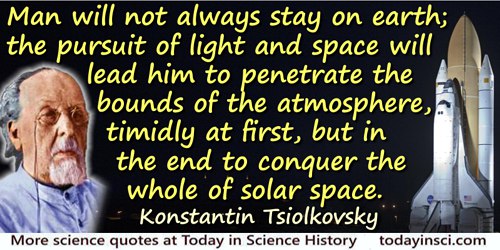
Man will not always stay on earth; the pursuit of light and space will lead him to penetrate the bounds of the atmosphere, timidly at first, but in the end to conquer the whole of solar space.
Epitaph he wrote for himself, engraved in bronze letters on the tall grey stone obelisk raised over his grave. As translated by Kenneth Syers and given in the English edition, Beyond the Planet Earth (1960) of K. Tsiolkovsky’s original Russian book (1920). Also seen translated as, “Mankind will not remain on the earth forever, but, in search of light and space, will at first timidly penetrate beyond the limits of the atmosphere and then finally conquer the spaces of the solar system.”
My position is that it is high time for a calm debate on more fundamental questions. Does human spaceflight continue to serve a compelling cultural purpose and/or our national interest?
In 'Is Human Spaceflight Obsolete?', Issues in Science and Technology (Summer 2004).
Space travel is at the frontier of my profession. It is going to be accomplished and I want to be in on it. There is also an element of simple duty involved. I am convinced that I have something to give this project.
As he wrote in an article for Life (14 Sep 1959), 38.
Space travel is bunk
As Astronomer Royal, Britain, in 1957, two weeks before the launch of Sputnik.
Space travel is utter bilge.
In 1956, one year before Sputnik. As quoted by Charles Hard Townes in essay, 'Unpredictability in Science and Technology', collected in Martin Moskovits (ed.), Science and Society, the John C. Polanyi Nobel Laureates Lectures (1995), 34.
The most important thing we can do is inspire young minds and to advance the kind of science, math and technology education that will help youngsters take us to the next phase of space travel.
As summarized on a CNN web page - without quotation marks - from a statement by Glenn about the fourth National Space Day (4 May 2000). 'All systems go for National Space Day' on CNN website.
The world we know at present is in no fit state to take over the dreariest little meteor ... If we have the courage and patience, the energy and skill, to take us voyaging to other planets, then let us use some of these to tidy up and civilize this earth. One world at a time, please.
Column in the London News Chronicle as quoted in article, 'Notions in Motion,' Time (24 Nov 1952).
There are three reasons why, quite apart from scientific considerations, mankind needs to travel in space. The first reason is garbage disposal; we need to transfer industrial processes into space so that the earth may remain a green and pleasant place for our grandchildren to live in. The second reason is to escape material impoverishment; the resources of this planet are finite, and we shall not forgo forever the abundance of solar energy and minerals and living space that are spread out all around us. The third reason is our spiritual need for an open frontier. The ultimate purpose of space travel is to bring to humanity, not only scientific discoveries and an occasional spectacular show on television, but a real expansion of our spirit.
In Disturbing the Universe (1979).
Throughout history, engineers have served their neighbours, their towns and their countries by making tools, machines and countless other things that improve every aspect of life. From information technology to medical science and mining, from building roads to space travel, engineers are working to make a difference to our standard of living, and with it our health, wealth and happiness.
From a speech by The Queen at The Queen Elizabeth Prize for Engineering (25 Jun 2013).
Throughout history, engineers have served their neighbours, their towns and their countries by making tools, machines and countless other things that improve every aspect of life. From information technology to medical science and mining, from building roads to space travel, engineers are working to make a difference to our standard of living, and with it our health, wealth and happiness. At its heart, engineering is about using science to find creative, practical solutions. It is a noble profession.
In Speech (25 Jun 2013), for the 2013 Queen Elizabeth Prize for Engineering.
 In science it often happens that scientists say, 'You know that's a really good argument; my position is mistaken,' and then they would actually change their minds and you never hear that old view from them again. They really do it. It doesn't happen as often as it should, because scientists are human and change is sometimes painful. But it happens every day. I cannot recall the last time something like that happened in politics or religion.
(1987) --
In science it often happens that scientists say, 'You know that's a really good argument; my position is mistaken,' and then they would actually change their minds and you never hear that old view from them again. They really do it. It doesn't happen as often as it should, because scientists are human and change is sometimes painful. But it happens every day. I cannot recall the last time something like that happened in politics or religion.
(1987) -- 





