Space Flight Quotes (28 quotes)
Spaceflight Quotes
Spaceflight Quotes
[Apollo 7 was] an expedition of the mind, not of the heart.
Quoted by Don E. Wilhelms in To a Rocky Moon: a Geologist's Lunar Exploration (1993), 336.

Poyekhali!
Let’s go!
Let’s go!
Attributed as his exclamation as the Vostok I was launched (12 Apr 1961) with the first human into space,
Quelquefois, par exemple, je me figure que je suis suspendu en l’air, et que j’y demeure sans mouvement, pendant que la Terre tourne sous moi en vingt-quatre heures. Je vois passer sous mes yeux tous ces visages différents, les uns blancs, les autres noirs, les autres basanés, les autres olivâtres. D’abord ce sont des chapeaux et puis des turbans, et puis des têtes chevelues, et puis des têtes rasées; tantôt des villes à clochers, tantôt des villes à longues aiguilles qui ont des croissants, tantôt des villes à tours de porcelaine, tantôt de grands pays qui n’ont que des cabanes; ici de vastes mers, là des déserts épouvantables; enfin, toute cette variété infinie qui est sur la surface de la Terre.
Sometimes, for instance, I imagine that I am suspended in the air, and remain there motionless, while the earth turns under me in four-and-twenty hours. I see pass beneath me all these different countenances, some white, others black, others tawny, others olive-colored. At first they wear hats, and then turbans, then heads with long hair, then heads shaven; sometimes towns with steeples, sometimes towns with long spires, which have crescents, sometimes towns with porcelain towers, sometimes extensive countries that have only huts; here wide seas; there frightful deserts; in short, all this infinite variety on the surface of the earth.
Sometimes, for instance, I imagine that I am suspended in the air, and remain there motionless, while the earth turns under me in four-and-twenty hours. I see pass beneath me all these different countenances, some white, others black, others tawny, others olive-colored. At first they wear hats, and then turbans, then heads with long hair, then heads shaven; sometimes towns with steeples, sometimes towns with long spires, which have crescents, sometimes towns with porcelain towers, sometimes extensive countries that have only huts; here wide seas; there frightful deserts; in short, all this infinite variety on the surface of the earth.
In 'Premier Soir', Entretiens Sur La Pluralité Des Mondes (1686, 1863), 43. French and translation in Craufurd Tait Ramage, Beautiful Thoughts from French and Italian Authors (1866), 117-118.
Current manned space flights are complex missions that involve thousands of people. Someday, however, space vehicles will fly in and out of earth orbit in a more routine manner, and the usefulness of space to science and, in fact, to all persons will have reached a highly desirable plateau.
In 'After Apollo, What?', Science Teacher (Sep 1969), 36, No. 6. 22.
I am happy to report to you that the assignment of the Central Committee of the Communist party of the Soviet Union and the Soviet Government has been carried out. The world's first space flight has been accomplished in the Soviet space ship Vostok. All systems and equipment worked impeccably, I feel very well and am prepared to carry out any assignment of the party and the government.
Speech beside Khrushchev, at the tomb of Lenin and Stalin, Red Square, Moscow (14 Apr 1961). As quoted in Osgood Caruthers, 'Krushchev Leads Russian Tribute to Astronaut', New York Times (15 Apr 1961), 2.
I ask myself whether the huge national commitment of technical talent to human spaceflight and the ever-present potential for the loss of precious human life are really justifiable.
In 'Is Human Spaceflight Obsolete?', Issues in Science and Technology (Summer 2004). [Note: published one year after the loss of seven lives in the Space Shuttle Columbia disaster. —Webmaster]
I find myself now preaching about the golden age of manned spaceflight, because something went on there, within us, that we’re missing. When we went to the Moon, it was not only just standing on a new plateau for all mankind. We changed the way everybody in the world thought of themselves, you know. It was a change that went on inside of us. And we’re losing that.
From interview with Ron Stone (24 May 1999) for NASA Johnson Space Center Oral History Project on NASA website.
I fully expect that NASA will send me back to the Moon as they treated Senator [John] Glenn, and if they don’t do otherwise, why, then I’ll have to do it myself.
About looking forward to the day he turned 77. In interview with Associated Press, as quoted in Peter Bond, 'Obituary: Charles Conrad Jnr', The Independent (10 Jul 1999).
I had a wonderful time the first time. I think I was probably more nervous back in those days because we did not know much about spaceflight in those days; we were sort of feeling our way and finding out what would happen to the human body in space and now we are putting the whole thing to work for everybody up here so I think I was a little more nervous the first time.
Replying to a Whetstone High School students’ question during a school forum held using a downlink with the Discovery Space Shuttle mission (31 Oct 1998). On NASA web page 'STS-95 Educational Downlink'. Sarah Ravely, Holleh Moheimani, Janara Walker asked, “Senator Glenn, were you more nervous being the first American to orbit the Earth or to be the oldest man ever in space?”
I think that space flight is a condition of Nature that comes into effect when an intelligent species reaches the saturation point of its planetary habitat combined with a certain level of technological ability... I think it is a built-in gene-directed drive for the spreading of the species and its continuation.
…...
If in some madhouse there is a lunatic who still believes the old churchly tenet that heaven is up above, even this [the first manned landing on the moon] probably will not disabuse him. Surely those of us still sane enough to be at large realize that this event will have no more to so with theology, God, or self-knowledge than any flower we pluck or any hand we press—in fact, much less.
(13 Jul 1969). As given in Alan F. and Jason R. Pater (eds.), What They Said in 1969: The Yearbook of Spoken Opinion (1970), 402.
In this age of space flight, when we use the modern tools of science to advance into new regions of human activity, the Bible ... this grandiose, stirring history of the gradual revelation and unfolding of the moral law ... remains in every way an up-to-date book. Our knowledge and use of the laws of nature that enable us to fly to the Moon also enable us to destroy our home planet with the atom bomb. Science itself does not address the question whether we should use the power at our disposal for good or for evil. The guidelines of what we ought to do are furnished in the moral law of God. It is no longer enough that we pray that God may be with us on our side. We must learn again that we may be on God's side.
Quoted in Bob Phillips, Phillips' Book of Great Thoughts & Funny Sayings (1993), 42.
Insurance is the biggest single problem with this industry [commercial space flight].
— Pat Bahn
As quoted by Braddock Gaskill, 'TGV Rockets ‘Walking before they can run’', on web page of nasaspaceflight.com (Sep 2005). Gaskill wrote comment, “One barrier to space flight today that 1920’s aviation pioneers were not overly concerned with is a highly litigious society.”
It will be possible in a few more years to build radio controlled rockets which can be steered into such orbits beyond the limits of the atmosphere and left to broadcast scientific information back to the Earth. A little later, manned rockets will be able to make similar flights with sufficient excess power to break the orbit and return to Earth. (1945) [Predicting communications satellites.]
In 'Can Rocket Stations Give Worldwide Coverage?', Wireless World (Oct 1945). Quoted and cited in Arthur C. Clarke, Greetings, Carbon-Based Bipeds!: Collected Essays, 1934-1998, 21.
Lift off! We have a lift off
Thirty five minutes past the hour!
Thirty five minutes past the hour!
— O.M.D.
Song lyrics, Apollo XI by Orchestral Manoeuvres In The Dark (O.M.D.)
Man, in his quest for knowledge and progress, is determined and cannot be deterred. The exploration of space will go ahead, whether we join in or not, and it is one of the great adventures of all time, and no nation which expects to be the leader of other nations can expect to stay behind in this race for space.
Address at Rice University in Houston (12 Sep 1962). On website of John F. Kennedy Presidential Library and Museum.
My own lifetime spans the Wright Brothers' Kitty Hawk flight and manned-satellite orbiting.
In 'The Wisdom of Wilderness', Life (22 Dec 1967), 63, No. 25, 8.
One of the greatest goals of the manned space flight program is that earth orbital flight will eventually become safe enough and low enough in cost to facilitate a firsthand scientific investigation from that vantage point.
In 'After Apollo, What?', Science Teacher (Sep 1969), 36, No. 6. 22.
Sarcastic Science, she would like to know,
In her complacent ministry of fear,
How we propose to get away from here
When she has made things so we have to go
Or be wiped out. Will she be asked to show
Us how by rocket we may hope to steer
To some star off there, say, a half light-year
Through temperature of absolute zero?
Why wait for Science to supply the how
When any amateur can tell it now?
The way to go away should be the same
As fifty million years ago we came—
If anyone remembers how that was
I have a theory, but it hardly does.
In her complacent ministry of fear,
How we propose to get away from here
When she has made things so we have to go
Or be wiped out. Will she be asked to show
Us how by rocket we may hope to steer
To some star off there, say, a half light-year
Through temperature of absolute zero?
Why wait for Science to supply the how
When any amateur can tell it now?
The way to go away should be the same
As fifty million years ago we came—
If anyone remembers how that was
I have a theory, but it hardly does.
'Why Wait for Science?' In Edward Connery Latham (ed.), The Poetry of Robert Frost: The Collected Poems, Complete and Unabridged (1979), 395.
Some people say there is a God out there. ... but in my travels around the earth all day long, I looked around and didn't see Him ... I saw no God or angels. The rocket was made by our own people. I don't believe in God. I believe in man, in his strength, his possibilities, and his reason.[After his return from a space flight orbitting the earth.]
As quoted, without citation, in H. T. Spence, Confronting Contemporary Christian Music: A Plain Account of Its History, Philosophy, and Future (2002), 7.
Spaceflights can’t be stopped. This isn't the work of any one man or even a group of men. It is a historical process which mankind is carrying out in accordance with the natural laws of human development.
As quoted in Space World (1974), 10.
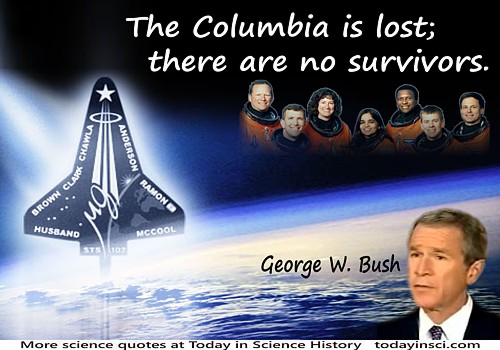
The Columbia is lost; there are no survivors. … In an age when space flight has come to seem almost routine, it is easy to overlook the dangers of travel by rocket, and the difficulties of navigating the fierce outer atmosphere of the Earth. These astronauts knew the dangers, and they faced them willingly, knowing they had a high and noble purpose in life. Because of their courage and daring idealism, we will miss them all the more. … The cause in which they died will continue. Mankind is led into the darkness beyond our world by the inspiration of discovery and the longing to understand. Our journey into space will go on.
Address to the Nation on the Space Shuttle Columbia tragedy, from the Cabinet Room (1 Feb 2003). In William J. Federer, A Treasury of Presidential Quotations (2004), 437.
The flight was extremely normal ... for the first 36 seconds then after that got very interesting.
About the Apollo 12 launch, during which two electrical discharges almost ended the mission.
About the Apollo 12 launch, during which two electrical discharges almost ended the mission.
Quoted in Air & Space Smithsonian (2000), 15, 74.
The rockets that have made spaceflight possible are an advance that, more than any other technological victory of the twentieth century, was grounded in science fiction… . One thing that no science fiction writer visualized, however, as far as I know, was that the landings on the Moon would be watched by people on Earth by way of television.
In Asimov on Physics (1976), 35. Also in Isaac Asimov’s Book of Science and Nature Quotations (1988), 307.
The world’s first spaceship, Vostok (East), with a man on board was launched into orbit from the Soviet Union on April 12, 1961. The pilot space-navigator of the satellite-spaceship Vostok is a citizen of the U.S.S.R., Flight Major Yuri Gagarin.
The launching of the multistage space rocket was successful and, after attaining the first escape velocity and the separation of the last stage of the carrier rocket, the spaceship went in to free flight on around-the-earth orbit. According to preliminary data, the period of revolution of the satellite spaceship around the earth is 89.1 min. The minimum distance from the earth at perigee is 175 km (108.7 miles) and the maximum at apogee is 302 km (187.6 miles), and the angle of inclination of the orbit plane to the equator is 65º 4’. The spaceship with the navigator weighs 4725 kg (10,418.6 lb), excluding the weight of the final stage of the carrier rocket.
The first man in space was announced by the Soviet newsagency Tass on 12 April 1961, 9:59 a.m. Moscow time.
The launching of the multistage space rocket was successful and, after attaining the first escape velocity and the separation of the last stage of the carrier rocket, the spaceship went in to free flight on around-the-earth orbit. According to preliminary data, the period of revolution of the satellite spaceship around the earth is 89.1 min. The minimum distance from the earth at perigee is 175 km (108.7 miles) and the maximum at apogee is 302 km (187.6 miles), and the angle of inclination of the orbit plane to the equator is 65º 4’. The spaceship with the navigator weighs 4725 kg (10,418.6 lb), excluding the weight of the final stage of the carrier rocket.
The first man in space was announced by the Soviet newsagency Tass on 12 April 1961, 9:59 a.m. Moscow time.
— Tass
Quoted in John David Anderson, Jr., Hypersonic and High Temperature Gas Dynamics (2000), 2.
Three hundred and sixty five feet
Of gleaming white equipment
Being pushed up through
The blue skies of Florida.
Of gleaming white equipment
Being pushed up through
The blue skies of Florida.
— O.M.D.
Song lyrics, Apollo XI by Orchestral Manoeuvres In The Dark (O.M.D.)
To me, it [the 1962 space flight of Friendship 7] is not something that happened a long time ago. It seems like a couple of days ago, really. It’s a rare day I don’t think about it, relive it in my mind. I can remember every switch I flipped, every move I made, every word I spoke and every word spoken to me. Clear as a bell.
As reported by Howard Wilkinson in 'John Glenn Had the Stuff U.S. Heroes are Made of', The Cincinnati Enquirer (20 Feb 2002).
What beauty. I saw clouds and their light shadows on the distant dear earth…. The water looked like darkish, slightly gleaming spots…. When I watched the horizon, I saw the abrupt, contrasting transition from the earth’s light-colored surface to the absolutely black sky. I enjoyed the rich color spectrum of the earth. It is surrounded by a light blue aureole that gradually darkens, becomes turquoise, dark blue, violet, and finally coal black.
Describing his view while making the first manned orbit of the earth (12 Apr 1961). As quoted in Don Knefel, Writing and Life: A Rhetoric for Nonfiction with Readings (1986), 93.
Front Cover
 In science it often happens that scientists say, 'You know that's a really good argument; my position is mistaken,' and then they would actually change their minds and you never hear that old view from them again. They really do it. It doesn't happen as often as it should, because scientists are human and change is sometimes painful. But it happens every day. I cannot recall the last time something like that happened in politics or religion.
(1987) --
In science it often happens that scientists say, 'You know that's a really good argument; my position is mistaken,' and then they would actually change their minds and you never hear that old view from them again. They really do it. It doesn't happen as often as it should, because scientists are human and change is sometimes painful. But it happens every day. I cannot recall the last time something like that happened in politics or religion.
(1987) -- 




