Slow Quotes (108 quotes)
…so slow is moral progress. True, we have the bicycle, the motor-car, the dirigible airship and other marvellous means of breaking our bones; but our morality is not one rung the higher for it all. One would even say that, the farther we proceed in our conquest of matter, the more our morality recedes. The most advanced of our inventions consists in bringing men down with grapeshot and explosives with the swiftness of the reaper mowing the corn.
...the life of the planet began the long, slow process of modulating and regulating the physical conditions of the planet. The oxygen in today's atmosphere is almost entirely the result of photosynthetic living, which had its start with the appearance of blue-green algae among the microorganisms.
In Late Night Thoughts on Listening to Mahler's Ninth Symphony(1984), 74.
[For the] increase of knowledge and … the useful application of the knowledge gained, … there never is a sudden beginning; even the cloud change which portends the thunderstorm begins slowly.
From address, 'A Medical Retrospect'. Published in Yale Medical Journal (Oct 1910), 17, No. 2, 59.
[Using a hand calculator and writing things down longhand] I was able to solve this problem because I don’t have a computer. I know what I am doing every step, and the steps go slowly enough that I can think.
As quoted in Charles Petit, 'The Curious Quester', The San Francisco Chronicle. Reprinted in The Courier-Journal (3 Mar 1991), Magazine, 33.
Copernicus, who rightly did condemn
This eldest systeme, form’d a wiser scheme;
In which he leaves the Sun at Rest, and rolls
The Orb Terrestial on its proper Poles;
Which makes the Night and Day by this Career,
And by its slow and crooked Course the Year.
The famous Dane, who oft the Modern guides,
To Earth and Sun their Provinces divides:
The Earth’s Rotation makes the Night and Day,
The Sun revolving through th’ Eccliptic Way
Effects the various seasons of the Year,
Which in their Turn for happy Ends appear.
This Scheme or that, which pleases best, embrace,
Still we the Fountain of their Motion trace.
Kepler asserts these Wonders may be done
By the Magnetic Vertue of the Sun,
Which he, to gain his End, thinks fit to place
Full in the Center of that mighty Space,
Which does the Spheres, where Planets roll, include,
And leaves him with Attractive Force endu’d.
The Sun, thus seated, by Mechanic Laws,
The Earth, and every distant Planet draws;
By which Attraction all the Planets found
Within his reach, are turn'd in Ether round.
This eldest systeme, form’d a wiser scheme;
In which he leaves the Sun at Rest, and rolls
The Orb Terrestial on its proper Poles;
Which makes the Night and Day by this Career,
And by its slow and crooked Course the Year.
The famous Dane, who oft the Modern guides,
To Earth and Sun their Provinces divides:
The Earth’s Rotation makes the Night and Day,
The Sun revolving through th’ Eccliptic Way
Effects the various seasons of the Year,
Which in their Turn for happy Ends appear.
This Scheme or that, which pleases best, embrace,
Still we the Fountain of their Motion trace.
Kepler asserts these Wonders may be done
By the Magnetic Vertue of the Sun,
Which he, to gain his End, thinks fit to place
Full in the Center of that mighty Space,
Which does the Spheres, where Planets roll, include,
And leaves him with Attractive Force endu’d.
The Sun, thus seated, by Mechanic Laws,
The Earth, and every distant Planet draws;
By which Attraction all the Planets found
Within his reach, are turn'd in Ether round.
In Creation: A Philosophical Poem in Seven Books (1712), book 2, l. 430-53, p.78-9.
Man is the result of slow growth; that is why he occupies the position he does in animal life. What does a pup amount to that has gained its growth in a few days or weeks, beside a man who only attains it in as many years.
In Orison Swett Marden, 'Bell Telephone Talk: Hints on Success by Alexander G. Bell', How They Succeeded: Life Stories of Successful Men Told by Themselves (1901), 35.
Question: Explain how to determine the time of vibration of a given tuning-fork, and state what apparatus you would require for the purpose.
Answer: For this determination I should require an accurate watch beating seconds, and a sensitive ear. I mount the fork on a suitable stand, and then, as the second hand of my watch passes the figure 60 on the dial, I draw the bow neatly across one of its prongs. I wait. I listen intently. The throbbing air particles are receiving the pulsations; the beating prongs are giving up their original force; and slowly yet surely the sound dies away. Still I can hear it, but faintly and with close attention; and now only by pressing the bones of my head against its prongs. Finally the last trace disappears. I look at the time and leave the room, having determined the time of vibration of the common “pitch” fork. This process deteriorates the fork considerably, hence a different operation must be performed on a fork which is only lent.
Answer: For this determination I should require an accurate watch beating seconds, and a sensitive ear. I mount the fork on a suitable stand, and then, as the second hand of my watch passes the figure 60 on the dial, I draw the bow neatly across one of its prongs. I wait. I listen intently. The throbbing air particles are receiving the pulsations; the beating prongs are giving up their original force; and slowly yet surely the sound dies away. Still I can hear it, but faintly and with close attention; and now only by pressing the bones of my head against its prongs. Finally the last trace disappears. I look at the time and leave the room, having determined the time of vibration of the common “pitch” fork. This process deteriorates the fork considerably, hence a different operation must be performed on a fork which is only lent.
Genuine student answer* to an Acoustics, Light and Heat paper (1880), Science and Art Department, South Kensington, London, collected by Prof. Oliver Lodge. Quoted in Henry B. Wheatley, Literary Blunders (1893), 176-7, Question 4. (*From a collection in which Answers are not given verbatim et literatim, and some instances may combine several students' blunders.)
~~[Orphan ?]~~ Reason is the slow and tortuous method by which those who do not know the truth discover it.
Webmaster presently believes this is an orphan quote, best attributed to Anonymous. It seem to be unsupported when attributed to Blaise Pascal, for example, as quoted, without citation, in Morris Kline, 'Ancients versus Moderns, A New Battle of the Books', The Mathematics Teacher (Oct 1958), 51, No. 6, 423. Also later published, without citation, in Morris Kline, Mathematical Thought From Ancient to Modern Times (1972), 296. Webmaster has not yet found a primary source for this as a quote by Pascal - not in English, not in French, and not in any earlier books. This is suspicious. (Can you help?) Furthermore, this sentence is also often seen in more recent books and online quotes pages as a first sentence, followed by a second sentence, “The heart has its reasons, which reason does not know.” The second sentence is a known Pascal quote verified in original French texts. However, Webmaster has not yet found, in any original French text, any instance of these two sentences together. Thus, putting them together more definitely appears to be a misquote. Can you help? [It is included on the Blaise Pascal page to link it with this cautionary note. —Webmaster]
A nation which depends upon others for its new basic scientific knowledge will be slow in its industrial progress and weak in its competitive position in world trade, regardless of its mechanical skill.
Quoted by Edwin T. Layton, Jr., in 'American Ideologies of Science and Engineering', Technology and Culture (1976), 17, 689. As cited in Arie Leegwater, 'Technology and Science', Stephen V. Monsma (ed.), Responsible Technology: A Christian Perspective (1986), 79.
All the old constellations had gone from the sky, however: that slow movement which is imperceptible in a hundred human lifetimes, had long since rearranged them in unfamiliar groupings. But the Milky Way, it seemed to me, was still the same tattered streamer of star-dust as of yore.
In The Time Machine (1898), 144.
All things on the earth are the result of chemical combination. The operation by which the commingling of molecules and the interchange of atoms take place we can imitate in our laboratories; but in nature they proceed by slow degrees, and, in general, in our hands they are distinguished by suddenness of action. In nature chemical power is distributed over a long period of time, and the process of change is scarcely to be observed. By acts we concentrate chemical force, and expend it in producing a change which occupies but a few hours at most.
In chapter 'Chemical Forces', The Poetry of Science: Or, Studies of the Physical Phenomena of Nature (1848), 235-236. Charles Dicken used this quote, with his own sub-head of 'Relative Importance Of Time To Man And Nature', to conclude his review of the book, published in The Examiner (1848).
And indeed I am not humming,
Thus to sing of Cl-ke and C-ming,
Who all the universe surpasses
in cutting up and making gases;
With anatomy and chemics,
Metaphysics and polemics,
Analyzing and chirugery,
And scientific surgery …
H-slow's lectures on the cabbage
Useful are as roots of Babbage;
Fluxions and beet-root botany,
Some would call pure monotony.
Thus to sing of Cl-ke and C-ming,
Who all the universe surpasses
in cutting up and making gases;
With anatomy and chemics,
Metaphysics and polemics,
Analyzing and chirugery,
And scientific surgery …
H-slow's lectures on the cabbage
Useful are as roots of Babbage;
Fluxions and beet-root botany,
Some would call pure monotony.
— Magazine
Punch in Cambridge (28 Jan 1834). In Mark Weatherall, Gentlemen, Scientists, and Medicine at Cambridge 1800-1940 (2000), Vol. 3,77. The professors named were William Clark (anatomy), James Cumming (chemistry) and Johns Stephens Henslow (botany).
Apart from the hostile influence of man, the organic and the inorganic world are … bound together by such mutual relations and adaptations as secure, if not the absolute permanence and equilibrium of both … at least a very slow and gradual succession of changes in those conditions. But man is everywhere a disturbing agent. Wherever he plants his foot, the harmonies of nature are turned to discords.
In Man and Nature, (1864), 35-36.
As long as Algebra and Geometry have been separated, their progress has been slow and their usages limited; but when these two sciences were reunited, they lent each other mutual strength and walked together with a rapid step towards perfection.
From the original French, “Tant que l’Algèbre et la Géométrie ont été séparées, leur progrès ont été lents et leurs usages bornés; mais lorsque ces deux sciences se sont réunies, elles se sont prêté des forces mutuelles et ont marché ensemble d’un pas rapide vers la perfection,” in Leçons Élémentaires sur la Mathematiques, Leçon 5, as collected in J.A. Serret (ed.), Œuvres de Lagrange (1877), Tome 7, Leçon 15, 271. English translation above by Google translate, tweeked by Webmaster. Also seen translated as, “As long as algebra and geometry proceeded along separate paths, their advance was slow and their applications limited. But when these sciences joined company, they drew from each other fresh vitality and thenceforward marched on at a rapid pace toward perfection,” in Robert Édouard Moritz, Memorabilia Mathematica; Or, The Philomath’s Quotation-Book (1914), 81.
At last gleams of light have come, and I am almost convinced (quite contrary to opinion I started with) that species are not (it is like confessing a murder) immutable. Heaven forfend me from Lamarck nonsense of a “tendency to progression”, “adaptations from the slow willing of animals”, &c! But the conclusions I am led to are not widely different from his; though the means of change are wholly so. I think I have found out (here’s presumption!) the simple way by which species become exquisitely adapted to various ends.
Letter to Sir Joseph Hooker (11 Jan 1844). In Charles Darwin and Francis Darwin (ed.), Charles Darwin: His Life Told in an Autobiographical Chapter, and in a Selected Series of His Published Letters (1892), 173-174.
Bees are not as busy as we think they are. They jest can’t buzz any slower.
As quoted in Henry Wysham Lanier, The Golden Book Magazine (1931), Vol. 13, 85.
But, as we consider the totality of similarly broad and fundamental aspects of life, we cannot defend division by two as a natural principle of objective order. Indeed, the ‘stuff’ of the universe often strikes our senses as complex and shaded continua, admittedly with faster and slower moments, and bigger and smaller steps, along the way. Nature does not dictate dualities, trinities, quarterings, or any ‘objective’ basis for human taxonomies; most of our chosen schemes, and our designated numbers of categories, record human choices from a cornucopia of possibilities offered by natural variation from place to place, and permitted by the flexibility of our mental capacities. How many seasons (if we wish to divide by seasons at all) does a year contain? How many stages shall we recognize in a human life?
…...
Clearly, we have compiled a record of serious failures in recent technological encounters with the environment. In each case, the new technology was brought into use before the ultimate hazards were known. We have been quick to reap the benefits and slow to comprehend the costs.
In 'Frail Reeds in a Harsh World', Natural History Journal of the American Museum of Natural History (Feb 1969), 79, No. 2, 44.
Computers are incredibly fast, accurate and stupid. Human beings are incredibly slow, inaccurate and brilliant. Together they are powerful beyond imagination.
Very often seen (?mis-)attributed to Albert Einstein, but there seems to be no authenticating primary source. (Webmaster has tried, but not yet found one.) Probably best regarded as Anonymous.
Eventually the process of aging, which is unlikely to be simple, should be understandable. Hopefully some of its processes can be slowed down or avoided. In fact, in the next century, we shall have to tackle the question of the preferred form of death.
(1986).
Evolution is a theory of organic change, but it does not imply, as many people assume, that ceaseless flux is the irreducible state of nature and that structure is but a temporary incarnation of the moment. Change is more often a rapid transition between stable states than a continuous transformation at slow and steady rates. We live in a world of structure and legitimate distinction. Species are the units of nature’s morphology.
…...
Felling a tree was possibly the original deed of appropriation of the natural earth by early mankind in Europe. Thousands of years ago,… man lifted a heavy flint tool and struck at the base of a tree. He may have wanted the tree for shelter and fuel, or possibly to make a bridge over a river or a path through a bog…. [E]ventually the tree crashed to the floor, and the first act in the slow possession of the land by its people was complete.
In The Man Who Made Things Out of Trees: The Ash in Human Culture and History (2015), Chap. 1.
For if there is any truth in the dynamical theory of gases the different molecules in a gas at uniform temperature are moving with very different velocities. Put such a gas into a vessel with two compartments [A and B] and make a small hole in the wall about the right size to let one molecule through. Provide a lid or stopper for this hole and appoint a doorkeeper, very intelligent and exceedingly quick, with microscopic eyes but still an essentially finite being.
Whenever he sees a molecule of great velocity coming against the door from A into B he is to let it through, but if the molecule happens to be going slow he is to keep the door shut. He is also to let slow molecules pass from B to A but not fast ones ... In this way the temperature of B may be raised and that of A lowered without any expenditure of work, but only by the intelligent action of a mere guiding agent (like a pointsman on a railway with perfectly acting switches who should send the express along one line and the goods along another).
I do not see why even intelligence might not be dispensed with and the thing be made self-acting.
Moral The 2nd law of Thermodynamics has the same degree of truth as the statement that if you throw a tumblerful of water into the sea you cannot get the same tumblerful of water out again.
Whenever he sees a molecule of great velocity coming against the door from A into B he is to let it through, but if the molecule happens to be going slow he is to keep the door shut. He is also to let slow molecules pass from B to A but not fast ones ... In this way the temperature of B may be raised and that of A lowered without any expenditure of work, but only by the intelligent action of a mere guiding agent (like a pointsman on a railway with perfectly acting switches who should send the express along one line and the goods along another).
I do not see why even intelligence might not be dispensed with and the thing be made self-acting.
Moral The 2nd law of Thermodynamics has the same degree of truth as the statement that if you throw a tumblerful of water into the sea you cannot get the same tumblerful of water out again.
Letter to John William Strutt (6 Dec 1870). In P. M. Hannan (ed.), The Scientific Letters and Papers of James Clerk Maxwell (1995), Vol. 2, 582-3.
For some men of great courage and adventure, inactivity was a slow death. Would a man like Gibson ever have adjusted back to peacetime life? One can imagine it would have been a somewhat empty existence after all he had been through. Facing death had become his drug. He had seen countless friends and comrades perish in the great crusade. Perhaps something in him even welcomed the inevitability he had always felt that before the war ended he would join them in their Bomber Command Valhalla. He had pushed his luck beyond all limits and he knew it. But that was the kind of man he was… A man of great courage, inspiration and leadership. A man born for war… but born to fall in war.
Wallis wrote after the death of Guy Gibson, leader of the successful Dambusters raid by the 617 Squadron. Gibson was killed a year later when his airplane crashed returning from a night-time sortie over Germany. As quoted in W. B. Bartlett, Dam Busters: In the Words of the Bomber Crews (2011, 2013), 272-273.
Genetics has enticed a great many explorers during the past two decades. They have labored with fruit-flies and guinea-pigs, with sweet peas and corn, with thousands of animals and plants in fact, and they have made heredity no longer a mystery but an exact science to be ranked close behind physics and chemistry in definiteness of conception. One is inclined to believe, however, that the unique magnetic attraction of genetics lies in the vision of potential good which it holds for mankind rather than a circumscribed interest in the hereditary mechanisms of the lowly species used as laboratory material. If man had been found to be sharply demarcated from the rest of the occupants of the world, so that his heritage of physical form, of physiological function, and of mental attributes came about in a superior manner setting him apart as lord of creation, interest in the genetics of the humbler organisms—if one admits the truth—would have flagged severely. Biologists would have turned their attention largely to the ways of human heredity, in spite of the fact that the difficulties encountered would have rendered progress slow and uncertain. Since this was not the case, since the laws ruling the inheritance of the denizens of the garden and the inmates of the stable were found to be applicable to prince and potentate as well, one could shut himself up in his laboratory and labor to his heart's content, feeling certain that any truth which it fell to his lot to discover had a real human interest, after all.
Mankind at the Crossroads (1923), v-vi.
Geologists have not been slow to admit that they were in error in assuming that they had an eternity of past time for the evolution of the earth’s history. They have frankly acknowledged the validity of the physical arguments which go to place more or less definite limits to the antiquity of the earth. They were, on the whole, disposed to acquiesce in the allowance of 100 millions of years granted to them by Lord Kelvin, for the transaction of the whole of the long cycles of geological history. But the physicists have been insatiable and inexorable. As remorseless as Lear’s daughters, they have cut down their grant of years by successive slices, until some of them have brought the number to something less than ten millions. In vain have the geologists protested that there must somewhere be a flaw in a line of argument which tends to results so entirely at variance with the strong evidence for a higher antiquity, furnished not only by the geological record, but by the existing races of plants and animals. They have insisted that this evidence is not mere theory or imagination, but is drawn from a multitude of facts which become hopelessly unintelligible unless sufficient time is admitted for the evolution of geological history. They have not been able to disapprove the arguments of the physicists, but they have contended that the physicists have simply ignored the geological arguments as of no account in the discussion.
'Twenty-five years of Geological Progress in Britain', Nature, 1895, 51, 369.
Guide to understanding a net.addict’s day:
Slow day: didn’t have much to do, so spent three hours on usenet.
Busy day: managed to work in three hours of usenet.
Bad day: barely squeezed in three hours of usenet.
Slow day: didn’t have much to do, so spent three hours on usenet.
Busy day: managed to work in three hours of usenet.
Bad day: barely squeezed in three hours of usenet.
Probably originated earlier, but Webmaster found it posted, cited as Anonymous, in the alt.quotations discussion group, at least as early as 2009.
He who has mastered the Darwinian theory, he who recognizes the slow and subtle process of evolution as the way in which God makes things come to pass, … sees that in the deadly struggle for existence that has raged throughout countless aeons of time, the whole creation has been groaning and travailing together in order to bring forth that last consummate specimen of God’s handiwork, the Human Soul
In The Destiny of Man Viewed in the Light of his Origin (1884), 32. Collected in Studies in Religion (1902), 19–20.
History shows that the human animal has always learned but progress used to be very slow. This was because learning often depended on the chance coming together of a potentially informative event on the one hand and a perceptive observer on the other. Scientific method accelerated that process.
In article Total Quality: Its Origins and its Future (1995), published at the Center for Quality and Productivity Improvement.
Hitherto the progress of science has been slow, and subject to constant error and revision. But as soon as physical research begins to go hand in hand with moral or psychical research, it will advance with a rapidity hitherto unimagined, each assisting and classifying the other.
As quoted by Mrs. H.O. Ward, without source, in The New Science Review: A Miscellany of Modern Thought and Discovery (1894), 173.
I am reminded of the great French Marshal Lyautey, who once asked his gardener to plant a tree. The gardener objected that the tree was slow-growing and would not reach maturity for a hundred years. The Marshal replied, “In that case, there is no time to lose, plant it this afternoon.”
Address at the University of California, Berkeley, California (23 March 1962), in Public Papers of the Presidents of the United States: John F. Kennedy (1962), 266. Kennedy used this story several times. The indicated source, Marshal Lyautey, has not been verified. Contact Webmaster if you know a primary source.
I have, also, a good deal of respect for the job they [physicists] did in the first months after Hiroshima. The world desperately needed information on this new problem in the daily life of the planet, and the physicists, after a slow start, did a good job of giving it to them. It hasn’t come out with a fraction of the efficiency that the teachers might have wished, but it was infinitely more effective than anyone would have dared expect.
In 'A Newsman Looks at Physicists', Physics Today (May 1948), 1, No. 1, 15.
I know with sure and certain knowledge that a man’s work is nothing but this slow trek to rediscover, through the detours of art, those two or three great and simple images in whose presence his heart first opened.
In Lyrical and Critical Essays (1967), 14.
If indeed the Earth is, in its own slow way, a very dynamic body and we have regarded it as essentially static, we need to discard most of our old theories and books and start again with a new viewpoint and a new science.
In 'Reply to Beloussov', Geotimes (1968), 13, No. 12, 22. The public disagreement on seafloor spreading between Wilson and V.V. Beloussov is collected in Brainerd Mears, The Nature of Geology: Contemporary Readings (1970).
If matter is not eternal, its first emergence into being is a miracle beside which all others dwindle into absolute insignificance. But, as has often been pointed out, the process is unthinkable; the sudden apocalypse of a material world out of blank nonentity cannot be imagined; its emergence into order out of chaos when “without form and void” of life, is merely a poetic rendering of the doctrine of its slow evolution.
In Nineteenth Century (Sep c.1879?). Quoted in John Tyndall, 'Professor Virchow and Evolution', Fragments of Science (1879), Vol. 2, 377.
If new species arise very rapidly in small, peripherally isolated local populations, then the great expectation of insensibly graded fossil sequences is a chimera. A new species does not evolve in the area of its ancestors; it does not arise from the slow transformation of all its forbears.
co-author with Niles Eldridge (palaeontologist, 1943- )
co-author with Niles Eldridge (palaeontologist, 1943- )
'Punctuated Equilibria: An Alternative to Phyletic Gradualism', in Thomas J. M. Schopf (ed.), Models in Paleobiology (1972), 84.
In every section of the entire area where the word science may properly be applied, the limiting factor is a human one. We shall have rapid or slow advance in this direction or in that depending on the number of really first-class men who are engaged in the work in question. ... So in the last analysis, the future of science in this country will be determined by our basic educational policy.
Quoted in Vannevar Bush, Science, the Endless Frontier: A Report to the President, July 1945. In Transactions of the Kansas Academy of Science: Volumes 48-49, 246.
In reality, I have sometimes thought that we do not go on sufficiently slowly in the removal of diseases, and that it would he better if we proceeded with less haste, and if more were often left, to Nature than is the practice now-a-days. It is a great mistake to suppose that Nature always stands in need of the assistance of Art. If that were the case, site would have made less provision for the safety of mankind than the preservation of the species demands; seeing that there is not the least proportion between the host of existing diseases and the powers possessed by man for their removal, even in those ages wherein the healing art was at the highest pitch, and most extensively cultivated.
As quoted by Gavin Milroy in 'On the Writings of Sydenham', The Lancet (14 Nov 1846), 524.
In summary, very large populations may differentiate rapidly, but their sustained evolution will be at moderate or slow rates and will be mainly adaptive. Populations of intermediate size provide the best conditions for sustained progressive and branching evolution, adaptive in its main lines, but accompanied by inadaptive fluctuations, especially in characters of little selective importance. Small populations will be virtually incapable of differentiation or branching and will often be dominated by random inadaptive trends and peculiarly liable to extinction, but will be capable of the most rapid evolution as long as this is not cut short by extinction.
Tempo and Mode in Evolution (1944), 70-1.
Is man a peculiar organism? Does he originate in a wholly different way from a dog, bird, frog, or fish? and does he thereby justify those who assert that he has no place in nature, and no real relationship with the lower world of animal life? Or does he develop from a similar embryo, and undergo the same slow and gradual progressive modifications? The answer is not for an instant doubtful, and has not been doubtful for the last thirty years. The mode of man’s origin and the earlier stages of his development are undoubtedly identical with those of the animals standing directly below him in the scale; without the slightest doubt, he stands in this respect nearer the ape than the ape does to the dog. (1863)
As quoted in Ernst Haeckel and E. Ray Lankester (trans.) as epigraph for Chap. 12, The History of Creation (1886), Vol. 1, 364.
It is safe to say that the little pamphlet which was left to find its way through the slow mails to the English scientist outweighed in importance and interest for the human race all the press dispatches which have been flashed under the channel since the delivery of the address—March 24. The rapid growth of the Continental capitals, the movements of princely noodles and fat, vulgar Duchesses, the debates in the Servian Skupschina, and the progress or receding of sundry royal gouts are given to the wings of lightning; a lumbering mail-coach is swift enough for the news of one of the great scientific discoveries of the age. Similarly, the gifted gentlemen who daily sift out for the American public the pith and kernel of the Old World's news; leave Dr. KOCH and his bacilli to chance it in the ocean mails, while they challenge the admiration of every gambler and jockey in this Republic by the fullness and accuracy of their cable reports of horse-races.
New York Times (3 May 1882). Quoted in Thomas D. Brock, Robert Koch (1988), 131.
It is the reciprocity of these appearances—that each party should think the other has contracted—that is so difficult to realise. Here is a paradox beyond even the imagination of Dean Swift. Gulliver regarded the Lilliputians as a race of dwarfs; and the Lilliputians regarded Gulliver as a giant. That is natural. If the Lilliputians had appeared dwarfs to Gulliver, and Gulliver had appeared a dwarf to the Lilliputians—but no! that is too absurd for fiction, and is an idea only to be found in the sober pages of science. …It is not only in space but in time that these strange variations occur. If we observed the aviator carefully we should infer that he was unusually slow in his movements; and events in the conveyance moving with him would be similarly retarded—as though time had forgotten to go on. His cigar lasts twice as long as one of ours. …But here again reciprocity comes in, because in the aviator’s opinion it is we who are travelling at 161,000 miles a second past him; and when he has made all allowances, he finds that it is we who are sluggish. Our cigar lasts twice as long as his.
In Space, Time and Gravitation: An Outline of the General Relativity Theory (1920, 1921), 23-24.
It may metaphorically be said that natural selection is daily and hourly scrutinising, throughout the world, the slightest variations; rejecting those that are bad, preserving and adding up all that are good; silently and insensibly working, whenever and wherever opportunity offers, at the improvement of each organic being in relation to its organic and inorganic conditions of life. We see nothing of these slow changes in progress, until the hand of time has marked the lapse of ages...
The Origin of Species (1870), 80.
Let us be well assured of the Matter of Fact, before we trouble our selves with enquiring into the Cause. It is true, that this Method is too slow for the greatest part of Mankind, who run naturally to the Cause, and pass over the Truth of the Matter of Fact.
The History of Oracles. In two Dissertations (1687), trans. S. Whatley (1750), 20.
Looking at these stars suddenly dwarfed my own troubles and all the gravities of terrestrial life. I thought of their unfathomable distance, and the slow inevitable drift of their movements out of the unknown past into the unknown future.
In The Time Machine (1898), 144.
Looking back across the long cycles of change through which the land has been shaped into its present form, let us realise that these geographical revolutions are not events wholly of the dim past, but that they are still in progress. So slow and measured has been their march, that even from the earliest times of human history they seem hardly to have advanced at all. But none the less are they surely and steadily transpiring around us. In the fall of rain and the flow of rivers, in the bubble of springs and the silence of frost, in the quiet creep of glaciers and the tumultuous rush of ocean waves, in the tremor of the earthquake and the outburst of the volcano, we may recognise the same play of terrestrial forces by which the framework of the continents has been step by step evolved.
Lecture at the Evening Meeting, Royal Geographical Society (24 Mar 1879), 'Discussion on Geographical Evolution', in Proceedings of the Royal Geographical Society and Monthly Record (1879), New Monthly Series, 1, 443.
Mankind have been slow to believe that order reigns in the universe—that the world is a cosmos and a chaos.
… The divinities of heathen superstition still linger in one form or another in the faith of the ignorant, and even intelligent men shrink from the contemplation of one supreme will acting regularly, not fortuitously, through laws beautiful and simple rather than through a fitful and capricious system of intervention.
... The scientific spirit has cast out the demons, and presented us with nature clothed in her right mind and living under the reign of law. It has given us, for the sorceries of the alchemist, the beautiful laws of chemistry; for the dreams of the astrologer, the sublime truths of astronomy; for the wild visions of cosmogony, the monumental records of geology; for the anarchy of diabolism, the laws of God.
… The divinities of heathen superstition still linger in one form or another in the faith of the ignorant, and even intelligent men shrink from the contemplation of one supreme will acting regularly, not fortuitously, through laws beautiful and simple rather than through a fitful and capricious system of intervention.
... The scientific spirit has cast out the demons, and presented us with nature clothed in her right mind and living under the reign of law. It has given us, for the sorceries of the alchemist, the beautiful laws of chemistry; for the dreams of the astrologer, the sublime truths of astronomy; for the wild visions of cosmogony, the monumental records of geology; for the anarchy of diabolism, the laws of God.
Speech (16 Dec 1867) given while a member of the U.S. House of Representatives, introducing resolution for the appointment of a committee to examine the necessities for legislation upon the subject of the ninth census to be taken the following year. Quoted in John Clark Ridpath, The Life and Work of James A. Garfield (1881), 216.
Many a genius has been slow of growth. Oaks that flourish for a thousand years do not spring up into beauty like a reed.
In The Spanish Drama: Lope de Vega and Calderon (1846), 60.
Many billions of years will elapse before the smallest, youngest stars complete their nuclear burning and into white dwarfs. But with slow, agonizing finality perpetual night will surely fall.
In The Last Three Minutes: Conjectures About The Ultimate Fate Of The Universe (1994, 2008), 50.
Men are impatient, and for precipitating things; but the Author of Nature appears deliberate throughout His operations, accomplishing His natural ends by slow, successive steps. And there is a plan of things beforehand laid out, which, from the nature of it, requires various systems of means, as well as length of time, in order to the carrying on its several parts into execution.
Analogy of Religion (1860), 239-240.
Men in general are very slow to enter into what is reckoned a new thing; and there seems to be a very universal as well as great reluctance to undergo the drudgery of acquiring information that seems not to be absolutely necessary.
In The Commercial and Political Atlas: Representing, by Means of Stained Copper Charts, the Progress of the Commerce, Revenues, Expenditure and Debts of England During the Whole of the Eighteenth Century (1786, 1801), 29.
Men, it has been well said, think in herds; it will be seen that they go mad in herds, while they only recover their senses slowly, one by one.
From Memoirs of Extraordinary Popular Delusions (1841), Vol. 1, 3.
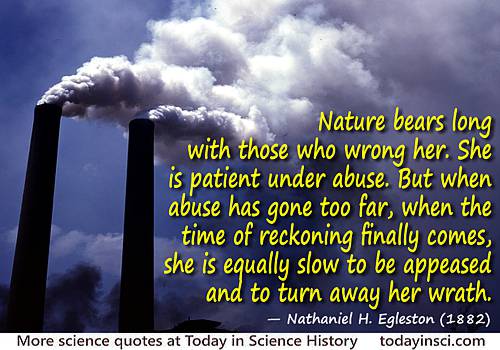
Nature bears long with those who wrong her. She is patient under abuse. But when abuse has gone too far, when the time of reckoning finally comes, she is equally slow to be appeased and to turn away her wrath.
'What We Owe to the Trees', Harper's New Monthly Magazine (Apr 1882), 46, No. 383, 686.
Nature offers us a thousand simple pleasures—plays of light and color, fragrance in the air, the sun’s warmth on skin and muscle, the audible rhythm of life’s stir and push—for the price of merely paying attention. What joy! But how unwilling or unable many of us are to pay this price in an age when manufactured sources of stimulation and pleasure are everywhere at hand. For me, enjoying nature’s pleasures takes conscious choice, a choice to slow down to seed time or rock time, to still the clamoring ego, to set aside plans and busyness, and to simply to be present in my body, to offer myself up.
In Sisters of the Earth: Women’s Prose and Poetry (1991), 43.
Nothing has afforded me so convincing a proof of the unity of the Deity as these purely mental conceptions of numerical and mathematical science which have been by slow degrees vouchsafed to man, and are still granted in these latter times by the Differential Calculus, now superseded by the Higher Algebra, all of which must have existed in that sublimely omniscient Mind from eternity.
Martha Somerville (ed.) Personal Recollections, from Early Life to Old Age, of Mary Somerville (1874), 140-141.
One of the things that makes the history of science so endlessly fascinating is to follow the slow education of our species in the sort of beauty to expect in nature.
In Dreams of a Final Theory: The Scientist's Search for the Ultimate Laws of Nature (1992), 158.
Orgel's First Rule: Whenever a spontaneous process is too slow or too inefficient a protein will evolve to speed it up or make it more efficient.
In Jack D. Dunitz and Gerald F. Joyce, 'Leslie Eleazer Orgel', Biographical Memoirs of Fellows of the Royal Society (2013), Vol. 59, 286.
Our earth is very old, an old warrior that has lived through many battles. Nevertheless, the face of it is still changing, and science sees no certain limit of time for its stately evolution. Our solid earth, apparently so stable, inert, and finished, is changing, mobile, and still evolving. Its major quakings are largely the echoes of that divine far-off event, the building of our noble mountains. The lava floods and intriguing volcanoes tell us of the plasticity, mobility, of the deep interior of the globe. The slow coming and going of ancient shallow seas on the continental plateaus tell us of the rhythmic distortion of the deep interior-deep-seated flow and changes of volume. Mountain chains prove the earth’s solid crust itself to be mobile in high degree. And the secret of it all—the secret of the earthquake, the secret of the “temple of fire,” the secret of the ocean basin, the secret of the highland—is in the heart of the earth, forever invisible to human eyes.
In Our Mobile Earth (1926), 320.
Peter Atkins, in his wonderful book Creation Revisited, uses a … personification when considering the refraction of a light beam, passing into a medium of higher refractive index which slows it down. The beam behaves as if trying to minimize the time taken to travel to an end point. Atkins imagines it as a lifeguard on a beach racing to rescue a drowning swimmer. Should he head straight for the swimmer? No, because he can run faster than he can swim and would be wise to increase the dry-land proportion of his travel time. Should he run to a point on the beach directly opposite his target, thereby minimizing his swimming time? Better, but still not the best. Calculation (if he had time to do it) would disclose to the lifeguard an optimum intermediate angle, yielding the ideal combination of fast running followed by inevitably slower swimming. Atkins concludes:
That is exactly the behaviour of light passing into a denser medium. But how does light know, apparently in advance, which is the briefest path? And, anyway, why should it care?
He develops these questions in a fascinating exposition, inspired by quantum theory.
That is exactly the behaviour of light passing into a denser medium. But how does light know, apparently in advance, which is the briefest path? And, anyway, why should it care?
He develops these questions in a fascinating exposition, inspired by quantum theory.
In 'Introduction to the 30th Anniversary Edition', The Selfish Gene: 30th Anniversary Edition (1976, 2006), xi-xii.
Reason is the slow and tortuous method by which those who do not know the truth discover it.
Webmaster presently believes this is an orphan quote, best attributed to Anonymous. It seem to be unsupported when attributed to Blaise Pascal, for example, as quoted, without citation, in Morris Kline, 'Ancients versus Moderns, A New Battle of the Books', The Mathematics Teacher (Oct 1958), 51, No. 6, 423. Also later published, without citation, in Morris Kline, Mathematical Thought From Ancient to Modern Times (1972), 296. Webmaster has not yet found a primary source for this as a quote by Pascal - not in English, not in French, and not in any earlier books. This is suspicious. (Can you help?) Furthermore, this sentence is also often seen in more recent books and online quotes pages as a first sentence, followed by a second sentence, “The heart has its reasons, which reason does not know.” The second sentence is a known Pascal quote verified in original French texts. However, Webmaster has not yet found, in any original French text, any instance of these two sentences together. Thus, putting them together more definitely appears to be a misquote. Can you help? [It is included on the Blaise Pascal page to link it with this cautionary note. —Webmaster]
Science is often regarded as the most objective and truth-directed of human enterprises, and since direct observation is supposed to be the favored route to factuality, many people equate respectable science with visual scrutiny–just the facts ma’am, and palpably before my eyes. But science is a battery of observational and inferential methods, all directed to the testing of propositions that can, in principle, be definitely proven false ... At all scales, from smallest to largest, quickest to slowest, many well-documented conclusions of science lie beyond the strictly limited domain of direct observation. No one has ever seen an electron or a black hole, the events of a picosecond or a geological eon.
…...
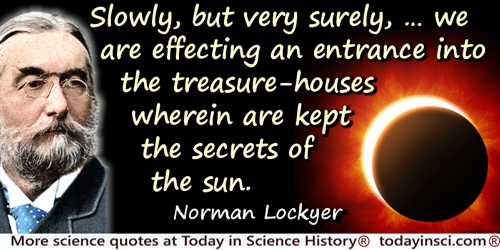
Slowly, but very surely, by means of quiet sap,… we are effecting an entrance into the treasure-houses wherein are kept the secrets of the sun.
In 'What the Sun Is Made Of', The Nineteenth Century (1878), 4, No. 17, 75. [The term sap comes from trench warfare. It refers to digging a trench (sap) toward the enemy line. In a figurative sense, it means to secretly infiltrate. —Webmaster]
Sometimes progress is slow. But then there does come a time when a lot of people accept a new idea and see ways in which it can be exploited. And because of the larger number of workers in the field, progress becomes rapid. That is what happened with the study of protein structure.
From interview with Neil A. Campbell, in 'Crossing the Boundaries of Science', BioScience (Dec 1986), 36, No. 11, 739.
Soon shall thy arm, UNCONQUER’D STEAM! afar
Drag the slow barge, or drive the rapid car;
Or on wide-waving wings expanded bear
The flying-chariot through the fields of air.
Drag the slow barge, or drive the rapid car;
Or on wide-waving wings expanded bear
The flying-chariot through the fields of air.
From 'Botanic Garden' (1781), part 1, canto 1, lines 289-92. The Botanic Garden, with Philosophical Notes (4th Ed., 1799). At the time Erasmus Darwin penned his poem, he would have been aware of a limited history of steam power: Edward Someset, 2nd Marquis of Worcester steam pump (1663), Thomas Savery's steam pump (1698), Thomas Newcomen atmospheric engine (1712), Matthew Boulton and James Watt first commercial steam engine (1776). Watt did not build his first 'double acting' engine, which enabled using a flywheel, until 1783 (two years after Darwin's poem). It was also after Darwin's poem was written that the first steamboat, using paddles, the Pyroscaphe steamed up a French river on 15 Jul 1783. Darwin's predicted future for the steam engine car did not come to pass until Richard Trevithick tested his Camborne road engine (1801). The Wrights' first airplane flight came a century later, in 1903.
Step by step we cross great eras in the development of thought: there is no sudden gigantic stride; a theory proceeds by slow evolution until it dominates or is destroyed.
In 'Theory of Phlogiston', The London, Edinburgh, and Dublin Philosophical Magazine and Journal of Science (Jan 1868), 35, 28-29.
Suddenly, from behind the rim of the moon, in long, slow-motion moments of immense majesty, there emerges a sparkling blue and white jewel, a light, delicate sky-blue sphere laced with slowly swirling veils of white, rising gradually like a small pearl in a thick sea of black mystery. It takes more than a moment to fully realize this is Earth . . . home.
…...
Teaching a school is but another word for sure and not very slow destruction.
In Thomas Carlyle and Charles Eliot Norton (ed.), Early Letters of Thomas Carlyle (1886), Vol. 1, 281.
That ability to impart knowledge … what does it consist of? … a deep belief in the interest and importance of the thing taught, a concern about it amounting to a sort of passion. A man who knows a subject thoroughly, a man so soaked in it that he eats it, sleeps it and dreams it—this man can always teach it with success, no matter how little he knows of technical pedagogy. That is because there is enthusiasm in him, and because enthusiasm is almost as contagious as fear or the barber’s itch. An enthusiast is willing to go to any trouble to impart the glad news bubbling within him. He thinks that it is important and valuable for to know; given the slightest glow of interest in a pupil to start with, he will fan that glow to a flame. No hollow formalism cripples him and slows him down. He drags his best pupils along as fast as they can go, and he is so full of the thing that he never tires of expounding its elements to the dullest.
This passion, so unordered and yet so potent, explains the capacity for teaching that one frequently observes in scientific men of high attainments in their specialties—for example, Huxley, Ostwald, Karl Ludwig, Virchow, Billroth, Jowett, William G. Sumner, Halsted and Osler—men who knew nothing whatever about the so-called science of pedagogy, and would have derided its alleged principles if they had heard them stated.
This passion, so unordered and yet so potent, explains the capacity for teaching that one frequently observes in scientific men of high attainments in their specialties—for example, Huxley, Ostwald, Karl Ludwig, Virchow, Billroth, Jowett, William G. Sumner, Halsted and Osler—men who knew nothing whatever about the so-called science of pedagogy, and would have derided its alleged principles if they had heard them stated.
In Prejudices: third series (1922), 241-2.
For a longer excerpt, see H.L. Mencken on Teaching, Enthusiasm and Pedagogy.
For a longer excerpt, see H.L. Mencken on Teaching, Enthusiasm and Pedagogy.
The advancement of science is slow; it is effected only by virtue of hard work and perseverance. And when a result is attained, should we not in recognition connect it with the efforts of those who have preceded us, who have struggled and suffered in advance? Is it not truly a duty to recall the difficulties which they vanquished, the thoughts which guided them; and how men of different nations, ideas, positions, and characters, moved solely by the love of science, have bequeathed to us the unsolved problem? Should not the last comer recall the researches of his predecessors while adding in his turn his contribution of intelligence and of labor? Here is an intellectual collaboration consecrated entirely to the search for truth, and which continues from century to century.
[Respecting how the work of prior researchers had enabled his isolation of fluorine.]
[Respecting how the work of prior researchers had enabled his isolation of fluorine.]
Proceedings of the Royal Institution (1897). In Annual Report of the Board of Regents of the Smithsonian Institution to July 1897 (1898), 262.
The age of the earth was thus increased from a mere score of millions [of years] to a thousand millions and more, and the geologist who had before been bankrupt in time now found himself suddenly transformed into a capitalist with more millions in the bank than he knew how to dispose of … More cautious people, like myself, too cautious, perhaps, are anxious first of all to make sure that the new [radioactive] clock is not as much too fast as Lord Kelvin’s was too slow.
1921 British Association for the Advancement of Science symposium on 'The Age of the Earth'. In Nature (1921), 108, 282.
The appearance of a disease is swift as an arrow; its disappearance slow, like a thread.
Chinese proverb.
The Archetypal idea was manifested in the flesh, under divers such modifications, upon this planet, long prior to the existence of those animal species that actually exemplify it. To what natural laws or secondary causes the orderly succession and progression of such organic phaenomena may have been committed we as yet are ignorant. But if, without derogation of the Divine power, we may conceive the existence of such ministers, and personify them by the term 'Nature,' we learn from the past history of our globe that she has advanced with slow and stately steps, guided by the archetypal light, amidst the wreck of worlds, from the first embodiment of the Vertebrate idea under its old Ichthyic vestment, until it became arrayed in the glorious garb of the Human form.
On the Nature of Limbs (1849), 86.
The child asks, “What is the moon, and why does it shine?” “What is this water and where does it run?” “What is this wind?” “What makes the waves of the sea?” “Where does this animal live, and what is the use of this plant?” And if not snubbed and stunted by being told not to ask foolish questions, there is no limit to the intellectual craving of a young child; nor any bounds to the slow, but solid, accretion of knowledge and development of the thinking faculty in this way. To all such questions, answers which are necessarily incomplete, though true as far as they go, may be given by any teacher whose ideas represent real knowledge and not mere book learning; and a panoramic view of Nature, accompanied by a strong infusion of the scientific habit of mind, may thus be placed within the reach of every child of nine or ten.
In 'Scientific Education', Lay Sermons, Addresses, and Reviews (1870), 71.
https://books.google.com/books?id=13cJAAAAIAAJ
Thomas Henry Huxley - 1870
The discovery of truth by slow, progressive meditation is talent. Intuition of the truth, not preceded by perceptible meditation, is genius.
Aphorism 93 (1787), in Aphorisms on Man. Translated from the original manuscript of the Rev. John Caspar Lavater (3rd ed. 1790), 36.
The earth itself assures us it is a living entity. Deep below surface one can hear its slow pulse, feel its vibrant rhythm. The great breathing mountains expand and contract. The vast sage desert undulates with almost imperceptible tides like the oceans. From the very beginning, throughout all its cataclysmic upthrusts and deep sea submergences, the planet Earth seems to have maintained an ordered rhythm.
…...
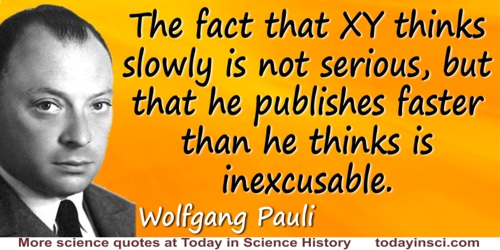
The fact that XY thinks slowly is not serious, but that he publishes faster than he thinks is inexcusable.
Quoted in Ralph Oesper, The Human Side of Scientists (1975), 154.
The Grand Cañon of the Colorado is a great innovation in modern ideas of scenery, and in our conceptions of the grandeur, beauty, and power of nature. As with all great innovations it is not to be comprehended in a day or a week, nor even in a month. It must be dwelt upon and studied, and the study must comprise the slow acquisition of the meaning and spirit of that marvelous scenery which characterizes the Plateau Country, and of which the great chasm is the superlative manifestation.
In Tertiary History of the Grand Cañon District: With Atlas (1882), Vol. 2, 141.
The History of Evolution of Organisms consists of two kindred and closely connected parts: Ontogeny, which is the history of the evolution of individual organisms, and Phylogeny, which is the history of the evolution of organic tribes. Ontogency is a brief and rapid recapitulation of Phylogeny, dependent on the physiological functions of Heredity (reproduction) and Adaptation (nutrition). The individual organism reproduces in the rapid and short course of its own evolution the most important of the changes in form through which its ancestors, according to laws of Heredity and Adaptation, have passed in the slow and long course of their palaeontological evolution.
Translated from his Generelle Morphologie (1866) as an epigraph to Chap. 1, The Evolution of Man, (1886), Vol 1, 1-2.
The invention of the differential calculus marks a crisis in the history of mathematics. The progress of science is divided between periods characterized by a slow accumulation of ideas and periods, when, owing to the new material for thought thus patiently collected, some genius by the invention of a new method or a new point of view, suddenly transforms the whole subject on to a higher level.
In An Introduction to Mathematics (1911), 217. Whitehead continued by quoting the poet, Percy Shelley, who compared the slow accumulation of thoughts leading to an avalanche following the laying down of a great truth. See the poetic quote beginning, “The sun-awakened avalanche…” on the Percy Shelley Quotations page.
The majority of evolutive movements are degenerative. Progressive cases are exceptional. Characters appear suddenly that have no meaning in the atavistic series. Evolution in no way shows a general tendency toward progress… . The only thing that could be accomplished by slow changes would be the accumulation of neutral characteristics without value for survival. Only important and sudden mutations can furnish the material which can be utilized by selection.
As quoted in Isaac Asimov's Book of Science and Nature Quotations (1988), 91. Please contact Webmaster if you know the primary source.
The monarch oak, the patriarch of the trees,
Shoots rising up, and spreads by slow degrees:
Three centuries he grows, and three he stays
Supreme in state; and in three more decays.
Shoots rising up, and spreads by slow degrees:
Three centuries he grows, and three he stays
Supreme in state; and in three more decays.
The night before Easter Sunday of that year (1920) I awoke, turned on the light, and jotted down a few notes on a tiny slip of thin paper. Then I fell asleep again. It occurred to me at six o’clock in the morning that during the night I had written down something most important, but I was unable to decipher the scrawl. The next night, at three o’clock, the idea returned. It was the design of an experiment to determine whether the hypothesis of chemical transmission that I had uttered seventeen years ago was correct. I got up immediately, went to the laboratory, and performed a simple experiment on a frog heart according to the nocturnal design. I have to describe this experiment briefly since its results became the foundation of the theory of chemical transmission of the nervous impulse. The hearts of two frogs were isolated, the first with its nerves, the second without. Both hearts were attached to Straub cannulas filled with a little Ringer solution. The vagus nerve of the first heart was stimulated for a few minutes. Then the Ringer solution that had been in the first heart during the stimulation of the vagus was transferred to the second heart. It slowed and its beats diminished just as if its vagus had been stimulated. Similarly, when the accelerator nerve was stimulated and the Ringer from this period transferred, the second heart speeded up and its beats increased. These results unequivocally proved that the nerves do not influence the heart directly but liberate from their terminals specific chemical substances which, in their turn, cause the well-known modifications of the function of the heart characteristic of the stimulation of its nerves.
'An Autobiographic Sketch', Perspectives in Biology and Medicine (1960), 4, 17.
The other book you may have heard of and perhaps read, but it is not one perusal which will enable any man to appreciate it. I have read it through five or six times, each time with increasing admiration. It will live as long as the ‘Principia’ of Newton. It shows that nature is, as I before remarked to you, a study that yields to none in grandeur and immensity. The cycles of astronomy or even the periods of geology will alone enable us to appreciate the vast depths of time we have to contemplate in the endeavour to understand the slow growth of life upon the earth. The most intricate effects of the law of gravitation, the mutual disturbances of all the bodies of the solar system, are simplicity itself compared with the intricate relations and complicated struggle which have determined what forms of life shall exist and in what proportions. Mr. Darwin has given the world a new science, and his name should, in my opinion, stand above that of every philosopher of ancient or modem times. The force of admiration can no further go!!!
Letter to George Silk (1 Sep 1860), in My Life (1905), Vol. I, 372-373.
The position of the anthropologist of to-day resembles in some sort the position of classical scholars at the revival of learning. To these men the rediscovery of ancient literature came like a revelation, disclosing to their wondering eyes a splendid vision of the antique world, such as the cloistered of the Middle Ages never dreamed of under the gloomy shadow of the minster and within the sound of its solemn bells. To us moderns a still wider vista is vouchsafed, a greater panorama is unrolled by the study which aims at bringing home to us the faith and the practice, the hopes and the ideals, not of two highly gifted races only, but of all mankind, and thus at enabling us to follow the long march, the slow and toilsome ascent, of humanity from savagery to civilization. And as the scholar of the Renaissance found not merely fresh food for thought but a new field of labour in the dusty and faded manuscripts of Greece and Rome, so in the mass of materials that is steadily pouring in from many sides—from buried cities of remotest antiquity as well as from the rudest savages of the desert and the jungle—we of to-day must recognise a new province of knowledge which will task the energies of generations of students to master.
'Author’s Introduction' (1900). In Dr Theodor H. Gaster (ed.), The New Golden Bough (1959), xxv-xxvi.
The pulse of a newborn during the neonatal period is very rapid … the pulse of old people is rather slow … the pulse is fullest and strongest in the prime years of youth.
As quoted in Fred Rosner, The Medical Legacy of Moses Maimonides (1998), 51.
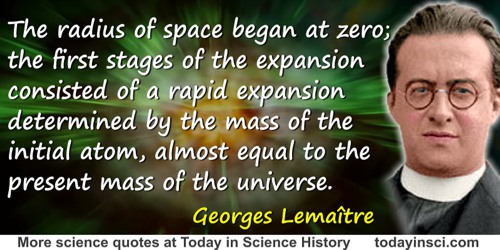
The radius of space began at zero; the first stages of the expansion consisted of a rapid expansion determined by the mass of the initial atom, almost equal to the present mass of the universe. If this mass is sufficient, and the estimates which we can make indicate that this is indeed so, the initial expansion was able to permit the radius to exceed the value of the equilibrium radius. The expansion thus took place in three phases: a first period of rapid expansion in which the atom-universe was broken into atomic stars, a period of slowing-down, followed by a third period of accelerated expansion. It is doubtless in this third period that we find ourselves today, and the acceleration of space which followed the period of slow expansion could well be responsible for the separation of stars into extra-galactic nebulae.
From 'La formation des Nebuleuses dans l’Univers en Expansion', Comptes Rendus (1933), 196, 903-904. As translated in Helge Kragh, Cosmology and Controversy: The Historical Development of Two Theories of the Universe (1996), 52.
The sad and solemn night
Hath yet her multitude of cheerful fires;
The glorious host of light
Walk the dark hemisphere till she retires;
All through her silent watches, gliding slow,
Her constellations come, and climb the heavens, and go.
Hath yet her multitude of cheerful fires;
The glorious host of light
Walk the dark hemisphere till she retires;
All through her silent watches, gliding slow,
Her constellations come, and climb the heavens, and go.
Poem, 'Hymn to the North Star', collected in Poems by William Cullen Bryant: Collected and Arranged by Himself (1873), 84.
The Scientific Revolution turns us away from the older sayings to discover the lost authorization in Nature. What we have been through in these last four millennia is the slow inexorable profaning of our species. And in the last part of the second millennium A.D., that process is apparently becoming complete. It is the Great Human Irony of our noblest and greatest endeavor on this planet that in the quest for authorization, in our reading of the language of God in Nature, we should read there so clearly that we have been so mistaken.
…...
The slow rejection of the foreign skin grafts fascinated me. How could the host distinguish another person's skin from his own?
Recalling his experience during WW II when assigned to a plastic surgery ward of an army hospital. In Tore Frängsmyr and Jan E. Lindsten (eds.), Nobel Lectures: Physiology Or Medicine: 1981-1990 (1993), 556.
The slowest goat sees the last sunset last.
…...
The sun's rays are the ultimate source of almost every motion which takes place on the surface of the earth. By their heat are produced all winds, and those disturbances in the electric equilibrium of the atmosphere which give rise to the phenomena of terrestrial magnetism. By their vivifying action vegetables are elaborated from inorganic matter, and become in their turn the support of animals and of man, and the sources of those great deposits of dynamical efficiency which are laid up for human use in our coal strata. By them the waters of the sea are made to circulate in vapor through the air, and irrigate the land, producing springs and rivers. By them are produced all disturbances of the chemical equilibrium of the elements of nature which, by a series of compositions and decompositions, give rise to new products, and originate a transfer of materials. Even the slow degradation of the solid constituents of the surface, in which its chief geological changes consist, and their diffusion among the waters of the ocean, are entirely due to the abrasion of the wind, rain, and tides, which latter, however, are only in part the effect of solar influence and the alternate action of the seasons.
from Outlines of Astronomy (1849), 237.
The theory of punctuated equilibrium, proposed by Niles Eldredge and myself, is not, as so often misunderstood, a radical claim for truly sudden change, but a recognition that ordinary processes of speciation, properly conceived as glacially slow by the standard of our own life-span, do not resolve into geological time as long sequences of insensibly graded intermediates (the traditional, or gradualistic, view), but as geologically ‘sudden’ origins at single bedding planes.
…...
There never was a chip, it is said, that Bill Gates couldn’t slow down with a new batch of features.
In The Chicago Tribune (1 Feb 1998).
There was no more grass, no flowers, not even any moss: dusty granite blocks covered the ice and an occasional grinding groan reminded us that we were on a slow-moving glacier.
…...
To the east was our giant neighbor Makalu, unexplored and unclimbed, and even on top of Everest the mountaineering instinct was sufficient strong to cause me to spend some moments conjecturing as to whether a route up that mountain might not exist. Far away across the clouds the great bulk of Kangchenjunga loomed on the horizon. To the west, Cho Oyu, our old adversary from 1952, dominated the scene and we could see the great unexplored ranges of Nepal stretching off into the distance. The most important photograph, I felt, was a shot down the north ridge, showing the North Col and the old route that had been made famous by the struggles of those great climbers of the 1920s and 1930s. I had little hope of the results being particularly successful, as I had a lot of difficulty in holding the camera steady in my clumsy gloves, but I felt that they would at least serve as a record. After some ten minutes of this, I realized that I was becoming rather clumsy-fingered and slow-moving, so I quickly replaced my oxygen set and experience once more the stimulating effect of even a few liters of oxygen. Meanwhile, Tenzing had made a little hole in the snow and in it he placed small articles of food – a bar of chocolate, a packet of biscuits and a handful of lollies. Small offerings, indeed, but at least a token gifts to the gods that all devoted Buddhists believe have their home on this lofty summit. While we were together on the South Col two days before, Hunt had given me a small crucifix that he had asked me to take to the top. I, too, made a hole in the snow and placed the crucifix beside Tenzing’s gifts.
As quoted in Whit Burnett, The Spirit of Adventure: The Challenge (1955), 349.
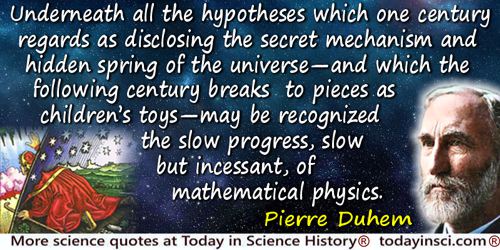
Underneath all the various theories which are only created to be destroyed; underneath all the hypotheses which one century regards as disclosing the secret mechanism and hidden spring of the universe—and which the following century breaks to pieces as children’s toys—may be recognized the slow progress, slow but incessant, of mathematical physics.
Quote translated from 'Les Théories de l’Optique', Revue des Deux Mondes (1 May 1894), Vol. 123, 125; in 'What is Science', compiled by Mrs. H.O. Ward, in J. M. Stoddart (ed.), The New Science Review: A Miscellany of Modern Thought and Discovery (Oct 1894), Vol. 1, No. 2, 173. From the original French, “Sous les théories qui ne s’élèvent que pour être abuttues, sous les hypothèses qu’un siècle contemple comme le mécanisme secret et le ressort caché de l’Univers, et que le siècle suivant brise comme des jouets d’enfant, se poursuit le progrès lent, mais incessant, de la physique mathématique.” Note: in the New Science Review, the author is incorrectly identified as “Duhene.”
We are now witnessing, after the slow fermentation of fifty years, a concentration of technical power aimed at the essential determinants of heredity, development and disease. This concentration is made possible by the common function of nucleic acids as the molecular midwife of all reproductive particles. Indeed it is the nucleic acids which, in spite of their chemical obscurity, are giving to biology a unity which has so far been lacking, a chemical unity.
Nucleic Acid (1947), 266-7.
We come back then to our records of nervous messages with a reasonable assurance that they do tell us what the message is like. It is a succession of brief waves of surface breakdown, each allowing a momentary leakage of ions from the nerve fibre. The waves can be set up so that they follow one another in rapid or in slow succession, and this is the only form of gradation of which the message is capable. Essentially the same kind of activity is found in all sorts of nerve fibres from all sorts of animals and there is no evidence to suggest that any other kind of nervous transmission is possible. In fact we may conclude that the electrical method can tell us how the nerve fibre carries out its function as the conducting unit of the nervous system, and that it does so by reactions of a fairly simple type.
The Mechanism of Nervous Action (1932), 21.
We should be most careful about retreating from the specific challenge of our age. We should be reluctant to turn our back upon the frontier of this epoch… We cannot be indifferent to space, because the grand slow march of our intelligence has brought us, in our generation, to a point from which we can explore and understand and utilize it. To turn back now would be to deny our history, our capabilities.
At a 1979 U.S. Senate hearing. As quoted in House Congressional Record (21 Jun 1991), 13874. Also quoted in James E. Oberg, Mission to Mars: Plans and Concepts for the First Manned Landing (2017), 174.
What is peculiar and new to the [19th] century, differentiating it from all its predecessors, is its technology. It was not merely the introduction of some great isolated inventions. It is impossible not to feel that something more than that was involved. … The process of change was slow, unconscious, and unexpected. In the nineteeth century, the process became quick, conscious, and expected. … The whole change has arisen from the new scientific information. Science, conceived not so much in its principles as in its results, is an obvious storehouse of ideas for utilisation. … Also, it is a great mistake to think that the bare scientific idea is the required invention, so that it has only to be picked up and used. An intense period of imaginative design lies between. One element in the new method is just the discovery of how to set about bridging the gap between the scientific ideas, and the ultimate product. It is a process of disciplined attack upon one difficulty after another This discipline of knowledge applies beyond technology to pure science, and beyond science to general scholarship. It represents the change from amateurs to professionals. … But the full self-conscious realisation of the power of professionalism in knowledge in all its departments, and of the way to produce the professionals, and of the importance of knowledge to the advance of technology, and of the methods by which abstract knowledge can be connected with technology, and of the boundless possibilities of technological advance,—the realisation of all these things was first completely attained in the nineteeth century.
In Science and the Modern World (1925, 1997), 96.
What nature does blindly, slowly and ruthlessly, man may do providently, quickly and kindly.
In Nature (2 Feb 1911), 85, 444.
While natural selection drives Darwinian evolution, the growth of human culture is largely Lamarckian: new generations of humans inherit the acquired discoveries of generations past, enabling cosmic insight to grow slowly, but without limit.
In magazine article, 'The Beginning of Science', Natural History (Mar 2001). Collected in Death by Black Hole: And Other Cosmic Quandaries (2007), 20.
Why may not the present generation, who have already good turnpikes, make the experiment of using steam carriages upon them? They will assuredly effect the movement of heavy burthens; with a slow motion of two and a half miles an hour, and as their progress need not be interrupted, they may travel fifty or sixty miles in the 24 hours.
From 'On the Origin of Steam Boats and Steam Wagons', Thomas Cooper (ed.), The Emporium of Arts and Sciences (Feb 1814), 2, No. 2, 215.
Wisdom is a river that runs deep and slow. Inspiration and intuition are
lightning flashes reflected on its surface.
In Barbara A. Robinson, Mind Bungee Jumping: Words of Life, Love, Inspiration, Encouragement and Motivation (2008), 287.
by - Poetry - 2008
Without this language [mathematics] most of the intimate analogies of things would have remained forever unknown to us; and we should forever have been ignorant of the internal harmony of the world, which is the only true objective reality. …
This harmony … is the sole objective reality, the only truth we can attain; and when I add that the universal harmony of the world is the source of all beauty, it will be understood what price we should attach to the slow and difficult progress which little by little enables us to know it better.
This harmony … is the sole objective reality, the only truth we can attain; and when I add that the universal harmony of the world is the source of all beauty, it will be understood what price we should attach to the slow and difficult progress which little by little enables us to know it better.
From La Valeur de la Science, as translated by George Bruce Halsted, in 'The Value of Science', Popular Science Monthly (Sep 1906), 69 195-196.
Year after year, the slow sure records grow.
Awaiting their interpreter.
Awaiting their interpreter.
In Watchers of the Sky (1922), 253.
You can hardly convince a man of error in a life-time, but must content yourself with the reflection that the progress of science is slow. If he is not convinced, his grand-children may be. The geologists tell us that it took one hundred years to prove that fossils are organic, and one hundred and fifty more, to prove that they are not to be referred to the Noachian deluge.
In A Week on the Concord and Merrimack Rivers (1862), 68.
You cannot force ideas. Successful ideas are the result of slow growth. Ideas do not reach perfection in a day, no matter how much study is put upon them. It is perserverance in the pursuit of studies that is really wanted.
In Orison Swett Marden, 'Bell Telephone Talk: Hints on Success by Alexander G. Bell', How They Succeeded: Life Stories of Successful Men Told by Themselves (1901), 34.
 In science it often happens that scientists say, 'You know that's a really good argument; my position is mistaken,' and then they would actually change their minds and you never hear that old view from them again. They really do it. It doesn't happen as often as it should, because scientists are human and change is sometimes painful. But it happens every day. I cannot recall the last time something like that happened in politics or religion.
(1987) --
In science it often happens that scientists say, 'You know that's a really good argument; my position is mistaken,' and then they would actually change their minds and you never hear that old view from them again. They really do it. It doesn't happen as often as it should, because scientists are human and change is sometimes painful. But it happens every day. I cannot recall the last time something like that happened in politics or religion.
(1987) -- 





