Sleep Quotes (82 quotes)
’Tis late; the astronomer in his lonely height
Exploring all the dark, descries from far
Orbs that like distant isles of splendor are,
And mornings whitening in the infinite.…
He summons one disheveled, wandering star,—
Return ten centuries hence on such a night.
That star will come. It dare not by one hour
Cheat science, or falsify her calculation;
Men will have passed, but watchful in the tower
Man shall remain in sleepless contemplation;
And should all men have perished there in turn,
Truth in their stead would watch that star’s return.
Exploring all the dark, descries from far
Orbs that like distant isles of splendor are,
And mornings whitening in the infinite.…
He summons one disheveled, wandering star,—
Return ten centuries hence on such a night.
That star will come. It dare not by one hour
Cheat science, or falsify her calculation;
Men will have passed, but watchful in the tower
Man shall remain in sleepless contemplation;
And should all men have perished there in turn,
Truth in their stead would watch that star’s return.
From poem, 'The Appointment', as translated by Arthur O’Shaughnessy, collected in Samuel Waddington (ed.), The Sonnets of Europe (1886), 154.
“Auto erotism,” … spontaneous solitary sexual phenomena of which genital excitement during sleep may be said to be the type.
Psychology of Sex (1933), 91.
[Describing the effects of over-indulgence in wine:]
But most too passive, when the blood runs low
Too weakly indolent to strive with pain,
And bravely by resisting conquer fate,
Try Circe's arts; and in the tempting bowl
Of poisoned nectar sweet oblivion swill.
Struck by the powerful charm, the gloom dissolves
In empty air; Elysium opens round,
A pleasing frenzy buoys the lightened soul,
And sanguine hopes dispel your fleeting care;
And what was difficult, and what was dire,
Yields to your prowess and superior stars:
The happiest you of all that e'er were mad,
Or are, or shall be, could this folly last.
But soon your heaven is gone: a heavier gloom
Shuts o'er your head; and, as the thundering stream,
Swollen o'er its banks with sudden mountain rain,
Sinks from its tumult to a silent brook,
So, when the frantic raptures in your breast
Subside, you languish into mortal man;
You sleep, and waking find yourself undone,
For, prodigal of life, in one rash night
You lavished more than might support three days.
A heavy morning comes; your cares return
With tenfold rage. An anxious stomach well
May be endured; so may the throbbing head;
But such a dim delirium, such a dream,
Involves you; such a dastardly despair
Unmans your soul, as maddening Pentheus felt,
When, baited round Citheron's cruel sides,
He saw two suns, and double Thebes ascend.
But most too passive, when the blood runs low
Too weakly indolent to strive with pain,
And bravely by resisting conquer fate,
Try Circe's arts; and in the tempting bowl
Of poisoned nectar sweet oblivion swill.
Struck by the powerful charm, the gloom dissolves
In empty air; Elysium opens round,
A pleasing frenzy buoys the lightened soul,
And sanguine hopes dispel your fleeting care;
And what was difficult, and what was dire,
Yields to your prowess and superior stars:
The happiest you of all that e'er were mad,
Or are, or shall be, could this folly last.
But soon your heaven is gone: a heavier gloom
Shuts o'er your head; and, as the thundering stream,
Swollen o'er its banks with sudden mountain rain,
Sinks from its tumult to a silent brook,
So, when the frantic raptures in your breast
Subside, you languish into mortal man;
You sleep, and waking find yourself undone,
For, prodigal of life, in one rash night
You lavished more than might support three days.
A heavy morning comes; your cares return
With tenfold rage. An anxious stomach well
May be endured; so may the throbbing head;
But such a dim delirium, such a dream,
Involves you; such a dastardly despair
Unmans your soul, as maddening Pentheus felt,
When, baited round Citheron's cruel sides,
He saw two suns, and double Thebes ascend.
The Art of Preserving Health: a Poem in Four Books (2nd. ed., 1745), Book IV, 108-110.
A light supper, a good night’s sleep, and a fine morning have often made a hero of the same man, who, by indigestion, a restless night, and a rainy morning would have proved a coward.
A professor is one who talks in someone else’s sleep.
Attributed.
After an honest day’s work a mathematician goes off duty. Mathematics is very hard work, and dons tend to be above average in health and vigor. Below a certain threshold a man cracks up; but above it, hard mental work makes for health and vigor (also—on much historical evidence throughout the ages—for longevity). I have noticed lately that when I am working really hard I wake around 5.30 a.m. ready and eager to start; if I am slack, I sleep till I am called.
In 'The Mathematician’s Art of Work' (1967), collected in Béla Bollobás (ed.), Littlewood’s Miscellany (1986), 195.
All our civilization is based on invention; before invention, men lived on fruits and nuts and pine cones and slept in caves.
Aphorism listed Frederick Seitz, The Cosmic Inventor: Reginald Aubrey Fessenden (1866-1932) (1999), 54, being Transactions of the American Philosophical Society, Held at Philadelphia For Promoting Useful Knowledge, Vol. 86, Pt. 6.
Among those whom I could never pursuade to rank themselves with idlers, and who speak with indignation of my morning sleeps and nocturnal rambles, one passes the day in catching spiders, that he may count their eyes with a microscope; another exhibits the dust of a marigold separated from the flower with a dexterity worthy of Leuwenhoweck himself. Some turn the wheel of electricity; some suspend rings to a lodestone, and find that what they did yesterday, they can do again to-day.—Some register the changes of the wind, and die fully convinced that the wind is changeable.—There are men yet more profound, who have heard that two colorless liquors may produce a color by union, and that two cold bodies will grow hot of they are mingled: they mingle them, and produce the effect expected, say it is strange, and mingle them again.
In Tryon Edwards, A Dictionary of Thoughts (1908), 243.
As night approaches,
Moon shines upon.
Like a baby it sleeps,
With starry blanket on.
Moon shines upon.
Like a baby it sleeps,
With starry blanket on.
At night I would return home, set out a lamp before me, and devote myself to reading and writing. Whenever sleep overcame me or I became conscious of weakening, I would turn aside to drink a cup of wine, so that my strength would return to me. Then I would return to reading. And whenever sleep seized me I would see those very problems in my dream; and many questions became clear to me in my sleep. I continued in this until all of the sciences were deeply rooted within me and I understood them as is humanly possible. Everything which I knew at the time is just as I know it now; I have not added anything to it to this day. Thus I mastered the logical, natural, and mathematical sciences, and I had now reached the science.
— Avicenna
W. E. Gohhnan, The Life of Ibn Sina: A Critical Edition and Annotated Translation (1974), 29-31.
At the moment I am occupied by an investigation with Kirchoff which does not allow us to sleep. Kirchoff has made a totally unexpected discovery, inasmuch as he has found out the cause for the dark lines in the solar spectrum and can produce these lines artificially intensified both in the solar spectrum and in the continuous spectrum of a flame, their position being identical with that of Fraunhofer’s lines. Hence the path is opened for the determination of the chemical composition of the Sun and the fixed stars.
Letter to H.E. Roscoe (Nov 1859). In The Life and Experiences of Sir Henry Enfield Roscoe (1906), 81.
At the moment I am occupied by an investigation with Kirchoff which does not allow us to sleep. Kirchoff has made a totally unexpected discovery, inasmuch as he has found out the cause for the dark lines in the solar spectrum and can produce these lines artificially intensified both in the solar spectrum and in the continuous spectrum of a flame, their position being identical with that of Fraunhofer’s lines. Hence the path is opened for the determination of the chemical composition of the Sun and the fixed stars.
Letter to H.E. Roscoe (Nov 1859). In The Life and Experiences of Sir Henry Enfield Roscoe (1906), 71.
Be not afeard.
The isle is full of noises,
Sounds, and sweet airs, that give delight and hurt not.
Sometimes a thousand twangling instruments
Will hum about mine ears; and sometime voices
That if I then had waked after long sleep
Will make me sleep again; and then, in dreaming
The clouds methought would open and show riches
Ready to drop upon me, that, when I waked,
I cried to dream again.
The isle is full of noises,
Sounds, and sweet airs, that give delight and hurt not.
Sometimes a thousand twangling instruments
Will hum about mine ears; and sometime voices
That if I then had waked after long sleep
Will make me sleep again; and then, in dreaming
The clouds methought would open and show riches
Ready to drop upon me, that, when I waked,
I cried to dream again.
The Tempest (1611), III, ii.
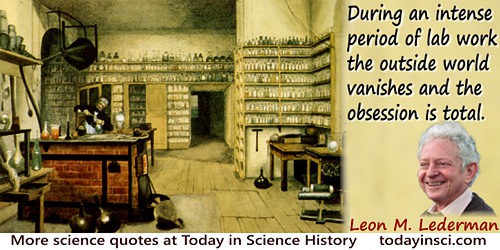
During an intense period of lab work, the outside world vanishes and the obsession is total. Sleep is when you can curl up on the accelerator floor for an hour.
In Leon Lederman and Dick Teresi, The God Particle: If the Universe is the Answer, What is the
Question (1993), 14-15.
Each morning sees some task begin,
Each evening sees it close;
Something attempted, something done,
Has earned a night’s repose.
Each evening sees it close;
Something attempted, something done,
Has earned a night’s repose.
In poem, 'The Village Blacksmith', The Poetical Works of H.W. Longfellow (1855), 109.
For a billion years the patient earth amassed documents and inscribed them with signs and pictures which lay unnoticed and unused. Today, at last, they are waking up, because man has come to rouse them. Stones have begun to speak, because an ear is there to hear them. Layers become history and, released from the enchanted sleep of eternity, life’s motley, never-ending dance rises out of the black depths of the past into the light of the present.
In 'Prologue', Conversation with the Earth (1954), 4. As translated by E.B. Garside from Gespräch mit der Erde (1947).
Gradually the sunken land begins to rise again, and falls perhaps again, and rises again after that, more and more gently each time, till as it were the panting earth, worn out with the fierce passions of her fiery youth, has sobbed herself to sleep once more, and this new world of man is made.
'Thoughts in a Gravel Pit', a lecture delivered at the Mechanics' Institute, Odiham (1857). The Works of Charles Kingsley (1880), 282.
Have you ever watched an eagle held captive in a zoo, fat and plump and full of food and safe from danger too?
Then have you seen another wheeling high up in the sky, thin and hard and battle-scarred, but free to soar and fly?
Well, which have you pitied the caged one or his brother? Though safe and warm from foe or storm, the captive, not the other!
There’s something of the eagle in climbers, don’t you see; a secret thing, perhaps the soul, that clamors to be free.
It’s a different sort of freedom from the kind we often mean, not free to work and eat and sleep and live in peace serene.
But freedom like a wild thing to leap and soar and strive, to struggle with the icy blast, to really be alive.
That’s why we climb the mountain’s peak from which the cloud-veils flow, to stand and watch the eagle fly, and soar, and wheel... below...
Then have you seen another wheeling high up in the sky, thin and hard and battle-scarred, but free to soar and fly?
Well, which have you pitied the caged one or his brother? Though safe and warm from foe or storm, the captive, not the other!
There’s something of the eagle in climbers, don’t you see; a secret thing, perhaps the soul, that clamors to be free.
It’s a different sort of freedom from the kind we often mean, not free to work and eat and sleep and live in peace serene.
But freedom like a wild thing to leap and soar and strive, to struggle with the icy blast, to really be alive.
That’s why we climb the mountain’s peak from which the cloud-veils flow, to stand and watch the eagle fly, and soar, and wheel... below...
…...
He plucks the pearls that stud the deep Admiring Beauty’s lap to fill;
He breaks the stubborn Marble’s sleep,
Rocks disappear before his skill:
With thoughts that swell his glowing soul
He bids the ore illume the page,
And, proudly scorning Time’s control,
Commences with an unborn age.
He breaks the stubborn Marble’s sleep,
Rocks disappear before his skill:
With thoughts that swell his glowing soul
He bids the ore illume the page,
And, proudly scorning Time’s control,
Commences with an unborn age.
Written for the Mechanics Celebration (1824). In 'Art—An Ode', as quoted and cited in Alpheus Cary, An Address Delivered Before the Massachusetts Charitable Mechanic Association (October 7th, 1824) (1824), 49.
He plucks the pearls that stud the deep Admiring Beauty’s lap to fill;
He breaks the stubborn Marble’s sleep,
Rocks disappear before his skill:
With thoughts that swell his glowing soul
He bids the ore illume the page,
And, proudly scorning Time’s control,
Commences with an unborn age.
He breaks the stubborn Marble’s sleep,
Rocks disappear before his skill:
With thoughts that swell his glowing soul
He bids the ore illume the page,
And, proudly scorning Time’s control,
Commences with an unborn age.
Written for the Mechanics Celebration (1824). In 'Art—An Ode', as quoted and cited in Alpheus Cary, An Address Delivered Before the Massachusetts Charitable Mechanic Association (October 7th, 1824) (1824), 49.
Hence dusky Iron sleeps in dark abodes,
And ferny foliage nestles in the nodes;
Till with wide lungs the panting bellows blow,
And waked by fire the glittering torrents flow;
Quick whirls the wheel, the ponderous hammer falls,
Loud anvils ring amid the trembling walls,
Strokes follow strokes, the sparkling ingot shines,
Flows the red slag, the lengthening bar refines;
Cold waves, immersed, the glowing mass congeal,
And turn to adamant the hissing Steel.
And ferny foliage nestles in the nodes;
Till with wide lungs the panting bellows blow,
And waked by fire the glittering torrents flow;
Quick whirls the wheel, the ponderous hammer falls,
Loud anvils ring amid the trembling walls,
Strokes follow strokes, the sparkling ingot shines,
Flows the red slag, the lengthening bar refines;
Cold waves, immersed, the glowing mass congeal,
And turn to adamant the hissing Steel.
How peacefully he sleep!
Yet may his ever-questing spirit, freed at length
from all the frettings of this little world,
Wander at will among the uncharted stars.
Fairfield his name. Perchance celestial fields
disclosing long sought secrets of the past
Spread 'neath his enraptured gaze
And beasts and men that to his earthly sight
were merely bits of stone shall live again to
gladden those eager eyes.
o let us picture him—enthusiast—scientist—friend—
Seeker of truth and light through all eternity!
Yet may his ever-questing spirit, freed at length
from all the frettings of this little world,
Wander at will among the uncharted stars.
Fairfield his name. Perchance celestial fields
disclosing long sought secrets of the past
Spread 'neath his enraptured gaze
And beasts and men that to his earthly sight
were merely bits of stone shall live again to
gladden those eager eyes.
o let us picture him—enthusiast—scientist—friend—
Seeker of truth and light through all eternity!
New York Sun (13 Nov 1935). Reprinted in 'Henry Fairfield Osborn', Supplement to Natural History (Feb 1936), 37:2, 135. Bound in Kofoid Collection of Pamphlets on Biography, University of California.
Hypotheses are cradle-songs by which the teacher lulls his scholars to sleep. The thoughtful and honest observer is always learning more and more of his limitations; he sees that the further knowledge spreads, the more numerous are the problems that make their appearance.
In The Maxims and Reflections of Goethe (1906), 195.
I believe … that we can still have a genre of scientific books suitable for and accessible alike to professionals and interested laypeople. The concepts of science, in all their richness and ambiguity, can be presented without any compromise, without any simplification counting as distortion, in language accessible to all intelligent people … I hope that this book can be read with profit both in seminars for graduate students and–if the movie stinks and you forgot your sleeping pills–on the businessman’s special to Tokyo.
In Wonderful Life: The Burgess Shale and the Nature of History (1990), Preface, 16.
I came from Paris in the Spring of 1884, and was brought in intimate contact with him [Thomas Edison]. We experimented day and night, holidays not excepted. His existence was made up of alternate periods of work and sleep in the laboratory. He had no hobby, cared for no sport or amusement of any kind and lived in utter disregard of the most elementary rules of hygiene. There can be no doubt that, if he had not married later a woman of exceptional intelligence, who made it the one object of her life to preserve him, he would have died many years ago from consequences of sheer neglect. So great and uncontrollable was his passion for work.
As quoted in 'Tesla Says Edison Was an Empiricist', The New York Times (19 Oct 1931), 25.
I carried this problem around in my head basically the whole time. I would wake up with it first thing in the morning, I would be thinking about it all day, and I would be thinking about it when I went to sleep. Without distraction I would have the same thing going round and round in my mind.
Recalling the degree of focus and determination that eventually yielded the proof of Fermat's Last Theorem.
Recalling the degree of focus and determination that eventually yielded the proof of Fermat's Last Theorem.
Quoted in interview for PBS TV program Nova. In William Byers, How Mathematicians Think (2007), 1.

I do not think there is any thrill that can go through the human heart like that felt by the inventor as he sees some creation of the brain unfolding to success... Such emotions make a man forget food, sleep, friends, love, everything.
Quoted by Cleveland Moffitt, 'A Talk With Tesla', Atlanta Constitution (7 Jun 1896)
I heard … xenon was a good anesthesia. … I thought, “How can xenon, which doesn’t form any chemical compounds, serve as a general anesthetic? … I lay awake at night for a few minutes before going to sleep, and during the next couple of weeks each night I would think, “…how do anesthetic agents work?" Then I forgot to do it after a while, but I’d trained my unconscious mind to keep this question alive and to call [it] to my consciousness whenever a new idea turned up…. So seven years went by. [One day I] put my feet up on the desk and started reading my mail, and here was a letter from George Jeffrey … an x-ray crystallographer, on his determination of the structure of a hydrate crystal. Immediately I sat up, took my feet off the desk, and said, “I understand anesthesia!” … I spent a year [and] determined the structure of chloroform hydrate, and then I wrote my paper published in June of 1961.
Interview with George B. Kauffman and Laurie M. Kauffman, in 'Linus Pauling: Reflections', American Scientist (Nov-Dec 1994), 82, No. 6, 522-523.
I will lift mine eyes unto the pills. Almost everyone takes them, from the humble aspirin to the multi-coloured, king-sized three deckers, which put you to sleep, wake you up, stimulate and soothe you all in one. It is an age of pills.
1962
I would rather be ashes than dust!
I would rather that my spark should burn out in a brilliant blaze than it should be stifled by dry-rot.
I would rather be a superb meteor, every atom of me in magnificent glow, than a sleepy and permanent planet.
The proper function of man is to live, not to exist.
I shall not waste my days in trying to prolong them.
I shall use my time.
I would rather that my spark should burn out in a brilliant blaze than it should be stifled by dry-rot.
I would rather be a superb meteor, every atom of me in magnificent glow, than a sleepy and permanent planet.
The proper function of man is to live, not to exist.
I shall not waste my days in trying to prolong them.
I shall use my time.
'Jack London Credo' quoted, without citing a source, in Irving Shepard (ed.), Jack London’s Tales of Adventure (1956), Introduction, vii. (Irving Shepard was London's literary executor.) This sentiment, expressed two months before his death, was quoted by journalist Ernest J. Hopkins in the San Francisco Bulletin (2 Dec 1916), Pt. 2, 1. No direct source in London's writings has been found, though he wrote “I would rather be ashes than dust&rdquo. as an inscription in an autograph book. Biographer Clarice Stasz cautions that although Hopkins had visited the ranch just weeks before London's death, the journalist's quote (as was not uncommon in his time) is not necessarily reliable, or may be his own invention. See this comment in 'Apocrypha' appended to Jack London, The Call Of The Wild (eBookEden.com).
Idleness, assuming the specious disguise of industry, will lull to sleep all suspicion of our want of an active exertion of strength.
In Discourse XII, Discourses on Painting and the Fine Arts: Delivered at the Royal Academy (1826), 226
If I were to awaken after having slept for a thousand years, my first question would be: Has the Riemann hypothesis been proven?
…...
If it’s green or wriggles, it’s biology. If it stinks, it’s chemistry. If it doesn’t work, it’s physics or engineering. If it’s green and wiggles and stinks and still doesn’t work, it’s psychology. If it’s incomprehensible, it’s mathematics. If it puts you to sleep, it’s statistics.
In Journal of the South African Institute of Mining and Metallurgy (1978), 79, 97, and additional lines from other sources.
If sleeping and dreaming do not perform vital biological functions, then they must represent nature's most stupid blunder and most colossal waste of time.
Private Myths: Dreams and Dreaming (1995, 1997), 91.
In shades of black and blue the skies do bow as darkness falls the lights go out.
Nature softly immersed in glee as all mankind drifts off to sleep.
Water breathes a sigh of relief now aquatic creatures can do as they please.
Animals whether large or small regain the natural instincts that man has fought.
The moon shines bright he’s happy too people can’t over-ride his rules.
Midnight calms the wounds of the world the break of dawn disperses new hope...
Nature softly immersed in glee as all mankind drifts off to sleep.
Water breathes a sigh of relief now aquatic creatures can do as they please.
Animals whether large or small regain the natural instincts that man has fought.
The moon shines bright he’s happy too people can’t over-ride his rules.
Midnight calms the wounds of the world the break of dawn disperses new hope...
…...
It is a curious and painful fact that almost all the completely futile treatments that have been believed in during the long history of medical folly have been such as caused acute suffering to the patient. When anesthetics were discovered, pious people considered them an attempt to evade the will of God. It was pointed out, however, that when God extracted Adam's rib He put him into a deep sleep. This proved that anesthetics are all right for men; women, however, ought to suffer, because of the curse of Eve.
In An Outline of Intellectual Rubbish (1943), 13.
It is not improbable that some of the presentations which come before the mind in sleep may even be causes of the actions cognate to each of them. For as when we are about to act [in waking hours], or are engaged in any course of action, or have already performed certain actions, we often find ourselves concerned with these actions, or performing them, in a vivid dream.
In Mortimer Jerome Adler, Charles Lincoln Van Doren (eds.) Great Treasury of Western Thought: A Compendium of Important Statements on Man and His Institutions by the Great Thinkers in Western History (1977), 352
It seemed to be a necessary ritual that he should prepare himself for sleep by meditating under the solemnity of the night sky… a mysterious transaction between the infinity of the soul and the infinity of the universe.
From Les Misérables (1862) as translated by Norman Denny in Les Misérables (1980), Vol. 1, 67.
It took Freud 38 years to understand it. You have one night. The psych exam is in 12 hours. And your id wants to party. Your ego wants to conk out. But your superego knows you need to stay awake tonight to cram. Fortunately, you've got Vivarin [caffeine tablets]. It helps keep you awake and mentally alert… So all your brainpower can focus on understanding the brain. If Freud had used Vivarin, maybe he could have understood the brain faster, too.
Advertisement by SmithKline Beecham for Vivarin, student newspaper, Columbia Daily Spectator (16 Apr 1990), Vol. 114, No. 113, (16 April 1990), 4.
It was about three o’clock at night when the final result of the calculation [which gave birth to quantum mechanics] lay before me ... At first I was deeply shaken ... I was so excited that I could not think of sleep. So I left the house ... and awaited the sunrise on top of a rock.
[That was “the night of Heligoland”.]
[That was “the night of Heligoland”.]
Quoted in Abraham Pais, Niels Bohr’s Times: in Physics, Philosophy, and Polity (1991), 275. Cited in Mauro Dardo, Nobel Laureates and Twentieth-Century Physics (2004), 179.
Joy and Temperance and Repose
Slam the door on the doctor’s nose.
Slam the door on the doctor’s nose.
Translated by Longfellow as a poetic aphorism from the Sinngedichte of Frifjjrich von Logau (17th century), Poems (1856), 253.
Man has to awaken to wonder—and so perhaps do peoples. Science is a way of sending him to sleep again.
in Culture and Value (1984), 5e.
May God us keep
From Single vision & Newton’s sleep!
From Single vision & Newton’s sleep!
Letter to Thomas Butt (22 Nov 1802). Collected in William Blake and Archibald George Blomefield Russell (ed.), The Letters of William Blake (1906), Vol. 1, 112.
Men who are unhappy, like men who sleep badly, are always proud of the fact.
In The Conquest of Happiness (1930), Chap. 1, 24.
Nature crying out and speaking to country people in these words: Clown, wherefore dost thou behold the heavens? Why dost thou seek after the stars? When thou art now werry with short sleep, the nights are troublesome to thee. So I scatter little stars in the grass, and I shew them in the evening when thy labour is ended, and thou art miraculously allured to look upon them when thous passest by: Dost thou not see how a light like fire is covered when she closeth her wings, and she carrieth both night and day with her.
In Thomas Moffett, 'Glow-Worms', The Theater of Insects.
On poetry and geometric truth,
And their high privilege of lasting life,
From all internal injury exempt,
I mused; upon these chiefly: and at length,
My senses yielding to the sultry air,
Sleep seized me, and I passed into a dream.
And their high privilege of lasting life,
From all internal injury exempt,
I mused; upon these chiefly: and at length,
My senses yielding to the sultry air,
Sleep seized me, and I passed into a dream.
From 'The Prelude' in Book 5, collected in Henry Reed (ed.), The Complete Poetical Works of William Wordsworth (1851), 497.
One day a math-deficient frog was sitting on a tiny lily pad in a big pond—a lily pad that doubled in size each night—and on this day the pad covered just one-eighth of the pond. The frog still saw the vast majority of his beloved water and so was unconcerned. Then, just three days later, he woke to find the pond had vanished while he slept.
Epigraph, without citation, 'A sad cautionary tale for frogs with their heads in the sand.' in In Praise of Simple Physics: The Science and Mathematics behind Everyday Questions (2016), 11.
One day when the whole family had gone to a circus to see some extraordinary performing apes, I remained alone with my microscope, observing the life in the mobile cells of a transparent star-fish larva, when a new thought suddenly flashed across my brain. It struck me that similar cells might serve in the defence of the organism against intruders. Feeling that there was in this something of surpassing interest, I felt so excited that I began striding up and down the room and even went to the seashore in order to collect my thoughts.
I said to myself that, if my supposition was true, a splinter introduced into the body of a star-fish larva, devoid of blood-vessels or of a nervous system, should soon be surrounded by mobile cells as is to be observed in a man who runs a splinter into his finger. This was no sooner said than done.
There was a small garden to our dwelling, in which we had a few days previously organised a 'Christmas tree' for the children on a little tangerine tree; I fetched from it a few rose thorns and introduced them at once under the skin of some beautiful star-fish larvae as transparent as water.
I was too excited to sleep that night in the expectation of the result of my experiment, and very early the next morning I ascertained that it had fully succeeded.
That experiment formed the basis of the phagocyte theory, to the development of which I devoted the next twenty-five years of my life.
I said to myself that, if my supposition was true, a splinter introduced into the body of a star-fish larva, devoid of blood-vessels or of a nervous system, should soon be surrounded by mobile cells as is to be observed in a man who runs a splinter into his finger. This was no sooner said than done.
There was a small garden to our dwelling, in which we had a few days previously organised a 'Christmas tree' for the children on a little tangerine tree; I fetched from it a few rose thorns and introduced them at once under the skin of some beautiful star-fish larvae as transparent as water.
I was too excited to sleep that night in the expectation of the result of my experiment, and very early the next morning I ascertained that it had fully succeeded.
That experiment formed the basis of the phagocyte theory, to the development of which I devoted the next twenty-five years of my life.
In Olga Metchnikoff, Life of Elie Metchnikoff 1845-1916 (1921), 116-7.
Our revels are now ended. These our actors,
As I foretold you, were all spirits, and Are melted into air, into thin air;
And like the baseless fabric of this vision,
The cloud-capp'd towers, the gorgeous palaces,
The solemn temples, the great globe itself,
Yea, all which it inherit, shall dissolve.
And like this insubstantial pageant faded,
Leave not a rack behind. We are such stuff
As dreams are made on; and our little life
Is rounded with a sleep.
As I foretold you, were all spirits, and Are melted into air, into thin air;
And like the baseless fabric of this vision,
The cloud-capp'd towers, the gorgeous palaces,
The solemn temples, the great globe itself,
Yea, all which it inherit, shall dissolve.
And like this insubstantial pageant faded,
Leave not a rack behind. We are such stuff
As dreams are made on; and our little life
Is rounded with a sleep.
The Tempest (1611), IV, i.
Professor Cayley has since informed me that the theorem about whose origin I was in doubt, will be found in Schläfli’s De Eliminatione. This is not the first unconscious plagiarism I have been guilty of towards this eminent man whose friendship I am proud to claim. A more glaring case occurs in a note by me in the Comptes Rendus, on the twenty-seven straight lines of cubic surfaces, where I believe I have followed (like one walking in his sleep), down to the very nomenclature and notation, the substance of a portion of a paper inserted by Schlafli in the Mathematical Journal, which bears my name as one of the editors upon the face.
In Philosophical Transactions of the Royal Society (1864), 642.
Researchers, with science as their authority, will be able to cut [animals] up, alive, into small pieces, drop them from a great height to see if they are shattered by the fall, or deprive them of sleep for sixteen days and nights continuously for the purposes of an iniquitous monograph... Animal trust, undeserved faith, when at last will you turn away from us? Shall we never tire of deceiving, betraying, tormenting animals before they cease to trust us?
…...
So the Lord God caused a deep sleep to fall upon the man, and while he slept took one of his ribs and closed up its place with flesh; and the rib which the Lord God had taken from the man he made into a woman and brought her to the man.
— Bible
(circa 725 B.C.)
Stress: When you wake up screaming and you realize you haven’t fallen asleep yet.
Such is always the pursuit of knowledge. The celestial fruits, the golden apples of the Hesperides, are ever guarded by a hundred-headed dragon which never sleeps, so that it is an Herculean labor to pluck them.
In The Writings of Henry David Thoreau: V; Excursions and Poems (1906), 307.
That ability to impart knowledge … what does it consist of? … a deep belief in the interest and importance of the thing taught, a concern about it amounting to a sort of passion. A man who knows a subject thoroughly, a man so soaked in it that he eats it, sleeps it and dreams it—this man can always teach it with success, no matter how little he knows of technical pedagogy. That is because there is enthusiasm in him, and because enthusiasm is almost as contagious as fear or the barber’s itch. An enthusiast is willing to go to any trouble to impart the glad news bubbling within him. He thinks that it is important and valuable for to know; given the slightest glow of interest in a pupil to start with, he will fan that glow to a flame. No hollow formalism cripples him and slows him down. He drags his best pupils along as fast as they can go, and he is so full of the thing that he never tires of expounding its elements to the dullest.
This passion, so unordered and yet so potent, explains the capacity for teaching that one frequently observes in scientific men of high attainments in their specialties—for example, Huxley, Ostwald, Karl Ludwig, Virchow, Billroth, Jowett, William G. Sumner, Halsted and Osler—men who knew nothing whatever about the so-called science of pedagogy, and would have derided its alleged principles if they had heard them stated.
This passion, so unordered and yet so potent, explains the capacity for teaching that one frequently observes in scientific men of high attainments in their specialties—for example, Huxley, Ostwald, Karl Ludwig, Virchow, Billroth, Jowett, William G. Sumner, Halsted and Osler—men who knew nothing whatever about the so-called science of pedagogy, and would have derided its alleged principles if they had heard them stated.
In Prejudices: third series (1922), 241-2.
For a longer excerpt, see H.L. Mencken on Teaching, Enthusiasm and Pedagogy.
For a longer excerpt, see H.L. Mencken on Teaching, Enthusiasm and Pedagogy.
The living and dead look well together in woods. Trees receive a most beautiful burial.
Nature takes fallen trees gently to her bosom—at rest from storms. They seem to have been called home out of the sky to sleep now.
In Linnie Marsh Wolfe (ed.), John of the Mountains: The Unpublished Journals of John Muir (1938 1979), 313. Entered in journal while on sled trip exploring Muir Glacier, its boundaries and tributaries; Hemlock Mountain (11-21 Jul 1890).
The manner of Demoivre’s death has a certain interest for psychologists. Shortly before it, he declared that it was necessary for him to sleep some ten minutes or a quarter of an hour longer each day than the preceding one: the day after he had thus reached a total of something over twenty-three hours he slept up to the limit of twenty-four hours, and then died in his sleep.
In History of Mathematics (3rd Ed., 1901), 394.
The night before Easter Sunday of that year (1920) I awoke, turned on the light, and jotted down a few notes on a tiny slip of thin paper. Then I fell asleep again. It occurred to me at six o’clock in the morning that during the night I had written down something most important, but I was unable to decipher the scrawl. The next night, at three o’clock, the idea returned. It was the design of an experiment to determine whether the hypothesis of chemical transmission that I had uttered seventeen years ago was correct. I got up immediately, went to the laboratory, and performed a simple experiment on a frog heart according to the nocturnal design. I have to describe this experiment briefly since its results became the foundation of the theory of chemical transmission of the nervous impulse. The hearts of two frogs were isolated, the first with its nerves, the second without. Both hearts were attached to Straub cannulas filled with a little Ringer solution. The vagus nerve of the first heart was stimulated for a few minutes. Then the Ringer solution that had been in the first heart during the stimulation of the vagus was transferred to the second heart. It slowed and its beats diminished just as if its vagus had been stimulated. Similarly, when the accelerator nerve was stimulated and the Ringer from this period transferred, the second heart speeded up and its beats increased. These results unequivocally proved that the nerves do not influence the heart directly but liberate from their terminals specific chemical substances which, in their turn, cause the well-known modifications of the function of the heart characteristic of the stimulation of its nerves.
'An Autobiographic Sketch', Perspectives in Biology and Medicine (1960), 4, 17.
The night spread out of the east in a great flood, quenching the red sunlight in a single minute. We wriggled by breathless degrees deep into our sleeping bags. Our sole thought was of comfort; we were not alive to the beauty or the grandeur of our position; we did not reflect on the splendor of our elevation. A regret I shall always have is that I did not muster up the energy to spend a minute or two stargazing. One peep I did make between the tent flaps into the night, and I remember dimly an appalling wealth of stars, not pale and remote as they appear when viewed through the moisture-laden air of lower levels, but brilliant points of electric blue fire standing out almost stereoscopically. It was a sight an astronomer would have given much to see, and here were we lying dully in our sleeping bags concerned only with the importance of keeping warm and comfortable.
…...
The responsibility for maintaining the composition of the blood in respect to other constituents devolves largely upon the kidneys. It is no exaggeration to say that the composition of the blood is determined not by what the mouth ingests but by what the kidneys keep; they are the master chemists of our internal environment, which, so to speak, they synthesize in reverse. When, among other duties, they excrete the ashes of our body fires, or remove from the blood the infinite variety of foreign substances which are constantly being absorbed from our indiscriminate gastrointestinal tracts, these excretory operations are incidental to the major task of keeping our internal environment in an ideal, balanced state. Our glands, our muscles, our bones, our tendons, even our brains, are called upon to do only one kind of physiological work, while our kidneys are called upon to perform an innumerable variety of operations. Bones can break, muscles can atrophy, glands can loaf, even the brain can go to sleep, without immediately endangering our survival, but when the kidneys fail to manufacture the proper kind of blood neither bone, muscle, gland nor brain can carry on.
'The Evolution of the Kidney', Lectures on the Kidney (1943), 3.
The vast spread
Of darkness
That speaks of mystery
The darkness that reveals
The beauty that lies beneath
In the form of glittering
Stars, a countless beauty
That seemed to conceal
A million stories
That can make the mankind
Take a new look at life
And the majestic moon
That silently looks at mankind
Wondering how its serenity
Was disturbed by the little steps
Of a man from the beautiful earth
Yet softly smiling back
And let the world sleep
In its magical glow
A glow that soothes
The world’s senses
And forget the pain of reality
Of darkness
That speaks of mystery
The darkness that reveals
The beauty that lies beneath
In the form of glittering
Stars, a countless beauty
That seemed to conceal
A million stories
That can make the mankind
Take a new look at life
And the majestic moon
That silently looks at mankind
Wondering how its serenity
Was disturbed by the little steps
Of a man from the beautiful earth
Yet softly smiling back
And let the world sleep
In its magical glow
A glow that soothes
The world’s senses
And forget the pain of reality
…...
Then I had shown, in the same place, what the structure of the nerves and muscles of the human body would have to be in order for the animal spirits in the body to have the power to move its members, as one sees when heads, soon after they have been cut off, still move and bite the ground even though they are no longer alive; what changes must be made in the brain to cause waking, sleep and dreams; how light, sounds, odours, tastes, warmth and all the other qualities of external objects can impress different ideas on it through the senses; how hunger, thirst, and the other internal passions can also send their ideas there; what part of the brain should be taken as “the common sense”, where these ideas are received; what should be taken as the memory, which stores the ideas, and as the imagination, which can vary them in different ways and compose new ones and, by the same means, distribute the animal spirits to the muscles, cause the limbs of the body to move in as many different ways as our own bodies can move without the will directing them, depending on the objects that are present to the senses and the internal passions in the body. This will not seem strange to those who know how many different automata or moving machines can be devised by human ingenuity, by using only very few pieces in comparison with the larger number of bones, muscles, nerves, arteries, veins and all the other parts in the body of every animal. They will think of this body like a machine which, having been made by the hand of God, is incomparably better structured than any machine that could be invented by human beings, and contains many more admirable movements.
Discourse on Method in Discourse on Method and Related Writings (1637), trans. Desmond M. Clarke, Penguin edition (1999), Part 5, 39-40.
There are two kinds of sleep. The sleep of the just and the sleep of the just after.
There is nothing frightening about an eternal dreamless sleep. Surely it is better than eternal torment in Hell and eternal boredom in Heaven.
…...
They [the Haida] are a doomed race. Wars, smallpox, gross immorality, a change from old ways to new ways their fate is the common fate of the American, whether he sails the sea in the North, gallops over the plain in the West, or sleeps in his hammock in the forests of Brazil.
From Lecture on the Haida Indian Nation, delivered at the Field Columbian Museum (6 Nov 1897). Reproduced in 'A Cruise among Haida and Tlingit Villages About Dixon’s Entrance', Popular Science Monthly (Jun 1898), 164.
Thou hast nor youth nor age,
But as it were an after-dinner's sleep
Dreaming on both; for all thy blessed youth
Becomes as aged, and doth beg the alms
Of palsied eld.
But as it were an after-dinner's sleep
Dreaming on both; for all thy blessed youth
Becomes as aged, and doth beg the alms
Of palsied eld.
Measure for Measure (1604), III, i.
Time is awake when all things sleep.
Time stands straight when all things fall.
Time shuts in all and will not be shut.
Is, was, and shall be are Time’s children.
O Reason! be witness! be stable!
Time stands straight when all things fall.
Time shuts in all and will not be shut.
Is, was, and shall be are Time’s children.
O Reason! be witness! be stable!
— Vyasa
In The Mahabarata (1968), Vol. 1, 31, v. 247-248
Traveling is a brutality. It forces you to trust strangers and to lose sight of all that familiar comfort of home and friends. You are constantly off balance. Nothing is yours except the essential things - air, sleep, dreams, the sea, the sky - all things tending towards the eternal or what we imagine of it.
…...
Tree…
he watching you.
You look at tree,
he listen to you.
He got no finger,
he can’t speak.
But that leaf...
he pumping, growing,
growing in the night.
While you sleeping
you dream something.
Tree and grass same thing.
They grow with your body,
with your feeling.
he watching you.
You look at tree,
he listen to you.
He got no finger,
he can’t speak.
But that leaf...
he pumping, growing,
growing in the night.
While you sleeping
you dream something.
Tree and grass same thing.
They grow with your body,
with your feeling.
Poem from Gagadju Man Bill Neidjie: The Environmental and Spiritual Philosophy of a Senior
Traditional Owner, Kakadu National Park, Northern Territory Australia (2002), 40.
Vary the mental and bodily exercises with dancing, horsemanship, swimming, fencing with sword and with sabre, shooting with gun and pistol, skating, the sling, stilts, tennis, bowls; hop on one foot, cross the arms, jump high and far, turn on one foot propped against the wall, exercise in shirt in the evening to get up a perspiration before going to bed; turning, joinery, gardening, reading while walking, declamation, singing, violin, versification, musical composition; eight hours of sleep; a walk on awakening, before and after eating; great sobriety; eat slowly, little, and often; avoid idleness and useless meditation.
From Appendix A, 'Extracts From the Unpublished Writings of Carnot', Reflections on the Motive Power of Heat (1890, 2nd ed. 1897), 205-206.
We might expect … in the summer of the “great year,” which we are now considering, that there would be a great predominance of tree-ferns and plants allied to the palms and arborescent grasses in the isles of the wide ocean, while the dicotyledenous plants and other forms now most common in temperate regions would almost disappear from the earth. Then might these genera of animals return, of which the memorials are preserved in the ancient rocks of our continents. The huge iguanodon might reappear in the woods, and the ichthyosaur in the sea, while the pterodactyle might flit again through umbrageous groves of tree-ferns. Coral reefs might be prolonged beyond the arctic circle, where the whale and narwal [sic] now abound. Turtles might deposit their eggs in the sand of the sea beach, where now the walrus sleeps, and where the seal is drifted on the ice-floe.
In Principles of Geology (1830-3), Vol. 1, 123.
We remember our dreams; we do not remember our sleep.
…...
We sleep, and at length awake to the still reality of a winter morning. The snow lies warm as cotton or down upon the window-sill; the broadened sash and frosted panes admit a dim and private light, which enhances the snug cheer within. The stillness of the morning is impressive... From the eaves and fences hang stalactites of snow, and in the yard stand stalagmites covering some concealed core. The trees and shrubs rear white arms to the sky on every side; and where were walls and fences we see fantastic forms stretching in the frolic gambols across the dusky landscape, as if nature had strewn her fresh designs over the fields by night as models for man’s art.
…...
What can you conceive more silly and extravagant than to suppose a man racking his brains, and studying night and day how to fly? ... wearying himself with climbing upon every ascent, ... bruising himself with continual falls, and at last breaking his neck? And all this, from an imagination that it would be glorious to have the eyes of people looking up at him, and mighty happy to eat, and drink, and sleep, at the top of the highest trees in the kingdom.
In A Serious Call to a Devout and Holy Life (1732), 168. This was written before Montgolfier brothers, pioneer balloonists, were born.
What if angry vectors veer
Round your sleeping head, and form.
There’s never need to fear
Violence of the poor world’s abstract storm.
Round your sleeping head, and form.
There’s never need to fear
Violence of the poor world’s abstract storm.
Poem, 'Lullaby: Smile in Sleep' (1957). In John D. Burt (ed.), The Collected Poems of Robert Penn Warren (1998), 128.
What matters in learning is not to be taught, but to wake up. A spark must explode the sleeping explosives.
As quoted in Bostonia: The Boston University Alumni Magazine (1949), 22. No. 9, 12.
What would life be without art? Science prolongs life. To consist of what—eating, drinking, and sleeping? What is the good of living longer if it is only a matter of satisfying the requirements that sustain life? All this is nothing without the charm of art.
The Art of the Theatre (1924), 177.
When an Englishman has nothing to do, and a certain time to wait, his one resource is to walk about. A Frenchman sits down and lights a cigar, an Italian goes to sleep, a German meditates, an American invents some new position for his limbs as far as possible asunder from that intended for them by nature, but an Englishman always takes a walk.
In The West Indies and the Spanish Main (1860), 15.
When important decisions have to be taken, the natural anxiety to come to a right decision will often keep us awake. Nothing, however, is more conducive to healthful sleep than plenty of open air.
The Pleasures of Life (1887, 2007), 87.
When you inoculate children with polio vaccine, you don’t sleep well for two or three months.
As quoted without citation in Greer Williams, Virus Hunters (1959), 289. Webmaster found on the web that, allegedly, the quote is as told to reporters (11 Oct 1954) and reported for the Associated Press from Pittsburgh by Saul Pett—but Webmaster has not found such a print story for verification. The quote appears widely duplicated and circulated, but none found have a citation to a primary print source. Some specify weeks, others say months. Please contact Webmaster if you have a definitive reference to a newspaper article.
With an interest almost amounting to anxiety, geologists will watch the development of researches which may result in timing the strata and the phases of evolutionary advance; and may even-going still further back—give us reason to see in the discrepancy between denudative and radioactive methods, glimpses of past aeons, beyond that day of regeneration which at once ushered in our era of life, and, for all that went before, was 'a sleep and a forgetting'.
Radioactivity and Geology (1909), 250-1.
You ask me how, with so much study, I manage to retene my health. ... Morpheous is my last companion ; without 8 or 9 hours of him yr correspondent is not worth one scavenger's peruke. My practices did at ye first hurt my stomach, but now I eat heartily enou' as y’ will see when I come down beside you. [On the value of sleep, and harm of eating poorly while intent on study.]
Letter to Dr. Law (15 Dec 1716) as quoted in Norman Lockyer, (ed.), Nature (25 May 1881), 24, 39. The source refers to it as an unpublished letter.
 In science it often happens that scientists say, 'You know that's a really good argument; my position is mistaken,' and then they would actually change their minds and you never hear that old view from them again. They really do it. It doesn't happen as often as it should, because scientists are human and change is sometimes painful. But it happens every day. I cannot recall the last time something like that happened in politics or religion.
(1987) --
In science it often happens that scientists say, 'You know that's a really good argument; my position is mistaken,' and then they would actually change their minds and you never hear that old view from them again. They really do it. It doesn't happen as often as it should, because scientists are human and change is sometimes painful. But it happens every day. I cannot recall the last time something like that happened in politics or religion.
(1987) -- 





