Size Quotes (63 quotes)
…forcing automakers to sell smaller cars to improve fuel economy [is like]… fighting the nation’s obesity problem by forcing clothing manufacturers to sell garments in only small sizes.
— Bob Lutz
…...
[I attach] little importance to physical size. I don’t feel the least humble before the vastness of the heavens. The stars may be large, but they cannot think or love; and these are qualities which impress me far more than size does.
From a paper read to the Apostles, a Cambridge discussion society (1925). In 'The Foundations of Mathematics' (1925), collected in Frank Plumpton Ramsey and D. H. Mellor (ed.), Philosophical Papers (1990), Epilogue, 249. Citation to the paper, in Nils-Eric Sahlin, The Philosophy of F.P. Ramsey (1990), 225.
[The biggest myth in business is that] bigger is better. A business should be judged not by its size but its impact.
In Issie Lapowsky, 'Scott Belsky', Inc. (Nov 2013), 140. Biography in Context,
Surtout l’astronomie et l’anatomie sont les deux sciences qui nous offrent le plus sensiblement deux grands caractères du Créateur; l’une, son immensité, par les distances, la grandeur, et le nombre des corps célestes; l’autre, son intelligence infinie, par la méchanique des animaux.
Above all, astronomy and anatomy are the two sciences which present to our minds most significantly the two grand characteristics of the Creator; the one, His immensity, by the distances, size, and number of the heavenly bodies; the other, His infinite intelligence, by the mechanism of animate beings.
Above all, astronomy and anatomy are the two sciences which present to our minds most significantly the two grand characteristics of the Creator; the one, His immensity, by the distances, size, and number of the heavenly bodies; the other, His infinite intelligence, by the mechanism of animate beings.
Original French and translation in Craufurd Tait Ramage (ed.) Beautiful Thoughts from French and Italian Authors (1866), 119-120.
~~[Unverified]~~ The strongest affection and utmost zeal should, I think, promote the studies concerned with the most beautiful objects. This is the discipline that deals with the universe’s divine revolutions, the stars’ motions, sizes, distances, risings and settings . . . for what is more beautiful than heaven?
Seen spreading across the web, only in recent years. As yet, Webmaster cannot identify a trustworthy primary source, is therefore presently skeptical, and meanwhile labels the quote as unverified.
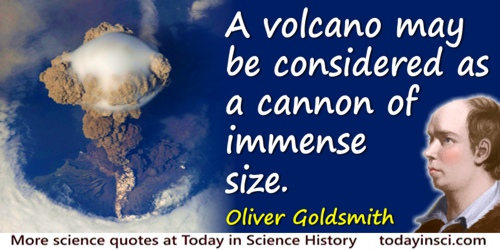
Eruption of Sarychev volcano, Matua Island, Russia, seen from International Space Station (12 Jul 2009) (source)
A volcano may be considered as a cannon of immense size.
In A History of the Earth and Animated Nature (New ed. 1805), Vol. 1, 77.
According to the theory of aerodynamics, as may be readily demonstrated through wind tunnel experiments, the bumblebee is unable to fly. This is because the size, weight and shape of his body in relation to the total wingspread make flying impossible. But the bumblebee, being ignorant of these scientific truths, goes ahead and flies anyway—and makes a little honey every day.
Sign in a General Motors Corporation factory. As quoted in Ralph L. Woods, The Businessman's
Book of Quotations (1951), 249-50. Cited in Suzy Platt (ed)., Respectfully Quoted: A Dictionary of Quotations (1989), 118.
All cell biologists are condemned to suffer an incurable secret sorrow: the size of the objects of their passion. … But those of us enamored of the cell must resign ourselves to the perverse, lonely fascination of a human being for things invisible to the naked human eye.
Opening sentence from The Center of Life: A Natural History of the Cell (1977, 1978), 5.
As the world of science has grown in size and in power, its deepest problems have changed from the epistemological to the social.
Scientific Knowledge and its Social Problems (1971), 10.
Because intelligence is our own most distinctive feature, we may incline to ascribe superior intelligence to the basic primate plan, or to the basic plan of the mammals in general, but this point requires some careful consideration. There is no question at all that most mammals of today are more intelligent than most reptiles of today. I am not going to try to define intelligence or to argue with those who deny thought or consciousness to any animal except man. It seems both common and scientific sense to admit that ability to learn, modification of action according to the situation, and other observable elements of behavior in animals reflect their degrees of intelligence and permit us, if only roughly, to compare these degrees. In spite of all difficulties and all the qualifications with which the expert (quite properly) hedges his conclusions, it also seems sensible to conclude that by and large an animal is likely to be more intelligent if it has a larger brain at a given body size and especially if its brain shows greater development of those areas and structures best developed in our own brains. After all, we know we are intelligent, even though we wish we were more so.
In The Meaning of Evolution: A Study of the History of Life and of its Significance for Man (1949), 78.
Deep beneath the surface of the Sun, enormous forces were gathering. At any moment, the energies of a million hydrogen bombs might burst forth in the awesome explosion…. Climbing at millions of miles per hour, an invisible fireball many times the size of Earth would leap from the Sun and head out across space.
From 'Sunjammer', collected in Harry Harrison (ed.), Worlds of Wonder: Sixteen Tales of Science Fiction (1969), 32-33. Originally published in Boys’ Life (Mar 1964).
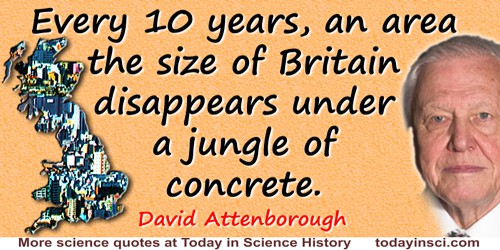
Every 10 years, an area the size of Britain disappears under a jungle of concrete.
As quoted from BBC TV series, Planet Earth II in Joe Shute, 'David Attenborough at 90: ‘I think about my mortality every day’', The Telegraph (29 Oct 2016).
Every river appears to consist of a main trunk, fed from a variety of branches, each running in a valley proportional to its size, and all of them together forming a system of vallies, communicating with one another, and having such a nice adjustment of their declivities that none of them join the principal valley on too high or too low a level; a circumstance which would be infinitely improbable if each of these vallies were not the work of the stream that flows in it.
Illustrations of the Huttonian Theory of the Earth (1802), 102.
Experiments in geology are far more difficult than in physics and chemistry because of the greater size of the objects, commonly outside our laboratories, up to the earth itself, and also because of the fact that the geologic time scale exceeds the human time scale by a million and more times. This difference in time allows only direct observations of the actual geologic processes, the mind having to imagine what could possibly have happened in the past.
In 'The Scientific Character of Geology', The Journal of Geology (Jul 1961), 69, No. 4, 455-6.
Experiments on ornamental plants undertaken in previous years had proven that, as a rule, hybrids do not represent the form exactly intermediate between the parental strains. Although the intermediate form of some of the more striking traits, such as those relating to shape and size of leaves, pubescence of individual parts, and so forth, is indeed nearly always seen, in other cases one of the two parental traits is so preponderant that it is difficult or quite impossible, to detect the other in the hybrid. The same is true for Pisum hybrids. Each of the seven hybrid traits either resembles so closely one of the two parental traits that the other escapes detection, or is so similar to it that no certain distinction can be made. This is of great importance to the definition and classification of the forms in which the offspring of hybrids appear. In the following discussion those traits that pass into hybrid association entirely or almost entirely unchanged, thus themselves representing the traits of the hybrid, are termed dominating and those that become latent in the association, recessive. The word 'recessive' was chosen because the traits so designated recede or disappear entirely in the hybrids, but reappear unchanged in their progeny, as will be demonstrated later.
'Experiments on Plant Hybrids' (1865). In Curt Stern and Eva R. Sherwood (eds.), The Origin of Genetics: A Mendel Source Book (1966), 9.
For, however much we may clench our teeth in anger, we cannot but confess, in opposition to Galen’s teaching but in conformity with the might of Aristotle’s opinion, that the size of the orifice of the hollow vein at the right chamber of the heart is greater than that of the body of the hollow vein, no matter where you measure the latter. Then the following chapter will show the falsity of Galen’s view that the hollow vein is largest at the point where it joins the hump of the liver.
From De Humani Corporis Fabrica Libri Septem (1543), Book III, 275, as translated by William Frank Richardson and John Burd Carman, in 'The Arguments Advanced by Galen in Opposition to Aristotl’s Views about the Origin of the Hollow Vein Do Not Have Oracular Authority', On The Fabric of the Human Body: Book III: The Veins And Arteries; Book IV: The Nerves (1998), 45.
Hey, size works against excellence.
Upside (Apr 1992). Quoted in Thomas J. Peters, Liberation Management: Necessary Disorganization for the Nanosecond Nineties (1992), 554.
I have always been very fond of mathematics—for one short period, I even toyed with the possibility of abandoning chemistry in its favour. I enjoyed immensely both its conceptual and formal beauties, and the precision and elegance of its relationships and transformations. Why then did I not succumb to its charms? … because by and large, mathematics lacks the sensuous elements which play so large a role in my attraction to chemistry.I love crystals, the beauty of their forms and formation; liquids, dormant, distilling, sloshing! The fumes, the odors—good or bad, the rainbow of colors; the gleaming vessels of every size, shape and purpose.
In Arthur Clay Cope Address, Chicago (28 Aug 1973). In O. T. Benfey and P. J. T. Morris (eds.), Robert Burns Woodward. Architect and Artist in the World of Molecules (2001), 427.
I have no doubt that it is possible to give a new direction to technological development, a direction that shall lead it back to the real needs of man, and that also means: to the actual size of man. Man is small, and, therefore, small is beautiful. To go
Small is Beautiful (1973).
In earlier times they had no statistics and so they had to fall back on lies. Hence the huge exaggerations of primitive literature, giants, miracles, wonders! It's the size that counts. They did it with lies and we do it with statistics: but it's all the same.
In Model Memoirs and Other Sketches from Simple to Serious (1971), 265.
In some respects, science has far surpassed religion in delivering awe. How is it that hardly any major religion has looked at science and concluded, “This is better than we thought! The Universe is much bigger than our prophets said, grander, more subtle, more elegant. God must be even greater than we dreamed”? Instead they say, 'No, no, no! My god is a little god, and I want him to stay that way.'
Pale Blue Dot: A Vision of the Human Future in Space (1994), 52.
In summary, very large populations may differentiate rapidly, but their sustained evolution will be at moderate or slow rates and will be mainly adaptive. Populations of intermediate size provide the best conditions for sustained progressive and branching evolution, adaptive in its main lines, but accompanied by inadaptive fluctuations, especially in characters of little selective importance. Small populations will be virtually incapable of differentiation or branching and will often be dominated by random inadaptive trends and peculiarly liable to extinction, but will be capable of the most rapid evolution as long as this is not cut short by extinction.
Tempo and Mode in Evolution (1944), 70-1.
In the center of everything rules the sun; for who in this most beautiful temple could place this luminary at another better place whence it can light up the whole at once? … In fact, the sun sitting on his royal throne guides the family of stars surrounding him. … In this arrangement we thus find an admirable harmony of the world, and a constant harmonious connection between the motion and the size of the orbits as could not be found otherwise.
In De Revolutionibus Orbium Coelestium (1543), Book 1, Ch. 10. As translated in Hermann Kesten, Copernicus and his World (1945), 182-183. From the original Latin: “In medio vero omnium residet Sol. Quis enim in hoc pulcherrimo templo lampadem hanc in alio vel meliori loco poneret, quam unde totum simul possit illuminare? … Ita profecto tanquam in solio regali Sol residens circum agentem gubernat Astrorum familiam. … Invenimus igitur sub hac ordinatione admirandam mundi symmetriam, ac certum harmoniae nexum motus et magnitudinis orbium: qualis alio modo reperiri non potest.” Corresponding translations also found in Charles Glenn Wallis (trans.), On the Revolutions of Heavenly Spheres (1939, 1995), 24-25, which gives: “In the center of all rests the sun. For who would place this lamp of a very beautiful temple in another or better place than this wherefrom it can illuminate everything at the same time? … And so the sun, as if resting on a kingly throne, governs the family of stars which wheel around. … Therefore in this ordering we find that the world has a wonderful commensurability and that there is a sure bond of harmony for the movement and magnitude of the orbital circles such as cannot be found in any other way.” The passage is translated in Robert Reinhold, 'After 500 Years, Now the Year of Copernicus', New York Times (28 Dec 1972), 33, as: “At rest in the middle of everything is the sun, for in this most beautiful temple, who would place this lamp in another or better position than that from which it can light up the whole thing at the same time? … As though seated on a royal throne, the sun governs the family of planets revolving around it.” Also seen translated in Edwin Arthur Burtt, The Metaphysical Foundations of Modern Physical Science (1925), 45, as: “Then in the middle of all stands the sun. For who, in our most beautiful temple, could set this light in another or better place, than that from which it can at once illuminate the whole? … And in fact does the sun, seated on his royal throne, guide his family of planets as they circle round him.” [Notice the original Latin reads “Astrorum familiam”, so the literal translation is “family of stars” rather than what we now call “planets.” —Webmaster]
In the physical world, one cannot increase the size or quantity of anything without changing its quality. Similar figures exist only in pure geometry.
In W.H. Auden and Louis Kronenberger, The Viking Book of Aphorisms: A Personal Selection, (1966), 98.
It is a right, yes a duty, to search in cautious manner for the numbers, sizes, and weights, the norms for everything [God] has created. For He himself has let man take part in the knowledge of these things ... For these secrets are not of the kind whose research should be forbidden; rather they are set before our eyes like a mirror so that by examining them we observe to some extent the goodness and wisdom of the Creator.
Epitome of Copernican Astronomy. In Michael B. Foster, Mystery and Philosophy, 61. Cited by Max Casper and Doris Hellman, trans., ed. Kepler (1954), 381. Cited by Gerald J. Galgan, Interpreting the Present: Six Philosophical Essays (1993), 105.
Gerald J. Galgan
It is popular to believe that the age of the individual and, above all, of the free individual, is past in science. There are many administrators of science and a large component of the general population who believe that mass attacks can do anything, and even that ideas are obsolete. Behind this drive to the mass attack there are a number of strong psychological motives. Neither the public or the big administrator has too good an understanding of the inner continuity of science, but they both have seen its world-shaking consequences, and they are afraid of it. Both of them wish to decerebrate the scientist, even as the Byzantine State emasculated its civil servants. Moreover, the great administrator who is not sure of his own intellectual level can aggrandize himself only by cutting his scientific employees down to size.
In I am a Mathematician (1956), Epilogue, 363-364.
Jupiter is the largest of all the solar system’s planets, more than ten times bigger and three hundred times as massive as Earth. Jupiter is so immense it could swallow all the other planets easily. Its Great Red Spot, a storm that has raged for centuries, is itself wider than Earth. And the Spot is merely one feature visible among the innumerable vortexes and streams of Jupiter’s frenetically racing cloud tops. Yet Jupiter is composed mainly of the lightest elements, hydrogen and helium, more like a star than a planet. All that size and mass, yet Jupiter spins on its axis in less than ten hours, so fast that the planet is clearly not spherical: Its poles are noticeably flattened. Jupiter looks like a big, colorfully striped beach ball that’s squashed down as if some invisible child were sitting on it. Spinning that fast, Jupiter’s deep, deep atmosphere is swirled into bands and ribbons of multihued clouds: pale yellow, saffron orange, white, tawny yellow-brown, dark brown, bluish, pink and red. Titanic winds push the clouds across the face of Jupiter at hundreds of kilometers per hour.
— Ben Bova
Jupiter
Just as a tree constitutes a mass arranged in a definite manner, in which, in every single part, in the leaves as in the root, in the trunk as in the blossom, cells are discovered to be the ultimate elements, so is it also with the forms of animal life. Every animal presents itself as a sum of vital unities, every one of which manifests all the characteristics of life. The characteristics and unity of life cannot be limited to anyone particular spot in a highly developed organism (for example, to the brain of man), but are to be found only in the definite, constantly recurring structure, which every individual element displays. Hence it follows that the structural composition of a body of considerable size, a so-called individual, always represents a kind of social arrangement of parts, an arrangement of a social kind, in which a number of individual existences are mutually dependent, but in such a way, that every element has its own special action, and, even though it derive its stimulus to activity from other parts, yet alone effects the actual performance of its duties.
In Lecture I, 'Cells and the Cellular Theory' (1858), Rudolf Virchow and Frank Chance (trans.) ,Cellular Pathology (1860), 13-14.
Looking back over the geological record it would seem that Nature made nearly every possible mistake before she reached her greatest achievement Man—or perhaps some would say her worst mistake of all. ... At last she tried a being of no great size, almost defenseless, defective in at least one of the more important sense organs; one gift she bestowed to save him from threatened extinction—a certain stirring, a restlessness, in the organ called the brain.
…...
Nature only shows us the tail of the lion. I am convinced, however, that the lion is attached to it, even though he cannot reveal himself directly because of his enormous size.
Quoted in Kim Lim (ed.), 1,001 Pearls of Spiritual Wisdom: Words to Enrich, Inspire, and Guide Your Life (2014), 41
Nature shows us only the tail of the lion. But I do not doubt that the lion belongs to it even though he cannot at once reveal himself because of his enormous size.
…...
Neither the absolute nor the relative size of the brain can be used to measure the degree of mental ability in animal or in man. So far as man is concerned, the weights of the brains or the volumes of the cranial cavities of a hundred celebrities of all branches of knowledge all over the world have been listed. … At the bottom of those lists are Gall, the famous phrenologist, Anatole France, the French novelist, and Gambetta, the French statesman, each with about 1,100 cc brain mass. The lists are topped by Dean Jonathan Swift, the English writer, Lord Byron, the English poet, and Turgenev, the Russian novelist, all with about 2,000 cc … Now our mental test! Had Turgenev really twice the mental ability of Anatole France?
In 'The Human Brain in the Light of Its Phylogenetic Development', Scientific Monthly (Aug 1948), 67, No. 2, 104-105. Collected in Sherwood Larned Washburn and Davida Wolffson (eds.), The Shorter Anthropological Papers of Franz Weidenreich Published in the Period 1939-1948: A Memorial Volume (1949), 18.
Nobody since Newton has been able to use geometrical methods to the same extent for the like purposes; and as we read the Principia we feel as when we are in an ancient armoury where the weapons are of gigantic size; and as we look at them we marvel what manner of man he was who could use as a weapon what we can scarcely lift as a burthen.
From Speech delivered at the Dejeuner, after the Inauguration of the statue of Isaac Newton at Grantham. Collected in Edmund Fillingham King, A biographical sketch of Sir Isaac Newton (1858), 105.
Now do you not see that the eye embraces the beauty of the whole world? It counsels and corrects all the arts of mankind... it is the prince of mathematics, and the sciences founded on it are absolutely certain. It has measured the distances and sizes of the stars it has discovered the elements and their location... it has given birth to architecture and to perspective and to the divine art of painting.
…...
Of all the constituents of the human body, bone is the hardest, the driest, the earthiest, and the coldest; and, excepting only the teeth, it is devoid of sensation. God, the great Creator of all things, formed its substance to this specification with good reason, intending it to be like a foundation for the whole body; for in the fabric of the human body bones perform the same function as do walls and beams in houses, poles in tents, and keels and ribs in boats.
Bones Differentiated by Function
Some bones, by reason of their strength, form as it were props for the body; these include the tibia, the femur, the spinal vertebrae, and most of the bony framework. Others are like bastions, defense walls, and ramparts, affording natural protection to other parts; examples are the skull, the spines and transverse processes of the vertebrae, the breast bone, the ribs. Others stand in front of the joints between certain bones, to ensure that the joint does not move too loosely or bend to too acute an angle. This is the function of the tiny bones, likened by the professors of anatomy to the size of a sesame seed, which are attached to the second internode of the thumb, the first internode of the other four fingers and the first internodes of the five toes. The teeth, on the other hand, serve specifically to cut, crush, pound and grind our food, and similarly the two ossicles in the organ of hearing perform a specifically auditory function.
Bones Differentiated by Function
Some bones, by reason of their strength, form as it were props for the body; these include the tibia, the femur, the spinal vertebrae, and most of the bony framework. Others are like bastions, defense walls, and ramparts, affording natural protection to other parts; examples are the skull, the spines and transverse processes of the vertebrae, the breast bone, the ribs. Others stand in front of the joints between certain bones, to ensure that the joint does not move too loosely or bend to too acute an angle. This is the function of the tiny bones, likened by the professors of anatomy to the size of a sesame seed, which are attached to the second internode of the thumb, the first internode of the other four fingers and the first internodes of the five toes. The teeth, on the other hand, serve specifically to cut, crush, pound and grind our food, and similarly the two ossicles in the organ of hearing perform a specifically auditory function.
From De Humani Corporis Fabrica Libri Septem: (1543), Book I, 1, as translated by William Frank Richardson, in 'Nature of Bone; Function of Bones', On The Fabric of the Human Body: Book I: The Bones and Cartilages (1998), 1.
One day a math-deficient frog was sitting on a tiny lily pad in a big pond—a lily pad that doubled in size each night—and on this day the pad covered just one-eighth of the pond. The frog still saw the vast majority of his beloved water and so was unconcerned. Then, just three days later, he woke to find the pond had vanished while he slept.
Epigraph, without citation, 'A sad cautionary tale for frogs with their heads in the sand.' in In Praise of Simple Physics: The Science and Mathematics behind Everyday Questions (2016), 11.
One of the most curious and interesting reptiles which I met with in Borneo was a large tree-frog, which was brought me by one of the Chinese workmen. He assured me that he had seen it come down in a slanting direction from a high tree, as if it flew. On examining it, I found the toes very long and fully webbed to their very extremity, so that when expanded they offered a surface much larger than the body. The forelegs were also bordered by a membrane, and the body was capable of considerable inflation. The back and limbs were of a very deep shining green colour, the undersurface and the inner toes yellow, while the webs were black, rayed with yellow. The body was about four inches long, while the webs of each hind foot, when fully expanded, covered a surface of four square inches, and the webs of all the feet together about twelve square inches. As the extremities of the toes have dilated discs for adhesion, showing the creature to be a true tree frog, it is difficult to imagine that this immense membrane of the toes can be for the purpose of swimming only, and the account of the Chinaman, that it flew down from the tree, becomes more credible. This is, I believe, the first instance known of a “flying frog,” and it is very interesting to Darwinians as showing that the variability of the toes which have been already modified for purposes of swimming and adhesive climbing, have been taken advantage of to enable an allied species to pass through the air like the flying lizard. It would appear to be a new species of the genus Rhacophorus, which consists of several frogs of a much smaller size than this, and having the webs of the toes less developed.
Malay Archipelago
Qualified scientists in Washington believe that the atom-blasting of Japan is the start toward heating plants the size of telephone booths for great factories, and motor-car trips of 1,000 hours on one gram of fuel. One expert estimated that with a few grams of uranium it might be possible to power the Queen Mary from Europe to the U.S. and back again. One of America’s leading scientists, Doctor Vollrath, said that the new discovery brings man’s attempt to reach the moon within bounds of possibility.
The Maple Leaf (8 Aug 1945), 4.
Scientific studies on marine reserves around the world show that if you close a place to fishing, the number of species increases 20 percent, the average size of a fish increases by a third, and the total weight of fish per hectare increases almost five times—in less than a decade.
From interview with Terry Waghorn, 'Can We Eat Our Fish and Protect Them Too?', Forbes (21 Feb 2012)
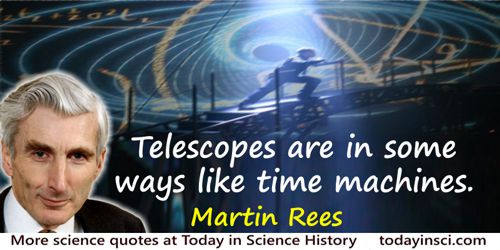
Telescopes are in some ways like time machines. They reveal galaxies so far away that their light has taken billions of years to reach us. We in astronomy have an advantage in studying the universe, in that we can actually see the past.
We owe our existence to stars, because they make the atoms of which we are formed. So if you are romantic you can say we are literally starstuff. If you’re less romantic you can say we’re the nuclear waste from the fuel that makes stars shine.
We’ve made so many advances in our understanding. A few centuries ago, the pioneer navigators learnt the size and shape of our Earth, and the layout of the continents. We are now just learning the dimensions and ingredients of our entire cosmos, and can at last make some sense of our cosmic habitat.
We owe our existence to stars, because they make the atoms of which we are formed. So if you are romantic you can say we are literally starstuff. If you’re less romantic you can say we’re the nuclear waste from the fuel that makes stars shine.
We’ve made so many advances in our understanding. A few centuries ago, the pioneer navigators learnt the size and shape of our Earth, and the layout of the continents. We are now just learning the dimensions and ingredients of our entire cosmos, and can at last make some sense of our cosmic habitat.
…...
The actuality of us being cognizant and accepting of the fact we are but a speck of sand in a universe sized desert, whose existence is irrelevant to any facet of universal function is a hard pill to swallow. Knowing the world will go on for another billion years after death and you will have no recollection of anything, just as you have no recollection of the billion years before your birth is a mind-boggling intuition.
In White Guilt (2010), 90.
The biggest animal that has ever lived on our planet: a blue whale. … It’s far bigger than even the biggest dinosaur. Its tongue weighs as much as an elephant. Its heart is the size of a car. And some of its blood vessels are so wide that you could swim down them.
Narration from 'Introduction' of the BBC TV series The Blue Planet (2001), Ep. 1. Text accompanies 'Blue whale breach', video clip on BBC website.
The combination of such characters, some, as the sacral ones, altogether peculiar among Reptiles, others borrowed, as it were, from groups now distinct from each other, and all manifested by creatures far surpassing in size the largest of existing reptiles, will, it is presumed, be deemed sufficient ground for establishing a distinct tribe or sub-order of Saurian Reptiles, for which I would propose the name of Dinosauria.
'Report on British Fossil Reptiles', Report of the Eleventh Meeting of the British Association for the Advancement of Science (1842), 103.
The competent programmer is fully aware of the limited size of his own skull. He therefore approaches his task with full humility, and avoids clever tricks like the plague.
…...
The Earth reminded us of a Christmas tree ornament hanging in the blackness of space. As we got farther and farther away it diminished in size. Finally it shrank to the size of a marble, the most beautiful marble you can imagine. That beautiful, warm, living object looked so fragile, so delicate, that if you touched it with a finger it would crumble and fall apart. Seeing this has to change a man, has to make a man appreciate the creation of God and the love of God.
…...
The fact that, with respect to size, the viruses overlapped with the organisms of the biologist at one extreme and with the molecules of the chemist at the other extreme only served to heighten the mystery regarding the nature of viruses. Then too, it became obvious that a sharp line dividing living from non-living things could not be drawn and this fact served to add fuel for discussion of the age-old question of “What is life?”
Nobel Lecture (12 Dec 1946), 'The Isolation and Properties of Crystalline Tobacco Mosaic Virus', collected in Nobel Lectures in Chemistry (1999), 140.
The mathematically formulated laws of quantum theory show clearly that our ordinary intuitive concepts cannot be unambiguously applied to the smallest particles. All the words or concepts we use to describe ordinary physical objects, such as position, velocity, color, size, and so on, become indefinite and problematic if we try to use them of elementary particles.
In Across the Frontiers (1974), 114.
The scientist values research by the size of its contribution to that huge, logically articulated structure of ideas which is already, though not yet half built, the most glorious accomplishment of mankind.
In The Art of the Soluble (1967), 126. Also 'Two Conceptions of Science', collected in The Strange Case of the Spotted Mice and Other Classic Essays on Science (1996), 70.
The size and age of the Cosmos are beyond ordinary human understanding. Lost somewhere between immensity and eternity is our tiny planetary home.
Cosmos (1981), 4.
The Sun is no lonelier than its neighbors; indeed, it is a very common-place star,—dwarfish, though not minute,—like hundreds, nay thousands, of others. By accident the brighter component of Alpha Centauri (which is double) is almost the Sun's twin in brightness, mass, and size. Could this Earth be transported to its vicinity by some supernatural power, and set revolving about it, at a little less than a hundred million miles' distance, the star would heat and light the world just as the Sun does, and life and civilization might go on with no radical change. The Milky Way would girdle the heavens as before; some of our familiar constellations, such as Orion, would be little changed, though others would be greatly altered by the shifting of the nearer stars. An unfamiliar brilliant star, between Cassiopeia and Perseus would be—the Sun. Looking back at it with our telescopes, we could photograph its spectrum, observe its motion among the stars, and convince ourselves that it was the same old Sun; but what had happened to the rest of our planetary system we would not know.
The Solar System and its Origin (1935), 2-3.
The tendency on the part of educators has ever been to make old bottles accommodate new wine quite regardless of either the size of the containers or of the quantity of the vintage.
Co-author with Louis Jay Heath, in A New Basis for Social Progress (1917), 149.
The tiny creatures of the undergrowth were the first creatures of any kind to colonise the land. They established the foundations of the land’s ecosystems and were able to transcend the limitations of their small size by banding together in huge communities of millions.
From BBC TV series Life in the Undergrowth (2005), as quoted in BBC press release (10 Oct 2005).
There is no absolute scale of size in the Universe, for it is boundless towards the great and also boundless towards the small.
As restated by D'Arcy Wentworth Thompson, in On Growth and Form (1917, 1959), 24. Note that Thompson does not uses quotation marks when he gives this as what “Oliver Heaviside used to say.”
There is no need to worry about mere size. We do not necessarily respect a fat man more than a thin man. Sir Isaac Newton was very much smaller than a hippopotamus, but we do not on that account value him less.
…...
There is no smallest among the small and no largest among the large; but always something still smaller and something still larger.
Quoted in Eli Maor, To Infinity and Beyond (1991), 2.
They were in orbit around the planet now, and its giant curving bulk loomed so huge that he could see nothing else, nothing but the bands and swirls of clouds that raced fiercely across Jupiter’s face. The clouds shifted and flowed before his eyes, spun into eddies the size of Asia, moved and throbbed and pulsed like living creatures. Lightning flashed down there, sudden explosions of light that flickered back and forth across the clouds, like signalling lamps.
— Ben Bova
Jupiter
To the extent that remaining old-growth Douglas fir ecosystems possess unique structural and functional characteristics distinct from surrounding managed forests, the analogy between forest habitat islands and oceanic islands applies. Forest planning decision variables such as total acreage to be maintained, patch size frequency distribution, spatial distribution of patches, specific locations, and protective measures all need to be addressed.
In The Fragmented Forest: Island Biogeography Theory and the Preservation of Biotic Diversity (1984), 6.
What could define God [is thinking of God] as the embodiment of the laws of nature. However, this is not what most people would think of that God. They made a human-like being with whom one can have a personal relationship. When you look at the vast size of the universe and how insignificant an accidental human life is in it, that seems most impossible.
From Interview with Diane Sawyer, quoted in ABC News, 'Stephen Hawking on Religion: “Science Will Win”' (4 Jun 2010), on abcnews.go.com website.
When I first ventured into the Gulf of Mexico in the 1950s, the sea appeared to be a blue infinity too large, too wild to be harmed by anything that people could do. I explored powder white beaches, dense marshes, mangrove forests, and miles of sea grass meadows alive with pink sea urchins, tiny shrimps, and seahorses half the size of my little finger. … Then, in mere decades, not millennia, the blue wilderness of my childhood disappeared: biologic change in the space of a lifetime.
From 'My Blue Wilderness', National Geographic Magazine (Oct 2010), 76.
Why are atoms so small? ... Many examples have been devised to bring this fact home to an audience, none of them more impressive than the one used by Lord Kelvin: Suppose that you could mark the molecules in a glass of water, then pour the contents of the glass into the ocean and stir the latter thoroughly so as to distribute the marked molecules uniformly throughout the seven seas; if you then took a glass of water anywhere out of the ocean, you would find in it about a hundred of your marked molecules.
What is life?: the Physical Aspect of the Living Cell (1944). Collected in What is Life? with Mind And Matter & Autobiographical Sketches (1967, 1992), 6-7.
Why must our bodies be so large compared with the atom?
What is Life? In Marc J. Madou, Fundamentals of Microfabrication: the Science of Miniaturization (2nd ed., 2002), 1.
Within the nucleus [of a cell] is a network of fibers, a sap fills the interstices of the network. The network resolves itself into a definite number of threads at each division of the cell. These threads we call chromosomes. Each species of animals and plants possesses a characteristic number of these threads which have definite size and sometimes a specific shape and even characteristic granules at different levels. Beyond this point our strongest microscopes fail to penetrate.
In A Critique of the Theory of Evolution (1916), 91.
You can’t see oxygen being generated by trees, carbon dioxide being taken up by trees, but we get that. We’re beginning to understand the importance of forests. But the ocean has its forests, too. They just happen to be very small. They’re very small in size but they’re very large in numbers.
In interview with Pierce Nahigyan, 'Dr. Sylvia Earle: “We’re Literally Destroying The Systems That Keep Us Alive”', Huffington Post (6 Jan 2016).
 In science it often happens that scientists say, 'You know that's a really good argument; my position is mistaken,' and then they would actually change their minds and you never hear that old view from them again. They really do it. It doesn't happen as often as it should, because scientists are human and change is sometimes painful. But it happens every day. I cannot recall the last time something like that happened in politics or religion.
(1987) --
In science it often happens that scientists say, 'You know that's a really good argument; my position is mistaken,' and then they would actually change their minds and you never hear that old view from them again. They really do it. It doesn't happen as often as it should, because scientists are human and change is sometimes painful. But it happens every day. I cannot recall the last time something like that happened in politics or religion.
(1987) -- 





