Side Quotes (237 quotes)
[Eratosthenes] ... is a mathematician among geographers, and yet a geographer among mathematicians; and consequently on both sides he offers his opponents occasions for contradiction.
H. L. Jones (ed.), The Geography of Strabo (1917), Vol. 1, 359-61.

[Ignorance] of the principle of conservation of energy … does not prevent inventors without background from continually putting forward perpetual motion machines… Also, such persons undoubtedly have their exact counterparts in the fields of art, finance, education, and all other departments of human activity… persons who are unwilling to take the time and to make the effort required to find what the known facts are before they become the champions of unsupported opinions—people who take sides first and look up facts afterward when the tendency to distort the facts to conform to the opinions has become well-nigh irresistible.
From Evolution in Science and Religion (1927), 58-59. An excerpt from the book including this quote appears in 'New Truth and Old', Christian Education (Apr 1927), 10, No. 7, 394-395.
[J.J.] Sylvester’s methods! He had none. “Three lectures will be delivered on a New Universal Algebra,” he would say; then, “The course must be extended to twelve.” It did last all the rest of that year. The following year the course was to be Substitutions-Théorie, by Netto. We all got the text. He lectured about three times, following the text closely and stopping sharp at the end of the hour. Then he began to think about matrices again. “I must give one lecture a week on those,” he said. He could not confine himself to the hour, nor to the one lecture a week. Two weeks were passed, and Netto was forgotten entirely and never mentioned again. Statements like the following were not unfrequent in his lectures: “I haven’t proved this, but I am as sure as I can be of anything that it must be so. From this it will follow, etc.” At the next lecture it turned out that what he was so sure of was false. Never mind, he kept on forever guessing and trying, and presently a wonderful discovery followed, then another and another. Afterward he would go back and work it all over again, and surprise us with all sorts of side lights. He then made another leap in the dark, more treasures were discovered, and so on forever.
As quoted by Florian Cajori, in Teaching and History of Mathematics in the United States (1890), 265-266.
[Relativist] Rel. There is a well-known proposition of Euclid which states that “Any two sides of a triangle are together greater than the third side.” Can either of you tell me whether nowadays there is good reason to believe that this proposition is true?
[Pure Mathematician] Math. For my part, I am quite unable to say whether the proposition is true or not. I can deduce it by trustworthy reasoning from certain other propositions or axioms, which are supposed to be still more elementary. If these axioms are true, the proposition is true; if the axioms are not true, the proposition is not true universally. Whether the axioms are true or not I cannot say, and it is outside my province to consider.
[Pure Mathematician] Math. For my part, I am quite unable to say whether the proposition is true or not. I can deduce it by trustworthy reasoning from certain other propositions or axioms, which are supposed to be still more elementary. If these axioms are true, the proposition is true; if the axioms are not true, the proposition is not true universally. Whether the axioms are true or not I cannot say, and it is outside my province to consider.
In Space, Time and Gravitation: An Outline of the General Relativity Theory (1920, 1921), 1.
[The surplus of basic knowledge of the atomic nucleus was] largely used up [during the war with the atomic bomb as the dividend.] We must, without further delay restore this surplus in preparation for the important peacetime job for the nucleus - power production. ... Many of the proposed applications of atomic power - even for interplanetary rockets - seem to be within the realm of possibility provided the economic factor is ruled out completely, and the doubtful physical and chemical factors are weighted heavily on the optimistic side. ... The development of economic atomic power is not a simple extrapolation of knowledge gained during the bomb work. It is a new and difficult project to reach a satisfactory answer. Needless to say, it is vital that the atomic policy legislation now being considered by the congress recognizes the essential nature of this peacetime job, and that it not only permits but encourages the cooperative research-engineering effort of industrial, government and university laboratories for the task. ... We must learn how to generate the still higher energy particles of the cosmic rays - up to 1,000,000,000 volts, for they will unlock new domains in the nucleus.
Addressing the American Institute of Electrical Engineering, in New York (24 Jan 1946). In Schenectady Gazette (25 Jan 1946),
[The Whig interpretation of history] ... is the tendency in many historians to write on the side of Protestants and Whigs, to praise revolutions provided they have been successful, to emphasise certain principles of progress in the past and to produce a story which is the ratification if not the glorification of the present.
The Whig Interpretation of History (1931), v.
[Describing the effects of over-indulgence in wine:]
But most too passive, when the blood runs low
Too weakly indolent to strive with pain,
And bravely by resisting conquer fate,
Try Circe's arts; and in the tempting bowl
Of poisoned nectar sweet oblivion swill.
Struck by the powerful charm, the gloom dissolves
In empty air; Elysium opens round,
A pleasing frenzy buoys the lightened soul,
And sanguine hopes dispel your fleeting care;
And what was difficult, and what was dire,
Yields to your prowess and superior stars:
The happiest you of all that e'er were mad,
Or are, or shall be, could this folly last.
But soon your heaven is gone: a heavier gloom
Shuts o'er your head; and, as the thundering stream,
Swollen o'er its banks with sudden mountain rain,
Sinks from its tumult to a silent brook,
So, when the frantic raptures in your breast
Subside, you languish into mortal man;
You sleep, and waking find yourself undone,
For, prodigal of life, in one rash night
You lavished more than might support three days.
A heavy morning comes; your cares return
With tenfold rage. An anxious stomach well
May be endured; so may the throbbing head;
But such a dim delirium, such a dream,
Involves you; such a dastardly despair
Unmans your soul, as maddening Pentheus felt,
When, baited round Citheron's cruel sides,
He saw two suns, and double Thebes ascend.
But most too passive, when the blood runs low
Too weakly indolent to strive with pain,
And bravely by resisting conquer fate,
Try Circe's arts; and in the tempting bowl
Of poisoned nectar sweet oblivion swill.
Struck by the powerful charm, the gloom dissolves
In empty air; Elysium opens round,
A pleasing frenzy buoys the lightened soul,
And sanguine hopes dispel your fleeting care;
And what was difficult, and what was dire,
Yields to your prowess and superior stars:
The happiest you of all that e'er were mad,
Or are, or shall be, could this folly last.
But soon your heaven is gone: a heavier gloom
Shuts o'er your head; and, as the thundering stream,
Swollen o'er its banks with sudden mountain rain,
Sinks from its tumult to a silent brook,
So, when the frantic raptures in your breast
Subside, you languish into mortal man;
You sleep, and waking find yourself undone,
For, prodigal of life, in one rash night
You lavished more than might support three days.
A heavy morning comes; your cares return
With tenfold rage. An anxious stomach well
May be endured; so may the throbbing head;
But such a dim delirium, such a dream,
Involves you; such a dastardly despair
Unmans your soul, as maddening Pentheus felt,
When, baited round Citheron's cruel sides,
He saw two suns, and double Thebes ascend.
The Art of Preserving Health: a Poem in Four Books (2nd. ed., 1745), Book IV, 108-110.
In artibus et scientiis, tanquam in metalli fodinis, omnia novis operibus et ulterioribus progressibus circumstrepere debent
But arts and sciences should be like mines, where the noise of new works and further advances is heard on every side.
But arts and sciences should be like mines, where the noise of new works and further advances is heard on every side.
Original Latin as in Novum Organum, Book 1, XC, collected in The Works of Francis Bacon (1826), Vol. 8, 50-51. As translated by James Spedding and Robert Leslie Ellis in The Works of Francis Bacon (1863), 127.
Le premier regard de l’homme jeté sur l’univers n’y découvre que variété, diversité, multiplicité des phénomènes. Que ce regard soit illuminé par la science,—par la science qui rapproche l’homme de Dieu,—et la simplicité et l’unité brillent de toutes parts.
Man’s first glance at the universe discovers only variety, diversity, multiplicity of phenomena. Let that glance be illuminated by science—by the science which brings man closer to God,—and simplicity and unity shine on all sides.
Man’s first glance at the universe discovers only variety, diversity, multiplicity of phenomena. Let that glance be illuminated by science—by the science which brings man closer to God,—and simplicity and unity shine on all sides.
Original French quoted in René Vallery-Radot, La Vie de Pasteur (1901), 209. Translation by Google translate, tweaked by Webmaster. The English version of the book, omits this passage, except for “Science, which brings man nearer to God.” In The Life of Pasteur (1902), Vol. 1, 194.
Responding to the Bishop of Oxford, Samuel Wilberforce's question whether he traced his descent from an ape on his mother's or his father's side:
If then, said I, the question is put to me would I rather have a miserable ape for a grandfather or a man highly endowed by nature and possessing great means and influence and yet who employs those faculties for the mere purpose of introducing ridicule into a grave scientific discussion—I unhesitatingly affirm my preference for the ape.
If then, said I, the question is put to me would I rather have a miserable ape for a grandfather or a man highly endowed by nature and possessing great means and influence and yet who employs those faculties for the mere purpose of introducing ridicule into a grave scientific discussion—I unhesitatingly affirm my preference for the ape.
Letter to Dr. Dyster (9 Sep 1860), Huxley Papers, Imperial College of Science and Technology. Quoted in D.J. Foskett, 'Wilberforce and Huxley on Evolution' in a letter to Nature, 1953, 172, 920.
Ron Hutcheson, a Knight-Ridder reporter: [Mr. President, what are your] personal views [about the theory of] intelligent design?
President George W. Bush: [Laughing. You're] doing a fine job of dragging me back to the past [days as governor of Texas]. ... Then, I said that, first of all, that decision should be made to local school districts, but I felt like both sides ought to be properly taught...”
Hutcheson: Both sides ought to be properly taught?
President: Yes ... so people can understand what the debate is about.
Hutcheson: So the answer accepts the validity of “intelligent design” as an alternative to evolution?
President: I think that part of education is to expose people to different schools of thought, and I'm not suggesting—you're asking me whether or not people ought to be exposed to different ideas, and the answer is yes.
Hutcheson: So we've got to give these groups—...
President: [interrupting] Very interesting question, Hutch. [Laughter from other reporters]
President George W. Bush: [Laughing. You're] doing a fine job of dragging me back to the past [days as governor of Texas]. ... Then, I said that, first of all, that decision should be made to local school districts, but I felt like both sides ought to be properly taught...”
Hutcheson: Both sides ought to be properly taught?
President: Yes ... so people can understand what the debate is about.
Hutcheson: So the answer accepts the validity of “intelligent design” as an alternative to evolution?
President: I think that part of education is to expose people to different schools of thought, and I'm not suggesting—you're asking me whether or not people ought to be exposed to different ideas, and the answer is yes.
Hutcheson: So we've got to give these groups—...
President: [interrupting] Very interesting question, Hutch. [Laughter from other reporters]
From conversation with reporters at the White House (1 Aug 2005), as quoted by Matthew Cooper in 'Fanning the Controversy Over “Intelligent Design”', Time (3 Aug 2005). The Time writer stated, “The president has gone farther in questioning the widely-taught theories of evolution and natural selection than any president since Ronald Reagan, who advocated teaching creationism in public schools alongside evolution.” Just a few months later, in the nation's first case on that point, on 20 Dec 2005, “a federal judge [John E. Jones] ruled it was unconstitutional for a Pennsylvania school district to present intelligent design as an alternative in high school biology courses, because it is a religious viewpoint,” as reported by Laurie Goodstein in 'Judge Rejects Teaching Intelligent Design', New York Times (21 Dec 2005). Goodstein also wrote “Judge Jones, a Republican appointed by President Bush, concluded that intelligent design was not science,” and that “the evidence in the trial proved that intelligent design was 'creationism relabeled.' The Supreme Court has already ruled that creationism ... cannot be taught as science in a public school.”
~~[Dubious]~~ I demonstrate by means of philosophy that the earth is round, and is inhabited on all sides; that it is insignificantly small, and is borne through the stars.
Included here to add a caution. As quoted in Paul Lyle, The Abyss of Time: A Study in Geological Time and Earth History (2015), 38, citing Astronomia Nova (1609). Webmaster has not yet been able to find in a primary source, so cannot vouch for this quote. Can you help?
A single and distinct luminous body causes stronger relief in the objects than a diffused light; as may be seen by comparing one side of a landscape illuminated by the sun, and one overshadowed by clouds, and illuminated only by the diffused light of the atmosphere.
…...
A weird happening has occurred in the case of a lansquenet named Daniel Burghammer, of the squadron of Captain Burkhard Laymann Zu Liebenau, of the honorable Madrucci Regiment in Piadena, in Italy. When the same was on the point of going to bed one night he complained to his wife, to whom he had been married by the Church seven years ago, that he had great pains in his belly and felt something stirring therein. An hour thereafter he gave birth to a child, a girl. When his wife was made aware of this, she notified the occurrence at once. Thereupon he was examined and questioned. … He confessed on the spot that he was half man and half woman and that for more than seven years he had served as a soldier in Hungary and the Netherlands… . When he was born he was christened as a boy and given in baptism the name of Daniel… . He also stated that while in the Netherlands he only slept once with a Spaniard, and he became pregnant therefrom. This, however, he kept a secret unto himself and also from his wife, with whom he had for seven years lived in wedlock, but he had never been able to get her with child… . The aforesaid soldier is able to suckle the child with his right breast only and not at all on the left side, where he is a man. He has also the natural organs of a man for passing water. Both are well, the child is beautiful, and many towns have already wished to adopt it, which, however, has not as yet been arranged. All this has been set down and described by notaries. It is considered in Italy to be a great miracle, and is to be recorded in the chronicles. The couple, however, are to be divorced by the clergy.
'From Piadena in Italy, the 26th day of May 1601'. As quoted in George Tennyson Matthews (ed.) The Fugger Newsletter (1970), 247-248. A handwritten collection of news reports (1568-1604) by the powerful banking and merchant house of Fugger in Ausburg. This was footnoted in The Story of the Secret Service (1937), 698.
https://books.google.com/books?id=YfssAAAAMAAJ
Richard Wilmer Rowan - 1937
About ten months ago [1609] a report reached my ears that a certain Fleming [Hans Lippershey] had constructed a spyglass, by means of which visible objects, though very distant from the eye of the observer, were distinctly seen as if nearby... Of this truly remarkable effect several experiences were related, to which some persons gave credence while others denied them. A few days later the report was confirmed to me in a letter from a noble Frenchman at Paris, Jacques Badovere, which caused me to apply myself wholeheartedly to enquire into the means by which I might arrive at the invention of a similar instrument. This I did shortly afterwards, my basis being the theory of refraction. First I prepared a tube of lead, at the ends of which I fitted two glass lenses, both plane on one side while on the other side one was spherically convex and the other concave.
The Starry Messenger (1610), trans. Stillman Drake, Discoveries and Opinions of Galileo (1957), 28-9.
Adventure isn’t hanging on a rope off the side of a mountain. Adventure is an attitude that we must apply to the day to day obstacles of life - facing new challenges, seizing new opportunities, testing our resources against the unknown and in the process, discovering our own unique potential.
…...
All rivers, small or large, agree in one character; they like to lean a little on one side; they cannot bear to have their channels deepest in the middle, but will always, if they can, have one bank to sun themselves upon, and another to get cool under.
In 'Water', The True and the Beautiful in Nature, Art, Morals, and Religion (1872), 62.
All those who think it paradoxical that so great a weight as the earth should not waver or move anywhere seem to me to go astray by making their judgment with an eye to their own affects and not to the property of the whole. For it would not still appear so extraordinary to them, I believe, if they stopped to think that the earth’s magnitude compared to the whole body surrounding it is in the ratio of a point to it. For thus it seems possible for that which is relatively least to be supported and pressed against from all sides equally and at the same angle by that which is absolutely greatest and homogeneous.
— Ptolemy
'The Almagest 1', in Ptolemy: the Almagest; Nicolaus Copernicus: On the Revolutions of the Heavenly Spheres; Johannes Kepler: Epitome of Copernican Astronomy: IV - V The Harmonies of the World: V, trans. R. Catesby Taliaferro (1952), 11.
Altering a gene in the gene line to produce improved offspring is likely to be very difficult because of the danger of unwanted side effects. It would also raise obvious ethical problems.
An article in Bioscience in November 1987 by Julie Ann Miller claimed the cortex was a “quarter-meter square.” That is napkin-sized, about ten inches by ten inches. Scientific American magazine in September 1992 upped the ante considerably with an estimate of 1½ square meters; that’s a square of brain forty inches on each side, getting close to the card-table estimate. A psychologist at the University of Toronto figured it would cover the floor of his living room (I haven’t seen his living room), but the prize winning estimate so far is from the British magazine New Scientist’s poster of the brain published in 1993 which claimed that the cerebral cortex, if flattened out, would cover a tennis court. How can there be such disagreement? How can so many experts not know how big the cortex is? I don’t know, but I’m on the hunt for an expert who will say the cortex, when fully spread out, will cover a football field. A Canadian football field.
In The Burning House: Unlocking the Mysteries of the Brain (1994, 1995), 11.
As a result of the phenomenally rapid change and growth of physics, the men and women who did their great work one or two generations ago may be our distant predecessors in terms of the state of the field, but they are our close neighbors in terms of time and tastes. This may be an unprecedented state of affairs among professionals; one can perhaps be forgiven if one characterizes it epigrammatically with a disastrously mixed metaphor; in the sciences, we are now uniquely privileged to sit side-by-side with the giants on whose shoulders we stand.
In 'On the Recent Past of Physics', American Journal of Physics (1961), 29, 807.
As buds give rise by growth to fresh buds, and these, if vigorous, branch out and overtop on all sides many a feebler branch, so by generation I believe it has been with the great Tree of Life, which fills with its dead and broken branches the crust of the earth, and covers the surface with its ever branching and beautiful ramifications.
From On the Origin of Species by Means of Natural Selection; or, The Preservation of Favoured Races in the Struggle for Life (1861), 119.
As to the Christian religion, Sir, … there is a balance in its favor from the number of great men who have been convinced of its truth after a serious consideration of the question. Grotius was an acute man, a lawyer, a man accustomed to examine evidence, and he was convinced. Grotius was not a recluse, but a man of the world, who surely had no bias on the side of religion. Sir Isaac Newton set out an infidel, and came to be a very firm believer.
(1763). In George Birkbeck Hill (ed.), Boswell’s Life of Johnson (1799), Vol. 1, 524.
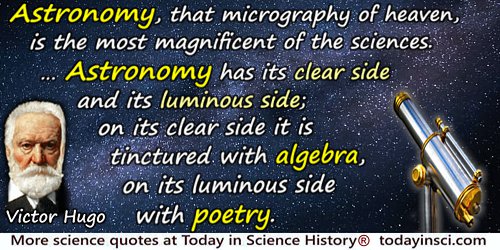
Astronomy, that micrography of heaven, is the most magnificent of the sciences. … Astronomy has its clear side and its luminous side; on its clear side it is tinctured with algebra, on its luminous side with poetry.
In Victor Hugo and Lorenzo O’Rourke (trans.) Victor Hugo’s Intellectual Autobiography: (Postscriptum de ma vie) (1907), 237-8. From the original French (1901): “L'astronomie, cette micrographie d'en haut, est la plus magnifique des sciences … L'astronomie a son côté clair et son côté lumineux ; par le côté clair elle trempe dans l'algèbre, par le côté lumineux dans la poésie.” [Note: The published translation had the typo “micography”, which is corrected herein. —Webmaster]
At about the age of sixteen, I began to feel uneasy. My confidence in adults began to be shaken. They were not smarter than us kids. They just had fixed ideas and stuck to them even if they disagreed among themselves. They were dragging us along a road to an unknown destination; they had no goal, just something to escape from: nature. … It was better to begin to look for a safer, side track. I began to feel like a prisoner calmly preparing to jump off a train that was on a wrong track.
In Ch. 1, 'Farewell to Civilization', Fatu-Hiva (1974), 6.
At Gabriel College there was a very holy object on the high altar of the Oratory, covered with a black velvet cloth... At the height of the invocation the Intercessor lifted the cloth to reveal in the dimness a glass dome inside which there was something too distant to see, until he pulled a string attached to a shutter above, letting a ray of sunlight through to strike the dome exactly. Then it became clear: a little thing like a weathervane, with four sails black on one side and white on the other, began to whirl around as the light struck it. It illustrated a moral lesson, the Intercessor explained, for the black of ignorance fled from the light, whereas the wisdom of white rushed to embrace it.
[Alluding to Crookes's radiometer.]
[Alluding to Crookes's radiometer.]
Northern Lights (2001), 149.
At length being at Clapham where there is, on the common, a large pond which, I observed to be one day very rough with the wind, I fetched out a cruet of oil and dropt a little of it on the water. I saw it spread itself with surprising swiftness upon the surface; but the effect of smoothing the waves was not produced; for I had applied it first on the leeward side of the pond, where the waves were largest, and the wind drove my oil back upon the shore. I then went to the windward side, where they began to form; and there the oil, though not more than a tea-spoonful, produced an instant calm over a space several yards square, which spread amazingly, and extended itself gradually till it reached the leeside, making all that quarter of the pond, perhaps half an acre, as smooth as a looking-glass.
[Experiment to test an observation made at sea in 1757, when he had seen the wake of a ship smoothed, explained by the captain as presumably due to cooks emptying greasy water in to the sea through the scuppers.]
[Experiment to test an observation made at sea in 1757, when he had seen the wake of a ship smoothed, explained by the captain as presumably due to cooks emptying greasy water in to the sea through the scuppers.]
Letter, extract in 'Of the still of Waves by Means of Oil The Gentleman's Magazine (1775), Vol. 45, 82.
At the entrance to the observatory Stjerneborg located underground, Tycho Brahe built a Ionic portal. On top of this were three sculptured lions. On both sides were inscriptions and on the backside was a longer inscription in gold letters on a porfyr stone: Consecrated to the all-good, great God and Posterity. Tycho Brahe, Son of Otto, who realized that Astronomy, the oldest and most distinguished of all sciences, had indeed been studied for a long time and to a great extent, but still had not obtained sufficient firmness or had been purified of errors, in order to reform it and raise it to perfection, invented and with incredible labour, industry, and expenditure constructed various exact instruments suitable for all kinds of observations of the celestial bodies, and placed them partly in the neighbouring castle of Uraniborg, which was built for the same purpose, partly in these subterranean rooms for a more constant and useful application, and recommending, hallowing, and consecrating this very rare and costly treasure to you, you glorious Posterity, who will live for ever and ever, he, who has both begun and finished everything on this island, after erecting this monument, beseeches and adjures you that in honour of the eternal God, creator of the wonderful clockwork of the heavens, and for the propagation of the divine science and for the celebrity of the fatherland, you will constantly preserve it and not let it decay with old age or any other injury or be removed to any other place or in any way be molested, if for no other reason, at any rate out of reverence to the creator’s eye, which watches over the universe. Greetings to you who read this and act accordingly. Farewell!
(Translated from the original in Latin)
Behold the mighty dinosaur,
Famous in prehistoric lore,
Not only for his power and strength
But for his intellectual length.
You will observe by these remains
The creature had two sets of brains—
One in his head (the usual place),
The other at his spinal base.
Thus he could reason 'A priori'
As well as 'A posteriori'.
No problem bothered him a bit
He made both head and tail of it.
So wise was he, so wise and solemn,
Each thought filled just a spinal column.
If one brain found the pressure strong
It passed a few ideas along.
If something slipped his forward mind
'Twas rescued by the one behind.
And if in error he was caught
He had a saving afterthought.
As he thought twice before he spoke
He had no judgment to revoke.
Thus he could think without congestion
Upon both sides of every question.
Oh, gaze upon this model beast
Defunct ten million years at least.
Famous in prehistoric lore,
Not only for his power and strength
But for his intellectual length.
You will observe by these remains
The creature had two sets of brains—
One in his head (the usual place),
The other at his spinal base.
Thus he could reason 'A priori'
As well as 'A posteriori'.
No problem bothered him a bit
He made both head and tail of it.
So wise was he, so wise and solemn,
Each thought filled just a spinal column.
If one brain found the pressure strong
It passed a few ideas along.
If something slipped his forward mind
'Twas rescued by the one behind.
And if in error he was caught
He had a saving afterthought.
As he thought twice before he spoke
He had no judgment to revoke.
Thus he could think without congestion
Upon both sides of every question.
Oh, gaze upon this model beast
Defunct ten million years at least.
'The Dinosaur: A Poem' (1912). In E. H. Colbert (ed.), The Dinosaur Book (1951), 78.
Business men are to be pitied who do not recognize the fact that the largest side of their secular business is benevolence. ... No man ever manages a legitimate business in this life without doing indirectly far more for other men than he is trying to do for himself.
Defining what makes a business legitimate. In Proverbs from Plymouth Pulpit (1887), 44.
But neither thirty years, nor thirty centuries, affect the clearness, or the charm, of Geometrical truths. Such a theorem as “the square of the hypotenuse of a right-angled triangle is equal to the sum of the squares of the sides” is as dazzlingly beautiful now as it was in the day when Pythagoras first discovered it, and celebrated its advent, it is said, by sacrificing a hecatomb of oxen—a method of doing honour to Science that has always seemed to me slightly exaggerated and uncalled-for. One can imagine oneself, even in these degenerate days, marking the epoch of some brilliant scientific discovery by inviting a convivial friend or two, to join one in a beefsteak and a bottle of wine. But a hecatomb of oxen! It would produce a quite inconvenient supply of beef.
Written without pseudonym as Charles L. Dodgson, in Introduction to A New Theory of Parallels (1888, 1890), xvi. Note: a hecatomb is a great public sacrifice, originally of a hundred oxen.
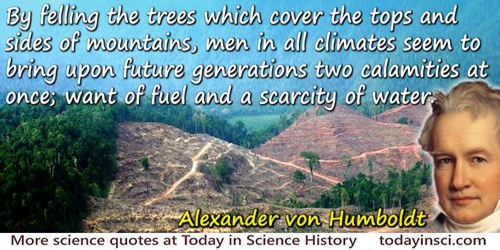
By felling the trees which cover the tops and sides of mountains, men in all climates seem to bring upon future generations two calamities at once; want of fuel and a scarcity of water.
In Alexander von Humboldt, Aimé Bonpland and Thomasina Ross (trans. and ed.) Personal Narrative of Travels to the Equinoctial Regions of America: During the Years 1799-1804 (1852), Vol. 2, 9. (Translated from the original in French.)
Centripetal force is the force by which bodies are drawn from all sides, are impelled, or in any way tend, toward some point as to a center.
The Principia: Mathematical Principles of Natural Philosophy (1687), 3rd edition (1726), trans. I. Bernard Cohen and Anne Whitman (1999), Definition 5, 405.
Chagrined a little that we have been hitherto able to produce nothing in this way of use to mankind; and the hot weather coming on, when electrical experiments are not so agreeable, it is proposed to put an end to them for this season, somewhat humorously, in a party of pleasure, on the banks of Skuylkil. Spirits, at the same time, are to be fired by a spark sent from side to side through the river, without any other conductor that the water; an experiment which we some time since performed, to the amazement of many. A turkey is to be killed for our dinner by the electrified bottle: when the healths of all the famous electricians in England, Holland, France, and Germany are to be drank in electrified bumpers, under the discharge of guns from the electrical battery.
Letter to Peter Collinson, 29 Apr 1749. In I. Bernard Cohen (ed.), Benjamin Franklin's Experiments (1941), 199-200.
Conservation and rural-life policies are really two sides of the same policy; and down at the bottom this policy rests upon the fundamental law that neither man nor nation can prosper unless, in dealing with the present, thought is steadily given for the future.
'Rural Life' (originally published in The Outlook, 27 Aug 1910). In The Works of Theodore Roosevelt. Vol. 16: American Problems (1926), 146.
Consider the hateful brew compounded with gleaming, deadly white lead whose fresh colour is like milk…. Over the victim’s jaws and in the grooves of the gums is plastered an astringent froth, and the furrow of the tongue turns rough on either side, and the depth of the throat grows somewhat dry, and from the pernicious venom follows a dry retching and hawking, for this affliction is severe; meanwhile his spirit sickens and he is worn out with mortal suffering. His body too grows chill, while sometimes his eyes behold strange illusions or else he drowses; nor can he bestir his limbs as heretofore, and he succumbs to the overmastering fatigue.
— Nicander
As translated by A.S.F. Gow and A.F. Scholfield in Nicander: The Poems and Portical Fragments (1953), 99.
Darwin's Origin of Species had come into the theological world like a plough into an ant-hill. Everywhere those thus rudely awakened from their old comfort and repose had swarmed forth angry and confused. Reviews, sermons, books light and heavy, came flying at the new thinker from all sides.
From The Warfare of Science and Theology in Christendom (1898), 70.
Darwin's characteristic perspicacity is nowhere better illustrated than in his prophecy of the reaction of the world of science. He admitted at once that it would be impossible to convince those older men '...whose minds are stocked with a multitude of facts, all viewed ... from a point of view directly opposite to mine ... A few naturalists endowed with much flexibility of mind and who have already begun to doubt the immutability of species, may be influenced by this volume; but I look with confidence to the young and rising naturalists, who will be able to view both sides with equal impartiality.
'The Reaction of American scientists to Darwinism', American Historical Review 1932), 38, 687. Quoted in David L. Hull, Science as Process (), 379.
Descartes' immortal conclusion cogito ergo sum was recently subjected to destruction testing by a group of graduate researchers at Princeton led by Professors Montjuic and Lauterbrunnen, and now reads, in the Shorter Harvard Orthodoxy:
(a) I think, therefore I am; or
(b) Perhaps I thought, therefore I was; but
(c) These days, I tend to leave that side of things to my wife.
(a) I think, therefore I am; or
(b) Perhaps I thought, therefore I was; but
(c) These days, I tend to leave that side of things to my wife.
— Tom Holt
Ye Gods! (1992), 223.
Educators may bring upon themselves unnecessary travail by taking a tactless and unjustifiable position about the relation between scientific and religious narratives. … The point is that profound but contradictory ideas may exist side by side, if they are constructed from different materials and methods and have different purposes. Each tells us something important about where we stand in the universe, and it is foolish to insist that they must despise each other.
In The End of Education: Redefining the Value of School (1995), 107.
Euler was a believer in God, downright and straightforward. The following story is told by Thiebault, in his Souvenirs de vingt ans de séjour à Berlin, … Thiebault says that he has no personal knowledge of the truth of the story, but that it was believed throughout the whole of the north of Europe. Diderot paid a visit to the Russian Court at the invitation of the Empress. He conversed very freely, and gave the younger members of the Court circle a good deal of lively atheism. The Empress was much amused, but some of her counsellors suggested that it might be desirable to check these expositions of doctrine. The Empress did not like to put a direct muzzle on her guest’s tongue, so the following plot was contrived. Diderot was informed that a learned mathematician was in possession of an algebraical demonstration of the existence of God, and would give it him before all the Court, if he desired to hear it. Diderot gladly consented: though the name of the mathematician is not given, it was Euler. He advanced toward Diderot, and said gravely, and in a tone of perfect conviction:
Monsieur, (a + bn) / n = x, donc Dieu existe; repondez!
Diderot, to whom algebra was Hebrew, was embarrassed and disconcerted; while peals of laughter rose on all sides. He asked permission to return to France at once, which was granted.
Diderot, to whom algebra was Hebrew, was embarrassed and disconcerted; while peals of laughter rose on all sides. He asked permission to return to France at once, which was granted.
In Budget of Paradoxes (1878), 251. [The declaration in French expresses, “therefore God exists; please answer!” This Euler-Diderot anecdote, as embellished by De Morgan, is generally regarded as entirely fictional. Diderot before he became an encyclopedist was an accomplished mathematician and fully capable of recognizing—and responding to—the absurdity of an algebraic expression in proving the existence of God. See B.H. Brown, 'The Euler-Diderot Anecdote', The American Mathematical Monthly (May 1942), 49, No. 5, 392-303. —Webmaster.]
Even happiness itself may become habitual. There is a habit of looking at the bright side of things, and also of looking at the dark side. Dr. Johnson has said that the habit of looking at the best side of a thing is worth more to a man than a thousand pounds a year. And we possess the power, to a great extent, of so exercising the will as to direct the thoughts upon objects calculated to yield happiness and improvement rather than their opposites.
In Self-help: With Illustrations of Character and Conduct (1859, 1861), 405-406.
Every gambler stakes a certainty to gain an uncertainty, and yet he stakes a finite certainty against a finite uncertainty without acting unreasonably. … The uncertainty of gain is proportioned to the certainty of the stake, according to the proportion of chances of gain and loss, and if therefore there are as many chances on one side as on the other, the game is even.
In Blaise Pascal and C. Kegan Paul (trans.), 'Of The Need of Seeking Truth', The Thought of Blaise Pascal: Translated from the Text of M. Auguste Molinier (1905), 98.
Every science touches art at some points—every art has its scientific side.
In Armand Trousseau and John Rose Cormack (trans.), Lectures on Clinical Medicine: Delivered at the Hôtel-Dieu, Paris (1869), Vol. 2, 40.
Exper. I. I made a small hole in a window-shutter, and covered it with a piece of thick paper, which I perforated with a fine needle. For greater convenience of observation I placed a small looking-glass without the window-shutter, in such a position as to reflect the sun's light, in a direction nearly horizontal, upon the opposite wall, and to cause the cone of diverging light to pass over a table on which were several little screens of card-paper. I brought into the sunbeam a slip of card, about one-thirtieth of an inch in breadth, and observed its shadow, either on the wall or on other cards held at different distances. Besides the fringes of colour on each side of the shadow, the shadow itself was divided by similar parallel fringes, of smaller dimensions, differing in number, according to the distance at which the shadow was observed, but leaving the middle of the shadow always white. Now these fringes were the joint effects of the portions of light passing on each side of the slip of card and inflected, or rather diffracted, into the shadow. For, a little screen being placed a few inches from the card, so as to receive either edge of the shadow on its margin, all the fringes which had before been observed in the shadow on the wall, immediately disappeared, although the light inflected on the other side was allowed to retain its course, and although this light must have undergone any modification that the proximity of the other edge of the slip of card might have been capable of occasioning... Nor was it for want of a sufficient intensity of light that one of the two portions was incapable of producing the fringes alone; for when they were both uninterrupted, the lines appeared, even if the intensity was reduced to one-tenth or one-twentieth.
'Experiments and Calculations Relative to Physical Optics' (read in 1803), Philosophical Transactions (1804), 94, 2-3.
Experience hobbles progress and leads to abandonment of difficult problems; it encourages the initiated to walk on the shady side of the street in the direction of experiences that have been pleasant. Youth without experience attacks the unsolved problems which maturer age with experience avoids, and from the labors of youth comes progress. Youth has dreams and visions, and will not be denied.
From speech 'In the Time of Henry Jacob Bigelow', given to the Boston Surgical Society, Medalist Meeting (6 Jun 1921). Printed in Journal of the Medical Association (1921), 77, 599.
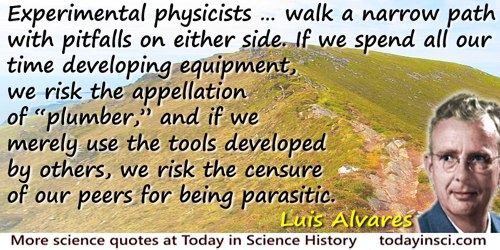
Experimental physicists … walk a narrow path with pitfalls on either side. If we spend all our time developing equipment, we risk the appellation of “plumber,” and if we merely use the tools developed by others, we risk the censure of our peers for being parasitic.
In Nobel Lecture (11 Dec 1968), 'Recent Developments in Particle Physics', collected in Nobel Lectures: Physics 1963-1970 (1972), 241.
First, as concerns the success of teaching mathematics. No instruction in the high schools is as difficult as that of mathematics, since the large majority of students are at first decidedly disinclined to be harnessed into the rigid framework of logical conclusions. The interest of young people is won much more easily, if sense-objects are made the starting point and the transition to abstract formulation is brought about gradually. For this reason it is psychologically quite correct to follow this course.
Not less to be recommended is this course if we inquire into the essential purpose of mathematical instruction. Formerly it was too exclusively held that this purpose is to sharpen the understanding. Surely another important end is to implant in the student the conviction that correct thinking based on true premises secures mastery over the outer world. To accomplish this the outer world must receive its share of attention from the very beginning.
Doubtless this is true but there is a danger which needs pointing out. It is as in the case of language teaching where the modern tendency is to secure in addition to grammar also an understanding of the authors. The danger lies in grammar being completely set aside leaving the subject without its indispensable solid basis. Just so in Teaching of Mathematics it is possible to accumulate interesting applications to such an extent as to stunt the essential logical development. This should in no wise be permitted, for thus the kernel of the whole matter is lost. Therefore: We do want throughout a quickening of mathematical instruction by the introduction of applications, but we do not want that the pendulum, which in former decades may have inclined too much toward the abstract side, should now swing to the other extreme; we would rather pursue the proper middle course.
Not less to be recommended is this course if we inquire into the essential purpose of mathematical instruction. Formerly it was too exclusively held that this purpose is to sharpen the understanding. Surely another important end is to implant in the student the conviction that correct thinking based on true premises secures mastery over the outer world. To accomplish this the outer world must receive its share of attention from the very beginning.
Doubtless this is true but there is a danger which needs pointing out. It is as in the case of language teaching where the modern tendency is to secure in addition to grammar also an understanding of the authors. The danger lies in grammar being completely set aside leaving the subject without its indispensable solid basis. Just so in Teaching of Mathematics it is possible to accumulate interesting applications to such an extent as to stunt the essential logical development. This should in no wise be permitted, for thus the kernel of the whole matter is lost. Therefore: We do want throughout a quickening of mathematical instruction by the introduction of applications, but we do not want that the pendulum, which in former decades may have inclined too much toward the abstract side, should now swing to the other extreme; we would rather pursue the proper middle course.
In Ueber den Mathematischen Unterricht an den hoheren Schulen; Jahresbericht der Deutschen Mathematiker Vereinigung, Bd. 11, 131.
![Christiaan Barnard quote: For a dying man it is not a difficult decision [to agree to become the world’s first heart transplant]](https://todayinsci.com/B/Barnard_Christiaan/BarnardChristiaan-Decision500x250px.jpg)
For a dying man it is not a difficult decision [to agree to become the world's first heart transplant] … because he knows he is at the end. If a lion chases you to the bank of a river filled with crocodiles, you will leap into the water convinced you have a chance to swim to the other side. But you would not accept such odds if there were no lion.
In Janie B. Butts and Karen Rich, Nursing Ethics (2005), 59.
For all these years you were merely
A smear of light through our telescopes
On the clearest, coldest night; a hint
Of a glint, just a few pixels wide
On even your most perfectly-framed portraits.
But now, now we see you!
Swimming out of the dark - a great
Stone shark, your star-tanned skin pitted
And pocked, scarred after eons of drifting
Silently through the endless ocean of space.
Here on Earth our faces lit up as we saw
You clearly for the first time; eyes wide
With wonder we traced the strangely familiar
Grooves raked across your sides,
Wondering if Rosetta had doubled back to Mars
And raced past Phobos by mistake –
Then you were gone, falling back into the black,
Not to be seen by human eyes again for a thousand
Blue Moons or more. But we know you now,
We know you; you’ll never be just a speck of light again.
A smear of light through our telescopes
On the clearest, coldest night; a hint
Of a glint, just a few pixels wide
On even your most perfectly-framed portraits.
But now, now we see you!
Swimming out of the dark - a great
Stone shark, your star-tanned skin pitted
And pocked, scarred after eons of drifting
Silently through the endless ocean of space.
Here on Earth our faces lit up as we saw
You clearly for the first time; eyes wide
With wonder we traced the strangely familiar
Grooves raked across your sides,
Wondering if Rosetta had doubled back to Mars
And raced past Phobos by mistake –
Then you were gone, falling back into the black,
Not to be seen by human eyes again for a thousand
Blue Moons or more. But we know you now,
We know you; you’ll never be just a speck of light again.
…...
For me, the first challenge for computing science is to discover how to maintain order in a finite, but very large, discrete universe that is intricately intertwined. And a second, but not less important challenge is how to mould what you have achieved in solving the first problem, into a teachable discipline: it does not suffice to hone your own intellect (that will join you in your grave), you must teach others how to hone theirs. The more you concentrate on these two challenges, the clearer you will see that they are only two sides of the same coin: teaching yourself is discovering what is teachable.
…...
For strictly scientific or technological purposes all this is irrelevant. On a pragmatic view, as on a religious view, theory and concepts are held in faith. On the pragmatic view the only thing that matters is that the theory is efficacious, that it “works” and that the necessary preliminaries and side issues do not cost too much in time and effort. Beyond that, theory and concepts go to constitute a language in which the scientistic matters at issue can be formulated and discussed.
In Nobel Lecture (8 Dec 1994), 'Slow Neutron Spectroscopy and the Grand Atlas of the Physical World', Nobel Lectures: Physics 1991-1995 (1997), 111.
For they are not given to idleness, nor go in a proud habit, or plush and velvet garments, often showing their rings upon their fingers, or wearing swords with silver hilts by their sides, or fine and gay gloves upon their hands, but diligently follow their labours, sweating whole days and nights by their furnaces. They do not spend their time abroad for recreation, but take delight in their laboratory. They wear leather garments with a pouch, and an apron wherewith they wipe their hands. They put their fingers amongst coals, into clay, and filth, not into gold rings. They are sooty and black like smiths and colliers, and do not pride themselves upon clean and beautiful faces.
As translated in Paracelsus and Arthur Edward Waite (ed.), The Hermetic and Alchemical Writings of Paracelsus (1894, 1976), Vol. 1, 167.
For, as the element of water lies in the middle of the globe, so, the branches run out from the root in its circuit on all sides towards the plains and towards the light. From this root very many branches are born. One branch is the Rhine, another the Danube, another the Nile, etc.
'The Philosophy of the Generation of the Elements', Book the Fourth, Text II. In The Hermetic and Alchemical Writings of Aureolus Philippus Theophrastus Bombast, of Hohenheim, called Paracelsus the Great, trans. A. E. Waite (1894), Vol. 1, 232.
Fragments of the natural method must be sought with the greatest care. This is the first and last desideratum among botanists.
Nature makes no jumps.
[Natura non facit saltus]
All taxa show relationships on all sides like the countries on a map of the world.
Nature makes no jumps.
[Natura non facit saltus]
All taxa show relationships on all sides like the countries on a map of the world.
Philosophia Botanica (1751), aphorism 77. Trans. Frans A. Stafleu, Linnaeus and the Linnaeans: The Spreading of their Ideas in Systematic Botany, 1735-1789 (1971), 45.
From common salt are obtained chemically as primary derivatives chlorine—both a war gas and a means of purifying water; and 'caustic soda.' … [O]n the chlorine side there is obtained chloride of lime, (a bleaching powder and a disinfectant), chloroform (an anesthetic), phosgene (a frightful ware gas), chloroacetophenone (another war gas), and an indigo and a yellow dye. [O]n the soda side we get metallic sodium, from which are derived sodium cyanide (a disinfectant), two medicines with [long] names, another war gas, and a beautiful violet dye. Thus, from a healthful, preservative condiment come things useful and hurtful—according to the intent or purpose.
The Homiletic Review, Vol. 83-84 (1922), Vol. 83, 209.
From the rocket we can see the huge sphere of the planet in one or another phase of the Moon. We can see how the sphere rotates, and how within a few hours it shows all its sides successively ... and we shall observe various points on the surface of the Earth for several minutes and from different sides very closely. This picture is so majestic, attractive and infinitely varied that I wish with all my soul that you and I could see it. (1911)
As translated in William E. Burrows, The Survival Imperative: Using Space to Protect Earth (2007), 147. From Tsiolkovsky's 'The Investigation of Universal Space by Means of Reactive Devices', translated in K.E. Tsiolkovsky, Works on Rocket Technology (NASA, NASATT F-243, n.d.), 76-77.
Further, the same Arguments which explode the Notion of Luck, may, on the other side, be useful in some Cases to establish a due comparison between Chance and Design: We may imagine Chance and Design to be, as it were, in Competition with each other, for the production of some sorts of Events, and many calculate what Probability there is, that those Events should be rather be owing to the one than to the other.
Doctrine of Chances (1718), Preface, v.
Having made a sufficient opening to admit my finger into the abdomen, I passed it between the intestines to the spine, and felt the aorta greatly enlarged, and beating with excessive force. By means of my finger nail, I scratched through the peritoneum on the left side of the aorta, and then gradually passed my finger between the aorta and the spine, and again penetrated the peritoneum, on the right side of the aorta. I had now my finger under the artery, and by its side I conveyed the blunt aneurismal needle, armed with a single ligature behind it...
Describing the first ligation of the aorta in 1817 for left femoral aneurysm.
Describing the first ligation of the aorta in 1817 for left femoral aneurysm.
Frederick Tyrell (Ed.), 'Lecture 15, On the Operation for Aneurism', The Lectures of Sir Astley Cooper (1824), Vol. 2, 58.
He is unworthy of the name of man who is ignorant of the fact that the diagonal of a square is incommensurable with its side.
— Plato
Quoted by Sophie Germain: Mémorie sur les Surfaces Élastiques. In Robert Édouard Moritz, Memorabilia Mathematica (1914), 211
Here I most violently want you to
Avoid one fearful error, a vicious flaw.
Don’t think that our bright eyes were made that we
Might look ahead; that hips and knees and ankles
So intricately bend that we might take
Big strides, and the arms are strapped to the sturdy shoulders
And hands are given for servants to each side
That we might use them to support our lives.
All other explanations of this sort
Are twisted, topsy-turvy logic, for
Nothing what is born produces its own use.
Sight was not born before the light of the eyes,
Nor were words and pleas created before the tongue
Rather the tongue's appearance long preceded
Speech, and the ears were formed far earlier than
The sound first heard. To sum up, all the members
Existed, I should think, before their use,
So use has not caused them to have grown.
Avoid one fearful error, a vicious flaw.
Don’t think that our bright eyes were made that we
Might look ahead; that hips and knees and ankles
So intricately bend that we might take
Big strides, and the arms are strapped to the sturdy shoulders
And hands are given for servants to each side
That we might use them to support our lives.
All other explanations of this sort
Are twisted, topsy-turvy logic, for
Nothing what is born produces its own use.
Sight was not born before the light of the eyes,
Nor were words and pleas created before the tongue
Rather the tongue's appearance long preceded
Speech, and the ears were formed far earlier than
The sound first heard. To sum up, all the members
Existed, I should think, before their use,
So use has not caused them to have grown.
On the Nature of Things, trans. Anthony M. Esolen (1995), Book 4, lines 820-8, 145.
Heredity is to-day the central problem of biology. This problem may be approached from many sides—that of the breeder, the experimenter, the statistician, the physiologist, the embryologist, the cytologist—but the mechanism of heredity can be studied best by the investigation of the germ cells and their development.
From Address of the vice-president and chairman of Section F, Zoology, American Association for the Advancement of Science, Chicago Meeting (1907-8). Published in 'The Mechanism of Heredity', Science (17 Jan 1908), 27, No. 691, 89-90.
Honest pioneer work in the field of science has always been, and will continue to be, life’s pilot. On all sides, life is surrounded by hostility. This puts us under an obligation.
In Function of the Orgasm: Discovery of the Orgone (1927, 1973), 37.
How came it to pass that a man with no peculiar advantages of early education grew to be so many-sided as Shakespeare, and with every side so equal?
From 'The Genius of Nathaniel Hawthorne', North American Review (Sep 1879), No. 274, 203. Collected in Anthony Trollope, Miscellaneous Essays and Reviews (1981).
How twins are born my discourse will explain thus. The cause is chiefly the nature of the womb in woman. For if it has grown equally on either side of its mouth, and if it opens equally, and also dries equally after menstruation, it can give nourishment, if it conceive the secretion of the man so that it immediately divides into both parts of the womb equally. Now if the seed secreted from both parents be abundant and strong, it can grow in both places, as it masters the nourishment that reaches it. In all other cases twins are not formed. Now when the secretion from both parents is male, of necessity boys are begotten in both places; but when from both it is female, girls are begotten. But when one secretion is female and the other male, whichever masters the other gives the embryo its sex. Twins are like one another for the following reasons. First, the places are alike in which they grow; then they were secreted together; then they grow by the same nourishment, and at birth they reach together the light of day.
Regimen, in Hippocrates, trans. W. H. S. Jones (1931), Vol. 4, 273.
Human nature is not a machine to be built after a model, and set to do exactly the work prescribed for it, but a tree, which requires to grow and develop itself on all sides, according to the tendency of the inward forces which make it a living thing.
In 'Elements of Well-Being', On Liberty (1859), 107.
I am afraid all we can do is to accept the paradox and try to accommodate ourselves to it, as we have done to so many paradoxes lately in modern physical theories. We shall have to get accustomed to the idea that the change of the quantity R, commonly called the 'radius of the universe', and the evolutionary changes of stars and stellar systems are two different processes, going on side by side without any apparent connection between them. After all the 'universe' is an hypothesis, like the atom, and must be allowed the freedom to have properties and to do things which would be contradictory and impossible for a finite material structure.
Kosmos (1932), 133.
I am willing to believe that my unobtainable sixty seconds within a sponge or a flatworm might not reveal any mental acuity that I would care to ca ll consciousness. But I am also confident ... that vultures and sloths, as close evolutionary relatives with the same basic set of organs, lie on our side of any meaningful (and necessarily fuzzy) border–and that we are therefore not mistaken when we look them in the eye and see a glimmer of emotional and conceptual affinity.
…...
I do not want to label myself a crystallographer as against a physicist and think indeed that though my research is concerned with crystals it is the physical side of it which attracts me.
In Letter (3 Jun 1929) to Ernest Rutherford, in Royal Society Archives, as quoted in David Phillips, Biographical Memoirs of Fellows of the Royal Society (Nov 1979), 25, 104.
I feel very strongly indeed that a Cambridge education for our scientists should include some contact with the humanistic side. The gift of expression is important to them as scientists; the best research is wasted when it is extremely difficult to discover what it is all about ... It is even more important when scientists are called upon to play their part in the world of affairs, as is happening to an increasing extent.
From essay in Thomas Rice Henn, The Apple and the Spectroscope: Being Lectures on Poetry Designed (in the Main) for Science Students (1951), 142.
I hear the scream of a great hawk, sailing with a ragged wing against the high wood-side, apparently to scare his prey and so detect it—shrill, harsh, fitted to excite terror in sparrows and to issue from his split and curved bill. I see his open bill the while against the sky. Spit with force from his mouth with an undulatory quaver imparted to it from his wings or motion as he flies.
(15 Jun 1852). In Henry David Thoreau and Bradford Torrey (ed.), The Writings of Henry Thoreau: Journal: IV: May 1, 1852-February 27,, 1853 (1906), 103.
I laughed … till my sides were sore.
British geologist, describing, in a letter to Charles Darwin, his reaction to On the Origin of Species, in Facts and Fallacies by Chris Morgan and David Langford (1981).
I prefer the spagyric chemical physicians, for they do not consort with loafers or go about gorgeous in satins, silks and velvets, gold rings on their fingers, silver daggers hanging at their sides and white gloves on their hands, but they tend their work at the fire patiently day and night. They do not go promenading, but seek their recreation in the laboratory, wear plain learthern dress and aprons of hide upon which to wipe their hands, thrust their fingers amongst the coals, into dirt and rubbish and not into golden rings. They are sooty and dirty like the smiths and charcoal burners, and hence make little show, make not many words and gossip with their patients, do not highly praise their own remedies, for they well know that the work must praise the master, not the master praise his work. They well know that words and chatter do not help the sick nor cure them... Therefore they let such things alone and busy themselves with working with their fires and learning the steps of alchemy. These are distillation, solution, putrefaction, extraction, calcination, reverberation, sublimination, fixation, separation, reduction, coagulation, tinction, etc.
Quoted in R. Oesper, The Human Side of Scientists (1975), 150. [Spagyric is a form of herbalism based on alchemic procedures of preparation.]
I venture to maintain, that, if the general culture obtained in the Faculty of Arts were what it ought to be, the student would have quite as much knowledge of the fundamental principles of Physics, of Chemistry, and of Biology, as he needs, before he commenced his special medical studies. Moreover, I would urge, that a thorough study of Human Physiology is, in itself, an education broader and more comprehensive than much that passes under that name. There is no side of the intellect which it does not call into play, no region of human knowledge into which either its roots, or its branches, do not extend; like the Atlantic between the Old and the New Worlds, its waves wash the shores of the two worlds of matter and of mind; its tributary streams flow from both; through its waters, as yet unfurrowed by the keel of any Columbus, lies the road, if such there be, from the one to the other; far away from that Northwest Passage of mere speculation, in which so many brave souls have been hopelessly frozen up.
'Universities: Actual and Ideal' (1874). In Collected Essays (1893), Vol. 3, 220.
I view the major features of my own odyssey as a set of mostly fortunate contingencies. I was not destined by inherited mentality or family tradition to become a paleontologist. I can locate no tradition for scientific or intellectual careers anywhere on either side of my eastern European Jewish background ... I view my serious and lifelong commitment to baseball in entirely the same manner: purely as a contingent circumstance of numerous, albeit not entirely capricious, accidents.
…...
I was the only female in my class. I sat on one side of the room and the guys on the other side of the room. I guess they didn't want to associate with me. But I could hold my own with them, and sometimes did better.
In interview with Laurel M. Sheppard, 'An Interview with Mary Ross: First Native American Woman Engineer Aerospace Pioneer Returns to her Native American Roots', on website of Lash Publications.
I’m doing my part, building plants at a record rate, having historic conservation levels. The only people not doing their part is the federal government that is siding with the energy companies against the interests of the people of California.
…...
I’m just a speck, standing on this big planet. … The Earth is orbiting the Sun, and the Sun is a huge star. And our star may be a big deal to us, but, my friends, our star is just another speck. … It’s not really in downtown Milky Way, it’s way out on the side. … I'm a speck, living on a speck, orbiting a speck in the middle of specklessness. But … I have this brain … to think about all of this. To think about the vast emptiness of space. I can reason that I'm a speck on a speck in the middle of specklessness. And that’s cool. That’s worthy of respect.
— Bill Nye
From narration to PBS TV program, 'Astrobiology', The Eyes of Nye (2005), Ep. 1, Introduction before titles. Also seen quoted as: “We are just a speck, on a speck, orbiting a speck, in the corner of a speck, in the middle of nowhere.”
If the atoms in [a] decimetre cube of lead were all put into a chain side by side the same distance apart as they are in the normal lead, the strings of atoms so formed would reach over six million million miles.
In Lecture (1936) on 'Forty Years of Atomic Theory', collected in Needham and Pagel (eds.) in Background to Modern Science: Ten Lectures at Cambridge Arranged by the History of Science Committee, (1938), 99.
If you are on the side whence the wind is blowing you will see the trees looking much lighter than you would see them on the other sides; and this is due to the fact that the wind turns up the reverse side of the leaves which in all trees is much whiter than the upper side.
…...
In attempting to explain geological phenomena, the bias has always been on the wrong side; there has always been a disposition to reason á priori on the extraordinary violence and suddenness of changes, both in the inorganic crust of the earth, and in organic types, instead of attempting strenuously to frame theories in accordance with the ordinary operations of nature.
Letter to Rev. W. Whewell (7 Mar 1837). Quoted in Mrs Lyell (ed.), Life, Letters and Journals of Sir Charles Lyell, Bart (1881), Vol. 2, 3.
In defining an element let us not take an external boundary, Let us say, e.g., the smallest ponderable quantity of yttrium is an assemblage of ultimate atoms almost infinitely more like each other than they are to the atoms of any other approximating element. It does not necessarily follow that the atoms shall all be absolutely alike among themselves. The atomic weight which we ascribe to yttrium, therefore, merely represents a mean value around which the actual weights of the individual atoms of the “element” range within certain limits. But if my conjecture is tenable, could we separate atom from atom, we should find them varying within narrow limits on each side of the mean.
Address to Annual General Meeting of the Chemical Society (28 Mar 1888), printed in Journal of the Chemical Society (1888), 491.
In early life I had felt a strong desire to devote myself to the experimental study of nature; and, happening to see a glass containing some camphor, portions of which had been caused to condense in very beautiful crystals on the illuminated side, I was induced to read everything I could obtain respecting the chemical and mechanical influences of light, adhesion, and capillary attraction.
In preface to Scientific Memoirs (1878), xii.
In early times, medicine was an art, which took its place at the side of poetry and painting; to-day, they try to make a science of it, placing it beside mathematics, astronomy, and physics.
In Armand Trousseau and John Rose Cormack (trans.), Lectures on Clinical Medicine: Delivered at the Hôtel-Dieu, Paris (1869), Vol. 2, 40.
In early times, when the knowledge of nature was small, little attempt was made to divide science into parts, and men of science did not specialize. Aristotle was a master of all science known in his day, and wrote indifferently treatises on physics or animals. As increasing knowledge made it impossible for any one man to grasp all scientific subjects, lines of division were drawn for convenience of study and of teaching. Besides the broad distinction into physical and biological science, minute subdivisions arose, and, at a certain stage of development, much attention was, given to methods of classification, and much emphasis laid on the results, which were thought to have a significance beyond that of the mere convenience of mankind.
But we have reached the stage when the different streams of knowledge, followed by the different sciences, are coalescing, and the artificial barriers raised by calling those sciences by different names are breaking down. Geology uses the methods and data of physics, chemistry and biology; no one can say whether the science of radioactivity is to be classed as chemistry or physics, or whether sociology is properly grouped with biology or economics. Indeed, it is often just where this coalescence of two subjects occurs, when some connecting channel between them is opened suddenly, that the most striking advances in knowledge take place. The accumulated experience of one department of science, and the special methods which have been developed to deal with its problems, become suddenly available in the domain of another department, and many questions insoluble before may find answers in the new light cast upon them. Such considerations show us that science is in reality one, though we may agree to look on it now from one side and now from another as we approach it from the standpoint of physics, physiology or psychology.
But we have reached the stage when the different streams of knowledge, followed by the different sciences, are coalescing, and the artificial barriers raised by calling those sciences by different names are breaking down. Geology uses the methods and data of physics, chemistry and biology; no one can say whether the science of radioactivity is to be classed as chemistry or physics, or whether sociology is properly grouped with biology or economics. Indeed, it is often just where this coalescence of two subjects occurs, when some connecting channel between them is opened suddenly, that the most striking advances in knowledge take place. The accumulated experience of one department of science, and the special methods which have been developed to deal with its problems, become suddenly available in the domain of another department, and many questions insoluble before may find answers in the new light cast upon them. Such considerations show us that science is in reality one, though we may agree to look on it now from one side and now from another as we approach it from the standpoint of physics, physiology or psychology.
In article 'Science', Encyclopedia Britannica (1911), 402.
In one department of his [Joseph Black’s] lecture he exceeded any I have ever known, the neatness and unvarying success with which all the manipulations of his experiments were performed. His correct eye and steady hand contributed to the one; his admirable precautions, foreseeing and providing for every emergency, secured the other. I have seen him pour boiling water or boiling acid from a vessel that had no spout into a tube, holding it at such a distance as made the stream’s diameter small, and so vertical that not a drop was spilt. While he poured he would mention this adaptation of the height to the diameter as a necessary condition of success. I have seen him mix two substances in a receiver into which a gas, as chlorine, had been introduced, the effect of the combustion being perhaps to produce a compound inflammable in its nascent state, and the mixture being effected by drawing some string or wire working through the receiver's sides in an air-tight socket. The long table on which the different processes had been carried on was as clean at the end of the lecture as it had been before the apparatus was planted upon it. Not a drop of liquid, not a grain of dust remained.
In Lives of Men of Letters and Science, Who Flourished in the Time of George III (1845), 346-7.
In right-angled triangles the square on the side subtending the right angle is equal to the squares on the sides containing the right angle.
— Euclid
The Thirteen Books of Euclid's Elements Translated from the Text of Heiberg, introduction and commentary by Sir T. L. Heath (1926), Vol. 1, 349.
In the case of a Christian clergyman, the tragic-comical is found in this: that the Christian religion demands love from the faithful, even love for the enemy. This demand, because it is indeed superhuman, he is unable to fulfill. Thus intolerance and hatred ring through the oily words of the clergyman. The love, which on the Christian side is the basis for the conciliatory attempt towards Judaism is the same as the love of a child for a cake. That means that it contains the hope that the object of the love will be eaten up.
…...
In the case of those solids, whether of earth, or rock, which enclose on all sides and contain crystals, selenites, marcasites, plants and their parts, bones and the shells of animals, and other bodies of this kind which are possessed of a smooth surface, these same bodies had already become hard at the time when the matter of the earth and rock containing them was still fluid. And not only did the earth and rock not produce the bodies contained in them, but they did not even exist as such when those bodies were produced in them.
The Prodromus of Nicolaus Steno's Dissertation Concerning a Solid Body enclosed by Process of Nature within a Solid (1669), trans. J. G. Winter (1916), 218.
In the mathematical investigations I have usually employed such methods as present themselves naturally to a physicist. The pure mathematician will complain, and (it must be confessed) sometimes with justice, of deficient rigour. But to this question there are two sides. For, however important it may be to maintain a uniformly high standard in pure mathematics, the physicist may occasionally do well to rest content with arguments which are fairly satisfactory and conclusive from his point of view. To his mind, exercised in a different order of ideas, the more severe procedure of the pure mathematician may appear not more but less demonstrative. And further, in many cases of difficulty to insist upon the highest standard would mean the exclusion of the subject altogether in view of the space that would be required.
In Preface to second edition, The Theory of Sound (1894), Vol. 1, vii.
In the training and in the exercise of medicine a remoteness abides between the field of neurology and that of mental health, psychiatry. It is sometimes blamed to prejudice on the part of the one side or the other. It is both more grave and less grave than that. It has a reasonable basis. It is rooted in the energy-mind problem. Physiology has not enough to offer about the brain in relation to the mind to lend the psychiatrist much help.
In 'The Brain Collaborates With Psyche', Man On His Nature: The Gifford Lectures, Edinburgh 1937-8 (1940), 283.
In the whole of geophysics there is probably hardly another law of such clarity and reliability as this—that there are two preferential levels for the world’s surface which occur in alternation side by side and are represented by the continents and the ocean floors, respectively. It is therefore very surprising that scarcely anyone has tried to explain this law.
In The Origins of Continents and Oceans (4th ed. 1929), trans. John Biram (1966), 37.
In the year of chan yan..., Jupiter was in [the Zodiacal Division of] Zi, it rose in the morning and went under in the evening together with the Lunar Mansions Xunu, Xu and Wei. It was very large and bright. Apparently, there was a small reddish (chi) star appended (fu) to its side. This is called “an alliance” (tong meng).
— Gan De
As given in Chinese Astronomy and Astrophysics (1981), 5, 242.

In these strenuous times, we are likely to become morbid and look constantly on the dark side of life, and spend entirely too much time considering and brooding over what we can't do, rather than what we can do, and instead of growing morose and despondent over opportunities either real or imaginary that are shut from us, let us rejoice at the many unexplored fields in which there is unlimited fame and fortune to the successful explorer and upon which there is no color line; simply the survival of the fittest.
In article urging African-Americans to engage in plant breeding to develop improved species.'A New Industry for Colored Men and Women', Colored American (Jan 1908, 14, 33. Cited in Linda O. McMurry, George Washington Carver, Scientist and Symbol (1982), 109.
In this age of space flight, when we use the modern tools of science to advance into new regions of human activity, the Bible ... this grandiose, stirring history of the gradual revelation and unfolding of the moral law ... remains in every way an up-to-date book. Our knowledge and use of the laws of nature that enable us to fly to the Moon also enable us to destroy our home planet with the atom bomb. Science itself does not address the question whether we should use the power at our disposal for good or for evil. The guidelines of what we ought to do are furnished in the moral law of God. It is no longer enough that we pray that God may be with us on our side. We must learn again that we may be on God's side.
Quoted in Bob Phillips, Phillips' Book of Great Thoughts & Funny Sayings (1993), 42.
Inasmuch as science represents one way of dealing with the world, it does tend to separate its practitioners from the rest. Being a scientist resembles membership of a religious order and a scientist usually finds that he has more in common with a colleague on the other side of the world than with his next-door neighbor.
In A Dictionary of Scientific Quotations (1991).
Is there a God? Who knows? Is there an angry unicorn on the dark side of the moon?
In 'Philosophy, Religion, and So Forth', A Voice Crying in the Wilderness (1989), 2.
It did not cause anxiety that Maxwell’s equations did not apply to gravitation, since nobody expected to find any link between electricity and gravitation at that particular level. But now physics was faced with an entirely new situation. The same entity, light, was at once a wave and a particle. How could one possibly imagine its proper size and shape? To produce interference it must be spread out, but to bounce off electrons it must be minutely localized. This was a fundamental dilemma, and the stalemate in the wave-photon battle meant that it must remain an enigma to trouble the soul of every true physicist. It was intolerable that light should be two such contradictory things. It was against all the ideals and traditions of science to harbor such an unresolved dualism gnawing at its vital parts. Yet the evidence on either side could not be denied, and much water was to flow beneath the bridges before a way out of the quandary was to be found. The way out came as a result of a brilliant counterattack initiated by the wave theory, but to tell of this now would spoil the whole story. It is well that the reader should appreciate through personal experience the agony of the physicists of the period. They could but make the best of it, and went around with woebegone faces sadly complaining that on Mondays, Wednesdays, and Fridays they must look on light as a wave; on Tuesdays, Thursdays, and Saturdays, as a particle. On Sundays they simply prayed.
The Strange Story of the Quantum (1947), 42.
It has been said repeatedly that one can never, try as he will, get around to the front of the universe. Man is destined to see only its far side, to realize nature only in retreat.
In 'The Innocent Fox,' The Star Thrower (1978), 63.
It is a happy world after all. The air, the earth, the water teem with delighted existence. In a spring noon, or a summer evening, on whichever side I turn my eyes, myriads of happy beings crowd upon my view. “The insect youth are on the wing.” Swarms of new-born flies are trying their pinions in the air. Their sportive motions, their wanton mazes, their gratuitous activity testify their joy and the exultation they feel in their lately discovered faculties … The whole winged insect tribe, it is probable, are equally intent upon their proper employments, and under every variety of constitution, gratified, and perhaps equally gratified, by the offices which the author of their nature has assigned to them.
Natural Theology: or, Evidences of the Existence and Attributes of The Deity, Collected from the Appearances of Nature (1802), 490-1.
It is difficult to conceive a grander mass of vegetation:—the straight shafts of the timber-trees shooting aloft, some naked and clean, with grey, pale, or brown bark; others literally clothed for yards with a continuous garment of epiphytes, one mass of blossoms, especially the white Orchids Caelogynes, which bloom in a profuse manner, whitening their trunks like snow. More bulky trunks were masses of interlacing climbers, Araliaceae, Leguminosae, Vines, and Menispermeae, Hydrangea, and Peppers, enclosing a hollow, once filled by the now strangled supporting tree, which has long ago decayed away. From the sides and summit of these, supple branches hung forth, either leafy or naked; the latter resembling cables flung from one tree to another, swinging in the breeze, their rocking motion increased by the weight of great bunches of ferns or Orchids, which were perched aloft in the loops. Perpetual moisture nourishes this dripping forest: and pendulous mosses and lichens are met with in profusion.
Himalayan Journals (1854), vol. 1, 110-1.
It is impossible for a Die, with such determin'd force and direction, not to fall on such determin'd side, only I don't know the force and direction which makes it fall on such determin'd side, and therefore I call it Chance, which is nothing but the want of art.... .
Of the Laws of Chance (1692), preface
It is the task of science, as a collective human undertaking, to describe from the external side, (on which alone agreement is possible), such statistical regularity as there is in a world “in which every event has a unique aspect, and to indicate where possible the limits of such description. It is not part of its task to make imaginative interpretation of the internal aspect of reality—what it is like, for example, to be a lion, an ant or an ant hill, a liver cell, or a hydrogen ion. The only qualification is in the field of introspective psychology in which each human being is both observer and observed, and regularities may be established by comparing notes. Science is thus a limited venture. It must act as if all phenomena were deterministic at least in the sense of determinable probabilities. It cannot properly explain the behaviour of an amoeba as due partly to surface and other physical forces and partly to what the amoeba wants to do, with out danger of something like 100 per cent duplication. It must stick to the former. It cannot introduce such principles as creative activity into its interpretation of evolution for similar reasons. The point of view indicated by a consideration of the hierarchy of physical and biological organisms, now being bridged by the concept of the gene, is one in which science deliberately accepts a rigorous limitation of its activities to the description of the external aspects of events. In carrying out this program, the scientist should not, however, deceive himself or others into thinking that he is giving an account of all of reality. The unique inner creative aspect of every event necessarily escapes him.
In 'Gene and Organism', American Naturalist, (1953), 87, 17.
It... [can] be easily shown:
1. That all present mountains did not exist from the beginning of things.
2. That there is no growing of mountains.
3. That the rocks or mountains have nothing in common with the bones of animals except a certain resemblance in hardness, since they agree in neither matter nor manner of production, nor in composition, nor in function, if one may be permitted to affirm aught about a subject otherwise so little known as are the functions of things.
4. That the extension of crests of mountains, or chains, as some prefer to call them, along the lines of certain definite zones of the earth, accords with neither reason nor experience.
5. That mountains can be overthrown, and fields carried over from one side of a high road across to the other; that peaks of mountains can be raised and lowered, that the earth can be opened and closed again, and that other things of this kind occur which those who in their reading of history wish to escape the name of credulous, consider myths.
1. That all present mountains did not exist from the beginning of things.
2. That there is no growing of mountains.
3. That the rocks or mountains have nothing in common with the bones of animals except a certain resemblance in hardness, since they agree in neither matter nor manner of production, nor in composition, nor in function, if one may be permitted to affirm aught about a subject otherwise so little known as are the functions of things.
4. That the extension of crests of mountains, or chains, as some prefer to call them, along the lines of certain definite zones of the earth, accords with neither reason nor experience.
5. That mountains can be overthrown, and fields carried over from one side of a high road across to the other; that peaks of mountains can be raised and lowered, that the earth can be opened and closed again, and that other things of this kind occur which those who in their reading of history wish to escape the name of credulous, consider myths.
The Prodromus of Nicolaus Steno's Dissertation Concerning a Solid Body enclosed by Process of Nature within a Solid (1669), trans. J. G. Winter (1916), 232-4.
Jupiter was very large and bright. Apparently, there was a small reddish star appended to its side. This is called “an alliance.”
[Observation in summer 365 B.C., speculated to be of Ganymede.]
[Observation in summer 365 B.C., speculated to be of Ganymede.]
— Gan De
In the lost book Suixing Jing (Treatise on Jupiter), quoted in the extensive compilation Kaiyuan Zhanjing, (The Kaiyuan Treatise on Astrology (compiled 718-726). As given Helaine Selin, Encyclopaedia of the History of Science, Technology, and Medicine in Non-Western Cultures (1997), 342. It has been speculated that it was the moon Ganymede beside Jupiter, by Xi Zezong in 'The Discovery of Jupiter’s Satellite Made by Gan De 2000 years Before Galileo,' Chinese Physics (1982), 2, No. 3, 664–67.
Know then thyself, presume not God to scan;
The proper study of Mankind is Man.
Plac'd on this isthmus of a middle state,
A being darkly wise, and rudely great:
With too much knowledge for the Sceptic side,
With too much weakness for the Stoic's pride,
He hangs between; in doubt to act, or rest;
In doubt to deem himself a God, or Beast;
In doubt his Mind or Body to prefer,
Born but to die, and reas'ning but to err;
Alike in ignorance, his reason such,
Whether he thinks too little, or too much:
Chaos of Thought and Passion, all confus'd;
Still by himself abus'd, or disabus'd;
Created half to rise, and half to fall;
Great lord of all things, yet a prey to all;
Sole judge of Truth, in endless Error hurl'd:
The glory, jest, and riddle of the world!
... Superior beings, when of late they saw
A mortal Man unfold all Nature's law,
Admir'd such wisdom in an earthly shape,
And shew'd a NEWTON as we shew an Ape.
The proper study of Mankind is Man.
Plac'd on this isthmus of a middle state,
A being darkly wise, and rudely great:
With too much knowledge for the Sceptic side,
With too much weakness for the Stoic's pride,
He hangs between; in doubt to act, or rest;
In doubt to deem himself a God, or Beast;
In doubt his Mind or Body to prefer,
Born but to die, and reas'ning but to err;
Alike in ignorance, his reason such,
Whether he thinks too little, or too much:
Chaos of Thought and Passion, all confus'd;
Still by himself abus'd, or disabus'd;
Created half to rise, and half to fall;
Great lord of all things, yet a prey to all;
Sole judge of Truth, in endless Error hurl'd:
The glory, jest, and riddle of the world!
... Superior beings, when of late they saw
A mortal Man unfold all Nature's law,
Admir'd such wisdom in an earthly shape,
And shew'd a NEWTON as we shew an Ape.
'An Essay on Man' (1733-4), Epistle II. In John Butt (ed.), The Poems of Alexander Pope (1965), 516-7.
Let both sides seek to invoke the wonders of science instead of its terrors. Together let us explore the stars, conquer the deserts, eradicate disease, tap the ocean depths, and encourage the arts and commerce.
From Inaugural Address (20 Jan 1961). As quoted in Elizabeth Sirimarco, The Cold War (2005), 45.
LIVER, n. A large red organ thoughtfully provided by nature to be bilious with. The sentiments and emotions which every literary anatomist now knows to haunt the heart were anciently believed to infest the liver; and even Gascoygne, speaking of the emotional side of human nature, calls it "our hepaticall parte." It was at one time considered the seat of life; hence its name— liver, the thing we live with.
The Collected Works of Ambrose Bierce (1911), Vol. 7, The Devil's Dictionary, 195.
Logic has borrowed the rules of geometry without understanding its power. … I am far from placing logicians by the side of geometers who teach the true way to guide the reason. … The method of avoiding error is sought by every one. The logicians profess to lead the way, the geometers alone reach it, and aside from their science there is no true demonstration.
From De l’Art de Persuader, (1657). Pensées de Pascal (1842), Part 1, Article 3, 41-42. As translated in Robert Édouard Moritz, Memorabilia Mathematica; Or, The Philomath’s Quotation-Book (1914), 202. From the original French, “La logique a peut-être emprunté les règles de la géométrie sans en comprendre la force … je serai bien éloigné de les mettre en parallèle avec les géomètres, qui apprennent la véritable méthode de conduire la raison. … La méthode de ne point errer est recherchée de tout le monde. Les logiciens font profession d'y conduire, les géomètres seuls y arrivent; et, hors de leur science …, il n'y a point de véritables démonstrations ….”
Man cannot afford to be a naturalist, to look at Nature directly, but only with the side of his eye. He must look through and beyond her, to look at her is fatal as to look at the head of Medusa. It turns the man of science to stone. I feel that I am dissipated by so many observations. I should be the magnet in the midst of all this dust and filings.
From Journal entry (23 Mar 1953), in Henry David Thoreau and Bradford Torrey (ed.), Journal (1906), Vol. 5, 45.
Many Americans are trying to conserve energy as never before—they're now burning their morning toast on only one side.
In E.C. McKenzie, 14,000 Quips and Quotes for Speakers, Writers, Editors, Preachers, and Teachers (1990), 156.
Medicine is the science by which we learn the various states of the human body in health and when not in health, and the means by which health is likely to be lost and, when lost, is likely to be restored back to health. In other words, it is the art whereby health is conserved and the art whereby it is restored after being lost. While some divide medicine into a theoretical and a practical [applied] science, others may assume that it is only theoretical because they see it as a pure science. But, in truth, every science has both a theoretical and a practical side.
— Avicenna
'The Definition of Medicine', in The Canon of Medicine, adapted by L. Bakhtiar (1999), 9.
My concern is not whether God is on our side; my greatest concern is to be on God’s side, for God is always right.
Quoted in Kim Lim (ed.), 1,001 Pearls of Spiritual Wisdom: Words to Enrich, Inspire, and Guide Your Life (2014), 155
My main thesis will be that in the study of the intermediate processes of metabolism we have to deal not with complex substances which elude ordinary chemical methods, but with the simple substances undergoing comprehensible reactions... I intend also to emphasise the fact that it is not alone with the separation and identification of products from the animal that our present studies deal; but with their reactions in the body; with the dynamic side of biochemical phenomena.
'The Dynamic Side of Biochemistry', Address (11 Sep 1913) in Report on the 83rd Meeting of the British Association for the Advancement of Science (1914), 653.
My mother, my dad and I left Cuba when I was two [January, 1959]. Castro had taken control by then, and life for many ordinary people had become very difficult. My dad had worked [as a personal bodyguard for the wife of Cuban president Batista], so he was a marked man. We moved to Miami, which is about as close to Cuba as you can get without being there. It’s a Cuba-centric society. I think a lot of Cubans moved to the US thinking everything would be perfect. Personally, I have to say that those early years were not particularly happy. A lot of people didn’t want us around, and I can remember seeing signs that said: “No children. No pets. No Cubans.” Things were not made easier by the fact that Dad had begun working for the US government. At the time he couldn’t really tell us what he was doing, because it was some sort of top-secret operation. He just said he wanted to fight against what was happening back at home. [Estefan’s father was one of the many Cuban exiles taking part in the ill-fated, anti-Castro Bay of Pigs invasion to overthrow dictator Fidel Castro.] One night, Dad disappeared. I think he was so worried about telling my mother he was going that he just left her a note. There were rumors something was happening back home, but we didn’t really know where Dad had gone. It was a scary time for many Cubans. A lot of men were involved—lots of families were left without sons and fathers. By the time we found out what my dad had been doing, the attempted coup had taken place, on April 17, 1961. Initially he’d been training in Central America, but after the coup attempt he was captured and spent the next two years as a political prisoner in Cuba. That was probably the worst time for my mother and me. Not knowing what was going to happen to Dad. I was only a kid, but I had worked out where my dad was. My mother was trying to keep it a secret, so she used to tell me Dad was on a farm. Of course, I thought that she didn’t know what had really happened to him, so I used to keep up the pretense that Dad really was working on a farm. We used to do this whole pretending thing every day, trying to protect each other. Those two years had a terrible effect on my mother. She was very nervous, just going from church to church. Always carrying her rosary beads, praying her little heart out. She had her religion, and I had my music. Music was in our family. My mother was a singer, and on my father’s side there was a violinist and a pianist. My grandmother was a poet.
…...
Natural selection is not the wind which propels the vessel, but the rudder which, by friction, now on this side and now on that, shapes the course.
— Asa Gray
Illustrating the Darwinian Doctrine, in his essay 'Evolutionary Teleology,' in Darwiniana: Essays and Reviews Pertaining to Darwinism (1876), 386.
Nature proceeds little by little from things lifeless to animal life in such a way that it is impossible to determine the exact line of demarcation, nor on which side thereof an intermediate form should lie. Thus, next after lifeless things comes the plant, and of plants one will differ from another as to its amount of apparent vitality; and, in a word, the whole genus of plants, whilst it is devoid of life as compared with an animal, is endowed with life as compared with other corporeal entities. Indeed, as we just remarked, there is observed in plants a continuous scale of ascent towards the animal. So, in the sea, there are certain objects concerning which one would be at a loss to determine whether they be animal or vegetable. For instance, certain of these objects are fairly rooted, and in several cases perish if detached.
History of Animals, 588b, 4-14. In Jonathan Barnes (ed.) The Complete Works of Aristotle (1984), Vol. 1, 922.

Nature will be reported. Everything in nature is engaged in writing its own history; the planet and the pebble are attended by their shadows, the rolling rock leaves its furrows on the mountain-side, the river its channel in the soil; the animal, its bones in the stratum; the fern and leaf, their modest epitaph in the coal.
In The Prose Works of Ralph Waldo Emerson (1847, 1872), Vol. 2, 141.
Nature, displayed in its full extent, presents us with an immense tableau, in which all the order of beings are each represented by a chain which sustains a continuous series of objects, so close and so similar that their difference would be difficult to define. This chain is not a simple thread which is only extended in length, it is a large web or rather a network, which, from interval to interval, casts branches to the side in order to unite with the networks of another order.
'Les Oiseaux Qui Ne Peuvent Voler', Histoire Naturelle des Oiseaux (1770), Vol. I, 394. Trans. Phillip R. Sloan.
No excavation ought to ever be permitted except under the immediate eye of a responsible and trustworthy superintendent. ... Superfluous precision may be regarded as a fault on the right side. ... [P]ottery [i]s the human fossil, so widely is it distributed.
Some of the basic principals of digging he adopted.
Some of the basic principals of digging he adopted.
Excavations in Cranborne Chase. Quoted in Alice Beck, The Land of Prehistory: A Critical History of American Archaeology (1998), 62-63.
No place affords a more striking conviction of the vanity of human hopes than a publick library; for who can see the wall crouded on every side by mighty volumes, the works of laborious meditation, and accurate inquiry, now scarcely known but by the catalogue, and preserved only to encrease the pomp of learning, without considering how many hours have been wasted in vain endeavours, how often imagination has anticipated the praises of futurity, how many statues have risen to the eye of vanity, how many ideal converts have elevated zeal, how often wit has exulted in the eternal infamy of his antagonists, and dogmatism has delighted in the gradual advances of his authority, the immutability of his decrees, and the perpetuity of his power.
Non unquam dedit
Documenta fors majora, quam fragili loco
Starent superbi.
Seneca, Troades, II, 4-6
Insulting chance ne'er call'd with louder voice,
On swelling mortals to be proud no more.
Of the innumerable authors whose performances are thus treasured up in magnificent obscurity, most are forgotten, because they never deserved to be remembered, and owed the honours which they have once obtained, not to judgment or to genius, to labour or to art, but to the prejudice of faction, the stratagem of intrigue, or the servility of adulation.
Nothing is more common than to find men whose works are now totally neglected, mentioned with praises by their contemporaries, as the oracles of their age, and the legislators of science. Curiosity is naturally excited, their volumes after long enquiry are found, but seldom reward the labour of the search. Every period of time has produced these bubbles of artificial fame, which are kept up a while by the breath of fashion and then break at once and are annihilated. The learned often bewail the loss of ancient writers whose characters have survived their works; but perhaps if we could now retrieve them we should find them only the Granvilles, Montagus, Stepneys, and Sheffields of their time, and wonder by what infatuation or caprice they could be raised to notice.
It cannot, however, be denied, that many have sunk into oblivion, whom it were unjust to number with this despicable class. Various kinds of literary fame seem destined to various measures of duration. Some spread into exuberance with a very speedy growth, but soon wither and decay; some rise more slowly, but last long. Parnassus has its flowers of transient fragrance as well as its oaks of towering height, and its laurels of eternal verdure.
Non unquam dedit
Documenta fors majora, quam fragili loco
Starent superbi.
Seneca, Troades, II, 4-6
Insulting chance ne'er call'd with louder voice,
On swelling mortals to be proud no more.
Of the innumerable authors whose performances are thus treasured up in magnificent obscurity, most are forgotten, because they never deserved to be remembered, and owed the honours which they have once obtained, not to judgment or to genius, to labour or to art, but to the prejudice of faction, the stratagem of intrigue, or the servility of adulation.
Nothing is more common than to find men whose works are now totally neglected, mentioned with praises by their contemporaries, as the oracles of their age, and the legislators of science. Curiosity is naturally excited, their volumes after long enquiry are found, but seldom reward the labour of the search. Every period of time has produced these bubbles of artificial fame, which are kept up a while by the breath of fashion and then break at once and are annihilated. The learned often bewail the loss of ancient writers whose characters have survived their works; but perhaps if we could now retrieve them we should find them only the Granvilles, Montagus, Stepneys, and Sheffields of their time, and wonder by what infatuation or caprice they could be raised to notice.
It cannot, however, be denied, that many have sunk into oblivion, whom it were unjust to number with this despicable class. Various kinds of literary fame seem destined to various measures of duration. Some spread into exuberance with a very speedy growth, but soon wither and decay; some rise more slowly, but last long. Parnassus has its flowers of transient fragrance as well as its oaks of towering height, and its laurels of eternal verdure.
The Rambler, Number 106, 23 Mar 1751. In W. J. Bate and Albrecht B. Strauss (eds.), The Rambler (1969), Vol. 2, 200-1.
No, not a feminist. I’m a humanist. I’m neither one side nor the other. It’s about the human being. And wanting human beings to be better off so they don’t view children as an insurance for the future.
As quoted in Jack Shepherd, "David Attenborough: 15 of the naturalist’s best quotes: In celebration of his 94th birthday", Independent (8 May 2017), on independent.co.uk website.
Nor need you doubt that Pythagoras, a long time before he found the demonstration for the Hecatomb, had been certain that the square of the side subtending the right angle in a rectangular triangle was equal to the square of the other two sides; the certainty of the conclusion helped not a little in the search for a demonstration. But whatever was the method of Aristotle, and whether his arguing a priori preceded sense a posteriori, or the contrary, it is sufficient that the same Aristotle (as has often been said) put sensible experiences before all discourses. As to the arguments a priori, their force has already been examined.
Dialogue on the Great World Systems (1632). Revised and Annotated by Giorgio De Santillana (1953), 60.
Of all many-sided subjects, [education] is the one which has the greatest number of sides.
Inaugural Address Delivered to the University of St. Andrews, Feb. 1st, 1867 (1867), 3.
Of power does Man possess no particle:
Of knowledge—just so much as show that still
It ends in ignorance on every side…
Of knowledge—just so much as show that still
It ends in ignorance on every side…
'With Francis Furini', The Complete Poetic and Dramatic Works of Robert Browning (1895), 967.
On the basis of the results recorded in this review, it can be claimed that the average sand grain has taken many hundreds of millions of years to lose 10 per cent. of its weight by abrasion and become subangular. It is a platitude to point to the slowness of geological processes. But much depends on the way things are put. For it can also be said that a sand grain travelling on the bottom of a river loses 10 million molecules each time it rolls over on its side and that representation impresses us with the high rate of this loss. The properties of quartz have led to the concentration of its grains on the continents, where they could now form a layer averaging several hundred metres thick. But to my mind the most astounding numerical estimate that follows from the present evaluations, is that during each and every second of the incredibly long geological past the number of quartz grains on earth has increased by 1,000 million.
'Sand-its Origin, Transportation, Abrasion and Accumulation', The Geological Society of South Africa (1959), Annexure to Volume 62, 31.
One hears a lot of talk about the hostility between scientists and engineers. I don't believe in any such thing. In fact I am quite certain it is untrue... There cannot possibly be anything in it because neither side has anything to do with the other.
Quoted in A. Rosenfeld, Langmuir: The Man and the Scientist (1962), 57.
One night we were hauling long lines on the Faroe slope, working with an electric lamp hanging over the side in order to see the line, when like lightning flashes one squid after another shot towards the light; … In October 1902 we were one night steaming outside the slopes of the coast banks of Norway, and for many miles we could see the squids moving in the surface waters like luminous bubbles, resembling large milky white electric lamps being constantly lit and extinguished.
From Sir John Murray and Johan Hyort, The Depths of the Ocean (1912), 649.
Only once in the historical record has a jump on the San Andreas exceeded the jump of 1906. In 1857, near Tejon Pass outside Los Angeles, the two sides shifted thirty feet.
Assembling California
Paris ... On this side of the ocean it is difficult to understand the susceptibility of American citizens on the subject and precisely why they should so stubbornly cling to the biblical version. It is said in Genesis the first man came from mud and mud is not anything very clean. In any case if the Darwinian hypothesis should irritate any one it should only be the monkey. The monkey is an innocent animal—a vegetarian by birth. He never placed God on a cross, knows nothing of the art of war, does not practice lynch law and never dreams of assassinating his fellow beings. The day when science definitely recognizes him as the father of the human race the monkey will have no occasion to be proud of his descendants. That is why it must be concluded that the American Association which is prosecuting the teacher of evolution can be no other than the Society for Prevention of Cruelty to Animals.
[A cynical article in the French press on the Scopes Monkey Trial, whether it will decide “a monkey or Adam was the grandfather of Uncle Sam.”]
[A cynical article in the French press on the Scopes Monkey Trial, whether it will decide “a monkey or Adam was the grandfather of Uncle Sam.”]
Article from a French daily newspaper on the day hearings at the Scopes Monkey Trial began, Paris Soir (13 Jul 1925), quoted in 'French Satirize the Case', New York Times (14 Jul 1925), 3.
Physical science comes nearest to that complete system of exact knowledge which all sciences have before them as an ideal. Some fall far short of it. The physicist who inveighs against the lack of coherence and the indefiniteness of theological theories, will probably speak not much less harshly of the theories of biology and psychology. They also fail to come up to his standard of methodology. On the other side of him stands an even superior being—the pure mathematician—who has no high opinion of the methods of deduction used in physics, and does not hide his disapproval of the laxity of what is accepted as proof in physical science. And yet somehow knowledge grows in all these branches. Wherever a way opens we are impelled to seek by the only methods that can be devised for that particular opening, not over-rating the security of our finding, but conscious that in this activity of mind we are obeying the light that is in our nature.
Swarthmore Lecture (1929) at Friends’ House, London, printed in Science and the Unseen World (1929), 77-78.
Placed in a universe of constant change, on an isolated globe surrounded by distant celestial objects on all sides, subjected to influences of various kinds, it is a sublime occupation to measure the earth and weigh the planets, to predict their changes, and even to discover the materials of which they are composed; to investigate the causes of the tempest and volcano; to bring the lightning from the clouds; to submit it to experiment by which it shall reveal its character; and to estimate the size and weight of those invisible atoms which constitute the universe of things.
In Letter (3 Feb 1873) to the Committee of Arrangements, in Proceedings of the Farewell Banquet to Professor Tyndall (4 Feb 1873), 19. Reprinted as 'On the Importance of the Cultivation of Science', The Popular Science Monthly (1873), Vol. 2, 645.
Question: How many legs has a horse?
Answer: Twelve; two in front, two behind, two on each side, and one in each corner.
Answer: Twelve; two in front, two behind, two on each side, and one in each corner.
Found as a space filler, Pi Mu Epsilon Journal (1949), 1, No. 1, 24.
Racism is an ism to which everyone in the world today is exposed; for or against, we must take sides. And the history of the future will differ according to the decision which we make.
In Race: Science and Politics (1945), 5.
Religious feeling is as much a verity as any other part of human consciousness; and against it, on its subjective side, the waves of science beat in vain.
In 'Professor Virchow and Evolution', Fragments of Science for Unscientific People (1879), Vol. 2, 376.
Science … cannot exist on the basis of a treaty of strict non-aggression with the rest of society; from either side, there is no defensible frontier.
In Government and Science (1954).
Science and literature are not two things, but two sides of one thing.
Reflection #296, Thomas Henry Huxley and Henrietta A. Huxley (ed.), Aphorisms and Reflections from the Works of T.H. Huxley (1907), 143.
Science has blown to atoms, as she can rend and rive in the rocks themselves; but in those rocks she has found, and read aloud, the great stone book which is the history of the earth, even when darkness sat upon the face of the deep. Along their craggy sides she has traced the footprints of birds and beasts, whose shapes were never seen by man. From within them she has brought the bones, and pieced together the skeletons, of monsters that would have crushed the noted dragons of the fables at a blow.
Book review of Robert Hunt, Poetry of Science (1848), in the London Examiner (1848). Although uncredited in print, biographers identified his authorship from his original handwritten work. Collected in Charles Dickens and Frederic George Kitton (ed.) Old Lamps for New Ones: And Other Sketches and Essays (1897), 87.
Science progresses by a series of combinations in which chance plays not the least role. Its life is rough and resembles that of minerals which grow by juxtaposition [accretion]. This applies not only to science such as it emerges [results] from the work of a series of scientists, but also to the particular research of each one of them. In vain would analysts dissimulate: (however abstract it may be, analysis is no more our power than that of others); they do not deduce, they combine, they compare: (it must be sought out, sounded out, solicited.) When they arrive at the truth it is by cannoning from one side to another that they come across it.
English translation from manuscript, in Évariste Galois and Peter M. Neumann, 'Dossier 12: On the progress of pure analysis', The Mathematical Writings of Évariste Galois (2011), 263. A transcription of the original French is on page 262. In the following quote from that page, indicated deletions are omitted, and Webmaster uses parentheses to enclose indications of insertions above the original written line. “La science progresse par une série de combinaisons où le hazard ne joue pas le moindre rôle; sa vie est brute et ressemble à celle des minéraux qui croissent par juxtà position. Cela s’applique non seulement à la science telle qu’elle résulte des travaux d’une série de savants, mais aussi aux recherches particulières à chacun d’eux. En vain les analystes voudraient-ils se le dissimuler: (toute immatérielle qu’elle wst analyse n’est pas pas plus en notre pouvoir que des autres); ils ne déduisent pas, ils combinent, ils comparent: (il faut l’epier, la sonder, la solliciter) quand ils arrivent à la vérité, c’est en heurtant de côté et d’autre qu’il y sont tombés.” Webmaster corrected from typo “put” to “but” in the English text.
Science stands, a too competant servant, behind her wrangling underbred masters, holding out resources, devices, and remedies they are too stupid to use. … And on its material side, a modern Utopia must needs present these gifts as taken.
A Modern Utopia (1904, 2006), 49.
Science started its modern career by taking over ideas derived from the weakest side of the philosophies of Aristotle’s successors.
In Science in the Modern World: Lowell Lectures, 1925 (1926), 24-25.
Since the seventeenth century, physical intuition has served as a vital source for mathematical porblems and methods. Recent trends and fashions have, however, weakened the connection between mathematics and physics; mathematicians, turning away from their roots of mathematics in intuition, have concentrated on refinement and emphasized the postulated side of mathematics, and at other times have overlooked the unity of their science with physics and other fields. In many cases, physicists have ceased to appreciate the attitudes of mathematicians. This rift is unquestionably a serious threat to science as a whole; the broad stream of scientific development may split into smaller and smaller rivulets and dry out. It seems therefore important to direct our efforts towards reuniting divergent trends by classifying the common features and interconnections of many distinct and diverse scientific facts.
As co-author with David Hilbert, in Methods of Mathematical Physics (1937, 1989), Preface, v.
So many of the properties of matter, especially when in the gaseous form, can be deduced from the hypothesis that their minute parts are in rapid motion, the velocity increasing with the temperature, that the precise nature of this motion becomes a subject of rational curiosity. Daniel Bernoulli, Herapath, Joule, Kronig, Clausius, &c., have shewn that the relations between pressure, temperature and density in a perfect gas can be explained by supposing the particles move with uniform velocity in straight lines, striking against the sides of the containing vessel and thus producing pressure. (1860)
In W.D. Niven (ed.) 'Illustrations of the Dynamical Theory of Gases,' The Scientific Papers of James Clerk Maxwell, Vol 1, 377. Quoted in John David Anderson, Jr., Hypersonic and High Temperature Gas Dynamics (2000), 468.
Some guns were fired to give notice that the departure of the balloon was near. ... Means were used, I am told, to prevent the great balloon's rising so high as might endanger its bursting. Several bags of sand were taken on board before the cord that held it down was cut, and the whole weight being then too much to be lifted, such a quantity was discharged as would permit its rising slowly. Thus it would sooner arrive at that region where it would be in equilibrio with the surrounding air, and by discharging more sand afterwards, it might go higher if desired. Between one and two o’clock, all eyes were gratified with seeing it rise majestically from above the trees, and ascend gradually above the buildings, a most beautiful spectacle. When it was about two hundred feet high, the brave adventurers held out and waved a little white pennant, on both sides of their car, to salute the spectators, who returned loud claps of applause. The wind was very little, so that the object though moving to the northward, continued long in view; and it was a great while before the admiring people began to disperse. The persons embarked were Mr. Charles, professor of experimental philosophy, and a zealous promoter of that science; and one of the Messrs Robert, the very ingenious constructors of the machine.
While U.S. ambassador to France, writing about witnessing, from his carriage outside the garden of Tuileries, Paris, the first manned balloon ascent using hydrogen gas on the afternoon of 1 Dec 1783. A few days earlier, he had watched the first manned ascent in Montgolfier's hot-air balloon, on 21 Nov 1783.
While U.S. ambassador to France, writing about witnessing, from his carriage outside the garden of Tuileries, Paris, the first manned balloon ascent using hydrogen gas on the afternoon of 1 Dec 1783. A few days earlier, he had watched the first manned ascent in Montgolfier's hot-air balloon, on 21 Nov 1783.
Letter to Sir Charles Banks (1 Dec 1783). In The Writings of Benjamin Franklin: 1783-1788 (1906), Vol. 9, 119-120.
Statistics are like alienists—they will testify for either side.
In 'The Banking Investigation', Liberty Magazine (13 May 1933). As cited in Elyse Sommer (ed.), Similes Dictionary (2013), 220. [Alienism is an obsolete term for psychiatry, the study and treatment of mental illnesses, and is seen for a physician who evaluates the competence of defendants to stand trial. —Webmaster]
Suppose it were perfectly certain that the life and fortune of every one of us would, one day or other, depend upon his winning or losing a game of chess. Don't you think that we should all consider it to be a primary duty to learn at least the names and the moves of the pieces; to have a notion of a gambit, and a keen eye for all the means of giving and getting out of check? Do you not think that we should look with a disapprobation amounting to scorn upon the father who allowed his son, or the state which allowed its members, to grow up without knowing a pawn from a knight?
Yet, it is a very plain and elementary truth that the life, the fortune, and the happiness of every one of us, and, more or less, of those who are connected with us, do depend upon our knowing something of the rules of a game infinitely more difficult and complicated than chess. It is a game which has been played for untold ages, every man and woman of us being one of the two players in a game of his or her own. The chess-board is the world, the pieces are the phenomena of the universe, the rules of the game are what we call the laws of nature. The player on the other side is hidden from us. We know that his play is always fair, just, and patient. But also we know, to our cost, that he never overlooks a mistake, or makes the smallest allowance for ignorance. To the man who plays well the highest stakes are paid with that sort of overflowing generosity with which the strong shows delight in strength. And one who plays ill is checkmated—without haste, but without remorse.
Yet, it is a very plain and elementary truth that the life, the fortune, and the happiness of every one of us, and, more or less, of those who are connected with us, do depend upon our knowing something of the rules of a game infinitely more difficult and complicated than chess. It is a game which has been played for untold ages, every man and woman of us being one of the two players in a game of his or her own. The chess-board is the world, the pieces are the phenomena of the universe, the rules of the game are what we call the laws of nature. The player on the other side is hidden from us. We know that his play is always fair, just, and patient. But also we know, to our cost, that he never overlooks a mistake, or makes the smallest allowance for ignorance. To the man who plays well the highest stakes are paid with that sort of overflowing generosity with which the strong shows delight in strength. And one who plays ill is checkmated—without haste, but without remorse.
Address to the South London Working Men’s College. 'A Liberal Education; and Where to Find It', in David Masson, (ed.), Macmillan’s Magazine (Mar 1868), 17, 369. Also in 'A Liberal Education and Where to Find it' (1868). In Collected Essays (1893), Vol. 3, 82.
Suppose we divide the space into little volume elements. If we have black and white molecules, how many ways could we distribute them among the volume elements so that white is on one side and black is on the other? On the other hand, how many ways could we distribute them with no restriction on which goes where? Clearly, there are many more ways to arrange them in the latter case. We measure “disorder” by the number of ways that the insides can be arranged, so that from the outside it looks the same. The logarithm of that number of ways is the entropy. The number of ways in the separated case is less, so the entropy is less, or the “disorder” is less.
In 'Order And Entropy', The Feynman Lectures on Physics (1964), 46-7.
Take an arrow, and hold it in flame for the space of ten pulses, and when it cometh forth you shall find those parts of the arrow which were on the outsides of the flame more burned, blacked, and turned almost to coal, whereas the midst of the flame will be as if the fire had scarce touched it. This is an instance of great consequence for the discovery of the nature of flame; and sheweth manifestly, that flame burneth more violently towards the sides than in the midst.
Observing, but not with the knowledge, that a flame burns at its outside in contact with air, and there is no combustion within the flame which is not mixed with air. In Sylva Sylvarum; or a Natural History in Ten Centuries (1627), Century 1, Experiment 32. Collected in The Works of Francis Bacon (1740), Vol 3, 9.
That, if a straight line falling on two straight lines make the interior angles on the same side less than two right angles, the two straight lines, if produced indefinitely, meet on that side on which are the angles less than the two right angles.
— Euclid
The Thirteen Books of Euclid's Elements Translated from the Text of Heiberg, introduction and commentary by Sir T. L. Heath (1926), Vol. 1, 155.
The [Moon] surface is fine and powdery. I can kick it up loosely with my toe. It does adhere in fine layers like powdered charcoal to the sole and sides of my boots. I only go in a small fraction of an inch, maybe an eighth of an inch, but I can see the footprints of my boots and the treads in the fine sandy particles.
[First report, immediately after stepping on to the Moon and saying “That's one small step for (a) man; one giant leap for mankind.”]
[First report, immediately after stepping on to the Moon and saying “That's one small step for (a) man; one giant leap for mankind.”]
NASA web site. Also in David Michael Harland, The First Men on the Moon: the Story of Apollo 11 (2007), 461.
The action of the mind in the acquisition of knowledge of any sort is synthetic-analytic; that is, uniting and separating. These are the two sides, or aspects, of the one process. … There is no such thing as a synthetic activity that is not accompanied by the analytic; and there is no analytic activity that is not accompanied by the synthetic. Children cannot be taught to perform these knowing acts. It is the nature of the mind to so act when it acts at all.
In The Public-School Journal (Jan 1895), Vol. 14, 281-282.
The adequate study of culture, our own and those on the opposite side of the globe, can press on to fulfillment only as we learn today from the humanities as well as from the sciences.
In An Anthropologist at Work (1959, 2011), 470.
The arguments for the two substances [mind and body] have, we believe, entirely lost their validity; they are no longer compatible with ascertained science and clear thinking. The one substance with two sets of properties, two sides, the physical and the mental—a double-faced unity—would appear to comply with all the exigencies of the case. … The mind is destined to be a double study—to conjoin the mental philosopher with the physical philosopher.
From concluding paragraph in Mind and Body: The Theories of their Relation (1872), 195.
The basic symptoms which occur in pneumonia and which are never lacking are acute fever, sticking pain in the side, short rapid breaths, serrated pulse, and cough, mostly with sputum.
As quoted in Robert Taylor, White Coat Tales: Medicine's Heroes, Heritage, and Misadventures (2010), 126.
The bird which is drawn to the water by its need of finding there the prey on which it lives, separates the digits of its feet in trying to strike the water and move about on the surface. The skin which unites these digits at their base acquires the habit of being stretched by these continually repeated separations of the digits; thus in course of time there are formed large webs which unite the digits of ducks, geese, etc., as we actually find them. In the same way efforts to swim, that is to push against the water so as to move about in it, have stretched the membranes between the digits of frogs, sea-tortoises, the otter, beaver, etc.
On the other hand, a bird which is accustomed to perch on trees and which springs from individuals all of whom had acquired this habit, necessarily has longer digits on its feet and differently shaped from those of the aquatic animals that I have just named. Its claws in time become lengthened, sharpened and curved into hooks, to clasp the branches on which the animal so often rests.
We find in the same way that the bird of the water-side which does not like swimming and yet is in need of going to the water's edge to secure its prey, is continually liable to sink into the mud. Now this bird tries to act in such a way that its body should not be immersed in the liquid, and hence makes its best efforts to stretch and lengthen its legs. The long-established habit acquired by this bird and all its race of continually stretching and lengthening its legs, results in the individuals of this race becoming raised as though on stilts, and gradually obtaining long, bare legs, denuded of feathers up to the thighs and often higher still.
On the other hand, a bird which is accustomed to perch on trees and which springs from individuals all of whom had acquired this habit, necessarily has longer digits on its feet and differently shaped from those of the aquatic animals that I have just named. Its claws in time become lengthened, sharpened and curved into hooks, to clasp the branches on which the animal so often rests.
We find in the same way that the bird of the water-side which does not like swimming and yet is in need of going to the water's edge to secure its prey, is continually liable to sink into the mud. Now this bird tries to act in such a way that its body should not be immersed in the liquid, and hence makes its best efforts to stretch and lengthen its legs. The long-established habit acquired by this bird and all its race of continually stretching and lengthening its legs, results in the individuals of this race becoming raised as though on stilts, and gradually obtaining long, bare legs, denuded of feathers up to the thighs and often higher still.
Philosophie Zoologique (1809), Vol. 1, 249-50, trans. Hugh Elliot (1914), 119-20.
The brain of man, like that of all animals is double, being parted down its centre by a thin membrane. For this reason pain is not always felt in the same part of the head, but sometimes on one side, sometimes on the other, and occasionally all over.
The Sacred Disease, in Hippocrates, trans. W. H. S. Jones (1923), Vol. 2, 153.
The brown and charred rags that hung from the sides of it, I presently recognized as the decaying vestiges of books. They had long since dropped to pieces, and every semblance of print had left them. … Had I been a literary man I might, perhaps, have moralized upon the futility of all ambition.
In The Time Machine (1898), 160.
The chess-board is the world; the pieces are the phenomena of the universe; the rules of the game are what we call the laws of Nature. The player on the other side is hidden from us. We know that his play is always fair, just and patient. But we know, to our cost, that he never overlooks a mistake, or makes the slightest allowance for ignorance.
From an address to the South London Working Men’s College (4 Jan 1868), 'A Liberal Education, and Where to Find It'. Printed in David Masson, (ed.), Macmillan’s Magazine (Mar 1868), 17, 369. Also collected in Chap. 3, 'The Physical Basis of Life', Select Works of Thomas H. Huxley (1886), 497.
The development doctrines are doing much harm on both sides of the Atlantic, especially among intelligent mechanics, and a class of young men engaged in the subordinate departments of trade and the law. And the harm thus considerable in amount must be necessarily more than considerable in degree. For it invariably happens, that when persons in these walks become materialists, they become turbulent subjects and bad men.
The Foot-prints of the Creator: Or, The Asterolepis of Stromness (1850, 1859), Preface, vi.
The digestive canal is in its task a complete chemical factory. The raw material passes through a long series of institutions in which it is subjected to certain mechanical and, mainly, chemical processing, and then, through innumerable side-streets, it is brought into the depot of the body. Aside from this basic series of institutions, along which the raw material moves, there is a series of lateral chemical manufactories, which prepare certain reagents for the appropriate processing of the raw material.
Speech to the Society of Russian Physicians (Dec 1874). as translated in Daniel P. Todes, Pavlov’s Physiology Factory: Experiment, Interpretation, Laboratory Enterprise (2002), 155.
The dispute between evolutionists and creation scientists offers textbook writers and teachers a wonderful opportunity to provide students with insights into the philosophy and methods of science. … What students really need to know is … how scientists judge the merit of a theory. Suppose students were taught the criteria of scientific theory evaluation and then were asked to apply these criteria … to the two theories in question. Wouldn’t such a task qualify as authentic science education? … I suspect that when these two theories are put side by side, and students are given the freedom to judge their merit as science, creation theory will fail ignominiously (although natural selection is far from faultless). … It is not only bad science to allow disputes over theory to go unexamined, but also bad education.
In Building a Bridge to the 18th Century: How the Past Can Improve Our Future (1999), 168.
The enthusiasm of Sylvester for his own work, which manifests itself here as always, indicates one of his characteristic qualities: a high degree of subjectivity in his productions and publications. Sylvester was so fully possessed by the matter which for the time being engaged his attention, that it appeared to him and was designated by him as the summit of all that is important, remarkable and full of future promise. It would excite his phantasy and power of imagination in even a greater measure than his power of reflection, so much so that he could never marshal the ability to master his subject-matter, much less to present it in an orderly manner.
Considering that he was also somewhat of a poet, it will be easier to overlook the poetic flights which pervade his writing, often bombastic, sometimes furnishing apt illustrations; more damaging is the complete lack of form and orderliness of his publications and their sketchlike character, … which must be accredited at least as much to lack of objectivity as to a superfluity of ideas. Again, the text is permeated with associated emotional expressions, bizarre utterances and paradoxes and is everywhere accompanied by notes, which constitute an essential part of Sylvester’s method of presentation, embodying relations, whether proximate or remote, which momentarily suggested themselves. These notes, full of inspiration and occasional flashes of genius, are the more stimulating owing to their incompleteness. But none of his works manifest a desire to penetrate the subject from all sides and to allow it to mature; each mere surmise, conceptions which arose during publication, immature thoughts and even errors were ushered into publicity at the moment of their inception, with utmost carelessness, and always with complete unfamiliarity of the literature of the subject. Nowhere is there the least trace of self-criticism. No one can be expected to read the treatises entire, for in the form in which they are available they fail to give a clear view of the matter under contemplation.
Sylvester’s was not a harmoniously gifted or well-balanced mind, but rather an instinctively active and creative mind, free from egotism. His reasoning moved in generalizations, was frequently influenced by analysis and at times was guided even by mystical numerical relations. His reasoning consists less frequently of pure intelligible conclusions than of inductions, or rather conjectures incited by individual observations and verifications. In this he was guided by an algebraic sense, developed through long occupation with processes of forms, and this led him luckily to general fundamental truths which in some instances remain veiled. His lack of system is here offset by the advantage of freedom from purely mechanical logical activity.
The exponents of his essential characteristics are an intuitive talent and a faculty of invention to which we owe a series of ideas of lasting value and bearing the germs of fruitful methods. To no one more fittingly than to Sylvester can be applied one of the mottos of the Philosophic Magazine:
“Admiratio generat quaestionem, quaestio investigationem investigatio inventionem.”
Considering that he was also somewhat of a poet, it will be easier to overlook the poetic flights which pervade his writing, often bombastic, sometimes furnishing apt illustrations; more damaging is the complete lack of form and orderliness of his publications and their sketchlike character, … which must be accredited at least as much to lack of objectivity as to a superfluity of ideas. Again, the text is permeated with associated emotional expressions, bizarre utterances and paradoxes and is everywhere accompanied by notes, which constitute an essential part of Sylvester’s method of presentation, embodying relations, whether proximate or remote, which momentarily suggested themselves. These notes, full of inspiration and occasional flashes of genius, are the more stimulating owing to their incompleteness. But none of his works manifest a desire to penetrate the subject from all sides and to allow it to mature; each mere surmise, conceptions which arose during publication, immature thoughts and even errors were ushered into publicity at the moment of their inception, with utmost carelessness, and always with complete unfamiliarity of the literature of the subject. Nowhere is there the least trace of self-criticism. No one can be expected to read the treatises entire, for in the form in which they are available they fail to give a clear view of the matter under contemplation.
Sylvester’s was not a harmoniously gifted or well-balanced mind, but rather an instinctively active and creative mind, free from egotism. His reasoning moved in generalizations, was frequently influenced by analysis and at times was guided even by mystical numerical relations. His reasoning consists less frequently of pure intelligible conclusions than of inductions, or rather conjectures incited by individual observations and verifications. In this he was guided by an algebraic sense, developed through long occupation with processes of forms, and this led him luckily to general fundamental truths which in some instances remain veiled. His lack of system is here offset by the advantage of freedom from purely mechanical logical activity.
The exponents of his essential characteristics are an intuitive talent and a faculty of invention to which we owe a series of ideas of lasting value and bearing the germs of fruitful methods. To no one more fittingly than to Sylvester can be applied one of the mottos of the Philosophic Magazine:
“Admiratio generat quaestionem, quaestio investigationem investigatio inventionem.”
In Mathematische Annalen (1898), 50, 155-160. As translated in Robert Édouard Moritz, Memorabilia Mathematica; Or, The Philomath’s Quotation-book (1914), 176-178.
The first concept of continental drift first came to me as far back as 1910, when considering the map of the world, under the direct impression produced by the congruence of the coast lines on either side of the Atlantic. At first I did not pay attention to the ideas because I regarded it as improbable. In the fall of 1911, I came quite accidentally upon a synoptic report in which I learned for the first time of palaeontological evidence for a former land bridge between Brazil and Africa. As a result I undertook a cursory examination of relevant research in the fields of geology and palaeontology, and this provided immediately such weighty corroboration that a conviction of the fundamental soundness of the idea took root in my mind.
In The Origins of Continents and Oceans (4th ed. 1929), trans. John Biram (1966), 1.
The first quality we know in matter is centrality,—we call it gravity,—which holds the universe together, which remains pure and indestructible in each mote, as in masses and planets, and from each atom rays out illimitable influence. To this material essence answers Truth, in the intellectual world,—Truth, whose centre is everywhere, and its circumference nowhere, whose existence we cannot disimagine,—the soundness and health of things, against which no blow can be struck but it recoils on the striker,—Truth, on whose side we always heartily are. And the first measure of a mind is its centrality, its capacity of truth, and its adhesion to it.
In 'Progress of Culture', an address read to the Phi Beta Kappa Society at Cambridge, 18 July 1867. Collected in Works of Ralph Waldo Emerson (1883), 477.
The following is one of the many stories told of “old Donald McFarlane” the faithful assistant of Sir William Thomson.
The father of a new student when bringing him to the University, after calling to see the Professor [Thomson] drew his assistant to one side and besought him to tell him what his son must do that he might stand well with the Professor. “You want your son to stand weel with the Profeessorr?” asked McFarlane. “Yes.” “Weel, then, he must just have a guid bellyful o’ mathematics!”
The father of a new student when bringing him to the University, after calling to see the Professor [Thomson] drew his assistant to one side and besought him to tell him what his son must do that he might stand well with the Professor. “You want your son to stand weel with the Profeessorr?” asked McFarlane. “Yes.” “Weel, then, he must just have a guid bellyful o’ mathematics!”
As given in Life of Lord Kelvin (1910), Vol. 1, 420, footnote. [Note: William Thomson, later became Lord Kelvin. —Webmaster]
The greatest of all spectral classifiers, Antonia Maury had two strikes on her: the biggest one was, she was a woman. A woman had no chance at anything in astronomy except at Harvard in the 1880’s and 1890’s. And even there, things were rough. It now turns out that her director, E.C. Pickering, did not like the way she classified; she then refused to change to suit him; and after her great publication in Harvard Annals 28 (1897), she left Harvard—and in a sense, astronomy. ... I would say the most remarkable phenomenological investigation in modern astronomy is Miss Maury’s work in Harvard Annals 28. She didn’t have anything astrophysical to go on. Investigations between 1890 and 1900 were the origin of astrophysics. But these were solar, mostly. And there Miss Maury was on the periphery. I’ve seen pictures of groups, where she’d be standing away a little bit to one side of the other people, a little bit in the background. It was a very sad thing. When Hertzsprung wrote Pickering to congratulate him on Miss Maury’s work that had led to Hertzsprung’s discovery of super giants, Pickering is supposed to have replied that Miss Maury’s work was wrong — could not possibly be correct.
'Oral History Transcript: Dr. William Wilson Morgan' (8 Aug 1978) in the Niels Bohr Library & Archives.
The High-Elves, … the Noldor or Loremasters, were always on the side of ‘science and technology’, as we should call it: they wanted to have the knowledge that Sauron genuinely had.
From Letter draft to Peter Hastings (manager of a Catholic bookshop in Oxford, who wrote about his enthusiasm for Lord of the Rings) (Sep 1954). In Humphrey Carpenter (ed.) assisted by Christopher Tolkien, The Letters of J.R.R. Tolkien (1995, 2014), 190, Letter No. 153.
The history of Science is not a mere record of isolated discoveries; it is a narrative of the conflict of two contending powers, the expansive force of the human intellect on one side, and the compression arising from traditionary faith and human interests on the other.
In History of the Conflict Between Religion and Science (1875), vi.
The human understanding when it has once adopted an opinion (either as being the received opinion or as being agreeable to itself) draws all things else to support and agree with it. And though there be a greater number and weight of instances to be found on the other side, yet these it either neglects and despises, or else by some distinction sets aside and rejects, in order that by this great and pernicious predetermination the authority of its former conclusions may remain inviolate.
From Aphorism 46, Novum Organum, Book I (1620). Collected in James Spedding (ed.), The Works of Francis Bacon (1858), Vol. 4, 56.
The Hypotenuse has a square on,
which is equal Pythagoras instructed,
to the sum of the squares on the other two sides
If a triangle is cleverly constructed.
which is equal Pythagoras instructed,
to the sum of the squares on the other two sides
If a triangle is cleverly constructed.
From lyrics of song Sod’s Law.
The magnitude of the railway works undertaken in this country will be still more clearly exhibited, if you consider the extent of the Earth-Works. Taking them at an average of 70,000 cubic yards to a mile, they will measure 550,000,000 cubic yards. What does this represent? We are accustomed to regard St. Paul’s as a test for height and space; but by the side of the pyramid of earth these works would rear, St. Paul’s would be but as a pigmy by a giant. Imagine a mountain half a mile in diameter at its base, and soaring into the clouds one mile and a half in height;—that would be the size of the mountain of earth which these earth-works would form.
From 'Railway System and its Results' (Jan 1856) read to the Institution of Civil Engineers, reprinted in Samuel Smiles, Life of George Stephenson (1857), 512.
The mathematic, then, is an art. As such it has its styles and style periods. It is not, as the layman and the philosopher (who is in this matter a layman too) imagine, substantially unalterable, but subject like every art to unnoticed changes form epoch to epoch. The development of the great arts ought never to be treated without an (assuredly not unprofitable) side-glance at contemporary mathematics.
In Oswald Spengler and Charles Francis Atkinson (trans.), The Decline of the West (1926), 62.
The moment one has offered an original explanation for a phenomenon which seems satisfactory, that moment affection for his intellectual child springs into existence, and as the explanation grows into a definite theory his parental affections cluster about his offspring and it grows more and more dear to him. ... There springs up also unwittingly a pressing of the theory to make it fit the facts and a pressing of the facts to make them fit the theory... To avoid this grave danger, the method of multiple working hypotheses is urged. It differs from the simple working hypothesis in that it distributes the effort and divides the affections... In developing the multiple hypotheses, the effort is to bring up into view every rational exploration of the phenomenon in hand and to develop every tenable hypothesis relative to its nature, cause or origin, and to give to all of these as impartially as possible a working form and a due place in the investigation. The investigator thus becomes the parent of a family of hypotheses; and by his parental relations to all is morally forbidden to fasten his affections unduly upon anyone. ... Each hypothesis suggests its own criteria, its own method of proof, its own method of developing the truth, and if a group of hypotheses encompass the subject on all sides, the total outcome of means and of methods is full and rich.
'Studies for Students. The Method of Multiple Working Hypotheses', Journal of Geology (1897), 5, 840-6.
The more a man is imbued with the ordered regularity of all events the firmer becomes his conviction that there is no room left by the side of this ordered regularity for causes of a different nature. For him neither the rule of human nor the rule of divine will exists as an independent cause of natural events. To be sure, the doctrine of a personal God interfering with natural events could never be refuted, in the real sense, by science, for this doctrine can always take refuge in those domains in which scientific knowledge has not yet been able to set foot.
…...
The most ominous conflict of our time is the difference of opinion, of outlook, between men of letters, historians, philosophers, the so-called humanists, on the one side and scientists on the other. The gap cannot but increase because of the intolerance of both and the fact that science is growing by leaps and bounds.
The History of Science and the New Humanism (1931), 69.Omnious;Conflict;Difference;Opinion;Outlook;Men OfLetters;Historian;Philosopher;Humanist;So-Called;Scientist;Gap;Intolerance;Fact;Growth;Leap;Bound
The novel feature of the structure is the manner in which the two chains are held together by the purine and pyrimidine bases. The planes of the bases are perpendicular to the fibre axis. They are joined together in pairs, a single base from one chain being hydrogen-bonded to a single base from the other chain, so that the two lie side by side with identical z-co-ordinates. One of the pair must be 11 purine and the other a pyrimidine for bonding to occur. The hydrogen bonds are made as follows: purine position I to pyrimidine position I; purine position 6 to pyrimidine position 6.
[Co-author with Francis Crick]
[Co-author with Francis Crick]
In 'Molecular Structure of Nucleic Acids', Nature (1953), 171, 737.
The position of the anthropologist of to-day resembles in some sort the position of classical scholars at the revival of learning. To these men the rediscovery of ancient literature came like a revelation, disclosing to their wondering eyes a splendid vision of the antique world, such as the cloistered of the Middle Ages never dreamed of under the gloomy shadow of the minster and within the sound of its solemn bells. To us moderns a still wider vista is vouchsafed, a greater panorama is unrolled by the study which aims at bringing home to us the faith and the practice, the hopes and the ideals, not of two highly gifted races only, but of all mankind, and thus at enabling us to follow the long march, the slow and toilsome ascent, of humanity from savagery to civilization. And as the scholar of the Renaissance found not merely fresh food for thought but a new field of labour in the dusty and faded manuscripts of Greece and Rome, so in the mass of materials that is steadily pouring in from many sides—from buried cities of remotest antiquity as well as from the rudest savages of the desert and the jungle—we of to-day must recognise a new province of knowledge which will task the energies of generations of students to master.
'Author’s Introduction' (1900). In Dr Theodor H. Gaster (ed.), The New Golden Bough (1959), xxv-xxvi.
The practice of physic is jostled by quacks on the one side, and by science on the other.
As quoted “I have heard him say” by Sir Thomas Watson, in 'In Memoriam', The Collected Works of Dr. P.M. Latham (1878), Vol. 1, xxv. The 'In Memoriam' was reprinted from St. Bartholomew’s Hospital Reports, Vol. 11.
The price one pays for pursuing any profession, or calling, is an intimate knowledge of its ugly side.
Nobody Knows My Name (1961). In The Price of the Ticket: Collected Nonfiction, 1948-1985 (1985), 302.

The Promised Land always lies on the other side of a wilderness.
In The Dance of Life (1923), 236.
The pursuit of mathematical science makes its votary appear singularly indifferent to the ordinary interests and cares of men. Seeking eternal truths, and finding his pleasures in the realities of form and number, he has little interest in the disputes and contentions of the passing hour. His views on social and political questions partake of the grandeur of his favorite contemplations, and, while careful to throw his mite of influence on the side of right and truth, he is content to abide the workings of those general laws by which he doubts not that the fluctuations of human history are as unerringly guided as are the perturbations of the planetary hosts.
In 'Imagination in Mathematics', North American Review, 85, 227.
The question is this: Is man an ape or an angel? I, my lord, am on the side of the angels.
[Debating Darwin's Origin of Species.]
[Debating Darwin's Origin of Species.]
Speech at the Diocesan Conference, Oxford (1864), chaired by Bishop Wilberforce. Quoted in James Anthony Froude, Lord Beaconsfield (4th ed. 1890), 176.
The ruthless destruction of their forests by the Chinese is one of the reasons why famine and plague today hold this nation in their sinister grasp. Denudation, wherever practiced, leaves naked soil; floods and erosion follow, and when the soil is gone men must also go—and the process does not take long. The great plains of Eastern China were centuries ago transformed from forest into agricultural land. The mountain plateau of Central China have also within a few hundred years been utterly devastated of tree growth, and no attempt made at either natural or artificial reforestation. As a result, the water rushes off the naked slopes in veritable floods, gullying away the mountain sides, causing rivers to run muddy with yellow soil, and carrying enormous masses of fertile earth to the sea. Water courses have also changed; rivers become uncontrollable, and the water level of the country is lowered perceptibly. In consequence, the unfortunate people see their crops wither and die for lack of water when it is most needed.
Statement (11 May 1921) by United States Department of Agriculture (USDA) concerning the famine in China in seven out of every ten years. Reported in 'Blames Deforestation: Department of Agriculture Ascribes Chinese Famine to it', New York Times (12 May 1921), 12.
The signs of liver inflammation [hepatitis] are eight in number, as follows: high fever, thirst, complete anorexia, a tongue which is initially red and then turns black, biliary vomitus initially yellow egg yolk in color, which later turns dark green, pain on the right side which ascends up to the clavicle. … Occasionally a mild cough may occur and a sensation of heaviness which is first felt on the right side and then spreads widely.
As quoted in Fred Rosner, The Medical Legacy of Moses Maimonides (1998), 53-54.
The speculative propositions of mathematics do not relate to facts; … all that we are convinced of by any demonstration in the science, is of a necessary connection subsisting between certain suppositions and certain conclusions. When we find these suppositions actually take place in a particular instance, the demonstration forces us to apply the conclusion. Thus, if I could form a triangle, the three sides of which were accurately mathematical lines, I might affirm of this individual figure, that its three angles are equal to two right angles; but, as the imperfection of my senses puts it out of my power to be, in any case, certain of the exact correspondence of the diagram which I delineate, with the definitions given in the elements of geometry, I never can apply with confidence to a particular figure, a mathematical theorem. On the other hand, it appears from the daily testimony of our senses that the speculative truths of geometry may be applied to material objects with a degree of accuracy sufficient for the purposes of life; and from such applications of them, advantages of the most important kind have been gained to society.
In Elements of the Philosophy of the Human Mind (1827), Vol. 3, Chap. 1, Sec. 3, 180.
The strength of all sciences is, as the strength of the old man’s faggot, in the band. For the harmony of a science, supporting each part the other, is and ought to be the true and brief confutation and suppression of all the smaller sort of objections; but, on the other side, if you take out every axiom, as the sticks of the faggot, one by one, you may quarrel with them and bend them and break them at your pleasure: so that, as was said of Seneca, Verborum minutiis rerum frangit pondera [that he broke up the weight and mass of the matter by verbal points and niceties], so a man may truly say of the schoolmen, Quaestionum minutiis scientiarum frangunt soliditatem [they broke up the solidarity and coherency of the sciences by the minuteness and nicety of their questions]. For were it not better for a man in fair room to set up one great light, or branching candlestick of lights, than to go about with a small watch-candle into every corner?
The Works of Francis Bacon (1864), Vol. 6, 123
The sum of the square roots of any two sides of an isosceles triangle is equal to the square root of the remaining side.
The original script by Noel Langley was revised by Florence Ryerson and Edgar Allan Woolf to produce the final screenplay of movie The Wizard of Oz. Whoever originated this particular line, it was said by the Scarecrow character on receiving his Doctor of Thinkology Degree from the Wizard. Screenplay as in The Wizard of Oz: The Screenplay (1989), 123.
The teacher can seldom afford to miss the questions: What is the unknown? What are the data? What is the condition? The student should consider the principal parts of the problem attentively, repeatedly, and from various sides.
In How to Solve It: A New Aspect of Mathematical Method (2004), 77
The theoretical side of physical chemistry is and will probably remain the dominant one; it is by this peculiarity that it has exerted such a great influence upon the neighboring sciences, pure and applied, and on this ground physical chemistry may be regarded as an excellent school of exact reasoning for all students of the natural sciences.
In Theories of Solutions (1912), xx.
The trouble with triumph is that you may be on the other side.
Aphorism as given by the fictional character Dezhnev Senior, in Fantastic Voyage II: Destination Brain (1987), 299.
The vacuum-apparatus requires that its manipulators constantly handle considerable amounts of mercury. Mercury is a strong poison, particularly dangerous because of its liquid form and noticeable volatility even at room temperature. Its poisonous character has been rather lost sight of during the present generation. My co-workers and myself found from personal experience-confirmed on many sides when published—that protracted stay in an atmosphere charged with only 1/100 of the amount of mercury required for its saturation, sufficed to induce chronic mercury poisoning. This first reveals itself as an affection of the nerves, causing headaches, numbness, mental lassitude, depression, and loss of memory; such are very disturbing to one engaged in intellectual occupations.
Hydrides of Boron and Silicon (1933), 203.
There are three side effects of acid. Enhanced long term memory, decreased short term memory, and I forgot the third.
…...
There is a fine line between genius and madness—and you can achieve a lot when people are never quite sure which side of the line you’re on today.
From 'Quotable Spaf' on his faculty webpage at purdue.com with note that it is his own original aphorism.
There is a moral or metaphysical part of nature as well as a physical. A man who denies this is deep in the mire of folly. ’Tis the crown and glory of organic science that it does through final cause, link material and moral; and yet does not allow us to mingle them in our first conception of laws, and our classification of such laws, whether we consider one side of nature or the other. You have ignored this link; and, if I do not mistake your meaning, you have done your best in one or two pregnant cases to break it. Were it possible (which, thank God, it is not) to break it, humanity, in my mind, would suffer a damage that might brutalize it, and sink the human race into a lower grade of degradation than any into which it has fallen since its written records tell us of its history.
Letter to Charles Darwin (Nov 1859). In Charles Darwin and Francis Darwin (ed.), Charles Darwin: His Life Told in an Autobiographical Chapter, and in a Selected Series of His Published Letters (1892), 217.
There is more evidence to prove that saltness [of the sea] is due to the admixture of some substance, besides that which we have adduced. Make a vessel of wax and put it in the sea, fastening its mouth in such a way as to prevent any water getting in. Then the water that percolates through the wax sides of the vessel is sweet, the earthy stuff, the admixture of which makes the water salt, being separated off as it were by a filter.
[This is an example of Aristotle giving proof by experiment, in this case, of desalination by osmosis.]
[This is an example of Aristotle giving proof by experiment, in this case, of desalination by osmosis.]
Meteorology (350 B.C.), Book II, translated by E. W. Webster. Internet Classics Archive, (classics.mit.edu).
There is no field of biological inquiry in which the influence of the Origin of Species is not traceable; the foremost men of science in every country are either avowed champions of its leading doctrines, or at any rate abstain from opposing them; a host of young and ardent investigators seek for and find inspiration and guidance in Mr. Darwin’s great work; and the general doctrine of Evolution, to one side of which it gives expression, finds in the phenomena of biology a firm base of operations whence it may conduct its conquest of the whole realm of nature.
From Lecture (19 Mar 1880) delivered at the Royal Institute 'The Coming of Age of The Origin of Species', printed in John Michels (ed.), Science (3 Jul 1880), 1, 15.
There is probably no other science which presents such different appearances to one who cultivates it and to one who does not, as mathematics. To this person it is ancient, venerable, and complete; a body of dry, irrefutable, unambiguous reasoning. To the mathematician, on the other hand, his science is yet in the purple bloom of vigorous youth, everywhere stretching out after the “attainable but unattained” and full of the excitement of nascent thoughts; its logic is beset with ambiguities, and its analytic processes, like Bunyan’s road, have a quagmire on one side and a deep ditch on the other and branch off into innumerable by-paths that end in a wilderness.
In 'The Theory of Transformation Groups', (A review of Erster Abschnitt, Theorie der Transformationsgruppen (1888)), Bulletin New York Mathematical Society (1893), 2 (First series), 61.
This Academy [at Lagado] is not an entire single Building, but a Continuation of several Houses on both Sides of a Street; which growing waste, was purchased and applied to that Use.
I was received very kindly by the Warden, and went for many Days to the Academy. Every Room hath in it ' one or more Projectors; and I believe I could not be in fewer than five Hundred Rooms.
The first Man I saw was of a meagre Aspect, with sooty Hands and Face, his Hair and Beard long, ragged and singed in several Places. His Clothes, Shirt, and Skin were all of the same Colour. He had been Eight Years upon a Project for extracting Sun-Beams out of Cucumbers, which were to be put into Vials hermetically sealed, and let out to warm the Air in raw inclement Summers. He told me, he did not doubt in Eight Years more, that he should be able to supply the Governor's Gardens with Sunshine at a reasonable Rate; but he complained that his Stock was low, and interested me to give him something as an Encouragement to Ingenuity, especially since this had been a very dear Season for Cucumbers. I made him a small Present, for my Lord had furnished me with Money on purpose, because he knew their Practice of begging from all who go to see them.
I saw another at work to calcine Ice into Gunpowder; who likewise shewed me a Treatise he had written concerning the Malleability of Fire, which he intended to publish.
There was a most ingenious Architect who had contrived a new Method for building Houses, by beginning at the Roof, and working downwards to the Foundation; which he justified to me by the life Practice of those two prudent Insects the Bee and the Spider.
In another Apartment I was highly pleased with a Projector, who had found a device of plowing the Ground with Hogs, to save the Charges of Plows, Cattle, and Labour. The Method is this: In an Acre of Ground you bury at six Inches Distance, and eight deep, a quantity of Acorns, Dates, Chestnuts, and other Masts or Vegetables whereof these Animals are fondest; then you drive six Hundred or more of them into the Field, where in a few Days they will root up the whole Ground in search of their Food, and make it fit for sowing, at the same time manuring it with their Dung. It is true, upon Experiment they found the Charge and Trouble very great, and they had little or no Crop. However, it is not doubted that this Invention may be capable of great Improvement.
I had hitherto seen only one Side of the Academy, the other being appropriated to the Advancers of speculative Learning.
Some were condensing Air into a dry tangible Substance, by extracting the Nitre, and letting the acqueous or fluid Particles percolate: Others softening Marble for Pillows and Pin-cushions. Another was, by a certain Composition of Gums, Minerals, and Vegetables outwardly applied, to prevent the Growth of Wool upon two young lambs; and he hoped in a reasonable Time to propagate the Breed of naked Sheep all over the Kingdom.
I was received very kindly by the Warden, and went for many Days to the Academy. Every Room hath in it ' one or more Projectors; and I believe I could not be in fewer than five Hundred Rooms.
The first Man I saw was of a meagre Aspect, with sooty Hands and Face, his Hair and Beard long, ragged and singed in several Places. His Clothes, Shirt, and Skin were all of the same Colour. He had been Eight Years upon a Project for extracting Sun-Beams out of Cucumbers, which were to be put into Vials hermetically sealed, and let out to warm the Air in raw inclement Summers. He told me, he did not doubt in Eight Years more, that he should be able to supply the Governor's Gardens with Sunshine at a reasonable Rate; but he complained that his Stock was low, and interested me to give him something as an Encouragement to Ingenuity, especially since this had been a very dear Season for Cucumbers. I made him a small Present, for my Lord had furnished me with Money on purpose, because he knew their Practice of begging from all who go to see them.
I saw another at work to calcine Ice into Gunpowder; who likewise shewed me a Treatise he had written concerning the Malleability of Fire, which he intended to publish.
There was a most ingenious Architect who had contrived a new Method for building Houses, by beginning at the Roof, and working downwards to the Foundation; which he justified to me by the life Practice of those two prudent Insects the Bee and the Spider.
In another Apartment I was highly pleased with a Projector, who had found a device of plowing the Ground with Hogs, to save the Charges of Plows, Cattle, and Labour. The Method is this: In an Acre of Ground you bury at six Inches Distance, and eight deep, a quantity of Acorns, Dates, Chestnuts, and other Masts or Vegetables whereof these Animals are fondest; then you drive six Hundred or more of them into the Field, where in a few Days they will root up the whole Ground in search of their Food, and make it fit for sowing, at the same time manuring it with their Dung. It is true, upon Experiment they found the Charge and Trouble very great, and they had little or no Crop. However, it is not doubted that this Invention may be capable of great Improvement.
I had hitherto seen only one Side of the Academy, the other being appropriated to the Advancers of speculative Learning.
Some were condensing Air into a dry tangible Substance, by extracting the Nitre, and letting the acqueous or fluid Particles percolate: Others softening Marble for Pillows and Pin-cushions. Another was, by a certain Composition of Gums, Minerals, and Vegetables outwardly applied, to prevent the Growth of Wool upon two young lambs; and he hoped in a reasonable Time to propagate the Breed of naked Sheep all over the Kingdom.
Gulliver's Travels (1726, Penguin ed. 1967), Part III, Chap. 5, 223.
This discovery, indeed, is almost of that kind which I call serendipity, a very expressive word, which as I have nothing better to tell you, I shall endeavour to explain to you: you will understand it better by the derivation than by the definition. I once read a silly fairy tale, called The Three Princes of Serendip: as their highnesses travelled, they were always making discoveries, by accidents and sagacity, of things which they were not in quest of: for instance, one of them discovered that a mule blind of the right eye had travelled the same road lately, because the grass was eaten only on the left side, where it was worse than on the right—now do you understand serendipity?
Letter to Sir Horace Mann (28 Jan 1754), in W. S. Lewis, Warren Hunting Smith and George L. Lam (eds.), Horace Walpole's Correspondence with Sir Horace Mann (1960), Vol. 20, 407-408.
This example illustrates the differences in the effects which may be produced by research in pure or applied science. A research on the lines of applied science would doubtless have led to improvement and development of the older methods—the research in pure science has given us an entirely new and much more powerful method. In fact, research in applied science leads to reforms, research in pure science leads to revolutions, and revolutions, whether political or industrial, are exceedingly profitable things if you are on the winning side.
In Lord Rayleigh, The Life of Sir J. J. Thomson (1943), 199
This theme of mutually invisible life at widely differing scales bears an important implication for the ‘culture wars’ that supposedly now envelop our universities and our intellectual discourse in general ... One side of this false dichotomy features the postmodern relativists who argue that all culturally bound modes of perception must be equally valid, and that no factual truth therefore exists. The other side includes the benighted, old-fashioned realists who insist that flies truly have two wings, and that Shakespeare really did mean what he thought he was saying. The principle of scaling provides a resolution for the false parts of this silly dichotomy. Facts are facts and cannot be denied by any rational being. (Often, facts are also not at all easy to determine or specify–but this question raises different issues for another time.) Facts, however, may also be highly scale dependent–and the perceptions of one world may have no validity or expression in the domain of another. The one-page map of Maine cannot recognize the separate boulders of Acadia, but both provide equally valid representations of a factual coastline.
The World as I See It (1999)
Three train travelers, passing through Scottish countryside, saw a black sheep through the window.
Engineer: Aha! I see that Scottish sheep are black.
Physician: Hmm. You mean that some Scottish sheep are black.
Mathematician: No, all we know is that there is at least one sheep in Scotland, and that at least one side of that one sheep is black.
Engineer: Aha! I see that Scottish sheep are black.
Physician: Hmm. You mean that some Scottish sheep are black.
Mathematician: No, all we know is that there is at least one sheep in Scotland, and that at least one side of that one sheep is black.
To a person uninstructed in natural history, his country or sea-side stroll is a walk through a gallery filled with wonderful works of art, nine-tenths of which have their faces turned to the wall. Teach him something of natural history, and you place in his hands a catalogue of those which are worth turning around. Surely our innocent pleasures are not so abundant in this life, that we can afford to despise this or any other source of them.
On the Educational Value of the Natural History Sciences' (1854). In Collected Essays (1893). Vol. 3, 63.
To most ... of us, Russia was as mysterious and remote as the other side of the moon and not much more productive when it came to really new ideas or inventions. A common joke of the time [mid 1940s] said that the Russians could not surreptitiously introduce nuclear bombs in suitcases into the United States because they had not yet been able to perfect a suitcase.
In Richard Rhodes, The Making of the Atomic Bomb (1986), 760.
To pick a hole–say in the 2nd law of Ωcs, that if two things are in contact the hotter cannot take heat from the colder without external agency.
Now let A & B be two vessels divided by a diaphragm and let them contain elastic molecules in a state of agitation which strike each other and the sides. Let the number of particles be equal in A & B but let those in A have equal velocities, if oblique collisions occur between them their velocities will become unequal & I have shown that there will be velocities of all magnitudes in A and the same in B only the sum of the squares of the velocities is greater in A than in B.
When a molecule is reflected from the fixed diaphragm CD no work is lost or gained.
If the molecule instead of being reflected were allowed to go through a hole in CD no work would be lost or gained, only its energy would be transferred from the one vessel to the other.
Now conceive a finite being who knows the paths and velocities of all the molecules by simple inspection but who can do no work, except to open and close a hole in the diaphragm, by means of a slide without mass.
Let him first observe the molecules in A and when lie sees one coming the square of whose velocity is less than the mean sq. vel. of the molecules in B let him open a hole & let it go into B. Next let him watch for a molecule in B the square of whose velocity is greater than the mean sq. vel. in A and when it comes to the hole let him draw and slide & let it go into A, keeping the slide shut for all other molecules.
Then the number of molecules in A & B are the same as at first but the energy in A is increased and that in B diminished that is the hot system has got hotter and the cold colder & yet no work has been done, only the intelligence of a very observant and neat fingered being has been employed. Or in short if heat is the motion of finite portions of matter and if we can apply tools to such portions of matter so as to deal with them separately then we can take advantage of the different motion of different portions to restore a uniformly hot system to unequal temperatures or to motions of large masses. Only we can't, not being clever enough.
Now let A & B be two vessels divided by a diaphragm and let them contain elastic molecules in a state of agitation which strike each other and the sides. Let the number of particles be equal in A & B but let those in A have equal velocities, if oblique collisions occur between them their velocities will become unequal & I have shown that there will be velocities of all magnitudes in A and the same in B only the sum of the squares of the velocities is greater in A than in B.
When a molecule is reflected from the fixed diaphragm CD no work is lost or gained.
If the molecule instead of being reflected were allowed to go through a hole in CD no work would be lost or gained, only its energy would be transferred from the one vessel to the other.
Now conceive a finite being who knows the paths and velocities of all the molecules by simple inspection but who can do no work, except to open and close a hole in the diaphragm, by means of a slide without mass.
Let him first observe the molecules in A and when lie sees one coming the square of whose velocity is less than the mean sq. vel. of the molecules in B let him open a hole & let it go into B. Next let him watch for a molecule in B the square of whose velocity is greater than the mean sq. vel. in A and when it comes to the hole let him draw and slide & let it go into A, keeping the slide shut for all other molecules.
Then the number of molecules in A & B are the same as at first but the energy in A is increased and that in B diminished that is the hot system has got hotter and the cold colder & yet no work has been done, only the intelligence of a very observant and neat fingered being has been employed. Or in short if heat is the motion of finite portions of matter and if we can apply tools to such portions of matter so as to deal with them separately then we can take advantage of the different motion of different portions to restore a uniformly hot system to unequal temperatures or to motions of large masses. Only we can't, not being clever enough.
Letter to Peter Guthrie Tait (11 Dec 1867). In P. M. Harman (ed.), The Scientific Letters and Papers of James Clerk Maxwell (1995), Vol. 2, 331-2.
To prove to an indignant questioner on the spur of the moment that the work I do was useful seemed a thankless task and I gave it up. I turned to him with a smile and finished, “To tell you the truth we don’t do it because it is useful but because it’s amusing.” The answer was thought of and given in a moment: it came from deep down in my soul, and the results were as admirable from my point of view as unexpected. My audience was clearly on my side. Prolonged and hearty applause greeted my confession. My questioner retired shaking his head over my wickedness and the newspapers next day, with obvious approval, came out with headlines “Scientist Does It Because It’s Amusing!” And if that is not the best reason why a scientist should do his work, I want to know what is. Would it be any good to ask a mother what practical use her baby is? That, as I say, was the first evening I ever spent in the United States and from that moment I felt at home. I realised that all talk about science purely for its practical and wealth-producing results is as idle in this country as in England. Practical results will follow right enough. No real knowledge is sterile. The most useless investigation may prove to have the most startling practical importance: Wireless telegraphy might not yet have come if Clerk Maxwell had been drawn away from his obviously “useless” equations to do something of more practical importance. Large branches of chemistry would have remained obscure had Willard Gibbs not spent his time at mathematical calculations which only about two men of his generation could understand. With this faith in the ultimate usefulness of all real knowledge a man may proceed to devote himself to a study of first causes without apology, and without hope of immediate return.
From lecture to a scientific society in Philadelphia on “The Mechanism of the Muscle” given by invitation after he received a Nobel Prize for that work. The quote is Hill’s response to a post-talk audience question asking disapprovingly what practical use the speaker thought there was in his research. The above quoted answer, in brief, is—for the intellectual curiosity. As quoted about Hill by Bernard Katz in his own autobiographical chapter, 'Sir Bernard Katz', collected in Larry R. Squire (ed.), The History of Neuroscience in Autobiography (1996), Vol. 1, 350-351. Two excerpts from the above have been highlighted as standalone quotes here in this same quote collection for A. V. Hill. They begin “All talk about science…” and “The most useless investigation may prove…”.
To sum up all, let it be known that science and religion are two identical words. The learned do not suspect this, no more do the religious. These two words express the two sides of the same fact, which is the infinite. Religion—Science, this is the future of the human mind.
In Victor Hugo and Lorenzo O'Rourke (trans.) Victor Hugo's Intellectual Autobiography: (Postscriptum de ma vie) (1907), 325.
To us … the only acceptable point of view appears to be the one that recognizes both sides of reality—the quantitative and the qualitative, the physical and the psychical—as compatible with each other, and can embrace them simultaneously … It would be most satisfactory of all if physis and psyche (i.e., matter and mind) could be seen as complementary aspects of the same reality.
From Lecture at the Psychological Club of Zurich (1948), 'The Influence of Archetypal Ideas on the Scientific Theories of Kepler', collected in Writings on Physics and Philosophy (1994), 260, as translated by Robert Schlapp.
Today there is a wide measure of agreement, which on the physical side of science approaches almost to unanimity, that the stream of knowledge is heading towards a non-mechanical reality; the universe begins to look more like a great thought than like a great machine. Mind no longer appears as an accidental intruder into the realm of matter; we are beginning to suspect that we ought rather to hail it as a creator and governor of the realm of matter. …
In The Mysterious Universe (1930, 1932), 181.
Today's water institutions—the policies and laws, government agencies and planning and engineering practices that shape patterns of water use—are steeped in a supply-side management philosophy no longer appropriate to solving today's water problems.
From a study Postel wrote for Worldwatch Institute, quoted in New York Times (22 Sep 1985), 19.
We are redefining and we are restating our Socialism in terms of the scientific revolution … The Britain that is going to be forged in the white heat of this revolution will be no place for restrictive practices or outdated methods on either side of industry.
Speech (1 Oct 1963) at the Labour Party Conference, Scarborough. Quoted in David Rubinstein, The Labour Party and British Society (2006), 122.
We call the one side [of humanity] religion, and we call the other science. Religion is always right. ... Science is always wrong; it is the very artifice of men. Science can never solve one problem without raising ten more problems.
Speech at the Einstein Dinner, Savoy Hotel, London (28 Oct 1930). Reproduced in George Bernard Shaw and Warren Sylvester Smith (ed.), The Religious Speeches of George Bernard Shaw (1963), 83.
We do live in a conceptual trough that encourages such yearning for unknown and romanticized greener pastures of other times. The future doesn’t seem promising, if only because we can extrapolate some disquieting present trends in to further deterioration: pollution, nationalism, environmental destruction, and aluminum bats. Therefore, we tend to take refuge in a rose-colored past ... I do not doubt the salutary, even the essential, properties of this curiously adaptive human trait, but we must also record the down side. Legends of past golden ages become impediments when we try to negotiate our current dilemma.
…...
We do not draw conclusions with our eyes, but with our reasoning powers, and if the whole of the rest of living nature proclaims with one accord from all sides the evolution of the world of organisms, we cannot assume that the process stopped short of Man. But it follows also that the factors which brought about the development of Man from his Simian ancestry must be the same as those which have brought about the whole of evolution.
Translation of Weismann's work in German, by John Arthur Thomson and Margaret R. Thomson, The Evolution Theory (1904), Vol. 2, 393.
We find that light acquires properties which are relative only to the sides of the ray,–which are the same for the north and south sides of the ray, (using the points of the compass for description’s sake only) and which are different when we go from the north and south to the east or to the west sides of the ray. I shall give the name of poles to these sides of the ray, and shall call polarization the modification which gives to light these properties relative to these poles.
(1811). As quoted in William Whewell, The Philosophy of the Inductive Sciences (1840), 336.
We know less about the ocean's bottom than about the moon's back side.
Quoted in obituary, Physics Today (Feb 1992) 120.
We know only a single science, the science of history. History can be contemplated from two sides, it can be divided into the history of nature and the history of mankind. However, the two sides are not to be divided off; as long as men exist the history of nature and the history of men are mutually conditioned.
Karl Marx and Frederick Engels, The German Ideology (1845-6), Vol. 1, 28. English translation 1965.
We may regard the cell quite apart from its familiar morphological aspects, and contemplate its constitution from the purely chemical standpoint. We are obliged to adopt the view, that the protoplasm is equipped with certain atomic groups, whose function especially consists in fixing to themselves food-stuffs, of importance to the cell-life. Adopting the nomenclature of organic chemistry, these groups may be designated side-chains. We may assume that the protoplasm consists of a special executive centre (Leistungs-centrum) in connection with which are nutritive side-chains… The relationship of the corresponding groups, i.e., those of the food-stuff, and those of the cell, must be specific. They must be adapted to one another, as, e.g., male and female screw (Pasteur), or as lock and key (E. Fischer).
Croonian Lecture, 'On Immunity with Special Reference to Cell Life', Proceedings of the Royal Society of London, 1900, 66, 433-434.
We must in imagination sweep off the drifted matter that clogs the surface of the ground; we must suppose all the covering of moss and heath and wood to be torn away from the sides of the mountains, and the green mantle that lies near their feet to be lifted up; we may then see the muscular integuments, and sinews, and bones of our mother Earth, and so judge of the part played by each of them during those old convulsive movements whereby her limbs were contorted and drawn up into their present posture.
Letter 2 to William Wordsworth. Quoted in the appendix to W. Wordsworth, A Complete Guide to the Lakes, Comprising Minute Direction for the Tourist, with Mr Wordsworth's Description of the Scenery of the County and Three Letters upon the Geology of the Lake District (1842), 15.
We reached the village of Watervliet, [New York] … and here we crossed the Hudson in a horse-tow-boat. Having never witnessed, except in America, this ingenious contrivance for crossing a river, I shall explain to you what it is … On each side of the boat, and standing on a revolving platform constructed a foot below the surface of the deck, is placed a horse, harnessed and attached to a splinter-bar which is fastened to the boat, so as to keep him in his proper position. When every thing is ready for departure, the animal is made to walk, and by the action of his feet puts the platform in motion, which, communicating with the paddle-wheels, gives them their rotatory evolution; and by this means the boat is propelled in any direction in which the helmsman wishes to go.
In Letter VIII, to a friend in England, from Lockport, New York (25 Jul 1831), collected in Narrative of a Tour in North America (1834), Vol. 1, 184-184.
We sleep, and at length awake to the still reality of a winter morning. The snow lies warm as cotton or down upon the window-sill; the broadened sash and frosted panes admit a dim and private light, which enhances the snug cheer within. The stillness of the morning is impressive... From the eaves and fences hang stalactites of snow, and in the yard stand stalagmites covering some concealed core. The trees and shrubs rear white arms to the sky on every side; and where were walls and fences we see fantastic forms stretching in the frolic gambols across the dusky landscape, as if nature had strewn her fresh designs over the fields by night as models for man’s art.
…...
What is the question now placed before society with a glib assurance the most astounding? The question is this—Is man an ape or an angel? My Lord Bishop, I am on the side of the angels. … I repudiate with indignation and abhorrence those new fangled theories.
From Speech (25 Nov 1864) at Oxford Diocesan Conference, collected in Cornelius Brown (ed.), An Appreciative Life of the Earl of Beaconsfield (1881), Vol. 2, 58.
When asked what it was like to set about proving something, the mathematician likened proving a theorem to seeing the peak of a mountain and trying to climb to the top. One establishes a base camp and begins scaling the mountain’s sheer face, encountering obstacles at every turn, often retracing one’s steps and struggling every foot of the journey. Finally when the top is reached, one stands examining the peak, taking in the view of the surrounding countryside and then noting the automobile road up the other side!
Space-filler in The Two-Year College Mathematics Journal (Nov 1980), 11, No. 5, 295.
When one begins to speak of something it sounds plausible, but when we reflect on it we find it false. The initial impression a thing makes on my mind is very important. Taking an overall view of a thing the mind sees every side of it obscurely, which is often of more value than a clear idea of only one side of it.
Aphorism 47 in Notebook D (1773-1775), as translated by R.J. Hollingdale in Aphorisms (1990). Reprinted as The Waste Books (2000), 50-51.
When we make the photon meet a tourmaline crystal, we are subjecting it to an observation. We are observing whether it is polarised parallel or perpendicular to the optic axis. The effect of making the observation is to force the photon entirely into the state of perpendicular polarisation. It has to make a sudden jump from being partly in each of these two states to being entirely in one or other of them. Which of the two states it will jump into cannot be predicted, but is governed only by probability laws. If it jumps into the perpendicular state it passes through the crystal and appears on the other side preserving this state of polarisation.
The Principles of Quantum Mechanics (1930).
When you wish to instruct, be brief; that men's minds take in quickly what you say, learn its lesson, and retain it faithfully. Every word that is unnecessary only pours over the side of a brimming mind.
In Norbert Guterman, The Anchor Book of Latin Quotations (1990), 193.
While a glacier is moving, it rubs and wears down the bottom on which it moves, scrapes its surface (now smooth), triturates the broken-off material that is found between the ice and the rock, pulverizes or reduces it to a clayey paste, rounds angular blocks that resist its pressure, and polishes those having a larger surface. At the surface of the glacier, other processes occur. Fragments of rocks that are broken-off from the neighbouring walls and fall on the ice, remain there or can be transported to the sides; they advance in this way on the top of the glacier, without moving or rubbing against each other … and arrive at the extremity of the glacier with their angles, sharp edges, and their uneven surfaces intact.
La théorie des glaciers et ses progrès les plus récents. Bibl. universelle de Genève, (3), Vol. 41, p.127. Trans. Karin Verrecchia.
Who … is not familiar with Maxwell’s memoirs on his dynamical theory of gases? … from one side enter the equations of state; from the other side, the equations of motion in a central field. Ever higher soars the chaos of formulae. Suddenly we hear, as from kettle drums, the four beats “put n=5.” The evil spirit v vanishes; and … that which had seemed insuperable has been overcome as if by a stroke of magic … One result after another follows in quick succession till at last … we arrive at the conditions for thermal equilibrium together with expressions for the transport coefficients.
In Ceremonial Speech (15 Nov 1887) celebrating the 301st anniversary of the Karl-Franzens-University Graz. Published as Gustav Robert Kirchhoff: Festrede zur Feier des 301. Gründungstages der Karl-Franzens-Universität zu Graz (1888), 29, as translated in Michael Dudley Sturge, Statistical and Thermal Physics (2003), 343. A more complete alternate translation also appears on the Ludwig Boltzmann Quotes page of this website.
Who does not know Maxwell’s dynamic theory of gases? At first there is the majestic development of the variations of velocities, then enter from one side the equations of condition and from the other the equations of central motions, higher and higher surges the chaos of formulas, suddenly four words burst forth: “Put n = 5.” The evil demon V disappears like the sudden ceasing of the basso parts in music, which hitherto wildly permeated the piece; what before seemed beyond control is now ordered as by magic. There is no time to state why this or that substitution was made, he who cannot feel the reason may as well lay the book aside; Maxwell is no program-musician who explains the notes of his composition. Forthwith the formulas yield obediently result after result, until the temperature-equilibrium of a heavy gas is reached as a surprising final climax and the curtain drops.
In Ceremonial Speech (15 Nov 1887) celebrating the 301st anniversary of the Karl-Franzens-University Graz. Published as Gustav Robert Kirchhoff: Festrede zur Feier des 301. Gründungstages der Karl-Franzens-Universität zu Graz (1888), 29-30, as translated in Robert Édouard Moritz, Memorabilia Mathematica; Or, The Philomath’s Quotation-book (1914), 187. From the original German, “Wer kennt nicht seine dynamische Gastheorie? – Zuerst entwickeln sich majestätisch die Variationen der Geschwindigkeiten, dann setzen von der einen Seite die Zustands-Gleichungen, von der anderen die Gleichungen der Centralbewegung ein, immer höher wogt das Chaos der Formeln; plötzlich ertönen die vier Worte: „Put n=5.“Der böse Dämon V verschwindet, wie in der Musik eine wilde, bisher alles unterwühlende Figur der Bässe plötzlich verstummt; wie mit einem Zauberschlage ordnet sich, was früher unbezwingbar schien. Da ist keine Zeit zu sagen, warum diese oder jene Substitution gemacht wird; wer das nicht fühlt, lege das Buch weg; Maxwell ist kein Programmmusiker, der über die Noten deren Erklärung setzen muss. Gefügig speien nun die Formeln Resultat auf Resultat aus, bis überraschend als Schlusseffect noch das Wärme-Gleichgewicht eines schweren Gases gewonnen wird und der Vorhang sinkt.” A condensed alternate translation also appears on the Ludwig Boltzmann Quotes page of this website.
Whoever would not remain in complete ignorance of the resources which cause him to act; whoever would seize, at a single philosophical glance, the nature of man and animals, and their relations to external objects; whoever would establish, on the intellectual and moral functions, a solid doctrine of mental diseases, of the general and governing influence of the brain in the states of health and disease, should know, that it is indispensable, that the study of the organization of the brain should march side by side with that of its functions.
On the Organ of the Moral Qualities and Intellectual Faculties, and the Plurality of the Cerebral Organs (1835), 45-6.
Why do they [Americans] quarrel, why do they hate Negroes, Indians, even Germans, why do they not have science and poetry commensurate with themselves, why are there so many frauds and so much nonsense? I cannot soon give a solution to these questions ... It was clear that in the United States there was a development not of the best, but of the middle and worst sides of European civilization; the notorious general voting, the tendency to politics... all the same as in Europe. A new dawn is not to be seen on this side of the ocean.
The Oil Industry in the North American State of Pennsylvania and in the Caucasus (1877). Translated by H. M. Leicester, from the original in Russian, in 'Mendeleev's Visit to America', Journal of Chemical Education (1957), 34, 333.
Why is it so very important to know that the lines drawn from the extremities of the base of an isosceles triangle to the middle points of the opposite sides are equal!
In Letter (29 May 1898), at age almost 18, to Mrs. Lawrence Hutton, excerpted in The Story of My Life: With her Letters (1887-1901) (1903, 1921), 242.
You cannot ask us to take sides against arithmetic.
From Speech on Coal Dispute (31 Aug 1926), as quoted in Winston S. Churchill's Maxims and Reflections (1992), 153. He was referring to how a glut of competitive supply prevented raising wages at the time.
You have read my writings, and from them you have certainly understood which was the true and real motive that caused, under the lying mask of religion, this war against me that continually restrains and undercuts me in all directions, so that neither can help come to me from outside nor can I go forth to defend myself, there having been issued an express order to all Inquisitors that they should not allow any of my works to be reprinted which had been printed many years ago or grant permission to any new work that I would print. … a most rigorous and general order, I say, against all my works, omnia et edenda; so that it is left to me only to succumb in silence under the flood of attacks, exposures, derision, and insult coming from all sides.
You have read my writings, and from them you have certainly understood which was the true and real motive that caused, under the lying mask of religion, this war against me that continually restrains and undercuts me in all directions, so that neither can help come to me from outside nor can I go forth to defend myself, there having been issued an express order to all Inquisitors that they should not allow any of my works to be reprinted which had been printed many years ago or grant permission to any new work that I would print. … a most rigorous and general order, I say, against all my works, omnia et edenda; so that it is left to me only to succumb in silence under the flood of attacks, exposures, derision, and insult coming from all sides.
In Letter to Nicolas-Claude Fabri de Peiresc (16 Mar 1635). As quoted in translation in Giorgio de Santillana, The Crime of Galileo (1976), 324, with footnote that “he had known about the reserved orders to the provincial Inquisitors from Micanzio in Venice. On September 8, 1633, the Pope had further reprimanded the Inquisitor of Florence for giving permission to reprint some past works.”
You know the formula m over naught equals infinity, m being any positive number? [m/0 = ∞]. Well, why not reduce the equation to a simpler form by multiplying both sides by naught? In which case you have m equals infinity times naught [m = ∞ × 0]. That is to say, a positive number is the product of zero and infinity. Doesn't that demonstrate the creation of the Universe by an infinite power out of nothing? Doesn't it?
In Point Counter Point (1928), 162.
You know, there’s such a very thin dividing line between inspiration and obsession that sometimes it’s very hard to decide which side we’re really on.
Fictional words as screenwriter’s dramatization in the script of the 1955 movie The Dam Busters. The words were spoken by actor Michael Redgrave, portraying Barnes Wallis.
 In science it often happens that scientists say, 'You know that's a really good argument; my position is mistaken,' and then they would actually change their minds and you never hear that old view from them again. They really do it. It doesn't happen as often as it should, because scientists are human and change is sometimes painful. But it happens every day. I cannot recall the last time something like that happened in politics or religion.
(1987) --
In science it often happens that scientists say, 'You know that's a really good argument; my position is mistaken,' and then they would actually change their minds and you never hear that old view from them again. They really do it. It doesn't happen as often as it should, because scientists are human and change is sometimes painful. But it happens every day. I cannot recall the last time something like that happened in politics or religion.
(1987) --