Short Quotes (200 quotes)
...He cannot conclude however, without observing, that from the contemplation of so great a variety of extraneous fossils discovered in the cliffs which were evidently the produce of very different climates, he thinks himself rationally induced to believe that nothing short of an universal deluge could be a cause adequate to this effect.
Plantae Favershamiensis, Appendix, 'Establishing a short view of the fossil bodies of the adjacent island of Sheppey.' Quoted in David Beerling, The Emerald Planet: How Plants Changed Earth's History (2007), 145.
...I may perhaps venture a short word on the question much discussed in certain quarters, whether in the work of excavation it is a good thing to have cooperation between men and women ... Of a mixed dig ... I have seen something, and it is an experiment that I would be reluctant to try again. I would grant if need be that women are admirable fitted for the work, yet I would uphold that they should undertake it by themselves ... the work of an excavator on the dig and off it lays on those who share it a bond of closer daily intercourse than is conceivable ... between men and women, except in chance cases, I do not believe that such close and unavoidable companionship can ever be other than a source of irritation; at any rate, I believe that however it may affect women, the ordinary male at least cannot stand it ... A minor ... objection lies in one particular form of contraint ... moments will occur on the best regulated dig when you want to say just what you think without translation, which before the ladies, whatever their feelings about it, cannot be done.
Archaeological Excavation (1915), 63-64. In Getzel M. Cohen and Martha Sharp Joukowsky Breaking Ground (2006), 557-558.
By (), 163-164.
’Tis a short sight to limit our faith in laws to those of gravity, of chemistry, of botany, and so forth. Those laws do not stop where our eyes lose them, but push the same geometry and chemistry up into the invisible plane of social and rational life, so that, look where we will, in a boy's game, or in the strifes of races, a perfect reaction, a perpetual judgment keeps watch and ward.
From 'Worship', The Conduct of Life (1860) collected in The Complete Works of Ralph Waldo Emerson (1866), Vol.2, 401.
“Wu Li” was more than poetic. It was the best definition of physics that the conference would produce. It caught that certain something, that living quality that we were seeking to express in a book, that thing without which physics becomes sterile. “Wu” can mean either “matter” or “energy.” “Li” is a richly poetic word. It means “universal order” or “universal law.” It also means “organic patterns.” The grain in a panel of wood is Li. The organic pattern on the surface of a leaf is also Li, and so is the texture of a rose petal. In short, Wu Li, the Chinese word for physics, means “patterns of organic energy” (“matter/ energy” [Wu] + “universal order/organic patterns” [Li]). This is remarkable since it reflects a world view which the founders of western science (Galileo and Newton) simply did not comprehend, but toward which virtually every physical theory of import in the twentieth century is pointing!
In The Dancing Wu Li Masters: An Overview of the New Physics (1979), 5.
[1665-09-14] ...my finding that although the Bill [total of dead] in general is abated, yet the City within the walls is encreasd and likely to continue so (and is close to our house there) - my meeting dead corps's of the plague, carried to be buried close to me at noonday through the City in Fanchurch-street - to see a person sick of the sores carried close by me by Grace-church in a hackney-coach - my finding the Angell tavern at the lower end of Tower-hill shut up; and more then that, the alehouse at the Tower-stairs; and more then that, that the person was then dying of the plague when I was last there, a little while ago at night, to write a short letter there, and I overheard the mistress of the house sadly saying to her husband somebody was very ill, but did not think it was of the plague - to hear that poor Payne my waterman hath buried a child and is dying himself - to hear that a labourer I sent but the other day to Dagenhams to know how they did there is dead of the plague and that one of my own watermen, that carried me daily, fell sick as soon as he had landed me on Friday morning last, when I had been all night upon the water ... is now dead of the plague - to hear ... that Mr Sidny Mountagu is sick of a desperate fever at my Lady Carteret's at Scott's hall - to hear that Mr. Lewes hath another daughter sick - and lastly, that both my servants, W Hewers and Tom Edwards, have lost their fathers, both in St. Sepulcher's parish, of the plague this week - doth put me into great apprehensions of melancholy, and with good reason. But I put off the thoughts of sadness as much as I can, and the rather to keep my wife in good heart and family also.
Diary of Samuel Pepys (14 Sep 1665)
[In an established surgical practice] there is a ghost in every bed [and fortunately] surgeons get long lives and short memories.
In B.J. Moran, 'Decision-making and technical factors account for the learning curve in complex surgery', Journal of Public Health (2006), 28375-378.
[In] death at least there would be one profit; it would no longer be necessary to eat, to drink, to pay taxes, or to [offend] others; and as a man lies in his grave not one year, but hundreds and thousands of years, the profit was enormous. The life of man was, in short, a loss, and only his death a profit.
In short story, Rothschild’s Fiddle (1894). Collected in The Black Monk and Other Stories (1915), 138.
[Other than fossils,] the most important of these other records of creation is, without doubt, ontogeny, that is, the history of the developmment of the organic individual (embryology and motamorphology). It briefly repeats in great and marked features the series of forms which the ancestors of the respective individuals have passed through from the beginning of their tribe. We have designated the palaeontological history of the development of the ancestors of a living form as the history of a tribe, or phylogeny, and we may therefore thus enunciate this exceedingly important biogenetic fundamental principle: “Ontogeny is a short and quick repetition, or recapitulation, of Phylogeny, determined by the laws of Inheritance and Adaptation.”
In Ernst Haeckel and E. Ray Lankester (trans.), The History of Creation (1876), Vol. 2, 33. Seen shortened to “Ontogeny recapitulates phylogeny.” This was Haeckel's (incorrect) answer to the vexing question of his time: what is the relationship between individual development (ontogeny) and the evolution of species and lineages (phylogeny)?
[The steamboat] will answer for sea voyages as well as for inland navigation, in particular for packets, where there may be a great number of passengers. He is also of opinion, that fuel for a short voyage would not exceed the weight of water for a long one, and it would produce a constant supply of fresh water. ... [T]he boat would make head against the most violent tempests, and thereby escape the danger of a lee shore; and that the same force may be applied to a pump to free a leaky ship of her water. ... [T]he good effects of the machine, is the almost omnipotent force by which it is actuated, and the very simple, easy, and natural way by which the screws or paddles are turned to answer the purpose of oars.
[This letter was written in 1785, before the first steamboat carried a man (Fitch) on 27 Aug 1787.]
[This letter was written in 1785, before the first steamboat carried a man (Fitch) on 27 Aug 1787.]
Letter to Benjamin Franklin (12 Oct 1785), in The Works of Benjamin Franklin (1882), Vol. 10, 232.
[The teaching of Nature] is harsh and wasteful in its operation. Ignorance is visited as sharply as wilful disobedience—incapacity meets with the same punishment as crime. Nature’s discipline is not even a word and a blow, and the blow first; but the blow without the word. It is left to you to find out why your ears are boxed.
The object of what we commonly call education—that education in which man intervenes, and which I shall distinguish as artificial education—is to make good these defects in Nature’s methods; to prepare the child to receive Nature’s education, neither incapably, nor ignorantly, nor with wilful disobedience; and to understand the preliminary symptoms of her displeasure, without waiting for the box on the ear. In short, all artificial education ought to he an anticipation of natural education. And a liberal education is an artificial education, which has not only prepared a man to escape the great evils of disobedience to natural laws, but has trained him to appreciate and to seize upon the rewards, which Nature scatters with as free a hand as her penalties.
The object of what we commonly call education—that education in which man intervenes, and which I shall distinguish as artificial education—is to make good these defects in Nature’s methods; to prepare the child to receive Nature’s education, neither incapably, nor ignorantly, nor with wilful disobedience; and to understand the preliminary symptoms of her displeasure, without waiting for the box on the ear. In short, all artificial education ought to he an anticipation of natural education. And a liberal education is an artificial education, which has not only prepared a man to escape the great evils of disobedience to natural laws, but has trained him to appreciate and to seize upon the rewards, which Nature scatters with as free a hand as her penalties.
From Inaugural Address as Principal, South London Working Men’s College, in 'A Liberal Education; and Where to Find it', Macmillan's Magazine (Mar 1868), 17, 370.
[The] structural theory is of extreme simplicity. It assumes that the molecule is held together by links between one atom and the next: that every kind of atom can form a definite small number of such links: that these can be single, double or triple: that the groups may take up any position possible by rotation round the line of a single but not round that of a double link: finally that with all the elements of the first short period [of the periodic table], and with many others as well, the angles between the valencies are approximately those formed by joining the centre of a regular tetrahedron to its angular points. No assumption whatever is made as to the mechanism of the linkage. Through the whole development of organic chemistry this theory has always proved capable of providing a different structure for every different compound that can be isolated. Among the hundreds of thousands of known substances, there are never more isomeric forms than the theory permits.
Presidential Address to the Chemical Society (16 Apr 1936), Journal of the Chemical Society (1936), 533.
Aber das Leben ist kurz und die Wahrheit wirkt ferne und lebt lange: sagen wir die Wahrheit.
Life is short and truth works far and lives long: let us speak the truth.
Life is short and truth works far and lives long: let us speak the truth.
Concluding remark in Preface, written at Dresden in August 1818, first German edition, Die Welt als Wille und Vorstellung, 4 Bücher nebst einem Anhange der die Kritik der Kentischen Philosophie (1819), xvi. As translated by Richard Burton Haldane and John Kemp in The World as Will and Representation (1883, 1907), Vol. 1, xv.
Ars longa, vita brevis.
Art is long, life is short.
Art is long, life is short.
Aphorisms, i. The original was written in Greek. This Latin translation, by Seneca (De Brevitate Vitae, 1.1), is in John Bartlett, Familiar Quotations (1905), 6, footnote 3. The sense is generally taken to be, 'Life is short, but to learn a profession (an art) takes a long time.'
Conclusions
I. A curve has been found representing the frequency distribution of standard deviations of samples drawn from a normal population.
II. A curve has been found representing the frequency distribution of values of the means of such samples, when these values are measured from the mean of the population in terms of the standard deviation of the sample…
IV. Tables are given by which it can be judged whether a series of experiments, however short, have given a result which conforms to any required standard of accuracy or whether it is necessary to continue the investigation.
I. A curve has been found representing the frequency distribution of standard deviations of samples drawn from a normal population.
II. A curve has been found representing the frequency distribution of values of the means of such samples, when these values are measured from the mean of the population in terms of the standard deviation of the sample…
IV. Tables are given by which it can be judged whether a series of experiments, however short, have given a result which conforms to any required standard of accuracy or whether it is necessary to continue the investigation.
'The Probable Error of a Mean', Biometrika, 1908, 6, 25.
Drosophila melanogaster Meigen…has in recent years come to be widely used as a laboratory animal, especially in the study of heredity. Its short life-cycle, great productivity, and the ease with which it may be bred have been chiefly responsible for making it so popular for this purpose.
In The North American Species of Drosophila (1921), 1.
Les Leucocytes Et L'esprit De Sacrifice. — Il semble, d'après les recherches de De Bruyne (Phagocytose, 1895) et de ceux qui le citent, que les leucocytes des Lamellibranches — probablement lorsqu'ils ont phagocyté, qu'ils se sont chargés de résidus et de déchets, qu'ils ont, en un mot, accompli leur rôle et bien fait leur devoir — sortent du corps de l'animal et vont mourir dans le milieu ambiant. Ils se sacrifient. Après avoir si bien servi l'organisme par leur activité, ils le servent encore par leur mort en faisant place aux cellules nouvelles, plus jeunes.
N'est-ce pas la parfaite image du désintéressement le plus noble, et n'y a-t-il point là un exemple et un modèle? Il faut s'en inspirer: comme eux, nous sommes les unités d'un grand corps social; comme eux, nous pouvons le servir et envisager la mort avec sérénité, en subordonnant notre conscience individuelle à la conscience collective. (30 Jan 1896)
Leukocytes and The Spirit Of Sacrifice. - It seems, according to research by De Bruyne (Phagocytosis, 1885) and those who quote it, that leukocytes of Lamellibranches [bivalves] - likely when they have phagocytized [ingested bacteria], as they become residues and waste, they have, in short, performed their role well and done their duty - leave the body of the animal and will die in the environment. They sacrifice themselves. Having so well served the body by their activities, they still serve in their death by making room for new younger cells.
Isn't this the perfect image of the noblest selflessness, and thereby presents an example and a model? It should be inspiring: like them, we are the units of a great social body, like them, we can serve and contemplate death with equanimity, subordinating our individual consciousness to collective consciousness.
N'est-ce pas la parfaite image du désintéressement le plus noble, et n'y a-t-il point là un exemple et un modèle? Il faut s'en inspirer: comme eux, nous sommes les unités d'un grand corps social; comme eux, nous pouvons le servir et envisager la mort avec sérénité, en subordonnant notre conscience individuelle à la conscience collective. (30 Jan 1896)
Leukocytes and The Spirit Of Sacrifice. - It seems, according to research by De Bruyne (Phagocytosis, 1885) and those who quote it, that leukocytes of Lamellibranches [bivalves] - likely when they have phagocytized [ingested bacteria], as they become residues and waste, they have, in short, performed their role well and done their duty - leave the body of the animal and will die in the environment. They sacrifice themselves. Having so well served the body by their activities, they still serve in their death by making room for new younger cells.
Isn't this the perfect image of the noblest selflessness, and thereby presents an example and a model? It should be inspiring: like them, we are the units of a great social body, like them, we can serve and contemplate death with equanimity, subordinating our individual consciousness to collective consciousness.
In Recueil d'Œuvres de Léo Errera: Botanique Générale (1908), 194. Google translation by Webmaster. Please give feedback if you can improve it.
Quelquefois, par exemple, je me figure que je suis suspendu en l’air, et que j’y demeure sans mouvement, pendant que la Terre tourne sous moi en vingt-quatre heures. Je vois passer sous mes yeux tous ces visages différents, les uns blancs, les autres noirs, les autres basanés, les autres olivâtres. D’abord ce sont des chapeaux et puis des turbans, et puis des têtes chevelues, et puis des têtes rasées; tantôt des villes à clochers, tantôt des villes à longues aiguilles qui ont des croissants, tantôt des villes à tours de porcelaine, tantôt de grands pays qui n’ont que des cabanes; ici de vastes mers, là des déserts épouvantables; enfin, toute cette variété infinie qui est sur la surface de la Terre.
Sometimes, for instance, I imagine that I am suspended in the air, and remain there motionless, while the earth turns under me in four-and-twenty hours. I see pass beneath me all these different countenances, some white, others black, others tawny, others olive-colored. At first they wear hats, and then turbans, then heads with long hair, then heads shaven; sometimes towns with steeples, sometimes towns with long spires, which have crescents, sometimes towns with porcelain towers, sometimes extensive countries that have only huts; here wide seas; there frightful deserts; in short, all this infinite variety on the surface of the earth.
Sometimes, for instance, I imagine that I am suspended in the air, and remain there motionless, while the earth turns under me in four-and-twenty hours. I see pass beneath me all these different countenances, some white, others black, others tawny, others olive-colored. At first they wear hats, and then turbans, then heads with long hair, then heads shaven; sometimes towns with steeples, sometimes towns with long spires, which have crescents, sometimes towns with porcelain towers, sometimes extensive countries that have only huts; here wide seas; there frightful deserts; in short, all this infinite variety on the surface of the earth.
In 'Premier Soir', Entretiens Sur La Pluralité Des Mondes (1686, 1863), 43. French and translation in Craufurd Tait Ramage, Beautiful Thoughts from French and Italian Authors (1866), 117-118.
Question: If you walk on a dry path between two walls a few feet apart, you hear a musical note or “ring” at each footstep. Whence comes this?
Answer: This is similar to phosphorescent paint. Once any sound gets between two parallel reflectors or walls, it bounds from one to the other and never stops for a long time. Hence it is persistent, and when you walk between the walls you hear the sounds made by those who walked there before you. By following a muffin man down the passage within a short time you can hear most distinctly a musical note, or, as it is more properly termed in the question, a “ring” at every (other) step.
Answer: This is similar to phosphorescent paint. Once any sound gets between two parallel reflectors or walls, it bounds from one to the other and never stops for a long time. Hence it is persistent, and when you walk between the walls you hear the sounds made by those who walked there before you. By following a muffin man down the passage within a short time you can hear most distinctly a musical note, or, as it is more properly termed in the question, a “ring” at every (other) step.
Genuine student answer* to an Acoustics, Light and Heat paper (1880), Science and Art Department, South Kensington, London, collected by Prof. Oliver Lodge. Quoted in Henry B. Wheatley, Literary Blunders (1893), 175-6, Question 2. (*From a collection in which Answers are not given verbatim et literatim, and some instances may combine several students' blunders.)
A lot of scientific papers do deal with matters of atheoretical fact ... for example, whenever somebody finds a new “world's largest dinosaur,” which has only slightly more scientific relevance than shooting the record moose. In short, not everything that gets published in scientific journals bears the distinctive hallmarks of science.
In 'Paleoanthropology: Science or Mythical Charter?', Journal of Anthropological Research (Summer 2002), 58, No. 2, 186.
A million years is a short time—the shortest worth messing with for most problems. You begin tuning your mind to a time scale that is the planet’s time scale. For me, it is almost unconscious now and is a kind of companionship with the earth.
In Basin and Range (1981), 134.
A short, broad man of tremendous vitality, the physical type of Hereward, the last of the English, and his brother-in-arms, Winter, Sylvester’s capacious head was ever lost in the highest cloud-lands of pure mathematics. Often in the dead of night he would get his favorite pupil, that he might communicate the very last product of his creative thought. Everything he saw suggested to him something new in the higher algebra. This transmutation of everything into new mathematics was a revelation to those who knew him intimately. They began to do it themselves. His ease and fertility of invention proved a constant encouragement, while his contempt for provincial stupidities, such as the American hieroglyphics for π and e, which have even found their way into Webster’s Dictionary, made each young worker apply to himself the strictest tests.
In Florian Cajori, Teaching and History of Mathematics in the United States (1890), 265.
After a short period spent in Brussels as a guest of a neurological institute, I returned to Turin on the verge of the invasion of Belgium by the German army, Spring 1940, to join my family. The two alternatives left then to us were either to emigrate to the United States, or to pursue some activity that needed neither support nor connection with the outside Aryan world where we lived. My family chose this second alternative. I then decided to build a small research unit at home and installed it in my bedroom.
Autobiography, Nobel Foundation
After five years' work I allowed myself to speculate on the subject, and drew up some short notes; these I enlarged in 1844 into a sketch of the conclusions, which then seemed to me probable: from that period to the present day I have steadily pursued the same object. I hope that I may be excused for entering on these personal details, as I give them to show that I have not been hasty in coming to a decision.
From On the Origin of Species by Means of Natural Selection; or, The Preservation of Favoured Races in the Struggle for Life (1861), 9.
Aluminum is at once as white as silver, as incorrodible as gold, as tenacious as iron, as fusible as copper, and as light as glass. It is easily worked; it is widely spread in nature, alumina forming the bases of most rocks; it is three times lighter than iron; in short, it seems to have been created expressly to furnish material for our projectile!
Planning a spacecraft to be fired from a cannon to the moon. In From the Earth to the Moon (1865, 1890), 38.
An undertaking of great magnitude and importance, the successful accomplishment of which, in so comparatively short a period, notwithstanding the unheard of unestimable difficulties and impediments which had to be encountered and surmounted, in an almost unexplored and uninhabited wilderness … evinced on your part a moral courage and an undaunted spirit and combination of science and management equally exciting our admiration and deserving our praise.
(In recognition of his achievement building the Rideau Canal.)
(In recognition of his achievement building the Rideau Canal.)
— John By
Address by the Montreal Committee of Trade. Quoted in 'John By', University of Toronto Press, Dictionary of Canadian Biography (1966), vol.7, 130.
Antiessentialist thinking forces us to view the world differently. We must accept shadings and continua as fundamental. We lose criteria for judgment by comparison to some ideal: short people, retarded people, people of other beliefs, colors, and religions are people of full status.
…...
At a distance in the meadow I hear still, at long intervals, the hurried commencement of the bobolink s strain, the bird just dashing into song, which is as suddenly checked, as it were, by the warder of the seasons, and the strain is left incomplete forever. Like human beings they are inspired to sing only for a short season.
(29 Jun 1851). In Henry David Thoreau and Bradford Torrey (ed.), The Writings of Henry Thoreau: Journal: II: 1850-September 15, 1851 (1906), 275.
At my urgent request the Curie laboratory, in which radium was discovered a short time ago, was shown to me. The Curies themselves were away travelling. It was a cross between a stable and a potato-cellar, and, if I had not seen the worktable with the chemical apparatus, I would have thought it a practical joke.
Wilhelm Ostwald on seeing the Curie's laboratory facilities.
Wilhelm Ostwald on seeing the Curie's laboratory facilities.
In R. Reid, Marie Curie (1974), 95.
At the voice of comparative anatomy, every bone, and fragment of a bone, resumed its place. I cannot find words to express the pleasure I have in seeing, as I discovered one character, how all the consequences, which I predicted from it, were successively confirmed; the feet were found in accordance with the characters announced by the teeth; the teeth in harmony with those indicated beforehand by the feet; the bones of the legs and thighs, and every connecting portion of the extremities, were found set together precisely as I had arranged them, before my conjectures were verified by the discovery of the parts entire: in short, each species was, as it were, reconstructed from a single one of its component elements.
Geology and Mineralogy (1836), Vol. I, 83-4.
Between men of different studies and professions, may be observed a constant reciprocation of reproaches. The collector of shells and stones derides the folly of him who pastes leaves and flowers upon paper, pleases himself with colours that are perceptibly fading, and amasses with care what cannot be preserved. The hunter of insects stands amazed that any man can waste his short time upon lifeless matter, while many tribes of animals yet want their history. Every one is inclined not only to promote his own study, but to exclude all others from regard, and having heated his imagination with some favourite pursuit, wonders that the rest of mankind are not seized with the same passion.
From 'Numb. 83, Tuesday, January 1, 1750', The Rambler (1756), Vol. 2, 150.
Between two truths of the real domain, the easiest and shortest path quite often passes through the complex domain.
From the French, “…entre deux vérités du domaine réel, le chemin le plus facile et le plus court passe bien souvent par le domaine complexe,” in Notice sur les Travaux Scientifiques (1900), 2. Widely seen incorrectly attributed to Hadamard, who quoted it himself as from an unnamed source, and paraphrased thus, “It has been written that the shortest path between two truths in the real domain passes through the complex domain,” in Jacques Hadamard, An Essay on the Psychology of Invention in the Mathematical Field (1945), 123. Now often seen misattributed to Hadamard in a shorter paraphrase, for example as, “The shortest path between two truths in the real domain passes through the complex domain,” in Craig Smorynski, 'The Need for Abstraction', The College Mathematics Journal (Jan 1985), 16, No. 1, 11. For a longer discussion of the Painlevé source, see homepage.math.uiowa.edu/~jorgen/hadamardquotesource.html, which is the source for the English translation in the subject quote.
Broadly speaking, the short words are the best, and the old words are the best of all.
But here I stop–short of any deterministic speculation that attributes specific behaviors to the possession of specific altruist or opportunist genes. Our genetic makeup permits a wide range of behaviors–from Ebenezer Scrooge before to Ebenezer Scrooge after. I do not believe that the miser hoards through opportunist genes or that the philanthropist gives because nature endowed him with more than the normal complement of altruist genes. Upbringing, culture, class, status, and all the intangibles that we call ‘free will,’ determine how we restrict our behaviors from the wide spectrum–extreme altruism to extreme selfishness–that our genes permit.
…...
But, because my private lectures and domestic pupils are a great hinderance and interruption of my studies, I wish to live entirely exempt from the former, and in great measure from the latter. … in short, I should wish to gain my bread from my writings.
Reply upon being offered a professorship. Quoted in John Elliot Drinkwater Bethune, Life of Galileo Galilei (1832), 63.
Common-sense contents itself with the unreconciled contradiction, laughs when it can, and weeps when it must, and makes, in short, a practical compromise, without trying a theoretical solution.
From Essay, 'German Pessimism', a book review (of Der Modern Pessimismus by Edmund Pfleiderer) in Nation (7 Oct 1875), 21, No. 536, 233. Reprinted in Ralph Barton Perry (ed.), Collected Essays and Reviews by William James (1920), 17.
Correct is to recognize what diseases are and whence they come; which are long and which are short; which are mortal and which are not; which are in the process of changing into others; which are increasing and which are diminishing; which are major and which are minor; to treat the diseases that can be treated, but to recognize the ones that cannot be, and to know why they cannot be; by treating patients with the former, to give them the benefit of treatment as far as it is possible.
Diseases, in Hippocrates, trans. P. Potter (1988), Vol. 5, 113.
Defenders of the short-sighted men who in their greed and selfishness will, if permitted, rob our country of half its charm by their reckless extermination of all useful and beautiful wild things sometimes seek to champion them by saying the “the game belongs to the people.” So it does; and not merely to the people now alive, but to the unborn people. The “greatest good for the greatest number” applies to the number within the womb of time, compared to which those now alive form but an insignificant fraction. Our duty to the whole, including the unborn generations, bids us restrain an unprincipled present-day minority from wasting the heritage of these unborn generations. The movement for the conservation of wild life and the larger movement for the conservation of all our natural resources are essentially democratic in spirit, purpose, and method.
'Bird Reserves at the Mouth of the Mississippi', A Book-Lover's Holidays in the Open (1920), 300-301.
Describing laughter: The sound is produced by a deep inspiration followed by short, interrupted, spasmodic contractions of the chest, and especially the diaphragm... the mouth is open more or less widely, with the corners drawn much backwards, as well as a little upwards; and the upper lip is somewhat raised.
The Expression of Emotions in Man and Animals
During the time of the Deluge, whilst the Water was out upon, and covered the Terrestrial Globe, … all Fossils whatever that had before obtained any Solidity, were totally dissolved, and their constituent Corpuscles all disjoyned, their Cohesion perfectly ceasing … [A]nd, to be short, all Bodies whatsoever that were either upon the Earth, or that constituted the Mass of it, if not quite down to the Abyss, yet at least to the greatest depth we ever dig: I say all these were assumed up promiscuously into the Water, and sustained in it, in such a manner that the Water, and Bodies in it, together made up one common confused Mass. That at length all the Mass that was thus borne up in the Water, was again precipitated and subsided towards the bottom. That this subsidence happened generally, and as near as possibly could be expected in so great a Confusion, according to the laws of Gravity.
In An Essay Toward A Natural History of the Earth (1695), 74-75.
Each paradigm will be shown to satisfy more or less the criteria that it dictates for itself and to fall short of a few of those dictated by its opponent.
The Structure of Scientific Revolutions (1962), 108-9.
Engineering, medicine, business, architecture and painting are concerned not with the necessary but with the contingent—not with how things are but with how they might be—in short, with design.
In The Sciences of the Artificial (1996), xii.
Every new theory as it arises believes in the flush of youth that it has the long sought goal; it sees no limits to its applicability, and believes that at last it is the fortunate theory to achieve the 'right' answer. This was true of electron theory—perhaps some readers will remember a book called The Electrical Theory of the Universe by de Tunzelman. It is true of general relativity theory with its belief that we can formulate a mathematical scheme that will extrapolate to all past and future time and the unfathomed depths of space. It has been true of wave mechanics, with its first enthusiastic claim a brief ten years ago that no problem had successfully resisted its attack provided the attack was properly made, and now the disillusionment of age when confronted by the problems of the proton and the neutron. When will we learn that logic, mathematics, physical theory, are all only inventions for formulating in compact and manageable form what we already know, like all inventions do not achieve complete success in accomplishing what they were designed to do, much less complete success in fields beyond the scope of the original design, and that our only justification for hoping to penetrate at all into the unknown with these inventions is our past experience that sometimes we have been fortunate enough to be able to push on a short distance by acquired momentum.
The Nature of Physical Theory (1936), 136.
For mining I cannot say much good except that its operations are generally short-lived. The extractable wealth is taken and the shafts, the tailings, and the ruins left, and in a dry country such as the American West the wounds men make in the earth do not quickly heal.
Letter (3 Dec 1960) written to David E. Pesonen of the Outdoor Recreation Resources Review Commission. Collected in 'Coda: Wilderness Letter', The Sound of Mountain Water: The Changing American West (1969), 151.
For that which can shewn only in a certain Light is questionable. Truth, ’tis suppos’d, may bear all Lights: and one of those principal Lights or natural Mediums, by which Things are to be view’d, in order to a thorow Recognition, is Ridicule it-self.
Also seen in short form: “Ridicule is the test of truth.”
Also seen in short form: “Ridicule is the test of truth.”
In 'An Essay on the Freedom of Wit and Humour', Characteristicks of Men, Manners, Opinions, Times (1723), Vol. 1, 61.
For the evolution of science by societies the main requisite is the perfect freedom of communication between each member and anyone of the others who may act as a reagent.
The gaseous condition is exemplified in the soiree, where the members rush about confusedly, and the only communication is during a collision, which in some instances may be prolonged by button-holing.
The opposite condition, the crystalline, is shown in the lecture, where the members sit in rows, while science flows in an uninterrupted stream from a source which we take as the origin. This is radiation of science. Conduction takes place along the series of members seated round a dinner table, and fixed there for several hours, with flowers in the middle to prevent any cross currents.
The condition most favourable to life is an intermediate plastic or colloidal condition, where the order of business is (1) Greetings and confused talk; (2) A short communication from one who has something to say and to show; (3) Remarks on the communication addressed to the Chair, introducing matters irrelevant to the communication but interesting to the members; (4) This lets each member see who is interested in his special hobby, and who is likely to help him; and leads to (5) Confused conversation and examination of objects on the table.
I have not indicated how this programme is to be combined with eating.
The gaseous condition is exemplified in the soiree, where the members rush about confusedly, and the only communication is during a collision, which in some instances may be prolonged by button-holing.
The opposite condition, the crystalline, is shown in the lecture, where the members sit in rows, while science flows in an uninterrupted stream from a source which we take as the origin. This is radiation of science. Conduction takes place along the series of members seated round a dinner table, and fixed there for several hours, with flowers in the middle to prevent any cross currents.
The condition most favourable to life is an intermediate plastic or colloidal condition, where the order of business is (1) Greetings and confused talk; (2) A short communication from one who has something to say and to show; (3) Remarks on the communication addressed to the Chair, introducing matters irrelevant to the communication but interesting to the members; (4) This lets each member see who is interested in his special hobby, and who is likely to help him; and leads to (5) Confused conversation and examination of objects on the table.
I have not indicated how this programme is to be combined with eating.
Letter to William Grylls Adams (3 Dec 1873). In P. M. Harman (ed.), The Scientific Letters and Papers of James Clerk Maxwell (1995), Vol. 2, 1862-1873, 949-50.
For the saving the long progression of the thoughts to remote and first principles in every case, the mind should provide itself several stages; that is to say, intermediate principles, which it might have recourse to in the examining those positions that come in its way. These, though they are not self-evident principles, yet, if they have been made out from them by a wary and unquestionable deduction, may be depended on as certain and infallible truths, and serve as unquestionable truths to prove other points depending upon them, by a nearer and shorter view than remote and general maxims. … And thus mathematicians do, who do not in every new problem run it back to the first axioms through all the whole train of intermediate propositions. Certain theorems that they have settled to themselves upon sure demonstration, serve to resolve to them multitudes of propositions which depend on them, and are as firmly made out from thence as if the mind went afresh over every link of the whole chain that tie them to first self-evident principles.
In The Conduct of the Understanding, Sect. 21.
Geology is intimately related to almost all the physical sciences, as is history to the moral. An historian should, if possible, be at once profoundly acquainted with ethics, politics, jurisprudence, the military art, theology; in a word, with all branches of knowledge, whereby any insight into human affairs, or into the moral and intellectual nature of man, can be obtained. It would be no less desirable that a geologist should be well versed in chemistry, natural philosophy, mineralogy, zoology, comparative anatomy, botany; in short, in every science relating to organic and inorganic nature. With these accomplishments the historian and geologist would rarely fail to draw correct and philosophical conclusions from the various monuments transmitted to them of former occurrences.
Principles of Geology (1830-3), Vol. 1, 2-3.
Geometry, which should only obey Physics, when united with it sometimes commands it. If it happens that the question which we wish to examine is too complicated for all the elements to be able to enter into the analytical comparison which we wish to make, we separate the more inconvenient [elements], we substitute others for them, less troublesome, but also less real, and we are surprised to arrive, notwithstanding a painful labour, only at a result contradicted by nature; as if after having disguised it, cut it short or altered it, a purely mechanical combination could give it back to us.
From Essai d’une nouvelle théorie de la résistance des fluides (1752), translated as an epigram in Ivor Grattan-Guinness, Convolutions in French Mathematics, 1800-1840: From the Calculus and Mechanics to Mathematical Analysis and Mathematical Physics (1990), Vol. 1, 33.
Hast thou ever raised thy mind to the consideration of existence, in and by itself, as the mere act of existing?
Hast thou ever said to thyself thoughtfully it is! heedless, in that moment, whether it were a man before thee, or a flower, or a grain of sand;—without reference, in short, to this or that particular mode or form of existence? If thou hast, indeed, attained to this, thou wilt have felt the presence of a mystery, which must have fixed thy spirit in awe and wonder.
Hast thou ever said to thyself thoughtfully it is! heedless, in that moment, whether it were a man before thee, or a flower, or a grain of sand;—without reference, in short, to this or that particular mode or form of existence? If thou hast, indeed, attained to this, thou wilt have felt the presence of a mystery, which must have fixed thy spirit in awe and wonder.
In 'Essay IX', The Friend: A Series of Essays (1818), Vol. 3, 250.
He who studies it [Nature] has continually the exquisite pleasure of discerning or half discerning and divining laws; regularities glimmer through an appearance of confusion, analogies between phenomena of a different order suggest themselves and set the imagination in motion; the mind is haunted with the sense of a vast unity not yet discoverable or nameable. There is food for contemplation which never runs short; you are gazing at an object which is always growing clearer, and yet always, in the very act of growing clearer, presenting new mysteries.
From 'Natural History', Macmillan's Magazine (1875), 31, 366.
His [Thomas Edison] method was inefficient in the extreme, for an immense ground had to be covered to get anything at all unless blind chance intervened and, at first, I was almost a sorry witness of his doings, knowing that just a little theory and calculation would have saved him 90 per cent of the labor. But he had a veritable contempt for book learning and mathematical knowledge, trusting himself entirely to his inventor's instinct and practical American sense. In view of this, the truly prodigious amount of his actual accomplishments is little short of a miracle.
As quoted in 'Tesla Says Edison Was an Empiricist', The New York Times (19 Oct 1931), 25. In 1884, Tesla had moved to America to assist Edison in the designing of motors and generators.
Hitherto the conception of chemical transmission at nerve endings and neuronal synapses, originating in Loewi’s discovery, and with the extension that the work of my colleagues has been able to give to it, can claim one practical result, in the specific, though alas only short, alleviation of the condition of myasthenia gravis, by eserine and its synthetic analogues.
'Some recent extensions of the chemical transmission of the effects of nerve impulses', Nobel Lecture, 12 December 1936. In Nobel Lectures: Physiology or Medicine 1922-1941 (1965), 412-3.
How do we convince people that in programming simplicity and clarity–in short: what mathematicians call ‘elegance’–are not a dispensable luxury, but a crucial matter that decides between success and failure?
…...
However far modern science and technics have fallen short of their inherent possibilities, they have taught mankind at least one lesson: Nothing is impossible.
Technics and Civilization (1934), 435.
I am paid by the word, so I always write the shortest words possible.
…...
I am particularly fond of his [Emmanuel Mendes da Costa’s] Natural History of Fossils because this treatise, more than any other work written in English, records a short episode expressing one of the grand false starts in the history of natural science–and nothing can be quite so informative and instructive as a juicy mistake.
In Leonardo's Mountain of Clams and the Diet of Worms: Essays on Natural History (1998, 2011), 93. [Gould uses the spelling “Emmanuel”, but it is usually seen as “Emanuel”. —Webmaster]
I cannot imagine a God who rewards and punishes the objects of his creation, whose purposes are modeled after our own–a God, in short, who is but a reflection of human frailty. Neither can I believe that the individual survives the death of his body, although feeble souls harbor such thoughts through fear or ridiculous egotism. It is enough for me to contemplate the mystery of conscious life perpetuating itself through all eternity, to reflect upon the marvelous structure of the universe which we can dimly perceive, and to try humbly to comprehend even an infinitesimal part of the intelligence manifested in nature.
From 'What I Believe: Living Philosophies XIII', Forum and Century (Oct 1930), 84, No. 4, 194. Article in full, reprinted in Edward H. Cotton (ed.), Has Science Discovered God? A Symposium of Modern Scientific Opinion (1931), 97.
I devoted myself to studying the texts—the original and commentaries—in the natural sciences and metaphysics, and the gates of knowledge began opening for me. Next I sought to know medicine, and so read the books written on it. Medicine is not one of the difficult sciences, and therefore, I excelled in it in a very short time, to the point that distinguished physicians began to read the science of medicine under me. I cared for the sick and there opened to me some of the doors of medical treatment that are indescribable and can be learned only from practice. In addition I devoted myself to jurisprudence and used to engage in legal disputations, at that time being sixteen years old.
— Avicenna
W. E. Gohhnan, The Life of Ibn Sina: A Critical Edition and Annotated Translation (1974), 25-7.
I had a dislike for [mathematics], and ... was hopelessly short in algebra. ... [One extraordinary teacher of mathematics] got the whole year's course into me in exactly six [after-school] lessons of half an hour each. And how? More accurately, why? Simply because he was an algebra fanatic—because he believed that algebra was not only a science of the utmost importance, but also one of the greatest fascination. ... [H]e convinced me in twenty minutes that ignorance of algebra was as calamitous, socially and intellectually, as ignorance of table manners—That acquiring its elements was as necessary as washing behind the ears. So I fell upon the book and gulped it voraciously. ... To this day I comprehend the binomial theorem.
In Prejudices: third series (1922), 261-262.
For a longer excerpt, see H. L. Mencken's Recollections of School Algebra.
For a longer excerpt, see H. L. Mencken's Recollections of School Algebra.
I have always been very fond of mathematics—for one short period, I even toyed with the possibility of abandoning chemistry in its favour. I enjoyed immensely both its conceptual and formal beauties, and the precision and elegance of its relationships and transformations. Why then did I not succumb to its charms? … because by and large, mathematics lacks the sensuous elements which play so large a role in my attraction to chemistry.I love crystals, the beauty of their forms and formation; liquids, dormant, distilling, sloshing! The fumes, the odors—good or bad, the rainbow of colors; the gleaming vessels of every size, shape and purpose.
In Arthur Clay Cope Address, Chicago (28 Aug 1973). In O. T. Benfey and P. J. T. Morris (eds.), Robert Burns Woodward. Architect and Artist in the World of Molecules (2001), 427.
I have decided today that the United States should proceed at once with the development of an entirely new type of space transportation system designed to help transform the space frontier of the 1970s into familiar territory, easily accessible for human endeavor in the 1980s and ’90s.
This system will center on a space vehicle that can shuttle repeatedly from Earth to orbit and back. It will revolutionize transportation into near space, by routinizing it. It will take the astronomical costs out of astronautics. In short, it will go a long way toward delivering the rich benefits of practical space utilization and the valuable spin-offs from space efforts into the daily lives of Americans and all people.
Statement by President Nixon (5 Jan 1972).
I have now reached the point where I may indicate briefly what to me constitutes the essence of the crisis of our time. It concerns the relationship of the individual to society. The individual has become more conscious than ever of his dependence upon society. But he does not experience this dependence as a positive asset, as an organic tie, as a protective force, but rather as a threat to his natural rights, or even to his economic existence. Moreover, his position in society is such that the egotistical drives of his make-up are constantly being accentuated, while his social drives, which are by nature weaker, progressively deteriorate. All human beings, whatever their position in society, are suffering from this process of deterioration. Unknowingly prisoners of their own egotism, they feel insecure, lonely, and deprived of the naive, simple, and unsophisticated enjoyment of life. Man can find meaning in life, short and perilous as it is, only through devoting himself to society.
…...
I have taken the stand that nobody can be always wrong, but it does seem to me that I have approximated so highly that I am nothing short of a negative genius.
Wild Talents (1932). In The Complete Books of Charles Fort (1975), 1037.
I shall collect plants and fossils, and with the best of instruments make astronomic observations. Yet this is not the main purpose of my journey. I shall endeavor to find out how nature's forces act upon one another, and in what manner the geographic environment exerts its influence on animals and plants. In short, I must find out about the harmony in nature.
Letter to Karl Freiesleben (Jun 1799). In Helmut de Terra, Humboldt: The Life and Times of Alexander van Humboldt 1769-1859 (1955), 87.
I should rejoice to see mathematics taught with that life and animation which the presence and example of her young and buoyant sister [natural and experimental science] could not fail to impart, short roads preferred to long ones.
From Presidential Address (1869) to the British Association, Exeter, Section A, collected in Collected Mathematical Papers of Lames Joseph Sylvester (1908), Vol. 2, 657.
I thought that the wisdom of our City had certainly designed the laudable practice of taking and distributing these accompts [parish records of christenings and deaths] for other and greater uses than [merely casual comments], or, at least, that some other uses might be made of them; and thereupon I ... could, and (to be short) to furnish myself with as much matter of that kind ... the which when I had reduced into tables ... so as to have a view of the whole together, in order to the more ready comparing of one Year, Season, Parish, or other Division of the City, with another, in respect of all Burials and Christnings, and of all the Diseases and Casualties happening in each of them respectively...
Moreover, finding some Truths and not-commonly-believed opinions to arise from my meditations upon these neglected Papers, I proceeded further to consider what benefit the knowledge of the same would bring to the world, ... with some real fruit from those ayrie blossoms.
Moreover, finding some Truths and not-commonly-believed opinions to arise from my meditations upon these neglected Papers, I proceeded further to consider what benefit the knowledge of the same would bring to the world, ... with some real fruit from those ayrie blossoms.
From Natural and Political Observations Mentioned in a Following Index and Made upon Bills of Mortality (1662), Preface. Reproduced in Cornelius Walford, The Insurance Cyclopaedia (1871), Vol. 1, 286-287.
I waited for Rob and, linking arms, we took our final steps together onto the rooftop of the world. It was 8.15 am on 24 May 2004; there was nowhere higher on the planet that we could go, the world lay at our feet. Holding each other tightly, we tried to absorb where we were. To be standing here, together, exactly three years since Rob’s cancer treatment, was nothing short of a miracle. Standing on top of Everest was more than just climbing a mountain - it was a gift of life. With Pemba and Nawang we crowded together, wrapping our arms around each other. They had been more than Sherpas, they had been our guardian angels.
— Jo Gambi
…...
I would never use a long word, even, where a short one would answer the purpose. I know there are professors in this country who “ligate” arteries. Other surgeons only tie them, and it stops the bleeding just as well.
'Scholastic and Bedside Teaching', Introductory Lecture to the Medical Class of Harvard University (6 Nov 1867). In Medical Essays 1842-1882 (1891), 302.
I’m very good at integral and differential calculus,
I know the scientific names of beings animalculous:
In short, in matters vegetable, animal, and mineral,
I am the very model of a modern Major-General.
I know the scientific names of beings animalculous:
In short, in matters vegetable, animal, and mineral,
I am the very model of a modern Major-General.
In The Pirates of Penzance (1879), Act 1.
If a small animal and a lighted candle be placed in a closed flask, so that no air can enter, in a short time the candle will go out, nor will the animal long survive. ... The animal is not suffocated by the smoke of the candle. ... The reason why the animal can live some time after the candle has gone out seems to be that the flame needs a continuous rapid and full supply of nitro-aereal particles. ... For animals, a less aereal spirit is sufficient. ... The movements of the lungs help not a little towards sucking in aereal particles which may remain in said flask and towards transferring them to the blood of the animal.
Remarking (a hundred years before Priestley identified oxygen) that a component of the air is taken into the blood.
Remarking (a hundred years before Priestley identified oxygen) that a component of the air is taken into the blood.
Quoted in William Stirling, Some Apostles of Physiology (1902), 45.
If it were possible to transfer the methods of physical or of biological science directly to the study of man, the transfer would long ago have been made ... We have failed not for lack of hypotheses which equate man with the rest of the universe, but for lack of a hypothesis (short of animism) which provides for the peculiar divergence of man ... Let me now state my belief that the peculiar factor in man which forbids our explaining his actions upon the ordinary plane of biology is a highly specialized and unstable biological complex, and that this factor is none other than language.
Linguistics as a Science (1930), 555.
If more of our resources were invested in preventing sickness and accidents, fewer would have to be spent on costly cures. … In short, we should build a true “health” system—and not a “sickness” system alone.
'Special Message to the Congress Proposing a National Health Strategy' (18 Feb 1971), Public Papers of the Presidents of the United States: Richard M. Nixon (1972), 172.
If the Humours of the Eye by old Age decay, so as by shrinking to make the Cornea and Coat of the Crystalline Humour grow flatter than before, the Light will not be refracted enough, and for want of a sufficient Refraction will not converge to the bottom of the Eye but to some place beyond it, and by consequence paint in the bottom of the Eye a confused Picture, and according to the Indistinctuess of this Picture the Object will appear confused. This is the reason of the decay of sight in old Men, and shews why their Sight is mended by Spectacles. For those Convex glasses supply the defect of plumpness in the Eye, and by increasing the Refraction make the rays converge sooner, so as to convene distinctly at the bottom of the Eye if the Glass have a due degree of convexity. And the contrary happens in short-sighted Men whose Eyes are too plump. For the Refraction being now too great, the Rays converge and convene in the Eyes before they come at the bottom; and therefore the Picture made in the bottom and the Vision caused thereby will not be distinct, unless the Object be brought so near the Eye as that the place where the converging Rays convene may be removed to the bottom, or that the plumpness of the Eye be taken off and the Refractions diminished by a Concave-glass of a due degree of Concavity, or lastly that by Age the Eye grow flatter till it come to a due Figure: For short-sighted Men see remote Objects best in Old Age, and therefore they are accounted to have the most lasting Eyes.
Opticks (1704), Book 1, Part 1, Axiom VII, 10-11.
If they should make the standard for the measure, we call a Chancellor’s foot; what an uncertain measure would this be? One Chancellor has a long foot, another a short foot, a third an indifferent foot.
In John Selden, Richard Milward (ed.), 'Equity', Table-Talk of John Selden (1689), 18.
If we do not learn to eliminate waste and to be more productive and more efficient in the ways we use energy, then we will fall short of this goal [for the Nation to derive 20 percent of all the energy we use from the Sun, by 2000]. But if we use our technological imagination, if we can work together to harness the light of the Sun, the power of the wind, and the strength of rushing streams, then we will succeed.
Speech, at dedication of solar panels on the White House roof, 'Solar Energy Remarks Announcing Administration Proposals' (20 Jun 1979).
If we have learned one thing from the history of invention and discovery, it is that, in the long run—and often in the short one—the most daring prophecies seem laughably conservative.
In The Exploration of Space (1951), 111.
If you can modify a cell, it’s only a short step to modifying a mouse, and if you can modify a mouse, it’s only a step to modifying a higher animal, even man.
Reported in 1981, expressing concern for the future of gene-splicing.
Reported in 1981, expressing concern for the future of gene-splicing.
In 'Shaping Life in the Lab', Time (9 Mar 1981).
In 1892 one of us was able within the compass of a short article in a medical journal to give a résumé of our knowledge of the Trypanosomes. To-day it requires a whole volume to relate all that is known about these hæmatozoa and the diseases to which they give rise.
Opening lines from Introduction to Alphonse Laveran and Felix Etienne Pierre Mesnil Trypanosomes and Trypanosomiasis (1904), v. English edition translated and much enlarged by David Nabarro, (1907), xv. The article was footnoted as A. Laveran, Arch. Méd. Expérim. (1 Mar 1892).
In attempting to discover how much blood passes from the veins into the arteries I made dissections of living animals, opened up arteries in them, and carried out various other investigations. I also considered the symmetry and size of the ventricles of the heart and of the vessels which enter and leave them (since Nature, who does nothing purposelessly, would not purposelessly have given these vessels such relatively large size). I also recalled the elegant and carefully contrived valves and fibres and other structural artistry of the heart; and many other points. I considered rather often and with care all this evidence, and took correspondingly long trying to assess how much blood was transmitted and in how short a time. I also noted that the juice of the ingested food could not supply this amount without our having the veins, on the one hand, completely emptied and the arteries, on the other hand, brought to bursting through excessive inthrust of blood, unless the blood somehow flowed back again from the arteries into the veins and returned to the right ventricle of the heart. In consequence, I began privately to consider that it had a movement, as it were, in a circle.
De Motu Cordis (1628), The Circulation of the Blood and Other Writings, trans. Kenneth j. Franklin (1957), Chapter 8, 57-8.
In geologists’ own lives, the least effect of time is that they think in two languages, function on two different scales. … “A million years is a short time—the shortest worth messing with for most problems.”
In Basin and Range (1981), 134.
In short, the greatest contribution to real security that science can make is through the extension of the scientific method to the social sciences and a solution of the problem of complete avoidance of war.
In "Science and Security", Science (25 Jun 1948), 107, 665. Written while Director of the U.S. National Bureau of Standards.
In summary, very large populations may differentiate rapidly, but their sustained evolution will be at moderate or slow rates and will be mainly adaptive. Populations of intermediate size provide the best conditions for sustained progressive and branching evolution, adaptive in its main lines, but accompanied by inadaptive fluctuations, especially in characters of little selective importance. Small populations will be virtually incapable of differentiation or branching and will often be dominated by random inadaptive trends and peculiarly liable to extinction, but will be capable of the most rapid evolution as long as this is not cut short by extinction.
Tempo and Mode in Evolution (1944), 70-1.
In the course of this short tour, I became convinced that we must turn to the New World if we wish to see in perfection the oldest monuments of the earth’s history, so far at least as relates to its earliest inhabitants.
Travels in North America (1845), Vol. 1, 19.
It is arguable whether the human race have been gainers by the march of science beyond the steam engine. Electricity opens a field of infinite conveniences to ever greater numbers, but they may well have to pay dearly for them. But anyhow in my thought I stop short of the internal combustion engine which has made the world so much smaller. Still more must we fear the consequences of entrusting a human race so little different from their predecessors of the so-called barbarous ages such awful agencies as the atomic bomb. Give me the horse.
Address to the Royal College of Surgeons (10 Jul 1951). Collected in Stemming the Tide: Speeches 1951 and 1952 (1953), 91.
It is easy to overlook this thought that life just is. As humans we are inclined to feel that life must have a point. We have plans and aspirations and desires. We want to take constant advantage of the intoxicating existence we’ve been endowed with. But what’s life to a lichen? Yet its impulse to exist, to be, is every bit as strong as ours-arguably even stronger. If I were told that I had to spend decades being a furry growth on a rock in the woods, I believe I would lose the will to go on. Lichens don’t. Like virtually all living things, they will suffer any hardship; endure any insult, for a moment’s additions existence. Life, in short just wants to be.
…...
It is like the man who became short-sighted and refused to wear glasses, saying there was nothing wrong with him, but that the trouble was that the recent papers were so badly printed.
In Psychological Commentaries on the Teaching of Gurdjieff (1972), 98.
It is nothing short of scandalous that we probably only know one out of every ten species on earth, let alone where they are or, various aspects of their biology, and … unless we really know what there is, and where it is, we’re gonna make some mistakes without even knowing we’ve made them.
From Reith Lecture, 'Biodiversity', on BBC Radio 4 (19 Apr 2000). Transcript and audio on BBC website.
It is said that the composing of the Lilavati was occasioned by the following circumstance. Lilavati was the name of the author’s daughter, concerning whom it appeared, from the qualities of the ascendant at her birth, that she was destined to pass her life unmarried, and to remain without children. The father ascertained a lucky hour for contracting her in marriage, that she might be firmly connected and have children. It is said that when that hour approached, he brought his daughter and his intended son near him. He left the hour cup on the vessel of water and kept in attendance a time-knowing astrologer, in order that when the cup should subside in the water, those two precious jewels should be united. But, as the intended arrangement was not according to destiny, it happened that the girl, from a curiosity natural to children, looked into the cup, to observe the water coming in at the hole, when by chance a pearl separated from her bridal dress, fell into the cup, and, rolling down to the hole, stopped the influx of water. So the astrologer waited in expectation of the promised hour. When the operation of the cup had thus been delayed beyond all moderate time, the father was in consternation, and examining, he found that a small pearl had stopped the course of the water, and that the long-expected hour was passed. In short, the father, thus disappointed, said to his unfortunate daughter, I will write a book of your name, which shall remain to the latest times—for a good name is a second life, and the ground-work of eternal existence.
In Preface to the Persian translation of the Lilavati by Faizi (1587), itself translated into English by Strachey and quoted in John Taylor (trans.) Lilawati, or, A Treatise on Arithmetic and Geometry by Bhascara Acharya (1816), Introduction, 3. [The Lilavati is the 12th century treatise on mathematics by Indian mathematician, Bhaskara Acharya, born 1114.]
It is the constant attempt in this country [Canada] to make fundamental science responsive to the marketplace. Because technology needs science, it is tempting to require that scientific projects be justified in terms of the worth of the technology they can be expected to generate. The effect of applying this criterion is, however, to restrict science to developed fields where the links to technology are most evident. By continually looking for a short-term payoff we disqualify the sort of science that … attempts to answer fundamental questions, and, having answered them, suggests fundamentally new approaches in the realm of applications.
'A Scientist and the World He Lives In', Speech to the Empire Club of Canada (27 Nov 1986) in C. Frank Turner and Tim Dickson (eds.), The Empire Club of Canada Speeches 1986-1987 (1987), 149-161.
It took Galileo 16 years to master the universe. You have one night. It seems unfair. The genius had all that time. While you have a few short hours to learn sun spots from your satellites before the dreaded astronomy exam. On the other hand, Vivarin [caffeine tablets] help you keep awake and mentally alert… So even when the subject matter’s dull, your mind will remain razor sharp. If Galileo had used Vivarin, maybe he could have mastered the solar system faster, too.
Advertisement by Beecham for Vivarin, student newspaper, Columbia Daily Spectator (1 Dec 1988), Vol. 112, No. 186, 5.
It’s not the critic who counts; not the man which points out how the strong man stumbles or where the doer of deeds could have done them better. The credit belongs to the man who is actually in the arena, whose face is marred by dust and sweat and blood; who strives valiantly; who errs, who comes short again and again … who knows great enthusiasms, the great devotions; who spends himself in a worthy cause; who at the best knows in the end the triumph of high achievement, and who at the worst, if he fails, at least fails while daring greatly, so that his place shall never be with those cold and timid souls who neither know victory nor defeat.
In Joseph A. Califano, Jr., Inside: A Public and Private Life (2005), 356.
Let him look at that dazzling light hung aloft as an eternal lamp to lighten the universe; let him behold the earth, a mere dot compared with the vast circuit which that orb describes, and stand amazed to find that the vast circuit itself is but a very fine point compared with the orbit traced by the stars as they roll their course on high. But if our vision halts there, let imagination pass beyond; it will fail to form a conception long before Nature fails to supply material. The whole visible world is but an imperceptible speck in the ample bosom of Nature. No notion comes near it. Though we may extend our thought beyond imaginable space, yet compared with reality we bring to birth mere atoms. Nature is an infinite sphere whereof the centre is everywhere, the circumference nowhere. In short, imagination is brought to silence at the thought, and that is the most perceptible sign of the all-power of God.
Let man reawake and consider what he is compared with the reality of things; regard himself lost in this remote corner of Nature; and from the tiny cell where he lodges, to wit the Universe, weigh at their true worth earth, kingdoms, towns, himself. What is a man face to face with infinity?
Let man reawake and consider what he is compared with the reality of things; regard himself lost in this remote corner of Nature; and from the tiny cell where he lodges, to wit the Universe, weigh at their true worth earth, kingdoms, towns, himself. What is a man face to face with infinity?
Pensées (1670), Section 1, aphorism 43. In H. F. Stewart (ed.), Pascal’s Pensées (1950), 19.
Let thy speech be short, comprehending much in few words.
— Bible
(circa 725 B.C.)
Let us suppose that an ichthyologist is exploring the life of the ocean. He casts a net into the water and brings up a fishy assortment. Surveying his catch, he proceeds in the usual manner of a scientist to systematise what it reveals. He arrives at two generalisations:
(1) No sea-creature is less than two inches long.
(2) All sea-creatures have gills.
These are both true of his catch, and he assumes tentatively that they will remain true however often he repeats it.
In applying this analogy, the catch stands for the body of knowledge which constitutes physical science, and the net for the sensory and intellectual equipment which we use in obtaining it. The casting of the net corresponds to observation; for knowledge which has not been or could not be obtained by observation is not admitted into physical science.
An onlooker may object that the first generalisation is wrong. “There are plenty of sea-creatures under two inches long, only your net is not adapted to catch them.” The icthyologist dismisses this objection contemptuously. “Anything uncatchable by my net is ipso facto outside the scope of icthyological knowledge. In short, what my net can't catch isn't fish.” Or—to translate the analogy—“If you are not simply guessing, you are claiming a knowledge of the physical universe discovered in some other way than by the methods of physical science, and admittedly unverifiable by such methods. You are a metaphysician. Bah!”
(1) No sea-creature is less than two inches long.
(2) All sea-creatures have gills.
These are both true of his catch, and he assumes tentatively that they will remain true however often he repeats it.
In applying this analogy, the catch stands for the body of knowledge which constitutes physical science, and the net for the sensory and intellectual equipment which we use in obtaining it. The casting of the net corresponds to observation; for knowledge which has not been or could not be obtained by observation is not admitted into physical science.
An onlooker may object that the first generalisation is wrong. “There are plenty of sea-creatures under two inches long, only your net is not adapted to catch them.” The icthyologist dismisses this objection contemptuously. “Anything uncatchable by my net is ipso facto outside the scope of icthyological knowledge. In short, what my net can't catch isn't fish.” Or—to translate the analogy—“If you are not simply guessing, you are claiming a knowledge of the physical universe discovered in some other way than by the methods of physical science, and admittedly unverifiable by such methods. You are a metaphysician. Bah!”
In 'Selective Subjectivism', The Philosophy of Physical Science (1938, 2012), 16.
Let's put it this way: I wouldn't buy gene-splicing stock for my grandmother.
Commenting to a reporter in 1981 on his doubt for the short-term possibilities of new gene-splicing companies.
Commenting to a reporter in 1981 on his doubt for the short-term possibilities of new gene-splicing companies.
'Shaping Life in the Lab'. In Time (9 Mar 1981).
Life is short and we have not too much time for gladdening the hearts of those who are traveling the dark way with us. Oh, be swift to love! Make haste to be kind.
Entry for 16 Dec 1868 in Amiel’s Journal: The Journal Intime (1896), Vol. 2, 15, as translated by Mrs. Humphry Ward.
Life is short, and the Art long; the occasion fleeting; experience fallacious, and judgment difficult. The physician must not only be prepared to do what is right himself, but also to make the patient, the attendants, and externals cooperate.
The Genuine Works of Hippocrates, trans. Francis Adams (1886), Vol. 2, 192.
Life is short, the Art long, opportunity fleeting, experience treacherous, judgment difficult. The physician must be ready, not only to do his duty himself, but also to secure the co-operation of the patient, of the attendants and of externals.
Aphorisms, in Hippocrates, trans. W. H. S. Jones (1931), Vol. 4, 99.
Life is too short to do the things you don’t love doing.
As quoted on imdb.com biography page for Bruce Dickinson. Webmaster has not yet found a primary source for this quote. Can you help?
Mathematical language is not only the simplest and most easily understood of any, but the shortest also.
In Works of Henry, Lord Brougham: Vol. 7: Rhetorical and literary Dissertions and Addresses (1856), 317, footnote.
Mathematics has the completely false reputation of yielding infallible conclusions. Its infallibility is nothing but identity. Two times two is not four, but it is just two times two, and that is what we call four for short. But four is nothing new at all. And thus it goes on and on in its conclusions, except that in the higher formulas the identity fades out of sight.
As quoted in Richard von Mises, 'Mathematical Postulates and Human Understanding', collected in J.R. Newman (ed.) The World of Mathematics (1956), Vol. 3, 1754.
Mathematics, among all school subjects, is especially adapted to further clearness, definite brevity and precision in expression, although it offers no exercise in flights of rhetoric. This is due in the first place to the logical rigour with which it develops thought, avoiding every departure from the shortest, most direct way, never allowing empty phrases to enter. Other subjects excel in the development of expression in other respects: translation from foreign languages into the mother tongue gives exercise in finding the proper word for the given foreign word and gives knowledge of laws of syntax, the study of poetry and prose furnish fit patterns for connected presentation and elegant form of expression, composition is to exercise the pupil in a like presentation of his own or borrowed thoughtsand their development, the natural sciences teach description of natural objects, apparatus and processes, as well as the statement of laws on the grounds of immediate sense-perception. But all these aids for exercise in the use of the mother tongue, each in its way valuable and indispensable, do not guarantee, in the same manner as mathematical training, the exclusion of words whose concepts, if not entirely wanting, are not sufficiently clear. They do not furnish in the same measure that which the mathematician demands particularly as regards precision of expression.
In Anleitung zum mathematischen Unterricht in höheren Schulen (1906), 17.
Modern Science has along with the theory that the Earth dated its beginning with the advent of man, swept utterly away this beautiful imagining. We can, indeed, find no beginning of the world. We trace back events and come to barriers which close our vistabarriers which, for all we know, may for ever close it. They stand like the gates of ivory and of horn; portals from which only dreams proceed; and Science cannot as yet say of this or that dream if it proceeds from the gate of horn or from that of ivory.
In short, of the Earth's origin we have no certain knowledge; nor can we assign any date to it. Possibly its formation was an event so gradual that the beginning was spread over immense periods. We can only trace the history back to certain events which may with considerable certainty be regarded as ushering in our geological era.
In short, of the Earth's origin we have no certain knowledge; nor can we assign any date to it. Possibly its formation was an event so gradual that the beginning was spread over immense periods. We can only trace the history back to certain events which may with considerable certainty be regarded as ushering in our geological era.
Lecture at the Royal Dublin Society, 6 Feb 1914. Published in Science Progress, Vol. 9, 37. Republished in The Birth-Time of the World and Other Scientific Essays, (1915), 2.
Much of his [Clifford’s] best work was actually spoken before it was written. He gave most of his public lectures with no visible preparation beyond very short notes, and the outline seemed to be filled in without effort or hesitation. Afterwards he would revise the lecture from a shorthand writer’s report, or sometimes write down from memory almost exactly what he had said. It fell out now and then, however, that neither of these things was done; in such cases there is now no record of the lecture at all.
In Leslie Stephen and Frederick Pollock (eds.), Lectures and Essays by William Kingdon Clifford(1879), Vol. 1, Introduction, 8.
My colleagues in elementary particle theory in many lands [and I] are driven by the usual insatiable curiosity of the scientist, and our work is a delightful game. I am frequently astonished that it so often results in correct predictions of experimental results. How can it be that writing down a few simple and elegant formulae, like short poems governed by strict rules such as those of the sonnet or the waka, can predict universal regularities of Nature?
Nobel Banquet Speech (10 Dec 1969), in Wilhelm Odelberg (ed.),Les Prix Nobel en 1969 (1970).
My father’s collection of fossils was practically unnamed, but the appearance of Phillips’ book [Geology of the Yorkshire Coast], in which most of our specimens were figured, enabled us to remedy this defect. Every evening was devoted by us to accomplishing the work. This was my first introduction to true scientific study. … Phillips’ accurate volume initiated an entirely new order of things. Many a time did I mourn over the publication of this book, and the consequences immediately resulting from it. Instead of indulging in the games and idleness to which most lads are prone, my evenings throughout a long winter were devoted to the detested labour of naming these miserable stones. Such is the short-sightedness of boyhood. Pursuing this uncongenial work gave me in my thirteenth year a thorough practical familiarity with the palaeontological treasures of Eastern Yorkshire. This early acquisition happily moulded the entire course of my future life.
In Reminiscences of a Yorkshire naturalist (1896), 12.
Natural selection produces systems that function no better than necessary. It results in ad hoc adaptive solutions to immediate problems. Whatever enhances fitness is selected. The product of natural selection is not perfection but adequacy, not final answers but limited, short-term solutions.
In 'The role of natural history in contemporary biology', BioScience (1986), 36, 325.
Nature crying out and speaking to country people in these words: Clown, wherefore dost thou behold the heavens? Why dost thou seek after the stars? When thou art now werry with short sleep, the nights are troublesome to thee. So I scatter little stars in the grass, and I shew them in the evening when thy labour is ended, and thou art miraculously allured to look upon them when thous passest by: Dost thou not see how a light like fire is covered when she closeth her wings, and she carrieth both night and day with her.
In Thomas Moffett, 'Glow-Worms', The Theater of Insects.
No hypothesis concerning the nature of this 'something' shall be advanced thereby or based thereon. Therefore it appears as most simple to use the last syllable 'gen' taken from Darwin's well-known word pangene since it alone is of interest to use, in order thereby to replace the poor, more ambiguous word, 'Anlage'. Thus, we will say for 'das pangene' and 'die pangene' simply 'Das Gen' and 'Die Gene,' The word Gen is fully free from every hypothesis; it expresses only the safely proved fact that in any case many properties of organisms are conditioned by separable and hence independent 'Zustiinde,' 'Grundlagen,' 'Anlagen'—in short what we will call 'just genes'—which occur specifically in the gametes.
Elemente der Exakten Erblichkeitslehre (1909), 124. Trans. G. E. Allen and quoted in G. E. Allen, Thomas Hunt Morgan: The Man and His Science (1978), 209-10 (Footnote 79).
Nothing is known in our profession by guess; and I do not believe, that from the first dawn of medical science to the present moment, a single correct idea has ever emanated from conjecture: it is right therefore, that those who are studying their profession should be aware that there is no short road to knowledge; and that observation on the diseased living, examination of the dead, and experiments upon living animals, are the only sources of true knowledge; and that inductions from these are the sole bases of legitimate theory.
Astley Paston Cooper, Astley Cooper, Bransby Blake Cooper, A Treatise on Dislocations and Fractures of the Joints (1851), 155.
Nothing is sudden in nature: whereas the slightest storms are forecasted several days in advance, the destruction of the world must have been announced several years beforehand by heat waves, by winds, by meteorites, in short, by an infinity of phenomena.
L' Antiquité devoilée par ses usages ou Examen critique des principales Opinions, Cérémonies & Institutions religieuses & politiques des differens Peuples de la Terre (1766), 373-4.
Now this supreme wisdom, united to goodness that is no less infinite, cannot but have chosen the best. For as a lesser evil is a kind of good, even so a lesser good is a kind of evil if it stands in the way of a greater good; and the would be something to correct in the actions of God if it were possible to the better. As in mathematics, when there is no maximum nor minimum, in short nothing distinguished, everything is done equally, or when that is not nothing at all is done: so it may be said likewise in respect of perfect wisdom, which is no less orderly than mathematics, that if there were not the best (optimum) among all possible worlds, God would not have produced any.
Theodicy: Essays on the Goodness of God and Freedom of Man and the Origin of Evil (1710), 128.
Once we thought, journalists and readers alike, that if we put together enough “facts” and gave them a fast stir, we would come up with something that, at least by the standards of short-order cooks, could be called the truth.
In 'How Journalists Regard Their Field', Christian Science Monitor (23 Jan 1985).
Opium is the only drug to' be rely'd on—all the boasted nostrums only take up time, and as the disease [is] often of short duration, or of small quantity, they have gain'd credit which they do not deserve.
Quoted in Desmond King-Hele, Erasmus Darwin: A Life of Unequalled Achievement (1999), 161.
Our atom of carbon enters the leaf, colliding with other innumerable (but here useless) molecules of nitrogen and oxygen. It adheres to a large and complicated molecule that activates it, and simultaneously receives the decisive message from the sky, in the flashing form of a packet of solar light; in an instant, like an insect caught by a spider, it is separated from its oxygen, combined with hydrogen and (one thinks) phosphorus, and finally inserted in a chain, whether long or short does not matter, but it is the chain of life. All this happens swiftly, in silence, at the temperature and pressure of the atmosphere, and gratis: dear colleagues, when we learn to do likewise we will be sicut Deus [like God], and we will have also solved the problem of hunger in the world.
Levi Primo and Raymond Rosenthal (trans.), The Periodic Table (1975, 1984), 227-228. In this final section of his book, Levi imagines the life of a carbon atom. He calls this his first “literary dream”. It came to him at Auschwitz.

Our children will enjoy in their homes electrical energy too cheap to meter. … Transmutation of the elements, unlimited power, ability to investigate the working of living cells by tracer atoms, the secret of photosynthesis about to be uncovered, these and a host of other results, all in about fifteen short years. It is not too much to expect that our children will know of great periodic regional famines in the world only as matters of history, will travel effortlessly over the seas and under the and through the air with a minimum of danger and at great speeds, and will experience a life span far longer than ours, as disease yields and man comes to understand what causes him to age.
Speech at the 20th anniversary of the National Association of Science Writers, New York City (16 Sep 1954), as quoted in 'Abundant Power From Atom Seen', New York Times (17 Sep 1954) 5.
Our contemporary culture, primed by population growth and driven by technology, has created problems of environmental degradation that directly affect all of our senses: noise, odors and toxins which bring physical pain and suffering, and ugliness, barrenness, and homogeneity of experience which bring emotional and psychological suffering and emptiness. In short, we are jeopardizing our human qualities by pursuing technology as an end rather than a means. Too often we have failed to ask two necessary questions: First, what human purpose will a given technology or development serve? Second, what human and environmental effects will it have?
Report of the Subcommittee on Air and Water Pollution (7 Aug 1969). 'Environmental Quality: Summary and Discussion of Major Provisions', U.S. Environmental Protection Agency, Legal Compilation, (Jan 1973), Water, Vol. 3, 1365. EPA website.
Our situation on this earth seems strange. Every one of us appears here involuntarily and uninvited for a short stay, without knowing the whys and the wherefore. In our daily lives we only feel that man is here for the sake of others, for those whom we love and for many other beings whose fate is connected with our own. I am often worried at the thought that my life is based to such a large extent on the work of my fellow human beings and I am aware of my great indebtedness to them.
…...
Perhaps the majority of paleontologists of the present time, who believe in orthogenesis, the irreversibility of evolution and the polyphyletic origin families, will assume that a short molar must keep on getting shorter, that it can never get longer and then again grow relatively shorter and therefore that Propliopithecus with its extremely short third molar and Dryopithecus its long m3 are alike excluded from ancestry of the Gorilla, in which the is a slight retrogression in length of m3. After many years reflection and constant study of the evolution of the vertebrates however, I conclude that 'orthogenesis' should mean solely that structures and races evolve in a certain direction, or toward a certain goal, only until the direction of evolution shifts toward some other goal. I believe that the 'irreversibility of evolution' means only that past changes irreversibly limit and condition future possibilities, and that, as a matter of experience, if an organ is once lost the same (homogenous) organ can be regained, although nature is fertile in substituting imitations. But this not mean, in my judgement, that if one tooth is smaller than its fellows it will in all cases continue to grow smaller.
'Studies on the Evolution of the Primates’, Bulletin of the American Museum of Natural History, 1916, 35, 307.
Physical science comes nearest to that complete system of exact knowledge which all sciences have before them as an ideal. Some fall far short of it. The physicist who inveighs against the lack of coherence and the indefiniteness of theological theories, will probably speak not much less harshly of the theories of biology and psychology. They also fail to come up to his standard of methodology. On the other side of him stands an even superior being—the pure mathematician—who has no high opinion of the methods of deduction used in physics, and does not hide his disapproval of the laxity of what is accepted as proof in physical science. And yet somehow knowledge grows in all these branches. Wherever a way opens we are impelled to seek by the only methods that can be devised for that particular opening, not over-rating the security of our finding, but conscious that in this activity of mind we are obeying the light that is in our nature.
Swarthmore Lecture (1929) at Friends’ House, London, printed in Science and the Unseen World (1929), 77-78.
Psychology has a long past, yet its real history is short.
Psychology (1885), 3.
Quite distinct from the theoretical question of the manner in which mathematics will rescue itself from the perils to which it is exposed by its own prolific nature is the practical problem of finding means of rendering available for the student the results which have been already accumulated, and making it possible for the learner to obtain some idea of the present state of the various departments of mathematics. … The great mass of mathematical literature will be always contained in Journals and Transactions, but there is no reason why it should not be rendered far more useful and accessible than at present by means of treatises or higher text-books. The whole science suffers from want of avenues of approach, and many beautiful branches of mathematics are regarded as difficult and technical merely because they are not easily accessible. … I feel very strongly that any introduction to a new subject written by a competent person confers a real benefit on the whole science. The number of excellent text-books of an elementary kind that are published in this country makes it all the more to be regretted that we have so few that are intended for the advanced student. As an example of the higher kind of text-book, the want of which is so badly felt in many subjects, I may mention the second part of Prof. Chrystal’s Algebra published last year, which in a small compass gives a great mass of valuable and fundamental knowledge that has hitherto been beyond the reach of an ordinary student, though in reality lying so close at hand. I may add that in any treatise or higher text-book it is always desirable that references to the original memoirs should be given, and, if possible, short historic notices also. I am sure that no subject loses more than mathematics by any attempt to dissociate it from its history.
In Presidential Address British Association for the Advancement of Science, Section A (1890), Nature, 42, 466.
Read, and found correct.
Written, with Einstein’s signature, below this statement written by an admirer: “A Short Definition of Relativity: There is no hitching post in the Universe—as far as we know.”
Written, with Einstein’s signature, below this statement written by an admirer: “A Short Definition of Relativity: There is no hitching post in the Universe—as far as we know.”
As described in Ronald William Clark, Einstein: The Life and Times (1995), 248-249.
Recollections [his autobiographical work] might possibly interest my children or their children. I know that it would have interested me greatly to have read even so short and dull a sketch of the mind of my grandfather, written by himself, and what he thought and did, and how he worked. I have attempted to write the following account of myself as if I were a dead man in another world looking back at my own life. Nor have I found this difficult, for life is nearly over with me.
Religious creeds are a great obstacle to any full sympathy between the outlook of the scientist and the outlook which religion is so often supposed to require … The spirit of seeking which animates us refuses to regard any kind of creed as its goal. It would be a shock to come across a university where it was the practice of the students to recite adherence to Newton's laws of motion, to Maxwell's equations and to the electromagnetic theory of light. We should not deplore it the less if our own pet theory happened to be included, or if the list were brought up to date every few years. We should say that the students cannot possibly realise the intention of scientific training if they are taught to look on these results as things to be recited and subscribed to. Science may fall short of its ideal, and although the peril scarcely takes this extreme form, it is not always easy, particularly in popular science, to maintain our stand against creed and dogma.
Swarthmore Lecture (1929), Science and the Unseen World (1929), 54-56.
Scientific education is catholic; it embraces the whole field of human learning. No student can master all knowledge in the short years of his academic life, but a young man of ability and industry may reasonably hope to master the outlines of science, obtain a deep insight into the methods of scientific research, and at the same time secure an initiation into some one of the departments of science, in such a manner that he may fully appreciate the multitude of facts upon which scientific conclusions rest, and be prepared to enter the field of scientific research himself and make additions to the sum of human knowledge.
From address (1 Oct 1884), at inauguration of the Corcoran School of Science and Arts, Columbian University, Washington, D.C. Published in 'The Larger Import of Scientific Education', Popular Science Monthly (Feb 1885), 26, 453.
Search the scriptures of human achievement and you cannot find any to equal in beneficence the introduction of Anæsthesia, Sanitation, with ail that it includes, and Asepsis—a short half century’s contribution towards the practical solution of the problems of human suffering, regarded as eternal and insoluble.
Address to the Canadian Medical association, Montreal (1902). Collected in 'Chavinism in Medicine', Aequanimitas (1904), 283.
Several times every day I observed the portions of the polyp with a magnifying glass. On the 4th December, that is to say on the ninth day after having cut the polyp, I seemed in the morning to be able to perceive, on the edges of the anterior end of the second part (the part that had neither head nor arms), three little points arising from those edges. They immediately made me think of the horns that serve as the legs and arms of the polyp. Nevertheless I did not want to decide at once that these were actually arms that were beginning to grow. Throughout the next day I continually observed these points: this excited me extremely, and awaited with impatience the moment when I should know with certainty what they were. At last, on the following day, they were so big that there was no longer any room for doubt that they were actually arms growing at the anterior extremity of this second part. The next day two more arms started to grow out, and a few days later three more. The second part thus had eight of them, and they were all in a short time as long as those of the first part, that is to say as long as those the polyp possessed before it was cut. I then no longer found any difference between the second part and a polyp that had never been cut. I had remarked the same thing about the first part since the day after the operation. When I observed them with the magnifying glass with all the attention of which I was capable, each of the two appeared perceptibly to be a complete polyp, and they performed all the functions that were known to me: they extended, contracted, and walked.
Mémoires, pour servir à l'histoire d'un genre de polyps d'eau douce à bras en forme de cornes (1744), 7-16. Trans. John R. Baker, in Abraham Trembley of Geneva: Scientist and Philosopher 1710-1784 (1952), 32.
Since Britain lies far north toward the pole, the nights are short in summer, and at midnight it is hard to tell whether the evening twilight still lingers or whether dawn is approaching, since the sun at night passes not far below the earth in its journey round the north back to the east. Consequently the days are long in summer, as are the nights in winter when the sun withdraws into African regions.
— Bede
Sir W. Ramsay has striven to show that radium is in process of transformation, that it contains a store of energy enormous but not inexhaustible. The transformation of radium then would produce a
million times more heat than all known transformations; radium would wear itself out in 1,250 years; this is quite short, and you see that we are at least certain to have this point settled some hundreds of years from now. While waiting, our doubts remain.
In La Valeur de la Science (1904), 199, as translated by George Bruce Halsted, in The Value of Science (1907), 105.
So far, the clumsily long name 'quasi-stellar radio sources' is used to describe these objects. Because the nature of these objects is entirely unknown, it is hard to prepare a short, appropriate nomenclature for them so that their essential properties are obvious from their name. For convenience, the abbreviated form 'quasar' will be used throughout this paper.
'Gravitational Collapse', Physics Today, 1964, 17, 21.
Some of the most important results (e.g. Cauchy’s theorem) are so surprising at first sight that nothing short of a proof can make them credible.
As co-author with Bertha Swirls Jeffreys, in Methods of Mathematical Physics (1946, 1999), v.
![Thomas Clifford Allbutt quote: Students who have attended my [medical] lectures may remember that I try not only to teach them w](https://todayinsci.com/A/Allbutt_Thomas/AllbuttThomas-Doubt500x250px.jpg)
Students who have attended my [medical] lectures may remember that I try not only to teach them what we know, but also to realise how little this is: in every direction we seem to travel but a very short way before we are brought to a stop; our eyes are opened to see that our path is beset with doubts, and that even our best-made knowledge comes but too soon to an end.
In Notes on the Composition of Scientific Papers (1904), 3.
The antagonism between science and religion, about which we hear so much, appears to me purely factitious, fabricated on the one hand by short-sighted religious people, who confound theology with religion; and on the other by equally short-sighted scientific people who forget that science takes for its province only that which is susceptible of clear intellectual comprehension.
…...
The basic symptoms which occur in pneumonia and which are never lacking are acute fever, sticking pain in the side, short rapid breaths, serrated pulse, and cough, mostly with sputum.
As quoted in Robert Taylor, White Coat Tales: Medicine's Heroes, Heritage, and Misadventures (2010), 126.
The chief art of learning, as Locke has observed, is to attempt but little at a time. The widest excursions of the mind are made by short flights frequently repeated; the most lofty fabrics of science are formed by the continued accumulation of single propositions.
'The Need For General Knowledge,' Rambler No. 137 (9 Jul 1751). In Samuel Johnson, Donald Greene (ed.), Samuel Johnson (1984), 223.
The custom of giving patients appointments weeks in advance, during which time their illness may become seriously aggravated, seems to me to fall short of the ideal doctor-patient relationship.
…...
The Dark Ages may return—the Stone Age may return on the gleaming wings of Science; and what might now shower immeasureable material blessings upon mankind may even bring about its total destruction. Beware! I say. Time may be short.
Referring to the discovery of atomic energy.
Referring to the discovery of atomic energy.
“Iron Curtain” speech at Fulton, Missouri (5 Mar 1946). Maxims and Reflections (1947), 164.
The follow-on space shuttle program has fallen far short of the Apollo program in its appeal to human aspirations. The launching of the Hubble Space Telescope and the subsequent repair and servicing missions by skilled crews are highlights of the shuttle’s service to science. … Otherwise, the shuttle’s contribution to science has been modest, and its contribution to utilitarian applications of space technology has been insignificant.
In 'Is Human Spaceflight Obsolete?', Issues in Science and Technology (Summer 2004).
The goal of science is clear—it is nothing short of the complete interpretation of the universe. But the goal is an ideal one—it marks the direction in which we move and strive, but never the point we shall actually reach.
From The Grammar of Science (1892), 17.
The History of Evolution of Organisms consists of two kindred and closely connected parts: Ontogeny, which is the history of the evolution of individual organisms, and Phylogeny, which is the history of the evolution of organic tribes. Ontogency is a brief and rapid recapitulation of Phylogeny, dependent on the physiological functions of Heredity (reproduction) and Adaptation (nutrition). The individual organism reproduces in the rapid and short course of its own evolution the most important of the changes in form through which its ancestors, according to laws of Heredity and Adaptation, have passed in the slow and long course of their palaeontological evolution.
Translated from his Generelle Morphologie (1866) as an epigraph to Chap. 1, The Evolution of Man, (1886), Vol 1, 1-2.
The language of the genes has a simple alphabet, not with twenty-six letters, but just four. These are the four different DNA bases—adenine, guanine, cytosine and thymine (A, G, C and T for short). The bases are arranged in words of three letters such as CGA or TGG. Most of the words code for different amino acids, which themselves are joined together to make proteins, the building blocks of the body.
The Language of the Genes: Biology, History and the Evolutionary Future (1993), 3.
The mathematical life of a mathematician is short. Work rarely improves after the age of twenty-five or thirty. If little has been accomplished by then, little will ever be accomplished.
Reflections: Mathematics and Creativity', New Yorker (1972), 47, No. 53, 39-45. In Douglas M. Campbell, John C. Higgins (eds.), Mathematics: People, Problems, Results (1984), Vol. 2, 5.
The mind, in short, works on the data it receives very much as a sculptor works on his block of stone. In a sense the statue stood there from eternity. But there were a thousand different ones beside it, and the sculptor alone is to thank for having extricated this one from the rest. Just so with the world of each of us, howsoever different our several views of it may be, all lay embedded in the primordial chaos of sensations, which gave the mere matter to the thought of all of us indifferently.
In 'The Stream of Thought', The Principles of Psychology (1890), Vol. 1, 288.
The miracle of man is not how far he has sunk but how magnificently he has risen. We are known among the stars by our poems, not our corpses. No creature who began as a mathematical improbability, who was selected through millions of years of unprecedented environmental hardship and change for ruggedness, ruthlessness, cunning, and adaptability, and who in the short ten thousand years of what we may call civilization has achieved such wonders as we find about us, may be regarded as a creature without promise.
African Genesis: A Personal Investigation into the Animal Origins and Nature of Man (1961), 348.
The moment of truth, the sudden emergence of new insight, is an act of intuition. Such intuitions give the appearance of miraculous flashes, or short circuits of reasoning. In fact they may be likened to an immersed chain, of which only the beginning and the end are visible above the surface of consciousness. The diver vanishes at one end of the chain and comes up at the other end, guided by invisible links.
In The Act of Creation (1964).
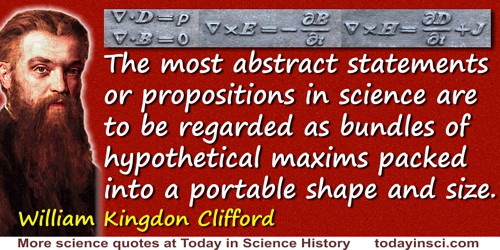
The most abstract statements or propositions in science are to be regarded as bundles of hypothetical maxims packed into a portable shape and size. Every scientific fact is a short-hand expression for a vast number of practical directions: if you want so-and-so, do so-and-so.
In 'On The Scientific Basis of Morals', Contemporary Review (Sep 1875), collected in Leslie Stephen and Frederick Pollock (eds.), Lectures and Essays: By the Late William Kingdon Clifford, F.R.S. (1886), 289.
The natural world in which we live is nothing short of entrancing—wondrous really. Personally, I take great joy in sharing a world with the shimmering variety of life on earth. Nor can I believe any of us really want a planet which is a lonely wasteland.
In Reith Lecture, 'Biodiversity', BBC Radio 4 (19 Apr 2000). Audio on BBC website.
The negative cautions of science are never popular. If the experimentalist would not commit himself, the social philosopher, the preacher, and the pedagogue tried the harder to give a short-cut answer.
In Coming of Age in Samoa (1928, 2001), 4.
The possibility that the infective agent may not contain nucleic acid and consist only of a peptide or peptide-polysaccharide complex which has replication properties within susceptible cells is intriguing. If peptides, short-chain proteins, or peptide/fatty-acid/ polysaccharide complexes activate nucleic-acid template activity in the host genes to produce identical infective particles, this would invalidate the accepted dogma of present-day molecular biology in which D.N.A. and R.N.A. templates control all biological activity.
'Scrapie: An Infective Peptide?', The Lancet (1972), i, 748.
The reason the cow jumped over the moon was because there was a short circuit in the milking machine.
In E.C. McKenzie, 14,000 Quips and Quotes for Speakers, Writers, Editors, Preachers, and Teachers (1990), 24.
The result of all these experiments has given place to a new division of the parts of the human body, which I shall follow in this short essay, by distinguishing those which are susceptible of Irritability and Sensibility, from those which are not. But the theory, why some parts of the human body are endowed with these properties, while others are not, I shall not at all meddle with. For I am persuaded that the source of both lies concealed beyond the reach of the knife and microscope, beyond which I do not chuse to hazard many conjectures, as I have no desire of teaching what I am ignorant of myself. For the vanity of attempting to guide others in paths where we find ourselves in the dark, shews, in my humble opinion, the last degree of arrogance and ignorance.
'A Treatise on the Sensible and Irritable Parts of Animals' (Read 1752). Trans. 1755 and reprinted in Bulletin of the Institute of the History of Medicine, 1936, 4(2), 657-8.
The sand should be neither coarse nor fine but of a middling quality or about the size of the common pop[p]y seed. If the sand is too coarse the mortar will be short or brittle … If the sand is too fine the cement will shrink and crack after it has been used.
Directions for Using White's Patent Hydraulic Cement.
The science of constructing a commonwealth, or renovating it, or reforming it, is, like every other experimental science, not to be taught a priori. Nor is it a short experience that can instruct us in that practical science, because the real effects of moral causes are not always immediate.
Reflections on the Revolution in France, p. 53, ed. Pocock (1790).
The scientific enterprise is full of experts on specialist areas but woefully short of people with a unified worldview. This state of affairs can only inhibit progress, and could threaten political and financial support for research.
Commentary, Nature (14 Aug 1997), 619. Quoted in Denis Alexander, Rebuilding the Matrix (2003), 7.
The solutions put forth by imperialism are the quintessence of simplicity...When they speak of the problems of population and birth, they are in no way moved by concepts related to the interests of the family or of society...Just when science and technology are making incredible advances in all fields, they resort to technology to suppress revolutions and ask the help of science to prevent population growth. In short, the peoples are not to make revolutions, and women are not to give birth. This sums up the philosophy of imperialism.
From Fidel Castro (1968).
The specific qualities in diseases also tend more rapidly to the skin than to the deeper-seated parts, except the cancer; although even in this disease the progress towards the superficies is more quick than its progress towards the centre. In short, this is a law in nature, and it probably is upon the same principle by which vegetables always approach the surface of the earth.
In A Treatise on the Blood, Inflammation and Gun-shot Wounds (1794, 1828), 299-300.
The stakes are immense, the task colossal, the time is short. But we may hope–we must hope–that man’s own creation, man’s own genius, will not destroy him. Scholars, indeed all men, must move forward in the faith of that philosopher who held that there is no problem the human reason can propound which the human reason cannot reason out.
From 'Is Einstein Right?', in William Allison Shimer (ed.), The American Scholar (1946), 15, 476. Reprinted in American Thought 1947 (1947), 196. Gauss is commenting on an article by Einstein about the challenges following the creation of the atomic bomb, 'The Real Problem Is in the Hearts of Men', New York Times Magazine (23 Jun 1946), SM4.
The sublime discoveries of Newton, and, together with these, his not less fruitful than wonderful application, of the higher mathesis to the movement of the celestial bodies, and to the laws of light, gave almost religious sanction to the corpuscular system and mechanical theory. It became synonymous with philosophy itself. It was the sole portal at which truth was permitted to enter. The human body was treated an hydraulic machine... In short, from the time of Kepler to that of Newton, and from Newton to Hartley, not only all things in external nature, but the subtlest mysteries of life, organization, and even of the intellect and moral being, were conjured within the magic circle of mathematical formulae.
Hints Towards the Formation of a more Comprehensive Theory of Life (1848). In The Collected Works of Samuel Taylor Coleridge: Shorter Works and Fragments (1995), H. J. Jackson and J. R. de J. Jackson (eds.), Vol. 11, 1, 498.
The sun rises. In that short phrase, in a single fact, is enough information to keep biology, physics, and philosophy busy for all the rest of time.
In Lifetide: A Biology of the Unconscious (1979), 23.
The tragedy of deforestation in Amazonia as well as elsewhere in the tropics is that its costs, in... economic, social, cultural, and aesthetic terms, far outweigh its benefits. In many cases, destruction of the region’s rainforests is motivated by short-term gains rather than the long-term productive capacity of the land. And, as a result, deforestation usually leaves behind landscapes that are economically as well as ecologically impoverished.
From Anthony Bennett Anderson (ed.), Alternatives to Deforestation: Steps Toward Sustainable Use
of the Amazon Rain Forest (1990), xi. As cited in Lykke E. Andersen (ed.), The Dynamics of Deforestation and Economic Growth in the Brazilian Amazon (2002), 2.
There are three side effects of acid. Enhanced long term memory, decreased short term memory, and I forgot the third.
…...
There is no short cut from chemical laboratory to clinic, except one that passes too close to the morgue.
American Medical Association (1929) as quoted in Arabella Melville and Colin Johnson , Cured to Death: The Effects of Prescription Drugs (1982).
There is no short cut, nor “royal road” to the attainment of medical knowledge. The path which we have to pursue is long, difficult, and unsafe. In our progress, we must frequently take up our abode with death and corruption, we must adopt loathsome diseases for our familiar associates, or we shall never be acquainted with their nature and dispositions ; we must risk, nay, even injure our own health, in order to be able to preserve, or restore that of others.
Hunterian Oration (1819). Quoted in Clement Carlyon, Early Years and Late Reflections (1856), 110-111.

There is only one subject matter for education, and that is Life in all its manifestations. Instead of this single unity, we offer children—Algebra, from which nothing follows; Geometry, from which nothing follows; Science, from which nothing follows; History, from which nothing follows; a Couple of Languages, never mastered; and lastly, most dreary of all, Literature, represented by plays of Shakespeare, with philological notes and short analyses of plot and character to be in substance committed to memory.
In 'The Aims of Education', The Aims of Education: & Other Essays (1917), 10.
They say that Ptolemy once asked him [Euclid] whether there was in geometry no shorter way than that of the elements and he replied, “There is no royal road to geometry”.
— Proclus
In (Edition Friedlein, 1873), Prol. II, 39.
Think of the image of the world in a convex mirror. ... A well-made convex mirror of moderate aperture represents the objects in front of it as apparently solid and in fixed positions behind its surface. But the images of the distant horizon and of the sun in the sky lie behind the mirror at a limited distance, equal to its focal length. Between these and the surface of the mirror are found the images of all the other objects before it, but the images are diminished and flattened in proportion to the distance of their objects from the mirror. ... Yet every straight line or plane in the outer world is represented by a straight line or plane in the image. The image of a man measuring with a rule a straight line from the mirror, would contract more and more the farther he went, but with his shrunken rule the man in the image would count out exactly the same results as in the outer world, all lines of sight in the mirror would be represented by straight lines of sight in the mirror. In short, I do not see how men in the mirror are to discover that their bodies are not rigid solids and their experiences good examples of the correctness of Euclidean axioms. But if they could look out upon our world as we look into theirs without overstepping the boundary, they must declare it to be a picture in a spherical mirror, and would speak of us just as we speak of them; and if two inhabitants of the different worlds could communicate with one another, neither, as far as I can see, would be able to convince the other that he had the true, the other the distorted, relation. Indeed I cannot see that such a question would have any meaning at all, so long as mechanical considerations are not mixed up with it.
In 'On the Origin and Significance of Geometrical Axioms,' Popular Scientific Lectures< Second Series (1881), 57-59. In Robert Édouard Moritz, Memorabilia Mathematica (1914), 357-358.
Those who work standing ... carpenters, sawyers, carvers, blacksmiths, masons ... are liable to varicose veins ... [because] the strain on the muscles is such that the circulation of the blood is retarded. Standing even for a short time proves exhausting compared with walking and running though it be for a long time ... Nature delights and is restored by alternating and varied actions.

Though the theories of plate tectonics now provide us with a modus operandi, they still seem to me to be a periodic phenomenon. Nothing is world-wide, but everything is episodic. In other words, the history of any one part of the earth, like the life of a soldier, consists of long periods of boredom and short periods of terror.
In The Nature of the Stratigraphical Record (1973), 100.
Three thousand stadia from the earth to the moon,—the first station. From thence to the sun about five hundred parasangs. ... Marvel not, my comrade, if I appear talking to you on super-terrestrial and aerial topics. The long and the short of the matter is that I am running over the order of a Journey I have lately made. ... I have travelled in the stars.
One of the earliest examples of what might be regarded as science fiction.
One of the earliest examples of what might be regarded as science fiction.
Icaromennipus, or the Aerial Jaunt in Ainsworth Rand Spofford (ed.), Rufus Edmonds Shapley (ed.) The Library of Wit and Humor, Prose and Poetry, Selected from the Literature of all Times and Nations (1894), vol. 4, 282-283. A shortened quote is on the title page of H. G. Wells, The First Men in the Moon (1901).
Throughout the 1960s and 1970s devoted Beckett readers greeted each successively shorter volume from the master with a mixture of awe and apprehensiveness; it was like watching a great mathematician wielding an infinitesimal calculus, his equations approaching nearer and still nearer to the null point.
Quoted in a review of Samuel Beckett’s Nohow On: Ill Seen Ill Said, Worstward Ho, in 'The Last Word', The New York Review of Books (13 Aug 1992).
Thursday, May 30 [1912]. This morning at 3:15, Wilbur passed away, aged 45 years, 1 month, and 14 days. A short life, full of consequences. An unfailing intellect, imperturbable temper, great selfreliance and as great modesty, seeing the right clearly, pursuing it steadily, he lived and died. Many called - many telegrams. (Probably over a thousand.)
From Milton’s handwritten Diary entry for Thur, 30 May 1912.
Time’s arrow of ‘just history’ marks each moment of time with a distinctive brand. But we cannot, in our quest to understand history, be satisfied only with a mark to recognize each moment and a guide to order events in temporal sequence. Uniqueness is the essence of history, but we also crave some underlying generality, some principles of order transcending the distinction of moments–lest we be driven mad by Borges’s vision of a new picture every two thousand pages in a book without end. We also need, in short, the immanence of time’s cycle.
…...
To find fault with our ancestors for not having annual parliaments, universal suffrage, and vote by ballot, would be like quarrelling with the Greeks and Romans for not using steam navigation, when we know it is so safe and expeditious; which would be, in short, simply finding fault with the third century before Christ for not being the eighteenth century after. It was necessary that many other things should be thought and done, before, according to the laws of human affairs, it was possible that steam navigation should be thought of. Human nature must proceed step by step, in politics as well as in physics.
The Spirit of the Age (1831). Ed. Frederick A. von Hayek (1942), 48.
To pick a hole–say in the 2nd law of Ωcs, that if two things are in contact the hotter cannot take heat from the colder without external agency.
Now let A & B be two vessels divided by a diaphragm and let them contain elastic molecules in a state of agitation which strike each other and the sides. Let the number of particles be equal in A & B but let those in A have equal velocities, if oblique collisions occur between them their velocities will become unequal & I have shown that there will be velocities of all magnitudes in A and the same in B only the sum of the squares of the velocities is greater in A than in B.
When a molecule is reflected from the fixed diaphragm CD no work is lost or gained.
If the molecule instead of being reflected were allowed to go through a hole in CD no work would be lost or gained, only its energy would be transferred from the one vessel to the other.
Now conceive a finite being who knows the paths and velocities of all the molecules by simple inspection but who can do no work, except to open and close a hole in the diaphragm, by means of a slide without mass.
Let him first observe the molecules in A and when lie sees one coming the square of whose velocity is less than the mean sq. vel. of the molecules in B let him open a hole & let it go into B. Next let him watch for a molecule in B the square of whose velocity is greater than the mean sq. vel. in A and when it comes to the hole let him draw and slide & let it go into A, keeping the slide shut for all other molecules.
Then the number of molecules in A & B are the same as at first but the energy in A is increased and that in B diminished that is the hot system has got hotter and the cold colder & yet no work has been done, only the intelligence of a very observant and neat fingered being has been employed. Or in short if heat is the motion of finite portions of matter and if we can apply tools to such portions of matter so as to deal with them separately then we can take advantage of the different motion of different portions to restore a uniformly hot system to unequal temperatures or to motions of large masses. Only we can't, not being clever enough.
Now let A & B be two vessels divided by a diaphragm and let them contain elastic molecules in a state of agitation which strike each other and the sides. Let the number of particles be equal in A & B but let those in A have equal velocities, if oblique collisions occur between them their velocities will become unequal & I have shown that there will be velocities of all magnitudes in A and the same in B only the sum of the squares of the velocities is greater in A than in B.
When a molecule is reflected from the fixed diaphragm CD no work is lost or gained.
If the molecule instead of being reflected were allowed to go through a hole in CD no work would be lost or gained, only its energy would be transferred from the one vessel to the other.
Now conceive a finite being who knows the paths and velocities of all the molecules by simple inspection but who can do no work, except to open and close a hole in the diaphragm, by means of a slide without mass.
Let him first observe the molecules in A and when lie sees one coming the square of whose velocity is less than the mean sq. vel. of the molecules in B let him open a hole & let it go into B. Next let him watch for a molecule in B the square of whose velocity is greater than the mean sq. vel. in A and when it comes to the hole let him draw and slide & let it go into A, keeping the slide shut for all other molecules.
Then the number of molecules in A & B are the same as at first but the energy in A is increased and that in B diminished that is the hot system has got hotter and the cold colder & yet no work has been done, only the intelligence of a very observant and neat fingered being has been employed. Or in short if heat is the motion of finite portions of matter and if we can apply tools to such portions of matter so as to deal with them separately then we can take advantage of the different motion of different portions to restore a uniformly hot system to unequal temperatures or to motions of large masses. Only we can't, not being clever enough.
Letter to Peter Guthrie Tait (11 Dec 1867). In P. M. Harman (ed.), The Scientific Letters and Papers of James Clerk Maxwell (1995), Vol. 2, 331-2.
To stop short in any research that bids fair to widen the gates of knowledge, to recoil from fear of difficulty or adverse criticism, is to bring reproach on science. There is nothing for the investigator to do but go straight on, 'to explore up and down, inch by inch, with the taper his reason;' to follow the light wherever it may lead, even should it at times resemble a will-o'-the-wisp.
Referring to his interest in psychical (spiritual) research.
Referring to his interest in psychical (spiritual) research.
Presidential address to the British Association (1898). Quoted in Harold Begbie in Pall Mall magazine (Jan 1903). In Albert Shaw, The American Monthly Review of Reviews (1903), 27, 232.
To use a Southern euphemism, our space program has been snake-bit.
Comment on the failed launch of an unmanned rocket, only a short time after the explosion of Space Shuttle Challenger.
Comment on the failed launch of an unmanned rocket, only a short time after the explosion of Space Shuttle Challenger.
— Al Gore
ABC television interview, Nightline (5 May 1986). In James B. Simpson, Simpson’s Contemporary Quotations (1988).
Traditional dinosaur theory is full of short circuits. Like the antiquated wiring in an old house, the details sputter and burn out when specific parts are tested.
The Dinosaur Heresies (1986), 27.
We all felt the majesty of the body. In a very short period of time we had seen something that was bigger than each of us. A lot of people, even those who were not religious, were reverent and attributed the success to God. As we saw the artificial heart beat in Dr. Clark, the feeling was not aren't we great, but aren't we small.
[Comment after surgery for the world's first human implant of a total artificial heart in the chest of dentist Dr. Barney Clark ]
[Comment after surgery for the world's first human implant of a total artificial heart in the chest of dentist Dr. Barney Clark ]
Quoted by Lawrence K. Altman in “Clark's Surgeon Was ‘Worried To Death’&rdquo, New York Times (12 Apr 1983), C2.
We believe that interest in nature leads to knowledge,
which is followed by understanding,
and later, appreciation.
Once respect is gained
it is a short step to responsibility,
and ultimately action
to preserve our Earth.
which is followed by understanding,
and later, appreciation.
Once respect is gained
it is a short step to responsibility,
and ultimately action
to preserve our Earth.
…...
We do not draw conclusions with our eyes, but with our reasoning powers, and if the whole of the rest of living nature proclaims with one accord from all sides the evolution of the world of organisms, we cannot assume that the process stopped short of Man. But it follows also that the factors which brought about the development of Man from his Simian ancestry must be the same as those which have brought about the whole of evolution.
Translation of Weismann's work in German, by John Arthur Thomson and Margaret R. Thomson, The Evolution Theory (1904), Vol. 2, 393.
We don’t teach our students enough of the intellectual content of experiments—their novelty and their capacity for opening new fields… . My own view is that you take these things personally. You do an experiment because your own philosophy makes you want to know the result. It’s too hard, and life is too short, to spend your time doing something because someone else has said it’s important. You must feel the thing yourself—feel that it will change your outlook and your way of life.
In Bernstein, 'Profiles: Physicists: I', The New Yorker (13 Oct 1975), 108.
We know by experience itself, that … we find out but a short way, by long wandering.
The Scholemaster (1570), Book 1.
We took on things which people might think would take a year or two. They weren't particularly hard. What was hard was believing they weren't hard.
[Recalling high-pressure, short-deadline problem solving leading up to planned release date of Polaroid instant color film.]
[Recalling high-pressure, short-deadline problem solving leading up to planned release date of Polaroid instant color film.]
Quoted in Alix Kerr, 'What It Took: Intuition, Goo,' Life (25 Jan 1963), 54, No. 4, 86.
Weight is caused by one element being situated in another; and it moves by the shortest line towards its centre, not by its own choice, not because the centre draws it to itself, but because the other intervening element cannot withstand it.
…...
What I have related is sufficient for establishing the main principle, namely, that the heat which disappears in the conversion of water into vapour, is not lost, but is retained in vapour, and indicated by its expansive form, although it does not affect the thermometer. This heat emerges again from this vapour when it becomes water, and recovers its former quality of affecting the thermometer; in short, it appears again as the cause of heat and expansion.
Lectures on the Elements of Chemistry, delivered in the University of Edinburgh (1803), Vol. I, 173.
What is there about fire that's so lovely? ... It's perpetual motion; the thing man wanted to invent but never did. Or almost perpetual motion. ... What is fire? It's a mystery. Scientists give us gobbledegook about friction and molecules. But they don't really know.
[Fahrenheit 451 refers to the temperature at which book paper burns. In the short novel of this title 'firemen' burn books forbidden by the totalitaran regime.]
[Fahrenheit 451 refers to the temperature at which book paper burns. In the short novel of this title 'firemen' burn books forbidden by the totalitaran regime.]
Fahrenheit 451 (1953, 1996), 115.
Whatsoever therefore is consequent to a time of Warre, where every man is Enemy to every man; the same is consequent to the time, wherein men live without other security, than what their own strength, and their own invention shall furnish them withall. In such condition, there is no place for Industry; because the fruit thereof is uncertain: and consequently no Culture of the Earth; no Navigation, nor use of the commodities that may be imported by Sea; no commodious Building; no Instruments of moving, and removing, such things as require much force; no Knowledge of the face of the Earth; no account of Time; no Arts; no Letters; no Society; and which is worst of all, continual fear, and danger of violent death; And the life of man, solitary, poore, nasty, brutish, and short.
Leviathan (1651), ed. C. B. Macpherson (1968), Part 1, Chapter 13, 186.
When chemists have brought their knowledge out of their special laboratories into the laboratory of the world, where chemical combinations are and have been through all time going on in such vast proportions,—when physicists study the laws of moisture, of clouds and storms, in past periods as well as in the present,—when, in short, geologists and zoologists are chemists and physicists, and vice versa,—then we shall learn more of the changes the world has undergone than is possible now that they are separately studied.
Geological Sketches (1866), 73.
When external objects are impressed on the sensory nerves, they excite vibrations in the aether residing in the pores of these nerves... Thus it seems that light affects both the optic nerve and the aether and ... the affections of the aether are communicated to the optic nerve, and vice versa. And the same may be observed of frictions of the skin, taste, smells and sounds... Vibrations in the aether will agitate the small particles of the medullary substance of the sensory nerves with synchronous vibrations... up to the brain... These vibrations are motions backwards and forwards of small particles, of the same kind with the oscillations of pendulums, and the tremblings of the particles of the sounding bodies (but) exceedingly short and small, so as not to have the least efficacy to disturb or move the whole bodies of the nerves... That the nerves themselves should vibrate like musical strings is highly absurd.
Observations on Man, His Frame, His Duty, and His Expectations (1749), part 1, 11-22.
When one studies strongly radioactive substances special precautions must be taken if one wishes to be able to take delicate measurements. The various objects used in a chemical laboratory and those used in a chemical laboratory, and those which serve for experiments in physics, become radioactive in a short time and act upon photographic plates through black paper. Dust, the air of the room, and one’s clothes all become radioactive.
Notebook entry. In Eve Curie, Madame Curie: a Biography by Eve Curie (1937, 2007), 196.
When something comes along and is really important to your career and important to science, important enough so that lots of other people are working on it, you have got to do it in a short time. You have got to get in there and run experiments quickly and get published. That is the killer instinct. I do not think women have that part of it. Part of it comes from sports. It's like scoring a goal.
Quoted in The Door in the Dream: Conversations with Eminent Women in Science by Elga Wasserman, National Academy Press/John Henry Press (2000), p. 182
While our behavior is still significantly controlled by our genetic inheritance, we have, through our brains, a much richer opportunity to blaze new behavioral and cultural pathways on short timescales.
The Dragons of Eden: Speculations on the Evolution of Human Intelligence (1977, 1986), 3.
Why it is that animals, instead of developing in a simple and straightforward way, undergo in the course of their growth a series of complicated changes, during which they often acquire organs which have no function, and which, after remaining visible for a short time, disappear without leaving a trace ... To the Darwinian, the explanation of such facts is obvious. The stage when the tadpole breathes by gills is a repetition of the stage when the ancestors of the frog had not advanced in the scale of development beyond a fish.
In The Works of Francis Maitland Balfour (1885), Vol. 1, 702.
Widespread intellectual and moral docility may be convenient for leaders in the short term, but it is suicidal for nations in the long term. One of the criteria for national leadership should therefore be a talent for understanding, encouraging, and making constructive use of vigorous criticism.
Billions and Billions: Thoughts on Life and Death at the Brink of the Millenium (1998), 189.
With these developments we have every reason to anticipate that in a time not very distant most telegraphic messages across the oceans will be transmitted without cables. For short distances we need a “wireless” telephone, which requires no expert operators.
In 'The Problem of Increasing Human Energy', Century Illustrated Monthly Magazine (Jun 1900), 209. Collected My Inventions: And Other Writings (2016), 123.
Yes, gentlemen, give me the map of any country, its configuration, its climate, its waters, its winds, and the whole of its physical geography; give me its natural productions, its flora, its zoology, &c., and I pledge myself to tell you, a priori, what will be the quality of man in history:—not accidentally, but necessarily; not at any particular epoch, but in all; in short, —what idea he is called to represent.
Introduction to the History of Philosophy (1832), trans. by Henning Gotfried Linberg, 240.
You must have short range goals to keep you from being frustrated by short-range failures.
…...
Your true inventor has a yen to invent, just as a painter or musician is impelled to create something in his art. I began wanting to invent when I was in short pants. At the age of eight—and that was forty years ago—I invented a rock-thrower. Later I found that the Romans had done a much better job some two thousand years before me.
Attributed to an unnamed “holder of many patents,” as quoted by Stacy V. Jones, in You Ought to Patent That (1962), 21.
Your words have come true with a vengeance that I shd [should] be forestalled ... I never saw a more striking coincidence. If Wallace had my M.S. sketch written out in 1842 he could not have made a better short abstract! Even his terms now stand as Heads of my Chapters.
Letter to Charles Lyell, 18 June 1858. In F. Burkhardt and S. Smith (eds.), The Correspondence of Charles Darwin 1858-1859, Supplement 1821-1857 (1991), Vol. 7, 107.
 In science it often happens that scientists say, 'You know that's a really good argument; my position is mistaken,' and then they would actually change their minds and you never hear that old view from them again. They really do it. It doesn't happen as often as it should, because scientists are human and change is sometimes painful. But it happens every day. I cannot recall the last time something like that happened in politics or religion.
(1987) --
In science it often happens that scientists say, 'You know that's a really good argument; my position is mistaken,' and then they would actually change their minds and you never hear that old view from them again. They really do it. It doesn't happen as often as it should, because scientists are human and change is sometimes painful. But it happens every day. I cannot recall the last time something like that happened in politics or religion.
(1987) --