Shell Quotes (69 quotes)
[An] old Pythagorean prejudice … thought it a crime to eat eggs; because an egg was a microcosm, or universe in little; the shell being the earth; the white, water; fire, the yolk; and the air found between the shell and the white.
'Common Cookery'. Household Words (26 Jan 1856), 13, 43. An English weekly magazine edited by Charles Dickens.
[My uncle said to me…] When I read, forty years ago, that shells from Syria were found in the Alps, I say, I admit, with a slightly mocking tone, that these shells were apparently brought by pilgrims who were returning from Jerusalem. M. de Buffon reprimanded me very sharply in his Theory of the Earth, page 281. I did not want to quarrel with him over shells, but I remain of the same opinion, because the impossibility that the sea formed the mountains is evident to me. Some may tell me that porphyry is made of sea urchin spikes, I’ll believe it when I see white marble is made of ostrich feathers.
Voltaire is recounting one of the reasons his uncle (Abbe Ambroise Bazing) had told him, for disputing Buffon’s claim that the sea that made the mountains. Translated by Webmaster from 'La Défense de Mon Oncle: Des montagnes et des Coquilles', collected in Oeuvres complètes: Histoire.- Mélanges historiques (1817), Tome 15, Chap. 19, 133-134. From the original French; “Quand je lus, il y a quarante ans, qu’on avait trouvé dans les Alpes des coquilles de Syrie, je dis, je l’avoue , d’un ton un peu goguenard, que ces coquilles avaient été apparemment apportées par des pélerins qui revenaient de Jérusalem. M. de Buffon m’en reprit très-vertement dans sa Théorie de la terre, page 281. Je n’ai pas voulu me brouiller avec lui pour des coquilles, mais je suis demeuré dans non opinion, parce que l’impossibilité que la mer ait formé les montagnes m’est démontrée. On a beau me dire que le porphyre est fait de pointes d’oursin, je le croirai quand je verrai que le marbre blanc est fait de plumes d’autruche.” [Note: porphyry is a form of igneous rock. Also note, this passage does NOT appear in 'Les Singularités de la Nature', which may be found elsewhere incorrectly cited as the source. —Webmaster]
E canchis amnia.
Everything from shells.
Everything from shells.
Motto on his bookplate, 1771, expressing his evolutionary beliefs.
Question: Account for the delicate shades of colour sometimes seen on the inside of an oyster shell. State and explain the appearance presented when a beam of light falls upon a sheet of glass on which very fine equi-distant parallel lines have been scratched very close to one another.
Answer: The delicate shades are due to putrefaction; the colours always show best when the oyster has been a bad one. Hence they are considered a defect and are called chromatic aberration.
The scratches on the glass will arrange themselves in rings round the light, as any one may see at night in a tram car.
Answer: The delicate shades are due to putrefaction; the colours always show best when the oyster has been a bad one. Hence they are considered a defect and are called chromatic aberration.
The scratches on the glass will arrange themselves in rings round the light, as any one may see at night in a tram car.
Genuine student answer* to an Acoustics, Light and Heat paper (1880), Science and Art Department, South Kensington, London, collected by Prof. Oliver Lodge. Quoted in Henry B. Wheatley, Literary Blunders (1893), 182, Question 27. (*From a collection in which Answers are not given verbatim et literatim, and some instances may combine several students' blunders.)
A physical theory remains an empty shell until we have found a reasonable physical interpretation.
At the 4th Soviet Gravitational Conference, Minsk, USSR (Jul 1976). Quoted in Anton Z. Capri, From Quanta to Quarks: More Anecdotal History of Physics (2007), 120.
A wise man once said, “Convention is like the shell to the chick, a protection till he is strong enough to break it through.”
In Learned Hand and Irving Dilliard (ed.), The Spirit of Liberty: Papers and Addresses of Learned Hand (1952), 32.
All knowledge and understanding of the Universe was no more than playing with stones and shells on the seashore of the vast imponderable ocean of truth.
…...
Another diversity of Methods is according to the subject or matter which is handled; for there is a great difference in delivery of the Mathematics, which are the most abstracted of knowledges, and Policy, which is the most immersed…, yet we see how that opinion, besides the weakness of it, hath been of ill desert towards learning, as that which taketh the way to reduce learning to certain empty and barren generalities; being but the very husks and shells of sciences, all the kernel being forced out and expulsed with the torture and press of the method.
Advancement of Learning, Book 2. In James Spedding, The Works of Francis Bacon (1863), Vol. 6, 292-293. Peter Pešić, explains that 'By Mathematics, he had in mind a sterile and rigid scheme of logical classifications, called dichotomies in his time,' inLabyrinth: A Search for the Hidden Meaning of Science (2001), 73.
As an adult she had her organs removed one by one. Now she is a mere shell with symptoms where her organs used to be.
Written as an intern on one of his patient's charts; commentary on the result of surgical treatment of non-organic disease.
Written as an intern on one of his patient's charts; commentary on the result of surgical treatment of non-organic disease.
In Barry G. Firkin, Judith A. Whitworth, Dictionary of Medical Eponyms (1966), 267.
Atoms have a nucleus, made of protons and neutrons bound together. Around this nucleus shells of electrons spin, and each shell is either full or trying to get full, to balance with the number of protons—to balance the number of positive and negative charges. An atom is like a human heart, you see.
The Lunatics (1988). In Gary Westfahl, Science Fiction Quotations: From the Inner Mind to the Outer Limits (2006), 323.
Between men of different studies and professions, may be observed a constant reciprocation of reproaches. The collector of shells and stones derides the folly of him who pastes leaves and flowers upon paper, pleases himself with colours that are perceptibly fading, and amasses with care what cannot be preserved. The hunter of insects stands amazed that any man can waste his short time upon lifeless matter, while many tribes of animals yet want their history. Every one is inclined not only to promote his own study, but to exclude all others from regard, and having heated his imagination with some favourite pursuit, wonders that the rest of mankind are not seized with the same passion.
From 'Numb. 83, Tuesday, January 1, 1750', The Rambler (1756), Vol. 2, 150.
By the fruit one judges the tree; the tree of science grows exceedingly slowly; centuries elapse before one can pluck the ripe fruits; even today it is hardly possible for us to shell and appraise the kernel of the teachings that blossomed in the seventeenth century. He who sows cannot therefore judge the worth of the corn. He must have faith in the fruitfulness of the seed in order that he may follow untiringly his chosen furrow when he casts his ideas to the four winds of heaven.
As quoted in Philipp Frank, Modern Science and its Philosophy (1949), 62, which cites Évolution de la Mécanique (1903).
Cell and tissue, shell and bone, leaf and flower, are so many portions of matter, and it is in obedience to the laws of physics that their particles have been moved, moulded and confirmed. They are no exception to the rule that God always geometrizes. Their problems of form are in the first instance mathematical problems, their problems of growth are essentially physical problems, and the morphologist is, ipso facto, a student of physical science.
On Growth and Form (1917), 7-8.
Even more difficult to explain, than the breaking-up of a single mass into fragments, and the drifting apart of these blocks to form the foundations of the present-day continents, is the explanation of the original production of the single mass, or PANGAEA, by the concentration of the former holosphere of granitic sial into a hemisphere of compressed and crushed gneisses and schists. Creep and the effects of compression, due to shrinking or other causes, have been appealed to but this is hardly a satisfactory explanation. The earth could no more shrug itself out of its outer rock-shell unaided, than an animal could shrug itself out of its hide, or a man wriggle out of his skin, or even out of his closely buttoned coat, without assistance either of his own hands or those of others.
The Rhythm of Ages (1940), 9-10.
Evidence of this [transformation of animals into fossils] is that parts of aquatic animals and perhaps of naval gear are found in rock in hollows on mountains, which water no doubt deposited there enveloped in sticky mud, and which were prevented by coldness and dryness of the stone from petrifying completely. Very striking evidence of this kind is found in the stones of Paris, in which one very often meets round shells the shape of the moon.
De Causis Proprietatum Elementorum (On the Causes of the Properties of the Elements) [before 1280], Book II, tract 3, chapter 5, quoted in A. C. Crombie, Augustine to Galileo (1959), Vol. 1, 126.
Gaia is a thin spherical shell of matter that surrounds the incandescent interior; it begins where the crustal rocks meet the magma of the Earth’s hot interior, about 100 miles below the surface, and proceeds another 100 miles outwards through the ocean and air to the even hotter thermosphere at the edge of space. It includes the biosphere and is a dynamic physiological system that has kept our planet fit for life for over three billion years. I call Gaia a physiological system because it appears to have the unconscious goal of regulating the climate and the chemistry at a comfortable state for life. Its goals are not set points but adjustable for whatever is the current environment and adaptable to whatever forms of life it carries.
In The Revenge of Gaia: Earth’s Climate Crisis & The Fate of Humanity (2006, 2007), 19.
I am convinced, by repeated observation, that marbles, lime-stones, chalks, marls, clays, sand, and almost all terrestrial substances, wherever situated, are full of shells and other spoils of the ocean.
'Second Discours: Histoire & Théorie de la Terre', Histoire Naturelle, Générale et Particulière, Avec la Description du Cabinet du Roi (1749), Vol. I, 76-77; Natural History, General and Particular (1785), Vol. I, trans. W. Smellie, 13.
I am very fond of the oyster shell. It is humble and awkward and ugly. It is slate-colored and unsymmetrical. Its form is not primarily beautiful but functional. I make fun of its knobbiness. Sometimes I resent its burdens and excrescences. But its tireless adaptability and tenacity draw my astonished admiration and sometimes even my tears. And it is comfortable in its familiarity, its homeliness, like old garden gloves when have molded themselves perfectly to the shape of the hand.
In 'Oyster Bed', Gift From the Sea (1955), 77.
I can only compare their [Hindu] astronomical and mathematical literature … to a mixture of pearl shells and sour dates, or of pearls and dung, or of costly crystals and common pebbles. Both kinds of things are equal in their eyes, since they cannot rise themselves to the methods of strictly scientific deduction.
As translated by Edward C. Sachau, in Alberuni’s India: An Account of the Religion, Philosophy, Literature, Geography, Chronology, Astronomy, Customs, Laws and Astrology of India about A.D. 1030 (1910), Vol. 1, 25.
I cannot separate land and sea: to me they interfinger like a pattern in a moss agate, positive and negative shapes irrevocably interlocked. My knowledge of this peninsula depends on that understanding: of underwater canyons that are continuations of the land, of the shell fossils far inland that measure continuations of the sea in eons past.
…...
I did not expect to find the electric cable in its primitive state, such as it was on leaving the manufactory. The long serpent, covered with the remains of shells, bristling with foraminiferae, was encrusted with a strong coating which served as a protection against all boring mollusks. It lay quietly sheltered from the motions of the sea, and under a favorable pressure for the transmission of the electric spark which passes from Europe to America in .32 of a second. Doubtless this cable will last for a great length of time, for they find that the gutta-percha covering is improved by the sea water.
[Referring to the Transatlantic telegraph cable laid in 1866, as viewed from the fictional submarine Nautilus.]
[Referring to the Transatlantic telegraph cable laid in 1866, as viewed from the fictional submarine Nautilus.]
Twenty Thousand Leagues Under The Seas, (1874), 285. Translated from the original French edition, Vingt Mille Lieues Sous Les Mers (1870).
I do ... humbly conceive (tho' some possibly may think there is too much notice taken of such a trivial thing as a rotten Shell, yet) that Men do generally rally too much slight and pass over without regard these Records of Antiquity which Nature have left as Monuments and Hieroglyphick Characters of preceding Transactions in the like duration or Transactions of the Body of the Earth, which are infinitely more evident and certain tokens than any thing of Antiquity that can be fetched out of Coins or Medals, or any other way yet known, since the best of those ways may be counterfeited or made by Art and Design, as may also Books, Manuscripts and Inscriptions, as all the Learned are now sufficiently satisfied, has often been actually practised; but those Characters are not to be Counterfeited by all the Craft in the World, nor can they be doubted to be, what they appear, by anyone that will impartially examine the true appearances of them: And tho' it must be granted, that it is very difficult to read them, and to raise a Chronology out of them, and to state the intervalls of the Times wherein such, or such Catastrophies and Mutations have happened; yet 'tis not impossible, but that, by the help of those joined to ' other means and assistances of Information, much may be done even in that part of Information also.
Lectures and Discourses of Earthquakes (1668). In The Posthumous Works of Robert Hooke, containing his Cutlerian Lectures and other Discourses read at the Meetings of the Illustrious Royal Society (1705), 411.
![Isaac Newton Quote: like a boy playing on the seashore [pebbles]…whilst the great ocean of truth lay all undiscovered before me](https://todayinsci.com/N/Newton_Isaac/NewtonIsaac-SeashoreQuote500px.jpg)
I do not know what I may appear to the world, but to myself I seem to have been only like a boy playing on the seashore, and diverting myself in now and then finding a smoother pebble or a prettier shell than ordinary, whilst the great ocean of truth lay all undiscovered before me.
First reported in Joseph Spence, Anecdotes, Observations and Characters, of Books and Men (1820), Vol. 1 of 1966 edn, sect. 1259, p. 462. Purported to have been addressed by Newton in the final year of his life (1727) to Chevalier Andrew Michael Ramsey (which conflicts with the Dictionary of National Biography article giving that he was in France at the time). Quoted in David Brewster, Memoirs of the Life, Writings, and Discoveries of Sir Isaac Newton (1855), Vol. 2, 407.
I have said that the investigation for which the teeth of the shark had furnished an opportunity, was very near an end... But thereafter, while I was examining more carefully these details of both places and bodies [sedimentary deposits and shells], these day by day presented points of doubt to me as they followed one another in indissoluble connection, so that I saw myself again and again brought back to the starting-place, as it were, when I thought I was nearest the goal. I might compare those doubts to the heads of the Lernean Hydra, since when one of them had been got rid of, numberless others were born; at any rate, I saw that I was wandering about in a sort of labyrinth, where the nearer one approaches the exit, the wider circuits does one tread.
The Prodromus of Nicolaus Steno's Dissertation Concerning a Solid Body enclosed by Process of Nature within a Solid (1669), trans. J. G. Winter (1916), 206.
I sometimes see a bird’s nest in a thorn or other bush half full of acorns and hazel-nut shells, where evidently some mouse or squirrel has left them.
24 August 1858. In Wild Fruits: Thoreau’s Rediscovered Last Manuscript (2000), 162.
I’m addicted to the entire planet. I don’t want to leave it. I want to get down into it. I want to say hello. On the beach, I could have stopped all day long and looked at those damned shells, looked for all the messages that come not in bottles but in shells...
In Encounters with the Archdruid (1971), 144.
In Ireland, there are the same fossils, the same shells and the same sea bodies, as appear in America, and some of them are found in no other part of Europe.
'Preuves de la Théorie de la Terre', Histoire Naturelle, Generale et Particulière, Avec la Description du Cabinet du Roi (1749), Vol. I, 606; Natural History: Theory of the Earth (1749), Vol. I, Trans. W. Smellie (1785), 507.
In the Choice of … Things, neglect not any, tho’ the most ordinary and trivial; the Commonest Peble or Flint, Cockle or Oyster-shell, Grass, Moss, Fern or Thistle, will be as useful, and as proper to be gathered and sent, as any the rarest production of the Country. Only take care to choose of each the fairest of its kind, and such as are perfect or whole.
In Brief Instructions for Making Observations in all Parts of the World (1696), 10.
In the case of those solids, whether of earth, or rock, which enclose on all sides and contain crystals, selenites, marcasites, plants and their parts, bones and the shells of animals, and other bodies of this kind which are possessed of a smooth surface, these same bodies had already become hard at the time when the matter of the earth and rock containing them was still fluid. And not only did the earth and rock not produce the bodies contained in them, but they did not even exist as such when those bodies were produced in them.
The Prodromus of Nicolaus Steno's Dissertation Concerning a Solid Body enclosed by Process of Nature within a Solid (1669), trans. J. G. Winter (1916), 218.
In the mountains of Parma and Piacenza, multitudes of shells and corals filled with worm-holes may be seen still adhering to the rocks, and when I was making the great horse at Milan a large sack of those which had been found in these parts was brought to my workshop by some peasants... The red stone of the mountains of Verona is found with shells all intermingled, which have become part of this stone... And if you should say that these shells have been and still constantly are being created in such places as these by the nature of the locality or by potency of the heavens in these spots, such an opinion cannot exist in brains possessed of any extensive powers of reasoning because the years of their growth are numbered upon the outer coverings of their shells; and both small and large ones may be seen; and these would not have grown without feeding, or fed without movement, and here [embedded in rock] they would not have been able to move... The peaks of the Apennines once stood up in a sea, in the form of islands surrounded by salt water... and above the plains of Italy where flocks of birds are flying today, fishes were once moving in large shoals.
'Physical Geography', in The Notebooks of Leonardo da Vinci, trans. E. MacCurdy (1938), Vol. 1, 355-6, 359.
In the year 1902 (while I was attempting to explain to an elementary class in chemistry some of the ideas involved in the periodic law) becoming interested in the new theory of the electron, and combining this idea with those which are implied in the periodic classification, I formed an idea of the inner structure of the atom which, although it contained certain crudities, I have ever since regarded as representing essentially the arrangement of electrons in the atom ... In accordance with the idea of Mendeleef, that hydrogen is the first member of a full period, I erroneously assumed helium to have a shell of eight electrons. Regarding the disposition in the positive charge which balanced the electrons in the neutral atom, my ideas were very vague; I believed I inclined at that time toward the idea that the positive charge was also made up of discrete particles, the localization of which determined the localization of the electrons.
Valence and the Structure of Atoms and Molecules (1923), 29-30.
It is better to have a few forms well known than to teach a little about many hundred species. Better a dozen specimens thoroughly studied as the result of the first year’s work, than to have two thousand dollars’ worth of shells and corals bought from a curiosity-shop. The dozen animals would be your own.
Lecture at a teaching laboratory on Penikese Island, Buzzard's Bay. Quoted from the lecture notes by David Starr Jordan, Science Sketches (1911), 147.
It is curious to observe with what different degrees of architectonic skill Providence has endowed birds of the same genus, and so nearly correspondent in their general mode of life! for while the swallow and the house-martin discover the greatest address in raising and securely fixing crusts or shells of loam as cunabula for their young, the bank-martin terebrates a round and regular hole in the sand or earth, which is serpentine, horizontal, and about two feet deep. At the inner end of this burrow does this bird deposit, in a good degree of safety, her rude nest, consisting of fine grasses and feathers, usually goose-feathers, very inartificially laid together.
In Letter to Daines Barrington, (26 Feb 1774), in The Natural History and Antiquities of Selborne (1789), 176.
It was quite the most incredible event that has ever happened to me in my life. It was almost as incredible as if you fired a 15-inch shell at a piece of tissue paper and it came back and hit you.
[Recalling in 1936 the discovery of the nucleus in 1909, when some alpha particles were observed instead of travelling through a very thin gold foil were seen to rebound backward, as if striking something much more massive than the particles themselves.]
[Recalling in 1936 the discovery of the nucleus in 1909, when some alpha particles were observed instead of travelling through a very thin gold foil were seen to rebound backward, as if striking something much more massive than the particles themselves.]
Quoted in Abraham Pais, Inward Bound (1986), 189, from E. N. da C. Andrade, Rutherford and the nature of the atom, (1964) 111.
It would be a very wonderful, but not an absolutely incredible result, that volcanic action has never been more violent on the whole than during the last two or three centuries; but it is as certain that there is now less volcanic energy in the whole earth than there was a thousand years ago, as it is that there is less gunpowder in a ‘Monitor’ after she has been seen to discharge shot and shell, whether at a nearly equable rate or not, for five hours without receiving fresh supplies, than there was at the beginning of the action.
In 'On the Secular Cooling of the Earth', Transactions of the Royal Society of Edinburgh (1864), 23, 159.
It would indeed be a great delusion, if we stated that those sports of Nature [we find] enclosed in rocks are there by chance or by some vague creative power. Ah, that would be superficial indeed! In reality, those shells, which once were alive in water and are now dead and decomposed, were made thus by time not Nature; and what we now find as very hard, figured stone, was once soft mud and which received the impression of the shape of a shell, as I have frequently demonstrated.
La vana speculazione disingannata del senso (1670), trans. Ezio Vaccari, 83-4.
Kids like their fossils. I’ve taken my godson fossil-hunting and there’s nothing more magical than finding a shiny shell and knowing you’re the first person to have seen it for 150 million years.
As reported by Adam Lusher in 'Sir David Attenborough', Daily Mail (28 Feb 2014).
Like the lapwing being lately hatched, I do run as it were with the shell on my head.
In 'To the Reader', The Optick Glass of Humors (1607), 10.
Looking outward to the blackness of space, sprinkled with the glory of a universe of lights, I saw majesty—but no welcome. Below was a welcoming planet. There, contained in the thin, moving, incredibly fragile shell of the biosphere is everything that is dear to you, all the human drama and comedy. That’s where life is; that’s where all the good stuff is.
Observation as payload specialist on the Challenger Eight space shuttle mission. As quoted in Kevin W. Kelley (ed.), The Home Planet (1988), 8.

Many Species of Animals have been lost out of the World, which Philosophers and Divines are unwilling to admit, esteeming the Destruction of anyone Species a Dismembring of the Universe, and rendring the World imperfect; whereas they think the Divine Providence is especially concerned, and solicitous to secure and preserve the Works of the Creation. And truly so it is, as appears, in that it was so careful to lodge all Land Animals in the Ark at the Time of the general Deluge; and in that, of all Animals recorded in Natural Histories, we cannot say that there hath been anyone Species lost, no not of the most infirm, and most exposed to Injury and Ravine. Moreover, it is likely, that as there neither is nor can be any new Species of Animals produced, all proceeding from Seeds at first created; so Providence, without which one individual Sparrow falls not to the ground, doth in that manner watch over all that are created, that an entire Species shall not be lost or destroyed by any Accident. Now, I say, if these Bodies were sometimes the Shells and Bones of Fish, it will thence follow, that many Species have been lost out of the World... To which I have nothing to reply, but that there may be some of them remaining some where or other in the Seas, though as yet they have not come to my Knowledge. Far though they may have perished, or by some Accident been destroyed out of our Seas, yet the Race of them may be preserved and continued still in others.
— John Ray
Three Physico-Theological Discourses (1713), Discourse II, 'Of the General Deluge, in the Days of Noah; its Causes and Effects', 172-3.
Most of the beds [of rock] contain shells, corals, and other related forms, called fossils,—so named because dug out of the earth, the word being from the Latin fossilis, meaning, that which is dug up. … The various species that have left their remains in any bed must have been in existence when that bed was in progress of formation…. The study of the fossils of the successive beds is the study of the succession of living species that have existed in the earth’s history.
In 'Introduction', A Text-book of Geology: Designed for Schools and Academies (1863), 3.
Most of these Mountains and Inland places whereon these kind of Petrify’d Bodies and Shells are found at present, or have been heretofore, were formerly under the Water, and that either by the descending of the Waters to another part of the Earth by the alteration of the Centre of Gravity of the whole bulk, or rather by the Eruption of some kind of Subterraneous Fires or Earthquakes, great quantities of Earth have been deserted by the Water and laid bare and dry.
Lectures and Discourses of Earthquakes (1668). In The Posthumous Works of Robert Hooke, containing his Cutlerian Lectures and other Discourses read at the Meetings of the Illustrious Royal Society (1705), 320-1.
My father, the practicing physician, … was a passionate collector of natural objects (amber, shells, minerals, beetles, etc.) and a great friend of the natural sciences. … To my energetic and intellectually vigorous mother I owe an infinite debt.
As quoted in Paul Forman and Armin Hermann, 'Sommerfeld, Arnold (Johannes Wilhelm)', Biography in Dictionary of Scientific Biography (1975), Vol. 12, 525. Cited from 'Autobiographische Skizze', Gesammelte Schriften, Vol 4, 673–682.
Of what use are the great number of petrifactions, of different species, shape and form which are dug up by naturalists? Perhaps the collection of such specimens is sheer vanity and inquisitiveness. I do not presume to say; but we find in our mountains the rarest animals, shells, mussels, and corals embalmed in stone, as it were, living specimens of which are now being sought in vain throughout Europe. These stones alone whisper in the midst of general silence.
Philosophia Botanica (1751), aphorism 132. Trans. Frans A. Stafleu, Linnaeus and the Linnaeans: The Spreading of their Ideas in Systematic Botany, 1735-1789 (1971), 56.
Often referred to as osteoporosis of the ocean, [ocean acidification] prevents shell building creatures such as lobster, oyster, crab, shrimp, and coral from extracting the calcium carbonate from the water that they need to build their shells and are thus unable to survive.
In 'What do the Arctic, a Thermostat and COP15 Have in Common?', Huffington Post (18 Mar 2010).
One cannot collect all the beautiful shells on the beach. One can collect only a few, and they are more beautiful if they are few.
In Gift From the Sea (1955), 114.
One subject, however I shall insist upon; that is, to explode the Linnæan obscenity in his characters of the Bivalves; not only for their licentiousness, but also that they are in no ways the parts expressed. Science should be chaste and delicate. Ribaldry at times has been passed for wit; but Linnæus alone passes it for terms of science. His merit in this part of natural history is, in my opinion, much debased thereby; and I can compare these his terms only to Spintriæ [Roman erotic bronze tokens], in a valuable collection of Roman coins. I therefore with due submission recommend to that otherwise great naturalist, to change them, and expunge this reproachable obscenity from his works.
From Preface to Elements of Conchology or, An introduction to the Knowledge of Shells (1776), iv-v. [Costa is offended by nomenclature adopted by Linnaeus for features of the opening of certain bivalve shells. Based on corresponding parts of surface appearance, Linnaeus used terms distinctive to human female anatomy. Costa was determined to eliminate the indelicate terms. —Webmaster]
Saying that each of two atoms can attain closed electron shells by sharing a pair of electrons is equivalent to saying that husband and wife, by having a total of two dollars in a joint account and each having six dollars in individual bank accounts, have eight dollars apiece!
Quoted in Reynold E. Holmen, 'Kasimir Fajans (1887-1975): The Man and His Work', Bulletin for the History of Chemistry, 1990, 6, 7-8.
Science affects the average man and woman in two ways already. He or she benefits by its application driving a motor-car or omnibus instead of a horse-drawn vehicle, being treated for disease by a doctor or surgeon rather than a witch, and being killed with an automatic pistol or shell in place of a dagger or a battle-axe.
'The Scientific Point of View' In R.C. Prasad (ed.), Modern Essays: Studying Language Through Literature (1987), 26.
She sells sea-shells on the sea-shore,
The shells she sells are sea-shells, I’m sure
For if she sells sea-shells on the sea-shore
Then I’m sure she sells sea-shore shells.
The shells she sells are sea-shells, I’m sure
For if she sells sea-shells on the sea-shore
Then I’m sure she sells sea-shore shells.
Tongue-twister by Terry Sullivan (1908), suggested as inspired by Mary Aiming. As quoted in Deborah Cadbury, Dinosaur Hunters: A True Story of Scientific Rivalry and the Discovery of the Prehistoric World (2000), 3.
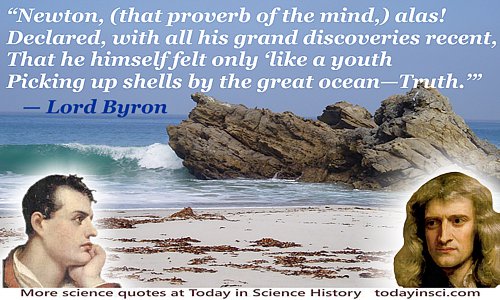
Background of ocean and rocky outcrop with kelp on sandy shore in foreground, at Channel Islands NMS, California. , Photo by Claire Fackler, NOAA (source)
Socrates said, our only knowledge was
“To know that nothing could be known;” a pleasant
Science enough, which levels to an ass
Each Man of Wisdom, future, past, or present.
Newton, (that Proverb of the Mind,) alas!
Declared, with all his grand discoveries recent,
That he himself felt only “like a youth
Picking up shells by the great Ocean—Truth.”
“To know that nothing could be known;” a pleasant
Science enough, which levels to an ass
Each Man of Wisdom, future, past, or present.
Newton, (that Proverb of the Mind,) alas!
Declared, with all his grand discoveries recent,
That he himself felt only “like a youth
Picking up shells by the great Ocean—Truth.”
From poem, 'Don Juan,' (1822), canto 7, verse V. In Lord Byron, Don Juan: Cantos VI, VII and VIII (1823), 67.
The Good Spirit never cared for the colleges, and though all men and boys were now drilled in Greek, Latin, and Mathematics, it had quite left these shells high on the beach, and was creating and feeding other matters [science] at other ends of the world.
The Prose Works of Ralph Waldo Emerson (1870), 553.
The material world is only the shell of the universe: the world of life are its inhabitants.
From The Spectator (25 Oct 1712), No. 519, collected in The Works of the Right Honorable Joseph Addison (1721), Vol. 4, 18.
The personal adventures of a geologist would form an amusing narrative. He is trudging along, dusty and weatherbeaten, with his wallet at his back, and his hammer on his shoulder, and he is taken for a stone-mason travelling in search of work. In mining-countries, he is supposed to be in quest of mines, and receives many tempting offers of shares in the ‘Wheel Dream’, or the ‘Golden Venture’;—he has been watched as a smuggler; it is well if he has not been committed as a vagrant, or apprehended as a spy, for he has been refused admittance to an inn, or has been ushered into the room appropriated to ostlers and postilions. When his fame has spread among the more enlightened part of the community of a district which he has been exploring, and inquiries are made of the peasantry as to the habits and pursuits of the great philosopher who has been among them, and with whom they have become familiar, it is found that the importance attached by him to shells and stones, and such like trumpery, is looked upon as a species of derangement, but they speak with delight of his affability, sprightliness, and good-humour. They respect the strength of his arm, and the weight of his hammer, as they point to marks which he inflicted on the rocks, and they recount with wonder his pedestrian performances, and the voracious appetite with which, at the close of a long day’s work he would devour the coarsest food that was set before him.
In Practical Geology and Mineralogy: With Instructions for the Qualitative Analysis of Minerals (1841), 31-2.
The Reproductions of the living Ens
From sires to sons, unknown to sex, commence...
Unknown to sex the pregnant oyster swells,
And coral-insects build their radiate shells...
Birth after birth the line unchanging runs,
And fathers live transmitted in their sons;
Each passing year beholds the unvarying kinds,
The same their manners, and the same their minds.
From sires to sons, unknown to sex, commence...
Unknown to sex the pregnant oyster swells,
And coral-insects build their radiate shells...
Birth after birth the line unchanging runs,
And fathers live transmitted in their sons;
Each passing year beholds the unvarying kinds,
The same their manners, and the same their minds.
The Temple of Nature (1803), canto 2, lines 63-4, 89-90, 107-10, pages 48-52.
The science of fossil shells is the first step towards the study of the earth.
Conchiologia Fossile Subappennina (1814), Vol. I, trans. Ezio Vaccari, 13.
The shell model, although proposed by theoreticians, really corresponds to the experimentalist’s approach. It was born from a thorough study of the experimental data, plotting them in different ways, and looking for interconnections.
The Shell Model, Nobel Lecture.
The whole Terrestrial Globe was taken all to Pieces and dissolved at the Deluge, the Particles of Stone, Marble, and all other solid Fossils being dissevered, taken up into the Water, and there sustained with Sea-Shells and other Animal and Vegetable Bodyes: and that the present Earth consists, and was formed out of that promiscuous Mass of Sand, Earth, Shells, and the rest, falling down again, and subsiding from the Water.
In An Essay Towards a Natural History of the Earth (3rd ed., 1723), Preface.
The world has different owners at sunrise… Even your own garden does not belong to you. Rabbits and blackbirds have the lawns; a tortoise-shell cat who never appears in daytime patrols the brick walls, and a golden-tailed pheasant glints his way through the iris spears.
In Listen! The Wind (1938), 125.
These rocks, these bones, these fossil forms and shells
Shall yet be touched with beauty and reveal
The secrets if the book of earth to man.
Shall yet be touched with beauty and reveal
The secrets if the book of earth to man.
In The Book of Earth (1925), 157.
To mean understandings, it is sufficient honour to be numbered amongst the lowest labourers of learning; but different abilities must find different tasks. To hew stone, would have been unworthy of Palladio; and to have rambled in search of shells and flowers, had but ill suited with the capacity of Newton.
From 'Numb. 83, Tuesday, January 1, 1750', The Rambler (1756), Vol. 2, 154. (Italian architect Palladio, 1509-80, is widely considered the most influential in the history of Western architecture.)
To use Newton’s words, our efforts up till this moment have but turned over a pebble or shell here and there on the beach, with only a forlorn hope that under one of them was the gem we were seeking. Now we have the sieve, the minds, the hands, the time, and, particularly, the dedication to find those gems—no matter in which favorite hiding place the children of distant worlds have placed them.
[Co-author with Dava Sobel.]
[Co-author with Dava Sobel.]
In Frank Drake and Dava Sobel, Is Anyone Out There? (1993), 236.
What makes philosophy so tedious is not the profundity of philosophers, but their lack of art; they are like physicians who sought to cure a slight hyperacidity by prescribing a carload of burned oyster-shells.
In A Mencken Chrestomathy (1949, 1956), 617.
What, then, shall we say about the receipts of alchemy, and about the diversity of its vessels and instruments? These are furnaces, glasses, jars, waters, oils, limes, sulphurs, salts, saltpeters, alums, vitriols, chrysocollae, copper greens, atraments, auripigments, fel vitri, ceruse, red earth, thucia, wax, lutum sapientiae, pounded glass, verdigris, soot, crocus of Mars, soap, crystal, arsenic, antimony, minium, elixir, lazarium, gold leaf salt niter, sal ammoniac, calamine stone, magnesia, bolus armenus, and many other things. Then, again, concerning herbs, roots, seeds, woods, stones, animals, worms, bone dust, snail shells, other shells, and pitch. These and the like, whereof there are some very farfetched in alchemy, are mere incumbrances of work; since even if Sol and Luna [gold and silver] could be made by them they rather hinder and delay than further one’s purpose.
In Paracelsus and Arthur Edward Waite (ed.), The Hermetic and Alchemical Writings of Paracelsus (1894), Vol. 1, 13.
When I read an Italian letter [Saggio by Voltaire] on changes which had occurred on the surface of the earth, published in Paris this year (1746), I believed that these facts were reported by La Loubère. Indeed, they correspond perfectly with the author’s ideas. Petrified fish are according to him merely rare fish thrown away by Roman cooks because they were spoiled; and with respect to shells, he said that they were from the sea of the Levant and brought back by pilgrims from Syria at the time of the crusades. These shells are found today petrified in France, in Italy and in other Christian states. Why did he not add that monkeys transported shells on top of high mountains and to every place where humans cannot live? It would not have harmed his story but made his explanation even more plausible.
In 'Preuves de la Théorie de la Terre', Histoire Naturelle, Générale et Particuliere, Avec la Description du Cabinet du Roi (1749), Vol. I, 281. Trans. Albert V. and Marguerite Carozzi.
When I was a little over eight years old,… I was sent to a day-school…. [By this time] my taste for natural history, and more especially for collecting, was well developed. I tried to make out the names of plants, and collected all sorts of things, shells, seals, franks, coins, and minerals. The passion for collecting which leads a man to be a systematic naturalist, a virtuoso, or a miser, was very strong in me.
In Charles Darwin and Francis Darwin (ed.), 'Autobiography', The Life and Letters of Charles Darwin (1887, 1896), Vol. 1, 26.
Why are the bones of great fishes, and oysters and corals and various other shells and sea-snails, found on the high tops of mountains that border the sea, in the same way in which they are found in the depths of the sea?
'Physical Geography', in The Notebooks of Leonardo da Vinci, trans. E. MacCurdy (1938), Vol. 1, 361.
Xenophanes of Kolophon ... believes that once the earth was mingled with the sea, but in the course of time it became freed from moisture; and his proofs are such as these: that shells are found in the midst of the land and among the mountains, that in the quarries of Syracuse the imprints of a fish and of seals had been found, and in Paros the imprint of an anchovy at some depth in the stone, and in Melite shallow impressions of all sorts of sea products. He says that these imprints were made when everything long ago was covered with mud, and then the imprint dried in the mud.
Doxographists, Zeller, Vorsokr. Phil. 543, n. 1. Quoted in Arthur Fairbanks (ed. And trans.), The First Philosophers of Greece (1898), 83.
You know, all is development. The principle is perpetually going on. First, there was nothing, then there was something; then—I forget the next—I think there were shells, then fishes; then we came—let me see—did we come next? Never mind that; we came at last. And at the next change there will be something very superior to us—something with wings. Ah! That's it: we were fishes, and I believe we shall be crows.
Tancred: or, The New Crusade (1847), 124.
 In science it often happens that scientists say, 'You know that's a really good argument; my position is mistaken,' and then they would actually change their minds and you never hear that old view from them again. They really do it. It doesn't happen as often as it should, because scientists are human and change is sometimes painful. But it happens every day. I cannot recall the last time something like that happened in politics or religion.
(1987) --
In science it often happens that scientists say, 'You know that's a really good argument; my position is mistaken,' and then they would actually change their minds and you never hear that old view from them again. They really do it. It doesn't happen as often as it should, because scientists are human and change is sometimes painful. But it happens every day. I cannot recall the last time something like that happened in politics or religion.
(1987) -- 





