Series Quotes (154 quotes)
“Life on Earth” [a 12-part TV series on evolution] was easier than “The Living Planet” because you have 2,000 years of narrative thrust built in. … You begin, say, with a giant jellyfish, then a fish with lungs which then became a frog. And all you have to do is say, “If you want to know what happens next, tune in next week.”
Comparing two of his famed BBC TV natural history series, in Justine de Lacy, 'Around the World With Attenborough', New York Times (27 Jan 1985), Sec. 2, 25.
[A crowd] thinks in images, and the image itself calls up a series of other images, having no logical connection with the first … A crowd scarcely distinguishes between the subjective and the objective. It accepts as real the images invoked in its mind, though they most often have only a very distant relation with the observed facts. * * * Crowds being only capable of thinking in images are only to be impressed by images. It is only images that terrify or attract them and become motives of action.
From Psychologie des Foules (1895), 29 & 56. English text in The Crowd: A Study of the Popular Mind (1897), Book 1, Chap 2, 22 & last sentence, 55. Original French text: “[La foule] pense par images, et l’image évoquée en évoque elle-même une série d’autres n’ayant aucun lien logique avec la première. … La foule ne sépare guère le subjectif de l’objectif. Elle admet comme réelles les images évoquées dans son esprit, et qui le plus souvent n’ont qu’une parenté lointaine avec le fait observé. * * * Les foules, ne pouvant penser que par images,ne se laissent impressionner que par des images. Seules les images les terrifient ou les séduisent, et deviennent des mobiles d’action.”
[It] may be laid down as a general rule that, if the result of a long series of precise observations approximates a simple relation so closely that the remaining difference is undetectable by observation and may be attributed to the errors to which they are liable, then this relation is probably that of nature.
'Mémoire sur les Inégalites Séculaires des Planètes et des Satellites' (I 785, published 1787). In Oeuvres completes de Laplace, 14 Vols. (1843-1912), Vol. 11, 57, trans. Charles Coulston Gillispie, Pierre-Simon Laplace 1749-1827: A Life in Exact Science (1997), 130.
[Other than fossils,] the most important of these other records of creation is, without doubt, ontogeny, that is, the history of the developmment of the organic individual (embryology and motamorphology). It briefly repeats in great and marked features the series of forms which the ancestors of the respective individuals have passed through from the beginning of their tribe. We have designated the palaeontological history of the development of the ancestors of a living form as the history of a tribe, or phylogeny, and we may therefore thus enunciate this exceedingly important biogenetic fundamental principle: “Ontogeny is a short and quick repetition, or recapitulation, of Phylogeny, determined by the laws of Inheritance and Adaptation.”
In Ernst Haeckel and E. Ray Lankester (trans.), The History of Creation (1876), Vol. 2, 33. Seen shortened to “Ontogeny recapitulates phylogeny.” This was Haeckel's (incorrect) answer to the vexing question of his time: what is the relationship between individual development (ontogeny) and the evolution of species and lineages (phylogeny)?
[T]he phenomena of animal life correspond to one another, whether we compare their rank as determined by structural complication with the phases of their growth, or with their succession in past geological ages; whether we compare this succession with their relative growth, or all these different relations with each other and with the geographical distribution of animals upon the earth. The same series everywhere!
In Essay on Classification (1851), 196.
[About the demand of the Board of Regents of the University of California that professors sign non-Communist loyalty oaths or lose their jobs within 65 days.] No conceivable damage to the university at the hands of hypothetical Communists among us could possibly have equaled the damage resulting from the unrest, ill-will and suspicion engendered by this series of events.
As quoted in 'Professors in West Call Oath “Indignity”', New York Times (26 Feb 1950), 38.
[In refutation of evolution] There is not enough evidence, consistent evidence to make it as fact, and I say that because for theory to become a fact, it needs to consistently have the same results after it goes through a series of tests. The tests that they put—that they use to support evolution do not have consistent results. Now too many people are blindly accepting evolution as fact. But when you get down to the hard evidence, it’s merely a theory.
[In favor of the teaching of creationism alongside evolution in schools.]
[In favor of the teaching of creationism alongside evolution in schools.]
From interview by Miles O'Brien on CNN (30 Mar 1996). Reported from transcript, via Nexis, in New York Magazine (15 Sep 2010).
Conclusions
I. A curve has been found representing the frequency distribution of standard deviations of samples drawn from a normal population.
II. A curve has been found representing the frequency distribution of values of the means of such samples, when these values are measured from the mean of the population in terms of the standard deviation of the sample…
IV. Tables are given by which it can be judged whether a series of experiments, however short, have given a result which conforms to any required standard of accuracy or whether it is necessary to continue the investigation.
I. A curve has been found representing the frequency distribution of standard deviations of samples drawn from a normal population.
II. A curve has been found representing the frequency distribution of values of the means of such samples, when these values are measured from the mean of the population in terms of the standard deviation of the sample…
IV. Tables are given by which it can be judged whether a series of experiments, however short, have given a result which conforms to any required standard of accuracy or whether it is necessary to continue the investigation.
'The Probable Error of a Mean', Biometrika, 1908, 6, 25.
Derrière la série de Fourier, d’autres séries analogues sont entrées dans la domaine de l’analyse; elles y sont entrées par la même porte; elles ont été imaginées en vue des applications.
After the Fourier series, other series have entered the domain of analysis; they entered by the same door; they have been imagined in view of applications.
After the Fourier series, other series have entered the domain of analysis; they entered by the same door; they have been imagined in view of applications.
La valeur de la science. In Anton Bovier, Statistical Mechanics of Disordered Systems (2006), 74.
Lyveris to-forn us
Useden to marke
For selkouthes that thei seighen,
Hir sones for to teche;
And helden it an heigh science
Hir wittes to knowe.
Ac thorugh hir science soothly
Was nevere no soule y-saved,
Ne broght by hir bokes
To blisse ne to joye;
For alle hir kynde knowynges
Come but of diverse sightes.
Patriarkes and prophetes
Repreveden hir science,
And seiden hir wordes and hir wisdomes
Nas but a folye
And to the clergie of Crist
Counted it but a trufle.
Our ancestors in olden days used to record
The strange things they saw, and teach them to their sons;
And they held it a high science, to have knowledge of such things.
But no soul was ever saved by all that science,
Nor brought by books into eternal bliss;
Their science was only a series of sundry observations.
So patriarchs and prophets disapproved of their science,
And said their so-called words of wisdom were but folly—
And compared with Christian philosophy, a contemptible thing.
Useden to marke
For selkouthes that thei seighen,
Hir sones for to teche;
And helden it an heigh science
Hir wittes to knowe.
Ac thorugh hir science soothly
Was nevere no soule y-saved,
Ne broght by hir bokes
To blisse ne to joye;
For alle hir kynde knowynges
Come but of diverse sightes.
Patriarkes and prophetes
Repreveden hir science,
And seiden hir wordes and hir wisdomes
Nas but a folye
And to the clergie of Crist
Counted it but a trufle.
Our ancestors in olden days used to record
The strange things they saw, and teach them to their sons;
And they held it a high science, to have knowledge of such things.
But no soul was ever saved by all that science,
Nor brought by books into eternal bliss;
Their science was only a series of sundry observations.
So patriarchs and prophets disapproved of their science,
And said their so-called words of wisdom were but folly—
And compared with Christian philosophy, a contemptible thing.
In William Langland and B. Thomas Wright (ed.) The Vision and Creed of Piers Ploughman (1842), 235-236. Modern translation by Terrence Tiller in Piers Plowman (1981, 1999), 123.
A ... hypothesis may be suggested, which supposes the word 'beginning' as applied by Moses in the first of the Book of Genesis, to express an undefined period of time which was antecedent to the last great change that affected the surface of the earth, and to the creation of its present animal and vegetable inhabitants; during which period a long series of operations and revolutions may have been going on, which, as they are wholly unconnected with the history of the human race, are passed over in silence by the sacred historian, whose only concern with them was largely to state, that the matter of the universe is not eternal and self-existent but was originally created by the power of the Almighty.
Vindiciae Geologicae (1820), 31-2.
All revolutionary advances in science may consist less of sudden and dramatic revelations than a series of transformations, of which the revolutionary significance may not be seen (except afterwards, by historians) until the last great step. In many cases the full potentiality and force of a most radical step in such a sequence of transformations may not even be manifest to its author.
The Newtonian Revolution (1980), 162.
Among the multitude of animals which scamper, fly, burrow and swim around us, man is the only one who is not locked into his environment. His imagination, his reason, his emotional subtlety and toughness, make it possible for him not to accept the environment, but to change it. And that series of inventions, by which man from age to age has remade his environment, is a different kind of evolution—not biological, but cultural evolution. I call that brilliant sequence of cultural peaks The Ascent of Man. I use the word ascent with a precise meaning. Man is distinguished from other animals by his imaginative gifts. He makes plans, inventions, new discoveries, by putting different talents together; and his discoveries become more subtle and penetrating, as he learns to combine his talents in more complex and intimate ways. So the great discoveries of different ages and different cultures, in technique, in science, in the arts, express in their progression a richer and more intricate conjunction of human faculties, an ascending trellis of his gifts.
The Ascent of Man (1973), 19-20.
Among the studies to which the [Rockefeller] Foundation is giving support is a series in a relatively new field, which may be called molecular biology, in which delicate modern techniques are being used to investigate ever more minute details of certain life processes.
In 'Molecular Biology', Annual Report of the Rockefeller Foundation (1938), 203-4. Reprinted in a letter to Science (6 Nov 1970), 170, 582.
An evolution is a series of events that in itself as series is purely physical, — a set of necessary occurrences in the world of space and time. An egg develops into a chick; … a planet condenses from the fluid state, and develops the life that for millions of years makes it so wondrous a place. Look upon all these things descriptively, and you shall see nothing but matter moving instant after instant, each instant containing in its full description the necessity of passing over into the next. … But look at the whole appreciatively, historically, synthetically, as a musician listens to a symphony, as a spectator watches a drama. Now you shall seem to have seen, in phenomenal form, a story.
In The Spirit of Modern Philosophy: An Essay in the Form of Lectures (1892), 425.
An Individual, whatever species it might be, is nothing in the Universe. A hundred, a thousand individuals are still nothing. The species are the only creatures of Nature, perpetual creatures, as old and as permanent as it. In order to judge it better, we no longer consider the species as a collection or as a series of similar individuals, but as a whole independent of number, independent of time, a whole always living, always the same, a whole which has been counted as one in the works of creation, and which, as a consequence, makes only a unity in Nature.
'De la Nature: Seconde Vue', Histoire Naturelle, Générale et Particulière, Avec la Description du Cabinet du Roi (1765), Vol. 13, i. Trans. Phillip R. Sloan.
And by the influence of heat, light, and electrical powers, there is a constant series of changes [in animal and vegetal substances]; matter assumes new forms, the destruction of one order of beings tends to the conservation of another, solution and consolidation, decay and renovation, are connected, and whilst the parts of the system, continue in a state of fluctuation and change, the order and harmony of the whole remain unalterable.
The Elements of Agricultural Chemistry (1813), in J. Davy (ed.) The Collected Works of Sir Humphry Davy(1839-40), Vol 7, 182.
Any experiment may be regarded as forming an individual of a 'population' of experiments which might be performed under the same conditions. A series of experiments is a sample drawn from this population.
Now any series of experiments is only of value in so far as it enables us to form a judgment as to the statistical constants of the population to which the experiments belong. In a great number of cases the question finally turns on the value of a mean, either directly, or as the mean difference between the two qualities.
If the number of experiments be very large, we may have precise information as to the value of the mean, but if our sample be small, we have two sources of uncertainty:— (I) owing to the 'error of random sampling' the mean of our series of experiments deviates more or less widely from the mean of the population, and (2) the sample is not sufficiently large to determine what is the law of distribution of individuals.
Now any series of experiments is only of value in so far as it enables us to form a judgment as to the statistical constants of the population to which the experiments belong. In a great number of cases the question finally turns on the value of a mean, either directly, or as the mean difference between the two qualities.
If the number of experiments be very large, we may have precise information as to the value of the mean, but if our sample be small, we have two sources of uncertainty:— (I) owing to the 'error of random sampling' the mean of our series of experiments deviates more or less widely from the mean of the population, and (2) the sample is not sufficiently large to determine what is the law of distribution of individuals.
'The Probable Error of a Mean', Biometrika, 1908, 6, 1.
As a net is made up of a series of ties, so everything in this world is connected by a series of ties. If anyone thinks that the mesh of a net is an independent, isolated thing, he is mistaken. It is called a net because it is made up of a series of a interconnected meshes, and each mesh has its place and responsibility in relation to other meshes.
In Gary William Flake, The Computational Beauty of Nature (2000), 383.
As physicists have arranged an extensive series of effects under the general term of Heat, so they have named another series Light, and a third they have called Electricity. We find ... that all these principles are capable of being produced through the medium of living bodies, for nearly all animals have the power of evolving heat; many insects, moreover, can voluntarily emit light; and the property of producing electricity is well evinced in the terrible shock of the electric eel, as well as in that of some other creatures. We are indeed in the habit of talking of the Electric fluid, or the Galvanic fluid, but this in reality is nothing but a licence of expression suitable to our finite and material notions.
In the Third Edition of Elements of Electro-Metallurgy: or The Art of Working in Metals by the Galvanic Fluid (1851), 1.
At fertilization, these two “haploid” nuclei are added together to make a “diploid” nucleus that now contains 2a, 2b and so on; and, by the splitting of each chromosome and the regulated karyokinetic separation of the daughter chromosomes, this double series is inherited by both of the primary blastomeres. In the resulting resting nuclei the individual chromosomes are apparently destroyed. But we have the strongest of indications that, in the stroma of the resting nucleus, every one of the chromosomes that enters the nucleus survives as a well-defined region; and as the cell prepares for its next division this region again gives rise to the same chromosome (Theory of the Individuality of the Chromosomes). In this way the two sets of chromosomes brought together at fertilization are inherited by all the cells of the new individual. It is only in the germinal cells that the so called reduction division converts the double series into a single one. Out of the diploid state, the haploid is once again generated.
In Arch. Zellforsch, 1909, 3, 181, trans. Henry Harris, The Birth of the Cell (1999), 171-2.
Biologists have long attempted by chemical means to induce in higher organisms predictable and specific changes which thereafter could be transmitted in series as hereditary characters. Among microorganisms the most striking example of inheritable and specific alterations in cell structure and function that can be experimentally induced and are reproducible under well defined and adequately controlled conditions is the transformation of specific types of Pneumococcus.
Oswald T. Avery (1877-1955), Colin Macleod (1909-72) and Maclyn McCarty (1911-2005), 'Studies on the Chemical Nature of the Substance Inducing Transformation of Pneumococcal Types', Journal of Experimental Medicine 1944, 79, 137.
Bradley is one of the few basketball players who have ever been appreciatively cheered by a disinterested away-from-home crowd while warming up. This curious event occurred last March, just before Princeton eliminated the Virginia Military Institute, the year’s Southern Conference champion, from the NCAA championships. The game was played in Philadelphia and was the last of a tripleheader. The people there were worn out, because most of them were emotionally committed to either Villanova or Temple-two local teams that had just been involved in enervating battles with Providence and Connecticut, respectively, scrambling for a chance at the rest of the country. A group of Princeton players shooting basketballs miscellaneously in preparation for still another game hardly promised to be a high point of the evening, but Bradley, whose routine in the warmup time is a gradual crescendo of activity, is more interesting to watch before a game than most players are in play. In Philadelphia that night, what he did was, for him, anything but unusual. As he does before all games, he began by shooting set shots close to the basket, gradually moving back until he was shooting long sets from 20 feet out, and nearly all of them dropped into the net with an almost mechanical rhythm of accuracy. Then he began a series of expandingly difficult jump shots, and one jumper after another went cleanly through the basket with so few exceptions that the crowd began to murmur. Then he started to perform whirling reverse moves before another cadence of almost steadily accurate jump shots, and the murmur increased. Then he began to sweep hook shots into the air. He moved in a semicircle around the court. First with his right hand, then with his left, he tried seven of these long, graceful shots-the most difficult ones in the orthodoxy of basketball-and ambidextrously made them all. The game had not even begun, but the presumably unimpressible Philadelphians were applauding like an audience at an opera.
A Sense of Where You Are: Bill Bradley at Princeton
But I think that in the repeated and almost entire changes of organic types in the successive formations of the earth—in the absence of mammalia in the older, and their very rare appearance (and then in forms entirely. unknown to us) in the newer secondary groups—in the diffusion of warm-blooded quadrupeds (frequently of unknown genera) through the older tertiary systems—in their great abundance (and frequently of known genera) in the upper portions of the same series—and, lastly, in the recent appearance of man on the surface of the earth (now universally admitted—in one word, from all these facts combined, we have a series of proofs the most emphatic and convincing,—that the existing order of nature is not the last of an uninterrupted succession of mere physical events derived from laws now in daily operation: but on the contrary, that the approach to the present system of things has been gradual, and that there has been a progressive development of organic structure subservient to the purposes of life.
'Address to the Geological Society, delivered on the Evening of the 18th of February 1831', Proceedings of the Geological Society (1834), 1, 305-6.
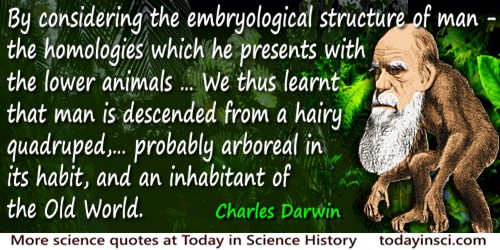
By considering the embryological structure of man - the homologies which he presents with the lower animals - the rudiments which he retains - and the reversions to which he is liable, we can partly recall in imagination the former condition of our early progenitors; and we can approximately place them in their proper position in the zoological series. We thus learnt that man is descended from a hairy quadruped, furnished with a tail and pointed ears, probably arboreal in its habit, and an inhabitant of the Old World. This creature, if its whole structure had been examined by a naturalist, would have been classed among the Quadrumana, as surely as would be the common and still more ancient progenitor of the Old and New World monkeys.
The Descent of Man (1871), Vol. 2, 389.
By the classification of any series of objects, is meant the actual or ideal arrangement together of those which are like and the separation of those which are unlike ; the purpose of this arrangement being to facilitate the operations of the mind in clearly conceiving and retaining in the memory the characters of the objects in question.
In 'Lecture I: On the Classification of Animals', Lectures on the Elements of Comparative Anatomy: On the ... - (1864), 1.
Casting off the dark fog of verbal philosophy and vulgar medicine, which inculcate names alone ... I tried a series of experiments to explain more clearly many phenomena, particularly those of physiology. In order that I might subject as far as possible the reasonings of the Galenists and Peripatetics to sensory criteria, I began, after trying experiments, to write dialogues in which a Galenist adduced the better-known and stronger reasons and arguments; these a mechanist surgeon refuted by citing to the contrary the experiments I had tried, and a third, neutral interlocutor weighed the reasons advanced by both and provided an opportunity for further progress.
'Malpighi at Pisa 1656-1659', in H. B. Adelmann (ed.), Marcello Malpighi and the Evolution of Embryology (1966), Vol. 1, 155-6.
Cayley was singularly learned in the work of other men, and catholic in his range of knowledge. Yet he did not read a memoir completely through: his custom was to read only so much as would enable him to grasp the meaning of the symbols and understand its scope. The main result would then become to him a subject of investigation: he would establish it (or test it) by algebraic analysis and, not infrequently, develop it so to obtain other results. This faculty of grasping and testing rapidly the work of others, together with his great knowledge, made him an invaluable referee; his services in this capacity were used through a long series of years by a number of societies to which he was almost in the position of standing mathematical advisor.
In Proceedings of London Royal Society (1895), 58, 11-12.
Chemistry is the study of material transformations. Yet a knowledge of the rate, or time dependence, of chemical change is of critical importance for the successful synthesis of new materials and for the utilization of the energy generated by a reaction. During the past century it has become clear that all macroscopic chemical processes consist of many elementary chemical reactions that are themselves simply a series of encounters between atomic or molecular species. In order to understand the time dependence of chemical reactions, chemical kineticists have traditionally focused on sorting out all of the elementary chemical reactions involved in a macroscopic chemical process and determining their respective rates.
'Molecular Beam Studies of Elementary Chemical Processes', Nobel Lecture, 8 Dec 1986. In Nobel Lectures: Chemistry 1981-1990 (1992), 320.
Civilization is simply a series of victories over nature.
In Where are We and Whither Tending?: Three Lectures on the Reality and Worth of Human Progress (1886), Lecture 1, 20.
Common sense … may be thought of as a series of concepts and conceptual schemes which have proved highly satisfactory for the practical uses of mankind. Some of those concepts and conceptual schemes were carried over into science with only a little pruning and whittling and for a long time proved useful. As the recent revolutions in physics indicate, however, many errors can be made by failure to examine carefully just how common sense ideas should be defined in terms of what the experimenter plans to do.
In Science and Common Sense (1951), 32-33.
Each species has evolved a special set of solutions to the general problems that all organisms must face. By the fact of its existence, a species demonstrates that its members are able to carry out adequately a series of general functions. … These general functions offer a framework within which one can integrate one’s view of biology and focus one’s research. Such a view helps one to avoid becoming lost in a morass of unstructured detail—even though the ways in which different species perform these functions may differ widely. A few obvious examples will suffice. Organisms must remain functionally integrated. They must obtain materials from their environments, and process and release energy from these materials. … They must differentiate and grow, and they must reproduce. By focusing one’s questions on one or another of these obligatory and universal capacities, one can ensure that one’s research will not be trivial and that it will have some chance of achieving broad general applicability.
In 'Integrative Biology: An Organismic Biologist’s Point of View', Integrative and Comparative Biology (2005), 45, 331.
Embryonic stem cell research is at the leading edge of a series of moral hazards.
'Address to the Nation on Stem Cell Research', (9 Aug 2001) in Public Papers Of The Presidents Of The United States, George W. Bush, 2001 (2004), Book 2, 955.
Entropy theory, on the other hand, is not concerned with the probability of succession in a series of items but with the overall distribution of kinds of items in a given arrangement.
In Entropy and Art: An Essay on Disorder and Order (1974), 19.
Every arsenate has its corresponding phosphate, composed according to the same proportions, combined with the same amount of water of crystallization, and endowed with the same physical properties: in fact, the two series of salts differ in no respect, except that the radical of the acid in one series in phosphorus, while in the other it is arsenic.
The experimental clue he used forming his law of isomerism. Originally published in 'Om Förhållandet emellan chemiska sammansättningen och krystallformen hos Arseniksyrade och Phosphorsyrade Salter', (On the Relation between the Chemical Composition and Crystal Form of Salts of Arsenic and Phosphoric Acids), Kungliga Svenska vetenskapsakademiens handlingar (1821), 4. Translation as shown in Joseph William Mellor, A Comprehensive Treatise on Inorganic and Theoretical Chemistry (1922), Vol. 1, 652. A very similar translation (“the same physical properties” is replaced with “nearly equal solubilities in water and acids”) is in F. Szabadváry article on 'Eilhard Mitscherlich' in Charles Coulston Gillispie (ed.), Dictionary of Scientific Biography (1974), Vol. 9, 424; perhaps from J.R. Partington, A History of Chemistry, Vol. 4 (1964), 210.
For the evolution of science by societies the main requisite is the perfect freedom of communication between each member and anyone of the others who may act as a reagent.
The gaseous condition is exemplified in the soiree, where the members rush about confusedly, and the only communication is during a collision, which in some instances may be prolonged by button-holing.
The opposite condition, the crystalline, is shown in the lecture, where the members sit in rows, while science flows in an uninterrupted stream from a source which we take as the origin. This is radiation of science. Conduction takes place along the series of members seated round a dinner table, and fixed there for several hours, with flowers in the middle to prevent any cross currents.
The condition most favourable to life is an intermediate plastic or colloidal condition, where the order of business is (1) Greetings and confused talk; (2) A short communication from one who has something to say and to show; (3) Remarks on the communication addressed to the Chair, introducing matters irrelevant to the communication but interesting to the members; (4) This lets each member see who is interested in his special hobby, and who is likely to help him; and leads to (5) Confused conversation and examination of objects on the table.
I have not indicated how this programme is to be combined with eating.
The gaseous condition is exemplified in the soiree, where the members rush about confusedly, and the only communication is during a collision, which in some instances may be prolonged by button-holing.
The opposite condition, the crystalline, is shown in the lecture, where the members sit in rows, while science flows in an uninterrupted stream from a source which we take as the origin. This is radiation of science. Conduction takes place along the series of members seated round a dinner table, and fixed there for several hours, with flowers in the middle to prevent any cross currents.
The condition most favourable to life is an intermediate plastic or colloidal condition, where the order of business is (1) Greetings and confused talk; (2) A short communication from one who has something to say and to show; (3) Remarks on the communication addressed to the Chair, introducing matters irrelevant to the communication but interesting to the members; (4) This lets each member see who is interested in his special hobby, and who is likely to help him; and leads to (5) Confused conversation and examination of objects on the table.
I have not indicated how this programme is to be combined with eating.
Letter to William Grylls Adams (3 Dec 1873). In P. M. Harman (ed.), The Scientific Letters and Papers of James Clerk Maxwell (1995), Vol. 2, 1862-1873, 949-50.
From whatever I have been able to observe up to this time the series of strata which form the visible crust of the earth appear to me classified in four general and successive orders. These four orders can be conceived to be four very large strata, as they really are, so that wherever they are exposed, they are disposed one above the other, always in the same order.
Quoted in Francesco Rodolico, 'Arduino', In Charles Coulston Gillispie (ed.), Dictionary of Scientific Biography (1970), Vol. 1, 234.
Genes make enzymes, and enzymes control the rates of chemical processes. Genes do not make ‘novelty seeking’ or any other complex and overt behavior. Predisposition via a long chain of complex chemical reactions, mediated through a more complex series of life’s circumstances, does not equal identification or even causation.
…...
Genetics is to biology what atomic theory is to physics. Its principle is clear: that inheritance is based on particles and not on fluids. Instead of the essence of each parent mixing, with each child the blend of those who made him, information is passed on as a series of units. The bodies of successive generations transport them through time, so that a long-lost character may emerge in a distant descendant. The genes themselves may be older than the species that bear them.
Almost Like a Whale: The Origin of Species Updated (1999), 115.
Genius and science have burst the limits of space, and few observations, explained by just reasoning, have unveiled the mechanism of the universe. Would it not also be glorious for man to burst the limits of time, and, by a few observations, to ascertain the history of this world, and the series of events which preceded the birth of the human race?
'Preliminary discourse', to Recherches sur les Ossemens Fossiles (1812), trans. R. Kerr Essay on the Theory of the Earth (1813), 3-4.
Gentlemen and ladies, this is ordinary alcohol, sometimes called ethanol; it is found in all fermented beverages. As you well know, it is considered by many to be poisonous, a belief in which I do not concur. If we subtract from it one CH2-group we arrive at this colorless liquid, which you see in this bottle. It is sometimes called methanol or wood alcohol. It is certainly more toxic than the ethanol we have just seen. Its formula is CH3OH. If, from this, we subtract the CH2-group, we arrive at a third colorless liquid, the final member of this homologous series. This compound is hydrogen hydroxide, best known as water. It is the most poisonous of all.
In Ralph Oesper, The Human Side of Scientists (1975), 189.
Geology fully proves that organic creation passed through a series of stages before the highest vegetable and animal forms appeared.
Explanations (1845), 31
However much we may enlarge our ideas of the time which has elapsed since the Niagara first began to drain the waters of the upper lakes, we have seen that this period was one only of a series, all belonging to the present zoological epoch; or that in which the living testaceous fauna, whether freshwater or marine, had already come into being. If such events can take place while the zoology of the earth remains almost stationary and unaltered, what ages may not be comprehended in those successive tertiary periods during which the Flora and Fauna of the globe have been almost entirely changed. Yet how subordinate a place in the long calendar of geological chronology do the successive tertiary periods themselves occupy! How much more enormous a duration must we assign to many antecedent revolutions of the earth and its inhabitants! No analogy can be found in the natural world to the immense scale of these divisions of past time, unless we contemplate the celestial spaces which have been measured by the astronomer.
Travels in North America (1845), Vol. 1, 51-2.
I ... express a wish that you may, in your generation, be fit to compare to a candle; that you may, like it, shine as lights to those about you; that, in all your actions, you may justify the beauty of the taper by making your deeds honourable and effectual in the discharge of your duty to your fellow-men.
The closing of the concluding lecture (8 Jan 1861) given to a juvenile audience at the Royal Institution, as published in A Course of Six Lectures on the Chemical History of a Candle (1861), 183. The tradition of these Christmas lectures continues to the present day.
I believe that, as men occupied with the study and treatment of disease, we cannot have too strong a conviction that the problems presented to us are physical problems, which perhaps we may never solve, but still admitting of solution only in one way, namely, by regarding them as part of an unbroken series, running up from the lowest elementary conditions of matter to the highest composition of organic structure.
From Address (7 Aug 1868), the Hunterian Oration, 'Clinical Observation in Relation to medicine in Modern Times' delivered to a meeting of the British Medical Association, Oxford. Collected in Sir William Withey Gull and Theodore Dyke Acland (ed.), A Collection of the Published Writings of William Withey Gull (1896), 4.
I have been able to solve a few problems of mathematical physics on which the greatest mathematicians since Euler have struggled in vain … But the pride I might have held in my conclusions was perceptibly lessened by the fact that I knew that the solution of these problems had almost always come to me as the gradual generalization of favorable examples, by a series of fortunate conjectures, after many errors. I am fain to compare myself with a wanderer on the mountains who, not knowing the path, climbs slowly and painfully upwards and often has to retrace his steps because he can go no further—then, whether by taking thought or from luck, discovers a new track that leads him on a little till at length when he reaches the summit he finds to his shame that there is a royal road by which he might have ascended, had he only the wits to find the right approach to it. In my works, I naturally said nothing about my mistake to the reader, but only described the made track by which he may now reach the same heights without difficulty.
(1891) As quoted in translation in Leo Koenigsberger and Frances A. Welby (trans.), Hermann von Helmholtz (1906), 180-181.
I have not trodden through a conventional university course, but I am striking out a new path for myself. I have made a special investigation of divergent series in general and the results I get are termed by the local mathematicians as “startling.”
First letter to G.H. Hardy (16 Jan 1913). In Collected Papers of Srinivasa Ramanujan (1927), xxiii. Hardy notes he did “seem to remember his telling me that his friends had given him some assistance” in writing the letter because Ramanujan's “knowledge of English, at that stage of his life, could scarcely have been sufficient.”
I have stated, that in the thirteen species of ground-finches [in the Galapagos Islands], a nearly perfect gradation may be traced, from a beak extraordinarily thick, to one so fine, that it may be compared to that of a warbler. I very much suspect, that certain members of the series are confined to different islands; therefore, if the collection had been made on any one island, it would not have presented so perfect a gradation. It is clear, that if several islands have each their peculiar species of the same genera, when these are placed together, they will have a wide range of character. But there is not space in this work, to enter on this curious subject.
Journal of Researches: into the Natural History and Geology of the Countries Visited During the Voyage of H.M.S. Beagle Round the World (1839), ch. XIX, 475.
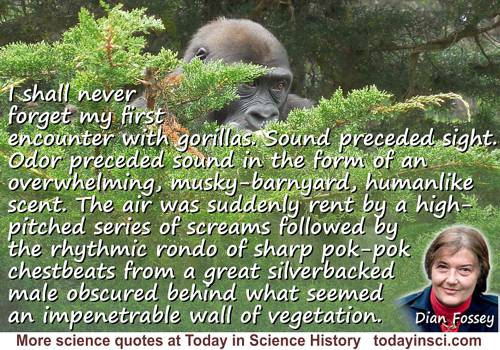
I shall never forget my first encounter with gorillas. Sound preceded sight. Odor preceded sound in the form of an overwhelming, musky-barnyard, humanlike scent. The air was suddenly rent by a high-pitched series of screams followed by the rhythmic rondo of sharp pok-pok chestbeats from a great silverbacked male obscured behind what seemed an impenetrable wall of vegetation.
Describing her 1963 trip to Kabara in Gorillas in the Mist (1983), 3. (The screams and chest-beating were of alarm, not ferocity.)
I think it [the World Series] should be called the World Sequence.
As given in essay, Ronald Coifman and Robert S. Strichartz, 'The School of Antoni Zygmund', collected in Peter Duren (ed.), A Century of Mathematics in America (1989), 348. The essay states Zygmund was “walking past a lounge in the University of Chicago that was filled with a loud crowd watching TV, he asked one of his students what was going on. The student told him that the crowd was watching the World Series and explained to him some of the features of this baseball phenomenon. Zygmund thought about it all for a few minutes and commented” with the subject quote above. The authors acknowledge students of Zygmund provided personal recollections to them for the essay in general. Webmaster speculates the quote is from a student recollection, and not necessarily verbatim.
I trust ... I have succeeded in convincing you that modern chemistry is not, as it has so long appeared, an ever-growing accumulation of isolated facts, as impossible for a single intellect to co-ordinate as for a single memory to grasp.
The intricate formulae that hang upon these walls, and the boundless variety of phenomena they illustrate, are beginning to be for us as a labyrinth once impassable, but to which we have at length discovered the clue. A sense of mastery and power succeeds in our minds to the sort of weary despair with which we at first contemplated their formidable array. For now, by the aid of a few general principles, we find ourselves able to unravel the complexities of these formulae, to marshal the compounds which they represent in orderly series; nay, even to multiply their numbers at our will, and in a great measure to forecast their nature ere we have called them into existence. It is the great movement of modern chemistry that we have thus, for an hour, seen passing before us. It is a movement as of light spreading itself over a waste of obscurity, as of law diffusing order throughout a wilderness of confusion, and there is surely in its contemplation something of the pleasure which attends the spectacle of a beautiful daybreak, something of the grandeur belonging to the conception of a world created out of chaos.
The intricate formulae that hang upon these walls, and the boundless variety of phenomena they illustrate, are beginning to be for us as a labyrinth once impassable, but to which we have at length discovered the clue. A sense of mastery and power succeeds in our minds to the sort of weary despair with which we at first contemplated their formidable array. For now, by the aid of a few general principles, we find ourselves able to unravel the complexities of these formulae, to marshal the compounds which they represent in orderly series; nay, even to multiply their numbers at our will, and in a great measure to forecast their nature ere we have called them into existence. It is the great movement of modern chemistry that we have thus, for an hour, seen passing before us. It is a movement as of light spreading itself over a waste of obscurity, as of law diffusing order throughout a wilderness of confusion, and there is surely in its contemplation something of the pleasure which attends the spectacle of a beautiful daybreak, something of the grandeur belonging to the conception of a world created out of chaos.
Concluding remark for paper presented at the Friday Discourse of the the Royal Institution (7 Apr 1865). 'On the Combining Power of Atoms', Proceedings of the Royal Institution (1865), 4, No. 42, 416.
I would picture myself as a virus, or as a cancer cell, for example, and try to sense what it would be like to be either. I would also imagine myself as the immune system, and I would try to reconstruct what I would do as an immune system engaged in combating a virus or cancer cell. When I had played through a series of such scenarios on a particular problem and had acquired new insights, I would design laboratory experiments accordingly… Based upon the results of the experiment, I would then know what question to ask next… When I observed phenomena in the laboratory that I did not understand, I would also ask questions as if interrogating myself: “Why would I do that if I were a virus or a cancer cell, or the immune system?” Before long, this internal dialogue became second nature to me; I found that my mind worked this way all the time.
In Anatomy of Reality: Merging of Intuition and Reason (1983), 7, footnote b, as quoted and cited in Roger Frantz, Two Minds: Intuition and Analysis in the History of Economic Thought (2006), 7.
I’d like the [Cosmos] series to be so visually stimulating that somebody who isn’t even interested in the concepts will just watch for the effects. And I’d like people who are prepared to do some thinking to be really stimulated.
Quoted by Dennis Meredith, in 'Carl Sagan’s Cosmic Connection and Extraterrestrial Life-Wish', Science Digest (Jun 1979), 85, 38. Reproduced in Carl Sagan and Tom Head, Conversations With Sagan (2006), 55.
If A denotes one of the two constant traits, for example, the dominating one, a the recessive, and the Aa the hybrid form in which both are united, then the expression:
A + 2Aa + a
gives the series for the progeny of plants hybrid in a pair of differing traits.
A + 2Aa + a
gives the series for the progeny of plants hybrid in a pair of differing traits.
'Experiments on Plant Hybrids' (1865). In Curt Stem and Eva R. Sherwood (eds.), The Origin of Genetics: A Mendel Source Book (1966), 16.
If it be urged that the action of the potato is chemical and mechanical only, and that it is due to the chemical and mechanical effects of light and heat, the answer would seem to lie in an enquiry whether every sensation is not chemical and mechanical in its operation? Whether those things which we deem most purely spiritual are anything but disturbances of equilibrium in an infinite series of levers, beginning with those that are too small for microscopic detection, and going up to the human arm and the appliances which it makes use of? Whether there be not a molecular action of thought, whence a dynamical theory of the passions shall be deducible?
In Erewhon, Or, Over the Range (1872), 192.
If some race of quadrumanous animals, especially one of the most perfect of them, were to lose, by force of circumstances or some other cause, the habit of climbing trees and grasping the branches with its feet in the same way as with its hands, in order to hold on to them; and if the individuals of this race were forced for a series of generations to use their feet only for walking, and to give up using their hands like feet; there is no doubt, according to the observations detailed in the preceding chapter, that these quadrumanous animals would at length be transformed into bimanous, and that the thumbs on their feet would cease to be separated from the other digits, when they only used their feet for walking.
Philosophie Zoologique (1809), Vol. 1, 349, trans. Hugh Elliot (1914), 170.
If the world may be thought of as a certain definite quantity of force and as a certain definite number of centers of force—and every other representation remains indefinite and therefore useless—it follows that, in the great dice game of existence, it must pass through calculable number of combinations. In infinite time, every possible combination would at some time or another be realized; more: it would be realized an infinite number of times. And since between every combination and its next recurrence all other possible combinations would have to take place, and each of these combination conditions of the entire sequence of combinations in the same series, a circular movement of absolutely identical series is thus demonstrated: the world as a circular movement that has already repeated itself infinitely often and plays its game in infinitum. This conception is not simply a mechanistic conception; for if it were that, it would not condition an infinite recurrence of identical cases, but a final state. Because the world has not reached this, mechanistic theory must be considered an imperfect and merely provisional hypothesis.
The Will to Power (Notes written 1883-1888), book 4, no. 1066. Trans. W. Kaufmann and R. J. Hollingdale and ed. W. Kaufmann (1968), 549.
If we were capable of following the progress of increase of the number of the parts of the most perfect animal, as they first formed in succession, from the very first to its state of full perfection, we should probably be able to compare it with some one of the incomplete animals themselves, of every order of animals in the Creation, being at no stage different from some of the inferior orders; or, in other words, if we were to take a series of animals, from the more imperfect to the perfect, we should probably find an imperfect animal, corresponding with some stage of the most perfect.
R. Owen (ed.), John Hunter's Observations on Animal Development (1841), 14.
If you disregard the very simplest cases, there is in all of mathematics not a single infinite series whose sum has been rigorously determined. In other words, the most important parts of mathematics stand without a foundation.
In Letter to a friend, as quoted in George Finlay Simmons, Calculus Gems (1992), 188.
In her book My Life With the Chimpanzees, Goodall told the story of “Mike,” a chimp who maintained his dominance by kicking a series of kerosene cans ahead of him as he moved down a road, creating confusion and noise that made his rivals flee and cower. She told me she would be thinking of Mike as she watched [Donald Trump in] the upcoming debates.
In magazine article by 'When Donald Meets Hillary', The Atlantic (Oct 2016). The reporter stated “Jane Goodall … told me shortly before Trump won the GOP nomination.”
In its earliest development knowledge is self-sown. Impressions force themselves upon men’s senses whether they will or not, and often against their will. The amount of interest in which these impressions awaken is determined by the coarser pains and pleasures which they carry in their train or by mere curiosity; and reason deals with the materials supplied to it as far as that interest carries it, and no further. Such common knowledge is rather brought than sought; and such ratiocination is little more than the working of a blind intellectual instinct. It is only when the mind passes beyond this condition that it begins to evolve science. When simple curiosity passes into the love of knowledge as such, and the gratification of the æsthetic sense of the beauty of completeness and accuracy seems more desirable that the easy indolence of ignorance; when the finding out of the causes of things becomes a source of joy, and he is accounted happy who is successful in the search, common knowledge passes into what our forefathers called natural history, whence there is but a step to that which used to be termed natural philosophy, and now passes by the name of physical science.
In this final state of knowledge the phenomena of nature are regarded as one continuous series of causes and effects; and the ultimate object of science is to trace out that series, from the term which is nearest to us, to that which is at the farthest limit accessible to our means of investigation.
The course of nature as it is, as it has been, and as it will be, is the object of scientific inquiry; whatever lies beyond, above, or below this is outside science. But the philosopher need not despair at the limitation on his field of labor; in relation to the human mind Nature is boundless; and, though nowhere inaccessible, she is everywhere unfathomable.
In this final state of knowledge the phenomena of nature are regarded as one continuous series of causes and effects; and the ultimate object of science is to trace out that series, from the term which is nearest to us, to that which is at the farthest limit accessible to our means of investigation.
The course of nature as it is, as it has been, and as it will be, is the object of scientific inquiry; whatever lies beyond, above, or below this is outside science. But the philosopher need not despair at the limitation on his field of labor; in relation to the human mind Nature is boundless; and, though nowhere inaccessible, she is everywhere unfathomable.
The Crayfish: an Introduction to the Study of Zoölogy (1880), 2-3. Excerpted in Popular Science (Apr 1880), 16, 789-790.
In my opinion, there is absolutely no trustworthy proof that talents have been improved by their exercise through the course of a long series of generations. The Bach family shows that musical talent, and the Bernoulli family that mathematical power, can be transmitted from generation to generation, but this teaches us nothing as to the origin of such talents. In both families the high-watermark of talent lies, not at the end of the series of generations, as it should do if the results of practice are transmitted, but in the middle. Again, talents frequently appear in some member of a family which has not been previously distinguished.
In 'On Heredity', Essays upon Heredity and Kindred Biological Problems (1889), Vol. 1, 95-96.
In the beginning of the year 1665 I found the Method of approximating series & the Rule for reducing any dignity of any Bionomial into such a series. The same year in May I found the method of Tangents of Gregory & Slusius, & in November had the direct method of fluxions & the next year in January had the Theory of Colours & in May following I had entrance into ye inverse method of fluxions. And the same year I began to think of gravity extending to ye orb of the Moon & (having found out how to estimate the force with wch [a] globe revolving within a sphere presses the surface of the sphere) from Keplers rule of the periodic times of the Planets being in sesquialterate proportion of their distances from the center of their Orbs, I deduced that the forces wch keep the Planets in their Orbs must [be] reciprocally as the squares of their distances from the centers about wch they revolve: & thereby compared the force requisite to keep the Moon in her Orb with the force of gravity at the surface of the earth, & found them answer pretty nearly. All this was in the two plague years of 1665-1666. For in those days I was in the prime of my age for invention & minded Mathematicks & Philosophy more then than at any time since.
Quoted in Richard Westfall, Never at Rest: A Biography of Isaac Newton (1980), 143.
In the early days of dealing with climate change, I wouldn’t go out on a limb one way or another, because I don’t have the qualifications there. But I do have the qualifications to measure the scientific community and see what the consensus is about climate change. I remember the moment when I suddenly thought it was incontrovertible. There was a lecture given by a distinguished American expert in atmospheric science and he showed a series of graphs about the temperature changes in the upper atmosphere. He plotted time against population growth and industrialisation. It was incontrovertible, and once you think it’s really totally incontrovertible, then you have a responsibility to say so.
From interview with Brian Cox and Robert Ince, in 'A Life Measured in Heartbeats', New Statesman (21 Dec 2012), 141, No. 5138, 32.
In the years since 1932, the list of known particles has increased rapidly, but not steadily. The growth has instead been concentrated into a series of spurts of activity.
From Nobel Lecture (11 Dec 1968). Collected in Yong Zhou (ed.), Nobel Lecture: Physics, 1963-1970 (2013), 241.
In using the present in order to reveal the past, we assume that the forces in the world are essentially the same through all time; for these forces are based on the very nature of matter, and could not have changed. The ocean has always had its waves, and those waves have always acted in the same manner. Running water on the land has ever had the same power of wear and transportation and mathematical value to its force. The laws of chemistry, heat, electricity, and mechanics have been the same through time. The plan of living structures has been fundamentally one, for the whole series belongs to one system, as much almost as the parts of an animal to the one body; and the relations of life to light and heat, and to the atmosphere, have ever been the same as now.
In 'Introduction', Manual of Geology: Treating of the Principles of the Science (1863), 7.
Indeed, nothing more beautifully simplifying has ever happened in the history of science than the whole series of discoveries culminating about 1914 which finally brought practically universal acceptance to the theory that the material world contains but two fundamental entities, namely, positive and negative electrons, exactly alike in charge, but differing widely in mass, the positive electron—now usually called a proton—being 1850 times heavier than the negative, now usually called simply the electron.
Time, Matter and Values (1932), 46. Cited in Karl Raimund Popper and William Warren Bartley (ed.), Quantum Theory and theSchism in Physics (1992), 37.
Isolated facts and experiments have in themselves no value, however great their number may be. They only become valuable in a theoretical or practical point of view when they make us acquainted with the law of a series of uniformly recurring phenomena, or, it may be, only give a negative result showing an incompleteness in our knowledge of such a law, till then held to be perfect.
'The Aim and Progress of Physical Science' (1869). Trans. E. Atkinson, Popular Lectures on Scientific Subjects (1873), 369.
It has been asserted … that the power of observation is not developed by mathematical studies; while the truth is, that; from the most elementary mathematical notion that arises in the mind of a child to the farthest verge to which mathematical investigation has been pushed and applied, this power is in constant exercise. By observation, as here used, can only be meant the fixing of the attention upon objects (physical or mental) so as to note distinctive peculiarities—to recognize resemblances, differences, and other relations. Now the first mental act of the child recognizing the distinction between one and more than one, between one and two, two and three, etc., is exactly this. So, again, the first geometrical notions are as pure an exercise of this power as can be given. To know a straight line, to distinguish it from a curve; to recognize a triangle and distinguish the several forms—what are these, and all perception of form, but a series of observations? Nor is it alone in securing these fundamental conceptions of number and form that observation plays so important a part. The very genius of the common geometry as a method of reasoning—a system of investigation—is, that it is but a series of observations. The figure being before the eye in actual representation, or before the mind in conception, is so closely scrutinized, that all its distinctive features are perceived; auxiliary lines are drawn (the imagination leading in this), and a new series of inspections is made; and thus, by means of direct, simple observations, the investigation proceeds. So characteristic of common geometry is this method of investigation, that Comte, perhaps the ablest of all writers upon the philosophy of mathematics, is disposed to class geometry, as to its method, with the natural sciences, being based upon observation. Moreover, when we consider applied mathematics, we need only to notice that the exercise of this faculty is so essential, that the basis of all such reasoning, the very material with which we build, have received the name observations. Thus we might proceed to consider the whole range of the human faculties, and find for the most of them ample scope for exercise in mathematical studies. Certainly, the memory will not be found to be neglected. The very first steps in number—counting, the multiplication table, etc., make heavy demands on this power; while the higher branches require the memorizing of formulas which are simply appalling to the uninitiated. So the imagination, the creative faculty of the mind, has constant exercise in all original mathematical investigations, from the solution of the simplest problems to the discovery of the most recondite principle; for it is not by sure, consecutive steps, as many suppose, that we advance from the known to the unknown. The imagination, not the logical faculty, leads in this advance. In fact, practical observation is often in advance of logical exposition. Thus, in the discovery of truth, the imagination habitually presents hypotheses, and observation supplies facts, which it may require ages for the tardy reason to connect logically with the known. Of this truth, mathematics, as well as all other sciences, affords abundant illustrations. So remarkably true is this, that today it is seriously questioned by the majority of thinkers, whether the sublimest branch of mathematics,—the infinitesimal calculus—has anything more than an empirical foundation, mathematicians themselves not being agreed as to its logical basis. That the imagination, and not the logical faculty, leads in all original investigation, no one who has ever succeeded in producing an original demonstration of one of the simpler propositions of geometry, can have any doubt. Nor are induction, analogy, the scrutinization of premises or the search for them, or the balancing of probabilities, spheres of mental operations foreign to mathematics. No one, indeed, can claim preeminence for mathematical studies in all these departments of intellectual culture, but it may, perhaps, be claimed that scarcely any department of science affords discipline to so great a number of faculties, and that none presents so complete a gradation in the exercise of these faculties, from the first principles of the science to the farthest extent of its applications, as mathematics.
In 'Mathematics', in Henry Kiddle and Alexander J. Schem, The Cyclopedia of Education, (1877.) As quoted and cited in Robert Édouard Moritz, Memorabilia Mathematica; Or, The Philomath’s Quotation-book (1914), 27-29.
It is distinctly proved, by this series of observations, that the reflex function exists in the medulla independently of the brain; in the medulla oblongata independently of the medulla spinalis; and in the spinal marrow of the anterior extremities, of the posterior extremities, and of the tail, independently of that of each other of these parts, respectively. There is still a more interesting and satisfactory mode of performing the experiment: it is to divide the spinal marrow between the nerves of the superior and inferior extremities. We have then two modes of animal life : the first being the assemblage of the voluntary and respiratory powers with those of the reflex function and irritability; the second, the two latter powers only: the first are those which obtain in the perfect animal, the second those which animate the foetus. The phenomena are precisely what might have been anticipated. If the spinal marrow be now destroyed, the irritability alone remains,—all the other phenomena having ceased.
'On the Reflex Function of the Medulla Oblongata and Medulla Spinalis,' Philosophical Transactions of the Royal Society, 1833, 123, 650.
It is obvious that we know with certainty, that the Flütz [layered] and primitive mountains have been produced by a series of precipitations and depositions formed in succession; that they took place from water which covered the globe, existing always more or less generally, and containing the different substances which have been produced from them.
In New Theory of the Formation of Veins (1809), 110-1.
It is strange that the immense variety in nature can be resolved into a series of numbers.
Lecture (Christmas 1923), 'The Atoms of Which Things Are Made'. Collected in Concerning the Nature of Things: Six Lectures Delivered at the Royal Institution (1925, 1954), 37.
It was to Hofmeister, working as a young man, an amateur and enthusiast, in the early morning hours of summer months, before business, at Leipzig in the years before 1851, that the vision first appeared of a common type of Life-Cycle, running through Mosses and Ferns to Gymnosperms and Flowering Plants, linking the whole series in one scheme of reproduction and life-history.
(1919). As quoted in E.J.H. Corner, The Life of Plants (1964).
Laplace would have found it child's-play to fix a ratio of progression in mathematical science between Descartes, Leibnitz, Newton and himself
The Education of Henry Adams: An Autobiography? (1918), 491.
Life is a series of definite and successive changes both in structure and in composition, which take place in an individual without destroying its identity.
In Problems of Life and Mind: Second Series: the Physical Basis of Mind (1891), 32.
Life is a series of experiences, each one of which makes us bigger, even though it is hard to realize this. For the world was built to develop character, and we must learn that the setbacks and griefs which we endure help us in our marching onward.
…...
Modern science gives lectures on botany, to show there is no such thing as a flower; on humanity, to show there is no such thing as a man; and on theology, to show there is no such thing as a God. No such thing as a man, but only a mechanism, No such thing as a God, but only a series of forces.
Letter V (1 May 1871) collected in Fors Clavigera: Letters to the Workmen and Labourers of Great Britain (1894), Vol. 1, 61.
My definition of science is … somewhat as follows: Science is an interconnected series of concepts and conceptual schemes that have developed as a result of experimentation and observation and are fruitful of further experimentation and observations. In this definition the emphasis is on the word “fruitful.”
In Science and Common Sense (1951), 25.
My experiments with single traits all lead to the same result: that from the seeds of hybrids, plants are obtained half of which in turn carry the hybrid trait (Aa), the other half, however, receive the parental traits A and a in equal amounts. Thus, on the average, among four plants two have the hybrid trait Aa, one the parental trait A, and the other the parental trait a. Therefore, 2Aa+ A +a or A + 2Aa + a is the empirical simple series for two differing traits.
Letter to Carl Nägeli, 31 Dec 1866. In Curt Stern and Eva R. Sherwood (eds.), The Origin of Genetics: A Mendel Source Book (1966), 63.
Nature, displayed in its full extent, presents us with an immense tableau, in which all the order of beings are each represented by a chain which sustains a continuous series of objects, so close and so similar that their difference would be difficult to define. This chain is not a simple thread which is only extended in length, it is a large web or rather a network, which, from interval to interval, casts branches to the side in order to unite with the networks of another order.
'Les Oiseaux Qui Ne Peuvent Voler', Histoire Naturelle des Oiseaux (1770), Vol. I, 394. Trans. Phillip R. Sloan.
No conclusion is more fully established, than the important fact of the total absence of any vestiges of the human species throughout the entire series of geological formations.
Geology and Mineralogy, Considered with Reference to Natural Theology (1836), Vol. I, 103.
No part of Mathematics suffers more from the triviality of its initial presentation to beginners than the great subject of series. Two minor examples of series, namely arithmetic and geometric series, are considered; these examples are important because they are the simplest examples of an important general theory. But the general ideas are never disclosed; and thus the examples, which exemplify nothing, are reduced to silly trivialities.
In An Introduction to Mathematics (1911), 194.
Notable enough, however, are the controversies over the series 1 – 1 + 1 – 1 + 1 – … whose sum was given by Leibniz as 1/2, although others disagree. … Understanding of this question is to be sought in the word “sum”; this idea, if thus conceived—namely, the sum of a series is said to be that quantity to which it is brought closer as more terms of the series are taken—has relevance only for convergent series, and we should in general give up the idea of sum for divergent series.
…...
Nothing in our experience suggests the introduction of [complex numbers]. Indeed, if a mathematician is asked to justify his interest in complex numbers, he will point, with some indignation, to the many beautiful theorems in the theory of equations, of power series, and of analytic functions in general, which owe their origin to the introduction of complex numbers. The mathematician is not willing to give up his interest in these most beautiful accomplishments of his genius.
In 'The Unreasonable Effectiveness of Mathematics in the Natural Sciences,' Communications in Pure and Applied Mathematics (Feb 1960), 13, No. 1 (February 1960). Collected in Eugene Paul Wigner, A.S. Wightman (ed.), Jagdish Mehra (ed.), The Collected Works of Eugene Paul Wigner (1955), Vol. 6, 537.
Nothing is accomplished all at once, and it is one of my great maxims, and one of the most completely verified, that Nature makes no leaps: a maxim which I have called the law of continuity.
[Referring to the gradual nature of all change from an initial state, through a continuous series of intermediate stages, to a final state.]
[Referring to the gradual nature of all change from an initial state, through a continuous series of intermediate stages, to a final state.]
Letter to de Volder, in Nouveaux Essais, New Essays (1703) translated by A. G. Langley (3rd ed. 1949). In Frederick Copleston, A History of Philosophy (1999), 292.
Now having (I know not by what accident) engaged my thoughts upon the Bills of Mortality, and so far succeeded therein, as to have reduced several great confused Volumes into a few perspicuous Tables, and abridged such Observations as naturally flowed from them, into a few succinct Paragraphs, without any long Series of multiloquious Deductions, I have presumed to sacrifice these my small, but first publish'd, Labours unto your Lordship, as unto whose benign acceptance of some other of my Papers even the birth of these is due; hoping (if I may without vanity say it) they may be of as much use to persons in your Lordships place, as they are of none to me, which is no more than fairest Diamonds are to the Journeymen Jeweller that works them, or the poor Labourer that first digg'd them from Earth.
[An early account demonstrating the value of statistical analysis of public health data. Graunt lived in London at the time of the plague epidemics.]
[An early account demonstrating the value of statistical analysis of public health data. Graunt lived in London at the time of the plague epidemics.]
From Graunt's 'Epistle Dedicatory', for Natural and Political Observations Mentioned in a Following Index and Made upon Bills of Mortality (1662). Reproduced in Cornelius Walford, The Insurance Cyclopaedia (1871), Vol. 1, 286. (This text used abbreviations for “Mort.” and “vols.”) The italicized words are given as from other sources. Note: bills of mortality are abstracts from parish registers showing the numbers that have died in each week, month or year.
Observation is simple, indefatigable, industrious, upright, without any preconceived opinion. Experiment is artificial, impatient, busy, digressive; passionate, unreliable. We see every day one experiment after another, the second outweighing the impression gained from the first, both, often enough, carried out by men who are neither much distinguished for their spirit, nor for carrying with them the truth of personality and self denial. Nothing is easier than to make a series of so-called interesting experiments. Nature can only in some way be forced, and in her distress, she will give her suffering answer. Nothing is more difficult than to explain it, nothing is more difficult than a valid physiological experiment. We consider as the first task of current physiology to point at it and comprehend it.
Inaugural lecture as docent of physiology at the University of Bonn (19 Oct) 1824. Published in Johannes Muller, Zur vergleichenden Physiologie des Gesichtssinnes des Menschen und der Thiere (1826), 20.
One of my inventions was a large thermometer made of an iron rod, … The expansion and contraction of this rod was multiplied by a series of levers … so that the slightest change in the length of the rod was instantly shown on a dial about three feet wide multiplied about thirty-two thousand times. The zero-point was gained by packing the rod in wet snow. The scale was so large that … the temperature read while we were ploughing in the field below the house.
From The Story of My Boyhood and Youth (1913), 258-259. One of the inventions made while growing up on his father’s farm, before he left the year after he was 21.
One of the great achievements of the 1950s and 1960s was a [TV] series called Your Life in Their Hands, which dealt with medical science. It presented the scientific evidence for the connection between tobacco and cancer, against the entrenched opposition, all of which you can quite easily imagine. … The “television doctor” … presented the evidence of the connection between the two over and over again on television. A lot of people tried to stop it, but he carried on. It ruined his career, I suspect, in the medical sense, but he stuck to his guns. It’s one of early television’s badges of honour.
From interview with Brian Cox and Robert Ince, in 'A Life Measured in Heartbeats', New Statesman (21 Dec 2012), 141, No. 5138, 32.
One-story intellects, two-story intellects, three-story intellects with skylights. All fact-collectors, who have no aim beyond their facts, are one-story men. Two-story men compare, reason, generalize, using the labors of the fact-collectors as well as their own. Three-story men idealize, imagine, predict; their best illumination comes from above, through the skylight. There are minds with large ground-floors, that can store an infinite amount of knowledge; some librarians, for instance, who know enough of books to help other people, without being able to make much other use of their knowledge, have intellects of this class. Your great working lawyer has two spacious stories; his mind is clear, because his mental floors are large, and he has room to arrange his thoughts so that lie can get at them,—facts below, principles above, and all in ordered series; poets are often narrow below, incapable of clear statement, and with small power of consecutive reasoning, but full of light, if sometimes rather bare of furniture, in the attics.
The Poet at the Breakfast Table (1883), 50.
Our humanity rests upon a series of learned behaviors, woven together into patterns that are infinitely fragile and never directly inherited.
…...
Our mind, by virtue of a certain finite, limited capability, is by no means capable of putting a question to Nature that permits a continuous series of answers. The observations, the individual results of measurements, are the answers of Nature to our discontinuous questioning.
…...
Physical science enjoys the distinction of being the most fundamental of the experimental sciences, and its laws are obeyed universally, so far as is known, not merely by inanimate things, but also by living organisms, in their minutest parts, as single individuals, and also as whole communities. It results from this that, however complicated a series of phenomena may be and however many other sciences may enter into its complete presentation, the purely physical aspect, or the application of the known laws of matter and energy, can always be legitimately separated from the other aspects.
In Matter and Energy (1912), 9-10.
Pure mathematics is much more than an armoury of tools and techniques for the applied mathematician. On the other hand, the pure mathematician has ever been grateful to applied mathematics for stimulus and inspiration. From the vibrations of the violin string they have drawn enchanting harmonies of Fourier Series, and to study the triode valve they have invented a whole theory of non-linear oscillations.
In 100 Years of Mathematics: a Personal Viewpoint (1981), 3.
Science [knowledge] which is…obtained by personal observations is vastly superior (as far as it goes) to that which is obtained by any other method. The knowledge derived from Lectures is exceedingly imperfect: that derived from careful reading is admirable for its accuracy and fulness, but occupies the mind rather as a train of internal ideas than as a series of consequences deduced from the observations of nature: but that inferred from actual personal observation carries with it a degree of reality and certainty, as the veritable science of external objects, which nothing else can give.
In 'Introduction' to Popular Astronomy: A Series of Lectures Delivered at Ipswich (5th ed., 1866), ix.
Science advances through tentative answers to a series of more and more subtle questions which reach deeper and deeper into the essence of natural phenomena.
…...
Science and technology were developing at a prodigious speed, and it seemed natural to assume that they would go on developing. This failed to happen, partly because of the impoverishment caused by a long series of wars and revolutions, partly because scientific and technical progress depended on the empirical habit of thought, which could not survive in a strictly regimented society.
In 1984 (1949), Book 2, Chapter 9.
Science has hitherto been proceeding without the guidance of any rational theory of logic, and has certainly made good progress. It is like a computer who is pursuing some method of arithmetical approximation. Even if he occasionally makes mistakes in his ciphering, yet if the process is a good one they will rectify themselves. But then he would approximate much more rapidly if he did not commit these errors; and in my opinion, the time has come when science ought to be provided with a logic. My theory satisfies me; I can see no flaw in it. According to that theory universality, necessity, exactitude, in the absolute sense of these words, are unattainable by us, and do not exist in nature. There is an ideal law to which nature approximates; but to express it would require an endless series of modifications, like the decimals expressing surd. Only when you have asked a question in so crude a shape that continuity is not involved, is a perfectly true answer attainable.
Letter to G. F. Becker, 11 June 1893. Merrill Collection, Library of Congress. Quoted in Nathan Reingold, Science in Nineteenth-Century America: A Documentary History (1966), 231-2.
Science I have defined as a series of concepts or conceptual schemes arising out of experiment and observation and leading to new experiments and new observations. From the experimental work and careful observations of nature come the scientific facts that are tied together by the concepts and conceptual schemes of modern science.
In 'Introduction', James Bryant Conant and Leonard K. Nash, Harvard Case Histories in Experimental Science (1957), x.
Science progresses by a series of combinations in which chance plays not the least role. Its life is rough and resembles that of minerals which grow by juxtaposition [accretion]. This applies not only to science such as it emerges [results] from the work of a series of scientists, but also to the particular research of each one of them. In vain would analysts dissimulate: (however abstract it may be, analysis is no more our power than that of others); they do not deduce, they combine, they compare: (it must be sought out, sounded out, solicited.) When they arrive at the truth it is by cannoning from one side to another that they come across it.
English translation from manuscript, in Évariste Galois and Peter M. Neumann, 'Dossier 12: On the progress of pure analysis', The Mathematical Writings of Évariste Galois (2011), 263. A transcription of the original French is on page 262. In the following quote from that page, indicated deletions are omitted, and Webmaster uses parentheses to enclose indications of insertions above the original written line. “La science progresse par une série de combinaisons où le hazard ne joue pas le moindre rôle; sa vie est brute et ressemble à celle des minéraux qui croissent par juxtà position. Cela s’applique non seulement à la science telle qu’elle résulte des travaux d’une série de savants, mais aussi aux recherches particulières à chacun d’eux. En vain les analystes voudraient-ils se le dissimuler: (toute immatérielle qu’elle wst analyse n’est pas pas plus en notre pouvoir que des autres); ils ne déduisent pas, ils combinent, ils comparent: (il faut l’epier, la sonder, la solliciter) quand ils arrivent à la vérité, c’est en heurtant de côté et d’autre qu’il y sont tombés.” Webmaster corrected from typo “put” to “but” in the English text.
Scientific observation has established that education is not what the teacher gives; education is a natural process spontaneously carried out by the human individual, and is acquired not by listening to words but by experiences upon the environment. The task of the teacher becomes that of preparing a series of motives of cultural activity, spread over a specially prepared environment, and then refraining from obtrusive interference. Human teachers can only help the great work that is being done, as servants help the master. Doing so, they will be witnesses to the unfolding of the human soul and to the rising of a New Man who will not be a victim of events, but will have the clarity of vision to direct and shape the future of human society.
In Education For a New World (1946), 4.
She [Rosalind Franklin] discovered in a series of beautifully executed researches the fundamental distinction between carbons that turned on heating into graphite and those that did not. Further she related this difference to the chemical constitution of the molecules from which carbon was made. She was already a recognized authority in industrial physico-chemistry when she chose to abandon this work in favour of the far more difficult and more exciting fields of biophysics.
Comment in The Times, 19 Apr 1958, shortly after Franklin's death. In Jenifer Glynn, 'Rosalind Franklin', in E. Shils and C. Blacker (eds.), Cambridge Women: Twelve Portraits (1996), 206.
So far as I have been able to observe thus far, the series of strata which compose the earth’s visible crust, seem to me to be divided into four general or successive, orders, without taking into consideration the sea. These four orders can be thought of as being four enormous strata ... which, wherever they are found, are seen to be placed one above the other, in a consistently uniform manner.
'Lettere Seconda ... sopra varie sue Osservazioni fatti in diverse parti del Territorio di Vicenza, ad altrove, appartenenti alIa Teoria terrestre, ed alIa Mineralogia') Nuova Raccolta di Opuscoli Scientificie Filologici, 1760,6,158, trans. Ezio Vaccari.
So says the most ancient book of the Earth; thus it is written on its leaves of marble, lime, sand, slate, and clay: ... that our Earth has fashioned itself, from its chaos of substances and powers, through the animating warmth of the creative spirit, to a peculiar and original whole, by a series of preparatory revolutions, till at last the crown of its creation, the exquisite and tender creature man, was enabled to appear.
Outlines of a Philosophy of the History of Man (1803). Translated from 1784 Original, Vol. I, Book 10, 465-6.
Spherical space is not very easy to imagine. We have to think of the properties of the surface of a sphere—the two-dimensional case—and try to conceive something similar applied to three-dimensional space. Stationing ourselves at a point let us draw a series of spheres of successively greater radii. The surface of a sphere of radius r should be proportional to r2; but in spherical space the areas of the more distant spheres begin to fall below the proper proportion. There is not so much room out there as we expected to find. Ultimately we reach a sphere of biggest possible area, and beyond it the areas begin to decrease. The last sphere of all shrinks to a point—our antipodes. Is there nothing beyond this? Is there a kind of boundary there? There is nothing beyond and yet there is no boundary. On the earth’s surface there is nothing beyond our own antipodes but there is no boundary there
In Space, Time and Gravitation: An Outline of the General Relativity Theory (1920, 1921), 158-159.
Such is the tendency of the human mind to speculation, that on the least idea of an analogy between a few phenomena, it leaps forward, as it were, to a cause or law, to the temporary neglect of all the rest; so that, in fact, almost all our principal inductions must be regarded as a series of ascents and descents, and of conclusions from a few cases, verified by trial on many.
In A Preliminary Discourse on the Study of Natural Philosophy (1830), 164-165.
Suppose a number of equal waves of water to move upon the surface of a stagnant lake, with a certain constant velocity, and to enter a narrow channel leading out of the lake. Suppose then another similar cause to have excited another equal series of waves, which arrive at the same time, with the first. Neither series of waves will destroy the other, but their effects will be combined: if they enter the channel in such a manner that the elevations of one series coincide with those of the other, they must together produce a series of greater joint elevations; but if the elevations of one series are so situated as to correspond to the depressions of the other, they must exactly fill up those depressions. And the surface of the water must remain smooth; at least I can discover no alternative, either from theory or from experiment.
A Reply to the Animadversions of the Edinburgh Reviewers on Some Papers Published in the Philosophical Transactions (1804), 17-8.
The animal kingdom exhibits a series of mental developments which may be regarded as antecedents to the mental development of man, for the mental life of animals shows itself to be throughout, in its elements and in the general laws governing the combination of the elements, the same as the mental life of man.
Outline of Psychology (1902)
The cases of action at a distance are becoming, in a physical point of view, daily more and more important. Sound, light, electricity, magnetism, gravitation, present them as a series.
The nature of sound and its dependence on a medium we think we understand, pretty well. The nature of light as dependent on a medium is now very largely accepted. The presence of a medium in the phenomena of electricity and magnetism becomes more and more probable daily. We employ ourselves, and I think rightly, in endeavouring to elucidate the physical exercise of these forces, or their sets of antecedents and consequents, and surely no one can find fault with the labours which eminent men have entered upon in respect of light, or into which they may enter as regards electricity and magnetism. Then what is there about gravitation that should exclude it from consideration also? Newton did not shut out the physical view, but had evidently thought deeply of it; and if he thought of it, why should not we, in these advanced days, do so too?
The nature of sound and its dependence on a medium we think we understand, pretty well. The nature of light as dependent on a medium is now very largely accepted. The presence of a medium in the phenomena of electricity and magnetism becomes more and more probable daily. We employ ourselves, and I think rightly, in endeavouring to elucidate the physical exercise of these forces, or their sets of antecedents and consequents, and surely no one can find fault with the labours which eminent men have entered upon in respect of light, or into which they may enter as regards electricity and magnetism. Then what is there about gravitation that should exclude it from consideration also? Newton did not shut out the physical view, but had evidently thought deeply of it; and if he thought of it, why should not we, in these advanced days, do so too?
Letter to E. Jones, 9 Jun 1857. In Michael Faraday, Bence Jones (ed.), The Life and Letters of Faraday (1870), Vol. 2, 387.
The difference between an ordinary mind and the mind of Newton consists principally in this, that the one is capable of a more continuous attention than the other,—that a Newton is able, without fatigue, to connect inference with inference in one long series towards a determinate end; while the man of inferior capacity is soon obliged to break or let full the thread which lie had begun to spin.
In Lectures on Metaphysics and Logic (1860), Vol. 1, 178.
The digestive canal is in its task a complete chemical factory. The raw material passes through a long series of institutions in which it is subjected to certain mechanical and, mainly, chemical processing, and then, through innumerable side-streets, it is brought into the depot of the body. Aside from this basic series of institutions, along which the raw material moves, there is a series of lateral chemical manufactories, which prepare certain reagents for the appropriate processing of the raw material.
Speech to the Society of Russian Physicians (Dec 1874). as translated in Daniel P. Todes, Pavlov’s Physiology Factory: Experiment, Interpretation, Laboratory Enterprise (2002), 155.
The divergent series are the invention of the devil, and it is a shame to base on them any demonstration whatsoever. By using them, one may draw any conclusion he pleases and that is why these series have produced so many fallacies and so many paradoxes.
From letter (Jan 1828) to his former teacher Berndt Holmböe. In Morris Kline, Mathematics: The Loss of Certainty (1982), 170.
The dogma of the impossibility of determining the atomic constitution of substances, which until recently was advocated with such fervor by the most able chemists, is beginning to be abandoned and forgotten; and one can predict that the day is not far in the future when a sufficient collection of facts will permit determination of the internal architecture of molecules. A series of experiments directed toward such a goal is the object of this paper.
The enthusiasm of Sylvester for his own work, which manifests itself here as always, indicates one of his characteristic qualities: a high degree of subjectivity in his productions and publications. Sylvester was so fully possessed by the matter which for the time being engaged his attention, that it appeared to him and was designated by him as the summit of all that is important, remarkable and full of future promise. It would excite his phantasy and power of imagination in even a greater measure than his power of reflection, so much so that he could never marshal the ability to master his subject-matter, much less to present it in an orderly manner.
Considering that he was also somewhat of a poet, it will be easier to overlook the poetic flights which pervade his writing, often bombastic, sometimes furnishing apt illustrations; more damaging is the complete lack of form and orderliness of his publications and their sketchlike character, … which must be accredited at least as much to lack of objectivity as to a superfluity of ideas. Again, the text is permeated with associated emotional expressions, bizarre utterances and paradoxes and is everywhere accompanied by notes, which constitute an essential part of Sylvester’s method of presentation, embodying relations, whether proximate or remote, which momentarily suggested themselves. These notes, full of inspiration and occasional flashes of genius, are the more stimulating owing to their incompleteness. But none of his works manifest a desire to penetrate the subject from all sides and to allow it to mature; each mere surmise, conceptions which arose during publication, immature thoughts and even errors were ushered into publicity at the moment of their inception, with utmost carelessness, and always with complete unfamiliarity of the literature of the subject. Nowhere is there the least trace of self-criticism. No one can be expected to read the treatises entire, for in the form in which they are available they fail to give a clear view of the matter under contemplation.
Sylvester’s was not a harmoniously gifted or well-balanced mind, but rather an instinctively active and creative mind, free from egotism. His reasoning moved in generalizations, was frequently influenced by analysis and at times was guided even by mystical numerical relations. His reasoning consists less frequently of pure intelligible conclusions than of inductions, or rather conjectures incited by individual observations and verifications. In this he was guided by an algebraic sense, developed through long occupation with processes of forms, and this led him luckily to general fundamental truths which in some instances remain veiled. His lack of system is here offset by the advantage of freedom from purely mechanical logical activity.
The exponents of his essential characteristics are an intuitive talent and a faculty of invention to which we owe a series of ideas of lasting value and bearing the germs of fruitful methods. To no one more fittingly than to Sylvester can be applied one of the mottos of the Philosophic Magazine:
“Admiratio generat quaestionem, quaestio investigationem investigatio inventionem.”
Considering that he was also somewhat of a poet, it will be easier to overlook the poetic flights which pervade his writing, often bombastic, sometimes furnishing apt illustrations; more damaging is the complete lack of form and orderliness of his publications and their sketchlike character, … which must be accredited at least as much to lack of objectivity as to a superfluity of ideas. Again, the text is permeated with associated emotional expressions, bizarre utterances and paradoxes and is everywhere accompanied by notes, which constitute an essential part of Sylvester’s method of presentation, embodying relations, whether proximate or remote, which momentarily suggested themselves. These notes, full of inspiration and occasional flashes of genius, are the more stimulating owing to their incompleteness. But none of his works manifest a desire to penetrate the subject from all sides and to allow it to mature; each mere surmise, conceptions which arose during publication, immature thoughts and even errors were ushered into publicity at the moment of their inception, with utmost carelessness, and always with complete unfamiliarity of the literature of the subject. Nowhere is there the least trace of self-criticism. No one can be expected to read the treatises entire, for in the form in which they are available they fail to give a clear view of the matter under contemplation.
Sylvester’s was not a harmoniously gifted or well-balanced mind, but rather an instinctively active and creative mind, free from egotism. His reasoning moved in generalizations, was frequently influenced by analysis and at times was guided even by mystical numerical relations. His reasoning consists less frequently of pure intelligible conclusions than of inductions, or rather conjectures incited by individual observations and verifications. In this he was guided by an algebraic sense, developed through long occupation with processes of forms, and this led him luckily to general fundamental truths which in some instances remain veiled. His lack of system is here offset by the advantage of freedom from purely mechanical logical activity.
The exponents of his essential characteristics are an intuitive talent and a faculty of invention to which we owe a series of ideas of lasting value and bearing the germs of fruitful methods. To no one more fittingly than to Sylvester can be applied one of the mottos of the Philosophic Magazine:
“Admiratio generat quaestionem, quaestio investigationem investigatio inventionem.”
In Mathematische Annalen (1898), 50, 155-160. As translated in Robert Édouard Moritz, Memorabilia Mathematica; Or, The Philomath’s Quotation-book (1914), 176-178.
The first law of Engineering Mathematics: All infinite series converge, and moreover converge to the first term.
The following theorem can be found in the work of Mr. Cauchy: If the various terms of the series u0 + u1 + u2 +... are continuous functions,… then the sum s of the series is also a continuous function of x. But it seems to me that this theorem admits exceptions. For example the series
sin x - (1/2)sin 2x + (1/3)sin 3x - …
is discontinuous at each value (2m + 1)π of x,…
sin x - (1/2)sin 2x + (1/3)sin 3x - …
is discontinuous at each value (2m + 1)π of x,…
In Oeuvres (1826), Vol. 1, 224-225. As quoted and cited in Ernst Hairer and Gerhard Wanner Analysis by Its History (2008), 213.
The goddess of learning is fabled to have sprung full-grown from the brain of Zeus, but it is seldom that a scientific conception is born in its final form, or owns a single parent. More often it is the product of a series of minds, each in turn modifying the ideas of those that came before, and providing material for those that came after. The electron is no exception.
'Electronic Waves', Nobel Lecture (7 Jun 1938). Nobel Lectures: Physics 1922-1941 (1998), 397.
The great beauty of Darwin’s theory of evolution is that it explains how complex, difficult to understand things could have arisen step by plausible step, from simple, easy to understand beginnings. We start our explanation from almost infinitely simple beginnings: pure hydrogen and a huge amount of energy. Our scientific, Darwinian explanations carry us through a series of well-understood gradual steps to all the spectacular beauty and complexity of life.
From speech at the Edinburgh International Science Festival (15 Apr 1992), published in the Independent newspaper. Included in excerpt in Alec Fisher, The Logic of Real Arguments (2004), 84-85. The full speech was reprinted in The Nullifidian, (Dec 1994). Transcribed online in the Richard Dawkins archive, article 89, titled: Lecture from 'The Nullifidian' (Dec 94).
The Historic Method may be described as the comparison of the forms of an idea, or a usage, or a belief, at any given time, with the earlier forms from which they were evolved, or the later forms into which they were developed and the establishment from such a comparison, of an ascending and descending order among the facts. It consists in the explanation of existing parts in the frame of society by connecting them with corresponding parts in some earlier frame; in the identification of present forms in the past, and past forms in the present. Its main process is the detection of corresponding customs, opinions, laws, beliefs, among different communities, and a grouping of them into general classes with reference to some one common feature. It is a certain way of seeking answers to various questions of origin, resting on the same general doctrine of evolution, applied to moral and social forms, as that which is being applied with so much ingenuity to the series of organic matter.
On Compromise (1874), 22-3.
The history of mathematics is exhilarating, because it unfolds before us the vision of an endless series of victories of the human mind, victories without counterbalancing failures, that is, without dishonorable and humiliating ones, and without atrocities.
In The Study of the History of Mathematics (1936), 13.
The idea that our natural resources were inexhaustible still obtained, and there was as yet no real knowledge of their extent and condition. The relation of the conservation of natural resources to the problems of National welfare and National efficiency had not yet dawned on the public mind. The reclamation of arid public lands in the West was still a matter for private enterprise alone; and our magnificent river system, with its superb possibilities for public usefulness, was dealt with by the National Government not as a unit, but as a disconnected series of pork-barrel problems, whose only real interest was in their effect on the re-election or defeat of a Congressman here and there —a theory which, I regret to say, still obtains.
The Works of Theodore Roosevelt. Vol. 20: Theodore Roosevelt, An Autobiography (1926), 386.
The impossibility of separating the nomenclature of a science from the science itself, is owing to this, that every branch of physical science must consist of three things; the series of facts which are the objects of the science, the ideas which represent these facts, and the words by which these ideas are expressed. Like three impressions of the same seal, the word ought to produce the idea, and the idea to be a picture of the fact.
Elements of Chemistry (1790), trans. R. Kerr, Preface, xiv.
The majority of evolutive movements are degenerative. Progressive cases are exceptional. Characters appear suddenly that have no meaning in the atavistic series. Evolution in no way shows a general tendency toward progress… . The only thing that could be accomplished by slow changes would be the accumulation of neutral characteristics without value for survival. Only important and sudden mutations can furnish the material which can be utilized by selection.
As quoted in Isaac Asimov's Book of Science and Nature Quotations (1988), 91. Please contact Webmaster if you know the primary source.
The plan followed by nature in producing animals clearly comprises a predominant prime cause. This endows animal life with the power to make organization gradually more complex, and to bring increasing complexity and perfection not only to the total organization but also to each individual apparatus when it comes to be established by animal life. This progressive complication of organisms was in effect accomplished by the said principal cause in all existing animals. Occasionally a foreign, accidental, and therefore variable cause has interfered with the execution of the plan, without, however, destroying it. This has created gaps in the series, in the form either of terminal branches that depart from the series in several points and alter its simplicity, or of anomalies observable in specific apparatuses of various organisms.
Histoire Naturelle des Animaux sans Vertèbres (1815-22), Vol. 1, 133. In Pietro Corsi, The Age of Lamarck: Evolutionary Theories in France 1790-1830, trans. J. Mandelbaum (1988), 189.
The present state of the earth and of the organisms now inhabiting it, is but the last stage of a long and uninterrupted series of changes which it has undergone, and consequently, that to endeavour to explain and account for its present condition without any reference to those changes (as has frequently been done) must lead to very imperfect and erroneous conclusions.
In 'On the Law which has regulated the Introduction of New Species', The Annals and Magazine of Natural History (1855), 16, No. 93, 184.
The primitive history of the species is all the more fully retained in its germ-history in proportion as the series of embryonic forms traversed is longer; and it is more accurately retained the less the mode of life of the recent forms differs from that of the earlier, and the less the peculiarities of the several embryonic states must be regarded as transferred from a later to an earlier period of life, or as acquired independently. (1864)
As translated and quoted in Ernst Haeckel and E. Ray Lankester (trans.) as epigraph for Chap. 13, The History of Creation (1886), Vol. 1, 406.
The principles which constituted the triumph of the preceding stages of the science, may appear to be subverted and ejected by the later discoveries, but in fact they are, (so far as they were true), taken up into the subsequent doctrines and included in them. They continue to be an essential part of the science. The earlier truths are not expelled but absorbed, not contradicted but extended; and the history of each science, which may thus appear like a succession of revolutions, is, in reality, a series of developments.
In History of the Inductive Sciences (1837) Vol. 1, 10.
The ridge of the Lammer-muir hills... consists of primary micaceous schistus, and extends from St Abb's head westward... The sea-coast affords a transverse section of this alpine tract at its eastern extremity, and exhibits the change from the primary to the secondary strata... Dr HUTTON wished particularly to examine the latter of these, and on this occasion Sir JAMES HALL and I had the pleasure to accompany him. We sailed in a boat from Dunglass ... We made for a high rocky point or head-land, the SICCAR ... On landing at this point, we found that we actually trode [sic] on the primeval rock... It is here a micaceous schistus, in beds nearly vertical, highly indurated, and stretching from S.E. to N. W. The surface of this rock... has thin covering of red horizontal sandstone laid over it, ... Here, therefore, the immediate contact of the two rocks is not only visible, but is curiously dissected and laid open by the action of the waves... On us who saw these phenomena for the first time, the impression will not easily be forgotten. The palpable evidence presented to us, of one of the most extraordinary and important facts in the natural history of the earth, gave a reality and substance to those theoretical speculations, which, however probable had never till now been directly authenticated by the testimony of the senses... What clearer evidence could we have had of the different formation of these rocks, and of the long interval which separated their formation, had we actually seen them emerging from the bosom of the deep? ... The mind seemed to grow giddy by looking so far into the abyss of time; and while we listened with earnestness and admiration to the philosopher who was now unfolding to us the order and series of these wonderful events, we became sensible how much farther reason may sometimes go than imagination can venture to follow.
'Biographical Account of the Late Dr James Hutton, F.R.S. Edin.' (read 1803), Transactions of the Royal Society of Edinburgh (1805), 5, 71-3.
The safest general characterization of the European philosophical tradition is that it consists of a series of footnotes to Plato. I do not mean the systematic scheme of thought which scholars have doubtfully extracted from his writings. I allude to the wealth of general ideas scattered through them.
In Process and Reality (1929), 39.
The series is divergent, therefore we may be able to do something with it.
Epigraph without citation, in Morris Kline (ed.), Mathematical Thought From Ancient to Modern Times (1990), Vol. 3, 107.
The spine is a series of bones running down your back. You sit on one end of it and your head sits on the other.
The successive series of stratified formations are piled on one another, almost like courses of masonry.
Geology and Mineralogy, Considered with Reference to Natural Theology (1836), Vol. 1, 37.
The sun's rays are the ultimate source of almost every motion which takes place on the surface of the earth. By their heat are produced all winds, and those disturbances in the electric equilibrium of the atmosphere which give rise to the phenomena of terrestrial magnetism. By their vivifying action vegetables are elaborated from inorganic matter, and become in their turn the support of animals and of man, and the sources of those great deposits of dynamical efficiency which are laid up for human use in our coal strata. By them the waters of the sea are made to circulate in vapor through the air, and irrigate the land, producing springs and rivers. By them are produced all disturbances of the chemical equilibrium of the elements of nature which, by a series of compositions and decompositions, give rise to new products, and originate a transfer of materials. Even the slow degradation of the solid constituents of the surface, in which its chief geological changes consist, and their diffusion among the waters of the ocean, are entirely due to the abrasion of the wind, rain, and tides, which latter, however, are only in part the effect of solar influence and the alternate action of the seasons.
from Outlines of Astronomy (1849), 237.
The true-spinal system consists of a series of nerves passing principally from the cutaneous surface, and the surface of the mucous membranes, to the spinal marrow; and of another series of nerves passing from the spinal marrow to a series of muscles, destined to be moved simultaneously. The former, thence designated the incident nerves; the latter, reflex nerves: the spinal marrow is their common centre.
On the Mutual Relations between Anatomy, Physiology, Pathology and Therapeutics, and the Practice of Medicine. Being the Gulstonian Lectures for 1842 (1842), 32.
The value the world sets upon motives is often grossly unjust and inaccurate. Consider, for example, two of them: mere insatiable curiosity and the desire to do good. The latter is put high above the former, and yet it is the former that moves some of the greatest men the human race has yet produced: the scientific investigators. What animates a great pathologist? Is it the desire to cure disease, to save life? Surely not, save perhaps as an afterthought. He is too intelligent, deep down in his soul, to see anything praiseworthy in such a desire. He knows by life-long observation that his discoveries will do quite as much harm as good, that a thousand scoundrels will profit to every honest man, that the folks who most deserve to be saved will probably be the last to be saved. No man of self-respect could devote himself to pathology on such terms. What actually moves him is his unquenchable curiosity–his boundless, almost pathological thirst to penetrate the unknown, to uncover the secret, to find out what has not been found out before. His prototype is not the liberator releasing slaves, the good Samaritan lifting up the fallen, but the dog sniffing tremendously at an infinite series of rat-holes.
In 'Types of Men: The Scientist', Prejudices (1923), 269-70.
The whole aim of practical politics is to keep the populace alarmed (and hence clamorous to be led to safety) by menacing it with an endless series of hobgoblins, all of them imaginary.
Essay, 'The Smart Set' (Dec 1921), 29. As cited in A Mencken Chrestomathy (1949, 2012), p. 29 (1949).
The whole of Mathematics consists in the organization of a series of aids to the imagination in the process of reasoning.
In Universal Algebra (1898), 12.
There is in the chemist a form of thought by which all ideas become visible in the mind as strains of an imagined piece of music. This form of thought is developed in Faraday in the highest degree, whence it arises that to one who is not acquainted with this method of thinking, his scientific works seem barren and dry, and merely a series of researches strung together, while his oral discourse when he teaches or explains is intellectual, elegant, and of wonderful clearness.
Autobiography, 257-358. Quoted in William H. Brock, Justus Von Liebig (2002), 9.
There is more danger of numerical sequences continued indefinitely than of trees growing up to heaven. Each will some time reach its greatest height.
Grundgesetz der Arithmetik(1893), Vol. 2, Section 60, In P. Greach and M. Black (eds., Translations from the Philosophical Writings of Gottlob Frege (1952), 204.
There is no art so difficult as the art of observation: it requires a skillful, sober spirit and a well-trained experience, which can only be acquired by practice; for he is not an observer who only sees the thing before him with his eyes, but he who sees of what parts the thing consists, and in what connexion the parts stand to the whole. One person overlooks half from inattention; another relates more than he sees while he confounds it with that which he figures to himself; another sees the parts of the whole, but he throws things together that ought to be separated. ... When the observer has ascertained the foundation of a phenomenon, and he is able to associate its conditions, he then proves while he endeavours to produce the phenomena at his will, the correctness of his observations by experiment. To make a series of experiments is often to decompose an opinion into its individual parts, and to prove it by a sensible phenomenon. The naturalist makes experiments in order to exhibit a phenomenon in all its different parts. When he is able to show of a series of phenomena, that they are all operations of the same cause, he arrives at a simple expression of their significance, which, in this case, is called a Law of Nature. We speak of a simple property as a Law of Nature when it serves for the explanation of one or more natural phenomena.
'The Study of the Natural Sciences: An Introductory Lecture to the Course of Experimental Chemistry in the University of Munich, for the Winter Session of 1852-53,' as translated and republished in The Medical Times and Gazette (22 Jan 1853), N.S. Vol. 6, 82.
There is no gene ‘for’ such unambiguous bits of morphology as your left kneecap or your fingernail ... Hundreds of genes contribute to the building of most body parts and their action is channeled through a kaleidoscopic series of environmental influences: embryonic and postnatal, internal and external. Parts are not translated genes, and selection doesn’t even work directly on parts.
…...
There may be as many classifications of any series of natural, or of other, bodies, as they have properties or relations to one another, or to other things; or, again, as there are modes in which they may be regarded by the mind: so that, with respect to such classifications as we are here concerned with, it might be more proper to speak of a classification than of the classification of the animal kingdom.
In Lecture (Spring 1863) to the Royal College of Surgeons of England, 'On the Classification of Animals', Lectures on the Elements of Comparative Anatomy (1864), 1.
There may be some interest in one of my own discoveries in physics, entitled, “A Method of Approximating the Importance of a Given Physicist.” Briefly stated, after elimination of all differentials, the importance of a physicist can be measured by observation in the lobby of a building where the American Physical Society is in session. The importance of a given physicist varies inversely with his mean free path as he moves from the door of the meeting-room toward the street. His progress, of course, is marked by a series of scattering collisions with other physicists, during which he remains successively in the orbit of other individuals for a finite length of time. A good physicist has a mean free path of 3.6 ± 0.3 meters. The shortest m.f.p. measured in a series of observations between 1445 and 1947 was that of Oppenheimer (New York, 1946), the figure being 2.7 centimeters. I know. I was waiting for him on the street.
In 'A Newsman Looks at Physicists', Physics Today (May 1948), 1, No. 1, 33.
Thinking is merely the comparing of ideas, discerning relations of likeness and of difference between ideas, and drawing inferences. It is seizing general truths on the basis of clearly apprehended particulars. It is but generalizing and particularizing. Who will deny that a child can deal profitably with sequences of ideas like: How many marbles are 2 marbles and 3 marbles? 2 pencils and 3 pencils? 2 balls and 3 balls? 2 children and 3 children? 2 inches and 3 inches? 2 feet and 3 feet? 2 and 3? Who has not seen the countenance of some little learner light up at the end of such a series of questions with the exclamation, “Why it’s always that way. Isn’t it?” This is the glow of pleasure that the generalizing step always affords him who takes the step himself. This is the genuine life-giving joy which comes from feeling that one can successfully take this step. The reality of such a discovery is as great, and the lasting effect upon the mind of him that makes it is as sure as was that by which the great Newton hit upon the generalization of the law of gravitation. It is through these thrills of discovery that love to learn and intellectual pleasure are begotten and fostered. Good arithmetic teaching abounds in such opportunities.
In Arithmetic in Public Education (1909), 13. As quoted and cited in Robert Édouard Moritz, Memorabilia Mathematica; Or, The Philomath’s Quotation-book (1914), 68.
To trace the series of these revolutions, to explain their causes, and thus to connect together all the indications of change that are found in the mineral kingdom, is the proper object of a THEORY OF THE EARTH.
Illustrations of the Huttonian Theory of the Earth (1802), 2.
Two of his [Euler’s] pupils having computed to the 17th term, a complicated converging series, their results differed one unit in the fiftieth cipher; and an appeal being made to Euler, he went over the calculation in his mind, and his decision was found correct.
In Letters of Euler (1872), Vol. 2, 22.
Until now the theory of infinite series in general has been very badly grounded. One applies all the operations to infinite series as if they were finite; but is that permissible? I think not. Where is it demonstrated that one obtains the differential of an infinite series by taking the differential of each term? Nothing is easier than to give instances where this is not so.
As quoted and translated in Reinhold Remmert and Robert B. Burckel, Theory of Complex Functions: Readings in Mathematics (1991), 125. From the original French, “La théorie des séries infinies en général est justqu’à présent très mal fondée. On applique aux séries infinies toutes les opérations, come si elles aient finies; mais cela est-il bien permis? Je crois que non. Où est-il démonstré qu/on ontient la différentielle dune série infinie en prenant la différentiaella de chaque terme. Rien n’est plus facile que de donner des exemples où cela n’est pas juste.” In Oeuvres Complètes (1881), Vol. 2, 258.
We pass with admiration along the great series of mathematicians, by whom the science of theoretical mechanics has been cultivated, from the time of Newton to our own. There is no group of men of science whose fame is higher or brighter. The great discoveries of Copernicus, Galileo, Newton, had fixed all eyes on those portions of human knowledge on which their successors employed their labors. The certainty belonging to this line of speculation seemed to elevate mathematicians above the students of other subjects; and the beauty of mathematical relations and the subtlety of intellect which may be shown in dealing with them, were fitted to win unbounded applause. The successors of Newton and the Bernoullis, as Euler, Clairaut, D’Alembert, Lagrange, Laplace, not to introduce living names, have been some of the most remarkable men of talent which the world has seen.
In History of the Inductive Sciences, Vol. 1, Bk. 4, chap. 6, sect. 6.
We receive experience from nature in a series of messages. From these messages we extract a content of information: that is, we decode the messages in some way. And from this code of information we then make a basic vocabulary of concepts and a basic grammar of laws, which jointly describe the inner organization that nature translates into the happenings and the appearances we meet.
The Identity of Man. Quoted in Richard Dawkins, The Oxford Book of Modern Science Writing (2008), 176-7.
What animates a great pathologist? Is it the desire to cure disease, to save life? Surely not, save perhaps as an afterthought. He is too intelligent, deep in his soul, to see anything praiseworthy in such a desire. He knows from life-long observation that his discoveries will do quite as much harm as good, that a thousand scoundrels will profit to every honest man, that the folks who most deserve to be saved will probably be the last to be saved. ... What actually moves him is his unquenchable curiosity—his boundless, almost pathological thirst to penetrate the unknown, to uncover the secret, to find out what has not been found out before. ... [like] the dog sniffing tremendously at an infinite series of rat-holes. ... And yet he stands in the very front rank of the race
In 'The Scientist', Prejudices: third series (1922), 269-70.
Where a cell arises, there a cell must have previously existed (omnis cellula e cellula), just as an animal can spring only from an animal, a plant only from a plant. In this manner, although there are still a few spots in the body where absolute demonstration has not yet been afforded, the principle is nevertheless established, that in the whole series of living things, whether they be entire plants or animal organisms, or essential constituents of the same, an eternal law of continuous development prevails.
In Lecture II 'Physiological Tissues' (17 Feb 1858), as translated by Frank Chance in Cellular Pathology: As Based Upon Physiological and Pathological Histology. Twenty Lectures Delivered in the Pathological Institute of Berlin During the Months of February, March and April, 1858 (1860), 27-28.
Why it is that animals, instead of developing in a simple and straightforward way, undergo in the course of their growth a series of complicated changes, during which they often acquire organs which have no function, and which, after remaining visible for a short time, disappear without leaving a trace ... To the Darwinian, the explanation of such facts is obvious. The stage when the tadpole breathes by gills is a repetition of the stage when the ancestors of the frog had not advanced in the scale of development beyond a fish.
In The Works of Francis Maitland Balfour (1885), Vol. 1, 702.
With the exception of the geometrical series, there does not exist in all of mathematics a single infinite series the sum of which has been rigorously determined. In other words, the things which are the most important in mathematics are also those which have the least foundation.
From letter (Jan 1828) to his former teacher Berndt Holmböe. In Morris Kline, Mathematics: The Loss of Certainty (1982), 170.
Your admission of the late appearance of the great intellectual crown of the whole animal race [man] strikes me as perfectly fatal to the analogy of your system of a continually recurring series of identical terms.
Letter to Charles Lyell February 1841. In M.J.S. Rudwick, 'A Critique of Uniformitarian Geology: A Letter from W. D. Conybeare to Charles Lyell', Proceedings of the American Philosophical Society, 1967, 111, 282.
 In science it often happens that scientists say, 'You know that's a really good argument; my position is mistaken,' and then they would actually change their minds and you never hear that old view from them again. They really do it. It doesn't happen as often as it should, because scientists are human and change is sometimes painful. But it happens every day. I cannot recall the last time something like that happened in politics or religion.
(1987) --
In science it often happens that scientists say, 'You know that's a really good argument; my position is mistaken,' and then they would actually change their minds and you never hear that old view from them again. They really do it. It doesn't happen as often as it should, because scientists are human and change is sometimes painful. But it happens every day. I cannot recall the last time something like that happened in politics or religion.
(1987) -- 




