Selection Quotes (130 quotes)
...the study of butterflies—creatures selected as the types of airiness and frivolity—instead of being despised, will some day be valued as one of the most important branches of Biological science.
From The Naturalist on the River Amazons: A record of Adventures, Habits of Animals, Sketches of Brazilian and Indian life, and Aspects of Nature under the Equator, During Eleven Years of Travel (1864), 413.
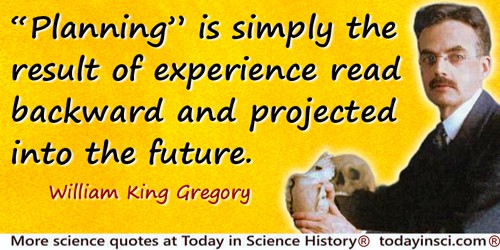
“Planning” is simply the result of experience read backward and projected into the future. To me the “purposive” action of a beehive is simply the summation and integration of its units, and Natural Selection has put higher and higher premiums on the most “purposeful” integration. It is the same way (to me) in the evolution of the middle ear, the steps in the Cynodonts (clearly shown by me in 1910 and by you later in Oudenodon) make it easier to see how such a wonderful device as the middle ear could arise without any predetermination or human-like planning, and in fact in the good old Darwinian way, if only we admit that as the “twig is bent the tree’s inclined” and that each stage conserves the advantages of its predecessors… The simple idea that planning is only experience read backward and combined by selection in suitable or successful combinations takes the mystery out of Nature and out of men’s minds.
Letter to Robert Broom [1933]. In Ronald Rainger, An Agenda for Antiquity (1991), 238.
[F. Werner, while a student in Princeton,] came to me and expressed his bewilderment with the fact that we make a rather narrow selection when choosing the data on which we test our theories. “How do we know that, if we made a theory which focuses its attention on phenomena we disregard and disregards some of the phenomena now commanding our attention, that we could not build another theory which has little in common with the present one but which, nevertheless, explains just as many phenomena as the present theory?” It has to be admitted that we have no definite evidence that there is no such theory.
In 'The Unreasonable Effectiveness of Mathematics in the Natural Sciences,' Communications in Pure and Applied Mathematics (Feb 1960), 13, No. 1 (February 1960). Collected in Eugene Paul Wigner, A.S. Wightman (ed.), Jagdish Mehra (ed.), The Collected Works of Eugene Paul Wigner (1955), Vol. 6, 535.
[When questioned on his longevity] First of all, I selected my ancestors very wisely. ... They were long-lived, healthy people. Then, as a chemist, I know how to eat, how to exercise, keep my blood circulating. ... I don't worry. I don't get angry at people. I don't worry about things I can't help. I do what I can to make the world a better place to live, but I don't complain if things aren't right. As a scientist I take the world as I find it.
[About celebrating his 77th birthday by swimming a half mile in 22 minutes] I used swim fins and webbed gloves because a man of intelligence should apply his power efficiently, not just churn the water.
[About celebrating his 77th birthday by swimming a half mile in 22 minutes] I used swim fins and webbed gloves because a man of intelligence should apply his power efficiently, not just churn the water.
As quoted in obituary by Wallace Turner, 'Joel Hildebrand, 101', New York Times (3 May 1983), D27.
A complete theory of evolution must acknowledge a balance between ‘external’ forces of environment imposing selection for local adaptation and ‘internal’ forces representing constraints of inheritance and development. Vavilov placed too much emphasis on internal constraints and downgraded the power of selection. But Western Darwinians have erred equally in practically ignoring (while acknowledging in theory) the limits placed on selection by structure and development–what Vavilov and the older biologists would have called ‘laws of form.’
…...
According to my derivative hypothesis, a change takes place first in the structure of the animal, and this, when sufficiently advanced, may lead to modifications of habits… . “Derivation” holds that every species changes, in time, by virtue of inherent tendencies thereto. “Natural Selection” holds that no such change can take place without the influence of altered external circumstances educing or selecting such change… . The hypothesis of “natural selection” totters on the extension of a conjectural condition, explanatory of extinction to the majority of organisms, and not known or observed to apply to the origin of any species.
In On the Anatomy of Vertebrates (1868), Vol. 3, 808.
All appearances to the contrary, the only watchmaker in nature is the blind forces of physics, albeit deployed in very special way. A true watchmaker has foresight: he designs his cogs springs, and plans their interconnections, with a future purpose in his mind's eye. Natural selection, the blind, unconscious, automatic process which Darwin discovered, and which we now know is the explanation for the existence and apparently purposeful form of all life, has no purpose in mind. It has no mind and no mind's eye. It does not plan for the future. It has no vision, no foresight, no sight at all. If it can be said to play the role of watchmaker in nature, it is the blind watchmaker.
The Blind Watchmaker (1986), 5.
Animals have genes for altruism, and those genes have been selected in the evolution of many creatures because of the advantage they confer for the continuing survival of the species.
In Late Night Thoughts on Listening to Mahler’s Ninth Symphony(1984), 143.
As natural selection works solely by and for the good of each being, all corporeal and mental endowments will tend to progress towards perfection.
On the Origin of Species by Means of Natural Selection (1866), 577.
But as my conclusions have lately been much misrepresented, and it has been stated that I attribute the modification of species exclusively to natural selection, I may be permitted to remark that in the first edition of this work, and subsequently, I placed in a most conspicuous position—namely, at the close of the Introduction—the following words: “I am convinced that natural selection has been the main but not the exclusive means of modification.” This has been of no avail. Great is the power of steady misrepresentation; but the history of science shows that fortunately this power does not long endure.
In The Origin of Species by Means of Natural Selection with additions and corrections from sixth and last English edition (1899), Vol. 2, 293.
By natural selection our mind has adapted itself to the conditions of the external world. It has adopted the geometry most advantageous to the species or, in other words, the most convenient. Geometry is not true, it is advantageous.
Science and Hypothesis (1902), in The Foundations of Science: Science and Hypothesis, The Value of Science, Science and Method(1946), trans. by George Bruce Halsted, 91.
Characteristically skeptical of the idea that living things would faithfully follow mathematical formulas, [Robert Harper] seized upon factors in corn which seemed to blend in the hybrid—rather than be represented by plus or minus signs, and put several seasons into throwing doubt upon the concept of immutable hypothetical units of inheritance concocted to account for selected results.
In 'Robert Almer Harper', National Academy Biographical Memoirs (1948), 25, 233-234.
Contrary to popular parlance, Darwin didn't discover evolution. He uncovered one (most would say the) essential mechanism by which it operates: natural selection. Even then, his brainstorm was incomplete until the Modern Synthesis of the early/mid-20th century when (among other things) the complementary role of genetic heredity was fully realized. Thousands upon thousands of studies have followed, providing millions of data points that support this understanding of how life on Earth has come to be as it is.
In online article, 'The Day That Botany Took on Bobby Jindal by Just Being Itself', Huffington Post (5 Aug 2013).
Darwinists are right to say that selection favours the organisms that leave alive the most progeny, but vigorous growth takes place within a constrained space where feedback from the environment allows the emergence of natural self-regulation.
In The Revenge of Gaia: Earth’s Climate Crisis & The Fate of Humanity (2006, 2007), 35.
Dr. Wallace, in his Darwinism, declares that he can find no ground for the existence of pure scientists, especially mathematicians, on the hypothesis of natural selection. If we put aside the fact that great power in theoretical science is correlated with other developments of increasing brain-activity, we may, I think, still account for the existence of pure scientists as Dr. Wallace would himself account for that of worker-bees. Their function may not fit them individually to survive in the struggle for existence, but they are a source of strength and efficiency to the society which produces them.
In Grammar of Science (1911), Part, 1, 221.
Even today a good many distinguished minds seem unable to accept or even to understand that from a source of noise natural selection alone and unaided could have drawn all the music of the biosphere. In effect natural selection operates upon the products of chance and can feed nowhere else; but it operates in a domain of very demanding conditions, and from this domain chance is barred. It is not to chance but to these conditions that eveloution owes its generally progressive cource, its successive conquests, and the impresssion it gives of a smooth and steady unfolding.
In Jacques Monod and Austryn Wainhouse (trans.), Chance and Necessity: An Essay on the Natural Philosophy of Modern Biology (1971), 118-119.
Eventually, it becomes hard to take the selections seriously, because we have no idea what factors are taken into consideration, except that somehow, it ends with only white and Asian men receiving the [Nobel] prize.
As quoted in Jesse Emspak, 'Are the Nobel Prizes Missing Female Scientists?' (5 Oct 2016), on LiveScience website.
Everywhere science is enriched by unscientific methods and unscientific results, ... the separation of science and non-science is not only artificial but also detrimental to the advancement of knowledge. If we want to understand nature, if we want to master our physical surroundings, then we must use all ideas, all methods, and not just a small selection of them.
Against Method: Outline of an Anarchistic Theory of Knowledge (1975), 305-6.
Evolution advances, not by a priori design, but by the selection of what works best out of whatever choices offer. We are the products of editing, rather than of authorship.
In 'The Origin of Optical Activity', Annals of the New York Academy of Science (1957), 69, 367.
Evolution has no long-term goal. There is no long-distance target, no final perfection to serve as a criterion for selection, although human vanity cherishes the absurd notion that our species is the final goal of evolution.
The Blind Watchmaker (1996), 50.
Evolution triumphs because it turns to natural selection, the plodding accumulation of error.
Almost Like a Whale: The Origin of Species Updated (1999), 9.
Finally in a large population, divided and subdivided into partially isolated local races of small size, there is a continually shifting differentiation among the latter (intensified by local differences in selection but occurring under uniform and static conditions) which inevitably brings about an indefinitely continuing, irreversible, adaptive, and much more rapid evolution of the species. Complete isolation in this case, and more slowly in the preceding, originates new species differing for the most part in nonadaptive parallel orthogenetic lines, in accordance with the conditions. It is suggested, in conclusion, that the differing statistical situations to be expected among natural species are adequate to account for the different sorts of evolutionary processes which have been described, and that, in particular, conditions in nature are often such as to bring about the state of poise among opposing tendencies on which an indefinitely continuing evolutionary process depends.
In 'Evolution In Mendelian Populations', Genetics, (1931), 16, 158.
General preparatory instruction must continue to be the aim in the instruction at the higher institutions of learning. Exclusive selection and treatment of subject matter with reference to specific avocations is disadvantageous.
In Resolution adopted by the German Association for the Advancement of Scientific and Mathematical Instruction, in Jahresbericht der Deutschen Mathematiker Vereinigung (1896), 41. As translated in Robert Édouard Moritz, Memorabilia Mathematica; Or, The Philomath’s Quotation-Book (1914), 72.
Given a large mass of data, we can by judicious selection construct perfectly plausible unassailable theories—all of which, some of which, or none of which may be right.
I-Ching and the citric acid cycle. Unpublished manuscript/seminar notes quoted in Frederick Grinnell, Everyday Practice of Science (2008), 86.
Heavy dependence on direct observation is essential to biology not only because of the complexity of biological phenomena, but because of the intervention of natural selection with its criterion of adequacy rather than perfection. In a system shaped by natural selection it is inevitable that logic will lose its way.
In 'Scientific innovation and creativity: a zoologist’s point of view', American Zoologist (1982), 22, 229.
Historians will have to face the fact that natural selection determined the evolution of cultures in the same manner as it did that of species.
On Aggression, trans. M. Latzke (1966), 260.
How can altruism, which by definition reduces personal fitness, possibly evolve by natural selection? The answer is kinship: if the genes causing the altruism are shared by two organisms because of common descent, and if the altruistic act by one organism increases the joint contribution of these genes to the next generation, the propensity to altruism will spread through the gene pool. This occurs even though the altruist makes less of a solitary contribution to the gene pool as the price of its altruistic act.
In Sociobiology (1975), 3-4.
I am quite sure that our views on evolution would be very different had biologists studied genetics and natural selection before and not after most of them were convinced that evolution had occurred.
Attributed.
I believe—and human psychologists, particularly psychoanalysts should test this—that present-day civilized man suffers from insufficient discharge of his aggressive drive. It is more than probable that the evil effects of the human aggressive drives, explained by Sigmund Freud as the results of a special death wish, simply derive from the fact that in prehistoric times intra-specific selection bred into man a measure of aggression drive for which in the social order today he finds no adequate outlet.
On Aggression, trans. M. Latzke (1966), 209.
I fully agree with all that you say on the advantages of H. Spencer's excellent expression of 'the survival of the fittest.' This, however, had not occurred to me till reading your letter. It is, however, a great objection to this term that it cannot be used as a substantive governing a verb; and that this is a real objection I infer from H. Spencer continually using the words, natural selection.
Letter to A. R. Wallace July 1866. In Francis Darwin (ed.), The Life and Letters of Charles Darwin, Including an Autobiographical Chapter (1887), Vol. 3, 45-6.
I have attempted to form a judgment as to the conditions for evolution based on the statistical consequences of Mendelian heredity. The most general conclusion is that evolution depends on a certain balance among its factors. There must be a gene mutation, but an excessive rate gives an array of freaks, not evolution; there must be selection, but too severe a process destroys the field of variability, and thus the basis for further advance; prevalence of local inbreeding within a species has extremely important evolutionary consequences, but too close inbreeding leads merely to extinction. A certain amount of crossbreeding is favorable but not too much. In this dependence on balance the species is like a living organism. At all levels of organization life depends on the maintenance of a certain balance among its factors.
In Proceedings of the Sixth International Congress of Genetics: Ithaca, New York, 1932 (1932) Vol. 1, 365.
I have called this principle, by which each slight variation, if useful, is preserved, by the term Natural Selection, in order to mark its relation to man's power of selection. But the expression often used by Mr. Herbert Spencer of the Survival of the Fittest is more accurate, and is sometimes equally convenient.
from Origin of Species (1859, 1888), 49.
I have often thought that an interesting essay might be written on the influence of race on the selection of mathematical methods. methods. The Semitic races had a special genius for arithmetic
and algebra, but as far as I know have never produced a single geometrician of any eminence. The Greeks on the other hand adopted a geometrical procedure wherever it was possible, and they even treated arithmetic as a branch of geometry by means of the device of representing numbers by lines.
In A History of the Study of Mathematics at Cambridge (1889), 123
I never know whether to be more surprised at Darwin himself for making so much of natural selection, or at his opponents for making so little of it.
Selections from His Notebook. Reprinted in Memories and Portraits, Memoirs of Himself and Selections from His Notebook (1924, 2003), 184.
I use the word nursing for want of a better. It has been limited to signify little more than the administration of medicines and the application of poultices. It ought to signify the proper use of fresh air, light, warmth, cleanliness, quiet, and the proper selection and administration of diet—all at the least expense of vital power to the patient.
Notes on Nursing: What it is and what it is not (1860), 2.
If the Weismann idea triumphs, it will be in a sense a triumph of fatalism; for, according to it, while we may indefinitely improve the forces of our education and surroundings, and this civilizing nurture will improve the individuals of each generation, its actual effects will not be cumulative as regards the race itself, but only as regards the environment of the race; each new generation must start de novo, receiving no increment of the moral and intellectual advance made during the lifetime of its predecessors. It would follow that one deep, almost instinctive motive for a higher life would be removed if the race were only superficially benefited by its nurture, and the only possible channel of actual improvement were in the selection of the fittest chains of race plasma.
'The Present Problem of Heredity', The Atlantic Monthly (1891), 57, 363.
In a world created by natural selection, homogeneity means vulnerability.
In 'Unmined Riches', The Diversity of Life (1992), 301.
In its essence, the theory of natural selection is primarily an attempt to give an account of the probable mechanism of the origin of the adaptations of the organisms to their environment, and only secondarily an attempt to explain evolution at large. Some modern biologists seem to believe that the word 'adaptation' has teleological connotations, and should therefore be expunged from the scientific lexicon. With this we must emphatically disagree. That adaptations exist is so evident as to be almost a truism, although this need not mean that ours is the best of all possible worlds. A biologist has no right to close his eyes to the fact that the precarious balance between a living being and its environment must be preserved by some mechanism or mechanisms if life is to endure.
Genetics and Origin of Species (1937), 150.
In summary, very large populations may differentiate rapidly, but their sustained evolution will be at moderate or slow rates and will be mainly adaptive. Populations of intermediate size provide the best conditions for sustained progressive and branching evolution, adaptive in its main lines, but accompanied by inadaptive fluctuations, especially in characters of little selective importance. Small populations will be virtually incapable of differentiation or branching and will often be dominated by random inadaptive trends and peculiarly liable to extinction, but will be capable of the most rapid evolution as long as this is not cut short by extinction.
Tempo and Mode in Evolution (1944), 70-1.
In the process of natural selection, then, any device that can insert a higher proportion of certain genes into subsequent generations will come to characterize the species.
'The Morality of the Gene'.; Sociobiology: The New Synthesis (1975, 1980), 3.
In the study of this membrane [the retina] I for the first time felt my faith in Darwinism (hypothesis of natural selection) weakened, being amazed and confounded by the supreme constructive ingenuity revealed not only in the retina and in the dioptric apparatus of the vertebrates but even in the meanest insect eye. ... I felt more profoundly than in any other subject of study the shuddering sensation of the unfathomable mystery of life.
Recollections of My Life (1898), 576. Quoted in Sidney Perkowitz, Empire of Light (1999), 16.
In true natural selection, if a body has what it takes to survive, its genes automatically survive because they are inside it. So the genes that survive tend to be, automatically, those genes that confer on bodies the qualities that assist them to survive.
The Blind Watchmaker (1996), 57
It is easy without any very profound logical analysis to perceive the difference between a succession of favorable deviations from the laws of chance, and on the other hand, the continuous and cumulative action of these laws. It is on the latter that the principle of Natural Selection relies.
In The Genetical Theory of Natural Selection (1930), 37. Reprinted as A Complete Variorum Edition (2003), 37.
It is essential for genetic material to be able to make exact copies of itself; otherwise growth would produce disorder, life could not originate, and favourable forms would not be perpetuated by natural selection.
Nobel Lecture (11 Dec 1962). In Nobel Lectures, Physiology or Medicine, 1942-1962 (1999, 762.
It is folly to use as one's guide in the selection of fundamental science the criterion of utility. Not because (scientists)... despise utility. But because. .. useful outcomes are best identified after the making of discoveries, rather than before.
Concerning the allocation of research funds.
Concerning the allocation of research funds.
Speech to the Canadian Society for the Weizmann Institute of Science, Toronto (2 Jun 1996)
It is interesting to contemplate an entangled bank, clothed with many plants of many kinds, with birds singing on the bushes, with various insects flitting about, and with worms crawling through the damp earth, and to reflect that these elaborately constructed forms, so different from each other, and dependent on each other in so complex a manner, have all been produced by laws acting around us. These laws, taken in the largest sense, being Growth with Reproduction; Inheritance which is almost implied by reproduction; Variability from the indirect and direct action of the external conditions of life, and from use and disuse; a Ratio of Increase so high as to lead to a Struggle for Life, and as a consequence to Natural Selection, entailing Divergence of Character and the Extinction of less-improved forms.
Concluding remarks in final chapter, The Origin of Species (1859), 490.
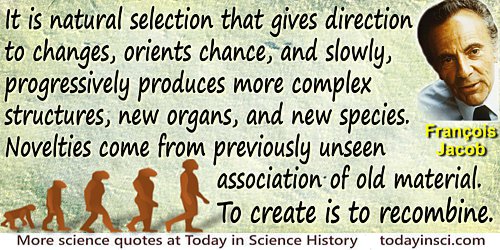
It is natural selection that gives direction to changes, orients chance, and slowly, progressively produces more complex structures, new organs, and new species. Novelties come from previously unseen association of old material. To create is to recombine.
In 'Evolution and Tinkering', Science (10 Jun 1977), 196, 1163.
It is probably no exaggeration to suppose that in order to improve such an organ as the eye at all, it must be improved in ten different ways at once. And the improbability of any complex organ being produced and brought to perfection in any such way is an improbability of the same kind and degree as that of producing a poem or a mathematical demonstration by throwing letters at random on a table.
[Expressing his reservations about Darwin's proposed evolution of the eye by natural selection.]
[Expressing his reservations about Darwin's proposed evolution of the eye by natural selection.]
Opening address to the Belfast Natural History Society, as given in the 'Belfast Northern Whig,' (19 Nov 1866). As cited by Charles Darwin in The Variation of Animals & Plants Under Domestication (1868), 222.
It is reasonable to suppose that if we could apply selection to the human race we could also produce modifications or variations of men.
From Paper (13 Nov 1883) presented to the National Academy of Sciences at New Haven, printed in ed in 'Upon the Formation of a Deaf variety of the Human Race', Memoirs of the National Academy of Sciences (1884), 2, 179.
It is the intact and functioning organism on which natural selection operates. Organisms are therefore the central element of concern to the biologist who aspires to a broad and integrated understanding of biology.
From 'Interspecific comparison as a tool for ecological physiologists', collected in M.E. Feder, A.F. Bennett, W.W. Burggren, and R.B. Huey, (eds.), New Directions in Ecological Physiology (1987), 15.
It may metaphorically be said that natural selection is daily and hourly scrutinising, throughout the world, the slightest variations; rejecting those that are bad, preserving and adding up all that are good; silently and insensibly working, whenever and wherever opportunity offers, at the improvement of each organic being in relation to its organic and inorganic conditions of life. We see nothing of these slow changes in progress, until the hand of time has marked the lapse of ages...
The Origin of Species (1870), 80.
It may very properly be asked whether the attempt to define distinct species, of a more or less permanent nature, such as we are accustomed to deal with amongst the higher plants and animals, is not altogether illusory amongst such lowly organised forms of life as the bacteria. No biologist nowadays believes in the absolute fixity of species … but there are two circumstances which here render the problem of specificity even more difficult of solution. The bacteriologist is deprived of the test of mutual fertility or sterility, so valuable in determining specific limits amongst organisms in which sexual reproduction prevails. Further, the extreme rapidity with which generation succeeds generation amongst bacteria offers to the forces of variation and natural selection a field for their operation wholly unparalleled amongst higher forms of life.
'The Evolution of the Streptococci', The Lancet, 1906, 2, 1415-6.
It wasn’t the finches that put the idea [of natural selection] in Darwin’s head, it was the tortoises. The reason he didn’t use the tortoises [in writing On the Origin of Species] was that, when he got back, he found he didn’t have localities on the tortoise specimens. Here the great god, the greatest naturalist we have records of, made a mistake. His fieldwork wasn’t absolutely perfect.
From interview with Brian Cox and Robert Ince, in 'A Life Measured in Heartbeats', New Statesman (21 Dec 2012), 141, No. 5138, 33.
Judged superficially, a progressive saturation of the germ plasm of a species with mutant genes a majority of which are deleterious in their effects is a destructive process, a sort of deterioration of the genotype which threatens the very existence of the species and can finally lead only to its extinction. The eugenical Jeremiahs keep constantly before our eyes the nightmare of human populations accumulating recessive genes that produce pathological effects when homozygous. These prophets of doom seem to be unaware of the fact that wild species in the state of nature fare in this respect no better than man does with all the artificality of his surroundings, and yet life has not come to an end on this planet. The eschatological cries proclaiming the failure of natural selection to operate in human populations have more to do with political beliefs than with scientific findings.
Genetics and Origin of Species (1937), 126.
Man cannot have an effect on nature, cannot adopt any of her forces, if he does not know the natural laws in terms of measurement and numerical relations. Here also lies the strength of the national intelligence, which increases and decreases according to such knowledge. Knowledge and comprehension are the joy and justification of humanity; they are parts of the national wealth, often a replacement for the materials that nature has too sparcely dispensed. Those very people who are behind us in general industrial activity, in application and technical chemistry, in careful selection and processing of natural materials, such that regard for such enterprise does not permeate all classes, will inevitably decline in prosperity; all the more so were neighbouring states, in which science and the industrial arts have an active interrelationship, progress with youthful vigour.
Kosmos (1845), vol.1, 35. Quoted in C. C. Gillispie (ed.), Dictionary of Scientific Biography (1970), vol. 6, 552.
More about the selection theory: Jerne meant that the Socratic idea of learning was a fitting analogy for 'the logical basis of the selective theories of antibody formation': Can the truth (the capability to synthesize an antibody) be learned? If so, it must be assumed not to pre-exist; to be learned, it must be acquired. We are thus confronted with the difficulty to which Socrates calls attention in Meno [ ... ] namely, that it makes as little sense to search for what one does not know as to search for what one knows; what one knows, one cannot search for, since one knows it already, and what one does not know, one cannot search for, since one does not even know what to search for. Socrates resolves this difficulty by postulating that learning is nothing but recollection. The truth (the capability to synthesize an antibody) cannot be brought in, but was already inherent.
'The Natural Selection Theory', in John Cairns, Gunther S. Stent, and James D. Watson (eds.) Phage and the Origins of Molecular Biology (1966), 301.
Most educated people are aware that we're the outcome of nearly 4 billion years of Darwinian selection, but many tend to think that humans are somehow the culmination. Our sun, however, is less than halfway through its lifespan. It will not be humans who watch the sun's demise, 6 billion years from now. Any creatures that then exist will be as different from us as we are from bacteria or amoebae.
Lecture (2006), reprinted as 'Dark Materials'. As cited in J.G. Ballard, 'The Catastrophist', collected in Christopher Hitchens, Arguably: Selected Essays (2011), 353
Most of the knowledge and much of the genius of the research worker lie behind his selection of what is worth observing. It is a crucial choice, often determining the success or failure of months of work, often differentiating the brilliant discoverer from an otherwise admirable but entirely unproductive plodder.
The Furtherance of Medical Research (1941), 8.
Mutation is random; natural selection is the very opposite of random
The Blind Watchmaker (1996), 41
Mutations and chromosomal changes arise in every sufficiently studied organism with a certain finite frequency, and thus constantly and unremittingly supply the raw materials for evolution. But evolution involves something more than origin of mutations. Mutations and chromosomal changes are only the first stage, or level, of the evolutionary process, governed entirely by the laws of the physiology of individuals. Once produced, mutations are injected in the genetic composition of the population, where their further fate is determined by the dynamic regularities of the physiology of populations. A mutation may be lost or increased in frequency in generations immediately following its origin, and this (in the case of recessive mutations) without regard to the beneficial or deleterious effects of the mutation. The influences of selection, migration, and geographical isolation then mold the genetic structure of populations into new shapes, in conformity with the secular environment and the ecology, especially the breeding habits, of the species. This is the second level of the evolutionary process, on which the impact of the environment produces historical changes in the living population.
Genetics and Origin of Species (1937), 13.
Natural Science treats of motion and force. Many of its teachings remain as part of an educated man's permanent equipment in life.
Such are:
(a) The harder you shove a bicycle the faster it will go. This is because of natural science.
(b) If you fall from a high tower, you fall quicker and quicker and quicker; a judicious selection of a tower will ensure any rate of speed.
(c) If you put your thumb in between two cogs it will go on and on, until the wheels are arrested, by your suspenders. This is machinery.
(d) Electricity is of two kinds, positive and negative. The difference is, I presume, that one kind comes a little more expensive, but is more durable; the other is a cheaper thing, but the moths get into it.
Such are:
(a) The harder you shove a bicycle the faster it will go. This is because of natural science.
(b) If you fall from a high tower, you fall quicker and quicker and quicker; a judicious selection of a tower will ensure any rate of speed.
(c) If you put your thumb in between two cogs it will go on and on, until the wheels are arrested, by your suspenders. This is machinery.
(d) Electricity is of two kinds, positive and negative. The difference is, I presume, that one kind comes a little more expensive, but is more durable; the other is a cheaper thing, but the moths get into it.
In Literary Lapses (1918), 130.
Natural selection based on the differential multiplication of variant types cannot exist before there is material capable of replicating itself and its own variations, that is, before the origination of specifically genetic material or gene-material.
'Genetic Nucleic Acid', Perspectives in Biology and Medicine (1961), 5, 7.

Natural selection is a mechanism for generating an exceedingly high degree of improbability.
This is not a verbatim quote, but it is a summary of Fisher’s idea, as appearing without quotation marks in the words of the editor, Julian Huxley, in J.S. Huxley, A.C. Hardy and E.B. Ford (eds.), Evolution as a Process (1954), 5. The lengthier quote is from Fisher’s full essay 'Retrospect of the Criticisms of the Theory of Natural Selection' which appears in the same book on p.91. See it elsewhere in this site’s collection, as the Fisher quote that begins: “It was Darwin’s chief contribution…”.
Natural selection is a theory of local adaptation to changing environments. It proposes no perfecting principles, no guarantee of general improvement,
Ever Since Darwin: Reflections in Natural History (1977), 45.
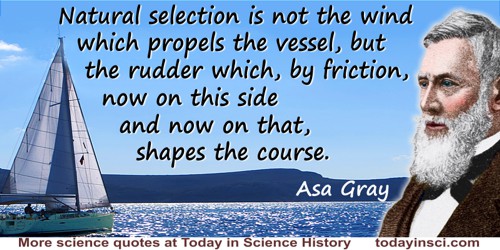
Natural selection is not the wind which propels the vessel, but the rudder which, by friction, now on this side and now on that, shapes the course.
— Asa Gray
Illustrating the Darwinian Doctrine, in his essay 'Evolutionary Teleology,' in Darwiniana: Essays and Reviews Pertaining to Darwinism (1876), 386.
Natural selection produces systems that function no better than necessary. It results in ad hoc adaptive solutions to immediate problems. Whatever enhances fitness is selected. The product of natural selection is not perfection but adequacy, not final answers but limited, short-term solutions.
In 'The role of natural history in contemporary biology', BioScience (1986), 36, 325.
Nature has but one plan of operation, invariably the same in the smallest things as well as in the largest, and so often do we see the smallest masses selected for use in Nature, that even enormous ones are built up solely by fitting these together. Indeed, all Nature’s efforts are devoted to uniting the smallest parts of our bodies in such a way that all things whatsoever, however diverse they may be, which coalesce in the structure of living things construct the parts by means of a sort of compendium.
'On the Developmental Process', in H. B. Adelmann (ed.), Marcello Malpighi and the Evolution of Embryology (1966), Vol. 2, 843.
No politics, no committees, no reports, no referees, no interviews – just highly motivated people picked by a few men of good judgment.
[Describing the compelling ideas of Max Perutz on how best to nurture research.]
[Describing the compelling ideas of Max Perutz on how best to nurture research.]
Quoted in Andrew Jack, "An Acute Talent for Innovation", Financial Times (1 Feb 2009).
No! What we need are not prohibitory marriage laws, but a reformed society, an educated public opinion which will teach individual duty in these matters. And it is to the women of the future that I look for the needed reformation. Educate and train women so that they are rendered independent of marriage as a means of gaining a home and a living, and you will bring about natural selection in marriage, which will operate most beneficially upon humanity. When all women are placed in a position that they are independent of marriage, I am inclined to think that large numbers will elect to remain unmarried—in some cases, for life, in others, until they encounter the man of their ideal. I want to see women the selective agents in marriage; as things are, they have practically little choice. The only basis for marriage should be a disinterested love. I believe that the unfit will be gradually eliminated from the race, and human progress secured, by giving to the pure instincts of women the selective power in marriage. You can never have that so long as women are driven to marry for a livelihood.
In 'Heredity and Pre-Natal Influences. An Interview With Dr. Alfred Russel Wallace', Humanitarian (1894), 4, 87.
Nothing drives progress like the imagination. The idea precedes the deed. The only exceptions
are accidents and natural selection.
In The Marketing Imagination (1983, 1986), 127.
On the theory of natural selection we can clearly understand the full meaning of that old canon in natural history, “Natura non facit saltum.” This canon, if we look only to the present inhabitants of the world, is not strictly correct, but if we include all those of past times, it must by my theory be strictly true.
From On the Origin of Species by Means of Natural Selection; or, The Preservation of Favoured Races in the Struggle for Life (1861), 183.
Only a few years ago, it was generally supposed that by crossing two somewhat different species or varieties a mongrel might be produced which might, or more likely might not, surpass its parents. The fact that crossing was only the first step and that selection from the numerous variations secured in the second and a few succeeding generations was the real work of new plant creation had never been appreciated; and to-day its significance is not fully understood either by breeders or even by many scientific investigators along these very lines.
From Paper read at the Annual Meeting of the American Breeders’ Association, at Columbia, Mo. (5-8 January 1909). In 'Another Mode of Species Forming', Popular Science Monthly (Sep 1909), 75, 264-265.
Our world is not an optimal place, fine tuned by omnipotent forces of selection. It is a quirky mass of imperfections, working well enough (often admirably); a jury-rigged set of adaptations built of curious parts made available by past histories in different contexts ... A world optimally adapted to current environments is a world without history, and a world without history might have been created as we find it. History matters; it confounds perfection and proves that current life transformed its own past.
…...
Quantitative work shows clearly that natural selection is a reality, and that, among other things, it selects Mendelian genes, which are known to be distributed at random through wild populations, and to follow the laws of chance in their distribution to offspring. In other words, they are an agency producing variation of the kind which Darwin postulated as the raw material on which selection acts.
'Natural Selection', Nature, 1929, 124, 444.
Scientists are not robotic inducing machines that infer structures of explanation only from regularities observed in natural phenomena (assuming, as I doubt, that such a style of reasoning could ever achieve success in principle). Scientists are human beings, immersed in culture, and struggling with all the curious tools of inference that mind permits ... Culture can potentiate as well as constrain–as Darwin’s translation of Adam Smith’s laissez-faire economic models into biology as the theory of natural selection. In any case, objective minds do not exist outside culture, so we must make the best of our ineluctable embedding.
…...
Select such subjects that your pupils cannot walk out without seeing them. Train your pupils to be observers, and have them provided with the specimens about which you speak. If you can find nothing better, take a house-fly or a cricket, and let each one hold a specimen and examine it as you talk.
Lecture at a teaching laboratory on Penikese Island, Buzzard's Bay. Quoted from the lecture notes by David Starr Jordan, Science Sketches (1911), 146.
Several very eminent living paleontologists frequently emphasise the abruptness of some of the major changes that have occurred, and seek for an external cause. This is a heady wine and has intoxicated palaeontologists since the days when they could blame it all on Noah's flood. In fact, books are still being published by the lunatic fringe with the same explanation. In case this book should be read by some fundamentalist searching for straws to prop up his prejudices, let me state categorically that all my experience (such as it is) has led me to an unqualified acceptance of evolution by natural selection as a sufficient explanation for what I have seen in the fossil record
In The Nature of the Stratigraphical Record (1973), 19-20.
Since natural selection demands only adequacy, elegance of design is not relevant; any combination of behavioural adjustment, physiological regulation, or anatomical accommodation that allows survival and reproduction may be favoured by selection. Since all animals are caught in a phylogenetic trap by the nature of past evolutionary adjustments, it is to be expected that a given environmental challenge will be met in a variety of ways by different animals. The delineation of the patterns of the accommodations of diverse types of organisms to the environment contributes much of the fascination of ecologically relevant physiology.
In 'The roles of physiology and behaviour in the maintenance of homeostasis in the desert environment.', Symposia of the Society for Experimental Biology (1964), 11.
Sociobiology is not just any statement that biology, genetics, and evolutionary theory have something to do with human behavior. Sociobiology is a specific theory about the nature of genetic and evolutionary input into human behavior. It rests upon the view that natural selection is a virtually omnipotent architect, constructing organisms part by part as best solutions to problems of life in local environments. It fragments organisms into “traits,” explains their existence as a set of best solutions, and argues that each trait is a product of natural selection operating “for” the form or behavior in question. Applied to humans, it must view specific behaviors (not just general potentials) as adaptations built by natural selection and rooted in genetic determinants, for natural selection is a theory of genetic change. Thus, we are presented with unproved and unprovable speculations about the adaptive and genetic basis of specific human behaviors: why some (or all) people are aggressive, xenophobic, religious, acquisitive, or homosexual.
In Hen's Teeth and Horses Toes (1983, 2010), 242-243.
Success in the solution of a problem generally depends in a great measure on the selection of the most appropriate method of approaching it; many properties of conic sections (for instance) being demonstrable by a few steps of pure geometry which would involve the most laborious operations with trilinear co-ordinates, while other properties are almost self-evident under the method of trilinear co-ordinates, which it would perhaps be actually impossible to prove by the old geometry.
In Trilinear Coordinates and Other Methods of Modern Analytical Geometry of Two Dimensions (1866), 154.
The Christians who engaged in infamous persecutions and shameful inquisitions were not evil men but misguided men. The churchmen who felt they had an edict from God to withstand the progress of science, whether in the form of a Copernican revolution or a Darwinian theory of natural selection, were not mischievous men but misinformed men. And so Christ’s words from the cross are written in sharp-edged terms across some of the most inexpressible tragedies of history: 'They know not what they do'.
'Love in Action', Strength To Love (1963, 1981), 43.
The dispute between evolutionists and creation scientists offers textbook writers and teachers a wonderful opportunity to provide students with insights into the philosophy and methods of science. … What students really need to know is … how scientists judge the merit of a theory. Suppose students were taught the criteria of scientific theory evaluation and then were asked to apply these criteria … to the two theories in question. Wouldn’t such a task qualify as authentic science education? … I suspect that when these two theories are put side by side, and students are given the freedom to judge their merit as science, creation theory will fail ignominiously (although natural selection is far from faultless). … It is not only bad science to allow disputes over theory to go unexamined, but also bad education.
In Building a Bridge to the 18th Century: How the Past Can Improve Our Future (1999), 168.
The earliest form of natural selection was simply a selection of stable forms and a rejection of unstable ones.
In The Selfish Gene: 30th Anniversary Edition (1976, 2006), 14.
The frequent allegation that the selective processes in the human species are no longer 'natural' is due to persistence of the obsolete nineteenth-century concept of 'natural' selection. The error of this view is made clear when we ask its proponents such questions as, why should the 'surviving fittest' be able to withstand cold and inclement weather without the benefit of fire and clothing? Is it not ludicrous to expect selection to make us good at defending ourselves against wild beasts when wild beasts are getting to be so rare that it is a privilege to see one outside of a zoo? Is it necessary to eliminate everyone who has poor teeth when our dentists stand ready to provide us with artificial ones? Is it a great virtue to be able to endure pain when anaesthetics are available?
[Co-author with American statistician Gordon Allen]
[Co-author with American statistician Gordon Allen]
Theodosius Dobzhansky and Gordon Allen, 'Does Natural Selection Continue to Operate in Modern Mankind?', American Anthropologist, 1956, 58, 595.
The fundamental biological variant is DNA. That is why Mendel's definition of the gene as the unvarying bearer of hereditary traits, its chemical identification by Avery (confirmed by Hershey), and the elucidation by Watson and Crick of the structural basis of its replicative invariance, are without any doubt the most important discoveries ever made in biology. To this must be added the theory of natural selection, whose certainty and full significance were established only by those later theories.
In Jacques Monod and Austryn Wainhouse (trans.), Chance and Necessity: An Essay on the Natural Philosophy of Modern Biology (1971), 104.
The great mathematician fully, almost ruthlessly, exploits the domain of permissible reasoning and skirts the impermissible. … [I]t is hard to believe that our reasoning power was brought, by Darwin’s process of natural selection, to the perfection which it seems to possess.
In 'The Unreasonable Effectiveness of Mathematics in the Natural Sciences,' Communications in Pure and Applied Mathematics (Feb 1960), 13, No. 1 (February 1960). Collected in Eugene Paul Wigner, A.S. Wightman (ed.), Jagdish Mehra (ed.), The Collected Works of Eugene Paul Wigner (1955), Vol. 6, 536.
The growth of our knowledge is the result of a process closely resembling what Darwin called “natural selection”; that is, the natural selection of hypotheses: our knowledge consists, at every moment, of those hypotheses which have shown their (comparative) fitness by surviving so far in their struggle for existence, a competitive struggle which eliminates those hypotheses which are unfit.
From Objective Knowledge: An Evolutionary Approach (1971), 261. As quoted in Dean Keith Simonton, Origins of Genius: Darwinian Perspectives on Creativity (1999), 26.
The human brain became large by natural selection (who knows why, but presumably for good cause). Yet surely most ‘things’ now done by our brains, and essential both to our cultures and to our very survival, are epiphenomena of the computing power of this machine, not genetically grounded Darwinian entities created specifically by natural selection for their current function.
…...
The main steps of my argument may be summarized thus:
1. Organisms are highly coordinated structures.
2. Only certain avenues of change are compatible with their conditions of coordination.
3. The formative and selective action of these internal conditions is theoretically and empirically different from that of Darwinian selection.
4. Mutations in the mode of coordination of the genetic system lie outside the scope of the classical arguments purporting to show that natural selection is the only directive agency.
5. The coordinative conditions constitute a second directive agency.
1. Organisms are highly coordinated structures.
2. Only certain avenues of change are compatible with their conditions of coordination.
3. The formative and selective action of these internal conditions is theoretically and empirically different from that of Darwinian selection.
4. Mutations in the mode of coordination of the genetic system lie outside the scope of the classical arguments purporting to show that natural selection is the only directive agency.
5. The coordinative conditions constitute a second directive agency.
In Internal Factors in Evolution (1965), 73.
The maintenance of biological diversity requires special measures that extend far beyond the establishment of nature reserves. Several reasons for this stand out. Existing reserves have been selected according to a number of criteria, including the desire to protect nature, scenery, and watersheds, and to promote cultural values and recreational opportunities. The actual requirements of individual species, populations, and communities have seldom been known, nor has the available information always been employed in site selection and planning for nature reserves. The use of lands surrounding nature reserves has typically been inimical to conservation, since it has usually involved heavy use of pesticides, industrial development, and the presence of human settlements in which fire, hunting, and firewood gathering feature as elements of the local economy.
The Fragmented Forest: Island Biogeography Theory and the Preservation of Biotic Diversity (1984), xii.
The majority of evolutive movements are degenerative. Progressive cases are exceptional. Characters appear suddenly that have no meaning in the atavistic series. Evolution in no way shows a general tendency toward progress… . The only thing that could be accomplished by slow changes would be the accumulation of neutral characteristics without value for survival. Only important and sudden mutations can furnish the material which can be utilized by selection.
As quoted in Isaac Asimov's Book of Science and Nature Quotations (1988), 91. Please contact Webmaster if you know the primary source.
The more efficient causes of progress seem to consist of a good education during youth whilst the brain is impressible, and of a high standard of excellence, inculcated by the ablest and best men, embodied in the laws, customs and traditions of the nation, and enforced by public opinion. It should, however, be borne in mind, that the enforcement of public opinion depends on our appreciation of the approbation and disapprobation of others; and this appreciation is founded on our sympathy, which it can hardly be doubted was originally developed through natural selection as one of the most important elements of the social instincts.
…...
The outlook seems grim. Natural selection under civilized conditions may lead mankind to evolve towards a state of genetic overspecialization for living in gadget-ridden environments. It is certainly up to man to decide whether this direction of his evolution is or is not desirable. If it is not, man has, or soon will have, the knowledge requisite to redirect the evolution of his species pretty much as he sees fit. Perhaps we should not be too dogmatic about this choice of direction. We may be awfully soft compared to paleolithic men when it comes to struggling, unaided by gadgets, with climatic difficulties and wild beasts. Most of us feel most of the time that this is not a very great loss. If our remote descendants grow to be even more effete than we are, they may conceivably be compensated by acquiring genotypes conducive to kindlier dispositions and greater intellectual capacities than those prevalent in mankind today.
[Co-author with American statistician Gordon Allen.]
[Co-author with American statistician Gordon Allen.]
Theodosius Dobzhansky and Gordon Allen, 'Does Natural Selection Continue to Operate in Modern Mankind?', American Anthropologist, 1956, 58 599.
The present gigantic development of the mathematical faculty is wholly unexplained by the theory of natural selection, and must be due to some altogether distinct cause.
In Darwinism, chap. 15.
The process of mutation is the only known source of the raw materials of genetic variability, and hence of evolution. It is subject to experimental study, and considerable progress has been accomplished in this study in recent years. An apparent paradox has been disclosed. Although the living matter becomes adapted to its environment through formation of superior genetic patterns from mutational components, the process of mutation itself is not adaptive. On the contrary, the mutants which arise are, with rare exceptions, deleterious to their carriers, at least in the environments which the species normally encounters. Some of them are deleterious apparently in all environments. Therefore, the mutation process alone, not corrected and guided by natural selection, would result in degeneration and extinction rather than in improved adaptedness.
'On Methods of Evolutionary Biology and Anthropology', American Scientist, 1957, 45, 385.
The process of natural selection has been summed up in the phrase “survival of the fittest.” This, however, tells only part of the story. “Survival of the existing” in many cases covers more of the truth. For in hosts of cases the survival of characters rests not on any special usefulness or fitness, but on the fact that individuals possessing these characters have inhabited or invaded a certain area. The principle of utility explains survivals among competing structures. It rarely accounts for qualities associated with geographic distribution.
The nature of animals which first colonize a district must determine what the future fauna will be. From their specific characters, which are neither useful nor harmful, will be derived for the most part the specific characters of their successors.
It is not essential to the meadow lark that he should have a black blotch on the breast or the outer tail-feather white. Yet all meadow larks have these characters just as all shore larks have the tiny plume behind the ear. Those characters of the parent stock, which may be harmful in the new relations, will be eliminated by natural selection. Those especially helpful will be intensified and modified, but the great body of characters, the marks by which we know the species, will be neither helpful nor hurtful. These will be meaningless streaks and spots, variations in size of parts, peculiar relations of scales or hair or feathers, little matters which can neither help nor hurt, but which have all the persistence heredity can give.
The nature of animals which first colonize a district must determine what the future fauna will be. From their specific characters, which are neither useful nor harmful, will be derived for the most part the specific characters of their successors.
It is not essential to the meadow lark that he should have a black blotch on the breast or the outer tail-feather white. Yet all meadow larks have these characters just as all shore larks have the tiny plume behind the ear. Those characters of the parent stock, which may be harmful in the new relations, will be eliminated by natural selection. Those especially helpful will be intensified and modified, but the great body of characters, the marks by which we know the species, will be neither helpful nor hurtful. These will be meaningless streaks and spots, variations in size of parts, peculiar relations of scales or hair or feathers, little matters which can neither help nor hurt, but which have all the persistence heredity can give.
Foot-notes to Evolution. A Series of Popular Addresses on the Evolution of Life (1898), 218.
The Question is what is The Question?
Is it all a Magic Show?
Is Reality an Illusion?
What is the framework of The Machine?
Darwin’s Puzzle: Natural Selection?
Where does Space-Time come from?
Is there any answer except that it comes from consciousness?
What is Out There?
T’is Ourselves?
Or, is IT all just a Magic Show?
Einstein told me:
“If you would learn, teach!”
Is it all a Magic Show?
Is Reality an Illusion?
What is the framework of The Machine?
Darwin’s Puzzle: Natural Selection?
Where does Space-Time come from?
Is there any answer except that it comes from consciousness?
What is Out There?
T’is Ourselves?
Or, is IT all just a Magic Show?
Einstein told me:
“If you would learn, teach!”
Speaking at the American Physical Society, Philadelphia (Apr 2003). As quoted and cited in Jack Sarfatti, 'Wheeler's World: It From Bit?', collected in Frank H. Columbus and Volodymyr Krasnoholovets (eds.), Developments in Quantum Physics (2004), 42.
The religious conservatives make an important point when they oppose presenting evolution in a manner that suggests it has been proved to be entirely determined by random, mechanistic events, but they are wrong to oppose the teaching of evolution itself. Its occurrence, on Earth and in the Universe, is by now indisputable. Not so its processes, however. In this, there is need for a nuanced approach, with evidence of creative ordering presented as intrinsic both to what we call matter and to the unfolding story, which includes randomness and natural selection.
Epigraph, without citation, in Michael Dowd, Thank God for Evolution: How the Marriage of Science and Religion Will Transform Your Life and Our World (2008), 109.
The resolution of revolutions is selection by conflict within the scientific community of the fittest way to practice future science. The net result of a sequence of such revolutionary selections, separated by periods of normal research, is the wonderfully adapted set of instruments we call modern scientific knowledge.
The Structure of Scientific Revolutions (1962), 171.
The scientific value of truth is not, however, ultimate or absolute. It rests partly on practical, partly on aesthetic interests. As our ideas are gradually brought into conformity with the facts by the painful process of selection,—for intuition runs equally into truth and into error, and can settle nothing if not controlled by experience,—we gain vastly in our command over our environment. This is the fundamental value of natural science
In The Sense of Beauty: Being the Outlines of Aesthetic Theory (1896), 22.
The starting point of Darwin’s theory of evolution is precisely the existence of those differences between individual members of a race or species which morphologists for the most part rightly neglect. The first condition necessary, in order that any process of Natural Selection may begin among a race, or species, is the existence of differences among its members; and the first step in an enquiry into the possible effect of a selective process upon any character of a race must be an estimate of the frequency with which individuals, exhibiting any given degree of abnormality with respect to that, character, occur. The unit, with which such an enquiry must deal, is not an individual but a race, or a statistically representative sample of a race; and the result must take the form of a numerical statement, showing the relative frequency with which the various kinds of individuals composing the race occur.
Biometrika: A Joumal for the Statistical Study of Biological Problems (1901), 1, 1-2.
The successes of the differential equation paradigm were impressive and extensive. Many problems, including basic and important ones, led to equations that could be solved. A process of self-selection set in, whereby equations that could not be solved were automatically of less interest than those that could.
In Does God Play Dice? The Mathematics of Chaos (1989, 1997), 33.
The theory here developed is that mega-evolution normally occurs among small populations that become preadaptive and evolve continuously (without saltation, but at exceptionally rapid rates) to radically different ecological positions. The typical pattern involved is probably this: A large population is fragmented into numerous small isolated lines of descent. Within these, inadaptive differentiation and random fixation of mutations occur. Among many such inadaptive lines one or a few are preadaptive, i.e., some of their characters tend to fit them for available ecological stations quite different from those occupied by their immediate ancestors. Such groups are subjected to strong selection pressure and evolve rapidly in the further direction of adaptation to the new status. The very few lines that successfully achieve this perfected adaptation then become abundant and expand widely, at the same time becoming differentiated and specialized on lower levels within the broad new ecological zone.
Tempo and Mode in Evolution (1944), 123.
The theory of evolution by natural selection is an ecological theory—founded on ecological observation by perhaps the greatest of all ecologists. It has been adopted by and brought up by the science of genetics, and ecologists, being modest people, are apt to forget their distinguished parenthood.
'A Darwinian Approach to Plant Ecology', Journal of Ecology, 1967, 55, 247.
The universe is governed by science. But science tells us that we can’t solve the equations, directly in the abstract. We need to use the effective theory of Darwinian natural selection of those societies most likely to survive. We assign them higher value.
[Answer to question: What is the value in knowing “Why are we here?”]
[Answer to question: What is the value in knowing “Why are we here?”]
'Stephen Hawking: "There is no heaven; it’s a fairy story"', interview in newspaper The Guardian (15 May 2011).
The vulgar opinion, then, which, on health reasons, condemns vegetable food and so much praises animal food, being so ill-founded, I have always thought it well to oppose myself to it, moved both by experience and by that refined knowledge of natural things which some study and conversation with great men have given me. And perceiving now that such my constancy has been honoured by some learned and wise physicians with their authoritative adhesion (della autorevole sequela), I have thought it my duty publicly to diffuse the reasons of the Pythagorean diet, regarded as useful in medicine, and, at the same time, as full of innocence, of temperance, and of health. And it is none the less accompanied with a certain delicate pleasure, and also with a refined and splendid luxury (non è privo nemmeno d’una certa delicate voluttà e d’un lusso gentile e splendido ancora), if care and skill be applied in selection and proper supply of the best vegetable food, to which the fertility and the natural character of our beautiful country seem to invite us. For my part I have been so much the more induced to take up this subject, because I have persuaded myself that I might be of service to intending diet-reformers, there not being, to my knowledge, any book of which this is the sole subject, and which undertakes exactly to explain the origin and the reasons of it.
From Dell Vitto Pitagorico (1743), (The Pythagorean Diet: for the Use of the Medical Faculty), as translated quotes in Howard Williams, The Ethics of Diet: A Catena of Authorities Deprecatory of the Practice of Flesh-Eating (1883), 158.
Theories should not be used to select observations; on the contrary, it is observations which should be used to select the theories.
From webpage 'The Selection Effect' on laserstars.org website. The article does not specify an author, but the homepage attributes the site to Y.P. Varshni and J. Talbot.
There is a finite number of species of plants and animals—even of insects—upon the earth. … Moreover, the universality of the genetic code, the common character of proteins in different species, the generality of cellular structure and cellular reproduction, the basic similarity of energy metabolism in all species and of photosynthesis in green plants and bacteria, and the universal evolution of living forms through mutation and natural selection all lead inescapably to a conclusion that, although diversity may be great, the laws of life, based on similarities, are finite in number and comprehensible to us in the main even now.
Presidential Address (28 Dec 1970) to the American Association for the Advancement of Science. 'Science: Endless Horizons or Golden Age?', Science (8 Jan 1971), 171, No. 3866, 24.
There is no gene ‘for’ such unambiguous bits of morphology as your left kneecap or your fingernail ... Hundreds of genes contribute to the building of most body parts and their action is channeled through a kaleidoscopic series of environmental influences: embryonic and postnatal, internal and external. Parts are not translated genes, and selection doesn’t even work directly on parts.
…...
This preservation of favourable variations and the destruction of injurious variations, I call Natural Selection, or the Survival of the Fittest. Variations neither useful nor injurious would not be affected by natural selection and would be left a fluctuating element.
From Origin of Species (fifth edition, 1869), 81. The phrase “survival of the fittest” was not added until the fifth edition (1869), and is absent from earlier editions. Also in the fifth edition, the word “destruction” replaced “rejection” used in the earlier editions (1859, 1860, 1861, 1866) to the fourth edition.
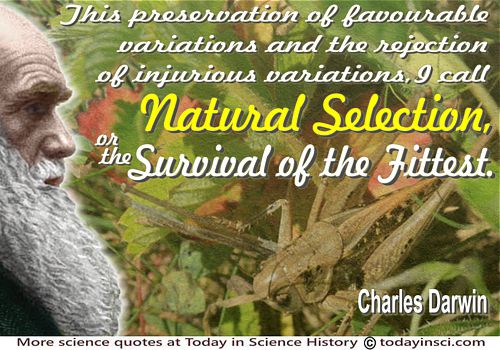
This preservation of favourable variations and the rejection of injurious variations, I call Natural Selection. Variations neither useful nor injurious would not be affected by natural selection and would be left a fluctuating element.
From Origin of Species (first edition, 1859), 81. The phrase “survival of the fittest” was not added until the fifth edition (1869), when also “rejection” was replaced with “destruction.”
This survival of the fittest which I have here sought to express in mechanical terms, is that which Mr. Darwin has called “natural selection, or the preservation of favoured races in the struggle for life.”
Principles of Biology (1865, 1872), Vol. 1, 444-445.
Throughout his last half-dozen books, for example, Arthur Koestler has been conducting a campaign against his own misunderstanding of Darwinism. He hopes to find some ordering force, constraining evolution to certain directions and overriding the influence of natural selection ... Darwinism is not the theory of capricious change that Koestler imagines. Random variation may be the raw material of change, but natural selection builds good design by rejecting most variants while accepting and accumulating the few that improve adaptation to local environments.
In The Panda’s Thumb: More Reflections in Natural History (1990, 2010), 38.
To ask what qualities distinguish good from routine scientific research is to address a question that should be of central concern to every scientist. We can make the question more tractable by rephrasing it, “What attributes are shared by the scientific works which have contributed importantly to our understanding of the physical world—in this case the world of living things?” Two of the most widely accepted characteristics of good scientific work are generality of application and originality of conception. . These qualities are easy to point out in the works of others and, of course extremely difficult to achieve in one’s own research. At first hearing novelty and generality appear to be mutually exclusive, but they really are not. They just have different frames of reference. Novelty has a human frame of reference; generality has a biological frame of reference. Consider, for example, Darwinian Natural Selection. It offers a mechanism so widely applicable as to be almost coexistent with reproduction, so universal as to be almost axiomatic, and so innovative that it shook, and continues to shake, man’s perception of causality.
In 'Scientific innovation and creativity: a zoologist’s point of view', American Zoologist (1982), 22, 230.
To suppose that the eye, with all its inimitable contrivances for adjusting the focus to different distances, for admitting different amounts of light, and for the correction of spherical and chromatic aberration, could have been formed by natural selection, seems, I freely confess, absurd in the highest possible degree. When it was first said that the sun stood still and the world turned round, the common sense of mankind declared the doctrine false; but the old saying of Vox populi, vox Dei, as every philosopher knows, cannot be trusted in science. Reason tells me, that if numerous gradations from a perfect and complex eye to one very imperfect and simple, each grade being useful to its possessor, can be shown to exist; if further, the eye does vary ever so slightly, and the variations be inherited, which is certainly the case; and if any variation or modification in the organ be ever useful to an animal under changing conditions of life, then the difficulty of believing that a perfect and complex eye could be formed by natural selection, though insuperable by our imagination, can hardly be considered real.
On The Origin of Species by Means of Natural Selection (1859, 1882), 143-144.
Tolstoi explains somewhere in his writings why, in his opinion, “Science for Science's sake” is an absurd conception. We cannot know all the facts since they are infinite in number. We must make a selection ... guided by utility ... Have we not some better occupation than counting the number of lady-birds in existence on this planet?
In Science and Method (1914, 2003), 15
Varicose veins are the result of an improper selection of grandparents.
Indicating that varicose veins are hereditary.
Indicating that varicose veins are hereditary.
In W. B. Bean, Sir William Osler: Aphorisms, 146. In Mark E. Silverman et al. (eds.), The Quotable Osler (2003), 127.
We are at our human finest, dancing with our minds, when there are more choices than two. Sometimes there are ten, even twenty different ways to go, all but one bound to be wrong, and the richness of the selection in such situations can lift us onto totally new ground.
In The Medusa and the Snail: More Notes of a Biology Watcher (1974, 1979), 39.
We do not inhabit a perfected world where natural selection ruthlessly scrutinizes all organic structures and then molds them for optimal utility. Organisms inherit a body form and a style of embryonic development; these impose constraint s upon future change and adaptation. In many cases, evolutionary pathways reflect inherited patterns more than current environmental demands. These inheritances constrain, but they also provide opportunity. A potentially minor genetic change ... entails a host of complex, nonadaptive consequences ... What ‘play’ would evolution have if each structure were built for a restricted purpose and could be used for nothing else? How could humans learn to write if our brain had not evolved for hunting, social cohesion, or whatever, and could not transcend the adaptive boundaries of its original purpose?
…...
We live in a cultural milieu ... The idea that culture is our ecological niche is still applicable. The impact and force of natural selection on the human physique are conditioned by the dimensions of culture.
Interview with Pat Shipman, 21 January 1991. Quoted in Erik Trinkaus and Pat Shipman, The Neanderthals: Changing the Image of Mankind (1993), 334.
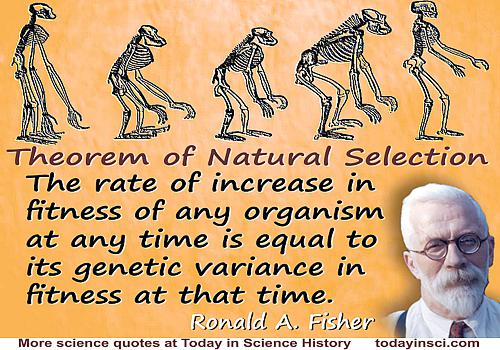
We may consequently state the fundamental theorem of Natural Selection in the form: The rate of increase in fitness of any organism at any time is equal to its genetic variance in fitness at that time.
The Genetical Theory of Natural Selection (1930), 35.
What these two sciences of recognition, evolution and immunology, have in common is not found in nonbiological systems such as 'evolving' stars. Such physical systems can be explained in terms of energy transfer, dynamics, causes, and even 'information transfer'. But they do not exhibit repertoires of variants ready for interaction by selection to give a population response according to a hereditary principle. The application of a selective principle in a recognition system, by the way, does not necessarily mean that genes must be involved—it simply means that any state resulting after selection is highly correlated in structure with the one that gave rise to it and that the correlation continues to be propagated. Nor is it the case that selection cannot itself introduce variation. But a constancy or 'memory' of selected events is necessary. If changes occurred so fast that what was selected could not emerge in the population or was destroyed, a recognition system would not survive. Physics proper does not deal with recognition systems, which are by their nature biological and historical systems. But all the laws of physics nevertheless apply to recognition systems.
Bright and Brilliant Fire, On the Matters of the Mind (1992), 79.
What, in fact, is mathematical discovery? It does not consist in making new combinations with mathematical entities that are already known. That can be done by anyone, and the combinations that could be so formed would be infinite in number, and the greater part of them would be absolutely devoid of interest. Discovery consists precisely in not constructing useless combinations, but in constructing those that are useful, which are an infinitely small minority. Discovery is discernment, selection.
In Science et Méthode (1920), 48, as translated by Francis Maitland, in Science and Method (1908, 1952), 50-51. Also seen elsewhere translated with “invention” in place of “discovery”.
When Bonner writes that ‘natural selection for optimal feeding is then presumed to be the cause of non-motility in all forms,’ I can’t help suspecting that some plants might do even better if they could walk from shade to sun–but the inherited constraints of design never permitted a trial of this intriguing option.
…...
When one ponders on the tremendous journey of evolution over the past three billion years or so, the prodigious wealth of structures it has engendered, and the extraordinarily effective teleonomic performances of living beings from bacteria to man, one may well find oneself beginning to doubt again whether all this could conceiveably be the product of an enormous lottery presided over by natural selection, blindly picking the rare winners from among numbers drawn at random. [Nevertheless,] a detailed review of the accumulated modern evidence [shows] that this conception alone is compatible with the facts.
In Jacques Monod and Austryn Wainhouse (trans.), Chance and Necessity: An Essay on the Natural Philosophy of Modern Biology (1971), 138.
When... the biologist is confronted with the fact that in the organism the parts are so adapted to each other as to give rise to a harmonious whole; and that the organisms are endowed with structures and instincts calculated to prolong their life and perpetuate their race, doubts as to the adequacy of a purely physiochemical viewpoint in biology may arise. The difficulties besetting the biologist in this problem have been rather increased than diminished by the discovery of Mendelian heredity, according to which each character is transmitted independently of any other character. Since the number of Mendelian characters in each organism is large, the possibility must be faced that the organism is merely a mosaic of independent hereditary characters. If this be the case the question arises: What moulds these independent characters into a harmonious whole? The vitalist settles this question by assuming the existence of a pre-established design for each organism and of a guiding 'force' or 'principle' which directs the working out of this design. Such assumptions remove the problem of accounting for the harmonious character of the organism from the field of physics or chemistry. The theory of natural selection invokes neither design nor purpose, but it is incomplete since it disregards the physiochemical constitution of living matter about which little was known until recently.
The Organism as a Whole: From a Physiochemical Viewpoint (1916), v-vi.
While natural selection drives Darwinian evolution, the growth of human culture is largely Lamarckian: new generations of humans inherit the acquired discoveries of generations past, enabling cosmic insight to grow slowly, but without limit.
In magazine article, 'The Beginning of Science', Natural History (Mar 2001). Collected in Death by Black Hole: And Other Cosmic Quandaries (2007), 20.
With highly civilised nations continued progress depends in a subordinate degree on natural selection; for such nations do not supplant and exterminate one another as do savage tribes. Nevertheless the more intelligent members within the same community will succeed better in the long run than the inferior, and leave a more numerous progeny, and this is a form of natural selection.
…...
You can be a thorough-going Neo-Darwinian without imagination, metaphysics, poetry, conscience, or decency. For “Natural Selection” has no moral significance: it deals with that part of evolution which has no purpose, no intelligence, and might more appropriately be called accidental selection, or better still, Unnatural Selection, since nothing is more unnatural than an accident. If it could be proved that the whole universe had been produced by such Selection, only fools and rascals could bear to live.
Back to Methuselah: A Metabiological Pentateuch (1921), lxi-lxii.
Zoocentrism is the primary fallacy of human sociobiology, for this view of human behavior rests on the argument that if the actions of ‘lower’ animals with simple nervous systems arise as genetic products of natural selection, then human behavior should have a similar basis.
…...
 In science it often happens that scientists say, 'You know that's a really good argument; my position is mistaken,' and then they would actually change their minds and you never hear that old view from them again. They really do it. It doesn't happen as often as it should, because scientists are human and change is sometimes painful. But it happens every day. I cannot recall the last time something like that happened in politics or religion.
(1987) --
In science it often happens that scientists say, 'You know that's a really good argument; my position is mistaken,' and then they would actually change their minds and you never hear that old view from them again. They really do it. It doesn't happen as often as it should, because scientists are human and change is sometimes painful. But it happens every day. I cannot recall the last time something like that happened in politics or religion.
(1987) -- 





