Seem Quotes (154 quotes)
[In an inventor’s life] Everything is stacked against you, but for some reason some silly chaps seem to be driven to it (rather like a painter of a composer of music), which is perhaps just as well or we should still be living in the Stone Age.
As quoted in Michael T. Kaufman, 'Christopher Cockerell, 88, Inventor, Dies; Father of Hovercraft and Marconi Devices', New York Times (4 Jun 1999), 19.
~~[Misattributed - NOT by Jefferson]~~ I am a great believer in Luck. The harder I work, the more of it I seem to have.
This wording of the quote was written down by Coleman Cox in Listen to This (1922), VII. The quote is often seen, despite having no known source, attributed to Thomas Jefferson. Also seen as “I find that the harder I work, the more luck I seem to have.” Historians of Jefferson have stated that neither these words nor variants exist in his written works. Included here to provide it together the notice of misattribution. Also see the Coleman Cox Quotes page on this website.
~~[No primary source found]~~ When I read the Bhagavad Gita and reflect about how God created this universe everything else seems so superfluous.
As yet, Webmaster has not found a 20th century book or primary source with this as a valid quote with citation. It is best regarded as a quote incorrectly attributed to Einstein. Although the quote appears in a few 21st century books, it is always without citation. If you you know a primary source, please contact Webmaster.
A commonsense interpretation of the facts suggests that a superintellect has monkeyed with physics, as well as with chemistry and biology, and that there are no blind forces worth speaking about in nature. The numbers one calculates from the facts seem to me so overwhelming as to put this conclusion almost beyond question.
In 'The Universe: Past and Present Reflections', Astrophysics and Relativity (1981), 70, 26.
A contradiction (between science and religion) is out of the question. What follows from science are, again and again, clear indications of God’s activity which can be so strongly perceived that Kepler dared to say (for us it seems daring, not for him) that he could ‘almost touch God with his hand in the Universe.’
…...
A cosmic mystery of immense proportions, once seemingly on the verge of solution, has deepened and left astronomers and astrophysicists more baffled than ever. The crux ... is that the vast majority of the mass of the universe seems to be missing.
[Reporting a Nature article discrediting explanation of invisible mass being due to neutrinos]
[Reporting a Nature article discrediting explanation of invisible mass being due to neutrinos]
In 'If Theory is Right, Most of Universe is Still “Missing”', New York Times (11 Sep 1984).
A depressing number of people seem to process everything literally. They are to wit as a blind man is to a forest, able to find every tree, but each one coming as a surprise.
Quoted in Kim Lim (ed.), 1,001 Pearls of Spiritual Wisdom: Words to Enrich, Inspire, and Guide Your Life (2014), 32
A person who is religiously enlightened appears to me to be one who has, to the best of his ability, liberated himself from the fetters of his selfish desires and is preoccupied with thoughts, feelings, and aspirations to which he clings because of their superpersonal value. It seems to me that what is important is the force of this superpersonal content and the depth of the conviction concerning its overpowering meaningfulness, regardless of whether any attempt is made to unite this content with a divine Being, for otherwise it would not be possible to count Buddha and Spinoza as religious personalities. Accordingly, a religious person is devout in the sense that he has no doubt of the significance and loftiness of those superpersonal objects and goals which neither require nor are capable of rational foundation. They exist with the same necessity and matter-of-factness as he himself. In this sense religion is the age-old endeavor of mankind to become clearly and completely conscious of these values and goals and constantly to strengthen and extend their effect. If one conceives of religion and science according to these definitions then a conflict between them appears impossible. For science can only ascertain what is, but not what should be, and outside of its domain value judgments of all kinds remain necessary.
…...
A very sincere and serious freshman student came to my office with a question that had clearly been troubling him deeply. He said to me, ‘I am a devout Christian and have never had any reason to doubt evolution, an idea that seems both exciting and well documented. But my roommate, a proselytizing evangelical, has been insisting with enormous vigor that I cannot be both a real Christian and an evolutionist. So tell me, can a person believe both in God and in evolution?’ Again, I gulped hard, did my intellectual duty, a nd reassured him that evolution was both true and entirely compatible with Christian belief –a position that I hold sincerely, but still an odd situation for a Jewish agnostic.
…...
Agreeing that plants and animals were produced by Omnipotent fiat does not exclude the idea of natural order and what we call secondary causes. The record of the fiat—“Let the earth bring forth grass, the herb yielding seed,” etc., “and it was so;” “let the earth bring forth the living creature after his kind” — seems even to imply them.
— Asa Gray
In Darwiniana: Essays and Reviews Pertaining to Darwinism (1877), 131.
All the real true knowledge we have of Nature is intirely experimental, insomuch that, how strange soever the assertion seems, we may lay this down as the first fundamental unerring rule in physics, That it is not within the compass of human understanding to assign a purely speculative reason for any one phaenomenon in nature.
In The Procedure, Extent, and Limits of Human Understanding (1728, 1729), 205-206.
Although the ocean’s surface seems at first to be completely homogeneous, after half a month we began to differentiate various seas and even different parts of oceans by their characteristic shades. We were astonished to discover that, during an flight, you have to learn anew not only to look, but also to see. At first the finest nuances of color elude you, but gradually your vision sharpens and your color perception becomes richer, and the planet spreads out before you with all its indescribable beauty.
…...
Are God and Nature then at strife,
That Nature lends such evil dreams?
So careful of the type she seems,
So careless of the single life…
So careful of the type, but no.
From scarped cliff and quarried stone
She cries, “A thousand types are gone;
I care for nothing, all shall go.”
That Nature lends such evil dreams?
So careful of the type she seems,
So careless of the single life…
So careful of the type, but no.
From scarped cliff and quarried stone
She cries, “A thousand types are gone;
I care for nothing, all shall go.”
From poem, 'In Memoriam A.H.H.' written between 1833-50, and first published anonymously in 1850. Collected in Poetical Works of Alfred Tennyson (1860), Vol.2, 64.
As for “Don’t be evil,” we have tried to define precisely what it means to be a force for good—always do the right, ethical thing. Ultimately, “Don’t be evil” seems the easiest way to summarize it.
From interview, 'Google Guys', Playboy (Sep 2004).
As he [Clifford] spoke he appeared not to be working out a question, but simply telling what he saw. Without any diagram or symbolic aid he described the geometrical conditions on which the solution depended, and they seemed to stand out visibly in space. There were no longer consequences to be deduced, but real and evident facts which only required to be seen. … So whole and complete was his vision that for the time the only strange thing was that anybody should fail to see it in the same way. When one endeavored to call it up again, and not till then, it became clear that the magic of genius had been at work, and that the common sight had been raised to that higher perception by the power that makes and transforms ideas, the conquering and masterful quality of the human mind which Goethe called in one word das Dämonische.
In Leslie Stephen and Frederick Pollock (eds.), Lectures and Essays by William Kingdon Clifford(1879), Vol. 1, Introduction, 4-5.
At first it seems obvious, but the more you think about it the stranger the deductions from this axiom seem to become; in the end you cease to understand what is meant by it.
As quoted, without citation, in Stories about Sets (1968), 84.
At moments of great enthusiasm it seems to me that no one in the world has ever made something this beautiful and important.
As quoted on the website mcescher.com, without citation.
But … the working scientist … is not consciously following any prescribed course of action, but feels complete freedom to utilize any method or device whatever which in the particular situation before him seems likely to yield the correct answer. … No one standing on the outside can predict what the individual scientist will do or what method he will follow.
In Reflections of a Physicist: A Collection of Essays (1955, 1980), 83.
Consciousness is never experienced in the plural, only in the singular. Not only has none of us ever experienced more than one consciousness, but there is also no trace of circumstantial evidence of this ever happening anywhere in the world. If I say that there cannot be more than one consciousness in the same mind, this seems a blunt tautology–we are quite unable to imagine the contrary.
…...
Consider the plight of a scientist of my age. I graduated from the University of California at Berkeley in 1940. In the 41 years since then the amount of biological information has increased 16 fold; during these 4 decades my capacity to absorb new information has declined at an accelerating rate and now is at least 50% less than when I was a graduate student. If one defines ignorance as the ratio of what is available to be known to what is known, there seems no alternative to the conclusion that my ignorance is at least 25 times as extensive as it was when I got my bachelor’s degree. Although I am sure that my unfortunate condition comes as no surprise to my students and younger colleagues, I personally find it somewhat depressing. My depression is tempered, however, by the fact that all biologists, young or old, developing or senescing, face the same melancholy situation because of an interlocking set of circumstances.
In 'Scientific innovation and creativity: a zoologist’s point of view', American Zoologist (1982), 22, 228.
Each year, it seems, larger and more daunting mountains of text rise from the lush lowlands of visual reproduction.
…...
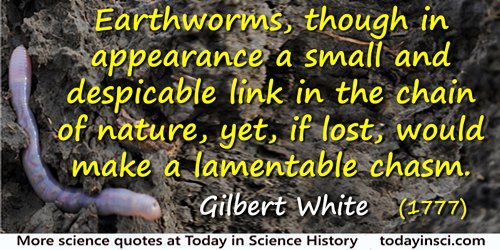
Earthworms, though in appearance a small and despicable link in the chain of nature, yet, if lost, would make a lamentable chasm … worms seem to be the great promoters of vegetation, which would proceed but lamely without them.
[Showing an early awareness in ecology.]
[Showing an early awareness in ecology.]
Letter XXXV, to Daines Barrington, (20 May 1777) in The Natural History of Selborne (1789), 216 and (1899), 174.
Einstein never accepted quantum mechanics because of this element of chance and uncertainty. He said: God does not play dice. It seems that Einstein was doubly wrong. The quantum effects of black holes suggests that not only does God play dice, He sometimes throws them where they cannot be seen.
…...
Fashion is the science of appearances, and it inspires one with the desire to seem rather than to be.
…...
Genetics has always turned out to be much more complicated than it seemed reasonable to imagine. Biology is not like physics. The more we know, the less it seems that there is one final explanation waiting to be discovered.
John Mitchinson and John Lloyd, If Ignorance Is Bliss, Why Aren't There More Happy People?: Smart Quotes for Dumb Times (2009), 275.
George Sears, called Nessmuk, whose “Woodcraft,” published in 1884, was the first American book on forest camping, and is written with so much wisdom, wit, and insight that it makes Henry David Thoreau seem alien, humorless, and French.
Coming into the Country
He seemed to approach the grave as an hyperbolic curve approaches a line, less directly as he got nearer, till it was doubtful if he would ever reach it at all.
In Far from the Madding Crowd (1874, 1909), Chap. 15, 117. In the 1874 edition, “—sheering off” were the original words, replaced by “less directly” by the 1909 edition.
Houston, that may have seemed like a very long final phase. The autotargeting was taking us right into a... crater, with a large number of big boulders and rocks ... and it required... flying manually over the rock field to find a reasonably good area.
…...
Human spirituality is to seek an answer to the question: “how can you make sense out of a world which does not seem to be intrinsically reasonable?”
Quoted in Kim Lim (ed.), 1,001 Pearls of Spiritual Wisdom: Words to Enrich, Inspire, and Guide Your Life (2014), 44
I am a great believer in Luck. The harder I work, the more of it I seem to have.
In Listen to This (1922), VII. The quote is often seen, despite having no known source, attributed to Thomas Jefferson. Historians of Jefferson have stated that neither these words nor variants exist in his written works. The proverbial relation between diligence and good luck dates back to the late 16th century.
I am not unmindful of the journalist’s quip that yesterday’s paper wraps today’s garbage. I am also not unmindful of the outrages visited upon our forests to publish redundant and incoherent collections of essays; for, like Dr. Seuss’ Lorax, I like to think that I speak for the trees. Beyond vanity, my only excuses for a collection of these essays lie in the observation that many people like (and as many people despise) them, and that they seem to cohere about a common theme–Darwin’s evolutionary perspective as an antidote to our cosmic arrogance.
…...
I can see him [Sylvester] now, with his white beard and few locks of gray hair, his forehead wrinkled o’er with thoughts, writing rapidly his figures and formulae on the board, sometimes explaining as he wrote, while we, his listeners, caught the reflected sounds from the board. But stop, something is not right, he pauses, his hand goes to his forehead to help his thought, he goes over the work again, emphasizes the leading points, and finally discovers his difficulty. Perhaps it is some error in his figures, perhaps an oversight in the reasoning. Sometimes, however, the difficulty is not elucidated, and then there is not much to the rest of the lecture. But at the next lecture we would hear of some new discovery that was the outcome of that difficulty, and of some article for the Journal, which he had begun. If a text-book had been taken up at the beginning, with the intention of following it, that text-book was most likely doomed to oblivion for the rest of the term, or until the class had been made listeners to every new thought and principle that had sprung from the laboratory of his mind, in consequence of that first difficulty. Other difficulties would soon appear, so that no text-book could last more than half of the term. In this way his class listened to almost all of the work that subsequently appeared in the Journal. It seemed to be the quality of his mind that he must adhere to one subject. He would think about it, talk about it to his class, and finally write about it for the Journal. The merest accident might start him, but once started, every moment, every thought was given to it, and, as much as possible, he read what others had done in the same direction; but this last seemed to be his real point; he could not read without finding difficulties in the way of understanding the author. Thus, often his own work reproduced what had been done by others, and he did not find it out until too late.
A notable example of this is in his theory of cyclotomic functions, which he had reproduced in several foreign journals, only to find that he had been greatly anticipated by foreign authors. It was manifest, one of the critics said, that the learned professor had not read Rummer’s elementary results in the theory of ideal primes. Yet Professor Smith’s report on the theory of numbers, which contained a full synopsis of Kummer’s theory, was Professor Sylvester’s constant companion.
This weakness of Professor Sylvester, in not being able to read what others had done, is perhaps a concomitant of his peculiar genius. Other minds could pass over little difficulties and not be troubled by them, and so go on to a final understanding of the results of the author. But not so with him. A difficulty, however small, worried him, and he was sure to have difficulties until the subject had been worked over in his own way, to correspond with his own mode of thought. To read the work of others, meant therefore to him an almost independent development of it. Like the man whose pleasure in life is to pioneer the way for society into the forests, his rugged mind could derive satisfaction only in hewing out its own paths; and only when his efforts brought him into the uncleared fields of mathematics did he find his place in the Universe.
A notable example of this is in his theory of cyclotomic functions, which he had reproduced in several foreign journals, only to find that he had been greatly anticipated by foreign authors. It was manifest, one of the critics said, that the learned professor had not read Rummer’s elementary results in the theory of ideal primes. Yet Professor Smith’s report on the theory of numbers, which contained a full synopsis of Kummer’s theory, was Professor Sylvester’s constant companion.
This weakness of Professor Sylvester, in not being able to read what others had done, is perhaps a concomitant of his peculiar genius. Other minds could pass over little difficulties and not be troubled by them, and so go on to a final understanding of the results of the author. But not so with him. A difficulty, however small, worried him, and he was sure to have difficulties until the subject had been worked over in his own way, to correspond with his own mode of thought. To read the work of others, meant therefore to him an almost independent development of it. Like the man whose pleasure in life is to pioneer the way for society into the forests, his rugged mind could derive satisfaction only in hewing out its own paths; and only when his efforts brought him into the uncleared fields of mathematics did he find his place in the Universe.
In Florian Cajori, Teaching and History of Mathematics in the United States (1890), 266-267.
I can’t recall a single problem in my life, of any sort, that I ever started on that I didn't solve, or prove that I couldn’t solve it. I never let up, until I had done everything that I could think of, no matter how absurd it might seem as a means to the end I was after.
As quoted in French Strother, 'The Modern Profession of Inventing', World's Work and Play (Jul 1905), 6, No. 32, 186.
I hate science. It denies a man’s responsibility for his own deeds, abolishes the brotherhood that springs from God’s fatherhood. It is a hectoring, dictating expertise, which makes the least lovable of the Church Fathers seem liberal by contrast. It is far easier for a Hitler or a Stalin to find a mock-scientific excuse for persecution than it was for Dominic to find a mock-Christian one.
…...
I have never looked upon ease and happiness as ends in themselves–this critical basis I call the ideal of a pigsty. The ideals that have lighted my way, and time after time have given me new courage to face life cheerfully, have been Kindness, Beauty, and Truth. Without the sense of kinship with men of like mind, without the occupation with the objective world, the eternally unattainable in the field of art and scientific endeavors, life would have seemed empty to me. The trite objects of human efforts–possessions, outward success, luxury–have always seemed to me contemptible.
In 'What I Believe,' Forum and Century (1930).
I regard it as an inelegance, or imperfection, in quaternions, or rather in the state to which it has been hitherto unfolded, whenever it becomes or seems to become necessary to have recourse to … the resources of ordinary algebra. [x, y, z, etc.]
In Lectures on Quaternions: Containing a Systematic Statement of a New Mathematical Method (1853), 522.
I remember discussions with Bohr which went through many hours till very late at night and ended almost in despair; and when at the end of the discussion I went alone for a walk in the neighboring park I repeated to myself again and again the question: Can nature possibly be as absurd as it seemed to us in these atomic experiments?
In Physics and Philosophy: The Revolution in Modern Science (1958, 1962), 42.
I should like to draw attention to the inexhaustible variety of the problems and exercises which it [mathematics] furnishes; these may be graduated to precisely the amount of attainment which may be possessed, while yet retaining an interest and value. It seems to me that no other branch of study at all compares with mathematics in this. When we propose a deduction to a beginner we give him an exercise in many cases that would have been admired in the vigorous days of Greek geometry. Although grammatical exercises are well suited to insure the great benefits connected with the study of languages, yet these exercises seem to me stiff and artificial in comparison with the problems of mathematics. It is not absurd to maintain that Euclid and Apollonius would have regarded with interest many of the elegant deductions which are invented for the use of our students in geometry; but it seems scarcely conceivable that the great masters in any other line of study could condescend to give a moment’s attention to the elementary books of the beginner.
In Conflict of Studies (1873), 10-11.
I sometimes hear preachers speak of the sad condition of men who live without God in the world, but a scientist who lives without God in the world seems to me worse off than ordinary men.
As quoted in E.P. Whipple, 'Recollections of Agassiz', in Henry Mills Alden (ed.), Harper's New Monthly Magazine (June 1879), 59, 103.
I’m not an atheist and I don’t think I can call myself a pantheist. We are in the position of a little child entering a huge library filled with books in many different languages. The child knows someone must have written those books. It doe s not know how. The child dimly suspects a mysterious order in the arrangement of the books but doesn’t know what it is. That, it seems to me, is the attitude of even the most intelligent human being toward God.
…...
I’m sure that science can’t ever explain everything and I can give you the reasons for that decision … I believe that scientific knowledge has fractal properties; that no matter how much we learn, whatever is left, however small it may seem, is just as infinitely complex as the whole was to start with. That, I think is the secret of the universe.
In It’s Been a Good Life (2009), 258, cited as from I. Asimov: A Memoir (1994), 481.
I’ve learned that no matter what happens, or how bad it seems today, life does go on, and it will be better tomorrow.
First stanza of poem 'On Turning 70'. The poem is printed in Michigan Office of Services to the Aging, Annual Report 2004 (2005), no page number.
In other branches of science, where quick publication seems to be so much desired, there may possibly be some excuse for giving to the world slovenly or ill-digested work, but there is no such excuse in mathematics. The form ought to be as perfect as the substance, and the demonstrations as rigorous as those of Euclid. The mathematician has to deal with the most exact facts of Nature, and he should spare no effort to render his interpretation worthy of his subject, and to give to his work its highest degree of perfection. “Pauca sed matura” was Gauss’s motto.
In Presidential Address British Association for the Advancement of Science, Section A, (1890), Nature, 42, 467. [The Latin motto translates as “Few, but ripe”. —Webmaster]
In psychoanalysis, only the fee is exactly what it seems to be.
City Aphorisms (1984).
In science nothing can be permanently accepted but that which is true, and whatever is accepted as true is challenged again and again. It is an axiom in science that no truth can be so sacred that it may not be questioned. When that which has been accepted as true has the least doubt thrown upon it, scientific men at once re-examine the subject. No opinion is sacred. “It ought to be” is never heard in scientific circles. “It seems to be” and “we think it is” is the modest language of scientific literature.
From address (1 Oct 1884), at inauguration of the Corcoran School of Science and Arts, Columbian University, Washington, D.C. Published in 'The Larger Import of Scientific Education', Popular Science Monthly (Feb 1885), 26, 455.
In science, one can learn the most by studying what seems to be the least.
John Mitchinson and John Lloyd, If Ignorance Is Bliss, Why Aren't There More Happy People?: Smart Quotes for Dumb Times (2009), 217.
Individual science fiction stories may seem as trivial as ever to the blinder critics and philosophers of today–but the core of science fiction, its essence, the concept around which it revolves, has become crucial to our salvation if we are to be saved a
…...
It has always seemed to me extreme presumptuousness on the part of those who want to make human ability the measure of what nature can and knows how to do, since, when one comes down to it, there is not one effect in nature, no matter how small, that even the most speculative minds can fully understand.
…...
It is comforting to reflect that the disproportion of things in the world seems to be only arithmetical.
…...
It is obvious that man dwells in a splendid universe, a magnificent expanse of earth and sky and heaven, which manifestly is built on a majestic plan, maintains some mighty design, though man himself cannot grasp it. Yet for him it is not a pleasant or satisfying world. In his few moments of respite from labor or from his enemies, he dreams that this very universe might indeed be perfect, its laws operating just as now they seem to do, and yet he and it somehow be in full accord. The very ease with which he can frame this image to himself makes the reality all the more mocking. ... It is only too clear that man is not at home in this universe, and yet he is not good enough to deserve a better.
In The New England Mind: The Seventeenth Century (1939, 1954), 7.
It may be said of some very old places, as of some very old books, that they are destined to be forever new. The nearer we approach them, the more remote they seem: the more we study them, the more we have yet to learn. Time augments rather than diminishes their everlasting novelty; and to our descendants of a thousand years hence it may safely be predicted that they will be even more fascinating than to ourselves. This is true of many ancient lands, but of no place is it so true as of Egypt.
Opening remark in Pharaohs, Fellahs and Explorers (1891), 3.
It must happen that in some cases the author is not understood, or is very imperfectly understood; and the question is what is to be done. After giving a reasonable amount of attention to the passage, let the student pass on, reserving the obscurity for future efforts. … The natural tendency of solitary students, I believe, is not to hurry away prematurely from a hard passage, but to hang far too long over it; the just pride that does not like to acknowledge defeat, and the strong will that cannot endure to be thwarted, both urge to a continuance of effort even when success seems hopeless. It is only by experience we gain the conviction that when the mind is thoroughly fatigued it has neither the power to continue with advantage its course in .an assigned direction, nor elasticity to strike out a new path; but that, on the other hand, after being withdrawn for a time from the pursuit, it may return and gain the desired end.
In 'Private Study of Mathematics', Conflict of Studies and other Essays (1873), 68.
It seemed to be a necessary ritual that he should prepare himself for sleep by meditating under the solemnity of the night sky… a mysterious transaction between the infinity of the soul and the infinity of the universe.
From Les Misérables (1862) as translated by Norman Denny in Les Misérables (1980), Vol. 1, 67.
It seems plain and self-evident, yet it needs to be said: the isolated knowledge obtained by a group of specialists in a narrow field has in itself no value whatsoever, but only in its synthesis with all the rest of knowledge and only inasmuch as it really contributes in this synthesis toward answering the demand, ‘Who are we?’
…...
It seems rather incongruous that in a society of super-sophisticated communications, we often suffer from a shortage of listeners.
…...
It seems that the rivers know the theory. It only remains to convince the engineers of the validity of this analysis.
Epigraph, without citation, in Péter Érdi, Complexity Explained (2007), 339. In French, “Il semble que les rivières connaissent déjà la théorie Il ne reste qu'à convaincre les ingénieurs de la validité de cette analyse.”
It seems to me it [hands-on experience] was more prevalent in a more primitive society, where you’re closer to machinery. [As a university teacher,] I see this with farm kids all the time. They have a more or less rugged self-reliance.
About the his concern that as society is changing, education is losing the benefits of childhood hand-on experience. In interview, Rushworth M. Kidder, 'Grounded in Space Science', Christian Science Monitor (22 Dec 1989).
It seems to me that God is a convenient invention of the human mind.
…...
It seems to me that the idea of a personal God is an anthropological concept which I cannot take seriously. I also cannot imagine some will or goal outside the human sphere has been cited as a statement that precedes the last three sentences here, but this might have originated in a paraphrase, a transcription error, or a misquotation; it does not appear in any editions of the essay which have thus far been checked.
…...
It seems to me that the older subjects, classics and mathematics, are strongly to be recommended on the ground of the accuracy with which we can compare the relative performance of the students. In fact the definiteness of these subjects is obvious, and is commonly admitted. There is however another advantage, which I think belongs in general to these subjects, that the examinations can be brought to bear on what is really most valuable in these subjects.
In Conflict of Studies and other Essays (1873), 6-7.
It seems to me that there is a good deal of ballyhoo about scientific method. I venture to think that the people who talk most about it are the people who do least about it. Scientific method is what working scientists do, not what other people or even they themselves may say about it. No working scientist, when he plans an experiment in the laboratory, asks himself whether he is being properly scientific, nor is he interested in whatever method he may be using as method.
In Reflections of a Physicist (1955), 81.
It seems to me, that if statesmen had a little more arithmetic, or were accustomed to calculation, wars would be much less frequent.
Letter to his sister, Mrs. Jane Mecom (1787) just after the close of the Constitutional Convention. In Jared Sparks (ed.) The Works of Benjamin Franklin (1840), Vol. 10, 445.
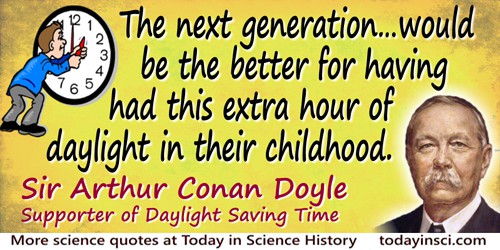
It seems very strange … that in the course of the world’s history so obvious an improvement should never have been adopted. … The next generation of Britishers would be the better for having had this extra hour of daylight in their childhood.
In Report, and Special Report, from the Select Committee on the Daylight Saving Bill: Minutes of Evidence (1908), 116.
It would seem at first sight as if the rapid expansion of the region of mathematics must be a source of danger to its future progress. Not only does the area widen but the subjects of study increase rapidly in number, and the work of the mathematician tends to become more and more specialized. It is, of course, merely a brilliant exaggeration to say that no mathematician is able to understand the work of any other mathematician, but it is certainly true that it is daily becoming more and more difficult for a mathematician to keep himself acquainted, even in a general way, with the progress of any of the branches of mathematics except those which form the field of his own labours. I believe, however, that the increasing extent of the territory of mathematics will always be counteracted by increased facilities in the means of communication. Additional knowledge opens to us new principles and methods which may conduct us with the greatest ease to results which previously were most difficult of access; and improvements in notation may exercise the most powerful effects both in the simplification and accessibility of a subject. It rests with the worker in mathematics not only to explore new truths, but to devise the language by which they may be discovered and expressed; and the genius of a great mathematician displays itself no less in the notation he invents for deciphering his subject than in the results attained. … I have great faith in the power of well-chosen notation to simplify complicated theories and to bring remote ones near and I think it is safe to predict that the increased knowledge of principles and the resulting improvements in the symbolic language of mathematics will always enable us to grapple satisfactorily with the difficulties arising from the mere extent of the subject.
In Presidential Address British Association for the Advancement of Science, Section A., (1890), Nature, 42, 466.
It’s a basic fact about being human that sometimes the self seems to just melt away.
Quoted in Kim Lim (ed.), 1,001 Pearls of Spiritual Wisdom: Words to Enrich, Inspire, and Guide Your Life (2014), 7
Like the ski resort full of girls hunting for husbands and husbands hunting for girls, the situation is not as symmetrical as it might seem.
In lecture at Birkbeck College, University of London, quoted in Alan L. MacKay, A Dictionary of Scientific Quotations (1991), 160.
Looking back over the geological record it would seem that Nature made nearly every possible mistake before she reached her greatest achievement Man—or perhaps some would say her worst mistake of all. ... At last she tried a being of no great size, almost defenseless, defective in at least one of the more important sense organs; one gift she bestowed to save him from threatened extinction—a certain stirring, a restlessness, in the organ called the brain.
…...
Mathematics is not a book confined within a cover and bound between brazen clasps, whose contents it needs only patience to ransack; it is not a mine, whose treasures may take long to reduce into possession, but which fill only a limited number of veins and lodes; it is not a soil, whose fertility can be exhausted by the yield of successive harvests; it is not a continent or an ocean, whose area can be mapped out and its contour defined: it is limitless as that space which it finds too narrow for its aspirations; its possibilities are as infinite as the worlds which are forever crowding in and multiplying upon the astronomer’s gaze; it is as incapable of being restricted within assigned boundaries or being reduced to definitions of permanent validity, as the consciousness of life, which seems to slumber in each monad, in every atom of matter, in each leaf and bud cell, and is forever ready to burst forth into new forms of vegetable and animal existence.
From Commemoration Day Address (22 Feb 1877) at Johns Hopkins University, Baltimore, collected in The Collected Mathematical Papers: (1870-1883) (1909), 77-78.
Mathematics seems to endow one with something like a new sense.
…...
Mitochondria seem to be able to exist, in the form of free-living bacteria, without our help. But without them, we die in a matter of seconds.
In Lifetide: A Biology of the Unconscious (1979), 78.
Most impediments to scientific understanding are conceptual locks, not factual lacks. Most difficult to dislodge are those biases that escape our scrutiny because they seem so obviously, even ineluctably, just. We know ourselves best and tend to view other creatures as mirrors of our own constitution and social arrangements. (Aristotle, and nearly two millennia of successors, designated the large bee that leads the swarm as a king.)
…...
Nature! … The one thing she seems to aim at is Individuality; yet she cares nothing for individuals.
As quoted by T.H. Huxley, in Norman Lockyer (ed.), 'Nature: Aphorisms by Goethe', Nature (1870), 1, 9.
No idea should be suppressed. … And it applies to ideas that look like nonsense. We must not forget that some of the best ideas seemed like nonsense at first. The truth will prevail in the end. Nonsense will fall of its own weight, by a sort of intellectual law of gravitation. If we bat it about, we shall only keep an error in the air a little longer. And a new truth will go into orbit.
In Cecilia Payne-Gaposchkin: An Autobiography and Other Recollections (1996), 233.
No other theory known to science [other than superstring theory] uses such powerful mathematics at such a fundamental level. …because any unified field theory first must absorb the Riemannian geometry of Einstein’s theory and the Lie groups coming from quantum field theory… The new mathematics, which is responsible for the merger of these two theories, is topology, and it is responsible for accomplishing the seemingly impossible task of abolishing the infinities of a quantum theory of gravity.
In 'Conclusion', Hyperspace: A Scientific Odyssey Through Parallel Universes, Time Warps, and the Tenth Dimension (1995), 326.
Nothing in physics seems so hopeful to as the idea that it is possible for a theory to have a high degree of symmetry was hidden from us in everyday life. The physicist's task is to find this deeper symmetry.
In American Scientist (1977) (as cited in The Atlantic (1984), 254, 81.) As an epigraph in Crystal and Dragon: The Cosmic Dance of Symmetry and Chaos in Nature, Art and Consciousness (1993), 139.
One of the big misapprehensions about mathematics that we perpetrate in our classrooms is that the teacher always seems to know the answer to any problem that is discussed. This gives students the idea that there is a book somewhere with all the right answers to all of the interesting questions, and that teachers know those answers. And if one could get hold of the book, one would have everything settled. That’s so unlike the true nature of mathematics.
As quoted in L.A. Steen and D.J. Albers (eds.), Teaching Teachers, Teaching Students (1981), 89.
Our situation on this earth seems strange. Every one of us appears here involuntarily and uninvited for a short stay, without knowing the whys and the wherefore. In our daily lives we only feel that man is here for the sake of others, for those whom we love and for many other beings whose fate is connected with our own. I am often worried at the thought that my life is based to such a large extent on the work of my fellow human beings and I am aware of my great indebtedness to them.
…...
Our way of life has been influenced by the way technology has developed. In future, it seems to me, we ought to try to reverse this and so develop our technology that it meets the needs of the sort of life we wish to lead.
Men, Machines and Sacred Cows (1984).
People declare as much, without, apparently, looking into the matter very closely. They seem able to dispense with the conscientious observer’s scruples, when inflating their bladder of theory.
Perfection of means and confusion of ends seems to characterize our age.
…...
Perhaps the problem is the seeming need that people have of making black-and-white cutoffs when it comes to certain mysterious phenomena, such as life and consciousness. People seem to want there to be an absolute threshold between the living and the nonliving, and between the thinking and the “merely mechanical,” ... But the onward march of science seems to force us ever more clearly into accepting intermediate levels of such properties.
‘Shades of Gray Along the Consciousness Continuum’, Fluid Concepts & Creative Analogies: Computer Models of the Fundamental Mechanisms of Thought (1995), 310.
Petr Beckmann has divided the men who made history into two classes, the thinkers and the thugs. The Greeks were the thinkers and the Romans were the thugs. The general law seems to be that the thugs always win, but the thinkers always outlive them.
In Mathematical Circles Squared (1972), 153. Petr Beckman wrote: “150 years saw the confrontation of Athens and Sparta, the thinkers against the thugs. The thugs always win, but the thinkers always outlast them”, in A History of Pi (1970), 34.
Scientists have long been baffled by the existence of spontaneous order in the universe. The laws of thermodynamics seem to dictate the opposite, that nature should inexorably degenerate toward a state of greater disorder, greater entropy. Yet all around
John Mitchinson and John Lloyd, If Ignorance Is Bliss, Why Aren't There More Happy People?: Smart Quotes for Dumb Times (2009), 274.
So many people today–and even professional scientists–seem to me like someone who has seen thousands of trees but has never seen a forest . A knowledge of the historic and philosophical background gives that kind of independence from prejudices of his generation from which most scientists are suffering. This independence created by philosophical insight is–in my opinion–the mark of distinction between a mere artisan or specialist and a real seeker after truth.
In unpublished Letter (7 Dec 1944) to R.A. Thornton, Einstein Archive, EA 6-574, Hebrew University, Jerusalem, Israel. As quoted and cited in Don A. Howard, 'Albert Einstein as a Philosopher of Science', Physics Today (Dec 2006), 34.
Some people believe in fate, others don’t. I do, and I don't. It may seem at times as if invisible fingers move us about like puppets on strings. But for sure, we are not born to be dragged along. We can grab the strings ourselves and adjust our course at every crossroad, or take off at any little trail into the unknown.
Opening paragraph in 'Foreword to the 35th Anniversary Edition', Kon-Tiki: Across the Pacific by Raft (1990), xi.
Sooner or later for good or ill, a united mankind, equipped with science and power, will probably turn its attention to the other planets, not only for economic exploitation, but also as possible homes for man... The goal for the solar system would seem to be that it should become an interplanetary community of very diverse worlds... each contributing to the common experience its characteristic view of the universe. Through the pooling of this wealth of experience, through this “commonwealth of worlds,” new levels of mental and spiritual development should become possible, levels at present quite inconceivable to man.
…...
Standing now in diffused light, with the wind at my back, I experience suddenly a feeling of completeness–not a feeling of having achieved something or of being stronger than everyone who was ever here before, not a feeling of having arrived at the ultimate point, not a feeling of supremacy. Just a breath of happiness deep inside my mind and my breast. The summit seemed suddenly to me to be a refuge, and I had not expected to find any refuge up here. Looking at the steep, sharp ridges below us, I have the impression that to have come later would have been too late. Everything we now say to one another, we only say out of embarrassment. I don’t think anymore. As I pull the tape recorder, trancelike, from my rucksack, and switch it on wanting to record a few appropriate phrases, tears again well into my eyes. “Now we are on the summit of Everest,” I begin, “it is so cold that we cannot take photographs…” I cannot go on, I am immediately shaken with sobs. I can neither talk nor think, feeling only how this momentous experience changes everything. To reach only a few meters below the summit would have required the same amount of effort, the same anxiety and burden of sorrow, but a feeling like this, an eruption of feeling, is only possible on the summit itself.
In Everest: Expedition to the Ultimate (1979), 180.
Success…seems to be connected with action. Successful men keep moving. They make mistakes, but they don’t quit.
…...
Suffer slight disagreeables without seeming to perceive them, but repulse decisively any one who evidently intends to injure or humiliate you.
From Appendix A, 'Extracts From the Unpublished Writings of Carnot', Reflections on the Motive Power of Heat (1890, 2nd ed. 1897), 206.
Suppose you were given a watch, a tube to sight with and a string, and then asked to determine the distance to the nearest star. Or you were asked the chemical composition, pressure or temperature of the Sun. A hundred or more years ago, these questions seemed impossible. Now astronomers are answering them all the time, and they believe their answers. Why? Because there are many parallel ways and tests, and they all give the same answers.
As quoted in John Noble Wilford, 'Sizing up the Cosmos: An Astronomers Quest', New York Times (12 Mar 1991), C10.
Th’invention all admir’d, and each, how he
To be th’inventor miss’d; so easy it seem’d,
Once found, which yet unfound most would have thought
Impossible.
To be th’inventor miss’d; so easy it seem’d,
Once found, which yet unfound most would have thought
Impossible.
From Paradise Lost (1821), Book 6, 183.
That scientific work should be more useful the more it has been used, while mechanical work is expended in use, may seem strange to us.
From 'The Economy of Science' in The Science of Mechanics: A Critical and Historical Exposition of its Principles (1893), 488.
The air of caricature never fails to show itself in the products of reason applied relentlessly and without correction. The observation of clinical facts would seem to be a pursuit of the physician as harmless as it is indispensable. [But] it seemed irresistibly rational to certain minds that diseases should be as fully classifiable as are beetles and butterflies. This doctrine … bore perhaps its richest fruit in the hands of Boissier de Sauvauges. In his Nosologia Methodica published in 1768 … this Linnaeus of the bedside grouped diseases into ten classes, 295 genera, and 2400 species.
In 'General Ideas in Medicine', The Lloyd Roberts lecture at House of the Royal Society of Medicine (30 Sep 1935), British Medical Journal (5 Oct 1935), 2, 609. In The Collected Papers of Wilfred Trotter, FRS (1941), 151.
The average English author [of mathematical texts] leaves one under the impression that he has made a bargain with his reader to put before him the truth, the greater part of the truth, and nothing but the truth; and that if he has put the facts of his subject into his book, however difficult it may be to unearth them, he has fulfilled his contract with his reader. This is a very much mistaken view, because effective teaching requires a great deal more than a bare recitation of facts, even if these are duly set forth in logical order—as in English books they often are not. The probable difficulties which will occur to the student, the objections which the intelligent student will naturally and necessarily raise to some statement of fact or theory—these things our authors seldom or never notice, and yet a recognition and anticipation of them by the author would be often of priceless value to the student. Again, a touch of humour (strange as the contention may seem) in mathematical works is not only possible with perfect propriety, but very helpful; and I could give instances of this even from the pure mathematics of Salmon and the physics of Clerk Maxwell.
In Perry, Teaching of Mathematics (1902), 59-61.
The belief that mathematics, because it is abstract, because it is static and cold and gray, is detached from life, is a mistaken belief. Mathematics, even in its purest and most abstract estate, is not detached from life. It is just the ideal handling of the problems of life, as sculpture may idealize a human figure or as poetry or painting may idealize a figure or a scene. Mathematics is precisely the ideal handling of the problems of life, and the central ideas of the science, the great concepts about which its stately doctrines have been built up, are precisely the chief ideas with which life must always deal and which, as it tumbles and rolls about them through time and space, give it its interests and problems, and its order and rationality. That such is the case a few indications will suffice to show. The mathematical concepts of constant and variable are represented familiarly in life by the notions of fixedness and change. The concept of equation or that of an equational system, imposing restriction upon variability, is matched in life by the concept of natural and spiritual law, giving order to what were else chaotic change and providing partial freedom in lieu of none at all. What is known in mathematics under the name of limit is everywhere present in life in the guise of some ideal, some excellence high-dwelling among the rocks, an “ever flying perfect” as Emerson calls it, unto which we may approximate nearer and nearer, but which we can never quite attain, save in aspiration. The supreme concept of functionality finds its correlate in life in the all-pervasive sense of interdependence and mutual determination among the elements of the world. What is known in mathematics as transformation—that is, lawful transfer of attention, serving to match in orderly fashion the things of one system with those of another—is conceived in life as a process of transmutation by which, in the flux of the world, the content of the present has come out of the past and in its turn, in ceasing to be, gives birth to its successor, as the boy is father to the man and as things, in general, become what they are not. The mathematical concept of invariance and that of infinitude, especially the imposing doctrines that explain their meanings and bear their names—What are they but mathematicizations of that which has ever been the chief of life’s hopes and dreams, of that which has ever been the object of its deepest passion and of its dominant enterprise, I mean the finding of the worth that abides, the finding of permanence in the midst of change, and the discovery of a presence, in what has seemed to be a finite world, of being that is infinite? It is needless further to multiply examples of a correlation that is so abounding and complete as indeed to suggest a doubt whether it be juster to view mathematics as the abstract idealization of life than to regard life as the concrete realization of mathematics.
In 'The Humanization of Teaching of Mathematics', Science, New Series, 35, 645-46.
The custom of giving patients appointments weeks in advance, during which time their illness may become seriously aggravated, seems to me to fall short of the ideal doctor-patient relationship.
…...
The divine tape recorder holds a million scenarios, each perfectly sensible. Little quirks at the outset, occurring for no particular reason, unleash cascades of consequences that make a particular feature seem inevitable in retrospect. But the slightest early nudge contacts a different groove, and history veers into another plausible channel, diverging continually from its original pathway. The end results are so different, the initial perturbation so apparently trivial.
…...
The earth itself assures us it is a living entity. Deep below surface one can hear its slow pulse, feel its vibrant rhythm. The great breathing mountains expand and contract. The vast sage desert undulates with almost imperceptible tides like the oceans. From the very beginning, throughout all its cataclysmic upthrusts and deep sea submergences, the planet Earth seems to have maintained an ordered rhythm.
…...
The following theorem can be found in the work of Mr. Cauchy: If the various terms of the series u0 + u1 + u2 +... are continuous functions,… then the sum s of the series is also a continuous function of x. But it seems to me that this theorem admits exceptions. For example the series
sin x - (1/2)sin 2x + (1/3)sin 3x - …
is discontinuous at each value (2m + 1)π of x,…
sin x - (1/2)sin 2x + (1/3)sin 3x - …
is discontinuous at each value (2m + 1)π of x,…
In Oeuvres (1826), Vol. 1, 224-225. As quoted and cited in Ernst Hairer and Gerhard Wanner Analysis by Its History (2008), 213.
The further the spiritual evolution of mankind advances, the more certain it seems to me that the path to genuine religiosity does not lie through the fear of life, and the fear of death, and blind faith, but through striving after rational knowledge.
…...
The Greeks made Space the subject-matter of a science of supreme simplicity and certainty. Out of it grew, in the mind of classical antiquity, the idea of pure science. Geometry became one of the most powerful expressions of that sovereignty of the intellect that inspired the thought of those times. At a later epoch, when the intellectual despotism of the Church, which had been maintained through the Middle Ages, had crumbled, and a wave of scepticism threatened to sweep away all that had seemed most fixed, those who believed in Truth clung to Geometry as to a rock, and it was the highest ideal of every scientist to carry on his science “more geometrico.”
In Space,Time, Matter, translated by Henry Leopold Brose (1952), 1.
The highest of the world’s mountains, it seems, has to make but a single gesture of magnificence to be the lord of all, vast in unchallenged and isolated supremacy.
…...
The instruction of children should aim gradually to combine knowing and doing [Wissen und Konnen]. Among all sciences mathematics seems to be the only one of a kind to satisfy this aim most completely.
In Werke, Bd. 9 (1888), 409.
The last few meters up to the summit no longer seem so hard. On reaching the top, I sit down and let my legs dangle into space. I don’t have to climb anymore. I pull my camera from my rucksack and, in my down mittens, fumble a long time with the batteries before I have it working properly. Then I film Peter. Now, after the hours of torment, which indeed I didn’t recognize as torment, now, when the monotonous motion of plodding upwards is at an end, and I have nothing more to do than breathe, a great peace floods my whole being. I breathe like someone who has run the race of his life and knows that he may now rest forever. I keep looking all around, because the first time I didn’t see anything of the panorama I had expected from Everest, neither indeed did I notice how the wind was continually chasing snow across the summit. In my state of spiritual abstraction, I no longer belong to myself and to my eyesight. I am nothing more than a single, narrow, gasping lung, floating over the mists and the summits.
In Everest: Expedition to the Ultimate (1979), 180.
The material world begins to seem so trivial, so arbitrary, so ephemeral when contrasted with the timeless beauty of mathematics.
In The Mathematical Universe: An Alphabetical Journey Through the Great Proofs, Problems, and Personalities (1994), 160.
The mathematician requires tact and good taste at every step of his work, and he has to learn to trust to his own instinct to distinguish between what is really worthy of his efforts and what is not; he must take care not to be the slave of his symbols, but always to have before his mind the realities which they merely serve to express. For these and other reasons it seems to me of the highest importance that a mathematician should be trained in no narrow school; a wide course of reading in the first few years of his mathematical study cannot fail to influence for good the character of the whole of his subsequent work.
In Presidential Address British Association for the Advancement of Science, Section A, (1890), Nature, 42, 467.
The Moon is a white strange world, great, white, soft-seeming globe in the night sky, and what she actually communicates to me across space I shall never fully know. But the Moon that pulls the tides, and the Moon that controls the menstrual periods of women, and the Moon that touches the lunatics, she is not the mere dead lump of the astronomist.... When we describe the Moon as dead, we are describing the deadness in ourselves. When we find space so hideously void, we are describing our own unbearable emptiness.
…...
The more efficient causes of progress seem to consist of a good education during youth whilst the brain is impressible, and of a high standard of excellence, inculcated by the ablest and best men, embodied in the laws, customs and traditions of the nation, and enforced by public opinion. It should, however, be borne in mind, that the enforcement of public opinion depends on our appreciation of the approbation and disapprobation of others; and this appreciation is founded on our sympathy, which it can hardly be doubted was originally developed through natural selection as one of the most important elements of the social instincts.
…...
The more man inquires into the laws which regulate the material universe, the more he is convinced that all its varied forms arise from the action of a few simple principles. These principles themselves converge, with accelerating force, towards some still more comprehensive law to which all matter seems to be submitted. Simple as that law may possibly be, it must be remembered that it is only one amongst an infinite number of simple laws: that each of these laws has consequences at least as extensive as the existing one, and therefore that the Creator who selected the present law must have foreseen the consequences of all other laws.
In Passages from the Life of a Philosopher (1864), 402.
The more original a discovery, the more obvious it seems afterward.
In The Act of Creation (1964), 120.
The most beautiful and deepest experience a man can have is the sense of the mysterious. It is the underlying principle of religion as well as all serious endeavour in art and science. He who never had this experience seems to me, if not dead, then at least blind. To sense that behind anything that can be experienced there is a something that our mind cannot grasp and whose beauty and sublimity reaches us only indirectly and as a feeble reflection, this is religiousness.
…...
The one quality that seems to be so universal among eccentrics is … so subjective as to be incapable of being proved or disproved, yet … eccentrics appear to be happier than the rest of us.
From a summary his study of 1,000 people, done at Royal Edinburgh Hospital in Scotland. In David Weeks, David Joseph Weeks and Jamie James, Eccentrics (1995), 38.
The progress of science is strewn, like an ancient desert trail, with the bleached skeletons of discarded theories which once seemed to possess eternal life.
In The Ghost in the Machine (1967), 178.
The really valuable thing in the pageant of human life seems to me not the State but the creative, sentient individual, the personality; it alone creates the noble and the sublime, while the herd as such remains dull in thought and dull in feeling.
…...
The routine produces. But each day, nevertheless, when you try to get started you have to transmogrify, transpose yourself; you have to go through some kind of change from being a normal human being, into becoming some kind of slave.
I simply don’t want to break through that membrane. I’d do anything to avoid it. You have to get there and you don’t want to go there because there’s so much pressure and so much strain and you just want to stay on the outside and be yourself. And so the day is a constant struggle to get going.
And if somebody says to me, You’re a prolific writer—it seems so odd. It’s like the difference between geological time and human time. On a certain scale, it does look like I do a lot. But that’s my day, all day long, sitting there wondering when I’m going to be able to get started. And the routine of doing this six days a week puts a little drop in a bucket each day, and that’s the key. Because if you put a drop in a bucket every day, after three hundred and sixty-five days, the bucket’s going to have some water in it.
I simply don’t want to break through that membrane. I’d do anything to avoid it. You have to get there and you don’t want to go there because there’s so much pressure and so much strain and you just want to stay on the outside and be yourself. And so the day is a constant struggle to get going.
And if somebody says to me, You’re a prolific writer—it seems so odd. It’s like the difference between geological time and human time. On a certain scale, it does look like I do a lot. But that’s my day, all day long, sitting there wondering when I’m going to be able to get started. And the routine of doing this six days a week puts a little drop in a bucket each day, and that’s the key. Because if you put a drop in a bucket every day, after three hundred and sixty-five days, the bucket’s going to have some water in it.
https://www.theparisreview.org/interviews/5997/john-mcphee-the-art-of-nonfiction-no-3-john-mcphee
The scientist’s task is to find ways to try to disprove things that seem to make sense.
With co-author Jack Cohen. In Terry Pratchett, Ian Stewart and Jack Cohen, Chap. 28, 'The Iceberg Cometh', The Science of Discworld (Rev. Ed. 2002), 230. Pratchett wrote the fantasy story told in the odd-numbered chapters. Following each, relevant real science is provided by his co-authors, Stewart and Cohen, in the even-numbered chapters (such as Chap. 28), but which of the two wrote which lines, is not designated.
The sky seems to be a pure, a cooler blue, the trees a deeper green. The whole world is charged with the glory of God and I feel fire and music under my feet.
On reading the scriptures. Quoted in Kim Lim (ed.), 1,001 Pearls of Spiritual Wisdom: Words to Enrich, Inspire, and Guide Your Life (2014), 166
The student should read his author with the most sustained attention, in order to discover the meaning of every sentence. If the book is well written, it will endure and repay his close attention: the text ought to be fairly intelligible, even without illustrative examples. Often, far too often, a reader hurries over the text without any sincere and vigorous effort to understand it; and rushes to some example to clear up what ought not to have been obscure, if it had been adequately considered. The habit of scrupulously investigating the text seems to me important on several grounds. The close scrutiny of language is a very valuable exercise both for studious and practical life. In the higher departments of mathematics the habit is indispensable: in the long investigations which occur there it would be impossible to interpose illustrative examples at every stage, the student must therefore encounter and master, sentence by sentence, an extensive and complicated argument.
In 'Private Study of Mathematics', Conflict of Studies and other Essays (1873), 67.
The superstition that the hounds of truth will rout the vermin of error seems, like a fragment of Victorian lace, quaint, but too brittle to be lifted out of the showcase.
In National Review (16 Jan 1962), 12, 21.
The universe contains vastly more order than Earth-life could ever demand. All those distant galaxies, irrelevant for our existence, seem as equally well ordered as our own.
As quoted in Eugene F. Mallove, The Quickening Universe: Cosmic Evolution and Human Destiny (1987), 61.
The vast spread
Of darkness
That speaks of mystery
The darkness that reveals
The beauty that lies beneath
In the form of glittering
Stars, a countless beauty
That seemed to conceal
A million stories
That can make the mankind
Take a new look at life
And the majestic moon
That silently looks at mankind
Wondering how its serenity
Was disturbed by the little steps
Of a man from the beautiful earth
Yet softly smiling back
And let the world sleep
In its magical glow
A glow that soothes
The world’s senses
And forget the pain of reality
Of darkness
That speaks of mystery
The darkness that reveals
The beauty that lies beneath
In the form of glittering
Stars, a countless beauty
That seemed to conceal
A million stories
That can make the mankind
Take a new look at life
And the majestic moon
That silently looks at mankind
Wondering how its serenity
Was disturbed by the little steps
Of a man from the beautiful earth
Yet softly smiling back
And let the world sleep
In its magical glow
A glow that soothes
The world’s senses
And forget the pain of reality
…...
The venereal Disease first invaded the Spaniards and Italians, before the Efficacy of Mercury was known. … By the Use of Mercury, given with Discretion, so as to raise a Salivation; after the Use of which the whole Body, in a manner, seems to grow young again.
In Dr. Boerhaave's Academical Lectures on the Theory of Physic (1746), Vol. 6, 266-267.
The worst primary school scolding I ever received was for ridiculing a classmate who asked, ‘What’s an atom?’ To my third grader’s mind, the question betrayed a level of ignorance more befitting a preschooler, but the teacher disagreed and banned me from recess for a week. I had forgotten the incident until a few years ago, while sitting in on a quantum mechanics class taught by a Nobel Prizewinning physicist. Midway through a brutally abstract lecture on the hydrogen atom, a plucky sophomore raised his hand and asked the very same question. To the astonishment of all, our speaker fell silent. He stared out the window for what seemed like an eternity before answering, ‘I don’t know.’
'The Secret Life of Atoms'. Discover (Jun 2007), 28:6, 52.
There are pessimists who hold that such a state of affairs is necessarily inherent in human nature; it is those who propound such views that are the enemies of true religion, for they imply thereby that religious teachings are utopian ideals and unsuited to afford guidance in human affairs. The study of the social patterns in certain so-called primitive cultures, however, seems to have made it sufficiently evident that such a defeatist view is wholly unwarranted.
From a response to a greeting sent by the Liberal Ministers' Club of New York City, published in The Christian Register (Jun 1948). Collected as 'Religion and Science: Irreconcilable?', in Carl Seelig (ed.)Ideas and Opinions (1954, 2010), 52.
There is no area in our minds reserved for superstition, such as the Greeks had in their mythology; and superstition, under cover of an abstract vocabulary, has revenged itself by invading the entire realm of thought. Our science is like a store filled with the most subtle intellectual devices for solving the most complex problems, and yet we are almost incapable of applying the elementary principles of rational thought. In every sphere, we seem to have lost the very elements of intelligence: the ideas of limit, measure, degree, proportion, relation, comparison, contingency, interdependence, interrelation of means and ends. To keep to the social level, our political universe is peopled exclusively by myths and monsters; all it contains is absolutes and abstract entities. This is illustrated by all the words of our political and social vocabulary: nation, security, capitalism, communism, fascism, order, authority, property, democracy. We never use them in phrases such as: There is democracy to the extent that… or: There is capitalism in so far as… The use of expressions like “to the extent that” is beyond our intellectual capacity. Each of these words seems to represent for us an absolute reality, unaffected by conditions, or an absolute objective, independent of methods of action, or an absolute evil; and at the same time we make all these words mean, successively or simultaneously, anything whatsoever. Our lives are lived, in actual fact, among changing, varying realities, subject to the casual play of external necessities, and modifying themselves according to specific conditions within specific limits; and yet we act and strive and sacrifice ourselves and others by reference to fixed and isolated abstractions which cannot possibly be related either to one another or to any concrete facts. In this so-called age of technicians, the only battles we know how to fight are battles against windmills.
From 'The Power of Words', collected in Siân Miles (ed.), Simone Weil: An Anthology (2000), 222-223.
They say,
The solid earth whereon we tread
In tracts of fluent heat began,
And grew to seeming-random forms,
The seeming prey of cyclic storms,
Till at the last arose the Man. …
The solid earth whereon we tread
In tracts of fluent heat began,
And grew to seeming-random forms,
The seeming prey of cyclic storms,
Till at the last arose the Man. …
From poem, 'In Memoriam A.H.H.' written between 1833-50, and first published anonymously in 1850. Collected in Poetical Works of Alfred Tennyson (1860), Vol.2, 147.
This brings me to the final point of my remarks, the relation between creativity and aging, a topic with which I have had substantial experience. Scientific research, until it has gone through the grueling and sometimes painful process of publication, is just play, and play is characteristic of young vertebrates, particularly young mammals. In some ways, scientific creativity is related to the exuberant behavior of young mammals. Indeed, creativity seems to be a natural characteristic of young humans. If one is fortunate enough to be associated with a university, even as one ages, teaching allows one to contribute to, and vicariously share, in the creativity of youth.”
In 'Integrative Biology: An Organismic Biologist’s Point of View', Integrative and Comparative Biology (2005), 45, 331.
This is the reason why all attempts to obtain a deeper knowledge of the foundations of physics seem doomed to me unless the basic concepts are in accordance with general relativity from the beginning. This situation makes it difficult to use our empirical knowledge, however comprehensive, in looking for the fundamental concepts and relations of physics, and it forces us to apply free speculation to a much greater extent than is presently assumed by most physicists.
…...
This morning’s messages announce the death oF Thomas Alva Edison, the great American inventor who for two generations has been an almost legendary figure. … He seemed to belong to a past which was already becoming remote, a past, without the incandescent electric light, and without the phonograph, and without other gifts with which his ingenuity and persistence endowed the world. … In the philosophical, theoretical sense he [Thomas Edison] was not a scientific man. To the understanding of electricity, with the use of which most of his inventions are concerned, he contributed little or nothing. Yet no man discovered more, or more ingenious, ways of using electricity for practical purposes.
In 'Thomas Edison', The Times (19 Oct 1931), 13.
This sense of the unfathomable beautiful ocean of existence drew me into science. I am awed by the universe, puzzled by it and sometimes angry at a natural order that brings such pain and suffering, Yet an emotion or feeling I have toward the cosmos seems to be reciprocated by neither benevolence nor hostility but just by silence. The universe appears to be a perfectly neutral screen unto which I can project any passion or attitude, and it supports them all.
…...
This topic brings me to that worst outcrop of the herd nature, the military system, which I abhor. That a man can take pleasure in marching in formation to the strains of a band is enough to make me despise him. He has only been given his big brain by mistake; a backbone was all he needed. This plague-spot of civilisation ought to be abolished with all possible speed. Heroism by order, senseless violence, and all the pestilent nonsense that goes by the name of patriotism–how I hate them! War seems to me a mean, contemptible thing: I would rather be hacked in pieces than take part in such an abominable business.
…...
Thought-economy is most highly developed in mathematics, that science which has reached the highest formal development, and on which natural science so frequently calls for assistance. Strange as it may seem, the strength of mathematics lies in the avoidance of all unnecessary thoughts, in the utmost economy of thought-operations. The symbols of order, which we call numbers, form already a system of wonderful simplicity and economy. When in the multiplication of a number with several digits we employ the multiplication table and thus make use of previously accomplished results rather than to repeat them each time, when by the use of tables of logarithms we avoid new numerical calculations by replacing them by others long since performed, when we employ determinants instead of carrying through from the beginning the solution of a system of equations, when we decompose new integral expressions into others that are familiar,—we see in all this but a faint reflection of the intellectual activity of a Lagrange or Cauchy, who with the keen discernment of a military commander marshalls a whole troop of completed operations in the execution of a new one.
In Populär-wissenschafliche Vorlesungen (1903), 224-225.
Time only seems to matter when it’s running out.
…...
To many of us, the first law of dietetics seems to be: if it tastes good, it’s bad for you.
Epigraph in Isaac Asimov’s Book of Science and Nature Quotations (1988), 57.
To preach conservation at such a time, when all our resources, national and otherwise are being sacrificed in unprecedented measure, might seem to some anomalous, even ironical. ... But we firmly believe, and now are more acutely aware than ever, that conservation is basically related to the peace of the world and the future of the race.
Breaking New Ground
Twin sister of natural and revealed religion, and of heavenly birth, science will never belie her celestial origin, nor cease to sympathize with all that emanates from the same pure home. Human ignorance and prejudice may for a time seem to have divorced what God has joined together; but human ignorance and prejudice shall at length pass away, and then science and religion shall be seen blending their particolored rays into one beautiful bow of light, linking heaven to earth and earth to heaven.
…...
Two lights for guidance. The first, our little glowing atom of community, with all that it signifies. The second, the cold light of the stars, symbol of the hypercosmical reality, with its crystal ecstasy. Strange that in this light, in which even the dearest love is frostily asserted, and even the possible defeat of our half-waking world is contemplated without remission of praise, the human crisis does not lose but gains significance. Strange, that it seems more, not less, urgent to play some part in this struggle, this brief effort of animalcules striving to win for their race some increase of lucidity before the ultimate darkness.
…...
Unfortunately, the study of organic remains is beset with two evils, which, though of an opposite character, do not neutralize each other so much as at first sight might be anticipated: the one consisting of a strong desire to find similar organic remains in supposed equivalent deposits, even at great distances; the other being an equally strong inclination to discover new species, often as it would seem for the sole purpose of appending the apparently magical word nobis.
In Geological Manual (1832), Preface, iii.
We agreed then on the good things we have in common. On the advantage of being able to test yourself, not depending on others in the test, reflecting yourself in your work. On the pleasure of seeing your creature grow, beam after beam, bolt after bolt, solid, necessary, symmetrical, suited to its purpose; and when it’s finished, you look at it and you think that perhaps it will live longer than you, and perhaps it will be of use to someone you don’t know, who doesn’t know you. Maybe, as an old man you’ll be able to come back and look at it, and it will seem beautiful, and it doesn’t really matter so much that it will seem beautiful only to you, and you can say to yourself “maybe another man wouldn’t have brought it off.”
In The Monkey’s Wrench: A Novel (1986, 2017), 54-55. Originally published in Italian (1978).
We all know, from what we experience with and within ourselves, that our conscious acts spring from our desires and our fears. Intuition tells us that that is true also of our fellows and of the higher animals. We all try to escape pain and death, while we seek what is pleasant. We are all ruled in what we do by impulses; and these impulses are so organized that our actions in general serve for our self preservation and that of the race. Hunger, love, pain, fear are some of those inner forces which rule the individual’s instinct for self preservation. At the same time, as social beings, we are moved in the relations with our fellow beings by such feelings as sympathy, pride, hate, need for power, pity, and so on. All these primary impulses, not easily described in words, are the springs of man’s actions. All such action would cease if those powerful elemental forces were to cease stirring within us. Though our conduct seems so very different from that of the higher animals, the primary instincts are much alike in them and in us. The most evident difference springs from the important part which is played in man by a relatively strong power of imagination and by the capacity to think, aided as it is by language and other symbolical devices. Thought is the organizing factor in man, intersected between the causal primary instincts and the resulting actions. In that way imagination and intelligence enter into our existence in the part of servants of the primary instincts. But their intervention makes our acts to serve ever less merely the immediate claims of our instincts.
…...
We do live in a conceptual trough that encourages such yearning for unknown and romanticized greener pastures of other times. The future doesn’t seem promising, if only because we can extrapolate some disquieting present trends in to further deterioration: pollution, nationalism, environmental destruction, and aluminum bats. Therefore, we tend to take refuge in a rose-colored past ... I do not doubt the salutary, even the essential, properties of this curiously adaptive human trait, but we must also record the down side. Legends of past golden ages become impediments when we try to negotiate our current dilemma.
…...
We now live in an age in which science is a court from which there is no appeal. And this issue this time around, at the beginning of the twenty-first century, is not the evolution of the species, which can seem a remote business, but the nature of our own precious inner selves.
…...
We pass with admiration along the great series of mathematicians, by whom the science of theoretical mechanics has been cultivated, from the time of Newton to our own. There is no group of men of science whose fame is higher or brighter. The great discoveries of Copernicus, Galileo, Newton, had fixed all eyes on those portions of human knowledge on which their successors employed their labors. The certainty belonging to this line of speculation seemed to elevate mathematicians above the students of other subjects; and the beauty of mathematical relations and the subtlety of intellect which may be shown in dealing with them, were fitted to win unbounded applause. The successors of Newton and the Bernoullis, as Euler, Clairaut, D’Alembert, Lagrange, Laplace, not to introduce living names, have been some of the most remarkable men of talent which the world has seen.
In History of the Inductive Sciences, Vol. 1, Bk. 4, chap. 6, sect. 6.
We seem to have a compulsion these days to bury time capsules in order to give those people living in the next century or so some idea of what we are like.
…...
We seem to think that God speaks by seconding the ideas we’ve already adopted, but God nearly always catches us by surprise...God tends to confound, astonish, and flabbergast.
Quoted in Kim Lim (ed.), 1,001 Pearls of Spiritual Wisdom: Words to Enrich, Inspire, and Guide Your Life (2014), 154
What clearer evidence could we have had of the different formation of these rocks, and of the long interval which separated their formation, had we actually seen them emerging from the bosom of the deep? … The mind seemed to grow giddy by looking so far into the abyss of time.
As quoted in Dennis R. Dean, James Hutton and the History of Geology (1992), 122.
What could define God [is thinking of God] as the embodiment of the laws of nature. However, this is not what most people would think of that God. They made a human-like being with whom one can have a personal relationship. When you look at the vast size of the universe and how insignificant an accidental human life is in it, that seems most impossible.
From Interview with Diane Sawyer, quoted in ABC News, 'Stephen Hawking on Religion: “Science Will Win”' (4 Jun 2010), on abcnews.go.com website.
What quality is shared by all objects that provoke our aesthetic emotions? Only one answer seems possible—significant form. In each, lines and colors combined in a particular way; certain forms and relations of forms, stir our aesthetic emotions. These relations and combinations of lines and colours, these æsthetically moving forms, I call “Significant Form”; and “Significant Form” is the one quality common to all works of visual art.
In Art (1913), 8.
When I was younger, Statistics was the science of large numbers. Now, it seems to me rapidly to be becoming the science of no numbers at all.
In Facts From Figures (1951), Chap. 7, 82. Webmaster has not, as yet, identified any earlier primary source. Can you help?
Whenever I get gloomy with the state of the world, I think about the arrivals gate at Heathrow Airport. General opinion’s starting to make out that we live in a world of hatred and greed, but I don’t see that. It seems to me that love is everywhere. Often it’s not particularly dignified or newsworthy, but it’s always there - fathers and sons, mothers and daughters, husbands and wives, boyfriends, girlfriends, old friends. When the planes hit the Twin Towers, as far as I know none of the phone calls from the people on board were messages of hate or revenge - they were all messages of love. If you look for it, I’ve got a sneaky feeling you’ll find that love actually is all around.
— Movie
Love Actually (Prime Minister)
While the method of the natural sciences is... analytic, the method of the social sciences is better described as compositive or synthetic. It is the so-called wholes, the groups of elements which are structurally connected, which we learn to single out from the totality of observed phenomena... Insofar as we analyze individual thought in the social sciences the purpose is not to explain that thought, but merely to distinguish the possible types of elements with which we shall have to reckon in the construction of different patterns of social relationships. It is a mistake... to believe that their aim is to explain conscious action ... The problems which they try to answer arise only insofar as the conscious action of many men produce undesigned results... If social phenomena showed no order except insofar as they were consciously designed, there would indeed be no room for theoretical sciences of society and there would be, as is often argued, only problems of psychology. It is only insofar as some sort of order arises as a result of individual action but without being designed by any individual that a problem is raised which demands a theoretical explanation... people dominated by the scientistic prejudice are often inclined to deny the existence of any such order... it can be shown briefly and without any technical apparatus how the independent actions of individuals will produce an order which is no part of their intentions... The way in which footpaths are formed in a wild broken country is such an instance. At first everyone will seek for himself what seems to him the best path. But the fact that such a path has been used once is likely to make it easier to traverse and therefore more likely to be used again; and thus gradually more and more clearly defined tracks arise and come to be used to the exclusion of other possible ways. Human movements through the region come to conform to a definite pattern which, although the result of deliberate decision of many people, has yet not be consciously designed by anyone.
…...
Will our Philosophy to later Life
Seem but a crudeness of the planet's youth,
Our Wisdom but a parasite of Truth?
Seem but a crudeness of the planet's youth,
Our Wisdom but a parasite of Truth?
Essay read at the Heretics Club, Cambridge (May 1922), 'Philosophic Ants', collected in Essays of a Biologist (1923), 176.
Yesterday, a small white keel feather escaped from my goose and lodged in the bank boughs near the kitchen porch, where I spied it as I came home in the cold twilight. The minute I saw the feather, I was projected into May, knowing a barn swallow would be along to claim the prize and use it to decorate the front edge of its nest. Immediately, the December air seemed full of wings of swallows and the warmth of barns.
In 'Home-Coming' (10 Dec 1955), collected in Essays of E.B. White (1977), 12.
You find sometimes that a Thing which seemed very Thingish inside you is quite different when it gets out into the open and has other people looking at it.
Winnie-the-Pooh
 In science it often happens that scientists say, 'You know that's a really good argument; my position is mistaken,' and then they would actually change their minds and you never hear that old view from them again. They really do it. It doesn't happen as often as it should, because scientists are human and change is sometimes painful. But it happens every day. I cannot recall the last time something like that happened in politics or religion.
(1987) --
In science it often happens that scientists say, 'You know that's a really good argument; my position is mistaken,' and then they would actually change their minds and you never hear that old view from them again. They really do it. It doesn't happen as often as it should, because scientists are human and change is sometimes painful. But it happens every day. I cannot recall the last time something like that happened in politics or religion.
(1987) -- 




