Science And Religion Quotes (340 quotes)
Religion And Science Quotes
Religion And Science Quotes
“Does one error disappear only to make room for another?” … [L]et us look at the science of astronomy. How grand and magnificent have been the discoveries in that field of knowledge. What victories over error have been achieved by the telescope. That instrument did … bring down and dispel vast clouds of error, both in respect of the sky and of our planet. It must be confessed, too, that it took something from the importance of our planet. The idea that all the hosts of heaven are mere appendages to this earth is no longer entertained by average men, and … [almost no men] now stand by the old theory for which the church proposed to murder Galileo. Men are compelled to admit that the Genesis by Moses is less trustworthy as to the time of creating the heavens and the earth than are the rocks and the stars.
From speech (20 Nov 1883) delivered to the Bethel Literary and Historical Association, Washington D.C.,'It Moves, or Philosophy of Reform', collected in The Essential Douglass: Selected Writings and Speeches (2016), 290.
“It's absolutely clear that the function of the world is to declare the glory of God.” I thought, what does that sentence mean?!
Quoting and reacting to a letter he saw in a newspaper about Stephen Hawking’s comments on the nonexistence of God. From 'Interview: Of Mind and Matter: David Attenborough Meets Richard Dawkins', The Guardian (11 Sep 2010).
[After science lost] its mystical inspiration … man’s destiny was no longer determined from “above” by a super-human wisdom and will, but from “below” by the sub-human agencies of glands, genes, atoms, or waves of probability. … A puppet of the Gods is a tragic figure, a puppet suspended on his chromosomes is merely grotesque.
In 'Epilogue', The Sleepwalkers: A History of Man’s Changing Vision of the Universe (1959), 539.
[I find it as difficult] to understand a scientist who does not acknowledge the presence of a superior rationality behind the existence of the universe as it is to comprehend a theologian who would deny the advances of science.
Speech, Huntsville Ministerial Association, in Wernher Von Braun and Irene E. Powell-Willhite (ed.), The Voice of Dr. Wernher Von Braun: An Anthology (2007), 89.
[Louis Rendu, Bishop of Annecy] collects observations, makes experiments, and tries to obtain numerical results; always taking care, however, so to state his premises and qualify his conclusions that nobody shall be led to ascribe to his numbers a greater accuracy than they merit. It is impossible to read his work, and not feel that he was a man of essentially truthful mind and that science missed an ornament when he was appropriated by the Church.
In The Glaciers of the Alps (1860), 299.
[The Royal Society] is quite simply the voice of science in Britain. It is intellectually rigorous, not afraid to be outspoken on controversial issues such as climate change, but it is not aggressively secular either, insisting on a single view of the world. In fact, there are plenty of eminent scientists – Robert Winston, for instance – who are also men of faith.
Quoted in Max Davidson, 'Bill Bryson: Have faith, science can solve our problems', Daily Telegraph (26 Sep 2010)
[Almost certainly not by Einstein.] The more I study science, the more I believe in God.
No cited primary source has been found, so it is almost certainly falsely linked with Einstein. Also, it is not compatible with Einstein’s documented statements on his religious views. See, for example, the quote beginning “It was, of course, a lie what you read about my religious convictions….” The subject quote is included here so readers may find this disclaimer.
Ce grand ouvrage, toujours plus merveilleux à mesure qu’il est plus connu, nous donne une si grande idée de son ouvrier, que nous en sentons notre esprit accablé d’admiration et de respect.
[The Universe] This great work, always more amazing in proportion as it is better known, raises in us so grand an idea of its Maker, that we find our mind overwhelmed with feelings of wonder and adoration.
[The Universe] This great work, always more amazing in proportion as it is better known, raises in us so grand an idea of its Maker, that we find our mind overwhelmed with feelings of wonder and adoration.
Original French and translation in Craufurd Tait Ramage (ed.) Beautiful Thoughts from French and Italian Authors (1866), 119-120.
Dieu, c'est le voile mystérieux sous lequel nous cachons notre ignorance de la cause première.
God is the mysterious veil under which we hide our ignorance of the cause.
God is the mysterious veil under which we hide our ignorance of the cause.
In Recueil d'Œuvres de Léo Errera: Botanique Générale (1908), 193. Google translation by Webmaster.
Dilbert: Wow! According to my computer simulation, it should be possible to create new life forms from common household chemicals
Dogbert: This raises some thorny issues.
Dilbert: You mean legal, ethical and religious issues?
Dogbert: I was thinking about parking spaces.
Dogbert: This raises some thorny issues.
Dilbert: You mean legal, ethical and religious issues?
Dogbert: I was thinking about parking spaces.
Dilbert comic strip (31 May 1989).
Il n'y a qu'un demi-siècle, un orateur chrétien, se défiant des hommes de la science leur disait: 'Arrêtez-vous enfin, et ne creusez pas jusqu'aux enfers.' Aujourd'hui, Messieurs, rassurés sur l'inébranlable constance de notre foi, nous vous disons: creusez, creusez encore; plus vous descendrez, plus vous rapprocherez du grand mystère de l'impuissance de l'homme et de la vérité de la religion. Creusez donc, creusez toujours,mundum tradidit disputationibus eorum; et quand la science aura donné son dernier coup de marteau sur les fondements de la terre, vous pourrez à la lueur du feu qu'il fera jaillir, lire encore l'idée de Dieu et contempler l'empreinte de sa main.
Only a half-century ago, a Christian speaker, mistrustful of men of science told them: 'Stop finally, and do not dig to hell.' Today, gentlemen, reassured about the steadfastness of our unshakeable faith, we say: dig, dig again; the further down you, the closer you come to the great mystery of the impotence of man and truth of religion. So dig, always dig: and when science has stuck its final hammer blow on the bosom of the earth, you will be able to ignite a burst of light, read furthermore the mind of God and contemplate the imprint of His hand.
Only a half-century ago, a Christian speaker, mistrustful of men of science told them: 'Stop finally, and do not dig to hell.' Today, gentlemen, reassured about the steadfastness of our unshakeable faith, we say: dig, dig again; the further down you, the closer you come to the great mystery of the impotence of man and truth of religion. So dig, always dig: and when science has stuck its final hammer blow on the bosom of the earth, you will be able to ignite a burst of light, read furthermore the mind of God and contemplate the imprint of His hand.
As Monseigneur Rendu, Bishop of Annecy, Savoy, presiding at the closing session of a meeting of the Geological Society of France at Chambéry, Savoy (27 Aug 1844). In Bulletin de la Société Géologique de France 1843 à 1844, Tome 1, Ser. 2, 857. (1844), li. Google trans., edited by Webmaster.
Surtout l’astronomie et l’anatomie sont les deux sciences qui nous offrent le plus sensiblement deux grands caractères du Créateur; l’une, son immensité, par les distances, la grandeur, et le nombre des corps célestes; l’autre, son intelligence infinie, par la méchanique des animaux.
Above all, astronomy and anatomy are the two sciences which present to our minds most significantly the two grand characteristics of the Creator; the one, His immensity, by the distances, size, and number of the heavenly bodies; the other, His infinite intelligence, by the mechanism of animate beings.
Above all, astronomy and anatomy are the two sciences which present to our minds most significantly the two grand characteristics of the Creator; the one, His immensity, by the distances, size, and number of the heavenly bodies; the other, His infinite intelligence, by the mechanism of animate beings.
Original French and translation in Craufurd Tait Ramage (ed.) Beautiful Thoughts from French and Italian Authors (1866), 119-120.
The Devil: Reformers … will thrust you first into religion, where you will sprinkle water on babies to save their souls from me ; then it will drive you from religion into science, where you will snatch the babies from the water sprinkling and inoculate them with disease to save them from catching it accidentally.
In Man and Superman: A Comedy and a Philosophy (1903), 135.
Theologus esse volebam: diu angebar: Deus ecce mea opera etiam in astronomia celebratur.
I wanted to become a theologian. For a long time I was restless. Now, however, behold how through my effort God is being celebrated in astronomy.
I wanted to become a theologian. For a long time I was restless. Now, however, behold how through my effort God is being celebrated in astronomy.
Letter to Michael Maestlin (3 Oct 1595). Johannes Kepler Gesammelte Werke (1937- ), Vol. 13, letter 23, l. 256-7, p. 40. As translated in Owen Gingerich, 'Johannes Kepler' article in Charles Coulston Gillespie (ed.) Dictionary of Scientific Biography (1973), Vol. 7, 291.
Also seen translated as “I wanted to become a theologian; for a long time I was unhappy. Now, behold, God is praised by my work even in astronomy.”
Wer Wissenschaft und Kunst besitzt,
Hat auch Religion;
Wer jene beiden nicht besitzt,
Der habe Religion
He who possesses science and art,
Possesses religion as well;
He who possesses neither of these,
Had better have religion.
Hat auch Religion;
Wer jene beiden nicht besitzt,
Der habe Religion
He who possesses science and art,
Possesses religion as well;
He who possesses neither of these,
Had better have religion.
'Gedichte' in Goethes Werke (1948, 1952), Vol. 1, 367. Cited in Max Jammer, Einstein and Religion (2002), 79.
Where faith commences, science ends. Both these arts of the human mind must be strictly kept apart from each other. Faith has its origin in the poetic imagination; knowledge, on the other hand, originates in the reasoning intelligence of man. Science has to pluck the blessed fruits from the tree of knowledge, unconcerned whether these conquests trench upon the poetical imaginings of faith or not.
In Ernst Haeckel and E. Ray Lankester (trans.), The History of Creation (1880), Vol. 1, 9.
SCIENCE: a way of finding things out and then making them work. Science explains what is happening around us the whole time. So does RELIGION, but science is better because it comes up with more understandable excuses when it’s wrong.
In Wings (1990, 2007), 147.
A century ago, Darwin and his friends were thought to be dangerous atheists, but their heresy simply replaced a benevolent personal deity called God by a benevolent impersonal deity called Evolution. In their different ways Bishop Wilberforce and T.H. Huxley both believed in Fate.
From transcript of BBC radio Reith Lecture (12 Nov 1967), 'A Runaway World', on the bbc.co.uk website.
A contradiction (between science and religion) is out of the question. What follows from science are, again and again, clear indications of God’s activity which can be so strongly perceived that Kepler dared to say (for us it seems daring, not for him) that he could ‘almost touch God with his hand in the Universe.’
…...
A great swindle of our time is the assumption that science has made religion obsolete. All science has damaged is the story of Adam and Eve and the story of Jonah and the Whale. Everything else holds up pretty well, particularly lessons about fairness and gentleness. People who find those lessons irrelevant in the twentieth century are simply using science as an excuse for greed and harshness. Science has nothing to do with it, friends.
Through the Looking Glass. In Carl Sagan, Broca's Brain (1986), 206.
A man does not receive the statements that “two and two make four,” and that “the pure in heart shall see God,” on the same terms. The one can be proved to him with four grains of corn.
In 'Dante', The Writings of James Russell Lowell: Literary Essays (1890), 255.
A mere inference or theory must give way to a truth revealed; but a scientific truth must be maintained, however contradictory it may appear to the most cherished doctrines of religion.
More Worlds Than One: The Creed of the Philosopher and the Hope of the Christian (1856), 132.
A patient pursuit of facts, and cautious combination and comparison of them, is the drudgery to which man is subjected by his Maker, if he wishes to attain sure knowledge.
In 'Productions Mineral, Vegetable and Animal', Notes on the State of Virginia (1787), 112.
A person who is religiously enlightened appears to me to be one who has, to the best of his ability, liberated himself from the fetters of his selfish desires and is preoccupied with thoughts, feelings, and aspirations to which he clings because of their superpersonal value. It seems to me that what is important is the force of this superpersonal content and the depth of the conviction concerning its overpowering meaningfulness, regardless of whether any attempt is made to unite this content with a divine Being, for otherwise it would not be possible to count Buddha and Spinoza as religious personalities. Accordingly, a religious person is devout in the sense that he has no doubt of the significance and loftiness of those superpersonal objects and goals which neither require nor are capable of rational foundation. They exist with the same necessity and matter-of-factness as he himself. In this sense religion is the age-old endeavor of mankind to become clearly and completely conscious of these values and goals and constantly to strengthen and extend their effect. If one conceives of religion and science according to these definitions then a conflict between them appears impossible. For science can only ascertain what is, but not what should be, and outside of its domain value judgments of all kinds remain necessary.
…...
A political law or a scientific truth may be perilous to the morals or the faith of individuals; but it cannot on this ground be resisted by the Church. … A discovery may be made in science which will shake the faith of thousands; yet religion cannot regret it or object to it. The difference in this respect between a true and a false religion is, that one judges all things by the standard of their truth, the other by the touchstone of its own interests. A false religion fears the progress of all truth; a true religion seeks and recognises truth wherever it can be found.
From 'Cardinal Wiseman and the Home and Foreign Review' (1862), collected in John Emerich Edward Dalberg Acton Baron Acton, John Neville Figgis (ed.) and Reginald Vere Laurence (ed.), The History of Freedom and Other Essays (1907), 449-450. The Darwinian controversy was at its height when this was written.
A religion contradicting science and a science contradicting religion are equally false.
In 'Forms of Knowledge', Tertium Organum: The Third Canon of Thought; a Key to the Enigmas of the World (1922), 231.
A religion old or new, that stressed the magnificence of the universe as revealed by modern science, might be able to draw forth reserves of reverence and awe hardly tapped by the conventional faiths. Sooner or later such a religion will emerge.
Pale Blue Dot: a Vision of the Human Future in Space (1994), 52.
A scientist reads many books in his lifetime, and knows he still has a lot to learn. A religious man barely reads one book, and thinks he knows everything.
Acceptance without proof is the fundamental characteristic of Western religion, rejection without proof is the fundamental characteristic of Western science.
In The dancing Wu Li Masters: an Overview of the New Physics (1979), 88.
All good moral philosophy is ... but the handmaid to religion.
In The Advancement of Learning, book 2, xxii, 14. In Francis Bacon and Basil Montagu, The Works of Francis Bacon (1825), 252.
All human affairs follow nature's great analogue, the growth of vegetation. There are three periods of growth in every plant. The first, and slowest, is the invisible growth by the root; the second and much accelerated is the visible growth by the stem; but when root and stem have gathered their forces, there comes the third period, in which the plant quickly flashes into blossom and rushes into fruit.
The beginnings of moral enterprises in this world are never to be measured by any apparent growth. ... At length comes the sudden ripeness and the full success, and he who is called in at the final moment deems this success his own. He is but the reaper and not the labourer. Other men sowed and tilled and he but enters into their labours.
The beginnings of moral enterprises in this world are never to be measured by any apparent growth. ... At length comes the sudden ripeness and the full success, and he who is called in at the final moment deems this success his own. He is but the reaper and not the labourer. Other men sowed and tilled and he but enters into their labours.
Life Thoughts (1858), 20.
All of my knowledge, of both science and religion, I incorporate into the classical tradition of my painting.
In G. Barry Golson (ed.), The Playboy Interview II (1983), 35.
All religions, arts and sciences are branches of the same tree. All these aspirations are directed toward ennobling man’s life, lifting it from the sphere of mere physical existence and leading the individual towards freedom.
'Moral Decay', Out of My Later Years (1937, 1995), 9.
All science has God as its author and giver. Much is heard of the conflict between science and religion, and of the contrast between sacred and secular. There may be aspects of truth to which religion is the gate, as indeed there are aspects of truth to which particular sciences are the gate. But if there be a Creator, and if truth be one of his attributes, then everything that is true can claim his authorship, and every search for truth can claim his authority.
In Margaret Duggan (ed.), Through the Year with Michael Ramsey: Devotional Readings for Every Day (1975).
All scientific theories are provisional and may be changed, but ... on the whole, they are accepted from Washington to Moscow because of their practical success. Where religion has opposed the findings of science, it has almost always had to retreat.
Essay 'Science Will Never Give Us the Answers to All Our Questions', collected in Henry Margenau, and Roy Abraham Varghese (eds.), Cosmos, Bios, Theos (1992), 65.
All that Eddington and Millikan achieve, when they attempt their preposterous reconciliation of science and theology, is to prove that they themselves, for all their technical skill, are scientists only by trade, not by conviction. They practice science diligently and to some effect, but only in the insensate way in which Blind Tom played the piano. … they can’t get rid of a congenital incredulity. Science, to them, remains a bit strange and shocking. They are somewhat in the position of a Christian clergyman who finds himself unable to purge himself of a suspicion that Jonah, after all, probably did not swallow the whale.
Minority Report (1956, 2006 reprint), 140.
All that stuff I was taught about evolution, embryology, Big Bang theory, all that is lies straight from the pit of hell. It’s lies to try to keep me and all the folks who are taught that from understanding that they need a savior.
[Revealing his anti-science views, contrary to the qualifications needed to make important public policy on matters of science.]
[Revealing his anti-science views, contrary to the qualifications needed to make important public policy on matters of science.]
From speech (27 Sep 2012) to a sportman’s banquet at Liberty Baptist Church, Hartwell, Georgia, as quoted in Matt Pearce, 'U.S. Rep. Paul Broun: Evolution a lie ‘from the pit of hell’', Los Angeles Times (7 Oct 2012).
Are we using science in ways that it wasn't intended to, in which case we should be a little careful, or are we using faith in ways that faith wasn't really designed for? There are certain questions that are better answered by one approach than the other, and if you start mixing that up, then you end up in … conflict.
From video of interview with Huffington post reporter at the 2014 Davos Annual Meeting, World Economic Forum (25 Jan 2014). On web page 'Dr. Francis Collins: “There Is An Uneasiness” About Evolution'
As a physicist who devoted his entire life to sober science, to the study of matter, I am sure that I am free from the suspicion of being considered a zealot. And so, according to my research of the atom, I say this: There is no matter in itself. All matter arises and exists only through a force that vibrates the atomic particles and holds them together to form the tiniest solar system of the universe. However, since there is no intelligent force or eternal power in the entire universe—mankind has not been able to invent the much-anticipated perpetuum mobile—we must accept a conscious intelligent mind behind this force. This spirit is the cause of all matter.
From Lecture, 'Das Wesen der Materie' [The Essence/Nature/Character of Matter], Florence, Italy (1944). Archiv zur Geschichte der Max-Planck-Gesellschaft, Abt. Va, Rep. 11 Planck, Nr. 1797. English version using Google Translate, from the original German, “Als Physiker, der sein ganzes Leben der nüchternen Wissenschaft, der Erforschung der Materie widmete, bin ich sicher von dem Verdacht frei, für einen Schwarmgeist gehalten zu werden. Und so sage ich nach meinen Erforschungen des Atoms dieses: Es gibt keine Materie an sich. Alle Materie entsteht und besteht nur durch eine Kraft, welche die Atomteilchen in Schwingung bringt und sie zum winzigsten Sonnensystem des Alls zusammenhält. Da es im ganzen Weltall aber weder eine intelligente Kraft noch eine ewige Kraft gibt—es ist der Menschheit nicht gelungen, das heißersehnte Perpetuum mobile zu erfinden—so müssen wir hinter dieser Kraft einen bewußten intelligenten Geist annehmen. Dieser Geist ist der Urgrund aller Materie.” German excerpt from Gregg Braden, The Spontaneous Healing of Belief: Shattering the Paradigm of False Limits (2009), 334-35. There is also a different, slightly shortened, translation on this web page, beginning: “As a man who has devoted ….”
As a scientist, I am hostile to fundamentalist religion because it actively debauches the scientific enterprise. It teaches us not to change our minds, and not to want to know exciting things that are available to be known. It subverts science and saps the intellect.
In The God Delusion (2007), 321. As cited in John C. Weaver and John David Weaver, Christianity and Science (1973, 1984), 22.
As for science and religion, the known and admitted facts are few and plain enough. All that the parsons say is unproved. All that the doctors say is disproved. That’s the only difference between science and religion…
In Manalive (1912), 146.
As knowledge advances, science ceases to scoff at religion; and religion ceases to frown on science. The hour of mockery by the one, and of reproof by the other, is passing away. Henceforth, they will dwell together in unity and goodwill. They will mutually illustrate the wisdom, power, and grace of God. Science will adorn and enrich religion; and religion will ennoble and sanctify science.
In Tryon Edwards, A Dictionary of Thoughts (1908), 505.
As to the Christian religion, Sir, … there is a balance in its favor from the number of great men who have been convinced of its truth after a serious consideration of the question. Grotius was an acute man, a lawyer, a man accustomed to examine evidence, and he was convinced. Grotius was not a recluse, but a man of the world, who surely had no bias on the side of religion. Sir Isaac Newton set out an infidel, and came to be a very firm believer.
(1763). In George Birkbeck Hill (ed.), Boswell’s Life of Johnson (1799), Vol. 1, 524.
As we survey all the evidence, the thought insistently arises that some supernatural agency—or, rather, Agency—must be involved. Is it possible that suddenly, without intending to, we have stumbled upon scientific proof of the existence of a Supreme Being? Was it God who stepped in and so providentially crafted the cosmos for our benefit?
In The Symbiotic Universe: Life and Mind in the Cosmos (1988), 27.
As you kind of get over the anxiety about [science and evolution], it actually adds to your sense of awe about this amazing universe that we live in, it doesn't subtract from it at all.
From video of interview with Huffington post reporter at the 2014 Davos Annual Meeting, World Economic Forum (25 Jan 2014). On web page 'Dr. Francis Collins: “There Is An Uneasiness” About Evolution'
Astronomers have built telescopes which can show myriads of stars unseen before; but when a man looks through a tear in his own eye, that is a lens which opens reaches into the unknown, and reveals orbs which no telescope, however skilfully constructed, could do.
Life Thoughts (1858), 20.
Belief cannot be reckoned with in terms of science, for science and faith are mutually exclusive.
In Fielding Hudson Garrison, An Introduction to the History of Medicine (1966), 576.
Both religion and natural science require a belief in God for their activities, to the former He is the starting point, and to the latter the goal of every thought process. To the former He is the foundation, to the latter, the crown of the edifice of every generalized world view.
Lecture, 'Religion and Natural Science' (1937) In Max Planck and Frank Gaynor (trans.), Scientific Autobiography and Other Papers (1949), 184.
Both religion and science must preserve their autonomy and their distinctiveness. Religion is not founded on science nor is science an extension of religion. Each should possess its own principles, its pattern of procedures, its diversities of interpretation and its own conclusions.
In Letter (1 Jun 1988) to Father George V. Coyne, Director of the Vatican Observatory. On vatican.va website.
Both Religion and science require faith in God. For believers, God is in the beginning, and for physicists He is at the end of all considerations.
Sometimes seen attributed (doubtfully?) to Max Planck. Widely seen on the web, but always without citation. Webmaster has not yet found any evidence in print that this is a valid Planck quote, and must be skeptical that it is. Contact Webmaster if you know a primary source.
By means of the Mummy, mankind, it is said,
Attests to the gods its respect for the dead.
We plunder his tomb, be he sinner or saint,
Distill him for physic and grind him for paint,
Exhibit for money his poor, shrunken frame,
And with levity flock to the scene of the shame.
O, tell me, ye gods, for the use of my rhyme:
For respecting the dead what’s the limit of time?
Attests to the gods its respect for the dead.
We plunder his tomb, be he sinner or saint,
Distill him for physic and grind him for paint,
Exhibit for money his poor, shrunken frame,
And with levity flock to the scene of the shame.
O, tell me, ye gods, for the use of my rhyme:
For respecting the dead what’s the limit of time?
Can a physicist visualize an electron? The electron is materially inconceivable and yet, it is so perfectly known through its effects that we use it to illuminate our cities, guide our airlines through the night skies and take the most accurate measurements. What strange rationale makes some physicists accept the inconceivable electrons as real while refusing to accept the reality of a Designer on the ground that they cannot conceive Him?
In letter to California State board of Education (14 Sep 1972).
Christianity possesses the source of its justification within itself and does not expect science to constitute its primary apologetic. Science must bear witness to its own worth.
In Letter (1 Jun 1988) to Father George V. Coyne, Director of the Vatican Observatory. On vatican.va website.
Creationists have also changed their name ... to intelligent design theorists who study 'irreducible complexity' and the 'abrupt appearance' of life—yet more jargon for 'God did it.' ... Notice that they have no interest in replacing evolution with native American creation myths or including the Code of Hammarabi alongside the posting of the Ten Commandments in public schools.
'75 Years and Still No Peace'. Humanist (Sep 2000)
Decades spent in contact with science and its vehicles have directed my mind and senses to areas beyond their reach. I now see scientific accomplishments as a path, not an end; a path leading to and disappearing in mystery. Science, in fact, forms many paths branching from the trunk of human progress; and on every periphery they end in the miraculous. Following these paths far enough, one must eventually conclude that science itself is a miracle—like the awareness of man arising from and then disappearing in the apparent nothingness of space. Rather than nullifying religion and proving that “God is dead,” science enhances spiritual values by revealing the magnitudes and minitudes—from cosmos to atom—through which man extends and of which he is composed.
A Letter From Lindbergh', Life (4 Jul 1969), 60B. In Eugene C. Gerhart, Quote it Completely! (1998), 409.
DNA that used to have some function way back in evolution but currently does not (and might possibly be revived if, say, an ancient parasite reappeared), DNA that controls how genes switch their protein manufacturing on and off, DNA that controls those, and so on. Some may actually be genuine junk. And some (so the joke goes) may encode a message like ‘It was me, I’m God, I existed all along, ha ha.’
With co-author Jack Cohen. In Terry Pratchett, Ian Stewart and Jack Cohen, Chap. 26, 'The Descent of Darwin', The Science of Discworld (1999), 193. Pratchett wrote the fantasy story told in the odd-numbered chapters. Following each, relevant real science is provided by his co-authors, Stewart and Cohen, in the even-numbered chapters (such as Chap. 26), but which of the two wrote which lines, is not designated. As the biologist, perhaps it was Jack Cohen who wrote this.
Does the evolutionary doctrine clash with religious faith? It does not. It is a blunder to mistake the Holy Scriptures for elementary textbooks of astronomy, geology, biology, and anthropology. Only if symbols are construed to mean what they are not intended to mean can there arise imaginary, insoluble conflicts. ... the blunder leads to blasphemy: the Creator is accused of systematic deceitfulness.
In 'Nothing in Biology Makes Sense Except in the Light of Evolution', The American Biology Teacher (Mar 1973), 125-129.
Does there truly exist an insuperable contradiction between religion and science? Can religion be superseded by science? The answers to these questions have, for centuries, given rise to considerable dispute and, indeed, bitter fighting. Yet, in my own mind there can be no doubt that in both cases a dispassionate consideration can only lead to a negative answer. What complicates the solution, however, is the fact that while most people readily agree on what is meant by “science,” they are likely to differ on the meaning of “religion.”
Replying to the Liberal Ministers’ Club of New York City. Published in >The Christian Register, (Jun 1948). As given in Ideas and Opinions (1954, 2010), 49-50.
Educators may bring upon themselves unnecessary travail by taking a tactless and unjustifiable position about the relation between scientific and religious narratives. … The point is that profound but contradictory ideas may exist side by side, if they are constructed from different materials and methods and have different purposes. Each tells us something important about where we stand in the universe, and it is foolish to insist that they must despise each other.
In The End of Education: Redefining the Value of School (1995), 107.
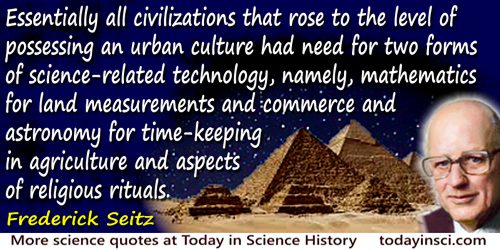
Essentially all civilizations that rose to the level of possessing an urban culture had need for two forms of science-related technology, namely, mathematics for land measurements and commerce and astronomy for time-keeping in agriculture and aspects of religious rituals.
From The Science Matrix: The Journey, Travails, Triumphs (1992, 1998), Preface, x.
Even though the realms of religion and science in themselves are clearly marked off from each other, nevertheless there exist between the two strong reciprocal relationships and dependencies. Though religion may be that which determines the goal, it has, nevertheless, learned from science, in the broadest sense, what means will contribute to the attainment of the goals it has set up. But science can only be created by those who are thoroughly imbued with the aspiration toward truth and understanding. This source of feeling, however, springs from the sphere of religion. To this there also belongs the faith in the possibility that the regulations valid for the world of existence are rational, that is, comprehensible to reason. I cannot conceive of a genuine scientist without that profound faith. The situation may be expressed by an image: science without religion is lame, religion without science is blind.
From paper 'Science, Philosophy and Religion', prepared for initial meeting of the Conference on Science, Philosophy and Religion in Their Relation to the Democratic Way of Life, at the Jewish Theological Seminary of America, New York City (9-11 Sep 1940). Collected in Albert Einstein: In His Own Words (2000), 212.
Every great scientist becomes a great scientist because of the inner self-abnegation with which he stands before truth, saying: “Not my will, but thine, be done.” What, then, does a man mean by saying, Science displaces religion, when in this deep sense science itself springs from religion?
In 'The Real Point of Conflict between Science and Religion', collected in Living Under Tension: Sermons On Christianity Today (1941), 148.
Evolution is either an innocent scientific description of how certain earthly things came about; or, if it is anything more than this, it is an attack upon thought itself. If evolution destroys anything, it does not destroy religion but rationalism.
In Orthodoxy (1918, 2008), 25.
Extinguished theologians lie about the cradle of every science, as the strangled snakes beside that of Hercules; and history records that whenever science and orthodoxy have been fairly opposed, the latter has been forced to retire from the lists, bleeding and crushed if not annihilated; scotched, if not slain.
Darwiniana: essays (1896), 52.
For any one who is pervaded with the sense of causal law in all that happens, who accepts in real earnest the assumption of causality, the idea of a Being who interferes with the sequence of events in the world is absolutely impossible! Neither the religion of fear nor the social-moral religion can have, any hold on him. A God who rewards and punishes is for him unthinkable, because man acts in accordance with an inner and outer necessity, and would, in the eyes of God, be as little responsible as an inanimate object is for the movements which it makes. Science, in consequence, has been accused of undermining morals—but wrongly. The ethical behavior of man is better based on sympathy, education and social relationships, and requires no support from religion. Man’s plight would, indeed, be sad if he had to be kept in order through fear of punishment and hope of rewards after death.
From 'Religion and Science', The New York Times Magazine, (9 Nov 1930), 1. Article in full, reprinted in Edward H. Cotton (ed.), Has Science Discovered God? A Symposium of Modern Scientific Opinion (1931), 101. The wording differs significantly from the version collected in 'Religion And Science', Ideas And Opinions (1954), 39, giving its source as: “Written expressly for the New York Times Magazine. Appeared there November 9, 1930 (pp. 1-4). The German text was published in the Berliner Tageblatt, November 11, 1930.” This variant form of the quote from the book begins, “The man who is thoroughly convinced of the universal operation of the law of causation….” and is also on the Albert Einstein Quotes page on this website. As for why the difference, Webmaster speculates the book form editor perhaps used a revised translation from Einstein’s German article.
For in much wisdom is much grief and he that increaseth knowledge, increaseth sorrow.
— Bible
From 'Ecclesiastes', 1:18. In King James Version, The Bible: Containing the Old and New Testaments Translated Out Of the Original Tongues (circa 725 B.C., 1834)
https://books.google.com/books?id=qbaVYV0QiPMC
1834
For me, the idea of a creation is not conceivable without invoking the necessity of design. One cannot be exposed to the law and order of the universe without concluding that there must be design and purpose behind it all.
In letter to California State board of Education (14 Sep 1972).
Formerly, when religion was strong and science weak, men mistook magic for medicine; now, when science is strong and religion weak, men mistake medicine for magic.
The Second Sin (1973), 115.
From religion comes a man's purpose; from science, his power to achieve it. Sometimes people ask if religion and science are not opposed to one another. They are: in the sense that the thumb and fingers of my hands are opposed to one another. It is an opposition by means of which anything can be grasped.
In Sir Kerr Grant, The Life and Work of Sir William Bragg (1952), 43.
Gentlemen, as we study the universe we see everywhere the most tremendous manifestations of force. In our own experience we know of but one source of force, namely will. How then can we help regarding the forces we see in nature as due to the will of some omnipresent, omnipotent being? Gentlemen, there must be a GOD.
As quoted in W. E. Byerly (writing as a Professor Emeritus at Harvard University, but a former student at a Peirce lecture on celestial mechanics), 'Benjamin Peirce: II. Reminiscences', The American Mathematical Monthly (Jan 1925), 32, No. 1, 6.
Geology, ethnology, what not?—(Greek endings, each the little passing bell
That signifies some faith’s about to die.)
That signifies some faith’s about to die.)
God was always invented to explain mystery. God is always invented to explain those things that you do not understand. Now, when you finally discover how something works … you don't need him anymore. But … you leave him to create the universe because we haven't figured that out yet.
Interview, collected in Paul C. W. Davies and Julian R. Brown (eds.) Superstrings: A Theory of Everything? (1988), 208-209.
Gods are born and die, but the atom endures.
In Perspectives (1966). As quoted and cited in Epigraph, Jefferson Hane Weaver, The World of Physics: A Small Library of the Literature of Physics (1987), Vol. 2, 85.
Happy is he who bears a god within himself, an ideal of beauty, and obeys him: an ideal of art, an ideal of the virtues of the Gospel. These are the living springs of great thoughts and great actions. All are illuminated by reflections of the sublime.
Speech (27 Apr 1882) on his reception into the Académie Française, as translated in Maurice Benjamin Strauss, Familiar Medical Quotations (1968), 490.
He who posseses science and art, has religion; he who possesses neither science nor art, let him get religion.
Quoted in Miguel De Unamuno, Tragic Sense of Life (1913), translated by John Ernest Crawford Flitch (1954), 210.
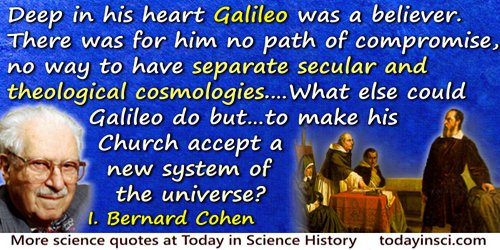
His conflict with the Catholic Church arose because deep in his heart Galileo was a believer. There was for him no path of compromise, no way to have separate secular and theological cosmologies. If the Copernican system was true as he believed, what else could Galileo do but fight with every weapon he had in his arsenal of logic, rhetoric, scientific observation, mathematical theory, and cunning insight, to make his Church accept a new system of the universe?
In The Birth of a New Physics (1960, rev. ed. 1985), 125.
Hogwash! … On our way to the moon, and on the moon, I worked as hard as John Young and it took me another six years before I found out the truth about God. In the days of Apollo and long afterwards I still believed in the theory of evolution and rejected the Biblical creation story. [Commenting on an American reporter’s printed intimation that Lunar Module pilots “had less things to do and had time to look out the spaceship’s window, or to explore the surroundings. Afterwards they could not cope with what they had seen, felt and experienced.”]
As quoted in Colin Burgess, Footprints in the Dust: The Epic Voyages of Apollo, 1969-1975 (2010), 422. Burgess introduced the quote with: “Charles Moss Duke Jr. has always been wrongly labeled as the astronaut who found God during his Apollo 16 mission, but even though he did eventually become a born-again Christian, this life-altering epiphany came some years after the event.” Burgess explained that Duke dislikes “misinformed characterizations of himself and his Apollo colleagues and of the religious impact of his own lunar mission.” [The ellipsis in the subject quote spans from one paragraph to the next in Burgess’ book. The ellipsis was added by Webmaster, on the assumption that the word “Hogwash!” belongs with the statement in the following paragraph.]
How could science be any enemy of religion when God commanded man to be a scientist the day He told him to rule the earth and subject it?
In The Life of All Living: the philosophy of life (1929, 1942), 212.
Humanism is only another name for spiritual laziness, or a vague half-creed adopted by men of science and logicians whose heads are too occupied with the world of mathematics and physics to worry about religious categories.
In The Outsider (1956), 279.
I am a creationist and an evolutionist. Evolution is God's, or Nature's method of creation. Creation is not an event that happened in 4004 BC; it is a process that began some 10 billion years ago and is still under way.
In 'Nothing in Biology Makes Sense Except in the Light of Evolution', The American Biology Teacher (Mar 1973), 125-129.
I am persuaded that there is not in the nature of science anything unfavourable to religious feelings, and if I were not so persuaded I should be much puzzled to account for our being invested, as we so amply are, with the facilities that lead us to the discovery of scientific truth. It would be strange if our Creator should be found to be urging us on in a career which tended to be a forgetfulness of him.
Letter to H. J. Rose (19 Nov 1826). Quoted in I. Todhunter (ed.), William Whewell: An Account of His Writings with Selections From His Literary and Scientific Correspondence (1876), Vol. 2, 76.
I am very much a scientist, and so I naturally have thought about religion also through the eyes of a scientist. When I do that, I see religion not denominationally, but in a more, let us say, deistic sense. I have been influenced in my thinking by the writing of Einstein who has made remarks to the effect that when he contemplated the world he sensed an underlying Force much greater than any human force. I feel very much the same. There is a sense of awe, a sense of reverence, and a sense of great mystery.
From interview with John F. Luca, 'Dr. Walter Kohn: Science, Religion, and the Human Experience', The Santa Barbara Independent (26 Jul 2001).
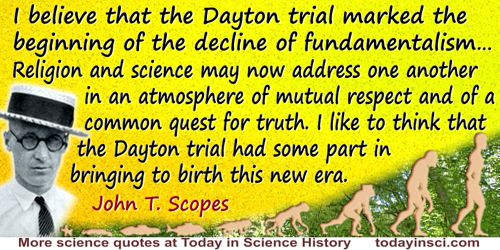
I believe that the Dayton trial marked the beginning of the decline of fundamentalism. … I feel that restrictive legislation on academic freedom is forever a thing of the past, that religion and science may now address one another in an atmosphere of mutual respect and of a common quest for truth. I like to think that the Dayton trial had some part in bringing to birth this new era.
From 'Reflections—Forty Years After', in Jerry R. Tompkins (ed.), D-Days at Dayton: Reflections on the Scopes Trial(1965), 31. As quoted in Stephen Jay Gould, Hen’s Teeth and Horse’s Toes: Further Reflections in Natural History (1983), 274.
I could almost wish, at this point, that I were in the habit of expressing myself in theological terms, for if I were, I might be able to compress my entire thesis into a sentence. All knowledge of every variety (I might say) is in the mind of God—and the human intellect, even the best, in trying to pluck it forth can but “see through a glass, darkly.”
In Asimov on Physics (1976), 146. Also in Isaac Asimov’s Book of Science and Nature Quotations (1988), 279.
I do not believe that a moral philosophy can ever be founded on a scientific basis. … The valuation of life and all its nobler expressions can only come out of the soul’s yearning toward its own destiny. Every attempt to reduce ethics to scientific formulas must fail. Of that I am perfectly convinced.
In 'Science and God: A Dialogue', Forum and Century (June 1930), 83, 374. Einstein’s dialogue was with James Murphy and J.W.N. Sullivan. Excerpted in David E. Rowe and Robert J. Schulmann, Einstein on Politics: His Private Thoughts and Public Stands on Nationalism, Zionism, War, Peace, and the Bomb (2007), 230. The book introduces this quote as Einstein’s reply when Murphy asked, in the authors’ words, “how far he thought modern science might be able to go toward establishing practical ideals of life on the ruins of religious ideals.”
I do not hope for any relief, and that is because I have committed no crime. I might hope for and obtain pardon, if I had erred, for it is to faults that the prince can bring indulgence, whereas against one wrongfully sentenced while he was innocent, it is expedient, in order to put up a show of strict lawfulness, to uphold rigor… . But my most holy intention, how clearly would it appear if some power would bring to light the slanders, frauds, and stratagems, and trickeries that were used eighteen years ago in Rome in order to deceive the authorities!
In Letter to Nicolas-Claude Fabri de Peiresc (22 Feb 1635). As quoted in translation in Giorgio de Santillana, The Crime of Galileo (1976), 324.
I don't see why religion and science can't cooperate. What's wrong with using a computer to count our blessings?
In Ashton Applewhite, William R. Evans and Andrew Frothingham, And I Quote (2003), 108.
I find it quite improbable that such order came out of chaos. There has to be some organizing principle. God to me is a mystery, but is the explanation for the miracle of existence, why there is something instead of nothing.
As quoted in John Noble Wilford, 'Sizing up the Cosmos: An Astronomers Quest', New York Times (12 Mar 1991), C10.
I have the same sense of the power and virtue of knowledge that some people get from a religious background.
From interview with Anthony Liversidge, in 'Walter Gilbert', Omni (Nov 1992), 15, No. 2.
I now never make the preparations for penetrating into some small province of nature hitherto undiscovered without breathing a prayer to the Being who hides His secrets from me only to allure me graciously on to the unfolding of them.
As quoted in E.P. Whipple, 'Recollections of Agassiz', in Henry Mills Alden (ed.), Harper's New Monthly Magazine (June 1879), 59, 103.
I now think the answer is very simple: it’s true. God did create the universe about 13.7 billion years ago, and of necessity has involved Himself with His creation ever since. The purpose of this universe is something that only God knows for sure, but it is increasingly clear to modern science that the universe was exquisitely fine-tuned to enable human life.
In Letter (May 2005), sent to the Hope College 2005 Alumni Banquet, read in lieu of accepting an award in person, because of declining health from cancer.
I often get letters … from people who say … I never give credit to the almighty power that created nature. … I reply … “Well, it’s funny that the people, when they say that this is evidence of the Almighty, always quote beautiful things … orchids and hummingbirds and butterflies and roses.” But I always have to think too of a little boy sitting on the banks of a river in west Africa who has a worm boring through his eyeball, turning him blind before he’s five years old. And I … say, “Well, presumably the God you speak about created the worm as well,” and now, I find that baffling to credit a merciful God with that action. And therefore it seems to me safer to show things that I know to be truth, truthful and factual, and allow people to make up their own minds about the moralities of this thing, or indeed the theology of this thing.
From BBC TV, Life on Air (2002).
I ought to call myself an agnostic; but, for all practical purposes, I am an atheist. I do not think the existence of the Christian God any more probable than the existence of the Gods of Olympus or Valhalla. To take another illustration: nobody can prove that there is not between the Earth and Mars a china teapot revolving in an elliptical orbit, but nobody thinks this sufficiently likely to be taken into account in practice. I think the Christian God just as unlikely.
Letter (1958) to Mr Major. Collected in Dear Bertrand Russell: A Selection of his
Correspondence with the General Public, 1950 - 1968 (1969), 41-42.
I prefer the man who calls his nonsense a mystery to him who who pretends it is a weighed, measured, analyzed fact.
In Evan Esar, 20,000 Quips and Quotes, 704.
I sometimes hear preachers speak of the sad condition of men who live without God in the world, but a scientist who lives without God in the world seems to me worse off than ordinary men.
As quoted in E.P. Whipple, 'Recollections of Agassiz', in Henry Mills Alden (ed.), Harper's New Monthly Magazine (June 1879), 59, 103.
I think Buddhists should not be afraid of science. Science can help Buddhism to discover more deeply the teaching of the Buddha. For example, the Avatamsaka Sutra says that the one is made of the many, and the many can be found in the one. This is something that can be proven by science. Out of a cell, they can duplicate a whole body. In one cell, the whole genetic heritage can be found, and you can make a replica of the whole body. In the one, you see the many.
In Melvin McLeod (ed.), 'Love without Limit: An Interview with Thich Nhat Hanh', The Best Buddhist Writing 2007 (2007), 75.
I think this case will be remembered because it is the first case of this sort since we stopped trying people in America for witchcraft, because here we have done our best to turn back the tide that has sought to force itself upon this modern world, of testing every fact in science by a religious dictum.
Final remarks to the Court after the jury verdict was read at the Scopes Monkey Trial Eighth day's proceedings (21 Jul 1925) in John Thomas Scopes, The World's Most Famous Court Trial: Tennessee Evolution Case: a Complete Stenographic Report of the Famous Court Test of the Tennessee Anti-Evolution Act, at Dayton, July 10 to 21, 1925, Including Speeches and Arguments of Attorneys (1925), 316.
I undertake my scientific research with the confident assumption that the earth follows the laws of nature which God established at creation. … My studies are performed with the confidence that God will not capriciously confound scientific results by “slipping in” a miracle.
Quoted in Lenny Flank, Deception by Design: The Intelligent Design Movement in America (2007), 81. Also seen as cited from Arthur Newell Strahler, Science and Earth History: the Evolution/Creation Controversy (1987), 40-41.
I was pretty good in science. But again, because of the small budget, in science class we couldn’t do experiments in order to prove theories. We just believed everything. Actually I think that class was call Religion. Religion was always an easy class. All you had to do was suspend the logic and reasoning you were taught in all the other classes.
In autobiography, Brain Droppings (1998), 227.
I wish the lecturers to treat their subject as a strictly natural science, the greatest of all possible sciences, indeed, in one sense, the only science, that of Infinite Being, without reference to or reliance upon any supposed special exception or so-called miraculous revelation. I wish it considered just as astronomy or chemistry is.
Statement in deed of foundation of the Gifford Lectures on natural theology (1885).
Statement in deed of foundation of the Gifford Lectures on natural theology (1885).
Quoted in Michael A. Arbib and Mary B. Hesse, The Construction of Reality (1986), 1.
I’ll deal with the most difficult problem first. Creation ex nihilo. The adipose argument is that “God did it.” That of course is the lazy man’s elixir. Sort of a cocktail made up of a swig of credulity and a teaspoon full of unwillingness to think. In short, it’s an explanation that avoids explanation.
From transcript of debate (Apr 1998) with William Lane Craig at the Carter Presidential Center, Atlanta, Georgia, 'What is the evidence for/against the existence of God?' on reasonablefaith.org website.
I’m saying that the leaders of the church have locked the sacred cow called science in the stable and they won’t let anybody enter; they should open it immediately so that we can milk that cow in the name of humanity and thus find the truth.
From the play Galileo Galilei (2001) .
If entropy must constantly and continuously increase, then the universe is remorselessly running down, thus setting a limit (a long one, to be sure) on the existence of humanity. To some human beings, this ultimate end poses itself almost as a threat to their personal immortality, or as a denial of the omnipotence of God. There is, therefore, a strong emotional urge to deny that entropy must increase.
In Asimov on Physics (1976), 141. Also in Isaac Asimov’s Book of Science and Nature Quotations (1988), 279.
If finally, the science should prove that society at a certain time revert to the church and recover its old foundation of absolute faith in a personal providence and a revealed religion, it commits suicide.
In The Degradation of the Democratic Dogma (1919), 131.
If I get the impression that Nature itself makes the decisive choice [about] what possibility to realize, where quantum theory says that more than one outcome is possible, then I am ascribing personality to Nature, that is to something that is always everywhere. [An] omnipresent eternal personality which is omnipotent in taking the decisions that are left undetermined by physical law is exactly what in the language of religion is called God.
As quoted by John D. Barrow in The Universe that Discovered Itself (2000), 171.
If I were to suggest that between the Earth and Mars there is a china teapot revolving about the sun in an elliptical orbit, nobody would be able to disprove my assertion provided I were careful to add that the teapot is too small to be revealed even by our most powerful telescopes. But if I were to go on to say that, since my assertion cannot be disproved, it is intolerable presumption on the part of human reason to doubt it, I should rightly be thought to be talking nonsense. If, however, the existence of such a teapot were affirmed in ancient books, taught as the sacred truth every Sunday, and instilled into the minds of children at school, hesitation to believe in its existence would become a mark of eccentricity and entitle the doubter to the attentions of the psychiatrist in an enlightened age or of the Inquisitor in an earlier time.
In unpublished manuscript, 'Is There a God', (5 Mar 1952) written for the magazine, Illustrated. Collected in Bertrand Russell, John G. Slater (ed.) and Peter Köllner (ed.) The Collected Papers of Bertran Russell: Volume II: Last Philosophical Testament: 1943-68 (1997), 547-548.
If in some madhouse there is a lunatic who still believes the old churchly tenet that heaven is up above, even this [the first manned landing on the moon] probably will not disabuse him. Surely those of us still sane enough to be at large realize that this event will have no more to so with theology, God, or self-knowledge than any flower we pluck or any hand we press—in fact, much less.
(13 Jul 1969). As given in Alan F. and Jason R. Pater (eds.), What They Said in 1969: The Yearbook of Spoken Opinion (1970), 402.
If the God of revelation is most appropriately worshipped in the temple of religion, the God of nature may be equally honored in the temple of science. Even from its lofty minarets the philosopher may summon the faithful to prayer, and the priest and sage exchange altars without the compromise of faith or knowledge.
In Tryon Edwards (ed.), A Dictionary of Thoughts: Being a Cyclopedia of Laconic Quotations from the Best Authors of the World, Both Ancient and Modern (1891), 507.
If the world is turning, even the church can’t stop it; if it isn’t turning, nobody can go out and make it turn.
From the play Galileo Galilei (2001) .
If there is a just God, how humanity would writhe in its attempt to justify its treatment of animals.
Epigraph in Isaac Asimov’s Book of Science and Nature Quotations (1988), 334.
If there really is God who created the entire universe with all of its glories, and He decides to deliver a message to humanity, He will not use, as His messenger, a person on cable TV with a bad hairstyle.
From newspaper column '25 Things I Have Learned in 50 Years' (Oct 1998), collected in Dave Barry Turns Fifty (2010), 185.
If they believe it [evolution], they go back to scoff at the religion of their parents.
From the transcript of the Scopes Monkey Trial fifth day's proceedings (16 Jul 1925) in John Thomas Scopes, The World's Most Famous Court Trial: Tennessee Evolution Case: a Complete Stenographic Report of the Famous Court Test of the Tennessee Anti-Evolution Act, at Dayton, July 10 to 21, 1925, Including Speeches and Arguments of Attorneys (1925), 175.
If time is treated in modern physics as a dimension on a par with the dimensions of space, why should we a priori exclude the possibility that we are pulled as well as pushed along its axis? The future has, after all, as much or as little reality as the past, and there is nothing logically inconceivable in introducing, as a working hypothesis, an element of finality, supplementary to the element of causality, into our equations. It betrays a great lack of imagination to believe that the concept of “purpose” must necessarily be associated with some anthropomorphic deity.
In 'Epilogue', The Sleepwalkers: A History of Man’s Changing Vision of the Universe (1959, 1968), 537.
If you want to save your child from polio, you can pray or you can inoculate. ... Choose science.
The Demon-Haunted World (1996), 30.
If, in the course of a thousand or two thousand years, science arrives at the necessity of renewing its points of view, that will not mean that science is a liar. Science cannot lie, for it’s always striving, according to the momentary state of knowledge, to deduce what is true. When it makes a mistake, it does so in good faith. It’s Christianity that’s the liar. It’s in perpetual conflict with itself.
In Adolf Hitler, Hugh Redwald Trevor-Roper, translated by Norman Cameron and R. H. Stevens, '14 October 1941', Secret Conversations (1941 - 1944) (1953), 51
Imagine the people who believe such things and who are not ashamed to ignore, totally, all the patient findings of thinking minds through all the centuries since the Bible was written. And it is these ignorant people, the most uneducated, the most unimaginative, the most unthinking among us, who would make themselves the guides and leaders of us all; who would force their feeble and childish beliefs on us; who would invade our schools and libraries and homes. I personally resent it bitterly.
In The Roving Mind (1983), 26.
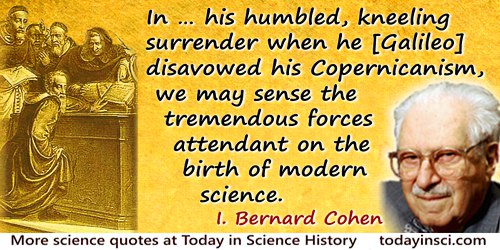
In … his humbled, kneeling surrender when he disavowed his Copernicanism, we may sense the tremendous forces attendant on the birth of modern science.
In The Birth of a New Physics (1960, rev. ed. 1985), 126.
In 1925 [state legislators] prohibited by law the teaching of evolution in Tennessee. … Anti-evolutionists feared that a scientific idea would undermine religious belief. In the present…, pro-evolutionists fear that a religious idea will undermine scientific belief. The former had insufficient confidence in religion; the latter, insufficient confidence in science.
In Building a Bridge to the 18th Century: How the Past Can Improve Our Future (1999), 167.
In addition to instructing them in the holy Scriptures, they also taught their pupils poetry, astronomy, and the calculation of the church calendar.
— Bede
Referring to the teaching methods of Theodore, Archbishop of Canterbury, and Hadrian, abbot of Canterbury (A.D. 669).
In all that has to do with the relations between man and the supernatural, we have to seek for a more than mathematical precision; this should be more exact than science.
In Gravity and Grace, (1947, 1952), 186.
In considering God's power, we must not look for a God of the Gaps, a god who is called in for those phenomena for which there is yet no scientific explanation.
Essay 'Science Will Never Give Us the Answers to All Our Questions', collected in Henry Margenau, and Roy Abraham Varghese (eds.), Cosmos, Bios, Theos (1992), 66.
In my personal view, a failure to discover unimagined objects and answer unasked questions, once HST functions properly, would indicate a lack of imagination in stocking the Universe on the part of the Deity.
In Hubble Space Telescope flaw: hearing before the Committee on Science, Space, and Technology, U.S. House of Representatives, One Hundred First Congress, second session, July 13, 1990 (1990), 105.
In my understanding of God I start with certain firm beliefs. One is that the laws of nature are not broken. We do not, of course, know all these laws yet, but I believe that such laws exist. I do not, therefore, believe in the literal truth of some miracles which are featured in the Christian Scriptures, such as the Virgin Birth or water into wine. ... God works, I believe, within natural laws, and, according to natural laws, these things happen.
Essay 'Science Will Never Give Us the Answers to All Our Questions', collected in Henry Margenau, and Roy Abraham Varghese (eds.), Cosmos, Bios, Theos (1992), 66.
In terms of doing things I take a fairly scientific approach to why things happen and how they happen. I don't know if there's a god or not, but I think religious principles are quite valid.
PBS interview with David Frost (Nov 1995). In Lisa Rogak (ed.) The Impatient Optimist - Bill Gates in his Words (2012), 107.
In the days when geology was young, now some two hundred years ago, it found a careful foster-mother in theology, who watched over its early growth with anxious solicitude, and stored its receptive mind with the most beautiful stories, which the young science never tired of transforming into curious fancies of its own, which it usually styled “theories of the earth.”
In British Association Address to Workingmen, 'Geology and Deluges', published in Nature (1984), 50, 505-510. Also printed in Popular Science Monthly (Dec 1894), 46 245.
In the distance tower still higher peaks which will yield to those who ascend them still wider prospects, and deepen the feeling whose truth is emphasized by every advance in science: that “Great are the Works of the Lord.”
From Inaugural Address to the Annual Meeting of the British Association for the Advancement of Science at Winnipeg. Collected in 'The British Association at Winnipeg',Nature (26 Aug 1909), 81. No. 2078, 257.
In the endeavor to clearly comprehend and explain the functions of the combination of forces called “brain,” the physiologist is hindered and troubled by the views of the nature of those cerebral forces which the needs of dogmatic theology have imposed on mankind.
In 'General Conclusions, Anatomy of the Vertebrates (1868, 2011), Vol. 3, Chap 40, 823. Excerpt in Noah Porter (ed.), Half Hours with Modern Scientists (1872), 71.
In this age of specialization men who thoroughly know one field are often incompetent to discuss another. … The old problems, such as the relation of science and religion, are still with us, and I believe present as difficult dilemmas as ever, but they are not often publicly discussed because of the limitations of specialization.
Opening statement, in transcript of talk to the Caltech Lunch Forum (2 May 1956), 'The Relation of Science and Religion', collected in Richard Phillips Feynman and Jeffrey Robbins (ed.), The Pleasure of Finding Things Out: The Best Short Works of Richard P. Feynman (1999, 2005), 245-246.
Infidels are intellectual discoverers. They sail the unknown seas and find new isles and continents in the infinite realms of thought. An Infidel is one who has found a new fact, who
has an idea of his own, and who in the mental sky has seen another star. He is an intellectual capitalist, and for that reason excites the envy and hatred of the theological pauper.
In 'The Great Infidels', The Works of Robert G. Ingersoll (1902), Vol. 3, 309.
Instead of dismissing professors for finding something out, let us rather discharge those who do not. Let each teacher understand that investigation is not dangerous for him; that his bread is safe, no matter how much truth he may discover, and that his salary will not be reduced, simply because he finds that the ancient Jews did not know the entire history of the world.
In Some Mistakes of Moses (1879), 27.
Is there a God? Who knows? Is there an angry unicorn on the dark side of the moon?
In 'Philosophy, Religion, and So Forth', A Voice Crying in the Wilderness (1989), 2.
It could plausibly be argued that far from Christian theology having hampered the study of nature for fifteen hundred years, it was Greek corruptions of biblical Christianity which hampered it.
Science and the Human Imagination: Aspects of the History and Logic of Physical Science (1955). Quoted in V.F. Lenzen, book review, Isis (Jun 1956), 47, No. 2, 190.
It doesn't seem to me that this fantastically marvelous universe, this tremendous range of time and space and different kinds of animals, and all the different planets, and all these atoms with all their motions, and so on, all this complicated thing can merely be a stage so that God can watch human beings struggle for good and evil—which is the view that religion has. The stage is too big for the drama.
'Viewpoint' Interview (with Bill Stout) for Los Angeles KNXT television station (1 May 1959), printed in Michelle Feynman (ed.) Perfectly Reasonable Deviations (from the Beaten Track) (2006), Appendix I, 426. Also quoted in James Gleick, Genius: The Life and Science of Richard Feynman (1992), 372. Gleick adds that KNXT “felt obliged to suppress” the interview. It was not broadcast until after Feynman, asked to redo the interview, wrote back with a letter objecting to “a direct censorship of the expression of my views.”
It is a curious and painful fact that almost all the completely futile treatments that have been believed in during the long history of medical folly have been such as caused acute suffering to the patient. When anesthetics were discovered, pious people considered them an attempt to evade the will of God. It was pointed out, however, that when God extracted Adam's rib He put him into a deep sleep. This proved that anesthetics are all right for men; women, however, ought to suffer, because of the curse of Eve.
In An Outline of Intellectual Rubbish (1943), 13.
It is admitted, on all hands, that the Scriptures are not intended to resolve physical questions, or to explain matters in no way related to the morality of human actions; and if, in consequence of this principle, a considerable latitude of interpretation were not allowed, we should continue at this moment to believe, that the earth is flat; that the sun moves round the earth; and that the circumference of a circle is no more than three times its diameter.
In The Works of John Playfair: Vol. 1: Illustrations of the Huttonian Theory of the Earth (1822), 137.
It is better to trust in the Rock of Ages, than to know the age of the rocks; it is better for one to know that he is close to the Heavenly Father, than to know how far the stars in the heavens are apart.
In chapter, 'The Origin of Man', In His Image (1922), 93.
It is certainly true in the United States that there is an uneasiness about certain aspects of science, particularly evolution, because it conflicts, in some people’s minds, with their sense of how we all came to be. But you know, if you are a believer in God, it’s hard to imagine that God would somehow put this incontrovertible evidence in front of us about our relationship to other living organisms and expect us to disbelieve it. I mean, that doesn't make sense at all.
From video of interview with Huffington post reporter at the 2014 Davos Annual Meeting, World Economic Forum (25 Jan 2014). On web page 'Dr. Francis Collins: “There Is An Uneasiness” About Evolution'
It is difficult even to attach a precise meaning to the term “scientific truth.” So different is the meaning of the word “truth” according to whether we are dealing with a fact of experience, a mathematical proposition or a scientific theory. “Religious truth” conveys nothing clear to me at all.
From 'Scientific Truth' in Essays in Science (1934, 2004), 11.
It is impossible to answer your question briefly; and I am not sure that I could do so, even if I wrote at some length. But I may say that the impossibility of conceiving that this grand and wondrous universe, with our conscious selves, arose through chance, seems to me the chief argument for the existence of God; but whether this is an argument of real value, I have never been able to decide.
[Replying to query about his religious views]
[Replying to query about his religious views]
Letter to a Dutch student (2 Apr 1873), in Charles Darwin and Sir Francis Darwin (ed.), The Life and Letters of Charles Darwin (1896), 276.
It is ironical that, in the very field in which Science has claimed superiority to Theology, for example—in the abandoning of dogma and the granting of absolute freedom to criticism—the positions are now reversed. Science will not tolerate criticism of special relativity, while Theology talks freely about the death of God, religionless Christianity, and so on.
In 'Preface', Science at the Crossroads (1972), 13.
It is only through the psyche that we can establish that God acts upon us, but we are unable to distinguish whether these actions emanate from God or from the unconscious. We cannot tell whether God and the unconscious are two different entities. Both are border-line concepts for transcendental contents.
In Psychology and Religion: West and East (1969), 468.
It is precisely because I have studied and reflected that I have to-day the faith of a Breton; and had I studied and reflected more I should have the faith of a Breton’s wife.
Apocryphal - doubtful that Pasteur actually said this. There seem to be no first-hand documents to support it. Alleged reply to a student, who supposedly asked Pasteur how it was possible for a scientific man, who had studied and reflected so much, to remain a devout Roman Catholic. As given in Michael Peter Hill, 'Scientific Freedom', The Catholic's Ready Answer: A Popular Vindication of Christian Beliefs and Practices Against the Attacks of Modern Criticism (1915), 415. Translated from the German, and expanded, from the work of Franz Xaver Brors, Modernes A B C. It was Pasteur’s position that science and faith were not mutually exclusive.
It may be that in the practice of religion men have real evidence of the Being of God. If that is so, it is merely fallacious to refuse consideration of this evidence because no similar evidence is forthcoming from the study of physics, astronomy or biology.
In Nature, Man and God: Being the Gifford Lectures Delivered in the University of Glasgow in the Academical Years 1932-1933 and 1933-1934 (1934), 11.
It was an admirable reply of a converted astronomer, who, when interrogated concerning his comparative estimate of religion and the science he had formerly idolized, answered, 'I am now bound for heaven, and I take the stars in my way.'
In Tryon Edwards. A Dictionary of Thoughts (1908), 506.
It was, of course, a lie what you read about my religious convictions, a lie which is being systematically repeated. I do not believe in a personal God and I have never denied this but have expressed it clearly. If something is in me which can be called religious then it is the unbounded admiration for the structure of the world so far as our science can reveal it.
From Letter (24 Mar 1954) in Einstein archives. Quoted by Helen Dukas and Banesh Hoffman, Albert Einstein: The Human Side (1979, 2013), 43. Dukas was Einstein’s personal secretary for 28 years, so she knew his philosophy well.
It’s a vacuous answer … To say that “God made the world” is simply a more or less sophisticated way of saying that we don't understand how the universe originated. A god, in so far as it is anything, is an admission of ignorance.
From Speech, Annual Meeting of the British Association for the Advancement of Science. As quoted in 'Professor Says Science Rules Out Belief in God', The Telegraph (11 Sep 1996). As cited in John C. Weaver and John David Weaver, Christianity and Science (1973, 1984), 22.
Knowledge is like a knife. In the hands of a well-balanced adult it is an instrument for good of inestimable value; but in the hands of a child, an idiot, a criminal, a drunkard or an insane man, it may cause havoc, misery, suffering and crime. Science and religion have this in common, that their noble aims, their power for good, have often, with wrong men, deteriorated into a boomerang to the human race.
In 'Applied Chemistry', Science (22 Oct 1915), New Series, 42, No. 1086, 548.
Let nobody be afraid of true freedom of thought. Let us be free in thought and criticism; but, with freedom, we are bound to come to the conclusion that science is not antagonistic to religion, but a help to it.
Quoted in Arthur Holmes, 'The Faith of the Scientist', The Biblical World (1916), 48 7.
Let us keep the discoveries and indisputable measurements of physics. But ... A more complete study of the movements of the world will oblige us, little by little, to turn it upside down; in other words, to discover that if things hold and hold together, it is only by reason of complexity, from above.
In Teilhard de Chardin and Bernard Wall (trans.), The Phenomenon of Man (1959, 2008), 43. Originally published in French as Le Phénomene Humain (1955).
Man is programmed to find the programmer.
Quotations: Superultramodern Science and Philosophy (2005).
Mankind have been slow to believe that order reigns in the universe—that the world is a cosmos and a chaos.
… The divinities of heathen superstition still linger in one form or another in the faith of the ignorant, and even intelligent men shrink from the contemplation of one supreme will acting regularly, not fortuitously, through laws beautiful and simple rather than through a fitful and capricious system of intervention.
... The scientific spirit has cast out the demons, and presented us with nature clothed in her right mind and living under the reign of law. It has given us, for the sorceries of the alchemist, the beautiful laws of chemistry; for the dreams of the astrologer, the sublime truths of astronomy; for the wild visions of cosmogony, the monumental records of geology; for the anarchy of diabolism, the laws of God.
… The divinities of heathen superstition still linger in one form or another in the faith of the ignorant, and even intelligent men shrink from the contemplation of one supreme will acting regularly, not fortuitously, through laws beautiful and simple rather than through a fitful and capricious system of intervention.
... The scientific spirit has cast out the demons, and presented us with nature clothed in her right mind and living under the reign of law. It has given us, for the sorceries of the alchemist, the beautiful laws of chemistry; for the dreams of the astrologer, the sublime truths of astronomy; for the wild visions of cosmogony, the monumental records of geology; for the anarchy of diabolism, the laws of God.
Speech (16 Dec 1867) given while a member of the U.S. House of Representatives, introducing resolution for the appointment of a committee to examine the necessities for legislation upon the subject of the ninth census to be taken the following year. Quoted in John Clark Ridpath, The Life and Work of James A. Garfield (1881), 216.
Many consider that the conflict of religion and science is a temporary phase, and that in due course the two mighty rivers of human understanding will merge into an even mightier Amazon of comprehension. I take the opposite view, that reconciliation is impossible. I consider that Science is mightier than the Word, and that the river of religion will (or, at least, should) atrophy and die.
In 'Religion - The Antithesis to Science', Chemistry & Industry (Feb 1997).
Maybe we have to accept that after reaching the deepest possible level of understanding science can offer, there will nevertheless be aspects of the universe that remain unexplained. Maybe we will have to accept that certain features of the universe are the way they are because of happenstance, accident, or divine choice.
In The Elegant Universe: Superstrings, Hidden Dimensions, and the Quest for the Ultimate Theory (2000), 385.
Modern science gives lectures on botany, to show there is no such thing as a flower; on humanity, to show there is no such thing as a man; and on theology, to show there is no such thing as a God. No such thing as a man, but only a mechanism, No such thing as a God, but only a series of forces.
Letter V (1 May 1871) collected in Fors Clavigera: Letters to the Workmen and Labourers of Great Britain (1894), Vol. 1, 61.
Most scientists think of science as being a kind of purifying intellectual machinery that leads to honesty, to the withering away of ignorance and wrong ideas, including, provided they are of the atheistic persuasion, those of religion.
In Pamela Weintraub (ed.), 'E. O. Wilson', The Omni Interviews (1984), 231.
Much scientific truth proved to be as hypothetical as poetic allegory. The relationshiip of those rod-connected blue and red balls to an actual atomic structure was about the same as the relationship of Christianity to the fish or the Lamb.
Another Roadside Attraction (1990), 240.
My aim is to argue that the universe can come into existence without intervention, and that there is no need to invoke the idea of a Supreme Being in one of its numerous manifestations.
In The Creation (1981), Preface, vii. As quoted and cited in Karl W. Giberson and Donald A. Yerxa, Species of Origins: America's Search for a Creation Story (2002), 126 and footnote, 146.
My experiences with science led me to God. They challenge science to prove the existence of God. But must we really light a candle to see the sun?
In letter to California State board of Education (14 Sep 1972).
My practice as a scientist is atheistic. That is to say, when I set up an experiment I assume that no god, angel or devil is going to interfere with its course; and this assumption has been justified by such success as I have achieved in my professional career. I should therefore be intellectually dishonest if I were not also atheistic in the affairs of the world.
In Fact and Faith (1934), vi.
My thesis is that what we call 'science' is differentiated from the older myths not by being something distinct from a myth, but by being accompanied by a second-order tradition—that of critically discussing the myth. … In a certain sense, science is myth-making just as religion is.
Conjectures and Refutations: the Growth of Scientific Knowledge (2002), 170-171.
Nature does not know extinction; all it knows is transformation. … Everything science has taught me—and continues to teach me—strengthens my belief in the continuity of our spiritual existence after death. Nothing disappears without a trace.
Wehner von Braun article in This Week Magazine (24 Jan 1960), 2. Excerpted in Viola Walden, Sword Scrapbook (1980), 66.
Neither physical science nor psychology can ever ‘explain’ human consciousness. To me then, human consciousness lies outside science, and it is here that I seek the relationship between God and man.
In Can scientists believe? (1991), 8.
No matter how much proponents of “intelligent design” try to clothe their views in the apparel of science, it is what it is: religion. Whose intelligence? Whose design?
Atlanta Journal-Constitution, column also distributed by United Press Syndicate, American Know-How Hobbled by Know-Nothings (9 Aug 2005).
No path leads from a knowledge of that which is to that which should be.
'The Goal' lecture at Princeton University (1939), quoted in Philipp Frank and George Rosen, Einstein (2002), 287.
None of us deny evolution. We know it and study it with pleasure. Catholic universities do not see anything in evolution to prevent a Christian accepting it, but with the reservation that the great problem of the origin of the world and of the creation of man is the secret of God. The Catholic church accepts what science gives it on condition that science reports facts which can be proved, for it is a fact that there is no scientific truth which can contradict eternal truth.
The position of the Catholic Church on the theory of evolution, as stated by Monseigneur Piette, as he introduced the next speaker Dr. Thomas Hunt Morgan, professor of experimental zoology at Columbia University. As given in The School of Education Record of the University of North Dakota (Jun 1926), Vol.11, No. 9, 72.
Nothing can be unworthy of being investigated by man, which was thought worthy of being created by God.
In 'Report of the Secretary', Seventh Annual Report of the Board of Regents of the Smithsonian Institution for 1852 (1853), 15.
Nothing could be more obvious than that the earth is stable and unmoving, and that we are in the center of the universe. Modern Western science takes its beginning from the denial of this common sense axiom.
In The Discoverers (2011), 294.
O Timothy, keep that which is committed to thy trust, avoiding profane and vain babblings, and oppositions of science falsely so called; Which some professing have erred concerning faith. Grace be with thee. Amen.
— Bible
I Timothy 6:20-21, in The Holy Bible (1756).
Of possible quadruple algebras the one that had seemed to him by far the most beautiful and remarkable was practically identical with quaternions, and that he thought it most interesting that a calculus which so strongly appealed to the human mind by its intrinsic beauty and symmetry should prove to be especially adapted to the study of natural phenomena. The mind of man and that of Nature’s God must work in the same channels.
As quoted in W. E. Byerly (writing as a Professor Emeritus at Harvard University, but a former student at a Peirce lecture on Hamilton’s new calculus of quaternions), 'Benjamin Peirce: II. Reminiscences', The American Mathematical Monthly (Jan 1925), 32, No. 1, 6.
Our country will never be filled with great institutions of learning until there is an absolute divorce between Church and School.
In Some Mistakes of Moses (1879), 27.
Our world will yet grow so subtle that it will be as ludicrous to believe in a god as it is today to believe in ghosts.
Aphorism 57 in Notebook D (1773-1775), as translated by R.J. Hollingdale in Aphorisms (1990). Reprinted as The Waste Books (2000), 52.
Physics is not religion. If it were, we’d have a much easier time raising money.
In Leon Lederman and Dick Teresi, The God Particle: If the Universe is the Answer, What is the
Question (1993), 198.
Religion and science ... constitute deep-rooted and ancient efforts to find richer experience and deeper meaning than are found in the ordinary biological and social satisfactions. As pointed out by Whitehead, religion and science have similar origins and are evolving toward similar goals. Both started from crude observations and fanciful concepts, meaningful only within a narrow range of conditions for the people who formulated them of their limited tribal experience. But progressively, continuously, and almost simultaneously, religious and scientific concepts are ridding themselves of their coarse and local components, reaching higher and higher levels of abstraction and purity. Both the myths of religion and the laws of science, it is now becoming apparent, are not so much descriptions of facts as symbolic expressions of cosmic truths.
'On Being Human,' A God Within, Scribner (1972).
Religion belongs to the realm that is inviolable before the law of causation and therefore closed to science.
In Max Planck and James Vincent Murphy (trans.), Where is Science Going?, (1932), 168.
Religion cannot object to science on moral grounds. The history of religious intolerance forbids it.
Epigraph in Isaac Asimov’s Book of Science and Nature Quotations (1988), 273.
Religion closes off the central questions of existence by attempting to dissuade us from further enquiry by asserting that we cannot ever hope to comprehend. We are, religion asserts, simply too puny.
Essay collected in John Cornwell (ed.), 'The Limitless Power of Science', Nature's Imagination: The Frontiers of Scientific Vision (1995), 125.
Religion has been compelled by science to give up one after another of its dogmas—of those assumed cognitions which it could not substantiate. In the mean time, Science substituted for the personalities to which Religion ascribed phenomena certain metaphysical entities; and in doing this it trespassed on the province of religion; since it classed among the things which it comprehended certain forms of the incomprehensible.
In First Principles (1864), 109.
Religion has run out of justifications. Thanks to the telescope and the microscope, it no longer offers an explanation of anything important. Where once it used to able, by its total command of a worldview, to prevent the emergence of rivals, it can now only impede and retard—or try to turn back—the measureable advances that we have made.
In God is not Great: How Religion Poisons Everything (2007, 2009), 282.
Religion is something left over from the infancy of our intelligence, it will fade away as we adopt read on and science as our guidelines.
Unverified. Included here to provide this caution that it is widely attributed on the web, but without citation. Webmaster has not found it in a major book of quotations. If you know the primary source, please contact Webmaster.
Religion is the antithesis of science; science is competent to illuminate all the deep questions of existence, and does so in a manner that makes full use of, and respects the human intellect. I see neither need nor sign of any future reconciliation.
In 'Religion - The Antithesis to Science', Chemistry & Industry (Feb 1997).
Religion reveals the meaning of life, and science only applies this meaning to the course of circumstances.
My Religion, translated by Huntington Smith (3rd Ed., 1885), 121.
Religion will not regain its old power until it can face change in the same spirit as does science. Its principles may be eternal, but the expression of those principles requires continual development.
In 'Religion and Science', The Atlantic (Aug 1925).
Religion, in contrast to science, deploys the repugnant view that the world is too big for our understanding. Science, in contrast to religion, opens up the great questions of being to rational discussion, to discussion with the prospect of resolution and elucidation.
Essay collected in John Cornwell (ed.), 'The Limitless Power of Science', Nature's Imagination: The Frontiers of Scientific Vision (1995), 125.
Religions are tough. Either they make no contentions which are subject to disproof or they quickly redesign doctrine after disproof. … near the core of the religious experience is something remarkably resistant to rational inquiry.
From 'A Sunday Sermon', in Broca's Brain: Reflections on the Romance of Science (1975, 2011), 332-333.
Religions die when they are proved to be true. Science is the record of dead religions.
In 'Phrases and Philosophies', The Writings of Oscar Wilde:Epigrams: Phrases and Philosophies for the Use of the Young (1907), 141.
Religious feeling is as much a verity as any other part of human consciousness; and against it, on its subjective side, the waves of science beat in vain.
In 'Professor Virchow and Evolution', Fragments of Science for Unscientific People (1879), Vol. 2, 376.
Religious leaders and men of science have the same ideals; they want to understand and explain the universe of which they are part; they both earnestly desire to solve, if a solution be ever possible, that great riddle: Why are we here?
Concerning Man's Origin (1927), viii.
Say’st thou, “The Course of Nature governs All?”
The Course of Nature is the Art of GOD.
The Course of Nature is the Art of GOD.
The Complaint: or, Night-Thoughts on Life, Death, and Immortality (1742, 1750), Night 9, 273.
Science ... in other words, knowledge—is not the enemy of religion; for, if so, then religion would mean ignorance. But it is often the antagonist of school-divinity.
'The Professor at the Breakfast Table', The Writings of Oliver Wendell Holmes (1859, 1891), Vol. 2, 113.
Science and art are the handmaids of religion.
In collection compiled by Charles Noel Douglas, Forty Thousand Quotations, Prose and Poetical (1917), 1536. That is predated by a statement, without quotation marks, merely descriptive of Delsarte’s frame of mind, in F. A. Dursvage, 'Delsarte', Atlantic Monthly (May 1871), 620, printed as: Like all minds of high rank, he [Delsarte] holds that science and art are the handmaids of religion.
Science and faith have discovered a common territory which they possess, not as rivals, but as allies. … Thus the most alarming intellectual conflict of the last generation has already become of merely historical interest to the thought of to-day.
In The Religion of an Educated Man (1903), 5.
Science and politics become the hobby of, and are cherished only by, the elect few; but religion becomes, through education, the property of all, without reference to station, age, and sex.
From an essay, reprinted as 'The Elect People' in Rev. W. Ayerst The Jews of the Nineteenth Century: A Collection of Essays, Reviews and Historical Notices, Originally Published in the “Jewish Intelligence” (1848) 119.
Science and religion are in full accord, but science and faith are in complete discord.
In The Kahlil Gibran Reader: Inspirational Writings (2006), 41.
Science and religion are not at odds. Science is simply too young to understand.
Angels & Demons. Quoted in Kim Lim (ed.), 1,001 Pearls of Spiritual Wisdom: Words to Enrich, Inspire, and Guide Your Life (2014), 35
Science and religion cannot be reconciled, and humanity should begin to appreciate the power of its child, and to beat off all attempts at compromise. Religion has failed, and its failures should stand exposed. Science, with its currently successful pursuit of universal competence through the identification of the minimal, the supreme delight of the intellect, should be acknowledged king.
In John Cornwell (ed.), Nature’s Imagination: The Frontiers of Scientific Vision (1995), 132.
Science and religion no more contradict each other than light and electricity.
In Tryon Edwards, C. N. Catrevas, The New Dictionary of Thoughts: a Cyclopedia of Quotations (1891, 1960), 554.
Science and Religion. These are reconciled in amiable and sensible people but nowhere else.
In Samuel Butler and Henry Festing Jones (ed.), 'Elementary Mortality', The Note-books of Samuel Butler (1912, 1917), 36.
Science boasts of the distance of its stars; of the terrific remoteness of the things of which it has to speak. But poetry and religion always insist upon the proximity, the almost menacing closeness of the things with which they are concerned. Always the Kingdom of Heaven is “At Hand.”
'A Glimpse of My Country', The Daily News. Collected in Tremendous Trifles (1920), 277.
Science can be the religion of the nonreligious, the poetry of the non-poet, the art of the man who cannot paint, the humor of the serious man, and the lovemaking of the inhibited and shy man. Not only does science begin in wonder; it also ends in wonder.
In The Psychology of Science: A Reconnaissance (1966), 151.
Science can destroy religion by ignoring it as well as by disproving its tenets. No one ever demonstrated, so far as I am aware, the nonexistence of Zeus or Thor—but they have few followers now.
Childhood's End: a novel (reissue 1987), 15.
Science can purify religion from error and superstition. Religion can purify science from idolatry and false absolutes. Each can draw the other into a wider world, a world in which both can flourish.
In Letter (1 Jun 1988) to Father George V. Coyne, Director of the Vatican Observatory. On vatican.va website.
Science commits suicide when it adopts a creed.
Speech at the Museum, South Kensington, on unveiling of a statue of Charles Darwin. Quoted in Herbert Spencer, 'The Factors of Organic Evolution', The Nineteenth Century (April/May 1886), 19, 770.
Science develops best when its concepts and conclusions are integrated into the broader human culture and its concerns for ultimate meaning and value. Scientists cannot, therefore, hold themselves entirely aloof from the sorts of issues dealt with by philosophers and theologians. By devoting to these issues something of the energy and care they give to their research in science, they can help others realize more fully the human potentialities of their discoveries. They can also come to appreciate for themselves that these discoveries cannot be a genuine substitute for knowledge of the truly ultimate.
In Letter (1 Jun 1988) to Father George V. Coyne, Director of the Vatican Observatory. On vatican.va website.
Science ever has been, and ever must be the safeguard of religion.
More Worlds Than One: The Creed of the Philosopher and the Hope of the Christian (1856), 131.
Science flies you to the moon. Religion flies you into buildings.
In The New Atheism: Taking a Stand for Science and Reason (2009), 59.
As attributed on a web page using the quote as a title at web site of Richard Dawkins Foundation.
Science has penetrated the constitution of nature, and unrolled the mysterious pages of its history, and started again many, as yet, unanswered questions in respect to the mutual relations of matter and spirit, of nature and of God.
Fifteen Years in the Chapel of Yale College (1887), 241.
Science investigates; religion interprets. Science gives man knowledge which is power; religion gives man wisdom which is control. Science deals mainly with facts; religion deals mainly with values. The two are not rivals. They are complementary.
In 'A Tough Mind and a Tender Heart', Strength To Love (1963), 3.
Science is a Differential Equation. Religion is a Boundary Condition.
Comment made on a postcard sent to Robin O. Gandy. Reproduced in Andrew Hodges, Alan Turing: The Enigma (1983), 513.
Science is but a mere heap of facts, not a golden chain of truths, if we refuse to link it to the throne of God.
The Peak in Darien: an octave of essays (1882), 50-51.
Science is like society and trade, in resting at bottom upon a basis of faith. There are some things here, too, that we can not prove, otherwise there would be nothing we can prove. Science is busy with the hither-end of things, not the thither-end. It is a mistake to contrast religion and science in this respect, and to think of religion as taking everything for granted, and science as doing only
clean work, and having all the loose ends gathered up and tucked in. We never reach the roots of things in science more than in religion.
From 'Walking by Faith', The Pattern in the Mount: And Other Sermons (1885), 49. The sentence “Science is busy with the hither-end of things, not the thither-end” is quoted alone in collections such as James Wood, Dictionary of Quotations from Ancient and Modern, English and Foreign Sources (1893), 382:35.
Science is not only compatible with spirituality; it is a profound source of spirituality. When we recognize our place in an immensity of light-years and in the passage of ages, when we grasp the intricacy, beauty, and subtlety of life, then that soaring feeling, that sense of elation and humility combined, is surely spiritual ... The notion that science and spirituality are somehow mutually exclusive does a disservice to both.
In Demon-Haunted World: Science as a Candle in the Dark (1995), 29.
Science is the natural ally of religion.
Theodore Parker and Samuel Atkins Eliot (Ed.), Sermons of Religion (1908), 35.
Science is the organised attempt of mankind to discover how things work as causal systems. The scientific attitude of mind is an interest in such questions. It can be contrasted with other attitudes, which have different interests; for instance the magical, which attempts to make things work not as material systems but as immaterial forces which can be controlled by spells; or the religious, which is interested in the world as revealing the nature of God.
In The Scientific Attitude (1941), Foreword, 9.
Science is the way—a powerful way, indeed—to study the natural world. Science is not particularly effective—in fact, it’s rather ineffective—in making commentary about the supernatural world. Both worlds, for me, are quite real and quite important. They are investigated in different ways. They coexist. They illuminate each other.
From transcript of interview by Bob Abernathy with Francis Collins on PBS TV program 'Religion and Ethics'(16 Jun 2000).
Science is wiser than religion: it never tries to do the humanly impossible, like making you love your neighbor like yourself.
In Evan Esar, 20,000 Quips and Quotes, 704.
Science keeps religion from sinking into the valley of crippling irrationalism and paralyzing obscurantism. Religion prevents science from falling into the marsh of obsolete materialism and moral nihilism.
In 'A Tough Mind and a Tender Heart', Strength To Love (1963), 3.
Science predicts that many different kinds of universe will be spontaneously created out of nothing. It is a matter of chance which we are in.
[Answer to question: You've said there is no reason to invoke God to light the blue touchpaper. Is our existence all down to luck?]
[Answer to question: You've said there is no reason to invoke God to light the blue touchpaper. Is our existence all down to luck?]
'Stephen Hawking: "There is no heaven; it's a fairy story"', interview in newspaper The Guardian (15 May 2011).
Science recognizes no personal powers in the universe responsive to the prayers and needs of men. Belief in mysterious powers which constitutes, according to our definition, the conceptual aspect of religion is usually an animistic belief in personal powers. Science in effect denies the existence of spiritual beings which religion affirms.
Religion in Human Affairs (1929), 470.
Science simply cannot adjudicate the issue of God’s possible superintendence of nature.
In ‘Impeaching a Self-Appointed Judge’, Scientific American (Jul 1992), 119. Cited in Gerald L. Schroeder The Science of God: The Convergence of Scientific and Biblical Wisdom (2009), 18 & 220.
Science tells us what storms are in the sky and when and where they will descend upon our continent, and nobody now thinks of praying for rain or fair weather.
From speech (20 Nov 1883) delivered to the Bethel Literary and Historical Association, Washington D.C.,'It Moves, or Philosophy of Reform', collected in The Essential Douglass: Selected Writings and Speeches (2016), 291.
Science without religion is lame; religion without science is blind.
In paper 'Science, Philosophy and Religion', prepared for initial meeting of the Conference on Science, Philosophy and Religion in Their Relation to the Democratic Way of Life, at the Jewish Theological Seminary of America, New York City (9-11 Sep 1940). In Ralph Keyes, The Quote Verifier (2006), 51, Keyes compares Einstein's own subsequent quote: “Epistomology without contact with science becomes an empty scheme. Science without epistomology is—insofar as it is thinkable at all—primitive and muddled.” Alice Calaprice, in The Quotable Einstein (1996), 153, compares the earlier quote by Immanuel Kant: “Notion without intuition is empty; intuition without notion is blind.” Calaprice states Einstein made this quote in a written contribution to the Symposium, and gives its date as 1941, the date of publication (?) of the Symposium proceedings. Calaprice cites Einstein Archive 28-523; and Einstein's Ideas and Opinions, 41-49.
Science, above all, respects the power of the human intellect. Science is the apotheosis of the intellect and the consummation of the Renaissance. Science respects more deeply the potential of humanity than religion ever can.
Essay collected in John Cornwell (ed.), 'The Limitless Power of Science', Nature's Imagination: The Frontiers of Scientific Vision (1995), 125.
Science, philosophy, religion and art are forms of knowledge. The method of science is experiment; the method of philosophy is speculation; the method of religion and art is moral or esthetic emotional inspiration.
In 'Forms of Knowledge', Tertium Organum: The Third Canon of Thought; a Key to the Enigmas of the World (1922), 231.
Science, the system of belief founded securely on publicly shared reproducible knowledge, emerged from religion. As science discarded its chrysalis to become its present butterfly, it took over the heath. There is no reason to suppose that science cannot deal with every aspect of existence. Only the religious—among whom I include not only the prejudiced but the uninformed—hope there is a dark corner of the physical universe, or of the universe of experience, that science can never hope to illuminate. But science has never encountered a barrier, and the only grounds for supposing that reductionism will fail are pessimism on the part of scientists and fear in the minds of the religious.
In John Cornwell (ed.), Nature’s Imagination: The Frontiers of Scientific Vision (1995), 125
Scientific research can reduce superstition by encouraging people to think and survey things in terms of cause and effect. Certain it is that a conviction, akin to religious feeling, of the rationality or intelligibility of the world lies behind all scientific work of a higher order.
From 'Scientific Truth' in Essays in Science (1934, 2004), 11.
Scientific research is based on the idea that everything that takes place is determined by laws of nature, and therefore this holds for the actions of people. For this reason, a research scientist will hardly be inclined to believe that events could be influenced by a prayer, i.e. by a wish addressed to a supernatural Being.
However, it must be admitted that our actual knowledge of these laws is only imperfect and fragmentary, so that, actually, the belief in the existence of basic all-embracing laws in Nature also rests on a sort of faith. All the same this faith has been largely justified so far by the success of scientific research.
However, it must be admitted that our actual knowledge of these laws is only imperfect and fragmentary, so that, actually, the belief in the existence of basic all-embracing laws in Nature also rests on a sort of faith. All the same this faith has been largely justified so far by the success of scientific research.
Letter (24 Jan 1936) replying to a letter (19 Jan 1936) asking if scientists pray, from Phyllis Wright in the sixth grade of a New York City Sunday School. Einstein Archive Reel 52-337. In Albert Einstein, Helen Dukas (ed.) and Banesh Hoffmann (ed.), Albert Einstein, The Human Side (1981), 32-33.
Scientific studies have strengthened my faith, strengthened it indeed to an extent that no study besides could have effected.
Quoted in Arthur Holmes, 'The Faith of the Scientist', The Biblical World (1916), 48 7. [Source identifies 'Professor Meehan'. Webmaster believes this would be Thomas Meeham.'.]
Scientists [still] refuse to consider man as an object of scientific scrutiny except through his body. The time has come to realise that an interpretation of the universe—even a positivist one—remains unsatisfying unless it covers the interior as well as the exterior of things; mind as well as matter. The true physics is that which will, one day, achieve the inclusion of man in his wholeness in a coherent picture of the world.
In Teilhard de Chardin and Bernard Wall (trans.), The Phenomenon of Man (1959, 2008), 36. Originally published in French as Le Phénomene Humain (1955).
Scientists do the work of God, engineers do the work of man.
In Lee Dye, 'On Science: Who Leads the Parade of Invention, Scientist or Engineer?', Los Angeles Times (3 Sep 1990) it is stated (without any quotation marks) that: A number of years ago, when Caltech planetary scientist Bruce Murray was the director of the Jet Propulsion Laboratory, he is said to have told his colleague, engineer John Casani, that scientists do the work of God; engineers do the work of man.
Simple molecules combine to make powerful chemicals. Simple cells combine to make powerful life-forms. Simple electronics combine to make powerful computers. Logically, all things are created by a combination of simpler, less capable components. Therefore, a supreme being must be in our future, not our origin. What if “God” is the consciousness that will be created when enough of us are connected by the Internet?!!
Thoughts by character Dogbert in Dilbert cartoon strip (11 Feb 1996).
Since religion intrinsically rejects empirical methods, there should never be any attempt to reconcile scientific theories with religion. [An infinitely old universe, always evolving may not be compatible with the Book of Genesis. However, religions such as Buddhism get along without having any explicit creation mythology and are in no way contradicted by a universe without a beginning or end.] Creatio ex nihilo, even as religious doctrine, only dates to around AD 200. The key is not to confuse myth and empirical results, or religion and science.
Quoted in Anthony L. Peratt, 'Dean of the Plasma Dissidents', Washington Times, supplement: The World and I (May 1988),196.
Skeptical scrutiny is the means, in both science and religion, by which deep insights can be winnowed from deep nonsense.
…...
So then Gravity may put ye Planets into Motion, but without ye divine Power it could never put them into such a Circulating Motion as they have about ye Sun; & therefore, for this, as well as other Reasons, I am compelled to ascribe ye Frame of this Systeme to an intelligent agent.
Letter to Richard Bently (17 Jan 1693). 189.R.4.47, f. 5A, Trinity College Library, Cambridge.
Sociobiology is not just any statement that biology, genetics, and evolutionary theory have something to do with human behavior. Sociobiology is a specific theory about the nature of genetic and evolutionary input into human behavior. It rests upon the view that natural selection is a virtually omnipotent architect, constructing organisms part by part as best solutions to problems of life in local environments. It fragments organisms into “traits,” explains their existence as a set of best solutions, and argues that each trait is a product of natural selection operating “for” the form or behavior in question. Applied to humans, it must view specific behaviors (not just general potentials) as adaptations built by natural selection and rooted in genetic determinants, for natural selection is a theory of genetic change. Thus, we are presented with unproved and unprovable speculations about the adaptive and genetic basis of specific human behaviors: why some (or all) people are aggressive, xenophobic, religious, acquisitive, or homosexual.
In Hen's Teeth and Horses Toes (1983, 2010), 242-243.
Some things mankind can finish and be done with, but not ... science, that persists, and changes from ancient Chaldeans studying the stars to a new telescope with a 200-inch reflector and beyond; not religion, that persists, and changes from old credulities and world views to new thoughts of God and larger apprehensions of his meaning.
In 'What Keeps Religion Going?', collected in Living Under Tension: Sermons On Christianity Today (1941), 51-52.
Someone with a fresh mind, one not conditioned by upbringing and environment, would doubtless look at science and the powerful reductionism that it inspires as overwhelmingly the better mode of understanding the world, and would doubtless scorn religion as sentimental wishful thinking.
Essay collected in John Cornwell (ed.), 'The Limitless Power of Science', Nature's Imagination: The Frontiers of Scientific Vision (1995), 123.
The “conflict” between the fundamental realities of Religion and the established facts of Science, is seen to be unreal as soon as Religion and Science each recognises the true borders of its dominion.
…...
The antagonism between science and religion, about which we hear so much, appears to me purely factitious, fabricated on the one hand by short-sighted religious people, who confound theology with religion; and on the other by equally short-sighted scientific people who forget that science takes for its province only that which is susceptible of clear intellectual comprehension.
…...
The atheist movement declares religion to be an arbitrary illusion—devised by power-hungry priests—for the pious belief in a higher Power over us. At this point, it is not surprising that the atheist movement describes religion with only words of mockery. The atheist movement eagerly makes use of the advance of scientific knowledge. In apparent unity with the progress of science, atheism accelerates its subverting action on the peoples of earth in all social classes. In short, after a victory by atheism, not only all the most precious wealth of our culture would topple, but—what is worse—the prospects for a better future also fade.
This is a loose translation by Webmaster. It has been gently rephrased for clarity, from a passage in Religion und Naturwissenschaft, Vortrag Gehalten im Baltikum Mai 1937 (1958), 7. The passage in the original German is prolix. The original German version of this quote can be found, together with a closer translation, elsewhere on this web page, beginning: “Under these circumstances….”
The belief in the immortality of the human soul is a dogma which is in hopeless contradiction with the most solid empirical truths of modern science.
In Wonders of Life (1904), 66.
The Catholic Church excommunicated Copernicans, the Communist Party persecuted Mendelians on the ground that their doctrines were pseudoscientific. The demarcation between science and pseudoscience is not merely a problem of armchair philosophy: it is of vital social and political relevance.
In Radio Lecture (30 Jun 1973) broadcast by the Open University, collected in Imre Lakatos, John Worrall (ed.) and Gregory Currie (ed.), 'Introduction: Science and Pseudoscience', The Methodology of Scientific Research Programmes (1978, 1980), Vol. 1, 1.
The Christians who engaged in infamous persecutions and shameful inquisitions were not evil men but misguided men. The churchmen who felt they had an edict from God to withstand the progress of science, whether in the form of a Copernican revolution or a Darwinian theory of natural selection, were not mischievous men but misinformed men. And so Christ’s words from the cross are written in sharp-edged terms across some of the most inexpressible tragedies of history: 'They know not what they do'.
'Love in Action', Strength To Love (1963, 1981), 43.
The Church saves sinners, but science seeks to stop their manufacture.
Elbert Hubbard and H. P. Taber, Philistine: A Periodical of Protest (Nov 1908), 27, No. 6, 184.
The combination in time and space of all these thoughtful conceptions [of Nature] exhibits not only thought, it shows also premeditation, power, wisdom, greatness, prescience, omniscience, providence. In one word, all these facts in their natural connection proclaim aloud the One God, whom man may know, adore, and love; and Natural History must in good time become the analysis of the thoughts of the Creator of the Universe….
In Essay on Classification (1851), 205.
The conclusion forced upon me in the course of a life devoted to natural science is that the universe as it is assumed to be in physical science is only an idealized world, while the real universe is the spiritual universe in which spiritual values count for everything.
The Sciences and Philosophy: Gifford Lectures, University of Glasgow, 1927 & 1925 (1929), 273.
The dogma of Christianity gets worn away before the advances of science. Religion will have to make more and more concessions. Gradually the myths crumble.
In Adolf Hitler, Hugh Redwald Trevor-Roper, translated by Norman Cameron and R.H. Stevens, '14 October 1941', Secret Conversations (1941 - 1944) (1953), 49-50.
The effort to reconcile science and religion is almost always made, not by theologians, but by scientists unable to shake off altogether the piety absorbed with their mother’s milk.
In Minority Report: H.L. Mencken’s Notebooks (1956), 166.
The entire cosmos is made out of one and the same world-stuff, operated by the same energy as we ourselves. “Mind” and “matter” appears as two aspects of our unitary mind-bodies. There is no separate supernatural realm: all phenomena are part of one natural process of evolution. There is no basic cleavage between science and religion; they are both organs of evolving humanity.
In essay, 'The New Divinity', originally published in The Twentieth Century (1962), 170, 9. Collected in Essays of a Humanist (1964), 218.
The essence of religion is inertia; the essence of science is change. It is the function of the one to preserve, it is the function of the other to improve. If, as in Egypt, they are firmly chained together, either science will advance, in which case the religion will be altered, or the religion will preserve its purity, and science will congeal.
In The Martyrdom of Man (1876), 41.
The existence of trousers proves that God meant us to be bipeds.
Caption to cartoon showing one 19th century man holding a book, speaking to another holding a book titled “Darwin.” Accompanying article by Ralph Estling, 'The Trouble With Thinking Backwards', New Scientist (2 Jun 1983), 620.
The fact that astronomies change while the stars abide is a true analogy of every realm of human life and thought, religion not least of all.
In The Living of These Days: An Autobiography (1956), 230.
The familiar idea of a god who is omniscient: someone who knows everything … does not immediately ring alarm bells in our brains; it is plausible that such a being could exist. Yet, when it is probed more closely one can show that omniscience of this sort creates a logical paradox and must, by the standards of human reason, therefore be judged impossible or be qualified in some way. To see this consider this test statement:
This statement is not known to be true by anyone. Now consider the plight of our hypothetical Omniscient Being (“Big O”). Suppose first that this statement is true and Big O does not know it. Then Big O would not be omniscient. So, instead, suppose our statement is false. This means that someone must know the statement to be true; hence it must be true. So regardless of whether we assume at the outset that this statement is true or false, we are forced to conclude that it must be true! And therefore, since the statement is true, nobody (including Big O) can know that it is true. This shows that there must always be true statements that no being can know to be true. Hence there cannot be an Omniscient Being who knows all truths. Nor, by the same argument, could we or our future successors, ever attain such a state of omniscience. All that can be known is all that can be known, not all that is true.
In Impossibility: The Limits of Science and the Science of Limits (1999), 11.
The fundamental characteristic of the scientific method is honesty. In dealing with any question, science asks no favors. ... I believe that constant use of the scientific method must in the end leave its impress upon him who uses it. ... A life spent in accordance with scientific teachings would be of a high order. It would practically conform to the teachings of the highest types of religion. The motives would be different, but so far as conduct is concerned the results would be practically identical.
Address as its retiring president, to the American Association for the Advancement of Science, St. Louis (28 Dec 1903). 'Scientific Investigation and Progress', Nature 928 Jan 1904), 69:1787, 309.
The general emphasis on God’s absolute power that was fostered by the Condemnation of 1277 encouraged many not only to take seriously the possibility that God could create other worlds than our own but to assume that he had actually done so.
In Planets, Stars, & Orbs: The Medieval Cosmos, 1220-1687 (1994), 156.
The God whom science recognizes must be a God of universal laws exclusively, a God who does a wholesale, not a retail business. He cannot accommodate his processes to the convenience of individuals.
The Varieties of Religious Experience: A Study in Human Nature (1902), 493-5.
The greatest spiritual revolutionary Western history, Saint Francis, proposed what he thought was an alternative Christian view of nature and man’s relation to it: he tried to substitute the idea of the equality of creatures, including man, for the idea of man’s limitless rule of creation. He failed. Both our present science and our present technology are so tinctured with orthodox Christian arrogance toward nature that no solution for our ecologic crisis can be expected from them alone. Since the roots of our trouble are so largely religious, the remedy must also be essentially religious, whether we call it that or not. We must rethink and refeel our nature and destiny. The profoundly religious, but heretical, sense of the primitive Franciscans for the spiritual autonomy of all parts of nature may point a direction. I propose Francis as a patron saint for ecologists.
In The Historical Roots of our Ecologic Crisis (1967), 1207.
The invention of the scientific method and science is, I'm sure we'll all agree, the most powerful intellectual idea, the most powerful framework for thinking and investigating and understanding and challenging the world around us that there is, and it rests on the premise that any idea is there to be attacked. If it withstands the attack then it lives to fight another day and if it doesn't withstand the attack then down it goes. Religion doesn't seem to work like that.
From impromptu speech at a Cambridge conference (1998). Quoted in Richard Dawkins, A Devil's Chaplain: Reflections on Hope, Lies, Science, and Love (2004), 168. In Douglas Adams, The Salmon of Doubt: Hitchhiking the Galaxy One Last Time (2002), 141.
The man who would discard the effort of the human intellect, and the science of Nature, from Religion, forgets … that the visible works of God are the principal medium by which he displays the attributes of his nature to intelligent beings—that the study and contemplation of these works employ the faculties of intelligences of a superior order.
From 'Introduction', The Christian Philosopher: Or, The Connection of Science and Philosophy With Religion (1840), 20.
The mathematician is entirely free, within the limits of his imagination, to construct what worlds he pleases. What he is to imagine is a matter for his own caprice; he is not thereby discovering the fundamental principles of the universe nor becoming acquainted with the ideas of God. If he can find, in experience, sets of entities which obey the same logical scheme as his mathematical entities, then he has applied his mathematics to the external world; he has created a branch of science.
Aspects of Science: Second Series (1926), 92.
The mind of man may be compared to a musical instrument with a certain range of notes, beyond which in both directions we have an infinitude of silence. The phenomena of matter and force lie within our intellectual range, and as far as they reach we will at all hazards push our inquiries. But behind, and above, and around all, the real mystery of this universe [Who made it all?] lies unsolved, and, as far as we are concerned, is incapable of solution.
In 'Matter and Force', Fragments of Science for Unscientific People (1871), 93.
The more we know about this universe, the more mysterious it is. The old world that Job knew was marvelous enough, and his description of its wonders is among the noblest poetry of the race, but today the new science has opened to our eyes vistas of mystery that transcend in their inexplicable marvel anything the ancients ever dreamed.
In 'What Keeps Religion Going?', collected in Living Under Tension: Sermons On Christianity Today (1941), 53.
The more we learn of science, the more we see that its wonderful mysteries are all explained by a few simple laws so connected together and so dependent upon each other, that we see the same mind animating them all.
Sermon (c. 13 Jan. 1895), Mukwonago, Wisconsin, published in Olympia Brown and Gwendolen B. Willis (ed.), Olympia Brown, An Autobiography (1960). Reprinted in Annual Journal of the Universalist Historical Society (1963), vol. 4, 103.
The more you understand the significance of evolution, the more you are pushed away from the agnostic position and towards atheism. Complex, statistically improbable things are by their nature more difficult to explain than simple, statistically probable things.
From edited version of a speech, at the Edinburgh International Science Festival (15 Apr 1992), as reprinted from the Independent newspaper in Alec Fisher, The Logic of Real Arguments (2004), 84.
The most beautiful and profound experience for a person is the feeling of the mysterious. It underlies religion and all deeper endeavors in art and science. Anyone who has not experienced this appears to me, if not like a dead man, at least like a blind man. To feel that behind the perceptible is hidden something that is incomprehensible, whose beauty and grandeur only reach us indirectly and in a dim reflection—that is religiousness. In that sense I am religious. It is enough for me to sense these secrets with wonder and to try to humbly grasp a faint image of the majestic structure of all things.
From His 'Credo' on a manuscript in German (Aug 1932) which he read for a sound recording (c. end Sep/early Oct 1932) for limited distribution on a 20 cm, 75 rpm shellac disk, by order and to benefit of the German League of Human Rights. Manuscript held by the Albert Einstein Archives, Hebrew University of Jerusalem, Israel. Original text, in German, “Das Schönste und Tiefste, was der Mensch erleben kann, ist das Gefühl des Geheimnisvollen. Es liegt der Religion sowie allem tieferen Streben in Kunst und Wissenschaft zugrunde. Wer dies nicht erlebt hat, erscheint mir, wenn nicht wie ein Toter, so doch wie ein Blinder. Zu empfinden, dass hinter dem Erlebbaren ein für unseren Geist Unerreichbares verborgen sei, dessen Schönheit und Erhabenheit uns nur mittelbar und in schwachem Widerschein erreicht, das ist Religiosität. In diesem Sinne bin ich religiös. Es ist mir genug, diese Geheimnisse staunend zu ahnen und zu versuchen, von der erhabenen Struktur des Seienden in Demut ein mattes Abbild geistig zu erfassen.” Translated to English using Google Translate and other online tools—and tweaked by Webmaster.
The most beautiful emotion we can experience is the mystical. It is the power of all true art and science. He to whom this emotion is a stranger, who can no longer wonder and stand rapt in awe, is as good as dead. To know that what is impenetrable to us really exists, manifesting itself as the highest wisdom and the most radiant beauty, which our dull faculties can comprehend only in their most primitive forms — this knowledge, this feeling, is at the center of true religiousness. In this sense, and in this sense only, I belong to the rank of devoutly religious men.
As quoted in Philip Frank, Einstein: His Life and Times (1947), chap. 12, sec. 5 - “Einstein’s Attitude Toward Religion.”
The mystery of life is certainly the most persistent problem ever placed before the thought of man. There is no doubt that from the time humanity began to think it has occupied itself with the problem of its origin and its future which undoubtedly is the problem of life. The inability of science to solve it is absolute. This would be truly frightening were it not for faith.
Address (10 Sep 1934) to the International Congress of Electro-Radio Biology, Venice. In Associated Press, 'Life a Closed Book, Declares Marconi', New York Times (11 Sep 1934), 15.
The narrow sectarian cannot read astronomy with impunity. The creeds of his church shrivel like dried leaves at the door of the observatory.
In 'Progress of Culture', an address read to the Phi Beta Kappa Society at Cambridge, 18 July 1867. Collected in Works of Ralph Waldo Emerson (1883), 474.
The person who thinks there can be any real conflict between science and religion must be either very young in science or very ignorant in religion.
In Tryon Edwards. A Dictionary of Thoughts (1908), 506.
The problem is that people think faith is something to be admired. In fact, faith means you believe in something for which you have no evidence.
In God and the Folly of Faith: The Incompatibility of Science (2012), 18.
The purpose of science is to develop, without prejudice or preconception of any kind, a knowledge of the facts, the laws, and the processes of nature. The even more important task of religion, on the other hand, is to develop the consciences, the ideals, and the aspirations of mankind.
'A Joint Statement Upon the Relations of Science and Religion' formulated by Millikan (1923), signed by forty-five leaders of religion, science and human affairs. Reproduced in Bulletin of the American Association of University Professors (May 1923), 9, No. 5, 47. Included in Science and Life (1924), 86. (Note the context in time: the contemporary social climate by 1925 led to the Butler Act banning the teaching of evolution in Tennessee schools and the resulting trial of John Scopes.)
The pursuit of science leads to a religious feeling of a special sort, which is indeed quite different from the religiosity of someone more naive.
Response to a letter from sixth-grade student Phyllis Wright (24 Jan 1936), Einstein Archive, reel
52-337. As quoted and cited in Max Jammer, Einstein and Religion: Physics and Theology (2011), 93.
The radical novelty of modern science lies precisely in the rejection of the belief, which is at the heart of all popular religion, that the forces which move the stars and atoms are contingent upon the preferences of the human heart.
In A Preface to Morals (1929, 1982), 127.
The Religion that is afraid of science dishonours God and commits suicide. It acknowledges that it is not equal to the whole of truth, that it legislates, tyrannizes over a village of God's empires but is not the immutable universal law. Every influx of atheism, of skepticism is thus made useful as a mercury pill assaulting and removing a diseased religion and making way for truth.
(4 Mar 1831). In William H. Gilman (ed.) The Journals and Miscellaneous Notebooks of Ralph Waldo Emerson: Vol III, 1826-1832 (1963), 239.
The religious right around the world has made embryonic stem cell research the surrogate battle between religion and science.
In Eve Herold, George Daley, Stem Cell Wars (2007), 21.
The science of Theology is indeed the first Philosophy—the only Philosophy—it comprehends all Philosophy—and all science, it is the Science of the Universe and its Ruler—and what other object of knowledge can there be.
Letter to Andrew Norton (24 Nov 1819). Quoted in James H. Hutson (ed.), The Founders on Religion: A Book of Quotations (2009), xiii; citing Adams Papers (microfilm), reel 124, Library of Congress.
The science, the art, the jurisprudence, the chief political and social theories, of the modern world have grown out of Greece and Rome—not by favour of, but in the teeth of, the fundamental teachings of early Christianity, to which science, art, and any serious occupation with the things of this world were alike despicable.
'Agnosticism and Christianity'. Collected Essays (1900), 315.
The scientist who yields anything to theology, however slight, is yielding to ignorance and false pretenses, and as certainly as if he granted that a horse-hair put into a bottle of water will turn into a snake.
Minority Report (1956), 33.
The soul without imagination is what an observatory would be without a telescope.
Life Thoughts (1858), 56.
The task of science, therefore, is not to attack the objects of faith, but to establish the limits beyond which knowledge cannot go and found a unified self-consciousness within these limits.
Translation of the original German: Die Aufgabe der Wissenschaft ist es daher nicht, die Gegenstände des Glaubens anzugreifen, sondern nur die Grenzen zu stecken, welche die Erkenntniss erreichen kann, und innerhalb derselben das einheitliche Selbstbewusstsein zu begründen., from 'Der Mensch' (1849), collected in Gesammelte abhandlungen zur wissenschaftlichen medicin (1856), 6. As translated in Lelland J. Rather (ed., trans.), 'On Man', Disease, Life, and Man: Selected Essays (1958), 83-84.
The techniques and criteria of religion and science are so extraordinarily different. Science seeks simplicity publicly and encourages the overthrow of authority; religion accepts complexity privately and encourages deference to authority.
In 'Religion - The Antithesis to Science', Chemistry & Industry (Feb 1997).
The terror of the thunderstorm led primitive man to the conception of a Supreme Being whose attribute was the thunderbolt. But when Franklin brought the lightning from the clouds and showed it to he a mere electric spark, when we learned to make the lightning harmless by the lightning-rod, and when finally we harnessed electricity to do our work, naturally our reverence for the thrower of the thunderbolt decayed. So the gods of experience vanished.
In 'Religion and Modern Science', The Christian Register (16 Nov 1922), 101, 1089. The article is introduced as “the substance of an address to the Laymen’s League in All Soul’s Church (5 Nov 1922).
The true contrast between science and religion is that science unites the world and makes it possible for people of widely differing backgrounds to work together and to cooperate. Religion, on the other hand, by its very claim to know “The Truth” through “revelation,” is inherently divisive and a creator of separatism and hostility.
Conclusion to 'Uniting the World—Or Dividing It: Which Outlook Is Truly Universal, which Parochial in the Extreme?', Free Inquiry (Spring 1998), 18, No.2. Collected in Science and Religion: Are They Compatible?, 148. Not found in that article, a widely circulated, brief form of this idea is: “Religion divides us, while it is our human characteristics that bind us to each other.” but Webmaster has not yet confirmed any source for that form. If you know a primary source for it, please contact Webmaster.
The truth of Nature is a part of the truth of God; to him who does not search it out, darkness; to him who does, infinity.
From chapter 'That the Truth of Nature is not to be Discerned by the Uneducated Senses', Modern Painters (1st American Ed. from the 3rd London ed., 1855), Vol. 1, Part 2, Sec 1, Chap 2, 50. Originally published anonymously, identified on the title page only as “A Graduate of Oxford.”
The universe is merely a fleeting idea in God’s mind—a pretty uncomfortable thought, particularly if you’ve just made a down payment on a house.
In Getting Even (1971), 33.
The universe is reeking with organic matter. You could say that the universe is in the business of making life—or that God is an organic chemist.
From interview, 'The Seeds of Life', in The Omni Interviews (1984), 10.
The whole thing is so much bigger than I am, and I can't understand it, so I just trust myself to it; and forget about it.
Reply to a “deeply depressed” friend’s question about his belief in a Creator of the universe. As quoted in Gale E. Christianson, Edwin Hubble: Mariner of the Nebulae (1996), 183.
There are trillions of cells in our body, and no cell claims to be the boss. All the cells have ways to communicate with each other, and the reality of no-self can be found in the way our bodies function. When neuroscientists look into our brain they see so many neurons, and they say it’s like an orchestra without a conductor. The neurons communicate with each other and a decision is made not by one neuron but by all together. The decision is made based on former experiences. Continuation is possible, and that doesn’t need a permanent separate self. It’s wonderful to notice that in the twenty-first century Buddhism and science can go together and support each other in the practice.
In The Mindfulness Survival Kit: Five Essential Practices (2013), 202.
There can be no real conflict between the two Books of the Great Author. Both are revelations made by Him to man,—the earlier telling of God-made harmonies coming up from the deep past, and rising to their height when man appeared, the later teaching man's relations to his Maker, and speaking of loftier harmonies in the eternal future.
Conclusion of 'Cosmogony', the last chapter in Manual of Geology, Treating of the Principles of the Science (1863), 746.
There can be no scientific dispute with respect to faith, for science and faith exclude one another.
Translation of the original German: “Ueber den Glauben lässt sich wissenschaftlich nicht rechten, denn die Wissenschaft und der Glaube schliessen sich aus”, from 'Der Mensch' (1849), collected in Gesammelte abhandlungen zur wissenschaftlichen medicin (1856), 6. As translated in Lelland J. Rather (ed.), 'On Man', Disease, Life, and Man: Selected Essays (1958), 83. Google translate gives, “There is no scientific justification for faith, for science and faith are mutually exclusive.”
There can be no scientific foundation of religion, and belief must always remain the foundation of religion, while that of science is logical reasoning from facts, that is, sense perceptions; and all that we can say is, that the two, science and religion, are not necessarily incompatible, but are different and unrelated activities of the human mind.
In 'Religion and Modern Science', The Christian Register (16 Nov 1922), 101, 1089. The article is introduced as “the substance of an address to the Laymen’s League in All Soul’s Church (5 Nov 1922).
There can never be any real opposition between religion and science; for the one is the complement of the other.
In Max Planck and James Vincent Murphy (trans.), Where is Science Going?, (1932), 168.
There is a fundamental difference between religion, which is based on authority, [and] science, which is based on observation and reason. Science will win because it works.
From Interview with Diane Sawyer, answering her question if there was a way to reconcile religion and science. As quoted in ABC News, 'Stephen Hawking on Religion: “Science Will Win”' (4 Jun 2010), on abcnews.go.com website.
There is at least as much mystery in science for the modern man as there ever was in religion; in a sense there is more mystery, for the logic of science is still altogether beyond his understanding, whereas the logic of revelation is the logic of his own feelings.
In A Preface to Morals (1929, 1982), 121.
There is more religion in men’s science than there is science in their religion.
In A Week on the Concord and Merrimack Rivers (1862), 82.
There is nothing which Nature so clearly reveals, and upon which science so strongly insists, as the universal reign of law, absolute, universal, invariable law... Not one jot or tittle of the laws of Nature are unfulfilled. I do not believe it is possible to state this fact too strongly... Everything happens according to law, and, since law is the expression of Divine will, everything happens according to Divine will, i.e. is in some sense ordained, decreed.
Lecture 18, 'Predestination and Free-Will', Religion and Science: A Series of Sunday Lectures (1874), 278.
There may be fairies at the bottom of the garden. There is no evidence of it, but you can’t prove that there aren’t any so shouldn’t we be agnostic with respect to fairies? The trouble with the agnostic argument is that it can be applied to anything. There is an infinite number of hypothetical beliefs we could hold which we can’t positively disprove. On the whole, people don’t believe in most of them, such as fairies, unicorns, dragons, Father Christmas, and so on. But on the whole they do believe in a creator God, together with whatever particular baggage goes with the religion of their parents.
From speech at the Edinburgh International Science Festival (15 Apr 1992), published in the Independent newspaper. Included in excerpt in Alec Fisher, The Logic of Real Arguments (2004), 84. The full speech was reprinted in The Nullifidian, (Dec 1994). Transcribed online in the Richard Dawkins archive, article 89, titled: Lecture from 'The Nullifidian' (Dec 94).
There will come a time when the world will look back to modern vivisection in the name of science as they now do the burning at the stake in the name of religion.
Concluding remark from 'Vivisection', an original paper in Surgical Anaesthesia: Addresses, and Other Papers (1894, 1900), 370.
There’s a lot of scientific data that I found out as a scientist that actually show that this is really a young Earth. I believe that the Earth is about 9,000 years old. I believe that it was created in six days as we know them. That’s what the Bible says. And what I’ve come to learn is that it’s the manufacturer’s handbook, is what I call it. It ... teaches us how to run all our public policy.
[Demonstrating the uncompromising substitution of his religious ideology for centuries of scientific facts while he is responsible for setting important public policy on matters of science.]
[Demonstrating the uncompromising substitution of his religious ideology for centuries of scientific facts while he is responsible for setting important public policy on matters of science.]
From speech (27 Sep 2012) to a sportman's banquet at Liberty Baptist Church, Hartwell, Georgia, as quoted in Matt Pearce, 'U.S. Rep. Paul Broun: Evolution a lie ‘from the pit of hell’', Los Angeles Times (7 Oct 2012).
This [the opening of the Vatican City radio station built by Marconi earlier in 1931] was a new demonstration of the harmony between science and religion that each fresh conquest of science ever more luminously confirms, so that one may say that those who speak of the incompatibility of science and religion either make science say that which it never said or make religion say that which it never taught.
Address to Pontifical Academy of Sciences (20 Dec 1931).In Associated Press, 'Pope Sees Harmony in Faith and Science', New York Times (21 Dec 1931), p.9. The pontiff said the opening of the radio station was “crowned by the publication of a radiophonic newspaper.”
Through fear of being shown to be vacuous, religion denies the awesome power of human comprehension. It seeks to thwart, by encouraging awe in things unseen, the disclosure of the emptiness of faith.
Essay collected in John Cornwell (ed.), 'The Limitless Power of Science', Nature's Imagination: The Frontiers of Scientific Vision (1995), 125.
Throughout the last four hundred years, during which the growth of science had gradually shown men how to acquire knowledge of the ways of nature and mastery over natural forces, the clergy have fought a losing battle against science, in astronomy and geology, in anatomy and physiology, in biology and psychology and sociology. Ousted from one position, they have taken up another. After being worsted in astronomy, they did their best to prevent the rise of geology; they fought against Darwin in biology, and at the present time they fight against scientific theories of psychology and education. At each stage, they try to make the public forget their earlier obscurantism, in order that their present obscurantism may not be recognized for what it is.
From An Outline of Intellectual Rubbish (1937, 1943), 6. Collected in The Basic Writings of Bertrand Russell (2009), 47.
Thus there is everywhere testimony of the same mind, [there is] no place in creation for the introduction of laws varying from the original design. All is one grand unity.
Sermon (c. 13 Jan. 1895), Mukwonago, Wisconsin, published in Olympia Brown and Gwendolen B. Willis (ed.), Olympia Brown, An Autobiography (1960). Reprinted in Annual Journal of the Universalist Historical Society (1963), vol. 4, 103.
To believe that the assertion that God is an explanation (of anything, let alone everything) is intellectually contemptible, for it amounts to an admission of ignorance packaged into the pretence of an explanation. To aver that “God did it” is worse than an admission of ignorance, for it shrouds ignorance in deceit.
In 'Religion - The Antithesis to Science', Chemistry & Industry (Feb 1997).
To me the hypothesis of a Creator is no less simple than the hypothesis of no Creator…
In Letter to periodical, Chemistry and Industry (17 Feb 1997).
To sum up all, let it be known that science and religion are two identical words. The learned do not suspect this, no more do the religious. These two words express the two sides of the same fact, which is the infinite. Religion—Science, this is the future of the human mind.
In Victor Hugo and Lorenzo O'Rourke (trans.) Victor Hugo's Intellectual Autobiography: (Postscriptum de ma vie) (1907), 325.
To teach doubt and Experiment Certainly was not what Christ meant.
True science and true religion are twin sisters, and the separation of either from the other is sure to prove the death of both. Science prospers exactly in proportion as it is religious; and religion flourishes in exact proportion to the scientific depth and firmness of its basis.
As quoted from the close of a recent lecture by Huxley in 'What Knowledge is of Most Worth'. Lectures in Education, by Herbert Spencer, delivered at the Royal Institution (1855). In The Westminster Review (Jul 1859), 22. Collected in Essays on Education and Kindred Subjects (1911), 41.
Truths physical have an origin as divine as truths religious.
More Worlds Than One: The Creed of the Philosopher and the Hope of the Christian (1856), 132.
Twin sister of natural and revealed religion, and of heavenly birth, science will never belie her celestial origin, nor cease to sympathize with all that emanates from the same pure home. Human ignorance and prejudice may for a time seem to have divorced what God has joined together; but human ignorance and prejudice shall at length pass away, and then science and religion shall be seen blending their particolored rays into one beautiful bow of light, linking heaven to earth and earth to heaven.
…...
Two erroneous impressions … seem to be current among certain groups of uninformed persons. The first is that religion today stands for mediaeval theology; the second that science is materialistic and irreligious.
Explaining the object of the statement formulated by Millikan (1923) signed by forty-five leaders of religion, science and human affairs. Reproduced in Bulletin of the American Association of University Professors (May 1923), 9, No. 5, 46.
Under these circumstances, it is not surprising that the atheist movement—which declares religion to be an arbitrary illusion, devised by power-hungry priests, and for the pious belief in a higher Power over us—has nothing but words of mockery, eagerly makes use of the advancing scientific knowledge, and in apparent unity with it, accelerates its subverting action on the peoples of earth in all classes. I need not discuss here in any more detail, that after its victory, not only all the most precious wealth of our culture would topple, but—what is worse—the prospects for a better future.
In Religion und Naturwissenschaft, Vortrag Gehalten im Baltikum Mai 1937 (1958), 7. Translated by Webmaster, using online resources, and modifying punctuation). For a more easily understood version, more loosely translated, see the quote on this page beginning: “The atheist movement….”
from the original German: “Unter diesen Umständen ist es nicht zu verwundern, wenn die Gottlosenbewegung, welche die Religion als ein willkürliches, von machtlüsternen Priestern ersonnenes Trugbild erklärt und für den frommen Glauben an eine höhere Macht über uns nur Worte des Hohnes übrig hat, sich mit Eifer die fortschreitende naturwissenschaftliche Erkenntnis zunutze macht und im angeblichen Bunde mit ihr in immer schnellerem Tempo ihre zersetzende Wirkung über die Völker der Erde in allen ihren Schichten vorantreibt. Daß mit ihrem Siege nicht nur die wertvollsten Schätze unserer Kultur, sondern, was schlimmer ist, auch die Aussichten auf eine bessere Zukunft der Vernichtung anheim fallen würden, brauche ich hier nicht näher zu erörtern.”
Until the advent of modern science, man had always expressed his feelings of incapacity in the language of religion.
From transcript of BBC radio Reith Lecture (12 Nov 1967), 'A Runaway World', on the bbc.co.uk website.
Vaccination was discovered, and, like all new discoveries, had at the first to maintain a vigorous battle for existence. It was condemned by the church as a cunning device of the devil to defeat the judgments of God. Nevertheless, it has triumphed, and is now adopted by the best instructed of all nations.
From speech (20 Nov 1883) delivered to the Bethel Literary and Historical Association, Washington D.C.,'It Moves, or Philosophy of Reform', collected in The Essential Douglass: Selected Writings and Speeches (2016), 290.
We all felt the majesty of the body. In a very short period of time we had seen something that was bigger than each of us. A lot of people, even those who were not religious, were reverent and attributed the success to God. As we saw the artificial heart beat in Dr. Clark, the feeling was not aren't we great, but aren't we small.
[Comment after surgery for the world's first human implant of a total artificial heart in the chest of dentist Dr. Barney Clark ]
[Comment after surgery for the world's first human implant of a total artificial heart in the chest of dentist Dr. Barney Clark ]
Quoted by Lawrence K. Altman in “Clark's Surgeon Was ‘Worried To Death’&rdquo, New York Times (12 Apr 1983), C2.
We are about to move into the Aquarian age of clearer thinking. Astrology and witchcraft both have a contribution to make to the new age, and it behooves the practitioners of both to realize their responsibilities and obligations to the science and the religion.
In Diary of a Witch (1969), 186.
We call the one side [of humanity] religion, and we call the other science. Religion is always right. ... Science is always wrong; it is the very artifice of men. Science can never solve one problem without raising ten more problems.
Speech at the Einstein Dinner, Savoy Hotel, London (28 Oct 1930). Reproduced in George Bernard Shaw and Warren Sylvester Smith (ed.), The Religious Speeches of George Bernard Shaw (1963), 83.
We can hardly overestimate the significance of the fact that the scientific and religious propensities were one before they became two different activities. Their fundamental unity precedes their separateness.
Epigraph, without citation, in Michael Dowd, Thank God for Evolution: How the Marriage of Science and Religion Will Transform Your Life and Our World (2008), 108.
We have learned that matter is weird stuff. It is weird enough, so that it does not limit God’s freedom to make it do what he pleases.
From Gifford Lectures (Apr-Nov 1985), 'In Praise of Diversity', given at Aberdeen, Scotland. In Infinite in All Directions (1988), 8.
We have many men of science; too few men of God. We have grasped the mystery of the atom and rejected the Sermon on the Mount.
Speech (10 Nov 1948) preceding Armistice Day, Collected Writings (1967), Vol. 1. Quoted in Bulletin of the Atomic Scientists (Apr 1952), 8, No. 4, 114.
We have passed midnight in the great struggle between Fact and Faith, between Science and
Superstition.
In 'The Great Infidels', The Works of Robert G. Ingersoll (1902), Vol. 3, 308.
We hold these truths to be self-evident.
Franklin's edit to the assertion of religion in Thomas Jefferson's original wording, “We hold these truths to be sacred and undeniable” in a draft of the Declaration of Independence changes it instead into an assertion of rationality. The scientific mind of Franklin drew on the scientific determinism of Isaac Newton and the analytic empiricism of David Hume and Gottfried Leibniz. In what became known as “Hume's Fork” the latters' theory distinguished between synthetic truths that describe matters of fact, and analytic truths that are self-evident by virtue of reason and definition.
Franklin's edit to the assertion of religion in Thomas Jefferson's original wording, “We hold these truths to be sacred and undeniable” in a draft of the Declaration of Independence changes it instead into an assertion of rationality. The scientific mind of Franklin drew on the scientific determinism of Isaac Newton and the analytic empiricism of David Hume and Gottfried Leibniz. In what became known as “Hume's Fork” the latters' theory distinguished between synthetic truths that describe matters of fact, and analytic truths that are self-evident by virtue of reason and definition.
As explained by Walter Isaacson in Benjamin Franklin: An American Life (2004), 312.
We must take the abiding spiritual values which inhere in the deep experiences of religion in all ages and give them new expression in terms of the framework which our new knowledge gives us. Science forces religion to deal with new ideas in the theoretical realm and new forces in the practical realm.
Address to Seventh Annual Midsummer Conferences of Ministers and Other Christian Workers, held by Union Theological Seminary, at Columbia University gymnasium (19 Jul 1927), as quoted in 'Fosdick Sees Bible Outrun by Science', New York Times (20 Jul 1927), 23.
We need go back only a few centuries to find the great mass of people depending on religion for the satisfaction of practically all their wishes. From rain out of the sky to good health on earth, they sought their desires at the altars of their gods. Whether they wanted large families, good crops, freedom from pestilence, or peace of mind, they conceived themselves as dependent on the favor of heaven. Then science came with its alternative, competitive method of getting what we want. That is science’s most important attribute. As an intellectual influence it is powerful enough, but as a practical way of achieving man’s desires it is overwhelming.
In 'The Real Point of Conflict between Science and Religion', collected in Living Under Tension: Sermons On Christianity Today (1941), 140-141.
We should therefore, with grace and optimism, embrace NOMA’s tough-minded demand: Acknowledge the personal character of these human struggles about morals and meanings, and stop looking for definite answers in nature’s construction. But many people cannot bear to surrender nature as a ‘transitional object’–a baby’s warm blanket for our adult comfort. But when we do (for we must) , nature can finally emerge in her true form: not as a distorted mirror of our needs, but as our most fascinating companion. Only then can we unite the patches built by our separate magisteria into a beautiful and coherent quilt called wisdom.
From essay, 'Non-overlapping Magisteria', Natural History magazine (Mar 1997), 106, 16–22 and 60–62. Collected in Rocks of Ages: Science and Religion in the Fullness of Life (1999), 178. [NOMA or Non-overlapping magisteria, is viewpoint advocated by Gould, that science and religion each represent different areas of inquiry, fact vs. values, and thus he aims to resolve the supposed conflict between science and religion. He draws the term “magisterium” from an encyclical of Pope Pius XII.
about science and religion. —Webmaster]
What a deep faith in the rationality of the structure of the world and what a longing to understand even a small glimpse of the reason revealed in the world there must have been in Kepler and Newton to enable them to unravel the mechanism of the heavens in long years of lonely work!
'Religion and Science', The New York Times (9 Nov 1930), Sunday Magazine, 1.
What could define God [is thinking of God] as the embodiment of the laws of nature. However, this is not what most people would think of that God. They made a human-like being with whom one can have a personal relationship. When you look at the vast size of the universe and how insignificant an accidental human life is in it, that seems most impossible.
From Interview with Diane Sawyer, quoted in ABC News, 'Stephen Hawking on Religion: “Science Will Win”' (4 Jun 2010), on abcnews.go.com website.
What is truth? In matters of religion it is simply the opinion that has survived. In matters of science it is the ultimate sensation. In matters of art it is one’s last mood.
In 'The Critic As Artist', Oscariana: Epigrams (1895), 8. Also in Sebastian Melmoth (1908), 42.
What was once called the objective world is a sort of Rorschach ink blot, into which each culture, each system of science and religion, each type of personality, reads a meaning only remotely derived from the shape and color of the blot itself.
In 'Orientation to Life,' The Conduct of Life (1951).
Whatever opinions we may adopt as to the physical constitution of comets, we must admit that they serve some grand and important purpose in the economy of the universe; for we cannot suppose that the Almighty has created such an immense number of bodies, and set them in rapid motion according to established laws, without an end worthy of his perfections, and, on the whole, beneficial to the inhabitants of the system through which they move.
In The Sidereal Heavens and Other Subjects Connected with Astronomy: As Illustrative of the Character of the Deity, and of an Infinity of Worlds (1871), 353.
When Benjamin Franklin invented the lightning-rod, the clergy, both in England and America, with the enthusiastic support of George III, condemned it as an impious attempt to defeat the will of God. For, as all right-thinking people were aware, lightning is sent by God to punish impiety or some other grave sin—the virtuous are never struck by lightning. Therefore if God wants to strike any one, Benjamin Franklin [and his lightning-rod] ought not to defeat His design; indeed, to do so is helping criminals to escape. But God was equal to the occasion, if we are to believe the eminent Dr. Price, one of the leading divines of Boston. Lightning having been rendered ineffectual by the “iron points invented by the sagacious Dr. Franklin,” Massachusetts was shaken by earthquakes, which Dr. Price perceived to be due to God’s wrath at the “iron points.” In a sermon on the subject he said,“In Boston are more erected than elsewhere in New England, and Boston seems to be more dreadfully shaken. Oh! there is no getting out of the mighty hand of God.” Apparently, however, Providence gave up all hope of curing Boston of its wickedness, for, though lightning-rods became more and more common, earthquakes in Massachusetts have remained rare.
In An Outline of Intellectual Rubbish (1943), 6-7.
When truth is made subservient to anything else, however great (say religion), it becomes impure and sordid.
In A History of Science: Volume 1: Ancient Science Through the Golden Age of Greece (1952), xi.
When understanding of the universe has become widespread, when the majority of men know that the stars are not sources of light but worlds, perhaps inhabited worlds like ours, then the Christian doctrine will be convicted of absurdity.
In Adolf Hitler, Hugh Redwald Trevor-Roper, translated by Norman Cameron and R. H. Stevens, '14 October 1941', Secret Conversations (1941 - 1944) (1953), 50
When we say “science” we can either mean any manipulation of the inventive and organizing power of the human intellect: or we can mean such an extremely different thing as the religion of science, the vulgarized derivative from this pure activity manipulated by a sort of priestcraft into a great religious and political weapon.
'The Art of Being Ruled'. Revolution and Progress (1926), 4.
Whereas history, literature, art, and even religion, all have national characters and local attachments, science alone of man’s major intellectual interests has no frontiers and no national varieties; that science, like peace, is one and indivisible.
From Pilgrim Trust Lecture (22 Oct 1946) delivered at National Academy of Science Washington, DC. Published in 'The Freedom of Science', Proceedings of the American Philosophical Society (25 Feb 1947), 91, No. 1, 72.
Why there is one Body in or System qualified to give Light and Heat to all ye rest, I know no reason, but because ye author of the Systeme thought it convenient.
Letter to Bentley (10 Dec 1692). In The Works of Richard Bentley (1838), Vol. 3, 204.
With all your science can you tell how it is, and whence it is, that light comes into the soul?
(16 Jul 1851). In Henry David Thoreau and Bradford Torrey (ed.), The Writings of Henry Thoreau: Journal: II: 1850-September 15, 1851 (1906), 307.
Without poetry our science will appear incomplete, and most of what now passes with us for religion and philosophy will be replaced by poetry.
Thomas Humphry Ward (ed.) with Introduction by Matthew Arnold, The English Poets: Chaucer to Donne (3rd. Ed., 1880), Vol. 1, xviii.
Would not [an] uncluttered mind also see the attempts to reconcile science and religion by disparaging the reduction of the complex to the simple as attempts guided by muddle-headed sentiment and intellectually dishonest emotion?
Essay collected in John Cornwell (ed.), 'The Limitless Power of Science', Nature's Imagination: The Frontiers of Scientific Vision (1995), 123.
You have read my writings, and from them you have certainly understood which was the true and real motive that caused, under the lying mask of religion, this war against me that continually restrains and undercuts me in all directions, so that neither can help come to me from outside nor can I go forth to defend myself, there having been issued an express order to all Inquisitors that they should not allow any of my works to be reprinted which had been printed many years ago or grant permission to any new work that I would print. … a most rigorous and general order, I say, against all my works, omnia et edenda; so that it is left to me only to succumb in silence under the flood of attacks, exposures, derision, and insult coming from all sides.
Your theories are those which you and many other people find easiest and pleasantest to believe, but, so far as I can see, they have no foundation other than they lead to a pleasant view of life … I agree that faith is essential to success in life … but I do not accept your definition of faith, i.e. belief in life after death. In my view, all that is necessary for faith is the belief that by doing our best we shall come nearer to success and that success in our aims (the improvement of the lot of mankind, present and future) is worth attaining … I maintain that faith in this world is perfectly possible without faith in another world.
Letter to her father, Ellis Franklin (undated, summer 1940? while she was an undergraduate at Cambridge). Excerpted in Brenda Maddox, The Dark Lady of DNA (2002), 61.
 In science it often happens that scientists say, 'You know that's a really good argument; my position is mistaken,' and then they would actually change their minds and you never hear that old view from them again. They really do it. It doesn't happen as often as it should, because scientists are human and change is sometimes painful. But it happens every day. I cannot recall the last time something like that happened in politics or religion.
(1987) --
In science it often happens that scientists say, 'You know that's a really good argument; my position is mistaken,' and then they would actually change their minds and you never hear that old view from them again. They really do it. It doesn't happen as often as it should, because scientists are human and change is sometimes painful. But it happens every day. I cannot recall the last time something like that happened in politics or religion.
(1987) --