Science And Art Quotes (197 quotes)
Art And Science Quotes, Science And Arts Quotes
Art And Science Quotes, Science And Arts Quotes
…the simplicity, the indispensableness of each word, each letter, each little dash, that among all artists raises the mathematician nearest to the World-creator; it establishes a sublimity which is equalled in no other art,—Something like it exists at most in symphonic music.
As quoted in Robert E. Moritz, 'Meaning, Methods and Mission of Modern Mathematics', The Scientific Monthly (May 1928), 26, No. 5, 424.
“Healing,” Papa would tell me, “is not a science, but the intuitive art of wooing Nature.”
From 'The Art of Healing' (1969), Epistle to a Godson: And Other Poems (1972), 7. (Auden’s father was a physician.) The memorial poem was written on the death of his friend, Dr. David Protetch.
“On doit etre etonné ([Abbé Raynal]says) que l'Amerique n’ait pas encore produit un bon poëte, un habile mathematicien, un homme de génie dans un seul art, ou une seule science.” …“America has not yet produced one good poet.” When we shall have existed as a people as long as the Greeks did before they produced a Homer, the Romans a Virgil, the French a Racine and Voltaire, the English a Shakespeare and Milton, should this reproach be still true, we will enquire from what unfriendly causes it has proceeded, that the other countries of Europe and quarters of the earth shall not have inscribed any name in the roll of poets. But neither has America produced “one able mathematician, one man of genius in a single art or a single science.” … In physics we have produced a [Benjamin] Franklin, than whom no one of the present age has made more important discoveries, nor has enriched philosophy with more, or more ingenious solutions of the phaenomena, of nature. … [The quadrant invented by Godfrey, an American also, and with the aid of which the European nations traverse the globe, is called Hadley’s quadrant.] … We have supposed Mr. [David] Rittenhouse second to no astronomer living: that in genius he must be the first, because he is self-taught. As an artist he has exhibited as great a proof of mechanical genius as the world has ever produced. … We therefore suppose, that this reproach is as unjust as it is unkind; and that, of the geniuses which adorn the present age, America contributes its full share. [Compared to the much larger populations of European countries.]
The reference given by Jefferson for the original reproach by Abbé Raynal, an ellipsis above, is “7. Hist. Philos. p. 92. ed. Maestricht. 1774”. The original remark written in French, translates as: “One must be amazed that America has not yet produced a good poet, an able mathematician, one man of genius in a single art, or a single science.” Jefferson uses parts of it in English, to introduce his rebuttal. From Thomas Jefferson, Notes on the State of Virginia (1787), 107-110. A footnote adds that: “In a later edition of the Abbé Raynal’s work, he has withdrawn his censure…”
[In 1909,] Paris was the center of the aviation world. Aeronautics was neither an industry nor even a science; both were yet to come. It was an “art” and I might say a “passion”. Indeed, at that time it was a miracle. It meant the realization of legends and dreams that had existed for thousands of years and had been pronounced again and again as impossible by scientific authorities. Therefore, even the brief and unsteady flights of that period were deeply impressive. Many times I observed expressions of joy and tears in the eyes of witnesses who for the first time watched a flying machine carrying a man in the air.
In address (16 Nov 1964) presented to the Wings Club, New York City, Recollections and Thoughts of a Pioneer (1964), 5.
[L]et us not overlook the further great fact, that not only does science underlie sculpture, painting, music, poetry, but that science is itself poetic. The current opinion that science and poetry are opposed is a delusion. … On the contrary science opens up realms of poetry where to the unscientific all is a blank. Those engaged in scientific researches constantly show us that they realize not less vividly, but more vividly, than others, the poetry of their subjects. Whoever will dip into Hugh Miller’s works on geology, or read Mr. Lewes's “Seaside Studies,” will perceive that science excites poetry rather than extinguishes it. And whoever will contemplate the life of Goethe will see that the poet and the man of science can co-exist in equal activity. Is it not, indeed, an absurd and almost a sacrilegious belief that the more a man studies Nature the less he reveres it? Think you that a drop of water, which to the vulgar eye is but a drop of water, loses anything in the eye of the physicist who knows that its elements are held together by a force which, if suddenly liberated, would produce a flash of lightning? Think you that what is carelessly looked upon by the uninitiated as a mere snow-flake, does not suggest higher associations to one who has seen through a microscope the wondrously varied and elegant forms of snow-crystals? Think you that the rounded rock marked with parallel scratches calls up as much poetry in an ignorant mind as in the mind of a geologist, who knows that over this rock a glacier slid a million years ago? The truth is, that those who have never entered upon scientific pursuits know not a tithe of the poetry by which they are surrounded. Whoever has not in youth collected plants and insects, knows not half the halo of interest which lanes and hedge-rows can assume. Whoever has not sought for fossils, has little idea of the poetical associations that surround the places where imbedded treasures were found. Whoever at the seaside has not had a microscope and aquarium, has yet to learn what the highest pleasures of the seaside are. Sad, indeed, is it to see how men occupy themselves with trivialities, and are indifferent to the grandest phenomena—care not to understand the architecture of the Heavens, but are deeply interested in some contemptible controversy about the intrigues of Mary Queen of Scots!—are learnedly critical over a Greek ode, and pass by without a glance that grand epic written by the finger of God upon the strata of the Earth!
In Education: Intellectual, Moral, and Physical (1889), 82-83.
[T]here shall be love between the poet and the man of demonstrable science. In the beauty of poems are the tuft and final applause of science.
In Walt Whitman and William Michael Rossetti (ed.), 'Preface to the First Edition of Leaves of Grass', Poems By Walt Whitman (1868), 46.
In artibus et scientiis, tanquam in metalli fodinis, omnia novis operibus et ulterioribus progressibus circumstrepere debent
But arts and sciences should be like mines, where the noise of new works and further advances is heard on every side.
But arts and sciences should be like mines, where the noise of new works and further advances is heard on every side.
Original Latin as in Novum Organum, Book 1, XC, collected in The Works of Francis Bacon (1826), Vol. 8, 50-51. As translated by James Spedding and Robert Leslie Ellis in The Works of Francis Bacon (1863), 127.
In scientia veritas, in arte honestas.
In science truth, in art honour.
In science truth, in art honour.
In Jon R. Stone, The Routledge Dictionary of Latin Quotations (2005), 170.
L’Art est fait pour troubler, la Science rassure.
Art is meant to disturb, science reassures.
Art is meant to disturb, science reassures.
From the original French, “L’Art est fait pour troubler, la Science rassure,” in Pensées sur l’Art. As translated by S. Appelbaum in Georges Braque Illustrated Notebooks: 1917-1955 (1971), 10. Also seen elsewhere translated as, “Art upsets, science reassures” or “Art is meant to upset people, science reassures them.”
Nicht Kunst und Wissenschaft allein,
Geduld will bei dem Werke sein.
Not Art and Science serve alone; Patience must in the work be shown.
Geduld will bei dem Werke sein.
Not Art and Science serve alone; Patience must in the work be shown.
Lines for character Mephistopheles in Faust I. As translated by Bayard Taylor in Lilian Dalbiac, Dictionary of Quotations (German) (1909, 256. Also translated as “Not art and science only, but patience will be required for the work”, in James Wood, Dictionary of Quotations from Ancient and Modern, English and Foreign Sources (1893), 298, No. 11.
Notatio naturae, et animadversio perperit artem
Art is born of the observation and investigation of nature.
Art is born of the observation and investigation of nature.
In Jon R. Stone, The Routledge Dictionary of Latin Quotations (2005), 78.
Wer Wissenschaft und Kunst besitzt,
Hat auch Religion;
Wer jene beiden nicht besitzt,
Der habe Religion
He who possesses science and art,
Possesses religion as well;
He who possesses neither of these,
Had better have religion.
Hat auch Religion;
Wer jene beiden nicht besitzt,
Der habe Religion
He who possesses science and art,
Possesses religion as well;
He who possesses neither of these,
Had better have religion.
'Gedichte' in Goethes Werke (1948, 1952), Vol. 1, 367. Cited in Max Jammer, Einstein and Religion (2002), 79.
A science or an art may be said to be “useful” if its development increases, even indirectly, the material well-being and comfort of men, it promotes happiness, using that word in a crude and commonplace way.
In A Mathematician's Apology (1940, 2012), 115.
A theory is a supposition which we hope to be true, a hypothesis is a supposition which we expect to be useful; fictions belong to the realm of art; if made to intrude elsewhere, they become either make-believes or mistakes.
As quoted by William Ramsay, in 'Radium and Its Products', Harper’s Magazine (Dec 1904), 52. The first part, about suppositions, appears in a paper read by G. Johnson Stoney to the American Philosophical Society, Philadelphia (3 Apr 1903), printed in 'On the Dependence of What Apparently Takes Place in Nature Upon What Actually Occurs in the Universe of Real Existences', Proceedings of the American Philosophical Society Held at Philadelphia for Promoting Useful Knowledge (Apr-May 1903) 42, No. 173, 107. If you know a primary source for the part on fictions and mistakes, please contact Webmaster.
Aeroplanes are not designed by science, but by art in spite of some pretence and humbug to the contrary. I do not mean to suggest that engineering can do without science, on the contrary, it stands on scientific foundations, but there is a big gap between scientific research and the engineering product which has to be bridged by the art of the engineer.
In John D. North, 'The Case for Metal Construction', The Journal of the Royal Aeronautical Society, (Jan 1923), 27, 11.
After a certain high level of technical skill is achieved, science and art tend to coalesce in esthetics, plasticity, and form. The greatest scientists are always artists as well.
Remark (1923) as recalled in Archibald Henderson, Durham Morning Herald (21 Aug 1955) in Einstein Archive 33-257. Quoted in Alice Calaprice, The Quotable Einstein (1996), 171.
All religions, arts and sciences are branches of the same tree. All these aspirations are directed toward ennobling man’s life, lifting it from the sphere of mere physical existence and leading the individual towards freedom.
'Moral Decay', Out of My Later Years (1937, 1995), 9.
Architecture is of all the arts the one nearest to a science, for every architectural design is at its inception dominated by scientific considerations. The inexorable laws of gravitation and of statics must be obeyed by even the most imaginative artist in building.
In 'The Message of Greek Architecture', The Chautauquan (Apr 1906), 43, 110.
Art and science coincide insofar as both aim to improve the lives of men and women. The latter normally concerns itself with profit, the former with pleasure. In the coming age, art will fashion our entertainment out of new means of productivity in ways that will simultaneously enhance our profit and maximize our pleasure.
Brecht’s positive vision of theater in the coming age of technology, expressed in Little Organon for the Theater (1949). In The Columbia World of Quotations (1996).
Art and science encounter each other when they seek exactitude.
AS quoted in Gus Kayafas, Estelle Jussim and Harry N. Abrams, Stopping Time: The Photographs of Harold Edgerton (2000), 24.
Art and science have their meeting point in method.
Caxtoniana (1875), 303.
Art and science work in quite different ways: agreed. But, bad as it may sound, I have to admit that I cannot get along as an artist without the use of one or two sciences. ... In my view, the great and complicated things that go on in the world cannot be adequately recognized by people who do not use every possible aid to understanding.
Bertolt Brecht, John Willett (trans.), Brecht on Theatre (1964), 73.
Art has a double face, of expression and illusion, just like science has a double face: the reality of error and the phantom of truth.
'The Lie of the Truth'. (1938) translated by Phil Powrie (1989). In Carol A. Dingle, Memorable Quotations (2000), 61.
Art includes everything that stimulates the desire to live; science, everything that sharpens the desire to know. Art, even the most disinterested, the most disembodied, is the auxiliary of life.
Rémy de Gourmont and Glenn Stephen Burne (ed.), Selected Writings (1966), 170.
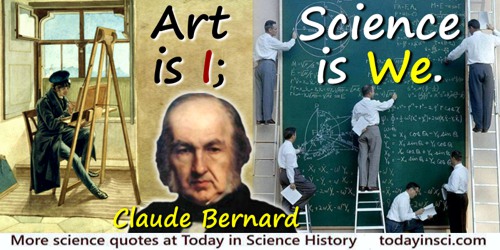
Art is I; science is we.
In Lily Splane, Quantum Consciousness (2004),307
Art is more godlike than science. Science discovers; art creates.
As given, without citation, in Maturin Murray Ballo, Edge-Tools of Speech (1851), 25. Also in a fictional conversation in novel by Baron Edward Bulwer Lytton, Zanoni (1842), 89.
Art is the beautiful way of doing things. Science is the effective way of doing things. Business is the economic way of doing things.
Selected writings of Elbert Hubbard (1928), 101.
Arts and sciences in one and the same century have arrived at great perfection; and no wonder, since every age has a kind of universal genius, which inclines those that live in it to some particular studies; the work then, being pushed on by many hands, must go forward.
In Samuel Austin Allibone, Prose Quotations from Socrates to Macaulay (1880), 45.
As for types like my own, obscurely motivated by the conviction that our existence was worthless if we didn’t make a turning point of it, we were assigned to the humanities, to poetry, philosophy, painting—the nursery games of humankind, which had to be left behind when the age of science began. The humanities would be called upon to choose a wallpaper for the crypt, as the end drew near.
From More Die of Heartbreak (1987, 1997), 246-247.
As yet, if a man has no feeling for art he is considered narrow-minded, but if he has no feeling for science this is considered quite normal. This is a fundamental weakness.
In Kermit Lansner, Second-Rate Brains: A Factual, Perceptive Report by Top Scientists, Educators, Journalists, and Their Urgent Recommendations (1958), 31. Note: Dr. I.I. Rabi was chairman of President Eisenhower's Science Advisory Committee.
Attainment and science, retainment and art—the two couples keep to themselves, but when they do meet, nothing else in the world matters.
In Time and Ebb (1947) in Nine Stories(1947), 102.
Both science and art have to do with ordered complexity.
In The Griffin (1957), 6, No 10.
Chess is a unique cognitive nexus, a place where art and science come together in the human mind and are then refined and improved by experience.
In How Life Imitates Chess: Making the Right Moves, from the Board to the Boardroom (2007), 4.
Creativity in science, as in the arts, cannot be organized. It arises spontaneously from individual talent. Well-run laboratories can foster it, but hierarchical organization, inflexible, bureaucratic rules, and mounds of futile paperwork can kill it. Discoveries cannot be planned; they pop up, like Puck, in unexpected corners.
In 'Preface', I Wish I’d Made You Angry Earlier: Essays on Science, Scientists, and Humanity (1998), ix.
Democracy is the art and science of running the circus from the monkey-cage.
A Mencken Chrestomathy (1949), 622.
Doubtless it is true that while consciousness is occupied in the scientific interpretation of a thing, which is now and again “a thing of beauty,” it is not occupied in the aesthetic appreciation of it. But it is no less true that the same consciousness may at another time be so wholly possessed by the aesthetic appreciation as to exclude all thought of the scientific interpretation. The inability of a man of science to take the poetic view simply shows his mental limitation; as the mental limitation of a poet is shown by his inability to take the scientific view. The broader mind can take both.
In An Autobiography (1904), Vol. 1, 485.
During human progress, every science is evolved out of its corresponding art.
Education: Intellectual, Moral and Physical (1861), 77.
Each later worker builds on the conclusions of his predecessors: anthropological knowledge is cumulative. Hence anthropology is a science, not an art.
From 'Introduction', Politics, Law and Ritual in Tribal Society (1965), xxiv.
Engineering is the science and art of efficient dealing with materials and forces … it involves the most economic design and execution … assuring, when properly performed, the most advantageous combination of accuracy, safety, durability, speed, simplicity, efficiency, and economy possible for the conditions of design and service.
As coauthor with Frank W. Skinner, and Harold E. Wessman, Vocational Guidance in Engineering Lines (1933), 6.
Every art should become science, and every science should become art.
In Friedrich Schlegel, translated by Ernst Behler and Roman Struc, Dialogue on Poetry and Literary Aphorisms (1797, trans. 1968), 132.
Every improvement of the means of locomotion benefits mankind morally and intellectually as well as materially, and not only facilitates the interchange of the various productions of nature and art, but tends to remove national and provincial antipathies, and to bind together all the branches of the great human family.
In The History of England From the Accession of James the Second (1849), Vol. 1, 365.
Every science touches art at some points—every art has its scientific side.
In Armand Trousseau and John Rose Cormack (trans.), Lectures on Clinical Medicine: Delivered at the Hôtel-Dieu, Paris (1869), Vol. 2, 40.
Every writer must reconcile, as best he may, the conflicting claims of consistency and variety, of rigour in detail and elegance in the whole. The present author humbly confesses that, to him, geometry is nothing at all, if not a branch of art.
Concluding remark in preface to Treatise on Algebraic Plane Curves (1931), x.
Exact science and its practical movements are no checks on the greatest poet, but always his encouragement and support … The sailor and traveller, the anatomist, chemist, astronomer, geologist, phrenologist, spiritualist, mathematician, historian and lexicographer are not poets, but they are the lawgivers of poets and their construction underlies the structure of every perfect poem.
In Walt Whitman and William Michael Rossetti (ed.), 'Preface to the First Edition of Leaves of Grass', Poems By Walt Whitman (1868), 46.
For just as musical instruments are brought to perfection of clearness in the sound of their strings by means of bronze plates or horn sounding boards, so the ancients devised methods of increasing the power of the voice in theaters through the application of the science of harmony.
In Vitruvius Pollio and Morris Hicky Morgan (trans.), 'Book V: Chapter III', Vitruvius, the Ten Books on Architecture (1914), 139. From the original Latin, “Ergo veteres Architecti, naturae vestigia persecuti, indagationibus vocis scandentes theatrorum perfecerunt gradationes: & quaesiuerunt per canonicam mathematicorum,& musicam rationem, ut quaecunq; vox effet in scena, clarior & suauior ad spectatorum perueniret aures. Uti enim organa in aeneis laminis, aut corneis, diesi ad chordarum sonituum claritatem perficiuntur: sic theatrorum, per harmonicen ad augendam vocem, ratiocinationes ab antiquis sunt constitutae.” In De Architectura libri decem (1552), 175.
For most scientists, I think the justification of their work is to be found in the pure joy of its creativeness; the spirit which moves them is closely akin to the imaginative vision which inspires an artist.
In Modern Science and Modern Man (1951), 58.
Form your life humanly, and you have done enough: but you will never reach the height of art and the depth of science without something divine.
Idea 68. In Friedrich Schlegel, translated by Ernst Behler and Roman Struc, Dialogue on Poetry and Literary Aphorisms (trans. 1968), 155.
Fractals are patterns which occur on many levels. This concept can be applied to any musical parameter. I make melodic fractals, where the pitches of a theme I dream up are used to determine a melodic shape on several levels, in space and time. I make rhythmic fractals, where a set of durations associated with a motive get stretched and compressed and maybe layered on top of each other. I make loudness fractals, where the characteristic loudness of a sound, its envelope shape, is found on several time scales. I even make fractals with the form of a piece, its instrumentation, density, range, and so on. Here I’ve separated the parameters of music, but in a real piece, all of these things are combined, so you might call it a fractal of fractals.
Interview (1999) on The Discovery Channel. As quoted by Benoit B. Manelbrot and Richard Hudson in The (Mis)Behaviour of Markets: A Fractal View of Risk, Ruin and Reward (2010), 133.
Gradually, … the aspect of science as knowledge is being thrust into the background by the aspect of science as the power of manipulating nature. It is because science gives us the power of manipulating nature that it has more social importance than art. Science as the pursuit of truth is the equal, but not the superior, of art. Science as a technique, though it may have little intrinsic value, has a practical importance to which art cannot aspire.
In The Scientific Outlook (1931, 2009), xxiv.
He that desireth to acquire any art or science seeketh first those means by which that art or science is obtained.
In An Apology For the True Christian Divinity (1825), 15.
He who posseses science and art, has religion; he who possesses neither science nor art, let him get religion.
Quoted in Miguel De Unamuno, Tragic Sense of Life (1913), translated by John Ernest Crawford Flitch (1954), 210.
He who would do good to another must do it in Minute Particulars: General Good is the plea of the scoundrel, hypocrite, and flatterer, For Art and Science cannot exist but in minutely organized particulars.
How far will chemistry and physics … help us understand the appeal of a painting?
Colour: Why the World Isn’t Grey (1983). Quoted in Sidney Perkowitz, Empire of Light (1999), 1.
I agree with Schopenhauer that one of the most powerful motives that attracts people to science and art is the longing to escape from everyday life.
Quoted, without citation in Bulletin of the Atomic Scientists (Feb 1959), 85. If you know a primary source, please contact Webmaster.
I believe that nursing is the compassionate, effective, and humane care given by one who is educated and trained in the art and science of nursing to someone who is in need of help because of problems in health or in activities of his daily life.
As quoted in American Nurses’ Association, Contemporary Minority Leaders in Nursing: Afro-American, Hispanic, Native American Perspectives (1983), 92.
I believe with Schopenhauer that one of the strongest motives that lead men to art and science is escape from everyday life with its painful crudity and hopeless dreariness, from the fetters of one’s own ever shifting desires. A finely tempered nature longs to escape from personal life into the world of objective perception and thought; this desire may be compared with the townsman’s irresistible longing to escape from his noisy, cramped surroundings into the silence of high mountains, where the eye ranges freely through the still, pure air and fondly traces out the restful contours apparently built for eternity.
Address at The Physical Society, Berlin (1918) for Max Planck’s 60th birthday, 'Principles of Research', collected in Essays in Science (1934) 2.
I do believe that a scientist is a freelance personality. We’re driven by an impulse which is one of curiosity, which is one of the basic instincts that a man has. So we are … driven … not by success, but by a sort of passion, namely the desire of understanding better, to possess, if you like, a bigger part of the truth. I do believe that science, for me, is very close to art.
From 'Asking Nature', collected in Lewis Wolpert and Alison Richards (eds.), Passionate Minds: The Inner World of Scientists (1997), 197.
I do not conceive of any manifestation of culture, of science, of art, as purposes in themselves. I think the purpose of science and culture is man.
In G. Barry Golson (ed.) The Playboy Interview (1981), 254.
I feel that, in a sense, the writer knows nothing any longer. He has no moral stance. He offers the reader the contents of his own head, a set of options and imaginative alternatives. His role is that of a scientist, whether on safari or in his laboratory, faced with an unknown terrain or subject. All he can do is to devise various hypotheses and test them against the facts.
Crash (1973, 1995), Introduction. In Barry Atkins, More Than A Game: the Computer Game as a Fictional Form (2003), 144.
I was reading in an article on Bizet not long ago that music has ceased to be an art and has become a science—in which event it must have a mathematical future!
In letter to H.E. Krehbiel (1887), collected in Elizabeth Bisland The Writings of Lafcadio Hearn (1922), Vol. 14, 8.
If any layman were to ask a number of archaeologists to give, on the spur of the moment, a definition of archaeology, I suspect that such a person might find the answers rather confusing. He would, perhaps, sympathize with Socrates who, when he hoped to learn from the poets and artisans something about the arts they practised, was forced to go away with the conviction that, though they might themselves be able to accomplish something, they certainly could give no clear account to others of what they were trying to do.
Opening statement in lecture at Columbia University (8 Jan 1908), 'Archaeology'. Published by the Columbia University Press (1908).
If Louis Pasteur were to come out of his grave because he heard that the cure for cancer still had not been found, NIH would tell him, “Of course we'll give you assistance. Now write up exactly what you will be doing during the three years of your grant.” Pasteur would say, “Thank you very much,” and would go back to his grave. Why? Because research means going into the unknown. If you know what you are going to do in science, then you are stupid! This is like telling Michelangelo or Renoir that he must tell you in advance how many reds and how many blues he will buy, and exactly how he will put those colors together.
Interview for Saturday Evening Post (Jan/Feb 1981), 30.
Imagination comes first in both artistic and scientific creations, but in science there is only one answer and that has to be correct.
In 'Discoverers of the Double Helix', The Daily Telegraph (27 Apr 1987), in Max Perutz (ed.), Is Science Necessary: Essays on Science and Scientists (1991), 182.
In all spheres of science, art, skill, and handicraft it is never doubted that, in order to master them, a considerable amount of trouble must be spent in learning and in being trained. As regards philosophy, on the contrary, there seems still an assumption prevalent that, though every one with eyes and fingers is not on that account in a position to make shoes if he only has leather and a last, yet everybody understands how to philosophize straight away, and pass judgment on philosophy, simply because he possesses the criterion for doing so in his natural reason.
From Phänomenologie des Geistes (1807) as translated by J.B. Baillie in 'Preface', The Phenomenology of Mind (1910), Vol. 1, 67.
In early times, medicine was an art, which took its place at the side of poetry and painting; to-day, they try to make a science of it, placing it beside mathematics, astronomy, and physics.
In Armand Trousseau and John Rose Cormack (trans.), Lectures on Clinical Medicine: Delivered at the Hôtel-Dieu, Paris (1869), Vol. 2, 40.
In general, art has preceded science. Men have executed great, and curious, and beautiful works before they had a scientific insight into the principles on which the success of their labours was founded. There were good artificers in brass and iron before the principles of the chemistry of metals were known; there was wine among men before there was a philosophy of vinous fermentation; there were mighty masses raised into the air, cyclopean walls and cromlechs, obelisks and pyramids—probably gigantic Doric pillars and entablatures—before there was a theory of the mechanical powers. … Art was the mother of Science.
Lecture (26 Nov 1851), to the London Society of Arts, 'The General Bearing of the Great Exhibition on the Progress of Art and Science', collected in Lectures on the Results of the Great Exhibition of 1851' (1852), 7-8.
In pure mathematics we have a great structure of logically perfect deductions which constitutes an integral part of that great and enduring human heritage which is and should be largely independent of the perhaps temporary existence of any particular geographical location at any particular time. … The enduring value of mathematics, like that of the other sciences and arts, far transcends the daily flux of a changing world. In fact, the apparent stability of mathematics may well be one of the reasons for its attractiveness and for the respect accorded it.
In Fundamentals of Mathematics (1941), 463.
In science, as in art, and, as I believe, in every other sphere of human activity, there may be wisdom in a multitude of counsellors, but it is only in one or two of them. And in scientific inquiry, at any rate, it is to that one or two that we must look for light and guidance.
'The Progress of Science'. Collected essays (1898), Vol. 1, 57.
In scientific matters ... the greatest discoverer differs from the most arduous imitator and apprentice only in degree, whereas he differs in kind from someone whom nature has endowed for fine art. But saying this does not disparage those great men to whom the human race owes so much in contrast to those whom nature has endowed for fine art. For the scientists' talent lies in continuing to increase the perfection of our cognitions and on all the dependent benefits, as well as in imparting that same knowledge to others; and in these respects they are far superior to those who merit the honour of being called geniuses. For the latter's art stops at some point, because a boundary is set for it beyond which it cannot go and which has probably long since been reached and cannot be extended further.
The Critique of Judgement (1790), trans. J. C. Meredith (1991), 72.
Indeed, we need not look back half a century to times which many now living remember well, and see the wonderful advances in the sciences and arts which have been made within that period. Some of these have rendered the elements themselves subservient to the purposes of man, have harnessed them to the yoke of his labors and effected the great blessings of moderating his own, of accomplishing what was beyond his feeble force, and extending the comforts of life to a much enlarged circle, to those who had before known its necessaries only.
From paper 'Report of the Commissioners Appointed to Fix the Site of the University of Virginia' (Dec 1818), reprinted in Annual Report of the Board of Visitors of the University of Virginia for the Fiscal Year Ending May 31, 1879 (1879), 10. Collected in Commonwealth of Virginia, Annual Reports of Officers, Boards, and Institutions of the Commonwealth of Virginia, for the Year Ending September 30, 1879 (1879).
Industry is best at the intersection of science and art.
In Alan R. Earls and Nasrin Rohani, Polaroid (2005), 20.
Inspiration plays no less a role in science than it does in the realm of art. It is a childish notion to think that a mathematician attains any scientifically valuable results by sitting at his desk with a ruler, calculating machines or other mechanical means. The mathematical imagination of a Weierstrass is naturally quite differently oriented in meaning and result than is the imagination of an artist, and differs basically in quality. But the psychological processes do not differ. Both are frenzy (in the sense of Plato’s “mania”) and “inspiration.”
From a Speech (1918) presented at Munich University, published in 1919, and collected in 'Wissenschaft als Beruf', Gessammelte Aufsätze zur Wissenschaftslehre (1922), 524-525. As given in H.H. Gerth and C. Wright-Mills (translators and eds.), 'Science as a Vocation', Max Weber: Essays in Sociology (1946), 136.
It is impossible for us, who live in the latter ages of the world, to make observations in criticism, morality, or in any art or science, which have not been touched upon by others. We have little else left us but to represent the common sense of mankind in more strong, more beautiful, or more uncommon lights.
Spectator, No. 253. In Samuel Austin Allibone, Prose Quotations from Socrates to Macaulay (1880), 60.
It is not, indeed, strange that the Greeks and Romans should not have carried ... any ... experimental science, so far as it has been carried in our time; for the experimental sciences are generally in a state of progression. They were better understood in the seventeenth century than in the sixteenth, and in the eighteenth century than in the seventeenth. But this constant improvement, this natural growth of knowledge, will not altogether account for the immense superiority of the modern writers. The difference is a difference not in degree, but of kind. It is not merely that new principles have been discovered, but that new faculties seem to be exerted. It is not that at one time the human intellect should have made but small progress, and at another time have advanced far; but that at one time it should have been stationary, and at another time constantly proceeding. In taste and imagination, in the graces of style, in the arts of persuasion, in the magnificence of public works, the ancients were at least our equals. They reasoned as justly as ourselves on subjects which required pure demonstration.
History (May 1828). In Samuel Austin Allibone, Prose Quotations from Socrates to Macaulay (1880), 36.
It is the greatest of crimes to depress true art and science.
Letter to William Hayley (11 Dec 1805). Collected in William Blake and Archibald George Blomefield Russell (ed.), The Letters of William Blake (1906), Vol. 1, 189.
It must be acknowledged that amongst few of the civilized nations of our time have the higher sciences made less progress than in the United States; and in few have great artists, fine poets, or celebrated writers been more rare.
In Alexis de Tocqueville and Henry Reeve (trans.), Democracy in America (1840, 1899), Vol. 2, 36.
It seems to be considered as a common right to all poets and artists, to live only in the world of their own thoughts, and to be quite unfitted for the world which other men inhabit.
In Lectures on the History of Literature, Ancient and Modern (1841), 5-6.
Man is unique not because he does science, and he is unique not because he does art, but because science and art equally are expressions of his marvelous plasticity of mind.
In The Ascent of Man (1973), 412.
Man tries to make for himself in the fashion that suits him best a simplified and intelligible picture of the world; he then tries to some extent to substitute this cosmos of his for the world of experience, and thus to overcome it. This is what the painter, the poet, the speculative philosopher, and the natural scientist do, each in his own fashion. Each makes this cosmos and its construction the pivot of his emotional life, in order to find in this way the peace and security which he cannot find in the narrow whirlpool of personal experience.
Address at The Physical Society, Berlin (1918) for Max Planck’s 60th birthday, 'Principles of Research', collected in Essays in Science (1934, 2004) 3.
Many arts there are which beautify the mind of man; of all other none do more garnish and beautify it than those arts which are called mathematical.
The Elements of Geometric of the most ancient Philosopher Euclide of Megara (1570), Note to the Reader. In Robert Édouard Moritz, Memorabilia Mathematica; Or, The Philomath's Quotation-book (1914), 44.
Mathematics is not only one of the most valuable inventions—or discoveries—of the human mind, but can have an aesthetic appeal equal to that of anything in art. Perhaps even more so, according to the poetess who proclaimed, “Euclid alone hath looked at beauty bare.”
From 'The Joy of Maths'. Collected in Arthur C. Clarke, Greetings, Carbon-Based Bipeds!: Collected Essays, 1934-1998, 460.
Mathematics is, as it were, a sensuous logic, and relates to philosophy as do the arts, music, and plastic art to poetry.
Aphorism 365 from Selected Aphorisms from the Lyceum (1797-1800). In Friedrich Schlegel, translated by Ernst Behler and Roman Struc, Dialogue on Poetry and Literary Aphorisms (trans. 1968), 147.
Mathematics, as much as music or any other art, is one of the means by which we rise to a complete self-consciousness. The significance of mathematics resides precisely in the fact that it is an art; by informing us of the nature of our own minds it informs us of much that depends on our minds.
In Aspects of Science: Second Series (1926), 94.
Mathematics, rightly viewed, possesses not only truth, but supreme beauty—a beauty cold and austere, like that of sculpture, without appeal to any part of our weaker nature, without the gorgeous trappings of painting or music, yet sublimely pure, and capable of a stern perfection such as only the greatest art can show.
Essay, 'The Study of Mathematics' (1902), collected in Philosophical Essays (1910), 73-74. Also collected in Mysticism and Logic: And Other Essays (1918), 60.
Modern bodybuilding is ritual, religion, sport, art, and science, awash in Western chemistry and mathematics. Defying nature, it surpasses it.
'Alice in Muscle Land,' Boston Globe (27 Jan 1991). Reprinted in Sex, Art, and American Culture (1992), 82.
Neither art nor science knows anything of moral approval or disapproval. Science is out of the reach of morals, for her eyes are fixed upon eternal truths. Art is out of the reach of morals, for her eyes are fixed upon things beautiful and immortal and ever-changing.
In his dialogue 'The Critic As Artist', collected in Intentions (1891), 156. Also collected in Oscariana: Epigrams (1895), 27.
Nobody, I suppose, could devote many years to the study of chemical kinetics without being deeply conscious of the fascination of time and change: this is something that goes outside science into poetry; but science, subject to the rigid necessity of always seeking closer approximations to the truth, itself contains many poetical elements.
From Nobel Lecture (11 Dec 1956), collected in Nobel Lectures in Chemistry (1999), 474.
Nothing retains less of desire in art, in science, than this will to industry, booty, possession.
Mad Love (1937) translated by Mary Ann Caws (1988), 25.
On one occasion committee members were asked by the chairman, who was also in charge of the project, to agree that a certain machine be run at a power which was ten percent lower than the design value. [Franz Eugen] Simon objected, arguing that “design value” should mean what it said. Thereupon the chairman remarked, “Professor Simon, don’t you see that we are not talking about science, but about engineering, which is an art.” Simon was persistent: “What would happen if the machine were run at full power?” “It might get too hot.” “But, Mr. Chairman,” came Simon’s rejoinder, “Can’t artists use thermometers?”
(1908). From N. Kurti, 'Franz Eugen Simon', Biographical Memoirs of Fellows of the Royal Society (Nov 1958), 4, 247.
One of the strongest motives that lead men to art and science is escape from everyday life with its painful crudity and hopeless dreariness, from the fetters of one's own ever-shifting desires. A finely tempered nature longs to escape from the personal life into the world of objective perception and thought.
Albert Einstein and Walter Shropshire (ed.), The Joys of Research (1981), 40.
One rarely hears of the mathematical recitation as a preparation for public speaking. Yet mathematics shares with these studies [foreign languages, drawing and natural science] their advantages, and has another in a higher degree than either of them.
Most readers will agree that a prime requisite for healthful experience in public speaking is that the attention of the speaker and hearers alike be drawn wholly away from the speaker and concentrated upon the thought. In perhaps no other classroom is this so easy as in the mathematical, where the close reasoning, the rigorous demonstration, the tracing of necessary conclusions from given hypotheses, commands and secures the entire mental power of the student who is explaining, and of his classmates. In what other circumstances do students feel so instinctively that manner counts for so little and mind for so much? In what other circumstances, therefore, is a simple, unaffected, easy, graceful manner so naturally and so healthfully cultivated? Mannerisms that are mere affectation or the result of bad literary habit recede to the background and finally disappear, while those peculiarities that are the expression of personality and are inseparable from its activity continually develop, where the student frequently presents, to an audience of his intellectual peers, a connected train of reasoning. …
One would almost wish that our institutions of the science and art of public speaking would put over their doors the motto that Plato had over the entrance to his school of philosophy: “Let no one who is unacquainted with geometry enter here.”
Most readers will agree that a prime requisite for healthful experience in public speaking is that the attention of the speaker and hearers alike be drawn wholly away from the speaker and concentrated upon the thought. In perhaps no other classroom is this so easy as in the mathematical, where the close reasoning, the rigorous demonstration, the tracing of necessary conclusions from given hypotheses, commands and secures the entire mental power of the student who is explaining, and of his classmates. In what other circumstances do students feel so instinctively that manner counts for so little and mind for so much? In what other circumstances, therefore, is a simple, unaffected, easy, graceful manner so naturally and so healthfully cultivated? Mannerisms that are mere affectation or the result of bad literary habit recede to the background and finally disappear, while those peculiarities that are the expression of personality and are inseparable from its activity continually develop, where the student frequently presents, to an audience of his intellectual peers, a connected train of reasoning. …
One would almost wish that our institutions of the science and art of public speaking would put over their doors the motto that Plato had over the entrance to his school of philosophy: “Let no one who is unacquainted with geometry enter here.”
In A Scrap-book of Elementary Mathematics: Notes, Recreations, Essays (1908), 210-211.
Our delight in any particular study, art, or science rises and improves in proportion to the application which we bestow upon it. Thus, what was at first an exercise becomes at length an entertainment.
In The Spectator (2 Aug 1712), No. 447, collected in The Spectator (9th ed., 1728), Vol. 6, 225.
Philosophy may teach us to bear with equanimity the misfortunes of our neighbours, and science resolve the moral sense into a secretion of sugar, but art is what makes the life of each citizen a sacrament.
In Epigrams of Oscar Wilde (2007), 48.
Poets are always ahead of science; all the great discoveries of science have been stated before in poetry.
In Epigrams of Oscar Wilde (2007), 71.
Psychology is in its infancy as a science. I hope, in the interests of art, it will always remain so.
In Epigrams of Oscar Wilde (2007), 51.
Raising children is a creative endeavor, an art rather than a science.
A Good Enough Parent (1988), 14.
Say’st thou, “The Course of Nature governs All?”
The Course of Nature is the Art of GOD.
The Course of Nature is the Art of GOD.
The Complaint: or, Night-Thoughts on Life, Death, and Immortality (1742, 1750), Night 9, 273.
Science and art are only too often a superior kind of dope, possessing this advantage over booze and morphia: that they can be indulged in with a good conscience and with the conviction that, in the process of indulging, one is leading the “higher life.”
Ends and Means (1937), 320. In Collected Essays (1959), 369.
Science and art are the handmaids of religion.
In collection compiled by Charles Noel Douglas, Forty Thousand Quotations, Prose and Poetical (1917), 1536. That is predated by a statement, without quotation marks, merely descriptive of Delsarte’s frame of mind, in F. A. Dursvage, 'Delsarte', Atlantic Monthly (May 1871), 620, printed as: Like all minds of high rank, he [Delsarte] holds that science and art are the handmaids of religion.
Science and art belong to the whole world, and the barriers of nationality vanish before them.
Wissenschaft und Kunst gehoren der Welt an, und vor ihhen verschwinden die Schranken der Nationalitat.
Wissenschaft und Kunst gehoren der Welt an, und vor ihhen verschwinden die Schranken der Nationalitat.
From 'In a Conversation With a German Historian' (1813), in Kate Louise Roberts (ed.), Hoyt’s New Cyclopedia of Practical Quotations (1922), 691.
Science and art, or by the same token, poetry and prose differ from one another like a journey and an excursion. The purpose of the journey is its goal, the purpose of an excursion is the process.
Notebooks and Diaries (1838). In The Columbia World of Quotations (1996).
Science and literature are not two things, but two sides of one thing.
Reflection #296, Thomas Henry Huxley and Henrietta A. Huxley (ed.), Aphorisms and Reflections from the Works of T.H. Huxley (1907), 143.
Science boasts of the distance of its stars; of the terrific remoteness of the things of which it has to speak. But poetry and religion always insist upon the proximity, the almost menacing closeness of the things with which they are concerned. Always the Kingdom of Heaven is “At Hand.”
'A Glimpse of My Country', The Daily News. Collected in Tremendous Trifles (1920), 277.
Science can be the religion of the nonreligious, the poetry of the non-poet, the art of the man who cannot paint, the humor of the serious man, and the lovemaking of the inhibited and shy man. Not only does science begin in wonder; it also ends in wonder.
In The Psychology of Science: A Reconnaissance (1966), 151.
Science deals exclusively with things as they are in themselves; and art exclusively with things as they affect the human sense and human soul.
From Stones of Venice (1851, 1886), Vol. 3, 36.
Science has to do with facts, art with phenomena. To science, phenomena are of use only as they lead to facts; and to art, facts are of use only as they lead to phenomena.
From Stones of Venice (1851, 1886), Vol. 3, 36.
Science is a human activity, and the best way to understand it is to understand the individual human beings who practise it. Science is an art form and not a philosophical method. The great advances in science usually result from new tools rather than from new doctrines. ... Every time we introduce a new tool, it always leads to new and unexpected discoveries, because Nature's imagination is richer
than ours.
Concluding remark from 'The Scientist As Rebel' American Mathemtical Monthly (1996), 103, 805. Reprinted in The Scientist as Rebel (2006), 17-18, identified as originally written for a lecture (1992), then published as an essay in the New York Review.
Science is continually correcting what it has said. Fertile corrections... science is a ladder... poetry is a winged flight... An artistic masterpiece exists for all time... Dante does not efface Homer.
Quoted in Pierre Biquard, Frederic Joliot-Curie: The Man and his Theories (1961), trans. Geoffrey Strachan (1965), 168.
Science is cumulative. The apprentice in this generation can outdo his master of the last. Art is not cumulative, however much study of past masters may improve the novice’s skill. A relatively poorly equipped anthropologist in intellectual terms can on the basis of sound training produce good work.
In Politics, Law and Ritual in Tribal Society (1965), 303.
Science is our century's art.
The Search for Solutions (1980), 10.
Science is spectral analysis. Art is light synthesis.
Pro domo et Mundo, (1912), 83. Translated by Harry Zohn (ed.), in 'Riddles and Solutions', Half-Truths and One-And-A-Half-Truths: Selected Aphorisms (1976), 47. From the original German, “Wissenschaft ist Spektralanalyse. Kunst ist Lichtsynthese.”
Science is the attempt to discern the order that underlies the chaos of nature; art is the attempt to discern the order that underlies the chaos of man.
In The Strength To Dream: Literature and the Imagination (1961), 197.
Science is the Differential Calculus of the mind. Art the Integral Calculus; they may be beautiful when apart, but are greatest only when combined.
Quoted in The Complete Poems of Hugh MacDiarmid 1920-76 (1978), Vol. 2, 1360.
Science is the labor and handicraft of the mind; poetry can only be considered its recreation.
As quoted in Nathaniel Holmes, The Authorship of Shakespeare (1867), 198. Footnoted as Int. Globe, Works (Mont.), XV. 150.
Science provides an understanding of a universal experience, and arts provides a universal understanding of a personal experience.
In online transcript of TED talk, 'Mae Jemison on teaching arts and sciences together' (2002).
Science studies the relations of things to each other: but art studies only their relations to man.
From Stones of Venice (1851, 1886), Vol. 3, 36.
Science, philosophy, religion and art are forms of knowledge. The method of science is experiment; the method of philosophy is speculation; the method of religion and art is moral or esthetic emotional inspiration.
In 'Forms of Knowledge', Tertium Organum: The Third Canon of Thought; a Key to the Enigmas of the World (1922), 231.
Strictly speaking, the idea of a scientific poem is probably as nonsensical as that of a poetic science.
Aphorism 61 from Selected Aphorisms from the Lyceum (1797-1800). In Friedrich Schlegel, translated by Ernst Behler and Roman Struc, Dialogue on Poetry and Literary Aphorisms (trans. 1968), 155.
Surrealists … are not exactly artists and we are not exactly men of science; … we are carnivorous fish … swimming between two kinds of water, the cold water of art and the warm water of science.
In Conquest of the Irrational (1935), 10.
Take the sum of human achievement in action, in science, in art, in literature—subtract the work of the men above forty, and while we should miss great treasures, even priceless treasures, we would practically be where we are today. … The effective, moving, vitalizing work of the world is done between the ages of twenty-five and forty.
In farewell address, Johns Hopkins University, 'The Fixed Period', as quoted in Harvey Cushing, The Life of Sir William Osier (1925), vol. 1, 666.
That which lies before the human race is a constant struggle to maintain and improve, in opposition to State of Nature, the State of Art of an organized polity; in which, and by which, man may develop a worthy civilization
'Prolegomena', Evolution and Ethics, and Other Essays (1897), 45.
The Almighty lecturer, by displaying the principles of science in the structure of the universe, has invited man to study and to imitation. It is as if he had said to the inhabitants of this globe that we call ours, “I have made an earth for man to dwell upon, and I have rendered the starry heavens visible, to teach him science and the arts. He can now provide for his own comfort, and learn from my munificence to all, to be kind to all, to be kind to each other.”
In The Age of Reason: Being an Investigation of True and Fabulous Theology (27 Jan O.S. 1794), 44.
The analogies between science and art are very good as long as you are talking about the creation and the performance. The creation is certainly very analogous. The aesthetic pleasure of the craftsmanship of performance is also very strong in science.
As quoted in Robert S. Root-Bernstein, Michele M. Root-Bernstein, Sparks of Genius: The Thirteen Thinking Tools of the World's Most Creative People (2013), 11.
The anatomist presents to the eye the most hideous and disagreeable objects, but his science is useful to the painter in delineating even a Venus or a Helen.
Inquiry Concerning the Human Understanding collected in The Philosophical Works of David Hume (1826), Vol. 4, 8.
The art and science of asking questions is the source of all knowledge.
Epigraph, without source citation, in The Art & Science of Assessing General Education Outcomes: A Practical Guide (2005), 1.
The Arts & Sciences are the Destruction of Tyrannies or Bad Governments. Why should a good government endeavour to depress what is its chief and only support.
Marginal note (c. 1808) written in his copy of The Works of Sir Joshua Reynolds (1798), on table of contents. As given in William Blake, Edwin John Ellis (ed.) and William Butler Yeats (ed.), The Works of William Blake (1893), Vol. 2, 319.
The astronomer who catalogues the stars cannot add one atom to the universe; the poet can call an universe from the atom.
From Zanoni (1842), 6.
The canons of art depend on what they appeal to. Painting appeals to the eye, and is founded on the science of optics. Music appeals to the ear and is founded on the science of acoustics. The drama appeals to human nature, and must have as its ultimate basis the science of psychology and physiology.
In Letter (Jul 1883) to Marie Prescott, in Oscar Wilde, Jules Barbey d'Aurevilly, Lady Wilde, The Writings of Oscar Wilde (1907), Vol. 15, 153-154.
The case I shall find evidence for is that when literature arrives, it expels science.
From 'Science and Literature', Pluto’s Republic (1984), 43.
The discoveries of science, the works of art are explorations—more, are explosions, of a hidden likeness. The discoverer or artist presents in them two aspects of nature and fuses them into one. This is the act of creation, in which an original thought is born, and it is the same act in original science and original art.
From Science and Human Values (1956), 30.
The expenditure [on building railways] of £286,000,000 by the people has secured to us the advantages of internal communication all but perfect,—of progress in science and arts unexampled at any period of the history of the world,—of national progress almost unchecked, and of prosperity and happiness increased beyond all precedent.
From 'Railway System and its Results' (Jan 1856) read to the Institution of Civil Engineers, reprinted in Samuel Smiles, Life of George Stephenson (1857), 512.
The faculty of art is to change events; the faculty of science is to foresee them. The phenomena with which we deal are controlled by art; they are predicted by science.
'The Influence of Women on the Progress of Knowledge,', a discourse delivered at the Royal Institution (19 Mar 1858) reprinted from Fraser's Magazine (Apr 1858) in The Miscellaneous and Posthumous Works of Henry Thomas Buckle (1872), Vol. 1, 4. Quoted in James Wood, Dictionary of Quotations from Ancient and Modern, English and Foreign Sources (1893), 426:46.
The fairest thing we can experience is the mysterious. It is the fundamental emotion which stands at the cradle of true art and true science. He who knows it not and can no longer wonder, no longer feel amazement, is as good as dead, a snuffed-out candle. It was the experience of mystery–even if mixed with fear–that engendered religion. A knowledge of the existence of something we cannot penetrate, of the manifestations of the profoundest reason and the most radiant beauty, which are only accessible to our reason in their most elementary forms–it is this knowledge and this emotion that constitute the truly religious attitude; in this sense, and in this alone, I am a deeply religious man.
From 'What I Believe: Living Philosophies XIII', Forum and Century (Oct 1930), 84, No. 4, 193-194. Alan Harris (trans.), The World as I See It (1956, 1993), 5.
The focal points of our different reflections have been called “science”’ or “art” according to the nature of their “formal” objects, to use the language of logic. If the object leads to action, we give the name of “art” to the compendium of rules governing its use and to their technical order. If the object is merely contemplated under different aspects, the compendium and technical order of the observations concerning this object are called “science.” Thus metaphysics is a science and ethics is an art. The same is true of theology and pyrotechnics.
Definition of 'Art', Encyclopédie (1751). Translated by Nelly S. Hoyt and Thomas Cassirer (1965), 4.
The Foundation of Empire is Art & Science. Remove them, or Degrade them, & the Empire is No More. Empire follows Art, & not Vice Versa as Englishmen suppose.
Marginal note (c. 1808) written in his copy of The Works of Sir Joshua Reynolds (1798), at foot of first page of table of contents. As given in William Blake, Edwin John Ellis (ed.) and William Butler Yeats (ed.), The Works of William Blake (1893), Vol. 2, 319.
The frontiers of science are separated now by long years of study, by specialized vocabularies, arts, techniques, and knowledge from the common heritage even of a most civilized society; and anyone working at the frontier of such science is in that sense a very long way from home, a long way too from the practical arts that were its matrix and origin, as indeed they were of what we today call art.
Address at the close of the year-long Bicentennial Celebration of Columbia University (26 Dec 54). Printed in 'Prospects in the Arts and Sciences', Bulletin of the Atomic Scientists (Feb 1955), 52.
The function of Art is to imitate Nature in her manner of operation. Our understanding of “her manner of operation” changes according to advances in the sciences.
A Year from Monday (1969), 31.
The great error of the 19th century, in morality as well as in science and art, has been to mingle and confound man and nature without pausing to consider that in art as in science and morality he is a man only in so far as he distinguishes himself from nature and makes himself an exception to it.
As quoted in Working and Thinking on the Waterfront: A Journal, June 1958-May 1959 (1969), 122.
The history of Europe is the history of Rome curbing the Hebrew and the Greek, with their various impulses of religion, and of science, and of art, and of quest for material comfort, and of lust of domination, which are all at daggers drawn with each other. The vision of Rome is the vision of the unity of civilisation.
In 'The Place of Classics in Education', The Aims of Education and Other Essays (1929), 79.
The immediate object of all art is either pleasure or utility: the immediate object of all science is solely truth.
Lecture (19 Mar 1858) at the Royal Institution, 'The Influence Of Women On The Progress Of Knowledge', collected in The Miscellaneous and Posthumous Works of Henry Thomas Buckle (1872), Vol. 1, 4. Published in Frazier’s Magazine (Apr 1858).
The instinct for collecting, which began as in other animals as an adaptive property, could always in man spread beyond reason; it could become a hoarding mania. But in its normal form it provides a means of livelihood at the hunting and collecting stage of human evolution. It is then attached to a variety of rational aptitudes, above all in observing, classifying, and naming plants, animals and minerals, skills diversely displayed by primitive peoples. These skills with an instinctive beginning were the foundation of most of the civilised arts and sciences. Attached to other skills in advanced societies they promote the formation of museums and libraries; detached, they lead to acquisition and classification by eccentric individuals, often without any purpose or value at all.
As quoted in Richard Fifield, 'Cytologist Supreme', New Scientist (16 Apr 1981), 90, No. 1249, 179; citing C.D. Darlington, The Little Universe of Man (1978).
The invention [of paper] has been of almost equal consequence to literature with that of printing itself; and shows how the arts and sciences, like children of the same family, mutually assist and bring forward each other.
In John Aikin and Anna Letitia Aikin Barbauld, 'The Manufacture of Paper', Evenings at Home: Or, The Juvenile Budget Opened (U.S. Revised ed., 1839), 145. In its Preface it was indicated this particular piece, written by Barbauld, was first added to the 15th London edition, posthumously, from her papers. The plan of work for the six volumes in this series originated with Dr. John Aiken in 1792.
The logic of the subject [algebra], which, both educationally and scientifically speaking, is the most important part of it, is wholly neglected. The whole training consists in example grinding. What should have been merely the help to attain the end has become the end itself. The result is that algebra, as we teach it, is neither an art nor a science, but an ill-digested farrago of rules, whose object is the solution of examination problems. … The result, so far as problems worked in examinations go, is, after all, very miserable, as the reiterated complaints of examiners show; the effect on the examinee is a well-known enervation of mind, an almost incurable superficiality, which might be called Problematic Paralysis—a disease which unfits a man to follow an argument extending beyond the length of a printed octavo page.
In Presidential Address British Association for the Advancement of Science (1885), Nature, 32, 447-448.
The mathematician can afford to leave to his clients, the engineers, or perhaps the popular philosophers, the emotion of belief: for himself he keeps the lyrical pleasure of metre and of evolving equations: and it is a pleasant surprise to him and an added problem if he finds that the arts can use his calculations, or that the senses can verify them, much as if a composer found that sailors could heave better when singing his songs.
In 'Revolution in Science', Some Turns of Thought in Modern Philosophy (1933), 81.
The Mathematics, I say, which effectually exercises, not vainly deludes or vexatiously torments studious Minds with obscure Subtilties, perplexed Difficulties, or contentious Disquisitions; which overcomes without Opposition, triumphs without Pomp, compels without Force, and rules absolutely without Loss of Liberty; which does not privately over-reach a weak Faith, but openly assaults an armed Reason, obtains a total Victory, and puts on inevitable Chains; whose Words are so many Oracles, and Works as many Miracles; which blabs out nothing rashly, nor designs anything from the Purpose, but plainly demonstrates and readily performs all Things within its Verge; which obtrudes no false Shadow of Science, but the very Science itself, the Mind firmly adhering to it, as soon as possessed of it, and can never after desert it of its own Accord, or be deprived of it by any Force of others: Lastly the Mathematics, which depends upon Principles clear to the Mind, and agreeable to Experience; which draws certain Conclusions, instructs by profitable Rules, unfolds pleasant Questions; and produces wonderful Effects; which is the fruitful Parent of, I had almost said all, Arts, the unshaken Foundation of Sciences, and the plentiful Fountain of Advantage to human Affairs.
Address to the University of Cambridge upon being elected Lucasian Professor of Mathematics (14 Mar 1664). In Mathematical Lectures (1734), xxviii.
The modern naturalist must realize that in some of its branches his profession, while more than ever a science, has also become an art.
African Game Trails (1910), 17.
The most beautiful and profound experience for a person is the feeling of the mysterious. It underlies religion and all deeper endeavors in art and science. Anyone who has not experienced this appears to me, if not like a dead man, at least like a blind man. To feel that behind the perceptible is hidden something that is incomprehensible, whose beauty and grandeur only reach us indirectly and in a dim reflection—that is religiousness. In that sense I am religious. It is enough for me to sense these secrets with wonder and to try to humbly grasp a faint image of the majestic structure of all things.
From His 'Credo' on a manuscript in German (Aug 1932) which he read for a sound recording (c. end Sep/early Oct 1932) for limited distribution on a 20 cm, 75 rpm shellac disk, by order and to benefit of the German League of Human Rights. Manuscript held by the Albert Einstein Archives, Hebrew University of Jerusalem, Israel. Original text, in German, “Das Schönste und Tiefste, was der Mensch erleben kann, ist das Gefühl des Geheimnisvollen. Es liegt der Religion sowie allem tieferen Streben in Kunst und Wissenschaft zugrunde. Wer dies nicht erlebt hat, erscheint mir, wenn nicht wie ein Toter, so doch wie ein Blinder. Zu empfinden, dass hinter dem Erlebbaren ein für unseren Geist Unerreichbares verborgen sei, dessen Schönheit und Erhabenheit uns nur mittelbar und in schwachem Widerschein erreicht, das ist Religiosität. In diesem Sinne bin ich religiös. Es ist mir genug, diese Geheimnisse staunend zu ahnen und zu versuchen, von der erhabenen Struktur des Seienden in Demut ein mattes Abbild geistig zu erfassen.” Translated to English using Google Translate and other online tools—and tweaked by Webmaster.
The most beautiful emotion we can experience is the mystical. It is the power of all true art and science. He to whom this emotion is a stranger, who can no longer wonder and stand rapt in awe, is as good as dead. To know that what is impenetrable to us really exists, manifesting itself as the highest wisdom and the most radiant beauty, which our dull faculties can comprehend only in their most primitive forms — this knowledge, this feeling, is at the center of true religiousness. In this sense, and in this sense only, I belong to the rank of devoutly religious men.
As quoted in Philip Frank, Einstein: His Life and Times (1947), chap. 12, sec. 5 - “Einstein’s Attitude Toward Religion.”
The nature of light is a subject of no material importance to the concerns of life or to the practice of the arts, but it is in many other respects extremely interesting.
Lecture 39, 'On the Nature of Light and Colours', A Course of Lectures on Natural Philosophy and the Mechanical Arts (1845), Vol. 1, 359.
The nature of things betrays itself more readily under the vexations of art than in its natural freedom.
The Great Instauration. In James Spedding, The Works of Francis Bacon: Translations of the Philosophical Works (1869), 48.
The object of science is knowledge; the objects of art are works. In art, truth is the means to an end; in science, it is the only end. Hence the practical arts are not to be classed among the sciences
Aphorism 25, 'Aphorisms Respecting Knowledge', The Philosophy of the Inductive Sciences (1840), Vol. 1, xli.
The private motives of scientists are not the trend of science. The trend of science is made by the needs of society: navigation before the eighteenth century, manufacture thereafter; and in our age I believe the liberation of personality. Whatever the part which scientists like to act, or for that matter which painters like to dress, science shares the aims of our society just as art does.
From The Common Sense of Science (1951), 145.
The reason it is so hard to attain to something good in any of the arts and sciences is that it involves attaining to a certain stipulated point; to do something badly according to a predetermined rule would be just as hard, if indeed it would then still deserve to be called bad.
Aphorism 53 in Notebook C (1772-1773), as translated by R.J. Hollingdale in Aphorisms (1990). Reprinted as The Waste Books (2000), 42.
The remotest discoveries of the Chemist, the Botanist, or the Mineralogist, will be as proper objects of the Poet’s art as any upon which it can be employed, if the time should ever come when these things shall be familiar to us, and the relations under which they are contemplated by the followers of these respective sciences shall be manifestly and palpably material to us as enjoying and suffering beings.
In W. J. B. Owen (ed.), Preface to the Lyrical Ballads (1800, 1957), 124-125.
The science, the art, the jurisprudence, the chief political and social theories, of the modern world have grown out of Greece and Rome—not by favour of, but in the teeth of, the fundamental teachings of early Christianity, to which science, art, and any serious occupation with the things of this world were alike despicable.
'Agnosticism and Christianity'. Collected Essays (1900), 315.
The sciences and arts are not cast in a mold, but formed and shaped little by little, by repeated handling and polishing, as bears lick their cubs into shape at leisure.
In Donald M. Frame (trans.), The Complete Essays of Montaigne (1958), 421.
The scientist has marched in and taken the place of the poet. But one day somebody will find the solution to the problems of the world and remember, it will be a poet, not a scientist.
As quoted in The Star (1959). Collected in Jonathon Green, Morrow's International Dictionary of Contemporary Quotations (1982).
The significance of a fact is relative to [the general body of scientific] knowledge. To say that a fact is significant in science, is to say that it helps to establish or refute some general law; for science, though it starts from observation of the particular, is not concerned essentially with the particular, but with the general. A fact, in science, is not a mere fact, but an instance. In this the scientist differs from the artist, who, if he deigns to notice facts at all, is likely to notice them in all their particularity.
In The Scientific Outlook (1931, 2009), 38.
The spirit of science arises from the habit of seeking food; the spirit of art arises from the habit of imitation, by which the young animal first learns to feed; the spirit of music arises from primeval speech, by means of which males and females are attracted to each other.
In The Martyrdom of Man (1876), 443.
The structure known, but not yet accessible by synthesis, is to the chemist what the unclimbed mountain, the uncharted sea, the untilled field, the unreached planet, are to other men … The unique challenge which chemical synthesis provides for the creative imagination and the skilled hand ensures that it will endure as long as men write books, paint pictures, and fashion things which are beautiful, or practical, or both.
In 'Art and Science in the Synthesis of Organic Compounds: Retrospect and Prospect', in Maeve O'Connor (ed.), Pointers and Pathways in Research (1963), 41.
The subject matter of the scientist is a crowd of natural events at all times; he presupposes that this crowd is not real but apparent, and seeks to discover the true place of events in the system of nature. The subject matter of the poet is a crowd of historical occasions of feeling recollected from the past; he presupposes that this crowd is real but should not be, and seeks to transform it into a community. Both science and art are primarily spiritual activities, whatever practical applications may be derived from their results. Disorder, lack of meaning, are spiritual not physical discomforts, order and sense spiritual not physical satisfactions.
The Dyer’s Hand and Other Essays (1965), 66.
The true excellence and importance of those arts and sciences which exert and display themselves in writing, may be seen, in a more general point of view, in the great influence which they have exerted on the character and fate of nations, throughout the history of the world.
In Lectures on the History of Literature, Ancient and Modern (1841), 10.
The true men of action in our time, those who transform the world, are not the politicians and statesmen, but the scientists. Unfortunately poetry cannot celebrate them because their deeds are concerned with things, not persons, and are, therefore, speechless.
In 'The Poet and the City' (1962), collected in The Dyer’s Hand and Other Essays (1965), 81.
The truth of art keeps science from becoming inhuman, and the truth of science keeps art from becoming ridiculous.
In 'Great Thought' (19 Feb 1938), The Notebooks of Raymond Chandler and English Summer: A Gothic Romance, (1976), 7.
The world of mathematics, which you condemn, is really a beautiful world; it has nothing to do with life and death and human sordidness, but is eternal, cold and passionless. To me, pure, mathematics is one of the highest forms of art; it has a sublimity quite special to itself, and an immense dignity derived, from the fact that its world is exempt I, from change and time. I am quite serious in this. The only difficulty is that none but mathematicians can enter this enchanted region, and they hardly ever have a sense of beauty. And mathematics is the only thing we know of that is capable of perfection; in thinking about it we become Gods.
Letter to Helen Thomas (30 Dec 1901). Quoted in Nicholas Griffin (ed.), The Selected Letters of Bertrand Russell (1992), Vol. 1, 224.
The world of science and the world of literature have much in common. Each is an international club, helping to tie mankind together across barriers of nationality, race, and language. I have been doubly lucky, being accepted as a member of both.
First sentences of 'Preface', From Eros to Gaia (1992), vii.
The worst scientist is he who is not an artist; the worst artist is he who is no scientist.
In Armand Trousseau and John Rose Cormack (trans.), Lectures on Clinical Medicine: Delivered at the Hôtel-Dieu, Paris (1869), Vol. 2, 40.
There are few humanities that could surpass in discipline, in beauty, in emotional and aesthetic satisfaction, those humanities which are called mathematics, and the natural sciences.
'Scientist and Citizen', Speech to the Empire Club of Canada (29 Jan 1948), The Empire Club of Canada Speeches (29 Jan 1948), 209-221.
There are two avenues from the little passions and the drear calamities of earth; both lead to the heaven and away from hell—Art and Science. But art is more godlike than science; science discovers, art creates.
Spoken by fictional character Zanoni in novel, Zanoni (1842), 6.
There are two kinds of equality, one potential and the other actual, one theoretical and the other practical. We should not be satisfied by merely quoting the doctrine of equality as laid down in the Declaration of Independence, but we should give it practical illustration. We have to do as well as to be. If we had built great ships, sailed around the world, taught the science of navigation, discovered far-off islands, capes, and continents, enlarged the boundaries of human knowledge, improved the conditions of man’s existence, brought valuable contributions of art, science, and literature, revealed great truths, organized great states, administered great governments, defined the laws of the universe, formulated systems of mental and moral philosophy, invented railroads, steam engines, mowing machines, sewing machines, taught the sun to take pictures, the lightning to carry messages, we then might claim, not only potential and theoretical equality, but actual and practical equality.
From Speech (16 Apr 1889) delivered to the Bethel Literary and Historical Society, Washington D.C., 'The Nation’s Problem'. Collected in Philip S. Foner, Yuval Taylor (eds.), Frederick Douglass: Selected Speeches and Writings (2000), 731.
There are two kinds of truth; the truth that lights the way and the truth that warms the heart. The first of these is science, and the second is art. Without art, science would be as useless as a pair of high forceps in the hands of a plumber. Without science, art would become a crude mess of folklore and emotional quackery.
In 'Great Thought' (19 Feb 1938), The Notebooks of Raymond Chandler and English Summer: A Gothic Romance, (1976), 7.
There is a great deal of emotional satisfaction in the elegant demonstration, in the elegant ordering of facts into theories, and in the still more satisfactory, still more emotionally exciting discovery that the theory is not quite right and has to be worked over again, very much as any other work of art—a painting, a sculpture has to be worked over in the interests of aesthetic perfection. So there is no scientist who is not to some extent worthy of being described as artist or poet.
'Scientist and Citizen', Speech to the Empire Club of Canada (29 Jan 1948), The Empire Club of Canada Speeches (29 Jan 1948), 209-221.
There is an art to science, and science in art; the two are not enemies, but different aspects of the whole.
Epigraph in Isaac Asimov’s Book of Science and Nature Quotations (1988), 251.
There is no art or science that is too difficult for industry to attain to; it is the gift of tongues, and makes a man understood and valued in all countries, and by all nations; it is the philosopher's stone, that turns all metals, and even stones, into gold, and suffers not want to break into its dwelling; it is the northwest passage, that brings the merchant's ships as soon to him as he can desire: in a word, it conquers all enemies, and makes fortune itself pay contribution.
'Essay on Industry' (1670). In Thomas Henry Lister, Life and Administration of Edward, first Earl of Clarendon (1838), Vol. 2, 566.
There is no patriotic art and no patriotic science.
In James Wood, Dictionary of Quotations from Ancient and Modern, English and Foreign Sources (1893), 473:44.
There is plenty of room left for exact experiment in art, and the gate has been opened for some time. What had been accomplished in music by the end of the eighteenth century has only begun in the fine arts. Mathematics and physics have given us a clue in the form of rules to be strictly observed or departed from, as the case may be. Here salutary discipline is come to grips first of all with the function of forms, and not with form as the final result … in this way we learn how to look beyond the surface and get to the root of things.
Quoted in The Bulletin of the Atomic Scientists (Feb 1959), 59, citing Bauhaus-Zeitschrijt (1928).
These creators, makers of the new, can never become obsolete, for in the arts there is no correct answer. The story of discoverers could be told in simple chronological order, since the latest science replaces what went before. But the arts are another story—a story of infinite addition. We must find order in the random flexings of the imagination.
In The Creators: A History of Heroes of the Imagination (1992), xv.
Though genius isn't something that can be produced arbitrarily, it is freely willed—like wit, love, and faith, which one day will have to become arts and sciences. You should demand genius from everyone, but not expect it. A Kantian would call this the categorical imperative of genius.
Critical Fragment 16 in Friedrich Schlegel's Lucinde and the Fragments (1971), 144.
Through art and science in their broadest senses it is possible to make a permanent contribution towards the improvement and enrichment of human life and it is these pursuits that we students are engaged in.
From Nobel Banquet Speech (10 Dec 1980).
Under the flag of science, art, and persecuted freedom of thought, Russia would one day be ruled by toads and crocodiles the like of which were unknown even in Spain at the time of the Inquisition.
We especially need imagination in science. It is not all mathematics, nor all logic, but it is somewhat beauty and poetry.
In Phebe Mitchell Kendall (ed.), Maria Mitchell: Life, Letters, and Journals (1896), 186.
We often observe in lawyers, who as Quicquid agunt homines is the matter of law suits, are sometimes obliged to pick up a temporary knowledge of an art or science, of which they understood nothing till their brief was delivered, and appear to be much masters of it.
In The Life of Samuel Johnson (1820), Vol. 1, 218. The Latin phrase translates as “what people do.”
We profess to teach the principles and practice of medicine, or, in other words, the science and art of medicine. Science is knowledge reduced to principles; art is knowledge reduced to practice. The knowing and doing, however, are distinct. ... Your knowledge, therefore, is useless unless you cultivate the art of healing. Unfortunately, the scientific man very often has the least amount of art, and he is totally unsuccessful in practice; and, on the other hand, there may be much art based on an infinitesimal amount of knowledge, and yet it is sufficient to make its cultivator eminent.
From H.G. Sutton, Abstract of Lecture delivered at Guy's Hospital by Samuel Wilks, 'Introductory to Part of a Course on the Theory and Practice of Medicine', The Lancet (24 Mar 1866), 1, 308
We quote not only books and proverbs, but arts, sciences, religion, customs and laws; nay, we quote temples and houses, tables and chairs by imitation.
In Lecture, second in a series given at Freeman Place Chapel, Boston (Mar 1859), 'Quotation and Originality', Letters and Social Aims (1875, 1917), 178-179.
What Art was to the ancient world, Science is to the modern: the distinctive faculty. In the minds of men the useful has succeeded to the beautiful. … There are great truths to tell, if we had either the courage to announce them or the temper to receive them.
In Coningsby: or the New Generation (1844), Vol. 2, Book 4, Chap. 1, 2.
What Art was to the ancient world, Science is to the modern: the distinctive faculty. In the minds of men the useful has succeeded to the beautiful. Instead of the city of the Violet Crown, a Lancashire village has expanded into a mighty region of factories and warehouses. Yet, rightly understood, Manchester is as great a human exploit; as Athens.
In Coningsby: Or The New Generation (1844), Vol. 2, Book 4, Ch.1, 2.
What is truth? In matters of religion it is simply the opinion that has survived. In matters of science it is the ultimate sensation. In matters of art it is one’s last mood.
In 'The Critic As Artist', Oscariana: Epigrams (1895), 8. Also in Sebastian Melmoth (1908), 42.
What would life be without art? Science prolongs life. To consist of what—eating, drinking, and sleeping? What is the good of living longer if it is only a matter of satisfying the requirements that sustain life? All this is nothing without the charm of art.
The Art of the Theatre (1924), 177.
When the world is mad, a mathematician may find in mathematics an incomparable anodyne. For mathematics is, of all the arts and sciences, the most austere and the most remote, and a mathematician should be of all men the one who can most easily take refuge where, as Bertrand Russell says, “one at least of our nobler impulses can best escape from the dreary exile of
the actual world.”
In A Mathematician's Apology (1940, 2012), 43.
Whereas history, literature, art, and even religion, all have national characters and local attachments, science alone of man’s major intellectual interests has no frontiers and no national varieties; that science, like peace, is one and indivisible.
From Pilgrim Trust Lecture (22 Oct 1946) delivered at National Academy of Science Washington, DC. Published in 'The Freedom of Science', Proceedings of the American Philosophical Society (25 Feb 1947), 91, No. 1, 72.
While medicine is to be your vocation, or calling, see to it that you have also an avocation—some intellectual pastime which may serve to keep you in touch with the world of art, of science, or of letters. Begin at once the cultivation of some interest other than the purely professional. … No matter what it is—but have an outside hobby.
From address at McGill College, Montreal (1899), 'After Twenty-Five Years', No. 11 in Aequanimitas and other Addresses (1904, 1906), 213.
Without art, science would be as useless as a pair of high forceps in the hands of a plumber. Without science, art would become a crude mess of folklore and emotional quackery.
In 'Great Thought' (19 Feb 1938), The Notebooks of Raymond Chandler and English Summer: A Gothic Romance, (1976), 7.
Women have absolutely no sense of art, though they may have of poetry. They have no natural disposition for the sciences, though they may have for philosophy. They are by no means wanting in power of speculation and intuitive perception of the infinite; they lack only power of abstraction, which is far more easy to be learned.
From Selected Aphorisms from the Lyceum (1797-1800). As translated by Luis H. Gray in Kuno Francke and Isidore Singer (eds.), The German Classics: Masterpieces of German Literature Translated Into English (1913), Vol. 4, 177.
You are surprised at my working simultaneously in literature and in mathematics. Many people who have never had occasion to learn what mathematics is confuse it with arithmetic and consider it a dry and arid science. In actual fact it is the science which demands the utmost imagination. One of the foremost mathematicians of our century says very justly that it is impossible to be a mathematician without also being a poet in spirit. It goes without saying that to understand the truth of this statement one must repudiate the old prejudice by which poets are supposed to fabricate what does not exist, and that imagination is the same as “making things up”. It seems to me that the poet must see what others do not see, and see more deeply than other people. And the mathematician must do the same.
In letter (1890), quoted in S. Kovalevskaya and Beatrice Stillman (trans. and ed.), Sofia Kovalevskaya: A Russian Childhood (2013), 35. Translated the Russian edition of Vospominaniya detstva (1974).
You may perceive something of the distinction which I think necessary to keep in view between art and science, between the artist and the man of knowledge, or the philosopher. The man of knowledge, the philosopher, is he who studies and acquires knowledge in order to improve his own mind; and with a desire of extending the department of knowledge to which he turns his attention, or to render it useful to the world, by discoveries, or by inventions, which may be the foundation of new arts, or of improvements in those already established. Excited by one or more of these motives, the philosopher employs himself in acquiring knowledge and in communicating it. The artist only executes and practises what the philosopher or man of invention has discovered or contrived, while the business of the trader is to retail the productions of the artist, exchange some of them for others, and transport them to distant places for that purpose.
From the first of a series of lectures on chemistry, collected in John Robison (ed.), Lectures on the Elements of Chemistry: Delivered in the University of Edinburgh (1807), Vol. 1, 3.
You may translate books of science exactly. ... The beauties of poetry cannot be preserved in any language except that in which it was originally written.
Quoted in James Boswell, The Life of Samuel Johnson, LL.D. (1826), Vol. 3, 29.
You tell me of an invisible planetary system in which electrons gravitate around a nucleus. You explain this world to me with an image. I realize that you have been reduced to poetry. … So that science that was to teach me everything ends up in a hypothesis, that lucidity founders in metaphor, that uncertainty is resolved in a work of art.
In Albert Camus and Justin O’Brien (trans.), 'An Absurd Reasoning', The Myth of Sisyphus and Other Essays (1955), 15.
 In science it often happens that scientists say, 'You know that's a really good argument; my position is mistaken,' and then they would actually change their minds and you never hear that old view from them again. They really do it. It doesn't happen as often as it should, because scientists are human and change is sometimes painful. But it happens every day. I cannot recall the last time something like that happened in politics or religion.
(1987) --
In science it often happens that scientists say, 'You know that's a really good argument; my position is mistaken,' and then they would actually change their minds and you never hear that old view from them again. They really do it. It doesn't happen as often as it should, because scientists are human and change is sometimes painful. But it happens every day. I cannot recall the last time something like that happened in politics or religion.
(1987) -- 





