Sand Quotes (63 quotes)
[About Gauss’ mathematical writing style] He is like the fox, who effaces his tracks in the sand with his tail.
In G. F. Simmons, Calculus Gems (1992), 177.
As we were flying over the Mozambique Channel, which separates the island of Madagascar from the continent of Africa, we could clearly see the transverse sand bars at its bottom. It was just like a brook one waded in childhood.
…...
At present we begin to feel impatient, and to wish for a new state of chemical elements. For a time the desire was to add to the metals, now we wish to diminish their number. They increase upon us continually, and threaten to enclose within their ranks the bounds of our fair fields of chemical science. The rocks of the mountain and the soil of the plain, the sands of the sea and the salts that are in it, have given way to the powers we have been able to apply to them, but only to be replaced by metals.
In his 16th Lecture of 1818, in Bence Jones, The Life and Letters of Faraday (1870), Vol. 1, 256-257.
Because of the way it came into existence, the solar system has only one-way traffic—like Piccadilly Circus. … If we want to make a model to scale, we must take a very tiny object, such as a pea, to represent the sun. On the same scale the nine planets will be small seeds, grains of sand and specks of dust. Even so, Piccadilly Circus is only just big enough to contain the orbit of Pluto. … The whole of Piccadilly Circus was needed to represent the space of the solar system, but a child can carry the whole substance of the model in its hand. All the rest is empty space.
In The Stars in Their Courses (1931, 1954), 49-50 & 89.
But if you have seen the soil of India with your own eyes and meditate on its nature - if you consider the rounded stones found in the earth however deeply you dig, stones that are huge near the mountains and where the rivers have a violent current; stones that are of smaller size at greater distance from the mountains, and where the streams flow more slowly; stones that appear pulverised in the shape of sand where the streams begin to stagnate near their mouths and near the sea - if you consider all this, you could scarcely help thinking that India has once been a sea which by degrees has been filled up by the alluvium of the streams.
Alberuni's India, trans. E. C. Sachau (1888), Vol. 1, 198.
Distrust even Mathematics; albeit so sublime and highly perfected, we have here a machine of such delicacy it can only work in vacuo, and one grain of sand in the wheels is enough to put everything out of gear. One shudders to think to what disaster such a grain of sand may bring a Mathematical brain. Remember Pascal.
The Garden of Epicurus (1894) translated by Alfred Allinson, in The Works of Anatole France in an English Translation (1920), 187.
Hast thou ever raised thy mind to the consideration of existence, in and by itself, as the mere act of existing?
Hast thou ever said to thyself thoughtfully it is! heedless, in that moment, whether it were a man before thee, or a flower, or a grain of sand;—without reference, in short, to this or that particular mode or form of existence? If thou hast, indeed, attained to this, thou wilt have felt the presence of a mystery, which must have fixed thy spirit in awe and wonder.
Hast thou ever said to thyself thoughtfully it is! heedless, in that moment, whether it were a man before thee, or a flower, or a grain of sand;—without reference, in short, to this or that particular mode or form of existence? If thou hast, indeed, attained to this, thou wilt have felt the presence of a mystery, which must have fixed thy spirit in awe and wonder.
In 'Essay IX', The Friend: A Series of Essays (1818), Vol. 3, 250.
Here is no water but only rocks
Rocks and no water and the sandy road.
Rocks and no water and the sandy road.
From poem, 'The Waste Land' (1922), in The Waste Land: And Other Poems (1958), 42.
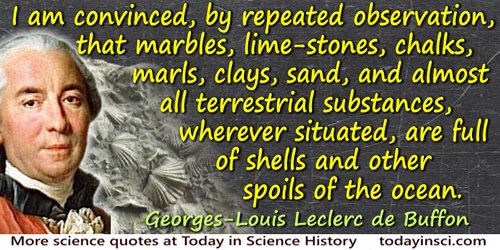
I am convinced, by repeated observation, that marbles, lime-stones, chalks, marls, clays, sand, and almost all terrestrial substances, wherever situated, are full of shells and other spoils of the ocean.
'Second Discours: Histoire & Théorie de la Terre', Histoire Naturelle, Générale et Particulière, Avec la Description du Cabinet du Roi (1749), Vol. I, 76-77; Natural History, General and Particular (1785), Vol. I, trans. W. Smellie, 13.
I have divers times examined the same matter (human semen) from a healthy man... not from a sick man... nor spoiled by keeping... for a long time and not liquefied after the lapse of some time... but immediately after ejaculation before six beats of the pulse had intervened; and I have seen so great a number of living animalcules... in it, that sometimes more than a thousand were moving about in an amount of material the size of a grain of sand... I saw this vast number of animalcules not all through the semen, but only in the liquid matter adhering to the thicker part.
Letter to W. Brouncker, President of the Royal Society, undated, Nov 1677. In The Collected Letters of Antoni van Leeuwenhoek (1957), Vol. 2, 283-4.
I think I have been much of my life an irritant. But some people say that something good came out of my research, something valuable that could be regarded as a pearl, and I can assure those who worked with me it was you who made the pearls and I was merely the grain of sand, the irritant to produce the pearls.
Recalling how, when increasingly in demand to serve on committees, upon attempting to resign from one, he was told by the chairman “We want you as an irritant.” Remark at a luncheon, quoted in Obituary, 'Nicholas Kurti, C. B. E. 14 May 1908-24 November 1998', by J.H. Sanders, Biographical Memoirs of Fellows of the Royal Society (Nov 2000), 46, 309.
I took him [Lawrence Bragg] to a young zoologist working on pattern formation in insect cuticles. The zoologist explained how disturbances introduced into these regular patterns pointed to their formation being governed by some kind of gradient. Bragg listened attentively and then exclaimed: “Your disturbed gradient behaves like a stream of sand running downhill and encountering an obstacle.” “Good heavens,” replied the zoologist, “I had been working on this problem for years before this simple analogy occurred to me and you think of it after twenty minutes.”
As quoted in David Phillips, Biographical Memoirs of Fellows of the Royal Society (Nov 1979), 25, 132, citing: Perutz, M.F. 1971 New Sci. & Sci. J. 8 July 1967.
If it be true, that some Chymists have now and then converted Lead into Gold, it was by just such a hazard, as if a man should let fall a handful of sand upon a table and the particles of it should be so ranged that we could read distinctly on it a whole page of Virgil’s Ænead.
In Traité de Physique, (1671, 1676), Part. 3, Chap. 6, 186. As translated in Rohault’s System of Natural Philosophy (1723), Part 3, Chap. 6, 154. From the original French, “Que s’il est vray que quelques Chymistes ayent autrefois converty du plomb en or, ça esté par un hazard aussi grand, que si ayant laissé tomber de haut une poignée de sable sur une table, ses gains s'estoient tellement rangez, qu'on y pût lire distinctement une page de l'Eneide de Virgile.”
If we reflect that a small creature such as this is provided, not only with external members, but also with intestines and other organs, we have no reason to doubt that a like creature, even if a thousand million times smaller, may already be provided with all its external and internal organs... though they may be hidden from our eyes. For, if we consider the external and internal organs of animalcules which are so small that a thousand million of them together would amount to the size of a coarse grain of sand, it may well be, however incomprehensible and unsearchable it may seem to us, that an animalcule from the male seed of whatever members of the animal kingdom, contains within itself... all the limbs and organs which an animal has when it is born.
Letter to the Gentlemen of the Royal Society, 30 Mar 1685. In The Collected Letters of Antoni van Leeuwenhoek (1957), Vol. 5, 185.
In every outthrust headland, in every curving beach, in every grain of sand there is a story of the earth.
In 'Our Ever-Changing Shore', Holiday (Jul 1958). Collected in Lost Woods: The Discovered Writing of Rachel Carson (2011), 114.
In the light of [current research on atomic structure] the physicists have, I think, some justification for their faith that they are building on the solid rock of fact, and not, as we are often so solemnly warned by some of our scientific brethren, on the shifting sands of imaginative hypothesis.
From Opening Address to the Mathematics and Physics Section at the Annual Meeting of the British Association for the Advancement of Science, Winnipeg. Collected in 'The British Association at Winnipeg', Nature (26 Aug 1909), 81. No. 2078, 263.
In this great celestial creation, the catastrophy of a world, such as ours, or even the total dissolution of a system of worlds, may possibly be no more to the great Author of Nature, than the most common accident in life with us, and in all probability such final and general Doomsdays may be as frequent there, as even Birthdays or mortality with us upon the earth. This idea has something so cheerful in it, that I know I can never look upon the stars without wondering why the whole world does not become astronomers; and that men endowed with sense and reason should neglect a science they are naturally so much interested in, and so capable of enlarging their understanding, as next to a demonstration must convince them of their immortality, and reconcile them to all those little difficulties incident to human nature, without the least anxiety. All this the vast apparent provision in the starry mansions seem to promise: What ought we then not to do, to preserve our natural birthright to it and to merit such inheritance, which alas we think created all to gratify alone a race of vain-glorious gigantic beings, while they are confined to this world, chained like so many atoms to a grain of sand.
In The Universe and the Stars: Being an Original Theory on the Visible Creation, Founded on the Laws of Nature (1750, 1837), 132.
It is curious to observe with what different degrees of architectonic skill Providence has endowed birds of the same genus, and so nearly correspondent in their general mode of life! for while the swallow and the house-martin discover the greatest address in raising and securely fixing crusts or shells of loam as cunabula for their young, the bank-martin terebrates a round and regular hole in the sand or earth, which is serpentine, horizontal, and about two feet deep. At the inner end of this burrow does this bird deposit, in a good degree of safety, her rude nest, consisting of fine grasses and feathers, usually goose-feathers, very inartificially laid together.
In Letter to Daines Barrington, (26 Feb 1774), in The Natural History and Antiquities of Selborne (1789), 176.
Lives of great men remind us
We can make our lives sublime,
And departing leave behind us
Footprints on the sands of time.
We can make our lives sublime,
And departing leave behind us
Footprints on the sands of time.
From poem, 'A Psalm of Life', collected in Poetical Works of Henry Wadsworth Longfellow (1855), 42.
Many scientists have tried to make determinism and complementarity the basis of conclusions that seem to me weak and dangerous; for instance, they have used Heisenberg’s uncertainty principle to bolster up human free will, though his principle, which applies exclusively to the behavior of electrons and is the direct result of microphysical measurement techniques, has nothing to do with human freedom of choice. It is far safer and wiser that the physicist remain on the solid ground of theoretical physics itself and eschew the shifting sands of philosophic extrapolations.
In New Perspectives in Physics (1962), viii.
Mock on, mock on, Voltaire, Rousseau!
Mock on, mock on: 'Tis all in vain!
You throw the sand against the wind,
And the wind blows it back again.
And every sand becomes a gem
Reflected in the beams divine;
Blown back they blind the mocking eye,
But still in Israel's paths they shine.
The atoms of Democritus
And Newton's particles of light
Are sands upon the Red Sea shore,
Where Israel's tents do shine so bright.
Mock on, mock on: 'Tis all in vain!
You throw the sand against the wind,
And the wind blows it back again.
And every sand becomes a gem
Reflected in the beams divine;
Blown back they blind the mocking eye,
But still in Israel's paths they shine.
The atoms of Democritus
And Newton's particles of light
Are sands upon the Red Sea shore,
Where Israel's tents do shine so bright.
Notebook Drafts (c. 1804). In W. H. Stevenson (ed.), The Poems of William Blake (1971), 481.
My dear nephew was only in his sixth year when I came to be detached from the family circle. But this did not hinder John and I from remaining the most affectionate friends, and many a half or whole holiday he was allowed to spend with me, was dedicated to making experiments in chemistry, where generally all boxes, tops of tea-canisters, pepper-boxes, teacups, &c., served for the necessary vessels, and the sand-tub furnished the matter to be analysed. I only had to take care to exclude water, which would have produced havoc on my carpet.
Letter to Lady Herschel, 6 Sep 1833. Quoted in Memoir and Correspondence of Caroline Herschel (1876), 259.
Ninety-nine and nine-tenths of the earth’s volume must forever remain invisible and untouchable. Because more than 97 per cent of it is too hot to crystallize, its body is extremely weak. The crust, being so thin, must bend, if, over wide areas, it becomes loaded with glacial ice, ocean water or deposits of sand and mud. It must bend in the opposite sense if widely extended loads of such material be removed. This accounts for … the origin of chains of high mountains … and the rise of lava to the earth’s surface.
Presidential speech to the Geological Society of America at Cambridge, Mass. (1932). As quoted in New York Times (20 Sep 1957), 23. Also summarized in Popular Mechanics (Apr 1933), 513.
On the basis of the results recorded in this review, it can be claimed that the average sand grain has taken many hundreds of millions of years to lose 10 per cent. of its weight by abrasion and become subangular. It is a platitude to point to the slowness of geological processes. But much depends on the way things are put. For it can also be said that a sand grain travelling on the bottom of a river loses 10 million molecules each time it rolls over on its side and that representation impresses us with the high rate of this loss. The properties of quartz have led to the concentration of its grains on the continents, where they could now form a layer averaging several hundred metres thick. But to my mind the most astounding numerical estimate that follows from the present evaluations, is that during each and every second of the incredibly long geological past the number of quartz grains on earth has increased by 1,000 million.
'Sand-its Origin, Transportation, Abrasion and Accumulation', The Geological Society of South Africa (1959), Annexure to Volume 62, 31.
One summer day, while I was walking along the country road on the farm where I was born, a section of the stone wall opposite me, and not more than three or four yards distant, suddenly fell down. Amid the general stillness and immobility about me the effect was quite startling. ... It was the sudden summing up of half a century or more of atomic changes in the material of the wall. A grain or two of sand yielded to the pressure of long years, and gravity did the rest.
Under the Apple-Trees (1916), 105.
One will see a layer of smooth stones, popularly called fluitati [diluvium], and over these another layer of smaller pebbles, thirdly sand, and finally earth, and you will see this repeatedly … up to the summit of the Mountain. This clearly shows that the order has been caused by many floods, not just one.
In De' Corpi Marini che su Monti si Trovano (1721), 57, as translated by Ezio Vaccari.
Painting the desert, sun-setting the tone
Starving backstage, morning-stars are jaded
The moonshine murmur still shivers alone
Curved slice of sliver, shear breath shadows stone
Suspending twilight shiny and shaded
Painting the desert, sun-setting the tone
Carving solace into silver in June
On horizons’ glow from forgotten gold
The moonshine’s’ shilling delivers alone
Gleaming duels of knights, pierce deathly silence
Steel tines of starlight, clashing swords they hold
Painting the desert, sun-setting the tone
Dimples aware, sparkle sand on the dune
Winking at comets, after tails are told
The moon-sand whispers, sift rivers alone
Sharpness they hone, filing skills onto stone
Starlight dazzles, its own space created
Painting the desert, sun-setting the tone
From owls’ talon, moonlight shimmers alone
Starving backstage, morning-stars are jaded
The moonshine murmur still shivers alone
Curved slice of sliver, shear breath shadows stone
Suspending twilight shiny and shaded
Painting the desert, sun-setting the tone
Carving solace into silver in June
On horizons’ glow from forgotten gold
The moonshine’s’ shilling delivers alone
Gleaming duels of knights, pierce deathly silence
Steel tines of starlight, clashing swords they hold
Painting the desert, sun-setting the tone
Dimples aware, sparkle sand on the dune
Winking at comets, after tails are told
The moon-sand whispers, sift rivers alone
Sharpness they hone, filing skills onto stone
Starlight dazzles, its own space created
Painting the desert, sun-setting the tone
From owls’ talon, moonlight shimmers alone
…...
Put three grains of sand inside a vast cathedral, and the cathedral will be more closely packed with sand than space is with stars.
In 'Our Home in Space.' In R.C. Prasad (ed.), Modern Essays: Studying Language Through Literature (1987), 26.
Sand in reality is nothing else than very small stones.
An Essay Towards a System of Mineralogy (1770), trans. G. Von Engestrom, xiv.
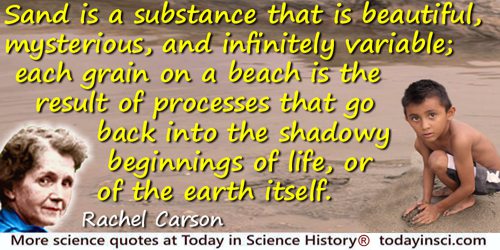
Sand is a substance that is beautiful, mysterious, and infinitely variable; each grain on a beach is the result of processes that go back into the shadowy beginnings of life, or of the earth itself.
In The Edge of the Sea (1955), 125.
Science is the topography of ignorance. From a few elevated points we triangulate vast spaces, inclosing infinite unknown details. We cast the lead, and draw up a little sand from abysses we may never reach with our dredges.
'Border Lines of Knowledge in Some Provinces of Medical Science', an introductory lecture to the Medical Class of Harvard University (6 Nov 1861). In Works of Oliver Wendell Holmes (1892), 211.
So says the most ancient book of the Earth; thus it is written on its leaves of marble, lime, sand, slate, and clay: ... that our Earth has fashioned itself, from its chaos of substances and powers, through the animating warmth of the creative spirit, to a peculiar and original whole, by a series of preparatory revolutions, till at last the crown of its creation, the exquisite and tender creature man, was enabled to appear.
Outlines of a Philosophy of the History of Man (1803). Translated from 1784 Original, Vol. I, Book 10, 465-6.
Some guns were fired to give notice that the departure of the balloon was near. ... Means were used, I am told, to prevent the great balloon's rising so high as might endanger its bursting. Several bags of sand were taken on board before the cord that held it down was cut, and the whole weight being then too much to be lifted, such a quantity was discharged as would permit its rising slowly. Thus it would sooner arrive at that region where it would be in equilibrio with the surrounding air, and by discharging more sand afterwards, it might go higher if desired. Between one and two o’clock, all eyes were gratified with seeing it rise majestically from above the trees, and ascend gradually above the buildings, a most beautiful spectacle. When it was about two hundred feet high, the brave adventurers held out and waved a little white pennant, on both sides of their car, to salute the spectators, who returned loud claps of applause. The wind was very little, so that the object though moving to the northward, continued long in view; and it was a great while before the admiring people began to disperse. The persons embarked were Mr. Charles, professor of experimental philosophy, and a zealous promoter of that science; and one of the Messrs Robert, the very ingenious constructors of the machine.
While U.S. ambassador to France, writing about witnessing, from his carriage outside the garden of Tuileries, Paris, the first manned balloon ascent using hydrogen gas on the afternoon of 1 Dec 1783. A few days earlier, he had watched the first manned ascent in Montgolfier's hot-air balloon, on 21 Nov 1783.
While U.S. ambassador to France, writing about witnessing, from his carriage outside the garden of Tuileries, Paris, the first manned balloon ascent using hydrogen gas on the afternoon of 1 Dec 1783. A few days earlier, he had watched the first manned ascent in Montgolfier's hot-air balloon, on 21 Nov 1783.
Letter to Sir Charles Banks (1 Dec 1783). In The Writings of Benjamin Franklin: 1783-1788 (1906), Vol. 9, 119-120.
The 31th of May, I perceived in the same water more of those Animals, as also some that were somewhat bigger. And I imagine, that [ten hundred thousand] of these little Creatures do not equal an ordinary grain of Sand in bigness: And comparing them with a Cheese-mite (which may be seen to move with the naked eye) I make the proportion of one of these small Water-creatures to a Cheese-mite, to be like that of a Bee to a Horse: For, the circumference of one of these little Animals in water, is not so big as the thickness of a hair in a Cheese-mite.
Letter to H. Oldenburg, 9 Oct 1676. In The Collected Letters of Antoni van Leeuwenhoek (1957), Vol. 2, 75.
The 4th sort of creatures... which moved through the 3 former sorts, were incredibly small, and so small in my eye that I judged, that if 100 of them lay [stretched out] one by another, they would not equal the length of a grain of course Sand; and according to this estimate, ten hundred thousand of them could not equal the dimensions of a grain of such course Sand. There was discover’d by me a fifth sort, which had near the thickness of the former, but they were almost twice as long.
The first time bacteria were observed.
The first time bacteria were observed.
Letter to H. Oldenburg, 9 Oct 1676. In The Collected Letters of Antoni van Leeuwenhoek (1957), Vol. 2, 95.
The actuality of us being cognizant and accepting of the fact we are but a speck of sand in a universe sized desert, whose existence is irrelevant to any facet of universal function is a hard pill to swallow. Knowing the world will go on for another billion years after death and you will have no recollection of anything, just as you have no recollection of the billion years before your birth is a mind-boggling intuition.
In White Guilt (2010), 90.
The architect does not demand things which cannot be found or made ready without great expense. For example: it is not everywhere that there is plenty of pitsand, rubble, fir, clear fir, and marble… Where there is no pitsand, we must use the kinds washed up by rivers or by the sea… and other problems we must solve in similar ways.
In De Architectura, Book 1, Chap 2, Sec. 8. As translated in Morris Hicky Morgan (trans.), Vitruvius: The Ten Books on Architecture (1914), 16.
The canyon country does not always inspire love. To many it appears barren, hostile, repellent—a fearsome, mostly waterless land of rock and heat, sand dunes and quicksand. cactus, thornbush, scorpion, rattlesnake, and agoraphobic distances. To those who see our land in that manner, the best reply is, yes, you are right, it is a dangerous and terrible place. Enter at your own risk. Carry water. Avoid the noon-day sun. Try to ignore the vultures. Pray frequently.
The Journey Home
The existing premises, wholly altered by geologic science, are no longer those of Hume. The foot-print in the sand—to refer to his happy illustration—does now stand alone. Instead of one, we see many footprints, each in turn in advance of the print behind it, and on a higher level.
Lecture to the Edinburgh Philosophical Institution, 'Geology in its Bearings on the Two Theologies, Part 1', collected in The Testimony of the Rocks: or, Geology in Its Bearings on the Two Theologies, Natural and Revealed (1857), 223.
The faculty for remembering is not diminished in proportion to what one has learnt, just as little as the number of moulds in which you cast sand lessens its capacity for being cast in new moulds.
Religion: a Dialogue, and Other Essays (1890), 99.
The great object of all knowledge is to enlarge and purify the soul, to fill the mind with noble contemplations, to furnish a refined pleasure, and to lead our feeble reason from the works of nature up to its great Author and Sustainer. Considering this as the ultimate end of science, no branch of it can surely claim precedence of Astronomy. No other science furnishes such a palpable embodiment of the abstractions which lie at the foundation of our intellectual system; the great ideas of time, and space, and extension, and magnitude, and number, and motion, and power. How grand the conception of the ages on ages required for several of the secular equations of the solar system; of distances from which the light of a fixed star would not reach us in twenty millions of years, of magnitudes compared with which the earth is but a foot-ball; of starry hosts—suns like our own—numberless as the sands on the shore; of worlds and systems shooting through the infinite spaces.
Oration at Inauguration of the Dudley Astronomical Observatory, Albany (28 Jul 1856). Text published as The Uses of Astronomy (1856), 36.
The landscape everywhere, away from the river, is of rock—cliffs of rock; plateaus of rock; terraces of rock; crags of rock—ten thousand strangely carved forms; rocks everywhere, and no vegetation, no soil, no sand. In long, gentle curves the river winds about these rocks.
In Canyons of the Colorado (1895), 206.
The sand should be neither coarse nor fine but of a middling quality or about the size of the common pop[p]y seed. If the sand is too coarse the mortar will be short or brittle … If the sand is too fine the cement will shrink and crack after it has been used.
Directions for Using White's Patent Hydraulic Cement.
The science of metaphysics promises more than it performs. The study of … metaphysics begins with a torrent of tropes, and a copious current of words, yet loses itself at last, in obscurity and conjecture, like the Niger in his barren deserts of sand.
Reflection 342, in Lacon: or Many things in Few Words; Addressed to Those Who Think (1820), 162.
The valuable properties of this cement depend in a great measure on the mode of preparing it for use. The mixing should therefore be conducted with care in order to form a perfect union of the powdered cement, sand and water. This can be best accomplished by the use of the New England corn hoe on a board floor or by beating with a hand stamper; not much labour is required if properly applied. Mechanics can judge when the mixture is perfect by the appearance of the mortar, which, when properly prepared, very much resembles putty.
Directions for Using White's Patent Hydraulic Cement.
The Walrus and the Carpenter
Were walking close at hand:
They wept like anything to see
Such quantities of sand:
“If this were only cleared away,”
They said,“it would be grand!”
Were walking close at hand:
They wept like anything to see
Such quantities of sand:
“If this were only cleared away,”
They said,“it would be grand!”
In Through the Looking Glass and What Alice Found There (1872, 1896), 62.
The weather is warm
The sun is out
There are people all around
The waves come flowing
And hits the shore
But makes so little sound
The wind is blowing
Oh so softly
The sand between my feet
The dolphins jump
The people watch
They even take a seat
I fly around
Watching from above
Today is like everyday
That is something I love
The sun is out
There are people all around
The waves come flowing
And hits the shore
But makes so little sound
The wind is blowing
Oh so softly
The sand between my feet
The dolphins jump
The people watch
They even take a seat
I fly around
Watching from above
Today is like everyday
That is something I love
…...
The whole Terrestrial Globe was taken all to Pieces and dissolved at the Deluge, the Particles of Stone, Marble, and all other solid Fossils being dissevered, taken up into the Water, and there sustained with Sea-Shells and other Animal and Vegetable Bodyes: and that the present Earth consists, and was formed out of that promiscuous Mass of Sand, Earth, Shells, and the rest, falling down again, and subsiding from the Water.
In An Essay Towards a Natural History of the Earth (3rd ed., 1723), Preface.
This part of optics [perspectiva], when well understood, shows us how we may make things a very long way off appear to be placed very close, and large near things appear very small, and how we may make small things placed at a distance appear as large as we want, so that it is possible for us to read the smallest letters at an incredible distance, or to count sand, or grain, or seeds, or any sort of minute objects.
Describing the use of a lens for magnification.
Describing the use of a lens for magnification.
De iride, in Baur, Die philosophischen Werke, 74.
Time is but the stream I go a-fishing in. I drink at it; but while I drink I see the sandy bottom and detect how shallow it is. Its thin current slides away, but eternity remains.
In 'Where I Lived and What I Lived For', in Walden: Or, Life in the Woods (1854, 1899), 112.
To every bushel of the powdered cement add one bushel of sand, mix them together and pass them through a sieve, then add a sufficient quantity of water to make it (by well mixing and working) about the consistency of a soft putty. It is then fit to use but should not be kept more than six or eight hours and should be thoroughly worked just before it is used.
Directions for Using White's Patent Hydraulic Cement.
To see a World in a grain of Sand,
And a Heaven in a Wild Flower,
Hold Infinity in the palm of your hand,
And Eternity in an hour.
And a Heaven in a Wild Flower,
Hold Infinity in the palm of your hand,
And Eternity in an hour.
William Blake and Alexander Gilchrist (ed.), Life of William Blake: with selections from his poems and other writings (1880), Vol. 2, 107.
To see a world in a grain of sand
And a heaven in a wild flower,
Hold infinity in the palm of your hand
And eternity in an hour.
And a heaven in a wild flower,
Hold infinity in the palm of your hand
And eternity in an hour.
'The Pickering Manuscript' - Auguries of Innocence (c.1805). In W. H. Stevenson (ed.), The Poems of William Blake (1971), 585.
Upon viewing the milt or semen Masculinum of a living Codfish with a Microscope, such Numbers of Animalcules with long Tails were found therein, that at least ten thousand of them were supposed to exist in the quantity of a Grain of Sand.
We are going to die, and that makes us the lucky ones. Most people are never going to die because they are never going to be born. The potential people who could have been here in my place but who will in fact never see the light of day outnumber the sand grains of Arabia. Certainly those unborn ghosts include greater poets than Keats, scientists greater than Newton. We know this because the set of possible people allowed by our DNA so massively outnumbers the set of actual people. In the teeth of these stupefying odds it is you and I, in our ordinariness, that are here.
Unweaving the Rainbow (1998), 1.
We hence acquire this sublime and interesting idea; that all the calcareous mountains in the world, and all the strata of clay, coal, marl, sand, and iron, which are incumbent on them, are MONUMENTS OF THE PAST FELICITY OF ORGANIZED NATURE!
Phytologia (1800), 560.
We might expect … in the summer of the “great year,” which we are now considering, that there would be a great predominance of tree-ferns and plants allied to the palms and arborescent grasses in the isles of the wide ocean, while the dicotyledenous plants and other forms now most common in temperate regions would almost disappear from the earth. Then might these genera of animals return, of which the memorials are preserved in the ancient rocks of our continents. The huge iguanodon might reappear in the woods, and the ichthyosaur in the sea, while the pterodactyle might flit again through umbrageous groves of tree-ferns. Coral reefs might be prolonged beyond the arctic circle, where the whale and narwal [sic] now abound. Turtles might deposit their eggs in the sand of the sea beach, where now the walrus sleeps, and where the seal is drifted on the ice-floe.
In Principles of Geology (1830-3), Vol. 1, 123.
We want them to use the education to be leaders in their community with an understanding of ecology and conservation for the wild outdoors far beyond their legislators back home. We expect these people to he a grain of sand on the beach of future leadership.
…...
Well beyond the tropostrata
There is a region stark and stellar
Where, on a streak of anti-matter
Lived Dr. Edward anti-Teller.
Remote from Fusion’s origin,
He lived unguessed and unawares
With all his antikith and kin,
And kept macassars on his chairs.
One morning, idling by the sea,
He spied a tin of monstrous girth
That bore three letters: A. E. C.
Out stepped a visitor from Earth.
Then, shouting gladly o’er the sands,
Met two who in their alien ways
Were like as lentils. Their right hands
Clasped, and the rest was gamma rays.
There is a region stark and stellar
Where, on a streak of anti-matter
Lived Dr. Edward anti-Teller.
Remote from Fusion’s origin,
He lived unguessed and unawares
With all his antikith and kin,
And kept macassars on his chairs.
One morning, idling by the sea,
He spied a tin of monstrous girth
That bore three letters: A. E. C.
Out stepped a visitor from Earth.
Then, shouting gladly o’er the sands,
Met two who in their alien ways
Were like as lentils. Their right hands
Clasped, and the rest was gamma rays.
In 'Perils of Modern Living', The New Yorker (10 Nov 1956), 56. Reprinted in Edward Teller with Judith Schoolery, Memoirs: A Twentieth Century Journey in Science and Politics (2002), 428. Webmaster supposes the initials 'A.E.C.' might be for the Atomic Energy Commission.
Where the untrained eye will see nothing but mire and dirt, Science will often reveal exquisite possibilities. The mud we tread under our feet in the street is a grimy mixture of clay and sand, soot and water. Separate the sand, however, as Ruskinn observes—let the atoms arrange themselves in peace according to their nature—and you have the opal. Separate the clay, and it becomes a white earth, fit for the finest porcelain; or if it still further purifies itself, you have a sapphire. Take the soot, and it properly treated it will give you a diamond. While lastly, the water, purified and distilled, will become a dew-drop, or crystallize into a lovely star. Or, again, you may see as you will in any shallow pool either the mud lying at the bottom, or the image of the heavens above.
The Pleasures of Life (1887, 2007), 63.
Who then can calculate the path of the molecule? how do we know that the creations of worlds are not determined by the fall of grains of sand?
Victor Hugo and Charles E. Wilbour (trans.), Les Misérables (1862), 41.
Why, these men would destroy the Bible on evidence that would not convict a habitual criminal of a misdemeanor. They found a tooth in a sand pit in Nebraska with no other bones about it, and from that one tooth decided that it was the remains of the missing link. They have queer ideas about age too. They find a fossil and when they are asked how old it is they say they can't tell without knowing what rock it was in, and when they are asked how old the rock is they say they can't tell unless they know how old the fossil is.
In Henry Fairfield Osborn, 'Osborn States the Case For Evolution', New York Times (12 Jul 1925), XX1. In fact, the tooth was misidentified as anthropoid by Osborn, who over-zealously proposed Nebraska Man in 1922. This tooth was shortly thereafter found to be that of a peccary (a Pliocene pig) when further bones were found. A retraction was made in 1927, correcting the scientific blunder.
Without the death of forests by Ice Age advance, there would be no northern lakes.
Without the death of mountains, there would be no sand or soil.
Without the death of mountains, there would be no sand or soil.
In 'The Nested Emergent Nature of Divine Creativity', Thank God for Evolution: How the Marriage of Science and Religion Will Transform Your Life and Our World (2007), 99.
 In science it often happens that scientists say, 'You know that's a really good argument; my position is mistaken,' and then they would actually change their minds and you never hear that old view from them again. They really do it. It doesn't happen as often as it should, because scientists are human and change is sometimes painful. But it happens every day. I cannot recall the last time something like that happened in politics or religion.
(1987) --
In science it often happens that scientists say, 'You know that's a really good argument; my position is mistaken,' and then they would actually change their minds and you never hear that old view from them again. They really do it. It doesn't happen as often as it should, because scientists are human and change is sometimes painful. But it happens every day. I cannot recall the last time something like that happened in politics or religion.
(1987) -- 





