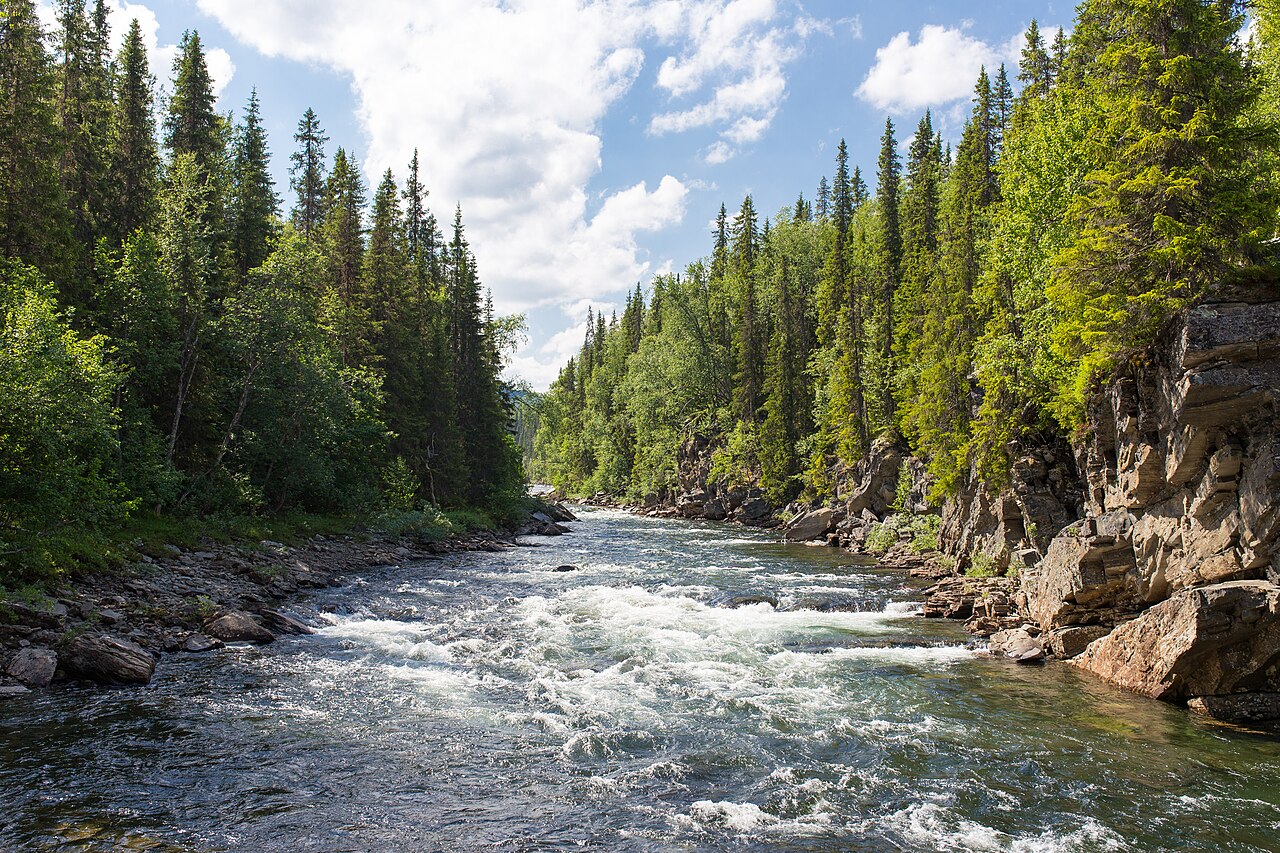
River Quotes (144 quotes)
.…yes, sitting on the bank of the Kibali itself and philosophizing about river systems with the much-traveled Abu Ssamat and his people, … I caught him out there and then in blatant contradictions and inaccuracies. Well then, I finally said, quite beside myself, so show me how you speak of rivers: here is the Kibali, show me with your hand: where does it come from and in what direction does it flow? To which all pointed eastwards and said: it is flowing in that direction, and then pointing west: it comes from there, that is how we say it. I could have gone through the roof. No, I cried, you Moslem, you have everything confused and mixed up, what must it be like inside your heads!
In August Petermann, Petermann’s Geographische Mittheilungen (1871), 135. As quoted and cited in Kathrin Fritsch, '"You Have Everything Confused And Mixed Up…!" Georg Schweinfurth, Knowledge And Cartography Of Africa In The 19th Century', History in Africa (2009), 36, 94. Fritsch comments on their misunderstandings caused by “different spatial conceptions [and] language barriers.”
“True is it, my incorporate friends,” quoth he, “That I receive the general food at first, Which you do live upon; and fit it is, Because I am the storehouse and the shop Of the whole body. But, if you do remember, I send it through the rivers of your blood, Even to the court, the heart, to th’ seat o’ th’ brain; And, through the cranks and offices of man, The strongest nerves and small inferior veins From me receive that natural competency Whereby they live. And though that all at once”— You, good friends, this says the belly, mark me.
[Told as a fable, this is the belly’s answer to a complaint from the other members of the body that it received all the food but did no work.] In Coriolanus (1623), Act 1, Scene 1, line 130-141. Webmaster’s note: The Fable of the Belly has its roots in antiquity. William Harvey delivered a lecture in Apr 1616 on his discovery the circulation of blood in the body, but did not publish until 1628.
[In Adelie Land, Antarctica, a howling river of] wind, 50 miles wide, blows off the plateau, month in and month out, at an average velocity of 50 m.p.h. As a source of power this compares favorably with 6,000 tons of water falling every second over Niagara Falls. I will not further anticipate some H. G. Wells of the future who will ring the antarctic with power-producing windmills; but the winds of the Antarctic have to be felt to be believed, and nothing is quite impossible to physicists and engineers.
Speaking at convention of the British Association for the Advancement of Science, Norwich (1935). As quoted in 'Science: One Against Darwin', Time (23 Sep 1935).
[Reporting after the now infamous 22 Jun 1969 burning of the Cuyahoga River:] Some River! Chocolate-brown, oily, bubbling with subsurface gases, it oozes rather than flows. “Anyone who falls into the Cuyahoga does not drown,” Cleveland’s citizens joke grimly. “He decays” … The Federal Water Pollution Control Administration dryly notes: “The lower Cuyahoga has no visible signs of life, not even low forms such as leeches and sludge worms that usually thrive on wastes.” It is also—literally—a fire hazard.
— Magazine
As reported in Time magazine (1 Aug 1969).
[The earth’s rocks] were so arranged, in their formation, that they should best serve Man’s purposes. The strata were subjected to metamorphism, and so crystallized, that he might be provided with the most perfect material for his art, his statues, temples, and dwellings; at the same time, they were filled with veins, in order to supply him with gold and silver and other treasures. The rocks were also made to enclose abundant beds of coal and iron ore, that Man might have fuel for his hearths and iron for his utensils and machinery. Mountains were raised to temper hot climates, to diversify the earth’s productiveness, and, pre-eminently, to gather the clouds into river-channels, thence to moisten the fields for agriculture, afford facilities for travel, and supply the world with springs and fountains.
In 'Concluding Remarks', A Text-book of Geology: Designed for Schools and Academies (1863), 338.
[Two college boys on the Flambeau River in a canoe]… their watches had run down, and for the first time in their lives there was no clock, whistle, or radio to set watches by. For two days they had lived by “sun-time,” and were getting a thrill out of it. No servant brought them meals: they got their meat out of the river, or went without. No traffic cop whistled them off the hidden rock in the next rapids. No friendly roof kept them dry when they misguessed whether or not to pitch the tent. No guide showed them which camping spots offered a nightlong breeze, and which a nightlong misery of mosquitoes; which firewood made clean coals, and which only smoke.
In 'Wisconsin: Flambeau', A Sand County Almanac, and Sketches Here and There (1949, 1987), 112-113.
[Two college boys on the Flambeau River in a canoe]…their first…taste of freedom … The elemental simplicities of wilderness travel were thrills not only because of their novelty, but because they represented complete freedom to make mistakes. The wilderness gave them their first taste of those rewards and penalties for wise and foolish acts which every woodsman faces daily, but against which civilization has built a thousand buffers. These boys were “on their own” in this particular sense. Perhaps every youth needs an occasional wilderness trip, in order to learn the meaning of this particular freedom.
In 'Wisconsin: Flambeau', A Sand County Almanac, and Sketches Here and There (1949, 1987), 112-113.
[W.H.R.] Rivers is the Rider Haggard of anthropology; I shall be the Conrad.
[Drawing parallel with popular novelists.]
[Drawing parallel with popular novelists.]
Attributed. As quoted in Raymond Firth, Malinowski as Scientist and as Man (1964), 6. However, Michael W. Young in his biography found that Malinowski in fact (in a letter to Mrs. Seligman, 1918) wrote only a comment upon re-reading Rivers' Melenesians, that the book 'reads like Rider Haggard rather than Joseph Conrad. It is rather a pursuit of fact than of the philosophical importance of fact.' See Malinowski. Odyssey of an anthropologist, 1884-1920 (2004), 237.
Nature, in the common sense, refers to essences unchanged by man; space, the air, the river, the leaf.
From 'Introduction' in his first published book (at first, anonymously), Nature (1836), 7.
A river is more than an amenity, it is a treasure. It offers a necessity of life that must be rationed among those who have power over it.
Writing for the Court, New Jersey v. New York, et al., 283 U.S. 336, 342 (1931), His ruling declared that the water of the Delaware River must be divided among states on a basis of need, rather than on the geographic mileage of the resource controlled by each state. Thus a river was to be regarded as a shared economic treasure. An upstream state must not willy-nilly deprive a downstream state of an important water resource. As quoted and explained in Tim Palmer, Endangered Rivers and the Conservation Movement (2004), 42.
A strict materialist believes that everything depends on the motion of matter. He knows the form of the laws of motion though he does not know all their consequences when applied to systems of unknown complexity.
Now one thing in which the materialist (fortified with dynamical knowledge) believes is that if every motion great & small were accurately reversed, and the world left to itself again, everything would happen backwards the fresh water would collect out of the sea and run up the rivers and finally fly up to the clouds in drops which would extract heat from the air and evaporate and afterwards in condensing would shoot out rays of light to the sun and so on. Of course all living things would regrede from the grave to the cradle and we should have a memory of the future but not of the past.
The reason why we do not expect anything of this kind to take place at any time is our experience of irreversible processes, all of one kind, and this leads to the doctrine of a beginning & an end instead of cyclical progression for ever.
Now one thing in which the materialist (fortified with dynamical knowledge) believes is that if every motion great & small were accurately reversed, and the world left to itself again, everything would happen backwards the fresh water would collect out of the sea and run up the rivers and finally fly up to the clouds in drops which would extract heat from the air and evaporate and afterwards in condensing would shoot out rays of light to the sun and so on. Of course all living things would regrede from the grave to the cradle and we should have a memory of the future but not of the past.
The reason why we do not expect anything of this kind to take place at any time is our experience of irreversible processes, all of one kind, and this leads to the doctrine of a beginning & an end instead of cyclical progression for ever.
Letter to Mark Pattison (7 Apr 1868). In P. M. Hannan (ed.), The Scientific Letters and Papers of James Clerk Maxwell (1995), Vol. 2, 1862-1873, 360-1.
All admit that the mountains of the globe are situated mostly along the border regions of the continents (taking these regions as 300 to 1000 miles or more in width), and that over these same areas the sedimentary deposits have, as a general thing, their greatest thickness. At first thought, it would seem almost incredible that the upliftings of mountains, whatever their mode of origin, should have taken place just where the earth’s crust, through these sedimentary accumulations, was the thickest, and where, therefore, there was the greatest weight to be lifted. … Earthquakes show that even now, in this last of the geological ages, the same border regions of the continents, although daily thickening from the sediments borne to the ocean by rivers, are the areas of the greatest and most frequent movements of the earth’s crust. (1866)
[Thus, the facts were known long ago; the explanation by tectonic activity came many decades later.]
[Thus, the facts were known long ago; the explanation by tectonic activity came many decades later.]
In 'Observations on the Origin of Some of the Earth’s Features', The American Journal of Science (Sep 1866), Second Series, 42, No. 125, 210-211.
All rivers, small or large, agree in one character; they like to lean a little on one side; they cannot bear to have their channels deepest in the middle, but will always, if they can, have one bank to sun themselves upon, and another to get cool under.
In 'Water', The True and the Beautiful in Nature, Art, Morals, and Religion (1872), 62.
All the rivers run into the sea; yet the sea is not full; unto the place from whence the rivers come, thither they return again.
— Bible
King James Version, Ecclesiastes 1:7.
Almost daily we shudder as prophets of doom announce the impending end of civilization and universe. We are being asphyxiated, they say, by the smoke of the industry; we are suffocating in the ever growing mountain of rubbish. Every new project depicts its measureable effects and is denounced by protesters screaming about catastrophe, the upsetting of the land, the assault on nature. If we accepted this new mythology we would have to stop pushing roads through the forest, harnessing rivers to produce the electricity, breaking grounds to extract metals, enriching the soil with chemicals, killing insects, combating viruses … But progress—basically, an effort to organise a corner of land and make it more favourable for human life—cannot be baited. Without the science of pomiculture, for example, trees will bear fruits that are small, bitter, hard, indigestible, and sour. Progress is desirable.
Uncredited. In Lachman Mehta, Stolen Treasure (2012), 117.
Already the steam-engine works our mines, impels our ships, excavates our ports and our rivers, forges iron, fashions wood, grinds grain, spins and weaves our cloths, transports the heaviest burdens, etc. It appears that it must some day serve as a universal motor, and be substituted for animal power, waterfalls, and air currents.
'Réflexions sur la puissance motrice du feu' (1824) translated by R.H. Thurston in Reflections on the Motive Power of Fire, and on Machines Fitted to Develop that Power (1890), 38.
Amid all the revolutions of the globe, the economy of Nature has been uniform, ... and her laws are the only things that have resisted the general movement. The rivers and the rocks, the seas and the continents, have been changed in all their parts; but the laws which direct those changes, and the rules to which they are subject, have remained invariably the same.
Illustrations of the Huttonian Theory of the Earth (1802) collected in The Works of John Playfair (1822), Vol. 1, 415
An incidental remark from a German colleague illustrates the difference between Prussian ways and our own. He had apparently been studying the progress of our various crews on the river, and had been struck with the fact that though the masters in charge of the boats seemed to say and do very little, yet the boats went continually faster and faster, and when I mentioned Dr. Young’s book to him, he made the unexpected but suggestive reply: “Mathematics in Prussia! Ah, sir, they teach mathematics in Prussia as you teach your boys rowing in England: they are trained by men who have been trained by men who have themselves been trained for generations back.”
In John Perry (ed.), Discussion on the Teaching of Mathematics (1901), 43. The discussion took place on 14 Sep 1901 at the British Association at Glasgow, during a joint meeting of the mathematics and physics sections with the education section. The proceedings began with an address by John Perry. Langley related this anecdote during the Discussion which followed.
And an ingenious Spaniard says, that “rivers and the inhabitants of the watery element were made for wise men to contemplate, and fools to pass by without consideration.”
In Izaak Walton and Charles Cotton, The Complete Angler (1653, 1859), 31.
Another error is a conceit that … the best has still prevailed and suppressed the rest: so as, if a man should begin the labor of a new search, he were but like to light upon somewhat formerly rejected, and by rejection brought into oblivion; as if the multitude, or the wisest for the multitude’s sake, were not ready to give passage rather to that which is popular and superficial, than to that which is substantial and profound: for the truth is, that time seemeth to be of the nature of a river or stream, which carrieth down to us that which is light and blown up, and sinketh and drowneth that which is weighty and solid.
Advancement of Learning, Book 1. Collected in The Works of Francis Bacon (1826), Vol 1, 36.
Anthropology found its Galileo in Rivers, its Newton in Mauss.
Referring to anthropologists W.H.R. Rivers and Marcel Mauss for revolutionizing theories of anthropology. In Structural Anthropology (1958), 159.
As I looked down, I saw a large river meandering slowly along for miles, passing from one country to another without stopping. I also saw huge forests, extending along several borders. And I watched the extent of one ocean touch the shores of separate continents. Two words leaped to mind as I looked down on all this: commonality and interdependence. We are one world.
…...
Ask a follower of Bacon what [science] the new philosophy, as it was called in the time of Charles the Second, has effected for mankind, and his answer is ready; “It has lengthened life; it has mitigated pain; it has extinguished diseases; it has increased the fertility of the soil; it has given new securities to the mariner; it has furnished new arms to the warrior; it has spanned great rivers and estuaries with bridges of form unknown to our fathers; it has guided the thunderbolt innocuously from heaven to earth; it has lighted up the night with the splendour of the day; it has extended the range of the human vision; it has multiplied the power of the human muscles; it has accelerated motion; it has annihilated distance; it has facilitated intercourse, correspondence, all friendly offices, all dispatch of business; it has enabled man to descend to the depths of the sea, to soar into the air, to penetrate securely into the noxious recesses of the earth, to traverse the land in cars which whirl along without horses, to cross the ocean in ships which run ten knots an hour against the wind. These are but a part of its fruits, and of its first-fruits; for it is a philosophy which never rests, which has never attained, which is never perfect. Its law is progress. A point which yesterday was invisible is its goal to-day, and will be its starting-point to-morrow.”
From essay (Jul 1837) on 'Francis Bacon' in Edinburgh Review. In Baron Thomas Babington Macaulay and Lady Trevelyan (ed.) The Works of Lord Macaulay Complete (1871), Vol. 6, 222.
At first, the people talking about ecology were only defending the fishes, the animals, the forest, and the river. They didn’t realize that human beings were in the forest—and that these humans were the real ecologists, because they couldn’t live without the forest and the forest couldn’t be saved without them.
Quoted in Andrew Revkin, The Burning Season
At that time, the river at Westminster was in such an abominable condition that they were obliged to close the windows of the Houses of Parliament and there was a talk of Parliament having to shift to other quarters altogether. What was the cause of it? The drains of London were pouring down their filth into the river at low water. There was no outflow from them at high water. The tide kept the sewage up the drains then; but when the tide had been running out for hours and the water in the river began to run low, then the drains began to pour out their sewage and of course when the tide came in again it was all swept up by the stream. When the tide ebbed it all came down and so it kept oscillating up and down the river, while more filth was continuously adding to it until the Thames became absolutely pestilential.
In 'Representative Men at Home; Sir Joseph Bazalgette, C.B.,at Wimbledon', Cassell's Saturday Journal (30 Aug 1890), 1160-1. As quoted and cited in Ph.D. Thesis by Stephen Halliday, 'Sir Joseph Bazalgette and the Main Drainage of London' (Dec 1977), 3.
At the end of 1854 … the aggregate length of railways opened in Great Britain and Ireland at that time measured about 8,054 miles,—about the diameter of the globe, and nearly 500 miles more than
the united lengths of the Thames, the Seine, the Rhone, the Ebro, the Tagus, the Rhine, the Elbe, the Vistula, the Dnieper, and the Danube, or the ten chief rivers of Europe. … the work of only twenty-five years.
From 'Railway System and its Results' (Jan 1856) read to the Institution of Civil Engineers, reprinted in Samuel Smiles, Life of George Stephenson (1857), 511-512.
But if you have seen the soil of India with your own eyes and meditate on its nature - if you consider the rounded stones found in the earth however deeply you dig, stones that are huge near the mountains and where the rivers have a violent current; stones that are of smaller size at greater distance from the mountains, and where the streams flow more slowly; stones that appear pulverised in the shape of sand where the streams begin to stagnate near their mouths and near the sea - if you consider all this, you could scarcely help thinking that India has once been a sea which by degrees has been filled up by the alluvium of the streams.
Alberuni's India, trans. E. C. Sachau (1888), Vol. 1, 198.
Chagrined a little that we have been hitherto able to produce nothing in this way of use to mankind; and the hot weather coming on, when electrical experiments are not so agreeable, it is proposed to put an end to them for this season, somewhat humorously, in a party of pleasure, on the banks of Skuylkil. Spirits, at the same time, are to be fired by a spark sent from side to side through the river, without any other conductor that the water; an experiment which we some time since performed, to the amazement of many. A turkey is to be killed for our dinner by the electrified bottle: when the healths of all the famous electricians in England, Holland, France, and Germany are to be drank in electrified bumpers, under the discharge of guns from the electrical battery.
Letter to Peter Collinson, 29 Apr 1749. In I. Bernard Cohen (ed.), Benjamin Franklin's Experiments (1941), 199-200.
Changes That Have Occurred in the Globe: When we have seen with our own eyes a mountain progressing into a plain; that is to say, an immense boulder separating from this mountain and covering the fields; an entire castle broken into pieces over the ground; a river swallowed up which then bursts out from its abyss; clear marks of a vast amount of water having once flooded regions now inhabited, and a hundred vestiges of other transformations, then we are much more willing to believe that great changes altered the face of the earth, than a Parisian lady who knows only that the place where her house was built was once a cultivated field. However, a lady from Naples who has seen the buried ruins of Herculaneum, is much less subject to the bias which leads us to believe that everything has always been as it is today.
From article 'Changements arrivées dans le globe', in Dictionnaire philosophique (1764), collected in Œuvres Complètes de Voltaire (1878), Vol. 2, 427-428. Translated by Ian Ellis, from the original French: “Changements arrivées dans le globe: Quand on a vu de ses yeux une montagne s’avancer dans une plaine, c’est-à-dire un immense rocher de cette montagne se détacher et couvrir des champs, un château tout entier enfoncé dans la terre, un fleuve englouti qui sort ensuite de son abîme, des marques indubitables qu’un vaste amas d’eau inondait autrefois un pays habité aujourd’hui, et cent vestiges d’autres révolutions, on est alors plus disposé à croire les grands changements qui ont altéré la face du monde, que ne l’est une dame de Paris qui sait seulement que la place où est bâtie sa maison était autrefois un champ labourable. Mais une dame de Naples, qui a vu sous terre les ruines d’Herculanum, est encore moins asservie au préjugé qui nous fait croire que tout a toujours été comme il est aujourd’hui.”
Chuang Tzu and Hui Tzu were standing on the bridge across the Hao River. Chuang Tzu said, “Look how the minnows are shooting to and fro! How joyful they are!”
“You are not a fish,” said Hui Tzu. “How can you know that the fishes are joyful?”
“You are not I,” answered Chuang Tzu, “How can you know I do not know about the joy of fishes? ... I know it from my own joy of the water.”
An ancient Chinese story
“You are not a fish,” said Hui Tzu. “How can you know that the fishes are joyful?”
“You are not I,” answered Chuang Tzu, “How can you know I do not know about the joy of fishes? ... I know it from my own joy of the water.”
An ancient Chinese story
As related in ‘Evolution of the Mind’, Scientific American (Jun 1957). Cited in Jo Carr, Beyond Fact: Nonfiction for Children and Young People (1982), 64.
City after city, state after state, had essentially failed in their efforts to protect their air and their water, the land, the health of their citizens. By 1970, our city’ skylines were so polluted that in many places it was all but impossible to see from one city skyscraper to another. … We had rivers that were fouled with raw sewage and toxic chemicals. One actually caught on fire. There was a very famous photograph from my teenage years of the Cuyahoga River
burning. In fact, it was memorialized in a song at the time.
In 'Environmental Protection: Meeting the Challenges of the Twenty-First Century', Harvard Environmental Law Review (2001), 25, 329, 330-331. [In fact, the Cuyahoga River had caught fire several times over a number of decades, and there had been fires on other rivers. Webmaster]
Cleveland, even now I can remember
Cause the Cuyahoga River
Goes smokin’ through my dreams
Burn on, big river, burn on
Burn on, big river, burn on
Now the Lord can make you tumble
And the Lord can make you turn
And the Lord can make you overflow
But the Lord can’t make you burn.
Cause the Cuyahoga River
Goes smokin’ through my dreams
Burn on, big river, burn on
Burn on, big river, burn on
Now the Lord can make you tumble
And the Lord can make you turn
And the Lord can make you overflow
But the Lord can’t make you burn.
From lyrics of 'Burn On', released on LP album Sail Away (May 1972), track 8. The song 'Burn On' was used as the opening song in Major League (7 Apr 1989).
Complicated things, everywhere, deserve a very special kind of explanation. We want to know how they came into existence and why they are so complicated. The explanation, … is likely to be broadly the same for complicated things everywhere in the universe; the same for us, for chimpanzees, worms, oak trees and monsters from outer space. On the other hand, it will not be the same for what I shall call ‘simple’ things, such as rocks, clouds, rivers, galaxies and quarks. These are the stuff of physics. Chimps and dogs and bats and cockroaches and people and worms and dandelions and bacteria and galactic aliens are the stuff of biology.
In The Blind Watchmaker (1986, 1996), 1.
Consciousness… does not appear to itself chopped up in bits. Such words as “chain” or “train” do not describe it fitly as it presents itself in the first instance. It is nothing jointed; it flows. A “river” or a “stream” are the metaphors by which it is most naturally described. In talking of it hereafter, let us call it the stream of thought, of consciousness, or of subjective life.
Source of the expression “stream of consciousness”.
Source of the expression “stream of consciousness”.
The Principles of Psychology (1890), Vol. 1, 239.
Domesticated salmon, after several generations, are fat, listless things that are good at putting on weight, not swimming up fast-moving rivers. When they get into a river and breed with wild fish, they can damage the wild fish's prospects of surviving to reproduce.
In The End of the Line: How Overfishing is Changing the World and what We Eat (2004), 312.
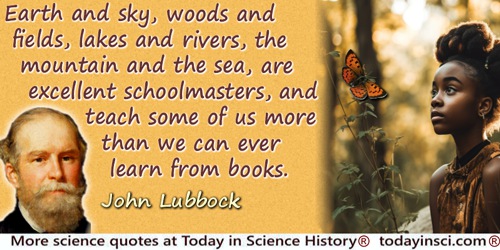
Earth and sky, woods and fields, lakes and rivers, the mountain and the sea, are excellent schoolmasters, and teach some of us more than we can ever learn from books.
The Use of Life (1895), 70 or (2005), 66.
Egypt has been called the Gift of the Nile. Once every year the river overflows its banks, depositing a layer of rich alluvial soil on the parched ground. Then it recedes and soon the whole countryside, as far as the eye can reach, is covered with Egyptologists.
In 'Cheops, or Khufu', The Decline and Fall of Practically Everybody (1950), 7.
Eratosthenes declares that it is no longer necessary to inquire as to the cause of the overflow of the Nile, since we know definitely that men have come to the sources of the Nile and have observed the rains there.
Proclus on Plato Timaeus, Vol. 1, 121.8-11 (Diehl). Quoted in Morris R. Cohen and I. E. Drabkin, A Sourcebook in Greek Science (1948), 383.
Etna presents us not merely with an image of the power of subterranean heat, but a record also of the vast period of time during which that power has been exerted. A majestic mountain has been produced by volcanic action, yet the time of which the volcanic forms the register, however vast, is found by the geologist to be of inconsiderable amount, even in the modern annals of the earth’s history. In like manner, the Falls of Niagara teach us not merely to appreciate the power of moving water, but furnish us at the same time with data for estimating the enormous lapse of ages during which that force has operated. A deep and long ravine has been excavated, and the river has required ages to accomplish the task, yet the same region affords evidence that the sum of these ages is as nothing, and as the work of yesterday, when compared to the antecedent periods, of which there are monuments in the same district.
Travels in North America (1845), Vol. 1, 28-9.
Every river appears to consist of a main trunk, fed from a variety of branches, each running in a valley proportional to its size, and all of them together forming a system of vallies, communicating with one another, and having such a nice adjustment of their declivities that none of them join the principal valley on too high or too low a level; a circumstance which would be infinitely improbable if each of these vallies were not the work of the stream that flows in it.
Illustrations of the Huttonian Theory of the Earth (1802), 102.
Felling a tree was possibly the original deed of appropriation of the natural earth by early mankind in Europe. Thousands of years ago,… man lifted a heavy flint tool and struck at the base of a tree. He may have wanted the tree for shelter and fuel, or possibly to make a bridge over a river or a path through a bog…. [E]ventually the tree crashed to the floor, and the first act in the slow possession of the land by its people was complete.
In The Man Who Made Things Out of Trees: The Ash in Human Culture and History (2015), Chap. 1.
![Christiaan Barnard quote: For a dying man it is not a difficult decision [to agree to become the world’s first heart transplant]](https://todayinsci.com/B/Barnard_Christiaan/BarnardChristiaan-Decision500x250px.jpg)
For a dying man it is not a difficult decision [to agree to become the world's first heart transplant] … because he knows he is at the end. If a lion chases you to the bank of a river filled with crocodiles, you will leap into the water convinced you have a chance to swim to the other side. But you would not accept such odds if there were no lion.
In Janie B. Butts and Karen Rich, Nursing Ethics (2005), 59.
For all at last return to the sea—to Oceanus, the ocean river, like the ever-flowing stream of time, the beginning of the end.
…...
For many of us, water simply flows from a faucet, and we think little about it beyond this point of contact. We have lost a sense of respect for the wild river, for the complex workings of a wetland, for the intricate web of life that water supports.
Last Oasis: Facing Water Scarcity (1997), 184.
For nature is a perpetuall circulatory worker, generating fluids out of solids, and solids out of fluids, fixed things out of volatile, & volatile out of fixed, subtile out of gross, & gross out of subtile, Some things to ascend & make the upper terrestriall juices, Rivers and the Atmosphere; & by consequence others to descend for a Requitall to the former. And as the Earth, so perhaps may the Sun imbibe this spirit copiously to conserve his Shineing, & keep the Planets from recedeing further from him. And they that will, may also suppose, that this Spirit affords or carryes with it thither the solary fewell & materiall Principle of Light; And that the vast aethereall Spaces between us, & the stars are for a sufficient repository for this food of the Sunn and Planets.
Letter to Oldenburg (7 Dec 1675). In H. W. Turnbull (ed.), The Correspondence of Isaac Newton, 1661-1675 (1959), Vol. 1, 366.
For the time of making Observations none can ever be amiss; there being no season, nor indeed hardly any place where in some Natural Thing or other does not present it self worthy of Remark: yea there are some things that require Observation all the Year round, as Springs, Rivers, &c. Nor is there any Season amiss for the gathering Natural Things. Bodies of one kind or other presenting themselves at all times, and in Winter as well as Summer.
In Brief Instructions for Making Observations in all Parts of the World (1696), 10-11.
Fractal geometry will make you see everything differently. There is a danger in reading further. You risk the loss of your childhood vision of clouds, forests, flowers, galaxies, leaves, feathers, rocks, mountains, torrents of water, carpet, bricks, and much else besides. Never again will your interpretation of these things be quite the same.
Fractals Everywhere (2000), 1.
Geographical concepts of the Nubians … differ from our own…. Amongst other things,… the Nubians refer to the … country between the lower course of two rivers that flow together … always … as an island.
In August Petermann, Petermann’s Geographische Mittheilungen (1871), 135. As quoted and cited in Kathrin Fritsch, '"You Have Everything Confused And Mixed Up…!" Georg Schweinfurth, Knowledge And Cartography Of Africa In The 19th Century', History in Africa (2009), 36, 91.
He scarce had ceased when the superior fiend
Was moving toward the shore; his ponderous shield
Ethereal temper, massy, large and round,
Behind him cast; the broad circumference
Hung on his shoulders like the moon, whose orb
Through optic glass the Tuscan artist views
At evening from the top of Fésolè,
Or in Valdarno, to descry new lands,
Rivers or mountains in her spotty globe.
Was moving toward the shore; his ponderous shield
Ethereal temper, massy, large and round,
Behind him cast; the broad circumference
Hung on his shoulders like the moon, whose orb
Through optic glass the Tuscan artist views
At evening from the top of Fésolè,
Or in Valdarno, to descry new lands,
Rivers or mountains in her spotty globe.
Paradise Lost, Books I and II (1667), edited by Anna Baldwin (1998), lines 283-91, p. 9.
Heraclitus somewhere says that all things are in process and nothing stays still, and likening existing things to the stream of a river he says that you would not step twice into the same river.
Plato, Cratylus 402A. In G. S. Kirk, J. E. Raven, and M. Schofield (eds.), The Presocratic Philosophers: A Critical History with a Selection of Texts (1983),195.
Horace Mann vividly pictures the power of education in his statement about the savage and transportation. Modifying his statement, it can be said: The savage can fasten only a dozen pounds on his back and swim the river. When he is educated enough to make an axe, fell a tree, and build a raft, he can carry many times a dozen pounds. As soon as he learns to rip logs into boards and build a boat, he multiplies his power a hundredfold; and when to this he adds mathematics, chemistry, physics, and other modern sciences he can produce the monster steel leviathans that defy wind, storm, and distance, and bear to the uttermost parts of the earth burdens a millionfold greater than the uneducated savage could carry across the narrow river.
In 'The Money Value of Education', Department of the Interior Bureau of Education Bulletin (1917), No. 22, 11.
I chatter over stony ways,
In little sharps and trebles,
I bubble into eddying bays,
I babble on the pebbles.…
And out again I curve and flow
To join the brimming river;
For men may come and men may go,
But I go on forever.
In little sharps and trebles,
I bubble into eddying bays,
I babble on the pebbles.…
And out again I curve and flow
To join the brimming river;
For men may come and men may go,
But I go on forever.
From 'Song of the Brook' (1842), collected in The Poetical Works of Alfred Tennyson (1873), 142.
I did enjoy the [CCNY geology] field trips. We went upstate and clambered over formations of synclines and anticlines. We had to diagram them, and figure out their mirror images. If you had an anticline here, you should be able to predict a complementing syncline bulging out somewhere else. Very satisfying when I got it right. Geology allowed me to display my brilliance to my non-college friends. “You know, the Hudson really isn’t a river.” “What are you talking about? … Everybody knows the Hudson River’s a river.” I would explain that the Hudson was a “drowned” river, up to about Poughkeepsie. The Ice Age had depressed the riverbed to a depth that allowed the Atlantic Ocean to flood inland. Consequently, the lower Hudson was really a saltwater estuary.
In My American Journey (1996), 30-31. [Powell graduated with a B.S. degree in Geology.]
I found the invention was applicable to painting, and would also contribute to facilitate the study of geography: for I have applied it to some maps, the rivers of which I represented in silver, and in the cities in gold. The rivers appearing, as it were, in silver streams, have a most pleasing effect on the sight, and relieve the eye of that painful search for the course, and origin, of rivers, the minutest branches of which can be splendidly represented this way.
Description of an outcome of her experiments originally investigating 'the possibility of making cloths of gold, silver and other metals by chemical processes.'
Description of an outcome of her experiments originally investigating 'the possibility of making cloths of gold, silver and other metals by chemical processes.'
Preface to An Essay on Combustion with a View to a New Art of Dyeing and Painting (1794), iii-iv. In Marilyn Bailey
Ogilvie and Joy Dorothy
Harvey, The Biographical Dictionary of Women in Science (2000), 478.
I give waters in the wilderness and rivers in the desert, to give drink to my people.
— Bible
Isaiah 43:20
I often get letters … from people who say … I never give credit to the almighty power that created nature. … I reply … “Well, it’s funny that the people, when they say that this is evidence of the Almighty, always quote beautiful things … orchids and hummingbirds and butterflies and roses.” But I always have to think too of a little boy sitting on the banks of a river in west Africa who has a worm boring through his eyeball, turning him blind before he’s five years old. And I … say, “Well, presumably the God you speak about created the worm as well,” and now, I find that baffling to credit a merciful God with that action. And therefore it seems to me safer to show things that I know to be truth, truthful and factual, and allow people to make up their own minds about the moralities of this thing, or indeed the theology of this thing.
From BBC TV, Life on Air (2002).
I used to sit in class and listen to the terms come floating down the room like paper airplanes. Geology was called a descriptive science, and with its pitted outwash plains and drowned rivers, its hanging tributaries and starved coastlines, it was nothing if not descriptive. It was a fountain of metaphor…
In Basin and Range (1981), 25.
I wandered away on a glorious botanical and geological excursion, which has lasted nearly fifty years and is not yet completed, always happy and free, poor and rich, without thought of a diploma or of making a name, urged on and on through endless, inspiring Godful beauty.
[Shortly after leaving university in 1863, without completing a degree, at age 25, he began his first botanical foot journey along the Wisconsin River to the Mississippi.]
[Shortly after leaving university in 1863, without completing a degree, at age 25, he began his first botanical foot journey along the Wisconsin River to the Mississippi.]
The Story of My Boyhood and Youth (1913), 286.
I've known rivers:
I've known rivers ancient as the world and older than the flow of human blood in human veins.
My soul has grown deep like the rivers.
I've known rivers ancient as the world and older than the flow of human blood in human veins.
My soul has grown deep like the rivers.
The Negro Speaks of Rivers (1926).
If a savage will learn how to swim, he can fasten a dozen pounds’ weight to his back, and transport it across a narrow river…. If he will invent an axe … by which to cut down a tree, he can use the tree for a float, and one of its limbs for a paddle, and can thus transport many times the former weight many times the former distance.
In 'Report For 1848', Annual Reports on Education (1872), 675.
In a figurative sense, civilization marches up and down the valley-section: all the great historic cultures … have thriven through the movement of men and institutions and inventions and goods along the natural highway of a great river.
In Technics and Civilization (2010), 60-61. The ellipsis replaces: “with the partial exception of those secluded maritime cultures in which the seas sometimes served instead of a river.” The quote ends with examples of such rivers: “the Yellow River, the Tigris, the Nile, the Euphrates, the Rhine, the Danube, the Thames.” Note that a “valley section” diagrams a longitudinal survey of local characteristics changing along the river from its source in the hills and stretching to the sea (as coined by Patrick Geddes).
In rivers, the water that you touch is the last of what has passed and the first of that which comes; so with present time.
…...
In the space of one hundred and seventy-six years the Lower Mississippi has shortened itself two hundred and forty-two miles. That is an average of a trifle over one mile and a third per year. Therefore, any calm person, who is not blind or idiotic, can see that in the old Oolitic Silurian Period, must a million years ago next November, the Lower Mississippi River was upward of one million three hundred thousand miles long, and stuck out over the Gulf of Mexico like a fishing-rod. And by the same token any person can see that seven hundred and forty-two years from now the Lower Mississippi will be only a mile and three-quarters long, and Cairo and New Orleans will have their streets joined together, and be plodding comfortably along under a single mayor and a mutual board of aldermen. There is something fascinating about science. One gets such wholesale returns of conjecture out of such a trifling investment of fact.
Life on the Mississippi (1883, 2000), 173.
Is not disease the rule of existence? There is not a lily pad floating on the river but has been riddled by insects. Almost every shrub and tree has its gall, oftentimes esteemed its chief ornament and hardly to be distinguished from the fruit. If misery loves company, misery has company enough. Now, at midsummer, find me a perfect leaf or fruit.
In The Writings of Henry David Thoreau (1893), Vol. 9, 458.
It is a strange feeling which comes over one as he stands in the centre of the tunnel, and knows that a mighty river is rolling on over his head, and that great ships with their thousands of tons burthen, sail over him. ... There is no single work of Art in London (with the exception of St. Paul's Cathedral) which excites so much curiosity and admiration among foreigners as the Tunnel. Great buildings are common to all parts of Europe, but the world has not such another Tunnel as this. There is something grand in the idea of walking under a broad river—making a pathway dry and secure beneath ships and navies!
[About visiting Brunel's Thames Tunnel, the first in the world under a navigable waterway.]
[About visiting Brunel's Thames Tunnel, the first in the world under a navigable waterway.]
What I Saw in London: or, Men and Things in the Great Metropolis (1853), 168-169.
It is curious to reflect on how history repeats itself the world over. Why, I remember the same thing was done when I was a boy on the Mississippi River. There was a proposition in a township there to discontinue public schools because they were too expensive. An old farmer spoke up and said if they stopped the schools they would not save anything, because every time a school was closed a jail had to be built.
It's like feeding a dog on his own tail. He'll never get fat. I believe it is better to support schools than jails.
It's like feeding a dog on his own tail. He'll never get fat. I believe it is better to support schools than jails.
Address at a meeting of the Berkeley Lyceum, New York (23 Nov 1900). Mark Twain's Speeches (2006), 69-70.
It is indeed an Opinion strangely prevailing amongst Men, that Houses, Mountains, Rivers, and in a word all sensible Objects have an Existence Natural or Real, distinct from their being perceived by the Understanding. But with how great an Assurance and Acquiescence soever this Principle may be entertained in the World; yet whoever shall find in his Heart to call it in Question, may, if I mistake not, perceive it to involve a manifest Contradiction. For what are the forementioned Objects but the things we perceive by Sense, and what do we perceive besides our own Ideas or Sensations; and is it not plainly repugnant that anyone of these or any Combination of them should exist unperceived?
A Treatise Concerning the Principles of Human Knowledge [first published 1710], (1734),38.
It is not necessary to probe into the nature of things, as was done by those whom the Greeks call physici; nor need we be in alarm lest the Christian should be ignorant of the force and number of the elements—the motion, and order, and eclipses of the heavenly bodies; the form of the heavens; the species and the natures of animals, plants, stones, fountains, rivers, mountains; about chronology and distances; the signs of coming storms; and a thousand other things which those philosophers either have found out, or think they have found out. … It is enough for the Christian to believe that the only cause of all created things, whether heavenly or earthly … is the goodness of the Creator, the one true God.
In Marcus Dods (ed.), J.F. Shaw (trans.), The Enchiridion of Augustine, Chap. 9, collected in The Works of Aurelius Augustine, Bishop of Hippo: A new translation (1873), Vol. 9, 180-181. The physici are natural philosophers.
It seems that the rivers know the theory. It only remains to convince the engineers of the validity of this analysis.
Epigraph, without citation, in Péter Érdi, Complexity Explained (2007), 339. In French, “Il semble que les rivières connaissent déjà la théorie Il ne reste qu'à convaincre les ingénieurs de la validité de cette analyse.”
Looking back across the long cycles of change through which the land has been shaped into its present form, let us realise that these geographical revolutions are not events wholly of the dim past, but that they are still in progress. So slow and measured has been their march, that even from the earliest times of human history they seem hardly to have advanced at all. But none the less are they surely and steadily transpiring around us. In the fall of rain and the flow of rivers, in the bubble of springs and the silence of frost, in the quiet creep of glaciers and the tumultuous rush of ocean waves, in the tremor of the earthquake and the outburst of the volcano, we may recognise the same play of terrestrial forces by which the framework of the continents has been step by step evolved.
Lecture at the Evening Meeting, Royal Geographical Society (24 Mar 1879), 'Discussion on Geographical Evolution', in Proceedings of the Royal Geographical Society and Monthly Record (1879), New Monthly Series, 1, 443.
Man is occupied and has been persistently occupied since his separate evolution, with three kinds of struggle: first with the massive unintelligent forces of nature, heat and cold, winds, rivers, matter and energy; secondly, with the things closer to him, animals and plants, his own body, its health and disease; and lastly, with his desires and fears, his imaginations and stupidities.
In The World, the Flesh and the Devil (1929).
Many consider that the conflict of religion and science is a temporary phase, and that in due course the two mighty rivers of human understanding will merge into an even mightier Amazon of comprehension. I take the opposite view, that reconciliation is impossible. I consider that Science is mightier than the Word, and that the river of religion will (or, at least, should) atrophy and die.
In 'Religion - The Antithesis to Science', Chemistry & Industry (Feb 1997).
Nature … is, as it were, a continual circulation. Water is rais'd in Vapour into the Air by one Quality and precipitated down in drops by another, the Rivers run into the Sea, and the Sea again supplies them.
In 'A Discourse of Earthquakes', Lectures and Discourses of Earthquakes (1668). In The Posthumous Works of Robert Hooke, containing his Cutlerian Lectures and other Discourses read at the Meetings of the Illustrious Royal Society (1705), 312.
Nature uncovers the inner secrets of nature in two ways: one by the force of bodies operating outside it; the other by the very movements of its innards. The external actions are strong winds, rains, river currents, sea waves, ice, forest fires, floods; there is only one internal force—earthquake.
About the Layers of the Earth and other Works on Geology (1757), trans. A. P. Lapov (1949), 45.
Nature will be reported. Everything in nature is engaged in writing its own history; the planet and the pebble are attended by their shadows, the rolling rock leaves its furrows on the mountain-side, the river its channel in the soil; the animal, its bones in the stratum; the fern and leaf, their modest epitaph in the coal.
In The Prose Works of Ralph Waldo Emerson (1847, 1872), Vol. 2, 141.
Nature. As the word is now commonly used it excludes nature's most interesting productions—the works of man. Nature is usually taken to mean mountains, rivers, clouds and undomesticated animals and plants. I am not indifferent to this half of nature, but it interests me much less than the other half.
Samuel Butler, Henry Festing Jones (ed.), The Note-Books of Samuel Butler (1917), 220.
No one tests the depth of a river with both feet.
Ashanti proverb, on web page 'African Proverb Wisdom', citing a book by Charlotte & Wolf Leslau.
Now the American eagle is verging on extinction. Even the polar bear on its ice floes has become easy game for flying sportsmen. A peninsula named Udjung Kulon holds the last two or three dozen Javan rhinoceroses. The last known herd of Arabian oryx has been machine-gunned by a sheik. Blue whales have nearly been harpooned out of their oceans. Pollution ruins bays and rivers. Refuse litters beaches. Dam projects threaten Colorado canyons, Hudson valleys, every place of natural beauty that can be a reservoir for power. Obviously the scientific progress so alluring to me is destroying qualities of greater worth.
In 'The Wisdom of Wilderness', Life (22 Dec 1967), 63, No. 25, 8-9. (Note: the Arabian oryx is no longer listed as extinct.)
Of the two eminent engineers in the recent construction of railways in England, Mr. Brunel went straight from terminus to terminus, through mountains, over streams, crossing highways, cutting ducal estates in two, and shooting through this man’s cellar, and that man’s attic window, and so arriving at his end, at great pleasure to geometers, but with cost to his company. Mr. Stephenson, on the contrary, believing that the river knows the way, followed his valley, as implicitly as our Western Railroad follows the Westfield River, and turned out to be the safest and cheapest engineer.
In 'Wealth', Power, Wealth, Illusions (1860, 1875), 80.
On the basis of the results recorded in this review, it can be claimed that the average sand grain has taken many hundreds of millions of years to lose 10 per cent. of its weight by abrasion and become subangular. It is a platitude to point to the slowness of geological processes. But much depends on the way things are put. For it can also be said that a sand grain travelling on the bottom of a river loses 10 million molecules each time it rolls over on its side and that representation impresses us with the high rate of this loss. The properties of quartz have led to the concentration of its grains on the continents, where they could now form a layer averaging several hundred metres thick. But to my mind the most astounding numerical estimate that follows from the present evaluations, is that during each and every second of the incredibly long geological past the number of quartz grains on earth has increased by 1,000 million.
'Sand-its Origin, Transportation, Abrasion and Accumulation', The Geological Society of South Africa (1959), Annexure to Volume 62, 31.
Once established, an original river advances through its long life, manifesting certain peculiarities of youth, maturity and old age, by which its successive stages of growth may be recognized without much difficulty.
'The Rivers and Valleys of Pennsylvania', The National Geographic Magazine, 1889, 1, 203.
Once the hatch was opened, I turned the lock handle and bright rays of sunlight burst through it. I opened the hatch and dust from the station flew in like little sparklets, looking like tiny snowflakes on a frosty day. Space, like a giant vacuum cleaner, began to suck everything out. Flying out together with the dust were some little washers and nuts that dad got stuck somewhere; a pencil flew by.
My first impression when I opened the hatch was of a huge Earth and of the sense of unreality concerning everything that was going on. Space is very beautiful. There was the dark velvet of the sky, the blue halo of the Earth and fast-moving lakes, rivers, fields and clouds clusters. It was dead silence all around, nothing whatever to indicate the velocity of the flight… no wind whistling in your ears, no pressure on you. The panorama was very serene and majestic.
My first impression when I opened the hatch was of a huge Earth and of the sense of unreality concerning everything that was going on. Space is very beautiful. There was the dark velvet of the sky, the blue halo of the Earth and fast-moving lakes, rivers, fields and clouds clusters. It was dead silence all around, nothing whatever to indicate the velocity of the flight… no wind whistling in your ears, no pressure on you. The panorama was very serene and majestic.
…...
One must be wary in attributing scientific discovery wholly to any one person. Almost every discovery has a long and precarious history. Someone finds a bit here, another a bit there. A third step succeeds later and thus onward till a genius pieces the bits together and makes the decisive contribution. Science, like the Mississippi, begins in a tiny rivulet in the distant forest. Gradually other streams swell its volume. And the roaring river that bursts the dikes is formed from countless sources.
In 'The Usefulness of Useless Knowledge', Harper’s (Jun/Nov 1939), No. 179, 549
One summer night, out on a flat headland, all but surrounded by the waters of the bay, the horizons were remote and distant rims on the edge of space. Millions of stars blazed in darkness, and on the far shore a few lights burned in cottages. Otherwise there was no reminder of human life. My companion and I were alone with the stars: the misty river of the Milky Way flowing across the sky, the patterns of the constellations standing out bright and clear, a blazing planet low on the horizon. It occurred to me that if this were a sight that could be seen only once in a century, this little headland would be thronged with spectators. But it can be seen many scores of nights in any year, and so the lights burned in the cottages and the inhabitants probably gave not a thought to the beauty overhead; and because they could see it almost any night, perhaps they never will.
In The Sense of Wonder (1956), as condensed in Reader’s Digest (1986), 129, 174.
One would like to see mankind spend the balance of the century in a total effort to clean up and groom the surface of the globe – wipe out the jungles, turn deserts and swamps into arable land, terrace barren mountains, regulate rivers, eradicate all pests, control the weather, and make the whole land mass a fit habitation for Man. The globe should be our and not nature’s home, and we no longer nature’s guests.
In The Temper of Our Time (1967), 94.
Only after the last tree has been cut down. Only after the last river has been poisoned. Only after the last fish has been caught. Only then will you find that money cannot be eaten.
— Cree
Cree Indian prophecy. Quoted by the United Nations Director for the Environment at a conference in Geneva. Recalled by a writer in Ann: Zoologische wetenschappen Issues 275-276 (1984), 16.
Painting the desert, sun-setting the tone
Starving backstage, morning-stars are jaded
The moonshine murmur still shivers alone
Curved slice of sliver, shear breath shadows stone
Suspending twilight shiny and shaded
Painting the desert, sun-setting the tone
Carving solace into silver in June
On horizons’ glow from forgotten gold
The moonshine’s’ shilling delivers alone
Gleaming duels of knights, pierce deathly silence
Steel tines of starlight, clashing swords they hold
Painting the desert, sun-setting the tone
Dimples aware, sparkle sand on the dune
Winking at comets, after tails are told
The moon-sand whispers, sift rivers alone
Sharpness they hone, filing skills onto stone
Starlight dazzles, its own space created
Painting the desert, sun-setting the tone
From owls’ talon, moonlight shimmers alone
Starving backstage, morning-stars are jaded
The moonshine murmur still shivers alone
Curved slice of sliver, shear breath shadows stone
Suspending twilight shiny and shaded
Painting the desert, sun-setting the tone
Carving solace into silver in June
On horizons’ glow from forgotten gold
The moonshine’s’ shilling delivers alone
Gleaming duels of knights, pierce deathly silence
Steel tines of starlight, clashing swords they hold
Painting the desert, sun-setting the tone
Dimples aware, sparkle sand on the dune
Winking at comets, after tails are told
The moon-sand whispers, sift rivers alone
Sharpness they hone, filing skills onto stone
Starlight dazzles, its own space created
Painting the desert, sun-setting the tone
From owls’ talon, moonlight shimmers alone
…...
Palaeontology is the Aladdin’s lamp of the most deserted and lifeless regions of the earth; it touches the rocks and there spring forth in orderly succession the monarchs of the past and the ancient river streams and savannahs wherein they flourished. The rocks usually hide their story in the most difficult and inaccessible places.
In On the Trail of Ancient Man (1926), x.
People travel to wonder at the height of mountains, at the huge waves of the sea, at the long courses of rivers, at the vast compass of the ocean, at the circular motion of the stars; and they pass by themselves without wondering.
In Circulations: Webster's Quotations, Facts and Phrases, 1.
Perhaps the most impressive illustration of all is to suppose that you could label the molecules in a tumbler of water. ... threw it anywhere you please on the earth, and went away from the earth for a few million years while all the water on the earth, the oceans, rivers, lakes and clouds had had time to mix up perfectly. Now supposing that perfect mixing had taken place, you come back to earth and draw a similar tumbler of water from the nearest tap, how many of those marked molecules would you expect to find in it? Well, the answer is 2000. There are 2000 times more molecules in a tumbler of water than there are tumblers of water in the whole earth.
In Lecture (1936) on 'Forty Years of Atomic Theory', collected in Needham and Pagel (eds.) in Background to Modern Science: Ten Lectures at Cambridge Arranged by the History of Science Committee, (1938), 99-100.
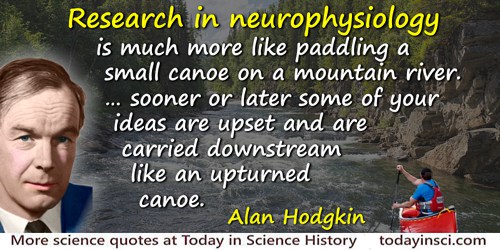
Research in neurophysiology is much more like paddling a small canoe on a mountain river. The river which is fed by many distant springs carries you along all right though often in a peculiar direction. You have to paddle quite hard to keep afloat. And sooner or later some of your ideas are upset and are carried downstream like an upturned canoe.
From Speech (10 Dec 1963) at the Nobel Banquet in Stockholm, Sweden. Collected inGöran Liljestrand (ed.), Les Prix Nobel en 1963, (1964).
Rivers are roads which move, and which carry us whither we desire to go.
In Pensées. As translated by W.F. Trotter in Blaise Pascal: Thoughts, Letters, and Minor Works (1910), 13.
Rivers, ponds, lakes and streams—they all have different names, but they all contain water. Just as religions do—they all contain truths.
Quoted in Kim Lim (ed.), 1,001 Pearls of Spiritual Wisdom: Words to Enrich, Inspire, and Guide Your Life (2014), 14
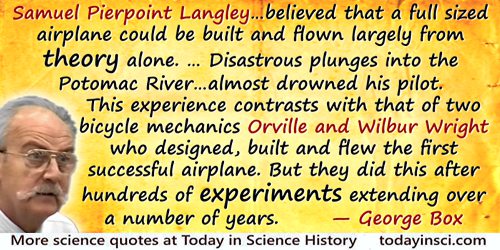
Samuel Pierpoint Langley, at that time regarded as one of the most distinguished scientists in the United States … evidently believed that a full sized airplane could be built and flown largely from theory alone. This resulted in two successive disastrous plunges into the Potomac River, the second of which almost drowned his pilot. This experience contrasts with that of two bicycle mechanics Orville and Wilbur Wright who designed, built and flew the first successful airplane. But they did this after hundreds of experiments extending over a number of years.
In article Total Quality: Its Origins and its Future (1995), published at the Center for Quality and Productivity Improvement.
Science should leave off making pronouncements: the river of knowledge has too often turned back on itself.
The Mysterious Universe (1930, 1976), 188.
Science—we have loved her well, and followed her diligently, what will she do? I fear she is too much in the pay of the counting-houses, and the drill-serjent, that she is too busy, and will for the present do nothing. Yet there are matters which I should have thought easy for her; say, for example, teaching Manchester how to consume its town smoke, or Leeds how to get rid of its superfluous black dye without turning it into the river, which would be as much worth her attention as the production of the heaviest black silks, or the biggest of useless guns.
In The Lesser Arts (1878).
See with what force yon river’s crystal stream
Resists the weight of many a massy beam.
To sink the wood the more we vainly toil,
The higher it rebounds, with swift recoil.
Yet that the beam would of itself ascend
No man will rashly venture to contend.
Thus too the flame has weight, though highly rare,
Nor mounts but when compelled by heavier air.
Resists the weight of many a massy beam.
To sink the wood the more we vainly toil,
The higher it rebounds, with swift recoil.
Yet that the beam would of itself ascend
No man will rashly venture to contend.
Thus too the flame has weight, though highly rare,
Nor mounts but when compelled by heavier air.
De Rerum Natura, second book, as quoted in translation in Thomas Young, A Course of Lectures on Natural Philosophy and the Mechanical Arts (1845), 12.
So it is clear, since there will be no end to time and the world is eternal, that neither the Tanais nor the Nile has always been flowing, but that the region whence they flow was once dry; for their action has an end, but time does not. And this will be equally true of all other rivers. But if rivers come into existence and perish and the same parts of the earth were not always moist, the sea must needs change correspondingly. And if the sea is always advancing in one place and receding in another it is clear that the same parts of the whole earth are not always either sea or land, but that all this changes in the course of time.
Meteorology, 353a, 14-24. In Jonathan Barnes (ed.), The Complete Works of Aristotle (1984), Vol. I, 575.
Some paintings become famous because, being durable, they are viewed by successive generations, in each of which are likely to be found a few appreciative eyes.
I know a painting so evanescent that it is seldom viewed at all, except by some wandering deer. It is a river who wields the brush, and it is the same river who, before I can bring my friends to view his work, erases it forever from human view. After that it exists only in my mind's eye.
Like other artists, my river is temperamental; there is no predicting when the mood to paint will come upon him, or how long it will last. But in midsummer, when the great white fleets cruise the sky for day after flawless day, it is worth strolling down to the sandbars just to see whether he has been at work.
In 'The Green Pasture', A Sand County Almanac, and Sketches Here and There (1949, 1987), 51.
That alone is worthy to be called Natural History, which investigates and records the condition of living things, of things in a state of nature; if animals, of living animals:— which tells of their 'sayings and doings,' their varied notes and utterances, songs and cries; their actions, in ease and under the pressure of circumstances; their affections and passions, towards their young, towards each other, towards other animals, towards man: their various arts and devices, to protect their progeny, to procure food, to escape from their enemies, to defend themselves from attacks; their ingenious resources for concealment; their stratagems to overcome their victims; their modes of bringing forth, of feeding, and of training, their offspring; the relations of their structure to their wants and habits; the countries in which they dwell; their connexion with the intimate world around them, mountain or plain, forest or field, barren heath or bushy dell, open savanna or wild hidden glen, river, lake, or sea:— this would be indeed zoology, i.e. the science of living creatures.
A Naturalist's Sojourn in Jamaica (1851), vi-vii.

The ancestors of the higher animals must be regarded as one-celled beings, similar to the Amœbæ which at the present day occur in our rivers, pools, and lakes. The incontrovertible fact that each human individual develops from an egg, which, in common with those of all animals, is a simple cell, most clearly proves that the most remote ancestors of man were primordial animals of this sort, of a form equivalent to a simple cell. When, therefore, the theory of the animal descent of man is condemned as a “horrible, shocking, and immoral” doctrine, tho unalterable fact, which can be proved at any moment under the microscope, that the human egg is a simple cell, which is in no way different to those of other mammals, must equally be pronounced “horrible, shocking, and immoral.”
Translated from his Ueber die Entstehung und den Stammbaum des Menschengeschlechts, (1873), Vol. 2, as an epigraph to Chap. 6, The Evolution of Man, (1879), Vol 1, 120-121.
The architect does not demand things which cannot be found or made ready without great expense. For example: it is not everywhere that there is plenty of pitsand, rubble, fir, clear fir, and marble… Where there is no pitsand, we must use the kinds washed up by rivers or by the sea… and other problems we must solve in similar ways.
In De Architectura, Book 1, Chap 2, Sec. 8. As translated in Morris Hicky Morgan (trans.), Vitruvius: The Ten Books on Architecture (1914), 16.
The cowman who cleans his range of wolves does not realize that he is taking over the wolf’s job of trimming the herd to fit the range. He has not learned to think like a mountain. Hence we have dustbowls, and rivers washing the future into the sea.
In 'Thinking Like a Mountain', A Sand County Almanac, and Sketches Here and There (1949, 1987), 132.
The earth holds a silver treasure, cupped between ocean bed and tenting sky. Forever the heavens spend it, in the showers that refresh our temperate lands, the torrents that sluice the tropics. Every suckling root absorbs it, the very soil drains it down; the rivers run unceasing to the sea, the mountains yield it endlessly… Yet none is lost; in vast convection our water is returned, from soil to sky, and sky to soil, and back gain, to fall as pure as blessing. There was never less; there could never be more. A mighty mercy on which life depends, for all its glittering shifts, water is constant.
In A Cup of Sky (1950), 41.
The Earth is a very small stage in a vast cosmic arena. Think of the rivers of blood spilled by all those generals and emperors, so that, in glory and triumph, they could become the momentary masters of a fraction of a dot. Think of the endless cruelties visited by the inhabitants of one corner of this pixel on the scarcely distinguishable inhabitants of some other corner, how frequent their misunderstandings, how eager they are to kill one another, how fervent their hatreds.
…...
The function of Latin literature is its expression of Rome. When to England and France your imagination can add Rome in the background, you have laid firm the foundations of culture. The understanding of Rome leads back to the Mediterranean civilisation of which Rome was the last phase, and it automatically exhibits the geography of Europe, and the functions of seas and rivers and mountains and plains. The merit of this study in the education of youth is its concreteness, its inspiration to action, and the uniform greatness of persons, in their characters and their staging. Their aims were great, their virtues were great, and their vices were great. They had the saving merit of sinning with cart ropes.
In 'The Place of Classics in Education', The Aims of Education: & Other Essays (1917), 106.
The idea that our natural resources were inexhaustible still obtained, and there was as yet no real knowledge of their extent and condition. The relation of the conservation of natural resources to the problems of National welfare and National efficiency had not yet dawned on the public mind. The reclamation of arid public lands in the West was still a matter for private enterprise alone; and our magnificent river system, with its superb possibilities for public usefulness, was dealt with by the National Government not as a unit, but as a disconnected series of pork-barrel problems, whose only real interest was in their effect on the re-election or defeat of a Congressman here and there —a theory which, I regret to say, still obtains.
The Works of Theodore Roosevelt. Vol. 20: Theodore Roosevelt, An Autobiography (1926), 386.
The measure of the Moon’s distance involves no principle more abstruse than the measure of the distance of a tree on the opposite bank of a river. The principles of construction of the best Astronomical instruments are as simple and as closely referred to matters of common school-education and familiar experience, as are those of the common globes, the steam-engine, or the turning-lathe; the details are usually less complicated.
In 'Introduction' to Popular Astronomy: A Series of Lectures Delivered at Ipswich (5th ed., 1866), viii.
The mere consideration of the number of cubic feet of detritus annually removed from any tract of land by its rivers, does not produce so striking an impression upon the mind as the statement of how much the mean surface level of the district in question, would be reduced by such a removal.
In 'Changes of the Sea-Level Effected by Existing Physical Causes During Stated Periods of Time', The London, Edinburgh and Dublin Philosophical Magazine and Journal of Science (Apr 1853), 4th series, 5, 260-261. In this paper, Alfred Tylor was perhaps the first geologist to estimate the probable amount of solid matter annually brought to the ocean by rivers and other agents. He inferred that the quantity of detritus now distributed over the sea bottom every year would, at the end of 10,000 years, cause an elevation of the sea-level to the extent of at least three inches. In turn, the surface of a drainage basin would be lowered year upon year.
The most important object of Civil Engineering is to improve the means of production and of traffic in states, both for external and internal trade. It is applied in the construction and management of roads, bridges, railroads, aqueducts, canals, river navigation, docks and storehouses, for the convenience of internal intercourse and exchange; and in the construction of ports, harbours, moles, breakwaters and lighthouses; and in the navigation by artificial power for the purposes of commerce. It is applied to the protection of property where natural powers are the sources of injury, as by embankments forthe defence of tracts of country from the encroachments of the sea, or the overflowing of rivers; it also directs the means of applying streams and rivers to use, either as powers to work machines, or as supplies for the use of cities and towns, or for irrigation; as well as the means of removing noxious accumulations, as by the drainage of towns and districts to ... secure the public health.
1828
The most striking difference … from our way of expressing things is in the identification of the direction in which rivers flow: the Nubian custom is exactly the opposite of our own. The people say the Nile goes to the mountains, not: it comes from the mountains…
In August Petermann, Petermann’s Geographische Mittheilungen (1871), 135. As quoted and cited in Kathrin Fritsch, '"You Have Everything Confused And Mixed Up…!" Georg Schweinfurth, Knowledge And Cartography Of Africa In The 19th Century', History in Africa (2009), 36, 91.
The Nubians never remember the native name for a river; thus their statements are of little value to geographical criticism. Hence they never speak of the River Bah or Ibba, for example, but always say the “Penio’s river,” because this is the name of the district head whose seat is on this river. In other places they are quite helpless…. This is a dreadful fact. Were the well-traveled and well-informed Arab leaders able to remember the names of the rivers, it would be wonderfully easy to draw a map of the entire country.
In August Petermann, Petermann’s Geographische Mittheilungen (1871), 137. As quoted and cited in Kathrin Fritsch, '"You Have Everything Confused And Mixed Up…!" Georg Schweinfurth, Knowledge And Cartography Of Africa In The 19th Century', History in Africa (2009), 36, 92.
The proof given by Wright, that non-adaptive differentiation will occur in small populations owing to “drift,” or the chance fixation of some new mutation or recombination, is one of the most important results of mathematical analysis applied to the facts of neo-mendelism. It gives accident as well as adaptation a place in evolution, and at one stroke explains many facts which puzzled earlier selectionists, notably the much greater degree of divergence shown by island than mainland forms, by forms in isolated lakes than in continuous river-systems.
Evolution: The Modern Synthesis (1942), 199-200.
The quality of Mersey is not strained. A century ago the river of that name, in England, afforded not less than sixty varieties of fish; now it affords none. (1876)
Description of the turbid, polluted River Mersey, Liverpool, England in the nineteenth century. In Daily Alta California (21 Aug 1876), 28, No. 9633, 2. The expression “The quality of Mersey is not strained” is seen repeated in various sources through the years to the present. The pun refers a line in Shakespeare's Merchant of Venice that “The quality of mercy is not strained.” An earlier mention appears in Harper's New Monthly Magazine (Dec 1870), 42, No. 247, 158.
The river Mersey, a mile-wide estuary not unlike the Hudson, perhaps in my childhood even more filthy. We used to say “the quality of Mersey is not strained.”
In Kenneth Ewart Boulding and Richard P. Beilock (Ed.), Illustrating Economics: Beasts, Ballads and Aphorisms (1980, 2009), 3.
The ruins of Machu Picchu are perched on top of a steep ridge in the most inaccessible corner of the most inaccessible section of the central Andes. No part of the highlands of Peru has been better defended by natural bulwarks—a stupendous canyon whose rim is more than a mile above the river, whose rock is granite, and whose precipices are frequently a thousand feet sheer.
As quoted in Mark Collins Jenkins (ed.), National Geographic 125 Years: Legendary Photographs, Adventures, and Discoveries (2012), 70, citing Machu Picchu: A Citadel of the Incas (1930).
The ruthless destruction of their forests by the Chinese is one of the reasons why famine and plague today hold this nation in their sinister grasp. Denudation, wherever practiced, leaves naked soil; floods and erosion follow, and when the soil is gone men must also go—and the process does not take long. The great plains of Eastern China were centuries ago transformed from forest into agricultural land. The mountain plateau of Central China have also within a few hundred years been utterly devastated of tree growth, and no attempt made at either natural or artificial reforestation. As a result, the water rushes off the naked slopes in veritable floods, gullying away the mountain sides, causing rivers to run muddy with yellow soil, and carrying enormous masses of fertile earth to the sea. Water courses have also changed; rivers become uncontrollable, and the water level of the country is lowered perceptibly. In consequence, the unfortunate people see their crops wither and die for lack of water when it is most needed.
Statement (11 May 1921) by United States Department of Agriculture (USDA) concerning the famine in China in seven out of every ten years. Reported in 'Blames Deforestation: Department of Agriculture Ascribes Chinese Famine to it', New York Times (12 May 1921), 12.
The sciences are like a beautiful river, of which the course is easy to follow, when it has acquired a certain regularity; but if one wants to go back to the source, one will find it nowhere, because it is everywhere; it is spread so much [as to be] over all the surface of the earth; it is the same if one wants to go back to the origin of the sciences, one will find only obscurity, vague ideas, vicious circles; and one loses oneself in the primitive ideas.
In Essai sur les machines en général (1783), conclusion, as translated in Ivor Grattan-Guinness, Convolutions in French Mathematics, 1800-1840 (1990), Vol. 1, 32.
The sea is the source of water and the source of wind; for neither would blasts of wind arise in the clouds and blow out from within them, except for the great sea, nor would the streams of rivers nor the rain-water in the sky exist but for the sea ; but the great sea is the begetter of clouds and winds and rivers.
Quoted in Arthur Fairbanks (ed. And trans.), The First Philosophers of Greece (1898), 69, fragment 11.
The sediments of the past are many miles in collective thickness: yet the feeble silt of the rivers built them all from base to summit.
Lecture at the Royal Dublin Society, 6 Feb 1914. Published in Science Progress, Vol. 9, 37. Republished in The Birth-Time of the World and Other Scientific Essays, (1915), 4.
The sun's rays are the ultimate source of almost every motion which takes place on the surface of the earth. By their heat are produced all winds, and those disturbances in the electric equilibrium of the atmosphere which give rise to the phenomena of terrestrial magnetism. By their vivifying action vegetables are elaborated from inorganic matter, and become in their turn the support of animals and of man, and the sources of those great deposits of dynamical efficiency which are laid up for human use in our coal strata. By them the waters of the sea are made to circulate in vapor through the air, and irrigate the land, producing springs and rivers. By them are produced all disturbances of the chemical equilibrium of the elements of nature which, by a series of compositions and decompositions, give rise to new products, and originate a transfer of materials. Even the slow degradation of the solid constituents of the surface, in which its chief geological changes consist, and their diffusion among the waters of the ocean, are entirely due to the abrasion of the wind, rain, and tides, which latter, however, are only in part the effect of solar influence and the alternate action of the seasons.
from Outlines of Astronomy (1849), 237.
The traditional psychology talks like one who should say a river consists of nothing but pailsful, spoonsful, quartpotsful, barrelsful, and other moulded forms of water. Even were the pails and the pots all actually standing in the stream, still between them the free water would continue to flow. It is just this free water of consciousness that psychologists resolutely overlook. Every definite image in the mind is steeped and dyed in the free water that flows round it. With it goes the sense of its relations, near and remote, the dying echo of whence it came to us, the dawning sense of whither it is to lead.
'On Some Omissions of Introspective Psychology', Mind (1884), 9, 16.
The United States at this moment occupies a lamentable position as being perhaps the chief offender among civilized nations in permitting the destruction and pollution of nature. Our whole modern civilization is at fault in the matter. But we in America are probably most at fault ... We treasure pictures and sculpture. We regard Attic temples and Roman triumphal arches and Gothic cathedrals as of priceless value. But we are, as a whole, still in that low state of civilization where we do not understand that it is also vandalism wantonly to destroy or permit the destruction of what is beautiful in nature, whether it be a cliff, a forest, or a species of mammal or bird. Here in the United States we turn our rivers and streams into sewers and dumping-grounds, we pollute the air, we destroy forests and exterminate fishes, birds and mammals'not to speak of vulgarizing charming landscapes with hideous advertisements.
'Our Vanishing Wild Life', The Outlook, 25 Jan 1913. In Donald Davidson (Ed.) The Wisdom of Theodore Roosevelt (2003), 19.
The universe is one great kindergarten for man. Everything that exists has brought with it its own peculiar lesson. The mountain teaches stability and grandeur; the ocean immensity and change. Forests, lakes, and rivers, clouds and winds, stars and flowers, stupendous glaciers and crystal snowflakes—every form of animate or inanimate existence, leaves its impress upon the soul of man.
…...
The wintry clouds drop spangles on the mountains. If the thing occurred once in a century historians would chronicle and poets would sing of the event; but Nature, prodigal of beauty, rains down her hexagonal ice-stars year by year, forming layers yards in thickness. The summer sun thaws and partially consolidates the mass. Each winter's fall is covered by that of the ensuing one, and thus the snow layer of each year has to sustain an annually augmented weight. It is more and more compacted by the pressure, and ends by being converted into the ice of a true glacier, which stretches its frozen tongue far down beyond the limits of perpetual snow. The glaciers move, and through valleys they move like rivers.
The Glaciers of the Alps & Mountaineering in 1861 (1911), 247.
There is a river in the ocean. In the severest droughts it never fails, and in the mightiest floods it never overflows. Its banks and its bottom are of cold water, while its current is of warm. The Gulf of Mexico is its fountain, and its mouth is in the Arctic Sea. It is the Gulf Stream.
Opening paragraph of The Physical Geography of the Sea (1855), 25.
There is a river in the ocean. In the severest droughts it never fails, and in the mightiest floods it never overflows. Its banks and its bottom are of cold water, while its current is of warm. The Gulf of Mexico is its fountain, and its mouth is in the Arctic Seas. It is the Gulf Stream. There is in the world no other such majestic flow of waters. Its current is more rapid than the Mississippi or the Amazon.
In The Physical Geography of the Sea and Its Meteorology (1855), 25.
There is more evidence to prove that saltiness [of the sea] is due to the admixture of some substance ... It is this stuff which makes salt water heavy (it weighs more than fresh water) and thick. The difference in consistency is such that ships with the same cargo very nearly sink in a river when they are quite fit to navigate in the sea. This circumstance has before now caused loss to shippers freighting their ships in a river. That the thicker consistency is due to an admixture of something is proved by the fact that if you make strong brine by the admixture of salt, eggs, even when they are full, float in it. It almost becomes like mud; such a quantity of earthy matter is there in the sea.
[Aristotle recognised the different density of fresh (river) or salty (sea) water. He describes an experiment using an egg (which sinks in fresh water) that floats in a strong brine solution.]
[Aristotle recognised the different density of fresh (river) or salty (sea) water. He describes an experiment using an egg (which sinks in fresh water) that floats in a strong brine solution.]
Meteorology (350 B.C.), Book II, translated by E. W. Webster. Internet Classics Archive, (classics.mit.edu).
This king [Sesostris] divided the land among all Egyptians so as to give each one a quadrangle of equal size and to draw from each his revenues, by imposing a tax to be levied yearly. But everyone from whose part the river tore anything away, had to go to him to notify what had happened; he then sent overseers who had to measure out how much the land had become smaller, in order that the owner might pay on what was left, in proportion to the entire tax imposed. In this way, it appears to me, geometry originated, which passed thence to Hellas.
(II. c. 109) As quoted in Florian Cajori, A History of Elementary Mathematics (1893), 10, footnoted to C.A. Bretschneider, Die Geometrie und die Geometer vor Eukides (1870). Note that the word geometry itself means “land measurement.”
This sounds simple: do we not already sing our love for and obligation to the land of the free and the home of the brave? Yes, but just what and whom do we love? Certainly not the soil, which we are sending helter-skelter downriver. Certainly not the waters, which we assume have no function except to turn turbines, float barges, and carry off sewage. Certainly not the plants, of which we exterminate whole communities without batting an eye. Certainly not the animals, of which we have already extirpated many of the largest and most beautiful species.
In 'The Land Ethic: The Community Concept', A Sand County Almanac, and Sketches Here and There (1949, 1987), 204.
Trees are great promoters of lakes and rivers…; for, since the woods and forests have been grubbed and cleared, all bodies of water are much diminished; so that some streams, that were very considerable a century ago, will not now drive a common mill.
Letter (7 Feb 1776) to Daines Barrington, collected in The Natural History of Selborne (1813), Vol. 1, 348.
Upon the rivers which are tributary to the Mississippi and also upon those which empty themselves into Lake Michigan, there are interminable forests of pine, sufficient to supply all the wants of the citizens ... for all time to come.
Speech to the U.S. House of Representatives (22 Jul 1852), Congressional Globe (1851-52). In Susan Flader, The Great Lakes Forest: an Environmental and Social History (1983), 124.
Very old and wide-spread is the opinion that forests have an important impact on rainfall. ... If forests enhance the amount and frequency of precipitation simply by being there, deforestation as part of agricultural expansion everywhere, must necessarily result in less rainfall and more frequent droughts. This view is most poignantly expressed by the saying: Man walks the earth and desert follows his steps! ... It is not surprising that under such circumstances the issue of a link between forests and climate has ... been addressed by governments. Lately, the Italian government has been paying special attention to reforestation in Italy and its expected improvement of the climate. ... It must be prevented that periods of heavy rainfall alternate with droughts. ...In the Unites States deforestation plays an important role as well and is seen as the cause for a reduction in rainfall. ... committee chairman of the American Association for Advancement of Science demands decisive steps to extend woodland in order to counteract the increasing drought. ... some serious concerns. In 1873, in Vienna, the congress for agriculture and forestry discussed the problem in detail; and when the Prussian house of representatives ordered a special commission to examine a proposed law pertaining to the preservation and implementation of forests for safeguarding, it pointed out that the steady decrease in the water levels of Prussian rivers was one of the most serious consequences of deforestation only to be rectified by reforestation programs. It is worth mentioning that ... the same concerns were raised in Russia as well and governmental circles reconsidered the issue of deforestation.
as quoted in Eduard Brückner - The Sources and Consequences of Climate Change and Climate Variability in Historical Times editted by N. Stehr and H. von Storch (2000)
We are like the explorers of a great continent, who have penetrated its margins in most points of the compass and have mapped the major mountain chains and rivers. There are still innumerable details to fill in, but the endless horizons no longer exist.
Stating his belief that within a generation or two, scientific progress was likely to halt. In Presidential Address (28 Dec 1970) to the American Association for the Advancement of Science. 'Science: Endless Horizons or Golden Age?', Science (8 Jan 1971), 171, No. 3866, 24. Quoted in obituary by Douglas Martin, New York Times (20 Jan 2005).
We may conclude, that the flux and reflux of the ocean have produced all the mountains, valleys, and other inequalities on the surface of the earth; that currents of the sea have scooped out the valleys, elevated the hills, and bestowed on them their corresponding directions; that that same waters of the ocean, by transporting and depositing earth, &c., have given rise to the parallel strata; that the waters from the heavens gradually destroy the effects of the sea, by continually diminishing the height of the mountains, filling up the valleys, and choking the mouths of rivers; and, by reducing every thing to its former level, they will, in time, restore the earth to the sea, which, by its natural operations, will again create new continents, interspersed with mountains and valleys, every way similar to those we inhabit.
'Second Discours: Histoire et Théorie de la Terre', Histoire Naturelle, Générale et Particulière, Avec la Description du Cabinet du Roi (1749), Vol. I, 124; Natural History, General and Particular (1785), Vol. I, Irans. W. Smellie, 57-8.
We reached the village of Watervliet, [New York] … and here we crossed the Hudson in a horse-tow-boat. Having never witnessed, except in America, this ingenious contrivance for crossing a river, I shall explain to you what it is … On each side of the boat, and standing on a revolving platform constructed a foot below the surface of the deck, is placed a horse, harnessed and attached to a splinter-bar which is fastened to the boat, so as to keep him in his proper position. When every thing is ready for departure, the animal is made to walk, and by the action of his feet puts the platform in motion, which, communicating with the paddle-wheels, gives them their rotatory evolution; and by this means the boat is propelled in any direction in which the helmsman wishes to go.
In Letter VIII, to a friend in England, from Lockport, New York (25 Jul 1831), collected in Narrative of a Tour in North America (1834), Vol. 1, 184-184.
We stand by the river and admire the great body of water flowing so sweetly on; could you trace it back to its source, you might find a mere rivulet, but meandering on, joined by other streams and by secret springs, and fed by the rains and dews of heaven, it gathers volume and force, makes its way through the gorges of the mountains, plows, widens and deepens its channel through the provinces, and attains its present majesty.
From Address (1 Aug 1875), 'The Growth of Principles' at Saratoga. Collected in William L. Snyder (ed.), Great Speeches by Great Lawyers: A Collection of Arguments and Speeches (1901), 246.
When the aggregate amount of solid matter transported by rivers in a given number of centuries from a large continent, shall be reduced to arithmetical computation, the result will appear most astonishing to those...not in the habit of reflecting how many of the mightiest of operations in nature are effected insensibly, without noise or disorder.
Principles of Geology (1837), Vol. 1, 230.
When you row another person across the river, you get there yourself.
…...
Who, of men, can tell
That flowers would bloom, or that green fruit would swell
To melting pulp, that fish would have bright mail,
The earth its dower of river, wood, and vale,
The meadows runnels, runnels pebble-stones,
The seed its harvest, or the lute its tones,
Tones ravishment, or ravishment its sweet,
If human souls did never kiss and greet?
That flowers would bloom, or that green fruit would swell
To melting pulp, that fish would have bright mail,
The earth its dower of river, wood, and vale,
The meadows runnels, runnels pebble-stones,
The seed its harvest, or the lute its tones,
Tones ravishment, or ravishment its sweet,
If human souls did never kiss and greet?
Endymion (1818), bk. 1, l. 835-842. In John Barnard (ed.), John Keats. The Complete Poems (1973), 129.
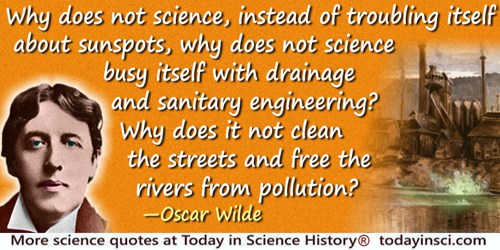
Why does not science, instead of troubling itself about sunspots, which nobody ever saw, or, if they did, ought not to speak about. — Why does not science busy itself with drainage and sanitary engineering? Why does it not clean the streets and free the rivers from pollution? Why, in England there is scarcely a river at some point is not polluted; and the flowers are all withering on the banks.
Interview, 'A Talk with Wilde: The Apostle of the Aesthetes Enunciates His Views', Philadelphia Press (17 Jan 1882), 2. Collected in E.H. Mikhail (ed.), Oscar Wilde: Interviews and Recollections (1979), Vol. 1, 45.
Willis Rodney Whitney ... once compared scientific research to a bridge being constructed by a builder who was fascinated by the construction problems involved. Basic research, he suggested, is such a bridge built wherever it strikes the builder's fancy—wherever the construction problems seem to him to be most challenging. Applied research, on the other hand, is a
bridge built where people are waiting to get across the river. The challenge to the builder's ingenuity and skill, Whitney pointed out, can be as great in one case as the other.
'Willis Rodney Whitney', National Academy of Sciences, Biographical Memoirs (1960), 351.
Wisdom is a river that runs deep and slow. Inspiration and intuition are
lightning flashes reflected on its surface.
In Barbara A. Robinson, Mind Bungee Jumping: Words of Life, Love, Inspiration, Encouragement and Motivation (2008), 287.
by - Poetry - 2008
Yet, hermit and stoic as he was, he was really fond of sympathy, and threw himself heartily and childlike into the company of young people whom he loved, and whom he delighted to entertain, as he only could, with the varied and endless anecdotes of his experiences by field and river: and he was always ready to lead a huckleberry-party or a search for chestnuts and grapes.
In magazine article, 'Thoreau', The Atlantic (Aug 1862), 10, 240. Emerson is credited as author on the Contents page.
 In science it often happens that scientists say, 'You know that's a really good argument; my position is mistaken,' and then they would actually change their minds and you never hear that old view from them again. They really do it. It doesn't happen as often as it should, because scientists are human and change is sometimes painful. But it happens every day. I cannot recall the last time something like that happened in politics or religion.
(1987) --
In science it often happens that scientists say, 'You know that's a really good argument; my position is mistaken,' and then they would actually change their minds and you never hear that old view from them again. They really do it. It doesn't happen as often as it should, because scientists are human and change is sometimes painful. But it happens every day. I cannot recall the last time something like that happened in politics or religion.
(1987) --