Reverence Quotes (30 quotes)
[Regarding evolution believers:] Their business is not with the possible, but the actual—not with a world which might be, but with a world that is. This they explore with a courage not unmixed with reverence, and according to methods which, like the quality of a tree, are tested by their fruits. They have but one desire—to know the truth. They have but one fear—to believe a lie.
'Scientific Use of the Imagination', Discourse Delivered Before the British Association at Liverpool, (16 Sep 1870). Fragments of Science for Unscientific People: A Series of Detached Essays, Lectures, and Reviews (1892), Vol. 2, 134.
A religion old or new, that stressed the magnificence of the universe as revealed by modern science, might be able to draw forth reserves of reverence and awe hardly tapped by the conventional faiths. Sooner or later such a religion will emerge.
Pale Blue Dot: a Vision of the Human Future in Space (1994), 52.
As we celebrate the vernal equinox, let us reflect on the intricate balance of the natural world and our responsibility to steward the Earth with care and reverence.
A fictional quote imagined in the style typical of a scientist (19 Mar 2024).
Believing, as I do, in the continuity of nature, I cannot stop abruptly where our microscopes cease to be of use. Here the vision of the mind authoritatively supplements the vision of the eye. By a necessity engendered and justified by science I cross the boundary of the experimental evidence, and discern in that Matter which we, in our ignorance of its latent powers, and notwithstanding our professed reverence for its Creator, have hitherto covered with opprobrium, the promise and potency of all terrestrial Life.
'Address Delivered Before The British Association Assembled at Belfast', (19 Aug 1874). Fragments of Science for Unscientific People: A Series of Detached Essays, Lectures, and Reviews (1892), Vol. 2, 191.
Everything material which is the subject of knowledge has number, order, or position; and these are her first outlines for a sketch of the universe. If our feeble hands cannot follow out the details, still her part has been drawn with an unerring pen, and her work cannot be gainsaid. So wide is the range of mathematical sciences, so indefinitely may it extend beyond our actual powers of manipulation that at some moments we are inclined to fall down with even more than reverence before her majestic presence. But so strictly limited are her promises and powers, about so much that we might wish to know does she offer no information whatever, that at other moments we are fain to call her results but a vain thing, and to reject them as a stone where we had asked for bread. If one aspect of the subject encourages our hopes, so does the other tend to chasten our desires, and he is perhaps the wisest, and in the long run the happiest, among his fellows, who has learned not only this science, but also the larger lesson which it directly teaches, namely, to temper our aspirations to that which is possible, to moderate our desires to that which is attainable, to restrict our hopes to that of which accomplishment, if not immediately practicable, is at least distinctly within the range of conception.
From Presidential Address (Aug 1878) to the British Association, Dublin, published in the Report of the 48th Meeting of the British Association for the Advancement of Science (1878), 31.
Fullness of knowledge always means some understanding of the depths of our ignorance; and that is always conducive to humility and reverence.
In 'What I Believe: Living Philosophies II', The Forum (Oct 1929), 82, No. 4, 199.
He who would know what geometry is, must venture boldly into its depths and learn to think and feel as a geometer. I believe that it is impossible to do this, and to study geometry as it admits of being studied and am conscious it can be taught, without finding the reason invigorated, the invention quickened, the sentiment of the orderly and beautiful awakened and enhanced, and reverence for truth, the foundation of all integrity of character, converted into a fixed principle of the mental and moral constitution, according to the old and expressive adage “abeunt studia in mores”.
In 'A Probationary Lecture on Geometry, in Collected Mathematical Papers (1908), Vol. 2, 9. [The Latin phrase, “abeunt studia in mores” translates as “studies pass on into character”. —Webmaster]
I am very much a scientist, and so I naturally have thought about religion also through the eyes of a scientist. When I do that, I see religion not denominationally, but in a more, let us say, deistic sense. I have been influenced in my thinking by the writing of Einstein who has made remarks to the effect that when he contemplated the world he sensed an underlying Force much greater than any human force. I feel very much the same. There is a sense of awe, a sense of reverence, and a sense of great mystery.
From interview with John F. Luca, 'Dr. Walter Kohn: Science, Religion, and the Human Experience', The Santa Barbara Independent (26 Jul 2001).
I do not share in this reverence for knowledge as such. It all depends on who has the knowledge and what he does with it. That knowledge which adds greatly to character is knowledge so handled as to transform every phase of immediate experience.
In 'The Rhythmic Claims of Freedom and Discipline', The Aims of Education and Other Essays (1929), 32.
I think at the moment we did not even want to break the seal [on the inner chamber of the tomb of Tutankhamen], for a feeling of intrusion had descended heavily upon us... We felt that we were in the presence of the dead King and must do him reverence, and in imagination could see the doors of the successive shrines open one.
Howard Carter, Arthur Cruttenden Mace, The Discovery of the Tomb of Tutankhamen (reprint 1977), 183.
It is an irony of fate that I myself have been the recipient of excessive admiration and reverence from my fellow-beings, through no fault, and no merit, of my own. The cause of this may well be the desire, unattainable for many, to understand the few ideas to which I have with my feeble powers attained through ceaseless struggle. I am quite aware that for any organisation to reach its goals, one man must do the thinking and directing and generally bear the responsibility. But the led must not be coerced, they must be able to choose their leader.
In 'What I Believe', Forum and Century (1930), 84, 193-194.
Learn to reverence night and to put away the vulgar fear of it, for, with the banishment of night from the experience of man, there vanishes as well a religious emotion, a poetic mood, which gives depth to the adventure of humanity. By day, space is one with the earth and with man - it is his sun that is shining, his clouds that are floating past; at night, space is his no more. When the great earth, abandoning day, rolls up the deeps of the heavens and the universe, a new door opens for the human spirit, and there are few so clownish that some awareness of the mystery of being does not touch them as they gaze. For a moment of night we have a glimpse of ourselves and of our world islanded in its stream of stars - pilgrims of mortality, voyaging between horizons across eternal seas of space and time. Fugitive though the instant be, the spirit of man is, during it, ennobled by a genuine moment of emotional dignity, and poetry makes its own both the human spirit and experience.
…...
Let us seek to fathom those things that are fathomable and reserve those things which are unfathomable for reverence in quietude.
…...
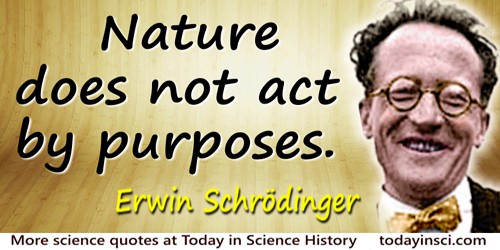
Nature has no reverence towards life. Nature treats life as though it were the most valueless thing in the world. … Nature does not act by purposes.
In Tarner Lecture, at Trinity College, Cambridge (Oct 1956), 'The Arithmetical Paradox: The Oneness of Mind', printed in Mind and Matter (1958), 66. Also collected in What is Life?: With Mind and Matter and Autobiographical Sketches (1992, 2012), 138.
Not all is doom and gloom. We are beginning to understand the natural world and are gaining a reverence for life - all life.
Source unverified. Please contact Webmaster if you know the primary source.
Nothing inspires more reverence and awe in me than an old man who knows how to change his mind.
In Pensamientos Escogidos (1924), 58. Translated from the original Spanish, “Nada me inspira más veneración y asombro que un anciano que sabe cambiar de opinión.”
On entering a temple we assume all signs of reverence. How much more reverent then should we be before the heavenly bodies, the stars, the very nature of God!
From Quaestiones Naturales as translated in Charles Singer, From Magic to Science (1958), 57.
Science enhances the moral value of life, because it furthers a love of truth and reverence—love of truth displaying itself in the constant endeavor to arrive at a more exact knowledge of the world of mind and matter around us, and reverence, because every advance in knowledge brings us face to face with the mystery of our own being.
In Max Planck and James Vincent Murphy (trans.), Where is Science Going?, (1932), 169.
Science is not about control. It is about cultivating a perpetual sense of wonder in the face of something that forever grows one step richer and subtler than our latest theory about it. It is about reverence, not mastery.
…...
Science is teaching man to know and reverence truth, and to believe that only so far as he knows and loves it can he live worthily on earth, and vindicate the dignity of his spirit.
In Where are We and Whither Tending?: Three Lectures on the Reality and Worth of Human Progress (1886), 26.
The intellectual craves a social order in which uncommon people perform uncommon tasks every day. He wants a society throbbing with dedication, reverence, and worshiHe sees it as scandalous that the discoveries of science and the feats of heroes should have as their denouement the comfort and affluence of common folk. A social order run by and for the people is to him a mindless organism motivated by sheer physiologism.
In 'Concerning Individual Freedom', The Ordeal of Change (1963, 1990), 100.
The largest land animal is the elephant, and it is the nearest to man in intelligence: it understands the language of its country and obeys orders, remembers duties that it has been taught, is pleased by affection and by marks of honour, nay more it possesses virtues rare even in man, honesty, wisdom, justice, also respect for the stars and reverence for the sun and moon.
Natural History, 8, I. Trans. H. Rackham, Pliny: Natural History (1947), Vol. 3, 3.
The layman, taught to revere scientists for their absolute respect for the observed facts, and for the judiciously detached and purely provisional manner in which they hold scientific theories (always ready to abandon a theory at the sight of any contradictory evidence) might well have thought that, at [Dayton C.] Miller's announcement of this overwhelming evidence of a “positive effect” [indicating that the speed of light is not independent from the motion of the observer, as Einstein's theory of relativity demands] in his presidential address to the American Physical Society on December 29th, 1925, his audience would have instantly abandoned the theory of relativity. Or, at the very least, that scientists—wont to look down from the pinnacle of their intellectual humility upon the rest of dogmatic mankind—might suspend judgment in this matter until Miller's results could be accounted for without impairing the theory of relativity. But no: by that time they had so well closed their minds to any suggestion which threatened the new rationality achieved by Einstein's world-picture, that it was almost impossible for them to think again in different terms. Little attention was paid to the experiments, the evidence being set aside in the hope that it would one day turn out to be wrong.
Personal Knowledge: Towards a Post-Critical Philosophy (1958, 1998), 13. Miller had earlier presented his evidence against the validity of the relativity theory at the annual meeting, 28 Apr 1925, of the National Academy of Sciences. Miller believed he had, by a much-refined and improved repetition of the so-called Michelson-Morley experiment, shown that there is a definite and measurable motion of the earth through the ether. In 1955, a paper by R.S. Shankland, et al., in Rev. Modern Phys. (1955), 27, 167, concluded that statistical fluctuations and temperature effects in the data had simulated what Miller had taken to be he apparent ether drift.
The Spaniards plundered Peru for its gold, which the Inca aristocracy had collected as we might collect stamps, with the touch of Midas. Gold for greed, gold for splendor, gold for adornment, gold for reverence, gold for power, sacrificial gold, life-giving gold, gold for tenderness, barbaric gold, voluptuous gold.
There is a reward structure in science that is very interesting: Our highest honors go to those who disprove the findings of the most revered among us. So Einstein is revered not just because he made so many fundamental contributions to science, but because he found an imperfection in the fundamental contribution of Isaac Newton.
In 'Wonder and Skepticism', Skeptical Enquirer (Jan-Feb 1995), 19, No. 1.

Until we consider animal life to be worthy of the consideration and reverence we bestow upon old books and pictures and historic monuments, there will always be the animal refugee living a precarious life on the edge of extermination, dependent for existence on the charity of a few human beings.
In Encounters With Animals (1970), 105.
We all felt the majesty of the body. In a very short period of time we had seen something that was bigger than each of us. A lot of people, even those who were not religious, were reverent and attributed the success to God. As we saw the artificial heart beat in Dr. Clark, the feeling was not aren't we great, but aren't we small.
[Comment after surgery for the world's first human implant of a total artificial heart in the chest of dentist Dr. Barney Clark ]
[Comment after surgery for the world's first human implant of a total artificial heart in the chest of dentist Dr. Barney Clark ]
Quoted by Lawrence K. Altman in “Clark's Surgeon Was ‘Worried To Death’&rdquo, New York Times (12 Apr 1983), C2.
We have not the reverent feeling for the rainbow that a savage has, because we know how it is made. We have lost as much as we gained by prying into that matter.
In A Tramp Abroad (1907), 170.
We reverence ancient Greece as the cradle of western science. Here for the first time the world witnessed the miracle of a logical system which proceeded from step to step with such precision that every single one of its propositions was absolutely indubitable—I refer to Euclid’s geometry. This admirable triumph of reasoning gave the human intellect the necessary confidence in itself for its subsequent achievements. If Euclid failed to kindle your youthful enthusiasm, then you were not born to be a scientific thinker.
From 'On the Method of Theoretical Physics', in Essays in Science (1934, 2004), 13.
Whoever has undergone the intense experience of successful advances made in [science], is moved by profound reverence for the rationality made manifest in existence.
…...
 In science it often happens that scientists say, 'You know that's a really good argument; my position is mistaken,' and then they would actually change their minds and you never hear that old view from them again. They really do it. It doesn't happen as often as it should, because scientists are human and change is sometimes painful. But it happens every day. I cannot recall the last time something like that happened in politics or religion.
(1987) --
In science it often happens that scientists say, 'You know that's a really good argument; my position is mistaken,' and then they would actually change their minds and you never hear that old view from them again. They really do it. It doesn't happen as often as it should, because scientists are human and change is sometimes painful. But it happens every day. I cannot recall the last time something like that happened in politics or religion.
(1987) -- 





