Result Quotes (709 quotes)
... an analysis that puts the final link in the chain, for here we see correlations between cytological evidence and genetic results that are so strong and obvious that their validity cannot be denied. This paper has been called a landmark in experimental genetics. It is more than that—it is a cornerstone.
Describing the paper 'A Correlation of Cytological and Genetic Crossings-over in Zea mays' published by Barbara McClintock and her student Harriet Creighton in the Proceedings of the National Academy of Sciences (1931), demonstrating that the exchange of genetic information that occurs during the production of sex cells is accompanied by an exchange of chromosomal material.
Describing the paper 'A Correlation of Cytological and Genetic Crossings-over in Zea mays' published by Barbara McClintock and her student Harriet Creighton in the Proceedings of the National Academy of Sciences (1931), demonstrating that the exchange of genetic information that occurs during the production of sex cells is accompanied by an exchange of chromosomal material.
Classic Papers in Genetics (1959), 156.
... I left Caen, where I was living, to go on a geologic excursion under the auspices of the School of Mines. The incidents of the travel made me forget my mathematical work. Having reached Coutances, we entered an omnibus to go to some place or other. At the moment when I put my foot on the step, the idea came to me, without anything in my former thoughts seeming to have paved the way for it, that the transformations I had used to define the Fuchsian functions were identical with those of non-Eudidean geometry. I did not verify the idea; I should not have had time, as upon taking my seat in the omnibus, I went on with a conversation already commenced, but I felt a perfect certainty. On my return to Caen, for convenience sake, I verified the result at my leisure.
Quoted in Sir Roger Penrose, The Emperor's New Mind: Concerning Computers, Minds, and the Laws of Physics (1990), 541. Science and Method (1908) 51-52, 392.
… the three positive characteristics that distinguish mathematical knowledge from other knowledge … may be briefly expressed as follows: first, mathematical knowledge bears more distinctly the imprint of truth on all its results than any other kind of knowledge; secondly, it is always a sure preliminary step to the attainment of other correct knowledge; thirdly, it has no need of other knowledge.
In Mathematical Essays and Recreations (1898), 35.
...I believe there exists, & I feel within me, an instinct for the truth, or knowledge or discovery, of something of the same nature as the instinct of virtue, & that our having such an instinct is reason enough for scientific researches without any practical results ever ensuing from them.
The Correspondence of Charles Darwin, Vol. 4. (1847-50)
...the genes almost always accurately reproduce. If they don't, you get one of the following results: One, monsters—that is, grossly malformed babies resulting from genetic mistakes. Years ago most monsters died, but now many can be saved. This has made possible the National Football League.
Found widely quoted on the web, but without a print source. Please contact webmaster if you know the primary source.
...the life of the planet began the long, slow process of modulating and regulating the physical conditions of the planet. The oxygen in today's atmosphere is almost entirely the result of photosynthetic living, which had its start with the appearance of blue-green algae among the microorganisms.
In Late Night Thoughts on Listening to Mahler's Ninth Symphony(1984), 74.
“Going fishing!” How often the question has been asked by acquaintances, as they have met me, with rod and basket, on an excursion after materials for microscopic study. “Yes!” has been the invariable answer, for it saved much detention and explanation; and now, behold! I offer them the results of that fishing. No fish for the stomach, but, as the old French microscopist Joblet observed, “some of the most remarkable fishes that have ever been seen”; and food-fishes for the intellect.
From 'Concluding Remarks', Fresh-Water Rhizopods of North America (1879), 295. Leidy explains how actively he pursued his interest in finding new microscopic life forms to examine by frequent exploration of suitable habitats in the neighborhood of Philadelphia, where he lived and taught.
“Heaven helps those who help themselves” is a well-tried maxim, embodying in a small compass the results of vast human experience. The spirit of self-help is the root of all genuine growth in the individual; and, exhibited in the lives of many, it constitutes the true source of national vigour and strength. Help from without is often enfeebling in its effects, but help from within invariably invigorates. Whatever is done for men or classes, to a certain extent takes away the stimulus and necessity of doing for themselves; and where men are subjected to over-guidance and over-government, the inevitable tendency is to render them comparatively helpless.
In Self-help: With Illustrations of Character and Conduct (1859, 1861), 15.
“Planning” is simply the result of experience read backward and projected into the future. To me the “purposive” action of a beehive is simply the summation and integration of its units, and Natural Selection has put higher and higher premiums on the most “purposeful” integration. It is the same way (to me) in the evolution of the middle ear, the steps in the Cynodonts (clearly shown by me in 1910 and by you later in Oudenodon) make it easier to see how such a wonderful device as the middle ear could arise without any predetermination or human-like planning, and in fact in the good old Darwinian way, if only we admit that as the “twig is bent the tree’s inclined” and that each stage conserves the advantages of its predecessors… The simple idea that planning is only experience read backward and combined by selection in suitable or successful combinations takes the mystery out of Nature and out of men’s minds.
Letter to Robert Broom [1933]. In Ronald Rainger, An Agenda for Antiquity (1991), 238.
“Progress” was synonymous with distance from nature. The adults, who set the pace of progress from nature, were so absorbed by their own ability to invent and to alter the existing world, that they hurried headlong, with no design for the ultimate structure. A man-made environment was the obvious goal, but who was the responsible architect? No one in my country. Not even the king of Great Britain or the president of America. Each inventor and producer who worked on building tomorrow’s world just threw in a brick or a cogwheel wherever he cared to, and it was up to us of the next generation to find out what the result would be.
In Ch. 1, 'Farewell to Civilization', Fatu-Hiva (1974), 4.
[A]s you know, scientific education is fabulously neglected … This is an evil that is inherited, passed on from generation to generation. The majority of educated persons are not interested in science, and are not aware that scientific knowledge forms part of the idealistic background of human life. Many believe—in their complete ignorance of what science really is—that it has mainly the ancillary task of inventing new machinery, or helping to invent it, for improving our conditions of life. They are prepared to leave this task to the specialists, as they leave the repairing of their pipes to the plumber. If persons with this outlook decide upon the curriculum of our children, the result is necessarily such as I have just described it.
Opening remarks of the second of four public lectures for the Dublin Institute for Advanced Studies at University College, Dublin (Feb 1950), The Practical Achievements of Science Tending to Obliterate its True Import', collected in Science and Humanism: Physics in Our Time (1951). Reprinted in 'Nature and the Greeks' and 'Science and Humanism' (1996), 113.
[American] Motherhood is like being a crack tennis player or ballet dancer—it lasts just so long, then it’s over. We’ve made an abortive effort to turn women into people. We’ve sent them to school and put them in slacks. But we’ve focused on wifehood and reproductivity with no clue about what to do with mother after the children have left home. We’ve found no way of using the resources of women in the 25 years of post-menopausal zest. As a result many women seem to feel they should live on the recognition and care of society.
As quoted in interview with Frances Glennon, 'Student and Teacher of Human Ways', Life (14 Sep 1959), 147.
[D]iscovery should come as an adventure rather than as the result of a logical process of thought. Sharp, prolonged thinking is necessary that we may keep on the chosen road but it does not itself necessarily lead to discovery. The investigator must be ready and on the spot when the light comes from whatever direction.
Letter to Dr. E. B. Krumhaar (11 Oct 1933), in Journal of Bacteriology (Jan 1934), 27, No. 1, 19.
[In the case of research director, Willis R. Whitney, whose style was to give talented investigators as much freedom as possible, you may define “serendipity” as] the art of profiting from unexpected occurrences. When you do things in that way you get unexpected results. Then you do something else and you get unexpected results in another line, and you do that on a third line and then all of a sudden you see that one of these lines has something to do with the other. Then you make a discovery that you never could have made by going on a direct road.
Quoted in Guy Suits, 'Willis Rodney Whitney', National Academy of Sciences, Biographical Memoirs (1960), 355.
[It] may be laid down as a general rule that, if the result of a long series of precise observations approximates a simple relation so closely that the remaining difference is undetectable by observation and may be attributed to the errors to which they are liable, then this relation is probably that of nature.
'Mémoire sur les Inégalites Séculaires des Planètes et des Satellites' (I 785, published 1787). In Oeuvres completes de Laplace, 14 Vols. (1843-1912), Vol. 11, 57, trans. Charles Coulston Gillispie, Pierre-Simon Laplace 1749-1827: A Life in Exact Science (1997), 130.
[Louis Rendu, Bishop of Annecy] collects observations, makes experiments, and tries to obtain numerical results; always taking care, however, so to state his premises and qualify his conclusions that nobody shall be led to ascribe to his numbers a greater accuracy than they merit. It is impossible to read his work, and not feel that he was a man of essentially truthful mind and that science missed an ornament when he was appropriated by the Church.
In The Glaciers of the Alps (1860), 299.
[Modern science] passed through a long period of uncertainty and inconclusive experiment, but as the instrumental aids to research improved, and the results of observation accumulated, phantoms of the imagination were exorcised, idols of the cave were shattered, trustworthy materials were obtained for logical treatment, and hypotheses by long and careful trial were converted into theories.
In The Present Relations of Science and Religion (1913, 2004), 3
[Professor W.L. Bragg asserts that] In sodium chloride there appear to be no molecules represented by NaCl. The equality in number of sodium and chlorine atoms is arrived at by a chess-board pattern of these atoms; it is a result of geometry and not of a pairing-off of the atoms.
In Henry E. Armstrong, 'Poor Common Salt!', Nature (1927), 120, 478.
[The ancient monuments] were all dwarfs in size and pigmies in spirit beside this mighty Statue of Liberty, and its inspiring thought. Higher than the monument in Trafalgar Square which commemorates the victories of Nelson on the sea; higher than the Column Vendome, which perpetuates the triumphs of Napoleon on the land; higher than the towers of the Brooklyn Bridge, which exhibit the latest and greatest results of science, invention, and industrial progress, this structure rises toward the heavens to illustrate an idea ... which inspired the charter in the cabin of the Mayflower and the Declaration of Independence from the Continental Congress.
Speech at unveiling of the Statue of Liberty, New York. In E.S. Werner (ed.), Werner's Readings and Recitations (1908), 107.
[The intellectual] is not religious in the sense of the ordinary man is religious, for the religion of the ordinary man is man-centred and takes faith as its cornerstone. The intellectual is sparing of faith, reserving it for those things which seem, for the time at least, to be scientifically demonstrated, such as the results of repeatable experiments or natural laws tested many times. But in another sense the intellectual is more religious than the ordinary man, because he is passionately interested in the nature of things. He wants to take everything in pieces, actually or figuratively, in order to discover the plan according to which it was constructed. If an active wonder with regard to the universe is a criterion for religion, then the intellectual is very religious indeed.
From Lecture (28 Nov 1957) in the Queen’s University, Belfast, 'Is the Study of its History a Brake on the Progress of Science', printed in Hermethena (1958), 19, 28.
[The unreactivity of the noble gas elements] belongs to the surest of experimental results.
Angewandte Chemie (1924), 37, 421. Trans. In Hilde Hein and George E. Hein, 'The Chemistry of Noble Gases- A Modern Case Study in Experimental Science', Journal of the History of Ideas (1966), 27, 420.
[There is no shortage of scientific talent.] But [I am] much less optimistic about the managerial vision [of the pharmaceutical industry] to catalyse these talents to deliver the results we all want.
Quoted in Andrew Jack, "An Acute Talent for Innovation", Financial Times (1 Feb 2009).
[There] are cases where there is no dishonesty involved but where people are tricked into false results by a lack of understanding about what human beings can do to themselves in the way of being led astray by subjective effects, wishful thinking or threshold interactions. These are examples of pathological science. These are things that attracted a great deal of attention. Usually hundreds of papers have been published upon them. Sometimes they have lasted for fifteen or twenty years and then they gradually die away.
[Coining the term “pathological science” for the self-deceiving application of science to a phenomenon that doesn't exist.]
[Coining the term “pathological science” for the self-deceiving application of science to a phenomenon that doesn't exist.]
From a Colloquium at The Knolls Research Laboratory (18 Dec 1953). Transcribed and edited by R. N. Hall. In General Electric Laboratories, Report No. 68-C-035 (April 1968).
[To a man expecting a scientific proof of the impossibility of flying saucers] I might have said to him: “Listen, I mean that from my knowledge of the world that I see around me, I think that it is much more likely that the reports of flying saucers are the results of the known irrational characteristics of terrestrial intelligence than of the unknown rational efforts of extra-terrestrial intelligence.” It is just more likely, that is all. It is a good guess. And we always try to guess the most likely explanation, keeping in the back of the mind the fact that if it does not work we must discuss the other possibilities.
In The Character of Physical Law (1965, 2001), 166.
[About the demand of the Board of Regents of the University of California that professors sign non-Communist loyalty oaths or lose their jobs within 65 days.] No conceivable damage to the university at the hands of hypothetical Communists among us could possibly have equaled the damage resulting from the unrest, ill-will and suspicion engendered by this series of events.
As quoted in 'Professors in West Call Oath “Indignity”', New York Times (26 Feb 1950), 38.
[In refutation of evolution] There is not enough evidence, consistent evidence to make it as fact, and I say that because for theory to become a fact, it needs to consistently have the same results after it goes through a series of tests. The tests that they put—that they use to support evolution do not have consistent results. Now too many people are blindly accepting evolution as fact. But when you get down to the hard evidence, it’s merely a theory.
[In favor of the teaching of creationism alongside evolution in schools.]
[In favor of the teaching of creationism alongside evolution in schools.]
From interview by Miles O'Brien on CNN (30 Mar 1996). Reported from transcript, via Nexis, in New York Magazine (15 Sep 2010).
[In refutation of evolution] They use carbon dating ... to prove that something was millions of years old. Well, we have the eruption of Mt. Saint Helens and the carbon dating test that they used then would have to then prove that these were hundreds of millions of years younger, when what happened was they had the exact same results on the fossils and canyons that they did the tests on that were supposedly 100 millions of years old. And it’s the kind of inconsistent tests like this that they’re basing their “facts” on.
[Citing results from a solitary young-Earth creationist, questioning whether the lava dome at Mount St. Helens is really a million years old.]
[Citing results from a solitary young-Earth creationist, questioning whether the lava dome at Mount St. Helens is really a million years old.]
From interview by Miles O''Brien on CNN (30 Mar 1996). Reported from transcript, via Nexis, in New York Magazine (15 Sep 2010).
[When recording electrical impulses from a frog nerve-muscle preparation seemed to show a tiresomely oscillating electrical artefact—but only when the muscle was hanging unsupported.] The explanation suddenly dawned on me ... a muscle hanging under its own weight ought, if you come to think of it, to be sending sensory impulses up the nerves coming from the muscle spindles ... That particular day’s work, I think, had all the elements that one could wish for. The new apparatus seemed to be misbehaving very badly indeed, and I suddenly found it was behaving so well that it was opening up an entire new range of data ... it didn’t involve any particular hard work, or any particular intelligence on my part. It was just one of those things which sometimes happens in a laboratory if you stick apparatus together and see what results you get.
From 'Memorable experiences in research', Diabetes (1954), 3, 17-18. As cited in Alan McComa, Galvani's Spark: The Story of the Nerve Impulse (2011), 102-103.
Conclusions
I. A curve has been found representing the frequency distribution of standard deviations of samples drawn from a normal population.
II. A curve has been found representing the frequency distribution of values of the means of such samples, when these values are measured from the mean of the population in terms of the standard deviation of the sample…
IV. Tables are given by which it can be judged whether a series of experiments, however short, have given a result which conforms to any required standard of accuracy or whether it is necessary to continue the investigation.
I. A curve has been found representing the frequency distribution of standard deviations of samples drawn from a normal population.
II. A curve has been found representing the frequency distribution of values of the means of such samples, when these values are measured from the mean of the population in terms of the standard deviation of the sample…
IV. Tables are given by which it can be judged whether a series of experiments, however short, have given a result which conforms to any required standard of accuracy or whether it is necessary to continue the investigation.
'The Probable Error of a Mean', Biometrika, 1908, 6, 25.
Drosophila melanogaster has been more extensively used in the study of genetics than any other organism, and the theory of heredity that is now generally accepted is based chiefly on the results obtained with this fly. … Not only has Drosophila been the most productive material for research in the subject, but it is now the standard object for laboratory instruction, and is used as such in many colleges and universities.
In The North American Species of Drosophila (1921), 12.
Man is the result of slow growth; that is why he occupies the position he does in animal life. What does a pup amount to that has gained its growth in a few days or weeks, beside a man who only attains it in as many years.
In Orison Swett Marden, 'Bell Telephone Talk: Hints on Success by Alexander G. Bell', How They Succeeded: Life Stories of Successful Men Told by Themselves (1901), 35.
~~[Attributed without source]~~ If your result needs a statistician then you should design a better experiment.
Often seen, virally spread, but always without a source citation. If you can provide a primary source, please contact Webmaster. Until then the quote should be regarded as not authenticated.
~~[Attributed]~~ I have had my results for a long time; but I do not yet know how I am to arrive at them.
Quoted, without primary source citation, in Agnes Arber, The Mind and the Eye: A Study of the Biologist’s Standpoint (1954, 1964), 47. Arber footnotes finding the quote also in Leonard Nelson and T.K. Brown (trans.), Socratic Method and Critical Philosophy (1949, 1965), 89; W.I.B. Beveridge, The Art of Scientific Investigation (1950, 1957), 149. Notably, Arber states being “unable to trace this dictum to its original source.” With benefit of Google, Webmaster also has, yet, no success, either. In German, guessed as, “Meine Lösungen habe ich schon lange, ich weiß nur noch nicht, wie ich zu ihnen gelangel!” Webmaster found the quote in a 1968 German book, and “Meine Resultate habe ich schon lange, ich weiß nur nicht, wie ich zu ihnen gelangen kann” (1958). All of these leave a century of apparent silence before them. Can you help?
A … difference between most system-building in the social sciences and systems of thought and classification of the natural sciences is to be seen in their evolution. In the natural sciences both theories and descriptive systems grow by adaptation to the increasing knowledge and experience of the scientists. In the social sciences, systems often issue fully formed from the mind of one man. Then they may be much discussed if they attract attention, but progressive adaptive modification as a result of the concerted efforts of great numbers of men is rare.
The Study of Man (1941), 19-20.
A general course in mathematics should be required of all officers for its practical value, but no less for its educational value in training the mind to logical forms of thought, in developing the sense of absolute truthfulness, together with a confidence in the accomplishment of definite results by definite means.
In 'Mathematics at West Point and Annapolis', United States Bureau of Education, Bulletin 1912, No. 2, 11.
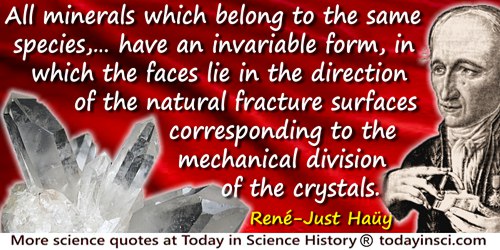
A casual glance at crystals may lead to the idea that they were pure sports of nature, but this is simply an elegant way of declaring one’s ignorance. With a thoughtful examination of them, we discover laws of arrangement. With the help of these, calculation portrays and links up the observed results. How variable and at the same time how precise and regular are these laws! How simple they are ordinarily, without losing anything of their significance! The theory which has served to develop these laws is based entirely on a fact, whose existence has hitherto been vaguely discerned rather than demonstrated. This fact is that in all minerals which belong to the same species, these little solids, which are the crystal elements and which I call their integrant molecules, have an invariable form, in which the faces lie in the direction of the natural fracture surfaces corresponding to the mechanical division of the crystals. Their angles and dimensions are derived from calculations combined with observation.
Traité de mineralogie … Publié par le conseil des mines (1801), Vol. 1, xiii-iv, trans. Albert V. and Marguerite Carozzi.
A closer look at the course followed by developing theory reveals for a start that it is by no means as continuous as one might expect, but full of breaks and at least apparently not along the shortest logical path. Certain methods often afforded the most handsome results only the other day, and many might well have thought that the development of science to infinity would consist in no more than their constant application. Instead, on the contrary, they suddenly reveal themselves as exhausted and the attempt is made to find other quite disparate methods. In that event there may develop a struggle between the followers of the old methods and those of the newer ones. The former's point of view will be termed by their opponents as out-dated and outworn, while its holders in turn belittle the innovators as corrupters of true classical science.
In 'On the Development of the Methods of Theoretical Physics in Recent Times', Populäre Schriften, Essay 14. Address (22 Sep 1899) to the Meeting of Natural Scientists at Munich. Collected in Brian McGuinness (ed.), Ludwig Boltzmann: Theoretical Physics and Philosophical Problems, Selected Writings (1974), 79.
A few of the results of my activities as a scientist have become embedded in the very texture of the science I tried to serve—this is the immortality that every scientist hopes for. I have enjoyed the privilege, as a university teacher, of being in a position to influence the thought of many hundreds of young people and in them and in their lives I shall continue to live vicariously for a while. All the things I care for will continue for they will be served by those who come after me. I find great pleasure in the thought that those who stand on my shoulders will see much farther than I did in my time. What more could any man want?
In 'The Meaning of Death,' in The Humanist Outlook edited by A. J. Ayer (1968) [See Gerald Holton and Sir Isaac Newton].
A moment’s consideration of this case shows what a really great advance in the theory and practise of breeding has been obtained through the discovery of Mendel’s law. What a puzzle this case would have presented to the biologist ten years ago! Agouti crossed with chocolate gives in the second filial generation (not in the first) four varieties, viz., agouti, chocolate, black and cinnamon. We could only have shaken our heads and looked wise (or skeptical).
Then we had no explanation to offer for such occurrences other than the “instability of color characters under domestication,” the “effects of inbreeding,” “maternal impressions.” Serious consideration would have been given to the proximity of cages containing both black and cinnamon-agouti mice.
Now we have a simple, rational explanation, which anyone can put to the test. We are able to predict the production of new varieties, and to produce them.
We must not, of course, in our exuberance, conclude that the powers of the hybridizer know no limits. The result under consideration consists, after all, only in the making of new combinations of unit characters, but it is much to know that these units exist and that all conceivable combinations of them are ordinarily capable of production. This valuable knowledge we owe to the discoverer and to the rediscoverers of Mendel’s law.
Then we had no explanation to offer for such occurrences other than the “instability of color characters under domestication,” the “effects of inbreeding,” “maternal impressions.” Serious consideration would have been given to the proximity of cages containing both black and cinnamon-agouti mice.
Now we have a simple, rational explanation, which anyone can put to the test. We are able to predict the production of new varieties, and to produce them.
We must not, of course, in our exuberance, conclude that the powers of the hybridizer know no limits. The result under consideration consists, after all, only in the making of new combinations of unit characters, but it is much to know that these units exist and that all conceivable combinations of them are ordinarily capable of production. This valuable knowledge we owe to the discoverer and to the rediscoverers of Mendel’s law.
'New Colour Variety of the Guinea Pig', Science, 1908, 28, 250-252.
A philosopher once said, “It is necessary for the very existence of science that the same conditions always produce the same results”. Well, they do not.
In Character of Physical Law (1965), 147.
A pound of energy with an ounce of talent will achieve greater results than a pound of talent with an ounce of energy.
In Getting on in the World; Or, Hints on Success in Life (1873), 55.
A professor … may be to produce a perfect mathematical work of art, having every axiom stated, every conclusion drawn with flawless logic, the whole syllabus covered. This sounds excellent, but in practice the result is often that the class does not have the faintest idea of what is going on. … The framework is lacking; students do not know where the subject fits in, and this has a paralyzing effect on the mind.
In A Concrete Approach to Abstract Algebra (1959), 1-2.
A rose is the visible result of an infinitude of complicated goings on in the bosom of the earth and in the air above, and similarly a work of art is the product of strange activities in the human mind.
In Since Cezanne (1922), 40.
A scientific invention consists of six (or some number) ideas, five of which are absurd but which, with the addition of the sixth and enough rearrangement of the combinations, results in something no one has thought of before.
As quoted in Robert Coughlan, 'Dr. Edward Teller’s Magnificent Obsession', Life (6 Sep 1954), 66.
A student who wishes now-a-days to study geometry by dividing it sharply from analysis, without taking account of the progress which the latter has made and is making, that student no matter how great his genius, will never be a whole geometer. He will not possess those powerful instruments of research which modern analysis puts into the hands of modern geometry. He will remain ignorant of many geometrical results which are to be found, perhaps implicitly, in the writings of the analyst. And not only will he be unable to use them in his own researches, but he will probably toil to discover them himself, and, as happens very often, he will publish them as new, when really he has only rediscovered them.
From 'On Some Recent Tendencies in Geometrical Investigations', Rivista di Matematica (1891), 43. In Bulletin American Mathematical Society (1904), 443.
A superficial knowledge of mathematics may lead to the belief that this subject can be taught incidentally, and that exercises akin to counting the petals of flowers or the legs of a grasshopper are mathematical. Such work ignores the fundamental idea out of which quantitative reasoning grows—the equality of magnitudes. It leaves the pupil unaware of that relativity which is the essence of mathematical science. Numerical statements are frequently required in the study of natural history, but to repeat these as a drill upon numbers will scarcely lend charm to these studies, and certainly will not result in mathematical knowledge.
In Primary Arithmetic: First Year, for the Use of Teachers (1897), 26-27.
A superficial knowledge of mathematics may lead to the belief that this subject can be taught incidentally, and that exercises akin to counting the petals of flowers or the legs of a grasshopper are mathematical. Such work ignores the fundamental idea out of which quantitative reasoning grows—the equality of magnitudes. It leaves the pupil unaware of that relativity which is the essence of mathematical science. Numerical statements are frequently required in the study of natural history, but to repeat these as a drill upon numbers will scarcely lend charm to these studies, and certainly will not result in mathematical knowledge.
In Primary Arithmetic: First Year, for the Use of Teachers (1897), 26-27.
A surplus of ideas is as dangerous as a drought. The tendency to jump from idea to idea spreads your energy horizontally rather than vertically. As a result you'll struggle to make progress.
In 'The Action Method', Making Ideas Happen (2012).
A tax on the farms would then result in the proprietors themselves working the lands, and this would mean better cultivation, and improvements which would yield returns indeed, but at too remote a period for the tenant. It would tend to a division of landed property, men of small fortune uniting in the purchase with capitalists who seek only the rent or payment for the land.
From Appendix A, 'Extracts From the Unpublished Writings of Carnot', Reflections on the Motive Power of Heat (1890, 2nd ed. 1897), 212-213.
A vital phenomenon can only be regarded as explained if it has been proven that it appears as the result of the material components of living organisms interacting according to the laws which those same components follow in their interactions outside of living systems.
Gesammelte Schriften (1904), Vol. 3, 767. Trans. Paul F. Cranefield, 'The Organic Physics of 1847 and the Biophysics of Today', Journal of the History of Medicine and Allied Sciences, 1957, 12, 410.
Abraham Maslow, felt … [an] instinctive revolt against the “atmosphere” of Freudian psychology, with its emphasis on sickness and neurosis, and decided that he might obtain some equally interesting results if he studied extremely healthy people.
In Introduction to the New Existentialism (1966), 15.
Accurate and minute measurement seems to the non-scientific imagination, a less lofty and dignified work than looking for something new. But nearly all the grandest discoveries of science have been but the rewards of accurate measurement and patient long-continued labour in the minute sifting of numerical results.
Presidential inaugural address, to the General Meeting of the British Association, Edinburgh (2 Aug 1871). In Report of the Forty-First Meeting of the British Association for the Advancement of Science (1872), xci.
Act as if you are going to live for ever and cast your plans way ahead. You must feel responsible without time limitations, and the consideration of whether you may or may not be around to see the results should never enter your thoughts.
In Theodore Rockwell, The Rickover Effect: How One Man Made A Difference (2002), 342.
After an orange cloud—formed as a result of a dust storm over the Sahara and caught up by air currents—reached the Philippines and settled there with rain, I understood that we are all sailing in the same boat.
In Jack Hassard and Julie Weisberg , Environmental Science on the Net: The Global Thinking Project (1999), 40.
After the discovery of spectral analysis no one trained in physics could doubt the problem of the atom would be solved when physicists had learned to understand the language of spectra. So manifold was the enormous amount of material that has been accumulated in sixty years of spectroscopic research that it seemed at first beyond the possibility of disentanglement. An almost greater enlightenment has resulted from the seven years of Röntgen spectroscopy, inasmuch as it has attacked the problem of the atom at its very root, and illuminates the interior. What we are nowadays hearing of the language of spectra is a true 'music of the spheres' in order and harmony that becomes ever more perfect in spite of the manifold variety. The theory of spectral lines will bear the name of Bohr for all time. But yet another name will be permanently associated with it, that of Planck. All integral laws of spectral lines and of atomic theory spring originally from the quantum theory. It is the mysterious organon on which Nature plays her music of the spectra, and according to the rhythm of which she regulates the structure of the atoms and nuclei.
Atombau und Spektrallinien (1919), viii, Atomic Structure and Spectral Lines, trans. Henry L. Brose (1923), viii.
Again and again in reading even his [William Thomson] most abstract writings one is struck by the tenacity with which physical ideas control in him the mathematical form in which he expressed them. An instance of this is afforded by … an example of a mathematical result that is, in his own words, “not instantly obvious from the analytical form of my solution, but which we immediately see must be the case by thinking of the physical meaning of the result.”
As given in Life of Lord Kelvin (1910), Vol. 2, 1136. The ellipsis gives the reference to the quoted footnote, to a passage in his Mathematical and Physical Papers, Vol. 1, 457. [Note: William Thomson, later became Lord Kelvin. —Webmaster]
All living forms are the results of physical influences which are still in operation, and vary only in degree and direction
Entry for Gottfried Reinhold Treviranus in Encyclopedia Britannica (1911), Vol. 27, 256.
All palaetiological sciences, all speculations which attempt to ascend from the present to the remote past, by the chain of causation, do also, by an inevitable consequence, urge us to look for the beginning of the state of things which we thus contemplate; but in none of these cases have men been able, by the aid of science, to arrive at a beginning which is homogeneous with the known course of events. The first origin of language, of civilization, of law and government, cannot be clearly made out by reasoning and research; and just as little, we may expect, will a knowledge of the origin of the existing and extinct species of plants and animals, be the result of physiological and geological investigation.
In History of the Inductive Sciences (1837), Vol. 3, 581.
All that we can hope from these inspirations, which are the fruits of unconscious work, is to obtain points of departure for such calculations. As for the calculations themselves, they must be made in the second period of conscious work which follows the inspiration, and in which the results of the inspiration are verified and the consequences deduced.
Science and Method (1914, 2003), 62.
All the events which occur upon the earth result from Law: even those actions which are entirely dependent on the caprices of the memory, or the impulse of the passions, are shown by statistics to be, when taken in the gross, entirely independent of the human will. As a single atom, man is an enigma; as a whole, he is a mathematical problem. As an individual, he is a free agent; as a species, the offspring of necessity.
In The Martyrdom of Man (1876), 185-186.
All the human culture, all the results of art, science and technology that we see before us today, are almost exclusively the creative product of the Aryan. This very fact admits of the not unfounded inference that he alone was the founder of all higher humanity, therefore representing the prototype of all that we understand by the word 'man.' He is the Prometheus of mankind from whose shining brow the divine spark of genius has sprung at all times, forever kindling anew that fire of knowledge which illuminated the night of silent mysteries and thus caused man to climb the path to mastery over the other beings of the earth ... It was he who laid the foundations and erected the walls of every great structure in human culture.
Mein Kampf (1925-26), American Edition (1943), 290. In William Lawrence Shirer, The Rise and Fall of the Third Reich (1990), 86-87.
All things on the earth are the result of chemical combination. The operation by which the commingling of molecules and the interchange of atoms take place we can imitate in our laboratories; but in nature they proceed by slow degrees, and, in general, in our hands they are distinguished by suddenness of action. In nature chemical power is distributed over a long period of time, and the process of change is scarcely to be observed. By acts we concentrate chemical force, and expend it in producing a change which occupies but a few hours at most.
In chapter 'Chemical Forces', The Poetry of Science: Or, Studies of the Physical Phenomena of Nature (1848), 235-236. Charles Dicken used this quote, with his own sub-head of 'Relative Importance Of Time To Man And Nature', to conclude his review of the book, published in The Examiner (1848).
Almost all the greatest discoveries in astronomy have resulted from what we have elsewhere termed Residual Phenomena, of a qualitative or numerical kind, of such portions of the numerical or quantitative results of observation as remain outstanding and unaccounted for, after subducting and allowing for all that would result from the strict application of known principles.
Outlines of Astronomy (1876), 626.
Although I must say that research problems I worked on were frequently the result of serendipity and often grew out of my interest in some species or some environment which I found to be particularly appealing—marine birds and tropical islands for example.
Bartholomew, April 1993, unpublished remarks when receiving the Miller Award from the Cooper Ornithological Society.
Among the minor, yet striking characteristics of mathematics, may be mentioned the fleshless and skeletal build of its propositions; the peculiar difficulty, complication, and stress of its reasonings; the perfect exactitude of its results; their broad universality; their practical infallibility.
In Charles S. Peirce, Charles Hartshorne (ed.), Paul Weiss (ed.), Collected Papers of Charles Sanders Peirce (1931), Vol. 4, 197.
An experiment is never a failure solely because it fails to achieve predicted results. An experiment is a failure only when it also fails adequately to test the hypothesis in question, when the data it produces don’t prove anything one way or another.
In Zen and the Art of Motorcycle Maintenance: An Inquiry Into Values (1974), 102.
An induction shock results in a contraction or fails to do so according to its strength; if it does so at all, it produces in the muscle at that time the maximal contraction that can result from stimuli of any strength.
Über die Eigentümlichkeiten der Reizbarkeit welche die Muskelfasern des Herzen zeigen', Ber. süchs. Akad. Wiss., Math.-nat Klasse, 1871, 23, 652-689. Trans. Edwin Clarke and C. D. O'Malley, The Human Brain and Spinal Cord (1968), 218.
Anaximenes ... said that infinite air was the principle, from which the things that are becoming, and that are, and that shall be, and gods and things divine, all come into being, and the rest from its products. The form of air is of this kind: whenever it is most equable it is invisible to sight, but is revealed by the cold and the hot and the damp and by movement. It is always in motion; for things that change do not change unless there be movement. Through becoming denser or finer it has different appearances; for when it is dissolved into what is finer it becomes fire, while winds, again, are air that is becoming condensed, and cloud is produced from air by felting. When it is condensed still more, water is produced; with a further degree of condensation earth is produced, and when condensed as far as possible, stones. The result is that the most influential components of the generation are opposites, hot and cold.
Hippolytus, Refutation, 1.7.1. In G. S. Kirk, J. E. Raven and M. Schofield (eds.), The Presocratic Philosophers: A Critical History with a Selection of Texts (1983), p. 145.
Any chemist reading this book can see, in some detail, how I have spent most of my mature life. They can become familiar with the quality of my mind and imagination. They can make judgements about my research abilities. They can tell how well I have documented my claims of experimental results. Any scientist can redo my experiments to see if they still work—and this has happened! I know of no other field in which contributions to world culture are so clearly on exhibit, so cumulative, and so subject to verification.
From Design to Discovery (1990), 119-20.
Anyone who understands algebraic notation, reads at a glance in an equation results reached arithmetically only with great labour and pains.
From Recherches sur les Principes Mathématiques de la Théorie des Richesses (1838), as translated by Nathaniel T. Bacon in 'Preface', Researches Into Mathematical Principles of the Theory of Wealth (1897), 4. From the original French, “Quiconque connaît la notation algébrique, lit d'un clin-d'œil dans une équation le résultat auquel on parvient péniblement par des règles de fausse position, dans l'arithmétique de Banque.”
As a man who has devoted his whole life to the most clear headed science, to the study of matter, I can tell you as a result of my research about atoms this much: There is no matter as such. All matter originates and exists only by virtue of a force which brings the particle of an atom to vibration and holds this most minute solar system of the atom together. … We must assume behind this force the existence of a conscious and intelligent mind. This mind is the matrix of all matter.
Lecture, 'Das Wesen der Materie' [The Essence/Nature/Character of Matter], Florence, Italy (1944). Archiv zur Geschichte der Max-Planck-Gesellschaft, Abt. Va, Rep. 11 Planck, Nr. 1797. Original German and this English translation, as in Gregg Braden, The Spontaneous Healing of Belief: Shattering the Paradigm of False Limits (2009), 334-35. Note: a number of books showing this quote cite it as from Planck’s Nobel Prize acceptance speech (1918), which the Webmaster has checked, and does not see this quote therein. The original German excerpt, and a slightly more complete translation is also on this web page, beginning: “As a physicist who devoted ….”
As a result of the phenomenally rapid change and growth of physics, the men and women who did their great work one or two generations ago may be our distant predecessors in terms of the state of the field, but they are our close neighbors in terms of time and tastes. This may be an unprecedented state of affairs among professionals; one can perhaps be forgiven if one characterizes it epigrammatically with a disastrously mixed metaphor; in the sciences, we are now uniquely privileged to sit side-by-side with the giants on whose shoulders we stand.
In 'On the Recent Past of Physics', American Journal of Physics (1961), 29, 807.
As an adult she had her organs removed one by one. Now she is a mere shell with symptoms where her organs used to be.
Written as an intern on one of his patient's charts; commentary on the result of surgical treatment of non-organic disease.
Written as an intern on one of his patient's charts; commentary on the result of surgical treatment of non-organic disease.
In Barry G. Firkin, Judith A. Whitworth, Dictionary of Medical Eponyms (1966), 267.
As modern physics started with the Newtonian revolution, so modern philosophy starts with what one might call the Cartesian Catastrophe. The catastrophe consisted in the splitting up of the world into the realms of matter and mind, and the identification of “mind” with conscious thinking. The result of this identification was the shallow rationalism of l’esprit Cartesien, and an impoverishment of psychology which it took three centuries to remedy even in part.
The Act of Creation (1964), 148.
As pure truth is the polar star of our science [mathematics], so it is the great advantage of our science over others that it awakens more easily the love of truth in our pupils. … If Hegel justly said, “Whoever does not know the works of the ancients, has lived without knowing beauty,” Schellbach responds with equal right, “Who does not know mathematics, and the results of recent scientific investigation, dies without knowing truth.”
From Didaktik und Methodik des Rechnens und der Mathematik (1908), 37. As quoted and translated in J.W.A. Young, Teaching of Mathematics in the Elementary and the Secondary School (1907), 44. From the original German, “Wenn Hegel mit Recht sagt: ‘Wer die Werke der Alten nicht kennt, der hat gelebt, ohne die Schönheit gekannt zu haben’, so erwidert Schellbach mit nicht minderem Recht: ‘Wer die Math. und die Resultate der neueren Naturforschung nicht gekannt hat, der stirbt, ohne die Wahrheit zu kennen.’”
As science is more and more subject to grave misuse as well as to use for human benefit it has also become the scientist's responsibility to become aware of the social relations and applications of his subject, and to exert his influence in such a direction as will result in the best applications of the findings in his own and related fields. Thus he must help in educating the public, in the broad sense, and this means first educating himself, not only in science but in regard to the great issues confronting mankind today.
Message to University Students Studying Science', Kagaku Asahi 11, no. 6 (1951), 28-29. Quoted in Elof Axel Carlson, Genes, Radiation, and Society: The Life and Work of H. J. Muller (1981), 371.
As soon as we got rid of the backroom attitude and brought our apparatus fully into the Department with an inexhaustible supply of living patients with fascinating clinical problems, we were able to get ahead really fast. Any new technique becomes more attractive if its clinical usefulness can be demonstrated without harm, indignity or discomfort to the patient... Anyone who is satisfied with his diagnostic ability and with his surgical results is unlikely to contribute much to the launching of a new medical science. He should first be consumed with a divine discontent with things as they are. It greatly helps, of course, to have the right idea at the right time, and quite good ideas may come, Archimedes fashion, in one's bath..
Asian Homo erectus died without issue and does not enter our immediate ancestry (for we evolved from African populations); Neanderthal people were collateral cousins, perhaps already living in Europe while we emerged in Africa... In other words, we are an improbable and fragile entity, fortunately successful after precarious beginnings as a small population in Africa, not the predictable end result of a global tendency. We are a thing, an item of history, not an embodiment of general principles.
Wonderful Life (1989), 319.
Astronomy was not studied by Kepler, Galileo, or Newton for the practical applications which might result from it, but to enlarge the bounds of knowledge, to furnish new objects of thought and contemplation in regard to the universe of which we form a part; yet how remarkable the influence which this science, apparently so far removed from the sphere of our material interests, has exerted on the destinies of the world!
In 'Report of the Secretary', Annual Report of the Board of Regents of the Smithsonian Institution for 1859 (1860), 15.
At last such field studies have been put on a sound basis which should result in the hunting of information rather than specimens.
Concluding line of Allee’s Review (of Hiram Bingham’s 1932 book, Gorillas in a Native Habitat), in journal, Ecology (1933), 14, No. 3, 320. Note that the quote is authored by the reviewer, W.C. Allee, and any source attributing it directly to Bingham himself is incorrect.
At no period of [Michael Faraday’s] unmatched career was he interested in utility. He was absorbed in disentangling the riddles of the universe, at first chemical riddles, in later periods, physical riddles. As far as he cared, the question of utility was never raised. Any suspicion of utility would have restricted his restless curiosity. In the end, utility resulted, but it was never a criterion to which his ceaseless experimentation could be subjected.
'The Usefulness of Useless Knowledge', Harper's Magazine (Jun/Nov 1939), No. 179, 546. In Hispania (Feb 1944), 27, No. 1, 77.
At present, light is generally regarded as the result of a vibratory movement of the ethereal fluid. Light produces heat, or at least accompanies the radiating heat, and moves with the same velocity as heat. Radiating heat is then a vibratory movement. It would be ridiculous to suppose that it is an emission of matter while the light which accompanies it could be only a movement.
Could a motion (that of radiating heat) produce matter (caloric)?
No, undoubtedly; it can only produce a motion. Heat is then the result of a motion.
Could a motion (that of radiating heat) produce matter (caloric)?
No, undoubtedly; it can only produce a motion. Heat is then the result of a motion.
From Appendix A, 'Extracts From the Unpublished Writings of Carnot', Reflections on the Motive Power of Heat (1890, 2nd ed. 1897), 222.
Bad science contributes to the steady dumbing down of our nation. Crude beliefs get transmitted to political leaders and the result is considerable damage to society. We see this happening now in the rapid rise of the religious right and how it has taken over large segments of the Republican Party.
As quoted in Kendrick Frazier, 'A Mind at Play: An Interview with Martin Gardner', Skeptical Inquirer (Mar/Apr 1998), 22, No. 2, 37.
Basic research may seem very expensive. I am a well-paid scientist. My hourly wage is equal to that of a plumber, but sometimes my research remains barren of results for weeks, months or years and my conscience begins to bother me for wasting the taxpayer’s money. But in reviewing my life’s work, I have to think that the expense was not wasted.
Basic research, to which we owe everything, is relatively very cheap when compared with other outlays of modern society. The other day I made a rough calculation which led me to the conclusion that if one were to add up all the money ever spent by man on basic research, one would find it to be just about equal to the money spent by the Pentagon this past year.
Basic research, to which we owe everything, is relatively very cheap when compared with other outlays of modern society. The other day I made a rough calculation which led me to the conclusion that if one were to add up all the money ever spent by man on basic research, one would find it to be just about equal to the money spent by the Pentagon this past year.
In The Crazy Ape (1971).
Before an experiment can be performed, it must be planned—the question to nature must be formulated before being posed. Before the result of a measurement can be used, it must be interpreted—nature's answer must be understood properly. These two tasks are those of the theorist, who finds himself always more and more dependent on the tools of abstract mathematics. Of course, this does not mean that the experimenter does not also engage in theoretical deliberations. The foremost classical example of a major achievement produced by such a division of labor is the creation of spectrum analysis by the joint efforts of Robert Bunsen, the experimenter, and Gustav Kirchoff, the theorist. Since then, spectrum analysis has been continually developing and bearing ever richer fruit.
'The Meaning and Limits of Exact Science', Science (30 Sep 1949), 110, No. 2857, 325. Advance reprinting of chapter from book Max Planck, Scientific Autobiography (1949), 110.
Before the introduction of the Arabic notation, multiplication was difficult, and the division even of integers called into play the highest mathematical faculties. Probably nothing in the modern world could have more astonished a Greek mathematician than to learn that, under the influence of compulsory education, the whole population of Western Europe, from the highest to the lowest, could perform the operation of division for the largest numbers. This fact would have seemed to him a sheer impossibility. … Our modern power of easy reckoning with decimal fractions is the most miraculous result of a perfect notation.
In Introduction to Mathematics (1911), 59.
Besides accustoming the student to demand, complete proof, and to know when he has not obtained it, mathematical studies are of immense benefit to his education by habituating him to precision. It is one of the peculiar excellencies of mathematical discipline, that the mathematician is never satisfied with à peu près. He requires the exact truth. Hardly any of the non-mathematical sciences, except chemistry, has this advantage. One of the commonest modes of loose thought, and sources of error both in opinion and in practice, is to overlook the importance of quantities. Mathematicians and chemists are taught by the whole course of their studies, that the most fundamental difference of quality depends on some very slight difference in proportional quantity; and that from the qualities of the influencing elements, without careful attention to their quantities, false expectation would constantly be formed as to the very nature and essential character of the result produced.
In An Examination of Sir William Hamilton’s Philosophy (1878), 611. [The French phrase, à peu près means “approximately”. —Webmaster]
Blood mixture and the result drop in the racial level is the sole cause of the dying out of old cultures; for men do not perish as a result of lost wars, but by the loss of that force of resistance which is continued only in pure blood. All who are not of good race in this world are chaff.
Mein Kampf (1925-26), American Edition (1943), 296. In William Lawrence Shirer, The Rise and Fall of the Third Reich (1990), 88.
Borel makes the amusing supposition of a million monkeys allowed to play upon the keys of a million typewriters. What is the chance that this wanton activity should reproduce exactly all of the volumes which are contained in the library of the British Museum? It certainly is not a large chance, but it may be roughly calculated, and proves in fact to be considerably larger than the chance that a mixture of oxygen and nitrogen will separate into the two pure constituents. After we have learned to estimate such minute chances, and after we have overcome our fear of numbers which are very much larger or very much smaller than those ordinarily employed, we might proceed to calculate the chance of still more extraordinary occurrences, and even have the boldness to regard the living cell as a result of random arrangement and rearrangement of its atoms. However, we cannot but feel that this would be carrying extrapolation too far. This feeling is due not merely to a recognition of the enormous complexity of living tissue but to the conviction that the whole trend of life, the whole process of building up more and more diverse and complex structures, which we call evolution, is the very opposite of that which we might expect from the laws of chance.
The Anatomy of Science (1926), 158-9.
But as no two (theoreticians) agree on this (skin friction) or any other subject, some not agreeing today with what they wrote a year ago, I think we might put down all their results, add them together, and then divide by the number of mathematicians, and thus find the average coefficient of error. (1908)
In Artificial and Natural Flight (1908), 3. Quoted in John David Anderson, Jr., Hypersonic and High Temperature Gas Dynamics (2000), 335.
But from the time I was in college I learned that there is nothing one could imagine which is so strange and incredible that it was not said by some philosopher; and since that time, I have recognized through my travels that all those whose views are different from our own are not necessarily, for that reason, barbarians or savages, but that many of them use their reason either as much as or even more than we do. I also considered how the same person, with the same mind, who was brought up from infancy either among the French or the Germans, becomes different from what they would have been if they had always lived among the Chinese or among the cannibals, and how, even in our clothes fashions, the very thing that we liked ten years ago, and that we may like again within the next ten years, appears extravagant and ridiculous to us today. Thus our convictions result from custom and example very much more than from any knowledge that is certain... truths will be discovered by an individual rather than a whole people.
Discourse on Method in Discourse on Method and Related Writings (1637), trans. Desmond M. Clarke, Penguin edition (1999), Part 2, 14-5.
But it is precisely mathematics, and the pure science generally, from which the general educated public and independent students have been debarred, and into which they have only rarely attained more than a very meagre insight. The reason of this is twofold. In the first place, the ascendant and consecutive character of mathematical knowledge renders its results absolutely insusceptible of presentation to persons who are unacquainted with what has gone before, and so necessitates on the part of its devotees a thorough and patient exploration of the field from the very beginning, as distinguished from those sciences which may, so to speak, be begun at the end, and which are consequently cultivated with the greatest zeal. The second reason is that, partly through the exigencies of academic instruction, but mainly through the martinet traditions of antiquity and the influence of mediaeval logic-mongers, the great bulk of the elementary text-books of mathematics have unconsciously assumed a very repellant form,—something similar to what is termed in the theory of protective mimicry in biology “the terrifying form.” And it is mainly to this formidableness and touch-me-not character of exterior, concealing withal a harmless body, that the undue neglect of typical mathematical studies is to be attributed.
In Editor’s Preface to Augustus De Morgan and Thomas J. McCormack (ed.), Elementary Illustrations of the Differential and Integral Calculus (1899), v.
But science and technology are only one of the avenues toward reality; others are equally needed to comprehend the full significance of our existence. Indeed, these other avenues are necessary for the prevention of thoughtless and inhuman abuses of the results of science.
In The Privilege of Being a Physicist (1989).
By destroying the biological character of phenomena, the use of averages in physiology and medicine usually gives only apparent accuracy to the results. From our point of view, we may distinguish between several kinds of averages: physical averages, chemical averages and physiological and pathological averages. If, for instance, we observe the number of pulsations and the degree of blood pressure by means of the oscillations of a manometer throughout one day, and if we take the average of all our figures to get the true or average blood pressure and to learn the true or average number of pulsations, we shall simply have wrong numbers. In fact, the pulse decreases in number and intensity when we are fasting and increases during digestion or under different influences of movement and rest; all the biological characteristics of the phenomenon disappear in the average. Chemical averages are also often used. If we collect a man's urine during twenty-four hours and mix all this urine to analyze the average, we get an analysis of a urine which simply does not exist; for urine, when fasting, is different from urine during digestion. A startling instance of this kind was invented by a physiologist who took urine from a railroad station urinal where people of all nations passed, and who believed he could thus present an analysis of average European urine! Aside from physical and chemical, there are physiological averages, or what we might call average descriptions of phenomena, which are even more false. Let me assume that a physician collects a great many individual observations of a disease and that he makes an average description of symptoms observed in the individual cases; he will thus have a description that will never be matched in nature. So in physiology, we must never make average descriptions of experiments, because the true relations of phenomena disappear in the average; when dealing with complex and variable experiments, we must study their various circumstances, and then present our most perfect experiment as a type, which, however, still stands for true facts. In the cases just considered, averages must therefore be rejected, because they confuse, while aiming to unify, and distort while aiming to simplify. Averages are applicable only to reducing very slightly varying numerical data about clearly defined and absolutely simple cases.
From An Introduction to the Study of Experimental Medicine (1865), as translated by Henry Copley Greene (1957), 134-135.
By research in pure science I mean research made without any idea of application to industrial matters but solely with the view of extending our knowledge of the Laws of Nature. I will give just one example of the ‘utility’ of this kind of research, one that has been brought into great prominence by the War—I mean the use of X-rays in surgery. Now, not to speak of what is beyond money value, the saving of pain, or, it may be, the life of the wounded, and of bitter grief to those who loved them, the benefit which the state has derived from the restoration of so many to life and limb, able to render services which would otherwise have been lost, is almost incalculable. Now, how was this method discovered? It was not the result of a research in applied science starting to find an improved method of locating bullet wounds. This might have led to improved probes, but we cannot imagine it leading to the discovery of X-rays. No, this method is due to an investigation in pure science, made with the object of discovering what is the nature of Electricity. The experiments which led to this discovery seemed to be as remote from ‘humanistic interest’ —to use a much misappropriated word—as anything that could well be imagined. The apparatus consisted of glass vessels from which the last drops of air had been sucked, and which emitted a weird greenish light when stimulated by formidable looking instruments called induction coils. Near by, perhaps, were great coils of wire and iron built up into electro-magnets. I know well the impression it made on the average spectator, for I have been occupied in experiments of this kind nearly all my life, notwithstanding the advice, given in perfect good faith, by non-scientific visitors to the laboratory, to put that aside and spend my time on something useful.
In Speech made on behalf of a delegation from the Conjoint Board of Scientific Studies in 1916 to Lord Crewe, then Lord President of the Council. In George Paget Thomson, J. J. Thomson and the Cavendish Laboratory in His Day (1965), 167-8.
Cavendish gave me once some bits of platinum for my experiments, and came to see my results on the decomposition of the alkalis, and seemed to take an interest in them; but he encouraged no intimacy with any one, and received nobody at his own house. … He was acute, sagacious, and profound, and, I think, the most accomplished British philosopher of his time.
As quoted in Victor Robinson, Pathfinders in Medicine (1912), 143.
Cayley was singularly learned in the work of other men, and catholic in his range of knowledge. Yet he did not read a memoir completely through: his custom was to read only so much as would enable him to grasp the meaning of the symbols and understand its scope. The main result would then become to him a subject of investigation: he would establish it (or test it) by algebraic analysis and, not infrequently, develop it so to obtain other results. This faculty of grasping and testing rapidly the work of others, together with his great knowledge, made him an invaluable referee; his services in this capacity were used through a long series of years by a number of societies to which he was almost in the position of standing mathematical advisor.
In Proceedings of London Royal Society (1895), 58, 11-12.
Characteristically skeptical of the idea that living things would faithfully follow mathematical formulas, [Robert Harper] seized upon factors in corn which seemed to blend in the hybrid—rather than be represented by plus or minus signs, and put several seasons into throwing doubt upon the concept of immutable hypothetical units of inheritance concocted to account for selected results.
In 'Robert Almer Harper', National Academy Biographical Memoirs (1948), 25, 233-234.
Charles Babbage proposed to make an automaton chess-player which should register mechanically the number of games lost and gained in consequence of every sort of move. Thus, the longer the automaton went on playing game, the more experienced it would become by the accumulation of experimental results. Such a machine precisely represents the acquirement of experience by our nervous organization.
In ‘Experimental Legislation’, Popular Science (Apr 1880), 16, 754-5.
Chemistry affords two general methods of determining the constituent principles of bodies, the method of analysis, and that of synthesis. When, for instance, by combining water with alkohol, we form the species of liquor called, in commercial language, brandy or spirit of wine, we certainly have a right to conclude, that brandy, or spirit of wine, is composed of alkohol combined with water. We can produce the same result by the analytical method; and in general it ought to be considered as a principle in chemical science, never to rest satisfied without both these species of proofs. We have this advantage in the analysis of atmospherical air, being able both to decompound it, and to form it a new in the most satisfactory manner.
Elements of Chemistry (1790), trans. R. Kerr, 33.
Chemistry is yet, indeed, a mere embryon. Its principles are contested; experiments seem contradictory; their subjects are so minute as to escape our senses; and their result too fallacious to satisfy the mind. It is probably an age too soon to propose the establishment of a system.
Letter to Rev. James Madison (Paris, 19 Jul 1788). In Thomas Jefferson and John P. Foley (ed.), The Jeffersonian Cyclopedia (1900), 135. From H.A. Washington, The Writings of Thomas Jefferson (1853-54). Vol 2, 431.
Chemistry works with an enormous number of substances, but cares only for some few of their properties; it is an extensive science. Physics on the other hand works with rather few substances, such as mercury, water, alcohol, glass, air, but analyses the experimental results very thoroughly; it is an intensive science. Physical chemistry is the child of these two sciences; it has inherited the extensive character from chemistry. Upon this depends its all-embracing feature, which has attracted so great admiration. But on the other hand it has its profound quantitative character from the science of physics.
In Theories of Solutions (1912), xix.
Collective unity is not the result of the brotherly love of the faithful for each other. The loyalty of the true believer is to the whole—the church, party, nation—and not to his fellow true believer. True loyalty between individuals is possible only in a loose and relatively free society.
In The True Believer (1951), 122
Common sense … has the very curious property of being more correct retrospectively than prospectively. It seems to me that one of the principal criteria to be applied to successful science is that its results are almost always obvious retrospectively; unfortunately, they seldom are prospectively. Common sense provides a kind of ultimate validation after science has completed its work; it seldom anticipates what science is going to discover.
Quoted in A. De Reuck, M. Goldsmith and J. Knight (eds.), Decision Making in National Science Policy (1968), 96.
Common sense is in spite of, not as the result of, education.
“Anonymous” because although commonly seen attributed to Victor Hugo, the quote cannot be found in his works.
Common sense is only the application of theories which have grown and been formulated unconsciously as result of experience.
From 'For Mans Use of God's Gifts', collected in Robert C. Goodpasture (ed.), Engineers and Ivory Towers (1952), 107.
Computers and rocket ships are examples of invention, not of understanding. … All that is needed to build machines is the knowledge that when one thing happens, another thing happens as a result. It’s an accumulation of simple patterns. A dog can learn patterns. There is no “why” in those examples. We don’t understand why electricity travels. We don’t know why light travels at a constant speed forever. All we can do is observe and record patterns.
In God's Debris: A Thought Experiment (2004), 22.
Consider the very roots of our ability to discern truth. Above all (or perhaps I should say “underneath all”), common sense is what we depend on—that crazily elusive, ubiquitous faculty we all have to some degree or other. … If we apply common sense to itself over and over again, we wind up building a skyscraper. The ground floor of the structure is the ordinary common sense we all have, and the rules for building news floors are implicit in the ground floor itself. However, working it all out is a gigantic task, and the result is a structure that transcends mere common sense.
In Metamagical Themas: Questing for the Essence of Mind and Pattern (1985), 93–94.
Descriptive geometry has two objects: the first is to establish methods to represent on drawing paper which has only two dimensions,—namely, length and width,—all solids of nature which have three dimensions,—length, width, and depth,—provided, however, that these solids are capable of rigorous definition.
The second object is to furnish means to recognize accordingly an exact description of the forms of solids and to derive thereby all truths which result from their forms and their respective positions.
The second object is to furnish means to recognize accordingly an exact description of the forms of solids and to derive thereby all truths which result from their forms and their respective positions.
From On the Purpose of Descriptive Geometry as translated by Arnold Emch in David Eugene Smith, A Source Book in Mathematics (1929), 426.
Dreaming over a subject is simply … allowing the will to focus the mind passively on the subject so that it follows the trains of thought as they arise, stopping them only when unprofitable but in general allowing them to form and branch naturally until some useful and interesting results occur.
In An Anatomy of Inspiration (1940), 5.
During the eighteenth and nineteenth centuries we can see the emergence of a tension that has yet to be resolved, concerning the attitude of scientists towards the usefulness of science. During this time, scientists were careful not to stress too much their relationships with industry or the military. They were seeking autonomy for their activities. On the other hand, to get social support there had to be some perception that the fruits of scientific activity could have useful results. One resolution of this dilemma was to assert that science only contributed at the discovery stage; others, industrialists for example, could apply the results. ... Few noted the ... obvious paradox of this position; that, if scientists were to be distanced from the 'evil' effects of the applications of scientific ideas, so too should they receive no credit for the 'good' or socially beneficial, effects of their activities.
Co-author with Philip Gummett (1947- ), -British social scientist
Co-author with Philip Gummett (1947- ), -British social scientist
Science, Technology and Society Today (1984), Introduction, 4.
Each part of the project had a specific task. These tasks were carefully allocated and supervised so that the sum of their parts would result in the accomplishment of our over-all mission.
In And Now It Can Be Told: The Story Of The Manhattan Project (1962), 414.
Edison was by far the most successful and, probably, the last exponent of the purely empirical method of investigation. Everything he achieved was the result of persistent trials and experiments often performed at random but always attesting extraordinary vigor and resource. Starting from a few known elements, he would make their combinations and permutations, tabulate them and run through the whole list, completing test after test with incredible rapidity until he obtained a clue. His mind was dominated by one idea, to leave no stone unturned, to exhaust every possibility.
As quoted in 'Tesla Says Edison Was an Empiricist', The New York Times (19 Oct 1931), 25.
England was nothing, compared to continental nations until she had become commercial … until about the middle of the last century, when a number of ingenious and inventive men, without apparent relation to each other, arose in various parts of the kingdom, succeeded in giving an immense impulse to all the branches of the national industry; the result of which has been a harvest of wealth and prosperity, perhaps without a parallel in the history of the world.
In Lives of the Engineers (1862, 1874), xvii.
Erasmus Darwin held that every so often you should try a damn-fool experiment. He played the trombone to his tulips. This particular result was, in fact, negative.
In 'The Mathematician’s Art of Work' (1967), collected in Béla Bollobás (ed.), Littlewood’s Miscellany (1986), 194. Webmaster has looked for a primary source to verify this statement and so far has found none. Can you help?
Every good thought you think is contributing its share to the ultimate result of your life.
…...
Every improvement that is put upon the real estate is the result of an idea in somebody's head. The skyscraper is another idea; the railroad is another; the telephone and all those things are merely symbols which represent ideas. An andiron, a wash-tub, is the result of an idea that did not exist before.
Speaking to a committee considering a new Copyright Bill (6 Dec 1906). In Mark Twain and William Dean Howells (ed.), Mark Twain’s Speeches? (1910), 320. An andiron is a metal bar, used in a pair, as a stand for logs in a fireplace. The Copyright Bill proposed to give authors, artists and musicians copyright for the term of his life and for 50 years thereafter. John Philip Sousa spoke for the musicians.
Every well established truth is an addition to the sum of human power, and though it may not find an immediate application to the economy of every day life, we may safely commit it to the stream of time, in the confident anticipation that the world will not fail to realize its beneficial results.
In 'Report of the Secretary', Annual Report of the Board of Regents of the Smithsonian Institution for 1856 (1857), 20.
Everything material which is the subject of knowledge has number, order, or position; and these are her first outlines for a sketch of the universe. If our feeble hands cannot follow out the details, still her part has been drawn with an unerring pen, and her work cannot be gainsaid. So wide is the range of mathematical sciences, so indefinitely may it extend beyond our actual powers of manipulation that at some moments we are inclined to fall down with even more than reverence before her majestic presence. But so strictly limited are her promises and powers, about so much that we might wish to know does she offer no information whatever, that at other moments we are fain to call her results but a vain thing, and to reject them as a stone where we had asked for bread. If one aspect of the subject encourages our hopes, so does the other tend to chasten our desires, and he is perhaps the wisest, and in the long run the happiest, among his fellows, who has learned not only this science, but also the larger lesson which it directly teaches, namely, to temper our aspirations to that which is possible, to moderate our desires to that which is attainable, to restrict our hopes to that of which accomplishment, if not immediately practicable, is at least distinctly within the range of conception.
From Presidential Address (Aug 1878) to the British Association, Dublin, published in the Report of the 48th Meeting of the British Association for the Advancement of Science (1878), 31.
Everywhere science is enriched by unscientific methods and unscientific results, ... the separation of science and non-science is not only artificial but also detrimental to the advancement of knowledge. If we want to understand nature, if we want to master our physical surroundings, then we must use all ideas, all methods, and not just a small selection of them.
Against Method: Outline of an Anarchistic Theory of Knowledge (1975), 305-6.
Evolution is a blind giant who rolls a snowball down a hill. The ball is made of flakes—circumstances. They contribute to the mass without knowing it. They adhere without intention, and without foreseeing what is to result. When they see the result they marvel at the monster ball and wonder how the contriving of it came to be originally thought out and planned. Whereas there was no such planning, there was only a law: the ball once started, all the circumstances that happened to lie in its path would help to build it, in spite of themselves.
'The Secret History of Eddypus', in Mark Twain and David Ketterer (ed.), Tales of Wonder (2003), 222-23.
Examples ... show how difficult it often is for an experimenter to interpret his results without the aid of mathematics.
Quoted in E. T. Bell, Men of Mathematics, xvi.
Experience is never at fault; it is only your judgment that is in error in promising itself such results from experience as are not caused by our experiments. For having given a beginning, what follows from it must necessarily be a natural development of such a beginning, unless it has been subject to a contrary influence, while, if it is affected by any contrary influence, the result which ought to follow from the aforesaid beginning will be found to partake of this contrary influence in a greater or less degree in proportion as the said influence is more or less powerful than the aforesaid beginning.
'Philosophy', in The Notebooks of Leonardo da Vinci, trans. E. MacCurdy (1938), Vol. 1, 70.
Experiment is the interpreter of nature. Experiments never deceive. It is our judgment which sometimes deceives itself because it expects results which experiment refuses. We must consult experiment, varying the circumstances, until we have deduced general rules, for experiment alone can furnish reliable rules.
In Introductory College Physics by Oswald Blackwood (1939).
Experiments may be of two kinds: experiments of simple fact, and experiments of quantity. ...[In the latter] the conditions will ... vary, not in quality, but quantity, and the effect will also vary in quantity, so that the result of quantitative induction is also to arrive at some mathematical expression involving the quantity of each condition, and expressing the quantity of the result. In other words, we wish to know what function the effect is of its conditions. We shall find that it is one thing to obtain the numerical results, and quite another thing to detect the law obeyed by those results, the latter being an operation of an inverse and tentative character.
Principles of Science: A Treatise on Logic and Scientific Method (1874, 1892), 439.
Finite systems of deterministic ordinary nonlinear differential equations may be designed to represent forced dissipative hydrodynamic flow. Solutions of these equations can be identified with trajectories in phase space. For those systems with bounded solutions, it is found that nonperiodic solutions are ordinarily unstable with respect to small modifications, so that slightly differing initial states can evolve into considerably different states. Systems with bounded solutions are shown to possess bounded numerical solutions.
A simple system representing cellular convection is solved numerically. All of the solutions are found to be unstable, and almost all of them are nonperiodic.
The feasibility of very-long-range weather prediction is examined in the light of these results
A simple system representing cellular convection is solved numerically. All of the solutions are found to be unstable, and almost all of them are nonperiodic.
The feasibility of very-long-range weather prediction is examined in the light of these results
Abstract from his landmark paper introducing Chaos Theory in relation to weather prediction, 'Deterministic Nonperiodic Flow', Journal of the Atmospheric Science (Mar 1963), 20, 130.
For centuries knowledge meant proven knowledge…. Einstein’s results again turned the tables and now very few philosophers or scientists still think that scientific knowledge is, or can be, proven knowledge. But few realize that with this the whole classical structure of intellectual values falls in ruins and has to be replaced.
In 'Falsification and the Methodology of Scientific Research Programmes', in I. Lakatos and A. Musgrave (eds.), Criticism and the Growth of Knowledge: Proceedings of the International Colloquium in the Philosophy of Science, London 1965 (1970), Vol. 4, 91-92.
For nature by the same cause, provided it remain in the same condition, always produces the same effect, so that either coming-to-be or passing-away will always result.
On Generation and Corruption, 336a, 27-9. In Jonathan Barnes (ed.), The Complete Works of Aristotle (1984), Vol. I, 551.
For the truth of the conclusions of physical science, observation is the supreme Court of Appeal. It does not follow that every item which we confidently accept as physical knowledge has actually been certified by the Court; our confidence is that it would be certified by the Court if it were submitted. But it does follow that every item of physical knowledge is of a form which might be submitted to the Court. It must be such that we can specify (although it may be impracticable to carry out) an observational procedure which would decide whether it is true or not. Clearly a statement cannot be tested by observation unless it is an assertion about the results of observation. Every item of physical knowledge must therefore be an assertion of what has been or would be the result of carrying out a specified observational procedure.
In ’Scientific Epistemology', The Philosophy of Physical Science (1938, 2012), 9.
Forces of nature act in a mysterious manner. We can but solve the mystery by deducing the unknown result from the known results of similar events.
In The Words of Gandhi (2001), 87.
Fortunately Nature herself seems to have prepared for us the means of supplying that want which arises from the impossibility of making certain experiments on living bodies. The different classes of animals exhibit almost all the possible combinations of organs: we find them united, two and two, three and three, and in all proportions; while at the same time it may be said that there is no organ of which some class or some genus is not deprived. A careful examination of the effects which result from these unions and privations is therefore sufficient to enable us to form probable conclusions respecting the nature and use of each organ, or form of organ. In the same manner we may proceed to ascertain the use of the different parts of the same organ, and to discover those which are essential, and separate them from those which are only accessory. It is sufficient to trace the organ through all the classes which possess it, and to examine what parts constantly exist, and what change is produced in the respective functions of the organ, by the absence of those parts which are wanting in certain classes.
Letter to Jean Claude Mertrud. In Lectures on Comparative Anatomy (1802), Vol. I, xxiii--xxiv.
Four college students taking a class together, had done so well through the semester, and each had an “A”. They were so confident, the weekend before finals, they went out partying with friends. Consequently, on Monday, they overslept and missed the final. They explained to the professor that they had gone to a remote mountain cabin for the weekend to study, but, unfortunately, they had a flat tire on the way back, didn’t have a spare, and couldn’t get help for a long time. As a result, they missed the final. The professor kindly agreed they could make up the final the following day. When they arrived the next morning, he placed them each in separate rooms, handed each one a test booklet, and told them to begin. The the first problem was simple, worth 5 points. Turning the page they found the next question, written: “(For 95 points): Which tire?”
Fourier’s Theorem … is not only one of the most beautiful results of modern analysis, but it may be said to furnish an indispensable instrument in the treatment of nearly every recondite question in modern physics. To mention only sonorous vibrations, the propagation of electric signals along a telegraph wire, and the conduction of heat by the earth’s crust, as subjects in their generality intractable without it, is to give but a feeble idea of its importance.
In William Thomson and Peter Guthrie Tait, Treatise on Natural Philosophy (1867), Vol. 1, 28.
Further study of the division phenomena requires a brief discussion of the material which thus far I have called the stainable substance of the nucleus. Since the term nuclear substance could easily result in misinterpretation..., I shall coin the term chromatin for the time being. This does not indicate that this substance must be a chemical compound of a definite composition, remaining the same in all nuclei. Although this may be the case, we simply do not know enough about the nuclear substances to make such an assumption. Therefore, we will designate as chromatin that substance, in the nucleus, which upon treatment with dyes known as nuclear stains does absorb the dye. From my description of the results of staining resting and dividing cells... it follows that the chromatin is distributed throughout the whole resting nucleus, mostly in the nucleoli, the network, and the membrane, but also in the ground-substance. In nuclear division it accumulates exclusively in the thread figures. The term achromatin suggests itself automatically for the unstainable substance of the nucleus. The terms chromatic and achromatic which will be used henceforth are thus explained.
Galileo was no idiot. Only an idiot could believe that science requires martyrdom—that may be necessary in religion, but in time a scientific result will establish itself.
As quoted, without citation, in Harold Eves, Mathematical Circles Squared (1971). Collected in Bill Swainson, The Encarta Book of Quotations (2000), 361.
General practice is at least as difficult, if it is to be carried on well and successfully, as any special practice can be, and probably more so; for the G.P. has to live continually, as it were, with the results of his handiwork.
The Corner of Harley Street: Being Some Familiar Correspondence of Peter Harding, M. D., Ch. 26.
Geologists have not been slow to admit that they were in error in assuming that they had an eternity of past time for the evolution of the earth’s history. They have frankly acknowledged the validity of the physical arguments which go to place more or less definite limits to the antiquity of the earth. They were, on the whole, disposed to acquiesce in the allowance of 100 millions of years granted to them by Lord Kelvin, for the transaction of the whole of the long cycles of geological history. But the physicists have been insatiable and inexorable. As remorseless as Lear’s daughters, they have cut down their grant of years by successive slices, until some of them have brought the number to something less than ten millions. In vain have the geologists protested that there must somewhere be a flaw in a line of argument which tends to results so entirely at variance with the strong evidence for a higher antiquity, furnished not only by the geological record, but by the existing races of plants and animals. They have insisted that this evidence is not mere theory or imagination, but is drawn from a multitude of facts which become hopelessly unintelligible unless sufficient time is admitted for the evolution of geological history. They have not been able to disapprove the arguments of the physicists, but they have contended that the physicists have simply ignored the geological arguments as of no account in the discussion.
'Twenty-five years of Geological Progress in Britain', Nature, 1895, 51, 369.
Geology is part of that remarkable dynamic process of the human mind which is generally called science and to which man is driven by an inquisitive urge. By noticing relationships in the results of his observations, he attempts to order and to explain the infinite variety of phenomena that at first sight may appear to be chaotic. In the history of civilization this type of progressive scientist has been characterized by Prometheus stealing the heavenly fire, by Adam eating from the tree of knowledge, by the Faustian ache for wisdom.
In 'The Scientific Character of Geology', The Journal of Geology (Jul 1961), 69, No. 4, 454.
Geometric writings are not rare in which one would seek in vain for an idea at all novel, for a result which sooner or later might be of service, for anything in fact which might be destined to survive in the science; and one finds instead treatises on trivial problems or investigations on special forms which have absolutely no use, no importance, which have their origin not in the science itself but in the caprice of the author; or one finds applications of known methods which have already been made thousands of times; or generalizations from known results which are so easily made that the knowledge of the latter suffices to give at once the former. Now such work is not merely useless; it is actually harmful because it produces a real incumbrance in the science and an embarrassment for the more serious investigators; and because often it crowds out certain lines of thought which might well have deserved to be studied.
From 'On Some Recent Tendencies in Geometric Investigations', Rivista di Matematica (1891), 43. In Bulletin American Mathematical Society (1904), 443.
Geometry, which should only obey Physics, when united with it sometimes commands it. If it happens that the question which we wish to examine is too complicated for all the elements to be able to enter into the analytical comparison which we wish to make, we separate the more inconvenient [elements], we substitute others for them, less troublesome, but also less real, and we are surprised to arrive, notwithstanding a painful labour, only at a result contradicted by nature; as if after having disguised it, cut it short or altered it, a purely mechanical combination could give it back to us.
From Essai d’une nouvelle théorie de la résistance des fluides (1752), translated as an epigram in Ivor Grattan-Guinness, Convolutions in French Mathematics, 1800-1840: From the Calculus and Mechanics to Mathematical Analysis and Mathematical Physics (1990), Vol. 1, 33.
Given any rule, however “fundamental” or “necessary” for science, there are always circumstances when it is advisable not only to ignore the rule, but to adopt its opposite. For example, there are circumstances when it is advisable to introduce, elaborate and defend ad hoc hypotheses, or hypotheses which contradict well-established and generally accepted experimental results, or hypotheses whose content is smaller than the content of the existing and empirically adequate alternative, or self-inconsistent hypotheses, and so on.
Against Method: Outline of an Anarchistic Theory of Knowledge (1975, 1993), 14-15.
Goethe said that he who cannot draw on 3,000 years of learning is living hand to mouth. It could just as well be said that individuals who do tap deeply into this rich cultural legacy are wealthy indeed. Yet the paradox is that much of this wisdom is buried in a sea of lesser books or like lost treasure beneath an ocean of online ignorance and trivia. That doesn’t mean that with a little bit of diligence you can’t tap into it. Yet many people, perhaps most, never take advantage of all this human experience. They aren’t obtaining knowledge beyond what they need to know for work or to get by. As a result, their view of our amazing world is diminished and their lives greatly circumscribed.
In An Embarrassment of Riches: Tapping Into the World's Greatest Legacy of Wealth (2013), 65.
Good mathematicians when they make errors, which is not infrequently, soon perceive and correct them. As for me (and mine is the case of many mathematicians), I make many more of them than my students do; only I always correct them so that no trace of them remains in the final result.
In An Essay on the Psychology of Invention in the Mathematical Field (1954), 49.
GOOSE, n. A bird that supplies quills for writing. These, by some occult process of nature, are penetrated and suffused with various degrees of the bird's intellectual energies and emotional character, so that when inked and drawn mechanically across paper by a person called an "author," there results a very fair and accurate transcript of the fowl's thought and feeling. The difference in geese, as discovered by this ingenious method, is considerable: many are found to have only trivial and insignificant powers, but some are seen to be very great geese indeed.
The Collected Works of Ambrose Bierce (1911), Vol. 7, The Devil's Dictionary, 119-120.
Great spirits have always found violent opposition from mediocrities. The latter cannot understand it when a man does not thoughtlessly submit to hereditary prejudices but honestly and courageously uses his intelligence and fulfills the duty to express the results of his thoughts in clear form.
…...
Guard against both doing experiments simply because they are likely to yield easy or easily manipulated results or because they are what a lively laboratory imagination is able to invent.
From archive recording (3 Jun 1959) with to John C. Kenna, giving his recollection of his farewell speech to Cambridge Psychological Society (4 Mar 1952), in which he gave a summary of points he considered to be basic requirements for a good experimental psychologist. Part of point 4 of 7, from transcription of recording held at British Psychological Society History of Psychology Centre, London, as abridged on thepsychologist.bps.org.uk website.
Gyroscope, n.: A wheel or disk mounted to spin rapidly about an axis and also free to rotate about one or both of two axes perpendicular to each other and the axis of spin so that a rotation of one of the two mutually perpendicular axes results from application of torque to the other when the wheel is spinning and so that the entire apparatus offers considerable opposition depending on the angular momentum to any torque that would change the direction of the axis of spin.
Webster's New Collegiate Dictionary (8th Ed., 1973), 513. (Webmaster comments: A definition which is perfectly easy to understand. Right?)
Here about the beach I wandered, nourishing a youth sublime
With the fairy tales of science, and the long result of Time.
With the fairy tales of science, and the long result of Time.
'Locksley Hall' (1842), collected in Alfred Tennyson and William James Rolfe (ed.) The Poetic and Dramatic Works of Alfred, Lord Tennyson (1898), 90.
Here I shall present, without using Analysis [mathematics], the principles and general results of the Théorie, applying them to the most important questions of life, which are indeed, for the most part, only problems in probability. One may even say, strictly speaking, that almost all our knowledge is only probable; and in the small number of things that we are able to know with certainty, in the mathematical sciences themselves, the principal means of arriving at the truth—induction and analogy—are based on probabilities, so that the whole system of human knowledge is tied up with the theory set out in this essay.
Philosophical Essay on Probabilities (1814), 5th edition (1825), trans. Andrew I. Dale (1995), 1.
His [J.J. Sylvester’s] lectures were generally the result of his thought for the preceding day or two, and often were suggested by ideas that came to him while talking. The one great advantage that this method had for his students was that everything was fresh, and we saw, as it were, the very genesis of his ideas. One could not help being inspired by such teaching.
As quoted by Florian Cajori, in Teaching and History of Mathematics in the United States (1890), 267-268.
Historically the most striking result of Kant's labors was the rapid separation of the thinkers of his own nation and, though less completely, of the world, into two parties;—the philosophers and the scientists.
The Order of Nature: An Essay (1917), 69.
Hitherto the conception of chemical transmission at nerve endings and neuronal synapses, originating in Loewi’s discovery, and with the extension that the work of my colleagues has been able to give to it, can claim one practical result, in the specific, though alas only short, alleviation of the condition of myasthenia gravis, by eserine and its synthetic analogues.
'Some recent extensions of the chemical transmission of the effects of nerve impulses', Nobel Lecture, 12 December 1936. In Nobel Lectures: Physiology or Medicine 1922-1941 (1965), 412-3.
How do we discover the individual laws of Physics, and what is their nature? It should be remarked, to begin with, that we have no right to assume that any physical law exists, or if they have existed up to now, that they will continue to exist in a similar manner in the future. It is perfectly conceivable that one fine day Nature should cause an unexpected event to occur which would baffle us all; and if this were to happen we would be powerless to make any objection, even if the result would be that, in spite of our endeavors, we should fail to introduce order into the resulting confusion. In such an event, the only course open to science would be to declare itself bankrupt. For this reason, science is compelled to begin by the general assumption that a general rule of law dominates throughout Nature.
Max Planck, Walter Henry Johnston, The Universe in the Light of Modern Physics (1931), 58.
However much the pits may be apparent, yet none, as far as can be comprehended by the senses, passes through the septum of the heart from the right ventricle into the left. I have not seen even the most obscure passages by which the septum of the ventricles is pervious, although they are mentioned by professors of anatomy since they are convinced that blood is carried from the right ventricle into the left. As a result—as I shall declare more openly elsewhere—I am in no little doubt regarding the function of the heart in this part.
In De Humani Corporis Fabrica Libri Septem [Seven Books on the Structure of the Human Body] (revised ed. 1555), 734. Quoted and trans. in Charles Donald O'Malley, Andreas Vesalius of Brussels, 1514-1564 (1964), 281.
I am a believer in unconscious cerebration. The brain is working all the time, though we do not know it. At night it follows up what we think in the daytime. When I have worked a long time on one thing, I make it a point to bring all the facts regarding it together before I retire; I have often been surprised at the results… We are thinking all the time; it is impossible not to think.
In Orison Swett Marden, 'Bell Telephone Talk: Hints on Success by Alexander G. Bell', How They Succeeded: Life Stories of Successful Men Told by Themselves (1901), 33.
I am afraid I am not in the flight for “aerial navigation”. I was greatly interested in your work with kites; but I have not the smallest molecule of faith in aerial navigation other than ballooning or of expectation of good results from any of the trials we hear of. So you will understand that I would not care to be a member of the aëronautical Society.
Letter (8 Dec 1896) to Baden Powell. This is the full text of the letter. An image of the handwritten original is on the zapatopi.net website
I am delighted that I have found a new reaction to demonstrate even to the blind the structure of the interstitial stroma of the cerebral cortex. I let the silver nitrate react with pieces of brain hardened in potassium dichromate. I have already obtained magnificent results and hope to do even better in the future.
Letter to Nicolo Manfredi, 16 Feb 1873. Archive source. Quoted in Paolo Mazzarello, The Hidden Structure: A Scientific Biography of Camillo Golgi, trans. and ed. Henry A. Buchtel and Aldo Badiani (1999), 63.
I am particularly concerned to determine the probability of causes and results, as exhibited in events that occur in large numbers, and to investigate the laws according to which that probability approaches a limit in proportion to the repetition of events. That investigation deserves the attention of mathematicians because of the analysis required. It is primarily there that the approximation of formulas that are functions of large numbers has its most important applications. The investigation will benefit observers in identifying the mean to be chosen among the results of their observations and the probability of the errors still to be apprehended. Lastly, the investigation is one that deserves the attention of philosophers in showing how in the final analysis there is a regularity underlying the very things that seem to us to pertain entirely to chance, and in unveiling the hidden but constant causes on which that regularity depends. It is on the regularity of the main outcomes of events taken in large numbers that various institutions depend, such as annuities, tontines, and insurance policies. Questions about those subjects, as well as about inoculation with vaccine and decisions of electoral assemblies, present no further difficulty in the light of my theory. I limit myself here to resolving the most general of them, but the importance of these concerns in civil life, the moral considerations that complicate them, and the voluminous data that they presuppose require a separate work.
Philosophical Essay on Probabilities (1825), trans. Andrew I. Dale (1995), Introduction.
I believe it to be of particular importance that the scientist have an articulate and adequate social philosophy, even more important than the average man should have a philosophy. For there are certain aspects of the relation between science and society that the scientist can appreciate better than anyone else, and if he does not insist on this significance no one else will, with the result that the relation of science to society will become warped, to the detriment of everybody.
Reflections of a Physicist (1950), 287.
I believe that the laws of physics such as they are, such as they have been taught to us, are not the inevitable truth. We believe in the laws, or we experiment* with them each day, yet I believe it is possible to consider the existence of a universe in which these laws would be extended, changed a very tiny bit, in a precisely demarcated way. Consequently we immediately achieve extraordinary results, different yet certainly not far from the truth. After all, every century or two a new scientist comes along who changes the laws of physics, isn’t that so? After Newton there were many who did, and there were even more after Einstein, right? We have to wait to see how the laws in question will change over time, then… In any case, without being a scientist myself I can still hope to reach parallel results, if you will, in art.
Epigraph, in James Housefield, Playing with Earth and Sky: Astronomy, Geography, and the Art of Marcel Duchamp (2016), ix. As modified by James Housefield, from Guy Viau interview of Marcel Duchamp on Canadian Radio Television (17 July 1960), 'Simply Change Your Name', translated by Sarah Skinner Kilborne in Tout-Fait: the Marcel Duchamp Studies Online Journal 2, no. 4 (2002). [*Note: Where the Housefield in the Epigraph uses the word “experiment”, the original French gives “expérimentons”, which in the unmodified translation by Sarah Skinner Kilborne is written more correctly as “experience.” —Webmaster]
I believe—and human psychologists, particularly psychoanalysts should test this—that present-day civilized man suffers from insufficient discharge of his aggressive drive. It is more than probable that the evil effects of the human aggressive drives, explained by Sigmund Freud as the results of a special death wish, simply derive from the fact that in prehistoric times intra-specific selection bred into man a measure of aggression drive for which in the social order today he finds no adequate outlet.
On Aggression, trans. M. Latzke (1966), 209.
I built the solenoid and with great expectations late one evening I pressed the switch which sent a current of 40 amperes through the coil. The result was spectacular—a deafening explosion, the apparatus disappeared, all windows were blown in or out, a wall caved in, and thus ended my pioneering experiment on liquid hydrogen cooled coils! [Recalling the result of his experiment, on 31 Mar 1930, to maximize the magnetic field by cooling the coils of an electromagnet in liquid hydrogen to reduce their resistance.]
'Magnets I have Known', Lecture Notes in Physics (1983), 177, 542-548. Quoted from his memoirs in M.J.M. Leask, 'Obituary: Professor Nicholas Kurti', The Independent (27 Nov 1998).
I can see him [Sylvester] now, with his white beard and few locks of gray hair, his forehead wrinkled o’er with thoughts, writing rapidly his figures and formulae on the board, sometimes explaining as he wrote, while we, his listeners, caught the reflected sounds from the board. But stop, something is not right, he pauses, his hand goes to his forehead to help his thought, he goes over the work again, emphasizes the leading points, and finally discovers his difficulty. Perhaps it is some error in his figures, perhaps an oversight in the reasoning. Sometimes, however, the difficulty is not elucidated, and then there is not much to the rest of the lecture. But at the next lecture we would hear of some new discovery that was the outcome of that difficulty, and of some article for the Journal, which he had begun. If a text-book had been taken up at the beginning, with the intention of following it, that text-book was most likely doomed to oblivion for the rest of the term, or until the class had been made listeners to every new thought and principle that had sprung from the laboratory of his mind, in consequence of that first difficulty. Other difficulties would soon appear, so that no text-book could last more than half of the term. In this way his class listened to almost all of the work that subsequently appeared in the Journal. It seemed to be the quality of his mind that he must adhere to one subject. He would think about it, talk about it to his class, and finally write about it for the Journal. The merest accident might start him, but once started, every moment, every thought was given to it, and, as much as possible, he read what others had done in the same direction; but this last seemed to be his real point; he could not read without finding difficulties in the way of understanding the author. Thus, often his own work reproduced what had been done by others, and he did not find it out until too late.
A notable example of this is in his theory of cyclotomic functions, which he had reproduced in several foreign journals, only to find that he had been greatly anticipated by foreign authors. It was manifest, one of the critics said, that the learned professor had not read Rummer’s elementary results in the theory of ideal primes. Yet Professor Smith’s report on the theory of numbers, which contained a full synopsis of Kummer’s theory, was Professor Sylvester’s constant companion.
This weakness of Professor Sylvester, in not being able to read what others had done, is perhaps a concomitant of his peculiar genius. Other minds could pass over little difficulties and not be troubled by them, and so go on to a final understanding of the results of the author. But not so with him. A difficulty, however small, worried him, and he was sure to have difficulties until the subject had been worked over in his own way, to correspond with his own mode of thought. To read the work of others, meant therefore to him an almost independent development of it. Like the man whose pleasure in life is to pioneer the way for society into the forests, his rugged mind could derive satisfaction only in hewing out its own paths; and only when his efforts brought him into the uncleared fields of mathematics did he find his place in the Universe.
A notable example of this is in his theory of cyclotomic functions, which he had reproduced in several foreign journals, only to find that he had been greatly anticipated by foreign authors. It was manifest, one of the critics said, that the learned professor had not read Rummer’s elementary results in the theory of ideal primes. Yet Professor Smith’s report on the theory of numbers, which contained a full synopsis of Kummer’s theory, was Professor Sylvester’s constant companion.
This weakness of Professor Sylvester, in not being able to read what others had done, is perhaps a concomitant of his peculiar genius. Other minds could pass over little difficulties and not be troubled by them, and so go on to a final understanding of the results of the author. But not so with him. A difficulty, however small, worried him, and he was sure to have difficulties until the subject had been worked over in his own way, to correspond with his own mode of thought. To read the work of others, meant therefore to him an almost independent development of it. Like the man whose pleasure in life is to pioneer the way for society into the forests, his rugged mind could derive satisfaction only in hewing out its own paths; and only when his efforts brought him into the uncleared fields of mathematics did he find his place in the Universe.
In Florian Cajori, Teaching and History of Mathematics in the United States (1890), 266-267.
I can see him now at the blackboard, chalk in one hand and rubber in the other, writing rapidly and erasing recklessly, pausing every few minutes to face the class and comment earnestly, perhaps on the results of an elaborate calculation, perhaps on the greatness of the Creator, perhaps on the beauty and grandeur of Mathematics, always with a capital M. To him mathematics was not the handmaid of philosophy. It was not a humanly devised instrument of investigation, it was Philosophy itself, the divine revealer of TRUTH.
Writing as a Professor Emeritus at Harvard University, a former student of Peirce, in 'Benjamin Peirce: II. Reminiscences', The American Mathematical Monthly (Jan 1925), 32, No. 1, 5.
I cannot anyhow be contented to view this wonderful universe, and especially the nature of man, and to conclude that everything is the result of brute force. I am inclined to look at everything as resulting from designed laws, with the details, whether good or bad, left to the working out of what we call chance. Not that this notion at all satisfies me. I feel most deeply that the whole subject is too profound for the human intellect. A dog might as well speculate on the mind of Newton. Let each man hope and believe what he can.
Letter to Asa Gray (22 May 1860). In Charles Darwin and Francis Darwin (ed.), Charles Darwin: His Life Told in an Autobiographical Chapter, and in a Selected Series of His Published Letters (1892), 236.
I consider the differences between man and animals in propensities, feelings, and intellectual faculties, to be the result of the same cause as that which we assign for the variations in other functions, viz. difference of organization; and that the superiority of man in rational endowments is not greater than the more exquisite, complicated, and perfectly developed structure of his brain, and particularly of his ample cerebral hemispheres, to which the rest of the animal kingdom offers no parallel, nor even any near approximation, is sufficient to account for.
Lectures on Physiology, Zoology, and the Natural History of Man (1819), 237.
I devoted myself especially to the purification of the radium…. It was only after treating one ton of pitchblende residues that I could get definite results. Indeed we know to-day that even in the
best minerals there are not more than a few decigrammes of radium in a ton of raw material.
Meanwhile, her husband, Pierre, studied the physical properties of the rays emitted by the new substances. As translated by Charlotte and Vernon Kellogg in Marie Curie, 'Autobiographical Notes', Pierre Curie (1923), 188.
I distinguish two kinds of "applied" research: problem-solving research — government or commercially initiated, centrally managed and institutionally coupled to a plan for application of the results, useful science—investigator-initiated, competitively evaluated and widely communicated. Then we have basic science—useful also, also investigator-initiated, competitively evaluated and widely communicated.
In Confessions of a Technophile (1994), 31.
I do hate sums. There is no greater mistake than to call arithmetic an exact science. There are permutations and aberrations discernible to minds entirely noble like mine; subtle variations which ordinary accountants fail to discover; hidden laws of number which it requires a mind like mine to perceive. For instance, if you add a sum from the bottom up, and then from the top down, the result is always different. Again if you multiply a number by another number before you have had your tea, and then again after, the product will be different. It is also remarkable that the Post-tea product is more likely to agree with other people’s calculations than the Pre-tea result.
Letter to Mrs Arthur Severn (Jul 1878), collected in The Letters of a Noble Woman (Mrs. La Touche of Harristown) (1908), 50. Also in 'Gleanings Far and Near', Mathematical Gazette (May 1924), 12, 95.
I do not believe that science per se is an adequate source of happiness, nor do I think that my own scientific outlook has contributed very greatly to my own happiness, which I attribute to defecating twice a day with unfailing regularity. Science in itself appears to me neutral, that is to say, it increases men’s power whether for good or for evil. An appreciation of the ends of life is something which must be superadded to science if it is to bring happiness, but only the kind of society to which science is apt to give rise. I am afraid you may be disappointed that I am not more of an apostle of science, but as I grow older, and no doubt—as a result of the decay of my tissues, I begin to see the good life more and more as a matter of balance and to dread all over-emphasis upon anyone ingredient.
Letter to W. W. Norton, Publisher (27 Jan 1931). In The Autobiography of Bertrand Russell, 1914-1944 (1968), Vol. 2, 200.
I do not think we can impose limits on research. Through hundreds of thousands of years, man’s intellectual curiosity has been essential to all the gains we have made. Although in recent times we have progressed from chance and hit-or-miss methods to consciously directed research, we still cannot know in advance what the results may be. It would be regressive and dangerous to trammel the free search for new forms of truth.
In Margaret Mead and Rhoda Bubendey Métraux (ed.), Margaret Mead, Some Personal Views (1979), 89.
I had … during many years, followed a golden rule, namely, that whenever a published fact, a new observation or thought came across me, which was opposed by my general results, to make a memorandum of it without fail and at once; for I had found by experience that such facts and thoughts were far more apt to escape from memory than favorable ones.
In The Autobiography of Charles Darwin with original omissions restored, edited by Nora Barlow (1958).
I had made up my mind to find that for which I was searching even if it required the remainder of my life. After innumerable failures I finally uncovered the principle for which I was searching, and I was astounded at its simplicity. I was still more astounded to discover the principle I had revealed not only beneficial in the construction of a mechanical hearing aid but it served as well as means of sending the sound of the voice over a wire. Another discovery which came out of my investigation was the fact that when a man gives his order to produce a definite result and stands by that order it seems to have the effect of giving him what might be termed a second sight which enables him to see right through ordinary problems. What this power is I cannot say; all I know is that it exists and it becomes available only when a man is in that state of mind in which he knows exactly what he wants and is fully determined not to quit until he finds it.
As quoted, without citation, in Mack R. Douglas, Making a Habit of Success: How to Make a Habit of Succeeding, How to Win With High Self-Esteem (1966, 1994), 38. Note: Webmaster is dubious of a quote which seems to appear in only one source, without a citation, decades after Bell’s death. If you know a primary source, please contact Webmaster.
I have always loved to begin with the facts, to observe them, to walk in the light of experiment and demonstrate as much as possible, and to discuss the results.
Quoted in Francesco Rodolico, 'Arduino', In Charles Coulston Gillispie (ed.), Dictionary of Scientific Biography (1970), Vol. 1, 234.

I have always supported women’s rights. I moved the admission of women to my college, Gonville and Caius College, Cambridge. The results were wholly good.
From TV show interview with Piers Morgan, on ITV, 'Good Morning Britain'. Transcribed from online video, 'Stephen Hawking on Donald Trump's US: "I Fear I May Not Be Welcome" | Good Morning Britain' on youtube.com website. Also quoted in Sarah Knapton, 'Five Most Powerful People in Britain are Women, says Prof Stephen Hawking', Daily Telegraph (20 Mar 2017).
I have been scientifically studying the traits and dispositions of the “lower animals” (so-called,) and contrasting them with the traits and dispositions of man. I find the result profoundly humiliating to me. For it obliges me to renounce my allegiance to the Darwinian theory of the Ascent of Man from the Lower Animals; since it now seems plain to me that that theory ought to be vacated in favor of a new and truer one, this new and truer one to be named the Descent of Man from the Higher Animals.
From 'Man's Place in the Animal World' (1896) in What is Man?: and Other Philosophical Writings (1973), 81.
I have devoted my whole life to the study of Nature, and yet a single sentence may express all that I have done. I have shown that there is a correspondence between the succession of Fishes in geological times and the different stages of their growth in the egg,—this is all. It chanced to be a result that was found to apply to other groups and has led to other conclusions of a like nature.
In Methods of Study in Natural History (1863), 23.
I have long since come to see that no one deserves either praise or blame for the ideas that come to him, but only for the actions resulting therefrom. Ideas and beliefs are certainly not voluntary acts. They come to us—we hardly know how or whence, and once they have got possession of us we can not reject or change them at will. It is for the common good that the promulgation of ideas should be free—uninfluenced by either praise or blame, reward or punishment. But the actions which result from our ideas may properly be so treated, because it is only by patient thought and work, that new ideas, if good and true, become adopted and utilized; while, if untrue or if not adequately presented to the world, they are rejected or forgotten.
In 'The Origin of the Theory of Natural Selection', Popular Science Monthly (1909), 74, 400.
I have not trodden through a conventional university course, but I am striking out a new path for myself. I have made a special investigation of divergent series in general and the results I get are termed by the local mathematicians as “startling.”
First letter to G.H. Hardy (16 Jan 1913). In Collected Papers of Srinivasa Ramanujan (1927), xxiii. Hardy notes he did “seem to remember his telling me that his friends had given him some assistance” in writing the letter because Ramanujan's “knowledge of English, at that stage of his life, could scarcely have been sufficient.”
I have paid special attention to those Properties of the Positive Rays which seem to throw light on the problems of the structure of molecules and atoms and the question of chemical combination … I am convinced that as yet we are only at the beginning of the harvest of results which will elucidate the process of chemical combination, and thus bridge over the most serious gap which now exists between Physics and Chemistry.
Rays of Positive Electricity and their Application to Chemical Analyses (1921), v.
I have satisfied myself that the [cosmic] rays are not generated by the formation of new matter in space, a process which would be like water running up a hill. Nor do they come to any appreciable amount from the stars. According to my investigations the sun emits a radiation of such penetrative power that it is virtually impossible to absorb it in lead or other substances. ... This ray, which I call the primary solar ray, gives rise to a secondary radiation by impact against the cosmic dust scattered through space. It is the secondary radiation which now is commonly called the cosmic ray, and comes, of course, equally from all directions in space. [The article continues: The phenomena of radioactivity are not the result of forces within the radioactive substances but are caused by this ray emitted by the sun. If radium could be screened effectively against this ray it would cease to be radioactive, he said.]
Quoted in 'Tesla, 75, Predicts New Power Source', New York Times (5 Jul 1931), Section 2, 1.
I have the vagary of taking a lively interest in mathematical subjects only where I may anticipate ingenious association of ideas and results recommending themselves by elegance or generality.
Letter to Heinrich Schumacher (17 Sep 1808). Quoted in G. Waldo Dunnington, Carl Friedrich Gauss: Titan of Science (2004), 416.
I hope that in due time the chemists will justify their proceedings by some large generalisations deduced from the infinity of results which they have collected. For me I am left hopelessly behind and I will acknowledge to you that through my bad memory organic chemistry is to me a sealed book. Some of those here, [August] Hoffman for instance, consider all this however as scaffolding, which will disappear when the structure is built. I hope the structure will be worthy of the labour. I should expect a better and a quicker result from the study of the powers of matter, but then I have a predilection that way and am probably prejudiced in judgment.
Letter to Christian Schönbein (9 Dec 1852), The Letters of Faraday and Schoenbein, 1836-1862 (1899), 209-210.
I like a deep and difficult investigation when I happen to have made it easy to myself, if not to all others; and there is a spirit of gambling in this, whether, as by the cast of a die, a calculation è perte de vue shall bring out a beautiful and perfect result or shall be wholly thrown away. Scientific investigations are a sort of warfare carried on in the closet or on the couch against all one’s contemporaries and predecessors; I have often gained a signal victory when I have been half asleep, but more frequently have found, upon being thoroughly awake, that the enemy had still the advantage of me, when I thought I had him fast in a corner, and all this you see keeps me alive.
Letter to Hudson Gurney, quoted in George Peacock, The Life of Thomas Young (1855), 239.
I like to summarize what I regard as the pedestal-smashing messages of Darwin’s revolution in the following statement, which might be chanted several times a day, like a Hare Krishna mantra, to encourage penetration into the soul: Humans are not the end result of predictable evolutionary progress, but rather a fortuitous cosmic afterthought, a tiny little twig on the enormously arborescent bush of life, which, if replanted from seed, would almost surely not grow this twig again, or perhaps any twig with any property that we would care to call consciousness.
…...
I noticed affixed to a laboratory door the following words: “Les théories passent. Le Grenouille reste. [The theories pass. The frog remains.] —Jean Rostand, Carnets d’un biologiste.” There is a risk that in the less severe discipline of criticism the result may turn out to be different; the theories will remain but the frog may disappear.
In An Appetite for Poetry (1989), 5.
I pass with relief from the tossing sea of Cause and Theory to the firm ground of Result and Fact.
I recall my own emotions: I had just been initiated into the mysteries of the complex number. I remember my bewilderment: here were magnitudes patently impossible and yet susceptible of manipulations which lead to concrete results. It was a feeling of dissatisfaction, of restlessness, a desire to fill these illusory creatures, these empty symbols, with substance. Then I was taught to interpret these beings in a concrete geometrical way. There came then an immediate feeling of relief, as though I had solved an enigma, as though a ghost which had been causing me apprehension turned out to be no ghost at all, but a familiar part of my environment.
In Tobias Dantzig and Joseph Mazur (ed.), 'The Two Realities', Number: The Language of Science (1930, ed. by Joseph Mazur 2007), 254.
I refer to experiments that did not uh pan out as we had expected. Science, pure science. You learn to take what comes in this business.
In William S. Burroughs, James Grauerholtz (ed.) and Ira Silverberg (ed.), 'Institute of Advanced Sexual Studies: Academic Bulletin No. 18', Word Virus: The William S. Burroughs Reader (2007), 294.
I said that there is something every man can do, if he can only find out what that something is. Henry Ford has proved this. He has installed in his vast organization a system for taking hold of a man who fails in one department, and giving him a chance in some other department. Where necessary every effort is made to discover just what job the man is capable of filling. The result has been that very few men have had to be discharged, for it has been found that there was some kind of work each man could do at least moderately well. This wonderful system
adopted by my friend Ford has helped many a man to find himself. It has put many a fellow on his feet. It has taken round pegs out of square holes and found a round hole for them. I understand that last year only 120 workers out of his force of 50,000 were discharged.
As quoted from an interview by B.C. Forbes in The American Magazine (Jan 1921), 10.
I see with much pleasure that you are working on a large work on the integral Calculus [ ... ] The reconciliation of the methods which you are planning to make, serves to clarify them mutually, and what they have in common contains very often their true metaphysics; this is why that metaphysics is almost the last thing that one discovers. The spirit arrives at the results as if by instinct; it is only on reflecting upon the route that it and others have followed that it succeeds in generalising the methods and in discovering its metaphysics.
Letter to S. F. Lacroix, 1792. Quoted in S. F. Lacroix, Traité du calcul differentiel et du calcul integral (1797), Vol. 1, xxiv, trans. Ivor Grattan-Guinness.
I sometimes ask myself how it came about that I was the one to develop the theory of relativity. The reason, I think, is that a normal adult never stops to think about the problem of space and time. These are things which he has thought of as a child. But my intellectual development was retarded, as a result of which I began to wonder about space and time only when I had already grown up.
In Ronald W. Clark, Einstein: The Life and Times (1971), 10.
I specifically paused to show that, if there were such machines with the organs and shape of a monkey or of some other non-rational animal, we would have no way of discovering that they are not the same as these animals. But if there were machines that resembled our bodies and if they imitated our actions as much as is morally possible, we would always have two very certain means for recognizing that, none the less, they are not genuinely human. The first is that they would never be able to use speech, or other signs composed by themselves, as we do to express our thoughts to others. For one could easily conceive of a machine that is made in such a way that it utters words, and even that it would utter some words in response to physical actions that cause a change in its organs—for example, if someone touched it in a particular place, it would ask what one wishes to say to it, or if it were touched somewhere else, it would cry out that it was being hurt, and so on. But it could not arrange words in different ways to reply to the meaning of everything that is said in its presence, as even the most unintelligent human beings can do. The second means is that, even if they did many things as well as or, possibly, better than anyone of us, they would infallibly fail in others. Thus one would discover that they did not act on the basis of knowledge, but merely as a result of the disposition of their organs. For whereas reason is a universal instrument that can be used in all kinds of situations, these organs need a specific disposition for every particular action.
Discourse on Method in Discourse on Method and Related Writings (1637), trans. Desmond M. Clarke, Penguin edition (1999), Part 5, 40.
I started studying law, but this I could stand just for one semester. I couldn’t stand more. Then I studied languages and literature for two years. After two years I passed an examination with the result I have a teaching certificate for Latin and Hungarian for the lower classes of the gymnasium, for kids from 10 to 14. I never made use of this teaching certificate. And then I came to philosophy, physics, and mathematics. In fact, I came to mathematics indirectly. I was really more interested in physics and philosophy and thought about those. It is a little shortened but not quite wrong to say: I thought I am not good enough for physics and I am too good for philosophy. Mathematics is in between.
From interview on his 90th birthday. In D J Albers and G L Alexanderson (eds.), Mathematical People: Profiles and Interviews (1985), 245-254.
I then began to study arithmetical questions without any great apparent result, and without suspecting that they could have the least connexion with my previous researches. Disgusted at my want of success, I went away to spend a few days at the seaside, and thought of entirely different things. One day, as I was walking on the cliff, the idea came to me, again with the same characteristics of conciseness, suddenness, and immediate certainty, that arithmetical transformations of indefinite ternary quadratic forms are identical with those of non-Euclidian geometry.
Science and Method (1908), trans. Francis Maitland (1914), 53-4.
I think one’s feelings waste themselves in words; they ought all to be distilled into actions, and into actions which bring results.
Letter to Mary Clarke (1844), quoted in Sir Edward Tyas Cook in The Life of Florence Nightingale (1914), 94.
I undertake my scientific research with the confident assumption that the earth follows the laws of nature which God established at creation. … My studies are performed with the confidence that God will not capriciously confound scientific results by “slipping in” a miracle.
Quoted in Lenny Flank, Deception by Design: The Intelligent Design Movement in America (2007), 81. Also seen as cited from Arthur Newell Strahler, Science and Earth History: the Evolution/Creation Controversy (1987), 40-41.
I use the word “attraction” here in a general sense for any endeavor whatever of bodies to approach one another, whether that endeavor occurs as a result of the action of the bodies either drawn toward one other or acting on one another by means of spirits emitted or whether it arises from the action of aether or of air or of any medium whatsoever—whether corporeal or incorporeal—in any way impelling toward one another the bodies floating therein. I use the word “impulse” in the same general sense, considering in this treatise not the species of forces and their physical qualities but their quantities and mathematical proportions, as I have explained in the definitions.
The Principia: Mathematical Principles of Natural Philosophy (1687), 3rd edition (1726), trans. I. Bernard Cohen and Anne Whitman (1999), Book I, Section II, Scholium, 588.
I well know what a spendidly great difference there is [between] a man and a bestia when I look at them from a point of view of morality. Man is the animal which the Creator has seen fit to honor with such a magnificent mind and has condescended to adopt as his favorite and for which he has prepared a nobler life; indeed, sent out for its salvation his only son; but all this belongs to another forum; it behooves me like a cobbler to stick to my last, in my own workshop, and as a naturalist to consider man and his body, for I know scarcely one feature by which man can be distinguished from apes, if it be not that all the apes have a gap between their fangs and their other teeth, which will be shown by the results of further investigation.
T. Fredbärj (ed.), Menniskans Cousiner (Valda Avhandlingar av Carl von Linné nr, 21) (1955), 4. Trans. Gunnar Broberg, 'Linnaeus's Classification of Man', in Tore Frängsmyr (ed.), Linnaeus: The Man and his Work (1983), 167.
I wish that one would be persuaded that psychological experiments, especially those on the complex functions, are not improved [by large studies]; the statistical method gives only mediocre results; some recent examples demonstrate that. The American authors, who love to do things big, often publish experiments that have been conducted on hundreds and thousands of people; they instinctively obey the prejudice that the persuasiveness of a work is proportional to the number of observations. This is only an illusion.
L' Études expérimentale de l'intelligence (1903), 299.
I won’t let anyone take us backward, deny our economy the benefits of harnessing a clean energy future, or force our children to endure the catastrophe that would result from unchecked climate change.
In Hillary Clinton, 'Hillary Clinton: America Must Lead at Paris Climate Talks', Time (29 Nov 2015)
I would picture myself as a virus, or as a cancer cell, for example, and try to sense what it would be like to be either. I would also imagine myself as the immune system, and I would try to reconstruct what I would do as an immune system engaged in combating a virus or cancer cell. When I had played through a series of such scenarios on a particular problem and had acquired new insights, I would design laboratory experiments accordingly… Based upon the results of the experiment, I would then know what question to ask next… When I observed phenomena in the laboratory that I did not understand, I would also ask questions as if interrogating myself: “Why would I do that if I were a virus or a cancer cell, or the immune system?” Before long, this internal dialogue became second nature to me; I found that my mind worked this way all the time.
In Anatomy of Reality: Merging of Intuition and Reason (1983), 7, footnote b, as quoted and cited in Roger Frantz, Two Minds: Intuition and Analysis in the History of Economic Thought (2006), 7.
I’m one of the most durable and fervent advocates of space exploration, but my take is that we could do it robotically at far less cost and far greater quantity and quality of results.
If a little less time was devoted to the translation of letters by Julius Caesar describing Britain 2000 years ago and a little more time was spent on teaching children how to describe (in simple modern English) the method whereby ethylene was converted into polythene in 1933 in the ICI laboratories at Northwich, and to discussing the enormous social changes which have resulted from this discovery, then I believe that we should be training future leaders in this country to face the world of tomorrow far more effectively than we are at the present time.
Quoted in an Obituary, D. P. Craig, Biographical Memoirs of Fellows of the Royal Society (1972), 18, 461.
If a mathematician wishes to disparage the work of one of his colleagues, say, A, the most effective method he finds for doing this is to ask where the results can be applied. The hard pressed man, with his back against the wall, finally unearths the researches of another mathematician B as the locus of the application of his own results. If next B is plagued with a similar question, he will refer to another mathematician C. After a few steps of this kind we find ourselves referred back to the researches of A, and in this way the chain closes.
From final remarks in 'The Semantic Conception of Truth and the Foundations of Semantics' (1944), collected in Leonard Linsky (ed.), Semantics and the Philosophy of Language: A Collection of Readings (1952), 41.
If gold medals and prizes were awarded to institutions instead of individuals, the Peter Bent Brigham Hospital of 30 years ago would have qualified. The ruling board and administrative structure of that hospital did not falter in their support of the quixotic objective of treating end-stage renal disease despite a long list of tragic failures that resulted from these early efforts.
In Tore Frängsmyr and Jan E. Lindsten (eds.), Nobel Lectures: Physiology Or Medicine: 1981-1990 (1993), 558.
If I have succeeded in discovering any truths in the sciences…, I can declare that they are but the consequences and results of five or six principal difficulties which I have surmounted, and my encounters with which I reckoned as battles in which victory declared for me.
In Discours de la Méthode (1637), as translated by J. Veitch, A Discourse on Method (1912), 53. Also seen translated as, “If I found any new truths in the sciences…, I can say that they follow from, or depend on, five or six principal problems which I succeeded in solving and which I regard as so many battles where the fortunes of war were on my side.”
If materialism is true, it seems to me that we cannot know that it is true. If my opinions are the result of the chemical processes going on in my brain, they are determined by the laws of chemistry, not those of logic.
The Inequality of Man (1932), 162.
If one in twenty does not seem high enough odds, we may, if we prefer it, draw the line at one in fifty (the 2 per cent. point), or one in a hundred (the 1 per cent. point). Personally, the writer prefers to set a low standard of significance at the 5 per cent. point, and ignore entirely all results which fail to reach this level. A scientific fact should be regarded as experimentally established only if a properly designed experiment rarely fails to give this level of significance.
'The Arrangement of Field Experiments', The Journal of the Ministry of Agriculture, 1926, 33, 504.
If one small and odd lineage of fishes had not evolved fins capable of bearing weight on land (though evolved for different reasons in lakes and seas,) terrestrial vertebrates would never have arisen. If a large extraterrestrial object—the ultimate random bolt from the blue—had not triggered the extinction of dinosaurs 65 million years ago, mammals would still be small creatures, confined to the nooks and crannies of a dinosaur's world, and incapable of evolving the larger size that brains big enough for self-consciousness require. If a small and tenuous population of protohumans had not survived a hundred slings and arrows of outrageous fortune (and potential extinction) on the savannas of Africa, then Homo sapiens would never have emerged to spread throughout the globe. We are glorious accidents of an unpredictable process with no drive to complexity, not the expected results of evolutionary principles that yearn to produce a creature capable of understanding the mode of its own necessary construction.
Full House: The Spread of Excellence from Plato to Darwin (1996), 216.
If physics is too difficult for the physicists, the nonphysicist may wonder whether he should try at all to grasp its complexities and ambiguities. It is undeniably an effort, but probably one worth making, for the basic questions are important and the new experimental results are often fascinating. And if the layman runs into serious perplexities, he can be consoled with the thought that the points which baffle him are more than likely the ones for which the professionals have not found satisfactory answers.
From essay, 'Physics', contributed to James Roy Newman (ed.), What is Science?: Twelve Eminent Scientists and Philosophers Explain Their Various Fields to the Layman (1955), 102.
If science is to progress, what we need is the ability to experiment, honesty in reporting results—the results must be reported without somebody saying what they would like the results to have been—and finally—an important thing—the intelligence to interpret the results.
In The Character of Physical Law (1965, 2001), 148.
If the Commission is to enquire into the conditions “to be observed,” it is to be presumed that they will give the result of their enquiries; or, in other words, that they will lay down, or at least suggest, “rules” and “conditions to be (hereafter) observed” in the construction of bridges, or, in other words, embarrass and shackle the progress of improvement to-morrow by recording and registering as law the prejudices or errors of to-day.
[Objecting to any interference by the State with the freedom of civil engineers in the conduct of their professional work.]
[Objecting to any interference by the State with the freedom of civil engineers in the conduct of their professional work.]
Letter (13 Mar 1848) to the Royal Commission on the Application of Iron in Railway Structures. Collected in The Life of Isambard Kingdom Brunel, Civil Engineer (1870), 487. The above verbatim quote may be the original source of the following statement as seen in books and on the web without citation: “I am opposed to the laying down of rules or conditions to be observed in the construction of bridges lest the progress of improvement tomorrow might be embarrassed or shackled by recording or registering as law the prejudices or errors of today.” Webmaster has not yet found a primary source for his latter form, and suspects it may be a synopsis, rather than a verbatim quote. If you know of such a primary source, please inform Webmaster.
If the kind of controversy which so often springs up between modernism and traditionalism in religion were applied to more commonplace affairs of life we might see some strange results. …It arises, let us say, from a passage in an obituary notice which mentions that the deceased had loved to watch the sunsets from his peaceful country home.. …it is forgotten that what the deceased man looked out for each evening was an experience and not a creed.
Swarthmore Lecture (1929) at Friends’ House, London, printed in Science and the Unseen World (1929), 84-85.
If the results of the present study on the chemical nature of the transforming principle are confirmed, then nucleic acids must be regarded as possessing biological specificity the chemical basis of which is as yet undetermined.
Oswald T. Avery (1877-1955), Colin Macleod (1909-72) and Maclyn McCarty (1911-2005), ‘Studies in the Chemical Nature of the Substance Inducing Transformation of Pneumococcal Types', Journal of Experimental Medicine 1944, 79, 155.
If we are to achieve results never before accomplished, we must employ methods never before attempted.
…...
If we ascribe the ejection of the proton to a Compton recoil from a quantum of 52 x 106 electron volts, then the nitrogen recoil atom arising by a similar process should have an energy not greater than about 400,000 volts, should produce not more than about 10,000 ions, and have a range in the air at N.T.P. of about 1-3mm. Actually, some of the recoil atoms in nitrogen produce at least 30,000 ions. In collaboration with Dr. Feather, I have observed the recoil atoms in an expansion chamber, and their range, estimated visually, was sometimes as much as 3mm. at N.T.P.
These results, and others I have obtained in the course of the work, are very difficult to explain on the assumption that the radiation from beryllium is a quantum radiation, if energy and momentum are to be conserved in the collisions. The difficulties disappear, however, if it be assumed that the radiation consists of particles of mass 1 and charge 0, or neutrons. The capture of the a-particle by the Be9 nucleus may be supposed to result in the formation of a C12 nucleus and the emission of the neutron. From the energy relations of this process the velocity of the neutron emitted in the forward direction may well be about 3 x 109 cm. per sec. The collisions of this neutron with the atoms through which it passes give rise to the recoil atoms, and the observed energies of the recoil atoms are in fair agreement with this view. Moreover, I have observed that the protons ejected from hydrogen by the radiation emitted in the opposite direction to that of the exciting a-particle appear to have a much smaller range than those ejected by the forward radiation.
This again receives a simple explanation on the neutron hypothesis.
These results, and others I have obtained in the course of the work, are very difficult to explain on the assumption that the radiation from beryllium is a quantum radiation, if energy and momentum are to be conserved in the collisions. The difficulties disappear, however, if it be assumed that the radiation consists of particles of mass 1 and charge 0, or neutrons. The capture of the a-particle by the Be9 nucleus may be supposed to result in the formation of a C12 nucleus and the emission of the neutron. From the energy relations of this process the velocity of the neutron emitted in the forward direction may well be about 3 x 109 cm. per sec. The collisions of this neutron with the atoms through which it passes give rise to the recoil atoms, and the observed energies of the recoil atoms are in fair agreement with this view. Moreover, I have observed that the protons ejected from hydrogen by the radiation emitted in the opposite direction to that of the exciting a-particle appear to have a much smaller range than those ejected by the forward radiation.
This again receives a simple explanation on the neutron hypothesis.
'Possible Existence of a Neutron', Letter to the Editor, Nature, 1932, 129, 312.
If we betake ourselves to the statistical method, we do so confessing that we are unable to follow the details of each individual case, and expecting that the effects of widespread causes, though very different in each individual, will produce an average result on the whole nation, from a study of which we may estimate the character and propensities of an imaginary being called the Mean Man.
'Does the Progress of Physical Science tend to give any advantage to the opinion of necessity (or determinism) over that of the continuency of Events and the Freedom of the Will?' In P. M. Hannan (ed.), The Scientific Letters and Papers of James Clerk Maxwell (1995), Vol. 2, 1862-1873, 818.
If we knew all the laws of Nature, we should need only one fact or the description of one actual phenomenon to infer all the particular results at that point. Now we know only a few laws, and our result is vitiated, not, of course, by any confusion or irregularity in Nature, but by our ignorance of essential elements in the calculation. Our notions of law and harmony are commonly confined to those instances which we detect, but the harmony which results from a far greater number of seemingly conflicting, but really concurring, laws which we have not detected, is still more wonderful. The particular laws are as our points of view, as to the traveler, a mountain outline varies with every step, and it has an infinite number of profiles, though absolutely but one form. Even when cleft or bored through, it is not comprehended in its entireness.
In Walden (1878), 311.
If we work, it is less to obtain those positive results the common people think are our only interest, than to feel that aesthetic emotion and communicate it to those able to experience it.
From the original French, “Si nous travaillons, c’est moins pour obtenir ces résultats auxquels le vulgaire nous croit uniquement attachés, que pour ressentir cette émotion esthétique et la communiquer à ceux qui sont capables de l’éprouver,” quoted in Henri Poincaré,'Notice sur Halphen', Journal de l’École Polytechnique (1890), 60, 143, cited in Oeuvres de G.H. Halphen (1916), Vol. 1, xxiv. As translated in Armand Borel, 'On the Place of Mathematics in Culture', in Armand Borel: Œvres: Collected Papers (1983), Vol. 4, 421.
If you don’t know anything about computers, just remember that they are machines that do exactly what you tell them but often surprise you in the result.
The Blind Watchmaker (1996), 51.
If you’re too sloppy, then you never get reproducible results, and then you never can draw any conclusions; but if you are just a little sloppy, then when you see something startling, you say, “Oh, my God, what did I do, what did I do different this time?” And if you really accidentally varied only one parameter, you nail it down, and that’s exactly what happened [to produce new experimental discoveries]. So I called it the "Principle of Limited Sloppiness".
From Interview (1978) for Oral History Project, California Institute of Technology Archives, Pasadena, California (oralhistories.library.caltech.edu), Online PDF version, 76-77. Delbrück also stated he first made a casual remark about the “Principle of Limited Sloppiness” as chairman at a meeting in Oak Ridge after the war.
If, unwarned by my example, any man shall undertake and shall succeed in really constructing an engine embodying in itself the whole of the executive department of mathematical analysis upon different principles or by simpler mechanical means, I have no fear of leaving my reputation in his charge, for he alone will be fully able to appreciate the nature of my efforts and the value of their results.
In Passages from the Life of a Philosopher (1864), 450.
In a sense, of course, probability theory in the form of the simple laws of chance is the key to the analysis of warfare;… My own experience of actual operational research work, has however, shown that its is generally possible to avoid using anything more sophisticated. … In fact the wise operational research worker attempts to concentrate his efforts in finding results which are so obvious as not to need elaborate statistical methods to demonstrate their truth. In this sense advanced probability theory is something one has to know about in order to avoid having to use it.
In 'Operations Research', Physics Today (Nov 1951), 19. As cited by Maurice W. Kirby and Jonathan Rosenhead, 'Patrick Blackett (1897)' in Arjang A. Assad (ed.) and Saul I. Gass (ed.),Profiles in Operations Research: Pioneers and Innovators (2011), 25.
In all cases when a particular agent or cause is to be studied, experiments should be arranged in such a way as to lead if possible to results depending on it alone ; or, if this cannot be done, they should be arranged so as to increase the effects due to the cause to be studied till these so far exceed the unavoidable concomitants, that the latter may be considered as only disturbing, not essentially modifying the effects of the principal agent.
In William Thomson and Peter Guthrie Tait, Treatise on Natural Philosophy (1867), Vol. 1, 305.
In all chemical investigations, it has justly been considered an important object to ascertain the relative weights of the simples which constitute a compound. But unfortunately the enquiry has terminated here; whereas from the relative weights in the mass, the relative weights of the ultimate particles or atoms of the bodies might have been inferred, from which their number and weight in various other compounds would appear, in order to assist and to guide future investigations, and to correct their results. Now it is one great object of this work, to shew the importance and advantage of ascertaining the relative weights of the ultimate particles, both of simple and compound bodies, the number of simple elementary particles which constitute one compound particle, and the number of less compound particles which enter into the formation of one more compound particle.
If there are two bodies, A and B, which are disposed to combine, the following is the order in which the combinations may take place, beginning with the most simple: namely,
1 atom of A + 1 atom of B = 1 atom of C, binary
1 atom of A + 2 atoms of B = 1 atom of D, ternary
2 atoms of A + 1 atom of B = 1 atom of E, ternary
1 atom of A + 3 atoms of B = 1 atom of F, quaternary
3 atoms of A and 1 atom of B = 1 atom of G, quaternary
If there are two bodies, A and B, which are disposed to combine, the following is the order in which the combinations may take place, beginning with the most simple: namely,
1 atom of A + 1 atom of B = 1 atom of C, binary
1 atom of A + 2 atoms of B = 1 atom of D, ternary
2 atoms of A + 1 atom of B = 1 atom of E, ternary
1 atom of A + 3 atoms of B = 1 atom of F, quaternary
3 atoms of A and 1 atom of B = 1 atom of G, quaternary
A New System of Chemical Philosophy (1808), Vol. 1, 212-3.
In all likelihood, it is the local conditions of society, which determine the form of the disease, and we can so far think of it as a fairly general result, that the simplest form is the more common, the more paltry and unbalanced the food, and the worse the dwellings are.
From the original German, “Aller Wahrscheinlichkeit nach sind es die lokalen Verhältnisse der Gesellschaft, welche die Form der Krankheit bestimmen, und wir können bis jetzt als ein ziemlich allgemeines Resultathinstellen, daß die einfache Form umso häufiger ist, je armseliger und einseitiger die Nahrungsmittel und je schlechter die Wohnungen sind,” in 'Mittheilungen über die in Oberschlesien herrschende Typhus-Epidemie', R. Virchow and B. Reinhardt, Archiv für pathologische Anatomie und Physiologie und für klinische Medicin (1848), 2, No. 2, 248. English version by Webmaster with Google translate.
In deriving a body from the water type I intend to express that to this body, considered as an oxide, there corresponds a chloride, a bromide, a sulphide, a nitride, etc., susceptible of double compositions, or resulting from double decompositions, analogous to those presented by hydrochloric acid, hydrobromic acid, sulphuretted hydrogen, ammonia etc., or which give rise to the same compounds. The type is thus the unit of comparison for all the bodies which, like it, are susceptible of similar changes or result from similar changes.
Traité de Chimie Organique, 1856, 4, 587. Trans. J. R. Partington, A History of Chemistry, (1970), Vol. 4, 456.
In discussing the state of the atmosphere following a nuclear exchange, we point especially to the effects of the many fires that would be ignited by the thousands of nuclear explosions in cities, forests, agricultural fields, and oil and gas fields. As a result of these fires, the loading of the atmosphere with strongly light absorbing particles in the submicron size range (1 micron = 10-6 m) would increase so much that at noon solar radiation at the ground would be reduced by at least a factor of two and possibly a factor of greater than one hundred.
Paul J. Crutzen -and John W. Birks (1946-, American chemist), 'The Atmosphere after a Nuclear War: Twilight at Noon', Ambio, 1982, 11, 115.
In early times, when the knowledge of nature was small, little attempt was made to divide science into parts, and men of science did not specialize. Aristotle was a master of all science known in his day, and wrote indifferently treatises on physics or animals. As increasing knowledge made it impossible for any one man to grasp all scientific subjects, lines of division were drawn for convenience of study and of teaching. Besides the broad distinction into physical and biological science, minute subdivisions arose, and, at a certain stage of development, much attention was, given to methods of classification, and much emphasis laid on the results, which were thought to have a significance beyond that of the mere convenience of mankind.
But we have reached the stage when the different streams of knowledge, followed by the different sciences, are coalescing, and the artificial barriers raised by calling those sciences by different names are breaking down. Geology uses the methods and data of physics, chemistry and biology; no one can say whether the science of radioactivity is to be classed as chemistry or physics, or whether sociology is properly grouped with biology or economics. Indeed, it is often just where this coalescence of two subjects occurs, when some connecting channel between them is opened suddenly, that the most striking advances in knowledge take place. The accumulated experience of one department of science, and the special methods which have been developed to deal with its problems, become suddenly available in the domain of another department, and many questions insoluble before may find answers in the new light cast upon them. Such considerations show us that science is in reality one, though we may agree to look on it now from one side and now from another as we approach it from the standpoint of physics, physiology or psychology.
But we have reached the stage when the different streams of knowledge, followed by the different sciences, are coalescing, and the artificial barriers raised by calling those sciences by different names are breaking down. Geology uses the methods and data of physics, chemistry and biology; no one can say whether the science of radioactivity is to be classed as chemistry or physics, or whether sociology is properly grouped with biology or economics. Indeed, it is often just where this coalescence of two subjects occurs, when some connecting channel between them is opened suddenly, that the most striking advances in knowledge take place. The accumulated experience of one department of science, and the special methods which have been developed to deal with its problems, become suddenly available in the domain of another department, and many questions insoluble before may find answers in the new light cast upon them. Such considerations show us that science is in reality one, though we may agree to look on it now from one side and now from another as we approach it from the standpoint of physics, physiology or psychology.
In article 'Science', Encyclopedia Britannica (1911), 402.
In every case the awakening touch has been the mathematical spirit, the attempt to count, to measure, or to calculate. What to the poet or the seer may appear to be the very death of all his poetry and all his visions—the cold touch of the calculating mind,—this has proved to be the spell by which knowledge has been born, by which new sciences have been created, and hundreds of definite problems put before the minds and into the hands of diligent students. It is the geometrical figure, the dry algebraical formula, which transforms the vague reasoning of the philosopher into a tangible and manageable conception; which represents, though it does not fully describe, which corresponds to, though it does not explain, the things and processes of nature: this clothes the fruitful, but otherwise indefinite, ideas in such a form that the strict logical methods of thought can be applied, that the human mind can in its inner chamber evolve a train of reasoning the result of which corresponds to the phenomena of the outer world.
In A History of European Thought in the Nineteenth Century (1896), Vol. 1, 314.
In general, we look for a new law by the following process. First, we guess it. Then we—don’t laugh, that’s really true. Then we compute the consequences of the guess to see if this is right—if this law that we guessed is right—we see what it would imply. And then we compare those computation results to nature—or, we say compare to experiment or experience—compare it directly with observation to see if it works. If it disagrees with experiment, it’s wrong.
Verbatim from Lecture No. 7, 'Seeking New Laws', Messenger Lectures, Cornell, (1964) in video and transcript online at caltech.edu website. Also, lightly paraphrased, in Christopher Sykes, No Ordinary Genius: The Illustrated Richard Feynman (1994), 143. There is another paraphrase elsewhere on the Richard Feynman Quotations webpage, beginning: “First you guess…”. Also see the continuation of this quote, verbatim, beginning: “If it disagrees with experiment…”.
In history an additional result is commonly produced by human actions beyond that which they aim at and obtain—that which they immediately recognize and desire. They gratify their own interest; but something further is thereby accomplished, latent in the actions in question, though not present to their consciousness, and not included in their design. … This may be called the cunning of reason.
From Vorlesungen über die philosophie der weltgeschichte (1837), as translated from the Third German Edition by J. Sibree (1857), in The Philosophy of History (1857, 1861), 28-29 & 34. Hegel coined the expression List der Vernunft translated as the cunning of reason. In Hegel’s philosophical view, the expression represents a process by which a certain purpose is realized in the history of mankind that is not conscious to the acting man.
In Institutions of a lower grade [secondary schools], it [geology] receives far less attention than its merits deserve. Why should not a science, whose facts possess a thrilling interest; whose reasonings are admirably adapted for mental discipline, and often severely tax the strongest powers; and whose results are, many of them, as grand and ennobling as those of Astronomy itself; … why should not such a science be thought as essential in education as the kindred branches of Chemistry and Astronomy?
In 'Preface', Elementary Geology (1840, 1841), vi.
In many ways, unexpected results are what have most inspired my photography.
As quoted, without source, in Gus Kayafas and Estelle Jussim, Stopping Time: The Photographs of Harold Edgerton (1987), 9.
In my first publication I might have claimed that I had come to the conclusion, as a result of serious study of the literature and deep thought, that valuable antibacterial substances were made by moulds and that I set out to investigate the problem. That would have been untrue and I preferred to tell the truth that penicillin started as a chance observation. My only merit is that I did not neglect the observation and that I pursued the subject as a bacteriologist. My publication in 1929 was the starting-point of the work of others who developed penicillin especially in the chemical field.
'Penicillin', Nobel Lecture, 11 Dec 1945. In Nobel Lectures: Physiology or Medicine 1942-1962 (1964), 83.
In my opinion, there is absolutely no trustworthy proof that talents have been improved by their exercise through the course of a long series of generations. The Bach family shows that musical talent, and the Bernoulli family that mathematical power, can be transmitted from generation to generation, but this teaches us nothing as to the origin of such talents. In both families the high-watermark of talent lies, not at the end of the series of generations, as it should do if the results of practice are transmitted, but in the middle. Again, talents frequently appear in some member of a family which has not been previously distinguished.
In 'On Heredity', Essays upon Heredity and Kindred Biological Problems (1889), Vol. 1, 95-96.
In October 1838, that is, fifteen months after I had begun my systematic enquiry, I happened to read for amusement Malthus on Population, and being well prepared to appreciate the struggle for existence which everywhere goes on from long-continued observation of the habits of animals and plants, it at once struck me that under these circumstances favourable variations would tend to be, preserved, and unfavourable ones to be destroyed. The result of this would be the formation of new species. Here, then, I had at last got a theory by which to work; but I was so anxious to avoid prejudice, that I determined not for some time to write even the briefest sketch of it.
In Charles Darwin and Francis Darwin (ed.), Charles Darwin: His Life Told in an Autobiographical Chapter, and in a Selected Series of His Published Letters (1892), 40.
In order that the facts obtained by observation and experiment may be capable of being used in furtherance of our exact and solid knowledge, they must be apprehended and analysed according to some Conceptions which, applied for this purpose, give distinct and definite results, such as can be steadily taken hold of and reasoned from.
Philosophy of the Inductive Sciences (1840), Vol. 2, 205.
In order to form for one's self a just notion of the operations which result in the production of thought, it is necessary to conceive of the brain as a peculiar organ, specially designed for the production thereof, just as the stomach is designed to effect digestion, the liver to filter the bile, the parotids and the maxillary and sublingual glands to prepare the salivary juices.
Rapports du Physique et du Moral de l'Homme (1805), 2nd edition, Vol. 1, 152-3. Translated in Robert M. Young, Mind, Brain and Adaptation in the Nineteenth Century (1970), 20.
In physical science the discovery of new facts is open to every blockhead with patience, manual dexterity, and acute senses; it is less effectually promoted by genius than by co-operation, and more frequently the result of accident than of design.
In Review of 'An Account of the Life, Lectures, and Writings of William Cullen, M.D. Professor of the Practice of Physic in the University of Edinburgh', The Edinburgh Review (1832), 55, 461.
In point of fact, no conclusive disproof of a theory can ever be produced; for it is always possible to say that the experimental results are not reliable or that the discrepancies which are asserted to exist between the experimental results and the theory are only apparent and that they will disappear with the advance of our understanding. If you insist on strict proof (or strict disproof) in the empirical sciences, you will never benefit from experience, and never learn from it how wrong you are.
The Logic of Scientific Discovery: Logik Der Forschung (1959, 2002), 28.
In scientific investigations it is grievously wrong to pander to the public’s impatience for results, or to let them think that for discovery it is necessary only to set up a great manufactory and a system of mass production. If in treatment team work is effective, in research it is the individual who counts first and above all. No great thought has ever sprung from anything but a single mind, suddenly conceiving. Throughout the whole world there has been too violent a forcing of the growth of ideas; too feverish a rush to perform experiments and publish conclusions. A year of vacation for calm detachment with all the individual workers thinking it all over in a desert should be proclaimed.
In Viewless Winds: Being the Recollections and Digressions of an Australian Surgeon (1939), 286.
In teaching man, experimental science results in lessening his pride more and more by proving to him every day that primary causes, like the objective reality of things, will be hidden from him forever and that he can only know relations.
…...
In that pure enjoyment experienced on approaching to the ideal, in that eagerness to draw aside the veil from the hidden truth, and even in that discord which exists between the various workers, we ought to see the surest pledges of further scientific success. Science thus advances, discovering new truths, and at the same time obtaining practical results.
In The Principles of Chemistry (1891), Vol. 1, preface, footnote, ix, as translated from the Russian 5th edition by George Kamensky, edited by A. J. Greenaway.
In the course of the history of the earth innumerable events have occurred one after another, causing changes of states, all with certain lasting consequences. This is the basis of our developmental law, which, in a nutshell, claims that the diversity of phenomena is a necessary consequence of the accumulation of the results of all individual occurrences happening one after another... The current state of the earth, thus, constitutes the as yet most diverse final result, which of course represents not a real but only a momentary end-point.
Ober das Entwicklung der Erde, (1867), 5-6.
In the discovery of lemmas the best aid is a mental aptitude for it. For we may see many who are quick at solutions and yet do not work by method ; thus Cratistus in our time was able to obtain the required result from first principles, and those the fewest possible, but it was his natural gift which helped him to the discovery.
— Proclus
As given in Euclid, The Thirteen Books of Euclid's Elements, translated from the text of Johan Ludvig Heiberg by Sir Thomas Little Heath, Vol. 1, Introduction and Books 1,2 (1908), 133. The passage also states that Proclus gives the definition of the term lemma as a proposition not proved beforehand. Glenn Raymond Morrow in A Commentary on the First Book of Euclid's Elements (1992), 165, states nothing more seems to be known of Cratistus.
In the hands of Science and indomitable energy, results the most gigantic and absorbing may be wrought out by skilful combinations of acknowledged data and the simplest means.
From Introduction to Lecture on the Pendulum-Experiments at Harton Pit (1855), iv. The quote comes from the printed Introduction in the published booklet, but was not part of the printed lecture itself. At the request of a “deputation of gentlemen of South Shields,” the printed version of the lecture was written “in extenso, from memory,” after the original talk was given on 24 Oct 1854 at South Shields, County Durham, England.
In the history of scientific development the personal aspects of the process are usually omitted or played down to emphasize that the thing discovered is independent of the discoverer and that the result can be checked. But, as Einstein has pointed out, scientific concepts are 'created in the minds of men,' and in some way the nonprofessional aspects of life and mind are inevitably related to the professional.
American Institute of Physics, Center for History of Physics Newsletter (Fall 2004).
In the last four days I have got the spectrum given by Tantalum. Chromium. Manganese. Iron. Nickel. Cobalt. and Copper and part of the Silver spectrum. The chief result is that all the elements give the same kind of spectrum, the result for any metal being quite easy to guess from the results for the others. This shews that the insides of all the atoms are very much alike, and from these results it will be possible to find out something of what the insides are made up of.
Letter to his mother (2 Nov 1913). In J. L. Heilbron (ed.), H. G. J. Moseley: The Life and Letters of an English Physicist 1887-1915 (1974), 209.
In the medical field [scientific ignorance] could lead to horrendous results. People who don’t understand the difference between a controlled experiment and claims by some quack may die as a result of not taking medical science seriously. One of the most damaging examples of pseudoscience is false memory syndrome. I’m on the board of a foundation exposing this problem.
As quoted by Lawrence Toppman, 'Mastermind', The Charlotte Observer (20 Jun 1993), 6E. As quoted and cited in Dana Richards, 'Martin Gardner: A “Documentary”', collected in Elwyn R. Berlekamp and Tom Rodgers (ed.) The Mathemagician and Pied Puzzler: A Collection in Tribute to Martin Gardner (1999), 11.
In the modern interpretation of Mendelism, facts are being transformed into factors at a rapid rate. If one factor will not explain the facts, then two are involved; if two prove insufficient, three will sometimes work out. The superior jugglery sometimes necessary to account for the results may blind us, if taken too naively, to the common-place that the results are often so excellently 'explained' because the explanation was invented to explain them. We work backwards from the facts to the factors, and then, presto! explain the facts by the very factors that we invented to account for them. I am not unappreciative of the distinct advantages that this method has in handling the facts. I realize how valuable it has been to us to be able to marshal our results under a few simple assumptions, yet I cannot but fear that we are rapidly developing a sort of Mendelian ritual by which to explain the extraordinary facts of alternative inheritance. So long as we do not lose sight of the purely arbitrary and formal nature of our formulae, little harm will be done; and it is only fair to state that those who are doing the actual work of progress along Mendelian lines are aware of the hypothetical nature of the factor-assumption.
'What are 'Factors' in Mendelian Explanations?', American Breeders Association (1909), 5, 365.
In the modern world, science and society often interact in a perverse way. We live in a technological society, and technology causes political problems. The politicians and the public expect science to provide answers to the problems. Scientific experts are paid and encouraged to provide answers. The public does not have much use for a scientist who says, “Sorry, but we don’t know.” The public prefers to listen to scientists who give confident answers to questions and make confident predictions of what will happen as a result of human activities. So it happens that the experts who talk publicly about politically contentious questions tend to speak more clearly than they think. They make confident predictions about the future, and end up believing their own predictions. Their predictions become dogmas which they do not question. The public is led to believe that the fashionable scientific dogmas are true, and it may sometimes happen that they are wrong. That is why heretics who question the dogmas are needed.
Frederick S. Pardee Distinguished Lecture (Oct 2005), Boston University. Collected in 'Heretical Thoughts About Science and Society', A Many-Colored Glass: Reflections on the Place of Life in the Universe (2007), 43-44.
In the summer of 1937, … I told Banach about an expression Johnny [von Neumann] had once used in conversation with me in Princeton before stating some non-Jewish mathematician’s result, “Die Goim haben den folgendenSatzbewiesen” (The goys have proved the following theorem). Banach, who was pure goy, thought it was one of the funniest sayings he had ever heard. He was enchanted by its implication that if the goys could do it, Johnny and I ought to be able to do it better. Johnny did not invent this joke, but he liked it and we started using it.
In Adventures of a Mathematician (1976, 1991), 107. Von Neumann, who was raised in Budapest by a Jewish family, knew the Yiddish word “goy” was equivalent to “gentile” or a non-Jew. Stefan Banach, a Polish mathematician, was raised in a Catholic family, hence “pure goy”. Ulam thus gives us the saying so often elsewhere seen attributed to von Neumann without the context: “The goys have proved the following theorem.” It is seen anecdotally as stated by von Neumann to begin a classroom lecture.
In the twenties the late Dr. Glenn Frank, an eminent social scientist, developed a new statement of the scientific code, which has been referred to as the “Five Fingers of the Scientific Method.” It may be outlined as follows: find the facts; filter the facts; focus the facts; face the facts; follow the facts. The facts or truths are found by experimentation; the motivation is material. The facts are filtered by research into the literature; the motivation is material. The facts are focused by the publication of results; again the motivation is material. Thus the first three-fifths of the scientific method have a material motivation. It is about time scientists acknowledge that there is more to the scientific convention than the material aspect. Returning to the fourth and fifth fingers of Dr. Frank's conception of the scientific method, the facts should be faced by the proper interpretation of them for society. In other words, a scientist must assume social responsibility for his discoveries, which means that he must have a moral motivation. Finally, in the fifth definition of the scientific method, the facts are to be followed by their proper application to everyday life in society, which means moral motivation through responsibility to society.
From 'Scientists and Society', American Scientist (Jul 1954), 42, No. 3, 495.
In those early days, the Chief Engineer was almost always the Chief Pilot as well. This had the automatic result of eliminating poor engineering very early in aviation.
In The Story of the Winged-S: The Autobiography of Igor I. Sikorsky (2011).
In working out physical problems there should be, in the first place, no pretence of rigorous formalism. The physics will guide the physicist along somehow to useful and important results, by the constant union of physical and geometrical or analytical ideas. The practice of eliminating the physics by reducing a problem to a purely mathematical exercise should be avoided as much as possible. The physics should be carried on right through, to give life and reality to the problem, and to obtain the great assistance which the physics gives to the mathematics.
In Electromagnetic Theory (1892), Vol. 2, 5.
Inductive reasoning is, of course, good guessing, not sound reasoning, but the finest results in science have been obtained in this way. Calling the guess a “working hypothesis,” its consequences are tested by experiment in every conceivable way.
In Higher Mathematics for Students of Chemistry and Physics (1902), 2.
Insanity: doing the same thing over and over again and expecting different results.
…...
Inspiration plays no less a role in science than it does in the realm of art. It is a childish notion to think that a mathematician attains any scientifically valuable results by sitting at his desk with a ruler, calculating machines or other mechanical means. The mathematical imagination of a Weierstrass is naturally quite differently oriented in meaning and result than is the imagination of an artist, and differs basically in quality. But the psychological processes do not differ. Both are frenzy (in the sense of Plato’s “mania”) and “inspiration.”
From a Speech (1918) presented at Munich University, published in 1919, and collected in 'Wissenschaft als Beruf', Gessammelte Aufsätze zur Wissenschaftslehre (1922), 524-525. As given in H.H. Gerth and C. Wright-Mills (translators and eds.), 'Science as a Vocation', Max Weber: Essays in Sociology (1946), 136.
Intelligence is an extremely subtle concept. It’s a kind of understanding that flourishes if it’s combined with a good memory, but exists anyway even in the absence of good memory. It’s the ability to draw consequences from causes, to make correct inferences, to foresee what might be the result, to work out logical problems, to be reasonable, rational, to have the ability to understand the solution from perhaps insufficient information. You know when a person is intelligent, but you can be easily fooled if you are not yourself intelligent.
In Irv Broughton (ed.), The Writer's Mind: Interviews with American Authors (1990), Vol. 2, 57.
Inventions and discoveries are of two kinds. The one which we owe to chance, such as those of the mariner’s compass, gunpowder, and in general almost all the discoveries we have made in the arts. The other which we owe to genius: and here we ought to understand by the word discovery, a new combination, or a new relation perceived between certain objects or ideas. A person obtains the title of a man of genius, if the ideas which result from this combination form one grand whole, are fruitful in truths, and are of importance with respect to mankind.
From the original French, “Les inventions ou les découvertes sont de deux espèces. Il en est que nous devons au hazard; telles sont la boussole, la poudre à canon, & généralement presque toutes les découvertes que nous avons faites dans les arts. Il en est d'autres que nous devons au génie: &, par ce mot de découverte, on doit alors entendre une nouvelle combinaison, un rapport nouveau aperçu entre certains objets ou certaines idées. On obtient le titre d'homme de génie, si les idées qui résultent de ce rapport forment un grand ensemble, sont fécondes en vérités & intéressantes pour l'humanité,” in 'Du Génie', L’Esprit (1758), Discourse 4, 476. English version from Claude Adrien Helvétius and William Mudford (trans.), 'Of Genius', De l’Esprit or, Essays on the Mind and its several Faculties (1759), Essay 4, Chap. 1, 241-242.
Ironically one’s scientific obsolescence is a direct result of the creativity of his peers.
In 'Scientific innovation and creativity: a zoologist’s point of view', American Zoologist (1982), 22, 229.
Isolated facts and experiments have in themselves no value, however great their number may be. They only become valuable in a theoretical or practical point of view when they make us acquainted with the law of a series of uniformly recurring phenomena, or, it may be, only give a negative result showing an incompleteness in our knowledge of such a law, till then held to be perfect.
'The Aim and Progress of Physical Science' (1869). Trans. E. Atkinson, Popular Lectures on Scientific Subjects (1873), 369.
It did not cause anxiety that Maxwell’s equations did not apply to gravitation, since nobody expected to find any link between electricity and gravitation at that particular level. But now physics was faced with an entirely new situation. The same entity, light, was at once a wave and a particle. How could one possibly imagine its proper size and shape? To produce interference it must be spread out, but to bounce off electrons it must be minutely localized. This was a fundamental dilemma, and the stalemate in the wave-photon battle meant that it must remain an enigma to trouble the soul of every true physicist. It was intolerable that light should be two such contradictory things. It was against all the ideals and traditions of science to harbor such an unresolved dualism gnawing at its vital parts. Yet the evidence on either side could not be denied, and much water was to flow beneath the bridges before a way out of the quandary was to be found. The way out came as a result of a brilliant counterattack initiated by the wave theory, but to tell of this now would spoil the whole story. It is well that the reader should appreciate through personal experience the agony of the physicists of the period. They could but make the best of it, and went around with woebegone faces sadly complaining that on Mondays, Wednesdays, and Fridays they must look on light as a wave; on Tuesdays, Thursdays, and Saturdays, as a particle. On Sundays they simply prayed.
The Strange Story of the Quantum (1947), 42.
It follows from the supreme perfection of God, that in creating the universe has chosen the best possible plan, in which there is the greatest variety together with the greatest order; the best arranged ground, place, time; the most results produced in the most simple ways; the most of power, knowledge, happiness and goodness the creatures that the universe could permit. For since all the possibles in I understanding of God laid claim to existence in proportion to their perfections, the actual world, as the resultant of all these claims, must be the most perfect possible. And without this it would not be possible to give a reason why things have turned out so rather than otherwise.
The Principles of Nature and Grace (1714), The Philosophical Works of Leibnitz (1890), ed. G. M. Duncan, 213-4.
It has been said that computing machines can only carry out the processes that they are instructed to do. This is certainly true in the sense that if they do something other than what they were instructed then they have just made some mistake. It is also true that the intention in constructing these machines in the first instance is to treat them as slaves, giving them only jobs which have been thought out in detail, jobs such that the user of the machine fully understands what in principle is going on all the time. Up till the present machines have only been used in this way. But is it necessary that they should always be used in such a manner? Let us suppose we have set up a machine with certain initial instruction tables, so constructed that these tables might on occasion, if good reason arose, modify those tables. One can imagine that after the machine had been operating for some time, the instructions would have altered out of all recognition, but nevertheless still be such that one would have to admit that the machine was still doing very worthwhile calculations. Possibly it might still be getting results of the type desired when the machine was first set up, but in a much more efficient manner. In such a case one would have to admit that the progress of the machine had not been foreseen when its original instructions were put in. It would be like a pupil who had learnt much from his master, but had added much more by his own work. When this happens I feel that one is obliged to regard the machine as showing intelligence.
Lecture to the London Mathematical Society, 20 February 1947. Quoted in B. E. Carpenter and R. W. Doran (eds.), A. M. Turing's Ace Report of 1946 and Other Papers (1986), 122-3.
It has been said that science is opposed to, and in conflict with revelation. But the history of the former shown that the greater its progress, and the more accurate its investigations and results, the more plainly it is seen not only not to clash with the Latter, but in all things to confirm it. The very sciences from which objections have been brought against religion have, by their own progress, removed those objections, and in the end furnished fall confirmation of the inspired Word of God.
…...
It has hitherto been a serious impediment to the progress of knowledge, that is in investigating the origin or causes of natural productions, recourse has generally been had to the examination, both by experiment and reasoning, of what might be rather than what is. The laws or processes of nature we have every reason to believe invariable. Their results from time to time vary, according to the combinations of influential circumstances; but the process remains the same. Like the poet or the painter, the chemist may, and no doubt often' does, create combinations which nature never produced; and the possibility of such and such processes giving rise to such and such results, is no proof whatever that they were ever in natural operation.
Considerations on Volcanoes (1825), 243.
It is a fair question whether the results of these things have induced among us in a large class of well-to-do people, with little muscular activity, a habit of excessive eating [particularly fats and sweets] and may be responsible for great damage to health, to say nothing of the purse.
L.A. Maynard citing Wilbur O. Atwater in a biographical sketch, Journal of Nutrition (1962) 78, 3. Quoted in Ira Wolinsky, Nutrition in Exercise and Sport (1998), 36.
It is admitted by all that a finished or even a competent reasoner is not the work of nature alone; the experience of every day makes it evident that education develops faculties which would otherwise never have manifested their existence. It is, therefore, as necessary to learn to reason before we can expect to be able to reason, as it is to learn to swim or fence, in order to attain either of those arts. Now, something must be reasoned upon, it matters not much what it is, provided it can be reasoned upon with certainty. The properties of mind or matter, or the study of languages, mathematics, or natural history, may be chosen for this purpose. Now of all these, it is desirable to choose the one which admits of the reasoning being verified, that is, in which we can find out by other means, such as measurement and ocular demonstration of all sorts, whether the results are true or not. When the guiding property of the loadstone was first ascertained, and it was necessary to learn how to use this new discovery, and to find out how far it might be relied on, it would have been thought advisable to make many passages between ports that were well known before attempting a voyage of discovery. So it is with our reasoning faculties: it is desirable that their powers should be exerted upon objects of such a nature, that we can tell by other means whether the results which we obtain are true or false, and this before it is safe to trust entirely to reason. Now the mathematics are peculiarly well adapted for this purpose, on the following grounds:
1. Every term is distinctly explained, and has but one meaning, and it is rarely that two words are employed to mean the same thing.
2. The first principles are self-evident, and, though derived from observation, do not require more of it than has been made by children in general.
3. The demonstration is strictly logical, taking nothing for granted except self-evident first principles, resting nothing upon probability, and entirely independent of authority and opinion.
4. When the conclusion is obtained by reasoning, its truth or falsehood can be ascertained, in geometry by actual measurement, in algebra by common arithmetical calculation. This gives confidence, and is absolutely necessary, if, as was said before, reason is not to be the instructor, but the pupil.
5. There are no words whose meanings are so much alike that the ideas which they stand for may be confounded. Between the meaning of terms there is no distinction, except a total distinction, and all adjectives and adverbs expressing difference of degrees are avoided.
1. Every term is distinctly explained, and has but one meaning, and it is rarely that two words are employed to mean the same thing.
2. The first principles are self-evident, and, though derived from observation, do not require more of it than has been made by children in general.
3. The demonstration is strictly logical, taking nothing for granted except self-evident first principles, resting nothing upon probability, and entirely independent of authority and opinion.
4. When the conclusion is obtained by reasoning, its truth or falsehood can be ascertained, in geometry by actual measurement, in algebra by common arithmetical calculation. This gives confidence, and is absolutely necessary, if, as was said before, reason is not to be the instructor, but the pupil.
5. There are no words whose meanings are so much alike that the ideas which they stand for may be confounded. Between the meaning of terms there is no distinction, except a total distinction, and all adjectives and adverbs expressing difference of degrees are avoided.
In On the Study and Difficulties of Mathematics (1898), chap. 1.
It is also a good rule not to put overmuch confidence in the observational results that are put forward until they are confirmed by theory.
New Pathways in Science (1935), 211.
It is better to have a few forms well known than to teach a little about many hundred species. Better a dozen specimens thoroughly studied as the result of the first year’s work, than to have two thousand dollars’ worth of shells and corals bought from a curiosity-shop. The dozen animals would be your own.
Lecture at a teaching laboratory on Penikese Island, Buzzard's Bay. Quoted from the lecture notes by David Starr Jordan, Science Sketches (1911), 147.
It is clear that in maize, seemingly blending is really segregating inheritance, but with entire absence of dominance, and it seems probably that the same will be found to be true among rabbits and other mammals; failure to observe it hitherto is probably due to the fact that the factors concerned are numerous. For the greater the number of factors concerned, the more nearly will the result obtained approximate a complete and permanent blend. As the number of factors approaches infinity, the result will become identical with a permanent blend.
Heredity: In Relation to Evolution and Animal Breeding (1911), 138-9.
It is clear, from these considerations, that the three methods of classifying mankind—that according to physical characters, according to language, and according to culture—all reflect the historical development of races from different standpoints; and that the results of the three classifications are not comparable, because the historical facts do not affect the three classes of phenomena equally. A consideration of all these classes of facts is needed when we endeavour to reconstruct the early history of the races of mankind.
'Summary of the Work of the Committee in British Columbia', Report of the Sixty-Eighth Meeting of the British Association for the Advancement of Science, 1899, 670.
It is easy to obtain confirmations, or verifications, for nearly every theory—if we look for confirmations. Confirmations should count only if they are the result of risky predictions... A theory which is not refutable by any conceivable event is non-scientific. Irrefutability is not a virtue of a theory (as people often think) but a vice. Every genuine test of a theory is an attempt to falsify it, or refute it.
Conjectures and Refutations: The Growth of Scientific Knowledge (1963), 36.
It is from this absolute indifference and tranquility of the mind, that mathematical speculations derive some of their most considerable advantages; because there is nothing to interest the imagination; because the judgment sits free and unbiased to examine the point. All proportions, every arrangement of quantity, is alike to the understanding, because the same truths result to it from all; from greater from lesser, from equality and inequality.
In On the Sublime and Beautiful, Part 3, sect. 2.
It is interesting to observe the result of habit in the peculiar shape and size of the giraffe (Camelo-pardalis): this animal, the largest of the mammals, is known to live in the interior of Africa in places where the soil is nearly always arid and barren, so that it is obliged to browse on the leaves on the trees and to make constant efforts to reach them. From this habit long maintained in all its race, it has resulted that the animal's fore-legs have become longer than its hind legs, and that its neck is lengthened to such a degree that the giraffe, without standing up on its hind legs, attains a height of six metres (nearly 20 feet).
Philosophie Zoologique (1809), Vol. 1, 256, trans. Hugh Elliot (1914), 122.
It is more important to have beauty in one's equations than to have them fit experiment... It seems that if one is working from the point of view of getting beauty in one's equations, and if one has really a sound insight, one is on a sure line of progress. If there is not complete agreement between the results of one's work and experiment, one should not allow oneself to be too discouraged, because the discrepancy may well be due to minor features that are not properly taken into account and that will get cleared up with further developments of the theory.
In 'The Evolution of the Physicist’s Picture of Nature', Scientific American, May 1963, 208, 47.
It is no valid objection that science as yet throws no light on the far higher problem of the essence or origin of life. Who can explain gravity? No one now objects to following out the results consequent on this unknown element of attraction...
The Origin of Species (1909), 519-520.
It is not possible to find in all geometry more difficult and more intricate questions or more simple and lucid explanations [than those given by Archimedes]. Some ascribe this to his natural genius; while others think that incredible effort and toil produced these, to all appearance, easy and unlaboured results. No amount of investigation of yours would succeed in attaining the proof, and yet, once seen, you immediately believe you would have discovered it; by so smooth and so rapid a path he leads you to the conclusion required.
— Plutarch
In John Dryden (trans.), Life of Marcellus.
It is not surprising that our language should be incapable of describing the processes occurring within the atoms, for, as has been remarked, it was invented to describe the experiences of daily life, and these consists only of processes involving exceedingly large numbers of atoms. Furthermore, it is very difficult to modify our language so that it will be able to describe these atomic processes, for words can only describe things of which we can form mental pictures, and this ability, too, is a result of daily experience. Fortunately, mathematics is not subject to this limitation, and it has been possible to invent a mathematical scheme—the quantum theory—which seems entirely adequate for the treatment of atomic processes; for visualization, however, we must content ourselves with two incomplete analogies—the wave picture and the corpuscular picture.
The Physical Principles of the Quantum Theory, trans. Carl Eckart and Frank C. Hoyt (1949), 11.
It is now necessary to indicate more definitely the reason why mathematics not only carries conviction in itself, but also transmits conviction to the objects to which it is applied. The reason is found, first of all, in the perfect precision with which the elementary mathematical concepts are determined; in this respect each science must look to its own salvation .... But this is not all. As soon as human thought attempts long chains of conclusions, or difficult matters generally, there arises not only the danger of error but also the suspicion of error, because since all details cannot be surveyed with clearness at the same instant one must in the end be satisfied with a belief that nothing has been overlooked from the beginning. Every one knows how much this is the case even in arithmetic, the most elementary use of mathematics. No one would imagine that the higher parts of mathematics fare better in this respect; on the contrary, in more complicated conclusions the uncertainty and suspicion of hidden errors increases in rapid progression. How does mathematics manage to rid itself of this inconvenience which attaches to it in the highest degree? By making proofs more rigorous? By giving new rules according to which the old rules shall be applied? Not in the least. A very great uncertainty continues to attach to the result of each single computation. But there are checks. In the realm of mathematics each point may be reached by a hundred different ways; and if each of a hundred ways leads to the same point, one may be sure that the right point has been reached. A calculation without a check is as good as none. Just so it is with every isolated proof in any speculative science whatever; the proof may be ever so ingenious, and ever so perfectly true and correct, it will still fail to convince permanently. He will therefore be much deceived, who, in metaphysics, or in psychology which depends on metaphysics, hopes to see his greatest care in the precise determination of the concepts and in the logical conclusions rewarded by conviction, much less by success in transmitting conviction to others. Not only must the conclusions support each other, without coercion or suspicion of subreption, but in all matters originating in experience, or judging concerning experience, the results of speculation must be verified by experience, not only superficially, but in countless special cases.
In Werke [Kehrbach] (1890), Bd. 5, 105. As quoted, cited and translated in Robert Édouard Moritz, Memorabilia Mathematica; Or, The Philomath’s Quotation-Book (1914), 19.
It is one of the chief merits of proofs that they instil a certain scepticism as to the result proved.
In The Principles of Mathematics (1903), Vol. 1, 360.
It is possible with … carbon … to form very large molecules that are stable. This results from the stability of the carbon-to-carbon bond. You must have complexity in order to achieve the versatility characteristic of living organisms. You can achieve this complexity with carbon forming the molecular backbone.
From interview with Neil A. Campbell, in 'Crossing the Boundaries of Science', BioScience (Dec 1986), 36, No. 11, 739.
It is profitable nevertheless to permit ourselves to talk about 'meaningless' terms in the narrow sense if the preconditions to which all profitable operations are subject are so intuitive and so universally accepted as to form an almost unconscious part of the background of the public using the term. Physicists of the present day do constitute a homogenous public of this character; it is in the air that certain sorts of operation are valueless for achieving certain sorts of result. If one wants to know how many planets there are one counts them but does not ask a philosopher what is the perfect number.
Reflections of a Physicist (1950), 6.
It is still false to conclude that man is nothing but the highest animal, or the most progressive product of organic evolution. He is also a fundamentally new sort of animal and one in which, although organic evolution continues on its way, a fundamentally new sort of evolution has also appeared. The basis of this new sort of evolution is a new sort of heredity, the inheritance of learning. This sort of heredity appears modestly in other mammals and even lower in the animal kingdom, but in man it has incomparably fuller development and it combines with man's other characteristics unique in degree with a result that cannot be considered unique only in degree but must also be considered unique in kind.
In The Meaning of Evolution: A Study of the History of Life and of its Significance for Man (1949), 286.
It is tempting to wonder if our present universe, large as it is and complex though it seems, might not be merely the result of a very slight random increase in order over a very small portion of an unbelievably colossal universe which is virtually entirely in heat-death. Perhaps we are merely sliding down a gentle ripple that has been set up, accidently and very temporarily, in a quiet pond, and it is only the limitation of our own infinitesimal range of viewpoint in space and time that makes it seem to ourselves that we are hurtling down a cosmic waterfall of increasing entropy, a waterfall of colossal size and duration.
(1976). In Isaac Asimov’s Book of Science and Nature Quotations (1988), 331.
It is the care we bestow on apparently trifling, unattractive detail and very troublesome minutiae which determines the result.
As quoted in William Bulloch, Obituary, 'Theobald Smith', Journal of Pathology and Bacteriology (May 1935), 40, No. 3, 621-625.
It is the unqualified result of all my experience with the sick that, second only to their need of fresh air, is their need of light; that, after a close room, what hurts them most is a dark room and that it is not only light but direct sunlight they want.
Notes on Nursing: What it is and what it is not (1860), 120.
It is therefore easy to see why the churches have always fought science and persecuted its devotees. On the other hand, I maintain that the cosmic religious feeling is the strongest and noblest motive for scientific research. Only those who realize the immense efforts and, above all, the devotion without which pioneer work in theoretical science cannot be achieved are able to grasp the strength of the emotion out of which alone such work, remote as it is from the immediate realities of life, can issue. What a deep conviction of the rationality of the universe and what a yearning to understand, were it but a feeble reflection of the mind revealed in this world, Kepler and Newton must have had to enable them to spend years of solitary labor in disentangling the principles of celestial mechanics! Those whose acquaintance with scientific research is derived chiefly from its practical results easily develop a completely false notion of the mentality of the men who, surrounded by a skeptical world, have shown the way to kindred spirits scattered wide through the world and through the centuries. Only one who has devoted his life to similar ends can have a vivid realization of what has inspired these men and given them the strength to remain true to their purpose in spite of countless failures. It is cosmic religious feeling that gives a man such strength. A contemporary has said, not unjustly, that in this materialistic age of ours the serious scientific workers are the only profoundly religious people.
…...
It is well-known that both rude and civilized peoples are capable of showing unspeakable, and as it is erroneously termed, inhuman cruelty towards each other. These acts of cruelty, murder and rapine are often the result of the inexorable logic of national characteristics, and are unhappily truly human, since nothing like them can be traced in the animal world. It would, for instance, be a grave mistake to compare a tiger with the bloodthirsty exectioner of the Reign of Terror, since the former only satisfies his natural appetite in preying on other mammals. The atrocities of the trials for witchcraft, the indiscriminate slaughter committed by the negroes on the coast of Guinea, the sacrifice of human victims made by the Khonds, the dismemberment of living men by the Battas, find no parallel in the habits of animals in their savage state. And such a comparision is, above all, impossible in the case of anthropoids, which display no hostility towards men or other animals unless they are first attacked. In this respect the anthropid ape stands on a higher plane than many men.
Robert Hartmann, Anthropoid Apes, 294-295.
It may be unpopular and out-of-date to say—but I do not think that a scientific result which gives us a better understanding of the world and makes it more harmonious in our eyes should be held in lower esteem than, say, an invention which reduces the cost of paving roads, or improves household plumbing.
From final remarks in 'The Semantic Conception of Truth and the Foundations of Semantics' (1944), collected in Leonard Linsky (ed.), Semantics and the Philosophy of Language: A Collection of Readings (1952), 41.
It may well be doubted whether, in all the range of science, there is any field so fascinating to the explorer—so rich in hidden treasures—so fruitful in delightful surprises—as that of Pure Mathematics. The charm lies chiefly, I think, in the absolute certainty of its results; for that is what, beyond all mental treasures, the human intellect craves for. Let us only be sure of something! More light, more light!
Written without pseudonym as Charles L. Dodgson. Opening remarks in Introduction to A New Theory of Parallels (1888, 1890), xv.
It may well be doubted whether, in all the range of Science, there is any field so fascinating to the explorer—so rich in hidden treasures—so fruitful in delightful surprises—as that of Pure Mathematics. The charm lies chiefly, I think, in the absolute certainty of its results: for that is what, beyond all mental treasures, the human intellect craves for. Let us only be sure of something! More light, more light … “And if our fate be death, give light and let us die” This is the cry that, through all the ages, is going up from perplexed Humanity, and Science has little else to offer, that will really meet the demands of its votaries, than the conclusions of Pure Mathematics.
Opening of 'Introduction', A New Theory of Parallels (1890), xv. As a non-fiction work, the author’s name on the title page of this book was Charles Lutwidge Dodgson. Being better known for his works of fiction as Lewis Carroll, all quotes relating to this one person, published under either name, are gathered on this single web page under his pen name.
It need scarcely be pointed out that with such a mechanism complete isolation of portion of a species should result relatively rapidly in specific differentiation, and one that is not necessarily adaptive. The effective intergroup competition leading to adaptive advance may be between species rather than races. Such isolation is doubtless usually geographic in character at the outset but may be clinched by the development of hybrid sterility. The usual difference of the chromosome complements of related species puts the importance of chromosome aberration as an evolutionary process beyond question, but, as I see it, this importance is not in the character differences which they bring (slight in balanced types), but rather in leading to the sterility of hybrids and thus making permanent the isolation of two groups.
How far do the observations of actual species and their subdivisions conform to this picture? This is naturally too large a subject for more than a few suggestions.
That evolution involves non-adaptive differentiation to a large extent at the subspecies and even the species level is indicated by the kinds of differences by which such groups are actually distinguished by systematics. It is only at the subfamily and family levels that clear-cut adaptive differences become the rule. The principal evolutionary mechanism in the origin of species must thus be an essentially nonadaptive one.
How far do the observations of actual species and their subdivisions conform to this picture? This is naturally too large a subject for more than a few suggestions.
That evolution involves non-adaptive differentiation to a large extent at the subspecies and even the species level is indicated by the kinds of differences by which such groups are actually distinguished by systematics. It is only at the subfamily and family levels that clear-cut adaptive differences become the rule. The principal evolutionary mechanism in the origin of species must thus be an essentially nonadaptive one.
In Proceedings of the Sixth International Congress of Genetics: Ithaca, New York, 1932 (1932) Vol. 1, 363-364.
It often happens that men, even of the best understandings and greatest circumspection, are guilty of that fault in reasoning which the writers on logick call the insufficient, or imperfect enumeration of parts, or cases: insomuch that I will venture to assert, that this is the chief, and almost the only, source of the vast number of erroneous opinions, and those too very often in matters of great importance, which we are apt to form on all the subjects we reflect upon, whether they relate to the knowledge of nature, or the merits and motives of human actions. It must therefore be acknowledged, that the art which affords a cure to this weakness, or defect, of our understandings, and teaches us to enumerate all the possible ways in which a given number of things may be mixed and combined together, that we may be certain that we have not omitted anyone arrangement of them that can lead to the object of our inquiry, deserves to be considered as most eminently useful and worthy of our highest esteem and attention. And this is the business of the art, or doctrine of combinations ... It proceeds indeed upon mathematical principles in calculating the number of the combinations of the things proposed: but by the conclusions that are obtained by it, the sagacity of the natural philosopher, the exactness of the historian, the skill and judgement of the physician, and the prudence and foresight of the politician, may be assisted; because the business of all these important professions is but to form reasonable conjectures concerning the several objects which engage their attention, and all wise conjectures are the results of a just and careful examination of the several different effects that may possibly arise from the causes that are capable of producing them.
Ars conjectandi (1713). In F. Maseres, The Doctrine of Permutations and Combinations (1795), 36.
It seeming impossible in any other manner to properly restrict the use of this powerful agent [calomel, a mercury compound, mercurous chloride], it is directed that it be struck from the supply table, and that no further requisitions for this medicine be approved by Medical Directors. ... modern pathology has proved the impropriety of the use of mercury in very many of those diseases in which it was formerly unfailingly administered. ... No doubt can exist that more harm has resulted from the misuse [of this agent], in the treatment of disease, than benefit from their proper administration.
W.A. Hammond, Surgeon General, Washington D.C., 4 May 1863
W.A. Hammond, Surgeon General, Washington D.C., 4 May 1863
'Circular No. 6,', in William Grace, The Army Surgeon's Manual (1864), 121.
It seems to me farther, that these Particles have not only a Vis inertiae, accompanied with such passive Laws of Motion as naturally result from that Force, but also that they are moved by certain active Principles, such as that of Gravity, and that which causes Fermentation, and the Cohesion of Bodies. These Principles I consider, not as occult Qualities, supposed to result from the specifick Forms of Things, but as general Laws of Nature, by which the Things themselves are form'd; their Truth appearing to us by Phaenomena, though their Causes be not yet discover'd. For these are manifest Qualities, and their Causes only are occult.
From Opticks, (1704, 2nd ed. 1718), Book 3, Query 31, 376-377.
It was about three o’clock at night when the final result of the calculation [which gave birth to quantum mechanics] lay before me ... At first I was deeply shaken ... I was so excited that I could not think of sleep. So I left the house ... and awaited the sunrise on top of a rock.
[That was “the night of Heligoland”.]
[That was “the night of Heligoland”.]
Quoted in Abraham Pais, Niels Bohr’s Times: in Physics, Philosophy, and Polity (1991), 275. Cited in Mauro Dardo, Nobel Laureates and Twentieth-Century Physics (2004), 179.
It was found after many troublesome experiments that when the vacuum within the lamp globe was good, and the contact between the carbon and the conductor which supported it sufficient, there was no blackening of the globes, and no appreciable wasting away of the carbons. Thus was swept away a pernicious error, which, like a misleading finger post proclaiming “No road this way,” tended to bar progress along a good thoroughfare. It only remained to perfect the details of the lamp, to find the best material from which to form the carbon, and to fix this material in the lamp in the best manner. These points, I think, I have now satisfactorily settled, and you see the result in the lamp before me on the table.
In Lecture (20 Oct 1880) at Newcastle-Upon-Tyne, as quoted in United States Courts of Appeals Reports: Cases Adjudged in the United States Circuit Court of Appeals (1894), Vol. 11, 419-420.
It would be a very wonderful, but not an absolutely incredible result, that volcanic action has never been more violent on the whole than during the last two or three centuries; but it is as certain that there is now less volcanic energy in the whole earth than there was a thousand years ago, as it is that there is less gunpowder in a ‘Monitor’ after she has been seen to discharge shot and shell, whether at a nearly equable rate or not, for five hours without receiving fresh supplies, than there was at the beginning of the action.
In 'On the Secular Cooling of the Earth', Transactions of the Royal Society of Edinburgh (1864), 23, 159.
It would be an easy task to show that the characteristics in the organization of man, on account of which the human species and races are grouped as a distinct family, are all results of former changes of occupation, and of acquired habits, which have come to be distinctive of individuals of his kind. When, compelled by circumstances, the most highly developed apes accustomed themselves to walking erect, they gained the ascendant over the other animals. The absolute advantage they enjoyed, and the new requirements imposed on them, made them change their mode of life, which resulted in the gradual modification of their organization, and in their acquiring many new qualities, and among them the wonderful power of speech.
Quoted in Ernst Heinrich Philipp August Haeckel The Evolution of Man (1897), Vol. 1, 70.
It would seem at first sight as if the rapid expansion of the region of mathematics must be a source of danger to its future progress. Not only does the area widen but the subjects of study increase rapidly in number, and the work of the mathematician tends to become more and more specialized. It is, of course, merely a brilliant exaggeration to say that no mathematician is able to understand the work of any other mathematician, but it is certainly true that it is daily becoming more and more difficult for a mathematician to keep himself acquainted, even in a general way, with the progress of any of the branches of mathematics except those which form the field of his own labours. I believe, however, that the increasing extent of the territory of mathematics will always be counteracted by increased facilities in the means of communication. Additional knowledge opens to us new principles and methods which may conduct us with the greatest ease to results which previously were most difficult of access; and improvements in notation may exercise the most powerful effects both in the simplification and accessibility of a subject. It rests with the worker in mathematics not only to explore new truths, but to devise the language by which they may be discovered and expressed; and the genius of a great mathematician displays itself no less in the notation he invents for deciphering his subject than in the results attained. … I have great faith in the power of well-chosen notation to simplify complicated theories and to bring remote ones near and I think it is safe to predict that the increased knowledge of principles and the resulting improvements in the symbolic language of mathematics will always enable us to grapple satisfactorily with the difficulties arising from the mere extent of the subject.
In Presidential Address British Association for the Advancement of Science, Section A., (1890), Nature, 42, 466.
John Dalton was a very singular Man, a quaker by profession & practice: He has none of the manners or ways of the world. A tolerable mathematician He gained his livelihood I believe by teaching the mathematics to young people. He pursued science always with mathematical views. He seemed little attentive to the labours of men except when they countenanced or confirmed his own ideas... He was a very disinterested man, seemed to have no ambition beyond that of being thought a good Philosopher. He was a very coarse Experimenter & almost always found the results he required.—Memory & observation were subordinate qualities in his mind. He followed with ardour analogies & inductions & however his claims to originality may admit of question I have no doubt that he was one of the most original philosophers of his time & one of the most ingenious.
J. Z. Fullmer, 'Davy's Sketches of his Contemporaries', Chymia, 1967, 12, 133-134.
Keep in mind that new ideas are commonplace, and almost always wrong. Most flashes of insight lead nowhere; statistically, they have a half-life of hours or maybe days. Most experiments to follow up the surviving insights are tedious and consume large amounts of time, only to yield negative or (worse!) ambiguous results.
In Consilience: The Unity of Knowledge (1998, 1999), 60
Knowledge and ability must be combined with ambition as well as with a sense of honesty and a severe conscience. Every analyst occasionally has doubts about the accuracy of his results, and also there are times when he knows his results to be incorrect. Sometimes a few drops of the solution were spilt, or some other slight mistake made. In these cases it requires a strong conscience to repeat the analysis and to make a rough estimate of the loss or apply a correction. Anyone not having sufficient will-power to do this is unsuited to analysis no matter how great his technical ability or knowledge. A chemist who would not take an oath guaranteeing the authenticity, as well as the accuracy of his work, should never publish his results, for if he were to do so, then the result would be detrimental not only to himself, but to the whole of science.
Anleitung zur Quantitativen Analyse (1847), preface. F. Szabadvary, History of Analytical Chemistry (1966), trans. Gyula Svehla, 176.
Knowledge must be gained by ourselves. Mankind may supply us with facts; but the results, even if they agree with previous ones, must be the work of our own minds.
The Young Duke (1831), 163-4.
Leave the beaten track occasionally and dive into the woods. Every time you do so you will be certain to find something that you have never seen before. Of course, it will be a little thing, but do not ignore it. Follow it up, explore all around it: one discovery will lead to another, and before you know it, you will have something worth thinking about to occupy your mind. All really big discoveries are the results of thought.
Address (22 May 1914) to the graduating class of the Friends’ School, Washington, D.C. Printed in 'Discovery and Invention', The National Geographic Magazine (1914), 25, 650.
Lectures with demonstrations are certainly valuable—more valuable than the lectures with text-books alone. Yet analyzing the object itself is infinitely more valuable than to watch the results exposed by another. Wrestling with the part which is being studied, handling it and viewing it from all sides, and tabulating and classifying the parts worked out, give us the greatest reward. All this can be accomplished by practical laboratory work. If we can make the student work thoroughly and carefully, a great result is achieved. It makes of him an artist, an actor, an expert, not a dilettante. He is upon the stage, not in the audience.
As quoted from a paper by Mall (1896), in Florence R. Sabin, Franklin Paine Mall: The Story of a Mind. (1934), 142.
Let me describe briefly how a black hole might be created. Imagine a star with a mass 10 times that of the sun. During most of its lifetime of about a billion years the star will generate heat at its center by converting hydrogen into helium. The energy released will create sufficient pressure to support the star against its own gravity, giving rise to an object with a radius about five times the radius of the sun. The escape velocity from the surface of such a star would be about 1,000 kilometers per second. That is to say, an object fired vertically upward from the surface of the star with a velocity of less than 1,000 kilometers per second would be dragged back by the gravitational field of the star and would return to the surface, whereas an object with a velocity greater than that would escape to infinity.
When the star had exhausted its nuclear fuel, there would be nothing to maintain the outward pressure, and the star would begin to collapse because of its own gravity. As the star shrank, the gravitational field at the surface would become stronger and the escape velocity would increase. By the time the radius had got down to 10 kilometers the escape velocity would have increased to 100,000 kilometers per second, the velocity of light. After that time any light emitted from the star would not be able to escape to infinity but would be dragged back by the gravitational field. According to the special theory of relativity nothing can travel faster than light, so that if light cannot escape, nothing else can either. The result would be a black hole: a region of space-time from which it is not possible to escape to infinity.
When the star had exhausted its nuclear fuel, there would be nothing to maintain the outward pressure, and the star would begin to collapse because of its own gravity. As the star shrank, the gravitational field at the surface would become stronger and the escape velocity would increase. By the time the radius had got down to 10 kilometers the escape velocity would have increased to 100,000 kilometers per second, the velocity of light. After that time any light emitted from the star would not be able to escape to infinity but would be dragged back by the gravitational field. According to the special theory of relativity nothing can travel faster than light, so that if light cannot escape, nothing else can either. The result would be a black hole: a region of space-time from which it is not possible to escape to infinity.
'The Quantum Mechanics of Black Holes', Scientific American, 1977, 236, 34-40.
Let U = the University, G = Greek, and P = Professor, Then GP = Greek Professor; let this be reduced to its lowest terms and call the result J.
From an essay concerning the Regius Professorship of Greek, The New Method of Evaluating as Applied to π (1865), as quoted and cited in Stuart Dodgson Collingwood, The Life and Letters of Lewis Carroll (1898), 159. Collingwood explains parenthetically, after "result J", “[i.e., Jowett]”, which was not in the original publication of “The New Method…”.
Man is but a perambulating tool-box and workshop or office, fashioned for itself by a piece of very clever slime, as the result of long experience. ... Hence we speak of man's body as his “trunk.”
Samuel Butler, Henry Festing Jones (ed.), The Note-Books of Samuel Butler (1917), 18.
Man is still by instinct a predatory animal given to devilish aggression.
The discoveries of science have immensely increased productivity of material things. They have increased the standards of living and comfort. They have eliminated infinite drudgery. They have increased leisure. But that gives more time for devilment.
The work of science has eliminated much disease and suffering. It has increased the length of life. That, together with increase in productivity, has resulted in vastly increased populations. Also it increased the number of people engaged in devilment.
The discoveries of science have immensely increased productivity of material things. They have increased the standards of living and comfort. They have eliminated infinite drudgery. They have increased leisure. But that gives more time for devilment.
The work of science has eliminated much disease and suffering. It has increased the length of life. That, together with increase in productivity, has resulted in vastly increased populations. Also it increased the number of people engaged in devilment.
Address delivered to Annual Meeting of the York Bible Class, Toronto, Canada (22 Nov 1938), 'The Imperative Need for Moral Re-armament', collected in America's Way Forward (1939), 50.
Man is the Reasoning Animal. Such is the claim. I think it is open to dispute. Indeed, my experiments have proven to me that he is the Unreasoning Animal. … It seems plain to me that whatever he is he is not a reasoning animal. His record is the fantastic record of a maniac. I consider that the strongest count against his intelligence is the fact that with that record back of him he blandly sets himself up as the head animal of the lot: whereas by his own standards he is the bottom one.
In truth, man is incurably foolish. Simple things which the other animals easily learn, he is incapable of learning. Among my experiments was this. In an hour I taught a cat and a dog to be friends. I put them in a cage. In another hour I taught them to be friends with a rabbit. In the course of two days I was able to add a fox, a goose, a squirrel and some doves. Finally a monkey. They lived together in peace; even affectionately.
Next, in another cage I confined an Irish Catholic from Tipperary, and as soon as he seemed tame I added a Scotch Presbyterian from Aberdeen. Next a Turk from Constantinople; a Greek Christian from Crete; an Armenian; a Methodist from the wilds of Arkansas; a Buddhist from China; a Brahman from Benares. Finally, a Salvation Army Colonel from Wapping. Then I stayed away two whole days. When I came back to note results, the cage of Higher Animals was all right, but in the other there was but a chaos of gory odds and ends of turbans and fezzes and plaids and bones and flesh—not a specimen left alive. These Reasoning Animals had disagreed on a theological detail and carried the matter to a Higher Court.
In truth, man is incurably foolish. Simple things which the other animals easily learn, he is incapable of learning. Among my experiments was this. In an hour I taught a cat and a dog to be friends. I put them in a cage. In another hour I taught them to be friends with a rabbit. In the course of two days I was able to add a fox, a goose, a squirrel and some doves. Finally a monkey. They lived together in peace; even affectionately.
Next, in another cage I confined an Irish Catholic from Tipperary, and as soon as he seemed tame I added a Scotch Presbyterian from Aberdeen. Next a Turk from Constantinople; a Greek Christian from Crete; an Armenian; a Methodist from the wilds of Arkansas; a Buddhist from China; a Brahman from Benares. Finally, a Salvation Army Colonel from Wapping. Then I stayed away two whole days. When I came back to note results, the cage of Higher Animals was all right, but in the other there was but a chaos of gory odds and ends of turbans and fezzes and plaids and bones and flesh—not a specimen left alive. These Reasoning Animals had disagreed on a theological detail and carried the matter to a Higher Court.
In Mark Twain and Bernard DeVoto (ed.), Letters from the Earth: Uncensored Writings (1962), 180-181. [Note: As a humorous, irreverent consideration of Man and Christianity, these essays (written c.1909) remained unpublished for over 50 years after Twain’s death (1910), because his daughter and literary executor (Clara Clemens Samossoud) felt that some of the pieces did not accurately represent her father’s beliefs, but eventually, she consented to their publication.]
Man is the result of a purposeless and natural process that did not have him in mind.
In The Meaning of Evolution (Rev.Ed. 1967), 345.
Many scientists have tried to make determinism and complementarity the basis of conclusions that seem to me weak and dangerous; for instance, they have used Heisenberg’s uncertainty principle to bolster up human free will, though his principle, which applies exclusively to the behavior of electrons and is the direct result of microphysical measurement techniques, has nothing to do with human freedom of choice. It is far safer and wiser that the physicist remain on the solid ground of theoretical physics itself and eschew the shifting sands of philosophic extrapolations.
In New Perspectives in Physics (1962), viii.
Mathematical knowledge is not—as all Cambridge men are surely aware—the result of any special gift. It is merely the development of those conceptions of form and number which every human being possesses; and any person of average intellect can make himself a fair mathematician if he will only pay continuous attention; in plain English, think enough about the subject.
'Science', a lecture delivered at the Royal Institution. The Works of Charles Kingsley (1880), 241.
Mathematicians assume the right to choose, within the limits of logical contradiction, what path they please in reaching their results.
In A Letter to American Teachers of History (1910), Introduction, v.
Mathematicians attach great importance to the elegance of their methods and their results. This is not pure dilettantism. What is it indeed that gives us the feeling of elegance in a solution, in a demonstration? It is the harmony of the diverse parts, their symmetry, their happy balance; in a word it is all that introduces order, all that gives unity, that permits us to see clearly and to comprehend at once both the ensemble and the details. But this is exactly what yields great results, in fact the more we see this aggregate clearly and at a single glance, the better we perceive its analogies with other neighboring objects, consequently the more chances we have of divining the possible generalizations. Elegance may produce the feeling of the unforeseen by the unexpected meeting of objects we are not accustomed to bring together; there again it is fruitful, since it thus unveils for us kinships before unrecognized. It is fruitful even when it results only from the contrast between the simplicity of the means and the complexity of the problem set; it makes us then think of the reason for this contrast and very often makes us see that chance is not the reason; that it is to be found in some unexpected law. In a word, the feeling of mathematical elegance is only the satisfaction due to any adaptation of the solution to the needs of our mind, and it is because of this very adaptation that this solution can be for us an instrument. Consequently this esthetic satisfaction is bound up with the economy of thought.
In 'The Future of Mathematics', Monist, 20, 80. Translated from the French by George Bruce Halsted.
Mathematics gives the young man a clear idea of demonstration and habituates him to form long trains of thought and reasoning methodically connected and sustained by the final certainty of the result; and it has the further advantage, from a purely moral point of view, of inspiring an absolute and fanatical respect for truth. In addition to all this, mathematics, and chiefly algebra and infinitesimal calculus, excite to a high degree the conception of the signs and symbols—necessary instruments to extend the power and reach of the human mind by summarizing an aggregate of relations in a condensed form and in a kind of mechanical way. These auxiliaries are of special value in mathematics because they are there adequate to their definitions, a characteristic which they do not possess to the same degree in the physical and mathematical [natural?] sciences.
There are, in fact, a mass of mental and moral faculties that can be put in full play only by instruction in mathematics; and they would be made still more available if the teaching was directed so as to leave free play to the personal work of the student.
There are, in fact, a mass of mental and moral faculties that can be put in full play only by instruction in mathematics; and they would be made still more available if the teaching was directed so as to leave free play to the personal work of the student.
In 'Science as an Instrument of Education', Popular Science Monthly (1897), 253.
Mathematics has beauties of its own—a symmetry and proportion in its results, a lack of superfluity, an exact adaptation of means to ends, which is exceedingly remarkable and to be found only in the works of the greatest beauty. … When this subject is properly and concretely presented, the mental emotion should be that of enjoyment of beauty, not that of repulsion from the ugly and the unpleasant.
In The Teaching of Mathematics in the Elementary and the Secondary School (1906), 44-45.
Mathematics has often been characterized as the most conservative of all sciences. This is true in the sense of the immediate dependence of new upon old results. All the marvellous new advancements presuppose the old as indispensable steps in the ladder. … Inaccessibility of special fields of mathematics, except by the regular way of logically antecedent acquirements, renders the study discouraging or hateful to weak or indolent minds.
In Number and its Algebra (1896), 136.
Mathematics is a type of thought which seems ingrained in the human mind, which manifests itself to some extent with even the primitive races, and which is developed to a high degree with the growth of civilization. … A type of thought, a body of results, so essentially characteristic of the human mind, so little influenced by environment, so uniformly present in every civilization, is one of which no well-informed mind today can be ignorant.
In Teaching of Mathematics in the Elementary and the Secondary School (1906), 14.
Mathematics may be compared to a mill of exquisite workmanship, which grinds you stuff of any degree of fineness; but, nevertheless, what you get out depends upon what you put in; and as the grandest mill in the world will not extract wheat-flour from peascods, so pages of formulae will not get a definite result out of loose data.
From Anniversary Address of the President to the Geological Society, Quarterly Journal of the Geological Society (1869), l. In 'Geological Reform', Collected Essays: Discourses, Biological and Geological (1894), Vol. 8, 333.
May every young scientist remember … and not fail to keep his eyes open for the possibility that an irritating failure of his apparatus to give consistent results may once or twice in a lifetime conceal an important discovery.
Commenting on the discovery of thoron gas because one of Rutherford’s students had found his measurements of the ionizing property of thorium were variable. His results even seemed to relate to whether the laboratory door was closed or open. After considering the problem, Rutherford realized a radioactive gas was emitted by thorium, which hovered close to the metal sample, adding to its radioactivity—unless it was dissipated by air drafts from an open door. (Thoron was later found to be argon.)
Commenting on the discovery of thoron gas because one of Rutherford’s students had found his measurements of the ionizing property of thorium were variable. His results even seemed to relate to whether the laboratory door was closed or open. After considering the problem, Rutherford realized a radioactive gas was emitted by thorium, which hovered close to the metal sample, adding to its radioactivity—unless it was dissipated by air drafts from an open door. (Thoron was later found to be argon.)
In Barbara Lovett Cline, Men Who Made a New Physics (1987), 21.
Measurement has too often been the leitmotif of many investigations rather than the experimental examination of hypotheses. Mounds of data are collected, which are statistically decorous and methodologically unimpeachable, but conclusions are often trivial and rarely useful in decision making. This results from an overly rigorous control of an insignificant variable and a widespread deficiency in the framing of pertinent questions. Investigators seem to have settled for what is measurable instead of measuring what they would really like to know.
'Patient Care—Mystical Research or Researchable Mystique/', Clinical Research (1964), 12, no. 4, 422.
Men who have excessive faith in their theories … make poor observations, because they choose among the results of their experiments only what suits their object, neglecting whatever is unrelated to it and carefully setting aside everything which might tend toward the idea they wish to combat.
From An Introduction to the Study of Experimental Medicine (1927, 1957), as translated by Henry Copley Greene (1957), 38. Note: the ellipsis condenses the quote from two paragraphs, beginning with the same clause as another quote on this web page, beginning, “Men who have excessive faith….” From the original French by Claude Bernard: “Les hommes qui ont une foi excessive dans leurs théories … font de mauvaises observations parce qu'ils ne prennent dans les résultats de leurs expériences que ce qui convient à leur but en négligeant ce qui ne s'y rapporte pas, et en écartant bien soigneusement tout ce qui pourrait aller dans le sens de l'idée qu'ils veulent combattre.” (1865), 67-68. A Google translation gives: “Men who have excessive faith in their theories … make bad observations because they only take from the results of their experiments what suits their purpose, neglecting what does not relate to it, and carefully discarding everything that could go in the direction of the idea they want to fight.”
Men who have excessive faith in their theories or ideas are not only ill prepared for making discoveries; they also make very poor observations. Of necessity, they observe with a preconceived idea, and when they devise an experiment, they can see, in its results,only a confirmation of their theory. In this way they distort observation and often neglect very important facts because they do not further their aim.
From An Introduction to the Study of Experimental Medicine (1927, 1957), as translated by Henry Copley Greene (1957), 38. From the original French by Claude Bernard: “Les hommes qui ont une foi excessive dans leurs théories ou dans leurs idées sont non-seulement mal disposés pour faire des découvertes, mais ils font aussi de très-mauvaises observations. Ils observent nécessairement avec une idée préconçue, et quand ils ont institué une expérience, ils ne veulent voir dans ses résultats qu'une confirmation de leur théorie. Ils défigurent ainsi l'observation et négligent souvent des faits très-importants, parce qu’ils ne concourent pas à leur but.” (1865), 68. A Google translation gives: “Men who have excessive faith in their theories or in their ideas are not only ill disposed to make discoveries, but they also make very bad observations. They necessarily observe with a preconceived idea, and when they have instituted an experiment, they only want to see in its results a confirmation of their theory. They thus disfigure observation and often neglect very important facts, because they do not contribute to their end.”
Misuse of reason might yet return the world to pre-technological night; plenty of religious zealots hunger for just such a result, and are happy to use the latest technology to effect it.
The Heart of Things: Applying Philosophy to the 21st Century (2006).
Modern discoveries have not been made by large collections of facts, with subsequent discussion, separation, and resulting deduction of a truth thus rendered perceptible. A few facts have suggested an hypothesis, which means a supposition, proper to explain them. The necessary results of this supposition are worked out, and then, and not till then, other facts are examined to see if their ulterior results are found in Nature.
In A Budget of Paradoxes (1872), 55.
Most advances in science come when a person for one reason or another is forced to change fields.
Viewing a new field with fresh eyes, and bringing prior knowledge, results in creativity.
Viewing a new field with fresh eyes, and bringing prior knowledge, results in creativity.
Quoted in Roger Von Oech, A Whack on the Side of the Head (1982), 71. (Berger is credited in the Introduction in a listed of people providing ideas and suggestions.) In Cheryl Farr, Jim Rhode, Newsletters, Patients and You (1985), 142.
Most of the work performed by a development engineer results in failure. The occasional visit of success provides just the excitement an engineer needs to face work the following day.
In Tore Frängsmyr (ed.), Les Prix Nobel. The Nobel Prizes 2002 (2003), 193.
Most, if not all, of the great ideas of modern mathematics have had their origin in observation. Take, for instance, the arithmetical theory of forms, of which the foundation was laid in the diophantine theorems of Fermat, left without proof by their author, which resisted all efforts of the myriad-minded Euler to reduce to demonstration, and only yielded up their cause of being when turned over in the blow-pipe flame of Gauss’s transcendent genius; or the doctrine of double periodicity, which resulted from the observation of Jacobi of a purely analytical fact of transformation; or Legendre’s law of reciprocity; or Sturm’s theorem about the roots of equations, which, as he informed me with his own lips, stared him in the face in the midst of some mechanical investigations connected (if my memory serves me right) with the motion of compound pendulums; or Huyghen’s method of continued fractions, characterized by Lagrange as one of the principal discoveries of that great mathematician, and to which he appears to have been led by the construction of his Planetary Automaton; or the new algebra, speaking of which one of my predecessors (Mr. Spottiswoode) has said, not without just reason and authority, from this chair, “that it reaches out and indissolubly connects itself each year with fresh branches of mathematics, that the theory of equations has become almost new through it, algebraic geometry transfigured in its light, that the calculus of variations, molecular physics, and mechanics” (he might, if speaking at the present moment, go on to add the theory of elasticity and the development of the integral calculus) “have all felt its influence”.
In 'A Plea for the Mathematician', Nature, 1, 238 in Collected Mathematical Papers, Vol. 2, 655-56.
Much is said about the progress of science in these centuries. I should say that the useful results of science had accumulated, but that there had been no accumulation of knowledge, strictly speaking, for posterity; for knowledge is to be acquired only by corresponding experience. How can be know what we are told merely? Each man can interpret another’s experience only by his own.
In A Week on the Concord and Merrimack Rivers (1862), 384.
My belief (is) that one should take a minimum of care and preparation over first experiments. If they are unsuccessful one is not then discouraged since many possible reasons for failure can be thought of, and improvements can be made. Much can often be learned by the repetition under different conditions, even if the desired result is not obtained. If every conceivable precaution is taken at first, one is often too discouraged to proceed at all.
Nobel Lectures in Chemistry (1999), Vol. 3, 364.
My colleagues in elementary particle theory in many lands [and I] are driven by the usual insatiable curiosity of the scientist, and our work is a delightful game. I am frequently astonished that it so often results in correct predictions of experimental results. How can it be that writing down a few simple and elegant formulae, like short poems governed by strict rules such as those of the sonnet or the waka, can predict universal regularities of Nature?
Nobel Banquet Speech (10 Dec 1969), in Wilhelm Odelberg (ed.),Les Prix Nobel en 1969 (1970).
My definition of science is … somewhat as follows: Science is an interconnected series of concepts and conceptual schemes that have developed as a result of experimentation and observation and are fruitful of further experimentation and observations. In this definition the emphasis is on the word “fruitful.”
In Science and Common Sense (1951), 25.
My eureka moment was in the dead of night, the early hours of the morning, on a cold, cold night, and my feet were so cold, they were aching. But when the result poured out of the charts, you just forget all that. You realize instantly how significant this is—what it is you’ve really landed on—and it’s great!
[About her discovery of the first pulsar radio signals.]
[About her discovery of the first pulsar radio signals.]
From BBC TV program, Journeys in Time and Space: Invisible Universe (28 Feb 2001).
My experiments with single traits all lead to the same result: that from the seeds of hybrids, plants are obtained half of which in turn carry the hybrid trait (Aa), the other half, however, receive the parental traits A and a in equal amounts. Thus, on the average, among four plants two have the hybrid trait Aa, one the parental trait A, and the other the parental trait a. Therefore, 2Aa+ A +a or A + 2Aa + a is the empirical simple series for two differing traits.
Letter to Carl Nägeli, 31 Dec 1866. In Curt Stern and Eva R. Sherwood (eds.), The Origin of Genetics: A Mendel Source Book (1966), 63.
My father’s collection of fossils was practically unnamed, but the appearance of Phillips’ book [Geology of the Yorkshire Coast], in which most of our specimens were figured, enabled us to remedy this defect. Every evening was devoted by us to accomplishing the work. This was my first introduction to true scientific study. … Phillips’ accurate volume initiated an entirely new order of things. Many a time did I mourn over the publication of this book, and the consequences immediately resulting from it. Instead of indulging in the games and idleness to which most lads are prone, my evenings throughout a long winter were devoted to the detested labour of naming these miserable stones. Such is the short-sightedness of boyhood. Pursuing this uncongenial work gave me in my thirteenth year a thorough practical familiarity with the palaeontological treasures of Eastern Yorkshire. This early acquisition happily moulded the entire course of my future life.
In Reminiscences of a Yorkshire naturalist (1896), 12.
My interest in the biology of tissue and organ transplantation arose from my [WW II] military experience at Valley Forge General Hospital in Pennsylvania … a major plastic surgical center. While there, I spent all my available spare time on the plastic surgical wards which were jammed with hundreds of battle casualties. I enjoyed talking to the patients, helping with dressings, and observing the results of the imaginative reconstructive surgical operations.
As a First Lieutenant with only a nine-month surgical internship, randomly assigned to VFGH to await overseas duty. In Tore Frängsmyr and Jan E. Lindsten (eds.), Nobel Lectures: Physiology Or Medicine: 1981-1990 (1993), 556.
My original decision to devote myself to science was a direct result of the discovery which has never ceased to fill me with enthusiasm since my early youth—the comprehension of the far from obvious fact that the laws of human reasoning coincide with the laws governing the sequences of the impressions we receive from the world about us; that, therefore, pure reasoning can enable man to gain an insight into the mechanism of the latter. In this connection, it is of paramount importance that the outside world is something independent from man, something absolute, and the quest for the laws which apply to this absolute appeared to me as the most sublime scientific pursuit in life.
'A Scientific Autobiography' (1948), in Scientific Autobiography and Other Papers, trans. Frank Gaynor (1950), 13.
My theory of electrical forces is that they are called into play in insulating media by slight electric displacements, which put certain small portions of the medium into a state of distortion which, being resisted by the elasticity of the medium, produces an electromotive force ... I suppose the elasticity of the sphere to react on the electrical matter surrounding it, and press it downwards.
From the determination by Kohlrausch and Weber of the numerical relation between the statical and magnetic effects of electricity, I have determined the elasticity of the medium in air, and assuming that it is the same with the luminiferous ether I have determined the velocity of propagation of transverse vibrations.
The result is
193088 miles per second
(deduced from electrical & magnetic experiments).
Fizeau has determined the velocity of light
= 193118 miles per second
by direct experiment.
This coincidence is not merely numerical. I worked out the formulae in the country, before seeing Webers [sic] number, which is in millimetres, and I think we have now strong reason to believe, whether my theory is a fact or not, that the luminiferous and the electromagnetic medium are one.
From the determination by Kohlrausch and Weber of the numerical relation between the statical and magnetic effects of electricity, I have determined the elasticity of the medium in air, and assuming that it is the same with the luminiferous ether I have determined the velocity of propagation of transverse vibrations.
The result is
193088 miles per second
(deduced from electrical & magnetic experiments).
Fizeau has determined the velocity of light
= 193118 miles per second
by direct experiment.
This coincidence is not merely numerical. I worked out the formulae in the country, before seeing Webers [sic] number, which is in millimetres, and I think we have now strong reason to believe, whether my theory is a fact or not, that the luminiferous and the electromagnetic medium are one.
Letter to Michael Faraday (19 Oct 1861). In P. M. Harman (ed.), The Scientific Letters and Papers of James Clerk Maxwell (1990), Vol. 1, 1846-1862, 684-6.
My visceral perception of brotherhood harmonizes with our best modern biological knowledge ... Many people think (or fear) that equality of human races represents a hope of liberal sentimentality probably squashed by the hard realities of history. They are wrong. This essay can be summarized in a single phrase, a motto if you will: Human equality is a contingent fact of history. Equality is not true by definition; it is neither an ethical principle (though equal treatment may be) nor a statement about norms of social action. It just worked out that way. A hundred different and plausible scenarios for human history would have yielded other results (and moral dilemmas of enormous magnitude). They didn’t happen.
…...
Natural powers, principally those of steam and falling water, are subsidized and taken into human employment Spinning-machines, power-looms, and all the mechanical devices, acting, among other operatives, in the factories and work-shops, are but so many laborers. They are usually denominated labor-saving machines, but it would be more just to call them labor-doing machines. They are made to be active agents; to have motion, and to produce effect; and though without intelligence, they are guided by laws of science, which are exact and perfect, and they produce results, therefore, in general, more accurate than the human hand is capable of producing.
Speech in Senate (12 Mar 1838). In The Writings and Speeches of Daniel Webster (1903), Vol. 8, 177.
Natural selection produces systems that function no better than necessary. It results in ad hoc adaptive solutions to immediate problems. Whatever enhances fitness is selected. The product of natural selection is not perfection but adequacy, not final answers but limited, short-term solutions.
In 'The role of natural history in contemporary biology', BioScience (1986), 36, 325.
Nature is a source of truth. Experience does not ever err, it is only your judgment that errs in promising itself results which are not caused by your experiments.
The Notebook. As cited in Edward Schwartz, One Step Forward, Two Steps Backward (2003), 38, with caption “examining objects in all their diversity.” Also quoted in Daniel J. Boorstin, The Discoverers (1983), 350.
Nature may reach the same result in many ways. Like a wave in the physical world, in the infinite ocean of the medium which pervades all, so in the world of organisms, in life, an impulse started proceeds onward, at times, may be, with the speed of light, at times, again, so slowly that for ages and ages it seems to stay, passing through processes of a complexity inconceivable to men, but in all its forms, in all its stages, its energy ever and ever integrally present.
Lecture (Feb 1893) delivered before the Franklin Institute, Philadelphia, 'On Light and Other High Frequency Phenomena,' collected in Thomas Commerford Martin and Nikola Tesla, The Inventions, Researches and Writings of Nikola Tesla (1894), 298.
Nature, the parent of all things, designed the human backbone to be like a keel or foundation. It is because we have a backbone that we can walk upright and stand erect. But this was not the only purpose for which Nature provided it; here, as elsewhere, she displayed great skill in turning the construction of a single member to a variety of different uses.
It Provides a Path for the Spinal Marrow, Yet is Flexible.
Firstly, she bored a hole through the posterior region of the bodies of all the vertebrae, thus fashioning a suitable pathway for the spinal marrow which would descend through them.
Secondly, she did not make the backbone out of one single bone with no joints. Such a unified construction would have afforded greater stability and a safer seat for the spinal marrow since, not having joints, the column could not have suffered dislocations, displacements, or distortions. If the Creator of the world had paid such attention to resistance to injury and had subordinated the value and importance of all other aims in the fabric of parts of the body to this one, he would certainly have made a single backbone with no joints, as when someone constructing an animal of wood or stone forms the backbone of one single and continuous component. Even if man were destined only to bend and straighten his back, it would not have been appropriate to construct the whole from one single bone. And in fact, since it was necessary that man, by virtue of his backbone, be able to perform a great variety of movements, it was better that it be constructed from many bones, even though as a result of this it was rendered more liable to injury.
It Provides a Path for the Spinal Marrow, Yet is Flexible.
Firstly, she bored a hole through the posterior region of the bodies of all the vertebrae, thus fashioning a suitable pathway for the spinal marrow which would descend through them.
Secondly, she did not make the backbone out of one single bone with no joints. Such a unified construction would have afforded greater stability and a safer seat for the spinal marrow since, not having joints, the column could not have suffered dislocations, displacements, or distortions. If the Creator of the world had paid such attention to resistance to injury and had subordinated the value and importance of all other aims in the fabric of parts of the body to this one, he would certainly have made a single backbone with no joints, as when someone constructing an animal of wood or stone forms the backbone of one single and continuous component. Even if man were destined only to bend and straighten his back, it would not have been appropriate to construct the whole from one single bone. And in fact, since it was necessary that man, by virtue of his backbone, be able to perform a great variety of movements, it was better that it be constructed from many bones, even though as a result of this it was rendered more liable to injury.
From De Humani Corporis Fabrica Libri Septem: (1543), Book I, 57-58, as translated by William Frank Richardson, in 'Nature’s Skill in Creating a Backbone to Hold Us Erect', On The Fabric of the Human Body: Book I: The Bones and Cartilages (1998), 138.
Nearly all the great inventions which distinguish the present century are the results, immediately or remotely, of the application of scientific principles to practical purposes, and in most cases these applications have been suggested by the student of nature, whose primary object was the discovery of abstract truth.
In 'Report of the Secretary', Annual Report of the Board of Regents of the Smithsonian Institution for 1859 (1860), 15.
Neurosis is the result of a conflict between the ego and its id, whereas psychosis is the analogous outcome of a similar disturbance in the relation between the ego and the external world.
Neurosis and Psychosis (1924), in James Strachey (ed.), The Standard Edition of the Complete Psychological Works of Sigmund Freud (1961), Vol. 19, 149.
Nine-tenths of diseases are medicinal diseases.
[Lamenting the diseases resulting from the continued prescribing of harmful medicinal remedies.]
[Lamenting the diseases resulting from the continued prescribing of harmful medicinal remedies.]
Quoted by William M. Scribner, 'Treatment of Pneumonia and Croup, Once More, Etc,' in The Medical World (1885), 3, 187.
Ninety-nine [students] out of a hundred are automata, careful to walk in prescribed paths, careful to follow the prescribed custom. This is not an accident but the result of substantial education, which, scientifically defined, is the subsumption of the individual.
As quoted in various 21st century books, each time cited only as from the The Philosophy of Education (1906), with no page number. For example, in John Taylor Gatto, A Different Kind of Teacher: Solving the Crisis of American Schooling (2000), 61. Note: Webmaster is suspicious of the attribution of this quote. The Library of Congress lists no such title by Harris in 1906. The LOC does catalog this title by Harris for 1893, which is a 9-page pamphlet printing the text of a series of five lectures. These lectures do not contain this quote. William Torrey Harris was editor of the International Education Series of books, of which Vol. 1 was the translation by Anna Callender Bracket of The Philosophy of Education by Johann Karl Friedrich Rosenkranz (2nd ed. rev. 1886). The translation was previously published in The Journal of Speculative Philosophy (1872, -73, -74), Vols vi-viii. Webmaster does not find the quote in that book, either. Webmaster has so far been unable to verify this quote, in these words, or even find the quote in any 19th or 20th century publication (which causes more suspicion). If you have access to the primary source for this quote, please contact Webmaster.
No creature is too bulky or formidable for man's destructive energies—none too minute and insignificant for his keen detection and skill of capture. It was ordained from the beginning that we should be the masters and subduers of all inferior animals. Let us remember, however, that we ourselves, like the creatures we slay, subjugate, and modify, are the results of the same Almighty creative will—temporary sojourners here, and co-tenants with the worm and the whale of one small planet. In the exercise, therefore, of those superior powers that have been intrusted to us, let us ever bear in mind that our responsibilities are heightened in proportion.
Lecture to the London Society of Arts, 'The Raw Materials of the Animal Kingdom', collected in Lectures on the Results of the Great Exhibition of 1851' (1852), 131.
No experimental result can ever kill a theory: any theory can be saved from counterinstances either by some auxiliary hypothesis or by a suitable reinterpretation of its terms.
In 'Falsification and the Methodology of Scientific Research Programmes', in I. Lakatos and A. Musgrave (eds.), Criticism and the Growth of Knowledge: Proceedings of the International Colloquium in the Philosophy of Science, London 1965 (1970), Vol. 4, 116.
No one believes the results of the computational modeler except the modeler, for only he understands the premises. No one doubts the experimenter’s results except the experimenter, for only he knows his mistakes.
See a similar idea expressed by W.I.B. Beveredge, beginning “No one believes an hypothesis…” on the W.I.B. Beveredge Quotes web page on this site.
No process of sound reasoning can establish a result not contained in the premises.
In Higher Mathematics for Students of Chemistry and Physics (1902), 2.
Non-standard analysis frequently simplifies substantially the proofs, not only of elementary theorems, but also of deep results. This is true, e.g., also for the proof of the existence of invariant subspaces for compact operators, disregarding the improvement of the result; and it is true in an even higher degree in other cases. This state of affairs should prevent a rather common misinterpretation of non-standard analysis, namely the idea that it is some kind of extravagance or fad of mathematical logicians. Nothing could be farther from the truth. Rather, there are good reasons to believe that non-standard analysis, in some version or other, will be the analysis of the future.
In 'Remark on Non-standard Analysis' (1974), in S. Feferman (ed.), Kurt Gödel Collected Works: Publications 1938-1974 (1990), Vol. 2, 311.
Not long ago the head of what should be a strictly scientific department in one of the major universities commented on the odd (and ominous) phenomenon that persons who can claim to be scientists on the basis of the technical training that won them the degree of Ph.D. are now found certifying the authenticity of the painted rag that is called the “Turin Shroud” or adducing “scientific” arguments to support hoaxes about the “paranormal” or an antiquated religiosity. “You can hire a scientist [sic],” he said, “to prove anything.” He did not adduce himself as proof of his generalization, but he did boast of his cleverness in confining his own research to areas in which the results would not perturb the Establishment or any vociferous gang of shyster-led fanatics. If such is indeed the status of science and scholarship in our darkling age, Send not to ask for whom the bell tolls.
In 'The Price of the Head', Instauration Magazine (Mar 1980).
Nothing that you do in science is guaranteed to result in benefits for mankind. Any discovery, I believe, is morally neutral and it can be turned either to constructive ends or destructive ends. That’s not the fault of science.
Quoted by Jeremy Pearce in 'Arthur Galston, Agent Orange Researcher, Is Dead at 88', New York Times (23 Jun 2008), B6.
Now it is a well-known principle of zoological evolution that an isolated region, if large and sufficiently varied in its topography, soil, climate and vegetation, will give rise to a diversified fauna according to the law of adaptive radiation from primitive and central types. Branches will spring off in all directions to take advantage of every possible opportunity of securing food. The modifications which animals undergo in this adaptive radiation are largely of mechanical nature, they are limited in number and kind by hereditary, stirp or germinal influences, and thus result in the independent evolution of similar types in widely-separated regions under the law of parallelism or homoplasy. This law causes the independent origin not only of similar genera but of similar families and even of our similar orders. Nature thus repeats herself upon a vast scale, but the similarity is never complete and exact.
'The Geological and Faunal Relations of Europe and America during the Tertiary Period and the Theory of the Successive Invasions of an African Fauna', Science (1900), 11, 563-64.
Now, we propose in the first place to show, that this law of organic progress is the law of all progress. Whether it be in the development of the Earth, in the development in Life upon its surface, in the development of Society, of Government, of Manufactures, of Commerce, of Language, Literature, Science, Art, this same evolution of the simple into the complex, through a process of continuous differentiation, holds throughout. From the earliest traceable cosmical changes down to the latest results of civilization, we shall find that the transformation of the homogeneous into the heterogeneous is that in which Progress essentially consists.
'Progress: Its Law and Cause', Westminster Review (1857), 67, 446-7.
Nuance: for best results apply with sledge hammer.
Verified by email from author. Widely seen on the web, citing “The Well-Spoken Thesaurus (2011)”. Can anyone help identify the page number?
Objections … inspired Kronecker and others to attack Weierstrass’ “sequential” definition of irrationals. Nevertheless, right or wrong, Weierstrass and his school made the theory work. The most useful results they obtained have not yet been questioned, at least on the ground of their great utility in mathematical analysis and its implications, by any competent judge in his right mind. This does not mean that objections cannot be well taken: it merely calls attention to the fact that in mathematics, as in everything else, this earth is not yet to be confused with the Kingdom of Heaven, that perfection is a chimaera, and that, in the words of Crelle, we can only hope for closer and closer approximations to mathematical truth—whatever that may be, if anything—precisely as in the Weierstrassian theory of convergent sequences of rationals defining irrationals.
In Men of Mathematics (1937), 431-432.
Occurrences that other men would have noted only with the most casual interest became for Whitney exciting opportunities to experiment. Once he became disturbed by a scientist's seemingly endless pursuit of irrelevant details in the course of an experiment, and criticized this as being as pointless as grabbing beans out of a pot, recording the numbers, and then analyzing the results. Later that day, after he had gone home, his simile began to intrigue him, and he asked himself whether it would really be pointless to count beans gathered in such a random manner. Another man might well have dismissed this as an idle fancy, but to Whitney an opportunity to conduct an experiment was not to be overlooked. Accordingly, he set a pot of beans beside his bed, and for several days each night before retiring he would take as many beans as he could grasp in one hand and make a note of how many were in the handful. After several days had passed he was intrigued to find that the results were not as unrewarding as he had expected. He found that each handful
contained more beans than the one before, indicating that with practice he was learning to grasp more and more beans. “This might be called research in morphology, the science of animal structure,” he mused. “My hand was becoming webbed … so I said to myself: never label a real experiment useless, it may reveal something unthought of but worth knowing.”
'Willis Rodney Whitney', National Academy of Sciences, Biographical Memoirs (1960), 358-359.
Oersted would never have made his great discovery of the action of galvanic currents on magnets had he stopped in his researches to consider in what manner they could possibly be turned to practical account; and so we would not now be able to boast of the wonders done by the electric telegraphs. Indeed, no great law in Natural Philosophy has ever been discovered for its practical implications, but the instances are innumerable of investigations apparently quite useless in this narrow sense of the word which have led to the most valuable results.
From Silvanus Phillips Thompson, 'Introductory Lecture to the Course on Natural Philosophy', The Life of Lord Kelvin (1910), Vol. 1, Appendix to Chap. 5, 249.
Of all the frictional resistances, the one that most retards human movement is ignorance, what Buddha called 'the greatest evil in the world.' The friction which results from ignorance ... can be reduced only by the spread of knowledge and the unification of the heterogeneous elements of humanity. No effort could be better spent.
In 'The Problem of Increasing Human Energy', Century Illustrated Monthly Magazine (Jun 1900), 60, 182.
Often the great scientists, by turning the problem around a bit, changed a defect to an asset. For example, many scientists when they found they couldn't do a problem finally began to study why not. They then turned it around the other way and said, “But of course, this is what it is” and got an important result.
'You and Your Research', Bell Communications Research Colloquium Seminar, 7 Mar 1986.
Ohm found that the results could be summed up in such a simple law that he who runs may read it, and a schoolboy now can predict what a Faraday then could only guess at roughly. By Ohm's discovery a large part of the domain of electricity became annexed by Coulomb's discovery of the law of inverse squares, and completely annexed by Green's investigations. Poisson attacked the difficult problem of induced magnetisation, and his results, though differently expressed, are still the theory, as a most important first approximation. Ampere brought a multitude of phenomena into theory by his investigations of the mechanical forces between conductors supporting currents and magnets. Then there were the remarkable researches of Faraday, the prince of experimentalists, on electrostatics and electrodynamics and the induction of currents. These were rather long in being brought from the crude experimental state to a compact system, expressing the real essence. Unfortunately, in my opinion, Faraday was not a mathematician. It can scarely be doubted that had he been one, he would have anticipated much later work. He would, for instance, knowing Ampere's theory, by his own results have readily been led to Neumann’s theory, and the connected work of Helmholtz and Thomson. But it is perhaps too much to expect a man to be both the prince of experimentalists and a competent mathematician.
From article 'Electro-magnetic Theory II', in The Electrician (16 Jan 1891), 26, No. 661, 331.
On all questions where his passions are strongly engaged, man prizes certitude and fears knowledge. Dispassionate inquiry is welcomed only when the result is indifferent.
In Aspects of Science (1925), 9.
On the basis of the results recorded in this review, it can be claimed that the average sand grain has taken many hundreds of millions of years to lose 10 per cent. of its weight by abrasion and become subangular. It is a platitude to point to the slowness of geological processes. But much depends on the way things are put. For it can also be said that a sand grain travelling on the bottom of a river loses 10 million molecules each time it rolls over on its side and that representation impresses us with the high rate of this loss. The properties of quartz have led to the concentration of its grains on the continents, where they could now form a layer averaging several hundred metres thick. But to my mind the most astounding numerical estimate that follows from the present evaluations, is that during each and every second of the incredibly long geological past the number of quartz grains on earth has increased by 1,000 million.
'Sand-its Origin, Transportation, Abrasion and Accumulation', The Geological Society of South Africa (1959), Annexure to Volume 62, 31.
On the whole, I cannot help saying that it appears to me not a little extraordinary, that a theory so new, and of such importance, overturning every thing that was thought to be the best established in chemistry, should rest on so very narrow and precarious a foundation, the experiments adduced in support of it being not only ambiguous or explicable on either hypothesis, but exceedingly few. I think I have recited them all, and that on which the greatest stress is laid, viz. That of the formation of water from the decomposition of the two kinds of air, has not been sufficiently repeated. Indeed it required so difficult and expensive an apparatus, and so many precautions in the use of it, that the frequent repetition of the experiment cannot be expected; and in these circumstances the practised experimenter cannot help suspecting the accuracy of the result and consequently the certainty of the conclusion.
Considerations on the Doctrine of Phlogiston (1796), 57-8.
Once a mathematical result is proven to the satisfaction of the discipline, it doesn’t need to be re-evaluated in the light of new evidence or refuted, unless it contains a mistake. If it was true for Archimedes, then it is true today.
In 'The Unplanned Impact of Mathematics', Nature (14 Jul 2011), 475, No. 7355, 166.
One can only say that the truth will be pursued, whatever the ultimate result may be.
Written to Dr. Tuttle, Secretary of the Montana Board of Health, two months after Ricketts had begun his research on spotted fever. As quoted in W. Malcolm Reid and C. Donald Vogel, 'Three Glimpses into the Life of Howard Taylor Ricketts', Bios (May 1951), 22, No. 2, 98.
One cannot ignore half of life for the purposes of science, and then claim that the results of science give a full and adequate picture of the meaning of life. All discussions of “life” which begin with a description of man's place on a speck of matter in space, in an endless evolutionary scale, are bound to be half-measures, because they leave out most of the experiences which are important to use as human beings.
In Religion and the Rebel (1957), 309.
One day when the whole family had gone to a circus to see some extraordinary performing apes, I remained alone with my microscope, observing the life in the mobile cells of a transparent star-fish larva, when a new thought suddenly flashed across my brain. It struck me that similar cells might serve in the defence of the organism against intruders. Feeling that there was in this something of surpassing interest, I felt so excited that I began striding up and down the room and even went to the seashore in order to collect my thoughts.
I said to myself that, if my supposition was true, a splinter introduced into the body of a star-fish larva, devoid of blood-vessels or of a nervous system, should soon be surrounded by mobile cells as is to be observed in a man who runs a splinter into his finger. This was no sooner said than done.
There was a small garden to our dwelling, in which we had a few days previously organised a 'Christmas tree' for the children on a little tangerine tree; I fetched from it a few rose thorns and introduced them at once under the skin of some beautiful star-fish larvae as transparent as water.
I was too excited to sleep that night in the expectation of the result of my experiment, and very early the next morning I ascertained that it had fully succeeded.
That experiment formed the basis of the phagocyte theory, to the development of which I devoted the next twenty-five years of my life.
I said to myself that, if my supposition was true, a splinter introduced into the body of a star-fish larva, devoid of blood-vessels or of a nervous system, should soon be surrounded by mobile cells as is to be observed in a man who runs a splinter into his finger. This was no sooner said than done.
There was a small garden to our dwelling, in which we had a few days previously organised a 'Christmas tree' for the children on a little tangerine tree; I fetched from it a few rose thorns and introduced them at once under the skin of some beautiful star-fish larvae as transparent as water.
I was too excited to sleep that night in the expectation of the result of my experiment, and very early the next morning I ascertained that it had fully succeeded.
That experiment formed the basis of the phagocyte theory, to the development of which I devoted the next twenty-five years of my life.
In Olga Metchnikoff, Life of Elie Metchnikoff 1845-1916 (1921), 116-7.
One feature which will probably most impress the mathematician accustomed to the rapidity and directness secured by the generality of modern methods is the deliberation with which Archimedes approaches the solution of any one of his main problems. Yet this very characteristic, with its incidental effects, is calculated to excite the more admiration because the method suggests the tactics of some great strategist who foresees everything, eliminates everything not immediately conducive to the execution of his plan, masters every position in its order, and then suddenly (when the very elaboration of the scheme has almost obscured, in the mind of the spectator, its ultimate object) strikes the final blow. Thus we read in Archimedes proposition after proposition the bearing of which is not immediately obvious but which we find infallibly used later on; and we are led by such easy stages that the difficulties of the original problem, as presented at the outset, are scarcely appreciated. As Plutarch says: “It is not possible to find in geometry more difficult and troublesome questions, or more simple and lucid explanations.” But it is decidedly a rhetorical exaggeration when Plutarch goes on to say that we are deceived by the easiness of the successive steps into the belief that anyone could have discovered them for himself. On the contrary, the studied simplicity and the perfect finish of the treatises involve at the same time an element of mystery. Though each step depends on the preceding ones, we are left in the dark as to how they were suggested to Archimedes. There is, in fact, much truth in a remark by Wallis to the effect that he seems “as it were of set purpose to have covered up the traces of his investigation as if he had grudged posterity the secret of his method of inquiry while he wished to extort from them assent to his results.” Wallis adds with equal reason that not only Archimedes but nearly all the ancients so hid away from posterity their method of Analysis (though it is certain that they had one) that more modern mathematicians found it easier to invent a new Analysis than to seek out the old.
In The Works of Archimedes (1897), Preface, vi.
One more word on “designed laws” and “undesigned results.” - I see a bird which I want for food, take my gun and kill it, I do this designedly.—An innocent and good man stands under a tree and is killed by a flash of lightning. Do you believe (& I really should like to hear) that God designedly killed this man? Many or most persons do believe this; I can’t and don’t.—If you believe so, do you believe that when a swallow snaps up a gnat that God designed that that particular swallow should snap up that particular gnat at that particular instant? I believe that the man and the gnat are in the same predicament. If the death of neither man nor gnat are designed, I see no good reason to believe that their first birth or production should be necessarily designed.
Letter to Asa Gray, 3 July 1860. In F. Burkhardt and S. Smith (eds.), The Correspondence of Charles Darwin 1860 (1993), Vol. 8, 275.
One must accept the results of experiments as they come, with all their unexpectedness and irregularity.
In An Introduction to the Study of Experimental Medicine (1927, 1957), 38, as translated by Henry Copley Greene. From the original French by Claude Bernard: “il faut accepter les résultats de l'expérience tels qu'ils se présentent, avec tout leur imprévu et leurs accidents.” (1865), 68. A Google translation gives: “One must accept the results of the experiment as they present themselves, with all their unforeseen and their accidents.”
One of the great distinguishing features of modern science, as compared to the science of earlier periods, is its emphasis on what is called the “experimental method”. … In the experimental way, we take an active role. Instead of being onlookers, we do something that will produce better observational results than those we find by merely looking at nature. Instead of waiting until nature provides situations for us to observe, we try to create such situations. In brief, we make experiments.
In An Introduction to the Philosophy of Science (1966, 1995), 40.
One of the most important choices any researcher makes is picking a significant topic to study. If you choose the right problem, you get important results that transform our perception of the underlying structure of the universe. If you don’t choose the right problem, you may work very hard but only get an interesting result.
Unverified - source citation needed. Can you help?
One of the most striking results of modern investigation has been the way in which several different and quite independent lines of evidence indicate that a very great event occurred about two thousand million years ago. The radio-active evidence for the age of meteorites; and the estimated time for the tidal evolution of the Moon's orbit (though this is much rougher), all agree in their testimony, and, what is far more important, the red-shift in the nebulae indicates that this date is fundamental, not merely in the history of our system, but in that of the material universe as a whole.
The Solar System and its Origin (1935), 137.
One of the principal results of civilization is to reduce more and more the limits within which the different elements of society fluctuate. The more intelligence increases the more these limits are reduced, and the nearer we approach the beautiful and the good. The perfectibility of the human species results as a necessary consequence of all our researches. Physical defects and monstrosities are gradually disappearing; the frequency and severity of diseases are resisted more successfully by the progress of modern science; the moral qualities of man are proving themselves not less capable of improvement; and the more we advance, the less we shall have need to fear those great political convulsions and wars and their attendant results, which are the scourges of mankind.
…...
One rarely hears of the mathematical recitation as a preparation for public speaking. Yet mathematics shares with these studies [foreign languages, drawing and natural science] their advantages, and has another in a higher degree than either of them.
Most readers will agree that a prime requisite for healthful experience in public speaking is that the attention of the speaker and hearers alike be drawn wholly away from the speaker and concentrated upon the thought. In perhaps no other classroom is this so easy as in the mathematical, where the close reasoning, the rigorous demonstration, the tracing of necessary conclusions from given hypotheses, commands and secures the entire mental power of the student who is explaining, and of his classmates. In what other circumstances do students feel so instinctively that manner counts for so little and mind for so much? In what other circumstances, therefore, is a simple, unaffected, easy, graceful manner so naturally and so healthfully cultivated? Mannerisms that are mere affectation or the result of bad literary habit recede to the background and finally disappear, while those peculiarities that are the expression of personality and are inseparable from its activity continually develop, where the student frequently presents, to an audience of his intellectual peers, a connected train of reasoning. …
One would almost wish that our institutions of the science and art of public speaking would put over their doors the motto that Plato had over the entrance to his school of philosophy: “Let no one who is unacquainted with geometry enter here.”
Most readers will agree that a prime requisite for healthful experience in public speaking is that the attention of the speaker and hearers alike be drawn wholly away from the speaker and concentrated upon the thought. In perhaps no other classroom is this so easy as in the mathematical, where the close reasoning, the rigorous demonstration, the tracing of necessary conclusions from given hypotheses, commands and secures the entire mental power of the student who is explaining, and of his classmates. In what other circumstances do students feel so instinctively that manner counts for so little and mind for so much? In what other circumstances, therefore, is a simple, unaffected, easy, graceful manner so naturally and so healthfully cultivated? Mannerisms that are mere affectation or the result of bad literary habit recede to the background and finally disappear, while those peculiarities that are the expression of personality and are inseparable from its activity continually develop, where the student frequently presents, to an audience of his intellectual peers, a connected train of reasoning. …
One would almost wish that our institutions of the science and art of public speaking would put over their doors the motto that Plato had over the entrance to his school of philosophy: “Let no one who is unacquainted with geometry enter here.”
In A Scrap-book of Elementary Mathematics: Notes, Recreations, Essays (1908), 210-211.
One should guard against inculcating a young man with the idea that success is the aim of life, for a successful man normally receives from his peers an incomparably greater portion than the services he has been able to render them deserve. The value of a man resides in what he gives and not in what he is capable of receiving. The most important motive for study at school, at the university, and in life is the pleasure of working and thereby obtaining results which will serve the community. The most important task for our educators is to awaken and encourage these psychological forces in a young man {or woman}. Such a basis alone can lead to the joy of possessing one of the most precious assets in the world - knowledge or artistic skill.
…...
One should guard against preaching to the young man success in the customary sense as the aim in life. ... The most important motive for work in school and in life is pleasure in work, pleasure in its result, and the knowledge of the value of the result to the community.
'On Education', address at the State University of New York, Albany (15 Oct 1936) in celebration of the Tercentenary of Higher Education in America, translation prepared by Lina Arronet. In Albert Einstein, The Einstein Reader (2006), 30.
One way of dealing with errors is to have friends who are willing to spend the time necessary to carry out a critical examination of the experimental design beforehand and the results after the experiments have been completed. An even better way is to have an enemy. An enemy is willing to devote a vast amount of time and brain power to ferreting out errors both large and small, and this without any compensation. The trouble is that really capable enemies are scarce; most of them are only ordinary. Another trouble with enemies is that they sometimes develop into friends and lose a great deal of their zeal. It was in this way the writer lost his three best enemies. Everyone, not just scientists, needs a good few enemies.
Quoted in George A. Olah, A Life of Magic Chemistry (2001), 146.
Only when Genius is married to Science can the highest results be produced.
Education: Intellectual, Moral, and Physical (1889), 81.
Organization is simply the means by which the acts of ordinary men can be made to add up to extraordinary results. To this idea of progress that does not wait on some lucky break, some chance discovery, or some rare stroke of genius, but instead is achieved through systematic, cumulative effort, the engineer has contributed brilliantly.
In A Professional Guide for Young Engineers (1949, 1967), 36.

Our children will enjoy in their homes electrical energy too cheap to meter. … Transmutation of the elements, unlimited power, ability to investigate the working of living cells by tracer atoms, the secret of photosynthesis about to be uncovered, these and a host of other results, all in about fifteen short years. It is not too much to expect that our children will know of great periodic regional famines in the world only as matters of history, will travel effortlessly over the seas and under the and through the air with a minimum of danger and at great speeds, and will experience a life span far longer than ours, as disease yields and man comes to understand what causes him to age.
Speech at the 20th anniversary of the National Association of Science Writers, New York City (16 Sep 1954), as quoted in 'Abundant Power From Atom Seen', New York Times (17 Sep 1954) 5.
Our emphasis on science has resulted in an alarming rise in world populations, the demand and ever-increasing emphasis of science to improve their standards and maintain their vigor. I have been forced to the conclusion that an over-emphasis of science weakens character and upsets life's essential balance.
In 'The Wisdom of Wilderness', Life (22 Dec 1967), 63, No. 25, 9.
Our immediate interests are after all of but small moment. It is what we do for the future, what we
add to the sum of man's knowledge, that counts most. As someone has said, 'The individual withers and the world is more and more.' Man dies at 70, 80, or 90, or at some earlier age, but through his power of physical reproduction, and with the means that he has to transmit the results of effort to those who come after him, he may be said to be immortal.
'Willis Rodney Whitney', National Academy of Sciences, Biographical Memoirs (1960), 360.
Our mind is so fortunately equipped, that it brings us the most important bases for our thoughts without our having the least knowledge of this work of elaboration. Only the results of it become unconscious.
cit. L.L. Whyte The Unconscious Before Freud (1960)
Our mind, by virtue of a certain finite, limited capability, is by no means capable of putting a question to Nature that permits a continuous series of answers. The observations, the individual results of measurements, are the answers of Nature to our discontinuous questioning.
…...

Our school education ignores, in a thousand ways, the rules of healthy development; and the results … are gained very generally at the cost of physical and mental health.
Lecture (2 Dec 1959) delivered in Clinton Hall, New York City. Published in 'Medicine as a Profession for Women', The English Woman’s Journal (1 May 1860), 5, No. 27, 148. (Prepared together with Emily Blackwell.) The Blackwells recognized the connection between health and learning. They also wanted that teachers (of whom 90% were women) should “diffuse among women the physiological and sanitary knowledge which they will need.”
Out of the interaction of form and content in mathematics grows an acquaintance with methods which enable the student to produce independently within certain though moderate limits, and to extend his knowledge through his own reflection. The deepening of the consciousness of the intellectual powers connected with this kind of activity, and the gradual awakening of the feeling of intellectual self-reliance may well be considered as the most beautiful and highest result of mathematical training.
In 'Ueber Wert und angeblichen Unwert der Mathematik', Jahresbericht der Deutschen Mathematiker Vereinigung (1904), 374.
Overfishing—really easy to do with megaships equipped with sonar for fast fish finding—and the eventual result is no fish. When smaller boats were still in use, fisheries were sustainable, more or less. But in the past forty years, hyper-efficient hi-tech practices have put paid to a third of the productive ocean. … Now you've got bigger and bigger boats chasing smaller and fewer fish.
In Payback: Debt and the Shadow Side of Wealth (2008), 191.
Part of the charm in solving a differential equation is in the feeling that we are getting something for nothing. So little information appears to go into the solution that there is a sense of surprise over the extensive results that are derived.
Co-author with Jules Alphonse Larrivee, Mathematics and Computers (1957), 40.
Philosophers have said that if the same circumstances don't always produce the same results, predictions are impossible and science will collapse. Here is a circumstance—identical photons are always coming down in the same direction to the piece of glass—that produces different results. We cannot predict whether a given photon will arrive at A or B. All we can predict is that out of 100 photons that come down, an average of 4 will be reflected by the front surface. Does this mean that physics, a science of great exactitude, has been reduced to calculating only the probability of an event, and not predicting exactly what will happen? Yes. That's a retreat, but that's the way it is: Nature permits us to calculate only probabilities. Yet science has not collapsed.
QED: The Strange Theory of Light and Matter (1985), 19.
Philosophically, I liked the steady-state cosmology. So I thought that we should report our results as a simple measurement; the measurement might be true after the cosmology was no longer true!
Remarking on the measurement he made with Arno Penzias of the 3 K cosmic background radiation. From Proceedings of workshop, National Radio Astronomy Observatory, Green Bank, West Virginia (4-6 May 1983), 'Discovery of the Cosmic Microwave Background', Serendipitous Discoveries in Radio Astronomy (1983), 195. Also collected in B. Bertotti (ed.) Modern Cosmology in Retrospect (1990), 303.
Physical science enjoys the distinction of being the most fundamental of the experimental sciences, and its laws are obeyed universally, so far as is known, not merely by inanimate things, but also by living organisms, in their minutest parts, as single individuals, and also as whole communities. It results from this that, however complicated a series of phenomena may be and however many other sciences may enter into its complete presentation, the purely physical aspect, or the application of the known laws of matter and energy, can always be legitimately separated from the other aspects.
In Matter and Energy (1912), 9-10.
Physiology, in its analysis of the physiological functions of the sense organs, must use the results of subjective observation of sensations; and psychology, in its turn, needs to know the physiological aspects of sensory function, in order rightly to appreciate the psychological.
PLAN, v. t. To bother about the best method of accomplishing an accidental result.
The Collected Works of Ambrose Bierce (1911), Vol. 7, The Devil's Dictionary, 256.
Politicians, real-estate agents, used-car salesmen, and advertising copy-writers are expected to stretch facts in self-serving directions, but scientists who falsify their results are regarded by their peers as committing an inexcusable crime. Yet the sad fact is that the history of science swarms with cases of outright fakery and instances of scientists who unconsciously distorted their work by seeing it through lenses of passionately held beliefs.
Science Good, Bad and Bogus (1981), 123.
Politicians, real-estate agents, used-car salesmen, and advertising copy-writers are expected to stretch facts in self-serving directions, but scientists who falsify their results are regarded by their peers as committing an inexcusable crime. Yet the sad fact is that the history of science swarms with cases of outright fakery and instances of scientists who unconsciously distorted their work by seeing it through lenses of passionately held beliefs.
In 'Great Fakes Of Science', Science Good, Bad and Bogus (1983), 123. Excerpted in John Carey (ed.), Eyewitness to Science (1995), 451.
Primordial communities of bacteria were elaborately interwoven by communication links. … These turned a colony into a collective processor… The resulting learning machine was so ingenious that Eshel Ben-Jacob has called its modern bacterial counterpart a “creative web.”
In 'Creative Nets in the Precambrian Era', Global Brain: The Evolution of Mass Mind from the Big Bang to the 21st Century (2000), 17.
Progress is made by trial and failure; the failures are generally a hundred times more numerous than the successes; yet they are usually left unchronicled. The reason is that the investigator feels that even though he has failed in achieving an expected result, some other more fortunate experimenter may succeed, and it is unwise to discourage his attempts.
From 'Radium and its Products', Harper’s Magazine (Dec 1904), 110, No. 655, 52.
Questioning the status quo can result in banishment, imprisonment, ridicule or being burned at the stake, depending on your era, your locale, and the sacred cows you wish to butcher.
From post 're:The Pursuit of Knowledge, from Genesis to Google' to the 'Interesting People' List (6 Jan 2005) maintained by David J. Farber, now archived at interesting-people.org website.
Quite distinct from the theoretical question of the manner in which mathematics will rescue itself from the perils to which it is exposed by its own prolific nature is the practical problem of finding means of rendering available for the student the results which have been already accumulated, and making it possible for the learner to obtain some idea of the present state of the various departments of mathematics. … The great mass of mathematical literature will be always contained in Journals and Transactions, but there is no reason why it should not be rendered far more useful and accessible than at present by means of treatises or higher text-books. The whole science suffers from want of avenues of approach, and many beautiful branches of mathematics are regarded as difficult and technical merely because they are not easily accessible. … I feel very strongly that any introduction to a new subject written by a competent person confers a real benefit on the whole science. The number of excellent text-books of an elementary kind that are published in this country makes it all the more to be regretted that we have so few that are intended for the advanced student. As an example of the higher kind of text-book, the want of which is so badly felt in many subjects, I may mention the second part of Prof. Chrystal’s Algebra published last year, which in a small compass gives a great mass of valuable and fundamental knowledge that has hitherto been beyond the reach of an ordinary student, though in reality lying so close at hand. I may add that in any treatise or higher text-book it is always desirable that references to the original memoirs should be given, and, if possible, short historic notices also. I am sure that no subject loses more than mathematics by any attempt to dissociate it from its history.
In Presidential Address British Association for the Advancement of Science, Section A (1890), Nature, 42, 466.
Reason may be employed in two ways to establish a point: first for the purpose of furnishing sufficient proof of some principle, as in natural science, where sufficient proof can be brought to show that the movement of the heavens is always of uniform velocity. Reason is employed in another way, not as furnishing a sufficient proof of a principle, but as confirming an already established principle, by showing the congruity of its results, as in astrology the theory of eccentrics and epicycles is considered as established because thereby the sensible appearances of the heavenly movements can be explained; not, however, as if this reason were sufficient, since some other theory might explain them.
Summa Theologica [1266-1273], Part I, question 32, article 2 (reply to objection 2), trans. Fathers of the English Dominican Province (i.e. L. Shapeote), revised D. J. Sullivan (1952), Vol. I, 177.
Recurrences of like cases in which A is always connected with B, that is, like results under like circumstances, that is again, the essence of the connection of cause and effect, exist but in the abstraction which we perform for the purpose of mentally reproducing the facts. Let a fact become familiar, and we no longer require this putting into relief of its connecting marks, our attention is no longer attracted to the new and surprising, and we cease to speak of cause and effect.
In The Science of Mechanics (1893), 483.
Religious creeds are a great obstacle to any full sympathy between the outlook of the scientist and the outlook which religion is so often supposed to require … The spirit of seeking which animates us refuses to regard any kind of creed as its goal. It would be a shock to come across a university where it was the practice of the students to recite adherence to Newton's laws of motion, to Maxwell's equations and to the electromagnetic theory of light. We should not deplore it the less if our own pet theory happened to be included, or if the list were brought up to date every few years. We should say that the students cannot possibly realise the intention of scientific training if they are taught to look on these results as things to be recited and subscribed to. Science may fall short of its ideal, and although the peril scarcely takes this extreme form, it is not always easy, particularly in popular science, to maintain our stand against creed and dogma.
Swarthmore Lecture (1929), Science and the Unseen World (1929), 54-56.
Research! A mere excuse for idleness; it has never achieved, and will never achieve any results of the slightest value.
As quoted from author’s conversation with Jowett, in Logan Pearsall Smith, Unforgotten Years (1938, 1939), 186-187.
Results rarely specify their causes unambiguously. If we have no direct evidence of fossils or human chronicles, if we are forced to infer a process only from its modern results, then we are usually stymied or reduced to speculation about probabilities. For many roads lead to almost any Rome.
…...
Results! Why, man, I have gotten a lot of results. I know several thousand things that won’t work.
…...
Revolution is a science only a few are competent to practice. It depends on correct organization and, above all, on communications. … Correctly organized and properly timed it is a bloodless coup. Done clumsily … the result is civil war, mob violence, purges, terror.
In The Moon Is a Harsh Mistress (1966), 59.
Richard Feynman was fond of giving the following advice on how to be a genius. You have to keep a dozen of your favorite problems constantly present in your mind, although by and large they will lay in a dormant state. Every time you hear or read a new trick or a new result, test it against each of your twelve problems to see whether it helps. Every once in a while there will be a hit, and people will say, “How did he do it? He must be a genius!”
In 'Ten Lessons I Wish I Had Been Taught', Indiscrete Thoughts (2008), 202.
Samuel Pierpoint Langley, at that time regarded as one of the most distinguished scientists in the United States … evidently believed that a full sized airplane could be built and flown largely from theory alone. This resulted in two successive disastrous plunges into the Potomac River, the second of which almost drowned his pilot. This experience contrasts with that of two bicycle mechanics Orville and Wilbur Wright who designed, built and flew the first successful airplane. But they did this after hundreds of experiments extending over a number of years.
In article Total Quality: Its Origins and its Future (1995), published at the Center for Quality and Productivity Improvement.
Sand is a substance that is beautiful, mysterious, and infinitely variable; each grain on a beach is the result of processes that go back into the shadowy beginnings of life, or of the earth itself.
In The Edge of the Sea (1955), 125.
Scarcely any attempt is entirely a failure; scarcely any theory, the result of steady thought, is altogether false; no tempting form of Error is without some latent charm derived from Truth.
In 'Lecture 7', Lectures on the History of Moral Philosophy in England (1852), 101.
Science does not present itself to man until mind conquers matter in striving to subject the result of experimental investigation to rational combinations.
In Alexander Humboldt and E.C. Otté (trans.), 'Introduction', Cosmos: Sketch of a Physical Description of the Universe (1852), Vol. 1, 76. The translator’s preface is dated 1844.
Science gains from it [the pendulum] more than one can expect. With its huge dimensions, the apparatus presents qualities that one would try in vain to communicate by constructing it on a small [scale], no matter how carefully. Already the regularity of its motion promises the most conclusive results. One collects numbers that, compared with the predictions of theory, permit one to appreciate how far the true pendulum approximates or differs from the abstract system called 'the simple pendulum'.
In 'Demonstration Experimentale du Movement de Rotation de la Terre' (31 May 1851). In C.M. Gariel (ed.), J. Bertrand (ed.) and Harold Burstyn (trans.), Recueil des Travaux Scientifiques de Lion Foucault (1878), Vol. 2, 527.
Science has now been for a long time—and to an ever-increasing extent—a collective enterprise. Actually, new results are always, in fact, the work of specific individuals; but, save perhaps for rare exceptions, the value of any result depends on such a complex set of interrelations with past discoveries and possible future researches that even the mind of the inventor cannot embrace the whole.
In Oppression and Liberty (1955, 1958), 109.
Science is a collaborative effort. The combined results of several people working together is often much more effective than could be that of an individual scientist working alone.
From his second Nobel Prize Banquet speech (10 Dec 1972). In Wilhelm Odelberg (ed.), Les Prix Nobel en 1972 (1973).
Science is a field which grows continuously with ever expanding frontiers. Further, it is truly international in scope. … Science is a collaborative effort. The combined results of several people working together is often much more effective than could be that of an individual scientist working alone.
From his second Nobel Prize Banquet speech (10 Dec 1972). In Wilhelm Odelberg (ed.), Les Prix Nobel en 1972 (1973).
Science is a human activity, and the best way to understand it is to understand the individual human beings who practise it. Science is an art form and not a philosophical method. The great advances in science usually result from new tools rather than from new doctrines. ... Every time we introduce a new tool, it always leads to new and unexpected discoveries, because Nature's imagination is richer
than ours.
Concluding remark from 'The Scientist As Rebel' American Mathemtical Monthly (1996), 103, 805. Reprinted in The Scientist as Rebel (2006), 17-18, identified as originally written for a lecture (1992), then published as an essay in the New York Review.
Science is made by men, a self-evident fact that is far too often forgotten. … Science rests on experiments; its results are attained through talks among those who work in it and who consult one another about their interpretation of these experiments. … [S]cience is rooted in conversations.
In Physics and Beyond: Encounters and Conversations (1971), Preface, xvii. Translated by Arnold J. Pomerans, from the original German book, Der Teil und das Ganze: Gespräche im Umkreis der Atomphysik (1971).
Science is one thing, wisdom is another. Science is an edged tool, with which men play like children, and cut their own fingers. If you look at the results which science has brought in its train, you will find them to consist almost wholly in elements of mischief. See how much belongs to the word “Explosion” alone, of which the ancients knew nothing.
Written for fictional character, the Rev. Dr. Opimian, in Gryll Grange (1861), collected in Sir Henry Cole (ed.) The Works of Thomas Love Peacock(1875), Vol. 2, 380. (An incorrect citation is found in Robert L. Weber, More Random Walks in Science (1982), 48. Weber attributes to Arthur Eddington in 'The Decline of Determinism.' Webmaster checked an article by this name in Mathematical Gazette (May 1932) but found nothing resembling the quote therein.)
Science is the art of finding patterns in reality. How do shadows fall as the sun moves in the sky? What does light do when it shines through a prism? What direction do you go in when you fall over? Scientific experiments are designed to elicit these patterns. If they produce the same result time and again, the pattern might be important. It might reveal a law of nature.
In Massive: The Missing Particle That Sparked the Greatest Hunt in Science (), 43.
Science progresses by a series of combinations in which chance plays not the least role. Its life is rough and resembles that of minerals which grow by juxtaposition [accretion]. This applies not only to science such as it emerges [results] from the work of a series of scientists, but also to the particular research of each one of them. In vain would analysts dissimulate: (however abstract it may be, analysis is no more our power than that of others); they do not deduce, they combine, they compare: (it must be sought out, sounded out, solicited.) When they arrive at the truth it is by cannoning from one side to another that they come across it.
English translation from manuscript, in Évariste Galois and Peter M. Neumann, 'Dossier 12: On the progress of pure analysis', The Mathematical Writings of Évariste Galois (2011), 263. A transcription of the original French is on page 262. In the following quote from that page, indicated deletions are omitted, and Webmaster uses parentheses to enclose indications of insertions above the original written line. “La science progresse par une série de combinaisons où le hazard ne joue pas le moindre rôle; sa vie est brute et ressemble à celle des minéraux qui croissent par juxtà position. Cela s’applique non seulement à la science telle qu’elle résulte des travaux d’une série de savants, mais aussi aux recherches particulières à chacun d’eux. En vain les analystes voudraient-ils se le dissimuler: (toute immatérielle qu’elle wst analyse n’est pas pas plus en notre pouvoir que des autres); ils ne déduisent pas, ils combinent, ils comparent: (il faut l’epier, la sonder, la solliciter) quand ils arrivent à la vérité, c’est en heurtant de côté et d’autre qu’il y sont tombés.” Webmaster corrected from typo “put” to “but” in the English text.
Science usually advances by a succession of small steps, through a fog in which even the most keen-sighted explorer can seldom see more than a few paces ahead. Occasionally the fog lifts, an eminence is gained, and a wider stretch of territory can be surveyed—sometimes with startling results. A whole science may then seem to undergo a kaleidoscopic rearrangement, fragments of knowledge sometimes being found to fit together in a hitherto unsuspected manner. Sometimes the shock of readjustment may spread to other sciences; sometimes it may divert the whole current of human thought.
Opening paragraph, Physics and Philosophy (1943), 1.
Science was born as a result and consequence of philosophy; it cannot survive without a philosophical base. If philosophy perishes, science will be next to go.
— Ayn Rand
For the New Intellectual: The Philosophy of Ayn Rand (1963), 44.
Scientific development depends in part on a process of non-incremental or revolutionary change. Some revolutions are large, like those associated with the names of Copernicus, Newton, or Darwin, but most are much smaller, like the discovery of oxygen or the planet Uranus. The usual prelude to changes of this sort is, I believed, the awareness of anomaly, of an occurrence or set of occurrences that does not fit existing ways of ordering phenomena. The changes that result therefore require 'putting on a different kind of thinking-cap', one that renders the anomalous lawlike but that, in the process, also transforms the order exhibited by some other phenomena, previously unproblematic.
The Essential Tension (1977), xvii.
Scientific inquiry would thus he conceived of as analogous to terrestrial exploration, whose product—geography—yields results of continually smaller significance which fill in ever more minute gaps in our information. In such a view, later investigations yield findings of ever smaller importance, with each successive accretion making a relatively smaller contribution to what has already come to hand. The advance of science leads, step by diminished step, toward a fixed and final view of things.
In The Limits Of Science (1984, Rev. 1999), 67.
Scientists, therefore, are responsible for their research, not only intellectually but also morally. This responsibility has become an important issue in many of today's sciences, but especially so in physics, in which the results of quantum mechanics and relativity theory have opened up two very different paths for physicists to pursue. They may lead us—to put it in extreme terms—to the Buddha or to the Bomb, and it is up to each of us to decide which path to take.
In The Turning Point: Science, Society, and the Rising Culture (1983), 87.
Secondly, the study of mathematics would show them the necessity there is in reasoning, to separate all the distinct ideas, and to see the habitudes that all those concerned in the present inquiry have to one another, and to lay by those which relate not to the proposition in hand, and wholly to leave them out of the reckoning. This is that which, in other respects besides quantity is absolutely requisite to just reasoning, though in them it is not so easily observed and so carefully practised. In those parts of knowledge where it is thought demonstration has nothing to do, men reason as it were in a lump; and if upon a summary and confused view, or upon a partial consideration, they can raise the appearance of a probability, they usually rest content; especially if it be in a dispute where every little straw is laid hold on, and everything that can but be drawn in any way to give color to the argument is advanced with ostentation. But that mind is not in a posture to find truth that does not distinctly take all the parts asunder, and, omitting what is not at all to the point, draws a conclusion from the result of all the particulars which in any way influence it.
In Conduct of the Understanding, Sect. 7.
Simple as the law of gravity now appears, and beautifully in accordance with all the observations of past and of present times, consider what it has cost of intellectual study. Copernicus, Galileo, Kepler, Euler, Lagrange, Laplace, all the great names which have exalted the character of man, by carrying out trains of reasoning unparalleled in every other science; these, and a host of others, each of whom might have been the Newton of another field, have all labored to work out, the consequences which resulted from that single law which he discovered. All that the human mind has produced—the brightest in genius, the most persevering in application, has been lavished on the details of the law of gravity.
in The Ninth Bridgewater Treatise: A Fragment (1838), 57.
Since religion intrinsically rejects empirical methods, there should never be any attempt to reconcile scientific theories with religion. [An infinitely old universe, always evolving may not be compatible with the Book of Genesis. However, religions such as Buddhism get along without having any explicit creation mythology and are in no way contradicted by a universe without a beginning or end.] Creatio ex nihilo, even as religious doctrine, only dates to around AD 200. The key is not to confuse myth and empirical results, or religion and science.
Quoted in Anthony L. Peratt, 'Dean of the Plasma Dissidents', Washington Times, supplement: The World and I (May 1988),196.
Since the stomach gives no obvious external sign of its workings, investigators of gastric movements have hitherto been obliged to confine their studies to pathological subjects or to animals subjected to serious operative interference. Observations made under these necessarily abnormal conditions have yielded a literature which is full of conflicting statements and uncertain results. The only sure conclusion to be drawn from this material is that when the stomach receives food, obscure peristaltic contractions are set going, which in some way churn the food to a liquid chyme and force it into the intestines. How imperfectly this describes the real workings of the stomach will appear from the following account of the actions of the organ studied by a new method. The mixing of a small quantity of subnitrate of bismuth with the food allows not only the contractions of the gastric wall, but also the movements of the gastric contents to be seen with the Röntgen rays in the uninjured animal during normal digestion.
In 'The Movements of the Stomach Studied by Means of the Röntgen Rays,' American Journal of Physiology (1898), 1, 359-360.
So I want to admit the assumption which the astronomer—and indeed any scientist—makes about the Universe he investigates. It is this: that the same physical causes give rise to the same physical results anywhere in the Universe, and at any time, past, present, and future. The fuller examination of this basic assumption, and much else besides, belongs to philosophy. The scientist, for his part, makes the assumption I have mentioned as an act of faith; and he feels confirmed in that faith by his increasing ability to build up a consistent and satisfying picture of the universe and its behavior.
From Science and the Nation (1957), 49. Also quoted in Ronald Keast, Dancing in the Dark: The Waltz in Wonder of Quantum Metaphysics (2009), 106.
Sociology is the science with the greatest number of methods and the least results.
…...
Sodium thymonucleate fibres give two distinct types of X-ray diagram … [structures A and B]. The X-ray diagram of structure B (see photograph) shows in striking manner the features characteristic of helical structures, first worked out in this laboratory by Stokes (unpublished) and by Crick, Cochran and Vand2. Stokes and Wilkins were the first to propose such structures for nucleic acid as a result of direct studies of nucleic acid fibres, although a helical structure had been previously suggested by Furberg (thesis, London, 1949) on the basis of X-ray studies of nucleosides and nucleotides.
While the X-ray evidence cannot, at present, be taken as direct proof that the structure is helical, other considerations discussed below make the existence of a helical structure highly probable.
While the X-ray evidence cannot, at present, be taken as direct proof that the structure is helical, other considerations discussed below make the existence of a helical structure highly probable.
From Rosalind Franklin and R. G. Gosling,'Molecular Configuration in Sodium Thymonucleate', Nature (25 Apr 1953), 171, No. 4356, 740.
Some of the most important results (e.g. Cauchy’s theorem) are so surprising at first sight that nothing short of a proof can make them credible.
As co-author with Bertha Swirls Jeffreys, in Methods of Mathematical Physics (1946, 1999), v.
Statistics are far from being the barren array of figures ingeniously and laboriously combined into columns and tables, which many persons are apt to suppose them. They constitute rather the ledger of a nation, in which, like the merchant in his books, the citizen can read, at one view, all of the results of a year or of a period of years, as compared with other periods, and deduce the profit or the loss which has been made, in morals, education, wealth or power.
Statistical View of the United States: A Compendium of the Seventh Census (1854), 9.
Success is a science; if you have the conditions, you get the result.
In Epigrams of Oscar Wilde (2007), 68.
Such biological ideas as the “survival of the fittest,” whatever their doubtful value in natural science, are utterly useless in attempting to understand society … The life of a man in society, while it is incidentally a biological fact, has characteristics that are not reducible to biology and must be explained in the distinctive terms of a cultural analysis … the physical well-being of men is a result of their social organization and not vice versa … Social improvement is a product of advances in technology and social organization, not of breeding or selective elimination … Judgments as to the value of competition between men or enterprises or nations must be based upon social and not allegedly biological consequences; and … there is nothing in nature or a naturalistic philosophy of life to make impossible the acceptance of moral sanctions that can be employed for the common good.
Social Darwinism in American Thought 1860-1915 (1945), 176.
Suppose the results of a line of study are negative. It might save a lot of otherwise wasted money to know a thing won’t work. But how do you accurately evaluate negative results? ... The power plant in [the recently developed streamline trains] is a Diesel engine of a type which was tried out many [around 25] years ago and found to be a failure. … We didn’t know how to build them. The principle upon which it operated was sound. [Since then much has been] learned in metallurgy [and] the accuracy with which parts can be manufactured
When this type of engine was given another chance it was an immediate success [because now] an accuracy of a quarter of a tenth of a thousandth of an inch [prevents high-pressure oil leaks]. … If we had taken the results of past experience without questioning the reason for the first failure, we would never have had the present light-weight, high-speed Diesel engine which appears to be the spark that will revitalize the railroad business.
When this type of engine was given another chance it was an immediate success [because now] an accuracy of a quarter of a tenth of a thousandth of an inch [prevents high-pressure oil leaks]. … If we had taken the results of past experience without questioning the reason for the first failure, we would never have had the present light-weight, high-speed Diesel engine which appears to be the spark that will revitalize the railroad business.
'Industrial Prospecting', an address to the Founder Societies of Engineers (20 May 1935). In National Research Council, Reprint and Circular Series of the National Research Council (1933), No. 107, 2-3.
Suppose…a boy thrown upon his own choice, fresh from the limitations of a schoolroom, to believe that science is an epitome of human desires. There is so much to fire his imagination and lend eagerness to his pursuit, that it is no wonder if he thinks it. Men of today are so astounded with the advance of empirical observation beyond what their fathers had accomplished, they have results that would so have exceeded even their predecessors’ fancy, that they go mad in the search for scientific truth, and shall not the rasher judgment of a boy be likewise moved? The mere ideals strain his imagination and extend his view into the eternities, backward or forward. His power is absolute, he is the only real prophet, the prophet who after his baptism of patience and of faith finds the whole world at his feet, if only he has the determination and the courage to make it his. The contempt with which the prophet may regard the loose and inaccurate babblings of other men who have less scope and make less splendid promises, is after all excusable when his prophecies are found so often true and his results so useful.
In Learned Hand and Irving Dilliard (ed.), The Spirit of Liberty: Papers and Addresses of Learned Hand (1952), 4.
Technocrats are turning us into daredevils. The haphazard gambles they are imposing on us too often jeopardize our safety for goals that do not advance the human cause but undermine it. By staking our lives on their schemes, decision makers are not meeting the mandate of a democratic society; they are betraying it. They are not ennobling us; they are victimizing us. And, in acquiescing to risks that have resulted in irreversible damage to the environment, we ourselves are not only forfeiting our own rights as citizens. We are, in turn, victimizing the ultimate nonvolunteers: the defenseless, voiceless—voteless—children of the future.
In Jacques Cousteau and Susan Schiefelbein, The Human, the Orchid, and the Octopus: Exploring and Conserving Our Natural World (2007), 85.
That form of popular science which merely recites the results of investigations, which merely communicates useful knowledge, is from this standpoint bad science, or no science at all. … Apply this test to every work professing to give a popular account of any branch of science. If any such work gives a description of phenomena that appeals to his imagination rather than to his reason, then it is bad science.
From The Grammar of Science (1892), 12.
That mathematics “do not cultivate the power of generalization,”; … will be admitted by no person of competent knowledge, except in a very qualified sense. The generalizations of mathematics, are, no doubt, a different thing from the generalizations of physical science; but in the difficulty of seizing them, and the mental tension they require, they are no contemptible preparation for the most arduous efforts of the scientific mind. Even the fundamental notions of the higher mathematics, from those of the differential calculus upwards are products of a very high abstraction. … To perceive the mathematical laws common to the results of many mathematical operations, even in so simple a case as that of the binomial theorem, involves a vigorous exercise of the same faculty which gave us Kepler’s laws, and rose through those laws to the theory of universal gravitation. Every process of what has been called Universal Geometry—the great creation of Descartes and his successors, in which a single train of reasoning solves whole classes of problems at once, and others common to large groups of them—is a practical lesson in the management of wide generalizations, and abstraction of the points of agreement from those of difference among objects of great and confusing diversity, to which the purely inductive sciences cannot furnish many superior. Even so elementary an operation as that of abstracting from the particular configuration of the triangles or other figures, and the relative situation of the particular lines or points, in the diagram which aids the apprehension of a common geometrical demonstration, is a very useful, and far from being always an easy, exercise of the faculty of generalization so strangely imagined to have no place or part in the processes of mathematics.
In An Examination of Sir William Hamilton’s Philosophy (1878), 612-13.
That the main results of the astronomer’s work are not so immediately practical does not detract from their value. They are, I venture to think, the more to be prized on that account. Astronomy has profoundly influenced the thought of the race. In fact, it has been the keystone in the arch of the sciences under which we have marched out from the darkness of the fifteenth and preceding centuries to the comparative light of to-day.
In 'The Nature of the Astronomer’s Work', North American Review (Jun 1908), 187, No. 631, 915.
That which is perfect in science, is most commonly the elaborate result of successive improvements, and of various judgments exercised in the rejection of what was wrong, no less than in the adoption of what was right.
Reflection 490, in Lacon: Or Many Things in Few Words, Addressed to Those who Think (1832), 202.

The “big bang” … set matter whirling in a maelstrom of activity that would never cease. The forces of order sought to bring this process under control, to tame chance. The result was not the rigid order of a crystal but the order of life. From the outset, chance has been the essential counterpart of the ordering forces.
As co-author with Ruthild Winkler, trans by Robert and Rita Kimber, in The Laws of the Game: How the Principles of Nature Govern Chance (1981, 1993), 3.
The [Pentium] co-processor is designed to give you 19 digits correct.… For it to give you only 10 is just utterly atrocious To get a result that poor from that co-processor is like having the transmission fall out of your Ford.
Concerning a flaw in the (then) new Pentium chip. In Peter Baker, 'Hello, Mr. Chips: Va. Teacher Who Found Intel’s Flaw', Washington Post (16 Dec 1994), A1.
The “British Association for the Promotion of Science,” … is almost necessary for the purposes of science. The periodical assemblage of persons, pursuing the same or différent branches of knowledge, always produces an excitement which is favourable to the development of new ideas; whilst the long period of repose which succeeds, is advantageous for the prosecution of the reasonings or the experiments then suggested; and the récurrence of the meeting in the succeeding year, will stimulate the activity of the inquirer, by the hope of being then enabled to produce the successful result of his labours.
In 'Future Prospects', On the Economy of Machinery and Manufactures (1st ed., 1832), chap. 32, 274. Note: The British Association for the Advancement of Science held its first meeting at York in 1831, the year before the first publication of this book in 1832.
The actual evolution of mathematical theories proceeds by a process of induction strictly analogous to the method of induction employed in building up the physical sciences; observation, comparison, classification, trial, and generalisation are essential in both cases. Not only are special results, obtained independently of one another, frequently seen to be really included in some generalisation, but branches of the subject which have been developed quite independently of one another are sometimes found to have connections which enable them to be synthesised in one single body of doctrine. The essential nature of mathematical thought manifests itself in the discernment of fundamental identity in the mathematical aspects of what are superficially very different domains. A striking example of this species of immanent identity of mathematical form was exhibited by the discovery of that distinguished mathematician … Major MacMahon, that all possible Latin squares are capable of enumeration by the consideration of certain differential operators. Here we have a case in which an enumeration, which appears to be not amenable to direct treatment, can actually be carried out in a simple manner when the underlying identity of the operation is recognised with that involved in certain operations due to differential operators, the calculus of which belongs superficially to a wholly different region of thought from that relating to Latin squares.
In Presidential Address British Association for the Advancement of Science, Sheffield, Section A,
Nature (1 Sep 1910), 84, 290.
The advancement of science is slow; it is effected only by virtue of hard work and perseverance. And when a result is attained, should we not in recognition connect it with the efforts of those who have preceded us, who have struggled and suffered in advance? Is it not truly a duty to recall the difficulties which they vanquished, the thoughts which guided them; and how men of different nations, ideas, positions, and characters, moved solely by the love of science, have bequeathed to us the unsolved problem? Should not the last comer recall the researches of his predecessors while adding in his turn his contribution of intelligence and of labor? Here is an intellectual collaboration consecrated entirely to the search for truth, and which continues from century to century.
[Respecting how the work of prior researchers had enabled his isolation of fluorine.]
[Respecting how the work of prior researchers had enabled his isolation of fluorine.]
Proceedings of the Royal Institution (1897). In Annual Report of the Board of Regents of the Smithsonian Institution to July 1897 (1898), 262.
The aid which we feel impelled to give to the helpless is mainly an incidental result of the instinct of sympathy, which was originally acquired as part of the social instincts, but subsequently rendered, in the manner previously indicated, more tender and more widely diffused. Nor could we check our sympathy, even at the urging of hard reason, without deterioration in the noblest part of our nature.
In The Descent of Man (1874), Part 1, Chap 5, 136.
The astronomer who studies the motion of the stars is surely like a blind man who, with only a staff [mathematics] to guide him, must make a great, endless, hazardous journey that winds through innumerable desolate places. What will be the result? Proceeding anxiously for a while and groping his way with his staff, he will at some time, leaning upon it, cry out in despair to Heaven, Earth and all the Gods to aid him in his misery.
In The Sleepwalkers by Arthur Koestler (1968).
The barrenness of doubt had to make itself felt before it could be supplanted by knowledge. It was not until Hume, by carrying scepticism to its uttermost extent, had shown its unsatisfactory character and vain results, that the germs of scientific method, implanted by Bacon and Descartes, could develop and bear fruit in the positive philosophy of Comte.
In 'Mr. Buckle’s Fallacies', Darwinism and Other Essays (1893), 190.
The Big Idea that had been developed in the seventeenth century ... is now known as the scientific method. It says that the way to proceed when investigating how the world works is to first carry out experiments and/or make observations of the natural world. Then, develop hypotheses to explain these observations, and (crucially) use the hypothesis to make predictions about the future outcome of future experiments and/or observations. After comparing the results of those new observations with the predictions of the hypotheses, discard those hypotheses which make false predictions, and retain (at least, for the time being) any hypothesis that makes accurate predictions, elevating it to the status of a theory. Note that a theory can never be proved right. The best that can be said is that it has passed all the tests applied so far.
In The Fellowship: the Story of a Revolution (2005), 275.
The bird which is drawn to the water by its need of finding there the prey on which it lives, separates the digits of its feet in trying to strike the water and move about on the surface. The skin which unites these digits at their base acquires the habit of being stretched by these continually repeated separations of the digits; thus in course of time there are formed large webs which unite the digits of ducks, geese, etc., as we actually find them. In the same way efforts to swim, that is to push against the water so as to move about in it, have stretched the membranes between the digits of frogs, sea-tortoises, the otter, beaver, etc.
On the other hand, a bird which is accustomed to perch on trees and which springs from individuals all of whom had acquired this habit, necessarily has longer digits on its feet and differently shaped from those of the aquatic animals that I have just named. Its claws in time become lengthened, sharpened and curved into hooks, to clasp the branches on which the animal so often rests.
We find in the same way that the bird of the water-side which does not like swimming and yet is in need of going to the water's edge to secure its prey, is continually liable to sink into the mud. Now this bird tries to act in such a way that its body should not be immersed in the liquid, and hence makes its best efforts to stretch and lengthen its legs. The long-established habit acquired by this bird and all its race of continually stretching and lengthening its legs, results in the individuals of this race becoming raised as though on stilts, and gradually obtaining long, bare legs, denuded of feathers up to the thighs and often higher still.
On the other hand, a bird which is accustomed to perch on trees and which springs from individuals all of whom had acquired this habit, necessarily has longer digits on its feet and differently shaped from those of the aquatic animals that I have just named. Its claws in time become lengthened, sharpened and curved into hooks, to clasp the branches on which the animal so often rests.
We find in the same way that the bird of the water-side which does not like swimming and yet is in need of going to the water's edge to secure its prey, is continually liable to sink into the mud. Now this bird tries to act in such a way that its body should not be immersed in the liquid, and hence makes its best efforts to stretch and lengthen its legs. The long-established habit acquired by this bird and all its race of continually stretching and lengthening its legs, results in the individuals of this race becoming raised as though on stilts, and gradually obtaining long, bare legs, denuded of feathers up to the thighs and often higher still.
Philosophie Zoologique (1809), Vol. 1, 249-50, trans. Hugh Elliot (1914), 119-20.
The books of the great scientists are gathering dust on the shelves of learned libraries. ... While the artist's communication is linked forever with its original form, that of the scientist is modified, amplified, fused with the ideas and results of others and melts into the stream of knowledge and ideas which forms our culture. The scientist has in common with the artist only this: that he can find no better retreat from the world than his work and also no stronger link with the world than his work.
From Nobel Lecture (10 Dec 1969), 'A Physicist's Renewed Look at Biology – Twenty Years Later.' in Nobel Lectures, Physiology or Medicine 1963-1970 (1972), 409.
The California crunch really is the result of not enough power-generating plants and then not enough power to power the power of generating plants.
From 'Excerpts From the Interview With President-Elect George W. Bush', New York Times (14 Jan 2001)
The carbon output that melts the ice in the Arctic also causes ocean acidification, which results from the ocean absorbing excess carbon dioxide from the atmosphere (the same carbon dioxide that is the primary cause of global warming, hence the nickname “the other carbon problem”).
In 'What do the Arctic, a Thermostat and COP15 Have in Common?', Huffington Post (18 Mar 2010).
The chief instrument of American statistics is the census, which should accomplish a two-fold object. It should serve the country by making a full and accurate exhibit of the elements of national life and strength, and it should serve the science of statistics by so exhibiting general results that they may be compared with similar data obtained by other nations.
Speech (16 Dec 1867) given while a member of the U.S. House of Representatives, introducing resolution for the appointment of a committee to examine the necessities for legislation upon the subject of the ninth census to be taken the following year. Quoted in John Clark Ridpath, The Life and Work of James A. Garfield (1881), 219.
The comforting, if spurious, precision of laboratory results has the same appeal as the lifebelt to the weak swimmer.
Lancet (1981) 1, 539-40 (1981)

The Commissioner of Patents may be likened to a wine merchant. He has in his office the wine of human progress of every kind and quality—wine, one may say, produced from the fermentation of the facts of the world through the yeast of human effort. Sometimes the yeast is “wild” and sometimes the “must” is poor, and while it all lies there shining with its due measure of the sparkle of divine effort, it is but occasionally that one finds a wine whose bouquet is the result of a pure culture on the true fruit of knowledge. But it is this true, pure wine of discovery that is alone of lasting significance.
In Some Chemical Problems of Today (1911), 108.
The complexity of contemporary biology has led to an extreme specialization, which has inevitably been followed by a breakdown in communication between disciplines. Partly as a result of this, the members of each specialty tend to feel that their own work is fundamental and that the work of other groups, although sometimes technically ingenious, is trivial or at best only peripheral to an understanding of truly basic problems and issues. There is a familiar resolution to this problem but it is sometimes difficulty to accept emotionally. This is the idea that there are a number of levels of biological integration and that each level offers problems and insights that are unique to it; further, that each level finds its explanations of mechanism in the levels below, and its significances in the levels above it.
From 'Interaction of physiology and behavior under natural conditions', collected in R.I. Bowman (ed.), The Galapagos (1966), 39.
The crown and glory of life is Character. It is the noblest possession of a man, constituting a rank in itself, and an estate in the general goodwill; dignifying every station, and exalting every position in society. It exercises a greater power than wealth, and secures all the honour without the jealousies of fame. It carries with it an influence which always tells; for it is the result of proved honour, rectitude, and consistency—qualities which, perhaps more than any other, command the general confidence and respect of mankind.
In Self-help: With Illustrations of Character and Conduct (1859, 1861), 396.
The determining cause of most wars in the past has been, and probably will be of all wars in the future, the uncertainty of the result; war is acknowledged to be a challenge to the Unknown, it is often spoken of as an appeal to the God of Battles. The province of science is to foretell; this is true of every department of science. And the time must come—how soon we do not know—when the real science of war, something quite different from the application of science to the means of war, will make it possible to foresee with certainty the issue of a projected war. That will mark the end of battles; for however strong the spirit of contention, no nation will spend its money in a fight in which it knows it must lose.
Times Literary Supplement (28 Nov 1902), 353-4.
The difficulty really is psychological and exists in the perpetual torment that results from your saying to yourself, “But how can it be like that?” which is a reflection of uncontrolled but utterly vain desire to see it in terms of something familiar. … If you will simply admit that maybe [Nature] does behave like this, you will find her a delightful, entrancing thing. Do not keep saying to yourself, if you can possible avoid it, "But how can it be like that?" because you will get 'down the drain', into a blind alley from which nobody has escaped. Nobody knows how it can be like that.
[About wave-particle duality.]
[About wave-particle duality.]
'Probability abd Uncertainty—the Quantum Mechanical View of Nature', the sixth of his Messenger Lectures (1964), Cornell University. Collected in The Character of Physical Law (1967), 129.
The discovery that these soccer-ball-like molecules can be made in large quantities will have an effect on chemistry like the sowing of a bucket of flower seeds—the results will spring up everywhere from now on. I’d be surprised if we don’t see thousands of new fullerene compounds in the next few years, some of which are almost certain to have important uses.
As quoted in Malcolm W. Browne, 'Bizarre New Class of Molecules Spawns Its Own Branch of Chemistry', New York Times (25 Dec 1990), Late Edition (East Coast), L37.
The divine tape recorder holds a million scenarios, each perfectly sensible. Little quirks at the outset, occurring for no particular reason, unleash cascades of consequences that make a particular feature seem inevitable in retrospect. But the slightest early nudge contacts a different groove, and history veers into another plausible channel, diverging continually from its original pathway. The end results are so different, the initial perturbation so apparently trivial.
…...
The dog [in Pavlov’s experiments] does not continue to salivate whenever it hears a bell unless sometimes at least an edible offering accompanies the bell. But there are innumerable instances in human life where a single association, never reinforced, results in the establishment of a life-long dynamic system. An experience associated only once with a bereavement, an accident, or a battle, may become the center of a permanent phobia or complex, not in the least dependent on a recurrence of the original shock.
Personality: A Psychological Interpretation(1938), 199.
The ends to be attained [in Teaching of Mathematics in the secondary schools] are the knowledge of a body of geometrical truths, the power to draw correct inferences from given premises, the power to use algebraic processes as a means of finding results in practical problems, and the awakening of interest in the science of mathematics.
In 'Aim of the Mathematical Instruction', International Commission on Teaching of Mathematics, American Report: United States Bureau of Education: Bulletin 1912, No. 4, 7.
The Engineer is one who, in the world of physics and applied sciences, begets new things, or adapts old things to new and better uses; above all, one who, in that field, attains new results in the best way and at lowest cost.
From Address on 'Industrial Engineering' at Purdue University (24 Feb 1905). Reprinted by Yale & Towne Mfg Co of New York and Stamford, Conn. for the use of students in its works.
The engineer who counts cost as nothing as compared to the result, who holds himself above the consideration of dollars and cents, has missed his vocation.
Presidents Address (1886), Transactions of the American Society of Mechanical Engineers (1887), 8, 678.
The errors which arise from the absence of facts are far more numerous and more durable than those which result from unsound reasoning respecting true data.
In 'Of Price as Measured by Money', On the Economy of Machinery and Manufactures (1st ed., 1832), chap. 17, 112.
The estimate we form of the intellectual capacity of our race, is founded on an examination of those productions which have resulted from the loftiest flights of individual genius, or from the accumulated labors of generations of men, by whose long-continued exertions a body of science has been raised up, surpassing in its extent the creative powers of any individual, and demanding for its development a length of time, to which no single life extends.
In The Ninth Bridgewater Treatise: A Fragment (1838), 30.
The events of the past few years have led to a critical examination of the function of science in society. It used to be believed that the results of scientific investigation would lead to continuous progressive improvements in conditions of life; but first the War and then the economic crisis have shown that science can be used as easily for destructive and wasteful purposes, and voices have been raised demanding the cessation of scientific research as the only means of preserving a tolerable civilization. Scientists themselves, faced with these criticisms, have been forced to consider, effectively for the first time, how the work they are doing is connected around them. This book is an attempt to analyse this connection; to investigate how far scientists, individually and collectively, are responsible for this state of affairs, and to suggest what possible steps could be taken which would lead to a fruitful and not to a destructive utilization of science.
The Social Function of Science (1939), xlii.
The experimental verification of a theory concerning any natural phenomenon generally rests on the result of an integration.
Epigraph in Higher Mathematics for Students of Chemistry and Physics: With Special Reference to Practical Work (1902), Chap 4, 150.
The faith of scientists in the power and truth of mathematics is so implicit that their work has gradually become less and less observation, and more and more calculation. The promiscuous collection and tabulation of data have given way to a process of assigning possible meanings, merely supposed real entities, to mathematical terms, working out the logical results, and then staging certain crucial experiments to check the hypothesis against the actual empirical results. But the facts which are accepted by virtue of these tests are not actually observed at all. With the advance of mathematical technique in physics, the tangible results of experiment have become less and less spectacular; on the other hand, their significance has grown in inverse proportion. The men in the laboratory have departed so far from the old forms of experimentation—typified by Galileo's weights and Franklin's kite—that they cannot be said to observe the actual objects of their curiosity at all; instead, they are watching index needles, revolving drums, and sensitive plates. No psychology of 'association' of sense-experiences can relate these data to the objects they signify, for in most cases the objects have never been experienced. Observation has become almost entirely indirect; and readings take the place of genuine witness.
Philosophy in a New Key; A Study in Inverse the Symbolism of Reason, Rite, and Art (1942), 19-20.
The final result of our researches has widened the class of substances sensitive to light vibrations, until we can propound the fact of such sensitiveness being a general property of all matter.
In Paper (27 Aug 1880) read to the American Association for the Advancement of Science, 'On the Production and Reproduction of Sound by Light'. Printed in The American Journal of Science (Oct 1880), 20, 3rd Ser., No. 118, 305.
The final results [of work on the theory of relativity] appear almost simple; any intelligent undergraduate can understand them without much trouble. But the years of searching in the dark for a truth that one feels, but cannot express; the intense effort and the alternations of confidence and misgiving, until one breaks through to clarity and understanding, are only known to him who has himself experienced them.
Concluding remark of George Gibson lecture at the University of Glasgow, 'The Origins of the General Theory of Relativity', (20 Jun 1933). Published by Glasgow University as The Origins of the General Theory of Relativity: Being the First Lecture on the George A. Gibson Foundation in the University of Glasgow, Delivered on June 20th, 1933 (1933), 11. Also quoted in 'No Hitching Posts' The Atlantic (1936), 157, 251.
The first concept of continental drift first came to me as far back as 1910, when considering the map of the world, under the direct impression produced by the congruence of the coast lines on either side of the Atlantic. At first I did not pay attention to the ideas because I regarded it as improbable. In the fall of 1911, I came quite accidentally upon a synoptic report in which I learned for the first time of palaeontological evidence for a former land bridge between Brazil and Africa. As a result I undertook a cursory examination of relevant research in the fields of geology and palaeontology, and this provided immediately such weighty corroboration that a conviction of the fundamental soundness of the idea took root in my mind.
In The Origins of Continents and Oceans (4th ed. 1929), trans. John Biram (1966), 1.
The first steps in Agriculture, Astronomy, Zoology, (those first steps which the farmer, the hunter, and the sailor take,) teach that nature's dice are always loaded; that in her heaps and rubbish are concealed sure and useful results.
In Nature (1849), 36.
The form of society has a very great effect on the rate of inventions and a form of society which in its young days encourages technical progress can, as a result of the very inventions it engenders, eventually come to retard further progress until a new social structure replaces it. The converse is also true. Technical progress affects the structure of society.
In Men, Machines and History (1948).
The framing of hypotheses is, for the enquirer after truth, not the end, but the beginning of his work. Each of his systems is invented, not that he may admire it and follow it into all its consistent consequences, but that he may make it the occasion of a course of active experiment and observation. And if the results of this process contradict his fundamental assumptions, however ingenious, however symmetrical, however elegant his system may be, he rejects it without hesitation. He allows no natural yearning for the offspring of his own mind to draw him aside from the higher duty of loyalty to his sovereign, Truth, to her he not only gives his affections and his wishes, but strenuous labour and scrupulous minuteness of attention.
Philosophy of the Inductive Sciences (1847), Vol. 2, 57.
The fundamental characteristic of the scientific method is honesty. In dealing with any question, science asks no favors. ... I believe that constant use of the scientific method must in the end leave its impress upon him who uses it. ... A life spent in accordance with scientific teachings would be of a high order. It would practically conform to the teachings of the highest types of religion. The motives would be different, but so far as conduct is concerned the results would be practically identical.
Address as its retiring president, to the American Association for the Advancement of Science, St. Louis (28 Dec 1903). 'Scientific Investigation and Progress', Nature 928 Jan 1904), 69:1787, 309.
THE fundamental questions in chemistry,—those questions the answers to which would convert chemistry into a branch of exact science, and enable us to predict with absolute certainty the result of every reaction—are (1) What is the nature of the forces which retain the several molecules or atoms of a compound together? and (2) How may their direction and amount be determined? We may safely say that, in the present state of the science, these questions cannot be answered; and it is extremely doubtful whether any future advances will render their solution possible.
Opening paragraph of his University of Edinburgh M.D. thesis, 'On the Theory of Chemical Combination' (1861).
The future is not a result of choices among alternative paths offered by the present, but a place that is created—created first in the mind and will, created next in activity. The future is not some place we are going to, but one we are creating. The paths are not to be found, but made, and the activity of making them, changes both the maker and the destination.
In Legitimacy in the Modern State (1981), 321.
The generalized theory of relativity has furnished still more remarkable results. This considers not only uniform but also accelerated motion. In particular, it is based on the impossibility of distinguishing an acceleration from the gravitation or other force which produces it. Three consequences of the theory may be mentioned of which two have been confirmed while the third is still on trial: (1) It gives a correct explanation of the residual motion of forty-three seconds of arc per century of the perihelion of Mercury. (2) It predicts the deviation which a ray of light from a star should experience on passing near a large gravitating body, the sun, namely, 1".7. On Newton's corpuscular theory this should be only half as great. As a result of the measurements of the photographs of the eclipse of 1921 the number found was much nearer to the prediction of Einstein, and was inversely proportional to the distance from the center of the sun, in further confirmation of the theory. (3) The theory predicts a displacement of the solar spectral lines, and it seems that this prediction is also verified.
Studies in Optics (1927), 160-1.
The genius of Laplace was a perfect sledge hammer in bursting purely mathematical obstacles; but, like that useful instrument, it gave neither finish nor beauty to the results. In truth, in truism if the reader please, Laplace was neither Lagrange nor Euler, as every student is made to feel. The second is power and symmetry, the third power and simplicity; the first is power without either symmetry or simplicity. But, nevertheless, Laplace never attempted investigation of a subject without leaving upon it the marks of difficulties conquered: sometimes clumsily, sometimes indirectly, always without minuteness of design or arrangement of detail; but still, his end is obtained and the difficulty is conquered.
In 'Review of “Théorie Analytique des Probabilites” par M. le Marquis de Laplace, 3eme edition. Paris. 1820', Dublin Review (1837), 2, 348.
The great age of the earth will appear greater to man when he understands the origin of living organisms and the reasons for the gradual development and improvement of their organization. This antiquity will appear even greater when he realizes the length of time and the particular conditions which were necessary to bring all the living species into existence. This is particularly true since man is the latest result and present climax of this development, the ultimate limit of which, if it is ever reached, cannot be known.
Hydrogéologie (1802), trans. A. V. Carozzi (1964), 77.
The great art consists in devising décisive experiments, leaving no place to the imagination of the observer. Imagination is needed to give wings to thought at the beginning of experimental investigations on any given subject. When, however, the time has come to conclude, and to interpret the facts derived from observations, imagination must submit to the factual results of the experiments.
Speech (8 Jul 1876), to the French Academy of Medicine. As translated in René J. Dubos, Louis Pasteur, Free Lance of Science (1950, 1986), 376. Date of speech identified in Maurice B. Strauss, Familiar Medical Quotations (1968), 502.
The great masters of modern analysis are Lagrange, Laplace, and Gauss, who were contemporaries. It is interesting to note the marked contrast in their styles. Lagrange is perfect both in form and matter, he is careful to explain his procedure, and though his arguments are general they are easy to follow. Laplace on the other hand explains nothing, is indifferent to style, and, if satisfied that his results are correct, is content to leave them either with no proof or with a faulty one. Gauss is as exact and elegant as Lagrange, but even more difficult to follow than Laplace, for he removes every trace of the analysis by which he reached his results, and studies to give a proof which while rigorous shall be as concise and synthetical as possible.
In History of Mathematics (3rd Ed., 1901), 468.
The greater part of our daily actions are the result of hidden motives which escape our observation.
From original French, “La plupart de nos actions journalières ne sont que l’effet de mobiles cachés qui nous échappent,” in Psychologie des Foules (1895), 16. English text in The Crowd: A Study of the Popular Mind (1897), Book 1, Chap. 1, 7. [A closer translation could be: “Most of our daily actions are just the effect of hidden motives that we don’t notice.” —Webmaster]
The growth of our knowledge is the result of a process closely resembling what Darwin called “natural selection”; that is, the natural selection of hypotheses: our knowledge consists, at every moment, of those hypotheses which have shown their (comparative) fitness by surviving so far in their struggle for existence, a competitive struggle which eliminates those hypotheses which are unfit.
From Objective Knowledge: An Evolutionary Approach (1971), 261. As quoted in Dean Keith Simonton, Origins of Genius: Darwinian Perspectives on Creativity (1999), 26.
The habitat of an organism is the place where it lives, or the place where one would go to find it. The ecological niche, on the other hand, is the position or status of an organism within its community and ecosystem resulting from the organism’s structural adaptations, physiological responses and specific behavior (inherited and/or learned). The ecological niche of an organism depends not only on where it lives, but also on what it does. By analogy, it may be said that the habitat is the organism’s ‘address,’ and the niche is its ‘profession,’ biologically speaking.
Fundamentals of Ecology
The highest mathematical principles may be involved in the production of the simplest mechanical result.
In 'Academical Education', Orations and Speeches on Various Occasions (1870), Vol. 3, 513. This is seen misattributed to Eric Temple Bell, but he only quoted it, attributing it to Everett, in for example, Mathematics: Queen and Servant of Sciences (1938), 20.
The highest result of education is tolerance.
In Optimism: An Essay (1903), 40.
The history of men of science has one peculiar advantage, as it shows the importance of little things in producing great results. Smeaton learned his principle of constructing a lighthouse, by noticing the trunk of a tree to be diminished from a curve to a cyclinder ... and Newton, turning an old box into a water-clock, or the yard of a house into a sundial, are examples of those habits of patient observation which scientific biography attractively recommends.
Pleasures, Objects, and Advantages of Literature (1855), 129.
The human mechanism is marvelous. But why not—it is the result of three-and-a-half billion years of tinkering.
Epigraph in Isaac Asimov’s Book of Science and Nature Quotations (1988), 12.
The hybridoma technology was a by-product of basic research. Its success in practical applications is to a large extent the result of unexpected and unpredictable properties of the method. It thus represents another clear-cut example of the enormous practical impact of an investment in research which might not have been considered commercially worthwhile, or of immediate medical relevance. It resulted from esoteric speculations, for curiosity’s sake, only motivated by a desire to understand nature.
From Nobel Lecture (8 Dec 1984), collected in Tore Frängsmyr and Jan Lindsten (eds.), Nobel Lectures in Physiology Or Medicine: 1981-1990 (1993), 267-268.
The hypotheses which we accept ought to explain phenomena which we have observed. But they ought to do more than this; our hypotheses ought to foretell phenomena which have not yet been observed; ... because if the rule prevails, it includes all cases; and will determine them all, if we can only calculate its real consequences. Hence it will predict the results of new combinations, as well as explain the appearances which have occurred in old ones. And that it does this with certainty and correctness, is one mode in which the hypothesis is to be verified as right and useful.
Philosophy of the Inductive Sciences (1847), Vol. 2, 62-63.
The hypothetical character of continual creation has been pointed out, but why is it more of a hypothesis to say that creation is taking place now than that it took place in the past? On the contrary, the hypothesis of continual creation is more fertile in that it answers more questions and yields more results, and results that are, at least in principle, observable. To push the entire question of creation into the past is to restrict science to a discussion of what happened after creation while forbidding it to examine creation itself. This is a counsel of despair to be taken only if everything else fails.
From Cosmology (), 152.
The idea of a method that contains firm, unchanging, and absolutely binding principles for conducting the business of science meets considerable difficulty when confronted with the results of historical research. We find, then, that there is not a single rule, however plausible, and however firmly grounded in epistemology, that is not violated at some time or another.
Against Method: Outline of an Anarchistic Theory of Knowledge (1975, 1993), 14.
The idea of making a fault a subject of study and not an object to be merely determined has been the most important step in the course of my methods of observation. If I have obtained some new results it is to this that I owe it.
'Notice sur les Travaux Scientifiques de Marcel Bertrand' (1894). In Geological Society of London, The Quarterly Journal of the Geological Society of London (May 1908), 64, li.
The ideas which these sciences, Geometry, Theoretical Arithmetic and Algebra involve extend to all objects and changes which we observe in the external world; and hence the consideration of mathematical relations forms a large portion of many of the sciences which treat of the phenomena and laws of external nature, as Astronomy, Optics, and Mechanics. Such sciences are hence often termed Mixed Mathematics, the relations of space and number being, in these branches of knowledge, combined with principles collected from special observation; while Geometry, Algebra, and the like subjects, which involve no result of experience, are called Pure Mathematics.
In The Philosophy of the Inductive Sciences (1868), Part 1, Bk. 2, chap. 1, sect. 4.
The importance of a result is largely relative, is judged differently by different men, and changes with the times and circumstances. It has often happened that great importance has been attached to a problem merely on account of the difficulties which it presented; and indeed if for its solution it has been necessary to invent new methods, noteworthy artifices, etc., the science has gained more perhaps through these than through the final result. In general we may call important all investigations relating to things which in themselves are important; all those which have a large degree of generality, or which unite under a single point of view subjects apparently distinct, simplifying and elucidating them; all those which lead to results that promise to be the source of numerous consequences; etc.
From 'On Some Recent Tendencies in Geometric Investigations', Rivista di Matematica (1891), 44. In Bulletin American Mathematical Society (1904), 444.
The importance of rice will grow in the coming decades because of potential changes in temperature, precipitation, and sea-level rise, as a result of global warming. Rice grows under a wide range of latitudes and altitudes and can become the anchor of food security in a world confronted with the challenge of climate change.
In 'Science and Shaping the Future of Rice', collected in Pramod K. Aggarwal et al. (eds.), 206 International Rice Congress: Science, Technology, and Trade for Peace and Prosperity (2007), 4.
The incessant call in this country for practical results and the confounding of mechanical inventions with scientific discoveries has a very prejudicial influence on science. … A single scientific principle may include a thousand applications and is therefore though if not of immediate use of vastly more importance even in a practical view.
Presidential address to the American Association for the Advancement of Science (22 Aug 1850),The Papers of Joseph Henry, Vol. 8, 101-102.
The Industrial Revolution as a whole was not designed. It took shape gradually as industrialists and engineers figured out how to make things. The result is that we put billions of pounds of toxic materials in the air, water and soil every year and generate gigantic amounts of waste. If our goal is to destroy the world—to produce global warming and toxicity and endocrine disruption—we're doing great.
In interview article, 'Designing For The Future', Newsweek (15 May 2005).
The inventor and the research man are confused because they both examine results of physical or chemical operations. But they are exact opposites, mirror images of one another. The research man does something and does not care [exactly] what it is that happens, he measures whatever it is. The inventor wants something to happen, but does not care how it happens or what it is that happens if it is not what he wants.
Aphorism listed Frederick Seitz, The Cosmic Inventor: Reginald Aubrey Fessenden (1866-1932) (1999), 54, being Transactions of the American Philosophical Society, Held at Philadelphia For Promoting Useful Knowledge, Vol. 86, Pt. 6.
The laws of thermodynamics, as empirically determined, express the approximate and probable behavior of systems of a great number of particles, or, more precisely, they express the laws of mechanics for such systems as they appear to beings who have not the fineness of perception to enable them to appreciate quantities of the order of magnitude of those which relate to single particles, and who cannot repeat their experiments often enough to obtain any but the most probable results.
Elementary Principles in Statististical Mechanics (1902), Preface, viii.
The layman, taught to revere scientists for their absolute respect for the observed facts, and for the judiciously detached and purely provisional manner in which they hold scientific theories (always ready to abandon a theory at the sight of any contradictory evidence) might well have thought that, at [Dayton C.] Miller's announcement of this overwhelming evidence of a “positive effect” [indicating that the speed of light is not independent from the motion of the observer, as Einstein's theory of relativity demands] in his presidential address to the American Physical Society on December 29th, 1925, his audience would have instantly abandoned the theory of relativity. Or, at the very least, that scientists—wont to look down from the pinnacle of their intellectual humility upon the rest of dogmatic mankind—might suspend judgment in this matter until Miller's results could be accounted for without impairing the theory of relativity. But no: by that time they had so well closed their minds to any suggestion which threatened the new rationality achieved by Einstein's world-picture, that it was almost impossible for them to think again in different terms. Little attention was paid to the experiments, the evidence being set aside in the hope that it would one day turn out to be wrong.
Personal Knowledge: Towards a Post-Critical Philosophy (1958, 1998), 13. Miller had earlier presented his evidence against the validity of the relativity theory at the annual meeting, 28 Apr 1925, of the National Academy of Sciences. Miller believed he had, by a much-refined and improved repetition of the so-called Michelson-Morley experiment, shown that there is a definite and measurable motion of the earth through the ether. In 1955, a paper by R.S. Shankland, et al., in Rev. Modern Phys. (1955), 27, 167, concluded that statistical fluctuations and temperature effects in the data had simulated what Miller had taken to be he apparent ether drift.
The logic of the subject [algebra], which, both educationally and scientifically speaking, is the most important part of it, is wholly neglected. The whole training consists in example grinding. What should have been merely the help to attain the end has become the end itself. The result is that algebra, as we teach it, is neither an art nor a science, but an ill-digested farrago of rules, whose object is the solution of examination problems. … The result, so far as problems worked in examinations go, is, after all, very miserable, as the reiterated complaints of examiners show; the effect on the examinee is a well-known enervation of mind, an almost incurable superficiality, which might be called Problematic Paralysis—a disease which unfits a man to follow an argument extending beyond the length of a printed octavo page.
In Presidential Address British Association for the Advancement of Science (1885), Nature, 32, 447-448.
The long-range trend toward federal regulation, which found its beginnings in the Interstate Commerce Act of 1887 and the Sherman Act of 1890, which was quickened by a large number of measures in the Progressive era, and which has found its consummation in our time, was thus at first the response of a predominantly individualistic public to the uncontrolled and starkly original collectivism of big business. In America the growth of the national state and its regulative power has never been accepted with complacency by any large part of the middle-class public, which has not relaxed its suspicion of authority, and which even now gives repeated evidence of its intense dislike of statism. In our time this growth has been possible only under the stress of great national emergencies, domestic or military, and even then only in the face of continuous resistance from a substantial part of the public. In the Progressive era it was possible only because of widespread and urgent fear of business consolidation and private business authority. Since it has become common in recent years for ideologists of the extreme right to portray the growth of statism as the result of a sinister conspiracy of collectivists inspired by foreign ideologies, it is perhaps worth emphasizing that the first important steps toward the modern organization of society were taken by arch-individualists—the tycoons of the Gilded Age—and that the primitive beginning of modern statism was largely the work of men who were trying to save what they could of the eminently native Yankee values of individualism and enterprise.
In The Age of Reform: From Bryan to F.D.R. (1955, 2011), 233-234.
The love of mathematics is daily on the increase, not only with us but in the army. The result of this was unmistakably apparent in our last campaigns. Bonaparte himself has a mathematical head, and though all who study this science may not become geometricians like Laplace or Lagrange, or heroes like Bonaparte, there is yet left an influence upon the mind which enables them to accomplish more than they could possibly have achieved without this training.
In Letter (26 Jan 1798) to Von Zach. As quoted in translation in Karl Bruhns (ed.), Jane Lassell (trans.) and Caroline Lassell (trans.), Life of Alexander von Humboldt (1872), Vol. 1, 232. [Webmaster assigns this quote to Jérôme Lalande as an informed guess for the following reasons. The cited text gives only the last names, Lalande and von Zach, but it does also give a source footnote to a Allgemeine geographische Ephemeriden, 1, 340. The journal editor, Franz Xaver von Zach, was a Hungarian astronomer. Jérôme Lalande was a French astronomer, living at the same time, who called himself Jérôme Le Français de la Lande. Their names are seen referred to together in the same journal, Vol. 6, 360.]
The maintenance of security … required every member of the project to attend strictly to his own business. The result was an operation whose efficiency was without precedent.
In And Now It Can Be Told: The Story Of The Manhattan Project (1962), 414.
The majority of mathematical truths now possessed by us presuppose the intellectual toil of many centuries. A mathematician, therefore, who wishes today to acquire a thorough understanding of modern research in this department, must think over again in quickened tempo the mathematical labors of several centuries. This constant dependence of new truths on old ones stamps mathematics as a science of uncommon exclusiveness and renders it generally impossible to lay open to uninitiated readers a speedy path to the apprehension of the higher mathematical truths. For this reason, too, the theories and results of mathematics are rarely adapted for popular presentation … This same inaccessibility of mathematics, although it secures for it a lofty and aristocratic place among the sciences, also renders it odious to those who have never learned it, and who dread the great labor involved in acquiring an understanding of the questions of modern mathematics. Neither in the languages nor in the natural sciences are the investigations and results so closely interdependent as to make it impossible to acquaint the uninitiated student with single branches or with particular results of these sciences, without causing him to go through a long course of preliminary study.
In Mathematical Essays and Recreations (1898), 32.
The mathematician, carried along on his flood of symbols, dealing apparently with purely formal truths, may still reach results of endless importance for our description of the physical universe.
In The Grammar of Science (1900), 505.
The mathematics involved in string theory … in subtlety and sophistication vastly exceeds previous uses of mathematics in physical theories. … String theory has led to a whole host of amazing results in mathematics in areas that seem far removed from physics. To many this indicates that string theory must be on the right track.
In Book Review 'Pulling the Strings,' of Lawrence Krauss's Hiding in the Mirror: The Mysterious Lure of Extra Dimensions, from Plato to String Theory and Beyond in Nature (22 Dec 2005), 438, 1082.
The more a science advances, the more will it be possible to understand immediately results which formerly could be demonstrated only by means of lengthy intermediate considerations: a mathematical subject cannot be considered as finally completed until this end has been attained.
In Formensystem binärer Formen (1875), 2.
The more important fundamental laws and facts of physical science have all been discovered, and these are now so firmly established that the possibility of their ever being supplanted in consequence of new discoveries is exceedingly remote. Nevertheless, it has been found that there are apparent exceptions to most of these laws, and this is particularly true when the observations are pushed to a limit, i.e., whenever the circumstances of experiment are such that extreme cases can be examined. Such examination almost surely leads, not to the overthrow of the law, but to the discovery of other facts and laws whose action produces the apparent exceptions. As instances of such discoveries, which are in most cases due to the increasing order of accuracy made possible by improvements in measuring instruments, may be mentioned: first, the departure of actual gases from the simple laws of the so-called perfect gas, one of the practical results being the liquefaction of air and all known gases; second, the discovery of the velocity of light by astronomical means, depending on the accuracy of telescopes and of astronomical clocks; third, the determination of distances of stars and the orbits of double stars, which depend on measurements of the order of accuracy of one-tenth of a second-an angle which may be represented as that which a pin's head subtends at a distance of a mile. But perhaps the most striking of such instances are the discovery of a new planet or observations of the small irregularities noticed by Leverrier in the motions of the planet Uranus, and the more recent brilliant discovery by Lord Rayleigh of a new element in the atmosphere through the minute but unexplained anomalies found in weighing a given volume of nitrogen. Many other instances might be cited, but these will suffice to justify the statement that “our future discoveries must be looked for in the sixth place of decimals.”
In Light Waves and Their Uses (1903), 23-4. Michelson had some years earlier referenced “an eminent physicist” that he did not name who had “remarked that the future truths of physical science are to be looked for in the sixth place of decimals,” near the end of his Convocation Address at the Dedication of the Ryerson Physical Laboratory at the University of Chicago, 'Some of the Objects and Methods of Physical Science' (4 Jul 1894), published in University of Chicago Quarterly Calendar (Aug 1894), 3, No.2, 15. Also
The most distinctive characteristic which differentiates mathematics from the various branches of empirical science, and which accounts for its fame as the queen of the sciences, is no doubt the peculiar certainty and necessity of its results.
First sentence of 'Geometry and Empirical Science', collected in Carl Hempel and James H. Fetzer (ed.), The Philosophy of Carl G. Hempel: Studies in Science, Explanation, and Rationality (2001), Chap. 2, 18. Also Carl Hempel, 'Geometry and Empirical Science', collected in J.R. Newman (ed.), The World of Mathematics (1956), Vol. 3, 1635.
The most startling result of Faraday’s Law is perhaps this. If we accept the hypothesis that the elementary substances are composed of atoms, we cannot avoid concluding that electricity also, positive as well as negative, is divided into definite elementary portions, which behave like atoms of electricity.
Faraday Lecture (1881). In 'On the Modern Development of Faraday's Conception of Electricity', Journal of the Chemical Society 1881, 39, 290. It is also stated in the book by Laurie M. Brown, Abraham Pais and Brian Pippard, Twentieth Century P, Vol. 1, 52, that this is 'a statement which explains why in subsequent years the quantity e was occasionally referred to in German literature as das Helmholtzsche Elementarquantum'.
The most striking characteristic of the written language of algebra and of the higher forms of the calculus is the sharpness of definition, by which we are enabled to reason upon the symbols by the mere laws of verbal logic, discharging our minds entirely of the meaning of the symbols, until we have reached a stage of the process where we desire to interpret our results. The ability to attend to the symbols, and to perform the verbal, visible changes in the position of them permitted by the logical rules of the science, without allowing the mind to be perplexed with the meaning of the symbols until the result is reached which you wish to interpret, is a fundamental part of what is called analytical power. Many students find themselves perplexed by a perpetual attempt to interpret not only the result, but each step of the process. They thus lose much of the benefit of the labor-saving machinery of the calculus and are, indeed, frequently incapacitated for using it.
In 'Uses of Mathesis', Bibliotheca Sacra (Jul 1875), 32, 505.
The most successful men in the end are those whose success is the result of steady accretion. That intellectuality is more vigorous that has attained its strength gradually. It is the man who carefully advances step by step, with his mind becoming wider and wider—and progressively better able to grasp any theme or situation—persevering in what he knows to be practical, and concentrating his thought upon it, who is bound to succeed in the greatest degree.
In Orison Swett Marden, 'Bell Telephone Talk: Hints on Success by Alexander G. Bell', How They Succeeded: Life Stories of Successful Men Told by Themselves (1901), 35.
The night before Easter Sunday of that year (1920) I awoke, turned on the light, and jotted down a few notes on a tiny slip of thin paper. Then I fell asleep again. It occurred to me at six o’clock in the morning that during the night I had written down something most important, but I was unable to decipher the scrawl. The next night, at three o’clock, the idea returned. It was the design of an experiment to determine whether the hypothesis of chemical transmission that I had uttered seventeen years ago was correct. I got up immediately, went to the laboratory, and performed a simple experiment on a frog heart according to the nocturnal design. I have to describe this experiment briefly since its results became the foundation of the theory of chemical transmission of the nervous impulse. The hearts of two frogs were isolated, the first with its nerves, the second without. Both hearts were attached to Straub cannulas filled with a little Ringer solution. The vagus nerve of the first heart was stimulated for a few minutes. Then the Ringer solution that had been in the first heart during the stimulation of the vagus was transferred to the second heart. It slowed and its beats diminished just as if its vagus had been stimulated. Similarly, when the accelerator nerve was stimulated and the Ringer from this period transferred, the second heart speeded up and its beats increased. These results unequivocally proved that the nerves do not influence the heart directly but liberate from their terminals specific chemical substances which, in their turn, cause the well-known modifications of the function of the heart characteristic of the stimulation of its nerves.
'An Autobiographic Sketch', Perspectives in Biology and Medicine (1960), 4, 17.
The observer is not he who merely sees the thing which is before his eyes, but he who sees what parts the thing is composed of. To do this well is a rare talent. One person, from inattention, or attending only in the wrong place, overlooks half of what he sees; another sets down much more than he sees, confounding it with what he imagines, or with what he infers; another takes note of the kind of all the circumstances, but being inexpert in estimating their degree, leaves the quantity of each vague and uncertain; another sees indeed the whole, but makes such an awkward division of it into parts, throwing into one mass things which require to be separated, and separating others which might more conveniently be considered as one, that the result is much the same, sometimes even worse than if no analysis had been attempted at all.
In A System of Logic Ratiocinative and Inductive (1858), 216.
The only object of theoretical physics is to calculate results that can be compared with experiment... it is quite unnecessary that any satisfactory description of the whole course of the phenomena should be given.
The Principles of Quantum Mechanics (1930), 7.
The origin of a science is usually to be sought for not in any systematic treatise, but in the investigation and solution of some particular problem. This is especially the case in the ordinary history of the great improvements in any department of mathematical science. Some problem, mathematical or physical, is proposed, which is found to be insoluble by known methods. This condition of insolubility may arise from one of two causes: Either there exists no machinery powerful enough to effect the required reduction, or the workmen are not sufficiently expert to employ their tools in the performance of an entirely new piece of work. The problem proposed is, however, finally solved, and in its solution some new principle, or new application of old principles, is necessarily introduced. If a principle is brought to light it is soon found that in its application it is not necessarily limited to the particular question which occasioned its discovery, and it is then stated in an abstract form and applied to problems of gradually increasing generality.
Other principles, similar in their nature, are added, and the original principle itself receives such modifications and extensions as are from time to time deemed necessary. The same is true of new applications of old principles; the application is first thought to be merely confined to a particular problem, but it is soon recognized that this problem is but one, and generally a very simple one, out of a large class, to which the same process of investigation and solution are applicable. The result in both of these cases is the same. A time comes when these several problems, solutions, and principles are grouped together and found to produce an entirely new and consistent method; a nomenclature and uniform system of notation is adopted, and the principles of the new method become entitled to rank as a distinct science.
Other principles, similar in their nature, are added, and the original principle itself receives such modifications and extensions as are from time to time deemed necessary. The same is true of new applications of old principles; the application is first thought to be merely confined to a particular problem, but it is soon recognized that this problem is but one, and generally a very simple one, out of a large class, to which the same process of investigation and solution are applicable. The result in both of these cases is the same. A time comes when these several problems, solutions, and principles are grouped together and found to produce an entirely new and consistent method; a nomenclature and uniform system of notation is adopted, and the principles of the new method become entitled to rank as a distinct science.
In A Treatise on Projections (1880), Introduction, xi. Published as United States Coast and Geodetic Survey, Treasury Department Document, No. 61.
The outgrowth of conservation, the inevitable result, is national efficiency.
In The Fight for Conservation (1910), 50.
The phenomenon of emergence takes place at critical points of instability that arise from fluctuations in the environment, amplified by feedback loops. Emergence results in the creation of novelty, and this novelty is often qualitatively different from the phenomenon out of which it emerged.
In The Hidden Connections (2002), 116-117.
The physicist, in his study of natural phenomena, has two methods of making progress: (1) the method of experiment and observation, and (2) the method of mathematical reasoning. The former is just the collection of selected data; the latter enables one to infer results about experiments that have not been performed. There is no logical reason why the second method should be possible at all, but one has found in practice that it does work and meets with reasonable success.
From Lecture delivered on presentation of the James Scott prize, (6 Feb 1939), 'The Relation Between Mathematics And Physics', printed in Proceedings of the Royal Society of Edinburgh (1938-1939), 59, Part 2, 122.
The physiological combustion theory takes as its starting point the fundamental principle that the amount of heat that arises from the combustion of a given substance is an invariable quantity–i.e., one independent of the circumstances accompanying the combustion–from which it is more specifically concluded that the chemical effect of the combustible materials undergoes no quantitative change even as a result of the vital process, or that the living organism, with all its mysteries and marvels, is not capable of generating heat out of nothing.
Bemerkungen über das mechanische Aequivalent der Wärme [Remarks on the Mechanical Equivalent of Heat] (1851), 17-9. Trans. Kenneth L. Caneva, Robert Mayer and the Conservation of Energy (1993), 240.
The power that produced Man when the monkey was not up to the mark, can produce a higher creature than Man if Man does not come up to the mark. What it means is that if Man is to be saved, Man must save himself. There seems no compelling reason why he should be saved. He is by no means an ideal creature. At his present best many of his ways are so unpleasant that they are unmentionable in polite society, and so painful that he is compelled to pretend that pain is often a good. Nature holds no brief for the human experiment: it must stand or fall by its results. If Man will not serve, Nature will try another experiment.
Back to Methuselah: a Metabiological Pentateuch (1921), xvii.
The present state of electrical science seems peculiarly unfavorable to speculation … to appreciate the requirements of the science, the student must make himself familiar with a considerable body of most intricate mathematics, the mere retention of which in the memory materially interferes with further progress. The first process therefore in the effectual study of the science, must be one of simplification and reduction of the results of previous investigation to a form in which the mind can grasp them.
First sentence of Maxwell’s first paper (read 10 Dec 1855), 'On Faraday’s Lines of Force', Transactions of the Cambridge Philosophical Society (1857), Vol. X, part I. Collected in William Davidson Niven (ed.), The Scientific Papers of James Clerk Maxwell (1890), Vol. 1, 155.
The principal result of my investigation is that a uniform developmental principle controls the individual elementary units of all organisms, analogous to the finding that crystals are formed by the same laws in spite of the diversity of their forms.
Mikroskopische Untersuchungen über die Uebereinstimmung in der Struktur und dem Wachsthum der Thiue und Pflanzen (1839). Microscopic Researches into the Accordance in the Structure and Growth of Animals and Plants, trans. Henry Smith (1847), 1.
The problem for a writer of a text-book has come now, in fact, to be this—to write a book so neatly trimmed and compacted that no coach, on looking through it, can mark a single passage which the candidate for a minimum pass can safely omit. Some of these text-books I have seen, where the scientific matter has been, like the lady’s waist in the nursery song, compressed “so gent and sma’,” that the thickness barely, if at all, surpasses what is devoted to the publisher’s advertisements. We shall return, I verily believe, to the Compendium of Martianus Capella. The result of all this is that science, in the hands of specialists, soars higher and higher into the light of day, while educators and the educated are left more and more to wander in primeval darkness.
In Presidential Address British Association for the Advancement of Science (1885), Nature, 32, 448. [Martianus Capella, who flourished c.410-320, wrote a compendium of the seven liberal arts. —Webmaster]
The process of mutation is the only known source of the raw materials of genetic variability, and hence of evolution. It is subject to experimental study, and considerable progress has been accomplished in this study in recent years. An apparent paradox has been disclosed. Although the living matter becomes adapted to its environment through formation of superior genetic patterns from mutational components, the process of mutation itself is not adaptive. On the contrary, the mutants which arise are, with rare exceptions, deleterious to their carriers, at least in the environments which the species normally encounters. Some of them are deleterious apparently in all environments. Therefore, the mutation process alone, not corrected and guided by natural selection, would result in degeneration and extinction rather than in improved adaptedness.
'On Methods of Evolutionary Biology and Anthropology', American Scientist, 1957, 45, 385.
The progress of science depends less than is usually believed on the efforts and performance of the individual genius ... many important discoveries have been made by men of ordinary talents, simply because chance had made them, at the proper time and in the proper place and circumstances, recipients of a body of doctrines, facts and techniques that rendered almost inevitable the recognition of an important phenomenon. It is surprising that some historian has not taken malicious pleasure in writing an anthology of 'one discovery' scientists. Many exciting facts have been discovered as a result of loose thinking and unimaginative experimentation, and described in wrappings of empty words. One great discovery does not betoken a great scientist; science now and then selects insignificant standard bearers to display its banners.
Louis Pasteur, Free Lance of Science (1986), 368
The progress of science has always been the result of a close interplay between our concepts of the universe and our observations on nature. The former can only evolve out of the latter and yet the latter is also conditioned greatly by the former. Thus in our exploration of nature, the interplay between our concepts and our observations may sometimes lead to totally unexpected aspects among already familiar phenomena.
'Weak Interactions and Nonconservation of Parity', Nobel Lecture, 11 Dec 1957. In Nobel Lectures: Physics 1942-1962 (1964), 417.
The proof given by Wright, that non-adaptive differentiation will occur in small populations owing to “drift,” or the chance fixation of some new mutation or recombination, is one of the most important results of mathematical analysis applied to the facts of neo-mendelism. It gives accident as well as adaptation a place in evolution, and at one stroke explains many facts which puzzled earlier selectionists, notably the much greater degree of divergence shown by island than mainland forms, by forms in isolated lakes than in continuous river-systems.
Evolution: The Modern Synthesis (1942), 199-200.
The real accomplishment of modern science and technology consists in taking ordinary men, informing them narrowly and deeply and then, through appropriate organization, arranging to have their knowledge combined with that of other specialized but equally ordinary men. This dispenses with the need for genius. The resulting performance, though less inspiring, is far more predictable.
In The New Industrial State (1967), 62.
The resolution of revolutions is selection by conflict within the scientific community of the fittest way to practice future science. The net result of a sequence of such revolutionary selections, separated by periods of normal research, is the wonderfully adapted set of instruments we call modern scientific knowledge.
The Structure of Scientific Revolutions (1962), 171.
The result is that a generation of physicists is growing up who have never exercised any particular degree of individual initiative, who have had no opportunity to experience its satisfactions or its possibilities, and who regard cooperative work in large teams as the normal thing. It is a natural corollary for them to feel that the objectives of these large teams must be something of large social significance.
In 'Science and Freedom: Reflections of a Physicist', Isis, 1947, 37, 130.
The result of all these experiments has given place to a new division of the parts of the human body, which I shall follow in this short essay, by distinguishing those which are susceptible of Irritability and Sensibility, from those which are not. But the theory, why some parts of the human body are endowed with these properties, while others are not, I shall not at all meddle with. For I am persuaded that the source of both lies concealed beyond the reach of the knife and microscope, beyond which I do not chuse to hazard many conjectures, as I have no desire of teaching what I am ignorant of myself. For the vanity of attempting to guide others in paths where we find ourselves in the dark, shews, in my humble opinion, the last degree of arrogance and ignorance.
'A Treatise on the Sensible and Irritable Parts of Animals' (Read 1752). Trans. 1755 and reprinted in Bulletin of the Institute of the History of Medicine, 1936, 4(2), 657-8.
The result of teaching small parts of a large number of subjects is the passive reception of disconnected ideas, not illuminated with any spark of vitality. Let the main ideas which are introduced into a child’s education be few and important, and let them be thrown into every combination possible.
In The Organisation of Thought: Educational and Scientific (1917), 5.
The result would inevitably be a state of universal rest and death, if the universe were finite and left to obey existing laws. But it is impossible to conceive a limit to the extent of matter in the universe; and therefore science points rather to an endless progress, through an endless space, of action involving the transformation of potential energy into palpable motion and thence into heat, than to a single finite mechanism, running down like a clock, and stopping for ever.
In 'On the Age of the Sun's Heat' (1862), Popular Lectures and Addresses (1891), Vol. 1, 349-50.
The results have exhibited one striking feature which has been frequently emphasized, namely that at high pressures all twelve liquids become more nearly like each other. This suggests that it might be useful in developing a theory of liquids to arbitrarily construct a 'perfect liquid' and to discuss its properties. Certainly the conception of a 'perfect gas' has been of great service in the kinetic theory of gases; and the reason is that all actual gases approximate closely to the 'perfect gas.' In the same way, at high pressures all liquids approximate to one and the same thing, which may be called by analogy the 'perfect liquid.' It seems to offer at least a promising line of attack to discuss the properties of this 'perfect liquid,' and then to invent the simplest possible mechanism to explain them.
'Thermodynamic Properties of Twelve Liquids Between 200 and 800 and up to 1200 KGM. Per Sq. Cm.', Memoirs of the American Academy of Arts and Sciences, 1913, 49, 113.
The results of ethnic psychology constitute, at the same time, our chief source of information regarding the general psychology of the complex mental processes.
The results of even a cursory examination exceeded all the tales of eyewitnesses and my wildest expectations.
Writing his recollection of his first sight of the Tunguska destruction.
Writing his recollection of his first sight of the Tunguska destruction.
Quoted in Alan E. Rubin, Disturbing the Solar System (2002), 186
The results of mathematics are seldom directly applied; it is the definitions that are really useful. Once you learn the concept of a differential equation, you see differential equations all over, no matter what you do. This you cannot see unless you take a course in abstract differential equations. What applies is the cultural background you get from a course in differential equations, not the specific theorems. If you want to learn French, you have to live the life of France, not just memorize thousands of words. If you want to apply mathematics, you have to live the life of differential equations. When you live this life, you can then go back to molecular biology with a new set of eyes that will see things you could not otherwise see.
In 'A Mathematician's Gossip', Indiscrete Thoughts (2008), 213.
The results of science are never quite true. By a healthy independence of thought perhaps we sometimes avoid adding other people’s errors to our own.
In 'Space, Time and Relativity', The Aims of Education and Other Essays (1929), 149.
The results of science, in the form of mechanism, poison gas, and the yellow press, bid fair to lead to the total downfall of our civilization.
In Conway Memorial Lecture (24 Mar 1922) at South Place Institute, published as Free Thought and Official Propaganda (1922), 55.
The results of systematic symbolical reasoning must always express general truths, by their nature; and do not, for their justification, require each of the steps of the process to represent some definite operation upon quantity. The absolute universality of the interpretation of symbols is the fundamental principle of their use.
In 'The Foundations of Higher Mathematics', The Philosophy of the Inductive Sciences (1847), Part I, Bk. 2, 149.
The results serve to disprove the tetranucleotide hypothesis. It is, however, noteworthy—whether this is more than accidental, cannot yet be said—that in all desoxypentose nucleic acids examined thus far the molar ratios of total purines to total pyrimidines, and also of adenine to thymine and of guanine to cytosine, were not far from 1.
'Chemical Specificity of Nucleic Acids and Mechanism of their Enzymatic Degradation', Experientia, 1950, 6, 206.
The results suggest a helical structure (which must be very closely packed) containing probably 2, 3 or 4 coaxial nucleic acid chains per helical unit and having the phosphate groups near the outside.
Official Report, submitted in Feb 1952. In Anne Sayre, Rosalind Franklin and DNA (2000), 126.
The ruthless destruction of their forests by the Chinese is one of the reasons why famine and plague today hold this nation in their sinister grasp. Denudation, wherever practiced, leaves naked soil; floods and erosion follow, and when the soil is gone men must also go—and the process does not take long. The great plains of Eastern China were centuries ago transformed from forest into agricultural land. The mountain plateau of Central China have also within a few hundred years been utterly devastated of tree growth, and no attempt made at either natural or artificial reforestation. As a result, the water rushes off the naked slopes in veritable floods, gullying away the mountain sides, causing rivers to run muddy with yellow soil, and carrying enormous masses of fertile earth to the sea. Water courses have also changed; rivers become uncontrollable, and the water level of the country is lowered perceptibly. In consequence, the unfortunate people see their crops wither and die for lack of water when it is most needed.
Statement (11 May 1921) by United States Department of Agriculture (USDA) concerning the famine in China in seven out of every ten years. Reported in 'Blames Deforestation: Department of Agriculture Ascribes Chinese Famine to it', New York Times (12 May 1921), 12.
The scientific man does not aim at an immediate result. He does not expect that his advanced ideas will be readily taken up. His work is like that of the planter—for the future. His duty is to lay the foundation for those who are to come, and point the way.
In 'The Problem of Increasing Human Energy', Century Illustrated Monthly Magazine (Jun 1900), 60, 211.
The scientific method cannot lead mankind because it is based upon experiment, and every experiment postpones the present moment until one knows the result. We always come to each other and even to ourselves too late so soon as we wish to know in advance what to do.
As quoted in H.W. Auden, The Faber Book of Aphorisms (1962), 260.
The self-regulating mechanism of the market place cannot always be depended upon to produce adequate results in scientific research.
With co-author Byron S. Miller in The Control of Atomic Energy: A Study of Its Social, Economic, and Political Implications (1948), 17.
The smallest particles of matter were said [by Plato] to be right-angled triangles which, after combining in pairs, ... joined together into the regular bodies of solid geometry; cubes, tetrahedrons, octahedrons and icosahedrons. These four bodies were said to be the building blocks of the four elements, earth, fire, air and water ... [The] whole thing seemed to be wild speculation. ... Even so, I was enthralled by the idea that the smallest particles of matter must reduce to some mathematical form ... The most important result of it all, perhaps, was the conviction that, in order to interpret the material world we need to know something about its smallest parts.
[Recalling how as a teenager at school, he found Plato's Timaeus to be a memorable poetic and beautiful view of atoms.]
[Recalling how as a teenager at school, he found Plato's Timaeus to be a memorable poetic and beautiful view of atoms.]
In Werner Heisenberg and A.J. Pomerans (trans.) The Physicist's Conception of Nature (1958), 58-59. Quoted in Jagdish Mehra and Helmut Rechenberg, The Historical Development of Quantum Theory (2001), Vol. 2, 12. Cited in Mauro Dardo, Nobel Laureates and Twentieth-Century Physics (2004), 178.
The so-called ‘crank’ may be quite original in his ideas. … Invention, however, in the engineering sense involves originality; but not that alone, if the results are to be of value. There is imagination more or less fertile, but with it a knowledge of what has been done before, carried perhaps by the memory, together with a sense of the present or prospective needs in art or industry. Necessity is not always the mother of invention. It may be prevision.
Address as M.I.T. acting president, to the graduating class (11 Jun 1920). Published in Massachusetts Institute of Technology, Technology Review (Jul 1920), 22, 419-420.
The so-called Marxian dialectic is simply an effort by third-rate men to give an air of profundity to balderdash. Christianity has gone the same way. There are some sound ideas in it, but its advocates always add a lot of preposterous nonsense. The result is theology.
…...
The solution, as all thoughtful people recognize, must lie in properly melding the themes of inborn predisposition and shaping through life’s experiences. This fruitful joining cannot take the false form of percentages adding to 100–as in ‘intelligence is 80 percent nature and 20 percent nurture,’ or ‘homosexuality is 50 percent inborn and 50 percent learned,’ and a hundred other harmful statements in this foolish format. When two ends of such a spectrum are commingled, the result is not a separable amalgam (like shuffling two decks of cards with different backs), but an entirely new and higher entity that cannot be decomposed (just as adults cannot be separated into maternal and paternal contributions to their totality).
…...
The starting point of Darwin’s theory of evolution is precisely the existence of those differences between individual members of a race or species which morphologists for the most part rightly neglect. The first condition necessary, in order that any process of Natural Selection may begin among a race, or species, is the existence of differences among its members; and the first step in an enquiry into the possible effect of a selective process upon any character of a race must be an estimate of the frequency with which individuals, exhibiting any given degree of abnormality with respect to that, character, occur. The unit, with which such an enquiry must deal, is not an individual but a race, or a statistically representative sample of a race; and the result must take the form of a numerical statement, showing the relative frequency with which the various kinds of individuals composing the race occur.
Biometrika: A Joumal for the Statistical Study of Biological Problems (1901), 1, 1-2.
The steam-engine in its manifold applications, the crime-decreasing gas-lamp, the lightning conductor, the electric telegraph, the law of storms and rules for the mariner's guidance in them, the power of rendering surgical operations painless, the measures for preserving public health, and for preventing or mitigating epidemics,—such are among the more important practical results of pure scientific research, with which mankind have been blessed and States enriched.
President's Address to the British Association, Leeds (1858). In Charles W. Vincent and James Mason (eds.), The Year-book of Facts in Science and Art (1859), title page.
The study of the serum of immunized animals forms a new chapter in the history of the struggle between the animal and infective agents, under which heading practical results of the highest importance are already inscribed. Any explanation of the phenomena is, however, still far from complete.
In Studies in Immunity (1909), 8.
The stupidity of overfishing would have shocked Carson, herself a marine biologist. … Dredgers carve graveyards in seabeds, fertilisers fuel plankton blooms that result in oxygenless dead zones, and climate change threatens much sea life.
In 'Fifty Years On, the Silence of Rachel Carson’s Spring Consumes Us', The Guardian (25 Sep 2012). Griffiths also quotes a professor of marine conservation, Callum Roberts, from his Ocean of Life that “Since the 1950s, when she published her trilogy The Sea, two-thirds of the species we have fished have collapsed, and some species are down 99%.”
The subject matter of the scientist is a crowd of natural events at all times; he presupposes that this crowd is not real but apparent, and seeks to discover the true place of events in the system of nature. The subject matter of the poet is a crowd of historical occasions of feeling recollected from the past; he presupposes that this crowd is real but should not be, and seeks to transform it into a community. Both science and art are primarily spiritual activities, whatever practical applications may be derived from their results. Disorder, lack of meaning, are spiritual not physical discomforts, order and sense spiritual not physical satisfactions.
The Dyer’s Hand and Other Essays (1965), 66.
The success of Apollo was mainly due to the fact that the project was conceived and honestly presented to the public as an international sporting event and not as a contribution to science. The order of priorities in Apollo was accurately reflected by the first item to be unloaded after each landing on the Moon's surface, the television camera. The landing, the coming and going of the astronauts, the exploring of the moon's surface, the gathering of Moon rocks and the earthward departure, all were expertly choreographed with the cameras placed in the right positions to make a dramatic show on television. This was to me the great surprise of the Apollo missions. There was nothing surprising in the fact that astronauts could walk on the Moon and bring home Moon rocks. There were no big scientific surprises in the chemistry of the Moon rocks or in the results of magnetic and seismic observations that the astronauts carried out. The big surprise was the quality of the public entertainment that the missions provided. I had never expected that we would see in real time astronauts hopping around in lunar gravity and driving their Rover down the Lincoln- Lee scarp to claim a lunar speed record of eleven miles per hour. Intensive television coverage was the driving force of Apollo. Von Braun had not imagined the possibilities of television when he decided that one kilohertz would be an adequate communication bandwidth for his Mars Project.
From a Danz lecture at University of Washington, 'Sixty Years of Space Science 1958-2018' (1988), collected in From Eros to Gaia (1992), Vol. 5, 52.
The surveyor ought to work in solitude. He must no more admit company while mapping than a writer admits visitors to his study while writing. This applies even to geological company, nay, even to the company of a skilled fellow-surveyor... The two authors of this book [Edward Greenly and Howell Williams] once thought that it would be pleasant to have a day's mapping together, and decided to break through their rule. The result was a ludicrous paralysis. The commonest operation seemed a mountain of difficulty. Next day the senior author (whose ground it was) swept an india-rubber over every line and went out again, when, hey presto! And all was clear.
Edward Greenly and Howell Williams, Methods in Geological Surveying (1930), 375-6.
The technologies which have had the most profound effects on human life are usually simple. A good example of a simple technology with profound historical consequences is hay. Nobody knows who invented hay, the idea of cutting grass in the autumn and storing it in large enough quantities to keep horses and cows alive through the winter. All we know is that the technology of hay was unknown to the Roman Empire but was known to every village of medieval Europe. Like many other crucially important technologies, hay emerged anonymously during the so-called Dark Ages. According to the Hay Theory of History, the invention of hay was the decisive event which moved the center of gravity of urban civilization from the Mediterranean basin to Northern and Western Europe. The Roman Empire did not need hay because in a Mediterranean climate the grass grows well enough in winter for animals to graze. North of the Alps, great cities dependent on horses and oxen for motive power could not exist without hay. So it was hay that allowed populations to grow and civilizations to flourish among the forests of Northern Europe. Hay moved the greatness of Rome to Paris and London, and later to Berlin and Moscow and New York. ... Great inventions like hay and printing, whatever their immediate social costs may be, result in a permanent expansion of our horizons, a lasting acquisition of new territory for human bodies and minds to cultivate.
Infinite In All Directions (1988, 2004), 135. The book is a revised version of a series of the Gifford Lectures under the title 'In Praise of Diversity', given at Aberdeen, Scotland.
The tendency of the sciences has long been an increasing proclivity of separation and dismemberment … The mathematician turns away from the chemist; the chemist from the naturalist; the mathematician, left to himself divides himself into a pure mathematician and a mixed mathematician, who soon part company … And thus science, even mere physical science, loses all traces of unity. A curious illustration of this result may be observed in the want of any name by which we can designate the students of the knowledge of the material world collectively. We are informed that this difficulty was felt very oppressively by the members of the British Association for the Advancement of Science, at their meetings at York, Oxford and Cambridge, in the last three summers. There was no general term by which these gentlemen could describe themselves with reference to their pursuits … some ingenious gentleman [William Whewell] proposed that, by analogy with artist, they might form Scientist, and added that there could be no scruple … when we have words such as sciolist, economist, and atheist—but this was not generally palatable.
In Review of Mrs Somerville, 'On the Connexion of the Physical Sciences', The Quarterly Review (1834), 51, 58-61.
The theory is confirmed that pea hybrids form egg and pollen cells, which, in their constitution, represent in equal numbers all constant forms which result for the combination of the characters united in fertilization.
As collected in Forest Ray Moulton (ed.), The Autobiography of Science (1945), 586.
The Theory of Groups is a branch of mathematics in which one does something to something and then compares the result with the result obtained from doing the same thing to something else, or something else to the same thing.
In J.R. Newman (ed.) The World of Mathematics (1956), Vol. 3, 1534.
The theory that gravitational attraction is inversely proportional to the square of the distance leads by remorseless logic to the conclusion that the path of a planet should be an ellipse, … It is this logical thinking that is the real meat of the physical sciences. The social scientist keeps the skin and throws away the meat. … His theorems no more follow from his postulates than the hunches of a horse player follow logically from the latest racing news. The result is guesswork clad in long flowing robes of gobbledygook.
In Science is a Sacred Cow (1950), 149-150.
The thesis which I venture to sustain, within limits, is simply this, that the savage state in some measure represents an early condition of mankind, out of which the higher culture has gradually been developed or evolved, by processes still in regular operation as of old, the result showing that, on the whole, progress has far prevailed over relapse.
In Primitive Culture (1871), Vol. 1, 28.
The third [argument of motion is] to the effect that the flying arrow is at rest, which result follows from the assumption that time is composed of moments: if this assumption is not granted, the conclusion will not follow.Arrow paradox
— Zeno
Aristotle, Physics, 239b, 30-1. In Jonathan Barnes (ed.), The Complete Works of Aristotle (1984), Vol. 1, 405.
The tragedy of deforestation in Amazonia as well as elsewhere in the tropics is that its costs, in... economic, social, cultural, and aesthetic terms, far outweigh its benefits. In many cases, destruction of the region’s rainforests is motivated by short-term gains rather than the long-term productive capacity of the land. And, as a result, deforestation usually leaves behind landscapes that are economically as well as ecologically impoverished.
From Anthony Bennett Anderson (ed.), Alternatives to Deforestation: Steps Toward Sustainable Use
of the Amazon Rain Forest (1990), xi. As cited in Lykke E. Andersen (ed.), The Dynamics of Deforestation and Economic Growth in the Brazilian Amazon (2002), 2.
The truth is, there are only two things in life, reasons and results, and reasons simply don't count.
In Webster's 21st Century Book of Quotations (1992), 143.
The universe is asymmetric and I am persuaded that life, as it is known to us, is a direct result of the asymmetry of the universe or of its indirect consequences. The universe is asymmetric.
Acknowledging the role of molecules that have stereoisomers, some the mirror image of the others, and microorganisms whose chemistry prefers only one of those forms.
Acknowledging the role of molecules that have stereoisomers, some the mirror image of the others, and microorganisms whose chemistry prefers only one of those forms.
Comptes Rendus de l'Académie des Science (1 Jun 1874). Reprinted in Oeuvres, Vol. 1, 361. In J.B.S. Haldane, Nature, 185, 87. As cited in Alan L. Mackay,The Harvest of a Quiet Eye (1977), 117. Pasteur's application of a microorganism with a chemical behaviour preferring a specific stereoisomer is in Sven Klussmann, The Aptamer Handbook (2006), 420.
The universe, as we see it, is the result of regularly working forces, having a causal connection with each other and therefore capable of being understood by human reason.
From Force and Matter: Or, Principles of the Natural Order of the Universe (1884), Preface to the 15th edition, x.
The velocity of light is one of the most important of the fundamental constants of Nature. Its measurement by Foucault and Fizeau gave as the result a speed greater in air than in water, thus deciding in favor of the undulatory and against the corpuscular theory. Again, the comparison of the electrostatic and the electromagnetic units gives as an experimental result a value remarkably close to the velocity of light–a result which justified Maxwell in concluding that light is the propagation of an electromagnetic disturbance. Finally, the principle of relativity gives the velocity of light a still greater importance, since one of its fundamental postulates is the constancy of this velocity under all possible conditions.
Studies in Optics (1927), 120.
The world is given to me only once, not one existing and one perceived. Subject and object are only one. The barrier between them cannot be said to have broken down as a result of recent experience in the physical sciences, for this barrier does not exist.
Concluding remark in Lecture, 'The Principle of Objectivation', the Tarner Lectures Delivered at Trinity College, Cambridge (Oct 1956), published in Mind and Matter (1958). Reprinted in collection What is Life?: With Mind and Matter and Autobiographical Sketches (1992, 2006), 127
The world probably being of much greater antiquity than physical science has thought to be possible, it is interesting and harmless to speculate whether man has shared with the world its more remote history. … Some of the beliefs and legends which have come down to us from antiquity are so universal and deep-rooted that we have are accustomed to consider them almost as old as the race itself. One is tempted to inquire how far the unsuspected aptness of some of these beliefs and sayings to the point of view so recently disclosed is the result of mere chance or coincidence, and how far it may be evidence of a wholly unknown and unsuspected ancient civilization of which all other relic has disappeared.
In 'The Elixir of Life', The Interpretation of Radium: Being the Substance of Six Free Popular Lectures Delivered at the University of Glasgow (1909, 1912), 248-250. The original lectures of early 1908, were greatly edited, rearranged and supplemented by the author for the book form.
The world won’t come to an end, but the incidence of disasters will have a very big impact, and in ways we can't predict. … Rises in seas levels will displace millions of people. It’s estimated there will be 150 million refugees by 2050, homeless as a result of global warming. It’s how we deal with these problems that is as much the challenge as tackling the causes of global warming.
In The Independent (10 Aug 2003).
Theories cannot claim to be indestructible. They are only the plough which the ploughman uses to draw his furrow and which he has every right to discard for another one, of improved design, after the harvest. To be this ploughman, to see my labours result in the furtherance of scientific progress, was the height of my ambition, and now the Swedish Academy of Sciences has come, at this harvest, to add the most brilliant of crowns.
'The Method of Direct Hydrogenation by Catalysis', Nobel Lecture (11 Dec 1912). Noble Lectures in Chemistry 1901-1921 (1966), 230-1.
There are many arts and sciences of which a miner should not be ignorant. First there is Philosophy, that he may discern the origin, cause, and nature of subterranean things; for then he will be able to dig out the veins easily and advantageously, and to obtain more abundant results from his mining. Secondly there is Medicine, that he may be able to look after his diggers and other workman ... Thirdly follows astronomy, that he may know the divisions of the heavens and from them judge the directions of the veins. Fourthly, there is the science of Surveying that he may be able to estimate how deep a shaft should be sunk … Fifthly, his knowledge of Arithmetical Science should be such that he may calculate the cost to be incurred in the machinery and the working of the mine. Sixthly, his learning must comprise Architecture, that he himself may construct the various machines and timber work required underground … Next, he must have knowledge of Drawing, that he can draw plans of his machinery. Lastly, there is the Law, especially that dealing with metals, that he may claim his own rights, that he may undertake the duty of giving others his opinion on legal matters, that he may not take another man’s property and so make trouble for himself, and that he may fulfil his obligations to others according to the law.
In De Re Metallica (1556), trans. H.C. and L.H. Hoover (1950), 3-4.
There are two possible outcomes: If the result confirms the hypothesis, then you’ve made a measurement. If the result is contrary to the hypothesis, then you’ve made a discovery.
Attributed. Found in various sources, but without citation, for example in Nancy Trautmann, Assessing Toxic Risk: Teacher Edition (2001), 29. Also rephrased as “Experimental confirmation of a prediction is merely a measurement. An experiment disproving a prediction is a discovery,” as given elsewhere on this page. Webmaster has been unable to find an original source for a direct quote with either wording. If you know the primary source, please contact Webmaster.
There is another approach to the extraterrestrial hypothesis of UFO origins. This assessment depends on a large number of factors about which we know little, and a few about which we know literally nothing. I want to make some crude numerical estimate of the probability that we are frequently visited by extraterrestrial beings.
Now, there is a range of hypotheses that can be examined in such a way. Let me give a simple example: Consider the Santa Claus hypothesis, which maintains that, in a period of eight hours or so on December 24-25 of each year, an outsized elf visits one hundred million homes in the United States. This is an interesting and widely discussed hypothesis. Some strong emotions ride on it, and it is argued that at least it does no harm.
We can do some calculations. Suppose that the elf in question spends one second per house. This isn't quite the usual picture—“Ho, Ho, Ho,” and so on—but imagine that he is terribly efficient and very speedy; that would explain why nobody ever sees him very much-only one second per house, after all. With a hundred million houses he has to spend three years just filling stockings. I have assumed he spends no time at all in going from house to house. Even with relativistic reindeer, the time spent in a hundred million houses is three years and not eight hours. This is an example of hypothesis-testing independent of reindeer propulsion mechanisms or debates on the origins of elves. We examine the hypothesis itself, making very straightforward assumptions, and derive a result inconsistent with the hypothesis by many orders of magnitude. We would then suggest that the hypothesis is untenable.
We can make a similar examination, but with greater uncertainty, of the extraterrestrial hypothesis that holds that a wide range of UFOs viewed on the planet Earth are space vehicles from planets of other stars.
Now, there is a range of hypotheses that can be examined in such a way. Let me give a simple example: Consider the Santa Claus hypothesis, which maintains that, in a period of eight hours or so on December 24-25 of each year, an outsized elf visits one hundred million homes in the United States. This is an interesting and widely discussed hypothesis. Some strong emotions ride on it, and it is argued that at least it does no harm.
We can do some calculations. Suppose that the elf in question spends one second per house. This isn't quite the usual picture—“Ho, Ho, Ho,” and so on—but imagine that he is terribly efficient and very speedy; that would explain why nobody ever sees him very much-only one second per house, after all. With a hundred million houses he has to spend three years just filling stockings. I have assumed he spends no time at all in going from house to house. Even with relativistic reindeer, the time spent in a hundred million houses is three years and not eight hours. This is an example of hypothesis-testing independent of reindeer propulsion mechanisms or debates on the origins of elves. We examine the hypothesis itself, making very straightforward assumptions, and derive a result inconsistent with the hypothesis by many orders of magnitude. We would then suggest that the hypothesis is untenable.
We can make a similar examination, but with greater uncertainty, of the extraterrestrial hypothesis that holds that a wide range of UFOs viewed on the planet Earth are space vehicles from planets of other stars.
The Cosmic Connection: An Extraterrestrial Perspective (1973), 200.
There is no art so difficult as the art of observation: it requires a skillful, sober spirit and a well-trained experience, which can only be acquired by practice; for he is not an observer who only sees the thing before him with his eyes, but he who sees of what parts the thing consists, and in what connexion the parts stand to the whole. One person overlooks half from inattention; another relates more than he sees while he confounds it with that which he figures to himself; another sees the parts of the whole, but he throws things together that ought to be separated. ... When the observer has ascertained the foundation of a phenomenon, and he is able to associate its conditions, he then proves while he endeavours to produce the phenomena at his will, the correctness of his observations by experiment. To make a series of experiments is often to decompose an opinion into its individual parts, and to prove it by a sensible phenomenon. The naturalist makes experiments in order to exhibit a phenomenon in all its different parts. When he is able to show of a series of phenomena, that they are all operations of the same cause, he arrives at a simple expression of their significance, which, in this case, is called a Law of Nature. We speak of a simple property as a Law of Nature when it serves for the explanation of one or more natural phenomena.
'The Study of the Natural Sciences: An Introductory Lecture to the Course of Experimental Chemistry in the University of Munich, for the Winter Session of 1852-53,' as translated and republished in The Medical Times and Gazette (22 Jan 1853), N.S. Vol. 6, 82.
There is no more common error than to assume that, because prolonged and accurate mathematical calculations have been made, the application of the result to some fact of nature is absolutely certain.
In An Introduction to Mathematics (1911), 27.
There is no result in nature without a cause; understand the cause and you will have no need of the experiment.
'Philosophy', in The Notebooks of Leonardo da Vinci, trans. E. MacCurdy, (1938) Vol. 1, 70.
There is no substitute for honest, thorough, scientific effort to get correct data (no matter how much of it clashes with preconceived ideas). There is no substitute for actually reaching a correct claim of reasoning. Poor data and good reasoning give poor results. Good data and poor reasoning give poor results. Poor data and poor reasoning give rotten results.
In 'Right Answers—A Short Guide for Obtaining Them,' Computers and Automation, September 1969.
There is no way to guarantee in advance what pure mathematics will later find application. We can only let the process of curiosity and abstraction take place, let mathematicians obsessively take results to their logical extremes, leaving relevance far behind, and wait to see which topics turn out to be extremely useful. If not, when the challenges of the future arrive, we won’t have the right piece of seemingly pointless mathematics to hand.
In 'The Unplanned Impact of Mathematics', Nature (14 Jul 2011), 475, No. 7355, 167.
There is not a soul on Earth who can read the deluge of physics publications in its entirety. As a result, it is sad but true that physics has irretrievably fallen apart from a cohesive to a fragmented discipline. … It was not that long ago that people were complaining about two cultures. If we only had it that good today.
In 'The Physical Review Then and Now', in H. Henry Stroke, Physical Review: The First Hundred Years: a Selection of Seminal Papers and Commentaries, Vol. 1, 3.
There is plenty of room left for exact experiment in art, and the gate has been opened for some time. What had been accomplished in music by the end of the eighteenth century has only begun in the fine arts. Mathematics and physics have given us a clue in the form of rules to be strictly observed or departed from, as the case may be. Here salutary discipline is come to grips first of all with the function of forms, and not with form as the final result … in this way we learn how to look beyond the surface and get to the root of things.
Quoted in The Bulletin of the Atomic Scientists (Feb 1959), 59, citing Bauhaus-Zeitschrijt (1928).
There must be some bond of union between mass and the chemical elements; and as the mass of a substance is ultimately expressed (although not absolutely, but only relatively) in the atom, a functional dependence should exist and be discoverable between the individual properties of the elements and their atomic weights. But nothing, from mushrooms to a scientific dependence can be discovered without looking and trying. So I began to look about and write down the elements with their atomic weights and typical properties, analogous elements and like atomic weights on separate cards, and soon this convinced me that the properties of the elements are in periodic dependence upon their atomic weights; and although I had my doubts about some obscure points, yet I have never doubted the universality of this law, because it could not possibly be the result of chance.
Principles of Chemistry (1905), Vol. 2, 18.
There was, I think, a feeling that the best science was that done in the simplest way. In experimental work, as in mathematics, there was “style” and a result obtained with simple equipment was more elegant than one obtained with complicated apparatus, just as a mathematical proof derived neatly was better than one involving laborious calculations. Rutherford's first disintegration experiment, and Chadwick's discovery of the neutron had a “style” that is different from that of experiments made with giant accelerators.
From 'Physics in a University Laboratory Before and After World War II', Proceedings of the Royal Society of London, Series A, (1975), 342, 463. As cited in Alan McComas, Galvani's Spark: The Story of the Nerve Impulse (2011), 107.
Therefore, these [geotectonic] models cannot be expected to assume that the deeper parts of the earth’s crust were put together and built in a simpler way. The myth about the increasing simplicity with depth results from a general pre-scientific trend according to which the unknown or little known has to be considered simpler than the known. Many examples of this myth occur in the history of geology as, for instance, the development of views on the nature of the seafloor from the past to the present.
In 'Stockwerktektonik und Madelle van Esteinsdifferentiation', in Geotektonisches Symposium zu Ehren von Hans Stille, als Festschrift zur Vollendung seines 80, Lebensjahres (1956), 17, trans. Albert V. and Marguerite Carozzi.
These days I am not bothering about
Getting enlightenment all the time.
And the result is that
I wake up in the morning feeling fine.
Getting enlightenment all the time.
And the result is that
I wake up in the morning feeling fine.
Quoted in Kim Lim (ed.), 1,001 Pearls of Spiritual Wisdom: Words to Enrich, Inspire, and Guide Your Life (2014), 249
These results demonstrate that there is a new polymerase inside the virions of RNA tumour viruses. It is not present in supernatents of normal cells but is present in virions of avian sarcoma and leukemia RNA tumour viruses. The polymerase seems to catalyse the incorporation of deoxyrinonucleotide triphosphates into DNA from an RNA template. Work is being performed to characterize further the reaction and the product. If the present results and Baltimore's results with Rauscher leukemia virus are upheld, they will constitute strong evidence that the DNA proviruses have a DNA genome when they are in virions. This result would have strong implications for theories of viral carcinogenesis and, possibly, for theories of information transfer in other biological systems. [Co-author with American virologist Satoshi Mizutani]
'RNA-dependent DNA Polymerase in Virions of Rous Sarcoma Virus', Nature (1970), 226, 1213.
These were errors in thinking which caused me two years of hard work before at last, in 1915, I recognised them as such. … The final results appear almost simple; any intelligent undergraduate can understand them without much trouble. But the years of searching in the dark for a truth that one feels, but cannot express; the intense desire and the alternations of confidence and misgiving, until one breaks through to clarity and understanding, are only known to him who has himself experienced them.
From address, 'Notes on the Origin of the General Theory of Relativity', part of the collection of essays in Mein Weltbild (1934), translated from the original German. This translation as quoted in W.I.B. Beveridge, The Art of Scientific Investigation (1957), 60. Another translation is given on this web page, beginning: “These were errors of thought…”.
Think of the image of the world in a convex mirror. ... A well-made convex mirror of moderate aperture represents the objects in front of it as apparently solid and in fixed positions behind its surface. But the images of the distant horizon and of the sun in the sky lie behind the mirror at a limited distance, equal to its focal length. Between these and the surface of the mirror are found the images of all the other objects before it, but the images are diminished and flattened in proportion to the distance of their objects from the mirror. ... Yet every straight line or plane in the outer world is represented by a straight line or plane in the image. The image of a man measuring with a rule a straight line from the mirror, would contract more and more the farther he went, but with his shrunken rule the man in the image would count out exactly the same results as in the outer world, all lines of sight in the mirror would be represented by straight lines of sight in the mirror. In short, I do not see how men in the mirror are to discover that their bodies are not rigid solids and their experiences good examples of the correctness of Euclidean axioms. But if they could look out upon our world as we look into theirs without overstepping the boundary, they must declare it to be a picture in a spherical mirror, and would speak of us just as we speak of them; and if two inhabitants of the different worlds could communicate with one another, neither, as far as I can see, would be able to convince the other that he had the true, the other the distorted, relation. Indeed I cannot see that such a question would have any meaning at all, so long as mechanical considerations are not mixed up with it.
In 'On the Origin and Significance of Geometrical Axioms,' Popular Scientific Lectures< Second Series (1881), 57-59. In Robert Édouard Moritz, Memorabilia Mathematica (1914), 357-358.
This investigation has yielded an unanticipated result that reaction of cyanic acid with ammonia gives urea, a noteworthy result in as much as it provides an example of the artificial production of an organic, indeed a so-called animal, substance from inorganic substances.
[The first report of the epoch-making discovery, that an organic compound can be produced from inorganic substances.]
[The first report of the epoch-making discovery, that an organic compound can be produced from inorganic substances.]
In 'On the Artificial Formation of Urea'. In J.C. Poggendorff's Annalen der Physik und Chemie (1828), 88, 253. Alternate translation in 'Über Künstliche Bildung des
Hamstoffs', Annalen der Physik und Chemie (1828), 12, 253, as translated in Quarterly Journal of Science (Apr-Jun 1828), 25, 491. Collected in Henry Marshall Leicester and Herbert S. Klickstein, A Source Book in Chemistry, 1400-1900 (1951), 310.
This irrelevance of molecular arrangements for macroscopic results has given rise to the tendency to confine physics and chemistry to the study of homogeneous systems as well as homogeneous classes. In statistical mechanics a great deal of labor is in fact spent on showing that homogeneous systems and homogeneous classes are closely related and to a considerable extent interchangeable concepts of theoretical analysis (Gibbs theory). Naturally, this is not an accident. The methods of physics and chemistry are ideally suited for dealing with homogeneous classes with their interchangeable components. But experience shows that the objects of biology are radically inhomogeneous both as systems (structurally) and as classes (generically). Therefore, the method of biology and, consequently, its results will differ widely from the method and results of physical science.
Atom and Organism: A New Approach to Theoretical Biology (1966), 34.
This is true of all science. Successes were largely due to forgetting completely about what one ultimately wanted, or whether one wanted anything ultimately; in refusing to investigate things which profit, and in relying solely on guidance by criteria of intellectual elegance. … And I think it extremely instructive to watch the role of science in everyday life, and to note how in this area the principle of laissez faire has led to strange and wonderful results.
Address (Jun 1954) to Princeton Graduate Alumni, 'The Role of Mathematics in the Science and in Society', in Collected Works: Vol. 6: Theory of Games, Astrophysics, Hydrodynamics and Meteorology (1961), Vol. 6, 489. As quoted in Armand Borel, 'On the Place of Mathematics in Culture', in Armand Borel: Œvres: Collected Papers (1983), Vol. 4, 422.
This science, Geometry, is one of indispensable use and constant reference, for every student of the laws of nature; for the relations of space and number are the alphabet in which those laws are written. But besides the interest and importance of this kind which geometry possesses, it has a great and peculiar value for all who wish to understand the foundations of human knowledge, and the methods by which it is acquired. For the student of geometry acquires, with a degree of insight and clearness which the unmathematical reader can but feebly imagine, a conviction that there are necessary truths, many of them of a very complex and striking character; and that a few of the most simple and self-evident truths which it is possible for the mind of man to apprehend, may, by systematic deduction, lead to the most remote and unexpected results.
In The Philosophy of the Inductive Sciences Part 1, Bk. 2, chap. 4, sect. 8 (1868).
Those of us who were familiar with the state of inorganic chemistry in universities twenty to thirty years ago will recall that at that time it was widely regarded as a dull and uninteresting part of the undergraduate course. Usually, it was taught almost entirely in the early years of the course and then chiefly as a collection of largely unconnected facts. On the whole, students concluded that, apart from some relationships dependent upon the Periodic table, there was no system in inorganic chemistry comparable with that to be found in organic chemistry, and none of the rigour and logic which characterised physical chemistry. It was widely believed that the opportunities for research in inorganic chemistry were few, and that in any case the problems were dull and uninspiring; as a result, relatively few people specialized in the subject... So long as inorganic chemistry is regarded as, in years gone by, as consisting simply of the preparations and analysis of elements and compounds, its lack of appeal is only to be expected. The stage is now past and for the purpose of our discussion we shall define inorganic chemistry today as the integrated study of the formation, composition, structure and reactions of the chemical elements and compounds, excepting most of those of carbon.
Inaugural Lecture delivered at University College, London (1 Mar 1956). In The Renaissance of Inorganic Chemistry (1956), 4-5.
Those who assert that the mathematical sciences make no affirmation about what is fair or good make a false assertion; for they do speak of these and frame demonstrations of them in the most eminent sense of the word. For if they do not actually employ these names, they do not exhibit even the results and the reasons of these, and therefore can be hardly said to make any assertion about them. Of what is fair, however, the most important species are order and symmetry, and that which is definite, which the mathematical sciences make manifest in a most eminent degree. And since, at least, these appear to be the causes of many things—now, I mean, for example, order, and that which is a definite thing, it is evident that they would assert, also, the existence of a cause of this description, and its subsistence after the same manner as that which is fair subsists in.
In Metaphysics [MacMahon] Bk. 12, chap. 3.
Those who have occasion to enter into the depths of what is oddly, if generously, called the literature of a scientific subject, alone know the difficulty of emerging with an unsoured disposition. The multitudinous facts presented by each corner of Nature form in large part the scientific man's burden to-day, and restrict him more and more, willy-nilly, to a narrower and narrower specialism. But that is not the whole of his burden. Much that he is forced to read consists of records of defective experiments, confused statement of results, wearisome description of detail, and unnecessarily protracted discussion of unnecessary hypotheses. The publication of such matter is a serious injury to the man of science; it absorbs the scanty funds of his libraries, and steals away his poor hours of leisure.
'Physiology, including Experimental Pathology and Experimental Physiology', Reports of the British Association for the Advancement of Science, 1899, 891-2.
Thought-economy is most highly developed in mathematics, that science which has reached the highest formal development, and on which natural science so frequently calls for assistance. Strange as it may seem, the strength of mathematics lies in the avoidance of all unnecessary thoughts, in the utmost economy of thought-operations. The symbols of order, which we call numbers, form already a system of wonderful simplicity and economy. When in the multiplication of a number with several digits we employ the multiplication table and thus make use of previously accomplished results rather than to repeat them each time, when by the use of tables of logarithms we avoid new numerical calculations by replacing them by others long since performed, when we employ determinants instead of carrying through from the beginning the solution of a system of equations, when we decompose new integral expressions into others that are familiar,—we see in all this but a faint reflection of the intellectual activity of a Lagrange or Cauchy, who with the keen discernment of a military commander marshalls a whole troop of completed operations in the execution of a new one.
In Populär-wissenschafliche Vorlesungen (1903), 224-225.
To complete a PhD[,] I took courses in the history of philosophy. … As a result of my studies, I concluded that the traditional philosophy of science had little if anything to do with biology. … I had no use for a philosophy based on such an occult force as the vis vitalis. … But I was equally disappointed by the traditional philosophy of science, which was all based on logic, mathematics, and the physical sciences, and had adopted Descartes’ conclusion that an organism was nothing but a machine. This Cartesianism left me completely dissatisfied.
In 'Introduction', What Makes Biology Unique?: Considerations on the Autonomy of a Scientific Discipline (2007), 2.
To complete a PhD[,] I took courses in the history of philosophy. … As a result of my studies, I concluded that the traditional philosophy of science had little if anything to do with biology. … I had no use for a philosophy based on such an occult force as the vis vitalis. … But I was equally disappointed by the traditional philosophy of science, which was all based on logic, mathematics, and the physical sciences, and had adopted Descartes’ conclusion that an organism was nothing but a machine. This Cartesianism left me completely dissatisfied.
In 'Introduction', What Makes Biology Unique?: Considerations on the Autonomy of a Scientific Discipline (2007), 2.
To eliminate the discrepancy between men's plans and the results achieved, a new approach is necessary. Morphological thinking suggests that this new approach cannot be realized through increased teaching of specialized knowledge. This morphological analysis suggests that the essential fact has been overlooked that every human is potentially a genius. Education and dissemination of knowledge must assume a form which allows each student to absorb whatever develops his own genius, lest he become frustrated. The same outlook applies to the genius of the peoples as a whole.
Halley Lecture for 1948, delivered at Oxford (12 May 1948). In "Morphological Astronomy", The Observatory (1948), 68, 143.
To emphasize this opinion that mathematicians would be unwise to accept practical issues as the sole guide or the chief guide in the current of their investigations, ... let me take one more instance, by choosing a subject in which the purely mathematical interest is deemed supreme, the theory of functions of a complex variable. That at least is a theory in pure mathematics, initiated in that region, and developed in that region; it is built up in scores of papers, and its plan certainly has not been, and is not now, dominated or guided by considerations of applicability to natural phenomena. Yet what has turned out to be its relation to practical issues? The investigations of Lagrange and others upon the construction of maps appear as a portion of the general property of conformal representation; which is merely the general geometrical method of regarding functional relations in that theory. Again, the interesting and important investigations upon discontinuous two-dimensional fluid motion in hydrodynamics, made in the last twenty years, can all be, and now are all, I believe, deduced from similar considerations by interpreting functional relations between complex variables. In the dynamics of a rotating heavy body, the only substantial extension of our knowledge since the time of Lagrange has accrued from associating the general properties of functions with the discussion of the equations of motion. Further, under the title of conjugate functions, the theory has been applied to various questions in electrostatics, particularly in connection with condensers and electrometers. And, lastly, in the domain of physical astronomy, some of the most conspicuous advances made in the last few years have been achieved by introducing into the discussion the ideas, the principles, the methods, and the results of the theory of functions. … the refined and extremely difficult work of Poincare and others in physical astronomy has been possible only by the use of the most elaborate developments of some purely mathematical subjects, developments which were made without a thought of such applications.
In Presidential Address British Association for the Advancement of Science, Section A, (1897), Nature, 56, 377.
To him who devotes his life to science, nothing can give more happiness than increasing the number of discoveries, but his cup of joy is full when the results of his studies immediately find practical applications.
As quoted in René J. Dubos, Louis Pasteur, Free Lance of Science (1960, 1986), 85.
To prove to an indignant questioner on the spur of the moment that the work I do was useful seemed a thankless task and I gave it up. I turned to him with a smile and finished, “To tell you the truth we don’t do it because it is useful but because it’s amusing.” The answer was thought of and given in a moment: it came from deep down in my soul, and the results were as admirable from my point of view as unexpected. My audience was clearly on my side. Prolonged and hearty applause greeted my confession. My questioner retired shaking his head over my wickedness and the newspapers next day, with obvious approval, came out with headlines “Scientist Does It Because It’s Amusing!” And if that is not the best reason why a scientist should do his work, I want to know what is. Would it be any good to ask a mother what practical use her baby is? That, as I say, was the first evening I ever spent in the United States and from that moment I felt at home. I realised that all talk about science purely for its practical and wealth-producing results is as idle in this country as in England. Practical results will follow right enough. No real knowledge is sterile. The most useless investigation may prove to have the most startling practical importance: Wireless telegraphy might not yet have come if Clerk Maxwell had been drawn away from his obviously “useless” equations to do something of more practical importance. Large branches of chemistry would have remained obscure had Willard Gibbs not spent his time at mathematical calculations which only about two men of his generation could understand. With this faith in the ultimate usefulness of all real knowledge a man may proceed to devote himself to a study of first causes without apology, and without hope of immediate return.
From lecture to a scientific society in Philadelphia on “The Mechanism of the Muscle” given by invitation after he received a Nobel Prize for that work. The quote is Hill’s response to a post-talk audience question asking disapprovingly what practical use the speaker thought there was in his research. The above quoted answer, in brief, is—for the intellectual curiosity. As quoted about Hill by Bernard Katz in his own autobiographical chapter, 'Sir Bernard Katz', collected in Larry R. Squire (ed.), The History of Neuroscience in Autobiography (1996), Vol. 1, 350-351. Two excerpts from the above have been highlighted as standalone quotes here in this same quote collection for A. V. Hill. They begin “All talk about science…” and “The most useless investigation may prove…”.
To say that mind is a product or function of protoplasm, or of its molecular changes, is to use words to which we can attach no clear conception. You cannot have, in the whole, what does not exist in any of the parts; and those who argue thus should put forth a definite conception of matter, with clearly enunciated properties, and show, that the necessary result of a certain complex arrangement of the elements or atoms of that matter, will be the production of self-consciousness. There is no escape from this dilemma—either all matter is conscious, or consciousness is something distinct from matter, and in the latter case, its presence in material forms is a proof of the existence of conscious beings, outside of, and independent of, what we term matter. The foregoing considerations lead us to the very important conclusion, that matter is essentially force, and nothing but force; that matter, as popularly understood, does not exist, and is, in fact, philosophically inconceivable. When we touch matter, we only really experience sensations of resistance, implying repulsive force; and no other sense can give us such apparently solid proofs of the reality of matter, as touch does. This conclusion, if kept constantly present in the mind, will be found to have a most important bearing on almost every high scientific and philosophical problem, and especially on such as relate to our own conscious existence.
In 'The Limits of Natural Selection as Applied to Man', last chapter of Contributions to the Theory of Natural Selection (1870), 365-366.
To see every day how people get the name “genius” just as the wood-lice in the
cellar the name “millipede”—not because they have that many feet, but because most people don't want to count to 14—this has had the result that I don't believe anyone any more without checking.
Lichtenberg: Aphorisms & Letters (1969), 48, translated by Franz H. Mautner and Henry Hatfield.
To the east was our giant neighbor Makalu, unexplored and unclimbed, and even on top of Everest the mountaineering instinct was sufficient strong to cause me to spend some moments conjecturing as to whether a route up that mountain might not exist. Far away across the clouds the great bulk of Kangchenjunga loomed on the horizon. To the west, Cho Oyu, our old adversary from 1952, dominated the scene and we could see the great unexplored ranges of Nepal stretching off into the distance. The most important photograph, I felt, was a shot down the north ridge, showing the North Col and the old route that had been made famous by the struggles of those great climbers of the 1920s and 1930s. I had little hope of the results being particularly successful, as I had a lot of difficulty in holding the camera steady in my clumsy gloves, but I felt that they would at least serve as a record. After some ten minutes of this, I realized that I was becoming rather clumsy-fingered and slow-moving, so I quickly replaced my oxygen set and experience once more the stimulating effect of even a few liters of oxygen. Meanwhile, Tenzing had made a little hole in the snow and in it he placed small articles of food – a bar of chocolate, a packet of biscuits and a handful of lollies. Small offerings, indeed, but at least a token gifts to the gods that all devoted Buddhists believe have their home on this lofty summit. While we were together on the South Col two days before, Hunt had given me a small crucifix that he had asked me to take to the top. I, too, made a hole in the snow and placed the crucifix beside Tenzing’s gifts.
As quoted in Whit Burnett, The Spirit of Adventure: The Challenge (1955), 349.
To the mind which looks not to general results in the economy of Nature, the earth may seem to present a scene of perpetual warfare, and incessant carnage: but the more enlarged view, while it regards individuals in their conjoint relations to the general benefit of their own species, and that of other species with which they are associated in the great family of Nature, resolves each apparent case of individual evil, into an example of subserviency to universal good.
Geology and Mineralogy, Considered with Reference to Natural Theology (1836), Vol. I, 131-2.
Treading the soil of the moon, palpating its pebbles, tasting the panic and splendor of the event, feeling in the pit of one’s stomach the separation from terra … these form the most romantic sensation an explorer has ever known … this is the only thing I can say about the matter. … The utilitarian results do not interest me.
In 'Reactions to Man’s Landing on the Moon Show Broad Variations in Opinions', The New York Times (21 Jul 1969), 6.
True poetry is truer than science, because it is synthetic, and seizes at once what the combination of all the sciences is able, at most, to attain as a final result.
Entry for 31 Oct 1852 in Amiel’s Journal: The Journal Intime of Henri-Frédéric Amiel, trans. Humphry Ward (1893), 30.
Two extreme views have always been held as to the use of mathematics. To some, mathematics is only measuring and calculating instruments, and their interest ceases as soon as discussions arise which cannot benefit those who use the instruments for the purposes of application in mechanics, astronomy, physics, statistics, and other sciences. At the other extreme we have those who are animated exclusively by the love of pure science. To them pure mathematics, with the theory of numbers at the head, is the only real and genuine science, and the applications have only an interest in so far as they contain or suggest problems in pure mathematics.
Of the two greatest mathematicians of modern tunes, Newton and Gauss, the former can be considered as a representative of the first, the latter of the second class; neither of them was exclusively so, and Newton’s inventions in the science of pure mathematics were probably equal to Gauss’s work in applied mathematics. Newton’s reluctance to publish the method of fluxions invented and used by him may perhaps be attributed to the fact that he was not satisfied with the logical foundations of the Calculus; and Gauss is known to have abandoned his electro-dynamic speculations, as he could not find a satisfying physical basis. …
Newton’s greatest work, the Principia, laid the foundation of mathematical physics; Gauss’s greatest work, the Disquisitiones Arithmeticae, that of higher arithmetic as distinguished from algebra. Both works, written in the synthetic style of the ancients, are difficult, if not deterrent, in their form, neither of them leading the reader by easy steps to the results. It took twenty or more years before either of these works received due recognition; neither found favour at once before that great tribunal of mathematical thought, the Paris Academy of Sciences. …
The country of Newton is still pre-eminent for its culture of mathematical physics, that of Gauss for the most abstract work in mathematics.
Of the two greatest mathematicians of modern tunes, Newton and Gauss, the former can be considered as a representative of the first, the latter of the second class; neither of them was exclusively so, and Newton’s inventions in the science of pure mathematics were probably equal to Gauss’s work in applied mathematics. Newton’s reluctance to publish the method of fluxions invented and used by him may perhaps be attributed to the fact that he was not satisfied with the logical foundations of the Calculus; and Gauss is known to have abandoned his electro-dynamic speculations, as he could not find a satisfying physical basis. …
Newton’s greatest work, the Principia, laid the foundation of mathematical physics; Gauss’s greatest work, the Disquisitiones Arithmeticae, that of higher arithmetic as distinguished from algebra. Both works, written in the synthetic style of the ancients, are difficult, if not deterrent, in their form, neither of them leading the reader by easy steps to the results. It took twenty or more years before either of these works received due recognition; neither found favour at once before that great tribunal of mathematical thought, the Paris Academy of Sciences. …
The country of Newton is still pre-eminent for its culture of mathematical physics, that of Gauss for the most abstract work in mathematics.
In History of European Thought in the Nineteenth Century (1903), 630.
Two of his [Euler’s] pupils having computed to the 17th term, a complicated converging series, their results differed one unit in the fiftieth cipher; and an appeal being made to Euler, he went over the calculation in his mind, and his decision was found correct.
In Letters of Euler (1872), Vol. 2, 22.
Undoubtedly, the capstone of every mathematical theory is a convincing proof of all of its assertions. Undoubtedly, mathematics inculpates itself when it foregoes convincing proofs. But the mystery of brilliant productivity will always be the posing of new questions, the anticipation of new theorems that make accessible valuable results and connections. Without the creation of new viewpoints, without the statement of new aims, mathematics would soon exhaust itself in the rigor of its logical proofs and begin to stagnate as its substance vanishes. Thus, in a sense, mathematics has been most advanced by those who distinguished themselves by intuition rather than by rigorous proofs.
As quoted in Hermann Weyl, Unterrichtsblätter für Mathematik und Naturwissenschaften (1932), 38, 177-188. As translated by Abe Shenitzer, in 'Part I. Topology and Abstract Algebra as Two Roads of Mathematical Comprehension', The American Mathematical Monthly (May 1995), 102, No. 7, 453.
Unless our laboratory results are to give us artificialities, mere scientific curiosities, they must be subjected to interpretation by gradual re-approximation to conditions of life.
'Psychology and Social Practice', The Psychological Review, 1900, 7, 119.
Until its results have gone through the painful process of publication, preferably in a refereed journal of high standards, scientific research is just play. Publication is an indispensable part of science. “Publish or perish” is not an indictment of the system of academia; it is a partial prescription for creativity and innovation. Sustained and substantial publication favors creativity. Novelty of conception has a large component of unpredictability. ... One is often a poor judge of the relative value of his own creative efforts. An artist’s ranking of his own works is rarely the same as that of critics or of history. Most scientists have had similar experiences. One’s supply of reprints for a pot-boiler is rapidly exhausted, while a major monograph that is one’s pride and joy goes unnoticed. The strategy of choice is to increase the odds favoring creativity by being productive.
In 'Scientific innovation and creativity: a zoologist’s point of view', American Zoologist (1982), 22, 233-234.
Untruth naturally afflicts historical information. There are various reasons that make this unavoidable. One of them is partisanship for opinions and schools … Another reason making untruth unavoidable in historical information is reliance upon transmitters … Another reason is unawareness of the purpose of an event … Another reason is unfounded assumption as to the truth of a thing. … Another reason is ignorance of how conditions conform with reality … Another reason is the fact that people as a rule approach great and high-ranking persons with praise and encomiums … Another reason making untruth unavoidable—and this one is more powerful than all the reasons previously mentioned—is ignorance of the nature of the various conditions arising in civilization. Every event (or phenomenon), whether (it comes into being in connection with some) essence or (as the result of an) action, must inevitably possess a nature peculiar to its essence as well as to the accidental conditions that may attach themselves to it.
In Ibn Khaldûn, Franz Rosenthal (trans.) and N.J. Dawood (ed.), The Muqaddimah: An Introduction to History (1967, 1969), Vol. 1, 35-36.
Varicose veins are the result of an improper selection of grandparents.
Indicating that varicose veins are hereditary.
Indicating that varicose veins are hereditary.
In W. B. Bean, Sir William Osler: Aphorisms, 146. In Mark E. Silverman et al. (eds.), The Quotable Osler (2003), 127.
Very old and wide-spread is the opinion that forests have an important impact on rainfall. ... If forests enhance the amount and frequency of precipitation simply by being there, deforestation as part of agricultural expansion everywhere, must necessarily result in less rainfall and more frequent droughts. This view is most poignantly expressed by the saying: Man walks the earth and desert follows his steps! ... It is not surprising that under such circumstances the issue of a link between forests and climate has ... been addressed by governments. Lately, the Italian government has been paying special attention to reforestation in Italy and its expected improvement of the climate. ... It must be prevented that periods of heavy rainfall alternate with droughts. ...In the Unites States deforestation plays an important role as well and is seen as the cause for a reduction in rainfall. ... committee chairman of the American Association for Advancement of Science demands decisive steps to extend woodland in order to counteract the increasing drought. ... some serious concerns. In 1873, in Vienna, the congress for agriculture and forestry discussed the problem in detail; and when the Prussian house of representatives ordered a special commission to examine a proposed law pertaining to the preservation and implementation of forests for safeguarding, it pointed out that the steady decrease in the water levels of Prussian rivers was one of the most serious consequences of deforestation only to be rectified by reforestation programs. It is worth mentioning that ... the same concerns were raised in Russia as well and governmental circles reconsidered the issue of deforestation.
as quoted in Eduard Brückner - The Sources and Consequences of Climate Change and Climate Variability in Historical Times editted by N. Stehr and H. von Storch (2000)
Von Neumann gave me an interesting idea: that you don’t have to be responsible for the world that you’re in. So I have developed a very powerful sense of social irresponsibility as a result of Von Neumann’s advice. It’s made me a very happy man ever since.
In 'Los Alamos From Below', “Surely You're Joking, Mr. Feynman!”: Adventures of a Curious Character (1997, 2010), 132, a collection of stories told to Ralph Leighton and edited by Edward Hutchings.
We all know, from what we experience with and within ourselves, that our conscious acts spring from our desires and our fears. Intuition tells us that that is true also of our fellows and of the higher animals. We all try to escape pain and death, while we seek what is pleasant. We are all ruled in what we do by impulses; and these impulses are so organized that our actions in general serve for our self preservation and that of the race. Hunger, love, pain, fear are some of those inner forces which rule the individual’s instinct for self preservation. At the same time, as social beings, we are moved in the relations with our fellow beings by such feelings as sympathy, pride, hate, need for power, pity, and so on. All these primary impulses, not easily described in words, are the springs of man’s actions. All such action would cease if those powerful elemental forces were to cease stirring within us. Though our conduct seems so very different from that of the higher animals, the primary instincts are much alike in them and in us. The most evident difference springs from the important part which is played in man by a relatively strong power of imagination and by the capacity to think, aided as it is by language and other symbolical devices. Thought is the organizing factor in man, intersected between the causal primary instincts and the resulting actions. In that way imagination and intelligence enter into our existence in the part of servants of the primary instincts. But their intervention makes our acts to serve ever less merely the immediate claims of our instincts.
…...
We already know the physical laws that govern everything we experience in everyday life … It is a tribute to how far we have come in theoretical physics that it now takes enormous machines and a great deal of money to perform an experiment whose results we cannot predict.
From Inaugural Lecture (29 Apr 1980) as Lucasian Professor at Cambridge University, 'Is the End in Sight for Theoretical Physics?', collected in Black Holes and Baby Universes and Other Essays (1993), 50 & 64.
We are apt to consider that invention is the result of spontaneous action of some heavenborn genius, whose advent we must patiently wait for, but cannot artificially produce. It is unquestionable, however, that education, legal enactments, and general social conditions have a stupendous influence on the development of the originative faculty present in a nation and determine whether it shall be a fountain of new ideas or become simply a purchaser from others of ready-made inventions.
Epigraph, without citation, in Roger Cullisin, Patents, Inventions and the Dynamics of Innovation: A Multidisciplinary Study (2007), ix.
We are compelled to drive toward total knowledge, right down to the levels of the neuron and the gene. When we have progressed enough to explain ourselves in these mechanistic terms...the result might be hard to accept.
'Man: From Sociobiology to Sociology'. Sociobiology: The New Synthesis (1975, 1980), 301.
We are consuming our forests three times faster than they are being reproduced. Some of the richest timber lands of this continent have already been destroyed, and not replaced, and other vast areas are on the verge of destruction. Yet forests, unlike mines, can be so handled as to yield the best results of use, without exhaustion, just like grain fields.
Address to the Deep Waterway Convention, Memphis, Tennessee (4 Oct 1907), 'Our National Inland Waterways Policy'. In American Waterways (1908), 9.
We are faced today with a social decision resulting from our progress in molecular genetics at least equal to, and probably greater than, that required of us twenty years ago with the maturity of nuclear power.
In 'Abstract' The Impurity of Science (19 Apr 1962), the printed version of the Robbins Lecture (27 Feb 1962) given at Pomona College, Claremont, California, as published by Ernest O. Lawrence Radiation Laboratory, University of California.
We are the accidental result of an unplanned process … the fragile result of an enormous concatenation of improbabilities, not the predictable product of any definite process.
'Extemporaneous Comments of Evolutionary Hopes and Realities'. In Charles L. Hamrum (Ed.), Darwin's Legacy, Nobel Conference XVIII (1983), 101-102. Quoted in Holmes Rolston, Genes, Genesis, and God (1999), 17-18.
We believe that each molecular vibration disturbs the ether; that spectra are thus begotten, each wavelength of light resulting from a molecular tremor of corresponding wavelength. The molecule is, in fact, the sender, the ether the wire, and the eye the receiving instrument, in this new telegraphy.
In Studies in Spectrum Analysis (1878), 118-119.
We cannot see how the evidence afforded by the unquestioned progressive development of organised existence—crowned as it has been by the recent creation of the earth's greatest wonder, MAN, can be set aside, or its seemingly necessary result withheld for a moment. When Mr. Lyell finds, as a witty friend lately reported that there had been found, a silver-spoon in grauwacke, or a locomotive engine in mica-schist, then, but not sooner, shall we enrol ourselves disciples of the Cyclical Theory of Geological formations.
Review of Murchison's Silurian System, Quarterly Review (1839), 64, 112-3.
We do not know of any enzymes or other chemical defined organic substances having specifically acting auto-catalytic properties such as to enable them to construct replicas of themselves. Neither was there a general principle known that would result in pattern-copying; if there were, the basis of life would be easier to come by. Moreover, there was no evidence to show that the enzymes were not products of hereditary determiners or genes, rather than these genes themselves, and they might even be products removed by several or many steps from the genes, just as many other known substances in the cell must be. However, the determiners or genes themselves must conduct, or at least guide, their own replication, so as to lead to the formation of genes just like themselves, in such wise that even their own mutations become .incorporated in the replicas. And this would probably take place by some kind of copying of pattern similar to that postulated by Troland for the enzymes, but requiring some distinctive chemical structure to make it possible. By virtue of this ability of theirs to replicate, these genes–or, if you prefer, genetic material–contained in the nuclear chromosomes and in whatever other portion of the cell manifests this property, such as the chloroplastids of plants, must form the basis of all the complexities of living matter that have arisen subsequent to their own appearance on the scene, in the whole course of biological evolution. That is, this genetic material must underlie all evolution based on mutation and selective multiplication.
'Genetic Nucleic Acid', Perspectives in Biology and Medicine (1961), 5, 6-7.
We don’t teach our students enough of the intellectual content of experiments—their novelty and their capacity for opening new fields… . My own view is that you take these things personally. You do an experiment because your own philosophy makes you want to know the result. It’s too hard, and life is too short, to spend your time doing something because someone else has said it’s important. You must feel the thing yourself—feel that it will change your outlook and your way of life.
In Bernstein, 'Profiles: Physicists: I', The New Yorker (13 Oct 1975), 108.
We have the satisfaction to find, that in nature there is wisdom, system and consistency. For having, in the natural history of this earth, seen a succession of worlds, we may from this conclude that, there is a system in nature; in like manner as, from seeing revolutions of the planets, it is concluded, that there is a system by which they are intended to continue those revolutions. But if the succession of worlds is established in the system of nature, it is vain to look for anything higher in the origin of the earth. The result, therefore, of our present enquiry is, that we find no vestige of a beginning,-no prospect of an end.
'Theory of the Earth', Transactions of the Royal Society of Edinburgh, 1788, 1, 304.
We have three approaches at our disposal: the observation of nature, reflection, and experimentation. Observation serves to assemble the data, reflection to synthesise them and experimentation to test the results of the synthesis. The observation of nature must be assiduous, just as reflection must be profound, and experimentation accurate. These three approaches are rarely found together, which explains why creative geniuses are so rare.
Thoughts on the Interpretation of Nature and Other Philosophical Works (1753/4), ed. D. Adams (1999), section XV, 42.
We have three principal means: observation of nature, reflection, and experiment. Observation gathers the facts, reflection combines them, experiment verifies the result of the combination. It is essential that the observation of nature be assiduous, that reflection be profound, and that experimentation be exact. Rarely does one see these abilities in combination. And so, creative geniuses are not common.
In On the Interpretation of Nature (1753).
We know that nature invariably uses the same materials in its operations. Its ingeniousness is displayed only in the variation of form. Indeed, as if nature had voluntarily confined itself to using only a few basic units, we observe that it generally causes the same elements to reappear, in the same number, in the same circumstances, and in the same relationships to one another. If an organ happens to grow in an unusual manner, it exerts a considerable influence on adjacent parts, which as a result fail to reach their standard degree of development.
'Considérations sur les pieces de la tête osseuse des animaux vertebras, et particulièrement sur celle du crane des oiseaux', Annales du Museum d'Histoire Naturelle, 1807, 10, 343. Trans. J. Mandelbaum. Quoted in Pietro Corsi, The Age of Lamarck (1988), 232.
We may therefore say in the future, strictly within the limits of observation, that in certain respects the fossil species of a class traverse in their historical succession metamorphoses similar to those which the embryos undergo in themselves. … The development of a class in the history of the earth offers, in many respects, the greatest analogy with the development of an individual at different periods of his life. The demonstration of this truth is one of the most beautiful results of modern paleontology.
From Embryologie des Salmones, collected in L. Agassiz, Poissons d'Eau Douce de l’Europe Centrale (1842), 260. Translated by Webmaster using Google Translate, from the original French, “On pourra donc dire à l'avenir, en restant rigoureusement dans les limites de l'observation, qu'à certains égards, les espèces fossiles d'une classe parcourent dans leur succession historique des métamorphoses semblables à celles que subissent les embryons en se développant … Le développement d’une classe dans l’histoire de la terre offre, à divers égards, la plus grande analogie avec le dévelopment d’un individu aux différentes époques de sa vie. La démonstration de cette vérité est un des plus beaux résultat de la paléontologie moderne.”
We must remember that all our [models of flying machine] inventions are but developments of crude ideas; that a commercially successful result in a practically unexplored field cannot possibly be got without an enormous amount of unremunerative work. It is the piled-up and recorded experience of many busy brains that has produced the luxurious travelling conveniences of to-day, which in no way astonish us, and there is no good reason for supposing that we shall always be content to keep on the agitated surface of the sea and air, when it is possible to travel in a superior plane, unimpeded by frictional disturbances.
Paper to the Royal Society of New South Wales (4 Jun 1890), as quoted in Octave Chanute, Progress in Flying Machines (1894), 2226.
We need to be realistic. There is very little we can do now to stop the ice from disappearing from the North Pole in the Summer. And we probably cannot prevent the melting of the permafrost and the resulting release of methane. In addition, I fear that we may be too late to help the oceans maintain their ability to absorb carbon dioxide. But there is something we can do—and it could make the whole difference and buy us time to develop the necessary low carbon economies. We can halt the destruction of the world’s rainforests—and even restore parts of them—in order to ensure that the forests do what they are so good at—in other words storing carbon naturally. This is a far easier, cheaper and quicker option than imagining we can rely on as yet unproven technology to capture carbon at a cost of some $50 per tonne or, for that matter, imagining we can achieve what is necessary through plantation timber.
Presidential Lecture (3 Nov 2008) at the Presidential Palace, Jakarta, Indonesia. On the Prince of Wales website.
We need to move from the open access regime that results in overfishing in much of the ocean to rights-based fisheries, giving fishermen a vested interest in preventing overfishing and increasing compliance with catch limits.
From The Nature of Nature: Why We Need the Wild (2020).
We say that knowing begins in our intrigue about some subject, but that intrigue is the result of the subject’s action upon us: geologists are people who hear rocks speak, historians are people who hear the voices of the long dead, writers are people who hear the music of words.
In The Courage to Teach: Exploring the Inner Landscape of a Teacher’s Life (1998), 105.
We sometimes are inclined to look into a science not our own as into a catalogue of results. In Faraday’s Diary, it becomes again what it really is, a campaign of mankind, balancing in any given moment, past experience, present speculation, and future experimentation, in a unique concoction of scepticism, faith, doubt, and expectation.
In 'The Scientific Grammar of Michael Faraday’s Diaries', Part I, 'The Classic of Science', A Classic and a Founder (1937), collected in Rosenstock-Huessy Papers (1981), Vol. 1, 1. The context is that Faraday, for “more than four decades. He was in the habit of describing each experiment and every observation inside and outside his laboratory, in full and accurate detail, on the very day they were made. Many of the entries discuss the consequences which he drew
from what he observed. In other cases they outline the proposed course of research for the future.”
We were able to see the plankton blooms resulting from the upwelling off the coast of Chile. The plankton itself extended along the coastline and had some long tenuous arms reaching out to sea. The arms or lines of plankton were pushed around in a random direction, fairly well-defined yet somewhat weak in color, in contrast with the dark blue ocean. The fishing ought to be good down there.
…...
We were about to abandon our efforts when the book of M. Mouillard fell into our hands, and we (since then) continued our investigations with the results before you.
From interview with M. Frank St. Lahm, L’Aerophile (Jul 1910). Quoted and cited in book review for L.P. Mouillard, Le Vol Sans Battement (Flight Without Flapping), in Journal of the United States Artillery (1912), 37, No. 2, 261.
Well do I remember that dark hot little office in the hospital at Begumpett, with the necessary gleam of light coming in from under the eaves of the veranda. I did not allow the punka to be used because it blew about my dissected mosquitoes, which were partly examined without a cover-glass; and the result was that swarms of flies and of 'eye-flies' - minute little insects which try to get into one's ears and eyelids - tormented me at their pleasure
In Memoirs, With a Full Account of the Great Malaria Problem and its Solution (1923), 221.
What I remember most clearly was that when I put down a suggestion that seemed to me cogent and reasonable, Einstein did not in the least contest this, but he only said, 'Oh, how ugly.' As soon as an equation seemed to him to be ugly, he really rather lost interest in it and could not understand why somebody else was willing to spend much time on it. He was quite convinced that beauty was a guiding principle in the search for important results in theoretical physics.
quoted in Fearful Symmetry: The Search for Beauty in Modern Physics (1987)
What I then got hold of, something frightful and dangerous, a problem with horns but not necessarily a bull, in any case a new problem—today I should say that it was the problem of science itself, science considered for the first time as problematic, as questionable. But the book in which my youthful courage and suspicion found an outlet—what an impossible book had to result from a task so uncongenial to youth! Constructed from a lot of immature, overgreen personal experiences, all of them close to the limits of communication, presented in the context of art—for the problem of science cannot be recognized in the context of science—a book perhaps for artists who also have an analytic and retrospective penchant (in other words, an exceptional type of artist for whom one might have to look far and wide and really would not care to look) …
In The Birth of Tragedy (1872). Collected in Friedrich Nietzsche and Walter Kaufmann (trans.), The Birth of Tragedy and The Case of Wagner (1967), 18.
What is common sense? That which attracts the least opposition: that which brings most agreeable and worthy results
In Sinner Sermons: A Selection of the Best Paragraphs of E. W. Howe (1926), 44.
What is important is the gradual development of a theory, based on a careful analysis of the ... facts. ... Its first applications are necessarily to elementary problems where the result has never been in doubt and no theory is actually required. At this early stage the application serves to corroborate the theory. The next stage develops when the theory is applied to somewhat more complicated situations in which it may already lead to a certain extent beyond the obvious and familiar. Here theory and application corroborate each other mutually. Beyond lies the field of real success: genuine prediction by theory. It is well known that all mathematized sciences have gone through these successive stages of evolution.
'Formulation of the Economic Problem' in Theory of Games and Economic Behavior (1964), 8. Reprinted in John Von Neumann, F. Bródy (ed.) and Tibor Vámos (ed.), The Neumann Compendium (2000), 416.
What is peculiar and new to the [19th] century, differentiating it from all its predecessors, is its technology. It was not merely the introduction of some great isolated inventions. It is impossible not to feel that something more than that was involved. … The process of change was slow, unconscious, and unexpected. In the nineteeth century, the process became quick, conscious, and expected. … The whole change has arisen from the new scientific information. Science, conceived not so much in its principles as in its results, is an obvious storehouse of ideas for utilisation. … Also, it is a great mistake to think that the bare scientific idea is the required invention, so that it has only to be picked up and used. An intense period of imaginative design lies between. One element in the new method is just the discovery of how to set about bridging the gap between the scientific ideas, and the ultimate product. It is a process of disciplined attack upon one difficulty after another This discipline of knowledge applies beyond technology to pure science, and beyond science to general scholarship. It represents the change from amateurs to professionals. … But the full self-conscious realisation of the power of professionalism in knowledge in all its departments, and of the way to produce the professionals, and of the importance of knowledge to the advance of technology, and of the methods by which abstract knowledge can be connected with technology, and of the boundless possibilities of technological advance,—the realisation of all these things was first completely attained in the nineteeth century.
In Science and the Modern World (1925, 1997), 96.
What struck me most in England was the perception that only those works which have a practical tendency awake attention and command respect, while the purely scientific, which possess far greater merit are almost unknown. And yet the latter are the proper source from which the others flow. Practice alone can never lead to the discovery of a truth or a principle. In Germany it is quite the contrary. Here in the eyes of scientific men no value, or at least but a trifling one, is placed upon the practical results. The enrichment of science is alone considered worthy attention.
Letter to Michael Faraday (19 Dec 1844). In Bence Jones (ed.), The life and letters of Faraday (1870), Vol. 2, 188-189.
What the use of P [the significance level] implies, therefore, is that a hypothesis that may be true may be rejected because it has not predicted observable results that have not occurred.
Theory of Probability (1939), 316.
When a [mercury] thermometer … was made (perhaps imperfect in many ways) the result answered to my prayer; and with great pleasure of mind I observed the truth [that water boils at a fixed degree of heat].
From 'Experimenta circa gradum caloris liquorum nonnullorum ebullientium instituta', Philosophical Transactions (1724), 33, 1, as translated in William Francis Magie, A Source Book in Physics (1935), 131.
When a man of science speaks of his “data,” he knows very well in practice what he means. Certain experiments have been conducted, and have yielded certain observed results, which have been recorded. But when we try to define a “datum” theoretically, the task is not altogether easy. A datum, obviously, must be a fact known by perception. But it is very difficult to arrive at a fact in which there is no element of inference, and yet it would seem improper to call something a “datum” if it involved inferences as well as observation. This constitutes a problem. …
In The Analysis of Matter (1954).
When an observation is made on any atomic system that has been prepared in a given way and is thus in a given state, the result will not in general be determinate, i.e. if the experiment is repeated several times under identical conditions several different results may be obtained. If the experiment is repeated a large number of times it will be found that each particular result will be obtained a definite fraction of the total number of times, so that one can say there is a definite probability of its being obtained any time that the experiment is performed. This probability the theory enables one to calculate. (1930)
The Principles of Quantum Mechanics 4th ed. (1981), 13-14
When carbon (C), Oxygen (o) and hydrogen (H) atoms bond in a certain way to form sugar, the resulting compound has a sweet taste. The sweetness resides neither in the C, nor in the O, nor in the H; it resides in the pattern that emerges from their interaction. It is an emergent property. Moreover, strictly speaking, is not a property of the chemical bonds. It is a sensory experience that arises when the sugar molecules interact with the chemistry of our taste buds, which in turns causes a set of neurons to fire in a certain way. The experience of sweetness emerges from that neural activity.
In The Hidden Connections (2002), 116-117.
When Cayley had reached his most advanced generalizations he proceeded to establish them directly by some method or other, though he seldom gave the clue by which they had first been obtained: a proceeding which does not tend to make his papers easy reading. …
His literary style is direct, simple and clear. His legal training had an influence, not merely upon his mode of arrangement but also upon his expression; the result is that his papers are severe and present a curious contrast to the luxuriant enthusiasm which pervades so many of Sylvester’s papers. He used to prepare his work for publication as soon as he carried his investigations in any subject far enough for his immediate purpose. … A paper once written out was promptly sent for publication; this practice he maintained throughout life. … The consequence is that he has left few arrears of unfinished or unpublished papers; his work has been given by himself to the world.
His literary style is direct, simple and clear. His legal training had an influence, not merely upon his mode of arrangement but also upon his expression; the result is that his papers are severe and present a curious contrast to the luxuriant enthusiasm which pervades so many of Sylvester’s papers. He used to prepare his work for publication as soon as he carried his investigations in any subject far enough for his immediate purpose. … A paper once written out was promptly sent for publication; this practice he maintained throughout life. … The consequence is that he has left few arrears of unfinished or unpublished papers; his work has been given by himself to the world.
In Proceedings of London Royal Society (1895), 58, 23-24.
When experimental results are found to be in conflict with those of an earlier investigator, the matter is often taken too easily and disposed of for an instance by pointing out a possible source of error in the experiments of the predessessor, but without enquiring whether the error, if present, would be quantitatively sufficient to explain the discrepancy. I think that disagreement with former results should never be taken easily, but every effort should be made to find a true explanation. This can be done in many more cases than it actually is; and as a result, it can be done more easily by the man “on the spot” who is already familiar with the essential details. But it may require a great deal of imagination, and very often it will require supplementary experiments.
From 'August Krogh' in Festkrift Københavns Universitet 1950 (1950), 18, as cited by E. Snorrason, 'Krogh, Schack August Steenberg', in Charles Coulton Gillispie (ed.), Dictionary of Scientific Biography (1973), Vol 7, 501. The DSB quote is introduced, “All his life Krogh was more interested in physical than in chemiical problems in biology, and he explained his critical attitude thus.”
When I arrived in California to join the faculty of the New University which opened in October 1891, it was near the end of the dry season and probably no rain had fallen for three or four months. The bare cracked adobe fields surrounding the new buildings ... offered a decidedly unpromising outlook... A month or two later, however, there was a magical transformation. With the advent of the autumn rains the whole country quickly turned green, and a profusion of liverworts such as I had never seen before appeared on the open ground... I soon realized that right in my own backyard, so to speak, was a wealth of material such as I had never imagined would be my good fortune to encounter. ... Such an invitation to make a comprehensive study of the structure and development of the liverworts could not be resisted; and the next three years were largely devoted to this work which finally resulted in the publication of 'The Mosses and Ferns' in 1895.
In The Structure and Development of Mosses and Ferns (Archegoniatae) (1905, 3rd ed. 1918, rev. 1928). Cited in William C. Steere, Obituary, 'Douglas Houghton Campbell', American Bryological and Lichenological Society, The Bryologist (1953), 131.
When in Ames, I had charge of a football team and a track team. I was the official ‘rubber.’ Now we call them ‘Masseurs.’ But we weren’t so stylish in those days, so my title was that of a ‘rubber.’ I noticed then that there was something lacking in the oils used for such purposes, which set me thinking. When I came to Tuskegee, I found a healing strength in peanut oil not found in other oils. I have found great possibilities in it. I am simply a scientist attempting to work out a complete oil therapy. In my investigations I find that the peanut oils give better results when skillfully applied than any of the 44 other oils that I have used. So far my success is very gratifying. I have more than 6,000 letters before me on this subject, and there are people who come to consult with me every day.
As quoted in 'Chemistry and Peace', Atlanta Daily World (3 Jan 1943), 4.
When it was first proposed to establish laboratories at Cambridge, Todhunter, the mathematician, objected that it was unnecessary for students to see experiments performed, since the results could be vouched for by their teachers, all of them of the highest character, and many of them clergymen of the Church of England.
In The Scientific Outlook (1931, 2009), 49.
When one considers in its length and in its breadth the importance of this question of the education of the nation's young, the broken lives, the defeated hopes, the national failures, which result from the frivolous inertia with which it is treated, it is difficult to restrain within oneself a savage rage. In the conditions of modern life the rule is absolute, the race which does not value trained intelligence is doomed. Not all your heroism, not all your social charm, not all your wit, not all your victories on land or at sea, can move back the finger of fate. To-day we maintain ourselves. To-morrow science will have moved forward yet one more step, and there will be no appeal from the judgment which will then be pronounced on the uneducated.
In 'Organisation of Thought', The Aims of Education: & Other Essays (1917), 22.
When scientists discovered that liquid water, which brought forth life on Earth, exists nowhere else in great quantities in the solar system, the most significant lesson they taught was not that water, or the life that depends on it, is necessarily the result of some chemical accident in space; their most important revelation was that water is rare in infinity, that we should prize it, preserve it, conserve it.
In Jacques Cousteau and Susan Schiefelbein, The Human, the Orchid, and the Octopus: Exploring and Conserving Our Natural World (2007), 201-202.
When students hear the story of Andrew J. Wiles’ proof of Fermat’s Last Theorem, it is not the result itself that stirs their emotions, but the revelation that a mathematician was driven by the same passion as any creative artist.
In 'Loving Math Infinitely', The Chronicle of Higher Education (19 Jan 2001).
When the aggregate amount of solid matter transported by rivers in a given number of centuries from a large continent, shall be reduced to arithmetical computation, the result will appear most astonishing to those...not in the habit of reflecting how many of the mightiest of operations in nature are effected insensibly, without noise or disorder.
Principles of Geology (1837), Vol. 1, 230.
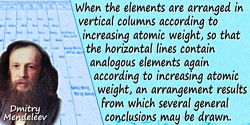
When the elements are arranged in vertical columns according to increasing atomic weight, so that the horizontal lines contain analogous elements again according to increasing atomic weight, an arrangement results from which several general conclusions may be drawn.
'The Relations of the Properties to the Atomic Weights of the Elements', Zeitschrift fur Chemie, 1869.
When the first mathematical, logical, and natural uniformities, the first laws, were discovered, men were so carried away by the clearness, beauty and simplification that resulted, that they believed themselves to have deciphered authentically the eternal thoughts of the Almighty.
From Lecture (Nov 1906) at the Lowell Institute, Boston. Published in 'The Present Dilemma in Philosophy',Pragmatism: A New Name for Some Old Ways of Thinking: Popular Lectures on Philosophy (1907), 56.
When the moon is ninety degrees away from the sun it sees but half the earth illuminated (the western half). For the other (the eastern half) is enveloped in night. Hence the moon itself is illuminated less brightly from the earth, and as a result its secondary light appears fainter to us.
The Starry Messenger (1610), trans. Stillman Drake, Discoveries and Opinions of Galileo (1957), 45.
When we have done our best, we should wait the result in peace.
The Pleasures of Life (1887, 2007), 18.
Whenever Nature's bounty is in danger of exhaustion, the chemist has sought for a substitute. The conquest of disease has made great progress as a result of your efforts. Wherever we look, the work of the chemist has raised the level of our civilization and has increased the productive capacity of the nation. Waste materials, formerly cast aside, are now being utilized.
Speech to American Chemical Society, White House lawn (Apr 1924). Quoted in American Druggist (1925), 73, 19.
Wherever man has left the stamp of mind on brute-matter; whether we designate his work as structure, texture, or mixture, mechanical or chymical; whether the result be a house, a ship, a garment, a piece of glass, or a metallic implement, these memorials of economy and invention will always be worthy of the attention of the Archaeologist.
In Lecture to the Oxford meeting of the Archaeological Institute (18 Jun 1850), printed in 'On the Study of Achaeology', Archaeological Journal (1851), 8, No. 29, 25.
While it is never safe to affirm that the future of Physical Science has no marvels in store even more astonishing than those of the past, it seems probable that most of the grand underlying principles have been firmly established, and that further advances are to be sought chiefly in the rigorous applications of these principles to all the phenomena which come under our notice. It is here that the science of measurement shows its importance—where the quantitative results are more to be desired than qualitative work. An eminent physicist has remarked that the future truths of Physical Science are to be looked for in the sixth place of decimals.
University of Chicago, Annual Register 1894-1895 (1894), 150. Michelson also incorporated these lines in his address, 'Some of the Objects and Methods of Physical Science', at the opening of the Physics and Electrical Engineering Laboratory at the University of Kansas, reprinted in The Electrical Engineer (1 Jan 1896), 21, No. 400, 9.
While it is true that scientific results are entirely independent from religious and moral considerations, those individuals to whom we owe the great creative achievements of science were all of them imbued with the truly religious conviction that this universe of ours is something perfect and susceptible to the rational striving for knowledge. If this conviction had not been a strongly emotional one and if those searching for knowledge had not been inspired by Spinoza's Amor Dei Intellectualis, they would hardly have been capable of that untiring devotion which alone enables man to attain his greatest achievements.
In response to a greeting sent by the Liberal Ministers’ Club of New York City, published in 'Religion and Science: Irreconcilable?' The Christian Register (Jun 1948). Collected in Albert Einstein, Cal Seelig (ed.) and Sonja Bargmann (trans., ed.), Ideas and Options (1954), 52.
While the artist’s communication is linked forever with its original form, that of the scientist is modified, amplified, fused with the ideas and results of others.
In The Eighth Day of Creation by Horace Freeland Judson (1979).
While the method of the natural sciences is... analytic, the method of the social sciences is better described as compositive or synthetic. It is the so-called wholes, the groups of elements which are structurally connected, which we learn to single out from the totality of observed phenomena... Insofar as we analyze individual thought in the social sciences the purpose is not to explain that thought, but merely to distinguish the possible types of elements with which we shall have to reckon in the construction of different patterns of social relationships. It is a mistake... to believe that their aim is to explain conscious action ... The problems which they try to answer arise only insofar as the conscious action of many men produce undesigned results... If social phenomena showed no order except insofar as they were consciously designed, there would indeed be no room for theoretical sciences of society and there would be, as is often argued, only problems of psychology. It is only insofar as some sort of order arises as a result of individual action but without being designed by any individual that a problem is raised which demands a theoretical explanation... people dominated by the scientistic prejudice are often inclined to deny the existence of any such order... it can be shown briefly and without any technical apparatus how the independent actions of individuals will produce an order which is no part of their intentions... The way in which footpaths are formed in a wild broken country is such an instance. At first everyone will seek for himself what seems to him the best path. But the fact that such a path has been used once is likely to make it easier to traverse and therefore more likely to be used again; and thus gradually more and more clearly defined tracks arise and come to be used to the exclusion of other possible ways. Human movements through the region come to conform to a definite pattern which, although the result of deliberate decision of many people, has yet not be consciously designed by anyone.
…...
While up to this time contrary sexual instinct has had but an anthropological, clinical, and forensic interest for science, now, as a result of the latest investigations, there is some thought of therapy in this incurable condition, which so heavily burdens its victims, socially, morally, and mentally. A preparatory step for the application of therapeutic measures is the exact differentiation of the acquired from the congenital cases; and among the latter again, the assignment of the concrete case to its proper position in the categories that have been established empirically.
Psychopathia Sexualis: With Special Reference to Contrary Sexual Instinct: A Medico-Legal Study (1886), trans. Charles Gilbert Chaddock (1892), 319.
Who … is not familiar with Maxwell’s memoirs on his dynamical theory of gases? … from one side enter the equations of state; from the other side, the equations of motion in a central field. Ever higher soars the chaos of formulae. Suddenly we hear, as from kettle drums, the four beats “put n=5.” The evil spirit v vanishes; and … that which had seemed insuperable has been overcome as if by a stroke of magic … One result after another follows in quick succession till at last … we arrive at the conditions for thermal equilibrium together with expressions for the transport coefficients.
In Ceremonial Speech (15 Nov 1887) celebrating the 301st anniversary of the Karl-Franzens-University Graz. Published as Gustav Robert Kirchhoff: Festrede zur Feier des 301. Gründungstages der Karl-Franzens-Universität zu Graz (1888), 29, as translated in Michael Dudley Sturge, Statistical and Thermal Physics (2003), 343. A more complete alternate translation also appears on the Ludwig Boltzmann Quotes page of this website.
Who does not know Maxwell’s dynamic theory of gases? At first there is the majestic development of the variations of velocities, then enter from one side the equations of condition and from the other the equations of central motions, higher and higher surges the chaos of formulas, suddenly four words burst forth: “Put n = 5.” The evil demon V disappears like the sudden ceasing of the basso parts in music, which hitherto wildly permeated the piece; what before seemed beyond control is now ordered as by magic. There is no time to state why this or that substitution was made, he who cannot feel the reason may as well lay the book aside; Maxwell is no program-musician who explains the notes of his composition. Forthwith the formulas yield obediently result after result, until the temperature-equilibrium of a heavy gas is reached as a surprising final climax and the curtain drops.
In Ceremonial Speech (15 Nov 1887) celebrating the 301st anniversary of the Karl-Franzens-University Graz. Published as Gustav Robert Kirchhoff: Festrede zur Feier des 301. Gründungstages der Karl-Franzens-Universität zu Graz (1888), 29-30, as translated in Robert Édouard Moritz, Memorabilia Mathematica; Or, The Philomath’s Quotation-book (1914), 187. From the original German, “Wer kennt nicht seine dynamische Gastheorie? – Zuerst entwickeln sich majestätisch die Variationen der Geschwindigkeiten, dann setzen von der einen Seite die Zustands-Gleichungen, von der anderen die Gleichungen der Centralbewegung ein, immer höher wogt das Chaos der Formeln; plötzlich ertönen die vier Worte: „Put n=5.“Der böse Dämon V verschwindet, wie in der Musik eine wilde, bisher alles unterwühlende Figur der Bässe plötzlich verstummt; wie mit einem Zauberschlage ordnet sich, was früher unbezwingbar schien. Da ist keine Zeit zu sagen, warum diese oder jene Substitution gemacht wird; wer das nicht fühlt, lege das Buch weg; Maxwell ist kein Programmmusiker, der über die Noten deren Erklärung setzen muss. Gefügig speien nun die Formeln Resultat auf Resultat aus, bis überraschend als Schlusseffect noch das Wärme-Gleichgewicht eines schweren Gases gewonnen wird und der Vorhang sinkt.” A condensed alternate translation also appears on the Ludwig Boltzmann Quotes page of this website.
Who knows not mathematics and the results of recent scientific investigation dies without knowing truth.
As qoted in Jacob William Albert Young, Teaching of Mathematics in the Elementary and the Secondary School (1907), 44. Footnoted with cite to Simon, Mathematischer Unterricht, 21
Why, it is asked, since the scientist, by means of classification and experiment, can predict the “action of the physical world, shall not the historian do as much for the moral world”! The analogy is false at many points; but the confusion arises chiefly from the assumption that the scientist can predict the action of the physical world. Certain conditions precisely given, the scientist can predict the result; he cannot say when or where in the future those conditions will obtain.
In 'A New Philosophy of History', The Dial (2 Sep 1915), 148. This is Becker’s review of a book by L. Cecil Jane, The Interpretation of History. Becker refutes Jane’s idea that the value of history lies in whether it consists in furnishing “some clue as to what the future will bring.”
Wisdom comes from experience. Experience is often a result of lack of wisdom.
Widely seen, attributed to Terry Pratchett, but always without citation. This seems dubious to Webmaster, who has, so far, found no primary source to verify this quote—not found for Pratchett, nor for anyone else. (Can you help?)
With an interest almost amounting to anxiety, geologists will watch the development of researches which may result in timing the strata and the phases of evolutionary advance; and may even-going still further back—give us reason to see in the discrepancy between denudative and radioactive methods, glimpses of past aeons, beyond that day of regeneration which at once ushered in our era of life, and, for all that went before, was 'a sleep and a forgetting'.
Radioactivity and Geology (1909), 250-1.
Without the concepts, methods and results found and developed by previous generations right down to Greek antiquity one cannot understand either the aims or achievements of mathematics in the last fifty years.
In 'A Half-Century of Mathematics', The American Mathematical Monthly, 58, No. 8, 523.
Workers must root out the idea that by keeping the results of their labors to themselves a fortune will be assured to them. Patent fees are so much wasted money. The flying machine of the future will not be born fully fledged and capable of a flight for 1,000 miles or so. Like everything else it must be evolved gradually. The first difficulty is to get a thing that will fly at all. When this is made, a full description should be published as an aid to others. Excellence of design and workmanship will always defy competition.
As quoted in Octave Chanute, Progress in Flying Machines (1894), 218.
You can try many different conditions, but if you get a negative result, you never know if you’re getting closer or farther away.
Concerning his research for identification of transcription factors. As quoted in Farooq Ahmed, 'Profile of Gregg L. Semenza', Proceedings of the National Academy of Sciences of the United States of America (17 Aug 2010), 107, No. 33, 14522.
You cannot force ideas. Successful ideas are the result of slow growth. Ideas do not reach perfection in a day, no matter how much study is put upon them. It is perserverance in the pursuit of studies that is really wanted.
In Orison Swett Marden, 'Bell Telephone Talk: Hints on Success by Alexander G. Bell', How They Succeeded: Life Stories of Successful Men Told by Themselves (1901), 34.
You don’t concentrate on risks. You concentrate on results. No risk is too great to prevent the necessary job from getting done.
You have to have a lot of ideas. First, if you want to make discoveries, it’s a good thing to have good ideas. And second, you have to have a sort of sixth sense—the result of judgment and experience—which ideas are worth following up. I seem to have the first thing, a lot of ideas, and I also seem to have good judgment as to which are the bad ideas that I should just ignore, and the good ones, that I’d better follow up.
As quoted by Nancy Rouchette, The Journal of NIH Research (Jul 1990), 2, 63. Reprinted in Linus Pauling, Barclay Kamb, Linus Pauling: Selected Scientific Papers, Vol. 2, Biomolecular Sciences (2001), 1101.
You say Beasts are Machines like Watches? But put the Machine called a Dog, and the Machine called a Bitch to one another for some time, and there may result another little Machine; whereas two Watches might be together all their Life-time, without ever producing a third Watch. Now Madam de B— and I think, according to our Philosophy, that all things which being but two, are endued with the Virtue of making themselves three, are of a much higher Nature than a Machine.
'Letter XI to Mr. C: Upon his studying the Philosophy of Descartes', Letters of Gallantry (1685), trans. Mr Ozell (1715), 25.
Your Grace will no doubt have learnt from the weekly reports of one Marco Antonio Bragadini, called Mamugnano. … He is reported to be able to turn base metal into gold… . He literally throws gold about in shovelfuls. This is his recipe: he takes ten ounces of quicksilver, puts it into the fire, and mixes it with a drop of liquid, which he carries in an ampulla. Thus it promptly turns into good gold. He has no other wish but to be of good use to his country, the Republic. The day before yesterday he presented to the Secret Council of Ten two ampullas with this liquid, which have been tested in his absence. The first test was found to be successful and it is said to have resulted in six million ducats. I doubt not but that this will appear mighty strange to your Grace.
'The Famous Alchemist Bragadini. From Vienna on the 1st day of November 1589'. As quoted in George Tennyson Matthews (ed.) News and Rumor in Renaissance Europe: The Fugger Newsletters (1959), 173. A handwritten collection of news reports (1568-1604) by the powerful banking and merchant house of Fugger in Ausburg.
 In science it often happens that scientists say, 'You know that's a really good argument; my position is mistaken,' and then they would actually change their minds and you never hear that old view from them again. They really do it. It doesn't happen as often as it should, because scientists are human and change is sometimes painful. But it happens every day. I cannot recall the last time something like that happened in politics or religion.
(1987) --
In science it often happens that scientists say, 'You know that's a really good argument; my position is mistaken,' and then they would actually change their minds and you never hear that old view from them again. They really do it. It doesn't happen as often as it should, because scientists are human and change is sometimes painful. But it happens every day. I cannot recall the last time something like that happened in politics or religion.
(1987) -- 





.jpg)


