Research Quotes (758 quotes)
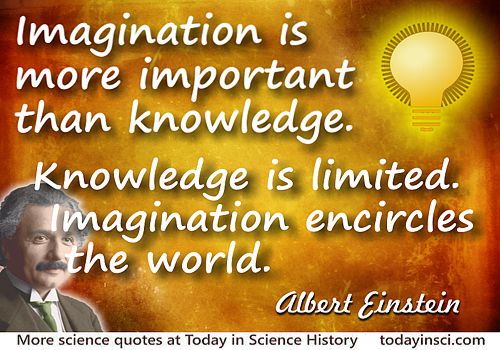
… the icy layers of the upper atmosphere contain conundrums enough to be worthy of humanity's greatest efforts.
Begrüssungsworte', Fourth conference of the International Commission for Scientific Aeronautics, St. Petersberg, 1904 (1905), 28-35. Quoted in Peter Lynch, The Emergence of Numerical Weather Prediction (2006), 97.
…cabinet naturalists [who] of nature saw almost nothing but what [that] is conserved in museums.
Arduino had an aversion to those authors inclined to empiricism and speculation, instead of field research. From Due Lettere del Sig Giovanni Arduino, lvi, 61. As quoted and cited by Francesco Luzzini, Lettere di Giovanni Arduino (edited by Ezio Vaccari) - Book Review (Jan 2011), published in Studi Veneziani (2010), LX, 294. As given by Google Translate, from the original: “naturalisti da gabinetto”, che “della naturaquasi altro non viddero che ciò [che] conservasi ne’ musei.”
…we are all inclined to ... direct our inquiry not by the matter itself, but by the views of our opponents; and, even when interrogating oneself, one pushes the inquiry only to the point at which one can no longer offer any opposition. Hence a good inquirer will be one who is ready in bringing forward the objections proper to the genus, and that he will be when he has gained an understanding of the differences.
'On the Heavens', The Works of Aristotle editted by William David Ross and John Alexander Smith (1930), Vol. 2, 15.
“Endow scientific research and we shall know the truth, when and where it is possible to ascertain it;” but the counterblast is at hand: “To endow research is merely to encourage the research for endowment; the true man of science will not be held back by poverty, and if science is of use to us, it will pay for itself.” Such are but a few samples of the conflict of opinion which we find raging around us.
From The Grammar of Science (1892), 5.
“Normal science” means research firmly based upon one or more past scientific achievements, achievements that some particular scientific community acknowledges for a time as supplying the foundation for its further practice.
The Structure of Scientific Revolutions (1962), 10.
“On doit etre etonné ([Abbé Raynal]says) que l'Amerique n’ait pas encore produit un bon poëte, un habile mathematicien, un homme de génie dans un seul art, ou une seule science.” …“America has not yet produced one good poet.” When we shall have existed as a people as long as the Greeks did before they produced a Homer, the Romans a Virgil, the French a Racine and Voltaire, the English a Shakespeare and Milton, should this reproach be still true, we will enquire from what unfriendly causes it has proceeded, that the other countries of Europe and quarters of the earth shall not have inscribed any name in the roll of poets. But neither has America produced “one able mathematician, one man of genius in a single art or a single science.” … In physics we have produced a [Benjamin] Franklin, than whom no one of the present age has made more important discoveries, nor has enriched philosophy with more, or more ingenious solutions of the phaenomena, of nature. … [The quadrant invented by Godfrey, an American also, and with the aid of which the European nations traverse the globe, is called Hadley’s quadrant.] … We have supposed Mr. [David] Rittenhouse second to no astronomer living: that in genius he must be the first, because he is self-taught. As an artist he has exhibited as great a proof of mechanical genius as the world has ever produced. … We therefore suppose, that this reproach is as unjust as it is unkind; and that, of the geniuses which adorn the present age, America contributes its full share. [Compared to the much larger populations of European countries.]
The reference given by Jefferson for the original reproach by Abbé Raynal, an ellipsis above, is “7. Hist. Philos. p. 92. ed. Maestricht. 1774”. The original remark written in French, translates as: “One must be amazed that America has not yet produced a good poet, an able mathematician, one man of genius in a single art, or a single science.” Jefferson uses parts of it in English, to introduce his rebuttal. From Thomas Jefferson, Notes on the State of Virginia (1787), 107-110. A footnote adds that: “In a later edition of the Abbé Raynal’s work, he has withdrawn his censure…”
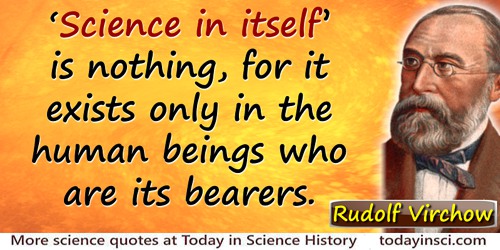
“Science in itself” is nothing, for it exists only in the human beings who are its bearers.
In 'Standpoints in Scientific Medicine', Disease, Life, and Man: Selected Essays (1958), 42.
[A friend at Cambridge] told me that Helmholtz had been a medical doctor before he became a physicist. It thereupon occurred to me that Helmholtz had eaten the meal of life in the wrong order, and that I would like to spend the first half of my life under the strict discipline of physics, and afterwards to apply that training to researches on living things.
As quoted in Stephen A. Richardson 'Lewis Fry Richardson (1881-1953): A Personal Biography', Conflict Resolution (Sep 1957), 1, No. 3, 301.
[About research with big particle accelerators such as the Large Hadron Collider.] I think the primary justification for this sort of science that we do is fundamental human curiosity. ... It's true, of course, that every previous generation that's made some breakthrough in understanding nature has seen those discoveries translated into new technologies, new possibilities for the human race. That may well happen with the Higgs boson. Quite frankly, at the moment I don't see how you can use the Higgs boson for anything useful.
As quoted in Alan Boyle, 'Discovery of Doom? Collider Stirs Debate', article (8 Sep 2008) on a msnbc.com web page.
[Allowing embryonic stem cell research] … is also likely to lead to human cloning and the harvesting of body parts from babies conceived for this purpose.
An example of extreme prolife religious conservative opposition confusing public opinion.
An example of extreme prolife religious conservative opposition confusing public opinion.
Statement released 15 Jun 2004 from Focus on the Family organisation which he founded. Quoted in Eve Herold, George Daley, Stem Cell Wars (2007), 39.
[An outsider views a scientist] as a type of unscrupulous opportunist: he appears as a realist, insofar as he seeks to describe the world independent of the act of perception; as idealist insofar as he looks upon the concepts and theories as the free inventions of the human spirit (not logically derivable from that which is empirically given); as positivist insofar as he considers his concepts and theories justified only to the extent to which they furnish a logical representation of relations among sense experiences. He may even appear as Platonist or Pythagorean insofar as he considers the viewpoint of logical simplicity as an indispensable and effective tool of his research.
In 'Reply to Critcisms', Paul Arthur Schilpp (ed.), Albert Einstein: Philosopher-Scientist (1949, 1959), Vol. 2, 684.
[At DuPont,] I was very fortunate that I worked under men who were very much interested in making discoveries and inventions. They were very much interested in what they were doing, and they left me alone. And I was able to experiment on my own, and I found this very stimulating. It appealed to the creative person in me.
From transcript for video interview (2007, published Aug 2012), 'Stephanie Kwolek: Curiosity and the Discovery of Kevlar', in the series Women in Chemistry, on Chemical Heritage Foundation website.
[Before the time of Benjamin Peirce it never occurred to anyone that mathematical research] was one of the things for which a mathematical department existed. Today it is a commonplace in all the leading universities. Peirce stood alone—a mountain peak whose absolute height might be hard to measure, but which towered above all the surrounding country.
In 'The Story of Mathematics at Harvard', Harvard Alumni Bulletin (3 Jan 1924), 26, 376. Cited by R. C. Archibald in 'Benjamin Peirce: V. Biographical Sketch', The American Mathematical Monthly (Jan 1925), 32, No. 1, 10.
[Edison] definitely ended the distinction between the theoretical man of science and the practical man of science, so that today we think of scientific discoveries in connection with their possible present or future application to the needs of man. He took the old rule-of-thumb methods out of industry and substituted exact scientific knowledge, while, on the other hand, he directed scientific research into useful channels.
In My Friend Mr. Edison (1930). Quoted in Dyson Carter, If You Want to Invent (1939), 110.
[For] men to whom nothing seems great but reason ... nature ... is a cosmos, so admirable, that to penetrate to its ways seems to them the only thing that makes life worth living. These are the men whom we see possessed by a passion to learn ... Those are the natural scientific men; and they are the only men that have any real success in scientific research.
From 'Lessons from the History of Science: The Scientific Attitude' (c.1896), in Collected Papers (1931), Vol. 1, 19.
[I doubt that in today's world, I and Francis Crick would ever have had our Eureka moment.] I recently went to my staircase at Clare College, Cambridge and there were women there! he said, with an enormous measure of retrospective sexual frustration. There have been a lot of convincing studies recently about the loss of productivity in the Western male. It may be that entertainment culture now is so engaging that it keeps people satisfied. We didn't have that. Science was much more fun than listening to the radio. When you are 16 or 17 and in that inherently semi-lonely period when you are deciding whether to be an intellectual, many now don't bother.
(Response when asked how he thought the climate of scientific research had changed since he made his discovery of the structure of life in 1953.)
(Response when asked how he thought the climate of scientific research had changed since he made his discovery of the structure of life in 1953.)
Quoted by Tim Adams in 'The New Age of Ignorance', The Observer (30 Jun 2007).
[In research on bacteria metabolism] we have indeed much the same position as an observer trying to gain an idea of the life of a household by careful scrutiny of the persons and material arriving or leaving the house; we keep accurate records of the foods and commodities left at the door and patiently examine the contents of the dust-bin and endeavour to deduce from such data the events occurring within the closed doors.
Bacterial Metabolism (1930), Preface. In 'Obituary Notice: Marjory Stephenson, 1885–1948', Biochemistry Journal (1950), 46:4, 380.
[In the case of research director, Willis R. Whitney, whose style was to give talented investigators as much freedom as possible, you may define “serendipity” as] the art of profiting from unexpected occurrences. When you do things in that way you get unexpected results. Then you do something else and you get unexpected results in another line, and you do that on a third line and then all of a sudden you see that one of these lines has something to do with the other. Then you make a discovery that you never could have made by going on a direct road.
Quoted in Guy Suits, 'Willis Rodney Whitney', National Academy of Sciences, Biographical Memoirs (1960), 355.
[It was] a lot of fun and we were so absorbed trying to do a good job that we didn’t think of the dangers. Until later on when people were saying, “You were sitting on top of all that hydrogen and oxygen.” Those tanks were right outside, the control room’s right there. I mean now, like up at Plum Brook, the control room for B-2 is like half a mile away. We were fifty feet away.
Recalling his experience with rocket engine tests using liquid hydrogen and liquid oxygen, while working as an engineer at the Propulsion Systems Laboratory. From Interview (1 Sep 2009), for the NASA Glenn History Collection, Oral History Collection, Cleveland, Ohio. As quoted an cited in Robert S. Arrighi, Pursuit of Power: NASA’s Propulsion and Systems Laboratory No. 1 and 2 (2012), 91.
[Karen] Uhlenbeck’s research has led to revolutionary advances at the intersection of mathematics and physics. Her pioneering insights have applications across a range of fascinating subjects, from string theory, which may help explain the nature of reality, to the geometry of space-time.
In news release, 'Mathematics’ Highest Prize Awarded to UT Austin’s Karen Uhlenbeck', UT News (19 Mar 2019) on website of University of Texas at Austin.
[King Hiero II] requested Archimedes to consider [whether a crown was pure gold or alloyed with silver]. The latter, while the case was still on his mind, happened to go to the bath, and on getting into a tub observed that the more his body sank into it the more water ran out over the tub. As this pointed out the way to explain the case in question, without a moment’s delay, and transported with joy, he jumped out of the tub and rushed home naked, crying with a loud voice that he had found what he was seeking; for as he ran he shouted repeatedly in Greek, “Eὕρηκα, εὕρηκα.”
This famous anecdote, being written about two centuries after Archimedes, is of questionable authenticity, but Vitruvius provided the origin of the story as we know it. In De Architectura, Book 9, Introduction, Sec. 10. As translated in Morris Hicky Morgan (trans.), Vitruvius: The Ten Books on Architecture (1914), 254. Also seen translated as “While Archimedes was turning the problem over, he chanced to come to the place of bathing, and there, as he was sitting down in the tub, he noticed that the amount of water which flowed over the tub was equal to the amount by which his body was immersed. This showed him a means of solving the problem. … In his joy, he leapt out of the tub and, rushing naked towards his home, he cried out with a loud voice that he had found what he sought.” In Ivor Bulmer-Thomas, Selections Illustrating the History of Greek Mathematics (1939), 37.
[L]et us not overlook the further great fact, that not only does science underlie sculpture, painting, music, poetry, but that science is itself poetic. The current opinion that science and poetry are opposed is a delusion. … On the contrary science opens up realms of poetry where to the unscientific all is a blank. Those engaged in scientific researches constantly show us that they realize not less vividly, but more vividly, than others, the poetry of their subjects. Whoever will dip into Hugh Miller’s works on geology, or read Mr. Lewes's “Seaside Studies,” will perceive that science excites poetry rather than extinguishes it. And whoever will contemplate the life of Goethe will see that the poet and the man of science can co-exist in equal activity. Is it not, indeed, an absurd and almost a sacrilegious belief that the more a man studies Nature the less he reveres it? Think you that a drop of water, which to the vulgar eye is but a drop of water, loses anything in the eye of the physicist who knows that its elements are held together by a force which, if suddenly liberated, would produce a flash of lightning? Think you that what is carelessly looked upon by the uninitiated as a mere snow-flake, does not suggest higher associations to one who has seen through a microscope the wondrously varied and elegant forms of snow-crystals? Think you that the rounded rock marked with parallel scratches calls up as much poetry in an ignorant mind as in the mind of a geologist, who knows that over this rock a glacier slid a million years ago? The truth is, that those who have never entered upon scientific pursuits know not a tithe of the poetry by which they are surrounded. Whoever has not in youth collected plants and insects, knows not half the halo of interest which lanes and hedge-rows can assume. Whoever has not sought for fossils, has little idea of the poetical associations that surround the places where imbedded treasures were found. Whoever at the seaside has not had a microscope and aquarium, has yet to learn what the highest pleasures of the seaside are. Sad, indeed, is it to see how men occupy themselves with trivialities, and are indifferent to the grandest phenomena—care not to understand the architecture of the Heavens, but are deeply interested in some contemptible controversy about the intrigues of Mary Queen of Scots!—are learnedly critical over a Greek ode, and pass by without a glance that grand epic written by the finger of God upon the strata of the Earth!
In Education: Intellectual, Moral, and Physical (1889), 82-83.
[Locating, from scratch, the gene related to a disease is like] trying to find a burned-out light bulb in a house located somewhere between the East and West coasts without knowing the state, much less the town or street the house is on.
Quoted in Philip Elmer-Dewitt, et al.,'The Genetic Revolution', Time magazine (17 Jan 1994), 46-53.
[M]y work, which I’ve done for a long time, was not pursued in order to gain the praise I now enjoy, but chiefly from a craving after knowledge, which I notice resides in me more than in most other men. And therewithal, whenever I found out anything remarkable, I have thought it my duty to put down my discovery on paper, so that all ingenious people might be informed thereof.
Letter (27 Jun 1716) thanking the University of Louvain for ending him a medal designed in honour of his research. (Leeuwenhoek was then in his 84th year.) As cited by Charles-Edward Amory Winslow in The Conquest of Epidemic Disease: A Chapter in the History of Ideas (), 156.
[Modern science] passed through a long period of uncertainty and inconclusive experiment, but as the instrumental aids to research improved, and the results of observation accumulated, phantoms of the imagination were exorcised, idols of the cave were shattered, trustworthy materials were obtained for logical treatment, and hypotheses by long and careful trial were converted into theories.
In The Present Relations of Science and Religion (1913, 2004), 3
[My research] throve best under adversity … in Germany in the middle 1930s under the Nazis when things became quite unpleasant and official seminars became dull. … We had a little private club… theoretical physicists and biologists. The discussions we had at that time have had a remarkable long-range effect, an effect that astonished us all. This was one adverse situation. Like the great Plague in Florence in 1348, which is the background setting for Bocaccio's Decameron.
In 'Homo Scientificus According to Beckett', collected in William Beranek, Jr. (ed.),Science, Scientists, and Society, (1972), 135-. Excerpted in Ann E. Kammer, Science, Sex, and Society (1979), 278.
[On research] It’s got to be fun. I don't think anybody should tell you that he’s slogged his way through 25 years on a problem and there's only one reward at the end, and that's the value of the Hubble constant. That’s a bunch of hooey. The reward is learning all the wonderful properties of the things that don’t work.
As quoted in Obituary, 'Allan Sandage, 84, Astronomer, Dies; Charted Cosmos’s Age and Expansion', New York Times (17 Nov 2010), B19.
[On the practical applications of particle physics research with the Large Hadron Collider.] Sometimes the public says, “What's in it for Numero Uno? Am I going to get better television reception? Am I going to get better Internet reception?” Well, in some sense, yeah. … All the wonders of quantum physics were learned basically from looking at atom-smasher technology. … But let me let you in on a secret: We physicists are not driven to do this because of better color television. … That's a spin-off. We do this because we want to understand our role and our place in the universe.
As quoted in Alan Boyle, 'Discovery of Doom? Collider Stirs Debate', article (8 Sep 2008) on a msnbc.com web page. The article writer included the information that Kaku noted that past discoveries from the world of particle physics ushered in many of the innovations we enjoy today, ranging from satellite communications and handheld media players to medical PET scanners (which put antimatter to practical use)."
[Otto Struve] made the remark once that he never looked at the spectrum of a star, any star, where he didn’t find something important to work on.
'Oral History Transcript: Dr. William Wilson Morgan' (8 Aug 1978) in the Niels Bohr Library & Archives.
[Pure research] is worth every penny it costs.
Quoted in 'Moon-Struck Scientist,' New York Times (27 Apr 1961), 42.
[Richard Drew] always encouraged his people to pursue ideas… He said, “If it’s a dumb idea, you’ll find out. You’ll smack into that brick wall, then you’ll stagger back and see another opportunity that you wouldn’t have seen otherwise.”
— Art Fry
As quoted in W. James McNerney Jr., A Century of Innovation: The 3M Story (2002), 68. (Note: The quote is in the words of Art Fry, as a recollection, and not necessarily a verbatim quote as spoken by Drew.)
[Richard Drew] created a greenhouse environment—a skunkworks—where we could do anything, try anything. When you’re an oddball in a permissive environment, very often things turn out well.
As quoted in W. James McNerney Jr., A Century of Innovation: The 3M Story (2002), 26.
[Scientific research reveals] the majestic spectacle of the order of nature gradually unfolding itself to man’s consciousness and placing in his hands the implements of ever augmenting power to control his destinies and attain that ultimate comprehension of the universe which has in all ages constituted the supreme aspiration of man.
As quoted in book review by Ian Clunies Ross, "The Spirit of Research', The Australian Quarterly (Dec 1931), 3, No. 12, 126.
[T]he yeoman’s work in any science, and especially physics, is done by the experimentalist, who must keep the theoreticians honest.
In Hyperspace: A Scientific Odyssey Through Parallel Universes, Time Warps, and The Tenth Dimension (1994), 314.
[Technical courage means the] physician-scientist must be brave enough to adopt new methods. It is far too easy to learn one technique and then to repeat the same experiment over and over. In this fashion one can write many papers, receive large research grants, and remain solidly rooted in the middle of a scientific field. But the true innovator has the confidence to drop one set of experimental crutches and leap to another when he or she must move forward.
In Banquet Speech, 'The Nobel Prize in Physiology or Medicine 1985', on website nobelprize.org. Published in Les Prix Nobel, 1985: Nobel Prizes, Presentations, Biographies and Lectures (1986).
[The purpose of flight research] is to separate the real from the imagined problems and to make known the overlooked and the unexpected.
Description of the purpose of the X-15 program given in a meeting at the Langley Research Center (Oct 1956). Quoted in Michael H. Gorn, Expanding the Envelope (2001), 3.
[The surplus of basic knowledge of the atomic nucleus was] largely used up [during the war with the atomic bomb as the dividend.] We must, without further delay restore this surplus in preparation for the important peacetime job for the nucleus - power production. ... Many of the proposed applications of atomic power - even for interplanetary rockets - seem to be within the realm of possibility provided the economic factor is ruled out completely, and the doubtful physical and chemical factors are weighted heavily on the optimistic side. ... The development of economic atomic power is not a simple extrapolation of knowledge gained during the bomb work. It is a new and difficult project to reach a satisfactory answer. Needless to say, it is vital that the atomic policy legislation now being considered by the congress recognizes the essential nature of this peacetime job, and that it not only permits but encourages the cooperative research-engineering effort of industrial, government and university laboratories for the task. ... We must learn how to generate the still higher energy particles of the cosmic rays - up to 1,000,000,000 volts, for they will unlock new domains in the nucleus.
Addressing the American Institute of Electrical Engineering, in New York (24 Jan 1946). In Schenectady Gazette (25 Jan 1946),
[There] are cases where there is no dishonesty involved but where people are tricked into false results by a lack of understanding about what human beings can do to themselves in the way of being led astray by subjective effects, wishful thinking or threshold interactions. These are examples of pathological science. These are things that attracted a great deal of attention. Usually hundreds of papers have been published upon them. Sometimes they have lasted for fifteen or twenty years and then they gradually die away.
[Coining the term “pathological science” for the self-deceiving application of science to a phenomenon that doesn't exist.]
[Coining the term “pathological science” for the self-deceiving application of science to a phenomenon that doesn't exist.]
From a Colloquium at The Knolls Research Laboratory (18 Dec 1953). Transcribed and edited by R. N. Hall. In General Electric Laboratories, Report No. 68-C-035 (April 1968).
[Vikram Sarabhai] informed the whole of his team about any new project and started working on it only after having discussed it with everyone.
As given in narrative form by Mahesh Sharma, P. Bhalla and P.K. Das, in 'Prof. Vikram Sarabhai in the Opinion of Dr. Kalam', Pride Of The Nation: Dr. A.P.J. Abdul Kalam (2004), 46.
[Vikram Sarabhai] said that if we want to establish ourselves in the world, we have to be self-sufficient and search for new ideas and techniques.
As given in narrative form by Mahesh Sharma, P. Bhalla and P.K. Das, in 'Prof. Vikram Sarabhai in the Opinion of Dr. Kalam', Pride Of The Nation: Dr. A.P.J. Abdul Kalam (2004), 46.
[Vikram Sarabhai] said that the performer must have emotional attachment with the project along with the physical: otherwise one can’t attain dedication and devotion for it.
As given in narrative form by Mahesh Sharma, P. Bhalla and P.K. Das, in 'Prof. Vikram Sarabhai in the Opinion of Dr. Kalam', Pride Of The Nation: Dr. A.P.J. Abdul Kalam (2004), 46.
[Recalling Professor Ira Remsen's remarks (1895) to a group of his graduate students about to go out with their degrees into the world beyond the university:]
He talked to us for an hour on what was ahead of us; cautioned us against giving up the desire to push ahead by continued study and work. He warned us against allowing our present accomplishments to be the high spot in our lives. He urged us not to wait for a brilliant idea before beginning independent research, and emphasized the fact the Lavoisier's first contribution to chemistry was the analysis of a sample of gypsum. He told us that the fields in which the great masters had worked were still fruitful; the ground had only been scratched and the gleaner could be sure of ample reward.
He talked to us for an hour on what was ahead of us; cautioned us against giving up the desire to push ahead by continued study and work. He warned us against allowing our present accomplishments to be the high spot in our lives. He urged us not to wait for a brilliant idea before beginning independent research, and emphasized the fact the Lavoisier's first contribution to chemistry was the analysis of a sample of gypsum. He told us that the fields in which the great masters had worked were still fruitful; the ground had only been scratched and the gleaner could be sure of ample reward.
Quoted in Frederick Hutton Getman, The Life of Ira Remsen (1980), 73.
[When recording electrical impulses from a frog nerve-muscle preparation seemed to show a tiresomely oscillating electrical artefact—but only when the muscle was hanging unsupported.] The explanation suddenly dawned on me ... a muscle hanging under its own weight ought, if you come to think of it, to be sending sensory impulses up the nerves coming from the muscle spindles ... That particular day’s work, I think, had all the elements that one could wish for. The new apparatus seemed to be misbehaving very badly indeed, and I suddenly found it was behaving so well that it was opening up an entire new range of data ... it didn’t involve any particular hard work, or any particular intelligence on my part. It was just one of those things which sometimes happens in a laboratory if you stick apparatus together and see what results you get.
From 'Memorable experiences in research', Diabetes (1954), 3, 17-18. As cited in Alan McComa, Galvani's Spark: The Story of the Nerve Impulse (2011), 102-103.
Clarke's First Law: When a distinguished but elderly scientist states that something is possible, he is almost certainly right. When he states that something is impossible, he is very probably wrong.
'Hazards of Prophecy: The Failure of Imagination'. In the collection. Profiles of the Future: An Enquiry into the Limits of the Possible (1962, rev. 1973), 14.
Clarke's Second Law: The only way of discovering the limits of the possible is to venture a little way past them into the impossible.
Profiles of the Future: An Enquiry into the Limits of the Possible (1962, rev. 1973), 21.
Drosophila melanogaster has been more extensively used in the study of genetics than any other organism, and the theory of heredity that is now generally accepted is based chiefly on the results obtained with this fly. … Not only has Drosophila been the most productive material for research in the subject, but it is now the standard object for laboratory instruction, and is used as such in many colleges and universities.
In The North American Species of Drosophila (1921), 12.
Ihre Arbeit ist gekrönt worden mit dem Nobel Preis für Otto Hahn.
Her work has been crowned by the Nobel Prize for Otto Hahn.
Her work has been crowned by the Nobel Prize for Otto Hahn.
Said to observe that she did not herself receive recognition of her research.
Indiana Jones: Archaeology is the search for fact… not truth. If it’s truth you're looking for, Dr. Tyree’s philosophy class is right down the hall. … So forget any ideas you've got about lost cities, exotic travel, and digging up the world. We do not follow maps to buried treasure, and “X” never, ever marks the spot. Seventy percent of all archaeology is done in the library. Research. Reading.
Spoken by actor Harrison Ford as character Indiana Jones in movie, Indiana Jones and the Last Crusade (1989).
La science, mon garçon, est faite d’erreurs, mais d’erreurs qu’il est bon de commettre, car elles mènent peu à peu à la vérité.
Science, my boy, is composed of errors, but errors that it is right to make, for they lead step by step to the truth.
Science, my boy, is composed of errors, but errors that it is right to make, for they lead step by step to the truth.
Journey to the Centre of the Earth, translated by William Butcher (1992, 2008), 146.
Les Leucocytes Et L'esprit De Sacrifice. — Il semble, d'après les recherches de De Bruyne (Phagocytose, 1895) et de ceux qui le citent, que les leucocytes des Lamellibranches — probablement lorsqu'ils ont phagocyté, qu'ils se sont chargés de résidus et de déchets, qu'ils ont, en un mot, accompli leur rôle et bien fait leur devoir — sortent du corps de l'animal et vont mourir dans le milieu ambiant. Ils se sacrifient. Après avoir si bien servi l'organisme par leur activité, ils le servent encore par leur mort en faisant place aux cellules nouvelles, plus jeunes.
N'est-ce pas la parfaite image du désintéressement le plus noble, et n'y a-t-il point là un exemple et un modèle? Il faut s'en inspirer: comme eux, nous sommes les unités d'un grand corps social; comme eux, nous pouvons le servir et envisager la mort avec sérénité, en subordonnant notre conscience individuelle à la conscience collective. (30 Jan 1896)
Leukocytes and The Spirit Of Sacrifice. - It seems, according to research by De Bruyne (Phagocytosis, 1885) and those who quote it, that leukocytes of Lamellibranches [bivalves] - likely when they have phagocytized [ingested bacteria], as they become residues and waste, they have, in short, performed their role well and done their duty - leave the body of the animal and will die in the environment. They sacrifice themselves. Having so well served the body by their activities, they still serve in their death by making room for new younger cells.
Isn't this the perfect image of the noblest selflessness, and thereby presents an example and a model? It should be inspiring: like them, we are the units of a great social body, like them, we can serve and contemplate death with equanimity, subordinating our individual consciousness to collective consciousness.
N'est-ce pas la parfaite image du désintéressement le plus noble, et n'y a-t-il point là un exemple et un modèle? Il faut s'en inspirer: comme eux, nous sommes les unités d'un grand corps social; comme eux, nous pouvons le servir et envisager la mort avec sérénité, en subordonnant notre conscience individuelle à la conscience collective. (30 Jan 1896)
Leukocytes and The Spirit Of Sacrifice. - It seems, according to research by De Bruyne (Phagocytosis, 1885) and those who quote it, that leukocytes of Lamellibranches [bivalves] - likely when they have phagocytized [ingested bacteria], as they become residues and waste, they have, in short, performed their role well and done their duty - leave the body of the animal and will die in the environment. They sacrifice themselves. Having so well served the body by their activities, they still serve in their death by making room for new younger cells.
Isn't this the perfect image of the noblest selflessness, and thereby presents an example and a model? It should be inspiring: like them, we are the units of a great social body, like them, we can serve and contemplate death with equanimity, subordinating our individual consciousness to collective consciousness.
In Recueil d'Œuvres de Léo Errera: Botanique Générale (1908), 194. Google translation by Webmaster. Please give feedback if you can improve it.
Nisi credideritis, non intelligitis.
Unless you believe, you will not understand.
Unless you believe, you will not understand.
De Ubero Arbitrio (On Free Choice of the Will) [386], Book I, chapter 2, section 4 (Augustine quoting from Isaiah 7:9).
Nun wie gehts?
How goes it?
[Werner’s perennial salutation to research students, hence his nickname, Professor Nunwiegehts.]
How goes it?
[Werner’s perennial salutation to research students, hence his nickname, Professor Nunwiegehts.]
Quoted in Ralph Oesper, The Human Side of Scientists (1975), 188.
On examinations: Das Wissen ist der Tad der Forschung.
Knowledge is the death of research.
Nernst's motto.
Knowledge is the death of research.
Nernst's motto.
Erwin N. Hiebert, 'Hermann Walther Nemst', in C. C. Gillispie (ed.), The Dictionary of Scientific Biography (1981), Supplement, Vol. 15, 450.
~~[Misattributed]~~ Somewhere, something incredible is waiting to be known.
Although describing Sagan’s viewpoint on extra-terrestrial life, expressed in the interview, these were her own summarizing words by the reporter, Sharon Begley, in 'Seeking Other Worlds', Newsweek (15 Aug 1977), 90, 53. The statement was not in quotation marks, and not Sagan’s own words, as verified on the quoteinvestigator.com website. [Updated on todayinsci site 25 Sep 2019.] An example of this narrative text being mistakenly printed as a Sagan quote is in Larry Chang, Wisdom for the Soul: Five Millennia of Prescriptions for Spiritual Healing (2006), 561, without source reference.
~~[Unverified attribution]~~ Most people stop looking when they find the proverbial needle in the haystack. I would continue looking to see if there were other needles.
Alice Calaprice, the most definitive editor of Einstein’s quotes, relegates this to the end of her book under 'Attributed to Einstein', meaning no primary source could be verified for it when published. See Alice Calaprice (ed.), The Ultimate Quotable Einstein (2013), 481.
A biologist, if he wishes to know how many toes a cat has, does not "frame the hypothesis that the number of feline digital extremities is 4, or 5, or 6," he simply looks at a cat and counts. A social scientist prefers the more long-winded expression every time, because it gives an entirely spurious impression of scientificness to what he is doing.
In Science is a Sacred Cow (1950), 151.
A century ago astronomers, geologists, chemists, physicists, each had an island of his own, separate and distinct from that of every other student of Nature; the whole field of research was then an archipelago of unconnected units. To-day all the provinces of study have risen together to form a continent without either a ferry or a bridge.
From chapter 'Jottings from a Note-book', in Canadian Stories (1918), 182-183.
A drop from the nose of Fleming, who had a cold, fell onto an agar plate where large yellow colonies of a contaminant had grown, and lysosyme was discovered. He made this important discovery because when he saw that the colonies of the contaminant were fading, his mind went straight to the right cause of the phenomenon he was observing—that the drop from his nose contained a lytic substance. And also immediately, he thought that this substance might be present in many secretions and tissues of the body. And he found this was so—the substance was in tears, saliva, leucocytes, skin, fingernails, mother's milk—thus very widely distributed in amounts and also in plants.
Personal recollections of Alexander Fleming by Lady Amelia Fleming. Quoted in Molecular Cloning (2001), Vol. 1, 153.
A fallacy entertained by many … is that any problem can be solved by gathering enough scientists and giving them enough money. To solve the problem of the common cold assemble a great institution, fill it with scientists and money, and soon we will have no more colds! It is folly to thus proceed. The great scientific steps forward originate in the minds of gifted scientists, not in the minds of promoters. The best way to proceed is to be sure that really inspired scientists have what they need to work with, and leave them alone
From a statement (21 Nov 1963) to the Select Committee on Government Research of the U.S. House of Representatives. Excerpted in 'Vannevar Bush Speaks', Science (27 Dec 1963), New Series, 142, No. 3600, 1623.
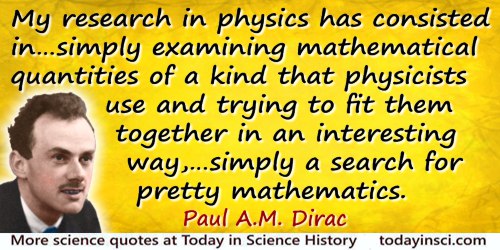
A good deal of my research in physics has consisted in not setting out to solve some particular problem, but simply examining mathematical quantities of a kind that physicists use and trying to fit them together in an interesting way, regardless of any application that the work may have. It is simply a search for pretty mathematics. It may turn out later to have an application. Then one has good luck. At age 78.
International Journal of Theoretical Physics (1982), 21, 603. In A. Pais, 'Playing With Equations, the Dirac Way'. Behram N. Kursunoglu (Ed.) and Eugene Paul Wigner (Ed.), Paul Adrien Maurice Dirac: Reminiscences about a Great Physicist (1990), 110.

A life that stood out as a gospel of self-forgetting service.
He could have added fortune to fame but caring for neither he found happiness and honor in being helpful to the world.
The centre of his world was the south where he was born in slavery some 79 years ago and where he did his work as a creative scientist.
He could have added fortune to fame but caring for neither he found happiness and honor in being helpful to the world.
The centre of his world was the south where he was born in slavery some 79 years ago and where he did his work as a creative scientist.
Epitaph on tombstone at Tuskegee University Campus Cemetery, Alabama.
A mind exclusively bent upon the idea of utility necessarily narrows the range of the imagination. For it is the imagination which pictures to the inner eye of the investigator the indefinitely extending sphere of the possible,—that region of hypothesis and explanation, of underlying cause and controlling law. The area of suggestion and experiment is thus pushed beyond the actual field of vision.
In 'The Paradox of Research', The North American Review (Sep 1908), 188, No. 634, 425.
A number of years ago, when I was a freshly-appointed instructor, I met, for the first time, a certain eminent historian of science. At the time I could only regard him with tolerant condescension.
I was sorry of the man who, it seemed to me, was forced to hover about the edges of science. He was compelled to shiver endlessly in the outskirts, getting only feeble warmth from the distant sun of science-in-progress; while I, just beginning my research, was bathed in the heady liquid heat up at the very center of the glow.
In a lifetime of being wrong at many a point, I was never more wrong. It was I, not he, who was wandering in the periphery. It was he, not I, who lived in the blaze.
I had fallen victim to the fallacy of the “growing edge;” the belief that only the very frontier of scientific advance counted; that everything that had been left behind by that advance was faded and dead.
But is that true? Because a tree in spring buds and comes greenly into leaf, are those leaves therefore the tree? If the newborn twigs and their leaves were all that existed, they would form a vague halo of green suspended in mid-air, but surely that is not the tree. The leaves, by themselves, are no more than trivial fluttering decoration. It is the trunk and limbs that give the tree its grandeur and the leaves themselves their meaning.
There is not a discovery in science, however revolutionary, however sparkling with insight, that does not arise out of what went before. “If I have seen further than other men,” said Isaac Newton, “it is because I have stood on the shoulders of giants.”
I was sorry of the man who, it seemed to me, was forced to hover about the edges of science. He was compelled to shiver endlessly in the outskirts, getting only feeble warmth from the distant sun of science-in-progress; while I, just beginning my research, was bathed in the heady liquid heat up at the very center of the glow.
In a lifetime of being wrong at many a point, I was never more wrong. It was I, not he, who was wandering in the periphery. It was he, not I, who lived in the blaze.
I had fallen victim to the fallacy of the “growing edge;” the belief that only the very frontier of scientific advance counted; that everything that had been left behind by that advance was faded and dead.
But is that true? Because a tree in spring buds and comes greenly into leaf, are those leaves therefore the tree? If the newborn twigs and their leaves were all that existed, they would form a vague halo of green suspended in mid-air, but surely that is not the tree. The leaves, by themselves, are no more than trivial fluttering decoration. It is the trunk and limbs that give the tree its grandeur and the leaves themselves their meaning.
There is not a discovery in science, however revolutionary, however sparkling with insight, that does not arise out of what went before. “If I have seen further than other men,” said Isaac Newton, “it is because I have stood on the shoulders of giants.”
Adding A Dimension: Seventeen Essays on the History of Science (1964), Introduction.
A persistent and age-old instinct makes us want to wander
Into regions yet untrod
And read what is still unread
In the manuscripts of God.
Into regions yet untrod
And read what is still unread
In the manuscripts of God.
Address upon receiving the Perkin Medal Award, 'The Big Things in Chemistry', The Journal of Industrial and Engineering Chemistry (Feb 1921), 13, No. 2, 163. These lines concluded his remarks, without citation, and since Webmaster has found no other source has assumed the words are his own. Contact Webmaster if you know a different primary source.
A provision of endless apparatus, a bustle of infinite enquiry and research, or even the mere mechanical labour of copying, may be employed, to evade and shuffle off real labour, — the real labour of thinking.
In Discourse XII, Discourses on Painting and the Fine Arts: Delivered at the Royal Academy (1826), 226
A recognized fact which goes back to the earliest times is that every living organism is not the sum of a multitude of unitary processes, but is, by virtue of interrelationships and of higher and lower levels of control, an unbroken unity. When research, in the efforts of bringing understanding, as a rule examines isolated processes and studies them, these must of necessity be removed from their context. In general, viewed biologically, this experimental separation involves a sacrifice. In fact, quantitative findings of any material and energy changes preserve their full context only through their being seen and understood as parts of a natural order.
First sentence of 'The Central Control of the Activity of Internal Organs', Nobel Lecture (12 Dec 1949).
A research journal serves that narrow borderland which separates the known from the unknown.
Editorial, Vol. 1, Part 1, in the new statistics journal of the Indian Statistical Institute, Sankhayā (1933), as quoted and cited by MacTutor webpage for Mahalanobis. Also reprinted in Sankhyā: The Indian Journal of Statistics (Feb 2003), 65, No. 1, xii.
A research laboratory jealous of its reputation has to develop less formal, more intimate ways of forming a corporate judgment of the work its people do. The best laboratories in university departments are well known for their searching, mutual questioning.
In Editorial, 'Is Science Really a Pack of Lies', Nature (1983), 303, 1257. As quoted and cited in Bradley P. Fuhrman, Jerry J. Zimmerman, Pediatric Critical Care (2011).
A research problem is not solved by apparatus; it is solved in a man's head.
A scientist can be productive in various ways. One is having the ability to plan and carry out experiments, but the other is having the ability to formulate new ideas, which can be about what experiments can be carried out … by making [the] proper calculations. Individual scientists who are successful in their work are successful for different reasons.
Interview with George B. Kauffman and Laurie M. Kauffman, in 'Linus Pauling: Reflections', American Scientist (Nov-Dec 1994), 82, No. 6, 522.
A space station will permit quantum leaps in our research in science, communications, in metals, and in lifesaving medicines which could be manufactured only in space.
From State of the Union Address (25 Jan 1984).
A student who wishes now-a-days to study geometry by dividing it sharply from analysis, without taking account of the progress which the latter has made and is making, that student no matter how great his genius, will never be a whole geometer. He will not possess those powerful instruments of research which modern analysis puts into the hands of modern geometry. He will remain ignorant of many geometrical results which are to be found, perhaps implicitly, in the writings of the analyst. And not only will he be unable to use them in his own researches, but he will probably toil to discover them himself, and, as happens very often, he will publish them as new, when really he has only rediscovered them.
From 'On Some Recent Tendencies in Geometrical Investigations', Rivista di Matematica (1891), 43. In Bulletin American Mathematical Society (1904), 443.
A wise man in China asked his gardener to plant a shrub. The gardener objected that it only flowered once in a hundred years. “In that case,” said the wise man, “plant it immediately.” [On the importance of fundamental research.]
'A Scientist and the World He Lives In', Speech to the Empire Club of Canada (27 Nov 1986) in C. Frank Turner and Tim Dickson (eds.), The Empire Club of Canada Speeches 1986-1987 (1987), 149-161.
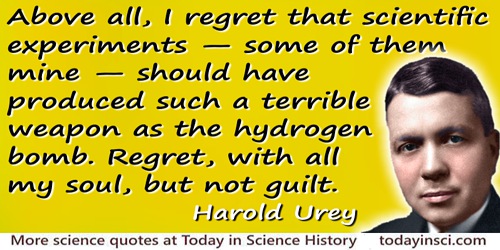
Above all, I regret that scientific experiments—some of them mine—should have produced such a terrible weapon as the hydrogen bomb. Regret, with all my soul, but not guilt.
Quoted in 'Moon-Struck Scientist,' New York Times (27 Apr 1961), 42.
Abstruse mathematical researches … are … often abused for having no obvious physical application. The fact is that the most useful parts of science have been investigated for the sake of truth, and not for their usefulness. A new branch of mathematics, which has sprung up in the last twenty years, was denounced by the Astronomer Royal before the University of Cambridge as doomed to be forgotten, on account of its uselessness. Now it turns out that the reason why we cannot go further in our investigations of molecular action is that we do not know enough of this branch of mathematics.
In 'Conditions of Mental Development', Lectures and Essays (1901), Vol. 1, 115.
Aeroplanes are not designed by science, but by art in spite of some pretence and humbug to the contrary. I do not mean to suggest that engineering can do without science, on the contrary, it stands on scientific foundations, but there is a big gap between scientific research and the engineering product which has to be bridged by the art of the engineer.
In John D. North, 'The Case for Metal Construction', The Journal of the Royal Aeronautical Society, (Jan 1923), 27, 11.
After a short period spent in Brussels as a guest of a neurological institute, I returned to Turin on the verge of the invasion of Belgium by the German army, Spring 1940, to join my family. The two alternatives left then to us were either to emigrate to the United States, or to pursue some activity that needed neither support nor connection with the outside Aryan world where we lived. My family chose this second alternative. I then decided to build a small research unit at home and installed it in my bedroom.
Autobiography, Nobel Foundation
After the discovery of spectral analysis no one trained in physics could doubt the problem of the atom would be solved when physicists had learned to understand the language of spectra. So manifold was the enormous amount of material that has been accumulated in sixty years of spectroscopic research that it seemed at first beyond the possibility of disentanglement. An almost greater enlightenment has resulted from the seven years of Röntgen spectroscopy, inasmuch as it has attacked the problem of the atom at its very root, and illuminates the interior. What we are nowadays hearing of the language of spectra is a true 'music of the spheres' in order and harmony that becomes ever more perfect in spite of the manifold variety. The theory of spectral lines will bear the name of Bohr for all time. But yet another name will be permanently associated with it, that of Planck. All integral laws of spectral lines and of atomic theory spring originally from the quantum theory. It is the mysterious organon on which Nature plays her music of the spectra, and according to the rhythm of which she regulates the structure of the atoms and nuclei.
Atombau und Spektrallinien (1919), viii, Atomic Structure and Spectral Lines, trans. Henry L. Brose (1923), viii.
All human affairs follow nature's great analogue, the growth of vegetation. There are three periods of growth in every plant. The first, and slowest, is the invisible growth by the root; the second and much accelerated is the visible growth by the stem; but when root and stem have gathered their forces, there comes the third period, in which the plant quickly flashes into blossom and rushes into fruit.
The beginnings of moral enterprises in this world are never to be measured by any apparent growth. ... At length comes the sudden ripeness and the full success, and he who is called in at the final moment deems this success his own. He is but the reaper and not the labourer. Other men sowed and tilled and he but enters into their labours.
The beginnings of moral enterprises in this world are never to be measured by any apparent growth. ... At length comes the sudden ripeness and the full success, and he who is called in at the final moment deems this success his own. He is but the reaper and not the labourer. Other men sowed and tilled and he but enters into their labours.
Life Thoughts (1858), 20.
All palaetiological sciences, all speculations which attempt to ascend from the present to the remote past, by the chain of causation, do also, by an inevitable consequence, urge us to look for the beginning of the state of things which we thus contemplate; but in none of these cases have men been able, by the aid of science, to arrive at a beginning which is homogeneous with the known course of events. The first origin of language, of civilization, of law and government, cannot be clearly made out by reasoning and research; and just as little, we may expect, will a knowledge of the origin of the existing and extinct species of plants and animals, be the result of physiological and geological investigation.
In History of the Inductive Sciences (1837), Vol. 3, 581.
All that concerns the Mediterranean is of the deepest interest to civilized man, for the history of its progress is the history of the development of the world; the memory of the great men who have lived and died around its banks; the recollection of the undying works that have come thence to delight us for ever; the story of patient research and brilliant discoveries connected with every physical phenomenon presented by its waves and currents, and with every order of creatures dwelling in and around its waters.
From Literary Papers (1855), 106. As quoted in On Early Explorations in the Mediterranean.In George Wilson and Archibald Geikie, Memoir of Edward Forbes F.R.S. (1861), 279. Geike introduces the Forbes quote as “the recollection of these, his earliest explorations in the Mediterranean,” as written down years later.
Although I must say that research problems I worked on were frequently the result of serendipity and often grew out of my interest in some species or some environment which I found to be particularly appealing—marine birds and tropical islands for example.
Bartholomew, April 1993, unpublished remarks when receiving the Miller Award from the Cooper Ornithological Society.
Although such research [into the paranormal] has yet to produce anything in the way of a repeatable controlled experiment, its practitioners argue that its revolutionary potentialities justify its continuation. My own feeling is that after a century of total failure it has become a bloody bore.
In Flanagan's View: A Spectator's Guide to Science on the Eve of the 21st Century (1988), 152.
Always preoccupied with his profound researches, the great Newton showed in the ordinary-affairs of life an absence of mind which has become proverbial. It is related that one day, wishing to find the number of seconds necessary for the boiling of an egg, he perceived, after waiting a minute, that he held the egg in his hand, and had placed his seconds watch (an instrument of great value on account of its mathematical precision) to boil!
This absence of mind reminds one of the mathematician Ampere, who one day, as he was going to his course of lectures, noticed a little pebble on the road; he picked it up, and examined with admiration the mottled veins. All at once the lecture which he ought to be attending to returned to his mind; he drew out his watch; perceiving that the hour approached, he hastily doubled his pace, carefully placed the pebble in his pocket, and threw his watch over the parapet of the Pont des Arts.
This absence of mind reminds one of the mathematician Ampere, who one day, as he was going to his course of lectures, noticed a little pebble on the road; he picked it up, and examined with admiration the mottled veins. All at once the lecture which he ought to be attending to returned to his mind; he drew out his watch; perceiving that the hour approached, he hastily doubled his pace, carefully placed the pebble in his pocket, and threw his watch over the parapet of the Pont des Arts.
Popular Astronomy: a General Description of the Heavens (1884), translated by J. Ellard Gore, (1907), 93.
American scientific companies are cross-breeding humans and animals and coming up with mice with fully functioning human brains.
From transcript of interview on TV show, The O'Reilly Factor (15 Nov 2007).
Among those whom I could never pursuade to rank themselves with idlers, and who speak with indignation of my morning sleeps and nocturnal rambles, one passes the day in catching spiders, that he may count their eyes with a microscope; another exhibits the dust of a marigold separated from the flower with a dexterity worthy of Leuwenhoweck himself. Some turn the wheel of electricity; some suspend rings to a lodestone, and find that what they did yesterday, they can do again to-day.—Some register the changes of the wind, and die fully convinced that the wind is changeable.—There are men yet more profound, who have heard that two colorless liquors may produce a color by union, and that two cold bodies will grow hot of they are mingled: they mingle them, and produce the effect expected, say it is strange, and mingle them again.
In Tryon Edwards, A Dictionary of Thoughts (1908), 243.
Ampère was a mathematician of various resources & I think might rather be called excentric [sic] than original. He was as it were always mounted upon a hobby horse of a monstrous character pushing the most remote & distant analogies. This hobby horse was sometimes like that of a child ['s] made of heavy wood, at other times it resembled those [?] shapes [?] used in the theatre [?] & at other times it was like a hypogrif in a pantomime de imagie. He had a sort of faith in animal magnetism & has published some refined & ingenious memoirs to prove the identity of electricity & magnetism but even in these views he is rather as I said before excentric than original. He has always appeared to me to possess a very discursive imagination & but little accuracy of observation or acuteness of research.
'Davy’s Sketches of his Contemporaries', Chymia, 1967, 12, 135-6.
An intelligent patient, private or otherwise, to whom you have taken the trouble to explain the nature of the investigation, makes the best laboratory animal.
'Some of the ‘Do’s’ and ‘Do-Nots’ in Clinical Investigation,' Journal of Clinical Investigation (1944), 23, 921-26.
And so, after many years, victory has come, and the romance of exploration, of high hopes and bitter disappointment, will in a few years simply be recorded in the text-books of organic chemistry in a few terse sentences.
Recent Developments in the Vitamin A Field', The Pedlar Lecture, 4 Dec 1947, Journal of the Chemical Society, Part I (1948), 393.
And when with excellent Microscopes I discern in otherwise invisible Objects the Inimitable Subtlety of Nature’s Curious Workmanship; And when, in a word, by the help of Anatomicall Knives, and the light of Chymicall Furnaces, I study the Book of Nature, and consult the Glosses of Aristotle, Epicurus, Paracelsus, Harvey, Helmont, and other learn'd Expositors of that instructive Volumne; I find my self oftentimes reduc’d to exclaim with the Psalmist, How manifold are thy works, O Lord? In wisdom hast thou made them all.
Some Motives and Incentives to the Love of God (1659), 56-7.
Animals, even plants, lie to each other all the time, and we could restrict the research to them, putting off the real truth about ourselves for the several centuries we need to catch our breath. What is it that enables certain flowers to resemble nubile insects, or opossums to play dead, or female fireflies to change the code of their flashes in order to attract, and then eat, males of a different species?
In Late Night Thoughts on Listening to Mahler's Ninth Symphony(1984), 131.
Any chemist reading this book can see, in some detail, how I have spent most of my mature life. They can become familiar with the quality of my mind and imagination. They can make judgements about my research abilities. They can tell how well I have documented my claims of experimental results. Any scientist can redo my experiments to see if they still work—and this has happened! I know of no other field in which contributions to world culture are so clearly on exhibit, so cumulative, and so subject to verification.
From Design to Discovery (1990), 119-20.

Anybody who has been seriously engaged in scientific work of any kind realizes that over the entrance to the gates of the temple of science are written the words: Ye must have faith. It is a quality which the scientist cannot dispense with.
In Max Planck and James Vincent Murphy (trans.), Where is Science Going?, (1932), 214.
Anyone of common mental and physical health can practice scientific research. … Anyone can try by patient experiment what happens if this or that substance be mixed in this or that proportion with some other under this or that condition. Anyone can vary the experiment in any number of ways. He that hits in this fashion on something novel and of use will have fame. … The fame will be the product of luck and industry. It will not be the product of special talent.
In Essays of a Catholic Layman in England (1931).
Anything worth doing is worth doing twice, the first time quick and dirty and the second time the best way you can.
As quoted in Steven Chu and Charles H. Townes, 'Arthur Schawlow', Biographical Memoirs of the National Academy of Sciences (2003), Vol. 83, 201.
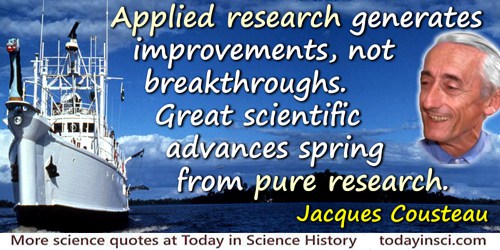
Applied research generates improvements, not breakthroughs. Great scientific advances spring from pure research. Even scientists renowned for their “useful” applied discoveries often achieved success only when they abandoned their ostensible applied-science goal and allowed their minds to soar—as when Alexander Fleming, “just playing about,” refrained from throwing away green molds that had ruined his experiment, studied them, and discovered penicillin. Or when C. A. Clarke, a physician affiliated with the University of Liverpool, became intrigued in the 1950s by genetically created color patterns that emerged when he cross-bred butterflies as a hobby. His fascination led him—“by the pleasant route of pursuing idle curiosity”—to the successful idea for preventing the sometimes fatal anemia that threatened babies born of a positive-Rhesus-factor father and a negative-Rhesus-factor mother.
In Jacques Cousteau and Susan Schiefelbein, The Human, the Orchid, and the Octopus: Exploring and Conserving Our Natural World (2007), 214-215.
As a different, but perhaps more common, strategy for the suppression of novelty, we may admit the threatening object to our midst, but provide an enveloping mantle of ordinary garb… . This kind of cover-up, so often amusing in our daily lives, can be quite dangerous in science, for nothing can stifle originality more effectively than an ordinary mantle placed fully and securely over an extraordinary thing.
In 'A Short Way to Big Ends', Natural History (Jan 1986), 95, No. 1, 18.

As a man who has devoted his whole life to the most clear headed science, to the study of matter, I can tell you as a result of my research about atoms this much: There is no matter as such. All matter originates and exists only by virtue of a force which brings the particle of an atom to vibration and holds this most minute solar system of the atom together. … We must assume behind this force the existence of a conscious and intelligent mind. This mind is the matrix of all matter.
Lecture, 'Das Wesen der Materie' [The Essence/Nature/Character of Matter], Florence, Italy (1944). Archiv zur Geschichte der Max-Planck-Gesellschaft, Abt. Va, Rep. 11 Planck, Nr. 1797. Original German and this English translation, as in Gregg Braden, The Spontaneous Healing of Belief: Shattering the Paradigm of False Limits (2009), 334-35. Note: a number of books showing this quote cite it as from Planck’s Nobel Prize acceptance speech (1918), which the Webmaster has checked, and does not see this quote therein. The original German excerpt, and a slightly more complete translation is also on this web page, beginning: “As a physicist who devoted ….”
As a scientist and geneticist I started to feel that science would probably soon reach the point where its interference into the life processes would be counterproductive if a properly designed governing policy was not implemented. A heavily overcrowded planet, ninety-five percent urbanized with nuclear energy as the main source of energy and with all aspects of life highly computerized, is not too pleasant a place for human life. The life of any individual soon will be predictable from birth to death. Medicine, able to cure almost everything, will make the load of accumulated defects too heavy in the next two or three centuries. The artificial prolongation of life, which looked like a very bright idea when I started research in aging about twenty-five years ago, has now lost its attractiveness for me. This is because I now know that the aging process is so multiform and complex that the real technology and chemistry of its prevention by artificial interference must be too complex and expensive. It would be the privilege of a few, not the method for the majority. I also was deeply concerned about the fact that most research is now either directly or indirectly related to military projects and objectives for power.
Quoted in 'Zhores A(leksandrovich) Medvedev', Contemporary Authors Online, Gale, 2002.
As experimentalists, we always can find something to do, even if we have to work with string and sealing wax.
As quoted in T.W. Hänsch, 'From (Incr)edible Lasers to New Spectroscopy', collected in William M. Yen and Marc D. Levenson (eds.), Lasers, Spectroscopy and New Ideas: A Tribute to Arthur L. Schawlow (2013), 6.
As in the domains of practical life so likewise in science there has come about a division of labor. The individual can no longer control the whole field of mathematics: it is only possible for him to master separate parts of it in such a manner as to enable him to extend the boundaries of knowledge by creative research.
In Die reine Mathematik in den Jahren 1884-99, 10. As quoted, cited and translated in Robert Édouard Moritz, Memorabilia Mathematica; Or, The Philomath’s Quotation-Book (1914), 94.
As our researches have made clear, an animal high in the organic scale only reaches this rank by passing through all the intermediate states which separate it from the animals placed below it. Man only becomes man after traversing transitional organisatory states which assimilate him first to fish, then to reptiles, then to birds and mammals.
Annales des Sciences Naturelles (1834), 2 (ii), 248. Trans. in E. S. Russell, Form and Function (1916), 82.
As was predicted at the beginning of the Human Genome Project, getting the sequence will be the easy part as only technical issues are involved. The hard part will be finding out what it means, because this poses intellectual problems of how to understand the participation of the genes in the functions of living cells.
Loose Ends from Current Biology (1997), 71.
At bottom each “exact” science is, and must be speculative, and its chief tool of research, too rarely used with both courage and judgement, is the regulated imagination.
In Igneous Rocks and their Origin (1914), Introduction, xxi.
At the entrance to the observatory Stjerneborg located underground, Tycho Brahe built a Ionic portal. On top of this were three sculptured lions. On both sides were inscriptions and on the backside was a longer inscription in gold letters on a porfyr stone: Consecrated to the all-good, great God and Posterity. Tycho Brahe, Son of Otto, who realized that Astronomy, the oldest and most distinguished of all sciences, had indeed been studied for a long time and to a great extent, but still had not obtained sufficient firmness or had been purified of errors, in order to reform it and raise it to perfection, invented and with incredible labour, industry, and expenditure constructed various exact instruments suitable for all kinds of observations of the celestial bodies, and placed them partly in the neighbouring castle of Uraniborg, which was built for the same purpose, partly in these subterranean rooms for a more constant and useful application, and recommending, hallowing, and consecrating this very rare and costly treasure to you, you glorious Posterity, who will live for ever and ever, he, who has both begun and finished everything on this island, after erecting this monument, beseeches and adjures you that in honour of the eternal God, creator of the wonderful clockwork of the heavens, and for the propagation of the divine science and for the celebrity of the fatherland, you will constantly preserve it and not let it decay with old age or any other injury or be removed to any other place or in any way be molested, if for no other reason, at any rate out of reverence to the creator’s eye, which watches over the universe. Greetings to you who read this and act accordingly. Farewell!
(Translated from the original in Latin)
Attempt the end and never stand to doubt;
Nothing's so hard, but search will find it out.
Nothing's so hard, but search will find it out.
'Seeke and Finde', Hesperides: Or, the Works Both Humane and Divine of Robert Herrick Esq. (1648). In J. Max Patrick (ed.), The Complete Poetry of Robert Herrick (1963), 411.
AZT stood up and said, 'Stop your pessimism. Stop your sense of futility. Go back to the lab. Go back to development. Go back to clinical trials. Things will work.'
[On the impact of AZT emerging as the long-sought first significant AIDS drug.]
[On the impact of AZT emerging as the long-sought first significant AIDS drug.]
As quoted in Emily Langer, 'Researcher Jerome P. Horwitz, 93, created AZT, the first approved treatment for HIV/AIDS' Washington Post (19 Sep 2012). The article was excerpted on blogs, sometimes referring to this quote by saying "AZT was more a cure for fatalism than for AIDS."
Bankers regard research as most dangerous a thing that makes banking hazardous due to the rapid changes it brings about in industry.
Address (1927), quoted in U.S. National Resources Committee Technology and Planning, Washington 1937, 5-6. Also U.S. Government Report, Technological Trends (1937), 63.
Basic research at universities comes in two varieties: research that requires big bucks and research that requires small bucks. Big bucks research is much like government research and in fact usually is government research but done for the government under contract. Like other government research, big bucks academic research is done to understand the nature and structure of the universe or to understand life, which really means that it is either for blowing up the world or extending life, whichever comes first. Again, that's the government's motivation. The universities' motivation for conducting big bucks research is to bring money in to support professors and graduate students and to wax the floors of ivy-covered buildings. While we think they are busy teaching and learning, these folks are mainly doing big bucks basic research for a living, all the while priding themselves on their terrific summer vacations and lack of a dress code.
Smalls bucks research is the sort of thing that requires paper and pencil, and maybe a blackboard, and is aimed primarily at increasing knowledge in areas of study that don't usually attract big bucks - that is, areas that don't extend life or end it, or both. History, political science, and romance languages are typically small bucks areas of basic research. The real purpose of small bucks research to the universities is to provide a means of deciding, by the quality of their small bucks research, which professors in these areas should get tenure.
Smalls bucks research is the sort of thing that requires paper and pencil, and maybe a blackboard, and is aimed primarily at increasing knowledge in areas of study that don't usually attract big bucks - that is, areas that don't extend life or end it, or both. History, political science, and romance languages are typically small bucks areas of basic research. The real purpose of small bucks research to the universities is to provide a means of deciding, by the quality of their small bucks research, which professors in these areas should get tenure.
Accidental Empires (1992), 78.
Basic research is like shooting an arrow into the air and, where it lands, painting a target.
As quoted by Walter Gratzer, in book review titled 'The Bomb and the Bumble-Bees' (about the book Late Night Thoughts, by Lewis Thomas), Nature (15 Nov 1984), 31, 211. The original text expresses the quote as “It was the organic chemist, Homer Adkins, who defined basic research as shooting an arrow into the air, and…”.
Basic research is not the same as development. A crash program for the latter may be successful; but for the former it is like trying to make nine women pregnant at once in the hope of getting a baby in a month’s time.
In New Scientist, November 18, 1976.

Basic research is what I am doing when I don’t know what I am doing.
Attributed, as seen without citation in R.L. Weber, A Random Walk in Science (1973), 41.
Basic research may seem very expensive. I am a well-paid scientist. My hourly wage is equal to that of a plumber, but sometimes my research remains barren of results for weeks, months or years and my conscience begins to bother me for wasting the taxpayer’s money. But in reviewing my life’s work, I have to think that the expense was not wasted.
Basic research, to which we owe everything, is relatively very cheap when compared with other outlays of modern society. The other day I made a rough calculation which led me to the conclusion that if one were to add up all the money ever spent by man on basic research, one would find it to be just about equal to the money spent by the Pentagon this past year.
Basic research, to which we owe everything, is relatively very cheap when compared with other outlays of modern society. The other day I made a rough calculation which led me to the conclusion that if one were to add up all the money ever spent by man on basic research, one would find it to be just about equal to the money spent by the Pentagon this past year.
In The Crazy Ape (1971).

Basic scientific research is scientific capital.
In 'Science - The Endless Frontier: A Report to the President' (Jul 1945), collected in John Dewey (ed.) and Julius A. Sigler (ed.), Science, Technology, and Society (1997), 13. Bush was the first director of the Office of Scientific Research and Development during World War II.
Beware of finding what you're looking for.
A favorite aphorism he often used.
A favorite aphorism he often used.
Though widely seen attributed as a caution Hamming often used, webmaster has found no evidence that he originated the saying. If you know a primary source, please contact webmaster.
Biological disciplines tend to guide research into certain channels. One consequence is that disciplines are apt to become parochial, or at least to develop blind spots, for example, to treat some questions as “interesting” and to dismiss others as “uninteresting.” As a consequence, readily accessible but unworked areas of genuine biological interest often lie in plain sight but untouched within one discipline while being heavily worked in another. For example, historically insect physiologists have paid relatively little attention to the behavioral and physiological control of body temperature and its energetic and ecological consequences, whereas many students of the comparative physiology of terrestrial vertebrates have been virtually fixated on that topic. For the past 10 years, several of my students and I have exploited this situation by taking the standard questions and techniques from comparative vertebrate physiology and applying them to insects. It is surprising that this pattern of innovation is not more deliberately employed.
In 'Scientific innovation and creativity: a zoologist’s point of view', American Zoologist (1982), 22, 233.
Bohr’s standpoint, that a space-time description is impossible, I reject a limine. Physics does not consist only of atomic research, science does not consist only of physics, and life does not consist only of science. The aim of atomic research is to fit our empirical knowledge concerning it into our other thinking. All of this other thinking, so far as it concerns the outer world, is active in space and time. If it cannot be fitted into space and time, then it fails in its whole aim and one does not know what purpose it really serves.
Letter to Willy Wien (25 Aug 1926). Quoted in Walter Moore, Schrödinger: Life and Thought (1989), 226.
Both social and biosocial factors are necessary to interpret crosscultural studies, with the general proviso that one’s research interest determines which elements, in what combinations, are significant for the provision of understanding.
…...
But among all these many departments of research, these many branches of industry, new and old, which are being rapidly expanded, there is one dominating all others in importance—one which is of the greatest significance for the comfort and welfare, not to say for the existence, of mankind, and that is the electrical transmission of power.
Speech (12 Jan 1897) at a gala inaugurating power service from Niagara Falls to Buffalo, NY. Printed in 'Tesla on Electricity', The Electrical Review (27 Jan 1897), 30, No. 3, 47.
But for twenty years previous to 1847 a force had been at work in a little county town of Germany destined to effect the education of Christendom, and at the same time to enlarge the boundaries of human knowledge, first in chemistry and the allied branches, then in every other one of the natural sciences. The place was Giessen; the inventor Liebig; the method, a laboratory for instruction and research.
A Semi-Centennial Discourse, 1847-97' (28 Oct 1897), The Sheffield Scientific School of Yale University. Quoted in Daniel Coit Gilman, University Problems in the United States (1898), 120.
But medicine has long had all its means to hand, and has discovered both a principle and a method, through which the discoveries made during a long period are many and excellent, while full discovery will be made, if the inquirer be competent, conduct his researches with knowledge of the discoveries already made, and make them his starting-point. But anyone who, casting aside and rejecting all these means, attempts to conduct research in any other way or after another fashion, and asserts that he has found out anything, is and has been victim of deception.
Ancient Medicine, in Hippocrates, trans. W. H. S. Jones (1923), Vol. I, 15.
But the World being once fram’d, and the course of Nature establish’d, the Naturalist, (except in some few cases, where God, or Incorporeal Agents interpose), has recourse to the first Cause but for its general and ordinary Support and Influence, whereby it preserves Matter and Motion from Annihilation or Desition; and in explicating particular phenomena, considers onely the Size, Shape, Motion, (or want of it) Texture, and the resulting Qualities and Attributes of the small particles of Matter.
The Origine of Formes and Qualities (1666), 194.
But when you come right down to it, the reason that we did this job is because it was an organic necessity. If you are a scientist you cannot stop such a thing. If you are a scientist you believe that it is good to find out how the world works; that it is good to find out what the realities are; that it is good to turn over to mankind at large the greatest possible power to control the world and to deal with it according to its lights and values.
Regarding the atomic bomb project.
Regarding the atomic bomb project.
From speech at Los Alamos (17 Oct 1945). Quoted in David C. Cassidy, J. Robert Oppenheimer and the American Century (2009), 214.
But, because my private lectures and domestic pupils are a great hinderance and interruption of my studies, I wish to live entirely exempt from the former, and in great measure from the latter. … in short, I should wish to gain my bread from my writings.
Reply upon being offered a professorship. Quoted in John Elliot Drinkwater Bethune, Life of Galileo Galilei (1832), 63.
By research in pure science I mean research made without any idea of application to industrial matters but solely with the view of extending our knowledge of the Laws of Nature. I will give just one example of the ‘utility’ of this kind of research, one that has been brought into great prominence by the War—I mean the use of X-rays in surgery. Now, not to speak of what is beyond money value, the saving of pain, or, it may be, the life of the wounded, and of bitter grief to those who loved them, the benefit which the state has derived from the restoration of so many to life and limb, able to render services which would otherwise have been lost, is almost incalculable. Now, how was this method discovered? It was not the result of a research in applied science starting to find an improved method of locating bullet wounds. This might have led to improved probes, but we cannot imagine it leading to the discovery of X-rays. No, this method is due to an investigation in pure science, made with the object of discovering what is the nature of Electricity. The experiments which led to this discovery seemed to be as remote from ‘humanistic interest’ —to use a much misappropriated word—as anything that could well be imagined. The apparatus consisted of glass vessels from which the last drops of air had been sucked, and which emitted a weird greenish light when stimulated by formidable looking instruments called induction coils. Near by, perhaps, were great coils of wire and iron built up into electro-magnets. I know well the impression it made on the average spectator, for I have been occupied in experiments of this kind nearly all my life, notwithstanding the advice, given in perfect good faith, by non-scientific visitors to the laboratory, to put that aside and spend my time on something useful.
In Speech made on behalf of a delegation from the Conjoint Board of Scientific Studies in 1916 to Lord Crewe, then Lord President of the Council. In George Paget Thomson, J. J. Thomson and the Cavendish Laboratory in His Day (1965), 167-8.
By teaching us how to cultivate each ferment in its purity—in other words, by teaching us how to rear the individual organism apart from all others,—Pasteur has enabled us to avoid all these errors. And where this isolation of a particular organism has been duly effected it grows and multiplies indefinitely, but no change of it into another organism is ever observed. In Pasteur’s researches the Bacterium remained a Bacterium, the Vibrio a Vibrio, the Penicillium a Penicillium, and the Torula a Torula. Sow any of these in a state of purity in an appropriate liquid; you get it, and it alone, in the subsequent crop. In like manner, sow smallpox in the human body, your crop is smallpox. Sow there scarlatina, and your crop is scarlatina. Sow typhoid virus, your crop is typhoid—cholera, your crop is cholera. The disease bears as constant a relation to its contagium as the microscopic organisms just enumerated do to their germs, or indeed as a thistle does to its seed.
In 'Fermentation, and its Bearings on Surgery and Medicine', Essays on the FloatingMatter of the Air in Relation to Putrefaction and Infection (1881), 264.
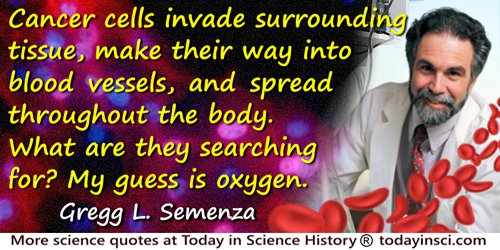
Cancer cells invade surrounding tissue, make their way into blood vessels, and spread throughout the body. What are they searching for? My guess is oxygen.
In Acceptance Remarks, 2016 Lasker Awards Ceremony, published in 'Oxygen Sensing – An Essential Process for Survival', on laskerfoundation.org website.
Cancer is a biological, not a statistical problem.
'Shoot Out in Marlboro Country', Mother Jones Magazine (Jan 1979), 36.
Charles Kettering ... said that from studying conventional text-books we fall into a rut and to escape from this takes as much effort as to solve the problem.
In W.I.B. Beveridge, The Art of Scientific Investigation (1957), 2.
Chemical research conducts to the knowledge of philosophical truth, and forms the mind to philosophical enlargement and accuracy of thought, more happily than almost any other species of investigation in which the human intellect can be employed.
Quote following title page of Samuel Parkes, A Chemical Catechism With Notes, Illustrations and Experiments (8th ed. 1818).
Chemistry is one of those branches of human knowledge which has built itself upon methods and instruments by which truth can presumably be determined. It has survived and grown because all its precepts and principles can be re-tested at any time and anywhere. So long as it remained the mysterious alchemy by which a few devotees, by devious and dubious means, presumed to change baser metals into gold, it did not flourish, but when it dealt with the fact that 56 g. of fine iron, when heated with 32 g. of flowers of sulfur, generated extra heat and gave exactly 88 g. of an entirely new substance, then additional steps could be taken by anyone. Scientific research in chemistry, since the birth of the balance and the thermometer, has been a steady growth of test and observation. It has disclosed a finite number of elementary reagents composing an infinite universe, and it is devoted to their inter-reaction for the benefit of mankind.
Address upon receiving the Perkin Medal Award, 'The Big Things in Chemistry', The Journal of Industrial and Engineering Chemistry (Feb 1921), 13, No. 2, 163.
Committees are dangerous things that need most careful watching. I believe that a research committee can do one useful thing and one only. It can find the workers best fitted to attack a particular problem, bring them together, give them the facilities they need, and leave them to get on with the work. It can review progress from time to time, and make adjustments; but if it tries to do more, it will do harm.
Attributed without citation in W.I.B. Beveridge, The Art of Scientific Investigation (1951), 118.
Controlled research … endeavors to pick out of the web of nature’s activities some single strand and trace it towards its origin and its terminus and determine its relation to other strands.
In 'The Influence of Research in Bringing into Closer Relationship the Practice of Medicine and Public Health Activities', American Journal of Medical Sciences (Dec 1929), No. 178.
Copy from one, it’s plagiarism; copy from two, it’s research.
…...
Copying extensively from one source is plagiarism; copying extensively from several is research.
N. E. Renton, Compendium of Good Writing: A Plain English Guide (2007), 113.
Cosmic religiousness is the strongest and most noble driving force of scientific research.
…...
Creative imagination is likely to find corroborating novel evidence even for the most 'absurd' programme, if the search has sufficient drive. This look-out for new confirming evidence is perfectly permissible. Scientists dream up phantasies and then pursue a highly selective hunt for new facts which fit these phantasies. This process may be described as “science creating its own universe” (as long as one remembers that “creating” here is used in a provocative-idiosyncratic sense). A brilliant school of scholars (backed by a rich society to finance a few well-planned tests) might succeed in pushing any fantastic programme ahead, or alternatively, if so inclined, in overthrowing any arbitrarily chosen pillar of “established knowledge”.
In 'Falsification and the Methodology of Scientific Research Programmes', in I. Lakatos and A. Musgrave (eds.), Criticism and the Growth of Knowledge: Proceedings of the International Colloquium in the Philosophy of Science, London 1965 (1970), Vol. 4, 187-8.
Curiosity atrophies after childhood unless it is transferred to an intellectual plane. The research worker is usually a person whose curiosity is turned toward seeking explanations for phenomena that are not understood.
In The Art of Scientific Investigation (1950), 67.
Debunking bad science should be constant obligation of the science community, even if it takes time away from serious research or seems to be a losing battle. One takes comfort from the fact there is no Gresham’s laws in science. In the long run, good science drives out bad.
In preamble to 'Part III: Pseudoscience', The Night Is Large: Collected Essays 1938-1995 (1996), 171.
Dick Drew took a bunch of misfits—people who wouldn’t fly in formation—and he put together a lab that created technologies that account for 20 percent of 3M's sales in 2000.
— Art Fry
As quoted in W. James McNerney Jr., A Century of Innovation: The 3M Story (2002), 26.
Direct observation of the testimony of the earth … is a matter of the laboratory, of the field naturalist, of indefatigable digging among the ancient archives of the earth’s history. If Mr. Bryan, with an open heart and mind, would drop all his books and all the disputations among the doctors and study first hand the simple archives of Nature, all his doubts would disappear; he would not lose his religion; he would become an evolutionist.
'Evolution and Religion', New York Times (5 Mar 1922), 91. Written in response to an article a few days earlier in which William Jennings Bryan challenged the theory of evolution as lacking proof.
Disused methods, cleverly modified, may be rendered efficient again. When it is understood in this way, the history of science becomes really a research method. A great scientist of our own
time, Ostwald, has even gone so far as to say that “It is nothing but a research method.”
In 'The History of Science', The Monist (July 1916), 26, No. 3, 344.
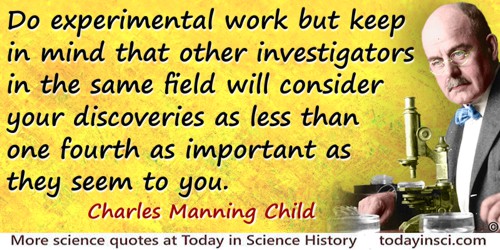
Do experimental work but keep in mind that other investigators in the same field will consider your discoveries as less than one fourth as important as they seem to you.
In Victor Shelford, The Ecology of North America (1963), v.
Do not do anything that anyone else can do readily.
In Alan R. Earls and Nasrin Rohani, Polaroid (2005), 16.
Do not enter upon research unless you can not help it. Ask yourself the “why” of every statement that is made and think out your own answer. If through your thoughtful work you get a worthwhile idea, it will get you. The force of the conviction will compel you to forsake all and seek the relief of your mind in research work.
From Cameron Prize Lecture (1928), delivered before the University of Edinburgh. As quoted in J.B. Collip 'Frederick Grant Banting, Discoverer of Insulin', The Scientific Monthly (May 1941), 52, No. 5, 473.

Do not go where the path may lead, go instead where there is no path and leave a trail.
…...
Do what you can where you are with what you have.
The Homiletic Review, Vol. 83-84 (1922), Vol. 84, 380.
Doctors have been exposed—you always will be exposed—to the attacks of those persons who consider their own undisciplined emotions more important than the world's most bitter agonies—the people who would limit and cripple and hamper research because they fear research may be accompanied by a little pain and suffering.
Doctors (1908), 28-9.
Don’t spare; don’t drudge.
Maxim quoted, without citation, in William Ian Beardmore Beveridge, The Art of Scientific Investigation (1950), 148.
Doubtless the reasoning faculty, the mind, is the leading and characteristic attribute of the human race. By the exercise of this, man arrives at the properties of the natural bodies. This is science, properly and emphatically so called. It is the science of pure mathematics; and in the high branches of this science lies the truly sublime of human acquisition. If any attainment deserves that epithet, it is the knowledge, which, from the mensuration of the minutest dust of the balance, proceeds on the rising scale of material bodies, everywhere weighing, everywhere measuring, everywhere detecting and explaining the laws of force and motion, penetrating into the secret principles which hold the universe of God together, and balancing worlds against worlds, and system against system. When we seek to accompany those who pursue studies at once so high, so vast, and so exact; when we arrive at the discoveries of Newton, which pour in day on the works of God, as if a second fiat had gone forth from his own mouth; when, further, we attempt to follow those who set out where Newton paused, making his goal their starting-place, and, proceeding with demonstration upon demonstration, and discovery upon discovery, bring new worlds and new systems of worlds within the limits of the known universe, failing to learn all only because all is infinite; however we may say of man, in admiration of his physical structure, that “in form and moving he is express and admirable,” it is here, and here without irreverence, we may exclaim, “In apprehension how like a god!” The study of the pure mathematics will of course not be extensively pursued in an institution, which, like this [Boston Mechanics’ Institute], has a direct practical tendency and aim. But it is still to be remembered, that pure mathematics lie at the foundation of mechanical philosophy, and that it is ignorance only which can speak or think of that sublime science as useless research or barren speculation.
In Works (1872), Vol. 1, 180.
During the time that [Karl] Landsteiner gave me an education in the field of imununology, I discovered that he and I were thinking about the serologic problem in very different ways. He would ask, What do these experiments force us to believe about the nature of the world? I would ask, What is the most. simple and general picture of the world that we can formulate that is not ruled by these experiments? I realized that medical and biological investigators were not attacking their problems the same way that theoretical physicists do, the way I had been in the habit of doing.
‘Molecular Disease’, Pfizer Spectrum (1958), 6:9, 234.
Each generation has its few great mathematicians, and mathematics would not even notice the absence of the others. They are useful as teachers, and their research harms no one, but it is of no importance at all. A mathematician is great or he is nothing.
Reflections: Mathematics and Creativity', New Yorker (1972), 47, No. 53, 39-45. In Douglas M. Campbell, John C. Higgins (eds.), Mathematics: People, Problems, Results (1984), Vol. 2, 3.
Each scientist of course maintains the “purity” of his own research and repudiates violently any proposal to subject his pet research to the test of immediate applicability and “usefulness.” It is not the object of his research to be useful but to be sound.
In Science: the False Messiah (1927), 35.
Each species has evolved a special set of solutions to the general problems that all organisms must face. By the fact of its existence, a species demonstrates that its members are able to carry out adequately a series of general functions. … These general functions offer a framework within which one can integrate one’s view of biology and focus one’s research. Such a view helps one to avoid becoming lost in a morass of unstructured detail—even though the ways in which different species perform these functions may differ widely. A few obvious examples will suffice. Organisms must remain functionally integrated. They must obtain materials from their environments, and process and release energy from these materials. … They must differentiate and grow, and they must reproduce. By focusing one’s questions on one or another of these obligatory and universal capacities, one can ensure that one’s research will not be trivial and that it will have some chance of achieving broad general applicability.
In 'Integrative Biology: An Organismic Biologist’s Point of View', Integrative and Comparative Biology (2005), 45, 331.
Economists use the expression “opportunity costs” for losses incurred through certain choices made over others, including ignorance and inaction. For systematics, or more precisely the neglect of systematics and the biological research dependent upon it, the costs are very high.
In 'Edward O. Wilson: The Biological Diversity Crisis: A Challenge to Science', Issues in Science and Technology (Fall 1985), 2, No. 1, 25.
Elaborate apparatus plays an important part in the science of to-day, but I sometimes wonder if we are not inclined to forget that the most important instrument in research must always be the mind of man.
The Art of Scientific Investigation (1951), ix.
Embryonic stem cell research is at the leading edge of a series of moral hazards.
'Address to the Nation on Stem Cell Research', (9 Aug 2001) in Public Papers Of The Presidents Of The United States, George W. Bush, 2001 (2004), Book 2, 955.
Endow the already established with money. Endow the woman who shows genius with time.
In Phebe Mitchell Kendall (ed.), Maria Mitchell: Life, Letters, and Journals (1896), 182.
Engineers apply the theories and principles of science and mathematics to research and develop economical solutions to practical technical problems. Their work is the link between scientific discoveries and commercial applications. Engineers design products, the machinery to build those products, the factories in which those products are made, and the systems that ensure the quality of the product and efficiency of the workforce and manufacturing process. They design, plan, and supervise the construction of buildings, highways, and transit systems. They develop and implement improved ways to extract, process, and use raw materials, such as petroleum and natural gas. They develop new materials that both improve the performance of products, and make implementing advances in technology possible. They harness the power of the sun, the earth, atoms, and electricity for use in supplying the Nation’s power needs, and create millions of products using power. Their knowledge is applied to improving many things, including the
quality of health care, the safety of food products, and the efficient operation of financial systems.
Bureau of Labor Statistics, Occupational Outlook Handbook (2000) as quoted in Charles R. Lord. Guide to Information Sources in Engineering (2000), 5. This definition has been revised and expanded over time in different issues of the Handbook.
Enough research will tend to support your theory.
In Murphy’s Law by Arthur Bloch (1977), and titled 'Murphy’s Law of Research'.
Even in science the object of research is no longer nature itself, but man’s investigation of nature.
In The Physicist's Conception of Nature (1958), 24.
Every detection of what is false directs us towards what is true: every trial exhausts some tempting form of error.
In 'Lecture 7', Lectures on the History of Moral Philosophy in England (1852), 101.
Every discovery opens a new field for investigation of facts, shows us the imperfection of our theories. It has justly been said, that the greater the circle of light, the greater the boundary of darkness by which it is surrounded.
Humphry Davy and John Davy, 'Consolations in Travel—Dialogue V—The Chemical Philosopher', The Collected Works of Sir Humphry Davy (1840), Vol. 9, 362.
Every failure is a step to success.
In 'Lecture 7', Lectures on the History of Moral Philosophy in England (1852), 101.
Every hour a scientist spends trying to raise funds is an hour lost from important thought and research.
Epigraph in Isaac Asimov’s Book of Science and Nature Quotations (1988), 287.
Every scientist, through personal study and research, completes himself and his own humanity. ... Scientific research constitutes for you, as it does for many, the way for the personal encounter with truth, and perhaps the privileged place for the encounter itself with God, the Creator of heaven and earth. Science shines forth in all its value as a good capable of motivating our existence, as a great experience of freedom for truth, as a fundamental work of service. Through research each scientist grows as a human being and helps others to do likewise.
Address to the members of the Pontifical Academy of Sciences (13 Nov 2000). In L’Osservatore Romano (29 Nov 2000), translated in English edition, 5.
Everyone knows that in research there are no final answers, only insights that allow one to formulate new questions.
In A Slot Machine, A Broken Test Tube: An Autobiography (1984).
Everything which is new has to come out of fundamental research otherwise it’s not new.
From transcript of video interview, with Hans Jörnvallat, the meeting of Nobel Laureates in Lindau, Germany (Jun 2000), obelprize.org website.
Experimental investigation, to borrow a phrase employed by Kepler respecting the testing of hypotheses, is “a very great thief of time.” Sometimes it costs many days to determine a fact that can be stated in a line.
In preface to Scientific Memoirs (1878), xi.

Experimenters are the shock troops of science.
'The Meaning and Limits of Exact Science', Science (30 Sep 1949), 110, No. 2857, 325. Advance reprinting of chapter from book Max Planck, Scientific Autobiography (1949), 110.
Facts, and facts alone, are the foundation of science... When one devotes oneself to experimental research it is in order to augment the sum of known facts, or to discover their mutual relations.
Precis elementaire de Physiologie (1816), ii. Trans. J. M. D. Olmsted, François Magendie: Pioneer in Experimental Physiology and Scientific Medicine in XIX Century France (1944), 62.
Far from attempting to control science, few among the general public even seem to recognize just what “science” entails. Because lethal technologies seem to spring spontaneously from scientific discoveries, most people regard dangerous technology as no more than the bitter fruit of science, the real root of all evil.
In Jacques Cousteau and Susan Schiefelbein, The Human, the Orchid, and the Octopus: Exploring and Conserving Our Natural World (2007), 181.
Far must thy researches go
Wouldst thou learn the world to know;
Thou must tempt the dark abyss
Wouldst thou prove what Being is;
Naught but firmness gains the prize,—
Naught but fullness makes us wise,—
Buried deep truth ever lies!
Wouldst thou learn the world to know;
Thou must tempt the dark abyss
Wouldst thou prove what Being is;
Naught but firmness gains the prize,—
Naught but fullness makes us wise,—
Buried deep truth ever lies!
In Edgar A. Bowring (trans.), The Poems of Schiller (1875), 260.
Faraday, … by his untiring faithfulness in keeping his diary, contributes to our understanding the objects of his scientific research in magnetism, electricity and light, but he also makes us understand the scientist himself, as a living subject, the mind in action.
In 'The Scientific Grammar of Michael Faraday’s Diaries', Part I, 'The Classic of Science', A Classic and a Founder (1937), collected in Rosenstock-Huessy Papers (1981), Vol. 1, 2.
Firm support has been found for the assertion that electricity occurs at thousands of points where we at most conjectured that it was present. Innumerable electrical particles oscillate in every flame and light source. We can in fact assume that every heat source is filled with electrons which will continue to oscillate ceaselessly and indefinitely. All these electrons leave their impression on the emitted rays. We can hope that experimental study of the radiation phenomena, which are exposed to various influences, but in particular to the effect of magnetism, will provide us with useful data concerning a new field, that of atomistic astronomy, as Lodge called it, populated with atoms and electrons instead of planets and worlds.
'Light Radiation in a Magnetic Field', Nobel Lecture, 2 May 1903. In Nobel Lectures: Physics 1901-1921 (1967), 40.
Fools make researches and wise men exploit them.
repr. In The Works of H.G. Wells, vol. 9 (1925). A Modern Utopia, ch. 2, sct. 5 (1905).
For God's sake, stop researching for a while and begin to think.
The Crisis in the University (1949), 183.
For we may remark generally of our mathematical researches, that these auxiliary quantities, these long and difficult calculations into which we are often drawn, are almost always proofs that we have not in the beginning considered the objects themselves so thoroughly and directly as their nature requires, since all is abridged and simplified, as soon as we place ourselves in a right point of view.
In Théorie Nouvelle de la Rotation des Corps (1834). As translated by Charles Thomas Whitley in Outlines of a New Theory of Rotatory Motion (1834), 4.
Formula for breakthroughs in research: Take young researchers, put them together in virtual seclusion, give them an unprecedented degree of freedom and turn up the pressure by fostering competitiveness.
In James Beasley Simpson, Simpson's Contemporary Quotations (1988), 145.
Frequently, I have been asked if an experiment I have planned is pure or applied science; to me it is more important to know if the experiment will yield new and probably enduring knowledge about nature. If it is likely to yield such knowledge, it is, in my opinion, good fundamental research; and this is more important than whether the motivation is purely aesthetic satisfaction on the part of the experimenter on the one hand or the improvement of the stability of a high-power transistor on the other.
Quoted in Richard R. Nelson, 'The Link Between Science and Invention: The Case of the Transistor,' The Rate and Direction of the Inventive Activity (1962). In Daniel S. Greenberg, The Politics of Pure Science (1999), 32, footnote.
From the point of view of the pure morphologist the recapitulation theory is an instrument of research enabling him to reconstruct probable lines of descent; from the standpoint of the student of development and heredity the fact of recapitulation is a difficult problem whose solution would perhaps give the key to a true understanding of the real nature of heredity.
Form and Function: A Contribution to the History of Animal Morphology (1916), 312-3.
Genetics as a whole is the great over-hyped science, and geneticists know that even if they don't say it. All that genetics really is is anatomy plus an enormous research group grant. It's what anatomists did in the fifteenth century-looking at the heart and seeing how it worked. Now, we are doing the same with DNA
Quoted by Sean O'Hagan, in 'End of sperm report', The Observer (14 Sep 2002).

Governments, universities and industry must put their faith in science and tell their people to study what they want to study.
From speech at the University of Saskatchewan, as quoted in Sean Trembath, 'Chemist Henry Taube Was Saskatchewan's First Nobel Laureate', Saskatoon StarPhoenix (5 Jan 2017).
Hardly a year passes that fails to find a new, oft-times exotic, research method or technique added to the armamentarium of political inquiry. Anyone who cannot negotiate Chi squares, assess randomization, statistical significance, and standard deviations
…...
He who contemplates nature finds an inexhaustible source of wonder and pleasure in considering, among the class of insects, their forms, their colours, the different offensive and defensive weapons with which they are provided, their curious habitudes, the bond of union which is shewn in some kinds, and the prudence and industry which they employ, less indeed for their individual preservation than with a view to secure the perpetuity of the species, while yielding to the soft and powerful impulse of nature. But if this innumerable family of little animals furnishes ample matter for the curious researches of the naturalist, it affords also a subject of meditation for public economy, since some kinds of these beings cause even national calamities, while on the contrary other species greatly contribute to the prosperity of states and individuals.
As translated (by uncredited trans.) in Chap. 1, 'Of Caterpillars Generally, Amongst Which is Comprised the Silk-Worm', The Art of Rearing Silk-Worms (1825), 1. Originally published in Italian as, Dell'arte di governare i bachi da seta (1815). Above quote from the original Italian, “Una sorgente inesausta di meraviglia e di piacere trova il contemplatore della natura nella classe degli insetti allorquando si fa a considerare l’abito esterno di çodesto iminenso popolo di esseri viventi, le tante differenti armi di offesa e di difesa loro prestate dalla provvida natura, le curiosissime loro abitudini, lo spirito di famiglia eminentissimo, che sì bene si mamifesta in alcune spezie, e la somma loro previdenza ed insdustria rispetto non tanto a’ mezzi che impiegano per la loro individuale conservazione, quanto a quelli cui, seguendo il dolce e possente invito della natura, mettono in opera, onde meglio assicurare la perpetuazione della spezie. Ma se questa innumerevole famiglia di animali fornisce ampia materia alle curiose indagini del naturalista, offre pur auco un soggetto di grande studio al pubblico economista, per la ragione che come alcune spezie di cotali esseri esercitano talvolta una influenza la più diretta sulle disgrazie dei popoli, così altre spezie per lo contrario l’hanno grandissima sulla prosperità degli Statie di quanti individui li compongono.” [Note: Whereas the printed translation gives “cause even national calamities”, the original Italian reads, “disgrazie dei popoli”—which might be translated less dramatically as, “misfortunes of the peoples.” —Webmaster

He who sees things grow from the beginning will have the best view of them.
Quoted in J. Lima-de-Faria (ed.), Historical Atlas of Crystallography (1990), vi.
Her [Rosalind Franklin] devotion to research showed itself at its finest in the last months of
her life. Although stricken with an illness which she knew would be fatal, she continued to work right up to the end.
In his obituary for Rosalind Franklin, Nature, 1958, 182, 154. As given in Andrew Brown, J.D. Bernal: The Sage of Science (2005), 359.
Hieron asked Archimedes to discover, without damaging it, whether a certain crown or wreath was made of pure gold, or if the goldsmith had fraudulently alloyed it with some baser metal. While Archimedes was turning the problem over in his mind, he chanced to be in the bath house. There, as he was sitting in the bath, he noticed that the amount of water that was flowing over the top of it was equal in volume to that part of his body that was immersed. He saw at once a way of solving the problem. He did not delay, but in his joy leaped out of the bath. Rushing naked through the streets towards his home, he cried out in a loud voice that he had found what he sought. For, as he ran, he repeatedly shouted in Greek; “Eureka! Eurekal I’ve found it! I’ve found it!”
Vitrivius Pollio, De Architectura, ix, prologue, section 10.
High school counselors would try to railroad Hispanic students into the AD nursing programs. I’m proud of the fact that we’ve [National Association of Hispanic Nurses] been able to push more of our nurses on to earn doctoral degrees. We now have a number of Hispanic doctoral nurses who are very good at research and have been recognized worldwide for their studies. For example, Mary Lou de Leon Siantz has done work with Mexican migrant families that was truly ground-breaking.
As quoted in 'Minority Mental Health: Shining a Light on Unique Needs and Situations', Minority Nurse (30 Mar 2013) online at minoritynurse.com
His [Edison’s] greatest invention was that of the industrial research laboratory, turning out inventions as a business.
In The Human Use of Human Beings: Cybernetics and Society (1950), 127.
Hitherto the principle of causality was universally accepted as an indispensable postulate of scientific research, but now we are told by some physicists that it must be thrown overboard. The fact that such an extraordinary opinion should be expressed in responsible scientific quarters is widely taken to be significant of the all-round unreliability of human knowledge. This indeed is a very serious situation.
In Max Planck and James Vincent Murphy (trans.), Where is Science Going?, (1932), 66.
Hitherto the progress of science has been slow, and subject to constant error and revision. But as soon as physical research begins to go hand in hand with moral or psychical research, it will advance with a rapidity hitherto unimagined, each assisting and classifying the other.
As quoted by Mrs. H.O. Ward, without source, in The New Science Review: A Miscellany of Modern Thought and Discovery (1894), 173.
Hofstadter’s Law: It always takes longer than you expect, even when you take into account Hofstadter’s Law.
Gödel, Escher, Bach: An Eternal Golden Braid (1979), 152.
Honest investigation is but the application of common sense to the solution of the unknown. Science does not wait on Genius, but is the companion of Industry.
From address (1 Oct 1884), at inauguration of the Corcoran School of Science and Arts, Columbian University, Washington, D.C. Published in 'The Larger Import of Scientific Education', Popular Science Monthly (Feb 1885), 26, 453.
Hopes are always accompanied by fears, and, in scientific research, the fears are liable to become dominant.
At age 67.
At age 67.
Eureka (Oct 1969), No.32, 2-4.
How did Biot arrive at the partial differential equation? [the heat conduction equation] … Perhaps Laplace gave Biot the equation and left him to sink or swim for a few years in trying to derive it. That would have been merely an instance of the way great mathematicians since the very beginnings of mathematical research have effortlessly maintained their superiority over ordinary mortals.
The Tragicomical History of Thermodynamics, 1822-1854 (1980), 51.
How did I discover saccharin? Well, it was partly by accident and partly by study. I had worked a long time on the compound radicals and substitution products of coal tar... One evening I was so interested in my laboratory that I forgot about my supper till quite late, and then rushed off for a meal without stopping to wash my hands. I sat down, broke a piece of bread, and put it to my lips. It tasted unspeakably sweet. I did not ask why it was so, probably because I thought it was some cake or sweetmeat. I rinsed my mouth with water, and dried my moustache with my napkin, when, to my surprise the napkin tasted sweeter than the bread. Then I was puzzled. I again raised my goblet, and, as fortune would have it, applied my mouth where my fingers had touched it before. The water seemed syrup. It flashed on me that I was the cause of the singular universal sweetness, and I accordingly tasted the end of my thumb, and found it surpassed any confectionery I had ever eaten. I saw the whole thing at once. I had discovered some coal tar substance which out-sugared sugar. I dropped my dinner, and ran back to the laboratory. There, in my excitement, I tasted the contents of every beaker and evaporating dish on the table.
Interview with American Analyst. Reprinted in Pacific Record of Medicine and Surgery (1886), 1, No. 3, 78.
How many times did the sun shine, how many times did the wind howl over the desolate tundras, over the bleak immensity of the Siberian taigas, over the brown deserts where the Earth’s salt shines, over the high peaks capped with silver, over the shivering jungles, over the undulating forests of the tropics! Day after day, through infinite time, the scenery has changed in imperceptible features. Let us smile at the illusion of eternity that appears in these things, and while so many temporary aspects fade away, let us listen to the ancient hymn, the spectacular song of the seas, that has saluted so many chains rising to the light.
In Tectonics of Asia (1924, 1977), 165, trans. Albert V. and Marguerite Carozzi.

Humanity certainly needs practical men, who get the most out of their work, and, without forgetting the general good, safeguard their own interests. But humanity also needs dreamers, for whom the disinterested development of an enterprise is so captivating that it becomes impossible for them to devote their care to their own material profit. Without the slightest doubt, these dreamers do not deserve wealth, because they do not desire it. Even so, a well-organised society should assure to such workers the efficient means of accomplishing their task, in a life freed from material care and freely consecrated to research.
In Eve Curie, Madame Curie: A Biography by Eve Curie (1938, 2007), 344.
Humanity, in the course of time, had to endure from the hands of science two great outrages against its naive self-love. The first was when humanity discovered that our earth was not the center of the universe…. The second occurred when biological research robbed man of his apparent superiority under special creation, and rebuked him with his descent from the animal kingdom, and his ineradicable animal nature.
From a series of 28 lectures for laymen, Part Three, 'General Theory of the Neurons', Lecture 18, 'Traumatic Fixation—the Unconscious' collected in Sigmund Freud and G. Stanley Hall (trans.), A General Introduction to Psychoanalysis (1920), 246-247.
I always feel like our descendants—they're going to be upset with us for wrecking the planet anyway—but they're really going to be mad that we didn't even bother to take a good picture. [On the importance of thorough research of even a little ant species.]
Quoted from NPR radio interview, also published on NPR web page by Christopher Joyce, Morning Edition (1 Aug 2013).
I am aware that those hateful persons called Original Researchers now maintain that Raleigh was not the man; but to them I turn a deaf ear.
On who offered his coat for Queen Elizabeth I.
On who offered his coat for Queen Elizabeth I.
My Lady Nicotine (1890), 107.
I am busy just now again on Electro-Magnetism and think I have got hold of a good thing but can't say; it may be a weed instead of a fish that after all my labour I may at last pull up.
Letter to Richard Phillips, 23 Sep 1831. In Michael Faraday, Bence Jones (ed.), The Life and Letters of Faraday (1870), Vol. 2, 3.
I am curious in a super-apish way. I like finding out things. That … is all that the “noble self-sacrificing devotion to truth” of 99-44/100% of all scientists amounts to—simple curiosity. That is the spirit in which nearly all productive scientific research is carried on.
Letter from London (20 Apr 1937), No. 81, in George Gaylord Simpson and Léo F. LaPorte (ed.), Simple Curiosity: Letters from George Gaylord Simpson to His Family, 1921-1970 (1987), 34.
I am now convinced that we have recently become possessed of experimental evidence of the discrete or grained nature of matter, which the atomic hypothesis sought in vain for hundreds and thousands of years. The isolation and counting of gaseous ions, on the one hand, which have crowned with success the long and brilliant researches of J.J. Thomson, and, on the other, agreement of the Brownian movement with the requirements of the kinetic hypothesis, established by many investigators and most conclusively by J. Perrin, justify the most cautious scientist in now speaking of the experimental proof of the atomic nature of matter, The atomic hypothesis is thus raised to the position of a scientifically well-founded theory, and can claim a place in a text-book intended for use as an introduction to the present state of our knowledge of General Chemistry.
In Grundriss der allgemeinen Chemie (4th ed., 1909), Preface, as cited by Erwin N. Hiebert and Hans-Gunther Korber in article on Ostwald in Charles Coulston Gillespie (ed.), Dictionary of Scientific Biography Supplement 1, Vol 15-16, 464.
I am sorry that the distinguished leader of the Republican Party in the House states that he is not versed in botany and publicly admits that he does not know anything of these terms or what it is all about; but, Mr. Chairman, it is indeed a sad day for the people of this country when we must close the doors of the laboratories doing research work for the people of the United States.
Speaking (28 Dec 1932) as a member of the 72nd Congress, early in the Great Depression, in opposition to an attempt to eliminate a small amount from the agricultural appropriation bill. As quoted in 'Mayor-Elect La Guardia on Research', Science (1933), New Series, 78, No. 2031, 511.
I assert that the cosmic religious experience is the strongest and the noblest driving force behind scientific research.
…...
I became expert at dissecting crayfish. At one point I had a crayfish claw mounted on an apparatus in such a way that I could operate the individual nerves. I could get the several-jointed claw to reach down and pick up a pencil and wave it around. I am not sure that what I was doing had much scientific value, although I did learn which nerve fiber had to be excited to inhibit the effects of another fiber so that the claw would open. And it did get me interested in robotic instrumentation, something that I have now returned to. I am trying to build better micromanipulators for surgery and the like.
In Jeremy Bernstein, 'A.I.', The New Yorker (14 Dec 1981).
I began to realize that something had to be done about this. I saw that I was the only Hispanic nurse who was going to Washington to work with the federal government, review research and education grants, etc. There was nobody else. I looked behind me and thought: “Where are my people?”
Explaining that in 1975, there was no unified voice—no national organization—to speak up in advocacy for the unique cultural concerns of Hispanic nurses. As quoted in 'Minority Mental Health: Shining a Light on Unique Needs and Situations', Minority Nurse (30 Mar 2013) online at minoritynurse.com
I believe in intuition and inspiration. Imagination is more important than knowledge. For knowledge is limited, whereas imagination embraces the entire world, stimulating progress, giving birth to evolution. It is, strictly speaking, a real factor in scientific research.
Cosmic Religion: With Other Opinions and Aphorisms (1931), 97.
I believe quite simply that the small company of the future will be as much a research organization as it is a manufacturing company.
Written in 1944. Quoted in New York Times (2 Mar 1991), 29.
I built the solenoid and with great expectations late one evening I pressed the switch which sent a current of 40 amperes through the coil. The result was spectacular—a deafening explosion, the apparatus disappeared, all windows were blown in or out, a wall caved in, and thus ended my pioneering experiment on liquid hydrogen cooled coils! [Recalling the result of his experiment, on 31 Mar 1930, to maximize the magnetic field by cooling the coils of an electromagnet in liquid hydrogen to reduce their resistance.]
'Magnets I have Known', Lecture Notes in Physics (1983), 177, 542-548. Quoted from his memoirs in M.J.M. Leask, 'Obituary: Professor Nicholas Kurti', The Independent (27 Nov 1998).
I consider then, that generally speaking, to render a reason of an effect or Phaenomenon, is to deduce It from something else in Nature more known than it self, and that consequently there may be divers kinds of Degrees of Explication of the same thing. For although such Explications be the most satisfactory to the Understanding, wherein ’tis shewn how the effect is produc’d by the more primitive and Catholick Affection of Matter, namely bulk, shape and motion, yet are not these Explications to be despis’d, wherein particular effects are deduc’d from the more obvious and familiar Qualities or States of Bodies, … For in the search after Natural Causes, every new measure of Discovery does both instinct and gratifie the Understanding.
Physiological Essays (1669), 20.
I contend that the continued racial classification of Homo sapiens represents an outmoded approach to the general problem of differentiation within a species. In other words, I reject a racial classification of humans for the same reasons that I prefer not to divide into subspecies the prodigiously variable West Indian land snails that form the subject of my own research.
…...
I could never have known so well how paltry men are, and how little they care for really high aims, if I had not tested them by my scientific researches. Thus I saw that most men only care for science so far as they get a living by it, and that they worship even error when it affords them a subsistence.
Wed 12 Oct 1825. Johann Peter Eckermann, Conversations with Goethe, ed. J. K. Moorhead and trans. J. Oxenford (1971), 119-20.
I distinguish two kinds of "applied" research: problem-solving research — government or commercially initiated, centrally managed and institutionally coupled to a plan for application of the results, useful science—investigator-initiated, competitively evaluated and widely communicated. Then we have basic science—useful also, also investigator-initiated, competitively evaluated and widely communicated.
In Confessions of a Technophile (1994), 31.
I do believe that a scientist is a freelance personality. We’re driven by an impulse which is one of curiosity, which is one of the basic instincts that a man has. So we are … driven … not by success, but by a sort of passion, namely the desire of understanding better, to possess, if you like, a bigger part of the truth. I do believe that science, for me, is very close to art.
From 'Asking Nature', collected in Lewis Wolpert and Alison Richards (eds.), Passionate Minds: The Inner World of Scientists (1997), 197.
I do not think we can impose limits on research. Through hundreds of thousands of years, man’s intellectual curiosity has been essential to all the gains we have made. Although in recent times we have progressed from chance and hit-or-miss methods to consciously directed research, we still cannot know in advance what the results may be. It would be regressive and dangerous to trammel the free search for new forms of truth.
In Margaret Mead and Rhoda Bubendey Métraux (ed.), Margaret Mead, Some Personal Views (1979), 89.
I do not want to label myself a crystallographer as against a physicist and think indeed that though my research is concerned with crystals it is the physical side of it which attracts me.
In Letter (3 Jun 1929) to Ernest Rutherford, in Royal Society Archives, as quoted in David Phillips, Biographical Memoirs of Fellows of the Royal Society (Nov 1979), 25, 104.
I doubt that Fleming could have obtained a grant for the discovery of penicillin on that basis [a requirement for highly detailed research plans] because he could not have said, 'I propose to have an accident in a culture so that it will be spoiled by a mould falling on it, and I propose to recognize the possibility of extracting an antibiotic from this mould.'
Remarks to the Canadian Senate on Science Policy, in From Dream to Discovery: On Being a Scientist (1964). In Ken G. Smith (ed.) and Michael A. Hitt (ed), Great Minds in Management: the Theory of Process Development (2005), 368
I feel very strongly indeed that a Cambridge education for our scientists should include some contact with the humanistic side. The gift of expression is important to them as scientists; the best research is wasted when it is extremely difficult to discover what it is all about ... It is even more important when scientists are called upon to play their part in the world of affairs, as is happening to an increasing extent.
From essay in Thomas Rice Henn, The Apple and the Spectroscope: Being Lectures on Poetry Designed (in the Main) for Science Students (1951), 142.
I first met J. Robert Oppenheimer on October 8, 1942, at Berkeley, Calif. There we discussed the theoretical research studies he was engaged in with respect to the physics of the bomb. Our discussions confirmed my previous belief that we should bring all of the widely scattered theoretical work together. … He expressed complete agreement, and it was then that the idea of the prompt establishment of a Los Alamos was conceived.”
In 'Some Recollections of July 16, 1945', Bulletin of the Atomic Scientists (Jun 1970), 26, No. 6, 21.
I found the best ideas usually came, not when one was actively striving for them, but when one was in a more relaxed state… I used to take long solitary walks on Sundays, during which I tended to review the current situation in a leisurely way. Such occasions often proved fruitful, even though (or perhaps, because) the primary purpose of the walk was relaxation and not research.
'Methods in Theoretical Physics', From A Life of Physics: Evening Lectures at the International Centre for Theoretical Physics, Trieste, Italy. A Special Supplement of the IAEA Bulletin (1968), 24.
I graduated from college still knowing nothing of original research in science.
In 'J. Michael Bishop: Biographical', website of nobelprize.org.
I had observed that there were different lines exhibited in the spectra of different metals when ignited in the voltaic arc; and if I had had any reasonable amount of wit I ought to have seen the converse, viz., that by ignition different bodies show in their spectral lines the materials of which they are formed. If that thought had occured to my mind, I should have discovered the spectroscope before Kirchoff; but it didn’t.
Address, in 'Report to the Chemical Society's Jubilee', Nature (26 Mar 1891), 43, 493. Words as in original text, occured and Kirchoff are sic.
I happen to be a kind of monkey. I have a monkeylike curiosity that makes me want to feel, smell, and taste things which arouse my curiosity, then to take them apart. It was born in me. Not everybody is like that, but a scientific researchist should be. Any fool can show me an experiment is useless. I want a man who will try it and get something out of it.
Quoted in Guy Suits, ''Willis Rodney Whitney', National Academy of Sciences, Biographical Memoirs (1960), 357.
I have always attached great importance to the manner in which an experiment is set up and conducted ... the experiment should be set up to open as many windows as possible on the unforeseen.
(1954). In Charles Coulston Gillespie (ed.), Dictionary of Scientific Biography (1973), Vol. 7, 153.
I have always felt that I understood a phenomenon only to the extent that I could visualise it. Much of the charm organic chemical research has for me derives from structural formulae. When reading chemical journals, I look for formulae first.
From Design to Discovery (1990), 122.
I have always tried to fit knowledge that I acquired into my understanding of the world. … When something comes along that I don’t understand, that I can’t fit in, that bothers me, I think about it, mull over it, and perhaps ultimately do some work with it. That’s perhaps the reason that I’ve been able to make discoveries in molecular biology.
From interview with Neil A. Campbell, in 'Crossing the Boundaries of Science', BioScience (Dec 1986), 36, No. 11, 739.
I have been trying to point out that in our lives chance may have an astonishing influence and, if I may offer advice to the young laboratory worker, it would be this—never neglect an extraordinary appearance or happening. It may be—usually is, in fact—a false alarm that leads to nothing, but may on the other hand be the clue provided by fate to lead you to some important advance.
Lecture at Harvard University. Quoted in Joseph Sambrook, David W. Russell, Molecular Cloning (2001), Vol. 1, 153.
I have little patience with scientists who take a board of wood, look for its thinnest part and drill a great number of holes where drilling is easy.
P. Frank in 'Einstein's Philosophy of Science', Reviews of Modern Physics (1949).
I have never had any student or pupil under me to aid me with assistance; but have always prepared and made my experiments with my own hands, working & thinking at the same time. I do not think I could work in company, or think aloud, or explain my thoughts at the time. Sometimes I and my assistant have been in the Laboratory for hours & days together, he preparing some lecture apparatus or cleaning up, & scarcely a word has passed between us; — all this being a consequence of the solitary & isolated system of investigation; in contradistinction to that pursued by a Professor with his aids & pupils as in your Universities.
Letter to C. Ransteed, 16 Dec 1857. In L. Pearce Williams (ed.), The Selected Correspondence of Michael Faraday (1971), Vol. 2, 888.
I have often had cause to feel that my hands are cleverer than my head. That is a crude way of characterizing the dialectics of experimentation. When it is going well, it is like a quiet conversation with Nature. One asks a question and gets an answer, then one asks the next question and gets the next answer. An experiment is a device to make Nature speak intelligibly. After that, one only has to listen.
Nobel Lecture (12 Dec 1967). In Nobel Lectures: Physiology Or Medicine: (1999), Vol. 4 (1963-197), 292.
I have rather, however, been desirous of discovering new facts and new relations dependent on magneto-electric induction, than of exalting the force of those already obtained; being assured that the latter would find their full development hereafter.
Read 12 Jan 1832, reprinted from Philosophical Transactions of 1831-1828, in 'Second Series', Experimental Researches in Electricity: Volume 1 (1839), 47.
I have to keep going, as there are always people on my track. I have to publish my present work as rapidly as possible in order to keep in the race. The best sprinters in this road of investigation are Becquerel and the Curies...
Letter to his mother (5 Jan1902). Quoted in A. S. Eve, Rutherford: Being the Life and Letters of the Rt. Hon. Lord Rutherford (1939), 80. In Laurie M. Brown, Abraham Pais and A. B. Pippard, Twentieth Century Physics (1995), 58.
I have tried to show why I believe that the biologist is the most romantic figure on earth at the present day. At first sight he seems to be just a poor little scrubby underpaid man, groping blindly amid the mazes of the ultra-microscopic, engaging in bitter and lifelong quarrels over the nephridia of flatworms, waking perhaps one morning to find that someone whose name he has never heard has demolished by a few crucial experiments the work which he had hoped would render him immortal.
Daedalus or Science and the Future (1924), 77.
I have yet to see any problem, however complicated, which, when you looked at it in the right way, did not become still more complicated.
Quoted in William Thorpe, 'Reduction v. Organicism,' New Scientist, 25 Sep 1969, 43, No 66, 638. As cited in Carl C. Gaither, Statistically Speaking: A Dictionary of Quotations (1996), 187.
I heard … xenon was a good anesthesia. … I thought, “How can xenon, which doesn’t form any chemical compounds, serve as a general anesthetic? … I lay awake at night for a few minutes before going to sleep, and during the next couple of weeks each night I would think, “…how do anesthetic agents work?" Then I forgot to do it after a while, but I’d trained my unconscious mind to keep this question alive and to call [it] to my consciousness whenever a new idea turned up…. So seven years went by. [One day I] put my feet up on the desk and started reading my mail, and here was a letter from George Jeffrey … an x-ray crystallographer, on his determination of the structure of a hydrate crystal. Immediately I sat up, took my feet off the desk, and said, “I understand anesthesia!” … I spent a year [and] determined the structure of chloroform hydrate, and then I wrote my paper published in June of 1961.
Interview with George B. Kauffman and Laurie M. Kauffman, in 'Linus Pauling: Reflections', American Scientist (Nov-Dec 1994), 82, No. 6, 522-523.
I keep looking for some … problem where someone has made an observation that doesn’t fit into my picture of the universe. If it doesn't fit in, then I find some way of fitting it in.
Interview with George B. Kauffman and Laurie M. Kauffman, in 'Linus Pauling: Reflections', American Scientist (Nov-Dec 1994), 82, No. 6, 522.
I knew, however, that it would cost ten times what I had available in order to build a molecular beam machine. I decided to follow a byway, rather than the highway. It is a procedure I have subsequently recommended to beginning scientists in this country, where research strategy is best modelled on that used by Wolfe at the Plains of Abraham.
(British General James Wolfe defeated the French defending Quebec in 1759 after scaling a cliff for a surprise attack.)
(British General James Wolfe defeated the French defending Quebec in 1759 after scaling a cliff for a surprise attack.)
'A Scientist and the World He Lives In', Speech to the Empire Club of Canada (27 Nov 1986) in C. Frank Turner and Tim Dickson (eds.), The Empire Club of Canada Speeches 1986-1987 (1987), 149-161.
I learned the inebriation of research, the practice of rigor, and the art of disappointment.
In 'J. Michael Bishop: Biographical', website of nobelprize.org.
I learned what research was all about as a research student [with] Stoppani ... Max Perutz, and ... Fred Sanger... From them, I always received an unspoken message which in my imagination I translated as “Do good experiments, and don’t worry about the rest.”
From Nobel Lecture (8 Dec 1984), collected in Tore Frängsmyr and Jan Lindsten (eds.), Nobel Lectures in Physiology Or Medicine: 1981-1990 (1993), 268.
I like to do high-risk and high-payoff kind of research. And I had a gut feeling that MIT was a cool place to be with people who are fearless.
As quoted in Anna Azvolinsky, 'Fearless About Folding', The Scientist (Jan 2016).
I looked for it [heavy hydrogen, deuterium] because I thought it should exist. I didn't know it would have industrial applications or be the basic for the most powerful weapon ever known [the nuclear bomb] … I thought maybe my discovery might have the practical value of, say, neon in neon signs.
[He was awarded the 1931 Nobel Prize in Chemistry for discovering deuterium.]
[He was awarded the 1931 Nobel Prize in Chemistry for discovering deuterium.]
Quoted in 'Moon-Struck Scientist,' New York Times (27 Apr 1961), 42.
I love to do research, I want to do research, I have to do research, and I hate to sit down and begin to do research—I always try to put it off just as long as I can.
In I Want to be a Mathematician: an Automathography (1985), 321.
I often say that research is a way of finding out what you are going to do when you can't keep on doing what you are doing now.
'Industrial Prospecting', an address to the Founder Societies of Engineers (20 May 1935). In National Research Council, Reprint and Circular Series of the National Research Council (1933), No. 107, 1.
I ought to say that one of our first joint researches, so far as publication was concerned, had the peculiar effect of freeing me forever from the wiles of college football, and if that is a defect, make the most of it! Dr. Noyes and I conceived an idea on sodium aluminate solutions on the morning of the day of a Princeton-Harvard game (as I recall it) that we had planned to attend. It looked as though a few days' work on freezing-point determinations and electrical conductivities would answer the question. We could not wait, so we gave up the game and stayed in the laboratory. Our experiments were successful. I think that this was the last game I have ever cared about seeing. I mention this as a warning, because this immunity might attack anyone. I find that I still complainingly wonder at the present position of football in American education.
Address upon receiving the Perkin Medal Award, 'The Big Things in Chemistry', The Journal of Industrial and Engineering Chemistry (Feb 1921), 13, No. 2, 162-163.
I rarely plan my research; it plans me.
'My Commonplace Book', in I Wish I'd Made You Angry Earlier (1998), 314.
I remember vividly my student days, spending hours at the light microscope, turning endlessly the micrometric screw, and gazing at the blurred boundary which concealed the mysterious ground substance where the secret mechanisms of cell life might be found.
Nobel Lecture, The Coming Age of the Cell, 12 Dec 1974
I should regard them [the Elves interested in technical devices] as no more wicked or foolish (but in much the same peril) as Catholics engaged in certain kinds of physical research (e.g. those producing, if only as by-products, poisonous gases and explosives): things not necessarily evil, but which, things being as they are, and the nature and motives of the economic masters who provide all the means for their work being as they are, are pretty certain to serve evil ends. For which they will not necessarily be to blame, even if aware of them.
From Letter draft to Peter Hastings (manager of a Catholic bookshop in Oxford, who wrote about his enthusiasm for Lord of the Rings) (Sep 1954). In Humphrey Carpenter (ed.) assisted by Christopher Tolkien, The Letters of J.R.R. Tolkien (1995, 2014), 190, Letter No. 153.
I sometimes think about the tower at Pisa as the first particle accelerator, a (nearly) vertical linear accelerator that Galileo used in his studies.
In Leon Lederman and Dick Teresi, The God Particle: If the Universe is the Answer, What is the Question (1993, 2006), 200.
I strongly oppose cloning, as do most Americans. We recoil at the idea of growing human beings for spare body parts or creating life for our convenience. And while we must devote enormous energy to conquering disease, it is equally important that we pay attention to the moral concerns raised by the new frontier of human embryo stem cell research. Even the most noble ends do not justify any means.
'Address to the Nation on Stem Cell Research', (9 Aug 2001) in Public Papers Of The Presidents Of The United States, George W. Bush, 2001 (2004), Book 2, 955.
I then began to study arithmetical questions without any great apparent result, and without suspecting that they could have the least connexion with my previous researches. Disgusted at my want of success, I went away to spend a few days at the seaside, and thought of entirely different things. One day, as I was walking on the cliff, the idea came to me, again with the same characteristics of conciseness, suddenness, and immediate certainty, that arithmetical transformations of indefinite ternary quadratic forms are identical with those of non-Euclidian geometry.
Science and Method (1908), trans. Francis Maitland (1914), 53-4.
I think I have been much of my life an irritant. But some people say that something good came out of my research, something valuable that could be regarded as a pearl, and I can assure those who worked with me it was you who made the pearls and I was merely the grain of sand, the irritant to produce the pearls.
Recalling how, when increasingly in demand to serve on committees, upon attempting to resign from one, he was told by the chairman “We want you as an irritant.” Remark at a luncheon, quoted in Obituary, 'Nicholas Kurti, C. B. E. 14 May 1908-24 November 1998', by J.H. Sanders, Biographical Memoirs of Fellows of the Royal Society (Nov 2000), 46, 309.
I think it is not irreligion but a tidiness of mind, which rebels against the idea of permeating scientific research with a religious implication.
Swarthmore Lecture (1929) at Friends’ House, London, printed in Science and the Unseen World (1929), 24-25.
I think it’s a very valuable thing for a doctor to learn how to do research, to learn how to approach research, something there isn't time to teach them in medical school. They don't really learn how to approach a problem, and yet diagnosis is a problem; and I think that year spent in research is extremely valuable to them.
On mentoring a medical student.
On mentoring a medical student.
Quoted in interview by Mary Ellen Avery (1997)
I think it’s time we recognized the Dark Ages are over. Galileo and Copernicus have been proven right. The world is in fact round; the Earth does revolve around the sun. I believe God gave us intellect to differentiate between imprisoning dogma and sound ethical science, which is what we must do here today.
Debating federal funding for stem cell research as Republican Representative (CT).
Debating federal funding for stem cell research as Republican Representative (CT).
In Eve Herold, George Daley, Stem Cell Wars (2007), 57.
I think that support of this [stem cell] research is a pro-life pro-family position. This research holds out hope for more than 100 million Americans.
In Eve Herold, George Daley, Stem Cell Wars (2007), 39.
I think there will always be something interesting left to be discovered.
From interview with Neil A. Campbell, in 'Crossing the Boundaries of Science', BioScience (Dec 1986), 36, No. 11, 739.
I think we are living in a new time. I think that the ways of working when there was not the current widespread questioning of what science does are no longer applicable. Besides, there is a difference between the sort of research you do when you’re developing something for the first time and the sort of thing you have to do to make sure it continues to work—and the two different sorts of research are done best by different sorts of people. And, just as with basic science, one needs confirmatory experiments. One can’t just have one group saying “yes they’re safe, yes they’re safe, take our word for it, we made them and we know they’re safe”. Someone else, quite independent, needs to take a look, do the confirmatory experiment. Duplication in this case can do nothing but good.
From interview with Graham Chedd, 'The Lady Gets Her Way', New Scientist (5 Jul 1973), 59, No. 853, 16.
I told him that for a modern scientist, practicing experimental research, the least that could be said, is that we do not know. But I felt that such a negative answer was only part of the truth. I told him that in this universe in which we live, unbounded in space, infinite in stored energy and, who knows, unlimited in time, the adequate and positive answer, according to my belief, is that this universe may, also, possess infinite potentialities.
Nobel Lecture, The Coming Age of the Cell, 12 Dec 1974
I undertake my scientific research with the confident assumption that the earth follows the laws of nature which God established at creation. … My studies are performed with the confidence that God will not capriciously confound scientific results by “slipping in” a miracle.
Quoted in Lenny Flank, Deception by Design: The Intelligent Design Movement in America (2007), 81. Also seen as cited from Arthur Newell Strahler, Science and Earth History: the Evolution/Creation Controversy (1987), 40-41.
I want to stay as close to the edge as I can without going over. Out on the edge you see all kinds of things you can't see from the center.
Player Piano (1999), 84. In Gary William Flake, The Computational Beauty of Nature (2000), 327.
I was just so interested in what I was doing I could hardly wait to get up in the morning and get at it. One of my friends, a geneticist, said I was a child, because only children can't wait to get up in the morning to get at what they want to do.
Quoted in Evelyn Fox Keller, A Feeling for the Organism: The Life and Work of Barbara McClintock (1984), 70.
I was unable to devote myself to the learning of this al-jabr [algebra] and the continued concentration upon it, because of obstacles in the vagaries of Time which hindered me; for we have been deprived of all the people of knowledge save for a group, small in number, with many troubles, whose concern in life is to snatch the opportunity, when Time is asleep, to devote themselves meanwhile to the investigation and perfection of a science; for the majority of people who imitate philosophers confuse the true with the false, and they do nothing but deceive and pretend knowledge, and they do not use what they know of the sciences except for base and material purposes; and if they see a certain person seeking for the right and preferring the truth, doing his best to refute the false and untrue and leaving aside hypocrisy and deceit, they make a fool of him and mock him.
A. P. Youschkevitch and B. A. Rosenfeld, 'Al-Khayyami', in C. C. Gillispie (ed.), Dictionary of Scientific Biography (1973), Vol. 7, 324.
I was working with these very long-chain … extended-chain polymers, where you had a lot of benzene rings in them. … Transforming a polymer solution from a liquid to a fiber requires a process called spinning. … We spun it and it spun beautifully. It [Kevlar] was very strong and very stiff—unlike anything we had made before. I knew that I had made a discovery. I didn’t shout “Eureka!” but I was very excited, as was the whole laboratory excited, and management was excited, because we were looking for something new. Something different. And this was it.
From transcript for video interview (2007, published Aug 2012), 'Stephanie Kwolek: Curiosity and the Discovery of Kevlar', in the series Women in Chemistry, on Chemical Heritage Foundation website.

I went to the trash pile at Tuskegee Institute and started my laboratory with bottles, old fruit jars and any other thing I found I could use. … [The early efforts were] worked out almost wholly on top of my flat topped writing desk and with teacups, glasses, bottles and reagents I made myself.
Manuscript fragment, no date, Box 1, George Washington Carver Papers. Cited in Linda O. McMurry, George Washington Carver, Scientist and Symbol (1982), 130.
I will frankly tell you that my experience in prolonged scientific investigations convinces me that a belief in God—a God who is behind and within the chaos of vanishing points of human knowledge—adds a wonderful stimulus to the man who attempts to penetrate into the regions of the unknown.
As quoted in E.P. Whipple, 'Recollections of Agassiz', in Henry Mills Alden (ed.), Harper's New Monthly Magazine (June 1879), 59, 103.
I would “like” to be positivistic, [and do] research; but I can’t impress myself sufficiently by the “importance” of any possible research which I can imagine, to embark upon it.… The terrible secret is that I don’t believe in natural science. And yet I do, I do.
From notebook K12 manuscript, 2-3. As quoted and cited in Allan Beveridge, Portrait of the Psychiatrist as a Young Man: The Early Writing and Work of R.D. Laing, 1927-1960 (2011), 45.
I would like to see us continue to explore space. There's just a lot for us to keep learning. I think it’s a good investment, so on my list of things that I want our country to invest in—in terms of research and innovation and science, basic science, exploring space, exploring our oceans, exploring our genome—we’re at the brink of all kinds of new information. Let's not back off now!
At Town Hall Meeting, Dover, New Hampshire (16 Jul 2015). As quoted in Clare Foran, 'Hillary Clinton: I Wanted to Be an Astronaut', National Journal (16 Jul 2015).
I would much prefer to have Goddard interested in real scientific development than to have him primarily interested in more spectacular achievements [Goddard’s rocket research] of less real value.
Letter to Harry Guggenheim of the Guggenheim Foundation (May 1936). As quoted in Robert L. Weber, A Random Walk in Science (1973), 67.
If a little less time was devoted to the translation of letters by Julius Caesar describing Britain 2000 years ago and a little more time was spent on teaching children how to describe (in simple modern English) the method whereby ethylene was converted into polythene in 1933 in the ICI laboratories at Northwich, and to discussing the enormous social changes which have resulted from this discovery, then I believe that we should be training future leaders in this country to face the world of tomorrow far more effectively than we are at the present time.
Quoted in an Obituary, D. P. Craig, Biographical Memoirs of Fellows of the Royal Society (1972), 18, 461.
If a mathematician wishes to disparage the work of one of his colleagues, say, A, the most effective method he finds for doing this is to ask where the results can be applied. The hard pressed man, with his back against the wall, finally unearths the researches of another mathematician B as the locus of the application of his own results. If next B is plagued with a similar question, he will refer to another mathematician C. After a few steps of this kind we find ourselves referred back to the researches of A, and in this way the chain closes.
From final remarks in 'The Semantic Conception of Truth and the Foundations of Semantics' (1944), collected in Leonard Linsky (ed.), Semantics and the Philosophy of Language: A Collection of Readings (1952), 41.
If a research project is not worth doing at all, it is not worth doing properly.
Saying.
If a superior alien civilisation sent us a message saying, “We’ll arrive in a few decades,” would we just reply, “OK, call us when you get here—we’ll leave the lights on”? Probably not—but this is more or less what is happening with AI. Although we are facing potentially the best or worst thing to happen to humanity in history, little serious research is devoted to these issues outside non-profit institutes such as the Cambridge Centre for the Study of Existential Risk, the Future of Humanity Institute, the Machine Intelligence Research Institute, and the Future of Life Institute. All of us should ask ourselves what we can do now to improve the chances of reaping the benefits and avoiding the risks.
From article with byline attributing several authors collectively, namely: Stephen Hawking, Stuart Russell, Max Tegmark, Frank Wilczek, 'Stephen Hawking: `Transcendence looks at the implications of artificial intelligence—but are we taking AI seriously enough?’', Independent. Posted on the newspaper site www.independent.co.uk (01 May 2014). The article does not given an individual attribution to the quoter, so it is not clear if Stephen Hawking contributed it, and it is easily possible he did not. Thus this entry is filed under his name only because he is the first-listed in the byline.
If all the individual facts, all the individual phenomena, were directly accessible to us, as we ask for the knowledge of them; no science would ever have arisen.
English translation by Webmaster from the original German, “Wenn uns alle einzelnen Thatsachen, alle einzelnen Erscheinungen unmittelbar zugänglich wären, so wie wir nach der Kenntniss derselben verlangen; so wäre nie eine Wissenschaft entstanden.” In Die Geschichte und die Wurzel des Satzes von der Erhaltung der Arbeit (1872), 30-31. Also found translated as “If all single facts, all separate phenomena, were as directly accessible to us as we demand that knowledge of them to be; science would never have arisen,” in Ernst Cassirer, The Problem of Knowledge: Philosophy, Science, and History since Hegel (1950), 108. Citing from
If any student comes to me and says he wants to be useful to mankind and go into research to alleviate human suffering, I advise him to go into charity instead. Research wants real egotists who seek their own pleasure and satisfaction, but find it in solving the puzzles of nature.
In Science Today (May 1980), 35. In Vladimir Burdyuzha, The Future of Life and the Future of Our Civilization (2006), 374.
If at first you don’t succeed, try, try, try again.
Old saying.
If I go out into nature, into the unknown, to the fringes of knowledge, everything seems mixed up and contradictory, illogical, and incoherent. This is what research does; it smooths out contradictions and makes things simple, logical, and coherent.
In 'Dionysians and Apollonians', Science (2 Jun 1972), 176, 966. Reprinted in Mary Ritchie Key, The Relationship of Verbal and Nonverbal Communication (1980), 318.
If I set out to prove something, I am no real scientist—I have to learn to follow where the facts lead me—I have to learn to whip my prejudices.
Attributed, as cited in Peter McDonald (ed.), Oxford Dictionary of Medical Quotations (2004), 95. Quoted earlier without citation as “If I want to find truth, I must have an open mind. I have to learn to follow where the facts lead me—I have to learn to whip my prejudices,” in World Order (1948), 14, 76.
If I want to stop a research program I can always do it by getting a few experts to sit in on the subject, because they know right away that it was a fool thing to try in the first place.
If intellectual curiosity, professional pride, and ambition are the dominant incentives to research, then assuredly no one has a fairer chance of gratifying them than a mathematician.
In A Mathematician’s Apology (1940, 1967), 80.
If it is impossible to judge merit and guilt in the field of natural science, then it is not possible in any field, and historical research becomes an idle, empty activity.
Reden und Abhandlungen (1874). Trans. W. H. Brock.
If Louis Pasteur were to come out of his grave because he heard that the cure for cancer still had not been found, NIH would tell him, “Of course we'll give you assistance. Now write up exactly what you will be doing during the three years of your grant.” Pasteur would say, “Thank you very much,” and would go back to his grave. Why? Because research means going into the unknown. If you know what you are going to do in science, then you are stupid! This is like telling Michelangelo or Renoir that he must tell you in advance how many reds and how many blues he will buy, and exactly how he will put those colors together.
Interview for Saturday Evening Post (Jan/Feb 1981), 30.
If necessity is the mother of invention, scientifically developed production is the mother of scientific research.
In 'Scientific Research in the Engineering Schools', Electrical World (1920), 75, 150.
If one in twenty does not seem high enough odds, we may, if we prefer it, draw the line at one in fifty (the 2 per cent. point), or one in a hundred (the 1 per cent. point). Personally, the writer prefers to set a low standard of significance at the 5 per cent. point, and ignore entirely all results which fail to reach this level. A scientific fact should be regarded as experimentally established only if a properly designed experiment rarely fails to give this level of significance.
'The Arrangement of Field Experiments', The Journal of the Ministry of Agriculture, 1926, 33, 504.
If one were not animated with the desire to discover laws, they would escape the most enlightened attention.
Maurice Crosland, Gay-Lussac, Scientist and Bourgeois (1978), 54.
If politics is the art of the possible, research is surely the art of the soluble. Both are immensely practical-minded affairs.
In 'The Act of Creation', a book review (of Arthur Koestler’s book, The Act of Creation) in New Statesman (19 Jun 1964). Collected in The Strange Case of the Spotted Mice and Other Classic Essays on Science (1996), 42. Also collected in Medawar’s The Art of the Soluble: Creativity and Originality in Science (1967), 7.
If the juices of the body were more chymically examined, especially by a naturalist, that knows the ways of making fixed bodies volatile, and volatile fixed, and knows the power of the open air in promoting the former of those operations; it is not improbable, that both many things relating to the nature of the humours, and to the ways of sweetening, actuating, and otherwise altering them, may be detected, and the importance of such discoveries may be discerned.
Quoted In Barbara Kaplan (ed.) Divulging of Useful Truths in Physick: The Medical Agenda of Robert Boyle (1993), 92.
If there is no solace in the fruits of our research, there is at least some consolation in the research itself. Men and women are not content to comfort themselves with tales of gods and giants, or to confine their thoughts to the daily affairs of life; they also build telescopes and satellites and accelerators and sit at their desks for endless hours working out the meaning of the data they gather.
In The First Three Minutes (1977), 154-155.
If this plane were to crash, we could get a new start on this quasar problem.
Said to colleagues, dramatically cupping his hand over his brow, shortly after the take-off of a propeller plane leaving Austin, Texas, after the Second Texas Symposium for Relativistic Astrophysics in Dec 1964. Various different theories had been presented at the conference. The flight passengers included many of the major scientists in quasar research, including Margaret and Geoffrey Burbridge, Subrahmanyan Chandrasekhar, John Wheeler and Maarten Schmidt.
Said to colleagues, dramatically cupping his hand over his brow, shortly after the take-off of a propeller plane leaving Austin, Texas, after the Second Texas Symposium for Relativistic Astrophysics in Dec 1964. Various different theories had been presented at the conference. The flight passengers included many of the major scientists in quasar research, including Margaret and Geoffrey Burbridge, Subrahmanyan Chandrasekhar, John Wheeler and Maarten Schmidt.
As quoted by Arthur I. Miller, Empire of the Stars (2005), 226.
If we knew what it was we were doing, it would not be called research, would it?
…...
If we knew what we were doing, it wouldn’t be called research, would it?
…...
If we knew what we were doing, it wouldn’t be research.
Seen in various publications attributed—but without citation—to Albert Einstein. Also seen attributed to J.C. Stamos. Webmaster is doubtful, and is placing it under Anonymous. But, if you know the primary print source, perhaps in different wording, please contact the Webmaster.
If we want an answer from nature, we must put our questions in acts, not words, and the acts may take us to curious places. Some questions were answered in the laboratory, others in mines, others in a hospital where a surgeon pushed tubes in my arteries to get blood samples, others on top of Pike’s Peak in the Rocky Mountains, or in a diving dress on the bottom of the sea. That is one of the things I like about scientific research. You never know where it will take you next.
From essay 'Some Adventures of a Biologist', as quoted in Ruth Moore, Man, Time, And Fossils (1953), 174.

If you have built castles in the air, your work need not be lost; that is where they should be. Now put the foundations under them.
In last chapter 'Conclusion', from Walden: or, Life in the Woods (1854), collected in The Writings of Henry David Thoreau (1894), Vol. 2, 499.
If you want to really understand about a tumor, you've got be be a tumor.
Quoted in Evelyn Fox Keller, A Feeling for the Organism: The Life and Work of Barbara McClintock (1984), 207.
If you’re telling a story, it’s very tempting to personalise an animal. To start with, biologists said this fascination with one individual was just television storytelling. But they began to realise that, actually, it was a new way to understand behaviour–following the fortunes of one particular animal could be very revealing and have all kinds of implications in terms of the ecology and general behaviour of the animals in that area.
From interview with Alice Roberts, 'Attenborough: My Life on Earth', The Biologist (Aug 2015), 62, No. 4, 15.
Imagination only rarely leads one to a correct answer, and most of our ideas have to be discarded. Research workers ought not to be afraid of making mistakes provided they correct them in good time.
In The Art of Scientific Investigation (1950), 67.
Imagination, as well as reason, is necessary to perfection of the philosophical mind. A rapidity of combination, a power of perceiving analogies, and of comparing them by facts, is the creative source of discovery. Discrimination and delicacy of sensation, so important in physical research, are other words for taste; and the love of nature is the same passion, as the love of the magnificent, the sublime and the beautiful.
In Parallels Between Art and Science (1807).
Improvements in industry can be left to chance in the hope that someone, sometime, will think of something useful. that some good invention will show up. The other way is to organize so that new knowledge shall always be coming from the researches in the fundamental sciences and engineering arts on which business is based. From that steady stream will arise inventions and new methods. This is the way of Bell Laboratories.
From a Bell Telephone System advertisement, 'The Search That Never Ends', placed, for example, in Life Magazine (17 Jan 1944), 33.
In … biological research one must resist the temptation to be deflected by details, to follow the fashion of putting the [dissection] pieces too early under the electron microscope. The magnitude of a scientific revelation is not always paralleled by the degree of magnification employed. It is easier to select the points on which attention should be concentrated once the plan is understood.
In 'Electric Location by Fishes', Scientific American (Mar 1963), 208, No. 3, 50.
In 1944 Erwin Schroedinger, stimulated intellectually by Max Delbruck, published a little book called What is life? It was an inspiration to the first of the molecular biologists, and has been, along with Delbruck himself, credited for directing the research during the next decade that solved the mystery of how 'like begat like.' Max was awarded this Prize in 1969, and rejoicing in it, he also lamented that the work for which he was honored before all the peoples of the world was not something which he felt he could share with more than a handful. Samuel Beckett's contributions to literature, being honored at the same time, seemed to Max somehow universally accessible to anyone. But not his. In his lecture here Max imagined his imprisonment in an ivory tower of science.
'The Polymerase Chain Reaction', Nobel Lecture (8 Dec 1993). In Nobel Lectures: Chemistry 1991-1995 (1997), 103.
In a sense, of course, probability theory in the form of the simple laws of chance is the key to the analysis of warfare;… My own experience of actual operational research work, has however, shown that its is generally possible to avoid using anything more sophisticated. … In fact the wise operational research worker attempts to concentrate his efforts in finding results which are so obvious as not to need elaborate statistical methods to demonstrate their truth. In this sense advanced probability theory is something one has to know about in order to avoid having to use it.
In 'Operations Research', Physics Today (Nov 1951), 19. As cited by Maurice W. Kirby and Jonathan Rosenhead, 'Patrick Blackett (1897)' in Arjang A. Assad (ed.) and Saul I. Gass (ed.),Profiles in Operations Research: Pioneers and Innovators (2011), 25.
In any broad program of research the key word in regard to any one aspect of the program is relevance. … Probably “conducive to progress toward the main object of a program” is as good a definition as any,
From a statement (21 Nov 1963) to the Select Committee on Government Research of the U.S. House of Representatives. Excerpted in 'Vannevar Bush Speaks', Science (27 Dec 1963), New Series, 142, No. 3600, 1623.
In geometry, as in most sciences, it is very rare that an isolated proposition is of immediate utility. But the theories most powerful in practice are formed of propositions which curiosity alone brought to light, and which long remained useless without its being able to divine in what way they should one day cease to be so. In this sense it may be said, that in real science, no theory, no research, is in effect useless.
In 'Geometry', A Philosophical Dictionary, (1881), Vol. l, 374.
In my considered opinion the peer review system, in which proposals rather than proposers are reviewed, is the greatest disaster visited upon the scientific community in this century. No group of peers would have approved my building the 72-inch bubble chamber. Even Ernest Lawrence told me he thought I was making a big mistake. He supported me because he knew my track record was good. I believe that U.S. science could recover from the stultifying effects of decades of misguided peer reviewing if we returned to the tried-and-true method of evaluating experimenters rather than experimental proposals. Many people will say that my ideas are elitist, and I certainly agree. The alternative is the egalitarianism that we now practice and I’ve seen nearly kill basic science in the USSR and in the People's Republic of China.
Alvarez: Adventures of a Physicist (1987), 200-1.
In my work I now have the comfortable feeling that I am so to speak on my own ground and territory and almost certainly not competing in an anxious race and that I shall not suddenly read in the literature that someone else had done it all long ago. It is really at this point that the pleasure of research begins, when one is, so to speak, alone with nature and no longer worries about human opinions, views and demands. To put it in a way that is more learned than clear: the philological aspect drops out and only the philosophical remains.
In Davis Baird, R.I.G. Hughes and Alfred Nordmann, Heinrich Hertz: Classical Physicist, Modern Philosopher (1998), 157.
In no case may we interpret an action [of an animal] as the outcome of the exercise of a higher psychical faculty, if it can be interpreted as the outcome of the exercise of one which stands lower in the psychological scale.
[Morgan's canon, the principle of parsimony in animal research.]
[Morgan's canon, the principle of parsimony in animal research.]
An Introduction to Comparative Psychology (1894), 53.
In passing, I firmly believe that research should be offset by a certain amount of teaching, if only as a change from the agony of research. The trouble, however, I freely admit, is that in practice you get either no teaching, or else far too much.
From 'The Mathematician's Art of Work' (1967) in Béla Bollobás (ed.) Littlewood's Miscellany (1986), 194.
In science, self-satisfaction is death. Personal self-satisfaction is the death of the scientist. Collective self-satisfaction is the death of the research. It is restlessness, anxiety, dissatisfaction, agony of mind that nourish science.
Quoted in 'Ariadne', New Scientist (17 Jun 1976) 70, 680, which states it comes from Le Nouvel Observateur which revived the quote, “from an earlier interview.” If you know this primary source, please contact Webmaster.
In scientific investigations it is grievously wrong to pander to the public’s impatience for results, or to let them think that for discovery it is necessary only to set up a great manufactory and a system of mass production. If in treatment team work is effective, in research it is the individual who counts first and above all. No great thought has ever sprung from anything but a single mind, suddenly conceiving. Throughout the whole world there has been too violent a forcing of the growth of ideas; too feverish a rush to perform experiments and publish conclusions. A year of vacation for calm detachment with all the individual workers thinking it all over in a desert should be proclaimed.
In Viewless Winds: Being the Recollections and Digressions of an Australian Surgeon (1939), 286.
In such researches as these, let us all in our several departments cheerfully engage…
Dissertation on the Canon and Feudal Law (as it was later known), originally published untitled and with no author credited in the Boston Gazette (Aug 1765). Collected in John Adams and Charles Francis Adams (ed.), The Works of John Adams (1851), Vol. 3, 462.
In the 1940s when I did my natural sciences degree in zoology it was very much laboratory-based. … I was not keen on the idea of spending the rest of my life in the lab. I also don’t think I would have been particularly good at it. I don't think I have as analytical a mind or the degree of application that one would need to become a first-rate research scientist.
From interview with Michael Bond, 'It’s a Wonderful Life', New Scientist (14 Dec 2002), 176, No. 2373, 48.
In the beginning the gods did not at all reveal all things clearly to mortals, but by searching men in the course of time find them out better.
Quoted in Arthur Fairbanks (ed. And trans.), The First Philosophers of Greece (1898), 71, fragment 16.
In the context of biological research one can reasonably identify creativity with the capacity 1 to ask new and incisive questions, 2 to form new hypotheses, 3 to examine old questions in new ways or with new techniques, and 4 to perceive previously unnoticed relationships.
In 'Scientific innovation and creativity: a zoologist’s point of view', American Zoologist (1982), 22, 231.
In the course of centuries the naïve self-love of men has had to submit to two major blows at the hands of science. The first was when they learnt that our earth was not the centre of the universe but only a tiny fragment of a cosmic system of scarcely imaginable vastness… the second blow fell when biological research destroyed man’s supposedly privileged place in creation and proved his descent from the animal kingdom and his ineradicable animal nature… But human megalomania will have suffered its third and most wounding blow from the psychological research of the present time which seeks to prove to the ego that it is not even master in its own house, but must content itself with scanty information of what is going on unconsciously in its mind.
Introductory Lectures on Psychoanalyis (1916), in James Strachey (ed.), The Standard Edition of the Complete Psychological Works of Sigmund Freud (1963), Vol. 16, 284-5.
In the distant future I see open fields for far more important researches. Psychology will be based on a new foundation, that of the necessary acquirement of each mental power and capacity by gradation. Light will be thrown on the origin of man and his history.
On The Origin of Species by Means of Natural Selection (1859, 1882), 428
.
In the light of [current research on atomic structure] the physicists have, I think, some justification for their faith that they are building on the solid rock of fact, and not, as we are often so solemnly warned by some of our scientific brethren, on the shifting sands of imaginative hypothesis.
From Opening Address to the Mathematics and Physics Section at the Annual Meeting of the British Association for the Advancement of Science, Winnipeg. Collected in 'The British Association at Winnipeg', Nature (26 Aug 1909), 81. No. 2078, 263.
In the study of this membrane [the retina] I for the first time felt my faith in Darwinism (hypothesis of natural selection) weakened, being amazed and confounded by the supreme constructive ingenuity revealed not only in the retina and in the dioptric apparatus of the vertebrates but even in the meanest insect eye. ... I felt more profoundly than in any other subject of study the shuddering sensation of the unfathomable mystery of life.
Recollections of My Life (1898), 576. Quoted in Sidney Perkowitz, Empire of Light (1999), 16.
In the twenties the late Dr. Glenn Frank, an eminent social scientist, developed a new statement of the scientific code, which has been referred to as the “Five Fingers of the Scientific Method.” It may be outlined as follows: find the facts; filter the facts; focus the facts; face the facts; follow the facts. The facts or truths are found by experimentation; the motivation is material. The facts are filtered by research into the literature; the motivation is material. The facts are focused by the publication of results; again the motivation is material. Thus the first three-fifths of the scientific method have a material motivation. It is about time scientists acknowledge that there is more to the scientific convention than the material aspect. Returning to the fourth and fifth fingers of Dr. Frank's conception of the scientific method, the facts should be faced by the proper interpretation of them for society. In other words, a scientist must assume social responsibility for his discoveries, which means that he must have a moral motivation. Finally, in the fifth definition of the scientific method, the facts are to be followed by their proper application to everyday life in society, which means moral motivation through responsibility to society.
From 'Scientists and Society', American Scientist (Jul 1954), 42, No. 3, 495.
In the year 2000, the solar water heater behind me, which is being dedicated today, will still be here supplying cheap, efficient energy. A generation from now, this solar heater can either be a curiosity, a museum piece, an example of a road not taken, or it can be just a small part of one of the greatest and most exciting adventures ever undertaken by the American people: harnessing the power of the Sun to enrich our lives as we move away from our crippling dependence on foreign oil.
[The next President, Republican Ronald Reagan, removed the solar panels and gutted renewable energy research budgets. The road was not taken, nationally, in the eight years of his presidency. Several of the panels are, indeed, now in museums. Most were bought as government surplus and put to good use on a college roof.]
[The next President, Republican Ronald Reagan, removed the solar panels and gutted renewable energy research budgets. The road was not taken, nationally, in the eight years of his presidency. Several of the panels are, indeed, now in museums. Most were bought as government surplus and put to good use on a college roof.]
Speech, at dedication of solar panels on the White House roof, 'Solar Energy Remarks Announcing Administration Proposals' (20 Jun 1979).
In these researches I followed the principles of the experimental method that we have established, i.e., that, in presence of a well-noted, new fact which contradicts a theory, instead of keeping the theory and abandoning the fact, I should keep and study the fact, and I hastened to give up the theory.
From An Introduction to the Study of Experimental Medicine (1865), as translated by Henry Copley Greene (1957), 164.

In these strenuous times, we are likely to become morbid and look constantly on the dark side of life, and spend entirely too much time considering and brooding over what we can't do, rather than what we can do, and instead of growing morose and despondent over opportunities either real or imaginary that are shut from us, let us rejoice at the many unexplored fields in which there is unlimited fame and fortune to the successful explorer and upon which there is no color line; simply the survival of the fittest.
In article urging African-Americans to engage in plant breeding to develop improved species.'A New Industry for Colored Men and Women', Colored American (Jan 1908, 14, 33. Cited in Linda O. McMurry, George Washington Carver, Scientist and Symbol (1982), 109.
In university, people spend their time talking about how they can raise money. In the drug company, they talk about their research.
— Magazine
By an unnamed pharmacologist comparing changing jobs from academia for industry, as given in 'Feedback', New Scientist (7 May 1987), 65.
Individual dolphins and whales are to be given the legal rights of human individuals. … Research into communication with cetaceans is no longer simply a scientific pursuit…. We must learn their needs, their ethics, their philosophy, to find out who we are on this planet, in this galaxy.
In The Rights of Cetaceans under Human Laws (1978), 138. This shows Lilly’s enthusiasm, but is definitely an over-reach. Edward O. Wilson bluntly rejects it. See the quote beginning “Lilly's writing differs…” on the Edward Wilson Quotation page on this website.
Infectious disease is one of the few genuine adventures left in the world. The dragons are all dead and the lance grows rusty in the chimney corner. ... About the only sporting proposition that remains unimpaired by the relentless domestication of a once free-living human species is the war against those ferocious little fellow creatures, which lurk in dark corners and stalk us in the bodies of rats, mice and all kinds of domestic animals; which fly and crawl with the insects, and waylay us in our food and drink and even in our love
Rats, Lice and History (1935)
It can happen to but few philosophers, and but at distant intervals, to snatch a science, like Dalton, from the chaos of indefinite combination, and binding it in the chains of number, to exalt it to rank amongst the exact. Triumphs like these are necessarily 'few and far between.'
Reflections on the Decline of Science in England (1830), 22.
It has been just so in all my inventions. The first step is an intuition—and comes with a burst, then difficulties arise. This thing that gives out and then that—“Bugs” as such little faults and difficulties are called show themselves and months of anxious watching, study and labor are requisite before commercial success—or failure—is certainly reached.
Describing his invention of a storage battery that involved 10,296 experiments. Note Edison’s use of the term “Bug” in the engineering research field for a mechanical defect greatly predates the use of the term as applied by Admiral Grace Murray Hopper to a computing defect upon finding a moth in the electronic mainframe.] Letter to Theodore Puskas (18 Nov 1878). In The Yale Book of Quotations (2006), 226.
It has been stated that the research should be discontinued because it involved “meddling with evolution.” Homo sapiens has been meddling with evolution in many ways and for a long time. We started in a big way when we domesticated plants and animals. We continue every time we alter the environment. In general, recombinant DNA research docs not seem to represent a significant increase in the risks associated with such meddling—although it may significantly increase the rate at which we meddle.
In letter to the Board of Directors of Friends of the Earth, published in The Coevolutionary Quarterly (Spring 1978), as abstracted and cited in New Scientist (6 Jul 1978), 35.
It is a curious property of research activity that after the problem has been solved the solution seems obvious. This is true not only for those who have not previously been acquainted with the problem, but also for those who have worked over it for years.
Address at the Franklin Institute (1937). Journal of the Franklin Institute (1937), 224, 277. Also see Paul C. Wensberg, Land's Polaroid: A Company and the Man who Invented It (1987), 31.
It is a good morning exercise for a research scientist to discard a pet hypothesis every day before breakfast. It keeps him young.
On Aggression, trans. M. Latzke (1966), 8.
It is a right, yes a duty, to search in cautious manner for the numbers, sizes, and weights, the norms for everything [God] has created. For He himself has let man take part in the knowledge of these things ... For these secrets are not of the kind whose research should be forbidden; rather they are set before our eyes like a mirror so that by examining them we observe to some extent the goodness and wisdom of the Creator.
Epitome of Copernican Astronomy. In Michael B. Foster, Mystery and Philosophy, 61. Cited by Max Casper and Doris Hellman, trans., ed. Kepler (1954), 381. Cited by Gerald J. Galgan, Interpreting the Present: Six Philosophical Essays (1993), 105.
Gerald J. Galgan
It is curious to observe how differently these great men [Plato and Bacon] estimated the value of every kind of knowledge. Take Arithmetic for example. Plato, after speaking slightly of the convenience of being able to reckon and compute in the ordinary transactions of life, passes to what he considers as a far more important advantage. The study of the properties of numbers, he tells us, habituates the mind to the contemplation of pure truth, and raises us above the material universe. He would have his disciples apply themselves to this study, not that they may be able to buy or sell, not that they may qualify themselves to be shop-keepers or travelling merchants, but that they may learn to withdraw their minds from the ever-shifting spectacle of this visible and tangible world, and to fix them on the immutable essences of things.
Bacon, on the other hand, valued this branch of knowledge only on account of its uses with reference to that visible and tangible world which Plato so much despised. He speaks with scorn of the mystical arithmetic of the later Platonists, and laments the propensity of mankind to employ, on mere matters of curiosity, powers the whole exertion of which is required for purposes of solid advantage. He advises arithmeticians to leave these trifles, and employ themselves in framing convenient expressions which may be of use in physical researches.
Bacon, on the other hand, valued this branch of knowledge only on account of its uses with reference to that visible and tangible world which Plato so much despised. He speaks with scorn of the mystical arithmetic of the later Platonists, and laments the propensity of mankind to employ, on mere matters of curiosity, powers the whole exertion of which is required for purposes of solid advantage. He advises arithmeticians to leave these trifles, and employ themselves in framing convenient expressions which may be of use in physical researches.
In 'Lord Bacon', Edinburgh Review (Jul 1837). Collected in Critical and Miscellaneous Essays: Contributed to the Edinburgh Review (1857), Vol. 1, 394.
It is folly to use as one's guide in the selection of fundamental science the criterion of utility. Not because (scientists)... despise utility. But because. .. useful outcomes are best identified after the making of discoveries, rather than before.
Concerning the allocation of research funds.
Concerning the allocation of research funds.
Speech to the Canadian Society for the Weizmann Institute of Science, Toronto (2 Jun 1996)
It is high time that laymen abandoned the misleading belief that scientific enquiry is a cold dispassionate enterprise, bleached of imaginative qualities, and that a scientist is a man who turns the handle of discovery; for at every level of endeavour scientific research is a passionate undertaking and the Promotion of Natural Knowledge depends above all on a sortee into what can be imagined but is not yet known.
The Times Literary Supplement (London), 1963 October 25 (p. 850)
It is idle to expect any great advancement in science from the superinducing and engrafting of new things upon old. We must begin anew from the very foundations, unless we would revolve for ever in a circle with mean and contemptible progress.
From Novum Organum (1620), Book 1, Aphorism 31. Translated as The New Organon: Aphorisms Concerning the Interpretation of Nature and the Kingdom of Man), collected in James Spedding, Robert Ellis and Douglas Heath (eds.), The Works of Francis Bacon (1857), Vol. 4, 52.
It is like the difference between a specialist and a philosopher. A specialist is someone who knows more and more about less and less until at last he knows everything about nothing. A philosopher is someone who knows less and less about more and more until at last he knows nothing about everything. Physics is now too philosophical. In my work I would like to reverse the process, and to try to limit the things to be found out and to make some modest discoveries which may later be useful.
As quoted in Robert Coughlan, 'Dr. Edward Teller’s Magnificent Obsession', Life (6 Sep 1954), 74.
It is not the fruits of scientific research that elevate man and enrich his nature but the urge to understand, the intellectual work, creative or receptive.
…...
It is now widely realized that nearly all the “classical” problems of molecular biology have either been solved or will be solved in the next decade. The entry of large numbers of American and other biochemists into the field will ensure that all the chemical details of replication and transcription will be elucidated. Because of this, I have long felt that the future of molecular biology lies in the extension of research to other fields of biology, notably development and the nervous system.
Letter to Max Perua, 5 June 1963. Quoted in William B. Wood (ed.), The Nematode Caenorhabditis Elegans (1988), x-xi.
It is of priceless value to the human race to know that the sun will supply the needs of the earth, as to light and heat, for millions of years; that the stars are not lanterns hung out at night, but are suns like our own; and that numbers of them probably have planets revolving around them, perhaps in many cases with inhabitants adapted to the conditions existing there. In a sentence, the main purpose of the science is to learn the truth about the stellar universe; to increase human knowledge concerning our surroundings, and to widen the limits of intellectual life.
In 'The Nature of the Astronomer’s Work', North American Review (Jun 1908), 187, No. 631, 915.
It is sometimes said that scientists are unromantic, that their passion to figure out robs the world of beauty and mystery. But is it not stirring to understand how the world actually works—that white light is made of colors, that color is the way we perceive the wavelengths of light, that transparent air reflects light, that in so doing it discriminates among the waves, and that the sky is blue for the same reason that the sunset is red? It does no harm to the romance of the sunset to know a little bit about it.
Pale Blue Dot: A Vision of the Human Future in Space (1994), 159.
It is terrifying to think how much research is needed to determine the truth of even the most unimportant fact.
Attributed.
It is that which we do know which is the great hindrance to our learning not that which we do
not know.
Remark to his friend Gambetta, as quoted in Sir Michael Foster, Claude Bernard (1899), 206
It is the care we bestow on apparently trifling, unattractive and very troublesome minutiae which determines the result.
In 'Observations on the Variability of Disease Germs', New York Medical Journal (1890), 52, 487.
It is the care we bestow on apparently trifling, unattractive detail and very troublesome minutiae which determines the result.
As quoted in William Bulloch, Obituary, 'Theobald Smith', Journal of Pathology and Bacteriology (May 1935), 40, No. 3, 621-625.
It is the great beauty of our science that advancement in it, whether in a degree great or small, instead of exhausting the subject of research, opens the doors to further and more abundant knowledge, overflowing with beauty and utility.
From 'Experimental Researches in Electricity: Series VII: § 13. On the absolute quantity of Electricity associated with the particles or atoms of Matter', Philosophic Transactions, (text dated 31 Dec 1833, received 9 Jan 1834, read 13 Feb 1834). Collected in Experimental Researches in Electricity (1839), Vol. 1, 257.
It is therefore easy to see why the churches have always fought science and persecuted its devotees. On the other hand, I maintain that the cosmic religious feeling is the strongest and noblest motive for scientific research. Only those who realize the immense efforts and, above all, the devotion without which pioneer work in theoretical science cannot be achieved are able to grasp the strength of the emotion out of which alone such work, remote as it is from the immediate realities of life, can issue. What a deep conviction of the rationality of the universe and what a yearning to understand, were it but a feeble reflection of the mind revealed in this world, Kepler and Newton must have had to enable them to spend years of solitary labor in disentangling the principles of celestial mechanics! Those whose acquaintance with scientific research is derived chiefly from its practical results easily develop a completely false notion of the mentality of the men who, surrounded by a skeptical world, have shown the way to kindred spirits scattered wide through the world and through the centuries. Only one who has devoted his life to similar ends can have a vivid realization of what has inspired these men and given them the strength to remain true to their purpose in spite of countless failures. It is cosmic religious feeling that gives a man such strength. A contemporary has said, not unjustly, that in this materialistic age of ours the serious scientific workers are the only profoundly religious people.
…...
It is when physicians are bogged down … when they lack a clear understanding of disease mechanisms, that the deficiencies of the health-care system are most conspicuous. If I were a policy-maker, interested in saving money for health care over the long haul, I would regard it as an act of high prudence to give high priority to a lot more basic research in biologic science.
In 'The Technology of Medicine', The Lives of a Cell: Notes of a Biology Watcher (1974), 41-42.
It makes sense to ask a young researcher in basic research what he is trying to find out, what sort of knowledge he hopes to have at the end of his program which does not now exist. … But it makes no sense to ask him just how he is going to do it, what it will cost, or how long it will take. If he knew the answers it would not be basic research.
From a statement (21 Nov 1963) to the Select Committee on Government Research of the U.S. House of Representatives. Excerpted in 'Vannevar Bush Speaks', Science (27 Dec 1963), New Series, 142, No. 3600, 1623.
It may be said “In research, if you know what you are doing, then you shouldn't be doing it.” In a sense, if the answer turns out to be exactly what you expected, then you have learned nothing new, although you may have had your confidence increased somewhat.
In Numerical Methods for Scientists and Engineers (1973), 704.
It might be thought … that evolutionary arguments would play a large part in guiding biological research, but this is far from the case. It is difficult enough to study what is happening now. To figure out exactly what happened in evolution is even more difficult. Thus evolutionary achievements can be used as hints to suggest possible lines of research, but it is highly dangerous to trust them too much. It is all too easy to make mistaken inferences unless the process involved is already very well understood.
In What Mad Pursuit: A Personal View of Scientific Discovery (1988), 138-139.
It never occurred to me that there was going to be any stumbling block. Not that I had the answer, but [I had] the joy of going at it. When you have that joy, you do the right experiments. You let the material tell you where to go, and it tells you at every step what the next has to be because you're integrating with an overall brand new pattern in mind.
When asked how she could have worked for two years without knowing the outcome.
When asked how she could have worked for two years without knowing the outcome.
Quoted in Evelyn Fox Keller, A Feeling for the Organism: The Life and Work of Barbara McClintock (1984), 125.
It takes a trained and discerning researcher to keep the goal in sight, and to detect evidence of the creeping progress toward it.
'A Scientist and the World He Lives In', Speech to the Empire Club of Canada (27 Nov 1986) in C. Frank Turner and Tim Dickson (eds.), The Empire Club of Canada Speeches 1986-1987 (1987), 149-161.
It usually takes me from five to seven years to perfect a thing. Some things I have been working on for twenty-five years—and some of them are still unsolved. My average would be about seven years. The incandescent light was the hardest one of all: it took many years not only of concentrated thought but also of world-wide research. The storage battery took eight years. It took even longer to perfect the phonograph.
As quoted from an interview by B.C. Forbes in The American Magazine (Jan 1921), 86.
It was basic research in the photoelectric field—in the photoelectric effect that would one day lead to solar panels. It was basic research in physics that would eventually produce the CAT scan. The calculations of today's GPS satellites are based on the equations that Einstein put to paper more than a century ago.
Speech to the National Academy of Sciences Annual Meeting (27 Apr 2009).
It was eerie. I saw myself in that machine. I never thought my work would come to this.
Upon seeing a distorted image of his face, reflected on the inside cylindrical surface of the bore while inside an MRI (magnetic-resonance-imaging) machine—a device made possible by his early physical researches on nuclear magnetic resonance (1938).
Upon seeing a distorted image of his face, reflected on the inside cylindrical surface of the bore while inside an MRI (magnetic-resonance-imaging) machine—a device made possible by his early physical researches on nuclear magnetic resonance (1938).
Quoted from conversation with the author, John S. Rigden, in Rabi, Scientist and Citizen (2000), xxii. Rabi was recalling having an MRI, in late 1987, a few months before his death. He had been awarded the Nobel Prize in 1944, for his discovery of the magnetic resonance method.
It will be contributing to bring forward the moment in which, seeing clearer into the nature of things, and having learnt to distinguish real knowledge from what has only the appearance of it, we shall be led to seek for exactness in every thing.
'An Essay on Pyrometry and Areometry, and on Physical Measures in General', Philosophical Transactions, 1778, 68, 493.
It would be wrong to assume that one must stay with a research programme until it has exhausted all its heuristic power, that one must not introduce a rival programme before everybody agrees that the point of degeneration has probably been reached.
In Radio Lecture (30 Jun 1973) broadcast by the Open University, collected in Imre Lakatos, John Worrall (ed.) and Gregory Currie (ed.), 'Introduction: Science and Pseudoscience', The Methodology of Scientific Research Programmes (1978, 1980), Vol. 1, 68.
John Bardeen was an avid golfer and a good one. Whenever possible, he sought out golf courses during research or consulting trips. According to the stories, he was as proud of hitting a “hole in one” as he was to win a second Nobel Prize.
In 'John Bardeen: A Place to Win Two Nobel Prizes and Make a Hole in One', collected in Lillian Hoddeson (ed.), No Boundaries: University of Illinois Vignettes (2004), Chap. 16, 257.
Just finding out something new is not by itself sufficient justification for research. It needs to mean something when we find it.
From a statement (21 Nov 1963) to the Select Committee on Government Research of the U.S. House of Representatives. Excerpted in 'Vannevar Bush Speaks', Science (27 Dec 1963), New Series, 142, No. 3600, 1623.
Keep on going and the chances are you will stumble on something, perhaps when you are least expecting it. I have never heard of anyone stumbling on something sitting down.
Kohn's Second Law: An experiment is reproducible until another laboratory tries to repeat it
In Dr. N Sreedharan, Quotations of Wit and Wisdom (2007), 24
Like children out on a treasure hunt, scientists don’t know what they will find.
In 'Preface', I Wish I’d Made You Angry Earlier: Essays on Science, Scientists, and Humanity (1998), x.
Look for knowledge not in books but in things themselves.
Non ex libris solum,sed ex rebus ipsis scientiam quaeritis.
Non ex libris solum,sed ex rebus ipsis scientiam quaeritis.
In De Magnete, Magnetisque Corporibus, et de Magno Magnete Tellure, On the Magnet,
Magnetic Bodies, and the Great Magnet Earth (1600). As translated in John Daintith, Biographical Encyclopedia of Scientists (2009), 291. A more literal translation is “Not only in books but in things themselves look for knowledge,” as translated by P. Fleury Mottelay (1893) in De Magnete (1958), xlix. Original Latin in De Magnete (1600), Praefatio, unpaginated second page of preface.
Look somewhere else for someone who can follow you in your researches about numbers. For my part, I confess that they are far beyond me, and I am competent only to admire them.
In Letter (27 Oct 1654), the third from Pascal to Fermat. As translated in George F. Simmons, Calculus Gems: Brief Lives and Memorable Mathematics (2007), 103. From the original French, “Cherchez ailleurs qui vous suive dans vos inventions numériques,… pour moi je vous confesse que cela me passé de bien loin: je ne fuis capable que de les admirer,” in Francis Maseres,Scriptores Logarithmici: Or, a Collection of Several Curious Tracts on the Nature and Construction of Logarithms (1801), Vol. 4, 495.
Lost in a gloom of uninspired research.
In The Excursion (1814). In The Works of William Wordsworth (1994), Book 4, 810.
Lubin's Law: If another scientist thought your research was more important than his, he would drop what he is doing and do what you are doing.
In Dr. N Sreedharan, Quotations of Wit and Wisdom (2007), 68.
Man is not born to solve the problem of the universe, but to find out where the problem begins and then restrain himself within the limits of the comprehensible.
The Homiletic Review, Vol. 83-84 (1922), Vol. 84, 290.
Many of the things that have happened in the laboratory have happened in ways it would have been impossible to foresee, but not impossible to plan for in a sense. I do not think Dr. Whitney deliberately plans his serendipity but he is built that way; he has the art—an instinctive way of preparing himself by his curiosity and by his interest in people and in all kinds of things and in nature, so that the things he learns react on one another and thereby accomplish things that would be impossible to foresee and plan.
Quoted in Guy Suits, 'Willis Rodney Whitney', National Academy of Sciences, Biographical Memoirs (1960), 355.
Many of us who conduct biomedical research do so with what could be described as a religious fervor. This would not have come as a surprise to Mary Lasker. She once told a reporter, “I am opposed to heart attacks and cancer the way one is opposed to sin.” Amen.
Acceptance Remarks, 2016 Lasker Awards Ceremony, published in 'Oxygen Sensing – An Essential Process for Survival', on laskerfoundation.org website.
Many scientists are atheists or agnostics who want to believe that the natural world they study is all there is, and being only human, they try to persuade themselves that science gives them grounds for that belief. It’s an honorable belief, but it isn’t a research finding.
In 'Oppressed by Evolution', Discover (Mar 1998), 83. Cited in Eugenie Carol Scott, Evolution vs. Creationism: an Introduction (2005), 67.
Mathematical research, with all its wealth of hidden treasure, is all too apt to yield nothing to our research: for it is haunted by certain ignes fatui—delusive phantoms, that float before us, and seem so fair, and are all but in our grasp, so nearly that it never seems to need more than one step further, and the prize shall be ours! Alas for him who has been turned aside from real research by one of these spectres—who has found a music in its mocking laughter—and who wastes his life and energy on the desperate chase!
Written without pseudonym as Charles L. Dodgson, in Introduction to A New Theory of Parallels (1888, 1890), xvi. Note: Ignes fatui, the plural of ignes fatuus (foolish fire), refers to a will-o'-the-wisp: something deceptive or deluding.
Modern physics has changed nothing in the great classical disciplines of, for instance, mechanics, optics, and heat. Only the conception of hitherto unexplored regions, formed prematurely from a knowledge of only certain parts of the world, has undergone a decisive transformation. This conception, however, is always decisive for the future course of research.
In Philosophical Problems of Nuclear Science: Eight Lectures (1952), 18.
Modern theories did not arise from revolutionary ideas which have been, so to speak, introduced into the exact sciences from without. On the contrary they have forced their way into research which was attempting consistently to carry out the programme of classical physics—they arise out of its very nature. It is for this reason that the beginnings of modern physics cannot be compared with the great upheavals of previous periods like the achievements of Copernicus. Copernicus’s idea was much more an import from outside into the concepts of the science of his time, and therefore caused far more telling changes in science than the ideas of modern physics are creating to-day.
In Philosophical Problems of Nuclear Science: Eight Lectures (1952), 13.
More and more of out colleagues fail to understand our work because of the high specialization of research problems. We must not be discouraged if the products of our labor are not read or even known to exist. The joy of research must be found in doing since every other harvest is uncertain.
Letter to Dr. E. B. Krumhaar (11 Oct 1933), in Journal of Bacteriology (Jan 1934), 27, No. 1, 20.
Most of the knowledge and much of the genius of the research worker lie behind his selection of what is worth observing. It is a crucial choice, often determining the success or failure of months of work, often differentiating the brilliant discoverer from an otherwise admirable but entirely unproductive plodder.
The Furtherance of Medical Research (1941), 8.
Most of us who become experimental physicists do so for two reasons; we love the tools of physics because to us they have intrinsic beauty, and we dream of finding new secrets of nature as important and as exciting as those uncovered by our scientific heroes.
In Nobel Lecture (11 Dec 1968), 'Recent Developments in Particle Physics', collected in Nobel Lectures: Physics 1963-1970 (1972), 241.
Much of American life for the previous twenty-five years had been defined by this adversary. American budgets, politics, weapons, foreign policy, science, research, and domestic priorities and the lives of millions of military-age Americans were influenced almost as much by what happened in Moscow as by what happened in Washington.
In My American Journey (1996), 165.
Much of the work we do as scientists involves filling in the details about matters that are basically understood already, or applying standard techniques to new specific cases. But occasionally there is a question that offers an opportunity for a really major discovery.
In Tyrannosaurus Rex and the Crater of Doom (1997), 42.
My ambition was to bring to bear on medicine a chemical approach. I did that by chemical manipulation of viruses and chemical ways of thinking in biomedical research.
From interview (1980) quoted in New York Times (24 Jun 1995), 9.
My decision to begin research in radio astronomy was influenced both by my wartime experience with electronics and antennas and by one of my teachers, Jack Ratcliffe, who had given an excellent course on electromagnetic theory during my final undergraduate year.
From Autobiography in Wilhelm Odelberg (ed.), Les Prix Nobel en 1974/Nobel Lectures (1975)
My judgment is that research in 'Star Wars' is going to fail, and I believe this so strongly that I'm willing to stake my professional reputation on this. I don't believe anybody is going to build this thing.
My many years of work and research as a biological and social anthropologist have made it abundantly clear to me that from an evolutionary and biological standpoint, the female is more advanced and constitutionally more richly endowed than the male.
In The Natural Superiority of Women (1952, 1999), 91.
My observations of the young physicists who seem to be most like me and the friends I describe in this book tell me that they feel as we would if we had been chained to those same oars. Our young counterparts aren’t going into nuclear or particle physics (they tell me it’s too unattractive); they are going into condensed-matter physics, low-temperature physics, or astrophysics, where important work can still be done in teams smaller than ten and where everyone can feel that he has made an important contribution to the success of the experiment that every other member of the collaboration is aware of. Most of us do physics because it’s fun and because we gain a certain respect in the eyes of those who know what we’ve done. Both of those rewards seem to me to be missing in the huge collaborations that now infest the world of particle physics.
Alvarez: Adventures of a Physicist (1987), 198.
My sense is that the most under-appreciated–and perhaps most under-researched–linkages between forests and food security are the roles that forest-based ecosystem services play in underpinning sustainable agricultural production. Forests regulate hydrological services including the quantity, quality, and timing of water available for irrigation. Forest-based bats and bees pollinate crops. Forests mitigate impacts of climate change and extreme weather events at the landscape scale.
In 'Forests and food security: What we know and need to know', Forest News online blog by the Center for International Forestry Research (20 Apr 2011).
My youth held little forecast of a career in biomedical research.
In 'J. Michael Bishop: Biographical', website of nobelprize.org.
Narration by flashback is now used by almost all novelists… The method of the sleuth does have some relation to contemporary science as well as to art. One of the procedures in modern chemical research, for example, is to take a compound or a chemical reaction and then to work backwards from that to the formula which will produce that compound or reaction.
In The Mechanical Bride: Folklore of Industrial Man (1967), 106.
Nature is disordered, powerful and chaotic, and through fear of the chaos we impose system on it. We abhor complexity, and seek to simplify things whenever we can by whatever means we have at hand. We need to have an overall explanation of what the universe is and how it functions. In order to achieve this overall view we develop explanatory theories which will give structure to natural phenomena: we classify nature into a coherent system which appears to do what we say it does.
In Day the Universe Changed (1985), 11.
Nature is full of by-ends. A moth feeds on a petal, in a moment the pollen caught on its breast will be wedding this blossom to another in the next county.
From chapter 'Jottings from a Note-Book', in Canadian Stories (1918), 170.

Necessity is not the mother of invention. Knowledge and experiment are its parents. It sometimes happens that successful search is made for unknown materials to fill well-recognized and predetermined requirements. It more often happens that the acquirement of knowledge of the previously unknown properties of a material suggests its trial for some new use. These facts strongly indicate the value of knowledge of properties of materials and indicate
a way for research.
Quoted in Guy Suits, 'Willis Rodney Whitney', National Academy of Sciences, Biographical Memoirs (1960), 357.
Nevertheless, paradigm changes do cause scientists to see the world of their research engagements differently. Insofar as their only recourse to that world is through what they see and do, we may want to say that after a revolution scientists are responding to a different world.
In The Structure of Scientific Revolutions (1962), 110.
No aphorism is more frequently repeated in connection with field trials, than that we must ask Nature few questions, or, ideally, one question, at a time. The writer is convinced that this view is wholly mistaken. Nature, he suggests, will best respond to a logical and carefully thought out questionnaire; indeed, if we ask her a single question, she will often refuse to answer until some other topic has been discussed.
'The Arrangement of Field Experiments', The Journal of the Ministry of Agriculture, 1926, 33, 511.
No generalizing beyond the data, no theory. No theory, no insight. And if no insight, why do research.
'Developing Theory About the Development of Theory,' in Ken G. Smith and Michael A. Hitt, Great Minds in Management: the Theory of Process Development (2005), 361.
No gun is perfectly true. So the marksman, that he may hit the bull's-eye, points elsewhere.
From chapter 'Jottings from a Note-Book', in Canadian Stories (1918), 169.
No more impressive warning can be given to those who would confine knowledge and research to what is apparently useful, than the reflection that conic sections were studied for eighteen hundred years merely as an abstract science, without regard to any utility other than to satisfy the craving for knowledge on the part of mathematicians, and that then at the end of this long period of abstract study, they were found to be the necessary key with which to attain the knowledge of the most important laws of nature.
In Introduction to Mathematics (1911), 136-137.

No occupation is more worthy of an intelligent and enlightened mind, than the study of Nature and natural objects; and whether we labour to investigate the structure and function of the human system, whether we direct our attention to the classification and habits of the animal kingdom, or prosecute our researches in the more pleasing and varied field of vegetable life, we shall constantly find some new object to attract our attention, some fresh beauties to excite our imagination, and some previously undiscovered source of gratification and delight.
In A Practical Treatise on the Cultivation of the Dahlia (1838), 1-2.
No politics, no committees, no reports, no referees, no interviews – just highly motivated people picked by a few men of good judgment.
[Describing the compelling ideas of Max Perutz on how best to nurture research.]
[Describing the compelling ideas of Max Perutz on how best to nurture research.]
Quoted in Andrew Jack, "An Acute Talent for Innovation", Financial Times (1 Feb 2009).
No research will answer all queries that the future may raise. It is wiser to praise the work for what it has accomplished and then to formulate the problems still to be solved.
Letter to Dr. E. B. Krumhaar (11 Oct 1933), in Journal of Bacteriology (Jan 1934), 27, No. 1, 19.
No scientist knows the world merely by holding it at arm’s length: if we ever managed to build the objectivist wall between the knower and the known, we could know nothing except the wall itself.
In The Courage to Teach: Exploring the Inner Landscape of a Teacher’s Life (1998), 54.
No scientist or student of science, need ever read an original work of the past. As a general rule, he does not think of doing so. Rutherford was one of the greatest experimental physicists, but no nuclear scientist today would study his researches of fifty years ago. Their substance has all been infused into the common agreement, the textbooks, the contemporary papers, the living present.
Attempting to distinguish between science and the humanities in which original works like Shakespeare's must be studied verbatim. 'The Case of Leavis and the Serious Case', (1970), reprinted in Public Affairs (1971), 94.
None of the great discoveries was made by a “specialist” or a “researcher.”
Martin H. Fischer, Howard Fabing (ed.) and Ray Marr (ed.), Fischerisms (1944).
None of the myriad scientific papers I’d read prepared me for the patience and diligence that go into scientific research. None had prepared me for the acute attention to minutiae that keeps science accurate, and scientific integrity intact. Or for the tedium. … I accepted the idea that finding out you don’t like something can be invaluable.
Recalling undergraduate junior year tropical biology program exploring Costa Rica’s forest jungles. In 'Concentration Crisis', Brown Alumni Magazine (Jul-Aug 2007)
Not long ago the head of what should be a strictly scientific department in one of the major universities commented on the odd (and ominous) phenomenon that persons who can claim to be scientists on the basis of the technical training that won them the degree of Ph.D. are now found certifying the authenticity of the painted rag that is called the “Turin Shroud” or adducing “scientific” arguments to support hoaxes about the “paranormal” or an antiquated religiosity. “You can hire a scientist [sic],” he said, “to prove anything.” He did not adduce himself as proof of his generalization, but he did boast of his cleverness in confining his own research to areas in which the results would not perturb the Establishment or any vociferous gang of shyster-led fanatics. If such is indeed the status of science and scholarship in our darkling age, Send not to ask for whom the bell tolls.
In 'The Price of the Head', Instauration Magazine (Mar 1980).
Nothing has such power to broaden the mind as the ability to investigate systematically and truly all that comes under thy observation in life.
Meditations. In Jehiel Keeler Hoyt, The Cyclopedia of Practical Quotations (1896), 326.
Nothing is in the intellect that was not first in the senses.
Nihil est in intellectu quod non sit prius in sensu.
Nihil est in intellectu quod non sit prius in sensu.
Original Latin in Quaestiones Disputatae de Veritate, q. 2 a. 3 arg. 19. Also seen translated as “There is nothing in the mind that has not been previously in the senses.” In plain language, it means that the knowledge (or understanding) of outward objects “is conveyed to the mind through the senses,” as given in William Sullivan and George Barrell Emerson, The Political Class Book: Intended to Instruct the Higher Classes in Schools (1831), 9.
Now, the causes being four, it is the business of the student of nature to know about them all, and if he refers his problems back to all of them, he will assign the “why” in the way proper to his science—the matter, the form, the mover, that for the sake of which.
Physics, 198a, 22-4. In Jonathan Barnes (ed.), The Complete Works of Aristotle (1984), Vol. I, 338.
Observation is a passive science, experimentation is an active science.
As given, for example, in Fielding Hudson Garrison, An Introduction to the History of Medicine (1929), 15. Webmaster has not found these words verbatim in a primary source, and believes there are summary of an idea expressed in a longer passage. See the quotation beginning “In sciences of observation,” elsewhere on this web page. From Introduction à l'Étude de la Médecine Expérimentale (1865); as translated by Henry Copley Greene, in An Introduction to the Study of Experimental Medicine (1927), 18.
Obviously we biologists should fit our methods to our materials. An interesting response to this challenge has been employed particularly by persons who have entered biology from the physical sciences or who are distressed by the variability in biology; they focus their research on inbred strains of genetically homogeneous laboratory animals from which, to the maximum extent possible, variability has been eliminated. These biologists have changed the nature of the biological system to fit their methods. Such a bold and forthright solution is admirable, but it is not for me. Before I became a professional biologist, I was a boy naturalist, and I prefer a contrasting approach; to change the method to fit the system. This approach requires that one employ procedures which allow direct scientific utilization of the successful long-term evolutionary experiments which are documented by the fascinating diversity and variability of the species of animals which occupy the earth. This is easy to say and hard to do.
In 'Scientific innovation and creativity: a zoologist’s point of view', American Zoologist (1982), 22, 232.
Occurrences that other men would have noted only with the most casual interest became for Whitney exciting opportunities to experiment. Once he became disturbed by a scientist's seemingly endless pursuit of irrelevant details in the course of an experiment, and criticized this as being as pointless as grabbing beans out of a pot, recording the numbers, and then analyzing the results. Later that day, after he had gone home, his simile began to intrigue him, and he asked himself whether it would really be pointless to count beans gathered in such a random manner. Another man might well have dismissed this as an idle fancy, but to Whitney an opportunity to conduct an experiment was not to be overlooked. Accordingly, he set a pot of beans beside his bed, and for several days each night before retiring he would take as many beans as he could grasp in one hand and make a note of how many were in the handful. After several days had passed he was intrigued to find that the results were not as unrewarding as he had expected. He found that each handful
contained more beans than the one before, indicating that with practice he was learning to grasp more and more beans. “This might be called research in morphology, the science of animal structure,” he mused. “My hand was becoming webbed … so I said to myself: never label a real experiment useless, it may reveal something unthought of but worth knowing.”
'Willis Rodney Whitney', National Academy of Sciences, Biographical Memoirs (1960), 358-359.
Oersted would never have made his great discovery of the action of galvanic currents on magnets had he stopped in his researches to consider in what manner they could possibly be turned to practical account; and so we would not now be able to boast of the wonders done by the electric telegraphs. Indeed, no great law in Natural Philosophy has ever been discovered for its practical implications, but the instances are innumerable of investigations apparently quite useless in this narrow sense of the word which have led to the most valuable results.
From Silvanus Phillips Thompson, 'Introductory Lecture to the Course on Natural Philosophy', The Life of Lord Kelvin (1910), Vol. 1, Appendix to Chap. 5, 249.
Of the nucleosides from deoxyribonucleic acids, all that was known with any certainty [in the 1940s] was that they were 2-deoxy-D-ribosides of the bases adenine, guanine, thymine and cytosine and it was assumed that they were structurally analogous to the ribonucleosides. The chemistry of the nucleotides—the phosphates of the nucleosides—was in a correspondingly primitive state. It may well be asked why the chemistry of these groups of compounds was not further advanced, particularly since we recognize today that they occupy a central place in the history of the living cell. True, their full significance was for a long time unrecognized and emerged only slowly as biochemical research got into its stride but I think a more important reason is to be found in the physical properties of compounds of the nucleotide group. As water-soluble polar compounds with no proper melting points they were extremely difficult to handle by the classic techniques of organic chemistry, and were accordingly very discouraging substances to early workers. It is surely no accident that the major advances in the field have coincided with the appearance of new experimental techniques such as paper and ion-exchange chromatography, paper electrophoresis, and countercurrent distribution, peculiarly appropriate to the compounds of this group.
In 'Synthesis in the Study of Nucleotides', Nobel Lecture, 11 December 1957. In Nobel Lectures: Chemistry 1942-1962 (1964), 524.
Oh, most magnificent and noble Nature!
Have I not worshipped thee with such a love
As never mortal man before displayed?
Adored thee in thy majesty of visible creation,
And searched into thy hidden and mysterious ways
As Poet, as Philosopher, as Sage?
Have I not worshipped thee with such a love
As never mortal man before displayed?
Adored thee in thy majesty of visible creation,
And searched into thy hidden and mysterious ways
As Poet, as Philosopher, as Sage?
A late fragment, probably written when he knew he was dying, in Fragmentary Remains (1858), 14.
On opening the incubator I experienced one of those rare moments of intense emotion which reward the research worker for all his pains: at first glance I saw that the broth culture, which the night before had been very turbid was perfectly clear: all the bacteria had vanished…as for my agar spread it was devoid of all growth and what caused my emotion was that in a flash I understood: what causes my spots was in fact an invisible microbe, a filterable virus, but a virus parasitic on bacteria. Another thought came to me also, If this is true, the same thing will have probably occurred in the sick man. In his intestine, as in my test-tube, the dysentery bacilli will have dissolved away under the action of their parasite. He should now be cured.
In Allan Chase, Magic Shots: A Human and Scientific Account of the Long and Continuing Struggle to Eradicated Infectious Diseases by Vaccination (1982), 249-250. Also in Allan J. Tobin and Jennie Dusheck, Asking About Life (2005), 206.
Once human beings realize something can be done, they’re not satisfied until they’ve done it.
Cease Fire (1958). In Gary Westfahl, Science Fiction Quotations: From the Inner Mind to the Outer Limits (2006), 1.
One and all
We lend an ear—nay, Science takes thereto—
Encourages the meanest who has racked
Nature until he gains from her some fact,
To state what truth is from his point of view,
Mere pin-point though it be: since many such
Conduce to make a whole, she bids our friend
Come forward unabashed and haply lend
His little life-experience to our much
Of modern knowledge.
We lend an ear—nay, Science takes thereto—
Encourages the meanest who has racked
Nature until he gains from her some fact,
To state what truth is from his point of view,
Mere pin-point though it be: since many such
Conduce to make a whole, she bids our friend
Come forward unabashed and haply lend
His little life-experience to our much
Of modern knowledge.
'With Francis Furini', The Complete Poetic and Dramatic Works of Robert Browning (1895), 967.
One can only say that the truth will be pursued, whatever the ultimate result may be.
Written to Dr. Tuttle, Secretary of the Montana Board of Health, two months after Ricketts had begun his research on spotted fever. As quoted in W. Malcolm Reid and C. Donald Vogel, 'Three Glimpses into the Life of Howard Taylor Ricketts', Bios (May 1951), 22, No. 2, 98.
One evening at a Joint Summer Research Congerence in the early 1990’s Nicholai Reshetikhin and I [David Yetter] button-holed Flato, and explained at length Shum’s coherence theorem and the role of categories in “quantum knot invariants”. Flato was persistently dismissive of categories as a “mere language”. I retired for the evening, leaving Reshetikhin and Flato to the discussion. At the next morning’s session, Flato tapped me on the shoulder, and, giving a thumbs-up sign, whispered, “Hey! Viva les categories! These new ones, the braided monoidal ones.”
In David N. Yetter, Functorial Knot Theory: Categories of Tangles, Coherence, Categorical Deformations, and Topological Invariants (2001), 8. Yetter writes this personal anecdote is given as a narrative in his own words. Presumable the phrases in quotation marks are based on recollection when written years later.
One major problem with any science is that people who don't know the conceptual history of their field go round re-inventing the elliptical wheel.
Telephone conversation with Susan Abrams 1983.
One never knows how hard a problem is until it has been solved. You don’t necessarily know that you will succeed if you work harder or longer.
From interview with Neil A. Campbell, in 'Crossing the Boundaries of Science', BioScience (Dec 1986), 36, No. 11, 739.
One of Euler’s main recreations was music, and by cultivating it he brought with it all his geometrical spirit; … he rested his serious researches and composed his Essay of a New Theory of Music, published in 1739; a book full of new ideas presented in a new point of view, but that did not have a great success, apparently for the sole reason that it contains too much of geometry for the musician and too much music for the geometer.
From his Eulogy of Leonhard Euler, read at the Imperial Academy of Sciences of Saint Petersburg (23 Oct 1783). Published in 'Éloge de Léonard Euler, Prononcé en Français par Nicolas Fuss'. Collected in Leonard Euler, Oeuvres Complètes en Français de L. Euler (1839), Vol. 1, xii. From the original French, “Un des principaux délassements d'Euler était la musique, et en la cultivant il y apporta tout son esprit géométrique; … il accordait à ses recherches profondes, il composa son Essai d'une nouvelle théorie de la musique, publié en 1739; ouvrage rempli d'idées neuves ou présentées sous un nouveau point de vue, mais qui n’eut pas un grand succès, apparemment par la seule raison qu’il renferme trop de géométrie pour le musicien et trop de musique pour le géomètre.” English version by Webmaster using Google translate.
One of the principal objects of theoretical research in my department of knowledge is to find the point of view from which the subject appears in its greatest simplicity.
In letter published in Proceedings of the American Academy of Arts and Sciences (1881), 420.
One of the principal results of civilization is to reduce more and more the limits within which the different elements of society fluctuate. The more intelligence increases the more these limits are reduced, and the nearer we approach the beautiful and the good. The perfectibility of the human species results as a necessary consequence of all our researches. Physical defects and monstrosities are gradually disappearing; the frequency and severity of diseases are resisted more successfully by the progress of modern science; the moral qualities of man are proving themselves not less capable of improvement; and the more we advance, the less we shall have need to fear those great political convulsions and wars and their attendant results, which are the scourges of mankind.
…...
One thing was clear: I’d had a great life in research. It wasn’t broken, so why fix it? So I set up interviews with 10 universities, and Johns Hopkins came out on top.
Quoted in Johns Hopkins University News Release (9 Jan 2003) after he retired from Bell Labs in 2001 and joined the faculty in Fall 2002. On jh.edu web site.
One wonders whether the rare ability to be completely attentive to, and to profit by, Nature’s slightest deviation from the conduct expected of her is not the secret of the best research minds and one that explains why some men turn to most remarkably good advantage seemingly trivial accidents. Behind such attention lies an unremitting sensitivity.
In The Furtherance of Medical Research (1941), 98.

Our children will enjoy in their homes electrical energy too cheap to meter. … Transmutation of the elements, unlimited power, ability to investigate the working of living cells by tracer atoms, the secret of photosynthesis about to be uncovered, these and a host of other results, all in about fifteen short years. It is not too much to expect that our children will know of great periodic regional famines in the world only as matters of history, will travel effortlessly over the seas and under the and through the air with a minimum of danger and at great speeds, and will experience a life span far longer than ours, as disease yields and man comes to understand what causes him to age.
Speech at the 20th anniversary of the National Association of Science Writers, New York City (16 Sep 1954), as quoted in 'Abundant Power From Atom Seen', New York Times (17 Sep 1954) 5.
Our job is to keep everlastingly at research and experiment, to adapt our laboratories to production as soon as practicable, to let no new improvement in flying and flying equipment pass us by.
End of Boeing’s quote, inscribed on his memorial at the Boeing Developmental Center, Tukwila, WA, as given in Mike Lombardi, 'Historical Perspective: 50 years at the Leading Edge', Boeing Frontiers (Aug 2009), 9.
Our novice runs the risk of failure without additional traits: a strong inclination toward originality, a taste for research, and a desire to experience the incomparable gratification associated with the act of discovery itself.
From Reglas y Consejos sobre Investigacíon Cientifica: Los tónicos de la voluntad. (1897), as translated by Neely and Larry W. Swanson, in Advice for a Young Investigator (1999), 48.
Our scientific work in physics consists in asking questions about nature in the language that we possess and trying to get an answer from experiment by the means at our disposal. In this way quantum theory reminds us, as Bohr has put it, of the old wisdom that when searching for harmony in life one must never forget that in the drama of existence we are ourselves both players and spectators. It is understandable that in our scientific relation to nature our own activity becomes very important when we have to deal with parts of nature into which we can penetrate only by using the most elaborate tools.
The Copenhagen Interpretation of Quantum Theory (1958). In Steve Adams, Frontiers (2000), 13.
Owing to my life-long habit of being a minority of one on all occasions, my research work does not look convincing to most people. Since I have become avowedly a specialist in unorthodox ideas in the last decade the situation is getting worse, because now I irritate more people.
Writing to classmates in 1937. As quoted in John W. Servos, 'Wilder Dwight Bancroft', National Academy of Sciences Biographical Memoirs (1994), 4.
Paradoxical as it may at first appear, the fact is that, as W. H. George has said, scientific research is an art, not a science.
The Art of Scientific Investigation (1950, 1957), 138.
Parkinson's Law is a purely scientific discovery, inapplicable except in theory to the politics of the day. It is not the business of the botanist to eradicate the weeds. Enough for him if he can tell us just how fast they grow.
Parkinson's Law or the Pursuit of Progress (1958), 15.
Penicillin .. has stimulated the search for other antibiotics and may lead to further productive study of the metabolism of microorganisms and the enzymes by which they act. From such knowledge should come not only new weapons for fighting germs but better, more rational use of those we already have.
Concluding sentences in Jane Stafford, 'Penicillin', The American Scholar (Autumn 1944), 13, No. 4, 478.
People have noted with admiration how the progress of scientific enquiry is like the growth of a coral reef; each generation of little toilers building a sure foundation on which their successors may build yet further. The simile is apt in many ways, and in one way in particular that is worth considering. When we see how industrious and how prolific are the coral insects, our chief astonishment should be, not how vast are the structures they have built, but how few and scattered. Why is not every coast lined with coral? Why is the abyss if ocean not bridged with it. The answer is that coral only lives under certain limitations; it can only thrive at certain depths, in water of certain temperatures and salinities; outside these limits it languishes and dies. Science is like coral in this. Scientific investigators can only work in certain spots of the ocean of Being, where they are at home, and all outside is unknown to them...
Scientific Method: An Inquiry into the Character and Validy of Natural Law (1923), 195. Quoted in Wilson Gee, Social science research methods (1950), 182.
People who are unused to learning, learn little, and that slowly, while those more accustomed do much more and do it more easily. The same thing also happens in connection with research. Those who are altogether unfamiliar with this become blinded and bewildered as soon as their minds begin to work: they readily withdraw from the inquiry, in a state of mental fatigue and exhaustion, much like people who attempt to race without having been trained. He, on the other hand, who is accustomed to research, seeks and penetrates everywhere mentally, passing constantly from one topic to another; nor does he ever give up his investigation; he pursues it not merely for a matter of days, but throughout his whole life. Also by transferring his mind to other ideas which are yet not foreign to the questions at issue, he persists till he reaches the solution.
'On Paralysis'. Quoted in A. J. Brock, Greek Medicine: Being Extracts Illustrative of Medical Writers from Hippocrates to Galen (1929), 185.
Practical discoveries are not made only by practical men.
In 'The Creative Mind', Science and Human Values (1956, 1972), 9.
Progress in science depends on new techniques, new discoveries and new ideas, probably in that order.
As quoted in Miranda Robinson, 'Biology in the 1980s, Plus or Minus a Decade', Nature (5 Jun 1980), 285, 358-359. Note that Robinson gave her (slightly flawed) recollection of the quote from Brenner’s Speech (20 Mar 1980), 'Biology in the 1980s', Friedrich Miescher Institute Basel, Switzerland. Note that in other sources the journal date is stated incorrectly as 5 May 1980, for example, in Alan Mackay, A Dictionary of Scientific Quotations (1991), 39. See the original quote also on the Sydney Brenner Quotes web page of this site, beginning, “I will ask you…”
Psychology appeared to be a jungle of confusing, conflicting, and arbitrary concepts. These pre-scientific theories doubtless contained insights which still surpass in refinement those depended upon by psychiatrists or psychologists today. But who knows, among the many brilliant ideas offered, which are the true ones? Some will claim that the statements of one theorist are correct, but others will favour the views of another. Then there is no objective way of sorting out the truth except through scientific research.
From The Scientific Analysis of Personality (1965), 14.
Radio has never ceased to stir the imagination; it has continually inspired research. That is why radio is always new. It has met the challenges of two world wars and of the 20 years of peace that intervened.
In address (Fall 1946) at a dinner in New York to commemorate the 40 years of Sarnoff’s service in the radio field, 'Institute News and Radio Notes: The Past and Future of Radio', Proceedings of the Institute of Radio Engineers (I.R.E.), (May 1947), 35, No. 5, 498.
Rampant scientific illiteracy in the general public is, in my opinion, one major cause of the current lack of opportunities for scientists. … A public that is ignorant of science, and of how science is done, is not going to support scientific research enthusiastically.
In 'Shattered Hopes and Dreams: The Dim Prospect for Careers in Science', Chronicle of Higher Education (5 Dec 1997). As cited in chapter 13 epigraph, Daniel S. Greenberg, Science, Money, and Politics: Political Triumph and Ethical Erosion (2003), 205.
Remember the Three Princes of Serendip who went out looking for treasure? They didn't find what they were looking for, but they kept finding things just as valuable. That's serendipity, and our business [drugs] is full of it.
'What the Doctor Ordered&#-30;, Time (18 Aug 1952)
Research cannot be forced very much. There is always danger of too much foliage and too little fruit.
Letter to Professor Simon H. Gage. Quoted in Paul Franklin Clark, 'Theobald Smith, Student of Disease (1859-1934)', Journal of the History of Medicine and Allied Sciences (1959), 14, 492.
Research has been called good business, a necessity, a gamble, a game. It is none of these—it’s a state of mind.
Martin H. Fischer, Howard Fabing (ed.) and Ray Marr (ed.), Fischerisms (1944).
Research has deserted the individual and entered the group. The individual worker find the problem too large, not too difficult. He must learn to work with others.
Letter to Dr. E. B. Krumhaar (11 Oct 1933), in Journal of Bacteriology (Jan 1934), 27, No. 1, 20.
Research in neurophysiology is much more like paddling a small canoe on a mountain river. The river which is fed by many distant springs carries you along all right though often in a peculiar direction. You have to paddle quite hard to keep afloat. And sooner or later some of your ideas are upset and are carried downstream like an upturned canoe.
From Speech (10 Dec 1963) at the Nobel Banquet in Stockholm, Sweden. Collected inGöran Liljestrand (ed.), Les Prix Nobel en 1963, (1964).
Research into the prehistory of China has only just begun… Certain stages of development appear in the full daylight, but in others we can only grope our way to the truth! At other times there is impenetrable darkness.
In 'Foreword', J. Gunnar Andersson and E. Classen (trans.), Children of the Yellow Earth; Studies in Prehistoric China (1934).
Research is a way of taking calculated risks to bring about incalculable consequences.
In The Decline and Fall of Science (1976), 1.
Research is an effort of the mind to comprehend relationships no one has previously known; and it is practical as well as theoretical.
Shown as a slogan of Bell Telephone Laboratories in a Bell Telephone System advertisement, 'The Search That Never Ends', placed, for example, in Life Magazine (17 Jan 1944), 33.
Research is an organized method for keeping you reasonably dissatisfied with what you have.
Research is appreciation.
From 'The Biggest Things in Chemistry', The Journal of Industrial and Engineering Chemistry (Feb 1921), 13, No. 2, 165.
Research is formalized curiosity. It is poking and prying with a purpose.
Zora Neale Hurston, Robert Hemenway, Dust Tracks on a Road: an Autobiography (1942, 1984), 182.
Research is four things: brains with which to think, eyes with which to see, machines with which to measure, and fourth, money.
Quoted in obituary by Walter Sullivan, 'Albert Szent-Gyorgyi Dead; Research Isolated Vitamin C', New York Times (25 Oct 1986), 9.
Research is fundamentally a state of mind involving continual reexamination of doctrines and axioms upon which current thought and action are based. It is, therefore, critical of existing practices.
In 'The Influence of Research in Bringing into Closer Relationship the Practice of Medicine and Public Health Activities', American Journal of Medical Sciences (Dec 1929), No. 178. As cited in Bill Swainson (ed.), The Encarta Book of Quotations (2000), 885.
Research is industrial prospecting. The oil prospectors use every scientific means to find new paying wells. Oil is found by each one of a number of methods. My own group of men are prospecting in a different field, using every possible scientific means. We believe there are still things left to be discovered. We have only stumbled upon a few barrels of physical laws from the great pool of knowledge. Some day we are going to hit a gusher.
'Industrial Prospecting', an address to the Founder Societies of Engineers (20 May 1935). In National Research Council, Reprint and Circular Series of the National Research Council (1933), No. 107, 1.
Research is one of those highly complex and subtle activities that usually remain quite unformulated in the minds of those who practise them. This is probably why most scientists think that it is not possible to give any formal instruction in how to do research.
In W.I.B. Beveridge, The Art of Scientific Investigation (1957), Preface, viii-viv.
Research is the art of seeing what everyone else has seen, and doing what no-one else has done.
In Barbara A. Nadel (ed.), Building Security (2004), 18.1. Compare quote by Albert Szent-Gyorgyi: “Discovery consists of seeing what everybody has seen and thinking what nobody has thought.”
Research is the name given the crystal formed when the night’s worry is added to the day's sweat.
Research is the process of going up alleys to see if they are blind.
Epigraph, without citation in Jefferson Hane Weaver, The World of Physics (1986), Vol. 2, 63. Webmaster has seen cites to The Nature of Natural History (1950), but thus far has not found the quote therein. If you know the primary source, please contact Webmaster.
Research is to see what everybody has seen and think what nobody has thought.
Bioenergetics (1957), 57.
Research is what I’m doing when I don’t know what I’m doing.
…...
Research is wonder.
when asked if research destroys wonder, in the London Daily Telegraph, October 26, 1982.
Research lifts teaching to a high plane. No one can be a really great educator unless he himself is an investigator.
As quoted in Vincent T. Andriole, 'Florence Rena Sabin—Teacher, Scientist, Citizen', Journal of the History of Medicine and Allied Sciences (Jul 1959), 14, No. 3, (July 1959), 325. Cited as from 'F. R. Sabin', Current Biography (Apr 1945).
Research may start from definite problems whose importance it recognizes and whose solution is sought more or less directly by all forces. But equally legitimate is the other method of research which only selects the field of its activity and, contrary to the first method, freely reconnoitres in the search for problems which are capable of solution. Different individuals will hold different views as to the relative value of these two methods. If the first method leads to greater penetration it is also easily exposed to the danger of unproductivity. To the second method we owe the acquisition of large and new fields, in which the details of many things remain to be determined and explored by the first method.
In Zum Gedächtniss an Julius Plucker', Göttinger Abhandlungen (1871), 16, Mathematische Classe, 6.
Research programmes, besides their negative heuristic, are also characterized by their positive heuristic.
In 'Falsification and the Methodology of Scientific Research Programmes', in I. Lakatos and A. Musgrave (eds.), Criticism and the Growth of Knowledge: Proceedings of the International Colloquium in the Philosophy of Science, London 1965 (1970), Vol. 4, 134.
Research serves to make building stones out of stumbling blocks.
Quoted in Massachusetts Institute of Technology, Technology Review (1932), 34, 4.
Research under a paradigm must be a particularly effective way of inducing paradigm change.
The Structure of Scientific Revolutions (1962), 52.
Research! A mere excuse for idleness; it has never achieved, and will never achieve any results of the slightest value.
As quoted from author’s conversation with Jowett, in Logan Pearsall Smith, Unforgotten Years (1938, 1939), 186-187.
Ros Yalow and Sol Berson [her research partner] were the Toscaninis of the field... Most others were, if not organ-grinders, followers.
Quoted in Eugene Straus, Rosalyn Yalow, Nobel Laureate: Her Life and Work in Medicine, 1.
Sam Rosenman and I drafted the order establishing the O.S.R.D. - mostly Rosenman with me hanging hard on the outskirts. The order assigned the N.D.R.C. as one component of the new office, and that assignment brought the only change in the civilian membership of the N.D.R.C. to occur during its lifetime.
About the National Defense Research Committee (NDRC), that was subsumed into the U.S. Office of Scientific Research and Development (OSRD), which Bush headed. As quoted in Pieces of the Action (1970), 44.
Sanctions alone could not stop Iran’s nuclear program. But they did help bring Iran to the negotiating table.
Statement on the Framework to Prevent Iran from Obtaining a Nuclear Weapon, in Press Release (2 Apr 2015).
Science can be thought of as a large pool of knowledge, fed by a steady flow from the tap of basic research. Every now and then the water is dipped out and put to use, but one never knows which part of the water will be needed. This confuses the funding situation for basic science, because usually no specific piece of scientific work can be justified in advance; one cannot know which is going to be decisive. Yet history shows that keeping water flowing into the pool is a very worthwhile enterprise.
In 'Technology Development', Science (1983), 220, 576-580. As quoted and cited in H. Charles Romesburg, Best Research Practices (2009), 213.
Science develops best when its concepts and conclusions are integrated into the broader human culture and its concerns for ultimate meaning and value. Scientists cannot, therefore, hold themselves entirely aloof from the sorts of issues dealt with by philosophers and theologians. By devoting to these issues something of the energy and care they give to their research in science, they can help others realize more fully the human potentialities of their discoveries. They can also come to appreciate for themselves that these discoveries cannot be a genuine substitute for knowledge of the truly ultimate.
In Letter (1 Jun 1988) to Father George V. Coyne, Director of the Vatican Observatory. On vatican.va website.
Science doesn’t in the slightest depend on trust. It depends completely on the belief that you can demonstrate something for yourself. I don’t have to trust anybody, though I can choose to.
From interview with Anthony Liversidge, in 'Walter Gilbert', Omni (Nov 1992), 15, No. 2.
Science emerges from the other progressive activities of man to the extent that new concepts arise from experiments and observations, and that the new concepts in turn lead to further experiments and observations.
From On Understanding Science (1947), 24 as quoted and cited in Naomi Oreskes and John Krige (eds.), Science and Technology in the Global Cold War (2014), 380 & footnote 30 on 391.
Science explorers are like an ideal gas. They can expand to fill any volume, but they can only do work under pressure. … And the pressure’s on.
Expressing confidence in his latest ocean search, for Amelia Earhart’s airplane. As quoted in Julie Cohn, 'Finding Amelia Earhart’s Plane Seemed Impossible. Then Came a Startling Clue', New York Times (12 Aug 2019)
Science has now been for a long time—and to an ever-increasing extent—a collective enterprise. Actually, new results are always, in fact, the work of specific individuals; but, save perhaps for rare exceptions, the value of any result depends on such a complex set of interrelations with past discoveries and possible future researches that even the mind of the inventor cannot embrace the whole.
In Oppression and Liberty (1955, 1958), 109.
Science is not a sacred cow—but there are a large number of would-be sacred cowherds busily devoting quantities of time, energy and effort to the task of making it one, so they can be sacred cowherds.
From 'Introduction', to Prologue to Analog (1962).
Science is best defined as a careful, disciplined, logical search for knowledge about any and all aspects of the universe, obtained by examination of the best available evidence and always subject to correction and improvement upon discovery of better evidence. What's left is magic. And it doesn't work.
The Mask of Nostradamus: The Prophecies of the World’s Most Famous Seer (1993), 66.
Science is not a sacred cow. Science is a horse. Don’t worship it. Feed it.
[Addressing a group of prospective contributors to an Israeli scientific research program]
[Addressing a group of prospective contributors to an Israeli scientific research program]
In Robert St. John, Eban (1972), 382.
Science is the topography of ignorance. From a few elevated points we triangulate vast spaces, inclosing infinite unknown details. We cast the lead, and draw up a little sand from abysses we may never reach with our dredges.
'Border Lines of Knowledge in Some Provinces of Medical Science', an introductory lecture to the Medical Class of Harvard University (6 Nov 1861). In Works of Oliver Wendell Holmes (1892), 211.
Science knows no politics. Are we in this frenzy of [the Depression] economy, brought about by those who control the wealth of this country, seeking to put a barrier on science and research for the paltry sum of $39,113 out of an appropriation of $100,000,000?
Speaking (28 Dec 1932) as a member of the 72nd Congress, early in the Great Depression, in opposition to an attempt to eliminate a small amount from the agricultural appropriation bill. As quoted in 'Mayor-Elect La Guardia on Research', Science (1933), New Series, 78, No. 2031, 510-511. Also in A. Hunter Dupree, under subtitle 'Impact of the Great Depression' in Science in the Federal Government: A History of Policies and Activities to 1940, 344.
Science must be free. We can permit no restrictions to be placed upon the scientists’ right to question, to experiment, and to think. Because America has held liberty above all else, distinguished men of science have come here to live, to work, and to seek new knowledge. The world has been the benefactor and science has moved forward.
In address (Fall 1946) at a dinner in New York to commemorate the 40 years of Sarnoff’s service in the radio field, 'Institute News and Radio Notes: The Past and Future of Radio', Proceedings of the Institute of Radio Engineers (I.R.E.), (May 1947), 35, No. 5, 498.
Science must be your passion. Remember that science claims a man’s whole life. Had he two lives they would not suffice. Science demands an undivided allegiance from its followers. In your work and in your research there must always be passion.
Translation of a note, 'Bequest of Pavlov to the Academic Youth of his Country', written a few days before his death for a student magazine, The Generation of the Victors. As published in 'Pavlov and the Spirit of Science', Nature (4 Apr 1936), 137, 572.
Science progresses by a series of combinations in which chance plays not the least role. Its life is rough and resembles that of minerals which grow by juxtaposition [accretion]. This applies not only to science such as it emerges [results] from the work of a series of scientists, but also to the particular research of each one of them. In vain would analysts dissimulate: (however abstract it may be, analysis is no more our power than that of others); they do not deduce, they combine, they compare: (it must be sought out, sounded out, solicited.) When they arrive at the truth it is by cannoning from one side to another that they come across it.
English translation from manuscript, in Évariste Galois and Peter M. Neumann, 'Dossier 12: On the progress of pure analysis', The Mathematical Writings of Évariste Galois (2011), 263. A transcription of the original French is on page 262. In the following quote from that page, indicated deletions are omitted, and Webmaster uses parentheses to enclose indications of insertions above the original written line. “La science progresse par une série de combinaisons où le hazard ne joue pas le moindre rôle; sa vie est brute et ressemble à celle des minéraux qui croissent par juxtà position. Cela s’applique non seulement à la science telle qu’elle résulte des travaux d’une série de savants, mais aussi aux recherches particulières à chacun d’eux. En vain les analystes voudraient-ils se le dissimuler: (toute immatérielle qu’elle wst analyse n’est pas pas plus en notre pouvoir que des autres); ils ne déduisent pas, ils combinent, ils comparent: (il faut l’epier, la sonder, la solliciter) quand ils arrivent à la vérité, c’est en heurtant de côté et d’autre qu’il y sont tombés.” Webmaster corrected from typo “put” to “but” in the English text.
Science sets out confidently on the endeavor finally to know the thing in itself, and even though we realize that this ideal goal can never be completely reached, still we struggle on towards it untiringly. And we know that at every step of the way each effort will be richly rewarded.
In Max Planck and James Vincent Murphy (trans.), Where Is Science Going? (1932), 139-140.
Science’s defenders have identified five hallmark moves of pseudoscientists. They argue that the scientific consensus emerges from a conspiracy to suppress dissenting views. They produce fake experts, who have views contrary to established knowledge but do not actually have a credible scientific track record. They cherry-pick the data and papers that challenge the dominant view as a means of discrediting an entire field. They deploy false analogies and other logical fallacies. And they set impossible expectations of research: when scientists produce one level of certainty, the pseudoscientists insist they achieve another.
In Commencement Address at the California Institute of Technology (10 Jun 2016). Published on the website of The New Yorker (10 Jun 2016).
Scientific education is catholic; it embraces the whole field of human learning. No student can master all knowledge in the short years of his academic life, but a young man of ability and industry may reasonably hope to master the outlines of science, obtain a deep insight into the methods of scientific research, and at the same time secure an initiation into some one of the departments of science, in such a manner that he may fully appreciate the multitude of facts upon which scientific conclusions rest, and be prepared to enter the field of scientific research himself and make additions to the sum of human knowledge.
From address (1 Oct 1884), at inauguration of the Corcoran School of Science and Arts, Columbian University, Washington, D.C. Published in 'The Larger Import of Scientific Education', Popular Science Monthly (Feb 1885), 26, 453.
Scientific research can reduce superstition by encouraging people to think and survey things in terms of cause and effect. Certain it is that a conviction, akin to religious feeling, of the rationality or intelligibility of the world lies behind all scientific work of a higher order.
From 'Scientific Truth' in Essays in Science (1934, 2004), 11.
Scientific research is based on the idea that everything that takes place is determined by laws of nature, and therefore this holds for the actions of people. For this reason, a research scientist will hardly be inclined to believe that events could be influenced by a prayer, i.e. by a wish addressed to a supernatural Being.
However, it must be admitted that our actual knowledge of these laws is only imperfect and fragmentary, so that, actually, the belief in the existence of basic all-embracing laws in Nature also rests on a sort of faith. All the same this faith has been largely justified so far by the success of scientific research.
However, it must be admitted that our actual knowledge of these laws is only imperfect and fragmentary, so that, actually, the belief in the existence of basic all-embracing laws in Nature also rests on a sort of faith. All the same this faith has been largely justified so far by the success of scientific research.
Letter (24 Jan 1936) replying to a letter (19 Jan 1936) asking if scientists pray, from Phyllis Wright in the sixth grade of a New York City Sunday School. Einstein Archive Reel 52-337. In Albert Einstein, Helen Dukas (ed.) and Banesh Hoffmann (ed.), Albert Einstein, The Human Side (1981), 32-33.
Scientific research is not itself a science; it is still an art or craft.
In The Scientist in Action: A Scientific Study of His Methods (1938), 29.
Scientific research is one of the most exciting and rewarding of occupations. It is like a voyage of discovery into unknown lands, seeking not for new territory but for new knowledge. It should appeal to those with a good sense of adventure.
From Nobel Banquet Speech (10 Dec 1980).
Scientific research was much like prospecting: you went out and you hunted, armed with your maps and instruments, but in the ened your preparations did not matter, or even your intuition. You needed your luck, and whatever benefits accrued to the diligent, through sheer, grinding hard work.
The Andromeda Strain (1969)
Scientific training gives its votaries freedom from the impositions of modern quackery. Those who know nothing of the laws and processes of Nature fall an easy prey to quacks and impostors. Perfectionism in the realm of religion; a score of frauds in the realm of medicine, as electric shoe soles, hair brushes and belts, electropises, oxydonors, insulating bed casters, and the like; Christian science, in the presence of whose unspeakable stillness and self-stultifying idealism a wise man knows not whether to laugh or cry; Prof. Weltmer’s magnetic treatment of disease; divine healing and miracle working by long-haired peripatetics—these and a score of other contagious fads and rank impostures find their followers among those who have no scientific training. Among their deluded victims are thousands of men and women of high character, undoubted piety, good intentions, charitable impulses and literary culture, but none trained to scientific research. Vaccinate the general public with scientific training and these epidemics will become a thing of the past.
As quoted by S.D. Van Meter, Chairman, closing remarks for 'Report of Committee on Public Policy and Legislation', to the Colorado State Medical Society in Denver, printed in Colorado Medicine (Oct 1904), 1, No. 12, 363. Van Meter used the quote following his statement, “In conclusion, allow me to urge once more the necessity of education of the public as well as the profession if we ever expect to correct the evils we are striving to reach by State and Society legislation. Much can be accomplished toward this end by the publication of well edited articles in the secular press upon medical subjects the public is eager to know about.” Prof. Weltmer is presumably Sidney A. Weltmer, founder of The Weltmer Institute of Suggestive Therapeutics, who offered a Course in Magnetic Healing by mail order correspondence (1899). [The word printed as “electropises” in the article is presumably a typo for “electropoises”. —Webmaster]
Scientists alone can establish the objectives of their research, but society, in extending support to science, must take account of its own needs. As a layman, I can suggest only with diffidence what some of the major tasks might be on your scientific agenda, but … First, I would suggest the question of the conservation and development of our natural resources. In a recent speech to the General Assembly of the United Nations, I proposed a world-wide program to protect land and water, forests and wildlife, to combat exhaustion and erosion, to stop the contamination of water and air by industrial as well as nuclear pollution, and to provide for the steady renewal and expansion of the natural bases of life.
From Address to the Centennial Convocation of the National Academy of Sciences (22 Oct 1963), 'A Century of Scientific Conquest'. Online at The American Presidency Project.
Scientists can only carry on with their work, addressing legitimate questions as they arise and challenging misinformation. … Scientists work to fill the gaps in human knowledge and to build a theory that can explain observations of the world. Climate sceptics revel in such gaps, sometimes long after they have been filled.
Editorial, Nature (28 Jul 2011), 475, 423-424.
Scientists tend to resist interdisciplinary inquiries into their own territory. In many instances, such parochialism is founded on the fear that intrusion from other disciplines would compete unfairly for limited financial resources and thus diminish their own opportunity for research.
[Naming territorial dominance, greed, and fear of the unknown, as some of the influences on the increasing specialization of science]
[Naming territorial dominance, greed, and fear of the unknown, as some of the influences on the increasing specialization of science]
Quoted in Anthony L. Peratt, 'Dean of the Plasma Dissidents', Washington Times, supplement: The World and I (May 1988),192.
Scientists today … have to be able to interpret their findings just as skillfully as they conduct their research. If not, a lot of priceless new knowledge will have to wait for a better man.
In his Introduction for Dagobert David Runes (ed.), A Treasury of World Science (1962), viii.
Scientists who dislike constraints on research like to remark that a truly great research worker needs only three pieces of equipment: a pencil, a piece of paper and a brain. But they quote this maxim more often at academic banquets than at budget hearings.
In Dr. N Sreedharan, Quotations of Wit and Wisdom (2007), 68.
Scientists wrote beautifully through the 19th century and on into the early 20th. But somewhere after that, coincident with the explosive growth of research, the art of writing science suffered a grave setback, and the stultifying convention descended that the best scientific prose should sound like a non-human author addressing a mechanical reader.
In Boojums All the Way Through: Communicating Science in a Prosaic Age (1990), Preface, xii.
Scientists, therefore, are responsible for their research, not only intellectually but also morally. This responsibility has become an important issue in many of today's sciences, but especially so in physics, in which the results of quantum mechanics and relativity theory have opened up two very different paths for physicists to pursue. They may lead us—to put it in extreme terms—to the Buddha or to the Bomb, and it is up to each of us to decide which path to take.
In The Turning Point: Science, Society, and the Rising Culture (1983), 87.
Sex is the best form of fusion at room temperature.
Saying.
She is a reflection of comfortable middle-class values that do not take seriously the continuing unemployment. What I particularly regret is that she does not take seriously the intellectual decline. Having given up the Empire and the mass production of industrial goods, Britain's future lay in its scientific and artistic pre-eminence. Mrs Thatcher will be long remembered for the damage she has done.
On Mrs Margaret H. Thatcher.
On Mrs Margaret H. Thatcher.
The Guardian, 15 Oct 1988.
Should a scientist consider possible ramifications of his research and their effects on society,…? Answer: I think it is impossible for anybody, scientist or not, to foresee the ramifications. We might say that that is a definition of basic science. Vide Einstein’s discovery of 1905 of the equivalence of mass and energy and the development of atomic weaponry. … CONSIDER RAMIFICATIONS? IMPOSSIBLE.
In 'Homo Scientificus According to Beckett," collected in William Beranek, Jr. (ed.)Science, Scientists, and Society, (1972), 135. Excerpted in Ann E. Kammer, Science, Sex, and Society (1979), 277.
Should the research worker of the future discover some means of releasing this [atomic] energy in a form which could be employed, the human race will have at its command powers beyond the dream of scientific fiction, but the remotest possibility must always be considered that the energy once liberated will be completely uncontrollable and by its intense violence detonate all neighbouring substances. In this event, the whole of the hydrogen on earth might be transformed at once and the success of the experiment published at large to the universe as a new star.
'Mass Spectra and Isotopes', Nobel Lecture, 12 December 1922. In Nobel Lectures, Chemistry, 1922-1941 (1966), 20.
Since the beginning of the century, computational procedures have become so complicated that any progress by those means has become impossible, without the elegance which modern mathematicians have brought to bear on their research, and by means of which the spirit comprehends quickly and in one step a great many computations.
It is clear that elegance, so vaunted and so aptly named, can have no other purpose. …
[But, the simplifications produced by this elegance will soon outrun the problems supplied by analysis. What happens then?]
Go to the roots, of these calculations! Group the operations. Classify them according to their complexities rather than their appearances! This, I believe, is the mission of future mathematicians. This is the road on which I am embarking in this work.
It is clear that elegance, so vaunted and so aptly named, can have no other purpose. …
[But, the simplifications produced by this elegance will soon outrun the problems supplied by analysis. What happens then?]
Go to the roots, of these calculations! Group the operations. Classify them according to their complexities rather than their appearances! This, I believe, is the mission of future mathematicians. This is the road on which I am embarking in this work.
From the preface to his final manuscript, 'Two Memoirs in Pure Analysis', written (Dec 1831) while he was in Sainte Pélagie prison. Translation as quoted by B. Melvin Kiernan, 'The Development of Galois Theory from Lagrange to Artin', Archive for History of Exact Sciences (30 Dec 1971), 8, No. 1/2, 92. [The sentence in brackets above, is how Kiernan summarizes Galois, at the ellipsis. Kiernan introduces the conclusion with his own question.] Kiernan cites in a footnote Ecrits et Mémoires, 9. The French 'Preface' was published for the first time in René Taton, 'Les relations d’Evariste Galois Avec Les Mathématiciens de Son Temps', Revue d’Histoire des Sciences (1949), 1, No. 1-2, 114-130. [Six months after writing his manuscript, Galois died in a duel (31 May 1832), at just 20 years old. In the papers he left after his death, he had established the foundation of the powerful Permutational Group Theory, hence “Group the Operations.” —Webmaster] The full Preface, in translation, is on the MacTutor website, titled, 'Évariste Galois’ Preface written in Sainte Pélagie'.
Society can, and does, and must control research enormously, negatively and positively, by selectively cutting off or supplying funds. At present it cuts—not so selectively. That is all right with me, as far as my own research is concerned. I certainly do not think society owes me a living or support for my research. If it does not support my research, I can always do something else and not be worse off, perhaps better. However, the question, from society's point of view, is exceedingly complicated.
In 'Homo Scientificus According to Beckett', collected in William Beranek, Jr. (ed.),Science, Scientists, and Society, (1972), 135-. Excerpted in Ann E. Kammer, Science, Sex, and Society (1979), 279.
Sometimes progress is slow. But then there does come a time when a lot of people accept a new idea and see ways in which it can be exploited. And because of the larger number of workers in the field, progress becomes rapid. That is what happened with the study of protein structure.
From interview with Neil A. Campbell, in 'Crossing the Boundaries of Science', BioScience (Dec 1986), 36, No. 11, 739.
Speaking concretely, when we say “making experiments or making observations,” we mean that we devote ourselves to investigation and to research, that we make attempts and trials in order to gain facts from which the mind, through reasoning, may draw knowledge or instruction.
Speaking in the abstract, when we say “relying on observation and gaining experience,” we mean that observation is the mind's support in reasoning, and experience the mind's support in deciding, or still better, the fruit of exact reasoning applied to the interpretation of facts. It follows from this that we can gain experience without making experiments, solely by reasoning appropriately about well-established facts, just as we can make experiments and observations without gaining experience, if we limit ourselves to noting facts.
Observation, then, is what shows facts; experiment is what teaches about facts and gives experience in relation to anything.
Speaking in the abstract, when we say “relying on observation and gaining experience,” we mean that observation is the mind's support in reasoning, and experience the mind's support in deciding, or still better, the fruit of exact reasoning applied to the interpretation of facts. It follows from this that we can gain experience without making experiments, solely by reasoning appropriately about well-established facts, just as we can make experiments and observations without gaining experience, if we limit ourselves to noting facts.
Observation, then, is what shows facts; experiment is what teaches about facts and gives experience in relation to anything.
From An Introduction to the Study of Experimental Medicine (1865), as translated by Henry Copley Greene (1957), 11.
Speaking of libraries: A big open-stack academic or public library is no small pleasure to work in. You’re, say, trying to do a piece on something in Nevada, and you go down to C Floor, deep in the earth, and out to what a miner would call a remote working face. You find 10995.497S just where the card catalog and the online computer thought it would be, but that is only the initial nick. The book you knew about has led you to others you did not know about. To the ceiling the shelves are loaded with books about Nevada. You pull them down, one at a time, and sit on the floor and look them over until you are sitting on a pile five feet high, at which point you are late home for dinner and you get up and walk away. It’s an incomparable boon to research, all that; but it is also a reason why there are almost no large open-stack libraries left in the world.
…...
Study is like the heaven’s glorious sun,
That will not be deep-search’d with saucy looks:
Small have continual plodders ever won,
Save base authority from others’ books.
That will not be deep-search’d with saucy looks:
Small have continual plodders ever won,
Save base authority from others’ books.
Dialog for Biron, written in Love’s Labour Lost (1598), Act 1, Scene 1, line 74-77.
Success in research needs four Gs: Glück, Geduld, Geschick und Geld. Luck, patience, skill and money.
Quoted in M. Perutz, 'Rita and the Four Gs', Nature, 1988, 332, 791.
Supposing is good, but finding out is better.
Mark Twain in Eruption: hitherto unpublished pages about men and events (1940), 324. In Caroline Thomas Harnsberger, Mark Twain at Your Fingertips (1948), 232.
Taken over the centuries, scientific ideas have exerted a force on our civilization fully as great as the more tangible practical applications of scientific research.
From 'The History of Science and the Teaching of Science', collected in I.B. Cohen and F.G. Watson(eds.), General Education in Science (1952), 72.
Taking him for all and all, I think it will be conceded that Michael Faraday was the greatest experimental philosopher the world has ever seen; and I will add the opinion, that the progress of future research will tend, not to dim or to diminish, but to enhance and glorify the labours of this mighty investigator.
In Faraday as a Discoverer (1868), 147.
Tapestries are made by many artisans working together. The contributions of separate workers cannot be discerned in the completed work, and the loose and false threads have been covered over. So it is in our picture of particle physics.
In 'Towards a Unified Theory—Threads in a Tapestry', Nobel Lecture, 8 Dec 1979. In Nobel Lectures: Physics 1971-1980 (1992), 494. Also reproduced in Science (19 Dec 1980), New Series 210, No. 4476, 1319.
Ten builders rear an arch, each in turn lifting it higher; but it is the tenth man, who drops in the keystone, who hears our huzzas.
From chapter 'Jottings from a Note-book', in Canadian Stories (1918), 167.
That the main results of the astronomer’s work are not so immediately practical does not detract from their value. They are, I venture to think, the more to be prized on that account. Astronomy has profoundly influenced the thought of the race. In fact, it has been the keystone in the arch of the sciences under which we have marched out from the darkness of the fifteenth and preceding centuries to the comparative light of to-day.
In 'The Nature of the Astronomer’s Work', North American Review (Jun 1908), 187, No. 631, 915.
That’s the nature of research—you don’t know what in hell you’re doing.
…...
The … publicity is always the same; only the blanks need to be filled in: “It was announced today by scientists at [Harvard, Vanderbilt, Stanford] Medical School that a gene responsible for [some, many, a common form of] [schizophrenia, Alzheimer’s, arterio-sclerosis, prostate cancer] has been located and its DNA sequence determined. This exciting research, say scientists, is the first step in what may eventually turn out to be a possible cure for this disease.”
From review, 'Billions and Billions of Demons', of the book, The Demon-Haunted World: Science as a Candle in the Dark, by Carl Sagan, in New York Review of Books (9 Jan 1997).
The “British Association for the Promotion of Science,” … is almost necessary for the purposes of science. The periodical assemblage of persons, pursuing the same or différent branches of knowledge, always produces an excitement which is favourable to the development of new ideas; whilst the long period of repose which succeeds, is advantageous for the prosecution of the reasonings or the experiments then suggested; and the récurrence of the meeting in the succeeding year, will stimulate the activity of the inquirer, by the hope of being then enabled to produce the successful result of his labours.
In 'Future Prospects', On the Economy of Machinery and Manufactures (1st ed., 1832), chap. 32, 274. Note: The British Association for the Advancement of Science held its first meeting at York in 1831, the year before the first publication of this book in 1832.
The advancement of science is slow; it is effected only by virtue of hard work and perseverance. And when a result is attained, should we not in recognition connect it with the efforts of those who have preceded us, who have struggled and suffered in advance? Is it not truly a duty to recall the difficulties which they vanquished, the thoughts which guided them; and how men of different nations, ideas, positions, and characters, moved solely by the love of science, have bequeathed to us the unsolved problem? Should not the last comer recall the researches of his predecessors while adding in his turn his contribution of intelligence and of labor? Here is an intellectual collaboration consecrated entirely to the search for truth, and which continues from century to century.
[Respecting how the work of prior researchers had enabled his isolation of fluorine.]
[Respecting how the work of prior researchers had enabled his isolation of fluorine.]
Proceedings of the Royal Institution (1897). In Annual Report of the Board of Regents of the Smithsonian Institution to July 1897 (1898), 262.
The aim of research is the discovery of the equations which subsist between the elements of phenomena.
In Popular Scientific Lectures (1910), 205.
The American Cancer Society's position on the question of a possible cause-effect relationship between cigarette smoking and lung cancer is:
1. The evidence to date justifies suspicion that cigarette smoking does, to a degree as yet undetermined, increase the likelihood of developing cancer of the lung.
2. That available evidence does not constitute irrefutable proof that cigarette smoking is wholly or chiefly or partly responsible for lung cancer.
3. That the evidence at hand calls for the extension of statistical and laboratory studies designed to confirm or deny a causual relationship between cigarette smoking and lung cancer.
4. That the society is committed to furthering such intensified investigation as its resources will permit.
1. The evidence to date justifies suspicion that cigarette smoking does, to a degree as yet undetermined, increase the likelihood of developing cancer of the lung.
2. That available evidence does not constitute irrefutable proof that cigarette smoking is wholly or chiefly or partly responsible for lung cancer.
3. That the evidence at hand calls for the extension of statistical and laboratory studies designed to confirm or deny a causual relationship between cigarette smoking and lung cancer.
4. That the society is committed to furthering such intensified investigation as its resources will permit.
Conclusions of statement after a meeting of the ACS board of directors in San Francisco (17 Mar 1954). Quoted in 'Tobacco Industry Denies Cancer Tie'. New York Times (14 Apr 1954), 51.
The anxious precision of modern mathematics is necessary for accuracy, … it is necessary for research. It makes for clearness of thought and for fertility in trying new combinations of ideas. When the initial statements are vague and slipshod, at every subsequent stage of thought, common sense has to step in to limit applications and to explain meanings. Now in creative thought common sense is a bad master. Its sole criterion for judgment is that the new ideas shall look like the old ones, in other words it can only act by suppressing originality.
In Introduction to Mathematics (1911), 157.
The art of research [is] the art of making difficult problems soluble by devising means of getting at them.
Pluto's Republic (1982), 2.
The automobile is our worst polluter of the air. Adequate control requires further advances in engine design and fuel composition. We shall intensify our research, set increasingly strict standards, and strengthen enforcement procedures—and we shall do it now.
In State of the Union Address (22 Jan 1970).
The best person to decide what research shall be done is the man who is doing the research. The next best is the head of the department. After that you leave the field of best persons and meet increasingly worse groups. The first of these is the research director, who is probably wrong more than half the time. Then comes a committee which is wrong most of the time. Finally there is a committee of company vice-presidents, which is wrong all the time.
1935, in Biographical Memoirs of Fellows of the Royal Society, 1961.
The by-product is sometimes more valuable than the product.
In Little Essays on Love and Virtue (1922), 66.
The candor of science is the glory of the modern. It does not hide and repress; it confronts, turns on the light.
In Specimen Days & Collect (1882), 302.
The classical example of a successful research programme is Newton’s gravitational theory: possibly the most successful research programme ever.
In Radio Lecture (30 Jun 1973) broadcast by the Open University, collected in Imre Lakatos, John Worrall (ed.) and Gregory Currie (ed.), 'Introduction: Science and Pseudoscience', The Methodology of Scientific Research Programmes (1978, 1980), Vol. 1, 48.
The companies that can afford to do basic research (and can’t afford not to) are ones that dominate their markets. … It’s cheap insurance, since failing to do basic research guarantees that the next major advance will be owned by someone else.
In Accidental Empires (1992), 79.
The deep study of nature is the most fruitful source of mathematical discoveries. By offering to research a definite end, this study has the advantage of excluding vague questions and useless calculations; besides it is a sure means of forming analysis itself and of discovering the elements which it most concerns us to know, and which natural science ought always to conserve.
Théorie Analytique de la Chaleur, Discours Préliminaire. Translation as in Robert Édouard Moritz, Memorabilia Mathematica; Or, The Philomath's Quotation-book (1914), 89.
The degree of exactness of the intuition of space may be different in different individuals, perhaps even in different races. It would seem as if a strong naive space-intuition were an attribute pre-eminently of the Teutonic race, while the critical, purely logical sense is more fully developed in the Latin and Hebrew races. A full investigation of this subject, somewhat on the lines suggested by Francis Gallon in his researches on heredity, might be interesting.
In The Evanston Colloquium Lectures (1894), 46.
The discovery of the conic sections, attributed to Plato, first threw open the higher species of form to the contemplation of geometers. But for this discovery, which was probably regarded in Plato’s tune and long after him, as the unprofitable amusement of a speculative brain, the whole course of practical philosophy of the present day, of the science of astronomy, of the theory of projectiles, of the art of navigation, might have run in a different channel; and the greatest discovery that has ever been made in the history of the world, the law of universal gravitation, with its innumerable direct and indirect consequences and applications to every department of human research and industry, might never to this hour have been elicited.
In 'A Probationary Lecture on Geometry, Collected Mathematical Papers, Vol. 2 (1908), 7.
The education of young people in science is at least as important, maybe more so, than the research itself.
As quoted in Peter Davies, Success With Words: A North American Guide to the English Language (1983), 52, citing The New York Times.
The empirical domain of objective contemplation, and the delineation of our planet in its present condition, do not include a consideration of the mysterious and insoluble problems of origin and
existence.
In lecture, 'Organic Life', collected in Cosmos, the Elements of the Physical World (1849), 348, as translated by E.C. Otté. Also seen translated as “The mysterious and unsolved problem of how things came to be does not enter the empirical province of objective research, which is confined to a description of things as they are.”
The end of the eighteenth and the beginning of the nineteenth century were remarkable for the small amount of scientific movement going on in this country, especially in its more exact departments. ... Mathematics were at the last gasp, and Astronomy nearly so—I mean in those members of its frame which depend upon precise measurement and systematic calculation. The chilling torpor of routine had begun to spread itself over all those branches of Science which wanted the excitement of experimental research.
Quoted in Sophia Elizabeth De Morgan, Memoir of Augustus De Morgan (1882), 41
The Europeans and the Americans are not throwing $10 billion down this gigantic tube for nothing. We're exploring the very forefront of physics and cosmology with the Large Hadron Collider because we want to have a window on creation, we want to recreate a tiny piece of Genesis to unlock some of the greatest secrets of the universe.
Quoted by Alexander G. Higgins (AP), in 'Particle Collider: Black Hole or Crucial Machine', The Journal Gazette (7 Aug 2009).
The events of the past few years have led to a critical examination of the function of science in society. It used to be believed that the results of scientific investigation would lead to continuous progressive improvements in conditions of life; but first the War and then the economic crisis have shown that science can be used as easily for destructive and wasteful purposes, and voices have been raised demanding the cessation of scientific research as the only means of preserving a tolerable civilization. Scientists themselves, faced with these criticisms, have been forced to consider, effectively for the first time, how the work they are doing is connected around them. This book is an attempt to analyse this connection; to investigate how far scientists, individually and collectively, are responsible for this state of affairs, and to suggest what possible steps could be taken which would lead to a fruitful and not to a destructive utilization of science.
The Social Function of Science (1939), xlii.
The explosions [of dying stars] scattered the heavy elements as a fine dust through space. By the time it made the Sun, the primordial gas of the Milky Way was sufficiently enriched with heavier elements for rocky planets like the Earth to form. And from the rocks atoms escaped for eventual incorporation in living things: carbon, nitrogen, oxygen, phosphorus and sulphur for all living tissue; calcium for bones and teeth; sodium and potassium for the workings of nerves and brains; the iron colouring blood red… and so on.
No other conclusion of modern research testifies more clearly to mankind’s intimate connections with the universe at large and with the cosmic forces at work among the stars.
In The Key to the Universe: A Report on the New Physics (1977), 33.
The fact is the physical chemists never use their eyes and are most lamentably lacking in chemical culture. It is essential to cast out from our midst, root and branch, this physical element and return to our laboratories.
'Ionomania in Extremis', Chemistry and Industry (1936), 14, 917.
The fact that the regions of nature actually covered by known laws are few and fragmentary is concealed by the natural tendency to crowd our experience into those particular regions and to leave the others to themselves. We seek out those parts that are known and familiar and avoid those that are unknown and unfamiliar. This is simply what is called 'Applied Science.'
Scientific Method: An Inquiry into the Character and Validy of Natural Law (1923), 201.
The faculties developed by doing research are those most needed in diagnosis.
From Transactions of the American Academy of Ophthalmology and Otolaryngology (1966) 70, 17. Used as epigraph in Clifford Frank Hawkins and Marco Sorgi Research: How to Plan, Speak and Write About It (1985), 1.
The faith of scientists in the power and truth of mathematics is so implicit that their work has gradually become less and less observation, and more and more calculation. The promiscuous collection and tabulation of data have given way to a process of assigning possible meanings, merely supposed real entities, to mathematical terms, working out the logical results, and then staging certain crucial experiments to check the hypothesis against the actual empirical results. But the facts which are accepted by virtue of these tests are not actually observed at all. With the advance of mathematical technique in physics, the tangible results of experiment have become less and less spectacular; on the other hand, their significance has grown in inverse proportion. The men in the laboratory have departed so far from the old forms of experimentation—typified by Galileo's weights and Franklin's kite—that they cannot be said to observe the actual objects of their curiosity at all; instead, they are watching index needles, revolving drums, and sensitive plates. No psychology of 'association' of sense-experiences can relate these data to the objects they signify, for in most cases the objects have never been experienced. Observation has become almost entirely indirect; and readings take the place of genuine witness.
Philosophy in a New Key; A Study in Inverse the Symbolism of Reason, Rite, and Art (1942), 19-20.
The field of scientific abstraction encompasses independent kingdoms of ideas and of experiments and within these, rulers whose fame outlasts the centuries. But they are not the only kings in science. He also is a king who guides the spirit of his contemporaries by knowledge and creative work, by teaching and research in the field of applied science, and who conquers for science provinces which have only been raided by craftsmen.
While president of the German Chemical Society, making memorial remarks dedicated to the deceased Professor Lunge (Jan 1923). As quoted in Richard Willstätter, Arthur Stoll (ed. of the original German) and Lilli S. Hornig (trans.), From My Life: The Memoirs of Richard Willstätter (1958), 174-175.
The final result of our researches has widened the class of substances sensitive to light vibrations, until we can propound the fact of such sensitiveness being a general property of all matter.
In Paper (27 Aug 1880) read to the American Association for the Advancement of Science, 'On the Production and Reproduction of Sound by Light'. Printed in The American Journal of Science (Oct 1880), 20, 3rd Ser., No. 118, 305.
The final results [of work on the theory of relativity] appear almost simple; any intelligent undergraduate can understand them without much trouble. But the years of searching in the dark for a truth that one feels, but cannot express; the intense effort and the alternations of confidence and misgiving, until one breaks through to clarity and understanding, are only known to him who has himself experienced them.
Concluding remark of George Gibson lecture at the University of Glasgow, 'The Origins of the General Theory of Relativity', (20 Jun 1933). Published by Glasgow University as The Origins of the General Theory of Relativity: Being the First Lecture on the George A. Gibson Foundation in the University of Glasgow, Delivered on June 20th, 1933 (1933), 11. Also quoted in 'No Hitching Posts' The Atlantic (1936), 157, 251.
The first concept of continental drift first came to me as far back as 1910, when considering the map of the world, under the direct impression produced by the congruence of the coast lines on either side of the Atlantic. At first I did not pay attention to the ideas because I regarded it as improbable. In the fall of 1911, I came quite accidentally upon a synoptic report in which I learned for the first time of palaeontological evidence for a former land bridge between Brazil and Africa. As a result I undertook a cursory examination of relevant research in the fields of geology and palaeontology, and this provided immediately such weighty corroboration that a conviction of the fundamental soundness of the idea took root in my mind.
In The Origins of Continents and Oceans (4th ed. 1929), trans. John Biram (1966), 1.
The first fundamental rule of historical science and research, when by these is sought a knowledge of the general destinies of mankind, is to keep these and every object connected with them steadily in view, without losing ourselves in the details of special inquiries and particular facts, for the multitude and variety of these subjects is absolutely boundless; and on the ocean of historical science the main subject easily vanishes from the eye.
In Friedrich von Schlegel and James Burton Robertson (trans.), The Philosophy of History (1835), 8.
The first man of science was he who looked into a thing, not to learn whether it furnished him with food, or shelter, or weapons, or tools, armaments, or playwiths but who sought to know it for the gratification of knowing.
In Samuel Taylor Coleridge and Ernest Hartley Coleridge (ed.), 'Chapter IX: 1814-1818', Anima Poetæ from the Unpublished Note-books of Samuel Taylor Coleridge (1895),
The first telescope opened the heavens; the first microscope opened the world of the microbes; radioisotopic methodology, as examplified by RIA [radioimmunoassay], has shown the potential for opening new vistas in science and medicine
'Radioimmunoassay: A Probe for the Fine Structure of Biologic Systems', Nobel Lecture (8 Dec 1977). In Nobel Lectures: Physiology or Medicine 1971-1980 (1992), 465.
The flight of most members of a profession to the high empyrean, where they can work peacefully on purely scientific problems, isolated from the turmoil of real life, was perhaps quite appropriate at an earlier stage of science; but in today's world it is a luxury we cannot afford.
The Scientific Imagination: Case Studies (1978), 250.
The forces of nature, such as electricity for instance, were not discovered by men who started out with the set purpose of adapting them for utilitarian purposes. Scientific discovery and scientific knowledge have been achieved only by those who have gone in pursuit of it without any practical purpose whatsoever in view. … Heinrich Hertz, for instance, never dreamt that his discoveries would have been developed by Marconi and finally evolved into a system of wireless telegraphy.
In Max Planck and James Vincent Murphy (trans.), Where Is Science Going? (1932), 138.
The foundations of population genetics were laid chiefly by mathematical deduction from basic premises contained in the works of Mendel and Morgan and their followers. Haldane, Wright, and Fisher are the pioneers of population genetics whose main research equipment was paper and ink rather than microscopes, experimental fields, Drosophila bottles, or mouse cages. Theirs is theoretical biology at its best, and it has provided a guiding light for rigorous quantitative experimentation and observation.
'A Review of Some Fundamental Concepts and Problems of Population Genetics', Cold Spring Harbor Symposia on Quantitative Biology, 1955, 20, 13-14.
The functional validity of a working hypothesis is not a priori certain, because often it is initially based on intuition. However, logical deductions from such a hypothesis provide expectations (so-called prognoses) as to the circumstances under which certain phenomena will appear in nature. Such a postulate or working hypothesis can then be substantiated by additional observations ... The author calls such expectations and additional observations the prognosis-diagnosis method of research. Prognosis in science may be termed the prediction of the future finding of corroborative evidence of certain features or phenomena (diagnostic facts). This method of scientific research builds up and extends the relations between the subject and the object by means of a circuit of inductions and deductions.
In 'The Scientific Character of Geology', The Journal of Geology (Jul 1961), 69, No. 4, 454-5.
The general knowledge of our author [Leonhard Euler] was more extensive than could well be expected, in one who had pursued, with such unremitting ardor, mathematics and astronomy as his favorite studies. He had made a very considerable progress in medical, botanical, and chemical science. What was still more extraordinary, he was an excellent scholar, and possessed in a high degree what is generally called erudition. He had attentively read the most eminent writers of ancient Rome; the civil and literary history of all ages and all nations was familiar to him; and foreigners, who were only acquainted with his works, were astonished to find in the conversation of a man, whose long life seemed solely occupied in mathematical and physical researches and discoveries, such an extensive acquaintance with the most interesting branches of literature. In this respect, no doubt, he was much indebted to an uncommon memory, which seemed to retain every idea that was conveyed to it, either from reading or from meditation.
In Philosophical and Mathematical Dictionary (1815), 493-494.
The gentleman [Mr. Taber] from New York says [agricultural research] is all foolish. Yes; it was foolish when Burbank was experimenting with wild cactus. It was foolish when the Wright boys went down to Kitty Hawk and had a contraption there that they were going to fly like birds. It was foolish when Robert Fulton tried to put a boiler into a sail boat and steam it up the Hudson. It was foolish when one of my ancestors thought the world was round and discovered this country so that the gentleman from New York could become a Congressman. (Laughter.) ... Do not seek to stop progress; do not seek to put the hand of politics on these scientific men who are doing a great work. As the gentleman from Texas points out, it is not the discharge of these particular employees that is at stake, it is all the work of investigation, of research, of experimentation that has been going on for years that will be stopped and lost.
Speaking (28 Dec 1932) as a member of the 72nd Congress, early in the Great Depression, in opposition to an attempt to eliminate a small amount from the agricultural appropriation bill. As quoted in 'Mayor-Elect La Guardia on Research', Science (1933), New Series, 78, No. 2031, 511.
The goal of physiological research is functional nature.
From 'The Central Control of the Activity of Internal Organs', Nobel Lecture (12 Dec 1949).
The goal of scientific physicians in their own science … is to reduce the indeterminate. Statistics therefore apply only to cases in which the cause of the facts observed is still indeterminate.
From An Introduction to the Study of Experimental Medicine (1865), as translated by Henry Copley Greene (1957), 139.
The gradual advance of Geology, during the last twenty years, to the dignity of a science, has arisen from the laborious and extensive collection of facts, and from the enlightened spirit in which the inductions founded on those facts have been deduced and discussed. To those who are unacquainted with this science, or indeed to any person not deeply versed in the history of this and kindred subjects, it is impossible to convey a just impression of the nature of that evidence by which a multitude of its conclusions are supported:—evidence in many cases so irresistible, that the records of the past ages, to which it refers, are traced in language more imperishable than that of the historian of any human transactions; the relics of those beings, entombed in the strata which myriads of centuries have heaped upon their graves, giving a present evidence of their past existence, with which no human testimony can compete.
The Ninth Bridgewater Treatise (1838), 47-8.
The Grand Duke [of Tuscany] …after observing the Medicaean plants several times with me … has now invited me to attach myself to him with the annual salary of one thousand florins, and with the title of Philosopher and Principal Mathematicial to His Highness; without the duties of office to perform, but with the most complete leisure; so that I can complete my Treatises...
From a letter to Kepler. Quoted in John Elliot Drinkwater Bethune, Life of Galileo Galilei (1832), 63.
The great question that has never been answered and which I have not been able to answer, despite my thirty years of research into the feminine soul, is 'What does a woman want?'
Freud once said to Marie Bonaparte.
Freud once said to Marie Bonaparte.
Quoted in Ernest Jones (ed.), Sigmund Freud: Life and Work (1955), Vol. 2, 468.
The greatest of all spectral classifiers, Antonia Maury had two strikes on her: the biggest one was, she was a woman. A woman had no chance at anything in astronomy except at Harvard in the 1880’s and 1890’s. And even there, things were rough. It now turns out that her director, E.C. Pickering, did not like the way she classified; she then refused to change to suit him; and after her great publication in Harvard Annals 28 (1897), she left Harvard—and in a sense, astronomy. ... I would say the most remarkable phenomenological investigation in modern astronomy is Miss Maury’s work in Harvard Annals 28. She didn’t have anything astrophysical to go on. Investigations between 1890 and 1900 were the origin of astrophysics. But these were solar, mostly. And there Miss Maury was on the periphery. I’ve seen pictures of groups, where she’d be standing away a little bit to one side of the other people, a little bit in the background. It was a very sad thing. When Hertzsprung wrote Pickering to congratulate him on Miss Maury’s work that had led to Hertzsprung’s discovery of super giants, Pickering is supposed to have replied that Miss Maury’s work was wrong — could not possibly be correct.
'Oral History Transcript: Dr. William Wilson Morgan' (8 Aug 1978) in the Niels Bohr Library & Archives.
The Greeks in the first vigour of their pursuit of mathematical truth, at the time of Plato and soon after, had by no means confined themselves to those propositions which had a visible bearing on the phenomena of nature; but had followed out many beautiful trains of research concerning various kinds of figures, for the sake of their beauty alone; as for instance in their doctrine of Conic Sections, of which curves they had discovered all the principal properties. But it is curious to remark, that these investigations, thus pursued at first as mere matters of curiosity and intellectual gratification, were destined, two thousand years later, to play a very important part in establishing that system of celestial motions which succeeded the Platonic scheme of cycles and epicycles. If the properties of conic sections had not been demonstrated by the Greeks and thus rendered familiar to the mathematicians of succeeding ages, Kepler would probably not have been able to discover those laws respecting the orbits and motions of planets which were the occasion of the greatest revolution that ever happened in the history of science.
In History of Scientific Ideas, Bk. 9, chap. 14, sect. 3.
The History of Evolution is the real source of light in the investigation of organic bodies. It is applicable at every step, and all our ideas of the correlation of organic bodies will be swayed by our knowledge of the history of evolution. To carry the proof of it into all branches of research would be an almost endless task. (1828)
Quoted as an epigraph to Chap. 3, in Ernst Haeckel, The Evolution of Man, (1886), Vol 1, 48.
The history of mathematics is important also as a valuable contribution to the history of civilization. Human progress is closely identified with scientific thought. Mathematical and physical researches are a reliable record of intellectual progress.
In History of Mathematics (1897), 4.
The history of penicillin is one of the disgraces of medical research. Fleming published his
classic paper in the British Journal of Experimental Pathology for June, 1929, but it was not until 1939 that Florey followed up the clue. An antiseptic which is almost ideal, inasmuch as it has no toxic effects, was allowed to slumber for ten years. Had it not been for the exigencies of the present war it might be slumbering still.
In book review, 'The Story of a Neglected Miracle', New York Times (25 Mar 1945), BR3. (The book being reviewed was J.D. Ratcliff, Yellow Magic: The Story of Penicillin.)
The history of science has proved that fundamental research is the lifeblood of individual progress and that the ideas that lead to spectacular advances spring from it.
In J. Edwin Holmström, Records and Research in Engineering and Industrial Science (1956), 7.
The history of semiconductor physics is not one of grand heroic theories, but one of painstaking intelligent labor. Not strokes of genius producing lofty edifices, but great ingenuity and endless undulation of hope and despair. Not sweeping generalizations, but careful judgment of the border between perseverance and obstinacy. Thus the history of solid-state physics in general, and of semiconductors in particular, is not so much about great men and women and their glorious deeds, as about the unsung heroes of thousands of clever ideas and skillful experiments—reflection of an age of organization rather than of individuality.
'Selected Topics from the History of Semiconductor Physics and Its Applications', in Lillian Hoddeson et al. (eds.), Out of the Crystal Maze (1992), 474.
The hybridoma technology was a by-product of basic research. Its success in practical applications is to a large extent the result of unexpected and unpredictable properties of the method. It thus represents another clear-cut example of the enormous practical impact of an investment in research which might not have been considered commercially worthwhile, or of immediate medical relevance. It resulted from esoteric speculations, for curiosity’s sake, only motivated by a desire to understand nature.
From Nobel Lecture (8 Dec 1984), collected in Tore Frängsmyr and Jan Lindsten (eds.), Nobel Lectures in Physiology Or Medicine: 1981-1990 (1993), 267-268.
The hypothesis is the principal intellectual instrument in research.
In The Art of Scientific Investigation (1957), 52.
The idea of a method that contains firm, unchanging, and absolutely binding principles for conducting the business of science meets considerable difficulty when confronted with the results of historical research. We find, then, that there is not a single rule, however plausible, and however firmly grounded in epistemology, that is not violated at some time or another.
Against Method: Outline of an Anarchistic Theory of Knowledge (1975, 1993), 14.
The ideal chemist of the future will be an investigator, one who dares to think and work with an independent freedom not permissible heretofore, unfolding before our very eyes a veritable mystic maze of new and useful products from material almost or quite beneath our feet and now considered of little or no value. This is the work of the creative research chemist, and it is to this group of workers that the whole civilized world must look for its greatest development.
From opening of Address at Third Session on 'Chemistry and Peace', New York (1939). Excerpted in Glenn Clarke, The Man Who Talks With the Flowers: The Intimate Life Story of Dr. George Washington Carver (1939), 62.
The intrinsic character of mathematical research and knowledge is based essentially on three properties: first, on its conservative attitude towards the old truths and discoveries of mathematics; secondly, on its progressive mode of development, due to the incessant acquisition of new knowledge on the basis of the old; and thirdly, on its self-sufficiency and its consequent absolute independence.
In Mathematical Essays and Recreations (1898), 87.
The inventor and the research man are confused because they both examine results of physical or chemical operations. But they are exact opposites, mirror images of one another. The research man does something and does not care [exactly] what it is that happens, he measures whatever it is. The inventor wants something to happen, but does not care how it happens or what it is that happens if it is not what he wants.
Aphorism listed Frederick Seitz, The Cosmic Inventor: Reginald Aubrey Fessenden (1866-1932) (1999), 54, being Transactions of the American Philosophical Society, Held at Philadelphia For Promoting Useful Knowledge, Vol. 86, Pt. 6.
The investigator may be made to dwell in a garret, he may be forced to live on crusts and wear dilapidated clothes, he may be deprived of social recognition, but if he has time, he can steadfastly devote himself to research. Take away his free time and he is utterly destroyed as a contributor to knowledge.
From 'The Career of the Investigator', collected in J. McKeen Cattell (ed.), Science and Education: Vol. 2: Medical Research and Education (1913), 301.
The justification for [basic research] is that this constitutes the fount of all new knowledge, without which the opportunities for further technical progress must eventually become exhausted.
From a British government publication, Technological Innovation in Britain (1968), quoted by M. Gibbons and C. Johnson in 'Relationship between Science and Technology', Nature, (11 Jul 1970), 125. As cited in Arie Leegwater, 'Technology and Science', Stephen V. Monsma (ed.), Responsible Technology: A Christian Perspective (1986), 79.
The leading idea which is present in all our [geological] researches, and which accompanies every fresh observation, the sound of which to the ear of the student of Nature seems echoed from every part of her works, is—Time!—Time!—Time!
The Geology and Extinct Volcanoes of Central France (2nd ed., 1858), 208-9.
The least thing contains something of the unknown. Let us find it. To describe a fire that flames and a tree in a field, we must remain facing that fire and that tree until they no longer resemble, to us, any other tree, or fire. This is the way we become original.
From 'Le Roman', Pierre et Jean (1888), as translated by Alexina Loranger in 'Introduction: The Novel', Pierre et Jean (Peter and John) (1890), 39. The opening words are quoted from Gustave Flaubert. From the original French, “La moindre chose contient un peu d’inconnu. Trouvons-le. Pour décrire un feu qui flambe et un arbre dans une plaine, demeurons en face de ce feu et de cet arbre jusqu’à ce 'qu’ils ne ressemblent plus, pour nous, à aucun autre arbre et à aucun autre feu. C’est de cette façon qu’on devient original.” [Because “devient” is present tense, where the original text gave “became”, the present tense “become” has been substituted in the above quote by Webmaster.]
The longing to behold this pre-established harmony [of phenomena and theoretical principles] is the source of the inexhaustible patience and perseverance with which Planck has devoted himself ... The state of mind which enables a man to do work of this kind is akin to that of the religious worshiper or the lover; the daily effort comes from no deliberate intention or program, but straight from the heart.
Address (1918) for Max Planck's 60th birthday, at Physical Society, Berlin, 'Principles of Research' in Essays in Science (1934), 4-5.
The majority of mathematical truths now possessed by us presuppose the intellectual toil of many centuries. A mathematician, therefore, who wishes today to acquire a thorough understanding of modern research in this department, must think over again in quickened tempo the mathematical labors of several centuries. This constant dependence of new truths on old ones stamps mathematics as a science of uncommon exclusiveness and renders it generally impossible to lay open to uninitiated readers a speedy path to the apprehension of the higher mathematical truths. For this reason, too, the theories and results of mathematics are rarely adapted for popular presentation … This same inaccessibility of mathematics, although it secures for it a lofty and aristocratic place among the sciences, also renders it odious to those who have never learned it, and who dread the great labor involved in acquiring an understanding of the questions of modern mathematics. Neither in the languages nor in the natural sciences are the investigations and results so closely interdependent as to make it impossible to acquaint the uninitiated student with single branches or with particular results of these sciences, without causing him to go through a long course of preliminary study.
In Mathematical Essays and Recreations (1898), 32.
The man of science has learned to believe in justification, not by faith, but by verification.
'On the Advisableness of Improving Natural knowledge' (1866). In Collected Essays (1893), Vol. 1, 41.
The mathematical universe is already so large and diversified that it is hardly possible for a single mind to grasp it, or, to put it in another way, so much energy would be needed for grasping it that there would be none left for creative research. A mathematical congress of today reminds one of the Tower of Babel, for few men can follow profitably the discussions of sections other than their own, and even there they are sometimes made to feel like strangers.
In The Study Of The History Of Mathematics (1936), 14.
The mathematician … stands between areas of study, especially between the humanities and the natural sciences … The object of his research is more spiritual than that of the natural scientist, and more sentient than that of the humanist.
— Max Dehn
Address (18 Jan 1928) at the University of Frankfurt am Main, Germany. Trans. by Abe Schenitzer, and published in 'The Mentality of the Mathematician: A Characterization', The Mathematical Intelligencer (1983), 5, No. 2. As quoted in Michael Fitzgerald and Ioan James, The Mind of the Mathematician (2007), 6.
The mathematics of cooperation of men and tools is interesting. Separated men trying their individual experiments contribute in proportion to their numbers and their work may be called mathematically additive. The effect of a single piece of apparatus given to one man is also additive only, but when a group of men are cooperating, as distinct from merely operating, their work raises with some higher power of the number than the first power. It approaches the square for two men and the cube for three. Two men cooperating with two different pieces of apparatus, say a special furnace and a pyrometer or a hydraulic press and new chemical substances, are more powerful than their arithmetical sum. These facts doubtless assist as assets of a research laboratory.
Quoted from a speech delivered at the fiftieth anniversary of granting of M.I.T's charter, in Guy Suits, 'Willis Rodney Whitney', National Academy of Sciences, Biographical Memoirs (1960), 352.
The middle third of the twentieth century was the era of hegemony of physics in American science. During that whole period Edward Uhler Condon was a leader in physics, in research of his own, in stimulating research in others, in applying physics, and in calling attention to the effects on all of us of its indiscriminate and irrational application. When he made his first contribution to theoretical physics in 1926, the word physics was not in the vocabularies of most Americans and the revolutionary concepts of quantum mechanics and relativity were just being worked out in Europe; by 1960 the applications of electronics and solid state physics had begun to change our lives irreversibly, and the implications of nuclear physics were manifest to everyone. Ed Condon contributed to each part of this explosive evolution.
From 'Edward Uhler Condon, 1902-1974', Reviews of Modern Physics (1975), 47, 1; as collected in Asim O. Barut, Halis Odabasi and Alwyn van der Merwe (eds.), Selected Popular Writings of E.U. Condon (1991), 42.
The modern research laboratory can be a large and complicated social organism.
How to Win the Nobel Prize: An Unexpected Life in Science (2004), xii.
The most humble research scientist in the Department of Agriculture is at this time contributing more to this country than the most useful member of Congress.
Speaking (29 Dec 1932) as a member of the 72nd Congress, early in the Great Depression, in opposition to curtailing the agricultural appropriation. As quoted in 'Mayor-Elect La Guardia on Research', Science (1933), New Series, 78, No. 2031, 511. Also in A. Hunter Dupree, under subtitle 'Impact of the Great Depression' in Science in the Federal Government: A History of Policies and Activities to 1940, 344.
The mythology of science asserts that with many different scientists all asking their own questions and evaluating the answers independently, whatever personal bias creeps into their individual answers is cancelled out when the large picture is put together. This might conceivably be so if scientists were women and men from all sorts of different cultural and social backgrounds who came to science with very different ideologies and interests. But since, in fact, they have been predominantly university-trained white males from privileged social backgrounds, the bias has been narrow and the product often reveals more about the investigator than about the subject being researched.
'Have Only Men Evolved?' Women Look at Biology Looking At Women, eds. Ruth Hubbard, Mary Sue Henifin, and Barbara Fried (1979).
The native hospital in Tunis was the focal point of my research. Often, when going to the hospital, I had to step over the bodies of typhus patients who were awaiting admission to the hospital and had fallen exhausted at the door. We had observed a certain phenomenon at the hospital, of which no one recognized the significance, and which drew my attention. In those days typhus patients were accommodated in the open medical wards. Before reaching the door of the wards they spread contagion. They transmitted the disease to the families that sheltered them, and doctors visiting them were also infected. The administrative staff admitting the patients, the personnel responsible for taking their clothes and linen, and the laundry staff were also contaminated. In spite of this, once admitted to the general ward the typhus patient did not contaminate any of the other patients, the nurses or the doctors. I took this observation as my guide. I asked myself what happened between the entrance to the hospital and the wards. This is what happened: the typhus patient was stripped of his clothes and linen, shaved and washed. The contagious agent was therefore something attached to his skin and clothing, something which soap and water could remove. It could only be the louse. It was the louse.
'Investigations on Typhus', Nobel lecture, 1928. In Nobel Lectures: Physiology or Medicine 1922-1941 (1965), 181.
The object of geometry in all its measuring and computing, is to ascertain with exactness the plan of the great Geometer, to penetrate the veil of material forms, and disclose the thoughts which lie beneath them? When our researches are successful, and when a generous and heaven-eyed inspiration has elevated us above humanity, and raised us triumphantly into the very presence, as it were, of the divine intellect, how instantly and entirely are human pride and vanity repressed, and, by a single glance at the glories of the infinite mind, are we humbled to the dust.
From 'Mathematical Investigation of the Fractions Which Occur in Phyllotaxis', Proceedings of the American Association for the Advancement of Science (1850), 2, 447, as quoted by R. C. Archibald in 'Benjamin Peirce: V. Biographical Sketch', The American Mathematical Monthly (Jan 1925), 32, No. 1, 12.
The one quality that seems to be so universal among eccentrics is … so subjective as to be incapable of being proved or disproved, yet … eccentrics appear to be happier than the rest of us.
From a summary his study of 1,000 people, done at Royal Edinburgh Hospital in Scotland. In David Weeks, David Joseph Weeks and Jamie James, Eccentrics (1995), 38.
The outcome of any serious research can only be to make two questions grow where only one grew before.
'Evolution of the Scientific Point of View', essay, collected in The Place of Science in Modern Civilisation and Other Essays (1919), 33.
The phosphorous smell which is developed when electricity (to speak the profane language) is passing from the points of a conductor into air, or when lightning happens to fall upon some terrestrial object, or when water is electrolysed, has been engaging my attention the last couple of years, and induced me to make many attempts at clearing up that mysterious phenomenon. Though baffled for a long time, at last, I think, I have succeeded so far as to have got the clue which will lead to the discovery of the true cause of the smell in question.
[His first reference to investigating ozone, for which he is remembered.]
[His first reference to investigating ozone, for which he is remembered.]
Letter to Michael Faraday (4 Apr 1840), The Letters of Faraday and Schoenbein, 1836-1862 (1899), 73. This letter was communicated to the Royal Society on 7 May, and an abstract published in the Philosophical Magazine.
The physics of undergraduate text-books is 90% true; the contents of the primary research journals of physics is 90% false.
In Reliable Knowledge: An Exploration of the Grounds for Belief in Science (1978, 1991), 40.
The problem [with genetic research] is, we're just starting down this path, feeling our way in the dark. We have a small lantern in the form of a gene, but the lantern doesn't penetrate more than a couple of hundred feet. We don't know whether we're going to encounter chasms, rock walls or mountain ranges along the way. We don't even know how long the path is.
Quoted in J. Madeleine Nash, et al., 'Tracking Down Killer Genes', Time magazine (17 Sep 1990).
The productive research worker is usually one who is not afraid to venture and risk going astray, but who makes a rigorous test for error before reporting his findings.
In The Art of Scientific Investigation (1957), 59.
The progress of science is an excellent illustration of the truth of the paradox that man must lose his soul before he can find it.
In Max Planck and James Vincent Murphy (trans.), Where Is Science Going? (1932), 138.
The pure culture is the foundation for all research on infectious disease.
'Zur Untersuchungen von Pathologen Organismen', Mittheilungen aus dem Kaiserlichen Gesundheitsamte (1881), 1, 1-48. Quoted in English in Thomas D. Brock, Robert Koch: A Life in Medicine and Bacteriology (1988), 94.
The question grows more troubling with each passing year how much of what yesterday’s science fiction regarded as unspeakably dreadful has become today’s awardwinning research
…...
The Reason of making Experiments is, for the Discovery of the Method of Nature, in its Progress and Operations. Whosoever, therefore doth rightly make Experiments, doth design to enquire into some of these Operations; and, in order thereunto, doth consider what Circumstances and Effects, in the Experiment, will be material and instructive in that Enquiry, whether for the confirming or destroying of any preconceived Notion, or for the Limitation and Bounding thereof, either to this or that Part of the Hypothesis, by allowing a greater Latitude and Extent to one Part, and by diminishing or restraining another Part within narrower Bounds than were at first imagin'd, or hypothetically supposed. The Method therefore of making Experiments by the Royal Society I conceive should be this.
First, To propound the Design and Aim of the Curator in his present Enquiry.
Secondly, To make the Experiment, or Experiments, leisurely, and with Care and Exactness.
Thirdly, To be diligent, accurate, and curious, in taking Notice of, and shewing to the Assembly of Spectators, such Circumstances and Effects therein occurring, as are material, or at least, as he conceives such, in order to his Theory .
Fourthly, After finishing the Experiment, to discourse, argue, defend, and further explain, such Circumstances and Effects in the preceding Experiments, as may seem dubious or difficult: And to propound what new Difficulties and Queries do occur, that require other Trials and Experiments to be made, in order to their clearing and answering: And farther, to raise such Axioms and Propositions, as are thereby plainly demonstrated and proved.
Fifthly, To register the whole Process of the Proposal, Design, Experiment, Success, or Failure; the Objections and Objectors, the Explanation and Explainers, the Proposals and Propounders of new and farther Trials; the Theories and Axioms, and their Authors; and, in a Word the history of every Thing and Person, that is material and circumstantial in the whole Entertainment of the said Society; which shall be prepared and made ready, fairly written in a bound Book, to be read at the Beginning of the Sitting of the Society: The next Day of their Meeting, then to be read over and further discoursed, augmented or diminished, as the Matter shall require, and then to be sign'd by a certain Number of the Persons present, who have been present, and Witnesses of all the said Proceedings, who, by Subscribing their names, will prove undoubted testimony to Posterity of the whole History.
First, To propound the Design and Aim of the Curator in his present Enquiry.
Secondly, To make the Experiment, or Experiments, leisurely, and with Care and Exactness.
Thirdly, To be diligent, accurate, and curious, in taking Notice of, and shewing to the Assembly of Spectators, such Circumstances and Effects therein occurring, as are material, or at least, as he conceives such, in order to his Theory .
Fourthly, After finishing the Experiment, to discourse, argue, defend, and further explain, such Circumstances and Effects in the preceding Experiments, as may seem dubious or difficult: And to propound what new Difficulties and Queries do occur, that require other Trials and Experiments to be made, in order to their clearing and answering: And farther, to raise such Axioms and Propositions, as are thereby plainly demonstrated and proved.
Fifthly, To register the whole Process of the Proposal, Design, Experiment, Success, or Failure; the Objections and Objectors, the Explanation and Explainers, the Proposals and Propounders of new and farther Trials; the Theories and Axioms, and their Authors; and, in a Word the history of every Thing and Person, that is material and circumstantial in the whole Entertainment of the said Society; which shall be prepared and made ready, fairly written in a bound Book, to be read at the Beginning of the Sitting of the Society: The next Day of their Meeting, then to be read over and further discoursed, augmented or diminished, as the Matter shall require, and then to be sign'd by a certain Number of the Persons present, who have been present, and Witnesses of all the said Proceedings, who, by Subscribing their names, will prove undoubted testimony to Posterity of the whole History.
'Dr Hooke's Method of Making Experiments' (1664-5). In W. Derham (ed.), Philosophical Experiments and Observations Of the Late Eminent Dr. Robert Hooke, F.R.S. And Geom. Prof. Gresh. and Other Eminent Virtuoso's in his Time (1726), 26-8.
The religious right around the world has made embryonic stem cell research the surrogate battle between religion and science.
In Eve Herold, George Daley, Stem Cell Wars (2007), 21.
The research rat of the future allows experimentation without manipulation of the real world. This is the cutting edge of modeling technology.
…...
The research worker, in his efforts to express the fundamental laws of Nature in mathematical form, should strive mainly for mathematical beauty. He should take simplicity into consideration in a subordinate way to beauty. It often happens that the requirements of simplicity and beauty are the same, but where they clash, the latter must take precedence.
From Proceedings of the Royal Society of Edinburgh (1939), 59 122. In A. Pais, 'Playing With Equations, the Dirac Way'. Behram N. Kursunoglu (Ed.) and Eugene Paul Wigner (Ed.), Paul Adrien Maurice Dirac: Reminiscences about a Great Physicist (1990), 110.
The resolution of revolutions is selection by conflict within the scientific community of the fittest way to practice future science. The net result of a sequence of such revolutionary selections, separated by periods of normal research, is the wonderfully adapted set of instruments we call modern scientific knowledge.
The Structure of Scientific Revolutions (1962), 171.
The rigid career path of a professor at a modern university is that One Must Build the Big Research Group, recruit doctoral students more vigorously than the head football coach, bombard the federal agencies with grant applications more numerous than the pollen falling from the heavens in spring, and leave the paper writing and the research to the postdocs, research associates, and students who do all the bench work and all the computer programming. A professor is chained to his previous topics by his Big Group, his network of contacts built up laboriously over decades, and the impossibility of large funding except in areas where the grantee has grown the group from a corner of the building to an entire floor. The senior tenure-track faculty at a research university–the “silverbacks” in anthropological jargon–are bound by invisible chains stronger than the strongest steel to a narrow range of what the Prevailing Consensus agrees are Very Important Problems. The aspiring scientist is confronted with the reality that his mentors are all business managers.
In his Foreword to Cornelius Lanczos, Discourse on Fourier Series, ix-x.
The role of hypothesis in research can be discussed more effectively if we consider first some examples of discoveries which originated from hypotheses. One of the best illustrations of such a discovery is provided by the story of Christopher Columbus’ voyage; it has many of the features of a classic discovery in science. (a) He was obsessed with an idea—that since the world is round he could reach the Orient by sailing West, (b) the idea was by no means original, but evidently he had obtained some additional evidence from a sailor blown off his course who claimed to have reached land in the west and returned, (c) he met great difficulties in getting someone to provide the money to enable him to test his idea as well as in the actual carrying out of the experimental voyage, (d) when finally he succeeded he did not find the expected new route, but instead found a whole new world, (e) despite all evidence to the contrary he clung to the bitter end to his hypothesis and believed that he had found the route to the Orient, (f) he got little credit or reward during his lifetime and neither he nor others realised the full implications of his discovery, (g) since his time evidence has been brought forward showing that he was by no means the first European to reach America.
The Art of Scientific Investigation (1950), 41.
The rule for life in the sea can be summed up in the well known expression “big fish eat little fish”. … Research shows that great losses occur in the fish cycle because small fish are eaten by larger ones, and in many cases the larger fish are not fit for human consumption.
In 'Man Explores the Sea', Journal of the Royal Society of Arts (Sep 1963), 111, No. 5086, 787-789.
The science and technology which have advanced man safely into space have brought about startling medical advances for man on earth. Out of space research have come new knowledge, techniques and instruments which have enabled some bedridden invalids to walk, the totally deaf to hear, the voiceless to talk, and, in the foreseeable future, may even make it possible for the blind to “see.”
'From Outer Space—Advances For Medicine on Earth', contributed in Lillian Levy, Space, Its Impact on Man and Society (1965, reprinted 1973), 117.
The science of genetics is in a transition period, becoming an exact science just as the chemistry in the times of Lavoisier, who made the balance an indispensable implement in chemical research.
The Genotype Conception of Heredity', The American Naturalist (1911), 45, 131.
The sciences are found, like Hercules's oxen, by tracing them backward; and old sciences are unravelled like old stockings, by beginning at the foot.
The Works of the Rev. Jonathan Swift (1803), 388.
The scientific enterprise is full of experts on specialist areas but woefully short of people with a unified worldview. This state of affairs can only inhibit progress, and could threaten political and financial support for research.
Commentary, Nature (14 Aug 1997), 619. Quoted in Denis Alexander, Rebuilding the Matrix (2003), 7.
The scientific man does not aim at an immediate result. He does not expect that his advanced ideas will be readily taken up. His work is like that of the planter—for the future. His duty is to lay the foundation for those who are to come, and point the way.
In 'The Problem of Increasing Human Energy', Century Illustrated Monthly Magazine (Jun 1900), 60, 211.
The scientific thinker becomes accustomed to withholding judgment and remaining in doubt when the evidence is insufficient.
In The Art of Scientific Investigation (1950), 67.
The scientist only imposes two things, namely truth and sincerity, imposes them upon himself and upon other scientists.
In Lecture, 'The Principle of Objectivation', the Tarner Lectures Delivered at Trinity College, Cambridge (Oct 1956), published in Mind and Matter (1958), 37.
The scientist values research by the size of its contribution to that huge, logically articulated structure of ideas which is already, though not yet half built, the most glorious accomplishment of mankind.
In The Art of the Soluble (1967), 126. Also 'Two Conceptions of Science', collected in The Strange Case of the Spotted Mice and Other Classic Essays on Science (1996), 70.
The self-regulating mechanism of the market place cannot always be depended upon to produce adequate results in scientific research.
With co-author Byron S. Miller in The Control of Atomic Energy: A Study of Its Social, Economic, and Political Implications (1948), 17.
The simplest way to assure sales is to keep changing the product the market for new things is indefinitely elastic. One of the fundamental purposes of advertising, styling, and research is to foster a healthy dissatisfaction.
The situation with regard to insulin is particularly clear. In many parts of the world diabetic children still die from lack of this hormone. ... [T]hose of us who search for new biological facts and for new and better therapeutic weapons should appreciate that one of the central problems of the world is the more equitable distribution and use of the medical and nutritional advances which have already been established. The observations which I have recently made in parts of Africa and South America have brought this fact very forcible to my attention.
'Studies on Diabetes and Cirrhosis', Proceedings, American Philosophical Society (1952) 96, No. 1, 29.
The skeptic does not mean him who doubts, but him who investigates or researches, as opposed to him who asserts and thinks that he has found. The one is the man who studies the problem and the other is the man who gives us a formula, correct or incorrect, as the solution of it.
'My Religion', Essays and Soliloquies, translated by John Ernest Crawford Flitch (1925), 56. In Robert Andrews, The Columbia Dictionary of Quotations (1993), 844:9.
The solution of problems is one of the lowest forms of mathematical research, … yet its educational value cannot be overestimated. It is the ladder by which the mind ascends into higher fields of original research and investigation. Many dormant minds have been aroused into activity through the mastery of a single problem.
With co-editor J. M. Colaw, Editorial introducing the first issue of The American Mathematical Monthly (Jan 1894), 1, No. 1, 2.
The spectral density of black body radiation ... represents something absolute, and since the search for the absolutes has always appeared to me to be the highest form of research, I applied myself vigorously to its solution.
In Michael Dudley Sturge , Statistical and Thermal Physics (2003), 201.
The steadfast pursuance of one aim and purpose is indispensable to the researcher and that aim will always light his way, even though sometimes it may be dimmed by initial failures.
From Nobel Prize acceptance speech (2 Jun 1920), as quoted and translated by James Murphy in 'Introduction: Max Planck: a Biographical Sketch' to Max Planck (trans.), Where is Science Going (1932), 24. This passage of Planck’s speech is translated very differently for the Nobel Committee. See elsewhere on this web page, beginning, “An indispensable hypothesis…”.
The steam-engine in its manifold applications, the crime-decreasing gas-lamp, the lightning conductor, the electric telegraph, the law of storms and rules for the mariner's guidance in them, the power of rendering surgical operations painless, the measures for preserving public health, and for preventing or mitigating epidemics,—such are among the more important practical results of pure scientific research, with which mankind have been blessed and States enriched.
President's Address to the British Association, Leeds (1858). In Charles W. Vincent and James Mason (eds.), The Year-book of Facts in Science and Art (1859), title page.
The strength of all sciences is, as the strength of the old man’s faggot, in the band. For the harmony of a science, supporting each part the other, is and ought to be the true and brief confutation and suppression of all the smaller sort of objections; but, on the other side, if you take out every axiom, as the sticks of the faggot, one by one, you may quarrel with them and bend them and break them at your pleasure: so that, as was said of Seneca, Verborum minutiis rerum frangit pondera [that he broke up the weight and mass of the matter by verbal points and niceties], so a man may truly say of the schoolmen, Quaestionum minutiis scientiarum frangunt soliditatem [they broke up the solidarity and coherency of the sciences by the minuteness and nicety of their questions]. For were it not better for a man in fair room to set up one great light, or branching candlestick of lights, than to go about with a small watch-candle into every corner?
The Works of Francis Bacon (1864), Vol. 6, 123
The successful researchers are scientists who spend long hours working at the bench, and who do not confine their activities to the conventional but try out novel procedures, therefore they are exposed to the maximum extent to the risk of encountering a fortunate “accident”.
In The Art of Scientific Investigation (1957), 34.

The sun of science has yet penetrated but through the outer fold of Nature’s majestic robe.
In 'Future Prospects', On the Economy of Machinery and Manufactures (1st ed., 1832), chap. 32, 281.
The task allotted to me is to state what is fact and what is fancy in our researches into immunity. We have reached the stage when we marshal our facts and court-martial our fictions.
At opening session of the Pathology Section of the British Medical Association Annual Meeting, Oxford (1904). Quoted as recollected by D.J. Hamilton in 'Obituary: The Late Prof. William Bulloch', The British Medical Journal (15 Mar 1941), 1, No. 4184, 422.
The technical genius which could find answers … was not cooped up in military or civilian bureaucracy, but was to be found in universities and in the people at large.
Quoted by Theodore von Karman, The Wind and Beyond: Theodore von Karman, Pioneer in Aviation and Pathfinder in Science (1967), 268. As cited in Office of Air Force History, Harnessing the Genie: Science and Technology Forecasting for the Air Force 1944-1986 (1988), 186.
Arnold was expressing the value of a balance between independent and government science.
The techniques have galloped ahead of the concepts. We have moved away from studying the complexity of the organism; from processes and organisation to composition.
[Commenting that growing use of new technologies and techniques, from molecular biology to genomics, has proved a mixed blessing.]
[Commenting that growing use of new technologies and techniques, from molecular biology to genomics, has proved a mixed blessing.]
Quoted in Andrew Jack, "An Acute Talent for Innovation", Financial Times (1 Feb 2009).
The term element is applied in chemistry to those forms of matter which have hitherto resisted all attempts to decompose them. Nothing is ever meant to be affirmed concerning their real nature; they are simply elements to us at the present time; hereafter, by new methods of research, or by new combinations of those already possessed by science, many of the substances which now figure as elements may possibly be shown to be compounds; this has already happened, and may again take place.
In Elementary Chemistry, Theoretical and Practical (1854), 103. There follows on this page, 62 listed elements, some indicated as “of recent discovery and yet imperfectly known”. Two of the later names were Norium and Pelopium.
The tireless workers of radio science will produce a radio-mail system that will be inexpensive, secret, and faster than any mail-carrying plane can travel.
In address (Fall 1946) at a dinner in New York to commemorate the 40 years of Sarnoff’s service in the radio field, 'Institute News and Radio Notes: The Past and Future of Radio', Proceedings of the Institute of Radio Engineers (I.R.E.), (May 1947), 35, No. 5, 498. [In 1946, foretelling e-mail? —Webmaster]
The Titanic didn’t sink because it hit an iceberg; it sank because the steel was brittle and it cracked. If you know the structure of a material, you can figure out how to improve it.
Speaking as group leader of the Electron Microscopy Group at Oak Ridge National Laboratory which uses scanning transmission electron microscopy (STEM) to image atomic structure. As quoted by Alex Stone in 'The Secret Life of Atoms', in magazine, Discover (Jun 2007), 28, 5253.
The trend of mathematics and physics towards unification provides the physicist with a powerful new method of research into the foundations of his subject. … The method is to begin by choosing that branch of mathematics which one thinks will form the basis of the new theory. One should be influenced very much in this choice by considerations of mathematical beauty. It would probably be a good thing also to give a preference to those branches of mathematics that have an interesting group of transformations underlying them, since transformations play an important role in modern physical theory, both relativity and quantum theory seeming to show that transformations are of more fundamental importance than equations.
From Lecture delivered on presentation of the James Scott prize, (6 Feb 1939), 'The Relation Between Mathematics And Physics', printed in Proceedings of the Royal Society of Edinburgh (1938-1939), 59, Part 2, 122.
The valuable attributes of research men are conscious ignorance and active curiosity.
In 'The Stimulation of Research in Pure Science Which Has Resulted from the Needs of Engineers and of Industry', Science, (March 1927).
The value of fundamental research does not lie only in the ideas it produces. There is more to it. It affects the whole intellectual life of a nation by determining its way of thinking and the standards by which actions and intellectual production are judged. If science is highly regarded and if the importance of being concerned with the most up-to-date problems of fundamental research is recognized, then a spiritual climate is created which influences the other activities. An atmosphere of creativity is established which penetrates every cultural frontier. Applied sciences and technology are forced to adjust themselves to the highest intellectual standards which are developed in the basic sciences. This influence works in many ways: some fundamental students go into industry; the techniques which are applied to meet the stringent requirements of fundamental research serve to create new technological methods. The style, the scale, and the level of scientific and technical work are determined in pure research; that is what attracts productive people and what brings scientists to those countries where science is at the highest level. Fundamental research sets the standards of modern scientific thought; it creates the intellectual climate in which our modern civilization flourishes. It pumps the lifeblood of idea and inventiveness not only into the technological laboratories and factories, but into every cultural activity of our time. The case for generous support for pure and fundamental science is as simple as that.
In 'Why Pure Science?' in Bulletin of the Atomic Scientists, 1965.
The way of pure research is opposed to all the copy-book maxims concerning the virtues of industry and a fixed purpose, and the evils of guessing, but it is damned useful when it comes off. It is the diametrical opposite of Edison’s reputed method of trying every conceivable expedient until he hit the right one. It requires, not diligence, but experience, information, and a good nose for the essence of a problem.
Letter to Paul de Kruif (3 Aug 1933), as quoted in Nathan Reingold, Science in America: A Documentary History 1900-1939 (1981), 409.
The way to do research is to attack the facts at the point of greatest astonishment.
In The Decline and Fall of Science (1976), 1.
The whole strenuous intellectual work of an industrious research worker would appear, after all, in vain and hopeless, if he were not occasionally through some striking facts to find that he had, at the end of all his criss-cross journeys, at last accomplished at least one step which was conclusively nearer the truth.
Nobel Lecture (2 Jun 1920), in Nobel Lectures in Physics, 1901-1921 (1998), 407.
The woof and warp of all thought and all research is symbols, and the life of thought and science is the life inherent in symbols; so that it is wrong to say that a good language is important to good thought, merely; for it is the essence of it.
From 'The Ethics of Terminology', in Collected Papers (1931), Vol. 1, 129.
The word, “Vitamine,” served as a catchword which meant something even to the uninitiated, and it was not by mere accident that just at that time, research developed so markedly in this direction. Our view as to the fortunate choice of this name is strengthened, on the one hand, because it has become popular (and a badly chosen catchword, like a folksong without feeling, can never become popular), and on the other, because of the untiring efforts of other workers to introduce a varied nomenclature, for example, “accessory food factors, food hormones, water-soluble B and fat-soluble A, nutramine, and auximone” (for plants). Some of these designations are certainly not better, while others are much worse than “Vitamine.”
The Vitamines translated by Harry Ennis Dubin (1922), 18.
The world is so full of a number of things,
I’m sure we should all be as happy as kings.
I’m sure we should all be as happy as kings.
In 'Happy Thought', in A Child's Garden of Verses (1885), 28.
The world was full of locked doors, and he had to get his hand on every key.
Ender's Shadow (1999)
The year which has passed ... has not been unproductive in contributions of interest and value, in those sciences to which we are professedly more particularly addicted, as well as in every other walk of scientific research. It has not, indeed, been marked by any of those striking discoveries which at once revolutionize, so as to speak, the department of science on which they bear.
Summary of the year in which the Darwin-Wallace communication was read. 'Presidential Address', Proceedings of the Linnean Society, 24 May (1859), viii.
Their specific effect on the glucosides might thus be explained by assuming that the intimate contact between the molecules necessary for the release of the chemical reaction is possible only with similar geometrical configurations. To give an illustration I will say that enzyme and glucoside must fit together like lock and key in order to be able to exercise a chemical action on each other. This concept has undoubtedly gained in probability and value for stereochemical research, after the phenomenon itself was transferred from the biological to the purely chemical field. It is an extension of the theory of asymmetry without being a direct consequence of it: for the conviction that the geometrical structure of the molecule even for optical isomers exercises such a great influence on the chemical affinities, in my opinion could only be gained by new actual observations.
'Einfluss der Configuration auf die wirkung der Enzyme', Berichte der deutschen Chemischen Gesellschaft, 1894, 27, 2985-93. Trans. B. Holmstedt and G. Liljestrand (eds.) Readings in Pharmacology (1963), 251.
Then followed months of intense thought in order to find out what the bewildering chaos of scattered observations meant until one day all of a sudden the whole became as clear and comprehensible as if it were illuminated with a flash of light … There are not many joys in human life equal to the joy of the sudden birth of a generalisation illuminating the mind after a long period of patient research.”
In Memoirs of a Revolutionist, 226-227. Concerning his geographical “meticulous research which resulted in his discovery of the configuration of the mountains of Asia—a discovery which he regarded as his most significant contribution to science.” As quoted, commented and cited in Caroline Cahm, Kropotkin: And the Rise of Revolutionary Anarchism, 1872-1886 (2002), 24.
There are no enemies in science, professor, only phenomena to study.
Movie, The Thing (from Another World) (1951). In Gary Westfahl, Science Fiction Quotations: From the Inner Mind to the Outer Limits (2006), 320.
There are still many unsolved problems about bird life, among which are the age that birds attain, the exact time at which some birds acquire their adult dress, and the changes which occur in this with years. Little, too, is known about the laws and routes of bird migration, and much less about the final disposition of the untold thousands which are annually produced.
There are those who say we cannot afford to invest in science, that support for research is somehow a luxury at moments defined by necessities. I fundamentally disagree. Science is more essential for our prosperity, our security, our health, our environment, and our quality of life than it has ever been before. … we can't allow our nation to fall behind. Unfortunately, that's exactly what's happened. Federal funding in the physical sciences as a portion of our gross domestic product has fallen by nearly half over the past quarter century. Time and again we've allowed the research and experimentation tax credit, which helps businesses grow and innovate, to lapse.
Speech to the National Academy of Sciences Annual Meeting (27 Apr 2009).
There are, as we have seen, a number of different modes of technological innovation. Before the seventeenth century inventions (empirical or scientific) were diffused by imitation and adaption while improvement was established by the survival of the fittest. Now, technology has become a complex but consciously directed group of social activities involving a wide range of skills, exemplified by scientific research, managerial expertise, and practical and inventive abilities. The powers of technology appear to be unlimited. If some of the dangers may be great, the potential rewards are greater still. This is not simply a matter of material benefits for, as we have seen, major changes in thought have, in the past, occurred as consequences of technological advances.
Concluding paragraph of "Technology," in Dictionary of the History of Ideas (1973), Vol. 4, 364.
There have been men, like Dalton, of humble origin and retiring habits, unable to command the advantages of a public position, and scantily provided with the means for private research, who by speculation and experiment confined to some one branch have reached the highest eminence in science, and discovered laws of nature with which their names are thenceforth connected.
In obituary, Benjamin Silliman, Benjamin Silliman Jr., and James D. Dana (eds.), Art. XXXI, 'Heinrich Rose', American Journal of Science and Arts (Nov 1864), s2-38, No. 114, 305. The article title gives no author name, but it ends with a one-letter signature, “D.”, [For attribution, Webmaster has assumed this is the initial identifying one of the journal editors, of which only the name James Dana corresponds.]
There is in the chemist a form of thought by which all ideas become visible in the mind as strains of an imagined piece of music. This form of thought is developed in Faraday in the highest degree, whence it arises that to one who is not acquainted with this method of thinking, his scientific works seem barren and dry, and merely a series of researches strung together, while his oral discourse when he teaches or explains is intellectual, elegant, and of wonderful clearness.
Autobiography, 257-358. Quoted in William H. Brock, Justus Von Liebig (2002), 9.
There is no area of the world that should not be investigated by scientists. There will always remain some questions that have not been answered. In general, these are the questions that have not yet been posed.
As quoted in J. Robert Moskin, Morality in America, 70-71. Otherwise unconfirmed in this form. Please contact webmaster if you know a primary print source.
There is no kind of material, no body, and no thing that can be produced or conceived of, which is not made up of elementary particles; and nature does not admit of a truthful exploration in accordance with the doctrines of the physicists without an accurate demonstration of the primary causes of things, showing how and why they are as they are.
In De Architectura, Book 2, Chap 1, Sec. 9. As translated in Morris Hicky Morgan (trans.), Vitruvius: The Ten Books on Architecture (1914), 41.
There is, however, no universal recipe for scientific advance. It is a matter of groping forward into terra incognita of the outer world by means of methods which should be adapted to the circumstances.
In 'The Scientific Character of Geology', The Journal of Geology (Jul 1961), 69, No. 4, 455.
There never has been and there never will be a good psychologist who has not got a number of lively interests outside of psychology itself. Or who fails to connect his psychological research and reflection with these other interests. Similarly there never has been and there never will be a good scientific psychologist who has not got at least some specialised training outside of psychology.
From archive recording (3 Jun 1959) with to John C. Kenna, giving his recollection of his farewell speech to Cambridge Psychological Society (4 Mar 1952), in which he gave a summary of points he considered to be basic requirements for a good experimental psychologist. Point 1 of 7, from transcription of recording held at British Psychological Society History of Psychology Centre, London, as abridged on thepsychologist.bps.org.uk website.
There seems no limit to research, for as been truly said, the more the sphere of knowledge grows, the larger becomes the surface of contact with the unknown.
from A History of Science and Its Relations with Philosophy and Religion (1929, 4th Ed., 1948), 500.
There were those who protested that the action of setting up NDRC was an end run, a grab by which a small company of scientists and engineers, acting outside established channels, got hold of the authority and money for the program of developing new weapons. That, in fact, is exactly what it was.
About the National Defense Research Committee, that was subsumed into the U.S. Office of Scientific Research and Development (OSRD), which Bush headed. As quoted in Pieces of the Action (1970), 31.
There’s a touch of the priesthood in the academic world, a sense that a scholar should not be distracted by the mundane tasks of day-to-day living. I used to have great stretches of time to work. Now I have research thoughts while making peanut butter and jelly sandwiches. Sure it’s impossible to write down ideas while reading “Curious George” to a two-year-old. On the other hand, as my husband was leaving graduate school for his first job, his thesis advisor told him, “You may wonder how a professor gets any research done when one has to teach, advise students, serve on committees, referee papers, write letters of recommendation, interview prospective faculty. Well, I take long showers.”
In 'In Her Own Words: Six Mathematicians Comment on Their Lives and Careers: Susan Landau', Notices of the AMS (Sep 1991), 38, No. 7, 704.
These parsons are so in the habit of dealing with the abstractions of doctrines as if there was no difficulty about them whatever, so confident, from the practice of having the talk all to themselves for an hour at least every week with no one to gainsay a syllable they utter, be it ever so loose or bad, that they gallop over the course when their field is Botany or Geology as if we were in the pews and they in the pulpit ... There is a story somewhere of an Englishman, Frenchman, and German being each called on to describe a camel. The Englishman immediately embarked for Egypt, the Frenchman went to the Jardin des Plantes, and the German shut himself up in his study and thought it out!
Letter to Asa Gray (29 Mar 1857). Quoted in Leonard Huxley, Life and Letters of Sir Joseph Dalton Hooker (1918), Vol. 1, 477.
Think of a single problem confronting the world today. Disease, poverty, global warming… If the problem is going to be solved, it is science that is going to solve it. Scientists tend to be unappreciated in the world at large, but you can hardly overstate the importance of the work they do. If anyone ever cures cancer, it will be a guy with a science degree. Or a woman with a science degree.
Quoted in Max Davidson, 'Bill Bryson: Have faith, science can solve our problems', Daily Telegraph (26 Sep 2010)
This brings me to the final point of my remarks, the relation between creativity and aging, a topic with which I have had substantial experience. Scientific research, until it has gone through the grueling and sometimes painful process of publication, is just play, and play is characteristic of young vertebrates, particularly young mammals. In some ways, scientific creativity is related to the exuberant behavior of young mammals. Indeed, creativity seems to be a natural characteristic of young humans. If one is fortunate enough to be associated with a university, even as one ages, teaching allows one to contribute to, and vicariously share, in the creativity of youth.”
In 'Integrative Biology: An Organismic Biologist’s Point of View', Integrative and Comparative Biology (2005), 45, 331.
This characteristic of modern experiments–that they consist principally of measurements,–is so prominent, that the opinion seems to have got abroad, that in a few years all the great physical constants will have been approximately estimated, and that the only occupation which will then be left to men of science will be to carry these measurements to another place of decimals … But we have no right to think thus of the unsearchable riches of creation, or of the untried fertility of those fresh minds into which these riches will continue to be poured.
Maxwell strongly disagreed with the prominent opinion, and was attacking it. Thus, he was saying he did not believe in such a future of merely making “measurements to another place of decimals.” In 'Introductory Lecture on Experimental Physics', (Oct 1871). In W.D. Niven (ed.), The Scientific Papers of James Clerk Maxwell (1890), Vol. 2, 244. Note that his reference to making measurements to another place of decimals is often seen extracted as a short quote without the context showing - obscuring the fact that he actually despised that opinion.
This example illustrates the differences in the effects which may be produced by research in pure or applied science. A research on the lines of applied science would doubtless have led to improvement and development of the older methods—the research in pure science has given us an entirely new and much more powerful method. In fact, research in applied science leads to reforms, research in pure science leads to revolutions, and revolutions, whether political or industrial, are exceedingly profitable things if you are on the winning side.
In Lord Rayleigh, The Life of Sir J. J. Thomson (1943), 199
This field [stem cell research] isn’t growing, it’s exploding.
Quoted in Andrea Dorf and Joe Levine 'Help From The Unborn Fetal-Cell', Time magazine (12 Jan 1987).
This is the element that distinguishes applied science from basic. Surprise is what makes the difference. When you are organized to apply knowledge, set up targets, produce a usable product, you require a high degree of certainty from the outset. All the facts on which you base protocols must be reasonably hard facts with unambiguous meaning. The challenge is to plan the work and organize the workers so that it will come out precisely as predicted. For this, you need centralized authority, elaborately detailed time schedules, and some sort of reward system based on speed and perfection. But most of all you need the intelligible basic facts to begin with, and these must come from basic research. There is no other source. In basic research, everything is just the opposite. What you need at the outset is a high degree of uncertainty; otherwise it isn’t likely to be an important problem. You start with an incomplete roster of facts, characterized by their ambiguity; often the problem consists of discovering the connections between unrelated pieces of information. You must plan experiments on the basis of probability, even bare possibility, rather than certainty.
The Planning of Science, The Lives of a Cell: Notes of a Biology Watcher, (1974) .
This leads us to ask for the reasons which call for this new theory of transmutation. The beginning of things must needs lie in obscurity, beyond the bounds of proof, though within those of conjecture or of analogical inference. Why not hold fast to the customary view, that all species were directly, instead of indirectly, created after their respective kinds, as we now behold them,--and that in a manner which, passing our comprehension, we intuitively refer to the supernatural? Why this continual striving after “the unattained and dim,”—these anxious endeavors, especially of late years, by naturalists and philosophers of various schools and different tendencies, to penetrate what one of them calls “the mystery of mysteries,” the origin of species? To this, in general, sufficient answer may be found in the activity of the human intellect, “the delirious yet divine desire to know,” stimulated as it has been by its own success in unveiling the laws and processes of inorganic Nature,—in the fact that the principal triumphs of our age in physical science have consisted in tracing connections where none were known before, in reducing heterogeneous phenomena to a common cause or origin, in a manner quite analogous to that of the reduction of supposed independently originated species to a common ultimate origin,—thus, and in various other ways, largely and legitimately extending the domain of secondary causes. Surely the scientific mind of an age which contemplates the solar system as evolved from a common, revolving, fluid mass,— which, through experimental research, has come to regard light, heat, electricity, magnetism, chemical affinity, and mechanical power as varieties or derivative and convertible forms of one force, instead of independent species,—which has brought the so-called elementary kinds of matter, such as the metals, into kindred groups, and raised the question, whether the members of each group may not be mere varieties of one species,—and which speculates steadily in the direction of the ultimate unity of matter, of a sort of prototype or simple element which may be to the ordinary species of matter what the protozoa or component cells of an organism are to the higher sorts of animals and plants,—the mind of such an age cannot be expected to let the old belief about species pass unquestioned.
— Asa Gray
'Darwin on the Origin of Species', The Atlantic Monthly (Jul 1860), 112-3. Also in 'Natural Selection Not Inconsistent With Natural Theology', Darwiniana: Essays and Reviews Pertaining to Darwinism (1876), 94-95.
This means that we have here an entirely separate kind of chemistry for which the current tool we use is the electrometer, not the balance, and which we might well call the chemistry of the imponderable.
(11 Dec 1911) As quoted in Marie and Pierre Curie and the Discovery of Polonium and Radium, Nobel Lecture
This study was supported by NSF MBS75-14268 and inspired by paying 95 cents for a rotten avocado.
In 'Why Fruits Rot, Seeds Mold, and Meat Spoils', The American Naturalist (Jul-Aug 1977), 111, No. 980, 707. The author suggests that food spoilage is the result of microbes competing to keep the resource to themselves by engendering the rotting process to repel larger animals from consuming the food item.
This was what the universities were turning out nowadays. The science-is-a-sacred-cow boys. People who believe you could pour mankind into a test-tube and titrate it, and come up with all the answers to the problems of the human race.
The Day the World Ended (1953). Quoted in Gary Westfahl, Science Fiction Quotations (2005), 320-321.
Those of us who were familiar with the state of inorganic chemistry in universities twenty to thirty years ago will recall that at that time it was widely regarded as a dull and uninteresting part of the undergraduate course. Usually, it was taught almost entirely in the early years of the course and then chiefly as a collection of largely unconnected facts. On the whole, students concluded that, apart from some relationships dependent upon the Periodic table, there was no system in inorganic chemistry comparable with that to be found in organic chemistry, and none of the rigour and logic which characterised physical chemistry. It was widely believed that the opportunities for research in inorganic chemistry were few, and that in any case the problems were dull and uninspiring; as a result, relatively few people specialized in the subject... So long as inorganic chemistry is regarded as, in years gone by, as consisting simply of the preparations and analysis of elements and compounds, its lack of appeal is only to be expected. The stage is now past and for the purpose of our discussion we shall define inorganic chemistry today as the integrated study of the formation, composition, structure and reactions of the chemical elements and compounds, excepting most of those of carbon.
Inaugural Lecture delivered at University College, London (1 Mar 1956). In The Renaissance of Inorganic Chemistry (1956), 4-5.
Those who are unacquainted with the details of scientific investigation have no idea of the amount of labour expended in the determination of those numbers on which important calculations or inferences depend. They have no idea of the patience shown by a Berzelius in determining atomic weights; by a Regnault in determining coefficients of expansion; or by a Joule in determining the mechanical equivalent of heat.
In Sound: A Course of Eight Lectures Delivered at the Royal Institution of Great Britain (1867), 26.
Those who have handled sciences have been either men of experiment or men of dogmas. The men of experiment are like the ant; they only collect and use; the reasoners resemble spiders, who make cobwebs out of their own substance. But the bee takes a middle course; it gathers its material from the flowers of the garden and of the field, but transforms and digests it by a power of its own. Not unlike this is the true business of philosophy; for it neither relies solely or chiefly on the powers of the mind, nor does it take the matter which it gathers from natural history and mechanical experiments and lay it up in the memory whole, as it finds it; but lays it up in the understanding altered and digested. Therefore from a closer and purer league between these two faculties, the experimental and the rational (such as has never yet been made), much may be hoped.
From Novum Organum (1620), Book 1, Aphorism 95. Translated as The New Organon: Aphorisms Concerning the Interpretation of Nature and the Kingdom of Man), collected in James Spedding, Robert Ellis and Douglas Heath (eds.), The Works of Francis Bacon (1857), Vol. 4, 92-3.
Those who knew that the judgements of many centuries had reinforced the opinion that the Earth is placed motionless in the middle of heaven, as though at its centre, if I on the contrary asserted that the Earth moves, I hesitated for a long time whether to bring my treatise, written to demonstrate its motion, into the light of day, or whether it would not be better to follow the example of the Pythagoreans and certain others, who used to pass on the mysteries of their philosophy merely to their relatives and friends, not in writing but by personal contact, as the letter of Lysis to Hipparchus bears witness. And indeed they seem to me to have done so, not as some think from a certain jealousy of communicating their doctrines, but so that their greatest splendours, discovered by the devoted research of great men, should not be exposed to the contempt of those who either find it irksome to waste effort on anything learned, unless it is profitable, or if they are stirred by the exhortations and examples of others to a high-minded enthusiasm for philosophy, are nevertheless so dull-witted that among philosophers they are like drones among bees.
'To His Holiness Pope Paul III', in Copernicus: On the Revolutions of the Heavenly Spheres (1543), trans. A. M. Duncan (1976), 24.
Those whose lives are so filled with the romance of discovery, whose years are a holiday of exploration, … their work itself is adequate reward, they have more happiness already than their share.
In speech at Nobel Banquet, Stockholm (10 Dec 1923). Collected in Carl Gustaf Santesson (ed.), Les Prix Nobel en 1921-1922 (1923).
Time... is an essential requirement for effective research. An investigator may be given a palace to live in, a perfect laboratory to work in, he may be surrounded by all the conveniences money can provide; but if his time is taken from him he will remain sterile.
Quoted in S. Benison, A. C. Barger and E. L. Wolfe, Walter B Cannon: The Life and Times of a Young Scientist (1987), 253.
Tis Man's to explore up and down, inch by inch, with the taper his reason.
'Apollo and the Fates', The Complete Poetic and Dramatic Works of Robert Browning (1895), 951.
To ask what qualities distinguish good from routine scientific research is to address a question that should be of central concern to every scientist. We can make the question more tractable by rephrasing it, “What attributes are shared by the scientific works which have contributed importantly to our understanding of the physical world—in this case the world of living things?” Two of the most widely accepted characteristics of good scientific work are generality of application and originality of conception. . These qualities are easy to point out in the works of others and, of course extremely difficult to achieve in one’s own research. At first hearing novelty and generality appear to be mutually exclusive, but they really are not. They just have different frames of reference. Novelty has a human frame of reference; generality has a biological frame of reference. Consider, for example, Darwinian Natural Selection. It offers a mechanism so widely applicable as to be almost coexistent with reproduction, so universal as to be almost axiomatic, and so innovative that it shook, and continues to shake, man’s perception of causality.
In 'Scientific innovation and creativity: a zoologist’s point of view', American Zoologist (1982), 22, 230.
To do successful research, you don’t need to know everything, you just need to know one thing that isn’t known.
As quoted in Steven Chu and Charles H. Townes, 'Arthur Schawlow', Biographical Memoirs of the National Academy of Sciences (2003), Vol. 83, 7.
To find out what happens to a system when you interfere with it you have to interfere with it (not just passively observe it).
Use and Abuse of Regression (1966), 629.
To prove to an indignant questioner on the spur of the moment that the work I do was useful seemed a thankless task and I gave it up. I turned to him with a smile and finished, “To tell you the truth we don’t do it because it is useful but because it’s amusing.” The answer was thought of and given in a moment: it came from deep down in my soul, and the results were as admirable from my point of view as unexpected. My audience was clearly on my side. Prolonged and hearty applause greeted my confession. My questioner retired shaking his head over my wickedness and the newspapers next day, with obvious approval, came out with headlines “Scientist Does It Because It’s Amusing!” And if that is not the best reason why a scientist should do his work, I want to know what is. Would it be any good to ask a mother what practical use her baby is? That, as I say, was the first evening I ever spent in the United States and from that moment I felt at home. I realised that all talk about science purely for its practical and wealth-producing results is as idle in this country as in England. Practical results will follow right enough. No real knowledge is sterile. The most useless investigation may prove to have the most startling practical importance: Wireless telegraphy might not yet have come if Clerk Maxwell had been drawn away from his obviously “useless” equations to do something of more practical importance. Large branches of chemistry would have remained obscure had Willard Gibbs not spent his time at mathematical calculations which only about two men of his generation could understand. With this faith in the ultimate usefulness of all real knowledge a man may proceed to devote himself to a study of first causes without apology, and without hope of immediate return.
From lecture to a scientific society in Philadelphia on “The Mechanism of the Muscle” given by invitation after he received a Nobel Prize for that work. The quote is Hill’s response to a post-talk audience question asking disapprovingly what practical use the speaker thought there was in his research. The above quoted answer, in brief, is—for the intellectual curiosity. As quoted about Hill by Bernard Katz in his own autobiographical chapter, 'Sir Bernard Katz', collected in Larry R. Squire (ed.), The History of Neuroscience in Autobiography (1996), Vol. 1, 350-351. Two excerpts from the above have been highlighted as standalone quotes here in this same quote collection for A. V. Hill. They begin “All talk about science…” and “The most useless investigation may prove…”.
To stop short in any research that bids fair to widen the gates of knowledge, to recoil from fear of difficulty or adverse criticism, is to bring reproach on science. There is nothing for the investigator to do but go straight on, 'to explore up and down, inch by inch, with the taper his reason;' to follow the light wherever it may lead, even should it at times resemble a will-o'-the-wisp.
Referring to his interest in psychical (spiritual) research.
Referring to his interest in psychical (spiritual) research.
Presidential address to the British Association (1898). Quoted in Harold Begbie in Pall Mall magazine (Jan 1903). In Albert Shaw, The American Monthly Review of Reviews (1903), 27, 232.
To this I may add another form of temptation, manifold in its dangers … There exists in the soul … a cupidity which does not take delight in the carnal pleasure but in perceptions acquired through the flesh. It is a vain inquisitiveness dignified with the title of knowledge and science. As this is rooted in the appetite for knowing, and as among the senses the eyes play a leading role in acquiring knowledge, the divine word calls it “the lust of the eyes” (I John, 2: 16) … To satisfy this diseased craving … people study the operations of nature, which lie beyond our grasp when there is no advantage in knowing and the investigators simply desire knowledge for its own sake. This motive is again at work if, using a perverted science for the same end, people try to achieve things by magical arts.
From Confessions (c.397), Book X, Chap. 35 (54-55), as given in Henry Chadwick, Confessions: A New Translation by Henry Chadwick (1991), 210-212.
To-day, science has withdrawn into realms that are hardly understanded of the people. Biology means very largely histology, the study of the cell by difficult and elaborate microscopical processes. Chemistry has passed from the mixing of simple substances with ascertained reactions, to an experimentation of these processes under varying conditions of temperature, pressure, and electrification—all requiring complicated apparatus and the most delicate measurement and manipulation. Similarly, physics has outgrown the old formulas of gravity, magnetism, and pressure; has discarded the molecule and atom for the ion, and may in its recent generalizations be followed only by an expert in the higher, not to say the transcendental mathematics.
‘Exit the Amateur Scientist.’ Editorial, The Nation, 23 August 1906, 83, 160.
Today we are on the eve of launching a new industry, based on imagination, on scientific research and accomplishment. … Now we add radio sight to sound. It is with a feeling of humbleness that I come to this moment of announcing the birth in this country of a new art so important in its implications that it is bound to affect all society. It is an art which shines like a torch of hope in the troubled world. It is a creative force which we must learn to utilize for the benefit of all mankind. This miracle of engineering skill which one day will bring the world to the home also brings a new American industry to serve man’s material welfare … [Television] will become an important factor in American economic life.
Address at dedication of RCA Exhibit Building, New York World Fair before unveiling the RCA television exhibit (20 Apr 1939). In RCA Review: A Technical Journal (1938), Vols 3-4, 4.
As quoted in Marcy Carsey and Tom Werner, 'Father of Broadcasting: David Sarnoff (Time 100)', Time (7 Dec 1998), 152, No. 23, 88; and in Eugene Lyons, David Sarnoff: A Biography (1966), 216.
Today we try to identify a gene and then study its properties. That is fruitful when you look at an important gene, but mostly you’re looking at one that happens to be under your nose for some reason. Today you can't take a global view—can’t ask what are the genes that make up the heart, the brain. The list of genes that will come out of the genome project will be the tool that turns our questions into global ones.
From interview with Anthony Liversidge, in 'Walter Gilbert', Omni (Nov 1992), 15, No. 2.
Train yourselves. Don’t wait to be fed knowledge out of a book. Get out and seek it. Make explorations. Do your own research work. Train your hands and your mind. Become curious. Invent your own problems and solve them. You can see things going on all about you. Inquire into them. Seek out answers to your own questions. There are many phenomena going on in nature the explanation of which cannot be found in books. Find out why these phenomena take place. Information a boy gets by himself is enormously more valuable than that which is taught to him in school.
In 'Dr. Irving Langmuir', Boys' Life (Jul 1941), 12.
Training in research must be largely self-training.
In W.I.B. Beveridge, The Art of Scientific Investigation (1957), Preface, viv.
Traveler, there are no roads. Roads are made by walking.
As quoted in, for example, James N. Gardner, Biocosm: The New Scientific Theory of Evolution (2003), 23.
True optimization is the revolutionary contribution of modern research to decision processes.
In Eberhard Zeidler, Applied Functional Analysis: main principles and their applications (1995), 1.
Truth is compared in Scripture to a streaming fountain; if her waters flow not in perpetual progression, they sicken into a muddy pool of conformity and tradition.
The Homiletic Review, Vol. 83-84 (1922), Vol. 83, 208.
Two impressions remaining, after a life of scientific research:
1. The inexhaustible oddity of nature.
2. The capacity of the human system for recovery.
1. The inexhaustible oddity of nature.
2. The capacity of the human system for recovery.
Unverified. Found as an epigraph, without citation, in Boris A Kupershmidt, The Variational Principles of Dynamics (1992).
Two roads diverged in a wood, and I
I took the one less traveled by,
And that has made all the difference.
I took the one less traveled by,
And that has made all the difference.
In poem, 'The Road Not Taken', Mountain Interval (1916), 9.
Unless there exist peculiar institutions for the support of such inquirers, or unless the Government directly interfere, the contriver of a thaumatrope may derive profit from his ingenuity, whilst he who unravels the laws of light and vision, on which multitudes of phenomena depend, shall descend unrewarded to the tomb.
Reflections on the Decline of Science in England (1830), 19.
Until its results have gone through the painful process of publication, preferably in a refereed journal of high standards, scientific research is just play. Publication is an indispensable part of science. “Publish or perish” is not an indictment of the system of academia; it is a partial prescription for creativity and innovation. Sustained and substantial publication favors creativity. Novelty of conception has a large component of unpredictability. ... One is often a poor judge of the relative value of his own creative efforts. An artist’s ranking of his own works is rarely the same as that of critics or of history. Most scientists have had similar experiences. One’s supply of reprints for a pot-boiler is rapidly exhausted, while a major monograph that is one’s pride and joy goes unnoticed. The strategy of choice is to increase the odds favoring creativity by being productive.
In 'Scientific innovation and creativity: a zoologist’s point of view', American Zoologist (1982), 22, 233-234.
Vision, in my view, is the cause of the greatest benefit to us, inasmuch as none of the accounts now given concerning the Universe would ever have been given if men had not seen the stars or the sun or the heavens. But as it is, the vision of day and night and of months and circling years has created the art of number and has given us not only the notion of Time but also means of research into the nature of the Universe. From these we have procured Philosophy in all its range, than which no greater boon ever has come or will come, by divine bestowal, unto the race of mortals.
— Plato
…...
War should mean research.
In Letter (1917) to Vary T. Hutchinson, in GEH Papers, Box 23. As quoted an cited in Daniel J. Kevles, The Physicists (1977, 1995), 116. (Hale was Chairman of the National Research Council, 1916–1919.)
We cannot step aside and say that we have achieved our goal by inventing a new drug or a new way by which to treat presently incurable diseases, a new way to help those who suffer from malnutrition, or the creation of ideal balanced diets on a worldwide scale. We cannot rest till the way has been found, with our help, to bring our finest achievement to everyone.
Address to the Medical College of Virginia, Richmond (1 Dec 1950).
We do not live in a time when knowledge can be extended along a pathway smooth and free from obstacles, as at the time of the discovery of the infinitesimal calculus, and in a measure also when in the development of projective geometry obstacles were suddenly removed which, having hemmed progress for a long time, permitted a stream of investigators to pour in upon virgin soil. There is no longer any browsing along the beaten paths; and into the primeval forest only those may venture who are equipped with the sharpest tools.
In 'Mathematisches und wissenschaftliches Denken', Jahresbericht der Deutschen Mathematiker Vereinigung, Bd. 11, 55. In Robert Édouard Moritz, Memorabilia Mathematica; Or, The Philomath’s Quotation-book (1914), 91.
We have a habit in writing articles published in scientific journals to make the work as finished as possible, to cover up all the tracks, to not worry about the blind alleys or describe how you had the wrong idea first, and so on. So there isn’t any place to publish, in a dignified manner, what you actually did in order to get to do the work.
In his Nobel Prize Lecture (11 Dec 1965), 'The Development of the Space-Time View of Quantum Electrodynamics'. Collected in Stig Lundqvist, Nobel Lectures: Physics, 1963-1970 (1998), 155.
We have been forced to admit for the first time in history not only the possibility of the fact of the growth and decay of the elements of matter. With radium and with uranium we do not see anything but the decay. And yet, somewhere, somehow, it is almost certain that these elements must be continuously forming. They are probably being put together now in the laboratory of the stars. ... Can we ever learn to control the process. Why not? Only research can tell.
'The Significance of Radium,' an address delivered (in connection with the presentation of a gram of radium to Madame Curie) at the National Museum, Washington, D.C. (25 May 1921). In Science (1921), 54, No. 1383, 1921. In Rodney P. Carlisle, Scientific American Inventions and Discoveries (2004), 375.
We have corrupted the term research to mean study and experiment and development toward selected objectives, and we have even espoused secret and classified projects. This was not the old meaning of university research. We need a new term, or the revival of a still older one, to refer to the dedicated activities of the scholar, the intensive study of special aspects of a subject for its own sake, motivated by the love of knowledge and truth.
In 'Technology and National Research Policy', Bulletin of the Atomic Scientists (Oct 1953), 292.
We have to keep in practice like musicians. Besides, there are still potentialities to be realized in color film. To us, it’s just like bringing up a child. You don’t stop after you’ve had it.
On product improvement research. As Quoted in Alix Kerr, 'What It Took: Intuition, Goo,' Life (25 Jan 1963), 54, No. 4, 86.
We look down on our research scientists … if they engage themselves in outside consultation, or if they choose to augment their income from projects of a practical nature. We implicitly promote the ivory tower, the alienation of the persons of insight from those who do things.
In 'Leadership in Science', The Indian Review (Jul-Dec 1966), 65, 293. Also seen condensed to “We look down on our scientists if they engage in outside consultation. We implicitly promote the ivory tower,” as quoted in India Today (Apr 2008), 33, No 16, as cited on webpage of Dhirubhai Ambani Institute of Information and Communication Technology.
We must not forget that when radium was discovered no one knew that it would prove useful in hospitals. The work was one of pure science. And this is a proof that scientific work must not be considered from the point of view of the direct usefulness of it. It must be done for itself, for the beauty of science, and then there is always the chance that a scientific discovery may become like the radium a benefit for humanity.
Lecture at Vassar College, Poughkeepsie, New York (14 May 1921). In Cambridge Editorial Partnership, Speeches that Changed the World, 53.
We must painfully acknowledge that, precisely because of its great intellectual developments, the best of man's domesticated animals—the dog—most often becomes the victim of physiological experiments. Only dire necessity can lead one to experiment on cats—on such impatient, loud, malicious animals. During chronic experiments, when the animal, having recovered from its operation, is under lengthy observation, the dog is irreplaceable; moreover, it is extremely touching. It is almost a participant in the experiments conducted upon it, greatly facilitating the success of the research by its understanding and compliance.
'Vivisection' (1893), as translated in Daniel P. Todes, Pavlov’s Physiology Factory: Experiment, Interpretation, Laboratory Enterprise (2002), 123.
We must remain, in a word, in an intellectual disposition which seems paradoxical, but which, in my opinion, represents the true mind of the investigator. We must have a robust faith and yet not believe.
[Often seen summarized as: The investigator should have a robust faith—and yet not believe.]
[Often seen summarized as: The investigator should have a robust faith—and yet not believe.]
Introduction to the Study of Experimental Medicine (1865). In Alan S. Weber, Nineteenth Century Science: a Selection of Original Texts (2000), 333.
We should misjudge this scientist [Fritz Haber] seriously if we were to judge him only by his harvest. The stimulation of research and the advancement of younger scholars become ever more important to him than his own achievements.
In Richard Willstätter, Arthur Stoll (ed. of the original German) and Lilli S. Hornig (trans.), From My Life: The Memoirs of Richard Willstätter (1958), 269.
We spend long hours discussing the curious situation that the two great bodies of biological knowledge, genetics and embryology, which were obviously intimately interrelated in development, had never been brought together in any revealing way. An obvious difficulty was that the most favorable organisms for genetics, Drosophila as a prime example, were not well suited for embryological study, and the classical objects of embryological study, sea urchins and frogs as examples, were not easily investigated genetically. What might we do about it? There were two obvious approaches: one to learn more about the genetics of an embryologically favourable organism, the other to better understand the development of Drosophila. We resolved to gamble up to a year of our lives on the latter approach, this in Ephrussi’s laboratory in Paris which was admirably equipped for tissue culture, tissue or organ transplantation, and related techniques.
In 'Recollections', Annual Review of Biochemistry, 1974, 43, 6.
We start off confused and end up confused on a higher level.
What is This Thing Called Science? (1982), Introduction, xix.
We took on things which people might think would take a year or two. They weren't particularly hard. What was hard was believing they weren't hard.
[Recalling high-pressure, short-deadline problem solving leading up to planned release date of Polaroid instant color film.]
[Recalling high-pressure, short-deadline problem solving leading up to planned release date of Polaroid instant color film.]
Quoted in Alix Kerr, 'What It Took: Intuition, Goo,' Life (25 Jan 1963), 54, No. 4, 86.
We worked and worked, didn’t get anywhere. That’s how you know you’re doing research.
As found on a MIT website, without citation. Webmaster has not yet been able to determine a primary source. Can you help?
What a delight it is to think that you are quietly & philosophically at work in the pursuit of science... rather than fighting amongst the crowd of black passions & motives that seem now a days to urge men every where into action. What incredible scenes every where, what unworthy motives ruled for the moment, under high sounding phrases and at the last what disgusting revolutions.
Letter to C. Schrenbein, 15 Dec 1848. In Frank A. J. L. James (ed.), The Correspondence of Michael Faraday (1996), Vol. 3, 742.
What are they doing, examining last month's costs with a microscope when they should be surveying the horizon with a telescope?
[Acerbic comment about directors of Brunner Mond, where he worked.]
[Acerbic comment about directors of Brunner Mond, where he worked.]
As quoted by Peter Allen in obituary, Biographical Memoirs of Fellows of the Royal Society (Nov 1976), 22, 116.
What I really want is a creative person. You can always hire a Ph.D. to take care of the details.
A recollection by Ray Hunder on Drew's philosophy, as quoted in A Century of Innovation: The 3M Story (2002), 27. (Note: The quote is in the words of Ray Hunder, and not necessarily a verbatim quote as spoken by Drew.)
What intellectual phenomenon can be older, or more oft repeated, than the story of a large research program that impaled itself upon a false central assumption accepted by all practitioners? Do we regard all people who worked within such traditions as dishonorable fools? What of the scientists who assumed that the continents were stable, that the hereditary material was protein, or that all other galaxies lay within the Milky Way? These false and abandoned efforts were pursued with passion by brilliant and honorable scientists. How many current efforts, now commanding millions of research dollars and the full attention of many of our best scientists, will later be exposed as full failures based on false premises?
…...
What is research, but a blind date with knowledge.
Quoted in Robert S. Ely, Creating the Creative (2006), 60, attributed to William Henry, but without citation. It is seen in different sources variously attributed to William Henry, William J. Henry, Will Henry or Will Harvey. Webmaster has not found a primary print source documenting its authenticity. If you can supply one, please contact the webmaster. Meanwhile, it is listed here as anonymous.
What is the use of this history, what the use of all this minute research? I well know that it will not produce a fall in the price of pepper, a rise in that of crates of rotten cabbages, or other serious events of this kind, which cause fleets to be manned and set people face to face intent upon one another's extermination. The insect does not aim at so much glory. It confines itself to showing us life in the inexhaustible variety of its manifestations; it helps us to decipher in some small measure the obscurest book of all, the book of ourselves.
Introducing the natural history and his study of the insect Minotaurus typhoeus. In Jean-Henri Fabre and Alexander Teixeira de Mattos (trans.), The Life and Love of the Insect (1918), 128.
What politicians do not understand is that [Ian] Wilmut discovered not so much a technical trick as a new law of nature. We now know that an adult mammalian cell can fire up all the dormant genetic instructions that shut down as it divides and specializes and ages, and thus can become a source of new life. You can outlaw technique; you cannot repeal biology.
Writing after Wilmut's successful cloning of the sheep, Dolly, that research on the cloning of human beings cannot be suppressed.
Writing after Wilmut's successful cloning of the sheep, Dolly, that research on the cloning of human beings cannot be suppressed.
'A Special Report on Cloning'. Charles Krauthammer in Time (10 Mar 1997).
When Archimedes jumped out of his bath one morning and cried Eureka he obviously had not worked out the whole principle on which the specific gravity of various bodies could be determined j and undoubtedly there were people who laughed at his first attempts. That is perhaps why most scientific pioneers are so slow to disclose the nature of their first insights when they believe themselves to be on a track of a new discovery.
In Max Planck and James Vincent Murphy (trans.), Where Is Science Going? (1932), 177.
When entering on new ground we must not be afraid to express even risky ideas so as to stimulate research in all directions. As Priestley put it, we must not remain inactive through false modesty based on fear of being mistaken.
From An Introduction to the Study of Experimental Medicine (1865), as translated by Henry Copley Greene (1957), 164-165.
When faced with a problem you do not understand, do any part of it you do understand and then look at it again.
In The Moon Is a Harsh Mistress (1996), 365. The paragraph containing this quote is also on this webpage to give it in context, beginning: “From somewhere, back in my youth…”.
When Faraday filled space with quivering lines of force, he was bringing mathematics into electricity. When Maxwell stated his famous laws about the electromagnetic field it was mathematics. The relativity theory of Einstein which makes gravity a fiction, and reduces the mechanics of the universe to geometry, is mathematical research.
In 'The Spirit of Research', III, 'Mathematical Research', in The Monist (Oct 1922), 32, No. 4, 542-543.
When I arrived in California to join the faculty of the New University which opened in October 1891, it was near the end of the dry season and probably no rain had fallen for three or four months. The bare cracked adobe fields surrounding the new buildings ... offered a decidedly unpromising outlook... A month or two later, however, there was a magical transformation. With the advent of the autumn rains the whole country quickly turned green, and a profusion of liverworts such as I had never seen before appeared on the open ground... I soon realized that right in my own backyard, so to speak, was a wealth of material such as I had never imagined would be my good fortune to encounter. ... Such an invitation to make a comprehensive study of the structure and development of the liverworts could not be resisted; and the next three years were largely devoted to this work which finally resulted in the publication of 'The Mosses and Ferns' in 1895.
In The Structure and Development of Mosses and Ferns (Archegoniatae) (1905, 3rd ed. 1918, rev. 1928). Cited in William C. Steere, Obituary, 'Douglas Houghton Campbell', American Bryological and Lichenological Society, The Bryologist (1953), 131.
When I think of Miss Sabin’s work in the Medical School it seems to me that she has been an ideal university professor. Successful in teaching, productive in research, conscientious and cooperative in all routine duties of an administrative character. Following the admonition of Pasteur she has chosen to dwell in the serene peace of the laboratory and library, and in this environment has given her time and best energies to the work belonging to her position.
As quoted in Vincent T. Andriole, 'Florence Rena Sabin—Teacher, Scientist, Citizen', Journal of the History of Medicine and Allied Sciences (Jul 1959), 14, No. 3, (July 1959), 325. Cited as from W. H. Howell, 'Presentation to the University of the Portrait of Dr. Florence Rena Sabin', Bulletin of Johns Hopkins Hospital (1920), 31, 151.
When I was research head of General Motors and wanted a problem solved, I’d place a table outside the meeting room with a sign: “Leave slide rules here.” If I didn’t do that, I'd find someone reaching for his slide rule. Then he’d be on his feet saying, “Boss, you can’t do it.”
In Jacob Morton Braude, Speaker's Desk Book of Quips, Quotes, & Anecdotes (1966), 323.
When I worked on the polio vaccine, I had a theory. Experiments were done to determine what might or might not occur. I guided each one by imagining myself in the phenomenon in which I was interested. The intuitive realm is constantly active—the realm of imagination guides my thinking.
From interview with James Reston, Jr., in Pamela Weintraub (ed.), The Omni Interviews (1984), 98. Previously published in magazine, Omni (May 1982).
When it becomes clear that you cannot find out by reasoning whether the cat is in the linen-cupboard, it is Reason herself who whispers, “Go and look. This is not my job: it is a matter for the senses.”
In Miracles: A Preliminary Study (1947), 110. Collected in Words to Live By: A Guide for the Merely Christian (2007), 245.
When scientific programs are judged by popular acclaim we inevitably have overemphasis on the spectacular. … The deeply important scientific advances moving today are not easy to understand. If they were they would have been accomplished long ago.
From a statement (21 Nov 1963) to the Select Committee on Government Research of the U.S. House of Representatives. Excerpted in 'Vannevar Bush Speaks', Science (27 Dec 1963), New Series, 142, No. 3600, 1623.
When they [radio astronomers] grew weary at their electronic listening posts. When their eyes grew dim with looking at unrevealing dials and studying uneventful graphs, they could step outside their concrete cells and renew their dull spirits in communion with the giant mechanism they commanded, the silent, sensing instrument in which the smallest packets of energy, the smallest waves of matter, were detected in their headlong, eternal flight across the universe. It was the stethoscope with which they took the pulse of the all and noted the birth and death of stars, the probe which, here on an insignificant planet of an undistinguishable star on the edge of its galaxy, they explored the infinite.
The Listeners (1968, 1972), 12.
When you look at the companies that have really won customers over in technology—say, Apple and Google—you find that they spend billions of dollars on R&D [research and development] each year, often spending that much on a product before they ever make a dime back in profits. Unfortunately, in the environment, I don’t see as much willingness to invest heavily in R&D as I do in consumer technology. And that’s a pity.
From interview with Mark Tercek, 'Q&A With Ramez Naam: Dialogues on the Environment', Huffington Post (1 Jul 2013).
When you steal from one author, it’s plagiarism; if you steal from many, it’s research.
…...
When you’re really shipwrecked, you do really find what you want. When you’re really on a desert island, you never find it a desert. If we were really besieged in this garden we’d find a hundred English birds and English berries that we never knew were here.
In Manalive (1912), 58.
Wherever it was, I did not come to know it through the bodily senses; the only things we know through the bodily senses are material objects, which we have found are not truly and simply one. Moreover, if we do not perceive one by the bodily sense, then we do not perceive any number by that sense, at least of those numbers that we grasp by understanding.
De Ubero Arbitrio (On Free Choice of the Will) [386], trans. T. Williams (1993), 45.
Whether it’s the science to slow global warming; the technology to protect our troops and confront bioterror and weapons of mass destruction; the research to find life-saving cures; or the innovations to remake our industries and create twenty-first century jobs—Today, more than ever before, science holds the key to our survival as a planet and our security and prosperity as a nation. It’s time we once again put science at the top of our agenda and work to restore America’s place as the world leader in science and technology.
From weekly Democratic address as President-Elect, online video (20 Dec 2008), announcing his selection of science and technology advisers. C-Span video 282995-102.
Whether or not it draws on new scientific research, technology is a branch of moral philosophy, not of Science. It aims at prudent goods for the comnonweal and to provide efficient means for these goods … philosopher, a technician should be able to criticize the programs given him (or her) to implement.
In 'Can Technology Be Humane?', New York Review of Books (20 Nov 1969),
While Occam’s razor is a useful tool in the physical sciences, it can be a very dangerous implement in biology. It is thus very rash to use simplicity and elegance as a guide in biological research.
In What Mad Pursuit: A Personal View of Scientific Discovery (1988), 138.
Who can estimate the value to civilization of the Copernican system of the sun and planets? A round earth, an earth not the centre of the universe, an earth obeying law, an earth developed by processes of evolution covering tens of millions of years, is incomparably grander than the earth which ante-Copernican imagination pictured.
In 'The Nature of the Astronomer’s Work', North American Review (Jun 1908), 187, No. 631, 915.
Who made me the genius I am today,
The mathematician that others all quote?
Who’s the professor that made me that way,
The greatest that ever got chalk on his coat?
One man deserves the credit;
One man deserves the blame,
And Nicolai Ivanovich Lobachevsky is his name. Oy!
Nicolai Ivanovich Lobach…
I am never forget the day I first meet the great Lobachevsky.
In one word he told me the secret of success in mathematics:
Plagiarize!
Plagiarize,
Let no one else’s work evade your eyes.
Remember why the good Lord made your eyes,
So don’t shade your eyes.
But plagiarize, plagiarize, plagiarize —
Only be sure always to call it please “research”.
And ever since I meet this man, my life is not the same.
And Nicolai Ivanovich Lobachevsky is his name. Oy!
Nicolai Ivanovich Lobach…
The mathematician that others all quote?
Who’s the professor that made me that way,
The greatest that ever got chalk on his coat?
One man deserves the credit;
One man deserves the blame,
And Nicolai Ivanovich Lobachevsky is his name. Oy!
Nicolai Ivanovich Lobach…
I am never forget the day I first meet the great Lobachevsky.
In one word he told me the secret of success in mathematics:
Plagiarize!
Plagiarize,
Let no one else’s work evade your eyes.
Remember why the good Lord made your eyes,
So don’t shade your eyes.
But plagiarize, plagiarize, plagiarize —
Only be sure always to call it please “research”.
And ever since I meet this man, my life is not the same.
And Nicolai Ivanovich Lobachevsky is his name. Oy!
Nicolai Ivanovich Lobach…
In lyrics of his song 'Lobachevski' recorded on his first album Songs by Tom Lehrer (1953). First performed as part a musical revue, The Physical Revue (1951–1952).
Who sees the future? Let us have free scope for all directions of research; away with dogmatism, either atomistic or anti-atomistic!
In Ludwig Boltzmann and Stephen G. Brush (trans.). Lectures on Gas Theory (1964), 26.
Why did I decide to undertake my doctorate research in the exotic field of boron hydrides? As it happened, my girl friend, Sarah Baylen, soon to become my wife, presented me with a graduation gift, Alfred Stock's book, The Hydrides of Boron and Silicon. I read this book and became interested in the subject. How did it happen that she selected this particular book? This was the time of the Depression. None of us had much money. It appears she selected as her gift the most economical chemistry book ($2.06) available in the University of Chicago bookstore. Such are the developments that can shape a career.
'From Little Acorns Through to Tall Oaks From Boranes Through Organoboranes', Nobel Lecture (8 Dec) 1979. In Nobel Lectures: Chemistry, 1971-1980 (1993), 341.
Why do scientists call it research when looking for something new?
Why do we do basic research? To learn about ourselves.
From interview with Anthony Liversidge, in 'Walter Gilbert', Omni (Nov 1992), 15, No. 2.
Why does such and such animal feed only on flesh, while another on plants? Where does one get the finesse of its sense of smell, or that of its hearing? What is the source of the prodigious strength of the muscles of birds? How is this force used to produce this amazing movement of flight? How does it come about that the bird sees equally well at quite different distances? What is the cause of the range and variety of its voice? Why is a reptile so lethargic? Why does a worm stay alive long after being divided? Why can a zoophyte live equally well with some parts of its body cut off? Is it presumed there could be natural history without these questions, and thousands of others like them, and do we think we can answer without a thorough comparative anatomy?
From 'Lettre à M. de la Cépède', collected in G. L. Duvernpy (ed.) Leçons d’Anatomie Comparée de Georges Cuvier: Tome IV, Première Partie: Corrigée et Augmentée (2nd ed. 1833), xxij. As translated and tweaked by Webmaster using online translation sites from the original French: “Pourquoi tel animal ne se nourrit-il que de chair, tel autre que de végétaux? D’où celui-ci tire-t-il la finesse de son odorat, ou celle de son ouïe? Quelle est la source de la force prodigieux des muscles des oiseaux? Comment cette force est-elle employée à produire ce mouvement si étonnant du vol? D’où viens que l’oiseau voit également bien à des distances si differentes? Quelles sont les causes de l’etendue, et de la variété de sa voix? Pourquoi tel reptile, est-il si engourdie? Pourquoi tel ver, conserve-t-il de la vie long-temps après être divisé? Pourquoi tel zoophyte peut-il vivre égalment bien, quelque partie de son corps que l’on en retranche. Suppose-t-on qu’il puisse exister une histoire naturelle sans ces questions, et des millieurs d’autres semblables, et des milliers d’autres semblables, y soient traitées, et croit-on pouvoir y répondre sans une anatomie compárée profonde?” [John Abernethy used this quote in a lecture to illustrate what animating motive caused Cuvier to strive so hard to find answers.]
Why grass is green, or why our blood is red
Are mysteries which none have reach’d unto.
Are mysteries which none have reach’d unto.
Why, then, are we surprised that comets, such a rare spectacle in the universe, are not known, when their return is at vast intervals?. … The time will come when diligent research over long periods will bring to light things which now lie hidden. A single lifetime, even though entirely devoted to the sky, would not be enough for the investigation of so vast a subject … And so this knowledge will be unfolded only through long successive ages. There will come a time when our descendants will be amazed that we did not know things that are so plain to them …. Many discoveries are reserved for ages still to come, when memory of us will have been effaced. Our universe is a sorry little affair unless it has in it something for every age to investigate … Nature does not reveal her mysteries once and for all. Someday there will be a man who will show in what regions comets have their orbit, why they travel so remote from other celestial bodies, how large they are and what sort they are.
Natural Questions, Book 7. As translated by Thomas H. Corcoran in Seneca in Ten Volumes: Naturales Quaestiones II (1972), 279 and 293.
Will fluorine ever have practical applications?
It is very difficult to answer this question. I may, however, say in all sincerity that I gave this subject little thought when I undertook my researches, and I believe that all the chemists whose attempts preceded mine gave it no more consideration.
A scientific research is a search after truth, and it is only after discovery that the question of applicability can be usefully considered.
It is very difficult to answer this question. I may, however, say in all sincerity that I gave this subject little thought when I undertook my researches, and I believe that all the chemists whose attempts preceded mine gave it no more consideration.
A scientific research is a search after truth, and it is only after discovery that the question of applicability can be usefully considered.
Proceedings of the Royal Institution (1897). In Annual Report of the Board of Regents of the Smithsonian Institution to July 1897 (1898), 261.
Willis Rodney Whitney ... once compared scientific research to a bridge being constructed by a builder who was fascinated by the construction problems involved. Basic research, he suggested, is such a bridge built wherever it strikes the builder's fancy—wherever the construction problems seem to him to be most challenging. Applied research, on the other hand, is a
bridge built where people are waiting to get across the river. The challenge to the builder's ingenuity and skill, Whitney pointed out, can be as great in one case as the other.
'Willis Rodney Whitney', National Academy of Sciences, Biographical Memoirs (1960), 351.
With a thousand joys I would accept a nonacademic job for which industriousness, accuracy, loyalty, and such are sufficient without specialized knowledge, and which would give a comfortable living and sufficient leisure, in order to sacrifice to my gods [mathematical research]. For example, I hope to get the editting of the census, the birth and death lists in local districts, not as a job, but for my pleasure and satisfaction...
Letter to Heinrich Olbers (26 Oct 1802). Quoted in G. Waldo Dunnington, Carl Friedrich Gauss: Titan of Science (2004), 415.
With the ministry’s motto ‘Research on a Shoestring’ emblazoned on his coat of arms, he has to struggle with a treasury more interested in surtax relief than national survival. [Responding to an earlier statement by British Science Minister, Lord Hailsham, that British scientists were being recruited by the U.S.]
Address at the Imperial College of Science and Technology, London (28 Feb 1963). In 'Hailsham Chided on Science's Role', New York Times (1 Mar 1963), 2. See also aron Hailsham's original statement using the link below.
Yes indeed: the human mind, so blind and languid, shamefully and dishonourably wishes to hide, and yet does not wish anything to be concealed from itself. But it is repaid on the principle that while the human mind lies open to the truth, truth remains hidden from it. Yet even thus, in its miserable condition, it prefers to find joy in true rather than false things. It will be happy if it comes to find joy only in that truth by which all things are true—without any distraction interfering.
Confessions [c.397], Book X, chapter 23 (34), trans. H. Chadwick (1991), 200.
Yet, in holding scientific research and discovery in respect, as we should, we must also be alert to the equal and opposite danger that public policy could itself become the captive of a scientific-technological elite.
Farewell Address as U.S. President (1961). In Diane Ravitch, The American Reader (2000), 538.
You can try many different conditions, but if you get a negative result, you never know if you’re getting closer or farther away.
Concerning his research for identification of transcription factors. As quoted in Farooq Ahmed, 'Profile of Gregg L. Semenza', Proceedings of the National Academy of Sciences of the United States of America (17 Aug 2010), 107, No. 33, 14522.
You do not know what you will find, you may set out to find one thing and end up by discovering something entirely different.
About “pure fundamental research.” From Dedication Address opening the Oklahoma Medical Research Foundation, Fleming stressed training “to look for significance in scientific ‘accidents,’” and “the importance of serendipity in science,” as well as a “free atmosphere which will allow genius full play.” In 'Penicillin Discoverer Calls For Free Path for Research', New York Times (4 Jul 1949), 1.
You have to have a lot of ideas. First, if you want to make discoveries, it’s a good thing to have good ideas. And second, you have to have a sort of sixth sense—the result of judgment and experience—which ideas are worth following up. I seem to have the first thing, a lot of ideas, and I also seem to have good judgment as to which are the bad ideas that I should just ignore, and the good ones, that I’d better follow up.
As quoted by Nancy Rouchette, The Journal of NIH Research (Jul 1990), 2, 63. Reprinted in Linus Pauling, Barclay Kamb, Linus Pauling: Selected Scientific Papers, Vol. 2, Biomolecular Sciences (2001), 1101.
You must never believe all these things which the scientists say because they always want more than they can get—they are never satisfied.
[Responding to a complaint of inadequate support for research.]
[Responding to a complaint of inadequate support for research.]
Quoted in Senate Internal Security Subcommittee, Nuclear Scientist Defect to the United States (1965). In Daniel S. Greenberg, The Politics of Pure Science (1999), 156, footnote.
You've to go out on a limb sometimes, because that's where the fruit is.
In Juanita Rose Violini, Almanac of the Infamous, the Incredible, and the Ignored (2009), 56. If you know a primary source, please contact Webmaster, who has not yet found a primary source for this quote, although seen widely attributed to Will Rogers.
Young people should be given good support and freedom in their research. They are the greatest source of scientific creativity because they are not as committed to existing scientific orthodoxy, and they have the energy and enthusiasm to push new ideas.
From keynote address, 'Will Innovation Flourish in the Future?' (2002), as adapted for Opinion article in The Industrial Physicist (Dec-Jan 2003-03), 8, No. 6, 24. The address was presented at Conference, 'Infrastructure for e-Business, e-Education, e-Science, and e-Medicine', at Scuola Superiore G. Reiss Romoli in L’Aquila, Italy (Jul 29-Aug 4, 2002).
 In science it often happens that scientists say, 'You know that's a really good argument; my position is mistaken,' and then they would actually change their minds and you never hear that old view from them again. They really do it. It doesn't happen as often as it should, because scientists are human and change is sometimes painful. But it happens every day. I cannot recall the last time something like that happened in politics or religion.
(1987) --
In science it often happens that scientists say, 'You know that's a really good argument; my position is mistaken,' and then they would actually change their minds and you never hear that old view from them again. They really do it. It doesn't happen as often as it should, because scientists are human and change is sometimes painful. But it happens every day. I cannot recall the last time something like that happened in politics or religion.
(1987) -- 





.jpg)