Requirement Quotes (67 quotes)
[Decimal currency is desirable because] by that means all calculations of interest, exchange, insurance, and the like are rendered much more simple and accurate, and, of course, more within the power of the great mass of people. Whenever such things require much labor, time, and reflection, the greater number who do not know, are made the dupes of the lesser number who do.
Letter to Congress (15 Jan 1782). 'Coinage Scheme Proposed by Robert Morris, Superintendent of Finance', from MS. letters and reports of the Superintendent of Finance, No, 137, Vol. 1, 289-300. Reprinted as Appendix, in Executive Documents, Senate of the U.S., Third Session of the Forty-Fifth Congress, 1878-79 (1879), 430.
[To identify ancient sites] The primary requirement is a human skeleton or artifacts that are clearly the work of humans. Next, this evidence must lie in situ within undisturbed geological deposits. The artifacts should be directly associated with stratigraphy. Finally, the minimum age of the site must be determined by a direct link with fossils of known age or with material that has been reliably dated.
As quoted in Sharman Apt Russell, When the Land Was Young: Reflections on American Archaeology (2001), 22.
A physician is an unfortunate gentleman who is every day required to perform a miracle; namely to reconcile health with intemperance.
In Great Thoughts from Master Minds (1887), 8, 49.
All science requires mathematics.
[Editors' summary of Bacon's idea, not Bacon's wording.]
[Editors' summary of Bacon's idea, not Bacon's wording.]
These are not the exact words of Roger Bacon, but are from an editor's sub-heading, giving a summary for the topic of Chapter 2, for example, in Roger Bacon and Robert Belle Burke (ed.), Opus Maius (reproduction 2002), Vol. 1, Part 4, 117. Part 4 is devoted to a discourse on Mathematics. In its Chapter 1, as translated, Bacon states that 'There are four great sciences, without which the other sciences cannot be known nor a knowledge of things secured. ... Of these sciences the gate and key is mathematics.'
An intimate friend and a hated enemy have always been indispensable requirements for my emotional life; I have always been able to create them anew, and not infrequently my childish ideal has been so closely approached that friend and enemy coincided in the same person.
The Interpretation of Dreams (1913), 385.
Sigmund Freud - 1913
Any ignorance is blank ignorance, because knowledge of any factor requires no ignorance.
'The Relatedness of Nature', The Principle of Relativity (1922, 2007), 22.
Any true Sherlock Holmes of science, possest of an adequate knowledge of first principles, may unravel a very tangled web of mystery. The great naturalist requires but a few pieces of bone from any prehistoric monster in order to ascertain whether it was herbivorous or carnivorous, reptile or mammal, or even to construct a counterpart of its entire skeleton.
In The Science of Poetry and the Philosophy of Language (1910), ix.
Change requires experimentation. But no problem can be solved by the same consciousness that created it. Our job is to dream—and to make those dreams happen.
In interview article, 'Designing For The Future', Newsweek (15 May 2005).
Every one who has seriously investigated a novel question, who has really interrogated Nature with a view to a distinct answer, will bear me out in saying that it requires intense and sustained effort of imagination.
In The Principles of Success in Literature (1901), 66.
Familiar things happen, and mankind does not bother about them. It requires a very unusual mind to undertake the analysis of the obvious.
In Science and the Modern World: Lowell Lectures, 1925 (1925), 6.
Galileo was no idiot. Only an idiot could believe that science requires martyrdom—that may be necessary in religion, but in time a scientific result will establish itself.
As quoted, without citation, in Harold Eves, Mathematical Circles Squared (1971). Collected in Bill Swainson, The Encarta Book of Quotations (2000), 361.
Given a situation, a system with a Leerstelle [a gap], whether a given completion (Lueckenfuellung) does justice to the structure, is the “right” one, is often determined by the structure of the system, the situation. There are requirements, structurally determined; there are possible in pure cases unambiguous decisions as to which completion does justice to the situation, which does not, which violates the requirements and the situation.
From 'Some Problems in the Theory of Ethics', collected in Mary Henle (ed.), Documents of Gestalt Psychology (1961), 36.
How fortunate for civilization, that Beethoven, Michelangelo, Galileo and Faraday were not required by law to attend schools where their total personalities would have been operated upon to make them learn acceptable ways of participating as members of “the group.”
In speech, 'Education for Creativity in the Sciences', Conference at New York University, Washington Square. As quoted by Gene Currivan in 'I.Q. Tests Called Harmful to Pupil', New York Times (16 Jun 1963), 66.
I also require much time to ponder over the matters themselves, and particularly the principles of mechanics (as the very words: force, time, space, motion indicate) can occupy one severely enough; likewise, in mathematics, the meaning of imaginary quantities, of the infinitesimally small and infinitely large and similar matters.
In Davis Baird, R.I.G. Hughes and Alfred Nordmann, Heinrich Hertz: Classical Physicist, Modern Philosopher (1998), 159.
I am now convinced that we have recently become possessed of experimental evidence of the discrete or grained nature of matter, which the atomic hypothesis sought in vain for hundreds and thousands of years. The isolation and counting of gaseous ions, on the one hand, which have crowned with success the long and brilliant researches of J.J. Thomson, and, on the other, agreement of the Brownian movement with the requirements of the kinetic hypothesis, established by many investigators and most conclusively by J. Perrin, justify the most cautious scientist in now speaking of the experimental proof of the atomic nature of matter, The atomic hypothesis is thus raised to the position of a scientifically well-founded theory, and can claim a place in a text-book intended for use as an introduction to the present state of our knowledge of General Chemistry.
In Grundriss der allgemeinen Chemie (4th ed., 1909), Preface, as cited by Erwin N. Hiebert and Hans-Gunther Korber in article on Ostwald in Charles Coulston Gillespie (ed.), Dictionary of Scientific Biography Supplement 1, Vol 15-16, 464.
I doubt that Fleming could have obtained a grant for the discovery of penicillin on that basis [a requirement for highly detailed research plans] because he could not have said, 'I propose to have an accident in a culture so that it will be spoiled by a mould falling on it, and I propose to recognize the possibility of extracting an antibiotic from this mould.'
Remarks to the Canadian Senate on Science Policy, in From Dream to Discovery: On Being a Scientist (1964). In Ken G. Smith (ed.) and Michael A. Hitt (ed), Great Minds in Management: the Theory of Process Development (2005), 368
I was working with these very long-chain … extended-chain polymers, where you had a lot of benzene rings in them. … Transforming a polymer solution from a liquid to a fiber requires a process called spinning. … We spun it and it spun beautifully. It [Kevlar] was very strong and very stiff—unlike anything we had made before. I knew that I had made a discovery. I didn’t shout “Eureka!” but I was very excited, as was the whole laboratory excited, and management was excited, because we were looking for something new. Something different. And this was it.
From transcript for video interview (2007, published Aug 2012), 'Stephanie Kwolek: Curiosity and the Discovery of Kevlar', in the series Women in Chemistry, on Chemical Heritage Foundation website.
If there ever was a misnomer, it is “exact science.” Science has always been full of mistakes. The present day is no exception. And our mistakes are good mistakes; they require a genius to correct. Of course, we do not see our own mistakes.
In Edward Teller, Wendy Teller and Wilson Talley, Conversations on the Dark Secrets of Physics (1991, 2013), 37.
If, for example, I had some idea, which, as it turned out would, say, be quite wrong, was going off of the tangent, Watson would tell me in no uncertain terms this was nonsense, and vice-versa. If he had some idea I didn’t like and I would say so and this would shake his thinking about it and draw him back again. And in fact, it’s one of the requirements for collaboration of this sort that you must be perfectly candid, one might almost say rude, to the person you are working with. It’s useless, working with somebody who’s either much too junior than yourself, or much too senior, because then politeness creeps in. And this is the end of all real collaboration in science.
As quoted in Robert Olby, The Path to the Double Helix: The Discovery of the Double Helix, (1974, 1994), 316, citing Transcript of BBC TV program, The Prizewinners (1962).
In the discovery of lemmas the best aid is a mental aptitude for it. For we may see many who are quick at solutions and yet do not work by method ; thus Cratistus in our time was able to obtain the required result from first principles, and those the fewest possible, but it was his natural gift which helped him to the discovery.
— Proclus
As given in Euclid, The Thirteen Books of Euclid's Elements, translated from the text of Johan Ludvig Heiberg by Sir Thomas Little Heath, Vol. 1, Introduction and Books 1,2 (1908), 133. The passage also states that Proclus gives the definition of the term lemma as a proposition not proved beforehand. Glenn Raymond Morrow in A Commentary on the First Book of Euclid's Elements (1992), 165, states nothing more seems to be known of Cratistus.
In this communication I wish first to show in the simplest case of the hydrogen atom (nonrelativistic and undistorted) that the usual rates for quantization can be replaced by another requirement, in which mention of “whole numbers” no longer occurs. Instead the integers occur in the same natural way as the integers specifying the number of nodes in a vibrating string. The new conception can be generalized, and I believe it touches the deepest meaning of the quantum rules.
'Quantisierung als Eigenwertproblem', Annalen der Physik (1926), 79, 361. Trans. Walter Moore, Schrödinger: Life and Thought (1989), 200-2.
Increasingly, our leaders must deal with dangers that threaten the entire world, where an understanding of those dangers and the possible solutions depends on a good grasp of science. The ozone layer, the greenhouse effect, acid rain, questions of diet and heredity. All require scientific literacy. Can Americans choose the proper leaders and support the proper programs if they themselves are scientifically illiterate? The whole premise of democracy is that it is safe to leave important questions to the court of public opinion—but is it safe to leave them to the court of public ignorance?
In Los Angeles Times (31 Mar 1989).
It is the constant attempt in this country [Canada] to make fundamental science responsive to the marketplace. Because technology needs science, it is tempting to require that scientific projects be justified in terms of the worth of the technology they can be expected to generate. The effect of applying this criterion is, however, to restrict science to developed fields where the links to technology are most evident. By continually looking for a short-term payoff we disqualify the sort of science that … attempts to answer fundamental questions, and, having answered them, suggests fundamentally new approaches in the realm of applications.
'A Scientist and the World He Lives In', Speech to the Empire Club of Canada (27 Nov 1986) in C. Frank Turner and Tim Dickson (eds.), The Empire Club of Canada Speeches 1986-1987 (1987), 149-161.
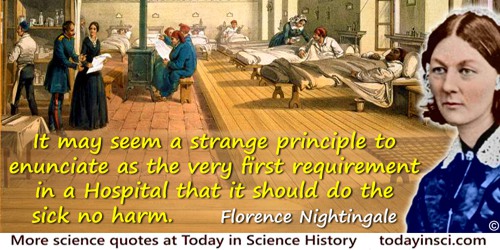
It may seem a strange principle to enunciate as the very first requirement in a Hospital that it should do the sick no harm.
First sentence of Preface to Notes on Hospitals (1859, 3rd. Ed.,1863), iii.
It was above all in the period after the devastating incursions of the Goths that all branches of knowledge which previously had flourished gloriously and been practiced in the proper manner, began to deteriorate. This happened first of all in Italy where the most fashionable physicians, spurning surgery as did the Romans of old, assigned to their servants such surgical work as their patients seemed to require and merely exercised a supervision over them in the manner of architects.
From De Humani Corporis Fabrica Libri Septem: (1543), Book I, i, as translated by William Frank Richardson, in On The Fabric of the Human Body: Book I: The Bones and Cartilages (1998), Preface, xlviii.
It would be an easy task to show that the characteristics in the organization of man, on account of which the human species and races are grouped as a distinct family, are all results of former changes of occupation, and of acquired habits, which have come to be distinctive of individuals of his kind. When, compelled by circumstances, the most highly developed apes accustomed themselves to walking erect, they gained the ascendant over the other animals. The absolute advantage they enjoyed, and the new requirements imposed on them, made them change their mode of life, which resulted in the gradual modification of their organization, and in their acquiring many new qualities, and among them the wonderful power of speech.
Quoted in Ernst Heinrich Philipp August Haeckel The Evolution of Man (1897), Vol. 1, 70.
Knowing what we know from X-ray and related studies of the fibrous proteins, how they are built from long polypeptide chains with linear patterns drawn to a grand scale, how these chains can contract and take up different configurations by intramolecular folding, how the chain- groups are penetrated by, and their sidechains react with, smaller co-operating molecules, and finally how they can combine so readily with nucleic acid molecules and still maintain the fibrous configuration, it is but natural to assume, as a first working hypothesis at least, that they form the long scroll on which is written the pattern of life. No other molecules satisfy so many requirements.
William Thomas Astbury and Florence O. Bell. 'Some Recent Developments in the X-Ray Study of Proteins and Related Structures', Cold Spring Harbor Symposia on Quantitative Biology, 1938, 6, 1144.
Man was born to be rich, or, inevitably grows rich by the use of his faculties; by the union of thought with nature. Property is an intellectual production. The game requires coolness, right reasoning, promptness, and patience in the players. Cultivated labor drives out brute labor. An infinite number of shrewd men, in infinite years, have arrived at certain best and shortest ways of doing, and this accumulated skill in arts, cultures, harvestings, curings, manufactures, navigations, exchanges, constitutes the worth of our world to-day.
In 'Wealth', Power, Wealth, Illusions (1860, 1875), 56-57.
Models so constructed, though of no practical value, serve a useful academic function. The oldest problem in economic education is how to exclude the incompetent. The requirement that there be an ability to master difficult models, including ones for which mathematical competence is required, is a highly useful screening device.
In Economics, Peace, and Laughter (1981), 40-41.
Most people like to believe something is or is not true. Great scientists tolerate ambiguity very well. They believe the theory enough to go ahead; they doubt it enough to notice the errors and faults so they can step forward and create the new replacement theory. If you believe too much you’ll never notice the flaws; if you doubt too much you won’t get started. It requires a lovely balance.
'You and Your Research', Bell Communications Research Colloquium Seminar, 7 Mar 1986.

Necessity is not the mother of invention. Knowledge and experiment are its parents. It sometimes happens that successful search is made for unknown materials to fill well-recognized and predetermined requirements. It more often happens that the acquirement of knowledge of the previously unknown properties of a material suggests its trial for some new use. These facts strongly indicate the value of knowledge of properties of materials and indicate
a way for research.
Quoted in Guy Suits, 'Willis Rodney Whitney', National Academy of Sciences, Biographical Memoirs (1960), 357.

Nursing is an art: and if it is to be made an art, it requires an exclusive devotion as hard a preparation as any painter’s or sculptor’s work; for what is the having to do with dead canvas or dead marble, compared with having to do with the living body, the temple of God’s spirit? It is one of the Fine Arts: I had almost said, the finest of Fine Arts.
First published as a eulogy to an unnamed nurse in 'Una and the Lion', Good Words (1 Jun 1868), 360-366. Reprinted in Una and the Lion (1871), 6.
One should avoid carrying out an experiment requiring more than 10 per cent accuracy.
Quoted in W. Jost, '45 Years of Physical Chemistry in Germany', Annual Review of Physical Chemistry (1966), 17, 9.
Order is not sufficient. What is required, is something much more complex. It is order entering upon novelty; so that the massiveness of order does not degenerate into mere repetition; and so that the novelty is always reflected upon a background of system.
Alfred North Whitehead, David Ray Griffin (ed.), Donald W. Sherburne (ed.), Process and Reality: an Essay in Cosmology (2nd Ed.,1979), 339.
Partly because of improved technology, partly because of the pressures of inflation, partly from causes few understand or agree about, prices have soared. A Spitfire cost £5000 in 1940. A Tornado Air Defence Fighter costs £14 million today. That is a lot of inflation! And even when all has been said about the greater effectiveness of the latter machine, so that far fewer are needed, there still remains a mighty problem. There tend to be limits to the extent to which numbers can be reduced by superior quality. A ship can only cover a certain amount of ocean, however sophisticated it may be; and the most formidable of tanks can’t do much beyond the limits of its commander’s sight. There is a minimum numerical requirement, and meeting it with equipment capable of taking on the enemy was already, in 1955, a source of worry.
In Reflect on Things Past: The Memoirs of Lord Carrington (1089), 110.
Perhaps bacteria may tentatively be regarded as biochemical experiments; owing to their relatively small size and rapid growth, variations must arise much more frequently than in more differentiated forms of life, and they can in addition afford to occupy more precarious positions in natural economy than larger organisms with more exacting requirements.
Bacterial Metabolism (1930). In 'Obituary Notice: Marjory Stephenson, 1885–1948', Biochemistry Journal (1950), 46:4, 377.
Science deals with judgments on which it is possible to obtain universal agreement. These judgments do not concern individual facts and events, but the invariable association of facts and events known as the laws of science. Agreement is secured by observation and experiment—impartial courts of appeal to which all men must submit if they wish to survive. The laws are grouped and explained by theories of ever increasing generality. The theories at first are ex post facto—merely plausible interpretations of existing bodies of data. However, they frequently lead to predictions that can be tested by experiments and observations in new fields, and, if the interpretations are verified, the theories are accepted as working hypotheses until they prove untenable. The essential requirements are agreement on the subject matter and the verification of predictions. These features insure a body of positive knowledge that can be transmitted from person to person, and that accumulates from generation to generation.
From manuscript on English Science in the Renaissance (1937), Edwin Hubble collection, Box 2, Huntington Library, San Marino, California. As cited by Norriss S. Hetherington in 'Philosophical Values and Observation in Edwin Hubble's Choice of a Model of the Universe', Historical Studies in the Physical Sciences (1982), 13, No. 1, 41. (Hetherington comments parenthetically that the references to court, judgment and appeal may be attributable to his prior experiences as a Rhodes Scholar reading Roman law at Oxford, and to a year's practice as an attorney in Louisville, Kentucky.)
Science, history and politics are not suited for discussion except by experts. Others are simply in the position of requiring more information; and, till they have acquired all available information, cannot do anything but accept on authority the opinions of those better qualified.
The Foundations of Mathematics and Other Logical Essays (1931), Epilogue, 287-8.
Sir Hiram Maxim is a genuine and typical example of the man of science, romantic, excitable, full of real but somewhat obvious poetry, a little hazy in logic and philosophy, but full of hearty enthusiasm and an honorable simplicity. He is, as he expresses it, “an old and trained engineer,” and is like all of the old and trained engineers I have happened to come across, a man who indemnifies himself for the superhuman or inhuman concentration required for physical science by a vague and dangerous romanticism about everything else.
In G.K. Chesterton, 'The Maxims of Maxim', Daily News (25 Feb 1905). Collected in G. K. Chesterton and Dale Ahlquist (ed.), In Defense of Sanity: The Best Essays of G.K. Chesterton (2011), 87.
The component parts of the pistols are to correspond so exactly that any limb or part of one Pistol may be fitted to any other Pistol of the Twenty thousand.
Requirement in an 1813 contract with Simeon North to furnish 20,000 pistols.
Requirement in an 1813 contract with Simeon North to furnish 20,000 pistols.
S.N.D. and R.H. North, Memoir of Simeon North (1913), 81. Quoted in Joseph Wickham Roe, English and American Tool Builders (1916), 134.
The creation of a science, like that of a world, demands more than a single day; but when our successors write the history of our science, I am convinced that they will say that the work of Suess marks the end of the first day, when there was light.
As translated to English, in Karl Alfred von Zittel, History of Geology and Palæontology to the End of the Nineteenth Century (1901), 321, from Bertrand’s Preface to the French translation by Emile de Margerie of Éduard Seuss, Das Antlitz der Erde (The Face of the Earth). The quote is the concluding sentence of La Face de la Terre (1897), Preface, xvi: “Il faut savoir attendre; la création d’une science, comme celle d’un monde, demande plus d’un jour; mais quand nos successeurs écriront l’histoire de la nôtre, ils diront, j’en suis persuadé, que l’œuvre de M. Suess marque dans cette histoire la fin du premier jour, celui où la lumière fut.”
The determination of the relationship and mutual dependence of the facts in particular cases must be the first goal of the Physicist; and for this purpose he requires that an exact measurement may be taken in an equally invariable manner anywhere in the world… Also, the history of electricity yields a well-known truth—that the physicist shirking measurement only plays, different from children only in the nature of his game and the construction of his toys.
In 'Mémoire sur la mesure de force de l'électricité', Journal de Physique (1782), 21, 191. English version by Google Translate tweaked by Webmaster. From the original French, “La determination de la relation & de la dépendance mutuelle de ces données dans certains cas particuliers, doit être le premier but du Physicien; & pour cet effet, il falloit one mesure exacte qui indiquât d’une manière invariable & égale dans tous les lieux de la terre, le degré de l'électricité au moyen duquel les expéiences ont été faites… Aussi, l’histoire de l'électricité prouve une vérité suffisamment reconnue; c’est que le Physicien sans mesure ne fait que jouer, & qu’il ne diffère en cela des enfans, que par la nature de son jeu & la construction de ses jouets.”
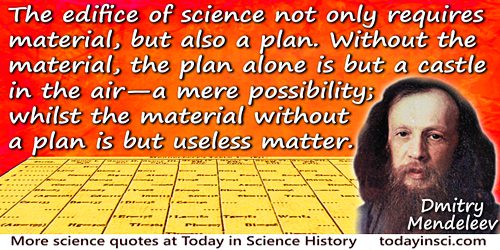
The edifice of science not only requires material, but also a plan. Without the material, the plan alone is but a castle in the air—a mere possibility; whilst the material without a plan is but useless matter.
In The Principles of Chemistry (1891), Vol. 1, preface, footnote, ix, as translated from the Russian 5th edition by George Kamensky, edited by A. J. Greenaway.
The first requirement in using statistics is that the facts treated shall be reduced to comparable units.
From An Introduction to the Study of Experimental Medicine (1865), as translated by Henry Copley Greene (1957), 136.
The infinite variations in the ways creatures fulfill the same requirement—to fuel energy needs—constantly astound me. Booby birds and pelicans … actually performed underwater dives, descending some twenty feet below the surface and then flapping their wings to fly through water. Totally encrusted with tiny diamond bubbles—like the jeweled nightingales of Asian emperors—they soared around below for nearly half a minute.
In Jacques Cousteau and Susan Schiefelbein, The Human, the Orchid, and the Octopus: Exploring and Conserving Our Natural World (2007), 282.
The maintenance of biological diversity requires special measures that extend far beyond the establishment of nature reserves. Several reasons for this stand out. Existing reserves have been selected according to a number of criteria, including the desire to protect nature, scenery, and watersheds, and to promote cultural values and recreational opportunities. The actual requirements of individual species, populations, and communities have seldom been known, nor has the available information always been employed in site selection and planning for nature reserves. The use of lands surrounding nature reserves has typically been inimical to conservation, since it has usually involved heavy use of pesticides, industrial development, and the presence of human settlements in which fire, hunting, and firewood gathering feature as elements of the local economy.
The Fragmented Forest: Island Biogeography Theory and the Preservation of Biotic Diversity (1984), xii.
The meaning of human life and the destiny of man cannot be separable from the meaning and destiny of life in general. 'What is man?' is a special case of 'What is life?' Probably the human species is not intelligent enough to answer either question fully, but even such glimmerings as are within our powers must be precious to us. The extent to which we can hope to understand ourselves and to plan our future depends in some measure on our ability to read the riddles of the past. The present, for all its awesome importance to us who chance to dwell in it, is only a random point in the long flow of time. Terrestrial life is one and continuous in space and time. Any true comprehension of it requires the attempt to view it whole and not in the artificial limits of any one place or epoch. The processes of life can be adequately displayed only in the course of life throughout the long ages of its existence.
The Meaning of Evolution: A Study of the History of Life and of its Significance for Man (1949), 9.
The only distinct meaning of the word “natural” is stated, fixed, or
settled; since what is natural as much requires and presupposes an intelligent agent to render it so, i.e. to effect it continually or at stated times, as what is supernatural or miraculous does to effect it for once.
In The Analogy of Revealed Religion, Natural and Revealed, to the Constitution and Course of Nature (1791), 43. Charles Darwin placed this quote on the title page of his On the Origin of Species.
The owner of the means of production is in a position to purchase the labor power of the worker. By using the means of production, the worker produces new goods which become the property of the capitalist. The essential point about this process is the relation between what the worker produces and what he is paid, both measured in terms of real value. In so far as the labor contract is free what the worker receives is determined not by the real value of the goods he produces, but by his minimum needs and by the capitalists’ requirements for labor power in relation to the number of workers competing for jobs. It is important to understand that even in theory the payment of the worker is not determined by the value of his product.
…...
The philosophical study of nature rises above the requirements of mere delineation, and does not consist in the sterile accumulation of isolated facts. The active and inquiring spirit of man may therefore be occasionally permitted to escape from the present into the domain of the past, to conjecture that which cannot yet be clearly determined, and thus to revel amid the ancient and ever-recurring myths of geology.
Views of Nature: Or Contemplation of the Sublime Phenomena of Creation (1850), trans. E. C. Otte and H. G. Bohn, 375.
The present state of electrical science seems peculiarly unfavorable to speculation … to appreciate the requirements of the science, the student must make himself familiar with a considerable body of most intricate mathematics, the mere retention of which in the memory materially interferes with further progress. The first process therefore in the effectual study of the science, must be one of simplification and reduction of the results of previous investigation to a form in which the mind can grasp them.
First sentence of Maxwell’s first paper (read 10 Dec 1855), 'On Faraday’s Lines of Force', Transactions of the Cambridge Philosophical Society (1857), Vol. X, part I. Collected in William Davidson Niven (ed.), The Scientific Papers of James Clerk Maxwell (1890), Vol. 1, 155.
The requirement for great success is great ambition ... for triumph over other men, not merely over nature.
In Patenting the Sun: Polio and the Salk Vaccine by Jane S. Smith (1990).
The research worker, in his efforts to express the fundamental laws of Nature in mathematical form, should strive mainly for mathematical beauty. He should take simplicity into consideration in a subordinate way to beauty. It often happens that the requirements of simplicity and beauty are the same, but where they clash, the latter must take precedence.
From Proceedings of the Royal Society of Edinburgh (1939), 59 122. In A. Pais, 'Playing With Equations, the Dirac Way'. Behram N. Kursunoglu (Ed.) and Eugene Paul Wigner (Ed.), Paul Adrien Maurice Dirac: Reminiscences about a Great Physicist (1990), 110.
The rules of scientific investigation always require us, when we enter the domains of conjecture, to adopt that hypothesis by which the greatest number of known facts and phenomena may be reconciled.
In The Physical Geography of the Sea (1855), 123.
The same society which receives the rewards of technology must, as a cooperating whole, take responsibility for control. To deal with these new problems will require a new conservation. We must not only protect the countryside and save it from destruction, we must restore what has been destroyed and salvage the beauty and charm of our cities. Our conservation must be not just the classic conservation of protection and development, but a creative conservation of restoration and innovation. Its concern is not with nature alone, but with the total relation between man and the world around him. Its object is not just man's welfare, but the dignity of man's spirit.
In his 'Message to Congress on Conservation and Restoration of Natural Beauty' written to Congress (8 Feb 1965). It was a broad initiative aimed at beautifying America, guaranteeing water and air quality, and preserving natural areas. In Lyndon B. Johnson: Containing the Public Messages, Speeches, and Statements of the President (1965), Vol.1, 156.
United States. President (1963-1969 : Johnson), Lyndon Baines Johnson, United States. Office of the Federal Register - 1970
The University of Cambridge, in accordance with that law of its evolution, by which, while maintaining the strictest continuity between the successive phases of its history, it adapts itself with more or less promptness to the requirements of the times, has lately instituted a course of Experimental Physics.
'Introductory Lecture on Experimental Physics', (1871). In W. D. Niven (ed.), The Scientific Papers of James Clerk Maxwell (1890), Vol. 2, 241.Course;Experiment;Cambridge;History;Promptness;Adapt;Requirement
The value of fundamental research does not lie only in the ideas it produces. There is more to it. It affects the whole intellectual life of a nation by determining its way of thinking and the standards by which actions and intellectual production are judged. If science is highly regarded and if the importance of being concerned with the most up-to-date problems of fundamental research is recognized, then a spiritual climate is created which influences the other activities. An atmosphere of creativity is established which penetrates every cultural frontier. Applied sciences and technology are forced to adjust themselves to the highest intellectual standards which are developed in the basic sciences. This influence works in many ways: some fundamental students go into industry; the techniques which are applied to meet the stringent requirements of fundamental research serve to create new technological methods. The style, the scale, and the level of scientific and technical work are determined in pure research; that is what attracts productive people and what brings scientists to those countries where science is at the highest level. Fundamental research sets the standards of modern scientific thought; it creates the intellectual climate in which our modern civilization flourishes. It pumps the lifeblood of idea and inventiveness not only into the technological laboratories and factories, but into every cultural activity of our time. The case for generous support for pure and fundamental science is as simple as that.
In 'Why Pure Science?' in Bulletin of the Atomic Scientists, 1965.
The way of pure research is opposed to all the copy-book maxims concerning the virtues of industry and a fixed purpose, and the evils of guessing, but it is damned useful when it comes off. It is the diametrical opposite of Edison’s reputed method of trying every conceivable expedient until he hit the right one. It requires, not diligence, but experience, information, and a good nose for the essence of a problem.
Letter to Paul de Kruif (3 Aug 1933), as quoted in Nathan Reingold, Science in America: A Documentary History 1900-1939 (1981), 409.
Thinking consists in envisaging, realizing structural features and structural requirements; proceeding in accordance with, and determined by, these requirements; thereby changing the situation in the direction of structural improvements.
In Productive Thinking (1959), 235.
Those who nod sagely and quote the tragedy of the commons in relation to environmental problems from pollution of the atmosphere to poaching of national parks tend to forget that Garrett Hardin revised his conclusions many times…. He recognized, most importantly, that anarchy did not prevail on the common pastures of medieval England in the way he had described…. “A managed commons, though it may have other defects, is not automatically subject to the tragic fate of the unmanaged commons,” wrote Hardin…. At sea, where a common exists in most waters… None of Hardin’s requirements for a successfully managed common is fulfilled by high-seas fishery regimes.
In The End of the Line: How Overfishing is Changing the World and what We Eat (2004), 153-155.
Time... is an essential requirement for effective research. An investigator may be given a palace to live in, a perfect laboratory to work in, he may be surrounded by all the conveniences money can provide; but if his time is taken from him he will remain sterile.
Quoted in S. Benison, A. C. Barger and E. L. Wolfe, Walter B Cannon: The Life and Times of a Young Scientist (1987), 253.
To paraphrase Dr. Orr: “Darwinian evolution can easily produce irreducible complexity: all that's required is that parts that were once just favorable become, because of later changes, essential.”
In 'Is the Complement System Irreducibly Complex?' on The TalkOrigins Archive website. Coon summarizes H. Allen Orr, who wrote: “An irreducibly complex system can be built gradually by adding parts that, while initially just advantageous, become-because of later changes-essential. The logic is very simple. Some part (A) initially does some job (and not very well, perhaps). Another part (B) later gets added because it helps A. This new part isn't essential, it merely improves things. But later on, A (or something else) may change in such a way that B now becomes indispensable. This process continues as further parts get folded into the system. And at the end of the day, many parts may all be required.” In H. Allen Orr, 'Darvin v. Intelligent Design (Again)' in Boston Review (Dec 1996/Jan1997)
To produce any given motion, to spin a certain weight of cotton, or weave any quantity of linen, there is required steam; to produce the steam, fuel; and thus the price of fuel regulates effectively the cost of mechanical power. Abundance and cheapness of fuel are hence main ingredients in industrial success. It is for this reason that in England the active manufacturing districts mark, almost with geological accuracy, the limits of the coal fields.
In The Industrial Resources of Ireland (1844), 2.
To stay young requires unceasing cultivation of the ability to unlearn old falsehoods.
In Time Enough For Love: the Lives of Lazarus Long (1973), 364.
What would life be without art? Science prolongs life. To consist of what—eating, drinking, and sleeping? What is the good of living longer if it is only a matter of satisfying the requirements that sustain life? All this is nothing without the charm of art.
The Art of the Theatre (1924), 177.
Wheeler hopes that we can discover, within the context of physics, a principle that will enable the universe to come into existence “of its own accord.” In his search for such a theory, he remarks: “No guiding principle would seem more powerful than the requirement that it should provide the universe with a way to come into being.” Wheeler likened this 'self-causing' universe to a self-excited circuit in electronics.
In God and the New Physics (1984), 39. Wheeler quotation footnoted 'From the Black Hole', in H. Woolf (Ed.),Some Strangeness in the Proportion (1980).
Yet is it possible in terms of the motion of atoms to explain how men can invent an electric motor, or design and build a great cathedral? If such achievements represent anything more than the requirements of physical law, it means that science must investigate the additional controlling factors, whatever they may be, in order that the world of nature may be adequately understood. For a science which describes only the motions of inanimate things but fails to include the actions of living organisms cannot claim universality.
The Human Meaning of Science (1940), 31.
 In science it often happens that scientists say, 'You know that's a really good argument; my position is mistaken,' and then they would actually change their minds and you never hear that old view from them again. They really do it. It doesn't happen as often as it should, because scientists are human and change is sometimes painful. But it happens every day. I cannot recall the last time something like that happened in politics or religion.
(1987) --
In science it often happens that scientists say, 'You know that's a really good argument; my position is mistaken,' and then they would actually change their minds and you never hear that old view from them again. They really do it. It doesn't happen as often as it should, because scientists are human and change is sometimes painful. But it happens every day. I cannot recall the last time something like that happened in politics or religion.
(1987) -- 





