Relativity Quotes (92 quotes)
…The present revolution of scientific thought follows in natural sequence on the great revolutions at earlier epochs in the history of science. Einstein’s special theory of relativity, which explains the indeterminateness of the frame of space and time, crowns the work of Copernicus who first led us to give up our insistence on a geocentric outlook on nature; Einstein's general theory of relativity, which reveals the curvature or non-Euclidean geometry of space and time, carries forward the rudimentary thought of those earlier astronomers who first contemplated the possibility that their existence lay on something which was not flat. These earlier revolutions are still a source of perplexity in childhood, which we soon outgrow; and a time will come when Einstein’s amazing revelations have likewise sunk into the commonplaces of educated thought.
In The Theory of Relativity and its Influence on Scientific Thought (1922), 31-32
[As a science hobbyist, hoping to become famous someday, Artie Pinsetter (Lou Costello):] They also laughed at Einstein and his theory of relativity. Now everyone has relatives.
From movie The 30-foot Bride of Candy Rock (1959). Writers, Rowland Barber and Arthur A. Ross. In Larry Langman and Paul Gold, Comedy Quotes from the Movies (2001), 289. This movie, (with its rare appearance of Costello without Bud Abott, his usual comedy partner), was released later in the year of Costello's death.
[John Wheeler] rejuvenated general relativity; he made it an experimental subject and took it away from the mathematicians
Quoted in Dennis Overbye, 'John A. Wheeler, Physicist Who Coined the Term Black Hole, Is Dead at 96', New York Times (14 Apr 2008).
![Arthur Stanley Eddington quote: [When thinking about the new relativity and quantum theories] I have felt a homesickness for the](https://todayinsci.com/E/Eddington_Arthur/EddingtonArthur-Handrails500x250px.jpg)
[When thinking about the new relativity and quantum theories] I have felt a homesickness for the paths of physical science where there are more or less discernible handrails to keep us from the worst morasses of foolishness.
The Nature Of The Physical World (1928), 343.
A superficial knowledge of mathematics may lead to the belief that this subject can be taught incidentally, and that exercises akin to counting the petals of flowers or the legs of a grasshopper are mathematical. Such work ignores the fundamental idea out of which quantitative reasoning grows—the equality of magnitudes. It leaves the pupil unaware of that relativity which is the essence of mathematical science. Numerical statements are frequently required in the study of natural history, but to repeat these as a drill upon numbers will scarcely lend charm to these studies, and certainly will not result in mathematical knowledge.
In Primary Arithmetic: First Year, for the Use of Teachers (1897), 26-27.
A superficial knowledge of mathematics may lead to the belief that this subject can be taught incidentally, and that exercises akin to counting the petals of flowers or the legs of a grasshopper are mathematical. Such work ignores the fundamental idea out of which quantitative reasoning grows—the equality of magnitudes. It leaves the pupil unaware of that relativity which is the essence of mathematical science. Numerical statements are frequently required in the study of natural history, but to repeat these as a drill upon numbers will scarcely lend charm to these studies, and certainly will not result in mathematical knowledge.
In Primary Arithmetic: First Year, for the Use of Teachers (1897), 26-27.
Asked in 1919 whether it was true that only three people in the world understood the theory of general relativity, [Eddington] allegedly replied: “Who's the third?”
As described in Brian Stableford, Science Fact and Science Fiction: An Encyclopedia (2006), 150.
But no Anglo-Saxon can understand relativity.
Said at a dinner in 1910, teasing Ernest Rutherford, who replied, 'No, they have too much sense.'
Said at a dinner in 1910, teasing Ernest Rutherford, who replied, 'No, they have too much sense.'
Quoted in Richard Reeves, A Force of Nature: The Frontier Genius of Ernest Rutherford (2007), 66.
By an application of the theory of relativity to the taste of readers, today in Germany I am called a German man of science, and in England I am represented as a Swiss Jew. If I come to be regarded as a bête noire the descriptions will be reversed, and I shall become a Swiss Jew for the Germans and a German man of science for the English!
Times (28 Nov 1919). In Robert Andrews Famous Lines: a Columbia Dictionary of Familiar Quotations (1997), 414. Variations of this quote were made by Einstein on other occasions.
By far the most important consequence of the conceptual revolution brought about in physics by relativity and quantum theory lies not in such details as that meter sticks shorten when they move or that simultaneous position and momentum have no meaning, but in the insight that we had not been using our minds properly and that it is important to find out how to do so.
'Quo Vadis'. In Gerald Holton (ed.), Science and the Modern Mind (1971), 84.
Each ray of light moves in the coordinate system 'at rest' with the definite, constant velocity V independent of whether this ray of light is emitted by a body at rest or a body in motion.
Annalen der Physik, 1905, 17, 891-921. Trans. John Stachel et al (eds.), The Collected Papers of Albert Einstein, Vol. 2, (1989), Doc. 23, 143.
Einstein, my upset stomach hates your theory [of General Relativity]—it almost hates you yourself! How am I to provide for my students? What am I to answer to the philosophers?!!
Letter to Albert Einstein, 20 Nov 1919. In Martin J. Klein, Paul Ehrenfest: The Making of a Theoretical Physicist (1970), Vol. 1, 315.
Einstein, twenty-six years old, only three years away from crude privation, still a patent examiner, published in the Annalen der Physik in 1905 five papers on entirely different subjects. Three of them were among the greatest in the history of physics. One, very simple, gave the quantum explanation of the photoelectric effect—it was this work for which, sixteen years later, he was awarded the Nobel prize. Another dealt with the phenomenon of Brownian motion, the apparently erratic movement of tiny particles suspended in a liquid: Einstein showed that these movements satisfied a clear statistical law. This was like a conjuring trick, easy when explained: before it, decent scientists could still doubt the concrete existence of atoms and molecules: this paper was as near to a direct proof of their concreteness as a theoretician could give. The third paper was the special theory of relativity, which quietly amalgamated space, time, and matter into one fundamental unity.
This last paper contains no references and quotes no authority. All of them are written in a style unlike any other theoretical physicist’s. They contain very little mathematics. There is a good deal of verbal commentary. The conclusions, the bizarre conclusions, emerge as though with the greatest of ease: the reasoning is unbreakable. It looks as though he had reached the conclusions by pure thought, unaided, without listening to the opinions of others. To a surprisingly large extent, that is precisely what he had done.
This last paper contains no references and quotes no authority. All of them are written in a style unlike any other theoretical physicist’s. They contain very little mathematics. There is a good deal of verbal commentary. The conclusions, the bizarre conclusions, emerge as though with the greatest of ease: the reasoning is unbreakable. It looks as though he had reached the conclusions by pure thought, unaided, without listening to the opinions of others. To a surprisingly large extent, that is precisely what he had done.
In Variety of Men (1966), 100-101. First published in Commentary magazine.
Every new theory as it arises believes in the flush of youth that it has the long sought goal; it sees no limits to its applicability, and believes that at last it is the fortunate theory to achieve the 'right' answer. This was true of electron theory—perhaps some readers will remember a book called The Electrical Theory of the Universe by de Tunzelman. It is true of general relativity theory with its belief that we can formulate a mathematical scheme that will extrapolate to all past and future time and the unfathomed depths of space. It has been true of wave mechanics, with its first enthusiastic claim a brief ten years ago that no problem had successfully resisted its attack provided the attack was properly made, and now the disillusionment of age when confronted by the problems of the proton and the neutron. When will we learn that logic, mathematics, physical theory, are all only inventions for formulating in compact and manageable form what we already know, like all inventions do not achieve complete success in accomplishing what they were designed to do, much less complete success in fields beyond the scope of the original design, and that our only justification for hoping to penetrate at all into the unknown with these inventions is our past experience that sometimes we have been fortunate enough to be able to push on a short distance by acquired momentum.
The Nature of Physical Theory (1936), 136.
Evolution ... is really two theories, the vague theory and the precise theory. The vague theory has been abundantly proved.... The precise theory has never been proved at all. However, like relativity, it is accepted on faith.... On getting down to actual details, difficulties begin.
In Science is a Sacred Cow (1950), 101 & 103.
General Relativity is at least very close to the truth.
…...
General Theory of Relativity = Gravity too; referentially, eh?
— Anagram
Anagram by V. Rabin (2003) on anagramgenius.com website.
Genuine religion has its root deep down in the heart of humanity and in the reality of things. It is not surprising that by our methods we fail to grasp it: the actions of the Deity make no appeal to any special sense, only a universal appeal; and our methods are, as we know, incompetent to detect complete uniformity. There is a principle of Relativity here, and unless we encounter flaw or jar or change, nothing in us responds; we are deaf and blind therefore to the Immanent Grandeur, unless we have insight enough to recognise in the woven fabric of existence, flowing steadily from the loom in an infinite progress towards perfection, the ever-growing garment of a transcendent God.
Continuity: The Presidential Address to the British Association (1913), 92-93.
Grossmann, you must help me, or else I’ll go crazy!
From the original German: “Grossmann, Du mußt mir helfen, sonst werd’ ich verrückt!” Einstein implored his mathematician friend, Marcel Grossmann, for collaboration. Einstein lacked knowledge on using higher-dimensional differential geometry, but realized he needed it to describe gravitation when developing his general theory of relativity. As quoted in K. Kollros, Helv. Phys. Acta. Suppl. (1956), 4, 271. As cited in Abraham Pais, Subtle is the Lord (1982, 2005), 212.
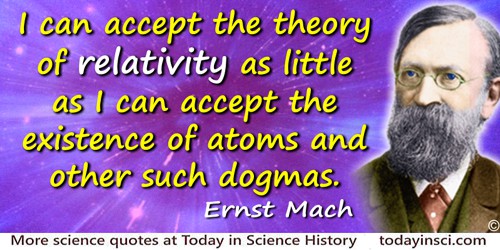
I can accept the theory of relativity as little as I can accept the existence of atoms and other such dogmas.
Professor of Physics at the University of Vienna, 1913, in The Book of Heroic Failures by Stephen Pile (1979).
I claim that relativity and the rest of modern physics is not complicated. It can be explained very simply. It is only unusual or, put another way, it is contrary to common sense.
In Edward Teller, Wendy Teller and Wilson Talley, Conversations on the Dark Secrets of Physics (1991, 2013), 2.
I count Maxwell and Einstein, Eddington and Dirac, among “real” mathematicians. The great modern achievements of applied mathematics have been in relativity and quantum mechanics, and these subjects are at present at any rate, almost as “useless” as the theory of numbers.
In A Mathematician's Apology (1940, 2012), 131.
I do not see any reason to assume that the heuristic significance of the principle of general relativity is restricted to gravitation and that the rest of physics can be dealt with separately on the basis of special relativity, with the hope that later on the whole may be fitted consistently into a general relativistic scheme. I do not think that such an attitude, although historically understandable, can be objectively justified. The comparative smallness of what we know today as gravitational effects is not a conclusive reason for ignoring the principle of general relativity in theoretical investigations of a fundamental character. In other words, I do not believe that it is justifiable to ask: What would physics look like without gravitation?
…...
I have read various articles on the fourth dimension, the relativity theory of Einstein, and other psychological speculation on the constitution of the universe; and after reading them I feel as Senator Brandegee felt after a celebrated dinner in Washington. “I feel,” he said, “as if I had been wandering with Alice in Wonderland and had tea with the Mad Hatter.”
Quoted in Michio Kaku, Einstein's Cosmos: How Albert Einstein's vision Transformed Our Understanding of Space and Time (2005), 118-119. [Note:Brandegee's original remark was in the context of politics after a White House conference with President Wilson (Feb 1917), and unrelated to Einstein's theory.]
I have tried to read philosophers of all ages and have found many illuminating ideas but no steady progress toward deeper knowledge and understanding. Science, however, gives me the feeling of steady progress: I am convinced that theoretical physics is actual philosophy. It has revolutionized fundamental concepts, e.g., about space and time (relativity), about causality (quantum theory), and about substance and matter (atomistics), and it has taught us new methods of thinking (complementarity) which are applicable far beyond physics.
— Max Born
My Life & My Views (1968), 48.
I like relativity and quantum theories
because I don't understand them
and they make me feel as if space shifted about
like a swan that
can't settle,
refusing to sit still and be measured;
and as if the atom were an impulsive thing
always changing its mind.
because I don't understand them
and they make me feel as if space shifted about
like a swan that
can't settle,
refusing to sit still and be measured;
and as if the atom were an impulsive thing
always changing its mind.
'Relativity', David Herbert Lawrence, The Works of D.H. Lawrence (1994), 437.
I sometimes ask myself how it came about that I was the one to develop the theory of relativity. The reason, I think, is that a normal adult never stops to think about the problem of space and time. These are things which he has thought of as a child. But my intellectual development was retarded, as a result of which I began to wonder about space and time only when I had already grown up.
In Ronald W. Clark, Einstein: The Life and Times (1971), 10.
I think a strong claim can be made that the process of scientific discovery may be regarded as a form of art. This is best seen in the theoretical aspects of Physical Science. The mathematical theorist builds up on certain assumptions and according to well understood logical rules, step by step, a stately edifice, while his imaginative power brings out clearly the hidden relations between its parts. A well constructed theory is in some respects undoubtedly an artistic production. A fine example is the famous Kinetic Theory of Maxwell. ... The theory of relativity by Einstein, quite apart from any question of its validity, cannot but be regarded as a magnificent work of art.
Responding to the toast, 'Science!' at the Royal Academy of the Arts in 1932.)
Responding to the toast, 'Science!' at the Royal Academy of the Arts in 1932.)
Quoted in Lawrence Badash, 'Ernest Rutherford and Theoretical Physics,' in Robert Kargon and Peter Achinstein (eds.) Kelvin's Baltimore Lectures and Modern Theoretical Physics: Historical and Philosophical Perspectives (1987), 352.
If Einstein’s theory [of relativity] should prove to be correct, as I expect it will, he will be considered the Copernicus of the twentieth century.
As quoted in Philipp Frank and Shuichi Kusaka, Einstein, His Life and Times (1947), 101.
If my theory of relativity is proven successful, Germany will claim me as a German and France will declare I am a citizen of the world. Should my theory prove untrue, France will say I am a German and Germany will declare I am a Jew.
In Speech (6 Apr 1922) to the French Philosophical Society, Sorbonne. Quoted in Alice Calaprice, The Quotable Einstein (1996), 8.
If the 'Principle of Relativity' in an extreme sense establishes itself, it seems as if even Time would become discontinuous and be supplied in atoms, as money is doled out in pence or centimes instead of continuously;—in which case our customary existence will turn out to be no more really continuous than the events on a kinematograph screen;—while that great agent of continuity, the Ether of Space, will be relegated to the museum of historical curiosities.
Continuity: The Presidential Address to the British Association (1913), 40-41.
If we consider that part of the theory of relativity which may nowadays in a sense be regarded as bone fide scientific knowledge, we note two aspects which have a major bearing on this theory. The whole development of the theory turns on the question of whether there are physically preferred states of motion in Nature (physical relativity problem). Also, concepts and distinctions are only admissible to the extent that observable facts can be assigned to them without ambiguity (stipulation that concepts and distinctions should have meaning). This postulate, pertaining to epistemology, proves to be of fundamental importance.
'Fundamental ideas and problems of the theory of relativity', Lecture delivered to the Nordic Assembly of Naturalists at Gothenburg, 11 Jul 1923. In Nobel Physics 1901-1921 (1998), 482.
If your car could travel at the speed of light, would your headlights work?
In relativity, movement is continuous, causally determinate and well defined; while in quantum mechanics it is discontinuous, not causally determinate and not well defined.
In Wholeness and the Implicate Order (1980), xv.
In the field of thinking, the whole history of science from geocentrism to the Copernican revolution, from the false absolutes of Aristotle’s physics to the relativity of Galileo’s principle of inertia and to Einstein’s theory of relativity, shows that it has taken centuries to liberate us from the systematic errors, from the illusions caused by the immediate point of view as opposed to “decentered” systematic thinking.
As quoted in D. E. Berlyne, Structure and Direction in Thinking (1965), 232.
In the history of physics, there have been three great revolutions in thought that first seemed absurd yet proved to be true. The first proposed that the earth, instead of being stationary, was moving around at a great and variable speed in a universe that is much bigger than it appears to our immediate perception. That proposal, I believe, was first made by Aristarchos two millenia ago ... Remarkably enough, the name Aristarchos in Greek means best beginning.
[The next two revolutions occurred ... in the early part of the twentieth century: the theory of relativity and the science of quantum mechanics...]
[The next two revolutions occurred ... in the early part of the twentieth century: the theory of relativity and the science of quantum mechanics...]
Edward Teller with Judith L. Shoolery, Memoirs: A Twentieth-Century Journey in Science and Politics (2001), 562.
It follows from the theory of relativity that mass and energy are both different manifestations of the same thing—a somewhat unfamiliar conception for the average man. Furthermore E=MC2, in which energy is put equal to mass multiplied with the square of the velocity of light, showed that a very small amount of mass may be converted into a very large amount of energy... the mass and energy were in fact equivalent.
As expressed in the Einstein film, produced by Nova Television (1979). Quoted in Alice Calaprice, The Quotable Einstein (1996), 183.
It is ironical that, in the very field in which Science has claimed superiority to Theology, for example—in the abandoning of dogma and the granting of absolute freedom to criticism—the positions are now reversed. Science will not tolerate criticism of special relativity, while Theology talks freely about the death of God, religionless Christianity, and so on.
In 'Preface', Science at the Crossroads (1972), 13.
It is only when science asks why, instead of simply describing how, that it becomes more than technology. When it asks why, it discovers Relativity. When it only shows how, it invents the atom bomb, and then puts its hands over its eye and says, 'My God what have I done?
The Stalin in Soul (1973). Quoted in Gary Westfahl, Science Fiction Quotations (2005), 322.
It is we, we alone, who have dreamed up the causes, the one-thing-after-another, the one-thing-reciprocating-another, the relativity, the constraint, the numbers, the laws, the freedom, the ‘reason why,’ the purpose. ... We are creating myths.
…...
Let me describe briefly how a black hole might be created. Imagine a star with a mass 10 times that of the sun. During most of its lifetime of about a billion years the star will generate heat at its center by converting hydrogen into helium. The energy released will create sufficient pressure to support the star against its own gravity, giving rise to an object with a radius about five times the radius of the sun. The escape velocity from the surface of such a star would be about 1,000 kilometers per second. That is to say, an object fired vertically upward from the surface of the star with a velocity of less than 1,000 kilometers per second would be dragged back by the gravitational field of the star and would return to the surface, whereas an object with a velocity greater than that would escape to infinity.
When the star had exhausted its nuclear fuel, there would be nothing to maintain the outward pressure, and the star would begin to collapse because of its own gravity. As the star shrank, the gravitational field at the surface would become stronger and the escape velocity would increase. By the time the radius had got down to 10 kilometers the escape velocity would have increased to 100,000 kilometers per second, the velocity of light. After that time any light emitted from the star would not be able to escape to infinity but would be dragged back by the gravitational field. According to the special theory of relativity nothing can travel faster than light, so that if light cannot escape, nothing else can either. The result would be a black hole: a region of space-time from which it is not possible to escape to infinity.
When the star had exhausted its nuclear fuel, there would be nothing to maintain the outward pressure, and the star would begin to collapse because of its own gravity. As the star shrank, the gravitational field at the surface would become stronger and the escape velocity would increase. By the time the radius had got down to 10 kilometers the escape velocity would have increased to 100,000 kilometers per second, the velocity of light. After that time any light emitted from the star would not be able to escape to infinity but would be dragged back by the gravitational field. According to the special theory of relativity nothing can travel faster than light, so that if light cannot escape, nothing else can either. The result would be a black hole: a region of space-time from which it is not possible to escape to infinity.
'The Quantum Mechanics of Black Holes', Scientific American, 1977, 236, 34-40.
MAGNITUDE, n. Size. Magnitude being purely relative, nothing is large and nothing small. If everything in the universe were increased in bulk one thousand diameters nothing would be any larger than it was before, but if one thing remained unchanged all the others would be larger than they had been. To an understanding familiar with the relativity of magnitude and distance the spaces and masses of the astronomer would be no more impressive than those of the microscopist. For anything we know to the contrary, the visible universe may be a small part of an atom, with its component ions, floating in the life-fluid (luminiferous ether) of some animal. Possibly the wee creatures peopling the corpuscles of our own blood are overcome with the proper emotion when contemplating the unthinkable distance from one of these to another.
The Collected Works of Ambrose Bierce (1911), Vol. 7, The Devil's Dictionary, 209.
Modern war, even from the consideration of physical welfare, is not creative. Soldiers and civilians alike are supposed to put on mental khaki. … War means the death of that fertile war which consists of the free, restless conflict of ideas. The war which matters is that of the scientist with nature; of the farmer with the tawny desert; of … philosopher against … mob stupidity. Such war is creative. … Inventions that further life and joy; freedom; new knowledge, whether Luther Burbank’s about the breeding of fruits or Einstein's about relativity; great cathedrals and Beethoven's music: these modern mechanical war can destroy but never produce. At its most inventive height, war creates the Maxim gun, the submarine, disseminable germs of disease, life-blasting gases. Spiritually and intellectually, modern war is not creative.
From ‘The Stagnation of War’, in Allen D. Hole (ed.) The Messenger of Peace (Nov 1924), 49, No. 11, 162-163.
No one must think that Newton’s great creation can be overthrown in any real sense by this [Theory of Relativity] or by any other theory. His clear and wide ideas will for ever retain their significance as the foundation on which our modern conceptions of physics have been built.
In 'Time, Space, and Gravitation', The Times (28 Nov 1919). Excerpted in David E. Rowe and Robert J. Schulmann, Einstein on Politics: His Private Thoughts and Public Stands on Nationalism, Zionism, War, Peace, and the Bomb (2007), 104.
Now Einstein was a very clever man,
with us all his philosophies he shared,
He gave us the theory of relativity,
which is E equals M C squared.
with us all his philosophies he shared,
He gave us the theory of relativity,
which is E equals M C squared.
From lyrics of song Sod’s Law.
Now it came to me: … the independence of the gravitational acceleration from the nature of the falling substance, may be expressed as follows: In a gravitational field (of small spatial extension) things behave as they do in a space free of gravitation. … This happened in 1908. Why were another seven years required for the construction of the general theory of relativity? The main reason lies in the fact that it is not so easy to free oneself from the idea that coordinates must have an immediate metrical meaning.
In Paul Arthur Schilpp, 'Autobiographical Notes', Albert Einstein: Philosopher-Scientist (1949), 65-67.
On quantum theory I use up more brain grease than on relativity.
…...
Our most successful theories in physics are those that explicitly leave room for the unknown, while confining this room sufficiently to make the theory empirically disprovable. It does not matter whether this room is created by allowing for arbitrary forces as Newtonian dynamics does, or by allowing for arbitrary equations of state for matter, as General Relativity does, or for arbitrary motions of charges and dipoles, as Maxwell's electrodynamics does. To exclude the unknown wholly as a “unified field theory” or a “world equation” purports to do is pointless and of no scientific significance.
Our ultimate analysis of space leads us not to a “here” and a “there,” but to an extension such as that which relates “here” and “there.” To put the conclusion rather crudely—space is not a lot of points close together; it is a lot of distances interlocked.
The Mathematical Theory of Relativity (1923), 10.
Quantum field theory, which was born just fifty years ago from the marriage of quantum mechanics with relativity, is a beautiful but not very robust child.
In Nobel Lecture (8 Dec 1989), 'Conceptual Foundations of the Unified Theory of Weak and Electromagnetic Interactions.'
Quantum mechanics and relativity, taken together, are extraordinarily restrictive, and they therefore provide us with a great logical machine. We can explore with our minds any number of possible universes consisting of all kinds of mythical particles and interactions, but all except a very few can be rejected on a priori grounds because they are not simultaneously consistent with special relativity and quantum mechanics. Hopefully in the end we will find that only one theory is consistent with both and that theory will determine the nature of our particular universe.
As quoted in John D. Barrow, The Universe that Discovered Itself (2000), 360.
Read, and found correct.
Written, with Einstein’s signature, below this statement written by an admirer: “A Short Definition of Relativity: There is no hitching post in the Universe—as far as we know.”
Written, with Einstein’s signature, below this statement written by an admirer: “A Short Definition of Relativity: There is no hitching post in the Universe—as far as we know.”
As described in Ronald William Clark, Einstein: The Life and Times (1995), 248-249.
Relativity applies to physics, not ethics.
…...
Relativity teaches us the connection between the different descriptions of one and the same reality.
…...
Relativity was a highly technical new theory that gave new meanings to familiar concepts and even to the nature of the theory itself. The general public looked upon relativity as indicative of the seemingly incomprehensible modern era, educated scientists despaired of ever understanding what Einstein had done, and political ideologues used the new theory to exploit public fears and anxieties—all of which opened a rift between science and the broader culture that continues to expand today.
'The Cultural Legacy of Relativity Theory' in Albert Einstein, Robert W. Lawson, Robert Geroch, Roger Penrose and David C. Cassidy, Relativity (2005), 226.
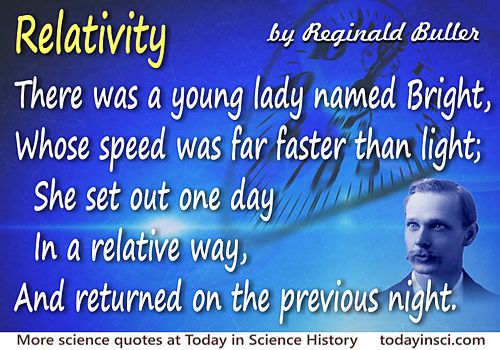
Relativity
There was a young lady named Bright,
Whose speed was far faster than light;
She set out one day
In a relative way,
And returned on the previous night.
There was a young lady named Bright,
Whose speed was far faster than light;
She set out one day
In a relative way,
And returned on the previous night.
Published without attribution in Punch (19 Dec 1923), 165, 591. He was later identified as the author, based his claim to have written it, in a letter to The Observer (1937).
Science derives its conclusions by the laws of logic from our sense perceptions, Thus it does not deal with the real world, of which we know nothing, but with the world as it appears to our senses. … All our sense perceptions are limited by and attached to the conceptions of time and space. … Modern physics has come to the same conclusion in the relativity theory, that absolute space and absolute time have no existence, but, time and space exist only as far as things or events fill them, that is, are forms of sense perception.
In 'Religion and Modern Science', The Christian Register (16 Nov 1922), 101, 1089. The article is introduced as “the substance of an address to the Laymen’s League in All Soul’s Church (5 Nov 1922).
Scientists don’t really ever grow up. I read, as a 10-or-so-year-old, a book for kids by Einstein. I think it was The Meaning of Relativity. It was exciting! Science was compared to a detective story, replete with clues, and the solution was the search for a coherent account of all the known events. Then I remember some very entrapping biographies: Crucibles, by Bernard Jaffe, was the story of chemistry told through the lives of great chemists; Microbe Hunters, by Paul de Kruif, did the same for biologists. Also, the novel Arrowsmith, by Sinclair Lewis, about a medical researcher. These books were a crucial component of getting hooked into science.
When asked by Discover magazine what books helped inspire his passion as a scientist.
When asked by Discover magazine what books helped inspire his passion as a scientist.
In 'The 1998 Discover Science Gift Guide: Fantastic Voyages Children's Books That Mattered', Discover (Dec 1998).
Scientists, therefore, are responsible for their research, not only intellectually but also morally. This responsibility has become an important issue in many of today's sciences, but especially so in physics, in which the results of quantum mechanics and relativity theory have opened up two very different paths for physicists to pursue. They may lead us—to put it in extreme terms—to the Buddha or to the Bomb, and it is up to each of us to decide which path to take.
In The Turning Point: Science, Society, and the Rising Culture (1983), 87.
Since the mathematicians have invaded the theory of relativity, I do not understand it myself anymore.
Quoted as “Einstein once joked”, in Carl Seelig, Albert Einstein: A Documentary Biography (1956), 28.
The alternative to the Big Bang is not, in my opinion, the steady state; it is instead the more general theory of continuous creation. Continuous creation can occur in bursts and episodes. These mini-bangs can produce all the wonderful element-building that Fred Hoyle discovered and contributed to cosmology. This kind of element and galaxy formation can take place within an unbounded, non-expanding universe. It will also satisfy precisely the Friedmann solutions of general relativity. It can account very well for all the facts the Big Bang explains—and also for those devastating, contradictory observations which the Big Bang must, at all costs, pretend are not there
In 'Letters: Wrangling Over the Bang', Science News (27 Jul 1991), 140, No. 4, 51. Also quoted in Roy C. Martin, Astronomy on Trial: A Devastating and Complete Repudiation of the Big Bang Fiasco (1999), Appendix I, 217.
The final results [of work on the theory of relativity] appear almost simple; any intelligent undergraduate can understand them without much trouble. But the years of searching in the dark for a truth that one feels, but cannot express; the intense effort and the alternations of confidence and misgiving, until one breaks through to clarity and understanding, are only known to him who has himself experienced them.
Concluding remark of George Gibson lecture at the University of Glasgow, 'The Origins of the General Theory of Relativity', (20 Jun 1933). Published by Glasgow University as The Origins of the General Theory of Relativity: Being the First Lecture on the George A. Gibson Foundation in the University of Glasgow, Delivered on June 20th, 1933 (1933), 11. Also quoted in 'No Hitching Posts' The Atlantic (1936), 157, 251.
The future will soon be a thing of the past.
In Napalm and Silly Putty (2001), 337.
The generalized theory of relativity has furnished still more remarkable results. This considers not only uniform but also accelerated motion. In particular, it is based on the impossibility of distinguishing an acceleration from the gravitation or other force which produces it. Three consequences of the theory may be mentioned of which two have been confirmed while the third is still on trial: (1) It gives a correct explanation of the residual motion of forty-three seconds of arc per century of the perihelion of Mercury. (2) It predicts the deviation which a ray of light from a star should experience on passing near a large gravitating body, the sun, namely, 1".7. On Newton's corpuscular theory this should be only half as great. As a result of the measurements of the photographs of the eclipse of 1921 the number found was much nearer to the prediction of Einstein, and was inversely proportional to the distance from the center of the sun, in further confirmation of the theory. (3) The theory predicts a displacement of the solar spectral lines, and it seems that this prediction is also verified.
Studies in Optics (1927), 160-1.
The idealistic tinge in my conception of the physical world arose out of mathematical researches on the relativity theory. In so far as I had any earlier philosophical views, they were of an entirely different complexion.
From the beginning I have been doubtful whether it was desirable for a scientist to venture so far into extra-scientific territory. The primary justification for such an expedition is that it may afford a better view of his own scientific domain.
From the beginning I have been doubtful whether it was desirable for a scientist to venture so far into extra-scientific territory. The primary justification for such an expedition is that it may afford a better view of his own scientific domain.
From 'Introduction', The Nature of the Physical World (1928), vi.
The importance of C.F. Gauss for the development of modern physical theory and especially for the mathematical fundament of the theory of relativity is overwhelming indeed; also his achievement of the system of absolute measurement in the field of electromagnetism. In my opinion it is impossible to achieve a coherent objective picture of the world on the basis of concepts which are taken more or less from inner psychological experience.
Quoted in G. Waldo Dunnington, Carl Friedrich Gauss: Titan of Science (2004), 350.
The layman, taught to revere scientists for their absolute respect for the observed facts, and for the judiciously detached and purely provisional manner in which they hold scientific theories (always ready to abandon a theory at the sight of any contradictory evidence) might well have thought that, at [Dayton C.] Miller's announcement of this overwhelming evidence of a “positive effect” [indicating that the speed of light is not independent from the motion of the observer, as Einstein's theory of relativity demands] in his presidential address to the American Physical Society on December 29th, 1925, his audience would have instantly abandoned the theory of relativity. Or, at the very least, that scientists—wont to look down from the pinnacle of their intellectual humility upon the rest of dogmatic mankind—might suspend judgment in this matter until Miller's results could be accounted for without impairing the theory of relativity. But no: by that time they had so well closed their minds to any suggestion which threatened the new rationality achieved by Einstein's world-picture, that it was almost impossible for them to think again in different terms. Little attention was paid to the experiments, the evidence being set aside in the hope that it would one day turn out to be wrong.
Personal Knowledge: Towards a Post-Critical Philosophy (1958, 1998), 13. Miller had earlier presented his evidence against the validity of the relativity theory at the annual meeting, 28 Apr 1925, of the National Academy of Sciences. Miller believed he had, by a much-refined and improved repetition of the so-called Michelson-Morley experiment, shown that there is a definite and measurable motion of the earth through the ether. In 1955, a paper by R.S. Shankland, et al., in Rev. Modern Phys. (1955), 27, 167, concluded that statistical fluctuations and temperature effects in the data had simulated what Miller had taken to be he apparent ether drift.
The middle third of the twentieth century was the era of hegemony of physics in American science. During that whole period Edward Uhler Condon was a leader in physics, in research of his own, in stimulating research in others, in applying physics, and in calling attention to the effects on all of us of its indiscriminate and irrational application. When he made his first contribution to theoretical physics in 1926, the word physics was not in the vocabularies of most Americans and the revolutionary concepts of quantum mechanics and relativity were just being worked out in Europe; by 1960 the applications of electronics and solid state physics had begun to change our lives irreversibly, and the implications of nuclear physics were manifest to everyone. Ed Condon contributed to each part of this explosive evolution.
From 'Edward Uhler Condon, 1902-1974', Reviews of Modern Physics (1975), 47, 1; as collected in Asim O. Barut, Halis Odabasi and Alwyn van der Merwe (eds.), Selected Popular Writings of E.U. Condon (1991), 42.
The modern physicist is a quantum theorist on Monday, Wednesday, and Friday and a student of gravitational relativity theory on Tuesday, Thursday, and Saturday. On Sunday he is neither, but is praying to his God that someone, preferably himself, will find the reconciliation between the two views.
In I Am a Mathematician, the Later Life of a Prodigy (1956), 109.
The present theory of relativity is based on a division of physical reality into a metric field (gravitation) on the one hand and into an electromagnetic field and matter on the other hand. In reality space will probably be of a uniform character and the present theory will be valid only as a limiting case. For large densities of field and of matter, the field equations and even the field variables which enter into them will have no real significance. One may not therefore assume the validity of the equations for very high density of field and matter, and one may not conclude that the 'beginning of the expansion' must mean a singularity in the mathematical sense. All we have to realise is that the equations may not be continued over such regions.
In O. Nathan and H. Norden (eds.), Einstein on Peace (1960), 640.
The prevailing trend in modern physics is thus much against any sort of view giving primacy to ... undivided wholeness of flowing movement. Indeed, those aspects of relativity theory and quantum theory which do suggest the need for such a view tend to be de-emphasized and in fact hardly noticed by most physicists, because they are regarded largely as features of the mathematical calculus and not as indications of the real nature of things.
Wholeness and the Implicate Order? (1981), 14.
The rigid electron is in my view a monster in relation to Maxwell's equations, whose innermost harmony is the principle of relativity... the rigid electron is no working hypothesis, but a working hindrance. Approaching Maxwell's equations with the concept of the rigid electron seems to me the same thing as going to a concert with your ears stopped up with cotton wool. We must admire the courage and the power of the school of the rigid electron which leaps across the widest mathematical hurdles with fabulous hypotheses, with the hope to land safely over there on experimental-physical ground.
In Arthur I. Miller, Albert Einstein's Special Theory of Relativity (1981), 350.
The second law of thermodynamics is, without a doubt, one of the most perfect laws in physics. Any reproducible violation of it, however small, would bring the discoverer great riches as well as a trip to Stockholm. The world’s energy problems would be solved at one stroke… . Not even Maxwell’s laws of electricity or Newton’s law of gravitation are so sacrosanct, for each has measurable corrections coming from quantum effects or general relativity. The law has caught the attention of poets and philosophers and has been called the greatest scientific achievement of the nineteenth century.
In Thermodynamics (1964). As cited in The Mathematics Devotional: Celebrating the Wisdom and Beauty of Physics (2015), 82.
The supposed astronomical proofs of the theory [of relativity], as cited and claimed by Einstein, do not exist. He is a confusionist. The Einstein theory is a fallacy. The theory that ether does not exist, and that gravity is not a force but a property of space can only be described as a
crazy vagary, a disgrace to our age.
Quoted in Elizabeth Dilling, A "Who's Who" and Handbook of Radicalism for Patriots (1934), 49.
The Theory of Relativity confers an absolute meaning on a magnitude which in classical theory has only a relative significance: the velocity of light. The velocity of light is to the Theory of Relativity as the elementary quantum of action is to the Quantum Theory: it is its absolute core.
'A Scientific Autobiography' (1948), in Scientific Autobiography and Other Papers, trans. Frank Gaynor (1950), 47.
The total number of people who understand relativistic time, even after eighty years since the advent of special relativity, is still much smaller than the number of people who believe in horoscopes.
'Classical to Quantum: A Generalized Phase Transition', in A. van der Merwe et al. (eds.) Microphysical Reality and Quantum Formalism (1987), 145.
The trend of mathematics and physics towards unification provides the physicist with a powerful new method of research into the foundations of his subject. … The method is to begin by choosing that branch of mathematics which one thinks will form the basis of the new theory. One should be influenced very much in this choice by considerations of mathematical beauty. It would probably be a good thing also to give a preference to those branches of mathematics that have an interesting group of transformations underlying them, since transformations play an important role in modern physical theory, both relativity and quantum theory seeming to show that transformations are of more fundamental importance than equations.
From Lecture delivered on presentation of the James Scott prize, (6 Feb 1939), 'The Relation Between Mathematics And Physics', printed in Proceedings of the Royal Society of Edinburgh (1938-1939), 59, Part 2, 122.
The velocity of light is one of the most important of the fundamental constants of Nature. Its measurement by Foucault and Fizeau gave as the result a speed greater in air than in water, thus deciding in favor of the undulatory and against the corpuscular theory. Again, the comparison of the electrostatic and the electromagnetic units gives as an experimental result a value remarkably close to the velocity of light–a result which justified Maxwell in concluding that light is the propagation of an electromagnetic disturbance. Finally, the principle of relativity gives the velocity of light a still greater importance, since one of its fundamental postulates is the constancy of this velocity under all possible conditions.
Studies in Optics (1927), 120.
The very closest stars would require many years to visit, even traveling at the speed of light, which is impossible according to Einstein's theory of relativity. Today's fastest spaceships would require 200,000 years to travel to Alpha Centauri, our closest bright star. The energy required to send a hundred colonists to another star, as Frank Drake has pointed out, would be enough to meet the energy needs of the entire United States over a human lifetime. And these estimates are regarding nearby stars. When we consider the distances across the entire galaxy, and between galaxies, interstellar travel seems absolutely untenable.
As co-author with his son, Marshall Fisher, in Strangers in the Night: a Brief History of Life on Other Worlds (1998).
Theoretical physicists accept the need for mathematical beauty as an act of faith... For example, the main reason why the theory of relativity is so universally accepted is its mathematical beauty.
'Methods in Theoretical Physics', From A Life of Physics: Evening Lectures at the International Centre for Theoretical Physics, Trieste, Italy. A Special Supplement of the IAEA Bulletin (1968), 22.
There does seem to be a sense in which physics has gone beyond what human intuition can understand. We shouldn’t be too surprised about that because we’re evolved to understand things that move at a medium pace at a medium scale. We can’t cope with the very tiny scale of quantum physics or the very large scale of relativity.
From 'Interview: Of Mind and Matter: David Attenborough Meets Richard Dawkins', The Guardian (11 Sep 2010).
There is another approach to the extraterrestrial hypothesis of UFO origins. This assessment depends on a large number of factors about which we know little, and a few about which we know literally nothing. I want to make some crude numerical estimate of the probability that we are frequently visited by extraterrestrial beings.
Now, there is a range of hypotheses that can be examined in such a way. Let me give a simple example: Consider the Santa Claus hypothesis, which maintains that, in a period of eight hours or so on December 24-25 of each year, an outsized elf visits one hundred million homes in the United States. This is an interesting and widely discussed hypothesis. Some strong emotions ride on it, and it is argued that at least it does no harm.
We can do some calculations. Suppose that the elf in question spends one second per house. This isn't quite the usual picture—“Ho, Ho, Ho,” and so on—but imagine that he is terribly efficient and very speedy; that would explain why nobody ever sees him very much-only one second per house, after all. With a hundred million houses he has to spend three years just filling stockings. I have assumed he spends no time at all in going from house to house. Even with relativistic reindeer, the time spent in a hundred million houses is three years and not eight hours. This is an example of hypothesis-testing independent of reindeer propulsion mechanisms or debates on the origins of elves. We examine the hypothesis itself, making very straightforward assumptions, and derive a result inconsistent with the hypothesis by many orders of magnitude. We would then suggest that the hypothesis is untenable.
We can make a similar examination, but with greater uncertainty, of the extraterrestrial hypothesis that holds that a wide range of UFOs viewed on the planet Earth are space vehicles from planets of other stars.
Now, there is a range of hypotheses that can be examined in such a way. Let me give a simple example: Consider the Santa Claus hypothesis, which maintains that, in a period of eight hours or so on December 24-25 of each year, an outsized elf visits one hundred million homes in the United States. This is an interesting and widely discussed hypothesis. Some strong emotions ride on it, and it is argued that at least it does no harm.
We can do some calculations. Suppose that the elf in question spends one second per house. This isn't quite the usual picture—“Ho, Ho, Ho,” and so on—but imagine that he is terribly efficient and very speedy; that would explain why nobody ever sees him very much-only one second per house, after all. With a hundred million houses he has to spend three years just filling stockings. I have assumed he spends no time at all in going from house to house. Even with relativistic reindeer, the time spent in a hundred million houses is three years and not eight hours. This is an example of hypothesis-testing independent of reindeer propulsion mechanisms or debates on the origins of elves. We examine the hypothesis itself, making very straightforward assumptions, and derive a result inconsistent with the hypothesis by many orders of magnitude. We would then suggest that the hypothesis is untenable.
We can make a similar examination, but with greater uncertainty, of the extraterrestrial hypothesis that holds that a wide range of UFOs viewed on the planet Earth are space vehicles from planets of other stars.
The Cosmic Connection: An Extraterrestrial Perspective (1973), 200.
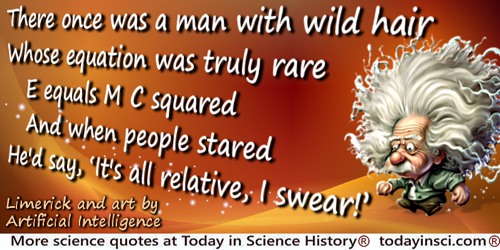
There once was a man with wild hair
Whose equation was truly rare
E equals M C squared
And when people stared
He’d say, “It's all relative, I swear!”
Whose equation was truly rare
E equals M C squared
And when people stared
He’d say, “It's all relative, I swear!”
Text by Artificial Intelligence: ChatGPT. Einstein caricature by AI: midjourney. Prompts by Webmaster (15 Feb 2023).
This is the reason why all attempts to obtain a deeper knowledge of the foundations of physics seem doomed to me unless the basic concepts are in accordance with general relativity from the beginning. This situation makes it difficult to use our empirical knowledge, however comprehensive, in looking for the fundamental concepts and relations of physics, and it forces us to apply free speculation to a much greater extent than is presently assumed by most physicists.
…...
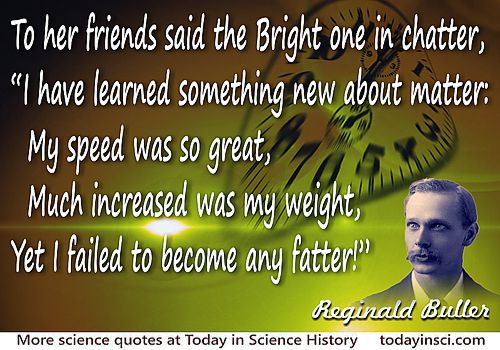
To her friends said the Bright one in chatter,
“I have learned something new about matter:
My speed was so great,
Much increased was my weight,
Yet I failed to become any fatter!”
“I have learned something new about matter:
My speed was so great,
Much increased was my weight,
Yet I failed to become any fatter!”
Collected in Baring-Gould, The Lure of the Limerick: An Uninhibited History (1967), 6. As cited in John de Pillis, 777 Mathematical Conversation Starters, 277.
To master anything—from football to relativity—requires effort. But it does not require unpleasant effort, drudgery.
In Mathematician's Delight (1943), 9.
Today scientists describe the universe in terms of two basic partial theories—the general theory of relativity and quantum mechanics. They are the great intellectual achievements of the first half of this century. The general theory of relativity describes the force of gravity and the large-scale structure of the universe, that is, the structure on scales from only a few miles to as large as a million million million million (1 with twenty-four zeros after it) miles, the size of the observable universe. Quantum mechanics, on the other hand, deals with phenomena on extremely small scales, such as a millionth of a millionth of an inch. Unfortunately, however, these two theories are known to be inconsistent with each other—they cannot both be correct.
A Brief History of Time: From the Big Bang to Black Holes (1988), 11-2.
Undeterred by poverty, failure, domestic tragedy, and persecution, but sustained by his mystical belief in an attainable mathematical harmony and perfection of nature, Kepler persisted for fifteen years before finding the simple regularity [of planetary orbits] he sought… . What stimulated Kepler to keep slaving all those fifteen years? An utter absurdity. In addition to his faith in the mathematical perfectibility of astronomy, Kepler also believed wholeheartedly in astrology. This was nothing against him. For a scientist of Kepler’s generation astrology was as respectable scientifically and mathematically as the quantum theory or relativity is to theoretical physicists today. Nonsense now, astrology was not nonsense in the sixteenth century.
In The Handmaiden of the Sciences (1937), 30.
What has been learned in physics stays learned. People talk about scientific revolutions. The social and political connotations of revolution evoke a picture of a body of doctrine being rejected, to be replaced by another equally vulnerable to refutation. It is not like that at all. The history of physics has seen profound changes indeed in the way that physicists have thought about fundamental questions. But each change was a widening of vision, an accession of insight and understanding. The introduction, one might say the recognition, by man (led by Einstein) of relativity in the first decade of this century and the formulation of quantum mechanics in the third decade are such landmarks. The only intellectual casualty attending the discovery of quantum mechanics was the unmourned demise of the patchwork quantum theory with which certain experimental facts had been stubbornly refusing to agree. As a scientist, or as any thinking person with curiosity about the basic workings of nature, the reaction to quantum mechanics would have to be: “Ah! So that’s the way it really is!” There is no good analogy to the advent of quantum mechanics, but if a political-social analogy is to be made, it is not a revolution but the discovery of the New World.
From Physics Survey Committee, U.S. National Academy of Sciences, National
Research Council, 'The Nature of Physics', in report Physics in Perspective (1973), 61-62. As cited in I. Bernard Cohen, Revolution in Science (1985), 554-555.
What makes the theory of relativity so acceptable to physicists in spite of its going against the principle of simplicity is its great mathematical beauty. This is a quality which cannot be defined, any more than beauty in art can be defined, but which people who study mathematics usually have no difficulty in appreciating. … The restricted theory changed our ideas of space and time in a way that may be summarised by stating that the group of transformations to which the space-time continuum is subject must be changed from the Galilean group to the Lorentz group.
From Lecture delivered on presentation of the James Scott prize, (6 Feb 1939), 'The Relation Between Mathematics And Physics', printed in Proceedings of the Royal Society of Edinburgh (1938-1939), 59, Part 2, 123.
When a man sits with a pretty girl for an hour, it seems like a minute. But let him sit on a hot stove for a minute—and it’s longer than any hour. That’s relativity.
Explanation given to his secretary, Helen Dukas, to relay to reporters and laypersons.
Explanation given to his secretary, Helen Dukas, to relay to reporters and laypersons.
James B. Simpson, Best Quotes of '54, '55, '56 (1957), as cited in Fred R. Shapiro and Joseph Epstein, The Yale Book of Quotations (2006), 230. Also reprinted in Simpson's Contemporary Quotations (1988), 208, annotated merely as “recalled on his death 18 Apr 1955.” Compare with the News Chronicle (14 Mar 1949) as “When you are courting a nice girl an hour seems like a second. When you sit on a red-hot cinder a second seems like an hour. That’s relativity.”
When Faraday filled space with quivering lines of force, he was bringing mathematics into electricity. When Maxwell stated his famous laws about the electromagnetic field it was mathematics. The relativity theory of Einstein which makes gravity a fiction, and reduces the mechanics of the universe to geometry, is mathematical research.
In 'The Spirit of Research', III, 'Mathematical Research', in The Monist (Oct 1922), 32, No. 4, 542-543.
 In science it often happens that scientists say, 'You know that's a really good argument; my position is mistaken,' and then they would actually change their minds and you never hear that old view from them again. They really do it. It doesn't happen as often as it should, because scientists are human and change is sometimes painful. But it happens every day. I cannot recall the last time something like that happened in politics or religion.
(1987) --
In science it often happens that scientists say, 'You know that's a really good argument; my position is mistaken,' and then they would actually change their minds and you never hear that old view from them again. They really do it. It doesn't happen as often as it should, because scientists are human and change is sometimes painful. But it happens every day. I cannot recall the last time something like that happened in politics or religion.
(1987) --