Regret Quotes (31 quotes)
...conscience looks backwards and judges past actions, inducing that kind of dissatisfaction, which if weak we call regret, and if severe remorse.
Descent of Man
Between the frontiers of the three super-states Eurasia, Oceania, and Eastasia, and not permanently in possession of any of them, there lies a rough quadrilateral with its corners at Tangier, Brazzaville, Darwin, and Hongkong. These territories contain a bottomless reserve of cheap labour. Whichever power controls equatorial Africa, or the Middle East or Southern India or the Indonesian Archipelago, disposes also of the bodies of hundreds of millions of ill-paid and hardworking coolies, expended by their conquerors like so much coal or oil in the race to turn out more armaments, to capture more territory, to control more labour, to turn out more armaments, to capture more territory, to control…
Thus George Orwell—in his only reference to the less-developed world.
I wish I could disagree with him. Orwell may have erred in not anticipating the withering of direct colonial controls within the “quadrilateral” he speaks about; he may not quite have gauged the vehemence of urges to political self-assertion. Nor, dare I hope, was he right in the sombre picture of conscious and heartless exploitation he has painted. But he did not err in predicting persisting poverty and hunger and overcrowding in 1984 among the less privileged nations.
I would like to live to regret my words but twenty years from now, I am positive, the less-developed world will be as hungry, as relatively undeveloped, and as desperately poor, as today.
Thus George Orwell—in his only reference to the less-developed world.
I wish I could disagree with him. Orwell may have erred in not anticipating the withering of direct colonial controls within the “quadrilateral” he speaks about; he may not quite have gauged the vehemence of urges to political self-assertion. Nor, dare I hope, was he right in the sombre picture of conscious and heartless exploitation he has painted. But he did not err in predicting persisting poverty and hunger and overcrowding in 1984 among the less privileged nations.
I would like to live to regret my words but twenty years from now, I am positive, the less-developed world will be as hungry, as relatively undeveloped, and as desperately poor, as today.
'The Less-Developed World: How Can We be Optimists?' (1964). Reprinted in Ideals and Realities (1984), xv-xvi. Referencing a misquote from George Orwell, Nineteen Eighty Four (1949), Ch. 9.

A few days ago, a Master of Arts, who is still a young man, and therefore the recipient of a modern education, stated to me that until he had reached the age of twenty he had never been taught anything whatever regarding natural phenomena, or natural law. Twelve years of his life previously had been spent exclusively amongst the ancients. The case, I regret to say, is typical. Now we cannot, without prejudice to humanity, separate the present from the past.
'On the Study of Physics', From a Lecture delivered in the Royal Institution of Great Britain in the Spring of 1854. Fragments of Science for Unscientific People: A Series of Detached Essays, Lectures, and Reviews (1892), Vol. 1, 284-5.
A political law or a scientific truth may be perilous to the morals or the faith of individuals; but it cannot on this ground be resisted by the Church. … A discovery may be made in science which will shake the faith of thousands; yet religion cannot regret it or object to it. The difference in this respect between a true and a false religion is, that one judges all things by the standard of their truth, the other by the touchstone of its own interests. A false religion fears the progress of all truth; a true religion seeks and recognises truth wherever it can be found.
From 'Cardinal Wiseman and the Home and Foreign Review' (1862), collected in John Emerich Edward Dalberg Acton Baron Acton, John Neville Figgis (ed.) and Reginald Vere Laurence (ed.), The History of Freedom and Other Essays (1907), 449-450. The Darwinian controversy was at its height when this was written.
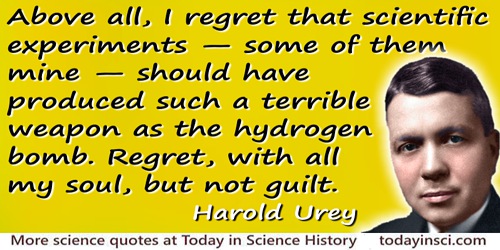
Above all, I regret that scientific experiments—some of them mine—should have produced such a terrible weapon as the hydrogen bomb. Regret, with all my soul, but not guilt.
Quoted in 'Moon-Struck Scientist,' New York Times (27 Apr 1961), 42.
Falsity cannot keep an idea from being beautiful; there are certain errors of such ingenuity that one could regret their not ranking among the achievements of the human mind.
Pensées d'un Biologiste (1939). Translated in The Substance of Man (1962), 89.
I have deeply regretted that I did not proceed far enough [as a Cambridge undergraduate] at least to understand something of the great leading principles of mathematics; for men thus endowed seem to have an extra sense.
In Charles Darwin and Francis Darwin (ed.), 'Autobiography', The Life and Letters of Charles Darwin (1887, 1896), Vol. 1, 40.
I have had a fairly long life, above all a very happy one, and I think that I shall be remembered with some regrets and perhaps leave some reputation behind me. What more could I ask? The events in which I am involved will probably save me from the troubles of old age. I shall die in full possession of my faculties, and that is another advantage that I should count among those that I have enjoyed. If I have any distressing thoughts, it is of not having done more for my family; to be unable to give either to them or to you any token of my affection and my gratitude is to be poor indeed.
Letter to Augez de Villiers, undated. Quoted in D. McKie, Antoine Lavoisier: Scientist, Economist, Social Reformer (1952), 303.
I only became fired up [deciding to become a scientist] in my second year of a science degree. … I was never a boy naturalist, to my regret. It was more the intellectual, philosophical questions that interested me.
From 'Interview: Of Mind and Matter: David Attenborough Meets Richard Dawkins', The Guardian (11 Sep 2010).
I regret that it has been necessary for me in this lecture to administer such a large dose of four-dimensional geometry. I do not apologize, because I am really not responsible for the fact that nature in its most fundamental aspect is four-dimensional. Things are what they are; and it is useless to disguise the fact that “what things are” is often very difficult for our intellects to follow.
From The Concept of Nature (1920, 1964), 118.
I should object to any experimentation which can justly be called painful, for the purpose of elementary instruction ... [but I regret] a condition of the law which permits a boy to troll for pike, or set lines with live frog bait, for idle amusement; and, at the same time, lays the teacher of that boy open to the penalty of fine and imprisonment, if he uses the same animal for the purpose of exhibiting one of the most beautiful and instructive of physiological spectacles, the circulation in the web of the foot. ... [Maybe the frog is] inconvenienced by being wrapped up in a wet rag, and having his toes tied out ... But you must not inflict the least pain on a vertebrated animal for scientific purposes (though you may do a good deal in that way for gain or for sport) without due licence of the Secretary of State for the Home Department, granted under the authority of the Vivisection Act.
... [Yet, in] 1877, two persons may be charged with cruelty to animals. One has impaled a frog, and suffered the creature to writhe about in that condition for hours; the other has pained the animal no more than one of us would be pained by tying strings round his fingers, and keeping him in the position of a hydropathic patient. The first offender says, 'I did it because I find fishing very amusing,' and the magistrate bids him depart in peace; nay, probably wishes him good sport. The second pleads, 'I wanted to impress a scientific truth, with a distinctness attainable in no other way, on the minds of my scholars,' and the magistrate fines him five pounds.
I cannot but think that this is an anomalous and not wholly creditable state of things.
... [Yet, in] 1877, two persons may be charged with cruelty to animals. One has impaled a frog, and suffered the creature to writhe about in that condition for hours; the other has pained the animal no more than one of us would be pained by tying strings round his fingers, and keeping him in the position of a hydropathic patient. The first offender says, 'I did it because I find fishing very amusing,' and the magistrate bids him depart in peace; nay, probably wishes him good sport. The second pleads, 'I wanted to impress a scientific truth, with a distinctness attainable in no other way, on the minds of my scholars,' and the magistrate fines him five pounds.
I cannot but think that this is an anomalous and not wholly creditable state of things.
'On Elementary Instruction in Physiology'. Science and Culture (1882), 92.
It is not the conscience which raises a blush, for a man may sincerely regret some slight fault committed in solitude, or he may suffer the deepest remorse for an undetected crime, but he will not blush... It is not the sense of guilt, but the thought that others think or know us to be guilty which crimsons the face.
The Expression of Emotions in Man and Animals
It is utterly false and cruelly arbitrary to put all the play and learning into childhood, all the work into middle age, and all the regrets into old age.
Quoted, without citation, as a column filler, in New York State Department of Mental Hygiene, Mental Hygiene News (1949), Volumes 20-26, 20. Webmaster has so far been unable to find a primary source, so please contact if you know the primary source.
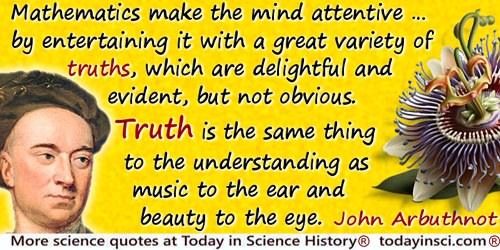
Mathematics make the mind attentive to the objects which it considers. This they do by entertaining it with a great variety of truths, which are delightful and evident, but not obvious. Truth is the same thing to the understanding as music to the ear and beauty to the eye. The pursuit of it does really as much gratify a natural faculty implanted in us by our wise Creator as the pleasing of our senses: only in the former case, as the object and faculty are more spiritual, the delight is more pure, free from regret, turpitude, lassitude, and intemperance that commonly attend sensual pleasures.
In An Essay on the Usefulness of Mathematical Learning (1701), 3-4.
Modern warfare is in every respect so horrifying, that scientific people will only regret that it draws its means from the progress of the sciences. I hope that the present war [World War I] will teach the peoples of Europe a lasting lesson and bring the friends of peace into power. Otherwise the present ruling classes will really deserve to be swept away by socialism.
Fischer to Margaret Oppenheim, 14 Dec 1917. Fischer Papers, Bancroft Library, University of California. Quotation supplied by W. H. Brock.
Much as I venerate the name of Newton, I am not therefore obliged to believe that he was infallible. I see … with regret that he was liable to err, and that his authority has, perhaps, sometimes even retarded the progress of science.
From 'Dr. Young’s Reply to the Animadversions of the Edinburgh Reviewers, on Some Papers Published in the Philosophical Transactions', collected in Thomas Young, George Peacock (ed.), Miscellaneous Works of the Late Thomas Young (1855), Vol. 1, 201.
My Volta is always busy. What an industrious scholar he is! When he is not paying visits to museums or learned men, he devotes himself to experiments. He touches, investigates, reflects, takes notes on everything. I regret to say that everywhere, inside the coach as on any desk, I am faced with his handkerchief, which he uses to wipe indifferently his hands, nose and instruments.
As translated and quoted in Giuliano Pancaldi, Volta: Science and Culture in the Age of Enlightenment (2005), 154.
Nowadays most people die of a sort of creeping common sense, and discover when it is too late that the only things one never regrets are one’s mistakes.
In The Picture of Dorian Gray (1891), Ch. 3, 61.
Quite distinct from the theoretical question of the manner in which mathematics will rescue itself from the perils to which it is exposed by its own prolific nature is the practical problem of finding means of rendering available for the student the results which have been already accumulated, and making it possible for the learner to obtain some idea of the present state of the various departments of mathematics. … The great mass of mathematical literature will be always contained in Journals and Transactions, but there is no reason why it should not be rendered far more useful and accessible than at present by means of treatises or higher text-books. The whole science suffers from want of avenues of approach, and many beautiful branches of mathematics are regarded as difficult and technical merely because they are not easily accessible. … I feel very strongly that any introduction to a new subject written by a competent person confers a real benefit on the whole science. The number of excellent text-books of an elementary kind that are published in this country makes it all the more to be regretted that we have so few that are intended for the advanced student. As an example of the higher kind of text-book, the want of which is so badly felt in many subjects, I may mention the second part of Prof. Chrystal’s Algebra published last year, which in a small compass gives a great mass of valuable and fundamental knowledge that has hitherto been beyond the reach of an ordinary student, though in reality lying so close at hand. I may add that in any treatise or higher text-book it is always desirable that references to the original memoirs should be given, and, if possible, short historic notices also. I am sure that no subject loses more than mathematics by any attempt to dissociate it from its history.
In Presidential Address British Association for the Advancement of Science, Section A (1890), Nature, 42, 466.
She is a reflection of comfortable middle-class values that do not take seriously the continuing unemployment. What I particularly regret is that she does not take seriously the intellectual decline. Having given up the Empire and the mass production of industrial goods, Britain's future lay in its scientific and artistic pre-eminence. Mrs Thatcher will be long remembered for the damage she has done.
On Mrs Margaret H. Thatcher.
On Mrs Margaret H. Thatcher.
The Guardian, 15 Oct 1988.
So far as modern science is concerned, we have to abandon completely the idea that by going into the realm of the small we shall reach the ultimate foundations of the universe. I believe we can abandon this idea without any regret. The universe is infinite in all directions, not only above us in the large but also below us in the small. If we start from our human scale of existence and explore the content of the universe further and further, we finally arrive, both in the large and in the small, at misty distances where first our senses and then even our concepts fail us.
To the German Society of Scientists and Physicists, Braunschweig, Germany (Sep 1896). As quoted in Anton Z. Capri, Quips, Quotes, and Quanta: An Anecdotal History of Physics (2011), 20. Wiechert was reporting his measurement of the mass of the moving particles in a cathode ray beam (electrons).
The idea that our natural resources were inexhaustible still obtained, and there was as yet no real knowledge of their extent and condition. The relation of the conservation of natural resources to the problems of National welfare and National efficiency had not yet dawned on the public mind. The reclamation of arid public lands in the West was still a matter for private enterprise alone; and our magnificent river system, with its superb possibilities for public usefulness, was dealt with by the National Government not as a unit, but as a disconnected series of pork-barrel problems, whose only real interest was in their effect on the re-election or defeat of a Congressman here and there —a theory which, I regret to say, still obtains.
The Works of Theodore Roosevelt. Vol. 20: Theodore Roosevelt, An Autobiography (1926), 386.
The main conclusion arrived at in this work, namely that man is descended from some lowly-organised form, will, I regret to think, be highly distasteful to many persons. But there can hardly be a doubt that we are descended from barbarians.
The Descent of Man (1871), Vol. 2, 404.
The night spread out of the east in a great flood, quenching the red sunlight in a single minute. We wriggled by breathless degrees deep into our sleeping bags. Our sole thought was of comfort; we were not alive to the beauty or the grandeur of our position; we did not reflect on the splendor of our elevation. A regret I shall always have is that I did not muster up the energy to spend a minute or two stargazing. One peep I did make between the tent flaps into the night, and I remember dimly an appalling wealth of stars, not pale and remote as they appear when viewed through the moisture-laden air of lower levels, but brilliant points of electric blue fire standing out almost stereoscopically. It was a sight an astronomer would have given much to see, and here were we lying dully in our sleeping bags concerned only with the importance of keeping warm and comfortable.
…...
The one who stays in my mind as the ideal man of science is, not Huxley or Tyndall, Hooker or Lubbock, still less my friend, philosopher and guide Herbert Spencer, but Francis Galton, whom I used to observe and listen to—I regret to add, without the least reciprocity—with rapt attention. Even to-day. I can conjure up, from memory’s misty deep, that tall figure with its attitude of perfect physical and mental poise; the clean-shaven face, the thin, compressed mouth with its enigmatical smile; the long upper lip and firm chin, and, as if presiding over the whole personality of the man, the prominent dark eyebrows from beneath which gleamed, with penetrating humour, contemplative grey eyes. Fascinating to me was Francis Galton’s all-embracing but apparently impersonal beneficence. But, to a recent and enthusiastic convert to the scientific method, the most relevant of Galton’s many gifts was the unique contribution of three separate and distinct processes of the intellect; a continuous curiosity about, and rapid apprehension of individual facts, whether common or uncommon; the faculty for ingenious trains of reasoning; and, more admirable than either of these, because the talent was wholly beyond my reach, the capacity for correcting and verifying his own hypotheses, by the statistical handling of masses of data, whether collected by himself or supplied by other students of the problem.
In My Apprenticeship (1926), 134-135.
The only way to get rid of the [football] combats of gorillas which now bring millions to the colleges will be to invent some imbecility which brings in even more. To that enterprise, I regret to have to report, I find myself unequal.
From American Mercury (Jun 1931). Collected in A Mencken Chrestomathy (1949, 1956), 372.
The swift metamorphosis and the onward march of civilization, sweeping ever westward and transforming and taming our wilderness, fills us with a strange regret, and we rejoice that parts of that wilderness will yet remain to us unchanged
…...
There was a golden period that I look back upon with great regret, in which the cheapest of experimental animals were medical students. Graduate students were even better. In the old days, if you offered a graduate student a thiamine-deficient diet, he gladly went on it, for that was the only way he could eat. Science is getting to be more and more difficult.
In talk, 'Origin of Death' (1970).
When I hear to-day protests against the Bolshevism of modern science and regrets for the old-established order, I am inclined to think that Rutherford, not Einstein, is the real villain of the piece. When we compare the universe as it is now supposed to be with the universe as we had ordinarily preconceived it, the most arresting change is not the rearrangement of space and time by Einstein but the dissolution of all that we regard as most solid into tiny specks floating in void. That gives an abrupt jar to those who think that things are more or less what they seem. The revelation by modern physics of the void within the atom is more disturbing than the revelation by astronomy of the immense void of interstellar space.
In The Nature of the Physical World (1928, 2005), 1.
Why does man regret, even though he may endeavour to banish any such regret, that he has followed the one natural impulse, rather than the other; and why does he further feel that he ought to regret his conduct? Man in this respect differs profoundly from the lower animals.
Descent of Man
Your remarks upon chemical notation with the variety of systems which have arisen, &c., &c., had almost stirred me up to regret publicly that such hindrances to the progress of science should exist. I cannot help thinking it a most unfortunate thing that men who as experimentalists & philosophers are the most fitted to advance the general cause of science & knowledge should by promulgation of their own theoretical views under the form of nomenclature, notation, or scale, actually retard its progress.
Letter to William Whewell (21 Feb 1831). In Isaac Todhunter, William Whewell, An Account of his Writings (1876), Vol. 1., 307. Faraday may have been referring to a paper by Whewell published in the Journal of the Royal Institution of England (1831), 437-453.
 In science it often happens that scientists say, 'You know that's a really good argument; my position is mistaken,' and then they would actually change their minds and you never hear that old view from them again. They really do it. It doesn't happen as often as it should, because scientists are human and change is sometimes painful. But it happens every day. I cannot recall the last time something like that happened in politics or religion.
(1987) --
In science it often happens that scientists say, 'You know that's a really good argument; my position is mistaken,' and then they would actually change their minds and you never hear that old view from them again. They really do it. It doesn't happen as often as it should, because scientists are human and change is sometimes painful. But it happens every day. I cannot recall the last time something like that happened in politics or religion.
(1987) -- 





