Recovery Quotes (24 quotes)
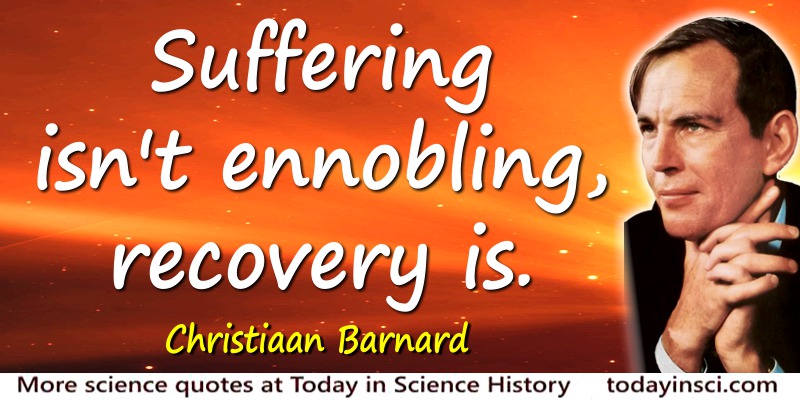
A great surgeon performs operations for stone by a single method; later he makes a statistical summary of deaths and recoveries, and he concludes from these statistics that the mortality law for this operation is two out of five. Well, I say that this ratio means literally nothing scientifically and gives us no certainty in performing the next operation; for we do not know whether the next case will be among the recoveries or the deaths. What really should be done, instead of gathering facts empirically, is to study them more accurately, each in its special determinism. We must study cases of death with great care and try to discover in them the cause of mortal accidents so as to master the cause and avoid the accidents.
From An Introduction to the Study of Experimental Medicine (1865), as translated by Henry Copley Greene (1957), 137-138. (Note that Bernard overlooks how the statistical method can be useful: a surgeon announcing a mortality rate of 40% invites comparison. A surgeon with worse outcomes should adopt this method. If a surgeon has a better results, that method should be adopted.)
Break the chains of your prejudices and take up the torch of experience, and you will honour nature in the way she deserves, instead of drawing derogatory conclusions from the ignorance in which she has left you. Simply open your eyes and ignore what you cannot understand, and you will see that a labourer whose mind and knowledge extend no further than the edges of his furrow is no different essentially from the greatest genius, as would have been proved by dissecting the brains of Descartes and Newton; you will be convinced that the imbecile or the idiot are animals in human form, in the same way as the clever ape is a little man in another form; and that, since everything depends absolutely on differences in organisation, a well-constructed animal who has learnt astronomy can predict an eclipse, as he can predict recovery or death when his genius and good eyesight have benefited from some time at the school of Hippocrates and at patients' bedsides.
Machine Man (1747), in Ann Thomson (ed.), Machine Man and Other Writings (1996), 38.
Doctor Johnson said, that in sickness there were three things that were material; the physician, the disease, and the patient: and if any two of these joined, then they get the victory; for, Ne Hercules quidem contra duos [Not even Hercules himself is a match for two]. If the physician and the patient join, then down goes the disease; for then the patient recovers: if the physician and the disease join, that is a strong disease; and the physician mistaking the cure, then down goes the patient: if the patient and the disease join, then down goes the physician; for he is discredited.
In 'A Collection of Apophthegms, New and Old' (1625). As given in Essays, Moral, Economical, and Political: A New Edition, With the Latin Quotations Translated (1813), No. 147, 308. The doctor is identified Ben Johnson by Forbes Winslow in his notes appended to Physic and Physicians (1842). Notes section, 39. Perhaps he means poet and playwright of stage comedy, Ben Jonson (1572-1637), also referred to in the book as “Benjamin Johnson” and once as “Dr. Johnson.” Note that Francis Bacon (1561-1626) died well before the life of writer Dr. Samuel Johnson (1709-1784).
Drugs are not always necessary. Belief in recovery always is.
Anatomy of an Illness As Perceived by the Patient: Reflections on Healing (2005), 55.
Forests are a fundamental component of our planet’s recovery. They are the best technology nature has for locking away carbon. And they are centers of biodiversity. Again, the two features work together. The wilder and more diverse forests are, the more effective they are at absorbing carbon from the atmosphere
From narration to Netflix TV program, A Life on Our Planet: My Witness Statement and a Vision for the Future (4 Oct 2020).
I don’t know if I would call it a miracle. I would call it a spectacular example of what people can do. To me, it’s like putting the first man on the moon or splitting the atom. We’ve shown that if the right treatment is given to people who have a catastrophic injury that they could walk away from it.
Expressing optimism for further recovery for Kevin Everett, a Buffalo Bills football player who suffered a paralyzing spinal injury during a game (9 Sep 2007), but after two days of hospital treatment had begun voluntarily moving his arms and legs. Green credits as significant to the recovery was that within minutes of his injury, the patient was quickly treated with intravenous ice-cold saline solution to induce hypothermia.
Expressing optimism for further recovery for Kevin Everett, a Buffalo Bills football player who suffered a paralyzing spinal injury during a game (9 Sep 2007), but after two days of hospital treatment had begun voluntarily moving his arms and legs. Green credits as significant to the recovery was that within minutes of his injury, the patient was quickly treated with intravenous ice-cold saline solution to induce hypothermia.
Quoted in John Wawrow, 'Bills' Everett Improves, May Walk Again', Associated Press news report, Washington Post (12 Sep 2007).
I fully support the goal of species protection and conservation and believe that recovery and ultimately delisting of species should be the U.S. Fish and Wildlife Service’s top priority under ESA.
…...
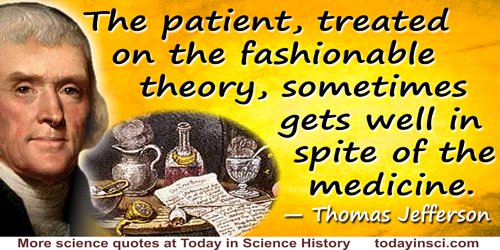
I have lived myself to see the disciples of Hoffman, Boerhaave, Stalh, Cullen, Brown, succeed one another like the shifting figures of a magic lanthern, and their fancies, like the dresses of the annual doll-babies from Paris, becoming from their novelty, the vogue of the day, and yielding to the next novelty their ephemeral favor. The patient, treated on the fashionable theory, sometimes gets well in spite of the medicine.
In letter to Caspar Wistar (21 Jun 1807), collected in Thomas Jefferson Randolph (ed.), Memoir, Correspondence, And Miscellanies, From The Papers Of Thomas Jefferson (1829), Vol. 4, 93.
I look upon a good physician, not so properly as a servant to nature, as one, that is a counsellor and friendly assistant, who, in his patient’s body, furthers those motions and other things, that he judges conducive to the welfare and recovery of it; but as to those, that he perceives likely to be hurtful, either by increasing the disease, or otherwise endangering the patient, he thinks it is his part to oppose or hinder, though nature do manifestly enough seem to endeavour the exercising or carrying on those hurtful motions.
Quoted In Barbara Kaplan (ed.) Divulging of Useful Truths in Physick: The Medical Agenda of Robert Boyle (1993), 125.
If a hundred or a thousand people, all of the same age, of the same constitution and habits, were suddenly seized by the same illness, and one half of them were to place themselves under the care of doctors, such as they are in our time, whilst the other half entrusted themselves to Nature and to their own discretion, I have not the slightest doubt that there would be more cases of death amongst the former, and more cases of recovery among the latter.
…...
In the patient who succumbed, the cause of death was evidently something which was not found in the patient who recovered; this something we must determine, and then we can act on the phenomena or recognize and foresee them accurately. But not by statistics shall we succeed in this; never have statistics taught anything, and never can they teach anything about the nature of the phenomenon.
From An Introduction to the Study of Experimental Medicine (1865), as translated by Henry Copley Greene (1957), 138.
It is not always worth the discomforts of major surgery to get minor recovery.
A Sense of Asher (1972), 86.
It is the surgeon’s duty to tranquillize the temper, to beget cheerfulness, and to impart confidence of recovery.
The Lectures of Sir Astley Cooper (1824), 30.
Let me tell you how at one time the famous mathematician Euclid became a physician. It was during a vacation, which I spent in Prague as I most always did, when I was attacked by an illness never before experienced, which manifested itself in chilliness and painful weariness of the whole body. In order to ease my condition I took up Euclid’s Elements and read for the first time his doctrine of ratio, which I found treated there in a manner entirely new to me. The ingenuity displayed in Euclid’s presentation filled me with such vivid pleasure, that forthwith I felt as well as ever.
Selbstbiographie (1875), 20. In Robert Édouard Moritz, Memorabilia Mathematica; Or, The Philomath's Quotation-book (1914), 146.
People say the effect is only on the mind. It is no such thing. The effect is on the body, too. Little as we know about the way in which we are affected by form, by color, and light, we do know this, that they have an actual physical effect. Variety of form and brilliancy of color in the objects presented to patients, are actual means of recovery.
Notes on Nursing: What it is and what it is not (1860), 84.
Restore a man to his health, his purse lies open to thee.
The Anatomy of Melancholy (1857), 431.
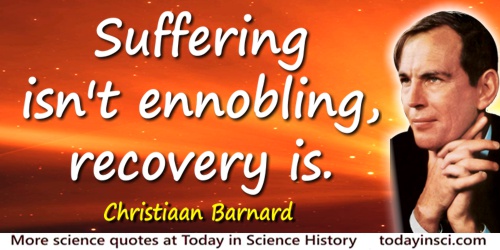
Suffering isn’t ennobling, recovery is.
Quoted in Patricia T. O’Conner, 'Recovery Is Ennobling, Suffering Is Not', New York Times (28 Apr 1985), BR9.
Take care of your health. ... Imagine Hercules as oarsman in a rotten boat; what can he do there but by the very force of his stroke expedite the ruin of his craft. Take care of the timbers of your boat. ... The formation of right habits is essential to your permanent security. They diminish your chance of falling when assaulted, and they augment your chance of recovery when overthrown.
Concluding remark from 'An Address to Students of University College, London' (1869), in Fragments of Science for Unscientific People (1871), 105.
The argument of the ‘long view’ may be correct in some meaninglessly abstract sense, but it represents a fundamental mistake in categories and time scales. Our only legitimate long view extends to our children and our children’s children’s children–hundreds or a few thousands of years down the road. If we let the slaughter continue, they will share a bleak world with rats, dogs, cockroaches, pigeons, and mosquitoes. A potential recovery millions of years later has no meaning at our appropriate scale.
…...
The doctor knows that it is the prescription slip itself, even more than what is written on it, that is often the vital ingredient for enabling a patient to get rid of whatever is ailing him.
Anatomy of an Illness As Perceived by the Patient: Reflections on Healing (2005), 55.
Though Hippocrates understood not the Circulation of the Blood, yet by accurately observing the Effects of the Disease, which he looked upon as an unknown Entity, and by remarking the Endeavours of Nature, by which the Disease tended to either Health or Recovery, did from thence deduce a proper Method of Cure, namely by assisting the salutary Endeavours of Nature, and by resisting those of the Disease; and thus Hippocrates, ignorant of the Causes, cured Disease as well as ourselves, stocked with so many Discoveries.
In Dr. Boerhaave's Academical Lectures on the Theory of Physic (1746), Vol. 6, 352.
Two impressions remaining, after a life of scientific research:
1. The inexhaustible oddity of nature.
2. The capacity of the human system for recovery.
1. The inexhaustible oddity of nature.
2. The capacity of the human system for recovery.
Unverified. Found as an epigraph, without citation, in Boris A Kupershmidt, The Variational Principles of Dynamics (1992).
We must painfully acknowledge that, precisely because of its great intellectual developments, the best of man's domesticated animals—the dog—most often becomes the victim of physiological experiments. Only dire necessity can lead one to experiment on cats—on such impatient, loud, malicious animals. During chronic experiments, when the animal, having recovered from its operation, is under lengthy observation, the dog is irreplaceable; moreover, it is extremely touching. It is almost a participant in the experiments conducted upon it, greatly facilitating the success of the research by its understanding and compliance.
'Vivisection' (1893), as translated in Daniel P. Todes, Pavlov’s Physiology Factory: Experiment, Interpretation, Laboratory Enterprise (2002), 123.
You tell your doctor, that y’are ill
and what does he, but write a bill?
Of which you need not read one letter;
The worse the scrawl, the dose the better,
For if you knew but what you take,
Though you recover, he must break.
and what does he, but write a bill?
Of which you need not read one letter;
The worse the scrawl, the dose the better,
For if you knew but what you take,
Though you recover, he must break.
In Alma Canto III. Collected in Poems on Several Occasions (1709), 262.
 In science it often happens that scientists say, 'You know that's a really good argument; my position is mistaken,' and then they would actually change their minds and you never hear that old view from them again. They really do it. It doesn't happen as often as it should, because scientists are human and change is sometimes painful. But it happens every day. I cannot recall the last time something like that happened in politics or religion.
(1987) --
In science it often happens that scientists say, 'You know that's a really good argument; my position is mistaken,' and then they would actually change their minds and you never hear that old view from them again. They really do it. It doesn't happen as often as it should, because scientists are human and change is sometimes painful. But it happens every day. I cannot recall the last time something like that happened in politics or religion.
(1987) --