Reading Quotes (136 quotes)
‘I was reading an article about “Mathematics”. Perfectly pure mathematics. My own knowledge of mathematics stops at “twelve times twelve,” but I enjoyed that article immensely. I didn’t understand a word of it; but facts, or what a man believes to be facts, are always delightful. That mathematical fellow believed in his facts. So do I. Get your facts first, and’—the voice dies away to an almost inaudible drone—’then you can distort ‘em as much as you please.’
In 'An Interview with Mark Twain', in Rudyard Kipling, From Sea to Sea (1899), Vol. 2, 180.
[Decoding the human genome sequence] is the most significant undertaking that we have mounted so far in an organized way in all of science. I believe that reading our blueprints, cataloguing our own instruction book, will be judged by history as more significant than even splitting the atom or going to the moon.
Interview (23 May 1998), 'Cracking the Code to Life', Academy of Achievement web site.
[Describing a freshman seminar titled “How the Tabby Cat Got Her Stripes or The Silence of the Genes”:] The big idea we start with is: “How is the genome interpreted, and how are stable decisions that affect gene expression inherited from one cell to the next? This is one of the most competitive areas of molecular biology at the moment, and the students are reading papers that in some instances were published this past year. As a consequence, one of the most common answers I have to give to their questions is, “We just don't know.”
As quoted by Kitta MacPherson in 'Exploring Epigenetics: President Shirley Tilghman in the Classroom,'
Princeton University Undergraduate Admission web page accessed 14 Oct 2013.
[George] Uhlenbeck was a highly gifted physicist. One of his remarkable traits was he would read every issue of The Physical Review from cover to cover.
'The Physical Review Then and Now', in H. Henry Stroke, Physical Review: The First Hundred Years: a Selection of Seminal Papers and Commentaries, Vol. 1, 3.
[I] browsed far outside science in my reading and attended public lectures - Bertrand Russell, H. G. Wells, Huxley, and Shaw being my favorite speakers. (The last, in a meeting at King's College, converted me to vegetarianism - for most of two years!).
Autobiography collected in Gardner Lindzey (ed.), A History of Psychology in Autobiography (1973), Vol. 6, 64.
[My uncle said to me…] When I read, forty years ago, that shells from Syria were found in the Alps, I say, I admit, with a slightly mocking tone, that these shells were apparently brought by pilgrims who were returning from Jerusalem. M. de Buffon reprimanded me very sharply in his Theory of the Earth, page 281. I did not want to quarrel with him over shells, but I remain of the same opinion, because the impossibility that the sea formed the mountains is evident to me. Some may tell me that porphyry is made of sea urchin spikes, I’ll believe it when I see white marble is made of ostrich feathers.
Voltaire is recounting one of the reasons his uncle (Abbe Ambroise Bazing) had told him, for disputing Buffon’s claim that the sea that made the mountains. Translated by Webmaster from 'La Défense de Mon Oncle: Des montagnes et des Coquilles', collected in Oeuvres complètes: Histoire.- Mélanges historiques (1817), Tome 15, Chap. 19, 133-134. From the original French; “Quand je lus, il y a quarante ans, qu’on avait trouvé dans les Alpes des coquilles de Syrie, je dis, je l’avoue , d’un ton un peu goguenard, que ces coquilles avaient été apparemment apportées par des pélerins qui revenaient de Jérusalem. M. de Buffon m’en reprit très-vertement dans sa Théorie de la terre, page 281. Je n’ai pas voulu me brouiller avec lui pour des coquilles, mais je suis demeuré dans non opinion, parce que l’impossibilité que la mer ait formé les montagnes m’est démontrée. On a beau me dire que le porphyre est fait de pointes d’oursin, je le croirai quand je verrai que le marbre blanc est fait de plumes d’autruche.” [Note: porphyry is a form of igneous rock. Also note, this passage does NOT appear in 'Les Singularités de la Nature', which may be found elsewhere incorrectly cited as the source. —Webmaster]
[Reading a cartoon story,] the boy favored reading over reality. Adults might have characterized him in any number of negative ways—as uninquisitive, uninvolved, apathetic about the world around him and his place in it. I’ve often wondered: Are many adults much different when they read the scriptures of their respective faiths?
In Jacques Cousteau and Susan Schiefelbein, The Human, the Orchid, and the Octopus: Exploring and Conserving Our Natural World (2007), 117.
After reading a paper by a young theoretical scientist, Pauli, shaking his head sadly, commented:
Das ist nicht einmal falsch.
That is not even wrong.
Das ist nicht einmal falsch.
That is not even wrong.
Attributed.
Der bis zur Vorrede, die ihn abweist, gelangte Leser hat das Buch für baares Geld gekauft und frägt, was ihn schadlos hält? – Meine letzte Zuflucht ist jetzt, ihn zu erinnern, daß er ein Buch, auch ohne es gerade zu lesen, doch auf mancherlei Art zu benutzen weiß. Es kann, so gut wie viele andere, eine Lücke seiner Bibliothek ausfüllen, wo es sich, sauber gebunden, gewiß gut ausnehmen wird. Oder auch er kann es seiner gelehrten Freundin auf die Toilette, oder den Theetisch legen. Oder endlich er kann ja, was gewiß das Beste von Allem ist und ich besonders rathe, es recensiren.
The reader who has got as far as the preface and is put off by that, has paid money for the book, and wants to know how he is to be compensated. My last refuge now is to remind him that he knows of various ways of using a book without precisely reading it. It can, like many another, fill a gap in his library, where, neatly bound, it is sure to look well. Or he can lay it on the dressing-table or tea-table of his learned lady friend. Or finally he can review it; this is assuredly the best course of all, and the one I specially advise.
The reader who has got as far as the preface and is put off by that, has paid money for the book, and wants to know how he is to be compensated. My last refuge now is to remind him that he knows of various ways of using a book without precisely reading it. It can, like many another, fill a gap in his library, where, neatly bound, it is sure to look well. Or he can lay it on the dressing-table or tea-table of his learned lady friend. Or finally he can review it; this is assuredly the best course of all, and the one I specially advise.
In Preface, written at Dresden in August 1818, first German edition, Die Welt als Wille und Vorstellung, 4 Bücher nebst einem Anhange der die Kritik der Kentischen Philosophie (1819), xv-xvi. As translated by E.F.J. Payne in The World as Will and Representation (1958, 1969), Vol. 1, xvii. In the preface, Schopenhauer is joking that some readers of his book may find his work does not interest them.
Indiana Jones: Archaeology is the search for fact… not truth. If it’s truth you're looking for, Dr. Tyree’s philosophy class is right down the hall. … So forget any ideas you've got about lost cities, exotic travel, and digging up the world. We do not follow maps to buried treasure, and “X” never, ever marks the spot. Seventy percent of all archaeology is done in the library. Research. Reading.
Spoken by actor Harrison Ford as character Indiana Jones in movie, Indiana Jones and the Last Crusade (1989).
To Laplace, on receiving a copy of the Mécanique Céleste:
The first six months, which I can spare will be employed in reading it.
The first six months, which I can spare will be employed in reading it.
Correspondance de Napoléon ler, 27 vendémiaire an VIII [19 October 1799] no. 4384 (1861), Vol. 6, I. Trans. Charles Coulston Gillispie, Pierre-Simon Laplace 1749-1827: A Life in Exact Science (1997), 176.
A DNA sequence for the genome of bacteriophage ΦX174 of approximately 5,375 nucleotides has been determined using the rapid and simple “plus and minus” method. The sequence identifies many of the features responsible for the production of the proteins of the nine known genes of the organism, including initiation and termination sites for the proteins and RNAs. Two pairs of genes are coded by the same region of DNA using different reading frames.
[Paper co-author]
[Paper co-author]
Frederick Sanger, et al., 'Nucleotide Sequence of Bacteriophage ΦX174 DNA', Nature (1977), 265, 687.
A good many times I have been present at gatherings of people who, by the standards of the traditional culture, are thought highly educated and who have with considerable gusto been expressing their incredulity at the illiteracy of scientists. Once or twice I have been provoked and have asked the company how many of them could describe the Second Law of Thermodynamics. The response was cold: it was also negative. Yet I was asking something which is about the scientific equivalent of: Have you read a work of Shakespeare’s?
The Two Cultures: The Rede Lecture (1959), 15-6.
After all, the Athanasian Creed is to me light and intelligible reading in comparison with much that now passes for science.
Samuel Bulter, Henry Festing Jones (ed.), The Note-Books of Samuel Butler (1917), 324.
After the German occupation of Holland in May 1940, the [last] two dark years of the war I spent hiding indoors from the Nazis, eating tulip bulbs to fill the stomach and reading Kramers' book “Quantum Theorie des Elektrons und der Strahlung” by the light of a storm lamp.
Again and again in reading even his [William Thomson] most abstract writings one is struck by the tenacity with which physical ideas control in him the mathematical form in which he expressed them. An instance of this is afforded by … an example of a mathematical result that is, in his own words, “not instantly obvious from the analytical form of my solution, but which we immediately see must be the case by thinking of the physical meaning of the result.”
As given in Life of Lord Kelvin (1910), Vol. 2, 1136. The ellipsis gives the reference to the quoted footnote, to a passage in his Mathematical and Physical Papers, Vol. 1, 457. [Note: William Thomson, later became Lord Kelvin. —Webmaster]
Although Lewis Carroll thought of The Hunting of the Snark as a nonsense ballad for children, it is hard to imagine—in fact one shudders to imagine—a child of today reading and enjoying it.
In 'Introduction', The Annotated Snark (1962), 11.
Any chemist reading this book can see, in some detail, how I have spent most of my mature life. They can become familiar with the quality of my mind and imagination. They can make judgements about my research abilities. They can tell how well I have documented my claims of experimental results. Any scientist can redo my experiments to see if they still work—and this has happened! I know of no other field in which contributions to world culture are so clearly on exhibit, so cumulative, and so subject to verification.
From Design to Discovery (1990), 119-20.
As a child I read a lot, and I read everything. I’d go to the library and then stay up all night reading. I used to read under the desk in school … I read all of the books on science in the library and was frustrated when there was nothing left to read.
In 'A Personal Profile of Karen K. Uhlenbeck', collected in Susan Ambrose et al., Journeys of Women in Science and Engineering, No Universal Constants (1999).
At night I would return home, set out a lamp before me, and devote myself to reading and writing. Whenever sleep overcame me or I became conscious of weakening, I would turn aside to drink a cup of wine, so that my strength would return to me. Then I would return to reading. And whenever sleep seized me I would see those very problems in my dream; and many questions became clear to me in my sleep. I continued in this until all of the sciences were deeply rooted within me and I understood them as is humanly possible. Everything which I knew at the time is just as I know it now; I have not added anything to it to this day. Thus I mastered the logical, natural, and mathematical sciences, and I had now reached the science.
— Avicenna
W. E. Gohhnan, The Life of Ibn Sina: A Critical Edition and Annotated Translation (1974), 29-31.
At the age of three I began to look around my grandfather’s library. My first knowledge of astronomy came from reading and looking at pictures at that time. By the time I was six I remember him buying books for me. … I think I was eight, he bought me a three-inch telescope on a brass mounting. It stood on a table. … So, as far back as I can remember, I had an early interest in science in general, astronomy in particular.
Oral History Transcript of interview with Dr. Jesse Greenstein by Paul Wright (31 Jul 1974), on website of American Institute of Physics.
Be careful about reading health books. You may die of a misprint.
In Mark Twain and Alex Ayres (ed.), The Wit & Wisdom of Mark Twain (1987), 97.
Book-knowledge is a poor resource … In many cases, ignorance is a good thing: the mind retains its freedom of investigation and does not stray along roads that lead nowhither, suggested by one’s reading. … Ignorance can have its advantages; the new is found far from the beaten track.
In Jean-Henri Fabre and Alexander Teixeira de Mattos (trans.), The Life and Love of the Insect (1918), 243.
By asking questions and quickly reading some books, [Melvin Calvin] felt comfortable in many fields of endeavor.
Co-author with Andrew A. Benson, 'Melvin Calvin', Biographical Memoirs of the US National Academy of Science.
![Luis W. Alvarez quote: Dad [Walter C. Alvarez] … advised me to sit every few months in my reading chair for an entire evening, c](https://todayinsci.com/A/Alvarez_Luis/AlvarezLuis-Problems500x250px.jpg)
Dad [Walter C. Alvarez] … advised me to sit every few months in my reading chair for an entire evening, close my eyes and try to think of new problems to solve. I took his advice very seriously and have been glad ever since that he did.
In Alvarez: Adventures of a Physicist (1987), 58.
Despite the high long-term probability of extinction, every organism alive today, including every person reading this paper, is a link in an unbroken chain of parent-offspring relationships that extends back unbroken to the beginning of life on earth. Every living organism is a part of an enormously long success story—each of its direct ancestors has been sufficiently well adapted to its physical and biological environments to allow it to mature and reproduce successfully. Viewed thus, adaptation is not a trivial facet of natural history, but a biological attribute so central as to be inseparable from life itself.
In 'Integrative Biology: An Organismic Biologist’s Point of View', Integrative and Comparative Biology (2005), 45, 330.
Dirac politely refused Robert’s [Robert Oppenheimer] two proffered books: reading books, the Cambridge theoretician announced gravely, “interfered with thought.”
Alvarez: Adventures of a Physicist (1987), 87.
Edmund Wilson attacked the pedantry of scholarly editions of literary classics, which (he claimed) took the pleasure out of reading. Extensive footnotes … spoiled the reader’s pleasure in the text. Wilson’s friend Lewis Mumford had compared footnote numbers … to “barbed wire” keeping the reader at arm’s length.
In Academic Instincts (2001), 39.
Euclid and Archimedes are allowed to be knowing, and to have demonstrated what they say: and yet whosoever shall read over their writings without perceiving the connection of their proofs, and seeing what they show, though he may understand all their words, yet he is not the more knowing. He may believe, indeed, but does not know what they say, and so is not advanced one jot in mathematical knowledge by all his reading of those approved mathematicians.
In Conduct of the Understanding, sect. 24.
Every mathematical book that is worth reading must be read “backwards and forwards”, if I may use the expression. I would modify Lagrange’s advice a little and say, “Go on, but often return to strengthen your faith.” When you come on a hard or dreary passage, pass it over; and come back to it after you have seen its importance or found the need for it further on.
In Algebra, Part 2 (1889), Preface, viii.
Everything that you read influences you one way or another, imperceptibly or directly or whatever it is, most likely imperceptibly.
In 'An Interview between Joseph Brodsky and Czesław Miłosz' (Autumn 1989) reprinted in Czesław Miłosz and Cynthia L. Haven (ed.), Czesław Miłosz: Conversations (2006), 106.
Fractal geometry will make you see everything differently. There is a danger in reading further. You risk the loss of your childhood vision of clouds, forests, flowers, galaxies, leaves, feathers, rocks, mountains, torrents of water, carpet, bricks, and much else besides. Never again will your interpretation of these things be quite the same.
Fractals Everywhere (2000), 1.
From the age of 13, I was attracted to physics and mathematics. My interest in these subjects derived mostly from popular science books that I read avidly. Early on I was fascinated by theoretical physics and determined to become a theoretical physicist. I had no real idea what that meant, but it seemed incredibly exciting to spend one's life attempting to find the secrets of the universe by using one's mind.
From 'Autobiography', in Tore Frängsmyr (ed.) Les Prix Nobel. The Nobel Prizes 2004, (2005).
Have you ever plunged into the immensity of space and time by reading the geological treatises of Cuvier? Borne away on the wings of his genius, have you hovered over the illimitable abyss of the past as if a magician’s hand were holding you aloft?
From 'La Peau de Chagrin' (1831). As translated by Herbert J. Hunt in The Wild Ass’s Skin (1977), 40-41.
Have you ever plunged into the immensity of time and space by reading the geological tracts of Cuvier? Transported by his genius, have you hovered over the limitless abyss of the past, as if held aloft by a magician’s hand?
From 'La Peau de Chagrin' (1831). As translated as by Helen Constantine The Wild Ass’s Skin (2012), 19.
He had read much, if one considers his long life; but his contemplation was much more than his reading. He was wont to say that if he had read as much as other men he should have known no more than other men.
From 'Thomas Hobbes', in Andrew Clark (ed.) Brief Lives (1898), Vol. 1, 349.
How might letters be most efficiently copied so that the blind might read them with their fingers?
Aphorism 28 in Notebook J (1789-1793), as translated by R. J. Hollingdale in Aphorisms (1990). Reprinted as The Waste Books (2000), 133.
I acquired such skill in reading Latin and Greek that I could take a page of either, and distinguish which language it was by merely glancing at it.
Quoted, without source, in Des MacHale, Wit (1999, 2003), 31.
I almost threw up. I got physically ill when I learned that ospreys and peregrine falcons weren't raising chicks because of what people were spraying on bugs at their farms and lawns. This was the first time I learned that humans could impact the environment with chemicals. [That a corporation would create a product that didn’t operate as advertised] was shocking in a way we weren’t inured to.
About reading Rachel Carson's Silent Spring, age 14, in the back seat of his parents’ sedan. As quoted by Eliza Griswold, in 'The Wild Life of “Silent Spring”', New York Times (23 Sep 2012), Magazine 39.
I can assure you, reader, that in a very few hours, even during the first day, you will learn more natural philosophy about things contained in this book, than you could learn in fifty years by reading the theories and opinions of the ancient philosophers. Enemies of science will scoff at the astrologers: saying, where is the ladder on which they have climbed to heaven, to know the foundation of the stars? But in this respect I am exempt from such scoffing; for in proving my written reason, I satisfy sight, hearing, and touch: for this reason, defamers will have no power over me: as you will see when you come to see me in my little Academy.
The Admirable Discourses (1580), trans. Aurele La Rocque (1957), 27.
I cannot serve as an example for younger scientists to follow. What I teach cannot be learned. I have never been a “100 percent scientist.” My reading has always been shamefully nonprofessional. I do not own an attaché case, and therefore cannot carry it home at night, full of journals and papers to read. I like long vacations, and a catalogue of my activities in general would be a scandal in the ears of the apostles of cost-effectiveness. I do not play the recorder, nor do I like to attend NATO workshops on a Greek island or a Sicilian mountain top; this shows that I am not even a molecular biologist. In fact, the list of what I have not got makes up the American Dream. Readers, if any, will conclude rightly that the Gradus ad Parnassum will have to be learned at somebody else’s feet.
In Heraclitean Fire: Sketches from a Life before Nature (1978), 7.
I do not know whether you are fond of chemical reading. There are some things in this science worth reading.
Letter to Mr. Rittenhouse (Paris, 1786). In Thomas Jefferson and John P. Foley (ed.), The Jeffersonian Cyclopedia (1900), 135. From H.A. Washington, The Writings of Thomas Jefferson (1853-54). Vol 1, 517.
I fully agree with all that you say on the advantages of H. Spencer's excellent expression of 'the survival of the fittest.' This, however, had not occurred to me till reading your letter. It is, however, a great objection to this term that it cannot be used as a substantive governing a verb; and that this is a real objection I infer from H. Spencer continually using the words, natural selection.
Letter to A. R. Wallace July 1866. In Francis Darwin (ed.), The Life and Letters of Charles Darwin, Including an Autobiographical Chapter (1887), Vol. 3, 45-6.
I grew up in Brooklyn, New York … a city neighborhood that included houses, lampposts, walls, and bushes. But with an early bedtime in the winter, I could look out my window and see the stars, and the stars were not like anything else in my neighborhood. [At age 5] I didn’t know what they were.
[At age 9] my mother … said to me, “You have a library card now, and you know how to read. Take the streetcar to the library and get a book on stars.” … I stepped up to the big librarian and asked for a book on stars. … I sat down and found out the answer, which was something really stunning.I found out that the stars are glowing balls of gas. I also found out that the Sun is a star but really close and that the stars are all suns except really far away I didn’t know any physics or mathematics at that time, but I could imagine how far you’d have to move the Sun away from us till it was only as bright as a star. It was in that library, reading that book, that the scale of the universe opened up to me. There was something beautiful about it.
At that young age, I already knew that I’d be very happy if I could devote my life to finding out more about the stars and the planets that go around them. And it’s been my great good fortune to do just that.
[At age 9] my mother … said to me, “You have a library card now, and you know how to read. Take the streetcar to the library and get a book on stars.” … I stepped up to the big librarian and asked for a book on stars. … I sat down and found out the answer, which was something really stunning.I found out that the stars are glowing balls of gas. I also found out that the Sun is a star but really close and that the stars are all suns except really far away I didn’t know any physics or mathematics at that time, but I could imagine how far you’d have to move the Sun away from us till it was only as bright as a star. It was in that library, reading that book, that the scale of the universe opened up to me. There was something beautiful about it.
At that young age, I already knew that I’d be very happy if I could devote my life to finding out more about the stars and the planets that go around them. And it’s been my great good fortune to do just that.
Quoted in interview with Jack Rightmyer, in 'Stars in His Eyes', Highlights For Children (1 Jan 1997). Ages as given in Tom Head (ed.), Conversations with Carl Sagan (2006), x.
I have always felt that I understood a phenomenon only to the extent that I could visualise it. Much of the charm organic chemical research has for me derives from structural formulae. When reading chemical journals, I look for formulae first.
From Design to Discovery (1990), 122.
I have just received copies of “To-day” containing criticisms of my letter. I am in no way surprised to find that these criticisms are not only unfair and misleading in the extreme. They are misleading in so far that anyone reading them would be led to believe the exact opposite of the truth. It is quite possible that I, an old and trained engineer and chronic experimenter, should put an undue value upon truth; but it is common to all scientific men. As nothing but the truth is of any value to them, they naturally dislike things that are not true. ... While my training has, perhaps, warped my mind so that I put an undue value upon truth, their training has been such as to cause them to abhor exact truth and logic.
[Replying to criticism by Colonel Acklom and other religious parties attacking Maxim's earlier contribution to the controversy about the modern position of Christianity.]
[Replying to criticism by Colonel Acklom and other religious parties attacking Maxim's earlier contribution to the controversy about the modern position of Christianity.]
In G.K. Chesterton, 'The Maxims of Maxim', Daily News (25 Feb 1905). Collected in G. K. Chesterton and Dale Ahlquist (ed.), In Defense of Sanity: The Best Essays of G.K. Chesterton (2011), 86.
I have read various articles on the fourth dimension, the relativity theory of Einstein, and other psychological speculation on the constitution of the universe; and after reading them I feel as Senator Brandegee felt after a celebrated dinner in Washington. “I feel,” he said, “as if I had been wandering with Alice in Wonderland and had tea with the Mad Hatter.”
Quoted in Michio Kaku, Einstein's Cosmos: How Albert Einstein's vision Transformed Our Understanding of Space and Time (2005), 118-119. [Note:Brandegee's original remark was in the context of politics after a White House conference with President Wilson (Feb 1917), and unrelated to Einstein's theory.]
I heard … xenon was a good anesthesia. … I thought, “How can xenon, which doesn’t form any chemical compounds, serve as a general anesthetic? … I lay awake at night for a few minutes before going to sleep, and during the next couple of weeks each night I would think, “…how do anesthetic agents work?" Then I forgot to do it after a while, but I’d trained my unconscious mind to keep this question alive and to call [it] to my consciousness whenever a new idea turned up…. So seven years went by. [One day I] put my feet up on the desk and started reading my mail, and here was a letter from George Jeffrey … an x-ray crystallographer, on his determination of the structure of a hydrate crystal. Immediately I sat up, took my feet off the desk, and said, “I understand anesthesia!” … I spent a year [and] determined the structure of chloroform hydrate, and then I wrote my paper published in June of 1961.
Interview with George B. Kauffman and Laurie M. Kauffman, in 'Linus Pauling: Reflections', American Scientist (Nov-Dec 1994), 82, No. 6, 522-523.
I myself, a professional mathematician, on re-reading my own work find it strains my mental powers to recall to mind from the figures the meanings of the demonstrations, meanings which I myself originally put into the figures and the text from my mind. But when I attempt to remedy the obscurity of the material by putting in extra words, I see myself falling into the opposite fault of becoming chatty in something mathematical.
Astronomia Nova, New Astronomy, (1609), Introduction, second paragraph.
I regarded as quite useless the reading of large treatises of pure analysis: too large a number of methods pass at once before the eyes. It is in the works of application that one must study them; one judges their utility there and appraises the manner of making use of them.
As reported by J. F. Maurice in Moniteur Universel (1814), 228.
I think my most important work has been done on the borderlines between different areas of science. My first work was in geophysics, a combination of physics and geology, and then at the Bell Laboratories, it was more a combination of physics and electrical engineering. That’s what I’m following more or less as time goes on. My appointment here at the university relates to physics and electrical engineering, but I have also worked in the borderline areas between physics and chemistry. I think reading widely and being interested in many different areas in science is important.
In Robert L. Burtch, 'Interview with a Nobel Laureate: Fifth Graders Learn About a Scientist We All Should Know', Science and Children, (Nov/Dec 1990), 28, No. 3, 16-17.
I took a course in speed reading course … and I was able to go through read War and Peace in twenty minutes. It’s about Russia.
As quoted in Reader's Digest (Oct 1967), 91, 120.
I was reading in an article on Bizet not long ago that music has ceased to be an art and has become a science—in which event it must have a mathematical future!
In letter to H.E. Krehbiel (1887), collected in Elizabeth Bisland The Writings of Lafcadio Hearn (1922), Vol. 14, 8.
I will be moving through the book as if on a train looking out at the beautiful landscape of the Arts.
An opinion posted on yougov.com (13 Jan 2017) describing reading a novel set after the Russian Revolution with much historical background, stimulating the reader’s interest on the literature, painting and performing arts of the time.
I'm sure we would not have had men on the Moon if it had not been for Wells and Verne and the people who write about this and made people think about it. I'm rather proud of the fact that I know several astronauts who became astronauts through reading my books.
Address to US Congress, 1975. Science and Technology Committee, United States Congress, House, Future Space Programs, 1975, Hearings Before the Subcommittee on Space Science and Applications (1975), 206. Also in Arthur C. ClarkeThe View from Serendip (1977), 238.
If a child left school at ten, knowing nothing of detailed information, but knowing the pleasure that comes from agreeable music, from reading, from making things, from finding things out, it would be better off than a man who left university at twenty-two, full of facts but without any desire to enquire further into such dry domains.
In Mathematician's Delight (1943), 9.
If a man, holding a belief which he was taught in childhood or persuaded of afterwards, keeps down and pushes away any doubts which arise about it in his mind, purposely avoids the reading of books and the company of men that call in question or discuss it, and regards as impious those questions which cannot easily be asked without disturbing it—the life of that man is one long sin against mankind.
In 'The Ethics of Belief', Contemporary Review (Jan 1877), collected in Leslie Stephen and Frederick Pollock (eds.), Lectures and Essays: By the Late William Kingdon Clifford, F.R.S. (1886), 346.
If Thomas Edison had gone to business school, we would all be reading by larger candles.
What They Don't Teach You at Harvard Business School (1984).
If you look over my Scientific American columns you will see that they get progressively more sophisticated as I began reading math books and learning more about the subject. There is no better way to learn anything than to write about it!
In Kendrick Frazier, 'A Mind at Play: An Interview with Martin Gardner', Skeptical Inquirer (Mar/Apr 1998), 22, No. 2, 36.
If you would not be forgotten
As soon as you are dead and rotten
Either write things worth reading,
Or do things worth the writing.
As soon as you are dead and rotten
Either write things worth reading,
Or do things worth the writing.
Collected in Poor Richard's Almanack (1914), 32, No. 285.
In early life I had felt a strong desire to devote myself to the experimental study of nature; and, happening to see a glass containing some camphor, portions of which had been caused to condense in very beautiful crystals on the illuminated side, I was induced to read everything I could obtain respecting the chemical and mechanical influences of light, adhesion, and capillary attraction.
In preface to Scientific Memoirs (1878), xii.
In Heaven there'll be no algebra,
No learning dates or names,
But only playing golden harps
And reading Henry James.
No learning dates or names,
But only playing golden harps
And reading Henry James.
Displayed at James’s home, Lambs House in Rye. Said to have been written by Henry James’s nephew in the guest book there, as stated in J.D. McClatchy, Sweet Theft: A Poet's Commonplace Book (2016), 212.
https://books.google.com/books?isbn=1619027607
J.D. McClatchy - 2016
In my experience most mathematicians are intellectually lazy and especially dislike reading experimental papers. He (René Thom) seemed to have very strong biological intuitions but unfortunately of negative sign.
In What Mad Pursuit: A Personal View of Scientific Discovery (1988), 136.
In my work I now have the comfortable feeling that I am so to speak on my own ground and territory and almost certainly not competing in an anxious race and that I shall not suddenly read in the literature that someone else had done it all long ago. It is really at this point that the pleasure of research begins, when one is, so to speak, alone with nature and no longer worries about human opinions, views and demands. To put it in a way that is more learned than clear: the philological aspect drops out and only the philosophical remains.
In Davis Baird, R.I.G. Hughes and Alfred Nordmann, Heinrich Hertz: Classical Physicist, Modern Philosopher (1998), 157.
In nature's infinite book of secrecy
A little I can read.
A little I can read.
In Antony and Cleopatra (1606-7), I, ii.
In the 1920s, there was a dinner at which the physicist Robert W. Wood was asked to respond to a toast … “To physics and metaphysics.” Now by metaphysics was meant something like philosophy—truths that you could get to just by thinking about them. Wood took a second, glanced about him, and answered along these lines: The physicist has an idea, he said. The more he thinks it through, the more sense it makes to him. He goes to the scientific literature, and the more he reads, the more promising the idea seems. Thus prepared, he devises an experiment to test the idea. The experiment is painstaking. Many possibilities are eliminated or taken into account; the accuracy of the measurement is refined. At the end of all this work, the experiment is completed and … the idea is shown to be worthless. The physicist then discards the idea, frees his mind (as I was saying a moment ago) from the clutter of error, and moves on to something else. The difference between physics and metaphysics, Wood concluded, is that the metaphysicist has no laboratory.
In 'Wonder and Skepticism', Skeptical Enquirer (Jan-Feb 1995), 19, No. 1.
It is sages and grey-haired philosophers who ought to sit up all night reading Alice in Wonderland in order to study that darkest problem of metaphysics, the borderland between reason and unreason, and the nature of the most erratic of spiritual forces, humour, which eternally dances between the two. That we do find a pleasure in certain long and elaborate stories, in certain complicated and curious forms of diction, which have no intelligible meaning whatever, is not a subject for children to play with; it is a subject for psychologists to go mad over.
In 'The Library of the Nursery', in Lunacy and Letters (1958), 26.
It is the nature of an hypothesis, when once a man has conceived it, that it assimilates every thing to itself, as proper nourishment; and, from the first moment of your begetting it, it generally grows the stronger by every thing you see, hear, read, or understand.
The Life and Opinions of Tristram Shandy Gentleman (1759-67), Penguin edition (1997), 121-122.
It might interest you that when we made the experiments that we did not read the literature well enough—and you know how that happens. On the other hand, one would think that other people would have told us about it. For instance, we had a colloquium at the time in Berlin at which all the important papers were discussed. Nobody discussed Bohr’s paper. Why not? The reason is that fifty years ago one was so convinced that nobody would, with the state of knowledge we had at that time, understand spectral line emission, so that if somebody published a paper about it, one assumed “probably it is not right.” So we did not know it.
Explaining how his experiment with Gustav Hertz produced results, without them knowing that it proved Niels Bohr’s theory of the atom and its energy levels. From an interview quoted by Gerald Holton in 'On the Recent Past of Physics', American Journal of Physics (1961), 29, 805. As cited in William H. Cropper, Great Physicists: The Life and Times of Leading Physicists from Galileo to Hawking (2001), 251.
It was long before I got at the maxim, that in reading an old mathematician you will not read his riddle unless you plough with his heifer; you must see with his light, if you want to know how much he saw.
Letter to W. R. Hamilton, 27 January 1853. In R. P. Graves (ed.), A Life of Sir W. R. Hamilton (1889), Vol. 3, 438.
It... [can] be easily shown:
1. That all present mountains did not exist from the beginning of things.
2. That there is no growing of mountains.
3. That the rocks or mountains have nothing in common with the bones of animals except a certain resemblance in hardness, since they agree in neither matter nor manner of production, nor in composition, nor in function, if one may be permitted to affirm aught about a subject otherwise so little known as are the functions of things.
4. That the extension of crests of mountains, or chains, as some prefer to call them, along the lines of certain definite zones of the earth, accords with neither reason nor experience.
5. That mountains can be overthrown, and fields carried over from one side of a high road across to the other; that peaks of mountains can be raised and lowered, that the earth can be opened and closed again, and that other things of this kind occur which those who in their reading of history wish to escape the name of credulous, consider myths.
1. That all present mountains did not exist from the beginning of things.
2. That there is no growing of mountains.
3. That the rocks or mountains have nothing in common with the bones of animals except a certain resemblance in hardness, since they agree in neither matter nor manner of production, nor in composition, nor in function, if one may be permitted to affirm aught about a subject otherwise so little known as are the functions of things.
4. That the extension of crests of mountains, or chains, as some prefer to call them, along the lines of certain definite zones of the earth, accords with neither reason nor experience.
5. That mountains can be overthrown, and fields carried over from one side of a high road across to the other; that peaks of mountains can be raised and lowered, that the earth can be opened and closed again, and that other things of this kind occur which those who in their reading of history wish to escape the name of credulous, consider myths.
The Prodromus of Nicolaus Steno's Dissertation Concerning a Solid Body enclosed by Process of Nature within a Solid (1669), trans. J. G. Winter (1916), 232-4.
Lord Northampton made a very apt quotation on the reading of Captain Denham's paper “on the deposits in the Mersey,” “It appears,” said his lordship, “that the quality of Mersey is not strained.”
— Magazine
In The Literary Gazette (21 Oct 1837), No. 1083, 677. (As an unverified guess by the Webmaster, the paper may have been read at the Royal Society, where the Marquis of Northampton was president 1838-48.)
Man is what he reads.
In essay 'Pendulum’s Song', Less Than One: Selected Essays (1983), 365. The subject of his essay was Constantine Cavafy.
Many people know everything they know in the way we know the solution of a riddle after we have read it or been told it, and that is the worst kind of knowledge and the kind least to be cultivated; we ought rather to cultivate that kind of knowledge which enables us to discover for ourselves in case of need that which others have to read or be told of in order to know it.
Aphorism 89 in Notebook D (1773-1775), as translated by R.J. Hollingdale in Aphorisms (1990). Reprinted as The Waste Books (2000), 58.
More and more of out colleagues fail to understand our work because of the high specialization of research problems. We must not be discouraged if the products of our labor are not read or even known to exist. The joy of research must be found in doing since every other harvest is uncertain.
Letter to Dr. E. B. Krumhaar (11 Oct 1933), in Journal of Bacteriology (Jan 1934), 27, No. 1, 20.
My interest in chemistry was started by reading Robert Kennedy Duncan’s popular books while a high school student in Des Moines, Iowa, so that after some delay when it was possible for me to go to college I had definitely decided to specialize in chemistry.
Letter (4 Apr 1932) to Pauline G. Beery. Hagley Museum and Library Collection, Wilmington, Delaware. 1784.) As cited in Matthew E. Hermes, Enough for One Lifetime: Wallace Carothers, Inventor of Nylon (1996), 13.
My reading of Aristotle leads me to believe that in all his work he had always before him the question; What light does this throw on man? But the question was not phrased in his mind—at least, so it appears to me—in the sense of “What light does this throw upon the origin of man,” but rather in the sense “What light does this throw on the way in which man functions and behaves here and now?”
Considering Aristotle as an anthropologist. In 'Review: The Discovery of Man by Stanley Casson', Isis (Jun 1941), 33, No. 2, 303.
Never leave an unsolved difficulty behind. I mean, don’t go any further in that book till the difficulty is conquered. In this point, Mathematics differs entirely from most other subjects. Suppose you are reading an Italian book, and come to a hopelessly obscure sentence—don’t waste too much time on it, skip it, and go on; you will do very well without it. But if you skip a mathematical difficulty, it is sure to crop up again: you will find some other proof depending on it, and you will only get deeper and deeper into the mud.
From letter to Edith Rix with hints for studying (about Mar 1885), in Stuart Dodgson Collingwood, The Life and Letters of Lewis Carroll (1898), 241.
Never mind what two tons refers to. What is it? How has it entered in so definite a way into our exprerience? Two tons is the reading of the pointer when the elephant was placed on a weighing machine. Let us pass on. … And so we see that the poetry fades out of the problem, and by the time the serious application of exact science begins we are left only with pointer readings.
From Gifford Lecture, Edinburgh, (1927), 'Pointer Readings', collected in The Nature of the Physical World (1928), 252.
No scientist or student of science, need ever read an original work of the past. As a general rule, he does not think of doing so. Rutherford was one of the greatest experimental physicists, but no nuclear scientist today would study his researches of fifty years ago. Their substance has all been infused into the common agreement, the textbooks, the contemporary papers, the living present.
Attempting to distinguish between science and the humanities in which original works like Shakespeare's must be studied verbatim. 'The Case of Leavis and the Serious Case', (1970), reprinted in Public Affairs (1971), 94.
One day the zoo-keeper noticed that the orangutan was reading two books—the Bible and Darwin’s Origin of Species. In surprise, he asked the ape,“Why are you reading both those books?”
“Well,” said the orangutan, “I just wanted to know if I was my brother’s keeper, or my keeper’s brother.”
“Well,” said the orangutan, “I just wanted to know if I was my brother’s keeper, or my keeper’s brother.”
In Jon Fripp, Michael Fripp and Deborah Fripp, Speaking of Science (2000), 27.
One of my friends, reading the title of these lectures [The Whence and Whither of Man] said: “Of man's origin you know nothing, of his future you know less.”
From the Introduction to The Whence and Whither of Man; a Brief History of his Origin and Development through Conformity to Environment; being the Morse Lectures of 1895. (1896), ix. The Morse lectureship was founded by Prof. Samuel F.B. Morse in 1865 at Union Theological Seminary, the lectures to deal with “the relation of the Bible to any of the sciences.”
One of the major goals when studying specific genetic diseases is to find the primary gene product, which in turn leads to a better understanding of the biochemical basis of the disorder. The bottom line often reads, 'This may lead to effective prenatal diagnosis and eventual eradication of the disease.' But we now have the ironic situation of being able to jump right to the bottom line without reading the rest of the page, that is, without needing to identify the primary gene product or the basic biochemical mechanism of the disease. The technical capability of doing this is now available. Since the degree of departure from our previous approaches and the potential of this procedure are so great, one will not be guilty of hyperbole in calling it the 'New Genetics'.
'Prenatal Diagnosis and the New Genetics', The American Journal of Human Genetics, 1980, 32:3, 453.
One will weave the canvas; another will fell a tree by the light of his ax. Yet another will forge nails, and there will be others who observe the stars to learn how to navigate. And yet all will be as one. Building a boat isn’t about weaving canvas, forging nails, or reading the sky. It’s about giving a shared taste for the sea, by the light of which you will see nothing contradictory but rather a community of love.
From the French, “Celui-là tissera des toiles, l’autre dans la forêt par l’éclair de sa hache couchera l’arbre. L’autre, encore, forgera des clous, et il en sera quelque part qui observeront les étoiles afin d’apprendre à gouverner. Et tous cependant ne seront qu’un. Créer le navire ce n’est point tisser les toiles, forger les clous, lire les astres, mais bien donner le goût de la mer qui est un, et à la lumière duquel il n’est plus rien qui soit contradictoire mais communauté dans l’amour.” In Citadelle (1948), Sect. 75, 687. An English edition was published as “Wisdom of the Sands.” The translation in the subject quote is given the website quoteinvestigator.com which discusses how it may have been paraphrased anonymously to yield the commonly seen quote as “If you want to build a ship, don’t recruit the men to gather the wood, divide the work and give orders. Instead, teach them to yearn for vast and endless sea.”
Over the past fifty years or so, scientists have allowed the conventions of expression available to them to become entirely too confining. too confining. The insistence on bland impersonality and the widespread indifference to anything like the display of a unique human author in scientific exposition, have transformed the reading of most scientific papers into an act of tedious drudgery.
In Boojums All the Way Through: Communicating Science in a Prosaic Age (1990), Preface, xi-xii.
Part of the appeal was that Medawar was not only a Nobel Laureate, but he seemed like a Nobel Laureate; he was everything one thought a Nobel Laureate ought to be. If you have ever wondered why scientists like Popper, try Medawar's exposition. Actually most Popperian scientists have probably never tried reading anything but Medawar's exposition.
'The Art of the Developable', New York Review of Books (Oct 1983). The first two sentences, slightly edited, were reprinted in A Devil's Chaplain (2004), 196.
People have now a-days got a strange opinion that every thing should be taught by lectures. Now, I cannot see that lectures can do as much good as reading the books from which the lectures are taken.
Entry for Feb 1776. In George Birkbeck-Hill (ed.), Boswell's Life of Johnson (1934-50), Vol. 2, 7.
People have now-a-days got a strange opinion that everything should be taught by lectures. Now, I cannot see that lectures can do so much good as reading the books from which the lectures are taken. I know nothing that can best be taught by lectures, except where experiments are to be shewn. You may teach chemistry by lectures.
Elements of Chemistry (1830)
People who have read a great deal seldom make great discoveries. I do not say this to excuse laziness, for invention presupposes an extensive contemplation of things on one's own account; one must see for oneself more than let oneself be told.
Aphorism 85 in Notebook E (1775-1776), as translated by R.J. Hollingdale in Aphorisms (1990). Reprinted as The Waste Books (2000), 77.
People wonder why the novel is the most popular form of literature; people wonder why it is read more than books of science or books of metaphysics. The reason is very simple; it is merely that the novel is more true than they are. … In the fiery alphabet of every sunset is written “to be continued in our next.”
'On Certain Modern Writers and the institution of the Family' Heretics (1903). Collected in G. K. Chesterton and Dale Ahlquist (ed.), In Defense of Sanity: The Best Essays of G.K. Chesterton (2011), 82.
Reading furnishes the mind only with materials of knowledge, it is thinking makes what we read ours.
On the Conduct Of Understanding (written 1697, published posthumously 1706), collected in Works (5th Ed. 1751), Vol. 3, 387.
Reading, after a certain age, diverts the mind too much from its creative pursuits. Any man who reads too much and uses his own brain too little falls into lazy habits of thinking.
…...
Religion is something left over from the infancy of our intelligence, it will fade away as we adopt read on and science as our guidelines.
Unverified. Included here to provide this caution that it is widely attributed on the web, but without citation. Webmaster has not found it in a major book of quotations. If you know the primary source, please contact Webmaster.
Science has blown to atoms, as she can rend and rive in the rocks themselves; but in those rocks she has found, and read aloud, the great stone book which is the history of the earth, even when darkness sat upon the face of the deep. Along their craggy sides she has traced the footprints of birds and beasts, whose shapes were never seen by man. From within them she has brought the bones, and pieced together the skeletons, of monsters that would have crushed the noted dragons of the fables at a blow.
Book review of Robert Hunt, Poetry of Science (1848), in the London Examiner (1848). Although uncredited in print, biographers identified his authorship from his original handwritten work. Collected in Charles Dickens and Frederic George Kitton (ed.) Old Lamps for New Ones: And Other Sketches and Essays (1897), 87.
Several very eminent living paleontologists frequently emphasise the abruptness of some of the major changes that have occurred, and seek for an external cause. This is a heady wine and has intoxicated palaeontologists since the days when they could blame it all on Noah's flood. In fact, books are still being published by the lunatic fringe with the same explanation. In case this book should be read by some fundamentalist searching for straws to prop up his prejudices, let me state categorically that all my experience (such as it is) has led me to an unqualified acceptance of evolution by natural selection as a sufficient explanation for what I have seen in the fossil record
In The Nature of the Stratigraphical Record (1973), 19-20.
Since my first discussions of ecological problems with Professor John Day around 1950 and since reading Konrad Lorenz's “King Solomon's Ring,” I have become increasingly interested in the study of animals for what they might teach us about man, and the study of man as an animal. I have become increasingly disenchanted with what the thinkers of the so-called Age of Enlightenment tell us about the nature of man, and with what the formal religions and doctrinaire political theorists tell us about the same subject.
'Autobiography of Allan M. Cormack,' Les Prix Nobel/Nobel Lectures 1979, editted by Wilhelm Odelberg.
Some books are to be tasted, others to be swallowed, and some few to be chewed and digested; that is, some books are to be read only in parts; other to be read, but not curiously; and some few to be read wholly, and with diligence and attention. Some books also may be read by deputy, and extracts made of them by others; but that would be only in the less important arguments, and the meaner sort of books; else distilled books are like common distilled waters, flashy things. Reading maketh a full man; conference a ready man; and writing an exact man. And therefore, if a man write little, he had need have a great memory; if he confer little, he had need have a present wit: and if he read little, he had need have much cunning, to seem to know that he doth not. Histories make men wise; poets witty; the mathematics subtile; natural philosophy deep; moral grave; logic and rhetoric able to contend. Abeunt studia in mores. [The studies pass into the manners.]
'Of Studies' (1625) in James Spedding, Robert Ellis and Douglas Heath (eds.), The Works of Francis Bacon (1887-1901), Vol. 6, 498.
Something to remember. If you have remembered every word in this article, your memory will have recorded about 150 000 bits of information. Thus, the order in your brain will have increased by about 150 000 units. However, while you have been reading the article, you will have converted about 300 000 joules of ordered energy, in the form of food, into disordered energy, in the form of heat which you lose to the air around you by convection and sweat. This will increase the disorder of the Universe by about 3 x 1024 units, about 20 million million million times the increase in order because you remember my article.
An afterword to his three-page article discussing thermodynamics and entropy, in 'The Direction of Time', New Scientist (9 Jul 1987), 49.
Sometime in my early teens, I started feeling an inner urgency, ups and downs of excitement and frustration, caused by such unlikely occupations as reading Granville’s course of calculus ... I found this book in the attic of a friend’s apartment. Among other standard stuff, it contained the notorious epsilon-delta definition of continuous functions. After struggling with this definition for some time (it was the hot Crimean summer, and I was sitting in the shadow of a dusty apple tree), I got so angry that I dug a shallow grave for the book between the roots, buried it there, and left in disdain. Rain started in an hour. I ran back to the tree and exhumed the poor thing. Thus, I discovered that I loved it, regardless.
'Mathematics as Profession and vocation', in V. Arnold et al. (eds.), Mathematics: Frontiers and Perspectives (2000), 153. Reprinted in Mathematics as Metaphor: Selected Essays of Yuri I. Manin (2007), 79.
Sylvester was incapable of reading mathematics in a purely receptive way. Apparently a subject either fired in his brain a train of active and restless thought, or it would not retain his attention at all. To a man of such a temperament, it would have been peculiarly helpful to live in an atmosphere in which his human associations would have supplied the stimulus which he could not find in mere reading. The great modern work in the theory of functions and in allied disciplines, he never became acquainted with …
What would have been the effect if, in the prime of his powers, he had been surrounded by the influences which prevail in Berlin or in Gottingen? It may be confidently taken for granted that he would have done splendid work in those domains of analysis, which have furnished the laurels of the great mathematicians of Germany and France in the second half of the present century.
What would have been the effect if, in the prime of his powers, he had been surrounded by the influences which prevail in Berlin or in Gottingen? It may be confidently taken for granted that he would have done splendid work in those domains of analysis, which have furnished the laurels of the great mathematicians of Germany and France in the second half of the present century.
In Address delivered at a memorial meeting at the Johns Hopkins University (2 May 1897), published in Bulletin of the American Mathematical Society (Jun 1897), 303. Also in Johns Hopkins University Circulars, 16 (1897), 54.
Take the living human brain endowed with mind and thought. …. The physicist brings his tools and commences systematic exploration. All that he discovers is a collection of atoms and electrons and fields of force arranged in space and time, apparently similar to those found in inorganic objects. He may trace other physical characteristics, energy, temperature, entropy. None of these is identical with thought. … How can this collection of ordinary atoms be a thinking machine? … The Victorian physicist felt that he knew just what he was talking about when he used such terms as matter and atoms. … But now we realize that science has nothing to say as to the intrinsic nature of the atom. The physical atom is, like everything else in physics, a schedule of pointer readings.
From a Gifford Lecture, University of Edinburgh (1927), published in 'Pointer Readings: Limits of Physical Knowledge', The Nature of the Physical World (1929), 258-259.
The aim of poetry is to give a high and voluptuous plausibility to what is palpably not true. I offer the Twenty-third Psalm as an example: ‘The Lord is my shepherd: I shall not want.’ It is immensely esteemed by the inmates of almshouses, and by gentlemen waiting to be hanged. I have to limit my own reading of it, avoiding soft and yielding moods, for I too, in my way, am a gentleman waiting to be hanged, as you are.
…...
The discovery of the famous original [Rosetta Stone] enabled Napoleon’s experts to begin the reading of Egypt’s ancient literature. In like manner the seismologists, using the difficult but manageable Greek of modern physics, are beginning the task of making earthquakes tell the nature of the earth’s interior and translating into significant speech the hieroglyphics written by the seismograph.
The faith of scientists in the power and truth of mathematics is so implicit that their work has gradually become less and less observation, and more and more calculation. The promiscuous collection and tabulation of data have given way to a process of assigning possible meanings, merely supposed real entities, to mathematical terms, working out the logical results, and then staging certain crucial experiments to check the hypothesis against the actual empirical results. But the facts which are accepted by virtue of these tests are not actually observed at all. With the advance of mathematical technique in physics, the tangible results of experiment have become less and less spectacular; on the other hand, their significance has grown in inverse proportion. The men in the laboratory have departed so far from the old forms of experimentation—typified by Galileo's weights and Franklin's kite—that they cannot be said to observe the actual objects of their curiosity at all; instead, they are watching index needles, revolving drums, and sensitive plates. No psychology of 'association' of sense-experiences can relate these data to the objects they signify, for in most cases the objects have never been experienced. Observation has become almost entirely indirect; and readings take the place of genuine witness.
Philosophy in a New Key; A Study in Inverse the Symbolism of Reason, Rite, and Art (1942), 19-20.
The following is a common sequence in an investigation on a medical or biological problem, (a) The relevant literature is critically reviewed. (b) A thorough collection of field data or equivalent observational enquiry is conducted, and is supplemented if necessary by laboratory examination of specimens. (c) The information obtained is marshalled and correlated and the problem is defined and broken down into specific questions. (d) Intelligent guesses are made to answer the questions, as many hypotheses as possible being considered. (e) Experiments are devised to test first the likeliest hypotheses bearing on the most crucial questions.
In The Art of Scientific Investigation (1957), 12.
The general knowledge of our author [Leonhard Euler] was more extensive than could well be expected, in one who had pursued, with such unremitting ardor, mathematics and astronomy as his favorite studies. He had made a very considerable progress in medical, botanical, and chemical science. What was still more extraordinary, he was an excellent scholar, and possessed in a high degree what is generally called erudition. He had attentively read the most eminent writers of ancient Rome; the civil and literary history of all ages and all nations was familiar to him; and foreigners, who were only acquainted with his works, were astonished to find in the conversation of a man, whose long life seemed solely occupied in mathematical and physical researches and discoveries, such an extensive acquaintance with the most interesting branches of literature. In this respect, no doubt, he was much indebted to an uncommon memory, which seemed to retain every idea that was conveyed to it, either from reading or from meditation.
In Philosophical and Mathematical Dictionary (1815), 493-494.
The interpretation of messages from the earth’s interior demands all the resources of ordinary physics and of extraordinary mathematics. The geophysicist is of a noble company, all of whom are reading messages from the untouchable reality of things. The inwardness of things—atoms, crystals, mountains, planets, stars, nebulas, universes—is the quarry of these hunters of genius and Promethean boldness.
The lives of scientists, considered as Lives, almost always make dull reading. For one thing, the careers of the famous and the merely ordinary fall into much the same pattern, give or take an honorary degree or two, or (in European countries) an honorific order. It could be hardly otherwise. Academics can only seldom lead lives that are spacious or exciting in a worldly sense. They need laboratories or libraries and the company of other academics. Their work is in no way made deeper or more cogent by privation, distress or worldly buffetings. Their private lives may be unhappy, strangely mixed up or comic, but not in ways that tell us anything special about the nature or direction of their work. Academics lie outside the devastation area of the literary convention according to which the lives of artists and men of letters are intrinsically interesting, a source of cultural insight in themselves. If a scientist were to cut his ear off, no one would take it as evidence of a heightened sensibility; if a historian were to fail (as Ruskin did) to consummate his marriage, we should not suppose that our understanding of historical scholarship had somehow been enriched.
'J.B.S: A Johnsonian Scientist', New York Review of Books (10 Oct 1968), reprinted in Pluto's Republic (1982), and inThe Strange Case of the Spotted Mice and Other Classic Essays on Science (1996), 86.
The many who believe they are the wiser for reading accounts of experiments deceive themselves. It is as impossible to learn science from hearsay as to gain wisdom from proverbs.
Said by the fictional character Lydia in Cashel Byron’s Profession (1886, 1906), 87-88.
The mathematician requires tact and good taste at every step of his work, and he has to learn to trust to his own instinct to distinguish between what is really worthy of his efforts and what is not; he must take care not to be the slave of his symbols, but always to have before his mind the realities which they merely serve to express. For these and other reasons it seems to me of the highest importance that a mathematician should be trained in no narrow school; a wide course of reading in the first few years of his mathematical study cannot fail to influence for good the character of the whole of his subsequent work.
In Presidential Address British Association for the Advancement of Science, Section A, (1890), Nature, 42, 467.
The only objections that have occurred to me are, 1st that you have loaded yourself with an unnecessary difficulty in adopting Natura non facit saltum so unreservedly. … And 2nd, it is not clear to me why, if continual physical conditions are of so little moment as you suppose, variation should occur at all. However, I must read the book two or three times more before I presume to begin picking holes.
Comments after reading Darwin's book, Origin of Species.]
Comments after reading Darwin's book, Origin of Species.]
Letter to Charles Darwin (23 Nov 1859). In Charles Darwin and Francis Darwin (ed.), Charles Darwin: His Life Told in an Autobiographical Chapter, and in a Selected Series of His Published Letters (1892), 214.
The prohibition of science would be contrary to the Bible, which in hundreds of places teaches us how the greatness and the glory of God shine forth marvelously in all His works, and is to be read above all in the open book of the heavens. And let no one believe that the reading of the most exalted thoughts which are inscribed upon these pages is to be accomplished through merely staring up at the radiance of the stars. There are such profound secrets and such lofty conceptions that the night labors and the researches of hundreds and yet hundreds of the keenest minds, in investigations extending over thousands of years would not penetrate them, and the delight of the searching and finding endures forever.
As stated by William H. Hobbs, 'The Making of Scientific Theories,' Address of the president of Michigan Academy of Science at the Annual Meeting, Ann Arbor (28 Mar 1917) in Science (11 May 1917), N.S. 45, No. 1167, 443.
The sciences of Natural History and Botany require so much time to be devoted to them that, however pleasing, they may be justly considered as improper objects for the man of business to pursue scientifically, so as to enter into the exact arrangement and classification of the different bodies of the animal, vegetable, and mineral kingdoms. But reading and personal observation will supply him with ample matter for reflection and admiration.
'On the Advantages of Literature and Philosophy in general and especially on the Consistency of Literary and Philosophical with Commercial Pursuits' (Read 3 Oct 1781). As quoted in Robert Angus Smith, A Centenary of Science in Manchester (1883), 79.
The Scientific Revolution turns us away from the older sayings to discover the lost authorization in Nature. What we have been through in these last four millennia is the slow inexorable profaning of our species. And in the last part of the second millennium A.D., that process is apparently becoming complete. It is the Great Human Irony of our noblest and greatest endeavor on this planet that in the quest for authorization, in our reading of the language of God in Nature, we should read there so clearly that we have been so mistaken.
…...
The so-called science of poll-taking is not a science at all but mere necromancy. People are unpredictable by nature, and although you can take a nation's pulse, you can't be sure that the nation hasn't just run up a flight of stairs, and although you can take a nation's blood pressure, you can’t be sure that if you came back in twenty minutes you’d get the same reading. This is a damn fine thing.
.
In 'Polling' (13 Nov 1948), collected in Writings from The New Yorker, 1925-1976 (1976, 2006), 60.
The whole subject-matter of exact science consists of pointer readings and similar indications.
From Gifford Lecture, Edinburgh, (1927), 'The New Quantum Theory', collected in The Nature of the Physical World (1928), 219.
There are four classes of Idols which beset men’s minds. To these for distinction’s sake I have assigned names,—calling the first class Idols of the Tribe; the second, Idols of the Cave; the third, Idols of the Market Place; the fourth, Idols of the Theatre …
The Idols of the Tribe have their foundation in human nature itself, and in the tribe or race of men. For it is a false assertion that the sense of man is the measure of things. On the contrary, all perceptions as well of the sense as of the mind are according to the measure of the individual and not according to the measure of the universe. And the human understanding is like a false mirror, which, receiving rays irregularly, distorts and discolours the nature of things by mingling its own nature with it.
The Idols of the Cave are the idols of the individual man. For every one (besides the errors common to human nature in general) has a cave or den of his own, which refracts and discolours the light of nature; owing either to his own proper and peculiar nature; or to his education and conversation with others; or to the reading of books, and the authority of those whom he esteems and admires; or to the differences of impressions, accordingly as they take place in a mind preoccupied and predisposed or in a mind indifferent and settled; or the like.
There are also Idols formed by the intercourse and association of men with each other, which I call Idols of the Market-place, on account of the commerce and consort of men there. For it is by discourse that men associate; and words are imposed according to the apprehension of the vulgar, and therefore the ill and unfit choice of words wonderfully obstructs the understanding. Nor do the definitions or explanations where with in some things learned men are wont to guard and defend themselves, by any means set the matter right. But words plainly force and overrule the understanding, and throw all into confusion, and lead men away into numberless empty controversies and idle fancies.
Lastly, there are Idols which have immigrated into men’s minds from the various dogmas of philosophies, and also from wrong laws of demonstration. These I call Idols of the Theatre; because in my judgment all the received systems are but so many stage-plays, representing worlds of their own creation after an unreal and scenic fashion.
The Idols of the Tribe have their foundation in human nature itself, and in the tribe or race of men. For it is a false assertion that the sense of man is the measure of things. On the contrary, all perceptions as well of the sense as of the mind are according to the measure of the individual and not according to the measure of the universe. And the human understanding is like a false mirror, which, receiving rays irregularly, distorts and discolours the nature of things by mingling its own nature with it.
The Idols of the Cave are the idols of the individual man. For every one (besides the errors common to human nature in general) has a cave or den of his own, which refracts and discolours the light of nature; owing either to his own proper and peculiar nature; or to his education and conversation with others; or to the reading of books, and the authority of those whom he esteems and admires; or to the differences of impressions, accordingly as they take place in a mind preoccupied and predisposed or in a mind indifferent and settled; or the like.
There are also Idols formed by the intercourse and association of men with each other, which I call Idols of the Market-place, on account of the commerce and consort of men there. For it is by discourse that men associate; and words are imposed according to the apprehension of the vulgar, and therefore the ill and unfit choice of words wonderfully obstructs the understanding. Nor do the definitions or explanations where with in some things learned men are wont to guard and defend themselves, by any means set the matter right. But words plainly force and overrule the understanding, and throw all into confusion, and lead men away into numberless empty controversies and idle fancies.
Lastly, there are Idols which have immigrated into men’s minds from the various dogmas of philosophies, and also from wrong laws of demonstration. These I call Idols of the Theatre; because in my judgment all the received systems are but so many stage-plays, representing worlds of their own creation after an unreal and scenic fashion.
From Novum Organum (1620), Book 1, Aphorisms 39, 41-44. Translated as The New Organon: Aphorisms Concerning the Interpretation of Nature and the Kingdom of Man), collected in James Spedding, Robert Ellis and Douglas Heath (eds.), The Works of Francis Bacon (1857), Vol. 4, 53-55.
There are four subjects which must be taught: reading, writing and arithmetic, and the fear of God. The most difficult of these is arithmetic.
Quoted as a filler, without citation in The Record (3 Nov 1948), 40, No. 8, 2. (Student newspaper of the New York State College for Teachers.)
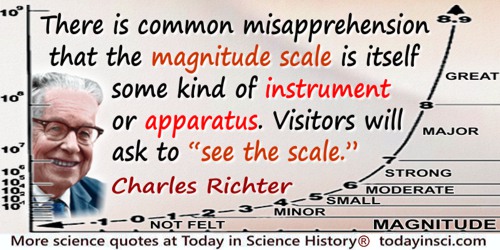
There is common misapprehension that the magnitude scale is itself some kind of instrument or apparatus. Visitors will ask to “see the scale,” and are disconcerted by being referred to tables and charts used for applying the scale to readings taken from the seismograms.
From interview with Henry Spall, as in an abridged version of Earthquake Information Bulletin (Jan-Feb 1980), 12, No. 1, that was on the USGS website.
There is not a soul on Earth who can read the deluge of physics publications in its entirety. As a result, it is sad but true that physics has irretrievably fallen apart from a cohesive to a fragmented discipline. … It was not that long ago that people were complaining about two cultures. If we only had it that good today.
In 'The Physical Review Then and Now', in H. Henry Stroke, Physical Review: The First Hundred Years: a Selection of Seminal Papers and Commentaries, Vol. 1, 3.
There’s a touch of the priesthood in the academic world, a sense that a scholar should not be distracted by the mundane tasks of day-to-day living. I used to have great stretches of time to work. Now I have research thoughts while making peanut butter and jelly sandwiches. Sure it’s impossible to write down ideas while reading “Curious George” to a two-year-old. On the other hand, as my husband was leaving graduate school for his first job, his thesis advisor told him, “You may wonder how a professor gets any research done when one has to teach, advise students, serve on committees, referee papers, write letters of recommendation, interview prospective faculty. Well, I take long showers.”
In 'In Her Own Words: Six Mathematicians Comment on Their Lives and Careers: Susan Landau', Notices of the AMS (Sep 1991), 38, No. 7, 704.
Therefore on long pondering this uncertainty of mathematical traditions on the deduction of the motions of the system of the spheres, I began to feel disgusted that no more certain theory of the motions of the mechanisms of the universe, which has been established for us by the best and most systematic craftsman of all, was agreed by the philosophers, who otherwise theorised so minutely with most careful attention to the details of this system. I therefore set myself the task of reading again the books of all philosophers which were available to me, to search out whether anyone had ever believed that the motions of the spheres of the, universe were other than was supposed by those who professed mathematics in the schools.
'To His Holiness Pope Paul III', in Copernicus: On the Revolutions of the Heavenly Spheres (1543), trans. A. M. Duncan (1976), 25.
This frustration of reading the tabloid press… it would easy to become convinced that the human race is on a mission to divide things into two clean columns… Good or evil, healthy or deadly or natural or chemical… everything organic and natural is good, ignoring the fact that organic natural substances include arsenic… Everything chemical is bad, ignoring that fact the everything is chemicals. Everything is chemicals! The day they discover yoga mats are carcinogenic will be the happiest day of my life.
Introducing his song, 'The Fence', on DVD, Live at the Royal Albert Hall (2011).
Through the reading of popular scientific books I soon reached the conviction that much in the stories of the Bible could not be true. The consequence was a positively fanatic [orgy of] freethinking coupled with the impression that youth is intentionally being deceived by the state through lies; it was a crushing impression. Mistrust of every kind of authority grew out of this experience, a skeptical attitude toward the convictions that were alive in any specific social environment–an attitude that has never again left me, even though, later on, it has been tempered by a better insight into the causal connections.
In P. A. Schilpp, (ed.), Part I, 'Autobiographical Notes', Albert Einstein: Philosopher-Scientist (1949, 1959), Vol. 1, 5. Translated by the P.A. Schilpp, from Einstein’s original German manuscript, written at age 67, (p.2, 4): “Durch Lesen populärwissenschaftlicher Bücher kam ich bald zu der Ueberzeugung, dass vieles in den Erzählungen der Bibel nicht wahr sein konnte. Die Folge war eine geradezu fanatische Freigeisterei, verbunden mit dem Eindruck, dass die Jugend vom Staate mit Vorbedacht belogen wird; es war ein niederschmetternder Eindruck. Das Misstrauen gegen jede Art Autorität erwuchs aus diesem Erlebnis, eine skeptische Einstellung gegen die Ueberzeugungen, welche in der jeweiligen sozialen Umwelt lebendig waren—eine Einstellung, die mich nicht wieder verlassen hat, wenn sie auch später durch bessere Einsicht in die kausalen Zusammenhänge ihre ursprünglische Schärfe verloren haben.”.
To arrive at the simplest truth, as Newton knew and practiced, requires years of contemplation. Not activity Not reasoning. Not calculating. Not busy behaviour of any kind. Not reading. Not talking. Not making an effort. Not thinking. Simply bearing in mind what it is one needs to know. And yet those with the courage to tread this path to real discovery are not only offered practically no guidance on how to do so, they are actively discouraged and have to set about it in secret, pretending meanwhile to be diligently engaged in the frantic diversions and to conform with the deadening personal opinions which are continually being thrust upon them.
In 'Appendix 1', The Laws of Form (1969), 110.
To be perfectly original one should think much and read little, and this is impossible, for one must have read before one has learnt to think.
In Select Works of Lord Byron (1834), Vol. 6, 512.
To limit the press is to insult a nation; to prohibit reading of certain books is to declare the inhabitants to be either fools or slaves: such a prohibition ought to fill them with disdain.
From the original French, “Les semences des découvertes présentées à tous par le hazard, sont stériles, si l’attention ne les séconde,” in 'Notes', De l'Homme, de ses Facultés Intellectuelles, et de son Éducation (1773), Tome 1, 383. English version from Claude Adrien Helvétius and W. Hooper (trans.), 'Notes', A Treatise on Man, His Intellectual Faculties and His Education: A Posthumous Work of M. Helvetius (1777), Note 53, 375.
Towards the end of his life, he [Ernest Rutherford] said, “I’ve just finished reading some of my early papers, and you know, when I’d finished I said to myself, ‘Rutherford, my boy, you used to be a damned clever fellow.’”
As quoted in 'The Rutherford Memorial Lecture' (29 Mar 1939), Memorial Lectures Delivered Before the Chemical Society (1951), Vol. 4, 183. Although quoted without source, note that Tizard and Rutherford were friends.
We are the children of a technological age. We have found streamlined ways of doing much of our routine work. Printing is no longer the only way of reproducing books. Reading them, however, has not changed...
…...
We build our personalities laboriously and through many years, and we cannot order fundamental changes just because we might value their utility; no button reading ‘positive attitude’ protrudes from our hearts, and no finger can coerce positivity into immediate action by a single and painless pressing.
…...
When Cayley had reached his most advanced generalizations he proceeded to establish them directly by some method or other, though he seldom gave the clue by which they had first been obtained: a proceeding which does not tend to make his papers easy reading. …
His literary style is direct, simple and clear. His legal training had an influence, not merely upon his mode of arrangement but also upon his expression; the result is that his papers are severe and present a curious contrast to the luxuriant enthusiasm which pervades so many of Sylvester’s papers. He used to prepare his work for publication as soon as he carried his investigations in any subject far enough for his immediate purpose. … A paper once written out was promptly sent for publication; this practice he maintained throughout life. … The consequence is that he has left few arrears of unfinished or unpublished papers; his work has been given by himself to the world.
His literary style is direct, simple and clear. His legal training had an influence, not merely upon his mode of arrangement but also upon his expression; the result is that his papers are severe and present a curious contrast to the luxuriant enthusiasm which pervades so many of Sylvester’s papers. He used to prepare his work for publication as soon as he carried his investigations in any subject far enough for his immediate purpose. … A paper once written out was promptly sent for publication; this practice he maintained throughout life. … The consequence is that he has left few arrears of unfinished or unpublished papers; his work has been given by himself to the world.
In Proceedings of London Royal Society (1895), 58, 23-24.
When I was a small boy [my father] used to sit me on his lap and read to me from the [Encyclopaedia] Britannica … say, about … the Tyrannosaurus rex, and it would say something like, “This dinosaur is twenty-five feet high and its head is six feet across.” My father would stop reading and say, “Now, let’s see what that means. That would mean that if he stood in our front yard, he would be tall enough to put his head through our window up here.” (We were on the second floor.) “But his head would be too wide to fit in the window.” Everything he read to me he would translate as best he could into some reality. …
In 'The Making of a Scientist', What Do You Care What Other People Think?": Further Adventures of a Curious Character (2001), 12-13. I learned from my father to translate: everything I read I try to figure out what it really means, what it’s really saying.
When I was reading Mathematics for University honours, I would sometimes, after working a week or two at some new book, and mastering ten or twenty pages, get into a hopeless muddle, and find it just as bad the next morning. My rule was to begin the book again. And perhaps in another fortnight I had come to the old difficulty with impetus enough to get over it. Or perhaps not. I have several books that I have begun over and over again.
From letter to Edith Rix with hints for studying (about Mar 1885), in Stuart Dodgson Collingwood, The Life and Letters of Lewis Carroll (1898), 240-241.
Whereas what knowledge we derive from lectures, reading and conversation, is but the copy of other men’s men's ideas; that is, the picture of a picture; and ’tis one remove farther from the original.
In Interesting Anecdotes, Memoirs, Allegories, Essays, and Poetical Fragments (1793), Vols 3-4, Vol 4, 72-73.
While reading in a textbook of chemistry, … I came across the statement, “nitric acid acts upon copper.” I was getting tired of reading such absurd stuff and I determined to see what this meant. Copper was more or less familiar to me, for copper cents were then in use. I had seen a bottle marked “nitric acid” on a table in the doctor’s office where I was then “doing time.” I did not know its peculiarities, but I was getting on and likely to learn. The spirit of adventure was upon me. Having nitric acid and copper, I had only to learn what the words “act upon” meant … I put one of them [cent] on the table, opened the bottle marked “nitric acid”; poured some of the liquid on the copper; and prepared to make an observation. But what was this wonderful thing which I beheld? The cent was already changed, and it was no small change either. A greenish blue liquid foamed and fumed over the cent and over the table. The air in the neighborhood of the performance became colored dark red. A great colored cloud arose. This was disagreeable and suffocating—how should I stop this? I tried to get rid of the objectionable mess by picking it up and throwing it out of the window, which I had meanwhile opened. I learned another fact—nitric acid not only acts upon copper but it acts upon fingers. The pain led to another unpremeditated experiment. I drew my fingers across my trousers and another fact was discovered. Nitric acid acts upon trousers. Taking everything into consideration, that was the most impressive experiment, and, relatively, probably the most costly experiment I have ever performed.
In F.H. Getman, The Life of Ira Remsen (1940), 9.
You tell your doctor, that y’are ill
and what does he, but write a bill?
Of which you need not read one letter;
The worse the scrawl, the dose the better,
For if you knew but what you take,
Though you recover, he must break.
and what does he, but write a bill?
Of which you need not read one letter;
The worse the scrawl, the dose the better,
For if you knew but what you take,
Though you recover, he must break.
In Alma Canto III. Collected in Poems on Several Occasions (1709), 262.
 In science it often happens that scientists say, 'You know that's a really good argument; my position is mistaken,' and then they would actually change their minds and you never hear that old view from them again. They really do it. It doesn't happen as often as it should, because scientists are human and change is sometimes painful. But it happens every day. I cannot recall the last time something like that happened in politics or religion.
(1987) --
In science it often happens that scientists say, 'You know that's a really good argument; my position is mistaken,' and then they would actually change their minds and you never hear that old view from them again. They really do it. It doesn't happen as often as it should, because scientists are human and change is sometimes painful. But it happens every day. I cannot recall the last time something like that happened in politics or religion.
(1987) -- 




