Reaction Quotes (107 quotes)
... every chemical combination is wholly and solely dependent on two opposing forces, positive and negative electricity, and every chemical compound must be composed of two parts combined by the agency of their electrochemical reaction, since there is no third force. Hence it follows that every compound body, whatever the number of its constituents, can be divided into two parts, one of which is positively and the other negatively electrical.
Essai sur la théorie des proportions chemiques (1819), 98. Quoted by Henry M. Leicester in article on Bessel in Charles Coulston Gillespie (editor), Dictionary of Scientific Biography (1981), Vol. 2, 94.
’Tis a short sight to limit our faith in laws to those of gravity, of chemistry, of botany, and so forth. Those laws do not stop where our eyes lose them, but push the same geometry and chemistry up into the invisible plane of social and rational life, so that, look where we will, in a boy's game, or in the strifes of races, a perfect reaction, a perpetual judgment keeps watch and ward.
From 'Worship', The Conduct of Life (1860) collected in The Complete Works of Ralph Waldo Emerson (1866), Vol.2, 401.
Die Welt der chemischen Vorgänge gleicht einer Bühne, auf welcher sich in unablässiger Aufeinanderfolge Scene um Scene abspielt. Die handelnden Personen auf ihr sind die Elemente.
The world of chemical reactions is like a stage, on which scene after scene is ceaselessly played. The actors on it are the elements.
The world of chemical reactions is like a stage, on which scene after scene is ceaselessly played. The actors on it are the elements.
Original German quote in Mary Elvira Weeks, The Discovery of the Elements (1934), 2, citing Winkler, 'Ueber die Entdeckung neuer Elemente im Verlaufe der letzten fünfundzwanzig Jahre," Ber. (Jan 1897), 30, 13. Translation in Mary Elvira Weeks and Henry M. Leicester (ed.)The Discovery of the Elements (6th ed. 1956), 3.
Mi è impossibile cingere i fianchi di una ragazza con il mio braccio destro e serrare il suo sorriso nella mia mano sinistra, per poi tentare di studiare i due oggetti separatamente. Allo stesso modo, non ci è possibile separare la vita dalla materia vivente, allo scopo di studiare la sola materia vivente e le sue reazioni. Inevitabilmente, studiando la materia vivente e le sue reazioni, studiamo la vita stessa.
It is impossible to encircle the hips of a girl with my right arm and hold her smile in my left hand, then proceed to study the two items separately. Similarly, we can not separate life from living matter, in order to study only living matter and its reactions. Inevitably, studying living matter and its reactions, we study life itself
It is impossible to encircle the hips of a girl with my right arm and hold her smile in my left hand, then proceed to study the two items separately. Similarly, we can not separate life from living matter, in order to study only living matter and its reactions. Inevitably, studying living matter and its reactions, we study life itself
In The Nature of Life (1948).
Sed tamen salis petrae. VI. Part V. NOV. CORVLI. ET V. sulphuris, et sic facies toniitrum et coruscationem: sic facies artificium.
But, however, of saltpetre take six parts, live of young willow (charcoal), and five of sulphur, and so you will make thunder and lightning, and so you will turn the trick.
Bacon’s recipe for Gunpowder, partly expressed as an anagram in the original Latin.
But, however, of saltpetre take six parts, live of young willow (charcoal), and five of sulphur, and so you will make thunder and lightning, and so you will turn the trick.
Bacon’s recipe for Gunpowder, partly expressed as an anagram in the original Latin.
Roger Bacon's Letter Concerning the Marvelous Power of Art and of Nature and Concerning the Nullity of Magic, trans. T. L. Davis (1922), 48.
A catalyst is a substance which alters the velocity of a chemical reaction without appearing in the final products.
'Über Katalyse', Zeitschrift für Physikalische Chemie (1901), 7, 995-1004 as quoted in J. R. Partington, A History of Chemistry, Vol. 4 (1901), 599-600.
A drop of old tuberculin, which is an extract of tubercle bacilli, is put on the skin and then a small superficial scarification is made by turning, with some pressure, a vaccination lancet on the surface of the skin. The next day only those individuals show an inflammatory reaction at the point of vaccination who have already been infected with tuberculosis, whereas the healthy individuals show no reaction at all. Every time we find a positive reaction, we can say with certainty that the child is tuberculous.
'The Relation of Tuberculosis to Infant Mortality', read at the third mid-year meeting of the American Academy of Medicine, New Haven, Conn, (4 Nov 1909). In Bulletin of the American Academy of Medicine (1910), 11, 75.
About eight days ago I discovered that sulfur in burning, far from losing weight, on the contrary, gains it; it is the same with phosphorus; this increase of weight arises from a prodigious quantity of air that is fixed during combustion and combines with the vapors. This discovery, which I have established by experiments, that I regard as decisive, has led me to think that what is observed in the combustion of sulfur and phosphorus may well take place in the case of all substances that gain in weight by combustion and calcination; and I am persuaded that the increase in weight of metallic calxes is due to the same cause... This discovery seems to me one of the most interesting that has been made since Stahl and since it is difficult not to disclose something inadvertently in conversation with friends that could lead to the truth I have thought it necessary to make the present deposit to the Secretary of the Academy to await the time I make my experiments public.
Sealed note deposited with the Secretary of the French Academy 1 Nov 1772. Oeuvres de Lavoisier, Correspondance, Fasc. II. 1770-75 (1957), 389-90. Adapted from translation by A. N. Meldrum, The Eighteenth-Century Revolution in Science (1930), 3.
Adrenalin does not excite sympathetic ganglia when applied to them directly, as does nicotine. Its effective action is localised at the periphery. The existence upon plain muscle of a peripheral nervous network, that degenerates only after section of both the constrictor and inhibitory nerves entering it, and not after section of either alone, has been described. I find that even after such complete denervation, whether of three days' or ten months' duration, the plain muscle of the dilatator pupillae will respond to adrenalin, and that with greater rapidity and longer persistence than does the iris whose nervous relations are uninjured. Therefore it cannot be that adrenalin excites any structure derived from, and dependent for its persistence on, the peripheral neurone. But since adrenalin does not evoke any reaction from muscle that has at no time of its life been innervated by the sympathetic, the point at which the stimulus of the chemical excitant is received, and transformed into what may cause the change of tension of the muscle fibre, is perhaps a mechanism developed out of the muscle cell in response to its union with the synapsing sympathetic fibre, the function of which is to receive and transform the nervous impulse. Adrenalin might then be the chemical stimulant liberated on each occasion when the impulse arrives at the periphery.
'On the Action of Adrenalin', Proceedings of the Physiological Society, 21 May 1904, in The Journal of Physiology 1904, 31, xxi.
All life depends on organic reactions.
A favorite saying.
A favorite saying.
Quoted in William J. Cromie, Obituary, Harvard University Gazette (16 Oct 1997).
Among those whom I could never pursuade to rank themselves with idlers, and who speak with indignation of my morning sleeps and nocturnal rambles, one passes the day in catching spiders, that he may count their eyes with a microscope; another exhibits the dust of a marigold separated from the flower with a dexterity worthy of Leuwenhoweck himself. Some turn the wheel of electricity; some suspend rings to a lodestone, and find that what they did yesterday, they can do again to-day.—Some register the changes of the wind, and die fully convinced that the wind is changeable.—There are men yet more profound, who have heard that two colorless liquors may produce a color by union, and that two cold bodies will grow hot of they are mingled: they mingle them, and produce the effect expected, say it is strange, and mingle them again.
In Tryon Edwards, A Dictionary of Thoughts (1908), 243.
An honest man, armed with all the knowledge available to us now, could only state that in some sense, the origin of life appears at the moment to be almost a miracle, so many are the conditions which would have had to have been satisfied to get it going. But this should not be taken to imply that there are good reasons to believe that it could not have started on the earth by a perfectly reasonable sequence of fairly ordinary chemical reactions. The plain fact is that the time available was too long, the many microenvironments on the earth’s surface too diverse, the various chemical possibilities too numerous and our own knowledge and imagination too feeble to allow us to be able to unravel exactly how it might or might not have happened such a long time ago, especially as we have no experimental evidence from that era to check our ideas against.
In Life Itself: Its Origin and Nature (1981), 88.
And by the influence of heat, light, and electrical powers, there is a constant series of changes [in animal and vegetal substances]; matter assumes new forms, the destruction of one order of beings tends to the conservation of another, solution and consolidation, decay and renovation, are connected, and whilst the parts of the system, continue in a state of fluctuation and change, the order and harmony of the whole remain unalterable.
The Elements of Agricultural Chemistry (1813), in J. Davy (ed.) The Collected Works of Sir Humphry Davy(1839-40), Vol 7, 182.
As usual, the author in his thorough, unobjective fashion has marshalled up all the good, indifferent and bad arguments ... I offer the following detailed comments ... though I realize that many of them will arouse him to a vigorous, if not violent rebuttal. In order to preserve the pH of Dr. Brown's digestive system I would not require a rebuttal as a condition of publication...
With heartiest greetings of the season to you and yours! Jack Roberts
PS The above comments should (help) to reduce your winter heating bill!
Jack Roberts' referee's report on Herbert Charles Brown's paper with Rachel Kornblum on the role of steric strain in carbonium ion reactions.
With heartiest greetings of the season to you and yours! Jack Roberts
PS The above comments should (help) to reduce your winter heating bill!
Jack Roberts' referee's report on Herbert Charles Brown's paper with Rachel Kornblum on the role of steric strain in carbonium ion reactions.
As quoted by D. A. Davenport, in 'On the Comparative Unimportance of the Invective Effect', Chemtech (Sep 1987), 17, 530.
Chemistry is one of those branches of human knowledge which has built itself upon methods and instruments by which truth can presumably be determined. It has survived and grown because all its precepts and principles can be re-tested at any time and anywhere. So long as it remained the mysterious alchemy by which a few devotees, by devious and dubious means, presumed to change baser metals into gold, it did not flourish, but when it dealt with the fact that 56 g. of fine iron, when heated with 32 g. of flowers of sulfur, generated extra heat and gave exactly 88 g. of an entirely new substance, then additional steps could be taken by anyone. Scientific research in chemistry, since the birth of the balance and the thermometer, has been a steady growth of test and observation. It has disclosed a finite number of elementary reagents composing an infinite universe, and it is devoted to their inter-reaction for the benefit of mankind.
Address upon receiving the Perkin Medal Award, 'The Big Things in Chemistry', The Journal of Industrial and Engineering Chemistry (Feb 1921), 13, No. 2, 163.
Chemistry is the study of material transformations. Yet a knowledge of the rate, or time dependence, of chemical change is of critical importance for the successful synthesis of new materials and for the utilization of the energy generated by a reaction. During the past century it has become clear that all macroscopic chemical processes consist of many elementary chemical reactions that are themselves simply a series of encounters between atomic or molecular species. In order to understand the time dependence of chemical reactions, chemical kineticists have traditionally focused on sorting out all of the elementary chemical reactions involved in a macroscopic chemical process and determining their respective rates.
'Molecular Beam Studies of Elementary Chemical Processes', Nobel Lecture, 8 Dec 1986. In Nobel Lectures: Chemistry 1981-1990 (1992), 320.
Clinical ecology [is] a new branch of medicine aimed at helping people made sick by a failure to adapt to facets of our modern, polluted environment. Adverse reactions to processed foods and their chemical contaminants, and to indoor and outdoor air pollution with petrochemicals, are becoming more and more widespread and so far these reactions are being misdiagnosed by mainstream medical practitioners and so are not treated effectively.
Quoted in article 'Richard Mackarness', Contemporary Authors Online (2002).
Confined to its true domain, mathematical reasoning is admirably adapted to perform the universal office of sound logic: to induce in order to deduce, in order to construct. … It contents itself to furnish, in the most favorable domain, a model of clearness, of precision, and consistency, the close contemplation of which is alone able to prepare the mind to render other conceptions also as perfect as their nature permits. Its general reaction, more negative than positive, must consist, above all, in inspiring us everywhere with an invincible aversion for vagueness, inconsistency, and obscurity, which may always be really avoided in any reasoning whatsoever, if we make sufficient effort.
In Synthèse Subjective (1856), 98. As translated in Robert Édouard Moritz, Memorabilia Mathematica; Or, The Philomath’s Quotation-Book (1914), 202-203. From the original French, “Bornée à son vrai domaine, la raison mathématique y peut admirablement remplir l’office universel de la saine logique: induire pour déduire, afin de construire. … Elle se contente de former, dans le domaine le plus favorable, un type de clarté, de précision, et de consistance, dont la contemplation familière peut seule disposer l’esprit à rendre les autres conceptions aussi parfaites que le comporte leur nature. Sa réaction générale, plus négative que positive, doit surtout consister à nous inspirer partout une invincible répugnance pour le vague, l’incohérence, et l’obscurité, que nous pouvons réellement éviter envers des pensées quelconques, si nous y faisons assez d’efforts.”
Darwin's characteristic perspicacity is nowhere better illustrated than in his prophecy of the reaction of the world of science. He admitted at once that it would be impossible to convince those older men '...whose minds are stocked with a multitude of facts, all viewed ... from a point of view directly opposite to mine ... A few naturalists endowed with much flexibility of mind and who have already begun to doubt the immutability of species, may be influenced by this volume; but I look with confidence to the young and rising naturalists, who will be able to view both sides with equal impartiality.
'The Reaction of American scientists to Darwinism', American Historical Review 1932), 38, 687. Quoted in David L. Hull, Science as Process (), 379.
Do not great Bodies conserve their heat the longest, their parts heating one another, and may not great dense and fix'd Bodies, when heated beyond a certain degree, emit Light so copiously, as by the Emission and Re-action of its Light, and the Reflexions and Refractions of its Rays within its Pores to grow still hotter, till it comes to a certain period of heat, such as is that of the Sun?
Opticks (1704), Book 3, Query II, 135.
Even the humblest creature has to know how to react to the difference between food and toxin if it's to survive. ... Life and some level of intelligent behavior—discerning and doing what's best for one's survival—appear to go hand in hand.
In Life Everywhere: the Maverick Science of Astrobiology (2002), 140.
Every breath you draw, every accelerated beat of your heart in the emotional periods of your oratory depend upon highly elaborated physical and chemical reactions and mechanisms which nature has been building up through a million centuries. If one of these mechanisms, which you owe entirely to your animal ancestry, were to be stopped for a single instant, you would fall lifeless on the stage. Not only this, but some of your highest ideals of human fellowship and comradeship were not created in a moment, but represent the work of ages.
Quoted in Closing Address by Dr. Henry Sloane Coffin, president of the Union Theological Seminary, New York, at the Memorial Service for Osborn at St. Bartholomew's Church, N.Y. (18 Dec 1935). In 'Henry Fairfield Osborn', Supplement to Natural History (Feb 1936), 37:2, 133-34. Bound in Kofoid Collection of Pamphlets on Biography, University of California.
Finally I got to carbon, and as you all know, in the case of carbon the reaction works out beautifully. One goes through six reactions, and at the end one comes back to carbon. In the process one has made four hydrogen atoms into one of helium. The theory, of course, was not made on the railway train from Washington to Ithaca … It didn’t take very long, it took about six weeks, but not even the Trans-Siberian railroad [has] taken that long for its journey.
'Pleasure from Physics', From A Life of Physics: Evening Lectures at the International Centre for Theoretical Physics, Trieste, Italy. A Special Supplement of the IAEA Bulletin (1968), 14.
For more than ten years, my theory was in limbo. Then, finally, in the late 1980s, physicists at Princeton said, “There’s nothing wrong with this theory. It’s the only one that works, and we have to open out minds to hyperspace.” We weren’t destined to discover this theory for another 100 years because it’s so bizarre, so different from everything we’d been doing. We didn’t use the normal sequence of discoveries to get to it.
Describing reaction to his superstring theory of hyperspace which mathematically relates the universe’s basic forces.
Describing reaction to his superstring theory of hyperspace which mathematically relates the universe’s basic forces.
Quoted in Nina L. Diamond, Voices of Truth (2000), 326.
Force, then, is Force, but mark you! Not a thing,
Only a Vector;
Thy barbèd arrows now have lost their sting,
Impotent spectre!
Thy reign, O force! is over. Now no more
Heed we thine action;
Repulsion leaves us where we were before,
So does attraction.
Both Action and Reaction now are gone.
Just ere they vanished,
Stress joined their hands in peace, and made them one;
Then they were banished....
Only a Vector;
Thy barbèd arrows now have lost their sting,
Impotent spectre!
Thy reign, O force! is over. Now no more
Heed we thine action;
Repulsion leaves us where we were before,
So does attraction.
Both Action and Reaction now are gone.
Just ere they vanished,
Stress joined their hands in peace, and made them one;
Then they were banished....
Reproduced in Bruce Clarke, Energy Forms: Allegory and Science in the Era of Classical Thermodynamics (2001), 20-21. In his parody of Shelley's Prometheus Unbound, Maxwell presents Newton's laws of motion updated into axioms of energy.
From the time of Aristotle it had been said that man is a social animal: that human beings naturally form communities. I couldn’t accept it. The whole of history and pre-history is against it. The two dreadful world wars we have recently been through, and the gearing of our entire economy today for defensive war belie it. Man's loathsome cruelty to man is his most outstanding characteristic; it is explicable only in terms of his carnivorous and cannibalistic origin. Robert Hartmann pointed out that both rude and civilised peoples show unspeakable cruelty to one another. We call it inhuman cruelty; but these dreadful things are unhappily truly human, because there is nothing like them in the animal world. A lion or tiger kills to eat, but the indiscriminate slaughter and calculated cruelty of human beings is quite unexampled in nature, especially among the apes. They display no hostility to man or other animals unless attacked. Even then their first reaction is to run away.
In Africa's Place In the Emergence of Civilisation (1959), 41.
Genes make enzymes, and enzymes control the rates of chemical processes. Genes do not make ‘novelty seeking’ or any other complex and overt behavior. Predisposition via a long chain of complex chemical reactions, mediated through a more complex series of life’s circumstances, does not equal identification or even causation.
…...
He [Heinrich Rose] looked upon the various substances that he was manipulating, as well as their reactions, under a thoroughly familial point of view: they were like so many children entrusted to his tutelage. Every time he explained simple, clear, well-defined phenomena, he assumed a jovial and smiling countenance; on the other hand, he almost got angry at certain mischievous bodies, the properties of which did not obey ordinary laws and troubled general theoretical views; in his eyes, this was unruly behavior.
As his student, about the lectures of Heinrich Rose, as quoted in entry by Stuart Pierson, 'Rose, Heinrich', in Charles Coulston Gillespie (ed.), Dictionary of Scientific Biography (1975), Vol.11, 541, citing Adolphe Remelé, 'Notice biographique sur le Professeur Henri Rose', in Moniteur Scientifique (1864), 2nd ser., 6, 385–389. [Remelé’s italics.]
However, all scientific statements and laws have one characteristic in common: they are “true or false” (adequate or inadequate). Roughly speaking, our reaction to them is “yes” or “no.” The scientific way of thinking has a further characteristic. The concepts which it uses to build up its coherent systems are not expressing emotions. For the scientist, there is only “being,” but no wishing, no valuing, no good, no evil; no goal. As long as we remain within the realm of science proper, we can never meet with a sentence of the type: “Thou shalt not lie.” There is something like a Puritan's restraint in the scientist who seeks truth: he keeps away from everything voluntaristic or emotional.
Essays in Physics (1950), 68.
I am delighted that I have found a new reaction to demonstrate even to the blind the structure of the interstitial stroma of the cerebral cortex. I let the silver nitrate react with pieces of brain hardened in potassium dichromate. I have already obtained magnificent results and hope to do even better in the future.
Letter to Nicolo Manfredi, 16 Feb 1873. Archive source. Quoted in Paolo Mazzarello, The Hidden Structure: A Scientific Biography of Camillo Golgi, trans. and ed. Henry A. Buchtel and Aldo Badiani (1999), 63.
I feel like a white granular mass of amorphous crystals—my formula appears to be isomeric with Spasmotoxin. My aurochloride precipitates into beautiful prismatic needles. My Platinochloride develops octohedron crystals,—with fine blue florescence. My physiological action is not indifferent. One millionth of a grain injected under the skin of a frog produced instantaneous death accompanied by an orange blossom odor. The heart stopped in systole. A base—L3H9NG4—offers analogous reaction to phosmotinigstic acid.
In letter to George M. Gould (1889), collected in Elizabeth Bisland The Writings of Lafcadio Hearn (1922), Vol. 14, 89.
I read in the proof sheets of Hardy on Ramanujan: “As someone said, each of the positive integers was one of his personal friends.” My reaction was, “I wonder who said that; I wish I had.” In the next proof-sheets I read (what now stands), “It was Littlewood who said…”. What had happened was that Hardy had received the remark in silence and with poker face, and I wrote it off as a dud.
In Béla Bollobás (ed.), Littlewood’s Miscellany, (1986), 61.
I think it is a sad reflection on our civilization that while we can and do measure the temperature in the atmosphere of Venus we do not know what goes on inside our soufflés.
[Remark made while demonstrating the progress of cooking a Soufflé à la Chartreuse, demonstrating its progress with thermocouples and chart recorders.]
[Remark made while demonstrating the progress of cooking a Soufflé à la Chartreuse, demonstrating its progress with thermocouples and chart recorders.]
Friday Evening Discourse at the Royal Institution, ‘The Physicist in the Kitchen’. In Proceedings of the Royal Institution (1969), 42/199, 451–67. Cited in article on Kurti by Ralph G. Scurlock in Oxford Dictionary of National Biography.
I think it would be just to say the most essential characteristic of mind is memory, using this word in its broadest sense to include every influence of past experience on present reactions.
In Portraits from Memory: and Other Essays (1956), 143.
I watched Baeyer activating magnesium with iodine for a difficult Grignard reaction; it was done in a test tube, which he watched carefully as he moved it gently by hand over a flame for three quarters of an hour. The test tube was the apparatus to Baeyer.
In Richard Willstätter, Arthur Stoll (ed. of the original German) and Lilli S. Hornig (trans.), From My Life: The Memoirs of Richard Willstätter (1958), 140.
I will now direct the attention of scientists to a previously unnoticed cause which brings about the metamorphosis and decomposition phenomena which are usually called decay, putrefaction, rotting, fermentation and moldering. This cause is the ability possessed by a body engaged in decomposition or combination, i.e. in chemical action, to give rise in a body in contact with it the same ability to undergo the same change which it experiences itself.
Annalen der Pharmacie 1839, 30, 262. Trans. W. H. Brock.
I would like to start by emphasizing the importance of surfaces. It is at a surface where many of our most interesting and useful phenomena occur. We live for example on the surface of a planet. It is at a surface where the catalysis of chemical reactions occur. It is essentially at a surface of a plant that sunlight is converted to a sugar. In electronics, most if not all active circuit elements involve non-equilibrium phenomena occurring at surfaces. Much of biology is concerned with reactions at a surface.
'Surface properties of semiconductors', Nobel Lecture (11 Dec 1956). In Nobel Lectures, Physics 1942-1962 (1967), 377.
If we wish to give an account of the atomic constitution of the aromatic compounds, we are bound to explain the following facts:
1) All aromatic compounds, even the most simple, are relatively richer in carbon than the corresponding compounds in the class of fatty bodies.
2) Among the aromatic compounds, as well as among the fatty bodies, a large number of homologous substances exist.
3) The most simple aromatic compounds contain at least six atoms of carbon.
4) All the derivatives of aromatic substances exhibit a certain family likeness; they all belong to the group of 'Aromatic compounds'. In cases where more vigorous reactions take place, a portion of the carbon is often eliminated, but the chief product contains at least six atoms of carbon These facts justify the supposition that all aromatic compounds contain a common group, or, we may say, a common nucleus consisting of six atoms of carbon. Within this nucleus a more intimate combination of the carbon atoms takes place; they are more compactly placed together, and this is the cause of the aromatic bodies being relatively rich in carbon. Other carbon atoms can be joined to this nucleus in the same way, and according to the same law, as in the case of the group of fatty bodies, and in this way the existence of homologous compounds is explained.
1) All aromatic compounds, even the most simple, are relatively richer in carbon than the corresponding compounds in the class of fatty bodies.
2) Among the aromatic compounds, as well as among the fatty bodies, a large number of homologous substances exist.
3) The most simple aromatic compounds contain at least six atoms of carbon.
4) All the derivatives of aromatic substances exhibit a certain family likeness; they all belong to the group of 'Aromatic compounds'. In cases where more vigorous reactions take place, a portion of the carbon is often eliminated, but the chief product contains at least six atoms of carbon These facts justify the supposition that all aromatic compounds contain a common group, or, we may say, a common nucleus consisting of six atoms of carbon. Within this nucleus a more intimate combination of the carbon atoms takes place; they are more compactly placed together, and this is the cause of the aromatic bodies being relatively rich in carbon. Other carbon atoms can be joined to this nucleus in the same way, and according to the same law, as in the case of the group of fatty bodies, and in this way the existence of homologous compounds is explained.
Bulletin de la Societé Chimique de France (1865), 1, 98. Trans. W. H. Brock.
If you free yourself from the conventional reaction to a quantity like a million years, you free yourself a bit from the boundaries of human time. And then in a way you do not live at all, but in another way you live forever.
In Basin and Range (1981), 135.
In deriving a body from the water type I intend to express that to this body, considered as an oxide, there corresponds a chloride, a bromide, a sulphide, a nitride, etc., susceptible of double compositions, or resulting from double decompositions, analogous to those presented by hydrochloric acid, hydrobromic acid, sulphuretted hydrogen, ammonia etc., or which give rise to the same compounds. The type is thus the unit of comparison for all the bodies which, like it, are susceptible of similar changes or result from similar changes.
Traité de Chimie Organique, 1856, 4, 587. Trans. J. R. Partington, A History of Chemistry, (1970), Vol. 4, 456.
In every combustion there is disengagement of the matter of fire or of light. A body can burn only in pure air [oxygen]. There is no destruction or decomposition of pure air and the increase in weight of the body burnt is exactly equal to the weight of air destroyed or decomposed. The body burnt changes into an acid by addition of the substance that increases its weight. Pure air is a compound of the matter of fire or of light with a base. In combustion the burning body removes the base, which it attracts more strongly than does the matter of heat, which appears as flame, heat and light.
'Memoire sur la combustion en général', Mémoires de l'Académie des Sciences, 1777, 592. Reprinted in Oeuvres de Lavoisier (1864), Vol. 2, 225-33, trans. M. P. Crosland.
In the dog two conditions were found to produce pathological disturbances by functional interference, namely, an unusually acute clashing of the excitatory and inhibitory processes, and the influence of strong and extraordinary stimuli. In man precisely similar conditions constitute the usual causes of nervous and psychic disturbances. Different conditions productive of extreme excitation, such as intense grief or bitter insults, often lead, when the natural reactions are inhibited by the necessary restraint, to profound and prolonged loss of balance in nervous and psychic activity.
Ivan Pavlov and G. V. Anrep (ed., trans.), Conditioned Reflexes—An Investigation of the Physiological Activity of the Cerebral Cortex (1927), 397.
In the infancy of physical science, it was hoped that some discovery might be made that would enable us to emancipate ourselves from the bondage of gravity, and, at least, pay a visit to our neighbour the moon. The poor attempts of the aeronaut have shewn the hopelessness of the enterprise. The success of his achievement depends on the buoyant power of the atmosphere, but the atmosphere extends only a few miles above the earth, and its action cannot reach beyond its own limits. The only machine, independent of the atmosphere, we can conceive of, would be one on the principle of the rocket. The rocket rises in the air, not from the resistance offered by the atmosphere to its fiery stream, but from the internal reaction. The velocity would, indeed, be greater in a vacuum than in the atmosphere, and could we dispense with the comfort of breathing air, we might, with such a machine, transcend the boundaries of our globe, and visit other orbs.
God's Glory in the Heavens (1862, 3rd Ed. 1867) 3-4.
Incandescent carbon particles, by the tens of millions, leap free of the log and wave like banners, as flame. Several hundred significantly different chemical reactions are now going on. For example, a carbon atom and four hydrogen atoms, coming out of the breaking cellulose, may lock together and form methane, natural gas. The methane, burning (combining with oxygen), turns into carbon dioxide and water, which also go up the flue. If two carbon atoms happen to come out of the wood with six hydrogen atoms, they are, agglomerately, ethane, which bums to become, also, carbon dioxide and water. Three carbons and eight hydrogens form propane, and propane is there, too, in the fire. Four carbons and ten hydrogens—butane. Five carbons … pentane. Six … hexane. Seven … heptane. Eight carbons and eighteen hydrogens—octane. All these compounds come away in the breaking of the cellulose molecule, and burn, and go up the chimney as carbon dioxide and water. Pentane, hexane, heptane, and octane have a collective name. Logs burning in a fireplace are making and burning gasoline.
In 'Firewood', Pieces of the Frame (1975), 205-206.
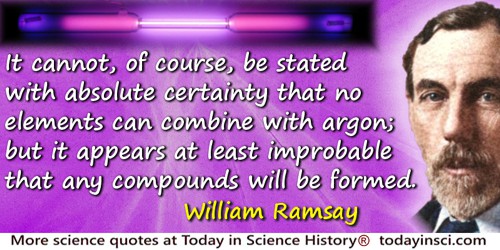
It cannot, of course, be stated with absolute certainty that no elements can combine with argon; but it appears at least improbable that any compounds will be formed.
As surmised in Gases of the Atmosphere (1896, 1905), 193. [The first argon compound was finally made a century later (Aug 2000), argon fluorohydride, HArF, but unstable above 40 K (–233 °C). —Webmaster]
It has been shown to be possible, by deliberately planned and chemotherapeutic approach, to discover curative agents which act specifically and aetiologically against diseases due to protozoal infections, and especially against the spirilloses, and amongst these against syphilis in the first place. Further evidence for the specificity of the action of dihydroxydiaminoarsenobenzene [Salvarsan ‘606’] is the disappearance of the Wasserman reaction, which reaction must … be regarded as indicative of a reaction of the organism to the constituents of the spirochaetes.
P. Ehrlich and S. Hata, 'Closing Notes to the Experimental Chemotherapy of Spirilloses', 1910. Reprinted in F. Himmelweit (ed.), The Collected Papers of Paul Ehrlich (1957), Vol. 3, 302.
It is a very strange thing to reflect that but for the invention of Professor Haber the Germans could not have continued the War after their original stack of nitrates was exhausted. The invention of this single man has enabled them, utilising the interval in which their accumulations were used up, not only to maintain an almost unlimited supply of explosives for all purposes, but to provide amply for the needs of agriculture in chemical manures. It is a remarkable fact, and shows on what obscure and accidental incidents the fortunes of possible the whole world may turn in these days of scientific discovery.
[During World War I, Fritz Haber and Karl Bosch invented a large scale process to cause the direct combination of hydrogen and nitrogen gases to chemically synthesize ammonia, thus providing a replacement for sodium nitrate in the manufacture of explosives and fertilizers.]
[During World War I, Fritz Haber and Karl Bosch invented a large scale process to cause the direct combination of hydrogen and nitrogen gases to chemically synthesize ammonia, thus providing a replacement for sodium nitrate in the manufacture of explosives and fertilizers.]
Parliamentary debate (25 Apr 1918). In Winston Churchill, Richard Langworth (ed.), Churchill by Himself: The Definitive Collection of Quotations (2008), 469.
by Winston Churchill, Richard Langworth
It is evident that certain genes which either initially or ultimately have beneficial effects may at the same time produce characters of a non-adaptive type, which will therefore be established with them. Such characters may sometimes serve most easily to distinguish different races or species; indeed, they may be the only ones ordinarily available, when the advantages with which they are associated are of a physiological nature. Further, it may happen that the chain of reactions which a gene sets going is of advantage, while the end-product to which this gives rise, say a character in a juvenile or the adult stage, is of no adaptive significance.
Mendelism and Evolution (1931), 78-9.
It is, I believe, justifiable to make the generalization that anything an organic chemist can synthesize can be made without him. All he does is increase the probability that given reactions will “go”. So it is quite reasonable to assume that given sufficient time and proper conditions, nucleotides, amino acids, proteins, and nucleic acids will arise by reactions that, though less probable, are as inevitable as those by which the organic chemist fulfills his predictions. So why not self-duplicating virus-like systems capable of further evolution?
The Place of Genetics in Modern Biology (1959),18.
It seems to me that the view toward which we are tending is that the specificity in gene action is always a chemical specificity, probably the production of enzymes which guide metabolic processes along particular channels. A given array of genes thus determines the production of a particular kind of protoplasm with particular properties—such, for example, as that of responding to surface forces by the formation of a special sort of semipermeable membrane, and that of responding to trivial asymmetries in the play of external stimuli by polarization, with consequent orderly quantitative gradients in all physiologic processes. Different genes may now be called into play at different points in this simple pattern, either through the local formation of their specific substrates for action, or by activation of a mutational nature. In either case the pattern becomes more complex and qualitatively differentiated. Successive interactions of differentiated regions and the calling into play of additional genes may lead to any degree of complexity of pattern in the organism as a largely self-contained system. The array of genes, assembled in the course of evolution, must of course be one which determines a highly selfregulatory system of reactions. On this view the genes are highly specific chemically, and thus called into play only under very specific conditions; but their morphological effects, if any, rest on quantitative influences of immediate or remote products on growth gradients, which are resultants of all that has gone on before in the organism.
In 'Genetics of Abnormal Growth in the Guinea Pig', Cold Spring Harbor Symposia on Quantitative Biology (1934), 2, 142.
It was a reaction from the old idea of “protoplasm”, a name which was a mere repository of ignorance.
Perspectives in Biochemistry (1938). As cited in Max Perutz, I Wish I’d Made You Angry Earlier: Essays on Science, Scientists, and Humanity (1998).
It was obvious—to me at any rate—that the answer was to why an enzyme is able to speed up a chemical reaction by as much as 10 million times. It had to do this by lowering the energy of activation—the energy of forming the activated complex. It could do this by forming strong bonds with the activated complex, but only weak bonds with the reactants or products.
Quoted In Thomas Hager, Force of Nature: The Life of Linus Pauling (1995), 284.
Look at life as an energy economy game. Each day, ask yourself, Are my energy expenditures (actions, reactions, thoughts, and feelings) productive or nonproductive? During the course of my day, have I accumulated more stress or more peace?
Doc Childre and Howard Martin
Many of the things that have happened in the laboratory have happened in ways it would have been impossible to foresee, but not impossible to plan for in a sense. I do not think Dr. Whitney deliberately plans his serendipity but he is built that way; he has the art—an instinctive way of preparing himself by his curiosity and by his interest in people and in all kinds of things and in nature, so that the things he learns react on one another and thereby accomplish things that would be impossible to foresee and plan.
Quoted in Guy Suits, 'Willis Rodney Whitney', National Academy of Sciences, Biographical Memoirs (1960), 355.
My main thesis will be that in the study of the intermediate processes of metabolism we have to deal not with complex substances which elude ordinary chemical methods, but with the simple substances undergoing comprehensible reactions... I intend also to emphasise the fact that it is not alone with the separation and identification of products from the animal that our present studies deal; but with their reactions in the body; with the dynamic side of biochemical phenomena.
'The Dynamic Side of Biochemistry', Address (11 Sep 1913) in Report on the 83rd Meeting of the British Association for the Advancement of Science (1914), 653.
My position is perfectly definite. Gravitation, motion, heat, light, electricity and chemical action are one and the same object in various forms of manifestation.
Annalen der Chemie und der Pharmacie (1842). Trans. A. S. Eve and C. H. Creasey, The Life and Work of John Tyndall (1945), 94.
Narration by flashback is now used by almost all novelists… The method of the sleuth does have some relation to contemporary science as well as to art. One of the procedures in modern chemical research, for example, is to take a compound or a chemical reaction and then to work backwards from that to the formula which will produce that compound or reaction.
In The Mechanical Bride: Folklore of Industrial Man (1967), 106.
Not every collision,
not every punctilious trajectory
by which billiard-ball complexes
arrive at their calculable meeting places
lead to reaction. ...
Men (and women) are not
as different from molecules
as they think.
not every punctilious trajectory
by which billiard-ball complexes
arrive at their calculable meeting places
lead to reaction. ...
Men (and women) are not
as different from molecules
as they think.
Hoffmann, as a chemist-turned-poet is making the analogy of random intermolecular interactions to those of humans. From poem, 'Men and Molecules', The Metamict State (1984), 43. Cited as an epigraph in William L. Masterton and Cecile N. Hurley Chemistry: Principles and Reactions, Updated Edition (2005), 282.
Not only do the various components of the cells form a living system, in which the capacity to live, react, and reproduce is dependent on the interactions of all the members of the system; but this living system is identical with the genetic system. The form of life is determined not only by the specific nature of the hereditary units but also by the structure and arrangement of the system. The whole system is more than the sum of its parts, and the effect of each of the components depends on and is influenced by all previous reactions, whose sequence is in turn determined by the whole idiotype.
'Cytoplasmic Inheritance in Epilobium and Its Theoretical Significance', Advances in Genetics (1954), 6, 320.
O. Hahn and F. Strassmann have discovered a new type of nuclear reaction, the splitting into two smaller nuclei of the nuclei of uranium and thorium under neutron bombardment. Thus they demonstrated the production of nuclei of barium, lanthanum, strontium, yttrium, and, more recently, of xenon and caesium. It can be shown by simple considerations that this type of nuclear reaction may be described in an essentially classical way like the fission of a liquid drop, and that the fission products must fly apart with kinetic energies of the order of hundred million electron-volts each.
'Products of the Fission of the Urarium Nucleus', Nature (1939), 143, 471.
One of the most impressive discoveries was the origin of the energy of the stars, that makes them continue to burn. One of the men who discovered this was out with his girl friend the night after he realized that nuclear reactions must be going on in the stars in order to make them shine.
She said “Look at how pretty the stars shine!”
He said, “Yes, and right now I am the only man in the world who knows why they shine.”
She merely laughed at him. She was not impressed with being out with the only man who, at that moment, knew why stars shine. Well, it is sad to be alone, but that is the way it is in this world.
She said “Look at how pretty the stars shine!”
He said, “Yes, and right now I am the only man in the world who knows why they shine.”
She merely laughed at him. She was not impressed with being out with the only man who, at that moment, knew why stars shine. Well, it is sad to be alone, but that is the way it is in this world.
…...
One reason which has led the organic chemist to avert his mind from the problems of Biochemistry is the obsession that the really significant happenings in the animal body are concerned in the main with substances of such high molecular weight and consequent vagueness of molecular structure as to make their reactions impossible of study by his available and accurate methods. There remains, I find, pretty widely spread, the feeling—due to earlier biological teaching—that, apart from substances which are obviously excreta, all the simpler products which can be found in cells or tissues are as a class mere objects, already too remote from the fundamental biochemical events to have much significance. So far from this being the case, recent progress points in the clearest way to the fact that the molecules with which a most important and significant part of the chemical dynamics of living tissues is concerned are of a comparatively simple character.
In 'The Dynamic Side of Biochemistry', Address (11 Sep 1913) in Report on the 83rd Meeting of the British Association for the Advancement of Science (1914), 657-8.
Perhaps... some day the precision of the data will be brought so far that the mathematician will be able to calculate at his desk the outcome of any chemical combination, in the same way, so to speak, as he calculates the motions of celestial bodies.
Oeuvres (1862), Vol. 2, 550-1. Trans. John Heilbron, Weighing Imponderables and Other Quantitative Science around 1800 (1993), 14.
Reagents are regarded as acting by virtue of a constitutional affinity either for electrons or for nuclei... the terms electrophilic (electron-seeking) and nucleophilic (nucleus-seeking) are suggested... and the organic molecule, in the activation necessary for reaction, is therefore required to develop at the seat of attack either a high or low electron density as the case may be.
'Significance of Tautomerism and of the Reactions of Aromatic Compounds in the Electronic Theory of Organic Relations', Journal of the Chemical Society (1933), 136, 1121, fn.
Scheele, it was said, never forgot anything if it had to do with chemistry. He never forgot the look, the feel, the smell of a substance, or the way it was transformed in chemical reactions, never forgot anything he read, or was told, about the phenomena of chemistry. He seemed indifferent, or inattentive, to most things else, being wholly dedicated to his single passion, chemistry. It was this pure and passionate absorption in phenomena—noticing everything, forgetting nothing—that constituted Scheele's special strength.
Uncle Tungsten: Memories of a Chemical Boyhood (2001), 44.
Seeing is an experience. A retinal reaction is only a physical state... People, not their eyes, see. Cameras, and eye-balls, are blind... there is more to seeing than meets the eyeball.
Patterns of Discovery (1958), 6-7.
Since it is proposed to regard chemical reactions as electrical transactions in which reagents act by reason of a constitutional affinity either for electrons or for atomic nuclei, it is important to be able to recognize which type of reactivity any given reagent exhibits.
'Principles of an Electronic Theory of Organic Reactions', Chemical Reviews (1934), 15, 265.
Since many cases are known in which the specificities of antigens and enzymes appear to bear a direct relation to gene specificities, it seems reasonable to suppose that the gene’s primary and possibly sole function is in directing the final configurations of protein molecules.
Assuming that each specific protein of the organism has its unique configuration copied from that of a gene, it follows that every enzyme whose specificity depends on a protein should be subject to modification or inactivation through gene mutation. This would, of course, mean that the reaction normally catalyzed by the enzyme in question would either have its rate or products modified or be blocked entirely.
Such a view does not mean that genes directly “make” proteins. Regardless of precisely how proteins are synthesized, and from what component parts, these parts must themselves be synthesized by reactions which are enzymatically catalyzed and which in turn depend on the functioning of many genes. Thus in the synthesis of a single protein molecule, probably at least several hundred different genes contribute. But the final molecule corresponds to only one of them and this is the gene we visualize as being in primary control.
Assuming that each specific protein of the organism has its unique configuration copied from that of a gene, it follows that every enzyme whose specificity depends on a protein should be subject to modification or inactivation through gene mutation. This would, of course, mean that the reaction normally catalyzed by the enzyme in question would either have its rate or products modified or be blocked entirely.
Such a view does not mean that genes directly “make” proteins. Regardless of precisely how proteins are synthesized, and from what component parts, these parts must themselves be synthesized by reactions which are enzymatically catalyzed and which in turn depend on the functioning of many genes. Thus in the synthesis of a single protein molecule, probably at least several hundred different genes contribute. But the final molecule corresponds to only one of them and this is the gene we visualize as being in primary control.
In 'Genetics and Metabolism in Neurospora', Physiological Reviews, 1945, 25, 660.
So many of the chemical reactions occurring in living systems have been shown to be catalytic processes occurring isothermally on the surface of specific proteins, referred to as enzymes, that it seems fairly safe to assume that all are of this nature and that the proteins are the necessary basis for carrying out the processes that we call life.
In 'The Physical Basis of Life', (1951), 39. As given in Andrew Brown, J.D. Bernal: The Sage of Science (2005), 359.
Some recent work by E. Fermi and L. Szilard, which has been communicated to me in manuscript, leads me to expect that the element uranium may be turned into a new and important source of energy in the immediate future. Certain aspects of the situation seem to call for watchfulness and, if necessary, quick action on the part of the Administration. …
In the course of the last four months it has been made probable … that it may become possible to set up nuclear chain reactions in a large mass of uranium, by which vast amounts of power and large quantities of new radium-like elements would be generated. Now it appears almost certain that this could be achieved in the immediate future.
This new phenomenon would also lead to the construction of bombs, and it is conceivable—though much less certain—that extremely powerful bombs of a new type may thus be constructed. A single bomb of this type, carried by boat or exploded in a port, might well destroy the whole port altogether with some of the surrounding territory. However, such bombs might well prove to be too heavy for transportation by air.
In the course of the last four months it has been made probable … that it may become possible to set up nuclear chain reactions in a large mass of uranium, by which vast amounts of power and large quantities of new radium-like elements would be generated. Now it appears almost certain that this could be achieved in the immediate future.
This new phenomenon would also lead to the construction of bombs, and it is conceivable—though much less certain—that extremely powerful bombs of a new type may thus be constructed. A single bomb of this type, carried by boat or exploded in a port, might well destroy the whole port altogether with some of the surrounding territory. However, such bombs might well prove to be too heavy for transportation by air.
Letter to President Franklin P. Roosevelt, (2 Aug 1939, delivered 11 Oct 1939). In Otto Nathan and Heinz Norden (Eds.) Einstein on Peace (1960, reprinted 1981), 294-95.
Suddenly there was an enormous explosion, like a violent volcano. The nuclear reactions had led to overheating in the underground burial grounds. The explosion poured radioactive dust and materials high up into the sky. It was just the wrong weather for such a tragedy. Strong winds blew the radioactive clouds hundreds of miles away. It was difficult to gauge the extent of the disaster immediately, and no evacuation plan was put into operation right away. Many villages and towns were only ordered to evacuate when the symptoms of radiation sickness were already quite apparent. Tens of thousands of people were affected, hundreds dying, though the real figures have never been made public. The large area, where the accident happened, is still considered dangerous and is closed to the public.
'Two Decades of Dissidence', New Scientist (4 Nov 1976), 72, No. 72, 265.
The adults of Drosophila react positively to light, i.e., they go toward a source of light … whether the animals walk or fly. Removal of the wings causes the flies to become less responsive to light, … roughly proportional to the amount of the wing that is cut off. As was to be expected from this fact, mutant races with parts of the wings gone or deformed show the same relations—the smaller the amount of normal wing present, the less marked is the reaction to light.
In The North American Species of Drosophila (1921), 4.
The blood corpuscles take up the atmospheric oxygen in the lungs, and the vital chemical process accordingly depends essentially on the combination of oxygen absorbed by blood corpuscles with the combustible constituents of the blood to form carbonic acid and water.
Quoted in Joseph Stewart Fruton Proteins, Enzymes, Genes: The Interplay of Chemistry and Biology (1999), 240.
The cell, too, has a geography, and its reactions occur in colloidal apparatus, of which the form, and the catalytic activity of its manifold surfaces, must efficiently contribute to the due guidance of chemical reactions.
'Some Aspects of Biochemistry', The Irish Journal of Medical Science (1932), 79, 344.
The chemical differences among various species and genera of animals and plants are certainly as significant for the history of their origins as the differences in form. If we could define clearly the differences in molecular constitution and functions of different kinds of organisms, there would be possible a more illuminating and deeper understanding of question of the evolutionary reactions of organisms than could ever be expected from morphological considerations.
'Uber das Vorkommen von Haemoglobin in den Muskeln der Mollusken und die Verbreitung desselben in den lebenden Organismen', Pflügers Archiv für die gesamte Physiologie des Menschen und der Tiere, 1871, 4, 318-9. Trans. Joseph S. Fruton, Proteins, Enzymes, Genes: The Interplay of Chemistry and Biology (1999), 270.
The chemists who uphold dualism are far from being agreed among themselves; nevertheless, all of them in maintaining their opinion, rely upon the phenomena of chemical reactions. For a long time the uncertainty of this method has been pointed out: it has been shown repeatedly, that the atoms put into movement during a reaction take at that time a new arrangement, and that it is impossible to deduce the old arrangement from the new one. It is as if, in the middle of a game of chess, after the disarrangement of all the pieces, one of the players should wish, from the inspection of the new place occupied by each piece, to determine that which it originally occupied.
Chemical Method (1855), 18.
The excessive increase of anything causes a reaction in the opposite direction.
— Plato
The Republic
THE fundamental questions in chemistry,—those questions the answers to which would convert chemistry into a branch of exact science, and enable us to predict with absolute certainty the result of every reaction—are (1) What is the nature of the forces which retain the several molecules or atoms of a compound together? and (2) How may their direction and amount be determined? We may safely say that, in the present state of the science, these questions cannot be answered; and it is extremely doubtful whether any future advances will render their solution possible.
Opening paragraph of his University of Edinburgh M.D. thesis, 'On the Theory of Chemical Combination' (1861).
The genotypic constitution of a gamete or a zygote may be parallelized with a complicated chemico-physical structure. This reacts exclusively in consequence of its realized state, but not in consequence of the history of its creation. So it may be with the genotypical constitution of gametes and zygotes: its history is without influence upon its reactions, which are determined exclusively by its actual nature. The genotype-conception is thus an 'ahistoric' view of the reactions of living beings—of course only as far as true heredity is concerned. This view is an analog to the chemical view, as already pointed out; chemical compounds have no compromising ante-act, H2O is always H2O, and reacts always in the same manner, whatsoever may be the 'history' of its formation or the earlier states of its elements. I suggest that it is useful to emphasize this 'radical' ahistoric genotype-conception of heredity in its strict antagonism to the transmission—or phenotype-view.
'The Genotype Conception of Heredity', The American Naturalist (1911), 45, 129.
The hype, skepticism and bewilderment associated with the Internet—concerns about new forms of crime, adjustments in social mores, and redefinition of business practices— mirror the hopes, fears, and misunderstandings inspired by the telegraph. Indeed, they are only to be expected. They are the direct consequences of human nature, rather than technology.
Given a new invention, there will always be some people who see only its potential to do good, while others see new opportunities to commit crime or make money. We can expect the same reactions to whatever new inventions appear in the twenty-first century.
Such reactions are amplified by what might be termed chronocentricity—the egotism that one’s own generation is poised on the very cusp of history. Today, we are repeatedly told that we are in the midst of a communications revolution. But the electric telegraph was, in many ways, far more disconcerting for the inhabitants of the time than today’s advances are for us. If any generation has the right to claim that it bore the full bewildering, world-shrinking brunt of such a revolution, it is not us—it is our nineteenth- century forebears.
Given a new invention, there will always be some people who see only its potential to do good, while others see new opportunities to commit crime or make money. We can expect the same reactions to whatever new inventions appear in the twenty-first century.
Such reactions are amplified by what might be termed chronocentricity—the egotism that one’s own generation is poised on the very cusp of history. Today, we are repeatedly told that we are in the midst of a communications revolution. But the electric telegraph was, in many ways, far more disconcerting for the inhabitants of the time than today’s advances are for us. If any generation has the right to claim that it bore the full bewildering, world-shrinking brunt of such a revolution, it is not us—it is our nineteenth- century forebears.
In The Victorian Internet (1998).
The ionosphere … provides a laboratory for ion chemistry in which reactions continue to completion without the influence of walls.
From 'Edward Uhler Condon, A Personal Recollection', presented at the Fourth International Conference on Atomic Physics, published in the Proceedings of this conference by G. zu Pulitz et al. (eds.), Atomic Physics (1975), Vol. 4, as collected in Asim O. Barut, Halis Odabasi and Alwyn van der Merwe (eds.), Selected Popular Writings of E.U. Condon (1991), 2.
The organism possesses certain contrivances by means of which the immunity reaction, so easily produced by all kinds of cells, is prevented from acting against the organism’s own elements and so giving rise to auto toxins … so that one might be justified in speaking of a “horror autotoxicus” of the organism. These contrivances are naturally of the highest importance for the existence of the individual.
P. Ehrlich and J. Morgenroth, 'Studies On Haemolysins: Fifth Communication', Berliner klin. Wochenschrift (1901), No. 10. Reprinted in Collected Studies on Immunity (1906), 82.
The physiological combustion theory takes as its starting point the fundamental principle that the amount of heat that arises from the combustion of a given substance is an invariable quantity–i.e., one independent of the circumstances accompanying the combustion–from which it is more specifically concluded that the chemical effect of the combustible materials undergoes no quantitative change even as a result of the vital process, or that the living organism, with all its mysteries and marvels, is not capable of generating heat out of nothing.
Bemerkungen über das mechanische Aequivalent der Wärme [Remarks on the Mechanical Equivalent of Heat] (1851), 17-9. Trans. Kenneth L. Caneva, Robert Mayer and the Conservation of Energy (1993), 240.
The question whether atoms exist or not... belongs rather to metaphysics. In chemistry we have only to decide whether the assumption of atoms is an hypothesis adapted to the explanation of chemical phenomena... whether a further development of the atomic hypothesis promises to advance our knowledge of the mechanism of chemical phenomena... I rather expect that we shall some day find, for what we now call atoms, a mathematico-mechanical explanation, which will render an account of atomic weight, of atomicity, and of numerous other properties of the so-called atoms.
Laboratory (1867), 1, 303.
The reactions follow a pattern, which is valid for the blood of all humans... Basically, in fact, there are four different types of human blood, the so-called blood groups. The number of the groups follows from the fact that the erythrocytes evidently contain substances (iso-agglutinogens) with two different structures, of which both may be absent, or one or both present, in the erythrocytes of a person. This alone would still not explain the reactions; the active substances of the sera, the iso-agglutinins, must also be present in a specific distribution. This is actually the case, since every serum contains those agglutinins which react with the agglutinogens not present in the cells—a remarkable phenomenon, the cause of which is not yet known for certain.
'On Individual Differences in Human Blood', Nobel Lecture (11 Dec 1930). In Nobel Lectures: Physiology or Medicine 1922-1941 (1965), 235.
The statistical method is required in the interpretation of figures which are at the mercy of numerous influences, and its object is to determine whether individual influences can be isolated and their effects measured. The essence of the method lies in the determination that we are really comparing like with like, and that we have not overlooked a relevant factor which is present in Group A and absent from Group B. The variability of human beings in their illnesses and in their reactions to them is a fundamental reason for the planned clinical trial and not against it.
Principles of Medical Statistics (1971), 13.
The steady states of the fluid matrix of the body are commonly preserved by physiological reactions, i.e., by more complicated processes than are involved in simple physico-chemical equilibria. Special designations, therefore, are appropriate:—“homeostasis” to designate stability of the organism; “homeostatic conditions,” to indicate details of the stability; and “homeostatic reactions,” to signify means for maintaining stability.
'Physiological Regulation of Normal States: Some Tentative Postulates Concerning Biological Homeostatics', 1926. Reprinted in L. L. Langley (ed.), Homeostasis: Origins of the Concept (1973), 246.
The teens are emotionally unstable and pathic. It is a natural impulse to experience hot and perfervid psychic states, and it is characterized by emotionalism. We see here the instability and fluctuations now so characteristic. The emotions develop by contrast and reaction into the opposite.
Hall, GS (1904b). Adolescence: Its psychology and its relations to physiology, anthropology, sociology, sex, crime, religion and education (1904), Vol. 2, 74-75.
Their specific effect on the glucosides might thus be explained by assuming that the intimate contact between the molecules necessary for the release of the chemical reaction is possible only with similar geometrical configurations. To give an illustration I will say that enzyme and glucoside must fit together like lock and key in order to be able to exercise a chemical action on each other. This concept has undoubtedly gained in probability and value for stereochemical research, after the phenomenon itself was transferred from the biological to the purely chemical field. It is an extension of the theory of asymmetry without being a direct consequence of it: for the conviction that the geometrical structure of the molecule even for optical isomers exercises such a great influence on the chemical affinities, in my opinion could only be gained by new actual observations.
'Einfluss der Configuration auf die wirkung der Enzyme', Berichte der deutschen Chemischen Gesellschaft, 1894, 27, 2985-93. Trans. B. Holmstedt and G. Liljestrand (eds.) Readings in Pharmacology (1963), 251.
There are various causes for the generation of force: a tensed spring, an air current, a falling mass of water, fire burning under a boiler, a metal that dissolves in an acid—one and the same effect can be produced by means of all these various causes. But in the animal body we recognise only one cause as the ultimate cause of all generation of force, and that is the reciprocal interaction exerted on one another by the constituents of the food and the oxygen of the air. The only known and ultimate cause of the vital activity in the animal as well as in the plant is a chemical process.
'Der Lebensprocess im Thiere und die Atmosphare', Annalen der Chemie und Pharmacie (1841), 41, 215-7. Trans. Kenneth L. Caneva, Robert Mo.yer and the Conservation of Energy (1993), 78.
There is no sharp boundary line separating the reactions of the immune bodies from chemical processes between crystalloids, just as in nature there exists every stage between crystalloid and colloid. The nearer the colloid particle approximates to the normal electrolyte, the nearer its compounds must obviously come to conforming to the law of simple stoichiometric proportions, and the compounds themselves to simple chemical compounds. At this point, it should be recalled that Arrhenius has shown that the quantitative relationship between toxin and antitoxin is very similar to that between acid and base.
Landsteiner and Nicholas von Jagic, 'Uber Reaktionen anorganischer Kolloide und Immunkorper', Münchener medizinischer Wochenschrift (1904), 51, 1185-1189. Trans. Pauline M. H. Mazumdar.
There is one experiment which I always like to try, because it proves something whichever way it goes. A solution of iodine in water is shaken with bone-black, filtered and tested with starch paste. If the colorless solution does not turn the starch blue, the experiment shows how completely charcoal extracts iodine from aqueous solution. If the starch turns blue, the experiment shows that the solution, though apparently colorless, still contains iodine which can be detected by means of a sensitive starch test.
Applied Colloid Chemistry (1921), 111.
These results demonstrate that there is a new polymerase inside the virions of RNA tumour viruses. It is not present in supernatents of normal cells but is present in virions of avian sarcoma and leukemia RNA tumour viruses. The polymerase seems to catalyse the incorporation of deoxyrinonucleotide triphosphates into DNA from an RNA template. Work is being performed to characterize further the reaction and the product. If the present results and Baltimore's results with Rauscher leukemia virus are upheld, they will constitute strong evidence that the DNA proviruses have a DNA genome when they are in virions. This result would have strong implications for theories of viral carcinogenesis and, possibly, for theories of information transfer in other biological systems. [Co-author with American virologist Satoshi Mizutani]
'RNA-dependent DNA Polymerase in Virions of Rous Sarcoma Virus', Nature (1970), 226, 1213.
This investigation has yielded an unanticipated result that reaction of cyanic acid with ammonia gives urea, a noteworthy result in as much as it provides an example of the artificial production of an organic, indeed a so-called animal, substance from inorganic substances.
[The first report of the epoch-making discovery, that an organic compound can be produced from inorganic substances.]
[The first report of the epoch-making discovery, that an organic compound can be produced from inorganic substances.]
In 'On the Artificial Formation of Urea'. In J.C. Poggendorff's Annalen der Physik und Chemie (1828), 88, 253. Alternate translation in 'Über Künstliche Bildung des
Hamstoffs', Annalen der Physik und Chemie (1828), 12, 253, as translated in Quarterly Journal of Science (Apr-Jun 1828), 25, 491. Collected in Henry Marshall Leicester and Herbert S. Klickstein, A Source Book in Chemistry, 1400-1900 (1951), 310.
Those of us who were familiar with the state of inorganic chemistry in universities twenty to thirty years ago will recall that at that time it was widely regarded as a dull and uninteresting part of the undergraduate course. Usually, it was taught almost entirely in the early years of the course and then chiefly as a collection of largely unconnected facts. On the whole, students concluded that, apart from some relationships dependent upon the Periodic table, there was no system in inorganic chemistry comparable with that to be found in organic chemistry, and none of the rigour and logic which characterised physical chemistry. It was widely believed that the opportunities for research in inorganic chemistry were few, and that in any case the problems were dull and uninspiring; as a result, relatively few people specialized in the subject... So long as inorganic chemistry is regarded as, in years gone by, as consisting simply of the preparations and analysis of elements and compounds, its lack of appeal is only to be expected. The stage is now past and for the purpose of our discussion we shall define inorganic chemistry today as the integrated study of the formation, composition, structure and reactions of the chemical elements and compounds, excepting most of those of carbon.
Inaugural Lecture delivered at University College, London (1 Mar 1956). In The Renaissance of Inorganic Chemistry (1956), 4-5.
To any action there is always an opposite and equal reaction; in other words, the actions of two bodies upon each other are always equal and always opposite in direction.
The Principia: Mathematical Principles of Natural Philosophy (1687), 3rd edition (1726), trans. I. Bernard Cohen and Anne Whitman (1999), Axioms, or Laws of Motion, Law 3, 417.
To solve a problem is to create new problems, new knowledge immediately reveals new areas of ignorance, and the need for new experiments. At least, in the field of fast reactions, the experiments do not take very long to perform.
From Nobel Lecture (11 Dec 1967), 'Flash Photolysis and Some of its Applications.' In Nobel Lectures: Chemistry 1963-1970 (1972), 261.
To-day, science has withdrawn into realms that are hardly understanded of the people. Biology means very largely histology, the study of the cell by difficult and elaborate microscopical processes. Chemistry has passed from the mixing of simple substances with ascertained reactions, to an experimentation of these processes under varying conditions of temperature, pressure, and electrification—all requiring complicated apparatus and the most delicate measurement and manipulation. Similarly, physics has outgrown the old formulas of gravity, magnetism, and pressure; has discarded the molecule and atom for the ion, and may in its recent generalizations be followed only by an expert in the higher, not to say the transcendental mathematics.
‘Exit the Amateur Scientist.’ Editorial, The Nation, 23 August 1906, 83, 160.
Truth and falsity, indeed understanding, is not necessarily something purely intellectual, remote from feelings and attitudes. ... It is in the total conduct of men rather than in their statements that truth or falsehood lives, more in what a man does, in his real reaction to other men and to things, in his will to do them justice, to live at one with them. Here lies the inner connection between truth and justice. In the realm of behavior and action, the problem recurs as to the difference between piece and part.
From 'On Truth', collected in Mary Henle (ed.), Documents of Gestalt Psychology (1961), 28.
Visible from Earth orbit … tropical rain forests of equatorial regions are huge expanses of monotonous, mottled dark green. During the day they are frequently covered with enormous thunderstorms that extend for hundreds of miles. The view has an air of fantasy about it, and you grope for words to describe what you see. My personal reaction was one of feeling humble, awed, and privileged to be witness to such a scene.
In How Do You Go To The Bathroom In Space?: All the Answers to All the Questions You Have About Living in Space (1999), 107.
We are just beginning to understand how molecular reaction systems have found a way to “organize themselves”. We know that processes of this nature ultimately led to the life cycle, and that (for the time being?) Man with his central nervous system, i.e. his memory, his mind, and his soul, stands at the end of this development and feels compelled to understand this development. For this purpose he must penetrate into the smallest units of time and space, which also requires new ideas to make these familiar concepts from physics of service in understanding what has, right into our century, appeared to be beyond the confines of space and time.
Answering “Where Now?” as the conclusion of his Nobel Lecture (11 Dec 1967) on 'Immeasurably Fast Reactions', published in Nobel Lectures, Chemistry 1963-1970 (1972).
We come back then to our records of nervous messages with a reasonable assurance that they do tell us what the message is like. It is a succession of brief waves of surface breakdown, each allowing a momentary leakage of ions from the nerve fibre. The waves can be set up so that they follow one another in rapid or in slow succession, and this is the only form of gradation of which the message is capable. Essentially the same kind of activity is found in all sorts of nerve fibres from all sorts of animals and there is no evidence to suggest that any other kind of nervous transmission is possible. In fact we may conclude that the electrical method can tell us how the nerve fibre carries out its function as the conducting unit of the nervous system, and that it does so by reactions of a fairly simple type.
The Mechanism of Nervous Action (1932), 21.
We may regard [Scheele] not only as having given the first indication of the rich harvest to be reaped by the investigation of the compounds of organic chemistry, but as having been the first to discover and make use of characteristic reactions by which closely allied substances can be detected and separated, so that he must be considered one of the chief founders of analytical chemistry.
In Treatise on Chemistry (1877, 1890), Vol. 1, 23.
What has been learned in physics stays learned. People talk about scientific revolutions. The social and political connotations of revolution evoke a picture of a body of doctrine being rejected, to be replaced by another equally vulnerable to refutation. It is not like that at all. The history of physics has seen profound changes indeed in the way that physicists have thought about fundamental questions. But each change was a widening of vision, an accession of insight and understanding. The introduction, one might say the recognition, by man (led by Einstein) of relativity in the first decade of this century and the formulation of quantum mechanics in the third decade are such landmarks. The only intellectual casualty attending the discovery of quantum mechanics was the unmourned demise of the patchwork quantum theory with which certain experimental facts had been stubbornly refusing to agree. As a scientist, or as any thinking person with curiosity about the basic workings of nature, the reaction to quantum mechanics would have to be: “Ah! So that’s the way it really is!” There is no good analogy to the advent of quantum mechanics, but if a political-social analogy is to be made, it is not a revolution but the discovery of the New World.
From Physics Survey Committee, U.S. National Academy of Sciences, National
Research Council, 'The Nature of Physics', in report Physics in Perspective (1973), 61-62. As cited in I. Bernard Cohen, Revolution in Science (1985), 554-555.
What is terrorism? Terrorism in some sense is a reaction against the creation of a type one [planet-wide advanced] civilization. Now most terrorists cannot articulate this. … What they’re reacting to is not modernism. What they’re reacting to is the fact that we’re headed toward a multicultural tolerant scientific society and that is what they don’t want. They don’t want science. They want a theocracy. They don’t want multiculturalism. They want monoculturalism. So instinctively they don’t like the march toward a type one civilization. Now which tendency will win? I don’t know, but I hope that we emerge as a type one civilization.
From transcript of online video interview (29 Sep 2010) with Paul Hoffman, 'What is the likelihood that mankind will destroy itself?', on bigthink.com website.
With the nervous system intact the reactions of the various parts of that system, the 'simple reflexes', are ever combined into great unitary harmonies, actions which in their sequence one upon another constitute in their continuity what may be termed the 'behaviour'.
The Integrative Action of the Nervous System (1906), 237.
Without some idea of oxidation processes, of the chemical structure of food, and of the chemical reactions in digestion, visceral behavior is a blank. And without some understanding of visceral behavior, psychic behavior is up in the air.
From Why We Behave Like Human Beings (1925), xiv.
 In science it often happens that scientists say, 'You know that's a really good argument; my position is mistaken,' and then they would actually change their minds and you never hear that old view from them again. They really do it. It doesn't happen as often as it should, because scientists are human and change is sometimes painful. But it happens every day. I cannot recall the last time something like that happened in politics or religion.
(1987) --
In science it often happens that scientists say, 'You know that's a really good argument; my position is mistaken,' and then they would actually change their minds and you never hear that old view from them again. They really do it. It doesn't happen as often as it should, because scientists are human and change is sometimes painful. But it happens every day. I cannot recall the last time something like that happened in politics or religion.
(1987) --