Rat Quotes (37 quotes)
...[T]he natural history of the rat is tragically similar to that of man ... some of the more obvious qualities in which rats resemble men — ferocity, omnivorousness, and adaptability to all climates ... the irresponsible fecundity with which both species breed at all seasons of the year with a heedlessness of consequences, which subjects them to wholesale disaster on the inevitable, occasional failure of the food supply.... [G]radually, these two have spread across the earth, keeping pace with each other and unable to destroy each other, though continually hostile. They have wandered from East to West, driven by their physical needs, and — unlike any other species of living things — have made war upon their own kind. The gradual, relentless, progressive extermination of the black rat by the brown has no parallel in nature so close as that of the similar extermination of one race of man by another...
Rats, Lice and History(1935)
Ratbert (as lab rat, to scientist): Doc, we have to talk. Every day you feed me over a hundred pounds of macaroni and cheese. At first I thought you were just being a good host. But lately I’ve been thinking it could be something far more sinister.
Scientist (thinking): Macaroni and cheese causes paranoia.
Scientist (thinking): Macaroni and cheese causes paranoia.
Dilbert cartoon strip (24 Jul 1990).
A large number of areas of the brain are involved when viewing equations, but when one looks at a formula rated as beautiful it activates the emotional brain—the medial orbito-frontal cortex—like looking at a great painting or listening to a piece of music. … Neuroscience can’t tell you what beauty is, but if you find it beautiful the medial orbito-frontal cortex is likely to be involved; you can find beauty in anything.
As quoted in James Gallagher, 'Mathematics: Why The Brain Sees Maths As Beauty,' BBC News (13 Feb 2014), on bbc.co.uk web site.
A mouse can fall down a mine shaft a third of a mile deep without injury. A rat falling the same distance would break his bones; a man would simply splash ... Elephants have their legs thickened to an extent that seems disproportionate to us, but this is necessary if their unwieldly bulk is to be moved at all ... A 60-ft. man would weigh 1000 times as much as a normal man, but his thigh bone would have its area increased by only 100 times ... Consequently such an unfortunate monster would break his legs the moment he tried to move.
Expressing, in picturesque terms, the strength of an organism relative to its bulk.
Expressing, in picturesque terms, the strength of an organism relative to its bulk.
Address at the annual congress of the British Association for the Advancement of Science. Quoted in 'On the Itchen', Time Magazine (Mon. 14 Sep 1925).
Adam is fading out. It is on account of Darwin and that crowd. I can see that he is not going to last much longer. There's a plenty of signs. He is getting belittled to a germ—a little bit of a speck that you can't see without a microscope powerful enough to raise a gnat to the size of a church. They take that speck and breed from it: first a flea; then a fly, then a bug, then cross these and get a fish, then a raft of fishes, all kinds, then cross the whole lot and get a reptile, then work up the reptiles till you've got a supply of lizards and spiders and toads and alligators and Congressmen and so on, then cross the entire lot again and get a plant of amphibiums, which are half-breeds and do business both wet and dry, such as turtles and frogs and ornithorhyncuses and so on, and cross-up again and get a mongrel bird, sired by a snake and dam'd by a bat, resulting in a pterodactyl, then they develop him, and water his stock till they've got the air filled with a million things that wear feathers, then they cross-up all the accumulated animal life to date and fetch out a mammal, and start-in diluting again till there's cows and tigers and rats and elephants and monkeys and everything you want down to the Missing Link, and out of him and a mermaid they propagate Man, and there you are! Everything ship-shape and finished-up, and nothing to do but lay low and wait and see if it was worth the time and expense.
'The Refuge of the Derelicts' collected in Mark Twain and John Sutton Tuckey, The Devil's Race-Track: Mark Twain's Great Dark Writings (1980), 340-41.
- 1980
Behaviorism is the art of pulling habits out of rats.
In Jon Fripp, Michael Fripp and Deborah Fripp, Speaking of Science (2000), 23.
Common sense iz instinkt, and instinkt don’t make enny blunders mutch, no more than a rat duz, in coming out, or going intew a hole, he hits the hole the fust time, and just fills it.
In The Complete Works of Josh Billings (1876), 79.
Everywhere in science the talk is of winners, patents, pressures, money, no money, the rat race, the lot; things that are so completely alien ... that I no longer know whether I can be classified as a modern scientist or as an example of a beast on the way to extinction.
An Imagined World: A Story of Scientific Discovery (1981), 213. Quoted in Evelyn Fox Keller, A Feeling for the Organism: The Life and Work of Barbara McClintock (1984), 207.
Gravity, a mere nuisance to Christian, was a terror to Pope, Pagan, and Despair. You can drop a mouse down a thousand-yard mine shaft; and, on arriving at the bottom, it gets a slight shock and walks away, provided that the ground is fairly soft. A rat is killed, a man is broken, a horse splashes.
Essay, 'On Being the Right Size', collected in Possible Worlds: And Other Essays (1927, 1945), 19. (Note: Christian appears in John Bunyan, Pilgrim’s Progress, in which Pope, Pagan and Despair are giants — Webmaster.)
His [Marvin Minsky’s] basic interest seemed to be in the workings of the human mind and in making machine models of the mind. Indeed, about that time he and a friend made one of the first electronic machines that could actually teach itself to do something interesting. It monitored electronic “rats” that learned to run mazes. It was being financed by the Navy. On one notable occasion, I remember descending to the basement of Memorial Hall, while Minsky worked on it. It had an illuminated display panel that enabled one to follow the progress of the “rats.” Near the machine was a hamster in a cage. When the machine blinked, the hamster would run around its cage happily. Minsky, with his characteristic elfin grin, remarked that on a previous day the Navy contract officer had been down to see the machine. Noting the man’s interest in the hamster, Minsky had told him laconically, “The next one we build will look like a bird.”
I can conceive few human states more enviable than that of the man to whom, panting in the foul laboratory, or watching for his life under the tropic forest, Isis shall for a moment lift her sacred veil, and show him, once and for ever, the thing he dreamed not of; some law, or even mere hint of a law, explaining one fact; but explaining with it a thousand more, connecting them all with each other and with the mighty whole, till order and meaning shoots through some old Chaos of scattered observations.
Health and Education (1874), 289.
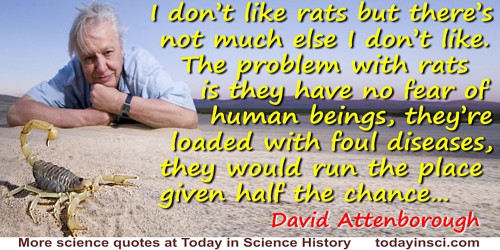
I don’t like rats but there’s not much else I don’t like. The problem with rats is they have no fear of human beings, they’re loaded with foul diseases, they would run the place given half the chance…
Interview by Simon Gage in 'David Attenborough: I’m not an animal lover', Metro newspaper (29 Jan 2013, London).
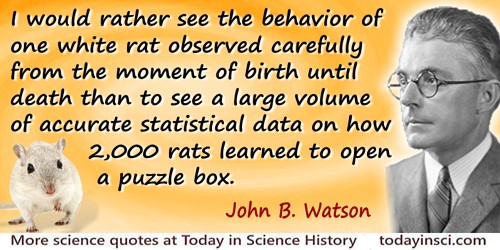
I would rather see the behavior of one white rat observed carefully from the moment of birth until death than to see a large volume of accurate statistical data on how 2,000 rats learned to open a puzzle box.
Introduction to G. V. Hamilton and Kenneth Macgowan, What Is Wrong with Marriage? (1929), xx.
If this [human kind’s extinction] happens I venture to hope that we shall not have destroyed the rat, an animal of considerable enterprise which stands as good a chance as any … of evolving toward intelligence.
In The Inequality of Man: And Other Essays (1937), 143.
If you confine yourself to this Skinnerian technique, you study nothing but the learning apparatus and you leave out everything that is different in octopi, crustaceans, insects and vertebrates. In other words, you leave out everything that makes a pigeon a pigeon, a rat a rat, a man a man, and, above all, a healthy man healthy and a sick man sick.
'Some Psychological Concepts and Issues. A Discussion between Konrad Lorenz and Richard I Evans'. In Richard I. Evans, Konrad Lorenz: The Man and his Ideas (1975), 60.
In 1810, the Triumph man-of-war and Phipps schooner received on board several tons of quicksilver, saved from the wreck of a vessel near Cadiz. In consequence of the rolling of the bags the mercury escaped, and the whole of the crews became more or less affected. In the space of three weeks, two hundred men were salivated, two died, and all the animals—cats, dogs, sheep, fowls, a canary bird, nay, even the rats, mice and cockroaches were destroyed.
[The leather bags of mercury had been salvaged and stored without the original wooden cases. Some were stowed in sleeping quarters, and the in same hold as spirit rations.]
[The leather bags of mercury had been salvaged and stored without the original wooden cases. Some were stowed in sleeping quarters, and the in same hold as spirit rations.]
The Edinburgh Medical And Surgical Journal, 6. Quoted in Alva Curtis, A Fair Examination and Criticism of All the Medical Systems in Vogue (1855), 38. For more information on the incident, see John Emsley, The Elements of Murder (2006), 38-9.
In the world of science different levels of esteem are accorded to different kinds of specialist. Mathematicians have always been eminently respectable, and so are those who deal with hard lifeless theories about what constitutes the physical world: the astronomers, the physicists, the theoretical chemists. But the more closely the scientist interests himself in matters which are of direct human relevance, the lower his social status. The real scum of the scientific world are the engineers and the sociologists and the psychologists. Indeed, if a psychologist wants to rate as a scientist he must study rats, not human beings. In zoology the same rules apply. It is much more respectable to dissect muscle tissues in a laboratory than to observe the behaviour of a living animal in its natural habitat.
From transcript of BBC radio Reith Lecture (12 Nov 1967), 'A Runaway World', on the bbc.co.uk website.
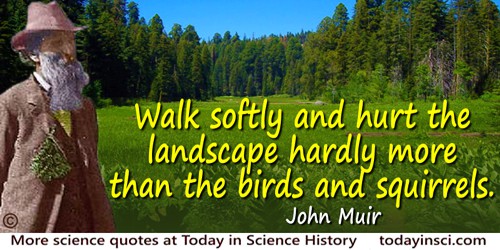
Indians walk softly and hurt the landscape hardly more than the birds and squirrels, and their brush and bark huts last hardly longer than those of wood rats, while their more enduring monuments, excepting those wrought on the forests by the fires they made to improve their hunting grounds, vanish in a few centuries.
In My First Summer in the Sierra (1911), 73. Based on Muir’s original journals and sketches of his 1869 stay in the Sierra.
Infectious disease is one of the few genuine adventures left in the world. The dragons are all dead and the lance grows rusty in the chimney corner. ... About the only sporting proposition that remains unimpaired by the relentless domestication of a once free-living human species is the war against those ferocious little fellow creatures, which lurk in dark corners and stalk us in the bodies of rats, mice and all kinds of domestic animals; which fly and crawl with the insects, and waylay us in our food and drink and even in our love
Rats, Lice and History (1935)
Intelligence is a valuable thing, but it is not usually the key to survival. Sheer fecundity ... usually counts. The intelligent gorilla doesn't do as well as the less intelligent but more-fecund rat, which doesn't do as well as the still-less-intelligent but still-more-fecund cockroach, which doesn't do as well as the minimally-intelligent but maximally-fecund bacterium.
'Fifty Million Big Brothers'. The Magazine of Fantasy and Science Fiction (Nov 1978), 55, No. 5, 93.
Is no one inspired by our present picture of the universe? This value of science remains unsung by singers: you are reduced to hearing not a song or poem, but an evening lecture about it. This is not yet a scientific age.
Perhaps one of the reasons for this silence is that you have to know how to read music. For instance, the scientific article may say, “The radioactive phosphorus content of the cerebrum of the rat decreases to one-half in a period of two weeks.” Now what does that mean?
It means that phosphorus that is in the brain of a rat—and also in mine, and yours—is not the same phosphorus as it was two weeks ago. It means the atoms that are in the brain are being replaced: the ones that were there before have gone away.
So what is this mind of ours: what are these atoms with consciousness? Last week’s potatoes! They now can remember what was going on in my mind a year ago—a mind which has long ago been replaced. To note that the thing I call my individuality is only a pattern or dance, that is what it means when one discovers how long it takes for the atoms of the brain to be replaced by other atoms. The atoms come into my brain, dance a dance, and then go out—there are always new atoms, but always doing the same dance, remembering what the dance was yesterday.
Perhaps one of the reasons for this silence is that you have to know how to read music. For instance, the scientific article may say, “The radioactive phosphorus content of the cerebrum of the rat decreases to one-half in a period of two weeks.” Now what does that mean?
It means that phosphorus that is in the brain of a rat—and also in mine, and yours—is not the same phosphorus as it was two weeks ago. It means the atoms that are in the brain are being replaced: the ones that were there before have gone away.
So what is this mind of ours: what are these atoms with consciousness? Last week’s potatoes! They now can remember what was going on in my mind a year ago—a mind which has long ago been replaced. To note that the thing I call my individuality is only a pattern or dance, that is what it means when one discovers how long it takes for the atoms of the brain to be replaced by other atoms. The atoms come into my brain, dance a dance, and then go out—there are always new atoms, but always doing the same dance, remembering what the dance was yesterday.
'What do You Care What Other People Think?' Further Adventures of a Curious Character (1988), 244.
It is the wisdom of rats, that will be sure to leave a house somewhat before it fall.
From essay, 'Of Wisdom for a Man’s Self'. As collected and translated in The Works of Francis Bacon (1765), Vol. 1, 479.
Mathematics is the science of the functional laws and transformations which enable us to convert figured extension and rated motion into number.
In 'The Departments of Mathematics, and their Mutual Relations', Journal of Speculative Philosophy (Apr 1871), 5, No. 2, 170.
Obvious facts are apt to be over-rated. System-makers see the gravitation of history, and fail to observe its chemistry, of greater though less evident power.
From chapter 'Jottings from a Note-book', in Canadian Stories (1918), 179.
Scientists were rated as great heretics by the church, but they were truly religious men because of their faith in the orderliness of the universe.
…...
The argument of the ‘long view’ may be correct in some meaninglessly abstract sense, but it represents a fundamental mistake in categories and time scales. Our only legitimate long view extends to our children and our children’s children’s children–hundreds or a few thousands of years down the road. If we let the slaughter continue, they will share a bleak world with rats, dogs, cockroaches, pigeons, and mosquitoes. A potential recovery millions of years later has no meaning at our appropriate scale.
…...
The growth curves of the famous Hopkins' rats are familiar to anyone who has ever opened a textbook of physiology. One recalls the proud ascendant curve of the milk-fed group which suddenly turns downwards as the milk supplement is removed, and the waning curve of the other group taking its sudden milk-assisted upward spring, until it passes its fellow now abruptly on the decline. 'Feeding experiments illustrating the importance of accessory factors in normal dietaries', Jour. Physiol., 1912, xliv, 425, ranks aesthetically beside the best stories of H. G. Wells.
Vitamins and Other Dietary Essentials (1933), 46.
The rat, the mouse, the fox, the rabbit, watch the roots; the lion, the tiger, the horse, the elephant the fruits.
In 'Proverbs', The Poems: With Specimens of the Prose Writings of William Blake (1885), 279.
The research rat of the future allows experimentation without manipulation of the real world. This is the cutting edge of modeling technology.
…...
The value the world sets upon motives is often grossly unjust and inaccurate. Consider, for example, two of them: mere insatiable curiosity and the desire to do good. The latter is put high above the former, and yet it is the former that moves some of the greatest men the human race has yet produced: the scientific investigators. What animates a great pathologist? Is it the desire to cure disease, to save life? Surely not, save perhaps as an afterthought. He is too intelligent, deep down in his soul, to see anything praiseworthy in such a desire. He knows by life-long observation that his discoveries will do quite as much harm as good, that a thousand scoundrels will profit to every honest man, that the folks who most deserve to be saved will probably be the last to be saved. No man of self-respect could devote himself to pathology on such terms. What actually moves him is his unquenchable curiosity–his boundless, almost pathological thirst to penetrate the unknown, to uncover the secret, to find out what has not been found out before. His prototype is not the liberator releasing slaves, the good Samaritan lifting up the fallen, but the dog sniffing tremendously at an infinite series of rat-holes.
In 'Types of Men: The Scientist', Prejudices (1923), 269-70.
There is a huge disconnect. Those living in the most urbanised areas don’t see a wild thing from one day to the next—unless it’s a pigeon or a rat. If you lose the connection with nature, you lose a source of great pleasure.
Lamenting Britain’s urbanized population is increasingly separated from the natural world. As reported by Adam Lusher in 'Sir David Attenborough', Daily Mail (28 Feb 2014).
There is more to biology than rats, Drosophila, Caenorhabditis, and E. coli.
Concluding remarks in Foreword written by Mayr for Lynn Margulis and Dorion Sagan, Acquiring Genomes: A Theory of the Origins of Species (2003), xiv.
To my deep mortification my father once said to me, “You care for nothing but shooting, dogs, and rat-catching, and you will be a disgrace to yourself and all your family.”
Despite this, perhaps rare, angry or unjust outburst, Darwin regarded his father as “the kindest man I ever knew and whose memory I love with all my heart.” In Charles Darwin and Francis Darwin (ed.), 'Autobiography', The Life and Letters of Charles Darwin (1887, 1896), Vol. 1, 30.
We already have anions and cations and now the biochemists and nutritionists are speaking of rat-ions.
Quoted in Ralph Oesper, The Human Side of Scientists (1975), 106.
We starve the rats, creosote the ticks, swat the flies, step on the cockroaches and poison the scales. Yet when these pests appear in human form we go paralytic.
What animates a great pathologist? Is it the desire to cure disease, to save life? Surely not, save perhaps as an afterthought. He is too intelligent, deep in his soul, to see anything praiseworthy in such a desire. He knows from life-long observation that his discoveries will do quite as much harm as good, that a thousand scoundrels will profit to every honest man, that the folks who most deserve to be saved will probably be the last to be saved. ... What actually moves him is his unquenchable curiosity—his boundless, almost pathological thirst to penetrate the unknown, to uncover the secret, to find out what has not been found out before. ... [like] the dog sniffing tremendously at an infinite series of rat-holes. ... And yet he stands in the very front rank of the race
In 'The Scientist', Prejudices: third series (1922), 269-70.
You are literally filled with the fruit of your own devices, with rats and mice and such small deer, paramecia, and entomostraceæ, and kicking things with horrid names, which you see in microscopes at the Polytechnic, and rush home and call for brandy—without the water—stone, and gravel, and dyspepsia, and fragments of your own muscular tissue tinged with your own bile.
'The Water Supply of London', North British Review (1851), 15, 246
 In science it often happens that scientists say, 'You know that's a really good argument; my position is mistaken,' and then they would actually change their minds and you never hear that old view from them again. They really do it. It doesn't happen as often as it should, because scientists are human and change is sometimes painful. But it happens every day. I cannot recall the last time something like that happened in politics or religion.
(1987) --
In science it often happens that scientists say, 'You know that's a really good argument; my position is mistaken,' and then they would actually change their minds and you never hear that old view from them again. They really do it. It doesn't happen as often as it should, because scientists are human and change is sometimes painful. But it happens every day. I cannot recall the last time something like that happened in politics or religion.
(1987) --