Rare Quotes (97 quotes)
… the truth is that the knowledge of external nature and of the sciences which that knowledge requires or includes, is not the great or the frequent business of the human mind. Whether we provide for action or conversation, whether we wish to be useful or pleasing, the first requisite is the religious and moral knowledge of right and wrong; the next is an acquaintance with the history of mankind, and with those examples which may be said to embody truth, and prove by events the reasonableness of opinions. Prudence and justice are virtues, and excellencies, of all times and of all places; we are perpetually moralists, but we are geometricians only by chance. Our intercourse with intellectual nature is necessary; our speculations upon matter are voluntary, and at leisure. Physical knowledge is of such rare emergence, that one man may know another half his life without being able to estimate his skill in hydrostatics or astronomy; but his moral and prudential character immediately appears.
In Lives of the Poets (1779-81).
...the need for a garden of rare palms and vines and ornamental trees and shrubs which would be near enough to a growing city to form a quiet place where children with their elders could peer, as it were, into those fascinating jungles and palm glades of the tropics which have for generations stimulated the imaginations of American youth.
[About Sir Roderick Impey Murchison:] The enjoyments of elegant life you early chose to abandon, preferring to wander for many successive years over the rudest portions of Europe and Asia—regions new to Science—in the hope, happily realized, of winning new truths.
By a rare union of favourable circumstances, and of personal qualifications equally rare, you have thus been enabled to become the recognized Interpreter and Historian (not without illustrious aid) of the Silurian Period.
By a rare union of favourable circumstances, and of personal qualifications equally rare, you have thus been enabled to become the recognized Interpreter and Historian (not without illustrious aid) of the Silurian Period.
Dedication page in Thesaurus Siluricus: The Flora and Fauna of the Silurian Period (1868), iv.
Nunc naturalem causam quaerimus et assiduam, non raram fortuitam.
Now we are looking for a natural and constant cause, not a rare and accidental one.
Now we are looking for a natural and constant cause, not a rare and accidental one.
Found as an Epigraph on title page of John Playfair, Illustrations of the Huttonian Theory of the Earth (1802). The Latin form of this quote is found in 'Naturalium Questionum, Book 2', Oeuvres Complètes de Sénèque: Le Philosophe (1838), Vol. 8, 164. It is part of a discussion of the nature of thunder and lightning. A thought—that they are caused by fire extinguished in a cloud from a falling star—is dismissed with the statement in the quote.
~~[Orphan]~~ Perfect numbers like perfect men are very rare.
Appears without citation in Howard W. Eves, Mathematical Circles Squared (1972), 7, and it is noted with the fact that only 12 perfect numbers were known in Descartes’ time. Webmaster regards this as an orphan (better regarded as anonymous), and has so far been unable to trace a primary source in the work of Descartes. Can you help?
04.23 To lose by caution is rare indeed.
As translated by David Hinton in Analects (2014), Chap 4, 38.
A … difference between most system-building in the social sciences and systems of thought and classification of the natural sciences is to be seen in their evolution. In the natural sciences both theories and descriptive systems grow by adaptation to the increasing knowledge and experience of the scientists. In the social sciences, systems often issue fully formed from the mind of one man. Then they may be much discussed if they attract attention, but progressive adaptive modification as a result of the concerted efforts of great numbers of men is rare.
The Study of Man (1941), 19-20.

A disease which new and obscure to you, Doctor, will be known only after death; and even then not without an autopsy will you examine it with exacting pains. But rare are those among the extremely busy clinicians who are willing or capable of doing this correctly.
In Atrocis, nee Descipti Prius, Morbi Historia as translated in Bulletin of the Medical Library Association (1944), 43, 217.
A perfectly normal person is rare in our civilization.
Quoted in obituary, Time magazine (15 Dec 1952).
After all, we scientific workers … like women, are the victims of fashion: at one time we wear dissociated ions, at another electrons; and we are always loth to don rational clothing; some fixed belief we must have manufactured for us: we are high or low church, of this or that degree of nonconformity, according to the school in which we are brought up—but the agnostic is always rare of us and of late years the critic has been taboo.
'The Thirst of Salted Water or the Ions Overboard', Science Progress (1909), 3, 643.
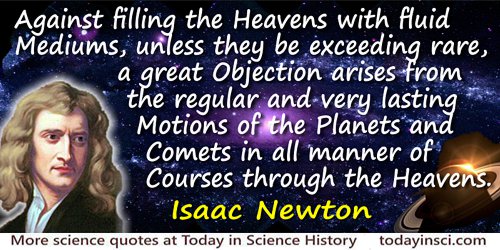
Against filling the Heavens with fluid Mediums, unless they be exceeding rare, a great Objection arises from the regular and very lasting Motions of the Planets and Comets in all manner of Courses through the Heavens.
From Opticks: Or, A Treatise of the Reflections, Refractions, Inflections and Colours of Light (1718), 339.
Amputations are much less frequent now than formerly, and there is little doubt that, in the present rapid advance in the science of surgery, and the greater perfection in its art, the time is not far removed when amputations for other cause than gangrene will be comparatively rare.
In A Text-Book on Surgery: General, Operative, and Mechanical (1887), 104.
And how admirable and rare an ornament, O good God, is mildenesse in a divine? And how much is it to be wished in this age, that all divines were mathematicians? that is men gentle and meeke.
Trigonometria (1595), trans. R. Handson (1614), Epistle Dedicatorie.
At the entrance to the observatory Stjerneborg located underground, Tycho Brahe built a Ionic portal. On top of this were three sculptured lions. On both sides were inscriptions and on the backside was a longer inscription in gold letters on a porfyr stone: Consecrated to the all-good, great God and Posterity. Tycho Brahe, Son of Otto, who realized that Astronomy, the oldest and most distinguished of all sciences, had indeed been studied for a long time and to a great extent, but still had not obtained sufficient firmness or had been purified of errors, in order to reform it and raise it to perfection, invented and with incredible labour, industry, and expenditure constructed various exact instruments suitable for all kinds of observations of the celestial bodies, and placed them partly in the neighbouring castle of Uraniborg, which was built for the same purpose, partly in these subterranean rooms for a more constant and useful application, and recommending, hallowing, and consecrating this very rare and costly treasure to you, you glorious Posterity, who will live for ever and ever, he, who has both begun and finished everything on this island, after erecting this monument, beseeches and adjures you that in honour of the eternal God, creator of the wonderful clockwork of the heavens, and for the propagation of the divine science and for the celebrity of the fatherland, you will constantly preserve it and not let it decay with old age or any other injury or be removed to any other place or in any way be molested, if for no other reason, at any rate out of reverence to the creator’s eye, which watches over the universe. Greetings to you who read this and act accordingly. Farewell!
(Translated from the original in Latin)
Being also in accord with Goethe that discoveries are made by the age and not by the individual, I should consider the instances to be exceedingly rare of men who can be said to be living before their age, and to be the repository of knowledge quite foreign to the thought of the time. The rule is that a number of persons are employed at a particular piece of work, but one being a few steps in advance of the others is able to crown the edifice with his name, or, having the ability to generalise already known facts, may become in time to be regarded as their originator. Therefore it is that one name is remembered whilst those of coequals have long been buried in obscurity.
In Historical Notes on Bright's Disease, Addison's Disease, and Hodgkin's Disease', Guy's Hospital Reports (1877), 22, 259-260.
Both died, ignored by most; they neither sought nor found public favour, for high roads never lead there. Laurent and Gerhardt never left such roads, were never tempted to peruse those easy successes which, for strongly marked characters, offer neither allure nor gain. Their passion was for the search for truth; and, preferring their independence to their advancement, their convictions to their interests, they placed their love for science above that of their worldly goods; indeed above that for life itself, for death was the reward for their pains. Rare example of abnegation, sublime poverty that deserves the name nobility, glorious death that France must not forget!
'Éloge de Laurent et Gerhardt', Moniteur Scientifique (1862), 4, 473-83, trans. Alan J. Rocke.
But I think that in the repeated and almost entire changes of organic types in the successive formations of the earth—in the absence of mammalia in the older, and their very rare appearance (and then in forms entirely. unknown to us) in the newer secondary groups—in the diffusion of warm-blooded quadrupeds (frequently of unknown genera) through the older tertiary systems—in their great abundance (and frequently of known genera) in the upper portions of the same series—and, lastly, in the recent appearance of man on the surface of the earth (now universally admitted—in one word, from all these facts combined, we have a series of proofs the most emphatic and convincing,—that the existing order of nature is not the last of an uninterrupted succession of mere physical events derived from laws now in daily operation: but on the contrary, that the approach to the present system of things has been gradual, and that there has been a progressive development of organic structure subservient to the purposes of life.
'Address to the Geological Society, delivered on the Evening of the 18th of February 1831', Proceedings of the Geological Society (1834), 1, 305-6.
But no pursuit at Cambridge was followed with nearly so much eagerness or gave me so much pleasure as collecting beetles. It was the mere passion for collecting, for I did not dissect them, and rarely compared their external characters with published descriptions, but got them named anyhow. I will give a proof of my zeal: one day, on tearing off some old bark, I saw two rare beetles, and seized one in each hand; then I saw a third and new kind, which I could not bear to lose, so that I popped the one which I held in my right hand into my mouth. Alas! it ejected some intensely acrid fluid, which burnt my tongue so that I was forced to spit the beetle out, which was lost, as was the third one.
In Charles Darwin and Francis Darwin (ed.), Charles Darwin: His Life Told in an Autobiographical Chapter, and in a Selected Series of His Published Letters (1892), 20.
Common sense is as rare as genius—is the basis of genius and experience is the hands and feet to every enterprise.
In essay, 'Experience', Essays: Second Series (1844), collected in Works of Ralph Waldo Emerson: Essays First and Second Series (1883), 97. A half-century later, Arthur Handly Marks incorporated the quote (without attribution) as “a first-rate article of common sense is as rare as genius”, in his Address (6 Jun 1892), 'Common Sense' at the Commencement of Prior Institute, Jasper, Tennessee, collected in Igerne and Other Writings of Arthur Handly Marks (1897), 348.
Common sense needs to be renamed
Cause nowadays it’s rare.
Cause nowadays it’s rare.
From lyrics, 'Jme', on album Blam! (Released 4 Oct 2010).
Counting stars by candlelight all are dim but one is bright; the spiral light of Venus rising first and shining best, from the northwest corner of a brand-new crescent moon crickets and cicadas sing a rare and different tune.
Terrapin Station
Everyone has talent. What is rare is the courage to follow that talent to dark place where it leads.
…...
Except for the rare cases of plastid inheritance, the inheritance of all known characters can be sufficiently accounted for by the presence of genes in the chromosomes. In a word the cytoplasm may be ignored genetically.
In 'Genetics and the Physiology of Development', The American Naturalist (1926), 60, 491.
Genius is less rare than the touchstone by which to test it.
Maxim 319 in Maxims for a Modern Man (1965), 47.
Geometric writings are not rare in which one would seek in vain for an idea at all novel, for a result which sooner or later might be of service, for anything in fact which might be destined to survive in the science; and one finds instead treatises on trivial problems or investigations on special forms which have absolutely no use, no importance, which have their origin not in the science itself but in the caprice of the author; or one finds applications of known methods which have already been made thousands of times; or generalizations from known results which are so easily made that the knowledge of the latter suffices to give at once the former. Now such work is not merely useless; it is actually harmful because it produces a real incumbrance in the science and an embarrassment for the more serious investigators; and because often it crowds out certain lines of thought which might well have deserved to be studied.
From 'On Some Recent Tendencies in Geometric Investigations', Rivista di Matematica (1891), 43. In Bulletin American Mathematical Society (1904), 443.
Having always observed that most of them who constantly took in the weekly Bills of Mortality made little other use of them than to look at the foot how the burials increased or decreased, and among the Casualties what had happened, rare and extraordinary, in the week current; so as they might take the same as a Text to talk upon in the next company, and withal in the Plague-time, how the Sickness increased or decreased, that the Rich might judg of the necessity of their removal, and Trades-men might conjecture what doings they were likely to have in their respective dealings.
From Natural and Political Observations Mentioned in a Following Index and Made upon Bills of Mortality (1662), Preface. Reproduced in Cornelius Walford, The Insurance Cyclopaedia (1871), Vol. 1, 286. Italicizations from another source.
He [Robert Boyle] is very tall (about six foot high) and straight, very temperate, and vertuouse, and frugall: a batcheler; keepes a Coach; sojournes with his sister, the Lady Ranulagh. His greatest delight is Chymistrey. He has at his sister’s a noble laboratory, and severall servants (Prentices to him) to look to it. He is charitable to ingeniose men that are in want, and foreigne Chymists have had large proofe of his bountie, for he will not spare for cost to get any rare Secret.
John Aubrey, Brief Lives (1680), edited by Oliver Lawson Dick (1949), 37.
Here are the most important pieces of advice that I’ve passed on to my children. One, remember to look up at the stars and not down at your feet. Two, never give up work. Work gives you meaning and purpose and life is empty without it. Three, if you are lucky enough to find love, remember it is rare and don’t throw it away.
From Interview with Diane Sawyer on ABC TV, World News Tonight (2010). As quoted in 'The Most Important Pieces of Advice Stephen Hawking Gave to his Children' (14 Mar 2018), on abcnews.go.com webpage.
I attained a triumph so complete that it is now rare to meet an American with marks of small pox on his face... Benefits are valuable according to their duration and extent, like the showers from heaven, but the benign remedy Vaccination saves millions of lives every century, like the blessing of the sun, universal and everlasting.
(Remark made near the end of his life.)
(Remark made near the end of his life.)
I know, indeed, and can conceive of no pursuit so antagonistic to the cultivation of the oratorical faculty … as the study of Mathematics. An eloquent mathematician must, from the nature of things, ever remain as rare a phenomenon as a talking fish, and it is certain that the more anyone gives himself up to the study of oratorical effect the less will he find himself in a fit state to mathematicize.
In Address (22 Feb 1877) for Commemoration Day at Johns Hopkins University. Published as a pamphlet, and reprinted in The Collected Mathematical Papers of James Joseph Sylvester: (1870-1883) (1909), Vol. 3, 72.
https://books.google.com/books?id=wgVbAAAAQAAJ
James Joseph Sylvester - 1877
I must … explain how I was led to concern myself with the pathogenic protozoa. … I was sent to Algeria and put in charge of a department of the hospital at Bone. A large number of my patients had malarial fevers and I was naturally led to study these fevers of which I had only seen rare and benign forms in France.
From Nobel Lecture (11 Dec 1907), 'Protozoa as Causes of Diseases', collected in Nobel Lectures, Physiology or Medicine 1901-1921 (1967, 1999), 264.
I think it would be a very rash presumption to think that nowhere else in the cosmos has nature repeated the strange experiment which she has performed on earth—that the whole purpose of creation has been staked on this one planet alone. It is probable that dotted through the cosmos there are other suns which provide the energy for life to attendant planets. It is apparent, however, that planets with just the right conditions of temperature, oxygen, water and atmosphere necessary for life are found rarely.
But uncommon as a habitable planet may be, non-terrestrial life exists, has existed and will continue to exist. In the absence of information, we can only surmise that the chance that it surpasses our own is as good as that it falls below our level.
But uncommon as a habitable planet may be, non-terrestrial life exists, has existed and will continue to exist. In the absence of information, we can only surmise that the chance that it surpasses our own is as good as that it falls below our level.
As quoted by H. Gordon Garbedian in 'Ten Great Riddles That Call For Solution by Scientists', New York Times (5 Oct 1930), XX4. Garbedian gave no citation to a source for Shapley’s words. However, part of this quote is very similar to that of Sir Arthur Eddington: “It would indeed be rash to assume that nowhere else has Nature repeated the strange experiment which she has performed on the earth,” from 'Man’s Place in the Universe', Harper’s Magazine (Oct 1928), 157 573.
In geometry, as in most sciences, it is very rare that an isolated proposition is of immediate utility. But the theories most powerful in practice are formed of propositions which curiosity alone brought to light, and which long remained useless without its being able to divine in what way they should one day cease to be so. In this sense it may be said, that in real science, no theory, no research, is in effect useless.
In 'Geometry', A Philosophical Dictionary, (1881), Vol. l, 374.
In my youth I regarded the universe as an open book, printed in the language of physical equations, whereas now it appears to me as a text written in invisible ink, of which in our rare moments of grace we are able to decipher a small fragment.
From Epilogue in Bricks to Babel (1980).
In science it often happens that scientists say, “You know that's a really good argument; my position is mistaken,” and then they would actually change their minds and you never hear that old view from them again. They really do it. It doesn't happen as often as it should, because scientists are human and change is sometimes painful. But it happens every day. I cannot recall the last time something like that happened in politics or religion. It’s very rare that a senator, say, replies, “That’s a good argument. I will now change my political affiliation.”
From keynote address at CSICOP conference, Pasadena, California (3 Apr 1987). Printed in 'The Burden of Skepticism', Skeptical Inquirer (1987), 12, No. 1. Collected in Kendrick Frazier (ed.), The Hundredth Monkey: And Other Paradigms of the Paranormal (1991), 5.
In the last two months I have been very busy with my own mathematical speculations, which have cost me much time, without my having reached my original goal. Again and again I was enticed by the frequently interesting prospects from one direction to the other, sometimes even by will-o'-the-wisps, as is not rare in mathematic speculations.
Letter to Ernst Weber (21 May 1843). Quoted in G. Waldo Dunnington, Carl Friedrich Gauss: Titan of Science (2004), 416.
It is a good principle in science not to believe any “fact”—however well attested—until it fits into some accepted frame of reference. Occasionally, of course, an observation can shatter the frame and force the construction of a new one, but that is extremely rare. Galileos and Einsteins seldom appear more than once per century, which is just as well for the equanimity of mankind.
In Opening of Chap 14, 'Search', 2061: Odyssey Three (1987, 1989), 62.
It is both a sad and a happy fact of engineering history that disasters have been powerful instruments of change. Designers learn from failure. Industrial society did not invent grand works of engineering, and it was not the first to know design failure. What it did do was develop powerful techniques for learning from the experience of past disasters. It is extremely rare today for an apartment house in North America, Europe, or Japan to fall down. Ancient Rome had large apartment buildings too, but while its public baths, bridges and aqueducts have lasted for two thousand years, its big residential blocks collapsed with appalling regularity. Not one is left in modern Rome, even as ruin.
In Why Things Bite Back: Technology and the Revenge of Unintended Consequences (1997), 23.
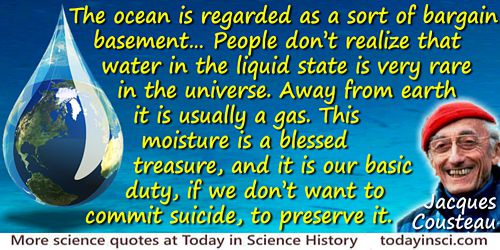
It is fashionable nowadays to talk about the endless riches of the sea. The ocean is regarded as a sort of bargain basement, but I don’t agree with that estimate. People don’t realize that water in the liquid state is very rare in the universe. Away from earth it is usually a gas. This moisture is a blessed treasure, and it is our basic duty, if we don’t want to commit suicide, to preserve it.
As quoted by Nancy Hicks in 'Cousteau’s Philosophy of the Sea Helps Him Get Another Medal', New York Times (25 Oct 1970), 54.
It is only in mathematics, and to some extent in poetry, that originality may be attained at an early age, but even then it is very rare (Newton and Keats are examples), and it is not notable until adolescence is completed.
In A Study of British Genius (1904), 142
It is rare enough that a scientist sheds light on an area which nature has kept secret and then during his lifetime, sees that area illuminate in turn every corner of physiology and medicine. It is rarer still that one man can contribute concurrently almost as much to several other biological fields as well. That meanwhile he [August Krogh] should develop in addition a large school of devoted students who loved the man even more, if possible, than they venerated the scientist, spells the highest form of genius.
Commemorative words presented to the American Physiological Society (1950), describing Eugene Landis, his friend and colleague at Harvard University. As quoted and cited in Bodil Schmidt-Nielsen, August and Marie Krogh: Lives in Science (2013), 4.
It is said, sometimes, that common sense is very rare.
From the original French, “On dit quelquefois, Le sens commun est fort rare.” in Dictionnaire Philosophique Portatif (1765), New Edition, Vol. 2, 276. As, translated in A Philosophical Dictionary: From the French of M. de Voltaire (1824), Vol. 2, 242.
It makes me feel both proud and rather humble that it shall be called Lonsdaleite. Certainly the name seems appropriate since the mineral only occurs in very small quantities (perhaps rare would be too flattering) and it is generally rather mixed up!
From Letter to Clifford Frondel, who had named a meteoritic form of diamond after Lonsdale (a petite person). As quoted in Maureen M. Julian, 'Women in Crystallography', in G. Kass-Simon and P. Farnes (eds.), Women of Science: Righting the Record (1990), 356.
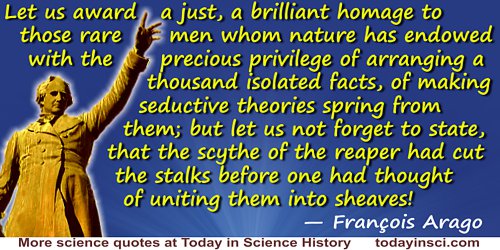
Let us award a just, a brilliant homage to those rare men whom nature has endowed with the precious privilege of arranging a thousand isolated facts, of making seductive theories spring from them; but let us not forget to state, that the scythe of the reaper had cut the stalks before one had thought of uniting them into sheaves!
In François Arago, trans. by William Henry Smyth, Baden Powell and Robert Grant, 'Fourier', Biographies of Distinguished Scientific Men (1859), Vol. 1, 409.
Let us not be exacting; perfection is so rare.
From Appendix A, 'Extracts From the Unpublished Writings of Carnot', Reflections on the Motive Power of Heat (1890, 2nd ed. 1897), 209.
Life is not a miracle. It is a natural phenomenon, and can be expected to appear whenever there is a planet whose conditions duplicate those of the earth.
[Stating his belief that planets supporting life cannot be rare.]
[Stating his belief that planets supporting life cannot be rare.]
Lecture at New York Academy of Medicine. Quoted in article, 'Life Begins,' Time (24 Nov 1952).
Man is merely a frequent effect, a monstrosity is a rare one, but both are equally natural, equally inevitable, equally part of the universal and general order. And what is strange about that? All creatures are involved in the life of all others, consequently every species... all nature is in a perpetual state of flux. Every animal is more or less a human being, every mineral more or less a plant, every plant more or less an animal... There is nothing clearly defined in nature.
D'Alembert's Dream (1769), in Rameau's Nephew and D' Alembert's Dream, trans. Leonard Tancock (Penguin edition 1966), 181.
Marly 30 July 1705. From all I hear of Leibniz he must be very intelligent, and pleasant company in consequence. It is rare to find learned men who are clean, do not stink and have a sense of humour.
From Letter (30 Jul 1705), to Sophie of Hanover, in Maria Kroll (trans.), Letters from Liselotte: Elisabeth-Charlotte, Princess Palatine and Duchess of Orléans, "Madame" 1652-1722 (1970), 131. Also seen in Alan L. MacKay, A Dictionary of Scientific Quotations (1991), 175. Also seen attributed to Charles-Louis de Secondat Montesquieu, in Alan L. MacKay, Dictionary of Scientific Quotations (1977), 175, citing Letter LXVI (30 Jul 1705) in Les Lettres Persanes. However, Webmaster does not find this quote when looking at Letter LXVI in Les Lettres Persanes (1721), text prepared by André Lefèvre (1873). (Can you help).
Mathematical studies … when combined, as they now generally are, with a taste for physical science, enlarge infinitely our views of the wisdom and power displayed in the universe. The very intimate connexion indeed, which, since the date of the Newtonian philosophy, has existed between the different branches of mathematical and physical knowledge, renders such a character as that of a mere mathematician a very rare and scarcely possible occurrence.
In Elements of the Philosophy of the Human Mind (1827), Vol. 3, Chap. 1, Sec. 3, 184.
Measurement has too often been the leitmotif of many investigations rather than the experimental examination of hypotheses. Mounds of data are collected, which are statistically decorous and methodologically unimpeachable, but conclusions are often trivial and rarely useful in decision making. This results from an overly rigorous control of an insignificant variable and a widespread deficiency in the framing of pertinent questions. Investigators seem to have settled for what is measurable instead of measuring what they would really like to know.
'Patient Care—Mystical Research or Researchable Mystique/', Clinical Research (1964), 12, no. 4, 422.
Mineral substances vary greatly in color, transparency, luster, brilliance, odor, taste, and other properties which are shown by their strength and weakness, shape, and form. They do not have the variety of origins that we find not only in living matter but also in original matter. Moreover they have not been classified like the latter on the basis of the place where they pass their life since mineral substances lack life and with rare exceptions are found only within the earth. They do not have the differences in characters and actions which nature has given to living things alone. Great differences are not the essential features of minerals as they are of living and original matter.
De Natura Fossilium (1546), trans. M. C. and J. A. Bandy (1955), 1.
Model-making, the imaginative and logical steps which precede the experiment, may be judged the most valuable part of scientific method because skill and insight in these matters are rare. Without them we do not know what experiment to do. But it is the experiment which provides the raw material for scientific theory. Scientific theory cannot be built directly from the conclusions of conceptual models.
Introduction to the Study of Animal Population (1961), 181.
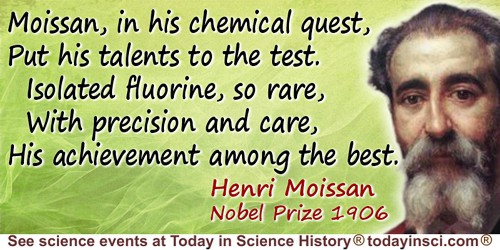
Moissan, in his chemical quest,
Put his talents to the test.
Isolated fluorine, so rare,
With precision and care,
His achievement among the best.
Put his talents to the test.
Isolated fluorine, so rare,
With precision and care,
His achievement among the best.
Limerick by Artificial Intelligence, without any edits. Prompt by Webmaster: “Write a limerick about Henri Moissan isolating fluorine as an element.” (20 Feb 2024)
My life has been filled with adventures linked together like pearls on a thread. Pearls rarely turn up in oysters served to you on a plate; you have to dive for them.
In 'Foreword to the 35th Anniversary Edition', Kon-Tiki: Across the Pacific by Raft (1990), xi.
Nature! … Incessant life, development, and movement are in her, but she advances not. She changes for ever and ever, and rests not a moment. Quietude is inconceivable to her, and she has laid her curse upon rest. She is firm. Her steps are measured, her exceptions rare, her laws unchangeable.
As quoted by T.H. Huxley, in Norman Lockyer (ed.), 'Nature: Aphorisms by Goethe', Nature (1870), 1, 9.
Now of the difficulties bound up with the public in which we doctors work, I hesitate to speak in a mixed audience. Common sense in matters medical is rare, and is usually in inverse ratio to the degree of education.
'Teaching and Thinking' (1894). In Aequanimitas with Other Addresses to Medical Students, Nurses and Practitioners of Medicine (1904), 131.
Observation is so wide awake, and facts are being so rapidly added to the sum of human experience, that it appears as if the theorizer would always be in arrears, and were doomed forever to arrive at imperfect conclusion; but the power to perceive a law is equally rare in all ages of the world, and depends but little on the number of facts observed.
In A Week on the Concord and Merrimack Rivers (1862), 383.
Of what use are the great number of petrifactions, of different species, shape and form which are dug up by naturalists? Perhaps the collection of such specimens is sheer vanity and inquisitiveness. I do not presume to say; but we find in our mountains the rarest animals, shells, mussels, and corals embalmed in stone, as it were, living specimens of which are now being sought in vain throughout Europe. These stones alone whisper in the midst of general silence.
Philosophia Botanica (1751), aphorism 132. Trans. Frans A. Stafleu, Linnaeus and the Linnaeans: The Spreading of their Ideas in Systematic Botany, 1735-1789 (1971), 56.
On opening the incubator I experienced one of those rare moments of intense emotion which reward the research worker for all his pains: at first glance I saw that the broth culture, which the night before had been very turbid was perfectly clear: all the bacteria had vanished…as for my agar spread it was devoid of all growth and what caused my emotion was that in a flash I understood: what causes my spots was in fact an invisible microbe, a filterable virus, but a virus parasitic on bacteria. Another thought came to me also, If this is true, the same thing will have probably occurred in the sick man. In his intestine, as in my test-tube, the dysentery bacilli will have dissolved away under the action of their parasite. He should now be cured.
In Allan Chase, Magic Shots: A Human and Scientific Account of the Long and Continuing Struggle to Eradicated Infectious Diseases by Vaccination (1982), 249-250. Also in Allan J. Tobin and Jennie Dusheck, Asking About Life (2005), 206.
One wonders whether the rare ability to be completely attentive to, and to profit by, Nature’s slightest deviation from the conduct expected of her is not the secret of the best research minds and one that explains why some men turn to most remarkably good advantage seemingly trivial accidents. Behind such attention lies an unremitting sensitivity.
In The Furtherance of Medical Research (1941), 98.
Only rarely do we see beyond the needs of humanity. … Now that we are over six billion hungry and greedy individuals, all aspiring to a first-world lifestyle, our urban way of life encroaches upon the domain of the living Earth. We are taking so much that it is no longer able to sustain the familiar and comfortable world we have taken for granted. Now it is changing, according to its own internal rules, to a state where we are no longer welcome.
In The Revenge of Gaia: Earth’s Climate Crisis & The Fate of Humanity (2006, 2007), 9. The first sentence is a concept acknowledged to John Gray, Straw Dogs (2002).
Organization is simply the means by which the acts of ordinary men can be made to add up to extraordinary results. To this idea of progress that does not wait on some lucky break, some chance discovery, or some rare stroke of genius, but instead is achieved through systematic, cumulative effort, the engineer has contributed brilliantly.
In A Professional Guide for Young Engineers (1949, 1967), 36.
Rachel Carson. Her very name evokes the beatific luminosity of the canonized. Yet Carson was not a saint, but better, a prophet—that rare soul who diverts our attention into the path of the oncoming truth.
In his Foreward to Rachel Carson, The Sea Around Us (1950, 2003), xvi.
Science has now been for a long time—and to an ever-increasing extent—a collective enterprise. Actually, new results are always, in fact, the work of specific individuals; but, save perhaps for rare exceptions, the value of any result depends on such a complex set of interrelations with past discoveries and possible future researches that even the mind of the inventor cannot embrace the whole.
In Oppression and Liberty (1955, 1958), 109.
Science would be ruined if (like sports) it were to put competition above everything else, and if it were to clarify the rules of competition by withdrawing entirely into narrowly defined specialties. The rare scholars who are nomads-by-choice are essential to the intellectual welfare of the settled disciplines.
Appended to his entry in Who’s Who. In Alan Lindsay Mackay, A Dictionary of Scientific Quotations (1991), 163.
See with what force yon river’s crystal stream
Resists the weight of many a massy beam.
To sink the wood the more we vainly toil,
The higher it rebounds, with swift recoil.
Yet that the beam would of itself ascend
No man will rashly venture to contend.
Thus too the flame has weight, though highly rare,
Nor mounts but when compelled by heavier air.
Resists the weight of many a massy beam.
To sink the wood the more we vainly toil,
The higher it rebounds, with swift recoil.
Yet that the beam would of itself ascend
No man will rashly venture to contend.
Thus too the flame has weight, though highly rare,
Nor mounts but when compelled by heavier air.
De Rerum Natura, second book, as quoted in translation in Thomas Young, A Course of Lectures on Natural Philosophy and the Mechanical Arts (1845), 12.
Sheppey hath long been noted for producing large quantities of Sheep (whence probably its name is derived) as well as Corn; and exhibits to the Curious Naturalist a most desirable Spot, by affording many rare Plants, and more especially in the of its Northern Cliffs, so great a Quantity and Variety of Fossils, both native and extraneous are scarcely to be paralleled. These Cliffs length about six miles; Minster, Shurland and Warden are the Manors to which they appertain, the more elevated parts whereof reach about thirds of their extension, and are at the very highest of them not less than fifty yards perpendicular height above the Beach and Shore.
Quoted in Augustus A. Daly, History of the Isle of Sheppey (1975), 247.
Sir Mortimer Wheeler is perhaps the most distinguished archaeologist in Europe. But he owes the greatest of his achievements to the rare combination of two qualities: namely a scientific expertise in the technique of excavation which has always been marked by a meticulous attention to minute detail, and a gift of imaginative vision.
Book review of two books by Mortimer Wheeler, 'Achaeology From the Earth' and 'Rome Beyond the Imperial Frontiers', in Blackfriars (Jan 1955), 36, No. 418, 597-598.
So long as the fur of the beaver was extensively employed as a material for fine hats, it bore a very high price, and the chase of this quadruped was so keen that naturalists feared its speedy consideration. When a Parisian manufacturer invented the silk hat, which soon came into almost universal use, the demand for beavers' fur fell off, and this animal–whose habits, as we have seen, are an important agency in the formation of bogs and other modifications of forest nature–immediately began to increase, reappeared in haunts which we had long abandoned, and can no longer be regarded as rare enough to be in immediate danger of extirpation. Thus the convenience or the caprice of Parisian fashion has unconsciously exercised an influence which may sensibly affect the physical geography of a distant continent.
In Man and Nature, (1864), 84.
So-called extraordinary events always split into two extremes naturalists who have not witnessed them: those who believe blindly and those who do not believe at all. The latter have always in mind the story of the golden goose; if the facts lie slightly beyond the limits of their knowledge, they relegate them immediately to fables. The former have a secret taste for marvels because they seem to expand Nature; they use their imagination with pleasure to find explanations. To remain doubtful is given to naturalists who keep a middle path between the two extremes. They calmly examine facts; they refer to logic for help; they discuss probabilities; they do not scoff at anything, not even errors, because they serve at least the history of the human mind; finally, they report rather than judge; they rarely decide unless they have good evidence.
Quoted in Albert V. Carozzi, Histoire des sciences de la terre entre 1790 et 1815 vue à travers les documents inédités de la Societé de Physique et d'Histoire Naturelle de Genève, trans. Albert V. and Marguerite Carozzi. (1990), 175.
The anatomy of a little child, representing all parts thereof, is accounted a greater rarity than the skeleton of a man in full stature.
In The Church History of Britain (1842), Vol. 1, 165. Fuller’s context was to compare being studious in antiquity with after-ages when perfected.
The best class of scientific mind is the same as the best class of business mind. The great desideratum in either case is to know how much evidence is enough to warrant action. It is as unbusiness-like to want too much evidence before buying or selling as to be content with too little. The same kind of qualities are wanted in either case. The difference is that if the business man makes a mistake, he commonly has to suffer for it, whereas it is rarely that scientific blundering, so long as it is confined to theory, entails loss on the blunderer. On the contrary it very often brings him fame, money and a pension. Hence the business man, if he is a good one, will take greater care not to overdo or underdo things than the scientific man can reasonably be expected to take.
Samuel Butler, Henry Festing Jones (ed.), The Note-Books of Samuel Butler (1917), 217.
The eye which can appreciate the naked and absolute beauty of a scientific truth is far more rare than that which is attracted by a moral one.
In A Week on the Concord and Merrimack Rivers (1862), 381.
The frequent allegation that the selective processes in the human species are no longer 'natural' is due to persistence of the obsolete nineteenth-century concept of 'natural' selection. The error of this view is made clear when we ask its proponents such questions as, why should the 'surviving fittest' be able to withstand cold and inclement weather without the benefit of fire and clothing? Is it not ludicrous to expect selection to make us good at defending ourselves against wild beasts when wild beasts are getting to be so rare that it is a privilege to see one outside of a zoo? Is it necessary to eliminate everyone who has poor teeth when our dentists stand ready to provide us with artificial ones? Is it a great virtue to be able to endure pain when anaesthetics are available?
[Co-author with American statistician Gordon Allen]
[Co-author with American statistician Gordon Allen]
Theodosius Dobzhansky and Gordon Allen, 'Does Natural Selection Continue to Operate in Modern Mankind?', American Anthropologist, 1956, 58, 595.
The idea that aptitude for mathematics is rarer than aptitude for other subjects is merely an illusion which is caused by belated or neglected beginners.
In 'Umriss pädagogischer Vorlesungen', Werke [Kehrbach] (1902), Bd. 10, 101. As quoted, cited and translated in Robert Édouard Moritz, Memorabilia Mathematica; Or, The Philomath’s Quotation-Book (1914), 74.
The kind of lecture which I have been so kindly invited to give, and which now appears in book form, gives one a rare opportunity to allow the bees in one's bonnet to buzz even more noisily than usual.
From Assumption and Myth in Physical Theory (1967), v.
The largest land animal is the elephant, and it is the nearest to man in intelligence: it understands the language of its country and obeys orders, remembers duties that it has been taught, is pleased by affection and by marks of honour, nay more it possesses virtues rare even in man, honesty, wisdom, justice, also respect for the stars and reverence for the sun and moon.
Natural History, 8, I. Trans. H. Rackham, Pliny: Natural History (1947), Vol. 3, 3.
The noble science of Geology loses glory from the extreme imperfection of the record. The crust of the earth with its embedded remains must not be looked at as a well-filled museum, but as a poor collection made at hazard and at rare intervals.
From On the Origin of Species by Means of Natural Selection; or, The Preservation of Favoured Races in the Struggle for Life (1861), 423.
The observer is not he who merely sees the thing which is before his eyes, but he who sees what parts the thing is composed of. To do this well is a rare talent. One person, from inattention, or attending only in the wrong place, overlooks half of what he sees; another sets down much more than he sees, confounding it with what he imagines, or with what he infers; another takes note of the kind of all the circumstances, but being inexpert in estimating their degree, leaves the quantity of each vague and uncertain; another sees indeed the whole, but makes such an awkward division of it into parts, throwing into one mass things which require to be separated, and separating others which might more conveniently be considered as one, that the result is much the same, sometimes even worse than if no analysis had been attempted at all.
In A System of Logic Ratiocinative and Inductive (1858), 216.
The oppressive weight of disaster and tragedy in our lives does not arise from a high percentage of evil among the summed total of all acts, but from the extraordinary power of exceedingly rare incidents of depravity to inflict catastrophic damage, especially in our technological age when airplanes can become powerful bombs. (An even more evil man, armed only with a longbow, could not have wreaked such havoc at the Battle of Agincourt in 1415.)
…...
The process of mutation is the only known source of the raw materials of genetic variability, and hence of evolution. It is subject to experimental study, and considerable progress has been accomplished in this study in recent years. An apparent paradox has been disclosed. Although the living matter becomes adapted to its environment through formation of superior genetic patterns from mutational components, the process of mutation itself is not adaptive. On the contrary, the mutants which arise are, with rare exceptions, deleterious to their carriers, at least in the environments which the species normally encounters. Some of them are deleterious apparently in all environments. Therefore, the mutation process alone, not corrected and guided by natural selection, would result in degeneration and extinction rather than in improved adaptedness.
'On Methods of Evolutionary Biology and Anthropology', American Scientist, 1957, 45, 385.
The real tragedy of human existence is not that we are nasty by nature, but that a cruel structural asymmetry grants to rare events of meanness such power to shape our history.
…...
The study of economics does not seem to require any specialised gifts of an unusually high order. Is it not, intellectually regarded, a very easy subject compared with the higher branches of philosophy and pure science? Yet good, or even competent, economists are the rarest of birds. An easy subject, at which very few excel! The paradox finds its explanation, perhaps, in that the master-economist must possess a rare combination of gifts. He must reach a high standard in several different directions and must combine talents not often found together. He must be mathematician, historian, statesman, philosopher—in some degree. He must understand symbols and speak in words. He must contemplate the particular in terms of the general, and touch abstract and concrete in the same flight of thought. He must study the present in the light of the past for the purposes of the future. No part of man's nature or his institutions must lie entirely outside his regard. He must be purposeful and disinterested in a simultaneous mood; as aloof and incorruptible as an artist, yet sometimes as near the earth as a politician.
'Alfred Marshall: 1842-1924' (1924). In Geoffrey Keynes (ed.), Essays in Biography (1933), 170.

The text-book is rare that stimulates its reader to ask, Why is this so? Or, How does this connect with what has been read elsewhere?
Preface to A. W. Stewart, Recent Advances in Organic Chemistry (1908), xiv.
Timorous readers, however, need entertain no feverish fear, on, visiting the Isle of Sheppey, of encountering either wild elephants, crocodiles, sharks, serpents, or man-eating birds of huge dimensions, bearing strange names, and armed with sets of teeth for masticating and digestive purposes, as the author can assure them that they all died out a million or so of years ago, before he undertook to look up their records and write the history of this wonderful little island. Visitors may, however, honestly deplore the absence of the feathery palm trees bearing the luscious date and the lacteous cocoa-nut; but by prosecuting a diligent search they may, at least, be consoled by procuring some of these, rare fossil remains, reminiscent of an incalculable period of time when our particular portion of this hemisphere performed its diurnal revolutions in the immediate zone of the tropics.
Quoted in Augustus A. Daly, History of the Isle of Sheppey (1975), 250.

To live is the rarest thing in the world. Most people exist, that is all.
Quoted in Kim Lim (ed.), 1,001 Pearls of Spiritual Wisdom: Words to Enrich, Inspire, and Guide Your Life (2014), 22
To me, it [the 1962 space flight of Friendship 7] is not something that happened a long time ago. It seems like a couple of days ago, really. It’s a rare day I don’t think about it, relive it in my mind. I can remember every switch I flipped, every move I made, every word I spoke and every word spoken to me. Clear as a bell.
As reported by Howard Wilkinson in 'John Glenn Had the Stuff U.S. Heroes are Made of', The Cincinnati Enquirer (20 Feb 2002).
True majorities, in a TV-dominated and anti-intellectual age, may need sound bites and flashing lights–and I am not against supplying such lures if they draw children into even a transient concern with science. But every classroom has one [Oliver] Sacks, one [Eric] Korn, or one [Jonathan] Miller, usually a lonely child with a passionate curiosity about nature, and a zeal that overcomes pressures for conformity. Do not the one in fifty deserve their institutions as well–magic places, like cabinet museums, that can spark the rare flames of genius?
…...
True science is distinctively the study of useless things. For the useful things will get studied without the aid of scientific men. To employ these rare minds on such work is like running a steam engine by burning diamonds.
From 'Lessons from the History of Science: The Scientific Attitude' (c.1896), in Collected Papers (1931), Vol. 1, 32.
We have three approaches at our disposal: the observation of nature, reflection, and experimentation. Observation serves to assemble the data, reflection to synthesise them and experimentation to test the results of the synthesis. The observation of nature must be assiduous, just as reflection must be profound, and experimentation accurate. These three approaches are rarely found together, which explains why creative geniuses are so rare.
Thoughts on the Interpretation of Nature and Other Philosophical Works (1753/4), ed. D. Adams (1999), section XV, 42.
When Benjamin Franklin invented the lightning-rod, the clergy, both in England and America, with the enthusiastic support of George III, condemned it as an impious attempt to defeat the will of God. For, as all right-thinking people were aware, lightning is sent by God to punish impiety or some other grave sin—the virtuous are never struck by lightning. Therefore if God wants to strike any one, Benjamin Franklin [and his lightning-rod] ought not to defeat His design; indeed, to do so is helping criminals to escape. But God was equal to the occasion, if we are to believe the eminent Dr. Price, one of the leading divines of Boston. Lightning having been rendered ineffectual by the “iron points invented by the sagacious Dr. Franklin,” Massachusetts was shaken by earthquakes, which Dr. Price perceived to be due to God’s wrath at the “iron points.” In a sermon on the subject he said,“In Boston are more erected than elsewhere in New England, and Boston seems to be more dreadfully shaken. Oh! there is no getting out of the mighty hand of God.” Apparently, however, Providence gave up all hope of curing Boston of its wickedness, for, though lightning-rods became more and more common, earthquakes in Massachusetts have remained rare.
In An Outline of Intellectual Rubbish (1943), 6-7.
When I read an Italian letter [Saggio by Voltaire] on changes which had occurred on the surface of the earth, published in Paris this year (1746), I believed that these facts were reported by La Loubère. Indeed, they correspond perfectly with the author’s ideas. Petrified fish are according to him merely rare fish thrown away by Roman cooks because they were spoiled; and with respect to shells, he said that they were from the sea of the Levant and brought back by pilgrims from Syria at the time of the crusades. These shells are found today petrified in France, in Italy and in other Christian states. Why did he not add that monkeys transported shells on top of high mountains and to every place where humans cannot live? It would not have harmed his story but made his explanation even more plausible.
In 'Preuves de la Théorie de la Terre', Histoire Naturelle, Générale et Particuliere, Avec la Description du Cabinet du Roi (1749), Vol. I, 281. Trans. Albert V. and Marguerite Carozzi.
When one ponders on the tremendous journey of evolution over the past three billion years or so, the prodigious wealth of structures it has engendered, and the extraordinarily effective teleonomic performances of living beings from bacteria to man, one may well find oneself beginning to doubt again whether all this could conceiveably be the product of an enormous lottery presided over by natural selection, blindly picking the rare winners from among numbers drawn at random. [Nevertheless,] a detailed review of the accumulated modern evidence [shows] that this conception alone is compatible with the facts.
In Jacques Monod and Austryn Wainhouse (trans.), Chance and Necessity: An Essay on the Natural Philosophy of Modern Biology (1971), 138.
When scientists discovered that liquid water, which brought forth life on Earth, exists nowhere else in great quantities in the solar system, the most significant lesson they taught was not that water, or the life that depends on it, is necessarily the result of some chemical accident in space; their most important revelation was that water is rare in infinity, that we should prize it, preserve it, conserve it.
In Jacques Cousteau and Susan Schiefelbein, The Human, the Orchid, and the Octopus: Exploring and Conserving Our Natural World (2007), 201-202.
Who has studied the works of such men as Euler, Lagrange, Cauchy, Riemann, Sophus Lie, and Weierstrass, can doubt that a great mathematician is a great artist? The faculties possessed by such men, varying greatly in kind and degree with the individual, are analogous with those requisite for constructive art. Not every mathematician possesses in a specially high degree that critical faculty which finds its employment in the perfection of form, in conformity with the ideal of logical completeness; but every great mathematician possesses the rarer faculty of constructive imagination.
In Presidential Address British Association for the Advancement of Science, Sheffield, Section A,
Nature (1 Sep 1910), 84, 290.
Who vagrant transitory comets sees,
Wonders because they’re rare; but a new star
Whose motion with the firmament agrees,
Is miracle; for there no new things are.
Wonders because they’re rare; but a new star
Whose motion with the firmament agrees,
Is miracle; for there no new things are.
Why, then, are we surprised that comets, such a rare spectacle in the universe, are not known, when their return is at vast intervals?. … The time will come when diligent research over long periods will bring to light things which now lie hidden. A single lifetime, even though entirely devoted to the sky, would not be enough for the investigation of so vast a subject … And so this knowledge will be unfolded only through long successive ages. There will come a time when our descendants will be amazed that we did not know things that are so plain to them …. Many discoveries are reserved for ages still to come, when memory of us will have been effaced. Our universe is a sorry little affair unless it has in it something for every age to investigate … Nature does not reveal her mysteries once and for all. Someday there will be a man who will show in what regions comets have their orbit, why they travel so remote from other celestial bodies, how large they are and what sort they are.
Natural Questions, Book 7. As translated by Thomas H. Corcoran in Seneca in Ten Volumes: Naturales Quaestiones II (1972), 279 and 293.
 In science it often happens that scientists say, 'You know that's a really good argument; my position is mistaken,' and then they would actually change their minds and you never hear that old view from them again. They really do it. It doesn't happen as often as it should, because scientists are human and change is sometimes painful. But it happens every day. I cannot recall the last time something like that happened in politics or religion.
(1987) --
In science it often happens that scientists say, 'You know that's a really good argument; my position is mistaken,' and then they would actually change their minds and you never hear that old view from them again. They really do it. It doesn't happen as often as it should, because scientists are human and change is sometimes painful. But it happens every day. I cannot recall the last time something like that happened in politics or religion.
(1987) --