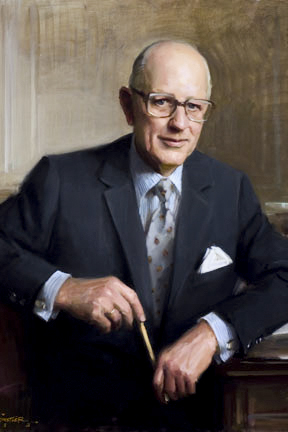
Quality Quotes (140 quotes)
… (T)he same cause, such as electricity, can simultaneously affect all sensory organs, since they are all sensitive to it; and yet, every sensory nerve reacts to it differently; one nerve perceives it as light, another hears its sound, another one smells it; another tastes the electricity, and another one feels it as pain and shock. One nerve perceives a luminous picture through mechanical irritation, another one hears it as buzzing, another one senses it as pain… He who feels compelled to consider the consequences of these facts cannot but realize that the specific sensibility of nerves for certain impressions is not enough, since all nerves are sensitive to the same cause but react to the same cause in different ways… (S)ensation is not the conduction of a quality or state of external bodies to consciousness, but the conduction of a quality or state of our nerves to consciousness, excited by an external cause.
Law of Specific Nerve Energies.
Law of Specific Nerve Energies.
Handbuch der Physiologie des Menschen für Vorlesungen, 2nd Ed. translation by Edwin Clarke and Charles Donald O'Malley
... in going over the history of all the inventions for which history could be obtained it became more and more clear that in addition to training and in addition to extensive knowledge, a natural quality of mind was also necessary.
Aphorism listed Frederick Seitz, The Cosmic Inventor: Reginald Aubrey Fessenden (1866-1932) (1999), 54, being Transactions of the American Philosophical Society, Held at Philadelphia For Promoting Useful Knowledge, Vol. 86, Pt. 6.
“Wu Li” was more than poetic. It was the best definition of physics that the conference would produce. It caught that certain something, that living quality that we were seeking to express in a book, that thing without which physics becomes sterile. “Wu” can mean either “matter” or “energy.” “Li” is a richly poetic word. It means “universal order” or “universal law.” It also means “organic patterns.” The grain in a panel of wood is Li. The organic pattern on the surface of a leaf is also Li, and so is the texture of a rose petal. In short, Wu Li, the Chinese word for physics, means “patterns of organic energy” (“matter/ energy” [Wu] + “universal order/organic patterns” [Li]). This is remarkable since it reflects a world view which the founders of western science (Galileo and Newton) simply did not comprehend, but toward which virtually every physical theory of import in the twentieth century is pointing!
In The Dancing Wu Li Masters: An Overview of the New Physics (1979), 5.
[A] quality of an inventor is imagination, because invention is a leap of the imagination from what is known to what has never been before.
As quoted in French Strother, 'The Modern Profession of Inventing', World's Work and Play (Jul 1905), 6, No. 32, 187.
[Haunted by the statistic that the best predictor of SAT scores is family income:] Where you were born, into what family you are born, what their resources are, are to a large extent are going to determine the quality of education you receive, beginning in preschool and moving all the way up through college.
And what this is going to create in America is a different kind of aristocracy that's going to be self-perpetuating, unless we find ways to break that juggernaut.
... I think what that really reflects is the fact that resources, and not wealth necessarily, but just good middle-class resources, can buy quality of experience for children.
And what this is going to create in America is a different kind of aristocracy that's going to be self-perpetuating, unless we find ways to break that juggernaut.
... I think what that really reflects is the fact that resources, and not wealth necessarily, but just good middle-class resources, can buy quality of experience for children.
In a segment from PBS TV program, Newshour (9 Sep 2013).
[I attach] little importance to physical size. I don’t feel the least humble before the vastness of the heavens. The stars may be large, but they cannot think or love; and these are qualities which impress me far more than size does.
From a paper read to the Apostles, a Cambridge discussion society (1925). In 'The Foundations of Mathematics' (1925), collected in Frank Plumpton Ramsey and D. H. Mellor (ed.), Philosophical Papers (1990), Epilogue, 249. Citation to the paper, in Nils-Eric Sahlin, The Philosophy of F.P. Ramsey (1990), 225.
[Intellectual courage is] the quality that allows one to believe in one's judgement in the face of disappointment and widespread skepticism. Intellectual courage is even rarer than physical courage.
'A Scientist and the World He Lives In', Speech to the Empire Club of Canada (27 Nov 1986) in C. Frank Turner and Tim Dickson (eds.), The Empire Club of Canada Speeches 1986-1987 (1987), 149-161.
[My] numberless observations... made on the Strata... [have] made me confident of their uniformity throughout this Country & [have] led me to conclude that the same regularity... will be found to extend to every part of the Globe for Nature has done nothing by piecemeal. [T]here is no inconsistency in her productions. [T]he Horse never becomes an Ass nor the Crab an Apple by any intermixture or artificial combination whatever[. N]or will the Oak ever degenerate into an Ash or an Ash into an Elm. [H]owever varied by Soil or Climate the species will still be distinct on this ground. [T]hen I argue that what is found here may be found elsewhere[.] When proper allowances are made for such irregularities as often occur and the proper situation and natural agreement is well understood I am satisfied there will be no more difficulty in ascertaining the true quality of the Strata and the place of its possition [sic] than there is now in finding the true Class and Character of Plants by the Linean [sic] System.
Natural Order of the Strata in England and Wales Accurately Delineated and Described, unpublished manuscript, Department of Geology, University of Oxford, 1801, f. 7v.
[Regarding evolution believers:] Their business is not with the possible, but the actual—not with a world which might be, but with a world that is. This they explore with a courage not unmixed with reverence, and according to methods which, like the quality of a tree, are tested by their fruits. They have but one desire—to know the truth. They have but one fear—to believe a lie.
'Scientific Use of the Imagination', Discourse Delivered Before the British Association at Liverpool, (16 Sep 1870). Fragments of Science for Unscientific People: A Series of Detached Essays, Lectures, and Reviews (1892), Vol. 2, 134.
[The word] genius is derived from gignere, gigno; I bring forth, I produce; it always supposes invention, and this quality, is the only one which belongs to all the different kinds of genius.
From the original French, “Celui de génie dérive de gignere, gigno; j’enfante, je
produis; il suppose toujours invention: & cette qualité est la seule qui appartienne à tous les génies différents,” in 'Du Génie', L’Esprit (1758), Discourse 4, 476. English version from Claude Adrien Helvétius and William Mudford (trans.), 'Of Genius', De l’Esprit or, Essays on the Mind and its several Faculties (1759), Essay 4, Chap. 1, 241.
[There is] some mathematical quality in Nature, a quality which the casual observer of Nature would not suspect, but which nevertheless plays an important role in Nature’s scheme.
From Lecture delivered on presentation of the James Scott prize, (6 Feb 1939), 'The Relation Between Mathematics And Physics', printed in Proceedings of the Royal Society of Edinburgh (1938-1939), 59, Part 2, 122.
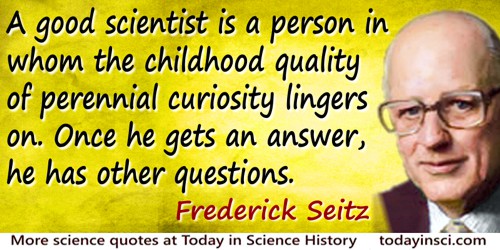
A good scientist is a person in whom the childhood quality of perennial curiosity lingers on. Once he gets an answer, he has other questions.
Quoted in James B. Simpson (ed.), Webster’s II New Riverside Desk Quotations (1992), 158; citing Fortune (Apr 1976).
A man’s value to the community depends primarily on how far his feelings, thoughts, and actions are directed towards promoting the good of his fellows. We call him good or bad according to how he stands in this matter. It looks at first sight as if our estimate of a man depended entirely on his social qualities.
…...
Activity bears fruit in habit, and the kind of activity determines the quality of the habit.
As quoted in William W. Speer, Primary Arithmetic: First Year, for the Use of Teachers (1902), 3.

After all, science is essentially international, and it is only through lack of the historical sense that national qualities have been attributed to it.
'Memorandum by Madame Curie, Member of the Committee, on the Question of International Scholarships for the advancement of the Sciences and the Development of Laboratories', League of Nations, International Committee on Intellectual Co-operation: Sub-committee of Experts for the Instruction of Children and Youth in the Existence and Aims of the League of Nations. (Recommendations. Preamble): Issue 5, Issues 9-13 (1926), 12.
All fossil anthropoids found hitherto have been known only from mandibular or maxillary fragments, so far as crania are concerned, and so the general appearance of the types they represented had been unknown; consequently, a condition of affairs where virtually the whole face and lower jaw, replete with teeth, together with the major portion of the brain pattern, have been preserved, constitutes a specimen of unusual value in fossil anthropoid discovery. Here, as in Homo rhodesiensis, Southern Africa has provided documents of higher primate evolution that are amongst the most complete extant. Apart from this evidential completeness, the specimen is of importance because it exhibits an extinct race of apes intermediate between living anthropoids and man ... Whether our present fossil is to be correlated with the discoveries made in India is not yet apparent; that question can only be solved by a careful comparison of the permanent molar teeth from both localities. It is obvious, meanwhile, that it represents a fossil group distinctly advanced beyond living anthropoids in those two dominantly human characters of facial and dental recession on one hand, and improved quality of the brain on the other. Unlike Pithecanthropus, it does not represent an ape-like man, a caricature of precocious hominid failure, but a creature well advanced beyond modern anthropoids in just those characters, facial and cerebral, which are to be anticipated in an extinct link between man and his simian ancestor. At the same time, it is equally evident that a creature with anthropoid brain capacity and lacking the distinctive, localised temporal expansions which appear to be concomitant with and necessary to articulate man, is no true man. It is therefore logically regarded as a man-like ape. I propose tentatively, then, that a new family of Homo-simidæ be created for the reception of the group of individuals which it represents, and that the first known species of the group be designated Australopithecus africanus, in commemoration, first, of the extreme southern and unexpected horizon of its discovery, and secondly, of the continent in which so many new and important discoveries connected with the early history of man have recently been made, thus vindicating the Darwinian claim that Africa would prove to be the cradle of mankind.
'Australopithicus africanus: The Man-Ape of South Africa', Nature, 1925, 115, 195.
An expert problem solver must be endowed with two incompatible qualities, a restless imagination and a patient pertinacity.
From In Mathematical Circles (1969).
André Weil suggested that there is a logarithmic law at work: first-rate people attract other first-rate people, but second-rate people tend to hire third-raters, and third-rate people hire fifth-raters. If a dean or a president is genuinely interested in building and maintaining a high-quality university (and some of them are), then he must not grant complete self-determination to a second-rate department; he must, instead, use his administrative powers to intervene and set things right. That’s one of the proper functions of deans and presidents, and pity the poor university in which a large proportion of both the faculty and the administration are second-raters; it is doomed to diverge to minus infinity.
In I Want to be a Mathematician: an Automathography (1985), 123.
Any chemist reading this book can see, in some detail, how I have spent most of my mature life. They can become familiar with the quality of my mind and imagination. They can make judgements about my research abilities. They can tell how well I have documented my claims of experimental results. Any scientist can redo my experiments to see if they still work—and this has happened! I know of no other field in which contributions to world culture are so clearly on exhibit, so cumulative, and so subject to verification.
From Design to Discovery (1990), 119-20.
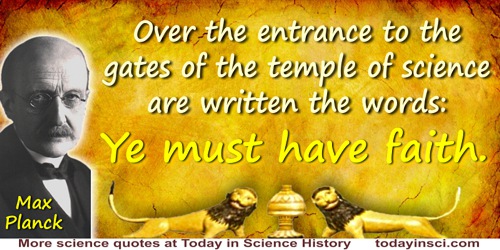
Anybody who has been seriously engaged in scientific work of any kind realizes that over the entrance to the gates of the temple of science are written the words: Ye must have faith. It is a quality which the scientist cannot dispense with.
In Max Planck and James Vincent Murphy (trans.), Where is Science Going?, (1932), 214.
Art is usually considered to be not of the highest quality if the desired object is exhibited in the midst of unnecessary lumber.
In Mathematics: Queen and Servant of Sciences (1938), 20. Bell is writing about the postulational method and the art of pruning a set of postulates to bare essentials without internal duplication.
As he [Clifford] spoke he appeared not to be working out a question, but simply telling what he saw. Without any diagram or symbolic aid he described the geometrical conditions on which the solution depended, and they seemed to stand out visibly in space. There were no longer consequences to be deduced, but real and evident facts which only required to be seen. … So whole and complete was his vision that for the time the only strange thing was that anybody should fail to see it in the same way. When one endeavored to call it up again, and not till then, it became clear that the magic of genius had been at work, and that the common sight had been raised to that higher perception by the power that makes and transforms ideas, the conquering and masterful quality of the human mind which Goethe called in one word das Dämonische.
In Leslie Stephen and Frederick Pollock (eds.), Lectures and Essays by William Kingdon Clifford(1879), Vol. 1, Introduction, 4-5.
As one recalls some of the monstrous situations under which human beings have lived and live their lives, one marvels at man’s meekness and complacency. It can only be explained by the quality of flesh to become calloused to situations that if faced suddenly would provoke blisters and revolt.
From Why We Behave Like Human Beings (1925), 469
At the present time the fishing industry is, in some ways, at the stage at which primitive man was many centuries ago—we hunt the fish that Nature provides, just as our ancestors hunted animals for food. We have not yet begun to herd fish or to improve their quality—but one day we shall be forced to farm the seas as we do the land.
In 'Man Explores the Sea', Journal of the Royal Society of Arts (Sep 1963), 111, No. 5086, 787.
Basic research at universities comes in two varieties: research that requires big bucks and research that requires small bucks. Big bucks research is much like government research and in fact usually is government research but done for the government under contract. Like other government research, big bucks academic research is done to understand the nature and structure of the universe or to understand life, which really means that it is either for blowing up the world or extending life, whichever comes first. Again, that's the government's motivation. The universities' motivation for conducting big bucks research is to bring money in to support professors and graduate students and to wax the floors of ivy-covered buildings. While we think they are busy teaching and learning, these folks are mainly doing big bucks basic research for a living, all the while priding themselves on their terrific summer vacations and lack of a dress code.
Smalls bucks research is the sort of thing that requires paper and pencil, and maybe a blackboard, and is aimed primarily at increasing knowledge in areas of study that don't usually attract big bucks - that is, areas that don't extend life or end it, or both. History, political science, and romance languages are typically small bucks areas of basic research. The real purpose of small bucks research to the universities is to provide a means of deciding, by the quality of their small bucks research, which professors in these areas should get tenure.
Smalls bucks research is the sort of thing that requires paper and pencil, and maybe a blackboard, and is aimed primarily at increasing knowledge in areas of study that don't usually attract big bucks - that is, areas that don't extend life or end it, or both. History, political science, and romance languages are typically small bucks areas of basic research. The real purpose of small bucks research to the universities is to provide a means of deciding, by the quality of their small bucks research, which professors in these areas should get tenure.
Accidental Empires (1992), 78.
Besides accustoming the student to demand, complete proof, and to know when he has not obtained it, mathematical studies are of immense benefit to his education by habituating him to precision. It is one of the peculiar excellencies of mathematical discipline, that the mathematician is never satisfied with à peu près. He requires the exact truth. Hardly any of the non-mathematical sciences, except chemistry, has this advantage. One of the commonest modes of loose thought, and sources of error both in opinion and in practice, is to overlook the importance of quantities. Mathematicians and chemists are taught by the whole course of their studies, that the most fundamental difference of quality depends on some very slight difference in proportional quantity; and that from the qualities of the influencing elements, without careful attention to their quantities, false expectation would constantly be formed as to the very nature and essential character of the result produced.
In An Examination of Sir William Hamilton’s Philosophy (1878), 611. [The French phrase, à peu près means “approximately”. —Webmaster]
Besides love and sympathy, animals exhibit other qualities connected with the social instincts which in us would be called moral.
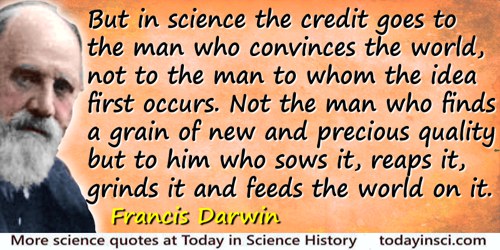
But in science the credit goes to the man who convinces the world, not to the man to whom the idea first occurs. Not the man who finds a grain of new and precious quality but to him who sows it, reaps it, grinds it and feeds the world on it.
First Galton Lecture before the Eugenics Society', Eugenics Review, 1914, 6, 9.
Cheap drugs would be dear if they were cheap and nasty. Nasty to the palate many drugs are bound to be; but worse is the nastiness of bad quality.
As quoted in Charles Margerison, Amazing People of England: Inspirational Stories (2010), 270.
Chemistry is the science or study of those effects and qualities of matter which are discovered by mixing bodies variously together, or applying them to one another with a view to mixture, and by exposing them to different degrees of heat, alone, or in mixture with one another, in order to enlarge our knowledge of nature, and to promote the useful arts.
From the first of a series of lectures on chemistry, collected in John Robison (ed.), Lectures on the Elements of Chemistry: Delivered in the University of Edinburgh (1807), Vol. 1, 11.
Courage is the first of human qualities because it is the quality which guarantees the others.
…...
Elegance is not a dispensable luxury but a quality that decides between success and failure.
…...
Endowed with two qualities, which seemed incompatible with each other, a volcanic imagination and a pertinacity of intellect which the most tedious numerical calculations could not daunt, Kepler conjectured that the movements of the celestial bodies must be connected together by simple laws, or, to use his own expression, by harmonic laws. These laws he undertook to discover. A thousand fruitless attempts, errors of calculation inseparable from a colossal undertaking, did not prevent him a single instant from advancing resolutely toward the goal of which he imagined he had obtained a glimpse. Twenty-two years were employed by him in this investigation, and still he was not weary of it! What, in reality, are twenty-two years of labor to him who is about to become the legislator of worlds; who shall inscribe his name in ineffaceable characters upon the frontispiece of an immortal code; who shall be able to exclaim in dithyrambic language, and without incurring the reproach of anyone, “The die is cast; I have written my book; it will be read either in the present age or by posterity, it matters not which; it may well await a reader, since God has waited six thousand years for an interpreter of his words.”
In 'Eulogy on Laplace', in Smithsonian Report for the year 1874 (1875), 131-132.
Engineers apply the theories and principles of science and mathematics to research and develop economical solutions to practical technical problems. Their work is the link between scientific discoveries and commercial applications. Engineers design products, the machinery to build those products, the factories in which those products are made, and the systems that ensure the quality of the product and efficiency of the workforce and manufacturing process. They design, plan, and supervise the construction of buildings, highways, and transit systems. They develop and implement improved ways to extract, process, and use raw materials, such as petroleum and natural gas. They develop new materials that both improve the performance of products, and make implementing advances in technology possible. They harness the power of the sun, the earth, atoms, and electricity for use in supplying the Nation’s power needs, and create millions of products using power. Their knowledge is applied to improving many things, including the
quality of health care, the safety of food products, and the efficient operation of financial systems.
Bureau of Labor Statistics, Occupational Outlook Handbook (2000) as quoted in Charles R. Lord. Guide to Information Sources in Engineering (2000), 5. This definition has been revised and expanded over time in different issues of the Handbook.
Experiments may be of two kinds: experiments of simple fact, and experiments of quantity. ...[In the latter] the conditions will ... vary, not in quality, but quantity, and the effect will also vary in quantity, so that the result of quantitative induction is also to arrive at some mathematical expression involving the quantity of each condition, and expressing the quantity of the result. In other words, we wish to know what function the effect is of its conditions. We shall find that it is one thing to obtain the numerical results, and quite another thing to detect the law obeyed by those results, the latter being an operation of an inverse and tentative character.
Principles of Science: A Treatise on Logic and Scientific Method (1874, 1892), 439.
Flaming enthusiasm, backed by horse sense and persistence, is the quality that most frequently makes for success.
…...
For a stone, when it is examined, will be found a mountain in miniature. The fineness of Nature’s work is so great, that, into a single block, a foot or two in diameter, she can compress as many changes of form and structure, on a small scale, as she needs for her mountains on a large one; and, taking moss for forests, and grains of crystal for crags, the surface of a stone, in by far the plurality of instances, is more interesting than the surface of an ordinary hill; more fantastic in form and incomparably richer in colour—the last quality being, in fact, so noble in most stones of good birth (that is to say, fallen from the crystalline mountain ranges).
Modern Painters, 4, Containing part 5 of Mountain Beauty (1860), 311.
From our best qualities come our worst. From our urge to pull together comes our tendency to pull apart. From our devotion to higher good comes our propensity to the foulest atrocities. From out commitment to ideals come our excuse to hate. Since the beginning of history, we have been blinded by evil’s ability to don a selfless disguise. We have failed to see that our finest qualities often lead us to the actions we most abhor—murder, torture, genocide, and war.
In 'Who is Lucifer?', The Lucifer Principle: A Scientific Expedition Into the Forces of History (1997), 3.
Good sense is, of all things among men, the most equally distributed ; for every one thinks himself so abundantly provided with it, that those even who are the most difficult to satisfy in everything else, do not usually desire a larger measure of this quality than they already possess.
In Discours de la Méthode (1637), Part 1. English version as given in John Veitch (trans.), The Method, Meditations, and Selections from the Principles of Descartes (1880), 3. Also seen translated as “Of all things, good sense is the most fairly distributed: everyone thinks he is so well supplied with it that even those who are the hardest to satisfy in every other respect never desire more of it than they already have,” or “Good sense is of all things in the world the most equally distributed, for everybody thinks he is so well supplied with it that even those most difficult to please in all other matters never desire more of it than they already possess.” From the original French, “Le bon sens est la chose du monde la mieux partagée; car chacun pense en être si bien pourvu, que ceux même qui sont les plus difficiles à contenter en toute autre chose n'ont point coutume d'en désirer plus qu'ils en ont.”
Great is the faith of the flush of knowledge and of the investigation of the depths of qualities and things.
In Walt Whitman and William Michael Rossetti (ed.), 'Preface to the First Edition of Leaves of Grass', Poems By Walt Whitman (1868), 46.
Having discovered … by observation and comparison that certain objects agree in certain respects, we generalise the qualities in which they coincide,—that is, from a certain number of individual instances we infer a general law; we perform an act of Induction. This induction is erroneously viewed as analytic; it is purely a synthetic process.
In Lecture VI of his Biennial Course, by William Hamilton and Henry L. Mansel (ed.) and John Veitch (ed.), Metaphysics (1860), Vol. 1, 101.

History without the history of science, to alter slightly an apothegm of Lord Bacon, resembles a statue of Polyphemus without his eye—that very feature being left out which most marks the spirit and life of the person. My own thesis is complementary: science taught ... without a sense of history is robbed of those very qualities that make it worth teaching to the student of the humanities and the social sciences.
'The History of Science and the Teaching of Science', in I. Bernard Cohen and Fletcher G. Watson (eds.), General Education in Science (1952), 71.
I am convinced, gentlemen, that unless some method of printing can be designed which requires no type at all, the method embodied in our invention will be the one used in the future; not alone because it is cheaper, but mainly because it is destined to secure superior quality.
From short Speech at the Chamberlain Hotel, Washington, D.C. (Feb 1885), concluding the exhibition of his own Linotype invention. As given in Carl Schlesinger (ed.), 'Mr. Mergenthaler’s Speech', The Biography of Ottmar Merganthaler: Inventor of the Linotype (1989), 20. [Accurately predicting the future of photo and digital typesetting. —Webmaster]
I believe myself to possess a most singular combination of qualities exactly fitted to make me pre-eminently a discoverer of the hidden realities of nature… the belief has been forced upon me…
Firstly: Owing to some peculiarity in my nervous system, I have perceptions of some things, which no one else has… and intuitive perception of… things hidden from eyes, ears, & ordinary senses…
Secondly: my sense reasoning faculties;
Thirdly: my concentration faculty, by which I mean the power not only of throwing my whole energy & existence into whatever I choose, but also of bringing to bear on anyone subject or idea, a vast apparatus from all sorts of apparently irrelevant & extraneous sources…
Well, here I have written what most people would call a remarkably mad letter; & yet certainly one of the most logical, sober-minded, cool, pieces of composition, (I believe), that I ever framed.
Firstly: Owing to some peculiarity in my nervous system, I have perceptions of some things, which no one else has… and intuitive perception of… things hidden from eyes, ears, & ordinary senses…
Secondly: my sense reasoning faculties;
Thirdly: my concentration faculty, by which I mean the power not only of throwing my whole energy & existence into whatever I choose, but also of bringing to bear on anyone subject or idea, a vast apparatus from all sorts of apparently irrelevant & extraneous sources…
Well, here I have written what most people would call a remarkably mad letter; & yet certainly one of the most logical, sober-minded, cool, pieces of composition, (I believe), that I ever framed.
Lovelace Papers, Bodleian Library, Oxford University, 42, folio 12 (6 Feb 1841). As quoted and cited in Dorothy Stein (ed.), 'This First Child of Mine', Ada: A Life and a Legacy (1985), 86.
I can see him [Sylvester] now, with his white beard and few locks of gray hair, his forehead wrinkled o’er with thoughts, writing rapidly his figures and formulae on the board, sometimes explaining as he wrote, while we, his listeners, caught the reflected sounds from the board. But stop, something is not right, he pauses, his hand goes to his forehead to help his thought, he goes over the work again, emphasizes the leading points, and finally discovers his difficulty. Perhaps it is some error in his figures, perhaps an oversight in the reasoning. Sometimes, however, the difficulty is not elucidated, and then there is not much to the rest of the lecture. But at the next lecture we would hear of some new discovery that was the outcome of that difficulty, and of some article for the Journal, which he had begun. If a text-book had been taken up at the beginning, with the intention of following it, that text-book was most likely doomed to oblivion for the rest of the term, or until the class had been made listeners to every new thought and principle that had sprung from the laboratory of his mind, in consequence of that first difficulty. Other difficulties would soon appear, so that no text-book could last more than half of the term. In this way his class listened to almost all of the work that subsequently appeared in the Journal. It seemed to be the quality of his mind that he must adhere to one subject. He would think about it, talk about it to his class, and finally write about it for the Journal. The merest accident might start him, but once started, every moment, every thought was given to it, and, as much as possible, he read what others had done in the same direction; but this last seemed to be his real point; he could not read without finding difficulties in the way of understanding the author. Thus, often his own work reproduced what had been done by others, and he did not find it out until too late.
A notable example of this is in his theory of cyclotomic functions, which he had reproduced in several foreign journals, only to find that he had been greatly anticipated by foreign authors. It was manifest, one of the critics said, that the learned professor had not read Rummer’s elementary results in the theory of ideal primes. Yet Professor Smith’s report on the theory of numbers, which contained a full synopsis of Kummer’s theory, was Professor Sylvester’s constant companion.
This weakness of Professor Sylvester, in not being able to read what others had done, is perhaps a concomitant of his peculiar genius. Other minds could pass over little difficulties and not be troubled by them, and so go on to a final understanding of the results of the author. But not so with him. A difficulty, however small, worried him, and he was sure to have difficulties until the subject had been worked over in his own way, to correspond with his own mode of thought. To read the work of others, meant therefore to him an almost independent development of it. Like the man whose pleasure in life is to pioneer the way for society into the forests, his rugged mind could derive satisfaction only in hewing out its own paths; and only when his efforts brought him into the uncleared fields of mathematics did he find his place in the Universe.
A notable example of this is in his theory of cyclotomic functions, which he had reproduced in several foreign journals, only to find that he had been greatly anticipated by foreign authors. It was manifest, one of the critics said, that the learned professor had not read Rummer’s elementary results in the theory of ideal primes. Yet Professor Smith’s report on the theory of numbers, which contained a full synopsis of Kummer’s theory, was Professor Sylvester’s constant companion.
This weakness of Professor Sylvester, in not being able to read what others had done, is perhaps a concomitant of his peculiar genius. Other minds could pass over little difficulties and not be troubled by them, and so go on to a final understanding of the results of the author. But not so with him. A difficulty, however small, worried him, and he was sure to have difficulties until the subject had been worked over in his own way, to correspond with his own mode of thought. To read the work of others, meant therefore to him an almost independent development of it. Like the man whose pleasure in life is to pioneer the way for society into the forests, his rugged mind could derive satisfaction only in hewing out its own paths; and only when his efforts brought him into the uncleared fields of mathematics did he find his place in the Universe.
In Florian Cajori, Teaching and History of Mathematics in the United States (1890), 266-267.
I have no right to consider anything a work of art to which I cannot react emotionally; and I have no right to look for the essential quality in anything that I have not felt to be a work of art.
In Art (1913), 9.
I have read somewhere that the resistance offered by a wire ... is affected by the tension of the wire. If this is so, a continuous current of electricity passed through a vibrating wire should meet with a varying resistance, and hence a pulsatory action should be induced in the current ... [corresponding] in amplitude, as well as in rate of movement, to the vibrations of the string ... [Thus] the timbre of a sound [a quality essential to intelligible speech] could be transmitted ... [and] the strength of the current can be increased ad libitum without destroying the relative intensities of the vibrations.
Letter to Gardiner Greene Hubbard (4 May 1875), 3-4. Bell Papers, Library of Congress.
I possess every good quality, but the one that distinguishes me above all is modesty.
from The Natural History of a Savant, trans. Oliver Lodge (1927).
I took a good clear piece of Cork and with a Pen-knife sharpen'd as keen as a Razor, I cut a piece of it off, and thereby left the surface of it exceeding smooth, then examining it very diligently with a Microscope, me thought I could perceive it to appear a little porous; but I could not so plainly distinguish them, as to be sure that they were pores, much less what Figure they were of: But judging from the lightness and yielding quality of the Cork, that certainly the texture could not be so curious, but that possibly, if I could use some further diligence, I might find it to be discernable with a Microscope, I with the same sharp Penknife, cut off from the former smooth surface an exceeding thin piece of it with a deep plano-convex Glass, I could exceedingly plainly perceive it to be all perforated and porous, much like a Honey-comb, but that the pores of it were not regular; yet it was not unlike a Honey-comb in these particulars.
First, in that it had a very little solid substance, in comparison of the empty cavity that was contain'd between, ... for the Interstitia or walls (as I may so call them) or partitions of those pores were neer as thin in proportion to their pores as those thin films of Wax in a Honey-comb (which enclose and constitute the sexangular cells) are to theirs.
Next, in that these pores, or cells, were not very deep, but constituted of a great many little Boxes, separated out of one continued long pore, by certain Diaphragms...
I no sooner discerned these (which were indeed the first microscopical pores I ever saw, and perhaps, that were ever seen, for I had not met with any Writer or Person, that had made any mention of them before this) but me thought I had with the discovery of them, presently hinted to me the true and intelligible reason of all the Phænomena of Cork.
First, in that it had a very little solid substance, in comparison of the empty cavity that was contain'd between, ... for the Interstitia or walls (as I may so call them) or partitions of those pores were neer as thin in proportion to their pores as those thin films of Wax in a Honey-comb (which enclose and constitute the sexangular cells) are to theirs.
Next, in that these pores, or cells, were not very deep, but constituted of a great many little Boxes, separated out of one continued long pore, by certain Diaphragms...
I no sooner discerned these (which were indeed the first microscopical pores I ever saw, and perhaps, that were ever seen, for I had not met with any Writer or Person, that had made any mention of them before this) but me thought I had with the discovery of them, presently hinted to me the true and intelligible reason of all the Phænomena of Cork.
Micrographia, or some Physiological Descriptions of Minute Bodies made by Magnifying Glasses with Observations and Inquiries thereupon (1665), 112-6.
I’m one of the most durable and fervent advocates of space exploration, but my take is that we could do it robotically at far less cost and far greater quantity and quality of results.
If it is good to teach students about the chemical industry then why is it not good to assign ethical qualities to substances along with their physical and chemical ones? We might for instance say that CS [gas] is a bad chemical because it can only ever be used by a few people with something to protect against many people with nothing to lose. Terylene or indigotin are neutral chemicals. Under capitalism their production is an exploitive process, under socialism they are used for the common good. Penicillin is a good chemical.
Quoted in T. Pateman (ed.), Countercourse (1972), 215.
In physical science a first essential step in the direction of learning any subject is to find principles of numerical reckoning and practicable methods for measuring some quality connected with it. I often say that when you can measure what you are speaking about, and express it in numbers, you know something about it; but when you cannot measure it, when you cannot express it in numbers, your knowledge is of a meagre and unsatisfactory kind; it may be the beginning of knowledge, but you have scarcely in your thoughts advanced to the stage of science, whatever the matter may be.
Often seen quoted in a condensed form: If you cannot measure it, then it is not science.
Often seen quoted in a condensed form: If you cannot measure it, then it is not science.
From lecture to the Institution of Civil Engineers, London (3 May 1883), 'Electrical Units of Measurement', Popular Lectures and Addresses (1889), Vol. 1, 80-81.
In science, each of us knows that what he has accomplished will be antiquated in ten, twenty, fifty years. That is the fate to which science is subjected; it is the very meaning of scientific work, to which it is devoted in a quite specific sense, as compared with other spheres of culture for which in general the same holds. Every scientific “fulfilment” raises new “questions”; it asks to be “surpassed” and outdated. Whoever wishes to serve science has to resign himself to this fact. Scientific works certainly can last as “gratifications” because of their artistic quality, or they may remain important as a means of training. Yet they will be surpassed scientifically—let that be repeated—for it is our common fate and, more our common goal. We cannot work without hoping that others will advance further than we have. In principle, this progress goes on ad infinitum.
From a Speech (1918) presented at Munich University, published in 1919, and collected in 'Wissenschaft als Beruf', Gessammelte Aufsätze zur Wissenschaftslehre (1922), 524-525. As given in H.H. Gerth and C. Wright-Mills (translators and eds.), 'Science as a Vocation', Max Weber: Essays in Sociology (1946), 138. A different translation of a shorter excerpt from this quote, beginning “[In] the realm of science, …” is also on the Max Weber Quotes web page on this site.
In the physical world, one cannot increase the size or quantity of anything without changing its quality. Similar figures exist only in pure geometry.
In W.H. Auden and Louis Kronenberger, The Viking Book of Aphorisms: A Personal Selection, (1966), 98.
In working out an invention, the most important quality is persistence. Nearly every man who develops an idea works it up to the point where it looks impossible, and then he gets discouraged. That’s not the place to become discouraged, that's the place to get interested.
As quoted in French Strother, 'The Modern Profession of Inventing', World's Work and Play (Jul 1905), 6, No. 32, 186.
Indian nouns are extremely connotive; that is, the name does more than simply denote the thing to which it belongs; in denoting the object, it also assigns to it some quality or characteristic.
In Introduction to the Study of Indian Languages: With Words, Phrases and Sentences to be Collected (1880), 72.
Inspiration plays no less a role in science than it does in the realm of art. It is a childish notion to think that a mathematician attains any scientifically valuable results by sitting at his desk with a ruler, calculating machines or other mechanical means. The mathematical imagination of a Weierstrass is naturally quite differently oriented in meaning and result than is the imagination of an artist, and differs basically in quality. But the psychological processes do not differ. Both are frenzy (in the sense of Plato’s “mania”) and “inspiration.”
From a Speech (1918) presented at Munich University, published in 1919, and collected in 'Wissenschaft als Beruf', Gessammelte Aufsätze zur Wissenschaftslehre (1922), 524-525. As given in H.H. Gerth and C. Wright-Mills (translators and eds.), 'Science as a Vocation', Max Weber: Essays in Sociology (1946), 136.
It be urged that the wild and uncultivated tree, hitherto yielding sour and bitter fruit only, can never be made to yield better; yet we know that the grafting art implants a new tree on the savage stock, producing what is most estimable in kind and degree. Education, in like manner, engrafts a new man on the native stock, and improves what in his nature was vicious and perverse into qualities of virtue and social worth.
From paper 'Report of the Commissioners Appointed to Fix the Site of the University of Virginia', included in Annual Report of the Board of Visitors of the University of Virginia for the Fiscal Year Ending May 31, 1879 (1879), 10. Collected in Commonwealth of Virginia, Annual Reports of Officers, Boards, and Institutions of the Commonwealth of Virginia, for the Year Ending September 30, 1879 (1879).
It is clear that the degradation of the position of the scientist as an independent worker and thinker to that of a morally irresponsible stooge in a science-factory has ‘proceeded even more rapidly and devastatingly than I had expected. This subordination of those who ought to think to those who have the administrative power is ruinous for the morale of the scientist, and quite to the same extent it is ruinous to the quality of the subjective scientific output of the country.
In 'A Rebellious Scientist after Two Years', Bulletin of the Atomic Scientists, (1948), 4, 338.
It is high time that laymen abandoned the misleading belief that scientific enquiry is a cold dispassionate enterprise, bleached of imaginative qualities, and that a scientist is a man who turns the handle of discovery; for at every level of endeavour scientific research is a passionate undertaking and the Promotion of Natural Knowledge depends above all on a sortee into what can be imagined but is not yet known.
The Times Literary Supplement (London), 1963 October 25 (p. 850)
It is said that the composing of the Lilavati was occasioned by the following circumstance. Lilavati was the name of the author’s daughter, concerning whom it appeared, from the qualities of the ascendant at her birth, that she was destined to pass her life unmarried, and to remain without children. The father ascertained a lucky hour for contracting her in marriage, that she might be firmly connected and have children. It is said that when that hour approached, he brought his daughter and his intended son near him. He left the hour cup on the vessel of water and kept in attendance a time-knowing astrologer, in order that when the cup should subside in the water, those two precious jewels should be united. But, as the intended arrangement was not according to destiny, it happened that the girl, from a curiosity natural to children, looked into the cup, to observe the water coming in at the hole, when by chance a pearl separated from her bridal dress, fell into the cup, and, rolling down to the hole, stopped the influx of water. So the astrologer waited in expectation of the promised hour. When the operation of the cup had thus been delayed beyond all moderate time, the father was in consternation, and examining, he found that a small pearl had stopped the course of the water, and that the long-expected hour was passed. In short, the father, thus disappointed, said to his unfortunate daughter, I will write a book of your name, which shall remain to the latest times—for a good name is a second life, and the ground-work of eternal existence.
In Preface to the Persian translation of the Lilavati by Faizi (1587), itself translated into English by Strachey and quoted in John Taylor (trans.) Lilawati, or, A Treatise on Arithmetic and Geometry by Bhascara Acharya (1816), Introduction, 3. [The Lilavati is the 12th century treatise on mathematics by Indian mathematician, Bhaskara Acharya, born 1114.]
It is something to be able to paint a particular picture or to carve a statue and so to make a few objects beautiful; but it is far more glorious to carve and paint the very atmosphere and medium through which we look, which morally we can do. To affect the quality of the day, that is the highest of arts.
In Walden: or, Life in the Woods (1854, 1893), 143.
It is the function of notions in science to be useful, to be interesting, to be verifiable and to acquire value from anyone of these qualities. Scientific notions have little to gain as science from being forced into relation with that formidable abstraction, “general truth.”
In paper delivered before the Royal College of Surgeons of England (15 Feb 1932), in 'The Commemoration of Great Men', British Medical Journal (1932), 1, 32. Collected in The Collected Papers of Wilfred Trotter, FRS (1941), 29.
It seems that the increased number of scientific workers, their being split up into groups whose studies are limited to a small subject, and over-specialization have brought about a shrinking of intelligence. There is no doubt that the quality of any human group decreases when the number of the individuals composing this group increases beyond certain limits… The best way to increase the intelligence of scientists would be to decrease their number.
Man the Unknown (1935), 48-9.
It was a great step in science when men became convinced that, in order to understand the nature of things, they must begin by asking, not whether a thing is good or bad, noxious or beneficial, but of what kind it is? And how much is there of it? Quality and Quantity were then first recognised as the primary features to be observed in scientific inquiry.
'Address to the Mathematical and Physical Sections of the British Association, Liverpool, 15 Sep 1870', The Scientific Papers of James Clerk Maxwell (1890 edition, reprint 2003), Vol. 2, 217.
It was his [Leibnitz’s] love of method and order, and the conviction that such order and harmony existed in the real world, and that our success in understanding it depended upon the degree and order which we could attain in our own thoughts, that originally was probably nothing more than a habit which by degrees grew into a formal rule. This habit was acquired by early occupation with legal and mathematical questions. We have seen how the theory of combinations and arrangements of elements had a special interest for him. We also saw how mathematical calculations served him as a type and model of clear and orderly reasoning, and how he tried to introduce method and system into logical discussions, by reducing to a small number of terms the multitude of compound notions he had to deal with. This tendency increased in strength, and even in those early years he elaborated the idea of a general arithmetic, with a universal language of symbols, or a characteristic which would be applicable to all reasoning processes, and reduce philosophical investigations to that simplicity and certainty which the use of algebraic symbols had introduced into mathematics.
A mental attitude such as this is always highly favorable for mathematical as well as for philosophical investigations. Wherever progress depends upon precision and clearness of thought, and wherever such can be gained by reducing a variety of investigations to a general method, by bringing a multitude of notions under a common term or symbol, it proves inestimable. It necessarily imports the special qualities of number—viz., their continuity, infinity and infinite divisibility—like mathematical quantities—and destroys the notion that irreconcilable contrasts exist in nature, or gaps which cannot be bridged over. Thus, in his letter to Arnaud, Leibnitz expresses it as his opinion that geometry, or the philosophy of space, forms a step to the philosophy of motion—i.e., of corporeal things—and the philosophy of motion a step to the philosophy of mind.
A mental attitude such as this is always highly favorable for mathematical as well as for philosophical investigations. Wherever progress depends upon precision and clearness of thought, and wherever such can be gained by reducing a variety of investigations to a general method, by bringing a multitude of notions under a common term or symbol, it proves inestimable. It necessarily imports the special qualities of number—viz., their continuity, infinity and infinite divisibility—like mathematical quantities—and destroys the notion that irreconcilable contrasts exist in nature, or gaps which cannot be bridged over. Thus, in his letter to Arnaud, Leibnitz expresses it as his opinion that geometry, or the philosophy of space, forms a step to the philosophy of motion—i.e., of corporeal things—and the philosophy of motion a step to the philosophy of mind.
In Leibnitz (1884), 44-45. [The first sentence is reworded to better introduce the quotation. —Webmaster]
It’s not quite as exhilarating a feeling as orbiting the earth, but it’s close. In addition, it has an exotic, bizarre quality due entirely to the nature of the surface below. The earth from orbit is a delight - offering visual variety and an emotional feeling of belonging “down there.” Not so with this withered, sun-seared peach pit out of my window. There is no comfort to it; it is too stark and barren; its invitation is monotonous and meant for geologists only.
…...
Let us now discuss the extent of the mathematical quality in Nature. According to the mechanistic scheme of physics or to its relativistic modification, one needs for the complete description of the universe not merely a complete system of equations of motion, but also a complete set of initial conditions, and it is only to the former of these that mathematical theories apply. The latter are considered to be not amenable to theoretical treatment and to be determinable only from observation.
From Lecture delivered on presentation of the James Scott prize, (6 Feb 1939), 'The Relation Between Mathematics And Physics', printed in Proceedings of the Royal Society of Edinburgh (1938-1939), 59, Part 2, 125.
Lord Northampton made a very apt quotation on the reading of Captain Denham's paper “on the deposits in the Mersey,” “It appears,” said his lordship, “that the quality of Mersey is not strained.”
— Magazine
In The Literary Gazette (21 Oct 1837), No. 1083, 677. (As an unverified guess by the Webmaster, the paper may have been read at the Royal Society, where the Marquis of Northampton was president 1838-48.)
Magic is a faculty of wonderful virtue, full of most high mysteries, containing the most profound contemplation of most secret things, together with the nature, power, quality, substance and virtues thereof, as also the knowledge of whole Nature, and it doth instruct us concerning the differing and agreement of things amongst themselves, whence it produceth its wonderful effects, by uniting the virtues of things through the application of them one to the other.
In De Occulta Philosophia (1533), Vol. 1. Translation by J.F. (1651) reprinted as The Philosophy of Natural Magic (1913), 38-39.
Man is by nature competitive, combative, ambitious, jealous, envious, and vengeful. These are the qualities which make men the slaves of evolution.
In Evolution and Ethics (1946), 95. Note that Keith was writing his book while WWII was raging.
Mathematics because of its nature and structure is peculiarly fitted for high school instruction [Gymnasiallehrfach]. Especially the higher mathematics, even if presented only in its elements, combines within itself all those qualities which are demanded of a secondary subject.
In Die Mathematik die Fackelträgerin einer neuen Zeit (1889), 40. As translated in Robert Édouard Moritz, Memorabilia Mathematica; Or, The Philomath’s Quotation-book (1914), 49.
Mathematics, while giving no quick remuneration, like the art of stenography or the craft of bricklaying, does furnish the power for deliberate thought and accurate statement, and to speak the truth is one of the most social qualities a person can possess. Gossip, flattery, slander, deceit, all spring from a slovenly mind that has not been trained in the power of truthful statement, which is one of the highest utilities.
In Social Phases of Education in the School and the Home (1900), 30.
My sense is that the most under-appreciated–and perhaps most under-researched–linkages between forests and food security are the roles that forest-based ecosystem services play in underpinning sustainable agricultural production. Forests regulate hydrological services including the quantity, quality, and timing of water available for irrigation. Forest-based bats and bees pollinate crops. Forests mitigate impacts of climate change and extreme weather events at the landscape scale.
In 'Forests and food security: What we know and need to know', Forest News online blog by the Center for International Forestry Research (20 Apr 2011).
Nature … is, as it were, a continual circulation. Water is rais'd in Vapour into the Air by one Quality and precipitated down in drops by another, the Rivers run into the Sea, and the Sea again supplies them.
In 'A Discourse of Earthquakes', Lectures and Discourses of Earthquakes (1668). In The Posthumous Works of Robert Hooke, containing his Cutlerian Lectures and other Discourses read at the Meetings of the Illustrious Royal Society (1705), 312.
Nature, everywhere the most amazingly and outstandingly remarkable producer of living bodies, being most carefully arranged according to physical, mechanical, and chemical laws, does not give even the smallest hint of its extraordinary and tireless workings and quite clearly points to its work as being alone worthy of a benign and omnipotent God; and it carries this bright quality in all of its traces, in that, just as all of its general mechanisms rejoice, so also do all of their various smallest component parts rejoice in the depth of wisdom, in the height of perfection, and in the lofty arrangement of forms and qualities, which lie far beyond every investigation of the human mind.
'Inaugural Physico-Medical Dissertation on the Blood and the Circulation of the Microcosm' (1749). Trans. Arthur Donovan and Joseph Prentiss, James Hutton's Medical Dissertation (1980), 29.
Not from the stars do I my judgement pluck,
And yet methinks I have astronomy.
But not to tell of good or evil luck,
Of plagues, of dearths, or season's quality;
Nor can I fortune to brief minutes tell,
Pointing to each his thunder, rain, and wind,
Or say with princes if it shall go well …
And yet methinks I have astronomy.
But not to tell of good or evil luck,
Of plagues, of dearths, or season's quality;
Nor can I fortune to brief minutes tell,
Pointing to each his thunder, rain, and wind,
Or say with princes if it shall go well …
Opening lines of 'Sonnet 14' (1609) in Complete Dramatic Works and Miscellaneous Poems (1823), 776.
(1906), 14.
Not one man in a thousand has accuracy of eye and judgment sufficient to become an eminent breeder. If gifted with these qualities, and he studies his subject for years, and devotes his lifetime to it with indomitable perseverance, he will succeed, and may make great improvements; if he wants any of these qualities, he will assuredly fail.
In On the Origin of Species by Means of Natural Selection (1859, 1860), 32.
Now Freud may be right or he may be wrong in the place he gives to biology in human fate, but I think we must stop to consider whether this emphasis on biology, whether correct or incorrect, is not so far from being a reactionary idea that it is actually a liberating idea. It proposes to us that culture is not all-powerful. It suggests that there is a residue of human quality beyond the reach of cultural control, and that this residue of human quality, elemental as it may be, serves to bring culture itself under criticism and keeps it from being absolute.
In Freud and the Crisis of our Culture (1955), 48.
Numbers have neither substance, nor meaning, nor qualities. They are nothing but marks, and all that is in them we have put into them by the simple rule of straight succession.
In 'Mathematics and the Laws of Nature', The Armchair Science Reader (1959), 301.
One might describe the mathematical quality in Nature by saying that the universe is so constituted that mathematics is a useful tool in its description. However, recent advances in physical science show that this statement of the case is too trivial. The connection between mathematics and the description of the universe goes far deeper than this, and one can get an appreciation of it only from a thorough examination of the various facts that make it up.
From Lecture delivered on presentation of the James Scott prize, (6 Feb 1939), 'The Relation Between Mathematics And Physics', printed in Proceedings of the Royal Society of Edinburgh (1938-1939), 59, Part 2, 122.
One of the principal results of civilization is to reduce more and more the limits within which the different elements of society fluctuate. The more intelligence increases the more these limits are reduced, and the nearer we approach the beautiful and the good. The perfectibility of the human species results as a necessary consequence of all our researches. Physical defects and monstrosities are gradually disappearing; the frequency and severity of diseases are resisted more successfully by the progress of modern science; the moral qualities of man are proving themselves not less capable of improvement; and the more we advance, the less we shall have need to fear those great political convulsions and wars and their attendant results, which are the scourges of mankind.
…...
Our ability to perceive quality in nature begins, as in art, with the pretty. It expands through successive stages of the beautiful to values as yet uncaptured by language.
In A Sand County Almanac, and Sketches Here and There (1949, 1987), 96.
Our papers have been making a great deal of American “know-how” ever since we had the misfortune to discover the atomic bomb. There is one quality more important than know-how” and we cannot accuse the United States of any undue amount of it. This is “know-what,” by which we determine not only how to accomplish our purposes, but what our purposes are to be.
In The Human Use of Human Beings: Cybernetics and Society (1950), 210.
Quality control is achieved most efficiently, of course, not by the inspection operation itself, but by getting at causes.
As coauthor with Harry Gutekius Romig in Sampling Inspection Tables: Single and Double Sampling (1944), 41.
Quality means doing it right when no one is looking.
…...
Science, as long as it limits itself to the descriptive study of the laws of nature, has no moral or ethical quality and this applies to the physical as well as the biological sciences.
'Social Responsibility and the Scientist', New Scientist, 22 October 1970, 166.
Scientists are convinced that they, as scientists, possess a number of very admirable human qualities, such as accuracy, observation, reasoning power, intellectual curiosity, tolerance, and even humility.
In Science is a Sacred Cow (1950), 15-16.
Significant advances in science often have a peculiar quality: they contradict obvious, commonsense opinions.
A Slot Machine, A Broken Test Tube: An Autobiography (1984).
Sir Mortimer Wheeler is perhaps the most distinguished archaeologist in Europe. But he owes the greatest of his achievements to the rare combination of two qualities: namely a scientific expertise in the technique of excavation which has always been marked by a meticulous attention to minute detail, and a gift of imaginative vision.
Book review of two books by Mortimer Wheeler, 'Achaeology From the Earth' and 'Rome Beyond the Imperial Frontiers', in Blackfriars (Jan 1955), 36, No. 418, 597-598.
Sufficient knowledge and a solid background in the basic sciences are essential for all medical students. But that is not enough. A physician is not only a scientist or a good technician. He must be more than that—he must have good human qualities. He has to have a personal understanding and sympathy for the suffering of human beings.
From interview with Benjamin Fine, 'Einstein Stresses Critical Thinking', New York Times (5 Oct 1952), 37.
The Qualities then that are in Bodies rightly considered, are of Three sorts.
First, the Bulk, Figure, Number, Situation, and Motion, or Rest of their solid Parts; those are in them, whether we perceive them or no; and when they are of that size, that we can discover them, we have by these an Idea of the thing, as it is in it self, as is plain in artificial things. These I call primary Qualities.
Secondly, The Power that is in any Body, by Reason of its insensible primary Qualities, to operate after a peculiar manner on any of our Senses, and thereby produce in us the different Ideas of several Colours, Sounds, Smells, Tastes, etc. These are usually called sensible Qualities.
Thirdly, The Power that is in any Body, by Reason of the particular Constitution of its primary Qualities, to make such a change in the Bulk, Figure, Texture, and Motion of another Body, as to make it operate on our Senses, differently from what it did before. Thus the Sun has a Power to make Wax white, and Fire to make Lead fluid. These are usually called Powers.
First, the Bulk, Figure, Number, Situation, and Motion, or Rest of their solid Parts; those are in them, whether we perceive them or no; and when they are of that size, that we can discover them, we have by these an Idea of the thing, as it is in it self, as is plain in artificial things. These I call primary Qualities.
Secondly, The Power that is in any Body, by Reason of its insensible primary Qualities, to operate after a peculiar manner on any of our Senses, and thereby produce in us the different Ideas of several Colours, Sounds, Smells, Tastes, etc. These are usually called sensible Qualities.
Thirdly, The Power that is in any Body, by Reason of the particular Constitution of its primary Qualities, to make such a change in the Bulk, Figure, Texture, and Motion of another Body, as to make it operate on our Senses, differently from what it did before. Thus the Sun has a Power to make Wax white, and Fire to make Lead fluid. These are usually called Powers.
An Essay Concerning Human Understanding (1690). Edited by Peter Nidditch (1975), Book 2, Chapter 8, Section 23, 140-1.
The apodictic quality of mathematical thought, the certainty and correctness of its conclusions, are due, not to a special mode of ratiocination, but to the character of the concepts with which it deals. What is that distinctive characteristic? I answer: precision, sharpness, completeness,* of definition. But how comes your mathematician by such completeness? There is no mysterious trick involved; some ideas admit of such precision, others do not; and the mathematician is one who deals with those that do.
In 'The Universe and Beyond', Hibbert Journal (1904-1905), 3, 309. An editorial footnote indicates “precision, sharpness, completeness” — i.e., in terms of the absolutely clear and indefinable.
The best class of scientific mind is the same as the best class of business mind. The great desideratum in either case is to know how much evidence is enough to warrant action. It is as unbusiness-like to want too much evidence before buying or selling as to be content with too little. The same kind of qualities are wanted in either case. The difference is that if the business man makes a mistake, he commonly has to suffer for it, whereas it is rarely that scientific blundering, so long as it is confined to theory, entails loss on the blunderer. On the contrary it very often brings him fame, money and a pension. Hence the business man, if he is a good one, will take greater care not to overdo or underdo things than the scientific man can reasonably be expected to take.
Samuel Butler, Henry Festing Jones (ed.), The Note-Books of Samuel Butler (1917), 217.
The bitterness of poor quality remains long after the sweetness of meeting the schedule is forgotten.

The Commissioner of Patents may be likened to a wine merchant. He has in his office the wine of human progress of every kind and quality—wine, one may say, produced from the fermentation of the facts of the world through the yeast of human effort. Sometimes the yeast is “wild” and sometimes the “must” is poor, and while it all lies there shining with its due measure of the sparkle of divine effort, it is but occasionally that one finds a wine whose bouquet is the result of a pure culture on the true fruit of knowledge. But it is this true, pure wine of discovery that is alone of lasting significance.
In Some Chemical Problems of Today (1911), 108.
The fact that human life can be prolonged with fewer physical problems requires that we give increasing attention to improving the quality of life. As the poet Edwin Markham stated: “We are all fools until we know that in the common plan, nothing is worth the building if it does not build the man; why build these temples glorious, if man unbuilded goes?”
In 'Millenial Musings', Chemical & Engineering News (6 Dec 1999), 77, No. 49, 48.
The first [quality] to be named must always be the power of attention, of giving one's whole mind to the patient without the interposition of anything of oneself. It sounds simple but only the very greatest doctors ever fully attain it. … The second thing to be striven for is intuition. This sounds an impossibility, for who can control that small quiet monitor? But intuition is only interference from experience stored and not actively recalled. … The last aptitude I shall mention that must be attained by the good physician is that of handling the sick man's mind.
In 'Art and Science in Medicine', The Collected Papers of Wilfred Trotter, FRS (1941), 98.
The first quality we know in matter is centrality,—we call it gravity,—which holds the universe together, which remains pure and indestructible in each mote, as in masses and planets, and from each atom rays out illimitable influence. To this material essence answers Truth, in the intellectual world,—Truth, whose centre is everywhere, and its circumference nowhere, whose existence we cannot disimagine,—the soundness and health of things, against which no blow can be struck but it recoils on the striker,—Truth, on whose side we always heartily are. And the first measure of a mind is its centrality, its capacity of truth, and its adhesion to it.
In 'Progress of Culture', an address read to the Phi Beta Kappa Society at Cambridge, 18 July 1867. Collected in Works of Ralph Waldo Emerson (1883), 477.
The Fundamental Regulator Paradox … The task of a regulator is to eliminate variation, but this variation is the ultimate source of information about the quality of its work. Therefore, the better the job a regulator does the less information it gets about how to improve.
In Gerald M. Weinberg and Daniela Weinberg, The Design of Stable Systems (1979), 250. As quoted in John R. Wilson, Evaluation of Human Work (2005), 220.
The future of humanity is uncertain, even in the most prosperous countries, and the quality of life deteriorates; and yet I believe that what is being discovered about the infinitely large and the infinitely small is sufficient to absolve this end of the century and millennium. What a very few are acquiring in knowledge of the physical world will perhaps cause this period not to be judged as a pure return to barbarism.
In 'News from the Sky', Other People’s Trades (1989), 23-24.
The Gaia Hypothesis asserts that Earth’s atmosphere is continually interacting with geology (the lithosphere). Earth’s cycling waters (the hydrosphere), and everything that lives (the biosphere). … The image is that the atmosphere is a circulatory system for life’s bio-chemical interplay. If the atmosphere is pan of a larger whole that has some of the qualities of an organism, one of those qualities we must now pray for is resilience.
In Praise of Nature
The meaning that we are seeking in evolution is its meaning to us, to man. The ethics of evolution must be human ethics. It is one of the many unique qualities of man, the new sort of animal, that he is the only ethical animal. The ethical need and its fulfillment are also products of evolution, but they have been produced in man alone.
The Meaning of Evolution: A Study of the History of Life and of its Significance for Man (1949), 309.
The moon, which is a favorite of the poets and portrayed by the Buddhists as representing the esthetic qualities of peace, serenity and beauty, is now being conquered by man’s ever expanding knowledge of science and technology. What was a mere conceptional imagination is today a concrete reality. The American landing on the moon symbolizes the very acme of scientific achievement. It is indeed a phenomenal feat of far-reaching consequences for the world of science.
In 'Reactions to Man’s Landing on the Moon Show Broad Variations in Opinions', The New York Times (21 Jul 1969), 6.
The most important thing for us to recall may be, that the crucial quality of science is to encourage, not discourage, the testing of assumptions. That is the only ethic that will eventually start us on our way to a new and much deeper level of understanding.
Concluding sentences of Preface, Quasars, Redshifts and Controversies (1987).
The new mathematics is a sort of supplement to language, affording a means of thought about form and quantity and a means of expression, more exact, compact, and ready than ordinary language. The great body of physical science, a great deal of the essential facts of financial science, and endless social and political problems are only accessible and only thinkable to those who have had a sound training in mathematical analysis, and the time may not be very remote when it will be understood that for complete initiation as an efficient citizen of the great complex world-wide States that are now developing, it is as necessary to be able to compute, to think in averages and maxima and minima, as it is now to be able to read and write.
Mankind in the Making (1903), 204. This is seen in a shorter form, somewhat misquoted in a paraphrase as: “Statistical thinking will one day be as necessary for efficient citizenship as the ability to read and write.” However, note that in fact, Wells refers only to “mathematical analysis” such as “averages and maxima and minima” — and did not specify (more complex) “statistics” at all! For citation of the paraphrase, see Samuel Wilks Quotations on this site.
The one quality that seems to be so universal among eccentrics is … so subjective as to be incapable of being proved or disproved, yet … eccentrics appear to be happier than the rest of us.
From a summary his study of 1,000 people, done at Royal Edinburgh Hospital in Scotland. In David Weeks, David Joseph Weeks and Jamie James, Eccentrics (1995), 38.
The persons who have been employed on these problems of applying the properties of matter and the laws of motion to the explanation of the phenomena of the world, and who have brought to them the high and admirable qualities which such an office requires, have justly excited in a very eminent degree the admiration which mankind feels for great intellectual powers. Their names occupy a distinguished place in literary history; and probably there are no scientific reputations of the last century higher, and none more merited, than those earned by great mathematicians who have laboured with such wonderful success in unfolding the mechanism of the heavens; such for instance as D ’Alembert, Clairaut, Euler, Lagrange, Laplace.
In Astronomy and General Physics (1833), Bk. 3, chap. 4, 327.
The qualities of bodies, which admit neither intension nor remission of degrees, and which are found to belong to fill bodies within the reach of our experiments, are to be esteemed the universal qualities of all bodies whatsoever.
From Isaac Newton, Rules of Reasoning in Philosophy, Rule 3, as translated by Andrew Motte in The Mathematical Principles of Natural Philosophy (1803), Vol. 2, 160.
The qualities of number appear to lead to the apprehension of truth.
— Plato
The Republic 7 525b, trans. P. Shorey (1935), Vol. 2, Book 7, 161.
The quality of Mersey is not strained. A century ago the river of that name, in England, afforded not less than sixty varieties of fish; now it affords none. (1876)
Description of the turbid, polluted River Mersey, Liverpool, England in the nineteenth century. In Daily Alta California (21 Aug 1876), 28, No. 9633, 2. The expression “The quality of Mersey is not strained” is seen repeated in various sources through the years to the present. The pun refers a line in Shakespeare's Merchant of Venice that “The quality of mercy is not strained.” An earlier mention appears in Harper's New Monthly Magazine (Dec 1870), 42, No. 247, 158.
The river Mersey, a mile-wide estuary not unlike the Hudson, perhaps in my childhood even more filthy. We used to say “the quality of Mersey is not strained.”
In Kenneth Ewart Boulding and Richard P. Beilock (Ed.), Illustrating Economics: Beasts, Ballads and Aphorisms (1980, 2009), 3.
The sand should be neither coarse nor fine but of a middling quality or about the size of the common pop[p]y seed. If the sand is too coarse the mortar will be short or brittle … If the sand is too fine the cement will shrink and crack after it has been used.
Directions for Using White's Patent Hydraulic Cement.
The specific qualities in diseases also tend more rapidly to the skin than to the deeper-seated parts, except the cancer; although even in this disease the progress towards the superficies is more quick than its progress towards the centre. In short, this is a law in nature, and it probably is upon the same principle by which vegetables always approach the surface of the earth.
In A Treatise on the Blood, Inflammation and Gun-shot Wounds (1794, 1828), 299-300.
The study of the history of mathematics will not make better mathematicians but gentler ones, it will enrich their minds, mellow their hearts, and bring out their finer qualities.
In The Study of the History of Mathematics (1936), 28.
The success of Apollo was mainly due to the fact that the project was conceived and honestly presented to the public as an international sporting event and not as a contribution to science. The order of priorities in Apollo was accurately reflected by the first item to be unloaded after each landing on the Moon's surface, the television camera. The landing, the coming and going of the astronauts, the exploring of the moon's surface, the gathering of Moon rocks and the earthward departure, all were expertly choreographed with the cameras placed in the right positions to make a dramatic show on television. This was to me the great surprise of the Apollo missions. There was nothing surprising in the fact that astronauts could walk on the Moon and bring home Moon rocks. There were no big scientific surprises in the chemistry of the Moon rocks or in the results of magnetic and seismic observations that the astronauts carried out. The big surprise was the quality of the public entertainment that the missions provided. I had never expected that we would see in real time astronauts hopping around in lunar gravity and driving their Rover down the Lincoln- Lee scarp to claim a lunar speed record of eleven miles per hour. Intensive television coverage was the driving force of Apollo. Von Braun had not imagined the possibilities of television when he decided that one kilohertz would be an adequate communication bandwidth for his Mars Project.
From a Danz lecture at University of Washington, 'Sixty Years of Space Science 1958-2018' (1988), collected in From Eros to Gaia (1992), Vol. 5, 52.
The University of Cambridge, in accordance with that law of its evolution, by which, while maintaining the strictest continuity between the successive phases of its history, it adapts itself with more or less promptness to the requirements of the times, has lately instituted a course of Experimental Physics.
'Introductory Lecture on Experimental Physics', (1871). In W. D. Niven (ed.), The Scientific Papers of James Clerk Maxwell (1890), Vol. 2, 241.Course;Experiment;Cambridge;History;Promptness;Adapt;Requirement
The winds, the sea, and the moving tides are what they are. If there is wonder and beauty and majesty in them, science will discover these qualities. If they are not there, science cannot create them. If there is poetry in my book about the sea, it is not because I deliberately put it there, but because no one could write truthfully about the sea and leave out the poetry.
Address upon receiving National Book Award at reception, Hotel Commodore, New York (27 Jan 1952). As cited in Linda Lear, Rachel Carson: Witness for Nature (1997), 219. She was referring to her book being recognized, The Sea Around Us.
The world has been centuries in learning to use other metals; in learning to roll, draw, temper and polish them. Aluminum is new. but we are learning how to deal with it, how to secure the qualities of strength, hardness, ductility, lustre, etc., when required, much more rapidly than has occurred in the history of the other metals.
Conclusion of article, Chas. M. Hall, 'The Properties of Aluminum', Western Electrician (30 May 1891), 8, No. 22, 312.
There are then two kinds of intellect: the one able to penetrate acutely and deeply into the conclusions of given premises, and this is the precise intellect; the other able to comprehend a great number of premises without confusing them, and this is the mathematical intellect. The one has force and exactness, the other comprehension. Now the one quality can exist without the other; the intellect can be strong and narrow, and can also be comprehensive and weak.
In Pascal’s Pensées (1958), 3.
There are those who say we cannot afford to invest in science, that support for research is somehow a luxury at moments defined by necessities. I fundamentally disagree. Science is more essential for our prosperity, our security, our health, our environment, and our quality of life than it has ever been before. … we can't allow our nation to fall behind. Unfortunately, that's exactly what's happened. Federal funding in the physical sciences as a portion of our gross domestic product has fallen by nearly half over the past quarter century. Time and again we've allowed the research and experimentation tax credit, which helps businesses grow and innovate, to lapse.
Speech to the National Academy of Sciences Annual Meeting (27 Apr 2009).
There is perhaps no science of which the development has been carried so far, which requires greater concentration and will power, and which by the abstract height of the qualities required tends more to separate one from daily life.
In 'Provisional Report of the American Subcommittee of the International Commission on Teaching of Mathematics', Bulletin American Society (Nov 1910), 97.
There must be some one quality without which a work of art cannot exist; possessing which, in the least degree, no work is altogether worthless.
In Art (1913), 7.
There was one quality of mind which seemed to be of special and extreme advantage in leading him [Charles Darwin] to make discoveries. It was the power of never letting exceptions pass unnoticed. Everybody notices a fact as an exception when it is striking or frequent, but he had a special instinct for arresting an exception. A point apparently slight and unconnected with his present work is passed over by many a man almost unconsciously with some half-considered explanation, which is in fact no explanation. It was just these things that he seized on to make a start from. In a certain sense there is nothing special in this procedure, many discoveries being made by means of it. I only mention it because, as I watched him at work, the value of this power to an experimenter was so strongly impressed upon me.
In Charles Darwin: His Life Told in an Autobiographical Chapter, and in a Selected Series of his Published Letters (1908), 94-95.
This quality of genius is, sometimes, difficult to be distinguished from talent, because high genius includes talent. It is talent, and something more. The usual distinction between genius and talent is, that one represents creative thought, the other practical skill: one invents, the other applies. But the truth is, that high genius applies its own inventions better than talent alone can do. A man who has mastered the higher mathematics, does not, on that account, lose his knowledge of arithmetic. Hannibal, Napoleon, Shakespeare, Newton, Scott, Burke, Arkwright, were
they not men of talent as well as men of genius?
In 'Genius', Wellman’s Miscellany (Dec 1871), 4, No. 6, 203.
Those qualities of bodies that cannot be intended and remitted [i.e., qualities that cannot be increased and diminished] and that belong to all bodies on which experiments can be made should be taken as qualities of all bodies universally.
The Principia: Mathematical Principles of Natural Philosophy (1687), 3rd edition (1726), trans. I. Bernard Cohen and Anne Whitman (1999), Book 3, Rules of Reasoning in Philosophy, Rule 3, 795.
Thus we have given to man a pedigree of prodigious length, but not, it may be said, of noble quality.
The Descent of Man (1871), Vol. 1, 213.
Time has a different quality in a forest, a different kind of flow. Time moves in circles, and events are linked, even if it’s not obvious that they are linked. Events in a forest occur with precision in the flow of tree time, like the motions of an endless dance.
The Wild Trees: A Story of Passion and Daring
To ask what qualities distinguish good from routine scientific research is to address a question that should be of central concern to every scientist. We can make the question more tractable by rephrasing it, “What attributes are shared by the scientific works which have contributed importantly to our understanding of the physical world—in this case the world of living things?” Two of the most widely accepted characteristics of good scientific work are generality of application and originality of conception. . These qualities are easy to point out in the works of others and, of course extremely difficult to achieve in one’s own research. At first hearing novelty and generality appear to be mutually exclusive, but they really are not. They just have different frames of reference. Novelty has a human frame of reference; generality has a biological frame of reference. Consider, for example, Darwinian Natural Selection. It offers a mechanism so widely applicable as to be almost coexistent with reproduction, so universal as to be almost axiomatic, and so innovative that it shook, and continues to shake, man’s perception of causality.
In 'Scientific innovation and creativity: a zoologist’s point of view', American Zoologist (1982), 22, 230.
To be creative, scientists need libraries and laboratories and the company of other scientists; certainly a quiet and untroubled life is a help. A scientist's work is in no way deepened or made more cogent by privation, anxiety, distress, or emotional harassment. To be sure, the private lives of scientists may be strangely and even comically mixed up, but not in ways that have any special bearing on the nature and quality of their work. If a scientist were to cut off an ear, no one would interpret such an action as evidence of an unhappy torment of creativity; nor will a scientist be excused any bizarrerie, however extravagant, on the grounds that he is a scientist, however brilliant.
In Advice to a Young Scientist (1979), 40.
We are concerned to understand the motivation for the development of pure mathematics, and it will not do simply to point to aesthetic qualities in the subject and leave it at that. It must be remembered that there is far more excitement to be had from creating something than from appreciating it after it has been created. Let there be no mistake about it, the fact that the mathematician is bound down by the rules of logic can no more prevent him from being creative than the properties of paint can prevent the artist. … We must remember that the mathematician not only finds the solutions to his problems, he creates the problems themselves.
In A Signpost to Mathematics (1951), 19. As quoted and cited in William L. Schaaf, 'Memorabilia Mathematica', The Mathematics Teacher (Mar 1957), 50, No. 3, 230. Note that this paper incorrectly attributes “A.H. Head”.
We have reason not to be afraid of the machine, for there is always constructive change, the enemy of machines, making them change to fit new conditions.
We suffer not from overproduction but from undercirculation. You have heard of technocracy. I wish I had those fellows for my competitors. I'd like to take the automobile it is said they predicted could be made now that would last fifty years. Even if never used, this automobile would not be worth anything except to a junkman in ten years, because of the changes in men's tastes and ideas. This desire for change is an inherent quality in human nature, so that the present generation must not try to crystallize the needs of the future ones.
We have been measuring too much in terms of the dollar. What we should do is think in terms of useful materials—things that will be of value to us in our daily life.
We suffer not from overproduction but from undercirculation. You have heard of technocracy. I wish I had those fellows for my competitors. I'd like to take the automobile it is said they predicted could be made now that would last fifty years. Even if never used, this automobile would not be worth anything except to a junkman in ten years, because of the changes in men's tastes and ideas. This desire for change is an inherent quality in human nature, so that the present generation must not try to crystallize the needs of the future ones.
We have been measuring too much in terms of the dollar. What we should do is think in terms of useful materials—things that will be of value to us in our daily life.
In 'Quotation Marks: Against Technocracy', New York Times (1 Han 1933), E4.
We may lay it down as an incontestible axiom, that, in all the operations of art and nature, nothing is created; an equal quantity of matter exists both before and after the experiment; the quality and quantity of the elements remain precisely the same; and nothing takes place beyond changes and modifications in the combination of these elements. Upon this principle the whole art of performing chemical experiments depends: We must always suppose an exact equality between the elements of the body examined and those of the products of its analysis.
Elements of Chemistry trans. Robert. Kerr, (1790, 5th Ed. 1802), Vol. 1, 226.
We will build the roads and bridges, the electric grids and digital lines that feed our commerce and bind us together. We'll restore science to its rightful place, and wield technology's wonders to raise health care's quality and lower its cost. We will harness the sun and the winds and the soil to fuel our cars and run our factories. And we will transform our schools and colleges and universities to meet the demands of a new age. All this we can do. All this we will do.
From First Inaugural Address (20 Jan 2009)
What I have related is sufficient for establishing the main principle, namely, that the heat which disappears in the conversion of water into vapour, is not lost, but is retained in vapour, and indicated by its expansive form, although it does not affect the thermometer. This heat emerges again from this vapour when it becomes water, and recovers its former quality of affecting the thermometer; in short, it appears again as the cause of heat and expansion.
Lectures on the Elements of Chemistry, delivered in the University of Edinburgh (1803), Vol. I, 173.
What makes the theory of relativity so acceptable to physicists in spite of its going against the principle of simplicity is its great mathematical beauty. This is a quality which cannot be defined, any more than beauty in art can be defined, but which people who study mathematics usually have no difficulty in appreciating. … The restricted theory changed our ideas of space and time in a way that may be summarised by stating that the group of transformations to which the space-time continuum is subject must be changed from the Galilean group to the Lorentz group.
From Lecture delivered on presentation of the James Scott prize, (6 Feb 1939), 'The Relation Between Mathematics And Physics', printed in Proceedings of the Royal Society of Edinburgh (1938-1939), 59, Part 2, 123.
What quality is shared by all objects that provoke our aesthetic emotions? Only one answer seems possible—significant form. In each, lines and colors combined in a particular way; certain forms and relations of forms, stir our aesthetic emotions. These relations and combinations of lines and colours, these æsthetically moving forms, I call “Significant Form”; and “Significant Form” is the one quality common to all works of visual art.
In Art (1913), 8.
What we call recycling is typically the product losing its quality. Paper gets mixed with other papers, re-chlorinated and contaminated with toxic inks. The fiber length gets shorter…and you end up with gray, fuzzy stuff that doesn't really work for you. That's downcycling. Michael Braungart and I coined the term upcycling, meaning that the product could actually get better as it comes through the system.
In interview article, 'Designing For The Future', Newsweek (15 May 2005).
Words can sometimes, in moments of grace, attain the quality of deeds.
Quoted in Kim Lim (ed.), 1,001 Pearls of Spiritual Wisdom: Words to Enrich, Inspire, and Guide Your Life (2014), 239
Yes, gentlemen, give me the map of any country, its configuration, its climate, its waters, its winds, and the whole of its physical geography; give me its natural productions, its flora, its zoology, &c., and I pledge myself to tell you, a priori, what will be the quality of man in history:—not accidentally, but necessarily; not at any particular epoch, but in all; in short, —what idea he is called to represent.
Introduction to the History of Philosophy (1832), trans. by Henning Gotfried Linberg, 240.
 In science it often happens that scientists say, 'You know that's a really good argument; my position is mistaken,' and then they would actually change their minds and you never hear that old view from them again. They really do it. It doesn't happen as often as it should, because scientists are human and change is sometimes painful. But it happens every day. I cannot recall the last time something like that happened in politics or religion.
(1987) --
In science it often happens that scientists say, 'You know that's a really good argument; my position is mistaken,' and then they would actually change their minds and you never hear that old view from them again. They really do it. It doesn't happen as often as it should, because scientists are human and change is sometimes painful. But it happens every day. I cannot recall the last time something like that happened in politics or religion.
(1987) --