Pump Quotes (9 quotes)
[The steamboat] will answer for sea voyages as well as for inland navigation, in particular for packets, where there may be a great number of passengers. He is also of opinion, that fuel for a short voyage would not exceed the weight of water for a long one, and it would produce a constant supply of fresh water. ... [T]he boat would make head against the most violent tempests, and thereby escape the danger of a lee shore; and that the same force may be applied to a pump to free a leaky ship of her water. ... [T]he good effects of the machine, is the almost omnipotent force by which it is actuated, and the very simple, easy, and natural way by which the screws or paddles are turned to answer the purpose of oars.
[This letter was written in 1785, before the first steamboat carried a man (Fitch) on 27 Aug 1787.]
[This letter was written in 1785, before the first steamboat carried a man (Fitch) on 27 Aug 1787.]
Letter to Benjamin Franklin (12 Oct 1785), in The Works of Benjamin Franklin (1882), Vol. 10, 232.
If … you reward people for behavior that’s actually bad … then you’re going to encourage that behavior. Today, our [conservation] incentives aren’t set up well-you can make a lot of money burning fossil fuels, digging up wetlands, pumping fossil water out of aquifers that will take 10,000 years to recharge, overfishing species in international waters that are close to collapse, and so on.
From interview with Mark Tercek, 'Q&A With Ramez Naam: Dialogues on the Environment', Huffington Post (1 Jul 2013).
In fact, the thickness of the Earth's atmosphere, compared with the size of the Earth, is in about the same ratio as the thickness of a coat of shellac on a schoolroom globe is to the diameter of the globe. That's the air that nurtures us and almost all other life on Earth, that protects us from deadly ultraviolet light from the sun, that through the greenhouse effect brings the surface temperature above the freezing point. (Without the greenhouse effect, the entire Earth would plunge below the freezing point of water and we'd all be dead.) Now that atmosphere, so thin and fragile, is under assault by our technology. We are pumping all kinds of stuff into it. You know about the concern that chlorofluorocarbons are depleting the ozone layer; and that carbon dioxide and methane and other greenhouse gases are producing global warming, a steady trend amidst fluctuations produced by volcanic eruptions and other sources. Who knows what other challenges we are posing to this vulnerable layer of air that we haven't been wise enough to foresee?
In 'Wonder and Skepticism', Skeptical Enquirer (Jan-Feb 1995), 19, No. 1.
Pervasive depletion and overuse of water supplies, the high capital cost of new large water projects, rising pumping costs and worsening ecological damage call for a shift in the way water is valued, used and managed.
From a study Postel wrote for Worldwatch Institute, quoted in New York Times (22 Sep 1985), 19.
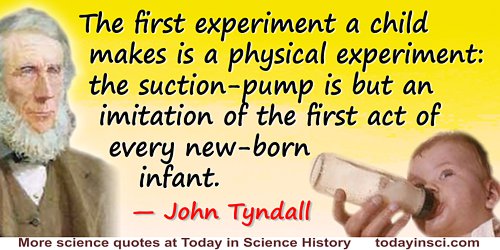
The first experiment a child makes is a physical experiment: the suction-pump is but an imitation of the first act of every new-born infant.
Lecture 'On the Study of Physics', Royal Institution of Great Britain (Spring 1854). Collected in Fragments of Science for Unscientific People: A Series of Detached Essays, Lectures, and Reviews (1892), Vol. 1, 283.
The value of fundamental research does not lie only in the ideas it produces. There is more to it. It affects the whole intellectual life of a nation by determining its way of thinking and the standards by which actions and intellectual production are judged. If science is highly regarded and if the importance of being concerned with the most up-to-date problems of fundamental research is recognized, then a spiritual climate is created which influences the other activities. An atmosphere of creativity is established which penetrates every cultural frontier. Applied sciences and technology are forced to adjust themselves to the highest intellectual standards which are developed in the basic sciences. This influence works in many ways: some fundamental students go into industry; the techniques which are applied to meet the stringent requirements of fundamental research serve to create new technological methods. The style, the scale, and the level of scientific and technical work are determined in pure research; that is what attracts productive people and what brings scientists to those countries where science is at the highest level. Fundamental research sets the standards of modern scientific thought; it creates the intellectual climate in which our modern civilization flourishes. It pumps the lifeblood of idea and inventiveness not only into the technological laboratories and factories, but into every cultural activity of our time. The case for generous support for pure and fundamental science is as simple as that.
In 'Why Pure Science?' in Bulletin of the Atomic Scientists, 1965.
There is no question that climate change is happening; the only arguable point is what part humans are playing in it. … Personally I would be absolutely astounded if population growth and industrialisation and all the stuff we are pumping into the atmosphere hadn’t changed the climatic balance. Of course it has. There is no valid argument for denial.
From interview with Nick Harding in 'Sir David Attenborough: ‘This awful summer? We've only ourselves to blame…’' The Independent (July 2012). On the website of independent.co.uk online.
Tree…
he watching you.
You look at tree,
he listen to you.
He got no finger,
he can’t speak.
But that leaf...
he pumping, growing,
growing in the night.
While you sleeping
you dream something.
Tree and grass same thing.
They grow with your body,
with your feeling.
he watching you.
You look at tree,
he listen to you.
He got no finger,
he can’t speak.
But that leaf...
he pumping, growing,
growing in the night.
While you sleeping
you dream something.
Tree and grass same thing.
They grow with your body,
with your feeling.
Poem from Gagadju Man Bill Neidjie: The Environmental and Spiritual Philosophy of a Senior
Traditional Owner, Kakadu National Park, Northern Territory Australia (2002), 40.
We don’t understand electricity. We use it. You can plug into it and light up a lamp, keep a heart pump going, light a cathedral, or you can electrocute a person with it. … I think talent is like that.
In Maya Angelo and Joanne M. Braxon (ed.), 'An interview with Claudia Tate', I Know why the Caged Bird Sings: A Casebook (1999), 154. Also seen paraphrased as, “Talent is like electricity. We don’t understand electricity. We use it.…”. [Many thanks to P.D. for locating the citation, previously unverified here.]
 In science it often happens that scientists say, 'You know that's a really good argument; my position is mistaken,' and then they would actually change their minds and you never hear that old view from them again. They really do it. It doesn't happen as often as it should, because scientists are human and change is sometimes painful. But it happens every day. I cannot recall the last time something like that happened in politics or religion.
(1987) --
In science it often happens that scientists say, 'You know that's a really good argument; my position is mistaken,' and then they would actually change their minds and you never hear that old view from them again. They really do it. It doesn't happen as often as it should, because scientists are human and change is sometimes painful. But it happens every day. I cannot recall the last time something like that happened in politics or religion.
(1987) -- 




