Profession Quotes (109 quotes)
...a man estimable for his learning, amiable for his life, and venerable for his piety. Arbuthnot was a man of great comprehension, skilful in his profession, versed in the sciences, acquainted with ancient literature, and able to animate his mass of knowledge by a bright and active imagination; a scholar with great brilliance of wit; a wit who, in the crowd of life, retained and discovered a noble ardour of religious zeal.
The Lives of the English Poets (1826), vol. 2, 257.
[Certain students] suppose that because science has penetrated the structure of the atom it can solve all the problems of the universe. ... They are known in every ... college as the most insufferable, cocksure know-it-alls. If you want to talk to them about poetry, they are likely to reply that the "emotive response" to poetry is only a conditioned reflex .... If they go on to be professional scientists, their sharp corners are rubbed down, but they undergo no fundamental change. They most decidedly are not set apart from the others by their intellectual integrity and faith, and their patient humility in front of the facts of nature.... They are uneducated, in the fullest sense of the word, and they certainly are no advertisement for the claims of science teachers.
In Science is a Sacred Cow (1950), 18-19.
[Engineering] is a great profession. There is the fascination of watching a figment of the imagination emerge through the aid of science to a plan on paper. Then it moves to realization in stone or metal or energy. Then it brings homes to men or women. Then it elevates the standards of living and adds to the comforts of life. That is the engineer’s high privilege.
Reprint of his 1916 statement in 'Engineering as a Profession', Engineer’s Week (1954).
[May] this civic and social landmark [the Washington, D.C., Jewish Community Center] ... be a constant reminder of the inspiring service that has been rendered to civilization by men and women of the Jewish faith. May [visitors] recall the long array of those who have been eminent in statecraft, in science, in literature, in art, in the professions, in business, in finance, in philanthropy and in the spiritual life of the world.
Speech upon laying the cornerstone of the Jewish Community Center, Washington, D.C. (3 May 1925). In William J. Federer, A Treasury of Presidential Quotations (2004), 240.
![Arthur Conan Doyle quote: [Sherlock Holmes:] The temptation to form premature theories upon insufficient data is the bane of our](https://todayinsci.com/D/Doyle_Arthur/DoyleArthur-Bane500x250px.jpg)
[Sherlock Holmes:] The temptation to form premature theories upon insufficient data is the bane of our profession.
In The Valley of Fear (1914), 43.
Ars longa, vita brevis.
Art is long, life is short.
Art is long, life is short.
Aphorisms, i. The original was written in Greek. This Latin translation, by Seneca (De Brevitate Vitae, 1.1), is in John Bartlett, Familiar Quotations (1905), 6, footnote 3. The sense is generally taken to be, 'Life is short, but to learn a profession (an art) takes a long time.'
A doctor must work eighteen hours a day and seven days a week. If you cannot console yourself to this, get out of the profession
Martin H. Fischer, Howard Fabing (ed.) and Ray Marr (ed.), Fischerisms (1944).
A hundred years ago … an engineer, Herbert Spencer, was willing to expound every aspect of life, with an effect on his admiring readers which has not worn off today.
Things do not happen quite in this way nowadays. This, we are told, is an age of specialists. The pursuit of knowledge has become a profession. The time when a man could master several sciences is past. He must now, they say, put all his efforts into one subject. And presumably, he must get all his ideas from this one subject. The world, to be sure, needs men who will follow such a rule with enthusiasm. It needs the greatest numbers of the ablest technicians. But apart from them it also needs men who will converse and think and even work in more than one science and know how to combine or connect them. Such men, I believe, are still to be found today. They are still as glad to exchange ideas as they have been in the past. But we cannot say that our way of life is well-fitted to help them. Why is this?
Things do not happen quite in this way nowadays. This, we are told, is an age of specialists. The pursuit of knowledge has become a profession. The time when a man could master several sciences is past. He must now, they say, put all his efforts into one subject. And presumably, he must get all his ideas from this one subject. The world, to be sure, needs men who will follow such a rule with enthusiasm. It needs the greatest numbers of the ablest technicians. But apart from them it also needs men who will converse and think and even work in more than one science and know how to combine or connect them. Such men, I believe, are still to be found today. They are still as glad to exchange ideas as they have been in the past. But we cannot say that our way of life is well-fitted to help them. Why is this?
In 'The Unification of Biology', New Scientist (11 Jan 1962), 13, No. 269, 72.
A library … is a great catalyser, accelerating the nutrition and rate of progress in a profession.
Address for the Dedication of the New Building of the Boston Medical Library (12 Jan 1901). Printed as 'Books and Men', The Boston Medical and Surgical Journal (17 Jan 1901), 144, No. 3, 60.
A true engineer, first of all, considers his duties as a trust and directs his whole energies to discharge the trust with all the solemnity of a judge on a bench. He is so immersed in his profession that he has no other sources of amusement, and is therefore always on his post.
From Jervis Memoirs, Beach Transcript, Jervis Library, Rome, New York. As quoted and cited on asce.org webpage of the American Society of Civil Engineers.
An acquaintance of mine, a notary by profession, who, by perpetual writing, began first to complain of an excessive wariness of his whole right arm which could be removed by no medicines, and which was at last succeeded by a perfect palsy of the whole arm. … He learned to write with his left hand, which was soon thereafter seized with the same disorder.
Concerning a notary, a scribe skilled in rapid writing, in a translation published by the University of Chicago Press (1940).
Art and religion are not professions: they are not occupations for which men can be paid. The artist and the saint do what they have to do, not to make a living, but in obedience to some mysterious necessity. They do not product to live - they live to produce.
In Art (1958), 172.
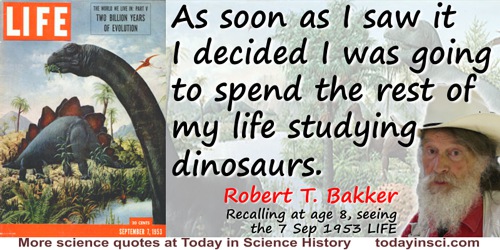
As soon as I saw it I decided I was going to spend the rest of my life studying dinosaurs.
Recalling his reaction, at age 8, when he saw Rudolph Zallinger’s mural of dinosaurs, the cover story of the 7 Sep 1953 Life magazine.
At its heart, engineering is about using science to find creative, practical solutions. It is a noble profession!
From a speech by The Queen at The Queen Elizabeth Prize for Engineering (25 Jun 2013).
Be very vigilent over thy Childe … If he chuse the profession of a Scholler, advise him to study the most profitable Arts: Poetry, and the Mathematichs, take up too great a latitude of the Soule, and moderately used, are good Recreations, but bad Callings, bring nothing but their owne Reward.
From Alexander B. Grosart (ed), 'Enchyridion: The Fourth Book' (1641), The Complete Works in Prose and Verse of Francis Quarles (1880), Vol. 1, 48, Cap. XCIX.
Between men of different studies and professions, may be observed a constant reciprocation of reproaches. The collector of shells and stones derides the folly of him who pastes leaves and flowers upon paper, pleases himself with colours that are perceptibly fading, and amasses with care what cannot be preserved. The hunter of insects stands amazed that any man can waste his short time upon lifeless matter, while many tribes of animals yet want their history. Every one is inclined not only to promote his own study, but to exclude all others from regard, and having heated his imagination with some favourite pursuit, wonders that the rest of mankind are not seized with the same passion.
From 'Numb. 83, Tuesday, January 1, 1750', The Rambler (1756), Vol. 2, 150.
But how is it that they [astrologers] have never been able to explain why, in the life of twins, in their actions, in their experiences, their professions, their accomplishments, their positions—in all the other circumstances of human life, and even in death itself, there is often found such a diversity that in those respects many strangers show more resemblance to them than they show to one another, even though the smallest possible interval separated their births and though they were conceived at the same moment, by a single act of intercourse.
De Civitate Dei (The City of God) [413-426], Book V, chapter I, trans. H. Bettenson (1972),180-181.
But nothing of a nature foreign to the duties of my profession [clergyman] engaged my attention while I was at Leeds so much as the, prosecution of my experiments relating to electricity, and especially the doctrine of air. The last I was led into a consequence of inhabiting a house adjoining to a public brewery, where first amused myself with making experiments on fixed air [carbon dioxide] which found ready made in the process of fermentation. When I removed from that house, I was under the necessity making the fixed air for myself; and one experiment leading to another, as I have distinctly and faithfully noted in my various publications on the subject, I by degrees contrived a convenient apparatus for the purpose, but of the cheapest kind. When I began these experiments I knew very little of chemistry, and had in a manner no idea on the subject before I attended a course of chymical lectures delivered in the Academy at Warrington by Dr. Turner of Liverpool. But I have often thought that upon the whole, this circumstance was no disadvantage to me; as in this situation I was led to devise an apparatus and processes of my own, adapted to my peculiar views. Whereas, if I had been previously accustomed to the usual chemical processes, I should not have so easily thought of any other; and without new modes of operation I should hardly have discovered anything materially new.
Memoirs of Dr. Joseph Priestley, in the Year 1795 (1806), Vol. 1, 61-2.
But the greatest error of all the rest is the mistaking or misplacing of the last or farthest end of knowledge: for men have entered into a desire of learning and knowledge, sometimes upon a natural curiosity and inquisitive appetite; sometimes to entertain their minds with variety and delight; sometimes for ornament and reputation; and sometimes to enable them to victory of wit and contradiction; and most times for lucre and profession; and seldom sincerely to give a true account of their gift of reason, to the benefit and use of men...
The First Book of Francis Bacon of the Proficience and Advancement of Learning (1605). In Francis Bacon and Basil Montagu, The Works of Francis Bacon, Lord Chancellor of England (1852), 174
But, contrary to the lady’s prejudices about the engineering profession, the fact is that quite some time ago the tables were turned between theory and applications in the physical sciences. Since World War II the discoveries that have changed the world are not made so much in lofty halls of theoretical physics as in the less-noticed labs of engineering and experimental physics. The roles of pure and applied science have been reversed; they are no longer what they were in the golden age of physics, in the age of Einstein, Schrödinger, Fermi and Dirac.
'The Age of Computing: a Personal Memoir', Daedalus (1992), 121, 120.
By profession a biologist, [Thomas Henry Huxley] covered in fact the whole field of the exact sciences, and then bulged through its four fences. Absolutely nothing was uninteresting to him. His curiosity ranged from music to theology and from philosophy to history. He didn't simply know something about everything; he knew a great deal about everything.
'Thomas Henry Huxley.' In the Baltimore Evening Sun (4 May 1925). Reprinted in A Second Mencken Chrestomathy: A New Selection from the Writings of America's Legendary Editor, Critic, and Wit (2006), 157.
Can I pay any higher tribute to a man [George Gaylord Simpson] than to state that his work both established a profession and sowed the seeds for its own revision? If Simpson had reached final truth, he either would have been a priest or would have chosen a dull profession. The history of life cannot be a dull profession.
From 'G.G. Simpson, Paleontology, and the Modern Synthesis', collected in Ernst Mayr, William B. Provine (eds.), The Evolutionary Synthesis: Perspectives on the Unification of Biology (1998), 171.
Chemical engineering is the profession in which a knowledge of mathematics, chemistry and other natural sciences gained by study, experience and practice is applied with judgment to develop economic ways of using materials and energy for the benefit of mankind.
— AIChE
In Article III, 'Definition of the Profession', Constitution of the American Institute of
Chemical Engineers (as amended 17 Jan 2003). The same wording is found in the 1983 Constitution, as quoted in Nicholas A. Peppas (ed.), One Hundred Years of Chemical Engineering: From Lewis M. Norton (M.I.T. 1888) to Present (2012), 334.
Early diagnosis of disease is the business of the general public even more than of the medical profession.
In 'The Time Factor in Medicine', Possible Worlds (1945), 104.
Effective science began when it passed from the occasional amateur into the hands of men who made the winning of knowledge their special function or profession.
Address to 48th annual summer convention of the American Institute of Electriccal Engineers, Cleveland (21 Jun 1932), abridged in 'The Rôle of the Engineer', The Electrical Journal (1932), 109, 223.
Engineering is a modest profession, which tends not to blow its own trumpet.
From a speech by The Queen at The Queen Elizabeth Prize for Engineering (25 Jun 2013).
Engineering is more closely akin to the arts than perhaps any other of the professions; first, because it requires the maximum of natural aptitude and of liking for the work in order to offset other factors; second, because it demands, like the arts, an almost selfless consecration to the job; and, third, because out of the hundreds who faithfully devote themselves to the task, only a few are destined to receive any significant reward—in either money or fame.
As coauthor with Frank W. Skinner, and Harold E. Wessman, 'Foreward', Vocational Guidance in Engineering Lines (1933), vi.
Engineering is quite different from science. Scientists try to understand nature. Engineers try to make things that do not exist in nature. Engineers stress invention. To embody an invention the engineer must put his idea in concrete terms, and design something that people can use. That something can be a device, a gadget, a material, a method, a computing program, an innovative experiment, a new solution to a problem, or an improvement on what is existing. Since a design has to be concrete, it must have its geometry, dimensions, and characteristic numbers. Almost all engineers working on new designs find that they do not have all the needed information. Most often, they are limited by insufficient scientific knowledge. Thus they study mathematics, physics, chemistry, biology and mechanics. Often they have to add to the sciences relevant to their profession. Thus engineering sciences are born.
Y.C. Fung and P. Tong, Classical and Computational Solid Mechanics (2001), 1.
Engineering is the profession in which a knowledge of the mathematical and natural sciences gained by study, experience, and practice is applied with judgment to develop ways to utilize, economically, the materials and forces of nature for the benefit of mankind.
— ABET
In EAC Criteria for 1999-2000 as cited in Charles R. Lord, Guide to Information Sources in Engineering (2000), 5. Found in many sources, and earlier, for example, Otis E. Lancaster, American Society for Engineering Education, Engineers' Council for Professional Development, Achieve Learning Objectives (1962), 8.
Engineering is the professional and systematic application of science to the efficient utilization of natural resources to produce wealth.
T. J. Hoover and John Charles Lounsbury (J.C.L.) Fish, The Engineering Profession (1941), 10.
Engineering training deals with the exact sciences. That sort of exactness makes for truth and conscience. It might be good for the world if more men had that sort of mental start in life even if they did not pursue the profession.
Reprint of his 1916 statement in 'Engineering as a Profession', Engineer’s Week (1954).
First, it must be a pleasure to study the human body the most miraculous masterpiece of nature and to learn about the smallest vessel and the smallest fiber. But second and most important, the medical profession gives the opportunity to alleviate the troubles of the body, to ease the pain, to console a person who is in distress, and to lighten the hour of death of many a sufferer.
Reasons for his choice of medicine as a career, from essay written during his last year in the Gymnasium (high school). As quoted in Leslie Dunn, Rudolf Virchow: Now You Know His Name (2012), 8-9.
He who designs an unsafe structure or an inoperative machine is a bad Engineer; he who designs them so that they are safe and operative, but needlessly expensive, is a poor Engineer, and … he who does the best work at lowest cost sooner or later stands at the top of his profession.
From Address on 'Industrial Engineering' at Purdue University (24 Feb 1905). Reprinted by Yale & Towne Mfg Co of New York and Stamford, Conn. for the use of students in its works.
HOMŒOPATHIST, n. The humorist of the medical profession.
The Collected Works of Ambrose Bierce (1911), Vol. 7, The Devil's Dictionary, 139.
How to start on my adventure—how to become a forester—was not so simple. There were no schools of Forestry in America. … Whoever turned his mind toward Forestry in those days thought little about the forest itself and more about its influences, and about its influence on rainfall first of all. So I took a course in meteorology, which has to do with weather and climate. and another in botany, which has to do with the vegetable kingdom—trees are unquestionably vegetable. And another in geology, for forests grow out of the earth. Also I took a course in astronomy, for it is the sun which makes trees grow. All of which is as it should be, because science underlies the forester’s knowledge of the woods. So far I was headed right. But as for Forestry itself, there wasn’t even a suspicion of it at Yale. The time for teaching Forestry as a profession was years away.
In Breaking New Ground (1947, 1998), 3.
I am giving this winter two courses of lectures to three students, of which one is only moderately prepared, the other less than moderately, and the third lacks both preparation and ability. Such are the onera of a mathematical profession.
Letter to Friedrich Bessel (4 Dec 1808). In Gauss-Bessel Briefwechsel (1880), 107. In Robert Édouard Moritz, Memorabilia Mathematica; Or, The Philomath's Quotation-book (1914), 158.
I do not like to see all the fine boys turning to the study of law, instead of to the study of science or technology. … Japan wants no more lawyers now; and I think the professions of literature and of teaching give small promise. What Japan needs are scientific men; and she will need more and more of them every year.
In letter to Masanobu Ōtani (1894), collected in Elizabeth Bisland The Writings of Lafcadio Hearn (1922), Vol. 14, 273.
I feel more confident and more satisfied when I reflect that I have two professions and not one. Medicine is my lawful wife and literature is my mistress. When I get tired of one I spend the night with the other. Though it's disorderly it's not so dull, and besides, neither really loses anything, through my infidelity.
In letter to A.S. Suvorin (11 Sep 1888).
I have had three personal ideals. One, to do the day’s work well and not to bother about tomorrow.… The second ideal has been to act the Golden Rule, as far as in me lay, towards my professional brethren and towards the patients committed to my care. And the third has been to cultivate such a measure of equanimity as would enable me to bear success with humility, the affection of my friends without pride, and to be ready when the day of sorrow and grief came to meet it with the courage befitting a man.
Remarks at farewell dinner given by the profession of the United States and Canada, New York (20 May 1905). Published as 'L’Envoi', No. 22 in Aequanimitas and other Addresses (1904, 1906), 473.
I hold every man a debtor to his profession; from the which as men of course do seek to receive countenance and profit, so ought they of duty to endeavour themselves, by way of amends, to be a help and ornament thereunto. This is performed, in some degree, by the honest and liberal practice of a profession; where men shall carry a respect not to descend into any course that is corrupt and unworthy thereof, and preserve themselves free from the abuses wherewith the same profession is noted to be infected: but much more is this performed, if a man be able to visit and strengthen the roots and foundation of the science itself; thereby not only gracing it in reputation and dignity, but also amplifying it in profession and substance.
Opening sentences of Preface, Maxims of Law (1596), in The Works of Francis Bacon: Law tracts. Maxims of the Law (1803), Vol. 4, 10.
I read once that the true mark of a pro—at anything—is that he understands, loves, and is good at even the drudgery of his profession.
In I Want to be a Mathematician: an Automathography (1985), 37.
I think it is a duty I owe to my profession and to my sex to show that a woman has a right to the practice of her profession and cannot be condemned to abandon it merely because she marries. I cannot conceive how women’s colleges, inviting and encouraging women to enter professions can be justly founded or maintained denying such a principle.
(From a letter Brooks wrote to her dean, knowing that she would be told to resign if she married, she asked to keep her job. Nevertheless, she lost her teaching position at Barnard College in 1906. Dean Gill wrote that “The dignity of women’s place in the home demands that your marriage shall be a resignation.”)
(From a letter Brooks wrote to her dean, knowing that she would be told to resign if she married, she asked to keep her job. Nevertheless, she lost her teaching position at Barnard College in 1906. Dean Gill wrote that “The dignity of women’s place in the home demands that your marriage shall be a resignation.”)
As quoted by Margaret W. Rossiter in Women Scientists in America: Struggles and Strategies to 1940. Baltimore: Johns Hopkins University Press (1982).
I think, considering what they have had to fight against, that women have been wonderful. I see no end to their development in science, as in the arts and professions and in business, if they have the will to work.
In Genevieve Parkhurst, 'Dr. Sabin, Scientist: Winner Of Pictorial Review’s Achievement Award', Pictorial Review (Jan 1930), 71.
I was interested in truth from the point of view of salvation just as much as in truth from the point of view of scientific certainty. It appeared to me that there were two paths to truth, and I decided to follow both of them.
Explaining his decision, made at age 9, to become a scientist, followed within a month by his decision to also become a priest. In interview with Duncan Aikman, 'Lemaître Follows Two Paths to Truth', New York Times Magazine (19 Feb 1933), 3.
If intellectual curiosity, professional pride, and ambition are the dominant incentives to research, then assuredly no one has a fairer chance of gratifying them than a mathematician.
In A Mathematician’s Apology (1940, 1967), 80.
If the love of surgery is a proof of a person’s being adapted for it, then certainly I am fitted to he a surgeon; for thou can’st hardly conceive what a high degree of enjoyment I am from day to day experiencing in this bloody and butchering department of the healing art. I am more and more delighted with my profession.
Letter to his father (1853). In John Vaughan, 'Lord Lister', The Living Age (1918), 297, 361. Reprinted from The Fortnightly Review (1918), 109, 417- .
If we had nothing but pecuniary rewards and worldly honours to look to, our profession would not be one to be desired. But in its practice you will find it to be attended with peculiar privileges, second to none in intense interest and pure pleasures. It is our proud office to tend the fleshly tabernacle of the immortal spirit, and our path, rightly followed, will be guided by unfettered truth and love unfeigned. In the pursuit of this noble and holy calling I wish you all God-speed.
Conclusion of Graduation Address, University of Edinburgh (1876). In John Vaughan, 'Lord Lister', The Living Age (1918), 297, 361.
If you care to be a master or to make a true success of your profession, the smallest detail of your work must be done with thoroughness. To be thorough in medicine means that in the ever alluring present, we do not forget the past.
Opening address to the Medical Department of the University of Michigan, Sep 1914. Quoted by Howard Markel in 'When it Rains it Pours' : Endemic Goiter, Iodized Salt, and David Murray Cowie, M.D. American Journal of Public Health, Feb 1987, vol.77, No.2, page 227.
In any of the learned professions a vigorous constitution is equal to at least fifty per
cent more brain.
In Getting on in the World; Or, Hints on Success in Life (1873), 55.
In order to imbue civilization with sound principles and enliven it with the spirit of the gospel, it is not enough to be illumined with the gift of faith and enkindled with the desire of forwarding a good cause. For this end it is necessary to take an active part in the various organizations and influence them from within. And since our present age is one of outstanding scientific and technical progress and excellence, one will not be able to enter these organizations and work effectively from within unless he is scientifically competent, technically capable and skilled in the practice of his own profession.
Encyclical (10 Apr 1963). In Pacem in Terris, Pt. 5, 50
In the last fifteen years we have witnessed an event that, I believe, is unique in the history of the natural sciences: their subjugation to and incorporation into the whirls and frenzies of disgusting publicity and propaganda. This is no doubt symptomatic of the precarious position assigned by present-day society to any form of intellectual activity. Such intellectual pursuits have at all times been both absurd and fragile; but they become ever more ludicrous when, as is now true of science, they become mass professions and must, as homeless pretentious parasites, justify their right to exist in a period devoted to nothing but the rapid consumption of goods and amusements. These sciences were always a divertissement in the sense in which Pascal used the word; but what is their function in a society living under the motto lunam et circenses? Are they only a band of court jesters in search of courts which, if they ever existed, have long lost their desire to be amused?
Voices in the Labyrinth: Nature, Man, and Science (1979), 27.
In those days in the South, the only professional jobs that seemed to be open to a black man were a teacher, a preacher, a doctor or a lawyer.
About his youth. Quoted in Johns Hopkins University News Release (9 Jan 2003) on jh.edu web site.
Into whatsoever houses I enter, I will enter to help the sick, and I will abstain from all intentional wrong-doing and harm, especially from abusing the bodies of man or woman, bond or free. And whatsoever I shall see or hear in the course of my profession, as well as outside my profession in my intercourse with men, if it be what should not be published abroad, I will never divulge, holding such things to be holy secrets.
Oath, in Hippocrates, trans. W. H. S. Jones (1923), Vol. 1, 301.
It is contrary to the usual practice of professional men to give their opinions upon each other's work unless regularly called upon in the way of their profession.
It is told of Faraday that he refused to be called a physicist; he very much disliked the new name as being too special and particular and insisted on the old one, philosopher, in all its spacious generality: we may suppose that this was his way of saying that he had not over-ridden the limiting conditions of class only to submit to the limitation of a profession.
Commentary (Jun 1962), 33, 461-77. Cited by Sydney Ross in Nineteenth-Century Attitudes: Men of Science (1991), 11.
It often happens that men, even of the best understandings and greatest circumspection, are guilty of that fault in reasoning which the writers on logick call the insufficient, or imperfect enumeration of parts, or cases: insomuch that I will venture to assert, that this is the chief, and almost the only, source of the vast number of erroneous opinions, and those too very often in matters of great importance, which we are apt to form on all the subjects we reflect upon, whether they relate to the knowledge of nature, or the merits and motives of human actions. It must therefore be acknowledged, that the art which affords a cure to this weakness, or defect, of our understandings, and teaches us to enumerate all the possible ways in which a given number of things may be mixed and combined together, that we may be certain that we have not omitted anyone arrangement of them that can lead to the object of our inquiry, deserves to be considered as most eminently useful and worthy of our highest esteem and attention. And this is the business of the art, or doctrine of combinations ... It proceeds indeed upon mathematical principles in calculating the number of the combinations of the things proposed: but by the conclusions that are obtained by it, the sagacity of the natural philosopher, the exactness of the historian, the skill and judgement of the physician, and the prudence and foresight of the politician, may be assisted; because the business of all these important professions is but to form reasonable conjectures concerning the several objects which engage their attention, and all wise conjectures are the results of a just and careful examination of the several different effects that may possibly arise from the causes that are capable of producing them.
Ars conjectandi (1713). In F. Maseres, The Doctrine of Permutations and Combinations (1795), 36.
John Dalton was a very singular Man, a quaker by profession & practice: He has none of the manners or ways of the world. A tolerable mathematician He gained his livelihood I believe by teaching the mathematics to young people. He pursued science always with mathematical views. He seemed little attentive to the labours of men except when they countenanced or confirmed his own ideas... He was a very disinterested man, seemed to have no ambition beyond that of being thought a good Philosopher. He was a very coarse Experimenter & almost always found the results he required.—Memory & observation were subordinate qualities in his mind. He followed with ardour analogies & inductions & however his claims to originality may admit of question I have no doubt that he was one of the most original philosophers of his time & one of the most ingenious.
J. Z. Fullmer, 'Davy's Sketches of his Contemporaries', Chymia, 1967, 12, 133-134.
Like all things of the mind, science is a brittle thing: it becomes absurd when you look at it too closely. It is designed for few at a time, not as a mass profession. But now we have megascience: an immense apparatus discharging in a minute more bursts of knowledge than humanity is able to assimilate in a lifetime. Each of us has two eyes, two ears, and, I hope, one brain. We cannot even listen to two symphonies at the same time. How do we get out of the horrible cacophony that assails our minds day and night? We have to learn, as others did, that if science is a machine to make more science, a machine to grind out so-called facts of nature, not all facts are equally worth knowing. Students, in other words, will have to learn to forget most of what they have learned. This process of forgetting must begin after each exam, but never before. The Ph.D. is essentially a license to start unlearning.
Voices In the Labyrinth: Nature, Man, and Science (1979), 2.
Looking at the thunder machine which had been set up, I saw not the slightest indication of the presence of electricity. However, while they were putting the food on the table, I obtained extraordinary electric sparks from the wire. My wife and others approached from it, for the reason that I wished to have witnesses see the various colors of fire about which the departed Professor Richmann used to argue with me. Suddenly it thundered most violently at the exact time that I was holding my hand to the metal, and sparks crackled. All fled away from me, and my wife implored that I go away. Curiosity kept me there two or three minutes more, until they told me that the soup was getting cold. By that time the force of electricity greatly subsided. I had sat at table only a few minutes when the man servant of the departed Richmann suddenly opened the door, all in tears and out of breath from fear. I thought that some one had beaten him as he was on his way to me, but he said, with difficulty, that the professor had been injured by thunder… . Nonetheless, Mr. Richmann died a splendid death, fulfilling a duty of his profession.
As quoted in Boris Menshutkin, 'Lomonosov: Excerpts', collected in Thomas Riha (ed.), Readings for Introduction to Russian Civilization (1963), Vol. 2, 30.
Mathematics is a dangerous profession; an appreciable proportion of us go mad.
In A Mathematician’s Miscellany (1953), reissued as Béla Bollobás (ed.), Littlewood’s Miscellany (1986), 104.
Medicine is a noble profession but a damn bad business.
…...
Medicine is essentially a learned profession. Its literature is ancient, and connects it with the most learned periods of antiquity; and its terminology continues to be Greek or Latin. You cannot name a part of the body, and scarcely a disease, without the use of a classical term. Every structure bears upon it the impress of learning, and is a silent appeal to the student to cultivate an acquaintance with the sources from which the nomenclature of his profession is derived.
From Address (Oct 1874) delivered at Guy’s Hospital, 'On The Study of Medicine', printed in British Medical journal (1874), 2, 425. Collected in Sir William Withey Gull and Theodore Dyke Acland (ed.), A Collection of the Published Writings of William Withey Gull (1896), 11.
Medicine would be the ideal profession if it did not involve giving pain.
The Health Master (1913), 61.
Medicine, the only profession that labours incessantly to destroy the reason for its own existence.
Speech at a dinner for General W.C. Gorgas (23 Mar 1914). In Carl C. Gaither and Andrew SlocombeMedically Speaking (), 204.
Men today who have had an irreproachable training in the art are seen to abstain from the use of the hand as from the plague, and for this very reason, lest they should be slandered by the masters of the profession as barbers… . For it is indeed above all things the wide prevalence of this hateful error that prevents us even in our age from taking up the healing art as a whole, makes us confine ourselves merely to the treatment of internal complaints, and, if I may utter the blunt truth once for all, causes us, to the great detriment of mankind, to study to be healers only in a very limited degree.
As given in George I. Schwartz and Philip W. Bishop, 'Andreas Vesalius', Moments of Discovery: The Development of Modern Science (1958), Vol. 1, 521.
My practice as a scientist is atheistic. That is to say, when I set up an experiment I assume that no god, angel or devil is going to interfere with its course; and this assumption has been justified by such success as I have achieved in my professional career. I should therefore be intellectually dishonest if I were not also atheistic in the affairs of the world.
In Fact and Faith (1934), vi.
My profession often gets bad press for a variety of sins, both actual and imagined: arrogance, venality, insensitivity to moral issues about the use of knowledge, pandering to sources of funding with insufficient worry about attendant degradation of values. As an advocate for science, I plead ‘mildly guilty now and then’ to all these charges. Scientists are human beings subject to all the foibles and temptations of ordinary life. Some of us are moral rocks; others are reeds. I like to think (though I have no proof) that we are better, on average, than members of many other callings on a variety of issues central to the practice of good science: willingness to alter received opinion in the face of uncomfortable data, dedication to discovering and publicizing our best and most honest account of nature’s factuality, judgment of colleagues on the might of their ideas rather than the power of their positions.
In Dinosaur in a Haystack: Reflections in Natural History (1997), 270.
Nothing is known in our profession by guess; and I do not believe, that from the first dawn of medical science to the present moment, a single correct idea has ever emanated from conjecture: it is right therefore, that those who are studying their profession should be aware that there is no short road to knowledge; and that observation on the diseased living, examination of the dead, and experiments upon living animals, are the only sources of true knowledge; and that inductions from these are the sole bases of legitimate theory.
Astley Paston Cooper, Astley Cooper, Bransby Blake Cooper, A Treatise on Dislocations and Fractures of the Joints (1851), 155.
Nowadays the field naturalist—who is usually at all points superior to the mere closet naturalist—follows a profession as full of hazard and interest as that of the explorer or of the big-game hunter in the remote wilderness.
African Game Trails (1910), 414-415.
Nursing has sometimes been made a trade, sometimes a profession; it will never be what it should be until it is made a religion.
As quoted in Sir William Withey Gull and Theodore Dyke Acland (ed.), A Collection of the Published Writings of William Withey Gull (1896), xxx.
On J-Day our profession will have a lot to answer for! We might at least have withheld our hands instead of making them work against God.
On the 25th of this month I remove to the SchoolHouse beyond Gray’s Ferry to succeed the present Teacher there. I shall recommence that painful profession once more with the same gloomy sullen resignation that a prisoner re-enters his Dungeon or a Malefactor mounts the Scaffold; Fate urges him, necessity me. … I shall have many difficulties to overcome in establishing my own Rules and authority. But perseverance overcometh all things.
From Letter to Charles Orr (14 Feb 1802), collected in Clark Hunter (ed.), The Life and Letters of Alexander Wilson (1983), 191-192.
Our profession is the only one which works unceasingly to annihilate itself.
Parenthood is the only profession that has been left exclusively to amateurs.
Perhaps scientists have been the most international of all professions in their outlook... Every time you scientists make a major invention, we politicians have to invent a new institution to cope with it—and almost invariably, these days, it must be an international institution.
From Address to the Centennial Convocation of the National Academy of Sciences (22 Oct 1963), 'A Century of Scientific Conquest'. Online at The American Presidency Project.
Science in England is not a profession: its cultivators are scarcely recognised even as a class. Our language itself contains no single term by which their occupation can be expressed. We borrow a foreign word [Savant] from another country whose high ambition it is to advance science, and whose deeper policy, in accord with more generous feelings, gives to the intellectual labourer reward and honour, in return for services which crown the nation with imperishable renown, and ultimately enrich the human race.
The Exposition of 1851: Or the Views of Industry, Science and Government of England (1851), 171.
Some day when you have time, look into the business of prayer, amulets, baths, and poultices, and discover much valuable therapy the profession has cast on the dump
Martin H. Fischer, Howard Fabing (ed.) and Ray Marr (ed.), Fischerisms (1944).
Space travel is at the frontier of my profession. It is going to be accomplished and I want to be in on it. There is also an element of simple duty involved. I am convinced that I have something to give this project.
As he wrote in an article for Life (14 Sep 1959), 38.
Such is professional jealousy; a scientist will never show any kindness for a theory which he did not start himself.
In A Tramp Abroad (1880), 156.
The double horror of two Japanese city names [Hiroshima and Nagasaki] grew for me into another kind of double horror; an estranging awareness of what the United States was capable of, the country that five years before had given me its citizenship; a nauseating terror at the direction the natural sciences were going. Never far from an apocalyptic vision of the world, I saw the end of the essence of mankind an end brought nearer, or even made, possible, by the profession to which I belonged. In my view, all natural sciences were as one; and if one science could no longer plead innocence, none could.
Heraclitean Fire: Sketches from a Life before Nature (1978), 3.
The first three men in the world were a gardener, a ploughman, and a grazier; and if any object that the second of these was a murderer, I desire him to consider that as soon as he was so, he quitted our profession, and turned builder.
The flight of most members of a profession to the high empyrean, where they can work peacefully on purely scientific problems, isolated from the turmoil of real life, was perhaps quite appropriate at an earlier stage of science; but in today's world it is a luxury we cannot afford.
The Scientific Imagination: Case Studies (1978), 250.
The great liability of the engineer compared to men of other professions is that his works are out in the open where all can see them. … He cannot, like the architects, cover his failures with trees and vines. … If his works do not work, he is damned. That is the phantasmagoria that haunts his nights and dogs his days. He comes from the job at the end of the day resolved to calculate it again.
Reprint of his 1916 statement in 'Engineering as a Profession', Engineer’s Week (1954).
The habitat of an organism is the place where it lives, or the place where one would go to find it. The ecological niche, on the other hand, is the position or status of an organism within its community and ecosystem resulting from the organism’s structural adaptations, physiological responses and specific behavior (inherited and/or learned). The ecological niche of an organism depends not only on where it lives, but also on what it does. By analogy, it may be said that the habitat is the organism’s ‘address,’ and the niche is its ‘profession,’ biologically speaking.
Fundamentals of Ecology
The historian of science may be tempted to claim that when paradigms change, the world itself changes with them. Led by a new paradigm, scientists adopt new instruments and look in new places. even more important, during revolutions, scientists see new and different things when looking with familiar instruments in places they have looked before. It is rather as if the professional community had been suddenly transported to another planet where familiar objects are seen in a different light and are joined by unfamiliar ones as well.
In The Structure of Scientific Revolutions (1962, 2nd ed. 1970). Excerpt 'Revolutions as Changes of World View', in Joseph Margolis and Jacques Catudal, The Quarrel between Invariance and Flux (2001), 35-36.
The indescribable pleasure—which pales the rest of life's joys—is abundant compensation for the investigator who endures the painful and persevering analytical work that precedes the appearance of the new truth, like the pain of childbirth. It is true to say that nothing for the scientific scholar is comparable to the things that he has discovered. Indeed, it would be difficult to find an investigator willing to exchange the paternity of a scientific conquest for all the gold on earth. And if there are some who look to science as a way of acquiring gold instead of applause from the learned, and the personal satisfaction associated with the very act of discovery, they have chosen the wrong profession.
From Reglas y Consejos sobre Investigacíon Cientifica: Los tónicos de la voluntad. (1897), as translated by Neely and Larry W. Swanson, in Advice for a Young Investigator (1999), 50.
The introduction of men into the lying in chamber in place of female attendants, has increased the suffering and dangers of childbearing women, and brought multiplied injuries and fatalities upon mothers and children; it violates the sensitive feelings of husbands and wives and causes an untold amount of domestic misery. The unlimited intimacy between a male profession and the female population silently and effectually wears away female delicacy and professional morality, and tends probably more than any other cause in existence, to undermine the foundation of public virtue.
Man-midwifery Exposed and Corrected (1848) quoted in The Male Midwife and the Female Doctor: The Gynecology Controversy in Nineteenth Century America Charles Rosenburg and Carroll Rovenberg Smith (Editors) publ. Arno, 1974.
The modern naturalist must realize that in some of its branches his profession, while more than ever a science, has also become an art.
African Game Trails (1910), 17.
The politician … is sometimes tempted to encroach on the normal territory of the scientific estate. Sometimes he interferes directly with the scientist’s pursuit of basic science; but he is more likely to interfere when the scientist proposes to publish findings that upset the established political or economic order, or when he joins with the engineering or medical profession in proposing to translate the findings of science into new policies. … Who decides when the apparent consensus of scientific opinion on the relation of cigarettes to lung cancer is great enough to justify governmental regulatory action, and of what kind? In such issues the problem is less often whether politics will presume to dictate to science than it is how much politics is to be influenced by the new findings of science.
In The Scientific Estate (1965), 201.
The price one pays for pursuing any profession, or calling, is an intimate knowledge of its ugly side.
Nobody Knows My Name (1961). In The Price of the Ticket: Collected Nonfiction, 1948-1985 (1985), 302.
The professional standards of conduct for engineers set a very high bar for the professional engineer. Sure, there have been engineering mistakes. Sure, there has been liability ascribed to faulty engineering design. Sure, there are some “bad apples” in the profession. However, considering the scope of the work that engineers have addressed over the last century, their collective performance has been superior.
In 'Engineering Ethics: Only Your Reputation is at Risk' (10 Jul 2015) article on Brigham Young University Wheatley Institution wheatley.byu.edu website. Originally published in Pittsburgh Engineer (Spring 2013).
The science of calculation … is indispensable as far as the extraction of the square and cube roots: Algebra as far as the quadratic equation and the use of logarithms are often of value in ordinary cases: but all beyond these is but a luxury; a delicious luxury indeed; but not to be indulged in by one who is to have a profession to follow for his subsistence.
In Letter (18 Jun 1799) to William G. Munford. On founders.archives.gov website.
The time is ripe for poetry therapy now because the psychiatric profession is more flexible in its willingness to use new techniques.Ten years ago we were laughed at. Now they’re starting to teach it in colleges.”
As quoted in Paul L. Montgomery, 'Psychopoetry: A New Way of Reaching the Disturbed', New York Times (17 Apr 1971), 31.
The transition from a paradigm in crisis to a new one from which a new tradition of normal science can emerge is far from a cumulative process, one achieved by an articulation or extension of the old paradigm. Rather it is a reconstruction of the field from new fundamentals, a reconstruction that changes some of the field's most elementary theoretical generalizations as well as many of its paradigm methods and applications. During the transition period there will be a large but never complete overlap between the problems that can be solved by the old and by the new paradigm. But there will also be a decisive difference in the modes of solution. When the transition is complete, the profession will have changed its view of the field, its methods, and its goals.
The Structure of Scientific Revolutions (1962), 84-5.
There has come about a general public awareness that America is not automatically, and effortlessly, and unquestionably the leader of the world in science and technology. This comes as no surprise to those of us who have watched and tried to warn against the steady deterioration in the teaching of science and mathematics in the schools for the past quarter century. It comes as no surprise to those who have known of dozens of cases of scientists who have been hounded out of jobs by silly disloyalty charges, and kept out of all professional employment by widespread blacklisting practices.
Banquet speech at American Physical Society, St. Louis, Missouri. (29 Nov 1957). In "Time to Stop Baiting Scientists", Bulletin of the Atomic Scientists (Feb 1958), 80.
There is a tolerably general agreement about what a university is not. It is not a place of professional education.
Address (Feb 1867) to the University of St. Andrews upon inauguration as Rector. The Living Age (16 Mar 1867), 92, 643.
There is no profession so incompatible with original enquiry as is a Scotch Professorship, where one’s income depends on the numbers of pupils. Is there one Professor in Edinburgh pursuing science with zeal? Are they not all occupied as showmen whose principal object is to attract pupils and make money?
Brewster to J. D. Forbes, 11 February 1830 (St. Andrew's University Library). Quoted in William Cochlan, 'Sir David Brewster: An Outline Biography', in J.R.R. Christie (ed.), Martyr of Science: Sir David Brewster, 1781-1868 (1984), 13.
There is no record in human history of a happy philosopher; they exist only in romantic legend. Many of them have committed suicide; many others have turned their children out of doors and beaten their wives. And no wonder. If you want to find out how a philosopher feels when he is engaged in the practise of his profession, go to the nearest zoo and watch a chimpanzee at the wearying and hopeless job of chasing fleas. Both suffer damnably, and neither can win.
From The Human Mind, Prejudices: Sixth Series (1927), 85. Collected in A Mencken Chrestomathy (1949, 1956), 16.
Throughout history, engineers have served their neighbours, their towns and their countries by making tools, machines and countless other things that improve every aspect of life. From information technology to medical science and mining, from building roads to space travel, engineers are working to make a difference to our standard of living, and with it our health, wealth and happiness. At its heart, engineering is about using science to find creative, practical solutions. It is a noble profession.
In Speech (25 Jun 2013), for the 2013 Queen Elizabeth Prize for Engineering.
To say that, a scientific man puts forth a theory and, supports it and adheres to it, not because he thinks it true, but because he wishes it to be true, is the same thing as saying that he is not a seeker after truth at all, and is therefore a traitor to his profession.
In Reason and Belief (1910), 136.
Very different would be the position of the profession toward homeopathy if it had aimed, like other doctrines advanced by physicians, to gain a foothold among medical men alone or chiefly, instead of making its appeal to the popular favour and against the profession. … And as its adherents do not aim simply at the establishment of a system of doctrines, but wage a war of radicalism against the profession, and seek to throw down the barricades and guard it from the intrusion of ignorance and quackery … our duty is to expel them.
Proceedings of the Connecticut Medical Society (1847), 24. Quoted by Harris L. Coulter in Divided Legacy: the Conflict Between Homeopathy and the American Medical Association (1982), 204.
We are having wool pulled over our eyes if we let ourselves be convinced that scientists, taken as a group, are anything special in the way of brains. They are very ordinary professional men, and all they know is their own trade, just like all other professional men. There are some geniuses among them, just as there are mental giants in any other field of endeavor.
In Science is a Sacred Cow (1950), 23-24.
We can found no scientific discipline, nor a hearty profession, on the technical mistakes of the Department of Defense and, mainly, one computer manufacturer.
…...
We profess to teach the principles and practice of medicine, or, in other words, the science and art of medicine. Science is knowledge reduced to principles; art is knowledge reduced to practice. The knowing and doing, however, are distinct. ... Your knowledge, therefore, is useless unless you cultivate the art of healing. Unfortunately, the scientific man very often has the least amount of art, and he is totally unsuccessful in practice; and, on the other hand, there may be much art based on an infinitesimal amount of knowledge, and yet it is sufficient to make its cultivator eminent.
From H.G. Sutton, Abstract of Lecture delivered at Guy's Hospital by Samuel Wilks, 'Introductory to Part of a Course on the Theory and Practice of Medicine', The Lancet (24 Mar 1866), 1, 308
What is wanted in architecture, as in so many things, is a man. ... One suggestion might be made—no profession in England has done its duty until it has furnished a victim. ... Even our boasted navy never achieved a great victory until we shot an admiral. Suppose an architect were hanged? Terror has its inspiration, as well as competition.
Tancred: Or, The New Crusade (1907), 112.
While medicine is to be your vocation, or calling, see to it that you have also an avocation—some intellectual pastime which may serve to keep you in touch with the world of art, of science, or of letters. Begin at once the cultivation of some interest other than the purely professional. … No matter what it is—but have an outside hobby.
From address at McGill College, Montreal (1899), 'After Twenty-Five Years', No. 11 in Aequanimitas and other Addresses (1904, 1906), 213.
With the exception of lawyers, there is no profession which, considers itself above the law so widely as the medical profession.
The Health Master (1913), 10.
Within 100 years the profession of teaching has grown from about one-twentieth to one-fourth of the [college] graduates… Since 1880 the line for teaching has crossed that of the ministry, and since 1890 that of law. Thus at the close of the century it is the dominant profession.
Professional Distribution of College and University Graduates (1912). Quoted in Bruce A. Kimball, The True Professional Ideal in America: A History (1996), 198.
You have chosen the most fascinating and dynamic profession there is, a profession with the highest potential for greatness, since the physician’s daily work is wrapped up in the subtle web of history. Your labors are linked with those of your colleagues who preceded you in history, and those who are now working all over the world. It is this spiritual unity with our colleagues of all periods and all countries that has made medicine so universal and eternal. For this reason we must study and try to imitate the lives of the “Great Doctors” of history.
epilogue to A Prelude to Medical History
 In science it often happens that scientists say, 'You know that's a really good argument; my position is mistaken,' and then they would actually change their minds and you never hear that old view from them again. They really do it. It doesn't happen as often as it should, because scientists are human and change is sometimes painful. But it happens every day. I cannot recall the last time something like that happened in politics or religion.
(1987) --
In science it often happens that scientists say, 'You know that's a really good argument; my position is mistaken,' and then they would actually change their minds and you never hear that old view from them again. They really do it. It doesn't happen as often as it should, because scientists are human and change is sometimes painful. But it happens every day. I cannot recall the last time something like that happened in politics or religion.
(1987) -- 





