Process Quotes (441 quotes)
… just as the astronomer, the physicist, the geologist, or other student of objective science looks about in the world of sense, so, not metaphorically speaking but literally, the mind of the mathematician goes forth in the universe of logic in quest of the things that are there; exploring the heights and depths for facts—ideas, classes, relationships, implications, and the rest; observing the minute and elusive with the powerful microscope of his Infinitesimal Analysis; observing the elusive and vast with the limitless telescope of his Calculus of the Infinite; making guesses regarding the order and internal harmony of the data observed and collocated; testing the hypotheses, not merely by the complete induction peculiar to mathematics, but, like his colleagues of the outer world, resorting also to experimental tests and incomplete induction; frequently finding it necessary, in view of unforeseen disclosures, to abandon one hopeful hypothesis or to transform it by retrenchment or by enlargement:—thus, in his own domain, matching, point for point, the processes, methods and experience familiar to the devotee of natural science.
In Lectures on Science, Philosophy and Art (1908), 26
… the embryological record, as it is usually presented to us, is both imperfect and misleading. It may be compared to an ancient manuscript, with many of the sheets lost, others displaced, and with spurious passages interpolated by a later hand. … Like the scholar with his manuscript, the embryologist has by a process of careful and critical examination to determine where the gaps are present, to detect the later insertions, and to place in order what has been misplaced.
A Treatise on Comparative Embryology (1885), Vol. 1, 3-4.
… the reasoning process [employed in mathematics] is not different from that of any other branch of knowledge, … but there is required, and in a great degree, that attention of mind which is in some part necessary for the acquisition of all knowledge, and in this branch is indispensably necessary. This must be given in its fullest intensity; … the other elements especially characteristic of a mathematical mind are quickness in perceiving logical sequence, love of order, methodical arrangement and harmony, distinctness of conception.
In Treatise on Infinitesimal Calculus (1868), Vol. 8, 6.
...an idea is no more an even relatively constant thing than is a feeling or emotion or volitional process. There exist only changing and transient ideational processes; there are no permanent ideas that return again and disappear again.
An Introduction to Psychology (1912)
...the life of the planet began the long, slow process of modulating and regulating the physical conditions of the planet. The oxygen in today's atmosphere is almost entirely the result of photosynthetic living, which had its start with the appearance of blue-green algae among the microorganisms.
In Late Night Thoughts on Listening to Mahler's Ninth Symphony(1984), 74.
[D]iscovery should come as an adventure rather than as the result of a logical process of thought. Sharp, prolonged thinking is necessary that we may keep on the chosen road but it does not itself necessarily lead to discovery. The investigator must be ready and on the spot when the light comes from whatever direction.
Letter to Dr. E. B. Krumhaar (11 Oct 1933), in Journal of Bacteriology (Jan 1934), 27, No. 1, 19.
[Everyone should know:] The unity of life that comes about through evolution, since we’re all descended from a single common ancestor. It’s almost too good to be true, that on one planet this extraordinary complexity of life should have come about by what is pretty much an intelligible process. And we're the only species capable of understanding it.
From 'Interview: Of Mind and Matter: David Attenborough Meets Richard Dawkins', The Guardian (11 Sep 2010),
[Fritz Haber's] greatness lies in his scientific ideas and in the depth of his searching. The thought, the plan, and the process are more important to him than the completion. The creative process gives him more pleasure than the yield, the finished piece. Success is immaterial. “Doing it was wonderful.” His work is nearly always uneconomical, with the wastefulness of the rich.
In Richard Willstätter, Arthur Stoll (ed. of the original German) and Lilli S. Hornig (trans.), From My Life: The Memoirs of Richard Willstätter (1958), 268.
[In mathematics] we behold the conscious logical activity of the human mind in its purest and most perfect form. Here we learn to realize the laborious nature of the process, the great care with which it must proceed, the accuracy which is necessary to determine the exact extent of the general propositions arrived at, the difficulty of forming and comprehending abstract concepts; but here we learn also to place confidence in the certainty, scope and fruitfulness of such intellectual activity.
In Ueber das Verhältnis der Naturwissenschaften zur Gesammtheit der Wissenschaft, Vorträge und Reden (1896), Bd. 1, 176. Also seen translated as “In mathematics we see the conscious logical activity of our mind in its purest and most perfect form; here is made manifest to us all the labor and the great care with which it progresses, the precision which is necessary to determine exactly the source of the established general theorems, and the difficulty with which we form and comprehend abstract conceptions; but we also learn here to have confidence in the certainty, breadth, and fruitfulness of such intellectual labor”, in Robert Édouard Moritz, Memorabilia Mathematica; Or, The Philomath’s Quotation-book (1914), 20. From the original German, “Hier sehen wir die bewusste logische Thätigkeit unseres Geistes in ihrer reinsten und vollendetsten Form; wir können hier die ganze Mühe derselben kennen lernen, die grosse Vorsicht, mit der sie vorschreiten muss, die Genauigkeit, welche nöthig ist, um den Umfang der gewonnenen allgemeinen Sätze genau zu bestimmen, die Schwierigkeit, abstracte Begriffe zu bilden und zu verstehen; aber ebenso auch Vertrauen fassen lernen in die Sicherheit, Tragweite und Fruchtbarkeit solcher Gedankenarbeit.”
[Learning is] the actual process of broadening yourself, of knowing there’s a little extra facet of the universe you know about and can think about and can understand. It seems to me that when it’s time to die, and that will come to all of us, there’ll be a certain pleasure in thinking that you had utilized your life well, that you had learned as much as you could, gathered in as much as possible of the universe, and enjoyed it. I mean, there’s only this universe and only this one lifetime to try to grasp it. And, while it is inconceivable that anyone can grasp more than a tiny portion of it, at least do that much. What a tragedy to just pass through and get nothing out of it.
'Isaac Asimov Speaks' with Bill Moyers in The Humanist (Jan/Feb 1989), 49. Reprinted in Carl Howard Freedman (ed.), Conversations with Isaac Asimov (2005), 139.
[Public cynicism towards professional expertise is] entirely wrong, and it’s the road back to the cave. The way we got out of the caves and into modern civilisation is through the process of understanding and thinking. Those things were not done by gut instinct. Being an expert does not mean that you are someone with a vested interest in something; it means you spend your life studying something. You’re not necessarily right–but you’re more likely to be right than someone who’s not spent their life studying it.
As quoted in interview with Decca Aitkenhead, 'Prof Brian Cox: Being anti-expert – that’s the way back to the cave', The Guardian (2 Jul 2016)
[The famous attack of Sir William Hamilton on the tendency of mathematical studies] affords the most express evidence of those fatal lacunae in the circle of his knowledge, which unfitted him for taking a comprehensive or even an accurate view of the processes of the human mind in the establishment of truth. If there is any pre-requisite which all must see to be indispensable in one who attempts to give laws to the human intellect, it is a thorough acquaintance with the modes by which human intellect has proceeded, in the case where, by universal acknowledgment, grounded on subsequent direct verification, it has succeeded in ascertaining the greatest number of important and recondite truths. This requisite Sir W. Hamilton had not, in any tolerable degree, fulfilled. Even of pure mathematics he apparently knew little but the rudiments. Of mathematics as applied to investigating the laws of physical nature; of the mode in which the properties of number, extension, and figure, are made instrumental to the ascertainment of truths other than arithmetical or geometrical—it is too much to say that he had even a superficial knowledge: there is not a line in his works which shows him to have had any knowledge at all.
In Examination of Sir William Hamilton's Philosophy (1878), 607.
[This] may prove to be the beginning of some embracing generalization, which will throw light, not only on radioactive processes, but on elements in general and the Periodic Law.... Chemical homogeneity is no longer a guarantee that any supposed element is not a mixture of several of different atomic weights, or that any atomic weight is not merely a mean number.
From Chemical Society's Annual Reports (1910), Vol. 7, 285. As quoted in Francis Aston in Lecture (1936) on 'Forty Years of Atomic Theory', collected in Needham and Pagel (eds.) in Background to Modern Science: Ten Lectures at Cambridge Arranged by the History of Science Committee, (1938), 100. Cited in Alfred Walter Stewart, Recent Advances in Physical and Inorganic Chemistry (1920), 198.
[We should] abandon all attempts to construct perceptual models of atomic processes.
In Physics and Beyond (1971), 76.
“Pieces” almost always appear 'as parts' in whole processes. ... To sever a “'part” from the organized whole in which it occurs—whether it itself be a subsidiary whole or an “element”—is a very real process usually involving alterations in that “part”. Modifications of a part frequently involve changes elsewhere in the whole itself. Nor is the nature of these alterations arbitrary, for they too are determined by whole-conditions.
From 'Untersuchungen zur Lehre von der Gestalt, I', Psychol. Forsch. (1922), 1, 47-58. As translated in 'The General Theoretical Situation' (1922), collected in W. D. Ellis (ed.), A Source Book of Gestalt Psychology (1938, 1967), Vol. 2, 14.
Error of confounding cause and effect.—There is no more dangerous error than confounding consequence with cause: I call it the intrinsic depravity of reason. … I take an
example: everybody knows the book of the celebrated Comaro, in which he recommends his spare diet as a recipe for a long and happy life,—for a virtuous life also. Few books have been read so much… I believe hardly any book … has caused so much harm, has shortened so many lives, as this well-meant curiosity. The source of this mischief is in confounding consequence with cause. The candid Italian saw in his diet the cause of his long life, while the prerequisite to long life, the extraordinary slowness of the metabolic process, small consumption, was the cause of his spare diet. He was not at liberty to eat little or much; his frugality—was not of “free will;” he became sick when he ate more.
From 'The Four Great Errors', The Twilight of the Idols (1888), collected in Thomas Common (trans.), The Works of Friedrich Nietzsche (1896), Vol. 11, 139.
Question: Explain how to determine the time of vibration of a given tuning-fork, and state what apparatus you would require for the purpose.
Answer: For this determination I should require an accurate watch beating seconds, and a sensitive ear. I mount the fork on a suitable stand, and then, as the second hand of my watch passes the figure 60 on the dial, I draw the bow neatly across one of its prongs. I wait. I listen intently. The throbbing air particles are receiving the pulsations; the beating prongs are giving up their original force; and slowly yet surely the sound dies away. Still I can hear it, but faintly and with close attention; and now only by pressing the bones of my head against its prongs. Finally the last trace disappears. I look at the time and leave the room, having determined the time of vibration of the common “pitch” fork. This process deteriorates the fork considerably, hence a different operation must be performed on a fork which is only lent.
Answer: For this determination I should require an accurate watch beating seconds, and a sensitive ear. I mount the fork on a suitable stand, and then, as the second hand of my watch passes the figure 60 on the dial, I draw the bow neatly across one of its prongs. I wait. I listen intently. The throbbing air particles are receiving the pulsations; the beating prongs are giving up their original force; and slowly yet surely the sound dies away. Still I can hear it, but faintly and with close attention; and now only by pressing the bones of my head against its prongs. Finally the last trace disappears. I look at the time and leave the room, having determined the time of vibration of the common “pitch” fork. This process deteriorates the fork considerably, hence a different operation must be performed on a fork which is only lent.
Genuine student answer* to an Acoustics, Light and Heat paper (1880), Science and Art Department, South Kensington, London, collected by Prof. Oliver Lodge. Quoted in Henry B. Wheatley, Literary Blunders (1893), 176-7, Question 4. (*From a collection in which Answers are not given verbatim et literatim, and some instances may combine several students' blunders.)
1839—The fermentation satire
THE MYSTERY OF ALCOHOLIC FERMENTATION RESOLVED
(Preliminary Report by Letter) Schwindler
I am about to develop a new theory of wine fermentation … Depending on the weight, these seeds carry fermentation to completion somewhat less than as in the beginning, which is understandable … I shall develop a new theory of wine fermentation [showing] what simple means Nature employs in creating the most amazing phenomena. I owe it to the use of an excellent microscope designed by Pistorius.
When brewer’s yeast is mixed with water the microscope reveals that the yeast dissolves into endless small balls, which are scarcely 1/800th of a line in diameter … If these small balls are placed in sugar water, it can be seen that they consist of the eggs of animals. As they expand, they burst, and from them develop small creatures that multiply with unbelievable rapidity in a most unheard of way. The form of these animals differs from all of the 600 types described up until now. They possess the shape of a Beinsdorff still (without the cooling apparatus). The head of the tube is a sort of proboscis, the inside of which is filled with fine bristles 1/2000th of a line long. Teeth and eyes are not discernible; however, a stomach, intestinal canal, anus (a rose red dot), and organs for secretion of urine are plainly discernible. From the moment they are released from the egg one can see these animals swallow the sugar from the solution and pass it to the stomach. It is digested immediately, a process recognized easily by the resultant evacuation of excrements. In a word, these infusors eat sugar, evacuate ethyl alcohol from the intestinal canal, and carbon dioxide from the urinary organs. The bladder, in the filled state, has the form of a champagne bottle; when empty, it is a small button … As soon as the animals find no more sugar present, they eat each other up, which occurs through a peculiar manipulation; everything is digested down to the eggs which pass unchanged through the intestinal canal. Finally, one again fermentable yeast, namely the seed of the animals, which remain over.
THE MYSTERY OF ALCOHOLIC FERMENTATION RESOLVED
(Preliminary Report by Letter) Schwindler
I am about to develop a new theory of wine fermentation … Depending on the weight, these seeds carry fermentation to completion somewhat less than as in the beginning, which is understandable … I shall develop a new theory of wine fermentation [showing] what simple means Nature employs in creating the most amazing phenomena. I owe it to the use of an excellent microscope designed by Pistorius.
When brewer’s yeast is mixed with water the microscope reveals that the yeast dissolves into endless small balls, which are scarcely 1/800th of a line in diameter … If these small balls are placed in sugar water, it can be seen that they consist of the eggs of animals. As they expand, they burst, and from them develop small creatures that multiply with unbelievable rapidity in a most unheard of way. The form of these animals differs from all of the 600 types described up until now. They possess the shape of a Beinsdorff still (without the cooling apparatus). The head of the tube is a sort of proboscis, the inside of which is filled with fine bristles 1/2000th of a line long. Teeth and eyes are not discernible; however, a stomach, intestinal canal, anus (a rose red dot), and organs for secretion of urine are plainly discernible. From the moment they are released from the egg one can see these animals swallow the sugar from the solution and pass it to the stomach. It is digested immediately, a process recognized easily by the resultant evacuation of excrements. In a word, these infusors eat sugar, evacuate ethyl alcohol from the intestinal canal, and carbon dioxide from the urinary organs. The bladder, in the filled state, has the form of a champagne bottle; when empty, it is a small button … As soon as the animals find no more sugar present, they eat each other up, which occurs through a peculiar manipulation; everything is digested down to the eggs which pass unchanged through the intestinal canal. Finally, one again fermentable yeast, namely the seed of the animals, which remain over.
In 'Das entriithselle Geheimiss der geisligen Giihrung', Annalen der Pharmacie und Chemie (1839), 29, 100-104; adapted from English translalion by Ralph E. Oesper, The Human Side of Scientists (1975), 203-205.
A totally blind process can by definition lead to anything; it can even lead to vision itself.
In Jacques Monod and Austryn Wainhouse (trans.), Chance and Necessity: An Essay on the Natural Philosophy of Modern Biology (1972), 98.
A careful analysis of the process of observation in atomic physics has shown that the subatomic particles have no meaning as isolated entities, but can only be understood as interconnections between the preparation of an experiment and the subsequent measurement.
The Tao of Physics: An Exploration of the Parallels Between Modern Physics (1975), 68.
A depressing number of people seem to process everything literally. They are to wit as a blind man is to a forest, able to find every tree, but each one coming as a surprise.
Quoted in Kim Lim (ed.), 1,001 Pearls of Spiritual Wisdom: Words to Enrich, Inspire, and Guide Your Life (2014), 32
A fateful process is set in motion when the individual is released “to the freedom of his own impotence” and left to justify his existence by his own efforts. The autonomous individual, striving to realize himself and prove his worth, has created all that is great in literature, art, music, science and technology. The autonomous individual, also, when he can neither realize himself nor justify his existence by his own efforts, is a breeding call of frustration, and the seed of the convulsions which shake our world to its foundations.
In The Passionate State of Mind (1955), 18.
A good psychologist has to be able to distinguish strongly between problems of process, which are causal, and problems of structure, which are analytic and descriptive. In particular the statistics adequate for the latter are not sufficient for the former.
From archive recording (3 Jun 1959) with to John C. Kenna, giving his recollection of his farewell speech to Cambridge Psychological Society (4 Mar 1952), in which he gave a summary of points he considered to be basic requirements for a good experimental psychologist. Point 5 of 7, from transcription of recording held at British Psychological Society History of Psychology Centre, London, as abridged on thepsychologist.bps.org.uk website.
A great part of its [higher arithmetic] theories derives an additional charm from the peculiarity that important propositions, with the impress of simplicity on them, are often easily discovered by induction, and yet are of so profound a character that we cannot find the demonstrations till after many vain attempts; and even then, when we do succeed, it is often by some tedious and artificial process, while the simple methods may long remain concealed.
Quoted in H. Eves, Mathematical Circles (1977) .
A lecture is a process by which the notes of the professor become the notes of the student without passing through the minds of either.
Quoted, without source, in Des MacHale, Wit (1999, 2003), 30.
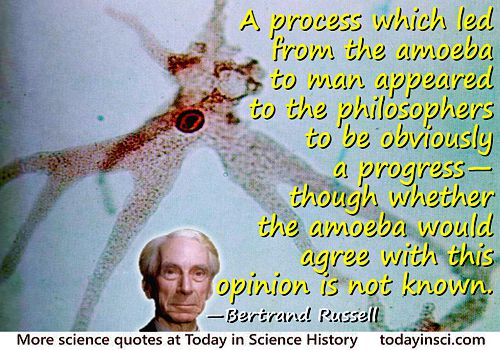
A process which led from the amoeba to man appeared to the philosophers to be obviously a progress—though whether the amoeba would agree with this opinion is not known.
From 'Current Tendencies', delivered as the first of a series of Lowell Lectures in Boston (Mar 1914). Collected in Our Knowledge of the External World (1914), 12.
A recognized fact which goes back to the earliest times is that every living organism is not the sum of a multitude of unitary processes, but is, by virtue of interrelationships and of higher and lower levels of control, an unbroken unity. When research, in the efforts of bringing understanding, as a rule examines isolated processes and studies them, these must of necessity be removed from their context. In general, viewed biologically, this experimental separation involves a sacrifice. In fact, quantitative findings of any material and energy changes preserve their full context only through their being seen and understood as parts of a natural order.
First sentence of 'The Central Control of the Activity of Internal Organs', Nobel Lecture (12 Dec 1949).
A science is not mere knowledge, it is knowledge which has undergone a process of intellectual digestion. It is the grasp of many things brought together in one, and hence is its power; for, properly speaking, it is Science that is power, not Knowledge..,
Discourses on the Scope and Nature of University Education. Addressed to the Catholics of Dublin (1852), Discourse 5, 144.
A single ray of light from a distant star falling upon the eye of a tyrant in bygone times, may have altered the course of his life, may have changed the destiny of nations, may have transformed the surface of the globe, so intricate, so inconceivably complex are the processes of nature.
Lecture (Feb 1893) delivered before the Franklin Institute, Philadelphia, 'On Light and Other High Frequency Phenomena,' collected in Thomas Commerford Martin and Nikola Tesla, The Inventions, Researches and Writings of Nikola Tesla (1894), 298.
A strict materialist believes that everything depends on the motion of matter. He knows the form of the laws of motion though he does not know all their consequences when applied to systems of unknown complexity.
Now one thing in which the materialist (fortified with dynamical knowledge) believes is that if every motion great & small were accurately reversed, and the world left to itself again, everything would happen backwards the fresh water would collect out of the sea and run up the rivers and finally fly up to the clouds in drops which would extract heat from the air and evaporate and afterwards in condensing would shoot out rays of light to the sun and so on. Of course all living things would regrede from the grave to the cradle and we should have a memory of the future but not of the past.
The reason why we do not expect anything of this kind to take place at any time is our experience of irreversible processes, all of one kind, and this leads to the doctrine of a beginning & an end instead of cyclical progression for ever.
Now one thing in which the materialist (fortified with dynamical knowledge) believes is that if every motion great & small were accurately reversed, and the world left to itself again, everything would happen backwards the fresh water would collect out of the sea and run up the rivers and finally fly up to the clouds in drops which would extract heat from the air and evaporate and afterwards in condensing would shoot out rays of light to the sun and so on. Of course all living things would regrede from the grave to the cradle and we should have a memory of the future but not of the past.
The reason why we do not expect anything of this kind to take place at any time is our experience of irreversible processes, all of one kind, and this leads to the doctrine of a beginning & an end instead of cyclical progression for ever.
Letter to Mark Pattison (7 Apr 1868). In P. M. Hannan (ed.), The Scientific Letters and Papers of James Clerk Maxwell (1995), Vol. 2, 1862-1873, 360-1.
Adventure isn’t hanging on a rope off the side of a mountain. Adventure is an attitude that we must apply to the day to day obstacles of life - facing new challenges, seizing new opportunities, testing our resources against the unknown and in the process, discovering our own unique potential.
…...
Aging is an inevitable process. I surely wouldn't want to grow younger. The older you become, the more you know; your bank account of knowledge is much richer.
Found in several quote books, but without citation, for example, in Tom Crisp, The Book of Bill: Choice Words Memorable Men (2009), 220. If you know the primary source, please contact Webmaster.
All appearances to the contrary, the only watchmaker in nature is the blind forces of physics, albeit deployed in very special way. A true watchmaker has foresight: he designs his cogs springs, and plans their interconnections, with a future purpose in his mind's eye. Natural selection, the blind, unconscious, automatic process which Darwin discovered, and which we now know is the explanation for the existence and apparently purposeful form of all life, has no purpose in mind. It has no mind and no mind's eye. It does not plan for the future. It has no vision, no foresight, no sight at all. If it can be said to play the role of watchmaker in nature, it is the blind watchmaker.
The Blind Watchmaker (1986), 5.
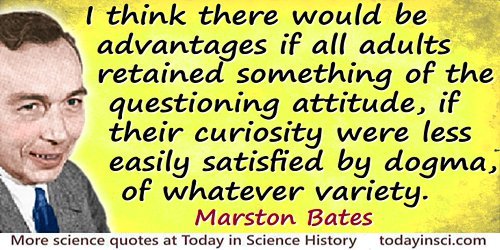
All children are curious and I wonder by what process this trait becomes developed in some and suppressed in others. I suspect again that schools and colleges help in the suppression insofar as they meet curiosity by giving the answers, rather than by some method that leads from narrower questions to broader questions. It is hard to satisfy the curiosity of a child, and even harder to satisfy the curiosity of a scientist, and methods that meet curiosity with satisfaction are thus not apt to foster the development of the child into the scientist. I don't advocate turning all children into professional scientists, although I think there would be advantages if all adults retained something of the questioning attitude, if their curiosity were less easily satisfied by dogma, of whatever variety.
The Nature of Natural History (1950, 1990), 256-257.
All disease, at some period or other of its course, is more or less a reparative process, not necessarily accompanied with suffering: an effort of nature to remedy a process of poisoning or of decay, which has taken place weeks, months, sometimes years beforehand, unnoticed.
In Notes on Nursing: What It Is and What It Is Not (1859), 5.
All fresh meat is eaten in a state of decay. The process may not have proceeded so far that the dull human nose can discover it, but a carrion bird or a carrion fly can smell it from afar.
In New Dietetics: What to Eat and How (1921), 384.
All important unit operations have much in common, and if the underlying principles upon which the rational design and operation of basic types of engineering equipment depend are understood, their successful adaptation to manufacturing processes becomes a matter of good management rather than of good fortune.
In William H. Walker, Warren K. Lewis and William H. MacAdams, The Principles of Chemical Engineering (1923), Preface to 1st. edition, v.
All knowledge is profitable; profitable in its ennobling effect on the character, in the pleasure it imparts in its acquisition, as well as in the power it gives over the operations of mind and of matter. All knowledge is useful; every part of this complex system of nature is connected with every other. Nothing is isolated. The discovery of to-day, which appears unconnected with any useful process, may, in the course of a few years, become the fruitful source of a thousand inventions.
In 'Report of the Secretary', Sixth Annual Report of the Board of Regents of the Smithsonian Institution for 1851 (1852), 10.
All stable processes we shall predict. All unstable processes we shall control.
Describing John von Neumann's aspiration for the application of computers sufficiently large to solve the problems of meteorology, despite the sensitivity of the weather to small perturbations.
Describing John von Neumann's aspiration for the application of computers sufficiently large to solve the problems of meteorology, despite the sensitivity of the weather to small perturbations.
Infinite in All Directions (2004), 182. Dyson wrote his recollection of a talk given by Neumann at Princeton around 1950. The words are not a direct quotation, merely Dyson's description of Neumann's idea.
All things on the earth are the result of chemical combination. The operation by which the commingling of molecules and the interchange of atoms take place we can imitate in our laboratories; but in nature they proceed by slow degrees, and, in general, in our hands they are distinguished by suddenness of action. In nature chemical power is distributed over a long period of time, and the process of change is scarcely to be observed. By acts we concentrate chemical force, and expend it in producing a change which occupies but a few hours at most.
In chapter 'Chemical Forces', The Poetry of Science: Or, Studies of the Physical Phenomena of Nature (1848), 235-236. Charles Dicken used this quote, with his own sub-head of 'Relative Importance Of Time To Man And Nature', to conclude his review of the book, published in The Examiner (1848).
Among the studies to which the [Rockefeller] Foundation is giving support is a series in a relatively new field, which may be called molecular biology, in which delicate modern techniques are being used to investigate ever more minute details of certain life processes.
In 'Molecular Biology', Annual Report of the Rockefeller Foundation (1938), 203-4. Reprinted in a letter to Science (6 Nov 1970), 170, 582.
An egg is a chemical process, but it is not a mere chemical process. It is one that is going places—even when, in our world of chance and contingency, it ends up in an omelet and not in a chicken. Though it surely be a chemical process, we cannot understand it adequately without knowing the kind of chicken it has the power to become.
'The Changing Impact of Darwin on Philosophy', Journal of the History of Ideas (1961), 22, 457.
And yet, it will be no cool process of mere science … with which we face this new age of right and opportunity….
Inaugural Address (4 Mar 1913). In 'President Wilson’s Inaugural Address', New York Times (5 Mar 1913), 2.
Anybody who looks at living organisms knows perfectly well that they can produce other organisms like themselves. This is their normal function, they wouldn’t exist if they didn’t do this, and it’s not plausible that this is the reason why they abound in the world. In other words, living organisms are very complicated aggregations of elementary parts, and by any reasonable theory of probability or thermodynamics highly improbable. That they should occur in the world at all is a miracle of the first magnitude; the only thing which removes, or mitigates, this miracle is that they reproduce themselves. Therefore, if by any peculiar accident there should ever be one of them, from there on the rules of probability do not apply, and there will be many of them, at least if the milieu is reasonable. But a reasonable milieu is already a thermodynamically much less improbable thing. So, the operations of probability somehow leave a loophole at this point, and it is by the process of self-reproduction that they are pierced.
From lecture series on self-replicating machines at the University of Illinois, Lecture 5 (Dec 1949), 'Re-evaluation of the Problems of Complicated Automata—Problems of Hierarchy and Evolution', Theory of Self-Reproducing Automata (1966).
Apparently the anti-evolutionist expects to see a monkey or an ass transformed into a man, though he must be familiar enough with the reverse process.
As quoted by E. Newton Harvey, in 'Edwin Grant Conklin: A Biographical Memoir', Biographical Memoirs of the National Academy of Sciences(1958), Vol. 31, 59.
As a scientist and geneticist I started to feel that science would probably soon reach the point where its interference into the life processes would be counterproductive if a properly designed governing policy was not implemented. A heavily overcrowded planet, ninety-five percent urbanized with nuclear energy as the main source of energy and with all aspects of life highly computerized, is not too pleasant a place for human life. The life of any individual soon will be predictable from birth to death. Medicine, able to cure almost everything, will make the load of accumulated defects too heavy in the next two or three centuries. The artificial prolongation of life, which looked like a very bright idea when I started research in aging about twenty-five years ago, has now lost its attractiveness for me. This is because I now know that the aging process is so multiform and complex that the real technology and chemistry of its prevention by artificial interference must be too complex and expensive. It would be the privilege of a few, not the method for the majority. I also was deeply concerned about the fact that most research is now either directly or indirectly related to military projects and objectives for power.
Quoted in 'Zhores A(leksandrovich) Medvedev', Contemporary Authors Online, Gale, 2002.
As each bit of information is added to the sum of human knowledge it is evident that it is the little things that count; that give all the fertility and character; that give all the hope and happiness to human affairs. The concept of bigness is apt to be a delusion, and standardizing processes must not supplant creative impulses.
In Nobel Banquet speech (10 Dec 1934). Collected in Gustaf Santesson (ed.) Les Prix Nobel en 1934 (1935).
As I have already mentioned, wherever cells are formed, this tough fluid precedes the first solid structures that indicate the presence of future cells. Moreover, we must assume that this substance furnishes the material for the formation of the nucleus and of the primitive sac, not only because these structures are closely apposed to it, but also because,they react to iodine in the same way. We must assume also that the organization of this substance is the process that inaugurates the formation of new cells. It therefore seems justifiable for me to propose a name that refers to its physiological function: I propose the word protoplasma.
H. Mohl, Botanisch Zeitung (1846), 4, col. 73, trans. Henry Harris, The Birth of the Cell (1999), 75.
As I review the nature of the creative drive in the inventive scientists that have been around me, as well as in myself, I find the first event is an urge to make a significant intellectual contribution that can be tangible embodied in a product or process.
Quoted in New York Times (2 Mar 1991), 1 and 29.
As is well known the principle of virtual velocities transforms all statics into a mathematical assignment, and by D'Alembert's principle for dynamics, the latter is again reduced to statics. Although it is is very much in order that in gradual training of science and in the instruction of the individual the easier precedes the more difficult, the simple precedes the more complicated, the special precedes the general, yet the min, once it has arrived at the higher standpoint, demands the reverse process whereby all statics appears only as a very special case of mechanics.
Collected Works (1877), Vol. 5, 25-26. Quoted in G. Waldo Dunnington, Carl Friedrich Gauss: Titan of Science (2004), 412.
As our own species is in the process of proving, one cannot have superior science and inferior morals. The combination is unstable and self-destroying.
Voices From the Sky: Previews of the Coming Space Age (1967), 156.
As soon as we touch the complex processes that go on in a living thing, be it plant or animal, we are at once forced to use the methods of this science [chemistry]. No longer will the microscope, the kymograph, the scalpel avail for the complete solution of the problem. For the further analysis of these phenomena which are in flux and flow, the investigator must associate himself with those who have labored in fields where molecules and atoms, rather than multicellular tissues or even unicellular organisms, are the units of study.
'Experimental and Chemical Studies of the Blood with an Appeal for More Extended Chemical Training for the Biological and Medical Investigator', Science (6 Aug 1915), 42, 176.
As the Director of the Theoretical Division of Los Alamos, I participated at the most senior level in the World War II Manhattan Project that produced the first atomic weapons.
Now, at age 88, I am one of the few remaining such senior persons alive. Looking back at the half century since that time, I feel the most intense relief that these weapons have not been used since World War II, mixed with the horror that tens of thousands of such weapons have been built since that time—one hundred times more than any of us at Los Alamos could ever have imagined.
Today we are rightly in an era of disarmament and dismantlement of nuclear weapons. But in some countries nuclear weapons development still continues. Whether and when the various Nations of the World can agree to stop this is uncertain. But individual scientists can still influence this process by withholding their skills.
Accordingly, I call on all scientists in all countries to cease and desist from work creating, developing, improving and manufacturing further nuclear weapons - and, for that matter, other weapons of potential mass destruction such as chemical and biological weapons.
[On the occasion of the 50th Anniversary of Hiroshima.]
Now, at age 88, I am one of the few remaining such senior persons alive. Looking back at the half century since that time, I feel the most intense relief that these weapons have not been used since World War II, mixed with the horror that tens of thousands of such weapons have been built since that time—one hundred times more than any of us at Los Alamos could ever have imagined.
Today we are rightly in an era of disarmament and dismantlement of nuclear weapons. But in some countries nuclear weapons development still continues. Whether and when the various Nations of the World can agree to stop this is uncertain. But individual scientists can still influence this process by withholding their skills.
Accordingly, I call on all scientists in all countries to cease and desist from work creating, developing, improving and manufacturing further nuclear weapons - and, for that matter, other weapons of potential mass destruction such as chemical and biological weapons.
[On the occasion of the 50th Anniversary of Hiroshima.]
Letter, Bulletin of the Atomic Scientists (Nov 1995), 51:6, 3.
As, no matter what cunning system of checks we devise, we must in the end trust some one whom we do not check, but to whom we give unreserved confidence, so there is a point at which the understanding and mental processes must be taken as understood without further question or definition in words. And I should say that this point should be fixed pretty early in the discussion.
Samuel Butler, Henry Festing Jones (ed.), The Note-Books of Samuel Butler (1917), 220-221.
Astronomers and physicists, dealing habitually with objects and quantities far beyond the reach of the senses, even with the aid of the most powerful aids that ingenuity has been able to devise, tend almost inevitably to fall into the ways of thinking of men dealing with objects and quantities that do not exist at all, e.g., theologians and metaphysicians. Thus their speculations tend almost inevitably to depart from the field of true science, which is that of precise observation, and to become mere soaring in the empyrean. The process works backward, too. That is to say, their reports of what they pretend actually to see are often very unreliable. It is thus no wonder that, of all men of science, they are the most given to flirting with theology. Nor is it remarkable that, in the popular belief, most astronomers end by losing their minds.
Minority Report: H. L. Mencken’s Notebooks (1956), Sample 74, 60.
Borel makes the amusing supposition of a million monkeys allowed to play upon the keys of a million typewriters. What is the chance that this wanton activity should reproduce exactly all of the volumes which are contained in the library of the British Museum? It certainly is not a large chance, but it may be roughly calculated, and proves in fact to be considerably larger than the chance that a mixture of oxygen and nitrogen will separate into the two pure constituents. After we have learned to estimate such minute chances, and after we have overcome our fear of numbers which are very much larger or very much smaller than those ordinarily employed, we might proceed to calculate the chance of still more extraordinary occurrences, and even have the boldness to regard the living cell as a result of random arrangement and rearrangement of its atoms. However, we cannot but feel that this would be carrying extrapolation too far. This feeling is due not merely to a recognition of the enormous complexity of living tissue but to the conviction that the whole trend of life, the whole process of building up more and more diverse and complex structures, which we call evolution, is the very opposite of that which we might expect from the laws of chance.
The Anatomy of Science (1926), 158-9.
Both religion and natural science require a belief in God for their activities, to the former He is the starting point, and to the latter the goal of every thought process. To the former He is the foundation, to the latter, the crown of the edifice of every generalized world view.
Lecture, 'Religion and Natural Science' (1937) In Max Planck and Frank Gaynor (trans.), Scientific Autobiography and Other Papers (1949), 184.
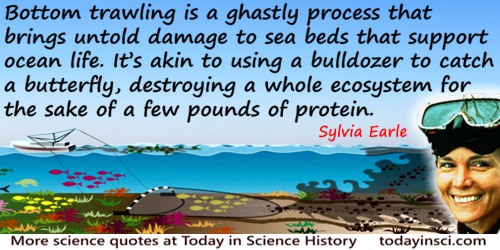
Bottom trawling is a ghastly process that brings untold damage to sea beds that support ocean life. It’s akin to using a bulldozer to catch a butterfly, destroying a whole ecosystem for the sake of a few pounds of protein. We wouldn’t do this on land, so why do it in the oceans?
In 'Can We Stop Killing Our Oceans Now, Please?', Huffington Post (14 Aug 2013).
But just as astronomy succeeded astrology, following Kepler's discovery of planetary regularities, the discoveries of these many principles in empirical explorations of intellectual processes in machines should lead to a science, eventually.
[Co-author with South African mathematician, Seymour Papert (1928- )]
[Co-author with South African mathematician, Seymour Papert (1928- )]
Artificial Intelligence (1973), 25.
But nothing of a nature foreign to the duties of my profession [clergyman] engaged my attention while I was at Leeds so much as the, prosecution of my experiments relating to electricity, and especially the doctrine of air. The last I was led into a consequence of inhabiting a house adjoining to a public brewery, where first amused myself with making experiments on fixed air [carbon dioxide] which found ready made in the process of fermentation. When I removed from that house, I was under the necessity making the fixed air for myself; and one experiment leading to another, as I have distinctly and faithfully noted in my various publications on the subject, I by degrees contrived a convenient apparatus for the purpose, but of the cheapest kind. When I began these experiments I knew very little of chemistry, and had in a manner no idea on the subject before I attended a course of chymical lectures delivered in the Academy at Warrington by Dr. Turner of Liverpool. But I have often thought that upon the whole, this circumstance was no disadvantage to me; as in this situation I was led to devise an apparatus and processes of my own, adapted to my peculiar views. Whereas, if I had been previously accustomed to the usual chemical processes, I should not have so easily thought of any other; and without new modes of operation I should hardly have discovered anything materially new.
Memoirs of Dr. Joseph Priestley, in the Year 1795 (1806), Vol. 1, 61-2.
But the whole vital process of the earth takes place so gradually and in periods of time which are so immense compared with the length of our life, that these changes are not observed, and before their course can be recorded from beginning to end whole nations perish and are destroyed.
Meteorology, 351b, 8-13. In Jonathan Barnes (ed.), The Complete Works of Aristotle (1984), Vol. I, 573.
By no process of sound reasoning can a conclusion drawn from limited data have more than a limited application.
In Higher Mathematics for Students of Chemistry and Physics (1902), 2.
By what process of reasoning should the State of Texas be more concerned in the conviction of the guilty than in the acquittal of the innocent? [Urging the use of scopolamine “truth serum” to determine innocence.]
From paper read at the Section on State Medicine and Public Hygiene of the State Medical Association of Texas at El Paso (11 May 1922), 'The Use Of Scopolamine In Criminology', published in Texas State Journal of Medicine (Sep 1922). Reprinted in The American Journal of Police Science (Jul-Aug 1931), 2, No. 4, 328.
Cells are required to stick precisely to the point. Any ambiguity, any tendency to wander from the matter at hand, will introduce grave hazards for the cells, and even more for the host in which they live. … There is a theory that the process of aging may be due to the cumulative effect of imprecision, a gradual degrading of information. It is not a system that allows for deviating.
In 'Information', The Lives of a Cell: Notes of a Biology Watcher (1974), 110-111.
Cellular pathology is not an end if one cannot see any alteration in the cell. Chemistry brings the clarification of living processes nearer than does anatomy. Each anatomical change must have been preceded by a chemical one.
Attributed in H. Coper and H. Herken, Deutsche Medizini Wochenschrift (18 Oct 1963), 88, No. 42, 2035, in the original German, “Nach der Überlieferung durch His soll Virchow geäußert haben: ‘Die Zellular-pathologie ist nicht am Ende, wenn man an einer Zelle keine Veränderungen mehr sehen kann. Die Chemie steht der Erklärung der Lebensvorgänge näher als die Anatomie. Jede anatomische Verände-rung setzt notwendig eine chemische voraus.’” As translated in Angel Pentschew,'Morphology and morphogenesis of lead encephalopathy', Acta Neuropathologica (Sep 1965) 5, No. 2, 133-160, as cited in I. Arthur Michaelson and Mitchell W. Sauerhoff, 'Animal Models of Human Disease: Severe and Mild Lead Encephalopathy in the Neonatal Rat', Environmental Health Perspectives (May 1974), 7, 204 & 223 footnote. Note: Although given in quotation marks in the original German text, the subject quote is almost definitely NOT verbatim, but only a paraphrase of Virchow’s teachings. The German text introduces the subject quote with, “Nach der Überlieferung durch His soll Virchow geäußert haben:…” which means, “According to tradition Virchow is said to have expressed:…” (using Google translate). However, it is useful as a succinct statement to the effect of what Virchow might say to summarize his doctrine.
Chemistry has the same quickening and suggestive influence upon the algebraist as a visit to the Royal Academy, or the old masters may be supposed to have on a Browning or a Tennyson. Indeed it seems to me that an exact homology exists between painting and poetry on the one hand and modern chemistry and modern algebra on the other. In poetry and algebra we have the pure idea elaborated and expressed through the vehicle of language, in painting and chemistry the idea enveloped in matter, depending in part on manual processes and the resources of art for its due manifestation.
Attributed.
Chemistry is the study of material transformations. Yet a knowledge of the rate, or time dependence, of chemical change is of critical importance for the successful synthesis of new materials and for the utilization of the energy generated by a reaction. During the past century it has become clear that all macroscopic chemical processes consist of many elementary chemical reactions that are themselves simply a series of encounters between atomic or molecular species. In order to understand the time dependence of chemical reactions, chemical kineticists have traditionally focused on sorting out all of the elementary chemical reactions involved in a macroscopic chemical process and determining their respective rates.
'Molecular Beam Studies of Elementary Chemical Processes', Nobel Lecture, 8 Dec 1986. In Nobel Lectures: Chemistry 1981-1990 (1992), 320.
Chemistry teaches us to regard under one aspect, as various types of combustion or oxidation, the burning of a candle, the rusting of metals, the physiological process of respiration, and the explosion of gunpowder. In each process there is the one common fact that oxygen enters into new chemical combinations. Similarly to the physicist, the fall of the traditional apple of Newton, the revolution of the earth and planets round the sun, the apparitions of comets, and the ebb and flow of the tides are all phases of the universal law of gravitation. A race ignorant of the nature of combustion or of the law of gravitation, and ignorant of the need of such generalisations, could not be considered to have advanced far along the paths of scientific discovery.
In 'The Discovery of Radioactivity: Radioactivity, a New Science', The Interpretation of Radium and the Structure of the Atom (4th ed., 1920), 1.
Clinical ecology [is] a new branch of medicine aimed at helping people made sick by a failure to adapt to facets of our modern, polluted environment. Adverse reactions to processed foods and their chemical contaminants, and to indoor and outdoor air pollution with petrochemicals, are becoming more and more widespread and so far these reactions are being misdiagnosed by mainstream medical practitioners and so are not treated effectively.
Quoted in article 'Richard Mackarness', Contemporary Authors Online (2002).
Considered from the standpoint of chemistry, living bodies appear to us as laboratories of chemical processes, for they undergo perpetual changes in their material substrate. They draw materials from the outside world and combine them with the mass of their liquid and solid parts.
In 'Allgemeine Betrachtungen der orgauischen Korper', Physiologie des Menschen (1830), Vol. 1, 34. Trans. in Kenneth L. Caneva, Robert Mayer and the Conservation of Energy (1993), 7I.
Correct is to recognize what diseases are and whence they come; which are long and which are short; which are mortal and which are not; which are in the process of changing into others; which are increasing and which are diminishing; which are major and which are minor; to treat the diseases that can be treated, but to recognize the ones that cannot be, and to know why they cannot be; by treating patients with the former, to give them the benefit of treatment as far as it is possible.
Diseases, in Hippocrates, trans. P. Potter (1988), Vol. 5, 113.
Courtship, properly understood, is the process whereby both the male and the female are brought into that state of sexual tumescence which is a more or less necessary condition for sexual intercourse. The play of courtship cannot, therefore, be considered to be definitely brought to an end by the ceremony of marriage; it may more properly be regarded as the natural preliminary to every act of coitus.
Studies in the Psychology of Sex (1921), Vol. 3, 239.
CREATION OF LIFE.
The Startling Discovery of Prof. Loeb.
Lower Animals Produced by Chemical Means.
Process May Apply to the Human Species.
Immaculate Conception is Explained.
Wonderful Experiments Conducted at Woods Hole.
The Startling Discovery of Prof. Loeb.
Lower Animals Produced by Chemical Means.
Process May Apply to the Human Species.
Immaculate Conception is Explained.
Wonderful Experiments Conducted at Woods Hole.
The Boston Herald (26 Nov 1899), 17.
Creative activity could be described as a type of learning process where teacher and pupil are located in the same individual.
In Drinkers of Infinity: Essays, 1955-1967 (1969), 235.
Creative imagination is likely to find corroborating novel evidence even for the most 'absurd' programme, if the search has sufficient drive. This look-out for new confirming evidence is perfectly permissible. Scientists dream up phantasies and then pursue a highly selective hunt for new facts which fit these phantasies. This process may be described as “science creating its own universe” (as long as one remembers that “creating” here is used in a provocative-idiosyncratic sense). A brilliant school of scholars (backed by a rich society to finance a few well-planned tests) might succeed in pushing any fantastic programme ahead, or alternatively, if so inclined, in overthrowing any arbitrarily chosen pillar of “established knowledge”.
In 'Falsification and the Methodology of Scientific Research Programmes', in I. Lakatos and A. Musgrave (eds.), Criticism and the Growth of Knowledge: Proceedings of the International Colloquium in the Philosophy of Science, London 1965 (1970), Vol. 4, 187-8.
Darwin abolished special creations, contributed the Origin of Species and hitched all life together in one unbroken procession of Siamese Twins, the whole evolved by natural and orderly processes from one microscopic parent germ.
'The Secret History of Eddypus', in Mark Twain and David Ketterer (ed.), Tales of Wonder (2003), 223.
Darwinian fitness is compounded of a mutual relationship between the organism and the environment. Of this, fitness of environment is quite as essential a component as the fitness which arises in the process of organic evolution; and in fundamental characteristics the actual environment is the fittest possible abode of life.
His thesis for the book stated at the beginning of The Fitness of the Environment (1913), Preface, v.
Deductivism in mathematical literature and inductivism in scientific papers are simply the postures we choose to be seen in when the curtain goes up and the public sees us. The theatrical illusion is shattered if we ask what goes on behind the scenes. In real life discovery and justification are almost always different processes.
Induction and Intuition in Scientific Thought (1969), 26.
Developing countries can leapfrog several stages in the development process through the application of bio-technology in agriculture.
In Arbind Prasad and Jagdish Prasad, Development Planning for Agriculture: Policies, Economic Implications, Inputs, Production and Marketing (1994), 93.
DIGESTION, n. The conversion of victuals into virtues. When the process is imperfect, vices are evolved instead—a circumstance from which that wicked writer, Dr. Jeremiah Blenn, infers that the ladies are the greater sufferers from dyspepsia.
The Collected Works of Ambrose Bierce (1911), Vol. 7, The Devil's Dictionary, 72.
Discoveries are always accidental; and the great use of science is by investigating the nature of the effects produced by any process or contrivance, and of the causes by which they are brought about, to explain the operation and determine the precise value of every new invention. This fixes as it were the latitude and longitude of each discovery, and enables us to place it in that part of the map of human knowledge which it ought to occupy. It likewise enables us to use it in taking bearings and distances, and in shaping our course when we go in search of new discoveries.
In The Complete Works of Count Rumford (1876), Vol. 4, 270.
Each species has evolved a special set of solutions to the general problems that all organisms must face. By the fact of its existence, a species demonstrates that its members are able to carry out adequately a series of general functions. … These general functions offer a framework within which one can integrate one’s view of biology and focus one’s research. Such a view helps one to avoid becoming lost in a morass of unstructured detail—even though the ways in which different species perform these functions may differ widely. A few obvious examples will suffice. Organisms must remain functionally integrated. They must obtain materials from their environments, and process and release energy from these materials. … They must differentiate and grow, and they must reproduce. By focusing one’s questions on one or another of these obligatory and universal capacities, one can ensure that one’s research will not be trivial and that it will have some chance of achieving broad general applicability.
In 'Integrative Biology: An Organismic Biologist’s Point of View', Integrative and Comparative Biology (2005), 45, 331.
Education is the process of driving a set of prejudices down your throat.
Engineering is the application of scientific and mathematical principles to practical ends such as the design, manufacture, and operation of efficient and economical structures, machines, processes, and systems.
In Bernice Zeldin Schacter, Issues and Dilemmas of Biotechnology: A Reference Guide (1999), 1, citing the American Heritage Dictionary, 2nd College Edition.
Engineers apply the theories and principles of science and mathematics to research and develop economical solutions to practical technical problems. Their work is the link between scientific discoveries and commercial applications. Engineers design products, the machinery to build those products, the factories in which those products are made, and the systems that ensure the quality of the product and efficiency of the workforce and manufacturing process. They design, plan, and supervise the construction of buildings, highways, and transit systems. They develop and implement improved ways to extract, process, and use raw materials, such as petroleum and natural gas. They develop new materials that both improve the performance of products, and make implementing advances in technology possible. They harness the power of the sun, the earth, atoms, and electricity for use in supplying the Nation’s power needs, and create millions of products using power. Their knowledge is applied to improving many things, including the
quality of health care, the safety of food products, and the efficient operation of financial systems.
Bureau of Labor Statistics, Occupational Outlook Handbook (2000) as quoted in Charles R. Lord. Guide to Information Sources in Engineering (2000), 5. This definition has been revised and expanded over time in different issues of the Handbook.
Eventually the process of aging, which is unlikely to be simple, should be understandable. Hopefully some of its processes can be slowed down or avoided. In fact, in the next century, we shall have to tackle the question of the preferred form of death.
(1986).
Every discovery, every enlargement of the understanding, begins as an imaginative preconception of what the truth might be. The imaginative preconception—a “hypothesis”—arises by a process as easy or as difficult to understand as any other creative act of mind; it is a brainwave, an inspired guess, a product of a blaze of insight. It comes anyway from within and cannot be achieved by the exercise of any known calculus of discovery.
In Advice to a Young Scientist (1979), 84.
Every form of life can be produced by physical forces in one of two ways: either by coming into being out of formless matter, or by the modification of an already existing form by a continued process of shaping. In the latter case the cause of this modification may lie either in the influence of a dissimilar male generative matter upon the female germ, or in the influence of other powers which operate only after procreation.
From Gottfried Reinhold Treviranus, The Biology or Philosophy of Animate Nature, as quoted in translation of Ernst Heinrich Philipp August Haeckel's 8th German edition with E. Ray Lankester (ed.), The History of Creation, or, the Development of the Earth and its Inhabitants by the Action of Natural Causes (1892), 95.
Evolution in the biosphere is therefore a necessarily irreversible process defining a direction in time; a direction which is the same as that enjoined by the law of increasing entropy, that is to say, the second law of thermodynamics. This is far more than a mere comparison: the second law is founded upon considerations identical to those which establish the irreversibility of evolution. Indeed, it is legitimate to view the irreversibility of evolution as an expression of the second law in the biosphere.
In Jacques Monod and Austryn Wainhouse (trans.), Chance and Necessity: An Essay on the Natural Philosophy of Modern Biology (1971), 123.
Evolution is a process which favors cooperating rather than disoperating groups and that “fitness” is a function of the group as a whole than of separate individuals. The fitness of the individual is largely derived from his membership on a group.
In On Being Human (1950), 45.
Experiments in geology are far more difficult than in physics and chemistry because of the greater size of the objects, commonly outside our laboratories, up to the earth itself, and also because of the fact that the geologic time scale exceeds the human time scale by a million and more times. This difference in time allows only direct observations of the actual geologic processes, the mind having to imagine what could possibly have happened in the past.
In 'The Scientific Character of Geology', The Journal of Geology (Jul 1961), 69, No. 4, 455-6.
Faced with the admitted difficulty of managing the creative process, we are doubling our efforts to do so. Is this because science has failed to deliver, having given us nothing more than nuclear power, penicillin, space travel, genetic engineering, transistors, and superconductors? Or is it because governments everywhere regard as a reproach activities they cannot advantageously control? They felt that way about the marketplace for goods, but trillions of wasted dollars later, they have come to recognize the efficiency of this self-regulating system. Not so, however, with the marketplace for ideas.
Quoted in Martin Moskovits (ed.), Science and Society, the John C. Polanyi Nobel Lareates Lectures (1995), 8.
Finally I got to carbon, and as you all know, in the case of carbon the reaction works out beautifully. One goes through six reactions, and at the end one comes back to carbon. In the process one has made four hydrogen atoms into one of helium. The theory, of course, was not made on the railway train from Washington to Ithaca … It didn’t take very long, it took about six weeks, but not even the Trans-Siberian railroad [has] taken that long for its journey.
'Pleasure from Physics', From A Life of Physics: Evening Lectures at the International Centre for Theoretical Physics, Trieste, Italy. A Special Supplement of the IAEA Bulletin (1968), 14.
Finally in a large population, divided and subdivided into partially isolated local races of small size, there is a continually shifting differentiation among the latter (intensified by local differences in selection but occurring under uniform and static conditions) which inevitably brings about an indefinitely continuing, irreversible, adaptive, and much more rapid evolution of the species. Complete isolation in this case, and more slowly in the preceding, originates new species differing for the most part in nonadaptive parallel orthogenetic lines, in accordance with the conditions. It is suggested, in conclusion, that the differing statistical situations to be expected among natural species are adequate to account for the different sorts of evolutionary processes which have been described, and that, in particular, conditions in nature are often such as to bring about the state of poise among opposing tendencies on which an indefinitely continuing evolutionary process depends.
In 'Evolution In Mendelian Populations', Genetics, (1931), 16, 158.
Food is at present obtained almost entirely from the energy of the sunlight. The radiation from the sun produces from the carbonic acid in the air more or less complicated carbon compounds which serve us in plants and vegetables. We use the latent chemical energy of these to keep our bodies warm, we convert it into muscular effort. We employ it in the complicated process of digestion to repair and replace the wasted cells of our bodies. … If the gigantic sources of power become available, food would be produced without recourse to sunlight. Vast cellars, in which artificial radiation is generated, may replace the cornfields and potato patches of the world.
From 'Fifty Years Hence', Strand Magazine (Dec 1931). Reprinted in Popular Mechanics (Mar 1932), 57, No. 3, 396-397.
For if medicine is really to accomplish its great task, it must intervene in political and social life. It must point out the hindrances that impede the normal social functioning of vital processes, and effect their removal.
In Die einheitsrebungen in der wissenschaftlichen medicin (1849), 48. As quoted and citefd in Paul Farmer, Pathologies of Power (2004), 323.
Freeman’s gift? It’s cosmic. He is able to see more interconnections between more things than almost anybody. He sees the interrelationships, whether it’s in some microscopic physical process or in a big complicated machine like Orion. He has been, from the time he was in his teens, capable of understanding essentially anything that he’s interested in. He’s the most intelligent person I know.
As quoted in Kenneth Brower, 'The Danger of Cosmic Genius', The Atlantic (Dec 2010). Webmaster note: The Orion Project was a study of the possibility of nuclear powered propulsion of spacecraft.
Genes make enzymes, and enzymes control the rates of chemical processes. Genes do not make ‘novelty seeking’ or any other complex and overt behavior. Predisposition via a long chain of complex chemical reactions, mediated through a more complex series of life’s circumstances, does not equal identification or even causation.
…...
Genius is rarely able to give any account of its own processes.
From The Fortnightly Review (1865). Reprinted in The Principles of Success in Literature (1901), 98.
Geology got into the hands of the theoreticians who were conditioned by the social and political history of their day more than by observations in the field. … We have allowed ourselves to be brainwashed into avoiding any interpretation of the past that involves extreme and what might be termed “catastrophic” processes. However, it seems to me that the stratigraphical record is full of examples of processes that are far from “normal” in the usual sense of the word. In particular we must conclude that sedimentation in the past has often been very rapid indeed and very spasmodic. This may be called the “Phenomenon of the Catastrophic Nature of the Stratigraphic Record.”
In The Nature of the Stratigraphical Record (3rd ed., 1993), 70.
Geology is part of that remarkable dynamic process of the human mind which is generally called science and to which man is driven by an inquisitive urge. By noticing relationships in the results of his observations, he attempts to order and to explain the infinite variety of phenomena that at first sight may appear to be chaotic. In the history of civilization this type of progressive scientist has been characterized by Prometheus stealing the heavenly fire, by Adam eating from the tree of knowledge, by the Faustian ache for wisdom.
In 'The Scientific Character of Geology', The Journal of Geology (Jul 1961), 69, No. 4, 454.
Geometrical reasoning, and arithmetical process, have each its own office: to mix the two in elementary instruction, is injurious to the proper acquisition of both.
In Trigonometry and Double Algebra (1849), 92.
Given any domain of thought in which the fundamental objective is a knowledge that transcends mere induction or mere empiricism, it seems quite inevitable that its processes should be made to conform closely to the pattern of a system free of ambiguous terms, symbols, operations, deductions; a system whose implications and assumptions are unique and consistent; a system whose logic confounds not the necessary with the sufficient where these are distinct; a system whose materials are abstract elements interpretable as reality or unreality in any forms whatsoever provided only that these forms mirror a thought that is pure. To such a system is universally given the name MATHEMATICS.
In 'Mathematics', National Mathematics Magazine (Nov 1937), 12, No. 2, 62.
GOOSE, n. A bird that supplies quills for writing. These, by some occult process of nature, are penetrated and suffused with various degrees of the bird's intellectual energies and emotional character, so that when inked and drawn mechanically across paper by a person called an "author," there results a very fair and accurate transcript of the fowl's thought and feeling. The difference in geese, as discovered by this ingenious method, is considerable: many are found to have only trivial and insignificant powers, but some are seen to be very great geese indeed.
The Collected Works of Ambrose Bierce (1911), Vol. 7, The Devil's Dictionary, 119-120.
Half a century ago Oswald (1910) distinguished classicists and romanticists among the scientific investigators: the former being inclined to design schemes and to use consistently the deductions from working hypotheses; the latter being more fit for intuitive discoveries of functional relations between phenomena and therefore more able to open up new fields of study. Examples of both character types are Werner and Hutton. Werner was a real classicist. At the end of the eighteenth century he postulated the theory of “neptunism,” according to which all rocks including granites, were deposited in primeval seas. It was an artificial scheme, but, as a classification system, it worked quite satisfactorily at the time. Hutton, his contemporary and opponent, was more a romanticist. His concept of “plutonism” supposed continually recurrent circuits of matter, which like gigantic paddle wheels raise material from various depths of the earth and carry it off again. This is a very flexible system which opens the mind to accept the possible occurrence in the course of time of a great variety of interrelated plutonic and tectonic processes.
In 'The Scientific Character of Geology', The Journal of Geology (Jul 1961), 69, No. 4, 456-7.
Have you tried neuroxing papers? It.'s a very easy and cheap process. You hold the page in front of your eyes and you let it go through there into the brain. It’s much better than xeroxing.
Quoted in L. Wolpert and A. Richards (eds.), A Passion for Science (1988), 104.
Having discovered … by observation and comparison that certain objects agree in certain respects, we generalise the qualities in which they coincide,—that is, from a certain number of individual instances we infer a general law; we perform an act of Induction. This induction is erroneously viewed as analytic; it is purely a synthetic process.
In Lecture VI of his Biennial Course, by William Hamilton and Henry L. Mansel (ed.) and John Veitch (ed.), Metaphysics (1860), Vol. 1, 101.
He [Lord Bacon] appears to have been utterly ignorant of the discoveries which had just been made by Kepler’s calculations … he does not say a word about Napier’s Logarithms, which had been published only nine years before and reprinted more than once in the interval. He complained that no considerable advance had been made in Geometry beyond Euclid, without taking any notice of what had been done by Archimedes and Apollonius. He saw the importance of determining accurately the specific gravities of different substances, and himself attempted to form a table of them by a rude process of his own, without knowing of the more scientific though still imperfect methods previously employed by Archimedes, Ghetaldus and Porta. He speaks of the εὕρηκα of Archimedes in a manner which implies that he did not clearly appreciate either the problem to be solved or the principles upon which the solution depended. In reviewing the progress of Mechanics, he makes no mention either of Archimedes, or Stevinus, Galileo, Guldinus, or Ghetaldus. He makes no allusion to the theory of Equilibrium. He observes that a ball of one pound weight will fall nearly as fast through the air as a ball of two, without alluding to the theory of acceleration of falling bodies, which had been made known by Galileo more than thirty years before. He proposed an inquiry with regard to the lever,—namely, whether in a balance with arms of different length but equal weight the distance from the fulcrum has any effect upon the inclination—though the theory of the lever was as well understood in his own time as it is now. … He speaks of the poles of the earth as fixed, in a manner which seems to imply that he was not acquainted with the precession of the equinoxes; and in another place, of the north pole being above and the south pole below, as a reason why in our hemisphere the north winds predominate over the south.
From Spedding’s 'Preface' to De Interpretations Naturae Proœmium, in The Works of Francis Bacon (1857), Vol. 3, 511-512. [Note: the Greek word “εὕρηκα” is “Eureka” —Webmaster.]
He who has mastered the Darwinian theory, he who recognizes the slow and subtle process of evolution as the way in which God makes things come to pass, … sees that in the deadly struggle for existence that has raged throughout countless aeons of time, the whole creation has been groaning and travailing together in order to bring forth that last consummate specimen of God’s handiwork, the Human Soul
In The Destiny of Man Viewed in the Light of his Origin (1884), 32. Collected in Studies in Religion (1902), 19–20.
HEART, n. An automatic, muscular blood- pump. Figuratively, this useful organ is said to be the seat of emotions and sentiments—a very pretty fancy which, however, is nothing but a survival of a once universal belief. It is now known that the sentiments and emotions reside in the stomach, being evolved from food by chemical action of the gastric fluid. The exact process by which a beefsteak becomes a feeling—tender or not, according to the age of the animal from which it was cut; the successive stages of elaboration through which a caviar sandwich is transmuted to a quaint fancy and reappears as a pungent epigram; the marvelous functional methods of converting a hard-boiled egg into religious contrition, or a cream-puff into a sigh of sensibility—these things have been patiently ascertained by M. Pasteur, and by him expounded with convincing lucidity.
The Collected Works of Ambrose Bierce (1911), Vol. 7, The Devil's Dictionary, 133-134.
Heraclitus somewhere says that all things are in process and nothing stays still, and likening existing things to the stream of a river he says that you would not step twice into the same river.
Plato, Cratylus 402A. In G. S. Kirk, J. E. Raven, and M. Schofield (eds.), The Presocratic Philosophers: A Critical History with a Selection of Texts (1983),195.
History shows that the human animal has always learned but progress used to be very slow. This was because learning often depended on the chance coming together of a potentially informative event on the one hand and a perceptive observer on the other. Scientific method accelerated that process.
In article Total Quality: Its Origins and its Future (1995), published at the Center for Quality and Productivity Improvement.
How can you shorten the subject? That stern struggle with the multiplication table, for many people not yet ended in victory, how can you make it less? Square root, as obdurate as a hardwood stump in a pasture nothing but years of effort can extract it. You can’t hurry the process. Or pass from arithmetic to algebra; you can’t shoulder your way past quadratic equations or ripple through the binomial theorem. Instead, the other way; your feet are impeded in the tangled growth, your pace slackens, you sink and fall somewhere near the binomial theorem with the calculus in sight on the horizon. So died, for each of us, still bravely fighting, our mathematical training; except for a set of people called “mathematicians”—born so, like crooks.
In Too Much College: Or, Education Eating up Life, with Kindred Essays in Education and Humour (1939), 8.
Human evolution is nothing else but the natural continuation, at a collective level, of the perennial and cumulative process of “psychogenetic” arrangement of matter which we call life. … The whole history of mankind has been nothing else (and henceforth it will never be anything else) but an explosive outburst of ever-growing cerebration. … Life, if fully understood, is not a freak in the universe—nor man a freak in life. On the contrary, life physically culminates in man, just as energy physically culminates in life.
(1952). As quoted in Stephen Jay Gould, Hen's Teeth and Horse's Toes: Further Reflections in Natural History (1984, 1994), 246.
Humor can be dissected, as a frog can, but the thing dies in the process and the innards are discouraging to any but the purely scientific mind.
In Elwyn Brooks White, Katharine Sergeant Angell White, first paragraph, 'The Preaching Humorist', The Saturday Review (18 Oct 1941), 16. Also collected in the same authors’ book, A Subtreasury of American Humor (1941), xvii. Seen in later books, in a number of variants, for example, “Analyzing humor is like dissecting a frog. Few people are interested and the frog dies of it”, in Bob Phillips, Phillips’ Treasury of Humorous Quotations (2004), 130.
I am a creationist and an evolutionist. Evolution is God's, or Nature's method of creation. Creation is not an event that happened in 4004 BC; it is a process that began some 10 billion years ago and is still under way.
In 'Nothing in Biology Makes Sense Except in the Light of Evolution', The American Biology Teacher (Mar 1973), 125-129.
I am afraid all we can do is to accept the paradox and try to accommodate ourselves to it, as we have done to so many paradoxes lately in modern physical theories. We shall have to get accustomed to the idea that the change of the quantity R, commonly called the 'radius of the universe', and the evolutionary changes of stars and stellar systems are two different processes, going on side by side without any apparent connection between them. After all the 'universe' is an hypothesis, like the atom, and must be allowed the freedom to have properties and to do things which would be contradictory and impossible for a finite material structure.
Kosmos (1932), 133.
I am Freeth, and I have come to apply the phase-rule to the ammonia-soda process.
First words on joining the Brunner-Mond Company in 1907.
First words on joining the Brunner-Mond Company in 1907.
W. F. L. Dick, A Hundred Years of Alkali in Cheshire (1973), 38.
I could not help laughing at the ease with which he explained his process of deduction. “When I hear you give your reasons,” I remarked, “the thing always appears to me to be so ridiculously simple that I could easily do it myself, though at each successive instance of your reasoning I am baffled, until you explain your process. And yet I believe that my eyes are as good as yours.”
“Quite so,” he answered, lighting a cigarette, and throwing himself down into an arm-chair. “You see, but you do not observe. The distinction is clear. For example, you have frequently seen the steps which lead up from the hall to this room.”
“Frequently.”
“How often?”
“'Well, some hundreds of times.”
“Then how many are there?”
“How many! I don't know.”
“Quite so! You have not observed. And yet you have seen. That is just my point. Now, I know that there are seventeen steps, because I have both seen and observed.”
“Quite so,” he answered, lighting a cigarette, and throwing himself down into an arm-chair. “You see, but you do not observe. The distinction is clear. For example, you have frequently seen the steps which lead up from the hall to this room.”
“Frequently.”
“How often?”
“'Well, some hundreds of times.”
“Then how many are there?”
“How many! I don't know.”
“Quite so! You have not observed. And yet you have seen. That is just my point. Now, I know that there are seventeen steps, because I have both seen and observed.”
From 'Adventure I.—A Scandal in Bohemia', Adventures of Sherlock Holmes, in The Strand Magazine: An Illustrated Monthly (Jul 1891), 2, 62.
I defend the following postulate as an indisputable principle: that each nerve fibre originates as a process from a single cell. This is its genetic, nutritive, and functional center; all other connections of the fibre are either indirect or secondary.
'Zur Geschichte des menschlichen Rückenmarkes und der Nervenwurzeln' (1887). Trans. Edwin Clarke and C. D. O'Malley, The Human Brain and Spinal Cord (1968), 103.
I definitely deny that any pathological process, i.e. any life-process taking place under unfavourable circumstances, is able to call forth qualitatively new formations lying beyond the customary range of forms characteristic of the species. All pathological formations are either degenerations, transformations, or repetitions of typical physiological structures.
In 'Cellular-Pathologie', Archiv für pathologische Anatomie und Physiologie und fur klinische Medizin (1855), 8, 13-14, as translated in LellandJ. Rather, 'Cellular Pathology', Disease, Life, and Man: Selected Essays by Rudolf Virchow (1958), 81.
I have a true aversion to teaching. The perennial business of a professor of mathematics is only to teach the ABC of his science; most of the few pupils who go a step further, and usually to keep the metaphor, remain in the process of gathering information, become only Halbwisser [one who has superficial knowledge of the subject], for the rarer talents do not want to have themselves educated by lecture courses, but train themselves. And with this thankless work the professor loses his precious time.
Letter to Heinrich Olbers (26 Oct 1802). Quoted in G. Waldo Dunnington, Carl Friedrich Gauss: Titan of Science (2004), 414.
I have attempted to form a judgment as to the conditions for evolution based on the statistical consequences of Mendelian heredity. The most general conclusion is that evolution depends on a certain balance among its factors. There must be a gene mutation, but an excessive rate gives an array of freaks, not evolution; there must be selection, but too severe a process destroys the field of variability, and thus the basis for further advance; prevalence of local inbreeding within a species has extremely important evolutionary consequences, but too close inbreeding leads merely to extinction. A certain amount of crossbreeding is favorable but not too much. In this dependence on balance the species is like a living organism. At all levels of organization life depends on the maintenance of a certain balance among its factors.
In Proceedings of the Sixth International Congress of Genetics: Ithaca, New York, 1932 (1932) Vol. 1, 365.
I have now reached the point where I may indicate briefly what to me constitutes the essence of the crisis of our time. It concerns the relationship of the individual to society. The individual has become more conscious than ever of his dependence upon society. But he does not experience this dependence as a positive asset, as an organic tie, as a protective force, but rather as a threat to his natural rights, or even to his economic existence. Moreover, his position in society is such that the egotistical drives of his make-up are constantly being accentuated, while his social drives, which are by nature weaker, progressively deteriorate. All human beings, whatever their position in society, are suffering from this process of deterioration. Unknowingly prisoners of their own egotism, they feel insecure, lonely, and deprived of the naive, simple, and unsophisticated enjoyment of life. Man can find meaning in life, short and perilous as it is, only through devoting himself to society.
…...
I have often pondered over the roles of knowledge or experience, on the one hand, and imagination or intuition, on the other, in the process of discovery. I believe that there is a certain fundamental conflict between the two, and knowledge, by advocating caution, tends to inhibit the flight of imagination. Therefore, a certain naivete, unburdened by conventional wisdom, can sometimes be a positive asset.
In R. Langlands, 'Harish-Chandra', Biographical Memoirs of Fellows of the Royal Society (1985), Vol. 31, 206.
I have paid special attention to those Properties of the Positive Rays which seem to throw light on the problems of the structure of molecules and atoms and the question of chemical combination … I am convinced that as yet we are only at the beginning of the harvest of results which will elucidate the process of chemical combination, and thus bridge over the most serious gap which now exists between Physics and Chemistry.
Rays of Positive Electricity and their Application to Chemical Analyses (1921), v.
I have recently read an article on handwriting and forgeries in which it is stated that ink eradicators do not remove ink: but merely bleach it, and that ink so bleached can be easily brought out by a process of fuming: known to all handwriting experts. Can you give me a description of this process, what chemicals are used: and how it is performed?
Showing his early interest in science, at age 16, while a student at Tulsa Central High School. From the first time Gardner’s writing appeared in print: a query printed in a magazine in Hugo Gernsback (ed.), 'Now It Is Now It Isn’t', Science and Invention (Apr 1930), 1119. As quoted and cited in Dana Richards, 'Martin Gardner: A “Documentary”', collected in Elwyn R. Berlekamp and Tom Rodgers (ed.) The Mathemagician and Pied Puzzler: A Collection in Tribute to Martin Gardner (1999), 3.
I have satisfied myself that the [cosmic] rays are not generated by the formation of new matter in space, a process which would be like water running up a hill. Nor do they come to any appreciable amount from the stars. According to my investigations the sun emits a radiation of such penetrative power that it is virtually impossible to absorb it in lead or other substances. ... This ray, which I call the primary solar ray, gives rise to a secondary radiation by impact against the cosmic dust scattered through space. It is the secondary radiation which now is commonly called the cosmic ray, and comes, of course, equally from all directions in space. [The article continues: The phenomena of radioactivity are not the result of forces within the radioactive substances but are caused by this ray emitted by the sun. If radium could be screened effectively against this ray it would cease to be radioactive, he said.]
Quoted in 'Tesla, 75, Predicts New Power Source', New York Times (5 Jul 1931), Section 2, 1.
I like to think that when Medawar and his colleagues showed that immunological tolerance could be produced experimentally the new immunology was born. This is a science which to me has far greater potentialities both for practical use in medicine and for the better understanding of living process than the classical immunochemistry which it is incorporating and superseding.
'Immunological Recognition of Self', Nobel Lecture, 12 December 1960. In Nobel Lectures Physiology or Medicine 1942-1962 (1964), 689.
I never really paused for a moment to question the idea that the progressive Spiritualization of Matter—so clearly demonstrated to me by Paleontology—could be anything other, or anything less, than an irreversible process. By its gravitational nature, the Universe, I saw, was falling—falling forwards—in the direction of spirit as upon its stable form. In other words, Matter was not ultra-materialized as I would at first have believed, but was instead metamorphosed in Psyche.
In The Heart of Matter (1978), 27-28.
I presume that few who have paid any attention to the history of the Mathematical Analysis, will doubt that it has been developed in a certain order, or that that order has been, to a great extent, necessary—being determined, either by steps of logical deduction, or by the successive introduction of new ideas and conceptions, when the time for their evolution had arrived. And these are the causes that operate in perfect harmony. Each new scientific conception gives occasion to new applications of deductive reasoning; but those applications may be only possible through the methods and the processes which belong to an earlier stage.
Explaining his choice for the exposition in historical order of the topics in A Treatise on Differential Equations (1859), Preface, v-vi.
I suppose that the first chemists seemed to be very hard-hearted and unpoetical persons when they scouted the glorious dream of the alchemists that there must be some process for turning base metals into gold. I suppose that the men who first said, in plain, cold assertion, there is no fountain of eternal youth, seemed to be the most cruel and cold-hearted adversaries of human happiness. I know that the economists who say that if we could transmute lead into gold, it would certainly do us no good and might do great harm, are still regarded as unworthy of belief. Do not the money articles of the newspapers yet ring with the doctrine that we are getting rich when we give cotton and wheat for gold rather than when we give cotton and wheat for iron?
'The Forgotten Man' (1883). In The Forgotten Man and Other Essays (1918), 468.
I think a strong claim can be made that the process of scientific discovery may be regarded as a form of art. This is best seen in the theoretical aspects of Physical Science. The mathematical theorist builds up on certain assumptions and according to well understood logical rules, step by step, a stately edifice, while his imaginative power brings out clearly the hidden relations between its parts. A well constructed theory is in some respects undoubtedly an artistic production. A fine example is the famous Kinetic Theory of Maxwell. ... The theory of relativity by Einstein, quite apart from any question of its validity, cannot but be regarded as a magnificent work of art.
Responding to the toast, 'Science!' at the Royal Academy of the Arts in 1932.)
Responding to the toast, 'Science!' at the Royal Academy of the Arts in 1932.)
Quoted in Lawrence Badash, 'Ernest Rutherford and Theoretical Physics,' in Robert Kargon and Peter Achinstein (eds.) Kelvin's Baltimore Lectures and Modern Theoretical Physics: Historical and Philosophical Perspectives (1987), 352.
I think that physics is the most important—indeed the only—means we have of finding out the origins and fundamentals of our universe, and this is what interests me most about it. I believe that as science advances religion necessarily recedes, and this is a process I wish to encourage, because I consider that, on the whole, the influence of religion is malign.
Quoted in Contemporary Authors Online Gale (2007)
I was suffering from a sharp attack of intermittent fever, and every day during the cold and succeeding hot fits had to lie down for several hours, during which time I had nothing to do but to think over any subjects then particularly interesting me. One day something brought to my recollection Malthus's 'Principles of Population', which I had read about twelve years before. I thought of his clear exposition of 'the positive checks to increase'—disease, accidents, war, and famine—which keep down the population of savage races to so much lower an average than that of more civilized peoples. It then occurred to me that these causes or their equivalents are continually acting in the case of animals also; and as animals usually breed much more rapidly than does mankind, the destruction every year from these causes must be enormous in order to keep down the numbers of each species, since they evidently do not increase regularly from year to year, as otherwise the world would long ago have been densely crowded with those that breed most quickly. Vaguely thinking over the enormous and constant destruction which this implied, it occurred to me to ask the question, Why do some die and some live? The answer was clearly, that on the whole the best fitted live. From the effects of disease the most healthy escaped; from enemies, the strongest, swiftest, or the most cunning; from famine, the best hunters or those with the best digestion; and so on. Then it suddenly flashed upon me that this self-acting process would necessarily improve the race, because in every generation the inferior would inevitably be killed off and the superior would remain—that is, the fittest would survive.
[The phrase 'survival of the fittest,' suggested by the writings of Thomas Robert Malthus, was expressed in those words by Herbert Spencer in 1865. Wallace saw the term in correspondence from Charles Darwin the following year, 1866. However, Wallace did not publish anything on his use of the expression until very much later, and his recollection is likely flawed.]
[The phrase 'survival of the fittest,' suggested by the writings of Thomas Robert Malthus, was expressed in those words by Herbert Spencer in 1865. Wallace saw the term in correspondence from Charles Darwin the following year, 1866. However, Wallace did not publish anything on his use of the expression until very much later, and his recollection is likely flawed.]
My Life: A Record of Events and Opinions (1905), Vol. 1, 361-362, or in reprint (2004), 190.
I was working with these very long-chain … extended-chain polymers, where you had a lot of benzene rings in them. … Transforming a polymer solution from a liquid to a fiber requires a process called spinning. … We spun it and it spun beautifully. It [Kevlar] was very strong and very stiff—unlike anything we had made before. I knew that I had made a discovery. I didn’t shout “Eureka!” but I was very excited, as was the whole laboratory excited, and management was excited, because we were looking for something new. Something different. And this was it.
From transcript for video interview (2007, published Aug 2012), 'Stephanie Kwolek: Curiosity and the Discovery of Kevlar', in the series Women in Chemistry, on Chemical Heritage Foundation website.
I’m trying to assemble pieces of this great jigsaw puzzle of the origin of the solar system, to see if we can illuminate our own processes on the Earth more fundamentally.
In interview, Rushworth M. Kidder, 'Grounded in Space Science', Christian Science Monitor (22 Dec 1989).
Iconography becomes even more revealing when processes or concepts, rather than objects, must be depicted–for the constraint of a definite ‘thing’ cedes directly to the imagination. How can we draw ‘evolution’ or ‘social organization,’ not to mention the more mundane ‘digestion’ or ‘self-interest,’ without portraying more of a mental structure than a physical reality? If we wish to trace the history of ideas, iconography becomes a candid camera trained upon the scholar’s mind.
…...
If I had my life to live over again I would not devote it to develop new industrial processes: I would try to add my humble efforts to use Science to the betterment of the human race.
I despair of the helter-skelter methods of our vaulted homo sapiens, misguided by his ignorance and his politicians. If we continue our ways, there is every possibility that the human race may follow the road of former living races of animals whose fossils proclaim that they were not fit to continue. Religion, laws and morals is not enough. We need more. Science can help us.
I despair of the helter-skelter methods of our vaulted homo sapiens, misguided by his ignorance and his politicians. If we continue our ways, there is every possibility that the human race may follow the road of former living races of animals whose fossils proclaim that they were not fit to continue. Religion, laws and morals is not enough. We need more. Science can help us.
Letter to a friend (14 Jan 1934). In Savage Grace (1985, 2007), 62.
If it is good to teach students about the chemical industry then why is it not good to assign ethical qualities to substances along with their physical and chemical ones? We might for instance say that CS [gas] is a bad chemical because it can only ever be used by a few people with something to protect against many people with nothing to lose. Terylene or indigotin are neutral chemicals. Under capitalism their production is an exploitive process, under socialism they are used for the common good. Penicillin is a good chemical.
Quoted in T. Pateman (ed.), Countercourse (1972), 215.
If it were always necessary to reduce everything to intuitive knowledge, demonstration would often be insufferably prolix. This is why mathematicians have had the cleverness to divide the difficulties and to demonstrate separately the intervening propositions. And there is art also in this; for as the mediate truths (which are called lemmas, since they appear to be a digression) may be assigned in many ways, it is well, in order to aid the understanding and memory, to choose of them those which greatly shorten the process, and appear memorable and worthy in themselves of being demonstrated. But there is another obstacle, viz.: that it is not easy to demonstrate all the axioms, and to reduce demonstrations wholly to intuitive knowledge. And if we had chosen to wait for that, perhaps we should not yet have the science of geometry.
In Gottfried Wilhelm Leibnitz and Alfred Gideon Langley (trans.), New Essays Concerning Human Understanding (1896), 413-414.
If matter is not eternal, its first emergence into being is a miracle beside which all others dwindle into absolute insignificance. But, as has often been pointed out, the process is unthinkable; the sudden apocalypse of a material world out of blank nonentity cannot be imagined; its emergence into order out of chaos when “without form and void” of life, is merely a poetic rendering of the doctrine of its slow evolution.
In Nineteenth Century (Sep c.1879?). Quoted in John Tyndall, 'Professor Virchow and Evolution', Fragments of Science (1879), Vol. 2, 377.
If one small and odd lineage of fishes had not evolved fins capable of bearing weight on land (though evolved for different reasons in lakes and seas,) terrestrial vertebrates would never have arisen. If a large extraterrestrial object—the ultimate random bolt from the blue—had not triggered the extinction of dinosaurs 65 million years ago, mammals would still be small creatures, confined to the nooks and crannies of a dinosaur's world, and incapable of evolving the larger size that brains big enough for self-consciousness require. If a small and tenuous population of protohumans had not survived a hundred slings and arrows of outrageous fortune (and potential extinction) on the savannas of Africa, then Homo sapiens would never have emerged to spread throughout the globe. We are glorious accidents of an unpredictable process with no drive to complexity, not the expected results of evolutionary principles that yearn to produce a creature capable of understanding the mode of its own necessary construction.
Full House: The Spread of Excellence from Plato to Darwin (1996), 216.
If the world has begun with a single quantum, the notions of space and would altogether fail to have any meaning at the beginning; they would only begin to have a sensible meaning when the original quantum had been divided into a sufficient number of quanta. If this suggestion is correct, the beginning of the world happened a little before the beginning of space and time. I think that such a beginning of the world is far enough from the present order of Nature to be not at all repugnant. It may be difficult to follow up the idea in detail as we are not yet able to count the quantum packets in every case. For example, it may be that an atomic nucleus must be counted as a unique quantum, the atomic number acting as a kind of quantum number. If the future development of quantum theory happens to turn in that direction, we could conceive the beginning of the universe in the form of a unique atom, the atomic weight of which is the total mass of the universe. This highly unstable atom would divide in smaller and smaller atoms by a kind of super-radioactive process.
In a seminal short letter (457 words), 'The Beginning of the World from the Point of View of Quantum Theory', Nature (9 May 1931), 127, 706.
If we ascribe the ejection of the proton to a Compton recoil from a quantum of 52 x 106 electron volts, then the nitrogen recoil atom arising by a similar process should have an energy not greater than about 400,000 volts, should produce not more than about 10,000 ions, and have a range in the air at N.T.P. of about 1-3mm. Actually, some of the recoil atoms in nitrogen produce at least 30,000 ions. In collaboration with Dr. Feather, I have observed the recoil atoms in an expansion chamber, and their range, estimated visually, was sometimes as much as 3mm. at N.T.P.
These results, and others I have obtained in the course of the work, are very difficult to explain on the assumption that the radiation from beryllium is a quantum radiation, if energy and momentum are to be conserved in the collisions. The difficulties disappear, however, if it be assumed that the radiation consists of particles of mass 1 and charge 0, or neutrons. The capture of the a-particle by the Be9 nucleus may be supposed to result in the formation of a C12 nucleus and the emission of the neutron. From the energy relations of this process the velocity of the neutron emitted in the forward direction may well be about 3 x 109 cm. per sec. The collisions of this neutron with the atoms through which it passes give rise to the recoil atoms, and the observed energies of the recoil atoms are in fair agreement with this view. Moreover, I have observed that the protons ejected from hydrogen by the radiation emitted in the opposite direction to that of the exciting a-particle appear to have a much smaller range than those ejected by the forward radiation.
This again receives a simple explanation on the neutron hypothesis.
These results, and others I have obtained in the course of the work, are very difficult to explain on the assumption that the radiation from beryllium is a quantum radiation, if energy and momentum are to be conserved in the collisions. The difficulties disappear, however, if it be assumed that the radiation consists of particles of mass 1 and charge 0, or neutrons. The capture of the a-particle by the Be9 nucleus may be supposed to result in the formation of a C12 nucleus and the emission of the neutron. From the energy relations of this process the velocity of the neutron emitted in the forward direction may well be about 3 x 109 cm. per sec. The collisions of this neutron with the atoms through which it passes give rise to the recoil atoms, and the observed energies of the recoil atoms are in fair agreement with this view. Moreover, I have observed that the protons ejected from hydrogen by the radiation emitted in the opposite direction to that of the exciting a-particle appear to have a much smaller range than those ejected by the forward radiation.
This again receives a simple explanation on the neutron hypothesis.
'Possible Existence of a Neutron', Letter to the Editor, Nature, 1932, 129, 312.
If you can’t describe what you are doing as a process, you don’t know what you’re doing.
Widely quoted, without citation. If you know a primary source, please contact Webmaster.
Imagine the chaos that would arise if time machines were as common as automobiles, with tens of millions of them commercially available. Havoc would soon break loose, tearing at the fabric of our universe. Millions of people would go back in time to meddle with their own past and the past of others, rewriting history in the process. … It would thus be impossible to take a simple census to see how many people there were at any given time.
In Hyperspace: A Scientific Odyssey Through Parallel Universes, Time Warps, and The Tenth Dimension (1994, 1995), 234.
In every case the awakening touch has been the mathematical spirit, the attempt to count, to measure, or to calculate. What to the poet or the seer may appear to be the very death of all his poetry and all his visions—the cold touch of the calculating mind,—this has proved to be the spell by which knowledge has been born, by which new sciences have been created, and hundreds of definite problems put before the minds and into the hands of diligent students. It is the geometrical figure, the dry algebraical formula, which transforms the vague reasoning of the philosopher into a tangible and manageable conception; which represents, though it does not fully describe, which corresponds to, though it does not explain, the things and processes of nature: this clothes the fruitful, but otherwise indefinite, ideas in such a form that the strict logical methods of thought can be applied, that the human mind can in its inner chamber evolve a train of reasoning the result of which corresponds to the phenomena of the outer world.
In A History of European Thought in the Nineteenth Century (1896), Vol. 1, 314.
In general, we look for a new law by the following process. First, we guess it. Then we—don’t laugh, that’s really true. Then we compute the consequences of the guess to see if this is right—if this law that we guessed is right—we see what it would imply. And then we compare those computation results to nature—or, we say compare to experiment or experience—compare it directly with observation to see if it works. If it disagrees with experiment, it’s wrong.
Verbatim from Lecture No. 7, 'Seeking New Laws', Messenger Lectures, Cornell, (1964) in video and transcript online at caltech.edu website. Also, lightly paraphrased, in Christopher Sykes, No Ordinary Genius: The Illustrated Richard Feynman (1994), 143. There is another paraphrase elsewhere on the Richard Feynman Quotations webpage, beginning: “First you guess…”. Also see the continuation of this quote, verbatim, beginning: “If it disagrees with experiment…”.
In high school, when I first heard of entropy, I was attracted to it immediately. They said that in nature all systems are breaking down, and I thought, What a wonderful thing; perhaps I can make some small contribution to this process, myself. And, of course, it’s not just true of nature, it’s true of society as well. If you look carefully, you can see that the social structure is just beginning to break down, just beginning to come apart at the seams.
In Napalm and Silly Putty (2001), 130.
In science, attempts at formulating hierarchies are always doomed to eventual failure. A Newton will always be followed by an Einstein, a Stahl by a Lavoisier; and who can say who will come after us? What the human mind has fabricated must be subject to all the changes—which are not progress—that the human mind must undergo. The 'last words' of the sciences are often replaced, more often forgotten. Science is a relentlessly dialectical process, though it suffers continuously under the necessary relativation of equally indispensable absolutes. It is, however, possible that the ever-growing intellectual and moral pollution of our scientific atmosphere will bring this process to a standstill. The immense library of ancient Alexandria was both symptom and cause of the ossification of the Greek intellect. Even now I know of some who feel that we know too much about the wrong things.
Voices in the Labyrinth: Nature, Man, and Science (1979), 46.
In science, law is not a rule imposed from without, but an expression of an intrinsic process. The laws of the lawgiver are impotent beside the laws of human nature, as to his disillusion many a lawgiver has discovered.
Attributed. Peter McDonald, In The Oxford Dictionary of Medical Quotations (2004), 2.
In systemic searches for embryonic lethal mutants of Drosophila melanogaster we have identified 15 loci which when mutated alter the segmental patterns of the larva. These loci probably represent the majority of such genes in Drosophila. The phenotypes of the mutant embryos indicate that the process of segmentation involves at least three levels of spatial organization: the entire egg as developmental unit, a repeat unit with the length of two segments, and the individual segment.
[Co-author with American physiologist Eric Wieshaus (1947-)]
[Co-author with American physiologist Eric Wieshaus (1947-)]
'Mutations Affecting Segment Number and Polarity in Drosophila', Nature, 1980, 287, 795.
In the animal world, on the other hand, the process of evolution is characterised by the progressive discrimination of the animal and vegetative functions, and a consequent differentiation of these two great provinces into their separate departments.
In the conception of a machine or the product of a machine there is a point where one may leave off for parsimonious reasons, without having reached aesthetic perfection; at this point perhaps every mechanical factor is accounted for, and the sense of incompleteness is due to the failure to recognize the claims of the human agent. Aesthetics carries with it the implications of alternatives between a number of mechanical solutions of equal validity; and unless this awareness is present at every stage of the process … it is not likely to come out with any success in the final stage of design.
From 'The Esthetic Assimilation of the Machine', Technics and Civilization (1934), 349.
In the discussion of the. energies involved in the deformation of nuclei, the concept of surface tension of nuclear matter has been used and its value had been estimated from simple considerations regarding nuclear forces. It must be remembered, however, that the surface tension of a charged droplet is diminished by its charge, and a rough estimate shows that the surface tension of nuclei, decreasing with increasing nuclear charge, may become zero for atomic numbers of the order of 100. It seems therefore possible that the uranium nucleus has only small stability of form, and may, after neutron capture, divide itself into two nuclei of roughly equal size (the precise ratio of sizes depending on liner structural features and perhaps partly on chance). These two nuclei will repel each other and should gain a total kinetic energy of c. 200 Mev., as calculated from nuclear radius and charge. This amount of energy may actually be expected to be available from the difference in packing fraction between uranium and the elements in the middle of the periodic system. The whole 'fission' process can thus be described in an essentially classical way, without having to consider quantum-mechanical 'tunnel effects', which would actually be extremely small, on account of the large masses involved.
[Co-author with Otto Robert Frisch]
[Co-author with Otto Robert Frisch]
Lise Meitner and O. R. Frisch, 'Disintegration of Uranium by Neutrons: a New Type of Nuclear Reaction', Nature (1939), 143, 239.
In the history of scientific development the personal aspects of the process are usually omitted or played down to emphasize that the thing discovered is independent of the discoverer and that the result can be checked. But, as Einstein has pointed out, scientific concepts are 'created in the minds of men,' and in some way the nonprofessional aspects of life and mind are inevitably related to the professional.
American Institute of Physics, Center for History of Physics Newsletter (Fall 2004).
In the process of natural selection, then, any device that can insert a higher proportion of certain genes into subsequent generations will come to characterize the species.
'The Morality of the Gene'.; Sociobiology: The New Synthesis (1975, 1980), 3.
Induction is the process of generalizing from our known and limited experience, and framing wider rules for the future than we have been able to test fully. At its simplest, then, an induction is a habit or an adaptation—the habit of expecting tomorrow’s weather to be like today’s, the adaptation to the unwritten conventions of community life.
Induction, then, is that operation of the mind by which we infer that what we know to be true in a particular case or cases, will be true in all cases which resemble the former in certain assignable respects. In other words, induction is the process by which we conclude that what is true of certain individuals of a class is true of the whole class, or that what is true at certain times will be true in similar circumstances at all times.
In A System of Logic, Ratiocinative and Inductive: Being a Connected View of the Principles of Evidence, and the Methods of Scientific Investigation (1843), Vol. 1, 352.
Induction. The mental operation by which from a number of individual instances, we arrive at a general law. The process, according to Hamilton, is only logically valid when all the instances included in the law are enumerated. This being seldom, if ever, possible, the conclusion of an Induction is usually liable to more or less uncertainty, and Induction is therefore incapable of giving us necessary (general) truths.
Stated as narrative, not a direct quote, by his biographer W.H.S. Monck in 'Glossary of Philosophical Terms', appended in Sir William Hamilton (1881), 181.
![Ronald Aylmer Fisher quote Inductive inference … [for] new knowledge.](https://todayinsci.com/F/Fisher_Ronald/FisherRonald-Inference500x250px.jpg "Click here for larger picture")
Inductive inference is the only process known to us by which essentially new knowledge comes into the world.
In The Design of Experiments (1935, 1971), 7.
Inspiration plays no less a role in science than it does in the realm of art. It is a childish notion to think that a mathematician attains any scientifically valuable results by sitting at his desk with a ruler, calculating machines or other mechanical means. The mathematical imagination of a Weierstrass is naturally quite differently oriented in meaning and result than is the imagination of an artist, and differs basically in quality. But the psychological processes do not differ. Both are frenzy (in the sense of Plato’s “mania”) and “inspiration.”
From a Speech (1918) presented at Munich University, published in 1919, and collected in 'Wissenschaft als Beruf', Gessammelte Aufsätze zur Wissenschaftslehre (1922), 524-525. As given in H.H. Gerth and C. Wright-Mills (translators and eds.), 'Science as a Vocation', Max Weber: Essays in Sociology (1946), 136.
It has hitherto been a serious impediment to the progress of knowledge, that is in investigating the origin or causes of natural productions, recourse has generally been had to the examination, both by experiment and reasoning, of what might be rather than what is. The laws or processes of nature we have every reason to believe invariable. Their results from time to time vary, according to the combinations of influential circumstances; but the process remains the same. Like the poet or the painter, the chemist may, and no doubt often' does, create combinations which nature never produced; and the possibility of such and such processes giving rise to such and such results, is no proof whatever that they were ever in natural operation.
Considerations on Volcanoes (1825), 243.
It is … genius which has given motion and progress to society; prevented the ossification of the human heart and brain; and though, in its processes, it may not ever have followed the rules laid down in primers, it has, at least, saved history from being the region of geology, and our present society from being a collection of fossil remains.
In 'Genius', Wellman’s Miscellany (Dec 1871), 4, No. 6, 204.
It is a matter of primary importance in the cultivation of those sciences in which truth is discoverable by the human intellect that the investigator should be free, independent, unshackled in his movement; that he should be allowed and enabled to fix his mind intently, nay, exclusively, on his special object, without the risk of being distracted every other minute in the process and progress of his inquiry by charges of temerariousness, or by warnings against extravagance or scandal.
In The Idea of a University Defined and Illustrated (1905), 471.
It is a very strange thing to reflect that but for the invention of Professor Haber the Germans could not have continued the War after their original stack of nitrates was exhausted. The invention of this single man has enabled them, utilising the interval in which their accumulations were used up, not only to maintain an almost unlimited supply of explosives for all purposes, but to provide amply for the needs of agriculture in chemical manures. It is a remarkable fact, and shows on what obscure and accidental incidents the fortunes of possible the whole world may turn in these days of scientific discovery.
[During World War I, Fritz Haber and Karl Bosch invented a large scale process to cause the direct combination of hydrogen and nitrogen gases to chemically synthesize ammonia, thus providing a replacement for sodium nitrate in the manufacture of explosives and fertilizers.]
[During World War I, Fritz Haber and Karl Bosch invented a large scale process to cause the direct combination of hydrogen and nitrogen gases to chemically synthesize ammonia, thus providing a replacement for sodium nitrate in the manufacture of explosives and fertilizers.]
Parliamentary debate (25 Apr 1918). In Winston Churchill, Richard Langworth (ed.), Churchill by Himself: The Definitive Collection of Quotations (2008), 469.
by Winston Churchill, Richard Langworth
It is an error to imagine that evolution signifies a constant tendency to increased perfection. That process undoubtedly involves a constant remodeling of the organism in adaptation to new conditions; but it depends on the nature of those conditions whether the direction of the modifications effected shall be upward or downward.
'The Struggle for Existence in Human Society' (1888). In Collected Essays (1894), Vol. 9, 199.
It is certainly true that all physical phenomena are subject to strictly mathematical conditions, and mathematical processes are unassailable in themselves. The trouble arises from the data employed. Most phenomena are so highly complex that one can never be quite sure that he is dealing with all the factors until the experiment proves it. So that experiment is rather the criterion of mathematical conclusions and must lead the way.
In Matter, Ether, Motion (1894), 89.
It is clear, then, that though there may be countless instances of the perishing of unmoved movers, and though many things that move themselves perish and are succeeded by others that come into being, and though one thing that is unmoved moves one thing while another moves another, nevertheless there is something that comprehends them all, and that as something apart from each one of them, and this it is that is the cause of the fact that some things are and others are not and of the continuous process of change; and this causes the motion of the other movers, while they are the causes of the motion of other things. Motion, then, being eternal, the first mover, if there is but one, will be eternal also; if there are more than one, there will be a plurality of such eternal movers.
Physics, 258b, 32-259a, 8. In Jonathan Barnes (ed.), The Complete Works of Aristotle (1984), Vol. 1, 432.
It is commonly considered that mathematics owes its certainty to its reliance on the immutable principles of formal logic. This … is only half the truth imperfectly expressed. The other half would be that the principles of formal logic owe such a degree of permanence as they have largely to the fact that they have been tempered by long and varied use by mathematicians. “A vicious circle!” you will perhaps say. I should rather describe it as an example of the process known by mathematicians as the method of successive approximation.
In 'The Fundamental Conceptions And Methods Of Mathematics', Bulletin of the American Mathematical Society (3 Nov 1904), 11, No. 3, 120.
It is exceptional that one should be able to acquire the understanding of a process without having previously acquired a deep familiarity with running it, with using it, before one has assimilated it in an instinctive and empirical way. Thus any discussion of the nature of intellectual effort in any field is difficult, unless it presupposes an easy, routine familiarity with that field. In mathematics this limitation becomes very severe.
In 'The Mathematician', Works of the Mind (1947), 1, No. 1. Collected in James Roy Newman (ed.), The World of Mathematics (1956), Vol. 4, 2053.
It is imperative in the design process to have a full and complete understanding of how failure is being obviated in order to achieve success. Without fully appreciating how close to failing a new design is, its own designer may not fully understand how and why a design works. A new design may prove to be successful because it has a sufficiently large factor of safety (which, of course, has often rightly been called a “factor of ignorance”), but a design's true factor of safety can never be known if the ultimate failure mode is unknown. Thus the design that succeeds (ie, does not fail) can actually provide less reliable information about how or how not to extrapolate from that design than one that fails. It is this observation that has long motivated reflective designers to study failures even more assiduously than successes.
In Design Paradigms: Case Histories of Error and Judgment in Engineering (1994), 31.
books.google.comHenry Petroski - 1994
It is like the difference between a specialist and a philosopher. A specialist is someone who knows more and more about less and less until at last he knows everything about nothing. A philosopher is someone who knows less and less about more and more until at last he knows nothing about everything. Physics is now too philosophical. In my work I would like to reverse the process, and to try to limit the things to be found out and to make some modest discoveries which may later be useful.
As quoted in Robert Coughlan, 'Dr. Edward Teller’s Magnificent Obsession', Life (6 Sep 1954), 74.
It is not enough to say that we cannot know or judge because all the information is not in. The process of gathering knowledge does not lead to knowing. A child's world spreads only a little beyond his understanding while that of a great scientist thrusts outward immeasurably. An answer is invariably the parent of a great family of new questions. So we draw worlds and fit them like tracings against the world about us, and crumple them when we find they do not fit and draw new ones.
In John Steinbeck and Edward Flanders Ricketts, Sea of Cortez: a Leisurely Journal of Travel and Research (1941), 165-66.
It is not of the essence of mathematics to be conversant with the ideas of number and quantity. Whether as a general habit of mind it would be desirable to apply symbolic processes to moral argument, is another question.
An Investigation of the Laws of Thought (1854), 12.
It is the intertwined and interacting mechanisms of evolution and ecology, each of which is at the same time a product and a process, that are responsible for life as we see it, and as it has been.
In Evolutionary Paleoecology of the Marine Biosphere (1973), 58.
It is the symbolic language of mathematics only which has yet proved sufficiently accurate and comprehensive to demand familiarity with this conception of an inverse process.
In 'The Symbol of Division', Symbolic Logic (1894), 74, footnote.
It is the technologist who is transforming at least the outward trappings of modern civilization and no hard and fast line can or should be drawn between those who apply science, and in the process make discoveries, and those who pursue what is sometimes called basic science.
Presidential Address to the Anniversary Meeting (30 Nov 1964) in the Proceedings of the Royal Society of London. Series A, Mathematical and Physical Sciences (5 Jan 1965), 283, No. 1392, xiii.
It is true that I am the father [of the H-bomb] in the biological sense that I performed a necessary function and let nature take its course. After that a child had to be born. It might he robust or it might be stillborn, but something had to be born. The process of conception was by no means a pleasure: it was filled with difficulty and anxiety….
As quoted in Robert Coughlan, 'Dr. Edward Teller’s Magnificent Obsession', Life (6 Sep 1954), 72.
It may sound like a lot of work to keep up with organic chemistry, and it is; however, those who haven't the time to do it become subject to decay in the ability to teach and to contribute to the Science—a sort of first-order process the half-life of which can't be much more than a year or two.
Highlights of Organic Chemistry: An Advanced Textbook (1974), 112.
It might be thought … that evolutionary arguments would play a large part in guiding biological research, but this is far from the case. It is difficult enough to study what is happening now. To figure out exactly what happened in evolution is even more difficult. Thus evolutionary achievements can be used as hints to suggest possible lines of research, but it is highly dangerous to trust them too much. It is all too easy to make mistaken inferences unless the process involved is already very well understood.
In What Mad Pursuit: A Personal View of Scientific Discovery (1988), 138-139.
It must never be forgotten that education is not a process of packing articles in a trunk. Such a simile is entirely inapplicable. It is, of course, a process completely of its own peculiar genus. Its nearest analogue is the assimilation of food by a living organism: and we all know how necessary to health is palatable food under suitable conditions.
In 'The Rhythmic Claims of Freedom and Discipline', The Aims of Education and Other Essays (1929), 42.
It need scarcely be pointed out that with such a mechanism complete isolation of portion of a species should result relatively rapidly in specific differentiation, and one that is not necessarily adaptive. The effective intergroup competition leading to adaptive advance may be between species rather than races. Such isolation is doubtless usually geographic in character at the outset but may be clinched by the development of hybrid sterility. The usual difference of the chromosome complements of related species puts the importance of chromosome aberration as an evolutionary process beyond question, but, as I see it, this importance is not in the character differences which they bring (slight in balanced types), but rather in leading to the sterility of hybrids and thus making permanent the isolation of two groups.
How far do the observations of actual species and their subdivisions conform to this picture? This is naturally too large a subject for more than a few suggestions.
That evolution involves non-adaptive differentiation to a large extent at the subspecies and even the species level is indicated by the kinds of differences by which such groups are actually distinguished by systematics. It is only at the subfamily and family levels that clear-cut adaptive differences become the rule. The principal evolutionary mechanism in the origin of species must thus be an essentially nonadaptive one.
How far do the observations of actual species and their subdivisions conform to this picture? This is naturally too large a subject for more than a few suggestions.
That evolution involves non-adaptive differentiation to a large extent at the subspecies and even the species level is indicated by the kinds of differences by which such groups are actually distinguished by systematics. It is only at the subfamily and family levels that clear-cut adaptive differences become the rule. The principal evolutionary mechanism in the origin of species must thus be an essentially nonadaptive one.
In Proceedings of the Sixth International Congress of Genetics: Ithaca, New York, 1932 (1932) Vol. 1, 363-364.
It was Darwin’s chief contribution, not only to Biology but to the whole of natural science, to have brought to light a process by which contingencies a priori improbable are given, in the process of time, an increasing probability, until it is their non-occurrence, rather than their occurrence, which becomes highly improbable.
From essay 'Retrospect of the Criticisms of the Theory of Natural Selection', reproduced in Julian Huxley, A.C. Hardy, and E.B. Ford (eds.), Evolution as a Process (1954), 91, as cited in Elizabeth Knowles, What They Didn't Say: A Book of Misquotations (2006), 79-80. “Natural selection is a mechanism for generating an exceedingly high degree of improbability,” which is seen more often, is a summary form of Fisher’s idea (not a verbatim quote) written by Julian Huxley, ibid, 5.
It was his [Leibnitz’s] love of method and order, and the conviction that such order and harmony existed in the real world, and that our success in understanding it depended upon the degree and order which we could attain in our own thoughts, that originally was probably nothing more than a habit which by degrees grew into a formal rule. This habit was acquired by early occupation with legal and mathematical questions. We have seen how the theory of combinations and arrangements of elements had a special interest for him. We also saw how mathematical calculations served him as a type and model of clear and orderly reasoning, and how he tried to introduce method and system into logical discussions, by reducing to a small number of terms the multitude of compound notions he had to deal with. This tendency increased in strength, and even in those early years he elaborated the idea of a general arithmetic, with a universal language of symbols, or a characteristic which would be applicable to all reasoning processes, and reduce philosophical investigations to that simplicity and certainty which the use of algebraic symbols had introduced into mathematics.
A mental attitude such as this is always highly favorable for mathematical as well as for philosophical investigations. Wherever progress depends upon precision and clearness of thought, and wherever such can be gained by reducing a variety of investigations to a general method, by bringing a multitude of notions under a common term or symbol, it proves inestimable. It necessarily imports the special qualities of number—viz., their continuity, infinity and infinite divisibility—like mathematical quantities—and destroys the notion that irreconcilable contrasts exist in nature, or gaps which cannot be bridged over. Thus, in his letter to Arnaud, Leibnitz expresses it as his opinion that geometry, or the philosophy of space, forms a step to the philosophy of motion—i.e., of corporeal things—and the philosophy of motion a step to the philosophy of mind.
A mental attitude such as this is always highly favorable for mathematical as well as for philosophical investigations. Wherever progress depends upon precision and clearness of thought, and wherever such can be gained by reducing a variety of investigations to a general method, by bringing a multitude of notions under a common term or symbol, it proves inestimable. It necessarily imports the special qualities of number—viz., their continuity, infinity and infinite divisibility—like mathematical quantities—and destroys the notion that irreconcilable contrasts exist in nature, or gaps which cannot be bridged over. Thus, in his letter to Arnaud, Leibnitz expresses it as his opinion that geometry, or the philosophy of space, forms a step to the philosophy of motion—i.e., of corporeal things—and the philosophy of motion a step to the philosophy of mind.
In Leibnitz (1884), 44-45. [The first sentence is reworded to better introduce the quotation. —Webmaster]
It will be possible, through the detailed determination of amino-acid sequences of hemoglobin molecules and of other molecules too, to obtain much information about the course of the evolutionary process, and to illuminate the question of the origin of species.
'Molecular Disease and Evolution'. Typescript of the Rudolph Virchow Lecture (5 Nov 1962). Quoted in T. Hager, Force of Nature: The Life of Linus Pauling (1997), 541.
It would not be difficult to come to an agreement as to what we understand by science. Science is the century-old endeavor to bring together by means of systematic thought the perceptible phenomena of this world into as thoroughgoing an association as possible. To put it boldly, it is the attempt at the posterior reconstruction of existence by the process of conceptualization. But when asking myself what religion is I cannot think of the answer so easily. And even after finding an answer which may satisfy me at this particular moment, I still remain convinced that I can never under any circumstances bring together, even to a slight extent, the thoughts of all those who have given this question serious consideration.
…...
It would seem that more than function itself, simplicity is the deciding factor in the aesthetic equation. One might call the process beauty through function and simplification.
As quoted in Christian Science Monitor (7 May 1952).
Judged superficially, a progressive saturation of the germ plasm of a species with mutant genes a majority of which are deleterious in their effects is a destructive process, a sort of deterioration of the genotype which threatens the very existence of the species and can finally lead only to its extinction. The eugenical Jeremiahs keep constantly before our eyes the nightmare of human populations accumulating recessive genes that produce pathological effects when homozygous. These prophets of doom seem to be unaware of the fact that wild species in the state of nature fare in this respect no better than man does with all the artificality of his surroundings, and yet life has not come to an end on this planet. The eschatological cries proclaiming the failure of natural selection to operate in human populations have more to do with political beliefs than with scientific findings.
Genetics and Origin of Species (1937), 126.
Judging from our experience upon this planet, such a history, that begins with elementary particles, leads perhaps inevitably toward a strange and moving end: a creature that knows, a science-making animal, that turns back upon the process that generated him and attempts to understand it. Without his like, the universe could be, but not be known, and this is a poor thing. Surely this is a great part of our dignity as men, that we can know, and that through us matter can know itself; that beginning with protons and electrons, out of the womb of time and the vastnesses of space, we can begin to understand; that organized as in us, the hydrogen, the carbon, the nitrogen, the oxygen, those 16-21 elements, the water, the sunlight—all having become us, can begin to understand what they are, and how they came to be.
In 'The Origins of Life', Proceedings of the National Academy of Sciences of the United States of America (1964), 52, 609-110.
Just as in the animal and vegetable kingdoms, an individual comes into being, so to speak, grows, remains in being, declines and passes on, will it not be the same for entire species? If our faith did not teach us that animals left the Creator's hands just as they now appear and, if it were permitted to entertain the slightest doubt as to their beginning and their end, may not a philosopher, left to his own conjectures, suspect that, from time immemorial, animal life had its own constituent elements, scattered and intermingled with the general body of matter, and that it happened when these constituent elements came together because it was possible for them to do so; that the embryo formed from these elements went through innumerable arrangements and developments, successively acquiring movement, feeling, ideas, thought, reflection, consciousness, feelings, emotions, signs, gestures, sounds, articulate sounds, language, laws, arts and sciences; that millions of years passed between each of these developments, and there may be other developments or kinds of growth still to come of which we know nothing; that a stationary point either has been or will be reached; that the embryo either is, or will be, moving away from this point through a process of everlasting decay, during which its faculties will leave it in the same way as they arrived; that it will disappear for ever from nature-or rather, that it will continue to exist there, but in a form and with faculties very different from those it displays at this present point in time? Religion saves us from many deviations, and a good deal of work. Had religion not enlightened us on the origin of the world and the universal system of being, what a multitude of different hypotheses we would have been tempted to take as nature's secret! Since these hypotheses are all equally wrong, they would all have seemed almost equally plausible. The question of why anything exists is the most awkward that philosophy can raise- and Revelation alone provides the answer.
Thoughts on the Interpretation of Nature and Other Philosophical Works (1753/4), ed. D. Adams (1999), Section LVIII, 75-6.
Know, oh Brother (May God assist thee and us by the Spirit from Him) that God, Exalted Be His Praise, when He created all creatures and brought all things into being, arranged them and brought them into existence by a process similar to the process of generation of numbers from one, so that the multiplicity [of numbers] should be a witness to his Oneness, and their classification and order an indication of the perfection of His wisdom in creation. And this would be a witness to the fact, too, that they [creatures] are related to Him who created them, in the same way as the numbers are related to the One which is prior to two, and which is the principle, origin and source of numbers, as we have shown in our treatise on arithmetic.
Rasa'il. In Seyyed Hossein Nasr, Science and Civilisation in Islam (1968), 155-6.
Knowledge is a process of piling up facts; wisdom lies in their simplification.
In Fischerisms (1930), 7.
Lecturing after a fashion is easy enough ; teaching is a very different affair. ... The transmission of ideas from one mind to another, in a simple unequivocal form, is not always easy ; but in teaching, the object is not merely to convey the idea, but to give a lively and lasting impression; something that should not merely cause the retention of the image, but in such connection as to excite another process, ' thought.'
Memoirs of John Abernethy (1854), 253.
Let us now declare the means whereby our understanding can rise to knowledge without fear of error. There are two such means: intuition and deduction. By intuition I mean not the varying testimony of the senses, nor the deductive judgment of imagination naturally extravagant, but the conception of an attentive mind so distinct and so clear that no doubt remains to it with regard to that which it comprehends; or, what amounts to the same thing, the self-evidencing conception of a sound and attentive mind, a conception which springs from the light of reason alone, and is more certain, because more simple, than deduction itself. …
It may perhaps be asked why to intuition we add this other mode of knowing, by deduction, that is to say, the process which, from something of which we have certain knowledge, draws consequences which necessarily follow therefrom. But we are obliged to admit this second step; for there are a great many things which, without being evident of themselves, nevertheless bear the marks of certainty if only they are deduced from true and incontestable principles by a continuous and uninterrupted movement of thought, with distinct intuition of each thing; just as we know that the last link of a long chain holds to the first, although we can not take in with one glance of the eye the intermediate links, provided that, after having run over them in succession, we can recall them all, each as being joined to its fellows, from the first up to the last. Thus we distinguish intuition from deduction, inasmuch as in the latter case there is conceived a certain progress or succession, while it is not so in the former; … whence it follows that primary propositions, derived immediately from principles, may be said to be known, according to the way we view them, now by intuition, now by deduction; although the principles themselves can be known only by intuition, the remote consequences only by deduction.
It may perhaps be asked why to intuition we add this other mode of knowing, by deduction, that is to say, the process which, from something of which we have certain knowledge, draws consequences which necessarily follow therefrom. But we are obliged to admit this second step; for there are a great many things which, without being evident of themselves, nevertheless bear the marks of certainty if only they are deduced from true and incontestable principles by a continuous and uninterrupted movement of thought, with distinct intuition of each thing; just as we know that the last link of a long chain holds to the first, although we can not take in with one glance of the eye the intermediate links, provided that, after having run over them in succession, we can recall them all, each as being joined to its fellows, from the first up to the last. Thus we distinguish intuition from deduction, inasmuch as in the latter case there is conceived a certain progress or succession, while it is not so in the former; … whence it follows that primary propositions, derived immediately from principles, may be said to be known, according to the way we view them, now by intuition, now by deduction; although the principles themselves can be known only by intuition, the remote consequences only by deduction.
In Rules for the Direction of the Mind, Philosophy of Descartes. [Torrey] (1892), 64-65.
Like all things of the mind, science is a brittle thing: it becomes absurd when you look at it too closely. It is designed for few at a time, not as a mass profession. But now we have megascience: an immense apparatus discharging in a minute more bursts of knowledge than humanity is able to assimilate in a lifetime. Each of us has two eyes, two ears, and, I hope, one brain. We cannot even listen to two symphonies at the same time. How do we get out of the horrible cacophony that assails our minds day and night? We have to learn, as others did, that if science is a machine to make more science, a machine to grind out so-called facts of nature, not all facts are equally worth knowing. Students, in other words, will have to learn to forget most of what they have learned. This process of forgetting must begin after each exam, but never before. The Ph.D. is essentially a license to start unlearning.
Voices In the Labyrinth: Nature, Man, and Science (1979), 2.
Little can be understood of even the simplest phenomena of nature without some knowledge of mathematics, and the attempt to penetrate deeper into the mysteries of nature compels simultaneous development of the mathematical processes.
In Teaching of Mathematics in the Elementary and the Secondary School (1906), 16.
Logic is not concerned with human behavior in the same sense that physiology, psychology, and social sciences are concerned with it. These sciences formulate laws or universal statements which have as their subject matter human activities as processes in time. Logic, on the contrary, is concerned with relations between factual sentences (or thoughts). If logic ever discusses the truth of factual sentences it does so only conditionally, somewhat as follows: if such-and-such a sentence is true, then such-and-such another sentence is true. Logic itself does not decide whether the first sentence is true, but surrenders that question to one or the other of the empirical sciences.
Logic (1937). In The Language of Wisdom and Folly: Background Readings in Semantics (1967), 44.
Magic … is a symbol for any process not understood.
In Chap 17, The Number of the Beast (1980), 160.
Man does not limit himself to seeing; he thinks and insists on learning the meaning of phenomena whose existence has been revealed to him by observation. So he reasons, compares facts, puts questions to them, and by the answers which he extracts, tests one by another. This sort of control, by means of reasoning and facts, is what constitutes experiment, properly speaking; and it is the only process that we have for teaching ourselves about the nature of things outside us.
In Claude Bernard and Henry Copley Greene (trans.), An Introduction to the Study of Experimental Medicine (1927, 1957), 5.
Man is a classifying animal: in one sense it may be said that the whole process of speaking is nothing but distributing phenomena, of which no two are alike in every respect, into different classes on the strength of perceived similarities and dissimilarities. In the name-giving process we witness the same ineradicable and very useful tendency to see likenesses and to express similarity in the phenomena through similarity in name.
Language: Its Nature, Development and Origin (1922), 388-9.
Man is a megalomaniac among animals—if he sees mountains he will try to imitate them by pyramids, and if he sees some grand process like evolution, and thinks it would be at all possible for him to be in on that game, he would irreverently have to have his whack at that too. That daring megalomania of his—has it not brought him to his present place?
'Application and Prospects', unpublished lecture, 1916. In Philip J. Pauly, Controlling Life: Jacques Loeb and the Engineering idea in Biology (1987), 179.
Man is not a machine, ... although man most certainly processes information, he does not necessarily process it in the way computers do. Computers and men are not species of the same genus. .... No other organism, and certainly no computer, can be made to confront genuine human problems in human terms. ... However much intelligence computers may attain, now or in the future, theirs must always be an intelligence alien to genuine human problems and concerns.
Computer Power and Human Reason: From Judgment to Calculation, (1976) 203 and 223. Also excerpted in Ronald Chrisley (ed.), Artificial Intelligence: Critical Concepts (2000), Vol. 3, 313 and 321. Note that the second ellipsis spans 8 pages.
Man is the result of a purposeless and natural process that did not have him in mind.
In The Meaning of Evolution (Rev.Ed. 1967), 345.
Mankind always takes up only such problems as it can solve; since, looking at the matter more closely, we will always find that the problem itself arises only when the material conditions necessary for its solution already exist or are at least in the process of formation.
In Karl Marx and N.I. Stone (trans.), A Contribution to the Critique of Political Economy (1904), 12.
Mathematicians create by acts of insight and intuition. Logic then sanctions the conquests of intuition. It is the hygiene that mathematics practices to keep its ideas healthy and strong. Moreover, the whole structure rests fundamentally on uncertain ground, the intuition of humans. Here and there an intuition is scooped out and replaced by a firmly built pillar of thought; however, this pillar is based on some deeper, perhaps less clearly defined, intuition. Though the process of replacing intuitions with precise thoughts does not change the nature of the ground on which mathematics ultimately rests, it does add strength and height to the structure.
In Mathematics in Western Culture (1964), 408.
Mathematicians may flatter themselves that they possess new ideas which mere human language is as yet unable to express. Let them make the effort to express these ideas in appropriate words without the aid of symbols, and if they succeed they will not only lay us laymen under a lasting obligation, but, we venture to say, they will find themselves very much enlightened during the process, and will even be doubtful whether the ideas as expressed in symbols had ever quite found their way out of the equations into their minds.
Mathematics … belongs to every inquiry, moral as well as physical. Even the rules of logic, by which it is rigidly bound, could not be deduced without its aid. The laws of argument admit of simple statement, but they must be curiously transposed before they can be applied to the living speech and verified by observation. In its pure and simple form the syllogism cannot be directly compared with all experience, or it would not have required an Aristotle to discover it. It must be transmuted into all the possible shapes in which reasoning loves to clothe itself. The transmutation is the mathematical process in the establishment of the law.
From Memoir (1870) read before the National Academy of Sciences, Washington, printed in 'Linear Associative Algebra', American Journal of Mathematics (1881), 4, 97-98.
Mathematics is a public activity. It occurs in a social context and has social consequences. Posing a problem, formulating a definition, proving a theorem are none of them private acts. They are all part of that larger social process we call science.
In 'Mathematics as an Objective Science', The American Mathematical Monthly (Aug-Sep 1979), 86, No. 7, 542. Reprinted in The Mathematical Intelligencer (1983), 5, No. 3.
Mathematics is the language of languages, the best school for sharpening thought and expression, is applicable to all processes in nature; and Germany needs mathematical gymnasia. Mathematics is God’s form of speech, and simplifies all things organic and inorganic. As knowledge becomes real, complete and great it approximates mathematical forms. It mediates between the worlds of mind and of matter.
Summarizing the ideas presented by Christian Heinrich Dillmann in Die Mathematik die Fackelträgerin einer neuen Zeit (1889). From book review, 'Recent Literature on Arithmetic and Arithmetical Teaching', in Granville Stanley Hall (ed.), The Pedagogical Seminary (1892), 2, 168. Dillmann’s book title translates as “Mathematics the Torchbearer of a New Era”. (However, Conant concluded that it was a “loosely-written, vague and incoherent book, which belies every anticipation awakened by its attractive title.”)
Mathematics, among all school subjects, is especially adapted to further clearness, definite brevity and precision in expression, although it offers no exercise in flights of rhetoric. This is due in the first place to the logical rigour with which it develops thought, avoiding every departure from the shortest, most direct way, never allowing empty phrases to enter. Other subjects excel in the development of expression in other respects: translation from foreign languages into the mother tongue gives exercise in finding the proper word for the given foreign word and gives knowledge of laws of syntax, the study of poetry and prose furnish fit patterns for connected presentation and elegant form of expression, composition is to exercise the pupil in a like presentation of his own or borrowed thoughtsand their development, the natural sciences teach description of natural objects, apparatus and processes, as well as the statement of laws on the grounds of immediate sense-perception. But all these aids for exercise in the use of the mother tongue, each in its way valuable and indispensable, do not guarantee, in the same manner as mathematical training, the exclusion of words whose concepts, if not entirely wanting, are not sufficiently clear. They do not furnish in the same measure that which the mathematician demands particularly as regards precision of expression.
In Anleitung zum mathematischen Unterricht in höheren Schulen (1906), 17.
Medicine is not only a science; it is also an art. It does not consist of compounding pills and plasters; it deals with the very processes of life, which must be understood before they may be guided.
…...
Modern technology has lost its magic. No longer do people stand in awe, thrilled by the onward rush of science, the promise of a new day. Instead, the new is suspect. It arouses our hostility as much as it used to excite our fancy. With each breakthrough there are recurrent fears and suspicion. How will the advance further pollute our lives; modern technology is not merely what it first appears to be. Behind the white coats, the disarming jargon, the elaborate instrumentation, and at the core of what has often seemed an automatic process, one finds what Dorothy found in Oz: modern technology is human after all.
In Science and Liberation edited by Rita Arditti, Pat Brennan, and Steve Cavrak (1980).
Mutations and chromosomal changes arise in every sufficiently studied organism with a certain finite frequency, and thus constantly and unremittingly supply the raw materials for evolution. But evolution involves something more than origin of mutations. Mutations and chromosomal changes are only the first stage, or level, of the evolutionary process, governed entirely by the laws of the physiology of individuals. Once produced, mutations are injected in the genetic composition of the population, where their further fate is determined by the dynamic regularities of the physiology of populations. A mutation may be lost or increased in frequency in generations immediately following its origin, and this (in the case of recessive mutations) without regard to the beneficial or deleterious effects of the mutation. The influences of selection, migration, and geographical isolation then mold the genetic structure of populations into new shapes, in conformity with the secular environment and the ecology, especially the breeding habits, of the species. This is the second level of the evolutionary process, on which the impact of the environment produces historical changes in the living population.
Genetics and Origin of Species (1937), 13.
Mutations merely furnish random raw material for evolution, and rarely, if ever determine the course of the process.
From 'Fisher and Ford on the Sewall Wright Effect', American Scientist (Jul 1951), 39, No. 3, 452. Collected in Sewall Wright and William B. Provine, Evolution: Selected Papers (1986), 515.
My view of the matter, for what it is worth, is that there is no such thing as a logical method of having new ideas, or a logical reconstruction of this process. My view may be expressed by saying that every discovery contains an “irrational element,” or “a creative intuition,” in Bergson's sense. In a similar way Einstein speaks of the “search for those highly universal laws … from which a picture of the world can be obtained by pure deduction. There is no logical path.” he says, “leading to these … laws. They can only be reached by intuition, based upon something like an intellectual love (Einfühlung) of the objects of experience.”
In The Logic of Scientific Discovery: Logik Der Forschung (1959, 2002), 8.
Nature prefers the more probable states to the less probable because in nature processes take place in the direction of greater probability. Heat goes from a body at higher temperature to a body at lower temperature because the state of equal temperature distribution is more probable than a state of unequal temperature distribution.
'The Atomic Theory of Matter', third lecture at Columbia University (1909), in Max Planck and A. P. Wills (trans.), Eight Lectures on Theoretical Physics (1915), 44.
No comfort should be drawn from the spurious belief that because extinction is a natural process, man is merely another Darwinian agent.
In 'Edward O. Wilson: The Biological Diversity Crisis: A Challenge to Science', Issues in Science and Technology (Fall 1985), 2, No. 1, 25.
No process of sound reasoning can establish a result not contained in the premises.
In Higher Mathematics for Students of Chemistry and Physics (1902), 2.
Nor can it be supposed that the diversity of chemical structure and process stops at the boundary of the species, and that within that boundary, which has no real finality, rigid uniformity reigns. Such a conception is at variance with any evolutionary conception of the nature and origin of species. The existence of chemical individuality follows of necessity from that of chemical specificity, but we should expect the differences between individuals to be still more subtle and difficult of detection. Indications of their existence are seen, even in man, in the various tints of skin, hair, and eyes, and in the quantitative differences in those portions of the end-products of metabolism which are endogenous and are not affected by diet, such as recent researches have revealed in increasing numbers. Even those idiosyncrasies with regard to drugs and articles of food which are summed up in the proverbial saying that what is one man's meat is another man's poison presumably have a chemical basis.
Inborn Errors of Metabolism: The Croonian Lectures delivered before the Royal College of Physicians of London, in June, 1908 (1909), 2-3.
Not only is the state of nature hostile to the state of art of the garden; but the principle of the horticultural process, by which the latter is created and maintained, is antithetic to that of the cosmic process. The characteristic feature of the latter is the intense and unceasing competition of the struggle for existence. The characteristic of the former is the elimination of that struggle, by the removal of the conditions which give rise to it. The tendency of the cosmic process is to bring about the adjustment of the forms of plant life to the current conditions; the tendency of the horticultural process is the adjustment of the conditions to the needs of the forms of plant life which the gardener desires to raise.
'Evolution and Ethics-Prolegomena' (1894). In Collected Essays (1894), Vol. 9, 13.
Now I must take you to a very interesting part of our subject—to the relation between the combustion of a candle and that living kind of combustion which goes on within us. In every one of us there is a living process of combustion going on very similar to that of a candle, and I must try to make that plain to you. For it is not merely true in a poetical sense—the relation of the life of man to a taper; and if you will follow, I think I can make this clear.
From the concluding lecture (8 Jan 1861) given to a juvenile audience at the Royal Institution, as published in A Course of Six Lectures on the Chemical History of a Candle (1861), 167.
Now, we propose in the first place to show, that this law of organic progress is the law of all progress. Whether it be in the development of the Earth, in the development in Life upon its surface, in the development of Society, of Government, of Manufactures, of Commerce, of Language, Literature, Science, Art, this same evolution of the simple into the complex, through a process of continuous differentiation, holds throughout. From the earliest traceable cosmical changes down to the latest results of civilization, we shall find that the transformation of the homogeneous into the heterogeneous is that in which Progress essentially consists.
'Progress: Its Law and Cause', Westminster Review (1857), 67, 446-7.
Of all the constituents of the human body, bone is the hardest, the driest, the earthiest, and the coldest; and, excepting only the teeth, it is devoid of sensation. God, the great Creator of all things, formed its substance to this specification with good reason, intending it to be like a foundation for the whole body; for in the fabric of the human body bones perform the same function as do walls and beams in houses, poles in tents, and keels and ribs in boats.
Bones Differentiated by Function
Some bones, by reason of their strength, form as it were props for the body; these include the tibia, the femur, the spinal vertebrae, and most of the bony framework. Others are like bastions, defense walls, and ramparts, affording natural protection to other parts; examples are the skull, the spines and transverse processes of the vertebrae, the breast bone, the ribs. Others stand in front of the joints between certain bones, to ensure that the joint does not move too loosely or bend to too acute an angle. This is the function of the tiny bones, likened by the professors of anatomy to the size of a sesame seed, which are attached to the second internode of the thumb, the first internode of the other four fingers and the first internodes of the five toes. The teeth, on the other hand, serve specifically to cut, crush, pound and grind our food, and similarly the two ossicles in the organ of hearing perform a specifically auditory function.
Bones Differentiated by Function
Some bones, by reason of their strength, form as it were props for the body; these include the tibia, the femur, the spinal vertebrae, and most of the bony framework. Others are like bastions, defense walls, and ramparts, affording natural protection to other parts; examples are the skull, the spines and transverse processes of the vertebrae, the breast bone, the ribs. Others stand in front of the joints between certain bones, to ensure that the joint does not move too loosely or bend to too acute an angle. This is the function of the tiny bones, likened by the professors of anatomy to the size of a sesame seed, which are attached to the second internode of the thumb, the first internode of the other four fingers and the first internodes of the five toes. The teeth, on the other hand, serve specifically to cut, crush, pound and grind our food, and similarly the two ossicles in the organ of hearing perform a specifically auditory function.
From De Humani Corporis Fabrica Libri Septem: (1543), Book I, 1, as translated by William Frank Richardson, in 'Nature of Bone; Function of Bones', On The Fabric of the Human Body: Book I: The Bones and Cartilages (1998), 1.
Of our three principal instruments for interrogating Nature,—observation, experiment, and comparison,—the second plays in biology a quite subordinate part. But while, on the one hand, the extreme complication of causes involved in vital processes renders the application of experiment altogether precarious in its results, on the other hand, the endless variety of organic phenomena offers peculiar facilities for the successful employment of comparison and analogy.
In 'University Reform', Darwinism and Other Essays (1893), 302.
Often in evolutionary processes a species must adapt to new conditions in order to survive. Today the atomic bomb has altered profoundly the nature of the world as we know it, and the human race consequently finds itself in a new habitat to which it must adapt its thinking.
…...
On the basis of the results recorded in this review, it can be claimed that the average sand grain has taken many hundreds of millions of years to lose 10 per cent. of its weight by abrasion and become subangular. It is a platitude to point to the slowness of geological processes. But much depends on the way things are put. For it can also be said that a sand grain travelling on the bottom of a river loses 10 million molecules each time it rolls over on its side and that representation impresses us with the high rate of this loss. The properties of quartz have led to the concentration of its grains on the continents, where they could now form a layer averaging several hundred metres thick. But to my mind the most astounding numerical estimate that follows from the present evaluations, is that during each and every second of the incredibly long geological past the number of quartz grains on earth has increased by 1,000 million.
'Sand-its Origin, Transportation, Abrasion and Accumulation', The Geological Society of South Africa (1959), Annexure to Volume 62, 31.
One must expect a war between U.S.A. and U.S.S.R. which will begin with the total destruction of London. I think the war will last 30 years, and leave a world without civilised people, from which everything will have to build afresh—a process taking (say) 500 years.
Stated just one month after the Hiroshima atomic explosion. Russell became one of the best-known antinuclear activists of his era.
Stated just one month after the Hiroshima atomic explosion. Russell became one of the best-known antinuclear activists of his era.
Letter to Gamel Brenan (1 Sep 1945). In Nicholas Griffin (Ed.), The Selected Letters of Bertrand Russell (2002), 410.
One of the earliest questions asked by an intelligent child is: “What is this made of?” “What is that made of?” And the answer is generally more or less satisfactory. For example, if the question relates to butter, the reply may be, “From cream.” It may be explained, besides, that when cream is beaten up, or churned, the butter separates, leaving skim-milk behind. But the question has not been answered. The child may ask, “Was the butter in the milk before it was churned? or has it been made out of the milk by the churning?” Possibly the person to whom the question is addressed may know that the milk contained the butter in the state of fine globules, and that the process of churning breaks up the globules, and causes them to stick together. The original question has not really been answered; and indeed it is not an easy one to reply to. Precisely such questions suggested themselves to the people of old, and they led to many speculations.
Opening paragraph of Modern Chemistry (1900, rev. 1907), 1.
One of the most disturbing ways that climate change is already playing out is through what ecologists call “mismatch” or “mistiming.” This is the process whereby warming causes animals to fall out of step with a critical food source, particularly at breeding times, when a failure to find enough food can lead to rapid population losses.
In 'The Change Within: The Obstacles We Face Are Not Just External', The Nation (12 May 2014).
Orgel's First Rule: Whenever a spontaneous process is too slow or too inefficient a protein will evolve to speed it up or make it more efficient.
In Jack D. Dunitz and Gerald F. Joyce, 'Leslie Eleazer Orgel', Biographical Memoirs of Fellows of the Royal Society (2013), Vol. 59, 286.
Our brains seem to be organised to make random comparisons of the contents of our memories. Daydreaming allows the process to go into free fall. Suddenly, there is a new idea, born with intense excitement. We cannot organise this process but we can distort or even defeat it.
[Commenting that creativity is not a method that can be learnt and taught.]
[Commenting that creativity is not a method that can be learnt and taught.]
Quoted in Andrew Jack, "An Acute Talent for Innovation", Financial Times (1 Feb 2009).
Our physicians have observed that, in process of time, some diseases have abated of their virulence, and have, in a manner, worn out their malignity, so as to be no longer mortal.

Our ultimate task is to find interpretative procedures that will uncover each bias and discredit its claims to universality. When this is done the eighteenth century can be formally closed and a new era that has been here a long time can be officially recognised. The individual human being, stripped of his humanity, is of no use as a conceptual base from which to make a picture of human society. No human exists except steeped in the culture of his time and place. The falsely abstracted individual has been sadly misleading to Western political thought. But now we can start again at a point where major streams of thought converge, at the other end, at the making of culture. Cultural analysis sees the whole tapestry as a whole, the picture and the weaving process, before attending to the individual threads.
As co-author with Baron Isherwood, The World of Goods: Towards an Anthropology of Consumption (1979, 2002), 41-42.
Part of the strength of science is that it has tended to attract individuals who love knowledge and the creation of it.
Just as important to the integrity of science have been the unwritten rules of the game. These provide recognition and approbation for work which is imaginative and accurate, and apathy or criticism for the trivial or inaccurate. … Thus, it is the communication process which is at the core of the vitality and integrity of science.
Just as important to the integrity of science have been the unwritten rules of the game. These provide recognition and approbation for work which is imaginative and accurate, and apathy or criticism for the trivial or inaccurate. … Thus, it is the communication process which is at the core of the vitality and integrity of science.
Editorial, 'The Roots of Scientific Integrity', Science (1963), 3561. In Bulletin of the Atomic Scientists (May 1965), 29.
Pavlov’s data on the two fundamental antagonistic nervous processes—stimulation and inhibition—and his profound generalizations regarding them, in particular, that these processes are parts of a united whole, that they are in a state of constant conflict and constant transition of the one to the other, and his views on the dominant role they play in the formation of the higher nervous activity—all those belong to the most established natural—scientific validation of the Marxist dialectal method. They are in complete accord with the Leninist concepts on the role of the struggle between opposites in the evolution, the motion of matter.
In E. A. Asratyan, I. P. Pavlov: His Life and Work (1953), 153.
Peer reviewers go for orthodoxy ... Many of the great 19th-century discoveries were made by men who had independent wealth—Charles Darwin is the prototype. They trusted themselves.
[Commenting that the anonymous peer review process is the enemy of scientific creativity]
[Commenting that the anonymous peer review process is the enemy of scientific creativity]
Quoted in Andrew Jack, "An Acute Talent for Innovation", Financial Times (1 Feb 2009).
Progress is the process whereby the human race is getting rid of whiskers, the veriform appendix and God.
In A Mencken Chrestomathy (1949, 1956), 617.
Psychological experiments have shown … that humans tend to seek out even weak evidence to support their existing beliefs, and to ignore evidence that undercuts those beliefs. In the process, we apply stringent tests to evidence we don't want to hear, while letting slide uncritically into our minds any information that suits our needs.
As co-author with Kathleen Hall Jamieson, in unSpun: Finding Facts in a World of Disinformation (2007), 69-70.
Pure mathematics is a collection of hypothetical, deductive theories, each consisting of a definite system of primitive, undefined, concepts or symbols and primitive, unproved, but self-consistent assumptions (commonly called axioms) together with their logically deducible consequences following by rigidly deductive processes without appeal to intuition.
In 'Non-Euclidian Geometry of the Fourth Dimension', collected in Henry Parker Manning (ed.), The Fourth Dimension Simply Explained (1910), 58.
Quantum theory thus reveals a basic oneness of the universe. It shows that we cannot decompose the world into independently existing smallest units. As we penetrate into matter, nature does not show us any isolated “building blocks,” but rather appears as a complicated web of relations between the various parts of the whole. These relations always include the observer in an essential way. The human observer constitute the final link in the chain of observational processes, and the properties of any atomic object can be understood only in terms of the object’s interaction with the observer.
In The Tao of Physics (1975), 68.
Radiant energy, which at the beginning [of the universe] played a predominant role in the evolutionary process, gradually lost its importance and by the end of the thirty-millionth year yielded its priority in favor of ordinary atomic matter.
In The Creation of the Universe (1952, 2012), 136.
Reality is never skin-deep. The true nature of the earth and its full wealth of hidden treasures cannot be argued from the visible rocks, the rocks upon which we live and out of which we make our living. The face of the earth, with its upstanding continents and depressed ocean-deeps, its vast ornament of plateau and mountain-chain, is molded by structure and process in hidden depths.
Reason is just as cunning as she is powerful. Her cunning consists principally in her mediating activity, which, by causing objects to act and re-act on each other in accordance with their own nature, in this way, without any direct interference in the process, carries out reason’s intentions.
In Die Logik (1840), 382.
Research is the process of going up alleys to see if they are blind.
Epigraph, without citation in Jefferson Hane Weaver, The World of Physics (1986), Vol. 2, 63. Webmaster has seen cites to The Nature of Natural History (1950), but thus far has not found the quote therein. If you know the primary source, please contact Webmaster.
Results rarely specify their causes unambiguously. If we have no direct evidence of fossils or human chronicles, if we are forced to infer a process only from its modern results, then we are usually stymied or reduced to speculation about probabilities. For many roads lead to almost any Rome.
…...
Returning to the moon is an important step for our space program. Establishing an extended human presence on the moon could vastly reduce the costs of further space exploration, making possible ever more ambitious missions. Lifting heavy spacecraft and fuel out of the Earth’s gravity is expensive. Spacecraft assembled and provisioned on the moon could escape its far lower gravity using far less energy, and thus, far less cost. Also, the moon is home to abundant resources. Its soil contains raw materials that might be harvested and processed into rocket fuel or breathable air. We can use our time on the moon to develop and test new approaches and technologies and systems that will allow us to function in other, more challenging environments. The moon is a logical step toward further progress and achievement.
Speech, NASA Headquarters (14 Jan 2004). In Office of the Federal Register (U.S.) Staff (eds.), Public Papers of the Presidents of the United States, George W. Bush (2007), 58.

Sand is a substance that is beautiful, mysterious, and infinitely variable; each grain on a beach is the result of processes that go back into the shadowy beginnings of life, or of the earth itself.
In The Edge of the Sea (1955), 125.
Science and art are only too often a superior kind of dope, possessing this advantage over booze and morphia: that they can be indulged in with a good conscience and with the conviction that, in the process of indulging, one is leading the “higher life.”
Ends and Means (1937), 320. In Collected Essays (1959), 369.
Science and art, or by the same token, poetry and prose differ from one another like a journey and an excursion. The purpose of the journey is its goal, the purpose of an excursion is the process.
Notebooks and Diaries (1838). In The Columbia World of Quotations (1996).
Science can explain why and how books are written; but it cannot account for the process being accompanied by consciousness.
Letter to E.C. Chapman (29 Jul 1891), Dan H. Laurence (ed.), Collected Letters (1965), Vol. 1, 303.
Science has hitherto been proceeding without the guidance of any rational theory of logic, and has certainly made good progress. It is like a computer who is pursuing some method of arithmetical approximation. Even if he occasionally makes mistakes in his ciphering, yet if the process is a good one they will rectify themselves. But then he would approximate much more rapidly if he did not commit these errors; and in my opinion, the time has come when science ought to be provided with a logic. My theory satisfies me; I can see no flaw in it. According to that theory universality, necessity, exactitude, in the absolute sense of these words, are unattainable by us, and do not exist in nature. There is an ideal law to which nature approximates; but to express it would require an endless series of modifications, like the decimals expressing surd. Only when you have asked a question in so crude a shape that continuity is not involved, is a perfectly true answer attainable.
Letter to G. F. Becker, 11 June 1893. Merrill Collection, Library of Congress. Quoted in Nathan Reingold, Science in Nineteenth-Century America: A Documentary History (1966), 231-2.
Science is a dynamic undertaking directed to lowering the degree of the empiricism involved in solving problems; or, if you prefer, science is a process of fabricating a web of interconnected concepts and conceptual schemes arising from experiments and observations and fruitful of further experiments and observations.
In Modern Science and Modern Man (1952), 62.
Science moves, but slowly, slowly, creeping on from point to point. ...
Yet I doubt not through the ages one increasing purpose runs,
And the thoughts of men are widened with the process of the suns.…
Knowledge comes, but wisdom lingers…
Yet I doubt not through the ages one increasing purpose runs,
And the thoughts of men are widened with the process of the suns.…
Knowledge comes, but wisdom lingers…
In poem, 'Locksley Hall', collected in Poems by Alfred Tennyson (1842), Vol. 1, 105-106.
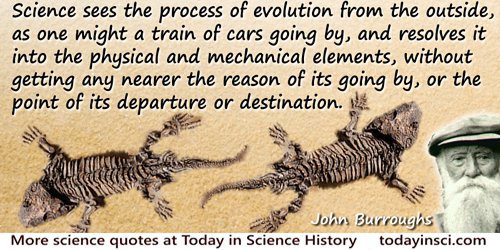
Science sees the process of evolution from the outside, as one might a train of cars going by, and resolves it into the physical and mechanical elements, without getting any nearer the reason of its going by, or the point of its departure or destination.
From essay, 'A Prophet of the Soul', Under the Apple-Trees (1916), 212.
Science, by itself, cannot supply us with an ethic. It can show us how to achieve a given end, and it may show us that some ends cannot be achieved. But among ends that can be achieved our choice must be decided by other than purely scientific considerations. If a man were to say, “I hate the human race, and I think it would be a good thing if it were exterminated,” we could say, “Well, my dear sir, let us begin the process with you.” But this is hardly argument, and no amount of science could prove such a man mistaken.
'The Science to Save us from Science', New York Times Magazine (19 Mar 1950). Collected in M. Gardner (ed.), Great Essays in Science (1950), 396-397.
Scientific development depends in part on a process of non-incremental or revolutionary change. Some revolutions are large, like those associated with the names of Copernicus, Newton, or Darwin, but most are much smaller, like the discovery of oxygen or the planet Uranus. The usual prelude to changes of this sort is, I believed, the awareness of anomaly, of an occurrence or set of occurrences that does not fit existing ways of ordering phenomena. The changes that result therefore require 'putting on a different kind of thinking-cap', one that renders the anomalous lawlike but that, in the process, also transforms the order exhibited by some other phenomena, previously unproblematic.
The Essential Tension (1977), xvii.
Scientific discovery, or the formulation of scientific theory, starts in with the unvarnished and unembroidered evidence of the senses. It starts with simple observation—simple, unbiased, unprejudiced, naive, or innocent observation—and out of this sensory evidence, embodied in the form of simple propositions or declarations of fact, generalizations will grow up and take shape, almost as if some process of crystallization or condensation were taking place. Out of a disorderly array of facts, an orderly theory, an orderly general statement, will somehow emerge.
In 'Is the Scientific Paper Fraudulent?', The Saturday Review (1 Aug 1964), 42.
Scientific findings do not threaten anyone (except to the extent that Homo sapiens may prove incapable of controlling what science makes possible). But what is critical to understand is that our species (or, for that matter, God) is not in the least diminished by the idea that we emerged thanks to the processes of evolution.
In The Monkey in the Mirror: Essays on the Science of What Makes Us Human (2003), 55.
Scientific observation has established that education is not what the teacher gives; education is a natural process spontaneously carried out by the human individual, and is acquired not by listening to words but by experiences upon the environment. The task of the teacher becomes that of preparing a series of motives of cultural activity, spread over a specially prepared environment, and then refraining from obtrusive interference. Human teachers can only help the great work that is being done, as servants help the master. Doing so, they will be witnesses to the unfolding of the human soul and to the rising of a New Man who will not be a victim of events, but will have the clarity of vision to direct and shape the future of human society.
In Education For a New World (1946), 4.
Scientific training gives its votaries freedom from the impositions of modern quackery. Those who know nothing of the laws and processes of Nature fall an easy prey to quacks and impostors. Perfectionism in the realm of religion; a score of frauds in the realm of medicine, as electric shoe soles, hair brushes and belts, electropises, oxydonors, insulating bed casters, and the like; Christian science, in the presence of whose unspeakable stillness and self-stultifying idealism a wise man knows not whether to laugh or cry; Prof. Weltmer’s magnetic treatment of disease; divine healing and miracle working by long-haired peripatetics—these and a score of other contagious fads and rank impostures find their followers among those who have no scientific training. Among their deluded victims are thousands of men and women of high character, undoubted piety, good intentions, charitable impulses and literary culture, but none trained to scientific research. Vaccinate the general public with scientific training and these epidemics will become a thing of the past.
As quoted by S.D. Van Meter, Chairman, closing remarks for 'Report of Committee on Public Policy and Legislation', to the Colorado State Medical Society in Denver, printed in Colorado Medicine (Oct 1904), 1, No. 12, 363. Van Meter used the quote following his statement, “In conclusion, allow me to urge once more the necessity of education of the public as well as the profession if we ever expect to correct the evils we are striving to reach by State and Society legislation. Much can be accomplished toward this end by the publication of well edited articles in the secular press upon medical subjects the public is eager to know about.” Prof. Weltmer is presumably Sidney A. Weltmer, founder of The Weltmer Institute of Suggestive Therapeutics, who offered a Course in Magnetic Healing by mail order correspondence (1899). [The word printed as “electropises” in the article is presumably a typo for “electropoises”. —Webmaster]
Scientists are human—they're as biased as any other group. But they do have one great advantage in that science is a self-correcting process.
In Pamela Weintraub (Ed.), The OMNI Interviews (1984), 14.
Sea water is rendered potable by evaporation; wine and other liquids can be submitted to the same process, for, after having been converted into vapours, they can be condensed back into liquids.
In Meteorology (c. 350 B.C.), Book 2, 2. Translation as shown in Joseph William Mellor, A Comprehensive Treatise on Inorganic and Theoretical Chemistry (1922), Vol. 1, 37.
Should I refuse a good dinner simply because I do not understand the process of digestion?
In Electromagnetic Theory (1892), Vol. 2, 9. With this quote, he illustrates that testing a mathematically complex theory and getting accurate results has significance, even while rigorous logic in the theory is not yet plain. The mathematician may not be satisfied. The physicist meanwhile sees value based on experimental results, but does still stay aware that the theory may not be infallible.
Since Pawlow [Pavlov] and his pupils have succeeded in causing the secretion of saliva in the dog by means of optic and acoustic signals, it no longer seems strange to us that what the philosopher terms an 'idea' is a process which can cause chemical changes in the body.
The Mechanistic Conception of Life (1912), 63.
Sir W. Ramsay has striven to show that radium is in process of transformation, that it contains a store of energy enormous but not inexhaustible. The transformation of radium then would produce a
million times more heat than all known transformations; radium would wear itself out in 1,250 years; this is quite short, and you see that we are at least certain to have this point settled some hundreds of years from now. While waiting, our doubts remain.
In La Valeur de la Science (1904), 199, as translated by George Bruce Halsted, in The Value of Science (1907), 105.
So many of the chemical reactions occurring in living systems have been shown to be catalytic processes occurring isothermally on the surface of specific proteins, referred to as enzymes, that it seems fairly safe to assume that all are of this nature and that the proteins are the necessary basis for carrying out the processes that we call life.
In 'The Physical Basis of Life', (1951), 39. As given in Andrew Brown, J.D. Bernal: The Sage of Science (2005), 359.
Society exists through a process of transmission quite as much as biological life. This transmission occurs by means of communication of habits of doing, thinking, and feeling from the older to the younger.
Democracy and Education: an Introduction to the Philosophy of Education (1916), 3.
Some of my cousins who had the great advantage of University education used to tease me with arguments to prove that nothing has any existence except what we think of it. … These amusing mental acrobatics are all right to play with. They are perfectly harmless and perfectly useless. ... I always rested on the following argument. … We look up to the sky and see the sun. Our eyes are dazzled and our senses record the fact. So here is this great sun standing apparently on no better foundation than our physical senses. But happily there is a method, apart altogether from our physical senses, of testing the reality of the sun. It is by mathematics. By means of prolonged processes of mathematics, entirely separate from the senses, astronomers are able to calculate when an eclipse will occur. They predict by pure reason that a black spot will pass across the sun on a certain day. You go and look, and your sense of sight immediately tells you that their calculations are vindicated. So here you have the evidence of the senses reinforced by the entirely separate evidence of a vast independent process of mathematical reasoning. We have taken what is called in military map-making “a cross bearing.” When my metaphysical friends tell me that the data on which the astronomers made their calculations, were necessarily obtained originally through the evidence of the senses, I say, “no.” They might, in theory at any rate, be obtained by automatic calculating-machines set in motion by the light falling upon them without admixture of the human senses at any stage. When it is persisted that we should have to be told about the calculations and use our ears for that purpose, I reply that the mathematical process has a reality and virtue in itself, and that onie discovered it constitutes a new and independent factor. I am also at this point accustomed to reaffirm with emphasis my conviction that the sun is real, and also that it is hot— in fact hot as Hell, and that if the metaphysicians doubt it they should go there and see.
In My Early Life (1930).
Spaceflights can’t be stopped. This isn't the work of any one man or even a group of men. It is a historical process which mankind is carrying out in accordance with the natural laws of human development.
As quoted in Space World (1974), 10.
Strategy is a style of thinking, a conscious and deliberate process, an intensive implementation system, the science of insuring future success.
…...
Strict conservation of energy in the elementary process had thus been confirmed also by a negative experiment.
…...
Suppose then I want to give myself a little training in the art of reasoning; suppose I want to get out of the region of conjecture and probability, free myself from the difficult task of weighing evidence, and putting instances together to arrive at general propositions, and simply desire to know how to deal with my general propositions when I get them, and how to deduce right inferences from them; it is clear that I shall obtain this sort of discipline best in those departments of thought in which the first principles are unquestionably true. For in all our thinking, if we come to erroneous conclusions, we come to them either by accepting false premises to start with—in which case our reasoning, however good, will not save us from error; or by reasoning badly, in which case the data we start from may be perfectly sound, and yet our conclusions may be false. But in the mathematical or pure sciences,—geometry, arithmetic, algebra, trigonometry, the calculus of variations or of curves,— we know at least that there is not, and cannot be, error in our first principles, and we may therefore fasten our whole attention upon the processes. As mere exercises in logic, therefore, these sciences, based as they all are on primary truths relating to space and number, have always been supposed to furnish the most exact discipline. When Plato wrote over the portal of his school. “Let no one ignorant of geometry enter here,” he did not mean that questions relating to lines and surfaces would be discussed by his disciples. On the contrary, the topics to which he directed their attention were some of the deepest problems,— social, political, moral,—on which the mind could exercise itself. Plato and his followers tried to think out together conclusions respecting the being, the duty, and the destiny of man, and the relation in which he stood to the gods and to the unseen world. What had geometry to do with these things? Simply this: That a man whose mind has not undergone a rigorous training in systematic thinking, and in the art of drawing legitimate inferences from premises, was unfitted to enter on the discussion of these high topics; and that the sort of logical discipline which he needed was most likely to be obtained from geometry—the only mathematical science which in Plato’s time had been formulated and reduced to a system. And we in this country [England] have long acted on the same principle. Our future lawyers, clergy, and statesmen are expected at the University to learn a good deal about curves, and angles, and numbers and proportions; not because these subjects have the smallest relation to the needs of their lives, but because in the very act of learning them they are likely to acquire that habit of steadfast and accurate thinking, which is indispensable to success in all the pursuits of life.
In Lectures on Teaching (1906), 891-92.
Technology is destructive only in the hands of people who do not realize that they are one and the same process as the universe.
…...
That a free, or at least an unsaturated acid usually exists in the stomachs of animals, and is in some manner connected with the important process of digestion, seems to have been the general opinion of physiologists till the time of SPALLANZANI. This illustrious philosopher concluded, from his numerous experiments, that the gastric fluids, when in a perfectly natural state, are neither acid nor alkaline. Even SPALLANZANI, however, admitted that the contents of the stomach are very generally acid; and this accords not only with my own observation, but with that, I believe, of almost every individual who has made any experiments on the subject. ... The object of the present communication is to show, that the acid in question is the muriatic [hydrochloric] acid, and that the salts usually met with in the stomach, are the alkaline muriates.
'On the Nature of the Acid and Saline Matters Usually Existing in the Stomachs of Animals', Philosophical Transactions of the Royal Society of London (1824), 114, 45-6.
That all plants immediately and substantially stem from the element water alone I have learnt from the following experiment. I took an earthern vessel in which I placed two hundred pounds of earth dried in an oven, and watered with rain water. I planted in it a willow tree weighing five pounds. Five years later it had developed a tree weighing one hundred and sixty-nine pounds and about three ounces. Nothing but rain (or distilled water) had been added. The large vessel was placed in earth and covered by an iron lid with a tin-surface that was pierced with many holes. I have not weighed the leaves that came off in the four autumn seasons. Finally I dried the earth in the vessel again and found the same two hundred pounds of it diminished by about two ounces. Hence one hundred and sixty-four pounds of wood, bark and roots had come up from water alone. (1648)
A diligent experiment that was quantitatively correct only as far as it goes. He overlooked the essential role of air and photosynthesis in the growth process.
A diligent experiment that was quantitatively correct only as far as it goes. He overlooked the essential role of air and photosynthesis in the growth process.
Complex. atque mist. elem. fig., 30, Opp. pp. 104-5; Aufgang, 148. In Walter Pagel, Joan Baptista Van Helmont (2002) , 53.
That mathematics “do not cultivate the power of generalization,”; … will be admitted by no person of competent knowledge, except in a very qualified sense. The generalizations of mathematics, are, no doubt, a different thing from the generalizations of physical science; but in the difficulty of seizing them, and the mental tension they require, they are no contemptible preparation for the most arduous efforts of the scientific mind. Even the fundamental notions of the higher mathematics, from those of the differential calculus upwards are products of a very high abstraction. … To perceive the mathematical laws common to the results of many mathematical operations, even in so simple a case as that of the binomial theorem, involves a vigorous exercise of the same faculty which gave us Kepler’s laws, and rose through those laws to the theory of universal gravitation. Every process of what has been called Universal Geometry—the great creation of Descartes and his successors, in which a single train of reasoning solves whole classes of problems at once, and others common to large groups of them—is a practical lesson in the management of wide generalizations, and abstraction of the points of agreement from those of difference among objects of great and confusing diversity, to which the purely inductive sciences cannot furnish many superior. Even so elementary an operation as that of abstracting from the particular configuration of the triangles or other figures, and the relative situation of the particular lines or points, in the diagram which aids the apprehension of a common geometrical demonstration, is a very useful, and far from being always an easy, exercise of the faculty of generalization so strangely imagined to have no place or part in the processes of mathematics.
In An Examination of Sir William Hamilton’s Philosophy (1878), 612-13.
That no real Species of Living Creatures is so utterly extinct, as to be lost entirely out of the World, since it was first Created, is the Opinion of many Naturalists; and 'tis grounded on so good a Principle of Providence taking Care in general of all its Animal Productions, that it deserves our Assent. However great Vicissitudes may be observed to attend the Works of Nature, as well as Humane Affairs; so that some entire Species of Animals, which have been formerly Common, nay even numerous in certain Countries; have, in Process of time, been so perfectly soft, as to become there utterly unknown; tho' at the same time it cannot be denyed, but the kind has been carefully preserved in some other part of the World.
'A Discourse concerning the Large Horns frequently found under Ground in Ireland, Concluding from them that the great American Deer, call'd a Moose, was formerly common in that Island: With Remarks on some other things Natural to that Country', Philosophical Transactions of the Royal Society of London (1697), 19, 489.
That the master manufacturer, by dividing the work to be executed into different processes, each requiring different degrees of skill or of force, can purchase precisely the precise quantity of both which is necessary for each process; whereas, if the whole work were executed by one workman, that person must possess sufficient skill to perform the most difficult, and sufficient strength to execute the most laborious, of the operations into which the art is divided.
In 'On the Division of Labour', Economy of Machinery and Manufactures (1st ed., 1832), chap. 18, 127.
The “big bang” … set matter whirling in a maelstrom of activity that would never cease. The forces of order sought to bring this process under control, to tame chance. The result was not the rigid order of a crystal but the order of life. From the outset, chance has been the essential counterpart of the ordering forces.
As co-author with Ruthild Winkler, trans by Robert and Rita Kimber, in The Laws of the Game: How the Principles of Nature Govern Chance (1981, 1993), 3.
The ability of the genes to vary and, when they vary (mutate), to reproduce themselves in their new form, confers on these cell elements, as Muller has so convincingly pointed out, the properties of the building blocks required by the process of evolution. Thus, the cell, robbed of its noblest prerogative, was no longer the ultimate unit of life. This title was now conferred on the genes, subcellular elements, of which the cell nucleus contained many thousands and, more precisely, like Noah’s ark, two of each kind.
Nucleo-cytoplasmic Relations in Micro-Organisms: Their Bearing on Cell Heredity and Differentiation (1953), 2-3.
The absorption of oxygen and the elimination of carbon dioxide in the lungs take place by diffusion alone. There is no trustworthy evidence of any regulation of this process on the part of the organism.
Krogh summing up his results related to a quote from The Mechanism of gas Exchange (1910), 257, as cited by E. Snorrason, 'Krogh, Schack August Steenberg', in Charles Coulton Gillispie (ed.), Dictionary of Scientific Biography (1973), Vol 7, 502.
The action of the mind in the acquisition of knowledge of any sort is synthetic-analytic; that is, uniting and separating. These are the two sides, or aspects, of the one process. … There is no such thing as a synthetic activity that is not accompanied by the analytic; and there is no analytic activity that is not accompanied by the synthetic. Children cannot be taught to perform these knowing acts. It is the nature of the mind to so act when it acts at all.
In The Public-School Journal (Jan 1895), Vol. 14, 281-282.
The activity characteristic of professional engineering is the design of structures, machines, circuits, or processes, or of combinations of these elements into systems or plants and the analysis and prediction of their performance and costs under specified working conditions.
1954
The actual evolution of mathematical theories proceeds by a process of induction strictly analogous to the method of induction employed in building up the physical sciences; observation, comparison, classification, trial, and generalisation are essential in both cases. Not only are special results, obtained independently of one another, frequently seen to be really included in some generalisation, but branches of the subject which have been developed quite independently of one another are sometimes found to have connections which enable them to be synthesised in one single body of doctrine. The essential nature of mathematical thought manifests itself in the discernment of fundamental identity in the mathematical aspects of what are superficially very different domains. A striking example of this species of immanent identity of mathematical form was exhibited by the discovery of that distinguished mathematician … Major MacMahon, that all possible Latin squares are capable of enumeration by the consideration of certain differential operators. Here we have a case in which an enumeration, which appears to be not amenable to direct treatment, can actually be carried out in a simple manner when the underlying identity of the operation is recognised with that involved in certain operations due to differential operators, the calculus of which belongs superficially to a wholly different region of thought from that relating to Latin squares.
In Presidential Address British Association for the Advancement of Science, Sheffield, Section A,
Nature (1 Sep 1910), 84, 290.
The advance from the simple to the complex, through a process of successive differentiations, is seen alike in the earliest changes of the Universe to which we can reason our way back, and in the earliest changes which we can inductively establish; it is seen in the geologic and climatic evolution of the Earth; it is seen in the unfolding of every single organism on its surface, and in the multiplication of kinds of organisms; it is seen in the evolution of Humanity, whether contemplated in the civilized individual, or in the aggregate of races; it is seen in the evolution of Society in respect alike of its political, its religious, and its economical organization; and it is seen in the evolution of all those endless concrete and abstract products of human activity which constitute the environment of our daily life. From the remotest past which Science can fathom, up to the novelties of yesterday, that in which Progress essentially consists, is the transformation of the homogeneous into the heterogeneous.
Progress: Its Law and Cause (1857), 35.
The aims of pure basic science, unlike those of applied science, are neither fast-flowing nor pragmatic. The quick harvest of applied science is the useable process, the medicine, the machine. The shy fruit of pure science is understanding.
In 'The Meaning of Einstein's New Theory', Life (9 Jan 1950), 28, No. 2, 22. Einstein had just completed the mathematical formulation of the United Field Theory.
The beautiful has its place in mathematics as elsewhere. The prose of ordinary intercourse and of business correspondence might be held to be the most practical use to which language is put, but we should be poor indeed without the literature of imagination. Mathematics too has its triumphs of the Creative imagination, its beautiful theorems, its proofs and processes whose perfection of form has made them classic. He must be a “practical” man who can see no poetry in mathematics.
In A Scrap-book of Elementary Mathematics: Notes, Recreations, Essays (1908), 208.
The belief that mathematics, because it is abstract, because it is static and cold and gray, is detached from life, is a mistaken belief. Mathematics, even in its purest and most abstract estate, is not detached from life. It is just the ideal handling of the problems of life, as sculpture may idealize a human figure or as poetry or painting may idealize a figure or a scene. Mathematics is precisely the ideal handling of the problems of life, and the central ideas of the science, the great concepts about which its stately doctrines have been built up, are precisely the chief ideas with which life must always deal and which, as it tumbles and rolls about them through time and space, give it its interests and problems, and its order and rationality. That such is the case a few indications will suffice to show. The mathematical concepts of constant and variable are represented familiarly in life by the notions of fixedness and change. The concept of equation or that of an equational system, imposing restriction upon variability, is matched in life by the concept of natural and spiritual law, giving order to what were else chaotic change and providing partial freedom in lieu of none at all. What is known in mathematics under the name of limit is everywhere present in life in the guise of some ideal, some excellence high-dwelling among the rocks, an “ever flying perfect” as Emerson calls it, unto which we may approximate nearer and nearer, but which we can never quite attain, save in aspiration. The supreme concept of functionality finds its correlate in life in the all-pervasive sense of interdependence and mutual determination among the elements of the world. What is known in mathematics as transformation—that is, lawful transfer of attention, serving to match in orderly fashion the things of one system with those of another—is conceived in life as a process of transmutation by which, in the flux of the world, the content of the present has come out of the past and in its turn, in ceasing to be, gives birth to its successor, as the boy is father to the man and as things, in general, become what they are not. The mathematical concept of invariance and that of infinitude, especially the imposing doctrines that explain their meanings and bear their names—What are they but mathematicizations of that which has ever been the chief of life’s hopes and dreams, of that which has ever been the object of its deepest passion and of its dominant enterprise, I mean the finding of the worth that abides, the finding of permanence in the midst of change, and the discovery of a presence, in what has seemed to be a finite world, of being that is infinite? It is needless further to multiply examples of a correlation that is so abounding and complete as indeed to suggest a doubt whether it be juster to view mathematics as the abstract idealization of life than to regard life as the concrete realization of mathematics.
In 'The Humanization of Teaching of Mathematics', Science, New Series, 35, 645-46.
The blood corpuscles take up the atmospheric oxygen in the lungs, and the vital chemical process accordingly depends essentially on the combination of oxygen absorbed by blood corpuscles with the combustible constituents of the blood to form carbonic acid and water.
Quoted in Joseph Stewart Fruton Proteins, Enzymes, Genes: The Interplay of Chemistry and Biology (1999), 240.
The breaking up of the terrestrial globe, this it is we witness. It doubtless began a long time ago, and the brevity of human life enables us to contemplate it without dismay. It is not only in the great mountain ranges that the traces of this process are found. Great segments of the earth's crust have sunk hundreds, in some cases, even thousands, of feet deep, and not the slightest inequality of the surface remains to indicate the fracture; the different nature of the rocks and the discoveries made in mining alone reveal its presence. Time has levelled all.
The Face of the Earth (1904), Vol. 1, 604.
The central problem of biological evolution is the nature of mutation, but hitherto the occurrence of this has been wholly refractory and impossible to influence by artificial means, although a control of it might obviously place the process of evolution in our hands.
'The Recent Findings in Heredity' (unpublished lecture, 1916, Lilly Library), 3. Quoted in Elof Axel Carlson, Genes, Radiation, and Society: The Life and Work of H. J. Muller (1981), 104.
The computational formalism of mathematics is a thought process that is externalised to such a degree that for a time it becomes alien and is turned into a technological process. A mathematical concept is formed when this thought process, temporarily removed from its human vessel, is transplanted back into a human mold. To think ... means to calculate with critical awareness.
Mathematics and Physics (1981), Foreward. Reprinted in Mathematics as Metaphor: Selected Essays of Yuri I. Manin (2007), 90.
The computer—logical, linear, rule-governed—encourages a certain kind of thought process. Call it scientific rationality. The introduction of the computer has driven man to an ever more highly rationalist view of his society, and an ever more mechanistic view of himself.
From interview with Marion Long, 'The Turncoat of the Computer Revolution', New Age Journal (1985), II, No. 5, 49-51, as quoted in Lester W. Milbrath, Envisioning a Sustainable Society: Learning Our Way Out (1989), 257.
The concepts of ‘soul’ or ‘life’ do not occur in atomic physics, and they could not, even indirectly, be derived as complicated consequences of some natural law. Their existence certainly does not indicate the presence of any fundamental substance other than energy, but it shows only the action of other kinds of forms which we cannot match with the mathematical forms of modern atomic physics ... If we want to describe living or mental processes, we shall have to broaden these structures. It may be that we shall have to introduce yet other concepts.
In 'Fundamental Problems of Atomic Physics', collected in Philip P. Wiener (Ed.), Readings in Philosophy of Science: Introduction to the Foundations and Cultural Aspects of the Sciences (1953), 96. From a Lecture delivered at the Eidgenössische Technische Hochschule, Zürich (9 Jul 1948). Published Wandlungen in den Grundlagen der Naturwissenschaft, as translated by F. C. Hayes in Philosophic Problems of Nuclear Science (1952).
The Darwinian process of continued interplay of a random and a selective process is not intermediate between pure chance and pure determinism, but qualitatively utterly different from either in its consequences.
In 'Comments on the Preliminary Working Papers of Eden and Waddington'. In P. Moorhead and M. Kaplan (eds.), Mathematical Challenges to the Neo-Darwinian Interpretation of Evolution (1967), 117.
The digestive canal is in its task a complete chemical factory. The raw material passes through a long series of institutions in which it is subjected to certain mechanical and, mainly, chemical processing, and then, through innumerable side-streets, it is brought into the depot of the body. Aside from this basic series of institutions, along which the raw material moves, there is a series of lateral chemical manufactories, which prepare certain reagents for the appropriate processing of the raw material.
Speech to the Society of Russian Physicians (Dec 1874). as translated in Daniel P. Todes, Pavlov’s Physiology Factory: Experiment, Interpretation, Laboratory Enterprise (2002), 155.
The dogma of the Ghost in the Machine ... maintains that there exist both bodies and minds; that there occur physical processes and mental processes; that there are mechanical causes of corporeal movements and mental causes of corporeal movements.
The Concept of Mind (1949), 22.
The earth and its atmosphere constitute a vast distilling apparatus in which the equatorial ocean plays the part of the boiler, and the chill regions of the poles the part of the condenser. In this process of distillation heat plays quite as necessary a part as cold.
In Forms of Water in Clouds and Rivers, Ice and Glaciers (1872), 21.
The endeavour to observe oneself must inevitably introduce changes into the course of mental events,—changes which could not have occurred without it, and whose usual consequence is that the very process which was to have been observed disappears from consciousness.
In Principles of Physiological Psychology (1873, 1904), Vol. 1, 5.
The energy liberated when substrates undergo air oxidation is not liberated in one large burst, as was once thought, but is released in stepwise fashion. At least six separate steps seem to be involved. The process is not unlike that of locks in a canal. As each lock is passed in the ascent from a lower to a higher level a certain amount of energy is expended. Similarly, the total energy resulting from the oxidation of foodstuffs is released in small units or parcels, step by step. The amount of free energy released at each step is proportional to the difference in potential of the systems comprising the several steps.
'Oxidative Mechanisms in Animal Tissues', A Symposium on Respiratory Enzymes (1942), 22.
The entire cosmos is made out of one and the same world-stuff, operated by the same energy as we ourselves. “Mind” and “matter” appears as two aspects of our unitary mind-bodies. There is no separate supernatural realm: all phenomena are part of one natural process of evolution. There is no basic cleavage between science and religion; they are both organs of evolving humanity.
In essay, 'The New Divinity', originally published in The Twentieth Century (1962), 170, 9. Collected in Essays of a Humanist (1964), 218.
The fact that Science walks forward on two feet, namely theory and experiment, is nowhere better illustrated than in the two fields for slight contributions to which you have done me the great honour of awarding the the Nobel Prize in Physics for the year 1923. Sometimes it is one foot that is put forward first, sometimes the other, but continuous progress is only made by the use of both—by theorizing and then testing, or by finding new relations in the process of experimenting and then bringing the theoretical foot up and pushing it on beyond, and so on in unending alterations.
'The Electron and the Light-quant from the Experimental Point of View', Nobel Lecture (23 May 1924). In Nobel Lectures: Physics 1922-1941 (1998), 54.
The fact that this chain of life existed [at volcanic vents on the seafloor] in the black cold of the deep sea and was utterly independent of sunlight—previously thought to be the font of all Earth’s life—has startling ramifications. If life could flourish there, nurtured by a complex chemical process based on geothermal heat, then life could exist under similar conditions on planets far removed from the nurturing light of our parent star, the Sun.
Quoted in Peter Douglas Ward and Donald Brownlee, Rare Earth: Why Complex Life is Uncommon in the Universe (2000), 1, without citation.
The faith of scientists in the power and truth of mathematics is so implicit that their work has gradually become less and less observation, and more and more calculation. The promiscuous collection and tabulation of data have given way to a process of assigning possible meanings, merely supposed real entities, to mathematical terms, working out the logical results, and then staging certain crucial experiments to check the hypothesis against the actual empirical results. But the facts which are accepted by virtue of these tests are not actually observed at all. With the advance of mathematical technique in physics, the tangible results of experiment have become less and less spectacular; on the other hand, their significance has grown in inverse proportion. The men in the laboratory have departed so far from the old forms of experimentation—typified by Galileo's weights and Franklin's kite—that they cannot be said to observe the actual objects of their curiosity at all; instead, they are watching index needles, revolving drums, and sensitive plates. No psychology of 'association' of sense-experiences can relate these data to the objects they signify, for in most cases the objects have never been experienced. Observation has become almost entirely indirect; and readings take the place of genuine witness.
Philosophy in a New Key; A Study in Inverse the Symbolism of Reason, Rite, and Art (1942), 19-20.
The first business of a teacher … should be to excite … curiosity. … This process saves a student from being (as many are) intellectually damaged by having a very good memory.
From Annotation to Essay 50, 'Of Studies', in Bacon’s Essays: With Annotations (1856), 446.
The first effect of the mind growing cultivated is that processes once multiple get to be performed in a single act. Lazarus has called this the progressive “condensation” of thought. ... Steps really sink from sight. An advanced thinker sees the relations of his topics is such masses and so instantaneously that when he comes to explain to younger minds it is often hard ... Bowditch, who translated and annotated Laplace's Méchanique Céleste, said that whenever his author prefaced a proposition by the words “it is evident,” he knew that many hours of hard study lay before him.
In The Principles of Psychology (1918), Vol. 2, 369-370.
The framing of hypotheses is, for the enquirer after truth, not the end, but the beginning of his work. Each of his systems is invented, not that he may admire it and follow it into all its consistent consequences, but that he may make it the occasion of a course of active experiment and observation. And if the results of this process contradict his fundamental assumptions, however ingenious, however symmetrical, however elegant his system may be, he rejects it without hesitation. He allows no natural yearning for the offspring of his own mind to draw him aside from the higher duty of loyalty to his sovereign, Truth, to her he not only gives his affections and his wishes, but strenuous labour and scrupulous minuteness of attention.
Philosophy of the Inductive Sciences (1847), Vol. 2, 57.
The fundamental essence of science, which I think we've lost in our education system, is poking something with a stick and seeing what happens. Embrace that process of inquiry.
The fundamental hypothesis of genetic epistemology is that there is a parallelism between the progress made in the logical and rational organization of knowledge and the corresponding formative psychological processes. With that hypothesis, the most fruitful, most obvious field of study would be the reconstituting of human history—the history of human thinking in prehistoric man. Unfortunately, we are not very well informed in the psychology of primitive man, but there are children all around us, and it is in studying children that we have the best chance of studying the development of logical knowledge, physical knowledge, and so forth.
'Genetic Epistemology', Columbia Forum (1969), 12, 4.
The genesis of mathematical invention is a problem that must inspire the psychologist with the keenest interest. For this is the process in which the human mind seems to borrow least from the exterior world, in which it acts, or appears to act, only by itself and on itself, so that by studying the process of geometric thought, we may hope to arrive at what is most essential in the human mind
As translated in Arthur I. Miller, Imagery in Scientific Thought Creating 20th-Century Physics (1984, 2013), 307. Opening of Paper delivered at Conference at the Institut Général Psychologique, Paris, 'L’Invention Mathématique', published in Enseignment Mathématique (1908), 10, 357. From the original French, “La genèse do l’Invention mathématique est un problème qui doit inspirer le plus vif intérêt au psychologue. C’est l’acte dans lequel l’esprit humain semble le moins emprunter au monde extérieur, où il n’agit ou ne paraît agir que par lui-même et sur lui-même, de sorte, qu’en étudiant le processus de la pensée géométrique, c’est ce qu’il y a de plus essentiel dans l’esprit humain que nous pouvons espérer atteindre.”
The great mathematician fully, almost ruthlessly, exploits the domain of permissible reasoning and skirts the impermissible. … [I]t is hard to believe that our reasoning power was brought, by Darwin’s process of natural selection, to the perfection which it seems to possess.
In 'The Unreasonable Effectiveness of Mathematics in the Natural Sciences,' Communications in Pure and Applied Mathematics (Feb 1960), 13, No. 1 (February 1960). Collected in Eugene Paul Wigner, A.S. Wightman (ed.), Jagdish Mehra (ed.), The Collected Works of Eugene Paul Wigner (1955), Vol. 6, 536.
The great upheavals which precede changes of civilisation, such as the fall of the Roman Empire and the founding of the Arabian Empire, for example, seem to have been determined mainly by considerable political transformations, invasions, or the overthrow of dynasties. But … most often, the real cause is … a profound modification in the ideas of the peoples. … The memorable events of history are the visible effects of the invisible changes of human thought. … The present epoch is one of these critical moments in which the thought of mankind is undergoing a process of transformation.
From Psychologie des Foules (1895), Introduction, 1-2. English text in The Crowd: A Study of the Popular Mind (1897), Introduction, xiii-xiv, tweaked by Webmaster. Original French text: “Les grands bouleversements qui précèdent les changements de civilisations, tels que la chute de l’Empire romain et la fondation de l’Empire arabe par exemple semblent … déterminés surtout par des transformations politiques considérables: invasions de peuples ou renversements de dynasties. Mais … se trouve le plus souvent, comme cause réelle, une modification profonde dans les peuples. … Les événements mémorables de l’histoire sont les effets visibles des invisibles changements de la pensée des hommes. … L’époque actuelle constitue un de ces moments critiques où la pensée des hommes est en voie de se transformer.”
The growth of our knowledge is the result of a process closely resembling what Darwin called “natural selection”; that is, the natural selection of hypotheses: our knowledge consists, at every moment, of those hypotheses which have shown their (comparative) fitness by surviving so far in their struggle for existence, a competitive struggle which eliminates those hypotheses which are unfit.
From Objective Knowledge: An Evolutionary Approach (1971), 261. As quoted in Dean Keith Simonton, Origins of Genius: Darwinian Perspectives on Creativity (1999), 26.
The helium which we handle must have been put together at some time and some place. We do not argue with the critic who urges that the stars are not hot enough for this process; we tell him to go and find a hotter place.
The Internal Constitution of the Stars (1926), 301.
The Historic Method may be described as the comparison of the forms of an idea, or a usage, or a belief, at any given time, with the earlier forms from which they were evolved, or the later forms into which they were developed and the establishment from such a comparison, of an ascending and descending order among the facts. It consists in the explanation of existing parts in the frame of society by connecting them with corresponding parts in some earlier frame; in the identification of present forms in the past, and past forms in the present. Its main process is the detection of corresponding customs, opinions, laws, beliefs, among different communities, and a grouping of them into general classes with reference to some one common feature. It is a certain way of seeking answers to various questions of origin, resting on the same general doctrine of evolution, applied to moral and social forms, as that which is being applied with so much ingenuity to the series of organic matter.
On Compromise (1874), 22-3.
The history of our enterprise…is one of evolution. We started by printing one letter at a time and justifying the sentences afterwards; then we impressed into papier maché one word at a time, justified it, and made a type from it by after process. Next we impressed a whole line and justified it, still leaving the production of the type as a second operation; but now we compose a line, justify and cast it all in one machine and by one operator.
From short Speech at the Chamberlain Hotel, Washington, D.C. (Feb 1885), concluding the exhibition of his own Linotype invention. As given in Carl Schlesinger (ed.), 'Mr. Mergenthaler’s Speech', The Biography of Ottmar Merganthaler: Inventor of the Linotype (1989), 20. [Describing the evolution of his Linotype invention. The word “justifying”, when used specifically for typesetting, refers to increasing the spaces between words to achieve a uniform overall line length for each row in a column. —Webmaster]
The initiation of the fermentation process does not require so complicated an apparatus as is represented by the living cell. The agent responsible for the fermenting action of the press juice is rather to be regarded as a dissolved substance, doubtless a protein; this will be denoted zymase.
'Gahrung ohne Hefezellen', Berichte der deutschen chemischen Gesellschaft, 1897, 30, 119-20. Trans. in Joseph S. Froton, Proteins, Enzymes, Genes: The Interplay of Chemistry and Biology (1999), 117.
The meaning of human life and the destiny of man cannot be separable from the meaning and destiny of life in general. 'What is man?' is a special case of 'What is life?' Probably the human species is not intelligent enough to answer either question fully, but even such glimmerings as are within our powers must be precious to us. The extent to which we can hope to understand ourselves and to plan our future depends in some measure on our ability to read the riddles of the past. The present, for all its awesome importance to us who chance to dwell in it, is only a random point in the long flow of time. Terrestrial life is one and continuous in space and time. Any true comprehension of it requires the attempt to view it whole and not in the artificial limits of any one place or epoch. The processes of life can be adequately displayed only in the course of life throughout the long ages of its existence.
The Meaning of Evolution: A Study of the History of Life and of its Significance for Man (1949), 9.
The mental process by which hypotheses are suggested is obscure. Ordinarily they flash into consciousness without premonition, and it would he easy to ascribe them to a mysterious intuition or creative faculty; but this would contravene one of the broadest generalizations of modern psychology. Just as in the domain of matter nothing is created from nothing, just as in the domain of life there is no spontaneous generation, so in the domain of mind there are no ideas which do not owe their existence to antecedent ideas which stand in the relation of parent to child.
In Address (11 Dec 1895) as President of the Geological Society, 'The Origin of Hypotheses, illustrated by the Discussion of a Topographical Problem', printed as Presidential Address of Grove Karl Gilbert (1896), 4. Also collected in Science (1896), 3, 2.
The most important distinction between the two qualities [talent and genius] is this: one, in conception, follows mechanical processes; the other, vital. Talent feebly conceives objects with the senses and understanding; genius, fusing all its powers together in the alembic of an impassioned imagination, clutches every thing in the concrete, conceives objects as living realities, gives body to spiritual abstractions, and spirit to bodily appearances, and like
“A gate of steel
Fronting the sun, receives and renders back
His figure and his heat!”
“A gate of steel
Fronting the sun, receives and renders back
His figure and his heat!”
In 'Genius', Wellman’s Miscellany (Dec 1871), 4, No. 6, 203. The quotation at the end is from Wiliam Shakespeare, Tr. & Cress. iii, 3.
The most striking characteristic of the written language of algebra and of the higher forms of the calculus is the sharpness of definition, by which we are enabled to reason upon the symbols by the mere laws of verbal logic, discharging our minds entirely of the meaning of the symbols, until we have reached a stage of the process where we desire to interpret our results. The ability to attend to the symbols, and to perform the verbal, visible changes in the position of them permitted by the logical rules of the science, without allowing the mind to be perplexed with the meaning of the symbols until the result is reached which you wish to interpret, is a fundamental part of what is called analytical power. Many students find themselves perplexed by a perpetual attempt to interpret not only the result, but each step of the process. They thus lose much of the benefit of the labor-saving machinery of the calculus and are, indeed, frequently incapacitated for using it.
In 'Uses of Mathesis', Bibliotheca Sacra (Jul 1875), 32, 505.
The motive for the study of mathematics is insight into the nature of the universe. Stars and strata, heat and electricity, the laws and processes of becoming and being, incorporate mathematical truths. If language imitates the voice of the Creator, revealing His heart, mathematics discloses His intellect, repeating the story of how things came into being. And Value of Mathematics, appealing as it does to our energy and to our honor, to our desire to know the truth and thereby to live as of right in the household of God, is that it establishes us in larger and larger certainties. As literature develops emotion, understanding, and sympathy, so mathematics develops observation, imagination, and reason.
In A Theory of Motives, Ideals and Values in Education (1907), 406.
The occurrence of an internal skeleton, in definite relations to the other organ systems, and the articulation of the body into homologous segments, are points in the general organization of Vertebrates to which especial weight must be given. This metameric structure is more or less definitely expressed in most of the organs, and as it extends to the axial skeleton, the latter also gradually articulates into separate segments, the vertebrae. The latter, however, must be regarded only as the partial expression of a general articulation of the body which is all the more important in consequence of its appearing prior to the articulation of the originally inarticulate axial skeleton. Hence this general articulation may be considered as a primitive vertebral structure, to which the articulation of the axial skeleton is related as a secondary process of the same sort.
As translated and quoted in Ernst Haeckel and E. Ray Lankester (trans.) as epigraph for Chap. 11, The History of Creation (1886), Vol. 1, 328-329.
The one who stays in my mind as the ideal man of science is, not Huxley or Tyndall, Hooker or Lubbock, still less my friend, philosopher and guide Herbert Spencer, but Francis Galton, whom I used to observe and listen to—I regret to add, without the least reciprocity—with rapt attention. Even to-day. I can conjure up, from memory’s misty deep, that tall figure with its attitude of perfect physical and mental poise; the clean-shaven face, the thin, compressed mouth with its enigmatical smile; the long upper lip and firm chin, and, as if presiding over the whole personality of the man, the prominent dark eyebrows from beneath which gleamed, with penetrating humour, contemplative grey eyes. Fascinating to me was Francis Galton’s all-embracing but apparently impersonal beneficence. But, to a recent and enthusiastic convert to the scientific method, the most relevant of Galton’s many gifts was the unique contribution of three separate and distinct processes of the intellect; a continuous curiosity about, and rapid apprehension of individual facts, whether common or uncommon; the faculty for ingenious trains of reasoning; and, more admirable than either of these, because the talent was wholly beyond my reach, the capacity for correcting and verifying his own hypotheses, by the statistical handling of masses of data, whether collected by himself or supplied by other students of the problem.
In My Apprenticeship (1926), 134-135.
The origin of a science is usually to be sought for not in any systematic treatise, but in the investigation and solution of some particular problem. This is especially the case in the ordinary history of the great improvements in any department of mathematical science. Some problem, mathematical or physical, is proposed, which is found to be insoluble by known methods. This condition of insolubility may arise from one of two causes: Either there exists no machinery powerful enough to effect the required reduction, or the workmen are not sufficiently expert to employ their tools in the performance of an entirely new piece of work. The problem proposed is, however, finally solved, and in its solution some new principle, or new application of old principles, is necessarily introduced. If a principle is brought to light it is soon found that in its application it is not necessarily limited to the particular question which occasioned its discovery, and it is then stated in an abstract form and applied to problems of gradually increasing generality.
Other principles, similar in their nature, are added, and the original principle itself receives such modifications and extensions as are from time to time deemed necessary. The same is true of new applications of old principles; the application is first thought to be merely confined to a particular problem, but it is soon recognized that this problem is but one, and generally a very simple one, out of a large class, to which the same process of investigation and solution are applicable. The result in both of these cases is the same. A time comes when these several problems, solutions, and principles are grouped together and found to produce an entirely new and consistent method; a nomenclature and uniform system of notation is adopted, and the principles of the new method become entitled to rank as a distinct science.
Other principles, similar in their nature, are added, and the original principle itself receives such modifications and extensions as are from time to time deemed necessary. The same is true of new applications of old principles; the application is first thought to be merely confined to a particular problem, but it is soon recognized that this problem is but one, and generally a very simple one, out of a large class, to which the same process of investigation and solution are applicable. The result in both of these cases is the same. A time comes when these several problems, solutions, and principles are grouped together and found to produce an entirely new and consistent method; a nomenclature and uniform system of notation is adopted, and the principles of the new method become entitled to rank as a distinct science.
In A Treatise on Projections (1880), Introduction, xi. Published as United States Coast and Geodetic Survey, Treasury Department Document, No. 61.
The owner of the means of production is in a position to purchase the labor power of the worker. By using the means of production, the worker produces new goods which become the property of the capitalist. The essential point about this process is the relation between what the worker produces and what he is paid, both measured in terms of real value. In so far as the labor contract is free what the worker receives is determined not by the real value of the goods he produces, but by his minimum needs and by the capitalists’ requirements for labor power in relation to the number of workers competing for jobs. It is important to understand that even in theory the payment of the worker is not determined by the value of his product.
…...
The philosopher of science is not much interested in the thought processes which lead to scientific discoveries; he looks for a logical analysis of the completed theory, including the establishing its validity. That is, he is not interested in the context of discovery, but in the context of justification.
'The Philosophical Significance of the Theory of Relativity' (1938). Collected in P.A. Schillp (ed.). Albert Einstein: Philosopher-Scientist (1949, 1970), 292. Cited in G. Holton, Thematic Origins of Scientific Thought (1973), 7.
The philosopher of science is not much interested in the thought processes which lead to scientific discoveries; he looks for a logical analysis of the completed theory, including the relationships establishing its validity. That is, he is not interested in the context of discovery, but in the context of justification.
In'The Philosophical Significance of the Theory of Relativity' (1949), collected in P.A. Schilpp (ed), Albert Einstein: Philosopher-Scientist (1969), 292. As quoted and cited in Stanley Goldberg, Understanding Relativity: Origin and Impact of a Scientific Revolution (1984, 2013), 306.
The physiological combustion theory takes as its starting point the fundamental principle that the amount of heat that arises from the combustion of a given substance is an invariable quantity–i.e., one independent of the circumstances accompanying the combustion–from which it is more specifically concluded that the chemical effect of the combustible materials undergoes no quantitative change even as a result of the vital process, or that the living organism, with all its mysteries and marvels, is not capable of generating heat out of nothing.
Bemerkungen über das mechanische Aequivalent der Wärme [Remarks on the Mechanical Equivalent of Heat] (1851), 17-9. Trans. Kenneth L. Caneva, Robert Mayer and the Conservation of Energy (1993), 240.
The practice of that which is ethically best—what we call goodness or virtue—involves a course of conduct which, in all respects, is opposed to that which leads to success in the cosmic struggle for existence. In place of ruthless self-assertion it demands self-restraint; in place of thrusting aside, or treading down, all competitors, it requires that the individual shall not merely respect, but shall help his fellows… It repudiates the gladiatorial theory of existence… Laws and moral precepts are directed to the end of curbing the cosmic process.
'Evolution and Ethics' (1893). In Collected Essays (1894), Vol. 9, 81-2.
The present state of electrical science seems peculiarly unfavorable to speculation … to appreciate the requirements of the science, the student must make himself familiar with a considerable body of most intricate mathematics, the mere retention of which in the memory materially interferes with further progress. The first process therefore in the effectual study of the science, must be one of simplification and reduction of the results of previous investigation to a form in which the mind can grasp them.
First sentence of Maxwell’s first paper (read 10 Dec 1855), 'On Faraday’s Lines of Force', Transactions of the Cambridge Philosophical Society (1857), Vol. X, part I. Collected in William Davidson Niven (ed.), The Scientific Papers of James Clerk Maxwell (1890), Vol. 1, 155.
The process of discovery is very simple. An unwearied and systematic application of known laws to nature, causes the unknown to reveal themselves. Almost any mode of observation will be successful at last, for what is most wanted is method.
In A Week on the Concord and Merrimack Rivers (1862), 382.
The process of mutation is the only known source of the raw materials of genetic variability, and hence of evolution. It is subject to experimental study, and considerable progress has been accomplished in this study in recent years. An apparent paradox has been disclosed. Although the living matter becomes adapted to its environment through formation of superior genetic patterns from mutational components, the process of mutation itself is not adaptive. On the contrary, the mutants which arise are, with rare exceptions, deleterious to their carriers, at least in the environments which the species normally encounters. Some of them are deleterious apparently in all environments. Therefore, the mutation process alone, not corrected and guided by natural selection, would result in degeneration and extinction rather than in improved adaptedness.
'On Methods of Evolutionary Biology and Anthropology', American Scientist, 1957, 45, 385.
The process of natural selection has been summed up in the phrase “survival of the fittest.” This, however, tells only part of the story. “Survival of the existing” in many cases covers more of the truth. For in hosts of cases the survival of characters rests not on any special usefulness or fitness, but on the fact that individuals possessing these characters have inhabited or invaded a certain area. The principle of utility explains survivals among competing structures. It rarely accounts for qualities associated with geographic distribution.
The nature of animals which first colonize a district must determine what the future fauna will be. From their specific characters, which are neither useful nor harmful, will be derived for the most part the specific characters of their successors.
It is not essential to the meadow lark that he should have a black blotch on the breast or the outer tail-feather white. Yet all meadow larks have these characters just as all shore larks have the tiny plume behind the ear. Those characters of the parent stock, which may be harmful in the new relations, will be eliminated by natural selection. Those especially helpful will be intensified and modified, but the great body of characters, the marks by which we know the species, will be neither helpful nor hurtful. These will be meaningless streaks and spots, variations in size of parts, peculiar relations of scales or hair or feathers, little matters which can neither help nor hurt, but which have all the persistence heredity can give.
The nature of animals which first colonize a district must determine what the future fauna will be. From their specific characters, which are neither useful nor harmful, will be derived for the most part the specific characters of their successors.
It is not essential to the meadow lark that he should have a black blotch on the breast or the outer tail-feather white. Yet all meadow larks have these characters just as all shore larks have the tiny plume behind the ear. Those characters of the parent stock, which may be harmful in the new relations, will be eliminated by natural selection. Those especially helpful will be intensified and modified, but the great body of characters, the marks by which we know the species, will be neither helpful nor hurtful. These will be meaningless streaks and spots, variations in size of parts, peculiar relations of scales or hair or feathers, little matters which can neither help nor hurt, but which have all the persistence heredity can give.
Foot-notes to Evolution. A Series of Popular Addresses on the Evolution of Life (1898), 218.
The process of preparing programs for a digital computer is especially attractive, not only because it can be economically and scientifically rewarding, but also because it can be an aesthetic experience much like composing poetry or music.
The Art of Computer Programming (1968), Vol. 1, v.
The process of scientific discovery is, in effect, a continual flight from wonder.
…...
The process of self-estrangement and its removal underlies all education. The mind must fix its attention upon what is alien to it and penetrate its disguise, making it become familiar. … Wonder is only the first stage of this estrangement. It must be followed by recognition.
In Psychologic Foundations of Education: An Attempt to Show the Genesis of the Higher Faculties of the Mind (1907), 289.
The process of tracing regularity in any complicated, and at first sight confused, set of appearances, is necessarily tentative; we begin by making any supposition, even a false one, to see what consequences will follow from it ; and by observing how these differ from the real phenomena, we learn what corrections to make in our assumption.
A System of Logic, Ratiocinative and Inductive (1858), 295.
The process that I want to call scientific is a process that involves the continual apprehension of meaning, the constant appraisal of significance accompanied by a running act of checking to be sure that I am doing what I want to do, and of judging correctness or incorrectness. This checking and judging and accepting, that together constitute understanding, are done by me and can be done for me by no one else. They are as private as my toothache, and without them science is dead.
Reflections of a Physicist (1950), 50.
The processes concerned in simple descent are those of Family Variability and Reversion. It is well to define these words clearly. By family variability is meant the departure of the children of the same or similarly descended families from the ideal mean type of all of them. Reversion is the tendency of that ideal mean type to depart from the parent type, 'reverting' towards what may be roughly and perhaps fairly described as the average ancestral type. If family variability had been the only process in simple descent, the dispersion of the race would indefinitely increase with the number of the generations, but reversion checks this increase, and brings it to a standstill.
Typical Laws of Heredity (1877), 513.
The products of the senses, especially those of sight, hearing, and touch, form the basis of all the higher thought processes. Hence the importance of developing accurate sense concepts. … The purpose of objective thinking is to enable the mind to think without the help of objects.
As quoted in William W. Speer, Primary Arithmetic (1896), 1.
The progress of synthesis, or the building up of natural materials from their constituent elements, proceeds apace. Even some of the simpler albuminoids, a class of substances of great importance in the life process, have recently been artificially prepared. ... Innumerable entirely new compounds have been produced in the last century. The artificial dye-stuffs, prepared from materials occurring in coal-tar, make the natural colours blush. Saccharin, which is hundreds of times sweeter than sugar, is a purely artificial substance. New explosives, drugs, alloys, photographic substances, essences, scents, solvents, and detergents are being poured out in a continuous stream.
In Matter and Energy (1912), 45-46.
The purpose of science is to develop, without prejudice or preconception of any kind, a knowledge of the facts, the laws, and the processes of nature. The even more important task of religion, on the other hand, is to develop the consciences, the ideals, and the aspirations of mankind.
'A Joint Statement Upon the Relations of Science and Religion' formulated by Millikan (1923), signed by forty-five leaders of religion, science and human affairs. Reproduced in Bulletin of the American Association of University Professors (May 1923), 9, No. 5, 47. Included in Science and Life (1924), 86. (Note the context in time: the contemporary social climate by 1925 led to the Butler Act banning the teaching of evolution in Tennessee schools and the resulting trial of John Scopes.)
The question of the origin of life is essentially speculative. We have to construct, by straightforward thinking on the basis of very few factual observations, a plausible and self-consistent picture of a process which must have occurred before any of the forms which are known to us in the fossil record could have existed.
The Origin of Life (1967), 2.
The races are in fact disappearing, although the process will require thousands of years at present rates
Interview (1967) with The Times. As quoted in obituary by Douglas Martin, New York Times (20 Jan 2005).
The Reason of making Experiments is, for the Discovery of the Method of Nature, in its Progress and Operations. Whosoever, therefore doth rightly make Experiments, doth design to enquire into some of these Operations; and, in order thereunto, doth consider what Circumstances and Effects, in the Experiment, will be material and instructive in that Enquiry, whether for the confirming or destroying of any preconceived Notion, or for the Limitation and Bounding thereof, either to this or that Part of the Hypothesis, by allowing a greater Latitude and Extent to one Part, and by diminishing or restraining another Part within narrower Bounds than were at first imagin'd, or hypothetically supposed. The Method therefore of making Experiments by the Royal Society I conceive should be this.
First, To propound the Design and Aim of the Curator in his present Enquiry.
Secondly, To make the Experiment, or Experiments, leisurely, and with Care and Exactness.
Thirdly, To be diligent, accurate, and curious, in taking Notice of, and shewing to the Assembly of Spectators, such Circumstances and Effects therein occurring, as are material, or at least, as he conceives such, in order to his Theory .
Fourthly, After finishing the Experiment, to discourse, argue, defend, and further explain, such Circumstances and Effects in the preceding Experiments, as may seem dubious or difficult: And to propound what new Difficulties and Queries do occur, that require other Trials and Experiments to be made, in order to their clearing and answering: And farther, to raise such Axioms and Propositions, as are thereby plainly demonstrated and proved.
Fifthly, To register the whole Process of the Proposal, Design, Experiment, Success, or Failure; the Objections and Objectors, the Explanation and Explainers, the Proposals and Propounders of new and farther Trials; the Theories and Axioms, and their Authors; and, in a Word the history of every Thing and Person, that is material and circumstantial in the whole Entertainment of the said Society; which shall be prepared and made ready, fairly written in a bound Book, to be read at the Beginning of the Sitting of the Society: The next Day of their Meeting, then to be read over and further discoursed, augmented or diminished, as the Matter shall require, and then to be sign'd by a certain Number of the Persons present, who have been present, and Witnesses of all the said Proceedings, who, by Subscribing their names, will prove undoubted testimony to Posterity of the whole History.
First, To propound the Design and Aim of the Curator in his present Enquiry.
Secondly, To make the Experiment, or Experiments, leisurely, and with Care and Exactness.
Thirdly, To be diligent, accurate, and curious, in taking Notice of, and shewing to the Assembly of Spectators, such Circumstances and Effects therein occurring, as are material, or at least, as he conceives such, in order to his Theory .
Fourthly, After finishing the Experiment, to discourse, argue, defend, and further explain, such Circumstances and Effects in the preceding Experiments, as may seem dubious or difficult: And to propound what new Difficulties and Queries do occur, that require other Trials and Experiments to be made, in order to their clearing and answering: And farther, to raise such Axioms and Propositions, as are thereby plainly demonstrated and proved.
Fifthly, To register the whole Process of the Proposal, Design, Experiment, Success, or Failure; the Objections and Objectors, the Explanation and Explainers, the Proposals and Propounders of new and farther Trials; the Theories and Axioms, and their Authors; and, in a Word the history of every Thing and Person, that is material and circumstantial in the whole Entertainment of the said Society; which shall be prepared and made ready, fairly written in a bound Book, to be read at the Beginning of the Sitting of the Society: The next Day of their Meeting, then to be read over and further discoursed, augmented or diminished, as the Matter shall require, and then to be sign'd by a certain Number of the Persons present, who have been present, and Witnesses of all the said Proceedings, who, by Subscribing their names, will prove undoubted testimony to Posterity of the whole History.
'Dr Hooke's Method of Making Experiments' (1664-5). In W. Derham (ed.), Philosophical Experiments and Observations Of the Late Eminent Dr. Robert Hooke, F.R.S. And Geom. Prof. Gresh. and Other Eminent Virtuoso's in his Time (1726), 26-8.
The results of systematic symbolical reasoning must always express general truths, by their nature; and do not, for their justification, require each of the steps of the process to represent some definite operation upon quantity. The absolute universality of the interpretation of symbols is the fundamental principle of their use.
In 'The Foundations of Higher Mathematics', The Philosophy of the Inductive Sciences (1847), Part I, Bk. 2, 149.
The road to the general, to the revelatory simplicities of science, lies through a concern with the particular, the circumstantial, the concrete, but a concern organized and directed in terms of … theoretical analysis … analyses of physical evolution, of the functioning of the nervous system, of social organization, of psychological process, of cultural patterning, and so on—and, most especially, in terms of the interplay among them. That is to say, the road lies, like any genuine Quest, through a terrifying complexity.
In 'The Impact of the Concept of Culture on the Concept of Man' (1966), The Interpretation of Cultures (1973).
The ruthless destruction of their forests by the Chinese is one of the reasons why famine and plague today hold this nation in their sinister grasp. Denudation, wherever practiced, leaves naked soil; floods and erosion follow, and when the soil is gone men must also go—and the process does not take long. The great plains of Eastern China were centuries ago transformed from forest into agricultural land. The mountain plateau of Central China have also within a few hundred years been utterly devastated of tree growth, and no attempt made at either natural or artificial reforestation. As a result, the water rushes off the naked slopes in veritable floods, gullying away the mountain sides, causing rivers to run muddy with yellow soil, and carrying enormous masses of fertile earth to the sea. Water courses have also changed; rivers become uncontrollable, and the water level of the country is lowered perceptibly. In consequence, the unfortunate people see their crops wither and die for lack of water when it is most needed.
Statement (11 May 1921) by United States Department of Agriculture (USDA) concerning the famine in China in seven out of every ten years. Reported in 'Blames Deforestation: Department of Agriculture Ascribes Chinese Famine to it', New York Times (12 May 1921), 12.
The same applies to the concept of force as does to any other physical concept: Verbal definitions are meaningless; real definitions are given through a measuring process.
As given in epigraph, without citation, in Eberhard Zeidler and Juergen Quandt (trans.), Nonlinear Functional Analysis and its Applications: IV: Applications to Mathematical Physics (2013), 9.
The scientific method is a potentiation of common sense, exercised with a specially firm determination not to persist in error if any exertion of hand or mind can deliver us from it. Like other exploratory processes, it can be resolved into a dialogue between fact and fancy, the actual and the possible; between what could be true and what is in fact the case. The purpose of scientific enquiry is not to compile an inventory of factual information, nor to build up a totalitarian world picture of Natural Laws in which every event that is not compulsory is forbidden. We should think of it rather as a logically articulated structure of justifiable beliefs about nature. It begins as a story about a Possible World—a story which we invent and criticise and modify as we go along, so that it ends by being, as nearly as we can make it, a story about real life.
Induction and Intuition in Scientific Thought (1969), 59.
The Scientific Revolution turns us away from the older sayings to discover the lost authorization in Nature. What we have been through in these last four millennia is the slow inexorable profaning of our species. And in the last part of the second millennium A.D., that process is apparently becoming complete. It is the Great Human Irony of our noblest and greatest endeavor on this planet that in the quest for authorization, in our reading of the language of God in Nature, we should read there so clearly that we have been so mistaken.
…...
The scientific value of truth is not, however, ultimate or absolute. It rests partly on practical, partly on aesthetic interests. As our ideas are gradually brought into conformity with the facts by the painful process of selection,—for intuition runs equally into truth and into error, and can settle nothing if not controlled by experience,—we gain vastly in our command over our environment. This is the fundamental value of natural science
In The Sense of Beauty: Being the Outlines of Aesthetic Theory (1896), 22.
The significant thing about the Darbys and coke-iron is not that the first Abraham Darby “invented” a new process but that five generations of the Darby connection were able to perfect it and develop most of its applications.
In Essays on Culture Change (2003), Vol. 2, 200.
The starting point of Darwin’s theory of evolution is precisely the existence of those differences between individual members of a race or species which morphologists for the most part rightly neglect. The first condition necessary, in order that any process of Natural Selection may begin among a race, or species, is the existence of differences among its members; and the first step in an enquiry into the possible effect of a selective process upon any character of a race must be an estimate of the frequency with which individuals, exhibiting any given degree of abnormality with respect to that, character, occur. The unit, with which such an enquiry must deal, is not an individual but a race, or a statistically representative sample of a race; and the result must take the form of a numerical statement, showing the relative frequency with which the various kinds of individuals composing the race occur.
Biometrika: A Joumal for the Statistical Study of Biological Problems (1901), 1, 1-2.
The steady progress of physics requires for its theoretical formulation a mathematics which get continually more advanced. ... it was expected that mathematics would get more and more complicated, but would rest on a permanent basis of axioms and definitions, while actually the modern physical developments have required a mathematics that continually shifts its foundation and gets more abstract. Non-euclidean geometry and noncommutative algebra, which were at one time were considered to be purely fictions of the mind and pastimes of logical thinkers, have now been found to be very necessary for the description of general facts of the physical world. It seems likely that this process of increasing abstraction will continue in the future and the advance in physics is to be associated with continual modification and generalisation of the axioms at the base of mathematics rather than with a logical development of any one mathematical scheme on a fixed foundation.
Introduction to a paper on magnetic monopoles, 'Quantised singularities in the electromagnetic field', Proceedings of the Royal Society of Lonndon (1931), A, 133 60. In Helge Kragh, Dirac: a Scientific Biography (1990), 208.
The stimulus of competition, when applied at an early age to real thought processes, is injurious both to nerve-power and to scientific insight.
In The Preparation of the Child for Science (1904), 44.
The study of mathematics is apt to commence in disappointment. The important applications of the science, the theoretical interest of its ideas, and the logical rigour of its methods all generate the expectation of a speedy introduction to processes of interest. We are told that by its aid the stars are weighed and the billions of molecules in a drop of water are counted. Yet, like the ghost of Hamlet's father, this great science eludes the efforts of our mental weapons to grasp it.
Opening to An Introduction to Mathematics (1911), 7.
The study of mathematics—from ordinary reckoning up to the higher processes—must be connected with knowledge of nature, and at the same time with experience, that it may enter the pupil’s circle of thought.
In Johann Friedrich Herbart, Henry M. Felkin (trans.) and Emmie Felkin (trans.), Letters and Lectures on Education [Felkin] (1898), 117.
The successes of the differential equation paradigm were impressive and extensive. Many problems, including basic and important ones, led to equations that could be solved. A process of self-selection set in, whereby equations that could not be solved were automatically of less interest than those that could.
In Does God Play Dice? The Mathematics of Chaos (1989, 1997), 33.
The teaching process, as commonly observed, has nothing to do with the investigation and establishment of facts, assuming that actual facts may ever be determined. Its sole purpose is to cram the pupils, as rapidly and as painlessly as possible, with the largest conceivable outfit of current axioms, in all departments of human thought—to make the pupil a good citizen, which is to say, a citizen differing as little as possible, in positive knowledge and habits of mind, from all other citizens.
From Baltimore Evening Sun (12 Mar 1923). Collected in A Mencken Chrestomathy (1949, 1956), 316.
The techniques have galloped ahead of the concepts. We have moved away from studying the complexity of the organism; from processes and organisation to composition.
[Commenting that growing use of new technologies and techniques, from molecular biology to genomics, has proved a mixed blessing.]
[Commenting that growing use of new technologies and techniques, from molecular biology to genomics, has proved a mixed blessing.]
Quoted in Andrew Jack, "An Acute Talent for Innovation", Financial Times (1 Feb 2009).
The tendency of modern physics is to resolve the whole material universe into waves, and nothing but waves. These waves are of two kinds: bottled-up waves, which we call matter, and unbottled waves, which we call radiation or light. If annihilation of matter occurs, the process is merely that of unbottling imprisoned wave-energy and setting it free to travel through space. These concepts reduce the whole universe to a world of light, potential or existent, so that the whole story of its creation can be told with perfect accuracy and completeness in the six words: 'God said, Let there be light'.
In The Mysterious Universe (1930, 1932), 97-98
The theory of punctuated equilibrium, proposed by Niles Eldredge and myself, is not, as so often misunderstood, a radical claim for truly sudden change, but a recognition that ordinary processes of speciation, properly conceived as glacially slow by the standard of our own life-span, do not resolve into geological time as long sequences of insensibly graded intermediates (the traditional, or gradualistic, view), but as geologically ‘sudden’ origins at single bedding planes.
…...
The thesis which I venture to sustain, within limits, is simply this, that the savage state in some measure represents an early condition of mankind, out of which the higher culture has gradually been developed or evolved, by processes still in regular operation as of old, the result showing that, on the whole, progress has far prevailed over relapse.
In Primitive Culture (1871), Vol. 1, 28.
The traditional disputes of philosophers are, for the most part, as unwarranted as they are unfruitful. The surest way to end them is to establish beyond question what should be the purpose and method of a philosophical enquiry. And this is by no means so difficult a task as the history of philosophy would lead one to suppose. For if there are any questions which science leaves it to philosophy to answer, a straightforward process of elimination must lead to their discovery.
Language, Truth and Logic (1960), 33.
The transition from a paradigm in crisis to a new one from which a new tradition of normal science can emerge is far from a cumulative process, one achieved by an articulation or extension of the old paradigm. Rather it is a reconstruction of the field from new fundamentals, a reconstruction that changes some of the field's most elementary theoretical generalizations as well as many of its paradigm methods and applications. During the transition period there will be a large but never complete overlap between the problems that can be solved by the old and by the new paradigm. But there will also be a decisive difference in the modes of solution. When the transition is complete, the profession will have changed its view of the field, its methods, and its goals.
The Structure of Scientific Revolutions (1962), 84-5.
The universality of parasitism as an offshoot of the predatory habit negatives the position taken by man that it is a pathological phenomenon or a deviation from the normal processes of nature. The pathological manifestations are only incidents in a developing parasitism. As human beings intent on maintaining man's domination over nature we may regard parasitism as pathological insofar as it becomes a drain upon human resources. In our efforts to protect ourselves we may make every kind of sacrifice to limit, reduce, and even eliminate parasitism as a factor in human life. Science attempts to define the terms on which this policy of elimination may or may not succeed. We must first of all thoroughly understand the problem, put ourselves in possession of all the facts in order to estimate the cost. Too often it has been assumed that parasitism was abnormal and that it needed only a slight force to reestablish what was believed to be a normal equilibrium without parasitism. On the contrary, biology teaches us that parasitism is a normal phenomenon and if we accept this view we shall be more ready to pay the price of freedom as a permanent and ever recurring levy of nature for immunity from a condition to which all life is subject. The greatest victory of man over nature in the physical realm would undoubtedly be his own delivery from the heavy encumbrance of parasitism with which all life is burdened.
Parasitism and Disease (1934), 4.
The universe came into being in a big bang, before which, Einstein’s theory instructs us, there was no before. Not only particles and fields of force had to come into being at the big bang, but the laws of physics themselves, and this by a process as higgledy-piggledy as genetic mutation or the second law of thermodynamics.
In 'The Computer and the Universe', International Journal of Theoretical Physics (1982), 21, 565.
The unscientific person takes things as they are, and cares not for their origin. To study things from a scientific standpoint means to take an inventory of them—to find the process in which they are being produced; to connect them with other things; to see things in their causal process.
From a series of lectures at Johns Hopkins University. Lecture 5 (4 Feb 1893), 'Herbert Spencer and What Knowledge is of Most Worth', The Philosophy of Education (1893), 7.
The volumes, the surfaces, the lines—in one word, the structures that build a tectonic construction—do not represent the whole picture: there is also the movement that animated and still animates these bodies because the history continues and we live under no particular privileged conditions at any given time in this great process.
In Tectonics of Asia (1924, 1977), 2, trans. Albert V. and Marguerite Carozzi.
The whole of Mathematics consists in the organization of a series of aids to the imagination in the process of reasoning.
In Universal Algebra (1898), 12.
The worst thing that will probably happen—in fact is already well underway—is not energy depletion, economic collapse, conventional war, or the expansion of totalitarian governments. As terrible as these catastrophes would be for us, they can be repaired in a few generations. The one process now going on that will take millions of years to correct is loss of genetic and species diversity by the destruction of natural habitats. This is the folly our descendants are least likely to forgive us.
Biophilia (1984), 121.(1990), 182.
There are many hypotheses in science which are wrong. That’s perfectly all right; they’re the aperture to finding out what’s right. Science is a self-correcting process. To be accepted, new ideas must survive the most rigorous standards of evidence and scrutiny.
Quoted in Donald R. Prothero and Carl Dennis Buell, Evolution: What the Fossils Say and Why it Matters (2007), 3.
There are still psychologists who, in a basic misunderstanding, think that gestalt theory tends to underestimate the role of past experience. Gestalt theory tries to differentiate between and-summative aggregates, on the one hand, and gestalten, structures, on the other, both in sub-wholes and in the total field, and to develop appropriate scientific tools for investigating the latter. It opposes the dogmatic application to all cases of what is adequate only for piecemeal aggregates. The question is whether an approach in piecemeal terms, through blind connections, is or is not adequate to interpret actual thought processes and the role of the past experience as well. Past experience has to be considered thoroughly, but it is ambiguous in itself; so long as it is taken in piecemeal, blind terms it is not the magic key to solve all problems.
In Productive Thinking (1959), 65.
There are three stages in the development of science: First, there is the observation of things and facts—the scientists map out and inventory the objects in each department of Nature; secondly, the interrelations are investigated, and this leads to a knowledge of forces and influences which produce or modify those objects…. This is the dynamic stage, the discovery of forces and laws connecting each fact with all other facts, and each province of Nature with all other provinces of Nature. The goal of this second stage of science is to make each fact in Nature throw light on all the other facts, and thus to illuminate each by all. … Science in its third and final stage learns to know everything in Nature as a part of a process which it studies in the history of its development. When it comes to see each thing in the perspective of its evolution, it knows it and comprehends it.
In Psychologic Foundations of Education: An Attempt to Show the Genesis of the Higher Faculties of the Mind (1907), 378.
There are two processes which we adopt consciously or unconsciously when we try to prophesy. We can seek a period in the past whose conditions resemble as closely as possible those of our day, and presume that the sequel to that period will, save for some minor alterations, be similar. Secondly, we can survey the general course of development in our immediate past, and endeavor to prolong it into the near future. The first is the method the historian; the second that of the scientist. Only the second is open to us now, and this only in a partial sphere.
From 'Fifty Years Hence', Strand Magazine (Dec 1931). Reprinted in Popular Mechanics (Mar 1932), 57, No. 3, 393.
There are various causes for the generation of force: a tensed spring, an air current, a falling mass of water, fire burning under a boiler, a metal that dissolves in an acid—one and the same effect can be produced by means of all these various causes. But in the animal body we recognise only one cause as the ultimate cause of all generation of force, and that is the reciprocal interaction exerted on one another by the constituents of the food and the oxygen of the air. The only known and ultimate cause of the vital activity in the animal as well as in the plant is a chemical process.
'Der Lebensprocess im Thiere und die Atmosphare', Annalen der Chemie und Pharmacie (1841), 41, 215-7. Trans. Kenneth L. Caneva, Robert Mo.yer and the Conservation of Energy (1993), 78.
There are, I believe, very few maxims in philosophy that have laid firmer hold upon the mind, than that air, meaning atmospherical air (free from various foreign matters, which were always supposed to be dissolved, and intermixed with it) is a simple elementary substance, indestructible, and unalterable, at least as much so as water is supposed to be. In the course of my enquiries, I was, however, soon satisfied that atmospherical air is not an unalterable thing; for that the phlogiston with which it becomes loaded from bodies burning in it, and animals breathing it, and various other chemical processes, so far alters and depraves it, as to render it altogether unfit for inflammation, respiration, and other purposes to which it is subservient; and I had discovered that agitation in water, the process of vegetation, and probably other natural processes, by taking out the superfluous phlogiston, restore it to its original purity.
'On Dephlogisticated Air, and the Constitution of the Atmosphere', in The Discovery of Oxygen, Part I, Experiments by Joseph Priestley 1775 (Alembic Club Reprint, 1894), 6.
There is no royal road to learning. But it is equally an error to confine attention to technical processes, excluding consideration of general ideas. Here lies the road to pedantry.
In An Introduction to Mathematics (1911), 8.
There is no way to guarantee in advance what pure mathematics will later find application. We can only let the process of curiosity and abstraction take place, let mathematicians obsessively take results to their logical extremes, leaving relevance far behind, and wait to see which topics turn out to be extremely useful. If not, when the challenges of the future arrive, we won’t have the right piece of seemingly pointless mathematics to hand.
In 'The Unplanned Impact of Mathematics', Nature (14 Jul 2011), 475, No. 7355, 167.
There is nothing distinctively scientific about the hypothetico-deductive process. It is not even distinctively intellectual. It is merely a scientific context for a much more general stratagem that underlies almost all regulative processes or processes of continuous control, namely feedback, the control of performance by the consequences of the act performed. In the hypothetico-deductive scheme the inferences we draw from a hypothesis are, in a sense, its logical output. If they are true, the hypothesis need not be altered, but correction is obligatory if they are false. The continuous feedback from inference to hypothesis is implicit in Whewell’s account of scientific method; he would not have dissented from the view that scientific behaviour can be classified as appropriately under cybernetics as under logic.
Induction and Intuition in Scientific Thought (1969), 54-5.
There is probably no other science which presents such different appearances to one who cultivates it and to one who does not, as mathematics. To this person it is ancient, venerable, and complete; a body of dry, irrefutable, unambiguous reasoning. To the mathematician, on the other hand, his science is yet in the purple bloom of vigorous youth, everywhere stretching out after the “attainable but unattained” and full of the excitement of nascent thoughts; its logic is beset with ambiguities, and its analytic processes, like Bunyan’s road, have a quagmire on one side and a deep ditch on the other and branch off into innumerable by-paths that end in a wilderness.
In 'The Theory of Transformation Groups', (A review of Erster Abschnitt, Theorie der Transformationsgruppen (1888)), Bulletin New York Mathematical Society (1893), 2 (First series), 61.
There were taken apples, and … closed up in wax. … After a month's space, the apple inclosed in was was as green and fresh as the first putting in, and the kernals continued white. The cause is, for that all exclusion of open air, which is ever predatory, maintaineth the body in its first freshness and moisture.
[In the U.S., since the 1920s, (to replace the fruit's original wax coating that is lost in the cleaning process after harvesting), natural waxes, such as carnauba wax, are applied in an extremely thin coating, to reduce loss of moisture and maintain crispness and appearance.]
[In the U.S., since the 1920s, (to replace the fruit's original wax coating that is lost in the cleaning process after harvesting), natural waxes, such as carnauba wax, are applied in an extremely thin coating, to reduce loss of moisture and maintain crispness and appearance.]
Sylva Sylvarum; or a Natural History in Ten Centuries (1627), Century 4, Experiment 350-317. Collected in The Works of Francis Bacon (1826), Vol 1, 350-351.
These expert men, technologists, engineers, or whatever name may best suit them, make up the indispensable General staff of the industrial system; and without their immediate and unremitting guidance and correction the industrial system will not work. It is a mechanically organized structure of technical processes designed, installed, and conducted by these production engineers. Without them and their constant attention the industrial equipment, the mechanical appliances of industry, will foot up to just so much junk.
Collected in 'The Captains of Finance and the Engineers', The Engineers and the Price System (1921), 69. Previously published in The Dial (1919).
These sciences, Geometry, Theoretical Arithmetic and Algebra, have no principles besides definitions and axioms, and no process of proof but deduction; this process, however, assuming a most remarkable character; and exhibiting a combination of simplicity and complexity, of rigour and generality, quite unparalleled in other subjects.
In The Philosophy of the Inductive Sciences (1858), Part 1, Bk. 2, chap. 1, sect. 2.
This brings me to the final point of my remarks, the relation between creativity and aging, a topic with which I have had substantial experience. Scientific research, until it has gone through the grueling and sometimes painful process of publication, is just play, and play is characteristic of young vertebrates, particularly young mammals. In some ways, scientific creativity is related to the exuberant behavior of young mammals. Indeed, creativity seems to be a natural characteristic of young humans. If one is fortunate enough to be associated with a university, even as one ages, teaching allows one to contribute to, and vicariously share, in the creativity of youth.”
In 'Integrative Biology: An Organismic Biologist’s Point of View', Integrative and Comparative Biology (2005), 45, 331.
This is a classical example of the process which we call, with Tinbergen, a redirected activity. It is characterized by the fact that an activity is released by one object but discharged at another, because the first one, while presenting stimuli specifically eliciting the response, simultaneously emits others which inhibit its discharge. A human example is furnished by the man who is very angry with someone and hits the table instead of the other man's jaw, because inhibition prevents him from doing so, although his pent-up anger, like the pressure within a volcano, demands outlet.
On Aggression, trans. M. Latzke (1966), 145.
Those who are accustomed to judge by feeling do not understand the process of reasoning, because they want to comprehend at a glance and are not used to seeking for first principles. Those, on the other hand, who are accustomed to reason from first principles do not understand matters of feeling at all, because they look for first principles and are unable to comprehend at a glance.
In Pensées (1670), Section 7, No. 33. As translated in W.H. Auden and L. Kronenberger (eds.) The Viking Book of Aphorisms (1966), 351. Also translated as “Those who are accustomed to judge by feeling do not understand the process of reasoning, for they would understand at first sight, and are not used to seek for principles. And others, on the contrary, who are accustomed to reason from principles, do not at all understand matters of feeling, seeking principles, and being unable to see at a glance,” in Blaise Pascal and W.F. Trotter (trans.), 'Thoughts', No. 3, collected in Charles W. Eliot (ed.), The Harvard Classics (1910), Vol. 48, 9. From the original French, “Ceux qui sont accoutumés à juger par le sentiment ne comprennent rien aux choses de raisonnement, car ils veulent d’abord pénétrer d’une vue et ne sont point accoutumés à chercher les principes. Et les autres, au contraire, qui sont accoutumés à raisonner par principes, ne comprennent rien aux choses de sentiment, y cherchant des principes et ne pouvant voir d’une vue,” in Ernest Havet (ed.), Pensées de Pascal (1892), 224.
Those who have taken upon them to lay down the law of nature as a thing already searched out and understood, whether they have spoken in simple assurance or professional affectation, have therein done philosophy and the sciences great injury. For as they have been successful in inducing belief, so they have been effective in quenching and stopping inquiry; and have done more harm by spoiling and putting an end to other men's efforts than good by their own. Those on the other hand who have taken a contrary course, and asserted that absolutely nothing can be known — whether it were from hatred of the ancient sophists, or from uncertainty and fluctuation of mind, or even from a kind of fullness of learning, that they fell upon this opinion — have certainly advanced reasons for it that are not to be despised; but yet they have neither started from true principles nor rested in the just conclusion, zeal and affectation having carried them much too far...
Now my method, though hard to practice, is easy to explain; and it is this. I propose to establish progressive stages of certainty. The evidence of the sense, helped and guarded by a certain process of correction, I retain. But the mental operation which follows the act of sense I for the most part reject; and instead of it I open and lay out a new and certain path for the mind to proceed in, starting directly from the simple sensuous perception.
Now my method, though hard to practice, is easy to explain; and it is this. I propose to establish progressive stages of certainty. The evidence of the sense, helped and guarded by a certain process of correction, I retain. But the mental operation which follows the act of sense I for the most part reject; and instead of it I open and lay out a new and certain path for the mind to proceed in, starting directly from the simple sensuous perception.
Novum Organum (1620)
Thought isn’t a form of energy. So how on Earth can it change material processes? That question has still not been answered.
As quoted in Eric Roston, The Carbon Age: How Life’s Core Element Has Become Civilization’s Gratest Threat (2009), 117.
Thus a nerve element, a nerve entity, or ‘neuron’, as I propose to call it, consists‥of the following pieces:—(a) a nerve cell, (b) the nerve process, (c) its collaterals, and (d) the end-branching.
[Coining the word ‘neuron’ in the sense of a nerve cell.]
[Coining the word ‘neuron’ in the sense of a nerve cell.]
In original German text by Waldeyer in Berliner Klin. Wochenschr. (13 July 1891), 691:1. As translated in Brain (1891), 14, 569. Note: The word ‘neuron’ was used earlier in difference senses, now obsolete, by B.T. Lowne (1883) for the neural part of the compound eye of athropods, and by B.G. Wilder (1884) for the neuraxis.
Thus, we have three principles for increasing adequacy of data: if you must work with a single object, look for imperfections that record historical descent; if several objects are available, try to render them as stages of a single historical process; if processes can be directly observed, sum up their effects through time. One may discuss these principles directly or recognize the ‘little problems’ that Darwin used to exemplify them: orchids, coral reefs, and worms–the middle book, the first, and the last.
…...
To a man of an impatient disposition, like James Gray, it became clear that in view of the very large number of known species many more generations of scientists could be kept occupied as sedate, taxonomic filing clerks by painstaking description and comparison of structures. This sort of existence was not for him; it lacked the excitement of discovery, and was not likely to make the principles or mechanisms underlying the process of evolution any more plausible.
In obituary, 'James Gray, 14 October 1891 - 14 December 1975', Biographical Memoirs of Fellows of the Royal Society (1 Nov 1978), 24.
To be anthropocentric is to remain unaware of the limits of human nature, the significance of biological processes underlying human behavior, and the deeper meaning of long-term genetic evolution.
Tanner Lecture on Human Values, University of Michigan, 'Comparative Social Theory' (30 Mar 1979).
To discover a Conception of the mind which will justly represent a train of observed facts is, in some measure, a process of conjecture, ... and the business of conjecture is commonly conducted by calling up before our minds several suppositions, selecting that one which most agrees with what we know of the observed facts. Hence he who has to discover the laws of nature may have to invent many suppositions before he hits upon the right one; and among the endowments which lead to his success, we must reckon that fertility of invention which ministers to him such imaginary schemes, till at last he finds the one which conforms to the true order of nature.
Philosophy of the Inductive Sciences (1847), Vol. 2, 54.
To produce a really good biological theory one must try to see through the clutter produced by evolution to the basic mechanisms lying beneath them, realizing that they are likely to be overlaid by other, secondary mechanisms. What seems to physicists to be a hopelessly complicated process may have been what nature found simplest, because nature could only build on what was already there.
In What Mad Pursuit (1990), 139.
To take one of the simplest cases of the dissipation of energy, the conduction of heat through a solid—consider a bar of metal warmer at one end than the other and left to itself. To avoid all needless complication, of taking loss or gain of heat into account, imagine the bar to be varnished with a substance impermeable to heat. For the sake of definiteness, imagine the bar to be first given with one half of it at one uniform temperature, and the other half of it at another uniform temperature. Instantly a diffusing of heat commences, and the distribution of temperature becomes continuously less and less unequal, tending to perfect uniformity, but never in any finite time attaining perfectly to this ultimate condition. This process of diffusion could be perfectly prevented by an army of Maxwell’s ‘intelligent demons’* stationed at the surface, or interface as we may call it with Prof. James Thomson, separating the hot from the cold part of the bar.
* The definition of a ‘demon’, according to the use of this word by Maxwell, is an intelligent being endowed with free will, and fine enough tactile and perceptive organisation to give him the faculty of observing and influencing individual molecules of matter.
* The definition of a ‘demon’, according to the use of this word by Maxwell, is an intelligent being endowed with free will, and fine enough tactile and perceptive organisation to give him the faculty of observing and influencing individual molecules of matter.
In 'The Kinetic Theory of the Dissipation of Energy', Nature (1874), 9, 442.
Until its results have gone through the painful process of publication, preferably in a refereed journal of high standards, scientific research is just play. Publication is an indispensable part of science. “Publish or perish” is not an indictment of the system of academia; it is a partial prescription for creativity and innovation. Sustained and substantial publication favors creativity. Novelty of conception has a large component of unpredictability. ... One is often a poor judge of the relative value of his own creative efforts. An artist’s ranking of his own works is rarely the same as that of critics or of history. Most scientists have had similar experiences. One’s supply of reprints for a pot-boiler is rapidly exhausted, while a major monograph that is one’s pride and joy goes unnoticed. The strategy of choice is to increase the odds favoring creativity by being productive.
In 'Scientific innovation and creativity: a zoologist’s point of view', American Zoologist (1982), 22, 233-234.
We [Frisch and Lise Meitner] walked up and down in the snow, I on skis and she on foot (she said and proved that she could get along just as fast that way), and gradually the idea took shape that this was no chipping or cracking of the nucleus but rather a process to be explained by Bohr’s idea that the nucleus was like a liquid drop; such a drop might elongate and divide itself.
Otto Frisch and John A. Wheeler, 'The Discovery of Fission', Physics Today, Nov 1967, 20, 47.
We are … led to a somewhat vague distinction between what we may call “hard” data and “soft” data. This distinction is a matter of degree, and must not be pressed; but if not taken too seriously it may help to make the situation clear. I mean by “hard” data those which resist the solvent influence of critical reflection, and by “soft” data those which, under the operation of this process, become to our minds more or less doubtful.
Our Knowledge of the External World (1925), 75.
We are as remote from adequate explanation of the nature and causes of mechanical evolution of the hard parts of animals as we were when Aristotle first speculated on this subject … I think it is possible that we may never fathom all the causes of mechanical evolution or of the origin of new mechanical characters, but shall have to remain content with observing the modes of mechanical evolution, just as embryologists and geneticists are observing the modes of development, from the fertilized ovum to the mature individual, without in the least understanding either the cause or the nature of the process of development which goes on under their eyes every day
From 'Orthogenesis as observed from paleontological evidence beginning in the year 1889', American Naturalist (1922) 56, 141-142. As quoted and cited in 'G.G. Simpson, Paleontology, and the Modern Synthesis', collected in Ernst Mayr, William B. Provine (eds.), The Evolutionary Synthesis: Perspectives on the Unification of Biology (1998), 171.
We are just beginning to understand how molecular reaction systems have found a way to “organize themselves”. We know that processes of this nature ultimately led to the life cycle, and that (for the time being?) Man with his central nervous system, i.e. his memory, his mind, and his soul, stands at the end of this development and feels compelled to understand this development. For this purpose he must penetrate into the smallest units of time and space, which also requires new ideas to make these familiar concepts from physics of service in understanding what has, right into our century, appeared to be beyond the confines of space and time.
Answering “Where Now?” as the conclusion of his Nobel Lecture (11 Dec 1967) on 'Immeasurably Fast Reactions', published in Nobel Lectures, Chemistry 1963-1970 (1972).
We are machines built by DNA whose purpose is to make more copies of the same DNA. ... This is exactly what we are for. We are machines for propagating DNA, and the propagation of DNA is a self-sustaining process. It is every living object's sole reason for living.
Royal Institution Christmas Lecture, 'The Ultraviolet Garden', (No. 4, 1991). Quoted in Vinoth Ramachandra, Subverting Global Myths: Theology and the Public Issues Shaping our World (2008), 187.
We are taught that the three great planning and control processes of modern society—bureaucracy, technology, and science—are all value-free means or instruments, just tools, which men must decide how to use by standards drawn from some other source than the realms of science, technology, and bureaucracy.
In Legitimacy in the Modern State (1981), 35.
We are the accidental result of an unplanned process … the fragile result of an enormous concatenation of improbabilities, not the predictable product of any definite process.
'Extemporaneous Comments of Evolutionary Hopes and Realities'. In Charles L. Hamrum (Ed.), Darwin's Legacy, Nobel Conference XVIII (1983), 101-102. Quoted in Holmes Rolston, Genes, Genesis, and God (1999), 17-18.
We can see that, the constant in the law of gravitation being fixed, there may be some upper limit to the amount of matter possible; as more and more matter is added in the distant parts, space curves round and ultimately closes; the process of adding more matter must stop, because there is no more space, and we can only return to the region already dealt with. But there seems nothing to prevent a defect of matter, leaving space unclosed. Some mechanism seems to be needed, whereby either gravitation creates matter, or all the matter in the universe conspires to define a law of gravitation.
In Space, Time and Gravitation: An Outline of the General Relativity Theory (1920, 1921), 163.
We depend upon science for prosperity for it supplies the new products and processes indispensable to our growing economy. We depend upon science for peace, for it supplies the weapons by which we defend the free world, and deter a reckless aggressor.
From Draft of Science Speech for Presidential Campaign (1960), held by the John F. Kennedy Presidential Library and Museum. Digital Identifier: JFKCAMP1960-0993-005.
We do not draw conclusions with our eyes, but with our reasoning powers, and if the whole of the rest of living nature proclaims with one accord from all sides the evolution of the world of organisms, we cannot assume that the process stopped short of Man. But it follows also that the factors which brought about the development of Man from his Simian ancestry must be the same as those which have brought about the whole of evolution.
Translation of Weismann's work in German, by John Arthur Thomson and Margaret R. Thomson, The Evolution Theory (1904), Vol. 2, 393.
We have been forced to admit for the first time in history not only the possibility of the fact of the growth and decay of the elements of matter. With radium and with uranium we do not see anything but the decay. And yet, somewhere, somehow, it is almost certain that these elements must be continuously forming. They are probably being put together now in the laboratory of the stars. ... Can we ever learn to control the process. Why not? Only research can tell.
'The Significance of Radium,' an address delivered (in connection with the presentation of a gram of radium to Madame Curie) at the National Museum, Washington, D.C. (25 May 1921). In Science (1921), 54, No. 1383, 1921. In Rodney P. Carlisle, Scientific American Inventions and Discoveries (2004), 375.
We have little more personal stake in cosmic destiny than do sunflowers or butterflies. The transfiguration of the universe lies some 50 to 100 billion years in the future; snap your fingers twice and you will have consumed a greater fraction of your life than all human history is to such a span. ... We owe our lives to universal processes ... and as invited guests we might do better to learn about them than to complain about them. If the prospect of a dying universe causes us anguish, it does so only because we can forecast it, and we have as yet not the slightest idea why such forecasts are possible for us. ... Why should nature, whether hostile or benign, be in any way intelligible to us? All the mysteries of science are but palace guards to that mystery.
…...
We have long been seeking a different kind of evolutionary process and have now found one; namely, the change within the pattern of the chromosomes. ... The neo-Darwinian theory of the geneticists is no longer tenable.
The Material Basis of Evolution (1940), 397.
We have not done the things that are necessary to lower emissions because these things fundamentally conflict with deregulated capitalism… We are stuck because the actions that would give us the best chance of averting catastrophe–and would benefit the vast majority–are extremely threatening to an elite minority that has a stranglehold over our economy, our political process, and most of our major media outlets.
From This Changes Everything: Capitalism vs. the Climate (2014), 18.
We have seen that a proton of energy corresponding to 30,000 volts can effect the transformation of lithium into two fast α-particles, which together have an energy equivalent of more than 16 million volts. Considering the individual process, the output of energy in the transmutation is more than 500 times greater than the energy carried by the proton. There is thus a great gain of energy in the single transmutation, but we must not forget that on an average more than 1000 million protons of equal energy must be fired into the lithium before one happens to hit and enter the lithium nucleus. It is clear in this case that on the whole the energy derived from transmutation of the atom is small compared with the energy of the bombarding particles. There thus seems to be little prospect that we can hope to obtain a new source of power by these processes. It has sometimes been suggested, from analogy with ordinary explosives, that the transmutation of one atom might cause the transmutation of a neighbouring nucleus, so that the explosion would spread throughout all the material. If this were true, we should long ago have had a gigantic explosion in our laboratories with no one remaining to tell the tale. The absence of these accidents indicates, as we should expect, that the explosion is confined to the individual nucleus and does not spread to the neighbouring nuclei, which may be regarded as relatively far removed from the centre of the explosion.
The Transmutation of the Atom (1933), 23-4
We know the laws of trial and error, of large numbers and probabilities. We know that these laws are part of the mathematical and mechanical fabric of the universe, and that they are also at play in biological processes. But, in the name of the experimental method and out of our poor knowledge, are we really entitled to claim that everything happens by chance, to the exclusion of all other possibilities?
From Nobel Prize Lecture (Dec 1974), 'The Coming Age of the Cell'. Collected in Jan Lindsten (ed.) Nobel Lectures, Physiology or Medicine 1971-1980 (1992).
We may need simple and heroic legends for that peculiar genre of literature known as the textbook. But historians must also labor to rescue human beings from their legends in science–if only so that we may understand the process of scientific thought aright.
…...
We may say that life has borrowed from inanimate processes the same mechanism used in producing these striking structures that are crystals.
‘The Nature of Forces between Large Molecules of Biological Interest’, Nature (1948), 161, 708.
We may... have to relinquish the notion, explicit or implicit, that changes of paradigm carry scientists and those who learn from them closer and closer to the truth... The developmental process described in this essay has been a process of evolution from primitive beginnings—a process whose successive stages are characterized by an increasingly detailed and refined understanding of nature. But nothing that has been or will be said makes it a process of evolution toward anything.
The Structure of Scientific Revolutions (1962), 169-70.
We see that each surface is really a pair of surfaces, so that, where they appear to merge, there are really four surfaces. Continuing this process for another circuit, we see that there are really eight surfaces etc and we finally conclude that there is an infinite complex of surfaces, each extremely close to one or the other of two merging surfaces.
An intermediate thought about some surface in state space, while evolving his Prototype Model of Chaos. In 'Deterministic Nonperiodic Flow', Journal of Atmospheric Science (1963), 20, 130–141. As quoted and cited in: T.N. Palmer, 'Edward Norton Lorenz: 23 May 1917—16 April 2008', Biographical Memoirs of Fellows of the Royal Society (2009) 55, 144.
We were flying over America and suddenly I saw snow, the first snow we ever saw from orbit. I have never visited America, but I imagined that the arrival of autumn and winter is the same there as in other places, and the process of getting ready for them is the same. And then it struck me that we are all children of our Earth.
As quoted in Kevin W. Kelley (ed.), The Home Planet (1988). Source cited as “submitted by Lev Demin”.
What is peculiar and new to the [19th] century, differentiating it from all its predecessors, is its technology. It was not merely the introduction of some great isolated inventions. It is impossible not to feel that something more than that was involved. … The process of change was slow, unconscious, and unexpected. In the nineteeth century, the process became quick, conscious, and expected. … The whole change has arisen from the new scientific information. Science, conceived not so much in its principles as in its results, is an obvious storehouse of ideas for utilisation. … Also, it is a great mistake to think that the bare scientific idea is the required invention, so that it has only to be picked up and used. An intense period of imaginative design lies between. One element in the new method is just the discovery of how to set about bridging the gap between the scientific ideas, and the ultimate product. It is a process of disciplined attack upon one difficulty after another This discipline of knowledge applies beyond technology to pure science, and beyond science to general scholarship. It represents the change from amateurs to professionals. … But the full self-conscious realisation of the power of professionalism in knowledge in all its departments, and of the way to produce the professionals, and of the importance of knowledge to the advance of technology, and of the methods by which abstract knowledge can be connected with technology, and of the boundless possibilities of technological advance,—the realisation of all these things was first completely attained in the nineteeth century.
In Science and the Modern World (1925, 1997), 96.
What it is important to realize is that automation ... is an attempt to exercise control, not only of the mechanical process itself, but of the human being who once directed it: turning him from an active to a passive agent, and finally eliminating him all together.
In 'The Myth of the Machine,' The Pentagon of Power (1970).
What made von Liebig and his students “different” from other chemists was their effort to apply their fundamental discoveries to the development of specific chemical processes and products.
In 'The Origins of Academic Chemical Engineering', collected in Nicholas A. Peppas (ed.), One Hundred Years of Chemical Engineering: From Lewis M. Norton (M.I.T. 1888) to Present (2012), 2.
What matters in science is the body of findings and generalizations available today: a time-defined cross-section of the process of scientific discovery. I see the advance of science as self-erasing in the sense that only those elements survive that have become part of the active body of knowledge.
In A Slot Machine, A Broken Test Tube (1985), 123.
What we remember, belonging more particularly to some special active pattern, is always normally checked by the reconstructed or the striking material of other active settings. It is, accordingly, apt to take on a peculiarity of some kind which, in any given case, expresses the temperament, or the character, of the person who effects the recall. This may be why, in almost all psychological descriptions of memory processes, memory is said to have a characteristically personal flavour … depending upon an interplay of appetites, instincts, interests and ideals peculiar to any given subject.
In Chapter 10, 'A Theory of Remembering', Remembering: A Study in Experimental and Social Psychology (1932, 1995), 213.
When we have amassed a great store of such general facts, they become the objects of another and higher species of classification, and are themselves included in laws which, as they dispose of groups, not individuals have a far superior degree of generality, till at length, by continuing the process, we arrive at axioms of the highest degree of generality of which science is capable. This process is what we mean by induction.
In A Preliminary Discourse on the Study of Natural Philosophy (1830), 102.
Whenever there is a great deal of energy in one region and very little in a neighboring region, energy tends to travel from the one region to the other, until equality is established. This whole process may be described as a tendency towards democracy.
In 'Science and Religion', collected in Al Seckel (ed.), >Bertrand Russell on God and Religion (1986), 175.
Where speculation ends—in real life—there real, positive science begins: the representation of the practical activity, of the practical process of development of men. Empty talk about consciousness ceases, and real knowledge has to take its place.
In David McLellan (ed.), 'The Premisses of the Material Method', Karl Marx: Selected Writings (2000), 181.
Where we reach the sphere of mathematics we are among processes which seem to some the most inhuman of all human activities and the most remote from poetry. Yet it is just here that the artist has the fullest scope for his imagination. … We are in the imaginative sphere of art, and the mathematician is engaged in a work of creation which resembles music in its orderliness, … It is not surprising that the greatest mathematicians have again and again appealed to the arts in order to find some analogy to their own work. They have indeed found it in the most varied arts, in poetry, in painting, and in sculpture, although it would certainly seem that it is in music, the most abstract of all the arts, the art of number and time, that we find the closest analogy.
In The Dance of Life (1923), 138-139.
While natural science up to the end of the last century was predominantly a collecting science, a science of finished things, in our century it is essentially a classifying science, a science of processes, of the origin and development of these things and of the interconnection which binds these processes into one great whole.
Speaking of the 18th (last) and 19th (our) centuries, in Ludwig Feuerbach and the Outcome of Classical German Philosophy (1886, 1941).
While the Mathematician is busy with deductions from general propositions, the Biologist is more especially occupied with observation, comparison, and those processes which lead to general propositions.
In 'On the Educational Value of the Natural History Sciences', Science and Education: Essays (1894), 57.
Who can estimate the value to civilization of the Copernican system of the sun and planets? A round earth, an earth not the centre of the universe, an earth obeying law, an earth developed by processes of evolution covering tens of millions of years, is incomparably grander than the earth which ante-Copernican imagination pictured.
In 'The Nature of the Astronomer’s Work', North American Review (Jun 1908), 187, No. 631, 915.
Who would not have been laughed at if he had said in 1800 that metals could be extracted from their ores by electricity or that portraits could be drawn by chemistry.
[Commenting on Becquerel’s process for extracting metals by voltaic means.]
[Commenting on Becquerel’s process for extracting metals by voltaic means.]
Letter (20 Aug 1847), The Letters of Faraday and Schoenbein, 1836-1862 (1899), footnote, 209.
Whoever limits his exertions to the gratification of others, whether by personal exhibition, as in the case of the actor and of the mimic, or by those kinds of literary composition which are calculated for no end but to please or to entertain, renders himself, in some measure, dependent on their caprices and humours. The diversity among men, in their judgments concerning the objects of taste, is incomparably greater than in their speculative conclusions; and accordingly, a mathematician will publish to the world a geometrical demonstration, or a philosopher, a process of abstract reasoning, with a confidence very different from what a poet would feel, in communicating one of his productions even to a friend.
In Elements of the Philosophy of the Human Mind (1827), Vol. 3, Chap. 1, Sec. 3, 202.
With savages, the weak in body or mind are soon eliminated; and those that survive commonly exhibit a vigorous state of health. We civilised men, on the other hand, do our utmost to check the process of elimination; we build asylums for the imbecile, the maimed, and the sick; we institute poor-laws; and our medical men exert their utmost skill to save the life of every one to the last moment.
…...
Without deductive logic science would be entirely useless. It is merely a barren game to ascend from the particular to the general, unless afterwards we can reverse the process and descend from the general to the particular, ascending and descending like angels on Jacob’s ladder.
In 'Technical Education and Its Relation to Science and Literature', The Aims of Education: & Other Essays (1917), 80.
Without some idea of oxidation processes, of the chemical structure of food, and of the chemical reactions in digestion, visceral behavior is a blank. And without some understanding of visceral behavior, psychic behavior is up in the air.
From Why We Behave Like Human Beings (1925), xiv.
You find FACTS as things given; I get them only by a long process of excavating (so to say), and so regard them as the very antipodes of things given.
In Letter, collected in Adolf Meyer and Edward Bradford Titchener, Defining American Psychology: The Correspondence Between Adolf Meyer and Edward Bradford Titchener (1990), 259.
Your creatures can come into being only, like shoot from stem, as part of an endlessly renewed process of evolution.
In Hymn of the Universe (1969), 22.
 In science it often happens that scientists say, 'You know that's a really good argument; my position is mistaken,' and then they would actually change their minds and you never hear that old view from them again. They really do it. It doesn't happen as often as it should, because scientists are human and change is sometimes painful. But it happens every day. I cannot recall the last time something like that happened in politics or religion.
(1987) --
In science it often happens that scientists say, 'You know that's a really good argument; my position is mistaken,' and then they would actually change their minds and you never hear that old view from them again. They really do it. It doesn't happen as often as it should, because scientists are human and change is sometimes painful. But it happens every day. I cannot recall the last time something like that happened in politics or religion.
(1987) --