Praise Quotes (28 quotes)
[M]y work, which I’ve done for a long time, was not pursued in order to gain the praise I now enjoy, but chiefly from a craving after knowledge, which I notice resides in me more than in most other men. And therewithal, whenever I found out anything remarkable, I have thought it my duty to put down my discovery on paper, so that all ingenious people might be informed thereof.
Letter (27 Jun 1716) thanking the University of Louvain for ending him a medal designed in honour of his research. (Leeuwenhoek was then in his 84th year.) As cited by Charles-Edward Amory Winslow in The Conquest of Epidemic Disease: A Chapter in the History of Ideas (), 156.
Every formula which expresses a law of nature is a hymn of praise to God.
…...
Everybody praises the incomparable power of the mathematical method, but so is everybody aware of its incomparable unpopularity.
In Jahresbericht der Deutschen Mathematiker Vereinigung, Bd. 13, 17.
Florey was not an easy personality. His drive and ambition were manifest from the day he arrived ... He could be ruthless and selfish; on the other hand, he could show kindliness, a warm humanity and, at times, sentiment and a sense of humour. He displayed utter integrity and he was scathing of humbug and pretence. His attitude was always—“You must take me as you find me.” But to cope with him at times, you had to do battle, raise your voice as high as his and never let him shout you down. You had to raise your pitch to his but if you insisted on your right he was always, in the end, very fair. I must say that at times, he went out of his way to cut people down to size with some very destructive criticism. But I must also say in the years I knew him he did not once utter a word of praise about himself.
Personal communication (1970) to Florey's Australian biographer, Lennard Bickel. By letter, Drury described his experience as a peer, being a research collaborator while Florey held a Studentship at Cambridge in the 1920s. This quote appears without naming Drury, in Eric Lax, The Mold in Dr. Florey's Coat: The Story of the Penicillin Miracle (2004), 40. Dury is cited in Lennard Bickel, Rise Up to Life: A Biography of Howard Walter Florey Who Gave Penicillin to the World (1972), 24. Also in Eric Lax
For FRICTION is inevitable because the Universe is FULL of God's works.
For the PERPETUAL MOTION is in all works of Almighty GOD.
For it is not so in the engines of man, which are made of dead materials, neither indeed can be.
For the Moment of bodies, as it is used, is a false term—bless God ye Speakers on the Fifth of November.
For Time and Weight are by their several estimates.
For I bless GOD in the discovery of the LONGITUDE direct by the means of GLADWICK.
For the motion of the PENDULUM is the longest in that it parries resistance.
For the WEDDING GARMENTS of all men are prepared in the SUN against the day of acceptation.
For the wedding Garments of all women are prepared in the MOON against the day of their purification.
For CHASTITY is the key of knowledge as in Esdras, Sir Isaac Newton & now, God be praised, in me.
For Newton nevertheless is more of error than of the truth, but I am of the WORD of GOD.
For the PERPETUAL MOTION is in all works of Almighty GOD.
For it is not so in the engines of man, which are made of dead materials, neither indeed can be.
For the Moment of bodies, as it is used, is a false term—bless God ye Speakers on the Fifth of November.
For Time and Weight are by their several estimates.
For I bless GOD in the discovery of the LONGITUDE direct by the means of GLADWICK.
For the motion of the PENDULUM is the longest in that it parries resistance.
For the WEDDING GARMENTS of all men are prepared in the SUN against the day of acceptation.
For the wedding Garments of all women are prepared in the MOON against the day of their purification.
For CHASTITY is the key of knowledge as in Esdras, Sir Isaac Newton & now, God be praised, in me.
For Newton nevertheless is more of error than of the truth, but I am of the WORD of GOD.
From 'Jubilate Agno' (c.1758-1763), in N. Callan (ed.), The Collected Poems of Christopher Smart (1949), Vol. 1, 276.
How agreeable … to dwell on the praises of Astronomy: to consider its happy effects as a science, on the human mind. … The direct tendency of this science is to dilate the heart with universal benevolence, and to enlarge its views.
From Oration (24 Feb 1775) delivered to The American Philosophical Society, Philadelphia. Collected in William Barton, Memoirs of the Life of David Rittenhouse (1813), 569.
I had this experience at the age of eight. My parents gave me a microscope. I don’t recall why, but no matter. I then found my own little world, completely wild and unconstrained, no plastic, no teacher, no books, no anything predictable. At first I did not know the names of the water-drop denizens or what they were doing. But neither did the pioneer microscopists. Like them, I graduated to looking at butterfly scales and other miscellaneous objects. I never thought of what I was doing in such a way, but it was pure science. As true as could be of any child so engaged, I was kin to Leeuwenhoek, who said that his work “was not pursued in order to gain the praise I now enjoy, but chiefly from a craving after knowledge, which I notice resides in me more that most other men.”
In The Creation: An Appeal to Save Life on Earth (2010), 143-144.
I have long since come to see that no one deserves either praise or blame for the ideas that come to him, but only for the actions resulting therefrom. Ideas and beliefs are certainly not voluntary acts. They come to us—we hardly know how or whence, and once they have got possession of us we can not reject or change them at will. It is for the common good that the promulgation of ideas should be free—uninfluenced by either praise or blame, reward or punishment. But the actions which result from our ideas may properly be so treated, because it is only by patient thought and work, that new ideas, if good and true, become adopted and utilized; while, if untrue or if not adequately presented to the world, they are rejected or forgotten.
In 'The Origin of the Theory of Natural Selection', Popular Science Monthly (1909), 74, 400.
I love to read the dedications of old books written in monarchies—for they invariably honor some (usually insignificant) knight or duke with fulsome words of sycophantic insincerity, praising him as the light of the universe (in hopes, no doubt, for a few ducats to support future work); this old practice makes me feel like such an honest and upright man, by comparison, when I put a positive spin, perhaps ever so slightly exaggerated, on a grant proposal.
From essay 'The Razumovsky Duet', collected in The Dinosaur in a Haystack: Reflections in Natural History (1995, 1997), 263.
I prefer the spagyric chemical physicians, for they do not consort with loafers or go about gorgeous in satins, silks and velvets, gold rings on their fingers, silver daggers hanging at their sides and white gloves on their hands, but they tend their work at the fire patiently day and night. They do not go promenading, but seek their recreation in the laboratory, wear plain learthern dress and aprons of hide upon which to wipe their hands, thrust their fingers amongst the coals, into dirt and rubbish and not into golden rings. They are sooty and dirty like the smiths and charcoal burners, and hence make little show, make not many words and gossip with their patients, do not highly praise their own remedies, for they well know that the work must praise the master, not the master praise his work. They well know that words and chatter do not help the sick nor cure them... Therefore they let such things alone and busy themselves with working with their fires and learning the steps of alchemy. These are distillation, solution, putrefaction, extraction, calcination, reverberation, sublimination, fixation, separation, reduction, coagulation, tinction, etc.
Quoted in R. Oesper, The Human Side of Scientists (1975), 150. [Spagyric is a form of herbalism based on alchemic procedures of preparation.]
If they would, for Example, praise the Beauty of a Woman, or any other Animal, they describe it by Rhombs, Circles, Parallelograms, Ellipses, and other geometrical terms …
In 'A Voyage to Laputa', Travels Into Several Remote Nations of the World by Captain Lemuel Gulliver (1726), Vol 2, Part 3, 26. (Gulliver’s Travels)
Is there anyone whose name cannot be twisted into either praise or satire? I have had given to me,
Thomas Babington Macaulay
Mouths big: a Cantab anomaly.
Thomas Babington Macaulay
Mouths big: a Cantab anomaly.
In Budget of Paradoxes (1872), 83. [Macaulay’s full name is followed by an anagram of it. —Webmaster]
Nature is beneficent. I praise her and all her works. She is silent and wise. … She is cunning, but for good ends. … She has brought me here and will also lead me away. I trust her. She may scold me, but she will not hate her work.
As quoted by T.H. Huxley, in Norman Lockyer (ed.), 'Nature: Aphorisms by Goethe', Nature (1870), 1, 10.

Nature, … in order to carry out the marvelous operations [that occur] in animals and plants has been pleased to construct their organized bodies with a very large number of machines, which are of necessity made up of extremely minute parts so shaped and situated as to form a marvelous organ, the structure and composition of which are usually invisible to the naked eye without the aid of a microscope. … Just as Nature deserves praise and admiration for making machines so small, so too the physician who observes them to the best of his ability is worthy of praise, not blame, for he must also correct and repair these machines as well as he can every time they get out of order.
'Reply to Doctor Sbaraglia' in Opera Posthuma (1697), in H. B. Adelmann (ed.), Marcello Malpighi and the Evolution of Embryology (1966), Vol. 1, 568.
No research will answer all queries that the future may raise. It is wiser to praise the work for what it has accomplished and then to formulate the problems still to be solved.
Letter to Dr. E. B. Krumhaar (11 Oct 1933), in Journal of Bacteriology (Jan 1934), 27, No. 1, 19.
Praise the sea, but keep on land.
In Wolfgang Mieder, Wolfgang Mieder, Stewart A. Kingsbury (eds.), A Dictionary of American Proverbs (1992), 30.
The only way to escape the personal corruption of praise is to go on working. One is tempted to stop and listen to it. The only thing is to turn away and go on working. Work. There is nothing else.
…...
The Royal Society is a collection of men who elect each other to office and then dine together at the expense of the Society to praise each other over wine and award each other medals.
As quoted, without citation, in Desmond MacHale, Comic Sections, (1993).
The value the world sets upon motives is often grossly unjust and inaccurate. Consider, for example, two of them: mere insatiable curiosity and the desire to do good. The latter is put high above the former, and yet it is the former that moves some of the greatest men the human race has yet produced: the scientific investigators. What animates a great pathologist? Is it the desire to cure disease, to save life? Surely not, save perhaps as an afterthought. He is too intelligent, deep down in his soul, to see anything praiseworthy in such a desire. He knows by life-long observation that his discoveries will do quite as much harm as good, that a thousand scoundrels will profit to every honest man, that the folks who most deserve to be saved will probably be the last to be saved. No man of self-respect could devote himself to pathology on such terms. What actually moves him is his unquenchable curiosity–his boundless, almost pathological thirst to penetrate the unknown, to uncover the secret, to find out what has not been found out before. His prototype is not the liberator releasing slaves, the good Samaritan lifting up the fallen, but the dog sniffing tremendously at an infinite series of rat-holes.
In 'Types of Men: The Scientist', Prejudices (1923), 269-70.
The vulgar opinion, then, which, on health reasons, condemns vegetable food and so much praises animal food, being so ill-founded, I have always thought it well to oppose myself to it, moved both by experience and by that refined knowledge of natural things which some study and conversation with great men have given me. And perceiving now that such my constancy has been honoured by some learned and wise physicians with their authoritative adhesion (della autorevole sequela), I have thought it my duty publicly to diffuse the reasons of the Pythagorean diet, regarded as useful in medicine, and, at the same time, as full of innocence, of temperance, and of health. And it is none the less accompanied with a certain delicate pleasure, and also with a refined and splendid luxury (non è privo nemmeno d’una certa delicate voluttà e d’un lusso gentile e splendido ancora), if care and skill be applied in selection and proper supply of the best vegetable food, to which the fertility and the natural character of our beautiful country seem to invite us. For my part I have been so much the more induced to take up this subject, because I have persuaded myself that I might be of service to intending diet-reformers, there not being, to my knowledge, any book of which this is the sole subject, and which undertakes exactly to explain the origin and the reasons of it.
From Dell Vitto Pitagorico (1743), (The Pythagorean Diet: for the Use of the Medical Faculty), as translated quotes in Howard Williams, The Ethics of Diet: A Catena of Authorities Deprecatory of the Practice of Flesh-Eating (1883), 158.
The wisest man could ask no more of fate
Than to be simple, modest, manly, true,
Safe from the many, honored by the few;
Nothing to count in world, or church, or state,
But inwardly in secret to be great;
To feel mysterious nature ever new,
To touch, if not to grasp, her endless clue,
And learn by each discovery how to wait,
To widen knowledge and escape the praise;
Wisely to teach because more wise to learn;
To toil for science, not to draw men’s gate,
But for her love of self denial stern;
That such a man could spring from our decays
Fans the soul’s nobler faith until it burn.
Than to be simple, modest, manly, true,
Safe from the many, honored by the few;
Nothing to count in world, or church, or state,
But inwardly in secret to be great;
To feel mysterious nature ever new,
To touch, if not to grasp, her endless clue,
And learn by each discovery how to wait,
To widen knowledge and escape the praise;
Wisely to teach because more wise to learn;
To toil for science, not to draw men’s gate,
But for her love of self denial stern;
That such a man could spring from our decays
Fans the soul’s nobler faith until it burn.
Elegy to Dr. Leidy for introduction to the inauguration of the Joseph Leidy Memorial Lectureship. As published in 'The Joseph Leidy Lecture: Introduction by the Provost of the University of Pennsylvania', Science (30 May 1913), 37, No. 961, 809.
There is no such whetstone, to sharpen a good wit and encourage a will to learning, as is praise.
The Schoolmaster (1570)
To understand [our cosmological roots]...is to give voice to the silent stars. Stand under the stars and say what you like to them. Praise them or blame them, question them, pray to them, wish upon them. The universe will not answer. But it will have spoken.
…...
Two lights for guidance. The first, our little glowing atom of community, with all that it signifies. The second, the cold light of the stars, symbol of the hypercosmical reality, with its crystal ecstasy. Strange that in this light, in which even the dearest love is frostily asserted, and even the possible defeat of our half-waking world is contemplated without remission of praise, the human crisis does not lose but gains significance. Strange, that it seems more, not less, urgent to play some part in this struggle, this brief effort of animalcules striving to win for their race some increase of lucidity before the ultimate darkness.
…...
We praise the eighteenth century for concerning itself chiefly with analysis. The task remaining to the nineteenth is to discover the false syntheses which prevail, and to analyse their contents anew.
In The Maxims and Reflections of Goethe (1906), 198.
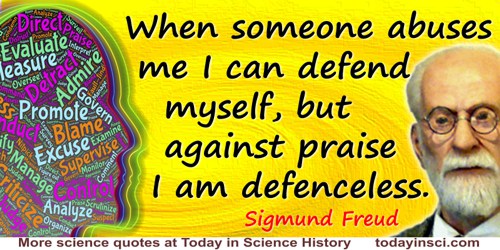
When someone abuses me I can defend myself, but against praise I am defenceless.
Attributed.
You say a thousand things,
Persuasively,
And with strange passion hotly I agree,
And praise your zest,
And then
A blackbird sings, or fieldfaring men,
Ghostlike, with loaded wain,
Come down the twilit lane
To rest,
And what is all your argument to me.
Persuasively,
And with strange passion hotly I agree,
And praise your zest,
And then
A blackbird sings, or fieldfaring men,
Ghostlike, with loaded wain,
Come down the twilit lane
To rest,
And what is all your argument to me.
From poem, 'Politics', collected in Poems, 1908-1919 (1919), 187. As quoted in A.E. Heath, 'The Scope of the Scientific Method', Proceedings of the Aristotelian Society (1918-1919), 179.
Young writers find out what kinds of writers they are by experiment. If they choose from the outset to practice exclusively a form of writing because it is praised in the classroom or otherwise carries appealing prestige, they are vastly increasing the risk inherent in taking up writing in the first place.
…...
 In science it often happens that scientists say, 'You know that's a really good argument; my position is mistaken,' and then they would actually change their minds and you never hear that old view from them again. They really do it. It doesn't happen as often as it should, because scientists are human and change is sometimes painful. But it happens every day. I cannot recall the last time something like that happened in politics or religion.
(1987) --
In science it often happens that scientists say, 'You know that's a really good argument; my position is mistaken,' and then they would actually change their minds and you never hear that old view from them again. They really do it. It doesn't happen as often as it should, because scientists are human and change is sometimes painful. But it happens every day. I cannot recall the last time something like that happened in politics or religion.
(1987) -- 





.jpg)