Potassium Quotes (12 quotes)
[Concerning] phosphorescent bodies, and in particular to uranium salts whose phosphorescence has a very brief duration. With the double sulfate of uranium and potassium ... I was able to perform the following experiment: One wraps a Lumière photographic plate with a bromide emulsion in two sheets of very thick black paper, such that the plate does not become clouded upon being exposed to the sun for a day. One places on the sheet of paper, on the outside, a slab of the phosphorescent substance, and one exposes the whole to the sun for several hours. When one then develops the photographic plate, one recognizes that the silhouette of the phosphorescent substance appears in black on the negative. If one places between the phosphorescent substance and the paper a piece of money or a metal screen pierced with a cut-out design, one sees the image of these objects appear on the negative. One can repeat the same experiments placing a thin pane of glass between the phosphorescent substance and the paper, which excludes the possibility of chemical action due to vapors which might emanate from the substance when heated by the sun's rays. One must conclude from these experiments that the phosphorescent substance in question emits rays which pass through the opaque paper and reduces silver salts.
[Although the sun is irrelevant, and he misinterprets the role of phosphorescence, he has discovered the effect of radioactivity.]
[Although the sun is irrelevant, and he misinterprets the role of phosphorescence, he has discovered the effect of radioactivity.]
Read at French Academy of Science (24 Feb 1896). In Comptes Rendus (1896), 122, 420. As translated by Carmen Giunta on the Classic Chemistry web site.
[Davy's] March of Glory, which he has run for the last six weeks—within which time by the aid and application of his own great discovery, of the identity of electricity and chemical attractions, he has placed all the elements and all their inanimate combinations in the power of man; having decomposed both the Alkalies, and three of the Earths, discovered as the base of the Alkalies a new metal... Davy supposes there is only one power in the world of the senses; which in particles acts as chemical attractions, in specific masses as electricity, & on matter in general, as planetary Gravitation... when this has been proved, it will then only remain to resolve this into some Law of vital Intellect—and all human knowledge will be Science and Metaphysics the only Science.
In November 1807 Davy gave his famous Second Bakerian Lecture at the Royal Society, in which he used Voltaic batteries to “decompose, isolate and name” several new chemical elements, notably sodium and potassium.
In November 1807 Davy gave his famous Second Bakerian Lecture at the Royal Society, in which he used Voltaic batteries to “decompose, isolate and name” several new chemical elements, notably sodium and potassium.
Letter to Dorothy Wordsworth, 24 November 1807. In Earl Leslie Griggs (ed.), The Collected Letters of Samuel Taylor Coleridge (1956), Vol. 3, 38.
As mineralogy constitutes a part of chemistry, it is clear that this arrangement [of minerals] must derive its principles from chemistry. The most perfect mode of arrangement would certainly be to allow bodies to follow each other according to the order of their electro-chemical properties, from the most electro-negative, oxygen, to the most electro-positive, potassium; and to place every compound body according to its most electro-positive ingredient.
An Attempt to Establish a Pure Scientific System of Mineralogy (1814), trans. J. Black, 48.
I am delighted that I have found a new reaction to demonstrate even to the blind the structure of the interstitial stroma of the cerebral cortex. I let the silver nitrate react with pieces of brain hardened in potassium dichromate. I have already obtained magnificent results and hope to do even better in the future.
Letter to Nicolo Manfredi, 16 Feb 1873. Archive source. Quoted in Paolo Mazzarello, The Hidden Structure: A Scientific Biography of Camillo Golgi, trans. and ed. Henry A. Buchtel and Aldo Badiani (1999), 63.
I will insist particularly upon the following fact, which seems to me quite important and beyond the phenomena which one could expect to observe: The same [double sulfate of uranium and potassium] crystalline crusts, arranged the same way [as reported to the French academy on 24 Feb 1896] with respect to the photographic plates, in the same conditions and through the same screens, but sheltered from the excitation of incident rays and kept in darkness, still produce the same photographic images … [when kept from 26 Feb 1896] in the darkness of a bureau drawer. … I developed the photographic plates on the 1st of March, expecting to find the images very weak. Instead the silhouettes appeared with great intensity.
It is important to observe that it appears this phenomenon must not be attributed to the luminous radiation emitted by phosphorescence … One hypothesis which presents itself to the mind naturally enough would be to suppose that these rays, whose effects have a great similarity to the effects produced by the rays studied by M. Lenard and M. Röntgen, are invisible rays …
[Having eliminated phosphorescence as a cause, he has further revealed the effect of the as yet unknown radioactivity.]
It is important to observe that it appears this phenomenon must not be attributed to the luminous radiation emitted by phosphorescence … One hypothesis which presents itself to the mind naturally enough would be to suppose that these rays, whose effects have a great similarity to the effects produced by the rays studied by M. Lenard and M. Röntgen, are invisible rays …
[Having eliminated phosphorescence as a cause, he has further revealed the effect of the as yet unknown radioactivity.]
Read at French Academy of Science (2 Mar 1896). In Comptes Rendus (1896), 122, 501. As translated by Carmen Giunta on the Classic Chemistry web site.
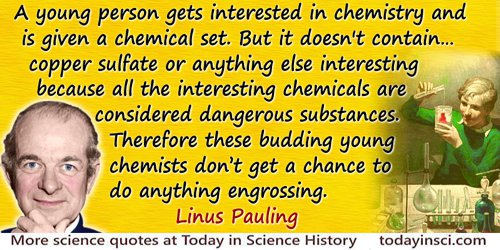
Just think of the differences today. A young person gets interested in chemistry and is given a chemical set. But it doesn't contain potassium cyanide. It doesn't even contain copper sulfate or anything else interesting because all the interesting chemicals are considered dangerous substances. Therefore, these budding young chemists don't get a chance to do anything engrossing with their chemistry sets. As I look back, I think it is pretty remarkable that Mr. Ziegler, this friend of the family, would have so easily turned over one-third of an ounce of potassium cyanide to me, an eleven-year-old boy.
In Barbara Marinacci, Linus Pauling In His Own Words (1995), 29.
One of the many useful properties of giant nerve fibres is that samples of protoplasm or axoplasm as it is usually called can be obtained by squeezing out the contents from a cut end … As in many other cells there is a high concentration of potassium ions and relatively low concentration of sodium and chloride ions. This is the reverse of the situation in the animals’ blood or in sea water, where sodium and chloride are the dominant ions and potassium is relatively dilute.
The Conduction of the Nervous Impulse (1964), 27.
Taking advantage of the method, found by me, of the black staining of the elements of the brain, staining obtained by the prolonged immersion of the pieces, previously hardened with potassium or ammonium bichromate, in a 0.50 or 1.0% solution of silver nitrate, I happened to discover some facts concerning the structure of the cerebral gray matter that I believe merit immediate communication.
'On the Structure of the Gray Matter of the Brain', Gazetta Medica Italiana, 2 Aug 1873. Trans. Maurizio Santini (ed.), Golgi Centennial Symposium: Perspectives in Neurobiology (1975), 647.
The explosions [of dying stars] scattered the heavy elements as a fine dust through space. By the time it made the Sun, the primordial gas of the Milky Way was sufficiently enriched with heavier elements for rocky planets like the Earth to form. And from the rocks atoms escaped for eventual incorporation in living things: carbon, nitrogen, oxygen, phosphorus and sulphur for all living tissue; calcium for bones and teeth; sodium and potassium for the workings of nerves and brains; the iron colouring blood red… and so on.
No other conclusion of modern research testifies more clearly to mankind’s intimate connections with the universe at large and with the cosmic forces at work among the stars.
In The Key to the Universe: A Report on the New Physics (1977), 33.
There's antimony, arsenic, aluminium, selenium,
And hydrogen and oxygen and nitrogen and rhenium,
And nickel, neodymium, neptunium, germanium,
And iron, americium, ruthenium, uranium,
Europium, zirconium, lutetium, vanadium,
And lanthanum and osmium and astatine and radium,
And gold and protactinium and indium and gallium,
And iodine and thorium and thulium and thallium.
There's yttrium, ytterbium, actinium, rubidium,
And boron, gadolinium, niobium, iridium,
And strontium and silicon and silver and samarium,
And bismuth, bromine, lithium, beryllium and barium.
There's holmium and helium and hafnium and erbium,
And phosphorus and francium and fluorine and terbium,
And manganese and mercury, molybdenum, magnesium,
Dysprosium and scandium and cerium and cesium,
And lead, praseodymium and platinum, plutonium,
Palladium, promethium, potassium, polonium,
And tantalum, technetium, titanium, tellurium,
And cadmium and calcium and chromium and curium.
There's sulfur, californium and fermium, berkelium,
And also mendelevium, einsteinium, nobelium,
And argon, krypton, neon, radon, xenon, zinc and rhodium,
And chlorine, cobalt, carbon, copper, tungsten, tin and sodium.
These are the only ones of which the news has come to Harvard,
And there may be many others, but they haven't been discarvard.
[To the tune of I am the Very Model of a Modern Major General.]
And hydrogen and oxygen and nitrogen and rhenium,
And nickel, neodymium, neptunium, germanium,
And iron, americium, ruthenium, uranium,
Europium, zirconium, lutetium, vanadium,
And lanthanum and osmium and astatine and radium,
And gold and protactinium and indium and gallium,
And iodine and thorium and thulium and thallium.
There's yttrium, ytterbium, actinium, rubidium,
And boron, gadolinium, niobium, iridium,
And strontium and silicon and silver and samarium,
And bismuth, bromine, lithium, beryllium and barium.
There's holmium and helium and hafnium and erbium,
And phosphorus and francium and fluorine and terbium,
And manganese and mercury, molybdenum, magnesium,
Dysprosium and scandium and cerium and cesium,
And lead, praseodymium and platinum, plutonium,
Palladium, promethium, potassium, polonium,
And tantalum, technetium, titanium, tellurium,
And cadmium and calcium and chromium and curium.
There's sulfur, californium and fermium, berkelium,
And also mendelevium, einsteinium, nobelium,
And argon, krypton, neon, radon, xenon, zinc and rhodium,
And chlorine, cobalt, carbon, copper, tungsten, tin and sodium.
These are the only ones of which the news has come to Harvard,
And there may be many others, but they haven't been discarvard.
[To the tune of I am the Very Model of a Modern Major General.]
Song, 'The Elements' (1959). In Tom Lehrer,Too Many Songs by Tom Lehrer: With Not Enough Drawings by Ronald Searle (1981), 151.
When [Humphry Davy] saw the minute globules of potassium burst through the crust of potash, and take fire as they entered the atmosphere, he could not contain his joy—he actually bounded about the room in ecstatic delight; some little time was required for him to compose himself to continue the experiment.
Quoted in Memoirs of the Life of Sir Humphry Davy, in J. Davy (ed.), The Collected Works of Sir Humphry Davy(1839-40), Vol 1, 109.
When Oxygen and Potassium went on a date, it went OK.
Joke found on the Web
 In science it often happens that scientists say, 'You know that's a really good argument; my position is mistaken,' and then they would actually change their minds and you never hear that old view from them again. They really do it. It doesn't happen as often as it should, because scientists are human and change is sometimes painful. But it happens every day. I cannot recall the last time something like that happened in politics or religion.
(1987) --
In science it often happens that scientists say, 'You know that's a really good argument; my position is mistaken,' and then they would actually change their minds and you never hear that old view from them again. They really do it. It doesn't happen as often as it should, because scientists are human and change is sometimes painful. But it happens every day. I cannot recall the last time something like that happened in politics or religion.
(1987) -- 




