Possible Quotes (568 quotes)
... [I]nfectious disease is merely a disagreeable instance of a widely prevalent tendency of all living creatures to save themselves the bother of building, by their own efforts, the things they require. Whenever they find it possible to take advantage of the constructive labors of others, this is the path of least resistance. The plant does the work with its roots and its green leaves. The cow eats the plant. Man eats both of them; and bacteria (or investment bankers) eat the man. ...
Rats, Lice and History (1935).
… the fact has always been for the physicist the one ultimate thing from which there is no appeal, and in the face of which the only possible attitude is a humility almost religious.
In The Logic of Modern Physics (1927).
...neither is it possible to discover the more remote and deeper parts of any science, if you stand but upon the level of the same science, and ascend not to a higher science.
Francis Bacon, Basil Montagu (Ed.), The Works of Francis Bacon (1852), Vol. 1, 173.
…separation of the observer from the phenomenon to be observed is no longer possible.
Quoted in Robert J. Scully, The Demon and the Quantum (2007), 3.
...the genes almost always accurately reproduce. If they don't, you get one of the following results: One, monsters—that is, grossly malformed babies resulting from genetic mistakes. Years ago most monsters died, but now many can be saved. This has made possible the National Football League.
Found widely quoted on the web, but without a print source. Please contact webmaster if you know the primary source.
“Endow scientific research and we shall know the truth, when and where it is possible to ascertain it;” but the counterblast is at hand: “To endow research is merely to encourage the research for endowment; the true man of science will not be held back by poverty, and if science is of use to us, it will pay for itself.” Such are but a few samples of the conflict of opinion which we find raging around us.
From The Grammar of Science (1892), 5.
[Edison] definitely ended the distinction between the theoretical man of science and the practical man of science, so that today we think of scientific discoveries in connection with their possible present or future application to the needs of man. He took the old rule-of-thumb methods out of industry and substituted exact scientific knowledge, while, on the other hand, he directed scientific research into useful channels.
In My Friend Mr. Edison (1930). Quoted in Dyson Carter, If You Want to Invent (1939), 110.
[In childhood, to overcome fear, the] need took me back again and again to a sycamore tree rising from the earth at the edge of a ravine. It was a big, old tree that had grown out over the ravine, so that when you climbed it, you looked straight down fifty feet or more. Every time I climbed that tree, I forced myself to climb to the last possible safe limb and then look down. Every time I did it, I told myself I’d never do it again. But I kept going back because it scared me and I had to know I could overcome that.
In John Glenn and Nick Taylor, John Glenn: A Memoir (2000), 16.
[In the case of research director, Willis R. Whitney, whose style was to give talented investigators as much freedom as possible, you may define “serendipity” as] the art of profiting from unexpected occurrences. When you do things in that way you get unexpected results. Then you do something else and you get unexpected results in another line, and you do that on a third line and then all of a sudden you see that one of these lines has something to do with the other. Then you make a discovery that you never could have made by going on a direct road.
Quoted in Guy Suits, 'Willis Rodney Whitney', National Academy of Sciences, Biographical Memoirs (1960), 355.
[Kepler] had to realize clearly that logical-mathematical theoretizing, no matter how lucid, could not guarantee truth by itself; that the most beautiful logical theory means nothing in natural science without comparison with the exactest experience. Without this philosophic attitude, his work would not have been possible.
From Introduction that Einstein wrote for Carola Baumgardt and Jamie Callan, Johannes Kepler Life and Letters (1953), 13.
[Learning is] the actual process of broadening yourself, of knowing there’s a little extra facet of the universe you know about and can think about and can understand. It seems to me that when it’s time to die, and that will come to all of us, there’ll be a certain pleasure in thinking that you had utilized your life well, that you had learned as much as you could, gathered in as much as possible of the universe, and enjoyed it. I mean, there’s only this universe and only this one lifetime to try to grasp it. And, while it is inconceivable that anyone can grasp more than a tiny portion of it, at least do that much. What a tragedy to just pass through and get nothing out of it.
'Isaac Asimov Speaks' with Bill Moyers in The Humanist (Jan/Feb 1989), 49. Reprinted in Carl Howard Freedman (ed.), Conversations with Isaac Asimov (2005), 139.
[Music as a] language may be the best we have for explaining what we are like to others in space, with least ambiguity. I would vote for Bach, all of Bach, streamed out into space, over and over again … to put the best possible face on at the beginning of such an acquaintance. We can tell the harder truths later.
In 'Ceti', The Lives of a Cell: Notes of a Biology Watcher (1974), 53.
[Regarding evolution believers:] Their business is not with the possible, but the actual—not with a world which might be, but with a world that is. This they explore with a courage not unmixed with reverence, and according to methods which, like the quality of a tree, are tested by their fruits. They have but one desire—to know the truth. They have but one fear—to believe a lie.
'Scientific Use of the Imagination', Discourse Delivered Before the British Association at Liverpool, (16 Sep 1870). Fragments of Science for Unscientific People: A Series of Detached Essays, Lectures, and Reviews (1892), Vol. 2, 134.
[The] erroneous assumption is to the effect that the aim of public education is to fill the young of the species with knowledge and awaken their intelligence, and so make them fit to discharge the duties of citizenship in an enlightened and independent manner. Nothing could be further from the truth. The aim of public education is not to spread enlightenment at all; it is simply to reduce as many individuals as possible to the same safe level, to breed and train a standardised citizenry, to put down dissent and originality.
The American Mercury (24 Apr 1924).
[The] structural theory is of extreme simplicity. It assumes that the molecule is held together by links between one atom and the next: that every kind of atom can form a definite small number of such links: that these can be single, double or triple: that the groups may take up any position possible by rotation round the line of a single but not round that of a double link: finally that with all the elements of the first short period [of the periodic table], and with many others as well, the angles between the valencies are approximately those formed by joining the centre of a regular tetrahedron to its angular points. No assumption whatever is made as to the mechanism of the linkage. Through the whole development of organic chemistry this theory has always proved capable of providing a different structure for every different compound that can be isolated. Among the hundreds of thousands of known substances, there are never more isomeric forms than the theory permits.
Presidential Address to the Chemical Society (16 Apr 1936), Journal of the Chemical Society (1936), 533.
[W]e have made a thing, a most terrible weapon, that has altered abruptly and profoundly the nature of the world. We have made a thing that, by all standards of the world we grew up in, is an evil thing. And by doing so, by our participation in making it possible to make these things, we have raised again the question of whether science is good for man, of whether it is good to learn about the world, to try to understand it, to try to control it, to help give to the world of men increased insight, increased power. Because we are scientists, we must say an unalterable yes to these questions; it is our faith and our commitment, seldom made explicit, even more seldom challenged, that knowledge is a good in itself, knowledge and such power as must come with it.
Speech to the American Philosophical Society (Jan 1946). 'Atomic Weapons', printed in Proceedings of the American Philosophical Society, 90(1), 7-10. In Deb Bennett-Woods, Nanotechnology: Ethics and Society (2008), 23. Identified as a speech to the society in Kai Bird, Martin J. Sherwin, American Prometheus: the Triumph and Tragedy of J. Robert Oppenheimer (2005), 323.
[While in school, before university,] I, like almost all chemists I know, was also attracted by the smells and bangs that endowed chemistry with that slight but charismatic element of danger which is now banned from the classroom. I agree with those of us who feel that the wimpish chemistry training that schools are now forced to adopt is one possible reason that chemistry is no longer attracting as many talented and adventurous youngsters as it once did. If the decline in hands-on science education is not redressed, I doubt that we shall survive the 21st century.
Nobel laureate autobiography in Les Prix Nobel/Nobel Lectures 1996 (1997), 191.
δος μοι που στω και κινω την γην — Dos moi pou sto kai kino taen gaen (in epigram form, as given by Pappus, classical Greek).
δος μοι πα στω και τα γαν κινάσω — Dos moi pa sto kai tan gan kinaso (Doric Greek).
Give me a place to stand on and I can move the Earth.
About four centuries before Pappas, but about three centuries after Archimedes lived, Plutarch had written of Archimedes' understanding of the lever:
Archimedes, a kinsman and friend of King Hiero, wrote to him that with a given force, it was possible to move any given weight; and emboldened, as it is said, by the strength of the proof, he asserted that, if there were another world and he could go to it, he would move this one.
A commonly-seen expanded variation of the aphorism is:
Give me a lever long enough and a place to stand, and I can move the earth.
δος μοι πα στω και τα γαν κινάσω — Dos moi pa sto kai tan gan kinaso (Doric Greek).
Give me a place to stand on and I can move the Earth.
About four centuries before Pappas, but about three centuries after Archimedes lived, Plutarch had written of Archimedes' understanding of the lever:
Archimedes, a kinsman and friend of King Hiero, wrote to him that with a given force, it was possible to move any given weight; and emboldened, as it is said, by the strength of the proof, he asserted that, if there were another world and he could go to it, he would move this one.
A commonly-seen expanded variation of the aphorism is:
Give me a lever long enough and a place to stand, and I can move the earth.
As attributed to Pappus (4th century A.D.) and Plutarch (c. 46-120 A.D.), in Sherman K. Stein, Archimedes: What Did He Do Besides Cry Eureka? (1999), 5, where it is also stated that Archimedes knew that ropes and pulley exploit “the principle of the lever, where distance is traded for force.” Eduard Jan Dijksterhuis, in his book, Archimedes (1956), Vol. 12., 15. writes that Hiero invited Archimedes to demonstrate his claim on a ship from the royal fleet, drawn up onto land and there loaded with a large crew and freight, and Archimedes easily succeeded. Thomas Little Heath in The Works of Archimedes (1897), xix-xx, states according to Athenaeus, the mechanical contrivance used was not pulleys as given by Plutarch, but a helix., Heath provides cites for Pappus Synagoge, Book VIII, 1060; Plutarch, Marcellus, 14; and Athenaeus v. 207 a-b. What all this boils down to, in the opinion of the Webmaster, is the last-stated aphorism would seem to be not the actual words of Archimedes (c. 287 – 212 B.C.), but restatements of the principle attributed to him, formed by other writers centuries after his lifetime.
“The Universe repeats itself, with the possible exception of history.” Of all earthly studies history is the only one that does not repeat itself. ... Astronomy repeats itself; botany repeats itself; trigonometry repeats itself; mechanics repeats itself; compound long division repeats itself. Every sum if worked out in the same way at any time will bring out the same answer. ... A great many moderns say that history is a science; if so it occupies a solitary and splendid elevation among the sciences; it is the only science the conclusions of which are always wrong.
In 'A Much Repeated Repetition', Daily News (26 Mar 1904). Collected in G. K. Chesterton and Dale Ahlquist (ed.), In Defense of Sanity: The Best Essays of G.K. Chesterton (2011), 82.
“Ye, sire,” I seide,
“By so no man were greved,
Alle the sciences under sonne,
And alle sotile craftes,
Ich wolde ich knewe and kouthe
Kyndely in myn harte.”
“Yes, sir,” I said, “so long as no one minds. All science under the sun, and all subtle arts. Were it possible, I would know and hold naturally within my heart!”
“By so no man were greved,
Alle the sciences under sonne,
And alle sotile craftes,
Ich wolde ich knewe and kouthe
Kyndely in myn harte.”
“Yes, sir,” I said, “so long as no one minds. All science under the sun, and all subtle arts. Were it possible, I would know and hold naturally within my heart!”
In William Langland and B. Thomas Wright (ed.) The Vision and Creed of Piers Ploughman (1842), 297. Modern translation by Terrence Tiller in Piers Plowman (1981, 1999), 157.
Clarke's First Law: When a distinguished but elderly scientist states that something is possible, he is almost certainly right. When he states that something is impossible, he is very probably wrong.
'Hazards of Prophecy: The Failure of Imagination'. In the collection. Profiles of the Future: An Enquiry into the Limits of the Possible (1962, rev. 1973), 14.
Clarke's Second Law: The only way of discovering the limits of the possible is to venture a little way past them into the impossible.
Profiles of the Future: An Enquiry into the Limits of the Possible (1962, rev. 1973), 21.
Dilbert: Wow! According to my computer simulation, it should be possible to create new life forms from common household chemicals
Dogbert: This raises some thorny issues.
Dilbert: You mean legal, ethical and religious issues?
Dogbert: I was thinking about parking spaces.
Dogbert: This raises some thorny issues.
Dilbert: You mean legal, ethical and religious issues?
Dogbert: I was thinking about parking spaces.
Dilbert comic strip (31 May 1989).
The constancy of the internal environment is the condition for free and independent life: the mechanism that makes it possible is that which assured the maintenance, with the internal environment, of all the conditions necessary for the life of the elements.
Lectures on the Phenomena of Life Common to Animals and Plants (1878), trans. Hebbel E. Hoff, Roger Guillemin and Lucienne Guillemin (1974), 84.
Une idée anticipée ou une hypothèse est donc le point de départ nécessaire de tout raisonnement expérimental. Sans cela on ne saurait faire aucune investigation ni s’instruire ; on ne pourrait qu’entasser des observations stériles. Si l’on expérimentait sans idée préconçue, on irait à l’aventure; mais d’un autre côté, ainsi que nous l’avons dit ailleurs, si l’on observait avec des idées préconçues, on ferait de mauvaises observations.
An anticipative idea or an hypothesis is, then, the necessary starting point for all experimental reasoning. Without it, we could not make any investigation at all nor learn anything; we could only pile up sterile observations. If we experimented without a preconceived idea, we should move at random.
[Also seen translated as:] A hypothesis is … the obligatory starting point of all experimental reasoning. Without it no investigation would be possible, and one would learn nothing: one could only pile up barren observations. To experiment without a preconceived idea is to wander aimlessly.
An anticipative idea or an hypothesis is, then, the necessary starting point for all experimental reasoning. Without it, we could not make any investigation at all nor learn anything; we could only pile up sterile observations. If we experimented without a preconceived idea, we should move at random.
[Also seen translated as:] A hypothesis is … the obligatory starting point of all experimental reasoning. Without it no investigation would be possible, and one would learn nothing: one could only pile up barren observations. To experiment without a preconceived idea is to wander aimlessly.
Original work in French, Introduction à l'Étude de la Médecine Expérimentale (1865). English translation by Henry Copley Green in An Introduction to the Study of Experimental Medicine (1927, 1957), 32. Alternate translation in Peter Medawar, 'Hypothesis and Imagination', collected in The Strange Case of the Spotted Mice and Other Classic Essays on Science (1974), 30.
~~[Attributed without source]~~ The only possible conclusion the social sciences can draw is: some do, some don’t.
Often seen, virally spread, but always without a source citation. If you can provide a primary source, please contact Webmaster. Until then the quote should be regarded as not authenticated.
A computer lets you make more mistakes faster than any invention in human history—with the possible exceptions of handguns and tequila.
…...
A distinguished writer [Siméon Denis Poisson] has thus stated the fundamental definitions of the science:
“The probability of an event is the reason we have to believe that it has taken place, or that it will take place.”
“The measure of the probability of an event is the ratio of the number of cases favourable to that event, to the total number of cases favourable or contrary, and all equally possible” (equally like to happen).
From these definitions it follows that the word probability, in its mathematical acceptation, has reference to the state of our knowledge of the circumstances under which an event may happen or fail. With the degree of information which we possess concerning the circumstances of an event, the reason we have to think that it will occur, or, to use a single term, our expectation of it, will vary. Probability is expectation founded upon partial knowledge. A perfect acquaintance with all the circumstances affecting the occurrence of an event would change expectation into certainty, and leave neither room nor demand for a theory of probabilities.
“The probability of an event is the reason we have to believe that it has taken place, or that it will take place.”
“The measure of the probability of an event is the ratio of the number of cases favourable to that event, to the total number of cases favourable or contrary, and all equally possible” (equally like to happen).
From these definitions it follows that the word probability, in its mathematical acceptation, has reference to the state of our knowledge of the circumstances under which an event may happen or fail. With the degree of information which we possess concerning the circumstances of an event, the reason we have to think that it will occur, or, to use a single term, our expectation of it, will vary. Probability is expectation founded upon partial knowledge. A perfect acquaintance with all the circumstances affecting the occurrence of an event would change expectation into certainty, and leave neither room nor demand for a theory of probabilities.
An Investigation of the Laws of Thought (1854), 243-244. The Poisson quote is footnoted as from Recherches sur la Probabilité des Jugemens.
A good scientist is a person with original ideas. A good engineer is a person who makes a design that works with as few original ideas as possible. There are no prima donnas in engineering.
In Disturbing the Universe (1979), 114.
A good title should aim at making what follows as far as possible superfluous to those who know anything of the subject.
Samuel Butler, Henry Festing Jones (ed.), The Note-Books of Samuel Butler (1917), 229.
A hundred years ago, the electric telegraph made possible—indeed, inevitable—the United States of America. The communications satellite will make equally inevitable a United Nations of Earth; let us hope that the transition period will not be equally bloody.
Neil Armstrong, Michael Collins, Buzz Aldrin, Edwin E. Aldrin et al., First on the Moon (1970), 389.
A living organism must be studied from two distinct aspects. One of these is the causal-analytic aspect which is so fruitfully applicable to ontogeny. The other is the historical descriptive aspect which is unravelling lines of phylogeny with ever-increasing precision. Each of these aspects may make suggestions concerning the possible significance of events seen under the other, but does not explain or translate them into simpler terms.
'Embryology and Evolution', in G. R. de Beer (ed.), Evolution: Essays on Aspects of Evolutionary Biology presented to Professor E. S. Goodrich on his Seventieth Birthday (1938), 76-7.
A man who has once looked with the archaeological eye will never see quite normally. He will be wounded by what other men call trifles. It is possible to refine the sense of time until an old shoe in the bunch grass or a pile of nineteenth century beer bottles in an abandoned mining town tolls in one’s head like a hall clock.
The Night Country (1971), 81.
A mind exclusively bent upon the idea of utility necessarily narrows the range of the imagination. For it is the imagination which pictures to the inner eye of the investigator the indefinitely extending sphere of the possible,—that region of hypothesis and explanation, of underlying cause and controlling law. The area of suggestion and experiment is thus pushed beyond the actual field of vision.
In 'The Paradox of Research', The North American Review (Sep 1908), 188, No. 634, 425.
A multidisciplinary study group ... estimated that it would be 1980 before developments in artificial intelligence make it possible for machines alone to do much thinking or problem solving of military significance. That would leave, say, five years to develop man-computer symbiosis and 15 years to use it. The 15 may be 10 or 500, but those years should be intellectually the most creative and exciting in the history of mankind.
From article 'Man-Computer Symbiosis', in IRE Transactions on Human Factors in Electronics (Mar 1960), Vol. HFE-1, 4-11.
A person who is religiously enlightened appears to me to be one who has, to the best of his ability, liberated himself from the fetters of his selfish desires and is preoccupied with thoughts, feelings, and aspirations to which he clings because of their superpersonal value. It seems to me that what is important is the force of this superpersonal content and the depth of the conviction concerning its overpowering meaningfulness, regardless of whether any attempt is made to unite this content with a divine Being, for otherwise it would not be possible to count Buddha and Spinoza as religious personalities. Accordingly, a religious person is devout in the sense that he has no doubt of the significance and loftiness of those superpersonal objects and goals which neither require nor are capable of rational foundation. They exist with the same necessity and matter-of-factness as he himself. In this sense religion is the age-old endeavor of mankind to become clearly and completely conscious of these values and goals and constantly to strengthen and extend their effect. If one conceives of religion and science according to these definitions then a conflict between them appears impossible. For science can only ascertain what is, but not what should be, and outside of its domain value judgments of all kinds remain necessary.
…...
A possible explanation for the observed excess noise is the one given by Dicke, Peebles, Roll, and Wilkinson (1965) in a companion letter in this issue.
[The low-key announcement of the detection of the cosmic microwave background radiation which is the afterglow of the Big Bang. Co-author with Robert Wilson. They received the 1978 Nobel Prize for their discovery.]
[The low-key announcement of the detection of the cosmic microwave background radiation which is the afterglow of the Big Bang. Co-author with Robert Wilson. They received the 1978 Nobel Prize for their discovery.]
'A measurement of excess antenna temperature at 4080 Mc/s'. In Astrophysical Journal (1965). Reprinted in R. B. Partridge, 3 K the cosmic microwave background radiation? (1995), Appendix A, 355.
A principle of induction would be a statement with the help of which we could put inductive inferences into a logically acceptable form. In the eyes of the upholders of inductive logic, a principle of induction is of supreme importance for scientific method: “... this principle”, says Reichenbach, “determines the truth of scientific theories. To eliminate it from science would mean nothing less than to deprive science of the power to decide the truth or falsity of its theories. Without it, clearly, science would no longer have the right to distinguish its theories from the fanciful and arbitrary creations of the poet’s mind.” Now this principle of induction cannot be a purely logical truth like a tautology or an analytic statement. Indeed, if there were such a thing as a purely logical principle of induction, there would be no problem of induction; for in this case, all inductive inferences would have to be regarded as purely logical or tautological transformations, just like inferences in inductive logic. Thus the principle of induction must be a synthetic statement; that is, a statement whose negation is not self-contradictory but logically possible. So the question arises why such a principle should be accepted at all, and how we can justify its acceptance on rational grounds.
…...
A single kind of red cell is supposed to have an enormous number of different substances on it, and in the same way there are substances in the serum to react with many different animal cells. In addition, the substances which match each kind of cell are different in each kind of serum. The number of hypothetical different substances postulated makes this conception so uneconomical that the question must be asked whether it is the only one possible. ... We ourselves hold that another, simpler, explanation is possible.
Landsteiner and Adriano Sturli, 'Hamagglutinine normaler Sera', Wiener klinische Wochenschrift (1902), 15, 38-40. Trans. Pauline M. H. Mazumdar.
A surgeon should give as little pain as possible while he is treating the patient, and no pain at all when he charges his fee.
‘FRCS’ in The Times, quoted by Reginald Pound in Harley Street (1967).
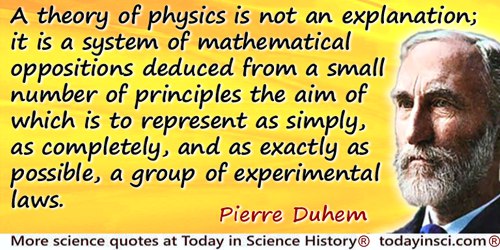
A theory of physics is not an explanation; it is a system of mathematical oppositions deduced from a small number of principles the aim of which is to represent as simply, as completely, and as exactly as possible, a group of experimental laws.
As quoted in Philipp Frank, Modern Science and its Philosophy (1949), 15, which cites Théorie Physique; Son Objet—Son Structure (1906), 24.
A troubling question for those of us committed to the widest application of intelligence in the study and solution of the problems of men is whether a general understanding of the social sciences will be possible much longer. Many significant areas of these disciplines have already been removed by the advances of the past two decades beyond the reach of anyone who does not know mathematics; and the man of letters is increasingly finding, to his dismay, that the study of mankind proper is passing from his hands to those of technicians and specialists. The aesthetic effect is admittedly bad: we have given up the belletristic “essay on man” for the barbarisms of a technical vocabulary, or at best the forbidding elegance of mathematical syntax.
Opening paragraph of 'The Study of Man: Sociology Learns the Language of Mathematics' in Commentary (1 Sep 1952). Reprinted in James Roy Newman, The World of Mathematics (1956), Vol. 2, 1294.
According to the system of modern economists, it would be desirable that the government should interfere as little as possible in the commerce and industry of the country. Nevertheless we cannot deny that in certain circumstances this intervention is very useful.
From Appendix A, 'Extracts From the Unpublished Writings of Carnot', Reflections on the Motive Power of Heat (1890, 2nd ed. 1897), 211.
Accordingly, the poet should prefer probable impossibilities to improbable possibilities.
In Poetics.
After … the general experimental knowledge has been acquired, accompanied with just a sufficient amount of theory to connect it together…, it becomes possible to consider the theory by itself, as theory. The experimental facts then go out of sight, in a great measure, not because they are unimportant, but because … they are fundamental, and the foundations are always hidden from view in well-constructed buildings.
In Electromagnetic Theory (1892), Vol. 2, 1.
Again the message to experimentalists is: Be sensible but don’t be impressed too much by negative arguments. If at all possible, try it and see what turns up. Theorists almost always dislike this sort of approach.
What Mad Pursuit: A Personal View of Scientific Discovery (1988), 113.
Again there is another great and powerful cause why the sciences have made but little progress; which is this. It is not possible to run a course aright when the goal itself has not been rightly placed.
Translation of Novum Organum, LXXXI. In Francis Bacon, James Spedding, The Works of Francis Bacon (1864), Vol. 8, 113.
All over the world there lingers on the memory of a giant tree, the primal tree, rising up from the centre of the Earth to the heavens and ordering the universe around it. It united the three worlds: its roots plunged down into subterranean abysses, Its loftiest branches touched the empyrean. Thanks to the Tree, it became possible to breathe the air; to all the creatures that then appeared on Earth it dispensed its fruit, ripened by the sun and nourished by the water which it drew from the soil. From the sky it attracted the lightning from which man made fire and, beckoning skyward, where clouds gathered around its fall. The Tree was the source of all life, and of all regeneration. Small wonder then that tree-worship was so prevalent in ancient times.
From 'L'Arbre Sacre' ('The Sacred Tree'), UNESCO Courier (Jan 1989), 4. Epigraph to Chap 1, in Kenton Miller and Laura Tangley, Trees of Life: Saving Tropical Forests and Their Biological Wealt (1991), 1.
All possible truth is practical. To ask whether our conception of chair or table corresponds to the real chair or table apart from the uses to which they may be put, is as utterly meaningless and vain as to inquire whether a musical tone is red or yellow. No other conceivable relation than this between ideas and things can exist. The unknowable is what I cannot react upon. The active part of our nature is not only an essential part of cognition itself, but it always has a voice in determining what shall be believed and what rejected.
The Muscular Perception of Space (1878), 446.
All those who think it paradoxical that so great a weight as the earth should not waver or move anywhere seem to me to go astray by making their judgment with an eye to their own affects and not to the property of the whole. For it would not still appear so extraordinary to them, I believe, if they stopped to think that the earth’s magnitude compared to the whole body surrounding it is in the ratio of a point to it. For thus it seems possible for that which is relatively least to be supported and pressed against from all sides equally and at the same angle by that which is absolutely greatest and homogeneous.
— Ptolemy
'The Almagest 1', in Ptolemy: the Almagest; Nicolaus Copernicus: On the Revolutions of the Heavenly Spheres; Johannes Kepler: Epitome of Copernican Astronomy: IV - V The Harmonies of the World: V, trans. R. Catesby Taliaferro (1952), 11.
Although [Charles Darwin] would patiently go on repeating experiments where there was any good to be gained, he could not endure having to repeat an experiment which ought, if complete care had been taken, to have told its story at first—and this gave him a continual anxiety that the experiment should not be wasted; he felt the experiment to be sacred, however slight a one it was. He wished to learn as much as possible from an experiment, so that he did not confine himself to observing the single point to which the experiment was directed, and his power of seeing a number of other things was wonderful. ... Any experiment done was to be of some use, and ... strongly he urged the necessity of keeping the notes of experiments which failed, and to this rule he always adhered.
In Charles Darwin: His Life Told in an Autobiographical Chapter, and in a Selected Series of his Published Letters (1908), 92.
Although the time of death is approaching me, I am not afraid of dying and going to Hell or (what would be considerably worse) going to the popularized version of Heaven. I expect death to be nothingness and, for removing me from all possible fears of death, I am thankful to atheism.
In John Altson, Patti Rae Miliotis, What Happened to Grandpa? (2009).
Although with the majority of those who study and practice in these capacities [engineers, builders, surveyors, geographers, navigators, hydrographers, astronomers], secondhand acquirements, trite formulas, and appropriate tables are sufficient for ordinary purposes, yet these trite formulas and familiar rules were originally or gradually deduced from the profound investigations of the most gifted minds, from the dawn of science to the present day. … The further developments of the science, with its possible applications to larger purposes of human utility and grander theoretical generalizations, is an achievement reserved for a few of the choicest spirits, touched from time to time by Heaven to these highest issues. The intellectual world is filled with latent and undiscovered truth as the material world is filled with latent electricity.
In Orations and Speeches, Vol. 3 (1870), 513.
Among all the occurrences possible in the universe the a priori probability of any particular one of them verges upon zero. Yet the universe exists; particular events must take place in it, the probability of which (before the event) was infinitesimal. At the present time we have no legitimate grounds for either asserting or denying that life got off to but a single start on earth, and that, as a consequence, before it appeared its chances of occurring were next to nil. ... Destiny is written concurrently with the event, not prior to it.
In Jacques Monod and Austryn Wainhouse (trans.), Chance and Necessity: An Essay on the Natural Philosophy of Modern Biology (1971), 145.
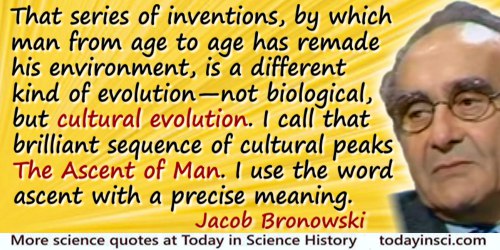
Among the multitude of animals which scamper, fly, burrow and swim around us, man is the only one who is not locked into his environment. His imagination, his reason, his emotional subtlety and toughness, make it possible for him not to accept the environment, but to change it. And that series of inventions, by which man from age to age has remade his environment, is a different kind of evolution—not biological, but cultural evolution. I call that brilliant sequence of cultural peaks The Ascent of Man. I use the word ascent with a precise meaning. Man is distinguished from other animals by his imaginative gifts. He makes plans, inventions, new discoveries, by putting different talents together; and his discoveries become more subtle and penetrating, as he learns to combine his talents in more complex and intimate ways. So the great discoveries of different ages and different cultures, in technique, in science, in the arts, express in their progression a richer and more intricate conjunction of human faculties, an ascending trellis of his gifts.
The Ascent of Man (1973), 19-20.
Analyse data just so far as to obtain simplicity and no further.
From La Science et l’Hypothèse (1902), 176, as translated in A.D. Ritchie, Scientific Method: An Inquiry into the Character and Validity of Natural Law (1923), 201. From the original French, “Il faut bien s’arrêter quelque part, et pour que la science soit possible, il faut s’arrêter quand on a trouvé la simplicité.” A more literal translation of that sentence would be (per Google Translate): “You have to stop somewhere, and for science to be possible, you have to stop when you have found simplicity.”
Anaximenes ... said that infinite air was the principle, from which the things that are becoming, and that are, and that shall be, and gods and things divine, all come into being, and the rest from its products. The form of air is of this kind: whenever it is most equable it is invisible to sight, but is revealed by the cold and the hot and the damp and by movement. It is always in motion; for things that change do not change unless there be movement. Through becoming denser or finer it has different appearances; for when it is dissolved into what is finer it becomes fire, while winds, again, are air that is becoming condensed, and cloud is produced from air by felting. When it is condensed still more, water is produced; with a further degree of condensation earth is produced, and when condensed as far as possible, stones. The result is that the most influential components of the generation are opposites, hot and cold.
Hippolytus, Refutation, 1.7.1. In G. S. Kirk, J. E. Raven and M. Schofield (eds.), The Presocratic Philosophers: A Critical History with a Selection of Texts (1983), p. 145.
And since the portions of the great and the small are equal in number, so too all things would be in everything. Nor is it possible that they should exist apart, but all things have a portion of everything.
Simplicius, Commentary on Aristotle’s Physics, 164, 26-8. In G. S. Kirk, J. E. Raven and M. Schofield (eds.), The Presocratic Philosophers: A Critical History with a Selection of Texts (1983) , p. 365-6.
And so the great truth, now a paradox, may become a commonplace, that man is greater than his surroundings, and that the production of a breed of men and women, even in our great cities, less prone to disease, and pain, more noble in aspect, more rational in habits, more exultant in the pure joy of living, is not only scientifically possible, but that even the partial fulfillment of this dream, if dream it be, is the most worthy object towards which the lover of his kind can devote the best energies of his life.
In 'The Breed of Man', The Nineteenth Century, (Oct 1900), 669, as collected in Martin Polley (ed.), The History of Sport in Britain, 1880-1914: Sport, Education, and Improvement (2004), Vol. 2, 181.
Anything that is theoretically possible will be achieved in practice, no matter what the technical difficulties are, if it is desired greatly enough.
Hazards of Prophecy: An Arresting Inquiry into the limits of the Possible: Failures of Nerve and Failures of Imagination (1962)
Art and science work in quite different ways: agreed. But, bad as it may sound, I have to admit that I cannot get along as an artist without the use of one or two sciences. ... In my view, the great and complicated things that go on in the world cannot be adequately recognized by people who do not use every possible aid to understanding.
Bertolt Brecht, John Willett (trans.), Brecht on Theatre (1964), 73.
As a second year high school chemistry student, I still have a vivid memory of my excitement when I first saw a chart of the periodic table of elements. The order in the universe seemed miraculous, and I wanted to study and learn as much as possible about the natural sciences.
In Tore Frängsmyr and Jan E. Lindsten (eds.), Nobel Lectures: Physiology Or Medicine: 1981-1990 (1993), 555.
As far as the meaning of life in general, or in the abstract, as far as I can see, there is none. If all of life were suddenly to disappear from earth and anywhere else it may exist, or if none had ever formed in the first place, I think the Universe would continue to exist without perceptible change. However, it is always possible for an individual to invest his own life with meaning that he can find significant. He can so order his life that he may find as much beauty and wisdom in it as he can, and spread as much of that to others as possible.
In a book proposal for The Meaning of Life edited by Hugh S. Moorhead, 1989.
As in the domains of practical life so likewise in science there has come about a division of labor. The individual can no longer control the whole field of mathematics: it is only possible for him to master separate parts of it in such a manner as to enable him to extend the boundaries of knowledge by creative research.
In Die reine Mathematik in den Jahren 1884-99, 10. As quoted, cited and translated in Robert Édouard Moritz, Memorabilia Mathematica; Or, The Philomath’s Quotation-Book (1914), 94.
As to how far in advance of the first flight the man should know he’s going. I’m not in agreement with the argument that says word should be delayed until the last possible moment to save the pilot from developing a bad case of the jitters. If we don’t have the confidence to keep from getting clutched at that time, we have no business going at all. If I’m the guy going, I’ll be glad to get the dope as soon as possible. As for keeping this a big secret from us and having us all suited up and then saying to one man “you go” and stuffing him in and putting the lid on that thing and away he goes, well, we’re all big boys now.
As he wrote in an article for Life (14 Sep 1959), 38. In fact, he was the first to fly in Earth orbit on 20 Feb 1962, though Alan Shepard was picked for the earlier first suborbital flight.
As to the position of the earth, then, this is the view which some advance, and the views advanced concerning its rest or motion are similar. For here too there is no general agreement. All who deny that the earth lies at the centre think that it revolves about the centre, and not the earth only but, as we said before, the counter-earth as well. Some of them even consider it possible that there are several bodies so moving, which are invisible to us owing to the interposition of the earth. This, they say, accounts for the fact that eclipses of the moon are more frequent than eclipses of the sun; for in addition to the earth each of these moving bodies can obstruct it.
On the Heavens, 293b, 15-25. In Jonathan Barnes (ed.), The Complete Works of Aristotle (1984), Vol. 1, 483.
As was the case for Nobel's own invention of dynamite, the uses that are made of increased knowledge can serve both beneficial and potentially harmful ends. Increased knowledge clearly implies increased responsibility. We reject the notion advocated in some quarters that man should stop eating from the tree of knowledge, as if that were humanly possible.
From Nobel Banquet Speech (10 Dec 1981), in Wilhelm Odelberg (ed.), Les Prix Nobel 1981 (1981), 44.
As we survey all the evidence, the thought insistently arises that some supernatural agency—or, rather, Agency—must be involved. Is it possible that suddenly, without intending to, we have stumbled upon scientific proof of the existence of a Supreme Being? Was it God who stepped in and so providentially crafted the cosmos for our benefit?
In The Symbiotic Universe: Life and Mind in the Cosmos (1988), 27.
Astronomy has not only taught us that there are laws, but that from these laws there is no escape, that with them there is no possible compromise.
In Henri Poincaré and George Bruce Halsted (trans.), The Value of Science: Essential Writings of Henri Poincare (1907), 86.
At every major step physics has required, and frequently stimulated, the introduction of new mathematical tools and concepts. Our present understanding of the laws of physics, with their extreme precision and universality, is only possible in mathematical terms.
In Book Review 'Pulling the Strings,' of Lawrence Krauss's Hiding in the Mirror: The Mysterious Lure of Extra Dimensions, from Plato to String Theory and Beyond in Nature (22 Dec 2005), 438, 1081.
At night I would return home, set out a lamp before me, and devote myself to reading and writing. Whenever sleep overcame me or I became conscious of weakening, I would turn aside to drink a cup of wine, so that my strength would return to me. Then I would return to reading. And whenever sleep seized me I would see those very problems in my dream; and many questions became clear to me in my sleep. I continued in this until all of the sciences were deeply rooted within me and I understood them as is humanly possible. Everything which I knew at the time is just as I know it now; I have not added anything to it to this day. Thus I mastered the logical, natural, and mathematical sciences, and I had now reached the science.
— Avicenna
W. E. Gohhnan, The Life of Ibn Sina: A Critical Edition and Annotated Translation (1974), 29-31.
At the beginning of its existence as a science, biology was forced to take cognizance of the seemingly boundless variety of living things, for no exact study of life phenomena was possible until the apparent chaos of the distinct kinds of organisms had been reduced to a rational system. Systematics and morphology, two predominantly descriptive and observational disciplines, took precedence among biological sciences during the eighteenth and nineteenth centuries. More recently physiology has come to the foreground, accompanied by the introduction of quantitative methods and by a shift from the observationalism of the past to a predominance of experimentation.
In Genetics and the Origin of Species (1937, 1982), 6.
At the outset do not be worried about this big question—Truth. It is a very simple matter if each one of you starts with the desire to get as much as possible. No human being is constituted to know the truth, the whole truth, and nothing but the truth; and even the best of men must be content with fragments, with partial glimpses, never the full fruition. In this unsatisfied quest the attitude of mind, the desire, the thirst—a thirst that from the soul must arise!—the fervent longing, are the be-all and the end-all.
'The Student Life' (1905). In G. L. Keynes (ed.), Selected Writings of Sir William Osler (1951), 172.
Avoid complexities. Make everything as simple as possible.
As quoted in Joseph Wickham Roe, English and American Tool Builders (1916), 49.
Be joyful because it is humanly possible.
Quoted in Kim Lim (ed.), 1,001 Pearls of Spiritual Wisdom: Words to Enrich, Inspire, and Guide Your Life (2014), 236
Beyond a critical point within a finite space, freedom diminishes as numbers increase. ...The human question is not how many can possibly survive within the system, but what kind of existence is possible for those who do survive.
Dune
But concerning vision alone is a separate science formed among philosophers, namely, optics, and not concerning any other sense ... It is possible that some other science may be more useful, but no other science has so much sweetness and beauty of utility. Therefore it is the flower of the whole of philosophy and through it, and not without it, can the other sciences be known.
Opus Majus [1266-1268], Part V, distinction I, chapter I, trans. R. B. Burke, The Opus Maius of Roger Bacon (1928), Vol. 2, 420.
But how is it that they [astrologers] have never been able to explain why, in the life of twins, in their actions, in their experiences, their professions, their accomplishments, their positions—in all the other circumstances of human life, and even in death itself, there is often found such a diversity that in those respects many strangers show more resemblance to them than they show to one another, even though the smallest possible interval separated their births and though they were conceived at the same moment, by a single act of intercourse.
De Civitate Dei (The City of God) [413-426], Book V, chapter I, trans. H. Bettenson (1972),180-181.
But I shall certainly admit a system as empirical or scientific only if it is capable of being tested by experience. These considerations suggest that not the verifiability but the falsifiability of a system is to be taken as a criterion of demarcation. In other words: I shall not require of a scientific system that it shall be capable of being singled out, once and for all, in a positive sense; but I shall require that its logical form shall be such that it can be singled out, by means of empirical tests, in a negative sense: it must be possible for an empirical scientific system to be refuted by experience. (1959)
The Logic of Scientific Discovery: Logik Der Forschung (1959, 2002), 18.
But since the brain, as well as the cerebellum, is composed of many parts, variously figured, it is possible, that nature, which never works in vain, has destined those parts to various uses, so that the various faculties of the mind seem to require different portions of the cerebrum and cerebellum for their production.
A Dissertation on the Functions of the Nervous System (1784), trans. and ed. Thomas Laycock (1851), 446.
But when you come right down to it, the reason that we did this job is because it was an organic necessity. If you are a scientist you cannot stop such a thing. If you are a scientist you believe that it is good to find out how the world works; that it is good to find out what the realities are; that it is good to turn over to mankind at large the greatest possible power to control the world and to deal with it according to its lights and values.
Regarding the atomic bomb project.
Regarding the atomic bomb project.
From speech at Los Alamos (17 Oct 1945). Quoted in David C. Cassidy, J. Robert Oppenheimer and the American Century (2009), 214.
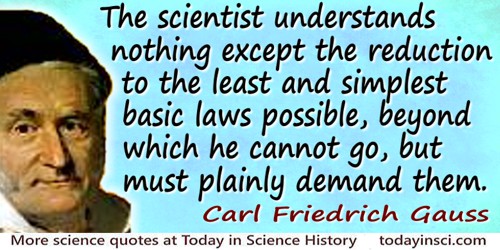
By explanation the scientist understands nothing except the reduction to the least and simplest basic laws possible, beyond which he cannot go, but must plainly demand them; from them however he deduces the phenomena absolutely completely as necessary.
From his memoir 'Erdmagnetismus und Magnetometer' in Collected Works (1877), Vol. 5, 315-316. Quoted in G. Waldo Dunnington, Carl Friedrich Gauss: Titan of Science (2004), 411.
By the fruit one judges the tree; the tree of science grows exceedingly slowly; centuries elapse before one can pluck the ripe fruits; even today it is hardly possible for us to shell and appraise the kernel of the teachings that blossomed in the seventeenth century. He who sows cannot therefore judge the worth of the corn. He must have faith in the fruitfulness of the seed in order that he may follow untiringly his chosen furrow when he casts his ideas to the four winds of heaven.
As quoted in Philipp Frank, Modern Science and its Philosophy (1949), 62, which cites Évolution de la Mécanique (1903).
Can the cause be reached from knowledge of the effect with the same certainty as the effect can be shown to follow from its cause? Is it possible for one effect to have many causes? If one determinate cause cannot be reached from the effect, since there is no effect which has not some cause, it follows that an effect, when it has one cause, may have another, and so that there may be several causes of it.
As quoted in Alistair Cameron Crombie, Robert Grosseteste and the Origins of Experimental Science, 1100-1700 (1971), 81.
Casting off the dark fog of verbal philosophy and vulgar medicine, which inculcate names alone ... I tried a series of experiments to explain more clearly many phenomena, particularly those of physiology. In order that I might subject as far as possible the reasonings of the Galenists and Peripatetics to sensory criteria, I began, after trying experiments, to write dialogues in which a Galenist adduced the better-known and stronger reasons and arguments; these a mechanist surgeon refuted by citing to the contrary the experiments I had tried, and a third, neutral interlocutor weighed the reasons advanced by both and provided an opportunity for further progress.
'Malpighi at Pisa 1656-1659', in H. B. Adelmann (ed.), Marcello Malpighi and the Evolution of Embryology (1966), Vol. 1, 155-6.
Catastrophe Theory is—quite likely—the first coherent attempt (since Aristotelian logic) to give a theory on analogy. When narrow-minded scientists object to Catastrophe Theory that it gives no more than analogies, or metaphors, they do not realise that they are stating the proper aim of Catastrophe Theory, which is to classify all possible types of analogous situations.
From 'La Théorie des catastrophes État présent et perspective', as quoted in Erick Christopher Zeeman, (ed.), Catastrophe Theory: Selected Papers, 1972-1977 (1977), 637, as cited in Martin Krampe (ed.), Classics of Semiotics (1987), 214.
Classical mountaineering is a completely anarchical activity. Its only measures are possible or impossible.
From interview with Rudraneil Sengupta, 'Reinhold Messner: When You’re Alone, Fear is All on You', Mint (1 Mar 2014). A business newspaper in India, also online at livemint.com website.
Collective unity is not the result of the brotherly love of the faithful for each other. The loyalty of the true believer is to the whole—the church, party, nation—and not to his fellow true believer. True loyalty between individuals is possible only in a loose and relatively free society.
In The True Believer (1951), 122
Common sense is the measure of the possible; it is composed of experience and prevision; it is calculation applied to life.
Entry for 26 Dec 1852 in Amiel’s Journal: The Journal Intime of Henri-Frédéric Amiel, trans. Humphry Ward (1893), 34.
Concerning the gods, I have no means of knowing either that they exist or that they do not exist, nor what sort of form they may have; there are many reasons why knowledge on this subject is not possible, owing to the lack of evidence and the shortness of human life.
Protagoras, fr. 1, quoted in E. Hussey, The Pre-Socratics (1972), 109.
Contact means the exchange of specific knowledge, ideas, or at least of findings, definite facts. But what if no exchange is possible? If an elephant is not a giant microbe, the ocean is not a giant brain.
As translated from the French by Joanna Kilmartin and Steve Cox, in Solaris (2002), 145.
Correct is to recognize what diseases are and whence they come; which are long and which are short; which are mortal and which are not; which are in the process of changing into others; which are increasing and which are diminishing; which are major and which are minor; to treat the diseases that can be treated, but to recognize the ones that cannot be, and to know why they cannot be; by treating patients with the former, to give them the benefit of treatment as far as it is possible.
Diseases, in Hippocrates, trans. P. Potter (1988), Vol. 5, 113.
Darwinian fitness is compounded of a mutual relationship between the organism and the environment. Of this, fitness of environment is quite as essential a component as the fitness which arises in the process of organic evolution; and in fundamental characteristics the actual environment is the fittest possible abode of life.
His thesis for the book stated at the beginning of The Fitness of the Environment (1913), Preface, v.
Don’t confuse hypothesis and theory. The former is a possible explanation; the latter, the correct one. The establishment of theory is the very purpose of science.
Martin H. Fischer, Howard Fabing (ed.) and Ray Marr (ed.), Fischerisms (1944), 7.
During the century after Newton, it was still possible for a man of unusual attainments to master all fields of scientific knowledge. But by 1800, this had become entirely impracticable.
The Intelligent Man's Guide to Science (1960), 19.
Each new machine or technique, in a sense, changes all existing machines and techniques, by permitting us to put them together into new combinations. The number of possible combinations rises exponentially as the number of new machines or techniques rises
Future Shock (1970).
Engineering is the science and art of efficient dealing with materials and forces … it involves the most economic design and execution … assuring, when properly performed, the most advantageous combination of accuracy, safety, durability, speed, simplicity, efficiency, and economy possible for the conditions of design and service.
As coauthor with Frank W. Skinner, and Harold E. Wessman, Vocational Guidance in Engineering Lines (1933), 6.
Engineering is the science of economy, of conserving the energy, kinetic and potential, provided and stored up by nature for the use of man. It is the business of engineering to utilize this energy to the best advantage, so that there may be the least possible waste.
(1908). Quoted, without source, in Appendix A, 'Some Definitions of Engineering' in Theodore Jesse Hoover and John Charles Lounsbury Fish, The Engineering Profession (1941), 463.
Engineers apply the theories and principles of science and mathematics to research and develop economical solutions to practical technical problems. Their work is the link between scientific discoveries and commercial applications. Engineers design products, the machinery to build those products, the factories in which those products are made, and the systems that ensure the quality of the product and efficiency of the workforce and manufacturing process. They design, plan, and supervise the construction of buildings, highways, and transit systems. They develop and implement improved ways to extract, process, and use raw materials, such as petroleum and natural gas. They develop new materials that both improve the performance of products, and make implementing advances in technology possible. They harness the power of the sun, the earth, atoms, and electricity for use in supplying the Nation’s power needs, and create millions of products using power. Their knowledge is applied to improving many things, including the
quality of health care, the safety of food products, and the efficient operation of financial systems.
Bureau of Labor Statistics, Occupational Outlook Handbook (2000) as quoted in Charles R. Lord. Guide to Information Sources in Engineering (2000), 5. This definition has been revised and expanded over time in different issues of the Handbook.
Even if there is only one possible unified theory, it is just a set of rules and equations. What is it that breathes fire into the equations and makes a universe for them to describe? The usual approach of science of constructing a mathematical model cannot answer the questions of why there should be a universe for the model to describe. Why does the universe go to all the bother of existing?
A Brief History of Time (1998), 190.
Even the mind depends so much on temperament and the disposition of one’s bodily organs that, if it is possible to find a way to make people generally more wise and more skilful than they have been in the past, I believe that we should look for it in medicine. It is true that medicine as it is currently practiced contains little of much use.
In Discourse on Method as translated by Desmond M. Clarke, in Discourse on Method and Related Writings (1999), 44. Also see an earlier translation that begins “For the mind…” on this web page.
Every living thing is a sort of imperialist, seeking to transform as much as possible of its environment into itself and its seed. When we compare the (present) human population of the globe with… that of former times, we see that “chemical imperialism” has been… the main end to which human intelligence has been devoted.
In 'Man and his Environment', An Outline of Philosophy (1927), 27.
Everything material which is the subject of knowledge has number, order, or position; and these are her first outlines for a sketch of the universe. If our feeble hands cannot follow out the details, still her part has been drawn with an unerring pen, and her work cannot be gainsaid. So wide is the range of mathematical sciences, so indefinitely may it extend beyond our actual powers of manipulation that at some moments we are inclined to fall down with even more than reverence before her majestic presence. But so strictly limited are her promises and powers, about so much that we might wish to know does she offer no information whatever, that at other moments we are fain to call her results but a vain thing, and to reject them as a stone where we had asked for bread. If one aspect of the subject encourages our hopes, so does the other tend to chasten our desires, and he is perhaps the wisest, and in the long run the happiest, among his fellows, who has learned not only this science, but also the larger lesson which it directly teaches, namely, to temper our aspirations to that which is possible, to moderate our desires to that which is attainable, to restrict our hopes to that of which accomplishment, if not immediately practicable, is at least distinctly within the range of conception.
From Presidential Address (Aug 1878) to the British Association, Dublin, published in the Report of the 48th Meeting of the British Association for the Advancement of Science (1878), 31.
Everything should be made as simple as possible, but not simpler.
Attributed.
Exercise in the most rigorous thinking that is possible will of its own accord strengthen the sense of truth and right, for each advance in the ability to distinguish between correct and false thoughts, each habit making for rigour in thought development will increase in the sound pupil the ability and the wish to ascertain what is right in life and to defend it.
In Anleitung zum mathematischen Unterricht in den höheren Schulen (1906), 28.
Extinction has only separated groups: it has by no means made them; for if every form which has ever lived on this earth were suddenly to reappear, though it would be quite impossible to give definitions by which each group could be distinguished from other groups, as all would blend together by steps as fine as those between the finest existing varieties, nevertheless a natural classification, or at least a natural arrangement, would be possible.
From On the Origin of Species by Means of Natural Selection; or, The Preservation of Favoured Races in the Struggle for Life (1860), 431.
Fertilization of mammalian eggs is followed by successive cell divisions and progressive differentiation, first into the early embryo and subsequently into all of the cell types that make up the adult animal. Transfer of a single nucleus at a specific stage of development, to an enucleated unfertilized egg, provided an opportunity to investigate whether cellular differentiation to that stage involved irreversible genetic modification. The first offspring to develop from a differentiated cell were born after nuclear transfer from an embryo-derived cell line that had been induced to became quiescent. Using the same procedure, we now report the birth of live lambs from three new cell populations established from adult mammary gland, fetus and embryo. The fact that a lamb was derived from an adult cell confirms that differentiation of that cell did not involve the irreversible modification of genetic material required far development to term. The birth of lambs from differentiated fetal and adult cells also reinforces previous speculation that by inducing donor cells to became quiescent it will be possible to obtain normal development from a wide variety of differentiated cells.
[Co-author of paper announcing the cloned sheep, ‘Dolly’.]
[Co-author of paper announcing the cloned sheep, ‘Dolly’.]
In I. Wilmut, A. E. Schnieke, J. McWhir, et al., 'Viable Offspring Derived from Petal and Adult Mammalian Cells', Nature (1997), 385, 810.
Finally, I aim at giving denominations to things, as agreeable to truth as possible. I am not ignorant that words, like money, possess an ideal value, and that great danger of confusion may be apprehended from a change of names; in the mean time it cannot be denied that chemistry, like the other sciences, was formerly filled with improper names. In different branches of knowledge, we see those matters long since reformed: why then should chemistry, which examines the real nature of things, still adopt vague names, which suggest false ideas, and favour strongly of ignorance and imposition? Besides, there is little doubt but that many corrections may be made without any inconvenience.
Physical and Chemical Essays (1784), Vol. I, xxxvii.
Finally, two days ago, I succeeded - not on account of my hard efforts, but by the grace of the Lord. Like a sudden flash of lightning, the riddle was solved. I am unable to say what was the conducting thread that connected what I previously knew with what made my success possible.
Quoted in H. Eves, Mathematical Circles Squared, (1972).
First, as concerns the success of teaching mathematics. No instruction in the high schools is as difficult as that of mathematics, since the large majority of students are at first decidedly disinclined to be harnessed into the rigid framework of logical conclusions. The interest of young people is won much more easily, if sense-objects are made the starting point and the transition to abstract formulation is brought about gradually. For this reason it is psychologically quite correct to follow this course.
Not less to be recommended is this course if we inquire into the essential purpose of mathematical instruction. Formerly it was too exclusively held that this purpose is to sharpen the understanding. Surely another important end is to implant in the student the conviction that correct thinking based on true premises secures mastery over the outer world. To accomplish this the outer world must receive its share of attention from the very beginning.
Doubtless this is true but there is a danger which needs pointing out. It is as in the case of language teaching where the modern tendency is to secure in addition to grammar also an understanding of the authors. The danger lies in grammar being completely set aside leaving the subject without its indispensable solid basis. Just so in Teaching of Mathematics it is possible to accumulate interesting applications to such an extent as to stunt the essential logical development. This should in no wise be permitted, for thus the kernel of the whole matter is lost. Therefore: We do want throughout a quickening of mathematical instruction by the introduction of applications, but we do not want that the pendulum, which in former decades may have inclined too much toward the abstract side, should now swing to the other extreme; we would rather pursue the proper middle course.
Not less to be recommended is this course if we inquire into the essential purpose of mathematical instruction. Formerly it was too exclusively held that this purpose is to sharpen the understanding. Surely another important end is to implant in the student the conviction that correct thinking based on true premises secures mastery over the outer world. To accomplish this the outer world must receive its share of attention from the very beginning.
Doubtless this is true but there is a danger which needs pointing out. It is as in the case of language teaching where the modern tendency is to secure in addition to grammar also an understanding of the authors. The danger lies in grammar being completely set aside leaving the subject without its indispensable solid basis. Just so in Teaching of Mathematics it is possible to accumulate interesting applications to such an extent as to stunt the essential logical development. This should in no wise be permitted, for thus the kernel of the whole matter is lost. Therefore: We do want throughout a quickening of mathematical instruction by the introduction of applications, but we do not want that the pendulum, which in former decades may have inclined too much toward the abstract side, should now swing to the other extreme; we would rather pursue the proper middle course.
In Ueber den Mathematischen Unterricht an den hoheren Schulen; Jahresbericht der Deutschen Mathematiker Vereinigung, Bd. 11, 131.
First, In showing in how to avoid attempting impossibilities. Second, In securing us from important mistakes in attempting what is, in itself possible, by means either inadequate or actually opposed to the end in view. Thirdly, In enabling us to accomplish our ends in the easiest, shortest, most economical, and most effectual manner. Fourth, In inducing us to attempt, and enabling us to accomplish, object which, but for such knowledge, we should never have thought of understanding.
On the ways that a knowledge of the order of nature can be of use.
On the ways that a knowledge of the order of nature can be of use.
Quoted in Robert Routledge, Discoveries and Inventions of the 19th Century (1890), 665.
For between true Science, and erroneous Doctrines, Ignorance is in the middle. Naturall sense and imagination, are not subject to absurdity. Nature it selfe cannot erre: and as men abound in copiousnesses of language; so they become more wise, or more mad than ordinary. Nor is it possible without Letters for any man to become either excellently wise, or (unless his memory be hurt by disease, or ill constitution of organs) excellently foolish. For words are wise men's counters, they do but reckon by them; but they are the money of fools that value them by the authority of an Aristotle, a Cicero, or a Thomas, or any other Doctor whatsoever, if but a man.
Leviathan (1651), ed. C. B. Macpherson (1968), Part 1, Chapter 4, 106.
For forty-nine months between 1968 and 1972, two dozen Americans had the great good fortune to briefly visit the Moon. Half of us became the first emissaries from Earth to tread its dusty surface. We who did so were privileged to represent the hopes and dreams of all humanity. For mankind it was a giant leap for a species that evolved from the Stone Age to create sophisticated rockets and spacecraft that made a Moon landing possible. For one crowning moment, we were creatures of the cosmic ocean, an epoch that a thousand years hence may be seen as the signature of our century.
…...
For it is the same whether you take it that the Earth is in motion or the Sky. For, in both the cases, it does not affect the Astronomical Science. It is just for the Physicist to see if it is possible to refute it.
In Syed Hasan Barani, 'Al-Biruni's Scientific Achievements', Indo-Iranica, 1952, S (4), 47.
For some years I have been afflicted with the belief that flight is possible to man. My disease has increased in severity and I feel that it will soon cost me an increased amount of money if not my life.
Opening line his first letter (13 May 1900) to Octave Chanute. In Marvin W. McFarland (ed.) The Papers of Wilbur and Orville Wright: 1899-1905 (1953), Vol. 1, 13.
For this we must make automatic and habitual, as early as possible, as many useful actions as we can, and guard against the growing into ways that are likely to be disadvantageous to us, as we should guard against the plague?
'The Laws of Habit', The Popular Science Monthly (Feb 1887), 434.
For, every time a certain portion is destroyed, be it of the brain or of the spinal cord, a function is compelled to cease suddenly, and before the time known beforehand when it would stop naturally, it is certain that this function depends upon the area destroyed. It is in this way that I have recognized that the prime motive power of respiration has its seat in that part of the medulla oblongata that gives rise to the nerves of the eighth pair [vagi]; and it is by this method that up to a certain point it will be possible to discover the use of certain parts of the brain.
Expériences sur le Principe de la Vie, Notamment sur celui des Mouvements du Coeur, et sur le Siege de ce Principe (1812), 148-149. Translated in Edwin Clarke and L. S. Jacyna, Nineteenth Century Origins of Neuroscientific Concepts (1987), 247.
Fortunately Nature herself seems to have prepared for us the means of supplying that want which arises from the impossibility of making certain experiments on living bodies. The different classes of animals exhibit almost all the possible combinations of organs: we find them united, two and two, three and three, and in all proportions; while at the same time it may be said that there is no organ of which some class or some genus is not deprived. A careful examination of the effects which result from these unions and privations is therefore sufficient to enable us to form probable conclusions respecting the nature and use of each organ, or form of organ. In the same manner we may proceed to ascertain the use of the different parts of the same organ, and to discover those which are essential, and separate them from those which are only accessory. It is sufficient to trace the organ through all the classes which possess it, and to examine what parts constantly exist, and what change is produced in the respective functions of the organ, by the absence of those parts which are wanting in certain classes.
Letter to Jean Claude Mertrud. In Lectures on Comparative Anatomy (1802), Vol. I, xxiii--xxiv.
From a mathematical standpoint it is possible to have infinite space. In a mathematical sense space is manifoldness, or combinations of numbers. Physical space is known as the 3-dimension system. There is the 4-dimension system, the 10-dimension system.
As quoted in 'Electricity Will Keep The World From Freezing Up', New York Times (12 Nov 1911), SM4.
From that night on, the electron—up to that time largely the plaything of the scientist—had clearly entered the field as a potent agent in the supplying of man's commercial and industrial needs… The electronic amplifier tube now underlies the whole art of communications, and this in turn is at least in part what has made possible its application to a dozen other arts. It was a great day for both science and industry when they became wedded through the development of the electronic amplifier tube.
The Autobiography of Robert A. Millikan (1951), 136.
Geology is intimately related to almost all the physical sciences, as is history to the moral. An historian should, if possible, be at once profoundly acquainted with ethics, politics, jurisprudence, the military art, theology; in a word, with all branches of knowledge, whereby any insight into human affairs, or into the moral and intellectual nature of man, can be obtained. It would be no less desirable that a geologist should be well versed in chemistry, natural philosophy, mineralogy, zoology, comparative anatomy, botany; in short, in every science relating to organic and inorganic nature. With these accomplishments the historian and geologist would rarely fail to draw correct and philosophical conclusions from the various monuments transmitted to them of former occurrences.
Principles of Geology (1830-3), Vol. 1, 2-3.
Geometrical axioms are neither synthetic a priori conclusions nor experimental facts. They are conventions: our choice, amongst all possible conventions, is guided by experimental facts; but it remains free, and is only limited by the necessity of avoiding all contradiction. ... In other words, axioms of geometry are only definitions in disguise.
That being so what ought one to think of this question: Is the Euclidean Geometry true?
The question is nonsense. One might as well ask whether the metric system is true and the old measures false; whether Cartesian co-ordinates are true and polar co-ordinates false.
That being so what ought one to think of this question: Is the Euclidean Geometry true?
The question is nonsense. One might as well ask whether the metric system is true and the old measures false; whether Cartesian co-ordinates are true and polar co-ordinates false.
In George Edward Martin, The Foundations of Geometry and the Non-Euclidean Plane (1982), 110.
Geometry enlightens the intellect and sets one’s mind right. All of its proofs are very clear and orderly. It is hardly possible for errors to enter into geometrical reasoning, because it is well arranged and orderly. Thus, the mind that constantly applies itself to geometry is not likely to fall into error. In this convenient way, the person who knows geometry acquires intelligence.
In Ibn Khaldûn, Franz Rosenthal (trans.) and N.J. Dawood (ed.), The Muqaddimah: An Introduction to History (1967, 1969), Vol. 1, 378.
Given a situation, a system with a Leerstelle [a gap], whether a given completion (Lueckenfuellung) does justice to the structure, is the “right” one, is often determined by the structure of the system, the situation. There are requirements, structurally determined; there are possible in pure cases unambiguous decisions as to which completion does justice to the situation, which does not, which violates the requirements and the situation.
From 'Some Problems in the Theory of Ethics', collected in Mary Henle (ed.), Documents of Gestalt Psychology (1961), 36.
Great things are only possible with outrageous requests.
As quoted, without citation in Jack Canfield and Mark Victor Hansen, The Aladdin Factor (1995), 212.
Half a century ago Oswald (1910) distinguished classicists and romanticists among the scientific investigators: the former being inclined to design schemes and to use consistently the deductions from working hypotheses; the latter being more fit for intuitive discoveries of functional relations between phenomena and therefore more able to open up new fields of study. Examples of both character types are Werner and Hutton. Werner was a real classicist. At the end of the eighteenth century he postulated the theory of “neptunism,” according to which all rocks including granites, were deposited in primeval seas. It was an artificial scheme, but, as a classification system, it worked quite satisfactorily at the time. Hutton, his contemporary and opponent, was more a romanticist. His concept of “plutonism” supposed continually recurrent circuits of matter, which like gigantic paddle wheels raise material from various depths of the earth and carry it off again. This is a very flexible system which opens the mind to accept the possible occurrence in the course of time of a great variety of interrelated plutonic and tectonic processes.
In 'The Scientific Character of Geology', The Journal of Geology (Jul 1961), 69, No. 4, 456-7.
He should avail himself of their resources in such ways as to advance the expression of the spirit in the life of mankind. He should use them so as to afford to every human being the greatest possible opportunity for developing and expressing his distinctively human capacity as an instrument of the spirit, as a centre of sensitive and intelligent awareness of the objective universe, as a centre of love of all lovely things, and of creative action for the spirit.
…...
Historical chronology, human or geological, depends... upon comparable impersonal principles. If one scribes with a stylus on a plate of wet clay two marks, the second crossing the first, another person on examining these marks can tell unambiguously which was made first and which second, because the latter event irreversibly disturbs its predecessor. In virtue of the fact that most of the rocks of the earth contain imprints of a succession of such irreversible events, an unambiguous working out of the chronological sequence of these events becomes possible.
'Critique of the Principle of Uniformity', in C. C. Albritton (ed.), Uniformity and Simplicity (1967), 31.
However improbable we regard [the spontaneous origin of life],… it will almost certainly happen at least once…. The time… is of the order of two billion years.… Given so much time, the “impossible” becomes possible, the possible probable, and the probable virtually certain. One only has to wait: time itself performs the miracles.
In 'The Origin of Life', Scientific American (Aug 1954), 191, No. 2, 46. Note that the quoted time of 2 billion years is rejected as impossibly short by such authors as H. J. Morowitz, in Energy Flow in Biology (1968), 317.
Human language is in some ways similar to, but in other ways vastly different from, other kinds of animal communication. We simply have no idea about its evolutionary history, though many people have speculated about its possible origins. There is, for instance, the “bow-bow” theory, that language started from attempts to imitate animal sounds. Or the “ding-dong” theory, that it arose from natural sound-producing responses. Or the “pooh-pooh” theory, that it began with violent outcries and exclamations.
We have no way of knowing whether the kinds of men represented by the earliest fossils could talk or not…
Language does not leave fossils, at least not until it has become written.
We have no way of knowing whether the kinds of men represented by the earliest fossils could talk or not…
Language does not leave fossils, at least not until it has become written.
Man in Nature (1961), 10.
Humanity stands ... before a great problem of finding new raw materials and new sources of energy that shall never become exhausted. In the meantime we must not waste what we have, but must leave as much as possible for coming generations.
Chemistry in Modern Life (1925), trans. Clifford Shattuck-Leonard, vii.
Humans everywhere share the same goals when the context is large enough. And the study of the Cosmos provides the largest possible context … . If a human disagrees with you, let him live. In a hundred billion galaxies, you will not find another … . If we are to survive, our loyalties must be broadened further, to include the whole human community, the entire planet Earth.
Cosmos
Hyper-selectionism has been with us for a long time in various guises; for it represents the late nineteenth century’s scientific version of the myth of natural harmony–all is for the best in the best of all possible worlds (all structures well designed for a definite purpose in this case). It is, indeed, the vision of foolish Dr. Pangloss, so vividly satirized by Voltaire in Candide–the world is not necessarily good, but it is the best we could possibly have.
…...
I … share an excitement and a certain pride in the wonders opened up by scientific investigation …, and also a recognition of the value in scientific method of keeping the hypotheses as simple as possible—my Oxford tutor gave me a great respect for Occam’s razor.
In Letter to periodical, Chemistry and Industry (17 Feb 1997).
I am paid by the word, so I always write the shortest words possible.
…...
I believe that certain erroneous developments in particle theory ... are caused by a misconception by some physicists that it is possible to avoid philosophical arguments altogether. Starting with poor philosophy, they pose the wrong questions. It is only a slight exaggeration to say that good physics has at times been spoiled by poor philosophy.
In 'The Nature of Elementary Particles', collected in Elena Castellani, Interpreting Bodies: Classical and Quantum Objects in Modern Physics (1998), 211. From Physics Today (1976), 29, No. 3, 32.
I believe that the laws of physics such as they are, such as they have been taught to us, are not the inevitable truth. We believe in the laws, or we experiment* with them each day, yet I believe it is possible to consider the existence of a universe in which these laws would be extended, changed a very tiny bit, in a precisely demarcated way. Consequently we immediately achieve extraordinary results, different yet certainly not far from the truth. After all, every century or two a new scientist comes along who changes the laws of physics, isn’t that so? After Newton there were many who did, and there were even more after Einstein, right? We have to wait to see how the laws in question will change over time, then… In any case, without being a scientist myself I can still hope to reach parallel results, if you will, in art.
Epigraph, in James Housefield, Playing with Earth and Sky: Astronomy, Geography, and the Art of Marcel Duchamp (2016), ix. As modified by James Housefield, from Guy Viau interview of Marcel Duchamp on Canadian Radio Television (17 July 1960), 'Simply Change Your Name', translated by Sarah Skinner Kilborne in Tout-Fait: the Marcel Duchamp Studies Online Journal 2, no. 4 (2002). [*Note: Where the Housefield in the Epigraph uses the word “experiment”, the original French gives “expérimentons”, which in the unmodified translation by Sarah Skinner Kilborne is written more correctly as “experience.” —Webmaster]
I believed that, instead of the multiplicity of rules that comprise logic, I would have enough in the following four, as long as I made a firm and steadfast resolution never to fail to observe them.
The first was never to accept anything as true if I did not know clearly that it was so; that is, carefully to avoid prejudice and jumping to conclusions, and to include nothing in my judgments apart from whatever appeared so clearly and distinctly to my mind that I had no opportunity to cast doubt upon it.
The second was to subdivide each on the problems I was about to examine: into as many parts as would be possible and necessary to resolve them better.
The third was to guide my thoughts in an orderly way by beginning, as if by steps, to knowledge of the most complex, and even by assuming an order of the most complex, and even by assuming an order among objects in! cases where there is no natural order among them.
And the final rule was: in all cases, to make such comprehensive enumerations and such general review that I was certain not to omit anything.
The long chains of inferences, all of them simple and easy, that geometers normally use to construct their most difficult demonstrations had given me an opportunity to think that all the things that can fall within the scope of human knowledge follow from each other in a similar way, and as long as one avoids accepting something as true which is not so, and as long as one always observes the order required to deduce them from each other, there cannot be anything so remote that it cannot be reached nor anything so hidden that it cannot be uncovered.
The first was never to accept anything as true if I did not know clearly that it was so; that is, carefully to avoid prejudice and jumping to conclusions, and to include nothing in my judgments apart from whatever appeared so clearly and distinctly to my mind that I had no opportunity to cast doubt upon it.
The second was to subdivide each on the problems I was about to examine: into as many parts as would be possible and necessary to resolve them better.
The third was to guide my thoughts in an orderly way by beginning, as if by steps, to knowledge of the most complex, and even by assuming an order of the most complex, and even by assuming an order among objects in! cases where there is no natural order among them.
And the final rule was: in all cases, to make such comprehensive enumerations and such general review that I was certain not to omit anything.
The long chains of inferences, all of them simple and easy, that geometers normally use to construct their most difficult demonstrations had given me an opportunity to think that all the things that can fall within the scope of human knowledge follow from each other in a similar way, and as long as one avoids accepting something as true which is not so, and as long as one always observes the order required to deduce them from each other, there cannot be anything so remote that it cannot be reached nor anything so hidden that it cannot be uncovered.
Discourse on Method in Discourse on Method and Related Writings (1637), trans. Desmond M. Clarke, Penguin edition (1999), Part 2, 16.
I beseech you in the bowels of Christ, think it possible you may be mistaken.
Letter, to General Assembly of the Church of Scotland (1650). In The Parliamentary or Constitutional History of England (1763), Vol. 19, 322.
I can see him [Sylvester] now, with his white beard and few locks of gray hair, his forehead wrinkled o’er with thoughts, writing rapidly his figures and formulae on the board, sometimes explaining as he wrote, while we, his listeners, caught the reflected sounds from the board. But stop, something is not right, he pauses, his hand goes to his forehead to help his thought, he goes over the work again, emphasizes the leading points, and finally discovers his difficulty. Perhaps it is some error in his figures, perhaps an oversight in the reasoning. Sometimes, however, the difficulty is not elucidated, and then there is not much to the rest of the lecture. But at the next lecture we would hear of some new discovery that was the outcome of that difficulty, and of some article for the Journal, which he had begun. If a text-book had been taken up at the beginning, with the intention of following it, that text-book was most likely doomed to oblivion for the rest of the term, or until the class had been made listeners to every new thought and principle that had sprung from the laboratory of his mind, in consequence of that first difficulty. Other difficulties would soon appear, so that no text-book could last more than half of the term. In this way his class listened to almost all of the work that subsequently appeared in the Journal. It seemed to be the quality of his mind that he must adhere to one subject. He would think about it, talk about it to his class, and finally write about it for the Journal. The merest accident might start him, but once started, every moment, every thought was given to it, and, as much as possible, he read what others had done in the same direction; but this last seemed to be his real point; he could not read without finding difficulties in the way of understanding the author. Thus, often his own work reproduced what had been done by others, and he did not find it out until too late.
A notable example of this is in his theory of cyclotomic functions, which he had reproduced in several foreign journals, only to find that he had been greatly anticipated by foreign authors. It was manifest, one of the critics said, that the learned professor had not read Rummer’s elementary results in the theory of ideal primes. Yet Professor Smith’s report on the theory of numbers, which contained a full synopsis of Kummer’s theory, was Professor Sylvester’s constant companion.
This weakness of Professor Sylvester, in not being able to read what others had done, is perhaps a concomitant of his peculiar genius. Other minds could pass over little difficulties and not be troubled by them, and so go on to a final understanding of the results of the author. But not so with him. A difficulty, however small, worried him, and he was sure to have difficulties until the subject had been worked over in his own way, to correspond with his own mode of thought. To read the work of others, meant therefore to him an almost independent development of it. Like the man whose pleasure in life is to pioneer the way for society into the forests, his rugged mind could derive satisfaction only in hewing out its own paths; and only when his efforts brought him into the uncleared fields of mathematics did he find his place in the Universe.
A notable example of this is in his theory of cyclotomic functions, which he had reproduced in several foreign journals, only to find that he had been greatly anticipated by foreign authors. It was manifest, one of the critics said, that the learned professor had not read Rummer’s elementary results in the theory of ideal primes. Yet Professor Smith’s report on the theory of numbers, which contained a full synopsis of Kummer’s theory, was Professor Sylvester’s constant companion.
This weakness of Professor Sylvester, in not being able to read what others had done, is perhaps a concomitant of his peculiar genius. Other minds could pass over little difficulties and not be troubled by them, and so go on to a final understanding of the results of the author. But not so with him. A difficulty, however small, worried him, and he was sure to have difficulties until the subject had been worked over in his own way, to correspond with his own mode of thought. To read the work of others, meant therefore to him an almost independent development of it. Like the man whose pleasure in life is to pioneer the way for society into the forests, his rugged mind could derive satisfaction only in hewing out its own paths; and only when his efforts brought him into the uncleared fields of mathematics did he find his place in the Universe.
In Florian Cajori, Teaching and History of Mathematics in the United States (1890), 266-267.
I cannot shut my eyes to the fact that the production of wealth is not the work of any one man, and the acquisition of great fortunes is not possible without the co-operation of multitudes of men.
Address (31 May 1871) to the 12th annual commencement at the Cooper Union, honoring his 80th birthday, in New York City Mission and Tract Society, Annual report of the New York City Mission and Tract Society (1872), 69.
I consider [H. G. Wells], as a purely imaginative writer, to be deserving of very high praise, but our methods are entirely different. I have always made a point in my romances of basing my so-called inventions upon a groundwork of actual fact, and of using in their construction methods and materials which are not entirely without the pale of contemporary engineering skill and knowledge. ... The creations of Mr. Wells, on the other hand, belong unreservedly to an age and degree of scientific knowledge far removed from the present, though I will not say entirely beyond the limits of the possible.
Gordon Jones, 'Jules Verne at Home', Temple Bar (Jun 1904), 129, 670.
I do not intend to go deeply into the question how far mathematical studies, as the representatives of conscious logical reasoning, should take a more important place in school education. But it is, in reality, one of the questions of the day. In proportion as the range of science extends, its system and organization must be improved, and it must inevitably come about that individual students will find themselves compelled to go through a stricter course of training than grammar is in a position to supply. What strikes me in my own experience with students who pass from our classical schools to scientific and medical studies, is first, a certain laxity in the application of strictly universal laws. The grammatical rules, in which they have been exercised, are for the most part followed by long lists of exceptions; accordingly they are not in the habit of relying implicitly on the certainty of a legitimate deduction from a strictly universal law. Secondly, I find them for the most part too much inclined to trust to authority, even in cases where they might form an independent judgment. In fact, in philological studies, inasmuch as it is seldom possible to take in the whole of the premises at a glance, and inasmuch as the decision of disputed questions often depends on an aesthetic feeling for beauty of expression, or for the genius of the language, attainable only by long training, it must often happen that the student is referred to authorities even by the best teachers. Both faults are traceable to certain indolence and vagueness of thought, the sad effects of which are not confined to subsequent scientific studies. But certainly the best remedy for both is to be found in mathematics, where there is absolute certainty in the reasoning, and no authority is recognized but that of one’s own intelligence.
In 'On the Relation of Natural Science to Science in general', Popular Lectures on Scientific Subjects, translated by E. Atkinson (1900), 25-26.

I do not think it is possible really to understand the successes of science without understanding how hard it is—how easy it is to be led astray, how difficult it is to know at any time what is the next thing to be done.
In The First Three Minutes: A Modern View of the Origin of the Universe (1977), 132.
I experimented with all possible maneuvers—loops, somersaults and barrel rolls. I stood upside down on one finger and burst out laughing, a shrill, distorted laugh. Nothing I did altered the automatic rhythm of the air. Delivered from gravity and buoyancy, I flew around in space.
Describing his early test (1943) in the Mediterranean Sea of the Aqua-Lung he co-invented.
Describing his early test (1943) in the Mediterranean Sea of the Aqua-Lung he co-invented.
Quoted in 'Sport: Poet of the Depths', Time (28 Mar 1960)
I had the ambition to not only go farther than man had gone before, but to go as far as it was possible to go.
…...
I have always attached great importance to the manner in which an experiment is set up and conducted ... the experiment should be set up to open as many windows as possible on the unforeseen.
(1954). In Charles Coulston Gillespie (ed.), Dictionary of Scientific Biography (1973), Vol. 7, 153.
I have always loved to begin with the facts, to observe them, to walk in the light of experiment and demonstrate as much as possible, and to discuss the results.
Quoted in Francesco Rodolico, 'Arduino', In Charles Coulston Gillispie (ed.), Dictionary of Scientific Biography (1970), Vol. 1, 234.
I have approximate answers and possible beliefs in different degrees of certainty about different things, but I am not absolutely sure of anything, and of many things I don’t know anything about but I don’t have to know an answer.
Interview, in BBC TV program, 'The Pleasure of Finding Things Out', Horizon (23 Nov 1981). As quoted in Caroline Baillie, Alice Pawley, Donna M. Riley, Engineering and Social Justice: In the University and Beyond (2012), 108.
I have just received copies of “To-day” containing criticisms of my letter. I am in no way surprised to find that these criticisms are not only unfair and misleading in the extreme. They are misleading in so far that anyone reading them would be led to believe the exact opposite of the truth. It is quite possible that I, an old and trained engineer and chronic experimenter, should put an undue value upon truth; but it is common to all scientific men. As nothing but the truth is of any value to them, they naturally dislike things that are not true. ... While my training has, perhaps, warped my mind so that I put an undue value upon truth, their training has been such as to cause them to abhor exact truth and logic.
[Replying to criticism by Colonel Acklom and other religious parties attacking Maxim's earlier contribution to the controversy about the modern position of Christianity.]
[Replying to criticism by Colonel Acklom and other religious parties attacking Maxim's earlier contribution to the controversy about the modern position of Christianity.]
In G.K. Chesterton, 'The Maxims of Maxim', Daily News (25 Feb 1905). Collected in G. K. Chesterton and Dale Ahlquist (ed.), In Defense of Sanity: The Best Essays of G.K. Chesterton (2011), 86.
I have no doubt that it is possible to give a new direction to technological development, a direction that shall lead it back to the real needs of man, and that also means: to the actual size of man. Man is small, and, therefore, small is beautiful. To go
Small is Beautiful (1973).
I have often thought that an interesting essay might be written on the influence of race on the selection of mathematical methods. methods. The Semitic races had a special genius for arithmetic
and algebra, but as far as I know have never produced a single geometrician of any eminence. The Greeks on the other hand adopted a geometrical procedure wherever it was possible, and they even treated arithmetic as a branch of geometry by means of the device of representing numbers by lines.
In A History of the Study of Mathematics at Cambridge (1889), 123
I have to keep going, as there are always people on my track. I have to publish my present work as rapidly as possible in order to keep in the race. The best sprinters in this road of investigation are Becquerel and the Curies...
Letter to his mother (5 Jan1902). Quoted in A. S. Eve, Rutherford: Being the Life and Letters of the Rt. Hon. Lord Rutherford (1939), 80. In Laurie M. Brown, Abraham Pais and A. B. Pippard, Twentieth Century Physics (1995), 58.
I have very often reflected on what it is that really distinguishes the great genius from the common crowd. Here are a few observations I have made. The common individual always conforms to the prevailing opinion and the prevailing fashion; he regards the State in which everything now exists as the only possible one and passively accepts it ail. It does not occur to him that everything, from the shape of the furniture up to the subtlest hypothesis, is decided by the great council of mankind of which he is a member. He wears thin-soled shoes even though the sharp stones of the Street hurt his feet, he allows fashion to dictate to him that the buckles of his shoes must extend as far as the toes even though that means the shoe is often hard to get on. He does not reflect that the form of the shoe depends as much upon him as it does upon the fool who first wore thin shoes on a cracked pavement. To the great genius it always occurs to ask: Could this too not be false! He never gives his vote without first reflecting.
Aphorism 24 in Notebook C (1772-1773), as translated by R.J. Hollingdale in Aphorisms (1990). Reprinted as The Waste Books (2000), 36.
I know that the majority of those who are not only considered intellectual people, but actually are very intellectual, able to understand the most difficult scientic, mathematical, and philosophical discussions, are very rarely able to understand even the simplest and most obvious truth, if it involves a consequent admission that a judgment concerning some subject, which they have reached often with great effort, a judgment of which they are proud, with which they have indoctrinated others, and on the foundation of which they have built their whole lives-that this judgment may possibly be false.
First sentence of Chap. 14, 'The Sense of Art is Atrophied', What is Art? (1898), 207, as translated by Charles Johnston. [Note: scientic (sic) is as printed.]
I maintain that in every special natural doctrine only so much science proper is to be met with as mathematics; for… science proper, especially [science] of nature, requires a pure portion, lying at the foundation of the empirical, and based upon a priori knowledge of natural things. … To the possibility of a determinate natural thing, and therefore to cognise it à priori, is further requisite that the intuition corresponding à priori to the conception should be given; in other words, that the conception should be constructed. But the cognition of the reason through construction of conceptions is mathematical. A pure philosophy of nature in general, namely, one that only investigates what constitutes a nature in general, may thus be possible without mathematics; but a pure doctrine of nature respecting determinate natural things (corporeal doctrine and mental doctrine), is only possible by means of mathematics; and as in every natural doctrine only so much science proper is to be met with therein as there is cognition à priori, a doctrine of nature can only contain so much science proper as there is in it of applied mathematics.
From Preface to The Metaphysical Foundations of Natural Science (1786), as translated by Ernest Belford Boax, in Kant’s Prolegomena: And The Metaphysical Foundations of Natural Science (1883), 140.
I never said it was possible. I only said it was true.
I no longer count as one of my merits that I always tell the truth as much as possible; it has become my metier.
Letter to Albert Einstein, 8 Dec 1932. Quoted in P. Gay, Freud: A Life for Our Time (1988), xvii.
I presume that few who have paid any attention to the history of the Mathematical Analysis, will doubt that it has been developed in a certain order, or that that order has been, to a great extent, necessary—being determined, either by steps of logical deduction, or by the successive introduction of new ideas and conceptions, when the time for their evolution had arrived. And these are the causes that operate in perfect harmony. Each new scientific conception gives occasion to new applications of deductive reasoning; but those applications may be only possible through the methods and the processes which belong to an earlier stage.
Explaining his choice for the exposition in historical order of the topics in A Treatise on Differential Equations (1859), Preface, v-vi.
I resolved to obtain from myself [through automatic writing] what we were trying to obtain from them, namely a monologue spoken as rapidly as possible without any intervention on the part of the critical faculties, a monologue consequently unencumbered by the slightest inhibition and which was, as closely as possible akin to spoken thought. It had seemed to me, and still does … that the speed of thought does not necessarily defy language, nor even the fast-moving pen.
I should be the last to discard the law of organic heredity ... but the single word “heredity” cannot dispense science from the duty of making every possible inquiry into the mechanism of organic growth and of organic formation. To think that heredity will build organic beings without mechanical means is a piece of unscientific mysticism.
In 'On the Principles of Animal Morphology', Proceedings of the Royal Society of Edinburgh (1888), 15, 294-295. Original as Letter to Mr John Murray, communicated to the Society by Professor Sir William Turner. Page given as in collected volume published 1889.
I should like to compare this rearrangement which the proteins undergo in the animal or vegetable organism to the making up of a railroad train. In their passage through the body parts of the whole may be left behind, and here and there new parts added on. In order to understand fully the change we must remember that the proteins are composed of Bausteine united in very different ways. Some of them contain Bausteine of many kinds. The multiplicity of the proteins is determined by many causes, first through the differences in the nature of the constituent Bausteine; and secondly, through differences in the arrangement of them. The number of Bausteine which may take part in the formation of the proteins is about as large as the number of letters in the alphabet. When we consider that through the combination of letters an infinitely large number of thoughts may be expressed, we can understand how vast a number of the properties of the organism may be recorded in the small space which is occupied by the protein molecules. It enables us to understand how it is possible for the proteins of the sex-cells to contain, to a certain extent, a complete description of the species and even of the individual. We may also comprehend how great and important the task is to determine the structure of the proteins, and why the biochemist has devoted himself with so much industry to their analysis.
'The Chemical Composition of the Cell', The Harvey Lectures (1911), 7, 45.
I specifically paused to show that, if there were such machines with the organs and shape of a monkey or of some other non-rational animal, we would have no way of discovering that they are not the same as these animals. But if there were machines that resembled our bodies and if they imitated our actions as much as is morally possible, we would always have two very certain means for recognizing that, none the less, they are not genuinely human. The first is that they would never be able to use speech, or other signs composed by themselves, as we do to express our thoughts to others. For one could easily conceive of a machine that is made in such a way that it utters words, and even that it would utter some words in response to physical actions that cause a change in its organs—for example, if someone touched it in a particular place, it would ask what one wishes to say to it, or if it were touched somewhere else, it would cry out that it was being hurt, and so on. But it could not arrange words in different ways to reply to the meaning of everything that is said in its presence, as even the most unintelligent human beings can do. The second means is that, even if they did many things as well as or, possibly, better than anyone of us, they would infallibly fail in others. Thus one would discover that they did not act on the basis of knowledge, but merely as a result of the disposition of their organs. For whereas reason is a universal instrument that can be used in all kinds of situations, these organs need a specific disposition for every particular action.
Discourse on Method in Discourse on Method and Related Writings (1637), trans. Desmond M. Clarke, Penguin edition (1999), Part 5, 40.
I strive that in public dissection the students do as much as possible so that if even the least trained of them must dissect a cadaver before a group of spectators, he will be able to perform it accurately with his own hands; and by comparing their studies one with another they will properly understand, this part of medicine.
In De Humani Corporis Fabrica Libri Septem [Seven Books on the Structure of the Human Body] (1543), 547. Quoted and trans. in Charles Donald O'Malley, Andreas Vesalius of Brussels, 1514-1564 (1964), 144.
I suspect that the changes that have taken place during the last century in the average man's fundamental beliefs, in his philosophy, in his concept of religion. in his whole world outlook, are greater than the changes that occurred during the preceding four thousand years all put together. ... because of science and its applications to human life, for these have bloomed in my time as no one in history had had ever dreamed could be possible.
In The Autobiography of Robert A. Millikan (1951, 1980), xii.
I think we are beginning to suspect that man is not a tiny cog that doesn’t really make much difference to the running of the huge machine but rather that there is a much more intimate tie between man and the universe than we heretofore suspected. … [Consider if] the particles and their properties are not somehow related to making man possible. Man, the start of the analysis, man, the end of the analysis—because the physical world is, in some deep sense, tied to the human being.
In The Intellectual Digest (Jun 1973), as quoted and cited in Mark Chandos, 'Philosophical Essay: Story Theory", Kosmoautikon: Exodus From Sapiens (2015).
I wish the lecturers to treat their subject as a strictly natural science, the greatest of all possible sciences, indeed, in one sense, the only science, that of Infinite Being, without reference to or reliance upon any supposed special exception or so-called miraculous revelation. I wish it considered just as astronomy or chemistry is.
Statement in deed of foundation of the Gifford Lectures on natural theology (1885).
Statement in deed of foundation of the Gifford Lectures on natural theology (1885).
Quoted in Michael A. Arbib and Mary B. Hesse, The Construction of Reality (1986), 1.
I would “like” to be positivistic, [and do] research; but I can’t impress myself sufficiently by the “importance” of any possible research which I can imagine, to embark upon it.… The terrible secret is that I don’t believe in natural science. And yet I do, I do.
From notebook K12 manuscript, 2-3. As quoted and cited in Allan Beveridge, Portrait of the Psychiatrist as a Young Man: The Early Writing and Work of R.D. Laing, 1927-1960 (2011), 45.
If a project is truly innovative, you cannot possibly know its exact cost and exact schedule at the beginning. And if you do know the exact cost and the exact schedule, chances are that the technology is obsolete.
From interview with Technology Review, quoted in Douglas Martin, 'Joseph Gavin, Who Helped Put First Man on Moon, Dies at 90', New York Times (4 Nov 2010)
If a specific question has meaning, it must be possible to find operations by which an answer may be given to it ... I believe that many of the questions asked about social and philosophical subjects will be found to be meaningless when examined from the point of view of operations.
The Logic of Modern Physics (1960), 28.
If E is considered to be a continuously divisible quantity, this distribution is possible in infinitely many ways. We consider, however—this is the most essential point of the whole calculation—E to be composed of a well-defined number of equal parts and use thereto the constant of nature h = 6.55 ×10⁻²⁷ erg sec. This constant multiplied by the common frequency ν of the resonators gives us the energy element ε in erg, and dividing E by ε we get the number P of energy elements which must be divided over the N resonators.
[Planck’s constant, as introduced in 1900; subsequently written e = hν.]
[Planck’s constant, as introduced in 1900; subsequently written e = hν.]
In 'On the theory of the energy distribution law of the normal spectrum', in D. ter Haar and Stephen G. Brush, trans., Planck’s Original Papers in Quantum Physics (1972), 40.
If I get the impression that Nature itself makes the decisive choice [about] what possibility to realize, where quantum theory says that more than one outcome is possible, then I am ascribing personality to Nature, that is to something that is always everywhere. [An] omnipresent eternal personality which is omnipotent in taking the decisions that are left undetermined by physical law is exactly what in the language of religion is called God.
As quoted by John D. Barrow in The Universe that Discovered Itself (2000), 171.
If it is impossible to judge merit and guilt in the field of natural science, then it is not possible in any field, and historical research becomes an idle, empty activity.
Reden und Abhandlungen (1874). Trans. W. H. Brock.
If it is possible to have a linear unit that depends on no other quantity, it would seem natural to prefer it. Moreover, a mensural unit taken from the earth itself offers another advantage, that of being perfectly analogous to all the real measurements that in ordinary usage are also made upon the earth, such as the distance between two places or the area of some tract, for example. It is far more natural in practice to refer geographical distances to a quadrant of a great circle than to the length of a pendulum.
'Histoire'. Histoire et Memoires de l’Academie Royale des Science de Paris (1788/1791), 9-10. In Charles Coulston Gillispie, Pierre-Simon Laplace, 1749-1827: A Life in Exact Science (2nd Ed., 2000), 151.
If it were possible for a metaphysician to be a golfer, he might perhaps occasionally notice that his ball, instead of moving forward in a vertical plane (like the generality of projectiles, such as brickbats and cricket balls), skewed away gradually to the right. If he did notice it, his methods would naturally lead him to content himself with his caddies’s remark-“ye heeled that yin,” or “Ye jist sliced it.” … But a scientific man is not to be put off with such flimsy verbiage as that. He must know more. What is “Heeling”, what is “slicing”, and why would either operation (if it could be thoroughly carried out) send a ball as if to cover point, thence to long slip, and finally behind back-stop? These, as Falstaff said, are “questions to be asked.”
In 'The Unwritten Chapter on Golf, Nature (1887), 36, 502.
If it were possible for us to have so deep an insight into a man's character as shown both in inner and in outer actions, that every, even the least, incentive to these actions and all external occasions which affect them were so known to us that his future conduct could be predicted with as great a certainty as the occurrence of a solar or lunar eclipse, we could nevertheless still assert that the man is free.
Critique of Practical Reason (1788). In L. W. Beck (ed. & trans.), Critique of Practical Reason and Other Writings in Moral Philosophy (1949), 204-5.
If it were possible to have a life absolutely free from every feeling of sin, what a terrifying vacuum it would be!
In The Burning Brand: Diaries 1935-1950 (1961), 175.
If it were possible to transfer the methods of physical or of biological science directly to the study of man, the transfer would long ago have been made ... We have failed not for lack of hypotheses which equate man with the rest of the universe, but for lack of a hypothesis (short of animism) which provides for the peculiar divergence of man ... Let me now state my belief that the peculiar factor in man which forbids our explaining his actions upon the ordinary plane of biology is a highly specialized and unstable biological complex, and that this factor is none other than language.
Linguistics as a Science (1930), 555.
If politics is the art of the possible, research is surely the art of the soluble. Both are immensely practical-minded affairs.
In 'The Act of Creation', a book review (of Arthur Koestler’s book, The Act of Creation) in New Statesman (19 Jun 1964). Collected in The Strange Case of the Spotted Mice and Other Classic Essays on Science (1996), 42. Also collected in Medawar’s The Art of the Soluble: Creativity and Originality in Science (1967), 7.
If the Weismann idea triumphs, it will be in a sense a triumph of fatalism; for, according to it, while we may indefinitely improve the forces of our education and surroundings, and this civilizing nurture will improve the individuals of each generation, its actual effects will not be cumulative as regards the race itself, but only as regards the environment of the race; each new generation must start de novo, receiving no increment of the moral and intellectual advance made during the lifetime of its predecessors. It would follow that one deep, almost instinctive motive for a higher life would be removed if the race were only superficially benefited by its nurture, and the only possible channel of actual improvement were in the selection of the fittest chains of race plasma.
'The Present Problem of Heredity', The Atlantic Monthly (1891), 57, 363.
If the world may be thought of as a certain definite quantity of force and as a certain definite number of centers of force—and every other representation remains indefinite and therefore useless—it follows that, in the great dice game of existence, it must pass through calculable number of combinations. In infinite time, every possible combination would at some time or another be realized; more: it would be realized an infinite number of times. And since between every combination and its next recurrence all other possible combinations would have to take place, and each of these combination conditions of the entire sequence of combinations in the same series, a circular movement of absolutely identical series is thus demonstrated: the world as a circular movement that has already repeated itself infinitely often and plays its game in infinitum. This conception is not simply a mechanistic conception; for if it were that, it would not condition an infinite recurrence of identical cases, but a final state. Because the world has not reached this, mechanistic theory must be considered an imperfect and merely provisional hypothesis.
The Will to Power (Notes written 1883-1888), book 4, no. 1066. Trans. W. Kaufmann and R. J. Hollingdale and ed. W. Kaufmann (1968), 549.
If there is any kind of animal which is female and has no male separate from it, it is possible that this may generate a young one from itself. No instance of this worthy of any credit has been observed up to the present at any rate, but one case in the class of fishes makes us hesitate. No male of the so-called erythrinus has ever yet been seen, but females, and specimens full of roe, have been seen. Of this, however, we have as yet no proof worthy of credit.
Generation of Animals, 741a, 32-8. In Jonathan Barnes (ed.), The Complete Works of Aristotle (1984), Vol. I, 1150.
If this [the Mysterium cosmographicum] is published, others will perhaps make discoveries I might have reserved for myself. But we are all ephemeral creatures (and none more so than I). I have, therefore, for the Glory of God, who wants to be recognized from the book of Nature, that these things may be published as quickly as possible. The more others build on my work the happier I shall be.
Letter to Michael Maestlin (3 Oct 1595). Johannes Kepler Gesammelte Werke (1937- ), Vol. 13, letter 23, l. 251, p. 39-40.
If we are correct in understanding how evolution actually works, and provided we can survive the complications of war, environmental degradation, and possible contact with interstellar planetary travelers, we will look exactly the same as we do now. We won’t change at all. The species is now so widely dispersed that it is not going to evolve, except by gradualism.
In Pamela Weintraub, The Omni Interviews (1984), 75.
If we lived on a planet where nothing ever changed, there would be little to do. There would be nothing to figure out. There would be no impetus for science. And if we lived in an unpredictable world, where things changed in random or very complex ways, we would not be able to figure things out. But we live in an in-between universe, where things change, but according to patterns, rules, or as we call them, laws of nature. If I throw a stick up in the air, it always falls down. If the sun sets in the west, it always rises again the next morning in the east. And so it becomes possible to figure things out. We can do science, and with it we can improve our lives.
Cosmos (1980, 1985), 32.
If words are not things, or maps are not the actual territory, then, obviously, the only possible link between the objective world and the linguistic world is found in structure, and structure alone.
Science and Sanity: An Introduction to Non-Aristotelian Systems and General Semantics (1958), 61.
If you have imagination as a grain of sesame seed, all things are possible to you.
…...
In a sense, of course, probability theory in the form of the simple laws of chance is the key to the analysis of warfare;… My own experience of actual operational research work, has however, shown that its is generally possible to avoid using anything more sophisticated. … In fact the wise operational research worker attempts to concentrate his efforts in finding results which are so obvious as not to need elaborate statistical methods to demonstrate their truth. In this sense advanced probability theory is something one has to know about in order to avoid having to use it.
In 'Operations Research', Physics Today (Nov 1951), 19. As cited by Maurice W. Kirby and Jonathan Rosenhead, 'Patrick Blackett (1897)' in Arjang A. Assad (ed.) and Saul I. Gass (ed.),Profiles in Operations Research: Pioneers and Innovators (2011), 25.
In a University we are especially bound to recognise not only the unity of science itself, but the communion of the workers in science. We are too apt to suppose that we are congregated here merely to be within reach of certain appliances of study, such as museums and laboratories, libraries and lecturers, so that each of us may study what he prefers. I suppose that when the bees crowd round the flowers it is for the sake of the honey that they do so, never thinking that it is the dust which they are carrying from flower to flower which is to render possible a more splendid array of flowers, and a busier crowd of bees, in the years to come. We cannot, therefore, do better than improve the shining hour in helping forward the cross-fertilization of the sciences.
'The Telephone', Nature, 15, 1878. In W. D. Niven (ed.), The Scientific Papers of James Clerk Maxwell (1890), Vol. 2, 743-4.
In all cases when a particular agent or cause is to be studied, experiments should be arranged in such a way as to lead if possible to results depending on it alone ; or, if this cannot be done, they should be arranged so as to increase the effects due to the cause to be studied till these so far exceed the unavoidable concomitants, that the latter may be considered as only disturbing, not essentially modifying the effects of the principal agent.
In William Thomson and Peter Guthrie Tait, Treatise on Natural Philosophy (1867), Vol. 1, 305.
In both social and natural sciences, the body of positive knowledge grows by the failure of a tentative hypothesis to predict phenomena the hypothesis professes to explain; by the patching up of that hypothesis until someone suggests a new hypothesis that more elegantly or simply embodies the troublesome phenomena, and so on ad infinitum. In both, experiment is sometimes possible, sometimes not (witness meteorology). In both, no experiment is ever completely controlled, and experience often offers evidence that is the equivalent of controlled experiment. In both, there is no way to have a self-contained closed system or to avoid interaction between the observer and the observed. The Gödel theorem in mathematics, the Heisenberg uncertainty principle in physics, the self-fulfilling or self-defeating prophecy in the social sciences all exemplify these limitations.
Inflation and Unemployment (1976), 348.
In its efforts to learn as much as possible about nature, modern physics has found that certain things can never be “known” with certainty. Much of our knowledge must always remain uncertain. The most we can know is in terms of probabilities.
In The Feynman Lectures on Physics (1963), Vol. 1.
In its essence, the theory of natural selection is primarily an attempt to give an account of the probable mechanism of the origin of the adaptations of the organisms to their environment, and only secondarily an attempt to explain evolution at large. Some modern biologists seem to believe that the word 'adaptation' has teleological connotations, and should therefore be expunged from the scientific lexicon. With this we must emphatically disagree. That adaptations exist is so evident as to be almost a truism, although this need not mean that ours is the best of all possible worlds. A biologist has no right to close his eyes to the fact that the precarious balance between a living being and its environment must be preserved by some mechanism or mechanisms if life is to endure.
Genetics and Origin of Species (1937), 150.
In my view, the proper attitude of a public-service broadcaster is that it should attempt to cover as broad as possible a spectrum of human interest and should measure success by the width of those views. There shouldn’t be all that large a number of gaps in the spectrum; and a major element in the spectrum is scientific understanding. The fact that it doesn’t necessarily get as big an audience as cookery is of no consequence.
From interview with Brian Cox and Robert Ince, in 'A Life Measured in Heartbeats', New Statesman (21 Dec 2012), 141, No. 5138, 33.
In order to pursue chemotherapy successfully we must look for substances which possess a high affinity and high lethal potency in relation to the parasites, but have a low toxicity in relation to the body, so that it becomes possible to kill the parasites without damaging the body to any great extent. We want to hit the parasites as selectively as possible. In other words, we must learn to aim and to aim in a chemical sense. The way to do this is to synthesize by chemical means as many derivatives as possible of relevant substances.
'Ueber den jetzigen Stand der Chemotherapie'. Berichte der Deutschen Chemischen Gesellschagt, 1909, 42, 17-47. Translated in B. Holmstedt and G. Liljestrand (eds.), Readings in Pharmacology (1963), 286.
In order to seek truth, it is necessary once in the course of our life, to doubt, as far as possible, of all things.
From the original Latin: “Veritatem inquirenti, semel in vita de omnibus, quantum fieri potest, esse dubitandum,” Principles of Philosophy (1644). Pars Prima, as collected in Charles Adam and Paul Tannery, Œuvres de Descartes (1905), Vol. 8, Proposition I, 5. English version as given in John Veitch (trans.), The Method, Meditations, and Selections from the Principles of Descartes (1880), 193. Also seen translated as: “If you would be a real seeker after truth, you must at least once in your life doubt, as far as possible, all things.”
In point of fact, no conclusive disproof of a theory can ever be produced; for it is always possible to say that the experimental results are not reliable or that the discrepancies which are asserted to exist between the experimental results and the theory are only apparent and that they will disappear with the advance of our understanding. If you insist on strict proof (or strict disproof) in the empirical sciences, you will never benefit from experience, and never learn from it how wrong you are.
The Logic of Scientific Discovery: Logik Der Forschung (1959, 2002), 28.
In preparing the present volume, it has been the aim of the author to do full justice to the ample material at his command, and, where possible, to make the illustrations tell the main story to anatomists. The text of such a memoir may soon lose its interest, and belong to the past, but good figures are of permanent value. [Justifying elaborate illustrations in his monographs.]
In Dinocerata: a monograph of an extinct order of gigantic mammals (1884), Preface, xvii.
In science, attempts at formulating hierarchies are always doomed to eventual failure. A Newton will always be followed by an Einstein, a Stahl by a Lavoisier; and who can say who will come after us? What the human mind has fabricated must be subject to all the changes—which are not progress—that the human mind must undergo. The 'last words' of the sciences are often replaced, more often forgotten. Science is a relentlessly dialectical process, though it suffers continuously under the necessary relativation of equally indispensable absolutes. It is, however, possible that the ever-growing intellectual and moral pollution of our scientific atmosphere will bring this process to a standstill. The immense library of ancient Alexandria was both symptom and cause of the ossification of the Greek intellect. Even now I know of some who feel that we know too much about the wrong things.
Voices in the Labyrinth: Nature, Man, and Science (1979), 46.
In the discovery of lemmas the best aid is a mental aptitude for it. For we may see many who are quick at solutions and yet do not work by method ; thus Cratistus in our time was able to obtain the required result from first principles, and those the fewest possible, but it was his natural gift which helped him to the discovery.
— Proclus
As given in Euclid, The Thirteen Books of Euclid's Elements, translated from the text of Johan Ludvig Heiberg by Sir Thomas Little Heath, Vol. 1, Introduction and Books 1,2 (1908), 133. The passage also states that Proclus gives the definition of the term lemma as a proposition not proved beforehand. Glenn Raymond Morrow in A Commentary on the First Book of Euclid's Elements (1992), 165, states nothing more seems to be known of Cratistus.
In the discussion of the. energies involved in the deformation of nuclei, the concept of surface tension of nuclear matter has been used and its value had been estimated from simple considerations regarding nuclear forces. It must be remembered, however, that the surface tension of a charged droplet is diminished by its charge, and a rough estimate shows that the surface tension of nuclei, decreasing with increasing nuclear charge, may become zero for atomic numbers of the order of 100. It seems therefore possible that the uranium nucleus has only small stability of form, and may, after neutron capture, divide itself into two nuclei of roughly equal size (the precise ratio of sizes depending on liner structural features and perhaps partly on chance). These two nuclei will repel each other and should gain a total kinetic energy of c. 200 Mev., as calculated from nuclear radius and charge. This amount of energy may actually be expected to be available from the difference in packing fraction between uranium and the elements in the middle of the periodic system. The whole 'fission' process can thus be described in an essentially classical way, without having to consider quantum-mechanical 'tunnel effects', which would actually be extremely small, on account of the large masses involved.
[Co-author with Otto Robert Frisch]
[Co-author with Otto Robert Frisch]
Lise Meitner and O. R. Frisch, 'Disintegration of Uranium by Neutrons: a New Type of Nuclear Reaction', Nature (1939), 143, 239.
In the gametes of an individual hybrid the Anlagen for each individual parental character are found in all possible combinations but never in a single gamete the Anlagen for a pair of characters. Each combination occurs with approximately the same frequency.
'Mendel's Regel über das Verhalten der Nachkommenschaft der Rassenbastarde', Der Deutsche Botanisch Gesellschaft, 1900, 18, 158-68. Trans. in Ernst Mayr, The Growth of Biological Thought: Diversity, Evolution and Inheritance (1982), 719.
In the last four days I have got the spectrum given by Tantalum. Chromium. Manganese. Iron. Nickel. Cobalt. and Copper and part of the Silver spectrum. The chief result is that all the elements give the same kind of spectrum, the result for any metal being quite easy to guess from the results for the others. This shews that the insides of all the atoms are very much alike, and from these results it will be possible to find out something of what the insides are made up of.
Letter to his mother (2 Nov 1913). In J. L. Heilbron (ed.), H. G. J. Moseley: The Life and Letters of an English Physicist 1887-1915 (1974), 209.
In the sense that [truth] means the reality about a human being it is probably impossible for a biographer to achieve. In the sense that it means a reasonable presentation of all the available facts it is more nearly possible, but even this limited goal is harder to reach than it appears to be. A biographer needs to be both humble and cautious.
Describing the difficulty of historical sources giving conflicting facts. From 'Getting at the Truth', The Saturday Review (19 Sep 1953), 36, No. 38, 11. Excerpted in Meta Riley Emberger and Marian Ross Hall, Scientific Writing (1955), 399.
In view of the kind of matter we work with, it will never be possible to avoid little laboratory explosions.
Letter to Carl Jung, 18 Jun 1909. Quoted in William McGuire (ed.), The Freud-Jung Letters: The Correspondence between Sigmund Freud and C. G. Jung (1974), 235.
In working out physical problems there should be, in the first place, no pretence of rigorous formalism. The physics will guide the physicist along somehow to useful and important results, by the constant union of physical and geometrical or analytical ideas. The practice of eliminating the physics by reducing a problem to a purely mathematical exercise should be avoided as much as possible. The physics should be carried on right through, to give life and reality to the problem, and to obtain the great assistance which the physics gives to the mathematics.
In Electromagnetic Theory (1892), Vol. 2, 5.
Increasingly, our leaders must deal with dangers that threaten the entire world, where an understanding of those dangers and the possible solutions depend on a good grasp of science. The ozone layer, the greenhouse effect, acid rain, questions of diet and of heredity--all require scientific literacy. Can Americans choose the proper leaders and support the proper programs if they are scientifically illiterate?
articles.latimes.com/1989-03-31/news/vw-543_1_scientific-literacy
Increasingly, our leaders must deal with dangers that threaten the entire world, where an understanding of those dangers and the possible solutions depends on a good grasp of science. The ozone layer, the greenhouse effect, acid rain, questions of diet and heredity. All require scientific literacy. Can Americans choose the proper leaders and support the proper programs if they themselves are scientifically illiterate? The whole premise of democracy is that it is safe to leave important questions to the court of public opinion—but is it safe to leave them to the court of public ignorance?
In Los Angeles Times (31 Mar 1989).
Induction. The mental operation by which from a number of individual instances, we arrive at a general law. The process, according to Hamilton, is only logically valid when all the instances included in the law are enumerated. This being seldom, if ever, possible, the conclusion of an Induction is usually liable to more or less uncertainty, and Induction is therefore incapable of giving us necessary (general) truths.
Stated as narrative, not a direct quote, by his biographer W.H.S. Monck in 'Glossary of Philosophical Terms', appended in Sir William Hamilton (1881), 181.
Intelligence is important in psychology for two reasons. First, it is one of the most scientifically developed corners of the subject, giving the student as complete a view as is possible anywhere of the way scientific method can be applied to psychological problems. Secondly, it is of immense practical importance, educationally, socially, and in regard to physiology and genetics.
From Intelligence: Its Structure, Growth and Action: Its Structure, Growth and Action (1987), 1.
Is it possible that a promiscuous Jumble of Printing Letters should often fall into a Method and Order, which should stamp on Paper a coherent Discourse; or that a blind fortuitous Concourse of Atoms, not guided by an Understanding Agent, should frequently constitute the Bodies of any Species of Animals.
In 'Of Wrong Assent, or Error', An Essay Concerning Humane Understanding (1706), Book 4, 601.
It does appear that on the whole a physicist… tries to reduce his theory at all times to as few parameters as possible and is inclined to feel that a theory is a “respectable” one, though by no means necessarily correct, if in principle it does offer reasonably specific means for its possible refutation. Moreover the physicist will generally arouse the irritation amongst fellow physicists if he is not prepared to abandon his theory when it clashes with subsequent experiments. On the other hand it would appear that the chemist regards theories—or perhaps better his theories (!) —as far less sacrosanct, and perhaps in extreme cases is prepared to modify them continually as each bit of new experimental evidence comes in.
'Discussion: Physics and Chemistry: Comments on Caldin's View of Chemistry', British Journal of the Philosophy of Science, 1960, 11, 222.
It follows from the supreme perfection of God, that in creating the universe has chosen the best possible plan, in which there is the greatest variety together with the greatest order; the best arranged ground, place, time; the most results produced in the most simple ways; the most of power, knowledge, happiness and goodness the creatures that the universe could permit. For since all the possibles in I understanding of God laid claim to existence in proportion to their perfections, the actual world, as the resultant of all these claims, must be the most perfect possible. And without this it would not be possible to give a reason why things have turned out so rather than otherwise.
The Principles of Nature and Grace (1714), The Philosophical Works of Leibnitz (1890), ed. G. M. Duncan, 213-4.
It has been demonstrated that a species of penicillium produces in culture a very powerful antibacterial substance which affects different bacteria in different degrees. Generally speaking it may be said that the least sensitive bacteria are the Gram-negative bacilli, and the most susceptible are the pyogenic cocci ... In addition to its possible use in the treatment of bacterial infections penicillin is certainly useful... for its power of inhibiting unwanted microbes in bacterial cultures so that penicillin insensitive bacteria can readily be isolated.
'On the Antibacterial Action of Cultures of a Penicillium, with Special Reference to their Use in the Isolation of B. Influenzae', British Journal of Experimental Pathology, 1929, 10, 235-6.
It has been long considered possible to explain the more ancient revolutions on... [the Earth's] surface by means of these still existing causes; in the same manner as it is found easy to explain past events in political history, by an acquaintance with the passions and intrigues of the present day. But we shall presently see that unfortunately this is not the case in physical history:—the thread of operation is here broken, the march of nature is changed, and none of the agents that she now employs were sufficient for the production of her ancient works.
'Preliminary discourse', to Recherches sur les Ossemens Fossiles (1812), trans. R. Kerr Essay on the Theory of the Earth (1813), 24.
It has been shown to be possible, by deliberately planned and chemotherapeutic approach, to discover curative agents which act specifically and aetiologically against diseases due to protozoal infections, and especially against the spirilloses, and amongst these against syphilis in the first place. Further evidence for the specificity of the action of dihydroxydiaminoarsenobenzene [Salvarsan ‘606’] is the disappearance of the Wasserman reaction, which reaction must … be regarded as indicative of a reaction of the organism to the constituents of the spirochaetes.
P. Ehrlich and S. Hata, 'Closing Notes to the Experimental Chemotherapy of Spirilloses', 1910. Reprinted in F. Himmelweit (ed.), The Collected Papers of Paul Ehrlich (1957), Vol. 3, 302.
It has not escaped our notice that the specific pairing we have postulated immediately suggests a possible copying mechanism for the genetic material.
[Concluding remark in the paper by Watson and Crick announcing discovery of the structure of DNA.]
[Concluding remark in the paper by Watson and Crick announcing discovery of the structure of DNA.]
In J.D. Watson and F.H.C. Crick, 'A Structure for Deoxyribose Nucleic Acid,' Letter in Nature (25 Apr 1953), 171, 738. Quoted in Francis Crick, What Mad Pursuit (1990), 66.
It has today occurred to me that an amplifier using semiconductors rather than vacuum is in principle possible.
Laboratory notebook (29 Dec 1939).
Laboratory notebook (29 Dec 1939).
In Michael Dudley Sturge , Statistical and Thermal Physics (2003), 251.
It is a natural inquiry to ask—To what most nearly are these new phenomena [the newly-born science of radioactivity and the spontaneous disintegration of elements] correlated? Is it possible to give, by the help of an analogy to familiar phenomena, any correct idea of the nature of this new phenomenon “Radioactivity”? The answer may surprise those who hold to the adage that there is nothing new under the sun. Frankly, it is not possible, because in these latest developments science has broken fundamentally new ground, and has delved one distinct step further down into the foundations of knowledge.
In The Interpretation of Radium: Being the Substance of Six Free Popular Lectures Delivered at the University of Glasgow (1909, 1912), 2. The original lectures of early 1908, were greatly edited, rearranged and supplemented by the author for the book form.
It is a profound and necessary truth that the deep things in science are not found because they are useful; they are found because it was possible to find them.
Epigraph in Richard Rhodes, The Making of the Atomic Bomb (1986), 11.
It is a very strange thing to reflect that but for the invention of Professor Haber the Germans could not have continued the War after their original stack of nitrates was exhausted. The invention of this single man has enabled them, utilising the interval in which their accumulations were used up, not only to maintain an almost unlimited supply of explosives for all purposes, but to provide amply for the needs of agriculture in chemical manures. It is a remarkable fact, and shows on what obscure and accidental incidents the fortunes of possible the whole world may turn in these days of scientific discovery.
[During World War I, Fritz Haber and Karl Bosch invented a large scale process to cause the direct combination of hydrogen and nitrogen gases to chemically synthesize ammonia, thus providing a replacement for sodium nitrate in the manufacture of explosives and fertilizers.]
[During World War I, Fritz Haber and Karl Bosch invented a large scale process to cause the direct combination of hydrogen and nitrogen gases to chemically synthesize ammonia, thus providing a replacement for sodium nitrate in the manufacture of explosives and fertilizers.]
Parliamentary debate (25 Apr 1918). In Winston Churchill, Richard Langworth (ed.), Churchill by Himself: The Definitive Collection of Quotations (2008), 469.
by Winston Churchill, Richard Langworth
It is characteristic of our age to endeavour to replace virtues by technology. That is to say, wherever possible we strive to use methods of physical or social engineering to achieve goals which our ancestors thought attainable only by the training of character. Thus, we try so far as possible to make contraception take the place of chastity, and anaesthetics to take the place of fortitude; we replace resignation by insurance policies and munificence by the Welfare State. It would be idle romanticism to deny that such techniques and institutions are often less painful and more efficient methods of achieving the goods and preventing the evils which unaided virtue once sought to achieve and avoid. But it would be an equal and opposite folly to hope that the take-over of virtue by technology may one day be complete, so that the necessity for the laborious acquisition of the capacity for rational choice by individuals can be replaced by the painless application of the fruits of scientific discovery over the whole field of human intercourse and enterprise.
'Mental Health in Plato's Republic', in The Anatomy of the Soul: Historical Essays in the Philosophy of Mind (1973), 26.
It is characteristic of science that the full explanations are often seized in their essence by the percipient scientist long in advance of any possible proof.
The Origin of Life, 1967
It is for such inquiries the modern naturalist collects his materials; it is for this that he still wants to add to the apparently boundless treasures of our national museums, and will never rest satisfied as long as the native country, the geographical distribution, and the amount of variation of any living thing remains imperfectly known. He looks upon every species of animal and plant now living as the individual letters which go to make up one of the volumes of our earth’s history; and, as a few lost letters may make a sentence unintelligible, so the extinction of the numerous forms of life which the progress of cultivation invariably entails will necessarily render obscure this invaluable record of the past. It is, therefore, an important object, which governments and scientific institutions should immediately take steps to secure, that in all tropical countries colonised by Europeans the most perfect collections possible in every branch of natural history should be made and deposited in national museums, where they may be available for study and interpretation. If this is not done, future ages will certainly look back upon us as a people so immersed in the pursuit of wealth as to be blind to higher considerations. They will charge us with having culpably allowed the destruction of some of those records of Creation which we had it in our power to preserve; and while professing to regard every living thing as the direct handiwork and best evidence of a Creator, yet, with a strange inconsistency, seeing many of them perish irrecoverably from the face of the earth, uncared for and unknown.
In 'On the Physical Geography of the Malay Archipelago', Journal of the Royal Geographical Society (1863), 33, 234.
It is hardly possible to maintain seriously that the evil done by science is not altogether outweighed by the good. For example, if ten million lives were lost in every war, the net effect of science would still have been to increase the average length of life.
In A Mathematician's Apology (1940, 2012), 65.
It is never possible to predict a physical occurrence with unlimited precision.
In 'The Meaning of Causality in Physics' (1953), collected in Max Planck and Frank Gaynor (trans.), Scientific Autobiography: and Other Papers (1949, 2007), 124.
It is not always possible to know what one has learned, or when the dawning will arrive. You will continue to shift, sift, to shake out and to double back. The synthesis that finally occurs can be in the most unexpected place and the most unexpected time. My charge ... is to be alert to the dawnings.
…...
It is not always the most brilliant speculations nor the choice of the most exotic materials that is most profitable. I prefer Monsieur de Reaumur busy exterminating moths by means of an oily fleece; or increasing fowl production by making them hatch without the help of their mothers, than Monsieur Bemouilli absorbed in algebra, or Monsieur Leibniz calculating the various advantages and disadvantages of the possible worlds.
Spectacle, 1, 475. Quoted in Camille Limoges, 'Noel-Antoine Pluche', in C. C. Gillispie (ed.), Dictionary of Scientific Biography (1974 ), Vol. 11, 43.
It is not easy to imagine how little interested a scientist usually is in the work of any other, with the possible exception of the teacher who backs him or the student who honors him.
Pensées d'un Biologiste (1939). Translated in The Substance of Man (1962), 195.
It is not possible for form to do without matter because it is not separable, nor can matter itself be purged of form.
De Luce seu De Inchoatione Formarum (On Light or On The Beginning of Forms) [1220], trans. A. C. Crombie, quoted in A. C. Crombie, Robert Grosseteste and the Origins of Experimental Science, 1100-1700 (1953), 106.
It is not possible for me to purchase intellectual peace at the price of intellectual death.
In 'Address Delivered Before The British Association Assembled at Belfast' (19 Aug 1874), in Fragments of Science for Unscientific People: A Series of Detached Essays, Lectures, and Reviews (1892), Vol. 2, 200.
It is not possible to find in all geometry more difficult and more intricate questions or more simple and lucid explanations [than those given by Archimedes]. Some ascribe this to his natural genius; while others think that incredible effort and toil produced these, to all appearance, easy and unlaboured results. No amount of investigation of yours would succeed in attaining the proof, and yet, once seen, you immediately believe you would have discovered it; by so smooth and so rapid a path he leads you to the conclusion required.
— Plutarch
In John Dryden (trans.), Life of Marcellus.
It is not surprising that our language should be incapable of describing the processes occurring within the atoms, for, as has been remarked, it was invented to describe the experiences of daily life, and these consists only of processes involving exceedingly large numbers of atoms. Furthermore, it is very difficult to modify our language so that it will be able to describe these atomic processes, for words can only describe things of which we can form mental pictures, and this ability, too, is a result of daily experience. Fortunately, mathematics is not subject to this limitation, and it has been possible to invent a mathematical scheme—the quantum theory—which seems entirely adequate for the treatment of atomic processes; for visualization, however, we must content ourselves with two incomplete analogies—the wave picture and the corpuscular picture.
The Physical Principles of the Quantum Theory, trans. Carl Eckart and Frank C. Hoyt (1949), 11.
It is often held that scientific hypotheses are constructed, and are to be constructed, only after a detailed weighing of all possible evidence bearing on the matter, and that then and only then may one consider, and still only tentatively, any hypotheses. This traditional view however, is largely incorrect, for not only is it absurdly impossible of application, but it is contradicted by the history of the development of any scientific theory. What happens in practice is that by intuitive insight, or other inexplicable inspiration, the theorist decides that certain features seem to him more important than others and capable of explanation by certain hypotheses. Then basing his study on these hypotheses the attempt is made to deduce their consequences. The successful pioneer of theoretical science is he whose intuitions yield hypotheses on which satisfactory theories can be built, and conversely for the unsuccessful (as judged from a purely scientific standpoint).
Co-author with Raymond Arthur Lyttleton, in 'The Internal Constitution of the Stars', Occasional Notes of the Royal Astronomical Society 1948, 12, 90.
It is only necessary to check the comic books and Reader’s Digest to see the extent of the influence of applied science on the popular imagination. How much it is used to provide an atmosphere of endless thrill and excitement, quite apart from its accidental menace or utility, one can decide from such typical daily headlines as these:
London, March 10, 1947, Reuters: ROCKET TO MOON SEEN POSSIBLE BUT THOUSANDS TO DIE IN ATTEMPT
Cleveland, January 5, 1948.: LIFE SPAN OF 100, BE YOUNG AT 80, ATOM PREDICTION
Washington, June 11, 1947: SCIENTISTS AWAIT COW’S DEATH TO SOLVE MATHEMATICS PROBLEM
Needham Market, Suffolk, England. (U.P.): VICAR PROPOSES BABIES FOR YEARNING SPINSTERS, TEST-TUBE BABIES WILL PRODUCE ROBOTS
Washington, D.C., January 3, 1948. U.S. FLYER PASSING SONIC BARRIER OPENS NEW VISTAS OF DESTRUCTION ONE OF BRAVEST ACTS IN HISTORY
Those headlines represent “human interest” attempts to gear science to the human nervous system.
London, March 10, 1947, Reuters: ROCKET TO MOON SEEN POSSIBLE BUT THOUSANDS TO DIE IN ATTEMPT
Cleveland, January 5, 1948.: LIFE SPAN OF 100, BE YOUNG AT 80, ATOM PREDICTION
Washington, June 11, 1947: SCIENTISTS AWAIT COW’S DEATH TO SOLVE MATHEMATICS PROBLEM
Needham Market, Suffolk, England. (U.P.): VICAR PROPOSES BABIES FOR YEARNING SPINSTERS, TEST-TUBE BABIES WILL PRODUCE ROBOTS
Washington, D.C., January 3, 1948. U.S. FLYER PASSING SONIC BARRIER OPENS NEW VISTAS OF DESTRUCTION ONE OF BRAVEST ACTS IN HISTORY
Those headlines represent “human interest” attempts to gear science to the human nervous system.
In The Mechanical Bride: Folklore of Industrial Man (1967), 93.
It is perfectly possible to be objective about an angry man, but it is inadvisable, for it will only make him angrier.
In Science is a Sacred Cow (1950), 120.
It is possible for a mathematician to be “too strong” for a given occasion. He forces through, where another might be driven to a different, and possible more fruitful, approach. (So a rock climber might force a dreadful crack, instead of finding a subtle and delicate route.)
In A Mathematician's Miscellany (1953). Reissued as Béla Bollobás (ed.), Littlewood’s Miscellany (1986), 144.
It is possible in quantum mechanics to sneak quickly across a region which is illegal energetically.
In Feynman Lectures on Physics, Vol. 3, 8-12.
It is possible that in ten years’ time penicillin itself will be a back number and will be replaced by something better. It is quite certain though that to displace penicillin any newcomer will have to be very, very good.
In 'Truman Hails Fleming For Penicillin Drug', New York Times (26 Jul 1945), 17.
It is possible that the deepest meaning and aim of Newtonianism, or rather, of the whole scientific revolution of the seventeenth century, of which Newton is the heir and the highest expression, is just to abolish the world of the 'more or less', the world of qualities and sense perception, the world of appreciation of our daily life, and to replace it by the (Archimedean) universe of precision, of exact measures, of strict determination ... This revolution [is] one of the deepest, if not the deepest, mutations and transformations accomplished—or suffered—by the human mind since the invention of the cosmos by the Greeks, two thousand years before.
'The Significance of the Newtonian Synthesis' (1950). In Newtonian Studies (1965), 4-5.
It is possible to fly without motors, but not without knowledge & skill.
From his first letter (13 May 1900) to Octave Chanute. In Marvin W. McFarland (ed.) The Papers of Wilbur and Orville Wright: 1899-1905 (1953), Vol. 1, 13.
It is possible to read books on Natural History with intelligence and profit, and even to make good observations, without a scientific groundwork of biological instruction; and it is possible to arrive at empirical facts of hygiene and medical treatment without any physiological instruction. But in all three cases the absence of a scientific basis will render the knowledge fragmentary and incomplete; and this ought to deter every one from offering an opinion on debatable questions which pass beyond the limit of subjective observations. The psychologist who has not prepared himself by a study of the organism has no more right to be heard on the genesis of the psychical states, or of the relations between body and mind, than one of the laity has a right to be heard on a question of medical treatment.
The Physical Basis of Mind (1877), 4.
It is possible to state as a general principle that the mesodermic phagocytes, which originally (as in the sponges of our days) acted as digestive cells, retained their role to absorb the dead or weakened parts of the organism as much as different foreign intruders.
'Uber die Pathologische Bedeutung der Intracellularen Verduung', Fortschritte der Medizin (1884), 17, 558-569. Trans. Alfred I. Tauber and Leon Chernyak, Metchnikoff and the Origins of Immunology (1991), 141.
It is possible with … carbon … to form very large molecules that are stable. This results from the stability of the carbon-to-carbon bond. You must have complexity in order to achieve the versatility characteristic of living organisms. You can achieve this complexity with carbon forming the molecular backbone.
From interview with Neil A. Campbell, in 'Crossing the Boundaries of Science', BioScience (Dec 1986), 36, No. 11, 739.
It is primarily through the growth of science and technology that man has acquired those attributes which distinguish him from the animals, which have indeed made it possible for him to become human.
In The Human Meaning of Science (1940), 2.
It is probable that all organisms now alive are descended from one ancestor, for the following reason. Most of our structural molecules are asymmetrical, as shown by the fact that they rotate the plane of polarized light, and often form asymmetrical crystals. But of the two possible types of any such molecule, related to one another like a right and left boot, only one is found throughout living nature. The apparent exceptions to this rule are all small molecules which are not used in the building of the large structures which display the phenomena of life.
In 'The Origin of Life', The Inequality of Man: And Other Essays (1932), 157.
It is quite possible that mathematics was invented in the ancient Middle East to keep track of tax receipts and grain stores. How odd that out of this should come a subtle scientific language that can effectively describe and predict the most arcane aspects of the Universe.
Epigraph in Isaac Asimov’s Book of Science and Nature Quotations (1988), 265.
It is the peculiar beauty of this method, gentlemen, and one which endears it to the really scientific mind, that under no circumstance can it be of the smallest possible utility.
Quoted as “It is reported that once in a lecture after explaining a new solution of an old problem he said…”, in Alexander Macfarlane, 'Henry John Stephen Smith', Lectures on Ten British Mathematicians of the Nineteenth Century (1916), 100.
It is the task of science, as a collective human undertaking, to describe from the external side, (on which alone agreement is possible), such statistical regularity as there is in a world “in which every event has a unique aspect, and to indicate where possible the limits of such description. It is not part of its task to make imaginative interpretation of the internal aspect of reality—what it is like, for example, to be a lion, an ant or an ant hill, a liver cell, or a hydrogen ion. The only qualification is in the field of introspective psychology in which each human being is both observer and observed, and regularities may be established by comparing notes. Science is thus a limited venture. It must act as if all phenomena were deterministic at least in the sense of determinable probabilities. It cannot properly explain the behaviour of an amoeba as due partly to surface and other physical forces and partly to what the amoeba wants to do, with out danger of something like 100 per cent duplication. It must stick to the former. It cannot introduce such principles as creative activity into its interpretation of evolution for similar reasons. The point of view indicated by a consideration of the hierarchy of physical and biological organisms, now being bridged by the concept of the gene, is one in which science deliberately accepts a rigorous limitation of its activities to the description of the external aspects of events. In carrying out this program, the scientist should not, however, deceive himself or others into thinking that he is giving an account of all of reality. The unique inner creative aspect of every event necessarily escapes him.
In 'Gene and Organism', American Naturalist, (1953), 87, 17.
It is to geometry that we owe in some sort the source of this discovery [of beryllium]; it is that [science] that furnished the first idea of it, and we may say that without it the knowledge of this new earth would not have been acquired for a long time, since according to the analysis of the emerald by M. Klaproth and that of the beryl by M. Bindheim one would not have thought it possible to recommence this work without the strong analogies or even almost perfect identity that Citizen Haüy found for the geometrical properties between these two stony fossils.
Haüy used the geometry of cleavage to reveal the underlying crystal structure, and thus found the emeral and beryl were geometrically identical. In May Elvira Weeks, The Discovery of the Elements (1934), 153, citing Mellor, Comprehensive Treatise on Inorganic and Theoretical Chemistry (1923), 204-7.
It is true that physics gives a wonderful training in precise, logical thinking-about physics. It really does depend upon accurate reproducible experiments, and upon framing hypotheses with the greatest possible freedom from dogmatic prejudice. And if these were the really important things in life, physics would be an essential study for everybody.
In Science is a Sacred Cow (1950), 90-91.
It might be thought … that evolutionary arguments would play a large part in guiding biological research, but this is far from the case. It is difficult enough to study what is happening now. To figure out exactly what happened in evolution is even more difficult. Thus evolutionary achievements can be used as hints to suggest possible lines of research, but it is highly dangerous to trust them too much. It is all too easy to make mistaken inferences unless the process involved is already very well understood.
In What Mad Pursuit: A Personal View of Scientific Discovery (1988), 138-139.
It must … be admitted that very simple relations … exist between the volumes of gaseous substances and the numbers of simple or compound molecules which form them. The first hypothesis to present itself in this connection, and apparently even the only admissible one, is the supposition that the number of integral molecules in any gases is always the same for equal volumes, or always proportional to the volumes. Indeed, if we were to suppose that the number of molecules contained in a given volume were different for different gases, it would scarcely be possible to conceive that the law regulating the distance of molecules could give in all cases relations so simple as those which the facts just detailed compel us to acknowledge between the volume and the number of molecules.
In 'Essay on a Manner of Determining the Relative Masses of the Elementary Molecules of Bodies, and the Proportions in which they enter into these Compounds', Journal de Physique, 1811, 73, 58-76. In Foundations of the Molecular Theory; Alembic Club Reprints, Number 4 (1923), 28-9.
It must not be thought that it is ever possible to reach the interior earth by any perseverance in mining: both because the exterior earth is too thick, in comparison with human strength; and especially because of the intermediate waters, which would gush forth with greater impetus, the deeper the place in which their veins were first opened; and which would drown all miners.
Principles of Philosophy (1644), trans. V. R. and R. P. Miller (1983), 217-8.
It often happens that men, even of the best understandings and greatest circumspection, are guilty of that fault in reasoning which the writers on logick call the insufficient, or imperfect enumeration of parts, or cases: insomuch that I will venture to assert, that this is the chief, and almost the only, source of the vast number of erroneous opinions, and those too very often in matters of great importance, which we are apt to form on all the subjects we reflect upon, whether they relate to the knowledge of nature, or the merits and motives of human actions. It must therefore be acknowledged, that the art which affords a cure to this weakness, or defect, of our understandings, and teaches us to enumerate all the possible ways in which a given number of things may be mixed and combined together, that we may be certain that we have not omitted anyone arrangement of them that can lead to the object of our inquiry, deserves to be considered as most eminently useful and worthy of our highest esteem and attention. And this is the business of the art, or doctrine of combinations ... It proceeds indeed upon mathematical principles in calculating the number of the combinations of the things proposed: but by the conclusions that are obtained by it, the sagacity of the natural philosopher, the exactness of the historian, the skill and judgement of the physician, and the prudence and foresight of the politician, may be assisted; because the business of all these important professions is but to form reasonable conjectures concerning the several objects which engage their attention, and all wise conjectures are the results of a just and careful examination of the several different effects that may possibly arise from the causes that are capable of producing them.
Ars conjectandi (1713). In F. Maseres, The Doctrine of Permutations and Combinations (1795), 36.
It seems now clear that a belief in the functional importance of all enzymes found in bacteria is possible only to those richly endowed with Faith.
In J. Needham (ed.) and D.E. Green (ed.), Perspectives in Biochemistry (1937). Quoted in 'Obituary Notice: Marjory Stephenson, 1885–1948', Biochemistry Journal (1950), 46:4, 383.
It should be the function of medicine to have people die young as late as possible.
…...
It surely can be no offence to state, that the progress of science has led to new views, and that the consequences that can be deduced from the knowledge of a hundred facts may be very different from those deducible from five. It is also possible that the facts first known may be the exceptions to a rule and not the rule itself, and generalisations from these first-known facts, though useful at the time, may be highly mischievous, and impede the progress of the science if retained when it has made some advance.
Sections and Views Illustrative of Geological Phenomena (1830), viii.
It was eerie. I saw myself in that machine. I never thought my work would come to this.
Upon seeing a distorted image of his face, reflected on the inside cylindrical surface of the bore while inside an MRI (magnetic-resonance-imaging) machine—a device made possible by his early physical researches on nuclear magnetic resonance (1938).
Upon seeing a distorted image of his face, reflected on the inside cylindrical surface of the bore while inside an MRI (magnetic-resonance-imaging) machine—a device made possible by his early physical researches on nuclear magnetic resonance (1938).
Quoted from conversation with the author, John S. Rigden, in Rabi, Scientist and Citizen (2000), xxii. Rabi was recalling having an MRI, in late 1987, a few months before his death. He had been awarded the Nobel Prize in 1944, for his discovery of the magnetic resonance method.
It will be noticed that the fundamental theorem proved above bears some remarkable resemblances to the second law of thermodynamics. Both are properties of populations, or aggregates, true irrespective of the nature of the units which compose them; both are statistical laws; each requires the constant increase of a measurable quantity, in the one case the entropy of a physical system and in the other the fitness, measured by m, of a biological population. As in the physical world we can conceive the theoretical systems in which dissipative forces are wholly absent, and in which the entropy consequently remains constant, so we can conceive, though we need not expect to find, biological populations in which the genetic variance is absolutely zero, and in which fitness does not increase. Professor Eddington has recently remarked that “The law that entropy always increases—the second law of thermodynamics—holds, I think, the supreme position among the laws of nature.” It is not a little instructive that so similar a law should hold the supreme position among the biological sciences. While it is possible that both may ultimately be absorbed by some more general principle, for the present we should note that the laws as they stand present profound differences—-(1) The systems considered in thermodynamics are permanent; species on the contrary are liable to extinction, although biological improvement must be expected to occur up to the end of their existence. (2) Fitness, although measured by a uniform method, is qualitatively different for every different organism, whereas entropy, like temperature, is taken to have the same meaning for all physical systems. (3) Fitness may be increased or decreased by changes in the environment, without reacting quantitatively upon that environment. (4) Entropy changes are exceptional in the physical world in being irreversible, while irreversible evolutionary changes form no exception among biological phenomena. Finally, (5) entropy changes lead to a progressive disorganization of the physical world, at least from the human standpoint of the utilization of energy, while evolutionary changes are generally recognized as producing progressively higher organization in the organic world.
The Genetical Theory of Natural Selection (1930), 36.
It will be possible in a few more years to build radio controlled rockets which can be steered into such orbits beyond the limits of the atmosphere and left to broadcast scientific information back to the Earth. A little later, manned rockets will be able to make similar flights with sufficient excess power to break the orbit and return to Earth. (1945) [Predicting communications satellites.]
In 'Can Rocket Stations Give Worldwide Coverage?', Wireless World (Oct 1945). Quoted and cited in Arthur C. Clarke, Greetings, Carbon-Based Bipeds!: Collected Essays, 1934-1998, 21.
It will be possible, through the detailed determination of amino-acid sequences of hemoglobin molecules and of other molecules too, to obtain much information about the course of the evolutionary process, and to illuminate the question of the origin of species.
'Molecular Disease and Evolution'. Typescript of the Rudolph Virchow Lecture (5 Nov 1962). Quoted in T. Hager, Force of Nature: The Life of Linus Pauling (1997), 541.
It would be interesting to inquire how many times essential advances in science have first been made possible by the fact that the boundaries of special disciplines were not respected… Trespassing is one of the most successful techniques in science.
Dynamics in Psychology (1940), 115-116
It would be possible to describe absolutely everything scientifically, but it would make no sense. It would be without meaning, as if you described a Beethoven symphony as a variation of wave pressure.
Attributed to Einstein by Frau Born. Paraphrased words as given in Ronald William Clark, Einstein (1984), 243.
It would not be difficult to come to an agreement as to what we understand by science. Science is the century-old endeavor to bring together by means of systematic thought the perceptible phenomena of this world into as thoroughgoing an association as possible. To put it boldly, it is the attempt at the posterior reconstruction of existence by the process of conceptualization. But when asking myself what religion is I cannot think of the answer so easily. And even after finding an answer which may satisfy me at this particular moment, I still remain convinced that I can never under any circumstances bring together, even to a slight extent, the thoughts of all those who have given this question serious consideration.
…...
John Bardeen was an avid golfer and a good one. Whenever possible, he sought out golf courses during research or consulting trips. According to the stories, he was as proud of hitting a “hole in one” as he was to win a second Nobel Prize.
In 'John Bardeen: A Place to Win Two Nobel Prizes and Make a Hole in One', collected in Lillian Hoddeson (ed.), No Boundaries: University of Illinois Vignettes (2004), Chap. 16, 257.
Just as in the animal and vegetable kingdoms, an individual comes into being, so to speak, grows, remains in being, declines and passes on, will it not be the same for entire species? If our faith did not teach us that animals left the Creator's hands just as they now appear and, if it were permitted to entertain the slightest doubt as to their beginning and their end, may not a philosopher, left to his own conjectures, suspect that, from time immemorial, animal life had its own constituent elements, scattered and intermingled with the general body of matter, and that it happened when these constituent elements came together because it was possible for them to do so; that the embryo formed from these elements went through innumerable arrangements and developments, successively acquiring movement, feeling, ideas, thought, reflection, consciousness, feelings, emotions, signs, gestures, sounds, articulate sounds, language, laws, arts and sciences; that millions of years passed between each of these developments, and there may be other developments or kinds of growth still to come of which we know nothing; that a stationary point either has been or will be reached; that the embryo either is, or will be, moving away from this point through a process of everlasting decay, during which its faculties will leave it in the same way as they arrived; that it will disappear for ever from nature-or rather, that it will continue to exist there, but in a form and with faculties very different from those it displays at this present point in time? Religion saves us from many deviations, and a good deal of work. Had religion not enlightened us on the origin of the world and the universal system of being, what a multitude of different hypotheses we would have been tempted to take as nature's secret! Since these hypotheses are all equally wrong, they would all have seemed almost equally plausible. The question of why anything exists is the most awkward that philosophy can raise- and Revelation alone provides the answer.
Thoughts on the Interpretation of Nature and Other Philosophical Works (1753/4), ed. D. Adams (1999), Section LVIII, 75-6.
Kepler’s discovery would not have been possible without the doctrine of conics. Now contemporaries of Kepler—such penetrating minds as Descartes and Pascal—were abandoning the study of geometry ... because they said it was so UTTERLY USELESS. There was the future of the human race almost trembling in the balance; for had not the geometry of conic sections already been worked out in large measure, and had their opinion that only sciences apparently useful ought to be pursued, the nineteenth century would have had none of those characters which distinguish it from the ancien régime.
From 'Lessons from the History of Science: The Scientific Attitude' (c.1896), in Collected Papers (1931), Vol. 1, 32.
Let me describe briefly how a black hole might be created. Imagine a star with a mass 10 times that of the sun. During most of its lifetime of about a billion years the star will generate heat at its center by converting hydrogen into helium. The energy released will create sufficient pressure to support the star against its own gravity, giving rise to an object with a radius about five times the radius of the sun. The escape velocity from the surface of such a star would be about 1,000 kilometers per second. That is to say, an object fired vertically upward from the surface of the star with a velocity of less than 1,000 kilometers per second would be dragged back by the gravitational field of the star and would return to the surface, whereas an object with a velocity greater than that would escape to infinity.
When the star had exhausted its nuclear fuel, there would be nothing to maintain the outward pressure, and the star would begin to collapse because of its own gravity. As the star shrank, the gravitational field at the surface would become stronger and the escape velocity would increase. By the time the radius had got down to 10 kilometers the escape velocity would have increased to 100,000 kilometers per second, the velocity of light. After that time any light emitted from the star would not be able to escape to infinity but would be dragged back by the gravitational field. According to the special theory of relativity nothing can travel faster than light, so that if light cannot escape, nothing else can either. The result would be a black hole: a region of space-time from which it is not possible to escape to infinity.
When the star had exhausted its nuclear fuel, there would be nothing to maintain the outward pressure, and the star would begin to collapse because of its own gravity. As the star shrank, the gravitational field at the surface would become stronger and the escape velocity would increase. By the time the radius had got down to 10 kilometers the escape velocity would have increased to 100,000 kilometers per second, the velocity of light. After that time any light emitted from the star would not be able to escape to infinity but would be dragged back by the gravitational field. According to the special theory of relativity nothing can travel faster than light, so that if light cannot escape, nothing else can either. The result would be a black hole: a region of space-time from which it is not possible to escape to infinity.
'The Quantum Mechanics of Black Holes', Scientific American, 1977, 236, 34-40.
Let the sun never set or rise on a small bowel obstruction.
Adage expressing urgency for early operation to avoid possible fatality.
Adage expressing urgency for early operation to avoid possible fatality.
Summary of classic advice by Georg Friedrich Louis Stromeyer (1804-76) for a stangulated hernia. In Joe J. Tjandra et al., Textbook of Surgery (2006), 159.
Let us hope that the advent of a successful flying machine, now only dimly foreseen and nevertheless thought to be possible, will bring nothing but good into the world; that it shall abridge distance, make all parts of the globe accessible, bring men into closer relation with each other, advance civilization, and hasten the promised era in which there shall be nothing but peace and goodwill among all men.
Concluding paragraph, Progress in Flying Machines (1894), 269.
Let us sum up the three possible explanations of the decision to drop the bomb and its timing. The first that it was a clever and highly successful move in the field of power politics, is almost certainly correct; the second, that the timing was coincidental, convicts the American government of a hardly credible tactlessness [towards the Soviet Union]; and the third, the Roman
holiday theory [a spectacular event to justify the cost of the Manhattan Project], convicts them of an equally incredible irresponsibility.
In The Political and Military Consequences of Atomic Energy (1948), 126. As cited by Maurice W. Kirby and Jonathan Rosenhead, 'Patrick Blackett (1897)' in Arjang A. Assad (ed.) and Saul I. Gass (ed.),Profiles in Operations Research: Pioneers and Innovators (2011), 17. Blackett regarded the dropping of the atomic bombs on Japan as unnecessary because a Japanese surrender was inevitable.
Life is no brief candle to me. It is a sort of splendid torch which I have got a hold of for the moment, and I want to make it burn as brightly as possible before handing it on to future generations.
As referenced to a private conversation with Professor henderson and quoted in Edwin Björkman, 'The Serious Bernard Shaw', The American Review of Reviews (1911), 43, 425.
Looking back over the geological record it would seem that Nature made nearly every possible mistake before she reached her greatest achievement Man—or perhaps some would say her worst mistake of all. ... At last she tried a being of no great size, almost defenseless, defective in at least one of the more important sense organs; one gift she bestowed to save him from threatened extinction—a certain stirring, a restlessness, in the organ called the brain.
…...
Love of liberty means the guarding of every resource that makes freedom possible—from the sanctity of our families and the wealth of our soil to the genius [of] our scientists…
Inaugural Address, the first such address to be televised (20 Jan 1953). In William J. Federer, A Treasury of Presidential Quotations (2004), 300.
Man has generally been preoccupied with obtaining as much “production” from the landscape as possible, by developing and maintaining early successional types of ecosystems, usually monocultures. But, of course, man does not live by food and fiber alone; he also needs a balanced CO2-O2 atmosphere, the climactic buffer provided by oceans and masses of vegetation, and clean (that is, unproductive) water for cultural and industrial uses. Many essential life-cycle resources, not to mention recreational and esthetic needs, are best provided man by the less 'productive' landscapes. In other words, the landscape is not just a supply depot but is also the oikos—the home—in which we must live.
'The Strategy of Ecosystem Development. An Understanding of Ecological Succession Provides a Basis for Resolving Man's Conflict with Nature', Science (1969), 164, 266.
Man is a free moral agent and can be magnanimous and deal disinterestedly, humanity is a definite goal, social justice is desirable and possible, individual lives may be gloriously diversified, uniquely individualized, and yet socially useful; or, these are mere phrases, snares to catch gulls, soothing syrup for our troubled souls.
From Why We Behave Like Human Beings (1925), 476.
Man is a megalomaniac among animals—if he sees mountains he will try to imitate them by pyramids, and if he sees some grand process like evolution, and thinks it would be at all possible for him to be in on that game, he would irreverently have to have his whack at that too. That daring megalomania of his—has it not brought him to his present place?
'Application and Prospects', unpublished lecture, 1916. In Philip J. Pauly, Controlling Life: Jacques Loeb and the Engineering idea in Biology (1987), 179.
Many will, no doubt, prefer to retain old unsystematic names as far as possible, but it is easy to see that the desire to avoid change may carry us too far in this direction; it will undoubtedly be very inconvenient to the present generation of chemists to abandon familiar and cherished names, but nevertheless it may be a wise course to boldly face the difficulty, rather than inflict on coming generations a partially illogical and unsystematic nomenclature.
'International Conference on Chemical Nomenclature', Nature (19 May 1892), 46, 57.
Mathematical studies … when combined, as they now generally are, with a taste for physical science, enlarge infinitely our views of the wisdom and power displayed in the universe. The very intimate connexion indeed, which, since the date of the Newtonian philosophy, has existed between the different branches of mathematical and physical knowledge, renders such a character as that of a mere mathematician a very rare and scarcely possible occurrence.
In Elements of the Philosophy of the Human Mind (1827), Vol. 3, Chap. 1, Sec. 3, 184.
Mathematicians attach great importance to the elegance of their methods and their results. This is not pure dilettantism. What is it indeed that gives us the feeling of elegance in a solution, in a demonstration? It is the harmony of the diverse parts, their symmetry, their happy balance; in a word it is all that introduces order, all that gives unity, that permits us to see clearly and to comprehend at once both the ensemble and the details. But this is exactly what yields great results, in fact the more we see this aggregate clearly and at a single glance, the better we perceive its analogies with other neighboring objects, consequently the more chances we have of divining the possible generalizations. Elegance may produce the feeling of the unforeseen by the unexpected meeting of objects we are not accustomed to bring together; there again it is fruitful, since it thus unveils for us kinships before unrecognized. It is fruitful even when it results only from the contrast between the simplicity of the means and the complexity of the problem set; it makes us then think of the reason for this contrast and very often makes us see that chance is not the reason; that it is to be found in some unexpected law. In a word, the feeling of mathematical elegance is only the satisfaction due to any adaptation of the solution to the needs of our mind, and it is because of this very adaptation that this solution can be for us an instrument. Consequently this esthetic satisfaction is bound up with the economy of thought.
In 'The Future of Mathematics', Monist, 20, 80. Translated from the French by George Bruce Halsted.
Mathematicians deal with possible worlds, with an infinite number of logically consistent systems. Observers explore the one particular world we inhabit. Between the two stands the theorist. He studies possible worlds but only those which are compatible with the information furnished by observers. In other words, theory attempts to segregate the minimum number of possible worlds which must include the actual world we inhabit. Then the observer, with new factual information, attempts to reduce the list further. And so it goes, observation and theory advancing together toward the common goal of science, knowledge of the structure and observation of the universe.
Lecture to Sigma Xi, 'The Problem of the Expanding Universe' (1941), printed in Sigma Xi Quarterly (1942), 30, 104-105. Reprinted in Smithsonian Institution Report of the Board of Regents (1943), 97, 123. As cited by Norriss S. Hetherington in 'Philosophical Values and Observation in Edwin Hubble's Choice of a Model of the Universe', Historical Studies in the Physical Sciences (1982), 13, No. 1, 63.
Mathematics … belongs to every inquiry, moral as well as physical. Even the rules of logic, by which it is rigidly bound, could not be deduced without its aid. The laws of argument admit of simple statement, but they must be curiously transposed before they can be applied to the living speech and verified by observation. In its pure and simple form the syllogism cannot be directly compared with all experience, or it would not have required an Aristotle to discover it. It must be transmuted into all the possible shapes in which reasoning loves to clothe itself. The transmutation is the mathematical process in the establishment of the law.
From Memoir (1870) read before the National Academy of Sciences, Washington, printed in 'Linear Associative Algebra', American Journal of Mathematics (1881), 4, 97-98.
Mathematics is the classification and study of all possible patterns.
In Prelude to Mathematics (1955), 12.
Mathematics takes us still further from what is human, into the region of absolute necessity, to which not only the world, but every possible world, must conform.
In 'The Study of Mathematics', The New Quarterly (1907), reprinted in Philosophical Essays (1910). As quoted and cited in 'The Retreat From Pythagoras', The Basic Writings of Bertrand Russell, 1903-1959 (1992), 254.
Mathematics was born and nurtured in a cultural environment. Without the perspective which the cultural background affords, a proper appreciation of the content and state of present-day mathematics is hardly possible.
In Introduction to the Foundations of Mathematics (1952), 265.
Mathematics… is the set of all possible self-consistent structures, and there are vastly more logical structures than physical principles.
In 'Conclusion', Hyperspace: A Scientific Odyssey Through Parallel Universes, Time Warps, and the Tenth Dimension (1995), 328.
Maybe we have to accept that after reaching the deepest possible level of understanding science can offer, there will nevertheless be aspects of the universe that remain unexplained. Maybe we will have to accept that certain features of the universe are the way they are because of happenstance, accident, or divine choice.
In The Elegant Universe: Superstrings, Hidden Dimensions, and the Quest for the Ultimate Theory (2000), 385.
Metals are the great agents by which we can examine the recesses of nature; and their uses are so multiplied, that they have become of the greatest importance in every occupation of life. They are the instruments of all our improvements, of civilization itself, and are even subservient to the progress of the human mind towards perfection. They differ so much from each other, that nature seems to have had in view all the necessities of man, in order that she might suit every possible purpose his ingenuity can invent or his wants require.
From 'Classification of Simple Bodies', The Artist & Tradesman’s Guide: Embracing Some Leading Facts & Principles of Science, and a Variety of Matter Adapted to the Wants of the Artist, Mechanic, Manufacturer, and Mercantile Community (1827), 16.
Modern man worships at the temple of science, but science tells him only what is possible, not what is right.
As quoted in James C. Humes, Presidents and Their Pens: The Story of White House Speechwriters (2016), 93, citing James C. Humes, My Fellow Americans: Presidential Addresses That Shaped History (1992), 202. Humes, on the same page, added that for that reason, President Dwight Einsenhower in his farewell address (17 Jan 1961), warned that “public policy could be the captive of a scientific technological elite.”
More than ever before in the history of science and invention, it is safe now to say what is possible and what is impossible. No one would claim for a moment that during the next five hundred years the accumulated stock of knowledge of geography will increase as it has during the last five hundred In the same way it may safely be affirmed that in electricity the past hundred years is not likely to be duplicated in the next, at least as to great, original, and far-reaching discoveries, or novel and almost revolutionary applications.
In A Century of Electricity (1890), 223.
Most of the crackpot papers which are submitted to The Physical Review are rejected, not because it is impossible to understand them, but because it is possible. Those which are impossible to understand are usually published. When the great innovation appears, it will almost certainly be in a muddled, incomplete and confusing form. To the discoverer himself it will be only half-understood; to everybody else it will be a mystery. For any speculation which does not at first glance look crazy, there is no hope.
In 'Innovation in Physics', Scientific American (Sep 1958), 199. Collected in From Eros to Gaia (1993).
My belief (is) that one should take a minimum of care and preparation over first experiments. If they are unsuccessful one is not then discouraged since many possible reasons for failure can be thought of, and improvements can be made. Much can often be learned by the repetition under different conditions, even if the desired result is not obtained. If every conceivable precaution is taken at first, one is often too discouraged to proceed at all.
Nobel Lectures in Chemistry (1999), Vol. 3, 364.
My interest in chemistry was started by reading Robert Kennedy Duncan’s popular books while a high school student in Des Moines, Iowa, so that after some delay when it was possible for me to go to college I had definitely decided to specialize in chemistry.
Letter (4 Apr 1932) to Pauline G. Beery. Hagley Museum and Library Collection, Wilmington, Delaware. 1784.) As cited in Matthew E. Hermes, Enough for One Lifetime: Wallace Carothers, Inventor of Nylon (1996), 13.
My only wish would be to have ten more lives to live on this planet. If that were possible, I’d spend one lifetime each in embryology, genetics, physics, astronomy and geology. The other lifetimes would be as a pianist, backwoodsman, tennis player, or writer for the National Geographic. … I’d like to keep open the option for another lifetime as a surgeon-scientist.
In Tore Frängsmyr and Jan E. Lindsten (eds.), Nobel Lectures: Physiology Or Medicine: 1981-1990 (1993), 557.
My own thinking (and that of many of my colleagues) is based on two general principles, which I shall call the Sequence Hypothesis and the Central Dogma. The direct evidence for both of them is negligible, but I have found them to be of great help in getting to grips with these very complex problems. I present them here in the hope that others can make similar use of them. Their speculative nature is emphasized by their names. It is an instructive exercise to attempt to build a useful theory without using them. One generally ends in the wilderness.
The Sequence Hypothesis
This has already been referred to a number of times. In its simplest form it assumes that the specificity of a piece of nucleic acid is expressed solely by the sequence of its bases, and that this sequence is a (simple) code for the amino acid sequence of a particular protein...
The Central Dogma
This states that once 'information' has passed into protein it cannot get out again. In more detail, the transfer of information from nucleic acid to nucleic acid, or from nucleic acid to protein may be possible, but transfer from protein to protein, or from protein to nucleic acid is impossible. Information means here the precise determination of sequence, either of bases in the nucleic acid or of amino acid residues in the protein. This is by no means universally held—Sir Macfarlane Burnet, for example, does not subscribe to it—but many workers now think along these lines. As far as I know it has not been explicitly stated before.
The Sequence Hypothesis
This has already been referred to a number of times. In its simplest form it assumes that the specificity of a piece of nucleic acid is expressed solely by the sequence of its bases, and that this sequence is a (simple) code for the amino acid sequence of a particular protein...
The Central Dogma
This states that once 'information' has passed into protein it cannot get out again. In more detail, the transfer of information from nucleic acid to nucleic acid, or from nucleic acid to protein may be possible, but transfer from protein to protein, or from protein to nucleic acid is impossible. Information means here the precise determination of sequence, either of bases in the nucleic acid or of amino acid residues in the protein. This is by no means universally held—Sir Macfarlane Burnet, for example, does not subscribe to it—but many workers now think along these lines. As far as I know it has not been explicitly stated before.
'On Protein Synthesis', Symposia of the Society for Experimental Biology: The Biological Replication of Macromolecules, 1958, 12, 152-3.
My task was to show the psychologists that it is possible to apply physiological knowledge to the phenomena of psychical life.
'Reflexes of the Brain', Selected Works (1935), 335-6.
Myths and science fulfill a similar function: they both provide human beings with a representation of the world and of the forces that are supposed to govern it. They both fix the limits of what is considered as possible.
The Possible and the Actual (1982), 9.
Nature is as it is because this is the only possible nature consistent with itself.
Bootstrap: A Scientific Idea'. Science, vol. II, 1968, pp. 762-765. Quoted in Erhard Scheibe and Brigitte Falkenburg (ed), Between Rationalism and Empiricism: Selected Papers in the Philosophy of Physics (2001), 33.
Nature uses as little as possible of anything.
Harmonice mundi (1619). In Bill Swainson and Anne H. Soukhanov, Encarta Book Of Quotations (2000), 514.
Nearly every subject has a shadow, or imitation. It would, I suppose, be quite possible to teach a deaf and dumb child to play the piano. When it played a wrong note, it would see the frown of its teacher, and try again. But it would obviously have no idea of what it was doing, or why anyone should devote hours to such an extraordinary exercise. It would have learnt an imitation of music. and it would fear the piano exactly as most students fear what is supposed to be mathematics.
In Mathematician's Delight (1943), 8.
Neither the natives of Munsa [chief of the Mangbetu] nor the people of Kifan who came to me knew anything of the existence of a great lake, even though I undertook a positively detective investigation in order to discover any possible political intrigues. All of the statements of different people were noted and then compared; they agree as to names etc., which put my mind at rest.
On the necessity of compiling map data by comparisons between interviews with locals. In August Petermann, Petermann’s Geographische Mittheilungen (1871), 13. As quoted and cited in Kathrin Fritsch, '"You Have Everything Confused And Mixed Up…!" Georg Schweinfurth, Knowledge And Cartography Of Africa In The 19th Century', History in Africa (2009), 36, 93.
Nervous messages are invariably associated with an electrical change known as the action potential. This potential is generally believed to arise at a membrane which is situated between the axoplasm and the external medium. If this theory is correct, it should be possible to record the action potential between an electrode inside a nerve fibre and the conducting fluid outside it. Most nerve fibres are too small for this to be tested directly, but we have recently succeeded in inserting micro-electrodes into the giant axons of squids (Loligo forbesi).
Co-author with Andrew Aelding Huxley, British physiologist, (1917-2012), in 'Action Potentials Recorded from Inside a Nerve Fibre', Nature (1939), 144, 710.
Never believe that the atom is a complex mystery—it is not. The atom is what we find when we look for the underlying architecture in nature, whose bricks are as few, as simple and orderly as possible.
Quoted in Andrew Jon Rotter, Hiroshima (2008), 7, without citation. Also in 'ABC of the Atom'. Reader's Digest (Feb 1952), 40, 25.
Nevertheless if any skillful Servant of Nature shall bring force to bear on matter, and shall vex it and drive it to extremities as if with the purpose of reducing it to nothing, then will matter (since annihilation or true destruction is not possible except by the omnipotence of God) finding itself in these straits, turn and transform itself into strange shapes, passing from one change to another till it has gone through the whole circle and finished the period.
From 'Proteus; or Matter', De Sapientia Veterum (1609), Sec. 13. As translated in James Spedding, Robert Ellis and Douglas Heath (eds.), The Works of Francis Bacon (1857), Vol. 6, 726.
Nevertheless, his [Dostoyevsky’s] personality retained sadistic traits in plenty, which show themselves in his irritability, his love of tormenting, and his intolerance even towards people he loved, and which appear also in the way in which, as an author, he treats his readers. Thus in little things he was a sadist towards others, and in bigger things a sadist towards himself, in fact a masochist—that is to say the mildest, kindliest, most helpful person possible.
In James Strachey (ed.), 'Dostoyevsky and Parricide', The Standard Edition of the Complete Psychological Works of Sigmund Freud (1953-74), Vol. 21, 178-179. Reprinted in Writings on Art and Literature (1997), 236
Nevertheless, it is necessary to remember that a planned economy is not yet socialism. A planned economy as such may be accompanied by the complete enslavement of the individual. The achievement of socialism requires the solution of some extremely difficult socio-political problems: how is it possible, in view of the far-reaching centralisation of political and economic power, to prevent bureaucracy from becoming all-powerful and overweening? How can the rights of the individual be protected and therewith a democratic counterweight to the power of bureaucracy be assured?
…...
Newton’s laws of motion made it possible to state on one page facts about nature which would otherwise require whole libraries. Maxwell’s laws of electricity and magnetism also had an abbreviating effect.
In 'Man’s Place in the Physical Universe', Bulletin of the Atomic Scientists (Sep 1965), 21, No. 7, 16.
No science is immune to the infection of politics and the corruption of power. … The time has come to consider how we might bring about a separation, as complete as possible, between Science and Government in all countries. I call this the disestablishment of science, in the same sense in which the churches have been disestablished and have become independent of the state.
In 'The Disestablishment of Science', Encounter (Jul 1971), 15.
Nobody, certainly, will deny that the idea of the existence of an omnipotent, just, and omnibeneficent personal God is able to accord man solace, help, and guidance; also, by virtue of its simplicity it is accessible to the most undeveloped mind. But, on the other hand, there are decisive weaknesses attached to this idea in its elf, which have been painfully felt since the beginning of history. That is, if this being is omnipotent, then every occurrence, including every human action, every human thought, and every human feeling and aspiration is also His work; how is it possible to think of holding men responsible for their deeds and thoughts before such an almighty Being? In giving out punishment and rewards He would to a certain extent be passing judgment on Himself. How can this be combined with the goodness and righteousness ascribed to Him?
…...
Nothing in physics seems so hopeful to as the idea that it is possible for a theory to have a high degree of symmetry was hidden from us in everyday life. The physicist's task is to find this deeper symmetry.
In American Scientist (1977) (as cited in The Atlantic (1984), 254, 81.) As an epigraph in Crystal and Dragon: The Cosmic Dance of Symmetry and Chaos in Nature, Art and Consciousness (1993), 139.
Nothing travels faster than the speed of light, with the possible exception of bad news, which obeys its own special laws.
In Mostly Harmless (1992), 1.
Now if we want poets to interpret physical science as Milton and Shelley did (Shelley and Keats were the last English poets who were at all up-to-date in their chemical knowledge), we must see that our possible poets are instructed, as their masters were, in science and economics.
In Daedalus or Science and the Future (1924). Reprinted in Haldane's Daedalus Revisited (1995), 31.
Now it is a well-known principle of zoological evolution that an isolated region, if large and sufficiently varied in its topography, soil, climate and vegetation, will give rise to a diversified fauna according to the law of adaptive radiation from primitive and central types. Branches will spring off in all directions to take advantage of every possible opportunity of securing food. The modifications which animals undergo in this adaptive radiation are largely of mechanical nature, they are limited in number and kind by hereditary, stirp or germinal influences, and thus result in the independent evolution of similar types in widely-separated regions under the law of parallelism or homoplasy. This law causes the independent origin not only of similar genera but of similar families and even of our similar orders. Nature thus repeats herself upon a vast scale, but the similarity is never complete and exact.
'The Geological and Faunal Relations of Europe and America during the Tertiary Period and the Theory of the Successive Invasions of an African Fauna', Science (1900), 11, 563-64.
Now this supreme wisdom, united to goodness that is no less infinite, cannot but have chosen the best. For as a lesser evil is a kind of good, even so a lesser good is a kind of evil if it stands in the way of a greater good; and the would be something to correct in the actions of God if it were possible to the better. As in mathematics, when there is no maximum nor minimum, in short nothing distinguished, everything is done equally, or when that is not nothing at all is done: so it may be said likewise in respect of perfect wisdom, which is no less orderly than mathematics, that if there were not the best (optimum) among all possible worlds, God would not have produced any.
Theodicy: Essays on the Goodness of God and Freedom of Man and the Origin of Evil (1710), 128.
Obviously we biologists should fit our methods to our materials. An interesting response to this challenge has been employed particularly by persons who have entered biology from the physical sciences or who are distressed by the variability in biology; they focus their research on inbred strains of genetically homogeneous laboratory animals from which, to the maximum extent possible, variability has been eliminated. These biologists have changed the nature of the biological system to fit their methods. Such a bold and forthright solution is admirable, but it is not for me. Before I became a professional biologist, I was a boy naturalist, and I prefer a contrasting approach; to change the method to fit the system. This approach requires that one employ procedures which allow direct scientific utilization of the successful long-term evolutionary experiments which are documented by the fascinating diversity and variability of the species of animals which occupy the earth. This is easy to say and hard to do.
In 'Scientific innovation and creativity: a zoologist’s point of view', American Zoologist (1982), 22, 232.
Oersted would never have made his great discovery of the action of galvanic currents on magnets had he stopped in his researches to consider in what manner they could possibly be turned to practical account; and so we would not now be able to boast of the wonders done by the electric telegraphs. Indeed, no great law in Natural Philosophy has ever been discovered for its practical implications, but the instances are innumerable of investigations apparently quite useless in this narrow sense of the word which have led to the most valuable results.
From Silvanus Phillips Thompson, 'Introductory Lecture to the Course on Natural Philosophy', The Life of Lord Kelvin (1910), Vol. 1, Appendix to Chap. 5, 249.
Of all the intellectual faculties, judgment is the last to arrive at maturity. The child should give its attention either to subjects where no error is possible at all, such as mathematics, or to those in which there is no particular danger in making a mistake, such as languages, natural science, history, and so on.
In Arthur Schopenhauer and T. Bailey (ed., trans.) Essays of Arthur Schopenhauer (1902), 67.
Of possible quadruple algebras the one that had seemed to him by far the most beautiful and remarkable was practically identical with quaternions, and that he thought it most interesting that a calculus which so strongly appealed to the human mind by its intrinsic beauty and symmetry should prove to be especially adapted to the study of natural phenomena. The mind of man and that of Nature’s God must work in the same channels.
As quoted in W. E. Byerly (writing as a Professor Emeritus at Harvard University, but a former student at a Peirce lecture on Hamilton’s new calculus of quaternions), 'Benjamin Peirce: II. Reminiscences', The American Mathematical Monthly (Jan 1925), 32, No. 1, 6.
On the terrace of the Pepiniere, the 150 pupils of the Institut Chemique talk chemistry as they leave the auditoria and the laboratory. The echoes of the magnificent public garden of the city of Nancy make the words reverberate; coupling, condensation, grignardization. Moreover, their clothes stay impregnated with strong and characteristic odours; we follow the initiates of Hermes by their scent. In such an environment, how is it possible not to be productive?
Charles Courtot, 'Notice sur la vie de Victor Grignard', Bulletin Societé Chemie, 1936, 3, 1445. Trans. in Mary Jo Nye, Science in the Provinces (1986),184.
One feature which will probably most impress the mathematician accustomed to the rapidity and directness secured by the generality of modern methods is the deliberation with which Archimedes approaches the solution of any one of his main problems. Yet this very characteristic, with its incidental effects, is calculated to excite the more admiration because the method suggests the tactics of some great strategist who foresees everything, eliminates everything not immediately conducive to the execution of his plan, masters every position in its order, and then suddenly (when the very elaboration of the scheme has almost obscured, in the mind of the spectator, its ultimate object) strikes the final blow. Thus we read in Archimedes proposition after proposition the bearing of which is not immediately obvious but which we find infallibly used later on; and we are led by such easy stages that the difficulties of the original problem, as presented at the outset, are scarcely appreciated. As Plutarch says: “It is not possible to find in geometry more difficult and troublesome questions, or more simple and lucid explanations.” But it is decidedly a rhetorical exaggeration when Plutarch goes on to say that we are deceived by the easiness of the successive steps into the belief that anyone could have discovered them for himself. On the contrary, the studied simplicity and the perfect finish of the treatises involve at the same time an element of mystery. Though each step depends on the preceding ones, we are left in the dark as to how they were suggested to Archimedes. There is, in fact, much truth in a remark by Wallis to the effect that he seems “as it were of set purpose to have covered up the traces of his investigation as if he had grudged posterity the secret of his method of inquiry while he wished to extort from them assent to his results.” Wallis adds with equal reason that not only Archimedes but nearly all the ancients so hid away from posterity their method of Analysis (though it is certain that they had one) that more modern mathematicians found it easier to invent a new Analysis than to seek out the old.
In The Works of Archimedes (1897), Preface, vi.
One may be a mathematician of the first rank without being able to compute. It is possible to be a great computer without having the slightest idea of mathematics.
In Schriften, Zweiter Teil (1901), 223.
One of the ways of stopping science would be only to do experiments in the region where you know the law. … In other words we are trying to prove ourselves wrong as quickly as possible, because only in that way can we find progress.
In The Character of Physical Law (1965, 2001), 158.
One of the ways the telegraph changed us as humans was it gave us a new sense of what time it is. It gave us an understanding of simultaneity. It gave us the ability to synchronize clocks from one place to another. It made it possible for the world to have standard time and time zones and then Daylight Savings Time and then after that jetlag. All of that is due to the telegraph because, before that, the time was whatever it was wherever you were.
From transcript for video interview on bigthink website
One should not understand this compulsion to construct concepts, species, forms, purposes, laws ('a world of identical cases') as if they enabled us to fix the real world; but as a compulsion to arrange a world for ourselves in which our existence is made possible:—we thereby create a world which is calculable, simplified, comprehensible, etc., for us.
The Will to Power (Notes written 1883-1888), book 3, no. 521. Trans. W. Kaufmann and R. J. Hollingdale and ed. W. Kaufmann (1968), 282.
One striking peculiarity of mathematics is its unlimited power of evolving examples and problems. A student may read a book of Euclid, or a few chapters of Algebra, and within that limited range of knowledge it is possible to set him exercises as real and as interesting as the propositions themselves which he has studied; deductions which might have pleased the Greek geometers, and algebraic propositions which Pascal and Fermat would not have disdained to investigate.
In 'Private Study of Mathematics', Conflict of Studies and other Essays (1873), 82.
One thought [spectra are] marvellous, but it is not possible to make progress there. Just as if you have the wing of a butterfly then certainly it is very regular with the colors and so on, but nobody thought one could get the basis of biology from the coloring of the wing of a butterfly.
Quoted from Interviews (I, 7) in 'The Genesis of the Bohr Atom', J.L. Heilbron and T.S. Kuhn, Historical Studies in the Physical Sciences (1969), 257, reprinted in J. L. Heilbron, Historical Studies in the Theory of Atomic Structure (1981), 195.
Our civilization is an engineering civilization, and the prosperous life of the large population, which our earth now supports has become possible only by the work of the engineer. Engineering, however, is the application of science to the service of man, and so to-day science is the foundation, not only of our prosperity, but of our very existence, and thus necessarily has become the dominant power in our human society.
In 'Religion and Modern Science', The Christian Register (16 Nov 1922), 101, 1089. The article is introduced as “the substance of an address to the Laymen’s League in All Soul’s Church (5 Nov 1922).
Our treatment of this science will be adequate, if it achieves the amount of precision which belongs to its subject matter.
In Nicomachean Ethics, Book 1, Chap 3. In Harris Rackham (trans.), Aristotle’s Ethics for English Readers (1943), 14.
Out of all possible universes, the only one which can exist, in the sense that it can be known, is simply the one which satisfies the narrow conditions necessary for the development of intelligent life.
From In the Centre of Immensities: Creation (1979), as cited in Bill Swainson, The Encarta Book of Quotations (2000), 579.
Outside our consciousness there lies the cold and alien world of actual things. Between the two stretches the narrow borderland of the senses. No communication between the two worlds is possible excepting across the narrow strip. For a proper understanding of ourselves and of the world, it is of the highest importance that this borderland should be thoroughly explored.
Keynote Address, a tribute to Helmholtz, at the Imperial Palace, Berlin (Aug 1891). Cited in Davis Baird, R.I.G. Hughes and Alfred Nordmann, Heinrich Hertz: Classical Physicist, Modern Philosopher (1998), 157.
Pauli … asked me to tell him what was happening in America. I told him that Mrs. Wu is trying to measure whether parity is conserved. He answered me: “Mrs. Wu is wasting her time. I would bet you a large sum that parity is conserved.” When this letter came I already knew that parity is violated. I could have sent a telegram to Pauli that the bet was accepted. But I wrote him a letter. He said: “I could never let it out that this is possible. I am glad that we did not actually do the bet because I can risk to lose my reputation, but I cannot risk losing my capital.”
In Discussion after paper presented by Chien-Shiung Wu to the International Conference on the History of Original Ideas and Basic Discoveries, Erice, Sicily (27 Jul-4 Aug 1994), 'Parity Violation' collected in Harvey B. Newman, Thomas Ypsilantis (eds.), History of Original Ideas and Basic Discoveries in Particle Physics (1996), 381.
Perhaps some day in the dim future it will be possible to advance the computations faster than the weather advances and at a cost less than the saving to mankind due to the information gained. But that is a dream.
Weather Prediction by Numerical Process (1922), 66. Quoted in Peter Lynch, The Emergence of Numerical Weather Prediction (2006), vii.
Physicists often quote from T. H. White’s epic novel The Once and Future King, where a society of ants declares, “Everything not forbidden is compulsory.” In other words, if there isn't a basic principle of physics forbidding time travel, then time travel is necessarily a physical possibility. (The reason for this is the uncertainty principle. Unless something is forbidden, quantum effects and fluctuations will eventually make it possible if we wait long enough. Thus, unless there is a law forbidding it, it will eventually occur.)
In Parallel Worlds: a Journey Through Creation, Higher Dimensions, and the Future of the Cosmos (2006), 136.
Physics is NOT a body of indisputable and immutable Truth; it is a body of well-supported probable opinion only .... Physics can never prove things the way things are proved in mathematics, by eliminating ALL of the alternative possibilities. It is not possible to say what the alternative possibilities are.... Write down a number of 20 figures; if you multiply this by a number of, say, 30 figures, you would arrive at some enormous number (of either 49 or 50 figures). If you were to multiply the 30-figure number by the 20-figure number you would arrive at the same enormous 49- or 50-figure number, and you know this to be true without having to do the multiplying. This is the step you can never take in physics.
In Science is a Sacred Cow (1950), 68, 88, 179.
Progress, far from consisting in change, depends on retentiveness. When change is absolute there remains no being to improve and no direction is set for possible improvement: and when experience is not retained, as among savages, infancy is perpetual. Those who cannot remember the past are condemned to repeat it.
The Life of Reason, or the Phases of Human Progress (1954), 82.
Propose theories which can be criticized. Think about possible decisive falsifying experiments—crucial experiments. But do not give up your theories too easily—not, at any rate, before you have critically examined your criticism.
'The Problem of Demarcation' (1974). Collected in David Miller (ed.) Popper Selections (1985), 126-127.
Pure mathematics is, in its way, the poetry of logical ideas. One seeks the most general ideas of operation which will bring together in simple, logical and unified form the largest possible circle of formal relationships. In this effort toward logical beauty spiritual formulas are discovered necessary for the deeper penetration into the laws of nature.
In letter (1 May 1935), Letters to the Editor, 'The Late Emmy Noether: Professor Einstein Writes in Appreciation of a Fellow-Mathematician', New York Times (4 May 1935), 12.
Qualified scientists in Washington believe that the atom-blasting of Japan is the start toward heating plants the size of telephone booths for great factories, and motor-car trips of 1,000 hours on one gram of fuel. One expert estimated that with a few grams of uranium it might be possible to power the Queen Mary from Europe to the U.S. and back again. One of America’s leading scientists, Doctor Vollrath, said that the new discovery brings man’s attempt to reach the moon within bounds of possibility.
The Maple Leaf (8 Aug 1945), 4.
Quantum mechanics and relativity, taken together, are extraordinarily restrictive, and they therefore provide us with a great logical machine. We can explore with our minds any number of possible universes consisting of all kinds of mythical particles and interactions, but all except a very few can be rejected on a priori grounds because they are not simultaneously consistent with special relativity and quantum mechanics. Hopefully in the end we will find that only one theory is consistent with both and that theory will determine the nature of our particular universe.
As quoted in John D. Barrow, The Universe that Discovered Itself (2000), 360.
Quite distinct from the theoretical question of the manner in which mathematics will rescue itself from the perils to which it is exposed by its own prolific nature is the practical problem of finding means of rendering available for the student the results which have been already accumulated, and making it possible for the learner to obtain some idea of the present state of the various departments of mathematics. … The great mass of mathematical literature will be always contained in Journals and Transactions, but there is no reason why it should not be rendered far more useful and accessible than at present by means of treatises or higher text-books. The whole science suffers from want of avenues of approach, and many beautiful branches of mathematics are regarded as difficult and technical merely because they are not easily accessible. … I feel very strongly that any introduction to a new subject written by a competent person confers a real benefit on the whole science. The number of excellent text-books of an elementary kind that are published in this country makes it all the more to be regretted that we have so few that are intended for the advanced student. As an example of the higher kind of text-book, the want of which is so badly felt in many subjects, I may mention the second part of Prof. Chrystal’s Algebra published last year, which in a small compass gives a great mass of valuable and fundamental knowledge that has hitherto been beyond the reach of an ordinary student, though in reality lying so close at hand. I may add that in any treatise or higher text-book it is always desirable that references to the original memoirs should be given, and, if possible, short historic notices also. I am sure that no subject loses more than mathematics by any attempt to dissociate it from its history.
In Presidential Address British Association for the Advancement of Science, Section A (1890), Nature, 42, 466.
Radiation, unlike smoking, drinking, and overeating, gives no pleasure, so the possible victims object.
As given in The Journal of NIH Research (1990), 2, 30
Real life is, to most men, a long second-best, a perpetual compromise between the ideal and the possible; but the world of pure reason ;knows no compromise, no practical limitations, no barrier to the creative activity.
Essay, 'The Study of Mathematics' (1902), collected in Philosophical Essays (1910), 73-74. Also collected in Mysticism and Logic: And Other Essays (1919), 60.
Reason is the only ability that makes it possible for humans to rule the Earth and to ruin it.
…...
Religious leaders and men of science have the same ideals; they want to understand and explain the universe of which they are part; they both earnestly desire to solve, if a solution be ever possible, that great riddle: Why are we here?
Concerning Man's Origin (1927), viii.
Research is industrial prospecting. The oil prospectors use every scientific means to find new paying wells. Oil is found by each one of a number of methods. My own group of men are prospecting in a different field, using every possible scientific means. We believe there are still things left to be discovered. We have only stumbled upon a few barrels of physical laws from the great pool of knowledge. Some day we are going to hit a gusher.
'Industrial Prospecting', an address to the Founder Societies of Engineers (20 May 1935). In National Research Council, Reprint and Circular Series of the National Research Council (1933), No. 107, 1.
Research is one of those highly complex and subtle activities that usually remain quite unformulated in the minds of those who practise them. This is probably why most scientists think that it is not possible to give any formal instruction in how to do research.
In W.I.B. Beveridge, The Art of Scientific Investigation (1957), Preface, viii-viv.
Returning to the moon is an important step for our space program. Establishing an extended human presence on the moon could vastly reduce the costs of further space exploration, making possible ever more ambitious missions. Lifting heavy spacecraft and fuel out of the Earth’s gravity is expensive. Spacecraft assembled and provisioned on the moon could escape its far lower gravity using far less energy, and thus, far less cost. Also, the moon is home to abundant resources. Its soil contains raw materials that might be harvested and processed into rocket fuel or breathable air. We can use our time on the moon to develop and test new approaches and technologies and systems that will allow us to function in other, more challenging environments. The moon is a logical step toward further progress and achievement.
Speech, NASA Headquarters (14 Jan 2004). In Office of the Federal Register (U.S.) Staff (eds.), Public Papers of the Presidents of the United States, George W. Bush (2007), 58.
Round about what is, lies a whole mysterious world of might be, — a psychological romance of possibilities and things that do not happen. By going out a few minutes sooner or later, by stopping to speak with a friend at a corner, by meeting this man or that, or by turning down this street instead of the other, we may let slip some great occasion good, or avoid some impending evil, by which the whole current of our lives would have been changed. There is no possible solution to the dark enigma but the one word, “Providence.”
In 'Table-Talk', The Poetical Works of Henry Wadsworth Longfellow: Volume 3 (1883), 1354.
Science deals with judgments on which it is possible to obtain universal agreement. These judgments do not concern individual facts and events, but the invariable association of facts and events known as the laws of science. Agreement is secured by observation and experiment—impartial courts of appeal to which all men must submit if they wish to survive. The laws are grouped and explained by theories of ever increasing generality. The theories at first are ex post facto—merely plausible interpretations of existing bodies of data. However, they frequently lead to predictions that can be tested by experiments and observations in new fields, and, if the interpretations are verified, the theories are accepted as working hypotheses until they prove untenable. The essential requirements are agreement on the subject matter and the verification of predictions. These features insure a body of positive knowledge that can be transmitted from person to person, and that accumulates from generation to generation.
From manuscript on English Science in the Renaissance (1937), Edwin Hubble collection, Box 2, Huntington Library, San Marino, California. As cited by Norriss S. Hetherington in 'Philosophical Values and Observation in Edwin Hubble's Choice of a Model of the Universe', Historical Studies in the Physical Sciences (1982), 13, No. 1, 41. (Hetherington comments parenthetically that the references to court, judgment and appeal may be attributable to his prior experiences as a Rhodes Scholar reading Roman law at Oxford, and to a year's practice as an attorney in Louisville, Kentucky.)
Science Fiction, SF, is related to the mainstream of writing much as ghost stories were related to it in the past. Possibly tales of the supernatural were a by-product of a waning religious faith and possibly SF is a by-product of our increasing loss of faith in science.
In 'Utopia and Utopias',A Moving Target (1982), 174.
Science has been arranging, classifying, methodizing, simplifying, everything except itself. It has made possible the tremendous modern development of power of organization which has so multiplied the effective power of human effort as to make the differences from the past seem to be of kind rather than of degree. It has organized itself very imperfectly. Scientific men are only recently realizing that the principles which apply to success on a large scale in transportation and manufacture and general staff work to apply them; that the difference between a mob and an army does not depend upon occupation or purpose but upon human nature; that the effective power of a great number of scientific men may be increased by organization just as the effective power of a great number of laborers may be increased by military discipline.
'The Need for Organization in Scientific Research', in Bulletin of the National Research Council: The National Importance of Scientific and Industrial Research (Oct 1919), Col 1, Part 1, No. 1, 8.
Science has now been for a long time—and to an ever-increasing extent—a collective enterprise. Actually, new results are always, in fact, the work of specific individuals; but, save perhaps for rare exceptions, the value of any result depends on such a complex set of interrelations with past discoveries and possible future researches that even the mind of the inventor cannot embrace the whole.
In Oppression and Liberty (1955, 1958), 109.
Science is a game—but a game with reality, a game with sharpened knives … If a man cuts a picture carefully into 1000 pieces, you solve the puzzle when you reassemble the pieces into a picture; in the success or failure, both your intelligences compete. In the presentation of a scientific problem, the other player is the good Lord. He has not only set the problem but also has devised the rules of the game—but they are not completely known, half of them are left for you to discover or to deduce. The experiment is the tempered blade which you wield with success against the spirits of darkness—or which defeats you shamefully. The uncertainty is how many of the rules God himself has permanently ordained, and how many apparently are caused by your own mental inertia, while the solution generally becomes possible only through freedom from its limitations.
Quoted in Walter Moore, Schrödinger: Life and Thought (1989), 348.
Science is concerned with what is possible while engineering is concerned with choosing, from among the many possible ways, one that meets a number of often poorly stated economic and practical objectives.
From Turing Award lecture (1968), 'One Man's View of Computer Science', collected in ACM Turing Award Lectures: The First Twenty Years, 1966 to 1985 (1987), 209. ACM is the Association for Computing Machinery. Also in Journal of the ACM (Jan 1969), 16, No. 1, 5.
Science is not gadgetry. The desirable adjuncts of modern living, although in many instances made possible by science, certainly do not constitute science. Basic scientific knowledge often (but not always) is a prerequisite to such developments, but technology primarily deserves the credit for having the financial courage, the ingenuity, and the driving energy to see to it that so-called ‘pure knowledge’ is in fact brought to the practical service of man. And it should also be recognized that those who have the urge to apply knowledge usefully have themselves often made significant contribution to pure knowledge and have even more often served as a stimulation to the activities of a pure researcher.
Warren Weaver (1894–1978), U.S. mathematician, scientist, educator. Science and Imagination, ch. 1, Basic Books (1967).
Science is the search for truth. It is not a game in which one tries to beat his opponent, to do harm to others. We need to have the spirit of science in international affairs, to make the conduct of international affairs the effort to find the right solution, the just solution of international problems, not the effort by each nation to get the better of other nations, to do harm to them when it is possible.
In No More War! (1958).
Science itself, therefore, may be regarded as a minimal problem, consisting of the completest possible presentment of facts with the least possible expenditure of thought.
Ernst Mach and Thomas Joseph McCormick (trans.), The Science of Mechanics: a Critical and Historical Account of its Development (1919), 490.
Science simply cannot adjudicate the issue of God’s possible superintendence of nature.
In ‘Impeaching a Self-Appointed Judge’, Scientific American (Jul 1992), 119. Cited in Gerald L. Schroeder The Science of God: The Convergence of Scientific and Biblical Wisdom (2009), 18 & 220.
Scientific findings do not threaten anyone (except to the extent that Homo sapiens may prove incapable of controlling what science makes possible). But what is critical to understand is that our species (or, for that matter, God) is not in the least diminished by the idea that we emerged thanks to the processes of evolution.
In The Monkey in the Mirror: Essays on the Science of What Makes Us Human (2003), 55.
Scientific reasoning is a kind of dialogue between the possible and the actual, between what might be and what is in fact the case.
Induction and Intuition in Scientific Thought (1969), 48.
Scientific theories tell us what is possible; myths tell us what is desirable. Both are needed to guide proper action.
…...
Scientists and particularly the professional students of evolution are often accused of a bias toward mechanism or materialism, even though believers in vitalism and in finalism are not lacking among them. Such bias as may exist is inherent in the method of science. The most successful scientific investigation has generally involved treating phenomena as if they were purely materialistic, rejecting any metaphysical hypothesis as long as a physical hypothesis seems possible. The method works. The restriction is necessary because science is confined to physical means of investigation and so it would stultify its own efforts to postulate that its subject is not physical and so not susceptible to its methods.
The Meaning of Evolution: A Study of the History of Life and of its Significance for Man (1949), 127.
Scientists like ripping problems apart, collecting as much data as possible and then assembling the parts back together to make a decision. [Reflecting on being president of Princeton University.]
As quoted by Diane Cole in 'Shirley Tilghman, Educator: From Lab Table to President's Chair', U.S. News & World Reports (12 Nov 2007)
Since 1849 I have studied incessantly, under all its aspects, a question which was already in my mind [since 1832. I confess that my scheme is still a mere dream, and I do not shut my eyes to the fact that so long as I alone believe it to be possible, it is virtually impossible. ... The scheme in question is the cutting of a canal through the Isthmus of Suez. This has been thought of from the earliest historical times, and for that very reason is looked upon as impracticable. Geographical dictionaries inform us indeed that the project would have been executed long ago but for insurmountable obstacles. [On his inspiration for the Suez Canal.]
Letter to M.S.A. Ruyssenaers, Consul-General for Holland in Egypt, from Paris (8 Jul 1852), seeking support. Collected in Ferdinand de Lesseps, The Suez Canal: Letters and Documents Descriptive of Its Rise and Progress in 1854-1856 (1876), 2.
Since it is necessary for specific ideas to have definite and consequently as far as possible selected terms, I have proposed to call substances of similar composition and dissimilar properties isomeric, from the Greek ίσομερης (composed of equal parts).
Jahrebericht (1832). As translated in Henry M. Leicester and Herbert S. Klickstein, A Source Book in Chemistry 1400-1900 (1952), 265.
Since nothing can exist that does not fulfil the conditions which render its existence possible, the different parts each being must be co-ordinated in such a way as to render possible the existence of the being as a whole, not only in itself, but also in its relations with other beings, and the analysis of these conditions often leads to general laws which are as certain as those which are derived from calculation or from experiment.
Le Règne Animal distribué d' Après son Organisation (1817), 6. Translated in E. S. Russell, Form and Function: A Contribution to the History of Animal Morphology (1916), 34.
Sociological method as we practice it rests wholly on the basic principle that social facts must be studied as things, that is, as realities external to the individual. There is no principle for which we have received more criticism; but none is more fundamental. Indubitably for sociology to be possible, it must above all have an object all its own. It must take cognizance of a reality which is not in the domain of other sciences... there can be no sociology unless societies exist, and that societies cannot exist if there are only individuals.
Suicide: A Study in Sociology (1897), trans. J. A. Spaulding and G. Simpson (1952), 37-8.
Some of Feynman’s ideas about cosmology have a modern ring. A good example is his attitude toward the origin of matter. The idea of continuous matter creation in the steady state cosmology does not seriously offend him (and he notes … that the big bang cosmology has a problem just as bad, to explain where all the matter came from in the beginning). … He emphasizes that the total energy of the universe could really be zero, and that matter creation is possible because the rest energy of the matter is actually canceled by its gravitational potential energy. “It is exciting to think that it costs nothing to create a new particle, …”
In John Preskill and Kip S. Thorne, 'Foreword to Feynman Lectures on Gravitation' (15 May 1995). Feynman delivered his lectures in 1962–63.
Some recent work by E. Fermi and L. Szilard, which has been communicated to me in manuscript, leads me to expect that the element uranium may be turned into a new and important source of energy in the immediate future. Certain aspects of the situation seem to call for watchfulness and, if necessary, quick action on the part of the Administration. …
In the course of the last four months it has been made probable … that it may become possible to set up nuclear chain reactions in a large mass of uranium, by which vast amounts of power and large quantities of new radium-like elements would be generated. Now it appears almost certain that this could be achieved in the immediate future.
This new phenomenon would also lead to the construction of bombs, and it is conceivable—though much less certain—that extremely powerful bombs of a new type may thus be constructed. A single bomb of this type, carried by boat or exploded in a port, might well destroy the whole port altogether with some of the surrounding territory. However, such bombs might well prove to be too heavy for transportation by air.
In the course of the last four months it has been made probable … that it may become possible to set up nuclear chain reactions in a large mass of uranium, by which vast amounts of power and large quantities of new radium-like elements would be generated. Now it appears almost certain that this could be achieved in the immediate future.
This new phenomenon would also lead to the construction of bombs, and it is conceivable—though much less certain—that extremely powerful bombs of a new type may thus be constructed. A single bomb of this type, carried by boat or exploded in a port, might well destroy the whole port altogether with some of the surrounding territory. However, such bombs might well prove to be too heavy for transportation by air.
Letter to President Franklin P. Roosevelt, (2 Aug 1939, delivered 11 Oct 1939). In Otto Nathan and Heinz Norden (Eds.) Einstein on Peace (1960, reprinted 1981), 294-95.
Sooner or later for good or ill, a united mankind, equipped with science and power, will probably turn its attention to the other planets, not only for economic exploitation, but also as possible homes for man... The goal for the solar system would seem to be that it should become an interplanetary community of very diverse worlds... each contributing to the common experience its characteristic view of the universe. Through the pooling of this wealth of experience, through this “commonwealth of worlds,” new levels of mental and spiritual development should become possible, levels at present quite inconceivable to man.
…...
Sooner or later nature does everything that is physically possible.
On Growth and Form (1917).
Spherical space is not very easy to imagine. We have to think of the properties of the surface of a sphere—the two-dimensional case—and try to conceive something similar applied to three-dimensional space. Stationing ourselves at a point let us draw a series of spheres of successively greater radii. The surface of a sphere of radius r should be proportional to r2; but in spherical space the areas of the more distant spheres begin to fall below the proper proportion. There is not so much room out there as we expected to find. Ultimately we reach a sphere of biggest possible area, and beyond it the areas begin to decrease. The last sphere of all shrinks to a point—our antipodes. Is there nothing beyond this? Is there a kind of boundary there? There is nothing beyond and yet there is no boundary. On the earth’s surface there is nothing beyond our own antipodes but there is no boundary there
In Space, Time and Gravitation: An Outline of the General Relativity Theory (1920, 1921), 158-159.
Standing now in diffused light, with the wind at my back, I experience suddenly a feeling of completeness–not a feeling of having achieved something or of being stronger than everyone who was ever here before, not a feeling of having arrived at the ultimate point, not a feeling of supremacy. Just a breath of happiness deep inside my mind and my breast. The summit seemed suddenly to me to be a refuge, and I had not expected to find any refuge up here. Looking at the steep, sharp ridges below us, I have the impression that to have come later would have been too late. Everything we now say to one another, we only say out of embarrassment. I don’t think anymore. As I pull the tape recorder, trancelike, from my rucksack, and switch it on wanting to record a few appropriate phrases, tears again well into my eyes. “Now we are on the summit of Everest,” I begin, “it is so cold that we cannot take photographs…” I cannot go on, I am immediately shaken with sobs. I can neither talk nor think, feeling only how this momentous experience changes everything. To reach only a few meters below the summit would have required the same amount of effort, the same anxiety and burden of sorrow, but a feeling like this, an eruption of feeling, is only possible on the summit itself.
In Everest: Expedition to the Ultimate (1979), 180.
Starting from statistical observations, it is possible to arrive at conclusions which not less reliable or useful than those obtained in any other exact science. It is only necessary to apply a clear and precise concept of probability to such observations.
In Probability, Statistics, and Truth (1939), 1. In the 1957 edition, this was rewritten as, “Starting from statistical observations and applying to them a clear and precise concept of probability it is possible to arrive at conclusions which are just as reliable and “truth-full” and quite as practically useful as those obtained in any other exact science.”
Surely the claim of mathematics to take a place among the liberal arts must now be admitted as fully made good. Whether we look at the advances made in modern geometry, in modern integral calculus, or in modern algebra, in each of these three a free handling of the material employed is now possible, and an almost unlimited scope is left to the regulated play of fancy. It seems to me that the whole of aesthetic (so far as at present revealed) may be regarded as a scheme having four centres, which may be treated as the four apices of a tetrahedron, namely Epic, Music, Plastic, and Mathematic. There will be found a common plane to every three of these, outside of which lies the fourth; and through every two may be drawn a common axis opposite to the axis passing through the other two. So far is certain and demonstrable. I think it also possible that there is a centre of gravity to each set of three, and that the line joining each such centre with the outside apex will intersect in a common point the centre of gravity of the whole body of aesthetic; but what that centre is or must be I have not had time to think out.
In 'Proof of the Hitherto Undemonstrated Fundamental Theorem of Invariants', Collected Mathematical Papers (1909), Vol. 3, 123.
Taking … the mathematical faculty, probably fewer than one in a hundred really possess it, the great bulk of the population having no natural ability for the study, or feeling the slightest interest in it*. And if we attempt to measure the amount of variation in the faculty itself between a first-class mathematician and the ordinary run of people who find any kind of calculation confusing and altogether devoid of interest, it is probable that the former could not be estimated at less than a hundred times the latter, and perhaps a thousand times would more nearly measure the difference between them.
[* This is the estimate furnished me by two mathematical masters in one of our great public schools of the proportion of boys who have any special taste or capacity for mathematical studies. Many more, of course, can be drilled into a fair knowledge of elementary mathematics, but only this small proportion possess the natural faculty which renders it possible for them ever to rank high as mathematicians, to take any pleasure in it, or to do any original mathematical work.]
[* This is the estimate furnished me by two mathematical masters in one of our great public schools of the proportion of boys who have any special taste or capacity for mathematical studies. Many more, of course, can be drilled into a fair knowledge of elementary mathematics, but only this small proportion possess the natural faculty which renders it possible for them ever to rank high as mathematicians, to take any pleasure in it, or to do any original mathematical work.]
In Darwinism, chap. 15.
Talent deals with the actual, with discovered and realized truths, any analyzing, arranging, combining, applying positive knowledge, and, in action, looking to precedents. Genius deals with the possible, creates new combinations, discovers new laws, and acts from an insight into new principles.
In 'Genius', Wellman’s Miscellany (Dec 1871), 4, No. 6, 203.
Technology feeds on itself. Technology makes more technology possible.
Future Shock (1970).
Technology made large populations possible; large populations now make technology indispensable.
In Human Nature and the Human Condition (1959), 145.
Thanks to the sharp eyes of a Minnesota man, it is possible that two identical snowflakes may finally have been observed. While out snowmobiling, Oley Skotchgaard noticed a snowflake that looked familiar to him. Searching his memory, he realized it was identical to a snowflake he had seen as a child in Vermont. Weather experts, while excited, caution that the match-up will be difficult to verify.
In Napalm and Silly Putty (2002), 105.
That the enthusiasm which characterizes youth should lift its parricide hands against freedom and science would be such a monstrous phenomenon as I cannot place among possible things in this age and country.
[Expressing confidence in the next generation to preserve the freedom of the human mind, and of the press, which grew out of America's Declaration of Independence.]
[Expressing confidence in the next generation to preserve the freedom of the human mind, and of the press, which grew out of America's Declaration of Independence.]
Letter to a student, William Green Mumford (18 Jun 1799), In Merrill D. Peterson, Thomas Jefferson and the New Nation (1970), 616.
That was the beginning, and the idea seemed so obvious to me and so elegant that I fell deeply in love with it. And, like falling in love with a woman, it is only possible if you do not know much about her, so you cannot see her faults. The faults will become apparent later, but after the love is strong enough to hold you to her. So, I was held to this theory, in spite of all difficulties, by my youthful enthusiasm.
Expressing how his work on quantum electrodynamics began with an original idea. In his Nobel Prize Lecture (11 Dec 1965), 'The Development of the Space-Time View of Quantum Electrodynamics'. Collected in Stig Lundqvist, Nobel Lectures: Physics, 1963-1970 (1998), 157.
That which is possible is inevitable.
…...
The … publicity is always the same; only the blanks need to be filled in: “It was announced today by scientists at [Harvard, Vanderbilt, Stanford] Medical School that a gene responsible for [some, many, a common form of] [schizophrenia, Alzheimer’s, arterio-sclerosis, prostate cancer] has been located and its DNA sequence determined. This exciting research, say scientists, is the first step in what may eventually turn out to be a possible cure for this disease.”
From review, 'Billions and Billions of Demons', of the book, The Demon-Haunted World: Science as a Candle in the Dark, by Carl Sagan, in New York Review of Books (9 Jan 1997).
The ‘Doctrine of Uniformity’ in Geology, as held by many of the most eminent of British Geologists, assumes that the earth’s surface and upper crust have been nearly as they are at present in temperature, and other physical qualities, during millions of millions of years. But the heat which we know, by observation, to be now conducted out of the earth yearly is so great, that if this action has been going on with any approach to uniformity for 20,000 million years, the amount of heat lost out of the earth would have been about as much as would heat, by 100 Cent., a quantity of ordinary surface rock of 100 times the earth’s bulk. This would be more than enough to melt a mass of surface rock equal in bulk to the whole earth. No hypothesis as to chemical action, internal fluidity, effects of pressure at great depth, or possible character of substances in the interior of the earth, possessing the smallest vestige of probability, can justify the supposition that the earth’s upper crust has remained nearly as it is, while from the whole, or from any part, of the earth, so great a quantity of heat has been lost.
In 'The “Doctrine of Uniformity” in Geology Briefly Refuted' (1866), Popular Lectures and Addresses (1891), Vol. 2, 6-7.
The actual evolution of mathematical theories proceeds by a process of induction strictly analogous to the method of induction employed in building up the physical sciences; observation, comparison, classification, trial, and generalisation are essential in both cases. Not only are special results, obtained independently of one another, frequently seen to be really included in some generalisation, but branches of the subject which have been developed quite independently of one another are sometimes found to have connections which enable them to be synthesised in one single body of doctrine. The essential nature of mathematical thought manifests itself in the discernment of fundamental identity in the mathematical aspects of what are superficially very different domains. A striking example of this species of immanent identity of mathematical form was exhibited by the discovery of that distinguished mathematician … Major MacMahon, that all possible Latin squares are capable of enumeration by the consideration of certain differential operators. Here we have a case in which an enumeration, which appears to be not amenable to direct treatment, can actually be carried out in a simple manner when the underlying identity of the operation is recognised with that involved in certain operations due to differential operators, the calculus of which belongs superficially to a wholly different region of thought from that relating to Latin squares.
In Presidential Address British Association for the Advancement of Science, Sheffield, Section A,
Nature (1 Sep 1910), 84, 290.
The admirable perfection of the adaptations of organisms and of their parts to the functions they perform has detracted attention from the fact that adaptedness does not consist of perfect fit, but capacity to fit or to adapt in a variety of ways: only in this sense is adaptedness a guarantee of further survival and evolutionary progress, for too perfect a fit is fatal to the species if not to the individual. This, I think, sets phylogeny and ontogeny in the correct perspective. It is the genotype which bears the marks of past experience of the species and defines the range of possible fits. What fit is actually chosen, what phenotype is actually evolved, is determined by the ever renewed individual history.
'The Interplay of Heredity and Environment in the Synthesis of Respiratory Enzymes in Yeast', The Harvey Lectures: Delivered under the auspices of The Harvey Society of New York 1950-1951, 1951, 156, 45-6.
The advanced course in physics began with Rutherford’s lectures. I was the only woman student who attended them and the regulations required that women should sit by themselves in the front row. There had been a time when a chaperone was necessary but mercifully that day was past. At every lecture Rutherford would gaze at me pointedly, as I sat by myself under his very nose, and would begin in his stentorian voice: “Ladies and Gentlemen”. All the boys regularly greeted this witticism with thunderous applause, stamping with their feet in the traditional manner, and at every lecture I wished I could sink into the earth. To this day I instinctively take my place as far back as possible in a lecture room.
In Cecilia Payne-Gaposchkin: An Autobiography and Other Recollections (1996), 118.
The aim of science is, on the one hand, as complete a comprehension as possible of the connection between perceptible experiences in their totality, and, on the other hand, the achievement of this aim by employing a minimum of primary concepts and relations.
H. Cuny, Albert Einstein: The Man and his Theories (1963), 128.
The alchemists of past centuries tried hard to make the elixir of life: ... Those efforts were in vain; it is not in our power to obtain the experiences and the views of the future by prolonging our lives forward in this direction. However, it is well possible in a certain sense to prolong our lives backwards by acquiring the experiences of those who existed before us and by learning to know their views as well as if we were their contemporaries. The means for doing this is also an elixir of life.
Foreword to Die Entwicklung der Chemie in der neueren Zeit (1873), trans. W. H. Brock.
The American Cancer Society's position on the question of a possible cause-effect relationship between cigarette smoking and lung cancer is:
1. The evidence to date justifies suspicion that cigarette smoking does, to a degree as yet undetermined, increase the likelihood of developing cancer of the lung.
2. That available evidence does not constitute irrefutable proof that cigarette smoking is wholly or chiefly or partly responsible for lung cancer.
3. That the evidence at hand calls for the extension of statistical and laboratory studies designed to confirm or deny a causual relationship between cigarette smoking and lung cancer.
4. That the society is committed to furthering such intensified investigation as its resources will permit.
1. The evidence to date justifies suspicion that cigarette smoking does, to a degree as yet undetermined, increase the likelihood of developing cancer of the lung.
2. That available evidence does not constitute irrefutable proof that cigarette smoking is wholly or chiefly or partly responsible for lung cancer.
3. That the evidence at hand calls for the extension of statistical and laboratory studies designed to confirm or deny a causual relationship between cigarette smoking and lung cancer.
4. That the society is committed to furthering such intensified investigation as its resources will permit.
Conclusions of statement after a meeting of the ACS board of directors in San Francisco (17 Mar 1954). Quoted in 'Tobacco Industry Denies Cancer Tie'. New York Times (14 Apr 1954), 51.
The automatic computing engine now being designed at N.P.L. [National Physics Laboratory] is atypical large scale electronic digital computing machine. In a single lecture it will not be possible to give much technical detail of this machine, and most of what I shall say will apply equally to any other machine of this type now being planned. From the point of view of the mathematician the property of being digital should be of greater interest than that of being electronic. That it is electronic is certainly important because these machines owe their high speed to this, and without the speed it is doubtful if financial support for their construction would be forthcoming. But this is virtually all that there is to be said on that subject. That the machine is digital however has more subtle significance. It means firstly that numbers are represented by sequences of digits which can be as long as one wishes. One can therefore work to any desired degree of accuracy. This accuracy is not obtained by more careful machining of parts, control of temperature variations, and such means, but by a slight increase in the amount of equipment in the machine.
Lecture to the London Mathematical Society, 20 February 1947. Quoted in B. E. Carpenter and R. W. Doran (eds.), A. M. Turing's Ace Report of 1946 and Other Papers (1986), 106.
The average English author [of mathematical texts] leaves one under the impression that he has made a bargain with his reader to put before him the truth, the greater part of the truth, and nothing but the truth; and that if he has put the facts of his subject into his book, however difficult it may be to unearth them, he has fulfilled his contract with his reader. This is a very much mistaken view, because effective teaching requires a great deal more than a bare recitation of facts, even if these are duly set forth in logical order—as in English books they often are not. The probable difficulties which will occur to the student, the objections which the intelligent student will naturally and necessarily raise to some statement of fact or theory—these things our authors seldom or never notice, and yet a recognition and anticipation of them by the author would be often of priceless value to the student. Again, a touch of humour (strange as the contention may seem) in mathematical works is not only possible with perfect propriety, but very helpful; and I could give instances of this even from the pure mathematics of Salmon and the physics of Clerk Maxwell.
In Perry, Teaching of Mathematics (1902), 59-61.
The best scientist is open to experience and begins with romance— the idea that anything is possible.
…...
The chemical differences among various species and genera of animals and plants are certainly as significant for the history of their origins as the differences in form. If we could define clearly the differences in molecular constitution and functions of different kinds of organisms, there would be possible a more illuminating and deeper understanding of question of the evolutionary reactions of organisms than could ever be expected from morphological considerations.
'Uber das Vorkommen von Haemoglobin in den Muskeln der Mollusken und die Verbreitung desselben in den lebenden Organismen', Pflügers Archiv für die gesamte Physiologie des Menschen und der Tiere, 1871, 4, 318-9. Trans. Joseph S. Fruton, Proteins, Enzymes, Genes: The Interplay of Chemistry and Biology (1999), 270.
The credulous … advance the authority of hearsay in place of reasons for possible success or facts that can be demonstrated.
In De La Pirotechnia (1540). As translated in Pirotechnia (1959), 36. Biringuccio rejected the lore of alchemy, and believed in his own practical observation instead of the writing of ancient philosophers.
The critical mathematician has abandoned the search for truth. He no longer flatters himself that his propositions are or can be known to him or to any other human being to be true; and he contents himself with aiming at the correct, or the consistent. The distinction is not annulled nor even blurred by the reflection that consistency contains immanently a kind of truth. He is not absolutely certain, but he believes profoundly that it is possible to find various sets of a few propositions each such that the propositions of each set are compatible, that the propositions of each such set imply other propositions, and that the latter can be deduced from the former with certainty. That is to say, he believes that there are systems of coherent or consistent propositions, and he regards it his business to discover such systems. Any such system is a branch of mathematics.
In George Edward Martin, The Foundations of Geometry and the Non-Euclidean Plane (1982), 94. Also in Science (1912), New Series, 35, 107.
The demonstration that no possible combination of known substances, known forms of machinery and known forms of force, can be united in a practical machine by which men shall fly along distances through the air, seems to the writer as complete as it is possible for the demonstration to be.
Side-lights on Astronomy and Kindred Fields of Popular Science (1906), 345.
The determining cause of most wars in the past has been, and probably will be of all wars in the future, the uncertainty of the result; war is acknowledged to be a challenge to the Unknown, it is often spoken of as an appeal to the God of Battles. The province of science is to foretell; this is true of every department of science. And the time must come—how soon we do not know—when the real science of war, something quite different from the application of science to the means of war, will make it possible to foresee with certainty the issue of a projected war. That will mark the end of battles; for however strong the spirit of contention, no nation will spend its money in a fight in which it knows it must lose.
Times Literary Supplement (28 Nov 1902), 353-4.
The difference between the impossible and the possible lies in not giving up.
…...
The difficulties connected with my criterion of demarcation (D) are important, but must not be exaggerated. It is vague, since it is a methodological rule, and since the demarcation between science and nonscience is vague. But it is more than sharp enough to make a distinction between many physical theories on the one hand, and metaphysical theories, such as psychoanalysis, or Marxism (in its present form), on the other. This is, of course, one of my main theses; and nobody who has not understood it can be said to have understood my theory.
The situation with Marxism is, incidentally, very different from that with psychoanalysis. Marxism was once a scientific theory: it predicted that capitalism would lead to increasing misery and, through a more or less mild revolution, to socialism; it predicted that this would happen first in the technically highest developed countries; and it predicted that the technical evolution of the 'means of production' would lead to social, political, and ideological developments, rather than the other way round.
But the (so-called) socialist revolution came first in one of the technically backward countries. And instead of the means of production producing a new ideology, it was Lenin's and Stalin's ideology that Russia must push forward with its industrialization ('Socialism is dictatorship of the proletariat plus electrification') which promoted the new development of the means of production.
Thus one might say that Marxism was once a science, but one which was refuted by some of the facts which happened to clash with its predictions (I have here mentioned just a few of these facts).
However, Marxism is no longer a science; for it broke the methodological rule that we must accept falsification, and it immunized itself against the most blatant refutations of its predictions. Ever since then, it can be described only as nonscience—as a metaphysical dream, if you like, married to a cruel reality.
Psychoanalysis is a very different case. It is an interesting psychological metaphysics (and no doubt there is some truth in it, as there is so often in metaphysical ideas), but it never was a science. There may be lots of people who are Freudian or Adlerian cases: Freud himself was clearly a Freudian case, and Adler an Adlerian case. But what prevents their theories from being scientific in the sense here described is, very simply, that they do not exclude any physically possible human behaviour. Whatever anybody may do is, in principle, explicable in Freudian or Adlerian terms. (Adler's break with Freud was more Adlerian than Freudian, but Freud never looked on it as a refutation of his theory.)
The point is very clear. Neither Freud nor Adler excludes any particular person's acting in any particular way, whatever the outward circumstances. Whether a man sacrificed his life to rescue a drowning, child (a case of sublimation) or whether he murdered the child by drowning him (a case of repression) could not possibly be predicted or excluded by Freud's theory; the theory was compatible with everything that could happen—even without any special immunization treatment.
Thus while Marxism became non-scientific by its adoption of an immunizing strategy, psychoanalysis was immune to start with, and remained so. In contrast, most physical theories are pretty free of immunizing tactics and highly falsifiable to start with. As a rule, they exclude an infinity of conceivable possibilities.
The situation with Marxism is, incidentally, very different from that with psychoanalysis. Marxism was once a scientific theory: it predicted that capitalism would lead to increasing misery and, through a more or less mild revolution, to socialism; it predicted that this would happen first in the technically highest developed countries; and it predicted that the technical evolution of the 'means of production' would lead to social, political, and ideological developments, rather than the other way round.
But the (so-called) socialist revolution came first in one of the technically backward countries. And instead of the means of production producing a new ideology, it was Lenin's and Stalin's ideology that Russia must push forward with its industrialization ('Socialism is dictatorship of the proletariat plus electrification') which promoted the new development of the means of production.
Thus one might say that Marxism was once a science, but one which was refuted by some of the facts which happened to clash with its predictions (I have here mentioned just a few of these facts).
However, Marxism is no longer a science; for it broke the methodological rule that we must accept falsification, and it immunized itself against the most blatant refutations of its predictions. Ever since then, it can be described only as nonscience—as a metaphysical dream, if you like, married to a cruel reality.
Psychoanalysis is a very different case. It is an interesting psychological metaphysics (and no doubt there is some truth in it, as there is so often in metaphysical ideas), but it never was a science. There may be lots of people who are Freudian or Adlerian cases: Freud himself was clearly a Freudian case, and Adler an Adlerian case. But what prevents their theories from being scientific in the sense here described is, very simply, that they do not exclude any physically possible human behaviour. Whatever anybody may do is, in principle, explicable in Freudian or Adlerian terms. (Adler's break with Freud was more Adlerian than Freudian, but Freud never looked on it as a refutation of his theory.)
The point is very clear. Neither Freud nor Adler excludes any particular person's acting in any particular way, whatever the outward circumstances. Whether a man sacrificed his life to rescue a drowning, child (a case of sublimation) or whether he murdered the child by drowning him (a case of repression) could not possibly be predicted or excluded by Freud's theory; the theory was compatible with everything that could happen—even without any special immunization treatment.
Thus while Marxism became non-scientific by its adoption of an immunizing strategy, psychoanalysis was immune to start with, and remained so. In contrast, most physical theories are pretty free of immunizing tactics and highly falsifiable to start with. As a rule, they exclude an infinity of conceivable possibilities.
'The Problem of Demarcation' (1974). Collected in David Miller (ed.) Popper Selections (1985), 127-128.
The difficulty really is psychological and exists in the perpetual torment that results from your saying to yourself, “But how can it be like that?” which is a reflection of uncontrolled but utterly vain desire to see it in terms of something familiar. … If you will simply admit that maybe [Nature] does behave like this, you will find her a delightful, entrancing thing. Do not keep saying to yourself, if you can possible avoid it, "But how can it be like that?" because you will get 'down the drain', into a blind alley from which nobody has escaped. Nobody knows how it can be like that.
[About wave-particle duality.]
[About wave-particle duality.]
'Probability abd Uncertainty—the Quantum Mechanical View of Nature', the sixth of his Messenger Lectures (1964), Cornell University. Collected in The Character of Physical Law (1967), 129.
The double horror of two Japanese city names [Hiroshima and Nagasaki] grew for me into another kind of double horror; an estranging awareness of what the United States was capable of, the country that five years before had given me its citizenship; a nauseating terror at the direction the natural sciences were going. Never far from an apocalyptic vision of the world, I saw the end of the essence of mankind an end brought nearer, or even made, possible, by the profession to which I belonged. In my view, all natural sciences were as one; and if one science could no longer plead innocence, none could.
Heraclitean Fire: Sketches from a Life before Nature (1978), 3.
The elements of human nature are the learning rules, emotional reinforcers, and hormonal feedback loops that guide the development of social behaviour into certain channels as opposed to others. Human nature is not just the array of outcomes attained in existing societies. It is also the potential array that might be achieved through conscious design by future societies. By looking over the realized social systems of hundreds of animal species and deriving the principles by which these systems have evolved, we can be certain that all human choices represent only a tiny subset of those theoretically possible. Human nature is, moreover, a hodgepodge of special genetic adaptations to an environment largely vanished, the world of the IceAge hunter-gatherer.
In On Human Nature (1978), 196.
The end of our foundation [Salomon's House in the New Atlantis] is the knowledge of Causes and the secret motions of things; and the enlarging of the bounds of Human Empire, to the effecting of all things possible.
In Francis Bacon and William Rawle (ed.), The Works of Francis Bacon: Philosophical Works (1887), 156.
The End of our Foundation is the knowledge of Causes; and secret motions of things; and the enlarging of the bounds of Human Empire, to the effecting of all things possible.
'New Atlantis' (1626) in James Spedding, Robert Ellis and Douglas Heath (eds.), The Works of Francis Bacon (1887-1901), Vol. 3, 156.
The engineer is the key figure in the material progress of the world. It is his engineering that makes a reality of the potential value of science by translating scientific knowledge into tools, resources, energy and labor to bring them to the service of man ... To make contribution of this kind the engineer requires the imagination to visualize the needs of society and to appreciate what is possible as well as the technological and broad social age understanding to bring his vision to reality.
In Philip Sporn, Foundations of Engineering: Cornell College of Engineering Lectures, Spring 1963 (1964), 22.
The events of the past few years have led to a critical examination of the function of science in society. It used to be believed that the results of scientific investigation would lead to continuous progressive improvements in conditions of life; but first the War and then the economic crisis have shown that science can be used as easily for destructive and wasteful purposes, and voices have been raised demanding the cessation of scientific research as the only means of preserving a tolerable civilization. Scientists themselves, faced with these criticisms, have been forced to consider, effectively for the first time, how the work they are doing is connected around them. This book is an attempt to analyse this connection; to investigate how far scientists, individually and collectively, are responsible for this state of affairs, and to suggest what possible steps could be taken which would lead to a fruitful and not to a destructive utilization of science.
The Social Function of Science (1939), xlii.
The Excellence of Modern Geometry is in nothing more evident, than in those full and adequate Solutions it gives to Problems; representing all possible Cases in one view, and in one general Theorem many times comprehending whole Sciences; which deduced at length into Propositions, and demonstrated after the manner of the Ancients, might well become the subjects of large Treatises: For whatsoever Theorem solves the most complicated Problem of the kind, does with a due Reduction reach all the subordinate Cases.
In 'An Instance of the Excellence of Modern Algebra, etc', Philosophical Transactions, 1694, 960.
The extracellular genesis of cells in animals seemed to me, ever since the publication of the cell theory [of Schwann], just as unlikely as the spontaneous generation of organisms. These doubts produced my observations on the multiplication of blood cells by division in bird and mammalian embryos and on the division of muscle bundles in frog larvae. Since then I have continued these observations in frog larvae, where it is possible to follow the history of tissues back to segmentation.
'Ueber extracellulare Eutstehung thierischer Zelleu und üüber Vermehrung derselben durch Theilung', Archiv für Anatomie, Physiologie und Wissenschaftliche Medicin (1852), 1, 49-50. Quoted in Erwin H. Ackerknecht, Rudolf Virchow: Doctor Statesman Anthropologist (1953), 83-4.
The faith of scientists in the power and truth of mathematics is so implicit that their work has gradually become less and less observation, and more and more calculation. The promiscuous collection and tabulation of data have given way to a process of assigning possible meanings, merely supposed real entities, to mathematical terms, working out the logical results, and then staging certain crucial experiments to check the hypothesis against the actual empirical results. But the facts which are accepted by virtue of these tests are not actually observed at all. With the advance of mathematical technique in physics, the tangible results of experiment have become less and less spectacular; on the other hand, their significance has grown in inverse proportion. The men in the laboratory have departed so far from the old forms of experimentation—typified by Galileo's weights and Franklin's kite—that they cannot be said to observe the actual objects of their curiosity at all; instead, they are watching index needles, revolving drums, and sensitive plates. No psychology of 'association' of sense-experiences can relate these data to the objects they signify, for in most cases the objects have never been experienced. Observation has become almost entirely indirect; and readings take the place of genuine witness.
Philosophy in a New Key; A Study in Inverse the Symbolism of Reason, Rite, and Art (1942), 19-20.
The first thing the reasonable man must do is to be content with a very little knowledge and a very great deal of ignorance. The second thing he must do is to make the utmost possible use of the knowledge he has and not waste his energy crying for the moon. The third thing he must do is try and see clearly where his knowledge ends and his ignorance begins.
Scientific Method: An Inquiry into the Character and Validy of Natural Law (1923), 177.
The first thing to realize about physics ... is its extraordinary indirectness.... For physics is not about the real world, it is about “abstractions” from the real world, and this is what makes it so scientific.... Theoretical physics runs merrily along with these unreal abstractions, but its conclusions are checked, at every possible point, by experiments.
In Science is a Sacred Cow (1950), 60-62.
The game of chess has always fascinated mathematicians, and there is reason to suppose that the possession of great powers of playing that game is in many features very much like the possession of great mathematical ability. There are the different pieces to learn, the pawns, the knights, the bishops, the castles, and the queen and king. The board possesses certain possible combinations of squares, as in rows, diagonals, etc. The pieces are subject to certain rules by which their motions are governed, and there are other rules governing the players. … One has only to increase the number of pieces, to enlarge the field of the board, and to produce new rules which are to govern either the pieces or the player, to have a pretty good idea of what mathematics consists.
In Book review, 'What is Mathematics?', Bulletin American Mathematical Society (May 1912), 18, 386-387.
The geometrical problems and theorems of the Greeks always refer to definite, oftentimes to rather complicated figures. Now frequently the points and lines of such a figure may assume very many different relative positions; each of these possible cases is then considered separately. On the contrary, present day mathematicians generate their figures one from another, and are accustomed to consider them subject to variation; in this manner they unite the various cases and combine them as much as possible by employing negative and imaginary magnitudes. For example, the problems which Apollonius treats in his two books De sectione rationis, are solved today by means of a single, universally applicable construction; Apollonius, on the contrary, separates it into more than eighty different cases varying only in position. Thus, as Hermann Hankel has fittingly remarked, the ancient geometry sacrifices to a seeming simplicity the true simplicity which consists in the unity of principles; it attained a trivial sensual presentability at the cost of the recognition of the relations of geometric forms in all their changes and in all the variations of their sensually presentable positions.
In 'Die Synthetische Geometrie im Altertum und in der Neuzeit', Jahresbericht der Deutschen Mathematiker Vereinigung (1902), 2, 346-347. As translated in Robert Édouard Moritz, Memorabilia Mathematica; Or, The Philomath’s Quotation-book (1914), 112. The spelling of the first “Apollonius” has been corrected from “Appolonius” in the original English text. From the original German, “Die geometrischen Probleme und Sätze der Griechen beziehen sich allemal auf bestimmte, oft recht komplizierte Figuren. Nun können aber die Punkte und Linien einer solchen Figur häufig sehr verschiedene Lagen zu einander annehmen; jeder dieser möglichen Fälle wird alsdann für sich besonders erörtert. Dagegen lassen die heutigen Mathematiker ihre Figuren aus einander entstehen und sind gewohnt, sie als veränderlich zu betrachten; sie vereinigen so die speziellen Fälle und fassen sie möglichst zusammen unter Benutzung auch negativer und imaginärer Gröfsen. Das Problem z. B., welches Apollonius in seinen zwei Büchern de sectione rationis behandelt, löst man heutzutage durch eine einzige, allgemein anwendbare Konstruktion; Apollonius selber dagegen zerlegt es in mehr als 80 nur durch die Lage verschiedene Fälle. So opfert, wie Hermann Hankel treffend bemerkt, die antike Geometrie einer scheinbaren Einfachheit die wahre, in der Einheit der Prinzipien bestehende; sie erreicht eine triviale sinnliche Anschaulichkeit auf Kosten der Erkenntnis vom Zusammenhang geometrischer Gestalten in aller Wechsel und in aller Veränderlichkeit ihrer sinnlich vorstellbaren Lage.”
The grand aim of all science is to cover the greatest number of empirical facts by logical deduction from the smallest possible number of hypotheses or axioms.
(1923). As quoted in Lincoln Barnett, The Universe and Dr. Einstein (1950), 110.
The great masters of modern analysis are Lagrange, Laplace, and Gauss, who were contemporaries. It is interesting to note the marked contrast in their styles. Lagrange is perfect both in form and matter, he is careful to explain his procedure, and though his arguments are general they are easy to follow. Laplace on the other hand explains nothing, is indifferent to style, and, if satisfied that his results are correct, is content to leave them either with no proof or with a faulty one. Gauss is as exact and elegant as Lagrange, but even more difficult to follow than Laplace, for he removes every trace of the analysis by which he reached his results, and studies to give a proof which while rigorous shall be as concise and synthetical as possible.
In History of Mathematics (3rd Ed., 1901), 468.
The highest possible stage in moral culture is when we recognize that we ought to control our thoughts.
Descent of Man
The history of a species, or any natural phenomenon that requires unbroken continuity in a world of trouble, works like a batting streak. All are games of a gambler playing with a limited stake against a house with infinite resources. The gambler must eventually go bust. His aim can only be to stick around as long as possible, to have some fun while he’s at it, and, if he happens to be a moral agent as well, to worry about staying the course with honor.
In Bully for Brontosaurus: Reflections in Natural History (1991), 471-472.
The history of the knowledge of the phenomena of life and of the organized world can be divided into two main periods. For a long time anatomy, and particularly the anatomy of the human body, was the α and ω of scientific knowledge. Further progress only became possible with the discovery of the microscope. A long time had yet to pass until through Schwann the cell was established as the final biological unit. It would mean bringing coals to Newcastle were I to describe here the immeasurable progress which biology in all its branches owes to the introduction of this concept of the cell concept. For this concept is the axis around which the whole of the modern science of life revolves.
Nobel Lecture (11 Dec 1908) 'Partial Cell Functions.' Collected in Nobel Lectures: Physiology or Medicine 1901-1921 (1967), 304.
The imagination of the crowds … is impressed above all by images. … It is possible to evoke them through the judicious use of words and formulas.
From Psychologie des Foules (1895), 90. English text in The Crowd: A Study of the Popular Mind (1897), Book 2, Chap. 2, 95. Original French text: “L’imagination des foules … est impressionnée surtout par des images. … Il est possible de les évoquer par l’emploi judicieux des mots et des formules.” A paraphrase is also seen, without the ellipses, as “Crowds are influenced mainly by images produced by the judicious employment of words and formulas.”
The individual within the collective is never, or hardly ever, conscious of the prevailing thought style, which almost always exerts an absolutely compulsive force upon his thinking and with which it is not possible to be at variance.
Genesis and the Development of a Scientific Fact (1935), 41.
The intensity and quantity of polemical literature on scientific problems frequently varies inversely as the number of direct observations on which the discussions are based: the number and variety of theories concerning a subject thus often form a coefficient of our ignorance. Beyond the superficial observations, direct and indirect, made by geologists, not extending below about one two-hundredth of the Earth's radius, we have to trust to the deductions of mathematicians for our ideas regarding the interior of the Earth; and they have provided us successively with every permutation and combination possible of the three physical states of matter—solid, liquid, and gaseous.
'Address delivered by the President of Section [Geology] at Sydney (Friday, Aug 21), Report of the Eighty-Fourth Meeting of the British Association for the Advancement of Science: Australia 1914, 1915, 345.
The laws of logic and pure mathematics, by their very nature, cannot be used as a basis for a scientific explanation because they tell us nothing that distinguishes the actual world from some other possible world. When we ask for the explanation of a fact, a particular observation in the actual world, we must use of empirical laws. They do not possess the certainty of logical and mathematical laws, but they do tell us something about the structure of the world.
In An Introduction to the Philosophy of Science (1966, 1995), 11-12.
The long-range trend toward federal regulation, which found its beginnings in the Interstate Commerce Act of 1887 and the Sherman Act of 1890, which was quickened by a large number of measures in the Progressive era, and which has found its consummation in our time, was thus at first the response of a predominantly individualistic public to the uncontrolled and starkly original collectivism of big business. In America the growth of the national state and its regulative power has never been accepted with complacency by any large part of the middle-class public, which has not relaxed its suspicion of authority, and which even now gives repeated evidence of its intense dislike of statism. In our time this growth has been possible only under the stress of great national emergencies, domestic or military, and even then only in the face of continuous resistance from a substantial part of the public. In the Progressive era it was possible only because of widespread and urgent fear of business consolidation and private business authority. Since it has become common in recent years for ideologists of the extreme right to portray the growth of statism as the result of a sinister conspiracy of collectivists inspired by foreign ideologies, it is perhaps worth emphasizing that the first important steps toward the modern organization of society were taken by arch-individualists—the tycoons of the Gilded Age—and that the primitive beginning of modern statism was largely the work of men who were trying to save what they could of the eminently native Yankee values of individualism and enterprise.
In The Age of Reform: From Bryan to F.D.R. (1955, 2011), 233-234.
The mathematical universe is already so large and diversified that it is hardly possible for a single mind to grasp it, or, to put it in another way, so much energy would be needed for grasping it that there would be none left for creative research. A mathematical congress of today reminds one of the Tower of Babel, for few men can follow profitably the discussions of sections other than their own, and even there they are sometimes made to feel like strangers.
In The Study Of The History Of Mathematics (1936), 14.
The maxim of science is simply that of common sense—simple cases first; begin with seeing how the main force acts when there is as little as possible to impede it, and when you thoroughly comprehend that, add to it in succession the separate effects of each of the incumbering and interfering agencies.
Collected in The Works of Walter Bagehot (1889), Vol. 5, 319-320.
The measure of the probability of an event is the ratio of the number of cases favourable to that event, to the total number of cases favourable or contrary, and all equally possible, or all of which have the same chance.
In 'Règles générales des probabilités', Recherches sur la Probabilités des Jugemens (1837), Chap. 1, 31, as translated in George Boole, An Investigation of the Laws of Thought (1854), 244. From the original French, “La mesure de la probabilité d'un événement, est le rapport du nombre de cas favorables à cet événement, au nombre total de cas favorables ou contraires, et tous également possibles, ou qui ont tous une même chance.”
The moment one has offered an original explanation for a phenomenon which seems satisfactory, that moment affection for his intellectual child springs into existence, and as the explanation grows into a definite theory his parental affections cluster about his offspring and it grows more and more dear to him. ... There springs up also unwittingly a pressing of the theory to make it fit the facts and a pressing of the facts to make them fit the theory... To avoid this grave danger, the method of multiple working hypotheses is urged. It differs from the simple working hypothesis in that it distributes the effort and divides the affections... In developing the multiple hypotheses, the effort is to bring up into view every rational exploration of the phenomenon in hand and to develop every tenable hypothesis relative to its nature, cause or origin, and to give to all of these as impartially as possible a working form and a due place in the investigation. The investigator thus becomes the parent of a family of hypotheses; and by his parental relations to all is morally forbidden to fasten his affections unduly upon anyone. ... Each hypothesis suggests its own criteria, its own method of proof, its own method of developing the truth, and if a group of hypotheses encompass the subject on all sides, the total outcome of means and of methods is full and rich.
'Studies for Students. The Method of Multiple Working Hypotheses', Journal of Geology (1897), 5, 840-6.
The moral faculties are generally and justly esteemed as of higher value than the intellectual powers. But we should bear in mind that the activity of the mind in vividly recalling past impressions is one of the fundamental though secondary bases of conscience. This affords the strongest argument for educating and stimulating in all possible ways the intellectual faculties of every human being.
…...
The more a science advances, the more will it be possible to understand immediately results which formerly could be demonstrated only by means of lengthy intermediate considerations: a mathematical subject cannot be considered as finally completed until this end has been attained.
In Formensystem binärer Formen (1875), 2.
The more important fundamental laws and facts of physical science have all been discovered, and these are now so firmly established that the possibility of their ever being supplanted in consequence of new discoveries is exceedingly remote. Nevertheless, it has been found that there are apparent exceptions to most of these laws, and this is particularly true when the observations are pushed to a limit, i.e., whenever the circumstances of experiment are such that extreme cases can be examined. Such examination almost surely leads, not to the overthrow of the law, but to the discovery of other facts and laws whose action produces the apparent exceptions. As instances of such discoveries, which are in most cases due to the increasing order of accuracy made possible by improvements in measuring instruments, may be mentioned: first, the departure of actual gases from the simple laws of the so-called perfect gas, one of the practical results being the liquefaction of air and all known gases; second, the discovery of the velocity of light by astronomical means, depending on the accuracy of telescopes and of astronomical clocks; third, the determination of distances of stars and the orbits of double stars, which depend on measurements of the order of accuracy of one-tenth of a second-an angle which may be represented as that which a pin's head subtends at a distance of a mile. But perhaps the most striking of such instances are the discovery of a new planet or observations of the small irregularities noticed by Leverrier in the motions of the planet Uranus, and the more recent brilliant discovery by Lord Rayleigh of a new element in the atmosphere through the minute but unexplained anomalies found in weighing a given volume of nitrogen. Many other instances might be cited, but these will suffice to justify the statement that “our future discoveries must be looked for in the sixth place of decimals.”
In Light Waves and Their Uses (1903), 23-4. Michelson had some years earlier referenced “an eminent physicist” that he did not name who had “remarked that the future truths of physical science are to be looked for in the sixth place of decimals,” near the end of his Convocation Address at the Dedication of the Ryerson Physical Laboratory at the University of Chicago, 'Some of the Objects and Methods of Physical Science' (4 Jul 1894), published in University of Chicago Quarterly Calendar (Aug 1894), 3, No.2, 15. Also

The most fundamental difference between compounds of low molecular weight and macromolecular compounds resides in the fact that the latter may exhibit properties that cannot be deduced from a close examination of the low molecular weight materials. Not very different structures can be obtained from a few building blocks; but if 10,000 or 100,000 blocks are at hand, the most varied structures become possible, such as houses or halls, whose special structure cannot be predicted from the constructions that are possible with only a few building blocks... Thus, a chromosome can be viewed as a material whose macromolecules possess a well defined arrangement, like a living room in which each piece of furniture has its place and not, as in a warehouse, where the pieces of furniture are placed together in a heap without design.
Quoted, without citation, in Ralph E. Oesper (ed.), The Human Side of Scientists (1975), 175.
The most stable arrangement for an assemblage of molecules is one in which the component atoms and groups are packed together so that (a) the distances between neighbors are close to the equilibrium distance, (b) each atom or group has as many close neighbors as possible, and (c) there are no large unoccupied regions. In other words, each structure tends to be as 'close-packed' as possible, consistent with the 'sizes' of its component atoms or groups.
'The Structure of Fibrous Proteins', Chemical Reviews (1943), 32, 198.
The most striking impression was that of an overwhelming bright light. I had seen under similar conditions the explosion of a large amount—100 tons—of normal explosives in the April test, and I was flabbergasted by the new spectacle. We saw the whole sky flash with unbelievable brightness in spite of the very dark glasses we wore. Our eyes were accommodated to darkness, and thus even if the sudden light had been only normal daylight it would have appeared to us much brighter than usual, but we know from measurements that the flash of the bomb was many times brighter than the sun. In a fraction of a second, at our distance, one received enough light to produce a sunburn. I was near Fermi at the time of the explosion, but I do not remember what we said, if anything. I believe that for a moment I thought the explosion might set fire to the atmosphere and thus finish the earth, even though I knew that this was not possible.
In Enrico Fermi: Physicist (1970), 147.
The neutral zone of selective advantage in the neighbourhood of zero is thus so narrow that changes in the environment, and in the genetic constitution of species, must cause this zone to be crossed and perhaps recrossed relatively rapidly in the course of evolutionary change, so that many possible gene substitutions may have a fluctuating history of advance and regression before the final balance of selective advantage is determined.
'The Distribution of Gene Ratios for Rare Mutations', Proceedings of the Royal Society of Edinburgh, 1930, 50, 219.
The observations we make in everyday life as well as the more systematic observations of science reveal certain repetitions or regularities in the world. Day always follows night; the seasons repeat themselves in the same order; fire always feels hot; objects fall when we drop them; and so on. The laws of science are nothing more than statements expressing these regularities as precisely as possible.
In An Introduction to the Philosophy of Science (1966, 1995), 3.
The only ethical principle which has made science possible is that the truth shall be told all the time. If we do not penalize false statements made in error, we open up the way for false statements by intention. And a false statement of fact, made deliberately, is the most serious crime a scientist can commit.
In The Search (1934, rev. ed. 1959), 273.
The only sure foundations of medicine are, an intimate knowledge of the human body, and observation on the effects of medicinal substances on that. The anatomical and clinical schools, therefore, are those in which the young physician should be formed. If he enters with innocence that of the theory of medicine, it is scarcely possible he should come out untainted with error. His mind must be strong indeed, if, rising above juvenile credulity, it can maintain a wise infidelity against the authority of his instructors, and the bewitching delusions of their theories.
In letter to Caspar Wistar (21 Jun 1807), collected in Thomas Jefferson Randolph (ed.), Memoir, Correspondence, And Miscellanies, From The Papers Of Thomas Jefferson (1829), Vol. 4, 93.
The only thing we know for sure about the future is that it will be radically different from the past. In the face of this enormous uncertainty, the least we can do for future generations is to pass on as many of the planet’s resources as possible.
In The Sinking Ark: A New Look at the Problem of Disappearing Species (1979), 189.
The only way in which to treat the elements of an exact and rigorous science is to apply to them all the rigor and exactness possible.
Quoted in De Morgan, Trigonometry and Double Algebra (1849), Title page.
The only way of finding the limits of the possible is by going beyond them into the impossible.
In The Lost Worlds of 2001 (1972).
The photons which constitute a ray of light behave like intelligent human beings: out of all possible curves they always select the one which will take them most quickly to their goal.
In Scientific Autobiography and Other Papers (1968), 186.
The physicist, in his study of natural phenomena, has two methods of making progress: (1) the method of experiment and observation, and (2) the method of mathematical reasoning. The former is just the collection of selected data; the latter enables one to infer results about experiments that have not been performed. There is no logical reason why the second method should be possible at all, but one has found in practice that it does work and meets with reasonable success.
From Lecture delivered on presentation of the James Scott prize, (6 Feb 1939), 'The Relation Between Mathematics And Physics', printed in Proceedings of the Royal Society of Edinburgh (1938-1939), 59, Part 2, 122.
The Primal Plant is going be the strangest creature in the world, which Nature herself must envy me. With this model and the key to it, it will be possible to go on for ever inventing plants and know that their existence is logical; that is to say, if they do not actually exist, they could, for they are not the shadowy phantoms of a vain imagination, but possess an inner necessity and truth. The same law will be applicable to all other living organisms.
To Herder, 17 May 1787. Italian Journey (1816-17), trans. W. H. Auden and Elizabeth Mayer (1970), 310-11.
The Principle of Uncertainty is a bad name. In science or outside of it we are not uncertain; our knowledge is merely confined, within a certain tolerance. We should call it the Principle of Tolerance. And I propose that name in two senses: First, in the engineering sense, science has progressed, step by step, the most successful enterprise in the ascent of man, because it has understood that the exchange of information between man and nature, and man and man, can only take place with a certain tolerance. But second, I also use the word, passionately, about the real world. All knowledge, all information between human beings, can only be exchanged within a play of tolerance. And that is true whether the exchange is in science, or in literature, or in religion, or in politics, or in any form of thought that aspires to dogma. It’s a major tragedy of my lifetime and yours that scientists were refining, to the most exquisite precision, the Principle of Tolerance, and turning their backs on the fact that all around them, tolerance was crashing to the ground beyond repair. The Principle of Uncertainty or, in my phrase, the Principle of Tolerance, fixed once for all the realization that all knowledge is limited. It is an irony of history that at the very time when this was being worked out there should rise, under Hitler in Germany and other tyrants elsewhere, a counter-conception: a principle of monstrous certainty. When the future looks back on the 1930s it will think of them as a crucial confrontation of culture as I have been expounding it, the ascent of man, against the throwback to the despots’ belief that they have absolute certainty. It is said that science will dehumanize people and turn them into numbers. That is false: tragically false. Look for yourself. This is the concentration camp and crematorium at Auschwitz. This is where people were turned into numbers. Into this pond were flushed the ashes of four million people. And that was not done by gas. It was done by arrogance. It was done by dogma. It was done by ignorance. When people believe that they have absolute knowledge, with no test in reality this is how they behave. This is what men do when they aspire to the knowledge of gods. Science is a very human form of knowledge. We are always at the brink of the known; we always feel forward for what is to be hoped. Every judgment in science stands on the edge of error, and is personal. Science is a tribute to what we can know although we are fallible. In the end, the words were said by Oliver Cromwell: “I beseech you, in the bowels of Christ: Think it possible you may be mistaken.” We have to cure ourselves of the itch for absolute knowledge and power. We have to close the distance between the push-button order and the human act. We have to touch people. [Referring to Heisenberg’s Uncertainty Principle.]
'Knowledge or Certainty,' episode 11, The Ascent of Man (1972), BBC TV series.
The problem of distinguishing prime numbers from composite numbers and of resolving the latter into their prime factors is known to be one of the most important and useful in arithmetic. It has engaged the industry and wisdom of ancient and modern geometers to such an extent that it would be superfluous to discuss the problem at length... Further, the dignity of the science itself seems to require that every possible means be explored for the solution of a problem so elegant and so celebrated.
Disquisitiones Arithmeticae (1801), Article 329
The problems of the world cannot possibly be solved by skeptics or cynics whose horizons are limited by the obvious realities. We need men who can dream of things that never were.
From Address (Jun 1963) to the Irish Parliament, Dublin, as collected in Public Papers of the Presidents of the United States: John F. Kennedy (1964), 537.
The prominent reason why a mathematician can be judged by none but mathematicians, is that he uses a peculiar language. The language of mathesis is special and untranslatable. In its simplest forms it can be translated, as, for instance, we say a right angle to mean a square corner. But you go a little higher in the science of mathematics, and it is impossible to dispense with a peculiar language. It would defy all the power of Mercury himself to explain to a person ignorant of the science what is meant by the single phrase “functional exponent.” How much more impossible, if we may say so, would it be to explain a whole treatise like Hamilton’s Quaternions, in such a wise as to make it possible to judge of its value! But to one who has learned this language, it is the most precise and clear of all modes of expression. It discloses the thought exactly as conceived by the writer, with more or less beauty of form, but never with obscurity. It may be prolix, as it often is among French writers; may delight in mere verbal metamorphoses, as in the Cambridge University of England; or adopt the briefest and clearest forms, as under the pens of the geometers of our Cambridge; but it always reveals to us precisely the writer’s thought.
In North American Review (Jul 1857), 85, 224-225.
The question of a possible physiological significance, in the resemblance between the action of choline esters and the effects of certain divisions of the involuntary nervous system, is one of great interest, but one for the discussion of which little evidence is available. Acetyl-choline is, of all the substances examined, the one whose action is most suggestive in this direction. The fact that its action surpasses even that of adrenaline, both in intensity and evanescence, when considered in conjunction with the fact that each of these two bases reproduces those effects of involuntary nerves which are absent from the action of the other, so that the two actions are in many directions at once complementary and antagonistic, gives plenty of scope for speculation.
In 'The Action of Certain Esters and Ethers of Choline, and Their Relation to Muscarine', The Journal of Pharmacology and Experimental Therapeutics, 1914-15, 6, 188.
The result of teaching small parts of a large number of subjects is the passive reception of disconnected ideas, not illuminated with any spark of vitality. Let the main ideas which are introduced into a child’s education be few and important, and let them be thrown into every combination possible.
In The Organisation of Thought: Educational and Scientific (1917), 5.
The results have exhibited one striking feature which has been frequently emphasized, namely that at high pressures all twelve liquids become more nearly like each other. This suggests that it might be useful in developing a theory of liquids to arbitrarily construct a 'perfect liquid' and to discuss its properties. Certainly the conception of a 'perfect gas' has been of great service in the kinetic theory of gases; and the reason is that all actual gases approximate closely to the 'perfect gas.' In the same way, at high pressures all liquids approximate to one and the same thing, which may be called by analogy the 'perfect liquid.' It seems to offer at least a promising line of attack to discuss the properties of this 'perfect liquid,' and then to invent the simplest possible mechanism to explain them.
'Thermodynamic Properties of Twelve Liquids Between 200 and 800 and up to 1200 KGM. Per Sq. Cm.', Memoirs of the American Academy of Arts and Sciences, 1913, 49, 113.
The rockets that have made spaceflight possible are an advance that, more than any other technological victory of the twentieth century, was grounded in science fiction… . One thing that no science fiction writer visualized, however, as far as I know, was that the landings on the Moon would be watched by people on Earth by way of television.
In Asimov on Physics (1976), 35. Also in Isaac Asimov’s Book of Science and Nature Quotations (1988), 307.
The science and technology which have advanced man safely into space have brought about startling medical advances for man on earth. Out of space research have come new knowledge, techniques and instruments which have enabled some bedridden invalids to walk, the totally deaf to hear, the voiceless to talk, and, in the foreseeable future, may even make it possible for the blind to “see.”
'From Outer Space—Advances For Medicine on Earth', contributed in Lillian Levy, Space, Its Impact on Man and Society (1965, reprinted 1973), 117.
The scientific method … is nothing but the exclusion of subjective opinions as far as possible, by the devising of experiments where observation can give objective answers, yes or no, to questions whether events are causally connected.
In Science and the Humanities: The Rickman Godlee Lecture Delivered At University College London 25 October 1956 (1956), 12.
The scientific method is a potentiation of common sense, exercised with a specially firm determination not to persist in error if any exertion of hand or mind can deliver us from it. Like other exploratory processes, it can be resolved into a dialogue between fact and fancy, the actual and the possible; between what could be true and what is in fact the case. The purpose of scientific enquiry is not to compile an inventory of factual information, nor to build up a totalitarian world picture of Natural Laws in which every event that is not compulsory is forbidden. We should think of it rather as a logically articulated structure of justifiable beliefs about nature. It begins as a story about a Possible World—a story which we invent and criticise and modify as we go along, so that it ends by being, as nearly as we can make it, a story about real life.
Induction and Intuition in Scientific Thought (1969), 59.
The seeker after truth must, once in the course of his life, doubt everything, as far as is possible.
In Principles of Philosophy Part 1, 1, As translated by Cottingham, Stoothoff and Murdoch in Descartes: Selected Philosophical Writings (1988, 1999), 160.
The simplest schoolboy is now familiar with facts for which Archimedes would have sacrificed his life. What would we not give to make it possible for us to steal a look at a book that will serve primary schools in a hundred years?
In Souvenirs d’Enfance et de Jeunesse (1846), Preface, 13. From the original French, “Le simple écolier sait maintenant des vérités pour lesquelles Archimède eût sacrifié sa vie. Que ne donnerions-nous pas pour qu’il nous fût possible de jeter un coup d’œil furtif sur tel livre qui servira aux écoles primaires dans cent ans?”
The skeletal striated muscle cell of amphibia therefore resembles the cardiac striated muscle cell in the property of “all or none” contraction. The difference which renders it possible to obtain 'submaximal' contractions from a whole skeletal muscle but not from a whole heart is not a difference in the functional capabilities of the two types of cell; it depends upon the fact that cardiac muscle cells are connected one with another, whereas skeletal muscle cells are isolated by their sarcolemma. The 'submaximal' contraction of a skeletal muscle is the maximal contraction of less than all its fibres.
'The “All or None” Contraction of the Amphibian Skeletal Muscle Fibre', Journal of Physiology (1909), 38, 133.
The starting point of Darwin’s theory of evolution is precisely the existence of those differences between individual members of a race or species which morphologists for the most part rightly neglect. The first condition necessary, in order that any process of Natural Selection may begin among a race, or species, is the existence of differences among its members; and the first step in an enquiry into the possible effect of a selective process upon any character of a race must be an estimate of the frequency with which individuals, exhibiting any given degree of abnormality with respect to that, character, occur. The unit, with which such an enquiry must deal, is not an individual but a race, or a statistically representative sample of a race; and the result must take the form of a numerical statement, showing the relative frequency with which the various kinds of individuals composing the race occur.
Biometrika: A Joumal for the Statistical Study of Biological Problems (1901), 1, 1-2.
The student of palaetiological sciences is a scientist and a historian. The former tries to be as uniformitarian as possible, the latter has to recognize the contingency of events which will ever be a 'skandalon' to the scientist. Verily, the geologist 'lives in a divided world'.
Natural Law and Divine Miracle: The Principle of Uniformity in Geology, Biology and Theology (1963), 151.
The subject matter of science has been described as “judgments on which it is possible to obtain universal agreement.” These judgments do not concern individual events, which can be witnessed only by a few persons at most. They are the invariable association of events or properties which are known as the laws of science. Agreement is obtained by observation and experiment—a court of appeal to which men of all races and creeds must submit if they wish to survive.
The Nature of Science and Other Lectures (1954), 8. Norriss S. Hetherington comments parenthetically that the references to court, judgment and appeal may be attributable to his prior experiences as a Rhodes Scholar reading Roman law at Oxford, and to a year’s practice as an attorney in Louisville, Kentucky. As stated in Norriss S. Hetherington, 'Philosophical Values and Observation in Edwin Hubble’s Choice of a Model of the Universe', Historical Studies in the Physical Sciences (1982), 13, No. 1, 41.
The succession of individuals, connected by reproduction and belonging to a species, makes it possible for the specific form itself to last for ages. In the end, however, the species is temporary; it has no “eternal life.” After existing for a certain period, it either dies or is converted by modification into other forms.
As translated by Joseph McCabe in Haeckel's The Wonders of Life: a Popular Study of Biological Philosophy (1904), 248.
The sum total of the NASA space program is the role of service, to the community of science and technology, to the community of industry, and to the entire community of individual citizens whose personal investment of faith and resources makes our whole program possible and worthwhile. This is the nature of NASA’s complete role in space.
In 'After Apollo, What?', Science Teacher (Sep 1969), 36, No. 6. 24.
The supreme goal of all theory is to make the irreducible basic elements as simple and as few as possible without having to surrender the adequate representation of a single datum of experience.
…...
The supreme task of the physicist is to arrive at those universal elementary laws from which the cosmos can be built up by pure deduction. There is no logical path to these laws; only intuition, resting on sympathetic understanding of experience, can reach them. In this methodological uncertainty, one might suppose that there were any number of possible systems of theoretical physics all equally well justified; and this opinion is no doubt correct, theoretically. But the development of physics has shown that at any given moment, out of all conceivable constructions, a single one has always proved itself decidedly superior to all the rest.
Address (1918) for Max Planck's 60th birthday, at Physical Society, Berlin, 'Principles of Research' in Essays in Science (1934), 4.
The teaching process, as commonly observed, has nothing to do with the investigation and establishment of facts, assuming that actual facts may ever be determined. Its sole purpose is to cram the pupils, as rapidly and as painlessly as possible, with the largest conceivable outfit of current axioms, in all departments of human thought—to make the pupil a good citizen, which is to say, a citizen differing as little as possible, in positive knowledge and habits of mind, from all other citizens.
From Baltimore Evening Sun (12 Mar 1923). Collected in A Mencken Chrestomathy (1949, 1956), 316.
The traditional mathematics professor of the popular legend is absentminded. He usually appears in public with a lost umbrella in each hand. He prefers to face a blackboard and to turn his back on the class. He writes a, he says b, he means c, but it should be d. Some of his sayings are handed down from generation to generation:
“In order to solve this differential equation you look at it till a solution occurs to you.”
“This principle is so perfectly general that no particular application of it is possible.”
“Geometry is the science of correct reasoning on incorrect figures.”
“My method to overcome a difficulty is to go round it.”
“What is the difference between method and device? A method is a device which you used twice.”
“In order to solve this differential equation you look at it till a solution occurs to you.”
“This principle is so perfectly general that no particular application of it is possible.”
“Geometry is the science of correct reasoning on incorrect figures.”
“My method to overcome a difficulty is to go round it.”
“What is the difference between method and device? A method is a device which you used twice.”
In How to Solve It: A New Aspect of Mathematical Method (2004), 208.
The trick in discovering evolutionary laws is the same as it is in discovering laws of physics or chemistry—namely, finding the right level of generalization to make prediction possible. We do not try to find a law that says when and where explosions will occur. We content ourselves with saying that certain sorts of compounds are explosive under the right conditions, and we predict that explosions will occur whenever those conditions are realized.
In 'Paleoanthropology: Science or Mythical Charter?', Journal of Anthropological Research (Summer 2002), 58, No. 2, 193.
The true contrast between science and religion is that science unites the world and makes it possible for people of widely differing backgrounds to work together and to cooperate. Religion, on the other hand, by its very claim to know “The Truth” through “revelation,” is inherently divisive and a creator of separatism and hostility.
Conclusion to 'Uniting the World—Or Dividing It: Which Outlook Is Truly Universal, which Parochial in the Extreme?', Free Inquiry (Spring 1998), 18, No.2. Collected in Science and Religion: Are They Compatible?, 148. Not found in that article, a widely circulated, brief form of this idea is: “Religion divides us, while it is our human characteristics that bind us to each other.” but Webmaster has not yet confirmed any source for that form. If you know a primary source for it, please contact Webmaster.
The truth is that other systems of geometry are possible, yet after all, these other systems are not spaces but other methods of space measurements. There is one space only, though we may conceive of many different manifolds, which are contrivances or ideal constructions invented for the purpose of determining space.
In Science (1903), 18, 106. In Robert Édouard Moritz, Memorabilia Mathematica (1914), 352.
The varieties of chemical substances actually found in living things are vastly more restricted than the possible varieties. A striking illustration is that if one molecule each of all the possible types of proteins were made, they would together weigh more than the observable universe. Obviously there are a fantastically large number of protein types that are not made by living cells.
In The Closing Circle: Nature, Man, and Technology (2014).
The velocity of light is one of the most important of the fundamental constants of Nature. Its measurement by Foucault and Fizeau gave as the result a speed greater in air than in water, thus deciding in favor of the undulatory and against the corpuscular theory. Again, the comparison of the electrostatic and the electromagnetic units gives as an experimental result a value remarkably close to the velocity of light–a result which justified Maxwell in concluding that light is the propagation of an electromagnetic disturbance. Finally, the principle of relativity gives the velocity of light a still greater importance, since one of its fundamental postulates is the constancy of this velocity under all possible conditions.
Studies in Optics (1927), 120.
The visible figures by which principles are illustrated should, so far as possible, have no accessories. They should be magnitudes pure and simple, so that the thought of the pupil may not be distracted, and that he may know what features of the thing represented he is to pay attention to.
In National Education Association of the United States, Report of the Committee of Ten on Secondary School Subjects, (1894), 109.
The Wegener hypothesis has been so stimulating and has such fundamental implications in geology as to merit respectful and sympathetic interest from every geologist. Some striking arguments in his favor have been advanced, and it would be foolhardy indeed to reject any concept that offers a possible key to the solution of profound problems in the Earth’s history.
Published while geologists remained sceptical of Alfred Wegener’s idea of Continental Drift, Though unconvinced, he published these thoughts suggesting that critics should be at least be open-minded. His patience was proven justified when two decades later, the theory of plate tectonics provided a mechanism for the motion of the continents.
Published while geologists remained sceptical of Alfred Wegener’s idea of Continental Drift, Though unconvinced, he published these thoughts suggesting that critics should be at least be open-minded. His patience was proven justified when two decades later, the theory of plate tectonics provided a mechanism for the motion of the continents.
Some Thoughts on the Evidence for Continental Drift (1944).
The work of the inventor consists of conceptualizing, combining, and ordering what is possible according to the laws of nature. This inner working out which precedes the external has a twofold characteristic: the participation of the subconscious in the inventing subject; and that encounter with an external power which demands and obtains complete subjugation, so that the way to the solution is experienced as the fitting of one's own imagination to this power.
Philosophie der Technik (1927). 'Technology in Its Proper Sphere' translated by William Carroll. In Carl Mitcham (ed.) and Robert Mackey (ed.), Philosophy and Technology: Readings in the Philosophical Problems of Technology, (1972), Vol. 14, 321. In David Lovekin, Technique, Discourse, and Consciousness (1991), 73.

The work of the true man of Science is a perpetual striving after a better and closer knowledge of the planet on which his lot is cast, and of the universe in the vastness of which that planet is lost. The only way of doing this effectually, is to proceed as gradually, and therefore as surely as possible, along the dim untrodden ground lying beyond the known. Such is scientific work.
First sentence in Chap. 1, 'Waves: Preliminary', Studies in Spectrum Analysis (1878), 1.
The world has arisen in some way or another. How it originated is the great question, and Darwin's theory, like all other attempts, to explain the origin of life, is thus far merely conjectural. I believe he has not even made the best conjecture possible in the present state of our knowledge.
In Evolution and Permanence of Type (1874), 12.
The world hath been much abused by the opinion of making gold; the work itself I judge to be possible; but the means, hitherto propounded, to effect it are, in the practice, full of error and imposture; and in the theory, full of unfound imaginations.
From 'Experiment Solitary Touching the Making of Gold', Sylva Sylvarum: Or, a Natural History (1627), published posthumously by William Rawley. As collected and translated in The Works of Francis Bacon (1765), Vol. 1, 204. As quoted in Samuel Austin Allibone, Prose Quotations From Socrates to Macaulay (1876), 28.
The world of mathematics and theoretical physics is hierarchical. That was my first exposure to it. There's a limit beyond which one cannot progress. The differences between the limiting abilities of those on successively higher steps of the pyramid are enormous. I have not seen described anywhere the shock a talented man experiences when he finds, late in his academic life, that there are others enormously more talented than he. I have personally seen more tears shed by grown men and women over this discovery than I would have believed possible. Most of those men and women shift to fields where they can compete on more equal terms
Alvarez: Adventures of a Physicist (1987), 20.
The world probably being of much greater antiquity than physical science has thought to be possible, it is interesting and harmless to speculate whether man has shared with the world its more remote history. … Some of the beliefs and legends which have come down to us from antiquity are so universal and deep-rooted that we have are accustomed to consider them almost as old as the race itself. One is tempted to inquire how far the unsuspected aptness of some of these beliefs and sayings to the point of view so recently disclosed is the result of mere chance or coincidence, and how far it may be evidence of a wholly unknown and unsuspected ancient civilization of which all other relic has disappeared.
In 'The Elixir of Life', The Interpretation of Radium: Being the Substance of Six Free Popular Lectures Delivered at the University of Glasgow (1909, 1912), 248-250. The original lectures of early 1908, were greatly edited, rearranged and supplemented by the author for the book form.
The wound is granulating well, the matter formed is diminishing in quantity and is laudable. But the wound is still deep and must be dressed from the bottom to ensure sound healing. … In view of the fact that sinister stories continue to be manufactured and to be printed, it may again be stated, as emphatically as possible, that during the operation no trace of malignant disease was observed, … His Majesty will leave Buckingham Palace for change of air shortly, and the date of the Coronation will be announced almost immediately.
In 'The King’s Progress Towards Recovery', British Medical Journal (1902), 144. The appendectomy caused the coronation of King Edward VII to be postponed.
Their specific effect on the glucosides might thus be explained by assuming that the intimate contact between the molecules necessary for the release of the chemical reaction is possible only with similar geometrical configurations. To give an illustration I will say that enzyme and glucoside must fit together like lock and key in order to be able to exercise a chemical action on each other. This concept has undoubtedly gained in probability and value for stereochemical research, after the phenomenon itself was transferred from the biological to the purely chemical field. It is an extension of the theory of asymmetry without being a direct consequence of it: for the conviction that the geometrical structure of the molecule even for optical isomers exercises such a great influence on the chemical affinities, in my opinion could only be gained by new actual observations.
'Einfluss der Configuration auf die wirkung der Enzyme', Berichte der deutschen Chemischen Gesellschaft, 1894, 27, 2985-93. Trans. B. Holmstedt and G. Liljestrand (eds.) Readings in Pharmacology (1963), 251.
There are … two fields for human thought and action—the actual and the possible, the realized and the real. In the actual, the tangible, the realized, the vast proportion of mankind abide. The great, region of the possible, whence all discovery, invention, creation proceed, and which is to the actual as a universe to a planet, is the chosen region of genius. As almost every thing which is now actual was once only possible, as our present facts and axioms were originally inventions or discoveries, it is, under God, to genius that we owe our present blessings. In the past, it created the present; in the present, it is creating the future.
In 'Genius', Wellman’s Miscellany (Dec 1871), 4, No. 6, 202.
There are also two kinds of truths, those of reasoning and those of fact. Truths of reasoning are necessary and their opposite is impossible: truths of fact are contingent and their opposite is possible. When a truth is necessary, reason can be found by analysis, resolving it into more simple ideas and truths, until we come to those which are primary.
The Monadology and Other Philosophical Writings (1714), trans. Robert Latta (1898), 235-6.
There are now several women astronauts who have a test pilot background, and that was not true for a long time. For quite some time, women at NASA only had scientific backgrounds. So it would’ve been impossible to have an all-women crew because there weren’t women pilots. But now it would be very possible!
Interview conducted on Scholastic website (20 Nov 1998).
There are two possible outcomes: If the result confirms the hypothesis, then you’ve made a measurement. If the result is contrary to the hypothesis, then you’ve made a discovery.
Attributed. Found in various sources, but without citation, for example in Nancy Trautmann, Assessing Toxic Risk: Teacher Edition (2001), 29. Also rephrased as “Experimental confirmation of a prediction is merely a measurement. An experiment disproving a prediction is a discovery,” as given elsewhere on this page. Webmaster has been unable to find an original source for a direct quote with either wording. If you know the primary source, please contact Webmaster.
There are two processes which we adopt consciously or unconsciously when we try to prophesy. We can seek a period in the past whose conditions resemble as closely as possible those of our day, and presume that the sequel to that period will, save for some minor alterations, be similar. Secondly, we can survey the general course of development in our immediate past, and endeavor to prolong it into the near future. The first is the method the historian; the second that of the scientist. Only the second is open to us now, and this only in a partial sphere.
From 'Fifty Years Hence', Strand Magazine (Dec 1931). Reprinted in Popular Mechanics (Mar 1932), 57, No. 3, 393.
There can be no greater issue than that of conservation in this country. Just as we must conserve our men, women and children, so we must conserve the resources of the land on which they live. We must conserve the soil so that our children shall have a land that is more and not less fertile than our fathers dwelt in. We must conserve the forests, not by disuse, but by use, making them more valuable at the same time that we use them. We must conserve the mines. Moreover, we must insure so far as possible the use of certain types of great natural resources for the benefit of the people as a whole.
Confession of Faith Speech, Progressive National Convention, Chicago, Illinois, 6 Aug 1912. In Marion Mills Miller (Ed.) Great Debates in American History (1913), Vol. 10, 111-112.
There is a moral or metaphysical part of nature as well as a physical. A man who denies this is deep in the mire of folly. ’Tis the crown and glory of organic science that it does through final cause, link material and moral; and yet does not allow us to mingle them in our first conception of laws, and our classification of such laws, whether we consider one side of nature or the other. You have ignored this link; and, if I do not mistake your meaning, you have done your best in one or two pregnant cases to break it. Were it possible (which, thank God, it is not) to break it, humanity, in my mind, would suffer a damage that might brutalize it, and sink the human race into a lower grade of degradation than any into which it has fallen since its written records tell us of its history.
Letter to Charles Darwin (Nov 1859). In Charles Darwin and Francis Darwin (ed.), Charles Darwin: His Life Told in an Autobiographical Chapter, and in a Selected Series of His Published Letters (1892), 217.
There is nothing which Nature so clearly reveals, and upon which science so strongly insists, as the universal reign of law, absolute, universal, invariable law... Not one jot or tittle of the laws of Nature are unfulfilled. I do not believe it is possible to state this fact too strongly... Everything happens according to law, and, since law is the expression of Divine will, everything happens according to Divine will, i.e. is in some sense ordained, decreed.
Lecture 18, 'Predestination and Free-Will', Religion and Science: A Series of Sunday Lectures (1874), 278.
There is one class of mind that loves to lean on rules and definitions, and another that discards them as far as possible. A faddist will generally ask for a definition of faddism, and one who is not a faddist will be impatient of being asked to give one.
Samuel Butler, Henry Festing Jones (ed.), The Note-Books of Samuel Butler (1917), 221.
There is one class of mind that loves to lean on rules and definitions, and another that discards them as far as possible. A faddist will generally ask for a definition of faddism, and one who is not a faddist will be impatient of being asked to give one.
Samuel Butler, Henry Festing Jones (ed.), The Note-Books of Samuel Butler (1917), 221.
There may only be a small number of laws, which are self-consistent and which lead to complicated beings like ourselves. … And even if there is only one unique set of possible laws, it is only a set of equations. What is it that breathes fire into the equations and makes a universe for them to govern? Is the ultimate unified theory so compelling that it brings about its own existence?
Lecture (1987), 'The Origin of the Universe', collected in Black Holes And Baby Universes And Other Essays (1993), 99.
There might have been a hundred or a thousand life-bearing planets, had the course of evolution of the universe been a little different, or there might have been none at all. They would probably add, that, as life and man have been produced, that shows that their production was possible; and therefore, if not now then at some other time, if not here then in some other planet of some other sun, we should be sure to have come into existence; or if not precisely the same as we are, then something a little better or a little worse.
From Conclusion to Man's Place in the Universe: A Study of the Results of Scientific Research (1903), 315.
Therefore to the same natural effects we must, as far as possible, assign the same causes.
From Isaac Newton, Rules of Reasoning in Philosophy, Rule 2, as translated by Andrew Motte in The Mathematical Principles of Natural Philosophy (1803), Vol. 2, 160.
Therefore, the causes assigned to natural effects of the same kind must be, so far as possible, the same.
The Principia: Mathematical Principles of Natural Philosophy (1687), 3rd edition (1726), trans. I. Bernard Cohen and Anne Whitman (1999), Book 3, Rule. of Reasoning in Philosophy, Rule 2, 795.
Think impossible and dreams get discarded, projects get abandoned, and hope for wellness is torpedoed. But let someone yell the words it’s possible, and resources we hadn’t been aware of come rushing in to assist us in our quest.
…...
This alleged damage which the small radioactivity is causing—supposedly cancer and leukemia—has not been proved, to the best of my knowledge, by decent and clear statistics. It is possible that there is damage. It is even possible, to my mind, that there is no damage; and there is the possibility, further, that very small amounts of radioactivity are helpful.
From debate (20 Feb 1958) between Linus Pauling and Edward Teller on WQED-TV, San Francisco. Transcript published as Fallout and Disarmament: The Pauling-Teller Debate (1958). Reprinted in 'Fallout and Disarmament: A Debate between Linus Pauling and Edward Teller', Daedalus (Spring 1958), 87, No. 2, 155.
This is the goal: To make available for life every place where life is possible. To make inhabitable all worlds as yet uninhabitable, and all life purposeful.
In G.P.H. Freville (trans.), Man Into Space: New Projects for Rocket and Space Travel (1957), 167. Quoted, for example, in Charles H. Holbrow, 'Suburbs in Space', The Rotarian (Jun 1978), 19.
This is the most extraordinary collection of talent, of human knowledge, that has ever been gathered together at the White House, with the possible exception of when Thomas Jefferson dined alone.
[Welcoming Nobel Prize winners as his guests at a White House dinner.]
[Welcoming Nobel Prize winners as his guests at a White House dinner.]
Remarks at a dinner honoring Nobel Prize Winners of the Western Hemisphere (29 Apr 1962).
This man, one of the chief architects of the atomic bomb, so the story runs, was out wandering in the woods one day with a friend when he came upon a small tortoise. Overcome with pleasurable excitement, he took up the tortoise and started home, thinking to surprise his children with it. After a few steps he paused and surveyed the tortoise doubtfully.
“What's the matter?” asked his friend.
Without responding, the great scientist slowly retraced his steps as precisely as possible, and gently set the turtle down on the exact spot from which he had taken him.
Then he turned solemnly to his friend. “It just struck me,” he said, “that, perhaps for one man, I have tampered enough with the universe.” He turned, and left the turtle to wander on its way.
“What's the matter?” asked his friend.
Without responding, the great scientist slowly retraced his steps as precisely as possible, and gently set the turtle down on the exact spot from which he had taken him.
Then he turned solemnly to his friend. “It just struck me,” he said, “that, perhaps for one man, I have tampered enough with the universe.” He turned, and left the turtle to wander on its way.
From Benjamin Franklin Lecture (1958) at the University of Pennsylvania, printed as 'The Ethic of the Group', in Robert Ernest Spiller, Social Control in a Free Society (1958), 37. Also in The Firmament of Time (1960), 148. Eiseley states that because he cannot vouch for the authenticity of the story, he would not name the scientist, though he hopes “with all his heart that it is true. If it is not, then it ought to be, for it illustrates well what I mean by a growing self-awareness, as sense of responsibility about the universe.”
This part of optics [perspectiva], when well understood, shows us how we may make things a very long way off appear to be placed very close, and large near things appear very small, and how we may make small things placed at a distance appear as large as we want, so that it is possible for us to read the smallest letters at an incredible distance, or to count sand, or grain, or seeds, or any sort of minute objects.
Describing the use of a lens for magnification.
Describing the use of a lens for magnification.
De iride, in Baur, Die philosophischen Werke, 74.
This science, Geometry, is one of indispensable use and constant reference, for every student of the laws of nature; for the relations of space and number are the alphabet in which those laws are written. But besides the interest and importance of this kind which geometry possesses, it has a great and peculiar value for all who wish to understand the foundations of human knowledge, and the methods by which it is acquired. For the student of geometry acquires, with a degree of insight and clearness which the unmathematical reader can but feebly imagine, a conviction that there are necessary truths, many of them of a very complex and striking character; and that a few of the most simple and self-evident truths which it is possible for the mind of man to apprehend, may, by systematic deduction, lead to the most remote and unexpected results.
In The Philosophy of the Inductive Sciences Part 1, Bk. 2, chap. 4, sect. 8 (1868).
This topic brings me to that worst outcrop of the herd nature, the military system, which I abhor. That a man can take pleasure in marching in formation to the strains of a band is enough to make me despise him. He has only been given his big brain by mistake; a backbone was all he needed. This plague-spot of civilisation ought to be abolished with all possible speed. Heroism by order, senseless violence, and all the pestilent nonsense that goes by the name of patriotism–how I hate them! War seems to me a mean, contemptible thing: I would rather be hacked in pieces than take part in such an abominable business.
…...
Through art and science in their broadest senses it is possible to make a permanent contribution towards the improvement and enrichment of human life and it is these pursuits that we students are engaged in.
From Nobel Banquet Speech (10 Dec 1980).
Through the Middle Ages and down to the late eighteenth century, many philosophers, most men of science, and, indeed, most educated men, were to accept without question—the conception of the universe as a Great Chain of Being, composed of an immense, or—by the strict but seldom rigorously applied logic of the principle of continuity—of an infinite number of links ranging in hierarchical order from the meagerest kind of existents, which barely escape non-existence, through 'every possible' grade up to the ens perfectissimum—or, in a somewhat more orthodox version, to the highest possible kind of creature, between which and the Absolute Being the disparity was assumed to be infinite—every one of them differing from that immediately above and that immediately below it by the 'least possible' degree of difference.
The Great Chain of Being (1936), 59.
Thus ordered thinking arises out of the ordered course of nature in which man finds himself, and this thinking is from the beginning nothing more than the subjective reproduction of the regularity according to the law of natural phenomena. On the other hand, this reproduction is only possible by means of the will that controls the concatenation of ideas.
An Introduction to Psychology (1912)
To act intelligently in human affairs is only possible if an attempt is made to understand the thoughts, motives, and apprehensions of one’s opponent so fully that one can see the world through his eyes.
In The New York Times, 1948.
To be in a world which is a hell, to be of that world and neither to believe in or guess at anything but that world is not merely hell but the only possible damnation: the act of a man damning himself. It may be—I hope it is—redemption to guess and perhaps perceive that the universe, the hell which we see for all its beauty, vastness, majesty, is only part of a whole which is quite unimaginable.
Lecture (11 Apr 1980), Hamburg, Germany. Collected in 'Belief and Creativity',A Moving Target (1982), 201.
To emphasize this opinion that mathematicians would be unwise to accept practical issues as the sole guide or the chief guide in the current of their investigations, ... let me take one more instance, by choosing a subject in which the purely mathematical interest is deemed supreme, the theory of functions of a complex variable. That at least is a theory in pure mathematics, initiated in that region, and developed in that region; it is built up in scores of papers, and its plan certainly has not been, and is not now, dominated or guided by considerations of applicability to natural phenomena. Yet what has turned out to be its relation to practical issues? The investigations of Lagrange and others upon the construction of maps appear as a portion of the general property of conformal representation; which is merely the general geometrical method of regarding functional relations in that theory. Again, the interesting and important investigations upon discontinuous two-dimensional fluid motion in hydrodynamics, made in the last twenty years, can all be, and now are all, I believe, deduced from similar considerations by interpreting functional relations between complex variables. In the dynamics of a rotating heavy body, the only substantial extension of our knowledge since the time of Lagrange has accrued from associating the general properties of functions with the discussion of the equations of motion. Further, under the title of conjugate functions, the theory has been applied to various questions in electrostatics, particularly in connection with condensers and electrometers. And, lastly, in the domain of physical astronomy, some of the most conspicuous advances made in the last few years have been achieved by introducing into the discussion the ideas, the principles, the methods, and the results of the theory of functions. … the refined and extremely difficult work of Poincare and others in physical astronomy has been possible only by the use of the most elaborate developments of some purely mathematical subjects, developments which were made without a thought of such applications.
In Presidential Address British Association for the Advancement of Science, Section A, (1897), Nature, 56, 377.
To find fault with our ancestors for not having annual parliaments, universal suffrage, and vote by ballot, would be like quarrelling with the Greeks and Romans for not using steam navigation, when we know it is so safe and expeditious; which would be, in short, simply finding fault with the third century before Christ for not being the eighteenth century after. It was necessary that many other things should be thought and done, before, according to the laws of human affairs, it was possible that steam navigation should be thought of. Human nature must proceed step by step, in politics as well as in physics.
The Spirit of the Age (1831). Ed. Frederick A. von Hayek (1942), 48.
To LIBIDO. Without which the work described in this volume would have been neither possible or necessary.
Dedication to his Contraception: The Chemical Control of Fertility (1969).
To most people, I fancy, the stars are beautiful; but if you asked why, they would be at a loss to reply, until they remembered what they had heard about astronomy, and the great size and distance and possible habitation of those orbs. ... [We] persuade ourselves that the power of the starry heavens lies in the suggestion of astronomical facts.
In The Sense of Beauty: Being the Outlines of Aesthetic Theory (1896), 100-101.
To regard such a positive mental science [psychology] as rising above the sphere of history, and establishing the permanent and unchanging laws of human nature, is therefore possible only to a person who mistakes the transient conditions of a certain historical age for the permanent conditions of human life.
The Idea of History (1946), 224.
To suppose that the eye, with all its inimitable contrivances for adjusting the focus to different distances, for admitting different amounts of light, and for the correction of spherical and chromatic aberration, could have been formed by natural selection, seems, I freely confess, absurd in the highest possible degree. When it was first said that the sun stood still and the world turned round, the common sense of mankind declared the doctrine false; but the old saying of Vox populi, vox Dei, as every philosopher knows, cannot be trusted in science. Reason tells me, that if numerous gradations from a perfect and complex eye to one very imperfect and simple, each grade being useful to its possessor, can be shown to exist; if further, the eye does vary ever so slightly, and the variations be inherited, which is certainly the case; and if any variation or modification in the organ be ever useful to an animal under changing conditions of life, then the difficulty of believing that a perfect and complex eye could be formed by natural selection, though insuperable by our imagination, can hardly be considered real.
On The Origin of Species by Means of Natural Selection (1859, 1882), 143-144.
To this day, we see all around us the Promethean drive to omnipotence through technology and to omniscience through science. The effecting of all things possible and the knowledge of all causes are the respective primary imperatives of technology and of science. But the motivating imperative of society continues to be the very different one of its physical and spiritual survival. It is now far less obvious than it was in Francis Bacon's world how to bring the three imperatives into harmony, and how to bring all three together to bear on problems where they superpose.
In 'Science, Technology and the Fourth Discontinuity' (1982). Reprinted in The Advancement of Science, and its Burdens (1986), 183.
Truth can only be found by the human intellect, exercised in perfect freedom, and trained to submit itself to the facts of nature. This is the essence of the Scientific Method, which is the exact opposite of the Theological Method. Science teaches men to think with absolute independence of all arbitrary authority, but to submit all their thoughts to the test of actual experiences of Nature. Christianity teaches them to think only according to its own foregone dogmatic conclusions, and to stick to these dogmatic conclusion in defiance of all possible experience.
Leading article in Francis Ellingwood Abbot (ed.), The Index (1 Jan 1880), Volume 11, No. 523, 1.
Two lights for guidance. The first, our little glowing atom of community, with all that it signifies. The second, the cold light of the stars, symbol of the hypercosmical reality, with its crystal ecstasy. Strange that in this light, in which even the dearest love is frostily asserted, and even the possible defeat of our half-waking world is contemplated without remission of praise, the human crisis does not lose but gains significance. Strange, that it seems more, not less, urgent to play some part in this struggle, this brief effort of animalcules striving to win for their race some increase of lucidity before the ultimate darkness.
…...
Understanding a theory has, indeed, much in common with understanding a human personality. We may know or understand a man's system of dispositions pretty well; that is to say, we may be able to predict how he would act in a number of different situations. But since there are infinitely many possible situations, of infinite variety, a full understanding of a man's dispositions does not seem to be possible.
Objective Knowledge: an Evolutionary Approach (1972), 299.
Unless we can “remember” ourselves, we are completely mechanical. Self-observation is possible only through self-remembering. These are the first steps in self-consciousness.
In On Love & Psychological Exercises: With Some Aphorisms & Other Essays (1998), 54.
Using material ferried up by rockets, it would be possible to construct a “space station” in ... orbit. The station could be provided with living quarters, laboratories and everything needed for the comfort of its crew, who would be relieved and provisioned by a regular rocket service. (1945)
In 'Can Rocket Stations Give Worldwide Coverage?', Wireless World (Oct 1945). Quoted and cited in Arthur C. Clarke, Greetings, Carbon-Based Bipeds!: Collected Essays, 1934-1998, 22. Also quoted in 'Hazards of Communication Satellites', Bulletin of the Atomic Scientists (May 1961), Vol. 17, No. 5, 181, by John R. Pierce Pierce, who then commented, “Clarke thought in terms of manned space stations; today these seem very remote.”
Visualize yourself confronted with the task of killing, one after the other, a cabbage, a fly, a fish, a lizard, a guinea pig, a cat, a dog, a monkey and a baby chimpanzee. In the unlikely case that you should experience no greater inhibitions in killing the chimpanzee than in destroying the cabbage or the fly, my advice to you is to commit suicide at your earliest possible convenience, because you are a weird monstrosity and a public danger.
'The Enmity Between Generations and Its Probable Ethological Causes'. In Richard I. Evans, Konrad Lorenz: The Man and his Ideas (1975), 227.
Was it not the great philosopher and mathematician Leibnitz who said that the more knowledge advances the more it becomes possible to condense it into little books?
Opening remark in 'Introductory Note', Outline of Science: A Plain Story Simply Told (1922), Vol. 1, iii. Webmaster has not yet identified the quote in Leibnitz's original words (translated). If you know the primary source, please contact Webmaster.
We are as remote from adequate explanation of the nature and causes of mechanical evolution of the hard parts of animals as we were when Aristotle first speculated on this subject … I think it is possible that we may never fathom all the causes of mechanical evolution or of the origin of new mechanical characters, but shall have to remain content with observing the modes of mechanical evolution, just as embryologists and geneticists are observing the modes of development, from the fertilized ovum to the mature individual, without in the least understanding either the cause or the nature of the process of development which goes on under their eyes every day
From 'Orthogenesis as observed from paleontological evidence beginning in the year 1889', American Naturalist (1922) 56, 141-142. As quoted and cited in 'G.G. Simpson, Paleontology, and the Modern Synthesis', collected in Ernst Mayr, William B. Provine (eds.), The Evolutionary Synthesis: Perspectives on the Unification of Biology (1998), 171.
We are going to die, and that makes us the lucky ones. Most people are never going to die because they are never going to be born. The potential people who could have been here in my place but who will in fact never see the light of day outnumber the sand grains of Arabia. Certainly those unborn ghosts include greater poets than Keats, scientists greater than Newton. We know this because the set of possible people allowed by our DNA so massively outnumbers the set of actual people. In the teeth of these stupefying odds it is you and I, in our ordinariness, that are here.
Unweaving the Rainbow (1998), 1.
We are now witnessing, after the slow fermentation of fifty years, a concentration of technical power aimed at the essential determinants of heredity, development and disease. This concentration is made possible by the common function of nucleic acids as the molecular midwife of all reproductive particles. Indeed it is the nucleic acids which, in spite of their chemical obscurity, are giving to biology a unity which has so far been lacking, a chemical unity.
Nucleic Acid (1947), 266-7.
We can see that, the constant in the law of gravitation being fixed, there may be some upper limit to the amount of matter possible; as more and more matter is added in the distant parts, space curves round and ultimately closes; the process of adding more matter must stop, because there is no more space, and we can only return to the region already dealt with. But there seems nothing to prevent a defect of matter, leaving space unclosed. Some mechanism seems to be needed, whereby either gravitation creates matter, or all the matter in the universe conspires to define a law of gravitation.
In Space, Time and Gravitation: An Outline of the General Relativity Theory (1920, 1921), 163.
We come back then to our records of nervous messages with a reasonable assurance that they do tell us what the message is like. It is a succession of brief waves of surface breakdown, each allowing a momentary leakage of ions from the nerve fibre. The waves can be set up so that they follow one another in rapid or in slow succession, and this is the only form of gradation of which the message is capable. Essentially the same kind of activity is found in all sorts of nerve fibres from all sorts of animals and there is no evidence to suggest that any other kind of nervous transmission is possible. In fact we may conclude that the electrical method can tell us how the nerve fibre carries out its function as the conducting unit of the nervous system, and that it does so by reactions of a fairly simple type.
The Mechanism of Nervous Action (1932), 21.
We do not know of any enzymes or other chemical defined organic substances having specifically acting auto-catalytic properties such as to enable them to construct replicas of themselves. Neither was there a general principle known that would result in pattern-copying; if there were, the basis of life would be easier to come by. Moreover, there was no evidence to show that the enzymes were not products of hereditary determiners or genes, rather than these genes themselves, and they might even be products removed by several or many steps from the genes, just as many other known substances in the cell must be. However, the determiners or genes themselves must conduct, or at least guide, their own replication, so as to lead to the formation of genes just like themselves, in such wise that even their own mutations become .incorporated in the replicas. And this would probably take place by some kind of copying of pattern similar to that postulated by Troland for the enzymes, but requiring some distinctive chemical structure to make it possible. By virtue of this ability of theirs to replicate, these genes–or, if you prefer, genetic material–contained in the nuclear chromosomes and in whatever other portion of the cell manifests this property, such as the chloroplastids of plants, must form the basis of all the complexities of living matter that have arisen subsequent to their own appearance on the scene, in the whole course of biological evolution. That is, this genetic material must underlie all evolution based on mutation and selective multiplication.
'Genetic Nucleic Acid', Perspectives in Biology and Medicine (1961), 5, 6-7.
We feel that even if all possible scientific questions be answered, the problems of life have still not been touched at all. Of course there is then no question left, and just this is the answer.
From the German, “Wir fühlen, dass selbst, wenn alle möglichen wissenschaftlichen Fragen beantwortet sind, unsere Lebensprobleme noch gar nicht berührt sind. Freilich bleibt dann eben keine Frage mehr; und eben dies ist die Antwort,” in Logisch-Philosophische Abhandlung (1921). German text with English translation in Tractatus Logico-Philosophicus (1922), 186-187.
We have a habit in writing articles published in scientific journals to make the work as finished as possible, to cover up all the tracks, to not worry about the blind alleys or describe how you had the wrong idea first, and so on. So there isn’t any place to publish, in a dignified manner, what you actually did in order to get to do the work.
In his Nobel Prize Lecture (11 Dec 1965), 'The Development of the Space-Time View of Quantum Electrodynamics'. Collected in Stig Lundqvist, Nobel Lectures: Physics, 1963-1970 (1998), 155.
We have little more personal stake in cosmic destiny than do sunflowers or butterflies. The transfiguration of the universe lies some 50 to 100 billion years in the future; snap your fingers twice and you will have consumed a greater fraction of your life than all human history is to such a span. ... We owe our lives to universal processes ... and as invited guests we might do better to learn about them than to complain about them. If the prospect of a dying universe causes us anguish, it does so only because we can forecast it, and we have as yet not the slightest idea why such forecasts are possible for us. ... Why should nature, whether hostile or benign, be in any way intelligible to us? All the mysteries of science are but palace guards to that mystery.
…...
We know that there exist true propositions which we can never formally prove. What about propositions whose proofs require arguments beyond our capabilities? What about propositions whose proofs require millions of pages? Or a million, million pages? Are there proofs that are possible, but beyond us?
Mathematical Mysteries (1999), 295.
We live in a capitalist economy, and I have no particular objection to honorable self-interest. We cannot hope to make the needed, drastic improvement in primary and secondary education without a dramatic restructuring of salaries. In my opinion, you cannot pay a good teacher enough money to recompense the value of talent applied to the education of young children. I teach an hour or two a day to tolerably well-behaved near-adults–and I come home exhausted. By what possible argument are my services worth more in salary than those of a secondary-school teacher with six classes a day, little prestige, less support, massive problems of discipline, and a fundamental role in shaping minds. (In comparison, I only tinker with intellects already largely formed.)
…...
We might call it the transformational content of the body … But as I hold it better to borrow terms for important magnitudes from the ancient languages, so that they may be adopted unchanged in all modern languages, I propose to call [it] the entropy of the body, from the Greek word “trope” for “transformation” I have intentionally formed the word “entropy” to be as similar as possible to the word “energy”; for the two magnitudes to be denoted by these words are so nearly allied in their physical meanings, that a certain similarity in designation appears to be desirable.
In 'The Bulldog: A Profile of Ludwig Boltzmann', The American Scholar (1 Jan 1999), 99.
We must avoid war under all possible circumstances, except, my opinion, one: when the freedom of human beings is at stake. … I don't want to kill anybody. I am passionately opposed to killing, but I'm even more passionately fond of freedom.
From debate (20 Feb 1958) between Linus Pauling and Edward Teller on WQED-TV, San Francisco. Transcript published as Fallout and Disarmament: The Pauling-Teller Debate (1958). Reprinted in 'Fallout and Disarmament: A Debate between Linus Pauling and Edward Teller', Daedalus (Spring 1958), 87, No. 2, 154 & 163.
We must regard it rather as an accident that the Earth (and presumably the whole solar system) contains a preponderance of negative electrons and positive protons. It is quite possible that for some of the stars it is the other way about.
(1902)
We must remember that all our [models of flying machine] inventions are but developments of crude ideas; that a commercially successful result in a practically unexplored field cannot possibly be got without an enormous amount of unremunerative work. It is the piled-up and recorded experience of many busy brains that has produced the luxurious travelling conveniences of to-day, which in no way astonish us, and there is no good reason for supposing that we shall always be content to keep on the agitated surface of the sea and air, when it is possible to travel in a superior plane, unimpeded by frictional disturbances.
Paper to the Royal Society of New South Wales (4 Jun 1890), as quoted in Octave Chanute, Progress in Flying Machines (1894), 2226.
We should admit in theory what is already very largely a case in practice, that the main currency of scientific information is the secondary sources in the forms of abstracts, reports, tables, &c., and that the primary sources are only for detailed reference by very few people. It is possible that the fate of most scientific papers will be not to be read by anyone who uses them, but with luck they will furnish an item, a number, some facts or data to such reports which may, but usually will not, lead to the original paper being consulted. This is very sad but it is the inevitable consequence of the growth of science. The number of papers that can be consulted is absolutely limited, no more time can be spent in looking up papers, by and large, than in the past. As the number of papers increase the chance of any one paper being looked at is correspondingly diminished. This of course is only an average, some papers may be looked at by thousands of people and may become a regular and fixed part of science but most will perish unseen.
'The Supply of Information to the Scientist: Some Problems of the Present Day', The Journal of Documentation, 1957, 13, 195.
We should have positive expectations of what is in the universe, not fears and dreads. We are made with the realization that we’re not Earthbound, and that our acceptance of the universe offers us room to explore and extend outward. It’s like being in a dark room and imagining all sorts of terrors. But when we turn on the light – technology - suddenly it’s just a room where we can stretch out and explore. If the resources here on Earth are limited, they are not limited in the universe. We are not constrained by the limitations of our planet. As children have to leave the security of family and home life to insure growth into mature adults, so also must humankind leave the security and familiarity of Earth to reach maturity and obtain the highest attainment possible for the human race.
…...
We should make things as simple as possible, but not simpler.
…...
We think we understand the regular reflection of light and X rays - and we should understand the reflections of electrons as well if electrons were only waves instead of particles ... It is rather as if one were to see a rabbit climbing a tree, and were to say ‘Well, that is rather a strange thing for a rabbit to be doing, but after all there is really nothing to get excited about. Cats climb trees - so that if the rabbit were only a cat, we would understand its behavior perfectly.’ Of course, the explanation might be that what we took to be a rabbit was not a rabbit at all but was actually a cat. Is it possible that we are mistaken all this time in supposing they are particles, and that actually they are waves?
Franklin Institute Journal Vol. 205, 597. Cited in New Scientist (14 Apr 1977), 66.
What a glorious title, Nature, a veritable stroke of genius to have hit upon. It is more than a cosmos, more than a universe. It includes the seen as well as the unseen, the possible as well as the actual, Nature and Nature's God, mind and matter. I am lost in admiration of the effulgent blaze of ideas it calls forth.
[Commenting on the title of the journal.]
[Commenting on the title of the journal.]
From 'History' web page of NPG, Nature Publishing Group, www.nature.com.
What I have done is to show that it is possible for the way the universe began to be determined by the laws of science. In that case, it would not be necessary to appeal to God to decide how the universe began. This doesn't prove that there is no God, only that God is not necessary. (17 Oct 1988)
Der Spiegel (17 Oct 1988). Quoted in Clifford A. Pickover, Archimedes to Hawking (2008), 483.
What is possible can never be demonstrated to be false; and 'tis possible the course of nature may change, since we can conceive such a change. Nay, I will go farther, and assert, that he could not so much as prove by any probable arguments, that the future must be conformable to the past. All probable arguments are built on the supposition, that there is this conformity betwixt the future and the past, and therefore can never prove it. This conformity is a matter of fact, and if it must be proved, will admit of no proof but from experience. But our experience in the past can be a proof of nothing for the future, but upon a supposition, that there is a resemblance betwixt them. This therefore is a point, which can admit of no proof at all, and which we take for granted without any proof.
An Abstract of A Treatise on Human Nature (1740), ed. John Maynard Keynes and Piero Sraffa (1938), 15.
What led me to my science and what fascinated me from a young age was the, by no means self-evident, fact that our laws of thought agree with the regularities found in the succession of impressions we receive from the external world, that it is thus possible for the human being to gain enlightenment regarding these regularities by means of pure thought
Max Planck and Ch. Scriba (ed), Wissenschaftliche Selbstbiographie (1990), 9. Quoted in Erhard Scheibe and Brigitte Falkenburg (ed), Between Rationalism and Empiricism: Selected Papers in the Philosophy of Physics (2001), 69
What quality is shared by all objects that provoke our aesthetic emotions? Only one answer seems possible—significant form. In each, lines and colors combined in a particular way; certain forms and relations of forms, stir our aesthetic emotions. These relations and combinations of lines and colours, these æsthetically moving forms, I call “Significant Form”; and “Significant Form” is the one quality common to all works of visual art.
In Art (1913), 8.
Whatever you can teach him from the nature of things themselves, do not teach him by words. Leave him to himself to see, hear, find, stumble, rise again, and be mistaken. Give no words when action or deed is possible. What he can do for himself, let him do.
…...
When chemists have brought their knowledge out of their special laboratories into the laboratory of the world, where chemical combinations are and have been through all time going on in such vast proportions,—when physicists study the laws of moisture, of clouds and storms, in past periods as well as in the present,—when, in short, geologists and zoologists are chemists and physicists, and vice versa,—then we shall learn more of the changes the world has undergone than is possible now that they are separately studied.
Geological Sketches (1866), 73.
When even the brightest mind in our world has been trained up from childhood in a superstition of any kind, it will never be possible for that mind, in its maturity, to examine sincerely, dispassionately, and conscientiously any evidence or any circumstance which shall seem to cast a doubt upon the validity of that superstition. I doubt if I could do it myself.
In Is Shakespeare Dead?: From My Autobiography (1909), 127-128.
When experimental results are found to be in conflict with those of an earlier investigator, the matter is often taken too easily and disposed of for an instance by pointing out a possible source of error in the experiments of the predessessor, but without enquiring whether the error, if present, would be quantitatively sufficient to explain the discrepancy. I think that disagreement with former results should never be taken easily, but every effort should be made to find a true explanation. This can be done in many more cases than it actually is; and as a result, it can be done more easily by the man “on the spot” who is already familiar with the essential details. But it may require a great deal of imagination, and very often it will require supplementary experiments.
From 'August Krogh' in Festkrift Københavns Universitet 1950 (1950), 18, as cited by E. Snorrason, 'Krogh, Schack August Steenberg', in Charles Coulton Gillispie (ed.), Dictionary of Scientific Biography (1973), Vol 7, 501. The DSB quote is introduced, “All his life Krogh was more interested in physical than in chemiical problems in biology, and he explained his critical attitude thus.”
When only one course of action is possible, there is no difficulty in deciding what to do.
Aphorism as given by the fictional character Dezhnev Senior, in Fantastic Voyage II: Destination Brain (1987), 282.
When science, art, literature, and philosophy are simply the manifestation of personality, they are on a level where glorious and dazzling achievements are possible, which can make a man’s name live for thousands of years. But above this level, far above, separated by an abyss, is the level where the highest things are achieved. These things are essentially anonymous.
In Simone Weil and Siân Miles (ed.), 'Human Personality', Simone Weil: An Anthology (2000), 55.
When the simplest compounds of this element are considered (marsh gas, chloride of carbon, chloroform, carbonic acid, phosgene, sulphide of carbon, hydrocyanic acid, etc.) it is seen that the quantity of carbon which chemists have recognised as the smallest possible, that is, as an atom, always unites with 4 atoms of a monatomic or with two atoms of a diatomic element; that in general, the sum of the chemical units of the elements united with one atom of carbon is 4. This leads us to the view that carbon is tetratomic or tetrabasic. In the cases of substances which contain several atoms of carbon, it must be assumed that at least some of the atoms are in some way held in the compound by the affinity of carbon, and that the carbon atoms attach themselves to one another, whereby a part of the affinity of the one is naturally engaged with an equal part of the affinity of the other. The simplest and therefore the most probable case of such an association of carbon atoms is that in which one affinity unit of one is bound by one of the other. Of the 2 x 4 affinity units of the two carbon atoms, two are used up in holding the atoms together, and six remain over, which can be bound by atom)' of other elements.
'Ueber die Konstitution und die Metamorphosen der chemischen Verbindungen', Annalen (1858) 5, 106. Trans. in J. R. Partington, A History of Chemistry (1972), Vol. 4, 536.
When you say A[tomic] P[ower] is ‘here to stay’ you remind me that Chesterton said that whenever he heard that, he knew that whatever it referred to would soon be replaced, and thought pitifully shabby and old-fashioned. So-called ‘atomic’ power is rather bigger than anything he was thinking of (I have heard it of trams, gas-light, steam-trains). But it surely is clear that there will have to be some ‘abnegation’ in its use, a deliberate refusal to do some of the things it is possible to do with it, or nothing will stay!
From Letter draft to Joanna de Bortadano (Apr 1956). In Humphrey Carpenter (ed.) assisted by Christopher Tolkien, The Letters of J.R.R. Tolkien (1995, 2014), 246, Letter No. 186.
When, in an experiment, all known causes being allowed for, there remain certain unexplained effects (excessively slight it may be), these must be carefully investigated, and every conceivable variation of arrangement of apparatus, etc., tried ; until, if possible, we manage so to exaggerate the residual phenomenon as to be able to detect its cause. It is here, perhaps, that in the present state of science we may most reasonably look for extensions of our knowledge
In William Thomson and Peter Guthrie Tait, Treatise on Natural Philosophy (1867), Vol. 1, 306.
Where any answer is possible, all answers are meaningless.
Referring to speculations (on “Not as We Know It” alien lifeforms) made in the total absence of evidence. In 'Fifty Million Big Brothers', The Magazine of Fantasy and Science Fiction (Nov 1978), 55, No. 5, 86.
Wherever possible, scientists experiment. Which experiments suggest themselves often depends on which theories currently prevail. Scientists are intent of testing those theories to the breaking point. They do not trust what is intuitively obvious. That the Earth is flat was once obvious. That heavy bodies fall faster than light ones was once obvious. That bloodsucking leeches cure most diseases was once obvious. That some people are naturally and by divine decree slaves was once obvious. That there is such a place as the center of the Universe, and that the Earth sits in that exalted spot was once obvious. That there is an absolute standard of rest was once obvious. The truth may be puzzling or counterintuitive. It may contradict deeply held beliefs. Experiment is how we get a handle on it.
In The Demon-Haunted World: Science As A Candle in the Dark (1995), 36.
While the method of the natural sciences is... analytic, the method of the social sciences is better described as compositive or synthetic. It is the so-called wholes, the groups of elements which are structurally connected, which we learn to single out from the totality of observed phenomena... Insofar as we analyze individual thought in the social sciences the purpose is not to explain that thought, but merely to distinguish the possible types of elements with which we shall have to reckon in the construction of different patterns of social relationships. It is a mistake... to believe that their aim is to explain conscious action ... The problems which they try to answer arise only insofar as the conscious action of many men produce undesigned results... If social phenomena showed no order except insofar as they were consciously designed, there would indeed be no room for theoretical sciences of society and there would be, as is often argued, only problems of psychology. It is only insofar as some sort of order arises as a result of individual action but without being designed by any individual that a problem is raised which demands a theoretical explanation... people dominated by the scientistic prejudice are often inclined to deny the existence of any such order... it can be shown briefly and without any technical apparatus how the independent actions of individuals will produce an order which is no part of their intentions... The way in which footpaths are formed in a wild broken country is such an instance. At first everyone will seek for himself what seems to him the best path. But the fact that such a path has been used once is likely to make it easier to traverse and therefore more likely to be used again; and thus gradually more and more clearly defined tracks arise and come to be used to the exclusion of other possible ways. Human movements through the region come to conform to a definite pattern which, although the result of deliberate decision of many people, has yet not be consciously designed by anyone.
…...
Who could believe an ant in theory?
A giraffe in blueprint?
Ten thousand doctors of what’s possible
Could reason half the jungle out of being.
A giraffe in blueprint?
Ten thousand doctors of what’s possible
Could reason half the jungle out of being.
In The Achievement of John Ciardi: A Comprehensive Selection of His Poems (1969), 73.
Why do they prefer to tell stories about the possible medicinal benefits of the Houston toad rather than to offer moral reasons for supporting the Endangered Species Act? That law is plainly ideological; it is hardly to be excused on economic grounds.
…...
Will it be possible to solve these problems? It is certain that nobody has thus far observed the transformation of dead into living matter, and for this reason we cannot form a definite plan for the solution of this problem of transformation. But we see that plants and animals during their growth continually transform dead into living matter, and that the chemical processes in living matter do not differ in principle from those in dead matter. There is, therefore, no reason to predict that abiogenesis is impossible, and I believe that it can only help science if the younger investigators realize that experimental abiogenesis is the goal of biology.
The Dynamics of Living Matter (1906), 223.
With the extension of mathematical knowledge will it not finally become impossible for the single investigator to embrace all departments of this knowledge? In answer let me point out how thoroughly it is ingrained in mathematical science that every real advance goes hand in hand with the invention of sharper tools and simpler methods which, at the same time, assist in understanding earlier theories and in casting aside some more complicated developments.
In 'Mathematical Problems', Lecture at the International Congress of Mathematics, Paris, (8 Aug 1900). Translated by Dr. Maby Winton Newson in Bulletin of the American Mathematical Society (1902), 8, 479. As quoted and cited in Robert Édouard Moritz, Memorabilia Mathematica; Or, The Philomath's Quotation-book (1914), 94-95. It is reprinted in Jeremy Gray, The Hilbert Challenge (2000), 282.
Yet is it possible in terms of the motion of atoms to explain how men can invent an electric motor, or design and build a great cathedral? If such achievements represent anything more than the requirements of physical law, it means that science must investigate the additional controlling factors, whatever they may be, in order that the world of nature may be adequately understood. For a science which describes only the motions of inanimate things but fails to include the actions of living organisms cannot claim universality.
The Human Meaning of Science (1940), 31.
You know that I write slowly. This is chiefly because I am never satisfied until I have said as much as possible in a few words, and writing briefly takes far more time than writing at length.
Quoted in G. Simmons, Calculus Gems (1992).
Your theories are those which you and many other people find easiest and pleasantest to believe, but, so far as I can see, they have no foundation other than they lead to a pleasant view of life … I agree that faith is essential to success in life … but I do not accept your definition of faith, i.e. belief in life after death. In my view, all that is necessary for faith is the belief that by doing our best we shall come nearer to success and that success in our aims (the improvement of the lot of mankind, present and future) is worth attaining … I maintain that faith in this world is perfectly possible without faith in another world.
Letter to her father, Ellis Franklin (undated, summer 1940? while she was an undergraduate at Cambridge). Excerpted in Brenda Maddox, The Dark Lady of DNA (2002), 61.
 In science it often happens that scientists say, 'You know that's a really good argument; my position is mistaken,' and then they would actually change their minds and you never hear that old view from them again. They really do it. It doesn't happen as often as it should, because scientists are human and change is sometimes painful. But it happens every day. I cannot recall the last time something like that happened in politics or religion.
(1987) --
In science it often happens that scientists say, 'You know that's a really good argument; my position is mistaken,' and then they would actually change their minds and you never hear that old view from them again. They really do it. It doesn't happen as often as it should, because scientists are human and change is sometimes painful. But it happens every day. I cannot recall the last time something like that happened in politics or religion.
(1987) --