Politics Quotes (123 quotes)

“Unless,” said I [Socrates], “either philosophers become kings in our states or those whom we now call our kings and rulers take to the pursuit of' philosophy seriously and adequately, and there is a conjunction of these two things, political power and philosophic intelligence, while the motley horde of the natures who at present pursue either apart from the other are compulsorily excluded, there can be no cessation of troubles, dear Glaucon, for our states, nor, I fancy for the human race either. Nor, until this happens, will this constitution which we have been expounding in theory ever be put into practice within the limits of possibility and see the light of the sun.”
— Plato
From The Republic 5 473 c-e, in Paul Shorey (trans.), Plato in Twelve Volumes (1930, 1969), Vol. 5, 509.
[P]olitical and social and scientific values … should be correlated in some relation of movement that could be expressed in mathematics, nor did one care in the least that all the world said it could not be done, or that one knew not enough mathematics even to figure a formula beyond the schoolboy s=(1/2)gt2. If Kepler and Newton could take liberties with the sun and moon, an obscure person ... could take liberties with Congress, and venture to multiply its attraction into the square of its time. He had only to find a value, even infinitesimal, for its attraction.
The Education of Henry Adams: An Autobiography? (1918), 376.
[T]he 47th proposition in Euclid might now be voted down with as much ease as any proposition in politics; and therefore if Lord Hawkesbury hates the abstract truths of science as much as he hates concrete truth in human affairs, now is his time for getting rid of the multiplication table, and passing a vote of censure upon the pretensions of the hypotenuse.
In 'Peter Plymley's Letters', Essays Social and Political (1877), 530.
[Writing this letter] has permitted me, for a moment, to abstract myself from the dry and dreary waste of politics, into which I have been impressed by the times on which I happened, and to indulge in the rich fields of nature, where alone I should have served as a volunteer, if left to my natural inclinations and partialties.
In letter to Caspar Wistar (21 Jun 1807), collected in Thomas Jefferson Randolph (ed.), Memoir, Correspondence, And Miscellanies, From The Papers Of Thomas Jefferson (1829), Vol. 4, 94.
[When asked “Dr. Einstein, why is it that when the mind of man has stretched so far as to discover the structure of the atom we have been unable to devise the political means to keep the atom from destroying us?”] That is simple, my friend. It is because politics is more difficult than physics.
Einstein’s answer to a conferee at a meeting at Princeton, N.J. (Jan 1946), as recalled by Greenville Clark in 'Letters to the Times', in New York Times (22 Apr 1955), 24.
Die Politik ist keine Wissenschaft, wie viele der Herren Professoren sich einbilden, sondern eine Kunst, sie ist ebensowenig.
Politics is not a science, as many of the professors imagine, but an art, it is just like that.
Politics is not a science, as many of the professors imagine, but an art, it is just like that.
Original German in Otto von Bismarck, Horst Kohl, Bismarckreden: 1847-1895 (1899), 255. As quoted in translation in William Roscoe Thayer 'Cavour and Bismarck', The Atlantic (Mar 1909), 103, 343.
Interviewer: Is there any science that’s not wrapped in politics?
Seitz: Oh, there are some things. The disappearance of the frog—as you know, the frog is dying worldwide. … I don’t think that has had any political repercussions other than the fact that that is happening.
Seitz: Oh, there are some things. The disappearance of the frog—as you know, the frog is dying worldwide. … I don’t think that has had any political repercussions other than the fact that that is happening.
Interview transcript on PBS Frontline website (24 Apr 2007). Seitz was a leading skeptic, dismissive of climate change.
La politique est … la science de la production.
Politics is … the science of production.
Politics is … the science of production.
In De L'Industrie (1816). As seen in extract reprinted in M.G. Hubbard, Saint-Simon: sa víe et ses travaux (1857), 156–157.
~~[No Known Source]~~ The role of the scholar is to destroy chimeras, that of the statesman is to make use of them.
Webmaster has looked for a primary source, and cannot yet find one. Can you help? Meanwhile it may be better to attribute to Anonymous.
A dialogue is a discourse consisting of question and answer on some philosophical or political subject, with due regard to the characters of the persons introduced and the choice of diction. The dialectic is the art of discourse by which we either refute or establish some proposition by means of question and answer on the part of the interlocutors.
Epigraph in Imre Lakatos, Paul Feyerabend, For and Against Method: Including Lakatos's Lectures on Scientific Method and the Lakatos-Feyerabend Correspondence (2000), 1.
A great man, [who] was convinced that the truths of political and moral science are capable of the same certainty as those that form the system of physical science, even in those branches like astronomy that seem to approximate mathematical certainty.
He cherished this belief, for it led to the consoling hope that humanity would inevitably make progress toward a state of happiness and improved character even as it has already done in its knowledge of the truth.
He cherished this belief, for it led to the consoling hope that humanity would inevitably make progress toward a state of happiness and improved character even as it has already done in its knowledge of the truth.
Describing administrator and economist Anne-Robert-Jacques Turgot in Essai sur l’application de l’analyse à la probabilité des décisions rendues à la pluralité des voix (1785), i. Cited epigraph in Charles Coulston Gillispie, Science and Polity in France: The End of the Old Regime (2004), 3
A political law or a scientific truth may be perilous to the morals or the faith of individuals; but it cannot on this ground be resisted by the Church. … A discovery may be made in science which will shake the faith of thousands; yet religion cannot regret it or object to it. The difference in this respect between a true and a false religion is, that one judges all things by the standard of their truth, the other by the touchstone of its own interests. A false religion fears the progress of all truth; a true religion seeks and recognises truth wherever it can be found.
From 'Cardinal Wiseman and the Home and Foreign Review' (1862), collected in John Emerich Edward Dalberg Acton Baron Acton, John Neville Figgis (ed.) and Reginald Vere Laurence (ed.), The History of Freedom and Other Essays (1907), 449-450. The Darwinian controversy was at its height when this was written.
A work of morality, politics, criticism will be more elegant, other things being equal, if it is shaped by the hand of geometry.
From Préface sur l'Utilité des Mathématiques et de la Physique (1729), as translated in Florian Cajori, Mathematics in Liberal Education (1928), 61.
According to Gandhi, the seven sins are wealth without works, pleasure without conscience, knowledge without character, commerce without morality, science without humanity, worship without sacrifice, and politics without principle. Well, Hubert Humphrey may have sinned in the eyes of God, as we all do, but according to those definitions of Gandhi’s, it was Hubert Humphrey without sin.
Eulogy at funeral of Vice President Hubert Humphrey, St. Paul, Minnesota (16 Jan 1978). In Public Papers of the Presidents of the United States: Jimmy Carter (1978), Vol. 1, 82.
After all, most men are incapable of deciding for themselves, and have got to have a leader somewhere. If the new discoveries in mass suggestion enable us to make government easier, not only political, but moral and aesthetic, why not welcome them like other useful inventions? Why should science be limited to improvements in our control over nature, and exclude the most important part of our environment, our fellows? Get on the inside, join, as I used to be told, some party, and learn where the ropes come down within your reach. Adopt the high calling of Manipulator and save the State.
Such Machiavellis are not confined to Russia and Italy; one may find them all about even in this Land of the Free. … Still there remains in me a strange misgiving about making use of one’s fellows through an appeal to their weaknesses, even when all you do is to select their objects for them. In the elegant diction of Mr. Mencken, and in spite of the great weight of his authority, a government of the boobs, for the boobs and by the boobs to me still has its morbid charms.
Such Machiavellis are not confined to Russia and Italy; one may find them all about even in this Land of the Free. … Still there remains in me a strange misgiving about making use of one’s fellows through an appeal to their weaknesses, even when all you do is to select their objects for them. In the elegant diction of Mr. Mencken, and in spite of the great weight of his authority, a government of the boobs, for the boobs and by the boobs to me still has its morbid charms.
In Learned Hand and Irving Dilliard (ed.), The Spirit of Liberty: Papers and Addresses of Learned Hand (1952), 36.
After you have exhausted what there is in business, politics, conviviality, and so on - have found that none of these finally satisfy, or permanently wear - what remains? Nature remains.
In Specimen Days & Collect (1882), 82.
All political parties die at last of swallowing their own lies.
Attributed in Richard Garnett, Life of Emerson (1888), 165. It is given without citation and without quotation marks, as: It is a shrewd remark of Arbuthnot’s, that all political parties die ….
At their best, at their most creative, science and engineering are attributes of liberty—noble expressions of man’s God-given right to investigate and explore the universe without fear of social or political or religious reprisals.
From 'Sarnoff Honored by I.R.E.', in Department of Information of the Radio Corporation of America, Radio Age: Research, Manufacturing, Communications, Broadcasting (Apr 1953), 12, No. 2, 32.
Bad science contributes to the steady dumbing down of our nation. Crude beliefs get transmitted to political leaders and the result is considerable damage to society. We see this happening now in the rapid rise of the religious right and how it has taken over large segments of the Republican Party.
As quoted in Kendrick Frazier, 'A Mind at Play: An Interview with Martin Gardner', Skeptical Inquirer (Mar/Apr 1998), 22, No. 2, 37.
Be a nuisance where it counts. … Do your part to inform and stimulate the public to join your action. Be depressed, discouraged, and disappointed at failure and the disheartening effects of ignorance, greed, corruption, and bad politics — but never give up.
As quoted in Post Editors, 'Marjory Stoneman Douglas and The Saturday Evening Post', Saturday Evening Post (26 Feb 2018). Cited as “From a 1980 article she wrote”, in 'A Life of Advocacy and Activism', a floridastateparks.org webpage.
But does Man have any “right” to spread through the universe? Man is what he is, a wild animal with the will to survive, and (so far) the ability, against all competition. Unless one accepts that, anything one says about morals, war, politics, you name it, is nonsense. Correct morals arise from knowing what man is, not what do-gooders and well-meaning old Aunt Nellies would like him to be. The Universe will let us know—later—whether or not Man has any “right” to expand through it.
In Starship Troopers (1959), 186.
But in practical affairs, particularly in politics, men are needed who combine human experience and interest in human relations with a knowledge of science and technology. Moreover, they must be men of action and not contemplation. I have the impression that no method of education can produce people with all the qualities required. I am haunted by the idea that this break in human civilization, caused by the discovery of the scientific method, may be irreparable.
— Max Born
My Life & My Views (1968), 57-8.
By the worldly standards of public life, all scholars in their work are of course oddly virtuous. They do not make wild claims, they do not cheat, they do not try to persuade at any cost, they appeal neither to prejudice nor to authority, they are often frank about their ignorance, their disputes are fairly decorous, they do not confuse what is being argued with race, politics, sex or age, they listen patiently to the young and to the old who both know everything. These are the general virtues of scholarship, and they are peculiarly the virtues of science.
In Science and Human Values (1956).
Concerning alchemy it is more difficult to discover the actual state of things, in that the historians who specialise in this field seem sometimes to be under the wrath of God themselves; for, like those who write of the Bacon-Shakespeare controversy or on Spanish politics, they seem to become tinctured with the kind of lunacy they set out to describe.
The Origins of Modern Science (1949), 115.
Coolidge is a better example of evolution than either Bryan or Darrow, for he knows when not to talk, which is the biggest asset the monkey possesses over the human.
[Referring to the Scopes trial, with Darrow defending a teacher being prosecuted for teaching evolution in the state of Tennessee.]
[Referring to the Scopes trial, with Darrow defending a teacher being prosecuted for teaching evolution in the state of Tennessee.]
'Rogers Thesaurus'. Saturday Review (25 Aug 1962). In Will Rogers' Weekly Articles (1981), Vol. 2, 66.
During my span of life science has become a matter of public concern and the l'art pour l'art standpoint of my youth is now obsolete. Science has become an integral and most important part of our civilization, and scientific work means contributing to its development. Science in our technical age has social, economic, and political functions, and however remote one's own work is from technical application it is a link in the chain of actions and decisions which determine the fate of the human race. I realized this aspect of science in its full impact only after Hiroshima.
— Max Born
My Life & My Views (1968), 49.
Equations are more important to me, because politics is for the present, but an equation is something for eternity.
Quoted in Carl Seelig (ed.), Helle Zeit, Dunkle Zeit: In Memoriam Albert Einstein (1956), 71.
Error held as truth has much the effect of truth. In politics and religion this fact upsets many confident predictions.
From chapter 'Jottings from a Note-Book', in Canadian Stories (1918), 177.
Everyone working in science, no matter their politics, has a stake in cleaning up the mess revealed by the East Anglia emails. Science is on the credibility bubble. If it pops, centuries of what we understand to be the role of science go with it.
In D. Henninger, 'Climategate: Science is Dying', Wall Street Journal (Dec 2009), A21.
For the masses, science is largely a matter of miracle, mystery, and authority. Translated into educational terms, the slogan that through science man has gained increasing knowledge of nature really means that a few men now know a great deal about how nature “works,” while the rest of us are about as ignorant as we have always been. Translated into political terms, the slogan that through knowledge man has gained power really means that a few men have gained the means of unprecedented power over a great many other men.
In Legitimacy in the Modern State (1981), 29.
Geology got into the hands of the theoreticians who were conditioned by the social and political history of their day more than by observations in the field. … We have allowed ourselves to be brainwashed into avoiding any interpretation of the past that involves extreme and what might be termed “catastrophic” processes. However, it seems to me that the stratigraphical record is full of examples of processes that are far from “normal” in the usual sense of the word. In particular we must conclude that sedimentation in the past has often been very rapid indeed and very spasmodic. This may be called the “Phenomenon of the Catastrophic Nature of the Stratigraphic Record.”
In The Nature of the Stratigraphical Record (3rd ed., 1993), 70.
Geology is intimately related to almost all the physical sciences, as is history to the moral. An historian should, if possible, be at once profoundly acquainted with ethics, politics, jurisprudence, the military art, theology; in a word, with all branches of knowledge, whereby any insight into human affairs, or into the moral and intellectual nature of man, can be obtained. It would be no less desirable that a geologist should be well versed in chemistry, natural philosophy, mineralogy, zoology, comparative anatomy, botany; in short, in every science relating to organic and inorganic nature. With these accomplishments the historian and geologist would rarely fail to draw correct and philosophical conclusions from the various monuments transmitted to them of former occurrences.
Principles of Geology (1830-3), Vol. 1, 2-3.
How much has happened in these fifty years—a period more remarkable than any, I will venture to say, in the annals of mankind. I am not thinking of the rise and fall of Empires, the change of dynasties, the establishment of Governments. I am thinking of those revolutions of science which have had much more effect than any political causes, which have changed the position and prospects of mankind more than all the conquests and all the codes and all the legislators that ever lived.
Banquet speech, Glasgow. In Nature (27 Nov 1873), 9, 71.
Human behaviour reveals uniformities which constitute natural laws. If these uniformities did not exist, then there would be neither social science nor political economy, and even the study of history would largely be useless. In effect, if the future actions of men having nothing in common with their past actions, our knowledge of them, although possibly satisfying our curiosity by way of an interesting story, would be entirely useless to us as a guide in life.
In Cours d’Economie Politique (1896-7), Vol. 2, 397.
I have no great faith in political arithmetic.
In An inquiry into the nature and causes of the wealth of nations (1789), 310.
I must confess, I am dreading today’s elections, … because no matter what the outcome, our government will still be a giant bonfire of partisanship. It is ironic since whenever I have met with our elected officials they are invariably thoughtful, well-meaning people. And yet collectively 90% of their effort seems to be focused on how to stick it to the other party.
On Sergey Brin’s Google+ page (6 Nov 2012).
I suspect that the most important effect of World War II on physical science lay in the change in the attitude of people to science. The politicians and the public were convinced that science was useful and were in no position to argue about the details. A professor of physics might be more sinister than he was in the 1930s, but he was no longer an old fool with a beard in a comic-strip. The scientists or at any rate the physicists, had changed their attitude. They not only believed in the interest of science for themselves, they had acquired also a belief that the tax-payer should and would pay for it and would, in some unspecified length of run, benefit by it.
'The Effect of World War II on the Development of Knowledge in the Physical Sciences', Proceedings of the Royal Society of London, 1975, Series A, 342, 532.
I uphold my own rights, and therefore I also recognize the rights of others. This is the principle I act upon in life, in politics and in science. We owe it to ourselves to defend our rights, for it is the only guarantee for our individual development, and for our influence upon the community at large. Such a defence is no act of vain ambition, and it involves no renunciation of purely scientific aims. For, if we would serve science, we must extend her limits, not only as far as our own knowledge is concerned, but in the estimation of others.
Cellular Pathology, translated by Frank Chance (1860), x.
Ideologues of all persuasions think they know how the economy will respond to the Administration’s strange mixture of Lafferism and monetarism. Indeed, their self-confidence is so vast, and their ability to rationalize so crafty, that one cannot imagine a scenario for the next few years, that they would regard as falsifying their dogma. The failure of any prediction can always be blamed on quirky political decisions or unforeseen historical events.
In 'Mathematical Games: The Laffer Curve', Scientific American (Dec 1981), 245, No. 6, 30. Collected in The Night Is Large: Collected Essays, 1938-1995 (1997), 135.
If politics is the art of the possible, research is surely the art of the soluble. Both are immensely practical-minded affairs.
In 'The Act of Creation', a book review (of Arthur Koestler’s book, The Act of Creation) in New Statesman (19 Jun 1964). Collected in The Strange Case of the Spotted Mice and Other Classic Essays on Science (1996), 42. Also collected in Medawar’s The Art of the Soluble: Creativity and Originality in Science (1967), 7.
![Stephen W. Hawking quote: If we factor in high-powered women in Europe as well, such as [German Chancellor] Angela Merkel,](https://todayinsci.com/H/Hawking_Stephen/HawkingStephen-Gap500x250px.jpg)
If we factor in high-powered women in Europe as well, such as [German Chancellor] Angela Merkel, it seems we are witnessing a seismic shift for women to accede to high-level positions in politics and society. But there may still be a gap between those women achieving high public status and those in the private sector. I welcome these signs of women’s liberation.
From TV show interview with Piers Morgan, on ITV, 'Good Morning Britain'. Transcribed from online video, 'Stephen Hawking on Donald Trump's US: "I Fear I May Not Be Welcome" | Good Morning Britain' on youtube.com website. Also quoted online at huffingtonpost.com in Hayley Miller, 'Stephen Hawking Teaches Piers Morgan A Valuable Lesson In Gender Equality', Huffington Post (20 Mar 2017), but given there with sentences reordered as 1st, 3rd, 2nd.
In an enterprise such as the building of the atomic bomb the difference between ideas, hopes, suggestions and theoretical calculations, and solid numbers based on measurement, is paramount. All the committees, the politicking and the plans would have come to naught if a few unpredictable nuclear cross sections had been different from what they are by a factor of two.
Epigraph in Richard Rhodes, The Making of the Atomic Bomb (1986), 8.
In an era in which the domain of intellect and politics were almost exclusively male, Theon [her father] was an unusually liberated person who taught an unusually gifted daughter [Hypatia] and encouraged her to achieve things that, as far as we know, no woman before her did or perhaps even dreamed of doing.
From 'Hypatia', in Louise S. Grinstein (ed.), Women of Mathematics, (1987), 74.
In my opinion it is not right to bring politics into scientific matters, nor should individuals be held responsible for the government of the country to which they happen to belong.
In Einstein: A Centenary Volume edited by A. P. French (1979).
In outer space you develop an instant global consciousness, a people orientation, an intense dissatisfaction with the state of the world, and a compulsion to do something about it. From out there on the moon, international politics look so petty. You want to grab a politician by the scruff of the neck and drag him a quarter of a million miles out and say, “Look at that, you son of a bitch.”
…...
In science it often happens that scientists say, “You know that's a really good argument; my position is mistaken,” and then they would actually change their minds and you never hear that old view from them again. They really do it. It doesn't happen as often as it should, because scientists are human and change is sometimes painful. But it happens every day. I cannot recall the last time something like that happened in politics or religion. It’s very rare that a senator, say, replies, “That’s a good argument. I will now change my political affiliation.”
From keynote address at CSICOP conference, Pasadena, California (3 Apr 1987). Printed in 'The Burden of Skepticism', Skeptical Inquirer (1987), 12, No. 1. Collected in Kendrick Frazier (ed.), The Hundredth Monkey: And Other Paradigms of the Paranormal (1991), 5.
In scientific matters there was a common language and one standard of values; in moral and political problems there were many. … Furthermore, in science there is a court of last resort, experiment, which is unavailable in human affairs.
In Enrico Fermi: Physicist (1970), 149. Segrè refers to the issues regarding the consequences of mastering the release of atomic energy.
In the higher walks of politics the same sort of thing occurs. The statesman who has gradually concentrated all power within himself … may have had anything but a public motive… The phrases which are customary on the platform and in the Party Press have gradually come to him to seem to express truths, and he mistakes the rhetoric of partisanship for a genuine analysis of motives… He retires from the world after the world has retired from him.
In The Conquest of Happiness (1930, 2006), 79.
In the modern world, science and society often interact in a perverse way. We live in a technological society, and technology causes political problems. The politicians and the public expect science to provide answers to the problems. Scientific experts are paid and encouraged to provide answers. The public does not have much use for a scientist who says, “Sorry, but we don’t know.” The public prefers to listen to scientists who give confident answers to questions and make confident predictions of what will happen as a result of human activities. So it happens that the experts who talk publicly about politically contentious questions tend to speak more clearly than they think. They make confident predictions about the future, and end up believing their own predictions. Their predictions become dogmas which they do not question. The public is led to believe that the fashionable scientific dogmas are true, and it may sometimes happen that they are wrong. That is why heretics who question the dogmas are needed.
Frederick S. Pardee Distinguished Lecture (Oct 2005), Boston University. Collected in 'Heretical Thoughts About Science and Society', A Many-Colored Glass: Reflections on the Place of Life in the Universe (2007), 43-44.
In the social equation, the value of a single life is nil; in the cosmic equation, it is infinite… Not only communism, but any political movement which implicitly relies on purely utilitarian ethics, must become a victim to the same fatal error. It is a fallacy as naïve as a mathematical teaser, and yet its consequences lead straight to Goya’s Disasters, to the reign of the guillotine, the torture chambers of the Inquisition, or the cellars of the Lubianka.
In 'The Invisible Writing', Arrow in the Blue: An Autobiography (1952), Vol. 2, 357.
Just as Darwin discovered the law of evolution in organic nature, so Marx discovered the law of evolution in human history; he discovered the simple fact, hitherto concealed by an overgrowth of idealogy [sic], that mankind must first of all eat and drink, have shelter and clothing, before it can pursue politics, science, religion, art etc.
Engels' Speech over the Grave of Karl Marx, delivered at Highgate Cemetery, London, 17 Mar 1883. Quoted in Karl Marx 1818-1883, for the Anniversary of his Death (1942), 27.
Lawyers have to make a living and can only do so by inducing people to believe that a straight line is crooked. This accounts for their penchant for politics, where they can usually find everything crooked enough to delight their hearts.
As quoted in Harry Black, Canada and the Nobel Prize: Biographies, Portraits and Fascinating Facts (2002), 19.
Let us make education brave and preventive. Politics is an afterwork, a poor patching. We are always a little late… We shall one day learn to supercede politics by education… We must begin higher up, namely in Education.
Culture (1860). Quoted in Bruce A. Kimball, The True Professional Ideal in America: A History (1996), 198.
Let us sum up the three possible explanations of the decision to drop the bomb and its timing. The first that it was a clever and highly successful move in the field of power politics, is almost certainly correct; the second, that the timing was coincidental, convicts the American government of a hardly credible tactlessness [towards the Soviet Union]; and the third, the Roman
holiday theory [a spectacular event to justify the cost of the Manhattan Project], convicts them of an equally incredible irresponsibility.
In The Political and Military Consequences of Atomic Energy (1948), 126. As cited by Maurice W. Kirby and Jonathan Rosenhead, 'Patrick Blackett (1897)' in Arjang A. Assad (ed.) and Saul I. Gass (ed.),Profiles in Operations Research: Pioneers and Innovators (2011), 17. Blackett regarded the dropping of the atomic bombs on Japan as unnecessary because a Japanese surrender was inevitable.
Like buried treasures, the outposts of the universe have beckoned to the adventurous from immemorial times. Princes and potentates, political or industrial, equally with men of science, have felt the lure of the uncharted seas of space, and through their provision of instrumental means the sphere of exploration has made new discoveries and brought back permanent additions to our knowledge of the heavens.
From article by Hale in Harper's Magazine, 156, (1928), 639-646, in which he urged building a 200-inch optical telescope. Cited in Kenneth R. Lang, Parting the Cosmic Veil (2006), 82 and 210. Also in George Ellery Hale, Signals From the Stars (1931), 1.
Many individuals are doing what they can. But real success can only come if there is a change in our societies and in our economics and in our politics.
About climate change. As quoted, without source, in Kate Ng, 'David Attenborough turns 95: His best quotes on nature, sustainability and humankind', Independent (8 May 2021).
Mathematics is a science continually expanding; and its growth, unlike some political and industrial events, is attended by universal acclamation.
From remarks made while opening the proceedings for the Mathematics Section (20 Sep 1904), Congress of Arts and Sciences (1905), Vol. 1, 455.
Medicine is a social science, and politics is nothing else but medicine on a large scale.
From the original German “Die Medicin ist eine sociale Wissenschaft, und die Politik ist weiter nichts, als Medicin im Grossen.” In his weekly medical newspaper, 'Der Armenarzt' (Poor Doctor), Die Medizinische Reform, (3 Nov 1848), 3, No. 18, 125. As translated in Henry Ernest Sigerist, Medicine and Human Welfare, (1941) 93.
Mere political reform will not cure the manifold evils which now afflict society. There requires a social reform, a domestic reform, an individual reform.
As quoted in Frank Daniels III (The Tennessean), 'Author Samuel Smiles thought reform started with ourselves', The Des Moines Register (22 Dec 2013). Also quoted in Timothy Travers, Samuel Smiles and the Victorian Work Ethic (1987),. 162.
Much of American life for the previous twenty-five years had been defined by this adversary. American budgets, politics, weapons, foreign policy, science, research, and domestic priorities and the lives of millions of military-age Americans were influenced almost as much by what happened in Moscow as by what happened in Washington.
In My American Journey (1996), 165.
Nature intended me for the tranquil pursuits of science, by rendering them my supreme delight. But the enormities of the times in which I have lived, have forced me to take a part in resisting them, and to commit myself on the boisterous ocean of political passions.
Letter to Pierre Samuel Du Pont de Nemours (2 Mar 1809). In Thomas Jefferson and John P. Foley (ed.) The Jeffersonian Cyclopedia (1990), 766.
No great advance has ever been made in science, politics, or religion, without controversy.
From'The Faith Once Delivered to the Saints', Sermon VII collected in Sermons Delivered on Various Occasions (1828), 259.
No national improvement can come from outside. It must come from within… But improved feeling has no chance of spreading throughout the body politic without that machinery of infection which we know by the name of education.
In paper 'On Social Unrest', The Daily Mail (1912). Collected and cited in A Sheaf (1916), 197-198.
No politics, no committees, no reports, no referees, no interviews – just highly motivated people picked by a few men of good judgment.
[Describing the compelling ideas of Max Perutz on how best to nurture research.]
[Describing the compelling ideas of Max Perutz on how best to nurture research.]
Quoted in Andrew Jack, "An Acute Talent for Innovation", Financial Times (1 Feb 2009).
No science is immune to the infection of politics and the corruption of power. … The time has come to consider how we might bring about a separation, as complete as possible, between Science and Government in all countries. I call this the disestablishment of science, in the same sense in which the churches have been disestablished and have become independent of the state.
In 'The Disestablishment of Science', Encounter (Jul 1971), 15.
Now an’ then an innocent man is sent t’ th’ legislature.
In Kin Hubbard and David S. Hawes (ed.), The Best of Kin Hubbard: Abe Martin's Sayings and Wisecracks, Abe’s Neighbors, his Almanack, Comic Drawings (1984), 14.
One day at Fenner's (the university cricket ground at Cambridge), just before the last war, G. H. Hardy and I were talking about Einstein. Hardy had met him several times, and I had recently returned from visiting him. Hardy was saying that in his lifetime there had only been two men in the world, in all the fields of human achievement, science, literature, politics, anything you like, who qualified for the Bradman class. For those not familiar with cricket, or with Hardy's personal idiom, I ought to mention that “the Bradman class” denoted the highest kind of excellence: it would include Shakespeare, Tolstoi, Newton, Archimedes, and maybe a dozen others. Well, said Hardy, there had only been two additions in his lifetime. One was Lenin and the other Einstein.
Variety of Men (1966), 87. First published in Commentary magazine.
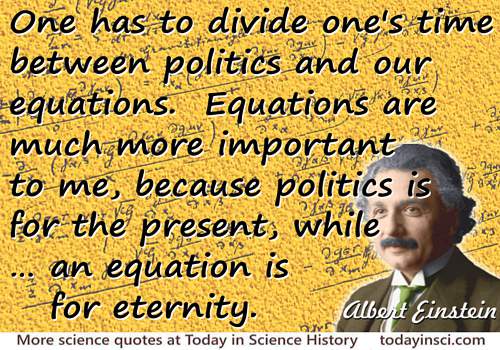
One has to divide one’s time between politics and our equations. But our equations are much more important to me, because politics is for the present, while such an equation is for eternity.
Remark to his assistant, Ernst Straus,(late 1940s) while at Princeton University Institute of Advanced Study. As quoted in Albrecht Fösling and Ewald Osers (trans.), Albert Einstein: A Biography (1997), 725. At the time Einstein was one of the Emergency Committee of Atomic Scientists, concerned with informing the public on the atomic bomb and its effects. (He was its Chairman from May 1946.)
Our national policies will not be revoked or modified, even for scientists. If the dismissal of Jewish scientists means the annihilation of contemporary German science, then we shall do without science for a few years.
Reply to Max Planck (President of the Kaiser Wilhelm Society for the Advancement of Science) when he tried to petition the Fuhrer to stop the dismissal of scientists on political grounds.
Reply to Max Planck (President of the Kaiser Wilhelm Society for the Advancement of Science) when he tried to petition the Fuhrer to stop the dismissal of scientists on political grounds.
In E. Y. Hartshorne, The German Universities and National Socialism (1937), 112.
Parkinson's Law is a purely scientific discovery, inapplicable except in theory to the politics of the day. It is not the business of the botanist to eradicate the weeds. Enough for him if he can tell us just how fast they grow.
Parkinson's Law or the Pursuit of Progress (1958), 15.
People ask, “Is the science going to run ahead of the ethics?” I don't think that’s always the problem. I think it’s that the science runs ahead of the politics. Bioethics can alert people to something coming down the road, but it doesn't mean policy and politicians are going to pay attention. They tend to respond when there’s an immediate crisis. The job of the ethicist, in some ways, is to warn or be prophetic. You can yell loudly, but you can’t necessarily get everybody to leave the cinema, so to speak.
Interview by Karen Pallarito in The Scientist (Jan 2008), supplement, 74.
Politics is a pendulum whose swings between anarchy and tyranny are fueled by perennially rejuvenated illusions.
(1937), in Albert Einstein, the Human Side by Helen Dukas and Banesh Hoffman (1979), 38.
Politics is a science. You can demonstrate that you are right and that others are wrong.
…...
Power politics existed before Machiavelli was ever heard of; it will exist long after his name is only a faint memory. What he did, like Harvey, was to recognize its existence and subject it to scientific study.
The Prince and the Discourses by Niccolò Machiavelli, with an Introduction by Max Lerner (1950), xliii.
Practical politics consists in ignoring facts.
In The Education of Henry Adams: An Autobiography (1906, 1918), 373.
Promoting science isn’t just about providing resources—it’s about protecting free and open inquiry. It’s about ensuring that facts and evidence are never twisted or obscured by politics or ideology. It’s about listening to what our scientists have to say, even when it’s inconvenient—especially when it’s inconvenient.
From weekly Democratic address as President-Elect, online video (20 Dec 2008), announcing his selection of science and technology advisers. C-Span video 282995-102.
Science and politics become the hobby of, and are cherished only by, the elect few; but religion becomes, through education, the property of all, without reference to station, age, and sex.
From an essay, reprinted as 'The Elect People' in Rev. W. Ayerst The Jews of the Nineteenth Century: A Collection of Essays, Reviews and Historical Notices, Originally Published in the “Jewish Intelligence” (1848) 119.
Science can be the basis of an objective criticism of political power because it claims no power itself. Politics can afford the independence of science because science does not attempt to dictate its purposes.
In The Scientific Estate (1965), 191.
Science differs from politics or religion, in precisely this one discipline: we agree in advance to simply reject our own findings when they have been shown to be in error.
…...
Science knows no politics. Are we in this frenzy of [the Depression] economy, brought about by those who control the wealth of this country, seeking to put a barrier on science and research for the paltry sum of $39,113 out of an appropriation of $100,000,000?
Speaking (28 Dec 1932) as a member of the 72nd Congress, early in the Great Depression, in opposition to an attempt to eliminate a small amount from the agricultural appropriation bill. As quoted in 'Mayor-Elect La Guardia on Research', Science (1933), New Series, 78, No. 2031, 510-511. Also in A. Hunter Dupree, under subtitle 'Impact of the Great Depression' in Science in the Federal Government: A History of Policies and Activities to 1940, 344.
Science, history and politics are not suited for discussion except by experts. Others are simply in the position of requiring more information; and, till they have acquired all available information, cannot do anything but accept on authority the opinions of those better qualified.
The Foundations of Mathematics and Other Logical Essays (1931), Epilogue, 287-8.
Scientists constantly get clobbered with the idea that we spent 27 billion dollars on the Apollo programs, and are asked “What more do you want?” We didn't spend it; it was done for political reasons. ... Apollo was a response to the Bay of Pigs fiasco and to the successful orbital flight of Yuri Gagarin. President Kennedy's objective was not to find out the origin of the moon by the end of the decade; rather it was to put a man on the moon and bring him back, and we did that.
Quoted by Dennis Meredith, in 'Carl Sagan's Cosmic Connection and Extraterrestrial Life-Wish', Science Digest (Jun 1979), 85, 38 & 89. Reproduced in Carl Sagan and Tom Head, Conversations With Sagan (2006), 55-56.
Such an atmosphere is un-American, the most un-American thing we have to contend with today. It is the climate of a totalitarian country in which scientists are expected to change their theories to match changes in the police state's propaganda line.
[Stinging rebuke of J. Parnell Thomas, Chairman, House Committee on Un-American activities, who had attacked Dr. Condon (1 Mar 1948) as a weak link in American atomic security.]
[Stinging rebuke of J. Parnell Thomas, Chairman, House Committee on Un-American activities, who had attacked Dr. Condon (1 Mar 1948) as a weak link in American atomic security.]
Opening address (13 Sep 1953) at the annual meeting of the American Association for the Advancement of Science where Condon would be elected as the new AAAS president. Obituary, New York Times (27 Mar 1974), 46.
The advance from the simple to the complex, through a process of successive differentiations, is seen alike in the earliest changes of the Universe to which we can reason our way back, and in the earliest changes which we can inductively establish; it is seen in the geologic and climatic evolution of the Earth; it is seen in the unfolding of every single organism on its surface, and in the multiplication of kinds of organisms; it is seen in the evolution of Humanity, whether contemplated in the civilized individual, or in the aggregate of races; it is seen in the evolution of Society in respect alike of its political, its religious, and its economical organization; and it is seen in the evolution of all those endless concrete and abstract products of human activity which constitute the environment of our daily life. From the remotest past which Science can fathom, up to the novelties of yesterday, that in which Progress essentially consists, is the transformation of the homogeneous into the heterogeneous.
Progress: Its Law and Cause (1857), 35.
The art of those who govern…, consists above all in the science of employing words.
From the original French, “L’art des gouvernants…, consiste surtout a savoir manier les mots,” in Psychologie des Foules (1895), 95. English text in The Crowd: A Study of the Popular Mind (1897), Book 2. Chap. 2, 101.
The Catholic Church excommunicated Copernicans, the Communist Party persecuted Mendelians on the ground that their doctrines were pseudoscientific. The demarcation between science and pseudoscience is not merely a problem of armchair philosophy: it is of vital social and political relevance.
In Radio Lecture (30 Jun 1973) broadcast by the Open University, collected in Imre Lakatos, John Worrall (ed.) and Gregory Currie (ed.), 'Introduction: Science and Pseudoscience', The Methodology of Scientific Research Programmes (1978, 1980), Vol. 1, 1.
The difference between science and Congress is that in science facts mean everything and the illusions mean nothing. And in politics, it’s just the opposite.
Seen attributed on the NPR website to perhaps congressman Rush Holt (Verification pending). Also seen recalled by NPR’s Ira Flatow as: “I think it was Rush Holt who was quoted when he got into Congress, his saying, when I was a scientist, facts meant everything and illusions meant nothing. When I became a politician, illusions meant everything and facts meant nothing.” From program transcript for Science Friday (11 May 2012).
The gentleman [Mr. Taber] from New York says [agricultural research] is all foolish. Yes; it was foolish when Burbank was experimenting with wild cactus. It was foolish when the Wright boys went down to Kitty Hawk and had a contraption there that they were going to fly like birds. It was foolish when Robert Fulton tried to put a boiler into a sail boat and steam it up the Hudson. It was foolish when one of my ancestors thought the world was round and discovered this country so that the gentleman from New York could become a Congressman. (Laughter.) ... Do not seek to stop progress; do not seek to put the hand of politics on these scientific men who are doing a great work. As the gentleman from Texas points out, it is not the discharge of these particular employees that is at stake, it is all the work of investigation, of research, of experimentation that has been going on for years that will be stopped and lost.
Speaking (28 Dec 1932) as a member of the 72nd Congress, early in the Great Depression, in opposition to an attempt to eliminate a small amount from the agricultural appropriation bill. As quoted in 'Mayor-Elect La Guardia on Research', Science (1933), New Series, 78, No. 2031, 511.
The great object, in trying to understand history, political, religious, literary, or scientific, is to get behind men, and to grasp ideas.
In Letters of Lord Acton to Mary Gladstone (1904), 99.
The Highways of America are built chiefly of politics, whereas the proper material is crushed rock or concrete.
From Letter (24 Sep 1912) to his friend, the publisher Elbert Hubbard. In Jane Watts Fisher, Fabulous Hoosier: A Story of American Achievement (1947), 79.
The laws expressing the relations between energy and matter are, however, not solely of importance in pure science. They necessarily come first in order ... in the whole record of human experience, and they control, in the last resort, the rise or fall of political systems, the freedom or bondage of nations, the movements of commerce and industry, the origin of wealth and poverty, and the general physical welfare of the race.
In Matter and Energy (1912), 10-11.
The masses have never thirsted after truth. Whoever can supply them with illusions is easily their master; whoever attempts to destroy their illusions is always their victim.
From Psychologie des Foules (1895), 98. English text in The Crowd: A Study of the Popular Mind (1897), Book 2, Chap. 2, 105. The original French text is, “Les foules n’ont jamais eu soif de vérités. Devant les évidences qui leur déplaisent, elles se detournent, preferant déifier l’erreur, si l’erreur les séduit. Qui sait les illusionner est aisément leur maître; qui tente de les désillusionner est toujours leur victime.”
The more I study the things of the mind the more mathematical I find them. In them as in mathematics it is a question of quantities; they must be treated with precision. I have never had more satisfaction than in proving this in the realms of art, politics and history.
Notes made after the completion of the third chapter of Vol. 3 of La Rivolution, 22 April 1883. In E. Sparvel-Bayly (trans.), Life and Letters of H. Taine (1902-1908), Vol. 3, 239.
The new mathematics is a sort of supplement to language, affording a means of thought about form and quantity and a means of expression, more exact, compact, and ready than ordinary language. The great body of physical science, a great deal of the essential facts of financial science, and endless social and political problems are only accessible and only thinkable to those who have had a sound training in mathematical analysis, and the time may not be very remote when it will be understood that for complete initiation as an efficient citizen of the great complex world-wide States that are now developing, it is as necessary to be able to compute, to think in averages and maxima and minima, as it is now to be able to read and write.
Mankind in the Making (1903), 204. This is seen in a shorter form, somewhat misquoted in a paraphrase as: “Statistical thinking will one day be as necessary for efficient citizenship as the ability to read and write.” However, note that in fact, Wells refers only to “mathematical analysis” such as “averages and maxima and minima” — and did not specify (more complex) “statistics” at all! For citation of the paraphrase, see Samuel Wilks Quotations on this site.
The plain message physical science has for the world at large is this, that were our political and social and moral devices only as well contrived to their ends as a linotype machine, an antiseptic operating plant, or an electric tram-car, there need now at the present moment be no appreciable toil in the world.
A Modern Utopia (1904, 2006), 49.
The politician … is sometimes tempted to encroach on the normal territory of the scientific estate. Sometimes he interferes directly with the scientist’s pursuit of basic science; but he is more likely to interfere when the scientist proposes to publish findings that upset the established political or economic order, or when he joins with the engineering or medical profession in proposing to translate the findings of science into new policies. … Who decides when the apparent consensus of scientific opinion on the relation of cigarettes to lung cancer is great enough to justify governmental regulatory action, and of what kind? In such issues the problem is less often whether politics will presume to dictate to science than it is how much politics is to be influenced by the new findings of science.
In The Scientific Estate (1965), 201.
The Principle of Uncertainty is a bad name. In science or outside of it we are not uncertain; our knowledge is merely confined, within a certain tolerance. We should call it the Principle of Tolerance. And I propose that name in two senses: First, in the engineering sense, science has progressed, step by step, the most successful enterprise in the ascent of man, because it has understood that the exchange of information between man and nature, and man and man, can only take place with a certain tolerance. But second, I also use the word, passionately, about the real world. All knowledge, all information between human beings, can only be exchanged within a play of tolerance. And that is true whether the exchange is in science, or in literature, or in religion, or in politics, or in any form of thought that aspires to dogma. It’s a major tragedy of my lifetime and yours that scientists were refining, to the most exquisite precision, the Principle of Tolerance, and turning their backs on the fact that all around them, tolerance was crashing to the ground beyond repair. The Principle of Uncertainty or, in my phrase, the Principle of Tolerance, fixed once for all the realization that all knowledge is limited. It is an irony of history that at the very time when this was being worked out there should rise, under Hitler in Germany and other tyrants elsewhere, a counter-conception: a principle of monstrous certainty. When the future looks back on the 1930s it will think of them as a crucial confrontation of culture as I have been expounding it, the ascent of man, against the throwback to the despots’ belief that they have absolute certainty. It is said that science will dehumanize people and turn them into numbers. That is false: tragically false. Look for yourself. This is the concentration camp and crematorium at Auschwitz. This is where people were turned into numbers. Into this pond were flushed the ashes of four million people. And that was not done by gas. It was done by arrogance. It was done by dogma. It was done by ignorance. When people believe that they have absolute knowledge, with no test in reality this is how they behave. This is what men do when they aspire to the knowledge of gods. Science is a very human form of knowledge. We are always at the brink of the known; we always feel forward for what is to be hoped. Every judgment in science stands on the edge of error, and is personal. Science is a tribute to what we can know although we are fallible. In the end, the words were said by Oliver Cromwell: “I beseech you, in the bowels of Christ: Think it possible you may be mistaken.” We have to cure ourselves of the itch for absolute knowledge and power. We have to close the distance between the push-button order and the human act. We have to touch people. [Referring to Heisenberg’s Uncertainty Principle.]
'Knowledge or Certainty,' episode 11, The Ascent of Man (1972), BBC TV series.
/AdamsJohn(1735-1826)-Study500x250px.jpg)
The science of government is my duty. … I must study politics and war that my sons may have liberty to study mathematics and philosophy. My sons ought to study mathematics and philosophy, geography, natural history, naval architecture, navigation, commerce, and agriculture, in order to give their children a right to study painting, poetry, music, architecture, statuary, tapestry, and porcelain.
Letter to Abigail Adams, (1780). In John Adams and Charles Francis Adams, Letters of John Adams, Addressed to His Wife (1841), 68.
The scientific enterprise is full of experts on specialist areas but woefully short of people with a unified worldview. This state of affairs can only inhibit progress, and could threaten political and financial support for research.
Commentary, Nature (14 Aug 1997), 619. Quoted in Denis Alexander, Rebuilding the Matrix (2003), 7.
The suppression of uncomfortable ideas may be common in religion or in politics, but it is not the path to knowledge; it has no in the endeavor of science. We do not know in advance who will discover fundamental insights.
In Cosmos (1985), 74.
The traditional boundaries between various fields of science are rapidly disappearing and what is more important science does not know any national borders. The scientists of the world are forming an invisible network with a very free flow of scientific information - a freedom accepted by the countries of the world irrespective of political systems or religions. ... Great care must be taken that the scientific network is utilized only for scientific purposes - if it gets involved in political questions it loses its special status and utility as a nonpolitical force for development.
Banquet speech accepting Nobel Prize in Physiology or Medicine (10 Dec 1982). In Wilhelm Odelberg (editor) Les Prix Nobel. The Nobel Prizes 1982 (1983)
The two poles of social and political philosophy seem necessarily to be organization or anarchy; man’s intellect or the forces of nature.
In Mont-Saint-Michel and Chartres (1913), 344.
The United States is the most powerful technically advanced country in the world to-day. Its influence on the shaping of international relations is absolutely incalculable. But America is a large country and its people have so far not shown much interest in great international problems, among which the problem of disarmament occupies first place today. This must be changed, if only in the essential interests of the Americans. The last war has shown that there are no longer any barriers between the continents and that the destinies of all countries are closely interwoven. The people of this country must realize that they have a great responsibility in the sphere of international politics. The part of passive spectator is unworthy of this country and is bound in the end to lead to disaster all round.
…...
The war on drugs must be a metaphorical war. But that … has to do with our stubborn determination not to come to grips with what a drug is: … our refusal to recognize that the term “drug” is not only a medical but also a political concept. … In short, while seemingly the word “drug” is a part of the vocabulary of science, it is even more importantly a part of the vocabulary of politics. … A drug is either good or bad, effective or ineffective, therapeutic or noxious, licit or illicit. … We deploy them simultaneously as technical tools in our fight against medical diseases and as scapegoats in our struggle for personal security and political stability.
From 'The Morality of Drug Controls', collected in Ronald Hamowy (ed.), Dealing with Drugs: Consequences of Government Control (1987), 328.
The whole aim of practical politics is to keep the populace alarmed (and hence clamorous to be led to safety) by menacing it with an endless series of hobgoblins, all of them imaginary.
Essay, 'The Smart Set' (Dec 1921), 29. As cited in A Mencken Chrestomathy (1949, 2012), p. 29 (1949).

The whole apparatus of using loyalty-security hearings for working off personal political spite has been firmly established as a part of our “way of life” and I do not see anything happening yet to loosen the hold of this machinery on us.
In letter to Linus Pauling (8 Sep 1955). Cited on Oregon State University Library web site.
The world has changed far more in the past 100 years than in any other century in history. The reason is not political or economic but technological—technologies that flowed directly from advances in basic science. Clearly, no scientist better represents those advances than Albert Einstein: TIME’s Person of the Century.
'A Brief History of Relativity'. Time (31 Dec 1999).
There are seven sins in the world: wealth without work, pleasure without conscience, knowledge without character, commerce without morality, science without humanity, worship without sacrifice, and politics without principle.
Respectfully Quoted: A Dictionary of Quotations (1989), 319.
There is a cult of ignorance in the United States, and there has always been. The strain of anti-intellectualism has been a constant thread winding its way through our political and cultural life, nurtured by the false notion that democracy means that “my ignorance is just as good as your knowledge.”
In 'A Cult of Ignorance', Newsweek (21 Jan 1980), 19. As cited in Igor Ž. Žagar and Polona Kelava, From Formal to Non-Formal: Education, Learning and Knowledge (2014), 74.
There must be no barriers to freedom of inquiry. There is no place for dogma in science. The scientist is free, and must be free to ask any question, to doubt any assertion, to seek for any evidence, to correct any errors. ... Our political life is also predicated on openness. We know that the only way to avoid error is to detect it and that the only way to detect it is to be free to inquire. And we know that as long as men are free to ask what they must, free to say what they think, free to think what they will, freedom can never be lost, and science can never regress.
Life (10 Oct 1949), 136.
To find fault with our ancestors for not having annual parliaments, universal suffrage, and vote by ballot, would be like quarrelling with the Greeks and Romans for not using steam navigation, when we know it is so safe and expeditious; which would be, in short, simply finding fault with the third century before Christ for not being the eighteenth century after. It was necessary that many other things should be thought and done, before, according to the laws of human affairs, it was possible that steam navigation should be thought of. Human nature must proceed step by step, in politics as well as in physics.
The Spirit of the Age (1831). Ed. Frederick A. von Hayek (1942), 48.
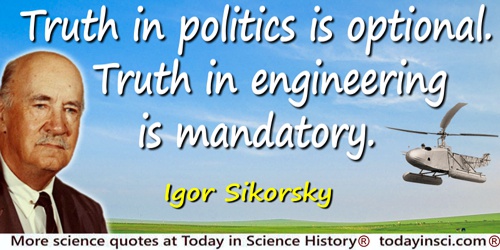
Truth in politics is optional — Truth in engineering is mandatory.
From 'Igor Sikorsky the Aviation Pioneer Speaks', Igor I. Sikorsky Historical Archives, sikorskyarchives.com.
University politics are vicious precisely because the stakes are so small.
Kissinger’s wording of an old academic saw. Variations of the same idea have been expressed by several other people. In Ralph Keyes, The Quote Verifier (2006), 1, Wallace Sayre is named as having been most prominent, with Sayre’s Law, “In any dispute the intensity of feeling is inversely proportional to the value of the stakes at issue—that is why academic politics are so bitter.”
University politics make me long for the simplicity of the Middle East.
…...
Were I to make the announcement and to run, the reasons I would run is because I have a great belief in this country [America]. … There’s more natural resources than any nation in the world; the greatest education population in the world; the greatest technology of any country in the world; the greatest capacity for innovation in the world; and the greatest political system in the world.
Answer to “Why do you want to be President,” interview with Roger Mudd, CBS TV documentary (12 Oct 1979). In Jim Lehrer and James Lehrer, Tension City: Inside the Presidential Debates (2011), 184.
What I chiefly admired, and thought altogether unaccountable, was the strong disposition I observed in them [the mathematicians of Laputa] towards news and politics; perpetually inquiring into public affairs; giving their judgments in matters of state; and passionately disputing every inch of party opinion. I have indeed observed the same disposition among most of the mathematicians I have known in Europe, although I could never discover the least analogy between the two sciences.
In Gulliver's Travels, Part 8, chap. 2.
When a conjecture inspires new hopes or creates new fears, action is indicated. There is an important asymmetry between hope, which leads to actions that will test its basis, and fear, which leads to restriction of options frequently restricting testing of the basis for the fear. As we know only too well, many of our hopes do not survive their tests. However, fears accumulate untested. Our inventory of untested fears has always made humanity disastrously vulnerable to thought control. While science was independent of politics, its greatest triumph was the reduction of that vulnerability.
Dartmouth College (1994)
When the state is shaken to its foundations by internal or external events, when commerce, industry and all trades shall be at a stand, and perhaps on the brink of ruin; when the property and fortune of all are shaken or changed, and the inhabitants of towns look forward with dread and apprehension to the future, then the agriculturalist holds in his hand the key to the money chest of the rich, and the savings-box of the poor; for political events have not the slightest influence on the natural law, which forces man to take into his system, daily, a certain number of ounces of carbon and nitrogen.
Reflecting on events of 1848.
Reflecting on events of 1848.
Familiar Letters on Chemistry (1851), 3rd edn., 483.
Whether statistics be an art or a science... or a scientific art, we concern ourselves little. It is the basis of social and political dynamics, and affords the only secure ground on which the truth or falsehood of the theories and hypotheses of that complicated science can be brought to the test.
Letters on the Theory of Probabilities (1846), trans. O. G. Downes (1849).
Why do they [Americans] quarrel, why do they hate Negroes, Indians, even Germans, why do they not have science and poetry commensurate with themselves, why are there so many frauds and so much nonsense? I cannot soon give a solution to these questions ... It was clear that in the United States there was a development not of the best, but of the middle and worst sides of European civilization; the notorious general voting, the tendency to politics... all the same as in Europe. A new dawn is not to be seen on this side of the ocean.
The Oil Industry in the North American State of Pennsylvania and in the Caucasus (1877). Translated by H. M. Leicester, from the original in Russian, in 'Mendeleev's Visit to America', Journal of Chemical Education (1957), 34, 333.
Yes, we have to divide up our time like that, between our politics and our equations. But to me our equations are far more important, for politics are only a matter of present concern. A mathematical equation stands forever.
…...
You must simply show the thing so truthfully that it lends strength to people’s awareness of what you might call the politics of the environment. … People do not want to sit in their armchairs and be made to feel that everything is awful and it's all their fault.
Attenborough felt—in the reporter’s narrative words—it would be a misuse of his position to waggle his finger at people and put across film-laden messages. In Justine de Lacy, 'Around the World With Attenborough', New York Times (27 Jan 1985), Sec. 2, 25.
You too can win Nobel Prizes. Study diligently. Respect DNA. Don't smoke. Don't drink. Avoid women and politics. That's my formula.
As given in David Pratt, 'What makes a Nobel laureate?', Los Angeles Times (9 Oct 2013). Cited as the response to telegram of congratulations from Caltech students (Oct 1958) in David Pratt, The Impossible Takes Longer: The 1,000 Wisest Things Ever Said by Nobel Prize Laureates (2007), 10 and 178.
 In science it often happens that scientists say, 'You know that's a really good argument; my position is mistaken,' and then they would actually change their minds and you never hear that old view from them again. They really do it. It doesn't happen as often as it should, because scientists are human and change is sometimes painful. But it happens every day. I cannot recall the last time something like that happened in politics or religion.
(1987) --
In science it often happens that scientists say, 'You know that's a really good argument; my position is mistaken,' and then they would actually change their minds and you never hear that old view from them again. They really do it. It doesn't happen as often as it should, because scientists are human and change is sometimes painful. But it happens every day. I cannot recall the last time something like that happened in politics or religion.
(1987) -- 





