Poison Quotes (48 quotes)
[Alchemists] finde out men so covetous of so much happiness, whom they easily perswade that they shall finde greater Riches in Hydargyrie [mercury], than Nature affords in Gold. Such, whom although they have twice or thrice already been deluded, yet they have still a new Device wherewith to deceive um again; there being no greater Madness…. So that the smells of Coles, Sulphur, Dung, Poyson, and Piss, are to them a greater pleasure than the taste of Honey; till their Farms, Goods, and Patrimonies being wasted, and converted into Ashes and Smoak, when they expect the rewards of their Labours, births of Gold, Youth, and Immortality, after all their Time and Expences; at length, old, ragged, famisht, with the continual use of Quicksilver [mercury] paralytick, onely rich in misery, … a laughing-stock to the people: … compell’d to live in the lowest degree of poverty, and … at length compell’d thereto by Penury, they fall to Ill Courses, as Counterfeiting of Money.
In The Vanity of the Arts and Sciences (1530), translation (1676), 313.
[May Morris (Joan Davis):] You know, I crossed the goldenrod with poison ivy once. What do you think I got? Hay fever and the seven-year itch.
From movie Josette (1938). Writer, James Edward Grant, from play by Paul Frank and Georg Fraser. In Larry Langman and Paul Gold, Comedy Quotes from the Movies (2001), 289. The phrase “seven-year itch” dates back to at least 1845, and was used as a film title in 1955.
[Mercurial medicines] affect the human constitution in a peculiar manner, taking, so to speak, an iron grasp of all its systems, and penetrating even to the bones, by which they not only change the healthy action of its vessels, and general structure, but greatly impair and destroy its energies; so that their abuse is rarely overcome. When the tone of the stomach, intestines, or nervous system generally, has been once injured by this mineral ... it could seldom be restored.
Quoted in Wooster Beach, A Treatise on Anatomy, Physiology, and Health (1848), 177.
[Describing the effects of over-indulgence in wine:]
But most too passive, when the blood runs low
Too weakly indolent to strive with pain,
And bravely by resisting conquer fate,
Try Circe's arts; and in the tempting bowl
Of poisoned nectar sweet oblivion swill.
Struck by the powerful charm, the gloom dissolves
In empty air; Elysium opens round,
A pleasing frenzy buoys the lightened soul,
And sanguine hopes dispel your fleeting care;
And what was difficult, and what was dire,
Yields to your prowess and superior stars:
The happiest you of all that e'er were mad,
Or are, or shall be, could this folly last.
But soon your heaven is gone: a heavier gloom
Shuts o'er your head; and, as the thundering stream,
Swollen o'er its banks with sudden mountain rain,
Sinks from its tumult to a silent brook,
So, when the frantic raptures in your breast
Subside, you languish into mortal man;
You sleep, and waking find yourself undone,
For, prodigal of life, in one rash night
You lavished more than might support three days.
A heavy morning comes; your cares return
With tenfold rage. An anxious stomach well
May be endured; so may the throbbing head;
But such a dim delirium, such a dream,
Involves you; such a dastardly despair
Unmans your soul, as maddening Pentheus felt,
When, baited round Citheron's cruel sides,
He saw two suns, and double Thebes ascend.
But most too passive, when the blood runs low
Too weakly indolent to strive with pain,
And bravely by resisting conquer fate,
Try Circe's arts; and in the tempting bowl
Of poisoned nectar sweet oblivion swill.
Struck by the powerful charm, the gloom dissolves
In empty air; Elysium opens round,
A pleasing frenzy buoys the lightened soul,
And sanguine hopes dispel your fleeting care;
And what was difficult, and what was dire,
Yields to your prowess and superior stars:
The happiest you of all that e'er were mad,
Or are, or shall be, could this folly last.
But soon your heaven is gone: a heavier gloom
Shuts o'er your head; and, as the thundering stream,
Swollen o'er its banks with sudden mountain rain,
Sinks from its tumult to a silent brook,
So, when the frantic raptures in your breast
Subside, you languish into mortal man;
You sleep, and waking find yourself undone,
For, prodigal of life, in one rash night
You lavished more than might support three days.
A heavy morning comes; your cares return
With tenfold rage. An anxious stomach well
May be endured; so may the throbbing head;
But such a dim delirium, such a dream,
Involves you; such a dastardly despair
Unmans your soul, as maddening Pentheus felt,
When, baited round Citheron's cruel sides,
He saw two suns, and double Thebes ascend.
The Art of Preserving Health: a Poem in Four Books (2nd. ed., 1745), Book IV, 108-110.
A barbarous practice, the inconsistency, folly, and injury of which no words can sufficiently describe.
Condemning the use of mercurial medicines.
Condemning the use of mercurial medicines.
Quoted in Wooster Beach, A Treatise on Anatomy, Physiology, and Health (1848), 177.
A study of Disease—of Pestilences methodically prepared and deliberately launched upon man and beast—is certainly being pursued in the laboratories of more than one great country. Blight to destroy crops, Anthrax to slay horses and cattle, Plague to poison not armies but whole districts—such are the lines along which military science is remorselessly advancing.
'Shall We All Commit Suicide?'. Pall Mall (Sep 1924). Reprinted in Thoughts and Adventures (1932), 250.
Alcoholism, the opium habit and tobaccoism are a trio of poison habits which have been weighty handicaps to human progress during the last three centuries. In the United States, the subtle spell of opium has been broken by restrictive legislation; the grip of the rum demon has been loosened by the Prohibition Amendment to the Constitution, but the tobacco habit still maintains its strangle-hold and more than one hundred million victims of tobaccoism daily burn incense to the smoke god.
In Tobaccoism: or, How Tobacco Kills (1922), Preface, 7.
All disease, at some period or other of its course, is more or less a reparative process, not necessarily accompanied with suffering: an effort of nature to remedy a process of poisoning or of decay, which has taken place weeks, months, sometimes years beforehand, unnoticed.
In Notes on Nursing: What It Is and What It Is Not (1859), 5.
All substances are poisonous, there is none that is not a poison; the right dose differentiates a poison from a remedy.
In Robert Allan Weinberg, The Biology of Cancer (2006), 725.
BELLADONNA, n. In Italian a beautiful lady; in English a deadly poison. A striking example of the essential identity of the two tongues.
The Collected Works of Ambrose Bierce (1911), Vol. 7, The Devil's Dictionary, 36.
Chlorine is a deadly poison gas employed on European battlefields in World War I. Sodium is a corrosive metal which burns upon contact with water. Together they make a placid and unpoisonous material, table salt. Why each of these substances has the properties it does is a subject called chemistry.
In Broca's Brain: The Romance of Science (1979), 18, footnote.
During this [book preparation] time attacks have not been wanting—we must always be prepared for them. If they grow out of a scientific soil, they cannot but be useful, by laying bare weak points and stimulating to their correction; but if they proceed from that soil, from which the lilies of innocence and the palms of conciliation should spring up, where, however, nothing but the marsh-trefoil of credulity and the poisonous water-hemlock of calumniation grow, they deserve no attention.
From Carl Vogt and James Hunt (ed.), Lectures on Man: His Place in Creation, and in the History of the Earth (1861), Author's Preface, 2-3.
Even bees, the little alms-men of spring bowers,
Know there is richest juice in poison-flowers.
Know there is richest juice in poison-flowers.
From poem, 'Isabella', collected in The Poetical Works of John Keats (1885), 186.
Ever since we arrived on this planet as a species, we’ve cut them down, dug them up, burnt them and poisoned them. Today we’re doing so on a greater scale than ever.
As quoted in Jack Shepherd, "David Attenborough: 15 of the naturalist’s best quotes: In celebration of his 94th birthday", Independent (8 May 2017), on independent.co.uk website.
Everything is poisonous, nothing is poisonous, it is all a matter of dose.
In Pathologie expérimenta1e (1872), 72. From the original French, “Tout est poison, rien n’est poison, tout est une question de dose.”
Gentlemen and ladies, this is ordinary alcohol, sometimes called ethanol; it is found in all fermented beverages. As you well know, it is considered by many to be poisonous, a belief in which I do not concur. If we subtract from it one CH2-group we arrive at this colorless liquid, which you see in this bottle. It is sometimes called methanol or wood alcohol. It is certainly more toxic than the ethanol we have just seen. Its formula is CH3OH. If, from this, we subtract the CH2-group, we arrive at a third colorless liquid, the final member of this homologous series. This compound is hydrogen hydroxide, best known as water. It is the most poisonous of all.
In Ralph Oesper, The Human Side of Scientists (1975), 189.
He, who for an ordinary cause, resigns the fate of his patient to mercury, is a vile enemy to the sick; and, if he is tolerably popular, will, in one successful season, have paved the way for the business of life, for he has enough to do, ever afterward, to stop the mercurial breach of the constitutions of his dilapidated patients. He has thrown himself in fearful proximity to death, and has now to fight him at arm's length as long as the patient maintains a miserable existence.
Quoted by William M. Scribner, 'Treatment of Pneumonia and Croup, Once More, Etc,' in The Medical World (1885), 3, 187.
I should regard them [the Elves interested in technical devices] as no more wicked or foolish (but in much the same peril) as Catholics engaged in certain kinds of physical research (e.g. those producing, if only as by-products, poisonous gases and explosives): things not necessarily evil, but which, things being as they are, and the nature and motives of the economic masters who provide all the means for their work being as they are, are pretty certain to serve evil ends. For which they will not necessarily be to blame, even if aware of them.
From Letter draft to Peter Hastings (manager of a Catholic bookshop in Oxford, who wrote about his enthusiasm for Lord of the Rings) (Sep 1954). In Humphrey Carpenter (ed.) assisted by Christopher Tolkien, The Letters of J.R.R. Tolkien (1995, 2014), 190, Letter No. 153.
If you could see what I almost daily see in my practice … persons … in the very last stages of wretched existence, emaciated to a skeleton, with both tables of the skull almost completely perforated in many places, half the nose gone, with rotten jaws, ulerated throats, breaths most pestiferous more intolerable than poisonous upas, limbs racked with the pains of the Inquisition, minds as imbecile as the puling babe, a grievous burden to themselves and a disgusting spectacle to others, you would exclaim as I have often done, 'O! the lamentable want of science that dictates the abuse (use) of that noxious drug calomel!'
[Calomel is the mercury compound, Hg2Cl2.]
[Calomel is the mercury compound, Hg2Cl2.]
Quoted in Wooster Beach, A Treatise on Anatomy, Physiology, and Health (1848), 177.
If you poison the environment, the environment will poison you.
…...
In 1810, the Triumph man-of-war and Phipps schooner received on board several tons of quicksilver, saved from the wreck of a vessel near Cadiz. In consequence of the rolling of the bags the mercury escaped, and the whole of the crews became more or less affected. In the space of three weeks, two hundred men were salivated, two died, and all the animals—cats, dogs, sheep, fowls, a canary bird, nay, even the rats, mice and cockroaches were destroyed.
[The leather bags of mercury had been salvaged and stored without the original wooden cases. Some were stowed in sleeping quarters, and the in same hold as spirit rations.]
[The leather bags of mercury had been salvaged and stored without the original wooden cases. Some were stowed in sleeping quarters, and the in same hold as spirit rations.]
The Edinburgh Medical And Surgical Journal, 6. Quoted in Alva Curtis, A Fair Examination and Criticism of All the Medical Systems in Vogue (1855), 38. For more information on the incident, see John Emsley, The Elements of Murder (2006), 38-9.
In fact, almost everything in this isle [Ireland] confers immunity to poison, and I have seen that folk suffering from snake-bite have drunk water in which scrapings from the leaves of books from Ireland had been steeped, and that this remedy checked the spreading poison and reduced the swelling.
— Bede
In my opinion, the cholera poison only produces its effects through the air when carried by insects, or when the evacuations become dry, and are wafted as a fine dust.
In 'On the Mode of Communication of Cholera', The Edinburgh Medical Journal (Jan 1856), Vol. 1, No. 7, 669.
It is beyond all doubt that during the sixteenth century, and the years immediately preceding and following it, poisoning had been brought to a pitch of perfection which remains unknown to modern chemistry, but which is indisputably proved by history. Italy, the cradle of modern science, was at that time the inventor and mistress of these secrets, many of which are lost. Romancers have made such extravagant use of this fact, that whenever they introduce Italians they make them play the part of assassins and poisoners.
In Catherine De Medici (1842), 274-275.
Nine-tenths of diseases are medicinal diseases.
[Lamenting the diseases resulting from the continued prescribing of harmful medicinal remedies.]
[Lamenting the diseases resulting from the continued prescribing of harmful medicinal remedies.]
Quoted by William M. Scribner, 'Treatment of Pneumonia and Croup, Once More, Etc,' in The Medical World (1885), 3, 187.
Nor can it be supposed that the diversity of chemical structure and process stops at the boundary of the species, and that within that boundary, which has no real finality, rigid uniformity reigns. Such a conception is at variance with any evolutionary conception of the nature and origin of species. The existence of chemical individuality follows of necessity from that of chemical specificity, but we should expect the differences between individuals to be still more subtle and difficult of detection. Indications of their existence are seen, even in man, in the various tints of skin, hair, and eyes, and in the quantitative differences in those portions of the end-products of metabolism which are endogenous and are not affected by diet, such as recent researches have revealed in increasing numbers. Even those idiosyncrasies with regard to drugs and articles of food which are summed up in the proverbial saying that what is one man's meat is another man's poison presumably have a chemical basis.
Inborn Errors of Metabolism: The Croonian Lectures delivered before the Royal College of Physicians of London, in June, 1908 (1909), 2-3.
One or two atoms can convert a fuel to a poison, change a color, render an inedible substance edible, or replace a pungent odor with a fragrant one. That changing a single atom can have such consequences is the wonder of the chemical world.
In Scientific American Library, Molecules (1987), 2.
Only after the last tree has been cut down. Only after the last river has been poisoned. Only after the last fish has been caught. Only then will you find that money cannot be eaten.
— Cree
Cree Indian prophecy. Quoted by the United Nations Director for the Environment at a conference in Geneva. Recalled by a writer in Ann: Zoologische wetenschappen Issues 275-276 (1984), 16.
Poison should be tried out on a frog.
African proverb, Bantu
Poisoning water is an assassination.
Statement to the Twelfth Meeting With the Panel on Science and Technology (28 Jan 1971), printed in Proceedings Before the Committee on Science and Astronautics, U.S. House of Representatives, Ninety-Second Congress, First Session, No. 1, (1971), 326.
Presumptions are of vast importance in medicine, as in law. A man is presumed innocent until he is proved guilty. A medicine—that is, a noxious agent, like a blister, a seton, an emetic, or a cathartic-should always be presumed to be hurtful. It always is directly hurtful; it may sometimes be indirectly beneficial. If this presumption were established, and disease always assumed to be the innocent victim of circumstances, and not punishable by medicines, that is, noxious agents, or poisons, until the contrary was shown, we should not so frequently hear the remark commonly, perhaps erroneously, attributed to Sir Astley Cooper, but often repeated by sensible persons, that, on the whole, more harm than good is done by medication.
From Address to Annual Meeting of Massachusetts Medical Society (30 May 1860), 'Currents and Counter-Currents in Medical Science'. Collected in The Writings of Oliver Wendell Holmes: Medical Essays, 1842-1882 (1891), 202.
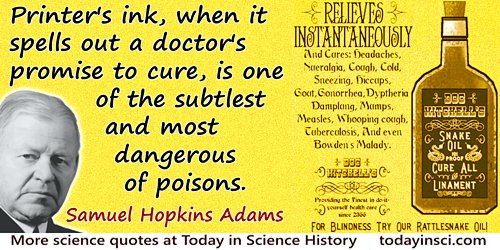
Printer’s ink, when it spells out a doctor’s promise to cure, is one of the subtlest and most dangerous of poisons.
In 'The Sure-Cure School,' Collier’s Weekly (14 Jul 1906). Reprinted in The Great American Fraud (1907), 84.
Satire is a composition of salt and mercury; and it depends upon the different mixture and preparation of those ingredients, that it comes out a noble medicine, or a rank poison.
In Tryon Edwards (ed.), A Dictionary of Thoughts (1908), 502.
Science is dangerous. There is no question but that poison gas, genetic engineering, and nuclear weapons and power stations are terrifying. It may be that civilization is falling apart and the world we know is coming to an end. In that case, why no turn to religion and look forward to the Day of Judgment, ... [being] lifted into eternal bliss ... [and] watching the scoffers and disbelievers writhe forever in torment.
The 'Threat' of Creationism. In Ashley Montagu (ed.), Science and Creationism (1984), 192.
Science is the great antidote to the poison of enthusiasm and superstition.
An Inquiry into the Nature And Causes of the Wealth of Nations (1776, 1801), Vol. 2, 314.
Signor Malipiero … said with good sense, “medicine in the hands of the foolhardy is poison, as poison becomes medicine in the hands of the wise.”
In History of My Life (1997), Vol. 1, 159, as translated from French by Willard R. Trask. Alternate forms include, for example, “In wise hands, poison is medicine; in foolish hands, medicine is poison.” The latter is used as an epigraph in Thomas Szasz, Our Right to Drugs: The Case for a Free Market (1996), 145.
Technology, when misused, poisons air, soil, water and lives. But a world without technology would be prey to something worse: the impersonal ruthlessness of the natural order, in which the health of a species depends on relentless sacrifice of the weak.
Editorial, 'Nature As Demon', (29 Aug 1986), A26.
The American is a gentle guy; but don't pressure him; if you do he turns toad and squirts poison.
The chemists are a strange class of mortals, impelled by an almost insane impulse to seek their pleasures amid smoke and vapour, soot and flame, poisons and poverty; yet among all these evils I seem to live so sweetly that may I die if I were to change places with the Persian king.
Physica subterranea (1667). Quoted in The Chemistry Leaflet (1935), 9, 490, which also comments that it was hanging as an inscription “on the walls of the library of the Chemists’ Club in New York City.”
The men you see waiting in the lobbies of doctors’ offices are, in a vast majority of cases, suffering through poisoning caused by an excess of food.
In Love, Life and Work (), 129.
The realization of the role played by DNA has had absolutely no consequence for either therapy or prevention…. Treatments for cancer remain today what they were before molecular biology was ever thought of: cut it out, burn it out, or poison it.
From review, 'Billions and Billions of Demons', of the book, The Demon-Haunted World: Science as a Candle in the Dark, by Carl Sagan, in New York Review of Books (9 Jan 1997).
The results of science, in the form of mechanism, poison gas, and the yellow press, bid fair to lead to the total downfall of our civilization.
In Conway Memorial Lecture (24 Mar 1922) at South Place Institute, published as Free Thought and Official Propaganda (1922), 55.
The vacuum-apparatus requires that its manipulators constantly handle considerable amounts of mercury. Mercury is a strong poison, particularly dangerous because of its liquid form and noticeable volatility even at room temperature. Its poisonous character has been rather lost sight of during the present generation. My co-workers and myself found from personal experience-confirmed on many sides when published—that protracted stay in an atmosphere charged with only 1/100 of the amount of mercury required for its saturation, sufficed to induce chronic mercury poisoning. This first reveals itself as an affection of the nerves, causing headaches, numbness, mental lassitude, depression, and loss of memory; such are very disturbing to one engaged in intellectual occupations.
Hydrides of Boron and Silicon (1933), 203.
These insecticides are not selective poisons; they do not single out the one species of which we desire to be rid. … Scientific observers at Sheldon described the symptoms of a meadowlark found near death: “Although it lacked muscular coordination and could not fly or stand, it continued to beat its wings and clutch with its toes while lying on its side. Its beak was held open and breathing was labored.”
In 'Needless Havoc', Silent Spring (1962), 99. [Note: Summarizing Carson (pp 92-93), for several years from 1954, Sheldon, in eastern Illinois, was subjected to extensive spraying of dieldrin (50 times more poisonous than DDT) by the Agriculture Departments of the U.S. and Illinois, to attempt to eradicate the Japanese beetle along the line of its invasive advance into Illinois. The dieldrin used was roughly equivalent to 150 pounds of DDT per acre. —Webmaster]
Things stand apart so far and differ, that
What’s food for one is poison for another.
What’s food for one is poison for another.
On the Nature of Things, trans. Authony M. Esolen (1995), Book 4, lines 634-5, 31.
This [cyanide] poison is for professors of chemistry only. You, as a professor of mechanics, will have to use the rope.
Said during the Nazi occupation of Norway.
Said during the Nazi occupation of Norway.
Quoted in Kaufman, Industrial Chemist and Chemical Manufacturer, Jan 1988.
We starve the rats, creosote the ticks, swat the flies, step on the cockroaches and poison the scales. Yet when these pests appear in human form we go paralytic.
Why Become Extinct? Authors with varying competence have suggested that dinosaurs disappeared because the climate deteriorated (became suddenly or slowly too hot or cold or dry or wet), or that the diet did (with too much food or not enough of such substances as fern oil; from poisons in water or plants or ingested minerals; by bankruptcy of calcium or other necessary elements). Other writers have put the blame on disease, parasites, wars, anatomical or metabolic disorders (slipped vertebral discs, malfunction or imbalance of hormone and endocrine systems, dwindling brain and consequent stupidity, heat sterilization, effects of being warm-blooded in the Mesozoic world), racial old age, evolutionary drift into senescent overspecialization, changes in the pressure or composition of the atmosphere, poison gases, volcanic dust, excessive oxygen from plants, meteorites, comets, gene pool drainage by little mammalian egg-eaters, overkill capacity by predators, fluctuation of gravitational constants, development of psychotic suicidal factors, entropy, cosmic radiation, shift of Earth’s rotational poles, floods, continental drift, extraction of the moon from the Pacific Basin, draining of swamp and lake environments, sunspots, God’s will, mountain building, raids by little green hunters in flying saucers, lack of standing room in Noah’s Ark, and palaeoweltschmerz.
'Riddles of the Terrible Lizards', American Scientist (1964) 52, 231.
 In science it often happens that scientists say, 'You know that's a really good argument; my position is mistaken,' and then they would actually change their minds and you never hear that old view from them again. They really do it. It doesn't happen as often as it should, because scientists are human and change is sometimes painful. But it happens every day. I cannot recall the last time something like that happened in politics or religion.
(1987) --
In science it often happens that scientists say, 'You know that's a really good argument; my position is mistaken,' and then they would actually change their minds and you never hear that old view from them again. They really do it. It doesn't happen as often as it should, because scientists are human and change is sometimes painful. But it happens every day. I cannot recall the last time something like that happened in politics or religion.
(1987) -- 




